Proven Solutions for your Pulp and Paper Applications

Store, reclaim, convey and feed biomass and alternative fuels directly into boilers and kilns.
Chip Thickness Screening
Chip screening, air density separation and overthick chip conditioning or sizing for digester optimization.
Biomass Material Handling
Support for biomass energy generation from truck/rail receiving through metered infeed into the boiler.
and secondary crushing as well as multiple feeder options to process wood and biomass.
PULP PAPER &

Supply of both softwood and hardwood pulps will outstrip global demand in the next few years, leading to some
A $30-million commercial-scale lignin recovery plant in Alberta has begun production of lignin to be used as a natural adhesive in engineered wood products.
Metsa Fibre and its suppliers made RFID work for bales of pulp, and now the rest of the industry could use the same
Micro-fibrillated cellulose as a filler for paper; cellulose nanofibrils for paper; lignin oil as a biofuel.
Wow, just wow!
Afew weeks ago, I received my Canadian Tire “Wow Guide” in the mail. You’ve probably seen it too; the 200-page catalogue was delivered to 12 million households in Canada. While the fact that a retailer has chosen to print and mail a large catalogue to almost every household in Canada is good news for our industry on the surface, it’s also good news in more subtle ways. The deeper message is that Canadian Tire is using paper and snail mail to draw people in to its digital marketing tools.
The Wow Guide is a traditional, printed catalogue, but it is also “an interactive catalogue for use in conjunction with the Canadian Tire app on customers’ mobile phones or tablets,” according to an article on financialpost.com on April 14. The printed photos in the Wow Guide are the key to a vast array of digital information.

Cindy Macdonald Editor
“We are not investing in paper,” Canadian Tire president Allan MacDonald told the Financial Post. “We are investing in a promotional tool for our digital catalogue.”
MacDonald went on to say a digital catalogue has high potential for delivering information, but lacks the consumer reach of a traditional paper catalogue.
Wow. That’s worth repeating: a digital catalogue lacks the consumer reach of a traditional paper catalogue.
Canadian Tire has spent $400 million to be a leader in digital retailing, and it intends to produce another printed catalogue in the fall.
Another bit of surprising news surfaced in late April, when Chinese papermaker Sun Paper announced that it will build a new greenfield pulp mill in North America. Unfortunately for Canadians, it is being built in the southern U.S.
What irks me is the list of incentives that were offered to Sun Paper to secure the billion-dollar project. The incentives are particularly galling in light of the import duties on supercalendered paper from Canada, which were based on an assumption of government subsidies for Canadian producers (see page 5 for an update on that situation).
This is the list of incentives offered Sun Paper, according to an article on BusinessInsider.com on April 26 (in U.S. dollars): “The project is receiving $10 million in local incentives for infrastructure at the site and another $92 million in local property tax abatement. The state is providing $12.5 million for site preparation and equipment, up to $3 million workforce training funds and a $50 million fully collateralized loan. Other state incentives include cash rebates based on its payroll, sales tax refunds on construction materials and a recycling tax credit.”
The state government has also agreed to expedite the process for approving the air and wastewater permits for the project.
Up to $117.5 million U.S. dollars in incentives and waived taxes. Just, wow. PPC
Editor
CINDY MACDONALD
905-713-4338 cindy@pulpandpapercanada.com
National Accounts Manager LAURA GOODWIN 289-928-8543 lgoodwin@annexweb.com
President and CEO
ANNEX BUSINESS MEDIA
MIKE FREDERICKS
Group Publisher/Director of Content and Engagement
SCOTT JAMIESON
519-429-5180 sjamieson@annexweb.co
PRODUCTION
Media Designer EMILY SUN esun@annexweb.com
News and Press Releases media@pulpandpapercanada.com
Account Coordinator
TRACEY HANSON thanson@annexbizmedia.com
Circulation Manager BEATA OLECHNOWICZ bolechnowicz@annexbizmedia.com
PULP & PAPER CANADA (ISSN 0316-4004) is published by Annex Business Media 105 Donly Drive South, Simcoe, ON, N3Y 4N5
CIRCULATION
email: mchana@annexbizmedia.com Tel: 416-442-5600 ext 3539 Fax: 416-510-5170
Mail: 80 Valleybrook Drive, Toronto, ON M3B 2S9
SUBSCRIPTION RATES
Canada $55.00 per year; $88.00 for 2 years. Outside Canada (US) US$101.95 per year; (foreign) US$110.00.
From time to time, we make our subscription list available to select companies and organizations whose product or service may interest you. If you prefer not to receive this information, please contact our circulation department in any of the four ways listed above.
Annex Privacy Officer privacy@annexbizmedia.com Tel: 800-668-2374
The editors have made every reasonable effort to provide accurate and authoritative information but they assume no liability for the accuracy or completeness of the text or its fitness for any particular purpose.
No part of the editorial content of this publication may be reprinted without the publisher’s written permission. ©2015 Annex Publishing & Printing Inc. All rights reserved.
Publications Mail Agreement No. 40065710
Print edition ISSN 0316-4004 On-line edition ISSN 1923-3515
Sustaining member, Pulp and Paper Technical Association of Canada; Member, Alliance for Audited Media.


“We acknowledge the [financial] support of the Government of Canada.”

Irving almost ready to start new digester
Phase two of the Irving Pulp & Paper Mill Modernization project in Saint John, N.B., is about 95 per cent complete, the company reported in mid-March. The new digester equipment and technology was on schedule for commissioning and start-up over the next few weeks.
The digester project is part of a $450-million modernization – the largest pulp mill investment in Canada since 1993. Engineering and some civil work has started on phase three of the modernization project, a $250-million pulp dryer installation that is expected to provide an estimated 600,000 person hours of work over 30 months.
Parent company J.D. Irving has awarded more than $90 million in contracts to 166 New Brunswick companies since the beginning of the modernization in 2014.
The current Phase 2 of the modernization has created about 450 direct and indirect construction jobs at the pulp mill site in Saint John.
Northern Pulp fined $225,000 for effluent leak
An effluent lead in June 2014 has led to a fine of $225,000 for Northern Pulp Nova Scotia, according to CBC News. The pulp mill pleaded guilty to a charge under the federal Fisheries Act.
The mill experienced a rupture in a large pipe carrying effluent from the mill to treatment lagoons. The CBC article estimates the spill was 47 million litres of effluent.
Worker dies in chip pile accident at Harmac Pacific
An employee at the Harmac Pacific pulp mill, near Nanaimo, B.C., died in an industrial accident on Mar. 25. A local news site, the Times Colonist, says that Chris Fletcher, 37, was killed when the chip pile he was standing on collapsed.
The mill is owned by Nanaimo Forest Products. Company president Levi Sampson told the newspaper, “We’ve got extremely heavy hearts right now at Harmac.”
Sampson said Fletcher’s job required him to drive a bulldozer to the top of a wood chip pile.
“All we know right now is that he was at the top of one of the chip piles and he got out of the vehicle,” Sampson said.
“To the best of our knowledge at this point, it was just a freak accident where a chip pile gave way on him.”
Carter to replace Rippon at West Fraser
West Fraser has announced several executive changes for its North American forest products business.
Most notable for the pulp and paper sector, Keith Carter, currently general manager, pulp operations, has been appointed vice-president, pulp and energy operations, and will assume the responsibilities of Peter Rippon on his retirement. Carter has been with the company since 2000 and has held a variety of maintenance, engineering and general management responsibilities.
Larry Gardner, currently general manager, Canadian woodlands operations, will assume the Canadian woodlands responsibilities of Dave Lehane on his retirement and take the title vice-president, Canadian woodlands. Gardner has been with the company since 1980 in a variety of roles including chief forester and is a registered professional forester.
Canada turns to WTO over SC paper duties
The federal government has taken a trade complaint about the U.S. tariffs on imports of Canadian supercalendered paper to the World Trade Organization.
The Honourable Chrystia Freeland, Minister of International Trade, announced that Canada has filed a request for consultations with the World Trade Organization to challenge U.S. countervailing duties. Consultations are the first step in the WTO dispute settlement mechanism.
The government also challenged the tariff under the rules of NAFTA, in November 2015.
The duties range from 17.87 to 20.18 per cent, and apply to Port Hawkesbury Paper, Irving Paper, Resolute Forest Products, and Catalyst Paper.
According to the federal government, exports of supercalendered paper from Canada to the U.S. were valued at $959 million in 2014.
An article published Mar. 31 by the Reuters news service, said the United States is evaluating the request, but quoted Andrew Bates, spokesman of the Office of the U.S. Trade Representative (USTR), saying: “It is ironic now for Canada to be invoking WTO remedies to address a legitimate U.S. response to massively large Canadian provincial subsidies that caused harm to U.S. companies and workers.”
Bates also told Reuters: “The U.S. Department of Commerce and U.S. International Trade Commission have both determined that Canada has been providing export-related subsidies to their supercalendered paper industry to the detriment of American manufacturers and producers.”
U.S. producer of SC paper closing down
One of the U.S. paper mills that successfully petitioned U.S. officials to have duties applied to supercalendered paper produced in Canada is shutting down. Madison Paper in Maine is scheduled to cease production by the end of May.
Madison Paper Industries is owned by UPM-Kymmene Inc., a Finnish forest products company, and Northern SC Paper Corp., a subsidiary of the New York Times Company.
“Demand for SC papers declined significantly in 2015 and the decline is expected to continue. The Madison mill is not cost-competitive and has lost a significant amount of sales in the recent past,” says Ruud van den Berg, senior vice-president of UPM Paper ENA.
According to the Bangor Daily News site, “union and state officials have attributed the impending closure to steep foreign competition.” But another group representing the mill blamed high natural gas costs.
Madison Paper and Verso Corp. successfully lobbied for the imposition of tariffs on imports of Canadian supercalendered paper last year.
The Bangor Daily News article also notes that Madison and Verso were the only two U.S. producers of supercalendered paper. Facing a substantial debt load after acquiring its larger competitor, NewPage, Verso filed for Chapter 11 bankruptcy protection in January.
IFIT helps new products find new markets
The Investments in Forest Industry Transformation (IFIT) program has partnered with NineSigma to establish and manage an open innovation platform to help newly commercialized products and technologies find new markets and new innovative uses in the global marketplace.
As a result of the presence on NineSigma’s NineSights website, IFIT-supported companies are now beginning to connect with new business opportunities on a wide range of projects from bioenergy and biomaterials, to biochemicals and next-generation building products.
Forest advisory committee recognized by PEFC
A forest certification advisory committee working with the Algonquin Forestry Authority on sustainable forest management within Algonquin Provincial Park in south-central Ontario has been recognized with the Program for the Endorsement of Forest Certification (PEFC) Canada Stewardship Award for their leadership and personal commitment.
“There are many demands placed on public forests that influence how they are managed. These advisory groups help balance these forest values within the context of the Canadian Standards Association (CSA) sustainable forest certification standard,” said John Dunford, Chair of PEFC Canada.
New rules for N.S. biomass plant
Another Canfor veteran joins Catalyst Paper
Catalyst Paper has appointed Sean Curran senior vice-president, sales and marketing. He replaces Jim Bayles, who retired on April 1.
Curran was formerly vice-president, sales and marketing with Canfor, a B.C.-based forest products company. Joe Nemeth, president and CEO of Catalyst Paper, is another Canfor veteran, having led that company’s pulp products segment.
Curran has nearly 30 years of experience in global pulp, paper and energy markets. Catalyst Paper manufactures diverse printing papers and market pulp from five mills across North America.
Quebec’s forests ministry plans workshops, innovation forum
Québec’s Minister of Forests, Wildlife and Parks, Laurent Lessard, has announced a Wood Innovation Forum to be held in Rivière-du-Loup on October 31, 2016. He invited all the players in the forest products industry to attend this unique event.
Between now and the date of the event, the Québec government will set up five major workshop groups tasked with identifying the problems and finding solutions and methods that will help the forest products industry to move forward.
The chair of each workshop will present his/her findings at the Forum.
The Government of Nova Scotia has amended a regulation so that Nova Scotia Power is no longer required to run its bioenergy plant in Point Tupper full-time. According to the CBC, the government has removed the must-run designation originally set upon the plant when it first began producing electricity.
The biomass facility is located next to Port Hawkesbury Paper, and will continue to provide steam for the pulp and paper mill, says the CBC article.
The regulatory change comes in the wake of public discussions in which many participants expressed concern over the use of primary forest products for electricity generation.

Paper bag company fined for worker injury
A fine of $50,000 has been assigned to Bag to Earth Inc./Sac au Sol Inc., which manufactures paper packaging products, after a worker was injured by a paper-bagmaking machine.
According to the Ontario Ministry of Labour, the incident occurred on December 10, 2013. A worker at the company’s facility in Napanee was working as a machine operator, replacing another worker on leave. The worker observed a build-up of glue on the roller assembly of the lamination section of the bag-making machine.
The Ministry explains that the worker was using a metal scraper and a rag to clear the build-up and was wearing cotton gloves at the time. While attempting to scrape off the build-up of glue from one of the rollers, one hand was caught and pulled into the inrunning nip created by two rotating rollers on the machine. The worker was able to activate the emergency pull cord located in the immediate area and stopped the machine. The worker was then able to pull the hand free.
The worker fully recovered and suffered no lasting impairment.
The Ministry of Labour determined that the machine was not guarded as required to prevent worker access to the rollers and in-running nip hazards.
Bag to Earth Inc./Sac au Sol Inc. pleaded guilty to failing as an employer to ensure that the measures and procedures prescribed by law were carried out at a workplace, contrary to the Occupational Health and Safety Act.
New venue, new dates for PaperWeek Canada
PAPTAC has announced a change of venue for the PaperWeek Canada conference and trade show. The event will be held at the Sheraton Centre Montreal.
Next year’s event will also be held a bit later than the traditional early February time slot. Dates for 2017 are Feb. 13-17.
The show floor at PaperWeek Canada 2015, at the Fairmont Queen Elizabeth Hotel.
Cascades exceeds water conservation target
Cascades announced on World Water Day that it has exceeded its 2015 target for reducing the water consumption. The packaging and tissue manufacturer had as an objective to decrease wastewater output of its plants to 10.6 cubic meters of water per tonne of products by the end of the 2013–2015 Sustainable Development Plan.
Several process improvements have enabled the company to exceed this target and reduce its output to 9.9 cubic meters per tonne, which is six times less than the average for the Canadian pulp and paper industry. (The average for the Canadian industry is 65 cubic meters according to the Forest Products Association of Canada, 2013.)
Over the past few years, Cascades’ environment department has worked closely with plants to identify areas for improvement in an effort to reduce water consumption. “Our teams have used their ingenuity to reuse water as much as possible in a closed circuit, thereby minimizing our fresh water usage,” explains Léon Marineau, vicepresident, environment.

B.C. pulp mills asked to reduce power production
B.C Hydro spent $17.5 million last year to not buy power from eight producers of biomass energy in the province, according to a story in the Vancouver Sun.
The independent power producers that were asked to limit production are: PGP Bio Energy Project (Canfor Pulp); Armstrong Wood Waste Co-Gen (Tolko Industries); Powell River Generation (Catalyst Paper); Cariboo Pulp and Paper; Harmac Biomass (Nanaimo Forest Products); Kamloops Green Energy (Domtar Inc.); Howe Sound Green Energy (Howe Sound Pulp and Paper); NWE Williams Lake WW (Atlantic Power Preferred Equity).
According to the Vancouver Sun, Bill Bennett, the minister of energy and mines, said it would have cost B.C. Hydro about $26 million to buy the unneeded power from the biomass projects.
Terrapure buys dredging business in Eastern Canada
Terrapure Environmental has acquired Consolidated Giroux Environment Inc. of Charlo, N.B. The purchase strengthens Terrapure’s services to the mining, refinery, municipal and pulp and paper sectors.
“This acquisition significantly bolsters our capacity to provide onsite dredging services to customers in our key target industry sectors across Canada,” said Todd Smith, vice-president, environmental solutions – onsite at Terrapure.
Terrapure says Giroux is recognized for its high quality and efficient service; specialized equipment; and skilled, experienced operators.
Fourth year of growth for Alberta’s forest products industry
Economic output by Alberta’s forest sector grew in 2015, marking the fourth consecutive year of increases. The forestry sector saw the value of its products rise by five per cent – or $150 million – last year, following growth of eight per cent in 2014, 14 per cent in 2013, and nine per cent in 2012.
Lumber, pulp and paper, and panelboard manufactured by members of the Alberta Forest Products Association (AFPA) in 2015 were valued at approximately $3 billion. The most significant
gains came from pulp and paper, which grew 16 per cent. Panel also had a strong year, with seven per cent growth. Lumber production values declined by five per cent.
The AFPA’s pulp and paper sector production for 2015 was 1.6 million air dried metric tonnes (ADMT) valued at $1.4 billion. Production increased 71,500 ADMT (4.8 per cent) from the same period in 2014, and stronger prices caused values
to rise by $191 million or 15.7 per cent. AFPA members in the pulp and paper sector include: Alberta Newsprint Company; Hinton Pulp (West Fraser); Millar Western Forest Products; Slave Lake Pulp (West Fraser); Weyerhaeuser (Grande Prairie).
Resolute president calls for free trade for lumber
We need to be able to freely sell lumber to the U.S., Richard Garneau told the Canadian Parliament’s Standing Committee on International Trade. The president and CEO of Resolute Forest Products appeared before the committee in Ottawa on April 12.
Garneau challenged the claims by some that the previous 2006 Softwood Lumber Agreement between produced predictability and stability. He made the case that managed trade increased volatility, creating an unpredictable and unstable trade environment between the two large trading partners.
“We need to be able to sell freely to the U.S. Indeed, that was the whole point of the Canada – U.S. Free Trade Agreement and NAFTA. Just about every industry enjoys free trade, except for softwood lumber,” he added.
Cascades has made water use a priority at its tissue and packaging plants.
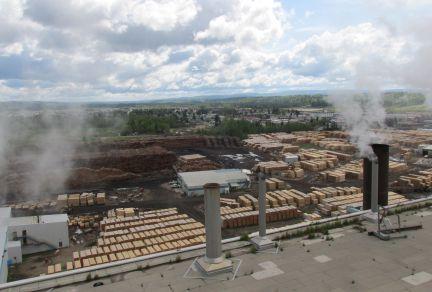
Wood yard at the Millar Western sawmill in Whitecourt, Alta.

Successful Pilot-scale Production of Agricultural Paper Mulch
By Jennifer Ellson, senior communications specialist, fpinnovations
Therecent focus on clean technology has led to an increased demand for renewable and biodegradable mulch products for use in agricultural applications. Agricultural paper mulch has the potential to replace the non-biodegradable plastic films currently dominating the market, provided it can meet some key end-use requirements.
In recent years, FPInnovations has developed strategies that use existing pulp and paper infrastructures to produce wood fibre-based structures with high stretch and a controllable permeability. These strategies were applied to the development of practical and cost-effective

paper mulch prototypes for horticultural and agricultural production.
Some of this work was conducted in collaboration with the Institut de Recherche et de Développement en Agroenvironnement (IRDA) – a Quebec-based research institute focusing on agricultural environmental issues. Thanks to IRDA, we now have a better understanding of end-use requirements for this type of product, and strong support for the various field trials conducted.
Our technology for making highly stretchable paper has been successfully scaled-up to widths suitable to conduct agricultural field trials. Paper mulch rolls of different thicknesses and with various treatments were produced, and have been suc-
cessfully installed on farmland using existing laying equipment, in several locations in Quebec. These first trials have shown that the durability of the paper mulch prototypes varied with geographical location.
“The development of non-traditional paper products, such as mulch, will bring the pulp and paper sector new opportunities with high growth potential,” says FPInnovations’ Rafik Allem, research leader, packaging and consumer products. “We are eager to work with member companies to bring this technology to commercial demonstration,” he adds.
For more information, please contact Rafik Allem at 514-782-4555 or at rafik. allem@fpinnovations.ca. PPC
Forest Products Sector Unveils Greenest Target Ever
By Derek Nighbor, CEO, forest products association of canada
It was only a generation or so ago that some Canadian forest products companies were facing an image problem.
Public opinion polls showed that many Canadians didn’t realize how committed our industry was to our forests’ long-term health. There were also concerns about the industry’s effects on the environment.
But that perception has changed dramatically in recent years – and for good reason.
Our industry developed more environmentally friendly practices, invested in new technology and changed many things about the way we do business. In some cases, the changes also included building new relationships, adopting a new way of thinking and spending more time listening.
It worked. To cite just a few examples, companies developed innovative new ways to use forest residuals to generate clean, green electricity, cut greenhouse gas emissions at pulp and paper mills by 66 per cent
since 1990, and invested heavily in new technology, including bio-products such as cosmetics, clothes, and even car parts.
As a representative of the Canadian forest products sector and somebody with a deep, personal connection to our forests and the critical role they play in supporting communities across the country, I couldn’t be more proud of this evolution.
I’m also very pleased that people took notice of the changes. Canadians now overwhelmingly see our industry as a strong steward of our forests and, according to a recent Leger survey, international customers say our forest products companies have the best environmental reputation in the world.
And now, Canada’s forest products sector is poised to make its greatest green contribution ever.
With the recent launch of our “30 By 30” Climate Change Challenge, Canada’s forest products companies have vowed to cut 30 MT of CO2 by 2030 – more than 13 per cent of the Canadian government’s
entire target of 225 MT.
This is a very ambitious goal that we know we won’t achieve alone. That’s why we have already started working closely with governments and other stakeholders to support new investments in innovation, regulatory changes to encourage taller wood-frame buildings, and even tax changes to encourage next steps.
One of the great things about our sector is that it supports a healthy environment. Among their many attributes, trees are a renewable resource that absorb carbon as they grow.
It won’t be easy but our industry is determined to hit its 30 By 30 goal. We look forward in the coming months to working with others who share our passion for Canada’s forests and to unveiling a detailed road map for achieving our 30 By 30 goals.
In the meantime, we invite all Canadians to do whatever they can to make a difference, or offer comments or suggestions to help us do our part. PPC
By Cindy Macdonald, editor
MARKET PULP: OVERCAPACITY ON THE WAY
Several experts feel that capacity is going to outstrip demand in the next few years
Pulp producers are facing a challenge: new pulp capacity is entering the market more quickly than demand is rising. Expert forecasters are saying the industry should prepare for an overcapacity situation in market pulp, beginning soon and lasting into the 2020s.
During a session on market pulp at PaperWeek Canada in February, three experts offered their forecasts. They concurred that supply is growing faster than demand, and that tissue and toweling
products are the most promising markets for chemical pulp in the near future.
Overcapacity until 2020
Solie Kilpi of Pöyry offered insights from her firm’s recent multi-client study, entitled World Fibre Outlook to 2030
Regarding capacity expansions, Kilpi says since 2000, softwood capacity has shown net growth of about 140,000 t/y. There were many shut downs in 2008 and 2009 that factor into that number. In 2017 and 2018, new softwood pulp lines are planned for both Sweden and Russia.
“There will be ample supply of softwood pulp,” she notes.
In hardwood, capacity expansions generally involve entirely new pulp mills. This sector has recorded growth of about 1.1 million t/y since 2000, and this growth rate is expected to continue thorough to 2018.
Kilpi presents these estimates of new capacity entering the market from 2015 to 2018:
• 1.7 million t of softwood pulp,
• 1.2 million t of fluff pulp,
• 6.4 million t of hardwood pulp.
“So we have an overcapacity situation
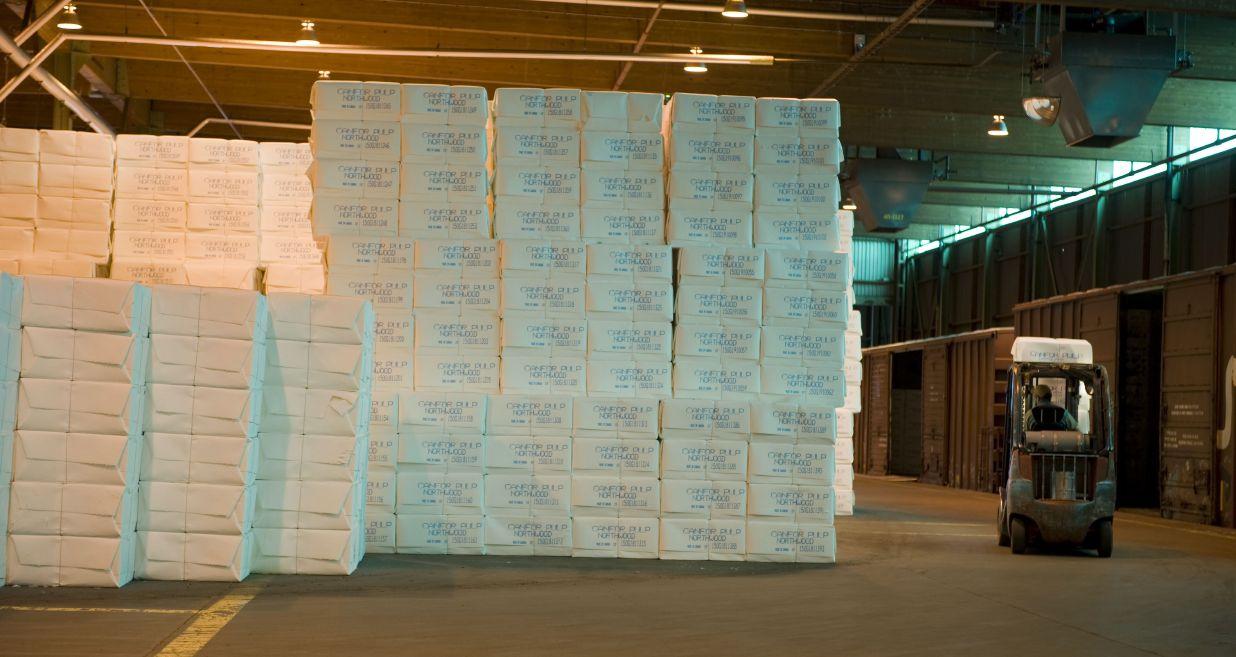
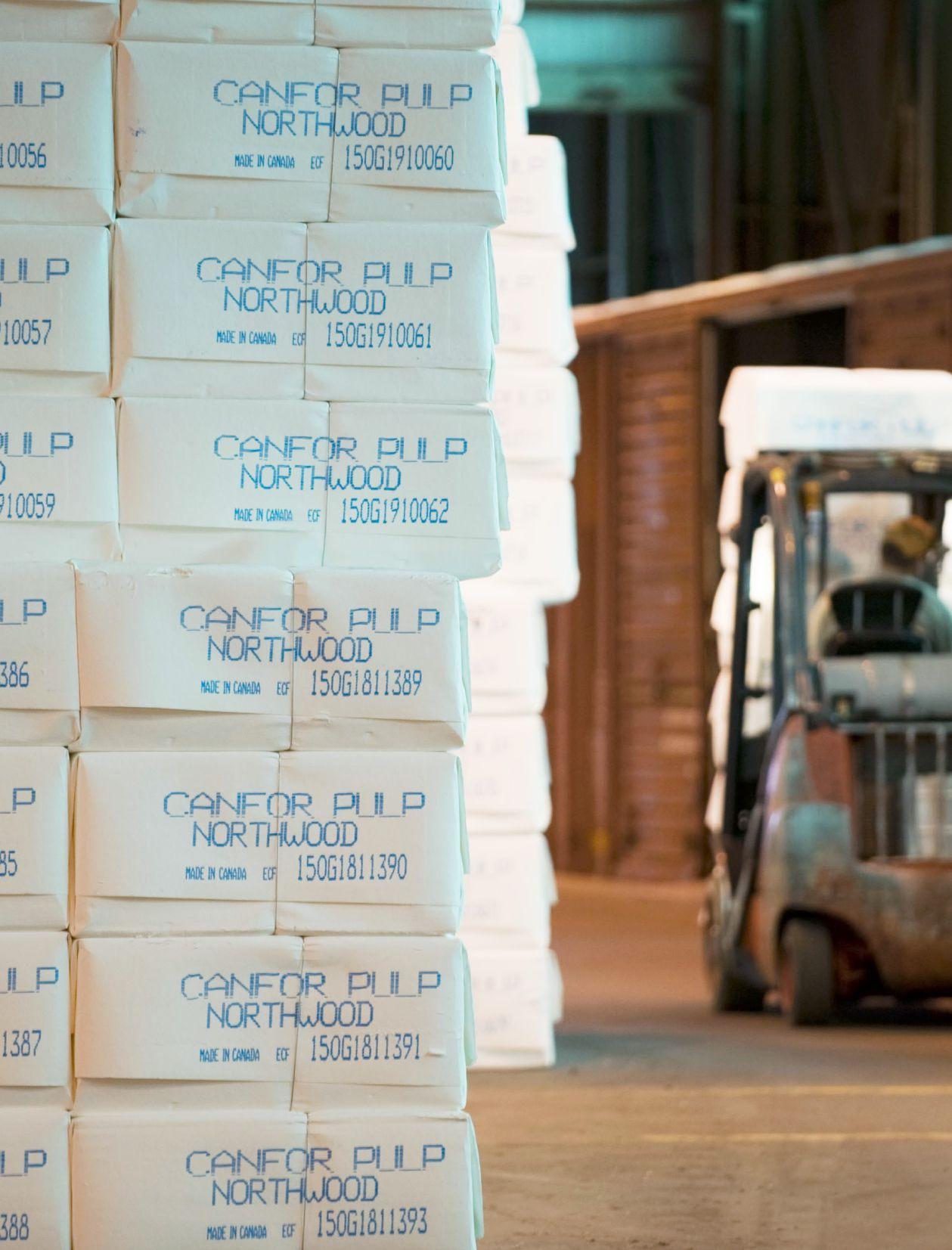
New softwood pulp capacity in Sweden and Russia will affect the global market and could trigger restructuring, according to Kilpi.
Photo courtesy Canfor Pulp.

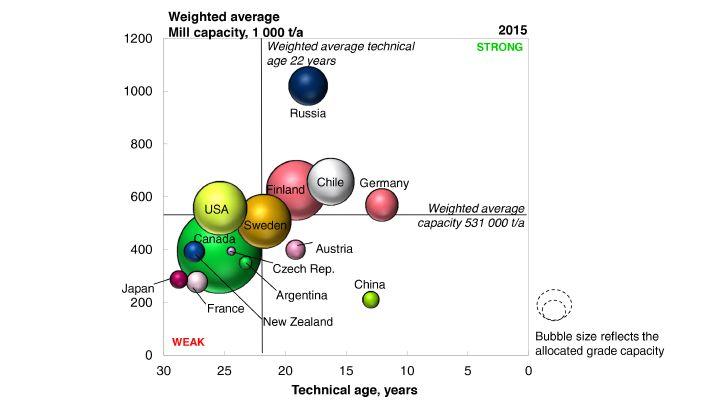
TOP: Announced capacity changes for bleached softwood kraft market pulp, 2000-2018. BOTTOM: This graph of the industry structure shows that the most modern and largest softwood kraft pulp mills are in Germany, Chile, Finland and Russia. Source: Pöyry.
MOODY’S: OUTLOOK STABLE FOR GLOBAL PAPER AND FOREST PRODUCTS
The outlook for the global paper and forest products industry is stable, says Moody’s Investors Service. The ratings agency’s outlook reflects expectations that the consolidated operating income of the 46 paper and forest product companies that Moody’s rates will increase by zero to two per cent over the next 12-18 months.
Similarly, Moody’s expects that the consolidated operating income of the 28 North American companies it rates will remain essentially flat, with zero to two per cent growth over the outlook period. These companies account for about 60 per cent of the global rated industry’s operating income.
Flat to modest operating income growth from paper packaging, pulp, wood products and timberland producers will be offset by lower operating earnings from paper companies.
For market pulp, Moody’s outlook remains stable. The agency predicts operating earnings for most North American producers of market pulp (hardwood, softwood and dissolving pulp) will decline as prices fall because capacity increases outpace demand.
Subscribers can access the report, “Global Paper and Forest Products: Weaker Prices Across Most Grades Will Limit Operating Earnings Growth” at: http://www.moodys.com/viewresearchdoc.aspx?docid=PBC_1015859
into the 2020s,” she concludes.
Those changes – about 9.3 million t/y –are equivalent to the demand growth that would take place over seven to eight years (up to 2022), explains Kilpi. As a consequence, she foresees industry restructuring and the exit of high-cost producers. She also expects declining prices and some producer surplus.
Kilpi predicts average annual demand growth of 1.9 per cent during the 2014 to 2030 period, driven by bleached hardwood and softwood kraft pulp. Current global demand for all market wood pulps is 61 million tonnes; by 2030 it is expected to be 82 million tonnes.
Demand is coming very much from China, says Kilpi. By 2030, China will account for about 40 per cent of global consumption of market pulp. She notes that emerging markets will experience demand growth of 3.2 per cent, while mature markets decline by 0.6 per cent. This pattern of global demand creates an imbalance between where market pulp is made and where it is consumed.
Kilpi predicts that demand for hardwood pulp, particularly eucalyptus pulp, will continue to show dramatic growth. Global demand for hardwood market pulp was 30 million tonnes in 2014, and is expected to grow to 45 million tonnes in 2030. Softwood currently accounts for about 24 million tonnes of global market pulp production.
The supply and demand forecast of Arnaud Franco, analyst with the Pulp and Paper Products Council, echoes that of Kilpi. He notes that global capacity growth for chemical pulp had been about 1.9 per cent per year since 2007. For the 20152019 period, the average annual growth rate is expected to be 3.2 per cent. “This is more than we’ve seen in recent years, but demand is expected to be quite weak.”
The operating rate for global softwood chemical pulp 2010 to 2014 averaged 90 to 95 per cent, but Franco predicts that operating rates by the end of his forecast period, 2019, will be significantly lower, about at the same level as they were in the mid ’80s.
“We can say with quite a bit of certainty that there will be adjustments,” says Franco.
Prices low and getting lower
Brian McClay is principal consultant at
the market intelligence firm Brian McClay and Associates. At PaperWeek Canada, he provided list prices in China as of Jan. 2016 for various grades of market pulp: northern bleached softwood kraft (NBSK) was about US$600/t, bleached chemithermomechanical pulp (BCTMP) was at US$330-US$380, and bleached eucalyptus kraft (BEK) was US$560. McClay points out that BEK had dropped about $100 in the previous six months, and that BCTMP was at 14-year lows earlier in 2016.
However, measured in Canadian dollars, the price China is paying is at historical high levels, he explains.
McClay believes that after the fourth quarter of 2016, pulp pricing will decline to about the levels it was in 2008.
North American market pricing, he says, is “dysfunctional”, with discounts of up to 30 or 40 per cent. More buyers are buying from the spot market, he says.
Regarding the supply imbalance ahead, McClay points to the example of an APP mill in Indonesia, which is scheduled to start later this year. It will have two
1.4-million-tonne pulp lines. There will be “way too much capacity” in the hardwood kraft market during the 2017-2019 period, says McClay.
In the softwood kraft market, about 2.7 million tonnes of capacity is coming onstream in the 2016-2018 period. That’s about two times the growth in demand for that period.
Consequently, McClay predicts NBSK pricing for 2017-2018 will be less than US$550/t in China. To put that in perspective, he estimates that for Canadian pulp mills to break even, the average cash cost for kraft pulp needs to be US$520.
The low prices he’s forecasting could encourage integrated producers to shut down their pulp capacity and buy from the market, says McClay.
Longer term outlook more positive
Pöyry’s Kilpi notes that long term market pulp demand is positive, driven by tissue, hygiene and board markets, but the market for fibre for papermaking is facing

profound changes.
Analyzing end-use markets for chemical pulp, Arnaud Franco of the Pulp and Paper Products Council noted that the percentage of market pulp destined for tissue is growing. In North America, tissue accounts for 51 per cent of chemical market pulp demand, in Western Europe it is 29 per cent, and in China 24 per cent.
In PPPC’s five-year forecast, the tissue category is expected to experience widespread growth, even in mature markets.
One important point that Franco makes is that a lot of the new tissue machines coming online globally are intended for virgin fibre.
The outlook for printing and writing grades is not so rosy. Global demand is expected to continue decreasing by 1.4 per cent per year, says Franco. That decline is even more dramatic in mature markets.
His conclusion: “The drag of declines in printing and writing grades is less felt because [these grades are] less of an enduse market for chemical market pulp, especially in mature markets.” PPC
Creating business
opportunities for companies that see things differently.
Helping our members stay ahead of the pack!
FPInnovations is a world leader in the development of new products and new applications. We rely on a team of more than 500 innovators and experts to create new sciencebased solutions. We don’t just talk about innovation. We innovate.
Next generation technology towards smart and greener pulp and paper products.
Advanced bioproducts that contribute to every aspect of daily life.
Solutions that deliver worldclass innovation across the forest value chain.
fpinnovations.ca
West Fraser begins commercial-scale LIGNIN RECOVERY
The first-of-its-kind facility will recover lignin from black liquor
By Cindy Macdonald, editor
A$30-million, commercial-scale lignin recovery plant at the Hinton pulp mill in Alberta has begun production of lignin. The bioproduct will be developed for use as a natural adhesive in the engineered wood products produced by West Fraser, which also owns the Hinton mill.
The state-of-the art facility will recover lignin from the pulping operation using a novel technology developed by FPInnovations and NORAM Engineering.
The startup of a lignin recovery plant is a major innovation in the forest industry and represents a significant milestone in the growth of the Alberta bioeconomy, said Steve Price, CEO of Alberta Innovates Bio Solutions. “Foresters have long been searching for ways to put lignin to better use,” Price noted. “The ability to recover lignin and transform it into green bioproducts will add more value to an abundant Alberta biomass and contribute to the provincial economy in a sustainable way.”
Ted Seraphim, president and CEO of
West Fraser, said the company recognizes the strategic importance of continuing to develop in a manner that fully utilizes the forest resource.
“Lignin is an opportunity to expand our product line and recover the maximum value from our fibre and our manufacturing process,” Seraphim said. “This technology has the potential to be a new product offering for all pulp mills in Canada. In addition, it is a sustainable choice. Every tonne of lignin substituted in phenol-formaldehyde resin prevents a tonne of CO2 emissions from entering the atmosphere,” he said.
West Fraser plans to market lignin as a natural replacement for certain components of phenol-formaldehyde, a synthetic resin that is widely used as an adhesive in engineered wood products, such as plywood, oriented strandboard and laminated veneer lumber. Examples of other potential applications include green chemicals (bio alternatives to petroleum-based chemicals), thermoplastic composites (advanced moldable materials), and packaging.
At the Hinton pulp mill, a portion of
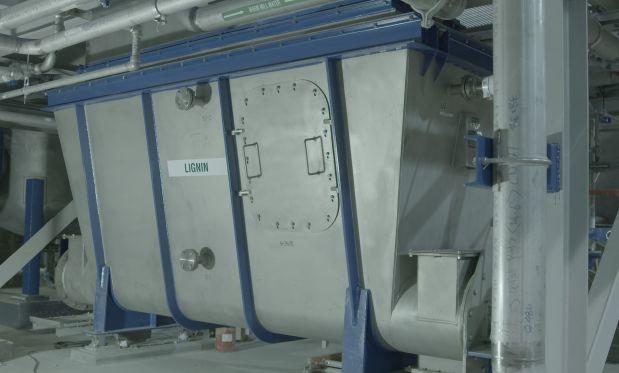
the black liquor is diverted from the pulping process. From this, the company can extract high-purity lignin using a proprietary process developed in Canada with FPInnovations and NORAM Engineering, called the LignoForce System. The Hinton facility is the first commercial-scale implementation of this new technology.
The production plant was made possible through joint funding by industry and government.
Alberta Innovates Bio Solutions (AI Bio) awarded West Fraser a $3-million innovation grant. The provincial portion was leveraged with investments from West Fraser and federal government sources, including Natural Resources Canada and Sustainable Development Technology Canada ($6 million). Natural Resources Canada (NRCan) contributed $10 million to the project in 2014 under the Investments in Forest Industry Transformation (IFIT) Program.
AI Bio’s funding agreement with West Fraser includes a provision for the company to contribute $1.5 million into a “lignin research fund.” PPC
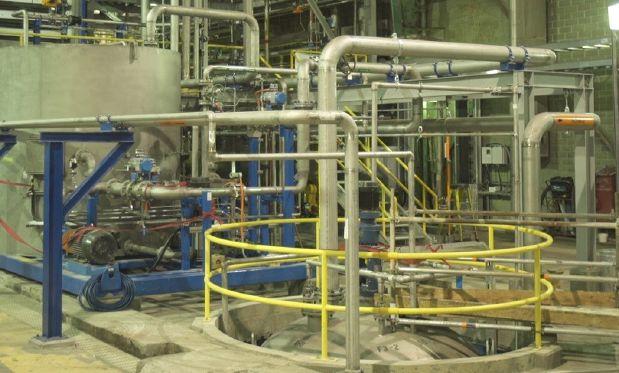
Inside West Fraser’s Hinton Pulp lignin recovery plant (CNW Group/Alberta Innovates - Bio Solutions).
EVOLVING SAFETY
Domtar’s
mill examines the sources of error
By Carroll McCormick
Aworker is tasked to cut some failed bolts on a pressure vessel door. In the process, he cuts his finger and takes five stitches. An investigation determines that this accident was just waiting to happen. In a new approach to understanding the cause of incidents like this, Domtar’s pulp and paper mill in Windsor, Que., is improving its safety programs by adopting a more correct way of understanding the nature of errors.
Adapting an approach developed to reduce the number of incidents in the nuclear power industry, called Human Performance Improvement (HPI), the Windsor mill is focusing less on how an incident happens, and more on why. Behind this tactic lies the dawning awareness that individual errors contribute far less to incidents than do organizational weaknesses.
Examine an event, incident, or unwant-
ed outcome – whatever name you prefer. A traditional belief, now considered false, is that human errors arise only at the level of the individual. The truth is more like this: 20 per cent of events are due to equipment failures and 80 per cent are due to human error. But only 30 per cent of that 80 per cent are due to individual mistakes. The other 70 per cent are due to organizational weaknesses.
So how did that worker cut himself?
“In the old days we asked the worker why he screwed up. But when we analysed this one, we found a lot of organizational weaknesses,” says Eric Ashby, general manager, Domtar Windsor Mill.
First, the bolts had been improperly torqued. Second, the inside door was bigger than the outside door. The worker had to wrestle with it to remove it. Third, his supervisor warned, “don’t drop the bolts
in the tank.” The only way to do all this and remove the bolts was to grind with one hand. He lost control of the grinder and cut himself.
The worker just happened to be the last one to show up at someone else’s party.
Additionally, although there were protocols in place for the task, there wasn’t one for what to do if the job could only be done with one hand. Among the lessons learned during the post-event investigation, Ashby says, “As part of the corrective action, what do you do if you have to use one hand? Stop.”
This example reveals several bold changes in the approach to safety at the Windsor mill. One, it is an example of what is called a just culture. Simply put, in a just culture workers are not punished for actions that are in line with their training and experience. “You separate individual
Windsor
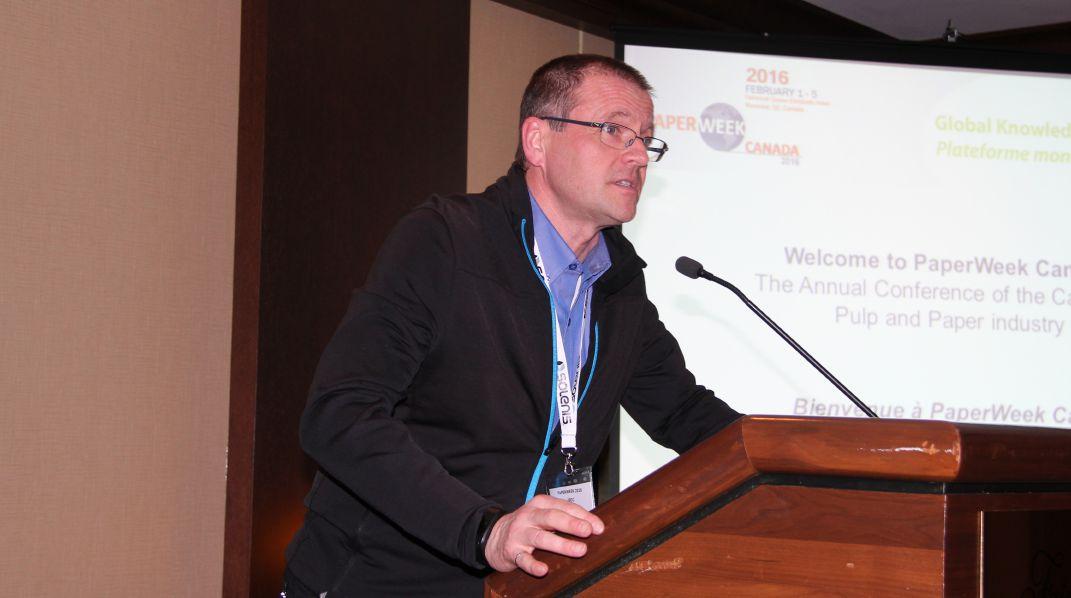
Domtar’s Eric Ashby speaking at PaperWeek Canada 2016. Ashby has been sharing his experience with HPI at various industry events.
and organizational culpability. We have a just culture decision tree that tells us if it is an individual or organization that is culpable,” Ashby says.
Two, rather than simply blaming the worker, look to management for the cause of events. For example, says Ashby, “If a lockout system is too complex, there is a higher probability that an employee will make an error. This is an organizational weakness.” Or, a tricky startup sequence may be begging for an event to happen.
Three, moving away from what is called the circle of despair: an incident, panic, fixing it, and then waiting for the next incident. “Part of HPI is how to move from reactive to proactive. Can we do better analyses of existing incidents and put in SMART+ER (Specific, Measurable, Actionable, Realistic, Timely + Effective Reviews) corrective actions? The issue
nesses, or holes, which is why Ashby refers to the “Swiss cheese model.” The more holes that line up, the greater the likelihood of a significant event linked to an error. “Our job is to identify all the holes. You have to figure out a way that there are the best barriers possible. If you are only protected by one barrier, there probability of an incident is 100%,” Ashby says. “Seventy per cent of our work is to identify latent organizational weaknesses and put better controls in place.”
Ashby cites a formula that captures this process: “RE + MC --> zero significant events.” Written out, it reads, “reducing the probability of making a human error, plus instituting the proper management control in the plant, leads to zero significant events.”
The Windsor mill has replaced the term “incident” with “significant event.” “The flaw of Occupational Health and Safety Act
WE HAVE A DECISION TREE THAT TELLS US IF IT IS AN INDIVIDUAL OR THE ORGANIZATION THAT IS CULPABLE.
we see now is that when we analyzed our investigations in the past, we were very good at identifying what happened, but not why it happened,” Ashby explains.
He continues: “The big shift is moving away from root cause analysis. In [HPI], we don’t focus on identifying the root cause. We believe we have causal factors. You want to eliminate all causal factors you can identify. Every contributing factor is a weakness in your barriers.”
The barriers Ashby refers to are ways set up to reduce the consequences of errors, while granting that people will always make them. Ashby lists four types: Cultural: norms that a group of people generally agree on. For example, people in one region might interpret a yellow traffic light as a cue to speed up, while those in another understand it as a cue to slow down; Administrative: Examples include lockout sheets, checklists or procedures; Engineering: guards on equipment and seatbelts are examples; Management/oversight: A radar and a sign displaying your speed is an oversight barrier designed to get you to slow down.
Barriers are imperfect. Each has weak-
(OHSA) incident rate is that it does not show its severity. One fatality equals one cut on the OHSA scale. We have four levels of significant event: Level 4: near misses, or minimum first aid; Level 3: Minor recordable (requires diagnosis and treatment); Level 2: hospitalization of more than one person; Level 1: permanent impairment; for example, amputation or long lost time,” Ashby says. This extra detail lets Domtar distinguish between, say, three cuts with two stitches, and losing a leg.
There are many moving parts to this version of HPI that Domtar has adapted to the Windsor mill, all designed to give a face to errors, quantify them and reduce the number of events. “We are pushing for zero significant events. We know that the company that survives is [the one that is] controlling significant events,” Ashby says.
For example, he says, “We have defined 14 tools to lower the probability of human error. For example, there is the concurrent verification tool, where one person does a lockout and someone else verifies it. This decreases the probability of error.” Then there are the 32 error precursors Domtar had already identified,
such as frustration, fatigue, rushing and complacency, which are expanded in HPI. For example, a dirty area will increase the probability of making an error.
Domtar is also capitalizing on the concept of the three performance modes that every human supposedly has, and their associated error types and rates: Skill base, rule base and knowledge base. The main error mode for skill-based performance is inattention, at a rate of one error per 10,000 actions. For rule-based behaviour it is misinterpretation. “The person doesn’t know what to do, but follows step-by-step processes, following a set of instructions. When you work in rule mode, your error rate is 1/1,000,” Ashby says. The main error mode for knowledge-based behaviour is an inaccurate mental model of, say, a system or process. The error rate here is 50 per cent.
Ashby illustrates what to do with this information. “Imagine two rule-based workers doing concurrent verification. The probability becomes 1,000 times 1,000, or one chance in one million of an error.”
Domtar uses 14 HPI human intervention tools to minimize the probability of errors. “The supervisor will work with his workers, have the proper tools; e.g., risk assessment, circle of danger, etc. This is the RE,” Ashby says.
For now, HPI at the Windsor mill is being driven at the leadership level, where 70 per cent of human errors reside. It begins with the mill manager, then managers, superintendents and then supervisors. As the plant evolves its version of HPI it will get more involvement from employees.
Initially, HPI was applied after there was an error. But doing audits is taking it past reaction to proaction. There are also continuous improvement mandates; e.g., improve an area as a result of several near misses, or the perception of a risk. Here, employees get a lot of involvement in audits.
Ultimately, Domtar wants to bring its Windsor mill employees to a team mindset, or, for those familiar with the Dupont Bradley Curve of a maturing safety culture, an interdependent stage where zero injuries is believed to be an attainable goal. Ashby says, “The key way to approach a just culture is how to approach human error. It is a shift, a continuous evolution. We are very proud that our mill and community have moved in that direction.” PPC
RFID DEBUTS IN PULP BALES
Metsä
Fibre and its suppliers made RFID work for pulp shipments, and now the rest of the industry may benefit
The product development work that went into making the RFID labels that enable Metsä Fibre to track pulp bales has opened up RFID technology to other companies in the pulp and paper sector. Manufacturing processes in the pulp and paper industry create unique requirements for RFID tags. These challenges have been overcome by Metsä and its project partners. Confidex is supplying specially-designed RFID labels to be inserted into each bale of pulp and the bales are automatically identified with fixed, forklift and handheld RFID readers via Vilant software throughout the pulp logistics chain.
Radio frequency identification, or RFID, has been around for decades. The term generally refers to technologies that use radio waves to automatically identify people or objects. For the purposes of logistics in manufacturing industries, RFID could be compared to an electronic bar code. One benefit is that RFID labels don’t need to be seen in order to be “read”.
Metsä Fibre, part of the Metsä Group
of forest products companies based in Finland, has been integrating RFID into its pulp logistics for several years now. RFID brings Metsä Fibre an effective and reliable way to track pulp units and generate savings in material flow management.
Digital integration
Confidex reports that several North American pulp and paper companies are now investigating the use of RFID to assist with keeping track of products in the mill, and along the supply chain.
“Whether it’s something as well-known as automotive logistics or a niche like the pulp and paper industry, companies are looking for new ways to make operations more efficient to compete in the global marketplace,” says Joe Hoerl, North American director for Confidex.
“They’re looking at developing business models with products based on digital integration, connecting or linking specific items and assets to interconnected systems for real-time data sharing.”
Metsä Fibre is a forerunner in utiliz-
By Cindy Macdonald, editor
ing wireless technology. Four years ago, RFID was in use at one Metsä Fibre mill, two seaports and at one customer. Today, Metsä Fibre’s RFID system is running in all of their pulp mills in Finland, several seaports, and in multiple customer operations.
This solution came about through a Confidex project started for Metsä Fibre in early 2011. The producer of softwood and birch pulp wanted to get more visibility in its logistics, specifically in tracking huge bales of pulp. They also wanted to eliminate loading errors and automatically verify the correct pulp type. At the time, Metsä Fibre was using barcode tracking, which was problematic in that it only reliably covered the initial part of the company’s logistics chain. This was because the barcodes were easily damaged and becoming unreadable during handling because the bales were so tightly packed in containers.
“We needed a very reliable, accurate and efficient way of tracking the pulp units throughout the supply chain,” says Matti Alanen, Metsä Fibre vice-president, logistics, Finland.
WHETHER IT’S SOMETHING AS WELL-KNOWN AS AUTOMOTIVE LOGISTICS OR A NICHE LIKE THE PULP AND PAPER INDUSTRY, COMPANIES ARE LOOKING FOR NEW WAYS TO MAKE OPERATIONS MORE EFFICIENT.
Metsä Fibre was able to track initial outbound orders. When the bales were reaching destination harbors, they didn’t have reliable automatic way of tracking them. The company started to develop a new approach for pulp logistics with RFID.
Custom-designed tags dissolve
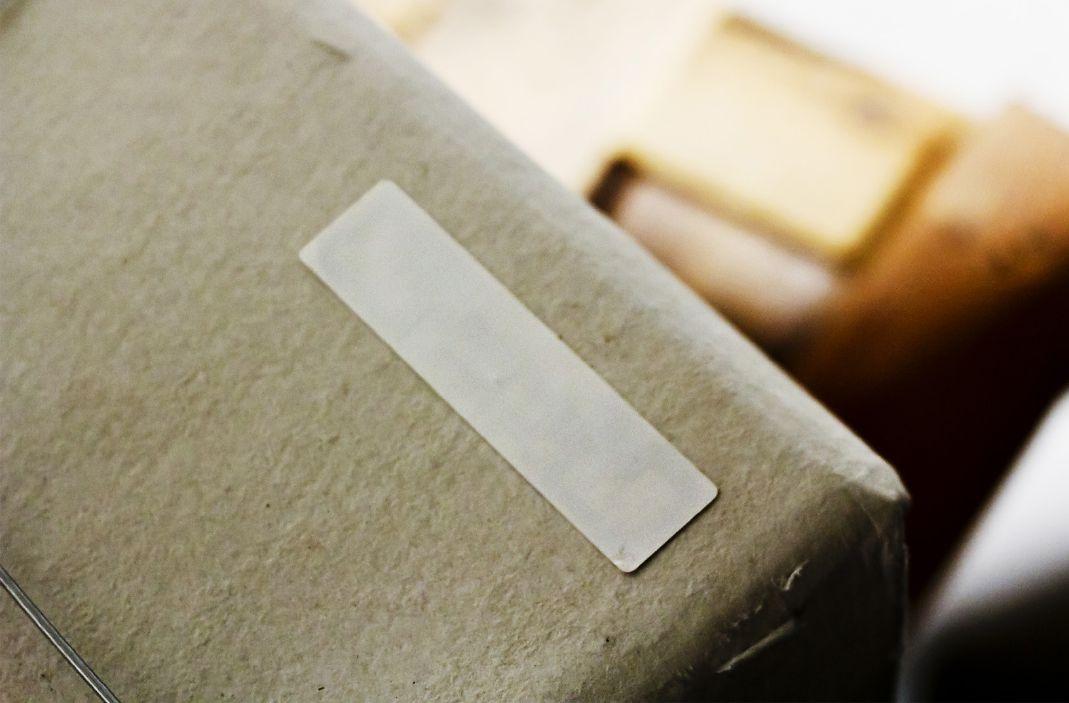
The solution Confidex developed for the company’s RFID application centered on custom-designed RFID labels which are inserted directly into huge bales of pulp. These labels are trackable with handheld, fixed and forklift-based RFID readers, providing high-quality, reliable digital integration which connects the pulp to Metsä Fibre logistics systems for real-time data sharing.
Confidex got involved with the project through its partner Vilant Systems which was working with Metsä Fibre setting up reader gates. After intensive testing and close co-operation with Metsä Fibre, Confidex was able to develop a completely

A radio frequency identification (RFID) system consists of three components: a transponder (RF tag) electronically programmed with unique information; an antenna which emits radio signals to activate the tag and to read and write data to it; and a reader that emits radio waves. When an RFID tag passes through the electromagnetic zone, the reader decodes the data encoded in the tag and the data is passed to the host computer for processing.
soluble, reliable RFID label meeting the company’s standards and requirements
“We worked for several years to develop a RFID label that can hold up to the [mill] environment and still function as RFID,” explains Hoerl. The solution involved metallic paste and soluble adhesives, so that the entire tag could dissolve into the final paper product.
As a result of the intensive testing and verification, Metsä Fibre uses Confidex’s RFID Pulp Label today in its RFID logistics tracking system. Labels are installed with an applicator on the pulp production line and read at every stage of the way from the pulp mill to the customer. Besides bringing various benefits in pulp logistics, the labels can help suppliers like Metsä Fibre manage their customers’ inventory more easily and provide better service.
“Typically in customer cases we can utilize some of our existing product platforms to develop a customized solution, but this was a completely new approach for us, requiring the design and development of a new antennae, as well as all-new materials, certification and testing,” says Jari Ovaskainen, director of products at Confidex.
“We’re excited that Metsä Fibre has been able to successfully utilize our customized RFID solution to help manage their entire pulp manufacturing chain over the past four years, as this mature industry sector continues to evolve,” he adds.
Project partners
Confidex is a manufacturer of contactless smart tickets, industrial RFID tags and specialty labels, all of which can be key enablers for short-range wireless IoT solutions that make supply chains, transactions and authentication of goods or people more efficient and secure.
Hoerl points out that different industries have different environments and unique product materials which often make RFID tags behave differently. One slight change in material, size or curvature
can cause off-the-shelf tags to fail, which is one reason Confidex takes a consultative approach by designing a customized RFID solution to fit specific needs.
“We control the entire RFID product manufacturing pipeline from rapid prototyping to final product, which allows us to address individualized projects, such as the pulp bale label we developed with Metsä Fibre. Not only did they need RFID labels that could work reliably when inserted into bales of pulp, but they needed to dissolve in the pulping process while complying with food contact regulations specified by the FDA and EEC (European Economic Community),” he explains.
Paper manufacturing processes create unique requirements for RFID tags used in pulp. The tag’s materials need to dissolve in the pulping process and have no effect on the downstream papermaking process. Because of these requirements, the various generally available RFID inlays and labels made of different plastic materials cannot be used.
Confidex’s RFID Pulp Label is specifically developed for meeting the demanding requirements of the pulp and paper industry. The compatibility in pulping processes has been verified with extensive testing and certification processes. The high quality, EPC C1G2-compliant label can be automatically applied to pulp bales and read reliably with fixed or handheld RFID readers.
In addition to the Metsä Fibre project, Confidex RFID labels have recently been implemented further along in the pulp and paper value chain in automatic identification of paper reels. Hoerl says the RFID label for paper cores withstands the pressure of the paper on the roll, and can be read through all the paper.
Confidex also offers RFID labels for post-processed paper products such as packaging materials where RFID can be used for product identification, tracking and brand authentication. PPC
FOCUS ON MOTORS AND DRIVES
ABB to deliver drive system for Kruger rebuild
ABB has been chosen as one of the suppliers for the paper machine rebuild project at Kruger’s Trois-Rivières Mill in Quebec. The project is part of Kruger’s $250-million investment to rebuild its No. 10 newsprint machine (PM10) to manufacture 100-per-cent-recycled, lightweight highstrength linerboard. Once the conversion is complete, PM 10 will produce 360,000 tonnes of linerboard annually for use in Kruger’s box plants and for the global packaging market.
ABB will deliver and install drive systems for PM 10 and its winder. The scope of supply for this rebuilding project includes ACS880 MultiDrives, AC motors, System 800xA control system, supervisory systems, remote diagnostic services, highspeed data logging system, spare parts and local engineering, commissioning, installation supervision and start-up service.
Kruger Packaging opted for a stateof-the-art AC drive system, which will replace the existing DC drive system currently on PM 10.
“We have chosen ABB for their excellent engineering and service team, as well as their extensive knowledge and experience in delivering proven technology for a number of our projects,” said Christian Lemay, Kruger project manager.
ABB says its ACS880 drive technology, coupled with its direct torque control (DTC) technology, provides unsurpassed motor control performance, supported with best in class uptimes. This contributes to energy efficient, highly reliable systems.
“The ABB project delivery and engineering team has a strong, trusted relationship and great working history with Kruger,” said Jim Fisher, head of ABB’s Pulp and Paper business. “We look forward to delivery of yet another successful project which will produce energy efficiencies and reduced maintenance costs for Kruger.”
Kruger Packaging L.P. is a Canadian manufacturer of containerboard and packaging products made from recycled fibers. ABB, www.abb.com
Remote support via virtual reality for in-house maintenance
Time is money when performing fault diagnosis and problem resolution. With Hägglunds InSight Live, Bosch Rexroth provides plant operators with a solution that enables a new level of remote support for their in-house maintenance teams.
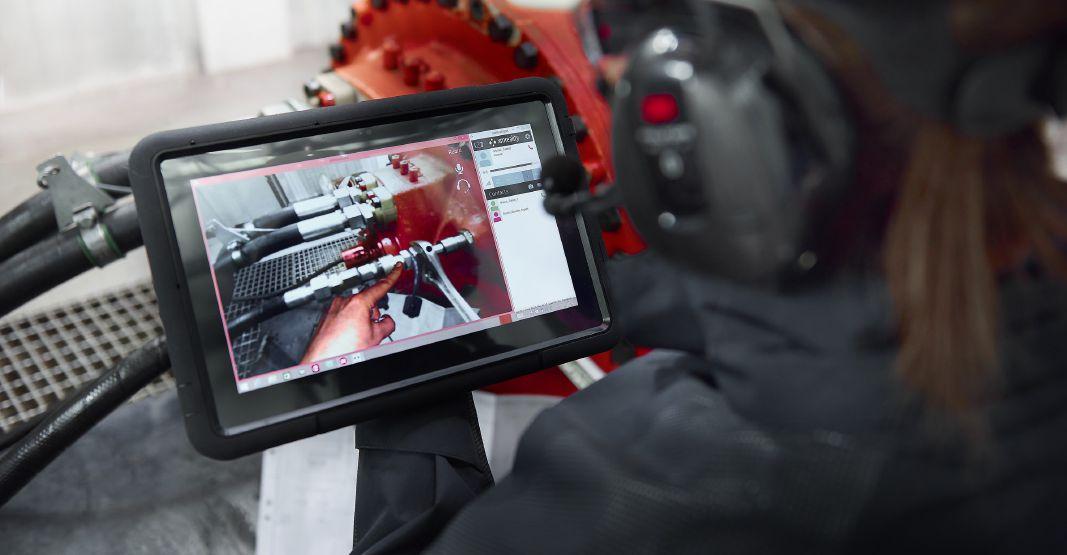
The Hägglunds Insight tool facilitates instant support through the use of virtual reality. With nothing but a rudimentary Internet connection and a smartphone, tablet or laptop, customers get direct support from Rexroth product and application experts for Hägglunds heavy-duty drives.
The specialists see everything the customer’s engineer sees and in return, by way of the intelligent platform, they can superimpose their hands, tools, documents and diagrams on top of the image the customer engineer is displaying. This way, the experts can visually demonstrate where the engineer can find the needed information and guide him through diagnosis and solution.
The Insight Live platform is designed to
work with limited bandwidth and mobile connectivity and can provide a powerful virtual reality real-time support. The app establishes a sound/image connection to the correct product or application specialist. Bosch Rexroth, www.boschrexroth. com/en/ca/
Wajax adds oil filtration systems
Wajax has added oil purification equipment from Oil Filtration Systems Inc. to its filtration portfolio. Oil Filtration Systems manufactures a comprehensive line of purification equipment designed to remove contamination (water, particulate, varnish) from a variety of fluids, including lube oil, hydraulic oil, transformer oil and diesel fuel.
By maintaining absolute fluid cleanliness using the company’s products, end users can dramatically increase the life of critical-wear components on rotational equipment.
Clive King, business development manager for filtration at Wajax, says: “Removing contaminants from oil is a best practice for the proper maintenance and reliability of rotating equipment, extending the life of critical components, minimizing downtime, and reducing overall maintenance costs. Oil Filtration Systems is in a unique position to provide a wide range of oil purification equipment and services to end users throughout Canada.”
Oil Filtration Systems, like Wajax, serves a variety of markets, including power generation, mining, oil and gas, and pulp and paper.
Wajax, www.wajax.com

SCA chooses integrated automation for pulp mill expansion
SCA Östrand’s expanded pulp mill will have what may be an industry first: an integrated automation solution to manage end-to-end production – from the woodyard to the baling line – from a single control room
ABB will provide integrated solutions using its System 800xA automation platform and custom-engineered software for pulp processes. The solution includes engineering for the control system and optimization of all processes at SCA Östrand’s expanded pulp mill in Timrå, Sweden, as well as the design of the control room. The mill is scheduled to come on stream in June 2018.
Traditionally, in a pulp mill, different operations, such as the woodyard, the digester, the recovery boiler, are controlled from separate control rooms. By integrating the management and control systems of the entire production process of the mill into a single control room, ABB believes the efficiency and productivity of all processes will be increased. The fully integrated control system will provide unparalleled connectivity and full plant overview of the whole process and all devices.
“By utilizing our systems as an integrated platform for the entire plant, we can contribute to SCA Östrand’s goal of creating the world’s most modern and efficient softwood kraft pulp mill,” said Roger Bailey, managing director of ABB’s process industries business.
The control center will be designed to apply the latest advances in ergonomics, design and layout to ensure the opera -
tor environment is attractive, efficient and conducive to cooperation between all employees at the mill. Operators will monitor and control the entire mill from eight extended operator workplaces. The expected result is improved operations, engineering, control and maintenance through a collaborative environment.
The order from SCA also includes a simulator for testing the control of all processes in the mill before delivery, and for operator training and process optimization over time. To ensure that the commissioning of the entire plant is as smooth as possible, five simulators will be used at the same time before and during start up.
SCA is investing about $1.2 billion to expand the Östrand kraft pulp mill into the world’s largest production line for bleached softwood kraft pulp. The expanded plant will have a capacity of 900,000 tons of softwood kraft pulp per year.
ABB, www.abb.com
Shoe press belt has high impact strength
Cracks are a common reason for an unscheduled change of a shoe press belt. When an external object or hard paper wad hits the belt harshly it may cause a crack or a puncture hole. Sometimes the sleeve may seem intact outside, but a small crack may have generated which ultimately can lead to an oily spot in the felt, a hole in the paper, poor web moisture profiles, off-spec paper quality, sleeve delamination and eventually, an unplanned belt change.
When the material used in the belt has sufficient toughness and good impact strength, cracks can be avoided. Valmet’s belt specialists have developed a new shoe
press belt, BlackBelt E, that, according to the company, has the highest impact strength of any belt currently available.
BlackBelt E (E for extreme conditions) achieves this by virtue of its high-performance polyurethane composition which boosts impact strength.
The original BlackBelt was launched in 2008 following a year-long development project. Now, with about 500 BlackBelts sold in North America and almost 2000 BlackBelt deliveries worldwide, Valmet has a large installed base.
The development of new versions continues. BlackBelt G has triple-layer reinforcement and is designed for small diameter shoe presses. The double-layer BlackBelt F (flexible) suits applications requiring a sleeve with higher flexibility and lower caliper.
All BlackBelt products are available with multiple surface options, including the new DG-HD surface (discontinuous grooving with high density groove pattern).
Valmet, www.valmet.com
New PulpEye module measures vessel elements
PulpEye has introduced a new module for its pulp measurement system to identify the quantity and size of vessel elements in hardwood pulps. The PulpEye Vessel module is based on a technology to measure fibre wall thickness.

PulpEye Vessel can measure the quantity and size of vessel elements in hardwood pulps.
The module uses circularized polarized light so that the images of fibres and vessel cells can be clearly distinguished from the background and are thus easier to spot.
Vessel cells in hardwood pulp are often
relatively intact in the pulp process and can have a negative impact on pulp quality. According to PulpEye, they can reduce print quality by acting like flakes or not take ink the same way as the surrounding fibres. Dust problems can also occur due to vessel elements coming loose during printing.
“Measuring the quantity and size of vessel elements in pulp is of interest for pulp manufacturers in order to classify pulp,” says Öjvind Sundvall, managing director of PulpEye. “We have received very positive response from producers of hardwood pulps when discussing this new way of measuring vessel cells in a fibre suspension, so the market for our technology is obviously there.”
“Our technology is also of interest for papermakers using pulps with big vessel cells or deinked pulp containing vessel cells from hardwood. Online measurement can early in the process detect variations and by acting on the results presented by PulpEye Vessel, costly rejections can be avoided.”
PulpEye mixes and circulates the sample through the flow cell where the camera captures images of the pulp. By using circularized polarized light, the images of fibres and vessel cells can be clearly distinguished from the background. With normal light, vessel cells are almost transparent and much more difficult to detect and capture in an image.
Images are captured at a very high resolution. The size of vessel cells is typically more than 100 microns and for some species, such as eucalyptus, the vessel cells are even bigger. The resulting images are analyzed using a series of image processing steps.
PulpEye, www.pulpeye.com
Swedish mill chooses biomass boiler to dry pulp
Rottneros Mill is planning to invest SEK 98 million (about $15.4 million) in a new biomass boiler. It will replace fossil oil as the energy source used to dry pulp in the mill’s flash dryers.
The company says this investment will also lead to the rebuilding of large parts of the mill’s energy system, which will increase energy efficiency significantly. The detailed planning work has begun and the new biofuel boiler will be completed
and put into use around mid-2017.
“It will result in significant energy efficiency improvements and environmental benefits in terms of lower emission levels. The extents of the savings are at least SEK 25 million per year,” says Olle Dahlin, CEO of Rottneros Mill.
Rottneros Mill produces two different kinds of high yield pulp for paper producers – CTMP and groundwood pulp –and has used oil to dry the pulp for many years. When the new biomass boiler is completed, the mill’s energy consumption will entirely free of fossil fuels.
The new biomass boiler has an effect around 18 MW and will replace an older biomass boiler. The supplier of the new boiler has not yet been selected.
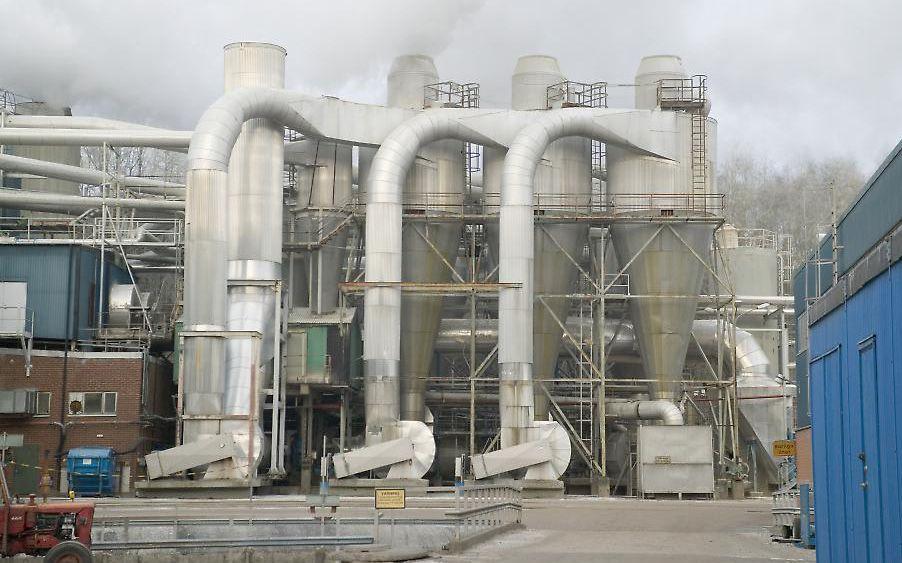
Andritz further announced that it has received an order to upgrade the CTMP pulp drying line at Rottneros Mill. The modernization will increase the flash dryer’s capacity by more than 50 per cent. At the same time, specific heat consumption will be reduced
Andritz will deliver a customized upgrade solution including a new drying stage as well as new cyclones. The newly designed cyclones will meet highest environmental standards, thus minimizing emissions.
“The target of this investment is to increase the production capacity and at the same time reduce the use of energy in our CTMP flash dryer,” says Nils Hauri, production manager at Rottneros Mill. Andrtiz, www.andritz.com
Bosch
Rexroth appoints hydraulics distributor
Bosch Rexroth Canada has appointed Norcan Fluid Power as an authorized distributor for industrial and mobile hydraulics products in Western Canada.
The agreement is intended to provide Western Canadian customers with greater access and choice for Bosch Rexroth’s hydraulic products and innovative solutions to achieve their specific application requirements. At the same time, it will expand service, technical support, application expertise and local inventory. Bosch Rexroth Canada, www. boschrexroth.ca
Dryer fabrics for high temperature range
Voith has added to its CleanWeave product line with the new Magma and MagmaHigh dryer fabrics. Magma dryer fabrics are made from hydrolysis-resistant PPS which ensures performance in the hottest dryer positions.
Extreme temperatures in some paper machines put dryer fabrics under severe stress and call for special material properties. Hydrolysis-resistant PPS reduces the stress on the fabric, allows service intervals to be properly planned and thus prevents unscheduled machine downtimes, says Voith.
Both Magma and MagmaHigh use the weave pattern that has already proven effective in the CleanWeave product range. The weave structure features low
The pulp drying facility at Rottneros Mill, Sweden.
internal void volume, which significantly reduces dirt within the fabric. Due to its relatively low number of yarn crossover points, this compact weave pattern makes surface cleaning easier and ensures constant air permeability. This guarantees that the fabric maintains its air permeability for optimum drying and web running properties over its entire service life. Voith, www.voith.com
Canadian mills opt for FITNIR analyzers
“We are excited to announce five new projects in Canada, four in the U.S., and a tenth in Asia,” said Tom Sands, president of FITNIR Analyzers. “It’s gratifying to see our products contributing to the success of mills throughout North America and now expanding internationally.”
The Vancouver-based technology company had seven projects awarded in 2015 and three in Q1 of 2016.
er and chlorine dioxide generator. “We decided to go with FITNIR again after the success we had with our recaust analyzer installation for smelt dissolving tank TTA control, CGL trim control, and slaker and CE control,” said Roger Puar, technical manager at Skookumchuck Pulp. “Not only does the technology meet our needs, but we also received excellent service from the FITNIR team.”
Another repeat customer in eastern Canada selected FITNIR Benchtop in 2014 for liquor measurement, and then in 2015 chose FITNIR Kappa to measure the kappa number of wet kraft pulp to help control its digester operations.
Also in 2015, a western Canadian mill was the first to implement FITNIR Kappa for dry pulp sheet applications. Their confidence in the unit led to the selection of FITNIR again in 2016, this time to analyze brownstock kappa.
More recently, two mills in the U.S.
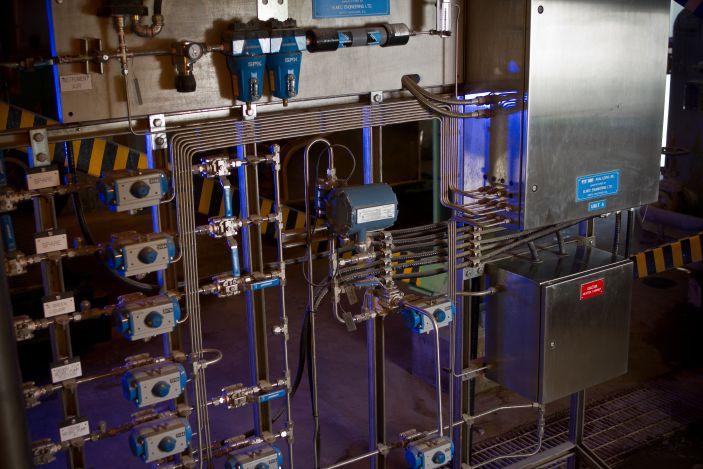
Paper Excellence’s Mackenzie Pulp Mill was one of the three mills in North America that selected FITNIR’s fully automated, online FT-NIR analyzer. FITNIR Online provides more reliable, accurate and true measurements versus the inferred measurements of traditional solutions. Integrating FITNIR Online into these mills will enable real-time monitoring of various unit operations for process optimization and control.
Skookumchuck Pulp, another Paper Excellence mill, is expanding its FITNIR Online system to now include the digest-
opted for FITNIR Kappa to provide quick, consistent and accurate kappa number measurements via near infrared (NIR) spectroscopy.
Most noteworthy for 2015 is FITNIR’s break into the Asian market with a landmark project that is FITNIR’s largest contract to date. Geared to commence installation this spring, the pulp and paper mill located in Southern Sumatra, Indonesia will use FITNIR Online to optimize its recaust and recovery processes via two analyzers and six field sampling stations. FITNIR Analyzers, www.fitnir.com
Hydraulic fluid boosts energy efficiency
Petro-Canada Lubricants has reformulated its HYDREX line of hydraulic fluids to deliver leading wear protection, greater energy efficiencies, extended oil life and strong performance in wide temperature ranges.
“The full HYDREX line has always delivered beyond expectations,” says Robert Farthing, category manager, lubricants, Suncor. “Our objective with the reformulation is to take product performance even further and help customers achieve their goals to increase equipment and operational productivity.”
According to the manufacturer, HYDREX is shown to provide up to two times better wear protection than global competitors, and helps to extend equipment life and reduce mechanical failures and maintenance.
“Though it may seem like one small spend as part of the overall operations budget, choosing the right hydraulic fluid can dramatically increase overall productivity and reduce operating costs,” says Farthing.
Petro-Canada Lubricants, a Suncor business, lubricants.petro-canada.com
Flowmeter
measures methane at paper mill
One paper company has used Krohne’s Optiswirl 4070 vortex flowmeter to measure methane gas emitted from its anaerobic bioreactor. The measurement allowed the paper manufacturer to claim more CO2 emission credits and reduce energy costs.
The mill selected the Optiswirl 4070C because it needed a robust flowmeter with pressure and temperature capability to measure the methane gas being pumped from the biomass reactor. After processing to remove impurities, some of the biogas is used to power the plant’s boilers in place of natural gas. This reduces the plant’s carbon footprint, gains additional CO2 emission credits, and lowers plant operating costs.
Krohne’s Optiswirl 4070C has been designed to be robust and highly versatile. It is a unique vortex flowmeter with integrated pressure and temperature measurement. It incorporates the company’s ISP (intelligent signal processing) technology, which eliminates unwanted signal noise to deliver precise, stable measurement. Krohne, www.krohne.com/ northamerica
Mobile device support for nip monitoring
Xerium Technologies recently launched Smart Connect Technology, which extends the functionality of the company’s Smart Technology platform.
Smart Connect is a comprehensive nip monitoring system available to help improve the performance of all nipped roll positions, including suction roll and tissue Yankee applications.
Smart Connect now includes seamless connectivity to existing site computer systems with automatic data backup. In addition, Smart Connect’s innovative new mobile monitoring capabilities provide the ability to monitor nip analytics from smartphones and tablets, at any time, and from anywhere. The system also provides the ability for collaborative review of the analytics with the customers’ and Xerium’s engineers.
Smart Connect can also estimate a machine’s financial cost savings opportunities by comparing the actual nip conditions to an ideal condition based on key performance parameters.
Xerium Technologies, www.xerium. com/Smart
App provides real-time plant performance data
Real-time plant performance and notifications can be sent direct to smartphones, using a new app from Honeywell Process Solutions. Honeywell Pulse enables plant managers, supervisors and others to stay connected to their enterprise – wherever they are. The app brings relevant metrics and the tools to resolve issues directly to mobile devices, helping to improve efficiency and safety.
“Honeywell’s IIoT is all about data, data analytics, and especially big data analytics,” said Bruce Calder, vice-president and chief technology officer for HPS. “Honeywell Pulse gives managers and supervisors peace of mind by allowing them to receive alerts and monitor performance remotely. This allows plant personnel to respond faster to situations, whether they are planned or unplanned.”
Honeywell Pulse connects to different sources and applications across the company’s portfolio to create a more intuitive mobile experience for plant workers. Honeywell Process Solutions, www. honeywellpulse.com
BOILERS
Available Immediately





CONSULTANTS
Composite of mineral/ micro-fibrillated cellulose finds commercial applications
Imerys has announced the signing of agreements to supply two leading paper producers with FiberLean™ MFC, an innovative mineral/micro-fibrillated cellulose composite.
The company developed FiberLean MFC under its innovation program. It is produced using a patented and innovative manufacturing technology.

The first commercial applications are in the paper and packaging markets, where Imerys says the the composite material allows paper and packaging producers to improve quality and/or significantly increase the mineral filler loading in the sheet to achieve productivity gains and reduced cost.
Imerys has signed two separate commercial agreements for the full-scale supply of FiberLean MFC, with two papermakers, one in Asia and one in the United States.
The Asian customer is a major manufacturer of coated woodfree paper with a large share of its production in the highend of the coated paper segment. An Imerys on-site production plant is due for startup in Q3 2016.
The U.S.-based customer has a strong position in the printing and writing market. Imerys will build an on-site plant to provide one of its southeastern U.S. mills with FiberLean MFC. This plant should also be commissioned and start production in Q3 2016.
With the completion of these two plants, Imerys will have 8,000 tonnes
per year capacity of MFC, which makes the company one of the most significant suppliers of micro-fibrillated cellulose worldwide.
The additive is FDA-approved for use as a food contact substance in paper and paperboard for food packaging applications.
RenFuel and Nordic Paper exploring lignin oil as biofuel
RenFuel and Nordic Paper are planning to build a production test facility in Bäckhammar, Sweden, in order to test manufacture an advanced biofuel based on lignin. The project has been granted 71 million SEK (about $11 million) by the Swedish Energy Agency.
RenFuel has developed and patented a catalytic process to refine the lignin from black liquor into lignin oil. The oil, called Lignol, can replace fossil oil and be used as raw material in the production of renewable gasoline and diesel.
“Our product Lignol is the key to reaching the goal of a fossil-free vehicle fleet in Sweden by 2030. We are very pleased to finally being able to put the product into large scale testing,” said Sven Löchen, CEO of RenFuel.
The production test facility will be built inside the Nordic Paper pulp factory in Bäckhammar, and will be ready for production by the beginning of 2017. If the production tests are successful, the next step will be large scale production of Lignol to meet the demands of the rapidly growing market for biofuel.
“The paper and paper pulp industry is an important link in the bio-economy. We can, through this cooperation, contribute tangibly to a fossil-free future. That is incredibly gratifying,” Per Bjurbom, CEO of Nordic Paper, said.
Another important link in the chain is access to refineries that have the capacity to produce diesel and gasoline from Lignol. Preem, a Swedish petroleum company, has been moving its production toward renewable fuels for several years by incorporating alternatives to crude oil.
“Byproducts from Swedish forestry, such as lignin, more than fulfill our requirements of the sustainability of the raw material, and in addition, the demand of lignin can be met in great volumes. We
look forward to receiving the first volume of Lignol at our refineries and [to] producing the renewable gasoline and diesel of the future,” said Petter Holland, CEO of Preem.
CNF may boost strength of packaging papers
The use of bio-based cellulose nanofibrils (CNF) offers potential benefits for the production of both conventional and new paper grades, according to a technical paper authored by experts from GL&V and the University of Maine. The paper, The Application of CNF to Improve Packaging Grade Performance, was presented at PaperWeek Canada in February.
GL&V and the University of Maine have formed a product development and commercialization partnership for CNF technology, called FibreFine.
Several trials were run on different paper grades on the UMaine pilot paper machine, with CNF added both to the furnish and as a surface application on the fourdrinier table. Results for an OCC packaging grade are very encouraging, say the authors.
Comparing the two methods of incorporating CNF, the authors noted that adding CNF to the furnish demonstrated the maximum strength improvement, and improved internal bond strength.
A drop in freeness causes 1.5-2.0 per cent drop in couch solids, , they state.
Applying CNF to the surface gives a smaller strength improvement, a large decrease in porosity and an improvement in sheet smoothness. The small volume of secondary flow does not affect couch dryness, according to the authors.
Photo shows the effect of adding CNF to the surface of OCC sheet.
Micrograph of a FiberLean product, in this case based on NBSK with kaolin.

Higher board, paper and tissue machine speeds mean higher demands for belt performance. Valmet’s BlackBelt is a unique shoe press belt that’s built for speed using a high performance elastomer material reinforced with dimensionally stable synthetic yarns. Available in different reinforcing structures and surface options, it is wear, chemical and heat resistant to ensure a long and trouble-free run. Learn more at valmet.com/blackbelt

AN INFLUENT MICROBICIDE SO GOOD, IT CAN EVEN

You may already know that Oxamine® for influent is more stable, so it works harder longer than bleach, chlorine gas and bromide treatments to control microbiological activity and save you money. You may also know that it has less impact on the environment. But did you know that the Oxamine microbicide program comes with proprietary feed equipment designed for industry-leading safety? It’s the only technology on the market with all these advanced safety features.
• LEAK DETECTION
• A BUILT-IN SEPARATOR to keep active ingredients apart in the case of a line break or other issue
• AUTOMATIC FLUSHING in case power is lost
• REGULAR INSPECTION by Buckman personnel to ensure efficient, safe operation
Protect your equipment, your people, the environment and the bottom line. Contact your Buckman representative or visit buckman.com , and see just how easy it is to switch to Oxamine.