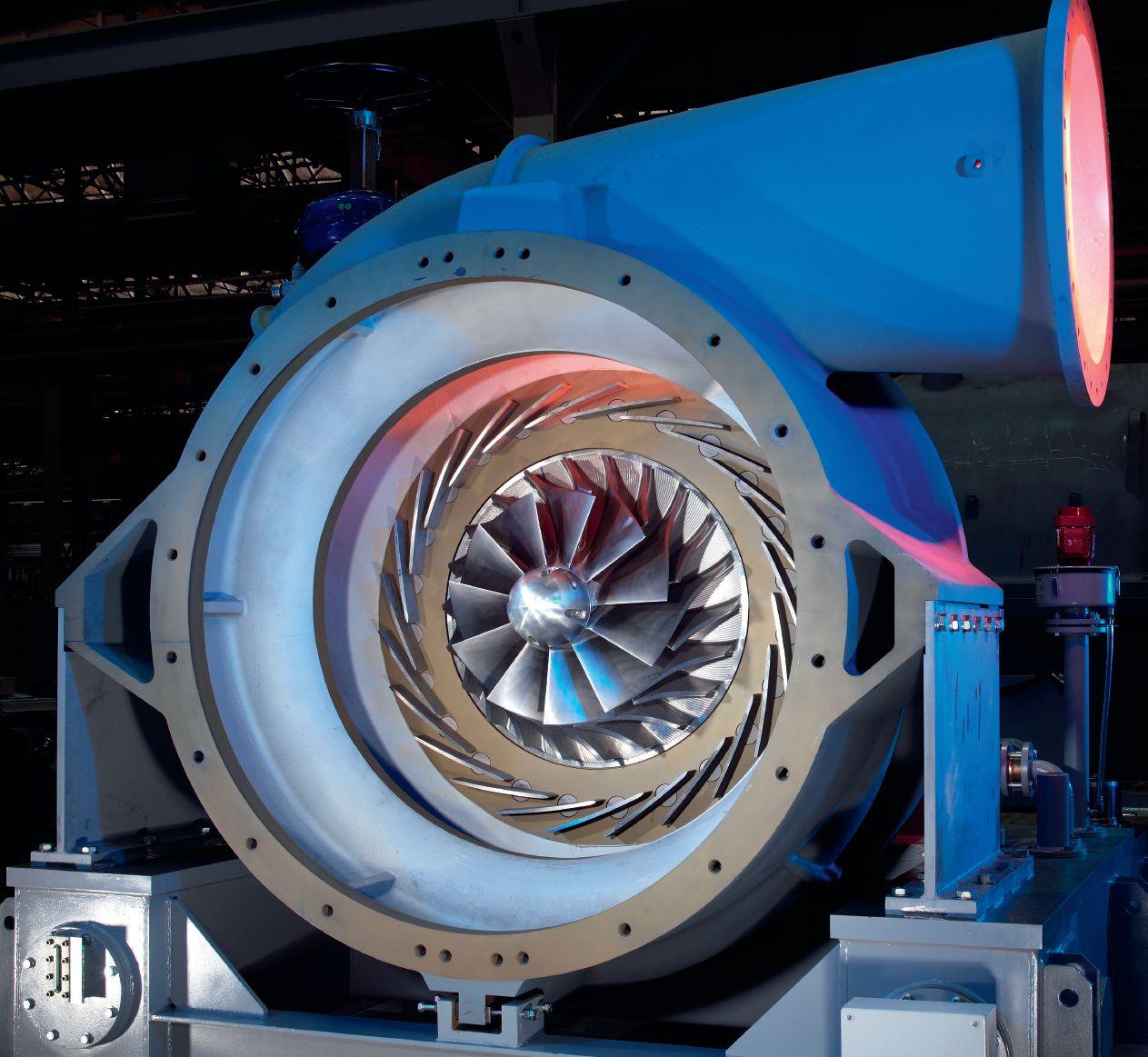
Gree n Te chn o l o g y for t h e Pa per I n du st r y ® systems available. Our tough and dependable multi-stage RC series ranges in sizes from 6,300 to 106,000
7,000 to 78,000 CFM, is ideally suited for felt conditioning and tissue production applications Every year, more paper machines are being built using TURBAIR ® vacuum systems
Compared to other vacuum systems, MAN’s state-of-the-art TURBAIR ® vacuum blowers
- 25-30% energy savings versus liquid-ring pumps
- Up to 70% of the consumed energy can be recuperated - No seal water is required
- Incredibly dependable, low maintenance, and engineered to last the life of any paper machine.
PULP PAPER &
CANADA
The 2016 PacWest conference held in Jasper drew more attendees than previous years, and delivered value-packed technical sessions with plenty of social opportunities.
The tissue manufacturing industry is poised to undergo significant changes in the next five years, according to Smithers Pira, spurred by relatively low-cost crescent former tissue machines.
A selection guides specifically for pulp and paper, plus a discussion of what defines severe service valves.
New technology announcements: biocrude in B.C., biodiesel in Quebec. Stora Enso, Valmet and CelluForce pursuing biochemicals.
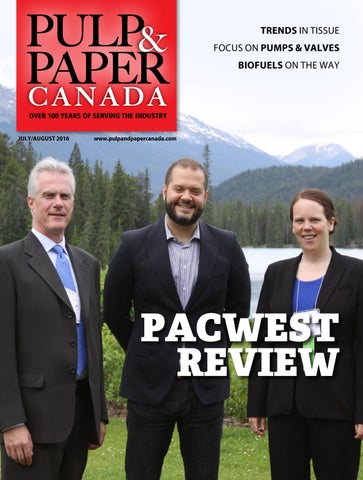
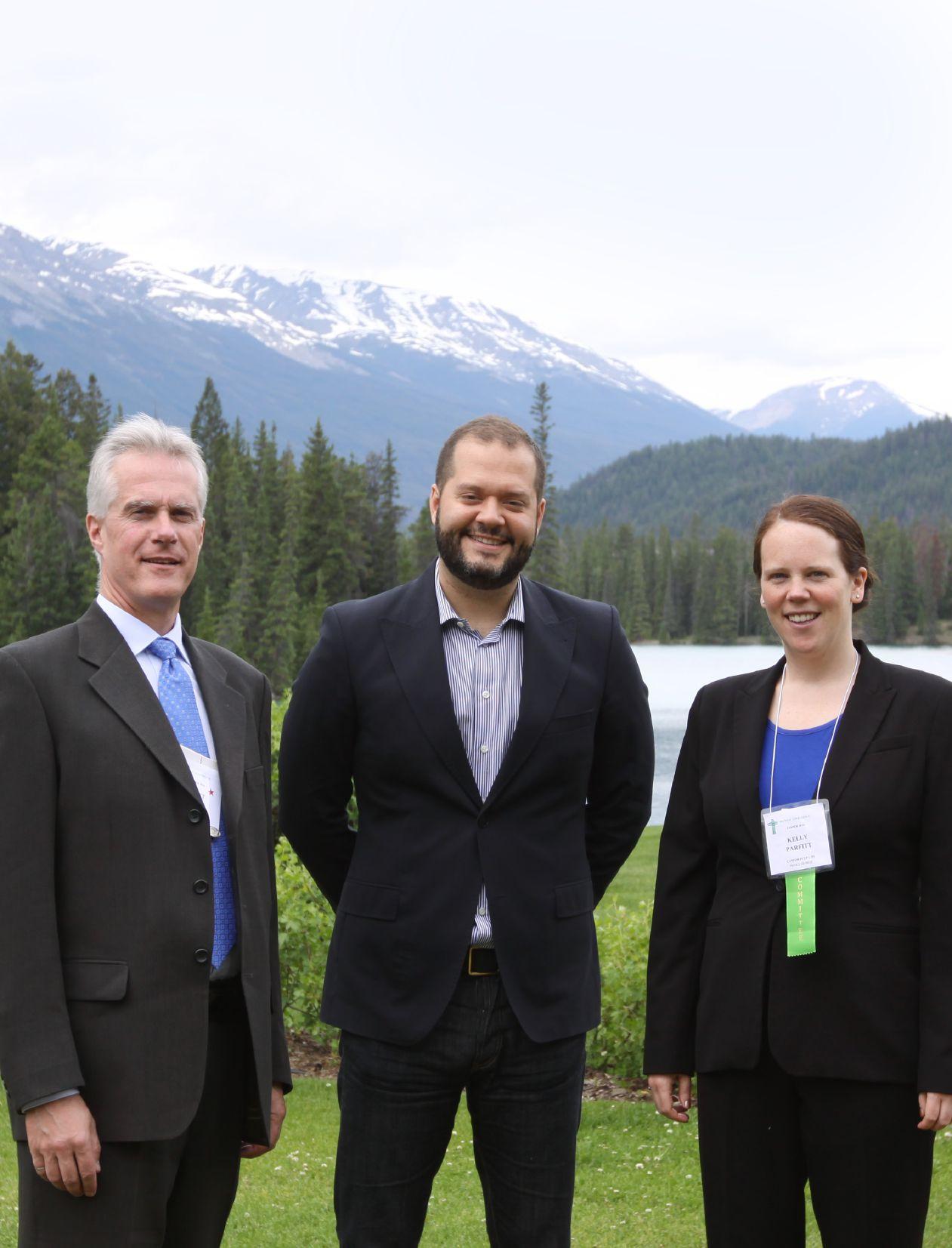
Cover photo: Scott Curry and Kelly Parfitt, co-chairs of PacWest, flank Jesse Brown, keynote speker. Photo by Mike Trivett, Valmet.
Two takes on tech
It’s easy to get caught up in the allure of new technology, in both your personal life and work life. But I think now more than ever, it is important to remember that just because you can do something, it doesn’t mean you should.
Recently, in a blog about the industrial Internet of Things operated by ARC Advisory Group, Mark Meza discussed how AC induction motors can now be IIoT-enabled. He noted that deciding which motors should be put in the IIoT spotlight merits careful consideration. “Is the motor a critical asset? Is it running critical assets or operations? A comprehensive application-specific asset management strategy needs to be created and then applied to the motor hardware already in operation,” says Meza.
Cindy Macdonald Editor
If the industry’s threshold for motor repair is generally 75 to 100 HP and above, then what value does IIoT offer to justify predictive maintenance of motors less than 75 HP?, he asks.
Meza concludes, “The percentage of industrial motors with realistic IIoT potential resides in the very low single digits.”
Speakers at the Honeywell users group meeting in June heard a similar message. Vimal Kapur, president of Honeywell Process Solutions, suggested that users evolve their systems in the direction of IIoT. He talked about how contractors, suppliers, workers and machines can interact in a more fluid way using cloud technologies, according to a report from Mark Sen Gupta, another ARC Advisory Group columnist. Gupta says that Kapur made a point that this connectivity should be leveraged only in service of the goals of reliability, efficiency and safety. “The technology is the means to the end,” Gupta concludes.
On the other hand, James Goldman of Valmet, speaking at PacWest, commented that if a manufacturer invests in new measuring technology, it is important to change the operational philosophy at the mill to take advantage of the new sensors. Goldman talked about one fibreline optimization project where the key to success was geting the operators to believeg in the sensor readings, and to accustom them to using lab tests only to check the accuracy of the new measuring technology.
“Lab testing is really where the process needs to change at most mills,” said Goldman. Instead of testing the process, the lab work should become a method of cross-checking the instruments.
To summarize, use your advanced instrumentation to its fullest capacity. But don’t adopt technology just for the sake of having new baubles. PPC
Editor
CINDY MACDONALD
905-713-4338 cindy@pulpandpapercanada.com
National Accounts Manager LAURA GOODWIN 289-928-8543 lgoodwin@annexweb.com
President and CEO
ANNEX BUSINESS MEDIA
MIKE FREDERICKS
Group Publisher/Director of Content and Engagement
SCOTT JAMIESON
519-429-5180 sjamieson@annexweb.co
PRODUCTION
Media Designer
EMILY SUN esun@annexweb.com
News and Press Releases media@pulpandpapercanada.com
Canada $55.00 per year; $88.00 for 2 years. Outside Canada (US) US$101.95 per year; (foreign) US$110.00.
From time to time, we make our subscription list available to select companies and organizations whose product or service may interest you. If you prefer not to receive this information, please contact our circulation department in any of the four ways listed above.
The editors have made every reasonable effort to provide accurate and authoritative information but they assume no liability for the accuracy or completeness of the text or its fitness for any particular purpose.
Sustaining member, Pulp and Paper Technical Association of Canada; Member, Alliance for Audited Media.
“We acknowledge the [financial] support of the Government of Canada.”
Indian company looking to buy Catalyst Paper
An Indian papermaker and four shareholders of Catalyst Paper have expressed an interest in acquiring the B.C.-based papermaker. Catalyst Paper announced May 23 that its board of directors had received a copy of an expression of intent from Kejriwal Group International and the four shareholders who hold or control approximately 79 per cent of its outstanding common shares.
Grande Prairie mill sold to International Paper
Weyerhaeuser is planning to sell its Cellulose Fibers pulp mills – including the site in Grande Prairie, Alta. – to International Paper for US$2.2 billion in cash.
The transaction includes four other pulp mills, located in Columbus, Miss.; Flint River, Ga.; New Bern, N.C., and Port Wentworth, Ga. The sale also includes two modified fiber mills in Columbus, Miss. and Gdansk, Poland.
IP will acquire mills and converting facilities that produce fluff pulp, softwood pulp and specialty pulp for a number of consumer applications including diapers, other hygiene products, tissue and textiles.
“Weyerhaeuser’s pulp business has an outstanding customer base served from low-cost, well-run assets that complement our existing system and offers significant synergy opportunities,” said International Paper’s chairman and CEO Mark Sutton. “This transaction will position us as the premier global supplier of fluff pulp and will enhance our ability to generate additional free cash flow.”
Domtar begins work for second co-gen unit
Domtar is investing of $36 million for the installation of a second biomass-based generating unit with a power output of 18 MW at its Windsor mill in Quebec.
This investment will improve the energy efficiency of the mill while reducing production costs. The mill installed a 30-MW generating unit in 2001.
“With its two generating units, the Windsor mill will become one of the major producers of renewable energy in the Eastern Townships,” explains Éric Ashby, director of the Windsor mill.
Construction work on the infrastructure for the generating unit was to begin mid-June. The new generating unit is expected to enter into service in the summer of 2017.
Man burned by pulp at Corner Brook paper mill
The expression of intent outlines terms for the potential acquisition, including an offer of $6 per share, except those held by the principal security holders.
KGI would commit to equity investments on or after closing of $25 million in the company.
A statement from Catalyst’s board of directors notes there is no assurance that any definitive proposal will be made or that any agreement will be executed and on what terms.
The transaction with International Paper does not include Weyerhaeuser’s liquid packaging board facility or newsprint and publishing papers joint-venture. Weyerhaeuser’s review of those assets is ongoing.
The transaction is subject to customary closing conditions including regulatory review and is expected to close in the fourth quarter of 2016. The Weyerhaeuser pulp business and International Paper will continue to operate separately until the transaction closes.
Unifor airs concerns about Howe Sound mill
A union representing workers at Paper Excellence’s Howe Sound mill is making public its concerns about practices at the pulp mill.
According to the Coast Reporter news site, Scott Doherty, executive assistant to Unifor’s national president, claimed in a letter that there are 190 outstanding health and safety investigations, and continuing issues around contracting out work that Unifor says laid-off members should be called back to do.
Doherty told the Coast Reporter: “This has expanded beyond the normal labour relations discussions that have taken place. There are other issues at play and we want to make sure all the stakeholders – the community, the governments, everybody – are aware of the fact that we believe things need to change.”
In an earlier statement to the newspaper, Paper Excellence’s director of corporate communications, Kathy Cloutier, said the company continues to follow its negotiated collective agreements and processes to settle its differences and that there are several arbitrations ongoing to resolve the matters.
A workplace incident left an employee of Corner Brook Pulp and Paper with serious burns, according to a local newspaper. The mill’s general manager, Ric Tull, told The Western Star that the employee was cleaning out a large vessel when he was splashed with boiling hot pulp stock.
He suffered burns to his arms and back and had to be airlifted to St. John’s for medical treatment. Tull said the man was correctly following a written, strict procedure when the hot pulp overflowed.
Corner Brook Pulp and Paper is a subsidiary of Kruger.
Two Canadian SC mills take downtime
Resolute Forest Products announced a temporary closure of its Kenogami, Que., supercalendered paper mill from June 23 to July 4. Port Hawkesbury Paper also took a one-week shutdown in late June, citing market weakness for supercalendered paper.
Resolute, in contrast, says the 11 days of down time is in large part attributable “to the ongoing market disruption” caused by provincial and federal government support of the Port Hawkesbury Paper mill in Nova Scotia.
“We are in the untenable position of dealing with a dual set of consequences: unfair government support of Port Hawkesbury here in Canada, and retal-
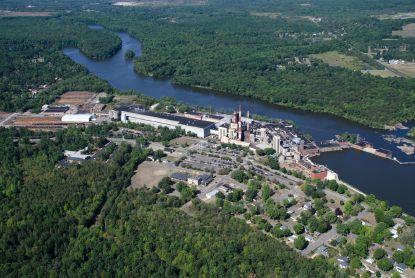
The Biron mill, one of Catalyst Paper’s two U.S. manufacturing locations.
iatory, protectionist actions by U.S. authorities,” said Richard Garneau, president and CEO.
Garneau refers to a duty on SC paper exports from Canada to the United States, which applies to Port Hawkesbury Paper, Resolute Forest Products, Irving Paper and Catalyst Paper.
Wood costs decreased for Eastern pulp mills
Pulp mills in Eastern Canada may have become more competitive following sharply declining wood costs. Wood costs reached their lowest levels in 15 years in the first quarter of 2016, according to the North American Wood Fiber Review.
NAWFR says wood costs for pulp mills in Eastern Canada have fallen dramatically the past four years, and the region has some of the lowest wood fiber costs in North America. In contrast, in 2012, pulp mills in Ontario and Quebec had some of the highest wood fiber costs on the continent.
In U.S. dollar terms, softwood chips and pulp log costs were down 37 per cent and 27 per cent, respectively, in Q1/2016 as compared to Q1/2012.
Although much of the decline can be contributed to a stronger U.S. dollar, wood chip prices have also fallen substantially in Canadian dollar terms.
Chip prices in Quebec and Eastern Ontario are currently on par with prices in Western Canada and the U.S. South, and they are substantially lower than in the U.S. Northwest, the Lake States and the U.S. Northeast.
Resolute files racketeering suit against Greenpeace
Resolute Forest Products is once again striking back at groups painting a negative image of the company and its forest practices.
Resolute has filed a federal lawsuit in the United States District Court against Greenpeace International, Greenpeace USA, Greenpeace Fund, Inc., STAND (formerly ForestEthics) and a number of their associates. The complaint includes federal racketeering claims, and racketeering, trademark, defamation and tortious interference claims under Georgia law.
Tortious interference, according to Wikipedia, occurs when a person intentionally damages the plaintiff’s contractual or other business relationships.
Resolute’s counsel is continuing its investigation of Greenpeace’s campaign and practices, and has established a telephone line for citizens to provide information on a confidential basis (212 542-4700). A website has also been established (resolutevgreenpeace.com) to catalog information and progress reports on the case.
Kruger’s Lafave to lead containerboard group
The Canadian Corrugated and Containerboard Association (CCCA) has elected Michael (Mike) Lafave as chairman for a one-year term. Lafave is senior vice-president, containerboard, packaging and recycling for Kruger Products.
Joining him on the executive committee are Bob Hagan, senior vice-president, Atlantic Packaging as first vice-chairman; Jean Parent, vice-president, sales and marketing, Norampac, as second vice-chairman; Gary Johnson, president, Maritime Paper, as treasurer; and as immediate past chairman, Peter Moore, board chairman, Moore Packaging.
Tembec extends paperboard product line
Kallima Coated Cover C2S 16 pt is the latest extension of Tembec’s line of bleached paperboard products. The company says this new product release stems from Tembec’s continuous investment into its research and development operations. This light weight grade is FSC certified.
Printers can benefit from savings of up to 20 per cent over competing products due to Kallima’s basis weight advantage achieved through a unique high-bulk, low-density construction, according to Tembec.
“Due to Kallima’s light weight construction, printers will find significant savings on mailing and shipping fees alone,” says Adrienne Jung, marketing manager, Tembec Paperboard Group.
Kallima is suitable for business cards, post cards, direct mail, POP displays, advertising collateral and pocket folders.
Chinese firm to build $1B pulp mill in U.S.
Chinese papermaker Sun Paper is building its first North American facility – a US$1-billion pulp mill in Arkansas.
An article by the Associated Press on thebusinessinsider.com says Sun Paper chairman Hongxin Li describes the new mill as “the most modern, the highest efficiency, the most environmentally progressive factory in the pulp and paper industry in all of North America.”
The article says the company hopes to begin construction in the first half of 2017. The plant is expected to take two and a half years to build.
Headquartered in China’s Shandong Province, Sun Paper ranks among the top 500 Chinese enterprises and is considered one of the world’s top pulp and paper makers.
Demo contractor shreds paper mill in Saskatchewan
Demolition contractor JMX Contracting Inc. of Gormley, Ont., has been contracted by Paper Excellence Canada to demolish the paper making buildings at its pulp and paper mill in Prince Albert, Sask., according to Daily Commercial News.
DCN reports that the pulp and paper mill was a major local employer until plant owner Weyerhaeuser shut it down in 2006. It was sold to Domtar that same year, and then purchased by Paper Excellence in 2011.
The new owners announced plans to produce dissolving pulp but duties imposed by China made that product not viable. There are now plans to produce fluff pulp at the mill, but no
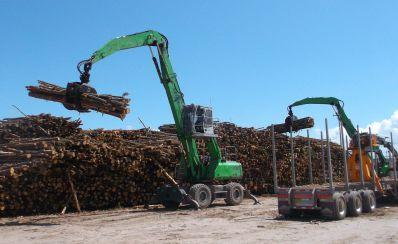
Woodyard at Port Hawkesbury Paper. Photo: Sennebogen
Canfor, Cascades, Catalyst receive energy conservation awards
Three pulp and paper manufacturers received awards at Energy Summit 2016 hosted by the Canadian Industry Program for Energy Conservation (CIPEC).
Natural Resources Canada presented Canfor Pulp Products Inc. with a CIPEC Leadership Award in the category of Employee Awareness and Training.
Canfor Pulp president, Brett Robinson, said the company is proud to have received this honor. “This CIPEC Leadership Award demonstrates that Canfor Pulp continues to be at the forefront of our industry in improving the energy efficiency of our operations.”
The company’s recent investments in energy conservation have encompassed much more than its work in employee awareness and training. They include turbine generator upgrades that reduced the mills’ dependency on purchased electricity as well as increased the mills’ thermal energy performance; updates to operating and maintenance practices; and capital investments to improve the company’s biomass boilers.
Catalyst Paper’s Powell River mill won the CIPEC Leadership Award in the category of Energy Performance Management, in recognition of its successful installation of the G13 turbine.
This turbine, which was installed in 2015, converts waste steam to electricity, increasing the mill’s power output by 8 megawatts, enough to power almost 7,000 homes. The $24-million project was developed in partnership with BC Hydro and was completed in the fall of 2015.
“This award recognizes the tremendous efforts of our team to reduce costs, create efficiency and support our commitment to environmental sustainability,” said Fred Chinn, vice-president and general manager, Powell River mill. “It’s a critical part of our effort to revitalize the mill for the future to ensure our long-term sustainability.”
Cascades received a CIPEC Leadership Award in the Corporate Stewardship category. Cascades reduced its energy consumption by 12 per cent in the 20132015 period.
“The expertise acquired over the past few years and the ingenuity of the teams in place once again made it possible to expand the boundaries. The establishment of energy kaizens, funding of special projects through a dedicated investment fund, and close collaboration with ENERGY STAR are among the measures that made this improvement possible,” explains Pascal Aguettaz, vice-president, corporate services.
firm date to re-open the facility has been announced.
According to DCN, JMX was contracted to remove several unused structures, primarily buildings formerly devoted to paper making. These include the paper mill, the sheeter warehouse, the folio building, the paper mill additives building, a fuel storage tank, the precipitated calcium carbonate plant, the old wood room (a new one has been built to support pulp production), the forestlands office, the effluent foam tower and the wood yard portal cranes.
Much of the paper making equipment had already been removed from the buildings.
Constantineau to lead new FPInnovations’ initiative
Serge Constantineau has been appointed research manager of FPInnovations’ SM2 Initiative. This initiative will oversee research and development of advanced manufacturing technologies that have the potential to impact the global forest sector. These technologies are expected to maximize the usage of fibre currently being harvested and enable the creation of innovative bioproducts from the subproduct material produced during the manufacturing process.
The SM2 Initiative will include a series of pre-commercial research and development projects. The launch project for the SM2 Initiative is a collaborative effort which includes partners DK Spec, Centre de recherche industrielle du Québec (CRIQ), Institut de recherche d’HydroQuébec (IREQ) and Laval University among others. Additional industrial partners from the forest and technology sectors are also expected to join.
The SM2 research projects will focus on the development of five innovative new technologies that will address many of the challenges currently being faced by the industry including the secondary manufacturing sector.
CPAWS and Tembec collaborate on caribou plans
Canadian Parks and Wilderness Society (CPAWS) and Tembec showcased their joint innovative solutions aimed at achieving woodland caribou habitat conservation and a healthy forest industry in Ontario and Quebec at a special event in Thunder
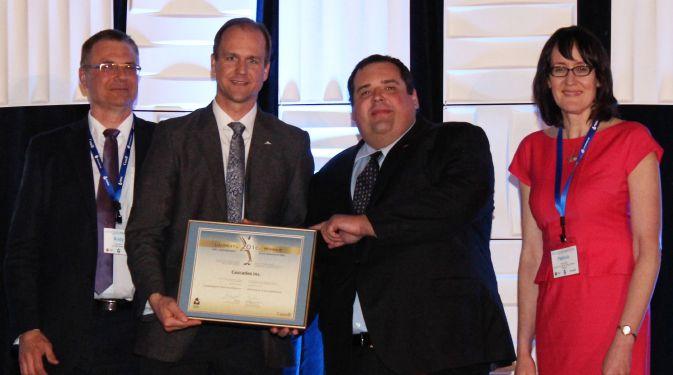
At the CIPEC award ceremony (from left to right): Scott McNeil-Smith, communications director, Excellence in Manufacturing Consortium; Fabien Demougeot, energy director, Cascades; François Lessard, energy coordinator, Cascades; and Patricia Fuller, general director, Office of Energy Efficiency, Natural Resources Canada.
Corrugated
and paperboard demand to rise 2.6 per cent
Demand for corrugated and paperboard boxes in the U.S. is forecast to increase 2.6 per cent per year to US$41.2 billion in 2020, as both nondurable goods manufacturing and retail sales post healthy gains, according to the Freedonia Group.
E-commerce and retail-ready applications will drive growth for corrugated boxes while folding carton demand will be sustained by the foodservice, carryout and pharmaceutical markets, Freedonia analysts say.
The group predicts value gains for corrugated and paperboard boxes will be stimulated by the increased adoption of value-added features such as high-quality printing, easy-open tear strips, and special coatings. Volume growth, they say, will be held back by lightweighting trends and market maturity.
These and other trends are presented in Corrugated & Paperboard Boxes, a new study from The Freedonia Group, a Cleveland-based industry research firm.
Freedonia says corrugated and solid fiber boxes will continue to hold the largest share of demand, comprising 74 per cent of the total in 2020 and reaching US$30.5 billion on growth of 3.0 per cent per year. Corrugated boxes benefit from advantages in terms of cost and strength capabilities and will remain the default shipping container throughout the foreseeable future, despite some competition from reusable containers, flexible packaging, and film covers, the report states.
“Moreover, as the e-commerce market continues to expand, so too will demand for boxes to ship products to consumers,” notes analyst Katie Wieser. Additionally, demand for shipping containers that can also act as retail displays will boost value growth as this application typically requires the use of high-quality printing and the integration of features that allow the box to be opened without tools.
Folding carton demand is forecast to increase 1.5 per cent per year to US$10.1 billion in 2020, posting slow growth as these containers face significant competition from flexible packaging formats such as stand-up pouches.
Bay in mid-May.
At the same time, Thunder Bay was hosting the a conference addressing caribou biology, research and management.
CPAWS and Tembec have been collaborating for almost ten years. The two organizations say their work in Ontario and Quebec is an example of “what is possible when people set aside their positions and bring a pragmatic problem-solving approach to resource challenges.” They have come up with voluntary recommendations to assist the provinces of Ontario and Quebec in meeting requirements for range plans under the federal recovery strategy for boreal caribou. Range plans are due by October 2017.
“There is a culture of leadership at
Tembec that invites collaboration,” said Janet Sumner, executive director for CPAWS Wildlands League, the Ontario chapter of CPAWS. “This kind of leadership is unparalleled in Canada when it comes to forest management and caribou.”
For the Abitibi River Forest near Cochrane, the two groups used best available science and wood supply information, and worked with local groups, to come up with a three-zoned approach that they say is better for caribou and mills and is respectful of communities.
Forest products industry launches climate change plan
The Canadian forest products industry is pledging to help Canada move to a low-
carbon economy by removing 30 megatonnes (MT) of CO2 per year by 2030 –more than 13 per cent of the Canadian government’s emissions target.
The “30 by 30” Climate Change Challenge issued by the Forest Products Association of Canada makes the forest sector the first to voluntarily contribute to the federal government’s climate goals.
“Our industry is uniquely positioned to be a crucial part of the solution to climate change because our renewable forests and forest products all store carbon,” says Derek Nighbor, the CEO of FPAC.
The sector has calculated the 30 MT can be reached by forest management practices that can maximize carbon storage in the forest and spur the growth of trees, by increasing the use of innovative forest products and clean tech to displace materials made from fossil fuels, and by further efficiencies at mills.
FPAC is working on a detailed road map to refine how it intends to meet the Climate Change Challenge. For more details go to fpac.ca/30by30
Papermaker Lucien Rolland dead at 99
Lucien G. Rolland was the last member of the Rolland family to run the family’s fine paper business before its sale to Cascades in 1992. He passed away in April 19 after a short illness.
A talented businessman, Rolland was part of the fourth generation of his family to grow the company. He helped the Rolland Paper Company transition into the modern era, as its president from 1952 to 1994.
Bernard, Laurent and Alain Lemaire, co-founders of Cascades, paid tribute to Rolland, saying he had an important impact on the development of the paper industry, and on the region. Since buying the Rolland mill in 1992, the brothers said, “profound mutual respect” marked their business relations with Lucien Rolland. “His vigor impressed us right up to the end.”
The Rolland paper company, founded in 1882 by Jean-Baptiste Rolland, originally had two mills in Quebec, at SaintJerome and Mont-Rolland. The plant at Mont-Rolland closed in 1990. The SaintJerome mill still operates, now owned by Rolland Enterprises.
Freedonia predicts the increased adoption of value-added features such as highquality printing, easy-open tear strips, and special coatings will lead to value gains for corrugated and paperboard boxes. Photo: Smurfit Kappa
FPInnovations’ Five-year Tissue Strategy
By Jennifer Ellson, senior communications specialist, fpinnovations
FPInnovations
launched a fiveyear tissue strategy last year, with an ambitious target to become one of the top tissue research and innovation centers in the world by 2020.
As part of this strategy, FPInnovations developed a suite of tissue testing methods and tools to characterize tissue structure and evaluate key tissue performance attributes. FPInnovations’ pulp, paper and tissue testing laboratory can test tissue physical properties such as bulk, optical properties, wet and dry strength, and water absorption according to ISO standard methods. FPInnovations has a full handfeel softness panel and tissue softness analyzer (TSA), and has done a large amount of work to assess their correlation, which is very helpful for the mills that have purchased the TSA instruments. The organization can also provide other testing services, including pulp quality and fiber morphology evaluation, chemical analysis and microscopy/image analysis that can be used to help troubleshoot operational problems
and support tissue product development and performance enhancement.
The five-year strategy involves developing insights into how fiber morphology and properties affect tissue performance through advanced fiber property characterization, laboratory studies and pilot scale benchmarking of pulp furnishes, as well as identifying and developing fiber processing technologies to enhance pulp fiber properties for tissue making, including both mechanical and chemical modifications.
FPInnovations’ pilot paper machine was upgraded to add tissue production capabilities in 2007.
The uniformity of tissue reels can now be analyzed with FPInnovations’ roll testing facility (RTF), a unique piece of equipment designed to test and quantify the uniformity of the web. The RTF also has a scanner to measure moisture and basis weight properties. Stretch variation can be quantified and we have found that it has a significant impact on converting efficiency.
The five-year strategy involves enhancing sustainability and cost competitiveness of tissue mills through improvement in
manufacturing efficiency and reduction in water and energy usage and environmental footprint.
Another very useful tool to diagnose web breaks in tissue converting is the analysis of the strength uniformity using a methodology and software developed by FPInnovations called PapTune. We have conducted benchmarking of strength uniformity for tissue produced on different machines in different mills and helped facilities improve their strength uniformity by reducing key properties variations, resulting in a significant reduction in web breaks.
Developing fundamental understanding of how creping operation and chemistry affect tissue structure and performance by using on-line sensors and modelling of creping mechanics – through partnerships with universities and suppliers – is a big part of the five-year strategy, along with working with industry partners to demonstrate the application of the new measurement tools and fundamental understanding in product performance enhancement and new product development. PPC
Linking Talent with Employers in Canada’s Forest Sector
By Derek Nighbor, ceo, forest products association of canada
Growing up in the Ottawa Valley, I appreciated from a young age the importance of the forest sector to our local economy. My brother and I were fortunate enough to earn good money in the summer on the same box-making factory floor where my grandfather and father earned their livelihoods.
Years later, as the CEO of the national forest products association and after seeing significant innovation and transformation across the industry, I am reminded that forest sector jobs continue to be rewarding and good-paying jobs in some 200 forest communities across Canada.
With more than 230,000 direct forestry jobs in Canada today, we continue to see opportunities on the horizon for young and more experienced workers in a host of job areas in forest operations, at mills, head offices and in the design, marketing and manufacturing of innovative forest products.
These jobs are not just supporting families and local economies, but they are also green jobs – bringing real benefit to the environment for all of us through sustainable forest management and the creation of environmentally friendly, forest-sourced products.
One of the biggest labour challenges in our industry today is ensuring that we have the right people trained to do the
jobs that are going to be in demand not only today, but tomorrow. The Forest Products Association of Canada launched in June our new job-matching tool, a critical tool to support the matching of job hunters with job opportunities.
This new tool, which is free for both employment seekers and employers, will not only support those looking for work, but it will also provide advanced labour market information that can be used to help forestry companies with their recruitment efforts, allow governments to develop public policies to better address employment needs, and support our high schools, colleges
PACWEST HIGHLIGHTS
The industry’s annual Western conference continues draw attendees away from their mill duties with valuable learning and networking opportunities.
The 2016 PacWest conference wrapped up on June 11 after three days of informative technical and business-oriented sessions. Attendance at the event has been growing over the past few years, reaching about 250 delegates this year plus about 50 attendees for the spousal program.
The annual PacWest conference is jointly organized by volunteers from pulp and paper mills, and IBMP, an organization of industry suppliers.
Kelly Parfitt of Canfor Pulp was conference chair, managing the event with the assistance of Scott Curry of CQ Strategy as co-chair. Parfitt noted that the opening forum had a more technical nature this year, which was well received by attendees.
Lessons learned from bioproducts
Various experts speaking at PacWest’s opening forum noted that a commodity product approach won’t work for the Canadian pulp and paper industry as it develops bioproducts.
The general conclusion is that the
By Cindy Macdonald, editor
development of bioproducts requires leaders that understand the philosophical differences of a higher-value product that needs lots of market development.
“We need people that want to make a difference, that want to change the industry,” said Eric Ashby of Domtar.
Domtar is a partner in CelluForce, which established a demonstration plant to produce cellulose nanocrystals a few years ago. “We learned that the ‘build it and they will come’ philosophy is a mistake,” he commented.
Rod Albers of West Fraser spoke of
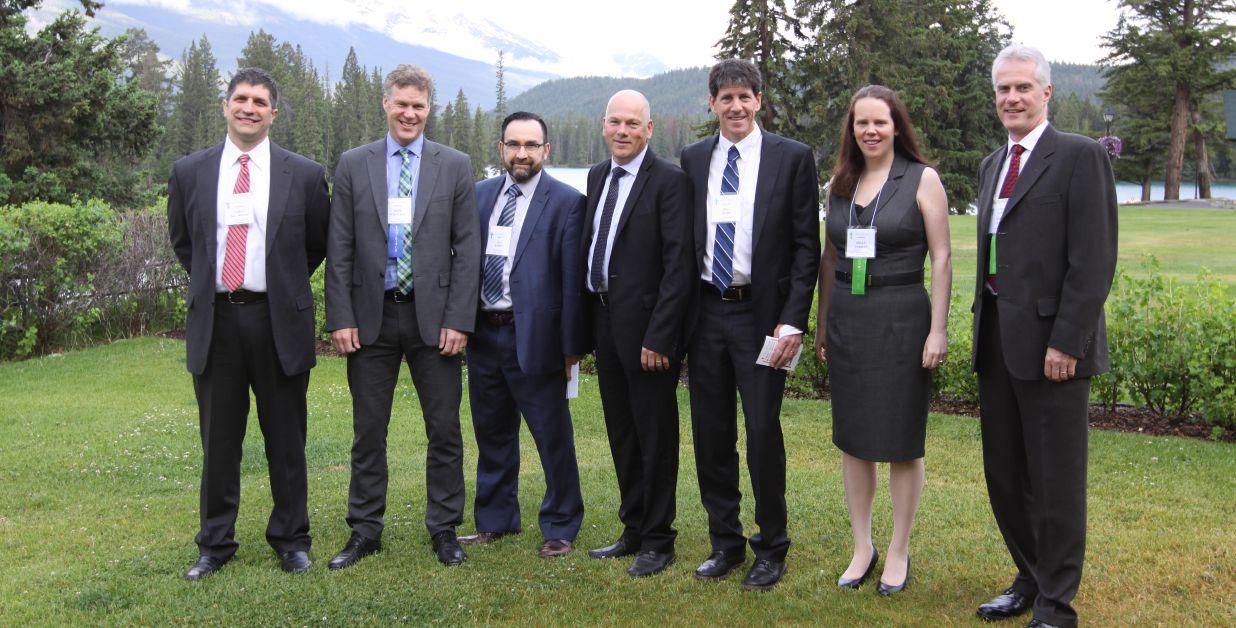
Speakers for the Conference Forum and PacWest organizers are pictured on the grounds of the Fairmont Jasper Park Lodge. Shown are (left to right): Carlo Dal Monte – Catalyst Paper, Mats Nordgren – Valmet, Jean Hamel – FPInnovations, Rod Albers - West Fraser, Bill Adams –Canfor Pulp, Kelly Parfitt – Canfor Pulp (PacWest chair) and Scott Curry – CQ Strategy (PacWest co-chair). Missing are: James Olson – UBC and Eric Ashby – Domtar.
his company’s investments in bioproducts, which include organic rankine cycle engines to produce electricity at sawmills, a biogas plant at Slave Lake Pulp, and lignin recovery at Hinton Pulp.
Albers cautioned the audience that bioproducts opportunities are generally high-risk propositions, and that about $100 million would be needed to develop a product. West Fraser has completed a lignin separation plant at its Hinton pulp mill, and has plans to use the lignin as an adhesive in the company’s engineered wood product. One tonne per day of lignin is earmarked for the internal West Fraser market, but Albers jokes that it’s not any easier to sell a new product to an internal client than an external one. The lignin facility at Hinton is expected to produce 30 t/d.
Jean Hamel of FPInnovations also commented that the pulp and paper tends to be a commodity-based industry. “For innovation projects, we have to change our mindset. We have limited capital and limited understanding of the value chain of other industries.”
The good news is that some wood-based bioproducts are starting to make commercial inroads. Hamel said, “You have to dig deep, but there are applications.”
He pointed to BioAmber and Comet Resources in southwestern Ontario as an example of a supply chain that developed to support a bioproduct, this one based on celluslosic sugar from corn. For wood-based bioproducts, he said, the industry needs to think about the structure and connections necessary to develop a supply chain. “In the world of biochemicals, you’re not going to control the whole supply chain,” he told the pulp and paper audience.
For some wood-based bioproducts, there won’t be enough of a market to absorb all that Canadian mills could produce, but when it comes to cellulosic biofuels, “we will be just a drop in the bucket,” Hamel predicted.
“The industry is transforming, right now, around the world,” he concluded.
European mills embracing new technology
One European speaker at the PacWest conference had words of caution regarding Canada’s global position within the pulp and paper industry. Mats Nordgren,
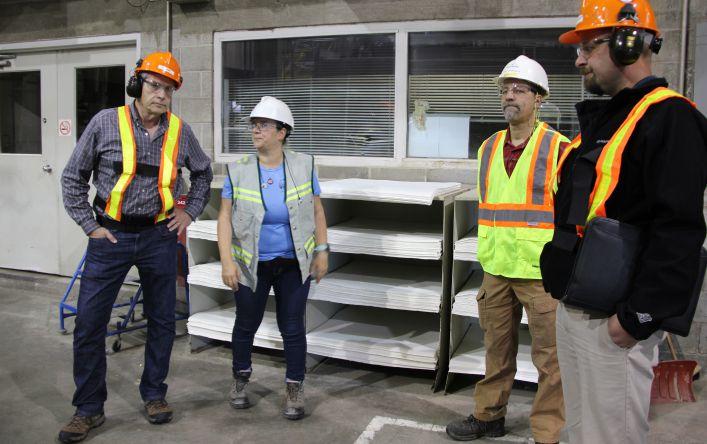
Top: Conference participants had an opportunity to tour West Fraser’s Hinton pulp mill.
Middle: PacWest attendees all dressed up for the dinner and dance.
Bottom: Panelists watch during a technical session.
a specialist with Valmet, described how the industry in Europe is rebuilding and upgrading technology in the mills. He hopes Canadian companies will invest and keep up.
Nordgren looked in detail at three current projects: Södra Cell’s Värö and SCA’s Östrand mills in Sweden, and the new mill being built by Metsä Fibre at Äänekoski in Finland.
All three companies have chosen to install new cooking plants. Nordgren says the new cooking plants have to potential to improve yield by three per cent compared with older technology, and could reduce steam consumption by as much as 30 per cent.
When the upgrades are complete, the Varo and Ostrand mills will have steam consumption of about 5 tonnes per tonne of pulp. Effluent volumes will be less than 10 m3 per tonne of pulp. Energy consumption at Varo is expected to be about 600 kWh per tonne. None of the three mills will be dependent on a power boiler, Nordgren noted.
He also cited an internal study performed by Valmet which showed that most pulp-producing regions were recording a decrease in bleach plant effluent volumes as a result of investment in newer and upgraded mills. That decrease is not evident in North America.
Benefits of sustainability
Bill Adams, senior director of sustainability, technical services and innovation at Canfor, had an opportunity during PacWest’s opening forum to share his views on sustainability. Because sustainability encompasses energy and water efficiency, sustainability delivers competitiveness, he said. “By embracing sustainability, we’re going to bring innovation to our facilities.”
Adams hinted that a major investment will likely be announced for the Taylor mill later this year.
Ecosystem services need to be more talked about, he noted. To produce one tonne of pulp requires a forest about the size of a tennis court, said Adams. That forest provides biodiversity, it binds carbon and it purifies water.
Operating insights
One of the strengths of the PacWest conference is the prevalence of technical presentations focused on the real-world
experiences
of Canadian mills.
Barry Hirtz of Canfor Pulp, and Devin Marshman and Carl Sheehan of Spartan Controls collaborated on a paper entitled “Kiln infrared cameras for brick loss detection and residual carbonate control.” It outlined the results of a trial installation of infrared cameras used to measure the shell temperature of the lime kiln at Canfor’s Prince George Pulp and Paper mill. The camera installation produced a temperature profile along the length of the kiln, and Spartan Control analyzed the data to assess the capability of the cameras to predict and control operation of the kiln. The cameras were also used for proactively monitoring and detecting ring formation, brick loss, and other undesirable operating conditions.
James Goldman’s presentation, “Online quality measurements are the key to understanding and optimizing your fiber-
oversizing has a huge capital cost penalty. “Unfortunately, steam distribution design, process control and financial optimization systems have lagged far behind the installations, substantially reducing the return on investment,” said Strausz.
He believes that in a mill, the ideal mode of operation for a condensing turbo-generator is main header pressure control, which allows the boilers to run as hard as possible at all times, controls the steam header to eliminate venting, and maximizes power generation by maximizing steam header pressure and using all steam available.
“Condensing turbo-generators run amazingly well most of the time,” said Strausz. “The two prominent exceptions are when they are exposed to a large, rapid rise in steam flow, as from a process area trip, and when they run close to capacity on a regular basis.”
BIOPRODUCTS OPPORTUNITIES ARE GENERALLY HIGH-RISK PROPOSITIONS, AND ABOUT $100 MILLION IS NEEDED TO DEVELOP A PRODUCT – ROD ALBERS, WEST FRASER
line,” emphasized that frequent, reliable and accurate process measurements are the most important step to understanding the process. “Without this step any hope of optimizing a fiberline to operate at its most efficient stage and sustain the results is futile,” writes Goldman, who works with Valmet Automation. “If a proper control strategy is developed based on accurate and reliable lab quality or better measurements then in most cases the savings in wood and chemical cost along with the reduced variation in the process which leads to improved final product quality is substantial enough to more than cover the cost and effort required to add and maintain these measurements.”
Jim Strausz of CTech correctly noted that over the last 10 years, the Canadian pulp industry has greatly increased its power generation capacity, often in the form of new condensing turbines. In his presentation, “Control and protection systems for condensing turbo-generators,” he explained that these units are sized to condense the expected steam available, and
Performance Pipe introduced at PacWest a high-temperature HDPE pipe that can be used to handle pulp and paper mill effluent. Because this new pressure-rated pipe has a peak operating temperature of up to 95°C, Wes Long of Performance Pipe suggests that it would be a suitable replacement for FRP pipe in some applications within pulp and paper mills. He notes that one B.C. mill is currently installing the PlatinumStripe 1800 series pipe for a bleach plant applicaton. PlatinumStripe 1800 PE-RT significantly expands the operating window for polyethylene pipes. These pipes are specifically designed for high-temperature applications in mining, pulp and paper, chemical processing, and water/wastewater. Performance Pipe is represented in Canada by Engineered Pipe Group.
PacWest 2016 at Jasper, Alta., also included a mill managers roundtable, trade show, presentations from UBC students and a mill tour of West Fraser’s Hinton site. Next year’s event will be held at Whistler, B.C., from June 7-10.
DISRUPTIVE TRENDS IN TISSUE MANUFACTURING
By Smithers Pira
The tissue manufacturing industry is poised to undergo significant changes in the next five years, according to the latest market analysis from Smithers Pira.
Its latest report, The Future of Tissue Manufacturing to 2021, examines the background to this change, key market drivers and the disruptive technology trends that will help transform the industry in the medium term.
The last two decades have already seen significant changes in tissue-making technology which have changed the market – principally by decreasing market concentration in North America. Simple, relatively low capital cost crescent former tissue machines have expanded and diluted ownership of tissue production across a wider geographical base. This in turn has led to the emergence of new tissue manufacturing companies and converting companies.
Smithers Pira’s analysis has highlighted four key disruptive trends to which tissue manufacturers, new and old, must respond over the next five years to stay competitive in this increasingly dynamic market.
1. Crescent former standardization
The arrival of the crescent former – with a single combined forming wire and press felt – has been a truly disruptive step for the tissue manufacturing industry. This has seen the development of more compact, lower-cost machines where the bottleneck of wet web transfer to the press felt is eliminated.
It is also the fastest tissue forming configuration, with run speeds of up to 2,150
metres per minute now reported.
As machine builders and operators have embraced the potential of crescent formers, there has been a drive for increased standardization. This has – and will continue to – eliminate engineering costs, as a limited menu of options greatly simplifies the process of building and operating a tissue machine.
Standardization keeps costs down and lowers the bar for new companies to enter into tissue manufacturing by minimizing the number of engineering staff they require. Over the next five years, this means it will be much easier for new tissue production sites to be set up, wherever and whenever a market need is detected.
As well, standardization makes it much easier for a machine buyer to compare costs between different models, making for a more competitive equipment supply market.
2. Refining reduction
Refining tissue fibre is an old process that is going through changes as tissue product designs and chemical technologies evolve. The objective of the refining process is to modify fibres in order to increase the strength of the tissue. This has the added benefit of removing clumps and tangles of fibre as they pass between the rotor and stator bars.
In a traditional refiner with rotating and stationary plates, fibres flowing between the bars in the refiner are worked mechanically through compression and shearing forces. This results in structural changes to the fibres, including:
• Chopping long fibres into shorter pieces,
• Fibrillating the fibre surface,
• Simple bruising of the fibre, which improves hydration and swelling.
Some types of fibres respond poorly to refining; eucalyptus fibres are particularly fragile in refining for tissue use. In response to demand for these, many tissue mills are setting up separate split stock systems with refining on only the softwood side. This avoids refining the eucalyptus fraction and creating fines, in order to produce premium quality.
The future trend for tissue manufacture is for less refining, with plates designed for internal fibre swelling with minimal debris generation. The disruptive effect of this reduced refining trend will be seen in the increased use of chemical additives for dry strength control in tissue. This approach holds the promise of improved softness at a given strength level.
Savings in energy consumption during the refining phase are not significant. The reduced refining levels do have potential to improve pressing solids however, which translates in to drying energy savings of about five per cent.
Development trials related to refining reduction are proceeding with several suppliers, and implementing the outcome of these is forecast to be a key focus over the next five years.
3. Foam forming
One established tissue process – foam forming – may witness a renaissance in the next five years. This technique involves forming tissue from a fibre solution suspended in a foam dispersion of air and water. It delivers dramatic improvements in both fibre dispersion and web formation.
Foam forming machines – like SCA Tissue France’s installation at Gien – have demonstrated how this process could allow for the substitution of lower-cost, coarser hardwood fibres for eucalyptus, while making similar or higher performance products. The business case for foam forming has been seriously eroded however, as the price of eucalyptus fibres has dropped.
Forthcoming disruptions in tissue fibre supply may create opportunities for foam forming technology to make a return in the next five years. Research has shown it can make reasonable tissue sheets from mechanical fibres. Furthermore, the open
wet foam tissue gives up water more easily than a conventional water-formed system – which leads to much better mechanical pressing efficiencies. Foam forming also offers benefits for energy consumption as well.
4. Press felt design
Press felt development trends are having an even greater impact on tissue manufacturing. Unlike in heavy paper grade production, in tissue manufacturing single suction nip machines are continuing to displace Yankee dryer configurations.
This is because a single nip press puts the focus on press fabric performance –minimizing the amount of water sent to the dryer section for evaporation. Pressing theory suggests that lightweight sheets like tissue have low drainage resistance and form pressure-controlled nips.
Press fabric design has already been identified as a key to crescent former productivity. Past designs for dewatering the tissue focused on the mass of batt fibre, caliper, and air permeability. For the next five years the trend for tissue press felt design is to focus on pressure uniformity, mean flow pore size, compressibility, resiliency, density, and void volume.
Pressure uniformity and mean pore size are the variables best correlated to increased dewatering efficiency. This will translate into a reduction in dryer energy required, or a potential speed increase of the same order of magnitude as seen with foam forming. Critically, press fabric performance improvements, and the resultant energy savings, will not necessarily require capital investment in machinery. This will potentially disrupt tissue production over the next five years with output on dryerlimited machines increasing significantly.
These cutting-edge trends in manufacturing processes, machinery developments and fibre technologies are expected to lead to significant changes in the global tissue industry.
For in-depth analysis and context related to these trends in manufacturing processes, machinery developments, fibre technologies, and tissue end-uses, and their transformative impact, explore Smithers Pira’s report The Future of Tissue Manufacturing to 2021. The report is available for purchase at www. smitherspira.com.
FOCUS ON PUMPS AND VALVES
Valve selection guide for pulp and paper
Valve manufacturer DeZURIK/APCO/ Hilton has released a valve guide for the pulp and paper industry to help users navigate the valve selection process. It provides usage guidance based on valve type, general specifications and common industry applications.
DeZURIK has a wide variety of valve styles to meet the application requirements of the pulp and paper industry. DeZURIK’s precision electric basis weight control valve is specifically designed for critical paper stock control, and is used for basis weight and head box level control applications.
The company’s knife gate valves and v-port ball valves are widely used in pulping and stock prep operations throughout the mill.
DeZURIK’s three-way tapered plug valves are designed for throttling and diverting applications in refiner stock control applications.
The selection guide uses color-coded graphics and detailed diagrams to help direct users based on specific industry applications.
DeZURIK Inc., http://www.dezurik.com/ bulletins/
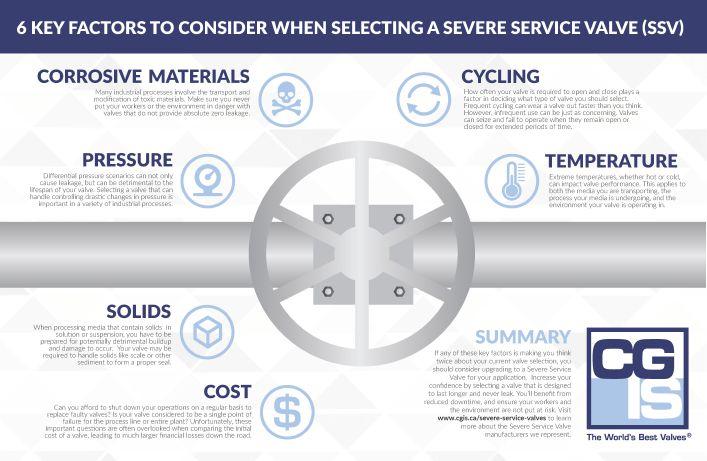
Key factors for selecting a severe service valve
The term severe service valve (SSV) is commonplace to the industrial valve industry. The problem is, no one really knows exactly what it means.
Valve manufacturer CGIS is in the process of establishing an exact definition. Once in place and approved by the Manufacturers Standardization Society of the Valve and Fittings Industry (MSS), there will be a benchmark and rating system to identify what constitutes a severe service valve (SSV), and how it differs from a general purpose valve (GPV).
In the meantime, CGIS pulled from its internal best practices to put together a brief guide to the key factors for selecting the right valve for your application.
CGIS notes that outdated valve specifi-
cations are a common sight in the industry. The operating conditions of pressure, temperature, process volume and energy costs are drastically different than they were only 30 years ago. Maintenance staff are fewer, piping systems are operating under higher pressures and temperatures, and the push to produce more revenue from fewer resources is greater than ever before. The company feels severe service valves play an important role as new processes and aging technology create immediate dangers to workers and their surrounding environment.
CGIS president Ross Waters has been at the forefront of this cause and has presented his paper, “Defining Severe Service Valves,” at various international venues. CGIS, www.CGIS.ca
Wajax now offering Hidrostal pumps
Wajax has added Hidrostal pumps to its product portfolio for municipal and industrial markets. Hidrostal manufactures screw impeller pumps and specializes in pumping solutions for solids and sludge handling.
“Our customers were asking for a range of screw centrifugal pumps that are ideally suited to a broad range of industries, including water, wastewater, pulp and
paper, agricultural food processing and fish pumping,” said Rick Byers, vendor development manager – fluid handling, at Wajax.. “Hidrostal is the solution for all these types of applications.”
The company’s pumps are available with flows to 50,000 US GPM and heads to 250 feet.
The Hidrostal screw centrifugal impeller is, by virtue of its axial extension, able to pass solids, and handle rags and fibrous material, while at the same time avoiding compromising the hydraulic design. Wajax, www.wajax.com; hidrostal.com
KSB adds to in-line pressureboosting pumps
KSB Pumps has introduced a new, larger member of its Movitec series of in-line pumps for pressure-boosting applications. The new Movitec 125 can deliver flow rates as high as 192 m3/h and has a maximum head of 128 m.
The new pumps are versatile workhorses that can be used in a wide variety of applications.
Careful hydraulic design has resulted in optimized NPSH values and in an industry-leading 80 per cent efficiency rating. A range of fluids can be handled, at temperatures ranging from -20° to 140° C. KSB Pumps Inc., www.ksb.com/ksb-ca/
Spartan Controls adds BTG products
Spartan Controls Ltd. is now the exclusive distributor of BTG instruments in Western Canada. BTG is a multinational provider of process solutions for the pulp and paper industry.
“Partnering with BTG strengthens our ability to provide fully integrated solutions in the pulp and paper industry,” said Terrance Chmelyk, performance solutions manager at Spartan Controls. “Combining the experience of Spartan’s Performance Solutions Group and BTG’s sensor technology, we can optimize process efficiency, reduce chemical and energy costs, and drive performance improvements.”
The new additions to Spartan’s offering include:
• Inline instrumentation: sensors and transmitters for inline measurement of fiber consistency, brightness, residuals and viscosity as well as analyzers for control of charge, retention, gas content and Kappa.
• Laboratory instruments: Mütek devices for detection of colloidal charge, iso-electric point, zeta potential, drainage, freeness, and retention.
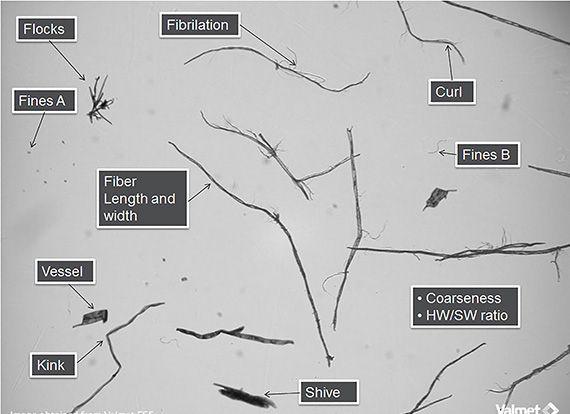
Valmet has added new measurement capabilities to its Fiber Image Analyzer (Valmet FS5).
The strength potential of the pulp can now be predicted easily from process samples. Better understanding of the characteristics of the fibers helps papermakers to better manage the process and achieve targeted end product quality.
“The new gravimetric coarseness feature in Valmet FS5 has been accepted very well by our customers. The true coarseness value is an important value which predicts the paper structure and now it is possible to get this result easier and faster than ever before without tedious and time-consuming sample preparation. Our approach of combining both optical and gravimetric coarseness values is a result of out-of-box thinking by our [research department],” says Tuomo Kälkäjä, the product manager for Valmet FS5.
Cell wall thickness and cross sectional area, available in a previous generation of Valmet’s analyzer, is also now derived by the Valmet FS5. It reports average values for the whole sample. Valmet says these results provide a better understanding of the paper making potential of the pulp.
The increased capabilities offered by these new measurements are also available as upgrades for existing users. More than sixty Valmet FS5 analyzers are now in use. Valmet, www.valmet.com/fs5
Solenis forms equipment service team
Specialty chemicals producer Solenis has introduced a new equipment service team to service Solenis-owned chemical feed equipment at customer locations. The program was launched in North America in early 2016 and will begin rolling out in Europe, Middle East and Africa in midsummer 2016.
When the program is fully implement-
ed, customers will have rapid access to skilled equipment technicians.
“We’ve always been committed to helping customers get the most out of their Solenis feed equipment,” says J Chris Farrell, director, global customer equipment and services. “Now, with this new team in place, we can provide premium-level service in less time. For customers, this translates into reduced downtime and improved productivity.”
The new program will also improve safety for Solenis employees at customer sites. All service technicians have completed their Solenis safety training, have demonstrated equipment service expertise and will complete all customer-specific qualifications before entering a site. Solenis states that they are highly qualified to perform complex repairs and installations.
Customers won’t incur additional costs for this service, although Solenis may, in the future, provide paid services for customer-owned equipment. The company will release details about any program expansion as they’re available. Solenis, www.solenis.com
FITNIR chosen for recaust and recovery application
FITNIR Analyzers is opening its doors to the Asian market with its largest single online FT-NIR analyzer implementation to date. This landmark project was secured with Asia Pulp and Paper’s newest mill site, PT OKI Pulp & Paper Mills, located in Southern Sumatra, Indonesia.
“It’s exciting to be on the ground floor with this new mill,” said Tom Sands, president of FITNIR Analyzers. “Having our technology contribute to the efficiency and productivity of a leading-edge operation is a major win for us.”
FITNIR Online will measure key pulp liquor properties from the mill’s recaust and recovery streams. This data will feed into a supervisory control system for process optimization. This mill will be one of the world’s largest, so a total of two analyzers and six field sample stations will be implemented to provide fundamental liquor properties at strategic process locations.
FITNIR is working in coordination with Elof Hansson International of Sweden. Elof Hansson facilitated the project contract and will provide local support and implementation services. Analyzer implementation is expected to commence in the fall of 2016.
PT OKI Pulp and Paper’s mill in Southern Sumatra is designed for a production rate of 8,000 air dry tonnes of pulp per day. FITNIR Analyzers Inc., www.fitnir.com
White Birch Paper selects Majiq software for Quebec mills
White Birch Paper has selected Majiq’s Enterprise Elixir system for sales order processing, planning, trim optimization, and manufacturing execution for its F.F. Soucy and Stadacona operations in Quebec.
“The ability to further differentiate the service and delivery execution we provide to our customers while remaining one of the lowest costs producers is a strategic goal at White Birch. Elixir’s Enterprise solution will enable us to streamline our supply chain, returning more value to our customers,” says Alexandra Baremore, director customer service and planning for White Birch Paper.
White Birch’s Bear Island operation has been running Elixir since 1997.
Steve Latham, president of MAJIQ, comments, “Elixir provides White Birch with a powerful tool that enables superior customer service while helping them become an even greater leader in efficient delivery to their customers.”
White Birch Paper manufactures newsprint, specialty paper, directory paper and paperboard, at mills located in the United States and Canada. Majiq, www.majiq.com
Positive results with web inspection at former and press section
German boxboard manufacturer WEIGKarton has been working closely with Procemex since 2009 to improve optical process monitoring on their folding box board line.
In 2013, WEIG-Karton decided to fit their gypsym liner board machine, KM6, with a portable high speed camera system. Four FullHD pinhole cameras were installed at the wet end of the machine to improve troubleshooting accuracy.
This new setup proved to be a great success: it helped the operators to focus their troubleshooting in the right areas of the wet end. The success of the first experiment lead to further collaboration between WEIG and Procemex. Together the teams developed a deployment concept of a camera system that would cover all of the board machine, not just the wet end.
The team’s idea was to monitor the wire with a pinhole web inspection beam. Procemex had previously used camera beams to inspect pick-up areas with promising results, and they had developed a pinhole beam technology for full-width web monitoring and inspecting extreme areas of paper machines. The technology guarantees seamless inspection without any disturbances brought by conventional cleaning mechanisms, such as wipers.
The pinhole beam technology was the preferred beam technology for the exit of the press section and the sizing press entry. The same image resolution could be used in all three beam positions in order to compare events with each other. Single pinhole cameras were installed alongside the beams on the headbox of the KM6.
In order to develop a comprehensive solution for the KM6, additional web monitoring cameras were installed at the second press, pre-dryer section and the exit from the size press. The system was completed in August 2014. Procemex trained WEIG operators and engineers to operate and take care of the system.
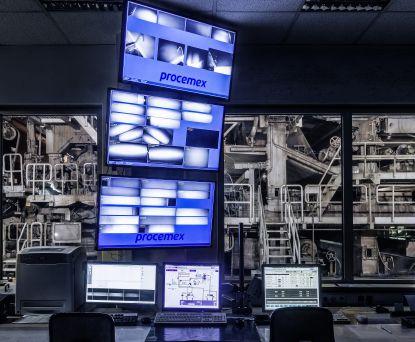
Today, a total of 40 single cameras are used to monitor the process and quality of the paper machines, and three 42-inch monitors display live images of production.
Henning Dippel, operating manager for KM6, comments: “After the commissioning we could see a major improve-
ment in process monitoring quality. The reaction times were significantly reduced. In addition to defect detection, the condition monitoring of wires and felts plays a significant role in ensuring the economic operation of the material. For example, a hole in the third dryer group felt and wire defect in the former section could be quickly detected and corrected.”
Mika Valkonen, CEO, Procemex, explains that the company’s pinhole camera and LED light beam technology are specifically developed for pulp and paper applications. “We started developing the wet end frame concept in Finland three years ago. The first pinhole camera beam was installed under the pick-up felt of a paper machine. This turned out to be very helpful in solving runnability issues and improving machine efficiency. We soon realized that the concept also works in several other positions where conventional solutions cannot stay clean enough to perform.”
“Monitoring the forming area is very important, as typically 80-90 per cent of web breaks originate there,” Valkonen states.
Procemex, www.procemex.com
Norampac starts up steam system for corrugator
Kadant Johnson has successfully started up its ThermoMax steam system at Norampac’s corrugated packaging plant in Drummondville, Que. The steam system serves a new corrugator line that was part of a $26 million modernization project. The corrugator project doubled the production capacity of the plant. The corrugator has a face-width of 110 in. and is designed to operate at sustained speeds
of 450 m/min. It is the first of its kind in Canada.
Kadant Johnson’s scope of supply included its ThermoMax steam system for the single facers, triple pre-heater stack, and hotplate sections; a PLC control system with operator stations; boiler room controls; variable moisture steam shower supply systems; engineering services; and system commissioning.
Greg Wedel, president of Kadant Johnson, comments: “Our expertise in heat transfer products, process control and systems engineering position us well for projects such as this, where product, process, and controls integration are required for maximum uptime, production and quality.”
The ThermoMax steam system features supervisory control logic to ensure consistent production and reliable operations. Operators have high visibility into the system through a graphical interface. They are supported by remote diagnostics, process monitoring and process recording.
Both single facers included Kadant Johnson’s patented Turbulator bars, CorrPro rotary joints, and cantilever syphon equipment on critical steam-heated rolls.
Norampac is a division of Cascades. The Drummondville plant produces and converts corrugated packaging from linerboard and medium supplied by Norampac’s containerboard mills for use in manufacturing, food and other industries. Kadant Johnson Inc., www.kadant.com
Valmet
invests in press felt production
Valmet is investing several million euros in its paper machine clothing production plant in Tampere, Finland. The investment is expected to improve the product technology and production capacity of seamed press felts for paper, board, tissue and pulp drying machines.
The upgrade includes a new wide weaving loom, updating of some existing weaving looms and new fiber opening and blending machinery.
Valmet says customers are now more willing to move away from endless felts in older machines. The company says market for seamed felts is growing, especially in North America, where more than 70 per cent of the felts used in paper and board machines are endless. The change from
endless felts to seamed ones improves occupational safety and production efficiency at mills, according to the company. The seamed felt installation is faster and takes much less manpower than installing an endless felt.
Valmet, www.valmet.com
Autopro named a Rockwell Automation partner
Autopro Automation Consultants has joined the Rockwell Automation Recognized System Integrator Program. Qualified members of the program represent system integrators that meet program criteria for operational excellence, application expertise and customer focus.
“They [Autopro] have clearly demonstrated their commitment to deliver the highest technical solution and customer service for their clients, and have established a mutually supportive relationship with Rockwell Automation sales personnel and distributors,” said Mark Moriarty, manager, System Integrator Program, Rockwell Automation.
Glen Roberts, vice-president, business development with Autopro, added: “As a vendor-independent integrator we advise our clients in choosing the most effective software and hardware for their unique requirements, and Rockwell Automation consistently provides the industry leading technology that helps us solve their complex process control challenges.”
Autopro Automation Consultants is a professional engineering and integration firm that specializes in the design and implementation of high-value industrial automation solutions.
Autopro Automation Consultants, www. autopro.ca
Voith Paper partners with SKF USA
Voith Paper now has an SKF-certified bearing inspection facility. Voith Paper North America has signed a strategic preferred service partner agreement with SKF USA, where SKF will supply its expertise, quality bearings, advanced tools and equipment in Voith’s Neenah, Wis., rolls facility.
“We’re continuously seeking to elevate the quality of our products and their performance on our customers’ machines,” said John Fox, president of Voith Paper
North America. “To this end, we’ve partnered with SKF experts to ensure that all repairs are performed in accordance with best-in-class industry practices.”
The Voith Paper-SKF strategic partnership is an agreement that focuses on highquality repairs for maximum service life in the pulp and paper industry. The preferred service partner program is intended to provide less machine variability. Consistent specifications and standards will be in place at the certified facility.
SKF is a global supplier of bearings, seals, mechatronics, lubrication systems, and services.
Dan Donnelly, senior vice-president, pulp and paper, SKF USA, says: “The Preferred Service Partner Program means both SKF and Voith can focus on their key strengths. SKF has the superior bearings and reliability expertise to maintain machine availability.”
Voith Paper, www.voith.com/ca-en/
ABB adds crill
measurement for pulp
ABB has launched a laboratory fiber analyzer with the capability to accurately detect the amount of crill in any pulp mixture. L&W Crill is an optional module to the portfolio of ABB’s fiber analyzers and expands the company’s offering of Lorentzen & Wettre products for fiber testing.
L&W Crill uses a method based on the fact that small particles absorb and scatter light, which makes it possible to detect very small particles in a pulp suspension.
This add-on to the fiber analyzers provides a complete range of fiber measurements, both image-based and non-image based, from one laboratory pulp sample for a more complete view of pulp fiber properties.
Crill is an important variable to measure in pulp mixtures, as these tiny fibers contribute to overall paper strength and end product quality, says the company.
Because L&W Crill is not based on image analysis, it is not limited by the resolution of an imaging system. Instead, L&W Crill analyzes how particles with different diameters absorb and scatter light of different wave lengths. By sending UV-light and IR-light through a pulp suspension, it detects if small particles are present in the solution. ABB, www.ABB.com
Canfor forms JV for liquid biofuels
Canfor Pulp has formed a joint venture with an Australian company to possibly integrate its catalytic hydrothermal reactor (Cat-HTR) upgrading platform into Canfor Pulp’s kraft and mechanical pulp mills to economically convert biomass, including wood residues from Canfor Pulp’s kraft pulping processes, into biocrude oil. The biocrude can then be used to produce next generation biofuels and biochemicals.
“The Cat-HTR process is a strong technical fit for the kraft process,” said Brett Robinson, president of Canfor Pulp. “The opportunity to directly produce advanced biofuels from our existing streams could transition Canfor Pulp from being strictly a pulp and paper manufacturer to a bioenergy producer as well. The Licella technology has significant similarities to our existing processes which makes this partnership a natural fit.”
The joint venture between Licella Fibre Fuels Pty Ltd. and Canfor Pulp Products Inc. will operate under the name Licella Pulp Joint Venture. If the Cat-HTR technology is successfully integrated, the Licella Pulp Joint Venture would look towards offering this solution to other, third-party kraft and mechanical pulp mills.
According to Canfor, refining this residue stream would allow Canfor Pulp to further optimize its pulp production capacity.
“Licella’s Cat-HTR technology may add significant value to Canfor Pulp’s kraft process by creating new products from Canfor Pulp’s waste streams,” said
Len Humphreys, CEO of Licella. “What we are potentially building towards is a biorefinery to utilize the entire tree, rather than part of the tree.”
According to Biofuels Digest, Licella’s process uses a supercritical water-based technology and catalysts to break up biomass and reform it into a drop-in fuel hydrocarbon.
The two joint venture partners have had a successful program of preliminary trials conducted on feedstock from Canfor Pulp’s Prince George, B.C., pulp mill at Licella’s pilot plants located in New South Wales, Australia. In these trials, wood residue streams from Canfor Pulp’s kraft process were successfully converted into a stable biocrude oil.
“Biofuels and biochemicals represent the next frontier in the utilization of sustain able wood fibre to produce green energy and chemicals,” said Don Kayne, CEO of Canfor Pulp. “This initiative underscores Canfor Pulp’s commitment to innovation and the importance of green energy and chemicals in our future product mix, and we look forward to developing this poten tially transforming technology with Licella.”
Biodiesel
pilot plant announced for Quebec
FPInnovations and Bioénergie La Tuque (BELT) have signed a collaboration agree ment to investigate and construct a nextgeneration demonstration biorefinery facility in the city of La Tuque, Que.
Through this project, the partners aim to produce more than 200 million litres of biodiesel annually from the conversion of forest residues.
availability of biomass at a competitive cost, identifying technological bottlenecks in the most promising process lines, and determining an acceptable technical and economical level of risk.
Phase 2 of the agreement includes a detailed evaluation of the technologies identified in Phase 1. This phase will be assigned specifically to FPInnovations’ research teams, in collaboration with BELT and the developing regional bioeconomy/bioenergy chair held by Mr. Mangin at UQTR.
The construction of a demonstration plant in La Tuque, with a defined capacity based on results obtained during Phases 1
Patrice J. Mangin, holder of the bioeconomy/bioenergy chair from Université du Québec à Trois-Rivières (UQTR), is the general manager of BELT. “[Partnering with] a centre with a national and international reputation, and a centre with experts and experience like FPInnovations, shows everyone that this project, which has been in the making for several years, has now reached a decisive point that will expedite subsequent work and decision-making.”
The agreement has an initial term of four years and consists of three phases. The first phase includes assessing the technical and economic feasibility of the biorefinery project and confirming the
FPInnovations will act as a key player with regard to R&D and evaluation studies, while Mangin of BELT will lead the management of major projects.
The biodiesel produced by this demonstration facility could replace non-renewable fuels in transportation, therefore leading to a reduction in CO2 emissions.
The project should also result in the creation of nearly 500 direct and indirect jobs in the region. Ultimately, the project aims to attract major partners interested in investing in a commercial plant.
“FPInnovations is proud to be part of the BELT project, which is perfectly in line with the environmental strategy of the organization and supports the energy policies of both the Québec and Cana-
Patrice Mangin is the general manager of the new biofuels venture, Bioénergie La Tuque.
da governments,” said Pierre Lapointe, president and CEO of FPInnovations. “In addition to having a positive impact on climate change, the production of clean energy from forest biomass fits perfectly with FPInnovations’ vision, that is, a world where products from sustainable forests contribute toward all aspects of daily life.”
Patrice Bergeron, president of BELT, commented: “This partnership can only lead us to the completion of this important project, and we are very confident that we will get there faster and more efficiently than expected.”
Bioénergie La Tuque is a not-for-profit organization whose mission is to develop and create positive conditions for the development of the bioenergy sector in the area of La Tuque.
Valmet working on ligninderived chemicals
Valmet and Biochemtex have launched a development project centered on the conversion of lignin into biochemicals. The collaboration will combine and adapt Valmet’s LignoBoost technology for the extraction of purified lignin from black liquor and Biochemtex’s Moghi proprietary technology for the conversion of lignin into biofuels and biochemicals.
This collaboration could create a highvalue market for lignin while providing the biochemical industry a consistent lignin stream to be used as a sustainable feedstock for the production of bioPET (bio-based thermoplastic polymer).
“Valmet’s industrially proven LignoBoost technology for lignin extraction plays an important role in this project. Combining LignoBoost and Moghi technologies is one of the very promising solutions we are looking into when developing biochemical technologies,” says Rickard Andersson, vice-president for Valmet’s biotech and environmental systems.
“For us this partnership is an additional opportunity to provide the market with second-generation biochemicals. We are already working with our own and Beta Renewables technologies,” says Giovanni Bolcheni, CEO of Biochemtex.
Bolcheni also says the cooperation with Valmet will allow an increase in the feedstock available to produce bioPX, a key raw material for the production of PET made 100% from renewable sources.
BOILERS
Available Immediately
CONSULTANTS
CelluForce building towards commercial production
Celluforce is reporting growing interest in its innovative green chemistry product called cellulose nanocrystals (CNC). The Canadian company has recorded, over the first half of 2016, the largest CNC shipment volumes since its inception.
“Over the past year, we have been actively developing several industry-specific applications featuring CelluForce NCC, a form of cellulose nanocrystals which is produced in our Windsor plant. Three of these applications have now reached a high level of technical and commercial maturity and have been proven to provide cost benefits and sustained performance in the oil and gas, electronics and plastics segments,” said Sebastien Corbeil, president and CEO of CelluForce.
“Our product development teams are extremely pleased to see CelluForce NCC now being used in full scale trials for final customer acceptance tests.”
These recent application developments in the oil and gas, electronics and plastics sectors are expected to lead to commercial sales towards the end of 2016.
With the current shipment volumes forecast, the company expects to deplete its CNC inventory by mid-2017. The inventory depletion will pave the way for the company to start commercial production of CNC at its Windsor. Que., plant next year.
CelluForce has built a strong network of researchers with academic and industrial partners and continues to invest time and resources to develop, refine and expand applications for CNC in key priority industrial markets. Beyond oil and gas, electronics and plastics, some of these markets are adhesives, cement,
paints and coatings, as well as personal and healthcare.
As it prepares for commercial production, CelluForce has revamped its digital platform and presence, with the underlying objective of developing a better understanding of its product, applications and its innovative green technology capabilities.
Headquartered in Montréal, CelluForce operates one of the world’s largest CNC facilities, capable of producing 300 tonnes per year of CelluForce NCC, a high quality and dispersible form of CNC. CelluForce’s shareholders are Domtar, FPInnovations and Schlumberger.
Stora Enso developing biochemicals with Rennovia
Finnish pulp producer Stora Enso has announced a joint development and license agreement to cooperate on biobased chemicals development with California-based Rennovia, a specialty chemicals company.
Under the terms of the agreement, the two companies will cooperate to develop processes for bio-based chemicals of interest to Stora Enso, employing Rennovia’s high-throughput catalyst discovery infrastructure and process development expertise. Rennovia focuses on the technology development of novel catalysts and processes for the production of chemicals from renewable feedstocks.
According to Rennovia’s website, the company is developing processes for the production of biobased glucaric acid, adipic acid, 1,6-hexanediol, hexamethylenediamine (HMD), and other important building blocks for a wide range of functional materials.
“The joint development and technol-
ogy agreement will accelerate some of the developments Stora Enso is working on and gives us a solid platform to move further in building a portfolio of sustainable bio-based solutions for our customers,” said Juan Carlos Bueno, executive vice-president, biomaterials division at Stora Enso.
Innventia imagines a cellulose-based society
The Swedish research institute Innventia has published the third in its series of forward-looking reports that have gained a lot of international attention in recent years. With this report, A Cellulose-Based Society, Innventia focuses on the conditions for a vital social transformation – from a fossil-based and linear society where products are produced, used and then thrown away, to a bio-based and circular society where “waste” as we think of it today will not exist and where all material will find a new use once it has served its initial purpose.
A Cellulose-Based Society highlights the conditions for any such transformation through the results of a comprehensive international survey, trends affecting development in key areas, and future scenarios that describe various outcomes based on an analysis of crucial uncertainties.
Biofuels association renamed RICanada
A Canadian biofuels organization has re-launched under the name Renewable Industries Canada (RICanada). The change – from the Canadian Renewable Fuels Association – reinforces the 32 yearold association’s mission to promote the use of value-added products made from renewable resources.
and universities by informing students about the career opportunities that exist in Canada’s forest sector. It will also promote the Canadian industry’s world-leading track record of environmental sustainability and emphasize how rewarding a career in the forest sector can be.
One of the things that has dramatically changed since my summer stints on the plant floor in Pembroke, Ont., is the tech-
nological transformation that has happened across industry. From the sophisticated software that helps run everything from our mills to our back-end delivery systems to the innovative new uses for wood products (clothing, cosmetics and even parts for the interior of your car) to the various technologies that help us maintain our sustainable forestry models and practices, the images of the traditional lumberjack are more than a little outdated.
As visitors to our new job-matching
tool can attest, today’s modern forestry operations are looking for engineers, computer scientists, biologists, mill operators, environmental scientists, and specialists in human resources, communications, the law, accounting and finance.
And yes, forestry companies will always need foresters and loggers too.
Our hope is that this new job-matching tool will help even more Canadians find quality, good-paying jobs in the forest sector. PPC
September 21-23
Fisher International, Southworth, Columbia Pulp, VTT and more to headline Specialty Papers US!
As the premier event in North America dedicated to the specialty papers industry, Specialty Papers is the conference where organizations from across the supply chain turn for the most topical content, presented by industry experts.
Earning a reputation as a “a rare opportunity for manufacturers and suppliers in the specialty papers business to gather, network, exchange ideas and search for business solutions” (Finch Paper), Specialty Papers 2016 will bring together more than 200 key decision makers, industry experts and end users, all in one room. Use the promotional code PPCUS16 to save 10% off the current registration price.
Chicago, IL
“ An excellent blend of topics targeted to the specialty papers industry in a small conference setting with time for individual discussions with conference speakers.” Naeenah Paper
“Very energizing to learn about new application ideas and growth opportunities.”
Dow Chemical Company
“A great learning experience that furthered my knowledge base and brought to life further value adds.”
Georgia Pacific
WHEN YOUR DEPOSIT CONTROL WORKS BETTER LONGER, YOUR PAPER
MACHINE WILL TOO.
Switch to more stable, longer lasting Busan® 1215 from Buckman. You’ll see significant improvements in runnability and speed with fewer boilouts and washups and lower chemistry costs. And that’s just the beginning. Busan 1215 can also help you:
REDUCE ODOR caused by volatile fatty acids and sulfate-reducing bacteria.
INCREASE SAFETY with proprietary feed equipment that provides leak detection, built-in separation of active ingredients, auto flushing and more.
IMPROVE PAPER QUALITY with fewer holes and sheet defects and reduced off-grade production.
PROTECT THE ENVIRONMENT by reducing the potential toxicity of your mill’s effluent.
Let Busan 1215 protect your equipment, your people, the environment and the bottom line. Contact your Buckman representative or visit buckman.com, and see just how easy it is to upgrade your deposit control program.