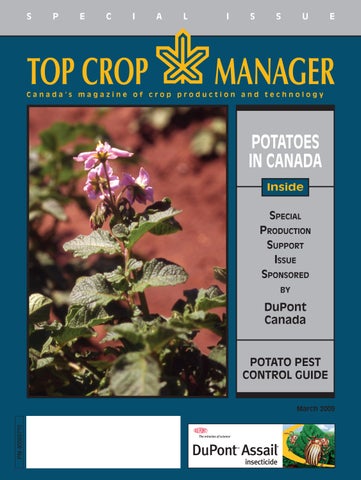
PIC - March 2009

Page 1


Introducing new DuPont™ Coragen™ insecticide

CONTENTS

Crop management

Dealing in greater depth, Potatoes in Canada examines research that assesses causes and solutions for soil erosion.

Insect management With the value of potatoes increasing, so is the need for efficient pest control.

March 2009

EDITOR Ralph Pearce • 519.280.0086 rpearce@annexweb.com

Contributors

Rosalie I. Tennison

WESTERN SALES MANAGER Kevin Yaworsky • 403.304.9822 kyaworsky@annexweb.com

ASSOCIATE PUBLISHER

Kelly Dundas • 519.280.5534 kdundas@annexweb.com

SALES ASSISTANT Mary Burnie • 519.429.5175 mburnie@annexweb.com

PRODUCTION ARTIST

Brooke Shaw bshaw@annexweb.com

GROUP PUBLISHER Diane Kleer dkleer@annexweb.com

PRESIDENT Michael Fredericks mfredericks@annexweb.com

PUBLICATION MAIL AGREEMENT #40065710 RETURN UNDELIVERABLE CANADIAN ADDRESSES TO CIRCULATION DEPT. P.O. Box 530, Simcoe, ON N3Y 4N5 e-mail: mweiler@annexweb.com

Printed in Canada ISSN 1717-452X

CIRCULATION e-mail: mweiler@annexweb.com

Tel.: 866.790.6070 ext. 211 Fax: 877.624.1940

POTATO PEST CONTROL GUIDE

INTRODUCTION

Once again, Top Crop Manager is offering an early spring edition of Potatoes in Canada , sponsored by DuPont Canada. This issue extends the potato production features published in the regular edition a month ago. As an added feature, this edition includes an updated ‘Guide to Potato Pest Control’: the industry’s only quick reference for products used to manage diseases, insects and weeds, as well as seed piece treatments. It provides comparative notes of products and the

various diseases, insects and weeds they control. Be sure to cross-check provincial guidelines and product labels before making any final decisions.

Other features in this issue cover a number of topics on production and storage of potatoes. Some decisions on protecting the crop’s yield potential must be left until the growing season is well underway. Keep this issue onhand for a quick reference. ■

Mail: P.O. Box 530, Simcoe, ON N3Y 4N5

SUBSCRIPTION RATES

Top Crop Manager West - 7 issuesFebruary, March, Early April, Mid April, July, November and December1 Year - $50.00 Cdn.

Top Crop Manager East - 7 issues - January, February, March, April, August, October and November - 1 Year - $50.00 Cdn.

Specialty Edition - Potatoes in CanadaFebruary - 1 Year - $9.00 Cdn.

All of the above - 15 issues - $80.00 Cdn.

No part of the editorial content of this publication may be reprinted without the publisher’s written permission © 2009 Annex Publishing & Printing Inc. All rights reserved. Opinions expressed in this magazine are not necessarily those of the editor or the publisher. No liability is assumed for errors or omissions.

All advertising is subject to the publisher’s approval. Such approval does not imply any endorsement of the products or services advertised. Publisher reserves the right to refuse advertising that does not meet the standards of the publication.

www.topcropmanager.com

A new look at soil erosion

What is a major contributor to soil erosion? The answer is surprising.

For decades, soil erosion has been blamed on wind and water. After the 1930s, cultural practices changed to reduce the effects of wind and cropping techniques were adjusted to minimize the damage from water. However, recent work conducted by researchers in three major cropping areas, Manitoba, Atlantic Canada, and Ontario, proves that tillage is equally culpable when it comes to soil erosion. Surprisingly, one of the main contributors to tillage erosion is the human characteristic to maintain patterns, such as always cultivating or ploughing in a clockwise or counterclockwise direction around the field.

Research conducted in the potato growing areas of Atlantic Canada, where fields are steeply sloped, shows that the tillage practices necessary to grow the crop and the direction of the tillage used on the slopes, is causing as much erosion as wind and water. “Tillage erosion is the loss and gain of soil that occurs within a field due to tillage practices and, typically, happens when more soil is moved down-slope than up-slope,” explains Kevin Tiessen, a research associate at the University of Manitoba. “While the severity of tillage erosion is usually greatest on hilly land, tillage erosion is showing considerable degradation on crop land in all areas of Canada.” Yes, even the “flat” prairie soils can be degraded, according to the research.

“Tillage erosion isn’t spectacular like wind and water erosion can be, but it occurs little by little over time,” comments Tiessen. “However, the evidence of tillage erosion is all of those eroded hilltops and knolls in the field. Always farming in the same pattern can also increase tillage erosion.” He says the common practice of tilling in circles around the field can eventually create a “bowl” effect in the middle of the field and always tilling from top to bottom on hills drags the soil to the lower areas. With the bowl effect, the soil is moved out of the centre of the field to the edges

creating an area of low fertility and collection area for water in the middle. By dragging soil off hilltops, the best soil is left at the bottom.

“We can’t predict how long it will be before our potato production land will become unproductive,” Tiessen admits. “In Atlantic Canada, it is estimated that up to 75 percent of the potato land is at risk to unsustainable levels of tillage erosion, but we don’t know when it will cause an insurmountable problem. So, we need to manage our soils better in order to sustain the industry.”

One of the challenges facing potato growers in Atlantic Canada is the minimal number of rotation crops available. Tiessen says growing potatoes in a two year rotation increased the soil losses due to tillage erosion because of the number of tillage operations involved. The problem is reduced when a three year rotation is practised. A four year rotation is even better, simply because the total number of tillage operations is reduced. In other potato growing areas in Canada, the availability of many rotation options and access to markets for them lessens the rotation factor as it pertains to erosion.

The challenge does not end with

changing the direction or the style of tillage or in increasing the years in a rotation because, as Tiessen learned, equipment is also contributing to the problem. He sites three forms of tillage that are typically used to grow a crop of potatoes in Atlantic Canada: primary fall tillage with mouldboard or chisel ploughs, secondary spring tillage using offset disc or vibrashank, and tertiary tillage that includes the planting, hilling and harvesting operations. All tillage operations involved in potato production moved large quantities of soil and have the potential to cause erosion. Of all the types of equipment, there was very little difference in the tillage erosion between the chisel plough, the mouldboard plough, or the offset disc. The greatest possibility for tillage erosion actually occurs in the post-plant hilling and harvesting operations. “The surprising part of the implement study was that by changing from a mouldboard plough to a chisel plough, little difference was made in terms of reducing tillage erosion,” Tiessen comments.

The threat of erosion can be reduced somewhat, he continues, if the depth of the tillage and the speed at which it is being done can be reduced. As

This potato field in New Brunswick exhibits the signs of eroded knolls where soil has been removed by tillage erosion.

CROP MANAGEMENT

well, matching the size of the tractor to the size of the plough will make a difference because a constant speed can be maintained. He says pulling a large plough with a smaller tractor means the tractor labours up slopes and returns down them at a greater speed displacing more soil.

In areas with steep slopes, growers often plan their operation to drive down the steepest slopes because it is easier and, often safer, but that results in soil always being dragged down the hill.

“Since tillage erosion moves soil to the lower parts of hills, where water erosion is most severe, tillage erosion is actually a major delivery mechanism for water erosion,” Tiessen explains. “When we repeat patterns, we cause erosion over time.” He recommends breaking up patterns of tillage whenever possible.

Another suggestion Tiessen makes is to reduce operations where possible.

“You can’t cut out all operations in potato production, but I would suggest not doing any extra,” he says. In the past, growers often did three hilling operations, but many have cut back to two and some have cut back to one.

“Cutting back one operation is hard to do, but it will make a difference.”

There have been no comprehensive studies on the effect equipment has on erosion and Tiessen’s examination only showed there were problems. He suggests equipment designers need to get involved to develop equipment that causes less disturbance which would cut down the chance for erosion.

Tiessen says the study of how tillage causes erosion is still in its infancy. “We are still in the early stages of understanding this issue, but we need to start thinking about it and learning ways to manage it,” he adds.

Certainly, the manner in which tillage erodes the soil is not as obvious as watching the wind blow soil from field to field, but Tiessen’s research shows there is need for concern. While he admits the damage is happening slowly over time, he cautions against ignoring the problem. He would like to see growers begin to make small changes, such as reducing tillage speed and depth, changing the direction and pattern of their tillage operations or lengthening the rotation to slow and, possibly, reverse the effects of tillage erosion. He believes by taking small steps now, it might not be necessary to take big steps later. ■

Global registration process means quicker access to new products

DuPont achieves registration across numerous countries at the same time.

Craig Hunter has spent the past 30 years working within the world of pesticide registration. Seldom has he seen a more important advancement for Canadian growers than what happened last year.

Years of research culminated in the registration of a new insecticide in numerous countries in 2008. For the first time, Canada, the United States, the European Union and Australia worked together to register a product for use on numerous crops, simultaneously.

Hunter is an expert advisor on pesticides to the Ontario Fruit and Vegetable Growers Association. He also has served as an advisor on such issues to the Canadian Horticultural Council.

The registration of DuPont Coragen, with the active ingredient rynaxypyr, is important for growers and would likely not have happened nearly as quickly without some innovative thinking by the company and government. “Growers get the advantage of a new product,” says Hunter. “A new mode of action like this also helps for resistance management of pests.”

Coragen is the first product in a new chemical class with a new mode of action, Group 28, anthranilic diamide. It is registered for control of Colorado potato beetle and European corn borer in potatoes and has a different mode of action than other insecticides. It also received an emergency registration for the control of corn earworm in sweet corn in 2008. Hunter notes that DuPont did take a considerable risk by being the first company to pursue a global registration. “The risk was that by sending the registration package out to numerous countries at once, if only one of them was slow in turning it around it would have affected everyone,” says Hunter. “They had a good package and good co-operation from government.”

Typically, companies submit comprehensive registration packages to the appropriate government agency in

each country in which they want to sell a product. The United States has the Environmental Protection Agency. Canada has the Pest Management Regulatory Agency.

In this case, DuPont broke new ground: each country’s government organization had a lead role in particular areas of the review. This resulted in a much more efficient process for the agencies. It is true that in the past, some companies have chosen to send a product for review in both Canada and the US simultaneously. But this was the first time that such a broad representation of countries was involved.

It is very expensive to get a product registered. A registration package includes information on toxicology, residue, efficacy and other relevant data. Sometimes companies make the decision that the acreage of crop within a country cannot sustain the expense of registration. As Hunter says, if it is going to cost $300,000 to register a fungicide for use on a crop and the total revenue expected to be made from that product is $100,000 a year, it will take a long time to repay the expense of registering it. “By doing the registration for each country at the same time and sharing the resources globally, costs are spread around,” says Hunter.

The main players were the PMRA, EPA, Australia, and the government organizations from Ireland and the UK, which represented the European Union. They essentially shared the work, with each agency taking the lead on a different part of the registration package, and then reviewing each other’s findings. The PMRA was the lead reviewer on efficacy and product chemistry. “We submitted a complete data package to each country,” says Adam Vaughan, product registration manager at DuPont. “Everything that Australia got, Canada got. There are large parts of the package that are common to all countries.”

The scientists poring over the

data in the different countries were satisfied because they were getting more data, not less, yet the massive job of reviewing all the data was shared between the different countries. “This process greatly improved the registration timeline,” says Vaughan. “From start to finish it was 15 months, which was really fast. It allows everyone to work more co-operatively and to make more consistent decisions. You end up with the same or similar decisions being made in all these countries.”

That means growers are getting equal access to technologies at the same time. Instead of farmers in one country looking longingly over the border at the latest products being used by their neighbours, growers in the participating countries were placed on a level playing field.

Also extremely important, it was one of the first times that minor use registrations were included in the initial submission. That is because what may be a minor crop in Canada might be a major crop when the market in numerous countries is taken into account.

This process also has changed the way DuPont does business. “We are trying to apply a much broader vision to research and development to make sure crops on the US label will be on our label too,” says Vaughan. “There is a lot more international co-operation within our company. It’s been a total shift for our company from looking at individual countries to the whole globe and making sure we have equal access to products for growers in all the countries.”

It is easy to see how this will mean

more products coming to market and being registered at a quicker pace for Canadian growers. But a global review process also has advantages for trade. “By sharing the review of the information, we can ensure there are maximum

residue limits in many important export countries, at the same time as getting the registration in Canada,” says Vaughan. “When these residue limits are set in a consistent way amongst the different countries, it ensures that residue limits are not a barrier to international trade.”

It was a lot of work, and perhaps carried some risk that things would get bogged down in bureaucracy, slowing down the commercialization of the product. But Hunter says it has positioned DuPont well for the future. “My understanding is that when at all possible this will be the approach they will be using in the future,“ says Hunter. “Sometimes when you’re the first to take the biggest risk you get the biggest rewards.”

“Now we know how to work internationally,” says Vaughan. “We can work with regulatory bodies to get new active ingredients approved more quickly and across international borders, which is good news for growers. We take our hats off to the PMRA and other agencies involved for taking this next step towards greater global co-operation.” ■

What is the AAFC’s Pest Management Centre and why it matters

It is seldom said that the inner workings of a government agency should make anyone sit up and take notice, but the Pest Management Centre (PMC) may already have affected how growers fight pests in their fields.

The PMC works directly with producers, extension, industry and government regulators in Canada and in the US to get minor use registrations achieved more quickly.

Every year in March, the PMC holds a workshop, with growers, industry and other related provincial and federal partners invited. They meet to determine the current year’s top minor-use crop/pest priorities for pest management in Canada.

First they prioritize the pest problems within a certain crop. Then, when they have the priorities defined, they choose the top 36 priorities for the three disciplines, identified as entomology, pathology and weeds. After that, the growers or grower representatives determine the best products to solve the problems.

After the company that owns the product agrees to support the minor-use request, and provides a valid use-pattern, the PMC sends a pre-submission consultation request (PSCR) to the Pest Management Regulatory Agency. Included in the PSCR is all available efficacy and safety data.

After reviewing all available information, the PMRA informs the PMC how many trials are needed to determine residue, crop safety and efficacy. The PMC conducts and pays for the required field trials.

The PMC works closely with companies and its NAFTA partners, such as IR-4 in the US, to enhance efficiencies in data generation and to harmonize available pest control solutions for growers.

In the case of Rynaxypyr, DuPont approached the PMC early on in the process. The PMC worked closely with DuPont and IR-4 to conduct required trials to ensure the successful registration for use in peaches and grapes. All initial trials were conducted under a secrecy agreement. The PMC continues to work on other crops that were determined by the growers to be a priority, such as sweet corn, caneberry, peas, beans, onions, peppers, ornamentals and many others.

Without the PMC, many growers in Canada would not have access to some of the innovative technologies to combat pests in minor-use crops. ■

The global review process has been made possible by the spirit of co-operation between participating countries and their registration authorities.

The new insecticide, DuPont™ Coragen™ is now registered for residual, multi-stage control of European corn borer (ECB) as well as control of Colorado Potato Beetle (CPB), including imidacloprid-resistant biotypes.

Launched under the brand name DuPont™ Coragen™ , the active ingredient Rynaxypyr™ is an insecticide from a completely new class of chemistry – Group 28, the Anthranilic Diamides.

The long-lasting residual activity of the active ingredient in Rynaxypyr™, combined with its multi-stage effect helps prevent the establishment and growth of pest populations. It is particularly potent against ECB neonates as they hatch from the eggs (ovi-larvicidal activity) and also provides control at the ovicidal and larvicidal stages.

Target pests stop feeding within minutes of ingestion, which results in nearly immediate crop protection. And, because Coragen™ moves into leaf tissue where it is protected from wash-off, it remains available to target pests feeding on either surface of the leaf.

potato beetle (CPB) control. Not surprisingly, there is an increasing level of resistance to this chemistry in some CPB populations. Despite the use of newer neonicotinoid insecticides, some preliminary research results show that their similar modes of action can lead to the development of cross-resistance.

Continued surveillance and implementation of an effective resistance management program is essential to prevent increased failure of CPB controls. Coragen™ , with an entirely new mode of action, can play an important role in this management strategy.

The residual ECB control delivered by Coragen™ means that the plant is protected for a longer period of time than with contact-only insecticides. And, because it is effective at multiple life stages, Coragen™ provides more flexibility in application timing. It also provides control of Colorado beetle at the same time.

Thanks to a novel class of insecticide, Coragen™ provides a new mode of action to deliver control of pest populations resistant to other products.

In over 4,000 development trials around the world and numerous laboratory experiments in 18 countries, no evidence has been found of cross-resistance between Coragen™ and existing insecticides.

These results show that Coragen™ can provide control of insect populations that have developed resistance to other insecticides. Rynaxypyr™ is registered for aerial application providing an alternative to the limited number of insecticides available to growers wanting to use aerial application.

For many years Canadian potato growers have relied heavily on soil or foliar application of imidacloprid for Colorado

Disease Management Products

Acrobat MZ dimethomorph/ mancozebmorpholine/ dithiocarbamate

Acrobat 50WP dimethomorphmorpholine

Allegro fluazinampyridinamine

Bravo 500 F chlorothalonilchloronitrile

Copper 53 W copper sulphateinorganic

Copper spray copper oxychlorideinorganic

Coppercide copper hydroxideinorganic

Curzate 60 DF cymoxanilacetamide

Dithane DG Rainshield NT mancozebdithiocarbamate

Gavel 75 DF zoxamide/mancozebbenzimidazole/ dithiocarbamate

Headline EC pyraclostrobinstrobilurin

Kocide 2000 copper hydroxideinorganic

Lance WDG boscalidanilid

Manzate Pro-Stick mancozebdithiocarbamate

Parasol WG copper hydroxideinorganic

Parasol flowable copper hydroxideinorganic

Penncozeb 75 DF mancozebdithiocarbamate

Polyram DF metiramdithiocarbamate

Quadris azoxystrobinstrobilurin

Quadris azoxystrobinstrobilurin

Ranman cyazofamidcyanoimidazole

Reason fenamidoneimidazolinone

Ridomil Gold 480EC metalaxyl acylamine

Ridomil Gold / Bravo metalaxyl/ chlorothalonilacylamine/ chloronitrile

Scala SC pyrimethanilpyrimadine

ASO

Tanos famoxadone/ cymoxaniloxazolidinedione/ acetimide

Tattoo C propamocarb/chlorothalonilcarbamate/chloronitrile

Important:

The Potatoes in Canada Potato Pest Control tables are a guide only. It is highly recommended that growers refer to local provincial guides and labels as well as processors and packers.

Serenade
Bacillus subtilis QST 713 strain

Important: The Potatoes in Canada Potato Pest Control tables are a guide only. It is highly recommended that growers refer to local provincial guides and labels as well as processors and packers.

POTATO PEST CONTROL

Insect Management Products

Common name

Actara 240SC thiamethoxamthianicotinyl

Actara 25WG thiamethoxamthianicotinyl

Admire 240 F imidaclopridchloronicotinyl

Admire 240 F imidaclopridchloronicotinyl

Admire 240 F (Also see Seed Piece Treatments) imidaclopridchloronicotinyl

Alias 240 EC imidaclopridchloronicotinyl

Alias 240 EC imidaclopridchloronicotinyl

Alias 240 EC imidaclopridchloronicotinyl

Assail acetamipridchloronicotinyl

Coragen rynaxypyranthranilic diamide

Cygon 480 EC dimethoateorganophosphate

Decis 5 EC deltamethrinpyrethroid

Diazinon 500 E diazinonorganophosphate

Dibrom EC naledorganophosphate

Endosulfan endosulfuranchlorinated cyclodiene

Fulfill 50 WG pymetrozinepyridine azomethines

Fyfanon malathion

Grapple imidaclopridchloronicotinyl

Grapple imidaclopridchloronicotinyl

Imidan phosmet

Lagon 480 E dimethoateorganophosphate

Lannate methomyl carbamate

Lorsban chlorpyrifosorganophosphate

Malathion 500 E malathionorganophosphate

Matador 120 EC cyhalothrin-lambdapyrethroid

Monitor 480 EC methamidophosorganophosphate

Nufos chlorpyrifosorganophosphate

Orthene75 SP acephateorganophosphate

Pounce 384 EC permethrinpyrethroid

Pyrinex 480 EC chlorpyrifosorganophosphate

Rimon 10 EC novaluronbenzoylphenyl urea

Ripcord 400 EC cypermethrinpyrethroid

Sevin XLR carbarylcarbamate

Success 480 SC spinosadspinosyn

Thimet phorateorganophosphate

Thiodan 4 EC endosulfuranchlorinated cyclodiene

Thionex 400 EC endosulfuranchlorinated cyclodiene

Vydate L oxamylcarbamate Important : The Potatoes in Canada Potato Pest Control tables are a guide only.

POTATO PEST CONTROL

recommended that

Important: The Potatoes in Canada Potato Pest Control tables are a guide only. It is highly recommended that growers refer to local provincial guides and labels as well as processors and packers.

Stick

Pro.

DuPont™ Manzate® Pro-Stick™ fungicide is a Canadian leader in protectant potato fungicides. Our Pro-Stick™ formulati smaller, more uniform particles, gives you excellent leaf adhesion, rain or shine, for broad-spectrum, multi-site protect An improved ability to stay in suspension gives you the most consistent delivery of active ingredient. That gives you th effective protection.

It's what you should expect from a field leader. Ask for it by name. Make it Manzate® Pro-Stick™

And this year you can really GO! With the Pro. Enter to win, and you could drive off in a brand new 2009 Chevrolet S pickup truck! Just visit our contest site at www.winwithmanzate.com, or see your local retailer for complete conte

ck™ . ation with ection. the most Silverado ntest details.

POTATO PEST CONTROL

Weed Control Products

(Not registered in all provinces. Some processors do not accept use of all products.) chemical group

APPLICATION TIMING

BROADLEAF WEED TANKMIX PARTNERS (GROUP) GRASSY WEED TANK-MIX PARTNERS (GROUP) pre-plant burndown pre-emergence burndown pre-plant soil incorporated post-plant soil incorporated pre-emergence surface applied foliar applied desiccant

Variety cautions in some provinces

Dual II Magnum15•••Superior

Excel Super (not in MB)1• Glyphosate9••

* Tank-mixes not registered in all provinces * Tank-mixes not registered in all provinces

Linuron(7), Patoran(7), Sencor(5), Afesin(7)

Gramoxone 22• Russett Burbank, Cherokee Linuron(7), Sencor(5)

Lorox DF, Lorox L, Linuron 480 7•Sencor(5) Poast Ultra1•

Belleisle, Tobique,/no post-emergence on early varieties, red-skinned, Atlantic, Eramosa Linuron(7) Dual II Magnum(15), Linuron(7),

Important

The Potatoes in Canada Potato Pest Control tables are a guide only. It is highly recommended that growers refer to local provincial guides and labels as well as processors and packers.

POTATO PEST CONTROL

GRASSY WEEDS VOLUNTEERSBROADLEAF WEEDS

barnyard grass foxtail, green foxtail, yellow wild oats vol. barley vol. corn vol. flax vol. canola/mustard vol. sunflowers vol. wheat buckwheat, wild catch fly, night flowering chickweed cleavers cocklebur flixweed hempnettle kochia lady’s thumb lamb’s quarters mallow, round-leaved mustard, wild nightshades pigweed, red root pigweed, prostrate purslane ragweed Russian thistle shepherd’s purse smart weed, annual stinkweed dandelion quackgrass sowthistle, perennial thistle, Canada

Warnings

S1hr rainfast

not on emerged potatoes in evening/ cloudy/stressed

rate on sandy soils

.80 days to harvest

apply before potatoes flower/30 days to harvest do not apply during periods of extreme drought or excessive moisture

not on muck soils/total applied restriction * *not triazine resistant lamb’s quarters

S no row cultivation until 5 days after application/ 90 days to harvest

NOTES:

* Conditions apply: Check provincial guides or product labels for details and specific weed control ratings. Some provincial guides include control ratings not shown. Some tank-mixes may not be registered in all provinces: additive effects and antagonism may also occur. Some products and tank-mixes are only recommended for certain varieties. Various formulations may be available and additional application rates may be recommended.

** Dandelion not on label for some glyphosates. Some potato processors do not approve use of some products.

• control

S suppression only

POTATO PEST CONTROL

Seed Piece Treatments Common nameChemical group

Actara 240SC thiamethoxamthianicontinyl

Admire 240 imidaclopridchloronicotinyl

Genesis XT mancozeb, thiophanate-methyl chloronicotinyl Fungicide

Grapple imidaclopridchloronicotinyl

Maxim MZ fludioxonilphenylpyrrole

Maxim PSP fludioxonilphenylpyrrole

Maxim Liquid PSP fludioxonilphenylpyrrole

PM 223 zein product none

Polyram 16DF metiramdithiocarbamate

Potato ST 16 mancozebdithiocarbamate

Senator PSPT thiophanate-methylbenzimidazole

Titan clothianidinchloronicotinyl

Tuberseal mancozebdithiocarbamate

In-storage seed treatment

Mertect thiabendazolebenzimidazole

POTATO PEST CONTROL

up to 24.4 mL/100kg

26-39mL/100kg

500-750 g/100kg

26-39mL/100kg

250S•••

250S•••

5.2mL/100kgS•••

135g/100kg

Important: The Potatoes in Canada Potato Pest Control tables are a guide only. It is highly recommended that growers refer to local provincial guides and labels as well as processors and packers.

Refer to label product rates specific to seeding rates.

For disease control add treatment following application of Admire 240.

Ensure consistent coverage. Disease ratings are at 750 g rate. S=suppression only

For disease control add treatment following application of Grapple.

Treat cut pieces soon after cutting. S=suppression only

Treat cut pieces soon after cutting. S=suppression only

Treat cut pieces soon after cutting. S=suppression only

Quickly dries and seals cut surfaces and protects seeds in wet, cold soils.

Plant as soon as posssible after treatment. Use second application for cut seed.

Plant as soon as possible after treatment Use second application for cut seed. 250••

Treat cut pieces within six hours. Do not use after Mertect used in storage

20.8mL/100kgS

Ratings for aphids, Colorado potato beetle, leafhoppers and flea beetle have been submitted for registration. S= suppression only

Plant as soon as possible after treatment. Use second application for cut seed.

88mL/1000kg•••

Apply as a mist on potatoes going into storage

Important: The Potatoes in Canada Potato Pest Control tables are a guide only. It is highly recommended that growers refer to local provincial guides and labels as well as processors and packers.

Green manure healthy for organic and conventional potatoes

Adding red clover or timothy into a rotation offers many benefits.

Even though it is a dominant crop in eastern Canada, potatoes are grown on a limited land base and recent economic pressures have forced growers towards more intensive production with unfortunate consequences. Soil degradation and nitrogen losses to the environment as a result of intense production mean alternate crops and production methods need to be introduced in order to maintain the viability of the production system. Researchers are suggesting that adding a green manure, a crop used primarily as a soil amendment and nutrient source for subsequent crops, in a rotation can increase nitrogen availability in the potato crops, improve yield and tuber quality, and improve the soil’s physical properties and suppress soilborne potato diseases.

Examined by the researchers as a nutrition source for organic potatoes, green manure also offers some benefits in conventional potato production. The issue that arises in organic production is how to get nutrients, especially nitrogen, to the crop while avoiding commercial fertilizer products. In conventional potato production, particularly in eastern Canada, having another crop in the rotation has many beneficial results besides the nutritional aspect. “Our work translates well to conventional production,” says Dr. Mehdi Sharifi, a researcher at the Organic Agriculture Centre of Canada (OACC) in Truro, Nova Scotia. However, the focus of the research done at OACC is to assist organic growers and those making the transition to organic production. “With conventional production, growers can supplement nutrition with commercial fertilizer, but in organic production, nitrogen has to be added through green manure or organic amendments, such as compost or manure.”

The essence of the work completed at the Centre suggests that growing green manure prior to potatoes will improve soil nutrient bio-availability, reduce the risk of nitrogen losses into the

Buckwheat is highly competitive and is noted for improving soil structure.
ALL PHOTOS COURTESY OF DR. A. HAMMERMEISTER, OACC.

environment, and sustain or improve soil quality. The researchers also report that, by adding green manure into the rotation in an organic system, crop yields will be comparable to those attained under conventional cropping systems. “Green manure will build soil organic matter and provide nitrogen for the crop,” explains Dr. Andrew Hammermeister, OACC manager. “In our case, we had high background fertility, so the impact of the forages was not as obvious as we may have expected. Unfortunately, the forages also actually reduced potato yield to some extent, because soil conditions were too wet to allow for early spring ploughing and the sod from the green manure had not decomposed before potato planting. The latter resulted in poor seed bed condition. We also saw that including forage in the rotation may encourage wireworm populations to increase.”

Nevertheless, the researchers believe that under good conditions, the addition of green manure will benefit organic production and certainly assist in conventional production. “Green manure could work in conventional systems providing suitable timing for

incorporation could be worked out,” Hammermeister continues. “Legume/ forage plough downs can provide 30 to 100-plus kg/ha (27 to 89 lbs/ac) of nitrogen depending on the conditions.”

Adjustments may have to be made in order to begin reaping the benefits of green manure. In eastern Canada where two-year rotations are not uncommon, adding a forage into the rotation would move the rotation to three years, a plan encouraged by most researchers, but it would mean including another lower value crop in the rotation. Access to a livestock market would be ideal, but this is not always possible for every potato producer. In western Canada the options for including green manure in either conventional or organic systems are greater as markets are often more accessible. “We encourage conventional growers to move to three-year rotations because it will improve soil fertility and productivity, “ Sharifi says. “In organic rotations, growers need to have a fouror five- year rotation that might include another vegetable crop, such as carrots, and a cereal to help break up the disease cycle. With green manure, growers can sometimes get one or two cuts, if red clover is grown, which can be a profit generator.”

Sharifi says both intensive production systems deplete soil of organic matter causing potato yields to decline. Therefore, he says, growers need to consider green manure in order to maintain the sustainability of their production systems. In long-term research conducted in Maine, he says, “we replaced the cereal crop in the rotation with green manure and got good results, particularly with a white clover/bean/pea mix.” He adds: “The following year, in which potatoes were grown, significantly less nitrogen fertilizer for optimal yield was required.” In this case, the researchers believe the savings realized by reducing commercial fertilizer made up for the reduction in profit from the green manure compared to cereals in the previous year.

According to Hammermeister, in any system, green manures grown as annuals or forages can break up the disease and insect cycles, suppress weeds, provide

MARKETS

soil nitrogen, build soil organic matter, increase availability of nutrients, such as phosphorus, and improve soil biology. He says that growers can adjust their production systems to include green manures by analyzing their operation. Selecting a green manure that suits the needs of the farm and its circumstances is the first step. “It helps to have a good plan for when and how to incorporate the forage or green manure, then plan to underseed a perennial forage as a green manure, such as alfalfa or red clover or, if you are growing a perennial legume crop, consider leaving at least one or two cuts in the year prior to potatoes to allow more buildup of organic matter and nitrogen,” he explains.

“Of course so much depends on the climate of where the potatoes are being grown,” adds Sharifi. “But, it is wise to move to green manure and reduce reliance on commercial fertilizer. By combining your high nutrient demanding potato crop with a less nutrient demanding crop and a green manure, your soils have a chance to recover. It’s not just the nutrient that you are getting, but also you are improving soil biological, chemical and physical conditions.”

Not without its concerns green manure can increase pressure from some diseases while minimizing pressure from others, it can also increase the nematode pressure. However, Hammermeister and Sharifi believe these are issues that can be managed and that the long term benefits outweigh the challenges. “Growers might be unwilling to include a green manure in their rotation because of the disease and nematode issues,” comments Sharifi, But, he adds, the benefits from adding green manure are much greater.

While the greatest value of adding green manure into a potato rotation may be recognized by organic growers, conventional growers will see benefits as well. The challenge lies in reorganizing the operation to include a green manure, such as moving to a longer rotation and finding a market for the forage if it is to be cut. While the researchers proved that sustainable crop production is possible with a combination of organic practices that include organic amendments and crop rotations with a green manure crop, conventional operations can benefit as well. In the long term, with the addition of a green manure crop into a conventional rotation, the legume nitrogen contribution to the subsequent potato crop can be taken into account in nitrogen recommendations to realize potential reductions in commercial fertilizer nitrogen requirements. ■

PESTS AND DISEASES

Potato growers have new way to control European corn borer

Latest pesticide provides better residual control, better window on application timing.

Cool, wet weather conditions made it very difficult for Maritime potato growers to control European corn borer (ECB) in the summer of 2008. Moth emergence, appearance of egg masses and hatch were each spread out over several weeks making it almost impossible to control ECB with a single pass of contact insecticides. Crop protection dealers had a hard time finding enough supply of insecticides with long-lasting residual control, like new DuPont Coragen and its active ingredient Rynaxypyr, to meet the demand. “Corn borers are recognized as serious insect pests in areas of Maine, New Brunswick, and Prince Edward Island,” says Dr. Robert Coffin, a crop specialist with Cavendish Farms in Prince Edward Island. “While they won’t devastate every potato field every year, the potential for them to cause significant yield loss is always there.”

“ECB overwinters in the soil and on the soil surface on trash, such as potato and corn stems,” says Steve Howatt, president of Atlantic Agritech, in New Glasgow, PEI. “In the spring or early summer the adult corn borer moths emerge, mate, and the females lay eggs on the stems, or the leaves, of suitable host plants. After a period of incubation the eggs will hatch and the small larvae will bore into the stems and start feeding.”

The potential for European corn borer, seen here in a corn stalk, to cause significant yield loss in potatoes is present from year to year.

Red clover is a common forage legume used in rotations in Eastern Canada.

Curzate® works in three (3) ways: preventative, curative and inhibitive (of sporulation). It’s systemic activity and ability to rapidly penetrate the foliar and stem surfaces allow Curzate® to provide fast-acting disease control. Trust Curzate® to protect your potato crop with up to 72 hours of kick-back activity!

E. I. du Pont de Nemours and Company. DuPont Canada is a licensee.

PESTS AND DISEASES

Larvae are very small, only about 2 millimetres in length when they hatch, but they can become quite large, more than 3.5 centimetres (nearly 1.5 inches) by the end of the growing season. Having insects that grow to this size eating away inside a stem can seriously weaken plant structure. Feeding activity alone can sometimes affect yield by reducing the plant’s ability to take up water and nutrients but they only cause serious yield losses when the weakened stocks break off in the wind.

ECB is not a big problem if the stems do not break off. Unfortunately growers do not know in advance if there will be enough high winds in late summer to cause a large amount of damage. Coffin says that tests at Cavendish Farms have shown that in seasons where significant breakage occurs, spraying insecticides will prevent yield losses. Since growers know damage can be severe, most prefer to err on the side of caution. They opt to spray rather than gamble on light winds if there is significant evidence of moths and egg masses in a field.

Still, it is not easy to know if there are enough in any given field to justify spraying. Egg masses are inconspicuous. They are flat, creamy white and layered over each other. They look a lot like fish scales clinging to the plant’s stem or

leaves. Since they are difficult to spot it is very hard to evaluate how many are there. Crop scouts use pheromone traps to help gauge adult moth numbers. Once they start finding moths they start looking for egg masses. Whenever they find one they will typically mark its location with a piece of coloured tape and monitor its development. Once the egg masses change from a creamy white colour to a dark colour, the eggs are about to hatch.

ECB moths will lay eggs over an extended period of time, anywhere from three to five weeks, but there can be a period when egg laying is particularly intense. Ideally a producer can determine when this maximum egglaying period occurs and time insecticide applications to coincide with the larvae hatch. Timing is critical because they only stay on the outside of the plant for a day or two before they burrow inside. “Timing can drive growers crazy,” Coffin says. “A scout can go out week after week and never find quite enough egg masses at any one time to justify spraying. Cumulatively though, over the course of the summer, enough can hatch to cause a lot of damage. That’s why a product with good residual is so very important. It takes the stress out of

trying to pinpoint exactly when you’d have to spray if you use a product that will only last for a short time on the leaf surface.”

“In the past, growers have had to resort to spraying multiple times to make sure they have the appropriate timing,” Howatt adds. “Over the past few years our company has looked at products such as Coragen, that have longer residual activity. Products that remain active on the leaf surface longer provide a bigger window of control with a single application. These products, in conjunction with basic growing degree models that help to predict the hatch more accurately, provide tools that help growers minimize pesticide applications.”

After doing a number of trials with Coragen during the past five years, Howatt said that in some seasons one application of a residual product can control both Colorado potato beetle and European corn borer. Growing season variability is always a wild card, but if the weather co-operates both insect species will emerge within a few days of each other. When this occurs, one well-timed application could effectively control both of them.

DuPont recommends that growers apply Coragen as soon as they start seeing egg masses. Unlike most insecticides it has ovicidal activity. This means it will start to kill corn borer larvae while they are still inside their eggs. It is particularly effective on freshly hatched neonates and its long-lasting activity means that it will still be around to control possible later hatches.

The active ingredient in Coragen is Rynaxypyr. Coragen is in a new chemical class with a new mode of action, Group 28, anthranilic diamide. Since this product works in a different way than others on the market, it provides growers with an effective new tool to control resistant insect populations. It also gives producers an effective new insecticide that they can incorporate into their insect resistance management programs. “Coragen has a long period of activity on the plant surfaces,” Coffin says. “It breaks down, or degrades, very slowly from rainfall, sunlight or oxidation. Farmers were very interested when they heard of this and used a very substantial quantity for corn borers in 2008. The farmers who used it for corn borer seemed to be genuinely happy with its performance.” ■

Products such as Coragen provide a wider window on applications and better residual control, all in one pass.

Humidity solution for any warehouse

A fine mist is the best solution for controlling humidity.

Few growers would suggest there is a perfect solution for controlling humidity in large storage facilities, but of the available options, DryFog might be the easiest to install. Most humidification systems need to be installed when the warehouse is constructed and spinner systems are not always accurate. DryFog claims to be quick to install and to offer the finest droplet size available. “DryFog is very simple to install, basically you take it out of the box and put it on the wall,” says George Burkholder of GRB Technologies in Mitchell, Ontario. “The system hangs on the wall and you hook an air line and a water line to it, add some electricity and away it goes!”

An air compressor pushes the water through nozzles breaking it down into a fine mist of 4.2 micron diameter droplets. The smaller droplet size minimizes the amount of moisture that can collect in storage. The heavier the droplet the quicker it will fall on the stored crop or on the floor. The size of the water particles means the mist will drift with less moisture actually landing on the potatoes. “This is as good as any system for breaking water into small particles,” says Bert Webster of Mid-Isle Farms, Prince Edward Island. Webster has DryFog installed in two storage facilities of 15-million pounds each. “It is more expensive to run and maintain because of the size of air compressor needed and the energy to run it, but it is easy to install and can be put into any storage easily.”

Webster produces potatoes for table stock, and he says the cooler temperature needed to keep his crop at optimum freshness has caused the nozzles in the DryFog system to freeze. “If the temperature is cold and you are running your storage at 38 degrees F (three degrees C),” he explains, “there will be some nozzle freezing.” He says he does not think this is a problem for growers storing potatoes for processing because the temperature needs to be a few degrees higher. He also has an idea of how to solve the problem, he is dealing with the manufacturer to find a suitable solution.

The DryFog humidity system can also be used to deliver disease control. Combining the technology with an anti-microbial product allows for disease protection and humidity in one uniform application. “It works well to disperse chlorine dioxide or peroxygen solutions,” Burkholder explains.

The value of the DryFog system with its misting technology is that humidity can be maintained. “You need the humidity to remain above 95 per cent and then you will get very little shrink,” Burkholder continues. “If the pile of potatoes shrinks by even five per cent, a lot of money will be lost as your weight is reduced.”

Burkholder says a basic DryFog system will cost between $3000 and $3500, but that price does not include the air compressor required to run it. Considering Webster’s experience, the additional cost for a compressor will largely depend on the size of storage for which it is needed.

Since its introduction to Canada a few years ago, the DryFog manufacturer has improved the system. Originally designed with individual nozzles, the newer ES100 model is more selfcontained and easier to install. When compared to other systems, there is no

retrofitting of existing storage required and with an air compressor matched to the size of the storage, DryFog can be installed and running within a day. “Besides the freezing aspect, we have not had other issues with the system,” Webster comments.

For growers who need to improve their humidification system or who are retrofitting an older storage facility, DryFog is an easy solution. It is also a good choice for new storage as no space has to be allotted for additional humidification equipment. Customizable controls allow for around the clock automated operation, but occasional monitoring of storage is always recommended. With DryFog, growers get fine mist protection of a valuable crop. ■

The simplicity of the DryFog system is evident at first glance: it requires only compressed air and a water line.
PHOTO COURTESY OF GEORGE BURKHOLDER, GRB TECHNOLOGIES
Given the value of a potato crop, the option of adding an antimicrobial agent to the DryFog system enhances its overall usefulness.

Getting the most from starter fertilizer

Planning, placement and moisture are key in benefiting from this form of nutrition.

While many growers and agronomists believe that using a starter fertilizer in the spring is necessary in order to improve yields and strengthen plants to minimize disease and pest pressure, paying attention to when, where and how the starter is applied is the only way to get the desired benefits. As with most crops, the availability of moisture at the right time will also affect the uptake of the nutrients.

According to Rudy Allen, a certified crop advisor in Washington State, any starter fertilizer needs to be four inches away from the seed piece in all directions; if it is not, there could be damage to the seed. He also recommends that starter fertilizer only be applied after careful analysis and planning. “You need to soil sample, learn your nutrient levels and then develop a blend of products to balance the soil nutrition,” he advises. “At planting a grower needs to test for phosphate, potash and micronutrients.”

A certified crop advisor near Orangeville, Ontario, suggests starter fertilizer is important in the spring, especially phosphorous, if fall soil test levels are not optimum. John Lightle of Holmes Agro says starter has value in row particularly for phosphorus. “Starter offers fertility close to the seed piece which will initiate rooting,” he explains.

Lightle conducted some comparisons of starter fertilizer options in field tests in 2008. On five separate farms, starter showed small yield improvements particularly when used in liquid form. In one situation, 30 gallons of 5-20-5 applied to Yukon Gold potatoes resulted in a yield increase of 26 percent above the normal for the field. Contrarily, on another farm the same formulation of starter applied to Gold Rush potatoes showed no yield advantage.

Lightle’s goal in doing the trials in field situations was to show that low rate liquid starter systems can compare to dry fertilizer starter applications if the soil is balanced and has optimum nutrient levels. His examinations also showed how each field must be treated individually and how varieties respond

differently to formulations depending on the field. “Growers need to know their soils and their varieties because responses can be different,” Lightle concludes. “In my recommendations, I try to help growers choose products and formulations they need based on their soil’s background. I don’t want my growers using something that I’ve shown doesn’t work; I would rather they use what does work.”

Allen concurs. He says without moisture, such as that supplied through irrigation, starter fertilizer does not always provide the boost growers are seeking. “Each farm needs to be assessed individually,” he continues. “If the proper nutrition is in the soil and the

plant can utilize that available nutrition, then there may not be any benefit in using a starter fertilizer.”

As with Lightle’s field tests, Allen agrees that growers need to gauge the results they desire against published standards for each variety. “Start with a spring soil test and compare to the set standards and know what your soil is telling you” is Allen’s advice. “For example, Chieftain requires more fertility than Yukon Gold because it yields higher. We tweak the soil test requirement to the needs of the variety.”

When “tweaking”, as Allen suggests, growers need to base their decisions on their anticipated outcome. “Starter fertilizer is a good idea depending on the needs of the crop,” says Allen. “Growers don’t want to spend money if they don’t have to, but they don’t want to short the crop either.” In the end, starter fertilizer is useful under the right conditions, and when applied following careful analysis of the soil and the needs of the intended crop. Both Lightle and Allen suggest that without good information, using starter fertilizer is, at best, a gamble. An advantage results from careful analysis of available information rather than application using the “let’s see if it helps” approach. One scenario makes money, the other could cost money. ■

Growers need to sample soil, determine nutrient levels, then develop a blend of products to balance soil nutrition.
When it comes to balancing nutrients, each field must be treated individually.

When you spray with DuPont™ Assail® insecticide, Colorado Potato Beetles have nowhere to hide. Its extended control helps keep your potato crop protected. And, Assail® offers you flexible application rates, so you can gear your application to the infestation level. Rates/residual. Assail® covers both sides.

Turn static files into dynamic content formats.

Create a flipbook
Issuu converts static files into: digital portfolios, online yearbooks, online catalogs, digital photo albums and more. Sign up and create your flipbook.