PA - July - August 2024

Page 1


The Gallus One now integrates all proven Gallus Labelmaster modules, offering unparalleled flexibility, top-notch speed, and increased profitability. Easily add, remove, or replace units up- and downstream, including flexo and screen printing, cold and hot foiling, embossing, gravure, and die-cutting. Plus, the Gallus One is now available in 340mm and 430mm print widths and features an extended color gamut with additional Orange and Violet HEIDELBERG Saphira inks. Tune in during Labelexpo Americas: September 10–12 in Booth 3523 Scan

11 18 24 20

ISSN 1481 9287. PrintAction is published 6 times per year by Annex Business Media. Canada Post

Publications Mail Agreement No. 40065710. Return undeliverable Canadian addresses to: Circulation Department, 111 Gordon Baker Rd., Suite 400, Toronto, ON M2H 3R1. No part of the editorial content in this publication may be reprinted without the publisher’s written permission. © 2024 Annex Business Media. All rights reserved. Opinions expressed in this magazine are not necessarily those of the editor or publisher. No liability is assumed for errors or omissions. All advertising is subject to the publisher’s approval. Such approval does not imply any endorsement of the products or services advertised. Publisher reserves the right to refuse advertising that does not meet the standards of this publication. Printed in Canada.

FEATURES

11 Drupa 2024: Back with full force

After eight years, the industry’s biggest trade show didn’t disappoint

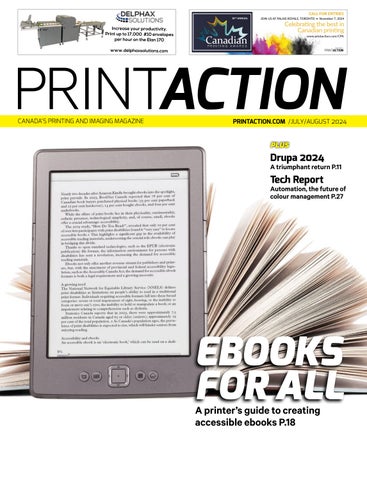
18 The joy of reading

Exploring how printers can create accessible ebooks

20 Rebuilding trust

Inside APP’s ambitious plan to regain FSC association

24 The intelligent revolution

Labels and packaging sectors are entering a new era of growth

DEPARTMENTS

GAMUT

5 News, People, Installs

10 Calendar

NEW PRODUCTS

26 Introducing new solutions from Sydney Stone, Duplo, Xeikon, ECO3, Scodix, Xitron, Highcon, and Neenah

SPOTLIGHT

30 Jason Foubert, general manager, Marquis Book Printing

COLUMNS

FROM THE EDITOR

4 Nithya Caleb

Achievements, losses, and the road ahead

CHRONICLE

8 Nick Howard

A showcase of print’s digital future

INSIDER

10 Bob Dale

Job search is a skill

TECH REPORT

27 Angus Pady

Automating colour management

Achievements, losses, and the road ahead

We ended spring on a high note at Drupa 2024, where a record number of deals were signed. Many key players, such as Bobst, Canon, Fujifilm, Heidelberg, HP, Horizon, Koenig & Bauer, Komori Konica Minolta, Kurz and Landa, reported signing contracts that exceeded expectations.

Terrace Bay pulp and paper mill was one of the town’s biggest employers (400 workers). Its idling six months ago is impacting local businesses such as the Print Shop.

Canadian Printing Awards

Drupa 2024 attracted 170,000 visitors.

Around 96 per cent of the 170,000 visitors confirmed they had fully achieved the objectives of their visit. More than 1,600 exhibitors from 52 nations showcased their innovations and solutions. For detailed coverage of Drupa, flip to pg 11.

Additionally, on pg.8 print historian and Chronicle columnist Nick Howard offers a holistic picture of how the trade show has evolved over the years.

Even as we were flying high on the optimism exuded at Drupa, events closer to home swiftly and rudely brought us back to the ground.

On June 27, Ruben Silva, who led the North American sales team at Agfa Inkjet Solutions for 18 years, passed away. He was well-known and deeply loved by the printing community. Silva is survived by his wife Lucy, son Justin, daughter Chantelle, and grandson, Remy. We offer our deepest condolences to the grieving family.

“Ruben had a unique way of connecting with people and building long-lasting relationships. He cared deeply for our customers, the North American team, and Agfa. He was a mentor to many of us, working side by side to help us reach our fullest potential. His positive attitude and smiling demeanour made work fun. Ruben’s passing leaves a significant void in the company and the graphic arts community, but his legacy will continue to inspire us,” said a statement by Agfa.

Another sad news was the closure of the Print Shop at Terrace Bay, Ont. The shop served the local Terrace Bay community and neighbouring regions for 75 years before ceasing operations on July 18, 2024.

Nestled on the north shore of Lake Superior, Terrace Bay is home to approximately 1,800 residents. The biggest industry in the region is forestry. The AV

Small businesses are major contributors to the Canadian economy. According to Stats Canada, in 2022, businesses with one to 99 employees comprised 98 per cent of all employer businesses in Canada and employed 10.7 million individuals, which is almost two-thirds (63 per cent) of all employees. However, these businesses face many obstacles, such as inflation, rising costs of inputs and high interest rates and debts. A survey conducted by Statistics Canada in early 2023 found small businesses were also more likely to expect a decrease in profitability and to expect supply chain problems, but less likely to hire new employees and to increase prices for goods and services.

We recognize the crucial role of small businesses in Canada. It’s one of the reasons why we created the Canadian Printing Awards 18 years ago. This year’s edition features more than 50 categories in printing, print production, packaging, labels, environmental printing and technology. The printing and print production categories continue to be the heart of the Canadian Printing Awards program. However, this year we decided to launch two completely new categories of Packaging and Labels, as well as:

• Best Workflow Project of the Year;

• Best Community Impact Project of the Year;

• Best Place to Work; and

• Best Direct Mail Project of the Year. Entries are open until mid-September. For more information and to apply, visit https://cpa.printaction.com. Please feel free to reach out to me if you have any questions about the awards program. I look forward to celebrating the Canadian print industry along with all of you later this year.

Reader Service

Print and digital subscription inquiries or changes, please contact Angelita Potal 416-510-5113 apotal@annexbusinessmedia.com Fax: 416-510-6875

Mail: 111 Gordon Baker Road, Suite 400, Toronto, ON M2H 3R1

Editor Nithya Caleb ncaleb@annexbusinessmedia.com 437-220-3039

Contributing writers

Bob Dale, Nick Howard, Angus Pady, Martin Habekost, Olivia Parker, Mary Ann Yule

Associate Publisher Kim Barton kbarton@annexbusinessmedia.com 416-435-9229

Media Designer Lisa Zambri lzambri@annexbusinessmedia.com

Account Coordinator

Melissa Gates

mgates@annexbusinessmedia.com 416-510-5217

Audience Development Manager Urszula Grzyb ugrzyb@annexbusinessmedia.com 416-510-5180

Group Publisher/VP Sales Martin McAnulty mmcanulty@annexbusinessmedia.com

CEO Scott Jamieson sjamieson@annexbusinessmedia.com

Subscription rates

For a 1 year subscription (6 issues): Canada — $43.86 +Tax Canada 2 year — $71.91 +Tax United States — $99.96 Other foreign — $194.82 Single Issue — $8.00 + Tax

All prices in CAD funds

Mailing address

Annex Business Media 111 Gordon Baker Rd., Suite 400, Toronto, ON M2H 3R1 Tel: 416-442-5600 Fax: 416-442-2230

Occasionally, PrintAction will mail information on behalf of industry related groups whose products and services we believe could be of interest to you. If you prefer not to receive this information, please contact our Audience Development in any of the four ways listed above.

Annex Business Media Privacy Officer Privacy@annexbusinessmedia.com 800-668-2384

PrintAction is printed by Annex Business Media Printing on Creator Gloss 80lb text and Creator Silk 70lb text available from Spicers Canada. ISSN 1481 9287 Mail Agreement No. 40065710 printaction.com

The Howard Iron Works Museum, Oakville, Ont., gifts the Gilmore Group of Companies a rare and unique printing press. The Columbian iron press, manufactured in London, U.K., in 1887 by Messrs. V & J Figgins, was the first printing machine to do away with the typical Gutenberg-era wine screw and instead use a unique set of levers to impart the needed pressure. Invented by Philadelphian George Clymer in 1813, the Columbian was the first printing machine to be built of iron in mass production. It is considered the most ornately decorated printing machine ever made. It features the American eagle, Joves’s lightning bolts, and the horn of

workflow. Regular service and Saphira Ink will be delivered through Heidelberg.

plenty cast in bas-relief. It was used to print every type of newspaper and book throughout the 19th century, but only about 400 of these machines survive today.

Landa Digital Printing and Gelato sign a partnership deal

The partnership leverages Landa’s Nanographic print technology and customer network, and Gelato’s global software platform – GelatoConnect – for the delivery of on-demand, short-to-medium run, digitally printed jobs.

Canon and Heidelberg decide on a global sales and service co-operation in inkjet printing Heidelberg will expand its technology portfolio by introducing an inkjet product family based on the newly announced Canon B2 sheetfed inkjet press and their B3 sheetfed inkjet press. Both presses will be integrated into the Heidelberg Prinect

SwissQprint inaugurates a new demo centre in Irvine, Calif., to meet growing demand from western United States and Canada. The new demo centre features the SwissQprint Nyala flagship printer. The generation 4 unit on show features the roll-to-roll option, including dual roll capabilities. Visitors to the new facility may also experience a wide range of print applications. The new centre offers customers in western U.S. a more accessible option to explore SwissQprint’s range of printers instead of travelling to the company’s headquarters in Elgin, Ill.

Fiery, Esko, and Global Inkjet Systems (GIS) form a strategic partnership. Esko and Fiery have co-developed a new colour workflow. Customers can choose either Esko Colour Engine (fully integrated into Fiery Impress) or Fiery’s colour management workflow, which includes Fiery Edge profiling technology, Fiery Spot Pro, and Fiery Color Profiler Suite. Fiery Impress DFE streams RIPped data directly to GIS printhead electronics. Any press manufacturer who chooses GIS printhead electronics will have plug-and-play, streaming connectivity to Fiery Impress.

Toronto Metropolitan University closes CopyRite, the university’s only student owned and operated full service copy, print,

and communications centre. A statement by the Toronto Metropolitan Students’ Union (TMSU) said, “It was the result of thorough deliberation by a previous executive team within the TMSU. This team painstakingly examined all potential impacts, weighing the pros and cons, and ultimately came to the conclusion this closure would be in the best interest of the university community.”

The U.S. Federal Trade Commission takes action against software maker Adobe and two of its executives, Maninder Sawhney and David Wadhwani, for allegedly deceiving consumers by hiding the early termination fee for its most popular subscription plan and making it difficult for consumers to cancel their subscriptions. A U.S. federal court complaint filed by the U.S. Department of Justice charges that Adobe pushed consumers toward the ‘annual paid monthly’ subscription without adequately disclosing that cancelling the plan in the first year could cost hundreds of dollars. Wadhwani is the president of Adobe’s digital media business, and Sawhney is an Adobe vice president.

ECO3 and eProductivity Software (ePS) sign a strategic partnership agreement. The partnership creates certified end-to-end workflows, from customer and order acquisition, job and financial management to production and postproduction. The certified workflow allows automated creation of jobs, including complex versions within ECO3 Apogee from an ePS MIS/ERP platform. It also facilitates the tracking of file receipt and approval, along with the generation of printing plates, proofs, and digital prints.

HP signs a strategic multi-year global partnership with Canva. This collaboration enables anyone creating visual content on the Canva platform to design and print through HP’s global network of print service providers.
Robert (Bob) Gilmore, chair and owner of the Gilmore Group of Companies, with the donated press at his Ottawa headquarters.
Henrik Müller, CEO and founder, Gelato, with Gil Oron, CEO, Landa Digital Printing.

Simpson Print , Bloomingdale, Ont., appoints Alec Couckuyt, an industry veteran with more than 30 years of professional experience, as president and COO. Carla Johanns, who was the company president, steps into the role of CEO and VP of sales and marketing. As a shareholder, Johanns will remain a part of the company’s senior management team, focusing on client solutions and the expansion of B2 Signs & Events across North America.

Canadian Print Scholarships

(CPS) appoints Steve Falk as executive director. A highly recognized Canadian industry leader, Falk has led many teams and businesses in the publishing, print and direct mail industries. His passion for developing others and supporting diverse industry interest groups has been exemplified with leadership roles at the Sustainable Mail Group, Digital Imaging Association and NAMMU associations. Falk will work closely with Ken Freek, the former executive director of CPS. Freek will retain an active role with the Canadian Print Scholarship team in the newly created role of marketing and social media manager.

Komori America promotes Lance Martin as vice president of product marketing. Martin brings to Komori America more than 40 years in printing and finishing with a strong background in sheetfed offset, web offset, gravure, diecutting, inline finishing and folding. In his new role, Martin will formulate, implement and support product marketing strategies to enhance product adoption, drive revenue growth and increase market share for Komori’s offset, web and digital products. Martin will report directly to Mark Milbourn, EVP of sales and service for Komori America.

Based in Quebec City, Que., Lion de l’image specializes in lamination production. It recently acquired a Canon Arizona 1380 GT, eight-colour UV-LED flatbed printer.

Manroland Sheetfed welcomes Mirko Kern as its new CEO. Kern succeeds Rafael Penuela, who now assumes the chairmanship of the Manroland Sheetfed Group. Kern (51) joins Manroland from DC Druck Chemie Group, where he has been managing director since 2016. The appointment to the top job at Manroland Sheetfed will be something of a home-coming for Kern. He began his career with the former Manroland AG in 1989 as an apprentice, going on to hold various positions across the organization before leaving to join Druck Chemie in 2011. He became managing director of the print chemicals group in 2016.

Graphiscan, one of the largest printers in Quebec, installs the HP Indigo 100K digital press. It is the first printer in eastern Canada to use this press. PrintPro, Winnipeg, adds AccurioWide 160 hybrid UV LED wide-format inkjet printer from Konica Minolta to their print arsenal.

Gaurav Bhatt, Bhadresh Bhatt, and Nirav Bhatt from PrintPro with Darin MacFarlane and Jason Paul from Konica Minolta.
Marc Gagnon and Alex Legue from Graphiscan with Steve Daigle from HP.

Earn More Profit with Wholesale Roll Labels

A showcase of print’s e-future

Despite a drop in attendance, Drupa 2024 buzzed with enthusiasm and novel technology

After eight long years, as 2020 was rudely cancelled by the pandemic, Drupa finally arrived earlier this year. More than 16, 600 exhibitors from 52 nations gathered in Düsseldorf, Germany, hoping the rest of the print world would join them. The attendance number of 170,000 visitors from 174 countries reflected what we all know: print is declining but still essential. Attendance is lower compared to Drupa 2016, when 260,165 showed up.

The reduced attendance didn’t spoil the fair’s upbeat atmosphere. This year’s event was unlike previous editions. German manufacturers dominated in the past. In 2024, China topped the exhibitor list with 25.19 per cent. Germany had 24.72 per cent. India surprised many, jumping from 1.57 per cent in 2012 to 4.55 per cent in 2024.

Digital printing isn’t a ‘what’s next,’ but a ‘now’ Drupa 2008 was often referred to as the ‘Digital Drupa,’ where many new developments in printing technology were displayed, often as prototypes, for the first time. The current Drupa continued that theme, defining and segregating print communication into silos: commercial, packaging, VLF, and enhancement. There were a few legacy offset and bindery exhibits. Heidelberg, Komori, Koenig & Bauer and RMGT displayed fewer press models than previous Drupas. Narrow web digital manufacturers more than made up for the loss, as did a host of cut-sheet digital, both inkjet and toner suppliers, reinforcing

a solid message that from now on, digital printing was not next but now! New workflow and software providers pushed artificial intelligence (AI) into mainstream applications—the technology was everywhere.

16k

Drupa 2024 showcased more than 16,600 exhibitors from 52 nations..

The conventional processes drew the eye from paper bag machinery (mainly Chinese products) to anilox and gravure. Gravure struggled with a much smaller piece of the pie, but anilox made huge strides, particularly with flexible packaging and Heidelberg’s new Boardmaster folding carton. Flexo CTP plates with remarkably sharp resolution were featured on various narrow web machines, from labels to flexible packaging. Drupa’s most prominent participant was packaging in all its variants.

Drupa’s most prominent participant was packaging in all its variants, holding the lion’s share of interest.

With faster speeds and shorter makereadies, Koenig & Bauer impressed with their joint venture partner, Italy’s Durst, showcasing the 5,500/hour 41-in. (B1) VariJet 106. At the same time, Heidelberg and Komori highlighted conventional presses, as did Koenig & Bauer, with various enhancements, such as coater declutching and anilox roll changeover, and improved in-press colour controls.

Show highlights

Here are some highlights of the three days I spent at Drupa.

Heidelberg’s XL106-8P with plate logistics ran flawlessly, automatically delivering, loading, and unloading plates. Perhaps the plate feature fits a small segment of users with the workload to support such a machine, but it is fantastic to see only one

operator for the whole machine while it cycled through numerous jobs.

Landa Digital Printing showcased two updated presses—the S11 and S11P (perfector), capable of 11,200 IPH in a 41-in. format. Benny Landa’s long-anticipated vision appears ready for takeoff. The quality and speeds are now in the direct path of traditional offset.

HP had a massive hall and introduced several new machines, including some label and commercial lines. The HP Indigo 120K, a 29-in. liquid toner press running at 6,000 IPH, impressed, as did the HP PageWide inkjet series with the top model (2200) running at 800 FPM.

Canon’s spacious hall held an exciting new VarioPress iV7 inkjet press in a 29-in. size. During the fair, Canon and Heidelberg announced a collaboration that included this model, with Heidelberg rebranding it as the Jetfire 75 and running the Prinect workflow on it.

Fujifilm, Ricoh, Screen, Konica Minolta, and many others increased their speeds and abilities to alter the landscape while reducing printing costs. Komori displayed their new J-throne 29 (23 x 29 in.), a faster version of their earlier collaborations with Konica Minolta, but now with inks supplied directly from Komori.

The use of robotics was evident throughout the fair, from bindery— both MBO and Stahl—to loading and offloading VLF cutting tables and printers. Robot integration, long used in other manufacturing industries, appears to be headed for significant breakthroughs in print.

During the trade show, Drupa showed the world how we, as an industry, can adapt to the realities of modern communication and find new ways to produce faster, cheaper, and with less human interaction than at any time in our history.

NICK HOWARD, a partner in Howard Graphic Equipment and Howard Iron Works, is a printing historian, consultant and Certified Appraiser of capital equipment.

nick@howardgraphicequipment.com

Sep 10-12, 2024

Printing United Expo

Las Vegas, Nev.

Sep 10-12, 2024

Labelexpo Americas Chicago, Ill.

Sep 12, 2024

OPIA Golf Classic Milton, Ont.

September 30-October 2, 2024

Paperboard Packaging Council 2024 Fall Meeting & Leadership Conference Atlanta, Ga.

October 7-9, 2024

FTA 2024 Fall Technical Conference

Las Vegas, Nev.

November 7, 2024

Canadian Printing Awards

Toronto

1

If you have less than 10 years of work experience, it’s best to limit your resume to one page.

Leveraging the latest trends in resume writing, LinkedIn optimization, and AI tools can help you stand out in today’s competitive job market.

Job search is a skill

Tips to help you stand out in your career search

The job market has changed, and potential employees are no longer in the driver’s seat. For people searching for new employment opportunities there are many considerations. Due to the advances of social media, use of artificial intelligence (AI) tools, and expectations of recruiters, a lot has changed in the past few years. Your approach needs to change too.

Leveraging the latest trends in resume writing, LinkedIn optimization, and AI tools can help you stand out in today’s competitive job market. Here are some tips on how to get started.

Keep your resume concise

Aim for one page if you have under 10 years of experience and extend to two pages for longer careers. Prioritize the last 15 years, emphasizing essential details and achievements that align with your target role.

Pass the six-second test

Statistics indicate that recruiters spend an average of six seconds per resume, focusing on the top 1/3 of the page. Utilize this space wisely. Skip the objective statement; instead, captivate hiring managers with a profile statement—a brief, compelling personal pitch that highlights your value to the company.

Quantify achievements

Your resume should be more than a list of tasks. To stand out, demonstrate your contributions and highlight results achieved so

employers can understand your potential impact on their organization. Start each bullet point with strong action verbs like ‘directed,’ ‘assessed,’ ‘streamlined’, or ‘designed.’ Provide context to showcase the purpose of your work and quantify your achievements when possible.

Leave out the fluff

Try to refrain from using unnecessary words that not only take up space, but also add zero value. Anyone can say they are a ‘passionate and motivated team player’ or that they are ‘detail-oriented,’ ‘innovative,’ ‘strategic,’ or ‘creative’. Focus on accomplishments rather than cliches, and if you use buzzwords, make sure they are tied directly to demonstrated achievements in your bullet points.

Leverage keywords

AI tools like ChatGPT can be used for keywords for resumes. Copy the job description into the AI chat field with the following prompt: Identify the most important keywords for this role. Take it a step further by adding in your resume and instruct the AI to strategically integrate these keywords into your resume to help you stand out. Using job-specific keywords is important if your resume is scanned by an applicant tracking system (ATS), which is software used by re-

cruiters and employers to rank job applications.

Include a cover letter

Craft a well-thought-out cover letter that tells your unique connection to the role you’re applying for. Keep it concise and impactful for a better chance at an interview. Structure the cover letter with an engaging opening paragraph followed by three to four bullet points specifically addressing the key job requirements. End with a closing paragraph that confidently requests an interview.

Optimize online presence

Make sure you have a professional profile picture. Save your vacation shots, selfies, and formal event pictures for Facebook. A picture is worth a thousand words. Make sure yours says, ‘professional,’ ‘approachable,’ and ‘confident.’

Let recruiters find you

Privately signal to recruiters that you are open to new job opportunities on LinkedIn. To enable this feature, go to the jobs tab on the top menu, click on preferences, and then turn on ‘open to work’. This makes your profile visible to recruiters only. Next, fill out your job preferences and then save.

We hope these suggestions help you as you prepare for the next stage of your career.

BOB DALE is vice-president of Connecting for Results. Heather Black is managing director, talent and strategy, at Connecting for Results. They can be reached at info@connectingforresults.com.

After a gap of

DRUPA: FULL FORCE RETURN

After eight years, the industry’s biggest trade show didn’t disappoint

After an eight-year hiatus, Drupa triumphantly returned as an in-person event earlier this spring. The anticipation of the show was palpable, with numerous vendors teasing exciting product launches and daily announcements flooding my inbox.

The sheer magnitude of the Drupa trade show made it a challenge to see everything, even with a four-day attendance. This article is my personal insight into the show.

Landa

It was a delight to witness Landa’s

machines double its speed to 11,200 IPH, a feat comparable to the top printing speed of sheetfed offset machines from two decades ago. The difference between reading about it and seeing it in person was striking. It was a sight to behold the Landa S11P printing at that speed, with each sheet displaying a unique image. Landa also demonstrated that their printed image maintains consistency across all substrates, which sets them apart from other inkjet-based commercial printers. The press operation is also sustainable due to the absence of printing plates.

Additionally, Landa showed printed samples from the W11 flexible

eight years, Drupa was held earlier this spring in Germany.

packaging machine, which is not yet on the market. I looked at the samples and was amazed by the print quality. Granted the print quality and speed of a conventional CI flexographic press are still better than that of the W11, but in my opinion, it is just a matter of time before the W11 press becomes a disruptor like the S11 press.

HP

Of course, Landa is not the only company with sustainability written on its flags. I had the opportunity to attend HP’s Canada Day event. This included a presentation on their latest product launches and a guided tour of hall 17, which was entirely occupied by HP. It was interesting to see that HP now offers an Indigo press for security printing applications. This

Booth highlights

RMGT

At Drupa 2024, RMGT showcased two innovations. The RMGT 970 PF-8+LED Convertible Perfector is tailored for the commercial print market. It supports automatic continuous printing of multiple jobs and includes a perfecting device for stable paper transport and a predictive control system for quick density adjustments. Designed for the packaging printing market, the RMGT 1060 LX press boasts enhanced paper feed and delivery performance. The press features a polygon-type vacuum wheel and enhanced feeder/registration section functions for heavy stock printing.

Koenig & Bauer

Digital solutions, such as its AI chatbot Kyana and connected packaging solution Follow, were a crowd-puller at Koenig & Bauer’s booth. The company also had on display the seven-colour Rapida 106 X with coater and extended delivery. With printing speeds of up to 22,000 sph, it is the world’s fastest medium-format sheetfed offset press. On display were also the CutPro X 106 series of rotary diecutters, flatbed diecutters and folder-gluers.

The VariJet 106 digital folding carton printing press from the Koenig & Bauer Durst joint venture was presented at a trade fair for the first time at Drupa.

Kongsberg PCS

Top: Boxes printed with the Packsize X5.

Above and left: Paper-based frozen pizza packaging samples.

Kongsberg Precision Cutting Systems was displaying at Drupa as a standalone business for the first time this year. It debuted the Kongsberg Ultimate, a new digital cutting platform with an acceleration rate of up to 2.74 G and a cutting speed of 168 mpm. Also on display were the MultiCam Apex3R CNC router and the latest version of its automated feeder and stacker. The star of the booth though was its canopy made from 245 individual pieces of Re-board, all cut on a Kongsberg cutting table in less than 12 hours.

Komori

At Drupa 2024, Komori unveiled its latest models of offset printing presses such as the Lithrone G37P advance EX Edition (GL-837P-A) 37-in. eight-color convertible perfecting offset printing press with H-UV L (LED) curing.

A part of Komori’s booth offered a glimpse into the future of general commercial printing, resembling a smart factory where every stage of the printing process, from printing and folding to bookbinding, is automated. After the Lithrone G37P advance press with Autopilot printed the sheets, AMR (autonomous mobile robot) moved the finished skid to the MBO K80 Folder with CoBo-Stack Palletizing Robot for folding. The entire process was supervised by Komori’s KP-Connect Pro, allowing production optimization in real time.

Chinese firms dominated the trade show floor by showcasing in 25.19 per cent of all the booths at the show. 25%

The company also introduced the new J-throne 29 B2 sheetfed UV inkjet digital printing press with a printing speed of 6,000 sph single-sided and 3,000 sph double-sided.

machine can print ID cards, vehicle registration cards, and driver’s licences. It was pointed out that this machine will only be available to authorized security printing facilities.

I also spoke to an HP representative about the sustainability of their equipment since a lot of metal and plastic goes into the manufacturing of a PageWide press. HP reduced its carbon footprint by 18 per cent compared to 2019, reached 40 per cent circularity by weight in 2022, and had 2 million trees planted by its partners. For their PageWide presses, they are recirculating 80 per cent of the hot air

required for drying the printed sheets, which results in 60 per cent less energy used per page. Another fact I didn’t know was that the first two PageWide presses installed in 2009 and 95 per cent of all presses installed since then are still in use.

HP offers field upgradability so the print company can benefit from improved print quality, inks, and print speed. HP also takes back used printheads, ink drums, and other parts for recycling and/or reuse. HP ensures the papers used on their PageWide presses are certified by FSC, PEFC, SFI, and Blue Angel

Far left: The Packsize EFI Nozomi X5 is the result of a collaboration between EFI and Packsize. Left: Ricoh had on display the C7500 tonerbased sheetfed press. Right: ETI from Quebec offers solutions for a variety of label applications.

More and more companies are offering workflow automation solutions to eliminate human touchpoints when a print job gets processed.

and come from sustainably managed forests. The HP A30 Inks, A50 Inks, and B60 Brilliant Ink/HP Optimizer are now UL EcoLogo certified for the Sustainability of Printing Inks. The Brilliant Ink is more efficient than A50, allowing the printing of 20 per cent more pages from the same ink barrel. The Brilliant Ink also does not require a primer, which needs to be dried, resulting in energy savings for the print company.

Heidelberg

Heidelberg has also conducted extensive research to improve the sustainability of its products. The XL106 series of presses has a standby mode, which should not be confused with the idle mode. This mode cuts energy consumption by a third compared to the idling mode, resulting in 3600 kWh of energy savings. Switching to process-less plates results in a 100 per cent reduction of chemicals normally required for developing printing plates. Since run lengths are getting shorter and shorter, using process-less plates makes sense. What also impressed me with Heidelberg is that they are not afraid of the digital side of printing.

At Drupa, Heidelberg announced a partnership with Canon. Heidelberg will sell Canon digital printing equipment under the Versafire and Jetfire brands. In two years, Heidelberg and Canon will introduce a new digital press, the Jetfire 75, which can produce 8,700 B2 sph.

Heidelberg’s Speedmaster XL106 had its world premiere at Drupa. It was shown printing at 21,000 IPH with fully automatic plate change, and a make-ready time between jobs of 1:10 minutes. During a presentation at their booth, the print jobs changed so quickly that one barely noticed them; more attention was paid to the automatic installation and removal of printing plates.

The press operator sat on the sidelines and ensured the press kept printing. It was an impressive demonstration of Heidelberg’s push-tostop technology.

Ricoh

Ricoh also had an remarkable booth at Drupa. I will highlight two products that amazed me. The first one is the Ricoh Pro VC80000. It is a webfed inkjet printer. The machine builds on the success of its predeces-

More than 16, 600 exhibitors from 52 nations showcased their solutions at Drupa 2024.

sor, the VC70000. The main print applications for the VC80000 are direct mail, colour books, catalogues, magazines, and commercial print. This machine has been developed to print with minimal operator interaction. The print speed was listed at 150 mpm, but that is not the only improvement on this piece of equipment. A spectrophotometer monitors the print production in real time and makes automatic changes if required. An optional piece of equipment for this machine is an auto splicer for continuous production. Another interesting machine was the C7500 toner-based sheetfed. It is an improved version of the C7250 and features a fifth colour station that can be equipped with different coloured and metallic toners. It can handle media up to 470 g/m2

Canon

Canon’s booth was also very striking. Many different pieces of equipment and complete production lines were showcased. One of the presses on display was the Colorstream 8200, a webfed inkjet printer with a print speed of up to 200 mpm. This machine is targeted for printing transactional statements, publications, books, direct mail, and product inserts. At Drupa it was shown as part of an end-to-end on-demand book production solution together with pre- and post-processing equipment from Hunkeler.

EFI

EFI was present in two halls. One booth was dedicated to its Fiery division, and the other showcased its digital printing solutions. EFI has partnered with Packsize, a German packaging manufacturer, to develop the Packsize EFI Nozomi X5, a single pass to corrugated solution that allows printing directly onto different

corrugated materials. It allows the production of custom-sized cardboard products for every box. The machine was developed for the right sizing of boxes with possible savings of 60 per cent void fill reduction and a 26 per cent reduction in the use of corrugated material. The boxes are cut to the right length, glued and erected in line. Variable diecut/cut is

At Drupa, HP had an entire hall to itself where it displayed multiple machines for every facet of the printing process.

also a feature of this machine. It takes only six seconds to print onto the substrate, cut/diecut, glue, and erect the box. This machine can produce 600 boxes hourly. The UV-LED curable inks are CMYKO.

During my long walks through the Drupa halls, I also encountered a company from Longueuil, Que. ETI produces equipment that can turn almost any substrate into an adhesive label. They offer solutions for different kinds of label applications, adhesive strengths, and more sustainable label solutions.

Touchpoint

Another interesting aspect of the show were the six touchpoint forums. The ones that interested me the most were the touchpoints on sustainability and packaging. There was a bit of an overlap between the two because several sustainability initiatives were in the packaging area. It was good to learn about a German company that has developed a process to recycle to-go coffee cups. It involves special

collection bins that collect only used cups. In the recycling process, the barrier inside the coffee cup gets removed, and the cups are recycled into printing paper. Examples of folding cartons made from recycled kraft paper highlighted the impact of preprinting opaque white before applying artwork.

Some of these boxes are available in retail stores in Germany. One paper mill from Poland displayed product trays and packaging inserts for boxes made from moulded pulp instead of plastic.

Clockwise from left: A showcase of Kurz’s PET foil stamping process; paper based-packaging tape from Tesa; specs of Landa’s W11 press; Marlys Brothers from Ricoh Canada take TMU students on a booth tour; and Benny Landa.

Epson showcased an in-office paper recycler. This machine allows paper sheets collected in an office to be recycled. The machine uses a water-free process, allowing the recycling of white paper into coloured sheets. Unfortunately, I didn’t see this machine in action. The main advantage of this machine is that printed sheets with sensitive information are not collected in a bin provided by a third party, which picks them up and shreds them. The newly made paper can be reused in the office.

One German manufacturer of foil stamping foils showed how they reduced the PET-based carrier’s thickness by 50 per cent and still achieved sufficient foil stamping results. Once the foil stamping coil is used, they recycle the PET. It gets turned into rPET, and 40 per cent of the rPET is used to make a new roll’s carrier film. The reclaimed metallic film is apparently reused internally.

Tesa, a German manufacturer of adhesive tapes, showed three different paper-based packaging tapes. One tape can be used as a tear-open strip for boxes or envelopes, another is a reinforcing tape, and the third is

a paper-based closing strip that can be used by the consumer to reseal a box when they return an item.

Automation

Another topic that was prevalent throughout the whole show was automation. More and more companies are offering workflow automation solutions to eliminate human touchpoints when a print job gets processed. From automatic pre-flighting, imposition, proofing, plate making, and printing, the automation does not stop at the print stage. Automatic finishing solutions involving robots were also demonstrated at the show. There are two reasons for increasing automation—improve the efficiency of a print company and reduce dependency on labour, as it’s difficult to find qualified people. Many companies offered solutions to automate the processes inside a print company. Workflow automation solutions were offered directly by printing equipment manufacturers and by third-party companies.

DR. MARTIN HABEKOST is a professor at the Creative School of the Toronto Metropolitan University.

September 19 - 20, 2024

The International Centre, Hall 5, Mississauga

BREAKFAST PANEL

at Sign Expo Canada this September 19, 8:30 AM

REGISTER TODAY and keep your seat warm for this September!

THE EVOLUTION OF OUT-OF-HOME MEDIA IN CANADA

Explore the remarkable journey of the Out-of-Home (OOH) media industry, from its humble beginnings with paper billboards to the cutting-edge world of 3D and digital displays.

JOIN THE signexpo.ca

Transformation from traditional to digital

Branding billboards, transit, and street furniture

Consumer marketing connectivity

Mobile integration

Future trends: AI and Smart Cities

Ebooks make reading materials more accessible to consumers.

BOOKS THAT ALL CAN ENJOY

Exploring how printers can create accessible ebooks

Nearly two decades after Amazon Kindle brought ebooks into the spotlight, print prevails. In 2023, BookNet Canada reported that 78 per cent of Canadian book buyers purchased physical books (53 per cent paperback and 25 per cent hardcover), 14 per cent bought ebooks, and four per cent audiobooks.

While the allure of print books lies in their physicality, sentimentality, esthetic presence, technological simplicity, and, of course, smell, ebooks offer a crucial advantage: accessibility.

The 2019 study, “How Do You Read?”, revealed that only 10 per cent

of over 600 participants with print disabilities found it “very easy” to locate accessible books.1 This highlights a significant gap in the availability of accessible reading materials, underscoring the crucial role ebooks can play in bridging this divide.

Thanks to open standard technologies, such as the EPUB (electronic publication) file format, the information environment for persons with disabilities has seen a revolution, increasing the demand for accessible reading materials.

Ebooks not only offer another revenue stream for publishers and printers, but, with the enactment of provincial and federal accessibility

legislation, such as the Accessible Canada Act, the demand for accessible ebook formats is both a legal requirement and a growing necessity.

A growing need

The National Network for Equitable Library Service (NNELS) defines print disabilities as limitations on people’s ability to read in a traditional print format. Individuals requiring accessible formats fall into three broad categories:

• severe or total impairment of sight, hearing, or the inability to focus or move one’s eyes;

• the inability to hold or manipulate a book; or

• an impairment relating to comprehension such as dyslexia.

Statistics Canada reports that in 2023, there were approximately 7.5 million residents in Canada aged 65 or older (seniors); approximately 19 per cent of the total population.2 As Canada’s population ages, the prevalence of print disabilities is expected to rise, which will hinder seniors from enjoying reading.

Accessibility and ebooks

An accessible ebook is an ‘electronic book,’ which can be read on a dedicated ebook reader, such as a multi-functional device like an iPad, or through software on a computer or mobile device. These tools modify content using assistive technologies to meet the specific reading needs of users with print disabilities.

Let’s set the record straight. A PDF has limitations. While it can be made accessible with careful file construction, its fixed layout lacks the benefits of the standard ebook format.

Ebook file formats can support several accessibility features including text reflow, magnification, colour/ contrast changes, text-to-speech, language support, alternative text descriptions for images/tables, and enhanced navigation features. These features ensure accessibility and legibility across different devices.

Producing an ebook

Designing ‘born-accessible’ ebooks from the outset, rather than retrofitting them, is ideal, but can be daunting. One option is to outsource to ebook converters to ensure optimal file construction and compliance with accessibility standards. These third-

party services take an existing InDesign or PDF file that has been tagged by the publisher or printer to indicate ebook elements and perform the final conversion.

Some desktop publishing software, including InDesign, offer the option to export to EPUB and add accessibility features. Preparing print files already sets you on the path to creating an accessible ebook, but there are a few things to consider.

Build good navigation

Create and apply paragraph styles to distinguish your chapters, headings, etc. Proper styles will make creating a linkable table of contents straightforward, which in turn, will help readers find and navigate quickly to specific sections.

Define semantics

Use character styles to emphasize text and define languages. When done properly this enables proper pronunciation and vocalization for text-tospeech features.

Assign alt text

Provide descriptive text for images, charts, videos, etc., unless they are decorative. Alternative text (alt text) is read by the screen reader when it encounters media. It should concisely describe what is relevant to the audience in a few sentences without rehashing caption.

Avoid drop caps and all caps

Avoid text style changes as screen readers can have difficulty processing them. A drop cap on the word ‘the’ causes it to be read as ‘t he’. Many text-to-speech engines are trained to spell out all-caps text as they assume it is an acronym. It’s also important to include metadata.

Tools and resources

The following tools and resources can help you in getting started with accessible ebook design:

As Canada’s population ages, the demand for accessible ebooks will increase.

• created by NNELS and hosted by the BC Libraries Cooperative, AccessiblePublishing.ca is an information repository with instructions to create born-accessible ebooks;

• Apln.ca produced in collaboration with NNELS is another resource that discusses best practices in ebook development;

In 2023, 78 per cent of Canadian book buyers purchased physical books, according to BookNet Canada.

• Ace by Daisy Accessibility Checker is a free, open-source tool to check conformance of EPUB files to EPUB Accessibility Specification;

• Sigil provides advanced EPUB editing features;

• Pagina ePub Checker is an EPUB checker that ensures your ePUB doesn’t have any critical errors before you send them to sales platforms like Amazon and Apple; and

• Thorium Reader is an EPUB reader that can test accessible features.

Conclusion

The “How Do You Read?” study referenced earlier found that over half of people with print disabilities read four or more books per month. The time to start creating accessible ebooks is now. To do this requires strategic planning and adherence to standards; tools and software; resources from organizations like NNELS; and collaboration with converters to simplify the process and making it more manageable.

A 2019 study found that only 10 per cent of over 600 participants with print disabilities found it “very easy” to locate accessible books.

By prioritizing accessibility in ebook creation, publishers and printers can ensure equal access to literature, fostering inclusivity and societal balance. Printers who invest in both print and ebook production ensure everyone can read the next bestseller. Once feared as a replacement for print, ebooks now share a common goal with print: making literature accessible to all.

Notes

1 Visit https://nnels.ca/HDYR-KeyFindings.

2 Details at https://www150.statcan.gc.ca/ t1/tbl1/en/tv.action?pid=1710000501.

One of the world’s largest paper manufacturing companies, APP has an annual combined pulp, paper, packaging & converting capacity of more than 25 million tons.

APP’S QUEST TO REBUILD TRUST

An indepth look into APP’s sustainability initiatives and plan to regain FSC association

In May 2024, Asia Pulp and Paper (APP) signed an agreement with FSC initiating a comprehensive implementation of their remedy process. The process will be guided by the provisions outlined in FSC’s Remedy Framework, which “promotes restoration through social and environmental remedy with standardized requirements against which the remediation and restorative activities of non-conforming companies will be assessed.”

“Only upon the successful completion and rigorous verification of this remedy process will the entities within APP’s corporate group become eligible for FSC certification and associ-

ation,” explained Rose Thuo, global director of communications and media, FSC International.

Coinciding with this agreement, APP took a few journalists on a tour of some of their plants in Indonesia, as part of their stakeholder awareness initiative. On the tour, I had the opportunity to sit down with several APP executives to discuss their sustainability plans, product innovations and future goals as well as visit paper and packaging and tissue manufacturing plants and some of their forests. It’s no secret that the APP Group lost its FSC association in October 2007 due to concerns over the company’s involvement in destructive

PHOTOS © NITHYA CALEB

forestry practices, such as deforestation, destruction of forest areas with high conservation values (HCVs), human/traditional rights violations, and illegal logging/timber trade. Ever since then, the company has been taking steps to address FSC’s concerns and play its part in protecting the forests under its control.

APP is one of the largest paper and pulp manufacturing companies in the world with an annual combined pulp, paper, packaging and converting capacity of more than 25 million tons. Headquartered in Jakarta, APP has 15 paper mills in Indonesia and China, a plantation area of 1.6 million ha where it grows acacia and eucalyptus trees, and 18 converting mills. It imports long fibre—mainly for the colour and softness—from Canada and Europe to produce tissues.

APP’s 2030 Sustainability Roadmap Vision is based on the three core pillars of production, forest and people.

Left: APP’s PT Pindo Deli Perawang Mill in Riau province produces several types of brown and white paper products under the Paperline brand. Right: APP has a R&D centre and niursery in Riau.

By 2030, APP plans to reduce its carbon intensity by 30 per cent. 30%

have a zero waste-to-landfill operation by 2030. As of December 2023, it reduced its landfill waste from 2018 baseline data by 60 per cent and achieved 11 per cent reduction in carbon intensity and 17 per cent reduction in water intensity compared to 2018. Additionally, 58 per cent of APP’s total energy needs were met by renewable fuel, a six per cent increase from 2018. This was accomplished by increasing the efficiency of APP’s recovery boilers and the use of bioenergy from bark, black liquor, sawdust, palm shell, wet sludge, biogas, empty fruit bunches, palm fibre and rubber compound oil, and methanol.

APP has also increased the use of recycled fibre in its compositions. According to stats dated December 2023, 48 per cent of APP’s fibre composition is made of recycled fibre.

Forest

APP has set aside 30 per cent of for-

APP’s 2030 Sustainability Roadmap

is based on the three core pillars of

Production

By 2030, APP aims to reduce its carbon intensity (the amount of carbon dioxide emissions produced per unit of energy or economic activity) by 30 per cent. According to Chandni Vasandani, international communications, Sustainability and Stakeholder Engagement Division, APP, inefficient equipment in older mills is an ongoing challenge for the company.

It plans to increase the share of renewables in the energy mix, reduce energy and water consumption and

estry land for conservation and community forests. It aims to conserve more than 500,000 ha of natural forests by 2030. It has also prioritized the protection of three endangered wildlife species—Sumatran tigers and elephants and orangutans—by creating wildlife corridors and actively working with local communities to minimize conflicts. APP estimates that approx. 190 Bornean orangutans, 296 Sumatran elephants, 77 Sumatran tigers live/roam around APP suppliers’ concessions.

APP currently manages around 600,000 ha of protected area across its suppliers’ concessions. APP admits that “some parts of the protected areas are in degraded condition, due to illegal logging, encroachment and fire throughout the years.” The company conducted an assessment in 2019 and identified 128,000 ha of land to restore.

Fire management is a serious challenge to the well-being of APP’s forests. Slash-and-burn is an established practice among the indigenous communities living around and within APP’s concessions. A single fire can quickly get out of hand. Letchumi Achanah, head of stakeholder engagement and advocacy at APP, highlighted some of the steps the company has taken towards reducing fire incidents. APP has invested more than US$250 million since 2015 to create an integrated fire management system, which includes round-the-clock monitoring, reporting systems, patrols, community education, infra-red detection cameras, water bombing aircraft, etc. A visit to its concessions in the Perawang area (Sumatra, Indonesia) included a stop at its fire tower and a demonstration by a firefighting crew. APP is committed to maintaining a fire-affected area of less than two per cent in its concession areas and those of its suppliers by 2023. In 2023, 0.008 per cent of total APP suppliers’ concession areas were impacted by fire.

Fibre sourcing

APP currently sources 100 per cent of its fibre supply from sustainably managed plantations. It uses a 12-point supplier evaluation and risk assessment (SERA) process to ensure it sources fibre from responsibly managed forests. Requirements include: • zero conversion of natural forest after February 1, 2013;

• protection of HCV and High Carbon Stock (HCS) areas as well as rare species; and • compliance with international labour laws.

However, supplier compliance to APP’s SERA process isn’t always perfect. Earlier this year, APP supplier PT. Riau Indo Agropalma (PT RIA) was accused of illegally clearing forest areas. An APP investigation found 57 ha of land were indeed cleared in direct violation of APP’s supplier agreement and sustainability policies. The investigation found that the clearing was due to a shift in the boundaries of PT RIA’s concession area. However, PT RIA didn’t conduct an HCV-HCS study in the extended area and didn’t inform APP before clearing the land. PT RIA has since the investigation terminated the people who were responsible for the deforestation.

“PT RIA has also committed to restoring the affected areas and will continue to provide APP Group with up-to-date information on progress. Based on the investigation outcome and the corrective action outlines by PT RIA, APP Group will monitor the progress and outcome of the correct-

Clockwise from left: Farmer Pak Barus (left) with his team and Letchumi Achanah (right) near his farm; a presentation by APP’s plant biologists on R&D into forestry management; and a firefighting crew conduct a mock fire drill.

ive actions as part of our SERA process,” said a company statement.

People

APP recognizes the need to engage the local communities to reduce land conversion for agricultural purposes, limit forest fires, and protect endangered species. It also understands the need to respect the rights of local communities and indigenous people while actively helping them grow financially without engaging in deforestation. At the end of 2023, APP had 3,756 community groups partnerships, an increase of nine per cent compared to 2019. It’s Desa Makmur Peduli Api (DMPA) community empowerment program has benefited 80,000+ people with an allocated fund of US$10 million since its launch in 2015.

During the tour, we met Pak Barus, a farmer in the village of Pinang Sebatang Barat, Riau, Indonesia. Once a contract labourer, Barus now owns 1.1 ha of farmland on which he grows spinach, water spinach, eggplant, papaya and long beans. He lives on the land along with his teenage daughter and wife. He joined the

DMPA program to learn about farming. Through the DMPA program, he got an interest-free loan of IDR 2.5 million (approx. $200) to start farming. Barus shared that his income had increased 1.5 times since he began farming.

Product innovation

At the 2024 Drupa expo, one of the star attractions at the APP booth was its Foopak range of paperboards for food packaging. On display were Foopak Bio Natura for compostable food and beverage packaging; Foopak Anchor Plus for shrimp and crustacean packaging; and Foopak Magna Board for plates, trays, and takeaway boxes. These paperboards are manufactured at APP’s PT. Indah Kiat Pulp & Paper Serang Mill.

Atul Tyagi, vice president of export sales, Industrial White BU, APP, explained that Foopak Bio Natura uses an aqueous dispersion-based coating to replace the plastic lining used in food packaging, making it recyclable and compostable. Foopak Bio Natura can withstand high temperatures of up to 220 C for 1 hour, and it is microwave- and oven-safe. It’s mainly used to manufacture cups, bowls and straws. Its biggest market is the U.S. and Europe.

Tyagi added that by the end 2025, APP will have the capacity to produce 50,000 metric tonnes of Foopak paperboards at the PT. Indah Kiat mill. Since the demand for effective paper-based packaging is increasing fuelly by a need to reduce plastic use, I imagine APP won’t have much trouble finding markets for the new paperboards.

APP has an annual combined pulp, paper, packaging and converting capacity of more than 25 million tons.

Throughout the tour, we were reminded of how new, relatively, Indonesia is to industrialisation, which started only in the 1990s. The country is ambitious for economic growth and so are its companies like APP, but not at the cost of community building or international laws. APP recognizes the importance of not only operating with profitability, but also consider its impact on local communities and the environment, simply because its customers value them. I met a team that’s keen on maintaining sustainability standards that are on par with global ones while celebrating Indonesia’s unique strengths of human capital and rich flora and fauna.

MORE THAN 50 CATEGORIES UNDER SIX PROGRAM SECTIONS: Print Production, Printing, Packaging, Labels, Technology and Environmental

Awards Gala November 7, 2024

In printing plants, AMRs will help improve inventory management, enhance productivity and reduce reliance on human labour.

EMBRACING THE E-REVOLUTION

Labels and packaging sectors are poised to enter a new era of growth, thanks to digitalization, automation, and artificial intelligence

The print industry has undergone a profound transformation over the past two decades. Once dominated by long production series, the industry has shifted towards shorter runs of customized products, tailored to meet the diverse needs and preferences of modern consumers. The demand for customization and variety continues to soar. Yet, with this surge in diversity, comes a heightened level of complexity for the labels and packaging industry.

In an era where consumer habits evolve rapidly, regulatory requirements fluctuate, and e-commerce reshapes distribution channels, the ability to adapt quickly is key. Flexibility is key to navigating this dynamic

landscape, and digital technologies are crucial enablers of agility.

Today, nearly one in two presses sold in the sector is digital. Within the next decade, we can anticipate this will increase to two in three. The transition from conventional to digital printing has allowed for unprecedented flexibility in meeting client demands. Digital presses have paved the way for swift adaptation to varying orders at no additional cost. However, all of this is, ultimately, just history. While no crystal ball can predict the future with certainty, several trends and developments offer insights into the path forward.

Digitalization

Digitalization is set to permeate every aspect of the production pro-

cess, especially downstream. While we continue to see new entrants break through and some finishers go 100 per cent digital, there is still some way to go.

We know that by embracing digital processes across the production chain—from printing to the finished product—the industry stands to gain significant advantages in terms of productivity, waste reduction, and sustainability. Orders would be executed more quickly and the entire system would move towards zero stock and zero waste, less warehousing across the supply chain, and ultimately, greater efficiency and reduced environmental impact for both converters and their clients. A 100 per cent digital process would lead to a decrease in quality defects, errors that result in waste, and value destruction. Intelligent production lines are on the rise. We’re looking at a future where a job can be completed in a few hours and ready to be delivered just a few later. But achieving this vision of a fully digitalized production ecosystem requires overcoming two critical challenges: standardization of file formats and seamless communication between machines. The ability to work from unified digital files containing technical specifications and commercial data will streamline order management and facilitate rapid response to client needs. Similarly, enhanced connectivity between machines will enable real-time monitoring and optimization of production processes.

In the packaging industry, information flows at the machine level, transferring data across the production flow and to human-machine interfaces (HMIs), so that operators can control the machine and monitor its performance. This data also feeds into ERP systems and into a cloud infrastructure where it’s used to understand if a machine, a line, or even entire factories are operating well or not. The calculation of profitability relies on this today. Major corporations beyond printing, with dozens of factories worldwide and operating hundreds of production

Within the next decade, two in three presses will be digital.

Flexibility is key to navigating a dynamic landscape, and digital technologies are crucial enablers of agility.

lines, use this information to compare the performance of their sites. Very soon we could anticipate converters will operate in a similar manner— measuring the performance of their production lines, the idle rate of their presses, the number and type of breakdowns they experience, consumables consumption, job execution time, and production costs.

Robotics

In an era where product differentiation and on-demand has become king, the number of substrates, films, primers, inks, and other coatings to be purchased, stored, and used is ever-increasing. Efficient production cannot overlook more optimal management of supplies involving automation and robotics. We can expect the ERPs of printing companies will increasingly integrate traceability of supplies and finished products more efficiently, from the moment they leave the machines to the warehouse or the reconciliation area for swift shipping.

and robots, with minimal human intervention. Traceability will be complete. Both digital and physical exchanges between consumer’s order to retailers and to factories and warehouses will be seamless.

It’s indeed only a matter of time that it will be the consumer who triggers the order at the very moment they purchase the product in the store or online. The financial transaction will initiate a series of reverse orders to go up the chain the moment a product sells, from the retailer to the producer, up to the ERP of the converter, which will instruct the press to manufacture the appropriate type of packaging and label. In a matter of days, the converter can manufacture all the required packaging and labels for the sold products and ship them to the packager who will have manufactured the products and sent them to the retailer, allowing him to almost replenish his stocks instantly. With these digital flows and operating a zero-stock model, printers will be able to better manage resource, embrace sustainability and ultimately, embrace higher profitability.

AI will play a prominent role

Today, nearly one in two presses sold in the labels and packaging sector is digital.

Logistics within printing production floors will also evolve to accommodate transport vehicles. Automated guided vehicles (AGVs) and autonomous mobile robots (AMRs) are poised to revolutionize logistics within printing facilities, offering benefits such as improved inventory management, enhanced productivity and reduced reliance on human labour. By integrating these technologies into production workflows, manufacturers can achieve greater efficiency and responsiveness to changing demands. The automotive industry is already at the forefront of using these systems, while the printing and packaging industry is just beginning to adopt them. In the next five to 10 years, we expect to see our industry follow suit.

The ultimate layer

After the flows between converters and packers, the last stage of this evolution will involve retailers and consumers. In about a decade we can expect entire production flows to be managed automatically by machines

Finally, the future of printing cannot overlook artificial intelligence (AI). The integration of AI promises to enhance operational efficiency and quality control—detecting errors and correcting the work of printing, embellishment, or cutting systems on its own. AI-driven algorithms can also optimize machine performance, predict maintenance needs, and even assist in decision-making processes.

Label converters

In this rapidly evolving landscape, label and packaging is at the forefront of innovation. As the first sector to undergo its digital revolution 30 years ago, the industry is well-positioned to embrace emerging technologies. The next 20 years promise a paradigm shift in the way printing and packaging are conceptualized and executed. With digitalization, automation, and AI-driven optimization at the forefront, the industry is poised to enter a new era of quality, versatility, productivity, sustainability, and profitability.

MARY ANN YULE is president & CEO, HP Canada

Showcasing latest offerings from Sydney Stone, Duplo, ECO3, Xeikon, Scodix, Xitron, Highcon, and Neenah

Sydney Stone expands product line

Sydney Stone adds envelopes to its product line. These made-inCanada envelopes can run on digital printers, offset printers and with insertion equipment.

Duplo expands its B2 finishing portfolio

Duplo USA launches two major B2-sized products in North America: the DuSense DDC8000 B2 Raised Spot UV Coater and the DSM-1000 B2 Platen Die Cutter. The DuSense DDC-8000 B2 Raised Spot UV Coater can handle maximum press sheets of 23 x 42 in. up to 600 gsm with the option to add cold foil in-line. Holographic, metallic, and matte foils can be

applied without lamination. Polymers are compatible with output produced by B2 devices as well as offset and digital presses. The DSM-1000 B2 Platen Die Cutter brings automated precision to packaging applications. Custom-made steel rule dies perform through cutting, creasing, perforating, and kiss cutting on sheet sizes up to 20.8 x 29.5 in. and up to 600 gsm.

ECO3 introduces new process-free offset plate solution

ECO3 launches Eclipse Pro, a process-free offset plate for commercial printing.

“The new ultra-convenient Eclipse Pro plate is another

Xeikon unveils new press

Xeikon’s next evolution of its Panther inkjet technology is the Xeikon PX3300HD, a 1200 dpi digital press for the high-end label segment. Developed for high quality labels, the five-colour machine offers a 330-mm printing width and speeds up to 70 m/min. Additionally, Xeikon PX3300HD utilizes a newly developed ink series, PX-Cure LED HD.

Scodix launches AI solution

piece in our Total Solutions approach, which leverages a broad, integrated portfolio of plates, equipment, software and expertise to bring more value for printing companies,” said Iris Bogunovic, product manager, Plate and CtP Systems. “Eclipse Pro has been meticulously developed with the needs of commercial sheetfed printers at the forefront, guaranteeing a seamless integration between convenience, time efficiency and cost-effectiveness.”

Neenah releases new digital paper brand

Neenah introduce its latest innovation, Go-to Digital Papers for commercial digital printing. Crafted as an uncoated, bright white sheet featuring a super smooth finish, Go-to Digital is available in a range of 5 basis weights from 80T to 120C. It is stocked in two sizes—13 x 19 in. and 20.75 x 29.5 in.

Scodix launches its first AI tool, Scodix AI. The AI technology uses learnings from vast databases of Scodix-enhanced pages to automate the embellishment design process. Scodix AI’s automated embellishment design process analyses designs before suggesting design choices. Scodix AI can be used with Scodix Sense and Scodix Foil. The technology is compatible with any web interface and integrates into web-to-print and online storefronts.

Xitron releases Navigator RIP version 14

Xitron releases version 14 of their Navigator RIP. Nearing almost 50,000 installations worldwide, Navigator is the foundation for Xitron’s full slate of prepress workflow products. Under development for more than three years, Navigator version 14 introduces support for PDF/X-6, PDF/X-VT3, and Color Exchange Format (CxF), as well as interpretive speed improvements.

Highcon releases digital die cutting solutions

Highcon adds three products to its new portfolio for paperboard packaging. This includes the Highcon Beam 3 with optional new Beam Writer for offline writing of DART foils for folding carton production; the Vulcan1, a next-generation system with 1.4 x 1.7 sheet size, which is still under development for the corrugated packaging and display sector; and an upgrade to the Highcon Beam 2C.

The DuSense DDC-8000 B2 Raised Spot UV Coater can handle maximum press sheets of 23 x 42 in.
The Eclipse Pro from ECO3 is a process-free offset plate meant for commercial printing.
Neenah’s Go-to Digital Papers are suitable for commercial digital printing.

Automating colour management

Advancements in technology are enhancing the efficiency and accuracy of colour reproduction

s technology becomes less expensive and software gains maturity, the landscape of colour management is evolving. One notable trend is the rise of small, Bluetooth-enabled micro spectrophotometers. Devices such as the Nix Sensor, Colour Muse Sensor, Variable from MeasureColour, and the Colourix Nano are beginning to gain significant market share. These handheld tools allow production managers to perform periodic colour checks with surprising accuracy. I have tested a few of these devices myself, and they are impressively precise, making them a viable option for maintaining colour consistency across projects.

AThe hardware required to add inline spectro photometers will only cost around $800 per printer.

Spectrophotometer

Inline spectrophotometers represent another significant opportunity for advancement. For example, an X-Rite spectrophotometer (e.g. the X-Rite ILS30EP), costs $1298 at retail. Imagine if flatbed printer manufacturers installed such devices next to print heads. The software could print calibration targets, which the spectropho-

Future printing presses will be equipped with numerous sensors that generate vast amounts of data. Machine learning models will analyze this data to predict faults and estimate failures based on usage trends, current conditions, and historical performance.

tometer would then measure directly on the machine. Epson has already made significant strides in this area with its inline SpectroProofer, which prints and measures colour bars and sends results to the software. This process could be further streamlined to create new media profiles with minimal user intervention, enhancing both efficiency and accuracy.

EFI, GMG, and CGS have been utilizing inline spectrophotometers with Epson printers for years, demonstrating the potential for broader adoption. It’s time for other digital printer manufacturers to integrate spectrophotometers into their devices. This would automate one of the more challenging aspects of printing—colour management—allowing for regular recalibrations, even during off-hours. The potential benefits are enormous, making it a logical next step in the evolution of printing technology.

The cost for manufacturers to add this feature is relatively low, about $800 for hardware per printer, plus the investment required for software API coding. The return on investment could be significant, with increased customer satisfaction and reduced manual intervention. This could lead to more consistent colour management, reducing errors and ensuring high-quality prints.

On the cloud

Another promising area is cloudbased colour management. Centralizing colour data in the cloud allows for easy access from any computer, streamlining workflows and ensuring consistency across different devices

and locations. If RIP manufacturers could access online spot colour tables, users could upload spectral libraries to a central location. This would enable RIPs, workflows, or wireless handheld devices to download and verify colour builds from a private online library. This centralized approach could revolutionize the way colour data is managed and accessed, leading to greater efficiency and consistency.

The future will also be shaped by the integration of large language models connected to IoT edge devices. These technologies will drive greater efficiency through predictive maintenance. Future printing presses will be equipped with numerous sensors that generate vast amounts of data. Machine learning models will analyze this data to predict faults and estimate failures based on usage trends, current conditions, and historical performance. This will allow for more proactive maintenance, reducing downtime and extending the life of equipment.

Today’s print analytic dashboards primarily present current and historical data graphically, often in static format. Creating and maintaining these dashboards can be labour-intensive and costly. Advanced analytics, including predictive and prescriptive analytics, use machine learning to recommend outcomes and improve decision-making. This can help customers move beyond basic data review to uncover opportunities for digitization, ultimately reducing costs and increasing productivity. By leveraging advanced analytics, businesses can gain deeper insights into their oper-

Handheld spectrophotometers allow production managers to perform periodic colour checks, reduce errors and ensure high-quality prints.

ations, leading to more informed decisions and better outcomes.

Centralizing

Despite the potential of artificial intelligence (AI), caution is necessary due to its limitations and risks.

Traditional vendors should seek partnerships and collaborations to integrate AI-powered cloud platforms while ensuring that devices are equipped with embedded intelligence. These partnerships can help mitigate the risks associated with AI, ensuring the technology is used responsibly and effectively.

To respond to the disruptive potential of AI, traditional vendors must look to partnerships

and collaborations while ensuring devices are embedded with the intelligence needed to integrate with AI-powered cloud platforms. By doing so, they can stay ahead of the curve and leverage the benefits of AI while minimizing its risks. This proactive approach will be essential to sucessfully navigating the rapidly evolving landscape of colour management and printing technology.

In conclusion, the automation of colour management in print shops is becoming increasingly feasible due to advances in technology and software. The key to success will be in embracing these advancements while managing the inherent risks and challenges.

ANGUS PADY is a G7-certified expert that has helped customers resolve colour management challenges for over 30 years. He can be reached at angus.pady@ fujifilm.com.

KOMF I AMIG A 5 2 T D

The most comprehensive directory of services and technologies for Canada’s printing and imaging industries. Distributed within PrintAction’s September/October 2024 issue, the BUYERS GUIDE is an affordable and proven way (print and online) to attract new clients and forge new industry relationships. With over 90% of our readership in executive management and 82% of our readership comprised of printers, your listing is assured to reach your target audience.

Jason Foubert/ general manager/ Marquis Book Printing

Jason Foubert is the general manager of Marquis Book Printing’s Toronto operations, one of Canada’s largest book printing companies. He’s been with the company for five years and can be credited with many positive changes at the Toronto plant. He has helped create very high levels of employee engagement, as measured by the results of Marquis’ annual Employee Engagement Survey. He’s developed continuous improvement cycles touching every aspect of the business, which has increased on-time delivery to 90 per cent; reduced quality complaints and the cost of fixing errors by 80 per cent; and increased sales by 75 per cent. Foubert is also an advocate for the industry through his role as president of the Digital Imaging Association.

What is the state of the print industry today, in your opinion?

JF: This is a very exciting time for our industry. The length of print runs is shrinking regardless of the business model—print using offset, digital or a combination of both technologies. This means companies need more orders to maintain the same sales level. Therefore automation is critical to keeping front-end workflow and labour costs at a level where businesses can succeed and grow. Printing companies are indeed in a race to automate as much of the workflow as possible. When this is combined with the latest equipment, tech and robotic solutions for several repetitive applications, businesses can experience significant growth.

What attracted you to the print industry?

JF: My father George Foubert owned a small trade bindery in southern Ontario. Some of my favourite childhood memories are of spending weekends in the bindery while he worked. He would encourage me to learn to pack a box of books with care when I wasn’t flying paper airplanes into ceiling fans. The planes often landed on press cylinders and ended up becoming ‘welcome-back gifts’ for press operators when they returned to work Monday mornings. His love of the trade was infectious.

How can the industry attract more young people?

JF: We need to become recognizable

Jason Foubert accepts a Canadian Printing Award from PrintAction’s editor Nithya Caleb during the 2023 edition.

entities in our communities. It’s advisable to hold open houses or find other ways to become visible at local high schools. Some schools offer co-op programs. Supporting local college and university programs through donations or tours and hiring summer interns ensures you have a pool of youngsters who have visibly demonstrated an interest in our industry.

In such a competitive landscape, how can printers win more sales?

5Jason Foubert celebrates his fifth anniversary at Marquis Book Printing this year.

JF: PSPs can win more business by investing in automation, consistently producing products with quality that’s higher than the print buyers’ needs and delivering on time while simultaneously looking for opportunities to make the buyers’ jobs easy.

What are some of the biggest opportunities in the print industry?

JF: Automation has opened many new doors for printing companies. Companies can take advantage of new technologies. The health and safety of employees is a priority. New technologies reduce the risk of injury. Additionally, with shorter run lengths per order, decreasing job set up or make ready time becomes important. The newest technologies in print and bindery equipment require less ‘wrench

time’ for each job changeover, thereby allowing you to find more opportunities. Companies can also expand their offerings as well as in-house capacity and/or capabilities to include products or services the company previously purchased or currently outsources.

What do you think is the most exciting thing about print today?

JF: There are endless pathways for growth. The stories are endless. For instance, a print finishing service provider decides to offer print and finishing in house; a haircare product supplier decides to print their own promotional products; a health food manufacturer determines to design, print and package in house, etc. These stories can also be reversed with printers specializing in a niche market expanding into the design or production of a product within that niche. There are several non-traditional opportunities in print such as printed electronics and print-on-demand that are waiting to be explored.

Jason Foubert’s response was edited for length. For more Q&A Spotlight interviews, please visit www.printaction. com/profile.

Durable and professional

Lay Flat Books

Perfect for seamless spreads

Smyth Sewing

Superior durability

Mainstream Redefined

The digital future for flexible packaging print

Built on FUJIFILM’s industry-leading, proven inkjet technologies, the J Press FP790 defines mainstream flexible packaging in the new era of digital print.

The J Press FP790 helps printers and converters adapt to changing market dynamics that are driving smaller print runs, shorter product life cycles, and faster delivery times. This groundbreaking new press sets a new standard for sustainable production and fits seamlessly into existing production environments.

Discover how the new J Press FP790 can transform your packaging production at Labelexpo Americas 2024 in booth #3623!

Learn more at print-us.fujifilm.com.

Turn static files into dynamic content formats.

Create a flipbook
Issuu converts static files into: digital portfolios, online yearbooks, online catalogs, digital photo albums and more. Sign up and create your flipbook.