Maintaining an 82-year-old Hydro-Quebec generating station
How to avoid hydraulic troubleshooting mistakes
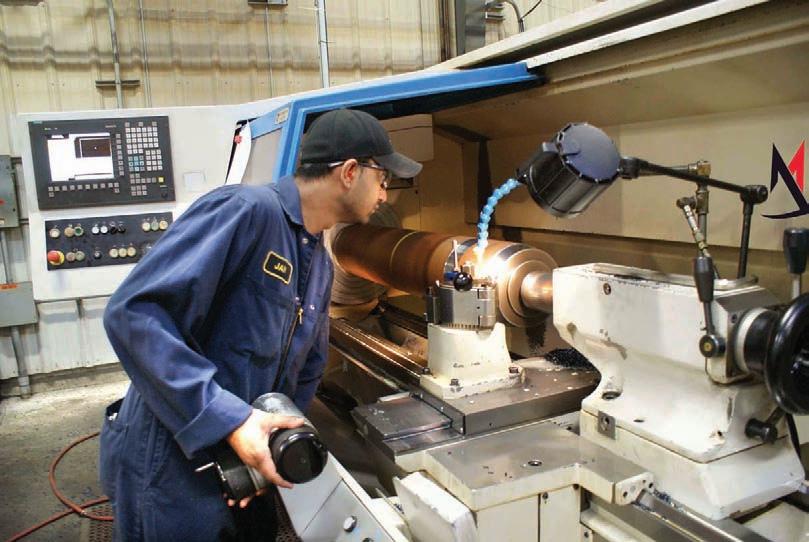
Tough lathes put teeth in oil-field equipment shop
Pumps are designed for high-pressure applications
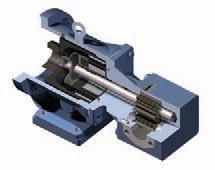
Viking Pump has expanded its line of high-pressure positive-displacement pumps to 43 cu m/hr (190 gpm). The pumps feature the sealless Vi king Mag Drive, single or double car tridge seals, component mechanical seals or lip seals. The SG-10 and SG-14 sealless external gear pumps are for highpressure applications where liquid or vapour containment is crucial. The series offers 29 displacements, and pressures to 34 bar (500 psi) standard, with some models offering pressure up to 170 bar (2,500 psi). All models operate at up to four-pole motor speeds and offer either foot bracket or close-coupled motor mount to both NEMA C and IEC frame motors. They can handle liquids from 1 cSt to 250,000 cSt viscosity.
Viking Pump
Online Reader Inquiry No. 623
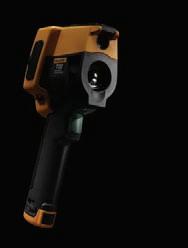
Thermal imager series is built for rugged operation in difficult conditions
Designed for a wide range of diagnostic applications, Fluke’s P3 series thermal imagers — based on the Ti32 series — adds four products, providing high-performance imagers for any budget. The P3 series includes the Ti32 and TiR32 models, plus the Ti27 and Ti29 models for industrial, electrical, mechanical and process applications; and the TiR27 and TiR29 models for building inspection, energy audit, weatherization and building maintenance applications. All models are designed to work in the harshest environments and provide good image quality with one-handed, easy-to-use interfaces.
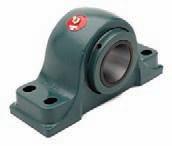
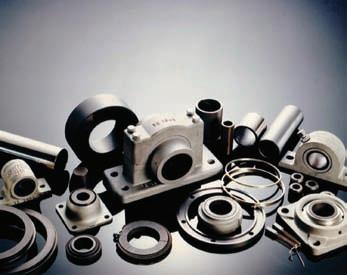
Bearing features high load ratings and advanced sealing for dusty or wet conditions Baldor has introduced the Dodge Type E-Xtra bearing with high load ratings and an advanced sealing system. The high-capacity tapered roller bearing insert allows for a combination of radial and thrust loads, while the carburized inner ring has been designed to absorb shock and resist cracking. An XTS triple-lip seal protects against contamination in dusty or wet environments. For extreme conditions, the XTS Plus sealing system is available. Bearings are pre-assembled and pre-lubricated, and are factory adjusted for easy installation. A variety of configurations is offered, including two- and four-bolt pillow blocks, flanges, piloted flanges, top angle take-ups and wide-slot take-ups.
Baldor Online Reader Inquiry No. 736
Shaft grounding system extends equipment life
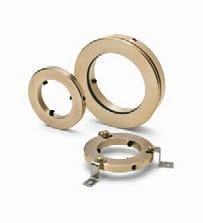
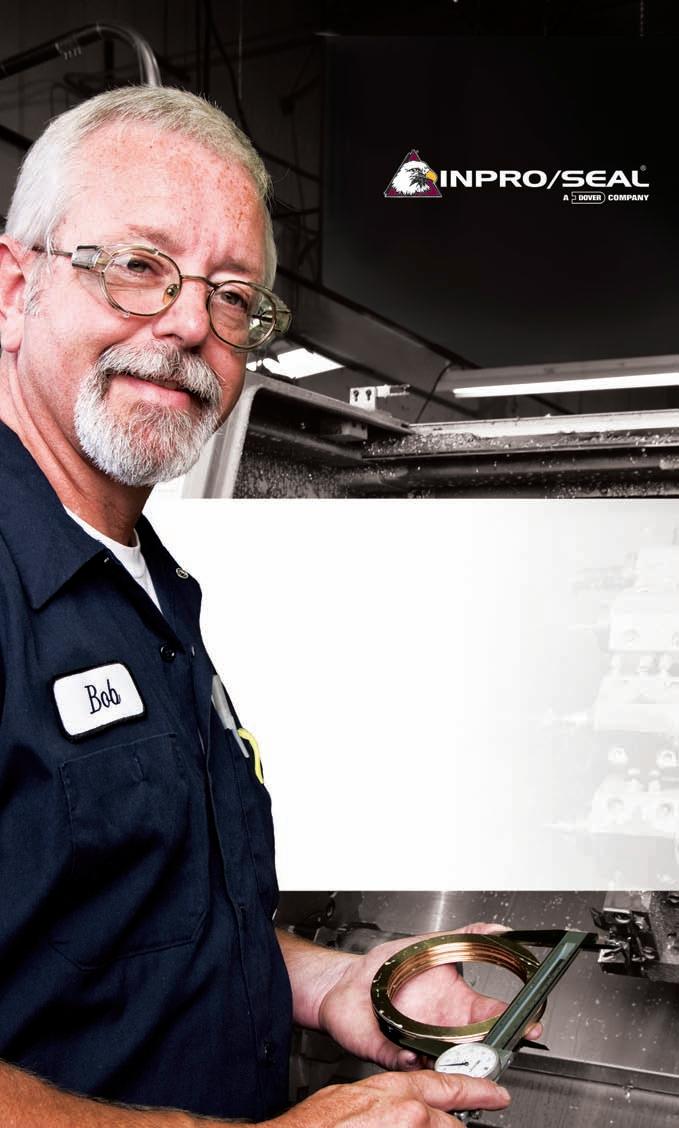
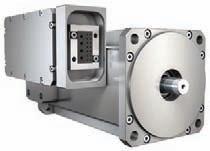
Variable frequency drive systems induce high-frequency voltages, which travel down the shaft, seeking a path to ground, and discharge through the motor’s bearings. These discharges damage the bearings and can lead to premature bearing failure and expensive downtime. To protect the bearings, Inpro/ Seal has introduced the Cur rent Diverter Ring, which uses conduc tive filaments to di vert shaft currents away from the bear ings. For applications that operate in severe-duty environments, the compa ny has developed the Motor Grounding Seal. This technology combines shaft-grounding technology with the VBXX-D Bearing Isolator, a two-part dynamic seal where outside contamination attempting to enter the bearing housing is captured in the outer labyrinth paths and expelled through a port in the stator by centrifugal force and gravity.
Inpro/Seal
Dirty Jobs Wanted
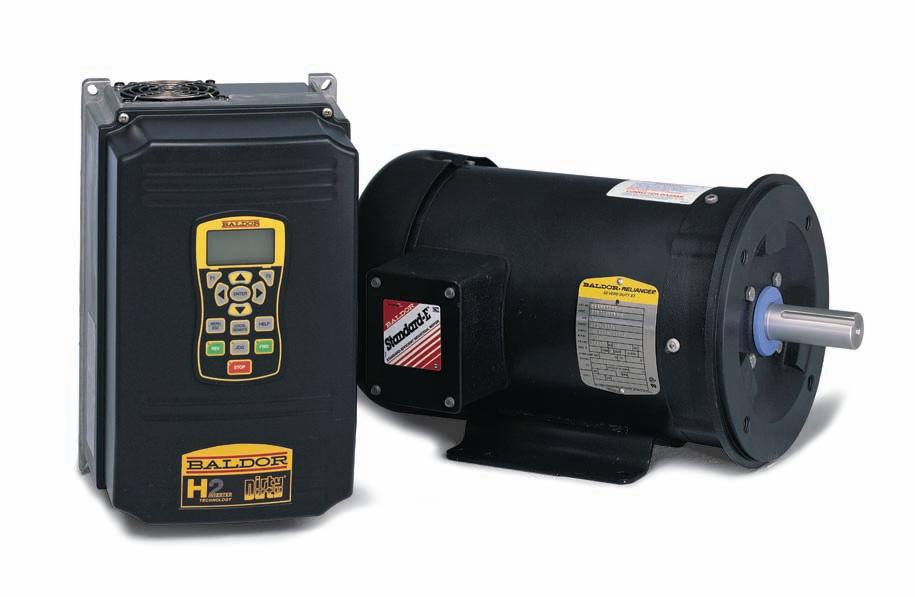
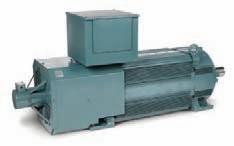
•Reliance® Dirty Duty AC motors and variable speed drives are the solution to the most hostile operating environments imaginable. Ideal for wastewater treatment, process industries, shipboard applications, even tropical environments, Dirty Duty products excel in foul environments. Dirty Duty motors feature a corrosion resistant proprietary bonded surface coating and stainless steel shaft extensions along with additional design features that stand up to whatever you can throw at them, while our NEMA 4X drive enclosures thrive where others fail. Need to fight dirty? Dirty Duty motors and drives will get the job done every time.
baldor.com 479-646-4711
Online Reader Inquiry No. 737
Program enhanced for sprag and trapped roller clutches
Renold’s Sprag and Trapped Roller Clutch product line has been enhanced to offer a wider range of products and faster availability to the Canadian marketplace. The product range covers a large variety of clutches, including Light Duty Sprag; Sleeve Bearing Sprag; Overrunning and Indexing Sprag; Flexible Coupling Combination; Long Life Holdback Sprag; Direct Mount Sprag; Trapped Roller, Ball Bearing and Cage Clutches. The company’s Westfield, NY, factory holds a large inventory of products. With its extensive tooling capability, the factory will stock, assemble, repair or customize most products and ship them directly to customers.
Renold Canada Ltd.
Online Reader Inquiry No. 741
Long-range wireless system monitors switches/valves remotely Omega’s HPWS series of long-range wireless systems simultaneously monitors and controls four switches or valves
up to eight miles away. The system is easy to set up and install. Featuring a rugged, weatherproof NEMA 4X (IP66) enclosure, it is suitable for supervising the fluid level in a tank, operation of a distant pump from a control station, or monitoring the status of a pumpline.
The water keeps coming and the turbines keep running, thanks to carefully planned maintenance at the 82-year-old Hydro-Quebec Beauharnois hydroelectric generating station.
How to avoid hydraulic troubleshooting mistakes / 18
It’s critical to assess the problem and eliminate the obvious.
columns
Safety and your CMMS / Don’t be caught in the crosshairs of a safety auditor’s scope. Here’s what must be done for satisfy auditors, safety officers and other regulatory agenies when it comes to Life Safety Systems.
Finding unexpected efficiencies / 28
Shaft collar is for low-rpm applications / 19
Quick-clamping shaft collars provide easy adjustment for rapid setup or frequent change-overs.
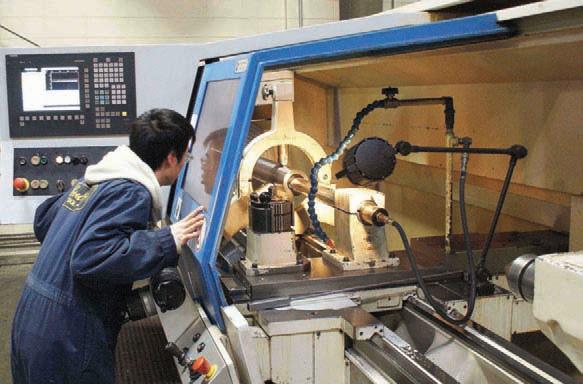
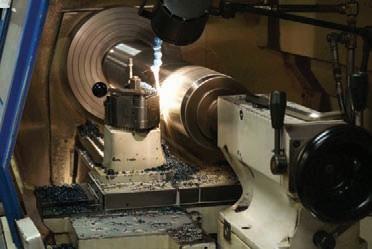
Tough lathes put teeth in oil-field equipment shop / 20
Quick conversational programming and versatility for deep-hole boring, profiling and threading make cycle-controlled lathes critical in Edmonton shop’s work with downhole tools.
COVER FEATURE:
Maintenance management: Can you be great? / 22
The skills and attributes required to be successful in maintenance are not the ones usually asked for in job postings.
Report on the PTDA
Canadian Conference / 38
More than 200 power transmission industry delegates came to Ottawa for learning and networking.
Follow along with Step 40 in a journey to World-Class Maintenance at the Plentya Paper Company as the maintenance team sees its responsibilities being realigned.
Dust, dangerous dust! / 29
Dust clouds can be ignited by the effects of mechanical friction from overheated bearings or motors, sparks from grinding machinery, static electricity, electrical arcing, welding sparks or naked flames. Here’s Part 1 of our guide to understanding and preventing dust explosions.
departments
Editor’s Notebook / 6
Industry Newswatch / 8
Business Briefs / 13
Mr. O, The Problem Solver / 13
CMMS Solutions / 27
Maintenance Management / 28
The Safety File / 29
MRO on the Road / 38
Product News
Product Spotlight / 2
MRO Components / 30
Focus on Bearings / 33
Focus on Clutches & Brakes / 34
Focus on Fluid Power / 35
Focus on Cleaning & Coatings / 36
Focus on Harsh Environments / 37
editor’s selections
Once a year, every unit is shut down for four to five days of routine maintenance and servicing.’
Ginette Vaillancourt / 17
‘We work these machines hard, and they have proven themselves oil-field tough, with excellent longevity.’
Gary Spencer / 20
‘If your operation had a safety incident or accident, what questions would investigators ask?’
Peter Phillips / 27
‘Dusty environments should be treated with respect, and proper safety measures applied.’
Simon Fridlyand / 29
Made in Canada –SKF Circulating Oil Lubrication Systems
sed in applications where lubrication must
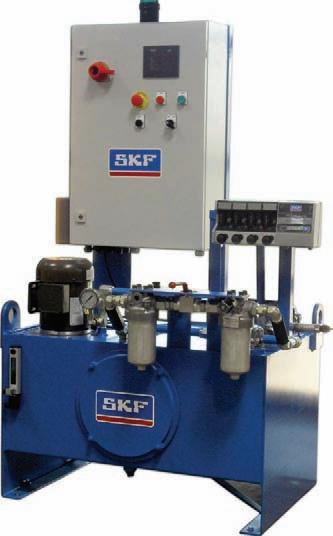
Circulating oil lubrication systems are used in applications where lubrication points must be cooled and cleaned by oil in addition to providing lubricity. Used extensively in general and heavy industries, typical applications may include; steel rolling mills, conveyors, paper machine dry end bearings, industrial fans and gear boxes.
The lubrication system must be able to deliver the right amount of highly conditioned, with appropriate temperature, oil to each lubrication point. The oil then flows back into the lubricant reservoir for reconditioning and reuse after passing through the lubrication points.
The respective system is selected on the basis of:
• the operating conditions (variations in the operating temperature and viscosity)
• the accuracy requirements for lubricant quantities
• the monitoring requirements
The SKF circulating oil lubrication unit is ideal for rolling bearings on industrial fans where high speeds and/or high temperatures can preclude the use of grease. These units deliver a continuous flow of cooled and filtered oil directly to the bearing. The metered pump flow is matched to the bearing and housing size, preventing oil leaks and excessive heat associated with oversized pumping systems. The use of circulating oil lubrication may also reduce bearing vibration associated with the use of grease lubricant at higher speeds.
The Canadian made circulating oil lubrication units are available in two standard tank sizes (other sizes are available); 75 litre (19 US gallon), and 130 litre (34 US gallon).
For additional information, please contact SKF Lubrication Solutions at lubrication@skf.ca or 1-800-207-5823.
Our evolution continues
If you’ve attended or exhibited at some key industry events that were covered by Machinery & Equipment MRO magazine, there’s a chance your photo was taken by our staff. You’ll often find a few of them published on our MRO on the Road page in each issue. Yet there’s always dozens – if not hundreds – more that we simply don’t have room to print. Our solution was to create a new online Photo Gallery, where we can post as many photos as we like for all to see. You can check it out now at www.mromagazine.com/gallery, or go to the home page of our website and select the PHOTOS link in the menu bar under the magazine logo.
Even if you didn’t attend any of these meetings, you can enjoy seeing who was there. Simply select the event
you’re interested in to view thumbnails of the images. You can enlarge any photo by clicking on it. If you want to save the photo onto your computer, right click with your mouse on the enlarged image and select ‘Save Picture As’ from the pop-up menu.
Currently, event photos posted include:
• IDI’s 30th annual Shareholders Meeting in Toronto
• IDI’s Supplier Summit in Halifax.
• the CIM (Canadian Institute of Mining) Conference and Exhibition 2011 in Montreal
• the EASA (Electrical Apparatus Service Association) Ontario Chapter annual general meeting in Toronto
• the Partners in Prevention health and safety show in Mississauga, ON
• the BSA (Bearing Specialists Association) 2011 Annual Convention in Texas
• the IFPE 2011 fluid power and motion control exhibit and conference in Las Vegas, NV
• the PTDA (Power Transmission Distributors Association) Canadian Conference in Ottawa
Later, we’ll be adding photos of the upcoming PTDA Industry Summit in Washington, DC, as well as others from additional events we cover.
Be sure to tell your colleagues who may have attended these events about our Photo Gallery, and don’t hesitate to let us know what you think of this feature by sending a quick note to broebuck@mromagazine.com.
On another front, we continued to garner recognition from the publishing industry with yet another award recognizing our editorial excellence this year, receiving a coveted APEX Award for Publication Excellence for 2011.
machine tools x foundries x metalworking machinery x lawn & garden x speed reducers medical x instruments x transmissions x kilns x mining x pharmaceutical x HVAC x hoist transportation x agriculture x washdown x construction x gear box x pumps x steel mills railway x band saws x aggregates x pulp & paper x spindles x grinders x textiles x vibrating screen x hand tools x electric motors x power generation x compressors x automation x idlers
Just some of the places you’ll find Koyo bearings.
wind turbines x automotive x conveyors x aerospace x stamping x recreation vehicles blowers x food & beverage x winches x cranes x excavator x fans x robotics x sander x mixer back-up roll x paver x printing press x debarker x head pulley x dryer x track roller x planer oil & gas x clean room x extreme environments x forestry x return rolls x traction motors x tunnel boring x rock crushers x rolling mills x work rolls x smelting x sawmills
The APEX 2011 Award was presented in July to Machinery & Equipment MRO in the Magapapers & Newspapers (Print) category for its September 2010 issue. It is the fifth APEX Award of Excellence received by the magazine. An international competition, APEX awards are based on excellence in graphic design, editorial content and the ability to achieve overall communications excellence. The Awards of Excellence recognize exceptional entries in each of 11 major categories. For 2011, more than 3,300 entries were submitted.
In addition to its five APEX Awards, MRO Magazine has received 11 KRW Awards, including four Gold (first place) awards and seven Silvers, along with dozens of Honorable Mention Awards and uncounted nominations. Not bad for a trade magazine targeted to tough guys and gals working in challenging industrial jobs, eh?
Bill Roebuck, Editor & Associate Publisher
SEPTEMBER 2011
Volume 27, No. 4 Established 1985 www.mromagazine.com www.twitter.com/mromagazine
EDITORIAL
Bill Roebuck, Editor & Associate Publisher 416-510-6749 broebuck@mromagazine.com
Ellie Robinson, Art Director Contributing Editors
Richard G. Ensman Jr., Simon Fridlyand, Carroll McCormick, Peter Phillips, Angela Webb, Cliff Williams
BUSINESS
Nick Naunheimer, Publisher 416-510-6868 nnaunheimer@mromagazine.com
Eric Achilles Cousineau, Adv. Sales Manager 416-510-6803 eachilles@mromagazine.com
Kimberly Collins, Advertising Production 416-510-6779
With more than 55 branches coast-to-coast, Kinecor is your largest Canadian distributor of industrial components and value-added services. Kinecor supports the Canadian industries by providing turn-key solutions that respond to your unique challenges.
Index indicates continued expansion in the PT market
Chicago, IL — The PTDA Business Index indicated the second quarter of 2011 was the fifth consecutive quarter for business growth among members of the Power Transmission Distributors Association (PTDA).
With a reading of 70.2, the second quarter results indicate the power transmission/motion control industry is still expanding. However, the rate of expansion has slowed as the 70.2 reading is the lowest the index has been since its inception a year ago.
The index reading indicates the rate of change compared with the previous period. For example, a reading of 50 indicates no change from the prior period while readings above 50 indicate growth
ada. We recognize that the IAM is also a leading asset management organization with similar interests and this agreement simply makes sense.”
There are several short-term benefits to both parties. CNAM is a young association looking to continue growing its membership base by demonstrating additional value, whereas the IAM has many best practices already in place. On the other hand, the IAM has expressed interest in developing formal ties to an organization within Canada, whereas CNAM has developed a strong network of municipal asset management practitioners from across the country, including a national workshop and practices targeted for municipalities.
PTDA Quarterly Business Index
and below 50 indicate contraction. The further the index is above or below 50 suggests a faster or slower rate of change.
PTDA members participating in the Business Index have also lowered their full year outlook for 2011. On average, members are now forecasting 12% growth, down from the first quarter outlook calling for 14% growth.
The PTDA Business Index full report is available through PTDA’s website at www.ptda.org/Index. It includes US and Canadian breakout data, in addition to historical data. Conducted jointly by PTDA and Cleveland Research Company, the PTDA Quarterly Business Index was modeled after the widely respected Purchasing Managers Index and tracks change in business activity, new orders, employment, supplier deliveries, inventories, prices and backlog in the PT/MC market to arrive at an overall index.
For more information, visit the website at www.ptda.org.
CANADIAN AND UK ASSET MANAGERS PARTNER UP
Burnaby, BC — The Canadian Network of Asset Managers (CNAM) has signed a formal partnership agreement with the UK-based Institute of Asset Management (IAM). The two associations share a mutual interest in the development of national and international best practices, competencies and qualifications for the practice of infrastructure asset management.
“CNAM and the IAM are excited about the opportunities to leverage each other’s strengths for both short- and long-term growth and to offer additional member value,” said CNAM chairman Steve Wyton, P.Eng, MBA. “CNAM wants to grow our knowledge base and promote asset management within Can-
“In the longer term, the IAM and CNAM are looking forward to starting to formalize international practice standards, and qualifications which may be applied in the UK and Canada,” adds David McKeown, chief executive of the IAM.
CNAM is a non-profit association established in 2009 as a national leader in Canada for municipal infrastructure asset management (MIAM). It is a recognized source of knowledge, promotes innovation and collaboration, and provides a common voice to facilitate action. For more information, visit http:// www.cnam.ca or contact Steve Wyton at chairchair@cnam.ca.
The IAM is a not-for-profit membership organization located in the UK that exists to advance for the public benefit the science and practice of asset management. Its priorities are to promote and enable the generation and application of knowledge, training and good practice, and to help individuals become demonstrably competent. For more information, visit http:// www.theiam.org or contact David McKeown at david.mckeown@theiam.org.
INSPECTION BLITZ OF PITS AND QUARRIES ENSURES HAZARD PROTECTION BEING USED
Toronto, ON — A month-long safety inspection blitz of pits and quarries across Ontario took place in July. The blitz focused on rock crushing, screening and conveying processes, which involve hazards that can endanger the health and safety of surface mine workers.
Inspectors aimed to ensure that guarding devices were used to protect workers from moving parts on equipment; written lockout procedures for equipment were available; dust control measures were used effectively; and protective hearing devices were being worn.
The biggest hazards at pits and quarries involve equipment such as belt conveyors, rock crushers and vibrating screens used in crushing, screening and conveying processes.
Since 2000, eight workers have died in pits and quarries in Ontario. Two of them were in incidents involving rock crushing, screening and conveying processes. During the same period, 60 workers were seriously injured in pits and quarries. Four workers were in incidents involving rock crushing, screening and conveying process.
Hazards can include lack of adequate
guarding and conveyor shutdown devices; lack of adequate lock and tag procedures; poorly maintained equipment; lack of fall arrest equipment; exposure to live electrical equipment; inadequate ladders, platforms and walkways; exposure to dust; and exposure to noise.
Mining inspectors focused on the following key priorities:
Dust control: Inspectors checked if measures to control dust from crushing, screening, stacking, conveying and transporting activities were adequate. (See the article on the dangers of dust in The Safety File on page 29.)
Guarding: Inspectors checked for the presence, adequacy, and use of guarding devices to protect workers from rotating parts or other equipment.
Written lockout procedures: Inspectors checked if crushing, screening and conveying equipment was being properly maintained and whether there were written lockout procedures.
Hearing protection: Inspectors checked if hearing protection devices (HPD) were available and used at worksites to control excess exposure to noise from crushing, screening and conveying activities.
SKILLS SHORTAGES TO BE ADDRESSED BY NEW FEDERAL GOVERNMENT APPROACH
Ottawa, ON — The federal government is taking action to address skills shortages so Canadians can train for jobs in a changing economy. Currently, Canada’s economic recovery is threatened by a lack of information among employers and workers for the skills needed in the workforce. As a result, the government is developing a new, proactive approach to coordinate the information job seekers will need to find the employers who are hiring.
“Better information will help Canadians find jobs and make the right learning and career choices,” said Minister of Human Resources and Skills Development Canada, Hon. Diane Finley. “Canadians need colleges and universities, business, labour and governments to all work together to ensure that our workforce develops a broad and
skills to be highly productive and to allow them to adapt to new technologies, innovations and new challenges.”
The government will gather critical information and make it available through a new website called Working in Canada (www.workingincanada.gc.ca), so that there will be a clearer picture of who is hiring and the skills that are needed.
Right now, said Finley, there are significant shortages in many key industries.
“Many of our members have told us that skills and training top their list of priorities,” said Perrin Beatty, president and CEO of the Canadian Chamber of Commerce. “Having the right people is critical to their competitiveness and to their very survival. Canada has a skills shortage problem well on its way to becoming a crisis. We don’t want to face a future where employers can’t fill positions because there aren’t enough qualified workers.”
POSTER TO HELP EASE TRANSITION TO NEW SAFETY DATA SHEET
Hamilton, ON — With the Globally Harmonized System of Classification and Labelling of Chemicals (GHS) on the horizon, suppliers are getting ready to make the transition from an ANSI MSDS (Material Safety Data Sheet) format to the GHS SDS (Safety Data Sheet) format. This transition will not be as simple as dropping the ‘M’ from the name, says the Hamilton, ON-based Canadian Centre for Occupational Healthy and Safety (CCOHS).
To help prepare for these changes, the CCOHS has produced a reference poster, MSDS -> SDS: Not Just Dropping the ‘M’, that provides a visual overview of what an MSDS will look like after its transition to a GHS SDS. The poster is designed as a reference tool to help educate, train and inform chemical manufacturers and suppliers, and employers and employees of industries where chemical products are used.
CCOHS has evaluated how the ANSI Z400.1-2004 MSDS data fields can be transitioned into an SDS, considering: what’s in, what’s out, what’s new, what’s
Since 2000, eight workers have died in pits and quarries in Ontario. Two of them were in incidents involving rock crushing, screening and conveying processes.
moving, what’s being renamed, and what’s staying the same. This poster will help prepare for these changes by graphically presenting the results of this analysis, and highlighting some key tips about how to successfully manage the transition from the MSDS to the SDS.
The information provided in this poster should not be regarded as final or unchangeable, since the final regulatory changes were not yet known as of press time. To find out more about the CCOHS poster, visit www.ccohs.ca/products/ posters/msds/.
MACHINERY AND EQUIPMENT PRICE INDEX CONTINUES ITS DECLINE
Ottawa, ON — The Machinery and Equipment Price Index (MEPI) declined by 0.8% in the second quarter of 2011 compared with the previous quarter, Statistics Canada reports.
The import component declined by 1.4% over this period, while the domestic series was unchanged. Compared with the second quarter of 2010, the total MEPI decreased by 2.5%, with the import component declining 4.4%, while the domestic component increased by 0.7%.
Except for fishing, hunting and trapping (+0.2%), and warehousing and storage (+0.1%), all other industries posted decreases in the prices of machinery and equipment purchased in the second quarter.
Manufacturing industries averaged a decline of -0.7%. Almost all commodities posted price decreases in the second quarter.
Meanwhile, the Canadian dollar appreciated by 1.9% against the US dollar in the second quarter.
HOW TO REDUCE RISK OF WORKPLACE HARASSMENT
Ottawa, ON — The costs of workplace violence and harassment are high, both to the victims and to their employers. A recent Conference Board of Canada study identifies six actions that organizations can take to significantly reduce the human, financial and reputational costs of workplace violence and harassment incidents.
“The scope of workplace violence has broadened beyond extreme acts of physical violence to include psychologically harmful behaviours,” said Karla Thorpe, associate director, compensation and industrial relations, at the Board. “Addressing harassment is important for several reasons. Harassment incidents occur more frequently than acts of violence. Harassment often precedes violence, and serves as an early warning that violence can result if workplace issues are not addressed.”
Four provinces — Quebec, Saskatchewan, Manitoba and Ontario — now legally distinguish between workplace violence (physical actions) and workplace harassment (psychological harmful behaviours). Quebec and Ontario laws have legislated requirements for employers to prepare, post, implement and review written policies with respect to both workplace violence and workplace harassment.
The risk of workplace violence and harassment comes from individuals both within and outside the organization. They include: • Co-workers — fellow employees or former employees.
• Clients — those who receive products or services from an organization.
• Individuals who have or had a relationship with an employee of the organization .
• Criminals — individuals who target and enter a workplace to commit a criminal act such as a robbery.
Employers can comply with recent legislative requirements and significantly reduce the risks by undertaking six key actions. Organizations should:
1. Conduct periodic risk assessments.
2. Heed early warning signs of potentially violent individuals and work situations — management and employees at all levels of an organization must be able to spot the signs of potentially violent individuals and work situations.
3. Make targeted use of professional assistance service options, such as employee assistance programs — these specialists identify and manage workplace violence and harassment, provide expert consultation services that identify risks, and suggest elimination or mitigation strategies.
4. Have appropriate policies and resources to respond when needed — workplace policies that include violence and harassment provisions should have in place clear expectations and consequences for individual conduct. Other options include regulating physical access to workplaces (such as layered levels of access in health-care settings) and redesigning jobs and schedules to ensure that individuals do not work alone.
5. Review prevention and response plans continually.
6. Provide effective crisis leadership and response in the event of violence or harassment — key actions include acknowledging the incident, communicating with both compassion and competence, and outlining the steps that are being taken to bring the organization back to normal and make it more resilient. MRO
More detailed versions of these stories, along with many additional news items, can be found online at www.mromagazine.com.
When you think “Performance”, you think about bearings that can withstand high speed, shock loads, misalignment and marginal lubrication conditions. We think about maximizing uptime and lowering maintenance costs with quality components supported by 24-hour service and worldwide distribution. For spherical roller bearings designed to deliver world-class performance in the most demanding applications, Think NSK.
Trends to 2031 for Canada’s labour force
The aging of baby boomers, which is largely behind the projected decline in the overall workforce participation rate, has had a major impact on the labour force.
Ottawa, ON — Using a range of projec tion scenarios, Canada’s labour force is projected to grow to between 20.5 million and 22.5 million by 2031, according to a new study from Statistics Canada re leased in August 2011. In 2010, the la bour force numbered about 18.5 million.
All scenarios suggest a slowdown in the rate of growth in the labour force, primarily because of the retirement of baby boomers. The overall participation rate, that is, the percentage of the total population aged 15 and over that is in the labour force, is also projected to decline.
This report, The Relationship Between Monthly, Quarterly and Annual Growth Rates, is based on an article in the dian Economic Observer about new pro jections for Canada’s labour force from 2011 to 2031, by which time the entire baby-boom generation will have reached the age of 65.
Between 1971 and 1976, when the large baby-boom cohorts were entering the labour market, the labour force in-
ployment Equity Act) in the labour force. Projections also show that the overall participation rate would decline and the diversity of the labour force would increase in every province.
By 2021, nearly one in four people in the labour force could be aged 55 or more, and by 2031, roughly one in every three could be foreign born.
Overall participation rate declines
As the growth of the labour force loses momentum, the population of seniors aged 65 and over is projected to grow increasingly rapidly as a result of population aging and the entry of the baby boomers into this age range.
Consequently, according to all scenarios, the overall participation rate is projected to decline during the next
In 2010, the participation rate was 67.0%; by 2031, it is projected to range between 59.7% and 62.6%, which would be the lowest observed since the late 1970s.
The projected decline in the overall participation rate over the next two decades would be largely attributable to demographic phenomena, such as the aging of the baby-boom cohorts, increasing life expectancy and a fertility rate below the replacement level of 2.1 children per woman.
Nearly one in four to be 55 or more
The aging of the baby boomers, which is largely behind the projected decline in the overall participation rate, has had a major impact on the aging of the labour force. Between 2001 and 2009, the proportion of people in the labour force aged 55 and over rose from 10% to 17%, an increase of 7 percentage points in nine years. The first baby boomers reached the age of 55 in 2001.
This increase is projected to continue from 2010 to 2021, when the succeeding cohorts of baby boomers in turn reach 55. By 2021, according to three of the five scenarios, nearly one person in four in the labour force (roughly 24%) could be
55 years of age or over, the highest proportion on record.
Also, by 2031, the ratio of people in the labour force to seniors aged 65 and over not in the labour force, that is mostly retired people, is also projected to decline.
In 1981, there were roughly six persons in the labour force for each retiree. By 2031, or 50 years later, this ratio is projected to decline to less than three to one, according to all five scenarios. The ratio is projected to decline in every province.
One in three in labour force to be foreign born
By 2031, roughly one in every three people in the labour force could be foreign born. Between 1991 and 2006, the percentage of foreign-born people in the labour force rose from 18.5% to 21.2%. If recent immigration levels were to continue, that proportion is projected to reach almost 33% in 2031, according to most scenarios.
For more than 20 years, Canadian immigration has come mainly from Asian countries. Consequently, between 1996 and 2006, the proportion of people in the labour force belonging to a visible minority group rose from 10% to 15%. According to most scenarios, this proportion could more than double to 32% by 2031.
Even if there were no immigration between 2010 and 2031, the proportion of people in the labour force belonging to a visible minority group would increase to about 23% in 2031.
This would be the result of two factors: first, the age structure of the visible minority population is younger than the
Notes about the study
The projections were based on five scenarios that combine assumptions on future population growth with assumptions on future labour force participation rates. These scenarios suggest increases of various sizes in the labour force population depending on assumptions for rates of fertility, mortality, immigration and participation rates.
The projections were obtained using a microsimulation projection model called Demosim. This model makes it possible to project populations by simultaneously taking into account the demographic components related to population growth, the education level, the participation rates and the person’s belonging to a visible minority group. The population base for this model comes from the microdata file of the 20% sample of the 2006 Census, adjusted for net undercoverage.
The labour force is defined as all individuals aged 15 years and older who work or who are looking for work. It is, therefore, the pool of individuals who are employed or available for employment in a population. The overall participation rate is the proportion of the population aged 15 years and older that is in the labour force.
general population, which means that fewer visible minority persons would retire by 2031. Secondly, the children of recent immigrants would gradually enter the labour force.
In addition, between 2006 and 2031, an increasing proportion of persons in the labour force belonging to a visible minority group is projected to be Canadian born. In 2006, Canadian-born visible minorities accounted for about 17%
of all visible minority people in the labour force; by 2031, their proportion is projected to rise to roughly 25%.
Again, this increase is mainly a result of two factors: first, Canadian-born visible-minority people tend to have a high level of education, so more participate in the labour force. Second, the children of immigrants who have arrived since the early 1990s will gradually enter the labour market. MRO
NSD TupH. A breakthrough in protection at the molecular level.
At last it’s here. A cost-effective alternative to stainless steel for the harshest environments. NORD innovation busts the protection racket.
NSD TupH, NORD’s new sealed surface conversion, is corrosion, chip and chemical resistant and highly cleanable. Utilized on NORD’s robust aluminum alloy housings, it establishes the required protection of your most demanding applications at a fraction of the cost you have been forced to pay for stainless steel.
Welcome to NSD TupH, the better solution you have been asking for is here. Now, you can start saving big money on protection without compromise Contact us today and find out how you can profit from NORD innovation.
MOVIGEAR
Movigear® is distinguished by its high level of system efficiency, a significant factor in reducing energy costs. The integration and coordination of all the drive components lead to a long service life and system availability. Movigear® is an intelligent system with its own control concept. Its high-quality networking helps reduce startup time and supports monitoring and maintenance tasks. When combined with a functional user software, drive tasks can be solved as quickly and easily as possible.
MOVITRAC ® LTE B
The range of functions provided by MOVITRAC® LTE B is particularly well adapted to less complicated applications. Its user-friendly design makes integration quick and easy, it also meets the high quality requirements of everyday requirements. The Movitrac® LTE B is also available in IP66/NEMA 4k making it suitable for special ambient conditions. These frequency inverters operate reliably and flexibly even when exposed to dust or water.
PSC
Planetary servo gear units
The low backlash PSC planetary servo gear units are designed for torque classes from 30 to 305 Nm. They are designed to offer the greatest possible flexibility and ROI, as not every application demands machines designed for maximum performance. These planetary servo gear units are the basis for versatile, dynamic, and above all cost optimized drive solutions.
MOVITRAC ® LTX
Simple, fast and diverse: as part of the Smart Servo Package, SEW-Eurodrive offers the new Movitrac® LTX servo inverter for universal use. It stands out with advantages such as ease of operation, short startup times as well as optimized costs. Available in two sizes and covers a power range from 750W to 5.5 kW. The Movitrac® LTX is particularly suitable for use in applications such as secondary packaging, handling, and logistics.
DECENTRALIZED DRIVE SYSTEMS
In many industries and applications, implementing economical automation concepts means utilizing decentralized systems throughout. Long rows of control cabinets with complex wiring, expansive space requirements and long distances between control cabinet and motors are too rigid and not very economical. Only the combination of fl exible, versatile, economic and target-oriented modules will provide an effi cient solution. This is the reason why system operators opting for decentralized drive systems from SEW-Eurodrive are always ahead of the game.
Our Drive Solution Pyramid.
The demands on material handling systems today have never been more wide ranging or more challenging. That’s why SEW-Eurodrive offers drive solutions for every kind of industry application. From the simple to the sophisticated, our pyramid of solutions allow you to control costs and limit complexity by giving you the ability to tailor our products to the exact intelligence and performance specs you require. Reducing energy consumption is also an important imperative today for the modern production line. Just ask Coca-Cola, who achieved a sensational 75% reduction in energy consumption by incorporating 40 of SEW-Eurodrives’s revolutionary decentralized MOVIGEAR® units in a recent overhaul of a European bottling plant transport line.
VFDs: RELIABLE, COMPACT & VERSATILE
SERVO PACKAGE: SIMPLE, FAST & DIVERSE
Business Briefs
News and views about companies, people, product lines and more.
• GBS Inc., Ottawa, ON, better known as General Bearing Service, marks its 65th anniversary in 2011. The company was founded on April 1, 1946, by Ernest Bouchard, who started the operation with a $500 loan from the Royal Bank of Canada, which was used to build a small inventory of bearings. This start was the foundation of a long relationship with both Timken and SKF. Today the company distributes products from more than 100 manufacturers. In addition to its Ottawa headquarters, it has 14 branch locations in Quebec and four in Ontario. To mark its anniversary, the company recently became the sponsor of MRO Magazine’s new Online Photo Gallery (www.mromagazine.com/gallery).
• BDI Canada Inc., Mississauga, ON, a national industrial distributor, has opened a new branch in Surrey, BC, to service local industrial markets. The branch manager is Pete Stratton and the outside sales representative is Dan Bidwell. Meanwhile, its parent firm, Bearing Distributors Inc., headquartered in Cleveland, OH, has opened a new branch in Guadalajara, Mexico. Overseeing this new branch is manager Victor Hugo Hernandez Trejo. The company now has 140 branch operations in the U.S., Canada, Mexico, Europe and Asia.
• Lenox has opened a new $500,000 weld centre in Mississauga, ON, to serve industrial band saw blade customers in
Ontario, Quebec and Eastern Canada. The centre keeps coil stock on hand to provide quick delivery and service on custom-length industrial metal-cutting band saw blades. It produces smooth factory welds that join the ends of blades up to 3 in. in width.
• The Canadian headquarters of KSB Pumps Inc. has relocated to 5205 Tomken Rd. in Mississauga, ON. The new 18,000 sq-ft building accommodates an expanded showroom and additional office space. It includes a 10,000 sq-ft high-bay workshop area with a 16-tonne overhead crane. Future plans call for the addition of a full range of machine shop and test loop facilities. KSB Pumps, which has operated in Canada since 1989, also has office locations in Montreal and Calgary. The company is part of the KSB Group, a manu facturer of pumps, valves and sys tems.
• Tom Green has joined Koyo Canada, Burlington, ON, in the role of senior technologist. Green has more than 20 years of handson bearing expertise and is expe rienced in training, installation, application assistance and root cause failure analysis (RCFA).
• Industrial distributor
Grainger Inc. (Grainger) of Lake Forest, IL, plans to acquire the shares of Fabory Group of Tilburg, The Netherlands, a European distributor of fasteners and related MRO (maintenance, repair and operations) products. The transaction price will be about US$344 million. The transaction is subject to customary closing conditions and is expected to be completed in the third quarter of 2011. According to Grainger, Europe is the largest MRO market in the world, valued at about US$200 billion. Fabory has been aggressively expanding its MRO and fastener offerings throughout Central and Eastern Europe. Grainger intends for Fabory to continue as a separate business, maintaining the Fabory name and brand. Grainger is the parent company of industrial distributor AcklandsGrainger Inc., Richmond Hill, ON.
• Bosch Rexroth Canada Corp., Welland ON, has celetrated its 50th anniversary. Originally founded in the Welland area in June 1961 as Basic Structure Steel Fabricators Ltd., Bosch Rexroth Canada has since grown to employ more than 300 in nine locations across Canada. The company got its start in hydraulics technologies in the mid-1960s through the development of the “UpPUP” telescopic work platform. The company’s name changed to Basic Hydraulics and Industrial Equipment Ltd. around this time. One of Basic’s staff engineers recommended hydraulic components from the German hydraulics company, G.L. Rexroth GmbH and in 1968 Basic became Rexroth’s sole authorized Canadian distributor. As Rexroth added new ‘Drive and Control’ technologies to its portfolio, Basic adapted also, changing its name to Basic Technologies Corp. to reflect the new product portfolio. Rexroth acquired a significant equity stake in the company in 1996, and followed that by acquiring a majority stake in 2001. Following the Rexroth acquisition by Robert Bosch GmbH, the company was renamed Bosch Rexroth Canada Corporation.
• The website of Wood Dale, IL, based Thomson Industries Inc. (www.thomsonlinear.com) is now available in seven new languages. Already available in English, German and Chinese, the site is now fully translated and functional in Italian, Korean, Polish, Portuguese (Brazil), Spanish (Latin America), Swedish and Turkish. The website provides access to the company’s family of mechanical and electromechanical motion control solutions. Visitors can navigate solutions by industry and benefit from an extensive suite of support resources and design tools to help machine builders quickly configure an optimal linear motion solution for their application.
teractive blog entitled Ask Dave, authored by Dave Wagner, director of product knowledge at the company. Ask Dave originally started as an e-mail question and answer feature on the company’s website. The blog format brings Dave’s knowledge about gas detection to end users and safety professionals. Dave has more than 20 years experience in the development and application of portable gas monitoring instruments and systems. He is said to excel at simplifying the sometimes complex world of gas detection. Ask Dave is available at www.askdaveblog.com.
• Michael Nisenbaum has joined Carlisle Transportation Prod ucts Inc. (CTP) as director of sales and marketing - industrial distri bution. Carlisle Transportation Products is a new operating divi sion of Carlisle Companies Inc. Charlottte, NC, that was created in February 2011. CTP is the combi nation of the former Carlisle Tire & Wheel and Carlisle Power Trans mission businesses and is a worldwide supplier of industrial belts, specialty tires and wheels. Most recently, Nisenbaum was president of Peer Chain Company of Waukegan, IL. His career includes various senior roles at U.S. Tsubaki
United States. “I am really excited to become certified as a woman-owned business, since there are very few of us in our industry, especially within linear motion and power transmission,” said Pamela Kan, president of Bishop-Wisecarver. The certification process is designed to confirm the business is at least 51% owned, operated and controlled by a woman or women. To learn more, visit www.wbenc.org.
• Bishop-Wisecarver Corp., Pittsburg, CA, the manufacturer of the DualVee guide wheel and guided motion technology, has received national certification as a Women’s Business Enterprise by the Astra Women’s Business Alliance, a regional certifying partner of the Women’s Business Enterprise National Council (WBENC) in the
• Extech Instruments , based in Waltham, MA, has recalled 5,100 selected EX612, EX613, EX622 and EX623 digital clamp meters, as well as EX540, EX542 and EX570 multimeters. The company has been working with Health Canada and US agencies to recall these products and replace them. After extensive quality testing, Extech found that in the case of an extremely weakened battery condition, these made-in-China instruments may display a zero or very low voltage reading while a user is testing a live circuit with an unsafe voltage. As a result, the user may be exposed to a potential electrocution hazard if he or she contacts an energized circuit based on an inaccurate reading from the meter. No injuries have been reported to date from the use of the recalled products. Users are to stop using the clamp meter or multimeter, even they have not experienced any issues. For details, call a special recall hotline toll-free at 1-855-239-8324 or send an e-mail to recall@extech.com. For more information, visit www.extech.com/recall. MRO
Mr.0 The Practical Problem Solver
Are any greases compatible?
BY JOE CONYERS
Problem: In attempting to keep up with various grease manufacturers’ opinions on grease compatability, I look to their websites, technical notes and published catalogues. Recently, I noted a major grease manufacturer had removed its grease compatability chart from its catalogue. It substituted a comment that I’ll paraphrase as, “we don’t recommend mixing greases.”
Solution: I think this was a good move on the part of the manufacturer, and it’s an opinion I share. Don’t mix greases. It’s just better to clean out the housing and replace the old grease with new.
What is grease made of anyway? The first time I looked at grease, I thought to myself, “It’s got to be half-oil and half-thickener, just to hold everything together.” Wrong! I found later that grease is more like custard or gelatin: it’s a chemical ‘mesh’ holding the oil in place.
Grease is typically about 90-95% oil, mixed with a thickener. The other component of grease is the additive package: rust and oxidation inhibitors, at a minimum, and almost certainly other additives.
Industrial Scientific, Pittsburgh, PA, has launched a new in-
Are grease thickeners compatible? Not at all. The two most commonly used greases, Lithium complex and Polyurea, are generally incompatible.
Are oils compatible? Nope. Mineral oil and Polyglycol aren’t.
Are additives compatible? Don’t even think about it. Anti-wear additives may have severe chemical reactions with R&O (Rust and Oxidation) additives, for example.
But you can use the ASTM D6185 (1997) grease compatability test, and you’re covered, right? Wrong. This test only covers dropping point, shear stability and storage issues. Check out the well-written caveats at the ASTM website. Go to www.astm.org and type D6185 in the search box.
Here’s the bottom line: don’t mix greases. If you have to, be prepared for the consequences, which could include liquifaction, high bleed rates, grease softening or hardening and possibly even corrosion issues.
For the past decade, Joe Conyers has been a senior consulting engineer for the SKF Reliability Maintenance Institute in training and development. This tip is from the Question of the Month for June 2011 at his blog, www.maintenancebits.com.
Do you have a solution for a maintenance problem? Send it in and if it’s published, we’ll send you a Mr. O Problem Solver T-shirt. Include your address, telephone number, print complete details and, if possible, add a sketch to help explain your tip. Send your tips to Mr. O, Machinery & Equipment MRO, 12 Concorde Place, Suite 800, Toronto, ON M3C 4J2.
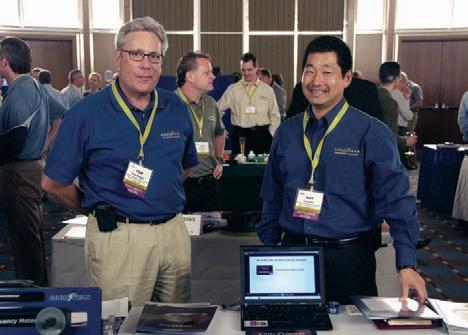
Pierre Bouchard, Mitch Bouchard, Ken Yamasaki and Richard Watson of GBS Inc.
Visitors to the Lenox grand opening signed their name on a special plaque.
Michael Nisenbaum has joined Carlisle.
Photo: CTP
Koyo Canada’s Tom Green.
Photo: Koyo Canada
Awards distributed at IDI meeting in Halifax
Halifax, NS — The IDI Independent Distributors Inc. Annual Meeting and Supplier Summit, which took place at the Delta Halifax in Nova Scotia, June 14-17, 2011, signified a big accomplishment for both IDI members and vendors towards their annual charitable donations. Including the cheques issued to charities at the Halifax event, IDI donations have amounted, over the past six years, to more than $100,000.
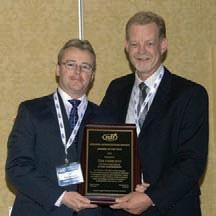
The event recognized the hard work and dedication of IDI members on behalf of the buying group by distributing awards and rebate cheques. Among the recipients of the awards were Benoit Dickner of Dickner Inc. for having the largest dollar increase and largest percent increase from year to year. Another award was given to
Tim Osmand of Ontario Belting for his dedication to the group, earning him the title of IDI’s Member of the Year.
The IDI meeting also recognized past directors, past chairmen of the board, retiring directors and the outgoing board of directors, and saw the passing of the gavel from outgoing chairman Michel Vezina of VL Industriel to incoming chairman Rob Inglis of Charles Jones Industrial Ltd., who said he was honoured to be asked once again to join the IDI board.
IDI’s next event will be its annual General Meeting and IDIMart trade show, taking place in Montreal, Jan. 24-27, 2012.
For more information on IDI Independent Distributors Inc., visit www.idiind.com.
To see several more photographs of the conference, check out MRO Magazine’s online photo gallery at www.mromagazine. com/photogallery.
CMTS BOLSTERED BY RESEARCH SHOWING MANUFACTURERS WILL SPEND MORE ON EQUIPMENT
Toronto, ON — Nearly 60% of Canadian manufacturing companies are planning to spend more money on manufacturing
equipment in 2011, compared to 2010, while approximately 30% are prepared to spend the same year over year. That’s the finding of a national survey conducted by the Society of Manufacturing Engineers (SME), the leading international resource for manufacturing information and knowledge.
The survey also showed that, at the same time, close to half of respondents cite “keeping production costs under control” and “improving workforce productivity” as their most pressing challenges. That means ongoing investment in new technology and processes is not only happening, but continues to play a key role as manufacturers rebound from the economic downtown of 2008-2009, said Nick Samain, event manager with SME, which is organizing the upcoming Canadian Manufacturing Technology Show 2011 (CMTS 2011).
Responding to the survey, the organizers of CMTS 2011, which takes place Oct. 17-20 at the Direct Energy Centre in Toronto, have announced an expanded show for this year that is expected to feature live equipment demonstrations, a 600-exhibit trade show, an exclusive industry keynote, interactive panel discussions and industry-wide networking opportunities.
“Our survey shows that there is optimism for the future, and as Canadian companies look for ways to increase efficiencies while keeping costs down, they rely on a venue like CMTS more than ever to help break through the massive clutter of information out there,” said Samain. When asked to name the most pressing challenges they face today, one-third of SME survey respondents pointed to either expanding into new markets, finding and retaining qualified personnel, or updating equipment and processes. Meanwhile, 22% reported difficulty keeping up with industry trends. Additional highlights of the survey include:
• 58% of respondents have increased their manufacturing equipment budgets this year, while 29% have maintained the same budgets.
• 60% of those surveyed are exploring areas for diversification, with 62% planning to upgrade their machinery and equipment as part of that strategy. Other areas earmarked for upgrading or diversification include design and engineering (45%), processing equipment (38%), quality (38%) and materials (35%).
• Just under 75% of respondents plan to invest in manufacturing equipment this year. Budgets range from $1 million and over (10.5%); $250,000 to $999,999 (16.3%); $50,000 to $249,999 (25.4%); and under $50,000 (21.8%).
CMTS 2011 is a showcase for the latest technology, equipment, lean practices, management strategies and green solutions in the manufacturing industry, from traditional automation, metalforming, packaging, prototyping, measurement and tooling solutions, to cutting-edge visualization, nanotechnology, robotics, and green and smart grid technologies.
Kevin O’Leary of CBC Television’s Dragon’s Den will kick off the conference portion of the show with his pull-no-punches look at the good, the bad and the ugly of modern manufacturing. Also speaking is automotive insight journalist and TV host John McElroy, who will moderate the Automotive Summit, a roundtable panel sponsored by the Automotive Parts Manufacturer’s Association (APMA).
For more information, visit www. cmts.ca or call (416) 491-7565.
tools, based on you, built by Fluke.
Keeping
Tim Osmand (left) of Ontario Belting receives the Member of the Year award from IDI president Scott Bebenek.
Photo: Eric Achilles Cousineau
PTDA INDUSTRY SUMMIT TO FOCUS ON INDUSTRY CHANGES
Washington, DC — Top ex ecutives in power trans mission and motion control (PT/MC) will converge in Washington, DC, in Octo ber at the Power Transmis sion Distributors Associa tion’s (PTDA) 2011 Indus try Summit. The theme of the meeting is ‘CAPI TOLize on Change’ and its mandate is to strengthen business relationships and forge new ones.
To be held at the Washington Hilton, Oct.13-15, 2011, the Industry Summit is a premier venue during which PTDA members can devote time to working on their businesses with networking, keynote talks, workshops and targeted business development opportunities.
The Industry Summit’s signature event, the Manufacturer-Distributor Idea Exchange (MD-IDEX), brings together existing and potential channel partners to plan for the upcoming year.
Pete Kalgreen, president of PTDA member Akron Bearing Supply in northeast Ohio, said the investment to attend is returned many times over. “My first year [at the Industry Summit’s MD-IDEX event], I was able to meet with the national leaders of a large manufacturer,” Kalgreen said. “Helping them better understand our business during our discussions allowed them to make changes, which has allowed me to buy a lot more of their product. It was a meeting of the minds made possible by the Industry Summit.”
Dave Witwer of Missouri Power Trans Inc., a St. Louis-based distributor, has
attended more than 20 PTDA Industry Summits. “The Industry Summit is all about people,” Witwer said. “In the end, we can get products, we can get customers, but at the Industry Summit, we can step back and learn from our fellow distributors about processes and procedures to do things better, more efficiently. You get ideas and information that you wouldn’t have thought about. This is stuff that you can’t get anywhere else.”
By offering multiple networking opportunities, forums, panel discussions and workshops as well as two keynote speakers, PTDA has structured the Industry Summit so participants can experience information about market changes, new ideas and changes in methods of communication and leadership in a style that allows a custom experience.
Some highlights for the 2011 Industry Summit are:
• Two highly regarded keynote speakers will address leadership in difficult cir-
cumstances and management in a difficult economy, respectively.
• Alison Levine, a world-renowned mountain climber and cold-weather adventurer as well as Wall Street investment banker and professor at the United States Academy at West Point, will be the opening keynote speaker. Levine’s life and accomplishments are the subject of the PBS documentary, Living Courageously (2007). Levine has also appeared on numerous television shows to talk about her experiences.
• Alan Beaulieau of the Institute for Trend Research is an economist with a special focus on industrial distribution. Beaulieu will discuss how the economy will affect the business in the near and far future.
• Websites that Work: Your Secret Online Weapon is a seminar that aims to help participants gain more ROI from their websites, transforming them from electronic billboards to active cash registers. The workshop will be led by Tim Ash of Site Tuners, a website optimization firm.
• Rule Your InBox: Don’t Let Your Tech Manage You is a seminar designed to train participants to take charge of their mobile devices, transforming them into the timesaving devices they were meant to be, rather than the time-wasting gadgets they’ve become. The workshop will be facilitated by Steve Turner of TurnerTime Management.
• The Effects of Mergers and Acquisitions on the Distribution Channel is a panel forum led by industry members for industry members. The discussion will shed light on the ripple effect of consolidation of both distribution companies and suppliers.
• Special networking sessions for each distinct industry segment are a highlight of this year’s Industry Summit. Distributors and manufacturers will meet independently to discuss issues and problems and find solutions and ideas from among their own peer groups, allowing them to better assist their customers in the long run.
• Kicking off the Industry Summit is the fifth annual Motion Control Showcase, offering participants a chance to see the latest trends and new products offered by manufacturers of motion control products. For more information, visit www.ptda. org/industrysummit. MRO
Photo gallery of industry events offers free image downloads
Toronto, ON - If you’ve attended or exhibited at some key industry events that were covered by Machinery & Equipment MRO magazine, there’s a chance your photo was taken by our staff. Find out by visiting our online MRO Photo Gallery at www.mromagazine.com/gallery, or go to our home page and select the PHOTOS link in the menu bar under the magazine logo. Even if you didn’t attend any of these meetings, you can enjoy seeing who was there. Simply select the event you’re interested in to view thumbnails of the images. You can enlarge the view of each photo by clicking on it. If you want to save the photo onto your computer, right click with your mouse on the enlarged image and select ‘Save Picture As’ from the pop-up menu. (High-resolution original digital images, or quality prints ideal for framing, are available at a nominal cost; please contact Eric Achilles Cousineau at MRO Magazine for details by sending an e-mail to eachilles@mromagazine.com.)
The U.S. capitol is the site of PTDA’s next industry event.
Electricity means money and HydroQuébec’s Beauharnois hydroelectric generating station is making its share of both this year: It generated a record 1,182,706 MWh in July 2011, thanks to all 38 generating units running. As well, 60% of this year’s scheduled maintenance jobs had been completed by March, its Unit 20 was back in service after refurbishment and, of course, Mother Nature has provided lots and lots of water.
Extracting this kind of performance out of a generating station is no paddle on a duck pond though. Located 40 km southwest of Montreal on Lac SaintFrancois and the Beauharnois canal, the kilometre-long generating station is the fourth-largest of Hydro-Québec’s 60 hydroelectric generating stations.
Construction on the Beauharnois station began in 1929, but its age alone is only part of the story of what makes it uniquely challenging to operate. With an installed capacity of 1,911 MW, it is more than nine times bigger than the next largest hydro station of its vintage. Its installed capacity is 507 MW greater than all of its 19 octogenarian and nonagenarian contemporaries combined.
The commissioning of the generating station was strung out from 1932 to 1961. The smorgasbord of unit types installed over the decades requires a lot of specialized knowledge to operate and maintain.
Ginette Vaillancourt, facilities engineer, Beauharnois, gives a taste of the generating station maintenance team’s daily bread: “The quantity and the wide variety of equipment in the generating station make it very challenging. There are Francis and propeller-type turbines and several different unit manufacturers. For example, we have turbines and generators manufactured by Westinghouse, General Electric, Canadian Allis-Chalmers, Dominion Engineering Works, Alstom, Voith, Oerlikon and English Electric. There are different designs, configurations and different technologies to consider: old and new, modernized and semi-modernized, digital and analogue.”
Mechanics, electricians, civil workers and operators total about 150. Technicians, engineers, managers and administrative staff bring the generating station’s population to about 200. To keep staffing levels up and reduce the irretrievable loss of knowledge as old hands retire, Hydro-Québec hires post-secondary graduates and sometimes pairs staff with experienced mentors.
“On-site coaching is sometimes used as an alternative or in addition to inclass training,” Vaillancourt says. Hydro-Québec also arranges training on topics such as generating units, speedcontrol systems, cranes and safety codes.
Scheduled maintenance includes familiar-sounding tasks such as routine and visual inspections of accessible parts for sparks, leaks and unusual noises. Permanent monitoring systems track variables like vibration, stator and bearing temperatures, oil levels, pressure, flow and air gap.
Once a year, every unit is shut down for four to five days of routine maintenance and servicing. This includes verifying oil leaks, oil sampling, analysis of generator and turbine bearings and hydraulic systems, and verification of wear on exciter
THE WATER KEEPS COMING AND THE TURBINES KEEP RUNNING THANKS TO CAREFULLY PLANNED MAINTENANCE AT THIS 82-YEAR-OLD HYDRO-QUÉBEC GENERATING STATION.
brushes. These tasks do not generally require disassembly or the use of a platform in the area of the runners (turbine blades).
On six- and 12-year schedules, every unit – usually three a year – is taken out of service for four to five weeks worth of more extensive maintenance tasks. “Furthermore,” Vaillancourt adds, “two units are usually out of service most of the year for major refurbishment or modernization work. We take advantage of these major shutdowns to perform extensive maintenance work on them.”
Refurbishment work requires taking units out of service for 40 to 60 weeks. “A major rehabilitation project has been under way here since the beginning of the 1990’s. It includes stator winding replacement and turbine runner replacement, major civil work, modernization of exciters, digital retrofit or replacement of speed governors, installation of monitoring systems and measurement instruments, etc.,” Vaillancourt says.
The maintenance team at Beauharnois is well equipped to do most repair work. Its machine shop is kitted out with gear like lathes, moulding machines, vertical and horizontal band saws, drill presses, bench grinders and a hydraulic press. The welding shop has some of this gear, plus a combined bending-punchingshearing machine and combined bendingshearing machine. In-house welders, in addition to doing small jobs, can also repair cracks and cavitation damage (pitting due to exploding air bubbles in areas of low pressure) on the runners.
Machining of some parts, like servomotors, specialized or robotized welding and tricky on-site boring tasks are carried out by a machine shop brought in from elsewhere in the Hydro-Québec system. Machining of heavy parts, like bottom rings, head covers and vane rings, and manufacturing and machining of turbine runners, stator rewinding and major civil works are outsourced to other companies.
Beauharnois uses the Maximo computerized maintenance management system (CMMS) to track all this maintenance work. About 8,600 pieces of equipment are entered in the Maximo software. There are roughly 8,700 coded items, including basics and common spare parts that are currently used, and specialized or strategic parts, both in store or to order.
Beauharnois follows what could be loosely referred to as a maintenance playbook: the Maintenance Management Concept used throughout the Generation Division of Hydro-Québec. It takes into account things like the expected services of the generating station, applicable laws, rules, regulations and commitments; maintenance specifications in condition
assessment standards and maintenance analysis guides; and systematic, conditional and corrective maintenance planning, equipment condition assessment and maintenance assessment.
“This helps us optimize maintenance: do the right maintenance action on the right equipment at the most appropriate time,” Vaillancourt explains. This kind of organization and planning allows the maintenance team to accomplish 85% of its planned maintenance, maintain an average forced outage rate as low as 1% and an operating factor of about 85%, all the while carrying out the 40- to 60-week-long major refurbishments or modernization on two units a year.
In recent years, good practices have been improved and include the following: refined maintenance planning in weekly meetings to coordinate and schedule maintenance tasks; doing as much maintenance as possible between January and March to minimize the water spillage that occurs when units are taken out of service at other times of the year; and putting all available resources onto the unit that is out of service to minimize the duration of outages.
Water spillage is a concern inherent to
the location of the Beauharnois generating station. A hydroelectric dam with a reservoir behind it does not lose water if a unit is not operating. The water just sits there. Beauharnois, on the other hand, is a run-of-river facility. It does not store water. It is a strictly get-as-can-get proposition: every litre of water that is not spinning a runner is a litre lost to the downstream side of the generating station. There is great motivation, then, to keep unit uptime as high as possible.
“This makes it a real challenge to perform maintenance while maintaining a high operating factor and a low forcedoutage rate,” Vaillancourt states. “Our main goal is to take the right maintenance actions on the right equipment at the right time, and to offer maximum availability to meet hydraulic and market demands while maintaining equipment long-term reliability. This is what our business is all about.” MRO
Carroll McCormick, senior contributing editor, is based in Montreal. He is the recipient of several awards for his articles in Machinery & Equipment MRO.
Top: Hydro-Québec’s Beauharnois hydroelectric station is the fourth-largest in Québec. Above: The Beauharnois station carries out at least two major unit refurbishments a year.
Photos courtesy Hydro-Québec
How to avoid hydraulic troubleshooting mistakes
BY BRENDAN CASEY
Troubleshooting hydraulic systems can be a complex exercise. It involves a lot of science, and sometimes, a bit of art. Incorrect diagnosis prolongs downtime and can result in the unnecessary repair or replacement of serviceable components. To avoid these costly mistakes, the correct equipment and a logical approach are required.
Before you incur the expense of hiring a technician, assess the problem and eliminate all of the obvious, possible causes. I have lost count of the number of times that I’ve been called to a problem and found that the cause was something quite simple. A wire broken off a solenoid valve, a pin fallen out of a mechanical linkage, an isolation valve that had vibrated closed, a blocked heat exchanger … and the list goes on.
Your oversight won’t bother the technician you’ve b rought in, because his hourly rate is the same, regardless of how easy or difficult the problem is to find. But you may be annoyed with yourself for not checking some-
thing so obvious, knowing that you could have easily saved the cost of the call-out. Paying for a technician’s time when it is not required is certainly not desirable. But it is nowhere near as costly as paying for the unnecessary repair or replacement of serviceable components as a result of incorrect diagnosis of a problem. Incorrect diagnosis in a troubleshooting situation is usually the result of the technician’s incompetence, insufficient investigation of the problem, or a combination of both.
Unfortunately it is not possible to determine a technician’s competency from the badge on his shirt or his charge-out rate. While charge-out rates may be a factor in deciding which technician you hire, from an overall cost perspective, it is far more important to evaluate the technician and his diagnosis, so that you don’t end up paying for his mistakes.
Let me illustrate how this can happen with an example. Several years ago, I was asked for a second opinion on the condition of a set of pumps operating a processing plant. The customer had called in a technician to check the performance of these pumps and was alarmed when the technician advised that all four pumps were in need of repair.
The pumps in question were variabledisplacement units fitted with constant power control. The power required to drive a hydraulic pump is a product of flow and pressure. A constant power or power-limiting control operates by reducing the displacement, and therefore flow, from the pump as pressure increases, so that the power rating of the prime mover is not exceeded.
Pump performance is checked using a flow tester to load the pump and measure its flow rate. As resistance to flow is increased, pressure increases and the flow available from the pump to do useful work decreases because of internal leakage. The difference in the measured flow rate between no load and full load determines the volume of internal leakage and therefore the pump performance.
I tested all four pumps, recording flow against pressure from no load through to maximum working pressure. In my report, I explained to the customer that the tests revealed that pump flow did decrease significantly as pressure increased, but that this is a normal characteristic of a pump fitted with a constant power control. I further advised that apart from the constant power control requiring adjustment on two of the pumps, the performance of all four pumps was acceptable.
The first technician’s assessment can only be explained by fraud or incompetence. I suspect it was the latter, with the technician failing to either establish or understand that the pumps he was testing were fitted with constant power control. This ignorance led to an incorrect interpretation of the test results. Whatever the explanation, the customer could have paid thousands of dollars for unnecessary repairs if they had not sought a second opinion.
When you have a problem with your hydraulic equipment, carry out an informed assessment of the problem and eliminate the obvious before you call for a technician. And if you do need to hire a technician, be sure to evaluate the technician and his diagnosis so you don’t end up paying for his on-the-job-training, or worse, his mistakes! MRO
Brendan Casey has more than 20 years experience in the maintenance, repair and overhaul of mobile and industrial hydraulic equipment. For more information on reducing the operating cost and increasing the uptime of hydraulic equipment, visit his website at www.hydraulicsupermarket.com.
you have a problem with hydraulic equipment, it's
Shaft collar is for low-rpm applications
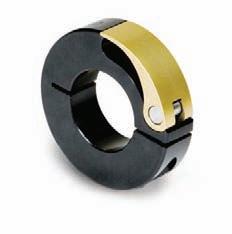
Quick-clamping shaft collars provide easy adjustment for rapid setup or frequent change-overs.
One of the simplest and consequently most overlooked com ponents in the power transmis sion industry is the shaft collar. However, the im portance of the shaft collar is demonstrated through the widespread use of these components.
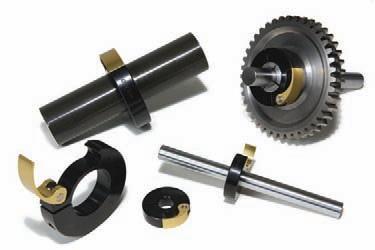
Shaft collars can be found in virtually any type of equipment. They are used by themselves for various applications, including mechanical stops, locating components and bearing faces, and are frequently accessories to other components to create assemblies for many types of power transmission equipment, including motors and gearboxes.
well in other applications such as fixture and guide rail adjustment, use of the clamp as a spacer, or when
mated with light-duty split-hub power transmission components such as gears and sprockets. The collars can also be machined to facilitate the mounting of other components. Many application benefits are being realized in packaging, food processing, medical, general manufacturing and other industries.
The collar clamping mechanism works
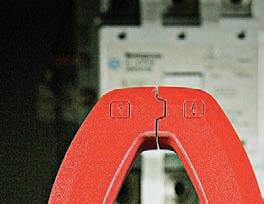
quickly and efficiently with the simple hand opening of the integral clamping lever, positioning the collar on the shaft, and closing the lever flush with the outer surface of the collar. The design of the cam on the lever and the mating machined surface on the collar assure a tight fit, with a maximum axial load of 35 lb to 120 lb (133 to 489 N) depending on the collar bore size. In situations where higher holding power or clamp axial load is required, the quick-clamping collar is not the recommended choice. MRO
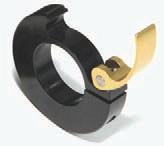
Among the types available, quickclamping shaft collars are designed with a low-profile integral clamping lever, in contrast to the typical approach of employing separate single or double tangential screws. These collars are suited for quick positioning adjustments in light-duty stationary or low-rpm rotating shaft applications that require frequent setup changes or adjustments, or in situations where the use of tools is not practical. Quick-clamping collars do not mar the shaft.
An application example found in the printing industry is the positioning of rolls of media on a shaft within a production process. Repositioning adjustments or changes of raw material can be quickly and easily made without the need for tools or timeconsuming fastener fine-tuning, improving both operator and machine productivity.
Quick-clamping collars also perform
Quick-clamping shaft collar speeds up positioning adjustments
Designed with a lowprofile integral clamping lever, the quick-clamping shaft col lar from Ruland is suited for quick positioning adjustments in light-duty stationary or low-rpm rotating shaft applications with frequent setup changes or adjustments, or in situations where the use of tools is not practical. The design of the cam on the lever and the mating machined surface on the collar assure a tight fit with a maximum axial load of 133 N to 489 N (35 lb to 120 lb), depending on the collar bore size. Available sizes are 8 mm to 38 mm and 0.375 in. to 1.5 in. The collar is suited for use in a wide range of applications, including packaging, food processing, general manufacturing, medical and more.
RotoPrecision Inc.
Online Reader Inquiry No. 728
associated with synchronous drives by as much as 19%. Enjoy smoother more precise power transmission thanks to Eagle NRG’s™ continuous rolling tooth engagement.
This guide was prepared by Ruland Manufacturing Co. Inc., Marlborough, MA.
Quick clamping shaft collars come in both inch and metric sizes.
Photos:
TOUGH LATHES PUT
TEETH
in oil-field equipment shop
Quick conversational programming and versatility for deep-hole boring, profiling and threading make cycle-controlled lathes critical in Edmonton shop’s work with downhole tools.
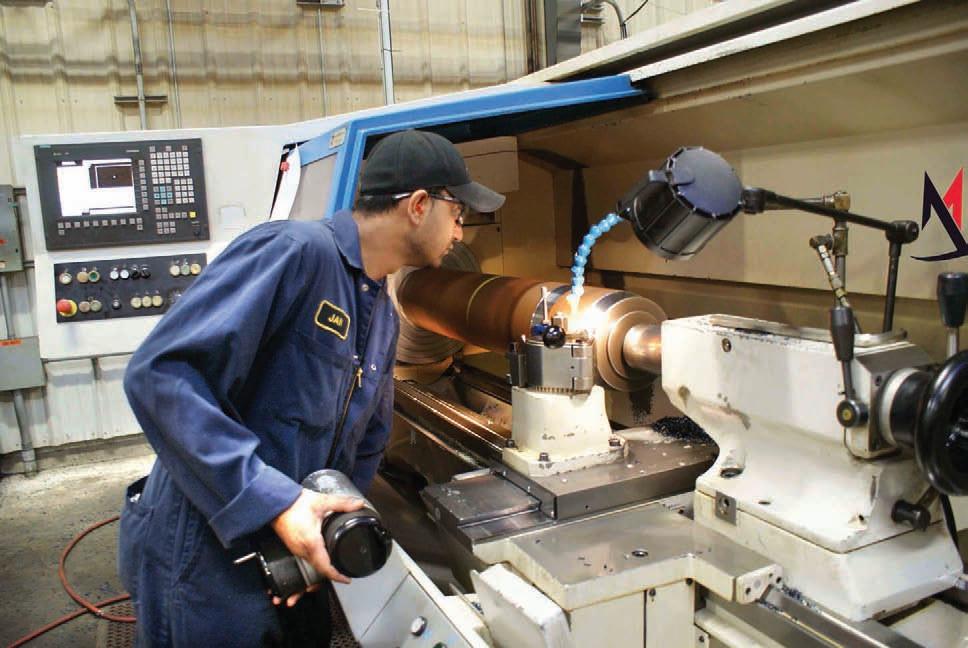
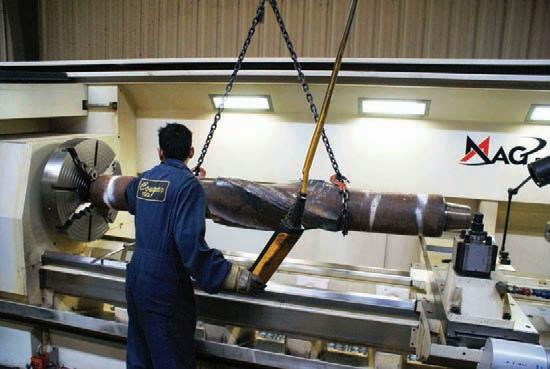
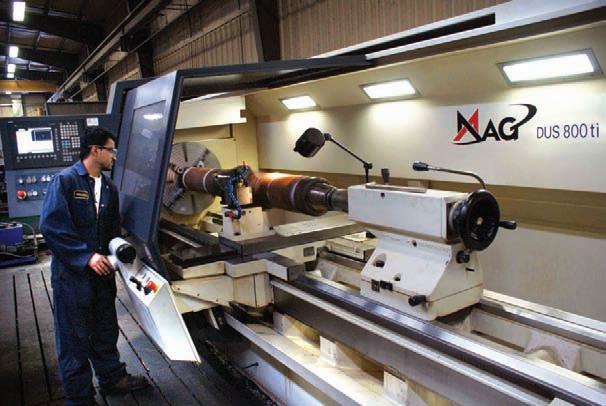
Cougar Tool Inc. manufacturing manager Gary Spencer says some innovative lathes opened his eyes “way back when” to the true potential of what can be done on a CNC machine designed for manual-operation lovers. As a result, 14 of Mag’s VDF DUS lathes today play a lead role in the company’s shops, where they are used to manufacture Cougar’s line of specialized downhole tools, as well as refurbish rented tools and produce prototype designs.
Boring holes to 32 in. (813 mm) depth, profiling internally and externally, or cutting/re-cutting threads, the conversationally programmed machines are critical in meeting Cougar’s requirements for speed and precision in producing short runs of heavy, large parts.
“We compete with the best in every corner of the globe from our 100,000-sq-ft Edmonton facility, so the cost-efficient manufacture of turned parts is a core competency,” Spencer said. “Our shop is also key to our R&D capability, and the ability to add one-off R&D parts into our work flow, with programming by the operator on the floor, has been a big plus for us.”
Based in Edmonton, AB, Cougar Tool is a family-owned, global business with facilities in Canada, the US, Iraq, Saudi Arabia, Dubai and Abu Dhabi. Most manufacturing takes place at the ISOcertified Edmonton facility. All of the company’s machinists are apprenticed and go through a program at NAIT (Northern Alberta Institute of Technology) to become journeymen.
Cougar product lines include single and double-acting drilling jars, shock tools, Mech-Thrusters, mud motors, drill bit protection devices, stabilizers/reamers, and a range of support tools. About 80% of the company’s approximately $50 million in annual sales is derived from rental business, so the shop is constantly refurbishing worn and damaged tools to ensure availability. “We are also developing new lines all the time, always looking for new points of entry into the market,” Spencer added.
The downhole tool business is all about cylindrical, turned parts, he emphasized. “We make the whole tool when it comes to hydraulically or mechanically acting drilling jars and shock tools, which consist of about 15 external and 10 internal
Fig. 1; An operator sets the position of tooling before running his program, using patented handwheel controls. The part is a 4330 VMod piston sub. The OD on this new part will be turned using a carbide insert.
Fig. 2: The operator loads a repaired stabilizer in a MAG VDF 800 DUS lathe prior to turning radii, tapers, and cleaning up the welded built-up area of the stabilizer blades.
Fig. 3: The operator uses handwheel controls to touch off on a repaired stabilizer loaded in MAG VDF 800 DUS lathe, prior to turning radii, tapers, and cleaning up the welded built-up area of the blades. The material is 4145 HTSR.
Fig. 4: Cougar Tool bores up to 30 in. depth using this setup on a MAG VDF 560 DUS lathe, though usually works to a depth of 24 in. This hydraulic housing is bored from both ends to complete the part, then sent out for chroming and honing of the ID.
Fig. 5: A MAG VDF DUS lathe machines the OD on a DJ10 piston sub. After OD machining, the operator will set up steady rest and bore the ID. The part would then be sent out for hard chroming and honing of the ID where a polypack seal runs. The material is 4330 VMod.
Fig. 1
Fig. 2
Fig. 3
Fig. 4
Photos: Cougar Tool Inc.
parts, all screwed or fitted together to make a functioning tool,” Spencer explained.
FOCUS ON HARSH ENVIRONMENTS
Drilling jars ‘jar’ stuck drilling tools to free them up, while shock tools and Mech-Thrusters protect drill strings and bits from transient shock loads, ensuring optimum weight-on-bit, penetration and bit life. These tools commonly operate in deep, hot wells, and are subjected to high torques and corrosive environments. As a result, the company is a heavy user of high-carbon steels, such as 4330 VMod and 4145, heat treated and stress relieved.
Regarding manufacturing tolerances for turned parts, Spencer understates somewhat when he says the company’s downhole drilling tools “are not RollsRoyce engines.” Cougar’s processes are quite stringent, utilizing computer-aided design, finite element analysis and CAM. Sliding and sealing interfaces require tolerances to 0.001 in. (0.025 mm), often followed by honing and chrome finishing of some bore surfaces.
Lathes are backbone of manufacturing
“We put the biggest pieces of steel into our VDF DUS machines that we can – often 72-in. (1,829-mm) long and 10-12 in. (254304 mm) in diameter,” said Cougar production manager Dave Hemmerling.
“We standardized on these machines because the Siemens control is easy to use, the machines hold excellent accuracy over long cuts, they are built for heavy use, and it’s easy to cut/re-cut taper or straight threads on them. Just about every part we machine has a thread at one end or both, and at least 50% are taper threads. The Siemens control makes it easy to cut new – and re-cut old – threads. The programming is fast, and the spindle rpm can be changed in cycle to control vibration.
to another over our Predator network,” Hemmerling added.
conversational programming through the CNC, the VDF DUS machine is true to its heritage as an ‘operator’s machine’ for one-off parts, and features a patented, ergonomic operator panel and handwheels.
“Standardization on these machines has been very helpful, allowing us to transfer part programs from one facility
“Our tooling is relatively basic, involving no turret and no probing capability. We do a lot of deep boring to produce the long housings required for drilling jars.” Parts are chucked, utilizing a tailstock and steady rest for support, if needed.
To take some of the heavyweight work off its 12 VDF 560 DUS machines, Cougar moved up to a VDF 800 DUS in July 2008. The 560’s handle part lengths of 40-315 in. (1,000-8,000 mm) and virtually any weight, with chuck capacity of 11 in. (280 mm), swing over the bed of 22.4 in. (570 mm) and a spindle motor rated 33 hp (25 kW).
Cougar’s VDF 800 DUS machine, by contrast, takes part weights up to 8,816 lb (4 metric tonnes), and lengths to 110 in. (2,794 mm), with an 18-in. (457-mm) chuck and swing over the bed of 32 in. (820 mm). Its 62-hp (46-kW) spindle motor provides speeds of 6-1,600 rpm through a two-speed gear box. Z-axis feed force is 2,800 lb (12.5 kN).
Designed for constant duty, VDF DUS lathes have the transmission mounted behind the headstock to eliminate thermal effects caused by the gearing, with a backlash-free overload coupling to protect the gearbox.
The VDF 800 DUS machine’s A-11 spindle is supported with a thermally optimized arrangement of lifetime-lubricated bearings. The Meehanite cast iron bed retains its core sand to enhance vibration damping, while hardened doubleV guideways distribute high axial cutting forces and prevent skewing. Larger models of the machine handle part lengths up to 787 in. (20,000 mm).
“All our drawings are generated in our CAD/CAM system. The majority of our programs are already produced and stored in our DNC system, but we can produce part programs on the lathes by programming off our drawings. All programs made by the machinists are double checked by the shop foreman before running. By repeating this process, the machinists get trained, and only proven programs go to the DNC system for storage.
“Manual mode is used quite often, too, for simple operations, such as facing, turning steady pads and test cuts for measuring tooling. This feature makes the machine more versatile, and simple operations are completed quickly,” said Hemmerling.
“We work these machines hard, and they have proven themselves oil-field tough, with excellent longevity, backed by excellent service here in Canada,” Spencer concluded. “We recently sold our first VDF DUS machine on the used market after years of double-shift work. The bedways were still in great shape and we received about 30% of the machine’s original price.” MRO
For more information on Cougar Tool, visit www.cougartool.com. Mag is a machine tool and systems company serving the durable goods industry worldwide with manufacturing solutions for metal cutting and composites applications. Its equipment and technologies include turning, milling, hobbing, grinding, honing, systems integration, composites processing, maintenance, automation and software, tooling and fluids, and core components. For more information, visit: www.mag-ias.com.
Online Reader Inquiry No. 753
Bio-Circle is a complete, cost-effective and hassle-free solution which:
� Cleans your parts without risks of health hazards.
� Comes with a complete on-site maintenance program performed in 21 precise steps by our qualified technicians.
� Is compliant with ISO 14000, ISO 18000, ACCP and Canadian food industry standards
� Has been adopted by thousands of industrial customers worldwide!
Although Cougar relies heavily on
Fig. 5
Maintenance management: Can you be great?
The skills and attributes required to be successful in maintenance are not the ones usually asked for in job postings.
How many 10-year-olds at school, when asked “What would you like to be when you grow up?” would reply “A maintenance manager.” A safe bet is that the answer is none.
How many 10-year-olds would have any idea what a maintenance manager is – or how many 20-year-olds or even 30-year-olds? When you think about it, there is no real way that those not directly involved in maintenance management could understand what it is.
When was the last time you saw that a superhero’s alter-ego as a maintenance manager? What’s the title of a romantic movie where the dashing white knight came in the guise of an asset reliability professional? I love to imagine a new television series entitled ‘Miami RCM’, where teams of investigators rush out and do vi-
BY CLIFF WILLIAMS
bration analysis. Then the team gets together to examine infra-red footage, and I just can’t wait for the close-up shot of the oil analysis slide under the microscope. Am I dreaming? I must be. But my thoughts do raise some important questions.
1. Who are the people that become maintenance managers?
2. How does it happen?
3. What is it exactly that they do?
Let’s take a look at the typical answers to these questions and then take an alternative view to answering the third question and see if it has an impact on the other questions.
Question 1: Who are the people that become maintenance managers? The people who become maintenance managers tend to have a background in one of three scenarios.
SHIPMENT SPECIALISTS
When your equipment is down, you need a partner that ships a solution to you same-day not some day. At Inpro/Seal, we recognize the high cost of downtime facing our customers; that’s why we’ve designed our operations to support quick–turnaround of our custom–engineered bearing protection products.
With manufacturing locations in North America and the United Kingdom, we’re able to offer industry–leading products with unparalleled response time and service to customers around the globe.
The right technology…right when you need it. YOUR SAME-DAY
a. The largest group already work in the maintenance environment as tradespeo ple, planners, and so on.
b. They are engineers who decide that they wish to take their expertise into the maintenance field.
c. They are project managers/engineers who stay behind after machinery and equipment installations.
Question 2: How does it happen? For each answer to Question 1, there is a different route.
a. They were good at what they did. They were the ‘go-to’ guys when you needed something fixed. They knew more about the equipment than anyone else. They, and management, believed that these attributes meant they deserved to be maintenance managers.
b. They found that there were lim ited opportunities for true engineering and figured their design and theoretical knowledge of equipment and systems would hold them in good stead in mainte nance. Management really liked the idea of having an engineer in maintenance because of that knowledge.
c. Having spent incredible energy and time on the project, they decide to stick around and see the fruits of their work. Management is delighted that ‘the guy who installed it’ is going to be around if something goes wrong.
Question 3: What is it exactly that they do? This is the big money question and the answer really depends on who you ask, but here are some typical responses:
i. They keep the plant running.
ii. They fix machines.
iii. They provide a service to production.
iv. They look after the tradespeople.
v. They ensure reliability.
I’d like to suggest an alternative, less common, answer to Question 3: They manage people and systems. I would also suggest that the skills and attributes required to be successful are not the ones usually asked for in job postings for maintenance managers.
If a job posting were to really reflect the requirements for a maintenance manager it might look something like the Help Wanted ad shown on this page. Let’s take a look at why the atypical skills listed in the ad are important to being a maintenance manager.
Amateur Psychology: “There is not enough time in the day to do everything I need to.” I’ve heard that comment so many times from maintenance managers and it’s true – if they try and do it all themselves. Successful managers only do those things that they alone can do. Everything else, they manage through their people –and that’s where psychology comes in.
Let’s look at two definitions of psychology:
1. The emotional and behavioural characteristics of an individual or group.
2. Subtle tactical action or argument used to manipulate or influence another.
Understanding definition Number 1 and knowing that it changes from day to day will allow you to modify your response. Late nights, domestic upsets, etc., result in different attitudes and require different approaches to get the same outcomes. Knowing this will, in turn, allow you to exert definition Number 2 and that enables you to get what you need done.
You cannot do everything alone. You need your people on board and you need to know what makes them tick. Situational Management courses can help you to learn to use psychology to move your underachievers to self-regulating performers.
Conflict Resolution: “Night shift didn’t do anything.” “That’s not my job; it’s electrical.” “If they knew how to operate the machine, this wouldn’t have happened.” Who hasn’t heard comments like that? The conflict between groups ends up taking too much time out of your day and prevents you from getting done what you want. Most of us are so busy that we just deal with the surface issue, the sticking point, the symptom. We never take – or think we have – the time to look at the underlying causes of such conflict. Because of this, we’ll likely be facing a similar problem the following week.
There are usually a number of root causes for conflict, but there is one that occurs in every mix of people, and that’s communication. So if we take the time to resolve the communication problem, then we will help resolve the issue before it becomes a conflict.
Initially, the biggest part of communica-
tion is listening. This will not only allow you understand the actual cause of the conflict, but it will also show those involved that you to care about their problems. There’s that good old Amateur Psychology again. If there seems to be systemic conflict, then approaches like multi-discipline teams or holding combined meetings (e.g. Mechanical and E&I, or Maintenance and Operations) will help bring the groups closer together. Once people are aware of each other’s challenges, then there is room for compromise and that, in itself, will reduce conflict.
Mind Reader: “Sorry, but we’re running that equipment today after all.” “I know it’s not working properly – it’s been like that for months.” If only we could read minds, then we wouldn’t bring in an army of contractors, only to be told the first excuse. And we wouldn’t need callins to deal with the second problem. People tend to be concerned with what
“I need it done now!”
“I want that report tomorrow!” “Daddy, when will you be home?” Being a maintenance manager means that your priorities are only a part of the process. You have to take into account the demands of tradespeople, production and your boss
which is their ‘top’ top priority. That may diffuse the situation.
Even your boss will come to accept this approach – as long as you remain calm. While you’re having this discussion, why not prioritize the next five ‘top priorities’ and then send the boss a copy of the list
People tend to be concerned with what is important to them and do not always consider their impact on others.
when you develop your priorities. These demands are sometimes unreasonable and can be great stress inducers, so staying calm becomes a necessary asset.
For those people who always have a million priorities, here’s just a calm reminder that yesterday, when they gave you another 10 ‘top priorities’ to deal with, while you really want to satisfy them, you need to have them tell you
that’s been agreed to. Invite the boss to prioritization meetings and if he or she is too busy to show up, then document that fact in the minutes of the meeting. Prioritization is far more difficult if you haven’t mastered the skill of Amateur Psychology.
Last, but most important, is prioritizing your work-life balance. You may get another job, you may earn more money, but you can’t gain back time.
Some of the world’s largest, most advanced fleets depend on the outstanding performance of the Delo® family of products with ISOSYN® Technology. Delo helps:
• Provide extended service protection
• Maximize engine durability
• Minimize operating costs
By partnering with Chevron, one of the leading innovators in lubrication technology, you get the confidence to succeed. To learn more about Delo with ISOSYN Technology and how it gives you an edge, visit us at www.deloperformance.com.
Motivation and Inspiration: “But we’ve always done it that way.” “I don’t understand this new-fangled technology.” “This is boring!” People become complacent or at least comfortable in their work life. There’s nothing more challenging to that comfort than change. Change happens, change is constant; it’s how we transition after change that makes it good or bad. You need to be the champion of change for the maintenance group. Whether it’s different equipment, different strategies, a new CMMS, or just a change in a procedure or policy, you need to demonstrate how you will embrace it. Only then will you be able to motivate others to accept change.
On a day-to-day basis, you need to show that you’re prepared to go the extra mile and that you’re right there with them in their efforts. There’s no better motivator than recognition (money is short term), so make an effort to give recognition to people every day. It can be a simple thank-you, tickets to a ball game or whatever is proportional to the effort. But also make sure that it is appropriate for the person being recognized. Not everyone likes public recognition, so maybe a quiet word will do. For those who do like the publicity, the middle of a full lunch room is the place to be. Giving Argos tickets to a Tiger Cats fan will defeat the objective. It’s that Amateur Psychology again!
Being enthusiastic, energized and always willing to help will lead you to become an inspiration for those working with you. If you’re not enjoying what you’re doing, stop doing it – life is too short and you certainly won’t inspire anyone else.
Communication Specialist: “What’s the point? They never listen!” “Nobody told me about that.” As mentioned under Conflict Resolution, poor communication – or a complete lack of communication – can cause many problems, so this skill is essential to a maintenance manager. Being a good speaker certainly helps but being a good listener is even better, as it’s not all about you. This is still only half the story. When you’ve listened, respond. Do something or do nothing, but respond! Always get back to them, even if you know they won’t like what they’re going to hear. Set the ground rules for that by establishing that there will be issues that the group controls, issues that they will be able to influence, and issues that they will just be made aware of. Communicate reasons for business, department or personal decisions. Attempt to meet with the group every week, together or in smaller groups, where you need to present the three I’s of communication:
• Involve them – ask opinions, discuss any options.
• Interest them – make it interesting, give them background, reasons, constraints.
• In it for them – tell them how they’ll benefit, if possible, or how they’ll be affected.
Try to start your meetings with some high notes. Get into the meaty part and then leave on a light note. Sending the group out in good humour will increase productivity.
Prima Donna Management: “Go get Joe, he’s the expert.” Every plant has at least one ‘Joe’ – the person who fixes certain problems and often little else. He can put out fires quicker than anyone else, but don’t ask him to do a mundane PM. He enjoys the glory and keeps the knowledge to himself.
The secret is to use Amateur Psychology to get him to be recognized for doing the things you want him to do.
ers, locate shops next to each other and hold multi-discipline meetings. When people are forced to interact with one another, the barriers come down by themselves.
Interpreter: “The ROI is dependent on your OEE and will be influenced by your MTBF and MTTR, and will result from your PM, PdM and RCM programs, with any FMCEA carried out.” Say what?
If they can’t understand what you’re saying, how can they help you achieve your goals? Interpret what the maintenance gurus are saying into practical, everyday examples. Interpret the consequences of what the tradespeople do or don’t do into something meaningful to them.
As with communication, the listening side of interpretation is more important than the explaining. Many times, tradespeople throw up an argument about something that is distant from what’s bothering them. They’ll complain about how the area is dirty, when what they really are mad about is schedule changes,
but if you don’t’ push and try to interpret what the real problem is, you’ll never remove the root cause.
Bilingual: That means you must be fluent in accounting and one other language. Accounting is the language that counts; it’s the language that is understood from the shop floor to the board room and it transcends departmental boundaries. If you want to change something in the department, give the information to your boss in dollars and cents and then use the same dollars and cents to explain why it’s happening to the people on the floor. Plant managers and accountants may not understand the tools or tactics you use, but they will understand the financial implications.
“If we increase our PdM and lessen our PM, our MTBF will lengthen and with some training and early intervention, our MTTR will be reduced” means nothing to them. Better is “If we do what we want, we’ll make more money.”
The best translation that all will under-
stand goes like this: “If we invest $5,000 on vibration analysis per year, we will increase uptime by 2% and realize an increase in revenue of $25,000 based on today’s production rate.” Discussing the total cost of a work order, including labour, cost of lost production, parts, etc., will be much more meaningful to the tradespeople. I’ll guarantee that after a few discussions, you will start to get really good cost-reduction ideas. Philosopher: Let’s take a look at the definitions of philosophy.
1. Love and pursuit of wisdom by intellectual means and moral self-discipline.
2. The critical study of the basic principles and concepts of a particular branch of knowledge, especially with a view to improving or reconstituting them.
3. A system of values by which one lives. Now let’s expand on these.
1. This is about you – get out there and learn about what other people are doing in maintenance. Attend conferences. Develop your own thoughts on how you can apply this wisdom.
2. The more you know and understand about the basic principles of your chosen field, the more you will find ways to improve it. Remember, if you’re not moving forward, you’re moving backward – because everyone else is moving forward.
Over 260 Locations Coast to Coast Across Canada
3. You spend more time at your place of work than any other single place, so why would your values be different at work? Trust, integrity and appreciation are words that should form part of your maintenance dictionary. You will need this final skill to turn your philosophies into practices.
Visionary: None of the previous skills will mean much unless you develop the final, yet most important, skill –being visionary. You have to push the envelope, think out of the box, reach for the stars or boldly go where no one has gone before – or use whatever cliché you like. You need to have a vision of where you want to take the maintenance department. Through a vision or mission statement, you must paint the picture of the future of the department – not just what it looks like but also how you will get there, incorporating all of the skills and methods listed previously. If you want people to join you on the journey to excellence, they need to know the route and what they can expect to encounter along the way.
You will also need to develop norms and standards around the values you propose. It’s no good if one of your values is, “We will trust our people,” and then you institute a rigid timekeeping system. It’s no good if you say, “We will value everyone’s contribution,” and then you ignore them every time they suggest something. If there is any doubt that you will be able to support a value with a norm or standard, don’t put it out there. You need to demonstrate values through your actions, not through t-shirts or colourful wall posters. No amount of sending memos or having discussions will reverse any bad feelings your actions have caused. As the sign that hangs on my office wall wherever I go says: “You can’t talk yourself out of a situation you behaved yourself into.”
The next time someone asks you “What exactly is it that maintenance mangers do?” I hope you’ll reply, “We manage people and systems. Let me explain.”
MRO
Cliff Williams is the corporate maintenance manager at Erco Worldwide in Toronto, ON, and a consultant with TMS – Total Maintenance Solutions Inc., Markham, ON. Your comments on this topic are encouraged and should be sent to the Editor at broebuck@mromagazine.com.
o you know if your CMMS system could pass a safety audit? The audit could be internal or external, depending on the circumstances. You’re probably asking why your system would be audited for safety in the first place. For many years, CMMS work orders were just used to record the maintenance history of equipment for internal use only. The accuracy of them was not always a big concern. Today, CMMS systems and the records they hold are considered official records and documents. In some cases, they are legal documents, especially when they include calibration and re-certification activities.
So ask yourself this: If you had to create a report to show the true equipment history on a machine – both PMs and repairs – could you do it? Is your CMMS really safety auditable? Does your CMMS contain maintenance records on Life Safety Systems (LSSs)?
LSSs include fire protection equipment such as fire extinguishers and hoses, fire alarms and sprinkler systems, as well as emergency eyewash stations and showers. Many facilities have emergency generators and lighting systems that are required by law to be started monthly and have the power transfer switches operated, and they also require annual operational checks as part of the facility’s LSSs. Hospitals, laboratories and research facilities can have oxygen systems, fume hoods, bio-safety cabinets and decontamination air systems that need to be included as well.
DON’T BE CAUGHT IN THE CROSSHAIRS OF A SAFETY AUDITOR’S SCOPE. HERE’S WHAT MUST BE DONE FOR SATISFY AUDITORS, SAFETY OFFICERS AND OTHER REGULATORY AGENCIES WHEN IT COMES TO LIFE SAFETY SYSTEMS.
If any or all of these systems are in your CMMS, how well are you tracking the maintenance on them? If you were asked to produce a detailed account of all the PMs, repairs, calibrations and re-certifications on these systems, how well would you do? Is the information available at your fingertips or would you need to do a physical search to locate work orders and documents?
How important is it to keep records on safety equipment? When you are managing your safety records in your CMMS, you need to think like an auditor. If your operation had a safety incident or accident, what questions would investigators ask? What information would a safety officer want to see? Are your maintenance records accurate, detailed and complete?
When I say ‘accurate’, I mean this: Are all the LSS equipment maintenance records filed in the CMMS? If you have completed PMs and repairs, have they all been executed and reports filed in the CMMS? If a piece of equipment is scheduled for a monthly PM, is every record accounted for, or are there months of missing work orders?
Are your records detailed, holding a specific checklist for each piece of equipment? Some facilities simply list the equipment to be checked and then provide one checkbox for all the equipment on the list. As a result, questions can arise about which ones were checked, and if every single unit was completely inspected. Auditors like to see clear, detailed inspection sheets and documents. Finally, can you locate the completed work orders and associated documents?
Are they at your fingertips? Does the work order have every box checked, show comments, have the complete date, and include the initials of the person who did the work? Is it signed off by the supervisor and was the report completed in the CMMS?
Any inaccuracies in any of these categories will raise questions by an auditor. If there are too many problems with your records, that will encourage the auditor to dig deeper into your documentation, searching for other missing information.
I recently asked a maintenance supervisor about a safety incident on a mechanical door seal on a containment lab. Could he produce the monthly PM results and show me the repairs done on that specific door?
Frankly, he looked like a deer in the headlights, not knowing which way to turn. He knew right then he needed to change the way work was being captured and completed, and the way documents were stored.
So what must you do to satisfy auditors, safety officers and other regulatory agencies?
First, start by auditing you own system, ensuring you have an accurate equipment history – whether you want it for yourself or need it for a special occasion. Most facilities need to start by creating a Standard Operating Procedure (SOP), to be used to train people to accurately fill out all the documents that can be printed from your CMMS. The SOP should also include instructions about how to record the data in the software. If the printed documents include calibration and re-certification sheets, decide where to file them. Better yet, scan them and attach the digital files directly in your CMMS.
Sometimes, routine LSS PMs are rescheduled due to equipment availability; make sure the reason for the postponement is well-documented and identified in your software.
Your CMMS should and can contain everything from soup to nuts about the work that has been done to Life Safety Systems. Don’t leave stray, incomplete work orders unaccounted for, and don’t let safety work orders accumulate in your
Safety and your CMMS
BY PETER PHILLIPS
software without closing them.
Don’t fool yourself by thinking an auditor won’t see the open and incomplete LSS work orders in your CMMS. Safety officers and regulatory agencies receive training in popular maintenance software systems. They know what to look for and what questions to ask. In fact, some regulatory agencies maybe using – at their own facilities – the same software that you use.
Today, your CMMS is more than just a place to record maintenance history. It is now a system where you need to show
due diligence towards LLS and all other maintenance activities. Don’t be caught in the crosshairs of a safety auditor’s scope. When it comes to safety in today’s work environment, every activity related to Life Safety Systems need to be closely controlled.
MRO
Peter Phillips of Trailwalk Holdings, a Canadian CMMS consulting and training company, can be reached at 902-7983601 or by e-mail at peter@trailwalk.ca. Online Reader Enquiry No. 752
Finding unexpected efficiencies
BY CLIFF WILLIAMS
Follow along with Step 40 in a journey to World-Class Maintenance at the Plentya Paper Company as the maintenance team sees its responsibilities being realigned.
This article is part of an ongoing series. The introduction appeared in Machinery & Equipment MRO’s February 2005 issue and the series has run in every issue since. Previous instalments are archived online at www.mromagazine.com. This month, we pick up where we left off in the June 2011 edition, as maintenance manager Bob Edwards looks into setting up a consignment relationship with a distributor.
We’d asked Trevor, the sales rep from our local industrial distributor, to quote on working with us on a consignment basis. He got back to Carol, our reliability manager, the next day to say that, in principle, his company was prepared to handle parts inventory consignments. I asked Carol to get a couple of the trades guys involved when she was setting up the details.
Meanwhile, our vice-president of finance called and said that he was prepared to look at converting the Insurance Spares into assets, but had to ensure the vice-president of operations was in agreement, since removing them from stores would probably be an expense.
Things were moving along nicely and within two weeks, we had agreement on those two issues. Also, Carol had prepared a report on what the impact would be. “Based on the agreement with the supplier, we will reduce inventory value by 10% when they convert their current items to consignment,” she said. “This should reach 15% when they start to consign parts that used to be supplied by someone else.
“As far as converting inventory to assets,” Carol related, “that would reduce the value by 25%. So eventually we should see a reduction in inventory value of around 40%. If you take into account our other initiatives, it should reach 50%.”
“Thanks, Carol. That’s great. I see that the planned shutdown schedule is working fine and the operators are feeling a little more confident about not changing out major rolls based on what the vibration and oil analysis show, so we’re on target for a reduction in planned shutdowns of 2%, down to 2% in total.
Our unscheduled downtime is down to 3%, so things are coming along.”
“I don’t mean to put a damper on things, Bob, but I’m beginning to get the feeling that we’ve picked most of the lowhanging fruit – that the gains from here on in are going to be harder to make.”
“I don’t disagree. I think we can still improve some of our practices, but the gain on the bottom line will be less significant. However, looking through my half-full glass with my rose-tinted glasses, I think they will build up so that we will continue to succeed.
“Let’s set up a meeting with the guys so we can go over all of the improvements we’ve made. They deserve a thank you.”
Carol organized the meeting for the next week and I thought more about what she’d said. We were very close to being where we needed to be, but she was right – I didn’t know where the next gains would come from and we needed to be sure we had systems in place to sustain the gains we’d already made.
but I’m afraid this small amount will be harder than what we’ve already achieved.”
Pete spoke up. “Well, Bob, we definitely saved time on the hydraulic breakdown.” He pulled out a sheet of paper from a folder he had brought with him. ”I’ve developed a troubleshooting sheet for that problem, so you wouldn’t have to call me in if it happened again. If I had more time, I could develop sheets like this for a lot more scenarios and do training based on what I learned during commissioning.”
“That’s a good idea, Pete, but I don’t think we could spare you the time to do that – unless we brought in someone on overtime to do your other work. That would increase costs, at least short term.”
Key Points
Help will come from unexpected places if you let it. In meetings, leave them on a high note. Respect will become a two-way street.
A couple of days later, we saw one of the systems we’d set up work well. There was a hydraulic problem on the paper machine at 2.00 a.m. and the guys on the shift quickly realized that they didn’t have enough experience to figure out the problem. After 20 minutes, they had called in Pete, one of our millwrights who had been part of the commissioning team for the hydraulics.
Pete had been able to solve the issue, so the mill was down for just 90 minutes, which, even though it amounted to major downtime, would have been longer if the guys had not been able to call him in themselves and had instead to wait for a supervisor to give the okay.
When the meeting time rolled around, everyone was in an upbeat mood as we reviewed the gains we had made in downtime, costs and inventory – until I said: “We need just a little push and everything will be in line with corporate expectations,
lunch for everyone next Friday and we’ll make sure the shift guys get what they want, when they want it.”
This brought on loud cheering and it was fair to say that the meeting ended with everyone in high spirits. As I walked back to my office, another light went on in my head – ending the meetings on a high note meant that the guys were in a good mood, and that meant that when they got to their jobsites, they were in a ‘can-do’ frame of mind. I needed to make a conscious effort to do this for every meeting.
Joe and Fred agreed to the trial of bringing one millwright off shift, but insisted that at the first sign it wasn’t working, we would put them back on. I explained this to Carol and she started to revise the work schedule.
“Which millwright should I assign to the rotating shift and which to the day shift?”
“Good question. I didn’t think any further than one of them coming off shift –maybe we should leave it up to them. I’m not sure it makes a difference.”
“I’m not sure I agree with that. If you look at Steve and Terry, who are on the same shift, Steve is definitely the leader and tends to take charge on shift. We hardly hear from Terry.”
“Hmm, good point. But I’m not sure we have really strong proof that one would work better than the other. I think we give them the chance to choose, but I’ll talk with each of the crews so they understand that if there’s any doubts, things stay as they are.”
Carol prepared the schedule and just noted ‘Millwright A’ and ‘Millwright B’ in the appropriate places. As the shifts rotated onto days, I took the opportunity to meet with them, and when it came to Steve and Terry’s turn, I mentioned the fact that Steve tended to take the lead and asked Terry how he would feel if he was the one to stay on shift.
“We’ve got a comment on that one, Bob,” offered Steve, another millwright. “The shift millwrights have been talking and we all agree that now that the mill has settled down, there is not really a need for two millwrights on shift. Especially now, as we can call someone as soon as we need them. We used to be really busy, but with the better PMs we do and the operators doing basic care, we don’t need two any longer.”
“Hang on, Steve,” I interjected. “I don’t want the ability to call someone in to cause repairs to be slowed down because they required two people.”
“We’ve talked about that too, Bob, and the electricians have agreed that they can lend a hand if we need physical help – and the operators would just jump at the chance. Come on, Bob, this would give Pete the time he needs to prepare the hydraulics sheets, and we could stop sending out the gearboxes for repair – we’d have enough people to do them in house.”
“It may be worth a trial, a least,” I said. “I’ll talk with Joe and Fred (the plant and production managers) to make sure operations won’t object. Anyway, as I said, we’ve made great progress and you guys deserve a big thank-you, so we’ll be bringing in
“Actually, we were hoping that we could both come off shift. Both Tom and Ben from tonight’s shift would like to stay on shift and they’d be quite happy for one of them to flip over onto our rotation. Terry and I would like to get more involved in the PM side of things, whereas Tom and Ben enjoy the ‘get in-get it done-get out’ environment on shift – and to be honest, they’re the best at it.”
The right solution
“I’m okay with that in principle, but I’ll need to talk with Tom and Ben – not just about switching rotation, but they’ll also need to understand that there’s more to the shift position than ‘get in-get it doneget out’. It’s ‘get a solution that will prevent it from happening again’ that they should be working on.”
I stayed behind to talk with Tom and Ben and they both were very happy that they could stay on shift.
“Thanks Bob. That’s really appreciated. We do understand that things have changed from the old ‘fix-it when it’s broke’ mentality. Ben has been doing a lot of reading about breakdown analysis and we’ve talked about doing it ourselves. By the way, allowing us to do this, setting up the 24/7 board, and the overall involvement in general, has clearly shown us things are not the way they were before. We appreciate it and promise we won’t let you down.”
MRO
Cliff Williams is the corporate maintenance manager at Erco Worldwide in Toronto, ON, and a consultant with TMS –Total Maintenance Solutions Inc., Markham, ON. He can be reached by email at williamscliff@rogers.com. Online Reader Inquiry No. 751
A dust explosion that occurred at a sugar refinery owned by Imperial Sugar in Port Wentworth, GA, on February 7, 2008, killed 13 people and injured 42. The origin of the explosion was narrowed down to a location at the centre of the factory, and it is believed to have started in a basement beneath the facility’s storage silos.
In Harbin, China, an explosion of flax dust triggered a chain of explosions that destroyed a whole 13,000 sq m linen plant on March 15, 1987, causing 58 deaths and 177 injuries. The strength and time of each explosion was detected at a nearby earthquake monitoring station.
At Westwego, LA, a series of explosions on December 23, 1977, destroyed 37 grain silos completely and damaged many others, causing 35 deaths and $100 million worth of damage. The facility consisted of 73 silos with a capacity of 150,000 cu m. It was one of five grain storage explosions that occurred over an eight-day period, and was attributed to unusually dry weather conditions.
In Bremen, Germany, the greater part of the 400,000 sq ft Roland Mill complex was destroyed by a series of explosions on February 6, 1979. The complex included a seven-storey flour store, six-storey mill, other silos and an administration building. A pressure wave struck a loaded truck, throwing it against a wall, spreading its load into the air, and this is believed to have caused an openair explosion. No traces were found of seven of the 14 people killed in the fire, who were believed to have been cremated in area of the fire where all traces of combustibles were consumed – meaning the temperature was an estimated 1,000°C.
ll of these explosions occurred during winter or dry times, when humidity is low. Dust explosions are dangerous because they can set off a chain reaction. The initial explosion is usually small and localized; however it is often sufficient to disturb surrounding dust deposited on floors, roofs, beams and machinery to form a second, much larger cloud, which, in turn, can lead to a far more devastating explosion. Further explosions can follow in other parts of the building or even in neighbouring buildings.
These secondary explosions may occur seconds or even minutes apart, and have been described by those who have survived a dust explosion as sounding like “rolling thunder.” A fire can then follow from scattered burning particles, or from other small dust accumulations that have been ignited.
Any combustible solid material that can be dispersed into the air as a dust cloud is capable of causing a dust explosion. Explosions on record have originated from the following sources:
• Agriculture – grain dust, flour, sugar, milk powder, wool, paper and wood
• Metals – aluminum, magnesium, zinc
• Mining – coal, combustible sulphide ores
• Chemical industry – sulphur, most plastics, pesticides and pharmaceuticals, including aspirin and vitamin C.
A dust explosion is the very rapid combustion of a dust cloud that produces a flame and a pressure front. There is more explosive energy in the dust from grains, such as wheat, barley and corn, than in an equal amount of TNT. The flame front frequently causes loss of life, while the pressure front often causes extensive damage to buildings. With some dusts, there is sometimes only a flame front and the pressure front is only minimal; with others, the flame spreads with the effect of an explosion.
DUST! DANGEROUS DUST!
BY SIMON FRIDLYAND
DUST CLOUDS CAN BE IGNITED BY THE EFFECTS OF MECHANICAL FRICTION FROM OVERHEATED BEARINGS OR MOTORS, SPARKS FROM GRINDING MACHINERY, STATIC ELECTRICITY, ELECTRICAL ARCING, WELDING SPARKS OR NAKED FLAMES. HERE’S PART 1 OF OUR TWO-PART GUIDE TO UNDERSTANDING AND PREVENTING DUST EXPLOSIONS.
An explosion occurs as the flame generates heat and engulfs combustion products, and expansion from both these sources causes an immediate pressure rise, which then moves out as a pressure wave and impacts the surroundings. Pressures of 100 psi to 116 psi can be generated, and if it occurs inside a space such as a building, the effects can be devastating, since most buildings can only withstand 0.5 psi of pressure at the most.
Dust clouds may be ignited by the effects of mechanical friction, such as from overheated bearings, motors overheating from air cooling vents being clogged with dust, particles of steel or stone caught up in grinding machinery to produce sparks, overheated dust-coated light bulbs, static electricity, electrical arcing, welding sparks or naked flames.
As a general rule, dusts require 20 to 50 times more energy from an ignition source compared to a flammable vapour, or they need direct contact with surface temperatures ranging from 300°C to 600°C.
The finer the dust, the greater the hazard. Not only can it be more easily blown into the air, but it will stay suspended in the air much longer. It has a greater surface area per unit volume, so that it can burn all the more rapidly, increasing the intensity of the flame front and the violence of the explosion.
Dusts, like flammable vapours, have lower and upper explosive limits. The lower limit is the concentration of dust in the air to just sustain the flame front. The lower flammability limit ranges from about 10-40 g/cu m, depending on the type of dust. At this concentration, it would be quite visible to the naked eye as a fog or cloud.
The upper limit is usually difficult to measure since there appears to be no clear cut-off point. Instead it may – or may not – ignite at a given concentration. If it does ignite, it tends to leave behind increasing amounts of charred residue.
Concentrations of dust that are potentially explosive are intolerable for people to remain in and are not likely to be found in the open, however they can be found around machinery used for crushing, grinding, sanding, milling, filtering, blending, shredding, spray drying or conveying bulk quantities of solid materials. That’s why dusty environments should be treated with respect, and proper safety measures applied. What’s the solution to the problem? Well, we’re out of space in this issue, so that topic – including methods, products and systems to prevent dust explosions – will be covered in Part 2 in next issue’s The Safety File column. Be sure to watch for it. MRO
Simon Fridlyand, P.Eng., of SAFE Engineering Inc., specializes in industrial health and safety concerns and PSR compliance. For more information, visit www.safeengineering.ca.
Imperial Sugar's rebuilt Port Wentworth refinery features a dust collection system.
What’s new…
Permanent magnet motor line extends horsepower range
Baldor has expanded the RPM AC permanent magnet (PM) product offering up to 1,200 hp. The NEMA frame size 440 has been added to the existing line, which includes frame sizes 180, 210, 250 and 280 with permanent magnet rotor construction. The addition of the finned laminated 440 frame (FL440) extends the product line’s horsepower range to 800 hp enclosed blower-cooled and 1,200 hp using open force-ventilated construction. The motors are designed to provide continuous constant torque performance from zero speed up to base speed for use with closed loop PM AC drives.
Baldor Electric Online Reader Inquiry No. 727
Vibration analysis software upgrade has additional functions
Commtest has announced the availability of its Ascent 2011 vibration analysis software. This new version of the software features rpm and linear speed support, vbX order tracking and band alarm display, machine assessment report up-
dates, automated importing and exporting, machine process variable incorporation, vbOnline setup report, new demodulation bandwidths and recommendations, crest factor display and true peak to peak amplitude level display and overall power level display on waveform charting, and more.
Commtest
Online Reader Inquiry No. 724
Caster series is built for gruelling round-the-clock operations
Photoelectric sensor has rugged metal housing for washdown applications
The TM18 EZ-Beam photoelectric sensor from Banner Engineering is available with a nickel-plated, die-cast zinc metal housing, as well as epoxyencapsulated electronics. It is rated IP69K and provides good durability and resistance in harsh sensing environments, especially in high-pressure washdown applications. Visible red emitter LED models are offered in op posed, polarized retroreflective, diffuse and fixed-field modes. Featuring a com pact, right-angle shape, an 18-mm threaded barrel mount and integral all-metal M12 quick disconnect, the sensor has the ability to fit in tight places and avoid sensor damage during machine assembly, transport, maintenance and operation.
Banner Engineering
Online Reader Inquiry No. 740
Non toxic system improves weld cleaning
Walter has expanded the Surfox weld electro-cleaning system for stainless steel with the addition of several compon-
Hamilton Caster has introduced the EHS towable caster series built for speed, long life and 24/7 operation. Combining
the company’s HPI swivel technology with high-quality polyurethane tread wheels, the series covers the 6-in.-by-2in. and 8-in.-by-2-in. wheel sizes. All wheels are equipped with double-sealed precision ball bearings or tapered roller bearings for sustained high speeds. Five models are available for use on such equipment as in-plant trailers, towline carts and AGV systems. Optional acces sories such as brakes, swivel locks and swivel seals also are available.
Hamilton Caster & Mfg. Co.
Online Reader Inquiry No. 722
Temperature distribution film suits many applications
Thermex temperature distribution film from Sensor Products is an economical thin film that can be used in virtually any application to test and monitor heat ed contacting surfaces from 93°C to 149°C (200°F to 300°F). Upon exposure to heat, the film changes colour instan-
Advanced Science. Advanced Grease Lubrication.
taneously and permanently to reveal temperature distribution between any two contacting surfaces. The intensity of this colour change directly relates to the temperature it was exposed to, enabling the film to reveal spot high- or low-temperature zones and minute surface variations. Common applications include heat sealing, lamination/press, vacuum and flat web-type machines, ultrasonic welding, heat sinking, and clutch/brake interfaces.
Sensor Products
Online Reader Inquiry No. 723
Catalogue details plugs and receptacles
The 2011-2012 product catalogue featuring Decontactor series switch rated plugs, receptacle and connectors has been issued by Meltric Corp. This 231page catalogue also provides information on the DSDC series direct current rated devices (up to 750 VDC), high ampacity devices (up to 600 A) and a wide variety of Multipin devices (up to 37 contacts). The full-colour catalogue is available, in both interactive and pdf formats, on the company’s website, which can be found at www.meltric.com.
Meltric Corp.
Online Reader Inquiry No. 730
tion tester; stainless steel grade ID tester; and marking kits. The marking kits use an electrochemical process to permanently mark stainless steel surfaces for barcodes, serial numbers, lot and batch numbers, text, company logos, etc.
Walter Surface Technologies
Online Reader Inquiry No. 729
V-belt efficiency calculator app is available for free download
Emerson Industrial Automation has announced the release of the Browning V-Belt efficiency calculator application for mobile devices. The application allows users to calculate projected energy savings when upgrading from a wrapped V-Belt to a notched V-Belt. By entering key usage data points, including geographic location, motor horsepower and days/ hours per week, users have the ability to calculate energy savings on site using an iPhone, Blackberry or Android application. The application also has a payback calculation feature that gives users the ability to estimate the amount of their return on investment or days to payback. For details, visit www.emerson-ept.com.
Guide offers overview of motion products for food processing
Thomson has introduced a guide to using mechanical and electromechanical motion components in food processing applications. Entitled Food Processing Motion Optimized, the guide provides an over view of the company’s motion expertise as applied in the food processing industry, and includes illustrated examples of motion solutions in bread robot, skewer/assembly, food vending, food press and de-boning applications
Online Reader Inquiry No. 726
Portable vacuum rapidly cleans up steel shot
Suitable for cleaning large amounts of non-dusty materials such as cast iron, steel or aluminum chips and sludge, the Vac-U-Max 1020B industrial vacuum cleaner features at its heart a positive displacement pump, or rotary lobe, which
differentiates it from other portable industrial vacuums. The continuous-duty vacuum is available with either a 1-hp or a 15-hp motor that can quickly clean up tons of steel shot. It operates with the power of a central vacuum system at a fraction of the cost of alternative systems.
Vac-U-Max
Online Reader Inquiry No. 731
Lift platforms provide access to large equipment
For assembly or maintenance operations where large structures, such as aircraft or heavy equipment, must be accessed at elevated/varying heights, Southworth offers custom-configured scissor lifts that
can be designed into most production lines. These worker platforms are also appropriate for stock picking from higher shelves. Available in stationary or movable configurations and in a wide range of platform sizes and lifting heights, they include such options as custom controls, soft start/stop, indexed lifting and lowering, fold-down safety gates and handrails, and more.
Trans-Quip
Online Reader Inquiry No. 625
Tactile film measures contact surface pressure
Fuji Prescale Mylar tactile pressure indicating sensor film instantly reveals surface pressure magnitude and distribution between contacting or impacting
surfaces. When placed between the surfaces, it permanently changes colour directly proportional to the amount of pres-
sure applied, and measures pressure at every point across the contact surface. Revealing pressures from 0.14 kg/sq cm to 3,000 kg/sq cm (2 psi to 43,200 psi), the film can be used on gaskets, clamps, bolted joints, heat sealing elements, lamination presses, welding heads, LCD panels, heat sinks, etc., in such applications as assembly and production, quality control and maintenance, design and test, and research.
Sensor Products
Online Reader Inquiry No. 626
CNC/PLC retrofits
save money
In many cases, manufacturing companies are retrofitting CNC controls, servo motors and drives, using parts taken from their existing machinery. When properly engineered, a new CNC control retrofit can increase productivity significantly, reduce the cost of energy and improve mean time between failure rates. Konecranes Machine Tool Service can retrofit numerous makes and models of CNC and PLC controls into a variety of machines, including gantry mills, horizontal and vertical boring mills, machining centres, grinders, turning centres and specialty machines.
Konecranes
The MultiFlow blowgun from CEJN delivers high power with good flow control, whether the job calls for cleaning with water or air. Built to withstand rough handling and tough work ing environments, the tool offers extreme flow for cleaning, cooling and drying applications. Features include adjustable flow control, ad justable jet nozzle, a nozzle that adjusts flow from narrow jet to wide beam, ergonomic non-slip grip, variable flow control, reduced hose whip and noise. The powerful air flow generates up to 1,200 l/min. in applica tions from sterile surgical centres to heavy industrial foundries.
tion system, called Onsight, which takes the problem to the expert for troubleshooting, rather than the other way around. Companies now can take video collaboration on to the plant floor, to a supplier location or into the field where the problems are occurring. The experts can receive live video and audio and share feedback with field staff, external suppliers or customers to assess operations and resolve issues immediately, while multiple layers of security keep the content safe. The system comprises three main com
Electric chain hoist allows precise control
Online Reader Inquiry No. 628
Vibration mount now offered in metric sizes
J.W. Winco now offers series GN 351 cylindrical type vibration isolation mounts in metric sizes. Available with two tapped holes, with one tapped hole and one threaded stud, or with two threaded studs, these RoHS-compliant components are suitable for the elastic mounting of machine units such as motors, compressors and pumps. The mount body is made of natural rubber, vulcanized, 55 durometer, and the cover plate is made of steel, zinc plated, blue passivated, moulded in, as are the tapped inserts or threaded studs. The resil ience and broad range of sizes allow these mounts to be used in many applications.
J.W. Winco
Online Reader Inquiry No. 631
Video collaboration system brings the problem to the experts
Travel costs, expensive delays and lost production are typically all a part of troubleshooting equipment problems in companies with operations in several countries. Librestream has addressed this problem by creating a mobile collabora-
ponents. The handheld mobile device comes in three models, Onsight 1000, 2000 and 2000EX hazardous location models. The wireless handheld video cameras are portable and hardened for durability, and all communication and data is encrypted to provide tight security. The Onsight Expert software allows the experts to communicate freely with the field staff from their desktop and remotely control all the camera functions. The Onsight Management Suite provides a secure method to configure, update and report on the use of the devices and software. Connecting with wireless, satellite and cellular networks, the system is used in manufacturing applications including automotive, industrial equipment, consumer packaged goods and aerospace, as well as the oil and gas industry and the field of health care.
Librestream
Online Reader Inquiry No. 627
The DCS-Pro electric chain hoist from Demag allows operators to handle and precisely posi tion critically sensitive loads with ease. Features include an infinitely variable speed con trol with soft starting speeds as low as 3.15 in./min., a 1:200 con trol ratio that produces gentle po sitioning in addition to highspeed travel, automatic switcho ver to low speed prior to reaching the upper/lower stop, acceleration and braking ramps to prevent load sway, and up to 90% higher nominal speed for partial-load or no-load operations. The hoist is simple to install, and the gearbox, brake and slipping clutch are maintenance-free for up to 10 years. The modular chain drive can be easily replaced without having to remove the motor or gear parts. Demag Cranes & Components Online Reader Inquiry No. 635
Welding glove is designed for comfortable fit
Miller Electric has added a line of industrial gloves to its Arc Armor welding protection products. Designed to endure long-term, re petitive abuse, this glove line combines comfort with protection and flexibility. Each glove features a three-dimensional pattern designed to fit the hand’s natural contours, while multiple types of leather are used based on the intended application. Together, the design, materials and lining contribute to a comfortable fit, encouraging welders to keep the product on, thereby decreasing the chance of hand injuries. Four styles are available: Heavy Duty MIG/Stick, MIG, MIG with extended cuff, and TIG.
Miller Electric Mfg. Co. Online Reader Inquiry No. 632
Catalogue details adhesives, sealants and coatings
Available both in print and on line, Henkel’s Loctite Adhesive Sourcebook, Volume 11, provides extensive end-use application information, easy matching of products and related equipment, and simple product identification.
This 210-page catalogue features more than 1,500 products for industrial manufacturing and maintenance, including adhesives, sealants, lubricants, coatings and dispensing/curing equipment. It is divided into several industrial application categories, and each category features easy-to-use product selector guides, typical applications, and the most relevant dispensing/ curing equipment options.
Henkel
Explosion proof motor suits extreme applications
The XP100 line of explosionproof motors, designed for hazardous operating environments such as the petrochemical and chemical processing, mining and grain handling industries, has been introduced by Siemens. The motors are UL and CSA listed for gas and dust ignition-proof environments and are suitable for Division 1, Class I, Groups C and D, Class II, Groups F and G, hazardous area classifications. Avail able with ratings from 1 hp through 300 hp and modifiable to specific customer needs, the motors are said to combine durability, superior operat ing performance and energy
Diagnostic tool hears problems before they result in breakdowns
The Spectroline MDE-1000 Marksman ultrasonic diagnostic tool converts and amplifies inaudible ultrasonic sound into audible natural sound. Using this tool, technicians can easily hear sounds that signify problems such as com pressed air leaks, electrical discharge, as well as vacuum, natural gas, propane, refrigerant, seal and gasket leaks, allowing them to make repairs before the problems become major headaches. The master kit comes with a receiver, full-sized headphones, two probes and an ultrasonic emitter. All components are packed in a sturdy storage case with a foam insert.
Spectronics
Online Reader Inquiry No. 641
efficiency. Features include a cast iron frame and bearing housings, epoxy enamel paint, polycarbonate cooling fan, non-hygroscopic insulation and corrosion-
resistant hardware. A wide range of options is available.
Siemens Industry Online Reader Inquiry No. 655
Swivel technology improves caster performance
HPI (Hamilton Precision Integrated) swivel technology can be found on select series of Hamilton’s heavy-duty forged steel casters, with load capacities ranging from 600 lb to 23,000 lb per caster. The company claims that this technolo
Safety is a serious obligation and a legal requirement with severe penalties.
SAFE PASS is your single-source solution for the most economical and effective way to meet all your safety requirements. It is designed for productivity gains and safety compliance.
The best time for a SAFE PASS:
• Before moving your plant
• When you are under Ministry of Labour orders to comply
• When you are concerned about equipment safety
• When you are not satisfied with your current process
S.A.F.E. Engineering in partnership with Schneider Electric™ offers a complete safety solution for your machinery.
Design
gy outperforms conventional CNC-machined ball raceways, kingpinless and unit load bearing swivel constructions. The technology improves the bearing’s element of contact and more than doubles the number of contact points. Casters equipped with this technology swivel more easily under heavy load and have a longer service life in 24/7 operations such as automatic guided vehicles and tow-line carts.
Hamilton Caster & Mfg. Co. Online Reader Inquiry No. 638
For the structural assembly of metals, especially aluminum components, Henkel has introduced two Loctite structural acrylic adhesives formulated to fixture in just 5 to 20 mins., and to deliver good peel and shear strength once cured. Loctite H8100 and H8110 Speedbonder adhesives provide tough, long-lasting bonds and are designed to reduce or eliminate welds, rivets and threaded fasteners. Green-coloured, two-component acrylic adhesives, they are available in 50-ml and 490-ml dual cartridges. They can be used in the assembly of agricultural/construction equipment, specialty vehicles, appliances, signage, building components and more.
Henkel
Online Reader Inquiry No. 651
What’s new in bearings
Bearings specifically engineered for extreme environments
Koyo’s line of EXSEV (Extreme Special Environment) bearings are specifically engineered for tough applications, such as those involving high temperatures, corrosive solutions and atmospheres, dry lubrication, low particle emissions, non-magnetic environments and highvacuum conditions. Suited for applica tions where conventional bearings are
Low-friction pump
bearing can run dry
VescoPlastics’ Pump Design Manual, aimed at engineering, design and manufacturing professionals, features leadfree Vesconite Hilube self-lubricating bearings. These bearings are used in pumps for support bearings, lineshaft
ponents and advanced dry film coatings for protection and low particle emissions. The line includes a wide range of bearing types.
Koyo Canada
Online Reader Inquiry No. 674
Catalogue details slewing ring bearings
The redesigned, 136-page Kaydon Bearings Division slewing ring bearing catalogue contains easyto-use tables with updated specifications and dimensions for the company’s line of slewing ring bearings, as well as load charts and cross-sectional drawings. It also features installation and maintenance tips, an expanded remanufactured bearings section and more reference information, including a handy English-metric conversion factors guide. A worksheet is included that can be sent to the company for a free, customized application engineering review and recommendation. The catalogue can be downloaded at www.kaydonbearings.com.
bearings, bowl bearings and wear rings, as well as hydro power turbines and wicket gates, and more. Features include no-swell in water, low friction, the ability to run up to 1 min. dry, and low wear rate. Applications include flood water and river pumps, fire fighting and service water pumps for offshore oil drilling platforms, cooling water pumps for power stations, and high-pressure dewatering pumps for underground mines.
VescoPlastics
Online Reader Inquiry No. 676
Gearbox bearings withstand tough applications
NKE has introduced bearing solutions for industrial gearboxes, including cylindrical roller bearings, spherical roller and taper roller bearings, and angular-contact and deepgroove ball bearings. Custom bearings also can be supplied. The gearboxes are used in general mechanical engineering, mining and conveying systems, heavy machinery, iron and steel industry, wind turbines and more. Supplied in a wide range suiting various operating conditions and requirements, the bearings are subjected to stringent quality and testing procedures.
Global Bear
Online Reader Inquiry No. 679
Wave spring handles bearing pre-loads
Kaydon Corporation
Bearings Division
Online Reader Inquiry No. 678
Designed for bearing pre-loads and suitable for short deflection applications, the MST series of single-turn metric Tru-
Needle roller bearings resist corrosion
Smith Bearing designs and manufactures preci sion needle roller bearings for aerospace and industrial applications, as well as custommanufactured special bearings, assemblies and bushings. The bearings are available in a wide variety of high-temperature and corro sion-resistant exotic alloys, including 440-C stainless steel. Non-bearing surfaces such as inner races and end washers are cadmium plated to resist corrosion, while the outer races of the bear ings are typically hard chrome plated to resist wear as well as corrosion. Accurate Bushing Co. Online Reader Inquiry No. 675
wave wave springs from Rotor Clip is available in sizes from 16 mm to 170 mm. This series enables overhead assembly, as the wave spring can lightly grip the inside of the bearing bore, and also allows for automatic installation via a tapered mandrel. Features include
even load/force with small tolerances, no radial jamming and self-centering in the bearing bore. There are no tooling costs for special sizes.
Rotor Clip
Online Reader Inquiry No. 630
Company broadens line of linear bearing products
Lee Linear has completed agreements to market and stock both Won ST and KBS Linear Bearing Products. Joining the products from these two companies with SBC Linear enhances Lee’s ability to provide a high level of value-added benefit service. Won ST is a Korean manufacturing company producing a comprehensive line of linear motion sys tem component products. KBS, located in Ningbo, China, has been manufacturing metric and inch dimension linear ball bearings since 2000. In addition, SBC Linear has expanded its manufacturing of stock precision linear motion component products.
Lee Linear
Online Reader Inquiry No. 677
duction uptime is critical and shaft replacement is expensive. The shaft guarding technology transfers the pressure of the setscrews through a stainless steel, hardened band. This absorbs the problems encountered from relative motion typically associated with setscrew products and protects the shaft against nicks, raised metal and permanent damage. The stainless band will not corrode on the shaft.
Timken
Online Reader Inquiry No. 680
Integral studded guide wheel is for V-groove rails
Quality Bearings & Components has introduced a line of integral studded standard guide wheels. Offered in both concentric and eccentric stud types, the BGXCOMMSW series guide wheels are made of 52100 chrome steel and feature nylon retainers. The rails for these
Shaft guarding technology reduces bearing installation/removal time
Timken bearing technology facilitates bearing installation and removal, while providing protection against costly shaft damage. The company’s Fafnir housed units with shaft guarding technology can be used when pro -
guide wheels are also stocked. High levels of material cleanliness, surface finish and straightness provide superior performance, minimal maintenance, long life and safety. The company’s website, www.qbcbearings.com, now includes an eStore, where price and availability can be checked, orders can by placed and quotes can be requested.
Quality Bearings & Components
Online Reader Inquiry No. 640 MRO
Obtain free additional information about any of these items by using our Online Reader Inquiry Card at www.mromagazine.com/rsc.
What’s new in industrial clutches and brakes
Clutch-brake module is built for heavy-duty conveyor applications
Warner Electric has introduced a heavy-duty Gen2 electromagnetic packaged clutch/brake UniModule for use in tough conveyor applications, including baggage handling systems. The module features two design modifications. A larger bearing provides a dynamic load capability increase of 47%, while a redesigned armature and spline hub features an effective spline length increase of 83%, resulting in a 44% decrease in spline compressive stress. Two fully as-
sembled, pre-burnished modules are offered for 143/145TC NEMA frame, up to 2 hp.
Warner Electric
Online Reader Inquiry No. 686
Linear guide brake system is compact
Bishop-Wisecarver has added compact carriage brakes to its UtiliTrak linear guide product line. This brake system offers a simple, two-component assembly solution for manually securing a carriage to rail in confined spaces. Coupled with a hard anodized aluminum body, it provides good corrosion resistance and braking action, and
Brake series is designed to withstand seawater splash Wichita Clutch has added the LI-SSI series to its AquaMaKKs family of clutches and brakes. This series has been modified to withstand sea spray and direct seawater splash prevalent in marine deck areas. Providing accurate torque control for constant tensioning and heavy-duty continuous slip tension applications, the LI-SSB brakes use the basic AquaMaKKs brake housing but have special alloy stainless steel torque (centre) plates installed instead of water jackets. Units also feature three-part epoxy marine-grade paint and stainless steel hardware for added corrosion protection. Brakes are available in the 19-in., 25-in. and 36-in. AquaMaKKs sizes.
Altra Industrial Motion Online Reader Inquiry No. 681
long life. The fixture can easily be retrofitted to existing applications or factory pre-assembled on new systems, and is available in four sizes. A second brake assembly can be installed at the opposite end of the wheel plate for added braking strength.
Bishop-Wisecarver
Online Reader Inquiry No. 634
Ratchet clutch offers four-way motion control
Lowell ratchet clutches offer users several options in controlling motion: one-way left, one-way right, freewheeling and fully locked. Each clutch body features a simple design of gear, two spring-loaded pawls and control lever for du rability and reduced cost. In addition to clockwise and counter clockwise ratcheting action, the unit features a neutral position. Shifting into neutral engages the gear with both pawls and prevents the gear from turning. Applications include manual backstopping for conveyor belts, overrunning capabilities for dual motor setups, and indexing for machinery.
A full-line catalogue detailing Deltran wrap spring and electromagnetic friction clutches and brakes is available from Danaher Motion. The catalogue includes product specifications and operation, design and application examples, and engineering guidelines. The Selection by Motion Type chart identifies standard products by the basic motions of start, index, slip, stop and hold. Each of these motion types is noted by an icon on the left side of the chart for easy product selection. The Selection by Capability chart indicates which technology may work best for a particular application.
Danaher Motion/Thomson Linear Online Reader Inquiry No. 684
Clutches and brakes offer precise torque, long life
Magneta electromagnetic clutches and brakes transmit the torque and brake torque through dry-running friction material. With DC voltage applied, the torque is transmitted without backlash, while the pre-stressed spring of the armature ensures a release free of residual torque. These clutches and brakes can be installed in any mounting position and hardly need
Just because different companies’ washdown gearmotors may appear similar from the outside doesn’t mean they’re built the same on the inside. The Bison 230V inverter duty, IP69K rated SANIMotor™ is unique from other gearmotors, since it completely encapsulates all electrical components in thermally conductive epoxy resin, is sealed with EPDM rubber o-rings and secured with hex bolts to guarantee against leaking. SANIMotor™ products are part of Bison’s In-Stock, Instant-Ship (ISIS) program which supports distribution partners in the U.S. and Canada by offering same-day shipment for orders received before noon (CDT). Check the label to ensure it’s always a “Bison”!
Get the most up-to-date news and industry updates on twitter at: http://twitter.com/bisongear
maintenance. Standard clutches, 0.3 Nm to 3.6 Nm, are offered and application
What’s new in fluid power
Proportional relief valve is designed for up to 1-in. piping
Swagelok RHPS series PRV model proportional relief valves provide proportional venting of overpres sures for piping systems up to 1-in. size. End connections in clude NPT female, BSPP fe male and BSPP male in sizes 1/4 in., 1/2 in., 3/4 in. and 1 in. Available Swagelok threaded adapters convert from BSPP to NPT to allow for easy product installa tion. Features include 316L stainless steel body, trim and spring housing, and fluorocarbon or nitrile seats and seals. A selection of set pressure ranges is offered.
Swagelok
Online Reader Inquiry No. 697
Coriolis flowmeter is made for large-diameter pipes
The new Endress+Hauser Proline Promass 83X/84X four-tube Coriolis flowmeter is for pipeline custody transfer and other high-flow-rate applications. The 14-in.-diameter flowmeter is suitable for measuring the mass flow, density and temperature of oil, gas and other fluids in
with accuracy and precision. The 83X model comes standard with fully traceable 0.1% flow accuracy, and optionally with a flow accuracy of 0.05%, while the 84X is suitable for custody transfer applications, featuring MID (OIML R117) and PTB approvals. An all-316L stainless steel construction makes them suitable for on- or off-shore applications.
Endress+Hauser Canada
Online Reader Inquiry No. 693
Gerotor drive pump is for low-pressure applications
The PGZ series 1X gerotor pump from Rexroth is manufactured for low-pressure applications in the nominal size range from 20 ccm to 140 ccm. Use in variablespeed drives is assured by a wide speed range from 200 rpm to 3,000 rpm. The pump is designed in particular for cooling, filtering and lubricating circuits with low operating pressures up to 15 bar in indus-
trial and mobile applications, such as plastic processing machines, machine tools, presses and wind power plants. Features include low operating noise, wide speed and viscosity range, and good priming properties. Four flange/shaft versions are available, and the pump can be used on its own or in flexible combination options.
Eaton’s KBS series proportional directional valves are manufactured to provide integrated programmable control capabilities in sophisticated electro-hydraulic applications. They are designed to support both centralized and distributed axis control architectures in high-performance applications, including test sim ulation, blow moulding, wind turbine control, metal forming, pulp and paper machinery, and primary metals pro duction. They are offered initially in ISO-3 and ISO-5 sizes with rated flows of 40 lpm and 100 lpm (10.6 and 26.4 gpm), and maximum flows of 75 lpm and 180 lpm (19.8 and 47.6 gpm), respectively.
Eaton
Regulator series provides accurate low-pressure control
Swagelok RHPS series TBRS and TBVS model regulators provide accurate pressure control in low-pressure gas systems. The spring-loaded, pressure-reducing TBRS model accommodates inlet pressures between 41.5 in. H2O (1.5 psig) to 0.1 to 16 bar (230 psig) and can regulate outlet pressures down to between 1.9 in. H2O (0.07 psig) to 5 to 500 millibar (7.3 psig). Likewise, the springloaded back pressure TBVS model senses pressures between 0.07 psig (1.9 in. H2O) and 7.3 psig (5 to 500 millibar). Sizes range from 1/2 in. to 2 in., and operating temperature range is minus 20°C to 140°C ( minus 4°F to 280°F). Features include 316L stainless steel body and spring housing construction, PTFE diaphragms, standard fluorocarbon seals and optional EPDM or perfluorocarbon seals. A wide choice of end connections is offered.
Swagelok
Online Reader Inquiry No. 694
Vortex shedding flowmeters are built for water and coolant
A line of vortex shedding flowmeters has been introduced by Parker Fluid Control Division. Suitable for applications using water, water/glycol coolant and other lowviscosity fluids, these rugged inline flowmeters monitor the flow of cooling fluid for resistance welders, slurry pump seal water, machine coolant and steam boiler feed
water. They operate with NPT ports ranging from 1/4 in. to 2 in. in size and can handle flows from 4 gpm to 200 gpm. Featuring 4-20 mA flow rate transmitters, they can
Online Reader Inquiry No. 691
withstand working pressures from 10 psig to 300 psig. Operating temperatures range from 35°F to 150°F. The meters feature no moving parts and require little maintenance.
The series TDMT thermal dis persion flowmeter from W.E. Anderson can easily be in stalled virtually non-intrusive ly into any pipe, allowing for flow-sensing without obstruction of the pipe diameter. The device is encapsulated in epoxy resin and is compact, rugged, and shock- and vibration-resistant. It is made of stainless steel with a titanium option, making it resistant to aggressive media. This analogue flowmeter is suitable for quick control loops because of the very short integration time, even at low flow rates. Minimum flow range is 0 to 20 cm/s (0 to 0.66 ft/s); maximum flow range is 0 to 4 m/s (0 to 13.12 ft/s).
Dwyer Instruments
Online Reader Inquiry No. 696
dissipation as steel, require no painting and are 100% leak-proof tested. On top is a steel lid with gasket and fasteners. Standard suction and return fittings with pick-up and return tubes provide oil flow. Every reservoir comes with a 1250-mesh filler breather and either a 3-in. or 5-in. thermometer level gauge, depending on tank size. Legs, casters and Enviro seal are optionally available.
Lovejoy Hydraulics
Online Reader Inquiry No. 695
Bronze ball valve
features ISO mounting pad
Dwyer Instruments has introduced the series BV21B bronze ball valve with an ISO mounting pad. Offering an economical solution for a wide range of uses, the ball valve features Buna-N stem O-rings and PTFE seats and seals for long life and leakfree operation. A blowout-proof stem adds safety in the event of over-pressure. The series is designed for minimal pressure drops with consistent flow rates. The ISO 5211 mounting pad accepts direct mounting of pneumatic and electric actuators.
Reservoir comes ready to go
Building reservoirs can be a time-consuming operation. Lovejoy Hydraulics has simplified this task by providing six popular-sized reservoirs ready for use in a wide range of applications. All the tanks are cast aluminum, which has twice the heat
Dwyer Instruments
Online Reader Inquiry No. 629 MRO
Obtain free additional information about any of these items by using our Online Reader Inquiry Card at www.mromagazine.com/rsc.
What’s new in cleaners and coatings
Website provides details on tank cleaning
A website dedicated to tank cleaning optimization and automation options has been launched by Spraying Systems.
The website, located at www.tankjet.com, includes information on a wide range of tank-cleaning nozzles, spray balls, motordriven tank cleaners, automated systems and lances suitable for cleaning tanks, vats and reactors up to 30 m (98 ft) in diameter. Also on the site are videos of
products in use, application information, a selection guide, educational resources and more. Solutions are organized by tank diameter and products also are categorized by industries ranging from food and chemical processing to industrial coatings to transportation. In addition, a visitor can easily connect with a tank-cleaning specialist directly from the site.
Spraying Systems Co.
Online Reader Inquiry No. 714
Cleaner-degreaser-lubricant line is non-hazardous
RSC Bio Solutions has introduced the Gunk Powered by SafeCare and Liquid Wrench Powered by EnviroLogic lines of industrial cleaners, degreasers and lubricants. The Gunk Powered by SafeCare products include a truck and equipment wash, heavy-duty degreaser, universal parts washing fluid and a general-purpose cleaner and degreaser. The Liquid Wrench Powered by EnviroLogic line features penetrating oil, jack oil, aerial lift fluid and mobile equipment hydraulic fluid. These non-hazardous formulas are the company’s first products to market since launching in 2010 as a bio-based platform of Radiator Specialty Company (RSC).
RSC Bio Solutions
Online Reader Inquiry No. 713
Descaling system removes heat-treat scale from coil wire
The Wheelabrator Coilblast descaling system is used as a batch operation to remove surface contaminants such as mill and heat-treat scale from the surfaces of wire in coil form. This totally enclosed system features a single- or double-swing
door configuration that incorporates a space-saving design. The articulating mandrel arm with special lifters is designed to fold within the profile of the cabinet door, providing easy access for smooth material transfers. There is no uncoiling of the wire for processing, the system is easy to load and unload, and no pit or basement is required. The system is used by fastener and spring manufacturers, steel companies and wire suppliers.
Wheelabrator Technologies
Online Reader Inquiry No. 715
Cable gland plating improves corrosion resistance in harsh environments
Appleton has upgraded the protective finish on its cable glands with electroless nickel plating for superior corrosion-resistance in harsh industrial environments. Due to its high hardness, electro -
less nickel plating enhances the life of cable glands exposed to severe conditions of service, particularly in the oil field and marine sectors. Its wear resistance also protects against galling, while its uniformity of deposit regardless of geometries is important for flame-proof/ explosion-proof threads. These cable glands are used to attach ends of electrical cable to equipment in a variety of applications. In addition to strain relief, they may provide water-tight sealing of the enclosure entry.
Appleton
Online Reader Inquiry No. 718
Cleaning products help machine shops go green
Daimer Industries has introduced a line of Eco-Green eco-friendly cleaning chemicals for metal fabrication and machine shops, including degreasers, metal cleaners, parts washers and commercial-grade hand soaps. These safe-to-use products are derived from plants and vegetables without any ozone-depleting substances, synthetics or VOCs, and have been certified as Readily Biodegradable, biodegrading by more than 90% within 28 days. They employ Micro-Blasting technology, which uses nano-based particles, 1/80,000 the thickness of human hair, to penetrate unwanted substances and pierce the carbon bonds holding dirt and grease molecules together. As a result, the particles are easy to remove and less likely to re-adhere to cleaned surfaces.
What’s new for harsh and severe-service environments
Motor line withstands caustic solutions
Baldor Electric of fers a broad range of washdown and paint-free motors and controls, allstainless motors and speed reducers, linear motors and con trols, and servo motors and controls. Washdown motors include AC, DC, JM pump motors, inverter duty, vector duty, SmartMotors and AC servo in a choice of finishes. Super-E premium-efficient designs are available in every configuration. Easy to clean and sanitize, they are suited for applications requiring highpressure cleaning with caustic solutions, such as in the pharmaceutical and chemical processing industries, and are available in three frame sizes through 5 hp.
Baldor Electric
Online Reader Inquiry No. 700
Hall effect switch has sealed pushbuttons
APEM has introduced two Hall effect switches, designed to work in the most rugged and harsh environments. The compact IH switches are lowmaintenance, contactless, sealed pushbuttons that come in two versions: ei ther linear proportional output or momentary switch. Made of extremely durable materials, they have an estimated life expectancy of above five million cycles. IP67 sealing ensures protec tion against the effects of being immersed in water 15 cm deep and up to 1 m deep for 30 minutes. They are particularly useful in remote military or outdoor locations where switch replacement is difficult.
APEM Components
Enhanced threadlocker tolerates contaminants and high temperatures
Henkel has reformulated and reintroduced Loctite 243 Threadlocker to withstand temperatures up to 360°F, cure consistently without primers and tolerate contamination from thread lubrication, and anti-corrosion and protection fluids. Designed for locking and sealing fasteners that may need to be disassembled dur ing their service life, this anaero bic threadlocker is designed for active and passive metal surfaces, including steel, stainless steel and plated materials. The thixotropic liquid product fixtures in five minutes and achieves full cure in 24 hours. It prevents loosening and leakage on fasteners from 1/4 in. to 3/4 in. in diameter. Fasteners can be disassembled using standard hand tools.
Designed for food, beverage and pharmaceutical handling, packaging and dispensing applications, Thomson’s Micron AquaTRUE planetary gearheads feature 300 series stainless steel external hous-
tial for bacteria collection or ingress. The units are available in 60-mm, 80-mm, 120-mm and 160-mm frame sizes, with ratios from 3:1 to 10:1, torque capacity up to 876 Nm and precision to 13 arc-min. Thomson
Coated hose/tube fittings resist corrosion
XTR coated hose and tube fittings from Parker Hannifin provide superior corrosion protection for mobile and industrial applications that come into contact with nitrogenbased fertilizers and other harsh chemicals or environmental elements. Using this extreme resistance coating, customers can avoid the po tential costs of corrosion damage, including hydraulic system leakage and re placement of fit tings. In a recent ASTM B117 salt spray test, the fittings provided standard-level corrosion resistance for more than 720 hours, more than seven times the SAE requirement of 96 hours. They are particularly suitable for combating corrosion on mobile applications that are subjected to severe environmental conditions, such as above ground mining, snow and ice removal, car wash and intermodal transportation equipment.
Bushing bearing has corrosion-resistant sleeve Thomson food-grade FluoroNyliner bushing bearings feature a non-mag netic 303 stainless steel, corrosion-re sistant sleeve with a self-lubricating liner for challenging food processing, pharmaceutical and medical ap plications. They are offered in open and closed types, with specific machining op tions available. The robust liner material can withstand a maximum continuous PV value of 10,000 psi ft/ min., handle high loads with a maximum static pressure value of 1,000 psi, and provide maximum no-load speeds up to 400 ft/min. in temperatures ranging from minus 400°F up to plus 385°F.
Thomson Online Reader Inquiry No. 701
use of special materials and extreme cleanliness due to their environmental restrictions. They offer a range of vacuum levels for a variety of applications.
Wittenstein
Online Reader Inquiry No. 708
Bearing assemblies are self-lubricating at high temperatures
Explosion-proof tank light cart can be disassembled for easy access in confined spaces
Standard cast iron pillow blocks and flange blocks with self-lubricating, carbon-graphite bearing inserts for applications where oil/grease lubrica tion cannot be used have been introduced by Metallized Carbon. These bearing as semblies provide low friction and long, maintenance-free wear life in hightemperature applications where oil/ grease lubricants would melt, volatilize or carbonize. Two-bolt pillow blocks are available for shaft sizes up to 3-1/2 in. in diameter, two-bolt flange blocks are available for shafts up to 2-1/16 in. in diameter and four-bolt flange blocks are available for shafts up to 5 in. in diameter. Applications include hot air dampers and butterfly valves for power plant boilers and high-temperature conveyors for drying, heat treating, baking and annealing.
Metallized Carbon
Online Reader Inquiry No. 709
High-temperature bushings work where grease and oil do not
The EPL-16C-1MLED-100 cart-mounted LED tank light from Magnalight provides operators in hazardous locations with an effective and versatile explosion-proof lighting solution for confined spaces. Designed with a 16-in. LED light head that produces 10,000 lumens of light in a wide flood pattern and a wheeled non-sparking aluminum cart, this light can easily be passed through standard-sized manholes and entryways and produces enough illumination to cover 8,000 sq ft of work space. The cart includes 100 ft of explosion-proof SOOW cord for convenient connection of the unit to power sources. The light can be removed from the cart, allowing the light head and cart to be passed separately through a manhole and the unit reassembled once inside.
Larson Electronics
Online Reader Inquiry No. 703
Upgraded features enhance explosion-proof pressure transmitters
AST has enhanced the features of its AST4600 and AST46HA series of explosion-proof pressure transmitters. The upgraded features include: extended pressure ranges from 0-2.5 psi up to 20,000
Parker Hannifin
Online Reader Inquiry No. 705
Servo motor is built for extreme conditions
Wittenstein provides extreme-condition servo motors for the most demanding of environments. Extreme-temperature models are small but will operate at temperatures ranging from minus 70°C to plus 210°C. Radiation-hardened motors are custom-designed for applications in military and aerospace applications, due to their accurate positioning, dynamic acceleration and high constant stability. Ultra-high-vacu um motors require the
Graphite Metallizing has announced the availability of additional sizes of the Graphalloy 453 family of self-lubricating
bushings. These bushings are intended for use in severe industrial applications where temperatures reach 400°C (750°F) or higher, such as bakery ovens, heat treat ovens, furnaces, conveyors, overhead paint lines, as well as other environments where oil and grease cannot be used. They operate at longer intervals without the need for maintenance, reducing costly downtime.
psi; vented gauge reference, which allows for low-pressure ranges; F250C female process ports for robust, high-pressure process connections; Class 1, Div 1, Groups A, B, C, D approvals for the AST46HA; sealed gauge versions for Class 2, Div 1, Groups A, B, C, D; failure mode indicator option for the AST64H; and the availability of a Waspalloy wetted material option, in addition to Inconel 718, 17-4 PH and 316L stainless steel. The transmitters are particularly suitable for use in deep well drilling, oil processing and mining.
American Sensor Technologies Online Reader Inquiry No. 707 MRO
Obtain free additional information about any of these items by using our Online Reader Inquiry Card at www.mromagazine.com/rsc.
Networking, education and information make PTDA Canadian Conference popular
Ottawa, ON – More than 220 attendees representing nearly 70% of the Canadian distributor membership and several dozen manufacturer members of the Power Transmission Distributors Association (PTDA) convened in Ottawa June 2-4, 2011, for networking, education and industry information at the association’s 10th Annual Canadian Conference.
The event was launched with an Industry Showcase – a tabletop show for manufacturers to display and demonstrate their latest products.
In his opening keynote presentation, Dr. Peter Andersen of Andersen Economic Research Ltd., Toronto, forecasted a decade of instability and change, but was optimistic as he said “there are opportunities out there.” With so much idle cash on corporate balance sheets and equities priced below their fair market value, Andersen saw opportunities with investments in the developing world and in alternative energy sources such as natural gas.
What worried Andersen? The national debt problems of Greece and the United States, commodity inflation, and dam-
age from the recession and how it will play when the next recession hits in 2014-2015 were at the top of his list.
According to PTDA’s Business Index, distribution and manufacturing companies in the power transmission/motion control industry are starting to hire. And, with the increase in hiring, current employees can be expected to test the waters to see what jobs are out there. A panel facilitated by Jos Sueters of Tsubaki of Canada discussed the challenges in employee recruitment and retention.
Kevin Maynard of the Canadian Supply Chain Sector Council led off the panel by providing attendees with resources for occupation statistics and standards, as well as some background on how people choose careers.
Maynard was followed by Ken Miko of PTDA distributor member BDI Inc., Cleveland, OH. Miko discussed the unique characteristics of the multiple generations currently in the workplace, asking: How do they think? What motivates them? Rounding out the panel was human resources expert Gerlinde Herrmann.
Herrmann emphasized the need for all companies to identify and assess the risk of losing key people in their organizations – and steps they can take to retain them.
A staple on the program at the Canadian Conference is information on key customer markets. This year, the focus was on the Canadian railway and the Canadian government. Jay Nordenstrom of the Canadian Association of Railway Suppliers (CARS) delivered fascinating information on how to work with some of the top manufacturers of railway equipment. With major investments in infrastructure in the past few years, opportunities to grow business exist by supplying light rail and commuter rail manufacturers with essential components.
Andrè Cardinal of the Office of Small and Medium Enterprises, Public Works and Government Services Canada, provided attendees with tactical information about how to do business with the many agencies and programs affiliated with the Canadian government. Cardinal explained the types of arrangements the government makes with potential suppli
ers and discussed the process of how PTDA member companies can become approved suppliers.
Pierre Bouchard of General Bearing Service Inc., a PTDA distributor member headquartered in Ottawa, donated four books filled with stunning photos of Ottawa to four lucky drawing winners – Yoji Nagata of Koyo Canada, Richard Morgan of Baldor Electric, Pete Golding of SKF Canada and Angie Bisante of RBI Bearing.
Finally, Ken Wong of the Queen’s School of Business focused on branding and positioning a company to best demonstrate its value proposition. Using realworld examples, he discussed the intrinsic value that comes with having an established brand – and the premium price you can command because of your brand.
Wong emphasized that your brand must associate your product with a point of difference, an advantage because, as he pointed out, “No one will pay more for something they can get cheaper somewhere else.” He spoke about brand management driven by price, cost, market share and market size. And, he said, at the end of the day, your corporate structure has to support your brand strategy or it will fail. MRO
To see many additional photographs from the conference, check out MRO Magazine’s online photo gallery at www.mromaga-
Tony Bisanti, Angie Bisanti and Bill Starr, RBI
Patrick Gregoire, Renold Jeffrey, Troy Miller, Kinecor LP, and Rick Hamilton, Renold Jeffrey. Lavigne, NTN Bearing Corp. of Canada, and Yvon Goudreau, Kinecor LP. Karch, SKF Canada, Greg Babcock, Koyo Canada, and Evan Boere, Timken Canada. equipment to the Industry Showcase, which was staffed by Terry Bell and Ross Robertson. and Barb Ross, Drives LLC. 9. Goodyear Canada’s Tom Burgett and Guy Enta. top display were David Heal, Oswaldo Almeida and Michael St. Jacques.
We see less downtime in your future.
At NTN, we are dedicated to help you get the most out of your rotating machinery.
Our people contribute to this vision every day. Invite us to roll up our sleeves with you.
Belt Tension Measuring Device
LASER.TRUMMY2
The robust, handy LASER.TRUMMY2 is anoptical-electronic instrument for measuring and setting optimum belt tension (strand force). Optimum belt tension, like precise alignment of the belt pulleys is an essential precondition for achieving the maximum possible life of the belt drive. There is also less wear of the drive components, energy costs are reduced and cost-Effectiveness is increased.
The user-friendly LASER.TRUMMY2 can be used in many locations and is comprised of a cableless measurement probe, a measurement probe with a cable for difficult to access locations and a microprocessor that indicates relevant measurables for belt tension either as frequency [Hz] or force [N]. By means of an impulse (for example by striking the stationary belt), the tensioned belt is excited to natural vibration. The individual static natural frequency thus generated is measured within seconds by the
TRUMMY2 sensor using clock pulse light and displayed. In order to calculate the strand force of the belt drive, the belt mass and length are entered in the microcomputer before measurement. TRUMMY2 uses these to calculate the strand force, which is then compared with the specified nominal value.
In comparison with systems operating for example by sound waves, this new measurement technique using clock pulse light offers a superior solution, since the measurement result cannot be distorted by disruptive influences.
Current Solutions in Electric Machinery
Rolling bearings with ceramic coating provide insulation against the passage of electrical current and prevent corrosion leading to bearing failure–one of many advantages offered by Schaeffler Group with INAand FAG products for electric machinery.
Schaeffler innovations in surface finishes has resulted in ball bearings that exhibit extremely low noise. Tested, high-grade Arcanol electric motor grease facilitates optimal bearing operation and lifetime, while Schaeffler X-life cylindrical roller bearings are designed to contend with increasingly high loads.
Through continuous product innovation, Schaeffler stays current and sets the standardfor rolling bearing solutions in electric motors and machinery.
SCHAEFFLER GROUP
Belt Pulley Alignment Device
LASER.SMARTY2
LASER.SMARTY2 is an economical measuring device for the alignment of belt pulleys and chain sprockets. The use of SMARTY2 promotes reduced wear of belt drives, bearings and seals. Less vibration is generated and the running time and reliability of the machinery is increased. The measuring device can be mounted in just a few seconds. The laser beam can be clearly seen on the target marks. Once the laser beam is adjusted to coincide with the slots in the target marks, the machine is correctly aligned. In addition to optical targets, SMARTY2 with a digital target. In this case, adjustment values are shown in the display in real time. Misalignments are presented in degrees and the parallelism offset in millimetres.
The SMARTY2 emitter and target marks areeasily mounted magnetically, but the lightweight devices can also be easily attached to non-magnetic drive pulleys using a strong, double-sided adhesivetape.
Features and advantages:
•Parallelism and misalignment of both pulleys displayed
•Significantly quicker and moreprecise than conventional methods
•Suitable for both horizontally and vertically mounted machinery
•Only one person required for alignment
For additional information about LASER.SMARTY2 or LASER.TRUMMY2, contact your local Schaeffler representative or visit www.fis-services.com.