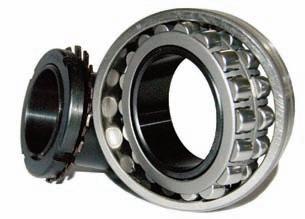
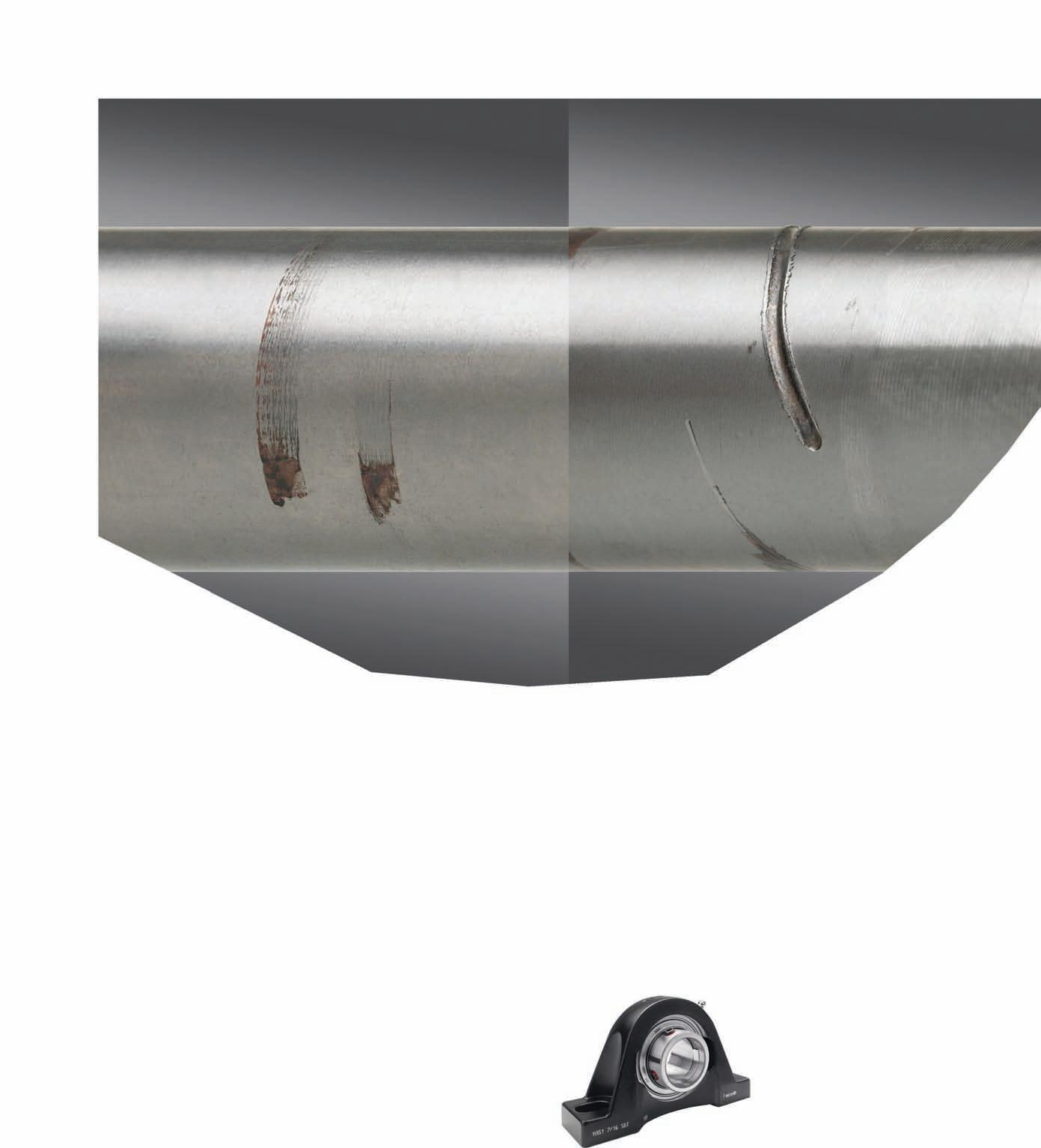
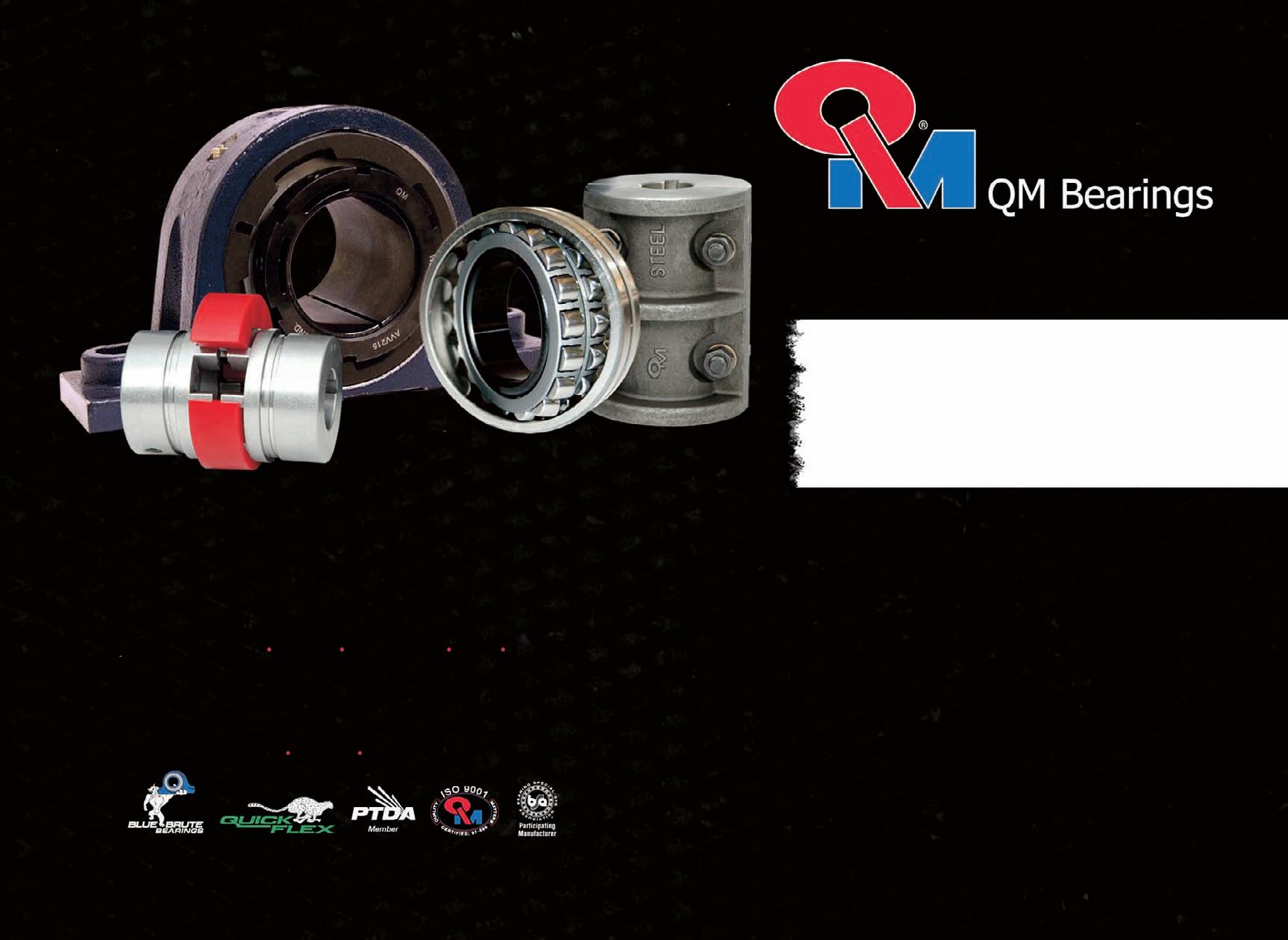
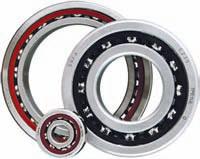
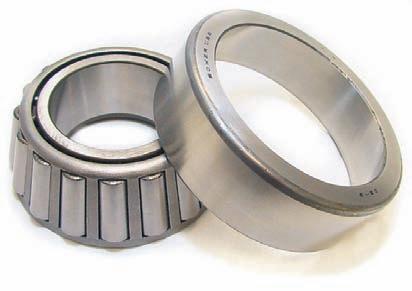
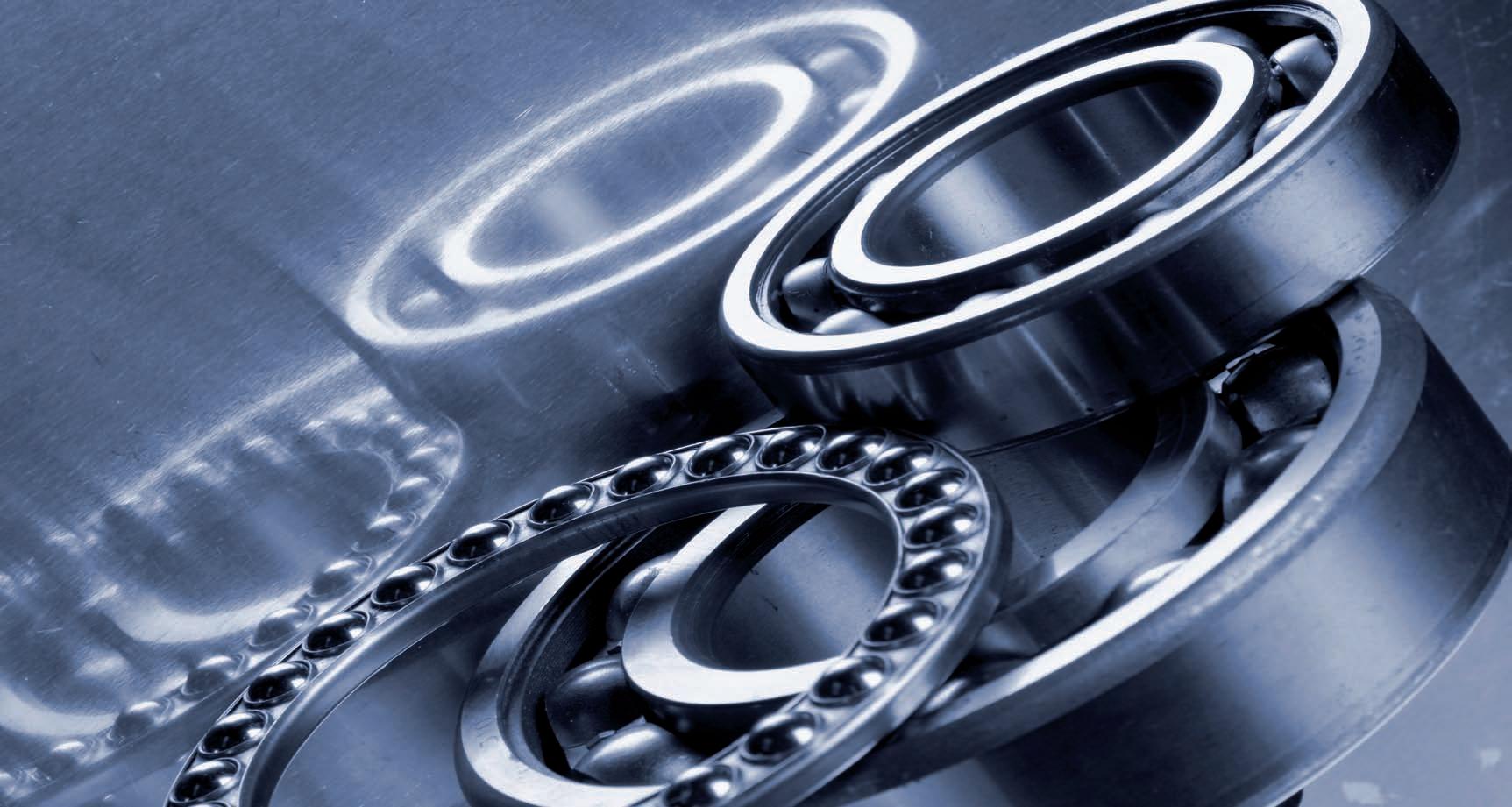
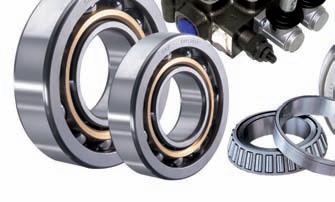
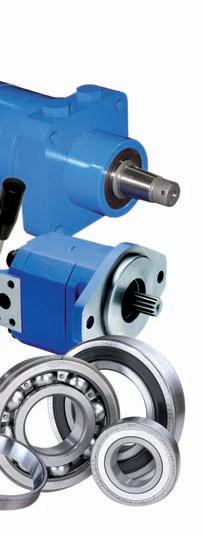
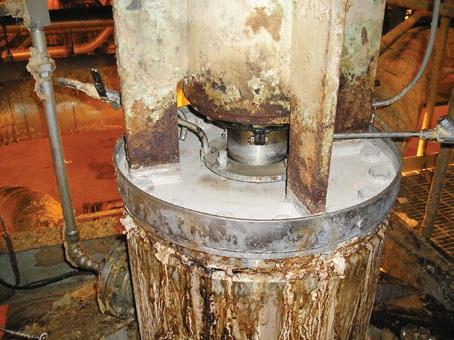
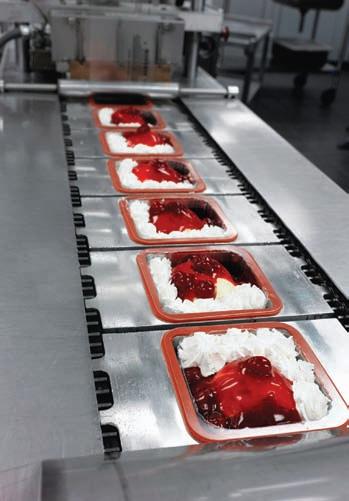
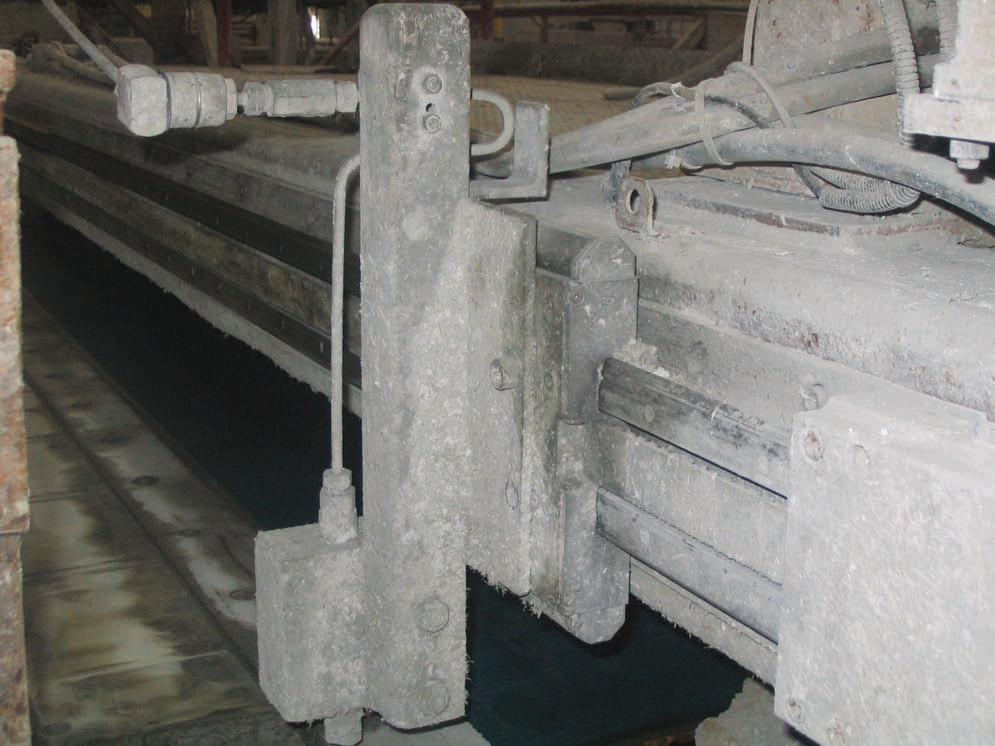
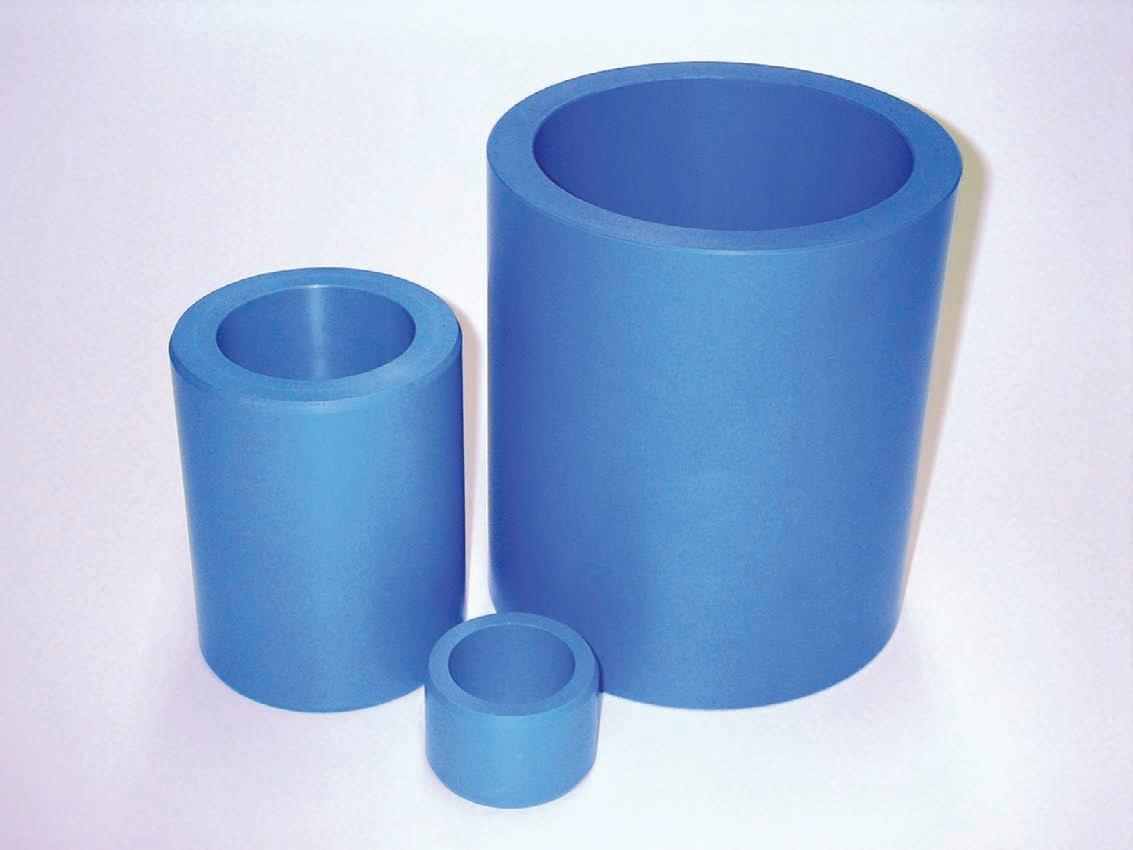
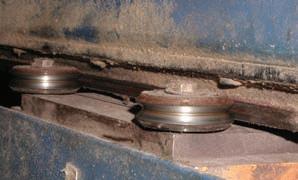
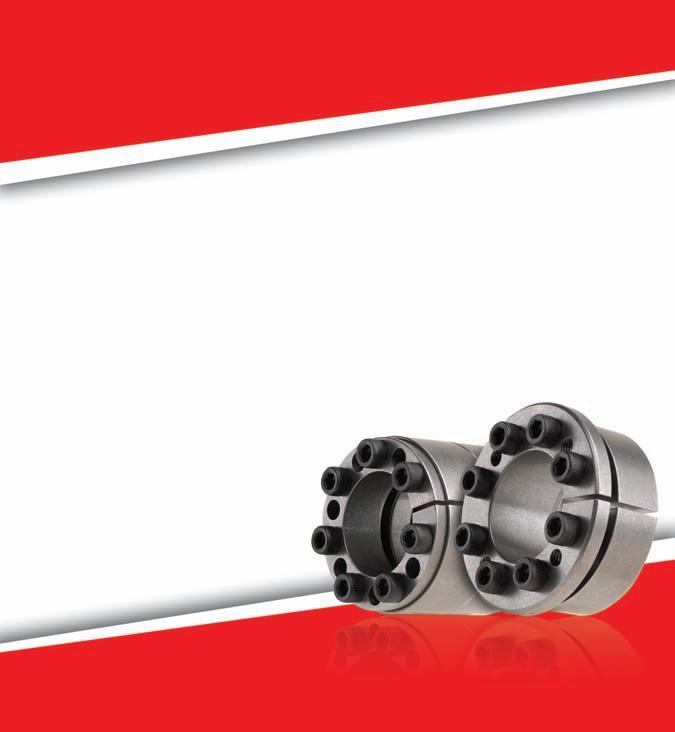
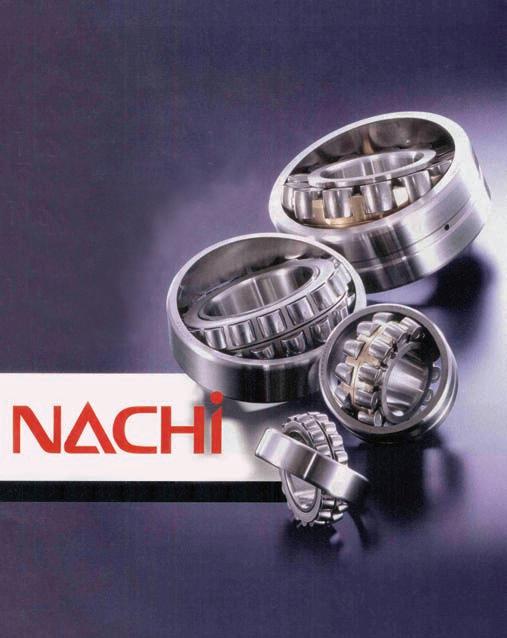
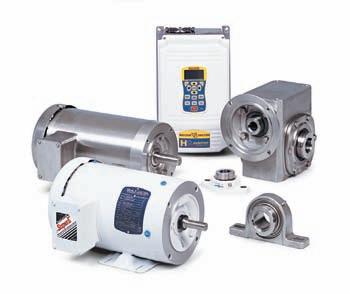
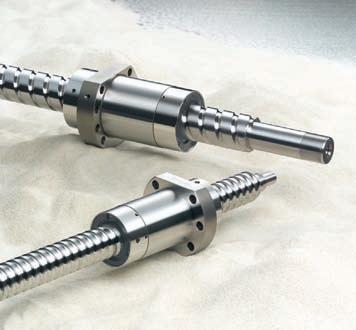
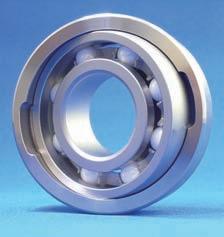
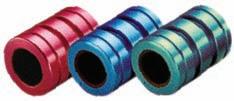
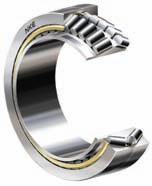
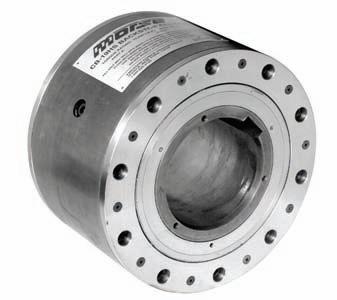
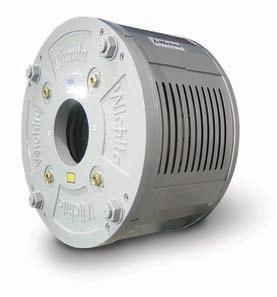
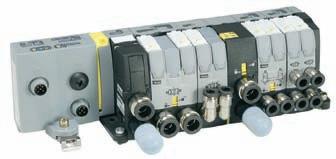
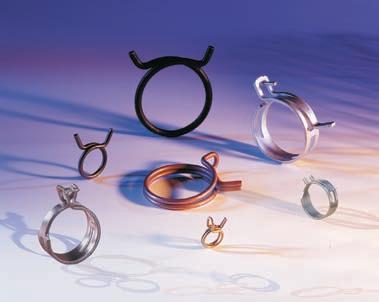
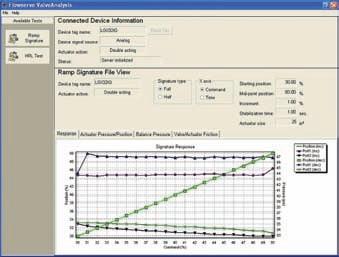
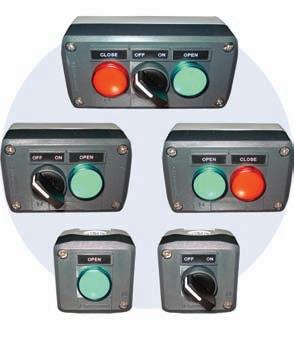
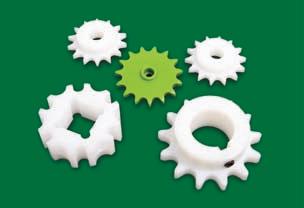
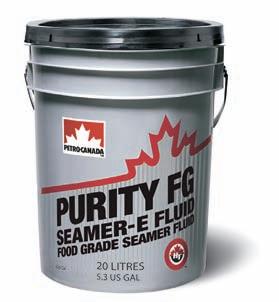
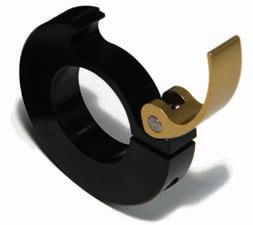
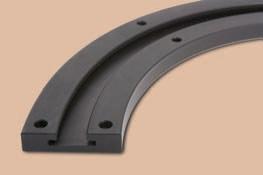
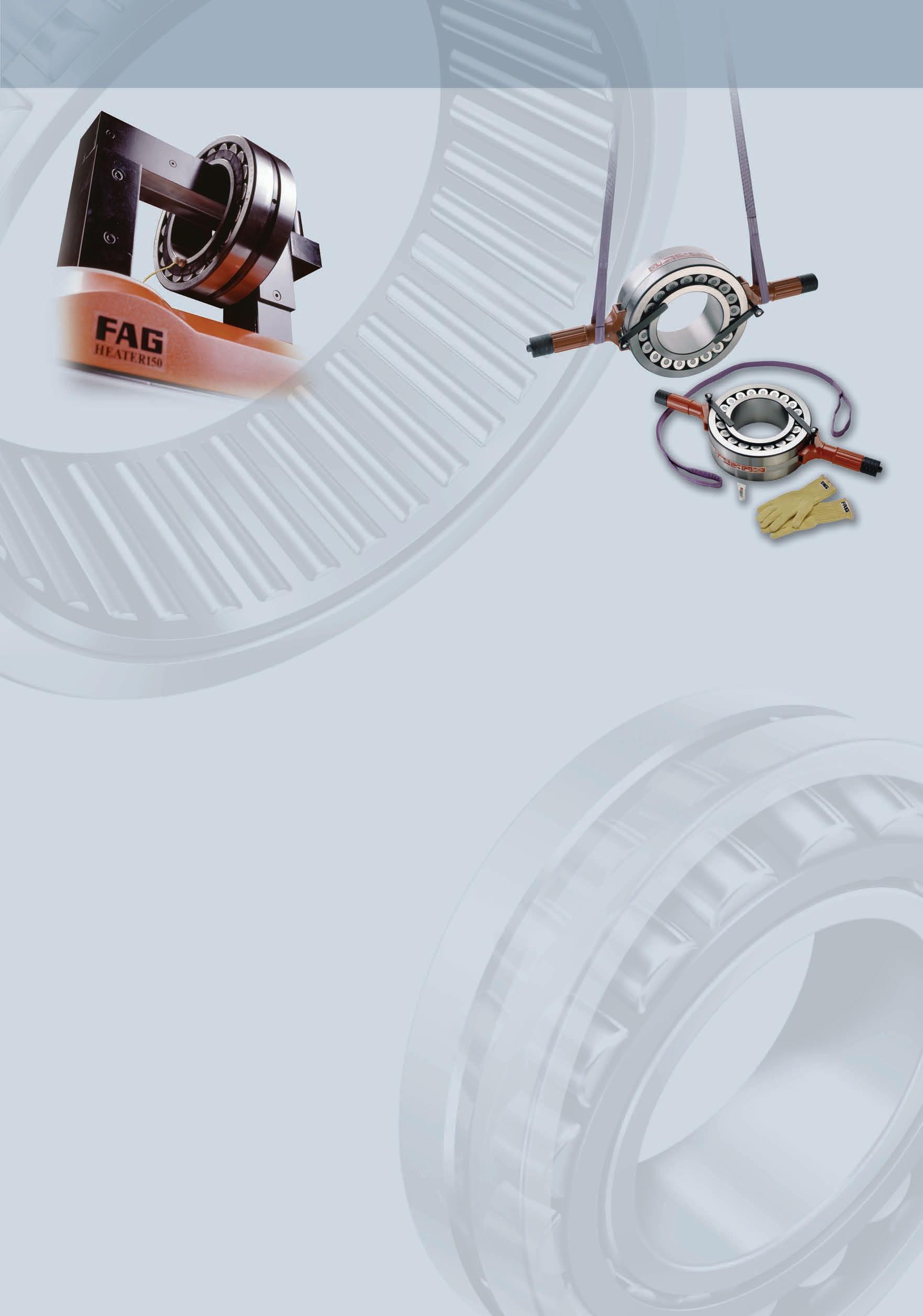
Blue Brute standard spherical roller bearings from QM Bearings are built ruggedly to withstand harsh conditions and environments. Suitable for split-cap units, they are available for shaft sizes ranging from 1 15/16 in. to 4 in. in diameter and have a C-3 clearance. Features include super-finished raceways and rollers and a black-oxide inner ring and adapter sleeve. The highperforming bearings reduce the downtime associated with removal and replacement.
Bearings
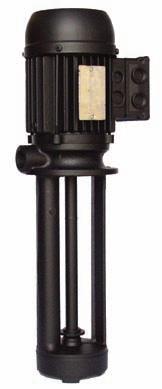
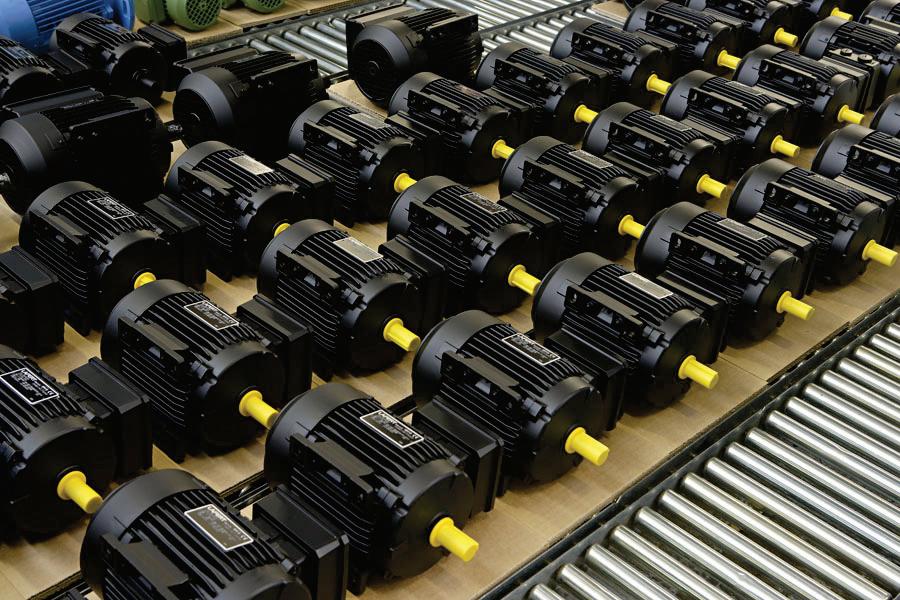
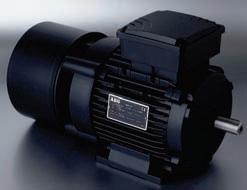
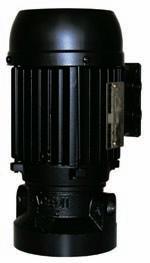
dustry. These pumps provide a quick, inexpensive alternative to repairing old pumps on foreign machinery. The company’s immersion design comes in fractional hp up to 1.5 hp, with options up to 5 hp, with multiple column lengths to meet different application requirements. Pump bodies are available in Valox or aluminum, depending on the fluid being pumped. Also offered are sidemount, self-priming and multi-stage pumps for high-pressure output.
Lafert North America
Reader Service Card No. 410
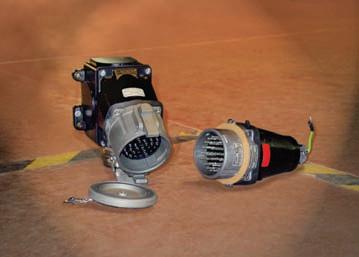
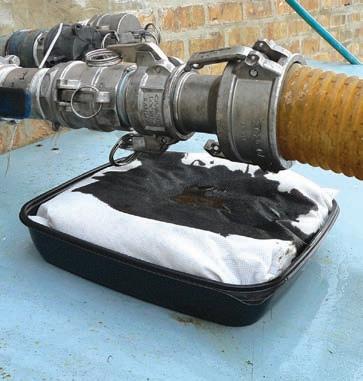
Coupling connects
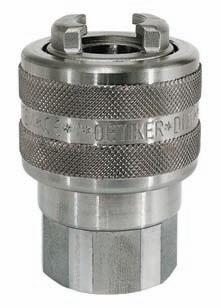
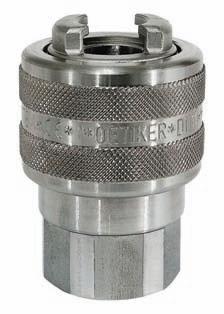
design and long service life with low maintenance, the couplings comply with ISO 4414, EN 983. They are simple to operate and have a twostage disconnection safety feature. Various application uses include com pressed air and gas sup ply in extremely rough working conditions, such as marine, shipbuilding, steel mills, and oil and gas industries.
Oetiker
Reader Service Card No. 415
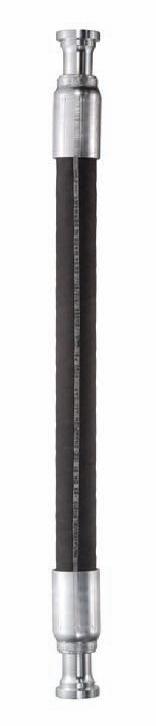
Hose withstands extreme cold Eaton has announced a line of Aero-
67°F) at operating pressures up to 420 bar (6,090 psi), the GH810 Ice Champion hose meets the needs of customers operating in Northern Canada, Alaska and other Arctic and Sub-Arctic cli mates around the world. This rugged, abrasion-re sistant hose uses Aeroquip Global Spiral TTC crimp fittings that require no skiving. Applications include construction equipment, oil and gas rigs, forestry and agricultural equipment, and other equipment operating in brutal Arctic conditions.
Eaton
Reader Service Card No. 414
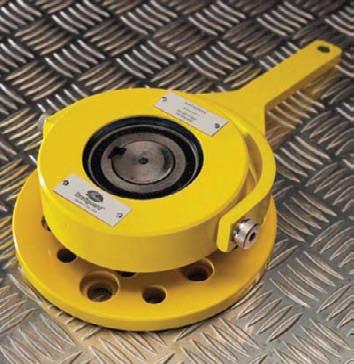
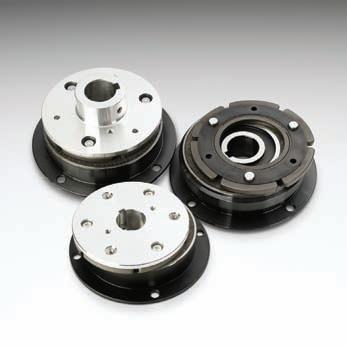
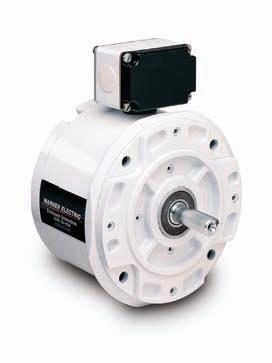
Clutch prevents fan backdrafting Gates Draftguard from Gates Canada is a high-torque, one-way clutch that prevents air-cooled heat exchanger belt
drive systems from spinning backwards. This anti-rotation device prevents damaging hard starts when equipment that is backdrafting is turned on. In addition, the clutch eliminates the need to wrangle the belt drive and protects technicians from serious injury during maintenance operations. The device fits on existing belt drive systems and typically requires no modification of fan cages.
Gates Canada
Reader Service Card No. 412
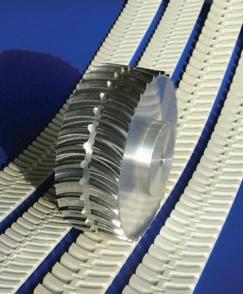
Timing belt offers continuous tooth engagement
Brecoflex’s Arc-Power polyurethane timing belts have a high-performance tooth design that features circular force distribution, leading to extremely low friction during tooth engagement. The belts come
or stainless steel reinforced, and are available in open-ended, welded or truly endless models. Belt widths are 25 mm to 100 mm. Various backing materials and over 3,000 existing profiles accommodate specific application requirements.
Brecoflex
Reader Service Card No. 413
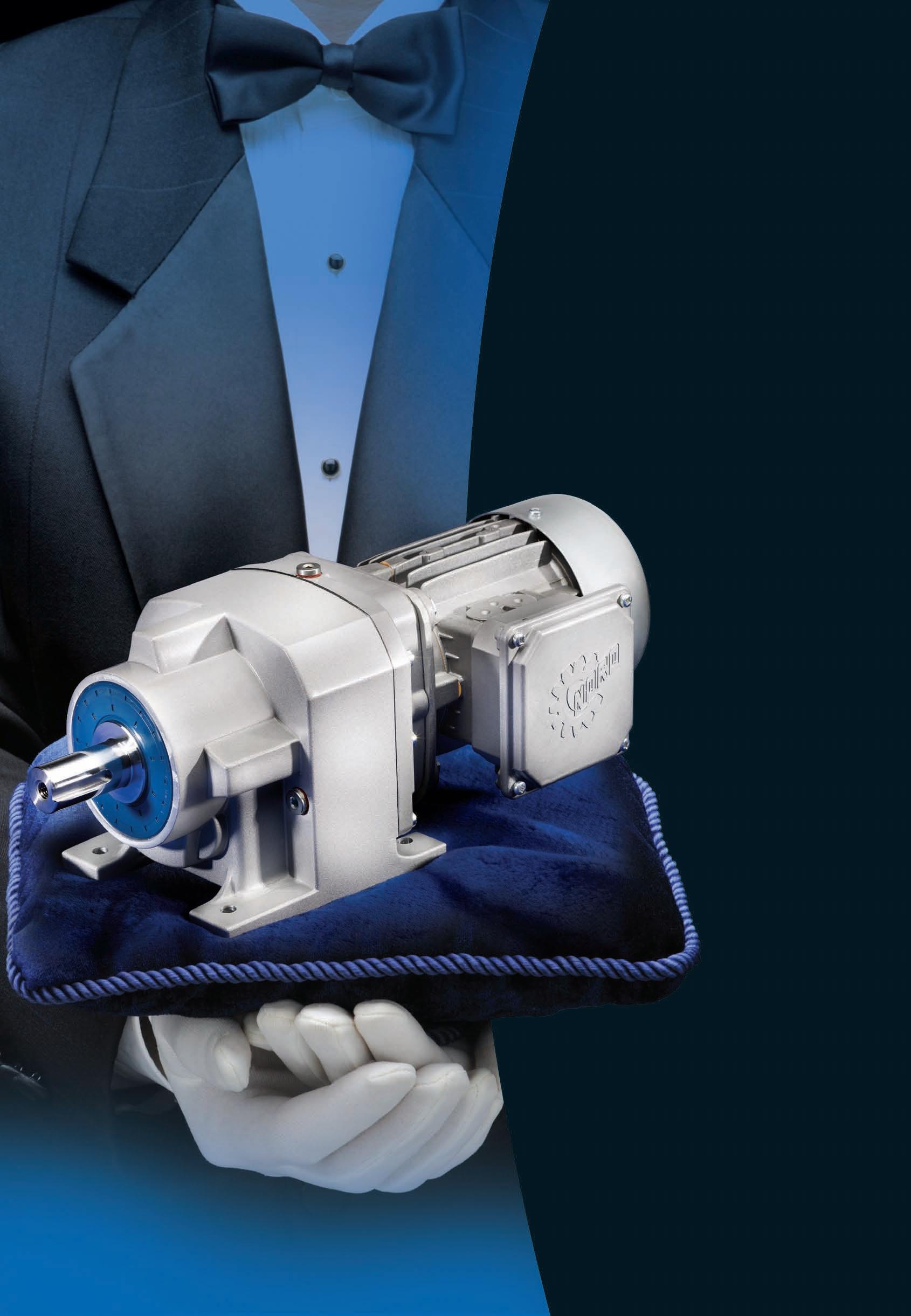
Stronger, lighter, more powerful, and a longer working life – only from NORD Gear.
But, perhaps, what’s most remarkable about the innovative new design of the NORDBLOC.1
Helical In-line series is that we were able to improve upon its already superb predecessor. Yes. We even impressed ourselves.
Advanced innovation gives you yet more durability, more efficiency and more reliability. Consider its compact dimensionally interchangeable design plus an aluminum alloy housing that’s both corrosion resistant and 60% lighter than castiron. Plus, oversized output bearings providing larger capacity and increased working life.
What could be better?
How about a NORDBLOC.1 configured to your exact specifications. We’re ready, 24/7, to design, assemble and ship — anywhere in Canada or worldwide. Call NORD Gear to find your perfect match.
The only intelligent choice is NORD Gear.
Strength in numbers / 14
Keeping the Trudeau airport’s baggage handling system flying.
Packing program cuts
water waste at mill / 17
Compression packing program evaluates the specific requirements for Tembec mill’s pumps.
How to maximize bearing life in food processing / 17
There are four key factors to keep in mind.
Thermoplastic bearings
handle plant’s assault / 18
New type of bearings extend maintenance periods at Quebec bacon plant.
Crashing guns / 18
Linear sleeve bearings keep automotive welding line running.
Dirt Busters / 19
Tough and reliable, guide wheels tackle any environment and excel under dirty conditions.
Washdown challenge / 19
Choosing lubricants for harsh conditions.
Vibration analyzer ensures bearing reliability / 20 Examining the development of vibration measuring equipment.
Big wheel / 23
Clutches and actuators provide a smooth ride for China’s Great Wheel.
columns
Owners vs. Suppliers: Who’s Responsible for Compliance? / 21 Why many purchasers of machinery and equipment pass the responsibility for PSRs on to their suppliers.
New plan needs a champion / 22 Follow along with Step 28 in a journey to World-Class Maintenance.
How to justify a CMMS purchase / 24 Answer these 10 questions.
PTDA’s Canadian Conference / 30 Conference brings together the power transmission/motion control industry’s leaders.
Editor’s Notebook / 6
Industry Newswatch / 8
Company Briefs / 10
Mr. O, The Problem Solver / 12
The Safety File / 21
Maintenance Management / 22
CMMS Solutions / 24
MRO On The Road / 30
Product News
Product Spotlight / 2
Focus on Harsh Conditions / 25
Focus on Bearings / 26
Focus on Clutches & Brakes / 27
Focus on Fluid Power / 28 MRO Components / 29
Getting recognition
Just after we went to press last issue, we got more good news here at our magazine offices. Machinery & Equipment MRO received another honour, an Award of Excellence in APEX 2009, the 21st Annual Awards for Publication Excellence competition. We’re pleased as punch because this marks the fourth year in a row we’ve received an APEX Award.
Sponsored by Communications Concepts, the international APEX Awards are based on excellence in graphic design, editorial content and the success of the entry in achieving overall communications effectiveness and excellence.
The submission by Ellie Robinson, our long-serving art director, and my-
self, for Machinery & Equipment MRO’s December 2008 issue, was selected from among a total of almost 4,000 entries. The Award of Excellence is for the competition’s Magapapers & Newspapers category; Apex Awards are given in 11 different categories.
This year’s award will join the others on our wall, along with our multiple Gold, Silver, Top 5 and Top 10 awards from the Canadian Business Press. You may have read in our previous issue about our Top Five award for our technical article, Troubleshooting Couplings, by contributor Lloyd (Tex) Leugner, in the 2009 Canadian Business Press editorial competition.
As you well know, it’s great to receive
recognition for your work. But I think it’s unfortunate that there isn’t more such acknowledgement available for the bulk of our readers, all those maintenance professionals who must endure the pressure of keeping all sorts of complicated machinery and equipment churning along, doing its job.
We know from experience than many of you are true inventors, coming up with unusual workarounds when trouble strikes, doing whatever it takes to get the mill back up, the production line running again, or improving a process so it’s more efficient or effective.
Most people think of the work we do around our offices — putting together magazines and websites — as pretty creative, but it’s unfortunately that few recognize the amazing creativity that shows up on the shop floors in industries across the country every day.
Without your creative thoughts and analyses of various technical prob
lems, there’d be a lot more lingering troubles on those shop floors. And a lot more downtime.
I wish there was an easy way to make those executives realize the wonderful benefits of the work you all do; that it’s not just about following the engineering standards and formulas that rule mechanical, fluid and electrical systems. There’s much more to maintaining uptime than that. But without recognition from the top, we expect your job probably can be fairly frustrating at times. It’s not much consolation, but be aware that all of us here at Machinery & Equipment MRO understand your plight and your challenges.
So if you suddenly start getting some unexpected kudos from up the ladder, let us know. We’ll be happy to share the news that the message is getting through to those who need to know.
Bill Roebuck, Editor & Associate Publisher
Roebuck,
Extended Life CHP® Series Chain Products
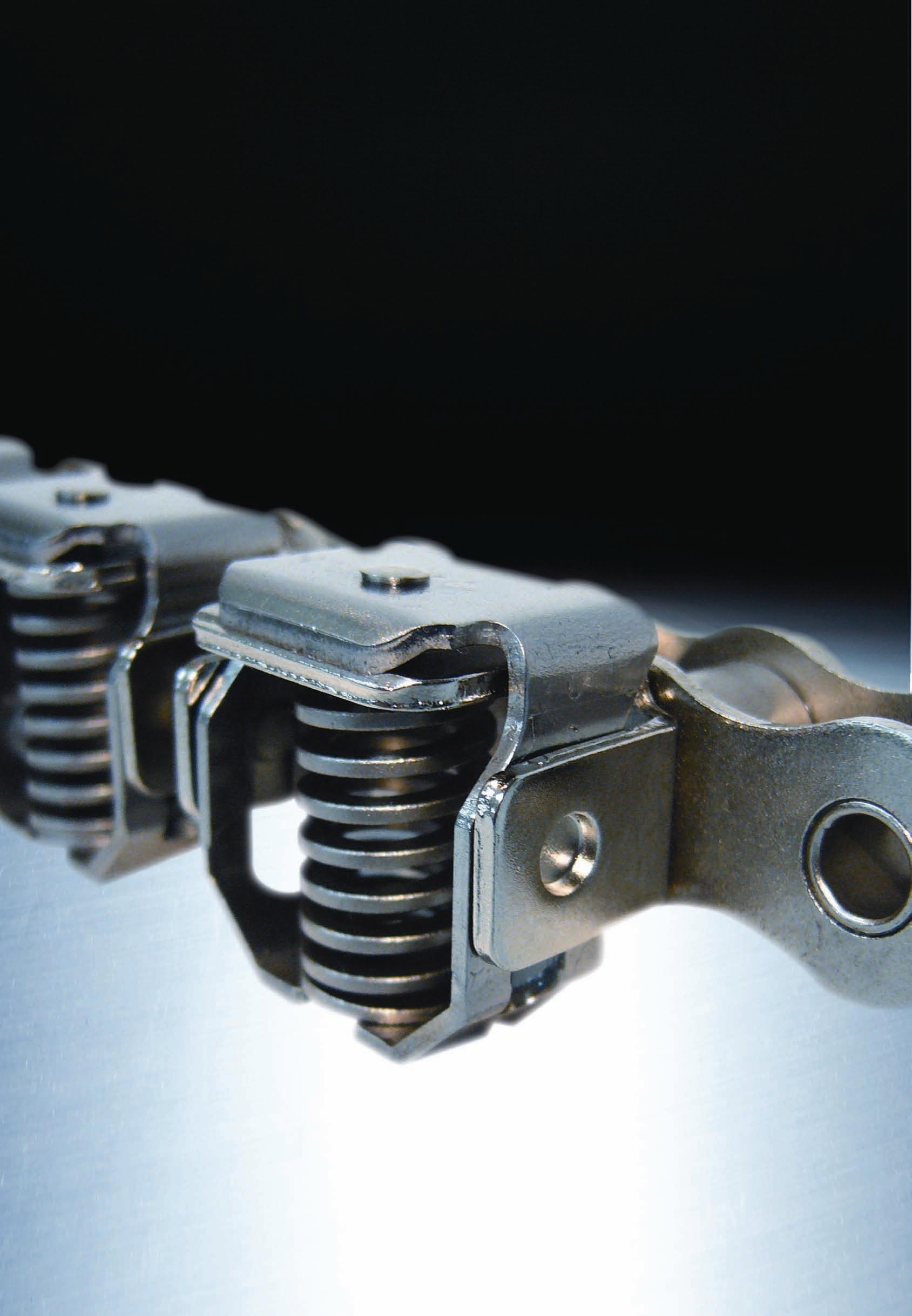
Extended Life CHP® hard chrome plated pins possess standard steel’s metallurgical properties for toughness and strength while delivering an extremely hard wear resistant pin surface. CHP chain pins resist wear longer than standard heat treated pins, even in dry and abrasive environments. Extended Life CHP® chain is directly interchangeable with standard ANSI chain.
Extended Life CHP® chain offers outstanding wear and fatigue life performance in extreme temperature ranges and does not require a reduction in working loads or operating speeds. Exceptional pin wear resistance reduces chain elongation and increases wear life by 3X over conventional premium chains. A full range of ANSI standard attachments are available.
Manitoba dealing with men’s depression in the workplace
Winnipeg, MN — A silent crisis. That’s how the Canadian Health Association describes men’s mental health — a shadowy crisis that is slowly coming to light, according to the June 2009 issue of the Canadian Health and Safety Report produced by the Canadian Centre for Occupational Health and Safety.
The CHA reports that nearly three million Canadians will experience depression, however in men it is less likely to be diagnosed.
Studies show that men often don’t make the connection between their mental health and physical symptoms, such as headaches, digestive problems and chronic pain. They also may face specific social barriers — e.g. that emotions are a sign of inadequacy — that may prevent them from recognizing and seeking help for their mental health concerns.
In Canada men die by suicide about four times as often as women, but only receive a diagnosis of depression about
silence and be treated.
To learn more about the Man to Man Project, visit klinic.mb.ca/mantoman/index.html. For information about depression from the Canadian Mental Health Association, visit cmha.ca.
INVENTOR OF THE TRANSFORMERLESS MEDIUM VOLTAGE DRIVE WINS INNOVATOR OF THE YEAR AWARD
Toronto, ON — The Ontario Ministry of Research and Innovation has honoured Dr. Navid Zargari from Rockwell Automation in Cambridge, ON, as Innovator of the Year. The award celebrates inventors who have played a significant role in developing a commercially successful product or service based on a breakthrough technology.
In May 2009, Zargari was recognized at the Premier’s Innovation Awards ceremony in Toronto and received a $200,000 grant.
Often men do not recognize their mental health concerns until they have a great personal and economic cost. Men are more likely to seek help if they have a connection with supportive peers and access to health information. So, while workplaces bear significant costs of men’s mental health issues (e.g. increased absenteeism, staff turnover, lower productivity), they are in a unique position to promote employees’ mental health.
Klinic’s Man to Man Project in Winnipeg, MN, is one initiative in place to help reach men through their employers. The project works to address the issue of unrecognized and undiagnosed depression in men, and how it affects communities and workplaces.
The project provides free services to Winnipeg men and their workplaces by giving a presentation highlighting the signs and costs of mental distress, and strategies to attain mental wellness. Organizations are pointed to information and resources they can use to promote the overall wellness of their employees.
The project provides promotional materials for display in the workplace that invite men to access free, ongoing confidential support for their mental health concerns, at no additional expense to the organization.
By shedding light on men’s mental health, men who are suffering from illness can emerge from the shroud of
CANADIAN POWER TRANSMISSION MARKETS ON THE RISE AGAIN
Chicago, IL — Canadian manufacturers of power transmission and motion control products experienced an increase in sales while US manufacturers had a drop in sales in June 2009, according to the latest Market Outlook Report released by the Power Transmission Distributors Association (PTDA).
lished monthly by the PTDA. The full report includes US and Canadian manufacturer data for sales and order trends for mounted bearings, unmounted bearings, standard industrial motors, variable speed drives, positioning systems/ linear motion products, gear products, clutches and brakes, shaft couplings and mechanical drive systems and other PT products.
A manager of medium voltage development at Rockwell Automation, Zargari was a major contributor in developing the transformerless medium voltage motor drive, a technology that is helping increase energy efficiency and reliability to achieve sustainability in industries, such as oil and gas, power utilities, mining and cement, and water/
Zargari, along with Dr. Bin Wu of Toronto’s Ryerson University, and Steve Rizzo and Yuan Xiao of Rockwell Automation, co-invented the integrated DC choke for the AllenBradley PowerFlex 7000 medium voltage (up to 34,000 hp/22.5 MW)
The patented, integrated DC choke helps eliminate the need for an isolation transformer to mitigate common mode voltages in the PowerFlex 7000 medium voltage drive. This helps companies reduce manufacturing costs by 20% to 25% per drive, as well as reduce overall operating costs.
The DC choke also helps improve sustainability by increasing drive efficiency by nearly 40%and creates a smaller footprint than the previous generation of medium voltage drives by decreasing the size and weight by nearly 30%.
“Navid led the research, development and technology transfer as the senior design engineer on the PowerFlex 7000 project team,” says Steve Rizzo, manager, Medium Voltage Drives. “His groundbreaking work has helped us grow medium voltage sales significantly with growth rates in the double digits year over year.”
The $200,000 grant will be used toward preliminary technology development and a feasibility study for wind energy conversion systems.
Rockwell Automation Inc. is headquartered in Milwaukee, WI, and employs about 20,000 people serving customers in more than 80 countries. For more information on the integrated DC choke from Rockwell Automation, visit the ab.com/mvb/drivetodrive.html.
Confidence in the Canadian market (as measured on a scale of 1 to 10 with 10 being most optimistic) rose slightly by 0.1% from the previous month to 4.4, while US confidence held at a negative position of 4.8 for the third consecutive month.
US manufacturers’ sales fell by 2.8% in June 2009 when compared to May 2009. Sales in June 2009 fell 32.9% compared to the same period last year. Orders in June 2009 decreased by 5.3% over May 2009.
Canadian manufacturers’ sales increased 7.6% compared to May 2009, although sales were down 25.5% when compared to the same period last year.
Product-by-product sales between May 2009 and June 2009 reflect the change in sales experienced by US and Canadian manufacturers. Three of nine product categories for US manufacturers — gear products, standard industrial motors, and mechanical drive systems and other PT products — posted sales gains. For Canadian manufacturers, five product categories posted sales gains — mounted bearings, gear products, standard industrial motors, variable speed drives, and mechanical drive systems and other PT. Variable speed drives were a highlight with a dramatic jump of close to 90%.
The Market Outlook Report is pub -
Year-end data for 2007 and 2008 also is available in a complete report. For details, visit ptda.org/store or call the PTDA at 312-516-2100.
MANUFACTURING FINALLY SEES A BOOST IN SALES
Ottawa, ON — Manufacturing sales increased 1.9% to $39.7 billion in June 2009, partially reversing the 4.9% decline posted in May. Strong sales in the aerospace industry and a rise in the price of petroleum and coal products largely explain the increase. Excluding both industries, Canada’s manufacturing sales would have decreased 0.5%.
Constant dollar manufacturing sales rose 1.1% in June, indicating that greater sales volumes were responsible for more than half of the increase in sales.
Sales were up in 12 of 21 manufacturing industries in June, representing 68% of total sales.
Production in the aerospace industry increased 61.0% to $1.6 billion, partially reversing a 44.5% decline in May. The aerospace industry has been extremely volatile over the past several months. Excluding the aerospace industry, total Canadian manufacturing sales increased 0.4%.
Sales in the petroleum and coal products industry rose 6.9%, reflecting higher prices for petroleum products. In addition, several refineries increased production in June.
Non-metallic mineral products (+5.6%), furniture and related products (+4.9%), wood products (+3.5%) and food (+1.4%) were other industries reporting sales increases in June.
The motor vehicle manufacturing industry was the main offsetting industry in June. Sales decreased 6.0%, following a 20.8% drop in May. The recent weakness reflected several plant shutdowns. In contrast, motor vehicle parts manufacturing edged down 0.1% in June.
Provincial results
Among the Atlantic provinces, sales rose significantly in Newfoundland and Labrador (+58.0%) and New Brunswick (+7.2%), while Prince Edward Island (-13.2%) and Nova Scotia (-2.8%) saw sales decline.
In Quebec, sales increased 5.7% in June, partially reversing an 8.6% drop in May. The provincial advance was largely driven by aerospace production, which increased by 82.5% to $1.1 billion. Non-metallic mineral products (+8.5%), fabricated metal products (+4.4%), food (+2.1%) and petroleum and coal products (+2.0%) were other industries contributing to the sales increase in Quebec.
Sales in Ontario edged down 0.3% in June, largely the result of a 7.3% decline in motor vehicle manufacturing in the province. The primary metals industry (-5.9%) also contributed to the weakness in Ontario. A 2.6% gain in the food industry only partially offset the declines in
Men often don’t make the connection between their mental health and physical symptoms.
vehicle manufacturing and the primary metals industry.
Manufacturers reported a 0.1% decline in inventories compared to May, with levels falling to $62.7 billion. This was the fifth consecutive monthly decline.
Fabricated metal products manufacturers (-3.1%) and the primary metals industry (-2.0%) posted two of the larger declines in value terms. However, a 14.0% advance in the value of inventories in the petroleum and coal products industry, stemming from both price and volume increases, largely offset the declines in other industries.
The slight decrease in inventories and the increase in overall manufacturing sales caused the inventory-to-sales ratio to drop to 1.58 from 1.61. The inventoryto-sales ratio remains well above values seen in 2007 and 2008.
The backlog of unfilled orders rose 2.0% in June to $60.0 billion, partially offsetting the 7.0% decline in May.
In June, the aerospace products and parts industry reported a 3.0% increase in the value of unfilled orders. Excluding aerospace products and parts, unfilled orders increased 0.9%. New orders increased 18.4% in June to $40.8 billion.
MANUFACTURING TECHNOLOGY SHOW TO REINFORCE IMPORTANCE OF TECHNOLOGICAL INNOVATIONS IN TOUGH ECONOMY
Toronto, ON — Manufacturing still matters. That’s the message from organizers of the Canadian Manufacturing Technology Show 2009 (CMTS), where more than 500 manufacturers and distributors are expected to convene in Toronto, October 19-22, 2009.
The event will unveil the latest trends in manufacturing innovations and demonstrate how new technological developments can help Canadian manufacturers reinvent themselves on the heels of a recession.
“Manufacturing is essential to restoring a stagnant economy,” said Mark Tomlinson, executive director and general manager of the Society of Manufacturing Engineers (SME), which is organizing the four-day event. “Not only is this sector providing goodpaying jobs, but it’s also helping to develop the innovations that will keep Canada globally competitive.”
CEO of Linamar Corp; the CMTS Town Hall Experience, an interactive panel discussion on North America’s energy manufacturing supply chain; Small and Medium Sized Manufacturers’ Success Stories — a panel of representatives who have successfully transitioned their manufacturing operations into new industries will share experiences and offer valuable lessons; Automation Rendez-Vous, a technical conference showcasing industrial process improvement technologies, partnership best practices and emerging technologies; and an Exhibitor Showcase, featuring Automaton Cell Live in the Factory Automation Zone, Innovations 2009 and Green Solutions 2009.
For details, visit cmts.ca.
BSA EXAMINES USE OF BEARINGS IN POULTRY PROCESSING
Glen Ellyn, IL — The Educational Services Committee of the Bearing Specialists Association (BSA) has released the first in a new series of industry-specific educational publications, referred to as Industry Briefs, which are intended to enhance the association’s existing Bearing Briefs by identifying bearing selection specifics used by individual industries.
The BSA Industry Brief: Poultry Process, details the use of bearings in poultry processing and is available for downloading as both a PowerPoint presentation and a PDF from the BSA members-only website, and as a PDF from the public website, bsahome.org, under Tools You Can Use.
Specifically, the Industry Brief maps the poultry process and identifies particular requirements for bearings. For example, in the receiving process, the Brief points out: “This application is subjected to shock loads that require rug-
“That’s not to say the industry is without its challenges,” adds Tomlinson. With manufacturing sales hitting record lows across almost all sectors and in all provinces, show organizers are sending out a strong message that Canadian manufacturers need to rethink business strategies and embrace diversification in order to survive.
“Businesses have to adapt, whether that means collaborating with other companies to create larger corporations capable of tackling tough markets, or transitioning traditional manufacturing processes to take advantage of emerging trends in the energy, aerospace and medical industries,” he said, emphasizing that CMTS 2009 conference sessions will provide participants with valuable insight into these opportunities.
CMTS exhibits will include the latest machine tools, automation technologies, metal forming, measurement technologies, tooling solutions, production methods and management strategies.
Highlights of the show will include a keynote address by Linda Hasenfratz,
ged cast iron construction pillow block and four-bolt flanged bearings. Corrosion-resistant bearings are usually not required at this stage of the process.”
Subsequent processes considered in this brief — slaughter, scalding and chilling — are given comparable consideration.
The Educational Services Committee hopes to address bearing selection specifics in various additional industries in subsequent Industry Briefs. The BSA Industry Brief: Poultry Process was approved at the association’s 2009 Annual Convention.
BSA is an international service and educational organization of distributors representing a total of almost 100 companies distributing factory-warranted ball-, roller-, and anti-friction bearings and invited manufacturers of bearings and related products. For more information, call 630-858-3838, e-mail info@bsahome.org or visit bsahome.org. MRO
Editor’s note: More detailed versions of many of these stories, along with additional news items, can be found online at www.mromagazine.com.
When you think “Value”, you think about maximizing productivity and reducing costs. We think about maximizing your investment by lowering your maintenance costs and increasing bearing life. Supported by 24-hour service and worldwide distribution, NSK spherical bearings keep you working. So, when it comes to getting more than you paid for, Think NSK.
Poultry processing facilities have particular requirements for bearings.
Company Briefs
News and views about companies, staff, product lines and more.
• Walter Surface Technologies has announced that it is building a new $20-million world headquarters in PointClaire, QC. With sales in excess of $100 million worldwide, the company is marketing its products and processes across Canada, the US, Latin America and Europe. It also is committed to environment-friendly innovations such as its Bio-Circle process, which replaces toxic solvents for cleaning greasy parts and changes unhealthy contaminants into plain water. In addition, Tim Houghton, who had been leading the company’s US operations, has been promoted to president and COO for all divisions.
• Parker Hannifin Corp., a provider of motion and control technologies, has
combined its Motion & Control and Fluid Connectors operations in Canada into one division, the Parker Canada Division. The division has offices in Milton and Grimsby in Ontario, and in Calgary and Montreal. Tony Wyszkowski is now the general manager of the new division, with responsibility for hydraulic, pneumatic, electromechanical, fluid connector, filtration, and climate control products and technologies. Previously Wyszkowksi was general manager of the Fluid Connectors Canada Division.
• Viking Pump Canada has appointed Joe Toy as its west regional manager. His is now responsible for sales and operations in Western Canada. He has been with the company for 23 years in several
sales and management roles, including his previous role as manager of customer service and applications engineering. Toy has relocated from the company’s
Windsor, ON, head office to its regional office in Edmonton, AB.
• Altra Industrial Motion, Braintree, MA, has launched a new website, AltraOilandGas.com, that provides engineers and professionals in the global oil and gas industry with a comprehensive resource for application-specific power transmission and motion control solu-
tions. It includes products such as heavyduty clutches and brakes, open and enclosed gearing, couplings and sheaves. The online resource is organized into 11 application-specific categories, including platforms, compressors and pumps, pump jacks, petro chem, drilling and service rigs, draw works, mooring/positioning, engine gearboxes, fans, kilns and mud pumps.
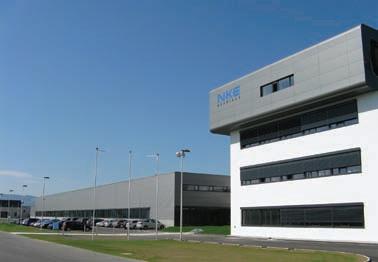
• Bearing manufacturer NKE Austria GmbH, Steyr, Austria, completed and moved into new headquarters in the industrial park Stadtgut Steyr in June 2009. More than 15 million euros were invested in the new facility, which has a floor space of more than 10,000 sq m. The new facilities enable NKE to have
better manufacturing capacities, including a small-lot production line, as well as more efficient logistics. NKE plans to increase the workforce in Steyr from 180 people to about 230 in the next three to five years.
Walter is building a new facility in Quebec.
Website is organized into 11 application-specific categories.
The new NKE works is in the industrial park Stadtgut Steyr in Austria.
Special Features
Crowned rollers provide lower friction and smooth operation through even load distribution.
Case carburized steel enhances long life operation and improves shock loading capabilities.
Optimized roller/rib interface promotes lubrication and lowers bearing running torque. Honed raceways ensure low friction for trouble free operation.
A Case for NTN Tapered Roller Bearings
Solutions... Delivering Value
Better Support Makes a Better Bearing
As an integral part of after-sales service and support, NTN provides an engineering and service staff across Canada to assist customers in gaining maximum service from the life of their bearings
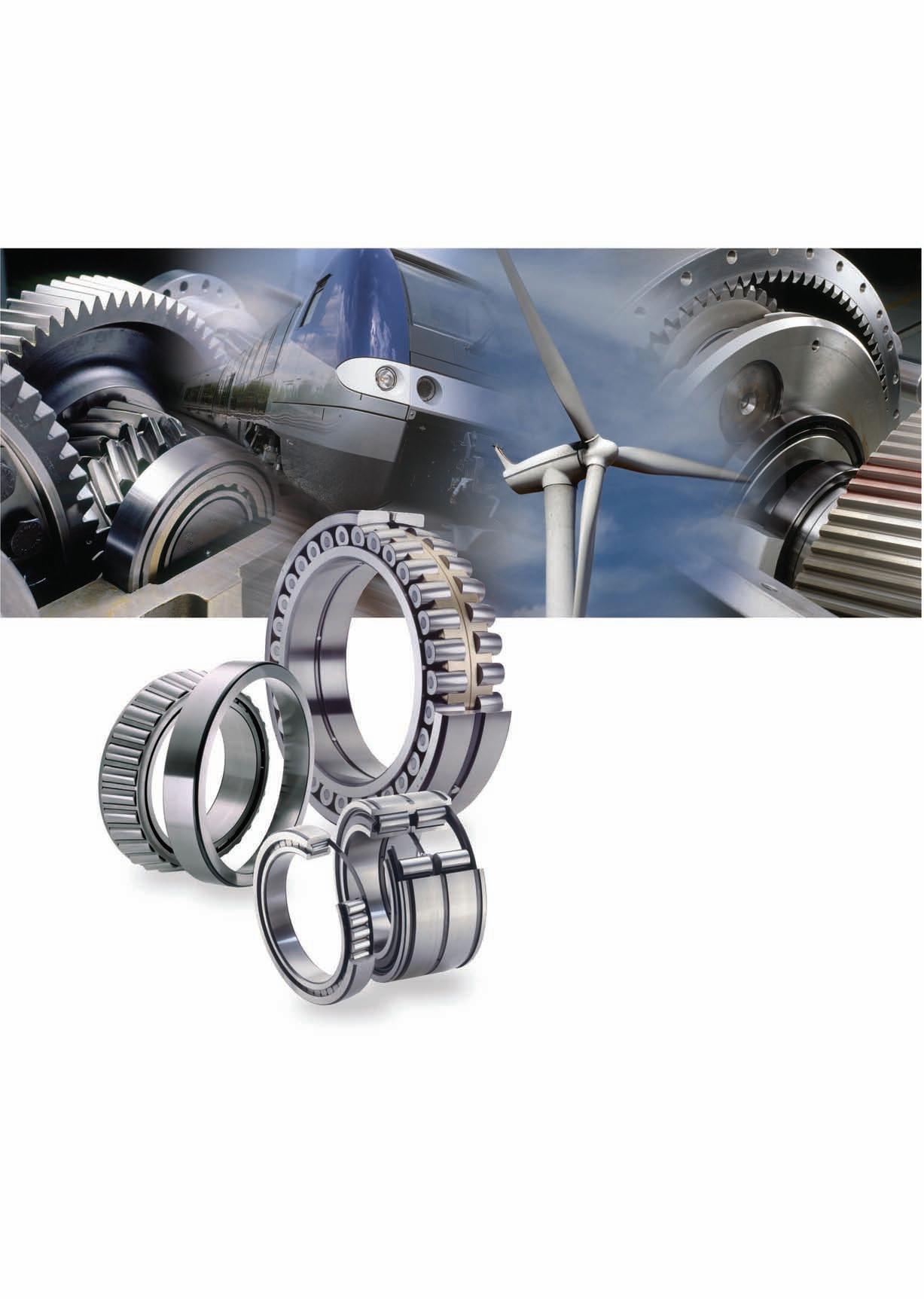
Preferred by leading manufacturers, NTN tapered roller bearings are renowned for their ability to operate reliably in some of the world’s harshest environments. NTN tapered roller bearings are ideally suited for heavy duty applications ranging from rail to aggregate and mining equipment, where marginal lubrication, vibration and impact loads are considered the norm. NTN tapered roller bearings are made to meet or exceed industry standards and feature case carburized steel. Carburizing hardens the steel from the surface to the proper depth, leaving a relatively soft core, improved durability and longer life. These results make the material ideal for shock loading and extreme conditions. Like all our products, NTN tapered roller bearings are backed by our knowledgeable technical support team, competitive pricing, 24/7 service and unmatched inventory capability.
• In depth bearing failure and machine troubleshooting
• Bearing (re)selection and machine redesign to prolong bearing life and up time
• Liaison with original equipment manufacturers and third party suppliers
• Preparation or review of maintenance schedules and procedures
• End user in-house training seminars
• Accurate part number crossover to one of NTN’s complete range of products
continued from page 10
• Commtest Inc. Knoxville, TN, a producer of vibration analysis technology, has named Rod Acklin as product manager and Dr. Robin Williams as technical director. Acklin has worked in the vibration analysis industry for 18 years as a design and application engineer, product manager and project manager. Since 1996, he has worked in design and support of Commtest’s family of reliability products. He is a Vibration Institute Category II Vibration Ana-
lyst and has successful ly launched numerous vibration in stru ments and analysis software packages. Dr. Williams brings extensive experi ence in research, prod uct design, strategic planning and corporate change management to his new role. He most recently led the expansion of a remote monitoring and control company into the agriculture and utilities sectors. Earlier this year, the company moved into new global headquarters in New Zealand.
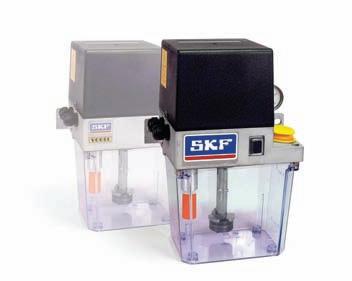
• In 2004, the SKF Group acquired Willy Vogel AG, a player in the world of lubrication technology. As of July 1, 2009, all lubrication systems, engineered solutions and services will be offered under the SKF brand only, instead of as pres-
ently dual-branded as SKF Vogel. The acquisi tion of Willy Vogel AG was strategically important to SKF’s objective of hav ing a leading role in all its technology platforms, including standard lubri cation systems, custom ized units and complete solutions integrating bearings, lubrication and sealing. SKF’s Lubrication Solutions facility in Burlington, ON, is home to its local engineering, technical support and customer service operations. For more information, send an e-mail enquiry to lubrication@skf.ca.
years of experience in helping Canadian healthcare, seaport, mining, manufacturing, supply chain, airport, airline and defence leaders build computer simulation models of their operations. MRO
Editor’s note: Many additional company briefs can be found online at our website, mromagazine.com.
• Simaco Inc., St. Laurent, QC, is a new Canadian-owned business formed to help executives apply simulation and modelling for informed decision-making. Its team, led by Steve Pare, brings 20
KL FSM Extreme-Duty Chain Lube. Keep downtime on the run.
Tips for selecting roller and conveyor chain
Problem: How can we get longer life from roller and conveyor chain?
Solution: The overall requirements of the application are important when selecting the correct type of roller or conveyor chain. Important factors to consider are resistance to the environment, wear life/ strength, and total cost. The chain selected should be capable of resisting the majority of the chemical and/or temperature requirements it will encounter. If the environment is ambient in temperature, stainless, nickel-plated or Silver Shield CR chains (a Drives Inc. brand) may be considered. (Silver Shield CR series chains consist of standard carbon steel components coated with a zinc-aluminum compound.)
If the environment is elevated or subzero, stainless steel chains will most often provide the best overall operation. In applications where extended wear is a requirement, carbon-steel-based nickel-plated or Silver Shield CR chains are the best choice.
Chain strength is normally defined by its allowable working load. This value is one at which the chain can be expected to operate at (or below) for an indefinite period of time. While allowable working load is a function of ultimate tensile strength, it is not measured using the same criteria. Chains can have very different allowable working loads, but have very similar ultimate tensile strengths. A chain manufacturer’s application engineering staff can provide more information if chain strength is a critical factor in a particular application.
Mr. O’s thanks go out to Drives Inc. for providing this tip.
Do you have a solution for a maintenance problem? Send it in and if it’s published, we’ll send you a Mr. O Problem Solver T-shirt. Include your address, telephone number, print complete details and, if possible, add a sketch to help explain your tip. Send your tips to Mr. O, Machinery & Equipment MRO, 12 Concorde Place, Suite 800, Toronto, ON M3C 4J2.
Rod Acklin Dr. Robin Williams.
Steve Pare has been actively involved in the world of simulation for over 15 years.
Mr.0 The Practical Problem Solver
Vogel products have been integrated into the SKF brand.
in N umbers Strength
BY CARROLL MCCORMICK
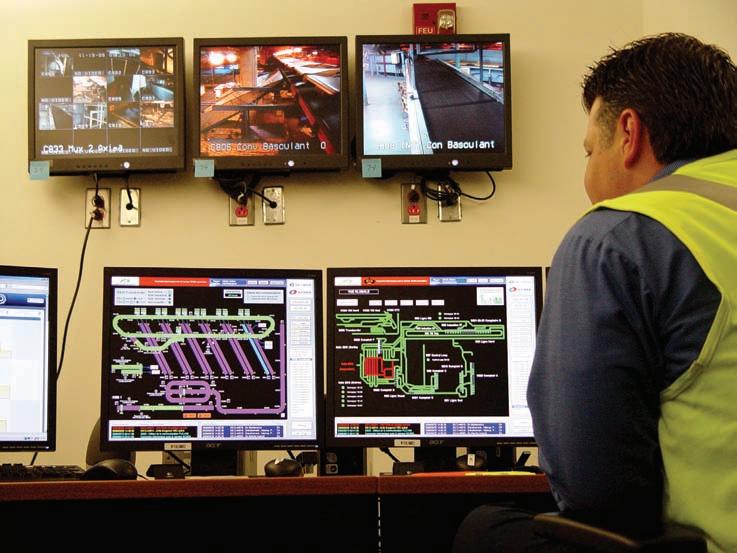
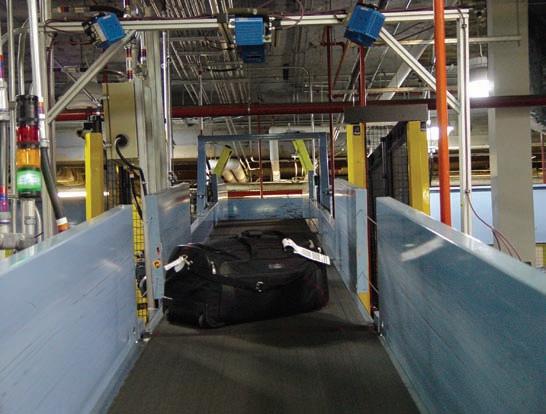
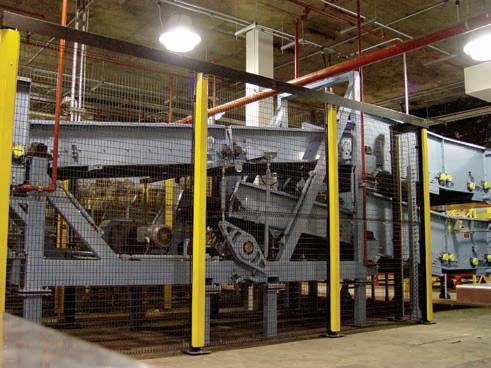
Hidden in the bowls of the Pierre Elliott Trudeau International Airport in Montreal is a labyrinthine system of conveyors, chutes, pushers, sorters and tilt trays, powered by hundreds of motors and bossed around by software that in turn makes split-second responses to endlessly-changing real-time data on sometimes thousands of pieces of baggage an hour.
Riding shotgun on this system is Axima Services, a Montreal-based technical management company. It took over the maintenance and servicing of the airport’s baggage handling system (BHS) in September 2005. The Trudeau airport (formerly Dorval International Airport) used to maintain the system in-house, but its growth, increased passenger throughput and an increasingly-complex BHS forced a review of maintenance practices. Airport operator Aéroports de Montréal (ADM) decided to get out of the BHS maintenance business and Axima won the maintenance contract.
“When you calculate everything, the maintenance budget has not gone up. Axima gets the latest technology and it is their responsibility to keep the staff training up to date. It does maintenance at many airports around the world. Going with an outsource service, we were gaining expertise,” explains Pierre-Paul Pharand, director, operations, ADM.
For example, the most recent belt conveyor ADM commissioned was in December 2005 under the guidance of the same Axima employee who was responsible for the building and start-up of the new bag room at the Athens International Airport in time for the 2004 Summer Olympics.
The Trudeau airport has three baggage handling systems. Two traditional belt-conveyor systems serve domestic and international traffic, and are considered as one in this article. The third system, commissioned in the summer of 2009 to serve trans-border (US-bound) traffic, is an entirely different creature and is not covered here.
The BHS, located under the main terminal, is fed via 135 ticket counters and seven bag drops. Dual, redundant conveyors between the ticket counters and the security room, where bags are
Collecting data, identifying weaknesses and making continuous improvements keep the Trudeau airport’s baggage handling system flying.
case of some BHS system failures. After passing through the security room, bags travel to a racetrack-shaped tilt tray system, which deliver bags to piers — airport-speak for the locations where handlers collect baggage on to carts and drive them to waiting aircraft.
That is the short version of the trip, but the delight and the devil are in the details: There are 1,600 pieces of equipment (70 different types) listed in the airport’s Maximo preventive maintenance
software program. There are six kilometres of belt conveyors, and 980 motors sourced from SEW Canada that range from 3/4 hp to 3 hp, with the exception of one 5-hp motor.
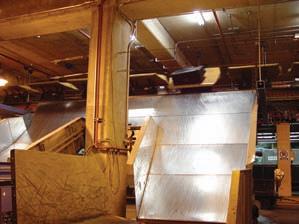
Twelve beefy vertical sorters shunt baggage up or down to different parts of the BHS. There are also pushers, ram-like devices that punt bags from one conveyor to another running at a right angle to the first.
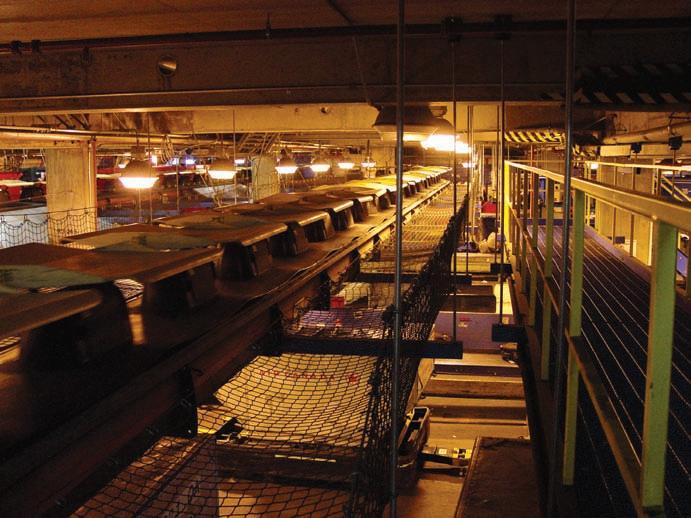
The tilt tray system is a 230metre long conveyor, but with a difference: rather than being made of rubber belts, it consists of 212 wooden trays that look suspiciously like the business ends of those seats found in elementary schools. The conveyor goes ceaselessly round and round, the trays tipping baggage into chutes at the correct piers. Suspended from the ceiling, the tilt tray system is the highest-maintenance part of the BHS, requiring 160 hours per month of preventive maintenance (PM).
In all, the 15 maintenance staff, which includes electricians, mechanics, PLC programmers and IT technicians,
handles about 100 work orders a month for the BHS.
The BHS is described as an electromechanical system with a high degree of automation, according to Pierre Loyer, director, Airport Group, Axima. “The equipment is simple and it is easy to maintain, but the system [software] on top of it is where the complexity lies: the automation and IT.”
Axima constantly strives to improve the performance of the mechanical system, which by one definition, is the rate at which it processes baggage. The design capacity of the BHS is 5,800 bags per hour. “We run a very intensive continuous improvement program so we can reduce our intervention with the system,” Loyer says. “We use Six Sigma on a daily basis.” (Six Sigma is a business management strategy aimed at improving processes and eliminating defects.)
“It is important to implement statistical measures for the system. At one merge, for example, we were having a lot of jams. The fact that we could measure
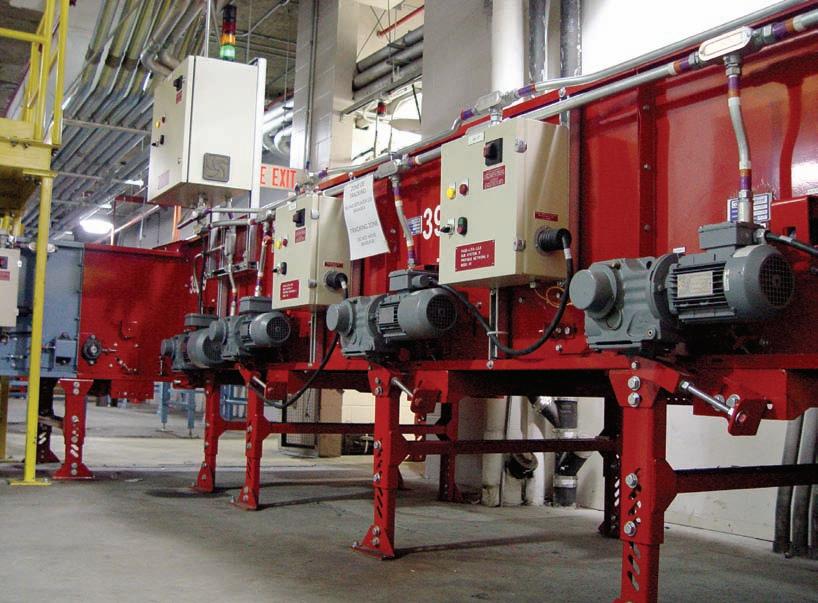
Above: The Trudeau airport in Montreal handled more than 12 million passengers in 2008. Right: The baggage handling system is monitored in real time and every incident is recorded for later analysis. Bottom: Cleanliness is key to the high read rate of the 360-degree bar code readers.
Photos by Carroll McCormick
UP & ROLLING 24/7
Bearings & Power Transmission • Hydraulic Components & Systems
Carrying a cost-effective supply of the industry’s most respected and trusted brands; Kinecor meets the needs of companies across Canada.
Actuators & air springs
Adhesives & lubricants
Bearings
From design engineering to equipment service and repair, Kinecor provides turn-key solutions that respond to your unique challenges.
Our stocking capabilities, national infrastructure and logistics management systems allow us to deliver your products on-time, day-in and day-out.
how many [there were] gave us information that led us to realize that we could change the con figuration of the merge.”
Every glitch, such as a jammed bag, automatically generates an event report, even though it may not affect the system. For example, while MRO Magazine was on site, a bag was caught up by its baggage strap, which had snagged on the corner of a conveyor behind a check-in counter. Loyer quickly unhooked it, but commented that the snag had nonetheless been logged.
This snag would not have happened had the check-in agent put the bag and its dangling strap in a baggage tub, according to Loyer. In fact, he notes, humans in the system cause far more problems than any mechanical issues.
“We can analyze the jams and go back to the airlines and train [their staff]. We ask airlines to let their personnel take an hour to tour the system and visually see the trouble that they can cause … a baggage strap can rip off a piece of belt.”
Axima keeps $600,000 worth of spare parts on hand. To ensure that the right parts are available, Axima has identified higher-risk parts of the system. “Our target is to always ID critical equipment and the critical parts. We analyze the risks, and the time to deliver parts,” Loyer explains. For example, there is a transformer that reduces a 600-volt feed to 480 volts for the tilt tray. Despite costing $15,000, Axima keeps a spare on hand: were it to fail, half of the BHS would go down. The transformer takes just 20 minutes to replace, but 14 weeks to order.
Far left: The baggage handling system has 980 motors.
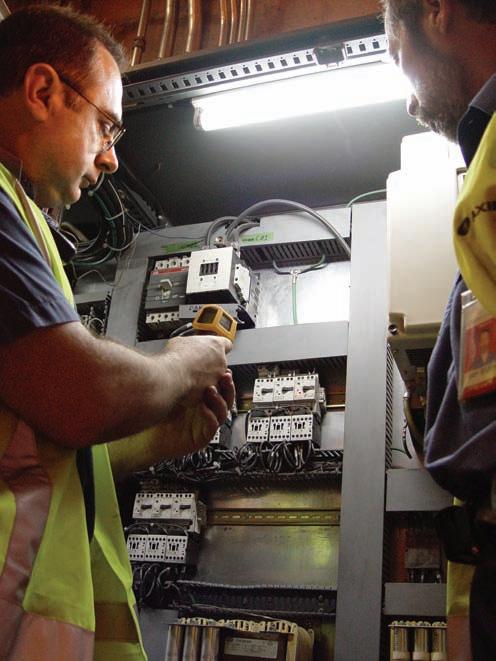
Left: Regular maintenance of the electronic systems ensures good uptime of the automated baggage handling system. Below: Beefy vertical sorters direct bags either up or down on to different paths of the system. Bottom: Racetrack-shaped, the tilt tray system delivers bags to waiting carts for a ride to their planes.
Bottom inset: A tilt tray drops off a bag at a pier.
In a six-kilometre system, conveyor belt selection is a science. “Belt selection is a big, big thing. They are chosen for the right friction situations, or whether the belts decline or incline. Belts can last for years, but if you use the wrong belt in an area, you will get a lot of wear,” Loyer says.
Cleanliness is another challenge, especially in the winter, when the urea used to de-ice the aprons creates more dust than usual. The BHS has nine locations where bag tags are read with bar code readers. Each reader consists of 12 heads arranged in a circle around a gap between two belts. This 360-degree coverage allows tags to be read no matter what their orientation, but as any shopper knows, bar code readers sometimes are unable to read the data. Loyer attributes the readers’ 96% read rate to regular PM on the heads, with extra attention to cleaning them in the winter. Regular analysis of the quality the output of the bar code printers helps as well.
Axima answers to ADM for the performance of the BHS, but meetings with ADM and the airport’s
tenant airlines are not just to discuss Axima’s report cards.
“A committee of airline, ADM and Axima representatives meet once a month to discuss performance, operational issues and expansion possibilities. This is a steering and operational committee. We give reports on the service levels, system uptime, intervention time, read rates, etc,” Loyer says.
The committee was struck after the BHS became common-use — that is, when all 39 of the airlines at the facility began using the same BHS, as opposed to each having its own. The exchange of information and good communication ensures that everyone understands their roles in keeping this hidden but critical part of the commercial aviation supply chain functioning smoothly.
MRO
Montreal-based Carroll McCormick, an awardwinning writer, is the senior contributing editor for Machinery & Equipment MRO.
For more information
You can use the Reader Reply Cards in this issue to obtain more information on the products and services mentioned in this article: Trudeau’s 980 motors, circle No. 401; Six Sigma, circle No. 402; Maximo CMMS, circle No. 403; conveyor
Packing program cuts water waste at mill
Compression packing program evaluates the specific requirements for Tembec mill’s pumps, resulting in a much longer life for the packing and a water consumption reduction of more than 72%.
BY BILL SEARLE
Over the years, many pulp and paper mills have been converting and simplifying their gasketing and packing supply in order to reduce problems across the country. Such was the case at Tembec’s Spruce Falls Mill in Kapuskasing, ON.
Tembec Inc. is an integrated forest products company with sales of about $2.4 billion and some 7,000 employees. With facilities in North America and France, it operates 40 market pulp, paper and wood product manufacturing units, and produces silvichemicals from byproducts of its pulping process and specialty chemicals. The company markets its products worldwide and has sales offices in Canada, the United States, the United Kingdom, Switzerland, China, Korea, Japan and Chile.
to determine the correct packing for any application at the mill.
As well, many other factors were taken into account, including the percentage of solids being pumped through the stuffing box, the pump manufacturer’s requirement for flush water, and most importantly, the access for the maintenance staff to install the product quickly and effectively, so it would work properly.
The first step was to determine the correct packing for each application for the 96 pumps operating in the Tembec facility. This information was document-
As for the action plan, Garlock of Canada provided on-site training for the trades as part of its service in providing the compression packing (a system set) through its corporate agreement.
The program has been in place since the summer of 2005, and since then, the yearly packing consumption has been reduced threefold. In addition, there has been a reduction in the manpower resource costs previously required. The team accomplished the goals that were set by Tembec and Garlock. But the most successful accomplishment was achieved by completing the initial water consumption survey to obtain the data for the successful repack of all pumps.
After all the tests and all the requirements were met, it was determined that the packing being used in all 96 pumps had a combined water consumption reduction of more than 72%. This was something that Tembec had not actively been looking for, so it was an unanticipated benefit for the mill and the company. The reduction in the cost of treating the water to operate its pumps was a bonus.
Over the years Garlock Sealing Technologies has grown the supply base to all the company’s mills throughout Canada, handling product conversion, product simplification and problem solving, all related to a rebate program which has benefitted Tembec over the long term.
In 1997, Garlock of Canada Ltd., Sherbrooke, QC (a division of Garlock Sealing Technologies), was awarded the contract to supply gasketing and packing to Tembec’s paperboard mill in Temiscaming, QC (the town where Tembec was founded in 1973, and which was featured in the 1975 National Film Board of Canada documentary, ‘Temiscaming, Quebec - A Town That Wouldn’t Die’).
Subsequently, after many conversions and successes at many mills, Garlock was contacted in 2004 by the Spruce Falls mill in Northern Ontario. The mill, in the town of Kapuskasing, had invested in 1996 in a new thermo-mechanical pulp mill (TMP) process. The mill’s TMP technologist, Ken Belanger, hoped that Garlock could help with the too-frequent repacking of pumps that the revamped mill required. At the mill, many work orders were being issued for the replacement of failed packing.
Initially, a complete survey was done jointly by Belanger and Garlock to determine the actual water consumption of each pump in the mill, a task that was extremely time-consuming. But Belanger had said he was willing to invest the needed time in order to come to a successful resolution for the plant’s future.
The initial goal was for the mill to get longer life from its compression packing and to extend the life of the packing from about six weeks to three months. These goals could and should have been easily accomplished with the correct recommendations. Unfortunately the mill had standardized its new TMP, at its startup, with one style of packing throughout the mill. This decision was the root cause of the problems the mill was experiencing.
The compression packing it was using was a good general-service packing for
standard- and medium-service requirements, but it was not capable of withstanding the harsher environment of the TMP process.
At the Spruce Falls mill, the longevity of the packing and the demand on its performance and capabilities were based solely on two main elements, the first being the speed of the pump, and the second being the media that was being pumped through the stuffing box. Those were the two most critical issues in order
ed and a chart was drawn up showing that many pumps required different configurations of two styles of packing, based on each individual piece of equipment.
The next step was to educate the staff on implementing the new packing program correctly, since — for many who know packing — its implementation is an old discipline that is not so much an educated science, but more of an acquired level of excellence gained through individual knowledge and experience.
How to maximize bearing life in food processing
There are four key factors to keep in mind when selecting and maintaining bearings for the food industry.
Food and beverage processes subject bearings to the harshest conditions, including high-pressure washdowns, frequent contact with acids, cooking fats and other chemicals, moisture saturation, extreme temperatures and antibacterial cleansing solutions. Bearings are vital components that must not only withstand these extreme conditions, but resist peeling, chipping, flaking and corrosion.
How can you maximize bearing life so that downtime is less costly, cleanups are quicker and maintenance is easier? There are four key factors to keep in mind when selecting and maintaining bearings for the food industry: proper lubrication, bearing type and style, the correct housing for the application, and seals and end covers.
Proper lubrication
Using the correct lubrication in the correct quantity can extend bearing life. Lubricants used in the food industry are classified as FDA/USDA H1 or H2 approved. Over-lubricating or under-lubricating bearings can increase friction and cause bearing failure. It is necessary to identify the right amount of lubrication for the particular environment.
In addition, there are a wide variety of
greases available and not all greases are compatible. Consult the manufacturer of your bearings to determine the correct type and amount of lubrication to maximize bearing performance and lifespan in your specific work environment.
Bearing type and style
Selecting the correct bearing type and style makes all the difference to a bearing’s lifespan. For example, for food processing facilities, stainless steel bearings provide corrosion resistance in these often-wet environments.
Correct housing for the application
For food applications, look for non-toxic, thermo-plastic designs reinforced with stainless steel. The advantage of these is that their smooth finish helps prevent bacteria from lodging in gaps or cracks. They are also chemical-resistant for less chipping or flaking during washdowns with detergents.
Also look for a solid base to prevent water and contamination from collecting, thus inhibiting bacterial growth.
Seals and end covers
Other components such as seals and end covers can help prolong bearing life.
“I’m extremely pleased with the results thus far,” said Belanger. “Further minor improvements are being looked at to enhance the ongoing costsaving program, with Garlock of Canada as a main contributor.”
MRO
All the information in this case study is documented and available through Bill Searle at Garlock Sealing Technologies, Stoney Creek, ON. E-mail bill.searle@ garlock.com.
Reader Service Card No. 409
Bearings must face high-pressure washdowns among other harsh conditions.
• Seals provide extra protection for bearing lubrication while preventing contaminant entry.
• End covers for housed units for foodgrade applications are made of thermoplastic, while non-food-grade bearings are made of pressed steel. End covers solve issues related to exposed shaft ends and workplace health and safety concerns, as well as possible contamination. MRO
These bearing life tips were prepared by NSK Canada Inc., whose products includes high-temperature bearings, mounted units complete with end covers designed to easily clip on without requiring special housings, and more.
Before: A one-size-fits-all packing specification wasn’t doing the job for the mill’s 96 pumps. After: Packing that was specifically selected for each pump application resulted in longer life spans.
Thermoplastic bearings handle plant’s assault
Different bearings extend maintenance periods substantially for electric lifts in wet and salty environment at Quebec bacon plant.
The roller wheels on the electric forklifts used at the Olymel L.P. bacon plant in Drummondville, QC, were causing some serious maintenance issues. The roller bearings in the wheels were constantly seizing after only a few weeks in service. The operating and service conditions for these electric lifts are arduous, as the environment is wet and salty.
The seals at the ends of the rolling element bearings would become damaged after exposure to the corrosive mixture (salt in water), and the contamination would cause the bearings to seize onto the shafts. These seals were not sophisticated in design (most are O-rings) and could be easily damaged when the packaged meat product, dirt, tie wraps, plastic wrap or other contaminants came into contact with them.
Replacing the roller bearings became expensive and time-consuming, so Marco Vachon, Olymel’s maintenance supervisor, decided to try some new materials manufactured by Thordon Bearings after he heard about some good results achieved at a nearby corrugated box manufacturer, Mitchel-Lincoln Packaging Ltd. of Montreal.
First, Thordon SXL was tested as the actual wheel part (no roller bearings) and the elastomeric polymer material lasted 16 times longer than the original combination of the wheel with rolling element bearings.
To extend the service life, Olymel then tried Thordon’s new engineered thermoplastic, called ThorPlas. ThorPlas bearings were made and used to replace the roller bearing element in the previous wheel configuration, a feature that was not possible with Thordon SXL, as only ThorPlas was capable of handling the higher pressures of the application.
The conversion to ThorPlas roller bearings in the wheels was done in August 2007 and almost two years later, the bearings are still operating satisfactorily. The electric lifts have performed well in this period with no noticeable wear or other issues to date.
Olymel plans to replace all the rolling element bearings in its roller wheels, as well as other applications, using ThorPlas. An order for 24 ThorPlas bearings was recently placed and another order for 48 is expected in the near future.
Olymel L.P., based in St-Hyacinthe, QC, handles primary processing, further processing, and distribution of pork and poultry meat products, with facilities in Quebec, Ontario and Alberta. Its trade-
marks include Olymel, Lafleur and Fla mingo, and its products are sold in Cana da and exported to 60 countries around the world.
Thordon Bearings Inc. designs and manu factures environmentally friendly, highperformance oil and grease-free bearings and seals for marine, hydro-turbine, pump and industrial markets. For more infor mation, visit www.thordonbearings.com.
Reader Service Card No. 420
Crashing Guns
Linear sleeve bearings keep automotive welding line running, putting an end to linear shafting and ball bearing problems caused by welding slag buildup.
The production line at a major automotive manufacturer centres around several machines, all working together with production staff to ensure high production rates and quality. A kink in this chain can halt production and greatly increase costs to a staggering level. In this case, the kink was a big one — crashing welding guns on the manufacturer’s production line — so help was called in.
When the manufacturer contacted PBC Linear, a supplier of linear and rotary motion solutions, the welding guns were running on conventional linear shafting and ball-bearing technology. Welding slag particulate collected along the shafting, causing the system to fall off track and machine inaccurately.
The slag buildup also caused the bearings to stall, seize up, and catastrophically fail — resulting in unplanned downtime and skyrocketing production costs.
PBC Linear recommended the use of
its Simplicity linear bearings and accurate shafting. Equipped with a FrelonGold liner to allow for a high tolerance against contamination, heat and shock vibration, the self-lubricating bearings were wellsuited for the welding application.
The automotive manufacturer recommended installing the parts in the two welding guns with the history of the highest slag accumulation. Eight months later, the manufacturer reported that the new shafting looked as it did the day it was installed. That’s because the Sim-
plicity bearings harmlessly wipe the slag and other contaminants off the shaft, promoting smooth and long-lasting linear motion.
With 150 other welding machines using failing ball bearings, PBC Linear was asked to install its replacement system on the plant’s remaining welding guns.
Top: Self-lubricating bear ings wipe away damaging welding slag. Right: Accu rate linear shafting allows for smooth motion.
BY ARIEL ORIEL
Machinery and maintenance professionals in industries such as woodworking, machine tools, paper processing, textiles, food processing and packaging often consider guide wheels based on their functionality in harsh environments. In fact, it is not at all uncommon for a guide wheel system to replace an existing linear motion system prone to frequent maintenance or failure.
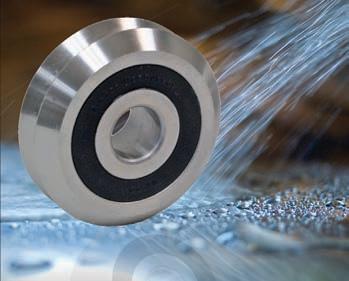
This is exactly how DualVee guide wheels from Bishop-Wisecarver originated. The design of the wheels provides the ability to outperform other linear motion technologies in environments where dirt, dust, metal chips, wood chips, textile fibre, food particles or other debris are present.
DualVee was invented and patented in 1967 by Bud Wisecarver while designing fertilizer packaging equipment for Standard Oil. The equipment’s flat rollers constantly became clogged with debris, causing the equipment to shut down. Wisecarver knew there must be a better way, and replaced the flat rollers with a double vee bearing, which handled the debris with ease.
The ability to excel under such dirty conditions is largely due to two primary
Washdown Challenge Dirt Busters
Other considerations
Guide wheels have other distinct advantages, providing the versatility to meet requirements in a wide range of applications:
Tough and reliable, guide wheels tackle any environment and excel under dirty conditions.
design features: sealed bearings and the guide wheel’s inner vee design.
Because a guide wheel’s bearings are self-contained and isolated from the environment, there is no contact between the bearings and the track. Other linear motion technologies such as profile rail or round rail systems feature bearings that are exposed to contaminants that settle on the rail. These bearings become clogged, resulting in performance problems, or in many cases, system failure.
In addition, contaminants, when mixed with lubrication, result in a sticky, greasy substance that increases friction and causes excessive heat generation. Maintenance and repair requirements can prove frequent and costly as a result.
A guide wheel’s inner vee diameter travels at a slower rate than the outer vee diameter, resulting in a velocity gradient that sweeps aside any debris that has settled on the track. As described by an equipment manufacturer in the wood and paper processing industry, DualVee forces the dust and glue off the ends of the track “like a squeegee.”
Other extreme environments
The double row angular contact design has now been incorporated into linear
guides and actuators, as well as hightemperature, low-temperature and washdown versions, to conquer the demands of a wide variety of extreme conditions. These specialty guide wheels are geometrically identical to the original wheels for interchangeability, and because they incorporate the same design features, they offer long life and reliability where debris is major a factor.
• Noise level reductions by as much as 20% compared to other ball circuit technologies
• Smooth, low-friction motion
• Speeds up to 5.5 m/s
• Acceleration up to 5 g’s
• Accommodates both axial and radial loading
• Inner or outer vee load-bearing surfaces. Guide wheels are easy to install, and because they are lubricated for life, they are virtually maintenance-free. Replacement, which is required less frequently due to long life, typically takes minutes. Adjusting a guide-wheel based system is relatively simple, with little to no surface preparation required, resulting in higher productivity, longer maintenance intervals, and reduced downtime. Guide wheels provide a cost-effective and long-term solution in dirty environments. MRO
Ariel Oriel is an applications engineer with Bishop-Wisecarver Corp. For more information, visit the website at www.bwc.com/products/dual-vee.html. Reader Service Card No. 423
Guide wheel comparison chart
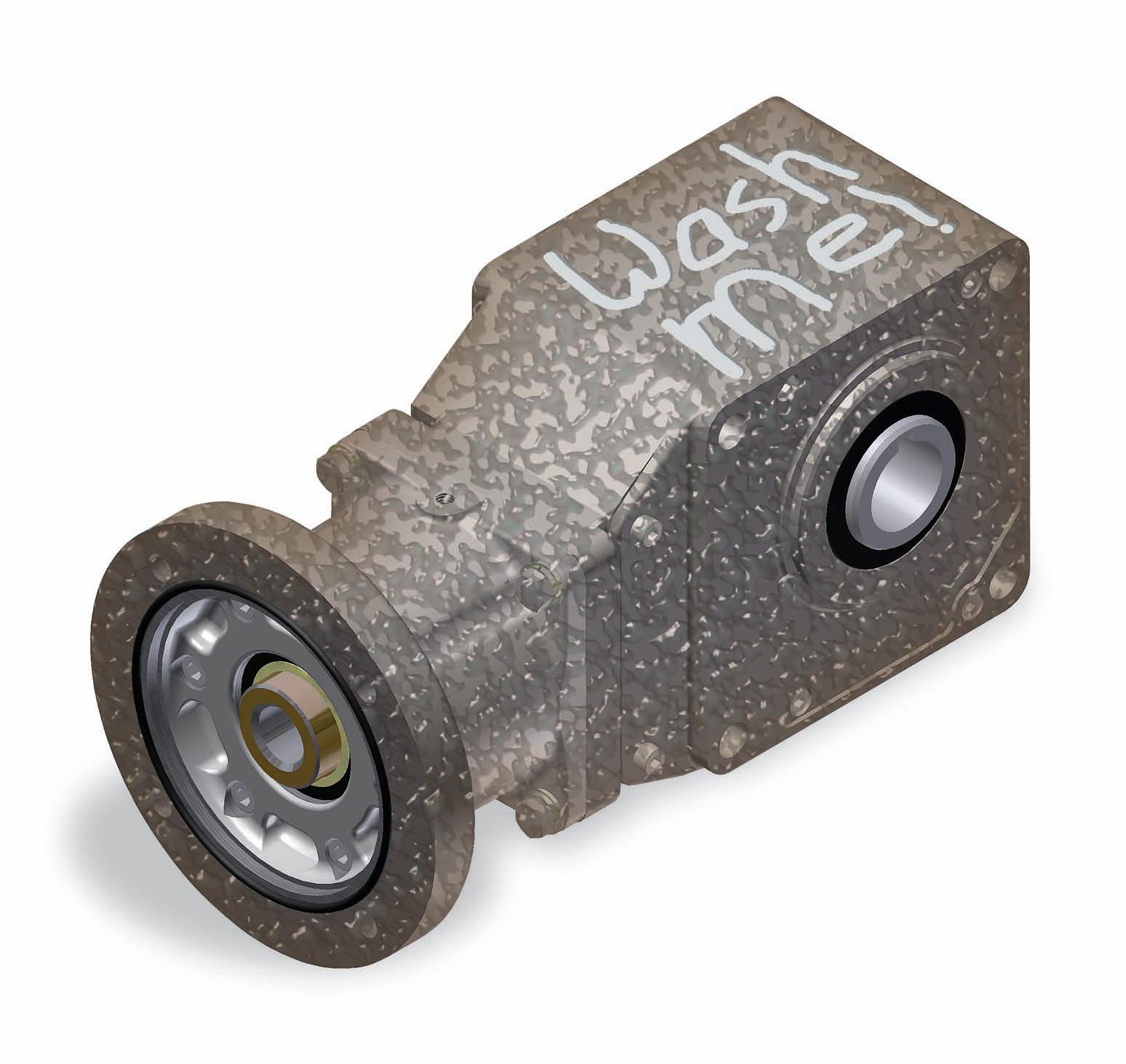
Choosing lubricants for harsh conditions and frequent washdowns.
Harsh environments call for specially formulated lubricants, and every application dictates the necessary properties for the ideal lubricant. Dusty environments lend themselves to solid lubricants that will not dry out and will not trap dust and dirt. On the other hand, extreme temperatures and frequent washdowns — as found in food processing facilities and other applications — call for lubricants that can withstand water, maintain their viscosity, control rust and corrosion, and will not be washed away. Research indicates that synthetic lu-
bricants can provide superior performance to mineral oils in extreme-temperature and wet environments. Mineral oils are produced using a solvent-based refining process. Due to the manufacturing process, they tend to retain a significant number of impurities, such as sulphur or aromatics, that result in decreased thermal and oxidative stability, leading to premature degradation of oil. In addition, impurities such as sulphur-containing species lend polarity to mineral oils, which can generate an increased rate of emulsification when compared to synthetics.
Synthetic lubricants are produced through chemical engineering and designed to meet certain performance parameters. Compared to mineral oils, synthetic fluids are inherently more chemically inert. Certain synthetics such as polyalphaolefins (PAO) lack polar sites, which means they offer no inherent attraction to water, allowing free water to separate from the oil and go to the lowest point in a system, where it can be easily drained off.
PAO greases used in the food and beverage industry possess the same properties as PAO fluids and can be formulated to be extremely tacky in order to resist water washout and spray off. For example, Molykote G-1502FG Synthetic Chain and Open Gear Grease has proven successful in washdown environments in food and beverage applications. It has demonstrated the ability to reduce the amount of grease used to lubricate washdown-application bearings. The grease stays in the bearing after repeated washdowns, reducing the ability of water to enter the bearing housing.
Polyolesters (POE) are synthetic lubricating fluids that possess excellent thermal and oxidative stability and can tolerate water very well. POE oils are often biodegradable. Due to these facts, POE lubri-
cants, such as Molykote L-4646 Synthetic High Temperature Compressor Oil, are a good choice in rotary screw compressor applications. POE oils have demonstrated greater than 14,000 hours of service life on a single fill. Unlike hydrocarbon-based lubricants, polyolester lubricants will not form varnish and sludge deposits.
Silicone fluids can be used to formulate greases that perform extremely well over a wide range of temperature extremes (-73°C to 288°C). Silicone fluids have an inherent viscosity index of 400500, which means that in comparison to other lubricating fluids, the viscosity of the oil will not alter much over differing operating temperatures.
Operating efficiencies may be increased as a result of lower viscosities of silicone lubricants at extremely low temperatures, since less energy is required to create motion and operate bearings and other mechanical components, leading to cost savings and lower carbon dioxide emissions. MRO
For more information about Dow Corning’s Molykote brand lubricants, visit www.molykote.com or e-mail industrial@
Left: A DualVee-based LoPro actuator operates where cement dust covers everything in the plant. Top: Cutaway shows the inside of the guide wheel. Bottoom: Guide wheels excel in dirty environments.
Photos: Bishop-Wisecarver
The success of vibration measuring equipment in bearing refurbishment for the aerospace industry has led to increasing interest from other areas of industry. This report gives details of the development of the technology.
Fifty years of ongoing development has given rise to a bearing vibration analyzer that can probe deep into rotating bearings while they are under load. Initially used as a production line tester, it’s now proving invaluable during the maintenance and refurbishment of gearboxes and other critical units in demanding applications such as aerospace.
However, the creation of a bearing vibration analyzer wasn’t as easy as some might think.
A good first step towards solving any problem is to get the facts. And that’s exactly what a group of senior engineers at SKF did in the early 1950s.
It was said that, collectively, the group members knew everything there was to know about bearing materials, bearing design, bearing manufacture and bearing applications. But still the SKF engineers had a problem. They were concerned about the causes of failure that bearings from all manufacturers were exhibiting.
Minute exterior examination of bearing components and bearing assemblies could only take them so far. They wanted more facts. They wanted to probe deep inside a bearing while it was rotating, and while it was under loads similar to those it would experience in service.
Intuitively, they knew that vibrations caused by the rotating and flexible parts in a bearing caused noise and could be a source of wear and bearing damage. But they also felt that understanding the vibrations better could tell them even more — perhaps even tell them what caused the vibration in the first place and how to design and manufacture in order to reduce the vibrations and the corresponding wear.
So the company set off on a path to develop an understanding of vibration phenomena in bearings, as well as find a method of measuring vibrations and connecting this back to distinct causes — as specific as rolling element induced vibration or damaged ring induced vibration.
By the mid-1950s, the group had successfully created its first vibration testing equipment for analyzing structureborne noise and vibration in bearings. It went on to develop equipment that would reveal problems hidden within a bearing, such as: dirt particles, cage noise, or form deviations in a component. Their search had revealed the factors that could lead to bearing failure and customer dissatisfaction.
Early milestone
Early versions of the equipment were introduced into production line testing but the group continued to probe further, until in 1965, one member of the group, E. Yhland, reached a milestone in the understanding of the quasi-static problem of bearing vibration.
His work became a contribution to es tablishing national standards such as AFBMA 13-1987 and DIN 5426 (draft). These standards define and specify the physical quantities to be measured and the test conditions to be applied. The equipment became of extreme importance for high-quality bearing production.
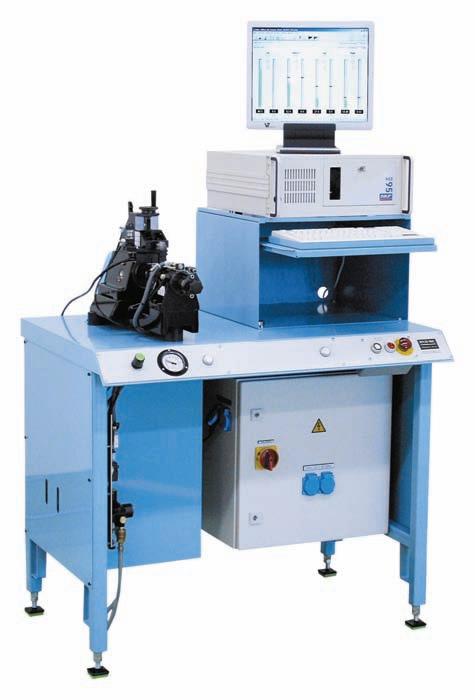
Today, SKF equipment such as the MVH Vibration Tester is used to analyze precisely the structure-borne noise and vibration of deep groove ball bearings, angular contact ball bearings, self-aligning ball bearings, and spherical roller bearings. The MVH is also used as the SKF reference equipment for these measure ments.
Operation of the MVH
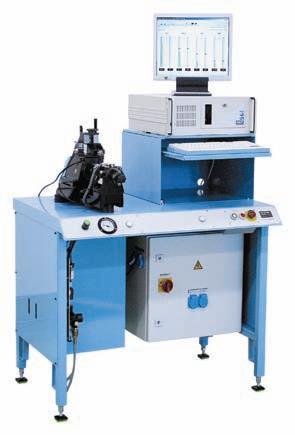
90C/200C Vibration Tester is semi-automatic, so when a bearing is to be tested, the only things to be done by hand are: the loading of the bearing on the test spindle, the pressing of two-handed start, and the removal of the bearing after the test.
Vibration analyzer ensures bearing reliability in gearbox refurbishing
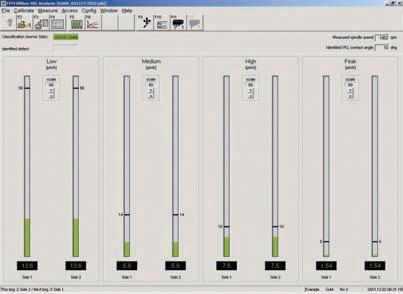
Median and High bands as well as Peak levels are recorded by the bearing analyzer. Below right: A bearing’s inner ring
An extremely precise sliding bearing spindle drives the inner ring of the bear-
Expanding vibration testing applications
SKF-developed vibration testing equipment used by Rolls-Royce for noise testing of bearings during gearbox servicing has been released for other applications. Release became necessary when Rolls Royce Deutschland decided to transfer service work on gearboxes for secondary power systems to the subcontractor Vector Aerospace in Almondbank, Scotland. Overhaul of the gearboxes required detailed inspection of more than 3,000 components, some of which require testing with special equipment. The components include various types of rolling bearings used in the gearbox, whick require stringent noise and vibration testing, and measurement of the radial and axial clearances.
Vector Aerospace selected SKF as the best suitable supplier of test equipment for the bearing tests. But before putting the equipment to use, it was necessary to run a release process with Rolls-Royce Deutschland. A detailed test and acceptance program was developed by Rolls-Royce Deutschland using reference and series bearings from different manufacturers to confirm the usability of the noise-test equipment after its installation at the Vector Aerospace site.
of a possible number of defect types, as well as detecting dirt particles, cage noise and form deviations.
Reducing costs and ensuring reliability
The great success of vibration measuring equipment in bearing refurbishment for the aerospace industry has lead to increasing interest from other areas of industry. There is also increasing awareness of the savings to be made from the re-use of bearings that have been tested and meet quality and reliability standards.
ing at a constant set speed, while loading is provided by an adjustable, pneumatic axial loading unit. When the automatic test cycle begins, the axial loading unit applies an axial load to the outer ring and moves the bearing against the testing spindle.
A pickup is applied to the stationary outer ring of the bearing and any bearing noise is measured, analyzed and displayed. After a pre-determined time, the axial loading unit returns to its rest position and the machine is ready for the next test cycle. Resetting for another type of bearing can be done quickly and simply.
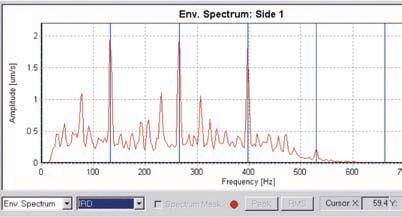
The tip of the pickup rests against the outer ring and converts the radial vibration of the bearing into an electrical signal that is proportional to the velocity of the pickup tip. When the signal is amplified and analyzed, the vibration level is measured in three frequency bands. The result identifies one or more
Other examples of the vibration tester’s versatility are its use in manufacturing companies where the equipment can be used to inspect incoming components, and its use in research departments to support R&D activities or act as a test rig for gears, motors or steering units and so on. The equipment is equally useful for grease noise testing.
Although the bearing vibration analyzer has come a long way since the 1950s, its development continues at SKF, where the search is on for even more accurate measurements and analysis. At the present time, research is focusing on three interesting areas: the application of different sensor technologies, the use of a detailed noise map, and the introduction of an expert system. MRO
For more information, visit SKF Canada at www.skf.ca. This article was supplied by Minett Media.
Top: Rolls Royce was an early user of vibration analysis for its aircraft services. Below left: SKF’s bearing vibration analyzer comes as a complete system. Right: Low,
defect is detected in this frequency test.
BY SIMON FRIDLYAND
any of my clients who are engineers complain that they are experts in their specific fields but might not necessarily be experts in machine or robot safety, or in areas such as flammable liquids.
Yet once your company becomes the owner or lessee of equipment with these concerns, it also becomes responsible for its compliance to the requirements of the Occupational Health and Safety Act (OHSA).
Owners and lessees of equipment or processes related to the storage and dispensing of flammable liquids, machine guarding, racks and racking systems, potentially explosive processes, dust collectors, molten metal and foundries, lifting devices, or occupational exposure to hazardous substances, are increasingly becoming responsible for making sure that the process, machine or device that will be used in their industrial establishments is in compliance with provincial OH&S regulations.
In Ontario, this is achieved through the so-called Pre-Start Health & Safety
Review process or PSR, where a professional engineer must review the hazards of the above equipment or process and issue a report that the equipment is in compliance with the applicable standards.
A section of the OHSA dealing with PSRs was substantially changed on October 7, 2000. The amendment allows the parties in the workplace to become more self-reliant in preventing hazards to workers — and they are now a major part of the internal responsibility system in the workplace.
The task of developing guidelines for engineers providing PSRs was assigned to Professional Engineers Ontario (PEO). Engineers carrying out the PSR must be
Legal accountability may occur through a lawsuit brought by an injured party. OHSA allows for fines and/or imprisonment for contravention of the act. This liability is not insurable and cannot be transferred to the employer if charges are laid against an engineer. This risk of liability warrants the necessity for personal liability insurance for engineers required to sign and seal PSR documents.
Failure to comply with the requirements of the Industrial Establishments Regulation in Ontario could now result in prosecutions and penalties for officers, directors, owners, lessees and engineers.
A corporation that is convicted of noncompliance could face a maximum fine of $500,000 per count. For individuals, the maximum fine is $25,000 per count, plus a 20% victim surcharge levied on all fines imposed by the courts, and/or imprisonment for up to 12 months.
The federal government has recently introduced amendments to the criminal code in Bill C-45. Under Bill C-45, new criminal offences are created for corporations and individuals who fail to protect workers and the public. Those who undertake, or have the authority to direct how other people work or perform tasks, are required to take reasonable steps to prevent bodily harm to any person arising from the work.
familiar with the equipment under review and must understand the principles of hazard analysis and issues related to occupational safety. He or she must have a thorough knowledge of the OHSA and codes and standards applicable to the equipment under review.
The professional engineers who sign and seal the PSR report are professionally and legally responsible for the statements made in the report. Engineers are held professionally accountable through the PEO’s discipline process, which may result in a reprimand, a suspension or revocation of their license to practice or other penalties if the PEO’s committee finds any wrongdoing on the part of the engineer.
To avoid unnecessary liability, many purchasers pass the responsibility for PSRs on to their suppliers by stating in their purchase orders that suppliers must obtain a PSR from a professional engineer, licensed by Professional Engineers Ontario, before a shipment is accepted. This policy has proven to be an effective one in ensuring that equipment is compliant before it is shipped. It requires original equipment manufacturers to supply a product that will comply with the regulations in the OHSA to avoid extra costs and delays.
MRO
Simon Fridlyand, P.Eng., is president of S.A.F.E. Engineering Inc., a Torontobased company specializing in industrial health and safety issues and PSR compliance. He can be reached 416-447-9757 or simonf@safeengineering.ca. For more information, visit www.safeengineering.ca. Reader Service Card No. 425
This article is part of an ongoing series. The introduction appeared in Machinery & Equipment MRO’s February 2005 issue and the series has run in every issue since. Previous instalments are archived online at www.mromagazine.com. In this issue, we pick up where we left off in the June 2009 edition, as maintenance manager Bob Edwards and members of his team return from an information-gathering visit to a big US paper mill. We join Bob on his way home.
Ireflected on what we had just seen as we travelled back from the paper mill in Wisconsin and realized that there was a constant theme of improving that ran throughout the plant, starting with the bottom line. We had made some strides in our own mill, but we still had a long way to go.
I must have looked pensive, as Carol, our reliability manager, commented, “Don’t worry, Bob, I know it’s a lot to think about, but I really believe that we only have to take small steps and we’ll be getting close. Everyone at our mill is poised to make the change. Once we really start, I’m sure the momentum will take over.”
By the time I arrived back at my mill the next morning, I had some ideas that would hopefully get the ball rolling. I called Joe Davis, the plant manager, to see if I could go over our visit to the US mill with him and tell him about my new ideas.
“Sure come on up to my office at 10.30 — I’m looking forward to hearing what you learned.”
Suddenly, Carol appeared at my office door. “Well what do you think — are you ready for the big push?”
“Come in, sit down. Let’s talk. I’ll be meeting with Joe later this morning and I want to run something by you. You saw how Chuck, the Wisconsin mill’s main tenance manager, was front and centre there. He wasn’t just their mill manag er; he was the champion for their operat ing mode. I’m going to ask Joe if he will do the same for us.”
“You’re right about Chuck. It was definitely top-down as far as the strat egy was concerned. But it was completely sustained by the guys on the floor.”
‘That’s it. I think we’ve got the guys on board and I know Joe supports us. We just haven’t pulled them all together. If we can do that, then Fred and his production group will have no choice but to join in. In fairness to Fred, as our production manager, he seems to be at least interested in changing. I know if Joe were to actively ‘champion the cause’, Fred would be fully on board”
a champion plan needs New
Follow along with Step 28 in a journey to World-Class Maintenance at the Plentya Paper Company as the team makes further progress towards its goals.
BY CLIFF WILLIAMS
up is fantastic, but it was all secondary to the results — and that’s something I wanted to talk to you about.”
Joe seemed a little uncomfortable at first, as I explained that Chuck was the champion at the plant and that he insisted that the end justified the means.
“Everyone at the mill talked the same talk — about the well-being of the company — so it was pretty obvious that this approach was top-down driven and that the guys on the floor sustained the approach,” I commented, stealing Carol’s words.
I talked about the pride and the neatness that was everywhere in the mill.
“I realize that we can’t make too many physical changes to our mill, but if we did things like brighten up the control rooms, use the 5S approach and start to involve everyone in a business perspective, I really believe we can make big improvements to our bottom line.”
“I’m sure you could get some of those things done — a few lights and a coat of paint here and there. You already involve your guys more than anyone, so that’s not a problem.”
able, the answer’s yes. If you mean, have they grown their business since start-up, that’s an emphatic yes. Are they the preferred supplier for their customers? Yes again. Do they have very little turnover? Yes, one more time!”
“Okay, okay. Those are good things about the company. But what about the mill?, Joe asked.”
“Well, we’ve seen the results at the other mill, so I think it’s worth a try.”
By the time I got to Joe’s office, I had a plan as to how I could get him involved.
“Come in, Bob. Tell me all about the ‘wonder mill’. Was it as good as
“That was about the mill, Joe, and pretty much anyone at the mill would have answered the same way I did. They all understand that those things are the most important ones and take great pride in telling you about them.”
Everyone is focused on the bottom liine “They’re all fine, but what makes the biggest difference between that mill and any other that I’ve visited is that everyone is focused on the bottom line.”
I went on to tell Joe about our discussion with Chuck, their maintenance manager, and Alan, their mechanical team lead, and about their insistence that the way they operated the mill was the way it was because they felt it would give them the best bottom-line results.
“Don’t get me wrong. The whole set-
The mill needs a champion for change “I guess I need to be more blunt, Joe. It’s not about what I can do; it’s about what can do. We need a champion at this mill. Someone who can transform what we in maintenance are trying to achieve into ‘the way we operate’, all based on the idea that what’s good for the company will be good for us all. And whatever is good for the individual must be good for the company. So what do you think, Joe? Can you be the champion?”
“I’m not really sure what to say, Bob. I don’t know what it is you want me to do.”
“That’s the problem Joe. I’m not really sure either. I just know that what I saw
Then I told him what I had in mind. “What I was thinking was that you make an announcement that we have an improvement project that involves everyone — something that is bottom-line driven.
“Right now we produce 565 tonnes of paper a day, so why don’t we develop a plan to increase it to, say, 600 tonnes per day? We could identify the issues that prevent us from reaching that level today and then develop a path forward. One of the things that I learned in Wisconsin is that succeeding is about partnerships — from a maintenance perspective, it’s partnering with operations, purchasing, scheduling and so on. Nobody succeeds alone.
“So what do you think?”
“Hmm, this actually falls in line with the corporate goals, so it may be a good idea. We could call it ‘Solution Six Hundred’ or something.”
“The way they approached it in Wisconsin was to explain what it is we’re hoping to achieve. Then they told everyone why they needed to succeed. This was followed with the plan for the road-
‘Succeeding is about partnerships — from a maintenance perspective, it’s partnering with operations, purchasing, scheduling and so on. Nobody succeeds alone.’
Key Points
Have a Change Champion. For change, use the 4 Ps:
Picture:
What you’re going to do.
Purpose: Why you need to do it.
Plan:
Which way you’re going to travel.
Parts to play: Where they fit in.
was followed with the plan for the roadmap and then it was explained — on an departmental and individual basis — what part they played in it.”
“Okay, I think I’ve got the idea, Bob. We could have departmental goals that would add up to 600 tonnes per day and we can ensure that if any department is struggling, then the rest help out. I’ll pull these ideas together and hold ‘town hall’ meetings this week to announce what we’re going to do.
“Obviously the first step will be to analyze what our problems are right now, and then, to be honest, I’m going to depend very heavily on you and the other department managers, as you will know more about the solutions.”
“Sounds good, Joe, but this can’t be smoke and mirrors. We’ll only get one chance at this and it’ll be a tough go for some people.”
I went on to tell Joe that the ‘fit’ of people in this sort of culture was extremely important. “They lost people early on as they couldn’t accept the way things happened; those that stayed took on greater responsibility.”
I described that there were no shift supervisors, and more importantly, the operators and maintenance took care of problems on the off-shifts.
“I don’t know how Fred will accept that. He likes to be called for everything.”
“That’s true, Bob, but obviously we’ll have to give the tools to the operators before we stop the calls to Fred. We’re going to think long and hard before we make these radical changes and you know what — we’re going to involve all levels in them.”
“Wow, that’s the spirit. Just be careful to let everyone know what their level of decision-making is.”
I brought Joe up to speed with the way things were done in Wisconsin and how they had adapted to 5S.
“We need to have someone trained in 5S, maybe one of Fred’s people.”
“I think we have enough work ahead of us, Bob. Let’s get this rolling but don’t forget that we need to track in detail what we are doing. Because of corporate’s response to your efforts, we’re going to have to give them a template to be rolled out.”
‘I’ll make a start on moving our department down the path we identified. This visit just reinforced that we’re on the right track.”
The meeting had gone better than I could have imagined and I felt confident that we could achieve a lot of the success I had seen in Wisconsin. MRO
Cliff Williams is the corporate maintenance manager at Erco Worldwide in Toronto, ON, and a consultant with TMS — Total Maintenance Solutions Inc., Markham, ON. He can be reached by e-mail at williamscliff@rogers.com.
Big Wheel
Clutches and actuators provide a smooth ride for China’s Great Wheel. The actuators can be subjected to low pressure jets of water from all directions, while the clutches keep the carriages steady in strong winds.
In Beijing, China, plans are underway to build the Great Wheel of China, a giant ferris wheel that will hold the record as the world’s highest observation wheel, with views reaching the famous Great Wall of China.
The wheel’s manufacturer, Sigma, is using linear actuators to open the doors and electromagnetic clutches to control the yaw of each of the 48 observation carriages. These components are being provided by Warner Electric, part of power transmission group Altra Industrial Motion.
When the world’s tallest ferris wheel is completed in late 2009, it will stand 680 ft high (208 m), which is over 130 ft (40 m) taller than the current highest wheel, located in Singapore.
The wheel will have 48 air-conditioned carriages that will each be able to hold 40 passengers, giving it a total of capacity of 1,920 passengers. The wheel will be so high that on clear days passengers will have a view stretching all the way to the Great Wall of China.
The wheel is predicted to make 750,000 rotations over a period of 50 years, so only products that are designed to deliver extended service life were considered, according to the manufacturer.
Linear actuators for each of the 48 carriages will be used as a secondary lock to prevent the door from opening during rotation. The actuator was designed in accordance to customer specifications, which included an adjustable end limit switch, end stroke signalling, specific stud, nut and washer arrangements, a manual release lever and extruded aluminium tube bodies
to avoid corrosion and reduce weight.
Warner Electric designs and manufactures a full line of maintenance-free linear actuators for applications ranging from light to rugged duty. Each actuator has an ingress protection rating of IP65, meaning they can be subjected to low-pressure jets of water from all directions. All products can be mixed and matched to accommodate custom orders quickly and effectively.
Each cabin of the Great Wheel of China has also been equipped with a Warner Electric electromagnetic tooth clutch to provide stability to the carriages. The clutches will prevent the carriages from swaying in the wind, which is necessary to prevent passengers from suffering from motion sickness throughout the 20-minute ride.
The clutches keep each carriage axis
vertical as the wheel rotates. If the carriages were left to hang freely, they could sway too much for comfort in the strong winds that are present at such a height. A tooth clutch provides higher torque in limited areas, which means that the relatively small clutches are able to stabilize the cabins, according to Pierre Lootvoet of Warner Electric. Each clutch has a flexible coupling that compensates for misalignments and allows for easy mounting. In the event of the transmission locking on the wheel, the clutch will be disengaged to leave the cabin free. A hand release lever also allows for manual disengagement. MRO
For information on the clutches and actuators used in this application, visit www. altramotion.com.
Reader Service Card No. 422
Above: Linear actuator and clutches are key components in the construction of the Great Wheel of China, the world’s tallest ferris wheel. Right: Electromagnetic tooth clutches provide stability to the carriages for the Great Wheel.
Recently, we have worked with some companies that have been trying to decide if it’s time to purchase a computerized maintenance management software system. I’m sure there are many other companies and facilities out there that are contemplating the same question. How do you know when it’s time the purchase and implement CMMS?
For many maintenance departments, the shift from a file cabinet full of equipment folders, purchase orders and preventive maintenance inspection lists, to a CMMS, is a big step.
Determining whether it’s a step in the right direction is often a very difficult decision.
So let’s look at some of the key warning signs that can help you make a strong case to move into electronic record-keeping … or not, as the case may be.
How do you know when you’re ready?
1. First of all, answer this question: how full is that filing cabinet?
Do you have 100 or more individual equipment files that you maintain with written service records? Do you keep a written file of equipment spare parts that you continually maintain and up-
How to justify a CMMS system purchase
BY PETER PHILLIPS
Answer these 10 questions and you’ll know for certain if you should invest in computerized maintenance management software.
date? Along with that, do you have another file folder for each machine that includes the preventive maintenance (PM) schedule and check sheets?
I’m not saying that you can’t have an impeccable paper file system. What I want to emphasize is the time it takes to maintain a paper system. Updating equipment service records, writing down spare parts and modifying inspection sheets takes time. As the file folders get thicker, it becomes harder to find the information you’re looking for. Even with a well-organized filing system, you have to admit that the bigger the file, the longer it takes to sort through the records to find that one piece of information you need.
only seconds — and often, equipment parts lists are automatically updated from the service records you create in the software.
2. Do you have a parts storeroom?
A threshold of about 500 parts usually means that you’re spending a fair amount of time ordering parts and maintaining an inventory of commonly used items.
The shortcomings of a paper system for inventory and purchasing relates to finding the right vendor when you need to order a part.
Overall, a CMMS will save most companies time and money.
By contrast, a CMMS can retain all your equipment records and return specific information in a fraction of the time it takes to look in the paper file. A CMMS can retrieve the data you’re looking for before you can even open the file cabinet drawer.
Updating parts list and preventive maintenance procedures in a CMMS takes
Renew Now!
Don’t let your free subscription lapse. More than ever, we think you’re going to need us in the months ahead.
Machinery & Equipment MRO is a trusted resource for over 18,000 readers serving a wide range of industries across Canada. Because of your role at your company, it’s available to you at no cost
But as our circulation list is audited twice a year, we you need to confirm your subscription information. Now it’s easier than ever!
Please take a moment to visit www.mromagazine.com
Simply click on Subscriber Services near the top of the left-hand column of our home page.
Maintaining your no-cost magazine subscription right now is easy and takes about a minute. Thank you for your support.
Shops that use a paper system tell me this is where they spend the majority of their time.
Do you want to know how many parts you have and where they are in the stockroom?
It’s advantageous to know where the parts are on the shelf, as well as the number in stock. With an electronic system, parts are easily located and reordering is very simple.
3. Would you like to consolidate your purchasing?
From a purchase savings perspective, it is nice to know how many units of the same item you’re buying. With this frequency of purchase data, you can talk to your vendors about some bulk purchases and discounts. This is difficult to do with multiple purchase order books.
4. Do you know when equipment is due for servicing?
When it comes to preventive maintenance, and when you’re trying to manually schedule inspections on the 100-plus pieces of equipment we described earlier, then it’s time to consider a CMMS.
Planning by keeping a manual PM schedule and the related inspection sheet takes too much time. I know some people that use their e-mail calendar to schedule PMs on their equipment. This does work as a reminder, but you still need to find and print the inspection sheets.
5. Is your to-do-list for equipment repairs growing longer?
Many people use a large desk calendar to plan their daily maintenance. When the calendar gets full, then a notepad is used to record the overflow. As the pad gets fuller, planning the work to be done just becomes unmanageable.
I know places that use this method and they have a desk calendar full of maintenance jobs, along with the parts that need to be ordered. One notepad has a list of repairs to do later and another pad has a list of parts to order. A lot of us have been in this position. I re -
member the time it took to review and maintain these pads.
Creating and scheduling work orders in a CMMS saves time. Even if you’re not doing the job until later or until the parts come in, a work order can be created and be ready to go. Software companies have made updating and closing work orders so easy that these records can be completed in seconds. You won’t miss your pads!
6. Do you want safety information on the equipment accessible to crafts people?
Because of government safety regulations, trades people need to know the critical safety issues on equipment before they begin work. This information includes such things as lockout procedures. In a CMMS, safety information is written directly on the work order automatically. This protects the employee and shows due diligence on the part of the employer.
7. Do you want to start tracking equipment costs?
I can imagine it would scare most people to death to think of trying to calculate the cost of maintaining equipment in a paper system.
Maintaining equipment history and costs have moved to the forefront of almost every organization, big or small. Justifying equipment purchases and keeping within maintenance budgets are now a normal process of doing business.
8. Do your customers want reports?
We work with agriculture companies that have different growing operations. Usually there is one maintenance facility that services them all. Many of their customers would like to see reports on the repairs to their equipment. They’d also like to have a schedule of when to bring their equipment in for servicing or annual overhauls. This very hard to do quickly in a manual system.
9. Are you going to start a certification process like ISO or HACCP?
There are requirements in some accreditations that stipulate the use of maintenance software and electronic records. The people who audit these certification programs will want detailed data on the equipment and the planned preventive maintenance.
10. Finally, do all of your maintenance information and planned activities reside in the heads of one or two people?
This is very common in many smallto medium-sized companies. It’s also risky business. When people are on vacation, taking sick time, or leave a company for good, it causes a major hiccup in the maintenance department. Some information is lost forever.
So if you are experiencing one or more of these signs, it might be time to research a CMMS that will fit your current and future needs.
People worry that maintaining and updating a CMMS will take too much time. If you’re one of them, you need to step back and have a closer look at the actual time you’re spending looking after your paper filing system.
What we have concluded after working with companies that have made the jump to a CMMS is that it actually saves time. Yes, it takes time to implement and learn the program, and this does cost money. However, after a short time, you’ll wonder how you got along without it.
MRO
Peter Phillips of Trailwalk Holdings, a CMMS consulting and training company, can be reached at 902-798-3601 or by e-mail at peter@trailwalk.ca.
416
What’s new for harsh environments
Washdown-duty motor line is easy to clean
Baldor offers a broad range of washdown and paint-free motors and controls, allstainless motors and speed reducers, linear motors and controls, and servo motors, gear products and mounted bearings. Suited to applications requiring high-pressure cleaning with caustic solutions, washdown motors include AC, DC, JM pump motors, inverter duty, vector duty and AC servo, in a choice of fin-
ishes. Paint-free and stainless motors feature non-contact rotating labyrinth seals, an additional varnish coating on the motor windings and stainless screwin-type drain plugs in four locations on each end. Super-E premium-efficient designs are available in every configuration. The all-stainless-steel speed reducers are easy to sanitize, minimizing bacterial contamination.
Baldor Electric
Reader Service Card No. 393
Ball screw performs in dusty environments
NSK’s V1 series of highly dust-resistant ball screws provides superior sealing performance and long service life. The series features specially profiled screw shaft grooves and high-performance seals that significantly reduce the rate of particle penetration, and provides highspeed operation at a maximum of 150,000 dN. Also, it has a low noise level and uses an internal ball recirculation method that results in a more compact ball nut than other models. The series is equipped
with the company’s K1 lubrication units, allowing for long-term, maintenance-free operation, particularly in environments where grease is either difficult to replenish or easily washed away.
NSK Precision America Reader Service Card No. 385
Receptacle is safe for use in hostile locations
Meltric has announced an addition to its line of hazardous-duty-rated plugs and receptacles. The DXN37C product line features plugs and receptacles with 37 electrical contacts, with each contact able to carry up to 4 A at 220 V. The products en-
able quick and safe connect and disconnect of machinery or systems with multiple control loops, feedback switches, photo eyes, lights and other devices with low amperage requirements. ATEX rated for use in zones 1 and 2 (gas) and zones 21 and 22 (dust) classified areas, they are suitable for use in hazardous environments.
Meltric
Reader Service Card No. 387
Conveyor end bearing keeps contamination out
Designed especially for the food industry, Ultra Seal conveyor end bearings from Technicor are blind ball bearings that prevent bacteria build-up inside the conveyor roller tube. Bearings are injectionmoulded acetyl with stainless steel balls. Popular sizes fit into standard 1-1/2-in. or 2-in. schedule 40 PVC pipe and come
ready for installation with stainless steel hardware: spring-loaded 5/16-in. diameter M8 threaded stub shaft, nut and washer. Additional sizes are available to suit various tube/pipe sizes.
Technicor
Reader Service Card No. 389
Rugged coupling has long service life
Oetiker has introduced an SV two-stage, heavy-duty coupling manufactured from high-quality materials and offering a robust design and long service life with low maintenance. Com plying with safety standard ISO 4414/EN 983, the couplings are simple to operate and have a two-stage disconnection safety feature. They find various application uses for compressed air and gas supply in extremely rough working conditions, such as marine and shipbuilding, steel mills, and oil and gas industries.
Oetiker
Reader Service Card No. 391
Washdown wheel seals out liquids Applications in washdown environments typically require frequent bearing replacement due to the ingress of highly corrosive fluids and loss of lubrication. Bishop-Wisecarver’s DualVee washdown wheels are claimed to increase replacement intervals at least three-fold, and they are inter-
changeable with standard vee wheels. The design features an all-stainless-steel con struction, FDA-approved grease, and an outer shield and inner seal for superior protection from liquids and debris. The outer shield acts as a momentary seal when subjected to a stream of high-velocity fluids, while the inner seal prevents liquid from entering the wheel and retains the internal lubrication grease.
Bishop-Wisecarver
Reader Service Card No. 390
Chains come in materials to suit all applications
Chain products from Drives Inc. are resistant to moisture, mild or aggressive corrosive agents and extreme temperatures. The company’s 300 series and 600 AS series stainless steel roller chains come in the most commonly used sizes. Nickelplated chains are designed to resist incidental contact or exposure to water or water-based washdown operations. Designed for applications that may be sub-
jected to mildly caustic or acidic environments, Silver Shield CR series chains consist of standard carbon steel components, coated with a zinc-aluminum compound. This combination provides a good alternative to stainless steel. All products are configured to meet the needs of the application, and come in standard packaged lengths or cut to length as required. Also, attachment link plates and extended pins are available for the most commonly requested ANSI power transmission and extended pitch conveyor chains.
Drives Inc.
Reader Service Card No. 392
Fabric hose withstands hot air
A line of double-ply silicone-coated glassfibre fabric hose has been introduced by Flexaust. Heat-Flex GS hose is reinforced with a spring steel wire helix and exter nal filament glassfibre cord. Designed for high-temperature air handling, this durable hose has a narrow pitch, combining a tight bending radius with a smooth air flow, and is rated for 550°F continuous and 600°F intermittent applications. It is resistant to many oils, solvents, ozone, water, fungus and alkalis, and is available in 3/4-in. to 12-in. I.D. sizes and standard 12-ft lengths with plain ends. Its standard colour is iron oxide red. Custom configurations are optional. Applications include plastics processing, exhaust evacuation, drying and brake ducting.
Flexaust
What’s new in bearings
Bearing line performs in clean room applications
NSK’s SpaceA series bearings, ball screws and linear guides is designed for use in operating environments in clean room, vacuum, anti-cor rosion, non-magnetic and highor low-temperature applications. Developed with vacuum lubrication and materials and thin-film technologies for space exploration equipment, these durable, long-life products incorporate special coatings and materials, including ceramic, anti-corrosion and solid lubricant, to meet the strict requirements for harsh operating conditions and clean room environments.
NSK Precision America
bearing pillow blocks are
Thomson’s new Lube for Life self-lubricating linear bearing pillow block assemblies eliminate the need for expensive lubrication systems and provide continuous bearing lubrication and enhanced protection for maximum linear bearing life and maintenance-free operation. Available for open or closed pillow block assemblies, Lube for Life can now be ordered as an option with Thom son Super Ball Bushing Bearing and Super Smart Ball Bushing Bearing Pillow Blocks. They come as a complete assembly for new applications, or in a retrofit kit for existing non
Geared slewing ring keeps costs down Igus has added a geared slewing ring bearing to its line of low-noise Iglide PRT modules. Geared PRT slewing rings are cost-effective and can be used in place of expensive ball bearings or rolling elements in many applications. The slewing ring uses self-lubricating, lowfriction polymer sliding elements in place of ball bearings. The geared version features the addition of a sprocket and a toothed system to drive the slewing ring. Available in plastic, aluminum or stainless steel and ready to install, it does not require lubrication. It is suitable for all environments, in particular assembly lines, machine tools, and semiconductor and clean room applications.
Igus
Reader Service Card No. 303
self-lubricating pillow block assemblies. Lube for Life pillow blocks work through self-lubricating cartridges pressed into each end of the pillow block housing, with the linear bearing
itself initially lubricated with EP2 grease. The Lube for Life polymer is under constant pressure against the 60 Case shafting, ensuring a film of lubricant is always present between the ball bearings and the inner race.
Thomson Industries, Inc.
Reader Service Card No. 306
Greases protect bearings against rust
Over 260 Locations Coast to Coast Across Canada
LPS Laboratories has added two bearing greases to its ThermaPlex line of bearing greases. Big Green bearing grease is an environmentally responsible, premium performance, biodegradable NLGI 2 grease that prolongs bearing life by withstanding extreme pressure, protecting against rust and corrosion, and offering superior water resistance. CS Moly bearing grease is a calcium sulfonate grease that is enhanced with molybdenum disulfide. This NLGI 2 grease reduces wear from vibration and offers a high load-carrying capacity and good rust and corrosion protection. Both greases are available in a 14.1-oz cartridge and a 35-lb pail.
LPS Laboratories
Reader Service Card No. 301
Self-lubricating bearing has long wear life
Simplicity self-lubricating bearings from PBC Linear provide smooth, quiet linear motion in the most severe environments. They withstand temperature extremes, heavy particulates, washdown and submersion, and shock vibration, all common causes of bearing failure. Maintenance-free and with no rolling elements to cause stickslip, the bearing cannot catastrophically fail. No additional lubrication is required.
PBC Linear
Reader Service Card No. 302
Bearings
keeps tidal current turbines turning
NKE supplies the bearings for the gearboxes of the SeaGen tidal current turbines in Northern Ireland. Tidal cur rent turbines are installed undersea and work much like an underwater windmill but are driven by the tidal current rather than air. The gearbox developers and manufacturers, Orbital2 and Wikov, selected NKE bearings partly for the quality of the company’s technical support and its short production lead times. The availability of large main rotor shaft bearings was a decisive factor. NKE supplies nine types of bearings for the gearboxes, including deep groove ball bearings, tapered roller bearings, cylindrical roller bearings and four-point contact ball bearings, with outside diameters from 300 mm to 1,090 mm.
Global Bear Reader Service Card No.
What’s new in clutches and brakes
Clutch/brake series suits aftermarket applications
Danaher has intro duced the Deltran MCS/ MBF series metric clutches and brakes. The RoHScompliant products are available in diameters from 63 mm to 280 mm (2.48 in. to 11.02 in.), torque ratings from 5.5 Nm to 500 Nm (49 lb-in. to 4,425 lb-in.), seven frame sizes and a wide selection of DIN 6885/1-compliant metric bores and standard metric keyways. Customized versions also are available. The clutches and brakes feature a zero backlash armature design, provide static or dynamic engagement and are rated for use in operating temperatures from minus 10°C to 40°C. These cost-effective products can be used as a drop-in replacement in such applications as material handling, packaging, factory automation and robotics.
Stainless steel clutch/brake provide smooth torque
Corrosion-resistant permanent magnet clutches and brakes from Warner Electric feature all stainless steel construction and require no electricity to operate. Since torque is independent of slip speed, smooth torque is achieved as low as 1 rpm up to 1,800 rpm. Perfectly smooth slip torque provides constant torque for tension or torque-limiting applications. Performance is dependable, as the units have no friction surfaces to break down or wear out. Bearings are made of 400 Series stainless steel, for extremely long life.
Altra Industrial Motion
Reader Service Card No. 353
Danaher Motion Reader Service Card No. 350
Clutch/brake withstands intense washdowns
The Warner Electric Uni Module EUM-W clutch/ brake is totally enclosed with a rugged housing to keep out contaminants for applications such as food processing conveyors that re quire clean operations and frequent caustic washdown. It is particularly suit able for applications that require frequent washing with high-pressure spray systems. Features include stainless steel shafts and USDA-approved coating, corrosion-resistant fasteners and special sealing accessories. The product offers rapid cycling, accurate positioning and soft, controlled starts and stops.
Altra Industrial Motion Reader Service Card No. 352
High-torque tooth clutch stands up to washdown
Disc brake caliper offers safe stopping
Conveyor backstop clutch allows fast line speeds
The release of the Morse high-speed conveyor backstop clutch product line has been announced by Emerson Industrial Automation. Available in sizes ranging from 7,000 ft-lb to 722,000 ft-lb, the Morse CB-HS clutch design packs more torque into a compact envelope compared to the current Morse conveyor backstop clutch and others. Such features as 28% larger spacers for a 64% stronger clutch and an ad vanced taconite sealing system make the clutch suited for critical applications, including inclined aggregate-con veying and coal-handling.
Emerson Industrial Automation Reader Service Card No. 351
should be fitted to the upstream end to prevent a catapult effect due to the reversal of belt tension. They also may be used for winder and haulage applications.
Altra Industrial Motion
Twiflex’s VKSD disc brake calipers provide safe control in heavy-duty mining equipment. In conveyor applications, the springapplied, hydraulically released caliper brakes are used for emergency stops, for normal stopping and parking, at junctions or wherever there is risk of personal injury, particu larly in underground mining. While these brakes may be fitted to the tail drum, driving drum or motor shaft, the company recommends that on long overland conveyors they
Reader Service Card No. 354
Friction lining extends clutch/brake life
Tribco manufactures Kevlar fibre textile composite friction material, marketing the material under the name Braketex for brake applications and Clutchtex in clutch applications. This is the first friction material that uses long Kevlar fibres in 100% levels, according to the company. It is claimed to last at least three to five times longer than such facings as asbestos, sintered bronze and moulded graphitics. Also, it will not abrade, scratch or score the opposing metal surface. The fibre composite lining is used in numerous metalforming, material handling, mining, agricultural and general manufacturing applications. While the lining costs more initially than other friction materials, it saves money in the long run through longer
Nexen 5H series tooth clutches deliver fast, no-slip engagement for washdown applications where high torque is required. They are completely enclosed, and their nickel-plated exterior and rotary seal withstand wet, corrosive environments common to food and beverage processing applications. They feature a torque range of 500 in.-lb to 12,000 in.-lb, with instantaneous torque at engagement up to 7,100 in.-lb. The nickel-plated exte-
wear life, lower maintenance costs and less unscheduled downtime.
Tribco
Reader Service Card No. 356
Clutches and brakes are built for heavy-duty tensioning AquaMaKKs water-cooled clutches and brakes from Wichita Clutch are air, hydraulic or spring-set actuated and feature non-metallic composite water jackets and heat-dissipating copper wear plates that
are optimized for heavy-duty continuous slip tension applications. These products are suited for applications in mining, logging and forestry operations, metal processing and metal forming, oil and gas, water/wastewater and offshore/marine. Available in sizes ranging from 19 in. to 36 in., they provide up to 3,400 hp heat absorption. Fewer parts means simple installation and maintenance, and the shim design makes the unit easy to maintain and adjust for wear.
Altra Industrial Motion Reader Service Card No. 355 MRO
Oil-Rite’s liquid level gaug es guard against low oil levels on hydraulic equip ment such as tanks, reser voirs, etc. Trogamid is a clear, round nylon tube that allows unobstructed viewing of the tank’s oil level. This durable material is compatible with many fluids and retains its clarity through various temperature changes. Features include aluminum bolts and end blocks, maximum pressure of 125 psi and maximum temperature of 205°F
Oil-Rite
Reader Service Card No. 360
valves, actuators and positioners. The software integrates with the Flowserve Logix 520si and 3200IQ HART positioners. Diagnostic tests that can be run include ramp signature and HDL. For positioners with actuator pressure management, the ramp signature test plots command versus position and compares these data to cylinder pressures. It can be used to identify such problems as tube fitting leaks, improper alignment of plugs and seats, and broken actuator springs. The HDL test calculates the four standard diagnostic signatures — hysteresis, deadband, repeatability and linearity — by opening and
Dual four-way valve broadens product line
The Pneumatic Division of Parker Hannifin has announced an addition to the Moduflex valve system series: a valve that combines two four-way valves into one valve body, offering two independently operated valves in the Size 1 valve body. Valve modules now can be ordered as dual valves or single valves. However, there is no difference in dimension or flow between double and single valve modules. Flow for each valve in the dual four-way valve is decreased in comparison to the single four-way valve. These valves can be combined with other dual three-way or single four-way valves of either Size 1 or Size 2 valves, without transition kits, to fit all types of applications.
Parker Hannifin
Reader Service Card No. 362
ing quick and easy. Designed for largesize, high-flow-rate piping systems, the strainers are available in sizes for 10-in. through 18-in. pipelines with flanged connections and iron or bronze construction.
Eaton
Control box can be operated remotely
Solenoid valve has low price tag
The Omega-Flo SV-3100 series two-way solenoid valves are direct-acting valves featuring brass and stainless steel construction and Viton seal material. Offering a temperature range from minus 10°C to 137°C (14°F to 280°F), these lowcost valves are suitable for neutral media such as compressed air, inert gases, water and synthetic oils. The series is CE compliant and offers the electrical connection options of a 1/2-in. conduit plug or cable clamp connector.
Omega
Reader Service Card No. 361
Hose clamp compensates for temperature change
A line of self-compensating hose clamps for low-pressure applications in single wire, double wire and constant tension band configurations has been introduced by Rotor Clamp. These clamps expand and contract with the hose in response to
temperature changes in the application. They cannot be over- or under-tightened, and are installed and removed easily using either manual or pneumatic tools. They are a suitable alternative to gluing hoses to manifolds in spa assemblies, which potentially could clog the hose line. Other applications include heating and air conditioning, automotive and trucks, utility vehicles, etc.
Rotor Clamp Inc.
Reader Service Card No. 363
Software runs diagnostic signatures for valves
Flowserve has introduced the ValveAnalysis software plug-in for Emerson Process Management’s AMS suite of asset management tools, enabling AMS users to run diagnostic signatures for Flowserve
closing valves. The signatures can be saved for future comparison to determine changes in equipment performance over time.
Flowserve
Reader Service Card No. 364
On-line configuration tool speeds valve selection
Asco has introduced an on-line tool for its 8290 Series actuated globe valve assembly that reduces configuration time and ensures a reliable flow control solution. The on-line configurator enables users to mix and match components and quickly select an actuated globe valve, solenoid pilot valve and position indicator in an assembly specifically suited to their applications. The compact yet durable 8290 series valve handles aggressive media and is suitable for power generation, water/wastewater and industrial dispensing applications. It comes in 0.375in. to 2.5-in. sizes and is available in bronze and stainless steel.
Asco
Reader Service Card No. 365
Pipeline strainer keeps flow moving
The duplex design of Ea ton’s Model 50 basket strainer allows it to oper ate continuously, so system flow never has to be shut down to clean the strainer basket. The strainer features two chambers linked by a pair of synchronized butterfly valves, allowing system flow to be diverted from one chamber to the other without shutting the flow off, and helping keep start-up pressure drops low. The design allows the total basket size to be reduced, while the available screening area is increased. Quick-opening covers make basket changing or clean-
Assured Automation’s line of weatherproof CB series control boxes allows users to operate the company’s electric or pneumatic actuators from a remote location. These compact control boxes are available with lamp indi cation for feedback confir mation of actuator/valve position (limit switch required). Features include highstrength, chemical-resistant, weatherproof enclosure, long-life lamps for 100,000 hours continuous use and protected LED modules. An on-line configurator allows the user to design and specify the options, providing an image of the box assembly and pricing. Applications include motor starters, pumps and valve actuators.
Assured Automation
our change, flush and load sequences, and different sequences and times can be programmed for every colour or parameter set. The system monitors, processes and quickly routes vital flow control data, while the operator interface permits system control with system configurations and data displays, text and graphic diagnostic computation and display. The system provides closedloop fluid control and can easily accomplish single- or multicomponent applications.
ITW Ransburg
Service rebuilds vacuum pumps
Mass-Vac offers a vacuum pump rebuilding service that restores current and obsolete rotary vane, rotary piston and other pump technologies used in research, production and semiconductor fabrication facilities.
Reader Service Card No. 367
Coupling can handle ultra-high-stress applications
CD couplings from Zero-Max, for use with fixed displacement hydraulic pumps driven by servo motors, provide the high dynamic load capacity and high torsional stiffness necessary to ensure reliable system opera tion. The working part is made of a rugged com posite material, which can withstand the pun ishment and stress of a servo motor. The cou plings are available in single- and double-flex aluminum hub models with or without keyways. The single-flex models have a torque capacity range from 40 Nm to 1,436 Nm and beyond with speed ratings from 4,400 rpm to 17,000 rpm. All models are environmentally friendly and are manufactured from RoHS-compliant materials.
Zero-Max
The service includes an evaluation of what caused the pump failure and a review of the customer’s application and installation, and offers maintenance recommendations to prevent future vacuum pump failures, along with suggestions for filtration products where applicable. Rebuilt pumps receive rigorous testing, several oil flushes and a thorough inspection before shipment.
Mass-Vac
Crimping system is easy to use
Reader Service Card No. 368
Flow metering system is versatile
The DynaFlow CC fluid metering and mixing system from ITW Ransburg delivers fast, concise and repeatable material flow for up to eight applicators and is configurable to either 2k meter mix or 1k flow control to meet application requirements. The graphic display optimizes col-
Parker’s Parkrimp crimping system enables anyone to make factory-quality hose assemblies quickly, easily and cost-effectively. The crimpers require no calibration, thus avoiding the need to dial variable settings, which can produce mis-crimps. Seven models are availa ble for crimping straight or bent-stem fittings from 1/4 in. to 2 in. in diameter. The company’s Parkalign system features a positive-stop design that positions the fitting correctly in the die, and bottom-loading crimpers make it easier to manage long hose assemblies. Dies are linked together to prevent mismatching and colour-coded according to size.
Parker
Reader Service Card No.
Reader Service Card No. 366
What’s new…
in products, systems, components and accessories for machinery and equipment maintenance, repair and operations.
Ion exchange units are durable
Hydac ion exchange units were developed for the conditioning of phosphateester fluids, which are vulnerable to acid formation. Designed for hydraulic and lubrication oil tanks of up to 20,000 litres, they remove acids resulting from hydro
lysis and metals from previous treatment with fuller’s earth or active aluminum oxide. Features include good resistivity of the fluid, long service life and low disposal costs. The company recommends that these units be used in conjunction with a Hydac FAM Aqua mobile dehydrator.
Hydac
Reader Service Card No. 317
Degreaser cleans without solvents
An environmentally safe, green product, T-91 non-solvent degreaser from LPS Laboratories does not contain any solvents and has good cleaning ability to remove grease and oil in such applications as basin-style parts washers and dip tanks. This biodegradable, non-flammable and non-toxic degreaser has zero VOCs and meets the U.S. Environmental Protection Agency’s ‘Design for the Environment’ requirements. It has a neutral ph of 7.3 to 7.7. The degreaser is available in a 1-gal container, 5-gal pail and 55-gal drum.
LPS Laboratories
Reader Service Card No. 310
Guide demystifies IR windows
Iriss has announced the release of a guide entitled 10 Things You Need to Know About Infrared Windows. This pocket guide clarifies key points and concepts and presents tips and technical details, all based on practical, real-world experience. The author of the guide, the president of Iriss, as a manufacturer understands the engineering and scientific issues, but also has practical knowledge as a Level III thermographer with many years of experience.
Iriss
Reader Service Card No. 311
Self-adjusting locking pliers have strong jaws
Cooper Tools has introduced a line of time-saving, self-adjusting locking pliers. Crescent RapidVise pliers automatically lock on to objects of different thick-
nesses at a preset pressure without any user adjustment. Features include strong jaws, angled tooth pattern and a nickelplated finish to protect against rust and corrosion. The line currently includes a 10-in. curved jaw with wire cutter and an 11-in. C clamp in swivel-pad and regulartip versions. The line soon will expand to include 5-in. and 7-in. curved jaw styles and 6-in. and 9-in. C clamps. The tool is suited for welding, metal fabrication and HVAC applications, general maintenance and repair operations, automotive service and many other uses.
Cooper Tools
Reader Service Card No. 329
Self-adjusting cushioning is for pneumatic cylinders
The PPS self-adjusting pneumatic cushioning system from Festo makes it possible to achieve a dynamic but gentle cushioning action into the end position of cylinders without the need for manual intervention. The system ensures optimum cushioning action, even if parameters such as pressure and friction change. It also reduces the acceleration forces acting on components and workpieces, reducing wear and minimizing vibration. The system is available with the Festo round cylinder DSNU.
Festo
Reader Service Card No. 312
Drip pan sucks up large leaks
Oil Eater has introduced an absorbent drip pan designed for leaks that are too large for an absorbent pad or that occur in cramped spaces, such as under machinery
and pipes. The drip pan is made of sturdy plastic and houses an eco-friendly, nosplash, absorbent pillow made of plant fibres and other reusable resources. When soiled, the pillow is easily removed and replaced with a new one. The drip pan measures 10 in. by 12 in. by 4 in.
Oil Eater
Reader Service Card No. 313
Food-grade lubricant is for use in canning industry
Petro-Canada has announced that its Purity FG SeamerE fluid is recognized by PneumaticScaleAngelus, a division of Barry-Wehmiller and a worldwide provider of packaging automation equipment. The recognition includes no objection for the use of the fluid in seamers of the series: 61/62H, 80/81L, 100/101L, 120/121L, 140S, 180S and 12M.
A mineral-oil-based product formulated for use in highspeed, continuous-lubrication seaming units, the fluid fits well in HACCP and GMP plans, and carries NSF H1 ap proval for use in food processing plants where incidental food contact may occur. Features include product stability for extended fluid life, good load-carrying properties and corrosion inhibition.
Petro-Canada
Reader Service Card No. 315
Emergency stop switch has long working life
The ER series rope pull emergency stop switches from Omron spans from 40 m to 200 m for emergency stopping capability along the entire rope length, while reduc-
ing the number of required switches per application. All models are available with a top-mounted, metal emergency stop button that provides emergency stopping capability at the switch end of the installation. In addition, the switches are available with a dual-indicator LED beacon that may be wired to flash red or glow a constant green, indicating the status of the switch. The series features a heavy-duty IP67 (NEMA 6) die-cast housing and stainless steel eye nut for reliable operation and long life in demanding industrial environments.
Omron Scientific Technologies
Reader Service Card No. 318
Infrared camera sees through flames
FLIR’S GF-series infrared cameras, previously know as GasFindIR, includes two IR cameras designed to detect industrial gas leaks and protect workers from leaking gas, which can cause fires and explosions. The GF320 is engineered to image VOCs including methane, sulphur hexafluoride, carbon monoxide and many other gases. It can scan large, hard-toreach or dangerous areas from a safe dis-
tance, and allows workers to detect and trace even small quantities of gas leaks to their source. The GF309 is engineered for high-temperature furnace applications. It helps workers detect such problems as coking, scaling and ash build-up. Both cameras feature in-the-field playback of images, embedded GPS, embedded temperature measurement data and a flip-out, full-colour LCD.
FLIR Systems
Reader Service Card No. 316
PPE catalogue details hand protection
Ansell’s North America Protection Solution Guide is a hand protection and apparel product catalogue designed to simplify the glove selection process by coupling product information with comparison charts and application images. The catalogue features 100 products, in three protection categories: mechanical protection, chemical and liquid protection, and product protection. The company uses green publishing technology to print the guide, including the use of recycled paper stock and soy inks. At the end of its use, the guide can be recycled.
Ansell
Reader Service Card No. 314
Quick-clamping shaft
collar
adjusts without tools
Ruland has introduced quick-clamping shaft collars. Allowing for quick adjustments without tools, the collars are suitable for printing, packaging, medi cal, machine vision or semi-conductor manufacturing equipment to retain frequent ly adjusted items such as rolls of media, guide rails or other set-up fixturing. They are made from aluminum for light weight and low inertia and have an anodized finish. The hardware on the collars is made from stainless steel. Available bore sizes range from 8 mm to 35 mm and 5/16 in. to 1 1/2 in.
Ruland Manufacturing
Reader Service Card No. 319
MRO
PTDA’s Canadian Conference targets distributor needs
Niagara Falls, ON — The 2009 Power Transmission Distributors Association (PTDA) Canadian Conference brought together the power transmission/motion control industry’s leaders for an insiders’ focus on Canadian industry trends. Held May 28-30, 2009, at the Sheraton Fallsview Hotel and Conference Centre in Niagara Falls, ON, participants left the conference with a heightened understanding of the drivers of the Canadian economy and associated opportunities for power transmission/motion control (PT/MC) manufacturers and distributors.
The conference was kicked off by Jayson Myers, president of the Canadian Manufacturers & Exporters (CME), who set the stage with an enlightening Canadian economic forecast. Myers reiterated the importance of manufacturing in Canada — manufacturing is the single largest business sector in Cana-
da, accounting for 14% of Canada’s GDP — and provided an in-depth economic overview. He also emphasized new market and business opportunities for Canadian manufacturers and distributors.
According to Myers’ presentation, Canadian companies will continue to be challenged by the tightening of the US credit market and high levels of risk and uncertainty, but there are a number of opportunities for companies that build a strategy around differentiation. Organizations that continue to innovate and explore new markets, while focusing on what customers value and on eliminating waste, have an advantage as the economy stabilizes.
Following Myers’ analysis, delegates attended in-depth market briefings on: • Infrastructure with Martin Doble, global managing director, Hatch Engineering
• Mining with Tim Gallant, Iron Ore Company of Canada
• Hydroelectric with Rick Everdell, project director, Niagara Tunnel Project, Ontario Power Generation, and • Aerospace and industrial engine manufacturing with Kevin Sodhi, commodities management global purchasing, and Antonio Columbo, key supplier initiatives, Pratt & Whitney Canada.
Attendees also listened to a presentation by Pat MacDonald, director of consulting for continuing education for Mohawk College; Ted Chisholm, vicepresident of finance and IT for BDI Canada Inc.; and Richard Ayuen, regional vice-president, Central Canada, for Kinecor LP, on the Industrial Careers Pathway program at Mohawk College in Hamilton, ON.
A partnership between industry leaders and the college has yielded the unique Industrial Distribution Leader-
ship certificate program at Mohawk College, helping local distributors hone key skill sets in business principles, operational awareness, client service principles and leadership training/coaching.
A cohort of nearly 25 students is making its way through the program, which includes five core courses and a capstone course that provides an opportunity for students to apply the program’s lessons to their own work environments.
An energizing closing keynote address by Larry Smith, president and CEO of the Montreal Alouettes Football Club, concluded the Canadian Conference. Smith is an expert on successfully managing people within an ever-changing environment and shared the strategies he uses to bring out the best in a team. Smith emphasized the importance of developing a personal life plan that includes lifelong learning.
Next year, the Canadian Conference will be held June 3-5, 2010, in Montreal. The program is open to all PTDA members selling product in Canada — distributors and manufacturers — as well as non-members who qualify for membership.
For more information, visit the website at www.ptda.org/CanadianConference.
John Palumbo, Accurate Bushing, and Dave Cummings, Advantage Sales Network.
Neil Richer and Oswaldo Almeida, NSK Canada, flank Mary Sue Lyon, PTDA.
Retiring Barry Nicholson, Kaman Industrial Technologies, was acknowledged for his service to the PTDA as Ajay Bajaj, Rotator Products, and Paul Meo, NTN Bearing Corp. of Canada, look on.
Barb Ross, Drives Inc., Terry Hutton, PTDA, and Marci Reuby, Tsubaki of Canada.
Scott Bebenek, IDI Independent Distributors Inc., and Yoji Nagata, Koyo Canada.
Wendy McDonald, BC Bearing Engineers, and Tom Karch, SKF Canada.
John Grainger, Cooper-Grainger Canada, Paul Dent, Posi Lock Puller, and Chip Myer, Oilite Bearings.
Don Brownrigg, SM Cyclo of Canada, and Jim McGee, Bonfiglioli Canada.
Bob Ramsden, Rexnord, Mary Sue Lyon, PTDA, and Evan Boere, Timken Canada.
Rick Hamilton, Renold Canada, Steve O’Brien, Advantage Sales Network, and Patrick Gregoire, Renold Canada.
Ian Goodland and Dan Robinson, ITW Devcon.
UNMATCHED ENGINEERING EXCELLENCE FROM THE SCHAEFFLER
PowerTherm Induction Heaters
Many rolling bearings and other rotationally symmetrical parts made from steel have tight fits on the shaft. Larger bearings and parts - in particular - can be mounted more easily if they are heated first.
Induction heating is superior to the conventional methods, and particularly suitable for batch mounting. Heating is carried out on complete bearings, rings for cylindrical roller or needle roller bearings and rotationally symmetrical steel parts such as labyrinth rings, roll couplings, etc.
Advantages
• Quick, safe and energy-efficient operation
• Environmentally friendly - no disposal required
• Uniform, controlled heating
• Automatic demagnetization
For the mounting of bearings and parts with a mass up to 300 kg, Schaeffler supplies five FAG brand table-top heating devices -
PowerTherm HEATER10 to 300 - suitable for mobile and/or stationary use. For parts with a mass as great as 3,000 kg, Schaeffler offers and recommends heavy duty standalone devices.
Driven to E xtremes
The constant evolution of capacity and efficiency in the field of power transmission increases the standard to be achieved in technical product design. And in the selection of technology partners. Drawing from years of close collaboration with designers and manufacturers, Schaeffler Group implements the latest technology into compact and powerful INA and FAG bearing design solutions. From industrial gears and transmissions to wind turbines and modern rail applications, Schaeffler is driven by innovation and operational reliability to achieve extreme standards of performance.
Transport and Mounting Tool BEARING.MATE
BEARING.MATE is an accessory used for the safe quick and easy handling of medium-sized and large rolling bearings. It can also be used where bearings are heated prior to mounting. The tool is comprised of two handles and two steel strips. Turning the handles clamps the steel strips firmly on the outer ring of the rolling bearing. The compact packaging also includes two brackets to be used when handling spherical roller bearings and selfaligning ball bearings. The clamps secure the bearing in order to prevent tilting of the inner rings.
The tool and bearing can either be carried by two people or by crane using slings (ordered separately). If two carrying slings are used, the rolling bearing can be rotated to any position when transpor ted bycrane. During heating on an induction heating device, the BEARING.MATE remains mounted on the bearing. The steel strips expand uniformly with the bearing, maintaining optimum tension.
BEARING.MATE is recommended for use in conjunction with bearings weighing as much as 500 kg, and can tolerate heating temperatures as high as 160°C. It is available in three different sizes that can be matched to bearing outside diameters ranging from 250 to 850 mm.
For additional information about PowerTherm induction heaters or BEARING.MATE, contact your local Schaeffler representative or visit www.fis-services.com