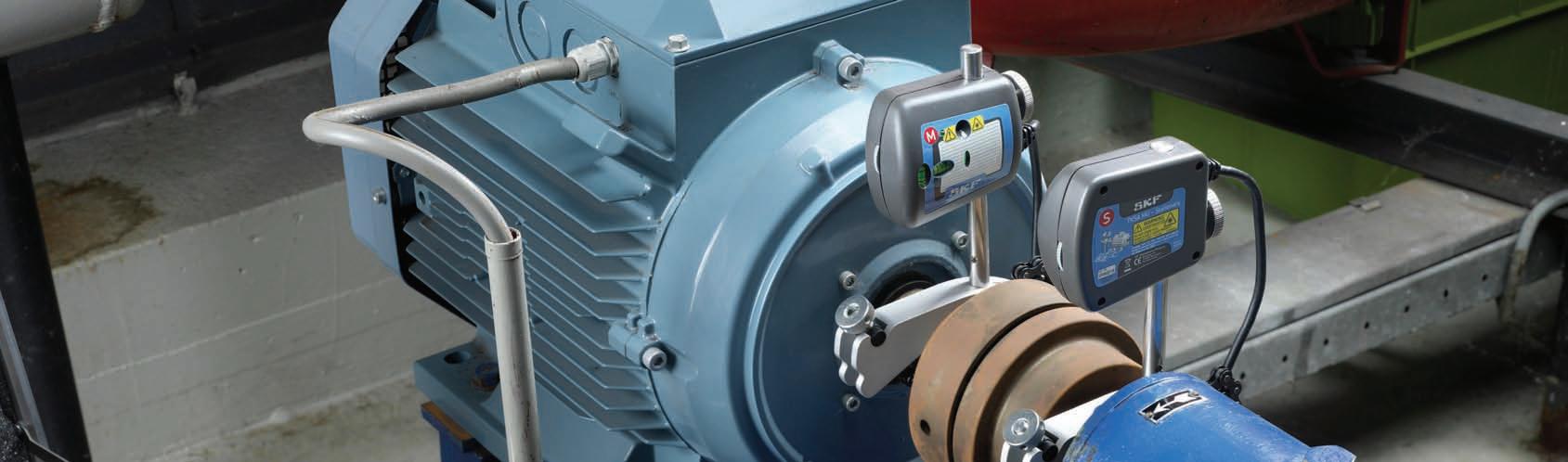
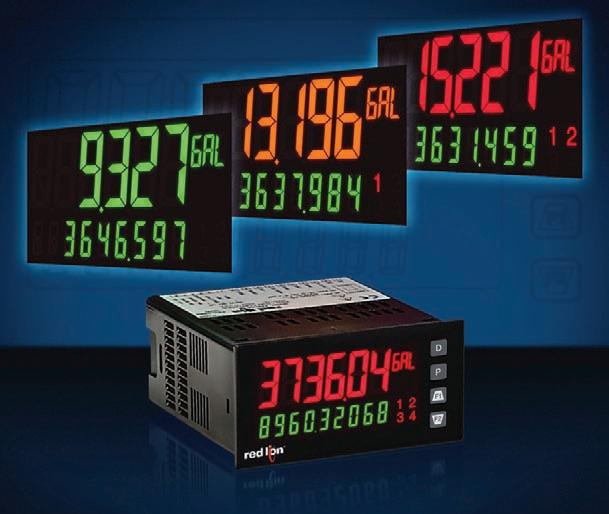
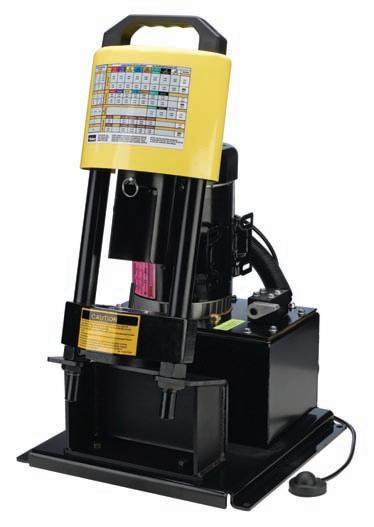
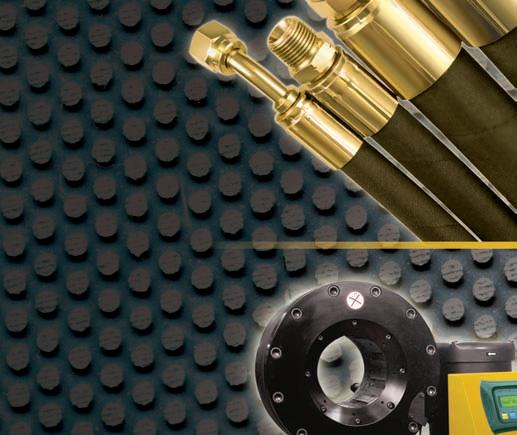
HoseFinder is a mobile application from Parker Hannifin that makes it fast and convenient for customers to search for hydraulic hose products and information on the go. The application features an abbreviated STAMP (Size, Temperature, Application, Media and Pressure) selection process. Using this app, customers can quickly narrow down suitable hoses by choosing the criteria that meet their needs. Once they have identified a product, a Find It option locates the nearest Parker distributor. The product details can also be forwarded to a colleague. Available at no charge at www. hosefinder.com, the app currently is compatible with Apple’s iPhone and RIM’s Blackberry handsets. Android and Windows Mobile versions will be added soon.
Parker Hannifin
Reader Service Card No. 328
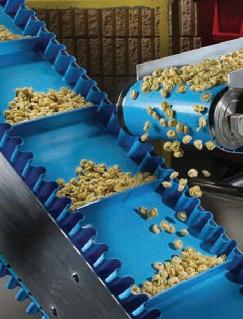
Non-sparking conveyor roller bearing isolator has long service life
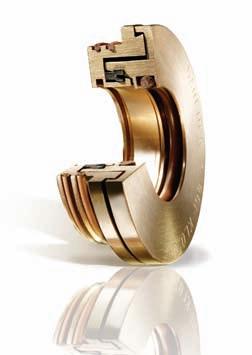
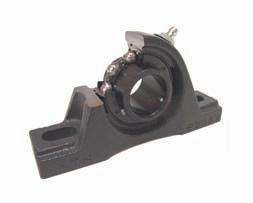
Garlock has introduced the Klozure Guardian non-sparking, conveyor roller bearing isolator. The nonsparking design prevents the failure mode, and the non-contacting labyrinth design features easy-to-install Cam-Lok o-rings. Offering IEEE 8412001 IP56 rating, the product prevents dust and liquid from entering the bearing housing. The bearing isolators are available in sizes ranging from 0.875 in. to over 30 in., in split or solid, flanged or flangeless, and bearing pillow block configurations.
Garlock Sealing Technologies
Reader Service Card No. 324
Diagnostic software keeps equipment up and running
Long-term machine availability is improved by using Bosch Rexroth’s Indra-
Drive Productivity Agent diagnostic tool, which monitors the status of axis mechanics and notifies the user of wear-related damage before problems with production are experienced or the machine fails. Also, monitoring ensures that the dynamics and precision of the axes are maximized. This software-based diagnostic tool uses the intelligent IndraDrive units as a sensor in parallel to the production process. The software incorporates an active vibration damping and counteracting function, in addition to the diagnostic functions.
Bosch Rexroth Canada
Reader Service Card No. 327
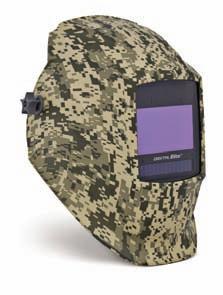
Welding safety glasses give all-day comfortable protection
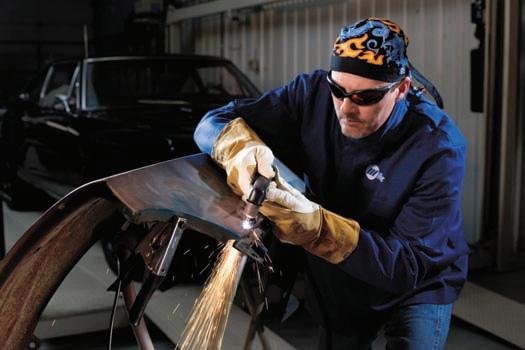
Miller Electric has added safety glasses to its ArcArmor line of welding protection products. Designed for comfort, fit and durability, these stylish glasses are available in three frame colours and
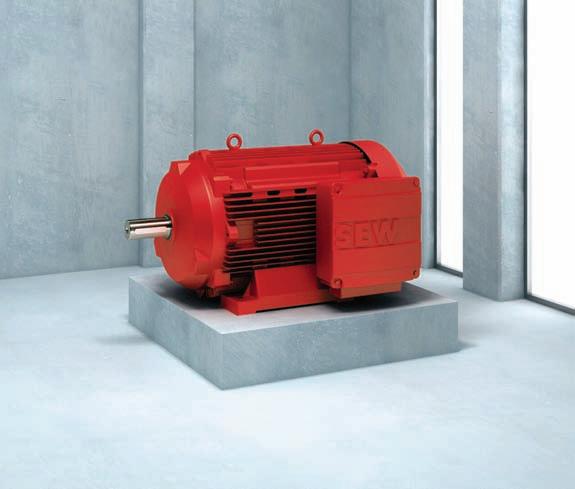
Big Motors. Small Wait.
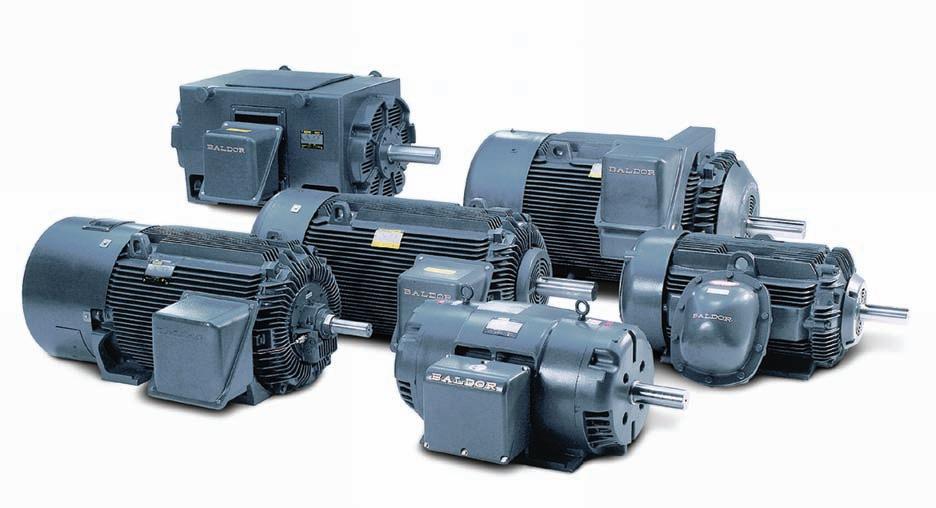
Baldor’s new Quick-Ship (QS) large frame AC motor program delivers the large motor you need faster than ever before.
The QS program offers a broad list of design options to build a custom motor that fits your application requirements. Available in TEFC, 200 Hp – 700 Hp, and 449 through 5000 frame sizes. Best of all, your QS motors will ship within two weeks from the day you place your order!
Plus, any large frame AC motor we have in stock that fits your needs will typically go out the door the same day we receive your order.
Big motors, custom or stock...fast. Only from Baldor.
baldor.com 479-646-4711
either clear or shade 5.0 lenses. Rubber ear pads and form-fitting orbital eye coverage help to reduce any discomfort that can occur after long periods of use. Protection features include shatter-proof polycarbonate lenses with anti-scratch coating and soft foam eye guards that keep out dust and perspiration. The shade 5.0 glasses, suitable for plasma or oxy-fuel cutting, also feature a reflective outer coating that protects against ultraviolet light. The safety glasses meet ANSI requirements.
Miller Electric Mfg.
Reader Service Card No. 326
Video communication tool facilitates team work
The Frontline Gateway from AudiSoft Technologies is a collaborative tool that allows live, simultaneous video communication between one Frontline Communicator user and up
width conditions. Clients may install the Gateway on their own private network or access it through a public network, or they may use AudiSoft’s hosting services.
AudiSoft Technologies
Reader Service Card No. 325
Rapid custom end machining offered for rolled ball screw line
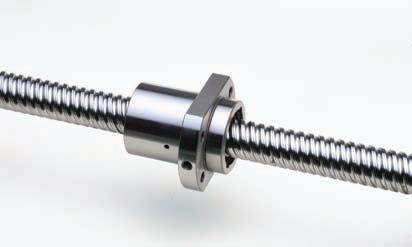
Lee Linear has announced that it provides fast turnaround of high-quality end-machined precision rolled ball screws. Made from induction case hardened alloy steel, these ball screws are integrally sealed, operate at over 92% efficiency and are
available in both inch and metric configurations. They exhibit the long life, smooth motion and high accuracy necessary for close tolerance work. A broad range of sizes and leads is offered in regular, highlead and miniature flange types.
Lee Linear
in this issue
features
Troubleshooting steam traps / 12
Eliminating failed traps can save large amounts of money. To test steam traps, the two basic pieces of equipment to own are an infrared thermometer and an airborne ultrasonic instrument.
Vibration monitoring proves effective on wind turbine / 14 Remote-monitoring system identifies the correct source of a failure, avoiding the unnecessary replacement of bearings.
Advances in infrared tools make inspections easier / 15
Interface to asset databases aids in route creation and equipment diagnostics. How proper motor and pump shaft sizes are determined / Consider modifying a shaft only with good engineering support. Even then, remember that the greater the consequence of failure, the more generous the safety factor should be.
editor’s selections
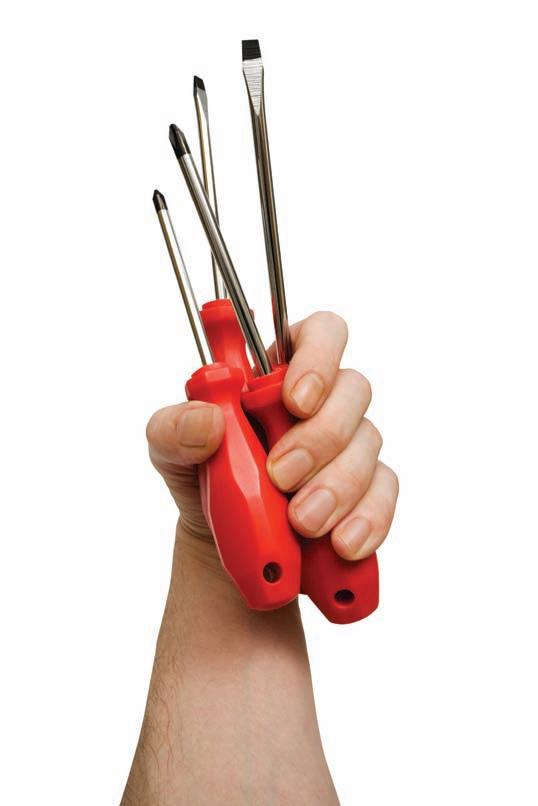
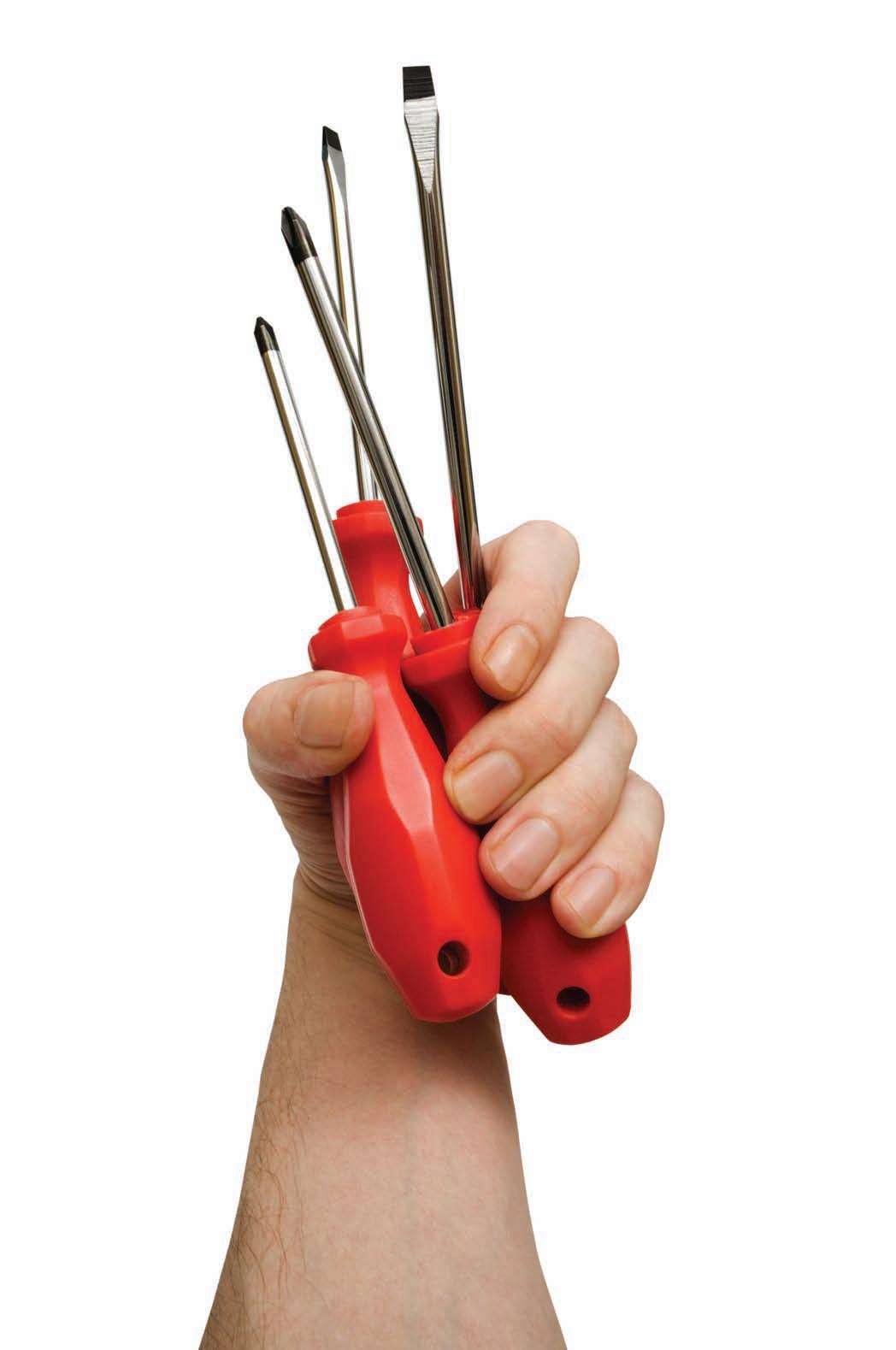
‘With the screwdriver grip against our ear, we determined if bearings were good or bad.’
Jolson Sanford / 21
‘Older equipment was overdesigned by even today’s standards. Of course, that is one reason many of us appreciate older machinery. It was darned reliable!’
Chuck Yung / 17
‘Encourage the people around you.’
Richard G. Ensman, Jr. / 22
‘A typical industrial facility can realize savings of 20% by improving its steam system.’
Bruce Gorelick / 12
Maintenance Management: Signals of success / 19
Follow along with Step 35 in a journey to World-Class Maintenance at the Plentya Paper Company.
CMMS Solutions: It all started with a screwdriver / 21
The early history of the introduction of vibration analysis technology to maintenance is a fascinating story.
Supervisory Suggestions: 50 ways you can become a better manager / 22 These tips for success apply whether you work in an office or on the shop floor.
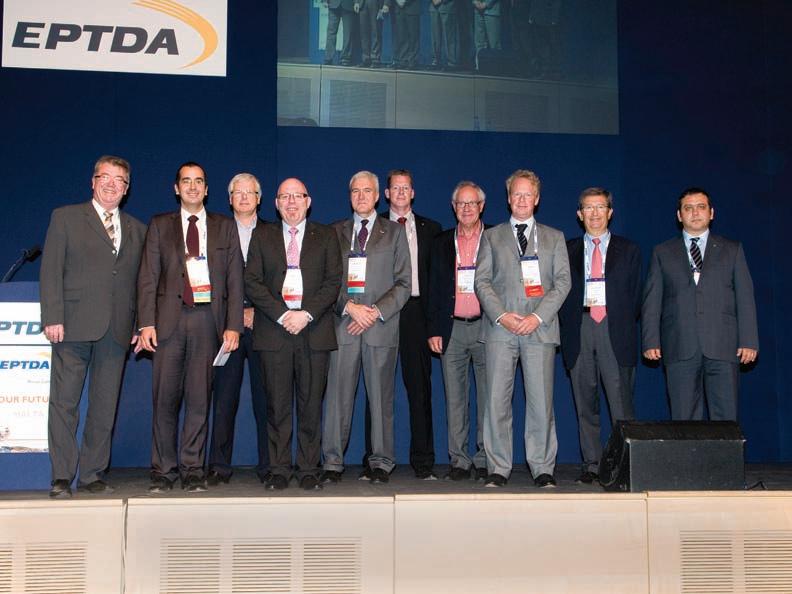
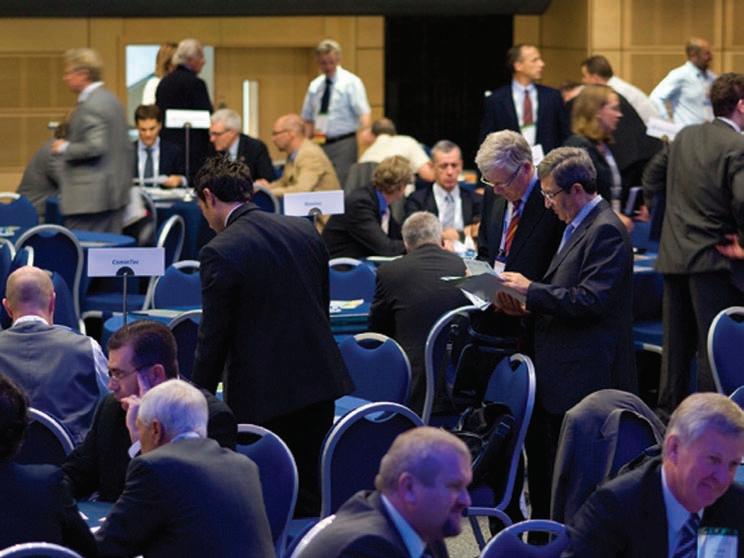
EPTDA’s convention breaks attendance records / 30 At this Malta meeting, more than 280 power transmission and motion control professionals participated in over 750 individual meetings between manufacturers and distributors.
Editor’s Notebook / 6
Industry Newswatch / 8
Company Briefs / 10
Mr. O, The Problem Solver / 11
Maintenance Management / 19
CMMS Solutions / 21
Supervisory Suggestions / 22
MRO On The Road / 30
Product News
Product Spotlight / 2
MRO Components / 23
Focus on Test & Measurement / 26
Focus on Drives / 28
Literature Guide / 29
This month’s Notebook topic really doesn’t have anything to do with maintenance. I thought instead I’d give you a small insight into our own operations here, as we near the end of our 25th anniversary year. It’s about our covers – some of which show industrial operations, and some of which are abstract concepts that show a bit more imagination (we’ve used both on this issue).
Choosing an image for our covers is one of the most time-consuming tasks we face around here at the MRO Magazine offices. In fact, the process of thinking about ideas for the next cover usually spills over into home time. Ideas can come from anywhere – reading a novel, glancing through the business section of
the daily newspaper, chatting to people about seemingly irrelevant topics, and of course, from the vast resources of the Internet – forums, chats, Facebook, Twitter, LinkedIn, YouTube and the like.
Our covers are very important because they quickly catch the reader’s eye, and if they look interesting enough – and different from all the other publications that come in the mail – our magazine is more likely to be opened and read.
Of course, coming up with a great cover idea is only one step. Then the idea must be executed. Is the concept one that can be photographed? Will it require a creative illustration? Can we communicate our ideas to a creative supplier who may never in his or her life have been in
a mine, a mill or a manufacturing plant?
Sometimes, we can’t find just the right solution, so our award-winning art director will work to create a compelling image from a variety of existing parts –two or three photographs that when combined relate to the concept we are trying to convey.
Usually, the topic of our cover images is pretty transparent, but sometimes it’s only a hint. Our goal is to create curiosity. After all, printing and sending out a magazine doesn’t make it one that’s read. We feel we need to entice you into picking up each issue, so we want to build curiosity with the graphics and the text and the promise of what’s inside. The cover tells you what kind of content is inside – articles that we expect will be worthwhile for you read.
In this issue, for example, our main cover headline, Predictive Maintenance, aims to draw attention to one of the key themes of the articles in this issue. Our
technical articles and case studies look at various applications of PdM tools, including ultrasound, infrared thermography and vibration monitoring. It’s not so easy to illustrate sound waves or vibration, it turns out. Sure, we could have used a product photograph of sound detection equipment, but we wanted to convey the ‘concept’ of sound waves and the useful data they can impart. We think the background behind the downtime detective on our cover is compelling and interesting.
We’ve created really interesting covers in the past – in fact, we’ve received Gold, Silver and Top Five awards in national competitions over the years in recognition of our creativity. But those judges weren’t regular readers like you. I’d really like to hear your point of view on this issue’s cover. Are our efforts worthwhile? Send me a quick note at broebuck@mromagazine.com.
Bill Roebuck
Did you know?
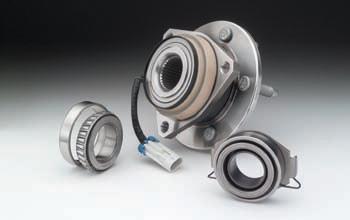
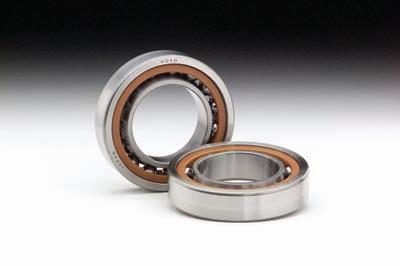
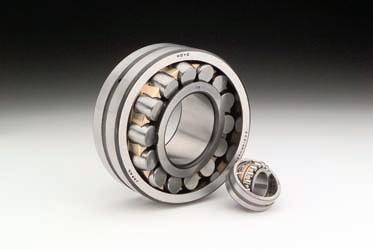
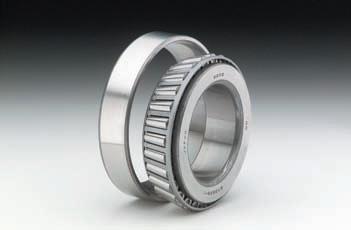
Koyo Seiko was formed in 1921. Today we are part of the JTEKT Corporation with consolidated sales of $10.3 billion and employing more than 33,000 around the world.
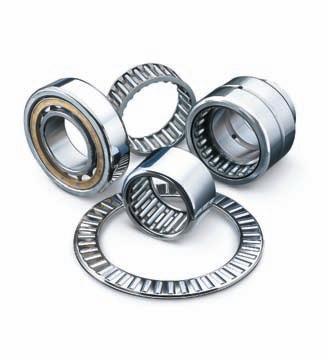
In January 2010 JTEKT acquired the Torrington® needle roller bearing business from the Timken Company and these products are now available from authorized Koyo distributors worldwide.
The Koyo brand supports an extensive array of applications, forming part of the original equipment for many world-class names and is a trusted supplier to industry for the ongoing repair and maintenance wherever anti-friction bearings are required.
Going green starts with a commitment to the future.
It’s about creating a vision for the future and then communicating that until it becomes a part of your culture. It’s about new approaches to break through old barriers. And it’s about holding true to your commitment when challenges arise.
Koyo continues to research, develop and deliver products that consume less energy, last longer and lighten their load on the environment. Since 2005 we’ve reduced the CO2 output per unit in manufacturing by 30% and since 2008 reduced our CO2 footprint in logistics by 31%.
In 2009 alone we reduced energy consumption in manufacturing by 14%, raw materials by 20% and CO2 emissions in logistics by 16%; all this while maintaining production levels.
Here are some of the many targets we are working towards achieving this year: Zero landfill waste; 90% reduction of 2001 levels of incineration waste; 30% reduction from 2003 levels of overall waste per unit; 5% increase in manufacturing efficiency per unit and 5% reduction in weight per unit.
For a copy of Koyo’s Corporate Social Responsibility report please visit www.koyo.ca
Making bearings since 1921.
Bill Roebuck, Editor & Associate Publisher 416-510-6749 broebuck@mromagazine.com
Ellie Robinson, Art Director
Contributing Editors
Richard G. Ensman Jr., Simon Fridlyand, Carroll McCormick, Peter Phillips, Angela Webb, Cliff Williams
BUSINESS
Nick Naunheimer, Publisher 416-510-6868 nnaunheimer@mromagazine.com
Eric Achilles Cousineau, Adv. Sales Manager 416-510-6803 eachilles@mromagazine.com Kimberly Collins, Advertising Production 416-510-6779 Melinda Marasigan, Subscription Enquiries 416-442-5600 x3548
Manufacturing sales up 17.6% from previous low
creased 2.0% in August 2010 to $45.1 billion, Statistics Canada reported in its latest available Monthly Survey of Manufacturing. Gains were widespread across industries; however, the main contributors to the increase were motor vehicle, and petroleum and coal product manufacturers. Higher sales volumes were responsible for most of the gain.
With the increase, manufacturing sales were 17.6% higher than their most recent low, reached in May 2009. Compared to July, constant dollar manufacturing sales increased 2.1% in August.
Higher sales were seen in 15 of 21 industries, representing 81.8% of total sales. Sales increased in Ontario, Quebec, Saskatchewan, Alberta and Nova Scotia.
Inventories levels increased 1.3% in August to $60.0 billion. The rise in inventories over the past three months
from November 2009 to May 2010.
As well, unfilled orders rose 1.5% to $54.7 billion in August. The backlog of orders at manufacturing plants across Canada has been gradually increasing since November 2009.
BSA’S ANNUAL CONVENTION TO CELEBRATE 45TH YEAR
Glen Ellyn, IL — In 2011, the Bearing Specialists Association (BSA) will celebrate 45 years of successfully bringing together the top-level executives of what is now a $5.6-billion bearing industry in an annual convention designed for networking and knowledge sharing.
The association’s 2011 Annual Convention, with the theme ‘Growing Together: 45 Years Strong’, is planned for April 29-May 3 at the Hyatt Regency Lost Pines, near Austin, TX.
Despite a variety of economic and business challenges — including those of the recent recovering economy — BSA has continued to deliver networking and problem solving within the bearing industry. Both the 2010 Annual Convention and the 2010 Fall Meeting set new attendance standards. BSA anticipates the same response to the 2011 Annual Convention.
Convention planning is well under way for business programs and social events to develop and enhance the industry-specific relationships that are the basis for BSA. As always, the annual event will feature industry updates from the American Bearing Manufacturers Association (ABMA), and the Conference Tables Session, which features pre-scheduled and planned conferences between distributors and manufacturers designed to resolve issues of mutual concern.
The Hyatt Regency Lost Pines, located along the Colorado River, is just 32 km from Austin, offering luxury accommodations, ample outdoor recreation and complimentary children’s activities. Lost Pines is a Four Diamond resort located in a rugged, historic Texas setting. The resort’s Wolfdancer Golf Club (ranked by Golfweek in its list of Top 100 Resort Courses) is just steps from the lobby entrance.
For more information, contact the BSA office at 630-858-3838; e-mail info@ bsahome.org or visit www.bsahome.org.
WSIB RAISES ITS RATES TO TACKLE $12 BILLION IN UNFUNDED LIABILITIES
Toronto, ON — Ontario’s Workplace Safety and Insurance Board (WSIB) is moving forward with a Funding Review to ensure its long-term financial stability.
The year-long review will gather expert advice and input from workers, labour and employers on a range of public policy issues relating to the WSIB’s financial future, including a plan on how to eliminate the WSIB’s unfunded liability.
To provide business with certainty and stability during the course of these
consultations, and in order to help slow the growth of the WSIB’s projected unfunded liability (UFL), the average premium rate will increase by 2% for 2011 and 2012.
The UFL is the difference between the total cost of claims in the system and the funds in the system to pay for them. It has increased due to insufficient premium revenue, rising claims and health care costs, and declining investment returns following the recent economic downturn. Currently the WSIB’s projected UFL is more than $12 billion.
The WSIB is also making a number of internal administrative changes that will address the UFL while improving customer service and operational efficiency. This includes a Value for Money Audit of the claims and adjudication process. These actions, along with the modest premium rate increases, will assist in balancing annual revenue with claim costs.
“We are taking important steps in ensuring that the workplace safety and insurance system is financially stable now and for future workers and employers,” said WSIB president and CEO David Marshall. “These steps, along with our continuing commitment to accountability and fiscal responsibility, will steer us toward our goal of achieving full funding, while preserving workers benefits and ultimately lowering employer premiums.”
The average premium rate will rise from $2.30 to $2.35 for every $100 of insurable earnings in 2011 and to $2.40 in 2012. This is well below the average premium rate of $3.00 in the mid 1990’s. The increase is being applied to the average premium rate, meaning more than half of registered employers will see little to no increase, while other employers in high-risk industries with a history of costly injury claims may see increases of more than 2%. Employers with good safety records will continue to be eligible for rebates under the WSIB’s incentive programs.
More details can be found on the WSIB’s website at www.wsib.on.ca.
IFPE RETURNS TO LAS VEGAS IN 2011
Chicago, IL — The International Exposition for Power Transmission (known as IFPE) will be held at the Las Vegas Convention Center in Las Vegas, NV, from March 22-26, 2011. IFPE is an international exposition and technical conference devoted to power transmission/motion control and fluid power, as applied through hydraulic, pneumatic, electrical and mechanical technologies. It is held every three years.
IFPE 2011 will be co-located with Conexpo-Con/Agg 2011, the largest international gathering place for the construction industry.
The Power Transmission Distributors Association (PTDA) will host a pavilion to help member companies build their brands and business with customer audiences at IFPE. Space in the PTDA Pavilion frequently sells out well in advance of the show. It helps exhibitors secure prime space that offers more prominence and increased presence than exhibiting on their own.
PTDA members can take advantage of a 15% discount off the non-member rate at IFPE 2011 by exhibiting in the PTDA Pavilion. Space rates include drayage, pipe and drape, directory and basic Virtual Trade Show listings and free marketing materials. More than 2,100 sq ft of space has already been sold in the PTDA Pavilion for 2011.
For more information on IFPE, visit www.ifpe.com.
Higher sales were seen in 15 of 21 industries in August.
RESOURCE HELPS WITH DEVELOPING DISTRIBUTOR/ MANUFACTURER AGREEMENTS
Chicago, IL — Identified by members of the Power Transmission Distributors Association (PTDA) as one of the top 10 issues between a distributor and manufacturer, PTDA has created a comprehensive distributor/manufacturer agreement template focused on the elements that need to be considered when entering a formal relationship.
‘Guidelines for Developing a Distributor/Manufacturer Agreement: A Components Checklist’ is a resource for outlining the parameters of a mutually profitable partnership.
Rex Davis, vice-president supply chain, warehouse and aerospace division, IBT Inc., served as chair of the task force charged with developing the guidelines. “PTDA is an association of both distributors and manufacturers,” he said. “We need to work together to deliver solutions to our mutual customers. To do that effectively, we have to be solid in our business relationship and understand what each of our strengths are.
“We analyzed these guidelines from many different perspectives: small, midsized and large companies, distributors and manufacturers, and relationships and processes. The input we received from PTDA manufacturer and distributor members throughout the development process influenced the committee to create a usable resource that is relevant to all of our members.”
The guidelines include practical, customizable language for 38 contract claus-
es grouped in six main sections: introductory clauses, terms and conditions clauses, product and price policy clauses, sales policy clauses, inventory clauses, and concluding clauses.
Developed using sample agreements from many of PTDA’s member companies, each clause includes a description of when the clause may be applicable and provides sample language to use in writing a mutually acceptable contract.
The guidelines include a Microsoft Word document, allowing one to edit, delete or add to each of the sample clauses.
“Communicating on important issues and laying out the expectations in advance with our distributors make it possible for us to focus our joint efforts on helping the customer,” said task force member Dennis Tanrikulu, vice-president of aftermarket sales for NTN Bearing Corp.
“A written agreement that addresses all of those details allows us to spend our time on the activities that drive profitability for both of us. These guidelines will help both parties ensure that each of the components of an agreement are discussed and negotiated before an issue can arise.”
The guidelines are available for purchase at US$349 for non-members at www.ptda.org/agreement. PTDA member companies can download the guidelines at no charge.
NEW QUARTERLY BUSINESS INDEX REVEALS GROWTH FOR PT/MC MARKETS
Chicago, IL — The inaugural Quarterly Business Index recently released by the Power Transmission Distributors Associ-
This table shows an overview of the results and provides a breakout reading by distributor and manufacturer of the PTDA Quarterly Business Index.
ation (PTDA) shows rapid expansion for the power transmission/motion control (PT/MC) industry in the second quarter of the year. The overall reading of the association’s distributor and manufacturer members revealed an impressive score of 77.0, where a reading above 50 indicates growth.
Conducted jointly by the PTDA and Cleveland Research Company, the new PTDA Quarterly Business Index was modelled after the widely respected Purchasing Managers Index and tracks change in business activity, new orders, employment, supplier deliveries, inventories, prices and backlog in the PT/MC market to arrive at an overall index.
The initial survey showed a robust response, with 122 companies participating — comprising 55 distributors and 67 manufacturing firms. A comparative review of the results reveals that manufacturer respondents are expanding at a more aggressive rate with an index of 81.6, with distributor respon-
dents showing a growth index of 71.1. In addition to improving sales and production, the survey results also anticipated continued strength in the near-term.
Participants were also asked to provide their perspective on the remainder of 2010. The positive momentum in the survey results appears to be reflected in the full-year outlook, which calls for 12% growth in sales on average. This comprises expectations for 8% growth on average for distributor participants and 16% growth for manufacturers.
The Quarterly Business Index is available at no charge through at www. ptda.org/index. The full report includes US and Canadian breakout data, as well as distributor and manufacturer expectations in business activity, new orders, employment, supplier deliveries, inventories, prices and backlogs. MRO
More detailed versions of these stories, along with many additional news items, can be found online at www.mromagazine.com.
Company Briefs
News and views about companies, staff, product lines and more.
• Can-Ross Environmental Services Ltd., Oakville, ON, has been operating as a family-run business since 1985 and celebrated its 25th Anniversary on October 15, 2010. Ted Edgar says he started Can-Ross with a vision and a purpose.
“Looking back on that vision 25 years later, we can now say we are on the right path in providing sustainable value to both our distribution partners and endusers. Our belief has always been that a good deal has to be good for all in order for any business arrangement to stand the test of time.”
The company’s focus is on spill control and containment products. Ted serves as the company’s president and CEO and his son, Terry, has been involved with the
company from an early age in both manufacturing and sales roles. His is now national sales manager.
Can-Ross has a network of distribution partners and currently distributes to over 400 outlets across Canada. The company’s plant and head office currently encompasses 30,000 sq ft in the Oakville operation, and it maintains a distribution centre in Calgary.
• Ray Cowan has joined the Western Canada sales team of Advantage Sales Network Corp., Brampton, ON. He has many years of electrical sales experience in the western provinces. He is based in the company’s regional sales office in Calgary. Cowan will be responsible for the sales activity in southern British Colum-
bia and southern Alberta
• For the record, at the Power Transmission Distributors Association’s Canadian Conference in Montreal in June 2010, NTN Canada’s Paul Meo, who dressed up in a flashy pink suit and hat at a reception as a fundraising stunt, raised more than $6,000 for cancer research from PTDA delegates (we inadvertently dropped a ‘0’ when we reported the amount in our previous issue).
• Commtest Instruments Inc. ville, TN, has been awarded a five-year United States General Services Administration (GSA) contract and is now listed on GSA’s Schedule 66 as a Small Business entity. Commtest is contracted to provide scientific equipment, specifically vibration analyzers, for the preventive maintenance of rotating machinery.
• Linde Canada, Mississauga, ON, and Liberty Tire and Rubber have
mining companies are operating in a volatile market where production optimization, cost reduction and operational efficiency are of the essence.
With more than 60 specialized engineers across Canada, Kinecor responds to the unique challenges of the mining industry.
signed a long-term agreement for Linde to supply liquid nitrogen for the cryogrinding process at Liberty’s Brenner, ON, rubber plant. Linde is part of a worldwide gases and engineering company. Liberty Tire and Rubber is a producer of crumb rubber in the US and Canada. To produce crumb rubber, it is necessary to reduce the size of the tire shred or chip. This is accomplished by techniques called cryogenic grinding. Cryogenic processing refers to the use of liquid nitrogen (−196°C) to freeze tire chips prior to size reduction. The rubber is immersed in liquid nitrogen to reduce the temperature of the tire chip. The cooled rubber is then ground in an impact-type reduction device.
Crown Point Productions, the producers of the television show World’s Greatest!, has recently selected Viking Pump, Cedar Falls, IA, to be a part of the popular television series. “Viking Pump is exactly the type of company that we like to feature on World’s Greatest!” said Gordon Freeman, executive producer of the show.
“They’re an innovative company that is preparing to mark their 100th Anniversary in 2011. They have plenty to offer, including their unique ability to produce custom pumps, built to order based on the customer’s mission-critical dimension, flow, pressure, viscosity, temperature requirement, or mounting feature application.”
World’s Greatest! is a 30-minute show dedicated to highlighting the world’s greatest companies, products, places and people. Each show is a tour featuring behind-the-scenes footage, interviews and visuals. For information on the show lineup, visit www.crown-tv.com.
• Thompson Pump & Manufacturing Co Inc., Port Orange, FL, a family-owned manufacturer and provider of pumps, pumping equipment and engineering expertise, has achieved ISO 9001:2008 quality recertification for its Port Orange manufacturing facility. The new certification represents an enhancement to the company’s previous ISO 9001:2000 classification. Thompson produces heavy-duty lines of portable pumps, ranging in size from 2 in. to 18 in. In addition, Thompson provides engineering services and special applications consulting for complicated wellpoint, bypass or multiple pump systems; and offers pump and dewatering education and training through its Pumpology courses. The company is also aligned with more than 30 distributors in the US, Canada, and South America.
• Eaton Corp., Eden Prairie, MN, has announced the completion of Eaton’s Hydraulics Instructor Symposium, an event designed to expose hydraulics industry leaders involved in academic and commercial training operations to the latest in both emerging hydraulic technologies and instructional methodologies. Hosted at Eaton’s Hydraulic Training Center in Maumee, OH, the symposium was attended by representatives of Alexandria Technical College, The University of Dayton, and Alfred College as well as training executives and instructors from Eaton’s customers and distributors across North America. Among the subjects presented at the Symposium were a CANbus primer, systemic contamination control, thread identification, cavitation and aeration, principles of proportional valve operation, hose assembly, proportional valve amplifier tuning and troubleshooting, fixed and variable pump controls, causes and cures of leaks, plus an introduction
Paul Meo, NTN Canada
to IEC 61131-3 compliant programming. Attendees also witnessed a demonstration of HTS-2 technology
Eaton’s Hydraulics Group provides solutions under product names such as Aeroquip, Boston, Char-Lynn, Eaton, Hydro-Line, Synflex, Vickers, Walterscheid and Weatherhead.
• While economic cycles may move slowly, the pace of social media access to valuable industrial and high-tech resources is quickening. Kennametal Inc. of Latrobe, PA, a supplier of tooling, engineered components and advanced materials for manufacturing and mining industries, is among the pioneers in this effort. It has released an interactive catalogue app for
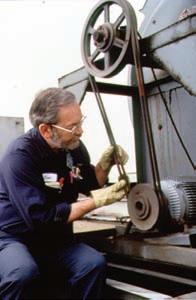
Using a stroboscope to diagnose belt drive problems
Problem: How can I determine what’s wrong with a belt drive system without stopping production?
Solution: A stroboscope is a wonderful diagnostic tool for belt drives. With a stroboscope light you can:
• Read the original belt’s number and manufacturer without stopping the machine: Run the strobe at the belt’s speed and the fast-moving label and manufacturer name will appear to stop.
• See if one in a series of belts are slipping: Shut down the equipment, chalk or paint a mark across all belts, start the equipment, and calibrate the strobe to the running speed of the sheave. A slipping belt will slow down and separate from the others, as you’ll see from the mark on it.
• Check multi-belt drives for misalignment: If the belts from the example above present a step-type pattern, the sheaves are misaligned. The belt with the most load slips the least.
• Check if a v-belt is worn out. Shine the strobe at the sheaves. Check for shiny groove bottoms, which mean that the belt or the sheave is worn out and the belt is riding on the bottom instead of on the walls.
The methods above require that you have see-through guards, an inspection lid or inspection hole. For the greatest visibility, the guard cover should be of expanded metal painted matt black and the sheaves and inside of the cover should be painted in two contrasting bright colors. With this configuration the guard cover will become invisible in a strobe light.
As always, make sure you observe all applicable safety regulations and procedures, and work safely.
Mr. O’s thanks for this tip go to Idcom. For more tips, visit www.idcom.com.
Do you have a solution for a maintenance problem? Send it in and if it’s published, we’ll send you a Mr. O Problem Solver T-shirt. Include your address, telephone number, print complete details and, if possible, add a sketch to help explain your tip. Send your tips to Mr. O, Machinery & Equipment MRO, 12 Concorde Place, Suite 800, Toronto, ON M3C 4J2.
the Apple iPad platform. Users can conveniently download any and all of Kennametal’s numerous product catalogues and review products and specifications, request quotes, view engineering drawings or videos, or contact technical support for more information. This app is available for download through iTunes at no cost.
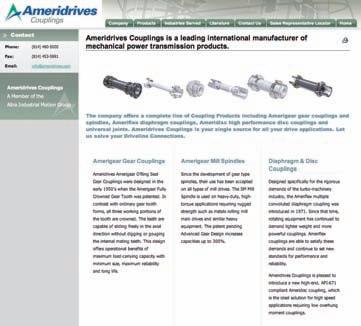
• Ameridrives Couplings, Erie, PA, has launched a new corporate website that provides information about its full line of coupling products, including Amerigear gear couplings and mill spindles, Ameriflex diaphragm couplings, and Ameridisc high-performance disc couplings and universal joints. The website, www.Ameridrives.com, contains specific product features and benefits as well as information on the patented Amerigear crowned gear tooth design and Ameridisc advanced disc technology. A link allows quick access to brochures, catalogues and service manuals, available as PDF downloads.
• Steven J. Smidler has assumed the role
Website offers product catalogue and service manual downloads.
of president of the Kaman Corp. subsidiary, Kaman Industrial Technologies Corp. (KIT), Bloomfield, CN. He succeeds T. Jack Cahill, who has retired. Smidler, 51, joined Kaman in December 2009 as senior vice-president and chief operating officer of KIT. He joined the company from Lenze Americas Corp., where
he served as executive vice-president.
• The Weir Group PLC, Madison, WI, and J. F. Comer Inc., Uxbridge, ON, have jointly announced the settlement of a long-running contested legal dispute between the parties in the Federal Court of Canada concerning Weir’s intellectual property rights in that country. The settlement has immediate effect.
At one time Comer was an official distributor in Canada for certain slurry pumps and parts now owned by Weir and branded as Hazleton, Ash Pump, Galigher or Warman, but this relationship ended some years ago. Under the present settlement, Comer has agreed to ensure that any products, parts, retrofit or kit components that they may sell are not sourced from replica manufacturers who illegally make use of the intellectual property of Weir in any manner. Comer has agreed not to import such products into Canada from specific replica manufacturers located in China. MRO
Mr.0 The Practical Problem Solver
Troubleshooting Tr aps
Eliminating failed traps can save large amounts of money. To test steam traps, the two basic pieces of equipment to own are an infrared thermometer and an airborne ultrasonic instrument.
BY BRUCE GORELICK & ALAN BANDES
Properly functioning steam traps open to release condensate and automatically close when steam is present. Failed traps waste fuel, reduce efficiency, increase production costs and compromise the overall integrity of the steam and condensate systems. That’s why traps should be tested on a regular basis — or the neglect may be quite costly.
Steam energy conservation is important to the economy. Consider that:
• Over 45% of all the fuel burned by US manufacturers is consumed to raise steam. Steam is used to heat raw materials and treat semi-finished products. It is also a power source for equipment, as well as for building heat and electricity generation. But steam is not free. It costs approximately $18 billion annually to feed the boilers generating steam in the United States (all figures in US dollars).
• Many manufacturing facilities can recapture energy through the installation of more efficient steam equipment and processes. A typical industrial facility can realize steam savings of 20% by improving its steam system. If steam system improvement were adopted industrywide, the benefits would be $4 billion in fuel cost reduction and 32 million metric tons of emission reductions. (Source: US Department of Energy, Energy Efficiency and Renewable Energy.)
Why do steam traps fail?
Obviously, anything mechanical will malfunction; steam traps are no exception to the rule. Proper maintenance improves longevity and helps reduce maintenance costs.
There are three general conditions that adversely affect traps:
A. Dirt is by far the leading cause of failure, resulting in either a leaking or plugged trap.
B. Pressure surges (due to sudden steam valve openings, improper piping, or trap misapplications), resulting in waterhammer and subsequent damage to the internal steam trap components.
C. Over-sizing of IB (inverted bucket) traps can cause them to lose their prime, while TD (thermodynamic) traps can experience rapid cycling.
Warning signs
How do we keep problems to a minimum and keep energy costs in check? One simple way is to look for warning signs. Let’s review the most evident signs that should signal a distress call from your steam system.
1. The once-lazy plume from your condensate stacks is now an out-of-control freight train. The steam coming from your stack like a soldier standing at attention is costing you dearly.
2. Condensate back pressures that have slowly been rising have been causing your electric condensate pump to selfdestruct. High-temperature condensate
cannot be handled by conventional electric pumps. Temperatures over 212ºF cause conventional electric condensate return pumps to cavitate. Motors burn out and mechanical seals begin to leak when steam is present.
3. Pressure-reducing valves (PRVs) or control valves fail to maintain set pressures. Fully or partially plugged traps prevent condensate from being eliminated from the steam space. Undrained condensate at PRV stations will back up into the steam line and will wiredraw the heads and seats of the reducing valves. Wiredrawing is when high-velocity water in the steam system cuts (scores) the surfaces of heads and seats. Even small microscopic cuts will prevent the proper operation of these valves.
4. A production capability has been reduced. Open or closed traps that have failed will have a negative impact on production. Plugged traps will back condensate up into the process and dramatically reduce system efficiency. Blowing and leaking traps are costly to production due the added and unnecessary energy consumption.
5. Pipe wall thickness of the condensate system has become an issue. Fully open or partially opened steam traps that are not repaired in a timely manner will deteriorate the condensate return piping. Some of the early warning signs begin with steam leaks.
6. The cost to maintain heat exchanger bundles, humidifiers, HVAC coils and other equipment has dramatically increased. Failed traps will prevent proper operation of sensitive equipment. When steam traps fail in a closed position, over time the stagnant condensate will turn to carbonic acid (H 2 CO3 ). Carbonic acid will deteriorate all the metal it comes in contact with. Beyond increased energy consumption, failed open traps will also cause control and efficiency issues.
7. Water hammer can develop in neglected or mismanaged steam and condensate systems. Water hammer literally sounds like someone is hitting a pipe with a hammer. In some cases water hammer can occur when a portion of the steam condenses into water within steam piping. Left undrained, condensate will spill into the steam system and begin to accumulate. Eventually a wave of water will be created. This slug of water can be carried at high velocity until it reaches an obstruction like a closed valve, a lower elevation, or a sudden change of direction.
A trap that is blowing steam can also cause water hammer. Blowing traps create back pressure in the condensate system piping. If condensate piping is already undersized, the problem will be compounded by the additional pressures found by the faulty traps.
Undrained condensate can back up into the steam distribution piping. From the
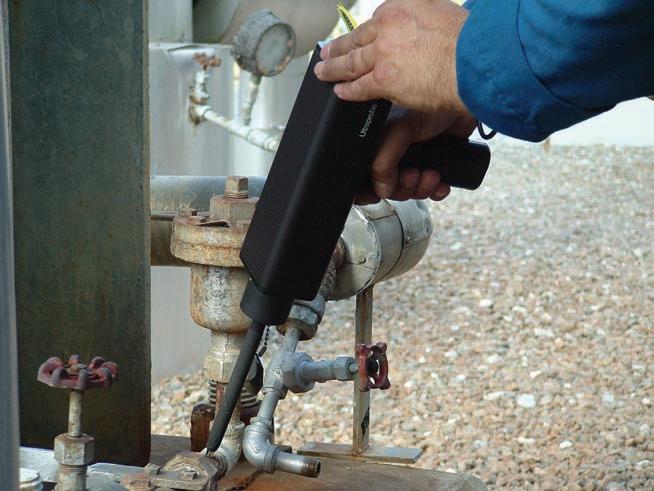
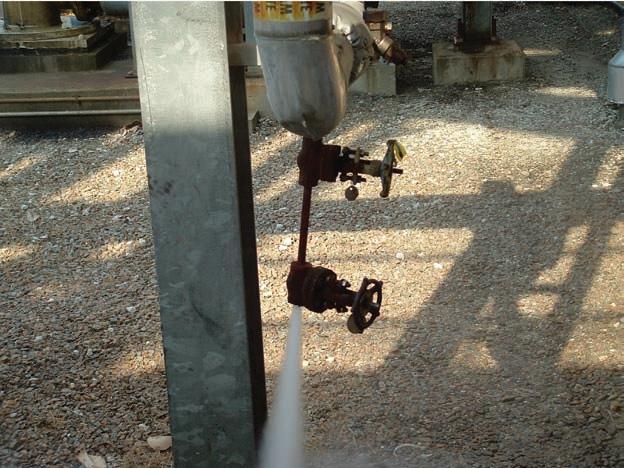
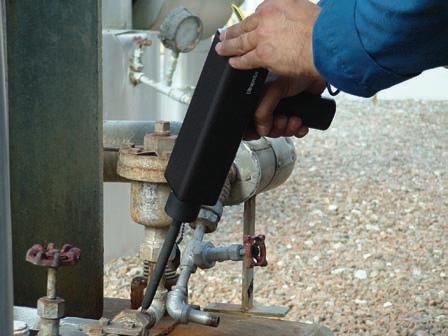
Above: In this application, after an ultrasonic test found the trap to be blowing, the downstream condensate line was shut and the test valve was opened to verify test results. The system pressure was 270 psi. At the cost of $10 per thousand pounds of steam produced, the energy loss for this single blowing trap was a whopping $21,000. Right: A 600-psi-rated steam trap is being ultrasonically tested.
standpoint of plant safety, it is essential to test and maintain the steam trap population. Type “steam water hammer accidents and fatalities” into a search engine; the results should be convincing enough to create an immediate action plan.
The action plan
ing across the head and seat of a wiredrawn inverted bucket trap. After all, hearing is believing.
Before you begin
Before you spend your hard-earned money, consider some of the characteristics of ultrasound instrument. Ask the following questions:
• How is the sound quality heard through the headphones? (External speakers will be hard to use in most steam environments.)
• Does it lack in versatility? (Will it in
Failed steam traps …
• Waste energy
• Adversely affect production
• Increase maintenance costs
• Create safety issues
• Perform a regularly scheduled steam trap survey.
• Identify system design issues.
• Perform an insulation audit. Areas where insulation has been removed and never replaced will significantly add to your overall steam production costs.
• Using ultrasound detection equipment, test bypass valves if they exist in your steam system. They may be leaking through when they ought to be shut.
• Turn off seasonally operated equipment, such as unit heaters.
• Periodically test control valves or shutoff valves in the HVAC system with a handheld IR temperature instrument and an ultrasonic leak detector. If they are even partially leaking through, they are adding to overall energy costs.
• Audit the system and unused inventory equipment. Remove defunct systems.
• Whenever possible and practical, use a computerized system to control and monitor processes.
Purchase proper test equipment
Even if outside technical professionals are contracted to test the steam system, from time to time, a problem will occur. Time is money. Having the proper equipment and just one trained employee can avoid costly downtime.
The two basic pieces of equipment to own are an infrared thermometer and an airborne ultrasonic instrument. Such equipment is readily available in all price ranges. A thermometer with simple features is fine; however, an ultrasonic listening device should be selected more carefully and must have a clear signal quality.
This is similar to purchasing an audio system for your home and comparing one set of speakers to another set. When listening to a quality speaker system, the nuances of what was actually recorded opens your ears to new level of listening. The same is true of listening to a steam trap. With a fine instrument you can even hear the snap-crackle-pop of steam pass-
clude the ability to change frequencies and test modules?)
• Is it heavy and/or awkward to handle when up on a ladder?
• Does it have an extended warranty period?
• Is there proper technical support via phone or in the field?
• Can batteries be easily charged and replaced?
• Are trial rentals available?
Purchasing an ultrasound device should take intelligent consideration. The instrument must be capable of providing you a clear and discernable signal quality. Labour hours and equipment costs depend on it.
Why use ultrasound to test traps?
Of all the inspection methods, ultrasound is often the most recommended and reliable. Ultrasound is a shortwave, high-frequency signal that does not travel far from its source. By listening to the ultrasonic components of a working steam trap, a user can isolate the signal and easily identify operational sounds. Ultrasonic testers translate high-frequency emissions generated from the mechanical and fluid flows of traps into the audible range where they are heard through headphones and seen as intensity levels on a meter. Some units have frequency tuning to filter out additional signals and to tune in to the sounds of steam and condensate.
Testing steam traps with ultrasound provides results in real time. It isolates the area being tested by eliminating confusing background noises. A user can quickly adjust to recognizing differences among various steam traps.
The ultrasonic detector may be easy to use, flexible and accurate among sound testing methods. However, the ultrasonic instrument cannot tell if a trap is cold or blocked. Therefore, first use a temperature indicator instrument to be certain that the system is operating. Then use the ultrasound instrument to determine if the trap is partially blocked or if backpressure exists at the trap's outlet. MRO
Bruce Gorelick is vice-president at Enercheck Systems, Charlotte, NC. Alan Bandes is vice-president of marketing for UE Systems, Elmsford, NY. For more information, visit www.enerchecksystems. com and www.uesystems.com. Reader Service Card No. 401
Vibration monitoring effective on wind turbine
Remote-monitoring system identifies the correct source of a failure, avoiding the unnecessary replacement of bearings.
This case study is a concrete example of the benefit of a vibration monitoring system with remote access on an isolated machine. A wind turbine is an excellent example of such an isolated machine, with difficult access as well.
The equipment is a wind turbine with a rated power of 600 kW that was commissioned in 2000 on a wind farm near Narbonne, France. It is a Stall Control
BY FRÉDÉRIC CHAMPAVIER
type of machine, using an asynchronous generator with a double winding, running at two fixed speeds, 1,000 rpm and 1,500 rpm, depending on the wind speed.
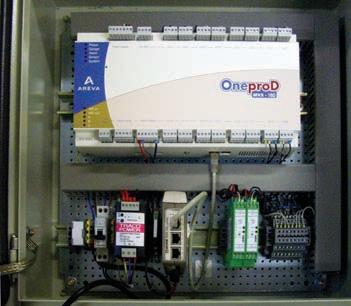
Since 2006, this machine has been equipped with a OneProd Wind System, a continuous vibration monitoring system.
The measurements are remotely processed by a local service provider that specializes in the monitoring of rotating machines, with the assistance, when required, of the
The vibration monitoring system was installed in 2006.
system provider, 01dB-Metravib.
On April 21, 2009, after an alarm was issued by the instrumentation on the generator, the operator of the wind farm requested the results of the analyses of the latest vibration measurements from the service provider. It also requested a diagnosis of the problem, along with recommendations for maintenance actions.
In parallel, the operator also consulted the subcontractor in charge of the maintenance of the machines, who recommended replacing the bearings of the generator.
On April 22, the service provider and 01dB-Metravib sent the conclusions of their analyses to the operator, along with their diagnosis hypotheses. The study of the most recent vibration signals collected on the generator, as well as the analysis of their time history, showed a few problems with the equipment, including:
• the existence of a very marked periodic shock at the rotation frequency of the generator (1,500 rpm) on the last measurements collected at high speed on the bearing located opposite the coupling
• progressive occurrence of shocks throughout the month of March 2009, and development of these shocks during the month of April 2009
• a strong and concomitant increase of the Kurtosis parameter collected in March and April 2009
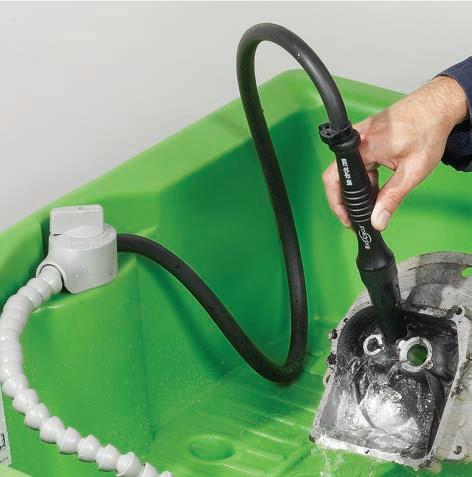
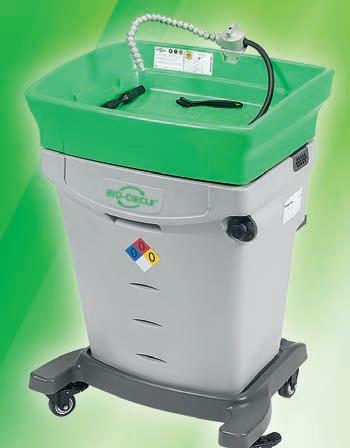
Bio-Circle is a complete, cost-effective and hassle-free solution which:
� Cleans your parts without risks of health hazards.
� Comes with a complete on-site maintenance program performed in 21 precise steps by our qualified technicians.
� Is compliant with ISO 14000, ISO 18000, ACCP and Canadian food industry standards
� Has been adopted by thousands of industrial customers worldwide!
• the existence of a similar but less intense phenomenon when the turbine was operating at slow speed (1,000 rpm)
• a notable increase of the vibration components corresponding to the notch frequencies of the generator, which are electromagnetic vibrations generated by the presence of notches on the rotor, these notches hosting the windings or bars that make up the rotor electric circuit.
The conclusions and diagnosis hypotheses were as follows:
• No fault – scaling, wear or defective lubrication – was identified on the bearings
• Possible – but not likely – air gap change (rotor/stator distance) resulting from radial backlash
• Possible temperature phenomenon, which may result from a ventilation problem on the generator, leading to stator distortion and rotor/stator contact
• Hypothesis of a secondary element generating shocks at the rotation frequency. Accordingly, the following corrective actions were recommended: immediate visual inspection of the generator; verification of the fixing of the generator fan, which is mounted along the rotor axis on the opposite side of the coupling, and driven by an independent motor; and control of the bearing backlash.
On April 23, 2009, based on these elements, the machine was inspected, while the electric parameters were controlled.
The on-site operations by the technicians showed that the fixing devices of the generator fan were broken, hence the air flow was no longer correctly oriented, which generated abnormal heating of the machine at the origin of the observed phenomena.
The fan was set back into place during the operation (which lasted three hours), after which the machine could be restarted. The bearing replacement scheduled for the next day was cancelled.
In this example, the diagnostic capabilities offered by the system proved very useful, allowing for a targeted, quick and relevant maintenance action, thus avoiding a costly and useless operation (changing the bearings).
No degradation of the machine was observed, while operating losses were limited to the maintenance time. Furthermore, the operator benefits from the experience of getting feedback on the machine. MRO Frédéric Champavier is a CMS expert with 01dB-Metravib. The company is represented in Canada by Alliance Predictive, Sherbrooke, QC. For more information, visit www.alliancepredictive.com and www. oneprod-system.com, or use the reply number below at mromagazine.com/rsc. Reader Service Card No. 402
Advances in infrared tools make inspections easier
Interface to asset databases aids in route creation and equipment diagnostics.
safety regulations and maintain ISO quality standards in an increasingly competitive environment. Capital-equipment intensive facilities are finding it critical to make sure that the maintenance department is well-equipped with the tools required to keep equipment running efficiently in order to meet these challenges. That’s where PdM tools come into play, as they
can be used to perform thermal imaging, vibration monitoring, oil analysis, laser sighting-based rotating machinery shaft alignment, and ultrasonic testing.
In order to assure that the PdM tools are optimally used and integrated with asset management information, new models have evolved whereby the tool assists users at a variety of skill levels in performing the necessary inspection
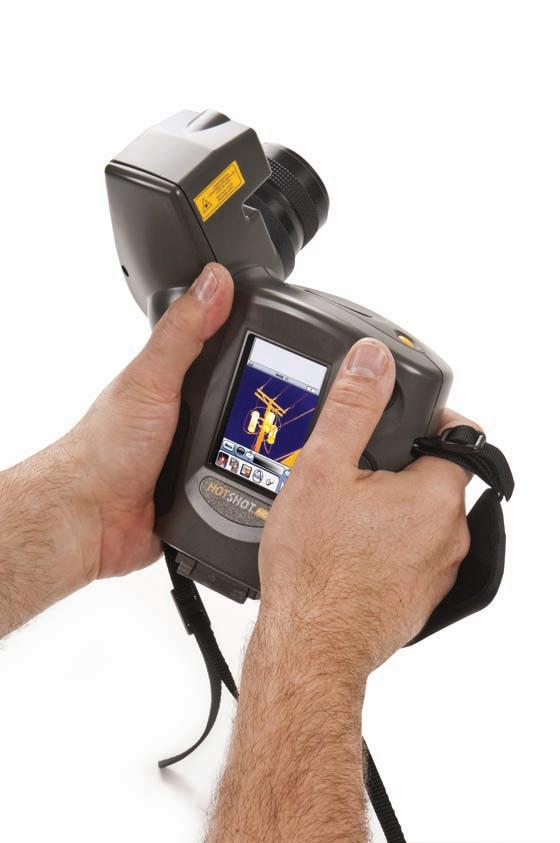
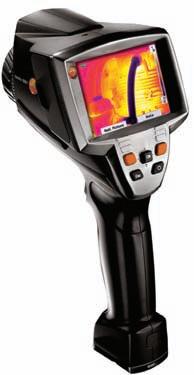
Infrared inspection is an established predictive maintenance (PdM) method that continues to evolve. Recent advances in infrared camera platforms have created a new class of infrared imaging instrument that helps make PdM easier than ever.
Infrared cameras can now incorporate pen-based computing, which — with application specific software — can create a powerful infrared inspection data logger. This product integration has a direct impact on the return on investment (ROI) for thermography programs, as well as on productivity, training and the integration of thermal inspection data with CMMS systems.
Today’s operations managers are under tremendous pressure to decrease costs, increase asset availability, reconcile employee skill levels, comply with
tasks with precision, consistency and efficiency. One such example is the thermal imaging camera that now includes not just an imaging capability to perform infrared inspection, but also incorporates an operating system that can be an interface to asset databases. The infrared inspection tool can now guide the user with route-based inspections and permit the capture of in-the-field incident details through image smart tags.
Route-based infrared inspection Many PdM professionals are familiar with route-based vibration data collectors. Route-based data collection has proven itself to be a productive and effective approach to conducting repetitive inspections of industrial equipment, including rotating equipment, electrical systems and many other critical production assets. A route-based system for infrared inspection cameras is also ex-
continued on page 16
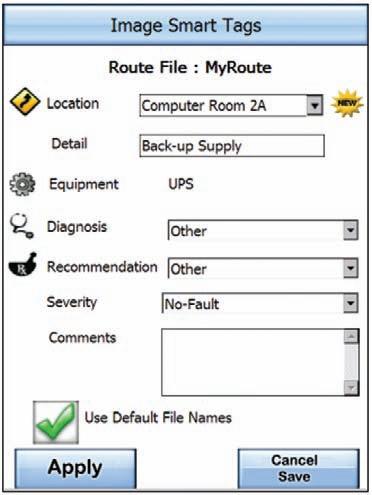
Infrared inspection cameras now integrate pen-based computers with asset databases, enabling users to create routes, identify the equipment being inspected and select fault options per equipment type.
Fig 1
tremely desirable, resulting in the acquisition of more reliable data, systematically gathered, stored, and consistently available throughout the enterprise.
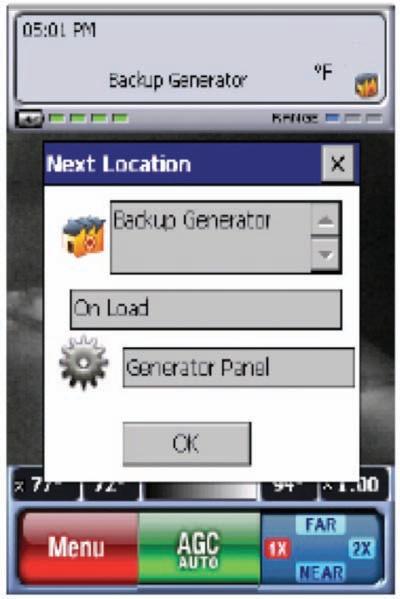
Typically, the camera can be operated in several modes, including off-route inspection, learn, on-route and survey (see Figs. 1 and 2).
1. Off-Route Inspection: This mode is useful when the user does not wish to follow a planned path, nor wants any assistance specifying the location of the points to be measured. (Cameras not equipped for routing always operate in the OffRoute mode).
2. Learn Mode : This mode allows the user to teach the camera an ordered list of inspection points (known as a route). For each of the traversed inspection points, the specific location, location detail, and equipment information are captured. Learned routes are saved in indi-
vidual files by user-defined names to facilitate future recall. Note that routes may also be created on a PC.
3. On-Route: A user selects a learned route from a set of routes stored in the infrared camera. While ‘on route’, the camera user is guided through an ordered set of inspection points. At each inspection point, the user has all the predefined inspection point information. The user can elect to take an image if desired (for example, if an anomaly is found, or simply to record the inspection event).
4. Survey Mode : This mode allows a user to randomly review inspection points on a specific route. This permits the user to benefit from the instant recall of predefined location and equipment field values, simplifying data entry and increasing operator efficiency.
Image smart tags
The significance of adding the loca-
& MEASUREMENT
Fig. 2: Using an On-Route mode, the user selects a learned route from a set stored in the infrared camera. Then the camera user is guided through an ordered set of inspection points. In this example, the backup generator is the next location on the route.
Downtime is expensive. We can help you reduce that time with high quality tungsten carbide parts—parts that will last 5 to 25 times longer than tool steel in the same high wear applications. Working in tungsten carbide and other advanced materials, our skilled craftsmen will manufacture custom parts for your equipment to exacting specifications.
tion, location detail and equipment field relationships into the routing process described above is that users can configure their camera in advance to guide them through a series of inspection points in which each of these fields can be preset, extensively simplifying user input in the field. Since the relationship between equipment, diagnosis and recommendation fields can also be userconfigured on a PC host, in-field typing is nearly eliminated in favour of the automatic population of input boxes and simple pull-down menus.
Image smart tags provide an opportunity to supply new image attributes, change default entries, or select from pull-down lists. As shown in Fig. 1, the location could be “Computer Room 2A”, the location detail field is “Back-up Supply” and the equipment type “UPS” (Uninterruptible Power Supply).
Once the equipment is identified, the infrared camera can offer expert-systembased diagnosis and recommendation options for that equipment. For example, diagnosis options for a UPS system may include: Faulty Connection, Defective Equipment, Improper Crimp, Overload, Unknown Anomaly, Short Circuit, or Other, to name a few. Once identified, the severity field can be identified in the camera and comments added.
Since all information is stored with the image, downloading after an inspection run will make the information accessible in PC software for archiving and automatic report generation.
As with other predictive maintenance modalities, infrared inspection has matured to be a common tool for the maintenance professional. In order to reap the benefits of infrared inspection, recent advances in infrared camera platforms have created a new class of infrared imaging instrument that incorporates many of the benefits of pen-based computing. With application-specific software, it can create a powerful infrared inspection data logger with many traits similar to mature vibration data collection systems.
Such developments have made possible route-based inspections and the use of smart tags to facilitate infrared inspections, better organize infrared inspection programs, optimize manpower planning, increase consistency of data a nd improve the productivity of personnel.
MRO
This article was prepared by Sofradir, a Paris-based developer and manufacturer of advanced infrared (IR) detectors. In Dec. 2008, it acquired Electrophysics, a Fairfield, NJ-based developer of advanced high-performance IR equipment, now known as Sofradir EC. For more information, use the reply number below at mromagazine.com/rsc.
THOMAS WIRE DIE
THOMAS WIRE DIE
Photo courtesy Sofradir EC (Electrophysics Corp.)
Fig 2
How proper shaft sizes are determined
Consider modifying a shaft only with good engineering support. Even then, remember that the greater the consequence of failure, the more generous the safety factor should be.
BY CHUCK YUNG AND CYNDI NYBERG
Have you ever wondered why various types of electric motors with the same hp/kW ratings have different shaft diameters, or why some pump shafts are so much smaller than the shafts of the motors that drive them? And what about those hollow-shaft motors? Knowing the answers to some of these questions, and some of the basics of how shaft sizes are determined, can be helpful to anyone who works with pumps and motors.
Bigger is better, at least it used to be Owing partly to tradition, the shafts of electric motors are often larger than those
of the equipment they drive. Engineers were very conservative a century ago when electric motors first came into widespread industrial use, so they typically designed in a sizable margin of error.
Today’s engineers haven’t changed much in this respect. For example, standard NEMA frame dimensions, which have been revised only once since 1950, still specify much larger shaft sizes than commonly accepted principles of mechanical engineering would require.
Shaft design basics
Shaft size is dictated by torque, not horsepower. But changes in horsepower and speed (rpm) affect torque, as the following equation shows:
Torque (lb-ft) = hp x 5252/rpm.
Accordingly, an increase in horsepower would require more torque, as would a decrease in rpm. For example, a 100-hp (75-kW) motor designed for 900 rpm would require twice as much torque as a 100-hp motor designed for 1,800 rpm. Each shaft must be sized for the torsional load it is expected to carry.
Two basic approaches are used to determine the required minimum shaft size for motors, both of which are quite conservative. One method calls for making the shaft large enough (and therefore strong enough) to drive the specified load without breaking. Mechanical engineers define this as the ability to transmit the required torque without exceeding the maximum allowable torsional shearing stress of the shaft material. In practice, this usually means that the minimum shaft diameter can withstand at least two times the rated torque of the motor.
Another way to design a shaft is to calculate the minimum diameter needed to prevent torsional deflection (twisting)
for a 200-hp motor is designed to withstand twice the rated torque, the shaft diameter of 2.371 in. is at the absolute minimum for the 400-hp rating.
Resistance to twisting method
The other way to calculate minimum shaft size for a motor is to set a limit on the amount of torsional deflection (twisting) that may occur. Resistance to torsional stress is directly proportional to shaft size: the larger the diameter, the greater the resistance to twisting.
A rule of thumb with this method is that the shaft must be large enough that it will not deflect more than 1 degree in a length of 20 times its diameter. To calculate the minimum shaft size to meet this specification, see Formula 4.
Example 2 : For the 200-hp, 1,800-rpm motor from Example 1, the minimum shaft size to limit torsional deflection would be as shown in Formula 5.
The minimum shaft diameters calculated by the torque transmission and torsional deflection methods are essentially the same for Examples 1 and 2. Still, a good approach is to calculate the size both ways, and then use the larger value as the absolute minimum.
Fig 1. A fire pump such as this does not run often, but it had better work when you need it. Fig 2. Effluent pumps application. Fig 3. This shaft failure started at a shoulder on the surface.
during service. To engineers, this means the allowable twisting moment, or torque, is a function of the allowable torsional shearing stress (in psi or kPa) and the polar section modulus (a function of the cross-sectional area of the shaft).
Machinery’s Handbook provides the following equations for determining minimum shaft sizes using both design approaches: resistance of torsional deflection and transmission of torque. Both sets of equations are based on standard values for steel, with allowable stresses of 4,000 psi (2.86 kg/sq mm) for power-transmitting shafts, and 6,000 psi (4.29 kg/sq mm) for line-shafts with sheaves (the proper name for what most of us incorrectly call pulleys).
Some of the equations also are specific to keyed or non-keyed shafts, which is handy for pump users who need to know how to calculate the size of each kind. (see Formula 1)
Most motor shafts are keyed, which increases the shear stress exerted on the shaft. Considering this, motor shaft designs typically use no more than 75% of the maximum recommended stress for a non-keyed shaft. This is another reason why the shafts of electric motors are often larger than the pump shafts they drive.
Example 1: Consider a 200-hp (150kW), 1,800 rpm motor. For a direct-couple application, the standard frame size is 445TS, with a (keyed) shaft diameter of 2.375 in. (60 mm). Using equation [1] (from Formula 1), the minimum shaft size would be as shown in Formula 2.
To see how much of a safety factor is built into the Formula 2 equations, substitute 400 hp for the 200 hp power rating. (see Formula 3)
Since the calculated shaft diameter
vertical motors. These designs allow the pump shaft to pass through the hollow motor shaft, which simplifies the coupling process for pump shafts that must support the heavy water column associated with a deep well.
The calculations for shaft diameter are not quite as straightforward for a vertical hollow-shaft motor. Two variables — the outside and inside diameters of the hollow-shaft — are not standardized, making it impossible to simplify the calculation with a ratio. For this reason, it is easier to demonstrate if a specific hollowshaft is sufficient for a given power rating.
Example 3: A 200-hp, 1,800 rpm hollowshaft motor has an outside shaft diameter of 3 in. (76 mm) and inside diameter of 2 in. (51 mm). To determine if this shaft size is sufficient to transmit the required torque, solve the following equation for P: 80 × P/N = (D4 - d4)⁄D [5] Where: P = power in horsepower N = rpm
D = outside diameter of hollow shaft (inches) d = inside diameter of hollow shaft (inches). For this example, P must be greater than 200 hp to ensure that the shaft will be large enough to handle the torque of the motor: 80 × P/1800 = (34 − 24)⁄3 P = 1,702 hp.
Hollow-shaft designs
Direct-coupled loads exert a twisting force (torsion) on the shaft, placing the greatest strain near the surface or radius and very little on the inside portion. That makes hollow-shaft designs practical for
1
The transmission of torque approach
Shaft with keyway Shaft without keyway Main power-transmitting shafts [1]
D = 60 P N 3 (inches) D = 105 P N (inches)
3 6 1033.1 N P D = (mm)
Line-shafts with sheaves/pulleys [2]
3 40 N P D = (inches) D = 70 P N (inches)
Where: P = horsepower N = rpm
FORMULA 2
3 60 N P D = 3 1800 20060 D = 1.89 in.
Or, in metric units: 3 6 1033.1 N P D = = 3 6 1800 1501033.1 = D = 48 mm
FORMULA 3
3 60 N P D = 3 1800 40060 D = 2.371 in. (60 mm)
FORMULA 4
4 3 = N P D (inches) [3]
Where: P = horsepower N = rpm
Or, in metric units: 112 3 = N P D (mm) [4]
Where: P = kW N = rpm
FORMULA 5
4 3 = N P D = 4 1800 200 3 = D = 1.92 in.
Or, in metric units:
Theoretically, this shaft is capable of transmitting 1,700 hp, so it is more than sufficient for the 200-hp requirement.
Example 4: The amount of torque that a hollow shaft can transmit depends on thickness of the wall between its inside and outside diameters. A thinner wall cannot handle as much torque as a thicker one. The 3-in. shaft in Example 3 was capable of transmitting 1,700 hp and had a wall that was 0.5 in. thick: (3 − 2)/2 = 0.5 in. How much horsepower could a 3-in. shaft transmit if the wall were only 0.25 in. thick?
80 × P/N = (D4 − d4)/D
80 × P/1800 = (34 − 2.54)/3 P = 314 hp
The effect of a thinner wall is dramatic. The shaft with the 0.25-in. wall can carry less than 20% of the torque of the shaft with 0.5-in. wall.
Summing up
Engineers tend to design using an ample safety factor, and older equipment in particular was overdesigned by even today’s standards. Of course, that is one reason many of us appreciate older machinery. It was darned reliable!
In any case, keep in mind that adding a keyway to an existing shaft weakens the shaft. Likewise, increasing the bore diameter of a hollow-shaft reduces the torque capacity. Consider modifying a shaft only with good engineering support. Even then, remember that the greater the consequence of failure, the more generous the safety factor should be. After all, who wants to board an elevator that was designed and built with no safety factor?
MRO
Chuck Yung is a technical support specialist at the Electrical Apparatus Service Association (EASA), and Cyndi Nyberg is a former EASA technical support specialist. EASA is an international trade association of more than 2,100 firms in 50 countries that sell and service electrical, electronic and mechanical apparatus. For more information, contact EASA at 314-993-2220 or visit www.easa.com. Reader Service Card No. 406
Fig 3
Fig 1
Fig 2
FORMULA
SIGNALS OF SUCCESS
Follow along with Step 35 in a journey to World-Class Maintenance at the Plentya Paper Company as the maintenance team strives to achieve its goals.
BY CLIFF WILLIAMS
This article is part of an ongoing series. The introduction appeared in Machinery & Equipment MRO’s February 2005 issue and the series has run in every issue since. Previous instalments are archived online at www.mromagazine.com. In this issue, we pick up where we left off in the September 2010 edition, as maintenance manager Bob Edwards gets ready to take on more responsibility in implementing major changes to the mill’s maintenance operations.
After hearing that one of our key millwrights, Dave, had accepted a job offer at another company as its maintenance manager, I called the guys together in the shop the next day, and told them about what was happening. There was definitely a subdued reaction from the group. It was Stan who broke the silence.
“Well, that just means we’ll have to take more of a role, and when we get the new guy, we’ll need to make sure he follows in Dave’s footsteps. What was it you guys used to say to me? ‘Lead, follow or get out of the way’?”
After that, everyone seemed more positive as they trooped out of the shop. Surprisingly, the day carried on as normal, even without Dave being there.
Later, I finished my calculations and figured that by reducing the number and time of our shutdowns, we could realize a gain of at least 2% from the planned downtime — and if we didn’t have the downtime associated with start-ups, we could reduce maintenance downtime by 1%.
Joe couldn’t argue with these numbers and I was sure corporate wouldn’t complain. That thought reminded me that I would have to present to the corporate group next week, so I thought I’d touch base with our reliability manager, Carol. When I called her, she said that she wasn’t quite ready and asked if she could have more time to get all of the reports together. It wasn’t like Carol not to be ahead of schedule, but I told that would be fine.
“Tomorrow’s good — it’ll give me the weekend to look at it,” I said.
The next day, I went to Carol’s office to get the reports.
“Well, the good news is that we are improving very quickly. Our downtime is down to 4%, which is less than half of what it was before. Our cost per ton has also dropped by 10% due to the fact that we use fewer parts and produce more tons. But the bad news is that we don’t
Taking Action Moving Forward
Network of Support
British Columbia
CastlegarBC(250) 365-7767
CranbrookBC(250) 426-4255
KamloopsBC(250) 374-8116
KelownaBC(250) 491-3434
ParksvilleBC(250) 248-7188
Prince GeorgeBC(250) 562-1114
QuesnelBC(250) 992-7038
VancouverBC(604) 523-2662
Williams LakeBC(250) 392-2388
Alberta
CalgaryAB(403) 243-5581
EdmontonAB(780) 437-9411
Grande PrairieAB(780) 539-3888
LethbridgeAB(403) 328-6681
LloydminsterAB(780) 875-8864
Medicine HatAB(403) 527-8166
Peace RiverAB(780) 624-4771
Saskatchewan
EsterhazySK(306) 745-6631
EstevanSK(306) 634-7321
ReginaSK(306) 757-5667
SaskatoonSK(306) 934-3366
Swift CurrentSK(306) 773-2066
Manitoba
WinnipegMB(204) 786-1167
Winnipeg - AgMB(204) 786-1976
Ontario
BramptonON(905) 456-2226
BrantfordON(519) 770-0239
ChathamON(519) 354-8444
DownsviewON(416) 743-5713
EtobicokeON(416) 252-2555
LondonON(519) 686-2650
NewmarketON(905) 853-6540
StratfordON(519) 271-3130
Quebec
Baie-ComeauQC(418) 296-5575
Mont-JoliQC(418) 775-3232
Sept-ÎlesQC(418) 968-5577
Trois-RivièresQC(819) 840-0489
Nova Scotia
DartmouthNS(902) 468-4300
With a goal of becoming a truly national organization in Canada,Applied Industrial Technologies continues to take action in expanding our business.With our recent acquisition of Toronto Bearings & Belting and CBS Equipment,Applied is proud to now operate eight facilities in Ontario.
At Applied Industrial Technologies,we're always right there when you need us, providing local,value-based solutions.
cluded the vice-presidents of operations and finance, what we had done so far. They seemed impressed that we had been able to reduce our unplanned downtime by 50% and seemed really keen when I discussed how we had managed to reduce inventory a little, with a plan to reduce it by a substantial amount over the next year.
“Exactly how much and how are you going to do that?” asked Monte, the vicepresident of finance.
“How much? That I can’t really tell you yet as we don’t have good data on which to base the numbers, but rest assured that it will be as much as possible without putting the operation of the mill at risk.” As to how, I described the usage reorder report that I had asked Carol to prepare. This seemed to answer their questions satisfactorily.
I saw Joe squirm just a little as I next brought up the subject of planned down-
time. When I brought up my chart that showed that we could easily save 2% downtime on planned shutdowns with a probable bonus of 1% of what was now being classified as unplanned downtime, everyone perked up. And when I mentioned how this was very much in line with what the Wisconsin mill had experienced, I’m sure everyone in the room could hear Joe exhale.
Scott, the vice-president of operations, had said very little all through the meeting and I wondered if he really saw value in what we were doing. But he soon allayed my fear when he commented, “Well, Bob, it looks quite impressive with what you’ve shown so far. We’ll soon be at the world-class mark for unplanned downtime, your inventory turns will be close behind and your planned downtime will far outdo any other mill I’ve heard about — other than Wisconsin.
“Now Joe has mentioned a little about how you try and get the guys involved —
and when I talk with my counterpart in Wisconsin, I’m amazed at exactly what the frontline people do. Do you have a measure for that and how are we doing in that aspect?”
Key Points
If someone opens the door, walk on through Delegate as soon as possible
“Well, Scott, if there is a measure, I’m afraid I don’t know of it — and when I talked with Alan at the Wisconsin mill, he didn’t really know of one either.”
Involve as much as possible
I went on to tell the group about our discussion with the Wisconsin management team, where they told us that this was their operating mode and it was driven by the bottom line. “Their philosophy is that decisions should be made at the lowest level possible and they’ve done everything to allow that to happen. That’s something we’re working on right now and we believe it will give us bottom-
Achieve up to 40% energy savings!
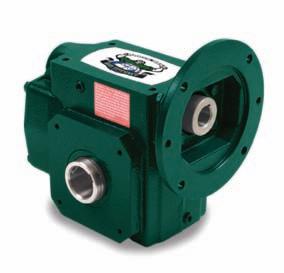
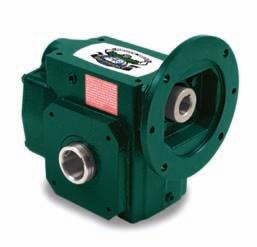
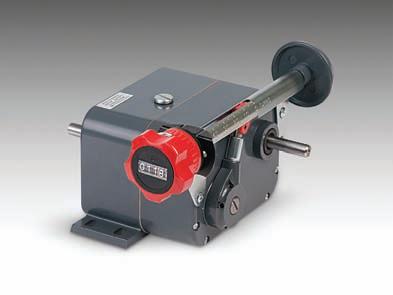
With the new Hub City HERA gearbox, it’s easy to replace inefficient gearing technology with a product that delivers 90% operating efficiency in ratios up to 60/1. Each HERA model also has the power density and versatility to directly replace up to four different worm gear models, minimizing inventory and downtime. Simply unbolt the old and drop in your new high-efficiency HERA. HERA – One powerful GREEN solution!
line results, while getting the guys engaged. But it will take some changes, a move towards empowerment and a great deal of trust.”
Joe just closed his eyes and shook his head as I continued by telling the group that we had just started tracking the reasons for delays in getting work done and that we believed a large proportion of it was waiting for someone with authority to make a decision on it — a decision the trades staff were quite capable of making themselves.
“Once we’ve confirmed that is true, we’ll start delegating authority in a controlled way. We can set up some sort of criteria that will allow the work to be completed sooner. This will also involve the operations group, as they will be involved in the decision-making process, so that will help us to include more people in the changes we’re trying to make.”
“Thanks, Bob,” said Scott. “That was encouraging stuff. Joe, I think we can safely say that this mill is headed in the right direction, and as I’ve mentioned before, we’ll be looking to you and people like Bob to help guide the other mills.”
“You can count on that, Scott, and thanks for the support,” Joe replied.
The next morning, Joe called me to his office, where he appeared a little bit anxious. “Bob, please don’t pull a stunt like that again — you know I didn’t know anything about the move to give the guys more authority.”
“I couldn’t help it. Scott just opened up the door and I had to drive through it. I think we came across very well, given their comments.”
“Yes, but as you mentioned, this will involve operations as well, and I’m not sure Fred’s group is ready for this.”
“I think you are selling Fred short,” I said. Then I told Joe about the change I had seen in Fred and about his comments to Kevin about work orders. “I know his guys are ready for it and I’m sure that all Fred needs is a little bit of support and a lot of reassurance. I’ll get him involved very soon.”
“Okay, but in future, keep me up-tospeed with everything you’re going to mention in a meeting!”
Later that day, I got the supervisors and Carol together and told them about what had happened in the meeting with the corporate group.
“Let’s call a meeting with the guys,” suggested Carol. “I want you to tell them about the codes and ask for suggestions on how we can reduce the delays, but we’ll need to be ready for a lot of them! I’ll talk with Fred so he’ll be aware of what’s going on.”
“Why not ask Fred if he wants his guys to sit in on the meeting?” suggested Kevin. “That way, we can be sure that everyone gets the same message. Carol and Jim, our maintenance supervisor, can take a group each and if you take one, then we’ll be able to cover all four shifts.”
“That’s a great idea, Kevin. I can invite Fred to sit in with me and that should help with his understanding.” MRO
605-225-0360 • Fax 605-225-0567
hubsales@regalbeloit.com • www.hubcityinc.com
Cliff Williams is the corporate maintenance manager at Erco Worldwide in Toronto, ON, and a consultant with TMS — Total Maintenance Solutions Inc., Markham, ON. He can be reached by email at williamscliff@rogers.com.
Introducing…
T
driver. In fact, the screwdriver helped to develop the parameters we use with this tool to determine the condition of rotating equipment in our facilities.
ysis (VA) and today a predictive maintenance program couldn’t function without it. VA in the early days wasn’t available to use right off the shelf and usually had to be invented and produced on the spot, where it was needed. Then in 1954, recognizing the demand for this type of equipment, Jim Chadwick and Jim Helmuth started a company that successfully produced vibration measurement systems.
were applied to the manufacturing of Hughes helicopter engines. Over the years, these field-ready units were used by every maintenance facility that serviced aircraft engines.
VA began in 1974 when the Canadian Armed Forces started using it on its Sea King helicopters.
days of VA in the Canadian Navy, I spoke with Jolson Sanford of Windsor, NS. A retired Navy Master Chief, Sanford helped to develop VA equipment and the early standards for measuring vibration in turbine aircraft engines.
in the beginning, when vibration analysis was a brand new tool.
BY PETER PHILLIPS
It all started with a
SCREWDRIVER
The early history of the introduction of vibration analysis technology to maintenance is a fascinating story, told here in recognition of MRO Magazine’s 25th anniversary and also to mark the Royal Canadian Navy’s 100th anniversary.
ter and Greenwood, NS. By 1984, most Canadian Forces bases had engine test cells and vibration analysis equipment. When we went to sea, we’d pick up a VA kit to take with us. We’d need it to do repairs and services to the helicopters
brex, made by Chadwick Helmuth, which was the only one available at the time. Before VA was introduced into the navy, we used a screwdriver held against the bearing housings of the Sea King engine. With the screwdriver grip against our ear, we determined if bearings were good or bad.
“This was the only way at the time to troubleshoot faulty bearings. As you got experienced listening to the sounds you felt and heard, you could determine which bearings were close to failing.
“When VA was first introduced, there were no baseline or benchmark readings to determine the condition of the Sea King engine bearings. In the beginning, we used our screwdrivers in conjunction with VA pickups (sensors) attached to the bearing housings. Back then, we even had to make the stand-offs (brackets) in the machine shop to mount the vibration pickups to the bearing housings.
“Once we had them mounted, we would compare the reading on the graph that the VA gear would print out, with what we heard with our screwdriver. If we found a bad bearing with our screwdriver, we would see if the graph corresponded. The graph would have high peaks if the bearing was failing. Bearings with the highest readings would score a ‘4’ on the graph. Other questionable bearings would score lower, usually a ‘1’ or ‘2’.
“Then we would dismantle the engine and check and measure the bearing. We paid special attention to the ones we found bad with our screwdriver and VA. This is the way we developed the first
“We would replace all the bearings during the rebuild and put the unit back into the test cell again for multiple starts and run-ups, while taking more VA measurements. These measurements and repairs were recorded for each engine on recipe cards. Along with the VA graph, the card would be posted on the walls of the test cell office. One of the test offices we had was 12 x 14 ft. We had hundreds of these cards covering every wall in the room. This was the history of every repair that was done to each engine.”
Sanford added that these early years were interesting. “The first VA test carts we built were mobile. The engine would be bolted on to the cart and wheeled behind an earth berm and tied down with one-inch cables. We stood behind an earth berm in case the engine blew up.
“The Sea King T58 GE engine absolutely screamed when it was turned up. The compressor rotated at 26,000 rpm and created 4,200 hp. We really took our lives into our own hands testing those engines in the open air without any protection. Once, in a lead-lined indoor test cell, an engine blew up and the turbine blades were stuck in the walls around the room. Imagine what would have happened if we had tested it outdoors just with a test cart.
“In the 1980s, we built test cells
“As we refined our use of VA on our Sea King helicopters and Aurora aircraft, our efforts began to be noticed by our military colleagues. In 1985, the American Air Force contacted us to go to Memphis to help them build a test cart for their Sea Stallion helicopter. By then we had developed the benchmark readings and it was easy to determine the condition of the engine bearings. They were quite impressed with our methods.
“As time went on, engine reliability improved and the 200-hour teardown and rebuild intervals were lengthened. This had a lot to do with the historical data we had collected on our recipe cards, and our ability to predict failures and test engines.”
Sanford said that many of their bearing problems occurred due to lubrication issues. Faulty lubrication pumps and plugged lines caused premature failures. Whether it’s in the 1970s or now, the reasons for such failures are the same. Lack of lubrication is still a major cause of bearing failure.
Interestingly, the methods of measurement really have not changed much these days either, as experienced maintenance practitioners still use screwdrivers to listen to bearings. The big difference today is the availability of the new technology that has been incorporated in modern vibration analysis equipment.
New VA equipment comes in handheld units that can be quickly used to measure a bearing’s condition; it simply displays a good or bad reading. More sophisticated units measure and analyze the collected data, and though analytic software provide users with useful graphs and reports of the results.
Today, many companies have pur-
many of those who haven’t done so yet continue to purchase services from vibration analysis specialists.
Although VA is more commonly referred to now as condition monitoring, the latest equipment allows vibration readings to be recorded over time using trend analysis software. Gone are the paper records and recipe cards. Today, everything’s right at your fingertips.
Back in Sanford’s day, VA was only capable of measuring high rpm readings. Today, full spectrum measurements can be taken on critically lowspeed rotating equipment to ultra-highfrequency centrifugal compressors that rotate up to 80,000 Hz.
Variable-speed equipment measurements, which once were difficult if not impossible to record and analyze, now can be taken as modern analyzers automatically adapt their diagnostic tools to variable turning speeds during routine data collection.
Even more advanced instruments use dual channels to correlate machinery vibration with process variables. This is accomplished by inputting the process information as a volt signal into one channel, while monitoring vibration on the other.
Of course, vibration readings can be recorded in a CMMS system and you can let it do the data crunching. It can then inform you that readings are out of spec and maintenance on the equipment needs to be scheduled.
This year, 2010, marks the 100th anniversary of the Royal Canadian Navy. I am pleased to dedicate this article to all those retired and active service people who have developed many tools and measurements that we now use in everyday industrial life. MRO
Peter Phillips of Trailwalk Holdings, a CMMS consulting and training company based in Nova Scotia, can be reached at 902-798-3601 or by e-mail at peter@trailwalk.ca.
This is the original engine test cell at the navy’s facility in Shearwater, NS.
Photo courtesy Jolson Sanford
These tips for success apply whether you work in an office or on the shop floor.
Want to improve your performance as a manager right now? Pick a few of these time-tested success tips and implement them in your work life.
1. Admit your mistakes.
2. Always tell the truth.
50 ways you can become a better manager
BY RICHARD G. ENSMAN, JR.
3. Ask questions.
4. Ask the people around you to list their top three skills. Then discuss with them how they can use the skills to more effectively reach your collective goals.
5. Be a good example.
6. Build a continuing education plan for yourself.
7. Carve 15 minutes out of your schedule each day for ‘think-and-plan’ time.
8. Delegate something you haven’t delegated before.
9. Determine what you procrastinate about. And then develop an anti-procrastination action plan.
10. Each day, make it a point to show interest and concern about the work of the people around you.
11. Encourage the people around you.
12. Face your fears. Admit to yourself what frightens you in your work life. Whether you resolve the fear or not, bringing it in the open will be liberating.
13. Figure out what distracts you from doing important (although sometimes boring) work. Ask yourself: How can you eliminate those distractions?
14. Identify the three activities that will make the most positive difference to your organization over the next year. At the start of each day, check on progress and pay attention to what you can do to move further along on your key activities.
15. Identify the triggers that make you angry or upset. Ask yourself what you can do to minimize the emotional impact of those triggers, or at least give yourself time to address problems when they occur.
16. Identify three people professionally close to you that you haven’t talked with recently. Have coffee with them.
17. Improve your time management system by writing down goals and tasks.
18. Make an inventory of your top three professional weaknesses. Ask your associates to help you overcome them.
19. Learn to say no when you need to.
20. Let a promising subordinate know that you have confidence in him or her.
21. Let your employees know what’s going on behind the scenes.
22. List the ways you get information right now, such as employee reports or sales data. Identify three ways you can improve the quality, accuracy or speed of the information.
23. Make a list of people who can help you navigate difficult situations. And call on them when the need arises.
24. Make a list of the disagreements and disputes you’ve had recently. And evaluate whether you resolved them
satisfactorily. If not, read up on negotiation skills.
25. Make it a point to embrace a new idea or learn a new skill at least once a month.
26. Make up a schedule that keeps you at optimum productivity, and stick to it.
27. Never be afraid to stand up for what’s right.
28. Offer to mentor a new employee.
29. Pick one bad habit you’ve noticed among the people around you, and set a good example of the behaviour you need from them.
30. Pick one speaking or presentation skill you’d like to polish, and find a way to practice that new skill.
31. Pick one troublesome computer skill you’d like to learn, and set aside two hours to master it.
32. Pick the very best quality of each your employees. Then match that skill with some important task or unmet need.
33. Promote lifelong learning among your employees and colleagues.
34. Put a smile on your face.
35. Read blogs and websites about your interests.
36. Remain calm in the face of conflict.
37. Say ‘please’ and ‘thank you’.
38. Scan a book list for recently-published books on leadership and management. Pick one to read.
39. Set a new ‘stretch’ goal.
40. Spend some social time with your employees, colleagues or vendors.
41. Take a few minutes each day to plan goals and activities for the next day.
42. Take steps to reach optimum health. That might mean difficult changes in diet, exercise or personal routine.
43. Tell your team that you believe in them.
44. Think about the worst possible scenario you could face as a manager — and figure out how you would address the problems that scenario would pose.
45. Treat each person you meet — employees, customers, vendors, associates, visitors — with the highest standards of courtesy and respect.
46. Walk around your workplace and observe. You’re bound to learn something new.
47. Watch your language — verbal language and body language.
48. When you catch someone doing something right, acknowledge and praise it.
49. Write a new procedure for a commonly-performed task. Standard operating procedures may save you time and effort in the future.
50. Write a vision statement for your business or work unit. Share it with your people at your next team meeting.
Richard G. Ensman,
What’s new…
in products, systems, components and accessories for machinery and equipment maintenance, repair and operations.
Transporter offers battery-powered lifting
Southworth Products has introduced the Dandy Lift lifter/ transporter with a battery-powered lift mechanism. Lifting and lowering is achieved at the touch of a button with the aid of a 24-V battery. Available in five models with capacities from 220 lb to 500 lb, table sizes of 20 in. by 31.5 in. by 36 in. and raised heights to 51 in., the device features a battery status indicator and onboard charger, full shielding of electrical components, smooth-rolling casters, parking locks and a comfortable handle. A high-speed linear actuator provides precise positioning. The lift is suitable for use in stock rooms, shipping rooms, assembly areas, test stations, etc.
Manufactured to maximize speed, precision and efficiency in high-demand machine tool applications, Timken’s precision cylindrical roller bearings for screw drives feature a combination of axial cylindrical rollers and radial needle rollers. This configuration helps manage loads from multiple directions during high-speed operation. The precision cylindrical roller bearings for rotary tables feature an integrated design, with an L-shaped inner ring, shaft washer, outer ring, two thrust roller cage assemblies and a radial fullcomplement row. These robust bearings are suitable for applications where rotational accuracy, consistency and rigidity are critical, such as rotary tables and grinding and milling operations.
Timken
Reader Service Card No. 350
Retaining ring/wave spring combination saves money
Rotor Clip’s multi-turn wave springs offer a cost-saving method to pre-load and retain bearings in a variety of applications. The radial wall of the wave spring offers a wide supporting surface and the bearing load in the waves provides 100% axial transmission of the load. In place of a cover plate, the entire assembly can be
held in place using a two-turn spiral retaining ring, which offers a 360-degree closed surface of contact for the wave spring. The combination of retaining ring and wave spring offers an economical way of accomplishing the bearing preload and retention task.
Rotor Clip
Reader Service Card No. 355
Two- and three-way valves offer improved performance
Asco has introduced the 8262/8263 series two-way and 8314 series three-way directacting solenoid valves with increased AC and DC pressure ratings and real-time online configuration and ordering. The two-way valves come in brass and stainless steel construction with 1/8-in., 1/4-in. and 3/8 in. pipe sizes and are used to control the
flow of air, water, light oil and specialty media such as cryogenic fluids, ammonia, oxygen and liquid propane. The three-way valves come in brass and stainless steel with 1/8-in. and 1/4-in. pipe sizes and are used to control the flow of air, water and light oil.
Asco
Reader Service Card No. 357
Shaft collar offers tight fit
A wide range of shaft collars with controlled face tolerance and high holding power is available from Ruland. Offered in aluminum, black oxide carbon steel, stainless steel and engineered plastic, the shaft collars are single-point faced during
the boring process to ensure a high level of face-to-bore perpendicularity. One-and two-piece clamp shaft collars are available with bore sizes from 3 mm to 80 mm and from 1/8 in. to 6 in. The company uses forged socket hardware, which allows for higher screw torque and increased holding power. All products are RoHS and REACH compliant.
Ruland Manufacturing
Reader Service Card No. 354
Degreaser handles tough cleaning jobs
Safe for ferrous and non-ferrous metals, CompreVac’s Xtra-Clean is an industrial degreaser and cleaner formulated for cleaning oily and greasy surfaces such as oil rigs, engines, the oil-side of heat exchangers, pipes, vats and more. A synthetic detergent with anti-redeposition agents provides this noncaustic cleaner with a pH of 13.0. The degreaser is water-based, environmentally
Welding helmet features camouflage graphics
Miller Electric has added the Digital Camo helmet to its line of Digital Elite series welding helmets. This helmet features a military-inspired camouflage design and comes in four fabrication modes. Other features include 1/20,000-sec. lens speed, weld, cut, grind and X-mode for versatility in the field, 3,000-hour battery life, manual-on and auto-off, and 9.22-sq in. viewing field that houses four independent arc sensors. The helmet offers variable shades (#8-13) in weld mode and light state #3 in grind mode. A magnifying lens holder is included.
Miller Electric
Reader Service Card No. 353
safe, biodegradable, non-flammable, nonabrasive, non-corrosive and non-toxic. It has a multitude of applications, including cleaning dirt and grease off equipment, as well as ink from presses.
CompreVac
Reader Service Card No. 352
Radio control system is for rope hoists
tDRC-MP radio control systems from Demag, designed for use with the company’s DR Pro rope hoists, provide a range of powerful features for enhanced operator control and added flexibility. Available in two ergonomic designs, the DRC-10 pushbutton transmitter and the DRC-J joystick transmitter, the systems come standard with bi-directional communication, an impact- and temperature-resistant housing, two buttons for special functions and a range of approximately 100 m (328 ft). The graphic display shows battery capacity, installation status and warning messages.
Demag Cranes & Components
Reader Service Card No. 356
Piston-type open-circuit pump is compact
The 620 series of compact piston-type open-circuit pumps for moderateflow, high-pressure applications is available from Eaton. Optimized for Tier-4 diesel-powered applications, the pumps are rated at 280 bar and 2,200 rpm with a displacement of 98 cc (6.0 cu in.) revolution. They feature a 15-degree swash plate angle that allows the pump body to be up to 27 mm (1.1 in.) shorter than other pumps, and internal flows and valve plate timing realize the packaging benefits of the smaller angle without sacrificing overall pump efficiency. They have a variety of mobile and stationary uses, such as wheel loaders, motor graders, concrete equipment, rail maintenance, forestry equipment and drill rigs.
Eaton
Reader Service Card No. 358
continued on page 24
When it really matters, trust Tsubaki.
Large air nozzle resists corrosion
Designed for blowing heavy materials and where the device cannot be mounted close to the target surface, Exair’s 3/4
NPT stainless steel Super Air Nozzle delivers 4.5 lb of strong blowing force for blowoff, cooling and drying applications
located in corrosive, high-temperature, food and pharmaceutical environments. The airflow cannot be blocked, as required by OSHA, and the sound level of 96 dBA is below OSHA limits. The type 316 stainless steel construction has a 32-mm (1-1/4-in.) hex body for easy installation using a standard wrench or socket. Applications include ejection of heavy parts, drying, part and machinery cleaning, chip removal, liquid blowoff and cooling hot parts.
Exair
Reader Service Card No. 360
Double diaphragm pump provides energy savings
AirVantage is a high-efficiency air-operated double diaphragm pump from Warren Rupp that saves energy, improves plant efficiency and reduces maintenance costs. It reduces energy costs by cutting air consumption at the pump, and automatically adjusts as process condi-
Modular crimper offers versatility, fast cycle times
Parkrimp-style modular crimpers from Parker Hannifin can be both portable and bench-mounted. The KarryKrimp 82CCHD and KarryKrimp 2 85C-CHD crimpers can serve as bench-mounted units with the addition of a power unit (model 85C-1PH) or as mobile crimpers by adding a portable stand (model 85C-STD). The design provides faster cycle times on bench-mounted units and the ability to crimp longer bent fittings due to increased height. These crimpers help users to reduce their equipment investment and to crimp hoses on any type of jobsite.
Parker Hannifin
Reader Service Card No. 359
tions change to maintain constant flow without manual operation or adjustment. An adaptive microprocessor continuously manages the amount of air volume required to operate the pump at desired flow rates. The AODD pump is available in 2-in. and 3-in. pump sizes under Sand-
piper and Versa-Matic brand names. Warren Rupp
Reader Service Card No. 361
Safety eyewear’s wrap-around design protects workers from sunlight
Sperian Protection has introduced the Uvex SolarPro safety eyewear. The style’s wrap-around design and variety of lens tint options offer good peripheral vision and comfort in outdoor applications such as construction, utility line work, landscaping, and oil and gas industries. The lenses provide 99.9% ultraviolet protection. Available in eight lens tints, including mirrored, polarized and photochromic, the eyewear reduces solar glare and eye fatigue, while its soft, padded temples and nosepiece deliver a comfortable, non-slip fit. It meets the ANSI Z87.1 safety standard.
Sperian Protection
Reader Service Card No. 362
Shaft collars/couplings come with choice of finish
Stafford’s stainless steel shaft collars and couplings are offered with a standard bright finish or they can be supplied with a matte finish to match machinery
and equipment design requirements. Manufactured from 303 or 316 grades, the collars come in sizes from 1/4 in. I.D. to 10 in. I.D. and the couplings in 1/4 in. I.D. to 3 in. I.D. with straight or stepped bores and keyways. One- and two-piece clamp-type and set-screw styles are available. Larger sizes, keyways, flats, hinges, threads, knurls and other characteristics are optional.
Stafford Manufacturing
Reader Service Card No. 365
You have a choice of using our traditional printed reader reply cards in this issue to obtain more information, or our new Online Reader Reply Card at www.mromagazine.com/rsc — a faster and simpler way to request additional details from suppliers.
Guide demystifies selection of lifting magnets
A guide for identifying and selecting lifting magnets for various industrial applica- rious tions is available from Eriez. The manual, entitled How to Choose and Use Lifting Magnets, covers topics such as the weight, shape and contact area of the objects to be lifted, surface conditions,temper-,temperature, lift frequency, etc. Lifting magnets can be electro or permanent and can be installed and used as single magnets or as arrangements of multiple magnets. In all of these cases, a thorough knowledge of the application is essential when selecting the components to handle steel plate and shapes. The free guide can be downloaded from Eriez’ website at www.eriez.com.
Eriez
Reader Service Card No. 367
Magnetic document binder keeps work orders to hand
valve that allows the water to flow at a minimum of 20 gpm. This high volume dilutes and completely flushes hazardous material off the body. Outdoor systems protect from freezing to minus 50°C and come with freeze and scald protection valves, interior and exterior lights, and an alarm system.
Ralston CanSafe Reader Service Card No. 363
Air union withstands hostile environments
Barco’s E-2 Series air union is suited for any air-related manufacturing application, such as marine, oil field drilling, clutches, winches and brakes. It features a Nitrotec surface treatment, an allgaseous surface treatment process that increas-
Built to attach to such items as steel walls or machinery, the magnetic document holder from Visual Planning features a 1-in. or 1-1/2-in. D-ring binder mechanism. The product holds 4 lb or 100 or more three-holepunched 11-in.-wide sheets. It is designed for work orders, instructions, and more. A free 128-page catalogue of magnetic products is available from the company.
Visual Planning Group
Reader Service Card No. 368
Antimicrobial product protects painted surfaces
Sherwin-Williams Chemical Coatings Division is partnering with Microban International to offer liquid and powder product finishes with Microban antimicrobial product protection. This protection works continuously to inhibit the growth of bacteria that can cause stain, odour, discoloration and deterioration of the painted surface. Seven coating products currently are available with this protection, including select Polane, Powdura, Kem Aqua and Sher-Wood finishes.
Applications include wood, plastic and metal products. The product provides protection for the life of the coating; it never has to be reapplied and will not wash off or wear away.
Sherwin-Williams
Service Card No. 366
Portable indoor/outdoor showers rinse off pollutants
The indoor and outdoor enclosed safety shower systems from Ralston CanSafe offer portable, engineered solutions to protect workers from harsh work environments. Each system is constructed of vacuum-formed glass-fibre and features a SpinTec showerhead, eyewash and drench hose. The shower features a stay-open ball
Jobsite sound system never skips a beat Bosch’s Power Box 360 jobsite AM/FM stereo system offers 360-degree speaker configuration and a five-speaker design with an integrated subwoofer that projects highquality, enriched sound in all directions. Features include a weather-sealed digital media bay for secure storage and protection from moisture, dust and debris, a built-in SD memory card and USB ports. Also included is a built-in battery bay. Bosch 14.4-V or 18-V lithium-ion power tool batteries can be charged inside the Power Box 360. The same batteries can be used to power the unit for easy outdoor use. The rugged aluminum and rubber protective cage isolates the unit from shocks and impacts on the toughest jobsite.
Bosch
Reader Service Card No. 364
es wear and corrosion resistance to eliminate rust build-up. The design offers a low balance ratio and a ceramic seal for long life. Sizes range from 1/4 in. to 2 in., maximum speed
is 3,500 rpm, and maximum air pressure is 10.3 bar (150 psig). Available in both US and metric threaded connections, the series is easily field replaceable using an inexpensive repair kit.
Your Canadian Resource For Business Acceleration
Barcor
What’s new in test & measurement
Leak detection kit reveals oil-based fluid leaks
Spectronics has introduced the OPK-341 industrial leak detection kit for pinpointing fluid leaks in hydraulic equip-
ment, compressors, engines, gearboxes, fuel and other synthetic and petroleumbased systems. The kit includes the Optimax 3000 cordless, powerful blue light LED inspection flashlight with an inspection range of up to 6.1 m (20 ft). Powered by a rechargeable NiMH battery, the flashlight has an LED life of 50,000 hours. Also included in the kit are two 16-oz twin-neck bottles of Oil-Glo 44 concentrated fluorescent oil dye, an 8-oz spray bottle of Glo-Away dye cleaner, smart AC and DC chargers, and fluorescence-enhancing glasses. The components
are packed in a rugged carrying case.
Spectronics
Reader Service Card No. 301
2D laser alignment system is easy to set up
The compact and affordable, twodimensional Microgage 2D laser alignment system from Pinpoint Laser Systems, designed for precision measuring, machine alignment, calibration and more, combines a compact laser transmitter with a receiver and digital display. Accessories allow for alignment of straightness, run out, parallelism, squareness, roll and web alignment, shaft and bore alignment, flatness measuring, etc. The system operates on batteries, and all components are machined
of solid aluminum with a hard anodized coating for wear resistance. The components are stored in a compact carrying
Laser alignment system is worn on the arm
The Fixturlaser UPADXA laser shaft alignment system is ultra-portable. Featuring all of the capabilities of the Fixturlaser XA system, this tool attaches to the arm, allowing the wearer to work in complete freedom and mobility during the entire measurement and alignment process. Features of the system include express evaluation with animated and colour display screen using 3D Macromedia Flash, express data transfer via built-in Bluetooth units, express mode incorporating inclinometers in both measurement units, and express documentation using a USB slave port.
Services Techniques Claude Drouin
Reader Service Card No. 305
case that can easily be carried on to the manufacturing floor.
Pinpoint Laser Systems
Reader Service Card No. 303
Five-in-one clamp meter delivers functionality and value Designed for plant, HVAC/R and electrical professionals, the Extech EX623 clamp meter offers the convenience of five meters in one instrument: AC/DC ‘amp clamp’ meter, true rms multimeter, infrared thermometer, noncontact voltage detector and dual-input Type-K thermometer. The instrument accurately measures AC and DC current, voltage and temperatures for troubleshooting both new installations and preventive/ongoing maintenance and repairs. Its generous, 36-mm jaw opening handles conductors up to 500 MCM.
Extech Instruments
brate or work loose. Tools should be calibrated and checked on a regularly scheduled calibration interval program.
Mountz
Piston gauge is optimized for low uncertainty
Reader Service Card No. 302
Multi-function pocket tachometer is versatile
Dwyer Instruments’ Series TAC3 pocket tachometer measures and displays rotational speed of saw blades, grinders, engines, motors and conveyor belts. The ergonomic design provides direct line-of-sight viewing of display and target. The easyto-read, five-digit, alphanumeric, dual LCD also displays on-target, continuous measurement, laser and low battery indications. Measurements of up to 999,999 can be viewed with the onscreen multiplier. Programmable to read in English or metric units, the instrument is a 32-function tachometer/ratemeter/totalizer/counter, and timer. It can be tripod-mounted and locked on for accurate and continuous operation.
Fluke Calibration has introduced the PG9607 piston gauge, which measures absolute and gauge pressures up to 500 kPa (72.5 psi). Designed according to National Measurement Institutes’ requirements, it offers features to reduce sources of pressure uncertainty, a 100 g mass load to allow a wide range of pressure defined by a single piston-cylinder assembly, and a high-performance 50-mm piston-cylinder design. The piston gauge uses DH Instruments’ AMH automatic mass handling technology to allow fully unattended testing, establishment of better reference vacuum and improved long-term mass stability. Compass calibration management software also is offered to support complete test system automation without the need for custom programming.
Fluke Electronics Canada Reader Service Card No. 307
Modules enhance laser alignment system
Prüftechnik has added two expert features to its Rotalign Ultra alignment system. The Live Trend add-on module monitors movement of machines during runup or coast-down phases in order to deter-
Dwyer Instruments Reader Service Card No. 308
Torque tester keeps hand tools at peak efficiency
The easy-to-use EZ-TorQ II torque tester from Mountz is a cost-effective calibration tester for verifying and calibrating all small hand torque and non-impacting torque power tools. The instrument packs a builtin transducer and graphics display into a small, portable unit, making it suitable for checking torque tools on the production floor or calibrating in the lab. Calibration of hand torque screwdrivers and wrenches, as well as power tools, avoids overtightening problems such as stripped fasteners and parts, and under-tightening problems such as fasteners that can vi-
mine the positional change over time and the influences of given events. The module uses the five-axis sensor to monitor both the vertical and horizontal parallel and angular displacement of rotating machinery. The Vibration Acceptance Check add-on module works in combination with the company’s Vibtool device to measure vibration levels according to ISO 10816-3. The RMS velocity value is transferred wirelessly and stored back on to the Rotalign Ultra system, where the result is instantly evaluated against the machine classification threshold.
Prüftechnik Canada
Powerful leak detection
flashlight catches all leaks
Spectronics has introduced the Spectroline OPX3000 Optimax 3000 portable fluorescent leak-detection flashlight with an inspection range of up to 6.1 m (20 ft). Its focused beam makes it easy for technicians to pinpoint all refrigerant leaks. Super-
hi-flux LED technology provides an ultra-bright light. The flashlight’s power equals that of 150watt lamps plugged into an AC power source, while this unit is rechargeable, powered by a NiMH battery with a 50,000-hour LED life. The flashlight comes with fluorescence-enhancing glasses and an AC and DC battery charger.
Spectronics
Reader Service Card No. 311
Dual-line display meter offers flexibility
The PAX2A dual-line display meter from Red Lion Controls can display input, total, minimum, maximum or setpoints on a 0.7-in. high, six-digit main LCD display. The main display offers three pro-
perature sensor and a laser tachometer. The instrument uses True Amplitude to give ultrasound inspectors the ability to maintain a database of accurate sound files. Each wave file is sampled 250,000 times per second. An ultrasound detector connects to the Internet for remote access for support, training and measurement triggering. In addition, two-channel sequential measurement means fast collection of data by multiple sensors. Six base formats are available, and sensors and software can be added as needed.
SDT Ultrasound Solutions
Reader Service Card No. 310
Laser alignment kit is built to last for years Pinpoint Laser Systems has introduced the Proline alignment kit, a visual laser system for checking and measuring straightness, flatness, squareness, paral-
Infrared cameras offer range of features
The HotShot HD portable infrared inspection camera, available from Electrophysics, is available in various models for temperature measurement up to 500°C. Features include sharp, 640-by-480 image details and an integrated highquality visible-light camera. The laser pointer accurately marks the temperature measurement spot at almost any distance. Also available is the EZTherm 800 series of portable infrared cameras for entry-level industrial inspection and building thermography. The two low-cost models feature point-and-shoot simplicity, an integrated visible-light camera and a large colour display. Sharp infrared images allow accurate, intuitive and precise analysis. This series is easy to operate and features a lightweight, waterproof and ergonomic housing design that is comfortable to hold.
laser alignment system in one compact and portable product. Enclosed within a precision-machined housing, the laser produces a crisp, collimated laser reference beam that forms a bull’s-eye pattern for easy visual alignment and precise measuring. The durable components, which are stored in a carrying case, are machined from solid aluminum with stainless steel parts and protected by a hard anodized coating.
Pinpoint Laser Systems
Reader Service Card No. 316
Electrophysics
grammable, easy-to-read colours: red, orange and green. The panel meter also features a second display line, featuring a 0.35-in. high, nine-digit green LCD display, which also is programmable and accommodates totalizing applications that easily exceed a six-digit display. In addition, a three-digit programmable custom unit also is available. The dual-line display meter provides universal functionality, including universal input.
Red Lion Controls
Reader Service Card No. 312
Roll alignment system works fast
The RollCheck laser alignment system speeds up alignment checks and the replacement of rolls in the processing industry. The laser transmitter and reflector sit on precision bases, and are either strapped on or magnetically mounted to the roll surface, allowing the user to project two lines, one horizontal, the other vertical, on to the corresponding reflector unit. Within two minutes of attaching the two components to adjacent rolls, the user can determine the alignment of the rolls. The devices can remain in place while adjustments to the roll are performed. The laser lines are green, which is a much brighter colour to the operator than red, and they provide a sharp, crisp visibility. The system is lightweight, compact, durable and easy to use. Applications include paper converting, films, roofing materials, steel, printing, textiles and paper recycling.
Cost-effective infrared camera fits into maintenance program
Suitable for entry-level industrial inspection and building thermography, the low-cost EZTherm 800 series of portable infrared cameras features point-and-shoot simplicity, an integrated visible camera and a large colour display.
The EZTherm 875 and 881 cameras produce sharp images, providing accurate, intuitive and precise analysis of thermal images. They are easy to operate and feature a lightweight, waterproof and ergonomic housing design that is comfortable to hold.
Electrophysics
Reader Service Card No. 317
Data collector offers intuitive operation
The Vibxpert II two-channel data collector and FFT signal analyzer is available from Prüftechnik, featuring a high degree of ergonomics and speed. The VGA colour screen with over 200,000 colours creates a clear graphics-based user interface, and the ergonomically shaped housing makes the device comfortable to use. Lower measurement times than with the earlier model are achieved through the use of updated processor technology and by optimizing internal measurement processes. The 2-Gb data memory and long-life lithium ion batteries allow data collection of up to eight hours without interruption.
Prüftechnik
Reader Service Card No. 318
MRO
Seiffert Industrial Sales Reader Service Card No. 315
Ultrasound data collector includes powerful database
What’s new in drives and motion control
Modular motor system offers a multitude of options
SEW Eurodrive’s modular DR motor system offers many drive combinations. Well-suited for almost any industry, the system allows users to specify exactly the options needed for any given application. It meets and exceeds international energy standards and comes in three efficiency levels. The standard efficiency model DRS has fractional hp, the NEMA Premium Efficiency model DRP has 1 hp to 50 hp, and the High Efficiency DRE, 1 hp to 300 hp. The built-in encoder is fully integrated into the motor, making it more compact and less expensive. The
Lightweight linear shafting has attractive pricetag
Thomson’s Ultra Light LinearRace shafting combines reduced system weight with smooth linear motion. It is constructed of 6061T6 aluminum with an HRC 70 hard anodized finish, and is available in inch sizes ranging from 0.25 in. to 1.0 in. and in lengths up to 120 in. Metric sizes are available upon request, as are special machining options. The shafting can be used with the company’s self-lubricating FluoroNyliner bushings for applications with heavy loads, high contamination and corrosive environments. It also can be paired with food-grade bearings for use in food processing, pharmaceutical and medical applications.
Thomson
Reader Service Card No. 337
Gear reducer boosts system efficiency
The Grove Gear IronMan E series gear reducer operates at 90% efficiency to maximize system effectiveness. It features a compact housing design that offers a direct replacement for worm gear re-
ducers, and mounting base kits allow drop-in replacement of multiple sizes. Four models of gear reducer are available, with double reduction ratios from 7.8:1 to 60:1 and power capability to 8.5 hp.
Triple reduction units are available by adding a ratio multiplier. Features include helical-bevel gear technology, synthetic lubricant, covers sealed with o-rings and Viton double-lip seals.
Grove Gear
Reader Service Card No. 336
High-power drive broadens application flexibility
Rockwell Automation has expanded the power range of its Allen-Bradley PowerFlex 755 AC drives to 450 kW (700 hp), giving users increased flexibility in motor-control applications in a variety of heavy industries, such as oil and gas, tire and rubber, refining, material handling, and metals and mining. Features include roll-out capability for fast installation and maintenance, modular design for easy replacement of drive components, and advanced diagnostic capabilities, including indication of blown fuses and surge protectors. The drive comes equipped with an embedded Ethernet port and five option slots.
Rockwell Automation
Reader Service Card No. 339
Drive easily handles changing operating speeds
The Zero-Max adjustable speed drive with the Micro Dial feature provides accurate and repeatable speed settings, allowing users to accurately set and re-set various speeds to meet performance levels for different applications, such as seeder cart settings for different grains and precise speed control in textile wind-
from 0 rpm to 2,000 rpm, the drive allows changes to its output speed to be made quickly and easily, whether the machine is running or not. It provides speed control for inputs from 1/4-hp to 1-1/2-hp applications with output torque ratings from 12 in.-lb through 200 in.-lb, and can be used as a prime mover connected to a motor, or as a secondary drive connected to a shaft in the machine’s drive line.
Zero-Max
Reader Service Card No. 341
Free MRO Product Literature Guide
NEW PULLEY CATALOG “B216”
BRECO flex ’s new B216 pulley catalog offers made-to-order and stock pulleys. The new domestic “CNC” pulley maufacture allows for precise machining standards, leading to superior product quality and quick product availability. BRECOflex now provides finished custom precision pulleys and stock pulleys with pilot bores, for immediate delivery. Custom pulleys include backlash, reduced backlash “SE” or zero backlash “0” tooth gap design. Call for our free engineering support! BRECOflex CO., L.L.C. 888-463-1400 or 732-460-9500, Email: info@brecoflex.com
BRECOFLEX Circle Reply Card No. 274
ENERGY SAVINGS BROCHURE
A new 18-page brochure outlines the advantages of premium efficiency Baldor_Reliance Super-E® motors, which meet or exceed NEMA premium efficiency standards. Baldor’s BE$T (Baldor Energy Savings Tool) software, included with the brochure, can compare the operating cost of industrial electric motors with Baldor-Reliance motors. For a free copy, contact a Baldor District Sales Office, or visit www. baldor.com/support/literature_ request.asp, complete the form, then click on ‘Energy.’
BALDOR
Circle Reply Card No. 277
KNOWLEDGE-ENGINEERED LUBRICATION SOLUTIONS FROM SKF
Some 36% of premature bearing failures are caused by incorrect specification or inadequate application of lubricant. Preventing such failures means delivering the right lubricant, in the right amount, at the right time, to the right lubrication point. With over 100 years of rotating machinery expertise, SKF delivers a complete line of lubrication solutions to do exactly that.
SKF Circle Reply Card No. 280
DRIVES, LLCPRODUCT YOU NEED, SERVICE YOU EXPECT.
Extended Life CHP™ hard chrome plated pins possess standard steel’s metallurgical properties for toughness and strength while delivering an extremely hard wear-resistant pin surface. CHP chain pins resist wear longer than standard heat-treated pins, even in dry and abrasive environments. Contact Drives, LLC for more information on Extended Life CHP™ series chains. Visit our website, www.drivesinc.com, today.
DRIVES, LLC
Circle Reply Card No. 272
MILL SUPPLIES AVAILABLE AT KINECOR!
Kinecor recently launched a new line of mill supplies throughout more than 60 branches across Canada. We have the tools you need for critical maintenance and repair work, from lubricants, paints and abrasives to industrial fans, flashlights and hand tools.
For more information, please consult our mill supplies brochure at www.kinecor.com or contact us at 1-866-KINECOR.
KINECOR Circle Reply Card No. 275
SPHERICAL ROLLER BEARINGS THAT SAVES YOU MONEY AND TIME
The FAG X-life series E1 spherical roller bearings provides optimum operating life far beyond conventional values. With our optimized roller geometry and raceway finish, operating life is increased up to 70%, reducing downtime and maintenance costs. That is why you will find our bearings in all kinds of applications where heavy loads have to be accommodated or where shaft deflections or misalignments of bearing seats must be compensated for. They operate in the harshest environmental conditions, for example in gearboxes, paper machines, construction machinery and vibrating machinery.
INA/FAG
BELT DRIVE PREVENTATIVE MAINTENANCE & SAFETY PROGRAM
Gates is dedicated to providing reliable information to keep your facility running safely at optimum capacity. When compared to the maintenance and replacement costs of roller chain or gear drives, belts can be the most cost-effective and reliable power transmission solution. An effective preventive maintenance program consisting of a safe working environment, proper belt drive installation, inspection and performance evaluations will continue to keep costs down. Let Gates help increase your facility’s uptime and avoid costly belt drive failures. Visit www.gates.com
GATES
Circle Reply Card No. 278
WE MAKE IT EASY FOR YOU TO MAKE THE RIGHT CHOICE!
More than 50 years of experience in power transmission — more than 40 KTR locations throughout the world.
As a global leader in the manufacture of couplings, clamping sets, torque limiters, torque measuring systems and hydraulic components, we are the right partner for all those who want to set things in motion. www.ktr.com
KTR CORPORATION
Circle Reply Card No. 281
ULTRA CLASS
NTN Bearing Corporation, a leader in the supply of bearing units, also offers the Ultra Class Mounted Unit series. NTN’s research, along with extensive experience in original equipment and the aftermarket, has led to the development of a unit with unique features that take mounted units to an elevated level of design and performance. For more information on Ultra Class Bearing Units, or on our wide range of bearing products, visit us at www.ntn.ca
GUIDE
NSK is dedicated to delivering value added information to keep your facility both efficient and productive. To help maximize uptime and lower maintenance costs, keep a copy of our reference guide for bearing ‘must-knows’ on:
• Types and Tolerance Classes
• Fits
• Radial Clearance
• Selecting the correct lubrication
• Lubrication consistency
• Mounting
For more information, visit us at www.ca.nsk.com or contact us at info@ca.nsk.com or 1.877.994.6675
NSK
Circle Reply Card No. 273
TECHNICAL SERVICES NOW OFFERED BY TSUBAKI!
Tsubaki’s Technical Services staff is available for on-site inspections and can recommend the best solution for your application. A partial list of our services includes the following: On-Site Services • Maintenance Seminar • Critical Application Survey • Application Troubleshooting In-House
Sample Identification Contact Tsubaki at info@tsubaki.ca for the complete list and to see how our Technical Services can help you best.
LOCTITE® DO-IT-RIGHT USER’S GUIDE
This 40-page User’s guide is designed to help the Maintenance Professional with the proper selection and use of Loctite® products. A wide variety of preventive maintenance, as well as repair techniques, is explained in step-by-step detail. This can be considered a supplemental service manual for every piece of equipment in your plant.
LOCTITE
Circle Reply Card No. 279
KOYO CANADA ADDS NEW LINE OF NEEDLE ROLLER BEARINGS
Koyo Canada now offers the full range of Torrington® needle roller bearings and cam followers from stock, in metric and inch sizes. Bearings can be ordered pre-lubricated to reduce assembly time and in bulk packaging which cuts down on material waste. Contact your local authorized Koyo distributor or Koyo Canada for more information at 1-800-263-5163, www.koyo.ca.
KOYO
Circle Reply Card No. 282
RANGE OF ‘SCP’ SCREW CONVEYOR DRIVE
Nord Drivesystems has added an additional size to their very popular ‘SCP’ line of CEMA compatible screw conveyor drives. Now with seven sizes with output torque capacity to 32,475 lb.in. Many options and styles including right angle are available. Contact Nord at info@nord-ca.com for complete information. NORD
EPTDA’s 2010 convention in Malta breaks attendance records
More than 280 power transmission and motion control professionals participated in over 750 individual meetings that took place between manufacturers and distributors during the event’s MD-IDEX session.
Brussels, Belgium – EPTDA (the European Power Transmission Distributors Association), an association for the industrial distribution channel in Europe, has hosted another successful industry summit. The event was held in Malta, and drew over 280 participants from around the world.
Among the delegates were 63 firsttimers, nine non-member companies and 30 international guests from the US, Canada, South Africa, Egypt, Japan and other countries.
EPTDA’s MD-IDEX (Manufacturer Distributor Idea Exchange) sessions facilitated over 750 individual meetings between manufacturers and distributors, the highest ever in its history.
The association also hosted its first ever Next Generation event at the Annual Convention, welcoming more than 40 young business potentials and aiming to attract future talent to invest, engage and get involved in the power transmission/motion control (PT/MC) industry.
Hetronic Malta, Vodafone, and others.
“Our aim is to add value to our members’ business and help them succeed,” said Hans Hanegreefs, executive vicepresident of EPTDA. “Malta boasts many achievements across numerous sectors, including pharmaceuticals, mechanical engineering, electronics, maritime products, yacht services, biomedical equipment, aircraft maintenance and many
“We are extremely proud of the success of our association and the Annual Convention in Malta,” said EPTDA’s newly elected president, David Harrow, managing director of Godiva Bearings in the United Kingdom. “The positive energy amongst the members, a strong belief in the benefits that we offer to them, and growing interest from other industry leaders to join us, signals that we are moving ahead on the road to recovery, and helping PT/MC leaders to grow profitably.”
EPTDA’s 2010 Annual Convention was themed ‘Our Future’, and featured prominent strategic thinkers and entrepreneurs, including Daniel Burrus and renowned economist Alan Beaulieu, who shared the insights on lessons learned in the past, and an outlook for the future.
While Burrus focused on the impact of technological development on the industry, Beaulieu (who is known for a magical 96% accuracy in economic forecasting) showed the audience which markets to watch, markets to avoid, where to invest, which industries to move into, and more. Supplementing this futuristic outlook, retail expert Prof. Dr. Joachim Zentes emphasized the role of innovation as the key to success from both the macro- and micro-economic perspectives.
One of the most successful highlights of this year’s convention were the company visits organized in co-operation with Malta Enterprise. The executive chairman of Malta Enterprise, Alan Camilleri, was a guest of honour at the annual business meeting and welcomed participants to explore the trade and economic strengths of Malta, a small but promising business hub that is already home to several multinational enterprises, such as Lufthansa Technik Malta Ltd., Trelleborg Sealing Solutions, Methode Electronics,
other industries that are directly or indirectly related to the PT/MC industry. The company visits are another innovative initiative by EPTDA to share information and knowledge that can be vital to our members’ business growth,” he added.
EPTDA has announced a strategic partnership with CHI Hotels & Resorts to offer privileged rates for business and leisure hotel stays for all EPTDA members. Corinthia Hotels’ CEO, Tony Potter, announced the partnership and discussed the strengths of Corinthia Hotels as a special guest of honour at a glamorous Gala Dinner hosted at the Palazzo Parisio in Malta.
As a yearly tradition and to show a strong commitment to responsible business, EPTDA’s members joined hands to donate EUR 7,400 to the Maltese charity Puttinu Cares Children’s Cancer Support Group.
EPTDA is the largest organization of distributors and manufacturers of power transmission and motion control products in Europe. It represents nearly 200 companies of the industry. Founded in 1998, EPTDA’s mission is to advance distribution and strengthen members to be successful, profitable and competitive in a changing market environment. It is dedicated to providing its members with information, education and business tools required to profitably meet the needs of the industrial marketplace. This year alone, EPTDA attracted 11 new members to its association, and following the Malta convention, several non-members expressed their willingness to join the association.
EPTDA’s 2011 Annual Convention will be hosted in Budapest, Hungary, at the Corinthia Hotel, September 28-30, 2011. MRO
1. David Harrow (left) takes over as EPTDA president from Manfred Beitel. 2. The closing keynote session drew a large crowd. 3. The newly elected EPTDA Board of Directors for 2010-2011. 4. MD-IDEX sessions proved more popular than ever in Malta. 5. EPTDA’s firstever Next Generation event featured the Next Generation Quiz.
We see less downtime in your future.
At NTN, we are dedicated to help you get the most out of your rotating machinery.
Our people contribute to this vision every day. Invite us to roll up our sleeves with you.
UNMATCHED ENGINEERING EXCELLENCE FROM THE SCHAEFFLER
PowerTherm Induction Heaters
Many rolling bearings and other rotationally symmetrical parts made from steel have tight fits onthe shaft. Larger bearings and parts - in particular - can be mounted more easily if they are heated first.
Induction heating is superior to the conventional methods, and particularly suitable for batch mounting. Heating is carried out on complete bearings, rings for cylindrical roller or needle roller bearings and rotationally symmetrical steel parts such as labyrinth rings, roll couplings, etc.
Advantages
•Quick, safe and energy-efficient operation
•Environmentally friendly - no disposal required
•Uniform, controlled heating
•Automatic demagnetization
For the mounting of bearings and parts with a mass up to 300 kg, Schaeffler supplies five FAG brand table-top heating devices -
PowerTherm HEATER10 to 300 -suitable for mobile and/or stationary use. For parts with a mass as great as 3,000 kg, Schaeffler offers and recommends heavy duty standalone devices.
Driven to Extremes
The constant evolution of capacity and efficiency in the field of power transmission increases the standardto be achieved in technical product design. And in the selection of technology partners. Drawing from years of close collaboration with designers and manufacturers, Schaeffler Group implements the latest technology into compact and powerful INA and FAG bearing design solutions. From industrial gears and transmissions to wind turbines and modern rail applications, Schaeffler is driven by innovation and operational reliability to achieveextreme standards of performance.
Transport and Mounting Tool BEARING.MATE
BEARING.MATE is an accessory used for the safe quick and easy handling of medium-sized and large rolling bearings. It can also be used where bearings are heated prior to mounting. The tool is comprised of two handles and two steel strips. Turning the handles clamps the steel strips firmly on the outer ring of the rolling bearing. The compact packaging also includes two brackets to be used when handling spherical roller bearings and selfaligning ball bearings. The clamps secure the bearing in order to prevent tilting of the inner rings.
The tool and bearing can either be carried bytwo people or by crane using slings (ordered separately). If two carrying slings are used, the rolling bearing can be rotated to any position when transported bycrane. During heating on an induction heating device, the BEARING.MATE remains mounted on the bearing. The steel strips expand uniformly with the bearing, maintaining optimum tension.
BEARING.MATE is recommended for use in conjunction with bearings weighing as much as 500 kg, and can tolerate heating temperatures as high as 160°C. It is available in three different sizes that can be matched to bearing outside diameters ranging from 250 to 850 mm.
For additional information about PowerTherm induction heaters or BEARING.MATE, contact your local Schaeffler representative or visit www.fis-services.com
To receive FREE information circle the numbers on the card below that correspond to the number found on the product(s) that interest you. Fully complete the card below and be sure to print clearly so your request can be processed accurately. Print out and fax/mail this card today! For faster service fax to (416) 510- 6875 Please provide your e-mail address to receive the MRO Newsletter full of Industry and Product News. MRO will also update your subscription via e-mail.
MY COMPANY’S MAIN BUSINESS ACTIVITY AT
q
q
q
MANUFACTURING
q
q Tobacco Products
q
q Finished Fabric Products
q Lumber & Wood Products
q Furniture & Fixtures
q Paper & Allied Products
q Printing, Publishing
q Chemical Products
q Petroleum Refining Product
q Rubber & Plastic Products
q Leather Products
q Stone, Clay, Glass & Concrete
q Primary Metal Industries
q Fabricated Metal Products
q Industrial & Comm. Machinery
q Electrical & Electronic Equip.
q Transportation Machinery
q Instruments, photo & medical goods
q Misc. Manufacturing
q Transportation Services
q Communications Services
q Electric Power, Gas & Sanitary Serv.
q Goverment
WHOLESALE TRADE
q Electrical Apparatus & Equipment
q Construction & Mining Machinery
q Industrial Machinery & Equipment
q Industrial Supplies
q Misc. Wholesalers
SERVICES / OTHER q Retail
q Electrical Repair Shop
q Welding Repair
q Armature Rewinding
q Misc. Repair Shops
q Misc. Services Incl. Engrg Serv.
PLEASE INDICATE WHICH OF THE FOLLOWING PRODUCTS YOU ARE PLANNING TO PURCHASE OVER THE NEXT FEW MONTHS. A q Aerial Work Platforms/Lifts
B q Automation Components C q Bearings – to 3” D q Bearings – over 3” E q Bearings – Split Roller F q Linear Bearing/Systems G q Gaskets