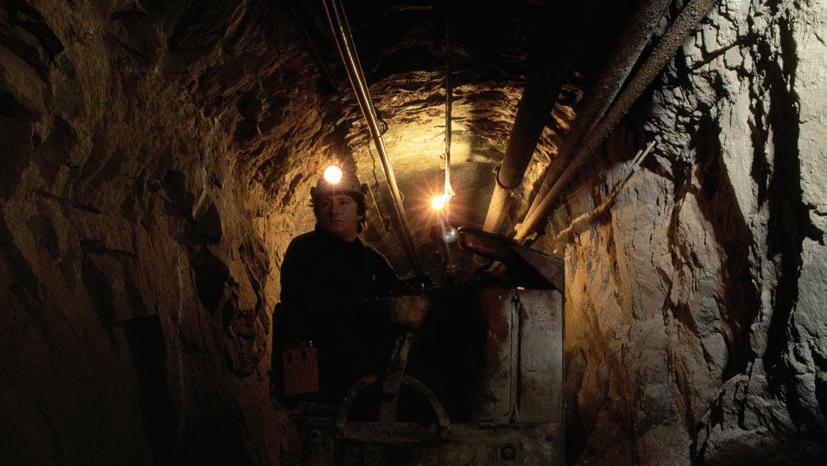
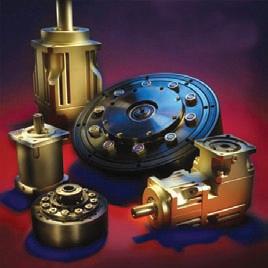
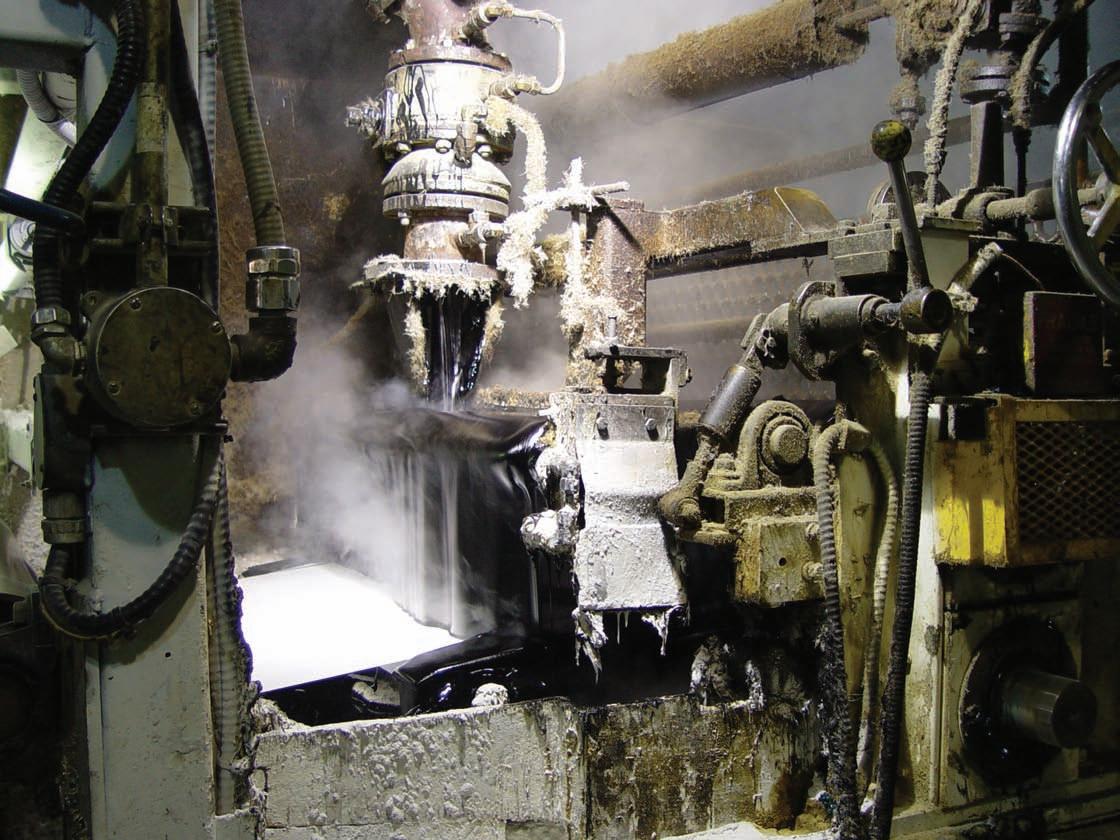
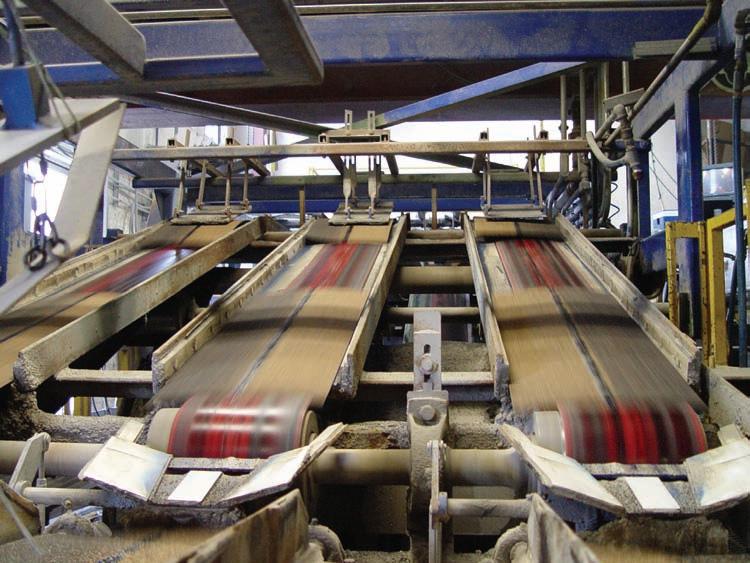
How to get maintenance work done during a flu pandemic
Just-in-time maintenance scheduling
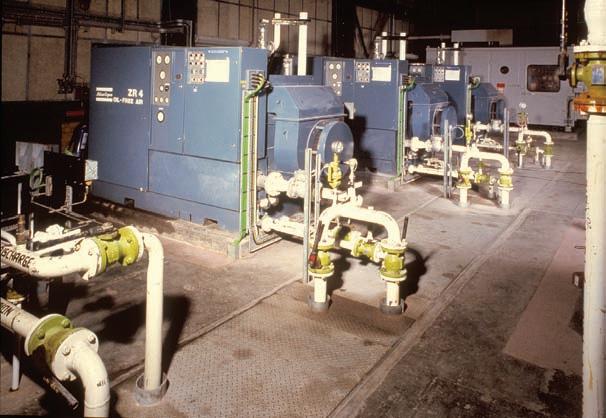
How thermal imaging finds problems before a failure
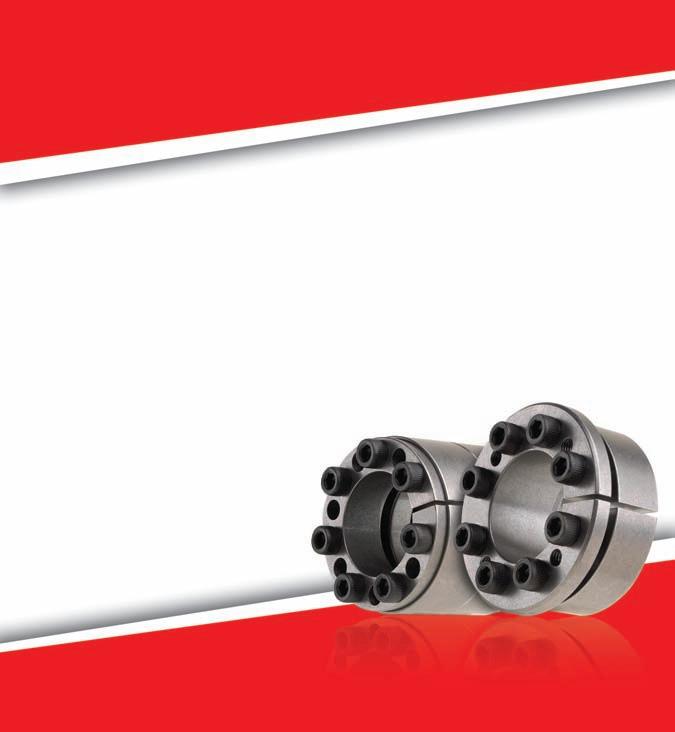
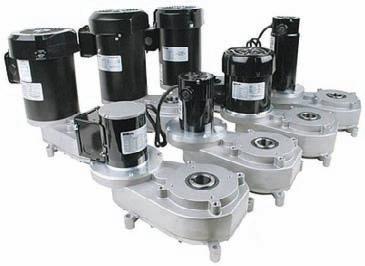
Simplify the replacement of gear drives
BP Canada plant taps shop floor PM expertise
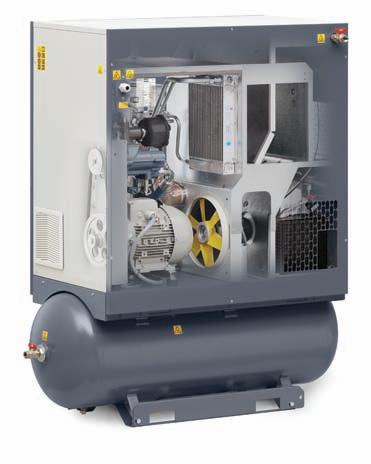
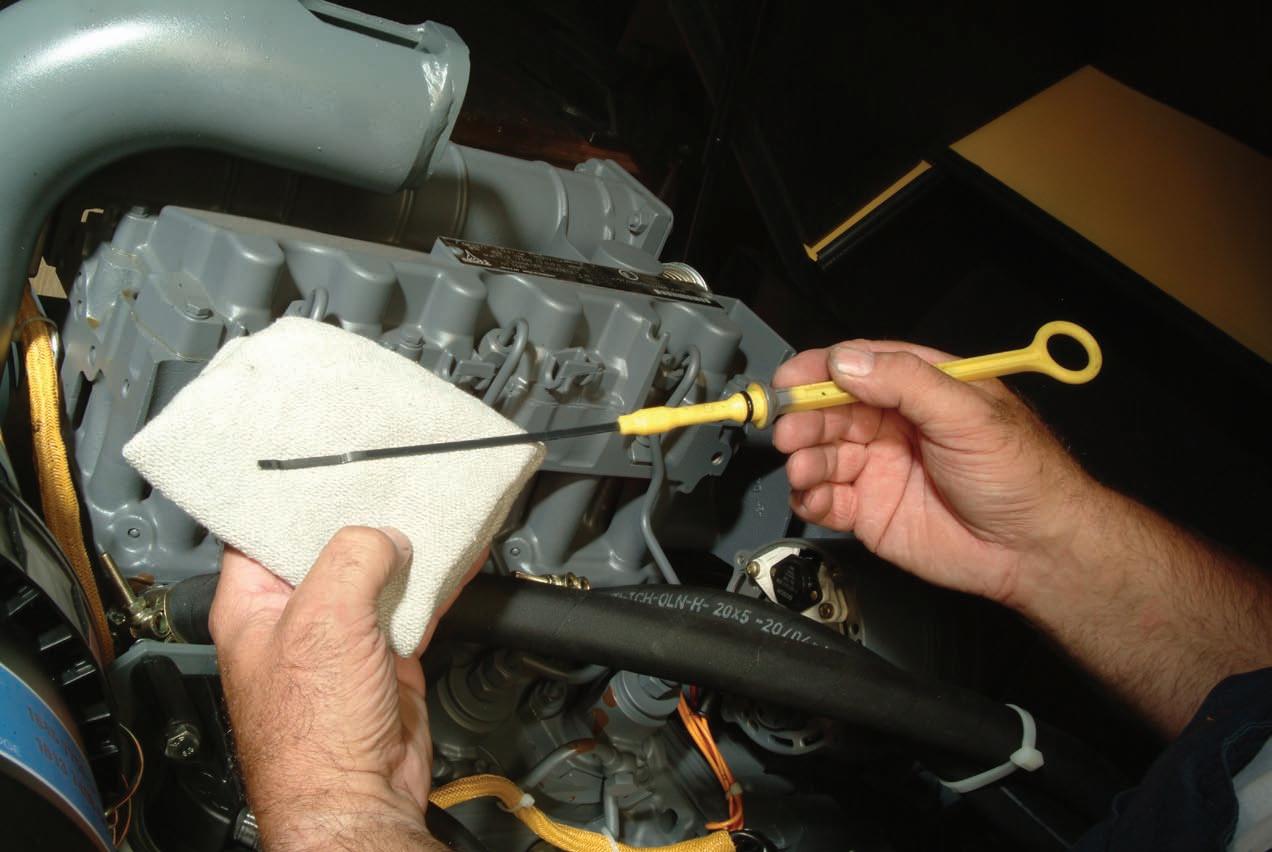
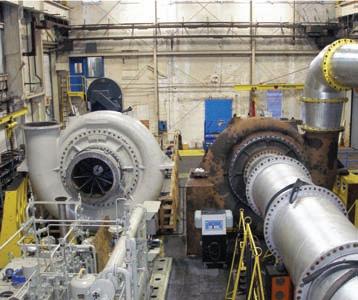
How to avoid compressor failures
love your glove
Steel levelling set has spherical washers
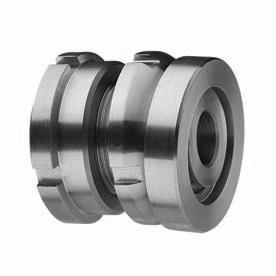
The series GN 350.2 steel levelling sets with spher ical washers from J.W. Winco are used for level ling, adjusting and linking operations. Offered in metric sizes, sets are RoHS compliant. They are made of zinc-plated, blue passivated steel. The sets comprise a threaded upper sleeve and a tapped lower sleeve. The fine thread allows precise, stepless setting and locking using a DIN 1810A hook spanner wrench. An anti-rotation disk serves also as a height limiter for the maximum height.
J.W.
Winco Reader Service Card No. 363
Thermal imager delivers
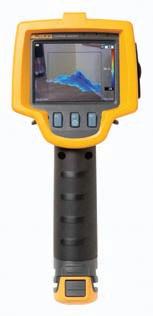
toration and remediation, inspection and roofing professionals. A 320-by-240 pixel sensor provides crisp, detailed images, which users can marry with visual (visible light) images in full-screen picture-inpicture or blended views for enhanced problem detection and analysis. Physical parallax correction enables accurate alignment, pixel by pixel, of both infrared and visible images. Each unit comes with two field-swappable, rechargeable batteries for virtually continuous imager use. Typical battery life is more than four hours each. This rugged device is tested to withstand a drop of 2 m (6.5 ft) and is IP54 rated to withstand water
Air amplifier directs increased air pressure where needed
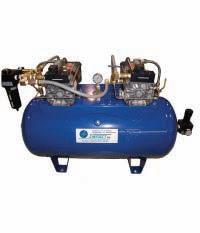
AirBooster air ampli fier systems are de signed to boost plant air pressure at point-of-use workstations and pneumatically operated machinery when the available working pressure is insuffi cient. This energy-saving system allows for pinpointed increased air pressure without increasing the pressure on the entire plant air system. Easy to install and low-maintenance, the units are available in standard and custom configurations with 2:1, 5:1, 15:1 and 30:1 ratios. They can be used in explosion-proof applications, because they do not need electrical power, using the
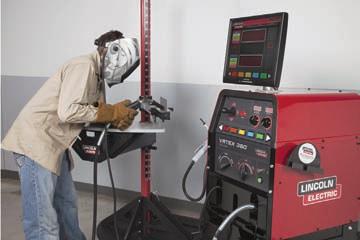
Students learn quickly using virtual reality welding simulator
Lincoln Electric, in partnership with VRSim, has developed a new way to teach welding techniques through a virtual welding system called VRTEX 360. A VRAW virtual reality arc welding system, the simulator offers a virtual hands-on training experience for students, providing real-time welding technique feedback to both trainers and students. It feeds com-
puter-generated data with a virtual welding gun and helmet equipped with internal monitors. Training can be conducted in various settings, including classrooms.
Lincoln Electric
Reader Service Card No. 362
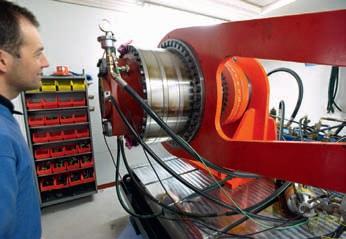
Motor offers enhancements over earlier model
The compact CB1120 motor from Hägglunds is designed as a replacement for the Marathon MB1150 motor. Improvements over the Marathon motor include a strengthened connection block and a new casting to cope with the higher loads to which the motor is subjected. The number of components has been reduced, in line with the company’s commitment to modular motor construction. Besides the ad-
vantages of lower weight and smaller diameter, the CB1120 motor is more versatile, since it can be built with smaller steps in torque capacity (seven torque levels). The motor will only be produced in splined output, but will also be available with a separate adapter for use in applications where a shaft coupling is required. The motor is suitable for mining, materials handling and pulp and paper industries.
Hägglunds Drives Reader Service Card No. 361
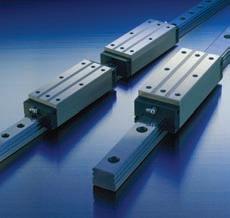
Linear guide offers accuracy
NSK’s HA series of linear guides provides high motion accuracy, rigidity and load capacity. Featuring improved dust resistance, the guides are suitable for machining centres, high-precision lathes and grinding machines. Ultralong ball slides minimize posture changes in the bearing that would normally result from ball passage vibration or rail waviness. To reduce the rail deflection that occurs when the rail is bolted to the base component, the series offers greater counterbore depth of the rail mounting hole. The series features a reduced body size that enables use in compact machinery. Despite the smaller size, the number of balls has been increased to improve rigidity, load capacity and friction. NSK Precision America
Reader Service Card No. 355 MRO
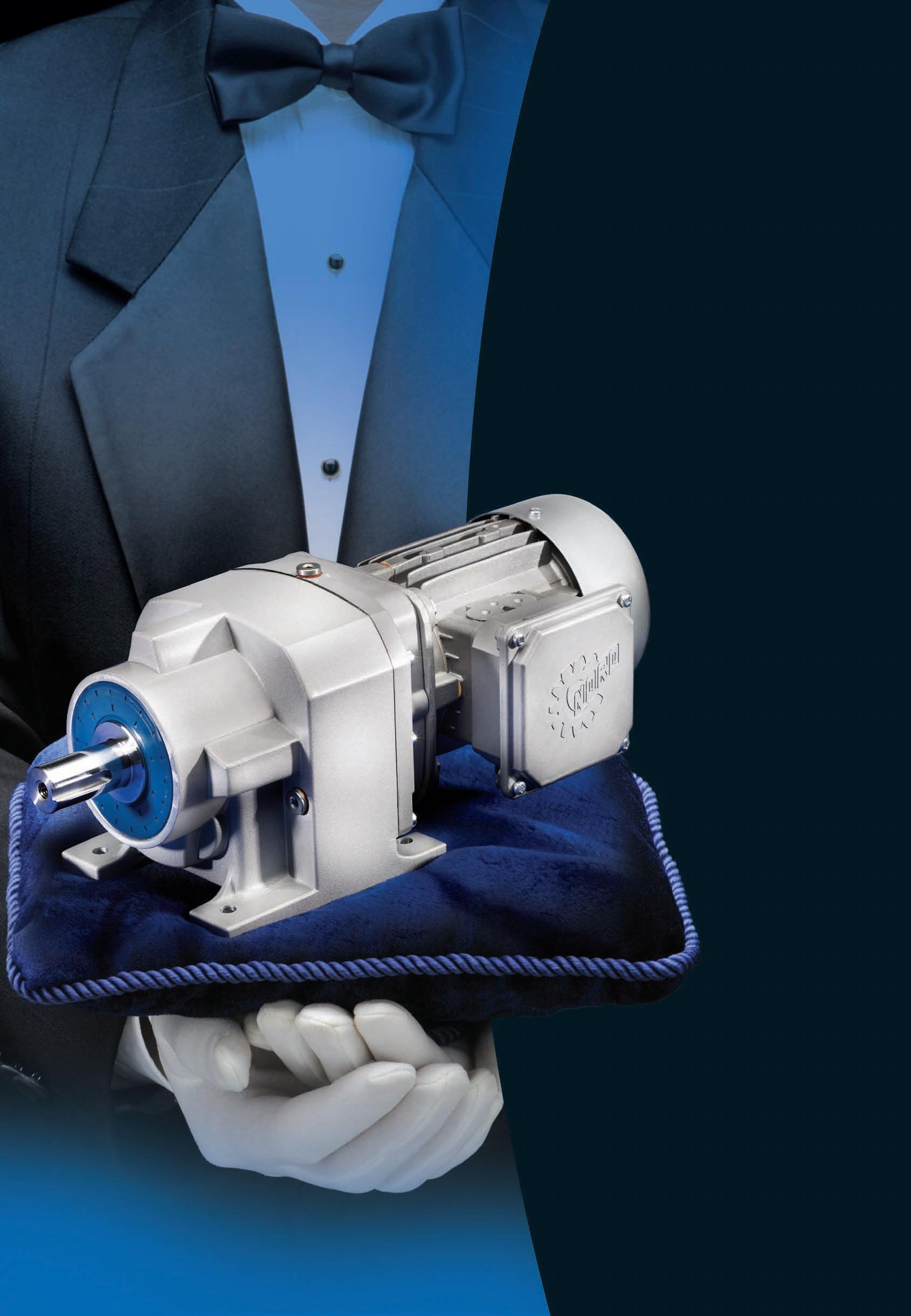
Stronger, lighter, more powerful, and a longer working life – only from NORD Gear.
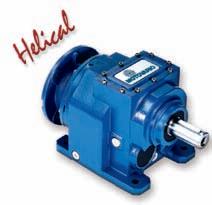
But, perhaps, what’s most remarkable about the innovative new design of the NORDBLOC.1
Helical In-line series is that we were able to improve upon its already superb predecessor. Yes. We even impressed ourselves.
Advanced innovation gives you yet more durability, more efficiency and more reliability. Consider its compact dimensionally interchangeable design plus an aluminum alloy housing that’s both corrosion resistant and 60% lighter than castiron. Plus, oversized output bearings providing larger capacity and increased working life.
What could be better?
How about a NORDBLOC.1 configured to your exact specifications. We’re ready, 24/7, to design, assemble and ship — anywhere in Canada or worldwide. Call NORD Gear to find your perfect match. The only intelligent choice is NORD Gear.
Bringing maintenance back to reality / 13
BP Canada plant taps its shop floor preventive maintenance expertise.
Making hand safety your policy / 16 It takes only seconds for a life-changing event to occur.
Cutting out cuts / 16
Electrician relies on gloves that provide both dexterity and protection.
Protecting hands from chemicals / 17
Keeping workers safe from acids and corrosive chemicals at BP plc.
Selecting the best glove materials / 17
Different gloves offer distinctive levels of protection, comfort, dexterity and grip.
How to get the right drop-in drive for your application.
Identifying equipment problems before failure / 19
Using thermal imaging to predict trouble on rotating equipment.
How to avoid compressor failures / 20
Preventive maintenance for the rotary screw compressor airend.
Distributor careers program to expand / 30
Industrial Careers Pathway program to provide needed staff for industrial distribution companies. Also on page 30, our CMTS show report.
columns
Condition monitoring gets a boost / 22
Maintenance Management: Follow along with Step 29 in a journey to World-Class Maintenance at the Plentya Paper Company as the team makes further progress towards its goals.
Just-in-time maintenance scheduling / 23
CMMS Solutions: Using Statistical Predictive Maintenance to improve service to operations.
How will maintenance get done with a flu outbreak? / 24
The Safety File: Getting ready for the H1N1 pandemic.
Editor’s Notebook / 6
Industry Newswatch / 8
Company Briefs / 10
Mr. O, The Problem Solver / 12
Maintenance Management / 22
CMMS Solutions / 23
The Safety File / 24
Literature Guide / 29 At Last / 30 Product News Product Spotlight / Focus on Safety / Focus on Test & Measurement / 26
Focus on Drives / MRO Components /
Being prepared
Forget the lousy economy. You already have enough trouble keeping your machinery and equipment running effectively. Also, it’s often difficult to keep your team motivated and enthusiastic about its work. On top of that, it’s even a challenge to find the skilled workers you need in the first place.
And now this: What are you going to do if Canada faces a flu pandemic in the weeks ahead? Not only could the H1N1 flu virus decimate your maintenance, production and management staff, it could affect the regular flow of equipment and components from distributors and suppliers. It could affect
power and communications too.
And then again, it may all just be a lot of worry over nothing. Who’s to know?
But just in case, you should be prepared. That’s why we asked our Safety File columnist Simon Fridlyand to talk in this issue about preparing for a pandemic. Follow this advice (see page 24), and think carefully about the issues this article discusses, and you’ll be as ready as anyone in industry to deal with the consequences of a flu pandemic.
You can also forget the lousy economy because things finally seem to have bottomed out. Even in Ontario, manufacturing’s decline has stopped. Again,
with so many factors in the global economy affecting every aspect of industry here, from price-bouncing commodities to the plethora of made-in-China replacement products killing our export markets, who’s to know what’s really going to happen next?
Know this, though. Those who study and read and research say things really are starting to improve at Canada’s mines, mills, factories and other industrial facilities. It may be as slow as trying to turn around an ocean liner but it’s happening. And like everything else, you should also be prepared for it.
You may have been taking advantage of the economic slowdown by investing in staff training, catching up on all those non-urgent work orders, or finally getting all your equipment keyed into a CMMS system. If so, you’ll be ready to roll when the production lines speed up again, when dormant processes start pumping through product, and when
drill bits and saw blades need to be sharpened more frequently.
Continuing our role of helping you be prepared, this issue contains a variety of stories, from the cold, hard, frustrating facts of running the maintenance operations at a Quebec shingle plant, to tips on choosing the best work gloves for the job. Plus we present technical articles on gear drive replacement in variable speed drives, thermal imaging for predictive maintenance, and how to avoid air compressor failures.
There’s more, of course, as you’ll see by reviewing this issue’s Contents page. So despite our diminished page count — a direct effect of that lousy economy — we’re still packing plenty of knowledge into every issue to help you in your work. And we’ve got lots more planned for future issues. As you might expect, we’re prepared!
Bill Roebuck, Editor & Associate Publisher
Nick Naunheimer, Publisher 416-510-6868
nnaunheimer@mromagazine.com
Eric Achilles Cousineau, Adv. Sales Manager 416-510-6803 eachilles@mromagazine.com
Kimberly Collins, Advertising Production 416-510-6779
Melinda
Bearing market to reach $10.6
Cleveland, OH — Ball, roller and plain bearing demand in the United States is projected to expand 3.0% per year through 2013 to $10.6 billion, according to a new study, Bearings, from The Freedonia Group Inc., a Cleveland-based industry research firm.
Sales increases for ball and roller bearings, including both mounted and unmounted types and associated parts, will outpace those of plain bearings, reaching $8.5 billion in 2013 (all figures are in US currency). Advances will be supported by sales of high-value, largediameter bearings as the wind energy and heavy equipment markets expand.
Continued, albeit moderating, growth
in the production of aerospace equipment and machinery will also support gains.
Recovery in motor vehicle production from the low levels of 2008, particularly in heavy truck and bus manufacturing, will also benefit bearing suppliers. Market gains will be dampened, however, as US companies in a variety of bearingusing industries continue to move manufacturing operations to offshore areas where labour costs are lower.
The strongest market gains through 2013 will be posted by roller bearings, benefitting from renewed strength in US production of motor vehicles and from sales of advanced, high-value products for applications such as wind
turbines and heavy machinery.
Demand for mounted bearings and bearing parts will also outperform bearing demand overall. Mounted bearing demand increases will be spurred by original equipment manufacturers’ (OEM) desires to simplify their production processes and reduce future maintenance requirements.
OEM bearing applications, which currently account for 78% of all demand, will approximate the performance of maintenance/repair/operations (MRO) applications through 2013. Sales conditions will be particularly strong in the automotive and engine, turbine and power transmission equipment manufacturing markets. MRO bearing demand will be bolstered by growing maintenance expenditures for aerospace equipment and construction machinery.
Bearings (published 09/2009, 267 pages) is available for $4,800. For further details, visit www.freedoniagroup.com.
Available for the first time ever – an affordable 320 x 240 thermal imager that will help you find problems fast. In these tough times, helping you get more done is worth its weight in gold.
• SmartView® analysis and reporting software
• 2 GB SD memory card
• Multi-function card reader for downloading images into your computer
• Interactive training DVD
• Rugged hard carry case and portable soft carry case
• Hand strap, for right or left-handed use
• 2 Lithium Ion removable and rechargeable smart batteries
• AC charger/power supply and two-bay external charger with mains adapters
• Printed Users Manuals (16 languages)
Find out more: Call 800-363-5853
PT SALES UP IN THE US, DOWN IN CANADA
Chicago, IL — US manufacturers experienced an increase in sales while Canadian manufacturers had a drop in sales in August 2009, according to the latest sales data released by the Power Transmission Distributors Association (PTDA). Confidence in the Canadian market (as measured on a scale of 1 to 10 with 10 being most optimistic) fell by 0.4 from the previous month to 4.1, the first drop since February 2009. US confidence is holding at a current negative position of 4.7 for the second consecutive month.
US manufacturers’ sales rose by 10.7% in August 2009 when compared to July 2009. Sales in August 2009 were down 30.6% compared to the same period last year. Orders in August 2009 increased by 10.4% over July 2009 orders.
Canadian manufacturers’ sales fell 6.6% compared to July 2009. Sales were down 23.8% when compared to the same period last year.
Product-by-product sales between July 2009 and August 2009 reflect the change in sales experienced by US and Canadian manufacturers. Six of nine product categories for US manufacturers — mounted bearings, positioning systems/linear motion products, shaft couplings, standard industrial motors, unmounted bearings and variable speed drives — posted sales gains.
For Canadian manufacturers, three product categories posted sales gains — shaft couplings, positioning systems/linear motion products and variable speed drives. The complete data is available by subscription; order online at www.ptda.org/ store or call 312-516-2100.
MANUFACTURING FINALLY SEES EMPLOYMENT UPTICK
Ottawa, ON — Employment in Canada increased for the second consecutive month, up 31,000 in September 2009, driven by large full-time job gains, reports Statistics Canada in its latest Labour Force Survey. The unemployment rate fell by 0.3 percentage points to 8.4%, the first monthly decline since the beginning of the labour market downturn in the fall of 2008.
September’s full-time increase of 92,000, the largest since May 2006, was partially offset by part-time losses of
61,000. The increase in full-time work was mainly among youths and women aged 25 and over and in Ontario.
Despite September’s gains, full-time employment has fallen by 395,000 or 2.8% since the employment peak in October 2008.
Construction, manufacturing and educational services saw employment increases in September, while there were declines in transportation and warehousing.
British Columbia, New Brunswick and Prince Edward Island were the only provinces with notable employment gains in September. In Ontario, employment rose slightly as large full-time gains were dampened by losses in part time.
Since the peak in October 2008, employment has fallen by 2.1% (-357,000), with the bulk of the decline occurring between October 2008 and March 2009. Since then, the trend in employment has levelled, with the number employed almost the same in September as it was in March.
Canadians have been working more hours since April 2009. While the number of actual hours worked decreased 4.2% from October 2008 to April 2009, since then, there has been an increase in hours worked of 2.0%. In contrast, employment edged down 0.2% from April to September.
The increase in average hourly wages slowed to 2.5% compared with September 2008. This was the lowest year-overyear growth in two-and-a-half years.
Manufacturing employment increased by 26,000 in September, the first notable increase since February 2009. Employment in this industry had the sharpest rate of decline since the start of the labour market downturn in the fall of 2008, down 10.6% (-210,000).
By province, the most notable employment gain in September was in British Columbia, up 14,000. Although down 1.7% since October 2008, employment in this province has been increasing since March 2009 (+1.3% or +30,000). The unemployment rate, at 7.4%, declined by 0.4 percentage points in September.
In Ontario, a large full-time increase (+62,000) was dampened by a loss in part time (-49,000), leaving employment up only slightly in September. The unemployment rate declined by 0.2 percentage points to 9.2%.
September marks the third consecutive month of small employment increases in Ontario, totalling 39,000. Despite this increase, Ontario has suffered the fastest rate of employment losses since October (-2.9%), mostly in full-time and in manufacturing, construction and a number of service industries.
Employment also increased in New Brunswick in September, up 2,900, bringing the unemployment rate down 1.2 percentage points, to 8.1%.
Quebec’s employment level was little changed in September for the second consecutive month. The unemployment rate declined by 0.3 percentage points to 8.8%, as fewer people participated in the labour market. Since October, employment in this province has fallen by 1.6%, less than the national average of 2.1%.
The next release of the Labour Force Survey will be on November 6, 2009.
FREE ONLINE TRAINING ON POWER TRANSMISSION TOPICS OFFERED
Chicago, IL — The Power Transmission Distributors Association (PTDA) has recognized the challenge its power transmission/motion control distributor and manufacturer members may be facing in funding training programs during the recession, so the association is giv-
ing each member special access to a PT Interactive Online course of their choice at no cost to the member company.
The newest training tool from PTDA, PT Interactive Online combines the knowledge of the Power Transmission Handbook and the video and graphics of the Product Training DVD Series to deliver a multi-media, interactive product training experience. The content capitalizes on PTDA’s expertise as a provider of training on maintenance, application, selection and standards for power transmission/motion control products.
Structured as a series of 14 independent, product-specific courses, these webbased courses allow any employer to design a customized training program for each employee wherever there is access to the Internet. Each course is two to three hours long and can be taken in any sequence. Using a multimedia format, including text, graphics, video and quizzes, PT Interactive Online maximizes comprehension of the materials by allowing the employee to learn at his or her own pace.
The free course offer expires on December 31, 2009. Other PT Interactive Online courses are available for an introductory registration fee of $75 per course for PTDA members and $125 per course for non-members. For more information, visit www.ptda.org.
DEMAND FOR FILTERS TO RISE 3.3% ANNUALLY
Cleveland, OH — Demand for filters in the United States is expected to increase 3.3% per year to US$12.4 billion in 2013. Advances will be spurred by pending changes in environmental regulations, particularly those involving reduced emissions from power plants and diesel engines, and improved operational efficiency of motor vehicle engines.
Demand will also be boosted by manufacturers’ increasing interest in reducing costs by reclaiming production inputs from process water and recycling process water for reuse.
Gains will be driven by ongoing sales in the aftermarket, which accounts for the vast majority of demand.
These and other trends are presented in Filters, a new study from The Freedonia Group, Inc., a Cleveland-based industry research firm.
In 2008, internal combustion engine filters (oil, air intake, fuel, cabin air and other filters) accounted for the largest share of filter shipments with 39%. Although this is a relatively mature product group, sales will benefit from the ongoing development of new types of emissions filters, particularly for diesel engines, and the growing aftermarket for cabin air filters.
Shipments of fluid filters (e.g., fluid power, municipal water and waste, consumer water and industrial fluid filters) accounted for the second largest share of total shipments, with 35%. Although they compete with membrane separation technologies, fluid filters will also benefit from their use as pretreatment steps for these technologies.
Shipments of air filters are expected to post the strongest growth through 2013, driven by changes in environmental regulations and advances in the consumer market.
Filters (published 08/2009, 333 pages) is available for US$4,800 from The Freedonia Group Inc., www.freedoniagroup.com. MRO
Editor’s note: More detailed versions of many of these stories, along with additional news items, can be found online at www.mromagazine.com.
When you think “Quality”, you think about bearings that can withstand high speed, shock loads, misalignment and marginal lubrication conditions. We think about maximizing uptime and lowering maintenance costs with quality components supported by 24-hour service and worldwide distribution. For spherical roller bearings designed to deliver world-class performance in vibrating applications, Think NSK.
Company Briefs
News and views about companies, staff, product lines and more.
• Ruland Manufacturing Co. Inc., Marlborough, MA, a manufacturer of couplings and shaft collars, and Belden Inc., Broadview, MI, a manufacturer of universal joints, have started a joint venture in Europe, PTMotion GmbH The new company is headquartered in Berlin, Germany. Belden manufactures precision universal joints and power transmission assemblies. Ruland manufactures zero-backlash motion control couplings and precision-honed shaft collars. Both companies have been active on the European market for many years.
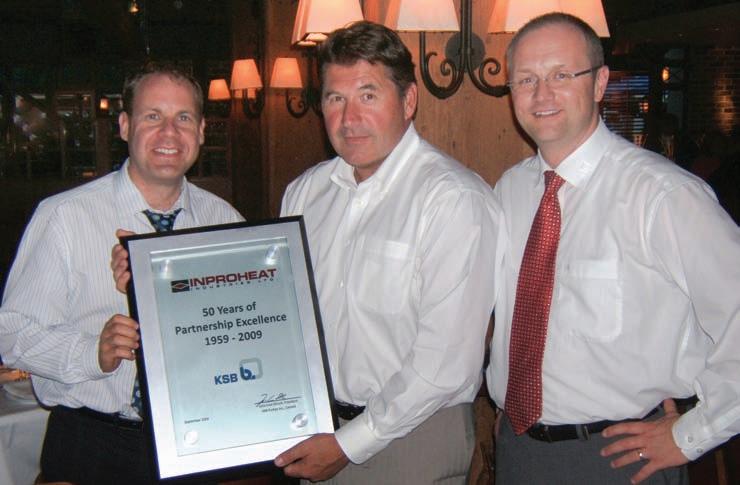
• Pumpmaker KSB, Mississauga, ON, has marked the 50th anniversary of its relationship with Vancouver-based engineering firm Inproheat Industries
Ltd. by awarding it the Partnership of Excellence, its highest recognition of a partner’s contribution to KSB’s success. “What started half a century ago with the sale of KSB’s first boiler feed pump in North America through Inproheat is still a lively and extremely vibrant business connection,” says Jens-Uwe Strunk, president and CEO of KSB’s Canadian subsidiary. It was Inproheat — and its still-energetic founder and owner, Eric Panz, 81 — that helped to put KSB on the map in North America. Long before the pump manufacturer launched its own subsidiaries in the US in 1963 and Canada in 1990, the Austrian-born engineer introduced KSB’s boiler feed pumps to the North American market.
• In other news, KSB has received an order for boiler feed and reactor coolant pumps worth around €50 million. The
pumps will be installed in two new nuclear power station units to be built on the southern Chinese island of Hainan. All of the 16 pumps included in the order will be manufactured in Germany until the end of 2012, following which the reactor coolant pumps will be fitted with additional technical components and tested in Shanghai. Over the next 12 years, China is planning to build around 60 new nuclear power plants. These will be equipped with pumps and valves capable of meeting the most stringent safety requirements. In order to participate in this market, KSB established a joint venture by the name of SEC-KSB Nuclear Pumps & Valves Co. Ltd. in mid-2008. • Advantage Sales Network Corp., Brampton, ON, has expanded its Ontario sales team, created three new territories, and now represents another power transmission supplier. Heather Aceto is responsible for sales activity in southwestern Ontario; Jack Yue is responsible for sales activity in eastern Ontario; and Mark Holden, who previously handled the entire province, now focuses on the GTA’s Mississauga to Burlington region. These appointments and re-organization follow the addition of the sales agency’s newest manufacturer in its line up, Renold Canada Ltd • A year after joining Renold Canada Ltd. of Brantford, ON, as president, Rick Hamilton has been appointed president of Renold Americas, Morristown, TN. In this position, Hamilton is responsible for all sales operations in the United States, Canada and Latin America. He will continue to report to George Graham, managing director, Global Chain Sales, Renold plc. Hamilton previously held strategic positions at Martin Sprocket & Gear Inc. and Emerson Power Transmission Corp.
• Viking Pump of Canada Inc., Windsor, ON, has improved its aftermarket service capability in southern Alberta with the appointment of James Electric Motor Services Ltd. of Calgary as its authorized service representative for the area. James Electric has a 35,000 sq ft service centre; 10 service trucks; 20 certified technicians, electricians, machinists, millwrights and mechanics; a fully equipped repair shop; and local inventory. • SKF, Gothenberg, Sweden, has inaugurated a previously announced investment in Dalian factory, Liaoning Province, China. The $98,760,000 investment was initiated in May 2008, and was the second phase of a project started in 2005, which brings the total investment up to $170,408,000. A 25,000-sq-metre facility
Rick Hamilton.
KSB recognizes its 50-year relationship with Inproheat.
Special Features
Crowned rollers provide lower friction and smooth operation through even load distribution.
Case carburized steel enhances long life operation and improves shock loading capabilities.
Optimized roller/rib interface promotes lubrication and lowers bearing running torque. Honed raceways ensure low friction for trouble free operation.
A Case for NTN Tapered Roller Bearings
Solutions... Delivering Value
Better Support Makes a Better Bearing
As an integral part of after-sales service and support, NTN provides an engineering and service staff across Canada to assist customers in gaining maximum service from the life of their bearings
Preferred by leading manufacturers, NTN tapered roller bearings are renowned for their ability to operate reliably in some of the world’s harshest environments. NTN tapered roller bearings are ideally suited for heavy duty applications ranging from rail to aggregate and mining equipment, where marginal lubrication, vibration and impact loads are considered the norm. NTN tapered roller bearings are made to meet or exceed industry standards and feature case carburized steel. Carburizing hardens the steel from the surface to the proper depth, leaving a relatively soft core, improved durability and longer life. These results make the material ideal for shock loading and extreme conditions. Like all our products, NTN tapered roller bearings are backed by our knowledgeable technical support team, competitive pricing, 24/7 service and unmatched inventory capability.
• In depth bearing failure and machine troubleshooting
• Bearing (re)selection and machine redesign to prolong bearing life and up time
• Liaison with original equipment manufacturers and third party suppliers
• Preparation or review of maintenance schedules and procedures
• End user in-house training seminars
• Accurate part number crossover to one of NTN’s complete range of products
has been added adjacent to the existing factory, doubling the manufacturing capacity. The aim for this investment is to increase the manufacturing capacity for large- and medium-size bearings in China.
• In other news, SKF has signed a Memorandum of Understanding (MoU) for a strategic partnership with Sinovel Wind Co. Ltd., one of the largest wind turbine manufacturers in China. The cooperation under the MoU will cover supply chain service system optimization, staff training and development, engineering development and design, as well as resources management. In connection to this, SKF signed a series of contracts with Sinovel with a value exceeding $51 million for main shaft bearings and sealing systems for 3-MW wind turbines to be supplied in 2010. The majority of the bearings covered in these contracts will be produced in the newly-inaugurated Dalian facility.
• Sean O’Brien has been appointed presi-
dent, Acklands-Grainger Inc., Toronto, ON, where his responsibilities include the oversight of the company’s business operations. He succeeds and reports to Court D. Carruthers, who became senior vice-president and president, Grainger International, earlier this year. Acklands-Grainger, the Canadian subsidiary of Grainger International of Chicago, IL, had revenues of $773 million in 2008. “Sean’s energy and experience will help drive continued success in the Canadian maintenance, repair and operating supplies (MRO) market,” said Carruthers.
O’Brien joined Acklands-Grainger as vice-president sales in November 2007 and has led several key initiatives in business services, inventory solutions, training and sales effectiveness. Earlier this year, he took on additional responsibilities for e-business and marketing.
• RotoPrecision Inc., Mississauga, ON, a Canadian-based provider of precision mechanical components and power trans-
mission products, has entered into an agreement with Onvio LLC to offer exclusively in Canada Onvio’s complete product line of planetary servo speed reducers, cycloidal zero backlash reducers and timing belt pulleys. Onvio’s corporate headquarters are located in Salem, NH, and include a new, state-of-the-art, 45,000-sq.-ft. engineering and design facility.
• Bosch Rexroth Canada, Welland, ON, has worked to beat the recession blues for both itself and its customers by installing a new $1.5 million CNC machine and CAM software package to build customized hydraulic manifolds for its customers. “We realize that our market will be significantly changed after this downturn,” says Dino Paladino, gen-
eral manager, systems. The company is continuing to make investments centred around customer satisfaction, including implementing lean programs such as 5S, BPS (Bosch Production Systems) and continuous improvement of its processes and technology, resulting in greater value added to its products. The new CNC machine will provide the Welland facility with added flexibility and capacity to manufacture custom manifold blocks for Bosch Rexroth’s hydraulic solutions. At the plant, a team of application engineers and designers develop the integrated circuits and manifold designs, then forward the information to the machining centre for manufacturing. The new machine is a Mazak HCN 6800 horizontal machining centre. Bosch Rexroth Canada is the Canadian subsidiary of Bosch Rexroth AG, part of the Bosch Group MRO
Editor’s note: More detailed versions of many of these stories, along with additional news items, can be found online at www.mromagazine.com.
Getting technicians to read work orders
Problem: One of the most difficult habits to form when trying to establish planned work methods is getting people to actually read work orders. In the past, work orders may not have contained much useful information, so nobody read them. But once your work orders have a full work plan attached, with instructions, drawings, parts lists, safety considerations and permits, how can you effectively change how maintenance technicians use them? If no one reads these work packages, they have no value.
Solution: Here’s a fun trick to help build a new habit for reading work orders. Find a simple reward, like movie tickets or gift certificates to a local store. Have your maintenance planners add some text to a few work orders every week like this: “The first person who sees this message, and calls me, gets two free tickets to the movies.” Bob, The Planner. For just a few dollars weekly, you can drive some change, and make it fun to read work orders. Try placing the messages in different places in the materials to encourage thorough viewing. Don’t make it too easy. Once this system gets rolling, you’ll see a great response to it. Give it a try! Mr. O’s thanks for this tip go to the folks who write the blog at www. nobreakdowns.com.
Do you have a solution for a maintenance problem? Send it in and if it’s published, we’ll send you a Mr. O Problem Solver T-shirt. Include your address, telephone number, print complete details and, if possible, add a sketch to help explain your tip. Send your tips to Mr. O, Machinery & Equipment MRO, 12 Concorde Place, Suite 800, Toronto, ON M3C 4J2.
Mr.0 The Practical Problem Solver
Onvio’s products include reducers and pulleys.
A Bringing Maintenance
back to REALITY
BY CARROLL MCCORMICK
Tapping knowledge on the shop floor helped fixed a broken PM system for BP Canada.
fter more than a decade of trying to implement a preventive maintenance program, Building Products of Canada Corporation, a huge roofing shingle manufacturer in Lasalle, QC, was still light years away from success.
“For me, I was at a 25% confidence level on the effectiveness of the PM,” says Denis Lanciault, vice-president of operations at the company, which goes back over 100 years. “The costs were really high, we were changing things we did not need to change, but output was still the same because other things were breaking.”
A year and a half after pulling Henri Boucher, the paper mill foreman, back from the brink of retirement to do brain surgery on the critically-ill PM patient, Lanciault’s confidence in the PM program has soared. “Our downtime has been cut by half. I think Henri will be able to deliver everything in three years,” Lanciault says.
The secret to unballing the mess and returning maintenance to good health
has had nothing to do with complex, impenetrable methods. Rather, say Lanciault and Boucher in unison, as though reciting an oft-practiced pitch, “It is back to basics.”
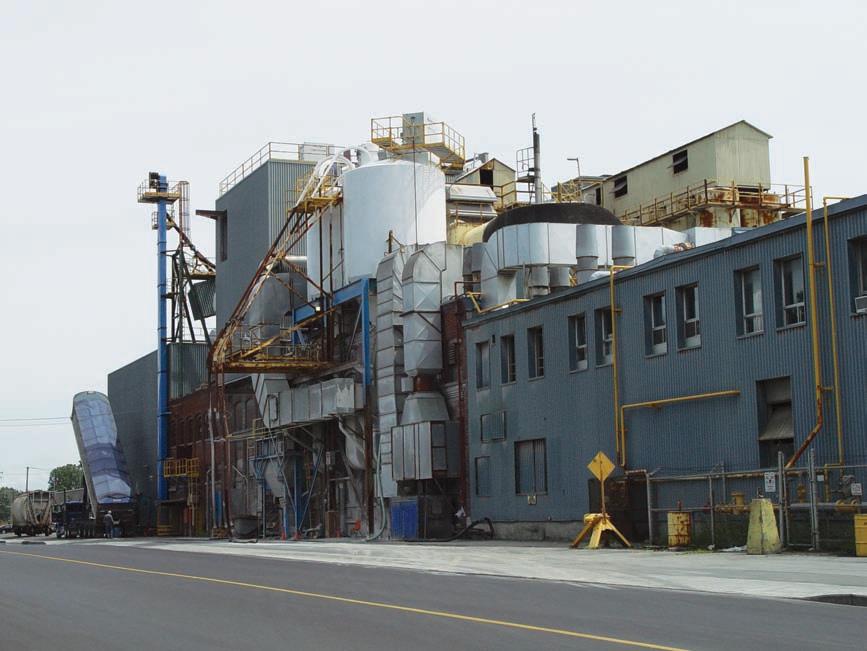
The Lasalle plant, only a few kilometres from downtown Montreal, has two production lines: RF1 and RF2. In places two storeys high, these giant “machines,” as everyone refers to them, churn out a very healthy percentage of the 45 million bundles of shingles the Canadian marketplace consumes each year.
The preventive maintenance (PM) program Boucher inherited had mechanics swarming like flies all over each other on the machines and saw none of them responsible for anything. The checklists — created by maintenance consultants — were so huge that during shutdowns the men spent more time playing PM catch-up than dealing with current problems or repairs.
The mechanics quickly learned that many items on the list were pointless. They gradually became contemptuous of the white-shirted PM creations and fell back onto breakdown maintenance
A Thoughtful Mechanic
A lifelong gearhead with a grip like a bench vice, Henri Boucher ran a tight ship for 15 years as foreman in BP Canada’s paper mill until it closed in 2006. After consulting on the overhaul of the mutant PM program in the shingle plant for a few months, he took over full-time as maintenance manager in August, 2008.
He likes his work and has a smile or a joke for everyone he meets as he roams the production floor. He likes to see engineers with dirty hands and grubby clothes.
He points to a young P. Eng. buck working with a mechanic on some spray gear, and he says: “My dream is to have mechanics and engineers working together.”
strategies. “The consultants copied what they knew from outside. But they never understood how we ran our machines,” Lanciault says.
Boucher, starting with RF1, divided it into 14 sectors and assigned one mechanic to be responsible for each sector and do a daily inspection. Boucher created efficient routes with no wasted steps. At first the routes took up to five hours to do, but with practice that dropped to a couple of hours.
“Every day all our machines are
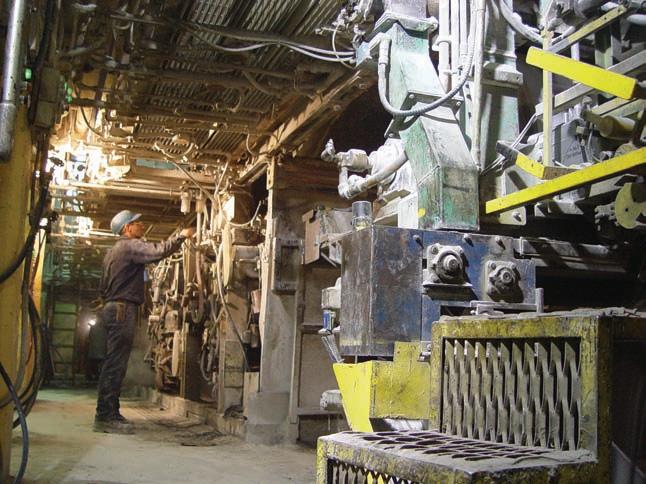
looked at by our guys — look, feel, take temperatures. I want to know everything that is going on with our machines,” Boucher explains.
Now the mechanics draw up the repair orders and decide when shutdowns are necessary. Compare this to the learned helplessness created by the old PM. “We were all controlled by the system. The guys were waiting for it to tell them what to look at, rather than doing what they should do,” Lanciault explains.
The old system not only frequently told them to look in the wrong places, its creators never incorporated the maintenance team’s knowledge. “The guys on the floor were saying, ‘you are spending a lot of money on consultants. You are not asking us’,” Lanciault adds.
The consultants had ignored the realities of the production environment, where equipment lives and dies by the conditions in which it operates. Boucher points to a shaft and bearing, half-covered with some kind of corruption, where the machine applies sand to hot-
Above: The grit and grime of an exceptionally harsh production environment made a farce out of the old PM program. Right: It took a mechanic to suggest belts that last months longer. Bottom: Maintenance manager Henri Boucher loves machinery, and his thoughtful strategies transformed the plant’s PM program into something usable.
Photos by Carroll McCormick
tarred felt. “This bearing might last 25 years, but here — maybe three months. The PM was not based on reality. We have sand, asphalt, gravel, limestone, hot and cold water, tar … these are really hard on machines. A contaminated bearing might last only three weeks.”
Since the mechanics now have responsibility and control, they can apply their knowledge to making the PM fit the machines as they are actually being used. As each became familiar with his sector, he began noticing that certain checks might not have to be made so often, and the PM routine was modified.
Boucher was also prepared to listen to their ideas. “Most of the suggestions come from the mechanics,” he says. One mechanic, for example, pointed out that belts on a die cutter were being replaced every few weeks, year after year. He suggested a different kind of belt, which has lasted six months and counting.
“The guys were given empowerment. They liked that,” Lanciault says. “The guys were also responsible for failures. Henri would ask them questions about that, say if a part was installed improperly and broke. How do you expect guys to take care of the machines if you don’t empower them? If they have a lack of knowledge, you train them.”
Speaking of lack of knowledge, Lanciault, who sounds more like Boucher’s agent than his boss, tells a curious story: “The big difference between Henri and his predecessors is that Henri does not pretend to know what he does not. He questioned the way that the engineers installed things. He read, and installed things the way the manufacturers asked for. Some of the previous managers did not do this.”
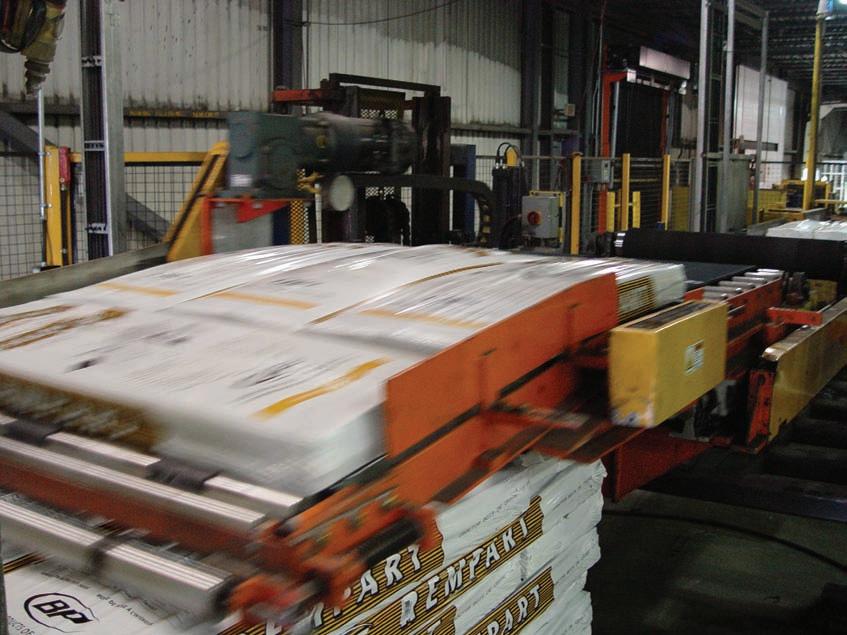
The palletizer, which does the work of strong men stacking heavy packages of shingles, was causing major migraines. “We lost time like you wouldn’t believe,” Lanciault recalls. “Henri, because he didn’t know about the palletizer, read the book on it. He discovered that an exhaust valve was not properly set up. He fixed it and the problem went away.”
The limestone filter screen was also causing grief. Boucher did not know it from bananas, but it was not a problem: He read the book and discovered that there were eight ways to install it, and someone had
figured out a ninth, wrong way. Boucher made the change and that problem vanished. There have been many cases like these, according to Lanciault.
Boucher keeps track of the 1,200 pieces of equipment and his maintenance scheme in a computerized maintenance management software (CMMS) program, the Ross ERP Maintenance Management module. Between the CMMS and paper records, the maintenance team is beginning to build up a history.
“There was a little bit of maintenance history, but when I took over, I made it more rigorous, like having all of the details — for example, parts, cost, time — on the work order. Now I can look a year back and see the people, parts, etc., for a repair,” Boucher says.
As for comparing the performance of the equipment under his watch with before he took over, Boucher cannot see the value: “I don’t want to compare now with before I started on this project.” What both Boucher and Lanciault do know is that mechanical downtime on RF1 has steadily dropped.
The secret to the success of the turn-around of the plant’s PM, according to Lanciault and Boucher, is to take it away from the white-collar office crowd and give it back to the people who run the equipment, who know how it is used and who are the most capable of judging what makes sense and what has to be changed.
Lanciault says, “When you go to an outside firm, [you are saying that] they have knowledge and that you don’t. This is an abdication of responsibility. The job to make PM work has to be done on the floor.” MRO
Montreal-based Carroll McCormick, an awardwinning writer, is the senior contributing editor for Machinery & Equipment MRO.
For more information
You can use the Reader Reply Card in this issue to obtain more information on the products and services mentioned in this article: Ross ERP, circle No. 403.
Above left: The palletizer caused untold grief until the new maintenance manager did the unthinkable: read the manual. Above right: An effective PM program required insider knowledge of BP Canada’s production environment. Left: Well-organized daily PM routes keep mechanics in tune with complex production equipment.
Making hand safety your policy
cut-resistant gloves, while gloves that absorb oil for sure grip are key in environments where workers handle slippery components. Chemical-resistant gloves are available to protect the hands of anyone who comes in contact with harsh substances. In fact, the varying chemicalresistance requirements of different tasks have led to the development of a website, www.chemrest.com, that is devoted to helping companies select the right glove for the right job.
It is important to remember that it takes only seconds for a life-changing event to occur.
BY GIL LEVERNE
Globally, worker safety is becoming a critically ranked priority in industry. With more than 250,000 serious injuries to fingers, hands and wrists each year in North America alone, hand safety is a leading concern.
Because lack of attention and human error are responsible for most hand, finger, wrist and lower arm injuries, it becomes imperative for employers to create a high level of hand safety awareness among workers.
Worker’s compensation claims are directly tied to how a company manages its safety programs. If a worker is injured because the employer did not provide the correct personal protective equipment
(PPE), then the claim can be much higher against the employer.
It is important to remember that it takes only seconds for a life-changing event to occur. In addition, without clear direction, workers often carelessly place their non-dominant hand in harm’s way while performing tasks with their dominant hand.
A strong hand-protection program begins with providing proper-fitting protective gloves designed for a specific task. Because no single glove provides protection from all types of hand injuries, selection is based on performance characteristics of the gloves in relation to the task being performed.
In metal construction, these might be
Cutting out cuts
Electrician
relies on work gloves that provide both dexterity and cut protection.
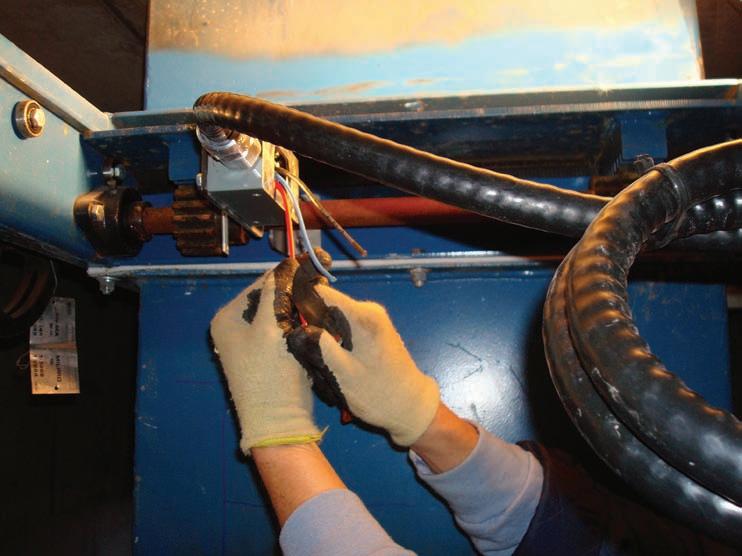
Barbara Monk of Odessa, ON, says there have been few times during her 21-year career that her hands have not been covered with cuts and nicks. As a journey-level electrician and member of the International Brotherhood of Electrical Workers, Monk typically works on new construction and retrofit projects.
As part of her job, Monk strips insulation from electrical wires and cables to make electrical connections and uses a hacksaw to cut cable and conduit. She frequently handles fixtures and cable trays that have sharp edges.
In the past, the electrical contractors for whom Monk worked provided her and other electricians with leather-cotton gloves that often deteriorated quickly and did not provide the cut protection required. Sometimes the gloves were so large that they fell off, leaving her hands exposed.
In recent years, some contractors supplied ‘pimple grip’ cotton gloves, which fit better and offered greater cut resistance, but did not provide the dexterity and tactile sensitivity needed for finite handling of small objects.
More recently, Monk began using different gloves while working at the con-
struction site for a refinery in Sarnia, ON.
The HyFlex 11-500 gloves she received include a foam nitrile coating to protect workers handling sharp-edged materials and tools, and have a DuPont Kevlar liner.
“We were doing a retrofit so the plant could produce ethanol,” Monk said. “The safety rules at the site required everyone to wear gloves at all times, and the contractor provided the HyFlex gloves. Because the product was available in different sizes, I had no problem finding a size to suit me. The HyFlex gloves fit me like a second skin, which is important, since I am wearing them nine to 11 hours a day.”
Providing the right hand protection is one thing. Establishing a safety program that achieves a high level of awareness and makes wearing PPE second nature for workers is quite another. The answer lies in creating a safety culture that penetrates every level of an organization, from the executive suite to the manufacturing floor, the maintenance department and the mailroom.
Fortunately for companies addressing hand safety for the first time, there are many templates available for safety programs that can be customized to meet an individual organization’s situation and criteria. There also are companies that will come to your facility and develop a program for you. Most importantly, whether you develop the program in-house or outsource the work, successful program development requires that every worker position be evaluated in terms of risks, safety protocols and the PPE required.
This is hard work that cannot be done from an ivory tower. It requires involving workers, their team leaders, their superintendents and anyone else who can provide valuable input. Worker surveys and interviews can be used to dig deep into safety requirements and best practices. Safety protocols can then be documented and PPE prescribed department-by-department, position-by-position.
Once the program is down on paper,
the hard work begins. This is essentially an internal marketing assignment to sell the entire company workforce on hand safety. This involves all of the following:
• Creating worker information sheets that make hand-protection protocols understandable
• Establishing a safety board that includes members from all stakeholder groups in the organization, from the factory floor to the executive suite
• Training workers on hand protection, including glove selection, glove storage and techniques for testing previously worn hand protection to be certain it is still effective
• Making it easy for workers to obtain the proper hand protection for their specific tasks through convenient glove stocking and intuitive labelling.
Use every internal communication vehicle available to you to promote hand protection, including:
• Displaying posters and worksite banners
• Using employee newsletters to communicate safety alerts that talk about new protocols and discuss near misses and minor accidents and what is being done about them
• Posting break-room announcements
• Using paycheque stuffers
• Discussing hand protection at worker meetings.
These are just a few of the many ways to keep hand safety in high profile. Promotions of the type described here are a good way to keep safety on the minds of workers. They will help ensure that your hand safety program will jump off the paper and stick in the workplace. MRO
Gil LeVerne is the manager, marketing communications, for Best Glove Inc., Coaticook QC. For more information, use the reply number below.
Reader Service Card No. 407
After the Sarnia project, Monk said she continued to wear the HyFlex gloves while she was working on three other jobs, laundering them as needed. The contractor at an ethanol plant construction site in Johnstown, ON, where she presently works, also provides HyFlex 11-500 gloves to every
Monk said since she began wearing these gloves, she has not suffered from the nicks and cuts that required a quantity of bandages in the past.
“When I wear the HyFlex gloves, my hands feel safe from cuts for the first time,” Monk said. “The gloves are comfortable and because they fit so well. I
have the dexterity I need to perform the majority of jobs. I remove the gloves only for the most finite tasks.”
She added that she often recommends the gloves to other electricians who are not familiar with the product. MRO
HyFlex is a trademark owned by Ansell Ltd., Cowansville, QC, or one of its affiliates. For more information, use the reply card number below.
Chemical-resistant gloves are available to protect the hands of anyone who comes in contact with harsh substances.
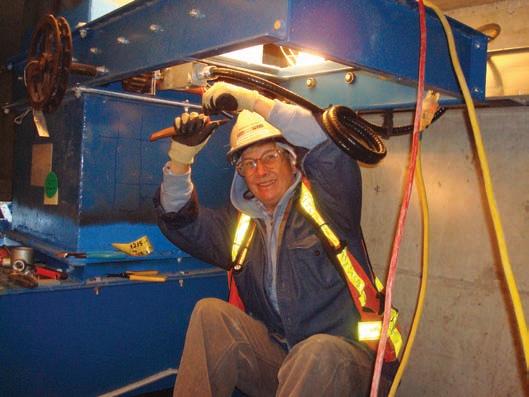
Above: Electrician Barbara Monk says HyFlex gloves fit her like a second skin, which is important since she wears them from nine to 11 hours a day. Left: Monk depends on gloves for cut protection while stripping insulation from a conveyor wire at a new ethanol plant in Johnstown, ON.
FOCUS ON WORK GLOVES
Protecting hands from chemicals
BP’s staff uses very strong acids and corrosive chemicals so it dare not get its health and safety and PPE approach wrong.
With 750 staff working at the large BP plc chemical manufacturing plant in Hull, UK, producing over one million tonnes of chemical products per year, site health and safety manager Andy Bell faces a constant challenge to ensure the wellbeing of workers.
Working with a range of hazardous materials, including acetic acid, ethyl acetate and vinyl acetate, which are used in a wide range of chemical-based products, including adhesives and paints, health and safety is the number one priority.
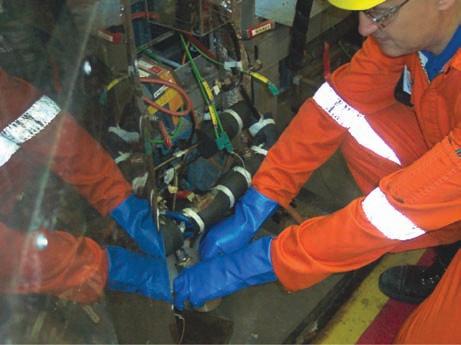
With the hands of staff throughout the plant in the direct firing line for potential injury, BP works with hand protection experts from Marigold Industrial to provide the right gloves for
Selecting the best glove materials
According to Marigold Industrial, the key drivers of industrial glove design are to achieve optimal comfort, dexterity and grip. Gloves can be made from natural rubber latex, synthetic rubber latex or textiles. The characteristics of each vary and the level of protection offered has to be considered glove by glove, chemical by chemical, for individual applications.
Using natural rubber latex to manufacture gloves provides a number of advantages, including high tensile strength, superior tear resistance, and good acid and alkali resistance. However, natural rubber gloves do not hold up well in organic solvents, oils, greases or fuels such as kerosene or gasoline. Also, natural rubber latex has been shown to cause allergic reactions in sensitized individuals.
Natural rubber latex is produced from the sap of the rubber tree Hevea brasiliensis, which is mainly harvested in Malaysia and Thailand. This latex is widely used in glove manufacturing and provides highly effective protection against chemicals as well as offering comfort, flexibility and dexterity.
Using synthetic rubber latex to manufacture gloves provides a number of advantages, including enhanced physical properties against abrasion and good chemical resistance to oil-based compounds such as grease, petrol and diesel. Chemical-resistant glove materials other than natural rubber include butyl rubber, neoprene, nitrile, polyurethane and PVC — sometimes in combination and in differing thickness and styles.
Using textiles to manufacture gloves provides a number of advantages, including enhanced performance against cuts and thermal protection against the extremes of both heat and cold.
Today’s range of textile gloves uses many specialist types of yarn that are sourced from various suppliers.
members of its plant and lab staff.
“A large proportion of the staff is working constantly with very strong acids and corrosive chemicals so we really cannot afford to get the health and safety and PPE approach wrong. “In addition to manufacturing chemicals, we also have a large lab where staff is constantly looking at developing new formulations or creating new ways to manufacture our chemicals,” says Bell.
“Whilst we ensure working practices
on site reduce the need for direct contact between staff and chemicals to an absolute minimum, we cannot engineer this out completely.
“As a result, we have to ensure that where PPE is required, it is extremely high performance and provides the level of protection that we require,” says Bell.
With a wide range of hand hazards on site, two particular personal protective equipment (PPE) solutions are provided in the shape of Marigold Industrial’s G25B and GO4Y gloves. The G04Y is used almost exclusively by staff working in the BP laboratory, while the G25B is used across the site. The blue nitrile G25B is resistant to a wide range of solvents and oil-based chemicals. It has a flock lining for comfort
and a raised palm pattern for enhanced grip. The GO4Y is ideal for use in chemical, electronic and preproduction areas.
“The Marigold Industrial gloves perform extremely well from a protective perspective but they also provide a good fit, which is very important when staff have to wear them throughout their shift,” adds Bell. “They also come in a wide range of sizes, which again is important when you have a lot of staff working on site, as we do.
“We place great faith in our PPE suppliers — whether it is for chemical suits, breathing apparatus or gloves. Their products are an essential ingredient in our health and safety approach, so we are extremely careful to select the best products for the many varied jobs being carried out on site.
For more information from Marigold Industrial, Concord, ON, use the reply number below.
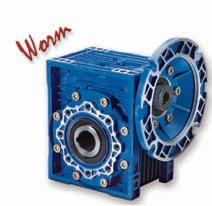
Proper planning simplifies gear drive replacement
How to get the best, easiestto-install replacement drive for your application.
BY RICK LYNCH AND NICK DERUS
Sooner or later, all gear drives will wear out. Whether it’s 60 years or six years after they were installed, the time will come when they have to be replaced. Proper planning and a well thought out replacement strategy can ensure continued smooth operation.
When a gear drive needs to be replaced, it can be frustrating when an exact replacement isn’t readily available. Because the number of US-based gear drive manufacturers has dwindled over the past 20 years, there may be no direct replacement or spare parts inventory available for much of their installed base.
With ever more frequent design changes, some drives only a few years old have become obsolete. This can leave a user no choice but to search used equipment lists or buy a new and different drive. When the substitute equipment arrives, it may not fit properly or be as suited for the intended use as the original drive.
When replacing a gear drive, there are several important questions to ask and factors to consider.
1. How does the replacement fit the envelope of the existing drive? The most obvious concern is the base-tocentreline distance. If the old drive measured 10 in. from the base to the shaft centerline, and the replacement measures 11 in., this is obviously a big problem, especially if the drive is mounted on a concrete foundation.
If the drive being replaced is very old, it may not be an issue, since drives have gotten smaller over each generation, but it can be a deal breaker if the drive being replaced is of a newer generation.
Other important dimensional con-
cerns include space considerations and interference with connected equipment or structures. Also consider what must be done with the motor to accommodate the new drive.
2. How does the replacement fit the connected/connecting equipment? Changes in solid-shaft diameters will affect couplings, sheaves, sprockets and other mounted equipment. Changes in bores of hollow-shaftmounted drives may make installation difficult or impossible.
In some cases these changes can be accommodated by changing bushings or re-boring. In others, a new hub, bushing or sprocket may be required. If such modifications become too expensive, it may be preferable to replace the drive with one having a special shaft to suit the application, if it is available.
3. Are there any foreseeable mechanical issues? Any time a drive is replaced, application parameters should be confirmed. Older drives were designed conservatively, so users could increase power over time without causing any problems. In some cases, motor horsepower and loads were increased by 50% to 100%. However, newer drives are developed with less conservative design practices and will not last long if misapplied or overloaded.
Ratios are another major concern, since it is unlikely a new drive will have exactly the same gear ratio as the drive it replaces. In most applications, ‘close’ is good enough, but in some cases, a change in ratio will be detrimental. These may include certain pump applications, dual drives and metering conveyors, among others. In these cases, it may be necessary to request a special ratio that is the
same or near that of the old drive.
Relative shaft rotations also may be an issue. If the old drive is a double-reduction gearbox and the replacement is a triple-reduction gearbox, the extra reduction and change in rotation can cause insurmountable problems.
This is more of a concern where the driver is an engine with a fixed direction of rotation. On electric motors, the leads can be switched to change the direction of motor shaft rotation. Relative rotation can also be an issue if there is some element in the drive train that must rotate in a specific direction, such as some variable-fill fluid couplings and clutches.
How to choose a replacement drive With all these considerations, how can you get the best, easiest-to-install replacement drive? Here are some suggestions:
First, work with a supplier that you know has the experience and attention to detail to handle the undertaking. This is not a job to shop around to the lowest bidder.
Work with a gear drive manufacturer that has a good library of competitive drive information. Knowing critical dimensional and rating information of the drive to be replaced is extremely important, and the manufacturer’s competitive knowledge can help offset the lack of detailed user records.
Next, make sure the bidder is given all the information regarding the application. Original paperwork and drawings are certainly a plus, but if they are not available, get full information from the existing drive nameplate, then verify that it reflects the current operation. Make sure the bidder includes a
site visit to see the application.
Ask for a written quotation of what is being proposed, and insist that it include full information on what will be required in the interchange. Will it require moving the motor, ordering a new coupling, sheave or sprocket, re-drilling the foundation or other changes?
Finally, make every attempt to simplify the change-out. Ask the bidder to provide a drop-in with an adapter base or bedplate to suit the existing foundation, new coupling, hub, etc. What could be easier than taking the new drive off the truck and bolting it in place of the original drive?
An example from the field
When a world-class producer of industrial chemicals needed to replace the gear drive on an agitator vessel at one of its North American plants, a replacement wasn’t available from the original manufacturer. A custom gearbox built to fit the application would have required a 25week lead time. Instead, the company’s contract engineering firm worked with Rexnord Industries, LLC, which made a transition base that allowed a drop-in replacement with a standard Falk gear drive in less than four weeks.
Because the company was rebuilding the equipment, time was less of an issue than in a breakdown situation. However, the long lead time and considerably higher cost of a custom gearbox made the alternative of a standard gearbox with a custom base a better choice.
The solution included a Falk M1150DBC3 reducer with a 64.67:1 ratio, a transition base, AirMax breather kit, sealed dipstick to exclude moisture, Wrapflex 20R10 high-speed coupling, Steelflex 1130T10 low-speed coupling, and a coupling guard.
The project manager said the company has similar equipment at other plants, some of which has been running for 45 years. He noted that the combination of the standard gear drive and adapter base provides a standard design that will make it easier to replace these drives when necessary. In fact, the company already has ordered two more of the drive packages for similar equipment at one of its plants in France.
MRO
Rick Lynch, marketing manager, and Nick Derus, applications engineer/product interchange specialist, are with Rexnord Industries, LLC, Milwaukee, WI. Reader Service Card No. 401
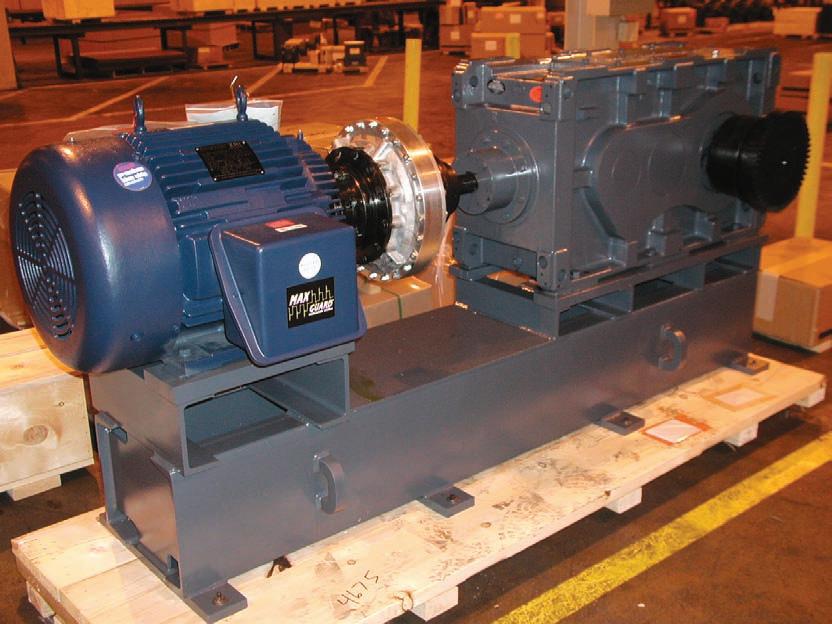
Completed drop-in drive package was designed to replace an obsolete drive without requiring changes to the existing equipment.
Identifying equipment problems before failure
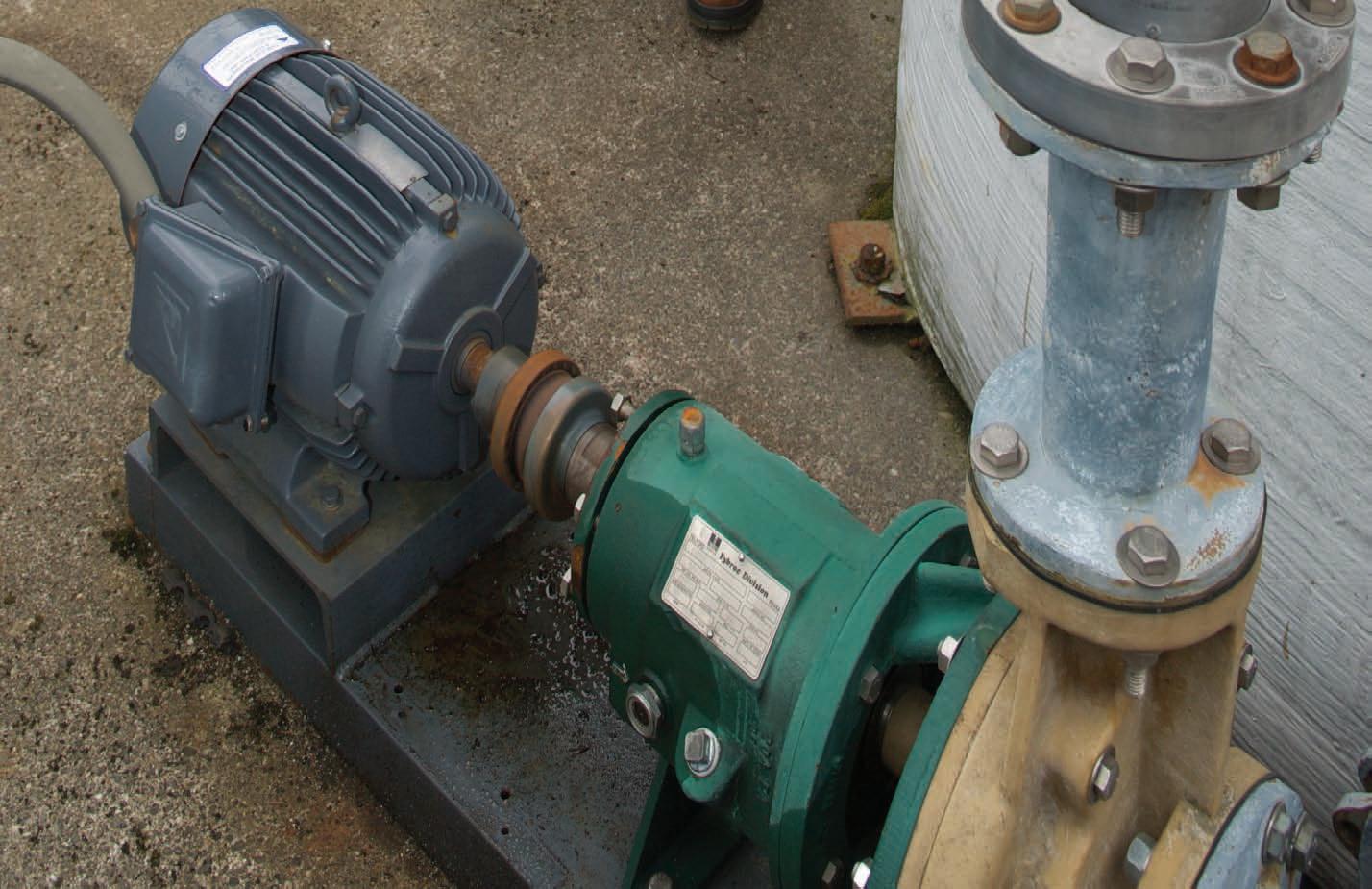
Predictive maintenance (PdM) programs monitor equipment condition, with the goal of identifying problems in advance and avoiding equipment failure. One powerful tool for monitoring rotating equipment such as motors and gearboxes is thermal imaging.
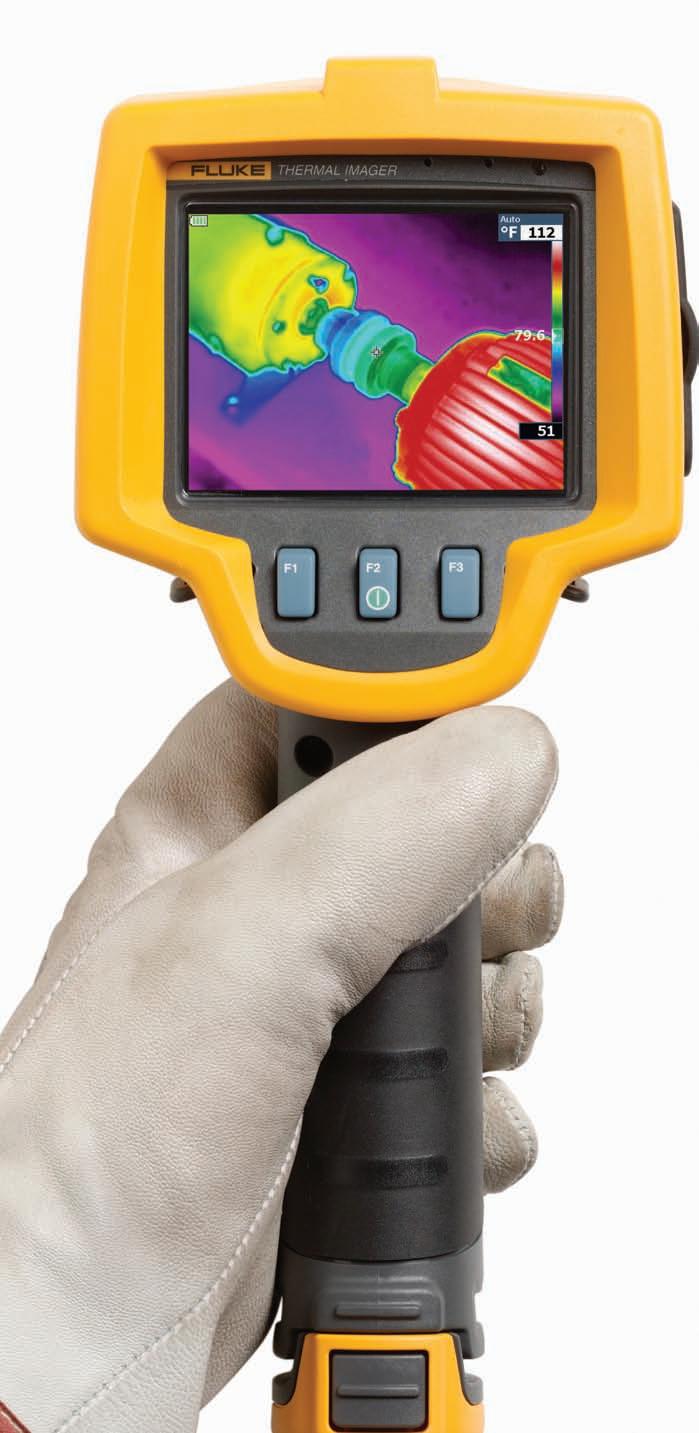
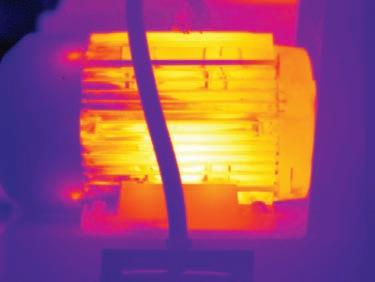
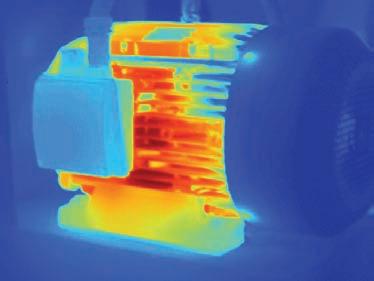
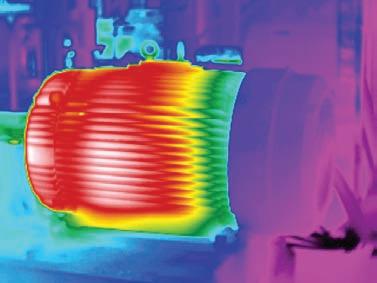
Thermal imagers capture heatbased images, using colour to correlate every pixel of an electronic image to a specific surface temperature. For motors and gearboxes in mechanical drives, overheating often signals impending breakdown. A thermal image makes it immediately clear what part of the motor is overheating, and to what extent.
Standard practice follows three basic methods: 1. Regularly compare the operating temperatures of like equipment, performing similar functions. 2. Regularly compare the operating temperature of a single unit to manufacturer’s standards. 3. Regularly compare the operating temperature of a single unit to previous images of the same unit.
More specific inspection guidelines follow.
Motors
Ideally, you should check a motor while it is running at a minimum of 40% of its typical load. That way, measurements can be properly evaluated and compared to normal operating conditions. By capturing an image of a whole motor, you can determine the operating temperatures of bearings as well as the temperature and temperature variations of the unit’s entire surface.
All motors have a normal thermal
pattern. Training and experience with both motors and thermal imagery make a thermographer familiar with motor heat patterns and how they relate to their operation. An experienced thermographer can use thermal imaging to identify conditions such as inadequate airflow, unbalanced voltage, impending bearing failure, and insulation degradation in a motor’s rotor or stator. An experienced thermographer can also identify a misalignment in a shaft coupling associated with the motor. And even a novice can spot anomalies in a motor compared to other similar motors under similar loads and then flag that deviant motor for further investigation.
Troubleshooting motors
If overheating appears to be due to one of the following situations, consider the action described.
• Inadequate airflow. If a brief shutdown is possible without affecting vital processes, shut off the motor long enough to perform minor cleaning on the air intake grills. Under any circumstances, schedule a thorough motor cleaning during the next planned facility shutdown.
• Unbalanced voltage or an overload. The usual cause — a high-resistance connection in the switchgear, disconnect, or motor connection box — can usually be pinpointed by an infrared
inspection and confirmed using a multimeter, clamp meter or a power quality analyzer.
• Impending bearing failure. When the thermal images indicate an overheating bearing, generate a maintenance order to either replace or lubricate the bearing. Vibration analysis will help you determine the best course of action.
• Insulation failure. If it will not too greatly affect production, de-rate the motor in accordance with NEMA standards. Under any circumstances, generate a work order to replace the motor as soon as possible.
• Shaft misalignment. In most cases, vibration analysis will confirm a misaligned coupling. If a shutdown is possible, dial indicators or laser alignment devices can be used and the misalignment can be corrected then and there.
Gearboxes
The lifeblood of any gearbox is the oil in it that lubricates the gears. If the oil level in a gearbox gets too low or loses its ability to lubricate, the gearbox will eventually fail, preceded by overheating.
Traditionally, preventive maintenance for gearboxes has consisted of regularly checking their oil levels and replenishing lost oil. Some maintenance departments add a predictive element to gearbox maintenance in the form of oil sampling and analysis. Oil analysis, usually performed by an outside labora-
tory, reveals if the oil in a gearbox has lost its ability to lubricate and will detect any metal particles in the oil, a telltale sign of gear wear that foreshadows a possible failure.
These gearbox maintenance measures are time-consuming and expensive and require shutting down the equipment. Also, gearboxes often are inaccessible or in unsafe locations, making oil-level checking and oil sampling difficult. Fortunately, thermal imaging is an alternative PdM approach. Since gearboxes generally overheat before they fail, an infrared (IR) camera can detect when a gearbox is running hotter than normal and/or hotter than similar gearboxes performing similar work in similar environments.
Because thermography is a non-contact, non-destructive technology, even inaccessible gearboxes in dangerous locations can be scanned while they are running. These devices can capture thermal images as well as visible-light digital images of all critical gearboxes that are running hotter than normal. Look, too, for leaking seals. Thermal images can reveal hot oil running down gearbox cases.
Be aware that while all excessive heat generated in mechanical gearboxes is the result of friction, it may have a source other than inadequate lubrication. For example, its source might be friction caused by faulty bearings, misalignment, imbalance, misuse, or just normal wear. Thermography is a good first step toward a complete analysis of a critical gearbox’s condition.
Troubleshooting gearboxes
When you find an overheating gearbox, its thermal image may offer hints as to the cause of its abnormal operating temperature. For example, if an oil pump has failed, its inlet and outlet temperatures will be the same. But whatever the suspected cause of overheating, maintenance personnel can arrange to follow-up by checking the oil level, oil quality and metal-particle content of the oil, or perform acoustical testing or vibration analysis.
In general, it is a good idea to create a regular inspection route that includes all critical motor/drive combinations. Then, save a thermal image of each one on a computer and track measurements over time, using the software that comes with the thermal imager. That way, you’ll have baseline images to compare to, that will help you determine whether a hotspot is unusual or not, and, following repairs, help you verify if the repairs were successful. MRO
This article was prepared by ITM Instruments, a Montreal-based distributor of precision instruments and calibration equipment.
Left: Colour infrared images clearly highlight overheating. Centre: Overheating can be caused by a variety of problems, from inadequate airflow to insulation failure. Right: Thermal images make pretty pictures, but the story they reveal is anything but pretty.
How to avoid compressor failures
BY DAN WISE
The oil-flooded rotary screw compressor is the most common type of compressor used in industrial plants. There are several reasons why this style of compressor has become so popular. The price of the unit and low installation costs provide the initial attraction for many customers.
In addition, the rotary screw compressor requires less maintenance over the long term. This is especially true when comparing it to a reciprocating compressor of the same size.
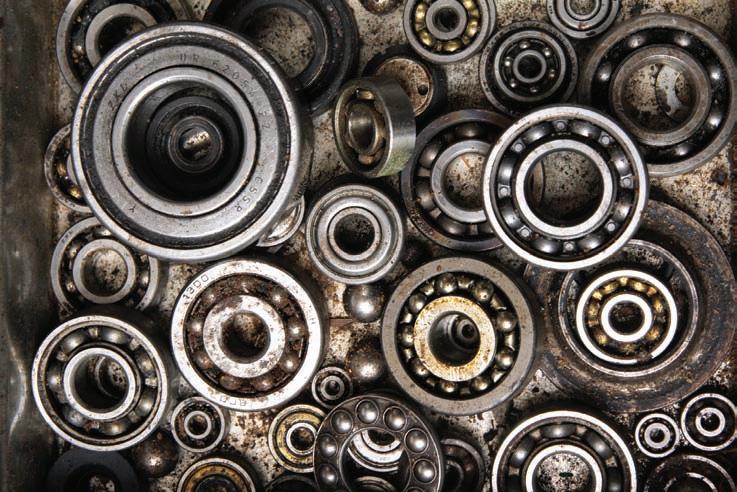
One primary objective of rotary screw maintenance involves monitoring the filtration system and oil change intervals in such a way that prevents outside contaminants from damaging the compressor. This helps protect the airend, which is the most expensive part of a rotary screw.
Our research into the airend aspect of the business found a company providing exceptional service and value with an airend exchange program. This company
has evaluated several thousand failed airends that were exchanged as cores for remanufactured units. It has a unique in sight into the common factors that cause prema ture airend failure and its staff have shared the following observations.
Bearings
The bearings used in a ro tary screw compressor airend are expected to maintain internal clearances of a few thousandths of an inch for many years of continuous service. These bearings will wear out at a rate dependent on many design and environmental variables. These variables include such factors as number, quality and type of airend bearings (they are not all the same), speed and pressure at which the airend is run, and provisions for filtration and coolant capacity.
Normally, compressor manufacturers quote an average airend bearing life expectancy of 40,000 hours or more. This is equivalent to five years or more of 24-hour-per-day duty. You must avoid some of the causes of premature failure if you are to achieve this longevity.
Contaminated lubrication
Contaminated lubricant causes more airends to fail prematurely than any other factor.
Air compressors ingest airborne contaminants every minute they are operating. Inlet filters slow the process but usually only catch particles over 20 to 30 microns. Also, they do nothing to stop chemical vapours that can attack the lubricant as well as the compressor.
Any particles smaller than the micron rating of the inlet filter will enter the airend. In addition, when the filter begins to plug, dirty air can suck past the filter gaskets, pulling larger debris inside.
Advanced lubricants have made it possible for extended operation between oil changes. However, you must not assume that your lubricant will remain clean for those advertised 8,000-hour oil change intervals.
ent models from the same supplier.
It is not likely that you will find a recommended oil injection pressure in the compressor manual. Injection pressure is the sump pressure minus the pressure drops through the cooler, oil filter, piping and any valves in the lubrication system.
On a typical 100-psi unit, you will usually see oil injection pressure at 70 to 80 psi when the compressor is under loaded conditions. Lower injection pressure is a key indicator of a problem that can cause major damage to the airend. An inspection will be required to find the source of the pressure drop.
Lack of oil flow at start-up
If there is little or no lubricant supplied to an airend on start-up, the bearings may last for hours. However, within minutes (or less), the rotors will lose critical discharge end clearances and seize.
Failures of this type are most often due to a complete blockage in the oil flow. This could be a bad oil stop valve or oil pump (where applicable). It could also
oil cooler. Normally, within very few minutes, a significant amount of heat is released into the cooler by the circulating lubricant.
3. The oil piping system is not getting hot, since no lubrication is returning to the airend. A compressor package with a thermostatic bypass valve will circulate lubricant from the airend to the sump through the thermal valve, oil filter and back to the airend until the lubricant reaches operating temperature. Heat should be present throughout the piping system.
4. The discharge side of the airend is getting very hot. Don’t rely on oil temperature shutdown switches to protect against lubricant starvation. If there is no lubricant flow, hot oil temperature switches and even some hot air temperature switches may not function properly.
5. All new or remanufactured airends should be primed with lubricant at start-up to help begin the oil circulation. This procedure alone is not likely to prevent this type of catastrophic failure. However, it may give the technician the opportunity to identify a lack of oil flow before it becomes a problem.
Some oil filters have a pressure bypass designed into them to prevent oil starvation should the filter element become plugged. Usually, these operate at from 15 to 30 psig of pressure drop.
In extremely dusty installations or environments, this can occur consistently within a week of filter replacement. Oil analysis and careful monitoring of compressor vital signs must accompany extended oil change intervals.
Lubrication flow to the airend
The lubricant injected to the airend serves the important function of removing the heat of compression. This refers to the heat released when the air or gas is compressed. As an example, a 100 hp rotary screw compressor will typically generate from 250,000 to 400,000 BTUs of heat per hour of running time.
In the 1980s, most compressor manufacturers simplified the design of the rotary screw compressor to eliminate the oil pump. This means the compressor must rely on sump pressure to inject oil into the airend.
Compressor lubricant flows from the sump to the cooler before going to the oil filter. The oil is then piped from the oil filter to the injection ports of the airend. There is no reservoir between the oil filter and the airend. Any blockage in the oil filter, oil cooler or within the oil piping system will lower the pressure of the oil supplied to the airend or reduce the oil injection pressure.
The amount of oil pressure combined with the size and location of the injection ports will determine the oil flow you have available to remove the heat of compression. This means normal oil injection pressure may vary between brands or even within differ -
mean that there is an obstruction in the oil filter, oil cooler, oil piping system or in any valves within the lubrication system.
In these failures, it is common for the compressor to run for several minutes before seizure. The following are a few indicators of an impending problem:
1. The compressor is making very little compressed air. Lubricant is also required to seal the rotors to each other and to the airend housing.
2. There is no hot air blowing from the
Varnishing
Compressor lubricants are subjected to very harsh conditions. The bulk oil temperature gauge may read 180°F, but temperatures in the airend can be much higher in certain spots. Mechanical shearing of complex molecules used in oil additive packages and the constant mixing with contaminants in the inlet air will contribute to the breakdown of the compressor lubricant. The result is a build-up of residue that affects clearances and plugs oil injection ports.
Varnishing can happen in all brands of compressors. It is usually a result of improper application or maintenance, rather than compressor design.
A well known rule of thumb is: For every 20 degrees above the normal operating temperature a compressor must run, the lubricant change intervals should be cut in half.
In the early stages of build-up, varnishing begins to give the compressor oil a burnt smell. This can be noticed when checking or adding lubricant as recommended in the owners manual. However, the recommended approach to identifying the problem is to perform regular oil analysis.
The oil analysis will reveal the high acid number and increased viscosity associated with a varnish problem before it becomes severe. You can also use an analysis to monitor many other issues that affect compressor service life.
A major concern is the effect that varnishing has on the other components of the compressor package. It is well accepted that even small amounts of varnish left in the oil system will accelerate more varnish formation in the future.
All components coming in contact with compressor oil need thorough cleaning. This includes the oil cooler, sump, oil lines, thermal valve, oil filter assembly, oil stop valve or oil pump where applicable.
A de-varnishing agent may also be added to the fresh oil at startup. However, be prepared with more fresh lubricant and replacement filters. Any varnish deposits left in the oil system will break loose and collect in the filters, causing them to plug up and begin the cycle over again.
Summary
A preventive maintenance program is essential for maximizing the service life of a rotary screw compressor airend. The key is to make sure your program matches your application.
This means monitoring filter and lubricant condition by measuring pressure drop and by using a regular oil analysis. This will help you create a schedule for change intervals that will provide the best protection for your compressor. MRO
Dan Wise of CompressorWise, an independent research and publishing company, can be reached at airends@compressorwise.com if you have any questions or want additional information on rotary screw or vane compressor airends, or visit compressorwise.com.
Reader Service Card No. 410
This article is part of an ongoing series. The introduction appeared in Machinery & Equipment MRO’s February 2005 issue and the series has run in every issue since. Previous instalments are archived online at www.mromagazine.com. In this issue, we pick up where we left off in the September 2009 edition, as maintenance manager Bob Edwards and members of his team begin to implement what they learned during an information-gathering visit to a big US paper mill. We join Bob at the end of his first day back on the job.
When I got home in the evening after work, I explained to Sandy, my wife, what had taken place at the mill and how I wasn’t sure if I could get Joe, the plant manager, to be the champion we needed — or even if I was the right person to try to convince him to do so.
“Well, Bob, you’re beginning to see that you need to manage both directions in some circumstances and it’s usually harder to manage up than down. As to whether you’re the right person to do it — who else? Joe has told you the corporate office is watching what you’re doing with your group, so you’re going to have the greatest influence. You’ve seen what the future looks like when you were visiting the mill in Wisconsin, so whether you like it or not, you’re going to have to guide the rest.”
“That’s part of the problem — I’m not sure I know how to get there. I’m not sure that I’m up to doing all of this.”
“You’re forgetting one important thing — something you seemed to have figured out before — you’re not alone. You have your reliability manager, Carol, who seems to know everything about the technologies and is not afraid to challenge the status quo. You have the millwright, Stan, who, because he didn’t believe but does now, will give support and credibility. Then there’s Dave from plant services, who’ll take whatever you give him and run with it. And I’ve heard you talk about the other millwrights, Pete and Ivan, as wanting to take responsibility — so let them.”
“Thanks, Sandy. You’re right, of course. In fact, I think that group is better prepared for this than I am. It still leaves Joe and the production manager, Fred — and his production group — who all need to be part of this.”
“As far as they are concerned, you need to show them how it’s important for them and then they’ll join in. I remember reading a quote from Dwight Eisenhower that went something like: ‘Leadership is the art of getting someone else to do something you want because he wants to do it.’ So you and Joe have to become the leaders.”
With Sandy’s words firmly implanted in my mind, I set off for the mill the next morning, where I knew I had to pull a team together to set up our plan. I called Carol and asked her to bring Stan up to my office so we could go over the highlights of our US trip before we rolled out a presentation to the rest of the maintenance group.
When they arrived, they both seemed excited and eager to talk about the trip.
“Did you see how well the shop was set up?”
“Their work order system! Wow, imagine! It’s set up to communicate to everyone automatically — and then there were those KPI calculations.”
“I’m glad you’re both enthusiastic,” I said.
I then told them about Sandy’s comments and how they would be crucial to
Condition monitoring plan gets a boost
Follow along with Step 29 in a journey to World-Class Maintenance at the Plentya Paper Company as the team makes further progress towards its goals.
BY CLIFF WILLIAMS
the success of the new program.
“I think we’re going to have to develop a plan to divide what needs to be done into mini-projects and then give them to the guys to take over. Of course, we’ll have to explain what they can and can’t make complete decisions on — just like they did in Wisconsin.
“The lucky thing is that I believe we’ve made a lot of progress already. We just need to make some little tweaks and then the whole system takes over. It’s still going to be a challenge to get Fred and the production group to make the changes. It really involves the passing of responsibility and I’m not sure how ready they are for that — although the last time we met, Fred did mention that his guys were always quoting what maintenance was doing.”
I asked Carol and Stan to pull together everything they had made a note of from the trip and forward it to me so I could put it all together for the guys.
“There you go again, Bob, wanting to do it all yourself,” Carol interjected. “Why don’t you and Stan send me what you have and let me put it all together? You can take a look at it when I’m done.”
Key Points
Delegating shares the load.
“Okay Carol, let’s get this done as soon as possible, as I don’t want much more time to pass before we get everyone to understand what we saw. There is a lot of anticipation within our group.”
Show others what’s in it for them.
Create an enabling environment.
“You’ve got that right, Bob,” said Stan. “All day yesterday they were bugging me about what we saw, and to be honest I didn’t know where to begin. So it would be great if Carol gets us something to talk about soon.”
How much would he involve me? But the fact that he had acted so soon was encouraging. After I had given Carol my report, I went down to the shop to see how the day was going.
Dave was in the shop rebuilding a wastewater pump.
“Hi Dave, what happened with your modification? Did it hold up, or is this a different failure?”
“No, in fact it’s the opposite. The pump is working fine. This is the spare to which I’m adding the modified back plate that the manufacturer sent us for free. In fact, they sent us a complete spare parts kit for free!”
“Hey, that’s a good deal. Thanks for your effort, Dave.”
“It’s not as good as it seems, Bob.”
“Why do you say that? We’ve spent quite a bit of money on these pumps, so everything will help.”
“That’s right, Bob, but that was before I came up with the solution. This kit will be sitting in the stores gathering dust — if not, you can transfer me to stock prep.”
“Wow, given how much you dislike the stock prep area, you must be pretty confident.”
“How was the mill in Wisconsin? Stan’s been pretty tight-lipped about it. I’m not sure he was the right guy to go after all.”
“No, Dave, your suggestion that he go was inspired. We hope to have a meeting tomorrow to talk about the trip. We just want to make sure we captured everything and that everyone gets the same message. One of the things I can say is that in the environment we saw there, you would have a great time. We’re going to try and get that environment here.
“Not only will you enjoy it, you’ll also be very instrumental in creating it. One lesson we learned was that we need to create a situation where everyone can reach their potential, irrespective of position and title. And as we’ve talked about before, I’m not sure if even you know your potential.”
“Sounds good, Bob. It seems like something to look forward to.”
I headed up to the meeting room for Joe’s gathering, to find Fred, Debbie and Josh already there.
“This must be important,” claimed Josh.” I had a meeting already booked for this time but Joe told me to get someone else to attend as this was one meeting I wasn’t allowed to miss.”
Just at that moment, Joe arrived and set up his presentation, which he had entitled ‘The Way Forward’.
“If we take what Chuck and Alan at the US mill told us about how things have continued getting better, and add Sandy’s comments about leadership, I’m sure that we can get Fred to ‘want’ to change,” suggested Carol.
“We should reflect on some of the times we’ve been waiting for a decision because we had to call everyone first, and then add the time we spent waiting to get parts for the jobs, etc.,” Stan added. “I’m sure we can convince Fred that he could make a lot more paper if we reduced those times. We know that at the end of the day that’s what Fred really cares about, and you never know, we might get close to the production levels they had in Wisconsin by doing it their way — being bottom-line driven.”
“Good point, Stan. Do you think you can get something ready by the end of today, Carol? It would be good if we can put up a notice of a meeting for tomorrow.”
“If you guys commit to getting your stuff to me before noon, then I’ll have something ready for tomorrow. I’ll get it to you by the end of the day for review.”
“Okay, let’s get on with it and remember to be positive about what we saw, especially when talking with the production guys.”
As I was working on the trip report, I got a call from Joe, who asked me to come to a meeting with Fred, as well as Debbie, the quality assurance manager, and Josh, the technical manager. He wanted to talk about Project 600. I wasn’t sure how Joe was going to approach this.
“All right everyone, this might seem a little bit sudden, but I’ve been talking with corporate over the past few months and they’ve repeatedly told me that as a company, we need to get more efficient, production- and cost-wise. They’ve watched what Bob and the maintenance group have been trying to do and have committed money to support their move toward condition monitoring.
“This is a good start but it’s not enough, so I’m going to sponsor a new program called Project 600. We’ll look at what is preventing us from producing 600 tonnes per day and then each of you will sponsor projects within your departments to get us there.”
Joe had certainly taken the bull by the horns. I couldn’t wait to hear more. MRO
Cliff Williams is the corporate maintenance manager at Erco Worldwide in Toronto, ON, and a consultant with TMS — Total Maintenance Solutions Inc., Markham, ON. He can be reached by e-mail at williamscliff@rogers.com.
dvanced CMMS modules can be used to record measurements you take on critical equipment, and some CMMS programs are able to take the measurements for you and analyze the data. Surprisingly, there are not many programs that will create trend reports and graphs that use statistical tools to create charts that show the results of measurements taken over an extended period of time.
Machinery that must run in order to produce your end product often receives a lot more attention than other redundant equipment in the process.
For example, a gypsum quarry near my home monitors its main conveyor systems and crusher with vibration analyses, as well as temperature and motor amperage measurements.
These readings are taken at regular intervals and are set up in its CMMS, which prints the predictive maintenance work orders. The vibration analysis is contracted out to a local contractor. Once the measurements have been taken, the contractor prepares a comprehensive report on the condition of the rotating equipment.
Vibration analysis provides a longterm picture of the condition of the equipment and identifies problems very early in the machine’s life cycle. Any suspect equipment can be more closely monitored and repairs can be scheduled when the plant is down.
This particular vibration analysis company has very sophisticated equipment and the software it uses analyzes the data and creates trending graphs and quickly identifies impending equipment failures. A complete report is sent to the plant. A work order is then created and parts obtained to complete the repair.
There exists other, less-sophisticated vibration analysis equipment that only provides a reading on the unit itself and identifies the condition of the equipment at that given time. It offers no software to do a trend analysis from previous measurements. Many facilities have purchased these units over the years, as they are fairly inexpensive. They show if the equipment either passes or fails. Sometimes the measurement tool simply shows red, yellow or green to indicate the equipment condition.
The same holds true for temperature and motor amperage measurements. Although these two readings provide on-the-spot, at-the-moment, numerical values, they are not often compared to
Scheduling maintenance just before the equipment fails
Using a Statistical Predictive Maintenance module in your CMMS will get you into predictive mode and provide an even higher level of service to operations.
BY PETER PHILLIPS
previous measurements; the temperature or motor amperage either falls into an acceptable range or it doesn’t.
So what if your CMMS could take these readings and do the analysis for you? There are CMMS programs that enable you to enter the values you record. It will then analyze the data based on the parameters you set in the program. One CMMS that does this very well is an Infor product called MP2.
The Statistical Predictive Maintenance (SPM) module goes beyond preventive maintenance into a predictive mode by identifying equipment readings outside preset control limits, alerting you to schedule maintenance before the equipment fails.
For example, you may create a SPM record that monitors amperage readings
of a 100-hp rock transporting conveyor. First you set the minimum and maximum possible readings for the motor, as obtained from the manufacturer’s specifications. Then you would enter each reading in the equipment record and periodically generate reports and graphs to recognize trends and readings that fall outside the specified range.
The MP2 software also automatically generates a repair work order when readings fall outside predetermined SPM limits. The software lets you choose the type of analysis you prefer. Use the manufacturer’s minimum and maximum values or use Standard Deviation Calculations for a more sophisticated Statistical Process Control (SPC) to produce charts (see graphs below).
In other CMMS programs, you can
input the specifications of a piece of machinery. For example, the temperature of a motor should fall between two values that create what is called a ‘condition’. This condition is then transferred to the predictive maintenance work order, where the craftsperson can then note the temperatures on the work order and visually see from the normal condition whether the measurement passes or fails. A report can then be created to view the trend of the readings.
Your CMMS may have one of these SPM features. Predictive maintenance, sometimes called just-in-time maintenance, demands regular monitoring but can provide substantial cost savings by delaying maintenance until failure is imminent. For example, by reading and analyzing vibration readings on a rock conveyor, you can extend the useful life of the part without risking downtime on the equipment.
I know that many facilities struggle to get just the basic information recorded in their CMMS. Getting PM work orders generated and distributed to the craftspeople, and retrieving and completing them properly in the software, are about all they can manage.
However, as they improve their preventive maintenance program and get breakdowns and repairs under control, there will be time to be more proactive
Using a CMMS SPM module will get you into predictive mode and provide an even higher level of service to operations. As a reminder, we are getting close to the end of 2009. Last year, in the December issue, I wrote about the ups and downs of previous year. I’ll be doing it again this year. If any MRO Magazine reader has stories about successes or challenges implementing a CMMS during 2009, I really would like to hear from you. With your permission, I’ll work your story into my future columns. Send your stories by e-mail to peter@trailwalk.ca. MRO
Peter Phillips of Trailwalk Holdings, a CMMS consulting and training company based in Nova Scotia, can be reached at 902-798-3601 or by e-mail at peter@trailwalk.ca.
can use the Reader Reply Card in this issue to obtain more information on CMMS systems: Circle No. 406.
How will maintenance get done with a flu outbreak?
BY SIMON FRIDLYAND
We all hope that a pandemic will not affect us, however we need to be ready should it arrive.
TA pandemic like this may:
• arise rapidly and spread quickly
• make people very ill; many likely will die
• generate unprecedented levels of fear and panic
• occur in several waves, each lasting for several months
• require government, businesses and many community agencies to be involved in a whole-of-society response
• result in health care services not being able to provide direct care in some cases, and
• result in very high staff absence rates for some periods during the pandemic.
With these factors in mind, your company will need to develop contingency plans to manage the impact of a potential pandemic on its business.
The contingency plan should consist of the following points:
1. Identify your business’ core people and skills.
What are your business’ core activities, who carries out the essential roles and what skills do they need? How might your business operations be affected by a 30% to 50% drop in staff at the peak of the pandemic? Will you be able to maintain your equipment and keep your machines running?
2. Consider the effects of supply shortages on operations.
Are there any products or external suppliers that are essential to your business functions? What would you do if you couldn’t access these products or people?
Can items you need be stockpiled or sourced from another supplier, distributor or buying group?
3. Plan for staff absences.
Arrange for staff to learn other peoples’ jobs, especially the important ones, so that there are a number of people who can backfill the positions of those who are away.
ing a decision to close during a pandemic.
If you are not a key service provider, you will need to consider at what point you might close temporarily. If you do stay open, your business planning might include consideration of employee risks and your duty of care as an employer. Will you need to rely more on online or phone services? Does your business have the necessary infrastructure to cope? You should also consider that there may be interruptions to services such as power or telecommunications.
6. Encourage good personal hygiene practices.
You don’t need to wait for a pandemic to practice good hygiene that could reduce the spread of infection. Encourage proper coughing/sneezing etiquette and ensure you have a good supply of handwashing products in stock. Your business premises, especially hard surfaces such as doorknobs, sinks, railings and counters, should be cleaned regularly.
You should also ensure you have a wellventilated work area and check that your air conditioning is serviced regularly.
7. Understand social distancing measures.
In a pandemic, staff should be encouraged to minimize contact with others. This might include restrictions on congregating in staff rooms. During shift changeovers, you could have one shift leave before a new shift begins.
8. Communicate your plans to staff and customers.
In the lead up to and during a pandemic, your staff will likely be concerned about and be preoccupied with the wellbeing of their families. Their commitment to their jobs or their ability to work may not be their major concern. Staff and customers will feel reassured by your pandemic planning activities and will be
In order to minimize the spread of the virus, special attention must be paid to the following points:
Hand washing
• Adopt g ood h and w ashing/hand hygiene practices, particularly after coughing, sneezing or using tissues.
• Immediately dispose of used tissues.
• Keep hands away from the mucous membranes of the eyes, nose and mouth.
• Ensure that adequate supplies of hand hygiene products are available. (This is a high planning priority as there may be an interruption in the supply or shortages of soap and hand towels).
• Have a supply of tissues available and provide no-touch receptacles for used tissue disposal.
• Consider having conveniently located dispensers of alcohol-based hand sanitizer.
• Provide soap and disposable towels for hand washing near all sinks.
Coughing and sneezing
• Cover the nose and mouth when sneezing and coughing (preferably with a disposable, single-use tissue).
• Dispose of tissues in the nearest waste receptacle after use. Do not store them in your pockets.
• Wash your hands after coughing, sneezing or touching used tissues.
Personal protective equipment (PPE)
• The most commonly used PPE equipment would be masks and protective barriers. Disposable masks help prevent exposing others to respiratory secretions of those who are ill. Dispose of any mask as soon as it becomes moist or after any cough or sneeze, and wash the hands thoroughly.
• Protective barriers in the form of Plexiglas or glass may provide useful protection for people such as front counter staff, raining and meetings.
• Shift changes should be managed in a way to prevent cross-contamination, i.e. provide an interval before the next shift begins; this helps reduce the number of people meeting in the locker room, etc., and provides an opportunity to ventilate the work site during the shift change (windows opened, increased HVAC).
• If face-to-face meetings are absolutely necessary, try to use a large room and sit at least three feet apart.
Cleaning
• There’s no doubt that cleaning should be enhanced during a pandemic.
• Disinfecting solutions should be applied to all common area surfaces, such as counters, railings, sinks, shared telephones, shared computer keyboards and toilet bowls.
HVAC
• HVAC systems should continue running, but try to increase the amount of outside air and reduce recirculation. There is no clinical indication for cleaning air filters during a flu pandemic. Since the spread of flu is still primarily by droplets, thus is not airborne, filters will not make a difference. Additionally, most industrial HVAC filters will not filter virus-sized organisms anyway. We all hope that a pandemic will not affect us, however we need to be ready should it arrive.
MRO
Simon Fridlyand, P.Eng., is president of S.A.F.E. Engineering Inc., a Torontobased company specializing in industrial health and safety issues and PSR compliance. He can be reached 416-447-9757 or simonf@safeengineering.ca. For more information, visit www.safeengineering.ca.
What’s new in safety products
Disposable clothing suits many environments
Innovative design sets these new disposable coveralls apart from existing products available today. North-Gen coveralls are the only ones with ventilated gussets. This design innovation is important be
cause non-porous coveralls can be very uncomfortable in warm conditions. There are three versions of the coveralls. NorthGen Air is made from a white, soft polyethylene bonded to a non-woven polypropylene that offers superior resistance to dust and minor chemical splashes. NorthGen Pro is made from a blue, non-woven, breathable, multi-layer polypropylene, suitable for use around dust and chemicals. North-Gen FR is made from a green, non-woven, breathable, multi-layer polypropylene with a flame-retardant treatment for arc flash risks and fire fighting. North Safety Products
Reader Service Card No. 323
Glove protects against cuts, moisture
The HyFlex 11-624 glove features a yarn combination of DSM Dyneema, Spandex and nylon. These gloves offer a high degree of cut protection, yet are light weight, cool, comfortable and flex ible. A polyurethane black coating provides a medium-high level of abra sion resistance and promotes a sure grip in both dry and wet applications. Recommended for applications requiring employees to handle small- to mediumsize sharp objects, the gloves are for use in a variety of industries, including metal fabrication, automotive and aerospace.
Ansell
Gloves knit with Kevlar and steel
Emerald CX gloves from Superior Glove Works are knit with an engineered blend of Kevlar and stainless steel for extra strength. Rated to ANSI Level 4 cut protection, the S13CXPU glove features a thermoplastic polymer of urethane (PU) coating for softness and flexibility. While the glove has poor resistance to hot water, it has very low particulate shed, making it suitable for assembly work in industries where product contamination is an issue. In lab trials, CX gloves stand up to 1,700 g of force, making them much tougher than leather gloves.
Well-priced glove gives good grip
PosiGrip lunar foam nitrile palm dip gloves from West Chester Holdings feature a white or salt and pepper nylon shell that is dipped over the palm and fingertips with full saddle coverage, giving them a firm grip on wet or oily materials, and good surface adhesion on dry applications. Sizes from extra-small to extra-extra-large ensure proper fit and dexterity, and a knit wrist provides comfort for the wearer. Antibacterial surfactants prevent odours and bacteria from forming. Machine washable and silicone free, these value-priced gloves can be used in maintenance applications, bottling and canning, recycling, manufacturing, materials handling, and more.
West Chester Holdings
Superior Glove Works
Reader Service Card No. 315
Custom earplugs fit comfortably
HearSafe Canada makes custom-fit earplugs by creating a custom mould. The company takes an impression of the ear canal and custom-contours the plug to the worker’s ear. This plug protects workers from measured noise levels in their working environment without over-protecting. As each plug is customized to the employee in question, a comfortable fit is assured.
Isolation monitor increases safety of mining machinery
Reader Service Card No. 316
Ladder stabilizer reduces accidents
Ralston CanSafe has introduced the Ralston stabilizer for hollow-rung ladders. Designed to reduce accidents resulting from slipping ladders, the stabilizer installs in under 10 minutes and does not negate the CSA rating of the ladder. It deploys in seconds, even on sloping ground, eliminates the need for a spotter and maintains its integrity, even when a large weight is suspended from either side. During testing, the stabilizer has enabled the ladder to withstand tethered droploads of over 2,273 kg (5,000 lb). The legs fold and lock to the side of the ladder for easy transportation and storage.
Ralston CanSafe Reader Service Card No. 320
Eyewash instantly flushes out chemical splashes
Speakman SEF 1800 aerated eyewash is used for flushing the eyes after an emergency chemical splash to a worker’s eye or face. Requiring only one hand to operate, it can be activated in less than one second. It attaches to any sink, replacing the existing faucet. After a chemical flash to the eyes, the time to flush out the con taminant is critical to saving a worker’s vision.
Dentec Safety Specialists
Reader Service Card No. 317
Workers no longer have to dispose of their earplugs, which reduces landfill waste and saves money. A company that has 200 employees likely would use 400 pairs of disposable plugs per day, or about 100,000 per year.
HearSafe Canada
Reader Service Card No. 318
Cooling vest protects workers in hot environments
The Allegro 8401 cooling vest is designed for work ers who must function in environments with exces sive heat, such as con struction workers, fire fighters, welders and fac tory workers. This light weight, 100% cotton prod uct provides all-day com fortable cooling. Soaking the vest in cold water for from two to five minutes gives a constant temperature for up to 72 hours. It is reusable and can be reactivated when dry. The cooling material is a safe, non-toxic polymer, and is non-flammable and non-combustible.
The A-Isometer IR420 series isolation monitor from Bender boosts the safety of large AC-powered mining machines by monitoring the insulation resistance of ungrounded AC systems up to 300 V. The response range is steplessly adjustable from 1 kOhm to 200 kOhm, and values are displayed on a sevensegment LCD. A large range of supply voltages can be applied to the unit. Connecting an external supply voltage allows de-energized sys tems to be monitored. Designed primarily for the mining industry, the monitor also can be used in smaller mining applications such as lighting systems and mobile generators.
Bender
Reader Service Card No. 321
Noise measurement kit conducts variety of surveys
Casella USA has introduced the CEL620. A wide-range integrating meter kit, it offers digital signal processing and a full-colour LCD, along with all the components necessary for conducting a variety of noise measurement surveys. The product provides the features of a broadband meter while also giving the user the ability to measure noise levels in whole or third octave bands across a wide range of frequencies. The kit includes a real-time octave band ANSI type 2 meter, an acoustic calibrator, foam windscreen, attachéstyle kit case, USB PCdownloadable cable, dB36 PC software, three AA batteries for the meter and one 9V battery for the calibrator, and operator manuals.
Ralston CanSafe
Reader Service Card No. 319
Casella USA Reader Service Card No. 322 MRO
What’s new in test and measurement devices
Transformer insulation test set comes ready to use
The IDAX-300 test set from Megger quickly and accurately assesses the condition of the insulation in power transformers. The self-contained, field-portable test set also is suitable for assessing
the insulation condition of bushings, cables, motors and generators. Using frequency domain spectroscopy, the unit is able to evaluate not only the condition of the oil in a transformer, but also the condition of the solid insulation. Included with the test set is easy-to-use software that allows moisture assessment of the insulation in a transformer to be completed in just 18 minutes. In addition to the instrument itself, the kit includes a set of 30-ft cables, a hard transport case, a soft case for accessories, a software CD and a user manual.
Megger
Reader Service Card No. 328
Inspection camera sees round corners
The Ridgid MicroExplorer digital inspection camera is a portable, handheld video inspection system that allows the user to perform and record detailed visual inspections of hard-to-reach areas. This powerful camera features 3.5-in. colour LCD (320 by 240 pixels) resolution for clear images, easy-to-use icon-based user interface, 3x digital zoom for areas out of reach of the camera head and a rechargeable lithium ion battery with four hours of run time. The pan feature allows viewing of objects just out of sight of the screen. Attach ments include hook, magnet and mirror.
ITM Instruments
Reader Service Card No. 334
Infrared viewing pane protects thermographer
Iriss has introduced the CAP-V range of infrared viewing panes. These panes allow the conduct of infrared surveys and visual inspection of energized electrical conductors and circuit parts from a single, custom-made, impact-resistant inspection panel, while keeping panel
InfraRed Imaging Solutions Inc. (IRIS) is a world class PDM (Infrared, Vibration Analysis, Ultrasound, and Oil Analysis) maintenance solutions company providing professional infrared scans to residential, commercial, industrial, and healthcare facilities in Canada, the United States and abroad.
IRIS’ inspectors are experienced and certified in inspecting electrical equipment, building envelope, roof integrity, ramp heating systems, and water damage. IRIS also provides core cut roof sampling and compressed air surveys.
covers and doors closed. They maintain an enclosed and guarded condition between a thermographer and the energized components. The durable panes come in standard 12-in., 24-in. and 36in. panel sections, and can also be custom-manufactured.
Iriss
Reader Service Card No. 327
Multimeter has built-in IR thermometer
What clients are Saying about IRIS
"IRIS has proven to protect and extend the life of our assets and help us achieve higher levels of reliability."
"Great Lakes Power and IRIS have developed a strong professional working relationship that will continue for years to come."
Gary Gazankas., BSc., E.E. Transmission Engineer Manager, System planning and Engineering Dept. (Great Lakes Power - Sault Ste. Marie, ON)
“I highly recommend IRIS to any organization that could utilize their skills and expertise”
Robert Peters - Thermal Process Engineering Manager. (Stackpole Automotive)
Designed for heavy-duty use in harsh environments, the EX570 12-function, true rms industrial multimeter comes with double-moulded test leads, a magnetic hanging strap and a water-resistant
package. It is equipped with a built-in, non-contact infrared thermometer with a laser pointer. Features include storage and recall of three measurements and a large backlit 40,000-count LCD with a 40-segment bar graph. This lightweight DMM is suitable for the quick identification of overheating motors or to locate hot spots on electrical panels and HVAC vents without requiring contact. It is constructed using a Type K bead wire temperature probe, and comes with a case and a 9-V battery.
Extech Instruments
Reader Service Card No. 329
Instrumentation catalogue is packed with products
Dwyer Instruments has announced the availability of its 2010 catalogue. This 600-page catalogue uses a convenient format to detail the company’s numerous instrumentation and control products, including over 60 new products. Included are pricing, applications, product dimensions, specifications and more. Also available is a digital catalogue on CD with interactive features that include keyword search, notes addition, page print and page save in pdf format. The company produces a broad range of precision instruments for measuring, transmitting or controlling pressure, flow, air velocity, level, temperature and humidity. Also offered are valve and valve control products.
Dwyer Instruments
Reader Service Card No. 330 MRO
What’s new in drives
Offset AC gearmotor is versatile
Bison Gear’s FlexTorq 762 series hol low shaft offset AC gearmotor features ei
ther a 1.25-in.-ID hollow shaft or a 1.25-in.-diameter solid shaft in either U- or S-shaped configu rations. Driven by 1/20-hp, 1/4-hp or 1/2hp single- and three-phase 115-VAC and 230 VAC electric motors, these fractional horsepower gearmotors operate with fixed output speeds from 60 to 1 rpm and offer continuous-duty torque outputs from 430 to 2,500 in.-lb, respectively. Suitable for a variety of conveying and foodservice applications, the product line includes two dual-voltage (115-V/230-V) models, nine 115-V models and four energy-saving Verdant Duty three-phase models for use with variable frequency drives.
Bison Gear
that provides superior performance due to circular force distribution, leading to extreme low friction during tooth engagement. Available in widths from 25 mm to 100 mm, the belts come in AT10 and AT15 tooth profile, are steel or stainless steel reinforced, and are available open-ended and welded or truly endless. Various backing materials and over 3,000 existing profiles accommodate many application requirements.
Brecoflex
Reader Service Card No. 308
Reader Service Card No. 302
Stainless steel reducer suits sanitary use
Grove Gear stainless steel products are designed to meet the stringent requirements in food processing, packaging and beverage industries. Featuring a smooth
surface finish for easy-to-clean, sanitary operation, the products include worm, helical-worm and helical-bevel gear reducers and ratio multipliers. The worm reducers are offered in six sizes with ratings to 17 hp. Single and double reduction units are available with ratios from 5:1 to 3,600:1. Double-lip, Viton seals protect the units against harsh environments. In addition to helical gearing for system efficiency, the ratio multiplier features ratings to 4.7 hp and ratios from 2:1 to 7.5:1. It can be used as a standalone, single-reduction inline reducer or as a bolt-on to the input of a C-face gear reducer to multiply overall ratio reduction. Lubed for life, the units can be combined with a Leeson Washguard allstainless motor to create a complete power transmission package.
Leeson Electric
Reader Service Card No. 301
Timing belt offers continuous tooth engagement
Planetary gearhead installs quickly Available in 40-mm, 60-mm, 80-mm, 120-mm and 160-mm frame sizes, the Thomson XTrue true planetary gearhead is engineered to move large loads easily and quietly, through improved load capacity and low backlash. The units de liver precise 13-arcmin. operation, torque capacity up to 876 Nm and ratio availability of 3:1 through 100:1. A tapped face output en ables quick drop-in replacement for similarly configured Euro pean gearheads: the Micron flex ible RediMount mounting system enables the gearhead to be mounted to any motor in three easy steps: align, mount and tighten.
Thomson
Washdown gearbox withstands harsh conditions
Wittenstein offers corrosion-resistant servo gearboxes with specifications for washdown environments. Available nickel-plated, lacquer-coated or in stainless steel, this washdown range is suitable for specific applications in the food packaging/processing and pharmaceutical/medical industries, and for clean room or harsh environment applications. The washdown option is available as standard for the Alpha LP+, SP+, TP+, HG+, SK+, TK+ and V-Drive.
measures 105 mm in diameter and fits drives with bore diameters of 9 mm, 11 mm and 14 mm. Both units offer 64, 128, 256, 512 or 1,024 pulses per revolution and maximum speeds of 10,000 rpm. They are available with 5-VDC voltage, or with variable voltage ranging from 8 VDC to 26 VDC.
Baumer
Reader Service Card No. 307
Integrated motor/drive reduces cabinet size
Rexroth’s IndraDrive Mi integrated motor and drive takes up significantly less total space than a servo system with separate motor and drive packages, reducing the space and air conditioning energy for the control cabinet and allowing machine builders more design flexibility. In
Reader Service Card No. 305
Gearmotor/motor line keeps costs down
Bodine Electric has added over 20 230-VAC/430-VAC variable speed, threephase gearmotors and motors to its Pacesetter product line. Suitable for factories with various power supply options, these high-efficiency units provide a wide range of torques, speeds and horsepowers
to fit diverse applications, such as conveyor systems, packaging machines and factory automation. The 34R and 42R frame motors are available with dual voltage windings and inverter-duty ratings, and can be matched with the company’s type E, F and 5N gearheads. All units feature the Quintsulation fivestage insulation system, which protects the motor from potential spikes or corona damage caused by the inverter.
Bodine Electric
Reader Service Card No. 304
Flange-style magnetic encoder is extra-thin
Designed for speed and position control on electric motors, drives, gearboxes and conveyors, Baumer’s 14-mm thick, extremely thin, flange-style MOR 90 and MOR 105 magnetic incremental encoders are virtually imperceptible when positioned between the motor and the gearbox. The MOR 90 measures 90 mm in diameter and fits drives with bore diameters of 11 mm and 14 mm. The MOR 105
Wittenstein North America
Reader Service Card No. 309
addition, using a single cable to carry both power and SERCOS communications greatly reduces wiring costs. Each additional axis is daisy-chained
to the preceding axis with pre-fabricated connectors. Machine builders can easily add programmable servo automation with very limited changes to the main electrical enclosure. The drive is fully compatible with the Rexroth IndraDrive family.
Bosch Rexroth Canada Reader Service Card No. 306 MRO
What’s new…
in products, systems, components and accessories for machinery and equipment maintenance, repair and operations.
Degreaser has low VOC content
LPS has introduced G-49 Orange Degreaser Low VOCs. This environmentally friendly product removes grease, grime, oil and adhesives from equipment. An alternative to methyl ethyl ketone, the degreaser is not a hazardous air pol-
lutant, has no ozone-depleting chemicals and conforms to low-VOC regulations. It is available in a 15-oz net fill aerosol.
LPS Laboratories
Compressor helps keep energy processing green
Powerful, high-capacity Dresser Roots compressors are used in the environmental protection systems of large petroleum processing projects. Destined for a project that is extracting oil from Canadian tar sands, the units compress steam in the evaporator systems that remove pollutants from the liquid wastes generated by the production processes. The evaporation process produces clean water that can be reused and solid wastes that can be disposed of responsibly. Compressing the steam also provides higher heat value, which reduces the amount of energy required to run the evaporation process. The project will use a 1,900-kW
(2,500-hp) Roots OIB 260 compressor, rated at 297,000 M3/H (175,000 cfm), and a 930-kW (1,250-hp) Roots OIB 75 compressor rated at 68,000 M3/H (40,000 cfm). Roots compressors also are being installed in Qatar in a plant that is using gas-to-liquids technology to transform natural gas into clean-burning synthetic diesel fuel.
Dresser
Reader Service Card No. 353
Plastic connector suits harsh environments
Murrelektronik has added a plastic model to its portfolio of M12 round plug connectors. Suitable for applications exposed to harsh operating environments, the corro-
sion-resistant M12 Lite is an economic alternative to the more costly M12 stainless steel models. The Lite model includes such features as a green contact carrier and an integrated hex screw and nut design made of fibre-reinforced polyamide, as well as a SW13 hex thread. It offers good resistance to oil and chemicals, and has high mechanical resistance. It is best used with the company’s torque wrench, which ensures consistent quality across all connections, including fully equipped distribution boxes.
Murrelektronik Canada
Reader Service Card No. 349
Puller meets large-scale equipment needs
Posi Lock’s hydraulic line has expanded to include the PH-200T four-jaw, 200-ton hydraulic gear and bearing puller. The puller’s jaws have a reach of 1,219 mm (50 in.) and a spread range from 203.2 m (8 in.) to 1,333.5 mm (52.5 in.). The hydraulic-powered dual mast lift cart extends from ground to 1,524 mm (5 ft).
The puller can be removed from the cart and used in either a horizontal or a vertical position. Operator safety is enhanced with a two-stage electric pump featuring a remote jog switch.
Posi Lock Puller
Reader Service Card No. 342
Pump maintenance kit helps in repairs
KSB’s maintenance kits for Etanorm SYA high-temperature pumps contain all the replacement bearings and seal elements necessary for periodic overhauls. These spare parts kits make it easy to identify and order the spare parts needed for routine overhauls, simplifying
Heat resistant caster can be used in ovens
Series LIXR-VKHT heat-resistant stainless steel swivel cast ers are available from J.W. Winco. The RoHS-compliant metric caster has swivel brackets of chromium-nickel plated 304 stainless steel with a bolt hole fitting. It features a double ball bearing in the swivel head, a strong central kingpin, a teflon-coated, stainless steel axle tube and a zinc-plated bolted wheel axle. The wheel is a heat-resistant Blickle Hotline special solid black rubber. This smoothrolling, long-life caster has a load capacity of 100 kg and a temperature range from minus 30°C to 260°C (minus 22°F to 500°F), and is particularly suitable for oven racks. A version with heat-resistant grease is available.
J.W. Winco
Reader Service Card No. 351
nearly all conveying tasks that require a flat transport surface. Typical applications include conveying of glass and plastic bottles, cans, cases, barrels and packing drums in bottling and packaging lines. These low-contamination chains are available in various plastic and stainless steel versions as both linear and curved tracks. Low friction coefficients make them energy-efficient. They are lowmaintenance and have a long service life.
Iwis Drive Systems
Reader Service Card No. 343
Switch disconnector is versatile
The Lovato GA series switch disconnector has current ratings ranging from 16 A to 125 A. Features include DIN rail or door mount, and a disconnect in enclos-
KSB. Similar maintenance kits are available for Etabloc, Etachrom, Etaline and Etaprime pumps. The Etanorm SYA pumps are widely used in process and pulp and paper industries.
KSB Canada
Reader Service Card No. 416
ure versions. A version is available for photovoltaic applications. A wide range of accessories is available, including different types of handles, neutral terminal, auxiliary contacts, shaft extensions for door coupling, and mechanical coupling system for six- to eight-pole switch disconnectors. Available in compact sizes, the series features terminal accessibility from the rear and an internal panel door. The IP65 handles are lockable in the “0” position with three padlocks.
Lovato Electric
Reader Service Card No. 344
Connector products pack power
Burndy has introduced the Enforcer model HIW716ENF hydraulic im pact wrench, the Kompressor hy draulic crimping tool and Implo connector products. The light and powerful 7/16-in. hy draulic impact wrench is made of extremely strong machined aluminum and features 515 ft-lb of output torque. A
remote-operated, low-pressure hydraulic 12-ton product, the crimping tool features a visual crimp indicator and is doubleacting for hydraulic ram advance and retract. The implosive connector products include jumper terminals, full tension joints, dead-end joints and repair sleeves. Installation requires no tools or dies.
Burndy
Reader Service Card No. 347
Washdown wheel has innovative seal
Designed primarily for washdown environments, the DualVee washdown wheel from Bishop-Wisecarver is said to significantly extend bearing life. The wheel’s bearing incorporates a recently
patented inner seal and outer shield design. The latter allows the bearing to act as a momentary seal, while pressure from high-velocity fluid causes the shield to deflect and conform to the wheel’s metallic surface. When the pressure is removed, the shield returns to its normal position, allowing any liquid and debris to drain or be spun out. The wheel is available in sizes 2 and 3 and features AISI 440C stainless steel construction. Washdown wheels are interchangeable with original DualVee wheels.
Bishop-Wisecarver
Reader Service Card No. 345
Lockout tag stands up to severe conditions
Dust and dirt, high humidity, UV radiation, harsh chemicals, frequent washdowns and extreme temperatures are harsh conditions well-known to Canadian industry. Master Lock has designed the Guardian extreme tag to withstand virtually all these conditions. Made from industrial-grade polypropylene, these tags remain easy to read in spite of harsh environments, as the graphics, which may be customized, are fused permanently into the tag. In testing, the tags were subjected to more than 4,000 hours of accelerated testing, including being subjected to more than 30 different chemicals and temperatures ranging from minus 50°F to 220°F.
Free MRO Product Literature Guide
ROTOPRECISION MINIATURE AND INSTRUMENT BEARING CATALOGUE
RotoPrecision’s 32-page catalogue includes Inch and Metric product information for open, shielded, flanged and flanged shielded miniature and instrument bearing configurations. Bore sizes available from 1.0mm to 10mm and .04˝ to .75˝ in tolerances ranging from ABEC 3 to ABEC 9. The informative design and engineering section also included is the ultimate aid to selecting a bearing that is perfect for your application. Application Support: 1-888-712-3400 Web: www.rotoprecision.ca
ROTOPRECISION INC. Circle Reply Card No. 274
NTN ULTRA CLASS BEARING UNITS
NTN Bearing Corporation, a leader in the supply of bearing units, also offers the Ultra Class Mounted Unit series. NTN’s research, along with extensive experience in original equipment and the aftermarket, has led to the development of a unit with unique features that take mounted units to an elevated level of design and performance. For more information on Ultra Class Bearing Units, or on our wide range of bearing products, visit us at www.ntn.ca
NTN BEARING CORPORATION Circle Reply Card No. 277
DRIVES, LLCPRODUCT YOU NEED, SERVICE YOU EXPECT.
Drives, LLC is the world leader in manufactured chain products. A complete line of superior quality precision roller chains, attachment chains, and engineered conveyor chains are available to meet your exact needs. Drives, LLC not only offers the most comprehensive line of chain products; Drives offers solutions with over 100 years of advanced engineering knowledge and experience. Request a copy of our NEW catalogue CD! To view our complete line of products, visit www. drivesinc.com.
DRIVES, LLC Circle Reply Card No. 280
TECHNICAL SERVICES NOW OFFERED BY
TSUBAKI!
Tsubaki’s Technical Services staff is available for on-site inspections and can recommend the best solution for your application. A partial list of our services includes the following: On-Site Services
• Maintenance Seminar
• Critical Application Survey
• Application Troubleshooting In-House Services
• Facility Tours
• One Day Seminars
• Failure and Wear Analysis
• Sample Identification
Contact Tsubaki at info@tsubaki.ca for the complete list and to see how our Technical Services can help you best.
TSUBAKI
Circle Reply Card No. 272
DRIVES, LLCPRODUCT YOU NEED, SERVICE YOU EXPECT.
Extended Life CHP™ hard chrome plated pins possess standard steel’s metallurgical properties for toughness and strength while delivering an extremely hard wear-resistant pin surface. CHP chain pins resist wear longer than standard heat-treated pins, even in dry and abrasive environments. Contact Drives, LLC for more information on Extended Life CHP™ series chains. Visit our website, www.drivesinc.com, today.
DRIVES, LLC Circle Reply Card No. 275
DO YOU KNOW JACK
The New ATS Electro-Lube “Jack” Luber 125cc Replaceable Grease Cartridge for quick change-out in the field. Over 200 psi, rugged and tough; cUL Div 2 pending Available in May 2009, to pre-order call 1-800663-8141 www.atselectrolube.com ATS ELECTRO-LUBE Circle Reply Card No. 278
GEARBOX IS ECO-FRIENDLY
“As a company striving to “go green,” you understand that it means more than minimizing environmental impact and eliminating hazardous substances. You know it also requires conserving natural resources, and improving efficiency while keeping life cycle costs low. Maintenance-free grease lubrication and exceptionally long service life, make Sumitomo’s Hyponic® an ideal eco-friendly gearbox for your application.”
SUMITOMO
Krown Industrial, a leading Canadian manufacturer industrial strength lubricants and rust inhibitors has recently announced an exciting new line of cleaning products. From degreasers to a salt removal soap, Krown now manufactures high quality, extreme duty cleaners for industrial and heavy duty applications. Contact Krown for a new catalogue and samples today. Visit our website at www.krownindustrial.com
KROWN INDUSTRIAL
KINECOR LAUNCHES K–SAFE!
Kinecor recently launched a new line of safety and personal protective equipment, K-SAFE. The first items available are winter working gloves, which come in both grain and split leather with Thinsulate, Pile and Foam lining. Kinecor will gradually add more diversified and cost effective products to the new line.
For more information: www.kinecor.com/k-safe
1.866.546.3267
KINECOR LP Circle Reply Card No. 279
INDUSTRIAL SEALS:
Timken now markets National® Industrial Seals after entering into an agreement with Federal Mogul. Maintenance people looking for ways to prevent lubricant contamination in their machinery can now turn to Timken for premier industrial bearings and sealing technologies. Seal solutions include oil & grease seals in sizes up to 13 inches or 340mm, in both inch and metric sizes, as well has high-temperature materials, V-Seals™ and Redi-Sleeve™.
Contact Timken at 905-826-9520 or www.timken.com.
TIMKEN CANADA Circle Reply Card No. 281
SPHERICAL ROLLER BEARINGS
With some of the highest load ratings in the industry, NSK’s HPS™ (High Performance Series) Spherical Roller Bearings pull out all the stops, delivering unparalleled performance and long life.
service life
• Average 12% higher load capacity
• Higher limiting speed
• Reduces costs and improves productivity
For more information, visit www.ca. nsk.com.
NSK
Canada’s premium chain and wire rope lubricant. With all of the corrosion inhibiting abilities of Krown’s KL-73 and the anti-wear properties of a surface modifier, KL-FSM is changing chain lubrication. Reduced wear, reduced down time, reduced chain noise and reduced product consumption are all among KL-FSM’s potential benefits for your chain and wire rope. KL-FSM is now your chain’s strongest link. Visit www.krown.com/industrial for a free sample.
KROWN INDUSTRIAL Circle Reply Card No. 284
Gates is dedicated to providing reliable information to keep your facility running safely at optimum capacity. When compared to the maintenance and replacement costs of roller chain or gear drives, belts can be the most cost-effective and reliable power transmission solution. An effective preventive maintenance program consisting of a safe working environment, proper belt drive installation, inspection and performance evaluations will continue to keep costs down. Let Gates help
NEW SINGLE STAGE DRIVE
Sumitomo’s New Single Stage Paramax Drive (SPA Series) releases on April 1st, 2009. Features large split housing, detachable cooling coils, and cooling fan for high cooling performance. Ideal for the Paper Mill and Pump Industries.
SUMITOMO Circle Reply Card No. 282
KL-FSM
Distributor careers program to expand
Chicago, IL — Five years into working with colleges, technical schools, industry veterans and 10 associations, the Industrial Careers Pathway (ICP) workforce development program now has several success stories to report. The program is designed to attract new talent to industrial distribution.
The Industrial Careers Pathway is a multifaceted North American workforce initiative that addresses the need for a skilled industrial distribution and manufacturing sales and customer service workforce today and tomorrow. ICP links students and job seekers to career paths in industrial distribution and manufac turing through partnerships with local educators and employers.
Now, ICP’s leadership has learned lessons to posi tion the program for a com prehensive expansion plan for 2010 and beyond. “This year is a critical turning point for ICP,” said Phyllis Russell, executive director of the program. “We have a clear path for the program’s expansion, which we’re set ting into motion now. Next year, you’ll see us really make some noise.”
The ICP initiative was born in 2002, when the Power Transmission Distributors Asso ciation’s PTDA Foundation identified in dustrial distribution’s need for entry-lev el employees with industry-specific skills and knowledge. From 2003 through 2008, the main focus was a pilot pro gram in which ICP partnered with community colleges in the United States and Canada to teach the essential skills for industrial distributors, creating local pools of qualified potential employees and affordable employee training programs. With five years of experience, ICP is ready to enhance the program and expand its reach across North America.
ICP to accelerate the development of industrial distribution programs in colleges, it brings some great satisfaction to be to the point of planning the next steps in the expansion of the ICP concept,” said Bill Childers, ICP steering committee chair and president, North American sales, for Rexnord LLC.
ICP recognized the need to introduce students to the industrial distribution business model. Elements of Industrial Distribution, developed specifically as the online textbook for the introductory industrial distribution course at a community or technical college, covers four key areas of study, each containing
• Industrial Distribution Fundamentals introduces employees to the industrial distribution model
• Functional Operations Overview familiarizes employees with the operating and business components of industrial distribution
• Customer Service & Sales focuses on the industrial consumer and their relationship with the industrial dis-
• Marketing & Profitability covers marketing to industrial customers, financial concepts in distribution and profitability. course is also available to companies seeking to train entry-level employees on the industrial distribution
Expansion plan
As a result of the evaluation, ICP is focusing on four key initiatives to guide expansion:
dustries, in addition to industrial distribution generally,” added Alles.
A new ICP website is scheduled for launch in October 2009. A key feature of the website will be an employer database, where job seekers can search for companies based on location or product type. The database will include member companies that belong to Alliance Partner associations.
ICP is supported by associations and organizations committed to the advancement of industrial distribution, including six Alliance Partner organizations (American Supply Association, Bearing Specialists Association, Industrial Sup-
ply Association, International Association of Plastics Distribution, National Fluid Power Association and the Power Transmission Distributors Association), and four Alliance Supporters (The FPDA Motion + Control Network, HALO/ HARDI, NAHAD and the National Association of Wholesaler-Distributors).
In addition, more than 100 distributors and manufacturers across North America provide financial support and volunteer leadership. MRO
For more information, visit www.idcareers.org or contact ICP at info@industrialcareerspathway.org or 312-516-2100.
Industrial show unveils innovative products, services
The results of the pilot program are presented in the Industrial Distribution Pilot Initiative Project Report, which reviews the history of each pilot site, features two success stories and outlines critical success factors to guide the expansion.
Two programs — Henry Ford Community College (HFCC) in Dearborn/Detroit, MI, and Metropolitan Community College in Omaha, NE — first enrolled students in an Industrial Distribution Certificate program in 2003, with a program at Cuyahoga Community College (Tri-C) in Cleveland, OH, beginning in 2004.
By the end of 2006, three additional locations were ICP pilot sites: Dakota County Technical College (DCTC), Twin Cities, MN.; Mohawk College of Applied Arts and Technology, Hamilton, ON; and British Columbia Institute of Technology (BCIT), Burnaby, BC.
As the pilot phase concluded at the end of 2008, courses were being offered at four of the pilot sites, attended by 75 students in total. Although total fall 2009 numbers aren’t in yet, 70 students are enrolled in industrial distribution leadership courses at Mohawk College alone.
“After the many years of the PTDA Foundation’s efforts and the formation of
1. Learning objectives and certification: Review, update and expand industrial distribution learning objectives as the basis for a) building industrial distribution programs and curriculum and b) an industrial distribution certificate for entry-level customer service and sales employees.
2. Development of industrial distribution material: Create Industrial Product Technologies and Applications material from a broad cross-section of industries serviced by industrial distribution.
3. Expansion of sites: Add additional colleges to the program to reach students in major distribution hubs across the US and Canada.
4. Student outreach: Expand the ICP website to add more efforts to achieve the program’s most important goal — drawing students to the ICP classes.
“Developing the workforce of the future is an important strategic initiative for the fluid power industry,” said Pete Alles, director of services and development with the National Fluid Power Association (NFPA). “As an ICP Alliance Partner, we believe these programs play a key role in ensuring an adequate supply of future employees with solid knowledge of industrial distribution concepts, as well as helping distributors elevate existing employees to new levels.
“With industry-relevant material, ICP programs help generate interest in careers with the various participating in-
Toronto, ON — From three-dimensional printers that turn ideas into hand-sized plastic models and laser systems that cut more parts in less time using less energy, to new developments in smart robotics, exhibitors at the Canadian Manufacturing Technology Show 2009 (CMTS 2009), held in Toronto Oct. 19-22, 2009, unveiled technological innovations available to manufacturers looking to reinvent their businesses on the heels of the economic downturn.
“More than 60% of Canadian manufacturers see their business increasing over the next 12 to 18 months,” said Mark Tomlinson, executive director and general manager of the Society of Manufacturing Engineers (SME), organizer of CMTS 2009.
A showcase for the latest machine tools, automation technologies, metal forming, measurement technologies, tooling solutions, production methods and management strategies, the event included a comprehensive exhibitor showcase, Town Hall meetings, panel presentations and a simultaneous technical conference called Automation Rendez-vous 2009.
“This is where they come to evaluate, purchase and compare the technologies that will take their business to the next level,” said Tomlinson, noting that manufacturing remains Canada’s largest business sector with more than $594 billion in manufactured goods and in excess of $400 billion in exports each year.
The exhibitor portion of CMTS 2009 featured a roster of more than 500 Canadian vendors, including such exhibits as: • The first North American demonstration of the TRUMPF TruLaser 303, an
innovative laser cutting machine that cuts more parts in less time, while consuming less energy.
• Automation Cell Live, a premiere event designed to display the latest developments in factory automation using real world settings. Representing a mini replica of a factory floor, it demonstrated the latest in smart robotics, including robots used for high-volume welding and cutting applications, as well as robots equipped with infrared vision systems that enable them to perform tasks normally carried out by humans.
• A Green Solutions Program featuring products designed to help manufacturers make their operations more environmentally friendly, including a heat exchanger that recycles heat from outgoing air, oil purification technology, an eco-friendly cutting fluid that extends the life of cutting tools, large ceiling ventilation fans that use 20% less electricity, and an electromagnetic control system that reduces the amount of non-productive current in electrical systems, helping to reduce electrical costs.
• Three-dimensional printers, including the uPrint Personal 3D Printer from Dimension and Simulate Complete from StampingSimulation.com, which turn ideas into durable plastic models users can hold, discuss and test right at their desk.
• Hearing protectors that custom fit to individual workers; high-performance plastic screws, nuts and bolts; a programmable band saw that stores up to 20 cutting jobs at a time; the latest in mobile communication technology; planning software that optimizes distribution centre inventory; new machine monitoring and control techniques, and more. MRO
Phyllis Russell is the executive director of the Industrial Careers Pathway program.
This year, 70 students are enrolled in industrial distribution leadership courses at Mohawk College in Hamilton, ON.
UNMATCHED ENGINEERING EXCELLENCE
Spherical Roller Bearings T41D
Vibrating screens for grading material and other machinery where vibration stress exists are among the most severe bearing conditions encountered in machinery construction. For a number of years Schaeffler has offered special design FAG E1 spherical roller bearing with specification T41Ato accommodate the punishing operating conditions found in vibrating machinery such as:
•high loads and high speeds
•high radial accelerations
•revolving shaft deflections
•sliding motion within the bearing
In order to prevent fretting corrosion between the bearing boreand the shaft, Schaeffler now offers the same series and design of spherical roller bearings with a thin-layer chromium plated bore (specification T41D). This coating ensures that the displacement ability (floating bearing function) between the bearing and the shaft – necessary
due to thermal influences - is maintained for a long period of operation. With the addition of thin-layer chromium plating, FAG spherical roller bearings for vibrating screens offer unparalleled operating benefits:
•highest load carrying capacity
•supports heavy shock loads and radial acceleration
•no fretting corrosion
•unhindered thermal shaft expansion
•prevention of shaft damage
•longer service life
Through Rock-Solid Obstacles
The combined technologies of INAand FAG offer the broadest possible range of bearing solutions to guide mining and processing machineryand equipment through the most demanding operating conditions.
From standard bearing products to highly specialized application solutions, including monitoring and maintenance services, INA and FAG commit decades of innovation to optimizing the performance of boring and excavation machinery, hoisting and conveying equipment, grinding mills and vibrating screens. Operational reliability and cost-effective innovation from INA and FAG – bearing solutions that move the earth.
Hydraulic Extractors PowerPull SPIDER
Hydraulic extractors PowerPull SPIDER are used where higher extraction forces are required that preclude the use of standardmechanical methods and devices. The 10 available extractor sizes have a range of extraction forces from 40 to 400 kN, covering a very wide range of possible applications. These devices allowrolling bearings, gears, sleeves and many other shrink fitted parts to be quickly and easily dismounted. In addition, the light weight of the extractors mean that they can be used in virtually any position.
If necessary, greater grip depth can be achieved through the use of extralong extraction arms (available integrally if specified, or separately as accessories). For protection of operators, the extractors SPIDER 40 to 80 havea safety grid. All larger hydraulic extractors are supplied with a transparent, tough safety cover to capture any parts that may fly off under extreme load. All parts under load are made from high quality chromiummolybdenum steel, and an integral pressure control valve prevents overload of the extractor.
For additional information about spherical roller bearings T41Dor hydraulic pullers, contact your local Schaeffler representative.