Tim Dimopoulos, Vice-President tdimopoulos@annexbusinessmedia.com
Mike Fredericks, President & CEO
Machinery and Equipment
MRO is published by Annex
Business Media, 111 Gordon Baker Rd., Suite 400, Toronto ON M2H 3R1; Tel. 416-442-5600, Fax 416-510-5140. Toll-free: 1-800-268-7742 in Canada, 1-800-387-0273 in the USA.
Printed in Canada
ISSN 0831-8603 (print); ISSN 1923-3698 (digital)
PUBLICATION MAIL AGREEMENT #40065710
CIRCULATION
e-mail: blao@annexbizmedia.com
Tel: 416.442.5600 ext 3552 Fax: 416-510-6875 or 416-442-2191
Mail: 111 Gordon Baker Rd., Suite 400, Toronto ON M2H 3R1
Subscription rates.
Canada: 1 year $65, 2 years $110 United States: 1 year $110
Elsewhere: 1 year $126 Single copies $10 (Canada), $16.50 (U.S.), $21.50 (other). Add applicable taxes to all rates.
On occasion, our subscription list is made available to organizations whose products or services may be of interest to our readers. If you would prefer not to receive such information, please contact our circulation department in any of the four ways listed above.
Annex Privacy Officer
Privacy@annexbusinessmedia.com, 800-668-2374
Want Less Downtime? Stop Doing Reactive Maintenance
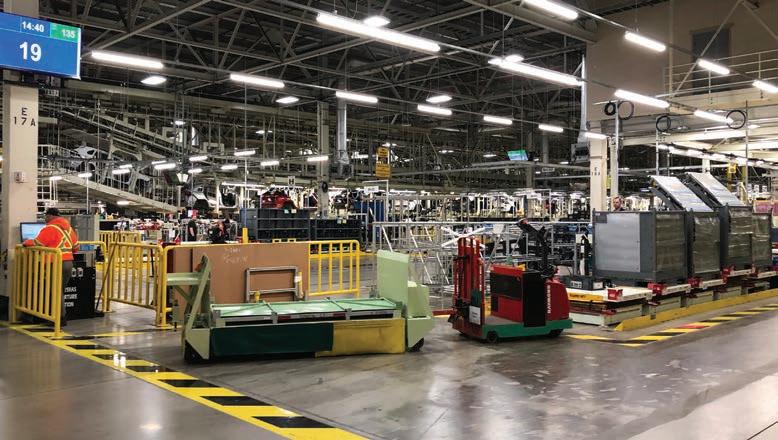
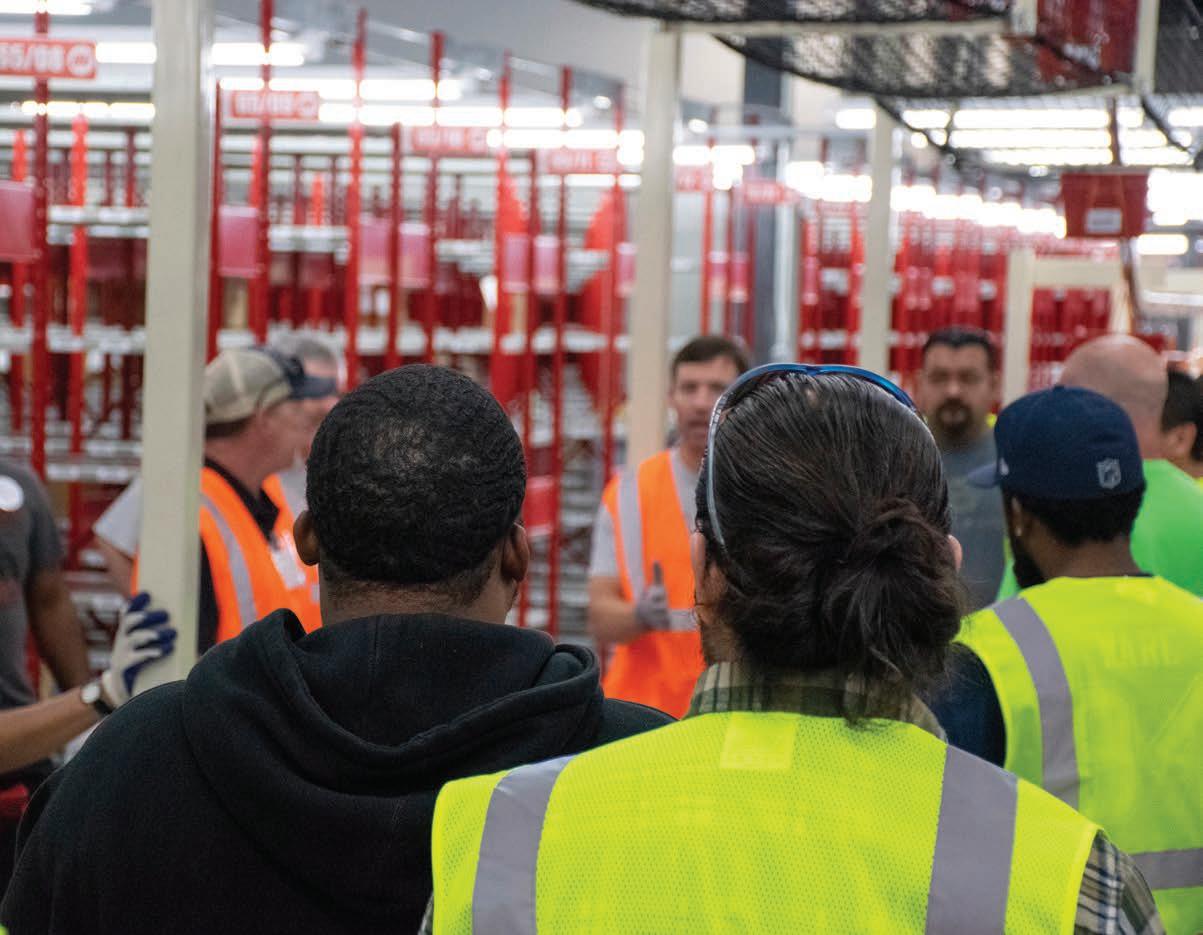
MRO recently had the opportunity to visit various plants and get a first-hand look at how they operate: from automotive manufacturing plants at two OEMs to a distribution centre for a company that distributes industrial supplies for many brand name products.
Having visited three Ontario car plants in the last few months, one Toyota plant in Woodstock (read “Retooled TMMC Plant Continues to Build RAV4” in our February issue) and one in Cambridge—as well as a Honda plant in Alliston—I have new found appreciation for how important maintenance is to these operations.
Even a short period of downtime can be catastrophic to the bottom line. The production line has to keep going and build vehicles; if one part of the line is down for any reason, the whole line stops.
Many of today’s modern plants have regular (in many cases daily) maintenance checks. There are sensors that monitor parts to make sure they’re replaced before they fail, and preventative maintenance is done when a plant is on a shutdown.
It’s very much like buying and maintaining a vehicle. You can buy a vehicle that is the most reliable (same as buying a reliable piece of equipment), but if you don’t change the oil, check the fluids and change the filters, among other tasks, the vehicle (like the piece of equipment) will eventually fail, forcing a major repair and a costly bill.
It’s a cliché, but time is money. And the more time you spend doing reactive repairs, the less money the operations are making.
On a different scale, the Acklands-Grainger distribution plant that MRO visited uses conveyors to move products around. These conveyors are constantly moving, so ensuring the rollers and parts of the conveyor are in working order all the time is of utmost importance.
MRO plans to regularly visit different types of plants to explore how each is using its own best practices to keep things running, and to make sure downtime is at a minimum. Look for case studies in the coming issues, including a feature on automotive plants in our June issue. MRO
CEDA has been named a new winner of Canada's Best-Managed Companies in 2019. This designation recognizes best-inclass Canadian-owned and managed companies with revenues over $15 million demonstrating strategy, capability and commitment to achieve sustainable growth.
Canada's Best Managed Companies is one of the country’s leading business awards programs. Every year, hundreds of entrepreneurial companies compete for this designation in a rigorous and independent process that evaluates the calibre of their management abilities and practices.
Obsidian Energy Appoints Interim President and CEO
Michael J. Faust has been named Interim President and CEO at Obsidian Energy Ltd., effective March 18, 2019, for a period of 12 months with an optional six-month extension. He succeeds David French, who stepped down, effective March 29, 2019.
Faust has been a member of Obsidian's Board of Directors since April 6, 2018. He has 35 years' experience within the oil and gas sector, including diverse geological, geophysical and technical reservoir experience spanning many different basins and formations throughout the world. He previously served as Vice President Exploration and Land, at ConocoPhillips Canada Ltd., and ConocoPhillips Alaska, Inc., prior to his retirement in January 2017.
Faust has a MA in Geophysics from the University of Texas and a B.Sc in Geology from the University of Washington. He is a Certified Petroleum Geologist and a member of the American Association of Petroleum Geologists and the Society of Exploration Geophysicists.
Havilah Makes Appointment to Board
Havilah Mining Corp. has appointed Shastri Ramnath to its Board of Directors. The appointment is subject to customary TSX Venture Exchange requirements.
Ramnath is a Professional Geoscientist with over 20 years of global experience within the exploration and mining industry. She started her career at Falconbridge in Winnipeg in 1999 and then moved to Sudbury, Ont., to join FNX in 2002. In 2010, Ramnath joined Bridgeport Ventures Inc., as President and CEO. In 2012, she co-founded and co-owns Orix Geoscience Inc.
Recently, Ramnath co-founded Exiro Minerals, a junior exploration company focused on project generation that combines technology with traditional exploration methodologies. Ramnath received a B.Sc. in Geology from the University of Manitoba, an M.Sc. in Exploration Geology from Rhodes University (South Africa) and an Executive MBA from Athabasca University.
Rio Tinto Named One of Montréal's Top Employers
Rio Tinto has been named as one of Montréal's Top Employers in an annual competition that recognizes employers in Greater Montréal that lead their industries in offering exceptional places to work.
Winners of Montréal's Top Employers are evaluated based on physical workplace; work atmosphere and social activities; health, financial and family benefits; vacation and time off;
employee communications; performance management; training and skills development; and community involvement.
Rio Tinto is the biggest mining and metals company operating in Canada, with 15,000 workers.
CellCube Names Henk Van Alphen to Board
Cellcube Energy Storage Systems Inc., named Henk van Alphen to its Board of Directors. Alphen, an entrepreneur in the service and mining industry, has been directly involved in Pacific Rim Mining Corp., Corriente Resources, Cardero Resources, Trevali Mining, Balmoral Resources and International Tower Hill Mines.
He is currently CEO and a Director of Wealth Minerals Ltd. He is also a Director of Blackrock Gold Corp., Ethos Gold Corp., Ltd. and Centenera Mining Corp. Alphen will be replacing Philip G.Hughes as an independent director of the company.
Victory Metals Makes Appointment to Board
Victory Metals Inc. named Doug Forster to its Board of Directors.
Forster has been involved in the mining industry and capital markets for over 35 years and acted as geologist, founder, director, senior executive and financier. Most recently he was Founder, President and CEO of Newmarket Gold Inc.
He has extensive experience and a proven track record in resource project development, mine operations, capital markets, equity and debt financing, and mergers and acquisitions. Forster holds a B.Sc. and M.Sc. in Geological Sciences from the University of British Columbia and is a Member of the Association of Professional Engineers and Geoscientists of British Columbia.
Organica Water on 2019 Global Cleantech 100 List
Cleantech Group named Organica Water to the 2019 Global Cleantech 100.
Cleantech Group presented the annual Global Cleantech 100 list, for the 10th year. The list is a showcase of companies that are most likely to have a big commercial impact in a five- to 10-year time span. They represent the most innovative and promising ideas and are best positioned to solve tomorrow's clean technology challenges today.
Petro-Canada’s Network of Fast Chargers
Petro-Canada is building a network of over 50 electric vehicle (EV) fast-charging stations across Canada. They will be located on the Trans-Canada highway at Petro-Canada stations from Nova Scotia to British Columbia.
The stations will have DC fast chargers with both CHAdeMO and CCS/SAE connectors. The chargers can provide up to a 200-kilowatt charge and are capable of 350 kW charging with future upgrades. Construction will begin in the spring with locations opening over the coming year.
A test site is currently operational in Milton, Ont. A full list of sites can be found at petro-canada.ca/ev. MRO
CanWEA Highlights Operations and Maintenance
BY MARIO CYWINSKI
Over 250 industry professionals attended the CanWEA Operations and Maintenance (O&M) Summit recently at the Hilton Mississauga/Meadowvale in Mississauga, Ont.
The two-day event offered attendees 25 exhibitors located within the largest exhibit space ever for the event. Exhibitors featured their newest products and services in the industry.
“As Canada’s wind energy industry continues to expand, and the significance of O&M in the industry’s success and evolution increases, there are many benefits to convening more than 260 industry leaders to connect and discuss operational issues and improvements, examine innovative tools and techniques, and continue the promotion of health and safety excellence,” said Phil McKay, Operations and Maintenance Program Director, Canadian Wind Energy Association. “These owners, operators, manufacturers and service providers are key contributors to wind energy’s status as the most economical option for new non-emitting electricity generation in Canada.”
The summit allowed attendees to immerse themselves in many topics of interest to the industry. Day 1 offered a panel discussion on Solutions Over Stalemate: How the O&M Sector Can Keep Raising the Bar; a presentation on OEM Predictive Analysis Using Large Scale Operational Data; digitalization and more.
“IHS Markit was so delighted that CanWEA invited us to speak at the Wind Energy O&M conference,” said Rafael McDonald, Director, North American Renewable Power. “The benefit of having so many decision-makers in one room is clear, and will only become more valuable as O&M garners more of the energy spotlight. The networking was top-notch. We look forward to coming again next year!”
Day 2 featured sessions on An Expanding Role in a Low-carbon Future, Connecting With O&M, Techno-future, and Pathway to Innovation.
Also part of the summit was the O&M Awards, which were presented to TECHÉOL Inc., for the O&M Outstanding Achievement award, and Vestas Canadian Wind Technology, for the Health and Safety Excellence award. MRO
NO TIME TO LOSE WHEN A POWER TRANSFORMER FAILS
Fast action can save manufacturers ‘thousands’ when a power transformer failure stops production in its tracks.
BY DAVID RIZZO
Silence… The sound no manufacturing general manager wants to hear. When a power transformer that supplies a plant goes bust, everything comes to a halt. At such times the only thing audible is the sound of profit being sucked out of the air.
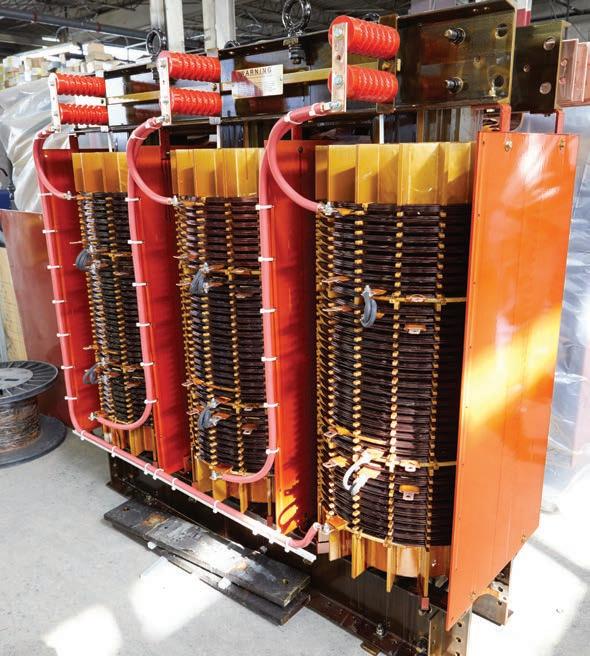
When disaster strikes, the only thing that counts is getting a replacement transformer as soon as possible. To match such urgency, there are electrical contractors and transformer suppliers who specialize in emergency replacements that can bring everything back to normal in short order. The recent experience of how one east coast manufacturer succeeded in quickly regaining full production status after a transformer failure provides lessons learned for others.
No time to lose
According to The Real Cost of Downtime in Manufacturing by Graham Immerman from an issue of MachineMetrics, the greatest unplanned expense is caused by unexpected downtime. Analyst firm Aberdeen Research found that unplanned downtime can cost a company as much as $260,000 an hour.
Acting as the heartbeat of a manufacturing plant, failure of a power transformer represents a priority one emergency.
“When the customer called us in a panic to explain that one of his dry-type power transformers burned up and half of his facility was down, we knew we had to act fast,” said George Whitcomb, P.E., President of IETC, an industrial commercial electrical contractor.
Photo
“In general, the biggest issue for us contractors when searching for a rush transformer replacement is reliability, dependability and promptness,” said Whitcomb. “The transformer has to arrive ASAP, fit into place with minimal issues, and has to work right the first time.”
In this case, the customer needing a rush transformer was a major manufacturer of threading tools, an electric-intensive industry that draws many kilowatts-per-hour to run drills, presses, metal benders, and CNC machines.
“This manufacturer had two dry-type transformers, each rated at 4160 Volts, stepped down to 480V. One of them failed, so half of their facility went down,” said Whitcomb. “As a stopgap, they wanted to feed the entire plant from the other unit. Of course, everything went black as they rewired the bussings to transfer the load. But since a single transformer wasn’t sized for full plant demands, they had to dial back their production schedule.”
Any reduction in productivity proves costly. As reported in the Thomas Industry Update Newsletter, a survey of 101 manufacturing executives in the automotive industry concluded that the cost of stopped production runs an average $22,000 per minute.
Whitcomb’s company sent over a tech to see what happened, assess the situation and take measurements. Usually, the plant facility manager doesn’t specify the replacement, but turns to an electrical contractor for a quick, lasting, resolution.
“We got the specs and proceeded to see if anyone had one in stock,” said Whitcomb. “I called ELSCO Transformers, since I had worked with them before and was lucky that they had an exact match ready to go. That would greatly reduce the turnaround time, so it came down to availability, reputation and quality.”
Build quality ensures reliability
Whitcomb understands that transformer construction and materials make a huge difference in terms of reliability. For
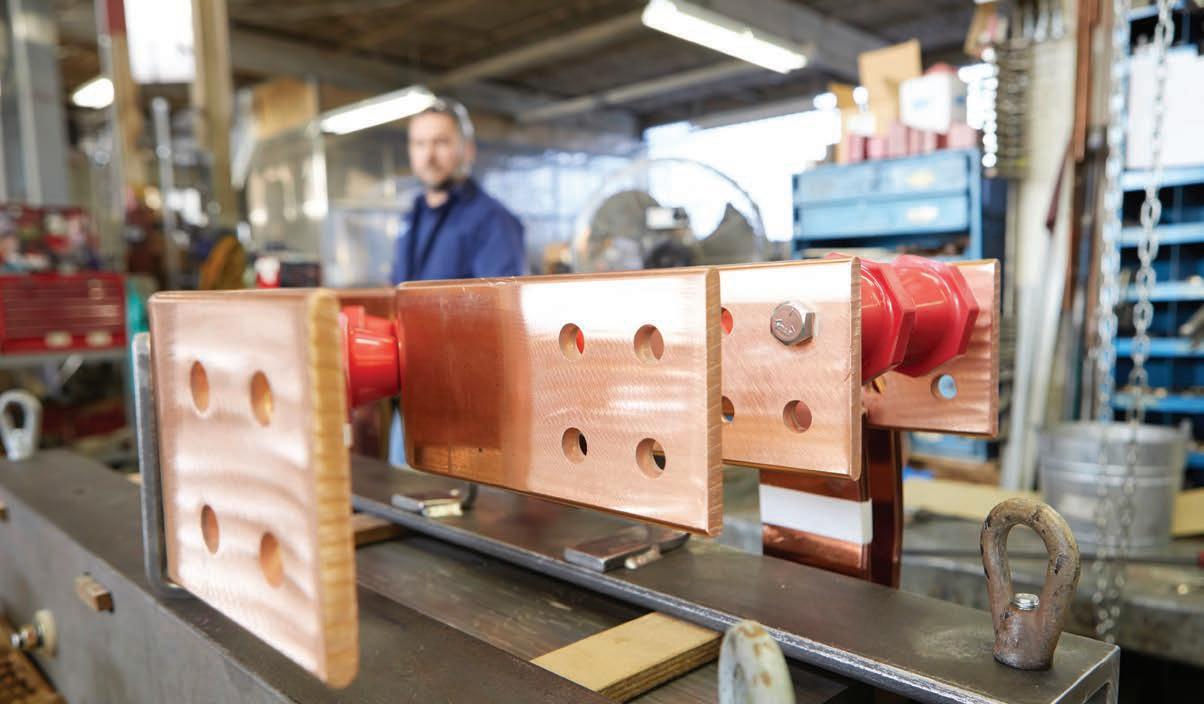
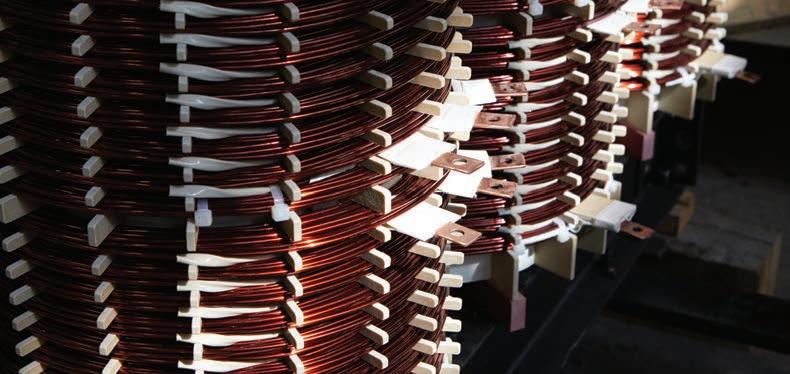
instance, the way the coils are wound around the core of the transformer greatly affects its robustness. Round wound transformers are superior to rectangular wound because they stay cooler, run quieter, and present less risk of short circuit failure. This enables manufacturers to offer longer warranties.
Beyond the improved reliability factor, the increased efficiency of the round design consumes less electricity. Some round wound transformers exceed the proposed efficiency standards for Energy Star compliance, drastically lowering utility costs for a manufacturing plant.
Implementation in record time
Whitcomb’s team knew they had specified the right transformer, but since time was of the essence, getting it in place fast was just as important.
Still, the arrival of a plant transformer signals the beginning of the real work, where attention to details like the duplication of the high and low voltage bussbars can spell the difference between a lengthy and costly replacement process, versus a quick, cost-effective plug-and-play solution.
“The big hurdle was fitting the new transformer between a 5KV load interrupter switch on one side and the 480V breakers on the other, so everything was fixed in place on either side,” said Whitcomb. “We knew every measurement had to be exact in order for installation to go quickly.”
Whitcomb coordinated with ELSCO to get the dimensions right so they could
make the necessary modifications to the transformer before it was shipped out.
“Without that accuracy of tolerances we would have had to modify things in the field and it would have taken a lot longer,” said Whitcomb. “But as a result of the effort spent up-front our rigger was able to slide the new transformer right in. It fit like a glove.”
The sweet sound of production
With the plant back up and running, the plant owner personally visited the transformer room to see for himself the new transformer in action.
“Our on-site tech reported that the owner walked into the room as our guys were cleaning up and said, ‘When are you going to turn it on?’ He didn’t realize that it already was operating; it was that quiet. Their other existing transformer was humming like crazy. He was so impressed that he said ‘we’ll have to see about having you guys replace the other one.’”
A catastrophic transformer failure can strike any manufacturing facility at any time. But with the availability of suppliers that can drop a plug-and-play, matched replacement on the plant loading dock within days means that the only silence on the manufacturing floor will come from the quiet operation of the new transformer. MRO
Dr. David Rizzo, D.P.M., is a Phoenix based freelance writer with over 30 years of experience writing engineering documents, technical papers, and editorial content for the electric utility and power generation industry.
COMPLETE LIST OF CONDITION MONITORING TECHNIQUES
BY BRYAN CHRISTIANSEN
The future holds great promise for condition monitoring as more sensors are developed that can be mounted on equipment. Also, more equipment is being built to Internet of Things (IoT) standards.
Kelvin Bui, Marketing Associate at SMC, in the MSI Data blog said, “Industrial devices now have an unprecedented amount of sensing, processing and communications capabilities built into the product itself.”
Data analyzed for condition monitoring serves as the basis for predictive maintenance. Patterns emerge from the data showing a machine part may be deteriorating or beginning to fail. Based on the analysis, maintenance is then scheduled to prevent failure and avoid emergency downtime.
The following list of condition monitoring techniques, grouped by several category types, shows the extent technology has moved monitoring ahead. The various methods listed may or may not currently be linked within an IoT network, but most are suitable for automatic data collection and analysis.
Oil Analysis/Tribology
This technique involves collecting and testing machine oils, equipment lubricants or other fluid samples to ascertain the condition of either/both the fluids and the machines. As machines wear, overheat or trend toward failure, contaminants are deposited in lubricating oils and other operating fluids. Careful analysis of oil samples reveals these contaminants. Data from these studies can then be interpreted to indicate impending failures.
Techniques include:
• Ferrography
• Presence of water
• Viscosity/kinematic viscosity test
• ICP or atomic emissions spectroscopy to identify presence of contaminants
• Dielectric strength test
• Microbial analysis
• Particle quantification index (iron content)
• Fourier transform infrared spectroscopy
• Ultraviolet spectroscopy
• Potentiometric titration/ total acid number and total base number
• Sediment test
Vibration Analysis/Dynamic Monitoring
Equipment and parts respond to vibrations in a variety of ways that can be used to identify defects due to misalignments, imbalances or design flaws. Wear on machine parts, bearings, rotors and shafts, causes these parts to vibrate with specific patterns that can be recorded and analyzed. Different parts vibrate in different ways, and worn or out-of-balance parts have unique vibration signatures that can be tracked and used to predict parts failures.
Techniques include:
• Shock pulse analysis
• Fast fourier transforms
• Broadband vibration analysis
• Ultrasonic analysis
• Power spectral density (PSD)
• Time waveform analysis
• Spectrogram/spectrum analysis
Motor Circuit Analysis
Motor circuit analysis (MCA) is a battery of computerized tests on an electric motor to ascertain the motor’s overall condition and possible sources of potential failures. Electrical imbalances and degradation of insulation are the chief causes of motor failure and are the focus of MCA testing. Some tests are go/no-go tests, while test results for others must be tracked over time to identify failure development. These tests are generally grouped into voltage-based or current-based tests.
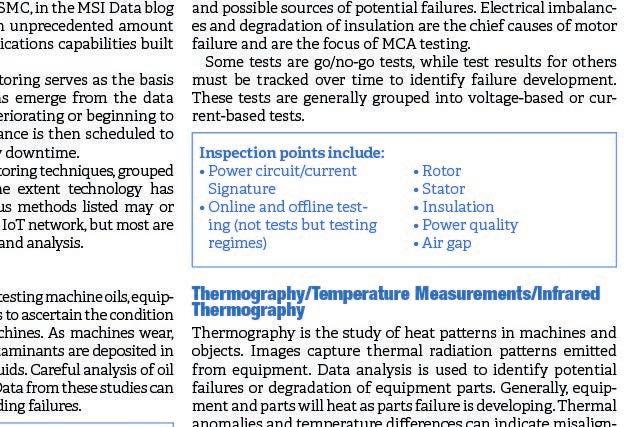
Inspection points include:
• Power circuit/current signature
• Online and offline testing (not tests but testing regimes)
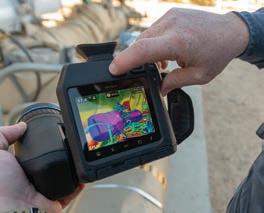
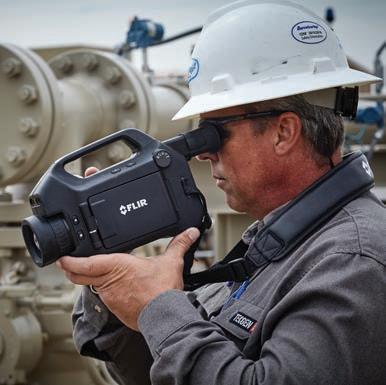
Thermography is the study of heat patterns in machines and objects. Images capture thermal radiation patterns emitted from equipment. Data analysis is used to identify potential failures or degradation of equipment parts. Generally, equipment and parts will heat as parts failure is developing. Thermal anomalies and temperature differences can indicate misalignment, imbalances, improper lubrication, worn components, undesirable mechanical stresses and electrical overheating. Thermographic inspection helps identify safety issues such as overheated electrical connections, pipe leaks and pressure vessel weaknesses. Many infrared techniques based on the principles of IR radiation have been developed to fit specific industrial applications.
Techniques include:
• Comparative thermography
• Testing of electrical, pipe-works and machinery
• Comparative quantitative thermography
• Comparative qualitative thermography
• Paint stickers (colour change with out of spec temperatures)
• Fluids that change colour at out-of-spec temperatures
Ultrasonic monitoring of equipment, bearings and rotating parts uses high-frequency sound waves to detect part defects such as leaks, parts seating and cavitations. In many cases, tiny changes in friction forces can be detected with ultrasonic
MAINTRAIN EDMONTON 2019
SEPTEMBER 16-19
DoubleTree by Hilton
Connect | Learn | Contribute
Canada’s largest annual maintenance and physical asset management conference exhibition and networking event, MainTrain gathers leading experts, practitioners and professionals from across Canada and around the world to share their insights and strategies that support professionals and their organizations.
Network with existing clients, and make new connections.
Connect and build relationships with key decision makers from the public and private sector, from across the country, and around the world. Opportunity to promote your products and services in a variety of ways including during the 2.5 day exhibitor trade show.
Get recognized through our many branding opportunities throughout the week.
Be a Speaker:
Submit an abstract by April 15, 2019 for a chance to speak at MainTrain.
Connect with your industry peers through online promotion, the printed program, and the conference app.
Learn from delegates on what is being asked in your industry through the question and answer period of your presentation.
Contribute to the advancement and education of attendees by showcasing your work, lessons learned, success stories, results, and expertise.
Receive a complimentary 4 day registration for the conference which includes all tours, workshops, off sites, exhibit hall and MORE. (If abstract is chosen)
Be a Delegate:
Connect, Learn and Contribute through: workshops, learning sessions, hospitality suite, exhibit hall, off site dinner, plenary sessions, networking events, round table discussions and much more!
monitoring. These small changes may be missed with IR or vibration analysis. Because of this, UM can be an excellent companion testing technique along with IR and vibration analysis. Almost all areas of manufacturing processes can benefit from ultrasonic monitoring UM. It provides an early warning for machine parts deterioration that might otherwise be masked by ambient plant noises and temperatures.
Techniques include:
• Airborne ultrasonics
• Ultrasonic backscatter technique
• Backwall echo attenuation
• Ultrasonic thickness and gauging (pipe walls, etc.)
This method uses radiation imaging to identify internal defects in equipment and parts. Applications include inspection of weldments, castings and sintered parts. This approach is one of the most thorough methods of non-destructive testing available.
The technique is based on measuring the differential ab-
sorption of radiation penetrating the part or material. Internal corrosion and flaws absorb differing amounts of radiation, which can be measured and analyzed.
Techniques include:
• Neutron backscatter
• Computed radiography
• Computed tomography (CT)
• Direct radiography
Laser Interferometry
• Positive material identification (PMI)
• Neutron radiography
Laser interferometry measures changes in wave displacement based on a laser-generated, highly accurate wavelength of light. This technique is used to identify surface and subsurface defects in composites and other materials. It is based on the interference of light waves generated by a laser. (Sound and radio/electromagnetic waves are also used.) The interference pattern is then captured and measured by a device called an interferometer.
The various interference patterns can be analyzed to show differences in material characteristics such as the presence of corrosion, surface defects or cavities in the material.
Techniques include:
• Laser shearography
• Laser ultrasonics
• Strain mapping
• Electronic speckle pattern interferometry
• Digital holography (used worldwide to test turbine blades and surgical parts)
Electrical Monitoring
• Holographic interferometry (still in laboratory testing/not currently used in general widespread condition monitoring)
This approach applies the principles of deviations in electrical parameters to identify faults and defects. Characteristics such as resistance, induction, capacitance, pulse response, frequency response and others are used to detect potential maintenance issues. Central to this methodology is the measurement of degradation trends in an electrical system so that preventative action can be taken in advance of any system failure.
Techniques include:
• Megohmmeter testing
• High potential testing
• Power signature analysis
• Battery impedance testing
• Surge testing
• Motor circuit analysis
• Alternating current field measurement (ACFM)
Electromagnetic Measurement
This category of test measures magnetic field distortions and eddy current changes to identify cracks, corrosion, weaknesses and other defects. A magnetic field is applied to surface walls, setting up magnetic fields. These fields interfere with one another causing patterns. Eddy current reporting over an extended period is used to identify gradual deterioration in material quality and surface features.
Similarly, electromagnetic testing induces an electromagnetic field or electric current inside the tubing or test object. Defects will create disturbances, which can be measured and analyzed. A variety of techniques have been developed to take advantage of these properties.
Techniques include:
• Magnetic particle inspection
• Magnetic flux leakage
• Metal magnetic memory method
• Pulsed eddy currents
Performance Monitoring/ Observation and Surveillance/Process
Variable and Performance
Trending
This traditional approach to monitoring production equipment uses visual inspection and physical senses to judge the proper functioning of a piece of machinery. The technique also uses tracking of output and manufacturing performance to identify deviations in expected results. When production output changes, defects increase or physical characteristics noticeably vary from the norm (sound, heat, vibration), these changes may indicate problems with equipment and possible failures.
This method of monitoring equipment is a valuable technique where advanced technological testing methods are not available. Much of the interpretation of results depends on careful recordkeeping and interpretation and application of hands-on experience.
Techniques include:
• Visual inspection
• Audio inspection
• Flow rates
• Touch inspection
• Temperatures
• Pressures
• Output or performance trends
• Downtime analysis
Is this everything?
Probably not, but a majority of known condition monitoring
• Remote and near field eddy current
• Saturated low-frequency eddy currents
• Other eddy current testing
techniques you can find on the market today were covered. As industry moves closer and closer to adopting IoT, the practice of condition monitoring is becoming more critical. Sensors now allow machines to communicate their condition through the Internet to central databases. Newly created analytics then analyze this data to identify which machine parts may be starting to fail. The condition of the equipment can be monitored in real time so that you can schedule planned downtime and proactive maintenance to prevent costly equipment failures. MRO
Bryan Christiansen is the Founder and CEO at Limble CMMS (a mobile CMMS software). He can be reached at bryan@limblecmms.com.
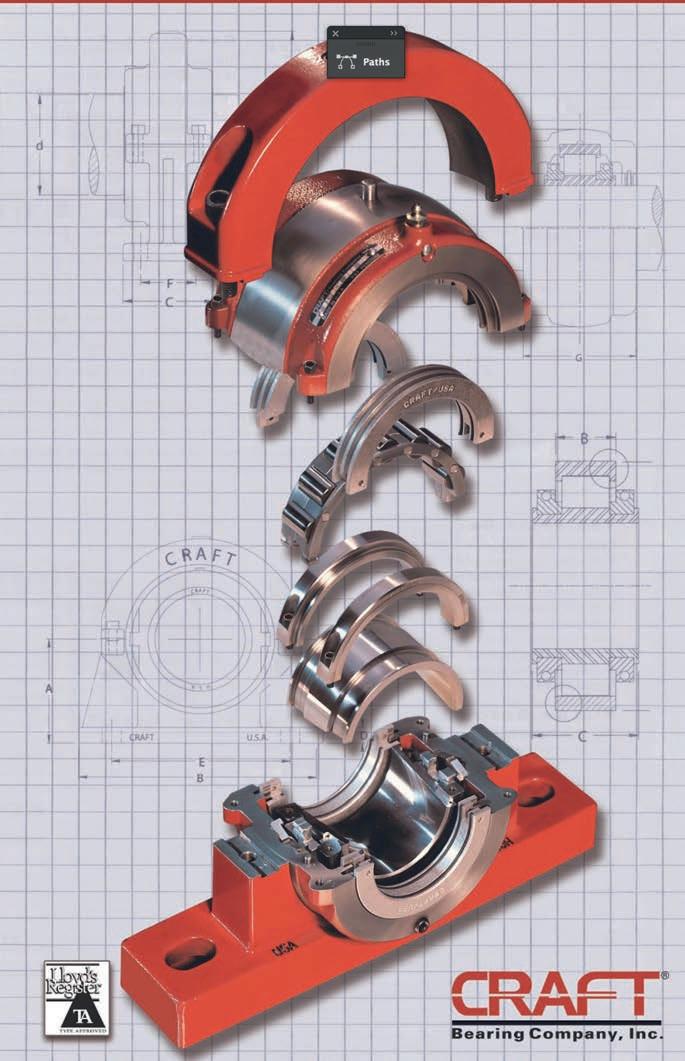
THE SPLIT MAKES THE DIFFERENCE
Announcement
Global Bear Inc. is pleased to announce the opening of a branch in Langley, BC.
The 3000sq. ft. facility will be stocked with a broad range of all the products distributed by Global.
“The plan has always been to have coverage across Canada”. “That dream has now become a reality”, stated Harold Benz, founder and President of Global.
We look forward to servicing our Western Canadian customers from the new facility and welcome all inquiries for bearings, belts and power transmission products.
Our stock, featuring CRAFT and NKE bearings in Langley, will help distributors service the “end-user” markets in Alberta and British Columbia.
call
A Credible Priority System Allows SCHEDULING TO SUCCEED
TIP: A priority system should allow easy and quick judgment to describe the relative urgency of the response for the work.
BY DOC PALMER
Acredible work order priority system is vital for effective scheduling. The scheduling function is the critical agreement between operations and maintenance about what the maintenance group should do and when. The priority system allows for properly creating schedules with the right work. It should offer enough but not too many choices, or not be too complex.
Not only is the quantity of choices an issue, but so is the description of choices in terms of time limits or descriptions. Some plants also have criteria in their priority systems that don’t belong. Proper consideration of these issues helps for proper scheduling.
Organizations are better at specializing than co-ordinating. The expression “things fall in the cracks” is an example of co-ordination problems between specialized groups. A schedule with its priority system is a critical coordination device between operations and maintenance.
What new work must start immediately? What other new work is too urgent to wait until next week? If it can wait beyond this week, how long can
it wait? The priority system addresses these questions. The maintenance group must try to follow the current schedule of work, but know when it should break the schedule. In addition, the schedule for next week must consider all the work in the backlog that is ready to go, but cannot possibly place all the work in the single week.
A credible priority system helps properly sort work. Without the schedule and a credible priority system, an operations group simply expects maintenance to come when called for reactive maintenance. Such an expectation leads to less proactive maintenance and generally less productivity. Maintenance should be able to productively keep after proactive maintenance and only break the schedule when appropriate. “Appropriateness” is embodied in the priority system, the established coordination contract between operations and maintenance.
A credible priority system should have over three levels. Many proactive maintenance tasks originate from the maintenance group; a proper scheduling process encourages operations to initiate more non-urgent work requests.
How should operations describe the relative urgency of such new work? A plant usually distinguishes between emergencies (that must be started now) and other urgent work (that cannot wait until next week); this leaves work that can wait beyond the week.
A plant could simply have three priorities: Emergency, Urgent and Routine. However, a goal to have less than 20 per cent of emergency and urgent work would mean that 80 per cent of the work would have only a single level. A single level consisting of 80 per cent of the whole backlog is insufficient to help guide scheduling. An additional priority describing what can wait beyond next week would help.
A minimum of four levels is required for a credible priority system. Five levels are even better such as Emergency (Now) and Urgent (Complete this week, Within two weeks, Within one month and Longer than one month). A credible priority system needs enough levels to spread out all the work adequately.
On the other hand, having too many levels or being too complex also causes problems. Going beyond five levels adds difficulty to operations making a quick
Photo
judgment and describing how long the work can wait. There is some logic in having more than five levels, simply to encourage more people to pick a level four or five, but at a certain point too many levels are simply “gaming” the system and it loses credibility.
Extremely complex systems also hinder operations in stating how long the work can wait. An example could be systems that multiply different factors together such as using work type times, equipment criticality. Plus an arbitrary “fudge factor.”
The description of the levels is another matter. Should the levels set time deadlines or use descriptive adjectives for each level? The problem with setting deadlines is that if there is too much work, maintenance cannot meet the deadlines. It is also difficult for operations to set deadlines for maintenance work outside of the current week.
The advantage of descriptive adjectives is that no matter the amount of work that exists, it could be sorted in order of relative importance. However, the problem using adjectives is never having enough descriptions to describe enough situations.
In addition, operations desire to know how long to expect for a response. A system that has deadlines, but also a limited number of qualifying descriptions is very practical in practice. The word "routine" is a good description to distinguish it from emergency and urgent work, but is overly broad. Plants that use routine and have only three levels might consider expanding routine to routine high, routine normal, and routine low. That would improve a threelevel system to five levels without alarming everyone.
Some plants think they have five levels, but only have three levels in reality. Consider safety, emergency, urgent, routine and outage. Safety is more of a priority type than an actual priority.
For example, an immediate life-threatening situation should be an emergency whereas a blemish on a handrail should be a routine matter, although both are safety related. Consider having a separate field for tracking safety-, environ-
mental-, reliability- and efficiency-related work apart from the priority system itself. Similarly, outage is more of a unit condition than an actual priority.
Scheduling programs need a credible priority system to allow proper selections of work agreeable to both operations and maintenance. Five simple levels seem to be practical in having enough priorities without becoming confusing. Credible priority systems usually contain time deadlines, but having some wording describing the level is also helpful. In addition, avoid items in the system that do not necessarily dictate relative urgency of response.
Remember that the point of the priority system is to help operations and maintenance quickly and easily communicate the relative urgency of the particular need for the work. MRO
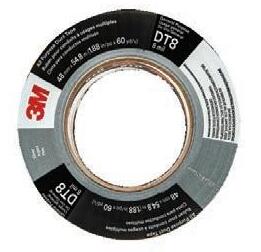
3M™ DT Series
Duct Tapes
Doc Palmer, PE, MBA, CMRP, is the author of McGraw-Hill’s Maintenance Planning and Scheduling Handbook. As managing partner of Richard Palmer and Associates, he helps companies worldwide with planning and scheduling success. For more information, including a schedule of current public workshops, visit www.palmerplanning.com, or e-mail Doc at docpalmer@palmerplanning.com. Three duct tapes that can do it all
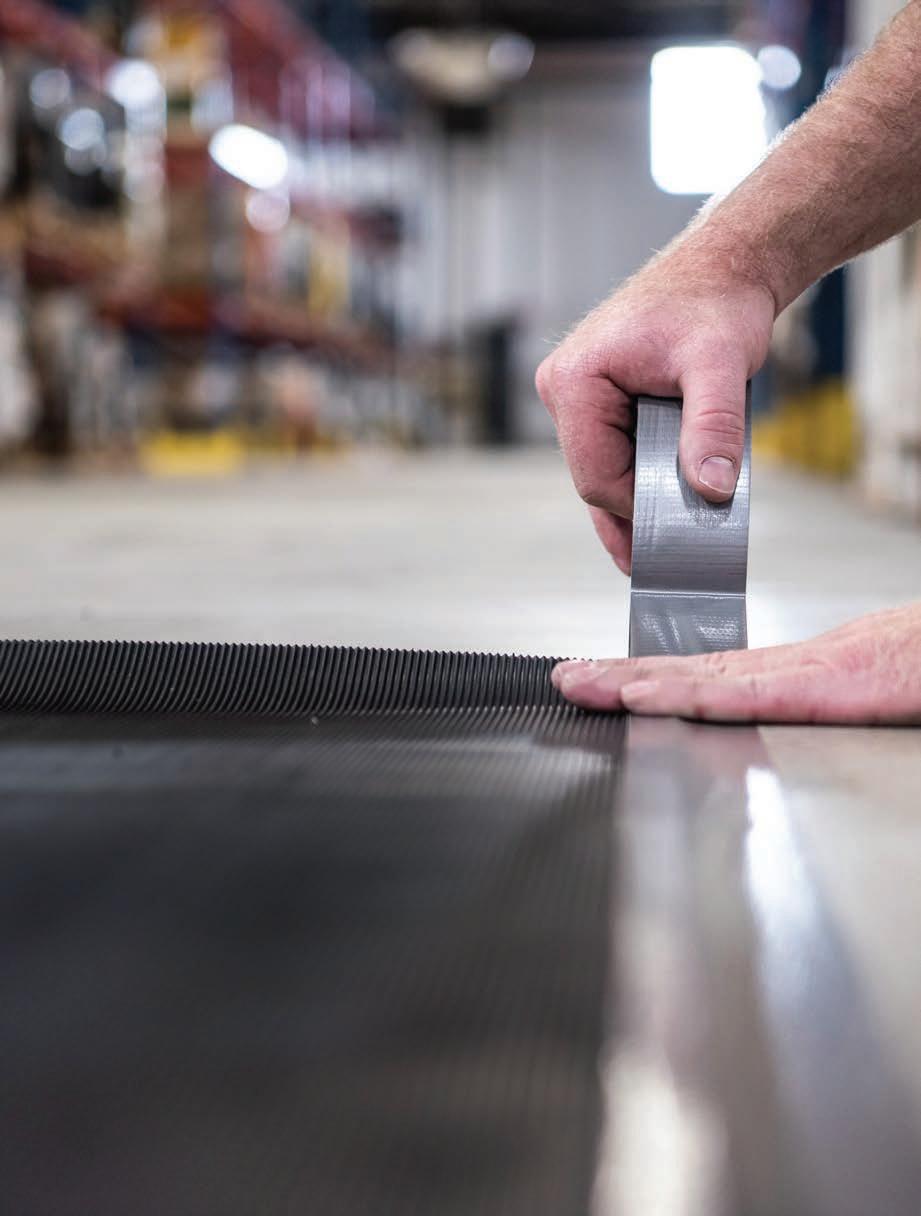
Tackle your everyday tasks with 3M™ DT Series duct tapes in three strengths. They resist curling, have a consistent unwind, and tear off the roll cleanly for the ultimate in ease of handling and application. Right performance. Right price.
Learn more at 3M.ca/DTSeries.
Six Rules of Thumb for SelectionBearing and Use
BY DOUGLAS MARTIN
Rule of Thumb: The range of normal loading applied to a bearing is between five per cent and 10 per cent of the published capacity.
Theory: The bearing capacity is defined by the load that after one million revolutions there is initiation of subsurface fatigue in 10 per cent of a population of the same bearing under the same load. In other words, we have 90 per cent confidence that any given bearing with the dynamic capacity applied to it will exceed one million revolutions. But in today’s world, most bearings are running at 1,000 revolutions per minute or faster, and one million revolutions comes soon (1,000 minutes or 16.7 hours).
C3 is the standard clearance for most deep groove ball bearings
If we go back to when ball bearings (for commercial/industrial use) were developed, so pre-1900, machines did not run that fast. The standards used for these products were developed at a time when running clearance was not fully understood. When doing some calculations with the typical interference generated when fitting ball bearings, we see that the mounted clearance of deep groove ball bearings (DGBBs) can always be a preload (less than zero clearance). As a result, C3 is generally used for DGBBs.
Use C3 for roller bearings over 75 per cent limiting speed
As roller bearings are generally taking a heavier load, and there tends to be some degree of sliding friction in a roller bearing, it is easy to see that the inner ring could run warmer than the outer ring. This difference in temperature takes away clearance from the bearing.
When should I use grease/oil?
If you look at older publications you may find references to ”limiting speed in grease” and "limiting speed in oil.” Today, we have a reference speed and a limiting speed.
The reference speed involved the use of a calculation that takes into account the applied load to the bearing; however, in simple terms, the reference speed is when the bearing generates more heat that can be taken away without some form of heat removal. If you need heat removal, that form of heat removal is circulating oil.
Based on this, we also consider that an oil bath does not have the ability to remove heat, so, in essence, one must consider an oil bath and grease to have the same thermal properties (at least within the scope of current standard calculation levels).
There are also other speed-related limits for lubrication. The base for determining the ranges is the "ndm” factor, which is the mean diameter (mm) of the bearing multiplied by the speed (rpm).
Photo credit: Getty Images
Too slow for oil film separation – ndm < 20,000 too fast for grease
Ball bearing ndm ~> 400,000 (load dependent)
Roller bearing ndm ~> 300,000 (load and design dependent)
Fortunately, online calculations will provide warnings when these limits are exceeded.
What ring is tight fit/loose fit and why
The ring that rotates must be tight fit; the ring that is stationary can have a loose fit (in applications in which the load is in a stationary direction like gravity or a belt pull).
If you have a loose fit between a rotating shaft and the bearing bore of 0.001”, then the circumference of the shaft OD will be smaller than the bearing bore by 0.00314.” If that shaft rotates at 1,000 rpm, then one surface will be more relative to the other by 0.003” x 1,000 = 3” per minute. Two steel surfaces running 3” per minute against each other will generate wear. As a result, you must have an interference fit between these two surfaces.
When saying the stationary ring can have a loose fit, it is emphasized that this is a compromise, as in if both rings were a tight fit the machine would be difficult to assemble. As well, a loose-fitted ring is used to allow for axial thermal expansion of the shaft in some bearings. There are, however, bearing designs such as NU cylindrical roller bearings and CARB bearings that can compensate for axial expansion internally and, could have an interference fit with the housing they are mounted in. This would guarantee that there is no creep between the outer ring and housing if there is an unbalance or misalignment.
Kappa value of lubricant at least one but two to four is preferred
When selecting the viscosity of oil (or base oil in a grease), we want to ensure that it is thick enough (viscous enough) to separate the roller and race surfaces. For any given bearing size and speed, the required viscosity can be calculated. In addition, oil changes its operating viscosity with temperature. Therefore, we compare the required viscosity to the operat-
ing viscosity and call this ratio Kappa.
A Kappa of one is the minimum required to achieve film separation; we like seeing a Kappa between two and four to ensure that there is enough viscosity to ensure separation of the two surfaces.
Of note, a Kappa less than one allows metal-to-metal contact leading to wear and heat generation. A Kappa above four only creates more friction, which may or may not have any direct affect on the operation until you get excessively high Kappa values. MRO
Douglas Martin is a heavy-duty machinery engineer based in Vancouver. He specializes in the design of rotating equipment, failure analysis and lubrication. Reach him by e-mail at mro.whats.up.doug@ gmail.com.
ELECTRON MICROSCOPY Scanning
Using SEM to determine the root cause of bearing failure.
BY L. (TEX) LEUGNER
Scanning electron microscopy (SEM) has long been used by geologists in the mining, oil and gas production, and other industries to evaluate formations and determine elemental analyses for the purposes of calculating viability of various mineral or crude oil deposits.
Using SEM to assist in the determination of causes of component failure or to confirm the conclusions has been overlooked. SEM can readily assist maintenance and engineering personnel in determining the root cause of failure.
In order to effectively use this analytical technology, a small sample piece cut from the component to be analyzed must be provided to the SEM analyst. The sample is fixed to the equipment and SEM scans its surface at high magnification determining the type of failure (i.e., abrasion, adhesion, erosion, corrosion and cavitation).
SEM is one of the best techniques available to study and document failure patterns and analysis. The scanning electron microscope provides a greater range of magnification (approximately 10,000X magnification) and a greater depth of field than a conventional macroscopic analysis. In addition, SEM provides a 3D image of the sample, through use of secondary electrons that are generated by the sample after being bombarded by electrons to create this image.
Elemental analyses can also be performed during an SEM study, by using an X-ray energy spectroscopy (XES) attachment. XES data are used to identify various precipitates or elements that may form on the specimen. For example, foreign deposits on bearings, pistons, mechanical seals, gears or other components can be evaluated and elements found within these deposits determined.
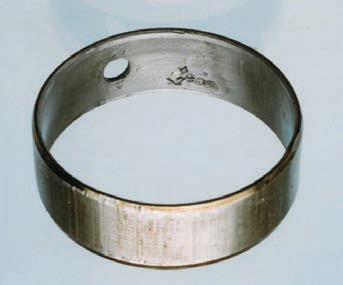
1. How would your maintenance department analyze the sleeve bearing illustrated below?
Logic: Bearings fail as a result of many potential causes, including fatigue, contamination, lack of or incorrect lubricant, water contamination, misalignment and excessive loads or speeds. For example, a camshaft bearing that was severely pitted for no obvious reason, but cavitation erosion (caused by the formation of oil vapour bubbles in low pressure areas and the collapse of those bubbles in higher pressure areas) as the shaft rotated pulled large metal particles away causing a catastrophic failure.
SEM analysis confirmed that as initial pitting and material removal continued due to the erosion, larger scale pits developed, resulting in deeper penetration of the vapour bubbles collapse, and ultimately resulting in further large-scale removal of bearing material.
Further investigation concluded that this type of failure could occur on diesel engine camshaft sleeve bearings under high-speed and/or high-load conditions.
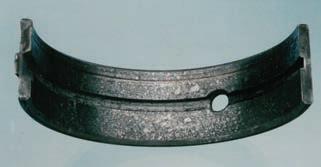
2. What caused the bearing failure illustrated below?
Logic: As in causal conditions noted in question 1, this failure could be considered obvious as indicated by the abrasive scor-
Photo credit: Getty Images
ing and discolouration that suggests something became embedded into the bearing surface overlay. Conclusions are often made that regular oil analysis should have provided warning of this contamination; however, SEM, analysis confirmed that scoring was caused by large particles of contamination “not found during routine oil analysis” because the contaminant particles were too large to be detected by spectroscopic analysis that typically can only detect particles in the six- to seven-micrometre range.
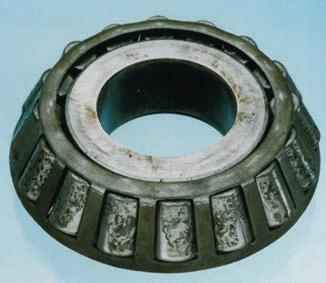
3. What caused the rolling element bearing failure illustrated below?
Logic: Initial inspection of the bearing strongly suggested that the bearing failed due to fatigue spalling due to its length of time in service. This is a common conclusion in many plants, but if a bearing is properly selected, correctly installed, prop erly lubricated, kept con
tamination free and operated at its designed load and speed, it can outlive the component in which it is installed.
SEM analysis confirmed that the apparent spalling was not caused by fatigue but by corrosion. This was evident by the smooth surfaces of the damaged areas as normal fatigue spalling creates sharp and/or jagged edges of the spalls. The smooth spalls indicate the occurrence of strong acids that resulted from water in the oil, which had evaporated during a period of hot shutdown just prior to a period of equipment storage. The bearing cones showed similar spalls, “but only on the bearing cone inner race surfaces that were above the surface of the oil.”
This particular failure could have been prevented had the maintenance staff had the oil analyzed for water and, on confirmation of contamination, replaced the contaminated oil before the equipment being parked for the season.
These case histories clearly illustrate that the use of SEM combined with elemental oil analysis, can be very useful in root-cause failure analysis investigations of any machine component. MRO
MAY 5 & 6
L. (Tex) Leugner, the author of Practical Handbook of Machinery Lubrication , is a 15-year veteran of the Royal Canadian Electrical Mechanical Engineers, where he served as a technical specialist. He was the founder and operations manager of Maintenance Technology International Inc. for 30 years. Tex holds an STLE lubricant specialist certification and is a millwright and heavy-duty mechanic. He can be BOOTH #811 OR #621
Safety meetings are a vital part of communications and building trust-based relationships with employees.
MAKE IT PART OF YOUR PLANT CULTURE SAFETY
BY TED COWIE
If a survey were conducted of all plant managers, it would likely find that safety is a priority. It might also discover that most have standard operating procedures (SOPs) in place for complying with safety standards, most provide personal protective equipment (PPE) for their employees, and most maintain formal safety training programs. The survey results would also indicate that performance gaps exist. Unfortunately, accidents still occur and accident rates may even continue to rise.
A Safety Culture Has Roots in Trust
A company can change attitudes about good safety habits by building trust-based relationships at every level. When top-level management demonstrates that it values workers
more than the statistics that equate accidents with lost dollars, everyone notices. Combining the commitment to those values with resources energizes and empowers effective integration of safety at all levels.
Trust grows with a different approach to accident reporting, and each injury situation presents a learning opportunity. However, a trust-based safety culture refrains from blame, or making examples of employees. Instead, trust-based relationships encourage workers and management to have honest conversations that focus on examining risks and solving problems.
Develop Humility
as Part of Your Safety Culture
Accidents can occur anytime, in any location and to anyone. Growing a safety culture requires a combination of active lis-
Photo credit: Motion Industries
tening and positive reinforcement. Eliminating at-risk behaviours and bad processes involves engaging all stakeholders and actively seeking opinions and improvement ideas. Rather than passing judgment or punishing incorrect behaviours, an active safety culture recognizes each worker’s contribution and responsibilities to facilitate helping the team succeed.
Problem: Worker fell from platform
Question Response
Why did the worker fall? Fluid had accumulated on the work area floor. Why did fluid accumulate on the floor? Fluid had slowly leaked from a hydraulic system.
Why did the fluid leak without any detection? The system inspection did not occur on a regular basis. Repairs did not occur.
Why did regular inspections and maintenance not happen?
As safety teams work to solve the root causes of problems, humility allows team members to share lessons learned and to explore effective solutions. Treating a worker who has had an accident with dignity and respect sends a powerful message throughout the company and encourages honest conversations that can power your safety culture. The same worker can emerge as a new advocate and leader fully supporting the culture.
Ask the “Five Whys”
Why were valve seals for this section not included in the database?
Examining risks and solving problems require process analysis. Teams of employees charged with the responsibility for preventing accidents should carefully consider the processes that created the environment for the accident. In some instances, safety teams may find that processes did not exist,
The safety and maintenance database did not include maintenance of the valve seals for a particular section of the hydraulic system.
The hydraulic system had been recently upgraded, but the database was not updated.
processes did not align with safety standards.
A safety team consisting of management and workers may want to use a form of root-cause analysis called the “five whys” when evaluating accident cause-and-effect relationships. The “five whys” technique prompts safety teams to employ deductive reasoning, examine processes, avoid quick conclusions and emphasize causes rather than symptoms. Team members define the problem, ask questions to fully expose the problem and develop possible solutions.
The fifth question leads us to the root cause of the accident and to a change in the processes followed for upgrading systems and updating related process databases. The use of the “five whys” encourages a comprehensive approach that goes
beyond symptoms and helps to build a team approach to solving the root cause of the accident.
HIGH PERFORMANCE. STANDARD.
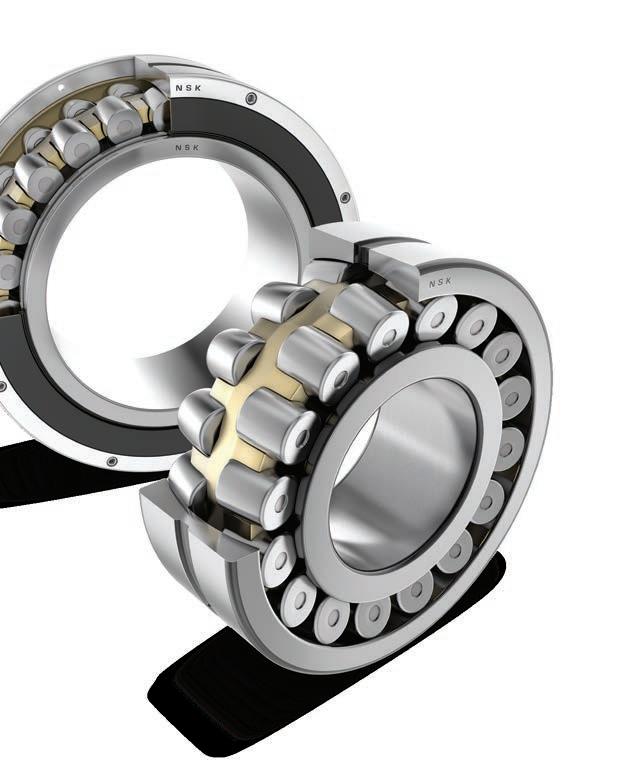
NSK rolling bearings are engineered to provide robust performance and optimal bearing life in the prevailing severity of mining and quarrying applications. Withstanding arduous loads and marginal lubrication in grit and moisture laden environments, NSK bearing solutions deliver every possible opportunity to maximize the performance of heavy machinery and equipment.
Take a Fresh Look at Training
A safety-first culture that prioritizes accident prevention begins with building employee knowledge about hazards in the workplace. A safety training programs often misses the mark if the program fails to address the specific needs of the trainees and actively engage their feedback. In assessing education and training needs, your safety teams should ensure that workers can build their experiences into:
• Identifying training needs and learning objectives;
• Creating a learning plan;
• Selecting the training methods; and
• Evaluating the effectiveness of the training.
A successful training programs presents resources relevant to worker responsibilities. Training program best practices include providing specific content about national safety standards, company procedures, risk assessments and accident reporting. Instructors can use this information as a baseline to:
• Define the goals workers should accomplish post-training;
• Identify correct safety behaviours for standard operations and emergencies; and
• Establish performance standards.
Training becomes more relevant through the assessments given by workers and constructive feedback offered by instructors to trainees about their learning progress.
Include Employees in Your Fundamental Approach
The same management principles and practices that apply to operations, finance and quality systems apply to safety. Safety policies establish accountability through effective operational
ROLLING BEARINGS FOR MINING AND QUARRYING
Photo credit: Motion Industries
procedures. A strong safety culture engages employees when establishing policies, procedures, and practices that respond to standard operational activities or emergency responses.
Your systemic approach to safety should involve workers in developing communication channels about site safety and control plans, work rules and procedures. Your approach should also establish a framework for emergency responses built around an incident command system that manages operations during an emergency and applies the skills of specialist employees and support staff.
Good safety management includes the capability to document procedures and investigate accidents. As you encourage proper recordkeeping, include workers in maintaining permits, having the right PPE in place, analyzing the reasons for accidents, and implementing corrective actions. For example, your safety team can influence the culture by involving employees in daily inspections of the workplace to ensure compliance with organizational and national safety standards.
Believe in Your Safety Culture
The word culture connects beliefs, attitudes, and values to the need for achieving a safe workplace. While achieving a safety culture requires engaging every employee, changing the workplace culture and committing to new attitudes and values take time and continuous effort. Some employees may not ac-
cept the value of a safety culture. Management must consistently communicate with all stakeholders that accidents are an unacceptable part of doing business. Overcoming these and other barriers requires a commitment to change that will likely take several years to fulfill and then sustain. The belief that change can occur, and that long-term management commitments to the safety culture will yield lasting benefits. MRO
Ted Cowie is Vice-President Sales, Safety and Industrial Products for Motion Industries. Before joining Motion in 2013, he served as Executive Vice-President at Elvex Corp., and as President and COO of Safety Today, Inc., between 2000 and 2011. Ted has served on the Boards of the Safety Equipment Distributors Association (SEDA) and the Safety Marketing Group (SMG).
COMPRESSOR TYPES, OPERATION, MAINTENANCE AND TROUBLESHOOTING
BY L. (TEX) LEUGNER
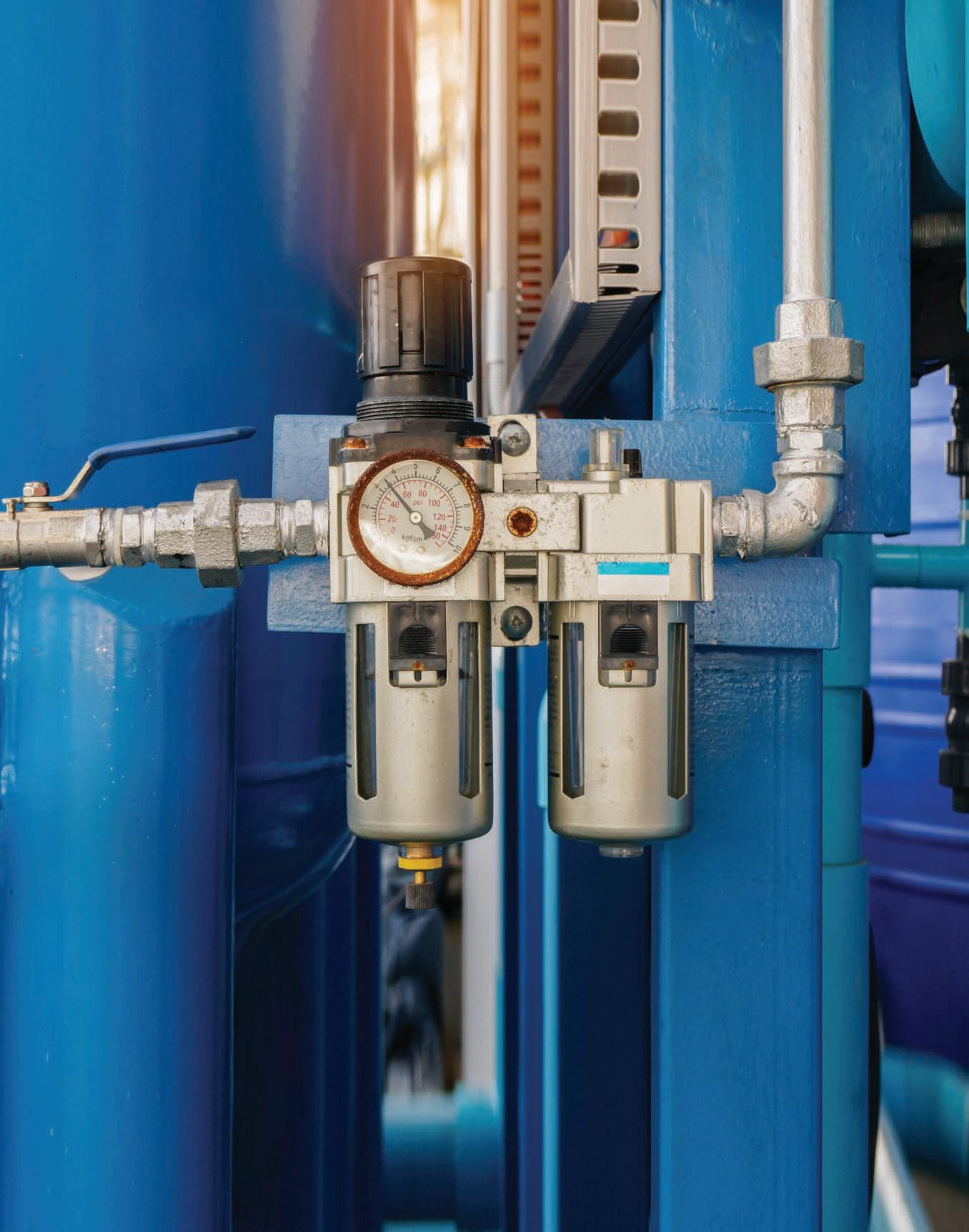
Air compressors are classified as positive or dynamic displacement. Positive displacement compressors confine volumes of air in an enclosed space to accomplish compression and include piston types of various designs and may be air- or water-cooled. Dynamic compressors compress air at high velocity, which maintains pressure at high levels. These include axial flow, centrifugal and screw types. These compressors provide pressurized air to operate tool or instrument air systems.
Reciprocating piston compressors draw air into the cylinders through a filter or strainer, where the air is contained, compressed and released through differential pressure valve arrangements. The compressor cylinders may have one or more inlet and discharge valves. Piston rings or packing contain the air under pressure and keep lubricating oil from the pressure chambers above the piston head(s).
The cycle of operation raises the temperature causing water to condense in the system. Water becomes acidic at 82.2°C (180°F), creating corrosive deposits in piping, valves and reservoirs. Therefore, when very high discharge pressures are required, compression is often carried out in two or more stages to cool the air between stages to limit temperatures to reasonable levels.
The compressed air passes through a heat exchanger or after cooler to reduce its temperature. The cooled air enters a separator (removing condensed water), the air enters the reservoir, and the process is repeated.
Photo credit: Getty Images
Attend Design & Manufacturing Canada to discover the industry’s latest innovations, processes, and materials to run your business more efficiently and cost effectively.
• 3D Printing
• Rapid Prototyping
• CAD/CAM Software
• Outsourced Design and Manufacturing Services
• Materials and Coatings
JUNE 4-6, 2019 // TORONTO, ONTARIO TORONTO CONGRESS CENTRE Use promo code MRO
Symptom
Failure to deliver output
Insufficient output or low pressure
Troubleshooting Compressors
Possible Cause(s)
-Excessive clearance between vanes, lobes or screws (rotary compressors).
-Worn or broken valves and/or defective unloader(s) (reciprocating compressors).
-Restricted or dirty inlet filter.
-Excessive leakage (air system).
-Inadequate speed.
-Worn or damaged piston rings (vanes, lobes or screws on rotary systems).
-System demand exceeds capacity.
-Worn valves or defective unloader(s).
-Carbon deposits on discharge valves.
-Excessive discharge pressure.
-Worn or broken valves.
Compressor overheats
Compressor running gear overheats
-Excessive speed.
-Inadequate cooling.
-Dirty cylinder water jackets.
-Inadequate cylinder lubrication.
-Defective unloader(s).
-Inadequate lubrication.
-Excessive drive belt tension (where used).
-Excessive speed.
-Excessive discharge pressure.
-Worn or damaged rotating components (rotary compressors).
-Excessive discharge pressure.
-Inadequate lubrication.
-Insufficient head clearance.
-Excessive crosshead clearance.
-Loose piston rod(s).
-Excessive bearing clearance.
Compressor knocks
Compressor vibrates
-Loose or damaged piston(s) (reciprocating compressors).
-Loose flywheel or drive pulley (where used).
-Misalignment at coupling.
-Damaged foundation or grouting.
-Loose motor rotor or shaft.
-Piping improperly supported causing resonance.
-Misalignment at coupling.
-Loose flywheel or pulleys (where used).
-Defective unloader(s).
-Unbalanced motor or defective motor bearings.
-Inadequate cylinder lubrication.
-Loose base plate mounting bolts or soft foot.
-Incorrect speed.
-Damaged foundation or grouting.
-Excessive discharge pressure.
-Worn or damaged rotating components (rotary compressors).
Reciprocating compressor lubricants include ISO viscosity grades 68, 122, 150 or 220, depending upon temperatures. Where discharge temperatures are below 149°C (300°F), napthenic base oils are recommended because these lubricants will not form wax crystals at low temperatures. When discharge temperatures are between 150°C and 200°C (302°F to 392°F), synthetic fluids of equivalent viscosity grades may be recommended. Cylinders are lubricated using the same oil found in the crankcase. Cylinder oil will inevitably reach the discharge valves, creating the formation of carbon deposits. Hot spots may develop, resulting in potential fires or explosions.
Axial flow compressors require lubrication for shaft support bearings, thrust or tilting pad bearings and any seals that require lubrication. The lubricant generally recommended is an ISO 32 grade. Where a gear-driven speed increaser is used, higher viscosities may be required. Synthetic oils are often recommended.
Centrifugal compressors require lubrication only at the support bearings, usually an anti-wear oil of a viscosity of 32 or 46, depending upon the ambient temperature. In units with rolling element bearings, NLGI grades one or two lithium greases may be used.
Helical screw “lubricant-injected” compressors draw air through the intake filter that is combined with injected oil into the rotor set to ensure lubrication of the screws, resulting in an air/oil mixture during the compression cycle causing potential for oxidation and deposits. Compression raises the temperature of the air/oil mixture in addition to creating condensation. This mixture exits the compressor outlet into an oil separator where the oil is filtered and returned to the point of injection. Where discharge temperatures are in the range of 85°C to 135°C (185°F to 275°F), lubricant requirements range from high-quality rust and oxidation-inhibited mineral oils to synthetic fluids in the viscosity range of 32, 46 or 68. Synthetic lubricants may be recommended. Helical “dry screw” compressors only require lubrication of the timing gears and bearings. Straight lobe screw compressors require viscosity grade 150 or 220 for higher ambient temperatures. When low ambient temperatures are experienced, viscosity grade 68 is acceptable. These oils should have rust and oxidation inhibitors. Anti-foaming additives and synthetic lubricants may be recommended.
Photo credit: Getty Images
Compatibility of synthetic oils and compressor seals is important. In general, polyglycols, diesters, polyalphaolefins and alkylated aromatics are compatible with the following seal materials. Viton
Symptom
Excessive intercooler pressure
Low intercooler pressure
Excessive receiver pressure
Troubleshooting Compressors
Possible Cause(s)
-Worn or broken valves (second stage).
-Defective unloader (second stage).
-Worn or broken valves (first stage).
-Defective unloader (first stage).
-Dirty or restricted inlet filter or suction line.
-Worn piston rings on low pressure (first stage) piston.
-Worn rotating components (rotary compressors).
-Defective unloader(s).
-Excessive discharge pressure.
-Carbon deposits on discharge valves.
1. Record normal full load electric motor current at a specific voltage as the baseline when problems are experienced.
2. Record compressor cutout pressure and the time it takes to fill the reservoir to monitor compressor efficiency.
3. Determine acceptable discharge temperature. The high air temperature switch on water-cooled, dual-stage reciprocating compressors is set at about 150°C to 165°C (302°F to 328°F). This temperature should be recorded and monitored. In rotary compressors, the high air temperature switch is set at about 110°C (230°F) and is intended to shut the compressor down if the temperature rises. Discharge
High discharge temperature
-Worn or broken valves.
-Defective unloader(s).
-Excessive discharge pressure.
-Inadequate cooling.
-Dirty water jackets (or plugged or dirty fins on aircooled compressors).
-Dirty or plugged intercooler.
-Abnormal (high) intercooler pressure.
-Inadequate cylinder lubrication.
Troubleshooting Compressors
Symptom
Cooling water discharge temperature too high
Valves overheat
Drive motor overheats
High levels of condensate
Premature oil thickening or discolouration
Compressor seals fail prematurely
High oil consumption
Possible Cause(s)
-Low level of coolant.
-Dirty water jackets.
-Worn or broken valves.
-Defective unloader(s).
-Excessive discharge pressure.
-Dirty or corroded intercooler.
-Abnormal intercooler pressure.
-Excessive discharge pressure.
-Long unloaded cycles (inlet valves).
-Damaged or carbonized valves.
-Defective unloader(s).
-Inadequately sized motor.
-Excessive discharge pressure.
-Worn or broken valves.
-Abnormal intercooler pressure.
-Inadequate lubrication (compressor running gear or motor bearings).
-Misalignment at coupling.
-Excessive belt tension (where used).
-Low voltage.
-Excessive discharge pressure.
-Excessive discharge temperature.
-Inoperative intercooler.
-Plugged or inoperative heat exchanger or water separator.
-Excessive lubricant operating temperature.
-Compressor operating temperature too high.
-Inadequate lubricant type (wrong oil for the application).
-Worn or faulty piston rings.
-Excessive discharge temperature.
-Lubricant oxidation.
-Excessive operating temperatures.
-Lubricant incompatible with seal materials.
-Misalignment at coupling.
-Excessive crankcase pressure.
-Seal material incompatible with the gas being processed.
temperature should be about 38°C (100°F) higher than the temperature of the inlet air.
4. Oil operating temperature should be about 65°C (150°F), 15 to 20 degrees higher than the pressure dew point to help reduce excessive condensate. In a two-stage air compressor taking in air at atmospheric pressure and a relative humidity of 75 per cent, with a discharge pressure of 120 psi (758 kPa), about 14 litres (3¾ gallons) of water per hour may be condensed for each 1,000 CFM of free air compressed. Any unusual increase in the recorded oil temperature should be immediately investigated.
5. Determine the filter quality necessary to ensure that compressor inlet air enters uncontaminated and oil filters are capable of removing contaminants in the 10-micrometer range. In lubricant-injected compressors, the oil separator should be replaced or cleaned when differential pressure reaches about 10 psi.
6. Determine and record normal air discharge pressure.
7. Due to corrosion, rust and varnish deposits, intercoolers, cylinder water jackets, aftercoolers or heat exchangers should be inspected and/or cleaned at least annually.
8. Air reservoirs, drains, condensate traps and air line filters should be inspected and drained at least once each week to ensure clean, moisture-free air.
9. Inspect and clean pneumatic system lubricators regularly. Lubricant is carried in the air stream and the amount of oil metered is determined by adjusting the oil feed rate. This oil drip feed rate must be monitored regularly and the effective feed rate recorded for maintenance reference.
10. Determine the cylinder lubrication feed rates for reciprocating compressors and record this information in maintenance files. New or rebuilt compressor cylinders should be run for five to 10 hours of operation at no load conditions using at least double the oil feed rate to establish normal wear patterns and eliminate the possibility of scoring a new cylinder. The proper lubricator oil feed rate can be determined using the following formula:
Photo credit: Getty Images
B x S x N x 62.8 = Q
10,000,000
Where B = Bore in inches
S = Stroke in inches
N = Compressor RPM
Q = Quarts of oil per 24 hour operation
Once the proper rate has been established, count the oil drops and record this in the maintenance files. If the oil type or specifications change, repeat the process. For example, a 12-inch (30.5 centimetre) compressor cylinder compressing air at a discharge pressure of 10 bars (145 psi) requires a lubricating oil feed rate of 12 drops per minute. If the cylinder has two lubrication points, each point should receive six drops per minute.
11. Inspect piping, fittings and drain valves for leaks and ensure pipe supports are secure. A combination of leaks totalling a ½ inch diameter hole, escaping at 60 psi, will cost approximately $30,000 annually. A pressure drop of 15-psi uses about 10 per cent additional energy, so piping design is critical. Piping systems corrode and form deposits, so when repairing or replacing piping, use smooth bore pipe such as aluminum or plastic.
Compressor Condition
Monitoring
a) Regular spectroscopic oil analysis will provide trends on the rates of compressor component wear and oil condition.
b) Vibration analysis can determine common vibration problems such as unbalance, misalignment, mechanical looseness and resonance.
c) Ultrasonic analysis can determine inaudible noise levels such as early stages of bearing failure and air leaks that may be the cause of resonant conditions, so correct leaks immediately.
d) Thermographic analysis can locate hot spots caused by
excessive discharge temperatures or partially plugged components, such as intercoolers or heat exchangers.
This troubleshooting guide is general in nature. Depending upon compressor type, operating conditions or application, some of these symptoms and their possible causes may not apply. MRO
L. (Tex) Leugner, the author of Practical Handbook of Machinery Lubrication, is a 15-year veteran of the Royal Canadian Electrical Mechanical Engineers, where he served as a technical specialist. He was the founder and operations manager of Maintenance Technology International Inc. for 30 years. Tex holds an STLE lubricant specialist certification and is a millwright and heavy-duty mechanic. He can be reached at texleug@shaw.ca.
Range of high performance lubricants
ORGANIZING THE MAINTENANCE STOREROOM
The most time-consuming job of all.
BY PETER PHILLIPS
Storeroom organization is the single most labourintensive maintenance activity we can undertake. Depending on the size of a storeroom and the number of parts carried, it can take anywhere from three months to a year to complete. Without a clear plan, these many months can be wasted.
Not to mention the overall cost. Storage shelving and cabinets are expensive; cabinets with drawers can cost anywhere from $3,000-$7,000 per unit. Shelving, plastic bins and organizers can cost several thousand dollars depending on the number needed. With that in mind, the storeroom design and layout are extremely important to control costs.
Steps to take and critical points to consider in design - as well as safety, layout, storage options, signage and labelling - are discussed below. Best practices in storeroom organization, and how to keep the room organized over the long haul, are highlighted.
First, let’s look at the advantages of having and keeping an organized storeroom. The most important two reasons are:
1. Having the parts you need when you need them; and
2. Being able to find the parts quickly.
Having the parts when you need them is simple; however, it's not always the case. Most storerooms are in poorly organized condition; tradespeople know where the parts are, not because they are organized, but because that is where the part has always been stored. Shelves are normally a mixed bag of parts in no particular order.
If parts are unorganized and used parts are allowed on shelves, that's asking for trouble. Typically, maintenance people say it’s a seek-and-find exercise that can take five to 30 minutes. The only used parts that should be in the storeroom are the ones labelled certified rebuilt.
Once you’re organized, a method to receive and check out parts is needed; the quantity on hand and the reorder quantity are always known. Usually maintenance departments use a CMMS for this; however, you may be surprised to know that less than 50 per cent of maintenance departments use the CMMS function. Instead, they rely on tradespeople to tell the storekeeper when parts need to be reordered.
Finally, finding parts quickly is important. Tradespeople need to get in and out of the storeroom as quickly as possible with the parts they need. There is a cost with every equipment breakdown and finding the correct parts in a short amount of time saves time, raw materials, labour and a multitude of other related costs.
Storeroom layout, signage and labelling are key to finding parts quickly. The industry standard today is under two minutes. From the time the tradesperson enters the storeroom until they have what they need is just 90 seconds.
Following are the key components of basic storeroom development.
Safety first
One of the most important factors in your design is safety. We need to make sure storekeepers, employees and contractors are safe in the storeroom. For example, parts should not be stored on top of shelving units. Shelving is designed to have parts sitting inside the enclosed unit with sides and backs to keep parts in place. Often, sloped tops are installed on the top of shelves to keep people from trying to store parts on them. Parts storage needs to be safe and ergonomic. Parts need to be secure on shelves, so they don’t roll off, and heavy parts need to be near the bottom shelves and lighter parts near the top shelves. Depending where you live in the world, you may need
Photo credit: Getty Images
to consider the climate. In some cases, there are earthquakes that can topple racking that can weigh hundreds of pounds. In these areas, shelving and racking will need to be secured to the floor or loaded to bearing walls. Remember to make sure all fastening devices are engineered to withstand the forces of nature and the unintentional collisions with mobile equipment.
Assessment of available space
There isn’t always enough space for all parts, which is more reason to purge the storeroom. Obsolete and used parts need to be removed, and an overall cleanup needs to be done.
Create a layout
The design process is important. Effective layouts lead the way to determine the storage needs. Moving shelves and parts on paper is easy, so take the time to create a design.
Determine parts storage needs
There are many different options to store parts. Cabinets with drawers typically store 40 per cent more parts than open shelving, so these are ideal for small storerooms. Drawers work well with small to medium-size parts. Shelving and heavy racking come in various configurations and weight limits, so know their weight restrictions.
Determine signage
Signage can help locate parts quickly. Bold shelf and bin location labels make a visual impact, allowing tradespeople to easily navigate storeroom aisles.
Determine location-naming conventions; this goes hand in hand with signage. Naming conventions need to be logical and easy to follow.
Kitting areas
In the storeroom design, an area needs to be designated to stage parts for work orders, so storekeepers can easy pick up parts for upcoming jobs.
Environmental controls
Parts need to be kept clean and in new condition while in storage. Dust and humidity need to be factors in the design.
Storeroom access
Storerooms need to be secure. Only authorized people should have access. Keys and swipe cards should only be assigned to people who need to have access.
Determine storeroom processes
Determine how the storeroom should operate. Receiving, putting away, checking out and cycle counts procedures need to be documented and followed. Including, how to sustain the storeroom and keep it organized. Organized storerooms can give a real sense of pride to the maintenance staff. Organized storerooms often filter down into how tradespeople maintain their personal tools and workspace.
We often get what we expect. Let's expect the best. MRO
Peter Phillips is the owner of Trailwalk Holdings Ltd., a Nova Scotiabased maintenance consulting and training company. Peter has over 40 years of industrial maintenance experience. He travels throughout North America working with maintenance departments and speaking at conferences. Reach him at 902-798-3601 or by e-mail at peter@ trailwalk.ca.
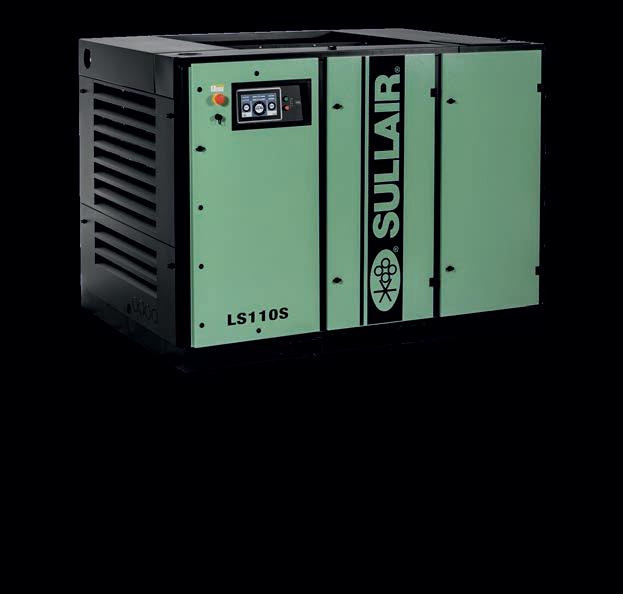
RELIABILITY including the full-color, easy-access Sullair Touch Screen controller
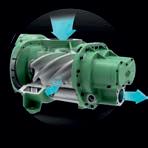
DURABILITY including the patent-pending, new generation Sullair air end
PERFORMANCE including highly efficient Electronic Spiral Valve technology
WHAT’S NEW IN PRODUCTS
Beckhoff TwinSAFE Logic Solutions
Beckhoff TwinSAFE safety controllers, based on EL6910 TwinSAFE Logic Terminal, make it possible to adapt the TwinSAFE system more specifically to the exact requirements of a machine concept and to a broader spectrum of programmable safety applications. I/O components include:
• EL1918 TwinSAFE EtherCAT Terminal: digital terminal with eight safe inputs;
• EL2911 TwinSAFE EtherCAT Terminal: safe potential supply terminal with four safe inputs and one safe output; and
• EP1957-0022 TwinSAFE EtherCAT Box: IP67-protected digital combo module with eight safe inputs and four safe outputs.
Three I/O modules can be used as controllers for direct execution of customer-specific safety projects. The safety project on the corresponding TwinSAFE I/O component can establish direct communication relationships with other safety-relevant devices and preprocess the data internally.
Safety projects can be modularly designed in TwinCAT software. The customizing function enables each module to be configured into operating modes: temporary deactivation, permanent deactivation and passivation. www.beckhoff.com/twinsafe/
Mitsubishi Electric Automation Handheld Models
Mitsubishi Electric Automation has handheld models for its GOT2000 Series. The GT25 Handy GOT, offered in 5.7-inch and 6.5" models, connects to industrial automation devices, including programmable logic controllers, variable frequency drives, servos and temperature controllers.
The handheld human machine interface displays information on a high-resolution VGA touchscreen and allows operators to carry with one hand.
The GT25 Handy GOT can be used in applications involving local setup, operation, monitoring
and maintenance of system components from a graphical interface where mobility is required.
https://us.mitsubishielectric.com/fa/en
HD Furnace From Grieve
No. 1039 is a 1,093°C (2,000°F), inert atmosphere, HD furnace from Grieve. Workspace dimensions are 36" W x 60" D x 36" H. 73 kW are installed in ICA wire coils supported by vacuum-formed ceramic fibre on all interior surfaces, including door and beneath the hearth.
This Grieve furnace has a roofmounted, heat-resisting alloy circulating fan powered by a one horsepower motor with V-belt drive, water-cooled bearings and inert atmosphere shaft seal. Furnace features include:
• 9" thick insulated walls comprising 5" of 2,300°F ceramic fibre and 4” of 1,900°F block insulation;
• 8½" floor insulation comprising 4½" of 2,300°F firebrick and 4” of 1,900°F block insulation.
• ¼" plate exterior reinforced with structural steel; and
• ½" steel faceplate at doorway with air-operated vertical lift door.
Inert atmosphere construction includes continuously welded outer shell, high-temperature door gasket, sealed heater terminal boxes, inert atmosphere inlet, inert atmosphere outlet, inert atmosphere flow meter and manual gas valve.
Controls include digital programming temperature controller, manual reset excess temperature controller with separate contractors, paperless event recorder and SCR power controller. www.grievecorp.com
Rite-Vu Hazard Recognition System
Rite-Hite offers elements of its Rite-Vu Hazard Recognition System, available as retrofit or stand-alone equipment for any loading dock. Equipment now available for retrofit includes Approach-Vu, Pedestrian-Vu and Lok-Vu.
Pedestrian-Vu uses motion-sensing technology to trigger a bright blue light that projects onto the dock leveller when it detects motion inside the trailer from material handling equipment and/or a pedestrian.
When used with Dok-Lok products, Pedestrian-Vu will also alert any dock worker or forklift that enters an unsecured trailer. The blue light flashes as an audible alarm and alerts the unsuspecting dock worker to the safety threat, while the exterior light system simultaneously changes to red, warning the truck driver
of activity inside the trailer and that they should not pull away.
Approach-Vu detects the motion of a tractor-trailer backing into a dock position. A visual and audible alarm located on the outside of the building, below the leveller, alerts dock workers and pedestrians in the drive approach of the impending hazard.
Lok-Vu uses an external camera to provide visual verification of trailer presence and lock engagement. Single and dual camera systems are available. Dual camera option allows for interchangeable views between two or three general locations.
www.ritehite.com
FLIR Uncooled Methane Gas Detection Camera
FLIR Systems, Inc. FLIR GF77
Gas Find IR, uncooled thermal camera for detecting methane, finds potentially dangerous, invisible methane leaks at natural gas power plants, renewable energy production facilities, industrial plants and other locations along a natural gas supply chain.
GF77 features an ergonomic design, an LCD touchscreen and a viewfinder. It is engineered to detect methane. GF77 offers a high-sensitivity mode, which accentuates movement to make tiny gas plumes more visible.
Technological features: laserassisted auto focus and onetouch contrast improvement. A rapid-response GUI helps efficiency by allowing users to organize job folders, record notes and add GPS location annotation.
www.flir.com/GF77
Drone Delivery Canada Condor
Drone Delivery Canada (DDC) cargo delivery drone, "The Condor," has a payload capacity
of 180 kg, and a potential travel distance of up to 200 km. A gas propulsion engine powers it.
Condor measures 22" long, 5.1" wide and seven feet tall. It has a wingspan of approximately 20" and is capable of vertical takeoff and landing. It is equipped with the DDC proprietary FLYTE management system.
DDC will be working with Transport Canada to secure necessary approvals to begin flight-testing in Q3 2019.
www.dronedeliverycanada.com
Connecting you to productivity!
The Core product range from Festo featuring the Stars of Automation: Festo quality at a competitive price covering 80% of your automation tasks. From actuators to accessories for factory and process automation.
Reduce your procurement complexity for both the electric and pneumatic control chain by simply following the stars. www.festo.ca/stars
Tooth Extractor For Auger Bit Replacement
Auger Technologies
Tooth Extractor removes conical auger teeth faster. Augers with worn teeth that are stuck fast can be removed quickly; ideal for any auger with standard conical teeth.
Fit split ring Tooth Extractor collet over conical auger bit, then slide the driver arm over the collet, locking in place. Drive extractor screw, in turn backing out tooth.
Once out, reverse the motion on the extractor screw to remove the tooth from the collet. The extractor can be used with an impact wrench or manually with a wrench. www.augertech.net/tooth-extractor/
ABB Dodge Food Safe Bearings
ABB Dodge Food Safe mounted ball bearings achieve IP69 water protection rating without the use of an end cover. And they're the only bearings to carry warranty against failure due to water ingress.
Food Safe bearings are resilient against cleaning agents and have 100 per cent stainless steel insert design combined with a top coat, which offers protection against corrosion. Housing without a grease fitting minimizes contamination harbour points. The bearing is sealed and lubricated for life to minimize maintenance costs.
Food Safe bearing is equipped with lubrication protection. A hydro armour sealing system, with a stainless steel flinger and four contact lip seals, prevents water and contamination from entering the bearing. ABB’s ball retainer, Maxlife cage, retains a large volume of grease in compartments around the rolling elements to prevent washout during high-pressure cleaning. Bearings come in various housing styles: pillow block, tapped base, flange and take-ups, in sizes 20 mm to 50 mm. www.abb.com
FLIR HD Handheld Cooled Optical Gas Imaging Camera
FLIR Systems, Inc. HD handheld optical gas imaging camera, FLIR GF620, is designed for oil and gas industry professionals. GF620 detects and visualizes invisible leaks of hydrocarbons, such as methane, and common volatile organic compounds.
GF620 helps inspectors survey for fugitive hydrocarbon emissions from further, safer distances.
■
■
■
■
■
GF620 also introduces Q-Mode, an automatic pre-set for use with the optional QL320 gas quantification system, which quantifies hydrocarbon leaks with mass or volumetric measurements and colourizes emissions for easier assessment. www.flir.com/GF620 Standard Parts. Winco.
Equipped with a 640x480 infrared detector, it’s calibrated to measure temperature, allowing the user to assess the thermal contrast between gas and background scene, and adjust to improve visibility. GF620 also features a highsensitivity mode.
Where smart Engineers go for smart Solutions
Thousands of engineers in fluid power, power transmission and motion control will come together at IFPE 2020 to exchange knowledge, solve technical problems and discover new solutions. Join them in Las Vegas in March 2020.
Government of Canada Supports Projects in Quebec
Three businesses in Quebec will get a total of $772,979 in repayable contributions from Canada Economic Development for Quebec Regions (CED). Fabspec, Technolaser and Aciers Richelieu will proceed with acquisition and installation of new equipment.
"We have chosen to focus on the innovative capacity and commitment to progress of these businesses, which have made a name for themselves in a constantly evolving market. Their drive, boldness and sense of innovation contribute to the economic vitality of the Montérégie region," said The Honourable François-Philippe Champagne, Minister of Infrastructure and Communities.
Granted by the Government of Canada through the Quebec Economic Development Program, the financial assistance will allow the recipient businesses to achieve their established objectives. Their respective projects will generate $2.2 million in total spending and will result in the creation of 21 jobs in the Sorel-Tracy region.
"As Minister of Innovation, Science and Economic Development, my goal is to help businesses grow and innovate so that they can increase their competitiveness and create good-quality jobs and wealth for Canadians. This is why we are supporting Fabspec, Technolaser and Aciers Richelieu, three businesses whose success reflects on the region and the Canadian economy as a whole," said The Honourable Navdeep Bains, minister responsible for CED. MRO
Government Invests in Steel and Aluminum Manufacturers
The Government of Canada has invested $100 million in small and medium-sized steel and aluminum manufacturers and users in Canada. Delivered by Regional Development Agencies, the Regional Economic Growth through Innovation Steel and Aluminum Initiative will provide support to Canadian businesses within the steel, aluminum and manufacturing sectors.
It will provide SME steel and aluminum manufacturers and users with non-repayable contributions for projects to enhance productivity, increase competitiveness by adopting new innovative technologies, and create jobs.
"Small and medium-sized businesses (SMBs) in our steel and aluminum industries make important contributions to our economy and to our communities by creating good middle-class jobs. Our government recognizes that SMBs are the backbone of our economy and that by investing in their success, we invest in the success of all Canadians," said The Honourable Mary Ng, Minister of Small Business and Export Promotion. MRO
Mr. 0, The Practical Problem Solver
Base Preventive Maintenance on Accurate Information
The two biggest objections to preventive maintenance are doing excessive maintenance, and assets still breaking down despite being proactive. Both problems are, in most cases, a result of a rushed preventive maintenance plan that wasn't based on accurate data.
If you want to run an effective maintenance program, it is never enough to just schedule maintenance based on OEM recommendations. While this is a good starting point, there are other sources of information you need to account for.
First, look at the maintenance history of the asset you want to put on a PM plan. If you are using a modern CMMS, getting to maintenance logs should not really be a problem. By looking at what type of failures the asset experienced in the past (and how often) will give you a good idea if the asset "acquired" specific problems over time that will need additional attention. Second, talk to your maintenance technicians and machine operators. In the end, some insights you can only get by talking to the people who are actually turning the wrench. MRO
xcellence in Manufacturing Consortium (EMC) named Craig Mannell as Field Service Advisor for Burlington, Oakville, Hamilton, Niagara and St. Catharines consortiums. He has held several leadership roles in various manufacturing industries, including rail car manufacturing, job shop welding, elevator manufacturing, metal storage systems and automotive parts manufacturing.
Mannell is a long-time EMC supporter with a broad knowledge of manufacturing and EMC. Thriving on helping connect people to solve problems and remove barriers to success, EMC believes he will be a great resource and addition.
Mannell will be in touch with members and community partners in the coming months to ensure continuous support to all of the consortium regions across Southern Ontario. MRO
Series Hydraulic Fluids are Environmentally Acceptable Lubricants (EALs) according to the definitions and requirements of the US EPA 2013 Vessel General Permit, as described in VGP Section 2.2.9