Tim Dimopoulos, Vice-President tdimopoulos@annexbusinessmedia.com
Mike Fredericks, President & CEO
Machinery and Equipment MRO is published by Annex Business Media, 111 Gordon Baker Rd., Suite 400, Toronto ON M2H 3R1; Tel. 416-442-5600, Fax 416-510-5140. Toll-free: 1-800-268-7742 in Canada, 1-800-387-0273 in the USA.
Printed in Canada
ISSN 0831-8603 (print); ISSN 1923-3698 (digital) PUBLICATION MAIL AGREEMENT #40065710
CIRCULATION
email: blao@annexbizmedia.com
Tel: 416.442.5600 ext 3552 Fax: 416-510-6875 or 416-442-2191
Mail: 111 Gordon Baker Rd., Suite 400, Toronto ON M2H 3R1
Subscription rates.
Canada: 1 year $63.50, 2 years $101 United States: 1 year $108
Elsewhere: 1 year $123.50 Single copies $10 (Canada), $16.50 (U.S.), $21.50 (other). Add applicable taxes to all rates.
On occasion, our subscription list is made available to organizations whose products or services may be of interest to our readers. If you would prefer not to receive such information, please contact our circulation department in any of the four ways listed above.
Across a global spectrum of technological disruption, industrial manufacturing plants are wedged somewhere between rhetoric and reality.
The starting point and context for each organization are different, which explains why mixed reactions about the impact of digitalization range from “the time for digital is now” to the outright skewering of artificial intelligence and machine learning as hype.
One could be tempted to agree that disruption may not be the silver bullet many expect it to be. There are good arguments against overselling the abilities of deep learning; not the least of which is that it provides fresh risk.
But, for the most part, the trend has been crystallized. The economic and technological drivers have been validated. McKinsey research reveals that by adapting current technologies, 45 per cent of the activities individuals are paid to perform can be automated. Other research reveals that by 2020 an estimated 50 billion devices around the globe will be connected to the Internet; two-thirds of them are categorized as sensors, actuators and other intelligent devices that monitor, control, analyze and optimize.
The role of data in predictive maintenance is thriving. The ability to aggregate and then analyze data is crucial to predicting malfunctions. Even traditional condition monitoring technologies – vibration, ultrasound and thermography –require capabilities for creating, handling and making use of data.
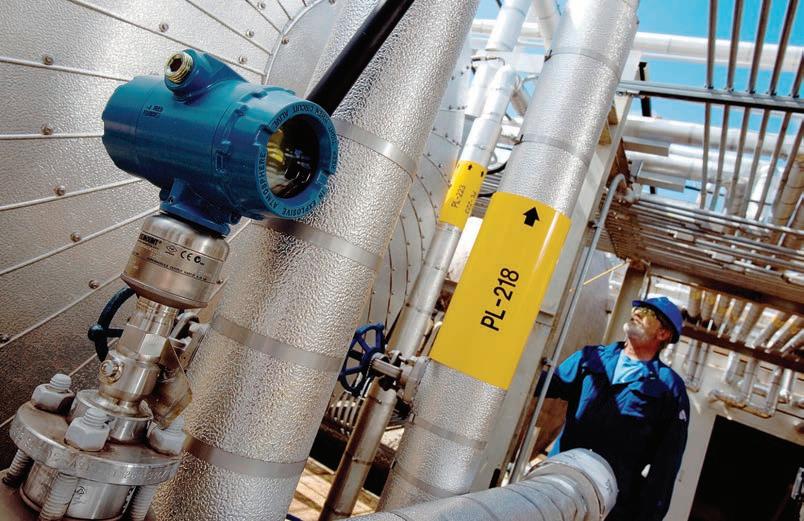
Resistance to the evolving landscape can set firms back, given the exponential speed of change. Focus instead on the value that data could bring. Blair Fraser (“Sensing Problems,” page 10) explains that when “life extension of assets” is top priority, the real value comes from what you do with the collected data. Asset owners needn’t focus on replacing current machinery with new, state-of-the-art machinery and equipment. Nor is it necessary to add unnecessary sensors. It turns out that legacy equipment houses stranded data that may give plants the upper hand. The key is to get that data out and learn to make sense of it.
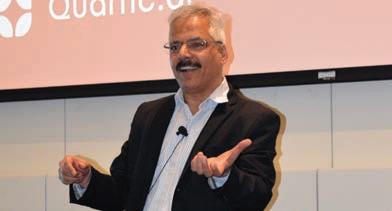
In the datasphere, start-ups invariably play by a new set of rules of engagement and are blowing things up. Rajiv Anand, CEO of Quartic.ai, proves this with his company’s sensor-based, machine-learning predictive maintenance platform (“Make a Decision,” page 14). By synchronizing contextual data with a facility’s SCADA system, operators can have real-time visual updates and early warnings of impending failure. Training in data science is optional.
I’ll leave you with one other application of asset-performance improvement techniques. I had the pleasure of interviewing Dr. Chi-Ghun Lee, director of the Centre for Maintenance Optimization and Reliability Engineering, in Toronto. His research turned decision-making tools on their heads when he applied asset performance principles to predict the quality of water at the Mtendeli refugee camp in Tanzania (“In Good Health,” page 22). Both noble and ingenious, Lee's research is an attempt to ensure the quality of water is acceptable for consumption.
New iterations of deep machine learning and prognostic maintenance through digitalization are far from being universal problem solvers, but the ubiquity forces organizations to react on multiple fronts. Some will undoubtedly struggle against the challenges posed, though they present unprecedented opportunities. Think of it instead as a necessary tool among many. MRO
Rehana Begg Editor
Sensing Problems
Photo by Getty Images
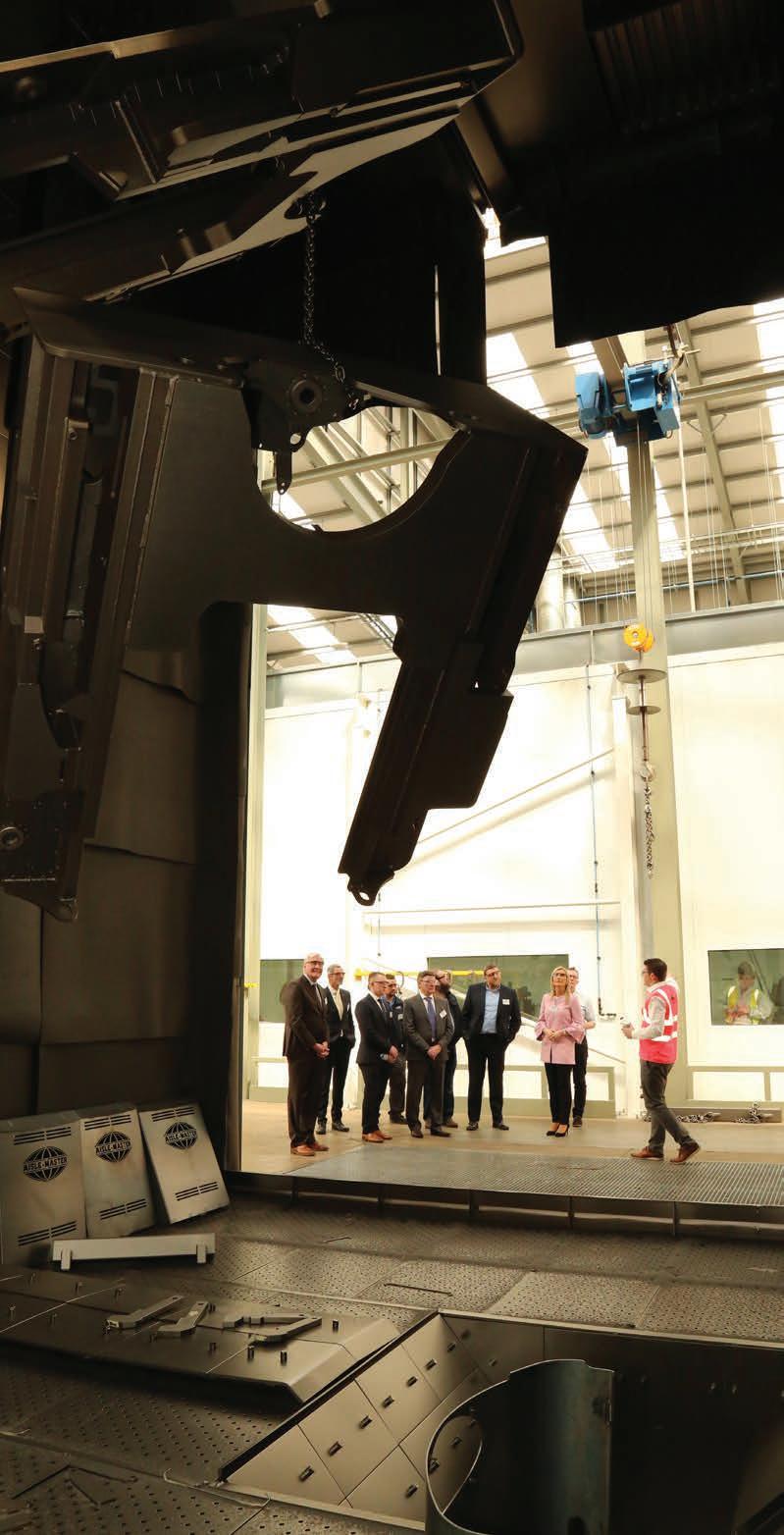
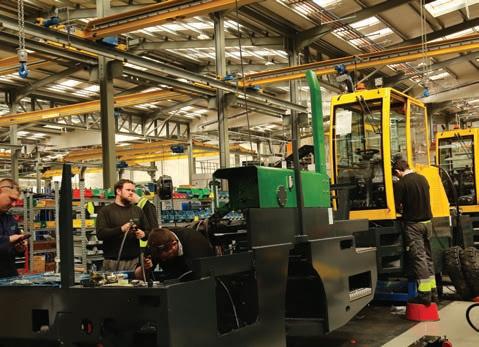
Combilift’s new factory in Monaghan, Ireland, launched with great fanfare. Dignitaries, including Kevin Vickers, ambassador of Canada, attended.
Lifting Innovation
Mass customization gives materials handling factory an edge
BY REHANA BEGG
Forklift manufacturer and materials handling solutions provider Combilift officially opened its global headquarters and manufacturing facility in Monaghan, Ireland, to dealers, customers, media and dignitaries, including Kevin Vickers, Ambassador of Canada.
Celebrating two decades in business, the privately held firm has carved its niche as a forklift manufacturer known for safely handling long and bulky products in less space and for narrow-aisle warehouse applications.
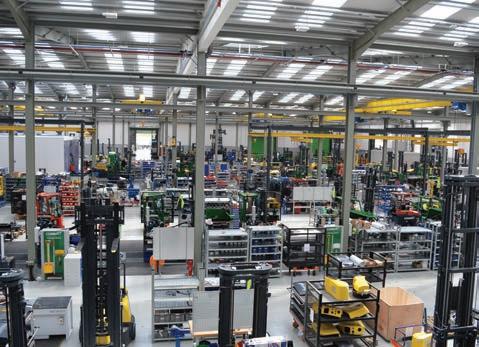
The new $60-million factory is a 46,500 square-metre purpose-built manufacturing operation set on a 100-acre site, which will enable Combilift to double its output in a single shift across all production lines.
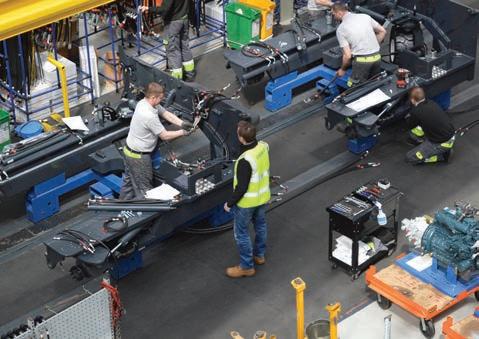
Four 90-metre moving assembly lines produce a finished truck every 15 minutes. The factory boasts 60 welding bays, two plasma cutting machines, three paint lines – which use sustainable water-based paints – and three automatic shot blasters to cater for different sized products. More than 50 truckloads of finished products are dispatched to 85 countries each week, and with 12,000 pallet locations, ample storage space for parts and components has been allocated.
Banking on growth
During a press conference, Combilift's managing director, Martin McVicar, said that keeping labour costs within 10 per cent of its US$280-million annual revenue allows Combilift to be competitive, exporting anywhere around the world.
With about 25 per cent of all sales coming from the United States and Canada, North America is the fastest growing market in the company’s portfolio, and the manufacturer expects 36 per cent growth in 2018. Parts can be delivered overnight in North America from Combilift’s headquarters in Greensboro, N.C., said Paul Short, president of Combilift USA.
Images courtesy of Combilift
Mass customization
The Monoghan factory, which employs 550 people, is set up with very little automation, said McVicar. “We like to think we’re setting this plant up so that we can do mass production of customized products. And even though there is a bit more labour required, it gives us great flexibility. But we have a lot of internal backup systems – MRP, ERP, Factory Track – for tool and labour tracking materials.”
However, a number of automated space-saving forklift trucks are planned in the pipeline as a direct response to customer requests, said McVicar. “We’re starting to develop AGV (automated guided vehicles) products… We would like to accommodate the market with automated space-saving forklift trucks.”
McVicar explained that Combilift’s business advantage stems from customers who expect products to be tailored to their needs. “Forklift producers that offer customized products generally produce low volume, but Combilift is setting the benchmark by offering the mass production of tailored products, resulting in a strategic advantage for our customers. Traditional forklift manufacturers focus on high-volume mass production of the same products. We evolve with our clients, producing new products each year.”
Combilift products have come a long way since its co-founders, Robert Moffett and Martin McVicar, first launched a multidirectional all-wheel drive IC engine powered forklift in 1998. Today,the company launches one to two new products annually and invests seven per cent of its annual turnover in research and development as a way to enhance customization capability, said McVicar.
Between 2008 and 2018, the company diversified its product range by developing innovative space-saving warehouse and heavy load handling products, including the Aisle Master articulated truck and the Straddle Carrier (Combi-SC). Benefitting from Combilift’s patented multi-positional operator tillerarm technology, the company has introduced a number of unique products
(Combi-WR and Combi-CS) in the pedestrian forklift market in the past five years.
Bespoke solutions
Customers can also take advantage of a free logistics and warehouse design service, which allows the customer to collaborate with design engineers in visualizing a site’s capacity potential and the optimum flow of materials on a site using 3D animations.
Certified to international quality and safety management standards, the new headquarters and manufacturing facility has been awarded ISO 9001 international quality management system, ISO 14001 Environment Management and OHSAS 18001 Occupational Health and Safety Assessment Series.
GRACE ENGINEERED PRODUCTS MOVES INTO INDUSTRIAL INTERNET OF THINGS (IIoT) WITH CIVIONICS ACQUISITION
Davenport, Iowa – Grace Engineered Products announced the acquisition of Civionics – the creators of Percév IIoT predictive sensing technology. Artificial intelligence built into each Percév wireless sensing node maximizes battery life and enables predictive maintenance capabilities to be easily deployed on both new and legacy assets. The technology helps users find failures before they occur. Sensor nodes help operations and maintenance managers track the performance of advanced engineered systems and diagnose mechanical failures before they occur. For more information, visit graceport.com.
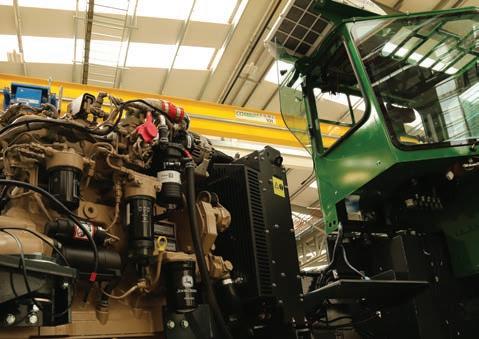
Combilift manufactures forklifts designed to save space on warehouse and factory floors and job sites.
Centrifugal pumps industry goes digital
Santa Clara, Calif. – The North American centrifugal pumps market is witnessing a renaissance with the adoption of Industrial Internet of Things (IIoT), digitization and next-gen prognoses offering significant growth opportunities and paving the way for smart pumps.
The Industrial Automation and Process Control team at Frost & Sullivan expects to see a focus on developing energyefficient solutions and analytical strategies to cater to enduser demand for actionable insights.
A recent analysis, “North American Centrifugal Pumps Market, Forecast to 2024,” reveals key trends that lead to growth opportunities. These include: the North American centrifugal pump market is growing at a compound annual growth rate
THE MOST SIGNIFICANT INNOVATION IN A CENTURY
Montreal – Rio Tinto and Alcoa Corp. announced a revolutionary process to make aluminium that produces oxygen and eliminates all direct greenhouse gas emissions from the traditional smelting process.
Executives of Rio Tinto, Alcoa and Apple were joined by Canadian Prime Minister Justin Trudeau and Premier of Québec Philippe Couillard for the announcement on May 10, which signals the most significant innovation in the aluminium industry in more than a century.
To advance larger scale development and commercialization of the new process, Alcoa and Rio Tinto are forming Elysis, a joint venture company to further develop the new process with a technology package planned for sale beginning in 2024.
Elysis, which will be headquartered in Montreal with a research facility in
(CAGR) of 3.2 per cent from 2017 to 2024; the rise of new IIoT business models such as gain sharing, pay-per-use and product-as-a-service; investment in new facilities and expansions in water and wastewater, oil and gas, and chemical industries; growing demand for centrifugal pumps across end-user industries; recovery of realty and construction market; and rise in replacement and servicing market.
“Market growth is being interrupted by pump manufacturer cost pressures, end-user price sensitivity, threats from alternative technologies such as positive displacement pumps, and low-cost products from other regions,” noted Anand M. Gnanamoorthy, industrial automation and process control senior industry analyst at Frost & Sullivan.
Source: Frost & Sullivan
Quebec’s Saguenay–Lac-Saint-Jean region, will develop and license the technology so it can be used to retrofit existing smelters or build new facilities.
When fully developed and implemented, it will eliminate direct greenhouse gas emissions from the smelting process and strengthen the closely integrated Canada–United States aluminium and manufacturing industry. The new joint venture company will also sell proprietary anode and cathode materials, which will last more than 30 times longer than traditional components.
The patent-protected technology, developed by Alcoa, is currently producing metal at the Alcoa Technical Center, near Pittsburgh, where the process has been operating at different scales since 2009. The joint venture intends to invest up to $40 million in the United States, which would include funding to support the supply chain for the proprietary anode and cathode materials.
For more information, visit alcan.com.
Bearings Specialists Association lifetime achievement award
Birmingham, Ala. – Motion Industries, a leading distributor of industrial maintenance, repair and operation replacement parts, announced that Ellen Holladay, the company’s senior-vice-president, chief information officer and operational excellence officer, is the 2018 recipient of the Bearings Specialists Association (BSA) Lifetime Achievement Award. The presentation was made at the association’s 2018 Annual Convention (April 28 – May 1) at the Hyatt Regency Coconut Point Resort & Spa in Bonita Springs, Fla.
integration platform designed to address the complex requirements associated with business-to-business transactions among North America’s leading manufacturers and suppliers. In addition to CIO responsibilities, Holladay leads the ebusiness and operational excellence groups within Motion.
Holladay has been a BSA member since 2000.
PTDA’S POWER TRANSMISSION HANDBOOK EARNS REGISTRATION MARK PROTECTION
Chicago, Ill. — Earlier in 2018, the U.S. Patent and Trademark Office awarded PTDA a Class 16 registration mark for its Power Transmission Handbook, a textbook first published in 1969 and now in its fifth iteration, packed with content for unbiased product training on 17 categories related to power transmission/motion control (PT/MC) products. Chapters include fundamentals, bearings, belt and chain drives, clutches & brakes, conveyors & components, coupling & U-joints, gears, hydraulics and pneumatics, linear motion, motors, adjustable speed drives, controls & sensors, sealants & adhesives, accessories, lubrication and vibration analysis.
Holladay joined Motion Industries in 1990 as manager of systems planning and has since led the development of Motion’s highly refined supply chain capabilities, including a comprehensive
BSA is an international service and educational organization of distributors representing a total of almost 100 companies distributing factory-warranted, anti-friction bearings and invited manufacturers of bearings and related products.
For more information on Motion Industries, visit bsahome.org.
With over 400 pages, the book is complete with colour graphics and charts and is being used by power transmission/motion control distributors and manufacturers for employee training and in curriculum by colleges and universities, as well as technical and trade schools offering courses in mechanical engineering, industrial maintenance and power transmission.
The companion Power Transmission Handbook Workbook and Answer Guide helps teachers/trainers to test their students and provides an interactive way to learn the content from the Power Transmission Handbook.
The U.S. Patent & Trademark office also awarded a supplemental Class 9 registration mark to PTDA for the Power Transmission Handbook eBook, available for use on Android and iOS devices, such as iPhones and iPads. For more information, visit ptda.org/handbook.
Business Briefs
News and views about companies, people, product lines and more.
• North Canton, OH – The Timken Company, a world leader in engineered bearings and mechanical power transmission products, reported first-quarter 2018 sales of $883.1 million, up about 25 per cent from the same period a year ago. The increase was driven by strong organic growth across most end-market sectors led by industrial distribution and off-highway, as well as the benefit of acquisitions and currency. The company now expects 2018 revenue to be up about 17 per cent in total versus 2017. This includes expected organic growth of approximately 12 per cent, plus the benefit of acquisitions made during 2017 and favourable currency.
of A Ganter Company, a global leader in manufacturing of standard parts. Since then, both sales and inventory increased by 80 per cent, respectively.
• Edmonton – Ritchie Bros. conducted its largest Canadian auction of the year,
selling $207+ million (U.S.$161+ million) of equipment over five days in Edmonton. The April 24 – 28 auction attracted more than 14,000 bidders from 59 countries, including 9,750 online bidders. About 89 per cent of the equipment in the auction was sold to Canadian buyers, with buyers from Alberta purchasing 55 per cent, while international buyers from countries such as the United States, China, and the United Arab Emirates purchased 11 per cent of the equipment. Online buyers accounted for 58 per cent of the equipment sold in the auction. MRO
Don Walker, CEO, Magna
• Aurora, Ont. –Magna International Inc. raised its guidance for the year as it reported a better-than-expected first-quarter profit and sales that grew 21 per cent compared with a year ago. The auto parts maker, which keeps its books in U.S. dollars, says it earned $660 million or $1.83 per share for the quarter, up from $577 million, or $1.51 per share a year ago. Revenue totalled $10.8 billion, up from $8.9 billion in the same quarter last year. “We had a strong start to the year, reporting record first-quarter results and increasing our outlook for sales and earnings," says Don Walker, Magna’s CEO.
• New Berlin, WI – May marked the 40th anniversary and success of JW Winco, Inc. Winco saw sales increase by 10 per cent to over $16.5 million in 2017 from its North American Divisions and sees continued growth in 2018. In 2009, JW Winco officially became part
THE NEW TOOLS OF THE TRADE
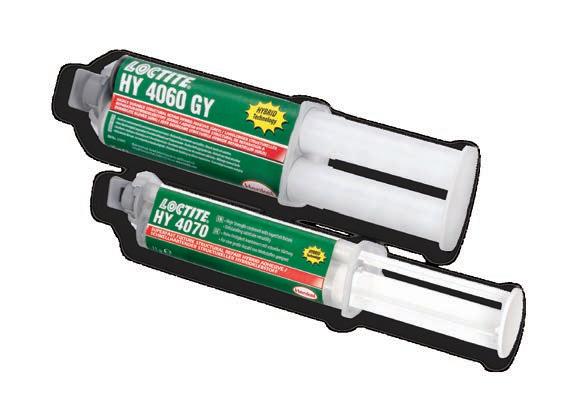
LOCTITE® UNIVERSAL
STRUCTURAL BONDERS
• The next generation in general-purpose adhesives.
• Combine the attributes of structural, instant and epoxy adhesives – bond strength, speed and durability.
• Versatile enough for metal, plastic and rubber.
TRY LOCTITE® HY 4060TM FOR YOURSELF Get a sample at limitless-bonding.com/4060sample
Sensing Problems
Those hidden IIoT sensors you didn’t know you had can lead to prognostic maintenance.
BY BLAIR FRASER
Over the past few years, the Industrial Internet of Things (IIoT) has become a buzzword and a ubiquitous phrase used to discuss the future of predictive maintenance in the context of “smart” industry, Industry 4.0 and digital transformation. When one reads or hears about the key predictions of the future, whether it is for IoT (the consumer applications) or IIoT (the industrial applications) the number of connected devices or sensors are at the heart of these predictions. Analysts forecast that IIoT applications for utilities and energy industries will increase to more than 1.5 billion devices by 2020 – and that is just a segment of industrial IoT.
With the hype cycle at its peak, asset owners are either racing to add new IIoT sensors to equipment without the proper foresight into the problem they are trying to solve or taking a step back and waiting to understand what value additional sensors truly bring. With the growing opportunity and competitive advantage that IIoT and Industry 4.0 offer, neither may be the right approach. But while simply adding sensors and not getting the ROI can stall organizational support, not doing anything can set you back given the exponential pace of growth in this technology.
There is no doubt that sensors play a critical and central role in IIoT for predictive maintenance, and that new assets being built will come equipped with a lot more sensors. But the real value comes from what you do with the additional information from sensors by applying insight creation technologies such as machine learning.
In mature markets, such as North America, where life extension of assets is a top priority, we don’t have the luxury of replacing our legacy assets with these new highly sensor-equipped assets. Instead, we look for ways to gain insight and actionable data from our legacy equipment. Ideally, we would like to design our new equipment to be Industry 4.0-ready from the design phase of its lifecycle. Anyone building new assets must consider this. However, most plants are trying to add new technology to equipment that was developed decades ago. Dealing with legacy equipment may seem like a disadvantage in implementing an IIoT project, but the legacy equipment with the wealth of stranded information may give plants the upper hand – the key is to get that
stranded information out. Taking a gradual, evolutionary approach to digital transformation is a practical approach for legacy asset owners.
Start with defining the problem to solve
Most of us have a preconceived belief that for anything to be called IIoT, we must install new sensors to get that data we never had before. Many new IIoT sensors on the market –wireless sensors, in particular – the ease of installation and use of the cloud to capture the data, make it appealing to purchase new sensors and see what happens. However, most of the time it will still leave you either not answering the question you had when you began or solves a problem that wasn’t worth solving.
A preferred way to go about installing sensors is to start with defining the problem you want to solve and then evaluating the what, where and how to sense using IIoT. Defining the question to solve may seem very basic. However, this fundamental question will set the stage for sensor, data and analytics requirements that will need to be identified before you install the first sensors, or even install any additional sensors. Many IIoT projects don’t require any new sensors at all!
Apply reliability fundamentals
Once the problem to solve has been defined, ask what type of data from sensors or other sources are needed to solve this question. At first it seems counterintuitive to know whether the data is needed without having the data. The best way to determine whether one has the right sensor data is to combine reliability fundamentals with subject matter experts. By performing an FMEA, or even a full-on RCM, we can identify the failure modes in which condition monitoring could be a control method to reduce the risk with that failure mode. Keep in mind that there will never be a complete IIoT solution that will cover 100 per cent of the failure modes; there will always be failure modes that are not detectable, and other techniques – such as time-based maintenance or run to failure – may be needed based on the risk assessment. By applying IIoT to the most critical and random failure modes, you will most likely be making the right investment in IIoT.
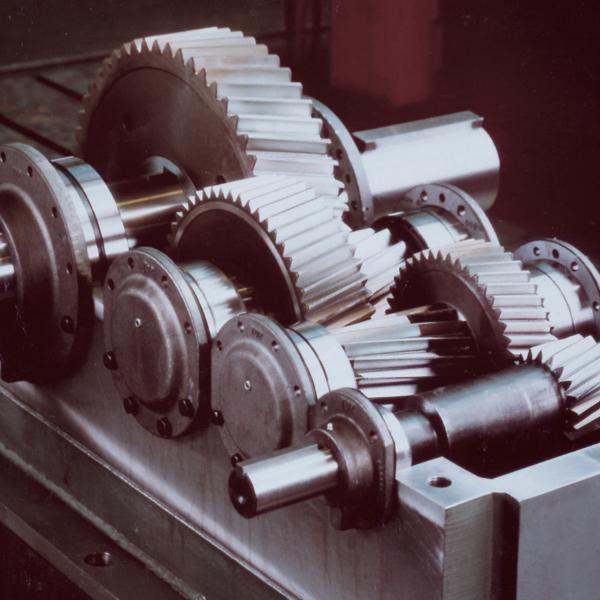
Lubriplate’s complete line of premium-quality gear oils has been formulated to deliver unsurpassed performance in a wide range of gear reducers. They meet and exceed the performance specifications of most gearbox manufacturers and interchange directly with most OEM oils. Available products include...
• These tacky, adhesive, extreme pressure oils cling tenaciously to gear teeth.
• Formulated for heavy equipment and heavy service industrial applications.
• Meets military specification MIL-PRF-2105E and API classification GL-5.
You already have an IIoT solution you are not using
Over the past 10 years I have been involved in hundreds of automation projects that have seen thousands of sensors installed to automate and control processes. These sensors, used to control and monitor process condition, are the hidden IIoT sensors we didn’t know we had.
There are two types of skill sets that are needed to determine whether you have enough data with the existing sensors. The first is subject matter expertise; that is, someone who understands the ins and outs of the equipment and has nuanced insight into detecting and predicting the health of an asset or component. The subject matter expert (SME) will likely be a key influencer in determining which additional sensors are needed. Start by asking the SME this: “If you had nothing but time to look at the existing data available, would you be able to use your knowledge and intuition to tell when an asset is behaving abnormally?” In most cases, the answer is, “Yes, but I would need to be looking at the data every second,” or “Yes, but I would also need to add my human senses; that is, sound, touch, and smell.” If the answer is yes, you have hit a home run in determining a use case for IIoT and artifical intelligence (AI). You have qualified a business case that will have real ROI by adding the missing sensors (IIoT) combined with intuition and knowledge (machine learning)!
The second skill set needed to define the data requirements is data science. A data scientist will be able to cleanse and explore the data to find relationships and correlations in the data that are not obvious. This process is called exploratory data analysis (EDA) and is an important step in the process. The key when working with any data scientist is that they cannot do it alone. They need the help of an SME to validate and further guide the data scientist in interpreting data for a given problem.
In an early project, I worked alongside a skilled data scientist who was tasked to provide a list of variables or sensors that contributed most to the prediction of failure. I was surprised when the list came back with the two most influential
variables not even making it onto my own list of potential correlations based on my experience with this type of equipment. From a data science point of view, these variables had the highest correlation. However, I could quickly determine that they had no impact on the failure mode.
Don’t confuse component health for overall system health
Many plants are starting their journey in IIoT with condition monitoring techniques that have been proven and deployed for decades – that is, vibration monitoring. As we see this technology grow and the cost of sensors decrease, we can deploy vibration monitoring technology not only on critical assets, but also on the balance of our plant equipment.
The urge to purchase wireless vibration (or other condition) transmitters may be strong, as it has an attractive ROI at the component level of the assets. By adding a vibration sensor we can monitor the health of common rotating equipment components. But the drawback with only looking at the component level is that it gives a false sense of security by associating the component health with the overall asset health of the larger system.
Consider a traditional HVAC unit. Many vendors provide wireless vibration sensors on the motor and fan bearings to provide an overall health index of the HVAC unit. An experienced reliability professional will tell you that an HVAC unit will have hundreds of failure modes, in addition to those covered by vibration monitoring on the motor and fan. To monitor the entire health of the HVAC unit, we need vibration, ultrasound, motor current and process variables to provide overall health of the equipment.
When choosing what and how to measure, we go back to our basics of reliability engineering and ensure we understand how things fail. Then we can determine if and how to measure for each particular failure mode. Always start at the system level of the asset and work your way down to the component.
Contextual data are the key to IIoT data overload
Now that we have defined what and how to measure, and making sure we leverage the existing sensors on the equipment first, we now have to get insights from the data.
The benefit of IIoT is realized when we apply context to data and turn it into actionable insights. Knowing the condition (such as vibration) without the operating state of the asset does not provide any useful insights. Adding operational context to data is the single most impactful task we can perform using data. When we take a vibration sensor or any other condition monitoring sensor and combine that with other data sources, such as process data and quality data, we then have the right formula for actionable insights, and we can move from predictive maintenance to prognostics maintenance.
Reinventing the P-F curve with IIoT and AI
For traditional condition monitoring technologies, such as vibration, ultrasound and thermography to indicate a potential failure – this is a “P” in the famous P-F curve diagram – a condition had to happen to cause a physical defect in the equipment. For example, for a bearing to start to have abnormal vibration, the bearing must have a defect to generate vibration or heat. Chances are there were subtle but small changes in operation, likely reflected in process data, that led to the eventual, noticeable high vibration. With the right operation data, combined with AI, this abnormal condition could not only be
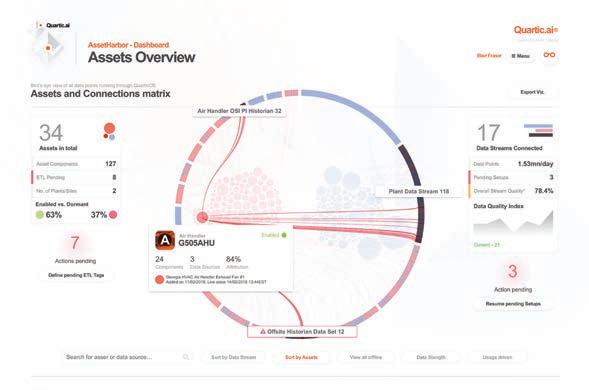
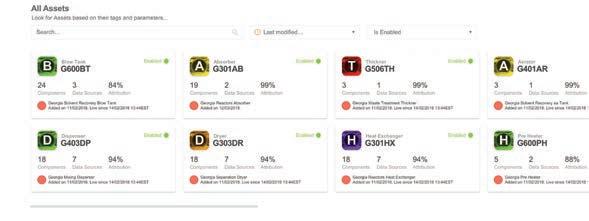
Dashboards showing key data points provide insights into the health of equipment.
Photos courtesy of Quartic.ai
detected well in advance of failure, but also be prevented! This is what we call moving the “P” back on the P-F curve.
Another item to consider when selecting components in an IIoT ecosystem is how well that data can be integrated into other systems and further support the context. Creating this contextual data pipeline, on which real-time machine learning predictions can be built, is the real foundation of a successful IIoT implementation. Many easy-to-use and powerful data pipeline architectures are emerging. (For more information on data pipeline architecture, read “Make a Decision,” page 14.)
Also, consider who owns that data that is being generated by your assets. Remember: If you are not paying for the sensors and the data created by them, you are the product. (See Blair Fraser's tip in “Mr. O – The Practical Problem Solver,” page 38.)
Bringing it all together
A great example of IIoT, contextual data and AI coming together is a project in which we were asked to develop a condition monitoring system for a large agitator that had repeat failures of the shaft.
Having been in the technology for predictive maintenance space for more than a decade, I thought this would be an easy problem to solve. However, it would be one of the most influential lessons in IIoT and AI.
The customer clearly defined the problem to solve: Detect the failure of the agitator shaft before it fails. At the system level, an agitator is a simple asset comprising blades, shaft, gearbox and motor. To monitor the typical failure modes, vibration is without a doubt the go-to sensor to monitor the health of the asset in this scenario.
I recommended that we install wireless vibration sensors on the agitator. Problem solved and another condition monitoring project under my belt. But then reality kicked in – they had already installed vibration sensors when the asset was first installed and had even upgraded them to higher precision sensors the year before. They also had good bearing temperature monitoring, but the failures had continued since.
How can that be? How could an impending agitator shaft failure not be detected by an increase in the vibration? The installation, sensor type and technical details of the sensor were in spec. How could a shaft the width of a tree trunk not cause vibration before it fails? The answer, although simple, could only come from a SME. The scale built up on the agitator was uniform as the blade spun, causing equally weighted scale around the blades, thus causing no vibration changes.
Enter the data, more specifically, contextual information combined with data science. We worked with an AI company to perform exploratory data analysis on the data and to look for correlations in the data that our techniques could not detect.
The results were remarkable. Vibration, the Holy Grail of condition monitoring, had very little correlation in data leading up to the failure. The one variable that had the highest correlation in data was the power draw of the motor. Simple current measurement typically used for energy monitoring or simple phase-to-phase current rule-based monitoring was the best indicator of failure. Using power as a predictor of agitator failure, we could detect scale buildup several days ahead of the failure.
For someone who has implemented hundreds of condition monitoring projects using traditional condition monitoring technologies, this was a very humbling moment. While it was a revelation that power would have a high correlation in data leading to the failure, we needed to build a failure predictor using power. Unlike vibration, where we have ISO-suggested
alert limits and threshold values, power is a varying measurement based on the speed setpoint of the agitator, the level in the tank, the amount of flow going out of the tank and the density of the product being mixed. Take a look at any power trend and observe peaks and valleys that can only be explained with operating context.
We now knew that power was a useful measurement to use to predict an impending failure, but we needed to know what “normal” power was when based on the multitude of variables that can affect power draw, and isolate it to the cause (scale buildup). This is where we took data from IIoT and combined it with AI, creating a machine learning aproach.
A typical technique for using power consumption would be to create a set of rules to determine when the power is not “normal” under the given operating conditions at any time. For example, we would create a rule saying if the level of the tank is X and the speed is Y, the power should be Z. To accurately detect power abnormality, we would need to create thousands of rules. Even if we were able to implement such rules in a typical logic solver (such as a PLC), the dynamics of the process and equipment could change, making some of the rules inapplicable. Using machine learning, which creates the logic or the rules from correlations in data, it quickly normalizes the power variables under all historical operating contexts, creating thousands of rules.
We now take the actual power prediction and use the predicted power value and allow the SME to create their own rules on how to set alarm levels based on the deviation of the two readings.
Solve more problems
When implementing IIoT projects, the best advice is to start with the problem you are trying to solve. Apply reliability fundamentals on how things fail by performing FMEA or RCM to determine if condition monitoring is a viable risk-mitigation tool. Once it’s decided that IIot may be a good choice, start with the available sensors and data first. IIoT does not always mean you need to add new sensors.
Using AI to get from data to actionable insights is not hype – it is real. Everyday, more and more companies are sharing their success stories. IIoT and AI, in collaboration with subject matter experts will solve a lot of plant problems. MRO
Blair Fraser, leader, operational certainty (digital transformation) at Lakeside Process Controls Ltd., is a reliability and operational excellence professional with more than 20 years of experience in designing, commissioning, maintaining and improving manufacturing equipment and processes for the manufacturing industry. For more information, visit lakesidecontrols.ca.
Make a
Decision
An industrial machinelearning solution creates a data pipeline for legacy equipment.
BY REHANA BEGG
Machine learning technology is enabling the way datadriven decisions or predictive maintenance is performed in industrial plants, yet the struggle to keep pace with cutting-edge solutions is ongoing.
The holdup may be due to a lack of expertise in fitting new solutions into existing technology stacks or finding ways to apply machine learning on legacy systems.
One technology start-up that’s helping bridge the gap for using data from legacy equipment in the industrial manufacturing marketplace is Quartic. ai. Based in Waterloo, Ont., the artificial intelligence (AI) and Industrial Internet of Things (IIoT) specialist is developing an end-to-end industrial analysis, sensor-based process automation and predictive maintenance platform.
“Our focus is to make legacy infra-
structure ‘smarter’ as we enable manufacturers to retain their existing operational technology (OT) infrastructure and adding intelligence to it,” says Rajiv Anand, Quartic.ai’s founder and CEO.
In essence, the solution is designed to use data from sensors and machines, as well as from ERP systems, data historians or CMMS systems and turn it into contextual data. Quartic.ai is a modular platform that is designed with industrial end-users in mind, so implementing the platform requires no formal data science or coding background, says Anand, who has a background in process control and automation.
Good contextual data is needed for any good machine learning to work, says Anand. “In data science, 60 to 70 per cent of time is spent in developing the contextual data. We created a platform that automates that process. Our Illuminator application automatically creates the
context of the machine, regardless of how many data sources the data came from.”
Illuminator extracts data from any physical asset or machine – such as rotating equipment, a compressor, a boiler or fermenter – and feeds a data pipeline (also known as a flowing context in real time). A standout feature is that operators can then build their own machine learning models since the application is built on Kafka, an open protocol used for complex microprocessing. The data collected could be related to a machine’s condition, its operation or performance history in general.
Start learning
Illuminator is a gateway for asking, “What type of problem am I trying to solve? How am I going to solve it?” Once integrated, which is a straightforward process, the next step is to make sense
Photo: Getty Images
Looking for correlations in data, feature extraction and feature engineering can be time-consuming, says Anand, but Quartic.ai automates these tasks by allowing users to select features based on their domain knowledge. Moreover, the application is capable of building three models in parallel – each built on slightly different features – and cross-validating the models before allowing the user to approve a preferred model to deploy and provide insights.
Actual analysis
of the data. For this purpose, Quartic.ai has developed another offering, ContexAlyze, which is an enabler for performing powerful visual analytics, including such tasks as root cause analysis or slow degradation of equipment. The application can be tailored to meet the specific requirements of the customer, and allows the user to share just a snippet of information, annotate, or share information across the organization, says Anand.
But the core of machine learning takes place once another application (MetaTrainer) is applied. A drag-anddrop facility allows the user to add unique specifications. For example, if users wanted to build a cavitation predictor on a pump, they would drag and drop the variables in the context of the asset, and, if they choose, add other variables that may have influenced the cavitation (such as the pump speed or pressure).
One of Quartic.ai’s clients, a mineralprocessing facility, experienced shaft failures associated with large tank mixers and agitators (300 to 350 HP) that caused unnecessary downtime.
Once slurry is processed from ore, it is processed under high pressure in large vessels with multiple agitators. The mineral-processing facility had several failures with its shafts, including broken shafts.
“The big concern was that it could lead to agitator seal leakage, which could have safety consequences,” says Anand.
The facility wanted to address the failure as a potential safety hazard, says Anand. “They had tried to address the issue through vibration, temperature and other condition monitoring tools, but the condition sensors alone would not overcome the problem. Exploring whether machine learning could be applied was the next option.
The facility was able to provide three years’ worth of historical data related to the shaft failure. Anand’s team noticed
that there wasn’t anything significant from the condition sensors leading to the failure, and it validated why they were not able to solve the problem using traditional condition sensors.
The most telling indicator was the “behaviour” of the shaft horsepower. “This was a big revelation. Plants and facilities have access to all sorts of smart electrical measurements and there is so much information available about the electrical behaviour of an asset. We learned that if we built a model for this shaft, it ought to be around power.”
Essentially, the problem stemmed from the fact that material builds up on the impellor and the shaft over time. This action causes asymmetry and the resultant imbalance of the shaft, which can lead to seal failure. Using power prediction, a predictor was built for how much material was being built up in the impeller and the shaft to create a predicted value and a corresponding preventive maintenance plan.
Without having the facility change its work processes or systems, Quartic.ai took the prediction output from its model and wrote it back into the facility’s SCADA control system so operators could see it on the screens they use daily. This process would cause very little disruption and it became a variable they could monitor in real time and it would provide an early warning of potential failure. “The facility’s operators set up rules on top of the predictions, as they are the best judge of ‘abnormal’ equipment behaviour,” says Anand.
The tangible advantages of implementing the application at the mineral-processing site include user participation, as well as time and cost savings, says Anand, who estimates that a minimum of 30 hours of downtime was prevented.
Turning IIoT newcomers into experts
Whereas machine learning and AI are generally touted as buzzwords, Anand says that with widely deployed sensors and greater connectivity, manufacturing plants are not only able to squeeze out noticeable improvements in efficiency or flexibility, but are also able to become predictive maintenance differentiators by paving the way forward with data-driven decisions. MRO
Rehana Begg is the editor of Machinery and Equipment MRO. Reach her at rbegg@annexbusinessmedia.com.
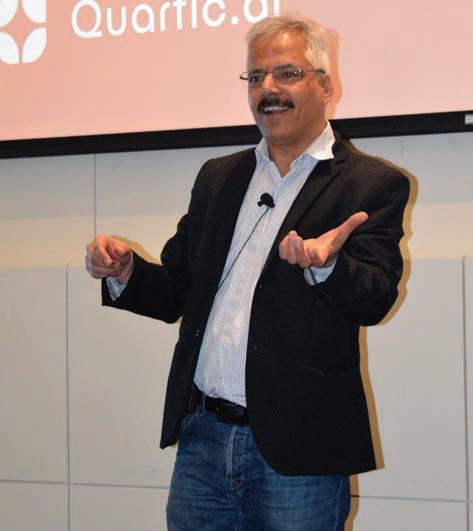
Rajiv Anand, founder and CEO, Quartic.ai, is spearheading a modular analysis platform for industrial plants.
MRO SUPPLY CHAIN
Digital transformation requires new ways of working. Success depends on data-driven strategies, not gut feelings, says Sada Haque.
BY REHANA BEGG
For all the effort devoted to improving downtime, streamlining processes and honing decision-making, relatively few industrial plants claim that they’ve successfully optimized the collaboration between maintenance and operations. It’s an ongoing challenge, and one that Sada Haque is keen to explore through the lens of his new role as director of sustainability, innovation & digitalization at Wajax, one of Canada’s oldest industrial products distributors and services providers.
Machinery and Equipment MRO spoke with Haque to gain insights into how he intends to blend innovation with traditional best practices.
MRO: You have made a significant change after building an impressive career at SKF. Congratulations! What spurred your move?
SH: I recently completed my Global Executive MBA from Rotman School of Management at the University of Toronto. I was looking for a challenge where I could possibly disrupt an industry. The industrial market is up for grabs. We have always been laggards when it comes to technology and innovation. To be able to realize such a disruption, I needed to be able to work with an organization that would have interface with OEMs, vendors, clients, service centres, engineers, technicians and end-users. Wajax offers that platform and has the culture and desire to be the pioneers in what they do.
MRO: How has your previous work history prepared you for this role?
SH: My previous role gave me the opportunity to work with organizations globally and understand their needs. Based on their needs, I had the privilege to design the asset management strategy and maintenance and reliability programs for many customers. My background is in engineering and that, along with an MBA, gave me a good balance of technical competence and business acumen to shape me as a strategic leader. It’s an amazing accomplishment when you know that you have played a pivotal role in helping other organizations go through their improvement journey, enhance their productivity and profits, and meet their business objectives. You know you have made a difference when your customers succeed.
Sada Hague, director of sustainability, innovation & digitalization, Wajax, hopes to challenge industry norms through digital innovation.
MRO: How are you settling into your routine and what are your priorities?
SH: It has been an exciting transition so far. As one of Canada’s oldest industrial companies, Wajax has an extensive footprint across the nation. The organizational culture is warm and welcoming, making my integration very smooth.… My current focus is to build upon our brand equity by developing valueadded solutions for our customers, enhance the sustainability of our business by positioning us as the partner of choice. And to develop new business models that challenge the current industry norms. How can I use big data, artificial intelligence (AI) and digitalization to disrupt this market?
MRO: What is Wajax’s vision for the Industrial Internet of Things (IIoT), digitalization and innovation?
SH: Digital innovation is the need of the hour, with the emergence of Industry 4.0, smart manufacturing and IIoT. The space is highly competitive and customers are looking for streamlined and more efficient solutions. Naturally, Wajax is driven to seize these opportunities and transform our business models in order to meet these demands and retain our competitive advantage. Despite being at the top of our priorities, we don’t want to innovate for the sake of it. We want to develop a digital culture that is effortless and almost a way of life. Our objective is to incorporate this new wave of change and make the transactions with our customers smoother and more tangible, but also effectively trackable. From automated warehouse operations to implementing customized solutions derived from historical data analysis, Wajax is
Photos: Courtesy of Wajax
working toward more reliable and precise delivery techniques that guarantee extended value throughout the lifecycle.
MRO: How does sustainability factor into your Wajax portfolio?
SH: The industry is currently very transactional. Vendors and suppliers are constantly trying to push their products and services with an inside-out approach. But at Wajax, we are taking a more indepth look into how we can be better. We believe in customizing our value propositions and we believe in the voice of the customer (VoC). With our sustainability efforts, we would like to understand our customers' need and perform on-site asset management assessments, so that we could design customized solutions and road maps to help customers meet their objectives. These three-day VoC assessments help us understand the pulse of our customers and allow us to entangle with our customers to start a new partnership with this outside-in approach. The objective is to meet the customers where they are.
MRO: What does digitalization mean in this context?
SH: At Wajax we believe digitalization is an avenue to help our customers optimize their businesses and make it profitable and sustainable. Digitalization is widely mistaken for capturing data, perhaps big data. The idea is to collect smart data, which, put together, effectively can become useful information for the business. This information, when used to en-
able business processes and models becoming much more streamlined, would become a source of knowledge that ultimately leads to wisdom and competitive advantage.
MRO: What is its implication for MRO markets, distributors and OEMs? Why does Wajax support the trend?
SH: Capturing big data is not a new concept. Our customers have already embarked on a journey to equip their critical machinery with all possible sensors to get all possible data/early detections and warnings. However, digitalization, if done the right way, would have five components.
• Data Capturing – Hardware prices are declining by the day, however, more sophisticated technology is still at a premium. Equipping all machinery with online monitoring systems is still a distant dream. Meanwhile, we need to find ways to crowdsource this data and enable this through gamification of our data capturing process.
• Data Integration – Everyone is building new sensors and customers are overwhelmed with several dashboards to monitor the same equipment. Suppliers need to work on a common platform to integrate data and provide better value.
• Data Analytics, Prognostics and Learning – AI, machine and deep learning ensure early detection of failures and failure modes.
• Supply Chain Automation – Customers should have the ability to get the parts they need and factories should opti-
mize their production to complement this demand, albeit data driven.
• Optimization and Sharing – As an industry, we need to continuously learn from each other and share the data that we gather. This creates a win-win situation for all of us, essentially driving our costs down.
Digitalization is a crucial element that ensures Wajax’s ability to retain its leadership and competitive advantage in the market. The journey to become pioneers in our business objectives will greatly depend upon data-driven strategies, rather than gut feelings.
MRO: How does digitalization deliver value to existing business models?
SH: On the demand side, for end-users, digitalization will help them get early warning of failures with defined failure modes and remedies. Reduced unplanned downtimes result in significant savings to the customer. To get the MRO just in time will ensure low inventory levels and higher operational efficiencies. On the supply side, for our OEMs and vendors, their manufacturing will be streamlined with optimized factory throughput. This will help lower the costs – improve bottom lines and pass on the benefits to the customer. For distributors like Wajax, digitalization will enable us to connect our vendors with the end-users proactively and help optimize our supply chain.
MRO: What are some of the prominent trends in Industry 4.0, IIoT and digitalization?
Digitalization is viewed as a way to drive competitiveness across the supply chain.
Photos: Courtesy of Wajax
Aside from using technology, digitalization requires new ways of working.
SH: At present, AI is centre stage of all things digital. AI has gained significant momentum over the past few years showing signs of exciting possibilities in almost every field of business. As one of the biggest trends this year, AI gives a glass-door glimpse into a world of automation and how it can optimize processes from a production and distribution standpoint. A world of true AI, where machines would think, is still a distant dream, but I think with the pace at which we are advancing, it won’t be too long before AI becomes an essential part of our daily lives. And digitalization will ensure streamlining of how we run our businesses. A key aspect would be to transform the traditional scopes of work and workforce practices.
MRO: As plants go digital, they can presumably expect to see a spike in costs. What advice can you offer on striking a balance between human effort and technological innovations?
SH: Digital transformation requires new ways of working, not just new technology. The scarcest resource at many companies is not necessarily technological know-how but leadership. With this in mind, improvements can be framed around the following ideas.
• Leadership – Leaders will need the ability to sift through an avalanche of digital initiatives, manage accelerating innovation cycles, and reshape the organization around new approaches.
• Steal with pride but stay authentic –Learn from others’ successes and fail-
ures, but establish what digital strategy fits into your organization and culture.
• Build a roadmap but stay agile – Define the end goal, be open to redefine the end goal and how you get there (nobody knows the path yet).
• Place many bets and fail fast – Feel free to experiment with technology and business models and when you fail, fail fast to start afresh.
• Set the organization – With the digital strategy, the organization culture will need to go through a transformation as well to embrace the new strategy. Build a talent pool and train your organization to be the digital organization of the future.
MRO: All things being equal, how do you imagine the role of the maintenance of the future?
SH: The future looks really exciting. Maintenance of the future will have millennials leading the way and they will be equipped with technology and IIoT, which will drive big data enabled with AI and complemented with augmented reality. With the onset of Industry 4.0, we at Wajax are striving to provide proactive value propositions to our customers with performance-driven business models and innovation across the value chain. I am excited about the future of digital and Wajax. You will see some good work coming out of Wajax shortly. MRO
This interview has been condensed and edited. Rehana Begg is the editor of Machinery and Equipment MRO. For more information, reach her at rbegg@annexbusinessmedia.com.
Misalignment of machine shaft centrelines causes up to 50 per cent of machine vibration problems and are the result of two common conditions. Parallel offset misalignment is a condition where the centrelines of the two shafts do not meet, whereas angular offset occurs where the centrelines of the shafts are not parallel to each other. Parallel and angular can also exist at the same time. In order to ensure that rotating machinery is reliable, productive and efficient, it is critically important that misalignment problems are eliminated.
Test your alignment knowledge by first answering the questions and then considering the validity in the accompanying solutions to ensure first-rate outcomes.
1. How do you recognize a misalignment problem through a visual inspection?
Logic: Symptoms of misalignment include powdered rubber or lubricant directly below the drive coupling (depend-
ing upon the coupling type), broken foot bolts, oil “shimmering” on the base plate or near the foot bolts, higher than normal energy consumption, cracked or broken foundation, premature or frequent bearing or seal failure, higher than normal operating temperature of one or both machines, at the coupling itself, or high vibration conditions – usually at both machines, and intermittent or continuous leaks caused by pipe strain.
2. How do you determine if a misalignment problem actually exists?
Logic: Using various diagnostic methods, such as vibration analysis, misalignment is characterized by a 180-degree phase difference across the coupling. Using a stroboscope, a misalignment is often indicated when the reference mark is unsteady or rotates intermittently in both directions and measuring temperature will indicate that a very minor misaligned coupling or shaft can cause dramatic temperature increases.
3. Once a misalignment is confirmed, why should you review the machine files?
Logic: Machine history will confirm any previous alignment problems, bearing or seal failures, and past maintenance activities that have been carried out. In addition, understand that thermal growth will affect the resulting alignment, so it is very important to know what the proper operating temperatures of the machine components are, such as at the coupling and bearings. Thermal growth is affected by the type of material used for the machine housings. For example, the coefficient of thermal expansion of aluminum is twice that of cast iron, so aluminum housings will grow twice that of cast iron with the same temperature increase. Thermal expansion is about .01 mm (.000394 inch) per metre (40 inches) for each Celsius degree increase in temperature. Therefore, it is essential to have known and recorded the temperature measurement at each bearing and at the machine housing near each foot during normal operation. The thermal growth must be added when shimming the feet during the realignment process. Also, couplings come in all types, and each coupling has its own vibration frequency and operating temperature. These should be listed in maintenance files.
Photos: Getty Images
4. Are you certain that the correct coupling is in use?
Logic: The causes of coupling failure (depending on the application) are excessive misalignments, improper, inadequate or insufficient lubrication, harsh environmental or operating conditions and excessive speeds or loads, but a primary cause is improper coupling selection for a particular application. For example, a serpentine spring metallic grid coupling is generally recommended for variable high-torque machine trains operating at moderate speed, the transmission of high torque at low speeds should use a chain coupling, while the transmission of high torque at both high and low speeds should use a gear coupling. Once satisfied the correct coupling is used, inspect it for correct lubricant (if used), proper bolts (note length, machining and weight), eccentricity, loose components such as grids, elastomers and disks, proper shaft fit, worn teeth or grid members, and correct setscrew length and tightness.
ered the most precise, but airborne dust can affect accuracy (two popular systems are the Optalign and Combi-Laser).
7. Do you ensure that the completed alignment meets acceptable standards?
Logic: There is a common perception that flexible couplings can accommodate misalignment. However, depending on the coupling type, these components can only accommodate from .25 to about 2.5 degrees misalignment, and highspeed, high-load applications should be aligned to closer tolerances.
Allowable misalignment tolerances are provided below as a guide.
5. Why should you carry out a pre-alignment inspection?
Logic: There are other conditions that should always be considered before carrying out the realignment procedure; these include a review of the vibration analyses reports to determine if pipe strain is a concern because this condition can cause resonant frequencies that will trigger resonance in other components of either the drive, the driven machine or both. If pipe strain exists, these distortions can be determined by mounting dial indicators, then tightening and loosening pipe flanges while noting dial indicator readings. Soft foot is a condition where a void exists between a foot of the machine, the shim pack and the base. This condition can cause distortion, reduced internal clearances, binding rotors and preloading of bearings and seals. Satisfactory alignments cannot be achieved if soft foot conditions are not corrected. Inspect the shaft keyways for wear, and never replace a worn key with a key of lesser length or difference in weight.
6. Are your technicians trained to use effective alignment methods?
Logic: There are several methods in use, among them the reverse dial method used when both shafts can be rotated freely, the face-rim method that requires the use of true couplings, the electromechanical method that will calculate for bar and bracket sag, and the laser alignment method, which is consid-
8. Do you know what types of lubricant to use in lubricated couplings?
Logic: There are three coupling types that require lubrication; namely, gear, chain and “combination” mechanical/material grid couplings. The lubricants recommended include ISO 460 compounded oils containing tackiness agents (to withstand high centrifugal force due to high-speed rotation), ISO 100 oils for machines operating at temperatures at or below -20°C, while NLGI grades 1 and 2 grease containing tackiness agents are also available for these couplings. MRO
L. (Tex) Leugner, the author of Practical Handbook of Machinery Lubrication, is a 15-year veteran of Royal Canadian Electrical Mechanical Engineers, where he served as a technical specialist. He was the founder and operations manager of Maintenance Technology International Inc. for 30 years. Leugner holds an STLE lubricant specialist certification and is a millwright and heavy-duty mechanic. He can be reached at texleug@shaw.ca.
In Good Health
The application of machine-learning techniques is far-reaching. One industrial engineer takes asset performance improvement services off the beaten path.
BY REHANA BEGG
We take for granted that access to safe drinking water and sanitation is a basic human right. Yet, for the millions of people of Tanzania who face conflict and are internally displaced, this basic need is denied. Their plight is a concern that Chi-Guhn Lee takes to heart and a reality that underpins a research project in which the University of Toronto professor of industrial engineering has been able to exercise his specialized optimization problem-solving skills.
In an ongoing project with Doctors Without Borders, Lee has been able to apply industrial engineering and machine learning ingenuity to test and predict the quality of water at Mtendeli refugee camp in Tanzania.
He says that it is typical for young boys in the camp to carry buckets of water back to their camps and shelters, sometimes located several kilometres away from the water supply. The water is then stored and used over 24 hours or more. The safety of the water is a big concern because waterborne diseases are among the most significant threats and recontamination after distribution in camp settings remains poorly understood.
Inadequate water quality provides the impetus for measuring the water’s chlorine levels at the site of consumption to ensure its condition remains at acceptable levels. The World Health Organization (WHO) guidelines for drinking water quality recommends free residual chlorine levels should be 0.2 - 0.5 mg/L under normal circumstances and 0.5 - 1.0 mg/L during outbreaks of diarrhoeal disease, or when the water supply is especially turbid or alkaline.
Data was sent directly from the camp in Tanzania – “where infrastructure is horrible,” says Lee. He used the raw data to make predictions about the quality of the water “one hour from the faucet, two hours from the faucet, three hours and four hours….It is just like the remaining life of the equipment. In this case, the asset is the water quality.”
Using machine-learning tools (a combination of traditional regression and machine learning techniques, such as clustering algorithms and random forest), along with some innovation, Lee was able to forecast the quality of water based on the concentration of chlorine in the water over time, and as a function of various environmental conditions – from temperature, sanitary condition, location of the bucket (in a tent or structure) to the walking distance from the faucet.
The outcomes of the research are still in progress, but the end goal is “to control the water differently and to ensure the quality of the water is above the acceptable threshold until consumption,” says Lee.
Predicting good health
The Tanzanian water project demonstrates the scope of Lee’s
Chi-Guhn Lee, director of C-MORE, used predictive modelling to gauge water quality at a Tanzanian refugee camp.
research capabilities and is one reason he is a good fit for his role as director of the Centre for Maintenance Optimization and Reliability Engineering (C-MORE), an incubator for new methods on maintenance decision-making and reliability engineering, which operates within U of T’s department of mechanical and industrial engineering.
Lee joined the U of T faculty in 2001, where his areas of research include both the theory and the application of the Markov decision processes – a mathematical framework for modelling dynamic decision-making. In particular, he tackles decision processes involving reinforcement learning, which is a dynamic machine-learning technique in which machines learn optimal behaviour by quantifying and optimizing performance based on changing environments.
Lee’s research approach has relevance in industrial maintenance and reliability practices, where one can predict the health condition of a machine by considering operational conditions. “This is extremely important in reliability engineering because, depending on how often you maintain or make an inspection, and depending on the action you are taking, the system will react very differently,” says Lee.
“Consider a huge haul truck on a mining site. What is the temperature? How much load has the truck been moving since the last inspection? I see a striking similarity between the water quality prediction model and the health condition prediction model, which is the basis for optimization of maintenance actions.”
The field of inquiry makes sense for maintenance decision-making, as it helps maintenance practitioners make decisions optimally and dynamically over time, based on observations such as vibration data and oil samples. “Things change continuously, so decisions should be based on changing conditions….If we include reinforcement learning as part of the maintenance optimization solution, then it’s not only automated, but also self-learning.”
Pumping for better results
At C-MORE, where the focus is on real-world, applied research in engineering asset management – such as condition-based maintenance, spares management, protective devices, maintenance and repair contracts, and failure-finding intervals – Lee and his colleagues put theory into practice.
In a project with Barrick Gold, one of the largest gold mining companies in the world, C-MORE researchers were given sensor readings for two major pumps at one of Barrick’s mine
Photos: (Top) Rehana Begg; (Insert) Getty Images
sites and were asked to provide a statistical analysis.
At the mine, the high-capacity pumps propel water from the bottom to the top of the mountain as part of mining operations. The pumps were retrofitted with eight different sensors and monitored over the span of three years. Data on temperature readings, pressure and vibration levels were collected. “So we have rich data and we are reviewing it and applying statistical tools to try and understand the behaviour,” says Lee.
In essence, Barrick wants to estimate the health condition of the pumps, or its remaining useful life. C-MORE’s statistical analysis will provide guidance on when to intervene with preventive maintenance at an optimal time.
The ROI for Barrick can be significant, says Lee. As an industry guideline for general maintenance, the savings can be 20 to 35 per cent, but Lee has seen case studies with up to 60 per cent savings.
This is where C-MORE’s twin roles in research and consult ing merge. The pump analysis is one of several projects in which C-MORE has forged interactions with Canadian and internation al industries. Through its con sortium members, C-MORE can access corporate databases and apply its research tools and pro prietary software prototypes.
“C-MORE has been one of the few successful cases where in dustrial engineers have worked successfully with private sector in getting their investment, and that’s why I see C-MORE as criti cally important,” says Lee.
For its maintenance consult ing effort, C-MORE charges an annual fee of $35,000 – a fraction of the consulting fee that a com pany may have to pay a profes sional consulting firm, says Lee. And since C-MORE is housed at U of T, consortium members have access to world-leading re searchers in such areas as com puter science, deep learning and machine learning.
Networked systems
One of C-MORE’s long-term goals is to diversify its portfolio and expertise. While mainte nance and reliability engineer ing remains the core area of its research, the centre plans to ex pand into connected areas, such as production scheduling, ener gy management, and selected ar eas of service optimization, such as pricing, says Lee.
These areas also have a natu ral affinity with Lee’s interest in networked systems. “The main tenance cost can be a complicat
ed function of how the components are connected. I am very interested in addressing maintenance and reliability issues along a networked system, and machine learning can be an essential tool to tackle such problems.”
Planning the way forward, Lee envisions the work of C-MORE to be a catalyst for combining theoretical methods and research with the practical potential of maintenance practices as it evolves with the pace of technology.
“We use mathematics, probability and statistics to come up with a better policy to maintain physical assets for the best outcome, given the same investment,” says Lee. “Machine learning makes perfect sense, because given the rich data through IT today, we have opportunities for improvement given the highly sophisticated computer-based systems to improve maintenance.”
The Year in
2018 Conference
Join infrastructure leaders and executives in London to hear from industry thought leaders, engage in forums and discussions, and learn about technologies and best practices that will shape the future of infrastructure delivery and operations.
Presented by Bentley Institute, the Year in Infrastructure Conference is a global gathering of leading executives in the world of infrastructure design, construction, and operations focused on best practices and technologies for going digital. The Year in Infrastructure Awards, formerly known as the Be Inspired Awards, is an exciting and well-regarded global competition that recognizes the “going digital” advancements in infrastructure. See presentations from award nominees and join us at the celebratory gala, recognizing the world’s most outstanding infrastructure projects in 2018.
October 15 – 18, 2018 I Hilton London Metropole REGISTER AND LEARN MORE AT YII.BENTLEY.COM
Automated Grease Systems
A selection guide reviewing the merits of system type relative to single- and dual-line parallel systems.
BY IAN MILLER
No matter what the type of equipment or its function, system designers are faced with choices at the onset of any project. Take as an example the differences between single-line and dual-line parallel systems. Understanding the benefits of each facet of both the mechanical and control systems will enable a designer to pair the best possible solution with any application.
Single-line, parallel automated lubrication
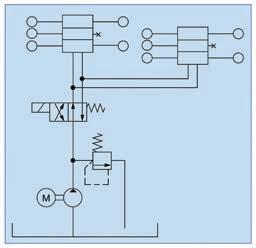
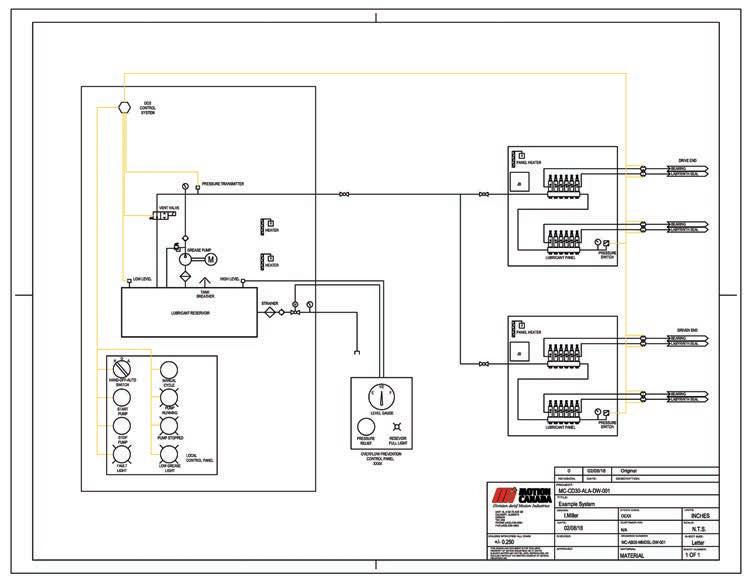
Single-line, parallel automated grease systems are commonly implemented for medium to large applications that require multiple lubrication points, often over a fair distance, and that require a moderate to large amount of grease per lube point (injector sizes typically range from 0.5 cc to 8 cc). The layout of this style of system is illustrated below.
Single-line, parallel automated system
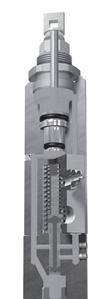
The primary components of single-line parallel systems are the injector banks, a dump valve and a pump. These injectors typically work on a two- or four-stage charge and discharge cycle. This cycle requires the pump to build pressure/flow in the feedline to the injector bank (filling the metering chamber) and then depressurizing the feedline (facilitated via the dump valve). During this depressurization, the injector’s internal spring will force grease from the measuring chamber out to the servicing lube point. This style of injector is typically adjustable and can also be daisy-chained together, making the metering of an exact volume of grease extremely easy to facilitate.
Grease in any system will always take the path of least resistance. As a result, not all injectors will charge or discharge at the same rate. This means that before transitioning from the charge to the discharge cycle, some form of feedback is needed. The most common method for this feedback is the implementation of end-of-line pressure switches. During the charge cycle, the injectors will start to fill and the pressure will remain relatively low. As the injectors reach capacity, this pressure will increase. End-ofline pressure switches are typically set around 1,500 psi to 2,500 psi, depending on the application.
After confirming all the injectors have charged, the dump valve can then be energized, providing a path to tank and depressurizing the feed-line. As the feedline pressure falls below 1,000 psi, the injectors will begin to discharge, and once the pressure reaches zero, the circuit is then ready to be charged again. It is good practice to install these pressure switches at the intake of each injector bank because it ensures that new grease flows through the switch during each cycle. Incorrect placement of these switches can lead to decreased equipment life and unreliable operation over time. It is also typical to see the implementation of a pressure transducer located at the output of the pump.
Photos: (Left) Getty Images; (Top) Courtesy of SKF
This can be tied via logic in the systems controller to ensure proper system operation and providing indication of such things as a failed pump or open feed-line. The cost of the system is heavily dependent on the size of the application, but it is fair to say that most single-line parallel systems hold a moderate-to-high price tag. That cost, however, is not without value – these systems are very reliable and probably the most popular (by install base) for moderate-to-large systems. Capable of feed-line lengths that average 100 - 200 feet, the limitation of these systems is typically dictated by the type of grease used, operating temperature and supply line size.
Dual-line, parallel automated lubrication
Dual-line, parallel automated grease systems are commonly implemented for large applications that have up to 1,000 servicing lube points. They can also span distances exceeding 1,000 feet, while also delivering large volumes of grease (typical metering valve volumes range from 1.5 cc to 5 cc). The topology of this style of system is illustrated below.
Dual-line, parallel automated system
The name “dual line” gives some insight into the heart of this style of system. Whereas the single-line system relies on one supply line being charged and discharged, the dual-line relies on two separate pressurized feed-lines running to each metering valve manifold. This system can be thought of as a hybrid of the single-line and progressive systems. Taking strengths from each, its operation is analogous to the combi ned operation of both systems. The result of this hybrid design is that the dual-line system is the most versatile, robust style of automated greasing system currently on the market. The operation of this system, like the others, starts with the pump. The pump is energized and builds flow/pressure on feed-line A. This is facilitated by the directional control valve mounted at the output of the pump (it takes the place of
Single-line parallel system for an ore crusher
the dump valve for the single-line system), which connects A to the pressure line and B to the tank line. As pressure/ flow builds on this line, the metering valves are charged/discharged. Each metering valve contains two spools: the control spool and the metering spool. The control spool is used to control the grease flow paths inside the valve and to alternate from connecting the metering valve to the discharge (lube point) and to the feed-line (how it fills). The metering spool both accepts grease that is to be discharged in the next cycle, while simultaneously discharging the grease from the previous charge cycle.
Thus, as line A feeds the metering valve, the control spool is forced to the opposing side – allowing a flow path for the grease to the metering spool on the A side. As the metering spool fills on the A line side, it also discharges the grease that was stored in the previous cycle on the B line side. Once full, pressure begins to build and, as with the single line system, end-of-line pressure switches (or transducers) are used to indicate that all metering valves have cycled. After the A-line cycle is complete, the directional control valve at the output of the pump is shifted again and the A line is now connected to the tank, and the B line is connected to the output of the pump –thus initiating the B-line cycle.
The operation of the metering valves is very similar to that of a progressive block, but one with only two stages. The rest of the system’s operation is very sim-
ilar to the single-line system with one important caveat: instead of relying on the spring inside of an injector in combination with the depressurization of the systems feed-line, the system instead actively forces the grease out of the metering valve using force transmitted from the current charge cycle. Very elegant in both concept and execution, the active cycling based on flow/pressure from the pump, and not a spring, is what enables this system to operate over such great distances and what allows one pump to service so many lubrication points.
The sheer mechanical design of this metering valve is not solely responsible for the transmission of grease over such great distances – it only enables it. The force required to transmit this grease still comes from the pump itself, which, in dual-line systems, typically has much higher operating pressures (on average up to 5,800 psi). This higher operating pressure is what allows the system to overcome the line losses associated with transmitting grease over great distances.
The popularity of the dual-line system is certainly dwarfed by that of the single-line and progressive systems when comparing install base. In truth, these systems are usually only seen on paper, pulp, steel, cement and mining applications, where long continually running systems require both accurate and reliable greasing under extreme operating conditions and typically with very little downtime. Thus, the single biggest constraint of this style of system is its budget
and that is why it becomes not a practical option for servicing moderate or smaller applications. With all the same monitoring/ system-augmenting options of the single-line system, dual-line systems are without question the top of the line, most versatile solution for applications that can justify the overall budget.
Control systems
Stand-alone Control: Stand-alone controllers are a very popular option and usually come in two forms: integrated controllers provided by manufacturers and custom controllers provided by sys-
tem integrators. Both options are valid and have their own merits. The manufacturersupplied controllers are usually fairly easy to install, often have a good price point, and have the advantage of coming preprogramed with a fairly rudimentary operator interface for setting lubrication cycle timing and other system parameters. A major drawback of this style of controller is that it is typically rigid in its application, difficult to troubleshoot, and can have long lead times for replacement. For these reasons, some system designers will instead choose to use a plant-standard micro-controller that can
Stars in Automation!
be programmed by local maintenance or a system integrator. The logic required to program these systems is very basic and can usually be accomplished in 50 lines of ladder logic or less.
Distributed Plant Wide Control: Integrating the control of an automated lubrication system into a plant’s existing distributed control system is another popular option. This is probably the best option for moderate to large systems, but not always a practical solution for smaller applications. These systems already exist at most plants, but the integration of them is not without cost; both the cost of hardware and programming can be substantial. For larger systems, however, the cost of integration is usually overshadowed by the benefits of being able to make the equipment’s operation visible for trending over time. For plants where the industrial internet of things is an active initiative to aid in improving predictive maintenance, the opportunity to capture this data is invaluable. It enables the owner to improve the overall effectiveness of the lubrication system and capture information that can be used to predict the life of the equipment being lubricated. This makes controlling an automated lubrication system by a plant’s distributed control system the ideal solution where costs permit.
Determining the most efficient, economical and practical product for your given application is the key to good system design. Never before has there been a time where so many products of such advanced design have been available for implementation. Continued diligence by system designers to stay current with these technologies is needed to ensure that end-users of these great advancements can take full advantage.
MRO
Ian Miller, E.I.T., is branch manager of Motion Canada’s Calgary Service Centre and Alberta-based Tech Group. Miller has more than a decade of automated lubrication, hydraulic and electrical experience in the field. For more information, visit MotionIndustries.com, MiHow2.com and bit.ly/2oc7get for short, instructional videos and demonstrations.
The revolution is here.
Take on the most demanding applications with CONTI® SYNCHROCHAIN CARBON heavy-duty timing belts. Our technology combines light but durable polyurethane teeth with high tensile carbon reinforcement to deliver up to 15% more horsepower. Contact Continental for a complimentary drive analysis. We o er complete drive solutions, including belts, metal, and a team ready to help you get the most from your drives.
On Mission a
Maintenance completes more work when it starts with the right goal.
BY DOC PALMER
Maintenance crews typically do not complete nearly as much work as they could simply because they are not given enough work. Instead, they complete enough work to ensure everyone is kept busy completing the reactive work, plus PMs that are due. There is a big difference in work completion because of Parkinson’s Law.
Parkinson’s Law says, “The amount of work assigned will expand to fill the time available.” This notion, explained in The Economist in 1955 by Cyril Northcote Parkinson, means that if you do not give someone enough work, the amount you do give them will take more time than it should. In fact, in 1986, Margaret Thatcher quotes Michael Gorbachev as saying, “Parkinson’s Law works everywhere.” Parkinson’s Law is alive and well in maintenance.
Keeping busy is different from working toward a goal of work. We all know in our own lives that we are more productive when working from a list of things we need to do.
Maintenance life is the same way. A typical maintenance environment is very distracting. Some jobs run longer than their time estimates and some finish sooner. Operations continually makes requests for new work that cannot wait. Maintenance crew supervisors become traffic directors shuffling craftspersons from place to place. Their primary focus is to make sure everyone has something to do. And they do that very well. Such plants in these environments can be good plants. Nevertheless, crews that start with a mission of a certain amount of work to complete for the week greatly outperform crews that simply keep everyone busy. Crews that start with proper goals typically complete as much as 50 per cent more work each week. A crew typically completing 100 work orders each week could be completing 150 work orders each week. This great difference is the result of Parkinson’s Law in maintenance.
The sense of mission makes the difference in productivity. Simply being here to take care of operations and ensure PMs do not get behind is not a proper mission if productivity is the goal. Having 400 hours of work ready for a crew of 10 persons (with 400 hours of available labour capacity) to start the week is a much better mission. In the first case, the crew is “here,” whereas in the second case, the crew is here to complete a certain amount of work. A mission of availability is replaced by a mission of productivity.
Doc’s Tip: Give your maintenance crews fully loaded weekly schedules to challenge them, but allow them to break the schedules when appropriate. Watch productivity increase.
The weekly schedule should function as goal setting. In goal setting, if the goal is too high or too low, it does not affect normal performance. Goals that are too high do not change normal performance. If the goal is too high, persons do not put forth any extra effort because they cannot achieve the goal anyway. Goals that are too low also do not affect normal performance. Low goals are achievable with only normal effort. What is the proper goal for a weekly schedule? Some plants schedule 120 per cent as “stretch goals,” but these plants are not very successful in increasing their productivity. Similarly, some plants only schedule 80 per cent or less to allow for break-ins, but this practice also does not seem to result in any more work completion than normal. Experience has shown that crews that start off with a goal of 100 per cent of their forecasted available labour hours are most productive. But a key aspect of goal setting is that it must be okay if the goal is not met. If there is punishment for not meeting the goal even with extra effort, no one wants to participate and everyone disparages the whole program. In effective goal setting for the week, it must be acceptable to break the schedule. In proper plants with 100 per cent loaded schedules where supervisors can break (but not ignore) weekly schedules, supervisors give that extra effort.
It is surprising that such a great opportunity would exist in most companies. Dr. W. Edwards Deming says, “The big problems are where people don’t realize they have one in the first place.”
In maintenance, no one looks for the opportunity to complete more work if everyone is already busy. And simply telling supervisors to “pick up the pace” is not the way to do it. Everyone truly is already busy working. No one is standing around.
Defeat Parkinson’s Law in maintenance with fully loaded schedules each week for maintenance crews. Increase your workforce with hiring! MRO
Doc Palmer, PE, MBA, CMRP, is the author of Maintenance Planning and Scheduling Handbook and as managing partner of Richard Palmer and Associates helps companies worldwide with planning and scheduling success. For more information, visit www.palmerplanning. com or email docpalmer@palmerplanning.com.
Photo: Getty Images
RETIREMENT
Industry tends to stick with ingrained misconceptions on asset renewals. Commonly held statements, such as “haul trucks last 20 years” or “plants are designed for a 30-year lifespan” persist. But misconceptions pose risks. Anyone involved in maintenance and reliability work has experienced the use of assets that are beyond their useful life. In many cases, it is a cost centre issue: we don’t have capital, so continue maintenance, or, our maintenance budget is blown, capitalize it!
How do we actually optimize the lifecycle to attain peak value? What drives obsolescence?
A renewal program enables an organization to manage the final lifecycle phase of assets in a proactive way. This forwardlooking approach prevents value destruction caused by unreliable and unserviceable assets that have reached their life limit. Developing a program requires a clear understanding of what is life-limiting. There are many things that should be considered when determining what defines the end of the serviceable life of an asset.
The first consideration would be to understand what is truly life-limiting. For example, if an engine is burning oil, it is not at the end of its life. It can be rebuilt. So what is life-limiting on a gasoline engine? The cylinder wall thickness. It can only be bored out to a predetermined measurement. Following are other considerations.
1. A physical life-limiting factor that can no longer be maintained. This would be a primary component that cannot
be satisfactorily restored by maintenance. It may require metallurgy or non-destructive testing to validate the limiting factor where loss of function is inevitable.
2. An economic end-of-life condition. In this case, the asset can function and can be rebuilt, but the cost of providing the required function is no longer acceptable. The full restoration of the asset to like-new condition – for example, replacing degraded wiring harnesses – is not cost-effective.
3. Operational cost factors. This may be energy consumption driven, and there may be a positive ROI for upgrading to a more energy-efficient unit. Another example would be replacing haul trucks with autonomous units. With advances in automation and controls, operational cost drives many renewal efforts.
4. Environmental impact factors. Some assets can no longer meet evolving environmental standards. With the onset of carbon management and contamination containment standards, some assets are incapable of meeting emerging requirements. This has risen to a primary asset renewal concern.
5. Technological factors. With advanced automation and control systems, some assets may no longer fit the process. For example, if all functions are managed through the operator’s distributed control system, but one asset has to be manually started or controlled, it is technologically obsolete.
6. Performance requirements. In some situations, the designed throughput is not aligned with the production objec-
tives. Some assets in a process may be capable of delivering the throughput, but at some point there may be assets that bottleneck the operation. This is a functional change of an asset, which would fall under modification, not renewal, but is still a consideration for strategic planning.
To develop an asset renewal program, the objectives of the operation are the primary input. This factor must be understood. The renewal program for a mine, for example, must be aligned with the mine’s plan. A mine that has an ore body reaching depletion within five years will manage renewals differently than a mine with 50 years of life remaining. Some factories are disposable, as the product they manufacture will be obsolete in five years. However, breweries, for example, run plants that will be there until humanity stops drinking beer. So, what are the objectives of your operation?
The next consideration is to define which assets qualify for the renewal program. Though asset criticality is considered, it is not the only criteria. Asset qualification can be driven by answering the following questions:
1. What is the criticality of the asset?
2. What are the consequences of this asset failing in a non-restorable manner?
3. Can contingency plans be developed?
4. Is there redundancy or buffering to consider?
5. What is the availability (lead time) of replacement assets?
After the selection of high-risk assets as qualifiers for a renewal program, devloping a forward-looking plan is a must and should be for the long term. Using a 100-year plan may seem very unrealistic, but keep in mind that, regardless of the time frame, the plan will have lower resolution as one progresses into the future. There is nothing wrong with this. For example, if an asset requires replacement or restoration every 12 years, enter it. In 50 years there may be new technology – then change the plan. A key point is, the plan is only a plan, it can change. The objective to strategically manage the assets doesn’t change. Fill in the plan with what you know.
Now the current state of the assets must be understood. Where are they in their remaining useful life profile? In far too many situations I have seen organizations with sudden failures. Con-
Developing asset renewal strategies.
BY JEFF SMITH
Photo: Getty Images
sider the following scenario. Suddenly, the hydrogen buffers were cracking at the longitudinal weld. This was a “very” high-risk issue. The buffers were engineered for a 30-year lifespan and were only 10 years old. As per any root cause analysis, the question was, “Why?” The buffers were designed for a 30-year lifespan based on a pressurization every hour. The site decided to change the process (operational loading) to pressurize every 20 minutes. This resulted in the “sudden” failure after 10 years. Now let’s phone HydrogenBuffers-R-Us and have one delivered….So sorry, three years’ lead time!
How do we determine the current state of an asset to enable forecasting of replacement? There are many things to consider, as the example above shows, and operational loading is a key consideration. Here are some of the factors considered to gain confidence in estimating the remaining useful life. (For best results compare all inputs).
1. What are the original design specification estimates?
2. What is the duty cycle the asset is subjected to?
3. How is operational loading managed? (overloading, under-loading, shock-loading, environmental-loading, etc.)
4. What is the plant history with similar assets?
5. What does Weibull analysis of failure data indicate?
6. What does the inspection and work history data reveal?
7. What are the metallurgical examination results?
8. What are the results of the cost analysis review?
9. Are there any operational, environmental, technological and performance considerations?
Armed with a list of assets and their estimated remaining useful life, we can then develop an asset renewal strategy. Assets that have exceeded 75 per cent of their useful life should be considered for budgeting and availability. The renewal of an asset becomes a project within itself. There are multi-
ple considerations within this project, as it is an opportunity to improve the asset from multiple perspectives, such as maintainability, durability and operational performance.
Asset renewal strategies must be aligned with the objectives of the organization. In some cases, this is not replacement or improvement but conscientiously not maintaining. For example, if you run a mining operation and will deplete the ore body in three years, then you should “run-out” your assets. The ideal situation would be to have the last truck break down as it
reached the scrapyard after dumping the last reclamation top soil load. There is little point in scrapping assets with rebuilt engines and new wheel motors. The value of managing a renewal program cannot be overstated. MRO
Jeff Smith is a reliability subject matter expert and the owner of 4TG Industrial. His work spans a cross-section of industries, including oil sands, mining, pulp and paper, packaging, petrochemical, marine, brewing, transportation, synfuels and others. Reach him at smith@4tg-ind.ca or visit 4tg-industrial.com.
WE OPTIMIZE YOUR MACHINES
HEAVY INDUSTRY LUBRICATION
Slow-moving bearings in tough environments face unique greasing challenges.
BY DOUGLAS MARTIN
In Canada’s tough climate, “heavy industry” generally uses large, slow-moving bearings for big and dirty equipment.
Tough environments do not only mean dirty and wet, but also cold (-40˚C) in the winter and hot (+40˚C) in the summer. To simplify, slow and dirty refers to a wide temperature range. Each of these elements poses a challenge to bearing lubrication.
Most heavy bearings are lubricated with grease. Grease serves two functions: lubrication and sealing. Lubrication is the creation of a separating film to prevent metal-to-metal contact of the rolling elements with the races and sealing bearing prevention of ingress of contaminants.
Slow rotation
Slow rotation poses a problem with lubrication. The relative speed of the rolling element over the races is not fast enough to create a separating film between the two surfaces. When the speed is below 20,000 mm/minute (rpm x pitch diameter), theory says a lubricating film cannot be created by the oil, regardless of the viscosity.
Under this speed the additive package or the extreme pressure (EP) properties of the grease becomes very important. It is often recommended that moly additives, graphite additives or Teflon additives be used to create a solid film to prevent metal-to-metal contact.
The soap type can also be helpful in slow-rotating applications. A calcium-sulphonate grease has some very good EP properties that may help.
Prevent contamination
The most important role of grease in a dirty-wet environment is its ability to block the path of contamination into the bearing and to carry away the contamination. To do this job, the grease does not have to be going to the bearing; it can be applied to the external seals or cavity beside the bearing to prevent and push away the grease before it even gets to the bearing.
One tactic is to create a system in which there are three barriers to the contamination. The first is a grease purgeable seal (often referred to as a taconite seal), the second is the space around the bearing being filled with grease, and the third is a seal integrated with the bearing.
The bearing itself is lubricated by its initial factory pack of high-quality bearing grease. This may occasionally need to be replenished. The cavity beside the bearing and the seals can be packed and regularly charged with a lower-cost or biodegradable grease. The only caveat to this method is to be sure that the right grease is used in the bearing and the right grease is put into the “sealing” areas. But education in simple tools such as colour coding or a different grease fitting (that is, button head for the bearing
and standard nipple for the purges) may prevent incorrect grease usage.
Over-greasing concerns
I look at a minimum of one failed bearing per week and have been doing so for more than 20 years. And I can confidently say that I have seen many, many more bearing failures from a lack of lubrication and from contamination than from too much grease. The only cases of too much grease that spring to mind are in bearings with an integral seal (such as ball bearing unit blocks) where the grease pops the seal and in higher-speed bearings with inadequate passages to allow the spent/contaminated grease to exit the system.
Hot and cold
Challenges are more likely to stem from the cold, rather than the hot end of the temperature range. One thing in a bearing’s favour is that when it is operating, it generates heat, so when the temperature is -40˚C outside, the temperature inside the bearing is typically warmer. The time spent at these low temperatures is probably very short. As well, if there is a condition where the grease has thickened, more heat will be generated, essentially “fixing” the problem.
Other problems associated with cold conditions are associated with delivery, as opposed to lubrication itself. Typically, both manual greasing systems (sending a technician out to a bearing position
Photo: Getty Images
on a very cold day) and automated greasing systems are inclined to malfunction when the temperature falls. There is no easy solution to this problem and it explains the challenges faced by maintenance teams.
The lack of easy-to-access technical resources for greases in cold conditions is also a factor. Lubricant documentation often overlooks discussions about sub-zero operating temperatures. It is not clear whether this is a function of the market size (not enough customers interested in these conditions) or whether extreme cold is only a transient condition when speaking of the temperature at the lubricating gap (which is where it really matters).
A colleague comments that more problems occur at the higher ambient temperatures rather than the lower ambient temperatures. In other words, those who attempted to address perceived “cold weather” problems had more problems in the summer when the ambient temperatures were in the 30˚C range than those who selected lubricants for the higher temperatures had in the cold weather. This lends credence to the idea that the bearing does not operate at -40˚C for very long.
When faced with a wide temperature range, greases with synthetic base oils contribute to a wider range of operating temperatures due to its inherent low-viscosity index, as it reduces the change in viscosity with temperature.
Vibration and shocks
Overall machine vibration and shocks play a role in bearing lubrication in that they cause the grease to be displaced. In a machine that runs smoothly, a reservoir of grease is built up predominately on the cage bars. This grease undergoes a cycle in which it slumps onto the rolling element, then back onto the cage bar. Each time it runs through this cycle it ages. Anything that causes this cycle to occur more frequently also causes the grease to age faster. When a bearing experiences vibration or shock from external sources, it causes the grease
to slump into the rolling path at a much greater frequency, thus causing the grease to age much faster. As well, it can cause the grease to purge away faster from the bearing cavity.
Another concern is that constant vibration can cause oil separation from the carrying soap.
What is unfortunate is that a lubrication frequency may be calculated for a machine that is running smoothly and then the operating conditions change. An increase in machine vibration caused by an imbalance from a broken blade or
hammer (as in a hammer mill) can cause the effects noted above to occur. Without an adjustment to the lubrication frequency, the bearing can fail from “inadequate lubrication,” and also depends, from the lubrication technician’s standpoint, on whether the scheduled grease frequencies were followed. MRO
Douglas Martin is a heavy-duty machinery engineer based in Vancouver. He specializes in the design of rotating equipment, failure analysis and lubrication. Reach him by email at mro.whats.up.doug@gmail.com.
Feel the need for speed? Our open design cable carriers for 3D movements on robotic equipment allow for incredibly fast and easy cable laying. Simply press in the cables...no threading through is necessary! Quick inspection and troubleshooting of all cables is possible with this innovative open design. All cables are cleanly isolated in three separate chambers, which enables easy organization and replacement if necessary. Choose from the many accessories available to build the perfect “dresspack” system and make your robotic equipment King of the Road.
Workflows and Swim Lanes
A structured work order process keeps us going with the current.
BY PETER PHILLIPS
About 20 years ago, while I was helping a car parts manufacturer north of Ottawa with its maintenance software, I realized they were missing something fundamental in the way its work orders and maintenance personnel were managed.
I had been at this plant six months prior and had helped them clean up the backlog of work orders. Their maintenance software was full of old work orders that no one knew anything about. They didn’t know the status of most work orders. They had a hard time answering questions about whether a work order was started or completed, or who had them. So we closed nearly 1,000 work orders, reset the preventive maintenance frequencies in the CMMS and basically started with a clean slate. All the maintenance supervisors and tradespeople were given refresher CMMS training and off they went using the cleaned-up maintenance database.
Back at the plant six months later, I was surprised to find 600 backlogged work orders, and, as before, no one knew much about these work orders. I asked myself: What in the world is wrong with these people? Why are work orders not being processed in the software and why are some partially completed and some not at all? And why doesn’t someone know the status of these work orders? Keep in my mind that a lot of these work orders were physically completed in the field by the technicians but never updated in the maintenance software.
It was only then it dawned on me that no one knew what their roles and responsibilities to the work order system were – they had no workflow. Work orders would be created in the CMMS but would not always find their way through the work order system to the supervisor and on to the technicians. The ones that did make it through were not updated properly and were closed with little information about the work done. The vast majority of them seemed to fall into a giant black hole never to be seen again.
My dilemma was: What do I do about this problem? We decided to get all the work order contributors together to dis-
cuss how they process work orders. We had everyone – all the production supervisors, engineers, safety and environmental staff and anyone who wanted work done by the maintenance department. On a large whiteboard we designed a workflow diagram. The process started the minute someone submitted a work request and flowed all the way through the various steps in the software and the people touching the work order until it was completed successfully and closed in the CMMS. The diagram absolutely surprised me and everyone in the room. We quickly realized how they had gotten into their previous situation with their maintenance system.
The flowchart identified every step of the work order and who was responsible for completing that step and moving the work order closer to completion. While documenting the process we also realized that not all the work orders made it into the software. A lot of work requests came to the maintenance department via email, phone, notes on the supervisor’s desk and through word of mouth to maintenance staff. This added further bottlenecks and confusion of getting important work completed on the equipment.
Photo: Getty Images
From the workflow diagram we could also identify who needed training in the software. Starting with the work request submission, all the way to work-order completion, every person was given specific training to know their piece of the puzzle inside and outside of the CMMS.
After the workflow design session a great deal more work orders were flowing through the maintenance software. Technicians were assigned more work, so their productivity increased, and the people who submitted the work could access the CMMS and see how their work request was progressing. A side effect was the maintenance supervisor became much busier assigning, distributing the work orders to the technicians and then closing the work orders when they were returned from the technicians. The supervisor’s job became more administrative, with much less time available to supervise people.
Role of the planner
At this time in maintenance history I wasn’t the only person who recognized the need for workflows. Small to medium manufacturers and processors were
starting to use CMMS systems and because of this we saw the birth of a new position called a maintenance planner. At the time, only large facilities such as refineries and paper mills used maintenance systems. They generally employed a planner because of the complexity of their huge maintenance turnarounds and outages.
The planner’s role is to organize work for the technicians based on what work requests are submitted and created by the maintenance software. The planner role relieves supervisors from the CMMS administrative role and gets them back to supervising maintenance activities. In the workflow routine, the planners process all the work orders in the system and prepare them for the supervisor, who assigns and distributes tasks to tradespeople. The tradespeople execute the work and return the work orders to the planner for further processing and closing in the system.
Today, workflow diagrams are still in full vigour and are now commonly called swim-lane diagrams. Companies continue to struggle with the roles and responsibilities of the workflow process and swim-lane diagrams are designed
for every task.
Many companies have switched to more complex ERP systems that demand rigorous compliance to the modules within the software that track our cost of doing business. We create work orders for most everything that requires time, resources and parts from our maintenance department.
We also create workflows for other activities – invoicing, purchasing, receiving, shipping, cycle counts and procedures are all documented in swim-lane diagrams. If there is a bottleneck we know exactly where it is and how to tweak our design to remove the barrier and speed up the workflow.
Workflows are the backbone of any company. They tell us what to do and when to do it. They make our systems run more smoothly and make us more efficient. They provide the basis for the training of new hires and new positions. We can’t do without them. MRO
Peter Phillips of Trailwalk Holdings, a Nova Scotia-based maintenance consulting and training company, can be reached at 902-7983601 or by email at peter@trailwalk.ca.
WHAT’S NEW IN SENSORS
Monitor vibration and temperature
SKF's QuickCollect handheld instrument monitors both vibration and temperature. The Bluetooth-enabled sensor transmits data wirelessly to a mobile device, where an entry-level app called QuickCollect is used to provide machine diagnostics for storage and analysis. A second app, SKF DataCollect, extends diagnostic capabilities so that users can manage and monitor maintenance tasks and inspection data, and connect to the SKF Cloud for access to remote expert services. Designed to be used as part of a walk-through machine data collection routine by service, operations and maintenance staff. skf.com
Gateway to IIoT solutions
The Aventics smart pneumatic monitor (SPM) module provides reliable information on the state of wear of actuators, valves and other devices as well as the energy efficiency of pneumatic systems – without the need to involve machine control. Together with the Aventics AES fieldbus system, the SPM module detects in advance when critical limits will be reached and provides key information for early intervention. The sensor data collected via the I/O modules help optimize other important areas, such as pneumatic systems’ energy efficiency.
aventics.com/us
Vibration switch protects critical assets
Aluminum-oxide moisture transmitter
The Edgetech Instruments AcuDew moisture transmitter is a two-wire, loop powered moisture transmitter with linear 4 to 20 mA output corresponding to the measured moisture content. Its high capacitance aluminum-oxide sensing element provides outstanding sensitivity, especially at low moisture content, as well as high speed of response and repeatability. Applications include process gases, high-purity gases, glove box environments, compressed air and injection moulding.
acudew.com
Long-stroke inductive linear position sensors
Alliance Sensors Group has added the LRL-27 Series of long-stroke LVIT position sensors to its line. The contactless devices designed for factory automation systems and heavy-duty industrial applications such as solar cell positioners, wind turbine prop pitch and brakes, robotic arm position feedback and packaging equipment. Operating from a variety of DC voltages, the LRL-27 series offer a choice of four analog outputs, and all units include ASG’s proprietary SenSet field scalability feature. alliancesensors.com
Refrigeration and air-conditioning
Danfoss introduced its DST P100 pressure sensor. Featuring a stainless-steel design and hermetically-sealed media interface, the sensor can withstand harsh environments, making it suitable for refrigeration and air-conditioning applications. The product packaging of the MEMS sensor and electronics allows for vibration resistance, thermal management and protection against moisture ingress. The hermetically-sealed design eliminates the need for an internal O-ring and reduces the number of potential leak points. sensors.danfoss.com
Hansford Sensors, the leading manufacturer and global supplier of industrial accelerometers, has launched a new compact vibration switch, designed to protect machinery against unexpected shutdown and repair costs. The HS-429 automatically trips in the event of excessive vibration levels, allowing critical systems to be shut down before damage can occur. It is designed to transmit a 4-20mA signal, features an adjustable false trigger delay of up to one minute to prevent error trips, which may occur at machine startup, and is overload protected to a maximum shock of 100g.
hansfordsensors.com/us/
Non-hazard industrial pumps
Maximize the efficiency and total cost of ownership of all types of rotating machines. The new i-ALERT compatible Bluetooth smart pressure sensor from ITT Inc. complements the i-ALERT monitoring portfolio, which includes a machine health sensor, a mobile application (app) and the i-ALERT Asset Intelligence (Ai) platform. The pressure sensor monitors fluid conditions and gathers operating data in real time to help identify and troubleshoot undesirable operating conditions around the clock. Ideal for non-hazard industrial pump applications or anywhere customers need to monitor fluid process conditions. itt.com
Smart pneumatics monitor a gateway for IoT solutions
The Aventics Smart Pneumatic Monitor (SPM) module provides the user with reliable information on the state of wear of actuators, valves and other devices as well as the energy efficiency of pneumatic systems –without the need to involve machine control. Together with the Aventics AES fieldbus system, the SPM module detects in advance when critical limits will be reached and provides users with the key information for early intervention.
aventics.com/us
The first connected desiccant breather
Des-Case Corporation, a leader in desiccant breathers and manufacturer of specialty filtration products, joins the IIoT space with IsoLogic, the first connected desiccant breather. By eliminating the subjectivity of colour-changing desiccant media, IsoLogic sensor technology within the breather provides a digital reading of remaining breather life, saturation direction and breather temperature. The humidity and temperature sensors in the desiccant breather communicate through an RFID-connected module, which synchronizes via Bluetooth to the corresponding IsoLogic app. descase.com/isologic
WHAT’S NEW IN MATERIAL
Forklift attachment handles steel drums
Intelligent wearables
Honeywell’s Skills Insight Intelligent Wearables feature a head-mounted visual display that responds to voice and brings live data, documents, work procedures, as well as health and safety information into view. The technology uses the latest in hands-free mobile computing, augmented reality, IIoT and mobility software. It combines the RealWear HMT-1Z1 handsfree wearable computer with Honeywell’s Movilizer platform, a cloud-based workflow solution, to support field service operations, specifically in hazardous locations. honeywell.com
HANDLING?
Safe and efficient material handling
Liftomatic Material Handling, Inc., introduces FTA drum handling units designed for loading, unloading, palletizing and storage of steel drums in nearly any size or configuration, including 30 gallon, 55 gallon and 85 gallon. The attachment fits directly onto the forks of any standard lift truck with Liftomatic’s exclusive “Parrot- Beak” clamping system and cushioned belt-cradles. The FTA protects the drums during transport, provides a sure-grip and handles the drums safely to and from any location. Available in 1, 2, 3 or 4 drum models. liftomatic.com
High capacity powered truck
Material handling solutions provider Combilift launched a new high capacity powered pallet truck. The Combi-PPT is a high-capacity powered pallet truck, with lift capacities of 3,000 kg and 6,000 kg, and with some models ranging in higher capacities of 7,000 to 16,000 kg. The optional operator’s platform enables stand-on or walk-behind operation. Equipped with a patented multiposition tiller arm, the Combi-HC-PPT offers safe operation, maximum operator visibility and narrow-aisle performance. combilift.com
Engineered to increase productivity and safety, the CartMover from Appleton Mfg. is a compact battery-powered cart tugger. Easy-to-use and highly maneuvrable, the CartMover is capable of moving wheeled loads up to 20,000 lbs. The CartMover fits most standard carts and can be equipped with a variety of engineered or custom hitches to connect securely to various carts, bins, vehicles or other wheeled loads. Also available in a stainless steel IP65 version for use in the food industries, or anywhere contaminants are a concern.
cart-mover.com
Automated guided vehicles
Dematic’s Compact product line of lower-cost automated guided vehicles (AGVs) takes on a modular design and “off-the-shelf” manufacturing approach. This translates to a 75 per cent reduction in time from order to delivery compared to traditional AGVs and a much faster ROI for customers. Compact AGVs are available in three functional versions: tugger vehicle capable of towing up to 10,000 pounds; counterbalance vehicle capable of lifting 2,500 pounds; and straddle fork vehicle capable of larger and heavier loads (up to 3,600 pounds). dematic.com/agv
Automotive—the industry most bullish on smart factories
Mr. 0, The Practical Problem Solver
Who owns your data?
Consider who owns the data that is being generated by your assets. Remember: If you are not paying for the sensors and the data created by them, you are the product.
Data is being called the world’s most valuable resource, replacing oil. The race for data has spun up the revolution, spawning the era of Everything-as-aService (XaaS) whereby hardware and software become a medium to create data – lots of data.
Driver’s seat
When it comes to smart factories, the automotive sector is in a class of its own. The sector is making larger investments and setting higher targets for its digital manufacturing operations than any other sector. Smart factories could add up to $160 billion annually in the global auto industry in productivity gains by 2023, according to a recent study, “Automotive Smart Factories: Putting Auto Manufacturers in the Digital Industrial Revolution Driving Seat.” But that’s only if digital technologies are introduced across the entire production process. By the end of 2022, automotive manufacturers expect that 24 per cent of their plants will be smart factories, and 49 per cent of automakers will have already invested more than $250 million in smart factories. The study draws on more than 320 automotive manufacturers, and, to date, reveals that few automotive manufacturers have translated their intentions into real progress – 42 per cent of smart-factory initiatives are struggling and the digital maturity of their manufacturing operations is below par. Those who are making the best progress invest 2.5 times more than the companies who are struggling.
Source: Capgemini’s Digital Transformation Institute
CALIBRATION AND REPAIR SERVICES
The calibration and repair services market are expected to reach $3.98 billion by 2022. That’s according to Frost & Sullivan’s recent report, “Growth Opportunities in the Calibration and Repair Services Market, Forecast to 2022.” The report forecasts that the North American calibration services market is expected to grow steadily in the next seven years, driven by the greater complexity of instruments and stricter regulations.
Where should calibration and repair services providers place their efforts?
Analysts point to four areas:
Online asset management tools. Offer comprehensive tools to share the real-time status of the equipment, shipping information, electronic storage of documents and equipment recalibration notice; Global reach. Improve global presence to harness emerging countries’ need for strong technological support;
Automation. Automate calibration procedures, as 10 - 15 per cent of calibration procedures are expected to be automated in the coming years to reduce equipment downtime and improve service quality; and Market share. Expand offerings to maintain market share due to consolidation of calibration laboratories. For more information, visit frost.ly/2fi
When we look outside our industry, we see this everywhere in our daily lives. Take for example, Google Photos; we can download the Google Photos App and store photos for free in their cloud. Google Photos now has 500 million monthly active users adding 1.2 billion photos per day. No one is quite sure what Google plans to do with all of these pictures in the long run, and it’s possible the search engine hasn’t even figured that out either. But in a landscape fast becoming dominated by artificial intelligence, data – in this case your photos – has become its own reward.
When we look at the trillions of data points we gather from our assets, the same scenario exists in our plants. We are seeing many data companies starting to offer hardware as a medium to collect data from our assets with the intent of building their own intellectual property. This is not necessarily a bad thing, especially when we consider how many similar assets are out there, and we can learn from each one.
But as with Google Photos, there are concerns: What if I want to download all of my information to use it for other purposes? What if I want to switch service providers? If I cancel the service, do I get the data at the end? These are questions to consider when entering the world of XaaS and the race to collect data.
Looking to give your bearings maximum protection against electrical arcing damage? Look to Schaeffler.
The problem: Damage caused by electrical current passing through bearings in electric motors. The solution: Current-insulated bearings from Schaeffler — featuring our proprietary Insutect™ ceramic coating — that have been engineered to stop stray electric current in its tracks.