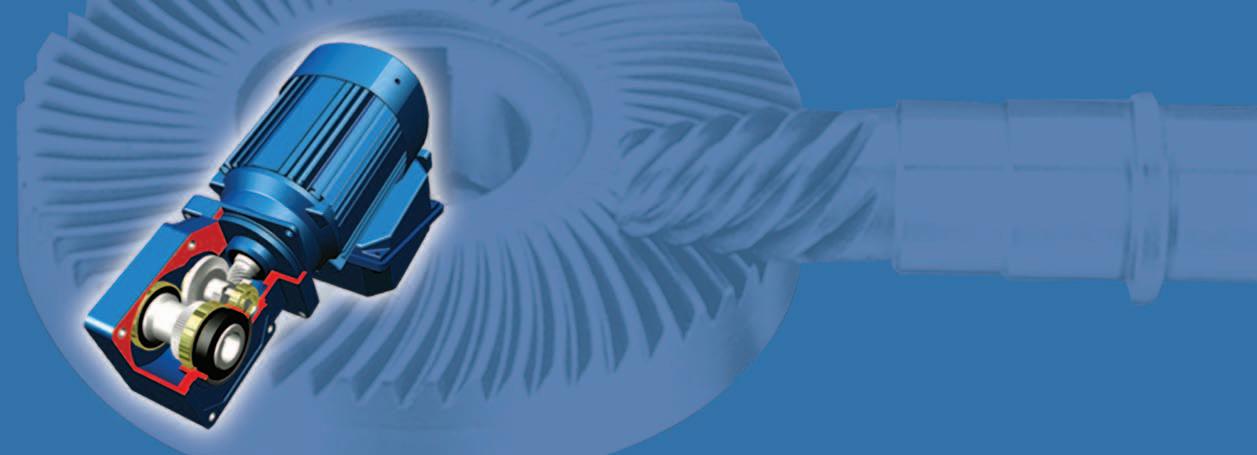
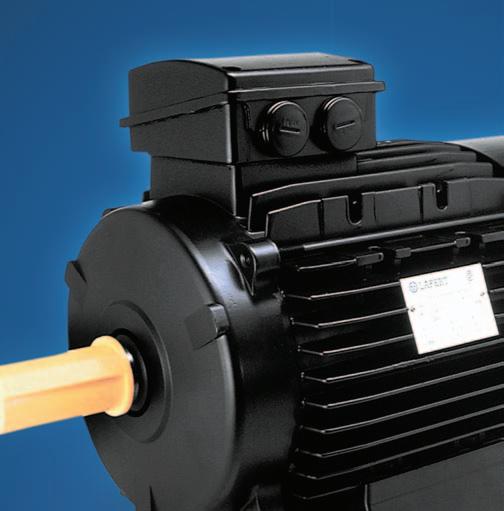
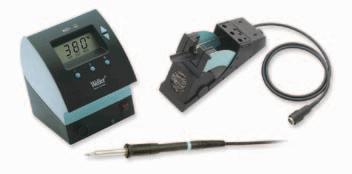
Baldor’s BE$T desktop program is now available as an application for iPhones. This program calculates an existing motor’s annual electricity usage based on its nominal efficiency and compares it to the annual electricity usage of the company’s Standard-E and Super-E premium-efficiency motors. The iPhone application, available from iTunes, offers the functionality of the desktop program in a smaller, easier-to-use package. The user enters the electricity rate and existing motor parameters, then taps the ‘calculate’ button. The application shows the recommended Super-E motor, the selling price, annual kWh use, annual electricity cost and estimated payback months.
Baldor Electric Reader Service Card No. 360
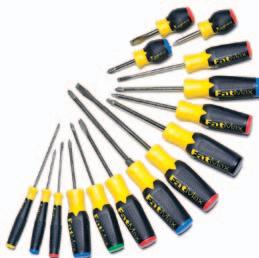
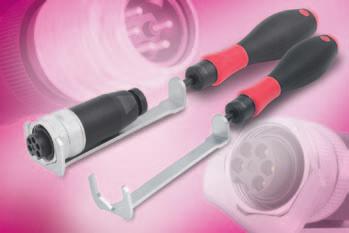
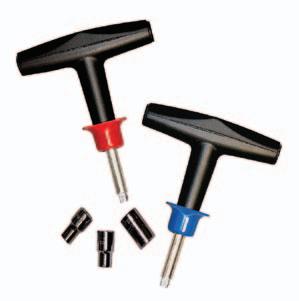
Screwdriver line is comfortable in the hand Built for comfort and strength, Stanley FatMax screwdrivers resist corrosion, chipping and breaking. Their premium handles are designed to create maximum torque and feature slip-resistant rubber grips. In addition, the durable bi-material construction ensures the handles can stand up to jobsite abuse. Colourcoded tip identification at the top of each handle makes choosing the correct driv er from a tool pouch a quick and easy task. The tips are sandblasted and heattreated for durability and precision, and also are magnetic for a firm grip on fasteners.
Container
provides
safe storage for batteries
Stanley Reader Service Card No. 375
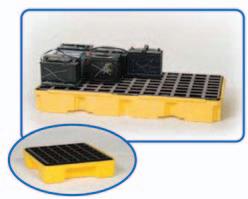
Can-Ross has introduced the Spill Busters battery storage system, which provides a containment and absorbing/neutralizing solution for the storage of wet batteries. Exhibiting good chemical and impact resistance, each system is blowmoulded using high-performance, high-density polyethylene plastic. A removable grating allows easy replacement of used absorbing/neutralizing pillows. These pillows assist in suppressing both heat and fuming/gassing that is typical of an exothermic reaction during the neutralizing process of either an acid or a base. Handling of the product should be restricted to qualified persons.
Can-Ross Environmental Services Reader Service Card No. 390
The Industrial Choice
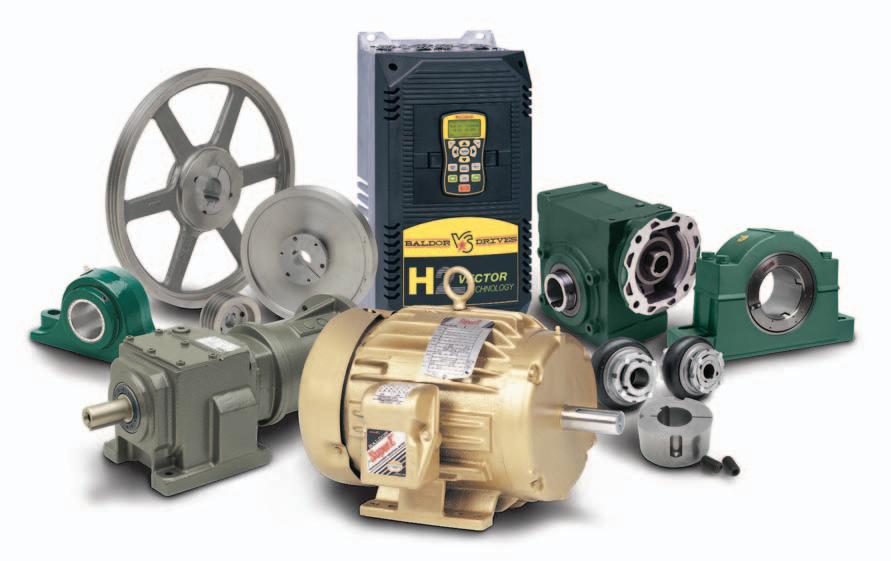
When it comes to industrial electric motors, power transmission products and drives, no other manufacturer offers more than Baldor...that is why Baldor is The Industrial Choice! Whether your application requires a fractional or 15,000 Hp motor, a variable frequency drive, mounted bearings or gearing, a pulley or sheave or even a standby generator, Baldor is the choice most preferred by industry.
When your next project demands the most reliable and energy efficient products available, look to Baldor as your one source for more industrial solutions.
baldor.com
Battery maintenance system keeps plates clean
The main cause of premature battery failure is sulfate deposits on the battery plates. The PowerPulse battery maintenance system generates an intermittent, highfrequency pulse that reduces existing sulfate deposits and keeps them from reforming. This improves the battery’s ability to accept and keep a charge, thereby extending its life. Designed for all leadacid batteries, including conventional flooded, sealed maintenance-free, AGM, Gel cell, antimony, hybrid and calciumplate, the small, waterproof device can be used as a supplement to the existing charging system. No electrical outlet is required as it draws a small portion of the current from the battery. Used extensively by the US and Canadian armies, the system comes with a five-year warranty.
PowerPulse
Reader Service Card No. 391
Laser shaft alignment system has barcode reader
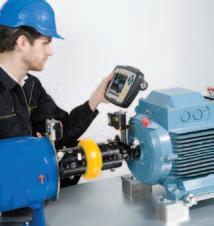
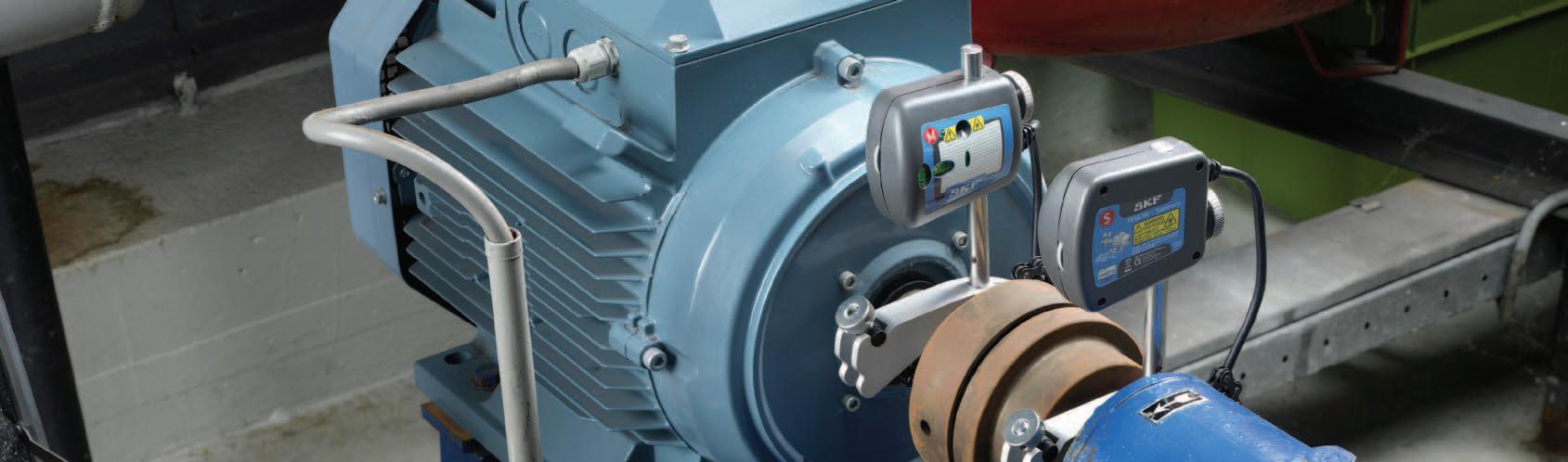
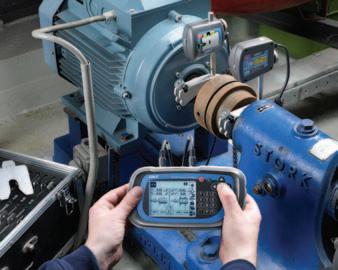
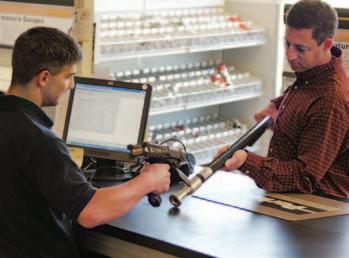
The Easy-Laser E710 shaft alignment system is a wireless, colour display system that includes functions for all the important stages of machine setup. Users can troubleshoot and prevent wear and breakdowns in their machines. They can check the flatness of the machine base, and measure and align the machine. A barcode reader allows the user to scan the machine tag, whereupon the machine is immediately ready for measurement. Other features include multi-language programs and electronic laser targets. This durable system is expandable for digital sheave/pulley alignment, vibration level check and geometric measurement.
Benchmark Maintenance Services
Reader Service Card No. 392
Compact drive has all-round functionality
The IndraDrive Cs compact drive from Rexroth supports all standard Ethernetbased communication interfaces, such as Sercos III, Profinet IO (RT), EtherNet/IP and EtherCat. Users configure their choice of communication protocol themselves using software on universal communication hardware. The drive also features a multiple transducer interface, which works with such transducer sys-
tems as EnDat, Hiperface, simple TTL incremental transducers, sine-cosine transducers, resolvers and the serial transducer system of the company’s ultra-compact MSM motors. Here, too, users make their selection easily by software. Power range is 50 W to 3.5 kW. Bosch Rexroth Canada
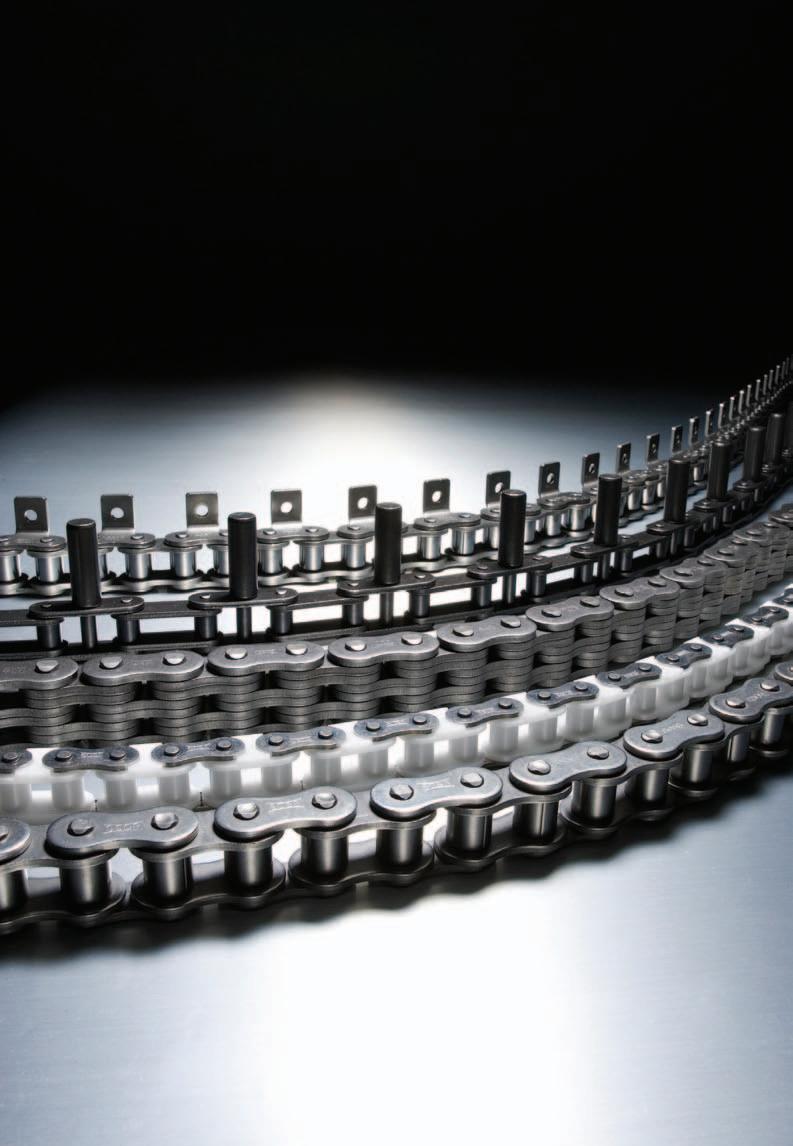
Extended Life CHP® Series Chain Products
Extended Life CHP® hard chrome plated pins possess standard steel’s metallurgical properties for toughness and strength while delivering an extremely hard wear resistant pin surface. CHP chain pins resist wear longer than standard heat treated pins, even in dry and abrasive environments. Extended Life CHP® chain is directly interchangeable with standard ANSI chain.
Extended Life CHP® chain offers outstanding wear and fatigue life performance in extreme temperature ranges and does not require a reduction in working loads or operating speeds. Exceptional pin wear resistance reduces chain elongation and increases wear life by 3X over conventional premium chains. A full range of ANSI standard attachments are available.
Please call 800-435-0782
Additional Warehouse Location Now Open in Brampton, ON www.drivesinc.com
selecting the right drive system / 12
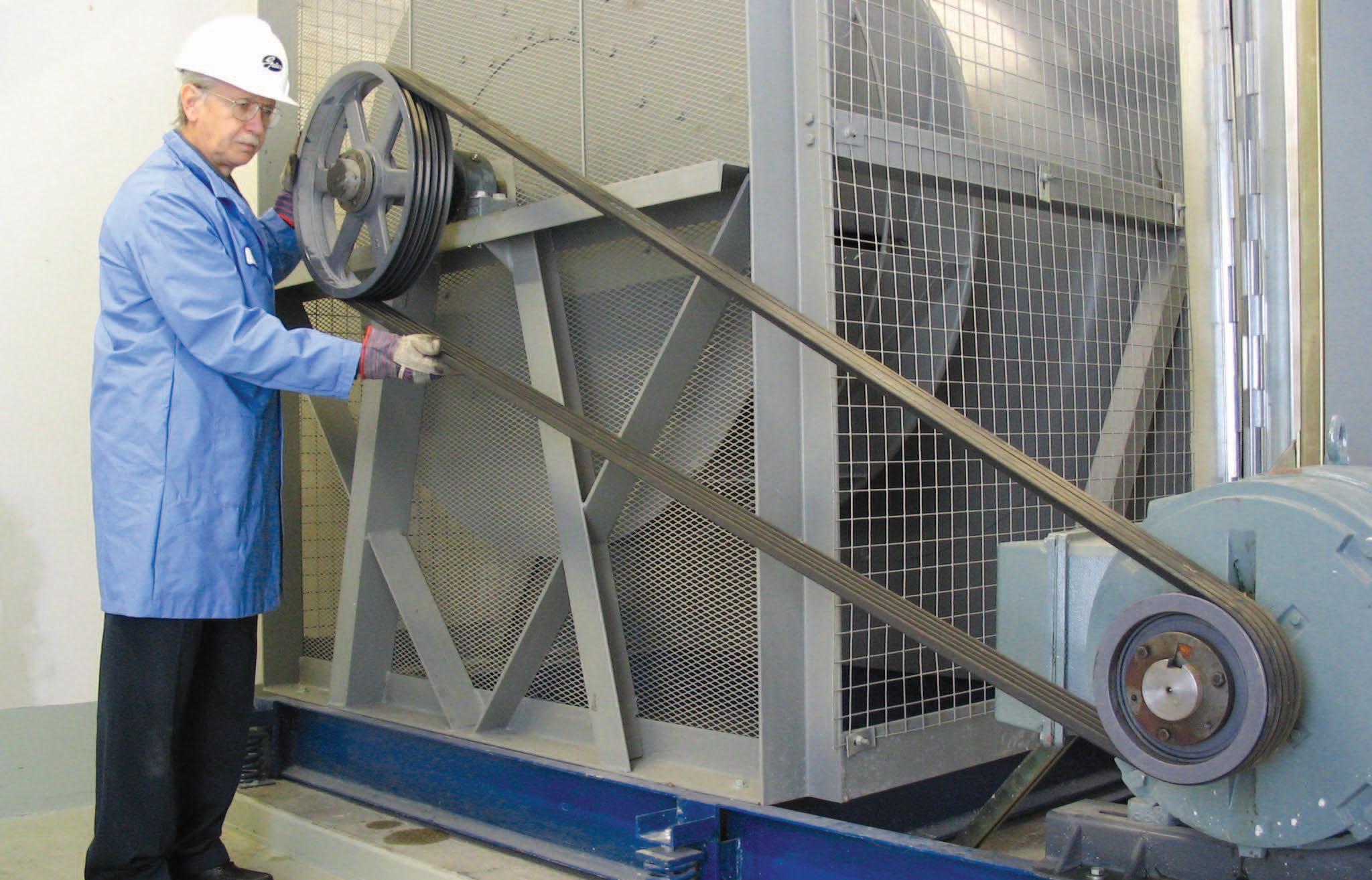
It’s important to consider both costs and performance when choosing chain and belt drive systems.
Quarry hunts for conveyor reliability / 15
High-reliability gearboxes and bearings cut conveyor maintenance and energy costs at aggregates quarry.
1985-2010
supplier profile: trusting the system / 16
A builder of arc welding machinery, Lincoln Electric’s success is based on a culture of trust and flexibility nurtured over a century.
The maintenance of chemical delivery systems, which requires expert handling, is the speciality of Canada’s own ‘everywhere man’.
drive technology trends / 22 In order for a direct drive motor to replace a gearmotor, it must be able to provide high torque at low speeds. reports from bsa / 37 Market turnaround bolsters convention mood for bearing specialists.
editor’s selections
For more than 60 years, no permanent employee had ever been laid off for economic reasons.
FRANK KOLLER / 16
Companies do not want to invest energy in learning how to service equipment they see as someone else’s responsibility.
MARC LAFRENIÈRE / 20
There are many horror stories of bringing in non-compliant equipment.
SIMON FRIDLYAND / 25
Maintenance Management: taking control / 24
the dangers of air and bubbles / Monitoring hydraulic lubricant health to avoid costly equipment repairs
It’s all about the thickness / 29 How insufficient — or too much — film thickness can cause gearbox problems.
Follow along with Step 33 in a journey to World-Class Maintenance at the Plentya Paper Company as the team undergoes major changes to achieve its goals.
the safety File: Why it’s a good time to buy / 25 Federal budget makes Canada a tariff-free zone for machinery and equipment.
cMMs solutions: successful implementation strategies / 26 There are four methods to get a computerized maintenance management system working.
riving back to Toronto one recent weekend with my colleague at MRO Magazine, Eric Achilles Cousineau — immediately after attending the outstanding Power Transmission Distributors Association (PTDA) Canadian Conference in Montreal — we were reflecting on the upbeat mood of the majority of the delegates we met.
On the radio, the Steve Miller Band was singing Jet Airliner, a 1970s Paul Penna song that features the riff, “You know you got to go through hell before you get to heaven.” Today, I think that most of those in the industry — both manufacturers and distributors — would agree with that line.
After experiencing declines in sales of 10%, 20%, and sometimes 30% or more
over the past year, it certainly was business hell. And now, well, it seems they’re heading to heaven — in a good way, of course. By the way, Eric and I heard similar stories at the excellent Bearing Specialists Association (BSA) annual conference a month earlier. (As an aside, it’s my observation that industrial conferences of all types are getting better than ever and are a worthwhile source of timely and useful information for our readers.)
Our team attending the PTDA and BSA conferences heard many stories about turnarounds in sales that began as early as March this year — with many seeing spikes in April. Sure, May might have been flat (so what — isn’t ‘flat’ the new ‘up’?), but the confidence
was back. I didn’t count the total, but dozens of people told me they were fiercely trying to hire employees once again.
For us at MRO Magazine, any good news from the industrial aftermarket is good news here as well, because as its success rises and falls, so does ours. More business for our target audience typically translates into more pages in the magazine, which means there will be more content for you to read, more helpful advice from our columnists, more technical articles, more new products being reviewed, and more maintenance case histories to read.
Those case histories and columns are what we call the bread and butter of our content, so not only are we happy our friends in the MRO market are seeing a turnaround, we’re very pleased to share our own good news. MRO Magazine recently received two nominations in the 2010 Kenneth R. Wilson Awards, a competition recognizing excellence in writing in trade and business magazines.
And one of those nominations resulted in a first place award in the industrial category! (You can read the details in our Industry Newswatch section).
With 2010 being our 25th anniversary, we’re especially happy with these results. Who would have guessed that a somewhat technical magazine for maintenance guys in shops across this vast country could win a top editorial award against some formidable competition from other ‘clean’ publications?
Well, really, it wasn’t that big of a surprise, as we’ve won 10 such awards in total, and look forward to continuing this award-winning tradition for our next 25 years. Most importantly, the awards recognize our success in our singular goal of sharing relevant, well-written, accurate and timely information with our readers across Canada.
Thanks for reading.
Bill Roebuck, Editor & Associate Publisher
Did you know?
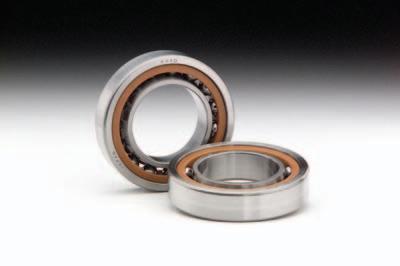
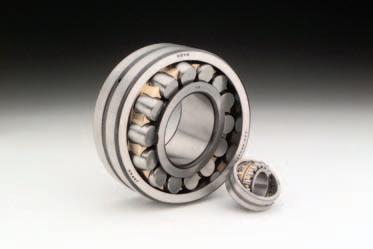
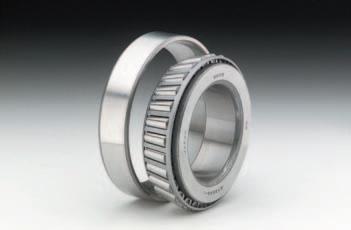
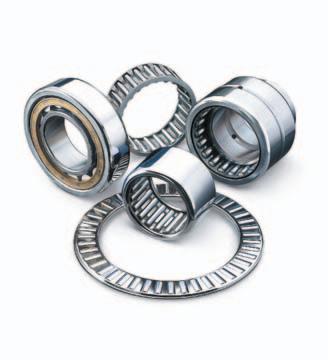
Koyo Seiko was formed in 1921. Today we are part of the JTEKT Corporation with consolidated sales of $10.3 billion and employing more than 33,000 around the world.
In January 2010 JTEKT acquired the Torrington® needle roller bearing business from the Timken Company and these products are now available from authorized Koyo distributors worldwide.
The Koyo brand supports an extensive array of applications, forming part of the original equipment for many world-class names and is a trusted supplier to industry for the ongoing repair and maintenance wherever anti-friction bearings are required.
Going green starts with a commitment to the future.
It’s about creating a vision for the future and then communicating that until it becomes a part of your culture. It’s about new approaches to break through old barriers. And it’s about holding true to your commitment when challenges arise.
Koyo continues to research, develop and deliver products that consume less energy, last longer and lighten their load on the environment. Since 2005 we’ve reduced the CO2 output per unit in manufacturing by 30% and since 2008 reduced our CO2 footprint in logistics by 31%.
In 2009 alone we reduced energy consumption in manufacturing by 14%, raw materials by 20% and CO2 emissions in logistics by 16%; all this while maintaining production levels.
Here are some of the many targets we are working towards achieving this year: Zero landfill waste; 90% reduction of 2001 levels of incineration waste; 30% reduction from 2003 levels of overall waster per unit; 5% increase in manufacturing efficiency per unit and 5% reduction in weight per unit.
For a copy of Koyo’s Corporate Social Responsibility report please visit www.koyo.ca
Making bearings since 1921.
Ellie robinson, art director
Contributing Editors
Richard G. Ensman Jr., Simon Fridlyand, Carroll McCormick, Peter Phillips, Angela Webb, Cliff Williams BusinEss nick naunheimer, Publisher 416-510-6868 nnaunheimer@mromagazine.com
Eric achilles Cousineau, adv. sales Manager 416-510-6803 eachilles@mromagazine.com
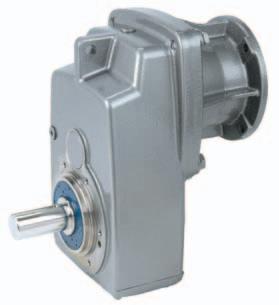
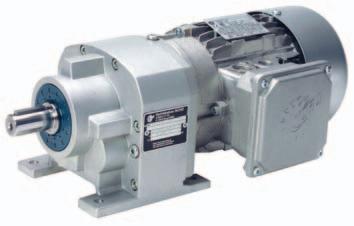
Bring your operation into the 21st Century with NORD Gear drive systems.
It’s difficult to stay competitive when you’re choosing outdated drive systems. Enhance productivity by switching to industry-leading NORD Gear drive systems. They’re more reliable, use less energy, require less maintenance, have a longer service life and are much safer. We have mounting configurations and options to satisfy even the harshest environments. It all adds up to lower total cost of ownership. NORD Gear is also a global leader in service. We can design and assemble literally millions of drive configurations. We’re only a phone call away and prepared, 24/7, to ship assembled units from stock components anywhere in Canada or worldwide.
Make your move into the 21st Century. For the reliability, efficiency, cleanliness and safety you need to stay competitive, it’s clear.
The only intelligent choice is NORD Gear.
‘Broad economic recovery is well under way’ says Conference Board of Canada
Ottawa, ON — Labour markets churned out 108,700 new jobs in April 2010, according to the Conference Board of Canada, well above consensus estimates, which clustered around 20,000. April marked the largest single monthly percentage gain in employment since August 2002 — and gains came entirely from the private sector.
Despite a surge in labour force participation in April, the job gains were so strong that they were able to nudge the unemployment rate down 0.1 percentage points to 8.1%.
Most of April’s job gains — 71,800 — were concentrated among men aged 25 and older. Youth workers (those aged 15 to 24) and, to a lesser degree, women aged 25 and over, also recorded combined gains of 37,100.
A broad economic recovery is well under way. The Canadian economy grew by 0.3% in February 2010, marking the sixth consecutive monthly increase in gross domestic product. The goods-producing sector, which experienced a 0.7% increase in output, accounted for the majority of the growth.
Goods-producing industries enjoyed universal growth in February, with the manufacturing sector expanding 1.2% and accounting for nearly half the total GDP gains registered in the month. Although production of transportation equipment declined, this was offset by gains in 14 of the 21 manufacturing subcategories, including fabricated metal, pharmaceuticals, non-metallic mining, and computer and electronics.
Excluding declines in oil and gas production, the mining sector grew by 7.6%. Surging potash production (and, to a lesser extent, extraction of copper, coal, and nickel) have offset oil production losses stemming from two fires at extraction facilities.
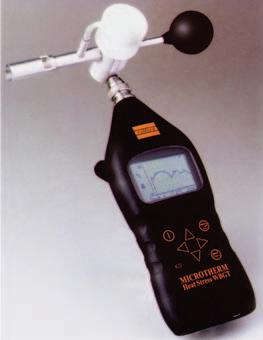
ONTARIO URGES WORKPLACES TO PREVENT HEAT STRESS
Toronto, ON — The province of Ontario is encouraging employers and workers to learn how to protect themselves from heat stress this summer.
As summer days get hotter, the harm caused by too much heat can become a significant problem in many workplaces. Workers and their employers must take steps to protect themselves from the effects of this hazard.
When heat is combined with other factors like hard physical work, fluid loss, fatigue or some medical conditions, it can lead to illness, disability and even death. Heat stress can affect anyone, including the young
and fit, and can be a concern in many workplaces.
Workers most at risk for heat stress include those in hot environments, such as smelters, furnaces, bakeries and out of doors during the summer.
Symptoms of heat stress can include excessive sweating, headache, rashes, cramping, dizziness and fainting. Prolonged exposure to heat stress can lead to heat stroke, a life-threatening condition.
The victims of heat stroke are often unable to notice the symptoms, and their survival may depend on co-workers’ ability to identify symptoms and to seek immediate medical assistance.
For information on preventing heat stress, visit www.wsib.on.ca/wsib/wsibsite.nsf/public/preventheatstress.
FIRST MAINTRAIN CONFERENCE IN NEWFOUNDLAND A SUCCESS
St. John’s, NL — MainTrain is a series of regional and national professional and workforce development events developed and produced by the Plant Engineering and Maintenance Association of Canada (PEMAC). The first MainTrain Atlantic Canada conference was held April 7-8, 2010.
Ken Corrigan of Suncor, president of the PEMAC chapter for Newfoundland Labrador, reports the event, held in St. John’s, NL, was highly successful. Corrigan and chapter executives Gord Stokes (also of Suncor) and Anthony Jones of Nalcor Energy, joined with Joanne O’Leary and Mary-Lou Johnson of the College of the North Atlantic to bring together an exceptional group of industry speakers and workshop leaders.
Speakers at the event focused on world-class maintenance, reliability and physical asset management practices.
With a success behind them, Corrigan and his team are now planning the Atlantic Canada MainTrain 2011 event.
MainTrain is Canada’s premier workforce and professional development event with Fort McMurray, AB (September 15-17) and Toronto (November 15-18) the remaining locations in 2010.
For further details, visit www.maintrain.ca or www.pemac.org.
PTDA SESSION REVEALS 10 TIPS FOR CAREER DEVELOPMENT
Chicago, IL — The power transmission/ motion control industry’s up-and-coming distribution and manufacturing leaders came together recently for two days in Mesa, AZ, to sharpen their sales management skills at the 2010 Executive Development Conference.
An exclusive conference for young executives belonging to the Power Transmission Distributors Association (PTDA), the conference was led by distribution veteran Gary Moore and focused on uncovering a customer’s business and personal objectives and then showing that customer how to best achieve those objectives.
The Executive Development Conference sessions also facilitated networking between distributor and manufacturer attendees. Held in March in conjunction with PTDA’s annual mid-winter meetings, conference attendees also had the opportunity to build industry connections with more than 70 of the associa-
tion’s most active volunteers. .
Craig Bobbie, director of business development for PTM Industries Inc., Toronto, was one of the attendees at the 2010 Executive Development Conference, and he walked away from the event with new contacts.
“As a first-time attendee to the Executive Development Conference [in 2010], I found the seminars to be not only informative and very relative to our industry, but they also presented some excellent networking opportunities,” said Bobbie. “I would highly recommend the conference for anyone looking to refresh their skills and meet other successful leaders in the power transmission industry.”
Moore emphasized the importance of meeting new people and learning new perspectives throughout the conference. He provided practical tips and advice on how to set appointments with prospective customers, keeping sales meetings interesting for all parties involved, and how to develop proposals that sell.
FAILED BEARING SHUTS DOWN NWT POWER PLANT
Hay River, NT — Located 64 km north of Fort Smith, NT, on the Taltson River, the 18-megawatt Taltson Hydro plant of the Northwest Territories Power Corp. (NTPC) provides power to Fort Smith, Hay River, Hay River Reserve, Fort Resolution and Enterprise. From Sept. 9-18, 2009, Taltson underwent an annual scheduled maintenance shutdown.
During start-up testing on Sept. 18, inordinately high bearing temperatures were recorded, so the unit was shut down. Further inspection determined the thrust bearing at the head of the turbine (generator) had failed, rendering the unit inoperable.
NTPC operates 28 separate power systems, serving a population of approximately 42,000 over a region that spans more than 1.1 million square kilometres.
“I am very pleased to have had the opportunity to attend the PTDA Executive Development Conference and hope to do so again,” said Jeff Pywell, regional sales manager, Jamaica Bearings Co. Inc. “In addition to the training portion, I found the networking opportunities especially valuable. The entire meeting was put together well and offered me plenty of time to network with other distributors as well as manufacturers.”
Attendees broke out into discussion groups, which mixed distributors and manufacturers to encourage the widest variety of perspectives. Following discussions of the specific topics assigned, each group reported findings to all attendees. This format gave the attendees an opportunity to practice small group facilitation and reporting skills in addition to discussing the topic at hand. At the end of the conference, several attendees reported their key takeaways from the session.
To wrap up the conference, Moore offered 10 tips for executive career development:
• Develop a distribution/business information stream.
• Build a personal advisory network.
• Join Toastmasters.
• Look for opportunities to present to groups.
• Engage in the community.
• Develop a personal organization system.
• Balance your professional/personal life.
• Associate with positive, professional people.
• Help others build their careers.
• Be active in industry associations.
For more information about the program, visit www.ptda.org/ExecutiveDevelopmentConference.
The original equipment manufacturer was flown to the site to assess the damage and assist in developing a restoration plan. Within 48 hours, the manufacturer had dispatched five staff to remove the bearing. NTPC located and dispatched specialized scaffolding equipment to the site. A back-up bearing was installed to bring the unit back in service.
“A number of people worked day and night until all the resources needed were in place. Their commitment to keep the lights on and keep equipment serving our customers is second to none,” said Brian Willows, the plant’s chief operating officer.
Customers were served by diesel generation while repairs took place. The plant was back in service on Nov. 3, 2009. The Taltson facility was commissioned in 1965.
MRO MAGAZINE GETS TWO NOMINATIONS, WINS GOLD
Toronto, ON — Our award-winning tradition continued yet again this year as Machinery & Equipment MRO received a Gold Award for one of its two nominations in a prestigious competition for business journalism at a ceremony at the Carlu in Toronto on June 1, 2010.
The Kenneth R. Wilson (KRW) Awards are presented annually by the Canadian Business Press. Business and trade magazines submit their best work in 20 different categories. Over 600 entries were received in the 2010 competition.
Machinery & Equipment MRO senior contributing editor Carroll McCormick of Montreal received a nomination -and the Gold Award (first place) -- in the Best Technology/Industrial/Manufacturing Article category for his feature story, Naval Gazing, a profile of the maintenance operations on two Oceanex container ships working in the Gulf of St. Lawrence. It appeared in our December 2009 issue.
As well, MRO Magazine columnist Peter Phillips of Windsor, NS, was nominated as one of the Top 10 submissions in the Best How-To Article or Series category for his article, How to Justify a CMMS System Purchase, from the magazine’s September 2009 issue. The column discussed 10 questions readers should answer to know for certain if they should invest in computerized maintenance management software.
That makes a total of 10 KRW awards the magazine has received, including four Gold (first place) awards. We also have received a total of four APEX Awards for Publication Excellence.
GLOBAL DEMAND FOR POWER TOOLS TO RISE OVER 3% ANNUALLY THROUGH 2013
Cleveland, OH — Global demand for power tools is forecast to exceed $28 billion in 2013 on annual gains approaching 4%. Despite having been mired in a recession, the bedrock US market will provide the best opportunities, accounting for over one-third of the additional demand generated between 2008 and 2013.
Recovery in US demand will reflect a turnaround in the current housing crisis, as well as continued enthusiasm for DIY projects by US consumers. US power tool sales will also benefit from the introduction of improved products, especially cordless electric models.
The BRIC economies — Brazil, Russia, India and China — will all fare well. Demand in China and India will rise over 6% per annum, benefitting not only from continued gains in construction expenditures, but also from rising industrial
production. Gains in Russia and Brazil will exceed the global average, benefitting from strong gains in improvement and repair construction activity; many of the buildings built during the USSR period (specifically 1950s and 1960s) are currently in need of repair.
Production of power tools is expected to continue to shift to the Asia/Pacific region, largely driven by Chinese manufacturing. China is projected to account for one-third of global shipments in 2013, with a significant share exported to the US. Eastern Europe is also forecast to account for an increasing share of global production, owing to increased trade with Western Europe.
Electric tools (plug-in and cordless) will continue to comprise the vast
majority of sales, due to their frequent use in both consumer and professional applications. Demand for pneumatic tools will continue to suffer from the fact that they are overwhelmingly used in the professional market. However, rising global industrial output will create opportunities.
Professional users accounted for the majority of the world power tool market in 2008, due to their use of a greater variety of more expensive tools compared to consumers. The professional market will remain dominant due to the rising levels of capital investment globally, which will boost construction expenditures.
In addition, rising industrial output will create opportunities in the professional market. However, gains in con-
sumer tool demand will outpace those of the professional market, based on the ongoing popularity of do-it-yourself activities in developed nations, and the rising standards of living in developing countries. Tool producers will continue to target the consumer segment with a variety of marketing approaches, including strategies aimed at women.
This new Freedonia study, World Power Tools, presents historical demand data plus forecasts for 2013 and 2018 by product, market, world region and for 25 countries. The study also considers market environment factors, evaluates company market share and profiles 27 industry players. For more information, visit www.freedonia.com.
‘DON’T
BE SHOCKED. BUY AUTHENTIC’ ANTI-COUNTERFEIT CAMPAIGN LAUNCHED
Toronto, ON — Eaton, Schneider Electric and Siemens have joined forces with Electro-Federation Canada (EFC) to develop an awareness campaign to raise awareness of the risks and hazards associated with the influx of counterfeit and unsafe electrical products in the market.
The campaign includes print ads, postcards and buttons. Packages containing information materials and awareness buttons were sent to electrical distributors, encouraging them to spread the word during the month of May to their customers.
For more information on the campaign, visit www.electrofed.com/industry/Anti_Counterfeiting/. MRO
When you think “Experience”, you
Professional users accounted for the majority of the world power tool market in 2008.
Company Briefs
News and views about companies, staff, product lines and more.
• Electric motor and fractional horsepower gearmotor manufacturer Bison Gear & Engineering Corp., St. Charles, IL, has acquired the brushless DC (BLDC) electric motor business of Von Weise of Canada Co., Cambridge, ON. The product line includes low-voltage (12-24 volt) BLDC motors ranging from 80-225 watts (0.1-0.3 hp) with integral multifunction speed controls. Martin Swarbrick, Bison Gear CEO, said, “This is a perfect complement to our own AUTONOmotor sensorless brushless product line and it aligns with our growth strategy, balancing internal product development with product and technology acquisition.” Originally
developed for the mobile HVAC market, the maintenance-free motors will also be incorporated into Bison’s gearmotor product line for industrial and commercial applications.
• SKF Lubrication Solutions, a division of SKF Canada, has relocated from its facility in Burlington, ON, to a 22,000 sq ft facility in Mississauga, ON. The lubrication division now has its sales, customer service, engineering and service operations together to better serve customer needs. The division was created in March 2007 when SKF Canada acquired Automatic Lubrication Systems (ALS) of Burlington. The Mississauga facility also is the home for the
SKF Economos Sealing and Engineered Plastics team. This division, which resulted from SKF’s acquisition of Economos Canada (formerly Custom Seal) in 2006, supplies sealing and engineering plastics solutions, as well as custom-made plastic components.
• The Standards Council of Canada (SCC) has accredited TÜV Rheinland of North America, Newtown, CT, as a Special Inspection Body authorized to perform field evaluations of electrical equipment in Canada. The company operates a Canadian branch in Toronto. The SCC accreditation permits TÜVRheinland to perform field inspections of electrical equipment and apply approval labels to systems in Canada, in accordance with SPE-1000-09, Model Code for the Field Evaluation of Electrical Equipment. “Canada represents an important marketplace for TÜVRheinland, and offering this capability to our existing North American as well
as global customer base reinforces our commitment to the area,” said Udo Heinz, division manager of the industrial machinery division at TÜVRheinland. For other information, visit www. us.tuv.com.
• Kaman Industrial Technologies Corp. (KIT), Bloomfield, CT, has completed the acquisition of Allied Bearings Supply Co., Tulsa, OK. Allied is now part of KIT, Kaman Corp.’s industrial distribution segment. Terms of the transaction were not disclosed. Allied, founded in 1934, is a distributor of bearings, power transmission, material handling and industrial supplies to such diverse markets as the oil, gas, refinery, drilling equipment, steel, cement, paper and food industries. KIT is the third largest distributor of power transmission and motion control products in North America. The company operates nearly 200 branches, distribution centres and customer service centres across the US, Canada, Mexico and Puerto Rico.
• Gord Duncan, president of industrial distributor Kinecor LP, Lachine, QC, has taken early retirement from the company. Doyens of industry gathered at a special ‘Bye Bye Gordie’ dinner held in Hudson, QC, in early June to wish him the best in his future endeavours.
• Kinecor LP, Lachine, QC, has appointed Adrian Trotman as senior vice-president, industrial components, effective May 24, 2010. Trotman, a professional engineer with an MBA, has 20 years of experience in industrial distribution in Canada with a major US multinational firm.
The Eagle NRG belt and sprocket reduces noise by as much as 19 dbs and vibration normally associated with synchronous drives by as much as 19 percent. Enjoy smoother more precise power transmission thanks to Eagle NRG’s continuous rolling tooth engagement.
For more info, call 1-888-275-4397, or visit www.goodyearep.com
• The Plant Engineering and Maintenance Association of Canada (PEMAC) has appointed Cindy Snedden, P.Eng., as MMP program manager and registrar. Snedden led the team at Northern Lakes College, Slave Lake, AB, in developing the first live, online delivery of PEMAC’s MMP (Maintenance Management Professional) education and certification program, which is now attended by participants across Canada. She was awarded PEMAC’s Sergio Guy Memorial Award in 2008, jointly with Claire Russell, also of Northern Lakes College. This award recognizes exceptional contributions to the maintenance, reliability and physical asset management profession and PEMAC. Snedden is a mechanical engineer with seven years of experience in oil and gas operations. For the past nine years she has worked as the resource training coordinator at Northern Lakes College. In this role she focussed on developing unique deliveries of industrial professional development training to suit the College’s northern industrial clients. This work included the distance delivery of the PEMAC MMP program.
• An essential resource for any company seeking distributors and manufacturers of power transmission/motion control products, the recently released Power Transmission Distributors Association (PTDA) 2010 Membership Directory puts names and information for nearly 500 industry contacts right at your fingertips. The directory is available to PTDA members for US$30 per copy, and to non-members for $250 per copy. It can be ordered online at www.ptda.org/store or by calling 312-516-2100.
• Project management is becoming more and more recognized as a legitimate set of skills to be successful in
Cindy Snedden, P.Eng.
Is poor pump maintenance leaving you high and dry?
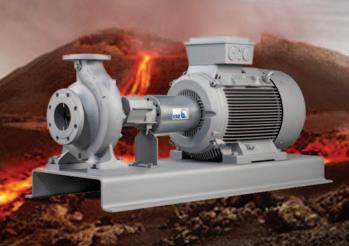
Problem: Oil and gas industries have extremely demanding environments that require exceptional reliability and efficient operation of mission-critical applications to manage and reduce operational costs. One of the vital components of any oil and gas application is the pump. When pumps fail, entire processes can be hampered, which costs both time and money. The main concern is how to get failed pumps up and running — fast. Solution: First, it’s important to get answers to questions like:
• How long are pumps supposed to last?
• How can a pump reach its best efficiency point?
• How can I prevent a pump from failing again?
• What is the proper way to repair a pump?
Getting answers to these questions can save thousands of dollars a year, or even a month. In short, effective pump maintenance will ensure your pumps never leave you high and dry.
Component condition: The first task in repairing pumps is to note the condition of each component when disassembling the pump. Proper and complete records are one of the most commonly overlooked procedures necessary for maintaining good pump repair.
Avoiding contaminants: Also often overlooked is the need to keep the surrounding environment clean when reassembling a pump. Contamination introduced during the pump rebuild will shorten the life of the seals, the lubricant and the bearings.
Seat diameters: During a rebuild, measuring the bearings seats’ diameters on the shaft and the housing with a micrometer, rather than callipers, is also advised, as improper sizes are a common cause of pump bearing failures.
Shaft alignment: Ensuring that the shaft is straight is also important. The proper way to do this is to set the bearing seats on the shaft on v-blocks. Then,
business, according to Sumitomo Machinery Corporation of America (SMA), Chesapeake, VA. As a result, the company has had four more employees become PMP certified: Brian Perkins, engineering service centre director; Mario Haeck, IT manager; Paul F. Martin, chief applications engineer; and Jennifer Shambley, quality operations manager.
• On June 1, Dymo Industrial and 3M Electrical Market Division began offering a co-branded line of portable industrial labellers that use Dymo Industrial’s labelling technology in 3M’s distribution channels. While Dymo Industrial’s Rhino-branded label makers will continue to be sold through Dymo sales channels, the new 3M Portable Labellers (PL 100, PL 200 and PL 300) will be available through 3M authorized distributors and agents in North America, Latin America and Europe. MRO
Editor’s note: More detailed versions of many of these stories, along with additional news items, can be found online at www.mromagazine.com.
using a dial indicator at several points on the shaft, you can determine if the shaft is bent.
Reassembly: When reassembling the pump bearings, be sure the snap ring on the held bearing does not cover any lubrication groove. Also note that the word ‘top’ in the casting is reassembled on the top to ensure that the bearing is not deprived of lubrication, and that the labyrinth seal drain slot is down.
After both the motor and pump are reattached to the bedplate (base plate) and before connecting their shafts, ensure that the two shafts are
aligned. This can be done with either laser aligning equipment or with a pair of dial indicators and magnetic bases. While some feel that a straight edge will suffice when checking the alignment, this isn’t advisable because a straight edge cannot detect less than 0.01 in. of misalignment. With your reassembly completed, be sure that all bolts are tightened to the proper torque values and your pump is ready for service.
Lubrication: To keep your newly maintained pumps working at peak levels, be sure to maintain proper lubrication:
• If grease is used to lubricate the bearings, use either sodium- or lithium-based grease with an NLGI rating of 2. If temperatures are greater than 93°C (200°F), choose a rating of 3.
• Bearing grease re-lubrication intervals should be once every three months
Kinecor Solutions
under normal operating conditions. If the temperature exceeds 93°C, the intervals should be more frequent.
A tip of Mr. O’s hard-hat goes to NSK Canada for this maintenance tip. For more information on pump bearing reliability, visit www.ca.nsk.com.
Do you have a solution for a maintenance problem? Send it in and if it’s published, we’ll send you a Mr. O Problem Solver T-shirt. Include your address, telephone number, print complete details and, if possible, add a sketch to help explain your tip. Send your tips to Mr. O, Machinery & Equipment MRO, 12 Concorde Place, Suite 800, Toronto, ON M3C 4J2.
Kinecor partners with thousands of suppliers around the world to find the right products and develop solutions that respond to our customers’ unique challenges.
With our broad product offering, national infrastructure, engineering expertise and technical services, Kinecor provides a single and complete source of supply.
Company Briefs continued
Selecting the Right Drive System
When making a drive conversion or designing a new power transmission system, plant maintenance managers and design engineers have basically three broad options:
1. Roller chain drives
2. V-belt drives
3. Synchronous belt drives.
Each has its own advantages and disadvantages, along with cost considerations that may not be immediately apparent.
Roller chain drives
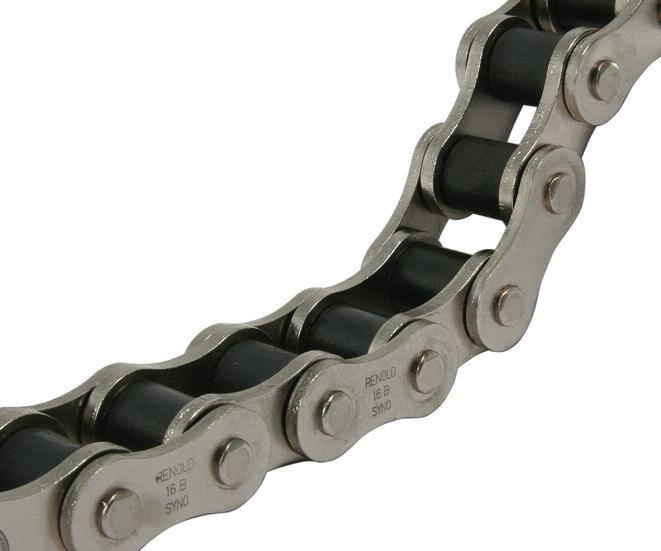
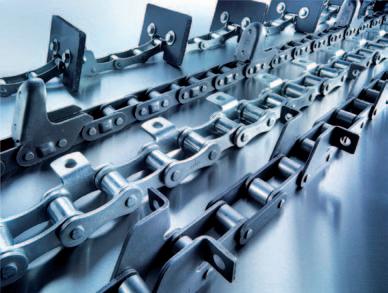
The popularity of chain drives stems from the ability of these drives to transmit high torque levels in a small package, at relatively low cost, while utilizing readily available stock components.
While initial costs of standard roller chain drives can be quite low, the cost of maintaining these drives can be substantial. Proper maintenance is essential for optimal roller chain drive performance, and includes the following cost factors:
• Lubrication
• Alignment
• Tension, and
• Drive component replacement.
According to chain industry estimates, roller chain drives operating without lubrication wear approximately 300 times faster than comparable drives that are properly lubricated. And yet, roller chain manufacturers estimate that 90% to 95% of all installed drives are either improperly lubricated, or not lubricated at all.
Determining the type of lubrication method needed is a major design consideration with cost implications of its own. An oil-retaining chain housing, for example, can represent up to 75% of the total chain drive system cost. In addition to lubrication, proper sprocket alignment and chain tensioning are critical to increasing roller chain life.
Another maintenance factor with cost implications is drive component replacement. One of the major weaknesses of a roller chain drive is chain wear, resulting
It’s important to consider both costs and performance when choosing chain and belt drive systems.
in stretching or elongation. Manufacturers recommend roller chain replacement when elongation of approximately 3% has occurred. Most roller chain manufacturers also recommend replacing sprockets with each new roller chain, because the metal-to-metal contact generates severe sprocket wear.
Power rating tables published within the roller chain industry are based on a theoretical design life of 15,000 hours, assuming proper drive design, align-
Top: While roller chain requires frequent retensioning, and V-belts require periodic retensioning, a synchronous belt typically will not need retensioning.
Above: The components of a synchronous belt drive system typically cost more initially than those of a comparable standard roller chain drive or V-belt drive.
Left: A synchronous belt drive system requires no lubrication, although safety guarding is essential.
ment, lubrication, maintenance, etc., but in a typical operating environment, actual drive life rarely approaches the ideal. Unlubricated roller chain drives operating under harsh conditions can be as short-lived as 100 hours or less.
The cost of the maintenance requirements noted above, added to the initial cost, approximates the true cost of a standard roller chain drive. However, beyond the cost of lubricant and drive component replacement is the labour expense
of frequent retensioning, which requires shutting down the drive, resulting in production downtime. Also, standard roller chain drives operate at 91%-94% efficiency, depending on the application, so energy costs must be taken into account.
Chain drive advantages
Maintenance and energy costs notwithstanding, roller chain drives offer designers and users some advantages over V-
continued on page 14
by Carroll McCormick
Photos
Canada's Solution for Roller and Engineering Chain
Engineering Chain
When acquired the oldest American chain company, it brought together the combined capabilities and experience of the and ranges.
Roller Chain
Celebrating our 90th year in Canada in 2010, the world's leading brand of high per formance, high quality roller chain stocked in 3 locations across Canada - Montreal, Toronto, Edmonton.
We have more than 250 years experience designing and manufac turing chain.
National Ser vice Center
622 rue De Hull, Ville LaSalle, QC H8R 1V9
Tel: (800) 265-9970
Fax: (800) 661-6118
Western Ser vice Center 9210 - 60th Ave Edmonton, AB T6E 0C1
Ontario Ser vice Center
80 Hale Road, Unit 1 Brampton, ON L6W 3N9
belt or synchronous belt drive systems:
• Versatility (functional attachments can be added to convey products, trip switches, actuate levers, etc.)
• Ability to create any length of chain with connecting links
• Availability of large selection of chains and sprockets.
V-belt drives
V-belt drives transmit power through friction between the belt and pulley. With efficiencies ranging from 95% to 98% at installation, V-belt drives use energy more efficiently than roller chain drives, and somewhat less efficiently than synchronous belt drives. V-belt drives are an industry standard, offering a wide range of sizes at relatively low cost, along with ease of installation and quiet operation.
V-belts are manufactured in a variety of materials, cross-sections and reinforcement materials, and are often used sin-
gly, in matched sets or in joined configurations. They are well-suited for severeduty applications, such as those involving shock loads and high starting loads.
Standard V-belt drives operate best in applications of 500 rpm or greater, speed ratios of up to 6:1, and within a limited operating temperature range of –40°C to 54°C (–40ºF to 130ºF). Because V-belts slip when overloaded, they help protect more expensive equipment from load surges. They also allow flexibility in the positioning of the motor and the load.
In a suitable application, the service life of a properly installed and maintained V-belt drive ranges from 20,000 to 25,000 hours. The components of a simple V-belt drive are relatively inexpensive to purchase, install, replace and maintain.
After they are installed properly and tensioned to the belt manufacturer’s recommended values, these drives require very little service, except for retensioning during the normal maintenance schedule.
However, due to belt slippage, V-belt drives lose up to 5% of their efficiency after installation. V-belts stretch as they wear, making slippage worse, which can decrease efficiency by as much as 10% unless corrected by periodic retensioning. Cogged or notched Vbelts can increase efficiency by 2% over standard designs.
Synchronous belt drives
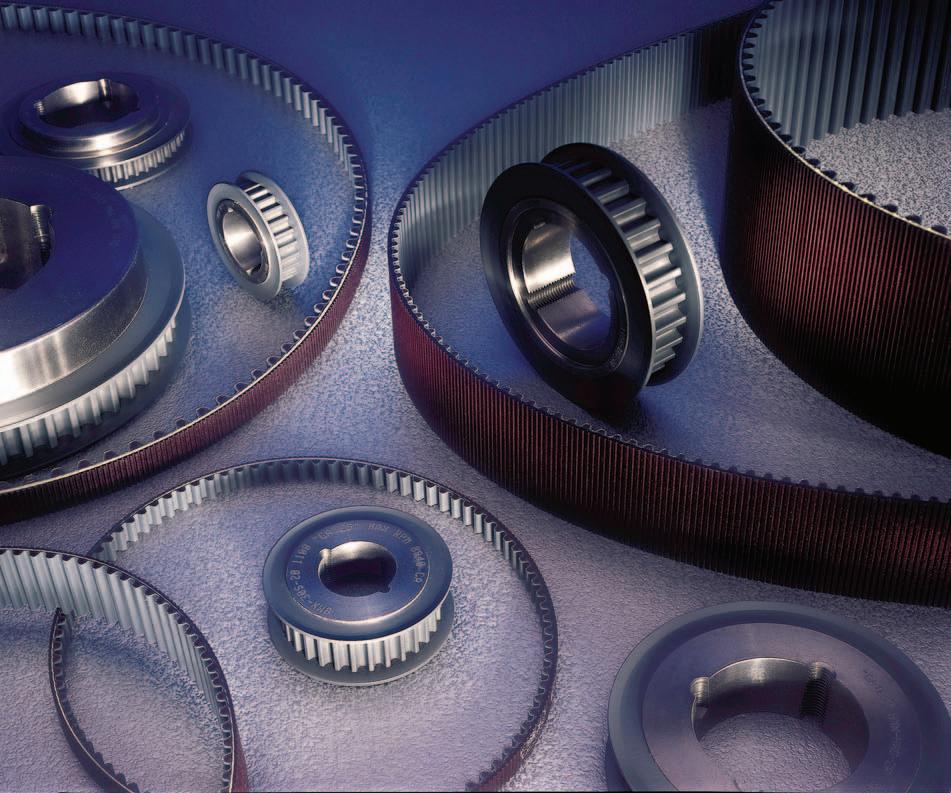
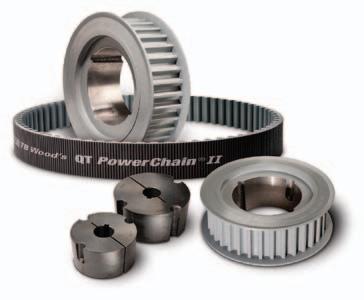
Synchronous belts work on the tooth-grip principle. Round, square or modified curvilinear belt teeth mesh with grooves on sprockets to provide positive power transmission on high-torque applications with high and low speeds.
The components of a synchronous belt drive system typically cost more initially than those of a comparable standard roller chain drive or V-belt drive. By contrast, synchronous belt drives do not have the maintenance costs associated with roller chain drives. They require no
lubrication and thus no lubrication system, only basic safety guarding.
While roller chain requires frequent retensioning, and V-belts require periodic retensioning, a synchronous belt typically requires no retensioning for the life of the belt.
To illustrate the amount of elongation that can occur in a roller chain, recommended centre distance take-up allowances for belt drives can be compared to the centre distance take-up needed for a roller chain in the same length.
Assuming a length of 100 in., a roller chain, V-belt and synchronous belt can be compared as follows: A roller chain will elongate about 3 in. (or 3%) over its life, requiring about 1.5” of centre-distance take-up. A V-belt requires 1.5 in. to 2.5 in. of centre-distance take-up over its life, depending upon the cross section and manufacturer. A synchronous belt typically requires only 0.04 in. of centredistance take up over its life, depending upon the belt type and manufacturer.
Chain and sprocket wear are significant cost factors in a roller chain drive.
Synchronous belts and sprockets experience dramatically less wear. For example, a synchronous belt system can outlast a comparable roller chain on the order of 3 to 1, and the sprockets can outlast roller chain sprockets 10 to 1.
Like roller chain drives, synchronous belt drives are sensitive to misalignment and should not be used on systems where it is inherent to the drive operation. Misalignment leads to inconsistent belt wear and premature tensile failure due to unequal tensile member loading.
Severe-service applications
While a synchronous belt is resistant to abrasion, corrosion and the caustic washdown solutions used in the food handling/ processing industry, it may not be suitable for certain highly corrosive environments where corrosion-resistant chain may be a better alternative.
One misconception about synchronous belts is that they are unsuitable for serpentine drives. Design engineers may think that roller chain is the only option when a load must be driven off both sides; however, double-sided synchronous rubber belts offer many of the same cost-saving advantages over roller chain as their single-sided cousins.
Due to their high efficiency ratings (as high as 99% on a continuous basis), synchronous belt drives can also lower energy costs compared with roller chain drives, which typically operate at 91%94% efficiency, or V-belt drives, which when properly tensioned, operate at 93%-95% efficiency.
When considered on a cost-of-ownership basis, a synchronous belt drive system can be more cost-effective than a comparable roller chain drive or V-belt drive system. An advanced synchronous belt system, for example, initially can cost an average of 30% more than a comparable standard roller chain drive. However, it has many cost-saving advantages for plant maintenance managers and design engineers.
In the MRO market, synchronous drives can greatly reduce day-to-day operational costs, and increase production output compared to the downtime and lost productivity resulting from the maintenance and replacement of roller chain and V-belt drives. MRO
FOCUS ON DRIVES
Quarry hunts for reliability
High-reliability gearboxes and bearings cut conveyor maintenance and energy costs at aggregates quarry.
Conveyor uptime has increased dramatically at Corcoran Concrete’s quarry following a switch to different gearboxes and bearings. The decision to implement the change was made following trials on conveyors in the sand production area of the quarry. Here, bearings were failing as often as three times a year, and the gearboxes typically lasted only 12 months. In some cases, a bearing failure also meant changing the gearbox as well, as it had to be removed by force — sustaining damage in the process. In these cases, the material costs were dwarfed by the day’s downtime needed for the repair.
Corcoran Concrete, which is located in Westport, County Mayo, Ireland, discussed the problem with local power transmission distributor, Central Bearing Supplies of Athlone, which suggested replacing the pillow block ( plummer) mounted bearings that came with the original conveyor equipment with Dodge ISN components. The main feature of in-
terest was the ISN bearing’s combined triple-lip and flinger sealing system, which is very effective against contaminants such as sand and stone dust.
A further advantage of the ISN bearing is its provision as a shaft-ready bearing with an adapter mounting system that allows installation in typically 15 minutes.
As bearing failures occurred in the sand production and washing plant, Corcoran Concrete replaced them with ISN types, and saw reliability increase by around three-fold.
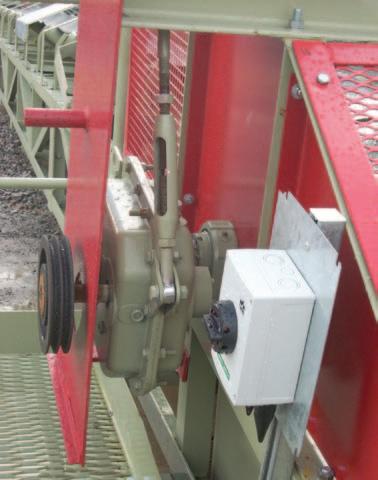
When a gearbox also went down, Central Bearing Supplies suggested the quarry try a Dodge Torque-Arm II shaftmounted speed reducer, primarily because of its tapered bushing system, which makes disassembly and reassembly a quick and predictable task.
New conveyors
Reliability improved again. So, when Corcoran Concrete recently decided to invest in a new 300 ton/hour plant for stone chip production, it specified that the conveyors must come fitted with Dodge ISN bearings and Torque-Arm II speed reducers.
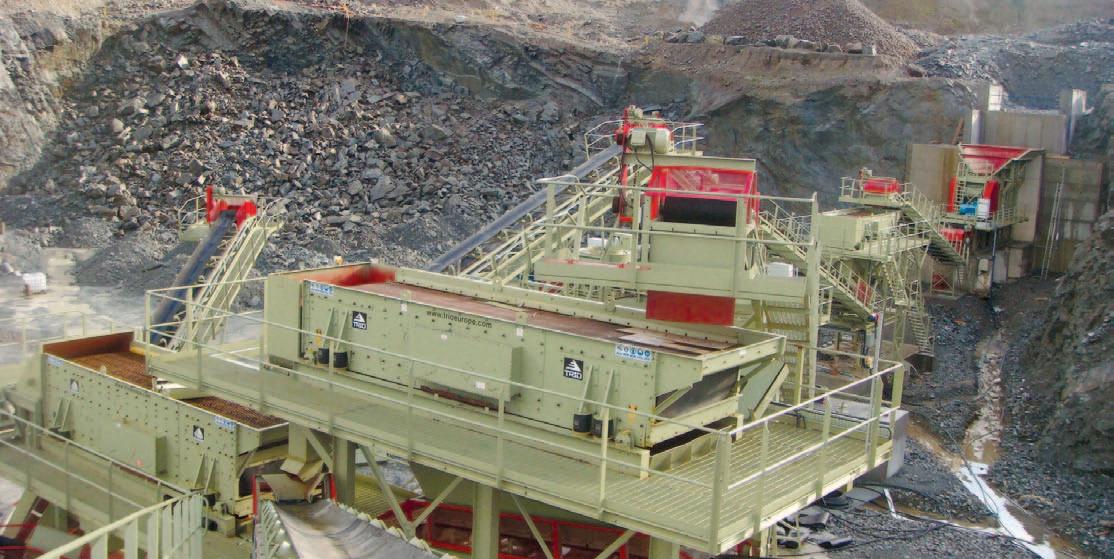
The new plant uses Trio aggregate machinery, which is integrated together with custom structures and conveyor sections designed and manufactured by Gortavoy Plant.
Corcoran Concrete’s maintenance manager, Ian Duffy, notes: “This is a competitive business and reliability of production is a critical concern — to make sure our clients’ construction projects run smoothly. The sealing integrity built into these Dodge parts has made a significant difference for us. And when parts do even-
70-75 A. The new conveyors in the stone chip area with their Dodge helical gearboxes draw around 40 A.
Although this evaluation exercise was not performed under closely controlled conditions, the obvious efficiency of the new automation made it clear that the energy savings would give a fast payback on the investment. These benefits are further amplified for Corcoran Concrete because they already draw almost the maximum capacity of the electricity supply to the quarry, and extending this would incur a substantial charge to improve the infrastructure.
“Dodge bearings and gearboxes have a formidable durability record on the most aggressive processes,” says Mike McGrath of Central Bearing Supplies. “Compared with the components often fitted on quarry conveyors, they can often increase operating lifetimes substantially, as this quarry application demonstrates.”
tually fail, we have the fallback position of predictable repair times through designed-for-maintainability features.”
A further spin-off benefit for Corcoran Concrete is the Torque-Arm II speed reducer’s use of two-stage helical gearing. This provides outstanding energy efficiency in the 96% range, minimizing energy consumption.
The difference became clear when Ian Duffy decided to make a comparison between old and new conveyors using an ammeter. Drives on the older conveyor systems tend to draw currents of around
The handling automation for the new stone processing area has been designed by Gortavoy Plant, a Northern Ireland company specializing in application-specific automation solutions for quarries. To aid the reliability and maintainability of the 17-section conveyor system it produced for Corcoran Concrete, just two sizes of Dodge gearbox and two sizes of ISN bearing have been used throughout the conveyor system, by allowing for good margins of performance above the nominal ratings. This feature aids the robustness of the system, and additionally allows Corcoran Concrete to maintain a spares holding on the site to deal quickly with any unforeseeable problems. MRO
For more information, contact Baldor Electric Company, Fort Smith, AR, by email at sales.us@baldor.com, or visit www.baldor.com.
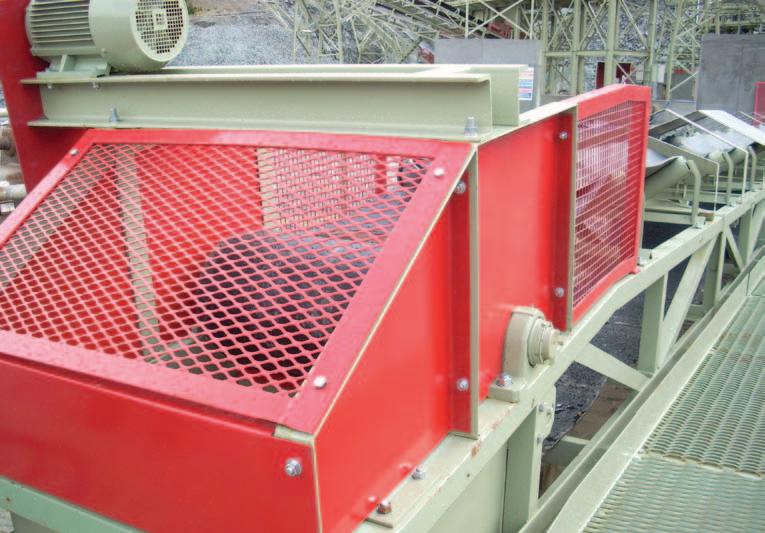
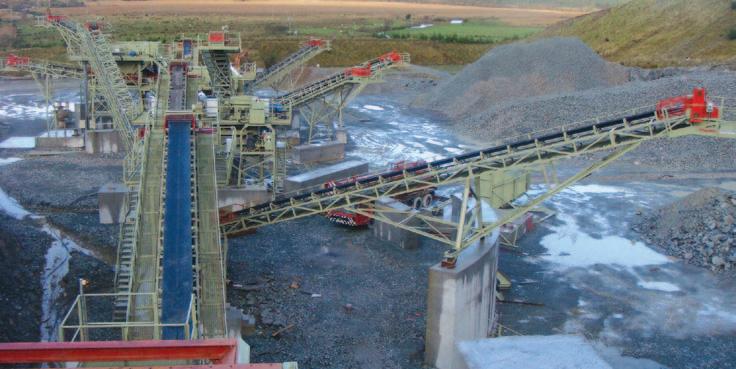
Fig. 1 & 2: When Corcoran Concrete decided to invest in a new stone chip plant, they specified that the conveyors must come fitted with replacement bearings and speed reducers.
Fig 3: Tapered bushing on Dodge Torque-Arm II shaft-mounted speed reducers makes disassembly and reassembly quick and predictable.
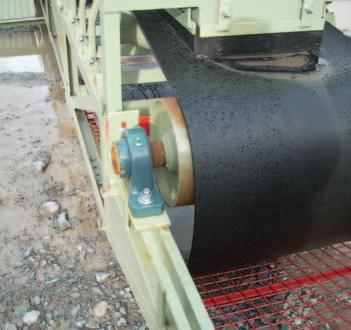
Fig: 4 & 5: Replacement bearings helped to increase reliability by around threefold for Corcoran Concrete’s conveyors.
Fig. 1
Fig. 2
Fig. 3
Fig. 4
Fig. 5
Trusting the System
BY FRANK KOLLER
Last Dec. 12th, 1,000 employees of the Lincoln Electric Company of Cleveland, OH, squeezed into the cafeteria for a ritual dating back to the Great Depression: the annual announcement of the profit-sharing bonus by the CEO. Two thousand more watched on closed-circuit TVs in the huge factory.
2009 was a lousy year. Sales for the world’s largest manufacturer of arc weld-
ing machinery dropped 30%. But unlike millions of other American workers, those at Lincoln Electric felt reassured listening to John Stropki, their boss. Two indisputable facts provided comfort. First, for more than 60 years, no permanent employee had ever been laid off for economic reasons. Second, for 75 uninterrupted years, the bonus had been paid through good times and bad, sometimes exceeding
100% of a worker’s base earnings.
Before every employee opened a personalized white envelope, Stropki announced that each cheque represented 37% of that worker’s base earnings. The average bonus? $16,660. By last December, millions of Americans had lost jobs. Yet Lincoln Electric’s promise remained unbroken: No permanent employees were laid off in 2009.
So how is it that what most people would call an old-fashioned business in an old-fashioned industry, in the wounded heart of the Rust Belt, survived two world wars, the Depression, the Great Recession, expanded internationally and yet never ordered a layoff?
James F. Lincoln, who in 1914 took the helm of the company his older brother John had founded in 1895, believed that avoiding layoffs was a defining mark of a successful manager. He believed that no company could grow if workers feared for their livelihood. “Managers are responsible for efficiency ... efficiency depends on human cooperation ... cooperation demands that fear of losing income be eliminated ... this can only be done by guaranteed continuous employment,” he wrote.
Platitudes from CEOs about loyalty to employees have become the norm, with the level of professed sincerity soaring whenever they announce layoffs. “We value our dedicated employees,” claimed GE’s Jeff Immelt as he cut 15,000 in 2009. “Loyal and committed employees are critical,” said Pfizer CEO Jeffrey Kindler when he laid off thousands last February.
Like Immelt and Kindler, James Lincoln was in the business of making a profit. What distinguished him from most chief executives — then and now — was that he acted on his conviction that the more employees earned for their hard efforts and the more secure they felt about their future, the smarter they would work and the more profits would be generated.
Factory workers at Lincoln Electric have always been paid by piece rates; a fixed price for every task completed. The phrase evokes Dickensian sweatshops where labourers are mercilessly exploited. If workers made too much, managers would cut piece rates or limit overall earnings. Not at Lincoln Electric. Once management sets a piece rate, it can’t be reduced and there is no cap on how much a hard-working employee can earn. Labour economists and union leaders warn that piece rates lead to poor quality and unsafe working conditions as employees cut corners to churn out products. Not at
Electric, where a
Lincoln Electric products range from welding and cutting equipment and consumables to robotics systems.
tion or safety violations dramatically shrinks the end-of-year bonus. Low performance ratings of teamwork, technical innovation and environmental awareness also reduce that cash award.
Lincoln Electric’s guaranteed employment promise only became company policy in 1958. The last recorded layoff was around 1948, but possibly decades earlier: the records are murky back then.
A job at Lincoln Electric is not a jobfor-life: It is a bargain. In good times, overtime is mandatory (guided by local labour laws). In tough times, the workweek can shrink to 32 hours for production workers, yet dramatically expand for salaried engineers and sales executives. Regular job transfers are common.
The payoff for this flexibility is that no employee who meets the performance standards will ever be laid off. That means mortgages are paid, health insurance premiums are paid (a big deal in the US), kids get new clothes and families remain stronger.
As Bob Maffitt, who retired after 43 years, told me: “There are so many people I know that once had good lives. We could have ended up as greeters at Walmart too, but we won’t have to.”
Toronto factory
Lincoln Electric has been in Canada since 1916, with a Toronto factory employing roughly 250 people. The wholly-owned subsidiary’s management system mirrors that of the US company, minus a formal no-layoff promise. Yet since 1945, there have been less than 30 layoffs for economic reasons.
When I first visited the Toronto plant in 1996, I interviewed seven employees. Ten years later, six were still on the job: the seventh retired after 40 years. (The 2009 bonus was almost $9,000, but remember, Canadian workers don’t have to buy expensive basic health insurance.)
Another beneficiary of guaranteed employment is the community. A worker earning a good salary, year after year, pays a lot of taxes to support schools, road repairs and day care.
Yet if steady work is so beneficial to Lincoln Electric, its employees and its shareholders (Wall Street loves the firm), why don’t more follow suit?
First, because the very idea of a nolayoff promise is now so rare across North America, the perception that it is impossible to uphold in a modern economy is deeply entrenched.
Second, there is a strong suspicion of no-layoff promises in most MBA schools. Harvard’s George Baker calls it “a terribly non-optimal and inefficient policy,” a common academic refrain.
Third, while Wall Street loves Lincoln Electric’s stellar financial record, guaranteeing employment is dismissed as a threat to shareholders. “This does not make sense from a capitalist viewpoint,” said one prominent analyst who had recommended the firm for years but had never heard about its no-layoff promise.
Fourth, greed. Lincoln Electric and others embracing no-layoff policies tend to be much more egalitarian, both financially and symbolically. Average earnings at Lincoln Electric are almost twice the industry norm, while John Stropki makes less than half what CEOs at his level earn. Plus, no interior designer ever made money redecorating his office in Cleveland.
Fifth, what makes Lincoln Electric tick is an astonishing level of trust in management and a resulting willingness by employees to be flexible, rare in the private or public sectors now. (Consider the grim studies on workplace morale by
Carleton University’s Linda Duxbury.)
Is Lincoln Electric an anomaly?
The better question is, can we afford it to be, especially with so many jobs lost since 2008?
Lincoln Electric’s success is based on a culture of trust and flexibility nurtured over a century: it is engrained in the corporation’s DNA. It would, admittedly, be hard for a larger company to adopt a no-layoff promise: who’d believe senior management?
Plus any firm trading on Wall Street or Bay Street would face relentless pressure to break the promise when sales drop.
Yet every year, tens of thousands new companies with employees start up in
Lincoln Electric, a start-up in 1895, is an important symbol for those newcom-
ers: a highly-profitable, technologically savvy giant, which has grown its dominant share of the global marketplace for 75 years and yet refuses to lay off workers when the going gets tough. Which part of that doesn’t seem worth emulating in the 21st century? MRO
Ottawa-based Frank Koller is the author of ‘Spark: How Old-Fashioned Values Drive a Twenty-First Century Corporation’ (Public Affairs, 2010). He was a journalist for 27 years with CBC Radio, specializing on the workplace, the US and Asia. His website is www.frankkoller. com. For more information on Lincoln Electric, visit http://lincolnelectric.ca.
Reader Service Card No. 404
Sumitomo’s patented, all-steel hypoidal gear technology leads the industr y in quiet operation and high efficienc y The Hyponic® significantly outper forms worm gearing across ratios from 30:1 to 1440:1 With millions of Hyponics
Its ex tremely quiet and smooth operation makes it ideal for commercial use. The optional IP55 washdown dut y Hyponic® gearmotors are the ideal choice for bottling, baker y, and food processing industries Get rid of that old can of worm gears Switch to Sumitomo
today
Canada, using private funds, hoping to grow long-term.
Hyponic®
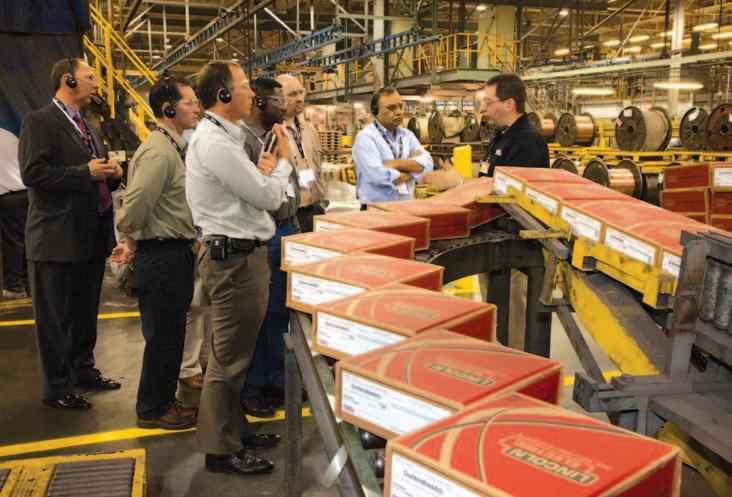
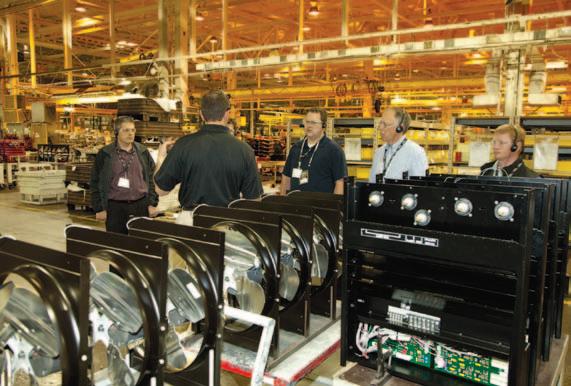
A group tours Lincoln Electric’s Machine Division plant in Cleveland, OH.
These days, few will dispute that the economy has been in a tough state. Even with a recovery under way, it seems everyone is still watching the finances and looking for innovative ways to save money.
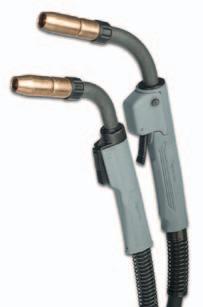
Your welding operation, just like any other portion of your business, offers opportunities to conserve resources. Consider these 10 money-saving tips for MIG gun care and maintenance as a good first step. And don’t be surprised if you find these tips improve your welding performance along the way.
Tip #1: Protect your assets
Keep your nozzles, retaining heads (diffusers) and contact tips in the original package in which they were shipped until you are ready to use them. This prevents scratches and/or dents where spatter can accumulate and will make them last longer. It also prevents dirt, oil or other debris from adhering to the consumables and inadvertently entering the weld puddle.
Remember, proper storage and handling doesn’t just lower your actual consumables costs, it can also prevent weld defects that require costly rework.
Tip #2: Ward off spatter
Use an anti-spatter compound to reduce spatter accumulation on the nozzle and keep it operating better for longer. Gels are most common anti-spatter compound for semi-automatic applications. Dip the front inch-and-a-half of the nozzle into the compound to apply it, but do not submerge the nozzle! Submerging it can damage the nozzle insulator, causing it to fail prematurely. Apply the anti-spatter as frequently as possible to prevent spatter accumulation and extend the life of your nozzle.
Tip #3: Inspect, clean and tighten regularly
Regularly perform a visual inspection of your nozzle — inside and outside — to look for spatter build-up. If there is accumulation, either clean the nozzle with a tool designed specifically for the job or replace the nozzle if necessary.
During your inspection, also check that the nozzle, contact tip and retaining head are still tightened properly, as these components can naturally loosen during welding. Inspecting and tightening your consumables regularly (several times during a welding shift is ideal) helps ensure good shielding gas coverage, reliable electrical conductivity and consistent weld quality.
Tip #4: Trim it properly
Always trim your MIG gun liner according to the manufacturer’s recommendations, using the proper tools and cutting it to the correct length. Cutting the liner too
Welding Tips
BY DAVID BELLAMY
long causes kinking, while cutting it too short allows debris to build up between the liner and the retaining head. Either way, the wrong liner length can cause poor wire feeding and premature failure of both the liner and the contact tip.
When possible, use a liner gauge to determine the proper length for your particular liner and be certain that there are no burrs or sharp edges after you cut it.
Tip #5: Line it up
Consider using front-load MIG gun liners to ease and speed liner replacement. They cut installation time nearly in half compared to using a rear-loading liner, saving you downtime and unnecessary labour costs for changeover.
If you are unable or prefer not to use a front-load liner, be certain to install your full-length liner according to the manufacturer’s recommendations. Keep the liner away from contaminants (don’t let it drag on the floor) during installation and be sure your hands or gloves are clean. This prevents contaminants from entering the weld puddle and causing costly weld quality issues.
Tip #6: Lighten up
When appropriate, switching from heavy-duty contact tips to standard-duty ones can help lower your overall consumable costs, while still providing you with reliable welding performance
If you have lower heat applications, brief arc-on times for short welds or tacks, or if you are using mixed shielding gases and small-diameter wires, standard-duty contact tips should work just fine and they cost less, too. You can also use these types of contact tips if you have applications with restricted access, as the smaller outside diameter can help increase gas coverage and reduce the nozzle’s bore size, making it easier to reach tough joints.
Tip #7: Double the life
Look for contact tips that have a dualthread design that can be rotated 180 degrees and re-installed to create a new wear surface. This design helps extend the life of your contact tip even if one side of it keyholes. Keyholing occurs when the bore of the contact tip erodes due to the constant pressure of
the welding wire feeding through it. Also, look for a contact tip system that stays tight and/or has locking features to ensure good electrical conductivity and to prevent overheating (caused by electrical resistance).
These features can lengthen the life of your contact tips and will improve your weld quality.
Tip #8: Keep it smooth and clean
As an additional defense against spatter accumulation, purchase nozzles that have a smooth, non-porous surface. Be sure that the nozzles are free of any sharp edges or flat spots that would further allow spatter to adhere.
As when handling the liner, be sure you have clean hands or gloves when you are handling or installing your nozzle. Dirt, oil, grease or other debris can easily adhere to nozzles and later enter the weld puddle, causing weld defects. These contaminants can also cause premature failure of the component.
Tip #9: Size it right
Use the shortest length MIG gun cable possible for your welding application, as this helps prevent kinking and premature wear of both the cable and the MIG gun liner. It also helps prevent wire-feeding problems that could lead to an erratic arc, poor weld quality and unnecessary downtime for rework or consumable replacement.
Also, remember to choose the correct diameter liner and contact tip for your welding wire, as this prevents similar problems and helps extend the life of these consumables.
Tip #10: Think long term
Whenever possible, purchase MIG guns and consumables that are backed by a reliable manufacturer’s warranty — most protect against defects for a year or two and some will replace certain parts for a lifetime. Use all guns and consumables as intended so as not to void the terms and conditions of your particular warranty. For example, using your MIG gun as a chipping hammer (a common occurrence, believe it or not) will definitely void a warranty.
Also, consider the upfront cost versus the long-term savings of purchasing sturdier and more expensive consumables. They will likely last longer, reducing downtime associated with changeover and the cost of the consumables themselves.
Keep these tips in mind and you can get back to welding faster — and keep conserving your resources. MRO
David Bellamy is product manager, semiautomatic/consumables group, Tregaskiss. Reader Service Card No. 406
The maintenance of chemical delivery systems, which requires expert handling, is the speciality of Canada’s own
BY CARROLL MCCORMICK
‘EVERYWHERE MAN’
As a sought-after expert in the arcane field of chemical delivery systems, Marc Lafrenière could easily write a new version of the 1959 Geoff Mack hit “I’ve Been Everywhere,” a song popularized by Johnny Cash. He’s seen Alma, Candiac, Chicoutimi and Cape Breton, Kapuskasing, Temiscaming, Sudbury and Lab City. Over 20 paper mills and mines have his company’s phone number on their speed dial and plastered to their equipment.
His company, M.L. Pro-Tech, in St-Boniface, QC, goes where maintenance departments prefer not to go, says Lafrenière. “Given a choice, maintenance people do not want to do chemical jobs. They don’t know enough about the chemicals that are used and they don’t know enough about the systems. With all the staff cuts, they have too many other jobs to do, so they cut in the areas they are afraid of.”
A mechanic and electrician by training, Lafrenière learned about chemicals and delivery systems during his eight years in charge of field services for Ciba’s Toronto office. When Ciba shut down its equipment division in 2001, he immediately formed Pro-Tech and used his connections and experience to rapidly grow his business.
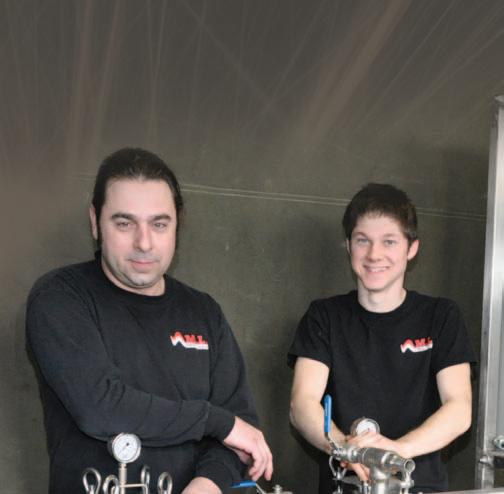
Working out of a 2,000 sq-ft (186 sq-m) shop and well-stocked 13,000 sq-ft (1,207 sq-m) warehouse, Lafrenière and his three employees, who have mechanical, welding and PLC control programming expertise, maintain, repair, modify, design and build systems.
Recently, for example, Lafrenière spent four days at Kruger’s Crabtree tissue products mill in eastern Quebec. It was annual maintenance time, which included doing internal pump inspections and calibrations; calibrating the make-down units, which perform very accurate mixing to within 0.1%; general electrical inspections; fixing leaks; and bigger jobs, like emptying and cleaning hoppers and tanks.
“Between shutdowns, mills usually do not do minor repairs and maintenance. They normally just leave that for my visit during shutdowns,” Lafrenière says. Too, a lot of chemical delivery systems are owned by chemical suppliers, not mills. “Companies do not want to invest energy in learning how to service equipment they see as someone else’s responsibility,” he adds.
In addition to planned maintenance, there are, of course, emergency calls. Since, however, it can take hours just to drive to some of the local mills, Lafrenière explains, “I tried to coach mill staff on the phone on how to fix problems temporarily and restart the process. Then, if necessary, I can visit the mill in the following days to do a complete job.”
He goes where no other maintenance man wants to go
Maintenance departments also prefer to contract out equipment modifications. For example, Lafrenière says, “We modify systems for receiving a new chemical. Maintenance departments won’t know the new chemical or how to manage it. Is it high-shear mixing or low-shear? Is it mixed at 0.2% or 5%? Is the product acid or base? Is it abrasive or shear sensitive?”
This past February, Lafrenière was in Tembec’s pulp mill in Temiscaming, QC, modifying equipment built in Finland
that is used to prepare a type of clay. He took an older, manual-speed Italian model of a motor reducer, modified it with a North American standard motor reducer, added an electronic speed controller and modified the electrical system to make it all work.
“If the mill had had to take this project in hand, they would have had to put an electrician, instrumentation specialist and mechanics on the project, find the right motor and controller, study how the system works and plan out the job. By involving Pro-Tech, they just had to supply a welder for few hours. I guaranteed them that I could do the job and restart the mill within eight hours,” Lafrenière says so.
Lafrenière trolls paper mill fire sales — fortunately, Canada’s many mill closures in recent months and years have an upside to his business — for used equipment to refurbish. “The pulp and paper mills don’t have money, so they are interested in used equipment. We find and buy old equipment, fix it up and rent it to the mills,” Lafrenière says. “Sometimes mills need equipment fast for adding a chemical to fix a problem in their process. We have some for sale, in stock, ready to ship.”
His shop is well-outfitted for repairing and refurbishing equipment: welding gear, drill press, a five-tonne press,
lots of tools and mechanical equipment, a laptop computer for PLC programming, an electrical tester, a test bench with a pressure transducer, flow meters, a booster pump, tanks, a printer and more.
On a road trips, Lafrenière and his staff carry a fairly basic suite of tools: electrical tester, laptop, hand-held programmer, safety equipment and tools.
A common shop repair job for his clients is repairing pumps worn by time or chemical attack. Or, sometimes a plant will reduce production and swap out its chemical delivery system for a smaller one. “When you remove a chemical delivery system, it is often dirty and broken. We will fi x and modify it as required,” Lafrenière explains.
Among other projects on Pro-Tech’s to-do list, in May the shop had a polymer make-down system in from SNF Canada to be modified from 200 VAC to 575 VAC. “We will change the motors and control panel, modify the system so it can receive a 750-kg bag and add a ladder and platform for access,” Lafrenière says.
Manufacturing companies’ maintenance departments vary in their ability to design and build new equipment, but Lafrenière finds that on the chemical side, there is generally too much to deal with for in-house projects.
“We have to consider the processes like capacity, pressure, flow and target. For example, in a paper machine, you want to deliver a certain number of grams of clay per tonne of paper, or deliver chemicals to achieve a certain clarity of water. There is a lot of stuff to know, and maintenance departments do not know what they have to know,” Lafrenière explains. MRO
Montreal-based Carroll McCormick, an award-winning writer, is the senior contributing editor for Machinery & Equipment MRO.
The built-in encoder is fully integrated into the motor, reducing the cost and complexity of encoder engineering as well as its footprint.
Introducing DR Series
SEW-Eurodrives’s new DR Series of AC motors have been engineered from the ground up to meet motor demands of the 21st century: like high efficiency performance that complies with international standards; a compact footprint that saves space; a modular design that allows for three different brake sizes to be used with a single motor size; and a simple, integrated encoder that can be easily retrofitted. What’s more, these new motors can be integrated into SEW gearmotors, used as stand-alone motors or in decentralized control architectures. The DR Series also comes in two energy efficient options: DRE (energy-efficiency) and DRP (premium efficiency).
Driving the world
Drive Technology Trends
In order for a direct drive motor to replace a gearmotor, it must be able to provide high torque at low speeds.
BY MASAZUMI SUZUKI
Gear Drives are used in many different industries, from heavy industrial (steel, mining, forestry) to light industrial (automotive, food machinery) applications. Environmental concerns and attention to energy savings are unavoidable in today’s manufacturing business. Global warming caused by the large industrial consumption of energy is one of the biggest environmental impacts on a global scale. As a result, energy savings, high efficiency and recycling are becoming increasingly more important. However,
with the current economic issues that surround the environment today, businesses must weigh their options with gear drives that are typically used in most industrial applications. One alternative is to opt for the direct drive technology that has started to penetrate through some markets. This article will discuss direct drive technology trends and investigate its potential impact on the gearmotor business.
Direct drive motor trends
Induction motors are commonly used in applications ranging from home electric
appliances to industrial process equipment and provide advantages such as simple construction, durability, reasonable cost and ease of control. However, increasing the efficiency of induction motors has been difficult because of their large ther-
mal losses due to current flow in the rotor.
Environmental and energy concerns are driving development of higher-efficiency motors due to the up to 70% of total energy consumption of the manufacturing market.
Downtime is expensive. We can help you reduce that time with high quality tungsten carbide partsóparts that will last 5 to 25 times longer than tool steel in the same high wear applications. Working in tungsten carbide and other advanced materials, our skilled craftsmen will manufacture custom parts for your equipment to exacting specifications. before it stops
Direct drive motors are, by definition, motors that transmit power to the application directly, without the use of mechanical reduction elements such as gears, pulleys, chains or belts (see Figure 1).
In order for a direct drive motor to replace a gearmotor, it must be able to provide high torque at low speeds, which is not what induction motors are well known for. Therefore, most direct drive motors that replace gearmotors have some type of permanent magnet (PM) motor that is paired with an electronic controller.
Potential impact
There are several important key factors that need to be understood to explain why some industries are opting for the direct drive motor rather than the typical gearmotor.
First, direct drive motors have high efficiency, high precision, low vibration and fast response, and are compact, lightweight, quiet and easy to maintain. Why then, would anyone not want to switch to a direct drive motor?
Technology evolution
Technology, even in the realm of motors, develops similar to the curve shown in Figure 1. This figure is a timeline of technology evolution known as an S Curve. If the S Curve exceeds customer needs, commoditization results, followed by severe cost competition and price wars.
It is said that the S Curve of the gearmotor business does not exceed customers’ needs, but is very close to the intersection of the two lines. On the other hand, direct drive motors are relatively new and are still in the developing stages of the technology evolution.
This can also be explained by utilizing the concept of product architecture. Figure 2 maps the customer value in the horizontal axis and product architecture in the vertical axis. The integrated type architecture requires custom designing and can be costly. The customer value is classified into ‘well-defined/general requirements’ and ‘potential/custom requirements’. It is thought that gearmotors are classified in Quadrants 1 and 2.
By contrast, direct drive motors are still custom-designed and have an integrated architecture. Based on this product architecture in respect to the gearmotor market, the cost of direct drive motors may shift into Quadrant 2 in the near future.
Time will most likely be required for direct drive motors to modularize and become standardized, because these designs are still developing and current options are still fairly flexible. There are
various speed and torque characteristics, motor design architectures and motor control schemes available.
Will gearmotors be replaced with direct drive motors?
Direct drive motors create new customer value, as mentioned in Figure 2, and although costly, many customers have realized the benefits of switching over to this new technology. If a customer’s value is mapped within the concept of a Value Network (Figure 3) that shows time in the horizontal axis, the function (value metrics) in the vertical axis, and the value network in the axis perpendicular to the page (z-axis), the value networks of both products can be shown in relation to one another on different planes.
chanical Engineering from Nagoya Insti-
The different customer needs are dotted three-dimensionally around the customer-needs line. Likewise, the different variations of the products are distributed three-dimensionally around the product technology evolution line. As time progresses, the customer-needs line and the product technology line begin to approach one another or separate from one another.
Currently, the value metrics we can identify for the gearmotor network are (1) reasonable life, (2) high reliability and (3) reasonable cost. On the other hand, value metrics identified for the direct drive motor network are (1) high efficiency, (2) high precision, (3) quiet operation and (4) maintainability.
As previously mentioned, direct drive motor technology is still in the developmental stages of the technology evolution and is yet to be modularized. Therefore, it can be said that direct drive motors are only used for specialized applications for high-end users and the size of the direct drive motor market is still relatively small.
The gearmotor market as a whole incorporates a wide range of applications, some of which are well outside the realm of the direct drive motor market. If we restrict the study of the gearmotor market to only that involving speed control, gearmotors still provide a more practical advantage.
Gearmotors are a moving target and can still be paired with PM motors to improve efficiency. Also, new lubrication technologies are continuing to improve gearbox efficiencies.
Direct drive motor applications that can accept tradeoffs between high efficiency and high performance vs. high cost and integrated packages are still not commonplace. However, new values such as energy savings, sustainability costs, and improved performance due to growing attention to environmental concerns — such increasing CO2 emissions — may nudge macroeconomic factors to replace gearmotors at a higher rate.
Other factors that will direct the market towards a shift to direct drive motors could incorporate new technologies that include design and manufacturing techniques yet to be unveiled. Furthermore, governmental regulations and development of new industry standards may tip the shift towards more direct drive motor applications. Nonetheless, users should continue to watch macro trends for direct drive motors in the future. MRO
Masazumi (Mack) Suzuki is an applications engineer with Sumitomo Drive Technologies. He has a Masters Degree in Me-
This column is part of an ongoing series. The introduction appeared in Machinery & Equipment MRO’s February 2005 issue and the series has run in every issue since. Previous instalments are archived online at www.mromagazine.com. In this issue, we pick up where we left off in the April 2010 edition, as maintenance manager Bob Edwards gets ready to take on more responsibility in implementing major changes to the mill’s maintenance operations.
Having had challenging meetings with the plant manager and production manager, and a frank discussion at home afterwards with my insightful wife, Sandy, my first stop next day was Carol, our reliability manager. I wanted to see if any of the guys had been recording delays in getting their work done.
“Some of them do, but most don’t,” she replied. “Why do you ask?”
I told Carol about my conversation with Sandy and how it seemed to fit in with the goal of reducing downtime.
“Do we have anywhere on the Work Order we could get the guys to record this info?” I asked.
Carol quickly switched to the Work Order Manual and started scrolling through the screens. As she turned her screen toward me, she had a cell highlighted entitled ‘Delay’.
“Well, it seems as if someone has thought about this before, Bob. I’ll look at how this is set up and how it’s linked to the reports. If I can set up a drop-down menu, what would you like included?”
“What I was thinking was Tools, Skills, Training, Ability, and of course Authority.”
Carol went to her filing cabinet and pulled out a folder.
“Ah, I thought so, these are the notes I made during our visit to Wisconsin. When we were talking about the offshifts with the guys up there, I asked about when they had to call in the supervisor or manager and they said they didn’t. When I talked with them about how they were able to do that, they pretty much told me that they had been given all of the things you just mentioned.
“I can’t imagine they just gave them total freedom from the start so it may be worthwhile asking Alan, the mechanical team lead at the mill in Wisconsin, about how they started. It looks like we’ll kill two birds with one stone. You and the supervisors won’t get as many call-ins and we’ll reduce downtime.”
There were a number of things I needed to talk with Alan about, so I added them to my to-do list for the day and headed down to the shop to see the guys. When I got there, everyone was gathered around the new KPI boards.
“Okay Bob, where do you want us to hang these?”
“Well, I want you guys to see them clearly and often.”
“In that case, we’d better put them up in the lunch room,” shouted Dave.
“Hmmm? The lunch room is in a hightraffic area, and, as Dave hinted, you do spend a lot of time there. How about we hang it outside the lunch room — that way you’ll see them every day and so will all of those people who walk by. The more people who understand what we’re trying to do as a department, the more they’ll be able to help. Let me talk with Fred in production to see where he wants his hung. I want to explain what our thinking is.”
When I got to my office, I decided that I’d better look at everything I had to do that day and that quickly led my thoughts
Taking Control
Follow along with Step 33 in a journey to World-Class Maintenance at the Plentya Paper Company as the team undergoes major changes to achieve its goals.
BY CLIFF WILLIAMS
to what we needed to do if we were going to achieve the numbers they did in Wisconsin. As I pulled my thoughts together, I realized that most, if not all, of what they did was based initially on a philosophy, but practically, it was based on data.
I started to scroll through the CMMS and was pleasantly surprised with the amount of information that had been entered over the past few months. It also took me back to the training session I’d been to, where we were told that the whole point of gathering information and making measures was to change something for the better.
downtime. I’m sure you’ll fi nd the same.
“On the reasons for delays in getting work done, I think you’ve got the big hitters. If your organization is anything like ours, the biggest problem you’ll have with trying to reduce these delays will be with authorization. But it’s probably the biggest opportunity.”
I was making progress, so my next call was to Carol, who agreed to meet in a couple of days with some reports I asked her to prepare. That was when I got a call from Joe, our plant manager.
“Bob, I just walked by your lunchroom and I see you’ve posted your KPI boards. I think it’s a great location, but didn’t I tell you to forget about the planned downtime stuff and concentrate on the KPIs I gave you!”
“Yes you did, Joe, but I really believe it’s a worthwhile measure.” Then I went on to tell him about my conversation with Alan.
“I don’t seem to be getting through to you Bob — those were the numbers that corporate was looking for and those are the ones I’m going to have to report every month.”
“I understand that, Joe, but corporate does not know the complete picture. I started out on this journey long before corporate got involved and they were happy to accept the direction I was taking. There are a lot of fundamentals we need to work on and if they can’t trust what we’re doing, then all of the things we’ve talked about are worthless.”
I realized I was getting a little passionate, but as I’d already pushed back at Joe, I thought I might as well continue.
“Come to think of it, Joe, you don’t seem to trust our judgment. If we can’t trust that you’ll support what we’re doing, then driving change will be almost impossible. I really believe that corporate is being shortsighted in just looking at the KPI s they’ve given us, and if you won’t tell them that, then just give me an opportunity to do it.”
When I told him about Joe’s comments on speeding up, he again put a positive spin on it.
Key Points
KPIs are to be shared, not kept in a file in drawer.
People need the required tools and authority to be successful.
“Bob, they’re not going to give you goals you can achieve tomorrow; they need to be stretch goals, so you push harder. That used to happen to us where, when we achieved our targets, they just adjusted the targets. We used to get ticked off but now they don’t do that any more — we do it ourselves. As soon as we hit a target, we look for the next opportunity — it’s part of the culture.
If you don’t believe in your vision, nobody will.
I needed to get through my to-do list quickly as I had ideas I wanted to start working on soon, so my first call was to Fred, our production manager, and as I explained our decision on locating our KPI boards, he agreed with our thoughts and asked that I just send the guys to him.
Next was talking to Alan in Wisconsin, who as usual was a great source of information. When I explained about how we were now being held to their standards, he just laughed.
“Don’t worry, Bob. I’m sure you’ll make progress very soon and I’m sure your corporate office won’t expect our numbers right away.”
“As far as planned downtime is concerned, that very quickly became a key measure for us. When we reduced everything to dollars, we found that shutdowns had a bigger impact than we even thought about. There were dollar losses as we ramped down and we never started up at a 100% quality, so the cost went further than just the shutdown time. When we added the cost of parts that were changed prematurely, and the cost of contractors we used because our guys were working on those big unnecessary jobs, it became obvious there was great opportunity for savings. In fact there was as much opportunity to save by reducing planned downtime as there was in unplanned
Joe was silent for a while but seemed calmer when he started speaking again. “Okay, Bob, you’re right, you’ve done well so far, so I’ll support you with this one — and I’ll give you the opportunity to defend your decision in front of corporate at the quarterly meeting next week. In fact, I think you should take the opportunity to help them with their vision problems — show them the complete picture. The more references you can make to Wisconsin, the wider you’ll open their eyes.”
The rest of the day saw me pulling together all of the things we’d done and talked about over the past few months and trying to pull them back to supporting the results corporate expected. At the end of the day I was happy that with the reports I’d asked Carol to prepare, we’d be in good shape
The next day was taken up with analyzing the impact of our shutdowns — what they had been and what they would be, and before I knew it, the day to meet with Carol had arrived.
“Okay Bob, let’s take a look at what we’ve got. First I have the downtime by area, then by equipment type, then by discipline, then by failure type, and last but not least, by individual. There’s an awful lot of information here.”
“That’s great, but does it tell us anything?”
“Okay, let me tell you the story ….” MRO
Cliff Williams is the corporate maintenance manager at Erco Worldwide in Toronto, ON, and a consultant with TMS — Total Maintenance Solutions Inc., Markham, ON. He can be reached by e-mail at williamscliff@rogers.com.
Why it’s a good time to buy
Federal budget makes Canada a tariff-free zone for machinery and equipment.
BY SIMON FRIDLYAND
The 2010 Canadian federal budget takes further action to improve conditions for investment in manufacturing, enhance competition, and reduce barriers for businesses. It makes Canada a tariff-free zone for industrial manufacturers by eliminating all remaining tariffs on machinery and equipment and goods imported for further manufacturing. When fully implemented, this will provide $300 million in annual duty savings for Canadian businesses.
“Making Canada a tariff-free zone for manufacturers will keep us ahead of the pack and show the rest of the world that we’re open for business,” says Minister of Finance Jim Flaherty. “It will help keep good manufacturing jobs here in Canada, and create many more.”
This historic step will position Canada as the first among its G20 partners to allow manufacturers to operate without the cost of tariffs on inputs or machinery and equipment. This tariff elimination is expected to result in the creation of up to 12,000 jobs over time.
The existing tax break that allows for an accelerated write off of machinery and equipment is set to expire at the end of 2011. Tariff elimination combined with the high Canadian dollar and an accelerated write-off period make the perfect condition for purchasing new equipment now.
Bringing the best world technology into Canada will greatly enhance Canadian productivity and competitiveness. Productivity is at the heart of economic and trade competitiveness, which in turn has an impact on Canadian economic performance and the standard of living of Canadians. In manufacturing, for example, low productivity raises production costs. Manufacturers with poor productivity must either price themselves above more productive competitors to attempt to recover their high costs, or lower prices to match the competition.
Either way, the outcome is undesirable: highcost manufacturers quickly lose market share and those selling at a loss are in the fast lane to corporate death. Low productivity can produce a whole cascade of ailments: poor sales, lower corporate tax revenues and job losses.
When purchasing new equipment, one needs to remember that it must meet all regulatory compliance requirements of the home province and Canada. Usually equipment and processes originating from outside of Canada require compliance to the Occupational Health and Safety Act through Pre-Start Health and Safety Reviews (PSRs) in the following areas:
• Storage, handling and processing of flammable liquids
• Machine guarding
• Potentially explosive processes
• Dust collection systems
• Hoists and cranes
• Racking and stacking systems for storage
• Molten metal and foundries
• Exposure to hazardous substances. Also necessary are approvals from the Electrical Safety Authority (ESA); Technical Standards and Safety Authority (TSSA) for issues related to pressure vessels and piping, boilers, fuels, etc.; Ministry of Environment certificates of Environmental Assessment; and municipal building permits related to construction issues.
Non-compliant equipment problems
Purchasing non-compliant equipment could be extremely costly and it may take a long time to upgrade it to meet Canadian standards. Most important is the fact that it is not always possible to get equipment upgraded, since it was originally designed to meet different standards.
By defi nition, safe equipment means equipment which meets current and applicable standards. For example, equipment originating from Europe is designed to meet European requirements. These requirements are different from Canadian requirements. The same applies to US-sourced equipment; it does not always meet Canadian requirements.
There are many horror stories associated with bringing in non-compliant equipment and trying to meet local requirements here. Obviously, the best method is to ensure that the equipment meets all Canadian regulatory compliance rules before it is shipped. S.A.F.E. Engineering Inc. pioneered a purchasing specification concept by which purchasers can pass on the responsibility for compliance to their suppliers through S.A.F.E. Engineering before the shipment is accepted.
S.A.F.E. Engineering professionals will work with the suppliers and end users during the manufacture of the equipment, advise the supplier about the local compliance requirements, and co-ordinate any potential issues with the end users. This approach will ensure that when equipment arrives at its final destination, it is immediately operational. The compliance certification will come with the equipment and S.A.F.E. Engineering will assume the liability associated with this process.
Equipment suppliers can also be enrolled in a program that will enable them to advise their clients that they can supply equipment complete with PSRs and other regulatory compliance documents. This will enhance their marketing ability. Combining all regulatory compliance issues under one umbrella creates efficiency, simplifies the process and provides cost savings.
There are two dimensions of productivity growth: technological productivity growth and organizational productivity growth. On the technological side, productivity can be raised by buying new productive equipment and upgrading the existing equipment. Organizationally, companies can capitalize on better organizing their processes. For example, process organization relates to purchasing practices, (such as the purchasing specification approach), efficiency and the effectiveness of dealing with differences in regulatory requirements in places outside of Canada.
Companies that implement technological and organizational productivity growth today will become leaders of tomorrow. With the new tariff rules, the time to buy equipment is now. MRO
Simon Fridlyand, P.Eng., is president of S.A.F.E. Engineering Inc., a Toronto-based company specializing in industrial health and safety issues and PSR compliance. He can be reached 416-447-9757 or simonf@safeengineering.ca. For more information, visit www.safeengineering.ca.
EPDM V-Belt technology from Gates YOUR BEST DEFENSE AGAINST BELT FAILURE.
Only Gates molded notch V-belts offer a patented, new EPDM construction to keep you running when others fail. With greater efficiency and smoother running, Gates EPDM belts hold up better in extreme operating conditions including the stifling conditions inside a belt guard.
• EPDM rubber material resists hardening to avoid cracking
• 70% broader temperature range compared to other belts
• Meets RMA standards for oil and heat resistance as well as static conductivity
hen it comes to implementing a computerized maintenance management system (CMMS), often the users know best — or more appropriately, know best what doesn’t work. That fact came to light at a recent maintenance conference.
In April, I attended and was a speaker at the MainTrain conference in St. John’s, NF, organized by the Plant Engineering & Maintenance Association of Canada (PEMAC). The conference was well-attended and there was a wide cross-section of industries represented at it. With a variety of training sessions and speakers, the conference was a great experience.
It was interesting to listen to the people during the Bear Pit sessions, where everyone gets a chance to ask and answer questions regarding issues they are facing. Although the people there came from different industries, it was obvious they all had the same issues. Problems ranged from not getting enough time to service equipment to not being able to find and retain qualified tradespeople.
The topic of my presentation was How to Successfully Implement a CMMS. With a show of hands, I discovered that the majority of the people in the room already had a CMMS in place. However some of them found that after their implementation, they could not retrieve the reports they required. They also experienced difficulty finding equipment and parts and other information in their software. A couple even thought their equipment and parts records were a real mess.
During my hour on the podium, we talked about:
• What a CMMS can do for you
• Different ways to implement a CMMS
• The steps needed to guarantee a successful program
• Special considerations when implementing multi-site programs, and finally
• Keeping your CMMS healthy.
Everyone agreed that a CMMS is a powerful maintenance tool and the ROI (return on investment) will often take less than a year. Maintenance programs formalize and standardize the way maintenance activities get done and should be done. They save a mountain of time looking for equipment history instead of looking through a file cabinet.
Those who used purchase order books before they started purchasing with the software said there’s no comparison. The CMMS is just so much faster, as information is at your fingertips.
With an aging and mobile workforce, the CMMS has become the best tool to capture maintenance knowledge before people retire or move to a new job. One of the themes of the conference was retaining skilled tradespeople. Knowledge can walk out the door at any time. The CMMS has become a tool to harvest and store maintenance information.
As I explained to the audience, there are four methods to implement a CMMS:
Successful Implementation Strategies
Of four methods to get a computerized maintenance management system working effectively, one stands out as best.
BY PETER PHILLIPS
• Go it alone
• Vendor-implemented
• Implementation by a consultant, or
• A combination of the above.
Regardless of the method chosen, a CMMS implementation is not often viewed as an important maintenance event. The best implementations are planned and executed like any other project, such as a new equipment installation or major plant shutdown.
Many people had the experience that the ‘Go It Alone’ method can cause longterm problems. With little or no training on the software, they flew by the seat of their pants and did the best job they could. In the end, they realized the initial set-up was not done correctly. With no project plan, they got discouraged trying to work on the software startup while doing their regular jobs as well. In most
cases, the end result was to bring in the CMMS vendor or a consultant to fix the program implementation.
When this happens, the system usually can be repaired and set on the right track. With some of the newer programs though, it becomes more difficult because data in key fields of the software are locked and difficult or impossible to change. In this case, bringing in outside help to fix your implementation can be expensive.
The ‘Vendor Implementation’ option requires the least amount of the maintenance department’s time. The issues with this method range from no participation or buy-in from the maintenance team, to the program not working with their processes.
Although vendors will know the software very well, they may not understand production and maintenance issues. Peo-
ple were more satisfied with the implementation when they asked the vendors or consultants about their experience with the software, their knowledge of maintenance, and when they and asked for references.
The ‘Consultant Implementation’ method was found to be less expensive than vendor implementation. Consultants often bring with them the knowledge of the software and have a wide range of experiences with different industries and maintenance departments. They bring with them benchmarks, best practices and experience with what works.
The ‘Combination Implementation’ method was the favourite of the group and is generally the most effective. A good project plan blends the know-how of an outside expert with the knowledge of the maintenance department. This method ensures buy-in from the users because they have a part in the implementation. It guarantees the program is set up properly, with correct nomenclatures and processes. It identifies bottlenecks and other problems early in the installation, so they can be corrected promptly.
Everyone agreed one element of the installation that must take place is the early involvement of the operation’s information technology (IT) department. Those who didn’t do this suffered software support issues.
The steps to implement a program are as simple as PPE (plan, prepare and execute). Knowing the what, when, where, who and how of every step is the only way to successfully get the CMMS up and running. Follow the same steps for any project. Map out your nomenclatures to use in the software and identify SOPs (Standard Operating Procedures) before you start. Those that implemented a multi-site CMMS experienced some special challenges. They needed a gatekeeper to keep an eye on the database as different plants added their own information. The gatekeeper needed to make sure naming conventions and SOPs were followed. They acted like police, informing people when they were outside the implementation boundaries.
They also needed a site administrator to be the main contact for users and outside support services. They are the ones that facilitate conference calls with other plants to discuss database changes.
IT support was again a key element to do backups of the data and to apply program updates. This team would look after the care and maintenance of the software.
The audience agreed that the CMMS project must be executed properly. Too much precious time and money is wasted when it is not. The message was clear: Do it once and do it right. MRO
Peter Phillips of Trailwalk Holdings, a CMMS consulting and training company based in Nova Scotia, can be reached at 902-798-3601 or by e-mail at peter@trailwalk.ca.
One element of the installation that must take place is the early involvement of the operation’s information technology (IT) department.
IT’S ALL ABOUT THE THICKNESS
HOW INSUFFICIENT — OR TOO MUCH — FILM THICKNESS CAN CAUSE GEARBOX PROBLEMS
BEARING GREASE KEEPS WIND TURBINES RUNNING
GREASE GUN DELIVERS HIGH PRESSURE FOR TOUGH JOBS
HEAVY-DUTY OIL HELPS PREVENT ENGINE WEAR
CLEAR GUN MAKES GREASE IDENTIFICATION EASY
Industrial Lubrication
Lubrication, Tribology and Hydraulics
THE DANGERS OFAIR & BUBBLES
The Dangers of Air and Bubbles
By carefully monitoring hydraulic lubricant health and safeguarding against the possible causes of aeration and cavitation, costly repairs to equipment can be avoided.
Air and bubbles, or fluid aeration and cavitation, can cause numerous problems in a hydraulic and lubrication oil system. Lubrication practitioners should be attentive to abnormal noise, poor component response due to spongy behaviour of aerated fluids, and high fluid temperature as signs of poor lubricant health.
Aeration occurs when air contaminates hydraulic fluid. Symptoms include foaming of
BY DAVE GARNER
the fluid, erratic actuator movements, and a banging or knocking noise when it compresses and decompresses as it circulates through the system.
Because air usually enters the hydraulic system through the pump’s inlet, ensure that the pump inlet lines are in good condition and all the clamps and fittings are tight. Flexible intake hoses can age and become porous, so it is essential to replace them regularly.
Aeration accelerates degradation of the
hydraulic fluid, which in turn can cause overheating and burning of the seals. Regularly check the condition of the pump shaft seal and if it is leaking, replace it.
Cavitation occurs when the pressure acting in a fluid is below the saturation pressure of a dissolved gas in the fluid. This causes the absolute pressure in that part of the circuit to fall below the vapour pressure of the hydraulic fluid, which results in the formation of vapour
cavities within the fluid. When these cavities encounter a region of higher pressure, they will collapse. Depending on the load pressure of the hydraulic pump, this can cause broad, high-frequency vibrations, noise, material damage and degradation of the oil, leading to mechanical failure of the system components.
Cavitation commonly occurs at the hydraulic pump, where a clogged inlet strainer or restricted intake line can cause the fluid to vaporize. Check the inlet strainer filter on a regular basis to see that it is not clogged, and if it is, clean it.
Operating a hydraulic system above temperatures of 82°C (180°F) should be avoided, because it can damage seals and accelerate degradation of the hydraulic fluid. Hydraulic systems dissipate heat through the fluid reservoir; therefore, the reservoir fluid level should be monitored and maintained at the correct level. To prevent damage caused by high temperatures, a fluid temperature alarm should be installed and all high-temperature indications investigated and rectified immediately. By carefully monitoring hydraulic lubricant health and safeguarding against the possible causes of aeration and cavitation, costly equipment repairs can be avoided and lubricant life can be significantly extended. IL
Dave Garner is with Dow Corning Molykote. For more information, visit www.dowcorning.com.
Reader Service Card No. 407
Top: A wide range of industrial components can be damaged by poor lubricant conditions. Centre: Air and bubbles — a danger signal for equipment lubrication. Bottom: Oil should be monitored regularly to ensure it is in good health.
It’s all about the thickness
In gearboxes, insufficient film thickness can lead to an increase in abrasion and pitting, while too high a viscosity will lead to higher oil temperatures, and consequently shorter oil and additive life.
The most important factor in lubrication selection is oil film thickness.
Gearbox manufacturers do not specify film thickness — they specify viscosity. However, film thickness is a function of viscosity, pressure, temperature, relative velocity, surface roughness, and other factors.
Insufficient film thickness can lead to an increase in abrasion, pitting and adhesion wear. If too high a viscosity is selected, gearbox-churning losses will lead to higher oil temperatures, and consequently shorter oil and additive life.
All else being equal — geometry, velocity, load, and viscosity — some base oils will provide a thinner oil film. Mineral oils will provide the thickest film, followed by PAO, PAG, and esters [3, 5]. For a given viscosity grade (e.g., ISO 320) the synthetic base stock will offer higher viscosity at operating temperature, but film thickness may be thinner than if using a mineral base oil.
If changing from mineral to synthetic, one cannot assume that the same viscosity grade will be acceptable. This in no way implies that synthetic oils always have thinner films or inferior performance.
In practice, for a given temperature, mineral and synthetic oil will not have the same viscosity. The synthetics’ higher viscosity at elevated temperatures will offset some or all of the inherent film reduction. Conversely, mineral oil’s poor viscosity index implies higher viscosity — and thicker oil films — at lower temperatures.
If choosing between a mineral and synthetic, one must weigh synthetics’ cost disadvantage against its superior thermal stability, high viscosity index, and oxidation resistance.
EP additives can provide protection under very heavy and shock loading conditions
Though synthetic oils may offer extended life, they may not offer extended drain intervals on unfiltered lubrication systems. Independent of a lubricant’s remaining useful life, contaminants and debris accumulation may require the same oil change intervals as mineral oil.
If the user requirements dictate operation over a wide temperature range, or oil changes are impractical, then synthetic offers a clear advantage over mineral.
The next thing to consider is the additive package. Inhibited oils are often used in hydraulic cylinders or other applications where there will always be hydrodynamic lubrication. Hydrodynamic lubrication is not always present in gearboxes during starting, reversing, or when experiencing shock load.
AW (anti-wear) oils have chemically mild additives that will form weak bonds with metal and help separate load bearing surfaces under boundary conditions. AW oils offer minimal corrosion and the additives activate at lower temperatures than EP (extreme pressure) additives. EP additives can provide protection under very heavy and shock loading conditions.
Below their relatively high activation temperature, EP additives are inert. When local temperatures are high enough for the additives to bond to metal, they offer superior protection against scuffing, but at the expense of corrosive wear. Under light loading conditions and lower temperatures, EP oils, due to corrosion, may offer increased wear compared to AW oils.
Gearboxes in applications where there may some incidental contact with food will require
BY MARK LEE JOHNSON
National Science Foundation (NSF) H1 class lubricants. The base oils may be mineral or synthetic, but there are significant restrictions to the additives. Many common EP additives are not allowed. Higher viscosity oil may compensate. IL
This article has been extracted from a white paper, ‘Lubrication Technology’, prepared by Mark Lee
Johnson, product engineer, Sumitomo Drive Technologies. The complete white paper provides basic lubrication information for industrial gearbox oils and examples of specific recommendations for Sumitomo products. Basic properties, terms from specifications sheets, and maintenance information are also included. For more information, visit www.sumitomodrive.com. Reader Service Card No. 408
Envision a world that doesn’t just turn. It
Whether you build, produce, manufacture, run or generate, one fact is clear: better lubricants and better lubricant suppliers lead to increased productivity. That’s why Imperial Oil is proud to offer Mobil Industrial Lubricants – recognized worldwide by more than 5000 equipment builders. With the combination of Mobil Industrial Lubricants and Imperial Oil expertise, we don’t just elevate productivity – we help unleash it. Visit www.imperialoil.ca for more information.
Bearing grease keeps wind turbines running
Formulated for wind turbine applications, SKF’s high-load, wide-temperature bearing grease, LGBB 2, provides consistent lubrication for the demanding operating conditions of blade and yaw bearings, which are subjected to high loads, temperatures varying from very low to medium (minus 40°C to plus 120°C) and very slow speeds, including oscillating movements and standing-still conditions. The often-static conditions in combination with vibrations can lead to false brinelling. The grease helps prevent corrosion resulting from this situation. It is based on a highly refined synthetic base oil and a complex lithium thickener, and is designed to withstand offshore turbine installation.
SKF Canada Reader Service Card No. 385
Grease gun delivers high pressure for tough jobs
Designed for heavy-duty applications such as heavy machinery, cold weather and clogged grease fittings, the M12 2446-21XC cordless
grease gun from Milwaukee delivers over 8,000 psi maximum operating pressure and dispenses up to seven grease cartridges per battery charge. The grease gun has a system of compatible tools for use in drilling, fastening, lighting and cutting. It comes with a high-capacity lithium-ion battery. A lightweight ergonomic handle provides added user comfort, and convenient on-board hose storage and shoulder strap loop keep things tidy.
Milwaukee Electric Tool
exhaust after-treatment devices such as diesel particulate filters, with or without diesel oxidation catalysts, increased rates of exhaust gas recirculation and selective catalytic reduction. In addition, the oil is suitable for use in engines powered by both ultra-lowand low-sulphur diesel.
Petro-Canada
Reader Service Card No. 377
On-line free resources focus on coolant issues
Reader Service Card No. 303
Heavy-duty oil helps prevent engine wear
Formulated for both on- and off-road fleets, Duron-E synthetic 5W-40 heavy-duty engine oil from Petro-Canada is licensed to the latest API Heavy Duty Engine Oil category, CJ-4. The oil offers extended drain intervals, low engine wear, minimized oxidative thickening, corrosion protection and good top-up and cold start-up performance. It is suited for four-stroke diesel, gasoline and some natural gas automotive applications where SAE 5W-40 is recommended, including EPA-compliant low-emission engines that employ advanced
Zebra Skimmers, a manufacturer of oil skimmers and fluid maintenance equipment, has announced its free online resources. These resources include a Coolant Troubleshooting Guide and Machine Coolant Standards & Maintenance Log. The guide helps to trace coolant issues, while the log tracks conditions to provide advance warning that protocols are not performed. Coolant maintenance protocols include: manage water hardness, manage concentration, manage pH, manage tramp oil and manage chips.
Zebra Skimmers
Reader Service Card No. 376
Clear grease gun makes grease identification easy
Water-soluble oil is operator friendly
The Lenox Cycle HD water-soluble oil, for use in a variety of metal-cutting applications, is formulated with an extreme-pressure additive that enhances performance in moderate- to heavy-
duty machining of ferrous and non-ferrous metals. The fluid performs well in sawing, drilling milling, tapping and turning applications. Benefits include extended tool life, versatility and long-term stability, which lead to increased shop productivity and lower fluid replacement costs. The oil contains no harmful additives and is mild to the skin.
Lenox
Reader Service Card No. 382
Woven absorbent pads are made of natural plant material
Clear grease guns are available from Lubrication Engineers of Canada. Developed to prevent costly cross-contamination mistakes, the grease guns allow users to visually identify the grease being used. They are available in pistol-grip, lever-style and battery-operated models, and include a fracture-resistant polycarbonate clear tube with anodized collars. The collars are offered in a variety of colours, providing a secondary method of grease identification. Clear tubes are designed to fit many standard grease gun models, including Lincoln and Alemite, and may be purchased separately.
Lubrication Engineers of Canada Reader Service Card No. 378
Oil Eater has introduced the Naturals line of absorbent pads. Designed to provide a safe, clean workplace, these eco-friendly pads are made of natural plant byproducts and feature a woven construction. Oil-only pads and rolls soak up and repel water, while universal pads and rolls soak up oil, water and other liquids. Absorbent socks control larger spills and protect drains. Products are available in various weights and finishes, ranging in size from 16-in. by 18-in. to 28-in. by 150-ft rolls. Applications include production lines, industrial and maintenance facility floors, loading docks, paint shop floors, etc.
Oil Eater
Reader Service Card No. 380 IL
What’s new…
in products, systems, components and accessories for machinery and equipment maintenance, repair and operations.
Refrigerated cycling dryer reduces power consumption
The SSRC refrigerated cycling compressed air dryer has been introduced by Sullair. The dryer offers users reduced energy consumption by matching power consumption to actual operating conditions. The energy-saving scroll compressor is standard on all SSRC-400 to SSRC1000 models. The nine models available, from 175 scfm to 1,000 scfm, feature the R404A environmentally friendly, nonozone-depleting refrigerant. A zero-loss drain integrated into the heat exchanger collects condensate, and the drain cycle continually adjusts to working conditions. Maintenance is facilitated by singlepanel access, and the control panel is easily accessed from the front of the dryer.
Sullair
Two basic configurations are available. The Fork Over handles skids and pallets with no cross-bottom boards, while the Straddle handles pallets and skids with either open or closed bottoms. Typical applications include feeding printing presses, cutters, binderies, metal presses, conveyors and packaging stations.
TransQuip
Reader Service Card No. 352
Pump is built for heat transfer systems
Belt alignment switch is built for easy access
Dwyer Instruments has introduced the series CBAS rugged belt alignment switch. The compact die-cast aluminum housing is designed for easy installation, while the switch cover allows for simple access to wiring terminals and angle adjustments. Belt alignment switches typically are used in pairs, with one switch on each side of the conveyor belt mounted near the first and/or last pulley. Two micro-switches allow one actuation angle for small belt deviations and a second actuation angle for extreme belt deviations.
Dwyer Instruments
Reader Service Card No. 358
Reader Service Card No. 353
Compact hose bends like braided hose
Compact Spiral hose from Parker Hannifin offers 5,000-psi to 6,000-psi hose performance and delivers greater routing, installation, size, weight and service life advantages compared to conventional SAE spiral hose. Features include great-
er flexibility, smaller O.D. size, tighter bend radius, longer performance life and less weight. The hose has half the bend radius and a nearly 30% smaller O.D. than earlier models. Also, the bends can begin sooner. Models 787TC and 797TC currently are available in sizes -8, -10, -12 and -16. Both lines will be extended at a future date to include larger sizes.
Parker Hannifin
Reader Service Card No. 351
Lifter moves pallets up to 3,000 lb
The PalletPal mobile leveller from Southworth Products allows workers to lift, transport and position loads of up to 3,000 lb. Designed to handle any type of pallet or skid, it can be used for loading or offloading pallets, picking orders or positioning materials at workbenches or production machines. Features include 52.5-in. overall height, dual-wheel steering and manual or electric lift and drive.
KSB Pumps’ Etanorm SYT pumps are designed for high-temperature applications, including the use of synthetic thermal oil. Rated for temperatures as high as 350°C, the pumps include such features as a venting system that facilitates the removal of gases during system operation and reinforced casings with extraheavy-duty bearings. The series is ca-
pable of flow rates as high as 1,900 m3 /h and heads of up to 102 m. For optimum efficiency, each pump is supplied with an impeller that is fine-tuned to match the required duty point of the system for which it was specified.
KSB Pumps
Reader Service Card No. 354
Clamp meter wirelessly transmits readings to IR cameras
The Extech EX845 MeterLink wirelessly connects Flir infrared cameras to Extech meters via Bluetooth to accelerate and simplify inspections. During infrared inspections of electrical components, users can transmit key electrical readings such as current or voltage from the clamp meter directly to the camera. The technology instantly imprints the electrical readings on to a related infrared image, adding time savings and ensuring accurate coordinated documentation for PdM inspection reports. The EX845 1,000-A clamp meter features a four-digit, 4,000count backlit display complemented by several one-button functions. The 43-mm (1.7-in.) jaw opening handles conductors up to 750 MCM.
tem features encoded tracking labels, which incorporate visual data, barcodes and optional RFID technology. They are affi xed to the hose assembly during the manufacturing process. An additional feature is a web-based software system that can be accessed securely through an Internet connection. Each tracking label code is catalogued in the database, and customers can relay the code information to the nearest distributor, ParkerStore or mobile Hose Doctor for fast assembly replacement.
Parker Hose Products Division
Reader Service Card No. 350
Square infrared window offers custom solutions
Iriss has introduced a square, industrial-grade infrared window as part of its product line of custom application products. In the past, round infrared windows were typically no larger than 4 in. Now, the polymer lens material used by the company allows it to manufacture custom windows in virtually any shape or size. The square window is a custom solution for assets that do not lend themselves to round windows, either because they do not give complete coverage, or because so many windows are required that it becomes cost prohibitive. The company can take a panel, machine guard or cowling and use it as a template to manufacture not only an IR viewing pane, but also an optical viewing pane.
Iriss
Reader Service Card No. 356
Heat stress monitor helps prevent workers from overheating
Extech Instruments
Reader Service Card No. 355
Tracking system speeds hose replacement
Parker’s PTS tracking system increases equipment uptime by increasing the speed, timing and accuracy of acquiring replacement hose assemblies. The sys-
Heat stroke can be a serious health risk to workers wearing heavy protective clothing. To combat this risk, Casella USA offers the Microtherm heat stress monitor. This simpleto-use, handheld device displays in real-time the Wet Bulb Globe Temperature index, the internationally recog-
nized method of calculating heat stress. The monitor uses three sensors, which are manufactured to BS 1904 and DIN 43760 accuracy standards and which can be mounted directly on the instrument itself or remotely positioned by cable at a distance of up to 30 ft, indoors or outdoors. Workers in power stations, steel works, bakeries, glass-manufacturing, etc., would benefit from the capabilities of this device. Included is a Microsoft Windows 32-bit PC software package for data collection and analysis.
Casella USA
Reader Service Card No. 359
Linear screw catalogue is packed with information
Thomson has issued a catalogue detailing the company’s complete line of lead screws, inch and metric series ball screws and ball splines, including relevant product specifications and performance attributes. The catalogue includes the family of inch, metric and ball spline end supports. Additionally, more than 50 pages of this 250-pluspage resource guide are devoted to technical engineering reference material designed to help the reader correctly specify, install, maintain and service lead screws, ball screws and ball splines. A technology comparison chart and application analysis worksheet assists in determining the optimum linear actuation method for a particular application.
Thomson
Reader Service Card No. 361
Ultrasonic inspection system cuts energy waste
The Ultraprobe 3,000 ultrasonic detection system from UE Systems has the ability to accurately detect energy waste, helping to reduce a plant’s carbon footprint. The system locates compressed air and steam trap leaks, as well as faulty steam traps. Using the company’s data management software, plant technicians can download data from a leak survey and, in real-time, generate reports that demonstrate loss and existing carbon footprint, as well as cost reduction and energy savings. Features include a wide, dynamic sensitivity range, spin and click sensitivity/feature control dial and 400 memory locations. Optional accessories include a long-range module to locate leaks at a distance and a holster set. A magnetically mounted transducer can be added to the basic kit.
UE Systems
357
Belt-driven unit stands up to increased moment forces
Bishop-Wisecarver has introduced the HepcoMotion PDU2M profile
belt-driven unit, a high-capacity version of its PDU2. This unit incorporates a carriage that contains four extra rollers on each side in order to withstand increased moment forces. Suitable for demanding single-axis systems and multiaxis applications, the PDU2M delivers a 50% higher load capacity, a 200% increase in moment load capacity and a 1,000% improvement in moment load stiffness compared to the standard PDU2. The device comprises a rigid yet lightweight aluminum slotted profile fitted with a toothed belt drive and carriage, which effectively encloses the unit. Rated for operating speeds up to
6 m/s and loads up to 750 N, the 20AT3 belt allows driving forces up to 280 N. Bishop-Wisecarver Reader Service Card No. 363
Solid state relay is durable
Schneider Electric has expanded its line of relays to include the compact Zelio solid state relay. This vibration-resistant relay offers an unlimited service life because it has no moving parts. It features high breaking capacities, a wide input voltage range and a front-facing LED for instant indication of line voltage. Complete silence when switching makes the relay suitable for hospitals and buildings, while high-switching frequency makes it suited for packaging machines. Other
Thermal imager suits HVAC applications
Designed with the HVAC/IAQ and weatherization professional in mind, the Testo 875 series of thermal imagers from ITM Instruments allows users to identify problem areas quickly, easily and accurately. Features include a thermal sensitivity of 0.08°C, a temperature range of minus 20°C to plus 280°C (minus 4°F to plus 536°F), a full-sized, 160-by-120 focal plane array and a 3.5-in. display. Additional features include 2 Gb of image storage, advanced software and RESNET compliance. The affordable system includes SD card, USB cable, lithium-ion rechargeable battery, charger, tripod adapter and carrying case.
ITM Instruments
Reader Service Card No. 362
applications include HVACR, commercial and industrial machines. Two models are available, the SSRD and the SSRP.
Schneider Electric Reader Service Card No. 366
Introducing www.mromagazine.com/rsc
Catalogue features switchrated plugs, receptacles
The 2010 product catalogue featuring Decontactor series switch-rated plugs, receptacles and connectors is available from Meltric. This 224-page catalogue also provides information about the company’s other plug and receptacle product offerings, including some hazardous-duty-rated devices, high-ampacity devices (up to 600 A) and a wide variety of Multipin devices (up to 37 contacts). The Decontactor series plugs and receptacles allow technicians to quickly change out motors, welders and other electrical equipment with plug and play simplicity. An approved line-of-sight disconnect, the plugs are CSA approved for both branch circuit and motor circuit disconnect switching up to 200 A or 60 hp. Meltric
Reader Service Card No. 365
Pre-engineered crane kit cuts installation time
Demag preengineered single-girder crane kits are available in either toprunning or under-running configurations that allow installers to do their own on-site assembly. The kits are shipped complete with all necessary components except the steel beams, which can be purchased locally to save freight cost. Crane components include a wire rope hoist, end trucks, bridge panel, festoon system with brackets and a pushbutton station. Typically assembled in less than 21 hours, all kits are plug and play, and no electrical work is required. These kits are designed for builders of beam girder cranes in the 3-ton, 5-ton and 10-ton capacity range. Demag Cranes & Components Reader Service Card No. 364 MRO
Now you have a choice of using our traditional printed reader service cards in this issue to obtain more information, or our new Online Reader Service Card at www.mromagazine.com/rsc, which provides a fast and simple way to request additional details from suppliers.
Plasma cutter can be carried to job site
With a weight of just 18 lb, the portable Spectrum 375 X-Treme plasma cutter from Miller Electric is light enough to be carried by the included shoulder strap. It connects to any 115-V to 230-V single-phase power supply using the correct multi-voltage plug. Rated at 3/8-in. cutting capacity on mild steel and 1/4-in. on aluminum, the device is designed for maintenance, HVAC and construction applications, including notching I-beams, and cutting steel studs, steel roofs or sheet metal. An optional drop-tested case with reinforced corners provides protection for the cutter and associated equipment during transport and storage.
Miller Electric Mfg. Co.
Reader Service Card No. 322
What’s new in hand and power tools
Soldering station offers reliable temperature control
Based on the WD1002 soldering station, the Weller WD1002T microprocessorcontrolled soldering station from Cooper Tools provides the functionality of the WD1002’s control unit and the short tip-to-grip precision of its iron, yet also includes a Weller Stop+Go safety stand with an integrated dry tip cleaner. The stand features temperature offset, allowing users to easily program setback levels and temperature lockout from the control unit. The temperature of the soldering iron au-
Torque wrench is comfortable in the hand
Binder-USA has announced the release of a torque wrench for its 7/8-in. series 820 connectors. Suited for DeviceNet applications in industrial automation environments, the tool is designed to aid in
connecting and disconnecting 7/8-in. field-attachable cable connectors with hex-shaped locking nuts. In addition to tightening hex nuts to the correct torque value, the tool ensures that the connectors are mated properly, guaranteeing an IP67-rated connection. It locks when motion is reversed, allowing easy unmating. Each wrench features a comfortable grip, and the jaws are replaceable and easily removed for cleaning purposes.
Binder-USA
Reader Service Card No. 324
MIG gun line gets new look
Designed for light- to medium-duty welding applications such as light fabrication or repair, the TGX MIG guns from Tregaskiss are offered in models XL 400 A, XL 300 A, XS 300 A, XS 260 A and XS 180 A. The guns feature a black polymer armoured-style gooseneck, grey gun handles, black triggers and a new rear handle. They are available in three standard lengths of 10 ft, 12 ft and 15 ft, and all models feature the company’s Tough Lock retaining heads with dual taper technology.
Tregaskiss
tomatically returns to setback temperature when placed in the safety stand and returns to operating temperature when removed. The soldering station is suitable for use in repair and laboratory environments, as well as for production, design and R&D applications.
Cooper Tools
Reader Service Card No. 340
Battery-powered MIG
welder is portable
Hobart has introduced the Trek 180 portable MIG welding system. This wire welder operates off its self-contained battery or 115-V power, welds 24-gauge up to 1/4-in. mild steel in a single pass and recharges off an automotive power inverter or 115-V receptacle. Features include 180 A on 115-V power, 120 A on 17VDC battery power at 20% duty cycle,
rechargeable inside a vehicle, and selfshielded flux-cored or solid-gas wires. When fully charged, the unit delivers approximately 100-in. of continuous weld bead using .030 diameter flux-cored wire on 1/8-in. mild steel. The 52-lb package has been built to withstand harsh conditions and incidental abuse.
Hobart
Reader Service Card No. 342
Torque wrench kit is designed for plumbers
Lowell has introduced a compact torque wrench kit that gives plumbers and utility workers all the tools they need to tighten all standard fastening screws on No-HUB couplings to 60 lbin. or 80 lb-in. Each kit comprises two
Torque-controlled power tool line is built to last Panasonic Canada has introduced a line of torque-controlled cordless power tools. These durable tools include features such as automatic shut-off with a negligible reaction force, and an ergonomic and lightweight design. A 10.8-V, 3.0-Ah lithium-ion battery provides long run time between cycles, and load speeds up to 3,000 rpm increase the speed of operation. Available in one of three torque ranges, 3-22 Nm, 6-30 Nm and 16-53 Nm, the tools are designed with two logarithmic formulas, one for lighter loads during fastener rundowns, the other for varying joint applications and assistance with prevailing torque during rundown. The line includes four quick-connect drivers for screw-driving applications and four square drive wrenches for bolt applications.
Panasonic Canada
Reader Service Card No. 323
T-Torker torque wrenches, one set to 60 lb max torque and the other to 80 lb, and three hex sockets. A durable carrying case is available. Each wrench is labelled with its torque setting and has a colour-coded collar for easy identification. A T-shaped handle gives the user good leverage, and a flanged collar can be easily pulled to disengage the ratchet mechanism and lock the tool for effective reversing action, without torque limitation.
Lowell
Reader Service Card No. 345
Torque wrench line assures accurate fastening Wright Tool offers micro-adjustable, clicktype torque wrenches in 1/4-in., 3/8-in., 3/4-in. and 1-in. drive sizes. Rugged and versatile, the wrenches feature an easyto-read exposed dual scale in either inches or foot-pounds, and Newton-metres. The ‘click-type’ name comes from the distinct
clicking action when the desired torque is reached. The wrenches operate in both clockwise and counter-clockwise directions. Encased in either a form-fitting blow-mould plastic or steel box, all models include a certificate of calibration, ensuring precise measurements.
Wright Tool Company
Reader Service Card No. 343
Electric drill packs power
The rugged Hilti TE 70 and TE 70-ATC Combihammers’ 1,600-W motor delivers the power for fast drilling in various applications, including drilling in concrete, stone and masonry, drilling holes for rebar dowels and anchor bolts, throughhole drilling and coring for mechanical and electrical applications, as well as chiselling and demolition of concrete and masonry. The Active Torque Control feature quickly shuts off power if the tool housing begins to rotate too quickly. This rugged tool requires low contact pressure to initiate drilling. In addition, the TE-YX (SDS Max) carbide drill bit line has been upgraded Hilti (Canada)
Portable truck box deters thieves
Built to deter theft and tampering, the Stanley model 036800R FatMax Xtreme portable truck box secures tools in the back of workers’ trucks. The integrated alarm system features a user-activated, water-resistant keypad that sounds an alarm if someone tampers with the box. The truck box fits into a docking station mounted to the truck bed, which provides a firm lock-
down on the undercarriage of the box. Water-resistant and with a 42-gal capacity, it features a load capacity of 130 lb and space for a variety of tools and accessories. A telescopic steel handle and 8.5-in. diameter wheels make this rugged and durable box easy to manoeuvre around job sites. The box comes with docking station, vertical storage organizer for smaller tools and three keys.
Stanley Hand Tools
Reader Service Card No. 341
Drill/driver provides cordless power in demanding applications
The Hilti SFH 18-A CPC hammer drill/ driver and SF 18-A CPC drill/driver are built for drilling holes in masonry, stone, wood and metal with a variety of bits, as well as driving screws and lag bolts. Powered by the company’s Cordless Power Care lithium-ion technology, the tools are built to withstand the toughest jobsite conditions. The batteries have a fast initial charge to 75%, and stored batteries will not lose their charge. LED lights on the batteries indicate the remaining capacity. These rugged tools feature 750 in./lb of torque, 2,140 rpm and three speeds. An ultramide glass-fibre reinforced tool and battery housing helps protect against drops, and the battery cells are designed with electronic monitoring that protects against overheating, overloading and deep discharge.
Hilti (Canada)
Reader Service Card No. 344
Reader Service Card No. 326
Catalogue details extensive line of ratcheting hand tools
A catalogue detailing the company’s ratcheting hand tools for workers in electric and water utilities, construction, and plant maintenance and operation is available from Lowell. Included in the catalogue are ratchet wrenches, handles and clutches that enable plant maintenance workers to control and adjust machinery with precision, ease and safety. All wrenches incorporate the company’s Bolt-Thru design, a feature that allows bolts to pass entirely through the socket so that nuts can be secured on any threaded length, eliminating the need for deep sockets of open-end wrenches. Other products include observation windows and strap wrenches.
ers, heat guns, tile saws, drywall lifters, floor nailers and air compressors. More tools will be introduced in the future.
ITC
Reader Service Card No. 327
Multi-function ratchet is made of quality materials
Wera has introduced the Zyklop ratcheting tool, which combines the features of five ratchets in one tool. In addition, with its freeturning sleeve it becomes a fast screwdriver. The ergonomic Kraftform handle fits comfortably in the hand for ease of use, and the bright green switch on the back of the driver head is easily visible. This quality tool is available in 1/4-in., 3/8-in. and 1-2-in. drives. The company carries a broad range of products, including screwdrivers, ratchets, bits, I-keys and torque tools.
Wera Tools
Tool line opens with wide array of products
ITC has announced the addition of a line of power tools, compressors and nail guns. Designed for DIY/semi-professional, automotive, construction and home renovation markets, the line includes such items as cordless and electrical drills, sanders, polishers, biscuit jointers, jig and reciprocating saws, mitre saws and stands, routers, grind-
Recip saw packs a powerful punch Milwaukee’s ergonomic and powerful Sawzall reciprocating saw is available in a 1-1/8-in. stroke length (model 6519-31) and 3/4-in. stroke length (model 6509-31). Both versions are powered by a 12-A motor. The short er, 3/4-in. stroke length makes for better control in tight areas, while the longer, 1-1/8-in. stroke length delivers more aggressive cuts for heavy demolition applications. A gearprotecting clutch absorbs high-impact forces and the Quik-Lok blade clamp offers fast tool-free blade changes.
Milwaukee Electric Tool Reader Service Card No. 325
wire cutter model and an 11-in. C clamp in swivel pad and regular tip versions, and will expand to include more products. The pliers are especially useful in general maintenance and re-
Quick-release
ratchet is comfortable to use
Reader Service Card No. 330
Self-adjusting locking pliers work fast
Crescent RapidVise pliers from Cooper Tools automatically lock on to objects of different thicknesses at a preset pressure without any user adjustment. The strong jaws’ angled tooth pattern provides a firm grip, and the nickel-plated finish protects against rust and corrosion. The line includes a 10-in. curved jaw with
pair, welding, metal fabrication and HVAC applications.
Cooper Tools
Reader Service Card No. 332
Right angle drill driver fits in tight spaces
Milwaukee Electric Tool has expanded its lithium-ion system with the M12 cordless 3/8-in. right angle drill driver. With a head size of only 3.75 in. and a 3/8-in. single-sleeve ratchet ing chuck, the drill provides control and versatility in tight spaces or unpredictable situ ations. Features include a spindle lock chuck, an electronic clutch, fuel gauge, speed control and built-in overload protection.
Milwaukee Electric Tool
Reader Service Card No. 331
Stanley-Proto has added four quick-release ratchets to its lineup, available in 1/4-in., 3/8-in. and 1/2-in. drive sizes. Featuring ergonomic handles with knurled bands for a strong grip, they include a lowprofile quick-release button on the back of the ratchet head and are designed to hold sockets securely while in use, making it possible for users to change sockets with one hand. The small, pear-shaped head, 8-degree ratcheting arc, and low-profile reversing lever make them suitable for working in tight spots. A sealed head design keeps dust out and lubricants in.
Stanley-Proto
Reader Service Card No. 328
Nailer, compressor products help boost productivity
Vertical snips make cutting easy
Two compound action vertical snips, the straight and left-cutting Wiss M8R and the straight and right-cutting M9R from Cooper Tools, are equipped with angled
Bosch has announced seven nailers and five compressors using Full Force Technology, an air chamber design that enables nailers to use 100% of the air coming from the compressor to drive the fastener, rather than saving air in reserve to return the driver to the ready posi tion. This results in nailers that are 20% smaller and 10% more powerful than comparable tools and that deliver excellent power-tosize ratio. Prior to their launch, these durable products underwent rigorous testing: the framing nailers had to drive 5.3 million nails and endure 11 million dry fire cycles.
Bosch
Reader Service Card No. 334
Hacksaw provides extra-high tension
The HT50 hacksaw frame and T2 hacksaw blades have been introduced by Lenox. The I-beam construction allows the frame to attain 50,000-psi tension, maximizing blade life and providing straight cuts. A comfortable handle grip absorbs shock, reduces discomfort in cold weather and can
blades that extend the reach and lessen the strain of cutting in overhead and other awkward, hard-to-reach applications. Designed to cut up to 22-gauge steel, these durable snips also make cutting more convenient in table-top or floor-level conditions. The hardened pivot bolt floats to reduce blade stress and to help maintain alignment. Features include wide jaw opening, non-slip serrated jaw blades, long handles for extra leverage and soft handle grips that are equipped with dual safety loops for lanyard attachment.
Cooper Tools
Reader Service Card No. 333
be used by both right- and left-handed users. Up to five extra blades can be stored inside the I-beam for ready access. The hacksaw can easily convert to a jab saw. The durable, low-friction blades cut through a wide variety of materials.
Lenox
Timing belt drive has sag-resistant design
The model AZ1040 drive has been added to the Amacoil-Uhing line of timing belt drives. The drive features a one-piece
aluminum profile extrusion, which serves as the belt housing. T-slots and receiver grooves for the load carriage guide bars are incorporated into the profile design. This one-piece construction permits long, sag-resistant stroke lengths. The load carriage measures 188 mm by 160 mm (7.4 in. by 6.3 in.), and maximum travel speed is up to 5.0 m/s (16.4 ft/sec). The drive has a repeatability of plus or minus 0.2 mm (0.008 in.) over travel spans of up to 2,000 m (6.5 ft). The timing belt is made of a heavy-duty synthetic rubber with a built-in steel cord strengthener. Five models are available. Amacoil
Reader Service Card No. 302
Plastic conveyor chain has long service life
What’s new in belt and chain drives
Plastic conveyor chains for environments with stringent hygiene regulations, such as the beverage, packaging and food processing industries, are available from Iwis Drive Systems. Flexon flat top chains and modular belts are made of low-contamination synthetic materials and meet the industry demand for energy-efficient, low-noise and low-maintenance conveying systems. The flat top chains consist of plates that are connected to each other with single- and doublehinged joints, allowing the construction
of chains with a width of up to 305 mm. Modular belts have multiple hinged joints. Several chain links can be placed side by side to give a width of up to 1,700
Tooth drive chain moves fragile product Rexroth uses an inverted tooth drive chain as the centrepiece of a pick and place system that it has developed for a light bulb manufacturer. This robust, low-maintenance tooth chain allows implementation of extremely rapid cycles, enabling it to achieve the minimum cycle time of 1.2 seconds specified for the system. Running over four gear wheels, the chain drives two ball rail guides arranged at right angles. The guide rails in turn control a system that grips, moves and positions the light bulbs. The chain is composed of individual links that interlock gently in the gear wheel. Operation of this low-friction chain is extremely quiet. Bosch Rexroth Canada Reader Service Card No. 301
mm. The line comprises about 300 different flat top chains and more than 1,000 modular belt variants.
Iwis Drive Systems
Reader Service Card No. 305
Belt drive system withstands harsh conditions
The QT Power Chain II belt drive system from TB Wood’s consists of a synchronous belt, sprockets, bushings and idlers that are designed for high performance in high-torque drive applications. The new sizes of belts and sprockets, along with increased power ratings (up to 40% higher than its
predecessor), allow the system to be designed in widths narrower and more compact than before. The body and teeth of the belt are made of a durable polyurethane compound, blended for good adhesion to the tensile cords and heavy nylon tooth facing, making the belt abrasion- and chemical-resistant. The system is designed for use in a variety of industries, including lumber, pulp and paper, packaging, food processing, bottling, aluminum and steel, and petrochemical.
Altra
What’s new in motors and drives
Motor withstands harsh conditions
Designed for severe operating conditions, Baldor Reliance Super-E Duty Master motors are available in TEFC and WPII foot-mounted configurations. Standard voltages are 1,300/4,000 V, 60 Hz. The motors are offered in 3,600, 1,800 and 1,200 rpm, 200 hp through 1,500 hp, three phase, and in NEMA 449T through 05812 frame sizes. They feature form coil vacuum pressure impregnated construction, high-pressure die cast aluminum rotors, all-cast-iron construction and NEMA Premium Efficiency. Several shaft configurations are available, and all speeds are designed for coupled applications. The motors are suitable for use in petrochemical facilities, mining, foundries, pulp and paper mills, chemical refi neries, waste management and power plants.
Baldor Electric Reader Service Card No. 315
lighting and super-charge ion batteries.
Toshiba International
Reader Service Card No. 313
Explosion-proof motor starter has modular trip blocks
Adalet has introduced a decreased footprint combination starter with modular, interchangeable trip blocks. Using Moeller’s PKZ2 plug-in trip modules, the company is able to provide a smaller, universal enclosure for size 0 through size 3 explosion-proof combination starter requirements. One frame size controls and protects motors up to 30 hp at 480 V or 25 hp at 600 V. Eleven plug-in modules range from fractional to 30 hp. Units are available in both AC and DC, full-voltage non-reversing and full-voltage reversing models up to a 42 A continuous current rating. Featuring internal dimensions of 10 in. wide by 14 in. high by 6 in. deep, the starter includes a through-the-door disconnect handle, mechanical reset button, start and stop pushbuttons, watertight gasket, hinged cover and standard conduit entries.
Variable speed AC drive suits many applications
Schneider Electric’s energy-efficient Altivar 312 variable speed AC drive features a simplified integration into a single control system architecture. It comes standard with integrated communication ports for Modbus and CANopen networks and optional cards for CANopen Daisy Chain, DeviceNet and Profibus DP. Available in 1 hp to 20 hp, and up to 600 V, this economical drive solution features high overtorque, a remote graphic keypad and Bluetooth capability. It can withstand temperatures from minus 10°C to plus 50°C without derating, even when installed side by side. It can be used in a variety of machines in the material handling, packaging, and food and beverage industries.
Schneider Electric
Reader Service Card No. 312
and 39 DC versions with 12-V, 24-V, 90-V and 130-V inputs and powers of 93.2 W and 37.3 W (1/8 hp and 1/20 hp). Continuous output torques range from 7.5 N-m to 124.3 N-m (66 in.-lb to 1,100 in.-lb), with corresponding fixed output speeds from 65 rpm to 1.3 rpm. Units can be optioned with single or double output shafts in any of three diameters, or fitted with one of the company’s TightDrive integral speed controls. The compact design allows the gearmotors to fit into tight spaces.
Bison Gear & Engineering
Reader Service Card No. 316
Worm gears, wheels are versatile
A series of metric worm gears and worm wheels from Quality Transmission Components provides over 403 ways to transmit motion at a 90-degree angle to the shaft. These hobbed worm gears, KWG worm shafts and AG worm wheels, are
available in 4140 alloy steel and the worm wheels in CAC702 aluminum bronze. Bore diameters for worm gears range from 4 mm to 250 mm and worm shaft lengths range from 13 mm to 32.5 mm. The worm gears and wheels are suitable for many power transmission design applications.
Quality Transmission Components
Reader Service Card No. 309
Motors and drives made in Texas
Toshiba offers several motors and adjustable speed drives made at its Industrial Division headquartered in Houston, Tex., where it employs about 1,000 people. Its product offering ranges from electric motors and adjustable speed drives to LED
Adalet
Reader Service Card No. 311
High-torque gearmotor is upgraded
Bodine has upgraded and expanded its TypeCG variable speed AC inverter-duty and permanent magnet DC gearmotors. Designed for applications such as heavy-duty conveyor systems, food processing, factory automation and medical equipment, the product comprises a CG gearhead paired with the company’s variable speed electric motors, the 48R6, AC inverter-duty and 42A7 permanent magnet DC motors. This integral design allows delivery of up to 1,000 lb-in. of torque. The gearmotor features a solid, aluminum cast gearhousing. It can be face-mounted in virtually any position, or mounted with a rigid base.
Bodine Electric
Right angle gear drive runs quietly
The Zero-Max Crown right angle gear drive provides directional motion change in all types of power transmission systems. This compact drive features class 10 spiral bevel gears permanently mounted to the shafts with locking pins and non-magnetic stainless steel shafts. It is available in standard two- and three-way models with 1:1 and 2:1 speed ratios and shaft diameter combinations of 3/8 in., 1/2 in.,
Reader Service Card No. 317
Gearmotor offers high torque in compact package
The 562 series of hollow-shaft offset gearmotors has been added to its FlexTorq product line by Bison Gear. Comprising 46 models, the series is offered in seven 115-V, single-phase 37.3-W (1/20 hp) versions
5/8 in. and 3/4 in. Long-life precision hardened and ground ball bearings ensure quiet operation at speeds up to 2,000 rpm. The drive is pre-lubricated and completely enclosed in heavy-duty cast aluminum housing, so the internal gears stay permanently aligned, lubricated and free of contamination. Applications include packaging, food processing and material handling systems.
Zero-Max
Reader Service Card No. 314
Gearbox line has choice of outputs
Alpha gearboxes from Wittenstein feature a wide range of faces to suit many output requirements. The product line includes the compact Alpha TP+, the economical Alpha LP+ and the classic Alpha SP+ servo inline planetary gearboxes. Also available is the line of smooth-running right-angle servo gearboxes, featuring low-backlash servo gearheads, compact power and precision, easy in-
stallation and minimal space requirements. The company manufactures standard products for a wide variety of applications, from the traditional keyed shaft to the dual hollow shaft, and stresses modularity and reconfigurability of its designs.
Wittenstein
Reader Service Card No. 310
Video provides motor mounting instructions
Wittenstein has introduced an instructional video for motor mounting to assist customers in ensuring that the gearbox is being correctly mounted. The video
provides step-by-step visual instructions for the proper procedures for motor mounting of the alpha SP+ and alpha TP+ style gearboxes.
Wittenstein
Reader Service Card No. 318 MRO
Bearing industry convention assesses
Naples, FL — The Bearing Specialists Association (BSA) 2010 Annual Convention, which took place May 1-4 in Naples, FL, invited attendees to take ‘a look back to step ahead’. The goal was to look ahead to new opportunities and markets in the recovering economy. After a year in which bearing sales were down 27%, and despite the rocky recession recovery, attendance was up 25% from the 2009 convention.
Of the association’s members, 60 distributors and 89 manufacturers attended this year’s event, although when guests, speakers, spouses and others were included, the grand total attendance was 247. “This includes 30 firsttime attendees,” boasted Eduardo Bichara, the 2009-2010 president of BSA.
BSA is an international service and educational organization of distributors representing a total of almost 100 companies distributing factory-warranted ball, roller, and anti-friction bearings, and invited manufacturers of bearings, and related products
The convention used a series of panel discussions to examine past industry lessons as a way of mapping out the future. A panel of past industry leaders provided the ‘Look Back’, discussing industry and economic lessons learned throughout the past 20 years, including their reflection on six different key topics of interest to the bearing industry.
This Past Leaders Panel was moderated by Bill Childers, president of North American Sales, Rexnord Industries LLC. Manufacturer panelists were Gus Kontonickas, NSK Precision Americas; Jamie Martin, The Timken Co./Torrington; and Gene Yarussi, Emerson Power Transmission. Distributor panelists were Lathrop Smith, Industrial Supplies Inc.; Tom Miller, Motion Industries Inc.; and Tom Brown, Applied Industrial Technologies/Associated Bearings Co.
Attendees used rapid-response electronics to cast anonymous votes on audience response questions. On-screen results separated distributor and manufacturer responses as categories, not individuals.
In another session, Mike Arnold, executive vice-president and president of the Bearings & Power Transmission Group at The Timken Co., and Bill Purser, president and chief operating officer of Applied Industrial Technologies, presented a Present Industry Overview, elaborating on the six key topics introduced by the Past Leaders Panel. Their analysis shed light on how and why the bearing industry has evolved over the years, focusing on what works and what doesn’t.
The next day, a Future Panel of current industry leaders, led by moderator Jeff Ramras, vice-president of marketing and supply chain management, Applied Industrial Technologies, addressed the results of the previous session’s immediate audience responses and brought the audience from the present to their opinions about the future.
Distributor panelists for this event were Mitch Bouchard, secretary/treasurer, General Bearing Service Inc.; Rex Davis, vice-president of supply chain, IBT
Inc; and Carl James, president and chief executive officer, BDI. Manufacturer panelists were Chris Curran, president, marketing, Climax Metal Products Co.; Jeff Moore, director of sales, Baldor Electric/ Dodge; and Don Poland, president, North America, SKF Service Division.
Additional programming included a BSA Update on the Distributor Survey results, presented by Gord Duncan, Kinecor LP; an American Bearing Manufacturers Association (ABMA) update from Bruce Warmbold, president and chief executive officer, Schaeffler Group; a presentation on counterfeit bearings; and a look at The New Normal with futurist Don Reynolds.
The association also honoured its long-time legal counsel, Bill Ives, with a Lifetime Achievement award.
As part of its annual meeting, BSA elected the following slate of officers to serve in 2010-2011: president — Ellen Holladay, Motion Industries Inc.; first vice-president — James Webster, DXP Enterprises; treasurer — Jack Simpson, Applied Industrial Technologies; and chairman of the board — Eduardo Bich-
ara, Baleromex S.A. de C.V.
In addition to the new officers, BSA also elected the following directors: Tom Armold, Applied Industrial Technologies; Rex Davis, IBT Inc.; Jim Fitzpatrick, Bearings Specialty Co.; Tim Breen, Motion Industries Inc.; Craig Gipson, Gipson Bearing & Supply; and Doug Savage, Bearing Service Inc. Those directors
continuing to serve are Bill DuComb, W.C. DuComb Co. Inc.; Mitch Bouchard, General Bearing Service Inc.; and Brian Negri, Jamaica Bearings Co. Inc.
For more information on BSA, call 630-858-3838; e-mail info@bsahome.org or visit www.bsahome.org.
1. BSA’s Past Leaders Panel, moderated by Bill Childers of Rexnord Industries, featured three panelists representing distributors and three from manufacturers.
2. Bill Ives (left), BSA’s long-standing legal counsel, received the association’s Lifetime Achievement Award from past president Steve Durston, Jamaica Bearings Co. Inc.
3. At the podium is Mike Arnold of The Timken Co., who led the Present Industry Overview session at the BSA conference, along with Bill Purser, Applied Industrial Technologies.
4. BSA’s Future Panel session, moderated by Jeff Ramras of AIT, included three manufacturers and three distributors.
Photos: Bill Roebuck
BSA looks for the sunshine
BY BILL ROEBUCK
A Look Back to Step Ahead was the theme of the 2010 Bearing Specialists Association (BSA) annual convention, which took place in May at the Naples Grand Resort in Naples, FL.
Known as the world’s premier bearing industry event for authorized distributors of bearing products and services, and the manufacturers of those products, attendance at this year’s event was up 25% from the previous year.
Also, with the economy showing signs of improvement, there was a sense of relief showing on the faces of most delegates. For many, the sun wasn’t only shining brightly in the Florida skies during the convention, since the outlook was becoming brighter for the whole industry. More details on the meeting can be found overleaf.
Photos: Bill Roebuck
Oswaldo Almeida, NSK Canada; Brian and Judy Lindsay, NSK Corp.; and Steve Ross, Schatz Bearing Corp.
Dermot Strong, Motion Industries - BC Bearing Engineers Division; Pierre Bouchard, General Bearing Service Inc.; and Evan Boere, Timken Canada.
Outgoing BSA president Eduardo Bichara, Baleromex S.A. de C.V., shows Mitch Bouchard, General Bearing Service Inc., how to play a game during a Mexican Fiesta-themed reception.
Paul Meo, NTN Bearing Corp. of Canada., and Gord Duncan, Kinecor LP.
Yvon Goudreau, Kinecor LP, and Tom Karch, SKF Canada Ltd.
Mike and Nancy Cochrane, The Timken Company.
Ellen Holladay, newly elected as the 2010-11 president of BSA, with her husband Hugh Holladay.
Paul and Olga Meo, NTN Bearing Corp. of Canada.
Donald Moore, Craft Bearing Co. Inc., and Steve Ross, Schatz Bearing Corp.
Lorelei and Dale Skoch, Emerson Industrial Automation.
Francois Germain, Kinecor LP, and Joao Ricciarelli, SKF Canada Ltd.
Brad and Teresa Gossard, Emerson Industrial Automation, with Brian Short, Kaydon Bearings.
Amanda Zawad, BSA’s meetings manager, and Cam Lawrence, BDI Canada.
Jon and Gayle Bradford, Emerson Industrial Automation.
We see less downtime in your future.
At NTN, we are dedicated to help you get the most out of your rotating machinery.
Our people contribute to this vision every day. Invite us to roll up our sleeves with you.
Spherical Roller Bearings T41D
Vibrating screens for grading material and other machinery where vibration stress exists are among the most severe bearing conditions encountered in machinery construction. For a number of years Schaeffler has offered special design FAG E1 spherical roller bearing with specification T41A to accommodate the punishing operating conditions found in vibrating machinery such as:
• high loads and high speeds
• high radial accelerations
• revolving shaft deflections
• sliding motion within the bearing
In order to prevent fretting corrosion between the bearing bore and the shaft, Schaeffler now offers the same series and design of spherical roller bearings with a thin-layer chromium plated bore (specification T41D). This coating ensures that the displacement ability (floating bearing function) between the bearing and the shaft – necessary
due to thermal influences - is maintained for a long period of operation. With the addition of thin-layer chromium plating, FAG spherical roller bearings for vibrating screens offer unparalleled operating benefits:
• highest load carrying capacity
• supports heavy shock loads and radial acceleration
• no fretting corrosion
• unhindered thermal shaft expansion
• prevention of shaft damage
• longer ser vice life
Through Rock-Solid Obstacles
The combined technologies of I NA and FAG offer the broadest possible range of bearing solutions to guide mining and processing machinery and equipment through the most demanding operating conditions.
From standard bearing products to highly specialized application solutions, including monitoring and maintenance services, INA and FAG commit decades of innovation to optimizing the performance of boring and excavation machinery, hoisting and conveying equipment, grinding mills and vibrating screens. Operational reliability and cost-effective innovation from INA and FAG – bearing solutions that move the earth.
SCHAEFFLER
Hydraulic Extractors PowerPull SPIDER
Hydraulic extractors PowerPull SPIDER are used where higher extraction forces are required that preclude the use of standard mechanical methods and devices. The 10 available extractor sizes have a range of extraction forces from 40 to 400 kN, covering a very wide range of possible applications. These devices allow rolling bearings, gears, sleeves and many other shrink fitted parts to be quickly and easily dismounted. In addition, the light weight of the extractors mean that they can be used in virtually any position.
If necessary, greater grip depth can be achieved through the use of extra long extraction arms (available integrally if specified, or separately as accessories).
For protection of operators, the extractors SPIDER 40 to 80 have a safety grid. All larger hydraulic extractors are supplied with a transparent, tough safety cover to capture any parts that may fly off under extreme load. All parts under load are made from high quality chromiummolybdenum steel, and an integral pressure control valve prevents overload of the extractor.
For additional information about spherical roller bearings T41D or hydraulic pullers, contact your local Schaeffler representative.
To receive FREE information circle the numbers on the card below that correspond to the number found on the product(s) that interest you. Fully complete the card below and be sure to print clearly so your request can be processed accurately. Print out and fax/mail this card today! For faster service fax to (416) 510- 6875 Please provide your e-mail address to receive the MRO Newsletter full of Industry and Product News. MRO will also update your subscription via e-mail.
MY COMPANY’S MAIN BUSINESS ACTIVITY
q
q
q
MANUFACTURING
q
q
q
q Lumber & Wood Products
q Furniture & Fixtures
q Paper & Allied Products
q Printing, Publishing
q Chemical Products
q Petroleum Refining Product
q Rubber & Plastic Products
q Leather Products
q Stone, Clay, Glass & Concrete
q Primary Metal Industries
q Fabricated Metal Products
q Industrial & Comm. Machinery
q Electrical & Electronic Equip.
q Transportation Machinery
q Instruments, photo & medical goods
q Misc. Manufacturing
q Transportation Services
q Communications Services
q Electric Power, Gas & Sanitary Serv.
q Goverment
WHOLESALE TRADE
q Electrical Apparatus & Equipment
q Construction & Mining Machinery
q Industrial Machinery & Equipment
q Industrial Supplies
q Misc. Wholesalers
SERVICES / OTHER
q Retail
q Electrical Repair Shop
q Welding Repair
q Armature Rewinding
q Misc. Repair Shops
q Misc. Services Incl. Engrg Serv.
PLEASE INDICATE WHICH OF THE FOLLOWING PRODUCTS YOU ARE PLANNING TO PURCHASE OVER THE NEXT FEW MONTHS.
A q Aerial Work Platforms/Lifts
B q Automation Components
C q Bearings – to 3” D q Bearings – over 3” E q Bearings – Split Roller F q Linear Bearing/Systems