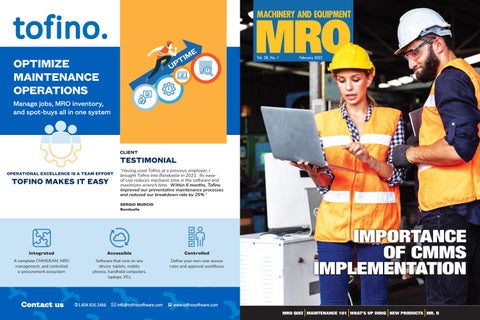
Manage jobs, MRO inventory, and spot-buys all in one system
“Having used Tofino at a previous employer, I brought Tofino into Bonduelle in 2021. Its easeof-use reduces mechanic time in the software and maximizes wrench time. Within 6 months, Tofino improved our preventative maintenance processes and reduced our breakdown rate by 25%.“ SERGIO MURCIO
Scott Jamieson, COO sjamieson@annexbusinessmedia.com
Machinery and Equipment
MRO is published by Annex Business Media, 111 Gordon Baker Rd., Suite 400, Toronto ON M2H 3R1; Tel. 416-442-5600, Fax 416-510-5140. Toll-free: 1-800-268-7742 in Canada, 1-800-387-0273 in the USA.
Printed in Canada
ISSN 0831-8603 (print); ISSN 1923-3698 (digital)
PUBLICATION MAIL AGREEMENT #40065710
Subscription rates.
Canada: 1 year $65, 2 years $110. United States: 1 year $110. Elsewhere: 1 year $126. Single copies $10 (Canada), $16.50 (U.S.), $21.50 (other). Add applicable taxes to all rates.
On occasion, our subscription list is made available to organizations whose products or services may be of interest to our readers. If you would prefer not to receive such information, please contact our circulation department in any of the four ways listed above.
Many businesses turn to maintenance software when they need help optimizing their maintenance operations; through efficient work order management systems or for problems tracking their inventory levels.
While those are valid reasons to try out a computerized maintenance management system (CMMS), the benefits of a fully utilized CMMS reaches beyond that.
A properly utilized CMMS will reduce cost of operation across the maintenance department. This is important, as since maintenance managers are always on the lookout for potential ways to reduce the cost of their maintenance operations.
A successful maintenance team shouldn’t solely be focused on quickly fixing problems as they come up, but to take preventive actions to predict and prevent potential breakdowns. A CMMS will help incorporate and automate predictive and preventive maintenance strategies to reduce equipment downtime and avoid costly unplanned shutdowns.
Less downtime translates into lower overtime expenses. When assets are kept at their optimal health, there is less chance for breakdowns, which results in employees not having to work overtime to get a critical asset up and running.
Also, CMMS lets your team communicate in a more efficient manner, meaning the work can be started faster, and finished under set deadlines.
CMMS enables maintenance team access to all crucial information about past problems and applied solutions (work history), so they can quickly figure out the best strategy for the problem at hand.
The system can also store electronic versions of documents. Having one point of access for everything, from technical sheets and equipment records to troubleshooting charts, will help technicians do their job efficiently.
Through a properly implemented CMMS strategy, you can ensure that your assets are always well maintained and working efficiently. As an overall effect, you increase the longevity of your assets.
To give you a better picture of how useful and flexible this software can be, in this issue, Bryan Christiansen discusses CMMS Implementation and Common Mistakes to Avoid, and Doc Palmer looks at CMMS: Main Thing for Planners to Know.
To summarize, ensuring high uptime and asset health reduces the need for major repairs. You cut down on the expenses related to labour and other resources, reducing costs. You can also find best practices and focus on the ones which are most cost-effective.
CMMS implementation and common mistakes to avoid / 10
Implementing a CMMS is a considerable investment in time and money for a business.
MRO Quiz / 16
Ignoring extreme operating conditions can cost industry millions of dollars.
Directing resources to ensure equipment uptime / 24
A manufacturing facility needs to have consistent and dependable operations in place to increase productivity and profits.
Social Media
CMMS: Main thing for planners to know / 12
Planners using a CMMS must use the job planning module.
Maintenance 101 / 20
The role of a maintenance supervisor.
Data and RCM / 26
Data, or a lack of it, is one of the more common reasons given by many to delay or forego doing reliability-centred maintenance.
Maintenance: What changes in asset management / 14
Asset management is not something that you ‘do’, but ‘the way you do things’.
What’s Up Doug? / 22
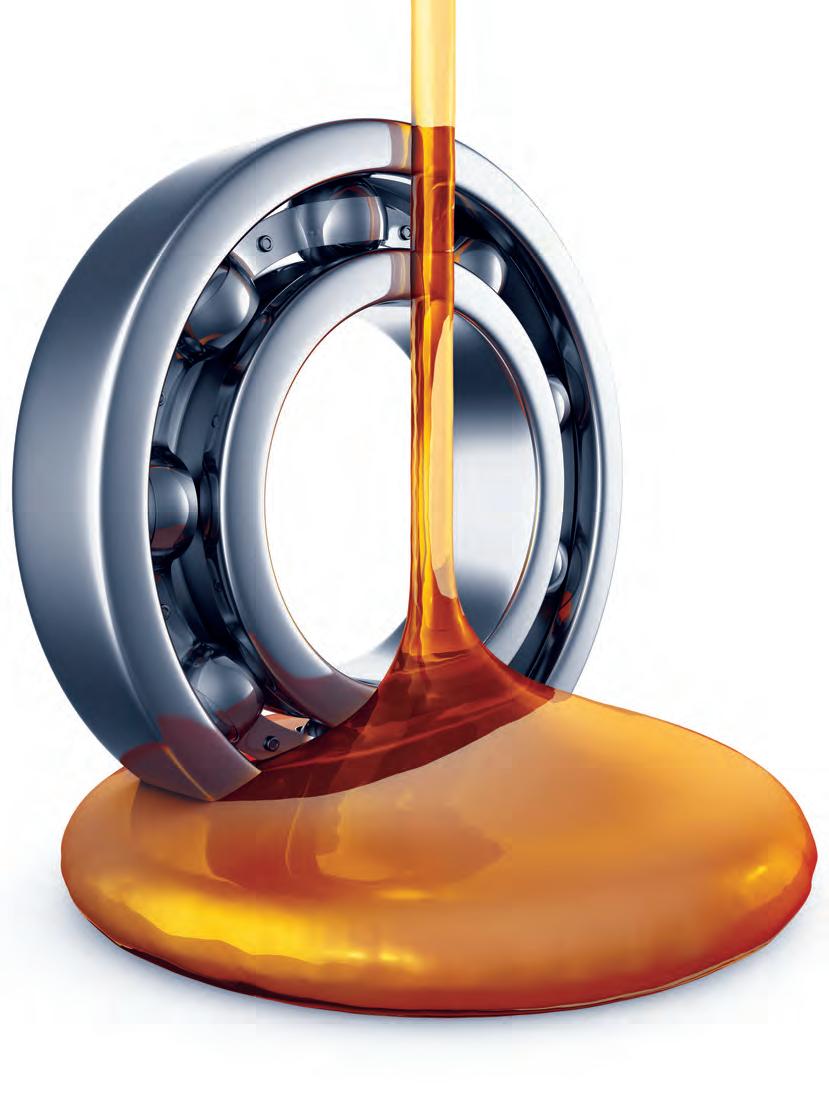
The lubrication of ceramic bearings, what does this mean?
Control and safety in robotic cell project / 28
Sysmac platform helps Innovair Automation provide seamless control and safety in Dimatec robotic cell project.
Departments
Editor’s Notebook / 3
Newswatch / 6
Webinar / 8
New in Products / 29 In Conversation with Mr. O / 30
Trelleborg appoints Global Segment Director
Trelleborg Sealing Solutions announced the appointment of Michael Cook as Global Segment Director, Off-Highway and Marketing Americas Segment Manager, Fluid Power.
In his role, Cook will be responsible for the coordination of all aspects of business development, marketing, and sales globally for off-highway and help execute and support the global strategy for fluid power in the Americas.
Cook has been the fluid power technical specialist since 2018, and before that he was an application engineer at Trelleborg. He went through the Trelleborg Graduate program in 2015-2016, and participated in the Trelleborg Sealing Solutions Talent Program in 2020-2021. MRO
Nanoprecise receives patent for its automated predictive maintenance solution
Nanoprecise announced that the U.S. Patent and Trademark Office has issued a patent for its AIbased predictive maintenance system, under U.S. Patent No. 11,188,065, titled, System and Method for Fault Diagnosis and Prognosis for Rotating Equipment.
RotationLF analyzes complex machine health data automatically, using a combination of AI and physics-based models, to minimize learning cycles and provide fast return on investment. The CEEMDAN algorithm is incorporated in to the RotationLF process to analyze large amounts of output parameters of the equipment, identify anomalies and pinpoint faults that have the potential to cause downtime.
The MachineDoctor sensor is installed on the rotating equipment and senses different parameters, which are then analyzed locally for anomalies before being discarded or sent to the cloud for more intensive review. The cloud server processes the signal through the RotationLF software, which uses CEEMDAN algorithm along with Wavelet Neural Network to detect faults and predict the Remaining Useful Life of the rotating equipment. MRO
Ontario launches Crown agency for serving tradespeople
The Ontario government has launched Skilled Trades Ontario, a new Crown agency, to improve trades training and simplify services. The new agency will promote and market the trades, develop the latest training and curriculum standards, and provide a streamlined experience for tradespeople.
The online services will help apprentices manage their careers in one place with an online one-stop-shop for scheduling classes and exams, submitting forms, paying fees and more. These changes will reduce the skilled labour shortage the province currently faces, estimated at 350,000 by 2025, by making it easier for people to learn about and enter the trades, including reducing processing and registration times for applicants from 60 days to 12.
An independent Board of Directors will lead the agency in delivering on the government’s skilled trades strategy “to break the stigma surrounding the trades, simplify the system, and encourage employers to hire more apprentices.” MRO
PTDA adds two new member companies
The Power Transmission Distributors Association (PTDA) announced the joining of two new member companies; Connexus and Mayr. Connexus (Langley, B.C.) has expertise in industrial chain and manufacturing solutions, such as lasers and metal detection. Its chains are engineered, designed and manufactured to ISO 9001:2015 standards to meet the industry specifications. Company brands include Viking Chains Inc. and I’Anco products. A family-run business, Mayr (Mawah, N.J.) provides torque limiters, shaft couplings and safety brakes. About 1,200 employees work for mayr power transmission, approximately 700 at the headquarters in Mauerstetten, Germany. MRO
CTMA announces Apprentice Award winners
The Canadian Tooling & Machining Association (CTMA) announced the recipients of the Apprentice Award winners, which include six apprentices and two pre-apprentices in the precision metalworking industry, during CTMA’s Annual General Meeting & Dinner This program recognizes “deserving apprentices and helps to increase the awareness and value of skilled-trades training.”
Top Apprentice:
• Matt Miltenburg – Answer Precision Technologies Apprentices:
• Sarah Conley – XL Tool Inc.
• Jay Jang – BOS Innovations
• Steven Mai – Hallink Moulds Inc.
• Lal Thang – Hallink Moulds Inc.
• Ryan Anderson – Manor Tool & Die Ltd.
Pre-Apprentices:
• Cynthia Cooper – Cavalier Tool & Manufacturing
• Rexon Abrenica – Rapid Enterprises
Photos: (top left), Trelleborg Sealing Solutions; (bottom right) : The Canadian Tooling & Machining Association
Festo releases its Productivity Master
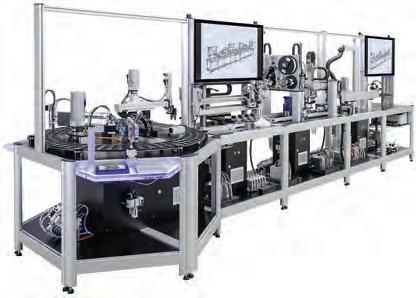
Festo’s Productivity Master features a digital manufacturing process, offering customers individualized products created by an automated process, from order placement to delivery.
The Productivity Master connects all handling hardware and software to create a digitalized production line that can be monitored by anyone from anywhere, but is otherwise hands-off from the vendor’s perspective. It requires no human interaction with the customer.
All components of the Productivity Master, axis mechanics and software are planned as a complete system. This initial Productivity Master layout, used for demonstration purposes, produces personalized USB memory sticks. It employs a cloud-based concept for registering and storing customer data, complying with data protection regulations.
Production begins with the entry of a QR code by the customer, read by SBSI sensors. EXCT gantries do the pick-and-place via their dynamic CMMT-AS servo drives and EMMT-AS servo motors. Rotation functions are carried out by ERMH electric rotary drives. The process is completed with the personalization of the USB stick. MRO
ATCO receives maintenance contract for 15 Alberta defence facilities
ATCO Frontec, part of the ATCO Group, has been awarded a facility operations and maintenance contract for 15 Department of National Defence (DND) sites in Alberta, including armouries, training camps and the Military Museums. Defence Construction Canada (DCC), a Crown corporation that provides federal defence infrastructure and environment services, awarded the five-year contract on behalf of DND.
Valued at $25 million over the first five years, the contract begins in April (with two three-year option extensions) and will be performed by Frontec’s new business unit, ATCO Facility Solutions.
ATCO will be responsible for the full spectrum of facility maintenance and support services and will manage a gross total building area of 90,169 square metres, plus 135 hectares of range and training areas. MRO
ASSET MANAGEMENT: A TALE OF TWO DEPLOYMENTS
PEMAC Asset Management Association of Canada hosted a webinar, presented by Erin MacNeil, Asset Management Operations Manager for Nova Scotia Power Inc. (NSPI).
BY MARYAM FARAG
cNeil oversees a team which designs and administers processes, programs and technologies with goals to strive for operations excellence, and to enable and sustain maintenance strategies, as informed through NSPI’s reliability processes.
MacNeil spoke about NSPI’s asset management journey, comparing the progression for its Power Production division,
with that current in play in support of its Transmission, Distribution and Delivery (T&D) division. She highlighted the benefits and challenges of each approach.
NSPI has deployed a fully-integrated, technology-enabled asset management approach for its Power Production fleet of assets. The journey to undertake that development was staged, with key components of the asset management approach integrated in a step-wise fashion, each building up on the other.
MacNeil explained that carefully designed visuals were used to communicate and gain asset owner (plant management and field-level) support for the initiative, and resources from the organization migrated to the centralized asset management team over time, providing centralized, fleet-level support versus plant-level support.
“Over approximately eight years, the ‘asset management office’ team grew from three to 10, including dedicated operational technology resources, technical
Erin MacNeil introduces Nova Scotia Power Inc.’s goals and strategic drivers.
subject matter experts, focused on generation assets and performance, and field level support resources. Major programs were deployed, such as condition-based monitoring, predictive analytics and digital operator rounds,” she said.
In 2017, the asset management team’s mandate expanded to include NSPI’s T&D assets. The mandate included an organizational change, which gave the Enterprise Asset Management (EAM) division, which includes asset management, but also capital management and planning, elevated status via senior director leadership.
An EAM integration management position was created to have consistent leadership over the integration of the asset management approach across T&D, including integration into existing asset performance management systems and framework, ensuring alignment with, and building on successful work completed for Power Production.
“The expectation for successful transition at a higher level, with minimal bumps along the way, was very different. A very top-down approach. Each approach has its highs; the best of times, and lows; the
worst of times. But while different, there are common learnings and lessons that can be applied. Each approach can be effective, and in fact has been effective for NS Power,” she said. MRO
Maryam Farag is the Associate Editor of Machinery and Equipment MRO magazine, Food and Beverage magazine, and Plant Magazine, Annex Business Media. Reach her at mfarag@annexbusinessmedia.com
Erin MacNeil, Asset Management Operations Manager, Nova Scotia Power Inc., presents the company’s asset management journey in a webinar hosted by PEMAC Asset Management Association of Canada.
CMMS IMPLEMENTATION AND COMMON MISTAKES TO AVOID
Implementing a CMMS is a considerable investment in time and money for a business. Yet, opportunities are squandered if it’s approached simply as a digitization of existing programs.
BY BRYAN CHRISTIANSEN
With the advance of new technologies, a new computerized maintenance management system (CMMS) is a transformational event for a plant, offering efficient asset utilization and greater reliability. Therefore, it demands a complete review of the existing maintenance process and operational culture. Of the many pitfalls
possible with CMMS implementation, four mistakes occur most commonly.
1. Incorporating existing maintenance flaws
Maintenance systems require continuous improvement and evolution, yet inefficiencies and redundancies can accumulate over time. Inputting an imperfect maintenance program to a
CMMS creates an abstraction that obfuscates, giving the appearance of control but with sub-optimal gains. Before implementation, a maintenance program review should be done at a strategic, tactical, and operational level, as part of the CMMS investment. Strategically, the operation’s maintenance objectives should be analyzed considering the new opportunities com-
It’s important to communicate with dedicated representatives from affected departments and explain to them the benefits of CMMS. If people fail to understand the strategic necessity of the implementation or see a threat from the change, they won’t support the process refinement and data integrity initiative.
ing with the technology. The original premise behind plant reliability, capital intensity, and maintenance expectation should bear scrutiny by a senior team. The future needs for infrastructure changes, to permit system scale and adaptation, should be acknowledged.
Tactically, an audit of assumptions regarding failure modes and criticality analysis should be made. Due to new plant introductions and revised layouts, the outcomes of the original criticality and failure effects may be sub-optimal. Similarly, the business may require new processes, including scrapping or modifying existing ones to suit the new paradigm.
Operationally, maintenance managers should review planned maintenance tasks for duplication, obsolescence, detail and effectiveness. It’s also important to understand whether work-hour estimates are accurate. A full spares inventory should occur, and a cleansing of supplier registers should ensure currency and completeness.
2.
Neglecting workplace communication
CMMS implementation is a fundamental change for maintenance departments, but it also affects the people and processes in production, warehousing and finance. Neglecting to implement a formal change management process threatens the integrity and effectiveness of the rollout. The cooperation and support of all departments are crucial for a trouble-free integration and the success of an optimized solution. Frequent and meaningful communication is the key, backed by a willingness to hear and respond to concerns and any proposed changes.
It’s important to communicate with dedicated representatives from affected departments and explain to them the benefits of CMMS. If people fail
to understand the strategic necessity of the implementation or see a threat from the change, they won’t support the process refinement and data integrity initiative.
Rolling out a comprehensive training program creates familiarity with the new system. Important factors are announced, and any staff concerns, and necessary process modifications are addressed. Technicians and operators should see the change without mundane tasks and have more time for more impactful and interesting roles.
3. Not considering inventory optimization
Often, the focus of CMMS implementation is on planned maintenance tasks and scheduling. Yet, inventory and warehousing departments offer opportunities to unlock capital, streamline operations, and improve equipment availability. The inventory feature of a modern CMMS allows optimized inventory and restocking levels with improved spare parts and tooling availability.
A clear understanding of component mean-time-between-failure and meantime-to-repair allows inventory adjustments. Inventory optimization frees up lazy capital while identifying supplier performance issues, component reliability, and trends in plant failure.
Operationally, as the CMMS schedules maintenance, the store department can pre-prepare servicing and spare-part kits to support the planned maintenance tasks. They can also ensure specialized equipment and tooling calibration to provide availability on maintenance days. These tasks enable maintenance technicians to focus on their role by readying the resources needed for each PM task. Improving the technicians’ effectiveness reduces maintenance shut duration, directly impacting equipment availability.
4. Failure to future-proof
The pace of industrial change is accelerating as technology advances. Many articles today speak of Industry 4.0 as something new, yet, we’re over halfway through Industry 4.0, with Industry 5.0 emerging on the horizon. The current discussion is what Industry 6.0 looks like.
Businesses in asset-intensive industries face a decline in competitiveness if they fail to acknowledge the pace and importance of this technological shift. If a business is looking to implement a CMMS for the first time, it’s vital to ensure the ability to capitalize on emerging technologies.
We have a convergence of the industrial internet of things, big data, the low latency of 5G connectivity, improvements in wireless sensors, machine learning, and artificial intelligence. These diverse technologies have unlocked predictive maintenance for small-to-medium-sized businesses, with prescriptive maintenance already rolled out in large industries, such as aviation and oil and gas.
A new CMMS, and the supporting infrastructure, must be designed to adapt; the time and disruption invested for a new CMMS implementation do not need to repeat again in a few years.
Investment in a CMMS is more than simply digitizing a paper-based maintenance program. Combined with Industry 5.0 technologies, machine learning, and artificial intelligence algorithms, it ushers in predictive and prescriptive maintenance potential. Such a revolutionary opportunity prohibits delegating the new CMMS rollout to middle management or treating it as transactional. Rather, it should be seen as transformational, demanding a comprehensive change program sponsored at the highest level and involving a cautious review of maintenance strategy and tactical implementation.
If a new CMMS implementation is badly handled, a business can make costly mistakes, increase administrative burden, and fail to provide a suitable ROI. When approached with a strategic mindset and correctly managed, a CMMS will increase reliability and productivity, improve worker safety, reduce maintenance costs, and positively redirect capital spending. MRO
Bryan Christiansen is the Founder and CEO at Limble CMMS (a mobile CMMS software company). He can be reached at bryan@ limblecmms.com.
CMMS: MAIN THING FOR PLANNERS TO KNOW
The main thing about planners using a CMMS is they must use the job planning module.
BY DOC PALMER
Planners are actually “craft historians that personalize information we learn on assets over the years with asset-specific, living job plans.” We just call them “planners” because it’s easier on the tongue.
Nearly every CMMS has a job planning module. They all call it something different.
- Maximo calls it the “job planning module”
- SAP calls it “tasks lists”
- Oracle calls it “benchmarks”
- INFOR calls it “standard work orders” And so on.
Many implementers of CMMS train that this module is where planners make reusable plans for jobs that we do a lot,
especially PMs. However, we do almost all maintenance repetitively in the long run. Therefore, we should plan nearly every job in the job plan module. If we perform maintenance on an asset today, there is a 50 per cent chance we will work on that same asset again within the next year. There is an 80 per cent chance we will work on that same asset again within the next five years.
We work on the same things year after year. Why would we want to rethink the plan each time? Every CMMS has a job plan module and we should therein make living plans just about every time we plan a job.
Another way to plan jobs would be to research history each time we plan a job. However, that is not the way to go. If we look at the work order history of a partic-
ular asset, we see that one time we used one rubber gasket, one time we used two Teflon gaskets, and another time we used one Teflon gasket. How would we plan this next job? We cannot simply consult history each time we plan a job. Instead, we should be creating and improving a single living job plan as our “current state-of-the-art” plan.
It takes extra time for the planners to plan in the job planning module and then import the job plan into the work order. It would be less work for the planners simply to create the job plan directly on the work order itself. But after diligently using the job plan module, surprisingly, after about six months, planners suddenly start seeing that they already have a job plan for about half of the incoming new work orders. In the
We work on the same stuff year after year. Why would we want to rethink the plan each time? Every CMMS has a job plan module and we should therein make living plans just about every time we plan a job.
long run, it saves time. This sudden reuse of plans confirms the “50 per cent rule” where we do work on the same assets over and over. Stick to your guns: plan using the job plan module. After a short while, it does save time. This strategy of making living job plans simply implements the Deming Cycle of continuous improvement. We do the same work year after year because we have the same assets. We should never approach a job as if we have never worked on it before. Our better craftspersons keep helpful information in their personal lockers. They have a resource to reference for the future. But we need to save information as a company and nearly every CMMS has a module where we can do that by making living job plans.
A KPI or metric that would make sense for planners would be: how many jobs did the planner plan using a reusable job plan? Therefore, if the planner does not use the job plan module, they are not really planning. One-off job plans do not run the Deming Cycle. We want planners to run the Deming Cycle by making reusable job plans. The living job plan in the job plan module is how “planners personalize information we learn over the years on specific assets in their capacity as craft historians.” We just call them “planners” for short. They must use the job plan module to earn the right to be called planners.
Plan jobs using the job plan module, not straight on the work orders. That’s what the plan module is for. Do planning properly. Don’t settle for planners simply making one-off job plans each time. Don’t re-invent the wheel.
Rather, implement a system to make better plans over the years. Don’t be a good plant by simply “planning”. Instead, be a great plant by continually growing better job plans. Proper planning should be Deming Cycle and continuous
improvement in practice. MRO
Doc Palmer, PE, MBA, CMRP is the author of McGraw-Hill’s Maintenance Planning and Scheduling Handbook, and as managing partner of Richard Palmer and Associates helps
companies worldwide with planning and scheduling success. For more information including online help and currently scheduled public workshops, visit www.palmerplanning.com or e-mail Doc at docpalmer@ palmerplanning.com
MAINTENANCE: WHAT CHANGES IN ASSET MANAGEMENT
Asset management is not something that you ‘do’, but is rather ‘the way you do things’, and shouldn’t be thought of as a separate entity or department.
BY CLIFF WILLIAMS
Quite often the questions of what will change for the maintenance department if and when the organization starts doing asset management. The most accurate answer, even though it might disappoint the asker, is ‘it depends’. This is the only answer to give, as what will change totally depends the maturity of the main-
tenance department and the culture of the organization.
If the maintenance department is fully matured and using all of the latest techniques, technologies and tools, then likely the only thing that will change will be the reporting of their results in the format that shows support to the strategic objectives.
As a reminder of what the focus of asset management is, here is a recap of the fundamentals that underpin it and show how they will apply to maintenance.
VALUE:
Assets exist to provide value to the organization and its stakeholders
Asset management does not focus solely
on the asset itself, but on the value that the asset can provide to the organization. This means that the maintenance focus might need to change a little, as value is often a moving target; should we continue to spend lots of money doing a fullblown maintenance program on an asset that is losing its ability to provide value? It may be that markets have shifted, competition has forced prices down, technology has passed us by, and so there is less value being derived from the asset. Now this doesn’t mean that maintenance departments should arbitrarily stop their maintenance program for this asset, but in discussion with other departments and guidance from leadership, they can make the decision on how to proceed.
Leadership and commitment from all levels of management are essential for successfully establishing, operating and improving asset management within the organization. Leadership creates the culture.
This brings us to the next fundamental of asset management.
LEADERSHIP: Leadership and workplace culture are determinants of value realization
Leadership and commitment from all levels of management are essential for successfully establishing, operating and improving asset management within the organization. Leadership creates the culture. Leadership does this by providing the correct measures for the various departments of the organization in support of the strategic objectives. These measures will in turn influence the behaviours of the departments, and thus, will create the culture of the organization; what they do, how they do it, how they measure it, and how they react to the measures. If leadership focuses on the wrong measures or allow the measures to drive the wrong actions, then they will drive the wrong behaviours.
Let’s assume that it’s been decided that one of the measures for the maintenance department is mean time to repair (MTTR). If, instead of ensuring that this drives better procedures, better planning and scheduling, better strategies to improve the understanding and monitoring for failures and so reduce repair time, leadership simply allows people to take short cuts, do ‘duct tape and gum’ repairs, or even worse, start to fudge the numbers by not following up and giving guidance, then this is certainly not going to provide value to the organization.
Leadership needs to be sure to provide the right targets to drive the right behaviours, and so, create the right culture and make sure that they follow up on ensuring this is happening. What they need to do is the next fundamental of asset management
ALIGNMENT: Asset management
transforms strategic intent into technical and financial decisions, plans and activities
Asset management decisions (technical, financial and operational) collectively
enable the achievement of the organization’s strategic objectives. This alignment needs to horizontal as well as vertical. We know there are other departments in the organization and not just maintenance, but we interact or talk or give feedback to them on an extremely limited basis, if at all. This definitely changes in the world of asset management, but before we talk about the changes, what is the current state?
If we look at the current model for many companies, it looks something like this, where maintenance, operations and procurement get their direction from current management and they go ahead and run their departments, often not talking to each other, and very often not having the opportunity to provide feedback or comments.
This model allows the departments to just look internally and not seek to understand how what they do influences and impacts the other departments. Procurement have been told that they need to reduce spend or reduce store holding; they simply start buying cheaper, inferior parts or arbitrarily reduce stock holding, not considering that they are now hindering the maintenance department in doing what they need to do.
Cheap parts don’t last as long and more repairs are necessary, and this in turn impacts operations ability to meet their targets, as there is increased downtime. Maintenance takes those short cuts mentioned in MTTR. This catches up with them as the repeat repairs become more frequent, forcing procurement to have to rush parts in, and again, impacting operations. Operations decide that they can’t release assets for PMs or necessary repairs, and this starts the vicious cycle all over again; more frequent repairs, more parts, more downtime.
Maintenance in the asset management world understands the impact and influence of all departments on them; HR for training and hiring the right competencies, IT for having easy to use systems that provide the requisite data, engineering for designing in reliability and maintainabili-
ty etc., and how maintenance impacts and influences these other departments. Leadership ensures that the goals are arrived at collaboratively and are clearly in support of the strategic objectives, and takes into consideration these impacts and influences. This is all supposed to provide the fourth fundamental of asset management.
ASSURANCE:
Asset management requires the assurance that the assets are fit for the required purpose The need for assurance arises from the governance process of an organization. Its origin is in the stewardship relationship between the top management of an organization, and its stakeholders guides and drives the actions of all departments of the organization to achieve the desired value.
To be able to give this assurance the maintenance department really does need to be using all of the latest techniques, technologies and tools. You are not applying the asset management way of doing things if you are in a reactive mode, or if you don’t have the information to make optimum decisions, or you don’t have the skills and competencies you need, or you have a culture where noone trusts anyone. The techniques, technologies and tools mentioned are really not any different to those mature maintenance departments are already using, and the journey from reactive to mature is the same one, whether it is done as part of an asset management journey or just trying to be the best maintenance department you can be.
Maintenance is a critical part of asset management, but it is only a part. We definitely need the mature department that provides the best results they can, but if we don’t include, collaborate with and engage with our partners in the organization, we will not be assured that we meet the intent of asset management, which is we deliver the desired business outcomes while meeting stakeholder expectations MRO
Cliff Williams is author of the bestselling maintenance novel People – A Reliability Success Story. He is a maintenance and asset management educator, and a keynote speaker at conferences around the world, who believes success is achieved through people. Currently, Cliff shares his knowledge and experience as an advisor on maintenance and reliability for people and processes, and asset management with TMS asset management and is a facilitator for PEMAC’s Asset Management Program.
IGNORING EXTREME OPERATING CONDITIONS CAN COST INDUSTRY MILLIONS OF DOLLARS
The reliability of industrial machinery can be reduced by 50 per cent or more if extreme operating conditions are not considered.
BY L. (TEX) LEUGNER
Many highly skilled, well qualified and well-meaning engineers and maintenance managers diligently and consistently apply sound maintenance ideas to their plant and industrial machinery, yet they fail miserably in their attempts to extend machinery life cy-
cles or improve machine reliability. Why is this so? One important reason is that plant management fail to consider the “extreme or unusual operating conditions” to which the organizations machinery may be subjected. This is a particular problem in plants, where the management group has little or no
technical training or experience, and ignores recommendations made by those who have. Machine reliability problems directly associated with extremes in operating conditions include;
• Poor design of new machinery.
• Excessive machine vibration.
• Extreme temperature conditions.
• Excessive contamination levels.
Let’s look at these conditions more closely and see how each affects machinery life cycles, equipment reliability and ultimately the efficiency and productivity of industry.
How does your organization plan for the acquisition of new machinery?
Logic: The relationship between life cycle costs and machinery design is a concept that is not always applied when the
initial design of replacement machinery is considered. Put simply, life cycle costs include the total costs related to the design, manufacture, commissioning, operation, and maintenance, and finally, the disposal of any piece of machinery.
If for example, only 40 per cent of the life cycle costs are applied to the design, manufacture, and commissioning stages of a new piece of machinery, it stands to mathematical reason that most of the remaining 60 per cent of the life cycle cost will be spent during its operational lifetime. What this means is that regardless of the level of maintenance or the techniques applied, this machine will experience failure after failure throughout its operational lifetime. On the other hand, if 80 per cent of the life cycle cost is spent during the design, manufacture, and commissioning of a piece of machinery before it is put into operation, the machine will live a long, reliable, problem-free life, provided it is operated for the purpose for which it was intended. The lesson here is that no amount of maintenance can correct a poor design.
Does your maintenance group pay sufficient attention to the resolution of vibration-related problems?
Logic: Vibration analysis experts suggest, and the statistics related to vibration problems confirm, that most machinery vibration problems are the direct result of component or drive system misalignment, component unbalance, mechanical looseness, or machine resonance related to its design. Machinery wear or bolt loosening can cause mechanical looseness conditions.
Misalignment can be caused by worn components, such as in gear drives, but is caused primarily by poor initial installation and set up of drive shafts, couplings, and belt drives.
Component unbalance can be caused
by wear, but frequently, it is caused by dirt buildup on fan blades or pump impeller erosion. Resonance is the term applied to a machine’s inherent (natural) vibration frequency. If the operating speed of the machine is such that its operational frequencies consistently come near to or continually pass through its resonant frequency, the operating frequencies can so seriously excite the resonant frequency that the machine can literally fly apart.
Designing a machine installation including the base, piping, duct work, pedestals, and accessories so that there are no natural frequencies coincident with any significant excitation generated by the machine’s operating frequencies must be considered because manufacturers are constantly reducing the machine’s mass and increasing capacities and loads in today’s equipment. As a result, resonance can be a problem throughout industry.
Is your organization aware of how both extreme ambient and operating temperatures can affect equipment operation?
Logic: Extreme temperature conditions include both high and low temperatures. In the case of temperatures below zero, industrial equipment requires the use of synthetic lubricants with high viscosity indices. This will ensure that oil flows are sufficient to allow the formation of satisfactory oil film thicknesses that will prevent wear during cold machine startup. On the other hand, high temperature operation should be a greater concern in southern North American plants. Even a five degree rise in temperature above those recommended can eventually cause severe damage. Many factors can affect temperature, but the most common are the use of lubricants of the wrong viscosity, excessive loads or speeds, dirt and dust buildup on components that have an insulating effect, or contaminated lu-
Rolling Element Bearings
Hydraulic Systems
Gear Drives
Industrial Gas Turbines
Temperatures should not exceed 71⁰C (160⁰F). (Acceptable operating temperatures can be higher if synthetic oils are applied).
Bulk oil temperature (at exterior of reservoir), should not exceed 60⁰C (140⁰F).
Operate best in a range of 49⁰C-60⁰C (120⁰F-140⁰F). Keep in mind that an operating temperature rise of 50⁰C (90⁰F) combined with an ambient temperature of 15.6⁰C (60⁰F) will result in a total “oil operating” temperature of 66⁰C (150⁰F) in gear drives.
Temperatures of the oil entering the bearings should normally be in the range of 54⁰C-71⁰C (130⁰F-160⁰F). Reservoir oil temperature should be similar.
Table 1: Common mechanical systems and their recommended operating temperatures.
bricants that can cause viscosity changes, foaming, oxidation, or other conditions that will dramatically affect the oil’s ability to disperse heat.
Another problem is that of overheated bearings that are grease lubricated. It is a mistake to apply more grease to an already overheated bearing. The additional grease simply adds to the problem because the lubricant acts as an insulator, the oil in the grease oxidizes and the increased temperature is absorbed by the bearing itself. In these cases, consideration should be given to the application of oil lubrication using a centralized oil mist system. Oil mist systems can reduce bearing temperatures by 20 to 30 per cent, because excessive lubricant is never allowed to remain in the bearing housing.
Do the personnel in your plant understand how contamination negatively affects equipment
systems, where close tolerances of machine parts are critical. This includes high pressure hydraulic systems, precision bearing applications, and engines. It is a common mistake to conclude that if contaminants can’t be seen, it’s not present. Consider this: water contamination caused by condensation can be as high as 2,000 parts per million (PPM), yet may never be discovered without accurate analysis. In some machinery, where high lubricant flow rates are present, such as in a turbine, water contamination as low as 250 PPM can cause lubricant foaming. This can also occur in poorly designed piping systems, where high flow rates can cause turbulence.
Very small amounts of condensation moisture can cause serious damage in bearings, which are installed in seasonally used machinery, because the water slowly evaporates after a hot shutdown, causing corrosion of uncovered bearing
in North America annually, but since careful failure analysis is not always carried out, these failures are incorrectly filed under “normal wear and tear”.
The lesson here is that dirt and dust particle sizes that cause the most damage are those that cannot be seen with the naked eye. These contaminants are in the size range of 10 to 40 micrometres and are referred to as “silt” contamination. Therefore, many equipment manufacturers and oil companies highly recommend that new lubricants are filtered prior to installation, and that contamination levels in lubricants in service should be monitored regularly using particle count analysis techniques. MRO
L. (Tex) Leugner, the author of Practical Handbook of Machinery Lubrication, is a 15year veteran of the Royal Canadian Electrical Mechanical Engineers, where he served as a technical specialist. He was the founder and operations manager of Maintenance
—Shane Carnegie, Electronics Product Manager
The Podcast for MRO Professionals
The podcast features conversations with industry experts about maintenance, reliability, and operations. Topics that are of utmost importance to MRO readers.
Previous guests and topics have included:
• Scott MacKenzie – Maintenance at TMMC Plants with a Focus on the Environment
• Martha Myers – Importance of Networking and Education in Maintenance
• Doc Palmer – Focus on Scheduling and Planning of Maintenance
• James Reyes-Picknell – Managing Maintenance and Reliability
• Shawn Casemore – Engaging Your Employees in a Safety Culture
For sponsorship opportunities, contact Paul Burton, Senior Publisher, pburton@annexbusinessmedia.com
For guest/topic suggestions, contact Mario Cywinski, Editor, mcywinski@annexbusinessmedia.com A Podcast brought to you by
THE ROLE OF A MAINTENANCE SUPERVISOR
As the planner develops the maintenance plan to service the equipment, the supervisor then determines when the job will be done and who the work will be assigned to.
BY PETER PHILLIPS
One of the primary duties of a maintenance supervisor is scheduling work. In other words, the supervisor will create a schedule to execute the planned work. The job of scheduling work orders is not a job to be taken lightly. There is always more work to be done than available manpower and time. The supervisor needs to take in consider-
ation the nature of the work, time needed and equipment. Priority equipment comes first and preventive maintenance (PM) and repairs must be completed on these machines, but other work order considerations need to be made. There are safety work orders, request from other departments requiring assistance from maintenance techs for equipment modifications, production, and quali-
ty improvements. Therefore, it is easy to see that the supervisor walks a tight rope trying to include everyone’s needs, at the same time maintaining the equipment to prevent failures.
In most manufacturing facilities, there is a limited amount of time to complete maintenance and repairs. Maintenance departments struggle to keep up with demand and often fall far behind with
the multitude of maintenance requests. PM often suffers the most and PM work orders are not completed on time. In general, there is usually considerable back log of work orders.
The planner and supervisor work hand in hand to keep the work order backlog to an acceptable level. They can do several things to cope with the ever-mounting workload.
1. Work orders can be separated into work that can be done when the equipment is running and work that needs the equipment stopped. One of the most successful ways to reduce backlog is utilizing the technicians time when the production equipment is running. Completing PMs and repairs safely while equipment is running can substantially reduce work order backlog.
2. Creating a work order folder for opportunity work. This is a list of work orders arranged by the time needed to complete the work. If the equipment goes down for a non-maintenance reason, technicians can select a work order that can be performed during the production equipment stoppage. This simple process gets work down without having to wait for the scheduled down day or outage.
3. Create a work schedule in advance. Giving technicians advanced notice of their work assignments allows them to prepare. They can round up the tools and materials they will need ahead of time.
However, there is more to the maintenance supervisor role than just getting work done. Most important is the safety of the technicians and other people working in the area. Ensuring proper lockout of equipment and following safe work practices are duties of the supervisor. Local and federal safety regulations state the safety of all workers is the primary responsibility of the person most in control. During maintenance and repair, this duty falls on the shoulders of the supervisor. It is important that the supervisor understands this responsibility and dedicates a good deal of their time monitoring work activities of their personnel. This includes technicians and other employees on the job site, it also includes contractors on-site, making sure they follow all safety policies and procedures. Besides safety, the supervisor will be monitoring the progress and quality of work being performed. Technicians and contractors may have questions on the repair, and it is an opportunity for the
supervisor to audit skills, abilities, and knowledge of their technicians and to ensure contractors are performing their work to expected standards.
Another important element of the supervisor role, assessing the skill set of technicians. Most maintenance departments have different pay levels, depending on skills and experience of technicians. Supervisors need to assess skills and knowledge of their personnel and place them at the appropriate pay level. Then develop a plan to provide technicians with training they need to move to the next level. This is time-consuming, especially with large maintenance crews, but a necessary element of improving the technicians’ abilities.
To improve and develop maintenance best practices, supervisors need to review work that was done during a maintenance outage. Although it is common to have a pre-outage meeting with all parties involved in the outage, it is not common to have a post-outage meeting to review how well the work was executed. The post meeting reveals any issues with the work package, and where best practices and procedures can be developed. If the job went well, it’s important to document the process so it can be performed the same next time. If the job did not go well, it needs to be analyzed and discussed to determine corrective actions, so it does not happen again.
Creating and managing work schedules, supervising technicians, managing days off and vacations along with the
many other duties, the maintenance supervisor position is very busy. Therefore, the maintenance supervisor should have a great eye for detail and possess various technical skills and leadership to lead the technical staff to the successful completion of maintenance activities.
The supervisor works closely with the planner. At small-to-medium-sized companies, the planner and supervisor are the same person. You can imagine how intensive the supervisor’s job is when they are responsible for both roles. When this is the case, it is easy to understand why maintenance departments struggle to maintain the equipment and overall equipment effectiveness (OEE).
OEE is a combination of three factors that tell how effective an asset is during the manufacturing process, asset availability, asset performance and production quality. OEE is a measure of how well a manufacturing operation is utilized compared to its full potential during periods when it is scheduled to run. It is easy to see how maintenance activities and performance affect the overall equipment effectiveness. MRO
Peter Phillips is the owner of Trailwalk Holdings Ltd., a Nova Scotia-based maintenance consulting and training company. Peter has over 40 years of industrial maintenance experience. He travels throughout North America working with maintenance departments and speaking at conferences. Reach him at 902798-3601 or peter@trailwalk.ca.
LUBRICATION OF HYBRID BEARINGS
The lubrication of ceramic bearings, what does this mean?
BY DOUGLAS MARTIN
Amain issue is understanding the meaning of grease life. Grease life is defined as the point in time where the grease is no longer able to lubricate the bearing. By knowing grease life, we can determine the frequency by which a bearing should be re-lubricated. We do
not want to wait until the last minute to re-grease a bearing, rather we choose to do it long before it is unable to do its job. There is a general calculation method presented in many bearing manufacturers documentation, which calculates the replenishment point, which is the L1 life of the grease (the length of time that one
can have 99 per cent confidence that the grease in the bearing is still functional). At this time, we feed the bearing with a specific volume based on the bearing size with the intent of pushing out any old grease in the bearing and replacing it with fresh grease.
The grease life will also give us a basis of the functional life of a sealed bearing. The general practice is to set the sealed bearing life in the same fashion as the fatigue life, in that we have a 90 per cent confidence level that a population of bearing will continue to run after this time is reached. Of course, when the grease is no longer able to lubricate, then bearing failure occurs. This differs from the traditional L10 fatigue life that most people know about. The L10 fatigue life predicts with 90 per cent confidence that a population of bearings will not suffer a failure from sub-surface fatigue. Of specific note: the calculated “life” of a sealed bearing is either the grease life or the fatigue life, whichever is a lower value.
There is certainly a value to knowing how a hybrid bearing will perform compared to a traditional, all-steel bearing, especially since the hybrid bearings come at a higher price. By knowing that a hybrid bearing will last X more hours, then the cost-effectiveness of this product can be understood. It is kind of like light bulbs; yes, we pay mode for LED lights, but how much longer do they run (and less power do they take).
A technical paper on the lubrication of ceramic bearing was published in Tribology Transactions, and this is what it was trying to achieve. Through testing procedures, it establishes performance factors for hybrid bearings that are grease lubricated. The tests were made with deep groove ball bearings and cylindrical roller bearings. A number of thickener types were tested, and synthetic and mineral oil.
The best performance improvement with DGBBs was with a lithium complex grease and mineral oil, which saw nine times more improvement of the
There is certainly a value to knowing how a hybrid bearing will perform compared to a traditional, all-steel bearing, especially since the hybrid bearings come at a higher price. By knowing that a hybrid bearing will last X more hours, then the cost-effectiveness of this product can be understood.
grease performance factor. The second greatest improvement in performance was with a grease of PolyUrea thickener and Ester Synthetic oil. In this case, the hybrid bearing performance was eight times greater than the all-steel bearing.
The lowest gain in performance was a factor of two, and this was with lithium and lithium complex thickeners, and either a mineral/PAO (synthetic blend) or a PAO oil (fully synthetic).
What do these results mean? For a standard grease such as a lithium complex/mineral oil type, then by using a hybrid bearing, you can make a significant increase in the performance of
MKETHE SWITCH
your bearing/grease system. This essentially means the sealed hybrid bearings will last longer before they reach the grease life, which could be the limiting factor depending on the application. So, for example, a “sealed for life” motor will run longer (given that it is limited by grease life) by nine times.
This also means that applications using open bearings do not need to be regreased for the purposes of lubrication as often. However, since grease serves also as a seal to keep contamination out, the re-lubrication frequency may need to be maintained to ensure cleanliness of the bearing (but hybrid bearings
are more tolerant of poor lubrication conditions).
If the environment is clean and there is no heat or external vibration, then the re-greasing can be extended or even eliminated reducing demands on lubrication technicians.
What is interesting in the results is that two very common greases, lithium complex in general industry and poly urea in electric motors, are the greases that benefit most from the use in ceramic bearings. To turn this around, there appeared to be greater benefits in changing to ceramic rolling element bearings than there is to change the grease to a more expensive type.
As a result of these findings, hybrids expand the horizon of applications that are maintenance-free, and hybrids allow machine optimizations so that smaller machine can be designed. MRO
Douglas Martin is a heavy-duty machinery engineer based in Vancouver. He specializes in the design of rotating equipment, failure analysis, and lubrication. Reach him at mro.whats.up.doug@gmail.com.
DIRECTING RESOURCES TO ENSURE EQUIPMENT UPTIME
A manufacturing facility needs to have consistent and dependable operations in place to increase productivity and profits.
By measuring the level of machine reliability, different metrics are produced. These metrics can be used to establish how reliable and consistent an organization’s day-to-day operations are.
Machine uptime is the time a machine was delivering output and performing its duties (depicted in percentage). If the ‘uptime’ metric is high, one may conclude that the reliability of a machine is also high.
Uptime is the opposite of machine downtime. If machine downtime is calculated, establishing machine uptime is easy.
Equipment downtime = The number of seconds a machine was unable to work/ final sum of seconds observed
The outcome is then multiplied by 100 to deliver the cost of machine downtime.
Equipment Uptime = 100 – equipment downtime
Improving the amount of equipment uptime holds many advantages. These include:
• Decreased use of resources;
• More predictable operations;
• Less unplanned downtime;
• Improved productivity; and,
• A strong supply-chain.
Some of the best ways to increase equipment uptime are:
1. Condition monitoring technology and predictive analytics.
A functional piece of equipment has many metrics one must track, such as temperature, current, speed, torque, shear and power. Back in the day, it was a big challenge to measure all these aspects, but in today’s technologically advanced world, it’s as easy as installing condition monitoring technology. Tech-
Most advanced CMMS allow for the integration with a manufacturing execution system. A direct interface between a CMMS and connected machines and devices allows an organization to go beyond simply maintaining operations and uptime.
nology such as this allows maintenance managers to monitor the above-mentioned metrics with great accuracy.
Maintenance management got a whole lot easier when technology enabled us to spot early deterioration signs, predict potential failures, and keep track of well-known failure modes. Now, organizations can have 30 minutes of planned downtime to do corrective maintenance on equipment instead of five hours of unplanned downtime.
Most advanced computerized maintenance management systems (CMMS) allow for the integration with a manufacturing execution system (MES). A direct interface between a CMMS and connected machines and devices allows an organization to go beyond simply maintaining operations and uptime. An organization can determine how to get the most value out of equipment and production systems throughout their lives. By tracking the hours that equipment is in operation, material flow, and other supplementary data for the MES, maintenance can be scheduled with very little disruption. Welltimed maintenance endeavours that are completed around production programs support machine uptime.
2. Training programs
One of the biggest reasons for equipment
failure is mistakes made by equipment operators. This is due to improper training and being inexperienced. An organization might also have technicians with different skill levels work on the same piece of equipment at different times. These issues cause big variability in daily operations and could affect machine reliability negatively in the long run.
Thus, it is crucial that all employees who work with the machines receive proper training. Regular upskilling of employees is necessary as well as setting up standard operating procedures (SOP). Maintenance checklists are another aspects that should be brought about to help avoid invariability among different technicians. This will not only make the technicians faster and more productive, but improve the quality of their maintenance work as well.
3. Maintenance software
CMMS is software that digitizes and centralizes your maintenance information and processes within a single system. It allows you to track and manage all your assets’ performance and productivity through your devices. A good CMMS can also optimize the use and life span of your equipment, machinery, facilities, fleets and operations. It provides you with tools to automate and stream-
line maintenance processes to ensure everything is working smoothly.
Key features of CMMS (related to equipment uptime):
• Integration with condition-monitoring equipment to keep track of equipment condition.
• Assist maintenance managers in the allocation of resources for corrective and preventive maintenance tasks.
• Increase the pace of maintenance work by giving workers instant access to SOPs, checklists and maintenance logs.
• Create the foundation for the implementation of preventive maintenance strategies and the improvement of equipment reliability.
4. Improve the procurement process
An organization’s choice regarding their equipment and vendors plays a crucial role in the plant’s productivity and equipment uptime. The most proactive approach to ensure maximum equipment uptime is choosing the correct vendor and equipment type. Factors such as cost of operation, maintenance, manpower, efficiency and specific use cases should be taken into consideration before making the final decision. Increasing equipment uptime is an objective that manufacturers have to enthusiastically invest in, as it increases the productivity and profitability of plant operations. A complete 100 per cent uptime is hardly ever possible, but it must be the goal. Apart from the aspects outlined above, manufacturers must focus on continuous development and should establish a proactive culture to keep progressing. MRO
DATA AND RCM
Data, or more specifically, a lack of it, is one of the more common reasons given by many to delay or forego doing reliability centred maintenance.
BY JAMES REYES-PICKNELL
Is a lack of data really a problem? Or is this just an excuse to sustain the status-quo?
Digging deeply into reliability requires math, which implies the need for numeric data and it implies precision. After all, one cannot do precise calculations without it. Many will stop there while arguing that the data they have is ill suited for purpose; it is lacking in sufficient quantity to be statistically valid, or it is just just not there.
However, is precision needed for reliability centred maintenance (RCM)? Is a lot of data needed? Does the data need to come from your computerized management systems? The answers to all three of those are “no” and here is why.
Precision
RCM is used to make decisions about tasks to be performed, primarily about task frequencies. Decisions are based on information, and some of that information can be based on data. Task intervals will usually be specified to be carried out daily, weekly, monthly, and quarterly.
Often during RCM, the task frequencies are specified to fit the standard frequencies already in use. If calculated properly, the task frequency comes out to 35.7 days, it will be rounded to “monthly”. If it comes out to 70 days, some might round up to “quarterly”. No matter how precise the calculation, the specified result is inevitably rounded up or down depending on how conservative the team might be, and more cautious ones usually round down.
Even highly precise calculated frequencies, like the interval for testing of a safety device, depend on inputs that are usually estimated. For example, one input is the “tolerable mean time between multiple failures.” That is invariably based on gut feel and estimates of past event frequencies. Whenever working with estimates, your results will always be approximate. If your estimates are reasonable and not just random selections of numbers, the
results will be similarly reasonable.
Data also informs information about failure characteristics, such as the value of Weibull Beta and characteristic life. Without data from a CMMS, however, you can still get decent estimates of these parameters.
In one situation, there was a field supervisor with roughly 20 years of experience. He could recall three incidents of a specific catastrophic failure that he had to deal with over the period of time. There were three supervisors and one wasn’t available, but the other was. He said that he had a similar experience. A few questions about those incidents revealed that they were indeed speaking about different events. That meant there were six, and possibly nine events over the period. The number of devices were known (nearly 800 transformers that were used in underground vaults), giving roughly 16,000 operating years and six to nine events.
MTBF was therefore in the range of 2666 to 1777 years for that particular event. None of the data came from the CMMS. In fact, the memory of those supervisors covered 20 years, the installed CMMS had only been there for six. The information about those transformers in the CMMS didn’t actually record any of those incidents, even though both supervisors remembered several incidents in that six-year time frame. There was also wonder whether the events were truly random or related to age. Since the incidents were spread out fairly evenly, the assumption was that it was random. The supervisors remembered that those events were associated with severe
weather events and flooding. Historical replacements were looked at to identify which were associated with known weather events. Although it was difficult to tell which were the ones remembered, it was found out that those replacements had taken place in older devices of a specific model. Finding relevant information required far more than what the CMMS had stored, and it relied heavily on the memories of experienced field personnel.
Doing RCM requires dealing with teams made up of experienced maintainers and operators. In doing this work since the mid-1980s, what is in their heads is usually far more valuable than the volumes of data stored in today’s maintenance management systems. Those systems help in managing the processes, but are not particularly helpful in gathering relevant reliability related information.
When dealing with reliability, we base decisions on information, not just data. While the latter feeds the former, that data is often lacking in details that inform us of what actually happened. One big reason is that we don’t ask anyone to gather the data. When implementing these systems, we rarely ask reliability engineers what data they need, and if we did, we’d find that it is very difficult to capture failure mode related data in a system designed to capture work order transactional data. They are simply not the same.
Field maintainers rarely fill in all the details unless the data fields are “mandatory”. Even then, if those fields have default values, those are often left untouched.
Those maintainers do not often see value in collecting data. They don’t use it themselves, and they rarely see any maintenance or reliability engineers using it. To them, it’s a waste of effort to collect and record it. As we install more IIoT devices, they argue that we could be collecting data automatically.
The problems with field gathered data in the CMMS that existed over 25 years ago are no different in today’s systems. It cannot be relied on without a serious concerted effort to do better. Of course, improved data gathering may not be a big help even if we do achieve it.
Another problem with data for reliability is if you do your job right as a design engineer or a reliability engineer, you will have very few failures. Even if the design is only “so-so”, it won’t fail all that often. Reliable equipment isn’t failing, so there’s no data on failures to collect.
Not long after Stan Nowlan and Howard Heap published their paper, Reliability-centred Maintenance (1978), Howard L Resnikoff argued, “One of the most important contributions of the reliability-centred maintenance program is its explicit recognition that certain
types of information heretofore actively sought as a product of maintenance activities are, in principle, as well as in practice, unobtainable.”
He was observing that in doing RCM analysis, we must work with assumptions and information that can rarely be substantiated with field observation prior to analysis. In fact, if we are doing work at the design stage, there is no directly relevant field data. However, there is often indirectly related data from similar systems, and invariably, we need to be cautious using it because of differences in how the old and new systems will be operated.
New aircraft designs are subjected to RCM analysis before they are put into service. The maintenance programs for new aircraft are well thought through and many of the calculated aspects are based on assumptions drawn from consideration of data from other systems. Those aircrafts usually operate quite reliably and safely. Had there been a wait for data to determine what maintenance to be doing, a form of root cause analysis would be used, and many failures allowed to occur in order to gather relevant data.
Few would fly in aircraft that are having their maintenance programs designed that way, and the world’s various aircraft regulators would never allow it.
If we want good data from the field, we need to have technicians in the field who are trained in and understand some basics of reliability. They’ll spot problems and their minds will make connections based on memory that a data base simply can’t achieve with data that is often gathered but unfit for this purpose.
A lack of data on failures is no reason to delay or avoid performing RCM on your critical systems. That situation is the norm for any critical system being subjected to RCM analysis, and it has been long proven over the 44 years since RCM was “invented” to work. It’s just an excuse, and a poor one at that. If you are among those who are avoiding RCM, please tell us what’s holding you back now? MRO
James Reyes-Picknell is President of Conscious Asset and the Author of Uptime – Strategies for Excellence in Maintenance Management (Productivity Press, 2015). Reach him by phone at 705-719-4945, email him at james@consciousasset.com or visit www.consciousasset.com.
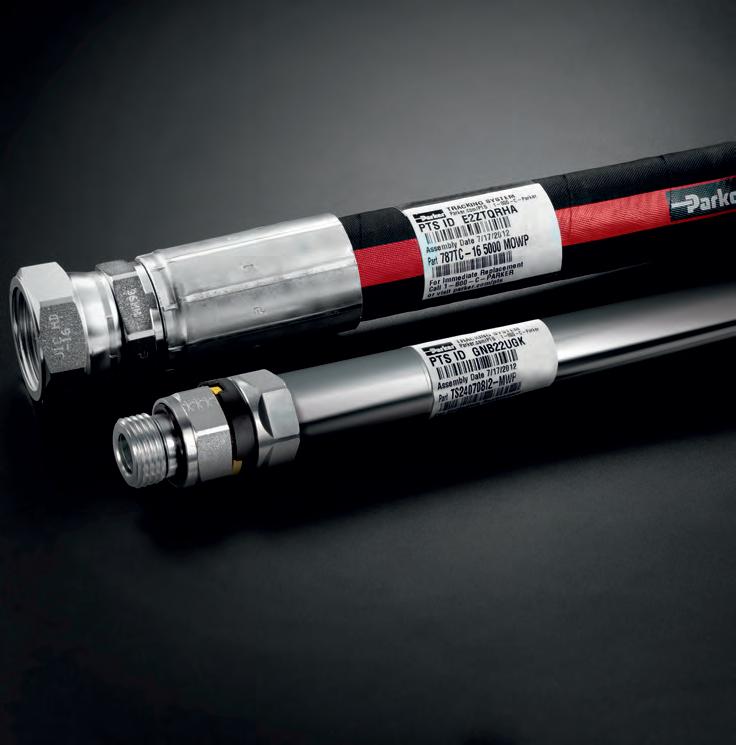
Every record contains a date code which can drive warranty, inspection, and maintenance activities. MRO planning can be easily conducted based on the age of the asset.
PTS tags can be customized by the user to contain specific information. This data can be used to drive product-specific assembly or replacement instructions. Standard 128BIT barcodes contain both the PTS ID and optional customer part number to speed identification and inspection of parts. Each asset is tagged with a unique PTS ID number. The number can be recalled by thousands of distributors and OEM business partners worldwide.
Want your next assembly faster? Use Parker PTS.
Increasing the speed, timing & accuracy of your next service event.
• Establish detailed asset location data
• Create & deploy custom inspection templates
• Schedule inspections & replacements
• Apply application & related data to an asset group
• Transfer record ownership between PTS accounts
• Store & retrieve historical inspection results
• Export asset details into Excel reports
• Create custom Databooks for audits or inspections
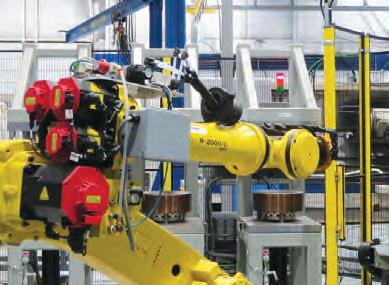
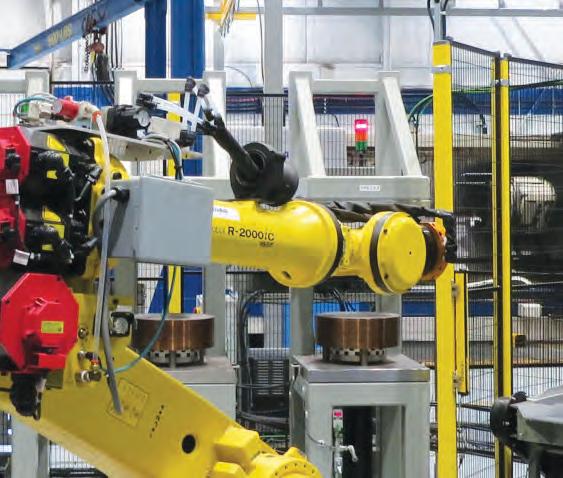
Sysmac platform helps Innovair Automation provide seamless control and safety in Dimatec robotic cell project.
Innovair Automation, an automation company specializing in installing and servicing robotic solutions, recently took on a robotic cell project with Canadian manufacturer Dimatec Inc., a manufacturer of metal-bond diamond tools and related drilling equipment.
Dimatec first invested in robotics solutions 10 years ago, and has since installed a total of seven robotic cells.
The robotic cell consists of a robotic arm that loads and unloads drill bits from furnaces that could reach temperatures up to 2000°F and then puts them into a press. Conveyance systems, sensing, and safety technology also form part of the operation system. As these operations were previously performed manually, this robotic cell has the dual benefit of improving efficiency, while eliminating manual activities that
would require operators to be near the extremely hot furnaces.
Innovair chose to work with Omron Automation Americas, whose technologies speak common industrial protocols used by robots, such as EtherCAT, CIP Safety, Modbus, and EtherNet/IP.
The need
As the inventor of the diamond-coated drill head, Dimatec had a process that had proven its merits for several decades. For this reason, the manufacturer sought to conserve as much of its existing equipment as possible in the new robotic cell. The purpose of the cell was to automate time-consuming manual processes that were requiring operators to work in the proximity of hot furnaces. Innovair turned to Omron for seeking an efficient control solution that would
eliminate time-consuming manual process, as well as implement flexible technology that was easy to retrofit onto the existing equipment. In particular, the automation partners wanted to design safety mechanisms to provide the highest degree of protection for operators, while causing minimal disruptions to the process. Since the robots in the cell needed to move through the light curtain detection areas to access specific points near conveyors, muting functionality was important.
The solution
The new robotic cell incorporates a complete PLC application that brings together control, sensing, robotics and safety to pick up parts from the conveyors without pause. Everything is programmed within Sysmac Studio – Omron’s automation platform that provides one connection for motion, logic, vision, safety and more – using a widescreen Omron NA5 HMI. The Omron technologies in the cell run on EtherCAT, while other technologies use EtherNet/IP or Modbus.
Innovair implemented Omron light curtains with a muting function and the NX-SL3300 safety controller. When works-in-progress hit a certain point at the end of the conveyor, Omron E3Z sensors send a signal to the PLC prompting a robot to go pick up the product. The PLC simultaneously mutes the light curtain so that the robot can pass through without triggering it.
The outcome
According to Innovair, the ultra-fast EtherCAT speeds and the all-encompassing Sysmac platform makes the new robotic cell efficient and flexible. Sysmac’s single connection makes it possible to program everything from a single development interface, and variables can be shared effortlessly from the HMI to the PLC. The control cabinet can be left closed during programming thanks to the single Ethernet connection, and this prevents issues with lockout/tagout.
The light curtain system has been running for about a year, and Innovair is pleased with the muting function that makes it possible for robots to easily access the conveyors when necessary. Innovair also appreciated Omron’s commitment to thorough training and support, including remote troubleshooting in real time. MRO
Provided by Omron Automation Americas
WHAT’S NEW IN PRODUCTS
Mobile sanitary conveyer bag dump system
Flexicon’s sanitary mobile tilt-down screw conveyor with integral bag dump station and compactor allows the transfer of material manually dumped from handheld bags into elevated process equipment, and the disposal of empty bags.
Mounted on a mobile frame with locking casters and a fold-down step, the bag dump station is secured to the floor hopper with clamps, and features a gasketed bag disposal chute through the side wall of the hopper hood.
The hopper discharges into an enclosed, 15 feet screw conveyor, handling materials including free- and non-free-flowing bulk solids. www.flexicon.com
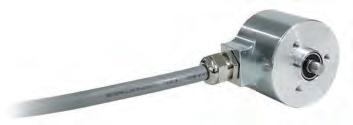
Posital rotary encoders
Posital’s models of its IXARC rotary encoders feature housings that are 27 millimetres long.
This reduced length is combined with a diameter of 36 mm. The radial cable entry and shaft seal have protection ratings of IP65.
The compact encoders are based on Posital’s magnetic measurement technology. Both incremental and single-turn absolute versions are available. Incremental variants are programmable: resolution can be set anywhere from one to 16,384 pulses-per-turn in software.
Pulse direction and the output driver, either Push-Pull (HTL) or RS422 (TTL), can be reset through software updates. www.posital.com
Creaform’s additions to its R-Series lineup
Creaform launched additions to its R-Series lineup, including a new MetraSCAN-R BLACK | Elite HD, and edition of VXelements designed for longterm support (LTS).
Features include:
• MetraSCAN-R BLACK I Elite HD offers a field of view for increased performance levels during challenging applications, such as 3D measurements on sheet metal parts.
• With its 69 laser lines and 3,000,000 measurements/s, this specialized 3D scanner is for parts with many edges, trims, and boundaries.
• The intuitive VXscan-R software module makes it possible to include the custom features of your 3D scanning CMM (enclosure, robot base, turntable, etc.). www.creaform3d.com
Flir Bridge for condition monitoring
Teledyne Flir introduced Flir Bridge for condition monitoring applications, designed for organizations to route asset health data into preferred data management systems.
The Flir Bridge is available in two options:
• Flir Bridge Pro: Includes the ability to apply filters to the incoming data, including custom alarm and alert settings, such as those based on standard deviations or Fourier Transforms.
• Flir Bridge Standard: Offers connection to up to five Flir devices or third-party fixed sensors along with the same data filtering capabilities as Bridge Pro. www.flir.com
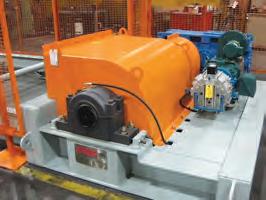
MagnaShear motor brakes
The MagnaShear motor brake from Force Control Industries employ oil shear technology, providing longer service life in applications like the frequent start/stop cycles seen on conveyors, cranes, hoists, winches, and other material handling equipment.
Proven oil shear technology transmits torque between lubricated surfaces, thereby eliminating wear on friction surfaces. A patented fluid recirculation system dissipates heat, eliminating heat build-up. The oil shear technology provides a “cushioned” stop, which reduces shock to the drive system, further extending service life of downstream components. www.forcecontrol.com
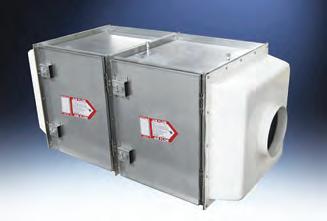
Clean Aire HEPA and Carbon Filtration Paks
CleanAire HEPA and Carbon Filtration Paks are designed to be mounted inline in the exhaust ducting from a fume hood or contaminant source, up to 1500 cubic feet per minute.
The filter pak includes a galvanized steel housing with hinged and gasketed access door for filter change-out and molded composite resin inlet and outlet plenums, with duct connection collars sized to meet specification.
Both filters include a 30 per cent pleated pre-filter, and can be paired together for applications that require particulate and fume removal. www.hemcocorp.com
The Podcast for MRO Professionals
The podcast features conversations with industry experts about maintenance, reliability, repair, asset management, safety and operations. Topics that are of utmost importance to MRO readers.
Previous guests and topics have included:
• Kevin Wright, Country Manager, igus Canada Inc - The importance of plastic products in MRO;
• Dr. Rafiq Ahmad, Assistant Professor, Department of Mechanical Engineering, University of Alberta - The role of additive manufacturing in the fight against COVID-19;
• Scott MacKenzie, Senior National Manager of External Affairs, Toyota Motor Manufacturing Canada – Maintenance at TMMC Plants with a Focus on the Environment;
• Martha Myers, Founder and Owner, Martha Myers Consulting Service –Importance of Networking and Education in Maintenance;
• Doc Palmer, Managing Partner, Richard Palmer and Associates Inc – Focus on Scheduling and Planning of Maintenance;
• James Reyes-Picknell, President, Conscious Asset – Managing Maintenance and Reliability;
• Shawn Casemore, President, Casemore and Co Inc – Engaging Your Employees in a Safety Culture; and
• Steve Richmond, CEO, Projetech Inc - How the expansion of 5G networks can benefit maintenance and repair operations MRO
Mr. O’s Tips
Past Mr. O tips are now available on our web site. We have tips from many industry experts on a wide variety of MRO related topics.
• Do not be afraid of change;
• Increase affordability and efficiency with cloudbased EAM systems;
• Sustaining our environment with maintenance;
• Ramping up from your COVID-19 slow-down;
• Planners: The underestimated safety heroes;
• Online networking during COVID-19;
• Asset information management;
• Don’t lose productivity during COVID-19, gain it;
• The first step toward building a safety culture; and,