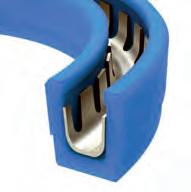
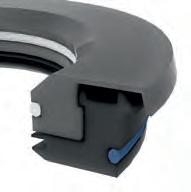
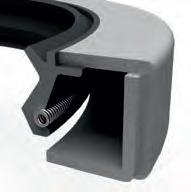
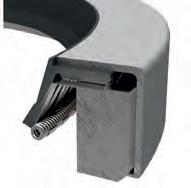
SELF-LUBRICATING BEARINGS Are Bearings Explosion Proof?
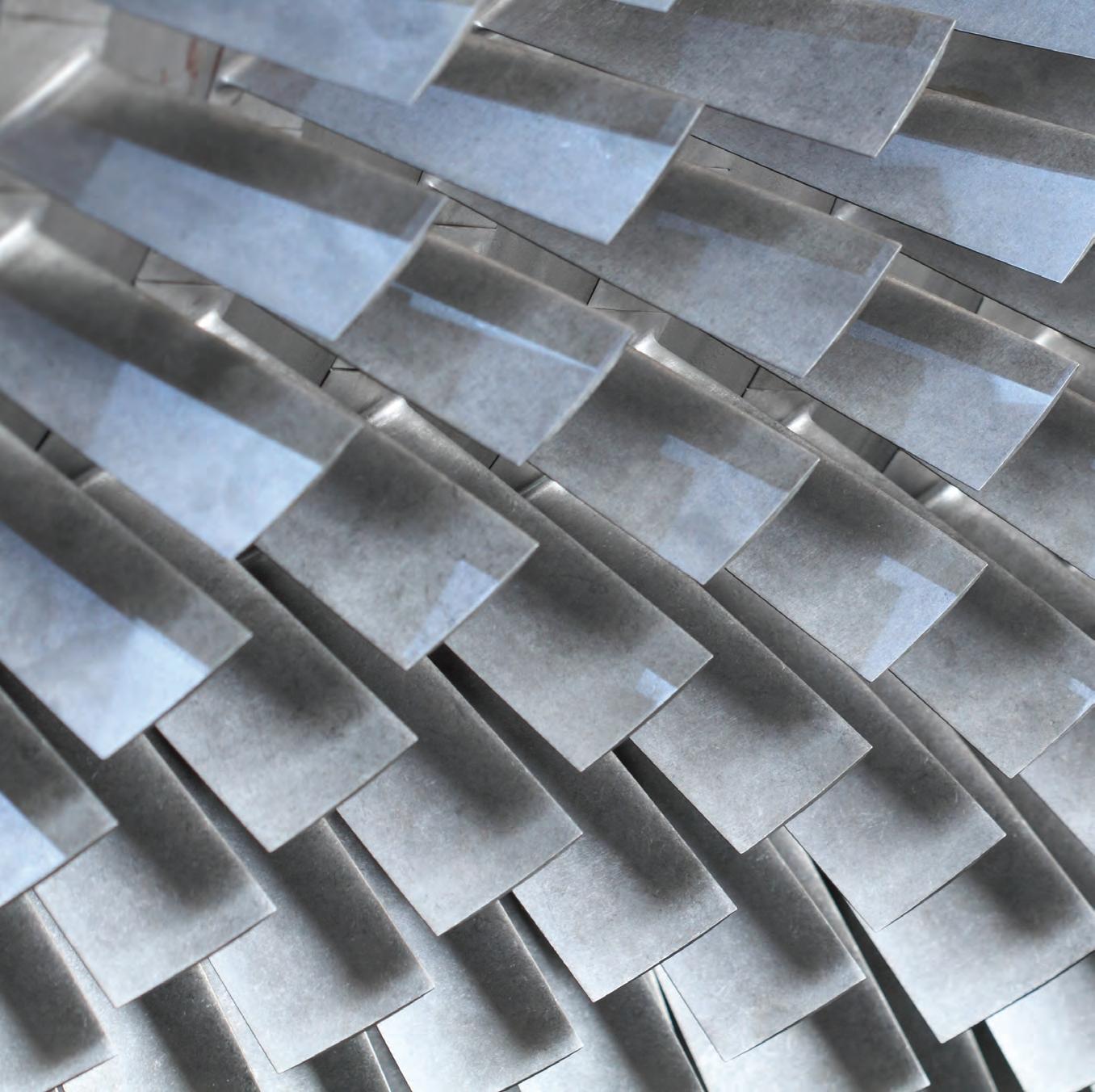
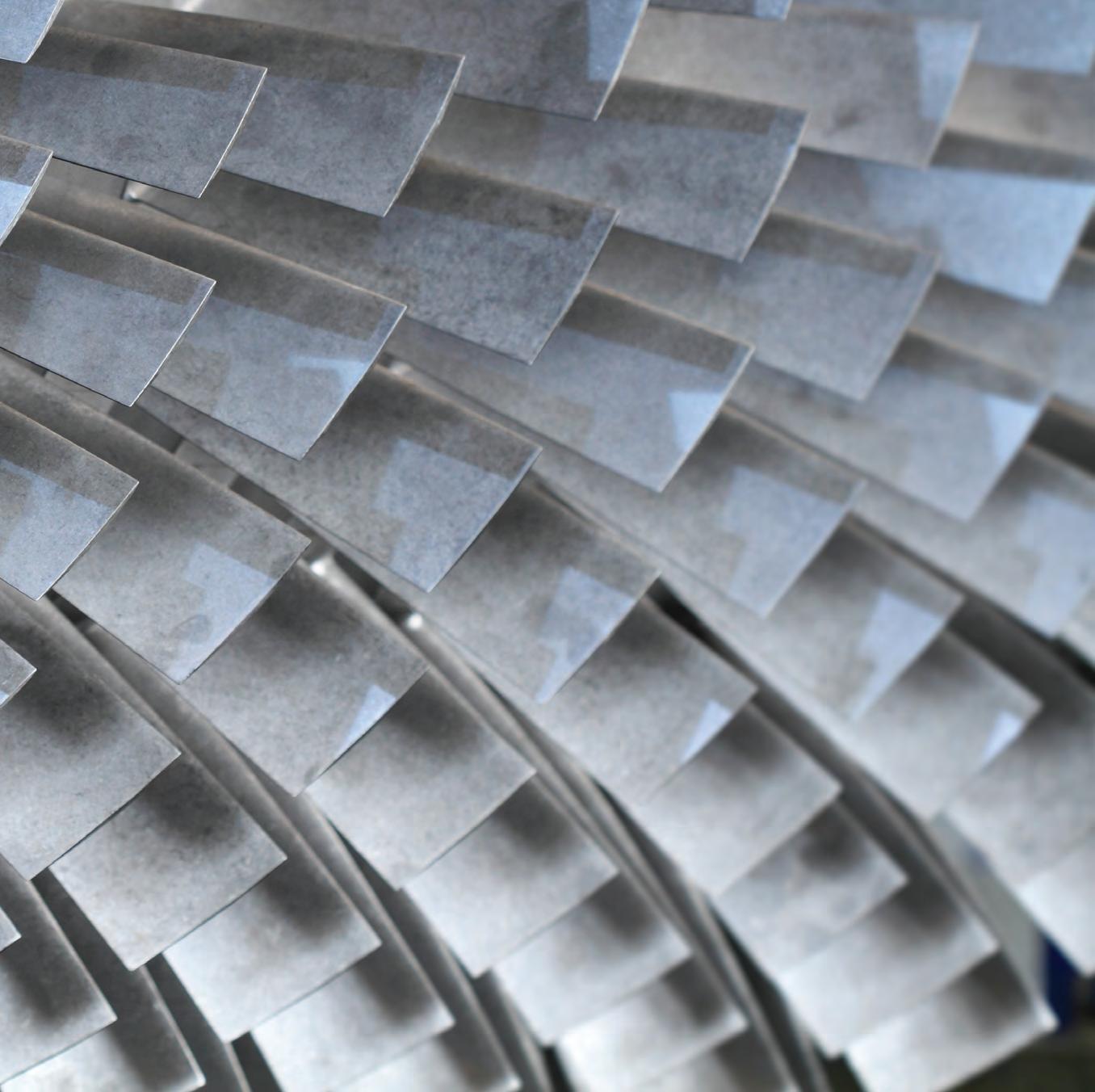
TROUBLESHOOTING Gas Turbines
MOST IMPORTANT ASSET FOR CMMS/EAM: People
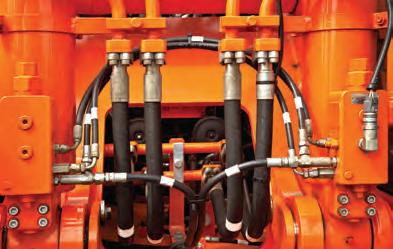
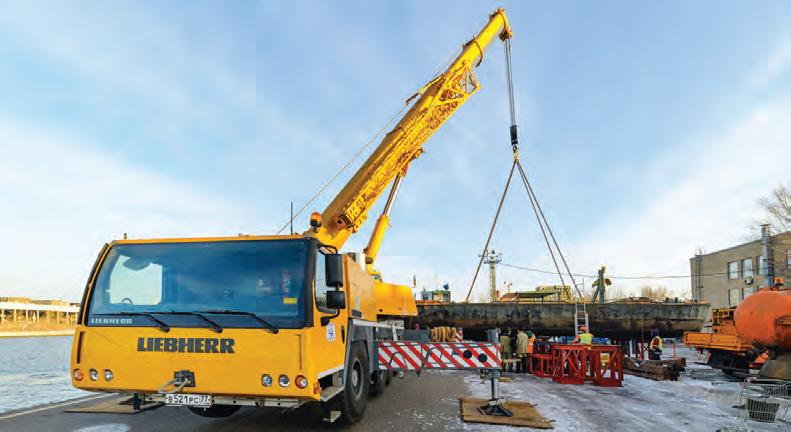
CARE AND MAINTENANCE OF Hydraulic Cranes
MRO HOSTS ROUND TABLE
WORKING WITH GRAVITY
CAUSING A FRACAS
COVER STORY: Planning Work
Planners must plan enough work to allow scheduling to succeed.
MRO Hosts Round Table / 6
Industry professionals discuss topics of utmost importance to the MRO world.
Care and Maintenance of Hydraulic Cranes / 22
How to properly care and maintain cranes to keep them running in good shape.
Causing a FRACAS / 28
What it takes to manage a failure reporting analysis and corrective action system.
Most Important Asset for CMMS/EAM: People / 14
The importance of people’s reliability on your asset data integrity.
Working With Gravity / 24
A fall protection and basic rescue course is time well spent.
Self-lubricating Bearings / 32
Properly specified, self-lubricating bearings reduce maintenance costs, extend bearing life, and are more environmentally friendly.
Departments
Editor’s Notebook / 3
Industry Newswatch / 6
Business Briefs / 8
What’s Up Doug? – Are Bearings Explosion Proof? / 12
MRO Quiz – Troubleshooting Gas Turbines / 20
Spare Parts / 38
Product News
What’s New in Products / 36
SKF TOOLS HELP KEEP YOUR MACHINES RUNNING
Improve your efficiency with solutions from SKF
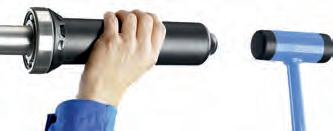
» Bearing fitting kits TMFT Series
Poor fitting, usually using brute force, accounts for 16% of premature bearing failures. SKF’s TMFT Bearing Fitting Tool Kits are designed for quick and precise mounting of bearings, while minimising the risk of bearing damage.
goo.gl/WrkTMQ
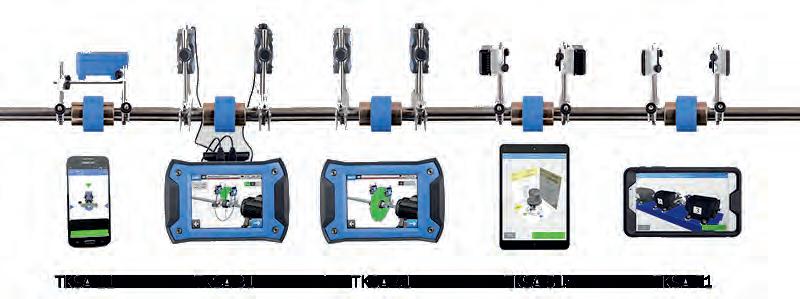
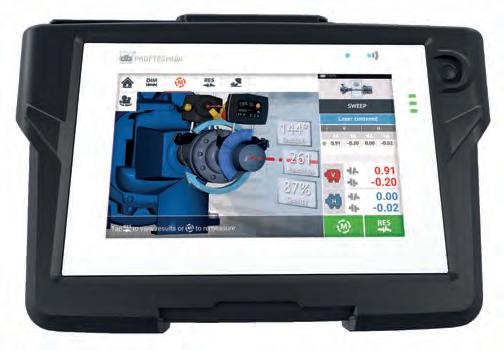
» Shaft Alignment Tool TKSA Series
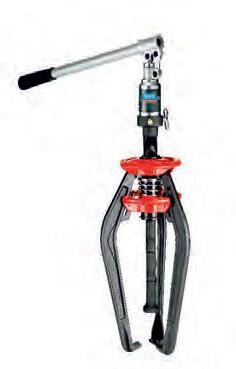
» SKF EasyPull mechanical puller TMMA series
The patented SKF EasyPull is one of the most user-friendly and safe tools on the market. The series is equipped with spring-operated arms and a solid design.
Avoid damaging the shaft with improper removal techniques, the TMMA series will assist you in the secure way to remove your bearings.
goo.gl/BL26Qo
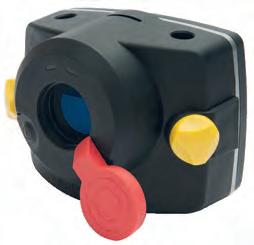
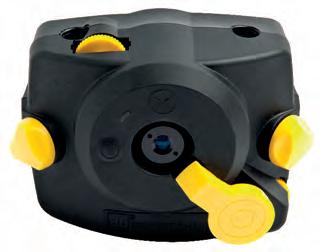
The TKSA Series are easy to use laser alignment solutions for achieving accurate shaft alignments. With two wireless measurement units, large sized detectors and powerful lasers, the instrument performs in even the most challenging conditions.
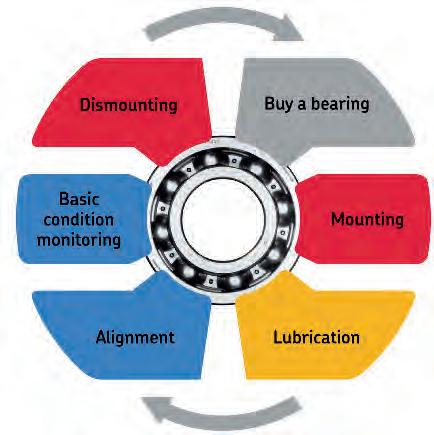
By applying the right maintenance practices and using the correct tools in all stages of the bearing life cycle, you can considerably extend your bearing’s service life and thereby increase plant productivity and efficiency.
More at: goo.gl/o2cwdF
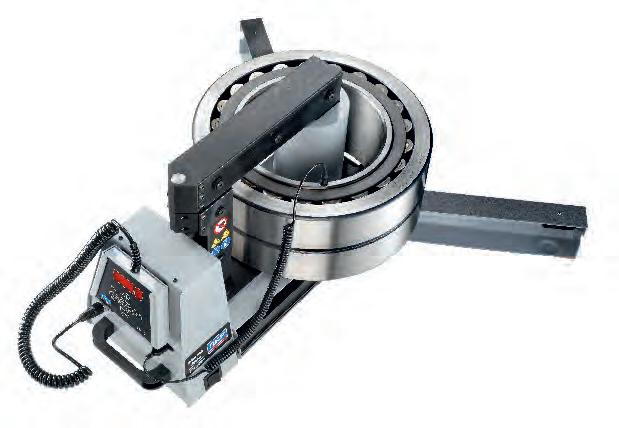
» SKF Portable Induction Heater TIH series
The TIH series combines high heating capacity with portability. Heat is used to expand the bearings inner ring before placing on the shaft, as the bearing cools a stronger interference fit is the result.
goo.gl/TOSupQ
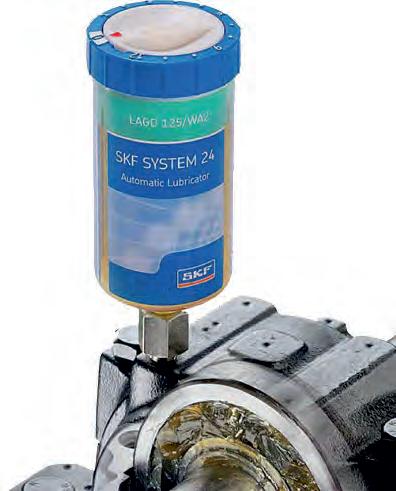
» SKF SYSTEM 24 Single Point Automatic Lubrication
Continuously delivers precisely measured amounts of lubricant to desired points via a gasdriven pump. It is ideal for lubrication points difficult or unsafe to reach manually, or where there are a large number of lubrication points where manual greasing would be less effective.
goo.gl/1gpzZZ
MAINTENANCE, REPAIR AND OPERATIONS
DECEMBER 2018
Vol. 34, No. 6
Established 1985 www.mromagazine.com www.twitter.com/mromagazine
Mario Cywinski, Editor 226-931-4194 mcywinski@annexbusinessmedia.com
Contributors
Chris Diak, Juan Pablo Geraldo, Ben Howard, L. Tex Leugner, Douglas Martin, Erika Mazza, Carroll McCormick, Doc Palmer, Brooke Smith, Jeff Smith
Michael King, Publisher 416-510-5107 mking@annexbusinessmedia.com
Tim Dimopoulos, Vice-President tdimopoulos@annexbusinessmedia.com
Mike Fredericks, President & CEO
Machinery and Equipment MRO is published by Annex Business Media, 111 Gordon Baker Rd., Suite 400, Toronto ON M2H 3R1; Tel. 416-442-5600, Fax 416-510-5140. Toll-free: 1-800-268-7742 in Canada, 1-800-387-0273 in the USA.
Printed in Canada
ISSN 0831-8603 (print); ISSN 1923-3698 (digital)
PUBLICATION MAIL AGREEMENT #40065710
CIRCULATION
email: blao@annexbizmedia.com
Tel: 416.442.5600 ext 3552 Fax: 416-510-6875 or 416-442-2191
Mail: 111 Gordon Baker Rd., Suite 400, Toronto ON M2H 3R1
Subscription rates.
Canada: 1 year $63.50, 2 years $101 United States: 1 year $108
Elsewhere: 1 year $123.50 Single copies $10 (Canada), $16.50 (U.S.), $21.50 (other). Add applicable taxes to all rates.
On occasion, our subscription list is made available to organizations whose products or services may be of interest to our readers. If you would prefer not to receive such information, please contact our circulation department in any of the four ways listed above.
Recently, we had the pleasure of hosting the MRO round table at the MainTrain Conference in Ottawa, which was presented by the Plant Engineering and Maintenance Association of Canada.
Our publisher, Michael King, and I emceed the meeting, while five industry experts facilitated the discussions. I’d like to thank James Reyes-Picknell, Shon Isenhour, Suzane Greeman, Nigel D’Souza, and Philippe Mercure for being part of the round table this year—and for sharing their expertise to help facilitate the discussions.
From the general discussion that followed the group discussions, a lot of great topics were covered. I hope those who participated took something away to use in their dayto-day work operations. For our complete summary of the MRO round table, see page 6.
If you missed our MainTrain conference coverage, make sure to read our November issue for a full report.
In this issue, we cover a broad spectrum of topics: from how to plan enough work, to caring for hydraulic cranes, to working at height. There’s even a story on self-lubricating bearings. Our MRO Quiz looks at “Troubleshooting Gas Turbines” (page 20), and What’s Up Doug? asks “Are Bearings Explosion Proof?” (page 12).
Our cover story, by Douglas Martin, explains how planners can plan enough work so that scheduling can succeed (page 10). And Erika Mazza looks at the importance of how reliable people are when it comes to asset data integrity (page 14).
“Care and Maintenance of Hydraulic Cranes” looks at how to care for and keep cranes in good shape, on page 22; “Working with Gravity,” on page 24, outlines the importance of fall protection and taking a rescue course; “Causing a FRACAS” covers failure reporting analysis and corrective action systems, on page 28; and a look at “Self-lubricating Bearings” is on page 32.
As always, we take a look at what’s happening in the industry, the new products on the market, and anything else we believe is of interest to MRO readers.
Lastly, I’d like to take this opportunity to wish all our readers a Happy Holidays and a great New Year from all of us at MRO magazine. MRO
MRO Hosts Round Table
Industry professionals discuss topics of utmost importance to the MRO world.
BY MARIO CYWINSKI
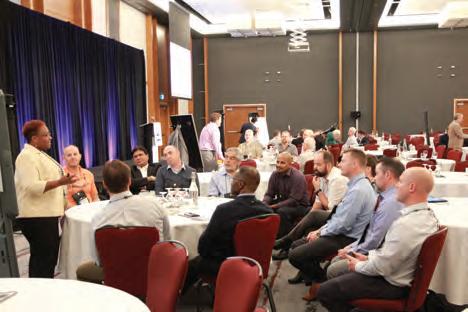
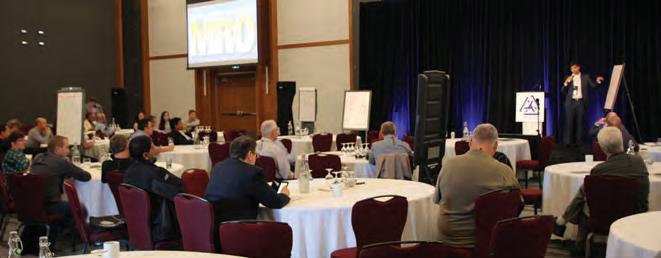
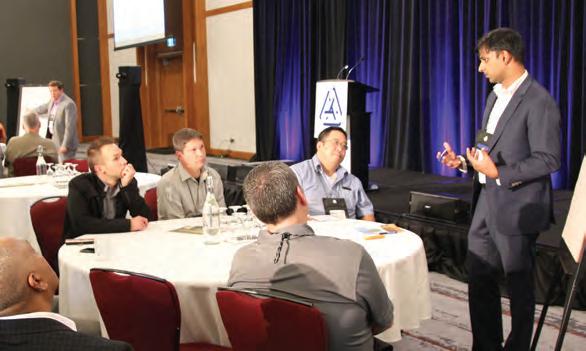
During the MainTrain conference hosted by Plant Engineering and Maintenance Association of Canada (PEMAC) in Ottawa, MRO magazine hosted a round table discussion.
The round table format had attendees break into five discussion groups. Each group discussed topics with facilitators for approximately 30 minutes. Participants were a part of two different discussion groups during the round table. After the table discussion, the facilitators summarized what was discussed and presented it to everyone in attendance.
Democratizing Predictive Maintenance Through the Industrial Internet of Things
Facilitator: James Reyes-Picknell - Principal Consultant - Conscious Asset
My table discussed the IIoT and the potential democratization of predictive maintenance technologies. We discussed a number of issues, including availability of sensors (growing), lowering of installation costs (happening due to wireless and Bluetooth technologies), concerns about security (largely eliminated by the security of cloud applications), and the impact of bandwidth on the ability to deploy IIoT devices widely for predictive purposes.
While using the IIoT to spread the ability to perform predictive assessments and diagnostics to a potentially broader audience of smaller and medium-sized businesses, the biggest concern was around the availability of bandwidth to support the large data volumes and willingness of companies to share their data. Sharing led to a discussion of artificial intelligence (AI) and its role. AI requires large amounts of data from similar equipment in order to learn enough to make good predictions. However, few companies use large numbers of like equipment on their own – sharing of data to enable AI to learn would be needed. That raises the as-yet-unanswered question, who owns the data, and how does one get paid for that data asset? A couple of ideas were put forward but no firm conclusions; this issue will need further dialogue among information technology and intellectual property professionals.
The Lies Reliability and Maintenance Professionals Tell Facilitator:
Shon Isenhour - Partner, Eruditio
We talked about lies in our session, about maintenance and reliability models and tools that we use and some of the subtleties that often aren't understood or taught correctly. We discussed the six failure curves of RCM (reliability-centred maintenance) and how to explain them as relating to types of asset or classes of assets but in reality they relate to types of failure modes of assets. This means that one asset could have many failure modes that relate to different curves, so suggesting that one of the curves represents an asset class is incorrect. This explanation helps individuals to then understand that 68 per cent of the failure modes are infant mortality, but 68 per
cent of the assets don't always fail in the infant phase.
We also talked about RCA (root cause analysis). The table discussed that there is no such thing as root cause because every single problem has root causes. All problems need both actions that happen instantaneously and conditions that have existed over time. The example used was fire, which does not have a cause. It has three causes: ignition, which is likely instantaneous, and fuel and oxygen, which are likely conditions that have existed over time. The key is it takes all three causes not just one root cause. We finished up by talking about where and how they could use this information in their site to improve their reliability programs.
Enabling Excellence in Asset Management
Facilitator: Nigel D'Souza - Asset Management Consultant, City of Mississauga
Our discussion was broken down into the following: What does excellence look like? What are the barriers to excellence? How do we enable excellence in asset management?
Many organizations are striving to develop program and structure to establish how asset management looks for them. However, there appears to be too much focus on tools to support efficiency and results; an awareness of sustainment of asset function is required, and we need to look past just the next week, month, or fiscal year.
What does excellence look like? The group felt co-ordination of efforts through tactical and strategic alignment were absolutely necessary, with a transition from capital work to operations and maintenance, and finally to disposal, clearly supporting the overall goals for the organization. Many companies currently reward their various departments differently for performance, which results in this misalignment. So strategic alignment is a typical barrier to excellence and also an opportunity for potential quick wins.
To enable success and excellence, a change in culture is required at the organization, which should be supported through training and awareness of best practices. Senior level education is also paramount in garnering buy-in and support, and in having the support to demonstrate that full life cycle management is important to your organization.
The Asset and Maintenance Management Professional of the Future
Facilitator: Suzane Greeman - Above-ground Asset ManagerVeolia North America (Winnipeg)
Specifically, we examined the issue from three angles using these questions. How will our hiring practices have to change in the future? What will the organizational culture of the future look like? We are in Industry 4.0; what skills, traits, and characteristics will the professionals and practitioners of the future need to have?
The conclusion was that a combination of hard and soft skills would be required of future professionals. Some of these
include being multi-skilled and being able to understand complex problems in several dimensions. Engineers, for example, will need to know some sales, HR, business and finance, and inventory management principles; be collaborative leaders that can function effectively in cross-functional teams as organizations become less formal; and be flexible and adaptive to changing circumstances, not averse to changing technology.
The new professional will be bringing more to the table than traditional skills and, as such, will require development in the form of exposure to complex work, projects, training, mentorship, and visibility within the firm. Organizations will need to be more willing to look beyond traditional norms such as dress codes, fixed work locations, and working hours to accommodate employees with families and other significant interests. Given that experienced-based skills are exiting the workforce faster than they can enter, industry may need to revisit apprenticeship, even though apprenticeship of the future may look different than in years gone by.
Best Practices to hire performant technical trade employees
Facilitator: Philippe Mercure - GM - OptiTest
In our group, we discussed how strong manufacturers and maintenance departments with a good number of employees hire all the time, not waiting to be under pressure, burning employees and overtime costs. Companies mentioned that since Ontario increased the minimum wage, it created a significant shortage for production employees, labourers, and machine operators. On the flip side, companies in Alberta shared that there is a strong workforce of employees available. Most companies use
a combination of their own HR departments and agencies to hire trade-skilled employees. Many companies have had difficulties in retaining their trade skilled employees lately. Almost everybody agreed that the best way to retain employees is to have a strong employee culture at the company.
Steps and best practices that were discussed were writing a proper job description that includes all the requirements and job information; job posting and/or to go with a recruitment agency; resume screening; telephone interview screening, as you can clarify things over the phone and eliminate candidates, saving time, as interviews are time-consuming when not the candidate is not ideal; in person interview; applicant talent assessments; and job offer conditional to reference check, criminal background check, and medical exam. MRO
CTMA Hosts Breakfast Seminar
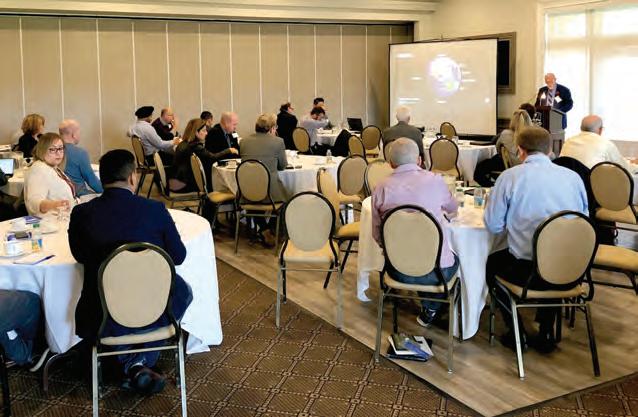
The Canadian Tooling and Machining Association (CTMA) recently partnered with BMO and Deloitte to host a breakfast seminar at the Galt Golf and Country Club in Cambridge, Ontario. The topic was USMCA and Steel/ Aluminum Tariffs: The Good, The Bad, The Ugly!
According to CTMA, the seminar was designed to address questions and uncertainty the industry has regarding these topics.
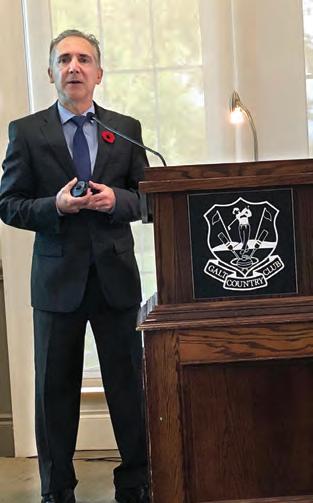
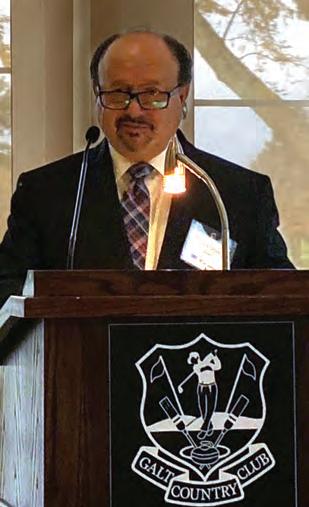
Two speakers highlighted the meeting: Sal Guatieri, Senior Economist and Director, BMO Capital Markets; and Frank Caruso, Eastern Canada Global Trade Advisory Services Leader, Deloitte.
Guatieri spoke about Canadian Manufacturing Outlook: Trade, Trump, Truckin’ On. He mentioned that manufacturers would be well-positioned as economic growth is decent, a low loonie has exports up, tax cuts may be coming, and there is less trade uncertainty, which helps investment. Challenges were also covered, which include higher interest rates, metal tariffs, and competitiveness.
“Discussed was the outlook for manufacturing in Canada and Ontario in light of the new USMCA, lingering U.S. trade policy concerns, rising interest rates, and a weak Canadian dollar,” said Guatieri. “The outlook is constructive, though there are challenges, including maintaining competitiveness.”
Caruso spoke about the Global Trade Advisory. Topics covered included the impact of USMCA, when we can see the deal being ratified, clauses included, automotive rules of origin, dispute settlement, supply management, and more. He also spoke about steel, aluminum and other tariffs, and retaliatory tariffs.
Business Briefs
News and views about companies, people, product lines and more.
• Government of Canada plans to invest $5 million to help position Goldcorp Canada Inc’s Borden Mine as a mine of the future, producing ore in a more environmentally sustainable way. Canada’s Minister of Natural Resources, the Honourable Amarjeet Sohi, and Parliamentary Secretary Paul Lefebvre made the announcement.
Borden Mine will replace all diesel mobile equipment with battery electric vehicles, making it Canada’s first all battery electric underground mine. This project
brings environmental benefits by reducing greenhouse gas emissions and creating approximately 250 jobs for local and Indigenous communities.
Funding for the project will be provided through the fast-track stream of Natural Resources Canada’s Clean Growth Program (CGP).
• New Gold Inc. has named Robert J. Chausse as Executive Vice-President and Chief Financial Officer (CFO). He brings more than 25 years of internation-
al finance experience, exclusively in the mining sector. He takes over from Paula Myson Most recently, Chausse was CFO at Richmont Mines Inc.; before this he was CFO at Stornoway Diamonds (2016) and Executive Vice-President and CFO of AuRico Gold (2013 to 2015). He was also Vice-President of Finance, Operations and Projects for Kinross Gold (2009 to 2013) and CFO for Baffinland Iron Mines Corp. (2006 to 2009), and held increasingly senior positions with Barrick Gold (1998 to 2006).
• Zedcor Energy Inc. has named Kim Cotter as Chief Financial Officer, replacing Ken Olson, who has resigned. Cotter has been with Zedcor since February 2016 as Corporate Controller and has 15 years of financial experience, as well as holding a CPA-CA designation.
The Board also announced the fol-
Frank Caruso
Sal Guatieri
lowing changes to the company’s senior leadership team: Ian McKinnon has been appointed Chairman of the Board; and Todd Ziniuk has been appointed President in addition to his current position as Chief Operating Officer.
• Petrotranz Inc. named Dallas M. Smith as Chief Executive Officer, replacing Paul Johnson
Smith joined Petrotranz in 2013 as the Vice-President of Technology and has held various senior positions at the company. For the past two years, he acted as Chief Operating Officer. Smith has held several other leadership positions within the energy industry, including customer experience, operations, IT, and development operations. Smith also managed the technical teams in several successful start-ups.
• Rio Tinto, with the Cheslatta Carrier and Haisla First Nations, celebrated the launch of the tl'ughus tunnel boring machine, a key milestone in completing the Kemano Second Tunnel project.
The machine will dig 7.6 kilometres of tunnel through a mountain as part of a $600-million project to enhance the long-term security of a clean power supply for the BC Works aluminum smelter in Kitimat, B.C.
The 1,300-tonne machine was named by the Cheslatta Carrier nation after a legendary giant monster snake and is decorated with artwork by Haisla First Nations students.
• ArcelorMittal Mining Canada G.P. announced that Pierre Lapointe is stepping down as CEO with immediate effect. Jean Ouellet, currently COO, ArcelorMittal, assumes the role of CEO on an interim basis, in addition to the position he currently holds. Ouellet has been a long-standing employee and strong member of the ArcelorMittal Mining management team. In this role, Ouellet will report to Gustavo Gomes, VP, COO, Mining segment. Lapointe will assist with the transition.
The ArcelorMittal team thanks Lapointe for his contribution and commitment to the business over the last seven years, and wishes
him all the best for the future.
• Wajax Corp. announced that it has acquired all of the issued and outstanding shares of Montréal-based Groupe Delom Inc.
Following the terms of the share purchase agreement entered into between Wajax, Delom, and Delom's direct and indirect shareholders, the aggregate purchase price for the shares was $51.8 million, with $2.0 million of such purchase price remaining subject to the achievement of certain performance targets post-closing.
• X-Terra Resources Inc. announced it has appointed Kim Oishi to the Board of Directors. Oishi has more than 20 years of experience in financing and advising growth companies and has served in senior management and board positions on a number of public and private companies. Oishi is the founder and president of Grand Rock Capital Inc. Oishi currently serves as the Director and Chair of the corporate governance and disclosure committee for Integrity Gaming Corp. and the Chairman of the Board for Datable Technology Corp. MRO
THE LASER ALIGNMENT GAME CHANGER OPTALIGN® touch
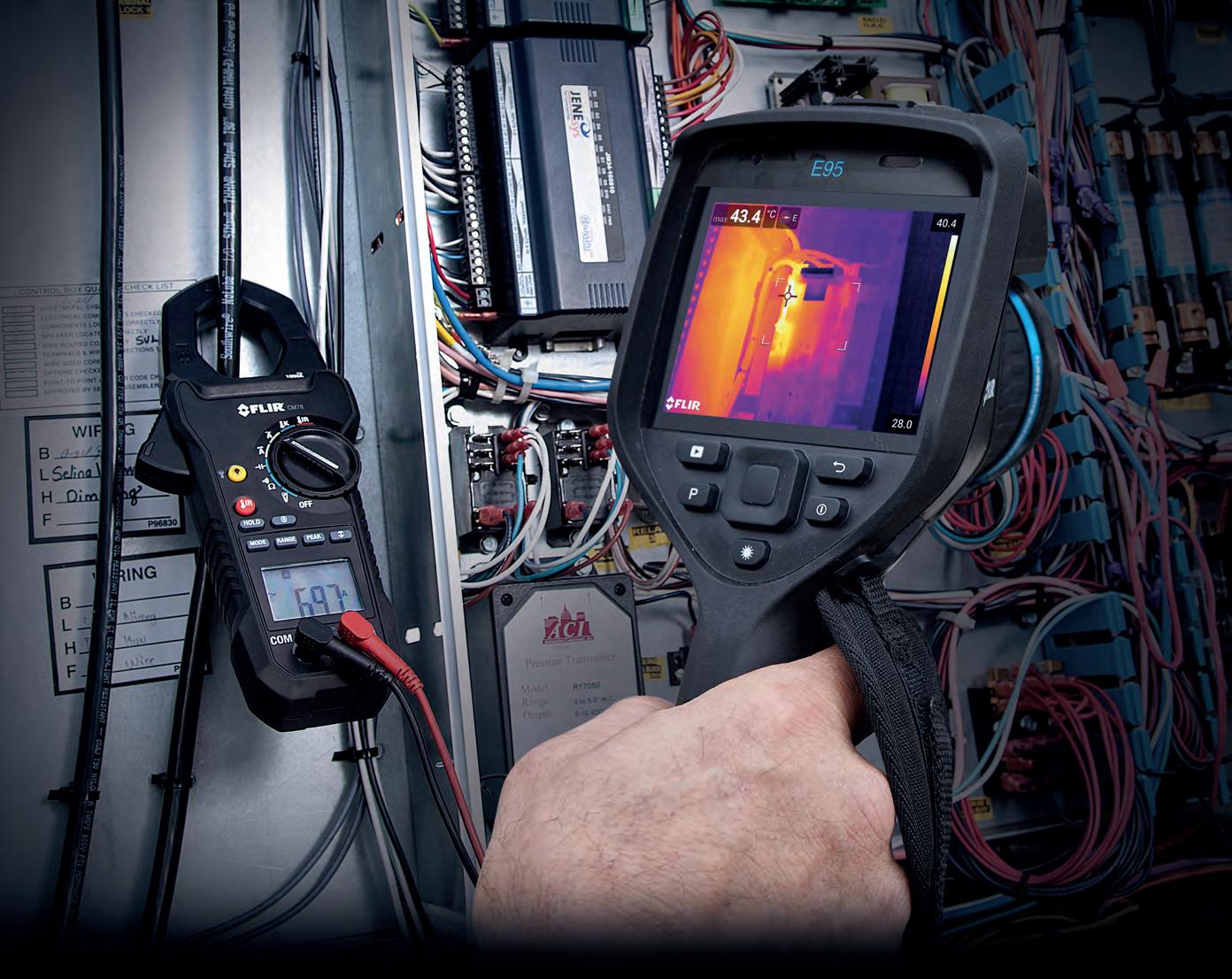
PLANNING WORK
Planners must plan enough work to allow scheduling to succeed.
BY DOC PALMER
Avital part of maintenance productivity is filling weekly schedules with planned work. However, many times a plant simply does not have enough planned work to fill the schedules. The biggest problem in most plants is that management does not adequately protect the planners to be planning in the first place. When allowed to plan, however, planners sometimes get caught up in being busy instead of completing job plans. First, management must protect planners to plan. All too often plants will hire planners and declare victory, but then use planners for enough other duties to the exclusion of planning. They may have the planners fill in for absent
craftspersons. When short of welders, the planner with a welding background helps out. They may have planners substitute for absent supervisors.
Consider a planner who plans for three crews, of which the supervisors and the planner each gets two weeks of vacation and two weeks of sick pay. The four weeks of planner vacation and illness take a month away from planning, but the 12 weeks of the planner substituting for a supervisor absence would take another three months away from planning. Therefore, the plant has arranged to have a total of four months without planning. Plants also often assign planners to various teams such as projects, root cause analysis, reliability centred
maintenance, safety, etc., all worthwhile in themselves, but taking away from planning.
Plants should realize that a planner can help a workforce of 30 persons achieve the productivity of 47 persons, but only if the planner is planning. Management should not be using a planner (the equivalent of 17 persons) for non-planning work.
A planner planning for 20 to 30 persons requires a full-time planner. Planners each planning for so many persons cannot be utilized elsewhere. Planners organized to plan for fewer than 20 persons have some limited time for other duties, but not at the expense of planning.
Photo credit: Getty Images
Second, even when protected by management to plan, planners often might not plan enough work in time to fill schedules. Problems keeping them from planning enough work include jobs in progress, plant design changes, desire for plans and estimates to be "perfect," spare parts issues, and even simply not focusing on completing plans.
Planners generally should not help problems that arise on jobs already in progress. Preferably, planners should only help emergency jobs that started without job plans, but only on the request of the supervisor. Otherwise, a planner planning for 20 to 30 persons cannot afford to get bogged down in helping jobs in progress.
The engineering side of the plant keeps some planners from planning enough of the work. Planners should not be deciding, researching, or co-ordinating work involved with mod-
"curacy is possible. Fortunately, a quickly made planner judgment on the time is often good enough to control work. Planners must face the truth that a plan will never be perfect.
Issues with spare parts often bog down planners. The purchasing group should not use planners as a crutch for expediting vendors. The purchasing group should place a minimum of administrative burden on the planners. The warehouse should carry stock so planners do not have to place special purchases for routinely used parts in the first place. The computer inventories should be accurate enough so planners do not have to verify stock quantities physically. If the plant practises extensive kitting, the warehouse could take the lead in kitting parts and the planners should not be double-checking (a non-value added activity) the kits for accuracy.
Finally, as with much of life, some -
Plants should realize that a planner can help a workforce of 30 persons achieve the productivity of 47 persons, but only if the planner is planning.
ification to the plant design. Examples might include when someone requests changing from a globe valve to a gate valve, adding a line for bypassing a heat exchanger, or changing a filter mesh size. Planners generally do not have the expertise, authority, or time for deciding plant modifications. The plant workflow process should change such work to a waiting on engineering or similar status for others to manage.
A desire to make plans and estimates "perfect" might also hinder planning enough work. As far as the level of detail, the planner must plan each job with as much detail as possible, but subject to the constraint of planning all the work. This constraint is frustrating. The plant desires great job plans to ensure consistency of work, give senior craftspersons a valuable reference, and give new persons a chance at success. But this level of detail is best developed over time, as jobs are repeated with the planner, first largely relying on craft skill and later adding more details as time permits. As far as time estimates, maintenance is not assembly line work where great ac-
times we get so busy we lose sight of our primary objectives. The objective of planning is simply to move jobs from a waiting on planning status to a waiting to schedule status. It is not enough for the planners to be "busy." Planners must be moving work to the status that indicates they are ready to go and can be placed into the weekly schedule.
A huge reward awaits the plant that can fill maintenance schedules to maximize productivity. Planners must plan the work ahead of time, in time.
Tip: It is not enough for planners to be “busy.” Planners must be moving work to the status that means they are ready to go and can be placed into the weekly schedule. MRO
Doc Palmer, PE, MBA, CMRP, is the author of McGraw-Hill’s Maintenance Planning and Scheduling Handbook. As managing partner of Richard Palmer and Associates, he helps companies worldwide with planning and scheduling success. For more information, including a schedule of current public workshops, visit www.palmerplanning.com or email Doc at docpalmer@palmerplanning.com.
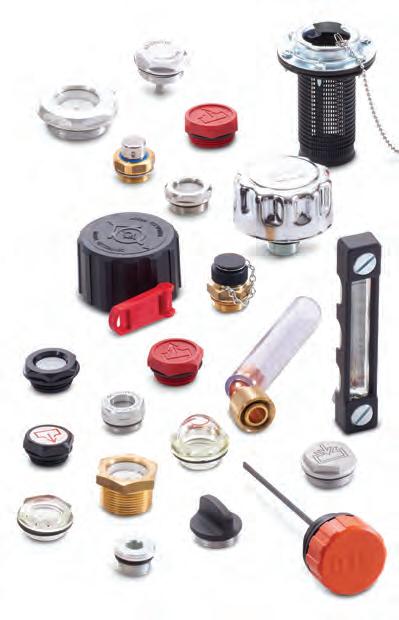
JW Winco’s immense offering of standard parts for controlling, venting and sealing of liquids and gases includes:
■ Oil Level Sight Glasses
■ Oil Level Indicators
■ Threaded Plugs / Sealing Plugs
■ Oil Drain Valves
■ Breather Valves
■ Filters / Strainers
Explore our full product line online or contact us with your application requirements.
ARE BEARINGS EXPLOSION PROOF?
BY DOUGLAS MARTIN
The question posed in the title is one that I have been asked a couple of times and is not easy to answer. If one looks at any technical documentation from a bearing manufacturer, nothing is written about it. Yet I have heard the term “explosion proof” several times in the industry, especially when there are machines that operate in safety-sensitive applications and certain environments.
What does “explosion proof” mean? I found the easiest place to find information is the Occupational Health and Safety Administration (OHSA) web site. The OHSA standard 1910 Hazardous (classified) locations is a standard that applies to electrical devices, so clearly this standard does not apply to bearings, as they are not electrical. It appears the concern is the device would create a spark that would ignite a “hazardous” atmosphere.
Engineers who have called me are in the process of using a bearing, likely in a hazardous atmosphere. There is likely a specification on their work package that states something to the effect of “all machines (or elements) must be explosion proof.”
A good article on the OHSA web site, "Combustible Dust in Industry: Preventing and Mitigating the Effects of Fire and Explosions," offers some case studies of dust fires and explains what is needed to start a fire or an explosion.
Perhaps the most informative article in terms of a bearing is found on the web site IEEE Xplore Digital Library. The paper "Analysis of Ignition Risk to Ball Bearings in Rotating Equipment in Explosive Atmospheres" (document number 0525745) indicates that “explosion proof” standards do not consider bearings as sources of ignition.
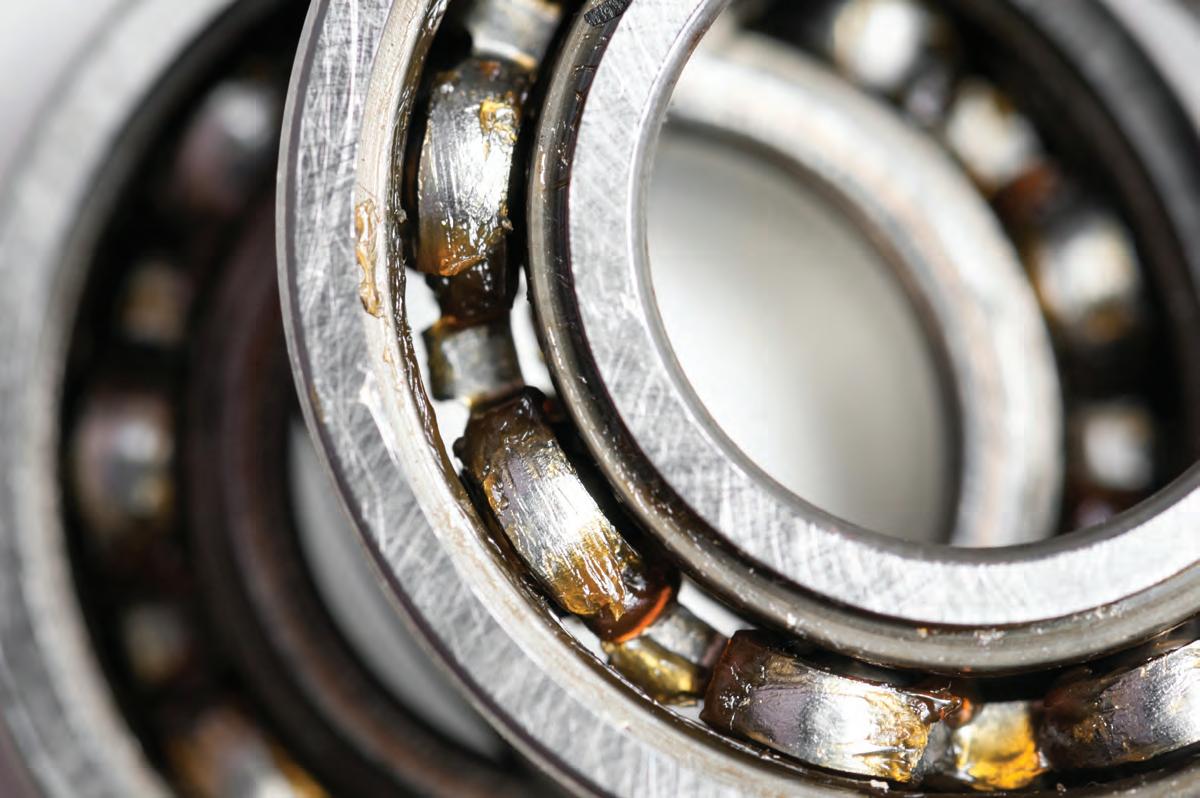
What the paper does recognize is that a bearing that is failing can be the source of ignition from heating up. As mentioned in the OHSA document, all that is needed to start a fire and/or explosion is a heat source. Bearings fail by attaining their design life or by damage resulting from handling, contamination, and/or poor maintenance (to name a few).
If a preventative strategy is employed, one could remove the bearing (or machine) before the predicted life of the system. However, less than 10 per cent of
failures are from bearings reaching their design life. Most bearing failures are the result of lubrication, contamination, and/or poor handling. As such, the rate of failure is generally not time based; rather, it is condition based.
Making the System “Explosion Proof” Using Condition Monitoring
The goal would be to monitor the condition of the bearing and set limits such that the machine is shut down prior to the bearings becoming an ignition source. The two most common methods of monitoring of bearings are by temperature and by vibration.
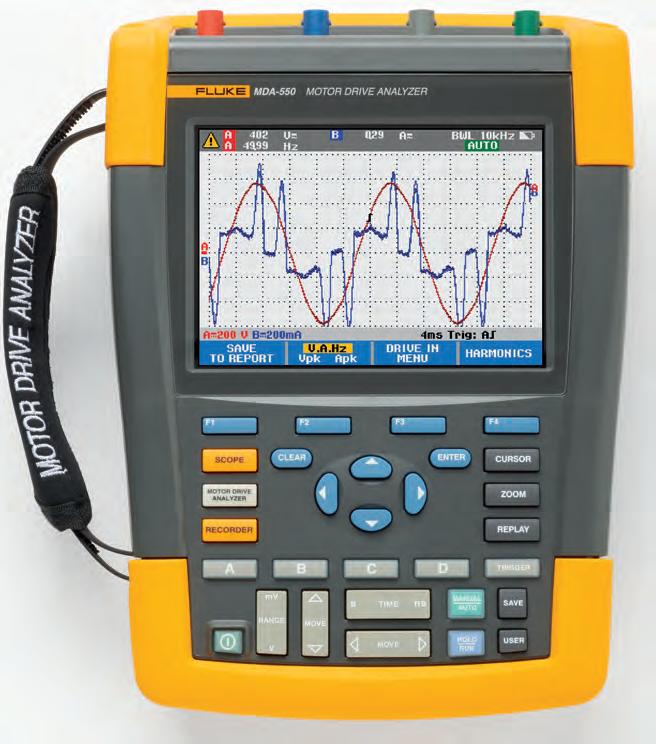
In measuring vibration, the typical parameters that are measured are velocity and acceleration. This is done by attaching an accelerometer to the machine or bearing housing and then connecting a data collector, which processes the overall vibration of the machine and provides the two readings: acceleration and velocity.
Acceleration readings are generally used to indicate and pinpoint damages to bearing rolling surfaces. These readings can provide indications of race and/ or roller damage months before the bearing will get to a critical stage that may make it an ignition source.
Specific acceleration readings can also be used to indicate that the bearing requires re-greasing, addressing a significant cause of bearing issues.
The velocity readings can provide indications on the overall health of the machine and can provide insight to such issues as coupling misalignment or rotating unbalance, both of which can lead to the failure of machine components.
However, vibration readings are not always able to predict failure from all modes, so the monitoring of bearing temperature is also an important condition to monitor. Certainly, by monitoring temperature, one will get a direct indication of the bearing temperature and how close one is to the ignition point of the atmosphere.
The key difference between temperature monitoring and vibration monitoring is that when a temperature alarm limit is passed, it probably should trigger immediate or very rapid shutdown, whereas vibration monitoring provides a longer-term prediction of a future failure. With vibration, one would likely be able to schedule the repair during a planned shutdown or outage.
Vibration monitoring is also a good diagnostic tool that can be used to determine which mechanical component is failing and even which part of that component (inner race, for example) is the one that is failing.
Are Condition Monitoring Systems “Explosion Proof”?
Herein lies the issue. One has a bearing, that is essentially “explosion proof” but one knows that when it fails, it could be an ignition source. To prevent this, one can add an electronic system which now falls into the “explosion proof” standard.
Indeed, there are components and wiring methods in which one can have an “explosion-proof” condition monitoring system.
Therefore, what is the answer?
• Bearings do not fall under the standards for explosion proof devices;
• Bearings, when failing, can be ignition sources; and
• “Explosion-proof” condition monitoring systems can be installed that allow shutdown prior to the “bearing system” becoming an ignition source. MRO
Photos provided by SKF Inc.
Douglas Martin is a heavy-duty machinery engineer based in Vancouver. He specializes in the design of rotating equipment, failure analysis, and lubrication. Reach him by email at mro.whats.up. doug@gmail.com.
PEOPLE
BY ERIKA MAZZA
Even though we are entering the era of IIoT and smart machines, the reality is that most organizations are using Computerized Maintenance Management Systems (CMMS) or an Enterprise Asset Management System (EAM), where more than 95 per cent of the data comes from human interaction.
It is people like the system administra-
tor who configure the master data and keep it up to date; maintenance managers will add maintenance plans, asset attributes, and BoM, and even set the threshold for machine connectivity, and regular users will request service based on their observations of how the machine is performing.
Planner, stock manager, and workforce complete the workflow process,
adding additional data and completing the asset historical record through planning of work orders, managing parts, and recording activity results, failure data, and meaningful closing comments. These three roles are key players in enriching the asset history and keeping up to date the existing data, based on their feedback. They are the closest to the assets and are the ones who can iden-
Photo credit: Getty Images
tify opportunities for improvements or issues that require attention; they can update asset condition and nameplates and even help optimize existing PM programs.
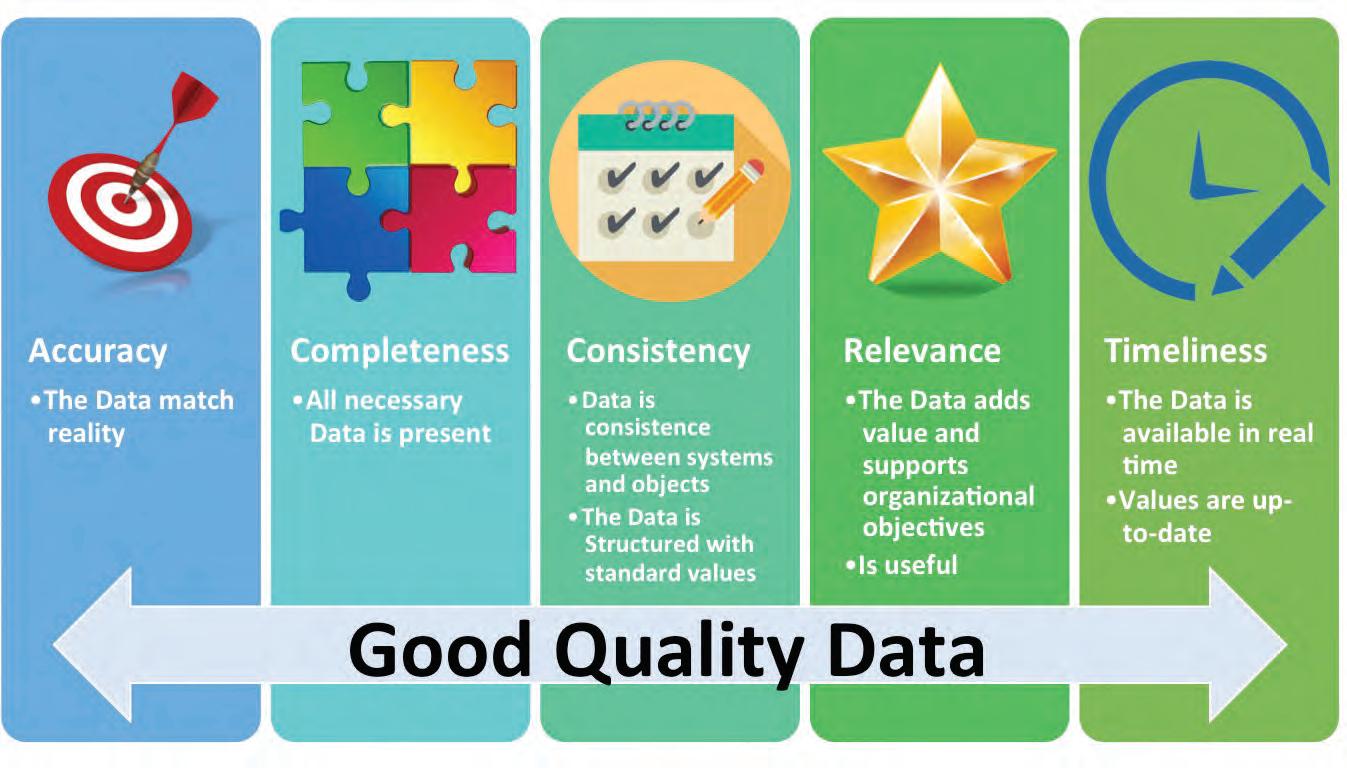
Managers at all levels of the organization will rely on this data and create reports to make decisions, adjust priorities, and understand asset performance. But an important question arises: Is the data fit for its intended uses in operations and maintenance decision-making? Five characteristics of high-quality data are accuracy, completeness, consistency, relevance, and timeliness. These need to be present to add value to your decision-making process.
Human Error and Human Reliability
The reliability of the data is directly tied to the source of it. People can be unpredictable, hard to reset or reprogram, easily distracted, highly multifunctional, unique, autonomous, muddy, and sensitive; making them prompt to commit errors that will compromise the integrity of your asset data in the CMMS/EAMS. Fortunately, errors are the outcome of multiple human and organizational factors happening in a chain reaction. The human factor link is a physiology combination of decision, learning, per-
formance, omission, and memory. We can break out the organizational factors (environment and task) into systems, procedures, processes, and culture. Organizational factors will give us a chance to influence the human link and break the error chain.
Avoiding blaming people but focusing on possible contributing factors of the problem helps to identify practical solutions. One way to do this is by categorizing the type of human errors that prompt situations like missing failure data on work orders, logging unrealistic labour hours, or even choosing the wrong asset to track the history. Using root cause analysis and other strategies will identify what is the ultimate cause of the human error, helping you to build strategies that prevent the occurrence and reoccurrence of the human errors when inputting data into the CMMS/ EAMS and boost the human reliability.
We can influence behaviours and outcomes by ensuring there is a platform that enables human reliability when deploying a new systems, relaunching existing systems or sustaining operations of your current CMMS/EAMS.
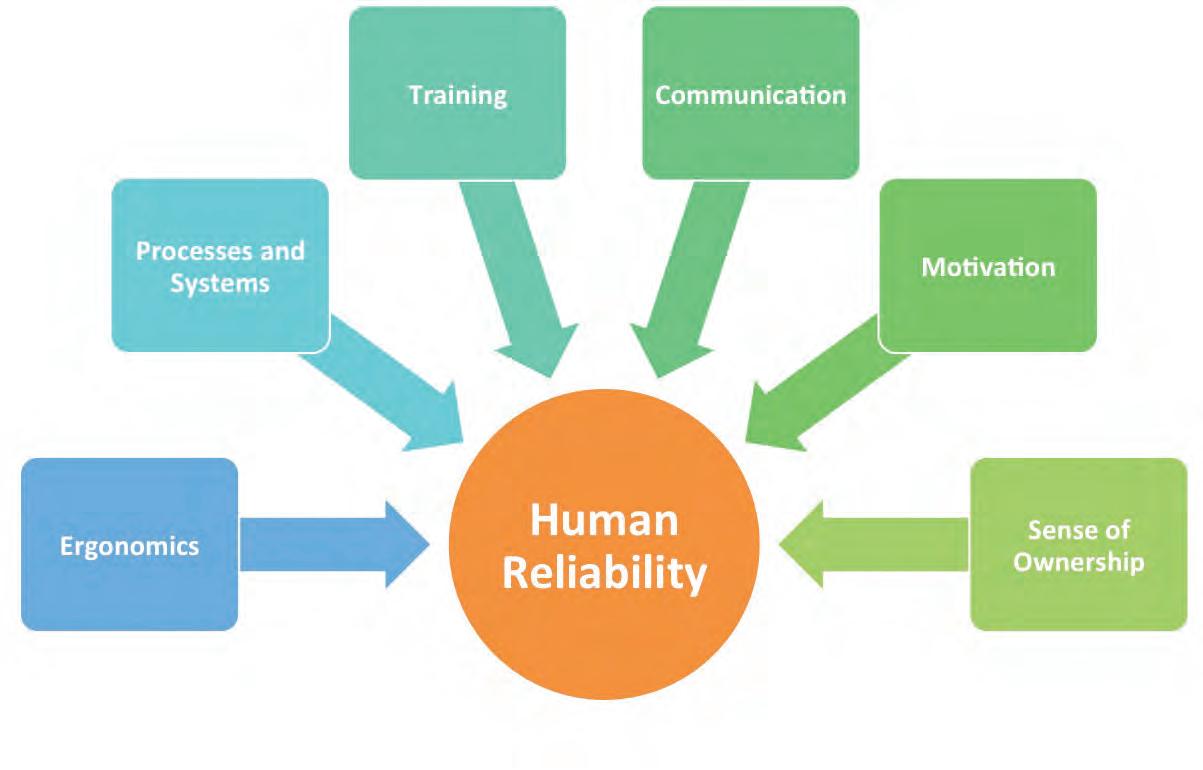
Some strategies include efficient ergonomics; practical processes and systems; a variety of training, clear communica-
tion, and motivational ideas to engage and promote sense of ownership on our so complex human capital and primary source of data. These strategies could lead to a great success, but only if they are built keeping in mind the people and their characteristics.
Human assets are very complex; no one is identical to any other. The level of interaction with the CMMS/EAMS and expectations of it are different, therefore each of these strategies should be moulded to their role as much as possible.
Ergonomics
Software developers have this critical enabler in mind as systems are developed to be more user-friendly and intuitive and with more options to configure screen and software interfaces as per the user’s preferences and roles.
Some ideas that can be implemented to make sure ergonomics are more effective are the following:
• Design system’s work environment with meaningful information and dashboards according to each role. Hide any application of the system that your users have not accessed or is not required to do their job.
• Ensure availability of hardware/devices for your users to input their data.
Human Reliability Enablers
Provide them with an adequate workspace and top-of-the-line hardware.
• Configure electronic systems to help staff to stay focused.
Processes and Systems
Review and update constantly your SOPs and work instructions as part of a continuous improvement process. A business process to include feedback and people’s knowledge into optimizing and updating these processes must be in place to capture, validate, and implement changes that enable people to know what, when, and how to input accurate and complete the data in the CMMS/EAM.
Pay attention to the following:
• SOPs, documents, and work instructions should list any specific data to be recorded on the system or subsequent actions to be taken to modify, update and/or add a new record. Create activity sequence and/or checklists for those tasks that require data entry. Highlight inputting the data in the CMMS/EAMS as one of the steps.
• Quick reference and user manuals made simple; more pictures, fewer words.
• Users' roles and responsibilities must be defined with clear expectations on how they will interact with the system. When the users know the scope of their work with the CMMS/EAMS, it is less overwhelming and ensures accountability.
• Reduce interruptions and distractions during procedure executions to keep people focused on their tasks.
Training
By training people on the functionalities of the CMMS/EAMS they will be more confident to use the system, increasing their contribution, accuracy, and consistency of the data, but the CMMS/EAMS software could be tremendously powerful and very overwhelming. Special considerations when setting up training should be taken in order to avoid disengagements because of information overload.
• Role based: Not all users need to manage all the functionality of the system, small sessions based on each role’s primary tasks are more suitable.
• Aware of cognitive load: Break simplified processes by splitting them into short step-by-step tasks. This ensures that the presentation of information does not impede learning.
• Consider the different learning styles:
Include a bit of each style in your training session and support documents, so everyone can process the information in the way they are more comfortable with.
• Training beyond CMMS/EAMS: When the users of the CMMS/EAMS become familiar with concepts that drive the type and amount of data that is required for them to collect, they will be more knowledgeable and accretive to record the required data.
Communication
Creating common meaning helps everyone understand one another. If you don’t explain why and what the purpose is to use a CMMS/EAMS, then people are skeptical from day one and will not fully co-operate.
Communicate how everybody has a piece of the puzzle in the corporate big picture, preach corporate objectives, and communicate any change that impacts the type of KPIs and data drivers required to support the organization’s strategic plan. This alignment needs to be clearly represented in the data that people need to populate into the system. Change management is a key to stay up to date and record relevant/useful data. Establish a glossary of terms, so everybody is on the same page: semantics. Tell people what is expected of them and explain how this links to the big picture: clear expectations. Keep people up to date of any variance in the corporate policies, procedures, and priorities –manage the changes.
Motivation
Be aware that to effectively motivate people you need to cover their needs, but everybody has different needs and different priorities. Understanding these needs and ensuring the basic ones are covered will allow people to focus on new goals. Identify the personality of your staff to motivate them more effectively. Several theories are based on the four temperaments: melancholic/visualizer, choleric/leader, sanguine/innovator, and phlegmatic/supporter. Each personality perceives and processes the information in different ways and moreover they will be motivated and engaged differently.
• Start with answering the question what's in it for me? Showcase the benefits of using the software and the importance of its role on recording reliable data. Prepare scenarios that demonstrate how simple it is to ac-
Timing Belts
cess accurate and complete asset history using the system, and compare to the amount of effort required to do the same task without having trustworthy data in the system.
• Personality traits may play a role in how to motivate and engage people into using the system.
• There are many effective ways to manage people to attain high performance, but certainly recognition for doing a good effort may start the wheels of engagement and motivate people to keep up.
• Display how the organization uses the data that it inputs into the system to make decisions and measure performance.
Sense of Ownership
Ownership is the ultimate prize of an engaged workforce and healthy workplace. It is a direct result of employees taking responsibility on a personal level as well as on a team level. Taking ownership means you hold yourself accountable for your actions and how you do your job. When employees feel a sense of ownership towards their duties, they tend to become better performers at work; hence, a more reliable source of data.
Some tips to build a sense of ownership for the data people input into the system are the following:
• Promote feedback for changes of the system functionality.
• Give them the opportunity to tailor their start centres or CMMS/EAMS workspace screens.
• Emphasize it is their knowledge and expertise.
• Ensure the data is available to them for use and consultation.
• Empower them through knowledge.
Conclusion
Data quality comes down to five characteristics that must be defined and understood by every user to set clear expectations of what is required of their interaction with the CMMS/EAM. Human assets are unique; they learn, communicate, and engage differently. Understanding these characteristics and building the systems and processes with them in mind will gain your organization a sustainable culture that will endure, evolve, and continuously improve. When dealing with human reliability for asset data integrity, there are many efforts like user-centred design and error-tolerance design to make technology better suited to operation by humans, but knowledge and communication will advance your organization to have a trustworthy primary source of data.
Any piece of data you input in the
system must be aligned with the organization's strategic plan and goals so the information that derives from your primary source, people, will be useful and meaningful to make educated decisions regarding your assets. As technology keeps evolving so should we. Never forget, technology is nothing without smart people using it to the best of its functionality and harvesting it to get insights into our reality. MRO
Photos provided by Erika Mazza.
Erika Mazza is a CMMS specialist for the Region Municipality of Durham. For the past nine years, Erika has been capturing and interpreting asset data for Duffin Creek WPCP. Her background in industrial maintenance engineering helps her to understand the business needs of CMMS beyond the requirements, identifying opportunities for improvement and optimization of the maintenance strategies on her site. She is currently enrolled in the Asset Management Professional program at Humber College, refining her skills to support asset management with asset data knowledge. She is an active member of the Plant Engineering and Maintenance Association of Canada, and has presented at national and international conferences and in multiple webinars in Spanish and English. She can be reached at erika.mazza@durham.ca.
Good Data Attributes
TORONTO | MONTREAL | VANCOUVER | EDMONTON | CHICAGO | DALLAS
AMCAN was founded in 1998 and is currently celebrating its 20th year in business, and we would like to thank our valued customers for this achievement. AMCAN is a leading supplier of ball and roller bearing products catering to distributors & OEMS. The company’s inventory is comprised of over 22,000 different bearing and PT related product part numbers
Amcan Bearing is proud to announce an exclusive deal to represent D&D Belting in Canada, with a full range of Belting to better serve our customers.
KYK: KYK is Amcan’s line of Electric Motor Quality Bearings (EMQ) for bearings 60mm ABEC 3 & higher, with Z3V3 noise and vibration ratings. For bearings 60mm inner diameter: Abec3, with Z2V2 noise and vibration Ratings. Both are packed with industry standard grease for electric motor applications. Stock with shields and seals in C3.
SWC: Amcan is SWC exclusive supplier in North America. SWC was founded in 1994 specializing in High-Temp Deep Groove Bearings, and Radial Insert Ball Bearings filled with special grease, giving them a range up to 350C available in open 2ZR and Viton Seals. SWC is a ISO 9001:2008 company since 2005.
FSQ: FSQ is a major Taiwanese supplier of Pillow Blocks, Plummer Blocks (split pillow blocks) Adapter Sleeves, and Seals, Amcan is their authorized dealer in North America.
We have a highly competent and professional customer service team available 24/7 that provide tailor-made solutions to specific requirements of our customers for their bearing and power transmission product needs.
TROUBLESHOOTING GAS TURBINES
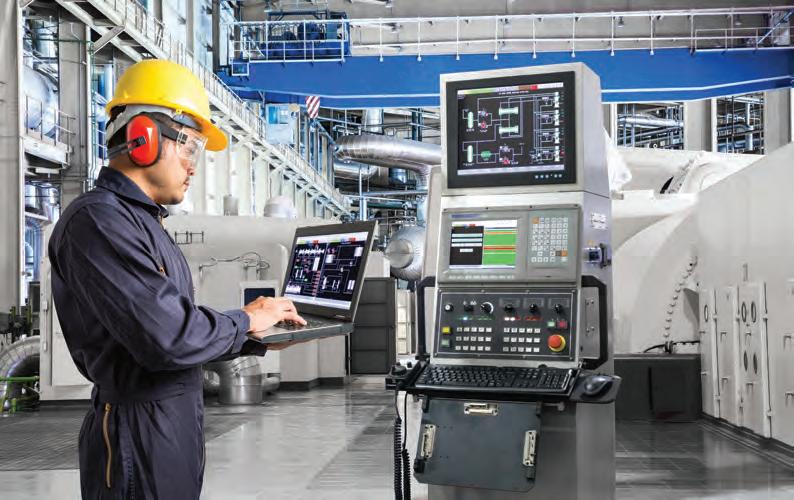
The objective of gas turbine maintenance is to maximize performance, improve maintainability and reliability, and reduce downtime.
BY L. TEX LEUGNER
The objective can only be achieved by preventing turbine systems deterioration with an effective condition monitoring and maintenance program. This program must pay particular attention to five turbine operational conditions:
• The thermodynamic gas path;
• Turbine vibration and instability;
• Lubricant and lubrication system condition;
• Parameters for online condition monitoring; and
• Scheduled inspection and proactive maintenance activities;
These operational considerations affect one another, and the components related to each system must be in excellent condition to ensure optimum performance of the turbine.
1. How do you manage the thermodynamic gas path conditions?
Logic: The gas path includes the condition and cleanliness of the compression intake air, fuel quality, and the integrity and quality of the combustion process and turbine exhaust.
Contaminants that contribute to turbine erosion, corrosion, fouling, and sulphidation that attack turbine blade and nozzle materials require high-efficiency air filtration. A decrease in turbine power output or compressor efficiency, or an increase in the frequency of cleaning the compressor is that the filter system is not functioning satisfactorily. There are many fuel types used in gas turbines, from distillate and residual oils to various fuel gases, such as propane, natural gas, methane, or gas produced from biomass processes.
Operators must be aware of fuel and governor control problems often associated with "hot" or "hung" starts caused by a too-rich fuel or too-lean fuel schedule, respectively. Pollutants such as hydrocarbons, carbon monoxide, sulphur oxides, and nitrogen oxides are all products of the turbine
combustion process. These pollutants can be reduced or eliminated by using properly designed combustors, reducing combustion temperature with water or steam injection into the combustion process, or by using a selective catalytic converter in the turbine exhaust. In addition, turbine exhaust temperature is a critical condition that should be monitored continually.
2. What turbine vibration and instability conditions should you consider critical?
Logic: Vibration of rotors, bearings, and gear box components can directly affect efficiency and reliability, and online vibration analysis should be a requirement. Depending on design, proximity transducers to measure displacement can be located at radial bearings, while accelerometers should be considered to measure frequencies of compressor and turbine blades. Handheld vibration monitoring devices should also be used when or if a specific problem is suspected.
Bearing problems in gas turbines are related to lubricant quality, contaminants, wear, temperature, and vibration. Gas turbines run at high speed; aero-derivatives run at speeds that range from 9,000 to 20,000 RPM, while heavy industrials operate at speeds in the 3,000 to 12,000 RPM range. Some industrial turbines use hydrodynamic journal bearings, but all of the new aero-derivatives and most industrials now use rolling element bearings to support the rotors and shafts.
3. What lubricant and lubrication system conditions are important in your application?
Logic: Considerations include the condition of the lubricant and the reliable operation of the lubrication system. The lubrication system must be periodically inspected for oil leaks at connections, piping, seals, and fittings. Oil levels should be monitored on a daily basis, and oil pressure and tempera-
Photo credit: Getty Images
TURBINES
ture must be part of the condition-monitoring program. Foaming or frothy oil is caused by hot air or gas leaking into the lubrication system past labyrinth or mechanical seals. Oil pressure is indicative of the pressure drop across filters and can indicate internal leaks if external leaks are not present but the oil level is dropping.
Internal leaks are difficult to detect and can result in oil leaking into the hot gas path. This may or may not be indicated by either a gradual or a sudden appearance of exhaust smoke. If internal leaks are suspected, inspection of the combustor, exhaust duct, compressor discharge, or air bleed discharge may be possible using a borescope to look for traces of oxidized oil or varnish in these components. Monitoring oil temperature can be carried out by measuring temperature of oil leaving the bearings, the actual oil temperature at the return line to the reservoir, or measuring the bearing temperature using contact thermocouples or resistance temperature detectors.
An increase in oil temperature can occur quickly if leaking seals allow hot gases to leak into the oil. Oil temperature will also increase if the cooler is inefficient or plugged, or if the cooler doesn’t have the correct capacity for the system.
4. Depending on your turbine operation, which of the following parameters for condition monitoring are critical?
Logic: Depending on design, gas turbines may include some or all of the following requirements.
a) Ambient air temperature and barometric pressure;
b) Inlet air pressure at the compressor;
c) Low-pressure compressor "out" pressure;
d) High-pressure compressor "out" pressure;
e) RPM, single shaft; f) RPM, dual shaft;
g) RPM, free power turbine; h) Fuel flow and pressure;
i) Exhaust total pressure and exhaust gas temperature; j) Overall vibration levels;
k) Lubricant oxidation inhibitors, acid number, and contaminant levels; and
l) Oil pressure and temperature.
5. Which scheduled inspections and proactive maintenance activities are required at your facility?
Logic: These should include, but may not be limited to, annual fuel nozzle inspection and/or replacement, governor control system inspection and testing, water or chemical washing procedures, and borescope inspections. When used in conjunction with gas path, vibration, lubricant, and turbine condition trending analysis, borescope inspections usually provide the final step in the identification of an internal turbine problem. Borescope inspection access depends on turbine design and can provide possible evidence of damaged turbine, compressor, or combustor components, contamination buildup, fouling, erosion, corrosion, sulphidation, lubricant oxidation causing sludge and varnish, water emulsions, worn bearings and seals, plugged or damaged fuel or turbine nozzles, or broken blades or vanes. MRO
L. (Tex) Leugner, the author of Practical Handbook of Machinery Lubrication , is a 15-year veteran of the Royal Canadian Electrical Mechanical Engineers, where he served as a technical specialist. He was the founder and operations manager of Maintenance Technology International Inc. for 30 years. Tex holds an STLE lubricant specialist certification and is a millwright and heavy-duty mechanic. He can be reached at texleug@shaw.ca.
Care and Maintenance of HYDRAULIC CRANES
How to properly care and maintain, to keep them running in good shape.
BY BEN HOWARD
It goes without saying that cranes are a useful resource in the construction industry. What would we do without them to lift, pull, and haul heavy materials such as precast concrete and iron?
Now in the 21st century, their usability has extended to other industries such as mining, manufacturing, and a host of others. Cranes are generally categorized by their uses and mechanism of operation, and one such type is the hydraulic crane. Hydraulic equipment uses a combination of pistons and confined liquids (mostly oil) to transmit pressure from one point to another with a much greater force.
Therefore, a hydraulic crane is powered by a fluid-filled hydraulic system. Hydraulic cranes, specifically, are powerful and used in transporting very heavy objects that electric or fossil fuel powered cranes fall short of.
As with all other heavy equipment, hydraulic cranes require specialized training and certification before they can be operated. They also require adequate care and maintenance for efficient operations and for avoiding operational hazards.
Here are some tips for keeping your hydraulic cranes in good shape.
Operational training and certification
The primary and most important aspect of caring for hydraulic cranes is to ensure professional training and certifica-
tion of operators. Hydraulic cranes are large and powerful, which means accidents can be fatal. Operational failures are routine experience with cranes and could put operators and those close by at risk of falling objects.
Improperly assembled cranes can also tip over, thereby causing large-scale damage. Professional training and certification give operators the required skills and safety procedures in crane operations. Including, but not limited to, the following:
• Preoperational checks;
• Availability of fire extinguishers; and
• Operational checks of systems like brakes, lights, steering, alarms, etc.
Comprehensive repair and support plan
Hydraulic cranes require a strict preventative maintenance plan, so breakdowns at the worst possible moment are avoided. A scheduled plan anticipates and prevents problems before they occur. Services like this are recommended and offered by hydraulic repair experts.
A preventative maintenance strategy will give your cranes a healthy safety margin, (i.e., replacement of worn components before they break). This decreases costs in the long run.
Damage offset and general wear
Cranes are generally susceptible to dirt and hazards because of the environment they operate in. Crane vibration
moves parts such as screws and fasteners out of specified range settings, upsetting rigging and loosening formerly secure assemblies. Though dirt (or other elements) on hydraulic crane exteriors isn’t necessarily harmful, it can do harm when it gets into the hydraulic system.
A strong maintenance program ensures the hydraulic system and fluids are free of external elements, moving parts are retightened and fresh lubrication is applied at regular intervals.
Proper inventory management
Another important aspect of hydraulic crane maintenance is proper inventory management. This simply means ensuring spare parts are promptly and readily available as, and when, needed.
Hydraulic cranes, as with all equipment, need to be repaired regularly. Sp if you replace components and keep an accurate and up-to-date inventory of materials for your crane, you can be sure that components will never be overworked due to lack of replacements. MRO
Photos provided by Ben Howard.
Ben Howard is a third-year mechanical engineering student at the University of Western Australia specializing in engineering design and fluid mechanics. His practical experience ranges from plant requisitioning, installations, and testing for local engineering firms in Perth, Australia. He can be reached at thehowardben@gmail.com.
FLIR delivers world-class thermal cameras and test & measurement tools with the accuracy, reliability, and versatility you need to tackle your most challenging jobs. For more information please visit: www.flir.ca/work/
WORKING WITH GRAVITY
A fall protection and basic rescue course is time well spent.
BY CARROLL MCCORMICK
Gravity is not always our friend. When working at height, it waits to bring you down in the blink of an eye, and even if you fall wearing a harness, you can quickly expire while you dangle, awaiting rescue. The trick is to appreciate the risks, wear fall protection, and have a rescue plan.
Instructor Tim Doane, pacing in the classroom and referring to his slide show, keeps us alert with the "military" voice he perfected over 22 years as a military firefighter. Now he teaches at Survival Systems Training Ltd. (SSTL), a Dartmouth, N.S., company that offers safety and survival training to workers in industries such as oil and gas, marine, and aviation.
Today, he is giving recurrent training to seven employees who work in the fishing industry, refreshing their memories with a morning in the classroom and an afternoon of hands-on work in SSTL’s Marine Aviation Survival Training facility.
First, Doane reminds everyone, work-
ing at height, officially starts just four feet up in general industry and six feet up in construction. He notes if you fall from 11 feet with no protection, you have a mere 15 per cent chance of surviving. Working at height is high risk. Doane underlines this with a grim statistic from the Alberta government: there are about 26,000 lost-time accidents a year in Canada, which are caused by falls.
The causes include inattention and poor housekeeping, such as tripping over tools or rubble, which can cause a worker to take a header. Fooling around is another cause; keep the horseplay and interpersonal distractions on the ground. Environmental conditions like wet staging, high wind, cold, or ice can cause a fall. Poor placement of a ladder, for example, and leaning too far
off to the side are classic ladder-related falls. Improper use of equipment and a too-manly attitude can smack you down.
Labour codes vary slightly from area to area, so check for the details. For example, the Canada Labour Code requires fall protection above eight feet. Nova Scotia and New Brunswick Occupational Health and Safety regulations require fall protection starting at 10 feet.
Fall protection is needed when working above a hazard, such as over a tank of bubbling oil, near an unguarded edge, or on a pitched roof. An example of passive fall protection would be a good guard rail or safety net.
A variation on the fall protection theme is maintaining three points of contact when climbing a ladder – which our class practised on the roof of the
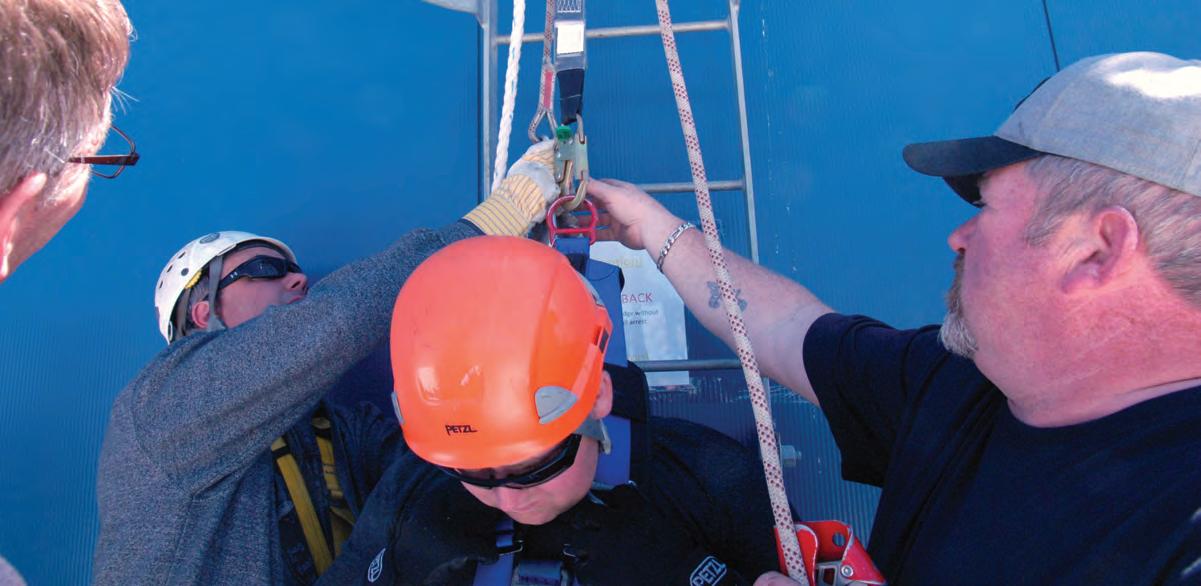
Learning how to handle a rescue rope
MAST – and first making sure, in the case of a portable ladder, that it is angled properly. A 3/1 or 4/1 angle is recommended; a rough check of a safe angle is to stand at the base of the ladder with arms outstretched toward the ladder. If your fingers can touch it, the ladder’s angle is still too steep.
If you are on a moving platform, wear fall protection (i.e., a harness) and be anchored. If possible, be anchored to a second point, too – that is, more secure than, for example, the mobile lift you are standing in. A harness and anchor are part of an active fall arrest system. Additional details include connecting components, like D-rings, carabineers, and shock absorbers, and a means of rescuing a person who has fallen.
Doane drills down into the equipment. There are several kinds of harnesses and lots of things that can damage them, like shock loads, too much heat, and abrasion. There are lots of components to learn about, but one, energy absorbers, leads into a discussion of shock absorption and a rather sobering tutorial in fall physics: you don’t have to fall far for a sudden stop at the end of your rope to seriously injure or kill you.
Doane explains: If you drop a 220-pound dummy six feet without any shock absorption, the force on the body is 5,000 pounds, 3,200 pounds more than the 1,800 pounds generously considered to be the maximum (900 pounds of force is the recommended maximum). With shock absorption, the force drops to just 500 pounds. However, a shock absorber – for example, a bundle of folded-up lanyard (webbing) stitched up in such a way that, in a fall, it rips out, thus cushioning the slam when you run out of rope – is just part of the solution.
You also need to keep in mind that it won’t end well if 11 feet worth of lanyard, shock absorber, and stretch are playing out for a nine-foot fall. Or having the anchor over there somewhere – a setup for a George of the Jungle-like swing into a pillar – if you fall.
Doane goes into lots of detail and offers handy rules of
Instructor Tim Doane teaches about rescue equipment
thumb. For example, if you think your anchorage point can support the weight of a pick-up truck, you’re in the ballpark of the recommended rule that an anchor point will be able to support a static load of 5,000 pounds.
One fact that lots of people are surely unaware of is that even if a buddy falls and is safely stopped by the harness and lanyard, they can die in as little as 10 minutes of what is called suspension trauma. It is caused by blood pooling in
the lower extremities, unconsciousness due to lack of oxygenated blood to the brain, and the inability to tip over while stuck in that harness. Shock can begin to set in, in as little as three minutes, and you will have somewhere between five
The World of Bearings and Power Transmission...
and 20 minutes to rescue your swinging pal before he or she checks out.
This brings the class to the rescue component of the morning: a rescue plan document that your company better have written, rescue training, and rescue equipment. Since buddy-on-a-rope has only a few minutes to live, an in-house rescue program makes great sense. For what it will be worth to poor Dangling Dan, Doane comments, “If 911 is your only rescue plan, be sure that the rescue people have the necessary training.”
Then he tosses some cold water on even that: “Don’t assume that the fire department will have high-angle rescue gear.” Doane says that of the five fire departments he works with, he is the only person with high-angle/confined spaces training. One way or another, Doane’s advice is key: “Don’t expect 911 to be there for the rescue.”
Fortunately, basic rescue techniques are not rocket science. Some hands-on work with pulleys, grappling poles, and ropes, which we practise after lunch under Doane’s watchful eye, gives us confidence that, as long as we don’t forget what we are told and can lay our paws on the rescue gear – which, of course, our
company has purchased for us (right?) –we can make a credible effort to reel in a work colleague who has fallen and just needs to be plucked out of the air.
Of course, the groundwork has to have been laid, the courses taken, and the equipment purchases made. It’s disconcerting to hear people say of their non-existent rescue equipment, “We’ve got to improvise.” It’s disconcerting to hear someone whisper, “two decks below,” after Doane asks, “Is the rescue gear available, or is it in a cubbyhole behind five pallets?”
While it seems obvious that we must keep ourselves safe from falls, judging from the number of fall-related deaths (one every three days, according to the Alberta government) it is not at all obvious. Treat your maintenance team to some life-saving knowledge. Take the course. MRO
Photos provided by Carroll McCormick.
Carroll McCormick is an award-winning writer who has been profiling plant maintenance and safety training for Machinery and Equipment MRO magazine since 1998. He is based in Montreal. DISTRIBUTED IN CANADA BY
Hopping
FRACAS Causing a
What it takes to manage a failure reporting analysis and corrective action system.
BY JEFF SMITH
As a lifetime reliability geek, I am a firm believer in creating continuous improvement loops. Once an organization has attained stability and control of its assets and has developed a maintenance program, it is only logical to measure the success of the program and have it continuously improve. One thing I admire about a world-class organization is its ability to stay driven and focused on improvements. I have been in worldclass operations and found that if you compliment them on the state of the operation, they tend to quickly move to the “Yes but…” conversation. Yes, we won that award, but we still can improve in this area. They have tasted success and like the flavour, and they understand the objective is a program, not a project.
It is organizations from the bottom quartile that tend to think they are done. You will often hear statements like, “We tried vibration analysis; it didn’t work here. We were going to do reliability centred maintenance (RCM), but the vendor gave us a great program to follow. We contract out everything; we just need better contractors.”
When I find bottom quartile operations, it shows they don’t know what they don’t know. Not only are they innocent, but they also have little motivation to change. If your belief is that you feel
there is no room for improvement, the market and your competitors will soon prove you wrong.
Reliability initiatives are a heavy lift; it takes a lot of effort to build a foundation. This effort must include high-level executive sponsorship and visual felt leadership throughout the program. At some point, you will have the foundational elements in place.
Foundational elements for reliability include but are not limited to, the following:
• Operational envelopes established for process reliability;
• Operational interfaces and responses consistently executed;
• Automation and control systems optimized;
• Lubrication best practices from selection to disposal;
• Competency-based learning programs for all personnel;
• An integrated CBM program that utilizes multiple data sources; and
• A failure mode-driven maintenance strategy.
At this point, an organization tends to be comfortable with the direction reliability is taking. It has seen a multiple number of good wins, and KPIs are starting to trend upward. Management is happy with the ROI from the multiple reliability initiatives, and it moves on
to the next focus area. Often the wins are short lived, as no reliability strategy program is perfect, and incidents happen that lead back to the reactive life. It is unlikely organizations at this point will regress to the starting point, but they will not continue with the step changes that lead to redefining what is considered world class. Managing the issues that slipped through the cracks of the program design is where a failure reporting analysis and corrective action system (FRACAS) comes into play.
FRACAS was developed by the U.S. government and introduced in Navy operations; the original application was to test missiles and address any deficiencies that resulted in testing. The original military standard is still available as MIL-STD-2155 (AS).
FRACAS is conducted by following a process of reporting failures, classifying those failures into logical groupings, analyzing the failures to understand cause, effect, and impact to your operational objectives, then planning corrective actions to eliminate the failures or minimize the impact of the failure. This process records the issues related to a failure (equipment, process, product, etc.) and its associated causes. This information is analyzed through various methodologies to develop effective solutions. The solutions are then applied and
Photo credit: Getty Images
the success of the solution will be evident as shown by the non-reoccurrence (successful elimination) or reoccurrence (unsuccessful solution).
To further explore this, let’s break down the acronym.
Failure
- A failure can be expressed as a malfunction; something did not deliver on the value proposition. Quite often, FRACAS is applied to equipment failures, though it can also be applied to process and business process failures. Failures and their impact to organizational goals can be categorized by frequency and magnitude. A failure will have some notable level of function loss, a functional failure. A failure will also have some defect that causes the loss of function. The output of an RCM study will list functional failures and can provide an input into the failure codes requited to enable categorization. It is worth noting that the RCM output requires conversion to create readable codes that can be easily identified by personnel who physically interact with the assets (maintain, operate, clean).
FRACAS uses a predefined list of codes that identify the failures that the system can have and a second set of codes noting the defects upon repair. The listing of codes should be filtered by the component that has suffered the loss of function. For example, one would not expect to see engine codes on an electric motor. When structured properly, the failure codes will be a focused list that is relevant to the asset or component selected, as with the associated defect codes.
Reporting
- With lists of failure and defect codes created, reporting must be integrated with the workflow process. Normally, there is a function loss (or potential function loss) associated with the work request or inspection exception report. The point when work is requested aligns with the failure codes, as the failure, or potential failure, is known. This field should be selectable at this point. The true defect is not known until post repair.
The defect code should be assigned upon completion of the work order. If you use "other" as a stopgap to ensure nothing is missed in reporting, it should be the last selection on the list. Even so, it should prompt a free-form text box, as using "other" for a failure or defect code identifies a deficiency in the list. This approach ensures constant failure reporting, which enables analysis.
Analysis
- Once the failures are reported in a queryable format, it enables multi-level analysis. If this is conducted within your CMMS, it ties costs and effort to the lists, which enables a clear understanding of failure impact. On a base level, your analysis will give a living Pareto chart of your failures. The Pareto provides a focusing tool to select the highest value failures to further analyze with tools like root cause analysis. Further analysis of the data can yield information to correlate failures to establish analytics.
Some outputs enabled by FRACAS inputs include the following:
• MTBF – mean time between failures on the component level and individual defect level;
• MTTR – mean time to repair correlated to failures and/or defects;
• Parts consumption and comparative analysis between parts;
• Reliability growth analysis;
• Failure incident distribution by failure code and/or defect code;
• Rolling up the information can result in comparative analysis of asset types, life cycle stages; and
• Reliability engineering.
As listed, there are multiple levels of analytics that can be correlated with the searchable fields produced within the failure/defect registry.
CACorrective
action – The failure analysis processes identify the cause factors of the failures. When effective solutions are discovered, they are deployed and implemented. The deployment stage includes identifying all assets that solutions are applicable to and conveying requirements of the solution to the stakeholders. Implementation includes the creation of all standard jobs, standard operating procedures, purchasing of storage requirements, or whatever solution will resolve the failure.
System
- FRACAS is a system, as it naturally produces feedback loops. If I have a listing of failure codes and have implemented an effective solution, the code should not re-emerge. One of the issues with most maintenance program development methodologies is they tend to drive linear thinking; there is one failure mode and one solution. In many cases, it may take several solutions to address one failure mode, and one solution may address several failure modes. If your primary solution resolves 70 per cent of the occurrences, it may be acceptable, or you may require additional solutions to resolve the complete issue.
FRACAS is a disciplined, repeatable process that provides query criteria to link failure information. This enables utilization of the information for informed decision-making and continuously improving your programs and processes. If the information is looped back to the structured work process, RCM for example, you develop living programs. MRO
Jeff Smith is a reliability subject matter expert and the owner of 4TG Industrial. His work spans a cross-section of industries, including oil sands, mining, pulp and paper, packaging, petrochemical, marine, brewing, transportation, synfuels, and others. Reach him at smith@4tgind.ca or visit www.4tg-industrial.com.
Photo credit: Getty Images
SELF-LUBRICATING BEARINGS
Properly specified, self-lubricating bearings reduce maintenance costs, extend bearing life, and are more environmentally friendly.
BY CHRIS DIAK AND JUAN PABLO GERALDO
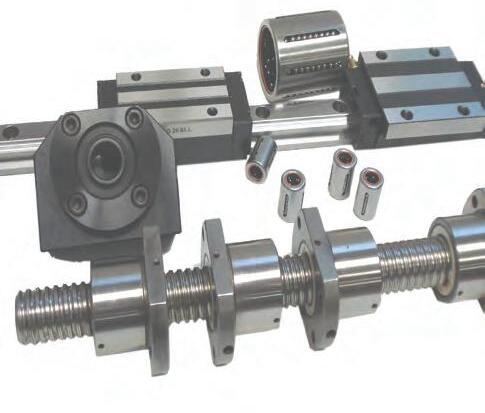
Motion system designers are increasingly outfitting round and profile rails with self-lubricating bearings that can significantly, reduce cost of ownership, improve performance and deliver virtually maintenance-free operation. However, whether they will deliver their fullest potential, depends on how the bearings have been specified, installed and evaluated for compatibility with their intended environment.
Benefits of self-lubricating bearings
For more than 10 years, self-lubricating, or lube-for-life, designs have used oil-saturated polymers in linear bearing applications ranging from food processing to automotive assembly. Original equipment manufacturers (OEMs) are turning to these designs to make their machines more attractive and take advantage of their maintenance-free operations with longer life, increased reliability, and overall lower cost of ownership.
MRO teams will accrue benefits, as their job is to keep installed bearings operational, and replace them at the end of their life cycles. They will enjoy significantly longer maintenance and replacement intervals, greater machine uptime, higher throughput, and cleaner operation. They will also save
money by eliminating the need for expensive lubrication systems and lubricants.
How self-lubricating bearings work
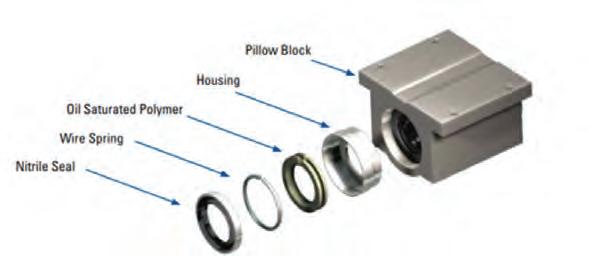
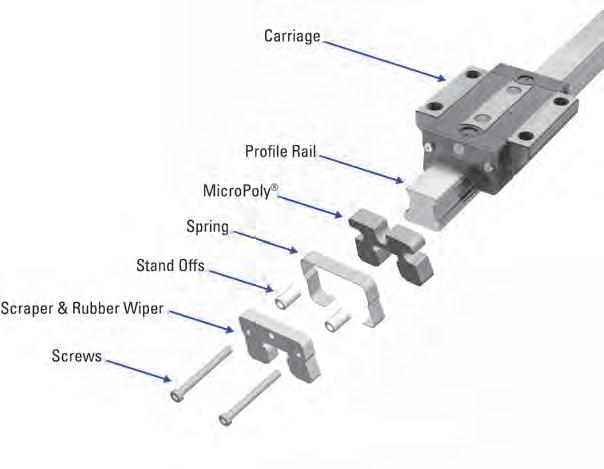
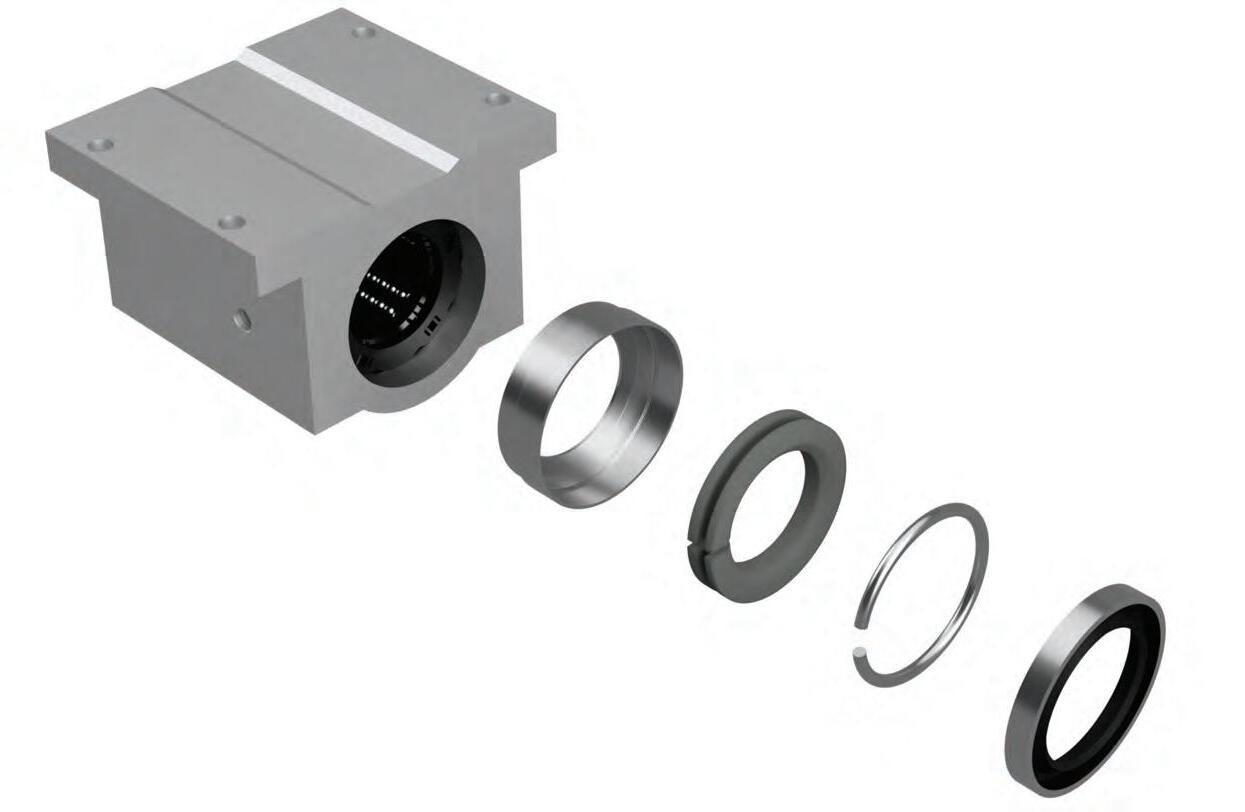
Self-lubricating bearings commonly used in linear and profile rails are made of oil-impregnated plastic. Figure 1 shows a self-lubricating cartridge that might be pressed onto each end of a pillow-block housing of a round rail. In the design illustrated, the micro-porous polymer section is saturated with oil, which gets diffused when the carriage is in motion, thanks
Figure 1
Photo credit: Getty Images
to the capillary action of a wire spring that is in continuous contact with the rail. This capillary action ensures that there is always a film of lubricant between all rolling elements and races. When motion stops, the micro-porous polymer acts as a sponge to reabsorb the oil, preventing excessive buildup of the lubricant on the shaft and eliminating the messy dripping that comes with manual oil applications. A double-lip, nitrile seal provides further protection from oil loss. Figure 2 illustrates a comparable self-lubricating assembly on a profile rail.
Specifying self-lubricating bearings
Whether you are an OEM motion designer seeking to design a maintenance-friendly system or a maintenance engineer replacing a bearing that requires manual lubrication, the design and application factors you must consider are similar. Maintainability adds a critical dimension to the specification matrix, impacting, or being impacted by, almost every variable. Self-lubrication options should be considered for just about every profile or linear guide specification and evaluated based on the following criteria.
Availability of maintenance support — Where end-user maintenance resources are limited, lubrication-free bearings are an easy choice. Independent testing (commissioned by Thomson Industries) showed that self-lubricating bearings exhibited no need for maintenance or addition of lubrication to the lube block during a three-million-cycle deflection test.
Life cycle — The possibility of consistent performance and maintenance-free operation can extend the life of the bearing by as much as three times when compared to a bearing that is lubricated just once, and not subsequently, during installation.
Accessibility — One of the key factors in determining whether to specify a self-lubricating bearing is the location of the bearing on the equipment. The more disassembly and reassembly required to access the bearing for lubrication, the more time and money will be saved by eliminating the need to maintain that bearing.
Temperature — Vendors will rate their bearings for operation in certain ranges. Operation outside those ranges could result in bearing failure. Some lubricants, for example, will dry up if operation temperature is too high. A second
EXPERIENCE THE SULLAIR DIFFERENCE IN ONE HARDWORKING PACKAGE
RELIABILITY including the full-color, easy-access Sullair Touch Screen controller
DURABILITY including the patent-pending, new generation Sullair air end
PERFORMANCE including highly efficient Electronic Spiral Valve technology
Figure 2
temperature-related factor is that self-lubricating bearings tend to run faster and thus hotter because there is better control over lubricant buildup, which minimizes dripping. This is not a huge issue but should be considered if the expected operating environment will have temperatures close to the vendor recommendations.
Extension — The addition of lubrication bushings to the pillow block can add length to the system, since they are
Example
For a bottle company, assume it has automated equipment that uses bearings at 350 pounds force-applied load and a speed of 2.3 m/s. Linear bearing operating temperature is below 70°C. Application cleanliness is considered high. First, it will estimate the expected life (L10) for this application. Catalogue-rated load: 1,900-lbf (SSU16) and 48 hours per week.
This means that 90 per cent of the bearings will last longer than 20 weeks for this application. Next, it will estimate the appropriate re-lubrication interval for this application.
This means that it will need to re-lubricate the bearings every two weeks for five months before replacing them. The company will experience short maintenance cycles and high maintenance costs. Also, there is a substantial risk to skip bearing re-lubrication, which leads to unplanned downtime that can easily cost more than $10,000 per hour. All of this can be avoided by including the lube-for-life option.
often added on both ends of a carriage. It is seldom much more than a few millimetres, but in tight quarters or where extension flexibility is limited, it could be important. A precise analysis of space requirements is critical to specifying self-lubricating bearings.
Environmental constraints — The environment in which the bearing will operate also impacts its maintenance-free capability. Operation in areas with high particulate counts or excessive grease and grime, for example, may require some bearing maintenance, but this can be kept to a minimum. The self-lubricating block, for example, uses a solid lubricant that is a mixture of polymers, oils, and select additives that reduce the penetration of dirt, grit, and liquids into the ball path, preventing premature failures.
Installing the self-lubricating blocks with optional accessories can provide even greater protection from environmental assault. Stainless steel scrapers help push larger dirt particles, metal shavings, or chips away from seals. Standard bellows can cover a rail for additional protection from particulates as well as splashes.
Total cost of ownership — While purchase price of a self-lubricating bearing might be 10 to 30 per cent higher than the cost of a bearing requiring manual lubrication, the reduced labour costs, elimination of need for lubrication assemblies, improved performance, and reduced downtime compensates for it. Poor lubrication is implicated in half of all bearing failures.
SEW-ECDRIVES-CANPACK11x4-2018.pdf 1 25/01/2018 11:08:02 AM
Self-lubricating pillow block assemblies, open or closed, are commonly available for shaft sizes ranging between ½” and 1½”, with loads ranging from 250 to 4,000 pounds, but can be customized. Pillow blocks can be integrated into the factory or retrofitted. With inadequate lubrication being the most common and readily preventable cause of reduced bearing life and failure, the more cost-effectively you can optimize the lubrication process, the more bottom-line impact you will enjoy. In addition to maintenance savings and longer life, the lube-free bearings eliminate the need for expensive lubrication systems and the cost of lubricant itself, promising more environmentally-friendly operation. By considering the factors mentioned above early on in the process, maintenance costs can become one less thing motion control users will have to worry about as they automate critical processes. MRO
Photos provided by Thomson Industries, Inc.
Chris Diak is the Automation Product Sales Manager at Motion Industries and has worked in the electrical/automation field for 23 years. He earned a BSEE from Clemson University. He can be reached at chris.diak@motionindustries.com
Juan Pablo Geraldo is a R&D Engineering Manager for Thomson Industries. He handles the design, development and evaluation of new generation products. Juan Pablo holds a Master’s degree in Design and Manufacturing Process with 14 years of experience as a Mechanical Engineer Professor and a Mechanical Engineering Consultant.
WHAT’S NEW IN PRODUCTS
Aitech Defense Systems Supercomputer
Aitech Defense Systems Inc. industrial version of GPGPU RediBuilt supercomputer is based on NVIDIA Jetson TX2 System-on-Module. The new A177 Twister uses CUDA and deep learning acceleration capabilities to handle complex computational requirements needed in embedded systems that are managing multiple data and video streams.
Allweiler Threescrew Pump for Machine Tool Coolant Service
Small form factor supercomputer employs 256 CUDA cores to reach more than 1 TFLOPS, while consuming only 17 watts of power and weighing less than 2.2 lbs. IP67-rated and fanless high-performance embedded computer can also be used in rugged and remote outdoor environments.
It measures 149 x 147 x 63 mm. Multiple I/O options provide design flexibility for capturing and processing several different types and streams of video and data. http://rugged.com/
Schütte PC Multi-Spindle Automatics
Schütte sells PC series multi-spindle automatics. Automatics in the PC series are machining centres, used whenever classic cam-controlled automatics reach their limit.
PC multi-spindle automatics perform tapping, mill cutting, polygon cutting, and eccentric drilling operations. Six or eight work spindles, end working, and cross slides can be controlled independently of one another. Rear-side machining can have up to three tools. Over 56 CNC axes can be programmed with Schütte’s SICS 2000 system.
PC multi-spindle automatics are designed for material removal of geometrically sophisticated parts made of hard solid materials.
The machines are designed to be robust, durable, and technically flexible for complex drilling operations. They provide ready-to-install precision parts in large and small batch sizes. www.schutteusa.com
Allweiler EMTEC-C three-screw pump removes abrasive machine chips, particles, and heat away from cutting surfaces in high-pressure machine tool coolant service.
EMTEC-C delivers coolant at a higher rate than centrifugal pumps, allowing machines to run at peak levels. Features include a new screw system with a patented reversed hanging idler and integrated thrust compensation system; improvements to seal life expectancy and maintenance requirements; and a transparent back flow.
EMTEC-C features an extra-long piston to minimize flow loss. Users have the option of connecting a pressure sensor to the frequency controller for easy control and measurement.
www.circorpt.com/emtec
AMK SPINDASYN SEZ Linear Drive Motor
AMK Automation’s SPINDASYN SEZ electric cylinder is a linear drive motor system, where the rotor is pressed directly onto the screw. Featuring high and constant force, high precision and position accuracy, and high-energy efficiency, the closed-loop positioning and force control of the SEZ make it an alternative to other linear technologies. Several options are available for screw and strength length, motor type, and acceleration; SEZ provides high rigidity without additional wearing parts. SEZ can set multiple travel profiles. It can be integrated into machine automation processes and applications; blister packaging; carton forming; palletizing; pick and place; cross-cutting; labelling; wrapping; strapping; filming; insertion; order picking; sealing plastics; printing; paper processing; textiles; food and beverage; and machine tooling.
http://us.amk.systems
Pioneer Medium Voltage Transformer/ Interrupting Switch Assembly
Pioneer Dry Type Group Medium Voltage Transformer/ Interrupter Switch Assemblies offer switching and fault protection for unit substations. Designing and manufacturing the fully integrated switch and transformer together helps the components work together. On-site assembly is simplified as all components are factory tested as a single unit. Disconnected for delivery; all applicable cables are provided and clearly marked for reconnection. Available in 5KV and 15KV class models, for 600A or 1200 amp continuous load interrupting rating. Transformer/ Interrupting Switch Assembly provides customers a choice of switch manufacturers, with or without fusing; NEMA 1 or 3R enclosures; and switch orientation on the right or left side of the transformer. Custom designs for specific applications available. All Pioneer Medium Voltage Transformer/ Interrupting Switch Assemblies meet IEEE, ANSI, UL, and CSA standards/certifications. www.pioneermvmagnetics.com.
Push-button Terminal Blocks
WAGO TOPJOB S line of DIN rail mount terminal blocks include pushbutton actuation. Orange push buttons on both sides of the terminal block identify where the operating tool must be applied. Press down on push-button with the operating tool, insert the conductor, and remove the operating tool from the push-button.
They are suitable for all copper conductor types size 22-4 AWG. Push-button design ensures operation integrity with positive feedback, orange push-button distinguishes wire entry from tool entry, and push-in CAGE CLAMP allows direct insertion of ferruled or solid conductors. www.wago.com
Baldwin PureFiltration Compact Technology
Baldwin Technology Co.'s PureFiltration systems, part of its fluid management solutions, continually clean process fluids for the metal and glass industries.
To meet the market demand for high-quality and efficient filtration systems for smaller machine applications, Baldwin has developed the new PureFiltration Compact system, which also increases the life cycle of process fluids but in a smaller footprint. https://www.baldwintech.com
Rite-Hite Direct Drive Fan HVLS
Rite-Hite Direct Drive high-volume, low-speed (HVLS) fan offers temperature-related solutions with no noise and no oil. Configured with three Propell-Air blades, it comes standard with 24-foot diameter blades, and is also available in 20-, 16-, 12-, and 8-foot diameters.
A single Direct Drive HVLS fan can circulate a large volume of air up to 85 feet from the fan’s centre in all directions for an area encompassing up to 22,000 square feet. The design of the fan directs air outward from the centre in a conical shape.
Direct Drive HVLS fan can be controlled with a digital touchscreen Fan Commander, wirelessly through a smart device, or incorporated into a building management system. Up to 24 HVLS fans can be co-ordinated with a single Fan Commander control panel. www.ritehite.com
Bentley Systems Names Year in Infrastructure 2018 Award Winners
Bentley Systems Inc. announced the winners of the Year in Infrastructure 2018 Awards. The annual awards program honour the work of Bentley users advancing design, construction, and operations of infrastructure throughout the world.
Twelve independent jury panels of industry experts selected the 57 finalists from 420 nominations submitted by more than 340 user organizations around the world.
The award winners (19 Year in Infrastructure and nine Special Recognition) were announced at a ceremony and gala at the conclusion of Bentley’s Year in Infrastructure 2018 Conference.
Year in Infrastructure 2018 Special Recognition Awards winners:
Advancing Collaborative Digital Workflows in Rail and Transit
China Railway Engineering Consulting Group Co., Ltd. – BIM Project for the Beijing-Zhangjiakou High-speed Railway – Beijing, China
Advancing Digital Twins for Airports
Infraero Empresa Brasileira de Infraestrutura Aeroportuária – Digital Airport-Londrina – Paraná, Brazil
Advancing Digital Twins for Bridges Composite Structures Lab, Chung-Ang University –Innovative Bridge Maintenance System Using Digital Twin Model – Seoul, South Korea
Advancing Digital Twins for Roads and Highways
Guangxi Communications Design Group Co., Ltd. –
BIM-based Collaborative Design and Construction Management of All Elements and Objects in the Lipu-Yulin Expressway Project – Guangxi Zhuang Autonomous Region, China
Advancing Digital Twins for Tunnels
AECOM – Tideway Tunnels C410 Central Contract –London, United Kingdom
Advancing Digital Twins for Utilities Transmission and Distribution
POWERCHINA Hubei Electric Engineering Corporation Limited – Cha’anling-Xiaojiazhou
220-kV Electric Transmission Line Project – Xianning City, Hubei, China
Advancing Industrialization through Digital Components for Urban Infrastructure
CCCC Water Transportation Consultants Co., Ltd. –
BIM Technology Application in the Municipal Infrastructure Phase 1 Project of Zhong-Guan-Cun Science and Technology Town – Baodi District, Tianjin City, China
Advancing Digital Workflows for Asset Performance Modeling of Transit Systems
Maharashtra Metro Rail Corporation Ltd. – Nagpur Metro Asset Information Management System – Nagpur, Maharashtra, India
Continuous Surveying in Constructioneering
Shell Chemical Appalachia LLC and Eye-bot Aerial Solutions – Pennsylvania Chemicals Project – Monaca, Pennsylvania, United States
Year in Infrastructure 2018 Awards for going digital advancements in infrastructure are:
Bridges
PT. WIJAYA KARYA (Persero) Tbk – Design and Build of Road Bridge at Teluk Lamong Port Project –Gresik-Surabaya, East Java, Indonesia
Buildings and Campuses
Shalom Baranes Associates – Cannon House Office
Building Renewal – Washington, District of Columbia, United States
Communications Networks
iForte Solusi Infotek – iForte Fiber Management System – Jakarta, Indonesia
Construction
AAEngineering Group, LLP – Phase II of Pustynnoe Gold Plant: Modernization and Capacity Increase –Balkhash, Karaganda region, Kazakhstan
Digital Cities
Yunnan Yunling Engineering Cost Consultation Co., Ltd. – New Municipal Public Facility Construction Project of Guandu Culture New City – Kunming, Yunnan, China
Environmental Engineering
PT. WIJAYA KARYA (Persero) Tbk – Landslide Disaster Protection Project on the National Road Network – Cianjur, West Java, Indonesia
Manufacturing
Digital Engineering (BIM) Center of Shenyang
Aluminum & Magnesium Engineering & Research Institute Co., Ltd. – Alumina Refinery Project Cooperated between CHALCO and Indonesia –Bukit Batu, West Kalimantan, Indonesia
Mining and Offshore Engineering
Northern Engineering & Technology Corporation, MCC – SINO Iron Ore Mine – Perth, Western Australia, Australia
Power Generation
Sacyr Somague – Hydroelectric Use of the Foz Tua
Dam – Foz Tua, Alijó- Vila Real, Portugal
Project Delivery
AECOM – Gaining New Perspective through ProjectWise Project Insights – United Kingdom
Rail and Transit
Skanska Costain STRABAG Joint Venture (SCS) –HS2 Main Works Lots S1 and S2 – London, United Kingdom
Reality Modeling
Skand Pty Ltd – Building Envelope Inspection
Powered by Machine Learning and Reality Modeling for RMIT University Brunswick Campus – Victoria, Australia
Road and Rail Asset Performance
CSX Transportation – Annual Patch Rail Capital Planning – Jacksonville, Florida, United States Roads and Highways
Lebuhraya Borneo Utara – Pan Borneo Highway
Sarawak – Sarawak, Malaysia
Structural Engineering
Shilp Consulting Engineers – Alambagh Bus Terminal
– Lucknow, Uttar Pradesh, India
Utilities and Industrial Asset Performance
Oman Gas Company S.A.O.C. – Asset Performance
Solution for Reliability Management – Al-Khuwair, Muscat, Oman
Utilities Transmission and Distribution
Pestech International Berhad – Substation Design & Automation for Olak Lempit Substation Project –Banting, Selangor, Malaysia
Water and Wastewater Treatment Plants
MCC Capital Engineering & Research Incorporation
Limited – 400,000 ton/day Water Supply Project of Wenjiang District, Chengdu City – Chengdu, Sichuan, China
Water, Wastewater, and Stormwater Networks
DTK Hydronet Solutions – Conceptioneering and Master Planning of Bankura Multi Village Bulk Water Supply Scheme – Bankura, West Bengal, India MRO
ENBRIDGE GAS DISTRIBUTION AMALGAMATES WITH UNION GAS
Enbridge Inc. announced it will amalgamate its Ontario-based utilities, Enbridge Gas Distribution Inc. and Union Gas Ltd., effective January 1, 2019.
"Energy affordability and the safe, reliable delivery of natural gas are important to Ontario natural gas customers," said Cynthia Hansen, Executive Vice-President, Utilities and Power Operations. "Union Gas and Enbridge Gas Distribution have long been leaders in delivering exceptional energy value for consumers through an unrelenting focus on safety, operational efficiency, and reliability of service. Combining these utilities and leveraging their strengths is an opportunity to do what's best for customers and to position the combined company for future growth and success."
This follows a detailed review of the parameters of regulatory approval received from the Ontario Energy Board, and approvals of the Board of Directors of each of Enbridge, Enbridge Gas Distribution, and Union Gas. MRO
Introducing the Breakthrough
Asymmetric Mainshaft Bearing from Schaeffler:
Engineered to convert high thrust into high performance
We designed our new, state-of-the-art Asymmetric Mainshaft Support Bearing for extreme applications where a wind turbine’s mainshaft bearing is threatened by high thrust forces. By optimizing the gearbox side of the bearing with an increased contact angle, potentially damaging thrust is safely transferred through the bearing to the housing support. The result: lower torque, less friction and less heat inside the bearing. Which means less downtime for you.