David Gersovitz, Renato Foti, John Lambert, L. Tex Leugner, Douglas Martin, Matt Nagel, Peter Phillips, Brooke Smith, Jeff Smith, Jack Weeks Jay Armstrong, Sales Manager 416-510-6803 jarmstrong@mromagazine.com
Tim Dimopoulos, Vice-President tdimopoulos@annexbusinessmedia.com
Ted Markle, COO tmarkle@annexbusinessmedia.com
Mike Fredericks, President & CEO
Machinery and Equipment MRO is published by Annex
Business Media, 111 Gordon Baker Rd., Suite 400, Toronto ON M2H 3R1; Tel. 416-442-5600, Fax 416-510-5140. Toll-free: 1-800-268-7742 in Canada, 1-800-387-0273 in the USA.
Printed in Canada
ISSN 0831-8603 (print); ISSN 1923-3698 (digital)
PUBLICATION MAIL AGREEMENT #40065710
CIRCULATION
email: blao@annexbizmedia.com
Tel: 416.442.5600 ext 3552 Fax: 416-510-6875 or 416-442-2191 Mail: 111 Gordon Baker Rd., Suite 400, Toronto ON M2H 3R1
Subscription rates.
Canada: 1 year $63.50, 2 years $101 United States: 1 year $108
Elsewhere: 1 year $123.50 Single copies $10 (Canada), $16.50 (U.S.), $21.50 (other). Add applicable taxes to all rates.
On occasion, our subscription list is made available to organizations whose products or services may be of interest to our readers. If you would prefer not to receive such information, please contact our circulation department in any of the four ways listed above.
In this issue of Machinery and Equipment MRO, we zoom in on the resource sector with a special emphasis on mining.
Sectors such as mining, oil & gas and power lean heavily on asset integrity management services to ensure reliability, safety, regulatory compliance and the technical integrity of their assets. The importance of maintenance in the success of asset-intensive industries cannot be underplayed, as its role in sustaining asset value over time becomes more visible at the business level with the increase in acquisition and maintenance costs.
The mining sector has deep ties to other sectors. In Canada, this sector is associated with more than 3,700 companies supplying goods and services to the Canadian mining industry, according to the Mining Association of Canada. In 2016, Canada’s mining sector contributed $57.6 billion to the national GDP and accounted for 19 per cent of the value of Canadian goods exported.
Protectionist economic conditions and the high-risk nature of mining – along with the mission-critical role assets play in business success – threaten to complicate supply chains and long-term business relations. At stake are millions of dollars of annual maintenance stemming from mining equipment maintenance, repair solutions for mobile equipment – such as off-road trucks, shovels and drillers – and major processing plant equipment – such as crushers, ball and SAG mills, slurry pumps, flotation cells, conveyor belts, screens and much, much more.
Analysts say that maintenance services demand is not adversely affected by economic slowdowns in the mining industry and falling commodity prices. To the contrary, mining companies are on the hook to keep up their maintenance activities to improve the life and performance of equipment by reducing downtime.
The global mining equipment market was expected to grow at a compound annual growth rate of 8.1 per cent and reach $84.2 billion by the end of 2017, up from $66.7 billion in 2014, according to a report by global market intelligence firm Beroe. Similarly, the total global heavy machinery equipment service market was valued at $31 billion in 2016, with a forecasted growth of 3 to 4 per cent CAGR to $33 billion in 2018.
The numbers represent an astounding measure of opportunity that major mining equipment manufacturers can dutifully seize upon. Look to companies such as Caterpillar Inc., Hitachi Construction Machinery Co., Komatsu Ltd., Joy Global Inc. and Atlas Copco for impressive trendsetting technology – from automatic power crushers and multi-functional excavators, to hybrid electric motors and rail-veyors for bulk material haulage solutions. These advancements expand not only the field of maintenance but also the requisite skills for meeting future production.
To be successful requires forward thinking. Miners of the future are proving they are keen to leverage tools that improve decision-making, increase efficiency and achieve better returns.
Viewed from this perspective, industrial manufacturing can do a lot for its maintenance maturity models by learning from the mining sector’s experience during times of slow growth, when productivity gains are vital. MRO
Cover Story
Getting Back to Work
Framing the Future / 12
Lubricant suppliers can be cautiously optimistic this year.
Same Same but Different / 16
Total equipment reliability applied to the mining sector.
No More, No Less / 28
Quality control effectively means doing the right work.
Come Clean / 38
Battling Along / 10 When it comes to oil & gas industry, Canada faces an upward battle against the U.S.
Spotlight on Mining MRO / 14
A roundup of specialized products for the resource sector.
Mining in High Gear / 22
Learn to unpack gearbox failures and mitigate downtime.
Gearing Up / 34
Common causes of bearing failure in gearboxes.
Standard Approach / 40
Departments
Editor’s Notebook / 3
Industry Newswatch / 6
Business Briefs / 7
MRO Quiz
–Hydraulic Systems / 24
What’s Up Doug? / 26
Maintenance 101 / 32
Spare Parts / 46
Mr. O, The Practical Problem
Solver / 46
Product News
What’s new in instrumentation / 44
What’s new in compressors, connectors, brakes, laser alignment and more… / 45
Cover photo: Hugo Lacroix Photographe
Tariffs, trade deals and protectionism
As we put together the April 2018 issue of Machinery and Equipment MRO, an agreement has yet to be reached on the renewal of the North American Free Trade Agreement (NAFTA). The eighth round of negotiations is in progress.
To date, a call for protectionism south of the border, specifically led by President Donald Trump’s insistence that the 24-year-old free trade deal has been unfair to the United States, has unleashed a political battle of wills on trade goals.
Trade talks are centred on U.S. demands that range from changes to automotive content origin rules and dispute resolution mechanisms, to imposing a clause that could automatically kill NAFTA after five years.
Meanwhile, the U.S. president’s imposition of a 25 per cent tariff on steel imports and 10 per cent tariff on aluminum imports, enacted under Section 232 of the Trade Expansion Act of 1962, would exempt both metals coming from Canada and
PTDA 2018 Canadian Conference comes to Toronto
The PTDA 2018 Canadian Conference will be held in Toronto (June 6 – 8). For the 17th year, key decision-makers of the Canadian power transmission/motion control (PT/MC) industry will gather for business networking and education. Activities include a CEO/Senior Executive Roundtable, a Leadership Enhancement Seminar and DM-IDEX (Distributor-Manufacturer Idea Exchange). DM-IDEX Canadian distributor companies and manufacturers can schedule meetings in advance. For more information, visit ptda.org/ canadianconference.
Mexico on national security grounds.
After the initial announcement of the tariffs, Canada’s largest private sector union, Unifor, said the exclusion of tariffs on Canadian steel and aluminum exports to the U.S. is simply a stay of execution.
But in late April, the U.S. president applied additional pressure to get a new NAFTA treaty on record by establishing a May 1 deadline. After the deadline, tariffs on steel and aluminum will be imposed on Canada and Mexico.
Ontario is a major supplier of steel and automobiles to the U.S., while Quebec is a key supplier of aluminum. Canada exported $24.1 billion-worth of steel and aluminum to the U.S. in 2017, with the bulk of Quebec’s exports concentrated on aluminum, according to an analysis from BMO Capital Markets.
Tariffs against Canada will also hurt the U.S. auto industry and result in higher costs for consumers on both sides of the border, warned Unifor, which represents 40,000 workers in the auto industry and thousands more in the steel and aluminum sectors (including 1,000 at Rio Tinto in British Columbia and 3,000 aluminum workers in Quebec).
Business leaders on both sides of the border have sounded the alarm about the risks involved in a fallout. Count among them 107 House Republicans who urged the U.S. president to “reconsider the idea of broad tariffs to avoid unintended negative consequences to the U.S. economy and its workers.”
Trade experts argue that President Trump is taking aim at the wrong target and that he is inviting a conflict that will serve no one. The Aluminium Association of Canada (ACC) fired off its missive, stating that Canada has helped maintain U.S. supplies without taking advantage of the U.S. decline in production. The AAC points instead to China for an overcapacity in the aluminum sector, reporting that it produces 54 per cent of the world’s primary aluminum and 53 per cent of the fabricated aluminum, and that China’s costs, partly subsidized, led to a “spiral of closures.” The United States is exposing the economy to “serious adverse effects that are greater than the expected gains,” noted Jean Simard, president and CEO of the AAC.
POWER TRANSMISSION SALES TREND UP
The third quarter 2017 Sales History & Outlook Report released by the Power Transmission Distributors Association (PTDA) showed the decline of 2016 is fading into memory as PTDA distributors’ total sales reached a record high (annual average basis) in the third quarter with sales up 4.2 per cent from one year ago.
The 4Q 2017 PTDA Business Index declined to a reading of 60.1 compared to the second quarter reading of 65.1. The decline in the PTDA Business Index is consistent with the Institute of Supply Management’s U.S. Purchasing Managers Index, which is generally declining following a tentative peak of 60.2 set in September 2017. However, both readings are above the five-year average of 57.3 and 53.9 respectively.
For more information, visit ptda.org/index.
Photos: Getty Images
Business Briefs
News and views about companies, people, product lines and more.
• Birmingham, AL - Motion Industries, Inc., – a leading distributor of maintenance, repair and operation replacement parts and a wholly owned subsidiary of Genuine Parts Company – will open a new distribution centre in Auburn, WA, late spring in 2018. The new facility will complement Motion’s existing, primary North American distribution centres in Birmingham, AL; Tracy, CA; Chicago; Baltimore; Dallas; Edmonton; and Lachine, QC.
• Salisbury, NC – Salisbury, NC-based MRO products distributor Industrial Supply Solutions Inc. (ISSI) has acquired Winston-Salem, NCbased Tri-Flex Hose & Fitting Co. in a deal completed March
1. ISSI is a full-line MRO distributor, offering products in various categories, including abrasives, cutting tools, fluids, hand tools, machinery, material handling, measuring tools, plant and safety and power tools. ISSI offers linear feet of heavyweight conveyor belts, along with pulleys, idlers, motors, belts, scrapers, reducers, bearings and more.
Tri-Flex is a distributor of Gates hydraulic and industrial and specialty hose products, serving industrial and OEM customers in the Carolinas and Virginia.
SEW-ECDRIVES-CANPACK11x4-2018.pdf 1 25/01/2018 11:08:02 AM
• Stockholm – Atlas Copco, a leading provider of sustainable productivity solutions, has agreed to acquire the assets of Klingel Joining
Technologies. The company specializes in flow drill technology, a joining method used in the automotive industry.
• The EMEA Power Transmission Distributors Association (EPTDA), the leading organization for the mechanical power transmission and motion control industry for
EMEA, will host its 21st Annual Convention in London, September 26 – 28. EPTDA will again offer successful B2B meetings at its MD-IDEX sessions, as well as host the association’s exclusive D2DIDEX (Distributor-to-Distributor Idea EXchange).
• Birmingham, AL - Motion Industries, Inc. announced that EIS – a wholly owned subsidiary of Genuine Parts Company, which was operating independently and reporting directly to GPC –has become the Electrical Specialties Group of Motion Industries, effective January 2. EIS operates 39 branches and six fabrication facilities located across North America, supplying process materials, production supplies, specialty wire and cable, and value-added fabricated parts to electrical OEMs, motor repair shops and various assembly markets. MRO
Photo: Getty Images
Getty Images
Photo:
GETTING BACK TO WORK
Signals of heavy activity in the mining sector paint a picture of optimism.
BY REHANA BEGG
After years of belt-tightening and wrestling with battered balance sheets, a healthier mining industry narrative emerges as the industry wakes up to stories of growth and discovery.
This storyline was supported by a whopping 25,606 attendees at the PDAC 2018 Convention in Toronto.
The organizers, the Prospectors & Developers Association of Canada, says that the turnout is “a clear signal that the mineral exploration and mining industry has regained its swagger and is building momentum.”
As one of the world’s largest annual mining conventions, the annual event attracts investors, analysts, mining executives, prospectors, geologists, Indigenous peoples, government officials and students from more than 125 countries.
While there’s no likelihood of a return to the halcyon days of 2010, prices for gold, copper, zinc, cobalt and lithium have gained momentum, and are spurring an attitude of “cautious confidence” for growth prospects in 2018, say PwC analysts.
A rapid recovery of the Canadian initial public offering (IPO) market in 2017, along with stabler prices, particularly for gold, are signals that commodity markets are starting to turn around. Heavy activity in the mining sector bolstered IPOs in Canada to a $5.1-billion five-year record posting for total proceeds raised from new equity issues, according to a PwC survey.
Dean Braunsteiner, PwC national IPO leader, says that “2017 also marks a welcome return of the mining sector to public markets after a prolonged absence.”
Analysts say the buoyant market shift was apparent in 2017 after 20 mining issues made it to Canadian exchanges (TSX, CSE and Venture). The TSX saw seven new listings in the last quarter with a value of $1.5 billion.
However, Braunsteiner could neither
forecast how this activity will trickle down to mid-tier and development companies, nor what it would mean for junior miners.
A similar positive posture is presented by consulting firm Deloitte’s annual Tracking the Trends report, which says that the mining industry is once again “poised for growth.” The report, which explores key trends facing mining companies, leans heavily toward the mining industry’s transition to the digital mine of the future and forecasts future disruptors.
Risk landscape
According to an annual survey of Canadian mining executives conducted by KPMG, commodity price risk is the leading challenge across the global risk landscape.
“With volatility making a comeback, mining businesses must plan for the future as they optimize scarce resources, flatten the cost curve, sharpen their focus on corporate social responsibility and mitigate political risk in key jurisdictions,” says Heather Cheeseman, GTA mining leader and partner, audit and risk consulting, KPMG, Canada.
The KPMG survey revealed the Top 10 risks to be commodity price risk; permitting risk; access to capital (including liquidity); community relations and social licence to operate; controlling capital costs; environmental risk; political risk; ability to access and replace reserves; controlling operating cost, and capital allocation.
Controlling capital and operating costs remained important risks from the perspective of mining executives, echoing a sentiment to mitigate mistakes of the past, such as chasing production at any cost as commodity prices rebound.
As well, capital allocation factored high in the risk survey. Mining companies are being creative about enhancing their capital allocation during periods of
uncertainty, says KPMG. “Those doing it best are explicitly linking capital decisions to their enterprise risk assessment process and risk appetite.”
Keeping score
A positive impression of Canada’s mining prospects is holding up well among mining executives, according to the Fraser Institute.
“Rich mineral reserves, competitive taxes, efficient permitting procedures and certainty around environmental regulations will still attract significant investment — even with slumping commodity prices,” says Kenneth Green, senior director of the Fraser Institute’s energy and natural resource studies.
The latest Fraser Institute “Annual Survey of Mining Companies,” an annual global survey of mining and exploration companies, positions Canada as “the most attractive region in the world for investment.” The top jurisdiction in the world for investment is Finland, which moved up from fifth place in 2016. Saskatchewan dropped into second place, while Nevada moved to third place, followed by the Republic of Ireland, Western Australia, Quebec, Ontario, Chile, Arizona and Alaska.
Sent to approximately 2,700 exploration, development and other mining-related companies across the globe, the survey attempts to assess the perceptions of mining company executives and is based on an Investment Attractiveness Index. The survey garnered 360 responses, providing sufficient data to evaluate 91 jurisdictions.
“Capital is fluid and one jurisdiction’s loss can be another’s gain because mining investors will flock to jurisdictions that have attractive policies,” says Green. MRO
Rehana Begg is the editor of Machinery and Equipment MRO. Reach her at rbegg@annexbusinessmedia.com.
Battling Along
Lower price ranges, high volatility and increased competition for markets are hurdles for the oil and gas industry.
BY REHANA BEGG
With more than $40 billion in annual investments, Canada’s oil and natural gas industry is the largest private investor in the country, outpacing all other heavy hitters, not least of which are Ontario automotive industry, Quebec aerospace and B.C. forestry.
But the industry faces a quandary. Canada has fallen behind in global competitiveness and is overshadowed by U.S. production of tight oil and shale gas and flat U.S. oil demand.
“Today, Canada’s No. 1 energy customer – the U.S. – has become our No. 1 energy competitor,” says Tim McMillan, president and CEO, Canadian Association of Petroleum Producers (CAPP).
According to a CAPP report, “A Global Vision for the Future of Canadian Oil and Natural Gas,” capital spending on Canadian oil and natural gas was $45 billion in 2017, down 19 per cent from 2016 and 46 per cent from 2014. In comparison, capital spending on oil and natural gas in the U.S. last year increased by 38 per cent to $120 billion.
Energy forecasters, including CAPP, predict that the industry will continue to face a lower price range, high volatility and increased competition for markets.
Canada’s stringent regulatory system ranks high on the list of barriers to attracting investment and innovation, saysMcMillan. “Energy jobs and investment will leave Canada for other countries unless there are changes to encourage growth the industry can build on,” says McMillan.
CAPP estimates that between 2008 and 2016, the U.S. has increased oil production 77 per cent and increased natural gas production 35 per cent. This signals bad news for Canada, particularly given the limited supply opportunities when access to emerging markets – notably India and China – is impeded.
OUTPUT DECLINES
While Canada is the world’s fifth largest producer of natural gas, output has been on the decline since 2007. Liquefied natural gas (LNG) export projects, coupled with competition from U.S. shale gas
production, share blame in the downward trajectory. Across the globe, LNG projects have stalled due to lower oil prices, high cost of building projects and new supply (mainly from the U.S. and Australia).
On the oil side, setbacks, such as the cancellation of the TransCanada Energy East and Enbridge Northern Gateway pipelines, have been affected by regulatory uncertainty and a challenging investment climate.
Three pipelines – Enbridge’s Line 3 replacement, TransCanada’s Keystone XL pipeline and the Kinder Morgan’s Trans Mountain expansion project – have received regulatory approval, yet further opposition from ENGOs continues to provide obstacles and deter investment.
Meanwhile, Canada imports 600,000 b/d to Ontario, Quebec and the Atlantic Canada from U.S., Africa and the Middle East.
CATCHING THE BREAKS
Set aside these hurdles and the opportunity to bolster government revenue persists. More than $160 billion in GDP came from the oil and natural gas sector in 2015, reports CAPP. That same year, Canada generated 1.54 per cent of the world’s total greenhouse gas emissions, while the U.S. contributed 14.34 per cent, making the U.S. the world’s second largest emitter.
Since Canada’s Oil Sands Innovation Alliance was launched in 2012, its oil sands members have invested more than $1.33 billion to develop 936 distinct technologies to improve tailings management and reduce impacts on air, land and water.
From a socio-economic perspective, investments in energy supported more than 640,000 direct and indirect jobs across Canada in 2015, and 533,000 jobs in 2017. The majority of these jobs can be traced to Alberta, followed by Ontario. In 2015 and 2016, about $3.3 billion was invested in 396 Indigenous businesses across 66 communities. Canada needs to confront the barriers if it wants to contribute to the global energy markets in a meaningful way, warn analysts.
“Energy jobs and investment will leave Canada for other countries unless there are changes to encourage growth the industry can build on,” says McMillan.
MRO
Rehana Begg is the editor of Machinery and Equipment MRO. Reach her at rbegg@annexbusinessmedia.com.
Photo: Getty Images
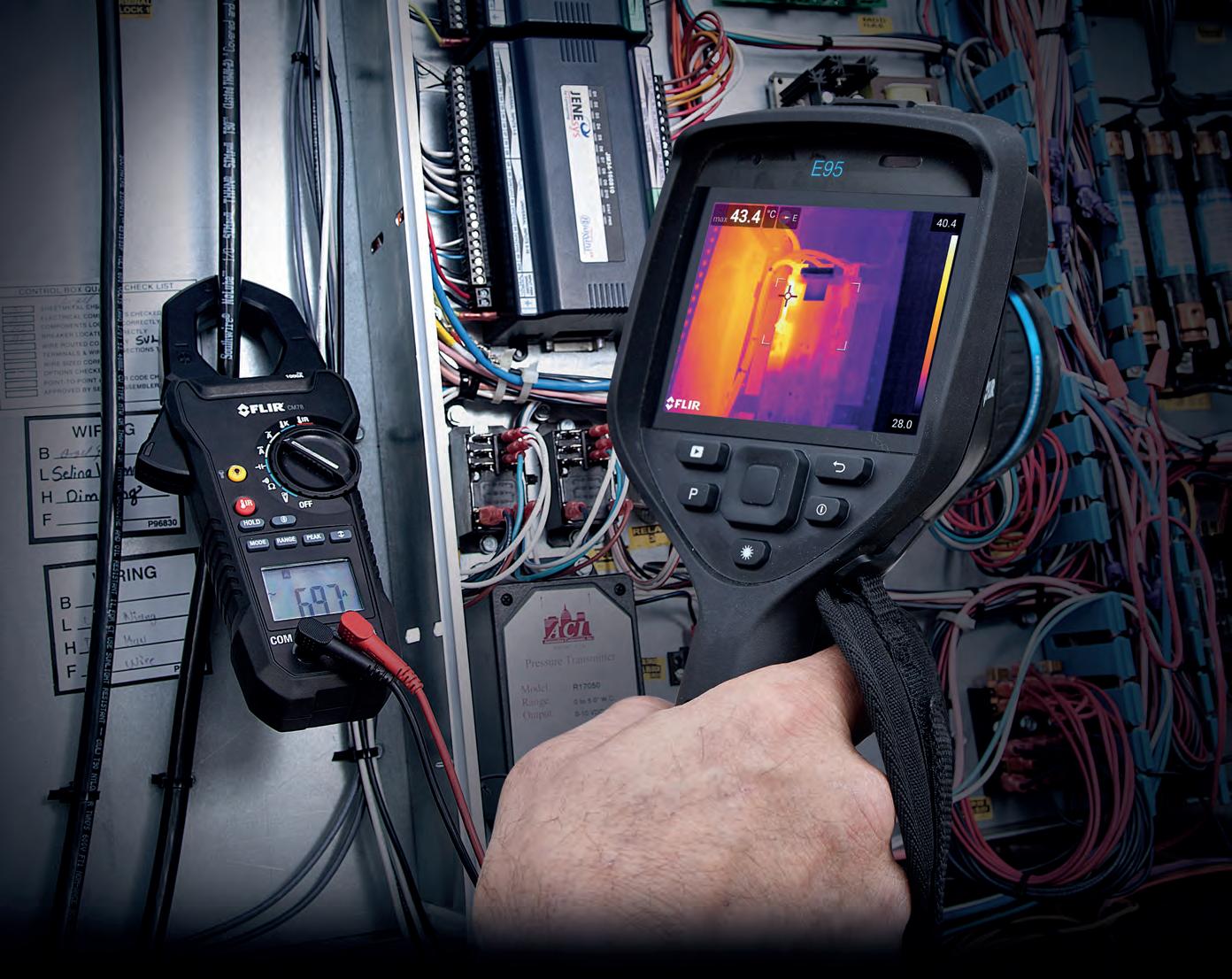
FLIR delivers world-class thermal cameras and test & measurement tools with the accuracy, reliability, and versatility you need to tackle your most challenging jobs. For more information please visit: www.flir.ca/work/
Framing the
FUTURE
Why the outlook for lubricant suppliers is cautiously optimistic.
BY REHANA BEGG
Operators in the industrial oil lubricants market have experienced their share of wear and tear in recent years, but with signs of a brightening economic forecast, firms may need to optimize in the coming years.
A case in point: Shell Lubricants announced the expansion of its B2B distribution network in Canada. Three new distributors – WestPier, Pepco and Boss Lubricants – are set to join Shell’s B2B distribution network in Canada. But Canadian B2B customers can also tap into Shell’s lube distribution through Bluewave Energy, Filgo (Philippe Gosselin et Ass.) and Lubesource (Original Parts Warehouse).
These new additions to Shell’s network effectively double the number of Shell Lubricant distributors in Canada and could be a signal in the overall busi-
ness environment, says Jay Schippanoski, general manager, regional sales, Shell Canada Products.
Bird’s-eye view
Schippanoski explains that as part of the industrial and resources sector, Shell Lubricants experienced considerable economic slowdown between 2014 and 2016, especially in the west. But since 2017, an upward trend has emerged and just two months into 2018 the company was observing growth (“a hockey stick graph-effect”).
Schippanoski, who has been with Shell for 15 years and is based in Calgary, says that he is cautiously optimistic about the interim data and hopeful that industrial lubricant demand in 2018 will bring growth back to 2014 levels. “It’s an exciting time for the B2B sector at Shell,
as it represents the biggest opportunity for growth,” says Schippanoski.
Still, Shell is far from being in the clear and, much like the rest of the industry, has yet to recapture the declines in its servicing industrial sector, says Schippanoski. Market declines over the past two years have pushed industrial sector plants to right-size business, look for ways to strip costs and get much more out of the equipment that is used everyday, says Schippanoski. “And that’s where lubricants have become much more important in the overall cost of ownership decision,” he says.
Shell takes a “lower Total Cost of Ownership” approach as a way to help its customers effectively manage lubrication with the objective of lowering maintenance costs, extending equipment life and reducing energy consumption. To this end, a white paper, “Powering Efficient Vehicles: How Lubricants can help achieve the lowest cost per kilometer,” documents that Shell projects returned $139 million in savings to customers.
With continued improvements in the industry’s downstream markets, higher demand for industrial machinery and equipment at the wholesale level can be expected based on industry trends and indicators, according to Kline, a global market research and management consulting firm.
Photo: Shell Lubricants
Forging ahead
Schippanoski notes that there are some sectors that haven’t bounced back and that concerns over smaller sectors persist. Canada’s agricultural sector is one that continues to face upheaval, thanks to adverse weather patterns. “The opportunities are weather-dependant,” says Schippanoski.
President Donald Trump’s threat to impose a 25 per cent tariff on imported steel and a 10 per cent duty on U.S. aluminum imports would have been another significant threat, but it is unlikely that the president’s protectionist remarks would persist over the long haul, says Schippanoski.
“As an oil supplier, Shell has good partnerships with all of the major steel suppliers in Canada….And, as the industrial sector in the west starts to grow, we see a domino effect and more demand for equipment, which, by extension, affects equipment manufacturers’ demand for steel. I am highly optimistic that that sector, too, will start to improve.”
Overall, companies have exercised restraint in the past several years, says Schippanoski. “Everyone has had to look
at their business and say, ‘Okay, if a slower-for-longer world is real, how do we deal with that without stripping all costs of the business?’”
But by looking at their business from a value-creation standpoint, companies can grow with a much more efficient model, says Schippanoski, noting that the industry is in a much better position than it was prior to 2014, when it was making decisions based on topline versus bottom line growth.
Competitive advantage
In an industry where there are no shortages of strong competitors, it helps to have the upper hand. To this end, Shell Lubricants has been recognized as the global market leader for the 11th consecutive year, according to Kline & Company’s 15th edition “Global Lubricants Industry: Market Analysis and Assessment: 2016-2026” report. One of the innovative technologies Shell Lubricants hopes to leverage this year is its
gas-to-liquids technology, which turns natural gas –the cleanest-burning fossil fuel – into high-quality liquid fuels and base oils for lubricants, and other liquid products usually made from oil. The technology (available in Shell Lubricants’ PCMO portfolio) fosters greater temperature control for the industrial sector in general, but in Canada’s extreme climate it is especially relevant. The competitive advantage is being able to speak to a customer about this kind of innovation in a category that doesn’t have a ton of innovation every year, says Schippanoski. “By explaining how these oils can allow for longer drain intervals and perform better lower temperatures, customers can see the benefits in terms of total cost-of-ownership decreases and reductions.”
MRO
Rehana Begg is the editor of Machinery and Equipment MRO. Reach her at rbegg@annexbusinessmedia.com.
Jay Schippanoski
SPOTLIGHT ON MINING MRO
Standard Parts. Winco.
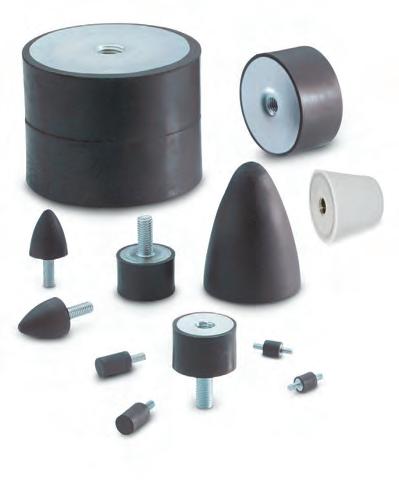
Anti Vibration / Isolation Mounts
These products are designed to dampen vibration, shock or noise produced by vibrating and moving parts or, unbalanced masses of equipment and machines.
■ Absorb kinetic energy on impact
■ Prevent damaging shock and rebound
■ Use as bumpers, leveling feet, or sound dampers
■ Available in inch and metric
■ NEW:
FDA compliant silicone version
J.W. Winco, Inc.
Phone 800-877-8351
Fax 800-472-0670
Email sales@jwwinco.com www.jwwinco.ca
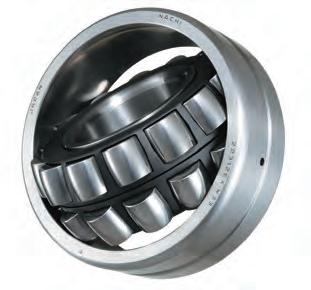
Spherical roller
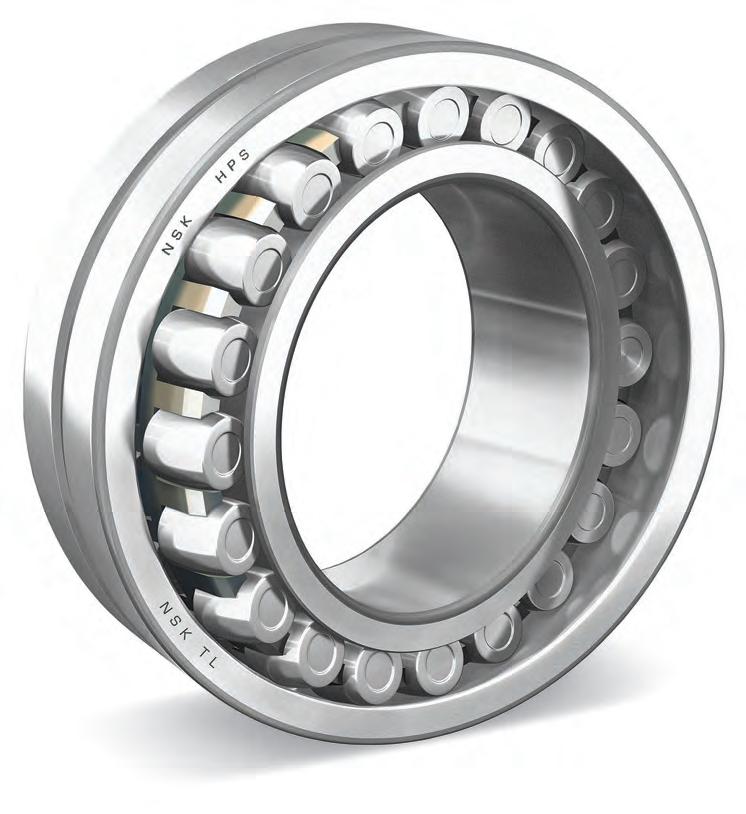
Vibrating screen bearings are the heavy-duty solution where impact and load are critical. The new generation of “Shaker Screen” bearings use hardened steel cages that are up to 10 times more impact-resistant than conventional cages. They also incorporate special O.D. tolerances as well as a special radial internal clearance range. Other advantages are that they are heat stabilized for 400° F (200° C) continuous operation. The floating centre guide ring and cage design allow for lower operating temperatures. Emerson Bearing features the new NACHI EXQ-V style as well as the FAG, NTN and NSK brands. emersoncanada.ca
Heavy-duty engine oils
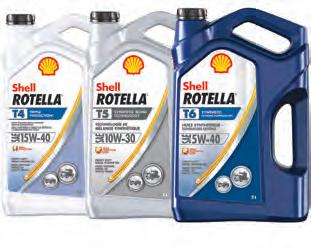
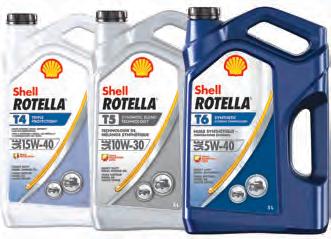
As engine manufacturers create a new generation of lower CO2, more fuelefficient diesel engines, they need higher-performing diesel engine oils. Shell Rotella T4 Triple Protection 15W-40 and 10W-30 and Shell Rotella T5 Synthetic Blend 10W-30 are formulated to meet the specification criteria for the API CK-4 service category for diesel engine oil. Technologically advanced, these engine oils defend against deposits and help keep engines cleaner over the entire oil drain interval.
rotella.shell.com
Flowmeter for custody transfer applications
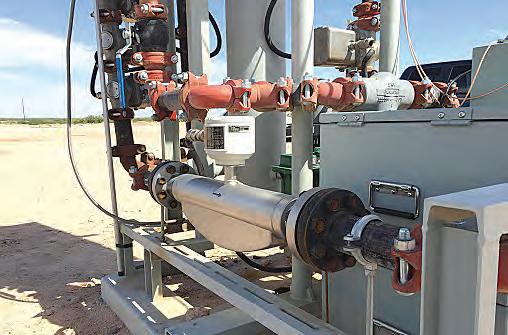
The new MID/OIML R117 certified coriolis flowmeter from ABB comes in a compact design and easy-to-use human machine interface (HMI), which saves on-site handling, installation and commissioning costs. It features VeriMass built-in software diagnostics, which constantly check for changes that could potentially affect meter accuracy, and low-pressure loss reduces operating and ownership costs. abb.com
Custom vibrating screens
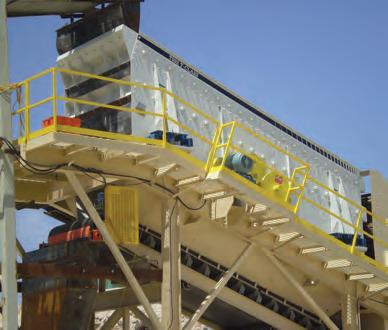
Haver & Boecker, a leading equipment manufacturer and solutions provider for mining applications, offers the versatile two-bearing Tyler T-Class vibrating screen for a wide range of materials with a top size of 16-inch minus. The machine has a cut size range of 20 mesh to 6-inch minus. A sheave combination and drive belts power the T-Class. A wide variety of add-on components allow producers to outfit the machine, such as a dust enclosure, spray system, ball trays, special paint systems and more. havercanada.com
Dual fuel retrofit kit
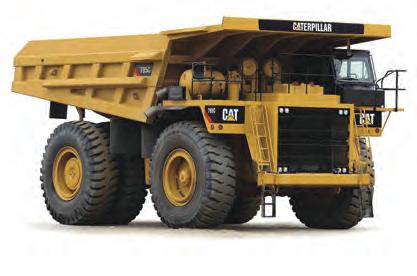
Launched earlier this year, Caterpillar’s dynamic gas blending retrofit kit for the Cat 785C Mining Truck, is the first of its kind. The 785C Retrofit Kit provides the technology for engines to run on both diesel and liquefied natural gas (LNG). DGB lowers fuel cost while maintaining diesel power and transient performance. The kit helps reduce fuel costs significantly by using LNG. cat.com
Diesel generator set featuring higher power density
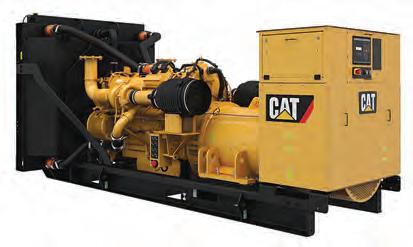
Caterpillar Inc. introduced six new ratings for the Cat C32 ACERT diesel generator set for standby and mission-critical applications. These ratings expand Caterpillar’s range of power solutions with leading power density to reduce total site preparation, transportation and installation costs while requiring less overall space for the generator set. Now available, these new ratings include 1400 kVA and 1500 kVA ratings engineered for 50-Hz non-regulated emissions applications; 1100 ekW and 1250 ekW ratings at 60 Hz for non-regulated emissions markets; and 1100 ekW and 1250 ekW ratings certified for 60-Hz Tier 2 emissions applications. The generator sets feature a smaller footprint and up to 44 per cent more power density than competitive power solutions. cat.com/powergeneration
Underground hard rock mining technology
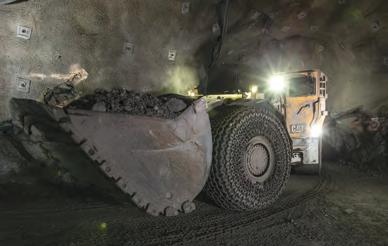
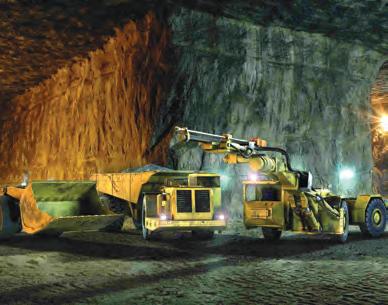
Caterpillar and Minetec, a wholly owned subsidiary of Codan Ltd., have an agreement for the development and delivery of technologies targeting underground hard rock mining challenges. The integrated solutions, offered as part of Cat MineStar, will focus on applications of underground mobile equipment. The development is expected to upgrade MineStar capabilities through the use of improved high-precision tracking and wireless communications, task management technology and proximity detection. cat.com
Underground mining tires
Continental UndergroundMaster, DrillMaster, DumperMaster and ScoopMaster are extreme-condition specialty tire offerings for the underground mining sector. Continental commercial specialty tires follows a customized solution approach whereby every tire line was developed for an individual vehicle type and therefore takes into consideration the requirements of each machine. They are available with the proven V.ply design with high carcass strength and robustness, or may offer a full steel radial construction that delivers outstanding load capability even on longer transport distances in underground mines. continental-tires.com
Split bearings
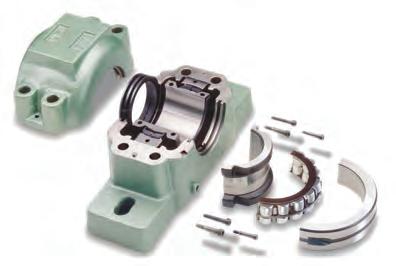
Split bearings provide a unique solution for reducing downtime and operational costs. They are available in a wide range of configurations that can be drop-in replacements for traditional solid bearings. Depending on the application, options include metric or inch shaft dimensions, cylindrical or spherical rollers, and sealing options for challenging environments. Available from Timken, FAG and Craft. emersoncanada.ca
Advanced remote control
The award-winning AutoMine product family from Sandvik continues to evolve. The next generation release of AutoMine Lite 2.0 includes both consistent high-speed automated production missions and smart tele-operation capabilities for dynamic mining operations. AutoMine Lite 2.0 is a unique solution for integrated autonomy and advanced remote control of underground loaders and trucks. Loader or truck production cycles can be automated with autonomous tramming and dumping as well as with loaders using Sandvik’s automatic bucket loading assistant functionality. home.sandvik
SAME SAME BUT DIFFERENT
In a quest for success, mines apply every advanced total equipment reliability maintenance or asset performance management program available.
BY L. TEX LEUGNER
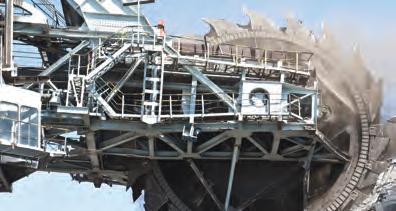
Equipment used in the mining industry is somewhat unique because it is dependant on the type of mining where the machinery is used. On the one hand, in oil sands mining, bucket wheels and draglines have been largely replaced by electric and hydraulic shovels, while in potash mining, two- and four-rotor continuous mining machines are used to cut the raw material, where it is then transferred to
conveyers or underground electric shuttle cars that move the ore to surface processing plants. On the other hand, coal mines use track or wheel-mounted excavators with rotating platforms with either a scoop or bucket to load coal onto haul trucks for delivery to process plants, while hard-rock mines employ drills for extraction and conveyors to move the material to either crushers or mills of various design, such as ball, rod or hammer mills.
What is not unique are the systems on these machines that require maintenance. The mining industry using diesel engines, hydraulic systems, gear drives of different types and configurations, electric systems, motors and transmission systems with associated components should apply every advanced total equipment reliability maintenance or asset performance management program available to effectively compete in today’s international marketplace.
Based on statistical information, maintenance costs in the mining industry vary from 30 to 50 per cent of operating expenditures, depending on the type and age of any particular mine. From initial machine design to its disposal, mining companies must consider issues related to reliability, maintainability and continuous improvement strategies, the necessary and ongoing training of maintenance specialists, easy access to replacement parts and components, among other important considerations.
New equipment
If we start at the beginning, new equipment acquisition should consider cost (based on lifecycle costs of the machine to be replaced) and the design and ease of maintenance and operation. If the new machine is a prototype, the mine might consider this as an opportunity to work with the manufacturer to improve design, maintainability, reliability and other considerations. Questions to be considered: Does the machine contain oil-sampling valves to easily permit sample taking from lubricated components? Are vibration analysis transducers mounted on rotating machine components for ease of monitoring vibration problems? How easy is it to carry out routine maintenance tasks such as oil filter, bearing or drivebelt replacement? In every case of new equipment acquisition, experienced, knowledgeable maintenance personnel should be involved.
Once the new unit is on-site, a review of the manufacturer’s maintenance procedures and recommendations should be undertaken, oil levels in all lubricated components should be checked, tire pressures or track adjustments should be confirmed, along with what is very often referred to as an on-site predelivery inspection to ensure compliance with the initial purchase order.
Installation and commissioning
When new machines are installed in the process plant, they are often installed and commissioned by either the manufacturer or a contractor. In either case, the installation should be carried out with close co-operation and involvement of mine maintenance personnel. Very often the commissioning is done too quickly (and badly) when mine management insists that production continue as soon as possible. Having maintenance personnel involved in the installation and commissioning can provide an opportunity to prevent this lack of foresight and provide access to learning about the new equipment’s operation for both mine maintenance and operating personnel. The old adage remains true: “If you don’t have time to do it right, when will it ever be done right?” Poor machine operation can very often be traced to inadequate installation or commissioning.
Continuous improvement
Once the equipment is operational, assuming it is considered “production critical,” it’s time to apply whatever reliability improvement strategies that can or should be considered. These should be based on an ongoing philosophy of continu-
Photo: Getty Images
ous improvement that includes the application of condition monitoring technology and this means that the mine should use as many of these technologies as can be applied; for example, oil and vibration analysis, temperature and ultrasound monitoring should all be applied on every lubricated rotating machine that is considered critical to mine operation. These technologies should be applied on a regularly scheduled basis in order to gather machine condition data that can be effectively trended and recorded for easy access in the history files. (Remember that the trend is much more important than any particular set of data.)
As part of the continuous improvement philosophy, next apply reliability centred maintenance (RCM) on the new machine. Simply speaking, RCM is a process of improving machine reliability through a step-by-step approach to determine the potential failures of components within a particular machine by using a failure modes and effects analysis (FMEA). In too many cases, failures are discussed and analyzed only after they have occurred, which is the essence of reactive maintenance. By applying FMEA, we are determining the potential failure of a particular machine and its components before the failure and is the first step in being proactive in our reliability improvement failure avoidance strategy.
The analysis is carried out by maintenance, engineering and operations specialists usually led by an expert in the RCM process, often by a service representative provided by the equipment manufacturer or a consulting engineer well-versed in the process.
Briefly, the steps used in the RCM process using the FMEA analysis:
1. Ask how the machine might fail.
2 Define how severe the failure might impact safety, production and maintenance.
3. Determine how to detect the failure earlier.
4. Determine how to reduce (or eliminate) the occurrence of the failure.
5. Create an appropriate action plan.
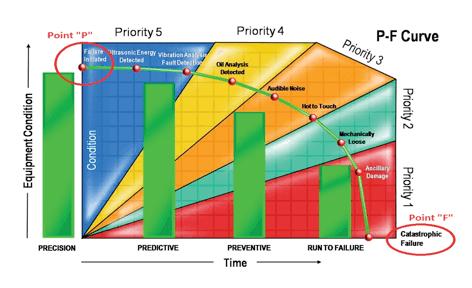
Once each failure mode is identified and what happens when it occurs, the mine personnel can assess the consequences and decide what (if anything) should be done to anticipate, detect, prevent or correct it; or even design it out. Step 3 above is directly related to the use of condition monitoring technologies to gather the data needed to detect the potential failure. Consider the P-F curve that determines the relationship where a component failure can be predicted (using ultrasound or vibration detection, to the result of oil analyses all indicating an incipient failure, followed by an obvious increase in noise or temperature, resulting in a failure that could be catastrophic).
Contrary to popular opinion, the process of RCM using FMEA can be applied to both mobile machinery such as haul trucks, as well as process plant machinery like conveyors, crushers or ball mills. The results of implementing these reliability improvement strategies will most definitely reduce maintenance costs as well as reduce maintenance itself.
EXAMPLES OF MACHINE AND EQUIPMENT MONITORING
Additional cost reductions
Even after the imposition of RCM, maintenance costs can be reduced by further reducing or eliminating maintenance activities. This can be achieved by extending the life of equipment and its components even further, as well as avoiding service failures. The key elements of further reducing maintenance costs are measuring the mean time between repairs (MTBR), or equipment life, the mean time between failure (MTBF), or equipment reliability, and the mean time to repair (MTTR) or equipment maintainability. By extending MTBR and MTBF and reducing the MTTR, costs can be reduced while production availability and yield can be improved. In addition, at least once each year, a team of maintenance personnel should review the preventive maintenance program using these regularly recorded data and consider even further maintenance activity reduction or elimination. Two examples of such improvements are the use of split
bearings, dramatically reducing the time to replace conveyor bearings, and the extension of oil drain intervals on haul trucks using oil analyses to monitor oxidation to determine remaining oil life.
Further improvements
An additional reliability improvement strategy that should be considered for improving plant equipment in the mining industry is the application of total productive maintenance that minimizes the six big losses in process plants or production facilities. Its principle requirements are that everyone in the plant is trained to be responsible for minor maintenance, and overall equipment effectiveness (OEE) measures three key performance indicators – availability, performance rate and rate of quality.
These three measures are divided into measuring and recording breakdowns and set-up adjustments, related to machine availability, machine idling/minor stoppages and speed losses both relating to rate of performance and process defects and start-up losses, relating directly to the rate of quality. An 85 per cent OEE is recognized internationally as best practice in any process plant. The calculation:
Availability
x
Performance
rate x Quality rate, or
loading time – downtime x ideal cycle time x net operating time loading time actual cycle time x first run capacity
The World of Bearings and Power Transmission...
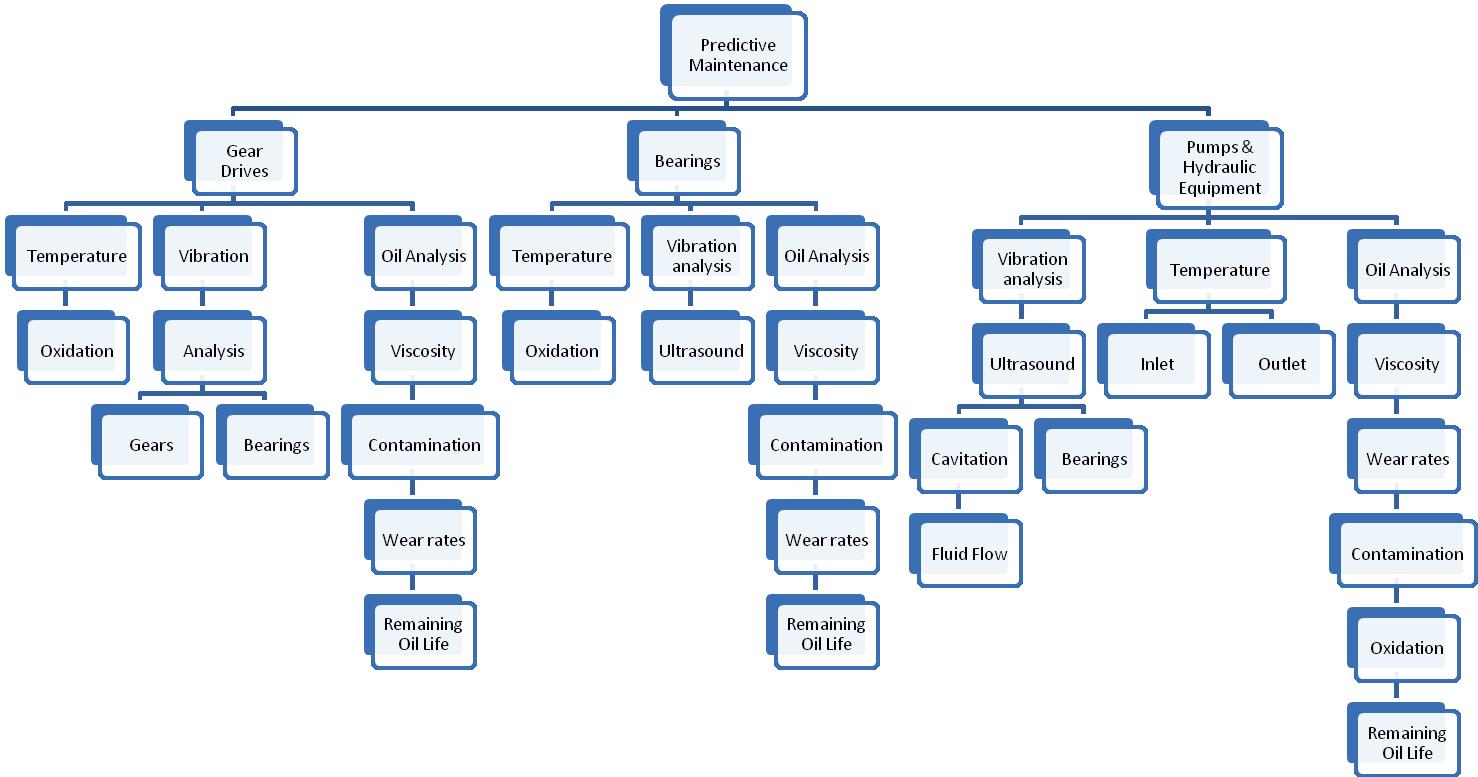
COMMON PREDICTIVE MAINTENANCE TECHNIQUES
Can provide information onCan determine
Oil viscosity and shear rate
Correct oil drain intervals
Additive/alkalinity/acidity levels
Contamination levels and types
Temperature limits of lubricants
Component wear rates
Nitration/oxidation rates, etc.
In all lubricated components and systems.
For the long haul
Imbalance
Misalignment
Looseness
Component deterioration
Hydraulic pulsations
Resonance
Cavitation
Valve operation, etc.
In bearings, gear drives, electric motors, hydraulic pumps and engines.
Can determine
Steam pressure
Vacuum leaks
Loose drive belts
Loose/misaligned couplings
Hydraulic valve leakage
Fluid flow
Electrical arcing, tracking and corona discharge
Correct bearing grease quantities
Bearing defects, etc.
In most industrial machinery, both stationary and mobile.
There are many other “best practice” issues that should be considered or reviewed, such as unwillingness by management or maintenance to carry out root cause failure analysis on component failures because the failure is considered normal and therefore acceptable. (They’re not!) Another problem is the application of short-term solutions to long-term problems without consideration for the consequences. A perfect example is the layoff of the plant oiler without an alternative plan that will result in lubrication-related failures within months or even weeks. Some mining management groups have failed to understand that a dedicated planning and scheduling func-
Can determine
Extreme temperature variations
Poor electrical connections
Effectiveness of insulation
Bearing deterioration
Valve and joint leakage
Electric motor defects, etc.
In most industrial machinery, both stationary and mobile, and in buildings and building systems.
tion is critical to reducing maintenance costs. Finally, many mine managers consider maintenance as a cost rather than a cost-reducing asset. Ultimately, this short-sighted thinking can be disastrous. MRO
L. (Tex) Leugner, the author of Practical Handbook of Machinery Lubrication, is a 15-year veteran of Royal Canadian Electrical Mechanical Engineers, where he served as a Technical Specialist. He was the founder and operations manager of Maintenance Technolgy International Inc. for 30 years. Leugner holds an STLE lubricant specialist certification and is a millwright and heavy-duty mechanic. He can be reached at texleug@shaw.ca.
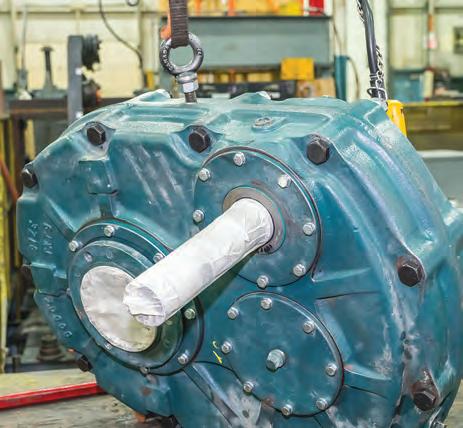
Mining in High Gear
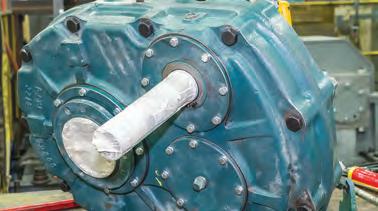
In large gear reducers, parts – such as bearings and gears – can be pricey. Understanding gearbox failures can help mitigate downtime.
BY RENATO FOTI
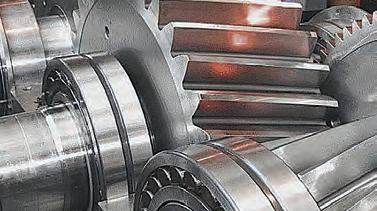
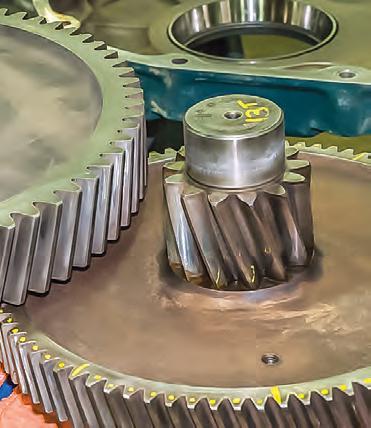
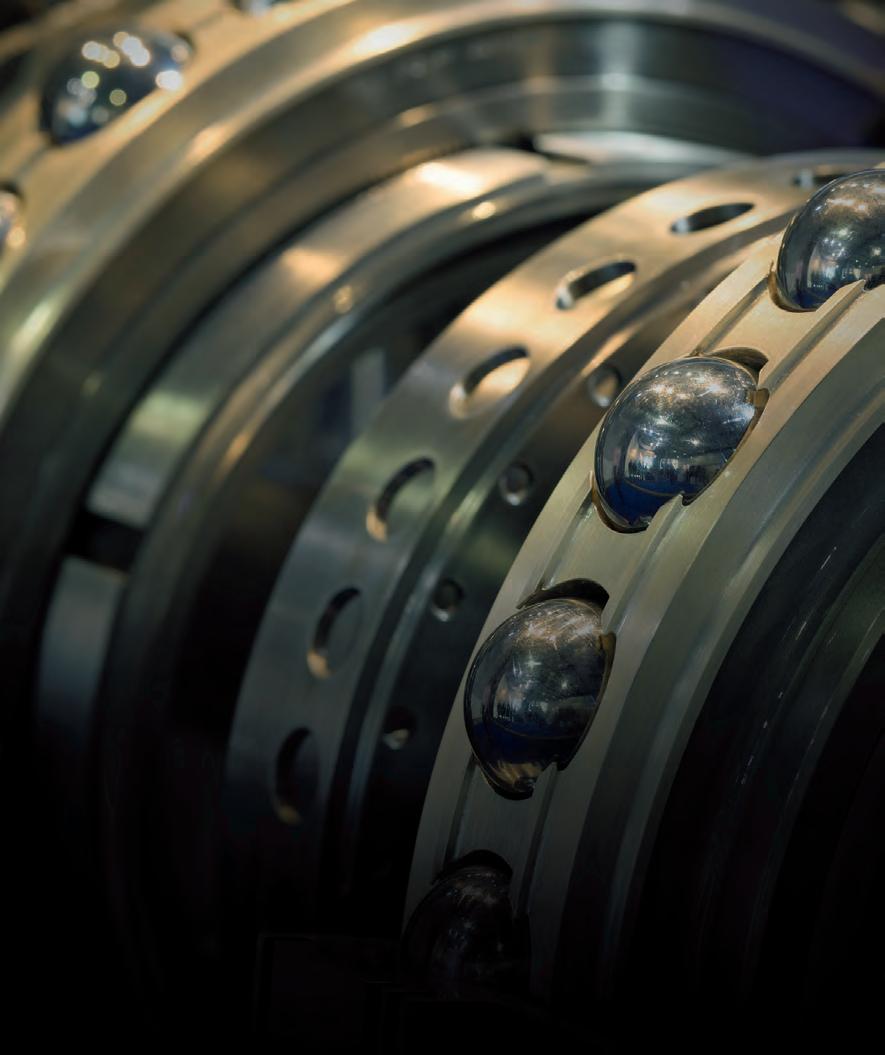
Gear reducers can be complex machines that apply the science of gearing and mechanical advantage to run thousands of complex operations in many different industries. Gearbox manufacturers have designed a variety of gearboxes in multitudes of different configurations and gear ratios. When failures occur, it is critical to understand how to repair the failed units and how to prevent future failures in order to keep production up and running. Three things that can cause premature failure are poor lubrication, misalignment and overloading. Failure modes can involve bearing failures or gear failures, or both.
Lubrication
Lubrication is critical for both bearing and gear life. Important aspects of lubrication are the volume of lubricant that is delivered to each gear mesh and bearings, as well as the properties of the lubricant. The lubricant forms a thin film that prevents metal-to-metal contact between gears and between bearing components. Modern industrial gears use an involute tooth form and tooth engagement, which is a combination of rolling and sliding.
The oil film is a thin barrier between moving parts that allows the rotating force to turn the gears easily without damage to the metal surfaces. Contamination in the lubricant can result in scuffing and much faster wear for both the bearings and the gearing in a gearbox, so it is imperative that maintenance mechanics check gearbox lubricant for contamination periodically, once a year as a minimum. Each gearbox would have a recommended oil level as well as a method to lubricate both the bearings and the gear set. With bath lubrication, all moving components dip down below the oil level. With splash lubrication, oil is splashed around inside the gearbox housing by fast-moving components, covering all moving parts. With pressure lubrication, oil is pumped to each gear mesh and bearing through spray nozzles or oil passages from the gearbox oil sump or from the external reservoir.
Alignment
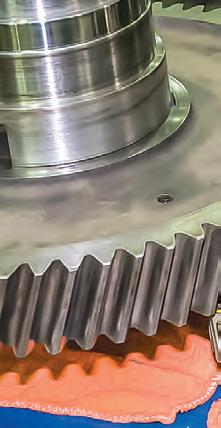
Gears are designed to mesh with either parallel or right angle shafts and with a specific backlash between gear teeth. The alignment of the gears in the gearbox housing is critical, and assessment of the alignment of the gearbox housing bores is very important when a rebuild is being done. In mining applications, where gear reducers are in heavily loaded applications, we sometimes see firsthand that reducer housings can get distorted or bent. Even a small amount of misalignment can cause premature gear wear and failure. The gear teeth will not mesh the way they were designed to, resulting in excessive loads in the weaker
parts of the teeth. Bearings rotating in their bores can also cause wear in the bores, in turn causing misalignment and gear damage.
When receiving a reducer from a mine for rebuild, repair shops should understand all of the application details, including input forces, output requirements, suspected cause of failure, maintenance history, vibration analysis results and oil sample analysis results. Once the reducer is in the shop, a full disassembly will take place with photo documentation and labelling of parts. Gear inspection will include a magnetic particle inspection of the gear teeth, and any wear patterns will be documented. Not all rebuilds will require replacement of the gears; in most cases, only bearings and seals will be required unless the failure is more catastrophic or if contamination or misalignment has been in place for a longer time. The millwrights will make a full report on every detail so that parts can be ordered or manufactured to complete the rebuild. An engineer will then measure and reverseengineer any gearing so that they can be replaced, if required. Some of the larger and older reducers are no longer available from the original manufacturer, so OEM supply of parts would be impossible. Even if the OEM can supply parts, the lead time may be prohibitive, especially when an emergency repair is required.
Each reducer is rebuilt after full cleaning, part replacements and housing alignment inspection. Housings can be remachined if bores are worn or misaligned. The gearbox then has backlash, and bearing clearances measured and Photos: Rapid
Gear
documented, and is test run under no load to check for vibration, noise or leakage. Finally, the gearbox is relabelled and painted to look new.
Overload
We often see reducers that are pushed to the limits and beyond. Conveyors are set to speed up, heavier loads are applied to the output and emergency stops and cold starts can add shock loads to the reducers beyond their design ratings. In older reducers, just the normal wearing of parts can change the internal clearances and cause problems. Once a critical limit is reached, failure can occur quickly.
It can be difficult for mines to know how much extra loading a reducer can take. When a reducer starts to heat up, it draws more power to run, has an increase in noise and vibration level and time for a rebuild becomes critical. It may take years for the first signs of damage or component failure to appear, but once that initial damage occurs, the progression of damage is accelerated and will ultimately lead to a catastrophic failure. Repairing a gearbox in the initial stages of failure may involve changing only bearings and seals, but repair of a gearbox that has suffered a catastrophic failure will likely involve much more cost as well as a longer lead time.
It is wise for any large facility to have spare bearings, seals or even full gear reducers onsite to get back up and running quickly after a failure. If a spare reducer is installed to replace a failed gearbox, the failed reducer can be rebuilt and become the new spare without being rushed, avoiding overtime fees during the repair process. In very large reducers, the parts, such as bearings and gears, can be very expensive, reflecting not just the cost to purchase the components, but also the lead times that cause excessive downtime costs.
Smart monitoring, careful inventory of critical parts and preventative maintenance
programs that check the oil temperature and contamination and monitor vibration levels, will all help minimize downtime. Having a good partnership with a rebuild shop that offers full service and turnkey repairs will also ensure quality rebuilding. As more and more facilities outsource rebuilding services, understanding what suppliers can and can’t do is critical.
MRO
Renato Foti, director of business development at Rapid Gear, Kitchener, Ont., can be reached at Renato.Foti@rapidgear.com. For more information, visit rapidgear.com.
SYMPTOM CHECKER
Test your knowledge as you go about diagnosing hydraulic systems.
BY L. TEX LEUGNER
There are two fundamental principles that must be fully understood when troubleshooting hydraulic system problems: the rate of flow, which determines the speed of all of the actuators (cylinders and motors that convert the hydraulic energy into mechanical energy), and the system pressure, which determines the force at the actuator. The troubleshooter should remember these rules: “flow makes it go” and “pressure lifts the load.”
The troubleshooter must also remember that all hydraulic systems contain the following components: reservoir, hydraulic oil, pump, control valves, actuators and the lines that connect them all. With this in mind, let’s see where we should be.
1. Are you using the correct hydraulic oil?
Logic: Among many hydraulic oil characteristics, viscosity, resistance to foaming and air entrainment and compatibility with hose and seal materials are of extreme importance. Hydraulic oils may be of differing base stocks and the
troubleshooter must be aware that aromatic base oils can cause seal swelling, while paraffinic base oils may cause seal shrinkage. Never select hydraulic oil based on price alone, and always follow the recommendations of both the manufacturer and the lubricant provider.
2. Do you know the operating conditions of the hydraulic systems in your care?
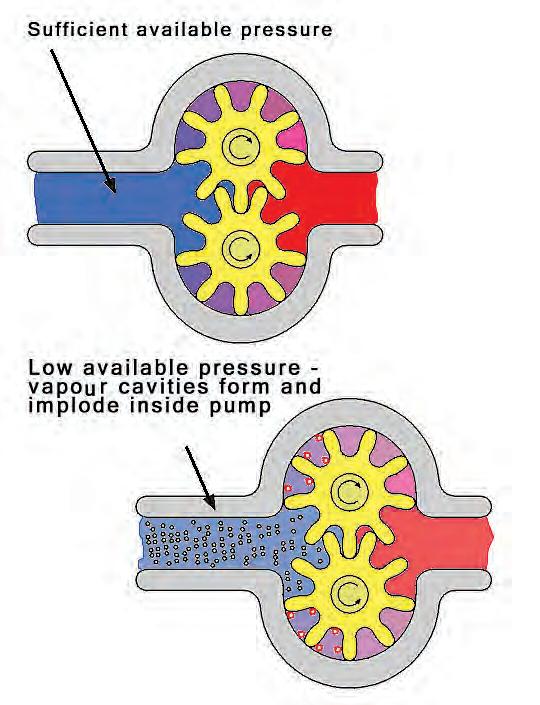
Logic: Keep hydraulic fluids cool, dry and clean. Operating temperatures of mineral base oil begin to oxidize at 71° C, while synthetic polyalphaolefin fluid can withstand higher temperatures. Oil inlets to the pump must be located below the reservoir outlet to ensure that the pump is continually flooded to prevent cavitation and air entrainment. When entrained air bubbles are compressed, they increase in temperature, causing the surrounding oil to also increase in temperature. Air bubbles trapped in the fluid may vapourize or implode at valve or pump surfaces causing cavitation erosion.
Water content should never exceed 1,000 ppm (parts per million), while water content in biodegradable (vegetable- or canola-based) hydraulic oil should never exceed 500 ppm. Cleanliness is critical in today’s systems, which frequently operate at 5,000 psi or higher, meaning that internal com-
ponent clearances are often in the 1 - 5 micrometre range and dirt, wear metals and foreign material cause some 75 per cent of hydraulic system failures. In hydraulic systems with servo control valves, contamination under 5 microns can cause intermittent spool jamming, slow response, instability, spool surface erosion and solenoid burnout.
3. Do you locate and repair leaks immediately?
Logic: An external leak of one drop per second is equal to 1,590 litres (420 gallons) in a 12-month period, causing high oil consumption, waste and environmental damage. (Several years ago, a U.S. study was conducted that confirmed that the average plant uses four times more oil than its machines actually hold!) Internal leaks that can’t be seen are even more problematic because they seriously reduce hydraulic machinery efficiency but are not obvious. If the designed cycle time of a hydraulic circuit is 10 seconds, but internal leakage slows the circuit’s speed to 20 seconds, the result is a 100 per cent reduction in performance efficiency. This example proves that machine efficiency is much more important than what unwitting plant managers refer to as availability, confirming that performance efficiency in hydraulic machinery is directly related to leakage.
4. How do you locate internal leaks in hydraulic systems?
Logic: Internal leaks affect the speed, accuracy and efficiency of hydraulic circuits. Therefore, troubleshooters should (must) know the operational speeds and pressures that operate their machines. One very useful tool used to “hear” elusive internal leaks is the ultrasonic scanner. During any internal leak in a closed control valve or past a cylinder packing, the hydraulic oil is moving away from higher pressure. As the fluid passes through the leak site, a turbulent flow is generated that has strong ultrasonic sound waves that can be monitored (heard) using the headphones. The intensity of the ultrasound produced by the leak will be at its loudest near the leak. If it is at a control valve, the leak could be as small as that caused by minor erosion on the valve spool. If the leak is near the cylinder packing or seal, it could be the result of a scored cylinder rod caused by contamination that entered past the packing during rod retraction. Ultrasound can also be used to monitor cavitation and air entrainment conditions at pump inlets, as well as locating electrostatic discharge noise at filters and reservoirs. (Electrostatic sparking discharge can occur in fluids by high turbulence, high fluid velocities or internal fluid friction and can result in burn marks in filter media and etching or pitting on internal surfaces of reservoirs.)
5. Do you use and properly interpret an effective oil analyses program?
Logic: The minimum tests necessary for hydraulics systems condition monitoring include viscosity and total acid number (that monitor oxidation and remaining useful oil life, respectively), water content (using Karl Fischer analyses) and contamination (using ISO cleanliness code 4406 standards). All oil samples should be taken at regularly scheduled intervals and results should be interpreted based on the trends established and not necessarily on any specific set of numbers.
6. If you operate in industries where contamination is an ongoing concern, do you effectively monitor sealing systems and filtration?
Logic: If contamination is an ongoing problem, consider the application of kidney or side-stream filters mounted on return lines to the reservoir. These filters should be rated in absolute terms at a micron rating lower than the smallest component clearance in the system. Reservoirs should be fitted with removable access plates to permit periodic internal cleaning and reservoir breathers should be fitted with two micron filters, and always pre-filter hydraulic oil before installing top-up oil or replacing existing oil. Finally, in all cases where a hydraulic failure has occurred, always completely flush the entire system or, at the very least, flush the affected circuit using a mobile filtration system or portable fluid purifier such as those manufactured by Caterpillar or the Pall Corp. MRO
L. (Tex) Leugner, the author of Practical Handbook of Machinery Lubrication, is a 15-year veteran of Royal Canadian Electrical Mechanical Engineers, where he served as a Technical Specialist. He was the founder and operations manager of Maintenance Technolgy International Inc. for 30 years. Leugner holds an STLE lubricant specialist certification and is a millwright and heavyduty mechanic. He can be reached at texleug@shaw.ca.
Photo: Getty Images
Seal of Approval
Taconite seals could be the standard for severe duty service in pulleys.
BY DOUGLAS MARTIN
Most people involved in belt conveyors, especially those used in mining and oil sands or heavy-equipment operations, have heard of “taconite” seals in the bearing pillow blocks (housings) of the pulleys.
Taconite is a form of iron ore. It is a sedimentary form of iron ore made up mostly of magnetite, hematite and chert. Magnetite and hematite are very abrasive and have been used as an abrasive in the manufacturing industry. The pulleys of the belt conveyors used to transport the ore in a “taconite” mine suffer terribly due to taconite dust.
To overcome the problem of the highly invasive taconite material penetrating bearing housings, engineers came up with a taconite seal that prevents ingress into the bearings in harsh environments. Taconite seals take their name from iron ore mined in Minnesota’s Mesabi Range in the United States.
Taconite seals are not standardized components. While they are often perceived to be a standard part, they are not. This misperception creates confusion and a lack of continuity as a design engineer may specify a taconite seal intending to get one design, but what is sourced (often from the lowest bidder) is not what the designer intended.
The only common thread a taconite seal shares with other comparable seals is that it is a grease-purgeable seal, meaning grease is injected directly into the seal and then flows out by pushing the contamination away from the bearing. This is a key distinction in that the housing has two or three grease inlets – one per seal and one for the bearing. It is not enough to hope that the grease going into the bearing is also enough to purge the seals. Each seal must have grease added to it.
Designed for purpose
There are two major general designs: a one-piece taconite seal and a two-piece taconite seal. The one-piece design is a single piece of steel that attaches to the housing and is stationary. Within the stationary ring could be a piece of felt or a lip seal of some sort. The disadvantage with this shaft contact seal is the probability of grooving of the shaft, which can be more pronounced when there is abrasive contamination. The onepiece taconite seal tends to be the economical solution, since it is only one part and this is a prime example of where the specification of taconite seal may cause disappointment with the performance of a taconite seal.
The second general type of taconite seal is a two-piece taconite seal consisting of a stator (adapter ring) and a rotor (flinger ring), which mate together with some form of axial or radial labyrinth and possibly a lip seal. In this case, the lip runs on the seal component instead of the shaft as not to wear the shaft.
There are two generations of two-piece taconite seals. With the first generation, there was an attempt to save space and have a narrow width across the seals. To accomplish this, the stator fit into a housing with an enlarged seal opening. However, once this seal opening was changed to accommodate the taconite seal, it could not be used with a standard triple labyrinth seal.
From this arose the generation-two taconite seals. In this version, the stator fits into the standard seal groove, which accommodates the triple labyrinth seal fit. The overall width became wider. However, the second-generation taconites can fit into off-the-shelf housings.
So, is the generation-two taconite the “be all end all”? The answer is no. In Australia, a large mining operation has tested it and found that the next level of reliability improvement came with the combination of using sealed spherical roller bearings along with the taconite seals. The bearing seals retain the high-quality, clean grease in the bearing, the grease in the housing provides a second barrier, and the taconite seal provides the best third barrier from external contamination.
A few things to keep in mind
There is no standard for a taconite seal other than it being a grease-purgeable seal (and this is not governed by any technical association). The individual design of the seal can offer important features that can make a difference in the performance, such as avoidance of shaft wear and more effective sealing due to complexity of labyrinths. No matter what design, a taconite seal that does not get fed grease is essentially ineffective. And, the most effective known sealing solution in a mining and oil sands operations is a combination of a sealed spherical roller bearing and a taconite (concept) seal. MRO
Douglas Martin is a heavy-duty machinery engineer based in Vancouver. He specializes in the design of rotating equipment, failure analysis and lubrication. Reach him at mro.whats.up.doug@gmail.com.
The revolution is here.
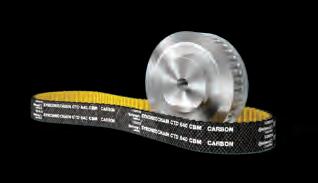
Take on the most demanding applications with CONTI® SYNCHROCHAIN CARBON heavy-duty timing belts. Our technology combines light but durable polyurethane teeth with high tensile carbon reinforcement to deliver up to 15% more horsepower. Contact Continental for a complimentary drive analysis. We o er complete drive solutions, including belts, metal, and a team ready to help you get the most from your drives.
No more, no less
Doing the work right is to do it to the lowest, minimal acceptable quality.
BY JEFF SMITH
As gang maintenance supervisor for a major railway, I had two mechanics working for me. Though both were good tradesmen, one had a higher work ethic and productivity level than the other. There was an issue with a track liner that fell under the area of responsibility of the first worker; he diligently chased the issue through the hydraulic system by replacing every conceivable component. This resulted in a week of downtime and still no resolution. But the answer was for sure in the obscure parts that were ordered.
As the slow order (the lowered speed implemented to safely pass over track that was not lined) was getting longer
and longer, I was getting a lot of heat. I went to the not-so-hardworking tradesman, who was enjoying his favourite pastime, sleeping in his service truck. I woke him up to ask him to look at the track liner. After a few minutes of grumbling, he said he would. I spent the next hour checking on other issues, then, on my return, I see the second mechanic’s service truck in the same position…with the mechanic inside sleeping. I pounded on his window (I have my limits) and stated, “I needed you to do one thing!” He rolled down his window and with a sleepy grin pointed down the train tracks at the functioning track liner. “It was a bad wire connection.”
Doing the work right is a lot easier.
QA & QC
There are two aspects to “doing the work right”: quality assurance (QA) – the work package the tradesperson receives, which outlines how to do the job – and quality control (QC) – assuring the tradesperson actually executes the work package as required, to meet the minimal acceptable quality. Minimal. Doing the work right is to do it to the lowest, minimal acceptable quality. If it was maximal, then we would rebuild it like new, polished, painted and every conceivable part replaced.
The QA document for maintenance work is the work plan. The document must be detailed enough so the lowest performer can successfully execute work correctly. In many cases the sea-
Photo: Getty Images
soned tradesman will scoff at the work package and claim he doesn’t need it as he has done the work hundreds of times (at least once prior). He may be correct and he may have the job memorized, but without QA there can be no QC.
The primary metric influenced by the plan is wrench time. Wrench time is the time someone physically interacts with an asset. It does not include travel to and from the asset for any reason, receiving instructions or breaks.
Let’s follow a task in two scenarios. The first is a seasoned tradesperson doing the task without the work defined and the second is an inexperienced tradesperson doing the task with a welldetailed QA document.
Task: Replacing a cylinder head on a large industrial engine
Scenario One
The tradesperson grabs the tools he thinks he needs for the job. He locks out the asset and completes his Job Safety Analysis (lamenting about useless paperwork). It is 9:00 a.m. He hops up on the haul truck, opens the hatch and climbs down onto the engine with tools in hand. Now which head was it? He gets off the asset and finds the foreman. “It’s the front left. Didn’t the CBM guys tell you? Here, let me find the thermographic image.” They admire the image and talk about heat distribution for a bit, then the tradesman heads to the asset. The tradesman climbs up the ladder into the engine compartment and finds the head. He starts unbolting the exhaust manifold and removes the complete assembly. Next, he proceeds to remove the valve cover. Coffee time! The tradesperson has coffee, returns to work to disassemble the rocker set and unbolt the head while grumbling under his breath, “This $#&! is heavy,” before lifting it onto the deck. He heads to his tool box to get a scraper and flapper wheel to clean the surface. During this trip he carries the defective head and places it beside his workbench. Heading to the parts counter, he gets the replacement head and head gasket. Returning to the truck,
he installs and torques the head. After another trip off the truck to check the manual for clearances, he sets the rocker assembly. He takes the valve cover to the workbench, cleans it and installs a new gasket. Last climb up the truck to finish the job. At this point he removes his locks and puts his tools away.
MTTR (Mean Time to Repair): 5 hours
Scenario Two
The junior tradesperson reviews the work package, noting the staging activities and
the tool list. He moves the equipment and parts to the truck deck. He then completes his lockout and JSA (job safety analysis). He did take some time, as the document noted that calibration must be validated on the torque wrench. Setting the clipboard by the engine he starts disassembling the front left head as noted in the work package. It notes that the exhaust manifold does not have to be completely removed, only loosened with the bolts on the removed head. Good, that saves some effort. As the weight of the head is in the work package, he follows the instructions
The Gold Standard for Performance
Titan™ chain offers the ultimate in extended wear-life.
When it comes to critical applications, reliability is everything. But not just any chain can withstand the nonstop stress of high speeds and harsh conditions. That’s why Tsubaki designed its Titan chain to deliver superior durability in challenging environments. Specially coated pins, solid lube groove bushings* and a patented ring-coining process increase fatigue strength while minimizing wear. The result is a significantly longer wear-life, even in extreme environments. So go on, hold your chain to a higher standard — the Titan gold standard.
Acoustic Lubrication Workshop
There are two aspects to “doing the work right”: quality assurance and quality control.
on lowering it down to the ground with a chain host, noting that having a cart directly under the lowering point would be a good addition to the job plan. He cleans the deck surface using a pneumatic vacuum to collect any particulate. Postcoffee break, the junior tradesman installs the new head, sets the rockers and installs the cleaned valve cover. (He had taken it down when he went for coffee and returned with it.) He then cleans up his tools and, as per the job plan, returns the defective head to storage.
MTTR (Mean time to Repair): 5 hours
What, no difference? Well, in this case, the junior tradesperson spent more time reviewing the documents and carefully double-checked everything. But had the senior tradesman had a work plan and reviewed it, he may not have contaminated the engine during cleaning and his torque wrench may have been calibrated. He may not have had to redo the job as the incorrect torque (calibration) led to a head gasket failure. (Darn, must be a deck problem!)
Doing the work right requires both efficiency and effectiveness. Efficiency gains come from clearly understood (whether documented or not) job plans. This includes staging activities, kitting of parts, clearly defining disassembly instructions, including identified laydown areas. The work itself must be well understood with all critical specifications and safety aspects highlighted. There should be detailed reassembly instructions with tips and tricks to keep the task flowing with minimal interruptions. Any static and dynamic testing requirements must be understood along with the acceptance criteria. There should also be a process in place for returning care, custody and control of the asset back to operations. The final step of the job closure activities is returning tools, equipment and parts to filling out post-job paperwork. The QA document should be sequenced to drive efficiency.
Following the technical specifications within the job plan will deliver the effectiveness. This includes clearances, torques, contamination control, ten-
sioning and as-found, as-left settings. Effectiveness also requires post work follow-up, such as re-torqueing wheels, or hot settings. Rework is a substantial problem within some operations, and if it is an issue, the root cause is usually found in a lack of QA or QC.
Fault trees
Now let’s consider doing the work right for a troubleshooting scenario. The task at hand would be to investigate a low-engine power issue. Does your organization have work packages that outline the fault tree or troubleshooting procedure? Troubleshooting is a major cause of downtime for an industrial asset. In some cases, second only to planned maintenance work. But in most companies troubleshooting is people dependant. “Call Joe, he knows this asset!” Every task may have a well-detailed job plan, but we have little QA and QC to identify the task to complete efficiently and effectively. Even though we are entering the era of the Internet of Things, with tools such as Google glasses and smart visors that can deliver augmented reality content to feed the future.
How do we attain work plans for troubleshooting a system? Consider post-planning; yes, you can plan a job after it has happened. Most work in industry will repeat itself over the years. If there is no troubleshooting plan documented, list the steps required to systematically work through the loss of function. As with any work package, it can start as an outline and evolve into a true QA document. The senior people we depend on have learned a massive amount over their careers. It is imperative we transition that knowledge to the incoming generation so they can “do the work right.”
MRO
Jeff Smith is a reliability subject matter expert and the owner of 4TG Industrial. His work spans a cross-section of industries, including oil sands, mining, pulp and paper, packaging, petrochemical, marine, brewing, transportation, synfuels and others. Reach him at smith@4tg-ind.ca or visit 4tg-industrial.com.
STEP O
BY PETER PHILLIPS
Maintenance departments throughout North America have taken on many different methods to improve equipment reliability and availability. There are many improvement types, all with valid methods to increase machine uptime. The most common ones are RCM (Reliability Centred Maintenance), TPM (Total Productive Maintenance), WCM (World Class Maintenance) and Just in Time Maintenance, to name a few.
There are mountains of training courses and consulting companies that can train and guide you through the various steps to meet your targets, goals and industry benchmarks. They all work provided you follow all the steps, only moving forward to the next step after mastering the one you’re working on, and are able to sustain the improvements made over the long-term without falling back into old habits.
The companies that succeed and show meaningful improvements are the ones that stay steady on course and follow the program as it is laid out, and do not skip over steps or move ahead too quickly. But often companies rush ahead, not completing important critical exercises and are just looking for quick results. Unfortunately, this quick-and-dirty
method will never sustain itself and any gains will be lost. People will look back and say the whole program was a failure.
Quick wins
If it’s immediate results you are looking for, there’s no need to spend a ton of money on improvement programs.
Simply meeting with production and maintenance personnel to brainstorm can yield many easy-to-implement ideas. This low-hanging fruit can be easily identified by just looking at the daily maintenance activities and asking tradespeople and operators what the maintenance department can do better. This method is simple and costs almost nothing, but it does not drill down to more deeply rooted issues.
If you’re serious about long-term results, it requires devoting time, people and resources and choosing an appropriate improvement program that matches your industry and improvement goals. Look no further than Machinery and Equipment MRO for a few excellent articles in recent months, such as “Myths About RCM” (December 2017), in which James Reyes-Picknell discusses the facts and myths about RCM. In December 2017, John Lambert wrote on “Equipment Life Expectancy,” where he suggests
what maintenance organizations should focus on. These are excellent examples of how these programs work and the effort it takes to implement them. We also need to realize the amount of effort that goes into a full-fledged improvement program. Your maintenance staff will spend many hours in training, improvement meetings and documenting equipment ledgers that list the spare parts used on the equipment, documenting the type and frequency of preventive maintenance and working through root cause analysis when equipment fails. All this time that takes them away from wrench time. So, before you embark on any improvement program, make sure you are 100 per cent committed.
I have the luxury to visit many companies and work with them in their maintenance departments. I get to see their improvement efforts. There are always lots of graphs and KPI (key performance indicators) carefully arranged and displayed on the walls. MTBF, MTTR, Equipment Availability, Downtime Trends, PM Completion Rates….A lot of time and effort is given to measuring the results of the improvement activities. Then, there are people, like me, who come in to audit progress, question results and provide a meaningful evaluation for a passing or
The fundamentals of maintenance.
failing grade. When we are totally committed to a long-term improvement program, we need to follow every step of the process and measure our results all along the way.
But sometimes we are so focused on the prize and on impressing upper management that we miss doing the little things. The little things that start at the grassroots of our maintenance department can change our culture and change the way we do things.
Ditch bad habits
Back in September 2017, I wrote an article called “The ERP Challenge – The Good Enough Syndrome,” which focused on how maintenance departments fail to address old habits and how we need to start with the basics. The images in that article depict workshops that left much to be desired, yet these companies boasted about the improvement programs and have KPIs plastered all over the shop walls. There are things we need to address
at Step 0 of any improvement program – we need to assess where our maintenance people are and how they carry out daily activities, how they keep their work surroundings and care for their tools. Many of us are missing the fundamentals of maintenance. We need to work to change our old cultural habits and working environment before we can hope to make long-term changes to equipment reliability.
After I took those pictures I presented them to the maintenance and plant manager. To their credit, they carefully examined the culture in their maintenance department and decided to focus on the basics of profession-
al maintenance. They started with the shop environment and today those conditions no longer exist. They addressed old work habits and defined the roles and responsibilities of their maintenance people. They set expectations and provided coaching for those who were struggling with the changes.
Changes like these are the new norm and we owe it to our maintenance people to help them through the transition. MRO
Peter Phillips of Trailwalk Holdings, a Nova Scotia-based maintenance consulting and training company, can be reached at 902-798-3601 or peter@trailwalk.ca.
Stars in Automation!
Photo: Getty Images
Gearing UP
How to attack gearbox and mechanical failures at the core.
BY MATT NAGEL
In any bearing application, especially gearboxes, the bearing is truly part of a system and can be affected by many environmental issues – even those outside of the gearbox.
In many industries, the gearbox, which is the equipment that transmits mechanical power, is essential. Bearings for gearboxes support the equipment’s most important function – revolving. Since there are many instances where the breakdown of a gearbox would have serious implications, extremely high reliability, low energy use and lower mainte-
nance costs are demanded. The bearings used in gearboxes must have certain performance characteristics, including low noise, low vibration, low heat generation, lightweight, high rigidity and a long operating life.
To prevent gearbox and mechanical failures, the bearing must match equipment and user needs, but must also be handled and installed properly. Understanding and implementing best practices to run, inspect and repair the gearbox in its specific application, will not only help prevent premature or unexpected
failures, but also extend bearing life and provide the best possible environment for the bearing and other parts of the system to run smoothly.
Bearing failures in gearboxes
Similar to the many other industrial bearing applications, the primary root cause of bearing failure in gearboxes is contamination (either external or those generated by the gearbox itself). The contamination particles will act as stress risers as they are rolled over by the rolling elements. Contamination can come from external sources, or from wear particles inside the gearbox, such as gear tooth wear.
Following that, failures caused by improper installation and handling practices also contribute to many early failures in plant-wide applications. Improper installation and handling can cause small impressions or indentation (known as brinells) that act as both stress risers and disruptions in smooth, quiet running. If this type of damage is not caught during initial start-up by noise and vibration, the stress risers can quickly develop into fatigue spalls on the races or rolling elements. The improper use of hammers and other support tools can also damage other components of the bearing, such as the roller cage and seals.
In addition, there are other causes of failure such as improper lubrication, excessive heat, improper fitting (dimensional control of the shaft and housing and clearance setting) and, in some cases, expose the gearbox and bearings to loads and speeds outside of the original design intent and selection. But even as we see these types of more common repeat failure modes, there are others that can crop up and contribute to bearing failures. For example, if there is a problem or failure in the foundation or support structure for the gearbox, this may then cause problems for the bearings.
In some cases, a facility has repaired a gearbox failure without checking the support structure. Cracks, separations or expansion may occur, which may cause flexure of the gear housing. Based on the sheer size and apparent robustness it might be assumed that the box can withstand those problems. While the external structure might hold, there can be much higher flexure that is simply translated to the gears and bearings which causes much higher loading than the design intent and leads to early bearing failures.
Series Hydraulic Fluids are Environmentally Acceptable Lubricants (EALs) according to the definitions and requirements of the US EPA 2013
Vessel General Permit, as described in VGP Section 2.2.9
Steps to prevent downtime and failures
Downtime avoidance is the most significant contribution to time and production revenue. In addition to downtime loss, the actual cost of the replacement bearing, as well as other components of the gearbox, and the labour-hours for replacement can also contribute significantly.
In many cases, the actual cost of a replacement bearing becomes a small fraction of the actual time/money loss of failure. That is why it is recommended that we use the right bearing (i.e., as intended by the OEM) and a bearing that has the quality and technological features to meet application demands. To best prevent gearbox and mechanical failures, follow these steps relevant to all plant applications:
Repair/replace with the proper bearing, meeting OEM specifications or with a replacement/substitute properly vetted by the supplier.
Assure repair area and gearbox components are free of contamination. Use proper tooling; free of damage and excessive wear, along with proper installation orientation.
When mounting a bearing, press on the ring that is being press fitted, as opposed to the opposite ring. Press forces should never transfer through the rolling elements.
Follow clearance settings and other specific part number guidelines of the OEM. Although substitutions in clearance might be viable based on availability in some cases, these need to be very carefully considered.
Following the recommended OEM guidelines for the gearbox from the start will help prevent failures, as they can provide exact instruction and frequency recommendations for inspection. In some cases, these specifications are fairly standardized, but other cases may have specified exact requirements for items such as oil type, oil viscosity, temperature, pressure, filtration or values, in addition to the more typical allowances concerning input power and speed. In these cases, there might also be a specific bearing specification called out. It is important to follow all of these requirements.
When conducting the actual inspection, be aware that a concern in one area of the gearbox can directly affect other components and how they perform after inspection and repair – even though they may not be evident, or the other
components seem perfectly serviceable. For example, if an unusually high contamination presence is noted in the oil or lubricant breakdown, be wary of failures that may be starting to develop in the bearings. The bearing may be acceptable at that moment, but impending failure may be the reality, which can be uncovered by a more complete inspection.
Recognize causes of gearbox failure
When it comes to common failure modes, such as contamination and installation, or handling damage, it is important to be aware of these situations. What are the sources of contamination? Are they normal? Were they controlled? How much is occurring? Were practices outside of allowances?
Contamination can gain entry into any production facility – naturally more in some than others. It is important to realize that even softer, smaller particulate can cause damage to bearing surfaces. Contaminant particles much softer than the bearing steel itself can still cause damage to the surfaces. As these soft particles are circulated and become trapped between the rolling elements and races, extremely highlocalized stresses are generated, which can still indent the races. During inspection, it is easy to differentiate between so-called hard-particle contamination damage versus soft-particle contamination based on the size and characteristics of the indentations.
Concerning installation and handling, as a full-service supplier, NSK is continuously promoting the necessity of proper methods, supported in many cases by on-site assistance with training and installation. However, that is not enough if plant management does not support the initiatives of training, but supports
the necessity of proper tools, upkeep and even space to conduct the needed inspections and repair. 5S-methodology initiatives (Sort, Set, Shine, Standardize, Sustain) have been found to contribute positively to proper bearing handling and installation. At NSK, we also add a sixth “S” for Safety. It is of vital importance that all aspects of bearing inspection and installation are safe to all. To that end, we have observed numerous cases in the production world where needed inspection did not occur, simply because there was not a safe methodology or pathway for the workers to conduct needed work.
During inspections, we can’t stress enough the importance of expertise and good equipment. Don’t just pawn the inspection work off to the new employee. While hands-on training for lessexperienced employees on equipment inspecting and troubleshooting are extremely valuable, it is always best to have your well-trained and experienced eyes review the gearbox components to relate observations to assess performance and potential problems and their cause in specific applications. On the equipment side, there are very useful, powerful and easy-to-use borescopes to allow inspectors to view all areas, especially those hard to assess.
Condition monitoring (CM) is relatively newer plant-wide technology that has been applied across many industries with great success in determining various problems and conditions, and incorporating proper controls before they evolve into failures or other issues. However, don’t let your CM become the be-all-and-end-all and replace the effective protocols described above to avoid and access bearing failures before they happen.
While the mechanics and processes may be known for inspection and gearbox-failure prevention, the logistics and practices to ensure these steps should be taken safely and in a scheduled, regular process supported by plant management and their experts. Preventing gearbox failures and extending bearing life lead to greater production and little to no downtime, which adds up to more productive and efficient equipment and workplaces. MRO
Matt Nagel is a senior applications engineer in the NSK Americas Headquarters in Ann Arbor, MI. Nagel has 28 years of experience in the bearing industry and specializes in gearboxes and other industrial applications. Photo: NSK
The Plant Engineering & Maintenance Association of Canada invites you to its national conference - MainTrain
PEMAC’s MainTrain conference is a source of professional development for maintenance, reliability and asset management professionals in every industry, in both public and private sector businesses, that invest capital in equipment & facilities.
Save the date for MainTrain 2018 to Connect, Learn and Contribute as you gather the insights and tools to develop effective strategies and solutions for your asset management, maintenance and reliability programs.
SPONSORSHIP IS NOW OPEN:
• Network with existing clients, and make new connections
• Connect and build relationships with key decision makers from the public and private sector, from across the country, and around the world
• Have the opportunity to promote your products and services in a variety of ways including in our MainTrain Demo Lounge
• Get recognized through our many branding opportunities throughout the week
To register as a sponsor or for more information on MainTrain 2018 go to: www.MainTrain.ca , email events@pemac.org or call 1-877-523-7255 ex 4 . We look forward to partnering with you!
Come Clean
The essentials of good compressed air preparation.
BY DAVID GERSOVITZ
Germans take their sausages seriously. Back in 1997, a scandal erupted when trace amounts of mineral oil found its way into a vacuum-wrapped pack of würstchen. The cover of the national newsmagazine, Der Spiegel, screamed, “Oil in the Sausage!” The story is recalled in articles by Rod Smith, editor of the trade magazine Compressed Air Best Practices, who was working in Germany at the time. The problem was traced to contaminated process air. Oil vapours in the compressed air had been blown into the sausage packaging and condensed, showing up in testing by a consumer advocate. In hindsight, an activated carbon filter in the air preparation system would have absorbed the hydrocarbons.
Much has changed in the two decades since. Food safety laws, industry standards and government inspections are generally more stringent, in Canada, Germany and elsewhere. Consumers are more informed and have high expectations for food safety. Producers are careful about protecting their reputations and brands; bad headlines can’t be whitewashed from the digital ether. New compressed air systems, when well-maintained, are highly efficient and
reliable. Today’s oil-free compressors and pre-lubricated drives – the latter pretty much industry standard now –virtually eliminate the possibility of “oil in the sausage.”
Food safety and food air safety are different topics; food processors need approaches for both. Food safety management programs have their own ISO standard (22000), as does compressed air purity (8573-1:2010). However, maintaining good compressed air quality in food preparation is not only a technical issue; persistently poor air preparation will raise energy, labour and spare parts expense in the short run, cause unplanned stoppages and shorten the working life of the system. You might end up with spoiled product, or worse, a recall. The Canadian Food Inspection Agency has an online archive of all recalls back to 2014. So far, in 2018, there have been more than 35 new and updated recalls. Safe food production is a perpetual challenge – as is maintaining good compressed air quality.
ISO sets air purity classes
One cubic metre of untreated compressed air may contain millions of dirt particles, oils, even heavy metals such as lead, cadmium and mercury. Water, in the form of natural atmospheric humidity, is released in large quantity when compressed air cools down. ISO 8573-1:2010 (Figure 1) sets different purity classes for allowable levels of contaminants and
humidity in compressed air in industry. It makes no determination which apply to food. Voluntary guidelines and recommendations by food safety and trade bodies are used.
Different compressed air qualities are required at different points within the production system. A proper plan should take into consideration the special requirements for the production of each type of food. A combination of centralized, basic compressed air preparation and decentralized auxiliary preparation is the most cost-effective approach.
Compressed air as pilot air
Three ISO 8573-1:2010 purity levels are observed in food production, with different types of treatment applied within the compressed air system for each. For pilot air – air channelled exclusively to activate cylinders, valves, grippers, etc., with no contact with foodstuff – the recommended purity class is 7:4:4 (particulates level 7; water/humidity level 4; oil level 4), achievable by locating a central refrigeration dryer with oil separator and a coarse (40 micron) particle filter right after the compressor.
Compressed air as blast air or process air
Significantly higher levels of purity are required for blast or process air; that is, for blowing out moulds or transporting products. Or in cases of direct contact with foodstuff, for example, mixing or
Photo: Getty Images
moving ingredients. (With packaging machines, when compressed air comes in contact with materials in which food will be packaged, the packaging material is considered part of the food zone.)
For compressed air that comes into contact with wet food such as meat, fish or vegetables, it’s widely held that ISO 8573-1:2010 Class 1:4:1 should apply, and for dry foods like cereal or milk powder, Class 1:2:1. That’s what Festo, a leading compressed air solutions provider, uses. (Some associations like the British Compressed Air Society use ISO 85731:2010 purity class 2:4:1 for wet food and 2:1:1 for dry.) Classes 2:4:1 and 2:2:1 allow for a greater volume of particulates per m3. On the other hand, many large food processers implemented in-house standards that exceed what is called for.
The purifying process for food grade air takes pilot air (already filtered to Class 7.4.4 levels) and flows it through a filter cascade. Festo recommends filter cascades for both wet and dry that consist of a 5 micron, 1 micron and 0.01 micron micro-filter – removing progressively finer particulates – and ending with an activated carbon filter to remove trace odours that can affect product quality. For dry foods, an inline adsorption dryer with a .01 micron pre-filter is installed after the 1 micron filter to further reduce the humidity level to comply with Class 1:2:1. If the compressed air system’s volumetric flow is throttled down to 70 per cent, it’s possible to lower the humidity dew point even further, to that of Class 1:1:1. (If sterile packaging is required, the purity class must be met and a sterile filter built into compressed air delivery as close as possible to the consuming device.)
Functional roles of service units
These particulate filters can be combined in a single service unit. Service units may also contain components necessary or useful for proper control and monitoring of air distribution, like flow sensors, pressure and vacuum sensors, on-off and soft-start valves and quick exhaust safety valves like Festo’s new MS6-SV-E. Another Festo innovation, the MSE6-E2M energy efficiency module, will shut off the air supply to idling machines to avoid energy waste and unnecessary wear and tear, and proactively check the system for leaks. Service units are available in standard pre-assembled combinations for different applications, or can be user defined. They should be located close to the consuming device to minimize the danger of recontamina-
tion of highly purified air in the piping network, for instance with rust particles.
Maintenance is key to compliance
Vendors can help customers determine many system design and operational considerations, like the right air-flow rate and pressure settings. However, the onus is on the food processor to maintain its system in good order. Good maintenance means being proactive – not just to avoid spoilage or worse, a food recall. Inadequate maintenance leads to higher energy bills as the system works harder, a proliferation of leaks (more energy waste), unscheduled downtime and premature replacement of mechanical components. It can also shorten the life of the compressor.
Focal points
• Ambient air: Even if you have clean process air, you don’t necessarily have clean air in your process. If the ambient air quality is poor, it presents a danger of direct contamination and will likely require more aggressive filtering to become process air. Think of a bakery that uses process air to open plastic sleeves to slide in bread loaves. Even a minute amount of ambient air could mix in, which is why most large food processors maintain a sterile environment. Ambient air is also the raw input for compressed air, so the greater the contamination, the harder the entire system has to work. If the ambient air is severely contaminated, it may be necessary to add more filtering capacity to achieve the necessary purity level. It pays to pay attention to air quality in general.
• Passive versus active maintenance: Passive maintenance is something many small operators practise and often struggle with. Filters need regular replacing. Clogged filters reduce operational efficiency. An active maintenance approach would include installing sensors that can signal deteriorating performance. For example, a sensor can measure the pressure differential between the input and output around that filter. If the pressure drop exceeds a certain level, the filter needs replacing. The sensor can have a simple visual display – green means good; red means the filter element needs servicing.
• Benefits of preventive maintenance: More and more Canadian food processors are embracing preventive maintenance (PM) programs. While arguably more expensive at the front end, a PM program is a good assurance about remaining compliant with your chosen
ISO 8573-1.2010 purity classes. It assures system efficiency and optimizes the service life of equipment. A PM program – cleaning lines and nozzles, replacing filters, etc. – should be based on each operator’s experience with the intervals between passive maintenance interventions. Monitoring devices are the best way to ensure that a potential problem is addressed before it causes the process to fall out of compliance.
• Ignorance is not bliss: Many smaller food processors aren’t as well-versed as they could be about what is expected of them in running a compressed air system today. “It’s really their responsibility to find out, but the reality is many are following the same practices they did years ago,” says Willy Forstner of Festo Canada, whose previous role as the food & beverage segment manager provided him with a unique insight into this industry. “Typically, upon entering a facility, just from looking around I understood fairly quickly if they were following current food safety standards. In such situations, I would be proactive and discuss food safety topics with them and where to find the information to help them. The Canadian Food Inspection Agency or the U.S. FDA websites are great starting points. There’s an awful lot of good advice online that you can find with a Google search for food safety in Canada. And with all things compressed air, we’re here to help.” MRO
This article was submitted by Festo Canada, a global manufacturer of process control and factory automation solutions. For more information, visit festo.com/cms/en-ca_ca/ index.htm.
Photo: Festo
Standard Approach
New guidelines on shaft alignment are a must-have for anyone working with rotating machinery.
BY JOHN LAMBERT
Without a doubt, the most important aspect for rotating machinery is the installation or reinstallation of the machine. There are other factors, such as operational procedure and design faults – or even incorrect lubrication – however, the main factor is the installation. This is the critical element that dictates the life expectancy of the machine. The famous study by Nowlan and Heap tells us that only 11 per cent of rotating machines run to their full life expectancy. Even if you disputed this study, consider the billion-dollar industrial supply industry that supplies us with chains, sprockets, belts, sheaves, pumps, motors, gearboxes and so on. If we say that the study is valid, then we have to admit that we do not do a good job as installers and maintainers of rotating machines.
We have to ask ourselves some tough questions. Do we have the qualified people to do the work? Have they been trained? To what level or standard? Do we have the right alignment equipment to do the work (dial set or laser)? It’s an exercise much the same as doing breakdown analysis – you have the questions, but you must get or give honest answers.
A new shaft alignment standard published by the Acoustical Society of America (ASA), American National Standard, Shaft Alignment Methodology, Part 1: General Principles, Methods, Practices, and Tolerances (ANSI/ASA S2.75-2017/ Part 1) can help with all of our installation work and more.
The Vibration Institute (VI) has worked with the ASA for more than 40 years to develop standards on machine vibration measurement, monitoring, and analysis and certification of vibration analysts. The first of its kind, the standard is intended for craftspeople, frontline supervisors, maintenance managers, procedure writers, construction managers and engineers who design, install or maintain rotating machinery. The authors of the standard fully expect it to be adopted by other
countries and it would not surprise me if the ISO (International Organization for Standardization) also adopted it.
Building block
Standards are the fundamental building blocks for development by establishing consistent procedures that can be universally understood and adopted. They help
govern the way we live, work and communicatte – in short, just about everything we do. The shaft alignment standard will greatly help us in improving our industry because it will lead to other new standards and certification programs. For proof of success, look no further than the example set for vibration analysis. The VI, as well as the Canadian Ma-
chinery Vibration Association (CMVA), manages a certification program that provides practitioners with a basic level of competence. Vibration analysts can be certified to Levels 1, 2, 3 or 4.
Practical takeaways
While standards provide guidance, they are not how-to books. They are instead written with specific recommendations and must-dos. The new shaft alignment standard has a flowchart of the machinery installation process, which is a recommended guideline (see flowchart on page 40).
It also provides a tolerance chart; this is a must-do and follows the core technical components of Measure, Analyze, Correct and Documentation. It tells you what you need to measure.
Following is an example taken from the introduction:
The measurements described here are mechanical in nature and describe the geometric features that define and affect shaft alignment. There are many types of rotating machine systems and all parameters cannot be fully identified. Below is a list of what should be measured on typical systems, where applicable, to understand the existing conditions and how to proceed.
1. Base flatness and level
2. Shaft runout
3. Coupling runout
4. Pipe and conduit strain
5. Soft foot
6. Offline to running (OLTR) machinery movement
7. Shaft centreline to shaft centreline
These parameters and applicable tolerances are defined in this section along with acceptable measurement methods.
The standard not only gives a recommendation on how level your base should be, but also on how flat the footpad should be, including a tolerance for coplanarity of the whole base. The shaft alignment tolerances have been expanded with minimum, standard and precision tolerance levels. They now have guidance on spacer couplings that have two flex planes as well as single planes style; that is, short/close couplings. (See for example, the simple diagram above.)
Another useful tool is the guidance on what should be documented, which could be provided to a contractor or used as a template for staff reference. The annexes contain the formula for different dial indicator setups, while showing graphing or modelling techniques for dial indicator work. The standard gives the formula for thermal growth, which is important for OLTR analysis. And a simple checklist for keeping you on track and honest (no cutting corners), it is especially useful. Suffice it to say, this new shaft alignment standard offers a lot of important information that will help craftspeople set the standards for companies, and is well worth the small fee. MRO
Polyurethane Timing Belts
English and Metric Pitch
Backings, profiles and machining available for diverse applications
Pulleys
Stock pulleys ship immediately Custom pulleys ship in 8 days or less Drive Components & Accessories Clamps, tensioning clamps and tensioners Tension Meter, Field Welder and Connecting Kits
John Lambert is the president of Benchmark PDM. For more information, visit www.benchmarkpdm.com. To purchase the standard, e-mail Lambert at info@benchmarkpdm.com.
The new shaft alignment standard details tolerances and provides guidance on spacer coupling.
TAKE
Five tests to improve hydraulic pump reliability.
BY JACK WEEKS
The only hydraulic reliability most plants perform is to have the oil analyzed for cleanliness and to change the filters. Typically, when a hydraulic issue occurs, the pump is the first component that is changed. Many times the pump is the most expensive hydraulic part in the hydraulic system. In a recent experience, the cost of a rebuild for one pump was $20,000! There’s not much worse than changing the pump and still having the same hydraulic problem. By performing the following five reliability tests, you’ll be able to spot potential issues with the pump, preventing unscheduled downtime.
Pump case drain flow
All variable displacement hydraulic pumps (and certain fixed displacement pumps) have a case drain. A typical variable displacement piston pump is shown in Figure 1. The purpose of the case drain is to provide a flow path to tank for oil that bypasses across the tight clearances
5
between internal components. Without this flow path, case pressure would build and cause a failure of the shaft seal. The internal tolerances are exceptionally tight, usually .0005” of an inch. Naturally, as the pump wears, the clearance between the internal components will increase, resulting in an increase in case flow. If the case flow is measured on a regular basis, the condition of the pump can easily be tracked.
While catastrophic pump failures do occur, they are extremely rare. Pump wear is usually a very gradual process, easily monitored by periodic case flow measurement. We recommend monthly case flow checks because there are three factors that can affect the case flow, pump wear being only one of them. The second factor is oil temperature. Since the viscosity of the oil is inversely proportional to its temperature, chances are very good that “normal” case flow may be different in August than it is in February. To determine if case flow is ex-
cessively high, we need to know what is normal for different times of the year.
The third factor that will affect the case flow is the pressure drop across the clearance between the internal pump components. This will vary by the load placed on the pump. Case flow will be highest when the pump is under its maximum load, so while a measurement at idle may appear perfectly acceptable, case flow could well be excessive when the pump is working its hardest. Case flow should thus be measured during the portion of the cycle when the pump is delivering its maximum flow and at the highest pressure.
While the maximum acceptable case flow will vary by the specific pump model and application, most variable displacement piston pumps will bypass approximately 1 to 3 per cent of their total output when they are in relatively new condition and vane pumps will bypass about 2 to 5 per cent. Most systems are designed to require no more than about 85 to 90 per cent of the maximum pump output so, as a rule, pumps should usually be replaced when the case flow reaches as much as 10 per cent of the total pump volume. By far the best way to measure case flow is to permanently install a flow meter (Figure 2) in the case drain line. The meter can then be monitored easily as the load on the pump varies and record the highest reading.
Infrared camera tests
In many cases a flow meter is not installed in the line, one is not available or too much downtime would be incurred to install it. Another method of determining pump wear and bypassing is by initially recording the temperatures in the suction and case drain lines. The oil in the suction line should be very near the oil temperature in the reservoir. Because the oil that flows out of the case drain line does no useful work, heat will be generated. This line, of course, will be hotter than the oil entering the pump through the suction line. In Figure 3, the suction and case drain temperatures are shown. The oil entering the pump is 126° F and the oil in the case drain is 135° F. As the pump wears, the bypassing will increase causing an increase in temperature of the case drain line. If the pump is checked a month later and the temperature in the case drain is 145° F, then the pump has worn considerably. Since the amount of case drain flow can vary from one pump manufacturer to another, the key is to make initial temperature checks when the pump is relatively new to establish a reference. If the
FIGURE 1
FIGURE 3
FIGURE 2
system is operating slowly and the case drain temperature has risen considerably, the pump is most likely the problem.
Sound checks
Two common audible problems with hydraulic pumps are cavitation and aeration. These two conditions sound similar and are often confused, but while they do sound somewhat alike, cavitation is characterized by a steady, high-pitched whining sound, while aeration is a much more erratic whine and is often accompanied by a sound like that of gravel or marbles rattling around inside of the pump. Many people believe that these very prominent sounds indicate that the pump needs to be replaced. While prolonged cavitation or aeration can indeed destroy a pump, if they are corrected early the pump will likely retain a substantial amount of useful life.
Cavitation is the formation and collapse of air cavities in the liquid (Figure 4). Cavitation occurs whenever the pump tries to deliver more volume than it receives through its suction line. Whenever suction flow is impaired, the suction pressure drops very low. This results in the formation of air cavities in the oil as air molecules are extracted from the “dissolved air” in the fluid. When the air cavities are passed to the pressure side of the pump, the high pressure causes them to implode, causing pump damage. The pump will then deliver a reduced flow and will eventually destroy itself.
The most common cause of cavitation is a plugged suction filter or strainer. Suction strainers are inside the reservoir below the oil level, out of sight and out of mind. In some cases, the strainer is mounted externally in the suction line. Often, they go for long periods without being checked or cleaned. There should be easy access to the suction strainer so that it will be checked periodically. We recommend checking it quarterly.
Another common cause of cavitation is high fluid viscosity, usually a result of starting the system with the oil too cold. The system should never be started unless the oil is at least 40° F (4° C) and should never be placed under load until the oil is at least 70° F (21° C).
A somewhat less likely cause is high drive motor RPM. On occasion, we have found that a drive motor has been replaced with one of an RPM that exceeds the rating of the pump. Since hydraulic pumps are positive displacement devices, meaning that a very specific amount of oil is delivered with each rotation, if the
drive motor turns faster than oil can be delivered through the suction port, the pump attempts to deliver more oil than it can get into its suction and will cavitate.
Aeration occurs whenever outside air enters the suction line of the pump. Outside air will not enter at a constant rate, causing the more erratic sound than that of cavitation. One common cause is an air leak in the suction line. Since the pressure in the suction line is below that of atmosphere, oil doesn’t leak out – air leaks in. To test for an air leak, oil can be squirted along the suction line. If the aeration stops momentarily, the leak has been found.
A worn shaft seal on a fixed displacement pump can cause it to aerate. A good way to check the shaft seal is to apply shaving cream around the seal. If air is getting in, little holes will appear in the foam.
The most common cause of aeration is a bad installation – couplings not properly aligned or torqued, or the wrong shaft rotation.
Minimum and maximum system pressures
In many facilities, system pressure is checked only when the machine appears not to be running properly (Figure 5). Minimum and maximum system pressures should be checked and recorded monthly. In most systems, the pressure should be monitored through a complete machine cycle. On many systems, the pressure should remain stable, while on others, the pressure will fluctuate considerably depending upon its load. In general, most systems with variable displacement pumps should maintain a somewhat stable system pressure. Significant pressure swings usually indicate that the system is being starved of flow, warranting further investigation. Common causes of pressure swings are worn pumps, bypassing components, large leaks and accumulator failure.
Sometimes, pressures are increased by operators or technicians in a misguided attempt to speed up the system. While this may indeed work, it is not the correct way to increase speed and will result in excess force being generated. This excess force will attack the weak points of the system, resulting in shock, leaks and overheating.
Minimum and maximum current draw
The amount of current pulled by the electric motor is dependent on the pump flow
and system pressure. Current checks are especially effective on fixed displacement pumps since they are normally internally drained. Monthly records of the minimum and maximum current draw of the drive motor can be a valuable reference when problems occur. This is the best single indication of how hard the system is working. Drops in system speed may not be immediately noticeable until they cause a problem, but the current draw will immediately change with any difference in pressure or flow.
This article has only discussed the reliability of hydraulic pumps. Depending on the system, additional 15 to 20 checks can be made on accumulators, heat in tank lines of directional and pressure control valves, system piping and hoses, leakage, filters, breather caps and heat exchangers. The key is to pre-record the information when the system is operating normally to establish a reference when actual problems occur. MRO
Jack Weeks is a consultant with GPM Hydraulic Consulting Inc., Monroe, GA. For more information, visit gpmhydraulic.com.
FIGURE 5
FIGURE 4
WHAT’S NEW IN INSTRUMENTATION
Differential pressure gauge
The PFD WinAIR differential pressure gauge from Winters offers low pressure and differential monitoring for air and non-combustible gases, including filters, blowers, vacuums, air handlers and clean rooms. The resistance-free differential gauge has an industrialgrade die-cast aluminum case, making it suitable for all air and non-corrosive gas installations. The instrument comes with an o-ring seal so it can tolerate extreme temperatures. Three mounting adapters with screws included.
winters.com
Access multiple flowmeter variables
Brooks
Instrument has added a new Foundation Fieldbus transmitter to its popular MT3809 variable area (VA) flowmeter, making it easier for users to integrate the unit into their automation control systems. The Brooks Instrument MT3809 metal tube VA flowmeter is designed for extreme conditions in chemicals, petrochemicals, oil and gas and LP gas applications. The transmitter makes it easier to access multiple MT3809 VA flowmeter variables, including flow rates, totalization, resettable and inventory measurement, temperatures, densities, calibration factors and hi-low alarm parameters. www.BrooksInstrument.com
Flue gas analyzer for emissions monitoring
The E1500 portable flue gas analyzer is designed for emissions monitoring, maintenance and tuning of boilers, burners, engines, furnaces, turbines, kilns and incinerators and other combustion processes. It features O2 and CO gas sensors, a built-in printer, automatic data saving, temperature and pressure measurements, internal data memory (2,000 tests) and a software package with USB and Bluetooth. e-inst.com
What’s new in compressors, connectors, brakes, laser alignment and more...
Gas-powered hand-carry compressor
Jenny Products, Inc., introduces the AM840-4HG-HC4V – a lightweight and compact hand-carry compressor powered by a four-horsepower Honda engine. Featuring a fourgallon twin-stack tank, the unit produces 4.7 CFM @ 100 PSI (4.4 CFM at 125 PSI) delivering high power in an extremely portable package, making it ideal for everyone from do-ityourself homeowners to professional contractors. The compressor features a single-stage, direct-coupled pump, built with a cast-iron cylinder for longer service life and an aluminum head to allow better dissipation of heat.
jennyproductsinc.com
Remote switch actuator
CBS ArcSafe, a leading manufacturer of remote racking and switching solutions for low- and medium-voltage switchgear, introduces its remote switch actuator (RSA) for the ABB/Sace Novomax air circuit breaker (ACB). The lightweight, portable CBS ArcSafe RSA-242 allows technicians to remotely close or trip an ABB/Sace Novomax ACB from a safe distance of up to 300 feet, well outside the arc-flash boundary. Installation and operation do not require any modifications to existing electrical equipment, thanks to CBS ArcSafe’s magnetic latching system.
cbsarcsafe.com
Stainless steel connectors
Harting’s new M12 INOX connectors are made of highgrade stainless steel to provide superior corrosion resistance in harsh environments, indoor or outdoor. M12 connectivity is standardized and reliable, widely used in industries like transportation, factory automation and robotics. M12 connectors stand up well in most applications, even outdoors, but when the operating environment is especially harsh – for example, extreme salt spray or mist – a stainless steel connector like the IP 65/67-rated M12 INOX is required. The M12 INOX is designed for an ambient temperature range of -40°C to 85°C, and up to 500 mating cycles, rated for up to 4A and 250V with crimp termination.
harting.ca
Low-cost nylon weld purge plugs
For welding nickel alloy, titanium and stainless steel tubes and pipes, including stubs, elbows and tees, Huntingdon Fusion Techniques HFT has designed and developed clinically clean, white nylon weld purge plugs, providing a great barrier for weld purging. Weld purge plugs are made from engineering quality nylon up to 6” (152 mm) diameter and will not seize up, rust or corrode. A friction-reducing washer inserted between the top plate and wing nut provides easy expansion and release.
huntingdonfusion.com
Zero-backlash, spring engaged (zse) brakes
Nexen Group, Inc., announces the release of the Zero-Backlash Spring Engaged (ZSE) brake family. The pneumatically released ZSE offers high torque, high speed and zero backlash, ideal for holding applications. Unlike brakes using leaf springs to transmit torque, the ZSE is zero-backlash up to 100 per cent of its rated holding torque. Nexen has released four different sizes (450, 600, 800, 1,000) for a wide variety of applications. The bore sizes are available in three standard sizes and can be easily customized for customer needs.
nexengroup.com
900° F high temperature walk-in oven
No. 1037 is a 900°F (482°C), high temperature walk-in oven from Grieve, currently used for holding weldments at temperature before welding at the customer’s facility. Workspace dimensions of this oven measure 108” W x 120” L x 115” H. 300 kW are installed in incoloy-sheathed tubular elements to heat the oven chamber, while a 30,000 CFM, 30 HP recirculating blower provides front to rear airflow to the workload. This Grieve walk-in oven has 9” insulated walls with an isolated inner oven completely surrounded by insulation to eliminate heat transfer. grievecorp.com
Manufacturing Pulse
Business optimism picked up among Canadian manufacturers during the early part of 2018. According to the IHS Markit Canada Manufacturing Purchasing Managers’ Index, the seasonally adjusted PMI picked up to 55.9 in January from 54.7 in December 2017, to remain well above the 50.0 no-change threshold. This is the strongest improvement in business conditions since April 2011. Survey respondents noted that the improving global economic backdrop and increased demand from U.S. clients were key factors helping to boost confidence in the manufacturing sector.
Other robust improvements include the following:
• Sharper rises in production, new orders and employment
• Backlogs of work accumulated at survey-record pace
• Strongest output charge inflation since April 2011
Source: ihsmarkit.com
PRODUCTIVITY DRIVERS
Industrial Capacity: Canadian industries operated at 85.0 per cent of their production capacity in the third quarter of 2017, up from 84.3 per cent the previous quarter, reports Statistics Canada. This was the fifth consecutive quarterly increase. The increase in the third quarter was mainly driven by construction and electric power generation, transmission and distribution. Capacity utilization in the machinery manufacturing industry continued to grow, up 2.7 percentage points to 91.3 per cent in the third quarter as most subsectors increased production.
Manufacturing Sales: Manufacturing sales rose 3.4 per cent to a record high $55.5 billion in November 2017, mainly due to higher sales in the transportation equipment, petroleum and coal products, and chemical industries. Overall, 12 of 21 industries, representing 81 per cent of the manufacturing sector, posted increases in November 2017.
Source: Statistics Canada
What can industry expect in terms of lubricant price changes in 2018?
A. Consider pricing in terms of total cost of ownership.
As a percentage of total cost in any financial or industrial model, the lubricant is a relatively small piece. We’re talking single digits in terms of overall operating cost, but the benefits are seen in savings on equipment – such as longer drain intervals, minimized downtime and better equipment maintenance with the right lubricant program. It all adds up to a lower cost of ownership. The value comes from the savings realized from keeping equipment a little bit longer because you’ve maintained it properly. So, single-digit increases or the price of oil increasing by pennies or dollars is minor.
When you look at the cost of equipment to clear a new highway, for example, it’s an investment of millions of dollars. The associated cost of an effective lubrication program in terms of equipment lifetime and performance is minimal in comparison. New industrial equipment requires better premium oils; manufacturers of the OEM equipment are starting to see the cost saving benefit of lubricants as well.