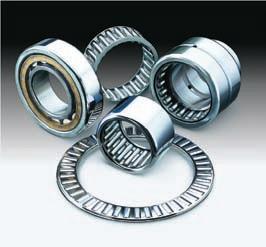
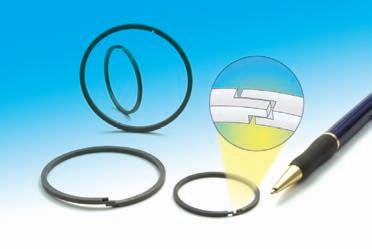
Loctite structural acrylic adhesives from Henkel fixture rapidly, and deliver good peel and shear strength once cured. Loctite H8100 and H8110 Speedbonder adhesives provide tough, long-lasting bonds and are designed to reduce or eliminate welds, rivets and threaded fasteners. The H8100 fixtures in 20 minutes., while the H8110 offers fast, fiveminute fixturing. Avail able in 50-ml and 490-ml dual cartridges, these green-coloured, twocomponent acrylic adhe sives can be used in the assembly of agricultural/ construction equipment, specialty vehicles, build ing components and other industrial bonding applications. They are particularly suitable for
the structural assembly of metals, es pecially aluminum components.
Henkel
Online Reader Inquiry No. 360
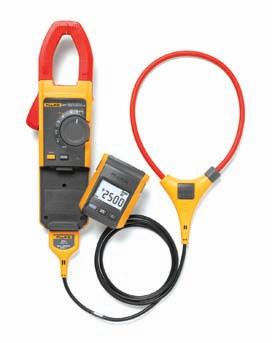
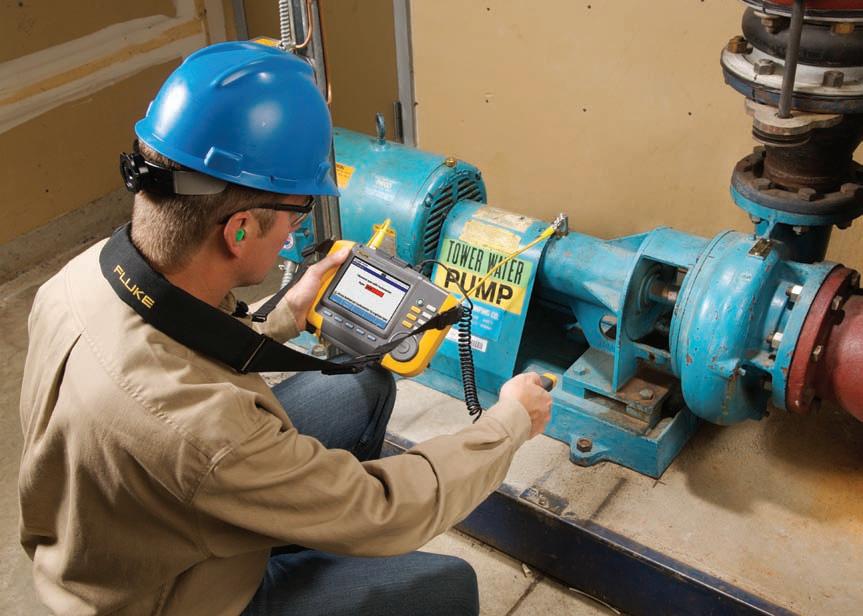
Electrical test tools are for use in hazardous environments
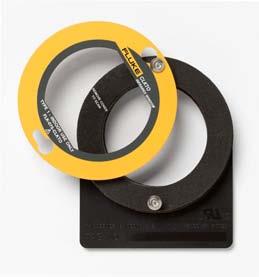
Designed for work on hazardous equipment and high-voltage cir cuits, the family of Fluke clamp meters and a four-channel hand-held oscilloscope are engineered to provide safe work environments for electricians and maintenance technicians and to reduce their exposure to electrical shock.
able display of the model 381 clamp meter enables technicians to see measurements remotely, and even when the test circuit is enclosed in an equipment cabinet. All members of the new Fluke clamp meter family have a CAT IV rating. Rated as dust- and drip-proof and designed for harsh industrial environments, the Fluke ScopeMeter 190 Series II handheld portable oscilloscopes are safety rated for CAT III 1,000 V, CAT IV 600V.
The Fluke 381, 376, 375 and 374 current clamps and iFlex current probes are rated for use in measurement category IV environments (CAT IV 600 V, CAT III 1,000 V). The detach-
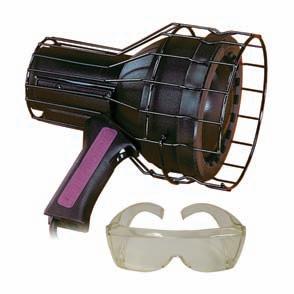
UV leak detection lamp is rugged Spectronics has introduced the Spectroline BIB-150P ultraviolet inspection lamp, designed for pinpointing any industrial leak,
Easy On. Easy Off.
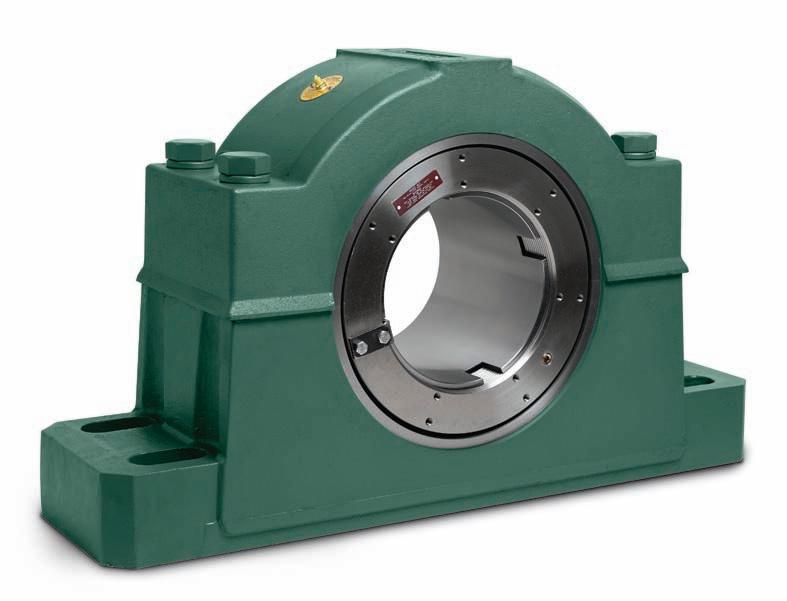
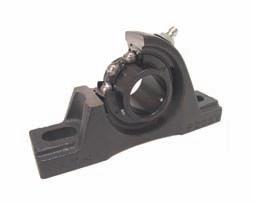
Baldor•Dodge® hydraulically-assisted ISAF bearings are so easy to install and remove you won’t believe it until you see it. Simply slip the bearing on the shaft, apply hydraulic pressure to position the bearing on the adapter sleeve and you’re ready to go. To remove, apply hydraulic pressure to the dismount piston and the bearing is pushed off the adapter sleeve. No feeler gauges or special tools needed. Plus, once it’s installed, the full shaft contact eliminates fretting corrosion.
Each bearing arrives fully assembled, sealed and lubricated for even easier installation than ever before. No wonder a prestigious trade publication recognized Baldor•Dodge ISAF hydraulically-assisted bearings as a product of the year winner. Easy on and off bearings… only from Baldor.
dodge-pt.com baldor.com 479-646-4711
• Unmatched Quality
• Superior Reliability
• Easy Installation and Removal
• Quickest Delivery Available
such as oil, hydraulics, refrigerant, gasoline, diesel fuel or water. Fluorescent dye is added to the system and allowed to circulate with the lubricant. The dye will escape with the host fluid wherever there is a leak. When the system is scanned with this handheld lamp, the dye will glow brightly at the leakage area. Features include a dent-proof and impactresistant housing, a crack-resistant and easily maintained filter, and an ergonomically designed handle for easy handling and reduced hand fatigue.
Spectronics
Online Reader Inquiry No. 363
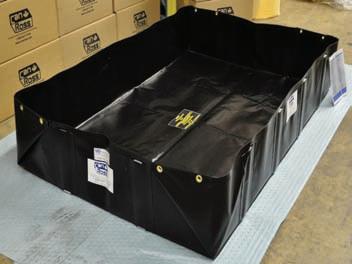
Spill berm packs down small for easy portability
Can-Ross spill berms are custom made to a user’s exact specifications. The aluminum L-bracket design makes the unit quick and easy to set up and dismantle, and allows for the berms to be compact and portable. The berms are manufactured using 30-oz XR-5 material for strength and durability. Ground
mats and track belting are available and usually recommended. Arctic grade material also is available.
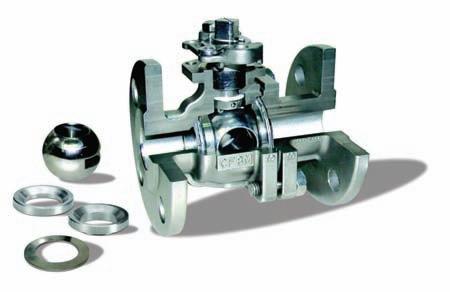
Metal seat ball valve withstands high temperatures
M-series metal seat ball valves from A-T Controls are engineered with specially coated matched balls and seats to stand up to high temperatures, pres -
sures and abrasive materials encountered in the oil/gas, chemical, power generation, pulp and paper, food processing and mining industries. Materials include stainless steel, stellite welded and hard chrome-plated steel.
A tungsten carbide coating for heavy slurry environments and a chrome carbide coating for higher-temperature applications are optionally available. Temperature range is minus 20°F to plus 661°F, and pressure rating is up to ANSI class 600. Four connection options are offered, flanged, threaded, socket weld and butt weld.
A-T Controls
Online Reader Inquiry No. 364 MRO
Our printed reader reply cards have been phased out. Please use our Online Reader Reply Card at www.mromagazine. com/rsc to request additional details directly from suppliers.
in this issue
features
Sealing out bearing contamination / 13
How to prepare and install lip seals, split seals, and metallic and non-metallic bearing isolators.
Decreasing MTTR using split seal technology / 16
Improving mean time to repair is critical for production efficiency in metal industries, and quickly installed bearing seals allow for fast recoveries from equipment failures.
Mounting bearings professionally / 18
Mounting rolling bearings the right way will ensure optimum performance.
Vibration an unexpected bearing predator / 20
Bearing wear caused by vibration can be solved by planning ahead.
Understanding vibration / 21
The latest vibration technology provides a new and better way to troubleshoot machine problems.
Solving motor vibration problems / 23
A basic understanding of frame construction can help minimize motor vibration.
columns
Creating the ‘24/7’ list / 28 Follow along with Step 38 in a journey to World-Class Maintenance at the Plentya Paper Company as the maintenance team comes closer to achieving its goals.
Making the right decisions / 29
To avoid maintenance-related accidents and injuries in the workplace, start by sharing the right information.
Training tips / 30
Here’s how to plan and set up a maintenance training program.
One dozen secret benefits of your next convention / 31
As the busy convention season gets under way, here’s advice on how to really take advantage of your time away from your job.
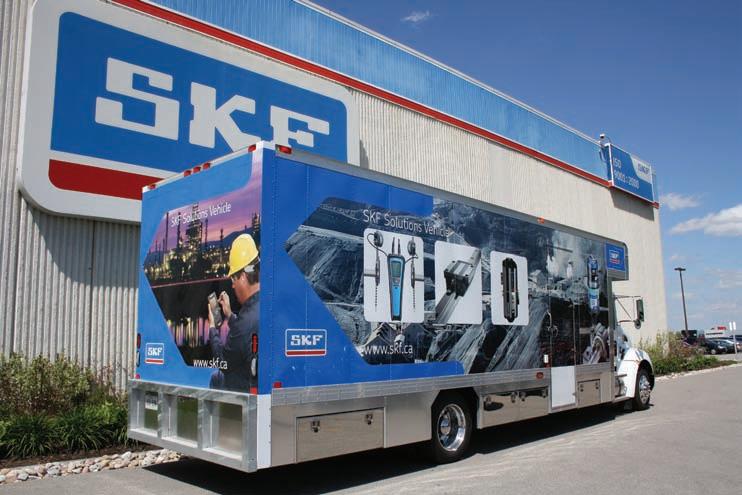
Maintenance advice takes to the road / 24 Big suppliers hit the highway to show distributors and end users their products and services.
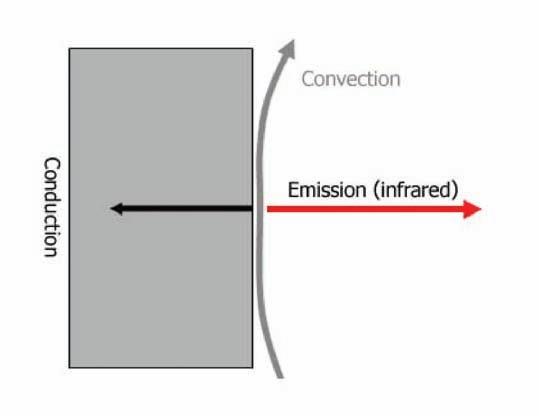
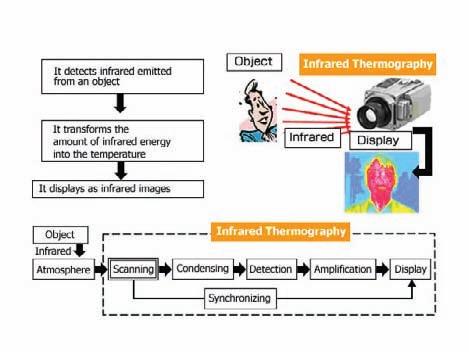
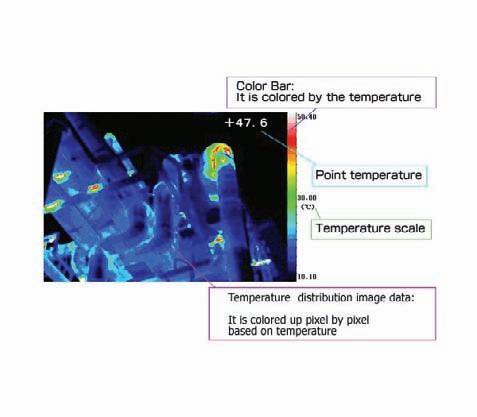
Understanding infrared / 26
Measuring temperature without touching an object.
IDI marks 30th anniversary / 38 Business meetings and social events accompany the annual IDI Mart trade show.
Cover:
departments
Editor’s Notebook / 6
Industry Newswatch / 8
Business Briefs / 10
Mr. O, The Problem Solver / 12
Maintenance Management / 28
The Safety File / 29
CMMS Solutions / 30
Supervisory Suggestions / 31
MRO on the Road / 38
Product News
Product Spotlight / 2
MRO Components / 32
Focus on Thermography / 35
Focus on Bearings / 36
editor’s selections
‘Bearing isolators significantly increase the operational life of the sealing system from a few hundred hours to thousands of hours.’
Earl J. Rogalski / 16
‘Cylindrical roller bearings are the most susceptible to vibration damage.’
SKF Canada / 20
‘The vibration tester has a built-in expert system that compares results to a like-new machine.’
Colin Plastow / 21
Minimizing vibration depends as much on shim placement as it does on using the correct amount of shimming.
Chuck Yung / 23
Information delivery gets faster
Afew of us were chatting in our office the other day about the changes we’ve seen in our industry — the pub lishing business — since MRO Magazine was launched over a quarter of a century ago. The production methods and technologies we use have altered dramatically.
We talked about the original fax machines we had purchased — big, expensive units that needed special thermal paper, dot matrix printers that clattered and clacked while slowly printing out stories for proofreading, and early cell phones that were the size of a brick — and as heavy — and cost about a $1.25 a minute to use.
As we reflected on our production methods of the past couple of decades, our youngest member of staff really didn’t know what we were talking about. Scary! So much has changed since then regarding personal technology, and its impact can be seen on every business, every industry, every person. And the changes keep on coming.
We’re now entrenched in a digital era, and although we’re still producing a printed magazine and love all of its benefits, we’ve adapted to the changing needs of some of our readers by also providing our publication in a format that can be read online — on PCs, Macs, iPads,
iPhones and Blackberries. We’ve dropped our printed reader service card in favour of an online version that makes it faster for readers to obtain more information on the products mentioned in our issues.
And now we’re embracing yet another technology to help make the transfer of information easier and faster.
The latest innovation can be found on this very page, and on a few select advertisements in this issue. It’s called the QR Code. We’re one of the first industrial magazines in North America to bring this technology to you.
The codes contain information in their jumble of fat pixels that, when scanned with a smartphone, will take you directly to a web page, often giving you a detailed product description or other information that simply wouldn’t fit onto a printed page. Too advanced? Well, we really don’t know anybody in business who, when they upgrade their cell phone, haven’t chosen a smartphone. It’s the future.
machine tools x foundries x metalworking machinery x lawn & garden x speed reducers medical x instruments x transmissions x kilns x mining x pharmaceutical x HVAC x hoist transportation x agriculture x washdown x construction x gear box x pumps x steel mills railway x band saws x aggregates x pulp & paper x spindles x grinders x textiles x vibrating screen x hand tools x electric motors x power generation x compressors x automation x idlers
Just some of the places you’ll find Koyo bearings.
wind turbines x automotive x conveyors x aerospace x stamping x recreation vehicles blowers x food & beverage x winches x cranes x excavator x fans x robotics x sander x mixer back-up roll x paver x printing press x debarker x head pulley x dryer x track roller x planer oil & gas x clean room x extreme environments x forestry x return rolls x traction motors x tunnel boring x rock crushers x rolling mills x work rolls x smelting x sawmills
Smartphones let us do a lot. We’re currently working on stories about their application in maintenance operations in industry. And one other thing they’re good at is giving you fast access to information via the new QR Code. If you have a smartphone, you can try it out right now. Use a QR Code reader (a free downloadable app) to scan the code here. It will direct you to a special page on the MRO Magazine website. It’s fast, simple and useful. Now check out the advertisers in this issue who have incorporated QR Codes into their layouts and see where their codes take you. We see the QR Code as an evolution of our old printed reader service card. So I expect we’ve given you one more reason to justify upgrading your old cell phone. We hope many of you can benefit from this and other evolutions in the magazine business as we find faster ways to bring you the information you need. Bill Roebuck, Editor & Associate Publisher
Study examines apprenticeship jobs during downturn
Ottawa, ON — Declines in employment between October 2008 and October 2009 were larger in occupations for which an apprenticeship program exists than in all other occupations combined, according to a new study from Statistics Canada. However, between October 2009 and October 2010, the recovery in employment was stronger in these apprenticeable occupations than in all other occupations.
Apprenticeable occupations saw employment losses of 5.7% between October 2008 and October 2009, compared with 1.3% for other occupations.
The decline in employment had the greatest impact on welders, exterior finishing occupations, machinists, carpenters and heavy equipment and crane operators, including drillers.
These decreases were especially reflected by employment losses in the mining and oil and gas extraction, transportation and warehousing, manufacturing, and construction sectors, all of which are closely associated with employment in apprenticeable occupations.
On the other hand, the increase in employment between October 2009 and October 2010 was more beneficial to workers in apprenticeable occupations.
Apprenticeable occupations posted gains of 3.3% between October 2009 and October 2010, compared with 2.0% for workers in other occupations. However, employment in October 2010 (2,892,000) remained below its October 2008 level (2,969,000).
Not all workers in apprenticeable occupations were affected in the same way by the employment losses between October 2008 and October 2009.
Welders, exterior finishing occupations, machinists, carpenters and heavy equipment and crane operators, including drillers, experienced the largest employment losses among apprenticeable occupations.
For all occupations combined, the employment downturn took its heaviest toll in Ontario and Alberta, where employment decreased by 3.1% and 3.3%, respectively. However, the biggest losses in apprenticeable occupations occurred in British Columbia (-14.4%) and Quebec (-11.8%).
In British Columbia, the five apprenticeable occupations that experienced the largest losses were electricians (-33.4%), interior finishing trades (-30.0%), food service trades (-29.7%) and heavy equipment and crane operators, including drillers (-28.3%). In Quebec, the most affected occupations were carpenters (-38.2%), hairstylists and estheticians (-27.0%), and truck drivers (-18.0%).
With respect to apprenticeable occupations, employment declined by 12.3% among workers who had not finished high school, compared with a 1.9% decrease for workers who had an apprenticeship or trades certificate.
During the economic downturn, the number of permanent employees fell by 3.8%, while the number of temporary employees edged up 0.7%. However, the decline in permanent employment in apprenticeable occupations was 7.3%, twice the 3.1% decline in permanent employment in other occupations.
Between October 2009 and October 2010, employment grew slightly in Canada. The recovery was more beneficial for
workers in apprenticeable occupations, as employment growth in those occupa tions was 3.3%, compared with 2.0% for workers in other occupations.
Although Quebec and British Colum bia were hardest hit by the decline in em ployment in apprenticeable occupations, these two provinces saw the strongest growth rates one year later. Employment rose by 73,400 (+12.1%) in Quebec and by 20,600 (+5.6%) in British Columbia be tween October 2009 and October 2010. Those two provinces alone accounted for 85% of the employment gains in appren ticeable occupations over that period.
MAINTENANCE CONFERENCE ADDED TO MONTREAL PMDS SHOW
Montreal, QC — As the recovery of the manufacturing sector continues to make headlines — including Bombardier Inc.’s recent announcement of its largest aircraft order to date, worth up to $6.7 billion — Quebec manufacturers will get a first-hand look at all that is new in the industry to help them improve their competitive edge and exploit growth opportunities at the upcoming Plant Management and Design Engineering Show (PMDS 2011).
Focused on the latest technologies in plant management, design engineering, automation, robotics and advanced manufacturing, the event takes place May 17-19, 2011, at Place Bonaventure in Montreal.
“Now, more than ever, it’s essential for manufacturers to come together in an environment where they can compare the latest in equipment, technology and services in order to be as competitive as possible,” said Nick Samain, event manager with the Society of Manufacturing Engineers (SME), organizer of the event.
“PMDS provides a unique forum that brings together three critical elements for manufacturers — knowledge, technology and networking — each of which is critical to success in today’s highly-competitive business environment.”
PMDS — now in its 22nd year — provides a hands-on experience that connects industry suppliers with qualified buyers seeking solutions. PMDS is produced in partnership with Canadian Manufacturers and Exporters (CME),
Canadian Wind Energy Association (CANWEA), Canadian Tooling and Machining Association (CTMA) and the Quebec Aerospace Association (AQA), to ensure a strong representation and attendance across multiple industries.
New for 2011 is an advanced Plant Maintenance Conference, bringing highlevel speakers and content designed to help manufacturers compete and take advantage of the economic recovery.
For more information, visit www. pmds.ca or call 1-888-322-7333.
WORKSHOP HELPS PTDA MEMBERS DEVELOP INTERNAL PRODUCT EXPERTS
Chicago, IL — According to the Business Index released by the Power Transmission Distributors Association (PTDA), a net 30% of distributors and 40% of manufacturers reported increased staffing in the fourth quarter of 2010. In the same study, survey respondents predicted 11% growth in 2011.
For many companies, the uptick in business activity is putting an increased urgency on training these new hires, as they can’t afford to wait months to get their sales or customer service staff trained.
As a members-only benefit to address the need for skilled employees, PTDA presented a Product Application Workshop in April 2011 to give sales and customer service personnel hands-on expe-
rience with the application basics of power transmission products.
Conducted in a classroom/hands-on lab environment at Henry Ford Community College in Dearborn, MI, with actual products, the two-day workshop gave attendees an understanding of the power transmission (PT) products used in typical industrial applications and processes so they can better assess and solve customers’ problems.
“The Product Application Workshop offers the most fundamental training over a broad spectrum of PT products that a typical PT distributor sells. The hands-on aspect makes this program unique in our industry,” said Carlton Harvey, vice-president of industrial sales for Jamaica Bearings Co. Inc., New Hyde Park, NY.
Harvey sent Carlos Navarrete, a customer service representative, to the Product Application Workshop when it was previously offered.
“In our case, Carlos was exposed to products he had yet to deal with on the order desk. The hands-on training reinforced the classroom work and gave him a perspective that enabled him to better serve his customers. Carlos’s understanding of their needs, in a product sense, was enhanced because he installed product, [and] he worked on a PT system from the wiring [and] motor control, to the mechanicals on a conveyor system.
Now when a customer calls and talks about bearing installation, couplings, motor control, etc., Carlos can visualize the situation and his service level becomes priceless. This investment has paid back many times over,” said Harvey.
“This is exactly the kind of training I was looking for when I was a new hire, and could still benefit from it,” said Dena Kelley, branch manager, US Bearings & Drives, Vancouver, WA. “To be able to use the products in real applications is a great idea and offers a unique, more effective learning experience than traditional training styles. I think this type of training would take our customer service to the next level because we would have hands-on product and troubleshooting experience to speak from, as well as more comprehensive understanding of the products we sell.”
The workshop is designed for employees with less than three years of experience in the power transmission/motion control
Apprentice jobs were the hardest hit in the recession, but also the quickest to recover.
Photo: Henry W.
(PT/MC) industry. Products covered include: bearings; belt drives; chain drives; motors, clutches and brakes; conveyors and components; couplings and u-joints; gears; and power transmission accessories. For more information, visit www.ptda.org.
HSE CANADA CONFERENCE AIMS TO BOOST DELEGATE PARTICIPATION
Toronto, ON — Delegates to the new HSE Canada 2011 annual conference and trade show, Sept. 27-28, 2011, at the Metro Toronto Convention Centre, will have an opportunity to share knowledge in dozens of occupational health, safety and environmental subjects by participating in sponsored town hall seminars, and attending educational seminars by industry experts and peer-to-peer roundtable discussion groups.
This participatory approach is being used to offer more than the typical existing methods employed in similar events. “Learning becomes more meaningful when applied from real life experiences,” says Nate Bright, event manager and founder of the conference.
“Delegates will learn, share, connect with peers and suppliers, and discover solutions for the many challenges that we face in safety and environmental issues every day.”
Bright has assembled a conference advisory committee that includes individuals from organizations such as the Canadian Standards Association, Canadian Centre for Occupational Health & Safety, Conference Board of Canada, Institute for Work and Health, Canadian Occupational Safety Magazine, Occupational Safety
Group, Levitt Safety and Electrolab.
“In an effort to attract a national audience of delegates, interactive feature areas on the trade show floor will host live product demonstrations, a ‘Best in Show’ product showcase, material handling innovations demonstrations, a hands-on ergonomic ‘testdrive’, and advances in environmental safety,” says Bright. “With a networking cocktail reception and lots of great prize draws, the trade show is sure to be lively and well attended.”
Delegate and exhibitor information can be found at www.hsecanada.ca.
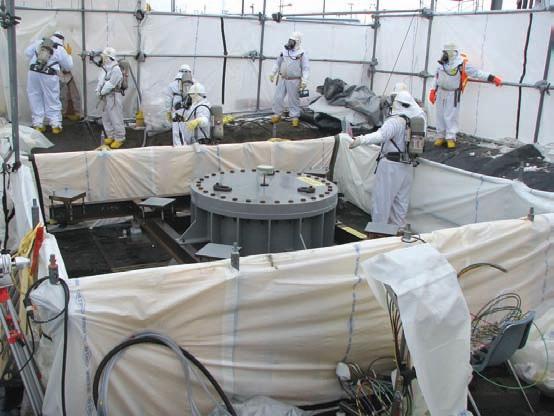
REMOTE-CONTROLLED WATER JET CUTS ACCESS HOLE IN RADIOACTIVE STORAGE TANK
Richland, WA — Water jet contractor AK Services made history recently by cutting the largest-ever access hole in an active US Department of Energy radioactive waste storage tank at the DOE’s Hanford Site in southeastern Washington state.
The Boston-area water jet contractor cut a 55-in. diameter hole in the top of the underground tank to allow for the installation of a robotic system that will remove 247,000 gallons of radioactive and chemical waste stored in the tank during the Manhattan Project and Cold War so it can be vitrified for safer storage.
Battling freezing temperatures and the challenges of running remote-controlled ultra-high-pressure water jet equipment from a 300-ft distance, AK Services used a specially engineered abrasive water jet cutting machine to make the huge cut through 15 in. of concrete and steel rebar in just 22 hours.
It performed the cut at 8 in. per hour using an abrasive jet of garnet grit mixed with 3 gals. per minute of water pressurized to 48,000 psi with a Jet Edge water jet intensifier pump.
AK Services engineered a three-piece stainless steel motion system with two circles separated by guide bushings with a ring gear in the middle. The ring gear featured four redundant Jet Edge High Flow Abrasivejet cutting heads in case of failure and was driven by a set of reduction gears and a drive motor to achieve
the proper cutting rate. Pneumatically actuated rams were placed on the sides and bottom to level and secure the system.
“The biggest challenge was running the equipment from 300 ft away,” said Carl Franson, AK Services vice-president of operations. “The tank top is in a radiation area and entry to the area is regulated to the extent that anything that enters the tank farm must be scanned and cleared prior to being released out of the fenced-in restricted area. The pumps and control systems had to be outside of the restricted area to ensure they did not become contaminated with radiation and then become the property of the DOE.
“We also had the added challenge of winter weather, so we installed air dryers and used air-line antifreeze to keep the system from freezing up.”
After the concrete plug was lifted from the tank, it was immediately wrapped in a plastic sleeve to prevent the spread of contamination and then was placed in an isolated area where it is being staged for disposal at the Hanford Site.
The tank is one of more than 100 similar underground tanks that the DOE is cleaning out as part of its environmental cleanup effort at the Hanford Site, which was once home to nine nuclear reactors that produced plutonium for the Manahattan Project and the US nuclear arsenal. Hanford is considered the most contaminated nuclear site in the US. MRO
Photo: Jet Edge
Water jet contractor cuts 55-in. access hole in nuclear waste storage tank.
Business Briefs
News and views about companies, people, product lines and more.
• For the second year in a row, W.W. Grainger Inc., Chicago, IL, has been named the ‘most admired’ company among diversified wholesalers in Fortune magazine’s annual listing of the World’s Most Admired Companies. Every year, the magazine and the Hay Group, a management consulting firm, survey top executives, directors and financial analysts to identify companies that enjoy the strongest reputations within and across industries. Grainger, a broad line supplier of maintenance, repair and operating (MRO) products, serves more than two million businesses and institutions in 153 countries. “Acklands-Grainger is a wholly owned subsidiary of Grainger with proud roots in Canada dating back to 1889,” said Sean O’Brien, president,
Acklands-Grainger, Richmond Hill, ON.
“As the leading distributor of industrial, safety and fasteners products, our team takes great pride in helping businesses of all sizes in 175 communities from coast to coast to coast. This recognition reflects the important role we play helping Canadians stay safe on the job and keeping their facilities running efficiently.” In the 2011 World’s Most Admired Companies survey, participants ranked Grainger number one in the Diversified Wholesalers industry, giving the company the highest marks in all nine reputational criteria. In addition, Grainger ranked in the top 10 in several All-Star Global Categories: Management Quality, Use of Assets, Financial Soundness, and Quality of Products/Services.
• The Sept-Îles Chamber of Commerce presented its ‘Services aux grandes entreprises’ award to Kinecor LP earlier this year. Kinecor qualified for the honour after receiving votes from large enterprises in the region, including Wabush Mines, Aluminerie Alouette and the Iron Ore Company of Canada (IOC). This award is offered to the company that provides continuous quality service to the large enterprises in the area.
“We’re very proud of this distinction and would like to congratulate Alain Labrie, branch manager of Kinecor Sept-Îles, and his team for their outstanding effort,” said Karim Asri, regional manager, Kinecor LP, Eastern Quebec. “It’s the synergy that drives the team to follow their motto: Service comes first!”
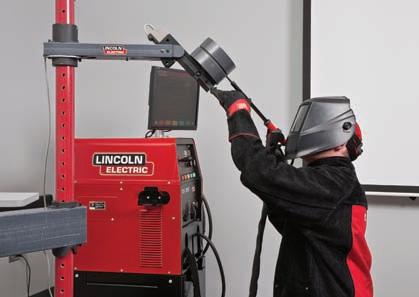
• The VRTEX 360, Lincoln Electric’s pioneering virtual reality welding system, has been recognized by the International Institute of Welding (IIW) with its 2011
Heinz Sossenheimer Award. The prize is open to modeling and simulation software covering any aspect of joining and allied processes. It recognizes that which has significantly contributed to the improvement of both the quality and safety of joining, cutting or surfacing operations. The VRTEX 360 is designed to allow students to practice their welding technique in a simulated environment. It promotes the efficient transfer of welding skills to the actual welding training booth while reducing material waste associated with traditional welding training. The combination of a realistic welding puddle simulation and an arc welding sound tied to the welder’s movement provides a realistic hands-on training experience.
• Visitors to www.timken.com, the website of The Timken Company, will find a refreshed design with lighter colours, an easier search function and more intuitive navigation — all resulting from an
Left to right: Gino Lévesque, vice-president and general manager, Wabush Mines Cliffs. Representing the Kinecor Sept-Îles team are Jean-Philippe Landry, internal sales rep, Alain Labrie, branch manager, Linda Thériault, project manager, Denis Pelletier, external sales rep, and Cindy Paré, external sales rep. On their right are Louis Gravel, general manager, product delivery, QNS&L, and Gilles Desgagnés, service superintendant, Aluminerie Alouette.
Photo: Kinecor
Simulator provides hands-on welding training.
continued from page 10
in-depth study of the site’s users. The update of the website also features an extensive new engineering platform packed with CAD drawings of the products referenced by part numbers that are most frequently requested by design engineers specifying Timken in their machinery.
• The London, ON-based EMC Purchasing Co-op Preferred Supplier for the Maintenance Repair and Operational (MRO) Products Category is IDI Independent Distributors Inc., Mississauga, ON. IDI is Canada’s largest network of Canadian distributors specializing in bearings, fluid power products, industrial supplies, janitorial supplies, power transmission products and safety supplies. The EMC member-owners who participated on the selection committee were impressed by the overall IDI National Accounts program. IDI’s network of industrial distributors, with over 250 branch locations, means most EMC Pur-
chasing Co-op member-owners will have multiple IDI members to choose among in their local areas. “We get what EMC Purchasing Co-op is doing and fully support it,” says Scott Bebenek, IDI president. “We are confident that this initial three-year deal will turn into a much longer-lasting relationship that all will benefit from for many years to come.”
• New Members who have recently joined IDI Independent Distributors Inc. include: Ampro Electric Ltd., London, ON (in the power transmission category); Celtic Industrial Tools & Repair Ltd., Edmonton, AB (industrial supplies and safety); Industrial Sales, Wabush, NL (industrial supplies and safety); Soucie Salo Safety Inc., Sudbury, ON (safety); and Steele Industrial Supplies, North Bay, ON (industrial supplies, power transmission, hose, rubber, fittings and safety).
• With industry under scrutiny as never before over illegal oil and grease dis-
charges, Thordon Bearings has launched a new website giving new technical information, references, success stories and videos, and providing solutions to eliminate oil and grease from bearings. Visitors can view Thordon oiland grease-free bearing information related to their industry. Also featured is a news section featuring the latest application stories and articles about oiland grease-free bearing solutions. The
site is at www.thordonbearings.com.
• Bosch Rexroth Canada was recently recertified by the Bosch Rexroth manufacturing plants as a Service Centre of Competence. This certification recognizes the facilities located in Welland, ON, Burnaby, BC, Edmonton, AB, Longueuil, QC, and Dartmouth, NS, as the only authorized service facilities for Bosch and Rexroth hydraulic products in Canada.
• Global packaging machinery demand will rise 4.7% yearly through 2014, driven mainly by gains in developing nations. In developed areas, demand will rebound after a period of decline. Beverages will be the fastest growing market, while labelling and coding, and filling and form/fill/ seal machines will be the fastest growing products, according to a new Freedonia study that analyzes the $28.6-billion world packaging machinery industry. The study also considers market environment factors, details industry structure, evaluates company market share and profiles 40 industry players, including Krones, Bosch Packaging Technology and Tetra Laval. For more information, visit www.freedoniagroup.com.
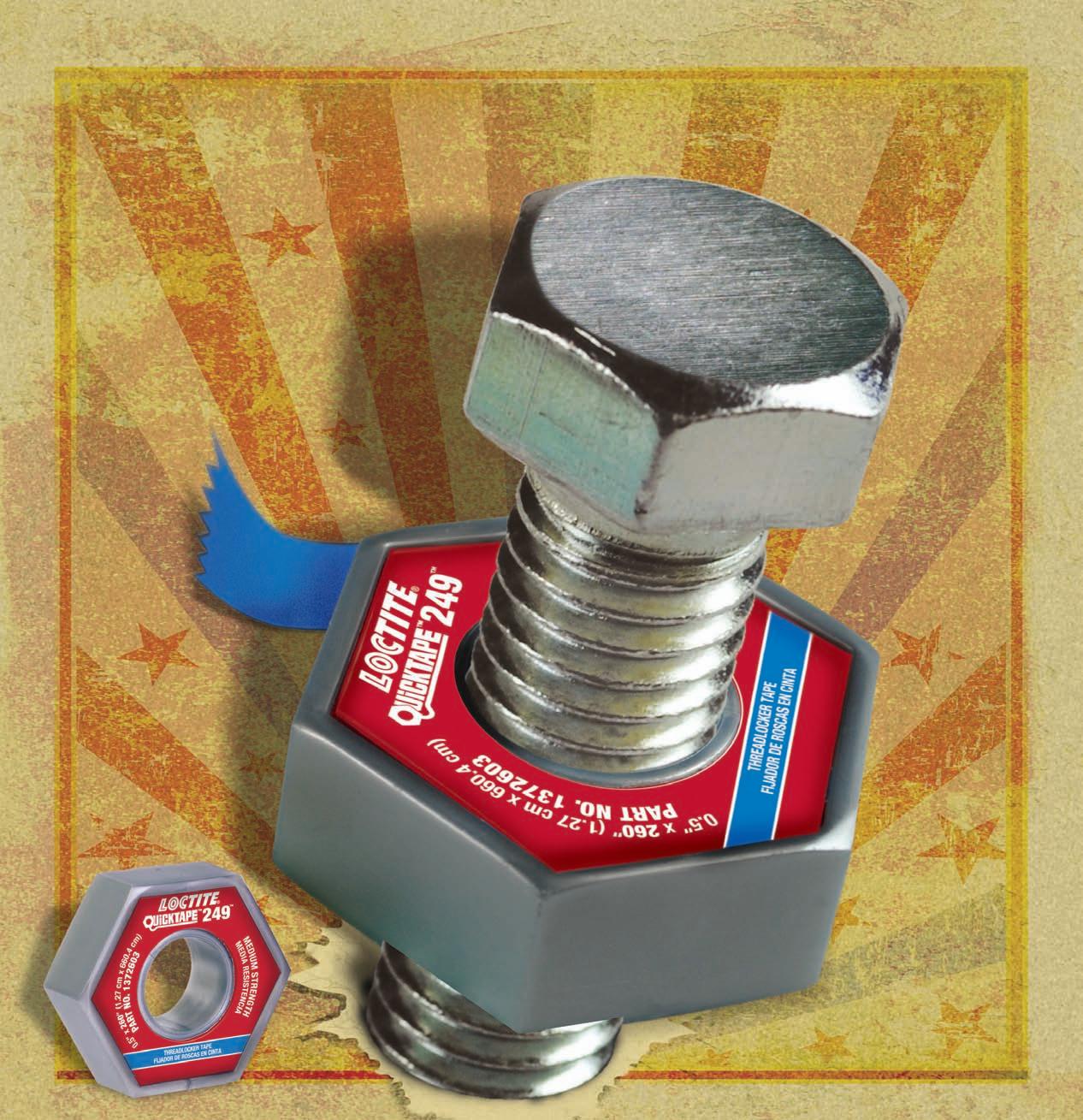
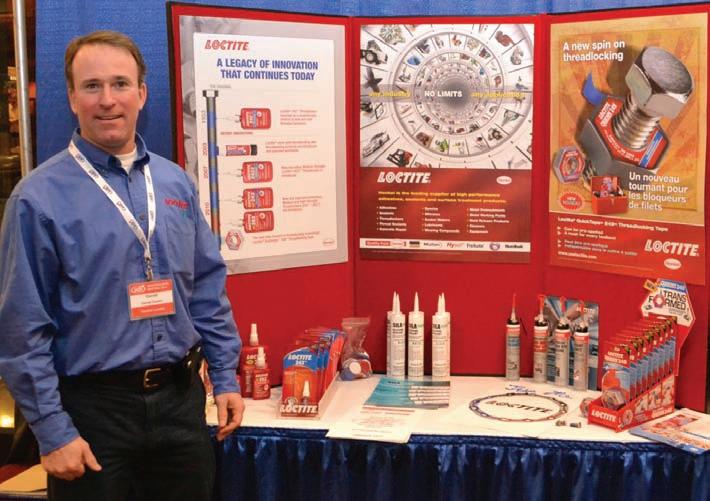
A new spin on threadlocking
The original inventor of threadlockers has taken threadlocking technology to a new level with the introduction of Loctite® Quicktape™ 249™! It is the first threadlocker to combine the trusted performance of Loctite® threadlockers and the familiar, easy-to-use tape format. Loctite® Quicktape™ is great for pre-apply applications, overhead situations or bench-top assembly. You can keep Loctite® Quicktape™ in your pocket, toolbox or any other convenient location on-hand. A must have for every toolbox!
at participating distributors. For a sample or more information, visit www.useloctite.com/mro. For
call 1-800-263-5043
• In June, Viking Pump will celebrate its 100th anniversary with a celetration at its headquarters in Cedar Falls, IA. The company will hold tours of the Viking Pump museum to mark the occasion. In 1886, Jens Nielsen, the founder of the company, invented the ‘internal gear’ pumping principal while designing a pump that would remove excess water from his limestone quarry. The Viking Pump Co. was founded in 1911 to produce pumps based on his designs.
• Peerless Electric, Montreal, QC, has announced that the Lumitech Group, also of Montreal and headed by René Globensky and Jim Adcock, will be the agency representing the Peerless line in the Greater Montreal Area, South Shore to Eastern Townships, including Trois Rivieres and the North Shore to MontTremblant. MRO
Can I paint a belt drive?
Problem: Some of our older equipment is looking pretty shabby so we’re planning on cleaning and painting it this summer. Can we paint a belt drive without affecting its operation? Solution: If a belt drive must be painted, it’s recommend that a spray painting process be used and that the coating be light and evenly applied. Of course, avoid painting the belt, and as much as possible, avoid painting the pulley or sheave grooves. Paint in these areas would have an impact on fit and function.
Mr. O thanks the engineers at Gates Corporation for this tip.
Do you have a solution for a maintenance problem? Send it in and if it’s published, we’ll send you a Mr. O Problem Solver T-shirt. Include your address, telephone number, print complete details and, if possible, add a sketch to help explain your tip. Send your tips to Mr. O, Machinery & Equipment MRO, 12 Concorde Place, Suite 800, Toronto, ON M3C 4J2.
Mr.0 The Practical Problem Solver
Sealing out bearing contamination
How to prepare and install lip seals, split seals, and metallic and non-metallic bearing isolators.
Bearing seals are critical when used in combination with grease lubrication because they help keep the grease free from contamination. Contamination that reaches grease is trapped and will continually wear on the bearing.
Most seals are designed to prevent contaminants from entering the bearing. Some seals are designed to allow some grease to escape from the bearing — or ‘weep’. With these types of seals, the weeping action allows the grease to carry some of the contaminants out of the bearing. The grease that escapes from the bearing helps lubricate the seal, and forms an additional barrier to contamination.
Equipment inspection and preparation Before installing any Timken lip seal, equipment should be thoroughly inspected. Follow the specifications below for best results:
Shaft surface finish (roughness average or AA [arithmetic average]): With the exception of PS-1 (Model 61), all seals should have a surface finish within 0.250.50 μm (10-20 μin.).
For PS-1 (Model 61), the surface finish should be within 0.10-0.20 μm (4-8 μin.). The surface finish direction for all seals must be perpendicular to the shaft axis of rotation.
Housing bore surface finish, Ra (roughness average or AA [arithmetic average]): The surface finish of all seals must be 2.54 μm (100 μin.). The surface finish direction for all seals must be perpendicular to the shaft axis of rotation.
Shaft surface hardness, Rockwell Cscale: For all seals, with the exception of PS-1 (Model 61), the shaft contact surface should have a hardness between 30 and 40 Rockwell C. For PS-1 (Model 61), the surface hardness must be within 50-70 Rockwell C.
Additional specifications: Both the shaft and housing bore should include an edge relief (preferably an edge chamfer). Both the shaft and housing bore should be clear of any defects, such as spiralmachining marks, burrs, sharp edges, nicks, scratches and corrosion.
Typically, the shaft has a wear groove created from previous seals. Make sure the new sealing lip does not seal in the same location.
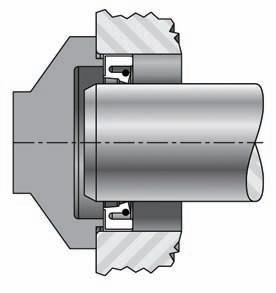
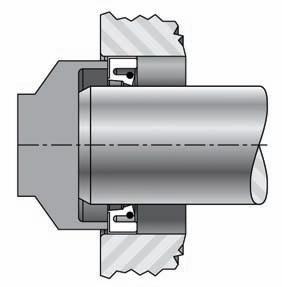
When drive features such as keyways or splines are present, they must be covered using an installation tool similar to
the one shown in Fig. 2, and using Installation Method D shown in Fig. 2d. If the use of a tool is prohibited by the size of the shaft, use one of the following options:
• Polyethylene tape
• Brass shim stock with smooth edges
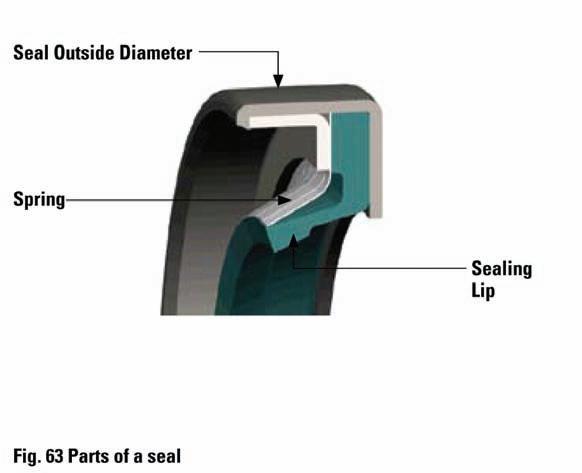
• Wooden plug with smooth edges. Inspect the sealing lip for any signs of damage, such as cuts, indentations and nicks. Make sure that the spring (finger or garter type) is retained within the seal (bonded or assembled). Inspect the seal O.D., looking for any signs of damage, such as cuts (in rubber seals), indentations and nicks.
Installation methods
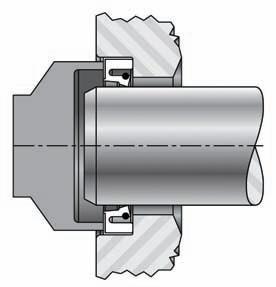
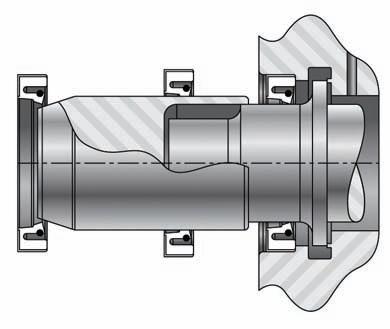
Solid seal installation: Install the seal(s) using one of the proper installation methods shown in Fig. 64. When using installation tooling, the diameter, or contact area, should not be more than 0.254-mm (0.010-in.) smaller than the bore diameter. If the use of an installation tool is prohibited by the size of the seal, then:
• Rest a block of wood on the seal and use a mallet to drive the seal into position. Do not hit the seal directly with the mallet, as it may cause damage.
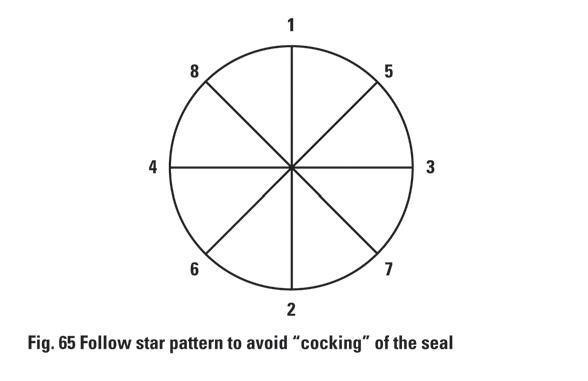
• When using this method, follow a star pattern (as shown in Fig. 3 to avoid cocking of the seal.
• Place the ends of the wooden block at positions 1 and 2 (as shown in Fig. 3.
• Hit the centre of the board with the mallet.
• Continue by rotating the wooden block to the appropriate positions (3 and 4, 5 and 6, 7 and 8), hitting the centre of the block with the mallet each time.
• Repeat the pattern until the seal is properly seated in the housing bore. The seal is fully seated when the difference between the seal surface and the housing surface is 0.254 mm (0.010 in.).
Split seal installation
Note: This applies to ambient pressure/ non-flooded applications only.
• Apply a thin coat of lubricant to the seal lip and shaft.
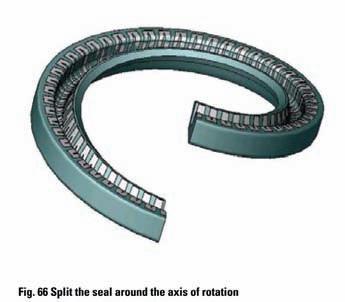
• Split the seal along the axis of rotation (shown in Fig. 4 and place the seal around the shaft.
• Beginning with the split ends, insert the seal into the housing bore. Make sure the splits ends of the seal are touching.
• Working downwards on both sides, con tinue inserting the seal into the housing bore, finishing at the bottom.
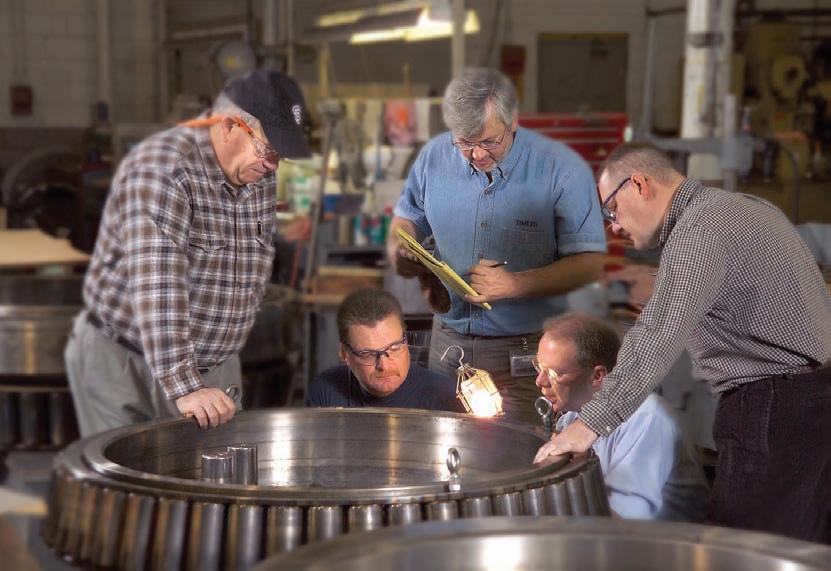
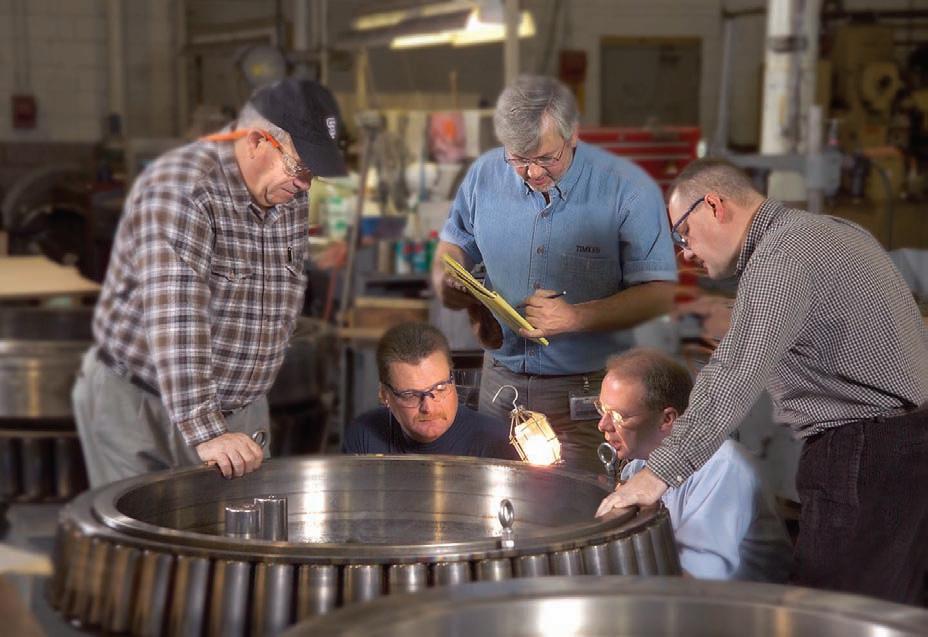
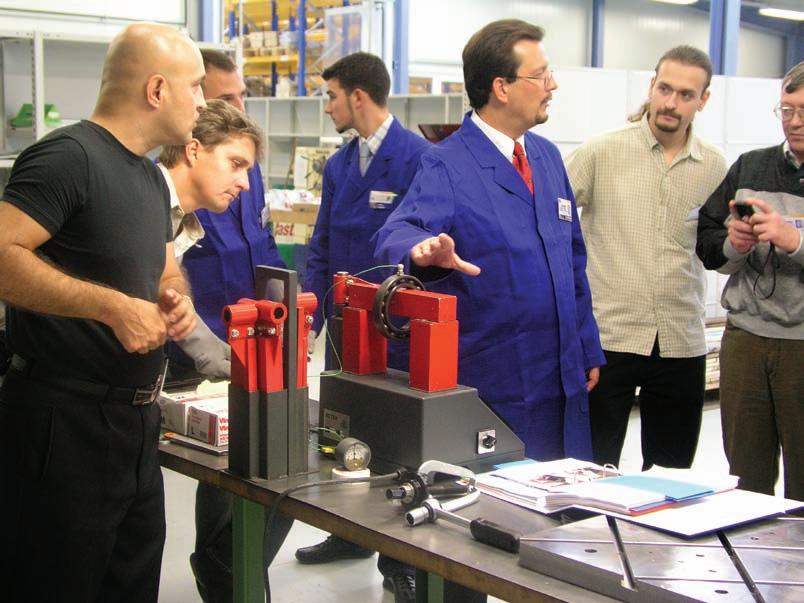
Several technicians inspect a large bearing.
Fig. 2a
Fig. 2c
Fig. 2d
Fig. 1 Images:
Fig. 3
Industrial Distribution
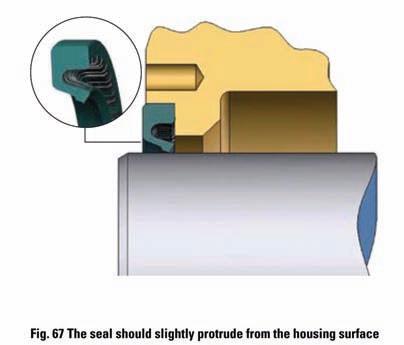
• Once the seal is properly seated in the housing bore, it should protrude from the housing surface by 0.381 mm (0.015 in.), as shown in Fig. 5. The 0.015 in. protrusion is built into the width of the seal. The depth of the bore housing should be machined to the seal width specified on the packaging.
Inspection
After installation, inspect the sealing areas for leaks, paying special attention to the area around the sealing lip and the O.D. Make sure that the sealing lip is not in the groove worn into the shaft from the previous seal.
Isolator installation
Before installing an isolator, all equipment should be inspected. First, disconnect all power to the machinery and follow standard safety procedures to avoid personal injury or equipment damage during installation.
Second, inspect the shaft and bore surfaces. The shaft finish should be better than 1.63 μm (64 μin.) with minimal lead, but a polished surface is not required. The bore surface should be 2.54 μm (125 μin.). Both the shaft and bore should have a chamfer or other edge relief to prevent the O-ring from shearing.
Third, check the shaft and bore for damage or imperfections. They should both be clear of burrs, nicks, indentations and any other defects. Clean all foreign debris from the area. Note that, in many cases, the previous seal may have worn a groove into the shaft. Make sure that the rotor O-ring of the new seal does not ride in this area.
Finally, if drive features such as keyways or splines are present on the shaft, they must be covered during installation. To do so, use an installation tool, polyethylene tape, brass shim stock with smooth edges or a wooden plug with smooth edges.
Seal preparation: Timken metallic and non-metallic bearing isolators are unitized, and any attempts to take them apart will not only cause seal damage, but will void the warranty on the product.
Before installation, inspect the Oring’s O.D. and I.D., making sure they are free of any defects. Use the lubricant included with your isolator to lightly grease all the O-rings.
Installation: Using your hands only (no installation tool required) push the isolator evenly onto the shaft.
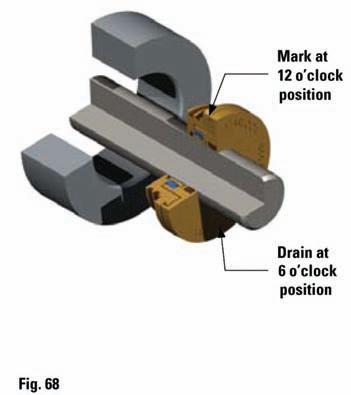
If your isolator has a drain port, rotate it to the 6 o’clock position. For iso -
lators with an orientation slot on the O.D. of the stator, rotate it to the 12 o’clock position to ensure appropriate positioning of the drain port. Some non-metallic bearing isolators may be installed in any direction, and there is no need to position the seal. See Fig. 68 for clarification, or contact your sales representative if you require additional information.
Using your hands only (no installation tool required), push the isolator gently into the bore. If required, gently tap the isolator using a mallet. While flanged isolators are fully seated when the flange is flush against the housing, flangeless isolators can be installed at the bottom of the housing and are fully seated when they are flush with the bore face.
Post-installation
Inspection: After installation, inspect the sealing area for damage. Gently spin the shaft to make sure the rotor is working properly. Do not flood the isolator or block the expulsion ports, as these actions can cause seal damage and failure.
Removal: To remove an old isolator from your equipment, start from the back side of the seal and perform installation instructions in reverse. If access to the back side of the isolator is difficult, pry it from the housing a little at a time. Be careful not to damage the shaft or housing bore during seal removal. MRO
This article has been adapted from the Timken Industrial Bearing Maintenance Manual, a technical reference on bearing maintenance in industrial and other applications. For more information, use our online reader inquiry service at www. mromagazine.com/rsc.
Online Reader Inquiry No. 460
Fig. 4: Split the seal around the axis of rotation. Fig. 5: The seal should slightly protrude from the housing surface. Fig. 6: If your isolator has a drain port, rotate it to the 6 o’clock position, or 12 o’clock if it has an orientation slot for the port.
Fig. 4
Fig. 5
Fig. 6
Decreasing MTTR using split seal technology
Improving mean time to repair is critical for production efficiency in metal industries, and quickly installed bearing seals allow for fast recoveries from equipment failures.
BY EARL J. ROGALSKI
aintenance engineers and technicians are typically charged with responsibility of developing and implementing maintenance programs, making continuous productivity improvements, and solving daily equipment challenges.
A subject within the maintenance team that often surfaces is strategy; strategies for ensuring productivity remains at its highest levels and for methods to return systems to a productive state should a failure occur. Although many basic strategies exist, the following four maintenance strategies are those that are most often used: corrective, preventive, predictive and proactive.
The strategies allow facilities to set up systems to deal with both planned and unplanned outages. No one strategy is the be-all, end-all solution to keep production always running at the highest efficiency. Most often, a combination of these strategies will be implemented and used for various reasons, all with the goal of keeping efficiencies at the highest possible levels.
One component that determines efficiencies of production is mean time to repair (MTTR). MTTR is key as it determines how quickly a system can be returned to a productive state following an outage, planned or unplanned. MTTR, by definition, is the average time that a device will take to recover from failure.
Systems in the outage stage vary from self-resetting fuses (where the MTTR would be very short, probably seconds), up to complete system repair and replacement. MTTR is defined as follows:
MTTR = RT/N, where:
MTTR = Mean time to repair
RT = Total repair time
N = Number of failures.
An effective device that will quickly allow a system to return to a productive state from failure is a split seal. Since split seals are easy and fast to install, they help get production back up and working towards the primary goals of a business — shareholder wealth maximization and long-term viability.
In power transmission systems, the most time-consuming steps to return a system to a productive state include the disassembly and reassembly of bearing equipment. Split seals eliminate these time-consuming steps as the seal can quickly be replaced. Available split seal technologies are numerous, so a basic understanding will be required prior to the implementation of split seals.
Three basic groups of split seal technology currently exist: split radial lip seals, split face seals and split bearing isolators. Within split radial lip seals, two levels of technology
exist: high-performance and general service radial lip seals.
Split radial lip seals
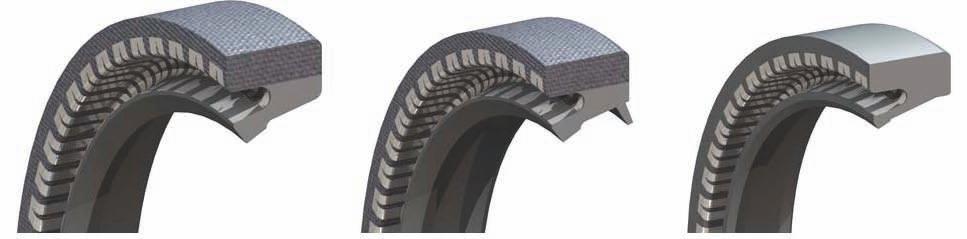
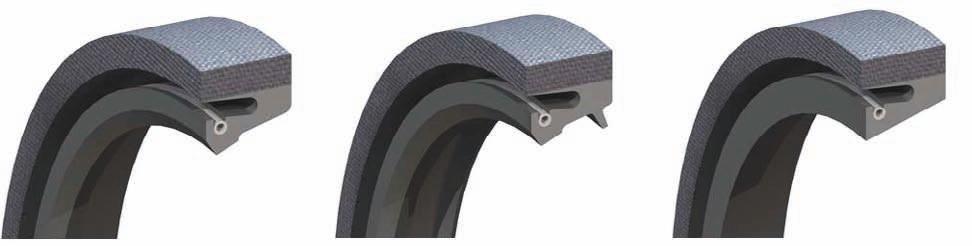
Split high-performance seals (Fig. 1) are used for the most demanding applications to ensure production continues running. High-performance seals include a few key technology differentiators to provide immediate benefits to businesses: specialized elastomer and moulded-in lip loading springs. The
combination of these technologies provides the benefits of high productivity uptime and extremely fast MTTR.
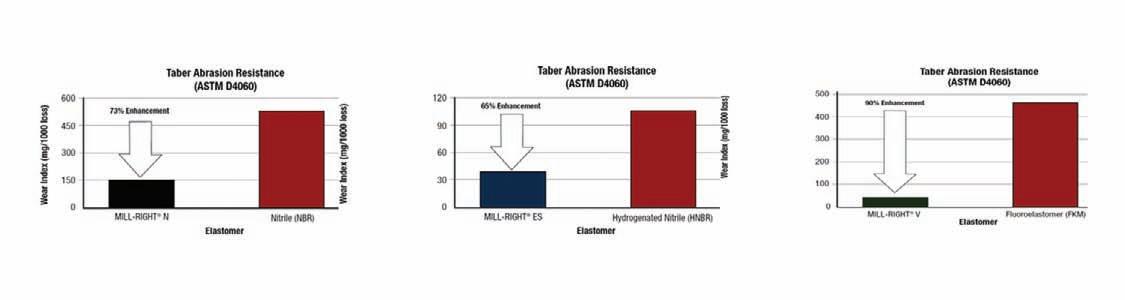
The specialized elastomer was engineered to provide, namely, very high abrasion resistance. The abrasion resistance will allow a seal to remain in the application, in service, for a longer period of time. Generally speaking, the specialized elastomer offers abrasion improvements over traditional elastomers of 65% to 90% (Fig. 2).
The longer service life equates to fewer seal replacements and minimizes the need to implement the corrective maintenance strategy or firefighting, should a seal begin leaking.
Moulded-in lip loading springs used in high-performance split seals drive MTTR. Since the spring is physically retained in the seal itself, you no longer need to make the spring connection and install the spring into the seal. The spring technology offers rapid installa-
Figure 1: Split high-performance composite oil seals. Figure 2: Specialized elastomer can offer abrasion improvements over traditional elastomers of 65% to 90%. Figure 3: Split general service composite oil seals. Figure 4: Split Model 144 & 143 face seals. Figure 5. Split Guardian bearing isolator.
Fig. 1
Fig. 3
Fig. 4
Fig. 5
Fig. 2
tion, without extra hassle, which will ensure the system returns to an operational state very quickly.
Some applications simply do not require high-performance seals and general service split seals will be better suited. Such applications could be simple gearboxes in a workshop, low-speed motors in ambient environments and similar pieces of equipment.
General service seals (Fig. 3) offer many of the same user benefits that highperformance split seals offer but do so in a different manner. Whereas the highperformance seals use specialty elastomers with high abrasion resistance, general service seals use standard elastomers that are often times suitable for many traditional applications.
General service seals are designed to use garter spring technology to provide appropriate lip loading. While the garter spring requires manual connection, the seal itself is simple to install due to the garter spring pocket design. The pocket design allows the spring to be snapped into place within the seal. Once the spring is snapped into place, risk of the spring coming out is significantly reduced, providing uptime reliability.
For both the high-performance and general service split seals, a common application is steel mill continuous casters. The high-performance seals would typically be used in caster applications that have limited cooling or when the seals are exposed to excessive debris. The general service seals would be used in more advanced casters that offer better roll cooling and debris protection. For both scenarios, having the ability to quickly change a caster seal is invaluable in the event of a breakdown. The caster can quickly be back up and running, since it is not necessary to pull the entire roll assembly out and send it to the roll shop for maintenance.
Split face seals
Split face seal technologies are very different from traditional radial lip oil seal technology. Face seals (Fig. 4) interact with the equipment in different ways and provide for a very different type of seal. First off, whereas an oil seal will provide ingress or egress protection by creating a dynamic seal at the rotating shaft, a face seal provides ingress protection by creating a dynamic seal at the housing contact point.
Split face seals are typically installed, in a static position, on a rotating shaft. The interface between the face seal and the shaft is purely static: no dynamic movement between the two. The dynamic sealing occurs at the seal-tohousing interface. In more simple terms, as the seal rotates with the shaft, the contact point between the seal and the static housing creates the dynamic seal, providing ingress protection.
Face seals are critical for applications exposed to coolant spray, debris and similar contamination. A common application for face seals includes backup and work rolls. The face seal is installed on the roll and provides sealing against the chock. The seal provides ingress protection for the internal seals and bearings, keeping slag and similar debris out. Since backup and work roll applications are so aggressive, having the ability to change the seal quickly is paramount. Split face seals allow rapid seal change-out without the need to disassemble the entire system, thus providing rapid MTTR. The split face seal is simply installed around the roll and positioned against the chock.
Bearing isolators
Bearing isolator technology is a significant departure from radial lip seals. How a bearing isolator works, the materials of construction, the installation of the seal and the interaction between the seal and the equipment are vastly different.
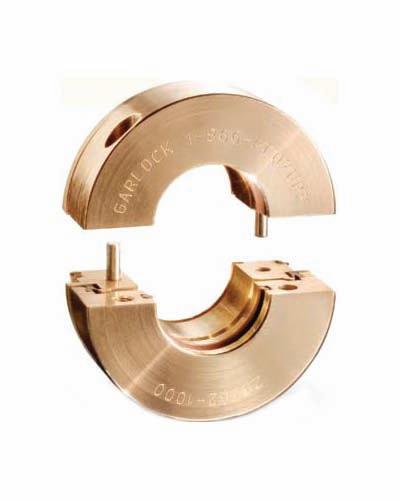
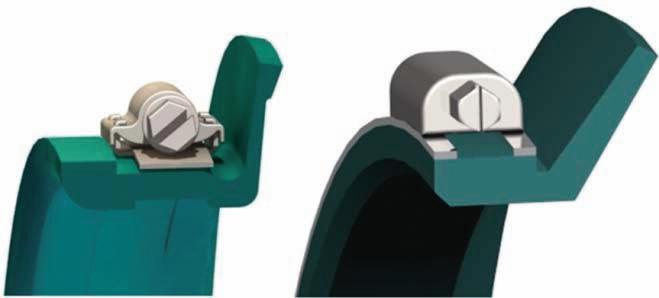
Bearing isolators have historically been solid seals consisting of a rotor, stator and static o-ring seals at the shaft and housing interface. The installation of a solid bearing isolator can be very daunting in some applications as you would be required to disassemble the equipment, slide the bearing isolator down the sometimes very long shaft and then press it into the housing. Split bearing isolators (Fig. 5) solve this problem by allowing the seal to be installed at the equipment without the need to disassemble systems Two dowel pins ensure proper alignment while two screws fully unit -
ize the bearing isolator. Once installed, the split bearing isolator provides both ingress and egress protection similar to a traditional bearing isolator.
Bearing isolators represent an evolution in technology from radial lip seals. Bearing isolators significantly increase the operational life of the sealing system from a few hundred hours to thousands of hours.
Bearing isolators are most frequently applied to gearboxes and electric motors found in power transmission systems. An example of such an application is run-out tables found in most steel production facilities. Dozens of electric motors are arranged in the run-out table to move the steel along the process line. If a solid seal is used, the electric motor would need to be removed from the system for repair or replacement. With the split bearing isolator, you can leave the motor installed on the table and simply replace the seal, meaning
there is no more need for costly downtime and hours of work.
Regardless if you plan to use split high-performance seals, split general service seals or split bearing isolators, the fact remains that you will clearly make significant improvements to your MTTR by using split-seal technology. With split seals the time, pain and expense of costly equipment disassembly, repair, reassembly and production downtime are vastly reduced.
The improvements to MTTR will have an immediate effect on the business and will ensure shareholder wealth maximization continues to occur and grow while providing for long-term business viability. MRO
Earl J. Rogalski is with Garlock Sealing Technology. This report is based on a presentation made at the Iron & Steel Technology Conference in May 2010.
Mounting Methods
Rolling bearings are high-precision machine elements that are produced using the latest hightechnology equipment, machined to close tolerances of a few microns. To guarantee the optimum function of a bearing arrangement, a few basic rules concerning mounting should be followed.
Preparation: Prior to mounting, some careful preparation is necessary. When dealing with rolling bearings, maximum cleanliness is the paramount basic requirement. Especially when dealing
Frustrated?
Safety is a serious obligation and is a legal requirement with severe penalties.
SAFE PASS is your single-source solution for the most economical and effective way to meet all your safety requirements. It is designed for productivity gains and safety compliance.
The best time for a SAFE PASS:
• Before moving your plant
• When you are under Ministry of Labour orders to comply
• When you are concerned about equipment safety
• When you are not satisfied with your current process
S.A.F.E. Engineering in partnership with Schneider Electric offers a complete safety solution for your machinery.
with repairs, all contacting surfaces of seals, including all adjacent machine parts and components, should be carefully checked for their condition.
An inspection of the alignment of the bearing may be necessary with the field installation of large machines or in plants. Before bearing mounting commences, one should study all available documentation, such as drawings, maintenance manuals and notices. The bearing should only be unpacked immediately prior to mounting in order keep it protected from contamination.
Selection of the mounting method: Rolling bearings are generally mounted to their adjacent parts by means of either sliding or interference fits. The decision about whether a bearing should be mounted either in warm or cold conditions depends mainly on the bearing type, its size and the individual fits that are used for each application.
In any case, never apply mounting forces via the bearing rolling elements and never hit the bearing surface directly with any hardened tools such as hammers, cotter pin drivers, etc.
In the majority of applications, the bearing inner ring is located by a tighter fit than the outer ring. For this reason, rolling bearing outer rings are usually pressed into the housing bore in a cold condition. To mount bearing inner rings on to their shaft seats, there are many more possibilities, including cold or warm mounting, adapter or withdrawal sleeves, or mounting with hydraulic devices.
Mounting of bearings in a cold condition: Small- and medium-sized bearings are usually mounted in a cold condition as they normally do not have tight fits. The bearings are mounted using either presses or by hammer strikes.
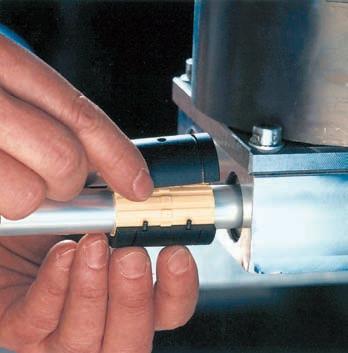
Also, impact sleeves and impact bushes have been proven to be satisfactory tools. These are sets of discs and rings made from a special impact-proof plastic and lengths of aluminium tubes that fit to them. Impact bushes provide a quick and simple method of mounting small bearings, even when mounting a large volume of bearings.
Press mounting of bearings: The mounting of small- and medium-sized rolling bearings may be completed quickly and simply by using either mechanical or hydraulic presses, even when volume mounting. The bearing seats of the shaft and housing should be lightly oiled.
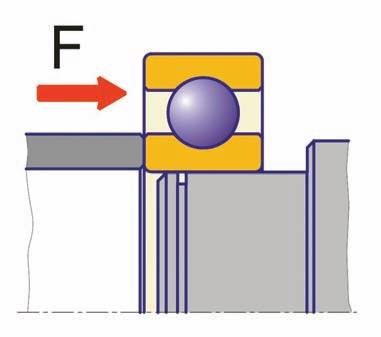
To avoid applying forces via the rolling elements, suitable auxiliary sleeves, washers or mounting bushes should be
Fig. 1
Fig. 2
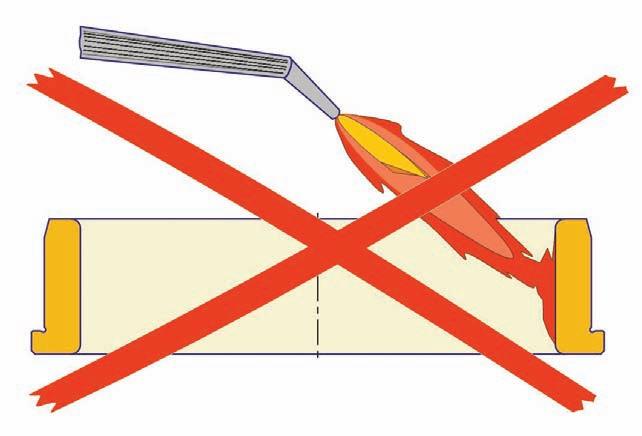
3: The use of blow and welding torches or soldering irons leads to irregular heating of the
Fig. 4: Training programs for rolling bearings typically offer useful tips for mounting.
used for pressing (Fig. 1). When hydraulic presses are used, the setting of a certain pressure relief is recommended in order to avoid choking caused by defects in the bearing or in the housing.
Mounting bearings by using the oilinjection method: Larger and very large rolling bearings may be mounted in a much simpler way by using the oil-injection method. To fit bearings by the oilinjection method, hydraulic nuts are used. When mounting or dismounting bearings using oil injection, huge pressures are applied. The operating and safety instructions provided by the supplier of the hydraulic equipment must be followed carefully.
Mounting of bearings by heating: In cases where mounting of bearings in cold conditions is not possible or practical, heating of the bearing or even individual bearing rings may be of advantage.
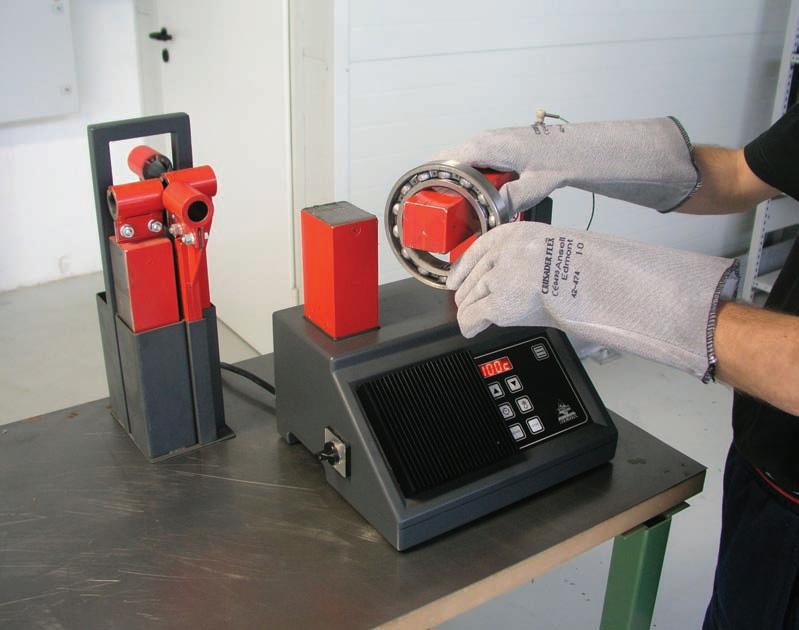
When heated, the bearing rings expand, which enables easier bearing mounting. Suitable heating methods are oil baths, hot plates and boxes, thermo rings and induction heating (see Fig. 2). Never heat rolling bearings directly by means of open flames (see Fig. 3).
Practical training for mounting rolling bearings: Professional mounting of rolling bearings is the basic requirement for the optimum performance of bearings. Leading manufacturers of bearings provide theoretical as well as practical training programs (Fig. 4). MRO
The article was prepared by NKE Austria GmbH, a bearing manufacturer headquartered in Steyr, Austria. In Canada, NKE products are distributed through Global Bear Inc., Dorval, QC. For more information, visit www.globalbear.ca or www.nke.at.
Fig. 1: Press mounting of a ball bearing on a tight shaft fit should be done using an appropriate impact sleeve.
Fig. 2: An induction heater eases bearing installations.
Fig.
bearing rings and should be avoided.
Fig. 3 Fig. 4
Vibration
Vibration Vibration Vibration Vibration
an unexpected predator
Did you know that bearings can be damaged when at rest, and there will be no visible change apparent in the rolling elements?
Bearings with vibration damage are usually found in machines that are not in operation and are situated close to machinery that is producing vibrations. Examples are transformer fans, standby generators and ships’ auxiliary machinery. Bearings in machines transported by rail, road or sea may be subject to vibration damage too.
When a bearing is not running, there is no lubricant film between the rolling elements and the raceways. The absence of lubricant film allows metal-to-metal contact and the vibrations produce small relative movements of the rolling elements and rings. As a result of these movements, small particles break away from the surfaces and this leads to the
Bearing wear caused by vibration can be solved by planning ahead.
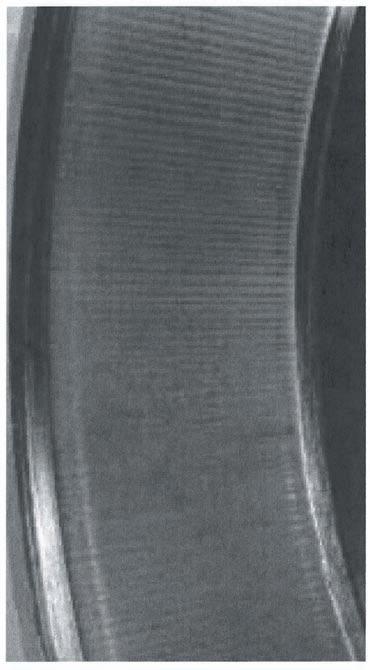
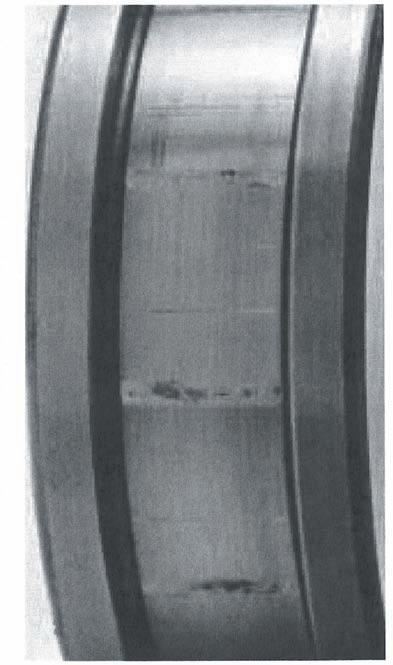
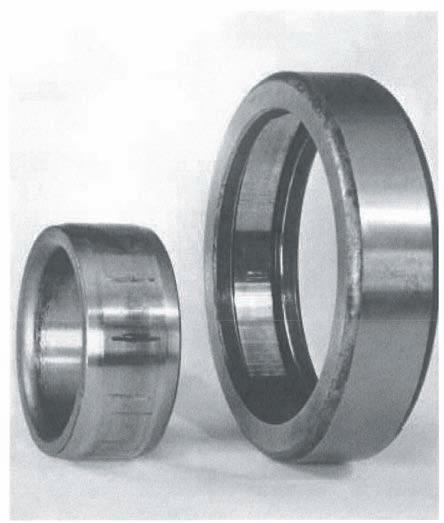
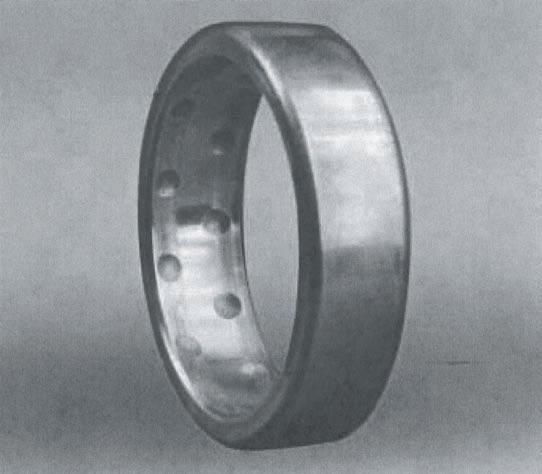
formation of depressions in the raceways. This damage is known as false brinelling, sometimes also referred to as washboarding. Balls produce sphered cavities while rollers produce fluting.
In many cases, it is possible to discern red rust at the bottom of the depressions. This is caused by oxidation of the detached particles, which have a large area in relation to their volume, as a result of their exposure to air. There is never any visible damage to the rolling elements.
The greater the energy of vibration, the more severe the damage. The period of time and the magnitude of the bearing internal clearance also influence developments, but the frequency of the vibrations does not appear to have any significant effect.
Roller bearings have proved to be more susceptible to this type of damage than ball bearings. This is considered to be because
#1 in Bearing Isolators www.inpro-seal.com
YOUR SAME-DAY SHIPMENT SPECIALISTS
When your equipment is down, you need a partner that ships a solution to you same-day not some day. At Inpro/Seal, we recognize the high cost of downtime facing our customers; that’s why we’ve designed our operations to support quick–turnaround of our custom–engineered bearing protection products.
With manufacturing locations in North America and the United Kingdom, we’re able to offer industry–leading products with unparalleled response time and service to customers around the globe.
The right technology…right when you need it.
the balls can roll in every direction. Rollers, on the other hand, only roll in one direction; movement in the remaining directions takes the form of sliding. Cylindrical roller bearings are the most susceptible.
The fluting resulting from vibrations sometimes closely resembles the fluting produced by the passage of electric current. However, in the latter case, the bottom of the depression is dark in colour, not bright or corroded. The damage caused by electric current is also distinguishable by the fact that the rolling elements are marked, as are the raceways.
Where machines subject to constant vibration are concerned, it is essential that the risk of damage to the bearings be taken into consideration at the design stage. Consequently, where possible, ball bearings should be selected instead of roller bearings.
The ability of ball bearings to with-
Fig. 2: Vibration damage to the ring of cylinder roller bearing. The damage has arisen while the bearing was not running. It is evident, from the fainter fluting discernible between the pronounced depressions with corrosion at the bottom, that the ring has changed position for short periods.
3: Inner and outer ring of a cylindrical roller bearing exposed to vibration. The inner ring has changed position.
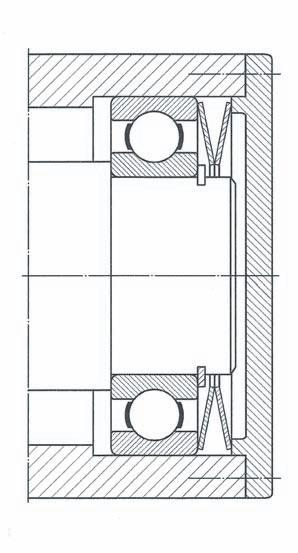
4: Spring loading a deep groove ball bearing to prevent vibration damage.
5: Outer ring of a self-aligning ball bearing damaged by vibration. The bearing has not rotated at all.
stand vibrations without being damaged can also be considerably improved by applying axial preloading with the aid of springs (see Fig. 4). An oil bath, in which all rolling elements in the load zone are immersed in the oil, has also proved to provide satisfactory protection. A vibration-damping base helps to prevent damage too.
The bearings in machines that are to be transported can be protected by locking the shaft, thus preventing the small movements that have such a damaging effect on the bearings.
MRO
This article is an edited excerpt from ‘Bearing Failures and Their Causes’, an SKF guide. For more information, visit SKF Canada at www.skf.com/portal/skf_ ca/home or use the online request number below at www.mromagazine.com/rsc. Online Reader Inquiry No. 490
Fig. 1: Outer ring of taper roller bearing damaged by vibration during operation.
Fig.
Fig.
Fig.
Fig. 5
Fig. 3
Fig. 4
Fig. 1
Fig. 2
Understanding Vibration
BY COLIN PLASTOW
n the simplest terms, vibration in motorized equipment is merely the back and forth movement or oscillation of machines and components, such as drive motors, driven devices (pumps, compressors and so on) and the bearings, shafts, gears, belts and other elements that make up mechanical systems. Vibration in industrial equipment can be both a sign and a source of trouble. Other times, vibration just ‘goes with the territory’ as a normal part of machine operation, and should not cause undue concern.
Vibration Basics
To understand how vibration manifests itself, consider an electric motor.
Rotation: The motor and shaft rotate around the axis of the shaft, which is supported by a bearing at each end. One key consideration in analyzing vibration is the direction of the vibrating force.
In our electric motor, vibration can occur as a force applied in a radial direction (outward from the shaft) or in an axial direction (parallel to the shaft).
An imbalance in the motor, for instance, would most likely cause a radial vibration as the ‘heavy spot’ in the motor rotation, creating a centrifugal force that tugs the motor outward as the shaft rotates through 360 degrees.
A shaft misalignment could cause vibration in an axial direction (back and forth along the shaft axis), due to misalignment in a shaft coupling device.
Amplitude: Another key factor in vibration is amplitude, or how much force or severity the vibration has. The farther out of balance our motor is, the greater its amplitude of vibration.
Other factors, such as speed of rotation, can also affect vibration amplitude. As rotation rate goes up, the imbalance force increases significantly.
Frequency: Frequency refers to the oscillation rate of vibration, or how rapidly the machine tends to move back and forth under the force of the condition or conditions causing the vibration.
Frequency is commonly expressed in cycles per minute or Hertz (cpm or Hz). One Hz equals one cycle per second or 60 cycles per minute. As the machine operates, it could be vibrating in multiple directions (radially and axially), with several rates of amplitude and frequency.
Imbalance vibration, axial vibration, vibration from deteriorating roller bearings and more all could combine to create a complex vibration spectrum.
But how can the plant maintenance professional tell the difference between acceptable, normal vibration, and the kind of vibration that requires immediate attention to service or replace troubled equipment? With a basic understanding of vibration and its causes, the maintenance professional can quickly and reliably determine the cause and se-
verity of most machine vibration and receive recommendations for repair.
Not always a problem
Vibration is not always a problem. In some tasks, vibration is essential. Ma-
chines such as oscillating sanders and vibratory tumblers use vibration to remove materials and finish surfaces. Vibratory feeders use vibration to move materials. In construction, vibrators are
The moment of trust. The line was spec’d for 2,000 TPH, but the next load’s way over that. And now routine maintenance has been delayed. Again. This is why you insisted on Timken.
With an enhanced bearing insert, double-lip seals and e-coat paint on the housing and collars, the new Timken® Type E tapered roller bearing yields a 55% longer design life and provides 10x improved sealing* and better corrosion resistance—even under the toughest conditions. Further proof of what Timken expertise means to your business. And your reputation. Learn more at timken.com/typeE.
New Timken Tapered Roller Bearing Housed Unit
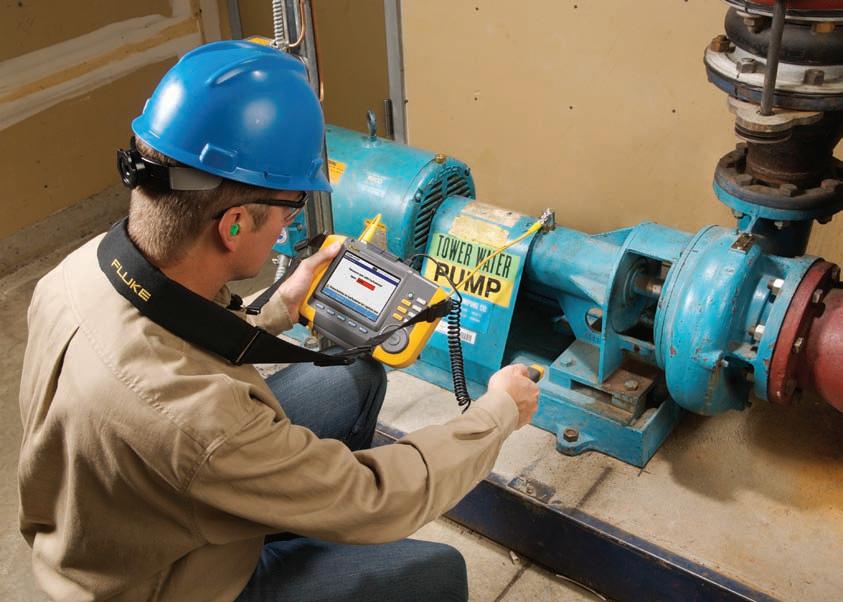
A built-in expert system in the Fluke 810 handheld vibration tester compares results to a ‘like new’ machine.
Photos: Fluke Electronics Canada
used to help concrete settle into forms and compact fill materials. Vibratory rollers help compress asphalt used in highway paving.
In other cases vibration is inherent in machine design. For instance, some vibration is almost unavoidable in the operation of reciprocating pumps and compressors, internal combustion engines and gear drives. In a well-engineered, well-maintained machine, such vibration should be no cause for concern.
When vibration is a problem
Most industrial devices are engineered to operate smoothly and avoid vibration, not produce it. In machines such as electric motors, rotary pumps and compressors, and fans and blowers, vibration can indicate problems or deterioration in the equipment. If the underlying causes are not corrected, the unwanted vibration itself can cause additional damage.
Vibration testing
Many professionals may think there are only two options for vibration testing; high-end vibration analyzers that are expensive and difficult to use, and low-end vibration pens which aren’t particularly accurate. The latest technology includes handheld vibration testers with built-in expertise that are designed specifically for maintenance professionals who need to troubleshoot mechanical problems and quickly understand the root cause of equipment condition.
Common causes of machine vibration
Vibration can result from a number of conditions, acting alone or in combination. Keep in mind that vibration problems may be caused by auxiliary equipment, not just the primary equipment. Here are some of the major causes of vibration: Imbalance. A ‘heavy spot’ in a rotating component will cause vibration when
Vibration tester has built-in expertise
One new troubleshooting tool – the Fluke 810 Handheld Vibration Tester – is designed specifically for maintenance professionals who need to troubleshoot mechanical problems and quickly understand the root cause of equipment condition.
This tester combines the diagnostic capability of a trained vibration analyzer with the speed and convenience of lower-end testers. Key features include:
• Triaxial sensor that picks up vibration in all three directions at the same time
• Built-in expert system that compares results to a ‘like new’ machine
• Diagnostic results provided in straightforward terms with level of severity and a recommended solution.
For more information on the Fluke 810, use the online request number below. Online Reader Inquiry No. 492
the machine’s axis, creating a centrifugal force. Imbalance could be caused by manufacturing defects (machining er
sues (deformed or dirty fan blades, missing balance weights). As machine speed increases, the effects of imbalance become greater. Imbalance can severely reduce bearing life as well as cause undue machine vibration.
We Keep You Moving
Misalignment/shaft runout. Vibration can result when machine shafts are out of line. Angular misalignment occurs when the axes of (for example) a motor and pump are not parallel. When the axes are parallel but not exactly aligned, the condition is known as parallel misalignment. Misalignment may be caused during assembly or develop over time, due to thermal expansion, components shifting or improper reassembly after maintenance. The resulting vibration may be radial or axial (in line with the axis of the machine) or both. Wear. As components such as ball or roller bearings, drive belts or gears become worn, they may cause vibration. When a roller bearing race becomes pitted, for instance, the bearing rollers will cause a vibration each time they travel over the damaged area. A gear tooth that is heavily chipped or worn, or a drive belt that is breaking down, can also produce vibration. Looseness. Vibration that might otherwise go unnoticed may become obvious and destructive if the component that is vibrating has loose bearings or is loosely attached to its mounts. Such looseness may or may not be caused by the underlying vibration. Whatever its cause, looseness can allow any vibration present to cause damage, such as further bearing wear, wear and fatigue in equipment mounts and other components.
Source for Critical MRO Parts
Providing local support, repair services and premium products is what Applied does to keep your machinery moving. As a full life-cycle distributor, Applied offers value added services including bearing repair, lubrication solutions and technical expertise to support our comprehensive offering of MRO products. Supporting the products we sell - That’s the Applied Difference.
Understanding why vibration occurs and how it manifests itself is a key first step toward preventing vibration from causing trouble in the production environment. Typical vibration analyzers and software are intended for monitoring machine condition over the longer term, but they require special training and investment that may not be possible in many companies.
Advanced troubleshooting tools are designed specifically for maintenance professionals who need to troubleshoot mechanical problems and quickly understand the root cause of equipment condition. Ensuring smoother machine operation, with zero vibration, goes a long way in helping keep today’s facilities productive and running efficiently. MRO
Colin Plastow has been with Fluke Electronics Canada since 1987 in various support and product management positions. Today, as industrial product manager for Fluke, he brings his expertise in electronic test and measurement to customers in high-tech and industrial markets. He can
Solving motor vibration problems
A basic understanding of frame construction can help minimize motor vibration. Minimizing vibration often depends as much on shim placement as it does on using the correct amount of shimming.
BY CHUCK YUNG
When motor vibration problems occur, the magnitude and direction of the vibration can give a good indication of where to look for the cause. When vibration is higher in the vertical plane, one of the first things to examine is the base/foundation of the motor. If the high vertical readings are compounded by indications of an eccentric air gap, such as high axial vibration and a predominant twice-linefrequency vibration, a ‘soft foot’ or twisted frame is often to blame.
Construction basics
To correct soft foot conditions, alignment technicians commonly use prefabricated shims (sized to accept the hold-down bolts) under motor feet. What they may not realize is that a cast iron or steel motor frame isn’t as solid as it appears.
The feet might be more than an inch (25 mm) thick, so some technicians mistakenly
assume distortion isn’t possible. As a result, they do not place shims to the greatest benefit. A review of motor frame construction basics can be helpful in determining where to put shims to obtain the best support, and therefore the lowest vibration readings. Fig. 1 shows the typical fabricated-frame construction; the holes through the motor feet are sized for the hold-down bolts. Depending on motor size, there will be at least four bolts and sometimes more. Each foot may be a standard pad at one corner of the motor, or it may run the full length of the frame, in which case there are usually four or more bolts along each side of the motor.
Frame bulkheads
An exploded view of any fabricated-frame motor would clearly show that the bulkheads do much more than hold the stator in the frame or channel the internal air flow, as in the case of a weatherproof
SOFT FOOT INSPECTION PROCEDURE
When aligning machinery, one of the first steps should be to check for a ‘soft foot’ — i.e., the condition when one or more of the motor feet do not share the same plane or the motor base is not flat.
This step is frequently overlooked when a motor is returned to service following repair. The reasoning may be that, “The motor was on this base before, so the shimming should be correct.” But shims are often lost when a motor is removed from service, and there is no guarantee that the original alignment was correct.
Bolting a soft foot firmly to the base can distort the motor frame, causing vibration. The vibration signature will indicate misalignment — in this case internal misalignment of the motor bearings due to frame distortion.
Fortunately, it is easy to check for soft feet. With the motor bolted down, place a dial indicator at one foot with the travel rod vertical and resting on the foot near the hold-down bolt (Figure 4). Loosen the bolt and observe the indicator movement. Record the deflection and retighten the bolt. Repeat this procedure at each foot.
Next, loosen all the bolts and put the appropriate shim under each foot (e.g., movement of 0.005 in. (0.127 mm) calls for a 0.005-in. shim). Tighten all base bolts and repeat the procedure.
Feet should be shimmed to obtain less than 0.002-in. (0.051-mm) movement. For two-pole machines, especially those with a fabricated frame (formerly called a shoebox design), try to shim for zero movement.
Angular soft feet are best addressed by machining the feet (Figure 5). In some cases, a millwright will use shims of varying thicknesses, or thermal-setting shims made for this purpose.
(WP) enclosure machine. They also stiffen the entire frame, helping dampen vibration. Vibration levels will therefore increase if one or more of the bulkheads is not properly supported by the motor base. Although most motors have solid-looking feet that are securely attached to the bulkheads, the mounting bolts must be far enough from the bulkheads to provide access for tightening. Therefore the bulkheads (as well as the feet) may require shimming to achieve the rock-solid support that is critical for minimizing frame distortion and vibration. If loosening or tightening base bolts changes the vibration levels, the motor is not shimmed properly.
Fig. 2 illustrates the critical areas for shimming. When a corner requires X amount of shim, that shim should also extend to the area directly beneath the bulkheads near the bolts. If the base and supporting foundation are not parallel, the shim thickness required beneath the bulkhead may differ from that required at the bolt.
Minimizing vibration
The shims beneath the bulkheads should not be loose after the mounting bolts have been tightened. If the soft-foot check procedure (see sidebar) of loosening the bolts indicates a soft foot, the shim pack beneath the bulkhead may be too thick. Vibration will be minimized once all feet are correctly supported, including the area directly beneath each bulkhead (see Fig. 3).
Note that these same basic principles also apply to other rotating equipment, for example, generators, blowers, screw compressors and so forth.
Avoiding frame distortion
When installing, removing or repairing a fabricated-frame motor, always use
every lifting point provided by the manufacturer. If a motor with a welded steel frame is designed to be lifted at all four corners, picking it up at only two diagonally opposite corners is likely to twist the frame. The resulting irregular air gap may affect assembly and testing; a twisted frame will also cause future softfoot problems, both in the service centre and on the jobsite.
Prudent engineering often uses a design safety factor of five (depending on many considerations, including the consequence of failure). It is a mistake to infer that it is ‘safe’ to lift a motor with only half of its lifting points; frame distortion is still a very real possibility. (Caution: An assumed design safety factor never makes it safe to lift a motor using only half of its lifting points.)
Summing it up
The bottom line is that minimizing vibration often depends as much on shim placement as it does on using the correct amount of shimming. Using proper lifting techniques can also help prevent frame distortion that could worsen softfoot and vibration problems.
Alignment technicians who understand and apply these basic principles can be more effective in reducing the vibration levels of both motors and driven equipment.
MRO
Chuck Yung is a senior technical support specialist at the Electrical Apparatus Service Association (EASA), St. Louis, MO. EASA is an international trade association of more than 1,900 firms in 56 countries that sell and service electrical, electronic and mechanical apparatus. For details, visit www.easa.com. Online Reader Inquiry No. 459
Chuck Yung.
Figure 4: Use a dial indicator near the hold-down bolt on each foot to check for any deflection. Figure 5: There are two soft foot conditions — parallel and angular.
Figure 1: The base bolts fasten the motor to the soleplate.
Figure 3: Lack of support beneath the bulkhead (left) will result in higher vibration than when the bulkhead is shimmed correctly (right).
Figure 2: The bulkheads (see arrows) support the stator and end brackets and stiffen the entire motor. Shims should be directly beneath them.
Fig. 5
Fig. 3
Fig. 4
Fig. 1
Fig. 2
Maintenance advice takes to the road
BY CARROLL MCCORMICK
With a lot to say, a lot to show and a desire to more tightly focus marketing dollars, several suppliers of maintenance and repair components and systems are crisscrossing the country this year with their trucks, packed with products, teaching tools and interactive displays.
At least three big Canadian suppliers —̦ Leeson Canada, NTN Bearing Corporation of Canada and SKF Canada —̦ will visit as many as 400 end users and distributors by year’s end.
Of the three companies, Mississauga, ON-based Leeson Canada is the most recent supplier to load up a bandwagon, with “The Regal Beloit Canadian Road Show and BBQ” (Leeson is a Regal Beloit division). In 2010, the company outfitted a 26-ft trailer to display HVAC/R motors, high-efficiency motors, high-ef ficiency gearing, industrial mo tors, variable-frequency drives and other hardware.
Dan McKelvie, national marketing manager for Leeson Canada, explains why. “We found that a lot of our market ing dollars were spent on local things like sending customers to see basketball and football games. But there is a trend to do less of that … we are allocat ing more money to the Road Show as a way of [replacing] trade shows.”
Leeson visited 18 distribu tor locations last fall and fore casts it will visit 66 distribu tor locations this year. The Road Show has so far restricted its visits to its distributors, but sends posters and other information material ahead of time so they can invite their customers, who will enjoy a BBQ in the bargain.
trade show,” says Gerry Siemon, owner of Ampro Electric, in London, ON. The Road Show visited his company’s four Ontario branches in London, Sarnia, Tillsonburg and Chatham last September.
Siemon invited a lot of his customers. “Most are from manufacturing plants. They comment on how nice it is for the Road Show to come to town. Local guys are not going to see this very often. We don’t have trade shows – we pretty well have to go to Kitchener or Toronto for that. It is very difficult to get all the different products that Regal Beloit has on the market to our customers. This Road Show does this very efficiently.”
Anthony Wu, a reliability electrical engineer with Cargill Value Added Meats in London, dropped into the Road Show at Ampro’s London branch. “It is a good way to understand new products. We get
Big suppliers hit the highway to show distributors and end users their products and services.
to speak to the Leeson representative, ask questions and express our interests and concerns related to their products.”
“It is a pretty tricked-up rig. It is a big walk-through trailer. It is like a mobile
Wu came away from the Road Show with a hot tip: “They introduced a new stainless steel motor suitable for extreme washdown applications. As a food pro-
cessing manufacturer, high standards of sanitation are critical. Sometimes it can be challenging to maintain the reliability of motors that undergo daily highpressure washdowns. This motor could be a possible solution.”
The Road Show also set up at Gilbert McEachern Electric, a motor shop in Brantford, ON. Owner Mal McEachern comments, “Part of what makes the show work is that the people can get out of the plants. They love coming to this type of
thing.” He adds that the Road Show is a great way to re-establish face-to-face relationships, something that has been lost in recent years.
Maintenance buyer Steve LeBlanc, who works at Maidstone Bakeries in Brantford, also dropped in to see the displays. Asked how it helped him, he joked, “I didn’t have to buy lunch that day! It gave us a chance to meet their whole staff, see the inventory and methods and gave us a chance to meet the folks from Leeson.” As for hot tips, he notes, “They had portable generators that I wouldn’t
Top: Leeson Canada is taking its products to its distributors, who in turn invite their clients to visit its Regal Beloit Canadian Road Show and BBQ. Centre: NTN Bearing Corporation of Canada’s second-generation Technical Training Unit includes a slide out truck axle for on-site bearing installation training. Bottom: SKF Canada’s solution vehicle criss-crosses the country for 50 weeks a year, spreading the word about its products and maintenance solutions.
Photo: Leeson Canada
Photo: NTN Canada.
Photo: SKF Canada
have thought to call them about.”
Since 2007, NTN Bearing Corporation of Canada Ltd., Mississauga, ON, has been delivering bearing training from Newfoundland to British Columbia out of a Ford E350 cutaway with a 14-ft Aerocell cube. Its cargo includes a number of core bearing product samples, including a 23032BK spherical roller bearing measuring 160 mm by 240 mm by 60 mm, and demonstration modules.
The vehicle carries comprehensive maintenance training seminar handout material for participants. Demonstrations are easily set up using three mobile carts that can be wheeled anywhere, such as on to a shop floor, training facility or hotel. NTN engineering staff conducts the training.
This is the company’s second-generation Technical Training Unit (TTU), also known as the Mobile Training Unit. From 2000 to 2006, NTN operated a 40-ft fifth-wheel mobile classroom in Canada and the United States, which incorporated an integrated mul timedia presentation theatre and dem onstration area.
Although the TTU is not a mobile classroom, in 2010 NTN installed a heavy-duty slide out truck axle so the TTU can pull into garages and train me chanics on the installation of tapered roller bearing truck axle bearings. Ulti mately, explains Marcus Wickert, engi neer and manager of technical resources with NTN, “The current concept is to in tegrate formal training with hands-on training demonstrations on the shop floor, where mechanics face daily real-life challenges. Training kits are organized in the unit to educate them on various bearing products or demonstrate a num ber of installation techniques.
“The majority of training is conducted for maintenance staff that are installing and maintaining bearings. However, we frequently cater to stores or purchasing personnel who want to further under stand part numbering or handling of bearing products. We have also provided product or technical training at our dis tributor partners.”
Demonstration equipment includes operating fans and gear that does real-time wireless condition monitoring of the fans’ vibration and speed.
The on-board hardware also includes a thermal camera, belt alignment tools and a lube board on the back wall, with single-point and multipoint lubrication systems.
The displays are interactive, according to Robert Simpson, product specialist, maintenance products, and marketing coordinator, SKF Canada. For the lubrication monitoring presentation, for example, he explains, “The viewers can jump to single-point monitoring or to greases or multi-point lubrication. They can choose what they are interested in and skip what does not interest them.”
During each appointment, which generally lasts for a morning, SKF has two goals: Enlighten end-users about the five platforms and explain how they allow
NTN books five to 10 training ses sions a month, according to Wickert, who oversees the TTU’s general regional routing and occasionally conducts the onsite training. The training platform is tailored to specific requests. A bearing presentation might last a morning, or NTN might present multiple topics over two or three days.
Last September, for example, NTN distributor M.A.S. Chibougamau ar ranged a two-day bearing seminar for 30 maintenance staff at the Chantiers Chibougamau Ltee sawmill, 850 km from NTN’s Montreal warehouse.
Inquiries for TTU bookings can be made through NTN’s local business de velopment manager or through the NTN support team. They can also be arranged through a local NTN distributor partner.
In 2011, roughly 225 companies will re ceive visits from the SKF solutions vehicle during an ambitious, 50-week per year schedule. SKF Canada put its 26-ft KenKen worth, essentially a walk-in showroom, on the road on May 17 last year, and it visited 171 companies by year’s end; it re places a traveling tool truck that SKF had retired after 12 years of service.
SKF outfitted the solutions vehicle with seven monitors – one for each of the company’s five platforms — bearings, seals, lubrication, mechatronics and reliability services — and two for its industry segments. A 42-in. monitor is wired to a laptop with wireless Internet access.
SKF to create solutions, says Mark Howard, business manager, seals platforms. “As we inform them about what we have and do, we ask questions about how their plant is operating. The concept is to discuss what they spend a year and how they can reduce maintenance costs. We want to talk about how to increase uptime and reduce costs.”
The solutions vehicle travels from Vancouver to the Maritimes. For example, it will be in Ontario and Manitoba until May 2011, and in Quebec in September. Each technical representative for a geographical area takes over the solutions vehicle for two weeks. There is always one technical sales representative on board. Local applications engineers, who have a general knowledge of all the platforms, and segment managers (for example, mining, oil and gas or renewable energy) may be on board too.
“The old truck had a lot of millwrights
come out to it, but with the new truck we want purchasers and maintenance managers to come in,” Simpson explains. “We want to hear about their problems, etc. Presentations will start the conversations and appointments will be made to address problems in more detail. It is not a hands-on clinic where you are mounting or dismounting bearings. It is more of a show and tell, to show new products.”
Local SKF sales representatives work with authorized distributors to arrange visits with end users, but local companies can ask distributors, or contact SKF about having the solutions vehicle visit them.
MRO
Montreal-based Carroll McCormick, an award-winning writer, is the senior contributing editor for Machinery & Equipment MRO.
Understanding Infrared
What is infrared thermography?
It is the process of using an instrument and a method to detect infrared energies emitted from an object, convert these emitted energies to temperature values, and display an image of the object, show-
Worried about contaminants in the water supply? Not
Rest easy, and know you’re covered.
has
Let us help put your mind at ease.
To find out more, visit www.garlock.com.
ing its temperature distribution. The instrument is an infrared thermograph and the method is called infrared thermography. However, the current trend is to incorporate both instrument and method in the terms infrared thermography or thermal imaging.
Infrared energy is an electromagnetic wave, part of the electromagnetic spectrum of radiation that transfers energy through space. It was discovered by the British astronomer, Sir William Herschel, around 1800. When dispersing sunlight using a prism, he accidentally found that there was an invisible energy just below the red colour wavelength, and he noted that the wavelength increases with temperature.
The infrared wavelength ranges from 0.7 μm to 1,000 μm (1 mm), and its frequency is 300 GHz or greater.
Infrared is invisible, since its wavelength is longer than visible light. It has nothing to do with the brightness or darkness of visible light.
Infrared is emitted naturally from any object that has a temperature of absolute zero (Zero Kelvin) or higher. Therefore, it can be applied to any field. It has a characteristic of heating an object. Therefore, it is sometimes called the ‘heat wave’.
Because it is a kind of light (being an electromagnetic wave), infrared is transmitable through a vacuum. There is a correlation between infrared energy and the temperature of an object. Therefore, it can be used to measure the temperature of an object, and is especially useful in industry to locate hot spots in machinery and equipment, which usually indicate hidden problems.
The characteristics of infrared thermography instrumentation are as follows:
1. Captures surface temperature distribution and displays it as visible information.
2. Temperature is measured from a distance without contacting the measured object.
3. Temperature is measured in real time. The merits of infrared thermography instrumentation include:
a) Relative comparison of surface temperature distribution is made over a wide area.
b) Allows temperature measurements of hazardous objects from a safe distance.
c) Measures temperature of small objects without interference.
d) Temperature of food, medicine or chemicals can be measured in a sanitary fashion.
e) Temperature of an object with dynamic temperature changes can be measured.
Frequently asked questions (FAQs) about infrared thermography instrumentation include the following:
Q. Isn’t the infrared camera emitting something?
A. No, it is not emitting anything. It merely detects infrared energy emitted from an object in a passive manner. It should be noted that the energy detected may be affected by reflected energy from the surroundings.
Q. Isn’t the temperature measured by the wavelength?
A. No, temperature distribution is measured by the amount of infrared energy.
Q. Can you see through objects using infrared instruments?
A. No. Infrared energy is emitted from the surface of an object; you cannot see through an object. However, it may be possible to estimate the rear-side temperature if the temperature distribution appearing on the front surface is due to thermal conductivity from a temperature difference.
Heat transfer occurs in three ways (Fig. 1). Emission is where the heat
Panoramic image innovation
The NEC Avio Infrared Technologies Thermo Gear model G120 highresolution portable thermal imaging cameras in its InfRec series feature the world’s first Panoramic Thermal Image Recording feature. As the camera is panned in a vertical or horizontal plane, it automatically captures and stores sequential thermal images. PC software then combines each image to create a full image of large areas, or of tall or wide objects, such as a bridge or a long production line.
The G120 features a rotating monitor, similar to a home video camera, and an ergonomic gun grip design. A built-in Target Illuminator LED lamp and laser pointer provides pin-point measurement accuracy. Another unique world’sfirst feature included in the Model G120 is a vibration alarm for sites where an alarm sound may not be heard easily or for when discreet alarms are preferred.
The unit can simultaneously record and display fused visual and temperature data images. Visual and thermal images may also be displayed side-by-side.
Soltec
is transferred directly from the surface of an object as an infrared energy. Convection transfers heat to a gas or liquid as it passes an object. Conduction transfers heat mainly through a solid object. An object that absorbs infrared well also emits infrared well.
Taking a measurement by infrared thermography instrumentation (also called an infrared camera or thermal imaging device) involves the following sequence: The instrument detects infrared emitting from an object; it transforms the amount of energy measured into temperature; and it displays the object as an infrared image (Fig. 2). The relative temperatures of the object are indicated by different colours on the image, from blue for the coolest temperatures and rising through green, yellow, red and finally white as the
hottest temperature (Fig. 3).
Infrared thermography instruments display the temperature distribution image data using a matrix of pixels (each pixel being a miniature infrared energy detector). In Fig. 3, there are 320 horizontal x 240 vertical pixels (detectors).
Thermal image data from each of these pixels/detectors may be stored in the thermography instrument or transferred to a PC for further analysis. The displayed thermal image is coloured pixel by pixel to show the temperature distribution values converted from the detected infrared thermal energy. MRO
This guide to understanding infrared thermography was compiled from data provided by Soltec Corporation, a subsidiary of NEC Avio Infrared Technologies Co. Ltd. For more information, visit www. solteccorp.com.
Over 260 Locations Coast to Coast Across Canada
BY CLIFF WILLIAMS
the Twenty Four Seven list!”
I think the group thought that I was crazy, getting so excited over the naming of a list, but this was another way of get ting what was required — ownership.
I headed off to see Fred in the produc tion manager’s office to show him what we had decided. Surprisingly, there was no criticism and Fred said he would meet with his supervisors about it over the next day or two. As I had told Steve, it wasn’t business as usual and people were getting on board.
We had decided not to wait to roll this out and held a meeting the next day, where we discussed the Twenty Four Seven list that Carol had quickly prepared. We talk ed about it as if it was owned by the shift guys. On the way out of the meeting, Pete, who was a day millwright, asked if he could talk to me about something related to what I had said in the meeting.
We settled down in my office. “Okay Pete, what’s on your mind?”
Follow along with Step 38 in a journey to World-Class Maintenance at the Plentya Paper Company as the maintenance team comes closer to achieving its goals.
This article is part of an ongoing series. The introduction appeared in Machinery & Equipment MRO’s February 2005 issue and the series has run in every issue since. Previous instalments are archived online at www.mromagazine.com. This month, we pick up where we left off in the February 2011 edition, as maintenance manager Bob Edwards gets ready for a major push towards his goals.
A Creating the ‘24/7’ list
s I sat in my office and reviewed in my head the things that we were doing and compared them to the Wisconsin mill we had visited and were modelling our our selves after, it still seemed that the big gest difference that mill displayed was the ‘ownership factor’.
We were going to have a meeting in the next few days to decide the level and criteria for giving our shift guys author ity to call in extra help or contractors as needed, but the Wisconsin mill seemed to have ownership in every facet of its op eration. I needed to find more ways to de velop this kind of ownership if we were going to change at the speed that Corpo rate and Joe, our mill manager, wanted.
The day of the meeting arrived and Carol, our reliability manager, had pre pared some information that she had been able to obtain from Wisconsin. Once millwrights Steve, Tom and Ted, and Larry, an electrician, had finished read ing the information, I asked them for their comments.
“It actually seems straightforward and I think everyone will understand quite easily. I’m not worried any longer,” said Steve, who had expressed concerns about the decision making process the previous week.
“It’s even easier for us electricians as we don’t have area maintenance and so we don’t need to worry about calling the wrong guy,” Larry added.
“That’s not exactly true, Larry, as we have to ensure that where possible we don’t call on the same guys all of the time,” I replied. “They’ll get fed up with being called and the rest will claim they don’t get a chance for overtime. I don’t re ally think we will have a problem, but we should be aware of what we’re doing.”
“I understand, Bob, so let me repeat this so we’re sure that we’ve got an understand ing. If the mill is still down after one hour, we are to meet with the shift supervisor. If we know the solution, have the parts on hand and can complete the work ourselves, we’re to do so — giving the supervisor an estimate of how long the job will take.”
“Correct.”
“If we don’t know the solution and be lieve someone else might have more knowledge, we are to call them in — our guys or a contractor. But do we wait for an hour to meet with the supervisor?”
“No, as soon as you realize that you’ve reached that point, let the supervisor know what you are doing.”
“If we know the solution but need help or a different skill, we are to call them in as soon as we realize this?”
“Correct.”
“If the mill is likely to be down for more than four hours, you want the supervisor to let you know about it.”
“Correct, then I’ll decide if I need to come in. That will be based on whether or not you have the solution to the problem.”
Carol, who had said nothing so far, gave me a quizzical look.
“What’s up Carol — you don’t agree?”
“No, it’s not that I disagree. I think we might be missing an opportunity here.”
“Well, expand.”
“If the mill is going to be down for more than four hours and all we do is re solve that particular problem, we’ve wasted four hours of opportunity to re pair or check other equipment. I was thinking that if we had a prioritized list of work orders that included the estimat ed times they required, then we could take advantage of the breakdown to ad dress them.
If the shutdown was caused by an electrical problem, then the millwrights could complete some of their mechanical work orders, and vice versa. I suppose that, taking it to extremes, we could ac tually call people in to complete the work orders. It would mean that we wouldn’t
have to take equipment down or bring in extra contractors on shutdown days.”
“That’s a great idea. Even if we did some two hour jobs when the mill was down for four hours, we would be much further ahead. I don’t think I like the idea of trying to do a four hour job when the estimated downtime was four hours, just in case it extended the downtime.”
Steve seemed quite enthused by this idea.
“Even if we did run over time, Bob, if it was on a job that we knew we were going to have to shut down to do anyway, we’re still ahead — but I guess I wouldn’t like to be in your shoes trying to explain that in the morning meeting.”
“Actually, Steve, with the way things are going, I think most people would see the benefit. As you’ve heard many times from me over the past few months, it’s not business as usual at this mill any more. In fact, it’s not business as usual for the com pany any more. You’ve seen the focus Corpo rate has placed on our improvement drive.”
“Okay, that’s it then. I’m going to pre pare a list of work orders with estimates of two hours, four hours and eight hours by area and trade,” said Carol.
“Can I make a silly suggestion?” asked Ted, who also had been quiet throughout the meeting.
“Sure — if it’s not too silly.”
“Carol, rather than doing it for two, four and eight hours, why not do it for two, four and seven hours?”
“Uhh, do you want to explain that a little more?”
“Well, then it would be the two four seven list! Or the ‘Twenty Four Seven’ list. It’s work that can get done 24/7. You know that us shift guys quite often feel left out and sometimes we think that all of you day people don’t realize that we run the mill 24 hours a day, seven days a week. This list would show that you rec ognize that and it would be something we could feel we owned.”
“Brilliant! That’s what it is, Carol —
“It’s the ownership thing you talked about. Ivan and I have been doing the vi bration rounds for the past couple of months and if we find anything, we let John, the vibe guy, know. It looks like we’ll give the rounds to the operators very soon and I hope that Ivan and I will still own the issue when the operators raise one.”
“I don’t see why not, Pete. In fact, I don’t see much of an alternative.”
“Great, but there’s more to it than that. Currently John brings his results to you and sometimes Ivan and I feel out of the loop. We both have great belief in vi bration analysis. I wondered if John could sit down with us and go over his reports. Of course, he would discuss the exceptions with you, but in general, we would own the program.”
“I don’t see this as a problem, Pete, as long as we make sure that I’m made aware of anything that may have an im pact on performance. I’ve got your side of the story, but what about Ivan?”
“He feels the same way; he’s just not as pushy as I am.”
“I don’t know if that’s true about Ivan because I’ve seen him quite defiant when he believes in something.”
“That’s true, but I think that for Ivan and a few of the other older guys, it’s a case of once bitten, twice shy.”
“What do you mean?”
“Well, the guys who have been around a while tell us about how it used to be years ago. The trades guys were here to fix things — not think, not suggest, defi nitely not own! I saw some of it, but the guys say that it was a lot worse before.”
I felt a little disappointed as I thought we had moved on from the ‘old days’.
“I don’t know what to say, Pete. I’ve tried to show that we have changed but I seem to have failed.”
“That’s crazy, Bob. I was talking about Ivan not wanting to come and confront you. You only have to look at how involved Ivan’s become, how much interest he shows and how he wants to own the pro gram to realize we’ve changed in a big way. You’ve talked about how we’re dif ferent and how we each need to be man aged differently. This is just one of those cases. Ivan will probably never feel confi dent enough to voice many things, so you’ve got to get it out from him.”
“Thanks Pete. Tell Ivan it’s a deal!” MRO
Cliff Williams is the corporate maintenance manager at Erco Worldwide in Toronto, ON, and a consultant with TMS — Total Maintenance Solutions Inc., Markham, ON. He can be reached by e-mail at williamscliff@rogers.com. Online Reader Inquiry No. 457
lant maintenance and engineering people are faced with decision making continually. Every day something needs to be fixed, in stalled, relocated or purchased. Many plant professionals wonder if there is some kind of standardized process that will allow them to make the right choice regarding these daily decisions.
This decision process begins with the gathering of applicable information. It’s a well known axiom that if everyone had all of the available information right at their fingertips, it would be easy for everyone to make the right decisions all the time. Gath ering and assessing the right information, however, is the hard part of the process.
First of all, we need to know what ques tions to ask when we are gathering infor mation. If we ask either an incorrect ques tion or ask the wrong person, we may get an inaccurate or just plain wrong answer.
It is also essential that the lines of communication are kept open. You may have seen this sign on an office wall that relates to communication: “I know that you believe you understand what you think I said, but I am not sure you real ize that what you heard is not what I meant.” Exactly.
The right information equals the right decision Understanding incorrectly may lead to people making bad decisions. Let me illus trate my point by providing you with an example. I was called by one of my clients recently to provide a PSR (Pre Start Health and Safety Review) for a machine. The supplier had sold similar machines to my client in the past, so purchasing went ahead and my client bought the machine. When I came in for a visit, the machine was already at my client’s facility, but he had realized that it might not have suffi cient guarding. The client decided to fix the guarding on site because of the urgent need to have the machine operational. But I realized that the machine had to be put in a classified environment as far as the electrical code was concerned.
No provisions had been made by the cli ent to comply with the electrical code’s re quirements. Fixing the machine at the job site became an impossible task. The Oc cupational Health and Safety Act in On tario requires owners or lessees of indus trial machines, equipment and processes to make sure that the machine, device or process is in compliance with the Act. This compliance process is called a PSR. It re quires that a professional engineer pro vide a report identifying compliance with the Act. PSR considerations always must be included in the decision making pro cess regarding new equipment.
as the legal requirements are concerned, the responsibility for compliance lies with the owner of the equipment — and not the supplier. The expression, ‘buyer beware,’ is very much applicable to this situation.
Look before you leap into purchasing
Making the right decisions
To avoid maintenance-related accidents and injuries in the workplace, start by sharing the right information.
BY SIMON FRIDLYAND
In this example, a wrong decision cost the company the price of a new machine. People also realize that in order to ask proper questions related to compliance, one needs to understand various code re quirements. Understanding multi disci
Another way of ensuring compliance is through a purchasing process. When pur chasing documents are prepared, it is easy to specify that it is the supplier’s re sponsibility (not the future owner’s) to pro vide PSR documents with the machine. A number of companies have successfully used this approach. They specify that the service of an engineer specializing in PSRs will be provided by the supplier. Similar decisions must be made when
classified environment. As in this case, although using previous experience can be helpful, it may not necessarily lead to the right decision. Once information re lated to a project has been verified, you must establish a fixed set of criteria that must be met by all alternatives.
This may limit your choices to, say, the best three. If this is the case, you can use an alternative reducing technique to narrow your choices. A potential alter nate is rejected on the basis of a single flaw, such as price or delivery time, with this technique.
If a wrong decision leads to a fail ure to comply with the requirements of the Industrial Establishments Reg ulation in Ontario or other provincial
compliance in Ontario could face a maximum fine of $500,000 per count. The maximum fine for an individual is $25,000 per count or a year in jail — plus a 20% victim surcharge is lev ied on all fines imposed by the courts. The penalties are even higher under the Federal Bill C 4 5 amendment to the Criminal Code of Canada. Wrong decisions can be very costly in both human and monetary terms. MRO
Simon Fridlyand, P.Eng., of SAFE Engineering Inc., specializes in industrial health and safety issues and PSR compliance. For more information, visit www. safeengineering.ca.
Online Reader Inquiry No. 456
BY PETER PHILLIPS
Training Tips
Here’s how to plan and set up a maintenance training program.
ow that our Canadian economy has started to take wings again, budget restraints are easing to allow some spending on CMMS training and other people devel opment activities. This month, I am going to lay out some important planning tools to ensure your training programs go off with as few hiccups as possible.
Most of us have been on training pro grams that we really enjoyed. If you think about these times, likely the course materials and instructors were orga nized and everything seemed to flow smoothly. Lets look at how it’s done.
I’ll be honest, we love to deliver train ing and we want our participants to enjoy, learn and walk away from the training feeling they received everything we promised and more. To accomplish this too, you’ll need to do some up front preparation. It doesn’t matter if your ses sion is a short two hours or several days, the same attention to detail will make your training successful.
If you are going to be planning training soon, grab a pen and paper and read on.
The first thing to determine is the needs of your participants. You’ll have to assess the problems or issues that exist and how the training will solve them. The program must have objectives and planned outcomes. What do you want the trainees to be able to do at the end of the training? We call this ‘SKA’; what skills, knowledge or attitudes do you want the people to have when they go back to work.
To have effective objectives, they must be written clearly and concisely. They must be measurable so you can deter mine if the trainee has successfully com pleted the program. It’s been my experi ence that most trainers find writing the course objectives the most difficult part of the course design. However, with prac tice, you can master writing objectives. I could create a completely separate article on writing objectives, but in brief, follow these rules.
1. Make objectives short, not wordy.
2. Make them clear and concise.
3. Make them measurable.
4. List what tools and resources will be needed to complete the task.
Once you’ve written the objectives, you can develop a training plan. It will include:
a) The amount of time needed for the training.
b) The training materials and equipment necessary.
c) The size of the training space.
d) The lesson plan itself; what will you teach and in what order.
e) Location of the training. We prefer to de liver the training off site, if possible. There are fewer distractions and people can relax a bit more and focus on the training.
Now you need to write a detailed agenda that can be sent to the training candidates. People like to know what to expect. The agenda will include the ‘3 Ws’: What, When and Where.
• What are the topics to be covered during
the session? If it’s longer than a half day program, break it down into morning and afternoon sessions. If training is more than one day, you need to break out each day.
• What do you want them to bring? You could include paper and pencils, or ex amples from their workplace.
• When and where is the training going to take place? State the dates and the start and finish times. Let them know direc tions to the training location and mention parking facilities if the location is off site.
Keep in mind that people have lives outside of work. They may need to make special arrangements for transportation to the training, day care for children or for other activities. That’s why it’s important to send out the agenda at least two weeks ahead of time, so people can plan personal and work activities around the training.
When deciding where to host the training, you’ll need to consider several things. Of course, you want enough space to comfortably seat your participants.
You’ll find the training space and the equipment needed often go hand in hand.
Do you need audio visual equipment? How about computers or other training resourc es? If computers are needed, you will most likely need your IT department to set up the computers and load software. Will a LAN or wi fi connection be needed to ac cess software and program databases? An swering these questions will certainly help to determine the ideal training location.
If you need assistance from other de partments like IT, be sure to give them
lots of notice. They may need to book the equipment and the room. Plan plenty of time to set up equipment and load soft ware. I’ve seen many great training pro grams developed, but then have every thing fall totally apart because equip ment or software was not ready. Having someone buzzing around the room trying to set up equipment or solve technical problems is very distracting for you and your participants when you’re trying to deliver your lesson plan.
What other resources will you need?
• What about training materials? If manuals are required, who is going to de velop them? Customized manuals are best; they help trainees understand the training and give them reference materi als to review when they return to work. I’ve seen training materials used as ref erences months and sometimes years after a course was finished.
• Will you need examples or other train ing aids to help demonstrate special sec tions of your program?
• Make sure any training aids are avail able. If you’re using equipment from your plant, it may be unexpectedly needed on the shop floor because a spare is unavail able. Plan ahead.
• Create a checklist of everything you need for the your training dates, and con firm its availability.
Now we’re getting close to doing the ac tual training. Check your list and check it twice. If you’re having lunch during the session, will it be supplied or are the peo ple on their own? (Let them know this ahead of time too.) We suggest using the most efficient way possible. Bringing in a lunch for attendees is best. Have a nice, simple lunch, allow adequate time for a break, and then get back to training.
On the training day, get to the facility early to make sure everything is set up the way you planned it and expected it to be. Make sure equipment works, the com puters turn on and the software starts up. Make sure you have IT support available to address any unexpected glitches.
Finally, keep your training focused. The managers paying for the training ex pect that their money is being well spent. People are often thrown into a train ing role. It’s not as easy as it looks. So if you’re training on your CMMS or some other technical concern, remember to plan your training and train your plan. Releasing people from work for poorly planned, ineffective training doesn’t go over well. So plan well, have some fun — and good luck.
MRO
ou already know why your up coming convention is important: it’s a chance to view new products, discuss emerging trends, and visit with people who make a difference in the industry. All true. But if you look and listen very carefully at this impor tant event, you can glean benefits you probably haven’t thought about.
Your convention offers you a rich va riety of secret benefits. Here are a dozen of them:
Communication secrets. Sure, you’ll meet and greet people at the convention. But here’s a chance to carefully observe how people you know and admire commu nicate with each other. Things to watch for: How your peers meet people they don’t know; how they probe for information; how they affirm others, and prepare for upcom ing deals. Just imagine what you can learn from these folks.
Technology secrets. There’s a pos sibility that software vendors will be dis playing their systems at the event. If you’ve always wondered how new infor mation systems might help you, bring along some sample data and ask one or two vendors to allow you to input your information and give their software a test drive. Even if you don’t end up buy ing, you’ll end up with new insights about information system capabilities — and ideas to make your existing software more productive.
Vendor secrets. So you think that vendors are experts only in what they sell? Think again. Vendors who sell to your industry try to learn everything they can about it. They get to know your peers, perhaps much better than you. And they get to see first hand how your peers practice their craft and solve prob lems. So make it a point to hang around with one or two vendor reps. Ask what ever industry related questions you’re curious about — sales trends in another part of the country, hot marketing ideas, product launch costs, whatever — and you might discover that your newfound friends are full of insights.
Advertising secrets. Did you ever wish you could see a collection of world class advertising and marketing materi als? Guess what? This may be exactly what you encounter at your convention — if you look for it. Check the best booths. Browse the literature swaps. Pick up the brochures you see scattered around the convention hall. Look at the signage and the posters. Firms that advertise at con ventions and trade shows try to put the industry’s best foot forward. Watch that foot, and follow it around.
Organizational secrets. Staying or ganized in this frantic day and age keeps you ahead of the pack. True, you may get away from your usual organizational routine while you’re at the convention. But take this opportunity to watch how conventioneers — the committee, the vendors, even your friends in the indus try — organize themselves. Do they carry schedules? Use electronic organiz ers? Make notes for their secretaries or assistants? Do they seem to have specific goals when they talk with seminar par ticipants or favourite vendors? Watch closely and you can pick up tips that can save and make time for you in the future.
Logistics secrets. Once you learn new organizing secrets, try to figure out how your convention is staged. What kind of team effort was required to put it together? How are seminars planned, outlined and presented? How does your association market to vendors and par ticipants? What happens when someone walks onto the convention floor for the
As the busy convention season gets under way, here’s advice on how to really take advantage of the time away from your job.
first time? How do organizers keep peo ple feeling safe and secure? Connect the answers to these questions to your own business, and you might figure out how to make things at home more enticing to your customers.
Worry secrets. What wakes you up with worry and fear at 3:30 a.m.? Maybe it’s rising wholesale costs. Or inadequate employee training. Or a weak balance sheet. Whatever your 3:30 a.m. worries happen to be, seek out someone at your convention who’s been through your problem and has addressed it with cre ativity and vigour. Don’t know who? Find out. Ask a convention organizer or semi
Hospitality secrets. ‘Hospitality’ — that constellation of customer care skills — is more important than ever in the 21st century. You can learn secrets from some of the masters at your convention. Watch how the organizers arrange for your comfort. Listen and learn from con ference chairs as they direct you to and from events. Pick up tidbits from the hotel and floor staff, hosts and wait staff. Just a single idea or two — maybe a heart warming hospitality habit, an example of a creative directional sign, or a chance comment in the hotel lobby — can add spark to your own relationship efforts back home.
Secret war stories. Okay, so you’re going to attend four seminars. Yes, you’ll pick up a new skill or two here, and you’ll learn about industry trends. But the best education may well be the war sto ries — replete with tales of victory and defeat — at lunch or dinner, or at the bar. Listen to your colleagues explain how they corralled an important, but lost, customer. Or picked their way through a regulatory minefield. Or lost critical market share because of a bad strategic decision. This is the school of hard knocks. Your convention helps you work toward your diploma.
Secrets from home. Do you wonder how the folks back at the office or shop get along without you? Convention time is when you finally learn the answer to this question. If you find yourself on the telephone, using e mail, or checking your Blackberry every half hour, you have a problem; when you return, it’s time to parcel out more responsibility or simplify tasks through new work processes. If your people get along well without you, you’ve learned a great lesson as well: your people are quite capable and, left to their own devices, they might do great things in the future. Let them.
BY RICHARD G. ENSMAN, JR.
nar leader. Or bring your problem up with friends at the first luncheon you at tend. Don’t go home without hearing how at least one peer cancelled those pesky 3:30 a.m. wakeups.
Travel secrets. Unless your conven tion happens to be close to home, you’re going to be visiting a new — and possibly strange — destination. So you have a learning experience. What can you learn about the most efficient travel methods? Fitness tips while on the road? Great food and lodging? Unique gifts you can bring home to family and friends? Nearby at tractions that can call you back in the years ahead?
People secrets. Maybe you know a lot of the folks in your industry. But chances are you’ll have the opportunity to meet people who are new to your line of work. When you meet them, make the most of the opportunity. They entered your business for a specific reason: Why? What are their goals, personal and fi nancial? Did they have any unique coaching or preparation along the way? And, entering the field with new and un biased eyes, what success secrets have they learned? Listen carefully. You might pick up some nuggets of wisdom. At the very least, you’ll catch the enthu siasm of these newcomers and carry it home with you.
MRO
Richard G. Ensman, Jr., is a regular contributor to Machinery & Equipment MRO.
What’s new…
in products, systems, components and accessories for machinery and equipment MRO (maintenance, repair and operations).
Shaft seal is designed for abrasive materials dryers
Two challenges encountered by processors who have to dry abrasive slurries are contamination of product by packing flecks
and loss of vacuum, which leads to increasingly longer drying cycles. Meco’s Ex-Pac custom shaft seals are designed to solve these problems. As the seal accommodates thermal shaft growth, it is able to hold vacuum in a dryer. Product is excluded from the seal cavity, so abrasion damage to the shaft is prevented. Seal faces co-rotate with the shaft, engaging on a plane perpendicular to it. Also, a low-flow air or inert gas-purge is used to maintain seal face pressure and to provide a monitoring tool to operators, indicating where seal face wear has occurred. The seals need infrequent rebuilding, and split internal rotating parts are quickly replaced.
Woodex Bearing Company
Online Reader Inquiry No. 337
Broken bolt removal kit saves time and money
Broken Bolt has introduced the custom ISX broken bolt removal kit. Commonly found in fleet trucks and heavy equipment, the Cummins ISX engine requires a specialized kit to address its unique characteristics and exhaust manifold maintenance procedures. The kit aligns over the holes and allows broken bolts to be drilled out quickly and with ease. In addition, the kit provides instructions to avoid drilling into water jackets, a common and costly mistake when performing this type of maintenance procedure.
Broken Bolt
Online Reader Inquiry No. 340
Plastic seal maintains fluid control
Minnesota Rubber and Plastics’ custommoulded seals, made of polyetheretherketone, with custom joints, handle thermal expansion forces in hydraulic and pneumatic applications. Designed for a wide range of sealing applications, such
as pumps, compressors and ultra-high vacuum, the seals provide long operating life with aqueous and organic chemical resistance and good retention of mechanical properties up to 300°C (570°F). Seal joints can be added to minimize leaks or to facilitate required fluid pass-through.
Minnesota Rubber and Plastics
Online Reader Inquiry No. 338
Carbon monoxide meter fits in a pocket
The Model 450A-1 digital pocket-size carbon monoxide meter from Dwyer Instruments measures the ambient concentration of carbon monoxide in the environment and displays the measurement on the twoline digital LCD screen. Also, the maximum recorded carbon monoxide value since the last reset is shown. An audible alarm gives warning of carbon monoxide levels above 25 ppm. For viewing in poorly lit environments, a built-in backlight brightens the display. Weighing 120 g (4.23 oz), the CE-approved meter has a range of 0 ppm to 999 ppm and temperature limits of minus 10°C to plus 60°C (14°F to 140°F). It comes with a soft carrying case with belt loop, wrist strap and three AAA batteries.
Dwyer Instruments
Online Reader Inquiry No. 341
Hose is built for industrial steam transfer applications
Designed for safety in demanding indus trial and commercial applications, Eaton’s Steam Slayer hose combines a specially blended chlorobutyl tube with high-tensile steel wire rein forcement and an EPDM cover to produce a hose with a 10:1 burst safety factor. The hose is suitable for steam transfer applications such as cleaning, processing, and melting glues and waxes, and withstands more than 2,000 hours of saturated steam at 407°F. Available in 1/2-in., 3/4-in. and 1-in. I.D. sizes, it comes in a choice of three colours, including red and black barber-pole stripe, red with yellow ink transfer layline, and a black covered hose. Eaton Hydraulics Group Online Reader Inquiry No. 346
Catalogue details ball screws
Lee Linear provides catalogues for fast, trouble-free ordering of precision ball screws. The SBC catalogue contains metric configuration information, while a
separate catalogue gives inch dimensions. Each catalogue offers technical information in an easy-to-understand format. The company’s ball screws are manufactured from grade 5, induction case-hardened alloy steel, and the nuts are internally ground for smooth operation, high speeds and long life. A variety of end supports, as well as standard and custom end-machining, flange types and nose thread adapters, is offered. Both catalogues are available at www.leelinear.com.
Lee Linear Online Reader Inquiry No. 339
Rebar detector helps avoid costly delays
The Hilti PS 30 and PS 35 Ferrodetector rebar detection systems look beneath the surface to help locate hazards within concrete and masonry. They are capable of detecting reinforcing bars in concrete up to a depth of 4 3/4 in., as well as copper or aluminum pipes in concrete or masonry to a depth of up to 3 in., avoiding expensive damage to concealed pipes or cables. The PS 35 model indicates the depth of the detected object. The maximum detection
range of this model can be set so that the tool only detects objects within a certain distance. Both models are easy to use with single-button operation and easy-toread red and green LED indicator lights.
A durable rubber casing is designed to withstand tough jobsite conditions.
Hilti (Canada)
Online Reader Inquiry No. 342
Backlash-free couplings have misalignment capabilities
Ruland manufactures a variety of components, including oldham couplings and beam couplings, for such applications as
test and measurement, inspection, semiconductor, solar panel production equipment, as well as medical devices. The oldham couplings comprise two aluminum hubs with drive tenons that mate with a floating centre member, a design that allows for easy sliding to accommodate misalignment. The beam couplings have overlapping spiral cuts in a single piece of aluminum. These spiral cuts accommodate angular misalignment, parallel misalignment and axial motion. Both coupling types are backlash-free and are offered in a variety of body sizes with bore sizes from 2 mm to 28 mm (3/32 in. to 1-1/18 in.).
Digital thermometer withstands hostile environments
Fluke Calibration has introduced the 1551A Ex and 1552A Ex Stik thermometers, engineered for temperature calibration specialists. These thermometers provide a precise and durable digital replacement for mercury-in-glass thermometers. They are intrinsically safe (ATEX and IECEx compliant), so they can be used where potentially explosive gases may be present, outdoors on the production floor. The model 1551A Ex thermometer covers a temperature range of minus 50°C to plus 160°C (minus 58°F to plus 320°F), while the 1552A Ex covers a range of minus 80°C to plus 300°C (minus 112°F to plus 572°F). The LCD display rotates 90 degrees, making it easy to read from any angle.
Fluorescent dye catches all leaks in large equipment
Formulated for large-ca pacity industrial systems, Spectroline Oil-Glo 44 flu orescent leak detection dye from Spectronics is a fullspectrum blend of two dyes, one of which fluoresces best under ultraviolet light, and the other under blue light. As a result, regardless of the type of inspection lamp used, the dye glows brightly to reveal the smallest, most elusive leaks. It pinpoints leaks in all oilcirculating systems, quickly detecting leaks in hydraulic systems, air compressors, cylinders, engines, gearboxes, offset printing presses, and more. The dye remains safely in the system until the oil is changed.
Spectronics
Online Reader Inquiry No. 348
Multipurpose actuator line suits washdown applications
Joyce/Dayton has introduced a line of multipurpose actuators designed to lift dynamic loads ranging from 100 lb to 1,600 lb. All units have an IP65 rating, qualifying them for many washdown and outdoor applications. Each actuator provides clevis-to-clevis mounting with no back driving and includes a potentiometer and preset limit switches. Models are available to suit specific customer load, stroke and travel speed requirements. Joyce/Dayton
Online Reader Inquiry No. 345
Configurator tool allows engineers to try before they buy
The updated Swagelok MPC configurator features 3-D CAD output, live flow evaluation and integrated flow data for easy development of complete process analyzer and sample-handling systems. The program provides engineers with an inter-
active tool to build and assemble ANSI/ ISA 76.00.02-compliant miniature modular designs prior to the purchase process. From the configurator, engineers can create several types of reports to support their design, and all outputs can be saved to the user’s local machine. The software is available for download from www. swagelok.com or as a CD installation. Swagelok
Eriez rare earth after market grates slide into most existing drawer magnet housings. These drawer magnets, which are available in four sizes, are installed in less than five minutes and can be used with mild steel housings. They capture and hold fine and weakly magnetic particles, preventing plugged valve gates, machine damage and equipment downtime. In addition, the magnets include close tube spacing for more effective ferrous removal and the ability to handle resin temperatures up to 250°F. Adhesive-backed gaskets are included for installation on the door or housing.
Baldor’s e100 servo drive family has been re-engineered to become compatible with three industrial Ethernet standards, EtherNet/IP, Modbus TCP and Powerlink, as well as standard TCP/IP networks and the company’s Mint system building environment. Offered in a choice of servomotor, closed-loop vector or V/Hz motor control modes, these drives, which are versions of the e100 single- and three-phase drives, combine an array of features and configuration options for versatility of use. The threephase drives are energy efficient, offering a DC bus system that can share regenerated power with other axes.
Baldor Electric
Online Reader Inquiry No. 380
Laser pulley alignment system is light in weight
The Pulley Partner laser alignment system, a light weight, compact and dur able tool designed for use with belt-driven equipment, magnetically attaches to the inside or outside face of any pulley or sprocket and can measure up to 3 m (6 ft) with any size pulley. A laser line is projected from the transmitter to the reflector mounted on the opposite pulley, and a reference line on the reflector indicates offset and vertical angle misalignment. Easy to use, the system enables a single operator to perform the alignment in minutes with no training.
Garlock has developed an ultra-low-emission, high-temperature valve stem spool packing designed to simplify leak detection and repair in the hydrocarbon and chemical processing industries. Easily meeting global emission standards, the style 212-ULE packing comprises two types of graphite packing: high-purity Graph-Lock contained by an Inconel filament jacket, and
ids and corrosion resistant. It can withstand operating temperatures from minus 200°C (minus 328°F) to plus 650°C (1,200°F) in steam and non-oxidizing environments and up to plus 455°C (plus 850°F) in media containing free oxygen. Maximum pressure rating is 310 bar (4,500 psig), and pH rating is 0-14, except for strong oxidizers. The packing is available in diameters of 1/8 in. to 5/8 in. in increments of 1/16 in. for average stem diameters of 0.375 in. to 5 in.
Garlock Sealing Technologies
Online Reader Inquiry No. 315
Safety relay expands application versatility
The family of Allen-Bradley Guardmaster safety relays includes seven
Vortex shedding flow meter has long operating life
Parker Fluid Control Division has introduced a line of vortex shedding flow meters. These rugged, inline flow meters are designed for applications using water, water/glycol coolant and other low-viscosity fluids to monitor the flow of cooling fluid for resistance welders, slurry pump seal water, machine cool ant and steam boiler feed water. They have no moving parts to clog or wear out, and operate with NPT ports ranging in size from 1/4 in. to 2 in. Built to handle flows from 4 gpm to 200 gpm, they feature 4-20-mA flow rate transmitters and stainless steel or bronze body with PDVF sensors and FKM seals. Working pressures range from 10 psig to 300 psig, and temperatures from 35°F to 150°F.
Parker Fluid Control Division
Online Reader Inquiry No. 355
basic units capable of supporting a broad range of safety devices in a variety of applications, including single- and multizone configurations. Designed to meet global func tional safety standards such as EN ISO 13849-1, the relay line features a single-wire communication capability that helps eliminate the need for dual-channel connection between relays. A universal input feature allows devices such as safety interlock switches, emergency stop switches and safety mats to use the same set of input terminals on the relay, which helps simplify system design and maintenance, and reduces hardware costs.
Rockwell Automation Online Reader Inquiry No. 336
Hearing protection products focus on comfort
Also in the line are the bulletshaped H10 disposable earplugs, made of soft foam. All products are distinctively coloured for easy compliance monitoring.
Kimberly-Clark Professional Online Reader Inquiry No. 328
Bearing material contains nano particles for extra strength
Following many years of polymer research, comprehensive testing and many initial trials, Igus has introduced an advanced bearing material using nano particles. The Iglide X6 material is up to six times more wear resistant at long-term temperatures of 482°F than the Iglide T500 and demonstrates significantly reduced relaxation behaviour. This means
Seiffert Industrial Online Reader Inquiry No. 301
Automated solution optimizes industrial machinery
Schneider Electric’s MachineStruxure architecture automation solution for industrial machines is based on flexible hardware platforms and the SoMachine software suite. It offers tested, validated and documented architectures, and is one of the building blocks of the company’s EcoStruxure energy management architecture portfolio. EcoStruxure connects five domains of business expertise – power, data centres, process and machines, building control and physical security. A choice of four new hardware control platforms is offered: the Magelis XBT GC HMI controller, the Altivar IMC integrated circuit card, the Modicon LMC058 controller and the Modicon M238 and M258 PLCs.
Schneider Electric
Kimberly-Clark has introduced the KleenGuard brand hearing protection line. Designed for comfort, the line includes four models. The H50 multiple-use ear clips feature a lightweight chassis and removable foam ear pads, and stay securely in place. The H30 multiple-use ComfortFlex earplugs offer an inner stem that flexes and conforms to the natural curves of the ear canal for custom fit. The H20 reusable earplugs feature a ridged stem for easy insertion and removal, and their three soft flanges collapse to conform to the ear canal.
that the press fit of the bearings is improved by up to 50%. In addition, the material has even greater resistance to chemicals than the T500. The bearings made from X6 are available in 24 dimensions. Igus Online Reader Inquiry No. 413
Vacuum cleaner can be used in explosive environments
Tiger-Vac’s explosion-proof vacuum cleaners are certified for use in hazardous locations. Rugged and easy to use, they are made of stainless steel and feature detachable tanks. Features include HEPA filtration and filter maintenance systems for improved performance. The units are available with electric single- or three-phase motors or pneumatic with single or twin venturi, as well as with static-dissipating hoses and tool kits.
Tiger-Vac International Online Reader Inquiry No. 302
Switching-mode DC bench power supply is versatile
Extech’s 382275 switching-mode bench power supply (125 V) is an easy -to-configure, highly stable, lab-grade DC
power supply with maximum output power of 600 W. It offers two degrees of control over both current and voltage outputs, and output is adjustable from 0 VDC to 30 VDC and 0 A to 20 A with 0.1 V/A resolution. The four operating modes include: normal mode, with values controlled by front-panel knobs; preset mode, which offers three voltage presets at 20 A: 5 V, 13.8 V, and 25 V; set mode, with three user-customizable presets; and remote control mode. The power supply is suitable for quality control, general R&D testing and circuit troubleshooting, telecommunication production testing, circuit bias power, etc.
Extech
Three-way shut-off valve is made of PVC
Dwyer Instruments has announced the release of the series A-5000 three-way shut-off valve. Constructed of solid grey PVC and featuring Buna-N seals and a rotating flag handle, the valve can withstand a maximum operating pressure of 8.6 bar (125 psi) and a maximum temperature of 60°C (140°F). The handle has 180-degree rotation and lies directly over the open port. When the handle is rotated 90 degrees from either port, flow is shut off to both outlet ports. Since the bottom port on the valve is common, this valve can be used as a diverter or a selecting valve. It can be used to hook three instruments together, as well as for testing various gauges and transmitters.
Dwyer Instruments Online Reader Inquiry No. 311
Online Reader Inquiry No. 332
Inverter potentiometer option gives operator manual speed control
Lenze-AC Tech has announced the release of the potentiometer option for SMVector NEMA 4X inverter models. This option, which is built into the terminal cover, provides direct
Your North American Resource for Project Acceleration
front-panel access and is suit able for hands-on applica tions where speed must be ramped up and down, such as conveyor applications, and food and beverage process applications. The potentiometer knob takes the place of the up/ down buttons on the drive keypad, giving the operator manual speed control over a 0-V to 10-V analogue output. Input voltage ranges from 120 VAC, one-phase, to 600 VAC, three-phase.
Lenze-AC Tech
Online Reader Inquiry No. 334
Right-angle LVDT linear position sensor fits in tight places
Macro Sensors offers right-angle configurations of its spring-loaded and through-bore LVDT (linear variable differential transformer) position sensors that offer a short-
radially mounted electrical connector permits through-bore operation that makes the right-angle LVDT accessible from both ends. As both ends are open, the device can easily be cleaned of any grit, dirt, dust, etc. Rated for operation in temperatures up to 105°C (220°F), these right-angle sensors are suitable for position measurement in hostile environments containing caustic/corrosive materials, or with extreme temperature variations, such as in automotive factories, forges and foundries, metal fabricating machinery, paper and plastic film plants, and process automation applications.
Macro Sensors
Online Reader Inquiry No. 416
Connector reduces installation time Quick and easy to install, Murrelektronik Profibus connectors feature two standard, b-coded M12 connections for Profibus cables. Installation takes just a few seconds, as the bus connectors are connected to the bus device’s ninepole Sub-D field bus interface and the fieldbus ca bles are connect ed via pre-wired M12 connectors. Designed for data rates of up to 12 Mbit/s, the connectors are available with three different housings and cable exits of 35 degrees, 90 degrees and 180 degrees. The full metal housing, made of die-cast zinc, ensures secure shielding. Murrelektronik
What’s new in infrared thermography
Thermal imaging camera features
wireless connectivity
Flir’s E-series line of thermal imaging camer as comprises four compact thermal imag ing cameras offering good infrared diagnostic capa bilities coupled with wi-fi connectivity to mobile de vices such as iPhones and iPads. Small, light and rug ged, the cameras offer a wide, 3.5-in. full-view touchscreen, up to 76,800 (320 x 240) of infrared resolution, a 4x digital zoom lens, a 60-Hz refresh rate, a 3.1-megapixel digital visible light camera with built-in LED lamp, thermal fusion capabilities to overlay thermal and visible light images, and more. The series is designed for use by industrial plant engineers, electrical and HVAC technicians, energy auditors, structural inspectors and professional thermographers.
closed. The window is CSA and UL certified as suitable for Type 1 environments. The CLKT C-range infrared window, also CSA and UL certified, fulfills outdoor application requirements.
IR camera includes panoramic thermal image recording mode
Soltec has introduced the InfRec models G100 and G120 high-resolution, portable thermal imaging cameras from NEC Avio Infrared Technologies. Model G120 features a pan oramic thermal image recording mode that, as the camera is panned in a vertical or horizontal plane, automatically captures and stores sequential thermal images. PC software then com bines each image to create a full image of large areas or tall/wide objects, such as a bridge or multi-storey building, for thermal analysis. One-handed operation is easy with the rotating monitor, similar to video
and an ergonomic gun grip design. A built-in target illuminator LED
and
Online Reader Inquiry No. 331
Flir Systems Canada
Online Reader Inquiry No. 433
Thermal imaging camera carries attractive price tag
The Flir T620 and T640 professional-grade thermal imaging cameras, part of the company’s T-series line of cameras, offer 640 x 480 (307,200-pixel) infrared resolution at an affordable price. Suitable for industrial, utility, HVAC and building diagnostics settings, the cameras combine high-resolution imaging with flexible ergonomics, a large, 4.3-in. touchscreen, wi-fi connectivity to iPhones and iPads, and 8x digital zoom, in addition to advanced analytics features.
Flir Systems Canada
Online Reader Inquiry No. 432
Viewing pane allows visual switchgear inspection with cover closed
Fluke has intro duced the CLKTO 3-in. infrared win dow, designed to fa cilitate infrared and visual inspections of indoor switchgear and electrical installations. Designed for indoor applications, it incorporates a clear, impact-resistant viewing pane which complies with IEEE and ANSI requirements for switchgear up to 72 kV, and allows visual inspection of electrical equipment even with the cover
Obtain free additional information about any of these items by using our Online Reader Reply Card at www.mromagazine.com/rsc.
Strikingly crisp, detailed images. When blended with our patented IR-Fusion® they’re your best defence when used in an industrial maintenance program or building restoration or remediation project.
“See how rugged it really is” video at: www.flukecanada.ca/Ti32
What’s new in bearings
Slewing ring bearing suits many applications
Kaydon space-saving HS series slewing ring bearings handle moment loads of up to 139,900 ft-lb. Available in 500-mm to 1,200-mm (20-in. to 47-in.)
O.D.s, they are suitable for a wide range of medium- to heavy-duty applications, such as cranes, aerial lifts, digger derricks, chute swivels, lift truck rotators and industrial turntables. Configurations include internal geared, external geared and non-geared. The gears are Involute Stub designs with 20-degree pressure angles and are manufactured to AGMA Class Q5. All models feature two fittings for lubrication and integral seals to protect against contamination. Geared races have tapped holes, while
non-geared races have through holes.
Kaydon
Online Reader Inquiry No. 349
Assembly is designed for fast bearing cartridge replacement
Metcar 100 series and 300 series bearing assemblies from Metallized Carbon Corporation are self-aligning assemblies with carbon-graphite replaceable bearing cartridges used to hold the powered rollers in large continuous dryers that are used for curing gypsum board and ceiling tile. Bearing cartridge replacement is quick and easy, even after years of exposure to the high temperatures inside the
Shaft grounding bearing isolator protects against contamination
The Garlock SGi maintenance-free bearing isolator, incor porating shaft-grounding technology, comprises the Gar lock Guardian non-sparking, non-contact labyrinth seal and the Aegis shaft grounding ring. Designed to replace both contact lip seals and traditional bearing isolators used in most industrial applications, these isolators prevent bearing contamination, lubrication loss and electrical discharge damage. They are available for shaft sizes ranging from 0.875 in. to over 6 in., in flanged, flangeless and custom configurations.
Garlock Sealing Technologies
Online Reader Inquiry No. 350
dryer. The 100 series is designed for bearing cartridge replacement from the axial direction, while in the 300 series it is from the radial direction. Four grades of Metcar self-lubricating carbon-graphite are available for a range of temperatures.
Metallized Carbon Corporation
Online Reader Inquiry No. 351
Your Resource for Sustainable Manufacturing
Spherical roller bearing is built for harsh applications
Presenting the full spectrum of sustainable manufacturing solutions for companies determined to remain competitive in today’s marketplace. With mounting consumer demand, impending government regulation, and economic and resource reality, manufacturers cannot afford to stick to outdated business and production models.
Find all the resources you need for long-term cost savings, improved process efficiency, and reduced waste.
The shift toward sustainable manufacturing is here to stay. Are you?
June 21–23, 2011 Toronto Congress Centre
Baldor has introduced the Dodge steelhoused S-2000 HD spherical roller bearing, featuring an economical set screw shaft mount with a cast steel housing designed for heavy-duty applica tions. Available in pil low block and flange configurations, the bearing has a high-capacity, double-row spherical bearing element that provides good misalignment tolerance. It may be ordered in either expansion or non-expansion configurations, but it is readily field convertible by changing the position of the snap ring. Also, the sealed inserts can be quickly replaced on site. The sealing system includes a nitrile multiple lip-seal that resists heat and chemical breakdown and corrosion-resistant flingers that block contamination.
Carbon steel ball bear ings that fail premature ly can be replaced with out increased cost with RBI premium stainless bearings and stainless steel or thermoplastic housings. These bear ings extend equipment life because the stainless 440C ball bearings and 304 stainless steel housing are not affected by water and other caustic fluids.
RBI Bearing
Online Reader Inquiry No. 353
Split-design linear bearing allows quick replacement
Designed for easy installation and removal, DryLin R linear sleeve bearings from Igus comprise two parts, a plastic liner made from the company’s Iglide J200 material and a split aluminum adapter that fits over the liner. If replacement is necessary, the adapter shell opens easily and only the plastic liner needs to be replaced. The bear
ings, manufactured for use in extremely dirty, wet and harsh environments, are available in a full range of sizes and are dimensionally interchangeable with standard recirculating ball bearings. Igus
No.
Free MRO Product Literature Guide
NEW PULLEY CATALOG “B216”
BRECO flex ’s new B216 pulley catalog offers made-to-order and stock pulleys. The new domestic “CNC” pulley maufacture allows for precise machining standards, leading to superior product quality and quick product availability. BRECOflex now provides finished custom precision pulleys and stock pulleys with pilot bores, for immediate delivery. Custom pulleys include backlash, reduced backlash “SE” or zero backlash “0” tooth gap design. Call for our free engineering support! BRECOflex CO., L.L.C. 888-463-1400 or 732-460-9500, Email: info@brecoflex.com
BRECOFLEX Circle Reply Card No. 273
ENERGY SAVINGS BROCHURE
The 18-page brochure outlines the advantages of premium efficiency Baldor·Reliance Super-E® motors, which meet or exceed NEMA Premium® efficiency standards. Baldor’s BE$T (Baldor Energy Savings Tool) software, included with the brochure, can compare the operating cost of industrial electric motors with Baldor·Reliance motors. For a free copy, contact a Baldor District Sales Office, or visit baldor. com/support/literature_request.asp, complete the form and click ‘Energy Efficiency.’
BALDOR Circle Reply Card No. 276
DRIVES IS PLEASED TO ANNOUNCE OUR “AS600” SERIES CHAIN
Imagine a stainless steel product that could offer you Higher Gross Profit Margins with no premium over standard 300SS Series Chain. Drives imagined it — and we are making it work for you. With 600SS series round parts and 300SS series side plates, the Drives “AS” series chain gives your customers a 50% higher working load over 304SS series chain while increasing wear life and providing excellent corrosion resistance. To view our complete line of products, visit www.drivesinc.com.
DRIVES, LLC Circle Reply Card No. 279
Get FREE information from the companies that interest you the most! Use the reader service card in this issue, circle the appropriate numbers and mail it in to us. For advertising opportunities, contact Eric Achilles at (416) 510-6803.
ROTOPRECISION PRECISIONGROUND CASE HARDENED LINEAR SHAFTING
RotoPrecision offers a complete range of linear shafting including diameters from 1/8˝ to 4˝ and 2mm to 150mm. Continuous lengths are available up to 300˝ for most diameters 3/4˝ and above, and 188” below 3/4˝. Standard materials include 1060 (HRC 60-65) and 440C (HRC 50-55). Other materials are available. For more challenging applications, our European manufacturing facility offers a full range of capabilities for custom requirements. Application Support: 1-888-712-3400 Web: www.rotoprecision.ca
ROTOPRECISION Circle Reply Card No. 274
BELT DRIVE PREVENTATIVE MAINTENANCE & SAFETY PROGRAM
Gates is dedicated to providing reliable information to keep your facility running safely at optimum capacity. When compared to the maintenance and replacement costs of roller chain or gear drives, belts can be the most cost-effective and reliable power transmission solution. An effective preventive maintenance program consisting of a safe working environment, proper belt drive installation, inspection and performance evaluations will continue to keep costs down. Let Gates help increase your facility’s uptime and avoid costly belt drive failures. Visit www.gates.com
GATES
Circle Reply Card No. 277
SPHERICAL ROLLER BEARINGS THAT SAVE YOU MONEY AND TIME
The FAG X-life series E1 spherical roller bearings provides optimum operating life far beyond conventional values. With our optimized roller geometry and raceway finish, operating life is increased up to 70%, reducing downtime and maintenance costs. That is why you will find our bearings in all kinds of applications where heavy loads have to be accommodated or where shaft deflections or misalignments of bearing seats must be compensated for. They operate in the harshest environmental conditions, for example in gearboxes, paper machines, construction machinery and vibrating machinery.
INA/FAG
NSK is dedicated to delivering value added information to keep your facility both efficient and productive. To help maximize uptime and lower maintenance costs, keep a copy of our reference guide for bearing ‘must-knows’ on:
• Types and Tolerance Classes
• Fits
• Radial Clearance
• Selecting the correct lubrication
• Lubrication consistency
• Mounting
For more information, visit us at www.ca.nsk.com or contact us at info@ca.nsk.com or 1.877.994.6675
NSK
Circle Reply Card No. 272
NEW ABB PARTNERSHIP
ABB Measurement Products is pleased to announce the appointment of Peacock, a division of Kinecor, as their new distributor for ABB Instrumentation in Alberta, Saskatchewan and the Northwest Territories. For catalogues or more information on ABB Measurement Products : Michael Holterman Product Manager - Instrumentation Peacock, a Division of Kinecor 2250 Argentia Road Mississauga ON L5N 6A5
This application note explains where power quality problems originate, how to estimate their cost, and how to reduce those costs. Includes many examples and easy formulas for calculating costs. Download it at: www.flukecanada.ca/poorpq
WE MAKE IT EASY FOR YOU TO MAKE THE RIGHT CHOICE!
More than 50 years of experience in power transmission — more than 40 KTR locations throughout the world. As a global leader in the manufacture of couplings, clamping sets, torque limiters, torque measuring systems and hydraulic components, we are the right partner for all those who want to set things in motion. www.ktr.com
KTR CORPORATION
Circle Reply Card No. 280
NTN ULTRA CLASS BEARING
NTN Bearing Corporation, a leader in the supply of bearing units, also offers the Ultra Class Mounted Unit series. NTN’s research, along with extensive experience in original equipment and the aftermarket, has led to the development of a unit with unique features that take mounted units to an elevated level of design and performance. For more information on Ultra Class Bearing Units, or on our wide range of bearing products, visit us at www.ntn.ca
KOYO CANADA ADDS NEW LINE OF NEEDLE ROLLER BEARINGS
Koyo Canada now offers the full range of Torrington® needle roller bearings and cam followers from stock, in metric and inch sizes. Bearings can be ordered pre-lubricated to reduce assembly time and in bulk packaging which cuts down on material waste. Contact your local authorized Koyo distributor or Koyo Canada for more information at 1-800-263-5163, www.koyo.ca.
KOYO Circle Reply Card No. 281
EXPANDS RANGE OF ‘SCP’ SCREW CONVEYOR DRIVE
Nord Drivesystems has added an additional size to their very popular ‘SCP’ line of CEMA compatible screw conveyor drives. Now with seven sizes with output torque capacity to 32,475 lb.in. Many options and styles including right angle are available. Contact Nord at info@nord-ca.com for complete information.
FOR YOUR NATIONAL MRO REQUIREMENTS
IDI is a group of independent, Canadian owned and operated, industrial distributors that joined together in 1981 to enhance the value of their services to their customers. With over 250 locations coast to coast across Canada, IDI is where you are, poised to meet the challenges of today’s marketplace. We offer the unique advantage of national coverage with local entrepreneurial ownership. Tel # (905)858-0988 www.idiind.com
IDI
Circle Reply Card No. 285
KNOWLEDGE-ENGINEERED LUBRICATION SOLUTIONS FROM SKF
Some 36% of premature bearing failures are caused by incorrect specification or inadequate application of lubricant. Preventing such failures means delivering the right lubricant, in the right amount, at the right time, to the right lubrication point. With over 100 years of rotating machinery expertise, SKF delivers a complete line of lubrication solutions to do exactly that.
SKF
Circle Reply Card No. 286
TIMKEN INDUSTRIAL SEALS
Nothing shortens bearing life faster than lubricant contamination due to a worn seal. Timken Industrial Seals offer a solution for maintenance people looking to prevent lubricant contamination in their machinery. Turn to Timken for premier industrial bearings and sealing technologies. Seal solutions include oil & grease seals in sizes up to 13 inches or 340mm, in both inch and metric sizes, as well has high-temperature materials, V-Seals™ and Redi-Sleeve™. Contact Timken at 905-826-9520 or www.timken.com
TIMKEN Circle Reply Card No. 287
LOCTITE® 243™ AND LOCTITE® 263™ – THE MOST ROBUST PERFORMING MEDIUM AND HIGH STRENGTH THREADLOCKERS
Recent advancements in the chemistry of anaerobic threadlockers have resulted in the new Loctite® 243™ Medium Strength Blue Threadlocker and the new Loctite® 263™ High Strength Red Threadlocker. For more information, request LTC-1326 Threadlocker Sell sheet or call 1.800.263.5043
For a free sample, visit www.useloctite.com
LOCTITE
Circle Reply Card No. 288
IDI marks 30th anniversary
BY ERIC ACHILLES COUSINEAU
Toronto, ON — IDI Independent Distributors Inc. held its 30th annual shareholders meeting in January at the Delta Chelsea hotel in downtown Toronto. Business meetings and social events accompanied the annual IDI Mart trade show, where a total of 84 tabletop exhibits allowed members of the popular buying group to view the wide variety of industrial products on display.
IDI is a network of Canadian distributors specializing in industrial supplies, bearing and power transmission products, safety supplies, fluid power products and janitorial supplies.
John Morrison, IDI’s vice-president of supplier relations, presented several awards during the annual show. The award for Best Promotion at the show was given to Jet Equipment and the Best Booth award went to Topring.
Members attending the event were able to win valuable prizes during the show by collecting the best poker hand from cards that were available during the placement of orders with exhibiting suppliers. The winners included Ron Cecchetto of Northern Safety, Terry Wheeler of Northern Metalic, Scott Ostrander of Ontario Tools, Val Nilson of Sabre Industrial, Craig Bailey of Ontario Tools, Robert Lafrenière of Outil Pac, Clint Levett of Triton, Derek White of S.B. Simpson, and Mario Mailhot of Services Normandin.
IDI’s Vendors of the Year were announced by IDI president Scott Bebenek and included IRP Industrial Rubber Products (in the Hose, Rubber
and Fittings category), Walter (Industrial Supplies), NTN (Bearings and Power Transmission) and Adox/Oki (Safety). These firms are also EDI participants through IDI’s head office Connectivity Project, an initiative that Bebenek proudly announced “is really taking off.”
Bebenek also introduced the annual inductee into IDI’s Builders Hall of Fame, which was established in 2006, the year of IDI’s 25th anniversary. It was created to recognize special founders and members who have helped IDI grow to the success it has today. The prestigious award had previously been bestowed upon nine inductees, four of whom were in attendance at the meeting, including Craig Simpson, Wally Mullin, Ed Weeden and former IDI president Don Knowles.
The 2011 Builders Hall of Fame award was presented to Gary Langeman of Langeman Supply. Langeman has had a formidable history with IDI, said Bebenek. He was a member of IDI for 25 of its past 30 years, being part of the cooperative from 1985 to 2010. He also served on the board of directors and has been chairman of the board.
The IDI event came to a close with the comedy of entertainer Dave Hemstad, who found an active and responsive audience before him.
For more information about IDI, visit www. idiind.com.
MRO
Eric Achilles Cousineau is with Machinery & Equipment MRO.
WEG’S NEW W22 LINE OF MOTORS
WEG’s new higher efficiency motor design incorporates a new airflow and end bell design for cooler running. W22 motors have 12:1 CT ratings for VFD use and flexible mounting for F1, F2, F3, vert. and horiz. options. The new flat foot design and FC200 High Grade Cast Iron provide less noise and vibration. W22 motors are CSA Inverter Duty rated for Div. 2 Class 1, Groups B, C & D.
VJ PAMENSKY Circle Reply Card No. 289
im
Monica Melvin, Jean-
and Ian
hester Collier of Walter Surface Technologies (2nd from left) holds an IDI Supplier Appreciation Award, flanked by Jean-Marie Maay oufi (left), and Jerome Leblanc and Daimon Mussel to his right. I president Scott Bebenek announces the Builders Hall of Fame
TN Canada’s booth featured Paul Meo,
Coulson, Mark Murphy
Goodland oversaw the Devcon/ Permatex display.
5. John Morrison, IDI vice-president of supplier relations, prepares to give out several awards.
7. Builders Hall of Fame recipient Gary Langeman with Joan Balsam-Clark.
We see less downtime in your future.
At NTN, we are dedicated to help you get the most out of your rotating machinery.
Our people contribute to this vision every day. Invite us to roll up our sleeves with you.
UNMATCHED ENGINEERING EXCELLENCE FROM THE SCHAEFFLER
PowerTherm Induction Heaters
Many rolling bearings and other rotationally symmetrical parts made from steel have tight fits onthe shaft. Larger bearings and parts - in particular - can be mounted more easily if they are heated first.
Induction heating is superior to the conventional methods, and particularly suitable for batch mounting. Heating is carried out on complete bearings, rings for cylindrical roller or needle roller bearings and rotationally symmetrical steel parts such as labyrinth rings, roll couplings, etc.
Advantages
•Quick, safe and energy-efficient operation
•Environmentally friendly - no disposal required
•Uniform, controlled heating
•Automatic demagnetization
For the mounting of bearings and parts with a mass up to 300 kg, Schaeffler supplies five FAG brand table-top heating devices -
PowerTherm HEATER10 to 300 -suitable for mobile and/or stationary use. For parts with a mass as great as 3,000 kg, Schaeffler offers and recommends heavy duty standalone devices.
Driven to Extremes
The constant evolution of capacity and efficiency in the field of power transmission increases the standardto be achieved in technical product design. And in the selection of technology partners. Drawing from years of close collaboration with designers and manufacturers, Schaeffler Group implements the latest technology into compact and powerful INA and FAG bearing design solutions. From industrial gears and transmissions to wind turbines and modern rail applications, Schaeffler is driven by innovation and operational reliability to achieveextreme standards of performance.
Transport and Mounting Tool BEARING.MATE
BEARING.MATE is an accessory used for the safe quick and easy handling of medium-sized and large rolling bearings. It can also be used where bearings are heated prior to mounting. The tool is comprised of two handles and two steel strips. Turning the handles clamps the steel strips firmly on the outer ring of the rolling bearing. The compact packaging also includes two brackets to be used when handling spherical roller bearings and selfaligning ball bearings. The clamps secure the bearing in order to prevent tilting of the inner rings.
The tool and bearing can either be carried bytwo people or by crane using slings (ordered separately). If two carrying slings are used, the rolling bearing can be rotated to any position when transported bycrane. During heating on an induction heating device, the BEARING.MATE remains mounted on the bearing. The steel strips expand uniformly with the bearing, maintaining optimum tension.
BEARING.MATE is recommended for use in conjunction with bearings weighing as much as 500 kg, and can tolerate heating temperatures as high as 160°C. It is available in three different sizes that can be matched to bearing outside diameters ranging from 250 to 850 mm.
For additional information about PowerTherm induction heaters or BEARING.MATE, contact your local Schaeffler representative or visit www.fis-services.com