MM - Survey Report 2024

Page 1


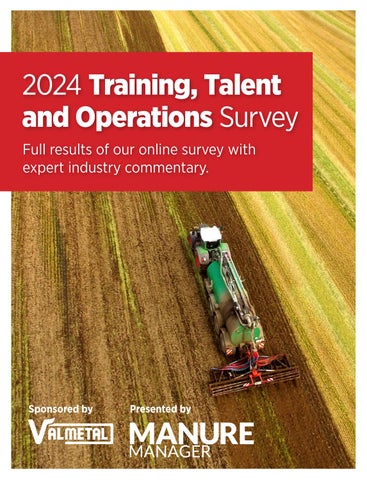
2024 Training, Talent and Operations Survey

Full results of our online survey with expert industry commentary.

Presented by Sponsored by

About the “why”

Kids love asking “why?” Part of it is that children are insatiably curious. Another part is that when you’re young, asking “why?” usually guarantees an answer.

Alas, some of us never outgrow our “why?” phase. And that usually makes us well-suited toward particular careers. There’s journalism (obviously), analysts, academics, researchers and a number of other more practical applications.

It was that insatiable “why?” that led the team at Manure Manager to launch an industry survey. It started with us wanting to understand what was driving certain content consumption online – why certain features got more clicks than others, why certain topics seemed to always soar above others in terms of interest, regardless of the time of year.

We hadn’t done an industry survey since well before the 2020 COVID lockdowns, and a lot has changed since then. Yes, we’ve had a lot of valuable industry conversations, like the ones at the North American Manure Expo, where we get to visit with applicators in different parts of the continent. Conversations are essential, but there’s also no substitute for data.

Data can help you figure out what your blind spots are. It’s crucial, as content creators, to ask ourselves, “Are we creating enough content about a subject?” “Are we creating too much about another?”

“Do people have time to engage with our content their way?”

As we tried to figure out the best approach to our survey, we kept coming back to the topic of time. How applicators and business owners spend their resources is important, and one of the most key resources is time. (I’ve heard more than a few people say time is money).

It takes time to train. It takes time to re-train. It takes time to research. It takes time to ensure proper safety precautions. It takes time to take proper care of your employees. It takes time to place a job ad. It takes time to recruit. It takes time to repair things. It takes time to evaluate equipment and make purchases. At a certain point, you only have so many hours. And while you hope that you have enough hands to help you out –maybe one of your children, nieces or nephews – as they say, good help is hard to find. And so, our survey largely set out to determine the priorities of for-hire manure hauler and applicator businesses, especially in terms of how their time is spent.

The results indicate that our readers care a lot about quality. However, some struggle with a lack of manpower, or a lack of up-todate training on-staff. As a result, they’re more likely to turn down jobs or take longer to do them than they are to sacrifice quality. But some fear that they won’t be able to retire when they’d like.

Proceed to our survey on the next page for a full summary of the results, including some demographic breakdowns.•

MARY BURNIE (519) 429-5175 mburnie@annexbusinessmedia.com

Media

ALISON KEBA Group Publisher MICHELLE BERTHOLET mbertholet@annexbusinessmedia.com

Audience Development

SHAWN ARUL (416) 510-5181 sarul@annexbusinessmedia.com

CEO SCOTT JAMIESON sjamieson@annexbusinessmedia.com

The results are in

What we learned in our first-ever Training, Talent and Operations survey

In mid-2024, we decided to launch an industry survey to better understand how for-hire manure hauler and applicator businesses are spending their resources and time. What are some of the gaps in need of filling? What are some areas of struggle? Are they optimistic about the future?

Our online survey consisted of 25 questions, mostly multiple-choice. It was promoted through our print magazine ads, our digital and social media and at the North American Manure Expo. We incentivized participants with the chance to win one of three gift cards. Our survey was launched into market in June and closed Aug. 30. A total of 74 respondents filled out the survey. Results were shared among the Manure Manager team and a small panel of industry and extension commentators through a Zoom panel. The following are the full results, along with commentary from our panel.

* Indicates a question for which multiple answers could be selected

Part one: Businesses at a glance

Panelists

Eric and Megan Dresbach

President and vice president

W.D. Farms

Kevin Erb

Conservation professional training program director, University of Wisconsin Extension

Mary Keena

Livestock environmental management specialist, North Dakota State University

Melissa Wilson

Associate professor and extension specialist, University of Minnesota

Hiring seasonal employees back

51% All staff employed yearround. 37% Some seasonal adjustment and temporary employees. 12% All employees are seasonal.

Additional figures:

• 45% of businesses in their first five years of operation have one to three employees.

• 45% of businesses in their first five years of operations have four to six employees.

• 9% of businesses in their first five years of operations have 10 or more employees.

• 40% of legacy businesses (25 years or more) operate with one to three employees.

• 33% of legacy businesses operate with 10 or more employees.

• 28% of legacy businesses operate with four to nine employees.

• Overall, while there is a positive correlation between years in business and the likelihood of having a larger team, it is also a popular choice for companies among all ages/life stages to operate with small and lean teams.

Bree Rody: We saw a polarity in that most of the respondents were legacy business of 25 years or more, but the next-most answer was five years or fewer. Is this indicative of more people

getting into the business in the last five years? Or is it that businesses have a hard time getting past the five- to 10year mark?

Kevin Erb: When looking at the long-term trend in growth from [the Professional Nutrient Applicators Association of Wisconsin], I think the exits in 2020 were folks that got more into the long-distance trucking side of things, those folks who found more lucrative jobs elsewhere, given the effects of the COVID economy and the recovery. But overall, we’re seeing that longer-term trend of increasing numbers of businesses in the manure hauling, manure transport and manure application sector.

BR: And in terms of size of teams, can anyone speak to that polarity? The most popular choice was one to three employees, but again, the next-most popular choice was 10 or more. What are some of the conditions, environmental, economic, that can prompt the need for more or less manpower?

Melissa Wilson: Our smaller operations are typically going around dealing with smaller operations – it’s one

to three people, going around, dealing with smaller farms. I feel like the bigger operations we see are usually associated with the bigger, 10,000-cattle operations, because they’re usually managing all the farms in that region.

Mary Keena: My longer-term firms tend to be larger. They have more employees. The younger firms who are just starting out, it’s one or two brothers, cousins, dad and son, just a couple people helping people down the road.

Part two: Recruitment, staffing, training and re-training

KE: The requirement of a CDL (commercial driver’s license) has been a challenge for manure moved by truck, because of competition for those with that credential. In the mid [2010s], it was competition with the frac sand industry – dump trucks, high wages, set hours, overtime.

Later in the decade, it became overthe-road trucking [that] was paying better. What we’ve seen is a huge increase in owner-operators who run the semi cab,

and today hook onto one farmer’s manure tanker, tomorrow their forage semi, and the day after something else.

Megan Dresbach: For the guys just starting out, it’s going to make sense that you have [only] a few employees. You’re not going to have the capital or the equipment or the customer base to hire full-time. You [usually] start hauling on the side. But after a few years, you’re going to start to build it up, and start to offer employee benefits and such.

Do most of your staff come with relevant manure experience?

• 48%: They have general ag experience, but not manurespecific experience.

• 20%: They have some experience handling/applying manure.

• 18%: They have thorough experience handling/applying manure.

• 14%: They have no prior agriculture or manure experience.

Do most of your staff come with prior equipment operation experience?

• 58%: Some heavy equipment/ag equipment experience.

• 22%: Thoroughly experienced in heavy equipment/ag equipment operation.

• 20%: No heavy equipment/ag equipment experience.

What do you feel incentivizes staff to work for you?*

• 64%: Competitive pay and benefits

• 39%: Work-life balance

• 19%: Continuing education opportunities

• 18%: Ownership opportunities and/or business mentoring

• 6%: Other

• 8% say they do not know what to offer and are struggling retaining staff as a result.

Do you feel your staff is as up-todate and knowledgeable as they could be?

• 48%: Some operators lack knowledge, but there are others there to help them.

• 38%: Everyone is up-to-date and adequately trained.

• 14%: No, there is a significant need for guidance among some operators.

What has been the impact of understaffing and/or lack of experience/knowledge?*

• 37%: Operators are tired, stressed and/or overworked.

• 28%: Jobs are not completed in a

timely manner.

• 25%: We have to turn down jobs.

• 25%: Operators are unsure of how to use the equipment to its fullest potential.

• 21%: Safety is a concern.

• 18%: Quality is being sacrificed.

• 3%: Other

• 21% feel all staffing/knowledge is adequate.

For trained/senior operators, do you require regular re-training or continuing education?

• 48%: No, but I encourage it.

• 34%: Yes.

• 18%: No.

For those who require/encourage operators to re-train, do they do so with their own time and/or money?

• 79%: They train on company time/money

• 12%: The company pays, but they must do so on their own time.

• 9%: They must re-train on their own time/money.

What, if anything, stops you from offering as much re-training as you’d like for operators?*

• 61%: Lack of time.

• 40%: Financial constraints.

• 25%: Resources not available in my region.

• 20%: I am able to offer as much re-training as I would like.

• 3%: I believe operators should be responsible for their own retraining.

How do you hear about courses, workshops and other programs for operators?*

• 61%: Traditional media.

• 54%: Outreach/extension.

• 35%: Social media.

• 32%: Word of mouth.

Additional figures:

• 55% of businesses in their first five years of operation say competitive pay/benefits entice people to work for them. By contrast;

• 63% of legacy businesses say this is the case.

• 26% of legacy businesses attract new talent via job ad, and 9% via job fair, whereas newer businesses all trend almost entirely toward referrals and preexisting relationships.

BR: It seems very clear that acquiring talent through preexisting relationship remains very common in the ag field. That doesn’t seem likely to change. Also, fewer than 20 percent of respondents say their new recruits come with thorough manure experience. The willingness to train seems to be there, possibly more than in other industries, but is manure a simple matter to train people on?

MD: Absolutely not, and I think that’s why you’re getting those responses. It’s going to be rare that you’re going to find someone with that experience. Yeah, we’re a big industry, but we’re small. So to find someone who’s done it before is going to be rare. If you want to do this, you have to train. There’s a benefit to that.

In our operation, we’ve got a lot of young guys. We hire them, we train them, they’re here for a few years, and then they find a better job. And no hard feelings, but this is ag, it’s weather-dependent and it can be crazy, but a lot of people want the nine to five. We focus on not just the manure skills, but the life skills as well.

Eric Dresbach: In our operation, retaining labor has come back to one thing: treating employees like humans. It’s amazing how many companies don’t do this. I have had so many employees leave for what they thought were greener pastures and came back because they were treated much better working for us.

KE (to Megan Dresbach): I’m curious, because what we see is two different age groups in our manure haulers. We see that 18-to-21year-old, young whippersnapper, who then go on with their CDL and do something else. But then we

have a number of retired farmers who, after they’ve sold the cattle or they’ve decided to change what they do, that they’re in there parttime as well. Are you seeing that over in your part of the country?

MD: Possibly. It depends on the area. We’d love to find some retired guys. But personally, it’s young guys here. We’re from Southern Ohio, we were working in Northern Ohio, we called one of our buddies and he sent over a couple retired drivers. He said, “I can find them a dime a dozen.” We’re just located in the wrong part of the state to apparently have that retiree pull. We’ve done that in the past, but I’d say that’s a mostly accurate statement.

BR: Extension is obviously a highly valued part of training and re-training. And, the biggest area our respondents wanted more training and re-training in was safety, followed by soil and water conservation, and increased manure knowledge. For our educators, what have you seen the biggest interests in, and the biggest increases in?

MW: Safety, especially if there’s been an accident, then people really want to see safety again. For us, we’re seeing more and more people who want to see information on new equipment and how it affects soil health – no till, things like that.

MK: Soil health is something my haulers ask about a lot – soil compaction issues. What happens when spreading? What happens when putting this product on? They’re also interested in what the manure does – how does it actually help the plants grow?

They want to go a little bit deeper than “We know it’s good because we spread it behind the barn for 40 years and then that crop grows really well.” They want just a little bit more. Weed management [is also] one of our biggest things. When folks say, “We don’t want to spread manure on our lands,” our haulers ask why, and they

Yes, there are always enough staff to get the job done. 10% No, we are definitely understaffed

say, “Because of the weeds!” So they want information on weed management quite often.

KE: I wonder if that’s not a function of size of the operation. What I tend to see is it’s the business owners, and maybe the people who are crew supervisors with long-term experience asking those questions.

But the driver who’s only on the job two or three years doesn’t care about soil health, doesn’t care about compaction. I don’t get an interest in those topics from those employees that are not going to be around long-term. Do you think it’s more the established people in the business who are asking those questions?

MK: One area where Kevin’s and my state differ is many of our firms, the owner is also the hauler, is the loader, is the person communicating with clients. They’re everything. So when I say “bigger firms,” that’s sometimes up to nine employees, but really, three to five. And they’re pretty bought in on what’s going on with the whole operation.

They’re either family, agedaway workers who have come back several times, employees that come back, even if they’re seasonal. We see something different, where all of them are interested in doing the things they’re asking, but that’s because they’re the owner or they’re going to be taking over or they’re working with a customer. They’re kind of everything.

BR: For the operators, what are the subjects you want to learn more about for your business?

ED: How to make life easier and educational. We’ve got the generator, the applicator and the corn farmer – the crop farmer. Trying to educate the crop farmer on all the value that manure brings to their operations, as well as the negatives of compaction and timing and what is in it. We need more corn farmers to take this product and spread this product out better. Education of the corn farmers is our

biggest concern. Of course, safety. We’ve got a pretty good track record here, but gas safety hits close to home for us.

BR: A combined 76% of respondents said they’re somewhat or definitely understaffed, and a combined 61% say there are some to significant knowledge gaps. Barriers include lack of time, financial constraints and geographic availability of these resources. From the educators, do you feel there is enough out there?

MW: We have a lot of stuff online, but I know applicators aren’t just going to read stuff online. We always have that tug and pull –they want in-person training, but they don’t actually want to come to in-person training. How much online do we put out there? You can only put so much because our requirements for re-certification are three hours every two years.

We have to have a mix, certain topics have to be covered. We’ve actually been decreasing some of our in-person [training], because there’s only so many times you can go and have two people show up. We’ve been trying to narrow down the popular locations, and hopefully get people coming to those locations, and get more people at fewer locations. It’s getting more and more expensive to hold those trainings.

BR: Virtual and webinars are checked as a popular choice, but have you seen an increase in the adoption of the virtual training? Obviously during COVID, the appetite was really big.

MW: Sometimes it seems like the older generation that wants the in-person training, and they’ll often bring their whole staff because they want to get it all done in one day. But we’ve now been getting hounded about online training, so there’s an appetite. Our first year during COVID, we had 40 people completing it, but I think the last few years, it’s only been 15 to 20 people completing it annually.

ED: In-person meetings are

What resources are part of your training for new hires?*

Third-party courses (extension/institutions)

Third-party courses (manufacturers)

How do senior/trained operators engage in re-training?* 50% Field days, workshops and courses (Extension/ institutions)

preferred [because] the option for networking during lunch and after are so much better. That being said, I understand having to offer options and being cost effective.

MK: If we’re doing it for two, it costs the same to do it for 20. But, in having conversations with them, the folks that show up say, ‘you can’t not have this meeting. We’re here. Do it for us.’ It twists the knife a little bit, because you feel like, ‘We should do this.’ I don’t know if it’s an after-COVID thing, if it’s a new workforce thing. I think another huge thing is, do you want to train someone who’s only going to be with you for six weeks?

KE: In the states where training, certification is mandatory – Minnesota, Iowa, others – people do take the online training. In the states where it’s not mandatory, what we’ve put together for the five states we have, I have had one person ask for access in the last 12 months for all the work we’ve done. On the other hand, if you look at Michigan, which has really paired up its online training with Farm Bureau Insurance to provide a significant insurance discount, and also paired it up with their voluntary farm inspection program, they’ve had over 100 people go through the online training. It’s basically ours reformatted

and repurposed.

If training is required for state certification, or if there’s a significant financial or other incentive, people will do the online if they can’t make the in-person. They prefer the in-person. In states where there’s not a requirement, they won’t do the online. They will only go to the in-person.

MK: In my state where it’s neither voluntary nor mandatory, I just have a meeting. They don’t get a certificate or anything. We’ve been doing it for seven years now, and I always have at least 10 that come. They won’t do anything online, but they still want the information. It’s enough for them to show up.

BR: More than a third of our respondents say they or their employees are tired, stressed or overworked. Would you say your operators have been experiencing a higher amount of stress than usual? Are you trying to mitigate that?

ED: Tractor drivers have a certain workload, and their stress is whatever’s in front of them for a day. Upper or middle management, our stress levels are pretty high because we lack at least one key employee that we can trust to cover the bases, so the three of us are carrying more of a workload than we have in the

past. Central Ohio is booming, so hiring somebody is crazy. [Some are] paying $30/hr for someone who just walks in off the street, and they don’t have any real responsibilities. Our job market now is probably as tight as it’s ever been.

Going back to some of the original questions, working off referrals, hiring some 16- or 18-year-old kid, when they get out of high school, they can become operators. Megan is certified so we can actually train someone to get their CDL. That’s a real hook for us with hiring – we’re able to offer a CDL as a fringe benefit if they’ve been with us for a while. But yeah, right now, the stress level is pretty high. Right now, we’ve had extreme dry weather. It could rain two inches and we could still work tomorrow.

MD: It’s very demanding. Our customers expect the best, so we’re go-go-go all the time. We’ve got a lot of work to do. We turn down things all the time, just because we don’t have the time, the equipment, the labor.

There’s lots and lots of factors, but being upper management, my brother and dad and I carry a lot of stress. We’re doing a lot of different things. It’s a lot. It’s not for the faint-hearted. If you’re not invested in this business like family member or owner, you can call it quits, but we can’t.

Part three: The future

Do you have a succession plan in place/do you know what the next three to five years look like?

• 38%: “I don’t have a formal plan, but I have some ideas.”

• 37%: “I have a plan, and things are going according to plan so far.”

• 14%: “I have a plan, but things are diverging from that plan and I must adjust expectations.”

• 11%: “I do not have a plan.”

Do you plan for someone to take over your business when you retire?

• 42%: Yes, one of my children/ younger relatives likely will.

• 33%: I would like someone to take over but I do not have a solid plan in place.

• 11%: Yes, one of my younger staffers/operators (non-relative) likely will take over.

• 10%: I plan on selling the business.

• 4%: I’m not sure/other

Do you feel with the current state of the industry, you will be able to retire when you want to?

• 41%: No, I might have to retire later than planned.

• 27%: Yes, it’s all going according to plan.

• 23%: I’m not sure.

• 9%: I might have to retire early because I cannot do the job anymore.

BR: There are quite a few people who say they don’t have a formal plan but have a general idea of how they’d like things to go. There’s a recurring theme we’re seeing of having an idea of how things should go, but not having a clear enough plan. Do you feel there are sufficient resources for setting people up for succession planning? Are older operators being supported?

ED: It’s sometimes hard not to get pushed out the door by the younger generation. I’m only 64, and we’re talking about things. We haven’t pulled the trigger on it yet. I’m not planning on retiring or walking away for some time. David and Megan have a big chunk of the reins, but it hasn’t become official yet.

MD: My brother Dave and I, we’ve had a lot of power from a young age. As soon as we were 18, we were on the checkbook. We always had to verify things with Dad, but we started transitioning the trucking part of the operation to me when I was 17, and we finalized it in my early twenties. My brother and I are very fortunate to have a parent who says, “One day, I’m going to die, and I want this business to survive. You guys are interested, so I’m going to let you do these things and make these decisions.” •

36% of respondents from newer businesses already feel they will have to retire later than usual.

18% of respondents from newer businesses report not having a succession plan, whether formal or informal. By contrast;

7% of respondents from legacy businesses report not having a formal or informal succession plan, indicating that more well-established businesses are more actively thinking of the future.

Turn static files into dynamic content formats.

Create a flipbook
Issuu converts static files into: digital portfolios, online yearbooks, online catalogs, digital photo albums and more. Sign up and create your flipbook.