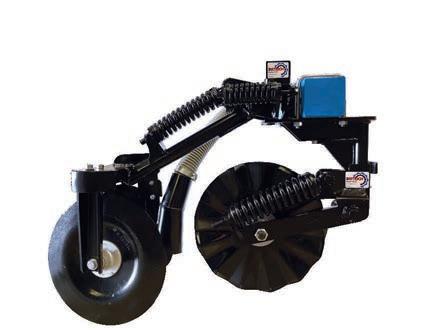
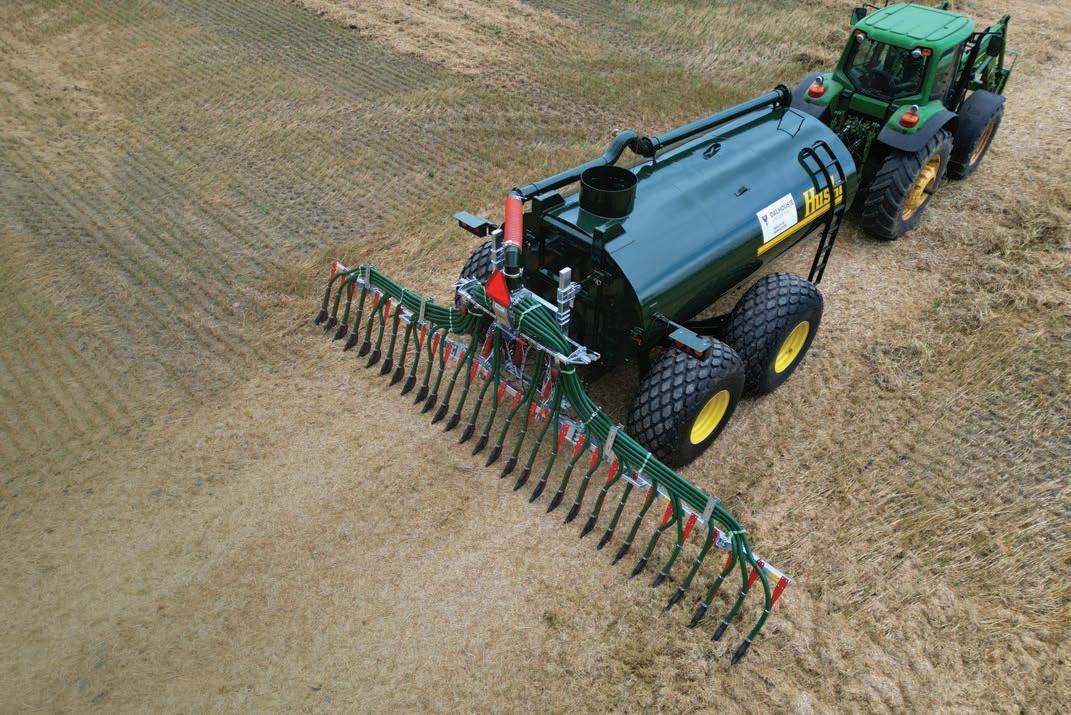
• Covering Blades adjustable for maximum coverage or minimum disturbance
• 24” – 30” spacing
Rugged Design 3
• Best Warranty
• Best actual injection/coverage of wide gallonage ranges
• Best Durability
• Best options for various requirements
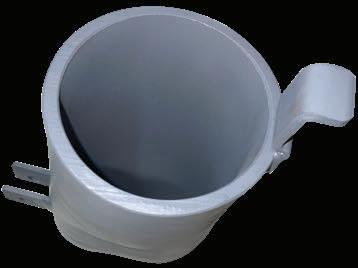
• 4.2” DOM Slurry Tube for heavy wall injection hose
• Highest GPA actually injected/covered in the industry
• Non-grease hubs on all models for maintenance free operation
• Swivel coulters reduce side loads
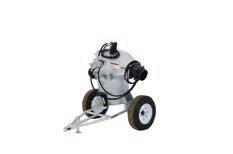
DIETRICH Rotary Injector
• 18” – 30” spacing
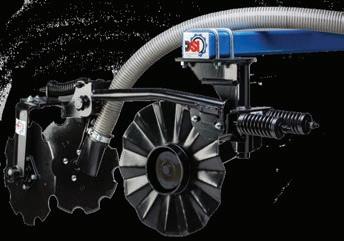
• Patented Conical blade creates a wider furrow for higher GPA than conventional coulter/vertical till injectors
• 18” spacing, 8 wave Conical blade, & 2 Clozr blades on dragline result in higher GPA injected/ covered than a single closer blade design
DIETRICH
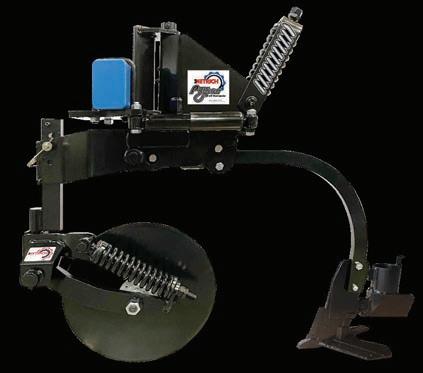
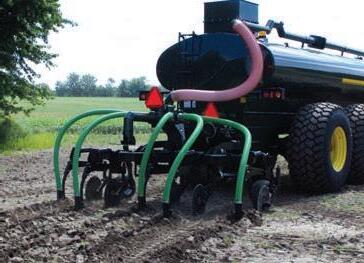
Series 70 A/R Sweep Injector
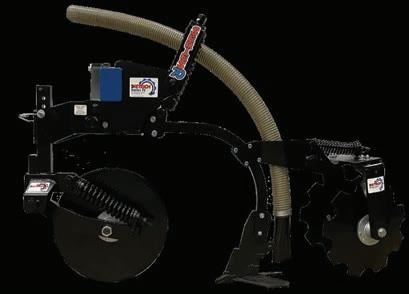
• DSI’s signature injector
• High performance Coulter down pressure design
• 4 Sweep options for lower rates to 20,000+ GPA
• 5 Tube options, including plug-free wing drop
• Liquid stays where injected, properly placed for full utilization by crop
• Clozr option for different operation requirements
November/December 2025 Vol.23, Issue 6
Mind
BY JACK KAZMIERSKI
BY RONDA PAYNE
Manure
JIM TIMLICK
TREENA HEIN
It's good to get a dub these days
Two big wins – “dubs,” as the Gen Alphas in my life keep insisting – came my way recently.
On a professional level, Manure Manager completed its first-ever Separator Week. For five days, more than 120 registrants took in free webinars from researchers and educators on the value of separation, and making the most of separators in manure management. They were accompanied by brand representatives who walked viewers through the latest in separation technology, giving detailed, personable explanations on why a machine might be right for your operation. It was gratifying, and people genuinely learned from it.
On a personal level, the Blue Jays made it to the World Series for the first time since 1993. By the time this magazine hits the stands, their fate against the Dodgers will be decided, but for now, it remains a mystery. While it’s not something I personally achieved (unless my name is George Springer), it felt personally good.
Outside of the rare Blue Jays
simply kicking back. These times can make it hard to really appreciate a good dub – like an especially bountiful harvest or a streak of good weather. With a whole new series of “what ifs” on the horizon, it might be hard to fully think about machinery upgrades or updating your manure management plans.
Virtually all producers who store or stockpile manure want to do the right thing – as our feature on page 10 notes, minding their “manure manners” – but information is not always readily available and can vary state-by-state. As the ground cools and some producers run out of time to spread their manure, take it from us: don’t wing it. Take the extra couple hours to ask around, call up your local farm services agency office, or, if they’re not operating (as of press time, FSAs were scheduled to reopen) check in with local extension and know the rules. Why risk a fine? Put yourself in a position of predictability.
Proactive manure management keeps your manure valuable.
baseball broadcasts, the other signs of fall have arrived. It’s crisp, and although there is still some harvest activity in nearby fields, it’s trickled since the peak a few weeks ago.
You’d be hard-pressed to find a farmer who isn’t relieved when harvest is over. But now, trade troubles, extreme weather events and even the (as of press time) stillongoing U.S. government shutdown have plunged many growers into uncertainty. It’s hard to picture anyone
Not much else in life is certain. The last year has definitely proven it. Sure, not all unexpected things are bad (like a certain ball team going on a deep postseason run), but doing what you can to mitigate unpredictability is objectively smart.
But proactive manure management – and storage is a big, expensive part of that – is instrumental in keeping your manure valuable and out of the wrong places. And doing that helps the manure industry’s reputation –win, win, win!
It’s good to get a dub these days. •
New York State funds manure management practices
More than two dozen soil and water conservation districts around New York State will reap the benefits of a combined $25 million in funding, awarded by the state to help farmers protect water quality.
The grants come from the Environmental Projection Fund and, for the first time, the state’s Environmental Bond Act of 2022. Initiatives include streamside vegetation buffers, cover crops and manure
management, all of which are proven positive practices to conserve water quality.
Funding highlights include the constructions of new manure storage systems or the expansions of existing ones to prevent or reduce runoff or to eliminate/reduce the need for spreading during winter and other adverse conditions; bedded pack barn construction; barnyard runoff management projects and more.
Study finds manure may suppress tricky weed
In Minnesota, where livestock manure was identified as a major pathway for the invasive Palmer amaranth weed, a recent study found some redeeming qualities for manure.
The study from the University of Minnesota looked at the use of black soldier fly larvae (BSFL) as an effective management strategy against weed seeds in manure. BSFL are known to feed on organic materials
including livestock manure, and have several proven uses for manure management. However, this is one of the first major studies about their effect on weed seeds.
The study, which covered a 10-day incubation period, has so far not been highly flattering for BSFL when it comes to palmer amaranth management – the addition of BSFL to manure did not affect the number of seeds
recovered, or their germination, in the fields studied.
But the results did have some nice implications for manure. A significant reduction in seed germination observed in manure treatments, regardless of larval presence, “highlights the inherent suppressive effects of manure,” the study concluded. This could be due to elevated ammonium concentrations, reduced
oxygen availability, the presence of phytotoxic compounds or a combination.
Therefore, although manure can be a vehicle for weed seed transport, the results point to manure treatment as a possible avenue for passive weed suppression – no need to mix in the BSFL. The detailed study results are published in the journal of Agrosystems, Geosciences and Environment.
BY
THE NUMBERS
something about where the info from
83% Canadian pig farmers who store liquid manure as of 2021, a drop from 93% in 2017.
78% Canadian dairy farmers who store liquid manure, up from 76% in 2017.
18% Canadian dairy farmers who store solid manure.
73% Amount of solid manure structures on Canadian dairy farms with a concrete or impermeable pad.
1 million gallons/100 cows
42%
Canadian beef farmers who store solid manure.
Suggested minimum manure storage capacities for 12 months of storage in North America
ON TRACK
JCB makes headway on San Antonio plant
JCB North America has reported significant progress on the construction of its new, one-million squarefoot manufacturing facility in San Antonio, TX – which it estimates will create 1,500 jobs. Construction continues on schedule, with production set to launch in mid-2026.
The facility will serve as a hub for producing JCB’s telehandlers and mobile elevating work platforms. The $500 million price tag on the investment makes it the single-largest investment in the company’s 80-year history
JCB manufactures globally, with half of its 22 total factories located in the U.K. It also has one manufacturing site in Brazil and one in China, as well as several in India. The San Antonio facility is not its first plant – it also operates a facility in Savannah, GA, which as of 2023 employs 1,000 people –but the company has stated that this significant expansion highlights its commitment to U.S. manufacturing and a desire to strengthen its U.S. supply chain.
Although full hiring will begin in late 2025, the company has already begun hiring key roles in San Antonio, and is focused on building a workforce from both the local community and veteran populations.
T7.270 hits the stage
At the upcoming Agritechnica 2025 show in Hanover, DE, New Holland will unveil the evolution of its T7 tractor range. This unveiling is centered around the T7.270 Methane Power CNG (Compressed Natural Gas) tractor. The T7.270 was first previewed at Agritechnica 2023, and is now making its official debut, taking the brand’s alternative fuel technology further up the power scale to benefit a broader range of farmers. Initially, the tractor will only be commercially available in Europe, beginning spring 2026.
The T7 can run on biomethane derived from livestock manure, supporting on-farm sustainability. In partnership with Bennamann, New Holland enables farms to capture, process and refine fugitive methane for use as fuel. This closed-loop system reduces emissions, cuts fertilizer use and can even achieve a negative carbon footprint.
Recently, New Holland North America and CNH established partnerships with Michigan State University and Penn State University that made T6.180 Methane Power tractors available to both universities to enable their students and researchers to gain hands-on experience with alternative energy technology and study the tractor’s benefits for sustainable farming.
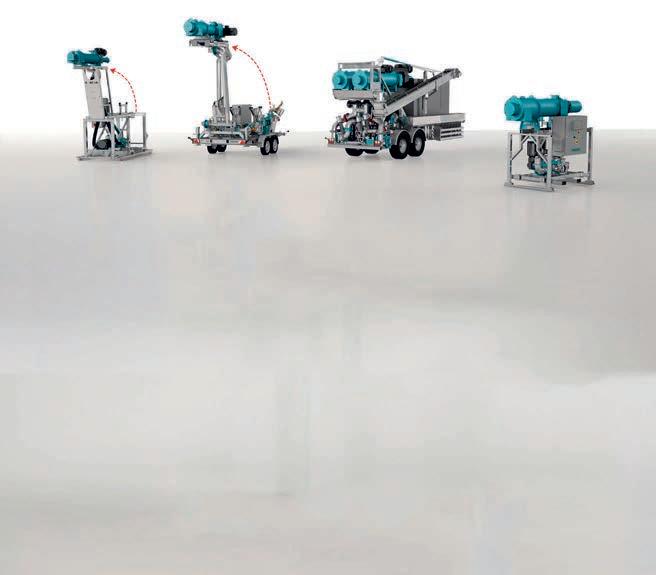
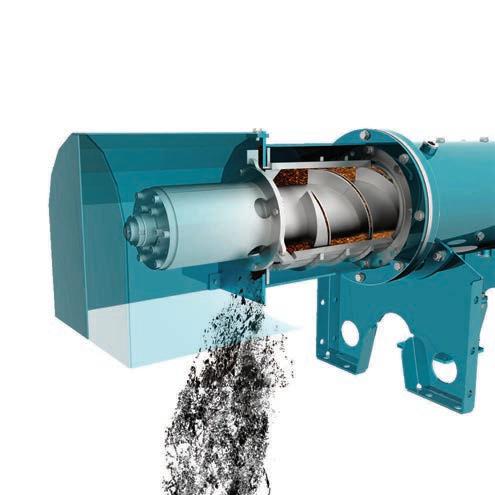
INNOVATIVE BIOSELECT FOR EFFICIENT MANURE SEPARATION. + Low Life-Cycle Costs
+ Turnkey from a Single Source: Separator Pump(s)
Control Unit
Stationary or Mobile Skids
+ Patented Profile Auger with Counter Bearing for No Auger Screen Contact
+ Continuously Variable Dry Matter Content
+ Large Capacities
844-647-7867 www.boerger.com
Measure the treasure: Part II
When manure is applied to soil, the nutrients it contains don’t instantly become available to crops. Instead, a series of chemical, physical and biological processes unfold between application and nutrient uptake. Factors such as manure composition, site conditions, and weather all influence how quickly nutrients become available – or are lost to the environment. Soil microorganisms play a key role in this process, using carbon for energy and nitrogen for growth as they break down organic matter.
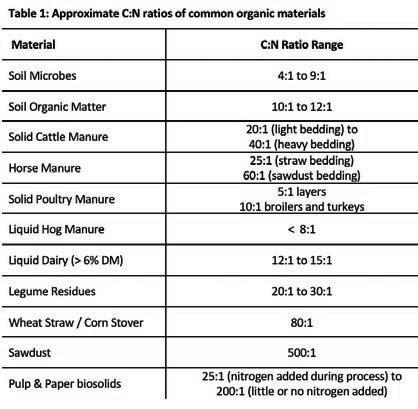
When manure is applied to a field, it adds both nutrients and organic matter to the soil. The carbon-to-nitrogen (C:N) ratio in a manure analysis indicates the proportion of organic carbon to total nitrogen in the material. Table 1 shows the approximate C:N ratio for common organic materials.
The typical soil C:N ratio is around 10:1, which represents a stable equilibrium that supports nutrient cycling. Soil microbes rely on this balance. When the C:N ratio of an amendment is higher than that of the soil, microbes will immobilize nitrogen – using it to break down excess carbon. This can temporarily reduce nitrogen availability
to crops, potentially causing deficiencies. Conversely, if the C:N ratio is lower than that of the soil, decomposition occurs rapidly and nitrogen is mineralized, increasing its availability to plants.
ABOVE
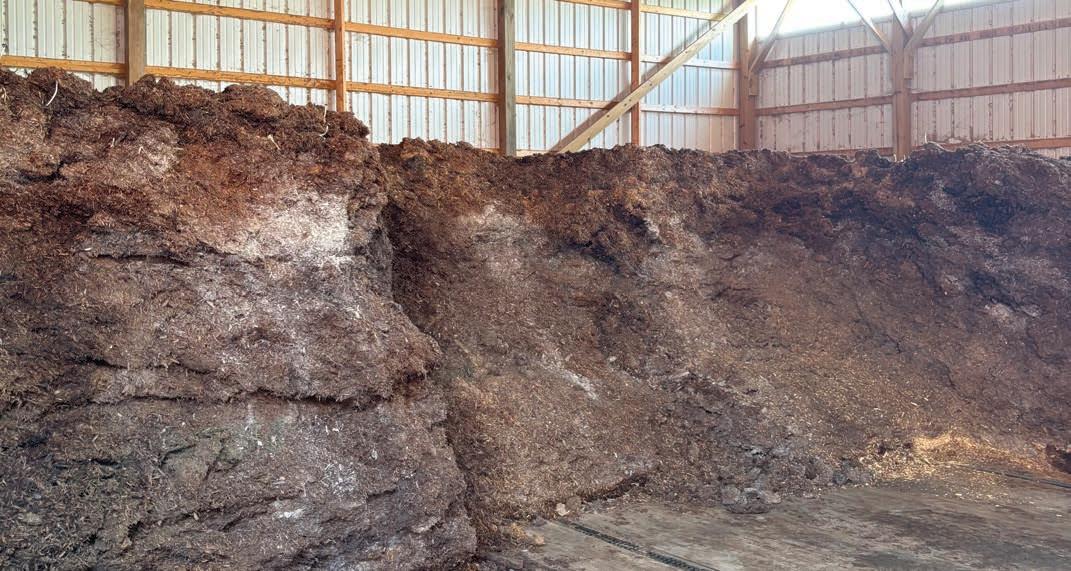
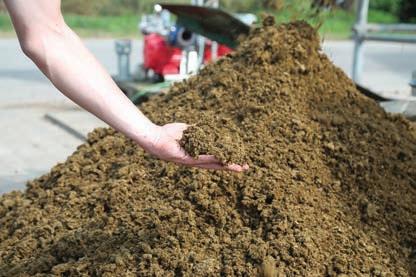
Solid manure on an Ohio farm, prepared to be brokered and applied to fields.
PHOTO: BREE RODY
INTERPRETING C:N RATIOS FOR NUTRIENT MANAGEMENT
An analysis that includes C:N ratio is effective since there is a wide range within and between livestock species. Generally,
• Liquid hog manure, with high N and low carbon has a C:N ratio ranging between 2:1 to 6:1, resulting in rapidly available N when soil microbial populations are active
• Liquid dairy manure (undiluted) will generally have a higher C:N ratio (around 12:1) due to forage-based rations. The higher the water content, the lower the C:N ratio.
• Horse manure with high bedding may exceed a C:N ratio of 50:1, leading to nitrogen immobilization unless supplemented.
• Poultry manure, often bedded with wood shavings, typically has a C:N ratio near soil equilibrium, making it a good source of readily available nitrogen.
• Pulp and paper biosolids can range from 25:1 to over 200:1. Without added nitrogen, their contribution to crop nutrition may take more than one growing season. Some processors add nitrogen to reduce C:N ratio to near 25:1, improving nutrient availability.
When heavily bedded manure with low nitrogen content is spring applied ahead of a nitrogen-demanding crop like corn, supplemental nitrogen may be necessary to avoid early-season deficiencies.
WHY C:N RATIO MATTERS IN A MANURE ANALYSIS
Including the C:N ratio in a manure analysis helps predict:
• When nitrogen will become available
• Whether supplemental nitrogen is required
• How manure will interact with soil microbial activity
For example, solid cattle manure with a higher proportion of organic N and a higher C:N ratio may release more nitrogen when applied in the fall, allowing microbial breakdown to begin before soil temperatures drop below 10oC (50oF). In contrast, the same manure spring-appliedmay be slower to release nitrogen when crop needs are high due to cooler soil temperatures and slower microbial activity.
Even liquid cattle manure with C:N ratio close to soil equilibrium may not release nitrogen in sync with crop demand during a cool, wet spring – sometimes requiring additional commercial nitrogen to support early-mid-season growth. •
SEPARA-
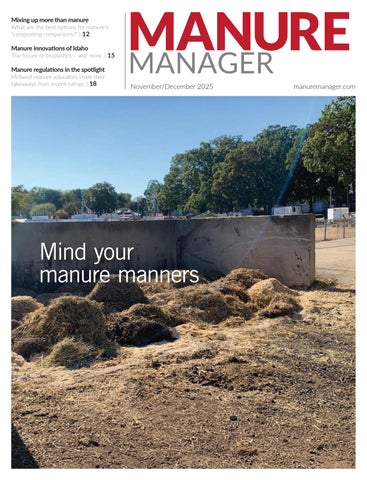
MIND YOUR MANURE MANNERS
Best practices for in-field stockpiling
BY JACK KAZMIERSKI
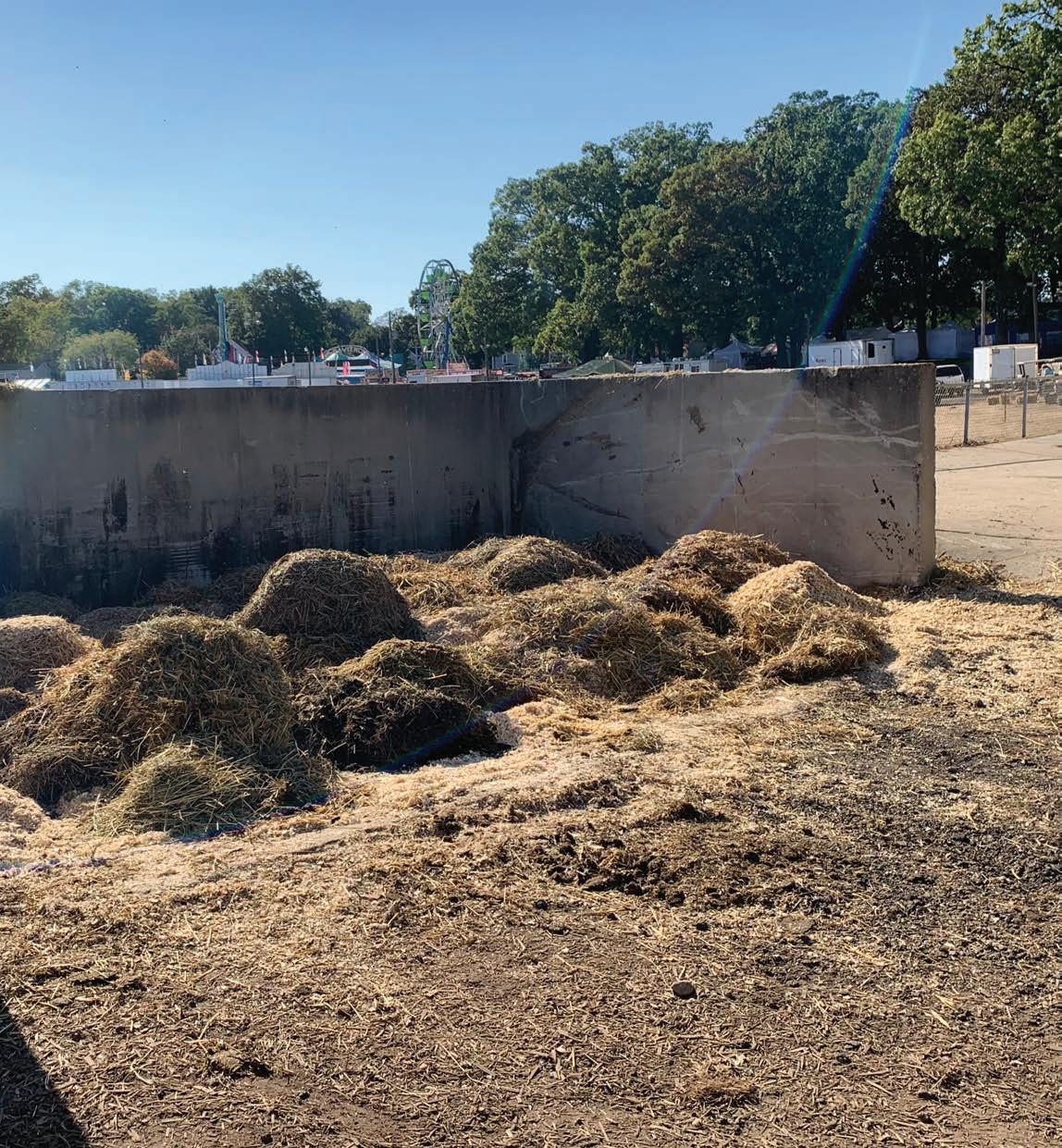
In a perfect world, livestock producers would always be able to supply farmers with manure exactly when they need it, resulting in a perfectly choreographed just-in-time delivery system where stockpiling manure would never be necessary. In the real world, however, infield stockpiling is a fact of life, and it needs to be managed properly in order to maximize the nutrient value of the manure, reduce its impact on the environment, and minimize friction with neighbors.
Dr. Amy Schmidt, professor, departments of biological systems engineering and animal science at the University of Nebraska–Lincoln sums up the problem farmers face: “I would say that with solid manure sources, like poultry litter or beef cattle feed lot manure, oftentimes, when those materials need to be cleaned out of the building or the feed lot, the timing doesn’t necessarily coincide with when crops are out in the field and we can land-apply manure. So, if a farmer wants poultry litter, or beef cattle manure, or any other solid manure for their field, the only option is to have it stockpiled or dumped on the side of their field so that it’s there for when they need it.”
COMMON SENSE APPROACH
ABOVE
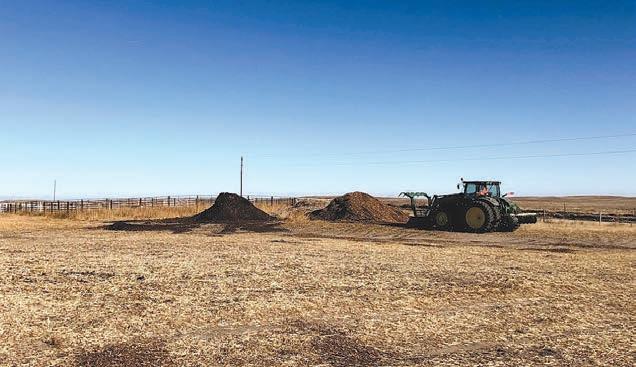
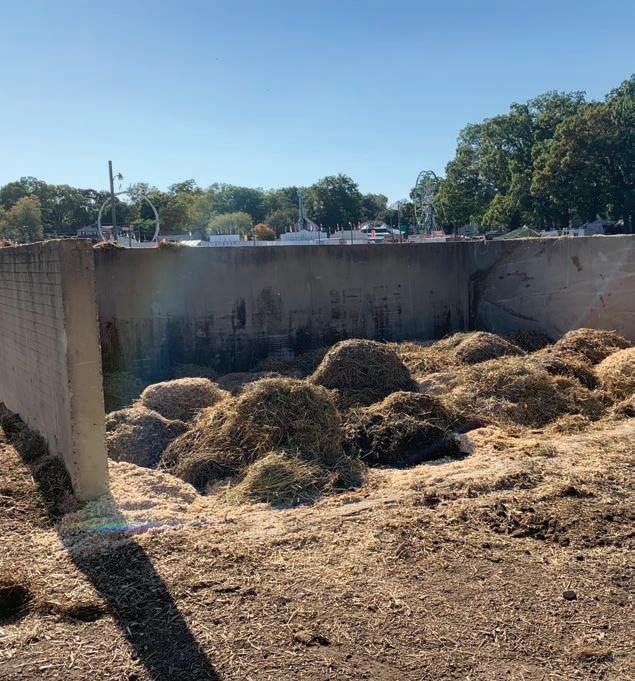
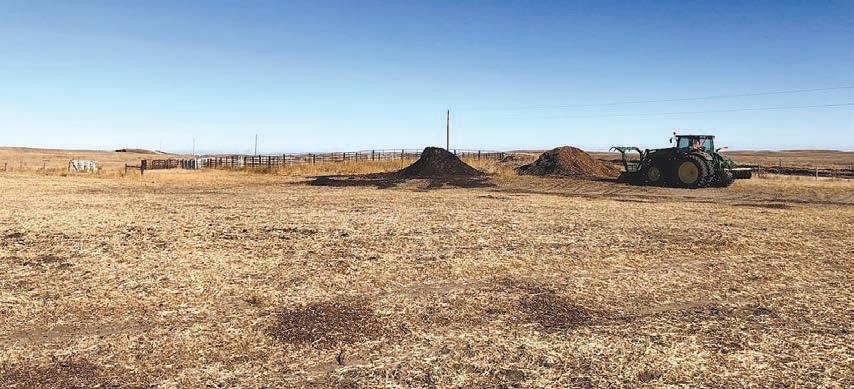
Manure and mulch on the edge of a field in Nebraska.
Many of the in-field stockpiling best practices could be summed up in a single phrase: Be a good neighbor, and use common sense. “Put the manure somewhere where it’s not going to create runoff into a water body. Build a berm around it if necessary, and keep it out of low spots in the field where water typically ponds,” says Schmidt.
“Don’t simply put it the most convenient spot in the field if you have a neighbor right next door. Be respectful. If it’s going to sit there for a while, they’re going to smell it, so don’t put in next to your property line.”
Sarah Zeiler, environmental management educator at Michigan State University Extension suggests covering the stockpile. “These piles are temporary, and hopefully they’re going to be there for six months or less,” she says. “We like to see them covered, even with straw.”
While a covering may not be necessary in drier parts of the country, Zeiler says that a stockpile of uncovered manure can attract insects in states like Michigan that can get a lot of rain. Uncovered manure can also attract unwanted animals, and is more prone to runoff in wetter weather.
“So it really depends on the climate in your area,” she says. “If it’s wetter, then you’re going to need to take steps to cover the pile.”
Zeiler notes that although in-field stockpiles of manure are typically left uncovered, “if you’re going to leave the pile in place for an extended period of time, then a cover is something you should think about.”
OUT OF SIGHT, OUT OF MIND
Another reason some kind of covering make sense, Zeiler adds, is that a pile of manure can be a real eyesore for neighbors and passersby. “People are going to see it. There’s no hiding the fact that it’s a big pile of manure,” she says. “People tend to smell with their eyes, so if they see the manure, then they will smell it too.”
To avoid problems, it’s best to keep the stockpile out of sight and out of mind. “It may not actually smell,” says Schmidt, “but when they see it, they will think that they’re smelling it, so cover it up or put it in a location where people can’t see it. And don’t put it right next to the road. That might reduce the amount of complaints you’ll get.”
Zeiler recommends stockpiling manure at least 150 feet from a neighbor’s home. “I’ve had calls from people who tell me a pile of manure was just delivered to the farm beside them, and they’re planning a party for their kid next week,” she says. She stresses the importance of communication and of being a good neighbor. “Be friendly, and talk to your neighbors before you have a pile of manure delivered,” says Zeiler. “Tell them you’re getting the manure, and that you’re going to put it as far away from their house as you can. Then ask them if there’s any reason you shouldn’t get it delivered that week.”
Schmidt adds using it as quickly as possible not only makes you a good neighbor, she explains, but also assures the best return on your investment. “If you’re paying for it, you’re losing the value of the nutrients every day, if it sits there, especially nitrogen,” says Schmidt.
WATER CONTAMINATION
Keeping a stockpile away from nearby homes will make you a good neighbor –keeping it away from waterways will make you environmentally responsible.
Up in Michigan, Zeiler recommends keeping the pile 150 feet away from wells, springs, streams, ponds and surface water. In Nebraska, Schmidt says they’re more concerned with groundwater, because they have shallow water tables and sandy soil.
“If it’s a drier part of the year,” says Schmidt, “I don’t worry about it too much. But if you’re putting it out there in March, with sandy soil, I would recommend compacting the ground prior, because you don’t want it leeching through the soil.”
She adds that setback requirements vary, depending on the state you’re in. “Here in Nebraska, it’s 100 feet from any sensitive water area,” says Schmidt. “It could be a well, stream, a diversion in your field or a tile drainage system – anything that could carry it to a surface water body.”
In addition, Zeiler recommends limiting the height of the pile to roughly six feet. “If it’s too high, it becomes a hazard for the workers loading it into spreaders,” she says, adding that it’s important to avoid any flat
spots or a depression that could hold water when it rains.
A more conical shape allows the pile to shed water, Zeiler explains. “You don’t want the manure to be soaking wet when you’re spreading it,” she says.
PROACTIVE STRATEGIES
Zeiler offers the following advice to any farmer who stockpiles manure and is concerned about pushback from neighbors. “Be proactive,” she says, “And talk with your neighbors.”
A gift is always a nice way to get your neighbors on your side, adds Schmidt. “Give them some beef or pork or chicken or whatever you think is appropriate,” she says. “You can also offer them a load of manure for their garden for free. There are lots of ways to be nice. Think of it as good neighbor relations.”
Zeiler echoes this, adding that going above and beyond creates valuable connections. "That kind of outreach, and creating those kinds of relationships, is a best practice people won’t forget.” •
When the going gets tough, turn to the toughest pumps in the field. Vaughan has unique pump configurations specially designed for agricultural applications, including: • Barn Finish Pits • Separator Feeds • Lagoons • Digester Mixing
Scraped Manure
And More!
MIXING UP MORE THAN MANURE
The art and science of composting manure.
BY RONDA PAYNE
ABOVE
The benefits of composting, as a soil amendment, may be well understood, but in today’s world of being greener and reducing waste, composting has also become an essential way to reduce trips to the landfill, ensure less nutrient runoff and support agriculture. Some operations compost produce and other organics that can’t be sold. Other businesses are focused on providing the tools farmers need to manage their on-farm waste while creating compost they (and others) can use in the process.
Regardless of whether compost is used hyper-locally or distributed throughout the community, the benefits are significant.
GOING GREEN BEFORE IT WAS COOL
In 1996, Nate Andre and his brother Paul could have been said to have turned over a new leaf as they started composting leaves and grass. Local regulations of the day had banned leaves and grass clippings from the landfill.
“In ‘96 we were taking leaf waste from towns and just composting leaf waste. And if we got manure that was good,” says Andre. “And that’s what a lot of compost is made from, just leaf waste and wood chips, which has a lot of carbon.”
Their idea to take that change in green waste disposal rules as a sign to bring more organic matter to their land has grown into a constant-motion (constant composting) solution that adds nutrients to their more than 1,600 acres of corn, soybeans and rye, while providing a valuable soil amendment to a few locals and keeping organic matter out of the landfill. With their farm on the beach ridges of Lake Erie, the sand content in the soil is high. It led them to a no-till approach in the 70s, cover-cropping and then the addition of composting to enrich the soil.
“Most of our nutrients for the farm come from the compost. We are working with four major food manufacturers, taking their waste products,” says Andre of the composting done at Andre Farms in Wauseon, OH. “And waste products from grain elevators, manure from horse farms and we’re also doing small livestock facilities. We’ve created a place where they can take it.”
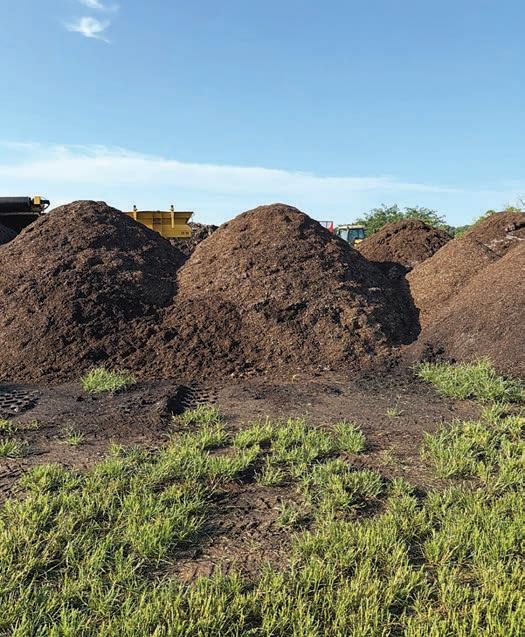
With a new compost start every second week, the Andres have 26 batches of a year at a size that would be staggering to the typical home and garden composter. The composting process starts at the concrete slab for blending then takes about six months for completion.
“Everything comes in at the south end of the compost site,” he says. “We’re rotating with a large excavator. Everything moves north about 30 feet every time we rotate. We rotate every two weeks.”
Composting manure and other waste material at Andre Farms.
PHOTO: BREE RODY
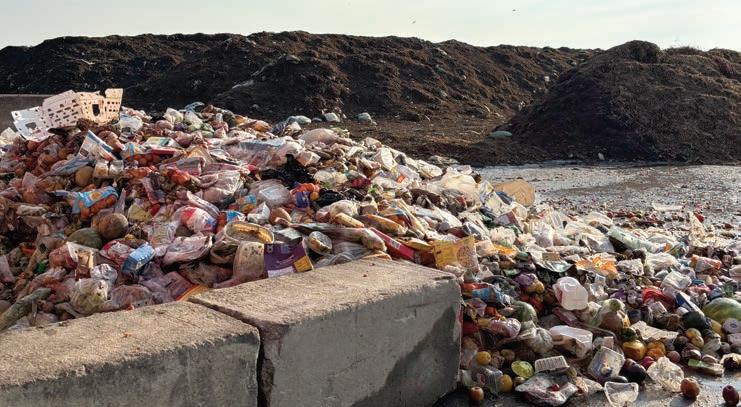
The Andres have a food de-packager that can manage cans, bread in bags, mouldy cheese and more for inclusion in the latest batch.
“If we get a little too many baked beans today, we’re probably okay,” he says.
MAKING THE BEST OF THE BASICS
As an EPA-regulated site, the Andres have their composting dialled in, but there are no fancy digesters here. This is the kind of composting any farm could do, if they wanted to. Each composting batch runs at about 200 feet long with windrows about 15 feet high.
“That slows our process down quite a bit, because we’re so tall,” says Andre. “We’re running about 160 to 170 degrees [Fahrenheit] temperatures most of the time.”
With the amount of science required to understand how the inputs work together at any given time, he says there is a need to “fly by the seat of our pants” to keep nitrogen and moisture ratios in check.
“Over the years, we’ve learned what kind of pile we need to have to get the right blend of carbon and nitrogen ratios,” he says.
There is no deadstock processed at Andre Farms due to the stigma of incorporating it. Andre says they are licensed to include it, but don’t. Instead, they need to screen everything that comes in for different reasons.
“We get the teddy bears and footballs and the Lego toys,” he says. “People sweep out the back of the pickup and they forget there are things at the bottom. And at the dairy, their tire
sidewalls, they get thrown in. We pick those out too. You find just about anything.”
PROVIDING THE TOOLS NEEDED
Not every farm has the ability to run a dozen massive composting piles at a time and do so well, like Andre Farms does. But, many farms want to make the most of on-farm waste like deadstock and that’s where Advanced Composting Technologies (ACT) in Candler, North Carolina comes in.
Chander Cummins, president of ACT, says the company has helped roll out about 550 composting facilities throughout North America as a result of the ideas of his partner, Keith Warren, who saw the potential of a product out of the composting industry. What began as composting dairy waste and tailings from a pallet mill led to the USDA contacting the company about ways to help with disposal of animal mortalities.
The company invents, manufactures, designs and installs innovative composting systems. According to Cummins, they reduce the footprint of composting and process more material with 40 percent less labor than traditional windrows. The systems incorporate a variety of materials, which can make for some interesting requests.
“We’re working with a lot of different mediums,” he says. “From livestock mortalities to tobacco processing waste and everything in between. You get some pretty strange calls sometimes.”
He feels the work they are doing to supply farms with composting equipment is only managing about three to five percent of the US deadstock volume.
BIG PUMPS TO HANDLE BIG JOBS
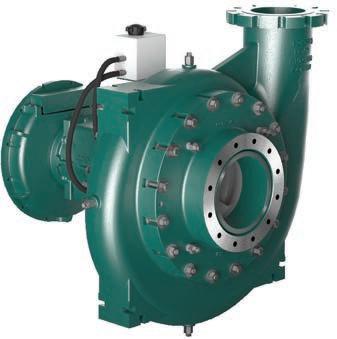
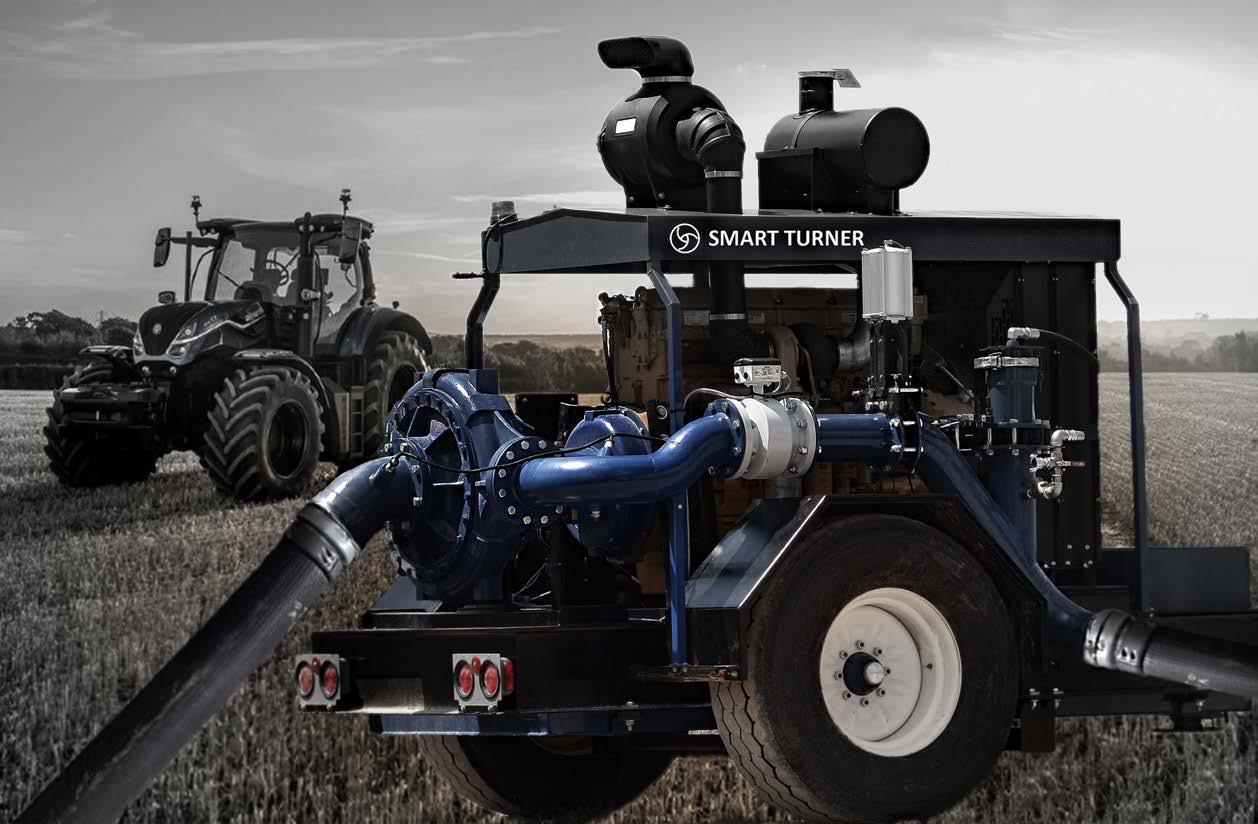
Cornell’s White Iron 81022MPL with the robust, yet compact EM19DBK Frame and Run-Dry™ Option tackles the toughest manure slurries. Featuring:
6000 GPM / 420’ TDH at BEP at 1800 RPM
7500 GPM max flow
High Efficiency
Low NPSHr
Proven Cornell construction for handling sand laden manure
Hard face seal with run-dry seal protection
With an 8” discharge, 10” suction and 3.5” solids handing, and built for high-operating pressures, MP pumps are specifically designed for coarseabrasive slurry applications. Constructed of high chrome iron, with a Brinell hardness rating above 650.
Talk with your authorized Cornell dealer about finding the best model for your application.
Cornell now offers cell connect monitoring of temperature, vibration, GPS, pressure and more.
“There’s still a lot going to rendering,” he says. “There’s a lot going to the landfill, there’s a lot that gets buried around the US and incinerated around the US.”
THE RIGHT BALANCE
Cummins says ACT is always trying to make the process easier, faster and more exact for their customers. That means helping to adjust the ratio of elements in the mix that lead to a better outcome.
“We don’t believe in pathogen reduction, we believe in pathogen kill,” he says. “That way we’re really making a difference.”
ACT’s livestock work began with poultry in 2001, then swine in 2003 and dairy about 10 years ago. Though chickens, turkeys and hogs remain the primary part of the industry.
“Now we’re looking at helping some of the cattlemen across the US with their beef stock,” he says.
He says the micro and macro nutrients that come out of the ACT composters make for a beautiful soil amendment. Like at Andre Farms, most of the farms use it on their own land, but some have enough to bag it and sell it, and others have enough to sell their compost in bulk volumes. This high-end amendment comes from people who understand why they are doing and why.
“We believe that training is just as important as the actual equipment,” says Cummins. “Some of our facilities will come back and retrain when they have new employees.”
He says they help farms understand the right recipe to achieve optimal results.
Mamma Mia! That’s a lot of tomatoes!
Finding the right balance and making changes based on the inputs is something Andre works with regularly. During his chat with Manure Manager, he received truck loads of tomatoes and carrots. Andre Farms takes the things that aren’t good as cow feed but work well in composting, with some adjustment. Both Nate and Paul and sons Ross and David know the ins and outs as well, as they prepare to take the farm forward for another generation.
“We never know what might be showing up,” he says. “Our compost starts out very wet because the food waste is very wet. Over the years we’ve learned what kind of pile we need to have to get the right blend of carbon and nitrogen ratios.”
They make use of silage, straw, leaves, horse manure and other carbon to help balance out the food waste. Sometimes they still do wood grinding to get coarser material.
LEFT
Andre Farms incorporates local food waste into its composting practices.
“You need the stuff that’s more coarse to get the air space,” says Andre. You need air, that’s what creates the compost is the air.”
ONGOING LEARNING
ACT is always ready to share new learnings according to Cummins.
“I’m staying in touch,” he says. “If they do run into issues, if they want to try something new. They found a new product and want to see if it will work. We’re always training to whatever they want to try. As long as they’ll stay at the proper levels of carbon, the nitrogen and proper water, we can give it the air, and the particle size and we can get that composting to where it needs to be.”
He says that when different elements are thrown into the mix, it can reduce the temperatures. Like when a truckload of lemons shows up. The citric acid in the peel works as an antibacterial to protect the sugars on the inside.
“This would slow a day’s worth of composting unless you break it open and change the diet to give a lot of quick energy to fight through the peel’s natural defences,” he says. “We get calls all the time and can get the process back inline within about 24 hours through understanding the elements at play.”
Obviously, with composting deadstock, time, temperature and testing are primary elements for any of the farms using an ACT system. With automated recorders, the time and temperature data is available at a moment’s notice. The temperatures are achieved by creating the proper mix within the compost, the testing of the compost proves the elimination of any pathogens. Some regions require random testing, while others are once a year.
All the states ACT works with allow for composting of deadstock and the company even assists with applying for permits and other necessary documentation. Most of the farms are small scale, but ACT has worked with some facilities at industrial composter levels.
Farms often work together to achieve economies of scale with ACT equipment and as they grow in their compost production, they can add on to the system. But there is always one element they need to look for, carbon. Andre has built long-term relationships that ensure a steady flow, but others may have to keep an eye out for opportunities.
“It’s the one piece that everyone tries to cheat [with] a bit,” says Cummins. “So we always preach to them there’s free carbon out there.” •
PHOTO: BREE RODY
MANURE INNOVATIONS in Idaho
From bioplastics to optimizing nutrient uptake, a wide range of opportunities lies ahead.
BY TREENA HEIN
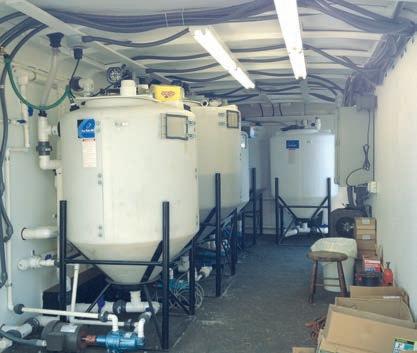
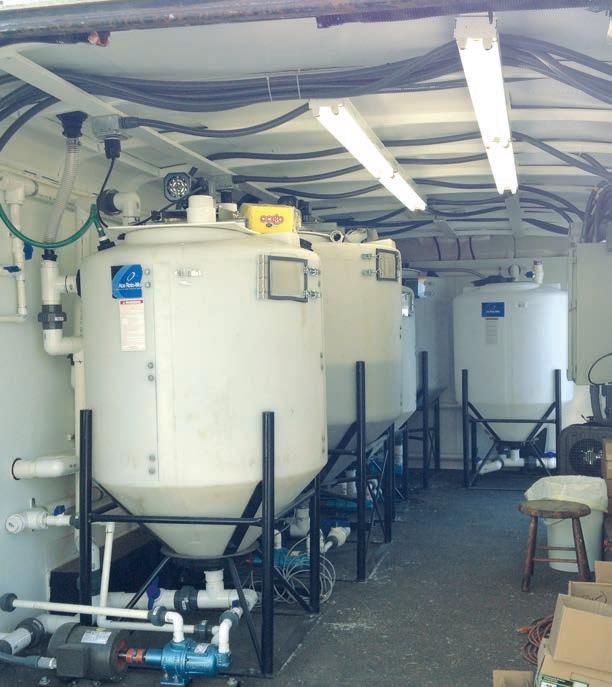
An Iowa bacteria reactor converts manure into bioplastics.
As is the case with most thorny conundrums, the dairy manure situation in Idaho also presents interesting opportunities. Only two other states surpass Idaho for milk production, and manure therefore abounds in the southern part of the state where most dairies are located. The conundrum: too much dairy manure to be used as fertilizer on crop farm acreage. The opportunity: create useful bioproducts from that manure.
In 2020, a project to investigate these bioproducts was launched by the USDA’s National Institute of Food and Agriculture. It has provided $10 million in funding to over 20 researchers at University of Idaho and wraps up in 2026. These researchers are building on decades of research in several areas, including better technologies to separate and process manure to use as feedstocks for soil amendments or additional applications, further investigation into manure biochar and production of biodegradable plastics from manure.
Before we dive into these exciting developments, however, let’s check in with U of Idaho economist Dr. Jason Winfree on the viability of bioproducts from manure. He first explains that it’s difficult for anyone to say which innovations have the best prospects.
“For example, manure pellets are easier to transport, but require a large amount of energy costs,” Winfree says. “Bioplastics seem to have potential, but consumer acceptance is an issue. There are many benefits from biochar. Biochar can help increase crop yields and consumers are willing to pay a little bit more if they understand that the production process was a bit more environmentally friendly. So, it’s an issue of both reducing the cost of creating the biochar and educating consumers about the process. In the end, since we are not sure which innovations will eventually become the most economically viable, I think there are benefits from working on various technologies.”
BIOPLASTIC PRODUCTION
Scientists have known for decades that bacteria can convert carbon in feedstocks such as corn sugar into polymers (plastic) and store it – but as far as he knows, Dr. Erik Coats (the lead scientist on this project) is the first to do it with manure.
“There has been quite a bit of research over the last 20 years using pure bacterial cultures with refined feedstocks and there is already a market for the bioplastics produced,” he explains. “There are more challenges with using a mixed microbial community, which is what we have in with manure in our bioreactor, but we’re working through those challenges.” Coats is referring to his software model that takes data from sensors in the reactor (mainly dissolved oxygen readings), translates that into a system-level picture of plastic production and provides direction on when it’s time to add more manure/bacteria to keep plastic production at a high rate.
Regarding the resulting bioplastics mixture, Coats and his team have already published results on purifying it, but he also notes that there’s no need to purify it for many exciting applications. “We can heat the mixture and it can melt and crystalize with other biodegradable materials to produce a biodegradable composite,” he explains. “One option for this composite is to produce planter pots and trays for nurseries. We’re doing a lifecycle assessment now and ROI analysis, and if we can demonstrate an acceptable ROI, someone can commercialize this.” Coats and his colleagues have also developed a way to capture and concentrate phosphorous (P) from the bioreactor that can then be used in commercial fertilizer.
BETTER SEPARATION
In another project, centrifugation has been demonstrated as a successful secondary separation technique in recovering significantly more nutrients from dairy manure as opposed to using only an inclined screen. Dr. Lide Chen notes that more than 50 percent of the solids in liquid dairy manure are particles smaller than 0.5 mm and commonly used on-farm inclined screens typically have pore sizes larger than 0.5 mm. Most of the total P in liquid dairy manure is attached to fine particles smaller than 0.5 mm, he explains, “so to remove P from the liquid stream, advanced separation methods such as centrifuges are required.”
In on-farm tests, Chen and his team have shown that centrifuge-separated solids contained a year-long average of 8 Ib/ ton of P (as P2O5) versus 2 Ib/ton from screen-separated solids. For total N, it’s 9.2 Ib/ton versus 5.4 Ib/ton, and for K (as K2O), it’s 7.2 Ib/ton versus 4.4 Ib/ton.
Chen and his colleagues have also investigated ammonia removal from dairy manure using thermal stripping with sulfuric acid absorption. In lab tests using anaerobically digested liquid manure, they achieved 93 percent removal of ammonium sulfate.
COMPOST
In this area, researchers have developed, built, tested and implemented a pilot composting system for benchmark-scale composting and air emissions monitoring. They have also completed the first run of dairy manure composting using amendments including clinoptilolite (zeolite), wood chips, biochar and pumice.
“We are excited that incorporating biochar, wood chips and other carbon-rich materials into composting manure results in a very-high value product that’s going to open large new markets for composted dairy manure,” says Dr. Mario de Haro-Marti, extension educator of Agricultural Environmental Management at U of Idaho Extension. “Owners of greenhouses and landscaping businesses have historically been rather shy of dairy compost because there hasn’t been solid data about the carbon and nitrogen content. They have also been concerned about salts, which are commonly found at a high level in dairy manure. Now, they will have the assurance from our data that they are getting a very high-quality composted product. It can be provided in bagged form or by the cubic yard by truckload.” He adds that there is a company in Boise that is already making and selling a value-added dairy manure very successfully. “There is more demand than production,” he says.
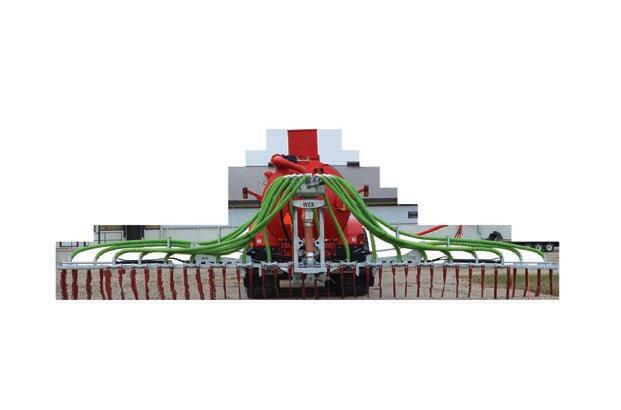
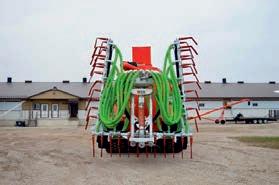
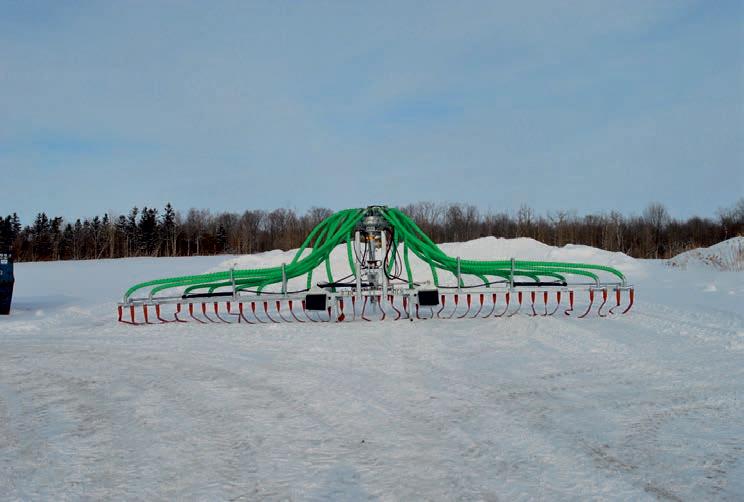
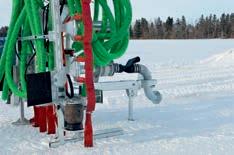
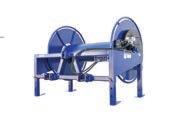
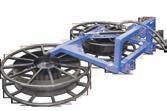
Drag-Line Systems & Accessories
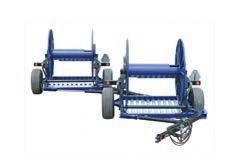
20 X 6” Hose Capacity. Lead & trailed units can be operated in unison or independently. TPH COILER
• Available in 30’ and 40’
• Full galvanized frame
• WER Distributer
• Rear hitch (max towing 5000 lbs)
• Available in 30’/40’/60’
• Full galvanized frame
• WER Distributer
• C/W ball blow-out
• Rear hitch (max towing 5000 lbs)
Use as a stand alone unit, or as an addition to a developing drag line system. (3 models available).
The telescopic hyd width adjustment provides a large surface radius when moving hose. Dealer Opportunities in Some
INLINE CHOPPER
Improve productivity by reducing blockages in the drag line system and reduce pump repairs.
DISTRIBUTOR
The high grade chopping system, and auto-reverse function, ensure an obstruction free distribution.
Maximize Efficiency with better spread. Heavy duty construction & galvanized frame.
De Haro-Marti and his colleagues are also doing studies also with zeolites (minerals mined in Idaho) and getting very good results in terms of decreasing ammonia emissions and retaining nitrogen from fresh and composted dairy manure.
MAPPING MANURE DISTRIBUTION
And although the bioproducts research is very exciting, this greater National Institute of Food and Agriculture project does not ignore the potential of using more manure on Idaho fields. In this area, Dr. Eric Brauns and his colleagues have been have analyzing the “optimal” spatial distribution of dairies to maximize manure nutrient uptake by crops and the “optimal” spatial distribution of cropland, given the current distribution of dairies and crops grown in Idaho. This will provide insight into the current supply chain of dairy manure and challenges in distributing dairy manure nutrients, as well as whether the capacity to utilize more manure nutrients in crop production has increased or decreased over time due to changes in dairy industry characteristics and cropping pattern changes. Brauns and his colleagues have also been analyzing data related to manure application in terms of water quantity and nutrient cycling which includes soil moisture and rainfall. They have made substantial progress with the calibration and assessment of the nutrient cycling and leaching algorithm in their model. Evapotranspiration, soil moisture and crop uptake
algorithms in a ‘SWAT’ model for irrigated conditions in the Magic Valley have been completed.
In this area of using more manure on fields, de Haro-Marti reports “we are also looking at how adding more dry manure to fields supports double-cropping, which is a great way for farmers to boost profits. We are investigating interseeding/double cropping with corn silage and cover crops, and also planting cover crops right after corn and tilling those in as green manure for the next crop. We are checking N leaching up to 4 feet deep, measuring corn yield and corn quality, and many other parameters.”
"Now, greenhouse and landscaping businesses have assurance from our data that they are getting high-quality composted products."
LOOKING FORWARD
Dr. Mark McGuire, distinguished professor at U of Idaho and project director for the Idaho Sustainable Agriculture Initiative for Dairy (ISAID), is very pleased about all the progress with these projects.
“Scientists at the University of Idaho have identified several innovative processes to extract and utilize valuable nutrients from dairy manure,” says McGuire. “These technologies – ranging from making bioplastics and biochar to nutrient recovery systems and advanced composting – demonstrate that environmental stewardship and economic opportunity can go hand in hand.” He adds, “the collaborative work being done here not only benefits producers and rural communities but also provides scalable solutions for agricultural systems worldwide.” •
CO M M I T T E D TO Q UA L I T Y YO U C A N D E P E N D O N
For more info visit huskyfarm.ca or call 1-800-349-1122
Trailing shoe booms from 6m to 30m in width. BlackBird trailing shoe booms in stock Summer 2024. Various incorporation options available. Contact us for more info on tank sizing options.
REGULATIONS in the spotlight
Learnings from a recent ruling
BY JIM TIMLICK
ABOVE
Maure applied to a demonstration field in Wisconsin, summer 2023. That year, a lawsuit challenged the state's authority to require certain permits for CAFOs.
Manure management and the regulations that govern the process is hardly a sexy subject, but it’s one that has been generating a lot of interest of late, especially in the American Midwest.
Much of that interest has been the result of a recent court ruling in the state of Wisconsin. In August, a Wisconsin Court of Appeals handed down a unanimous judgment that declared the state’s department of natural resources has the authority to subject large farms to wastewater permit requirements aimed at protecting water quality.
The court ruling followed a lawsuit filed in 2023 by two groups representing a number of the state’s larger farms that challenged the state’s authority to require permits under the DNR’s Wisconsin Pollutant Discharge Elimination System. The groups had argued the DNR doesn’t have the right to require large concentrated animal feeding operations, or CAFOs, to obtain wastewater permits before they discharge a pollutant into navigable waters.
Earlier this year in neighbouring Minnesota, the Minnesota Pollution Control Agency held public meetings and received comments on proposed updates to that state’s animal feedlot rules, including manure management plans. Although no new regulations have been proposed yet, the MPCA has stated it wants to find new ways to reduce the amount of nitrate from feedlot manure that has worked its way into private wells and groundwater and sporadically killed fish in some rivers and streams.
Manure Manager spoke with nutrient management experts in both Wisconsin and Minnesota about each of these recent developments, how management plans can affect both CAFOs and smaller farms, and how farmers can navigate manure regulations as they continue to evolve.
PHOTO: BREE RODY
Kevin Erb, manager of the conservation professional training program at the University of Wisconsin-Madison, Division of Extension, says the recent Court of Appeals ruling doesn’t really change anything since it upheld the existing rules CAFOs were already required to follow.
What it does do, he says, is let farms that are not quite CAFO-size as well as those that haven’t yet applied for a permit know they’re going to need to start the permitting process before they reach the 1,000-animal unit threshold. And he suggests that farms in that situation begin the process sooner rather than later.
“As you’re approaching that CAFO size, you really need to be working with your engineering consultant, with your agronomic consultant, because there are some things that are easier and more economical to do before you get the permit and some things become more expensive after you get the permit,” he says.
“Working with those independent consultants or the country land and water conservation departments to get your ducks in a row and get things going before you reach that size or before you start the permit process can save you a lot of money in the permit process.”
Melissa Wilson, associate professor and extension specialist with the University of Minnesota, says it’s too early to say what the MPCA’s proposed updates to feedlot rules will mean for farm operations and manure management plans in that state.
However, she suggests that farmers should be prepared for change including the possibility that smaller farms could be required to keep more detailed records of where they apply manure and potentially face restrictions on fall manure applications much like larger operations already do.
“I can’t say what they’re going to end up coming up with because right now they’re just so early in the process. We’ll have to wait and see. It could be a lot of different things or there could be minimal changes,” says Wilson, whose work is focused largely on manure nutrient management and water quality.
“[But] people should be aware that this is coming. It shouldn’t really be a surprise.”
One particular area of concern for Minnesota farm operators could be potential updates to regulations for manure application timing, which may affect storage facilities. Some farms have older storages that were built decades ago. With changes in livestock management
"Working to get your ducks in a row before you reach that [CAFO] size can save you a lot of money in the permit process."
and changing weather conditions the state now receives, including increased precipitation, these older storages may not meet current storage needs.
Erb and Wilson both agree that one of the challenges with navigating manure management regulations is the fact that they can vary widely from state to state and are based on a variety of factors including weather conditions, topography, soil types and the type of manure a region produces.
In Wisconsin, for example, the state’s DNR requires CAFO operators to submit a plan each spring detailing the next 12 months of manure and fertilizer applications they have planned. Farms can update that plan in the summer if things such as winter kill or cropping decisions change the rotation. In Minnesota,
reporting requirements vary depending on the farm size. Setbacks – where manure can and cannot be applied in relation to waterways or other sensitive features –differ between the states, as well.
One of the most important parts of any manure management system is a spill response plan that details what to do in the event of an accidental release.
Erb says regardless of what is contained in an individual spill response plan, those details should be written down and easily available to anyone who may be working on that farm.
“It doesn’t really matter if it’s a formal document or if it’s written on the back of somebody’s napkin, but it needs to be practical and accessible. I’ve seen times where they have a really good plan, but it’s locked in the office and people can’t get to it when it’s needed,” he says.
“The plan that you develop should be downloaded onto every employee’s phone and they should know that if something happens, they’re empowered to call the vacuum truck or septic pumper and not worry that the boss is going to say you shouldn’t spend the money to fix that situation.”
A LONG WAY TOGETHER
WHEREVER YOU ARE, BKT IS WITH YOU
No matter how challenging your needs, BKT is with you offering an extensive product portfolio for every field such as agriculture, OTR and industrial applications. BKT provides concrete, reliable and high-quality solutions to your requests and working needs. Wherever you are, BKT is with you.
Eastern Zone Manager
BKT
Cell:
Joe Dias
Most nutrient management regulations at the state level also require some form of manure testing. The frequency of testing can depend on a number of factors including the size of the operation.
Wilson says one of the priorities when it comes to manure testing is for producers to ensure they are getting a representative sample of any manure being produced by their operation or used on their fields.
The key is to get many smaller subsamples from different parts of the storage and mix the subsamples well. Then, fill your sampling container that will be sent to the lab and let it cool down so the nutrients stay put and don’t turn into gasses. That means putting the sample on ice or freezing it before sending it to the lab.
plan can be updated when needed. For example, if a field is drenched with rain and manure application ends up being shifted to another field, the farmer should make sure it is tracked and considered when developing next year’s plan.
There are currently no federal insurance premium rebates specifically for farms with manure management plans. However, some federal and state-level programs do offer significant financial incentives for implementing manure management practices.
"It doesn't matter if it's a formal document or if it's written on a napkin. It needs to be practical and accessible."
Wilson also recommends that manure management plans should include detailed instructions on how employees should react in emergency situations. That includes making sure employees know their exact location in the field so they can communicate that to emergency personnel.
They should also be made aware that manure gasses such as hydrogen sulfide and carbon monoxide can be “silent killers.” Because they tend to be heavier than air and can effectively force oxygen to disperse elsewhere, that can sometimes mean there is not enough clean air to breathe low to the ground.
Wilson advises that farm operators keep a detailed account of what happens on their farm so that their manure management
In Wisconsin, a voluntary program provides business insurance premium discounts of between five and 20 percent if the farmer or their manure applicator goes through training and they have a spill response plan in place. The program has helped farmers and professional manure applicators save more than $100,000 in insurance premiums on an annual basis. Erb says farmers who don’t take part in the program should check with their insurance agent and ask if they can receive a similar premium discount.
Erb and Wilson also agree that technology is going to play an increasingly large role in developing future manure management plans.
Erb cites the example of the GPS technology that is available in most newer tractors. He says it can be used to create a map to show where manure has been applied and document it was applied properly. Wilson says that same mapping technology can also be used to note intermittent streams in a field that form during heavy rains and let farmers know to avoid applying manure if rain is in the immediate forecast. •
BUYERS GUIDE
MANURE MINUTE
CHRYSEID MODDERMAN | University of Minnesota Extension
Manure compost troubleshooting
Proper manure composting is as much an art as a science, and it takes the right combination of many components to work efficiently. In general, you want a particle size of one eight to two inches; internal temperature of 110⁰ to 150⁰F; moisture content of 50 to 60 percent; oxygen content of 10 to 15 percent; carbon to nitrogen ratio (C:N) 25:1 to 30:1. When these components are unbalanced, it can hinder the whole composting process. However, when a compost pile doesn’t break down correctly, it’s not always immediately apparent which factor is lacking or in over-abundance. Below are some common compost problems, their symptoms, and how to remedy them.
ROTTEN EGG SMELL
If your compost is giving off a sulfurous or rotten egg smell, it might be an indicator that the pile is oxygen-deficient. Composting is an aerobic process, meaning it requires adequate oxygen for decomposition. The lack of oxygen might be from excessive moisture or compaction due to small particle size.
To test for excessive moisture, pick up a handful of compost and squeeze it. If water drips from your hand, the compost is too wet. If wetness is the problem, turn and mix the pile to aid drying and consider covering with a tarp or roof.
as ammonia (hence the smell). To increase the C:N, carbon sources such as straw, corn stalks, or wood chips can be added to the pile.
PILE DOESN’T HEAT UP
One of the most common problems in compost is that the pile does not reach high enough temperatures for good decomposition. There are a variety of reasons this might be happening.
The pile might be too small. A very small pile will not have the mass to maintain high internal heat. This one is a simple fix: just make the pile bigger. The absolute minimum size for manure composting is three by three by three feet. One of the most common reasons a pile isn’t heating properly is that it is too dry. If you do the squeeze test (as described above) and the compost does not hold its form and crumbles apart, it is too dry. To fix this, simply add water with a hose or bucket while turning and mixing.
Lack of nitrogen might also be the problem. To remedy this, add nitrogen sources such as grass clippings, soybean straw, or hay. Lack of oxygen can also cause heating problems. The same rectifying methods of increasing oxygen through turning and adding larger particles apply here, as they do above for “rotten egg smell.”
Unbalanced components can hinder the whole process.
If particle size appears to be the problem, turn and mix the pile. This “fluffing” of the pile will help create air pockets and reduce compaction. If the problem persists, add bulky particles, such as wood chips, that are about two inches in diameter.
AMMONIA SMELL
A quick whiff of strong ammonia smell is quite distinct. And if it’s coming from your compost pile, it’s likely due to excess nitrogen. Keeping carbon and nitrogen balanced is a necessary tight rope to walk; and if the compost C:N drops below 20:1, the pile may become rancid and sludge-like. Nitrogen is also lost to the atmosphere at high rates
The pile might also resist heating if the weather is cold. During the winter or a cold snap, turn and mix the pile less frequently. Also make sure the pile is large enough to retain heat; at least five by five by five feet. Or, finally, perhaps the composting process is complete. If the pile resembles soil, has an earthy (not manure) smell, and is crumbly, the compost is probably done and does not need to heat up any more.
Overall, knowing what might be causing a heating issue or foul smell can put you on the right track to identifying and fixing the root problem. Of course, each problem may not exist alone, and the compost can have multiple problems simultaneously. In those cases, you’ve got to put on your detective hat and analyze the combination of symptoms to find the problems and their solutions. •
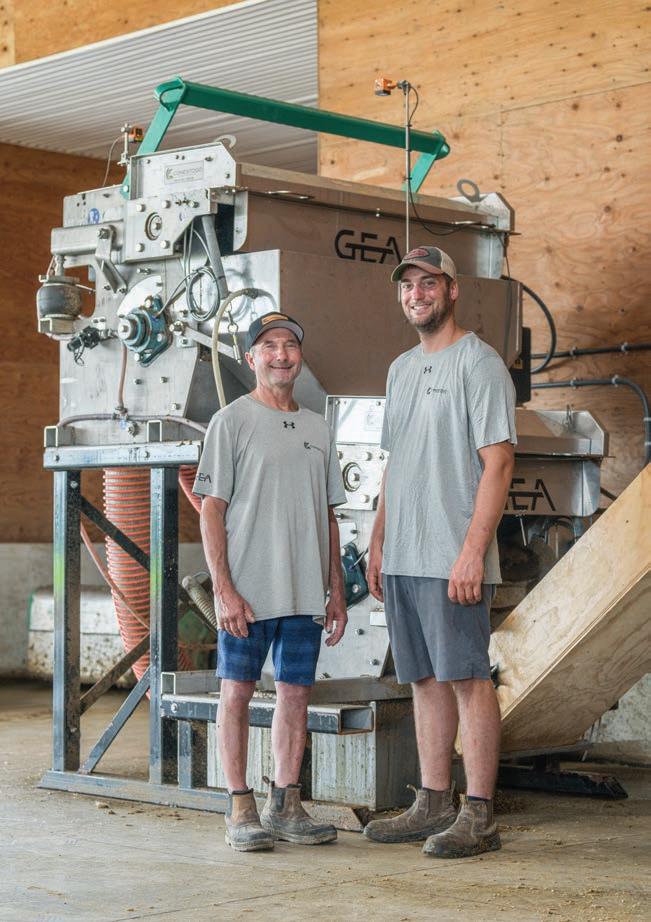
‘‘We’re a closed herd calving all our own replacements. By adding fiber bedding from our GEA roller press system, it’s comforting, not worrying if any bacteria will come in purchased bedding material. We can bed anytime of the day even during the summer with fans running and curtains open, there’s no dust blowing. Since switching from sawdust, the barn stays much cleaner.’’
Ryan Bross and his father Bross Dairy, Mildway, ON, Canada