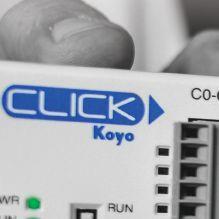
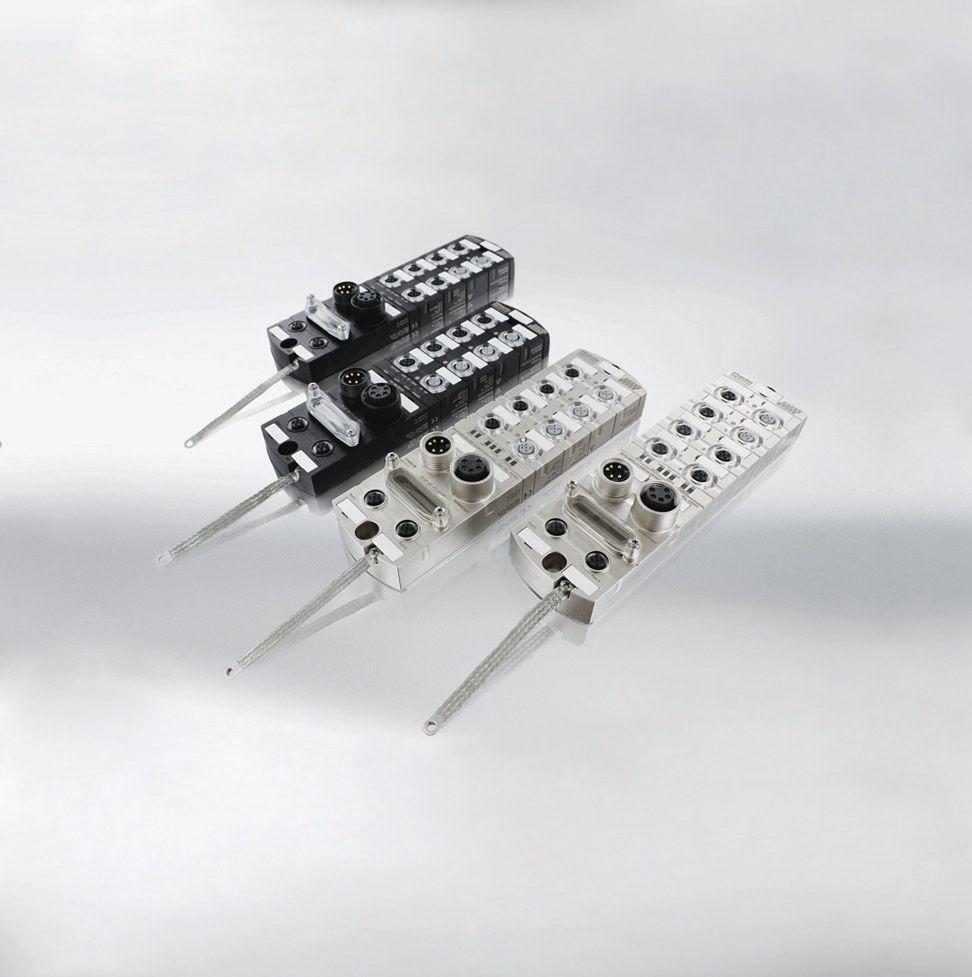
The CLICK PLC family offers extreme value for simple systems where time and resources are limited. The compact size, affordability and easy programming make CLICK great for small applications and beginner projects.
•NEW! Ethernet Analog PLC Units with 8 discrete I/O points, Ethernet and serial communication, and up to 6 analog I/O channels built in. Starting at $179.00
• Easy expansion with snap-on I/O modules for up to an additional 128 discrete or 48 analog I/O points
• Communicate with, and power a low-cost C-more Micro HMI from the RS232 serial port for even more savings
• All CLICK PLCs use our FREE programming software with a simple but practical instruction set
C-more around your plant for less C-more Micro HMIs provide graphical system status and operator interaction for a fraction of what you’d pay elsewhere. Paired with the CLICK PLC, C-more Micro panels provide practical and complete control for any small system.
• Numerous sizes up to 10-inch with touch and non-touch screen versions available
• FREE easy-to-use programming software with simulator
NOTABLE TWEETS
@SYSPRO
We have recently announced the global release of our latest ERP solution with integrated artificial intelligence (AI) and the Internet of Things (IoT). Thanks for featuring us in this article @ AutomationMag
http://hubs.ly/ H0d9fSH0
@IIoT_World
Seven areas of focus for any company to consider when readying themselves for #digitaltransformation http:// bit.ly/2AnEBfE
@Mentor_Works
New government funding available to support growth projects
http://hubs.ly/ H0c_TJn0
@EndeavourEIS
Critical to the success of remote access is the level of protection against cyber threats.
Our own David Price explores how IoT-enabled businesses can mitigate cyber risk in @ AutomationMag
http://ow.ly/ vVZj30kjWtO
BY KRISTINA URQUHART
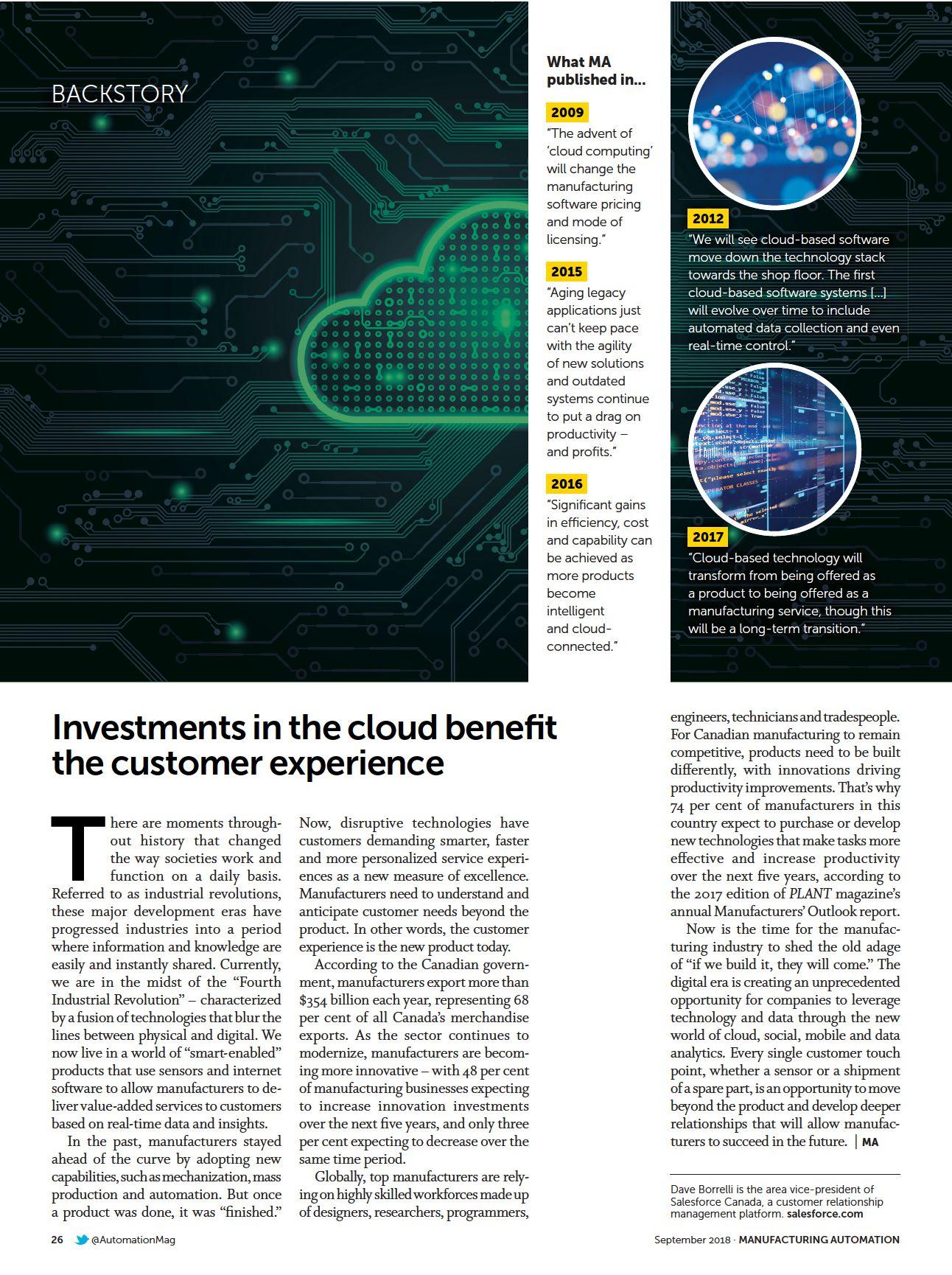
Get your head in the cloud
I’m pleased to introduce myself as the new editor of Manufacturing AUTOMATION. I come to this magazine from another trade publication in a different industry, so I’ve spent the past few weeks reading through back issues of MA to understand what trends, topics and challenges are most important to manufacturing professionals in Canada.
A few themes are pretty obvious. There’s the impact of the IIoT, whether positive (i.e., a connected, more efficient workplace) or negative (i.e., cybersecurity concerns). And safety remains paramount. Despite factories becoming more automated, workers still must be equipped with the knowledge and tools not only to operate the systems, but also to help avoid injury and fix problems – perhaps more so than in other industries. In fact, according to a 2017 study sponsored by ServiceMax from GE Digital and market-research firm Vanson Bourne, 23 per cent of unscheduled downtime in manufacturing facilities is due to human error, compared to nine per cent in other sectors.
Other themes are less apparent, but they are often the root causes of this industry’s challenges – Paul Hogendoorn of FreePoint Technologies addresses one of them in his column on what can happen when manufacturing companies are paralyzed by fear, especially of technology (p. 14). And what about Canada’s little-sister syndrome when it comes to how we stack up in the world?
Jennifer Rideout of Cisco Canada hits that pervasive nail on the head in her article on how our country’s manufacturers are potentially falling short when it comes to embracing the digital landscape (p. 12), especially when we evaluate where we’re at compared with other advanced manufacturing sectors around the world. If you think about it, Jennifer and Paul are saying the same thing: the time is now to get your head in the cloud (and, in this case, that’s not a bad thing at all).
We’re going to continue to cover all of this in our upcoming issues, but I’m going to need your help, too. The goal of this publication is to give you the information you need to help you do your job better. So, what kinds of stories would you like to see on these pages? What are you and your company doing to respond to all of these industry changes, or to advance them? Make sure to add me to your mailing lists to keep me in the loop.
I’m also looking forward to getting out into your workplaces and to industry events, starting with IMTS this month. I’ll be in Chicago to see the latest automation technologies and to connect with as many of you as possible. (Watch for a wrap-up of the show in our November/December issue.) In the meantime, email me at kurquhart@annexbusinessmedia.com to introduce yourself and to tell me what your company has been up to lately. I’d love to know, and I’m sure our other readers would, too. | MA
Your resource for Canada’s industrial automation news
Mail: 111 Gordon Baker Rd., Suite 400, Toronto, ON, M2H 3R1
SUBSCRIPTION RATES
Canada — $42 per year
United States — $74 (US) per year and Foreign — $84.50 (US) per year
Students — $20 per year
ANNEX PRIVACY OFFICER
email: privacy@annexbusinessmedia.com
Tel: 800-668-2374
Occasionally, Manufacturing Automation will mail information on behalf of industry related groups whose products and services we believe may be of interest to you. If you prefer not to receive this information, please contact our circulation department in any of the four ways listed above.
Annex Publishing & Printing Inc. disclaims any warranty as to the accuracy, completeness or currency of the contents of this publication and disclaims all liability in respect of the results of any action taken or not taken in reliance upon information in this publication.
We acknowledge the [financial] support of the Government of Canada.
AUTOMATION UPFRONT
PRODUCTION
Bel Canada to open its first Canadian factory
The Bel Group will build its first Canadian plant in Sorel-Tracy, Quebec. The facility, whose commercial production is scheduled to begin in early 2020, will be fully dedicated to producing Mini Babybel cheese.
The project will require an investment of $87 million and create 170 skilled jobs between the Sorel-Tracy plant and Bel Canada’s Montreal head office.
“Bel has been marketing its products in Canada since 1957, and we know the local dairy sector’s expertise. With this new plant, we are becoming a fullfledged Quebec dairy processor,” said Catherine Thomas, president of Bel Canada.
The new plant will be built on the site adjacent to Laiterie Chalifoux – a company established in Sorel-Tracy in 1920.
“This cheese is currently imported and will soon be produced with 100 per cent Canadian milk. This is good news for local dairy producers. This investment will generate employment and much-needed economic benefits in our regions,” added Bruno Letendre, chair of Les Producteurs de lait du Québec.
TEKNA receives funds to scale up operations
The federal government will invest up to $21.1 million in Quebec-based advanced manufacturing company TEKNA Plasma Systems Inc. In addition to a $9.4-million investment from the government of Quebec, the $128.4-million project will help TEKNA produce metallic powders for use in additive manufacturing and electronic products.
Additive manufacturing, also known as 3D printing, allows for the design of complex metal parts that are lighter and more efficient and environmentally friendly than conventionally manufactured parts.
TEKNA’s project will help the company increase its total production capacity and footprint in Sherbrooke. It will also increase R&D, stimulate collaboration with Canadian post-secondary institutions and help strengthen the Montreal–Sherbrooke advanced manufacturing cluster and supply chain. Roughly 170 jobs will be created in Sherbrooke as a result of the investment.
The new Bel Canada plant in Sorel-Tracy, Que. will create 170 jobs and be in operation by early 2020.
Georgia-Pacific announces Dixie Cup plant closure in Brampton
Georgia-Pacific has announced it’s closing the Dixie Cup manufacturing plant in Brampton, Ontario, by the end of its financial year.
The company told employees that the decision was based on business needs and consumer demand. The closure affects 128 manufacturing workers and five customer service employees.
Demand is down in Canada as customers choose to purchase from other cup manufacturers, said spokesperson Kelly Ferguson.
The U.S. Dixie Cups manufacturing plants will remain open.
ROBOTICS
Robotics company to create up to 30 jobs in Fredericton
Lateetud, a company in the robotic process automation sector, is opening an office in Fredericton and creating up to 30 jobs over the next four years.
“Creating job opportunities in emerging industries is at the heart of [the] government’s multi-year economic growth plan,” said Premier Brian Gallant.
Lateetud implements robotic process automation using “software robots” and extends their capabilities to include machine learning, optical character recognition, text analytics, business process management, document management and artificial intelligence. The company will hire software developers, designers, a sales and support team and a general manager.
Opportunities NB estimates that creating up to 30 jobs would contribute $7.4 million in direct GDP for the province over four years and would generate
$510,000 in provincial income taxes over the same period.
To support the creation of these jobs, the company is eligible for an investment of up to $375,000 from Opportunities NB, a Crown corporation that works to attract and support opportunities to grow the economy and create jobs. It provides support services for businesses across New Brunswick.
ARTIFICIAL INTELLIGENCE
Canada invests $150M
to help with training and new jobs
The Canadian government has announced a $150-million investment in CAE – a simulations and training supplier for the aerospace and healthcare sectors – which will create up to 400 new engineering and manufacturing jobs over the next five years.
The commitment is part of a $1-billion overall investment from CAE into research and development, which, in addition to the new jobs, will involve retraining 1,700 employees with new digital skills and collaborating with 50 post-secondary institutions and research centres across the country for further training.
The company will also develop new simulation tools and training programs using the latest technologies in cloud computing, artificial intelligence, big data and AR/VR.
“Canadians will benefit from more middle-class jobs, more skills training opportunities, and innovative new products thanks in part to this investment,” said Navdeep Bains, minister of innovation, science and economic development. “Our government’s investment in CAE will help maintain Canada’s global leadership in a sector critical to our economy.” CAE will be responsible to repay $140 million of the government’s contribution, which was made through the Strategic Innovation Fund, a program that supports projects that position Canada as a global innovation leader.
DEAL MAKERS
PTC, Rockwell partner for industrial innovation
PTC and Rockwell Automation have entered into a definitive agreement for a strategic partnership that is expected to accelerate growth for both companies. As part of the terms, Rockwell Automation will make a $1-billion equity investment in PTC, and Rockwell chairman and CEO Blake Moret will join PTC’s board of directors effective with the closing of the equity transaction. The partnership aims to leverage both companies’ resources, technologies, industry expertise and market presence, and will include technical collaboration
The federal government is investing $150 million into CAE, with $140M as a repayable contribution, to help with training and create up to 400 new engineering and manufacturing jobs
across the organizations as well as joint global go-to-market initiatives. In particular, PTC and Rockwell Automation have agreed to align their respective smart factory technologies and combine PTC’s ThingWorx IoT, Kepware industrial connectivity, and Vuforia augmented reality (AR) platforms with Rockwell Automation’s FactoryTalk MES, FactoryTalk Analytics, and Industrial Automation platforms.
“Our combined customer base will benefit from two world-class organizations that understand their business and deliver comprehensive, innovative, and integrated solutions,” said Jim Heppelmann, President and CEO, PTC. “Leveraging Rockwell Automation’s industry-leading industrial control and software technology, strong brand, and domain expertise with PTC’s award-winning technology enables industrial enterprises to
capitalize on the promise of the Industrial IoT.”
Moret said, “We believe this strategic partnership will enable us to accelerate growth by building on both companies’ records of innovation to extend the value of the Connected Enterprise and deepen our customer relationships. As
IT and OT converge, there is a natural alignment between our companies. Together, we will offer the most comprehensive and flexible IoT offering in the industrial space. Our equity investment in PTC reflects our confidence in the partnership and the significant upside we expect it
to create for both companies as we work together to profitably grow subscription revenue.”
Durham adds Fanuc to EMTY program
Durham College in Oshawa, Ontario has announced that students enrolled in its electromechanical engineering technology (EMTY) program will now receive the internationally recognized Fanuc Robotics Handling Tool Operations and Programming Level 1 certification in addition to their advanced diploma upon completion of the program.
This certification will give Durham College graduates a “substantial advantage” as they enter the workforce, says the college, and will signal to employers they are ready to hit the ground running with knowledge and familiarity of the equipment and software already installed in their workplace.
Durham College’s electromechanical engineering technology (EMTY) lab with Fanuc robotics.
AUTOMATION UPFRONT
A global leader in robotic automation for manufacturing and supply, Fanuc says its systems are installed more than any other brand in the world.
The certification earned by graduates is part of Fanuc’s Certified Educational Robot Training (CERT) program and will be facilitated by Durham professor and CERT-certified instructor Beau James, and CERT-certified instructor Brent Brooks.
Students enrolled in EMTY as of September 2018 onward will be eligible to receive the certification at the end of their program.
Humber College and SEW-EURODRIVE team up for advanced manufacturing
SEW-EURODRIVE and Toronto’s Humber College are entering into a five-year partnership designed to build awareness and provide training and research opportunities for students and Canadian companies related to Industry 4.0 technologies, a critical aspect of advanced manufacturing.
As part of the agreement, SEW-EURODRIVE, a drive technology specialist, will showcase its Industry 4.0 laboratory for the first time in North America. This living laboratory focuses on automated guided vehicles (AGVs), mobile worker assistants and connected automation equipment. Located in Humber’s Barrett Centre for Technology Innovation (CTI), the laboratory will demonstrate
how mobile technology interacts with both people and stationary automation.
“We are finding new ways to invest in our students and strengthen Humber’s expertise in advanced manufacturing education and training,” said Dr. Chris Whitaker, president, Humber College. “This partnership reflects how in our polytechnic approach to education we are working closely with industry to engage students and faculty through emerging technologies.”
In addition to the laboratory, the partnership will include an investment of more than $4 million in SEW-EURODRIVE technology at Humber, $125,000 to establish new scholarships through the SEW-EURODRIVE Ernst Blickle Awards, employment and exchange pathways for Humber students to work at SEW-EURODRIVE locations in Canada and around the world, educational programs in drive automation and Industry 4.0, and STEM outreach activities and awareness events to inspire high school students about careers in automation.
“We see great value in investing in Humber students and providing the opportunity for students to develop the skills and gain the practical experience that today’s employers demand,” said Anthony Peluso, CCO at SEW-EURODRIVE Canada. “We look forward to working with other industry partners to lead and build a worldclass automation and learning systems centre at Humber.”
MOVERS AND SHAKERS
Sue Elliott is the new field service advisor, Nova Scotia, for the non-profit Excellence in Manufacturing Consortium (EMC). Elliott is an operational management specialist who EMC describes as “well versed in production requirements and the supporting processes to a successful supply chain.” She succeeds Glenn Durnford, who recently retired. “Glenn has tirelessly worked forging relationships in the Nova Scotia manufacturing community, helping to share common industry issues with the solutions vetted by our members,” the organization said.
ATEK Access Technologies, part of the ATEK Companies group of manufacturing and technology businesses, has announced Jon Keeler as director of sales for its Industrial Internet of Things (IIoT) brands, TankScan and AssetScan. In his role, Keeler will be responsible for business growth and development. He has more than 15 years of technology sales experience throughout the U.S. and Canada in industries including manufacturing, distribution and information technology.
Schneider Packaging Equipment
Co. Inc., will see a leadership transition as part of a new
corporate structure for the 48-year-old manufacturer. The company manufactures and installs end-of-line packaging equipment, including robotic palletizing, integrated packaging and ancillary equipment. Bob Brotzki, Greg Masingill and Mike Smith will become the new ownership team, staying in their current roles as president, executive vice-president and vice-president of engineering and services, respectively.
Beckhoff Automation has promoted Calvin Wallace to the managing director position of Beckhoff Canada. Wallace is succeeding Joe Ottenhof, who is retiring but will remain on the board of directors. As managing director, Wallace will oversee all operations at the headquarters of Beckhoff Automation in Mississauga, Ontario, where administration, sales and marketing, customer service and technical services are managed. “Calvin was the second employee I hired to work at Beckhoff Canada and has been with us since 2006,” said Ottenhof. “Since then, Calvin has maintained an impressive record of achievement without blemish and he is the most qualified person to lead Beckhoff Canada into our next phase of rapid business development.” | MA
We catch up with product manager JARED EVANS to find out how manufacturing execution systems (MES) have changed since MAJiK Systems, the company he co-founded, was last profiled in MA
We last checked in with MAJiK in October 2016. What new technologies have you added to your offering?
We now connect to about 90 per cent of PLCs out there in the market, which means that you can do native deployments in your factory without additional hardware or downtime or reprogramming of PLCs. We connect directly to whatever assets you have, pull the data, and then transform it into what’s needed to show you the monitoring and analytics that you want to view. That’s been good for our customers because it allows them to add more assets, get a better view of their entire
plant floor and fill gaps in their automation.
How have these improvements aligned with how you’ve seen MES evolve?
Going back to when we last spoke to MA – almost nobody was talking about Industry 4.0 and digital manufacturing as a concept, about getting information and analysis instantaneously to help make decisions in your operations. Now, people come up to us at trade shows and say, “Can you tell me about Industry 4.0?” or, “Where should I start?” Our customers have reduced their downtime by over 50 per cent in some cases and increased production by 10
NO NODES... LIKE OUR NODES.
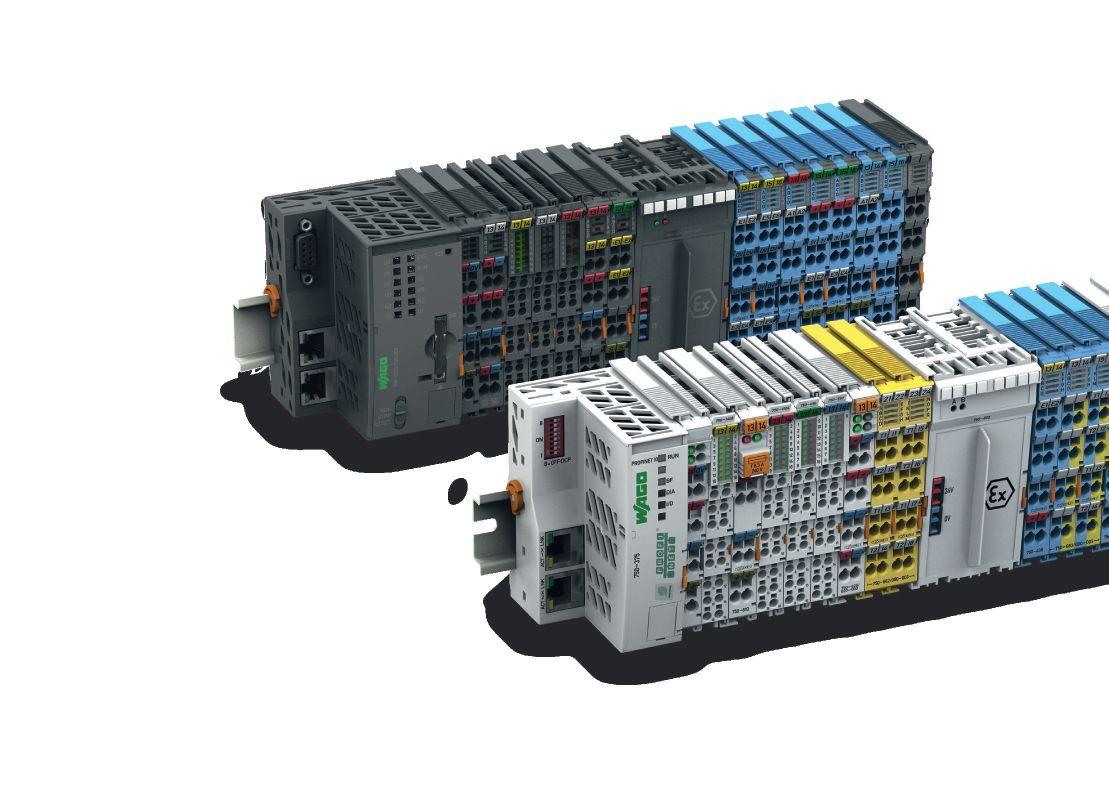
• Fieldbus independent – supports 16+ protocols
• 500+ digital, analog and special function I/O modules
• Compact – up to 16 DI or DO in just one 12 mm wide module
• XTR Series for eXTReme temperature, shock and vibration
• Add-on instruction library for RSLogix 5000® software
www.wago.ca/IOsystem
or 20 per cent in other cases. Those things translate directly to bottom-line revenue growth. I think the next three to five years are going to be explosive as manufacturers start coming on to these platforms, utilize the data and have easier tools to work with to acquire data, to analyze it, and then to optimize their production.
What’s the most common challenge your clients have?
We went through a bit of a shift as a company in our thinking on that. We always thought of data integration, cybersecurity and having meaningful data analysis as being the biggest hurdles for our customers. But it turns out the challenge happens much
earlier than that, almost before we’re even engaged. The biggest thing [for clients] is making sure they have a good use case and a strategy for getting a return on investment. We’ve implemented a quick-start program for our customers where they can get up and running in less than a month [as a pilot]. For any manufacturer, you need to make sure you are getting the full use out of the system and have it become a part of your daily activity. Use the system to find root causes and optimize production before you make a big investment on rolling it out on a larger scale. | MA
To read the full interview with Jared Evans, visit automationmag .com/industry-news
BY WSPS
Workplace Safety & Prevention Services (WSPS) is the largest health & safety association in Ontario. A leader in providing impactful risk management solutions, WSPS offers unparalleled health and safety expertise, insight and solutions.
Managing cannabis in the workplace
Cannabis is set to be legalized for recreational use as of October 17, 2018. For many employers still struggling with how to accommodate employees who have been prescribed cannabis for medicinal purposes, this will create new challenges and questions. How do you define impairment and fitness for work? What types of tasks are safety sensitive?
“If you’re an employer, it’s reasonable to be worried,” said Dan Demers, senior manager, strategic business development for CannAmm Occupational Testing Services. “There are a lot of unknowns and a lot at stake.”
Five things you need to know
1. Cannabis is much more potent than it was even a decade ago and there’s no consensus on a clear, safe limit. This makes it hard to measure and compare, which means there is no consistent standard.
2. Cannabis and alcohol affect the body differently and require separate approaches.
3. What people do on their own time matters. Cannabis affects critical cognitive functions in various ways and these impacts may linger for a significant period after use.
4. It’s easy to create a policy on your own. The difficulty lies in creating a policy that can withstand a legal challenge – and without a strong policy, your company may be vulnerable.
5. The larger your workforce, the more likely that cannabis will impact your workplace.
What to do
• Act soon and devise a policy before recreational use becomes legal.
• Balance a strong position on safety with a full commitment to accommodating medical conditions.
• Draft a comprehensive, legally defensible policy that addresses medical cannabis and recreational cannabis use in a fitness-for-duty program.
The CEO Health + Safety Leadership Network recently held a panel discussion about the steps and strategies leaders should take to mitigate risk in their organizations. Here are some of their insights:
What employers need to know
• Prior to legalization, cannabis is the most prevalently used illicit drug in Canada.
• Consuming recreational cannabis at work is and will remain illegal.
• Cannabis use, particularly THC products (the principal psychoactive constituent), can cause residual impairment for 24 to 48 hours.
• The legislation may affect the entire organization, not just safety-sensitive positions.
• Safety should always come first.
• Protecting employees’ rights is important, but employers have rights, too.
How to move your organization forward
• Review highlights of the federal cannabis
legislation and your province’s new workplace rules.
• Update your hazard assessments to include the potential for impairment.
• Create a policy on the use of any substance that can cause impairment. Write the policy in a way that leaves room for dialogue. Include definitions of terms, such as “impairment” and “fitness to work”.
• Consider the entire organization’s needs, not just safety-sensitive positions.
• Consult with stakeholders and experts.
Your workplace will benefit by:
• Mitigating risk
• Building organizational trust
• Promoting open, honest communication
• Improving employee engagement
• Demonstrating commitment to employee health and well-being
As manufacturing continues to focus on critical priorities such as production, quality and cost, new challenges such as the legalization of recreational cannabis provide an opportunity to create competitive advantages by revisiting the organization’s culture. WSPS can help you prepare. Download our white paper, “Marijuana in the Workplace: Conversations About the Impact on Employers and Employees,” host a one-hour on-site info session with Larry Masotti, our WSPS subject matter expert (email customercare@wsps.ca), or sign up for our 90-minute online e-course: Impairment and Cannabis in the Workplace. | MA
Your productivity is priority number one at Turck.
Keeping your automated operation running at peak performance with maximum up time is our mission. We do it by providing an extensive line of durable, dependable products and unsurpassed customer service and support. Turck Works!
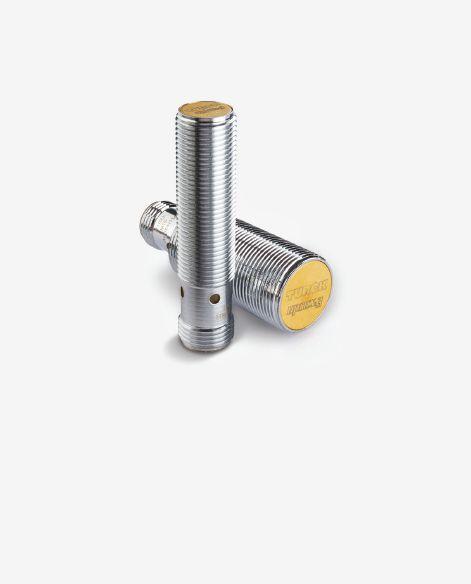
uprox®3 Inductive Proximity Sensors
Third-generation factor 1 sensors offer compact design and the farthest sensing range of any inductive sensors on the market.
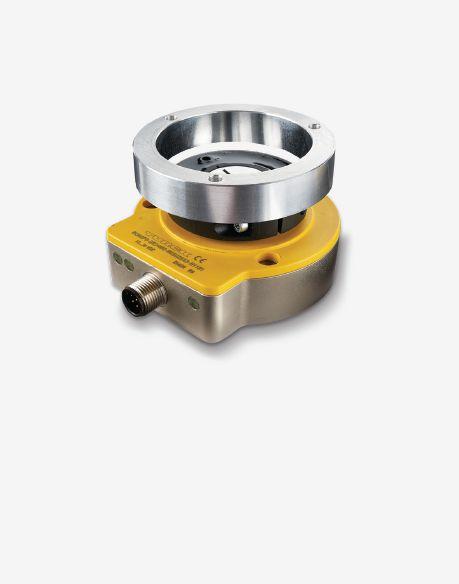
QR24 Rotary Inductive Sensors
Expanded line of contactless rotary position sensors provides superior performance and a wide range of outputs options.
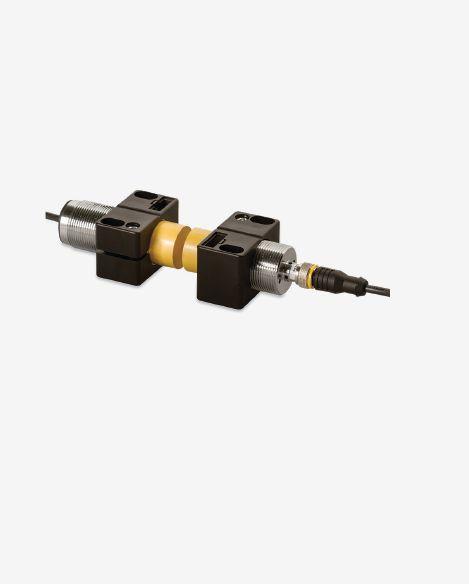
IO-Link Solutions
Our solutions are designed for reduced machine costs, improved machine availability and enhanced process efficiency.
BY JENNIFER RIDEOUT
the manufacturing
for Cisco
responsible for developing go-to-market strategies for the manufacturing sector in Canada, including channel alignment and content development. She can be contacted at jerideou@cisco.com.
Are Canadian manufacturers ready for the future of digital manufacturing?
In this magazine’s May 2018 issue, the results of the annual Canadian Manufacturing Study were revealed. Initially, as a professional in the IT industry, I was thrilled to see manufacturers prioritize IT investment. Twenty-five per cent, 17 per cent and 11 per cent of you, respectively, plan to invest in bridging the IT/OT gap, the Industrial Internet of Things (IIoT) and cybersecurity best practices over the next three years.
Then I read the results of a recent Capgemini study titled “Digital Engineering: The new growth engine for discrete manufacturers.” Capgemini surveyed more than 1,000 senior executives from global manufacturers (unfortunately none from Canada) to understand how much digital technologies are transforming how they operate. The contrast between the studies was startling. The results should be concerning to all Canadian manufacturers, because when you break them down, it just doesn’t look like we are prepared to compete in the future of digital manufacturing.
• Canadian Manufacturing Study: Seventeen per cent of manufacturers plan to invest in the IIoT and digital transformation in the next three years.
• Digital Engineering survey: Manufacturers predict close to 50 per cent of their products to be smart and connected by 2020.
• Canadian Manufacturing Study: Six per cent of manufacturers are currently using big data and analytics solutions in their operations.
• Digital Engineering survey: The most successful manufacturers are using technology to analyze and put into action 93 per cent of the data they produce.
• Canadian Manufacturing Study: Eleven per cent of manufacturers plan to invest in cybersecurity best practices over the next three years.
• Digital Engineering survey: Sixty per cent of manufacturers are leveraging cybersecurity solutions to promote a culture of innovation.
As Canadian manufacturers struggle to adopt advanced technologies, competitors outside of our borders are using them – and we need to catch up.
The reality is that Canadian manufacturers fall well behind their global peers (and competitors) in technology adoption. The reasons for this are well known and valid. Our manufacturers need more government programs and support; we need better alignment between education institutions and businesses; and often these technologies are expensive and require specialized skills to operate. But the data doesn’t lie. The fact remains that as Canadian manufacturers struggle to adopt advanced technologies, competitors outside of our borders are using them – and we need to catch up.
So how can Canadian manufacturers prepare for the future of digital manufacturing? Here are three suggestions:
1. Invest in different kinds of talent.
The Canadian Manufacturing Study identified the availability of skilled labour as the number one barrier to a manufacturer’s future competitiveness. This is for good reason, as fewer students are entering programs essential to factory operations. But it is time to look beyond the floor to talent with non-physical skills such as cybersecurity, software and data analytics. These skills are what will help manufacturers improve their digital capabilities, optimize results and benefit from advanced technologies. The Capgemini study predicts
these hires are expected to grow up to 50 per cent globally by 2020.
2. Focus on using the data you are already collecting from your connected devices. Two of the biggest factors contributing to the high (perceived) failure rate of IoT projects are scope and follow-through. Often, companies define a scope that is too large to accurately track and measure the data collected; they also often get excited about the bells and whistles of connected devices without investing in the analytics required to turn that data into actions. Instead of starting a new, or large, IoT project, Canadian manufacturers should focus on understanding the data they are already collecting and how that can be used to optimize operations.
3. Create a digital vision.
According to the Capgemini study, 92 per cent of successful manufacturers have created a digital roadmap to monitor progress. What does becoming a “digital manufacturer” mean to you? Why is it important that your company embraces these changes? What will it mean for your customers and employees? With an established digital vision, manufacturers will be better equipped to make the right technology decisions for their operations. | MA
Jennifer Rideout is
marketing manager
Canada. She is
INDUSTRY WATCH
BY
PAUL HOGENDOORN
Paul Hogendoorn co-founded FreePoint Technologies. “Measure. Analyze. Share. Don’t forget to share.” He can be contacted at paul.hogendoorn@getfreepoint.com or www.getfreepoint.com.
Myth-busting the IIoT and Industry 4.0
The emergence of Industry 4.0 and the IIoT, or the Industrial Internet of Things, is causing equal levels of excitement and concern. Most manufacturers I visit have heard about its potential and are aware of the building hype, but don’t know how it will affect them specifically. Depending on a person’s age, the opinions vary from one extreme to the other, with a healthy percentage of indifference. There is often fear associated with it – and like all fear, it is caused by uncertainty and lack of knowledge, fuelled by myths and speculation.
If you are close to retirement, you may be inclined to be indifferent, believing it will be the next generation’s problem – or opportunity. If you are in the middle of your career and working on the plant floor, you may fear it might eliminate jobs like yours in the future. And if you are in management, you might be concerned that the new technologies may obsolete or displace your skills, or require you to learn new ones. It seems to me that the more one group of people gets excited about the potential of these new technologies, the more concerned and worried the other group gets.
So, let’s pop the four myths I see and hear as most prevalent.
M yth #1: “The technology is only applicable for new machines, not for old and ‘legacy’ equipment.” This notion is completely false and is often perpetuated by companies seeking to sell new equipment or expensive software or consulting services. The truth is that old machines are often far easier and less complicated to connect than new machines. As an example, I have seen machines built in 1928 connected, “as is,” without modification or upgrade, for less than $1,000. Although newer machines come with more connectivity options built in, often those options require proprietary software that is either costly, or that creates data islands for the newly purchased machines.
Myth #2: “The IIoT will eliminate people.” While it’s true that technology does eliminate some jobs, it also
There is often fear associated with IIoT – and, like all fear, it is caused by uncertainty and lack of knowledge.
creates new jobs, and in many cases actually helps protect jobs by helping companies remain competitive with low-cost regions. Properly applied, technology should do more than that – it should also improve the working experience. The purpose of IIoT technologies should be to engage workers, not to eliminate them. (The purpose of most internet technologies is to engage people – the more people engaged by a platform or website, the more successful it is deemed to be. The same measurement objective should hold true for the IIoT.)
Myth #3: “Data is complicated and requires a sophisticated skill set.” If this is true in your situation, you are probably measuring the wrong things. The most important information is the information that lets you see which of your systems and processes are healthy, and which ones are not, and this information is usually very simple to extract, and equally simple to compute. For example, a doctor may see 50 patients in a week. By just taking three measurements from each one (pulse, blood pressure and temperature), he or she will know which 47 patients are healthy and which three require far more attention. The same is true on
the plant floor. Simple run time, stroke count and defect count will let you know which processes are healthy, and which ones require more attention. For the ones that require more attention, you and your people already know the symptoms that are evident. It then becomes a matter of measuring and analyzing those things empirically, automatically and in real time.
Myth #4: “Big brother is watching.”
This is the one I hear most often on the plant floor, but it’s a notion very easily dispelled. The fact is that management already knows the performance of a plant, person or machine, just perhaps not in real time. The only people that don’t know how well they are doing most often are the people actually doing the work. This may have been acceptable for our current workforce, but our emerging workforce – i.e. young people who have grown up with constant real-time feedback – needs that real-time feedback to remain engaged. Properly devised and deployed, IIoT technologies provide relevant, meaningful and engaging information to people. The information may come from a machine or sensor, but its ultimate purpose is still to inform, empower and equip people. | MA
ENDING THE DATA DEADLOCK
Why Industry 4.0 will require us to change the way we think of managing big data
BY ADAM BYRNE
Recent reports project that Canadian industry is perfectly positioned to take advantage of a new industrial revolution and the process is already taking place.
A survey conducted by PwC revealed that over half of Canada’s industrial companies expect to achieve advanced levels of digitization within two years and that 31 per cent have already passed this milestone.
It is envisaged that industrial digitalization will cause a shift in production, similar to that of the invention of mechanization, creating a digital industrial supply chain where products are developed, manufactured and monitored in real-time from design studio to display case through a single, integrated process. Connected supply chains with smart sensors will allow the real-time monitoring and measurement of vast automated assembly lines.
The possibilities are huge. The digital blurring of the boundary between the physical and virtual world in manufacturing will also allow
computer visualizations to be seamlessly converted into customized physical products in any location through 3D printers and other machines. Industrial robots capable of manufacturing everything from aircraft components to nuclear parts will create cost-effective, fast, efficient and low-maintenance industrial supply chains.
Yet the road ahead is replete with major obstacles and challenges. According to Deloitte, 87 per cent of Canada’s businesses report they are not ready for the disruption that advanced technologies will create, and 32 per cent consider themselves completely unprepared.
Central to the vision of Industry 4.0 is the
creation of digitally interwoven automated supply chains that can continuously adapt to live-market trends or trading conditions through the ability to track, trace, monitor and respond in real time. This will require a revolution in industrial communications where big data can be digitally omnipresent across a supply chain the second it is generated, just as remote access technology currently allows the data on one screen to be replicated in real time on another. We will need new open standards to enable seamless interchange of data across the industrial ecosystem.
This will be essential to enable control signals, sensor measurements and other data to be continuously exchanged in real time so that all critical industrial machinery, from robots to 3D printers, can be instantly accessed remotely and controlled by humans.
With robots making safety-critical components such as aircraft engines, staff will need to be
The only way forward for manufacturers is to create a safe, secure, open platform for end-to-end data exchange across the entire industrial supply chain.
able to remotely monitor, optimize and maintain them to instantly detect and fix software faults or prevent malicious interference. Cybersecurity teams will also need to be able to remotely monitor and intervene in manufacturing machinery to avert industrial sabotage by cyber-attack. For example, researchers have previously shown how to hack into 3D-printer files to make a drone crash by altering the design specifications for the propellers.
There are also plans to radically decentralize manufacturing through an “Internet of Thinking” based on a “DIY” sensor network that can autonomously analyze information, rather than send it for remote analysis. This will mean that if an industrial robot notices its own equipment malfunctioning, it will be able to recognize what it needs to do and self-correct any faults. However, such systems will need external human supervision in case of faults that they fail to detect or if they involve errors that require human intervention.
Continuous live data will also be critical to enable armies of robot “workers” to operate in seamless synchronicity, continually choreographing their actions in response to live location or measurement data from other robots.
The need for data to be digitally present in multiple places at once the moment it is generated requires us to apply the thinking behind the traditional “IT help desk” to the whole of the industrial IoT ecosystem. We need
a secure standard for sharing everything from audio and video to images and text among millions of industrial devices. This will require a genuinely low-latency, live connection that can make industrial control rooms digitally omnipresent across an entire supply line by allowing the two-way exchange of control signals and information.
Yet there are currently no open standards for industrial remote communication to allow industrial machines from any vendor to share live data and enable remote human intervention across all manufacturing equipment and components. Companies have proprietary protocols for remote access to machinery, but these work only with their own machines. This proprietary model for machine-to-machine has arguably damaged other industries. Millions of vehicles do not connect with different phone models, thus creating a fragmented “connected car” IoT due to car dashboards being divided between rival smartphone firms that “lock out” their competitors’ devices.
If this system is transposed into manufacturing, it will create a fragmented industrial IoT landscape where some machines cannot interface with machines by other manufacturers and control rooms cannot exercise the same degree of control over all machinery. This undermines the vision of digitally integrated end-to-end supply chains – and it could also make automation impossible, as it would necessitate real-time remote
87%
The percentage of Canadian businesses that reported they are not prepared for the disruption that advanced technologies will create, according to a study by Deloitte.
supervision of all machinery. Crucially, it could jeopardize cybersecurity by making some machines inaccessible to cybersecurity experts and by creating many different attack vectors that are difficult to protect.
The only way forward for manufacturers is to create a safe, secure open platform for end-to-end data exchange across the entire industrial supply chain. This would enable low-latency, multi-directional communication among all machines. Significantly, it would mean that supply-chain connectivity is backwards compatible and fully “future-proofed,” so it can seamlessly incorporate any new industrial robots or machines that emerge in the future. It would also make technicians, cybersecurity personnel, engineers and factory staff digitally ubiquitous across a factory floor of diverse and varied equipment, and enable them to instantly remote into any machine to fix faults.
If we are to fully realize the vision of an interconnected industrial supply chain across Canada and the rest of the world, we must challenge rival industrial manufacturers to convene around a more inclusive open-standard approach that will strengthen all the stakeholders in the supply chain. | MA
Adam Byrne is CEO of RealVNC. With a background in mathematics and computer science and a career spent growing IT companies from the ground up, he is building a worldwide ecosystem of technology partners in a variety of vertical markets. realvnc.com
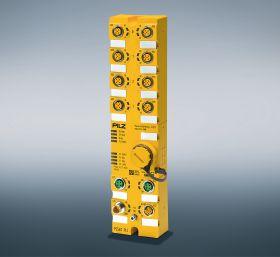
The open remote I/O system o ers maximum flexibility for the adaptation of existing system environments with head modules for PROFINET/PROFIsafe, Ethernet/IP and CIP Safety. A simple substitution of the head module allows the communication within di erent networks. Wide ranges of safe and standard I/O modules are available.
Scan to watch our PSSuniversal 2 video. Online information at www.pilz.ca
Pilz Automation Safety Canada L.P., www.pilz.ca
LOOK BEFORE YOU LEAP INTO INDUSTRY 4.0
Determine your company’s goals, and then dive into digitization
BY PETER GUILFOYLE
The term “Industrie 4.0” was first coined by the German federal government, in a national strategy to promote the computerization of manufacturing. It represents the fourth industrial revolution on the way to an internet of things, data and services. Decentralized intelligence helps to create intelligent object networking and independent process management, with the interaction of the real and virtual worlds representing a crucial new aspect of the manufacturing and production process.
T he basic principle is that by connecting machines and systems, we can create intelligent networks that control each other along the value chain. For example, machines would be able to predict failures and trigger
maintenance processes autonomously, or self-organize logistics that react to changes in production.
Industry 4.0 technologies include many of today’s buzzwords like big data, advanced analytics, virtual reality, the cloud, internet of things (IoT) and M2M (machine-to-machine communication). In the past decade, these technologies have swept across the globe, as manufacturers across the world recognize the value of Industry 4.0.
It sounds great, doesn’t it? A vision of the future with efficient, self-automated manufacturing processes that monitor themselves, so they never go wrong.
Taking pause
Few people would fault the vision, but a problem is emerging in the way that the principles of this industrial revolution are being implemented.
4.0
Adopting Industry 4.0 technologies involves a commitment, and adequate resource allocation, by the IT department to ensure necessary connections are made and maintained
The potential for Industry 4.0 is so huge that a lot of companies rushing to adopt the technology haven’t paused to first figure out the root goals they are trying to achieve, and what main problems they are trying to solve. If these two questions are not answered before embarking on the path to Industry 4.0, the route to follow becomes unclear, and many companies lose their way. The key technologies required for digital transformation cause radical changes in the business processes of any company, and those changes need to be discussed and understood before they are undertaken. For example, key stakeholders in the business need to consider the company’s culture and how to help employees at all levels to deal with change. This involves overcoming a general reluctance to change that is typical of the human makeup, as well as training employees to ensure they are qualified to use the upgraded plant. Once digitization is achieved, reassurances over continued employment need to be made or, if the upgrades are likely to
lead to redundancies, the company’s management needs to decide whether people can be redeployed in the new system (as is often the case), or whether they will need to be let go.
Industry 4.0: IT friend or foe?
Adopting Industry 4.0 involves a commitment, and adequate resource allocation, by the IT department to ensure necessary connections are made and maintained, and to avoid any IT snags that could cause expensive production outages. Modern information and communication technologies like the cyber-physical system, big data analytics and cloud computing will help early detection of defects and production failures, thus enabling their prevention and increasing productivity, quality and agility benefits that have significant competitive value. However, as more databases move onto – or connect with – the cloud, security issues are commonly cited as a barrier to fully embracing the new technology, and it’s important to ensure that all databases are protected sufficiently.
Some software technologies necessitate the moving and/or duplication of historian data or other data sources. This creates its own problems, both in terms of external data security and internal validation of the data. If a validated database is duplicated, does it need to be re-validated? These additional drains on IT and other resourcing need to be considered and discussed – sometimes an alternative approach is available that avoids these issues but still allows the company to move forward with digitization.
New technology needs to be reliable and stable for critical M2M, and it needs to meet
Investments need to be prioritized to ensure that those providing the greatest ROI are implemented first, and all changes need to be based on strategic plans to place the company at an advantage.
any applicable regulations to the industry sector concerned.
Of course, the economic benefits of this considerable investment need to be justified, and an expected return on investment (ROI) for each stage should be estimated. Investments need to be prioritized to ensure that those providing the greatest ROI are implemented first, and all changes need to be based on strategic plans to place the company at an advantage, or at the very least maintain a current favorable market position, in the future.
The path to digitization
Our world is becoming increasingly digitized, and this can be a good thing – improving efficiency, enhancing quality and helping companies to comply with ever-increasing data-related regulatory requirements. However, before embarking on the journey to Industry 4.0, companies need to pause to consider the objectives of the exercise, and set clear goals that will guide them on the way to the successful implementation of novel technologies. There is no shortage of technologies, but choosing the one that is going to have the greatest positive impact on your company, in the area that you most need it, is an obvious crucial decision.
Determining how to approach your technology choices can be resolved by creating a step-by-step process. This should be a team sport with relevant constituent participation. The first step is to determine the problems you hope to solve and what challenges are in the way. Secondly, identify the team. Who has the technical expertise to identify the parameters of importance? How is the IT going to help access key data sources? Then take a look at the people and technologies involved. What talent and technologies are needed? For example, if looking to maximize existing technologies and data sources, what platforms are compatible with current equipment and will be scalable going forward? Finally, begin with a pilot project and refine its implementation, which will roll out to other sites. All of these steps can help you to avoid potential problems and set your company on its path to Industry 4.0. |
Peter Guilfoyle is vice-president, marketing of Northwest Analytics, a manufacturing analytics solutions provider for Industry 4.0. nwasoft.com
SIMPLIFY WITH SCADA
Modular, on-demand subscription software built for the 21st century offers economical predictive process analytics to improve efficiencies
BY BERT BAECK
At times it seems hard to believe we’re already in the second decade of the 21st century, but what is even harder to believe is that the majority of manufacturers are still only using technology that is at least 30 years old. Many of these systems work wonderfully for what they are meant to do – collect and store data and monitor processes. However, these systems alone cannot help industrial companies meet the challenges of today’s global market.
The solution calculates the possible trajectories of the process and predicts process variables and behaviour before they happen.
Although there are several reasons for this situation, the perception that change is too difficult and expensive is the leading cause for companies to remain hesitant to take advantage of the new opportunities promised by the Industrial Internet of Things (IIoT). A recent LNS Research survey of over 400 manufacturing executives showed the vast majority of companies do not have plans to invest in IIoT technology in the near future. When we consider how expensive many of the existing systems are, it’s understandable why industrial companies are reluctant to invest in new technology.
Unfortunately, these executives are often looking at old technologies that have been tweaked to try to take advantage of IIoT
opportunities and that may require removing their current systems. The good news is there are very affordable technologies developed specifically for the internet age that work with existing systems to help manufacturers gain deep insight into process behaviour that translates into fast ROI.
SCADA information is more valuable than ever
SCADA systems were originally designed to collect data and monitor processes. Since they generate such enormous amounts of data, historians were added to store this data. Initially, historians were used to fulfill regulatory requirements, such as generating reports for government agencies. Leading industrial companies recognized the data hidden in their historians could provide valuable information on plant processes and production, but accessing and using the data could be very difficult because historians weren’t designed for “read” purposes or a two-way transfer of information.
Manufacturing execution systems (MES) were introduced in the early 1990s in an attempt to bridge the gap between plant-floor SCADA systems and enterprise ERP software. They also promised to provide analytics, such as KPI data, to improve plant-floor operations. While MES has been able to provide more advanced capabilities than SCADA systems, they are expensive and often require extensive engineering to be implemented. Moreover, they were developed for a different business
era in which systems were still largely siloed and internet optimization was largely an afterthought.
21st-century technology has arrived
When we consider the amount of time and money industrial companies have spent on traditional software, we can understand the reluctance of some manufacturers to enhance their systems. They are still trapped in the fear that any new solution will be expensive as well as require extensive engineering and training for employees. In addition, they are apprehensive about becoming locked into a cycle of difficult and expensive upgrades, patches and limited scalability.
To really take advantage of the IIoT, companies need next-generation solutions that were developed for that purpose. These solutions are able to offer users the best of new technologies, particularly in terms of ease of use and affordability.
Google for industry
As mentioned earlier, while historians hold a wealth of valuable data for improving operations, accessing that data and turning it into actionable information has been time-consuming and difficult. Many applications were based on data modelling, which required extensive engineering and data scientists. As a result, only mission-critical applications were targeted, leaving vast areas of improvement
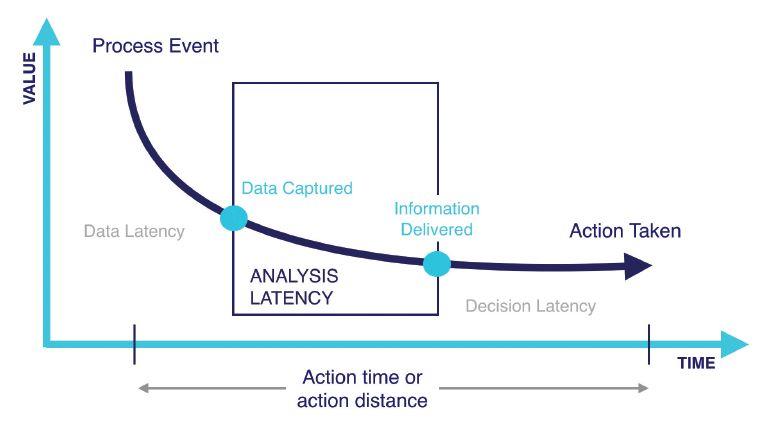
Figure 1: Combining live data with historical context shortens the analysis latency to immediate, providing an opportunity to take actions even before an event can affect process performance.
opportunities hidden.
In 2008, engineers from Covestro (then known as Bayer MaterialScience) knew there had to be a better way to leverage time-series data. They worked with different types of analytics models and identified their limitations for scaling-up beyond pilot projects. Eventually, they were able to use their deep knowledge of process operations to create “pattern search-based discovery and predictive-style process analytics” developed for the average user. The unique multi-dimensional search capabilities of this platform enable users to find precise information quickly and easily, without expensive modelling projects and data scientists.
A simple example of how this works is the song title–recognition app Shazam. While the technology used by Shazam is different, the concept is similar. Instead of trying to map every note in a song to its vast database of songs, Shazam uses pattern-recognition software that seeks “high-energy content” or the most unique features of a song, then matches it to similar patterns in its database. This is a very simple explanation of a complex process, but the important thing is that it enables users to quickly find a song title with a very high rate of accuracy. Naturally, industry demands more sophisticated algorithms that are capable of going beyond mere search. Often called Google for Industry, this software works by connecting to existing historian databases, then implementing
A recent LNS Research survey asked over 400 manufacturing executives if they have plans to invest in IIoT technology in the near future. Most of them reported they do not.
a column store database layer for an index. This software makes it easy to find, filter, overlay and compare interesting time periods to search through batches or continuous processes (Figure 1).
Moreover, this next-generation solution enables users to search for particular operating regimes, process drifts, operator actions, process instabilities or oscillations. By combining these advanced search patterns, users unlock the true information they need. For example, an operator can compare multiple data layers or time periods to discover which sensors are more or less deviating from the baseline, then can make adjustments to improve production efficiency.
Bringing it all together
In addition to easy search, this new technology provides process data contextualization and predictive analytics capabilities. Engineers and operators can provide annotation to give greater insight. The predictive analytics capabilities enable an early warning detection of abnormal and undesirable process events by comparing saved historical patterns with live process data. Moreover, the solution calculates the possible trajectories of the process and predicts process variables and behaviour before it happens. This gives operators the ability to see if recent process changes match the expected process behaviour and to proactively adjust settings when it does not.
A 21st-century business model
This new solution with out-of-the-box predictive process analytics (discovery and predictive) also employs a modern business model: online subscription pricing. In addition to making process analytics affordable to all companies, this setup also frees businesses from having to spend the time and money on adding additional licenses and upgrades. Each time a user logs in, they automatically get the latest version of the software. Companies now have the option to enhance the value of the investments they have made in high-quality historians. Low-cost predictive analytics solutions that complement their existing historians enable companies to better use the data collected by those historians to provide them with valuable business insights.
With an affordable, plug-and-play solution to uncover new areas for improving operation efficiencies, the question becomes why more businesses aren’t using software that is created for the IIoT generation. The future is here and companies can no longer operate solely using existing systems if they want to stay competitive in this new world. | MA
Bert Baeck is co-founder and CEO of TrendMiner with over 10 years of professional experience within big data/analytics in the manufacturing industry. Previously, he worked as a process optimization engineer for Bayer MaterialScience (now Covestro). trendminer.com
NEW PRODUCTS
Sine wave inverters for cranes
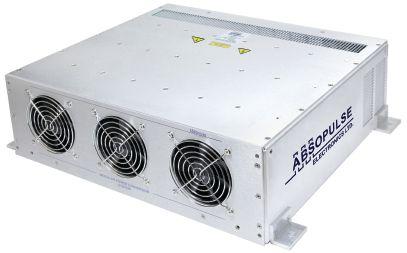
Absopulse has released the CSH 2K-3U7 series of rugged sine wave inverters for cranes and other severe environment applications. The inverters are designed to run peripheral equipment such as air conditioners, heaters and lights in crane operator cabins. They offer a 250Vdc nominal input voltage with a 230V to 600Vdc operating range. The high input voltage capability ensures that the inverters operate reliably with up to 600Vdc surge voltages on the input line. Microprocessor-controlled high frequency PWM technology enables high efficiency, compact construction and low weight. The input meets EN55022 Class A with wide margins (Class B option). The units meet C22.2 No. 107.1 – 01, UL 458 and EN/ UL60950-1 standards. Electronic protection includes 3000Vdc input to output isolation, inrush current limiting, output overload and short-circuit protection, as well as thermal shutdown with automatic recovery. absopulse.com
Mobile app expands data resources
Advantech’s IIoT iAutomation Group has launched WebAccess/SCADA 8.3 with the introduction of the new WebAccess Dashboard 2.0, a new mobile app, and added features such as improved
MQTT protocol and driver support. The app allows users to access external data via a thirdparty database or web service. It is compatible with standard SQL database management systems and has web service interface for data acquisition from other software systems. The new version allows users to customize widgets and supports multiple DSNs. The new version also comes with a more userfriendly installation package and a soft-license mechanism so that the software can be run on virtual machine systems. New drivers have also been added for popular PLCs and video management integration. advantech.com
Wi-Fi embedded module for device networking
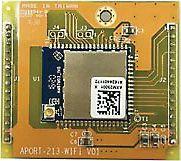
Artila Electronics has debuted the FreeRTOS-based serialto-wireless LAN module. SW-200M supports 2.4GHz, IEEE 802.11b/g/n Wi-Fi and the UART interface, which is designed to connect serial devices to intranet/internet. The module provides a serial-to-embedded wireless solution with 40 x 45 mm compact PCB size, and ultra-low power consumption features. The SW-200M module supports serial, UART, SPI, I2C,
PWM and GPIOs interfaces, and integrates a 32-bit ARM Cortex M3 processor with 2MB Flash memory, 2.5MB data memory, SSL hardware accelerator, 802.11b/b/g compatible WLAN MAC/Baseband/RF. The compact module also features a self-supporting Wi-Fi system and WPS (Wi-Fi Protected Setup), web browser, smartphone app and window manager utility. artila.com
High-speed ethernet over long distances
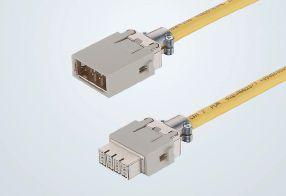
The Gigabit Cat7A data transmission module works with Harting’s comprehensive Han-Modular connector system. The setup, as part of a Cat7 network, offers ultra–high speed ethernet, making possible higher speeds over greater distances – for example, 10 gbit/s, up to 100 metres at an operating frequency up to 1,000 MHz. The Gigabit Cat7A module connects at data rates of 10, 100, 1,000, 10,000 and 40,000 mbit/s, so using Cat7A (Class F) cabling with it supports existing high-speed ethernet applications while providing flexibility to incorporate future ultra–high speed features without re-wiring. The eightcontact Gigabit Cat7A module is well-suited for transmission of sensitive data, bandwidthintensive applications and backbone connections. harting.ca
I/O platform for a connected enterprise
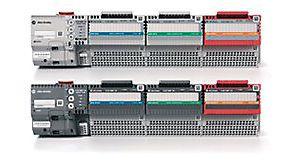
The Allen-Bradley FLEX 5000 I/O platform from Rockwell Automation is designed to create smarter, more productive and more flexible industrial
control systems. The platform’s higher-speed connectivity and expanded bandwidth deliver increased amounts of data back to the controller. This helps future-proof control systems for a connected enterprise. It is built on a one-gigabit architecture with communications supporting Device Level Ring (DLR), linear and star topologies. A future release will support Parallel Redundancy Protocol (PRP) for a redundant network topology. Installation is eased with a flexible architecture that includes vertical and horizontal mounting and copper and fibre media options.
rockwellautomation.com
Modbus Gateways for harsh environments
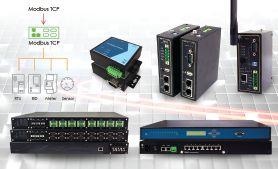
Mencom is offering a range of Modbus Gateway solutions, available from one to 16 serial ports and featuring several mounting options, such as DINrail, field mount or rack-mount. The products are designed to provide seamless conversion from Modbus RTU to Modbus TCP, and are enhanced with harsh environment operational capability, vibration resistance, power or serial port isolation for equipment and device protection. A data concentrator function is a proprietary mechanism to enhance responsiveness on Mencom Advanced/Industrial Modbus Gateways, automatically polling IEDs at specified intervals and storing the data.
mencom.com
Hygienic
design
enclosures
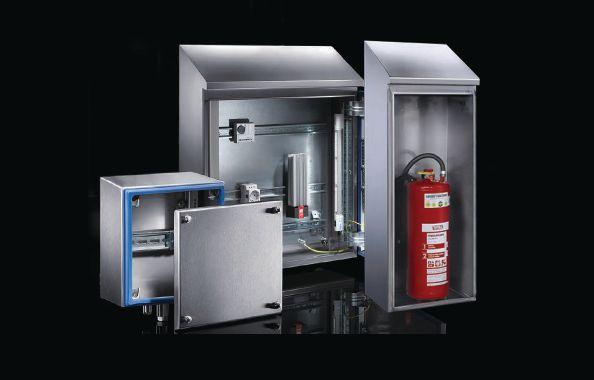
Rittal has created hygienic design enclosures engineered to prevent water damage and to deliver protection against contamination. The unit
WIRE & CABLE
Cut-to-length VFD cables
features a 30-degree roof angle designed to allow for liquids to run off easily, as well as fully welded construction of 304 stainless steel. IP69K-rated for food/beverage or any environment with sanitation
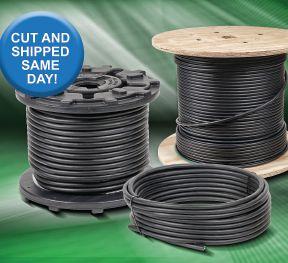
VFD cable from AutomationDirect is now available in customer-specified lengths in one-foot increments with minimum 10- to 20-foot lengths, depending on wire size. These VFD cables use cross-linked polyethylene (XLPE) conductor insulation with Class K, flexible stranded tinned annealed copper conductors. XLPE insulation can withstand voltages as much as three times higher than standard PVC/nylon insulation for VFD cables. The cable is available with fourconductors (including ground) in 16 AWG to 2 AWG sizes, and is 1000V rated for use with 460-volt drives. automationdirect.com
concerns and high-pressure washes, the enclosure features a one-piece, replaceable blue silicone gasket to provide a secure seal, while the distinctive colour makes particles easy to spot and remove. rittal.com
Heat exchangers cool electrical enclosures
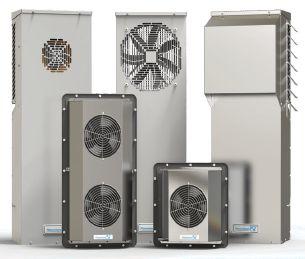
Pfannenberg has released the PKS Series air-to-air heat exchangers to cool electrical enclosures. The exchangers use a proprietary technology called Pfannenberg Kinetic System to ensure a cooler ambient environment for the electrical enclosure. They also consume approximately one-third of the power of a traditional industrial air conditioning unit. Pfannenberg has designed the exchangers for indoor, outdoor, remote and wash-down applications that require a closed-loop system to protect electronics. The PKS series of heat exchangers is available in five configurations: 22, 45, 64, 100, 150 and 180 watts per
degrees Celsius. pfannenberg.com
Clean workstation with HEPA filter
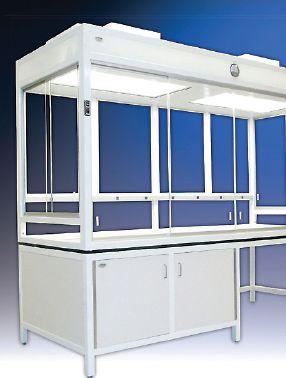
Hemco says its EnviroMax Laminar Flow enclosures are engineered and built to meet critical clean requirements within the laboratory. Typical applications include liquid-handling stations, compounding, high-throughput screening, sample weighing, powder handling, HPLC equipment and other related systems. The enclosure isolates the process while the HEPA filter system maintains a positive pressure and ISO 5 class 100 conditions by protecting the process from surrounding contamination. Standard sizes of the enclosures range from four to eight feet wide, two to four feet deep, and three to five feet high.
hemcocorp.com
NEW PRODUCTS
MACHINE TOOLS
R&D device for continuous production
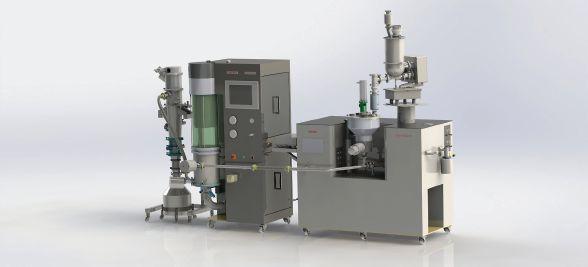
Bosch Packaging Technology has introduced its latest R&D device for the continuous production of oral solid dosage (OSD) forms. As opposed to the common complex mass flow rate, excipients and active ingredients are dosed as a discrete mass in the Xelum R&D, making it possible to dose even smallest amounts of APIs of less than one per cent. The system doses, mixes and granulates individual packages, so-called X-keys, which continuously run through the process chain and are removed from the machine as packages into bins. Depending on requirements, up to four loss-in-weight feeders can be used. The Xelum system relies on fluid bed processors.
POWER SUPPLIES
SIL 3 power supplies
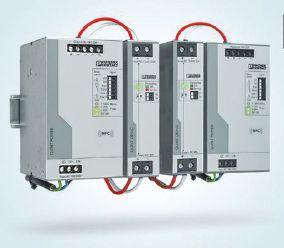
Phoenix Contact’s QUINT line now provides IEC 61508 SIL-rated power supply solutions to fulfill critical SIL 3 safety requirements. The overvoltage protection (OVP) circuitry built into the QUINT4-PS/1AC/24DC/20 (2904602) power supply and
In the fluid bed, granulation and drying take place in the same process chamber.
boschpackaging.com
Highly elastic material for bearings
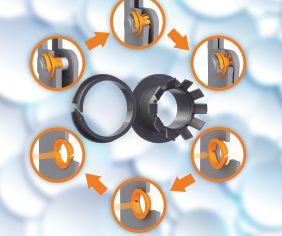
igus has developed a new triboplastic material, iglidur K230, for clip and flanged bearings often used in the sheet metal industry. The lubrication-free material is highly elastic, chemical-resistant and able to withstand moisture.
In addition to the standard range of clip bearings, there are also a range of customized solutions in which the K230 material can be used. The K230 properties are suitable for bearings in which a second flange is formed after inserting the bearing into a hole. Those bearings are frequently used in reducing friction and noise in car seats, and in other applications that require high flexibility and durability. igus.ca
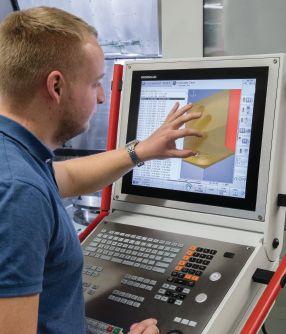
Mill-turn control with touch tech
Heidenhain has announced that its TNC 640 high-performance mill-turn control will now only be available with touch technology. With the TNC 640
touch screen, the operator can use kinetic scrolling to navigate through long lists, programs, tables and other content. The minimum requirement for NC Software version is 340 59x-07 SP2. The hardware enabling touch control are the MC8532 main computer and the BF 860 color flat-panel. These units come without any hardware keys, as they have been designed for touch operation. The MC 8532 features a 19” touchscreen, an Intel Core i7-7-3 processor with 1.7 GHz on SSDR and 4GB RAM memory. The BF 860 offers four USB ports. The TE 745 (FS) remains unchanged and does not to be upgraded with the hardware. heidenhain.com
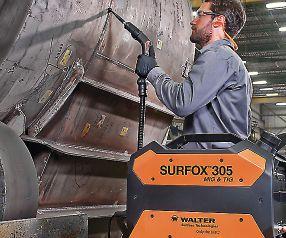
Weld cleaning system
Walter Surface Technologies has released the SURFOX 305, a patented electrochemical MIG and TIG weld cleaning system. The system removes heat tint from the heat-affected zone of MIG, TIG and spot welds on stainless steel and aluminum. It cleans surfaces without disrupting passivation on stainless steel or altering the finish, and its dynamic current
the QUINT4-S-ORING/1224DC/1X40/+ (2907753) redundancy module have been certified for electrical safety in accordance to IEC 61508 and multiple EMC standards. The OVP circuitry build in the Phoenix Contact QUINT4-PS/1AC/24DC/20 (2904602) with the redundancy module QUINT4-S-ORING/1224DC/1X40/+ (2907753) can be used to set up single or redundant bulk power system with a proven OVP. This system can be used in SIL 3 applications according to IEC 61508. The safety function is to limit the output voltage to 32 V DC. If the voltage rises above 32 V DC, the device will switch
off, creating a safe state of no output voltage.
phoenixcontact.com
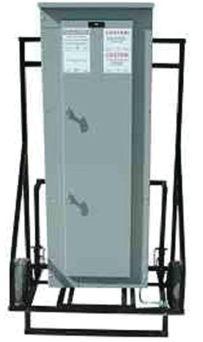
Portable power distribution panel
Larson Electronics has released a dolly cart–mounted portable power distribution panel with receptacle outputs. This system offers compatibility with three-phase 480V AC and provides access to eight receptacles for temporary power distribution. The MGP-480D500MB-8X460R7W-
20C can be used to power equipment from various sources, such as generators and grid power. Operators may bring 480V AC input power using 20 feet of 500 AWG Type W cable into the NEMA 3R rated panel. The 500-amp main breaker panel contains eight 60-amp, 3-pole 480V AC breakers protecting eight 480V AC 460R7W pin-and-sleeve receptacles. The entire system is mounted on a slim, upright dolly cart for ease of transportation around the site.
larsonelectronics.com
control protects the surface against micro-pitting. Users can quickly change out brushes, which are designed to clean large and hard-to-reach areas. Other features include an AC mode for cleaning and marking, a DC mode for polishing and etching, and a built-in vapour dispersion system. walter.com
MACHINE SAFETY
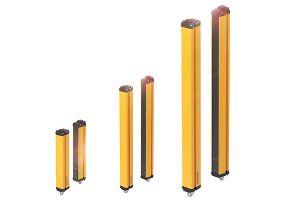
Safety light curtains with IO-Link
Balluff has released a new family of safety light curtains with IO-Link connectivity. Users can choose from finger-, hand- or body-detection versions, covering protective heights from 150 mm (six inches) to 1,800 mm (71 inches). They have a compact, robust housing and meet the highest levels of safety required by EN
PROGRAMMABLE CONTROL
PLC controller for safety and automation
With PSS67 PLC, Pilz says it is launching the first safe PLC controller with protection type IP67. PSS67 PLC can be installed outside the control cabinet, directly
on the machine. It is protected against dust and temporary submersion and can be used for temperatures from -30 to 60 C. The PSS67 PLC is suitable for applications up to the highest category PLe, and is part of the automation system PSS 4000. It is compatible with other controllers in the system and can integrate into existing architectures.
PSS67 PLC has 16 safe digital inputs for the direct connection of sensors and can be combined with the compact module PSS67 I/O from Pilz, which forwards signals from the field. pilz.com
ISO 13849 (PLe) and IEC/EN 61508/62061 (SIL 3). They can be connected to safety relays, programmable logic modules or safety controllers, and are plug-and-play with the Balluff safety IO-Link I/O module. They’re wired using standardized M12 plug connections and off-the-shelf non-shielded cables. The safety light curtains can be applied at point-of-operation guarding of machine openings, area guarding of machine and work cell perimeters. balluff.com
A scalable safety solution
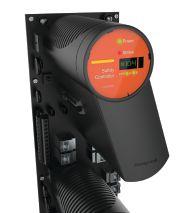
Honeywell Process Solutions has announced Safety Manager SC, the next generation of its flagship Safety Manager
platform. Its modular, scalable design enables it to function as a single platform for all enterprise safety applications, allowing customers to consolidate and reduce their training and engineering costs, and spare parts inventories. Safety Manager SC incorporates a new Series C-based controller and Honeywell technologies such as LEAP, Universal Safety IO, offline simulation and Experion integration. Safety Manager SC works for global hydrocarbon processing companies with greenfield projects requiring SIL2 or SIL3 solutions for distributed and safety applications, or standalone safety solutions. honeywellprocess.com
ADVERTISER INDEX
Allied Electronics & Automation 1 + 15
AutomationDirect 2
Balluff Canada Inc. 19
Beckhoff Automation Ltd. 5 Carlo Gavazzi (Canada) Inc. 7
Encoder Products Company 6
EPTECH 2018 25
Fluke Electronics 13 Hammond Manufacturing 8
TO ADVERTISE
Contact Klaus B. Pirker • KPirker@annexbusinessmedia.com
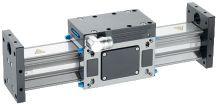
0.01 mm repeat accuracy LDN Linear Axis
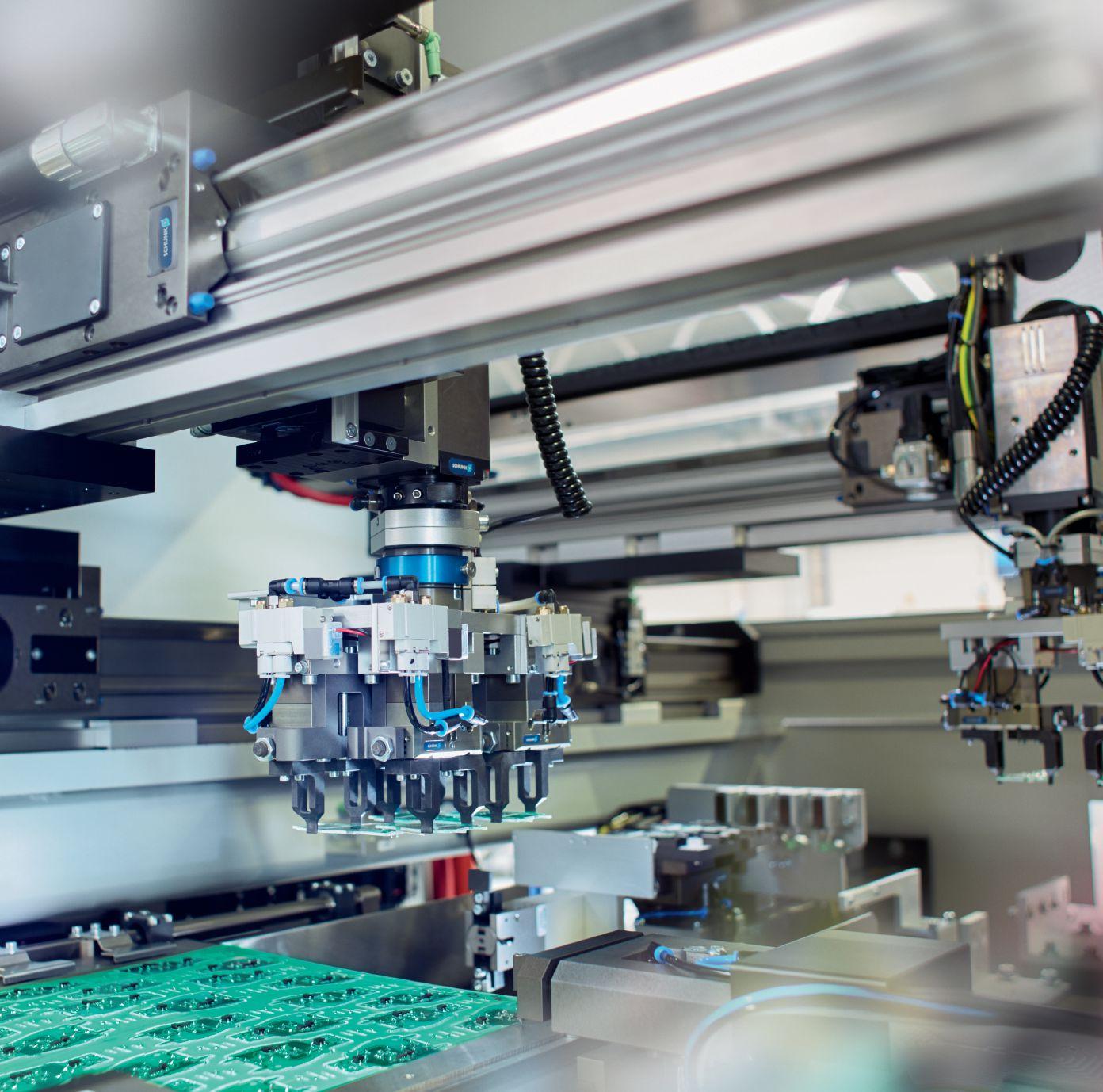
90% faster gripper change
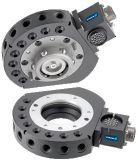
SWS Quick-change System
NEW: Up to 50% higher gripping force
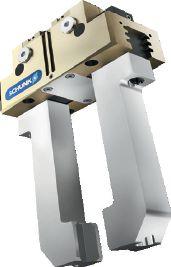
PGN-plus-P Universal Gripper
Everything for your Handling System
More than 4,000 components for handling and assembly.
Always on track
SIMATIC ITP1000: Maximum mobile performance, every day
More flexibility with the robust SIMATIC ITP1000 Tablet PC: thanks to its long battery life, the tablet is suitable for all-day mobile use in the entire industrial environment. Frequently used applications can be implemented at the touch of a button. For top performance and maximum time savings.