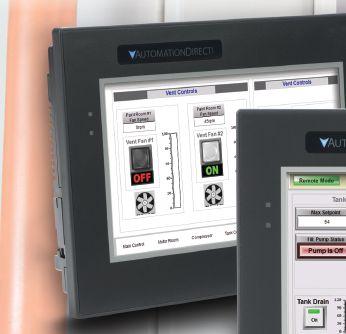
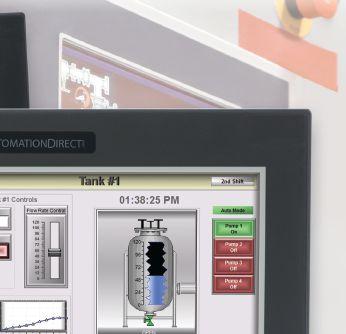
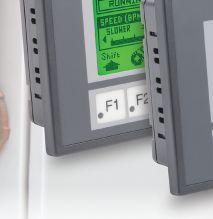
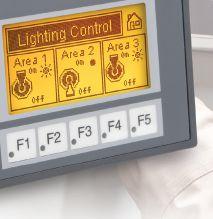
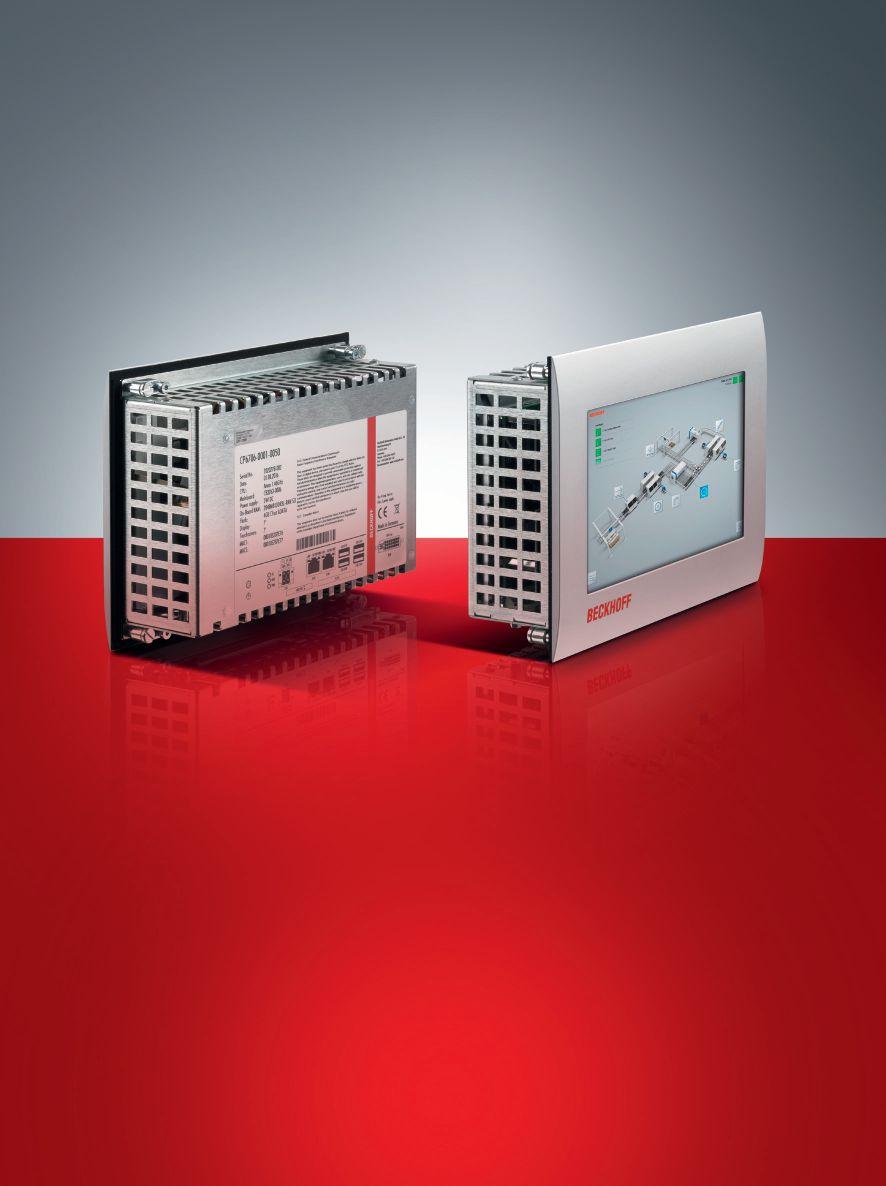
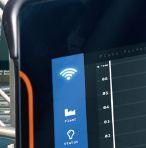
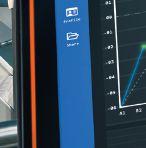
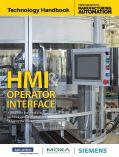
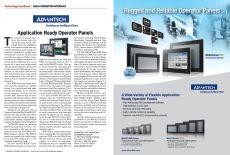
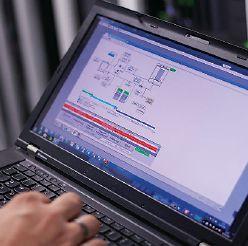
The C-more and C-more Micro HMI families provide a variety of affordable options and features to meet your operator interface needs, no matter the project size or complexity. Whether your application requires advanced interfacing or just the basics, we have a low-cost HMI solution for you.
C-more Advanced HMIs
• Variety of sizes available (6, 7, 8, 10, 12 and 15 inch)
• Widescreen options
• Advanced features include animations, logic, math, alarming, remote accessibility (web server and mobile app), data logging and a myriad of supported communication protocols
C-more Micro HMIs
• Touch and non-touch versions available
• Variety of sizes offered starting at 3 inches
• Free programming software with simulator
• Basic functionality, ideal for small systems and cost-conscious applications
18 A new era in camera control
The CoaXPress communication standard for machine vision is gaining traction – here’s why
By Donal Waide
Sensor manufacturer SICK takes us inside its new
factory in Germany. What does it mean for Canada?
By Kristina Urquhart
Seven
to self-diagnose your need for data-driven analytics
By Jeff McBee
LETTERS TO THE EDITOR
@AIMSmetrology
In interesting #automation news, Volkswagen fits e-Golf headliner using robot in Dresden factory. Watch the #video here!
@AutomationMag hubs.ly/ H0h1Myp0
@ForceDesignInc1
@Automation Mag points out that the right end-of-arm tooling can add value to your production. #cobots #manufacturingprocess bit.ly/2DLuLm8
@CorlinaInc
New report from @TrendMicro indicates that IP and production processes are at risk from using outdated tech in #manufacturing networks. Get the full report via @Automation Mag. buff. ly/2UvArfw
@karenjhalliday MT @AutomationMag has content on #Industry 4.0. It refers to a cyber-physical environment or a “Smart Factory,” ...layering AI to learn from data & make decisions.
FROM THE EDITOR
BY KRISTINA URQUHART
A case study in connected manufacturing
Ever since the German government introduced the concept of Industry 4.0 at the Hannover Messe trade show eight years ago, connected manufacturing has been the main topic of conversation at the annual fair.
This year was no different, with the biggest buzz being how connectivity is about to be redefined with the next generation of wireless communications. 5G technology is almost ready for commercial launch – Canadian telecom companies are expected to implement capabilities in 2020 – and will have a massive impact on the industrial landscape, though implementation is still a few years off.
5G, with its ultra-low latency and very-high bandwidth, is lauded as the first real solution for manufacturers to achieve total, reliable wireless coverage – even indoors – using cellular “nodes” (like base stations, mounted to ceilings or walls) to transmit signals from point to point.
Industry giants are also focusing on refining their solutions for Internet of Things–enabled devices and the artificial intelligence (or “smart programming” – remember that reader who challenged the term AI in our last issue? Turn to p. 16) that drives them. It’s all part of the original quest announced back in 2011 to realize the Industry 4.0 benchmarks of connectivity, flexibility and decentralized decisions.
S ensor manufacturer SICK is
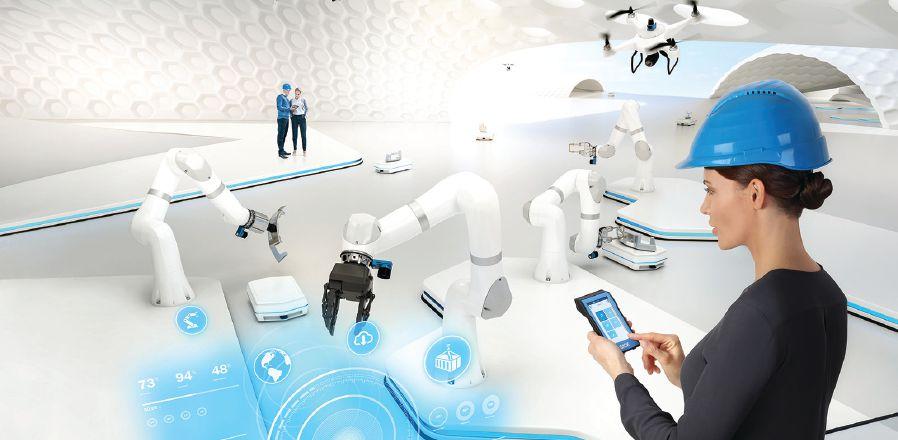
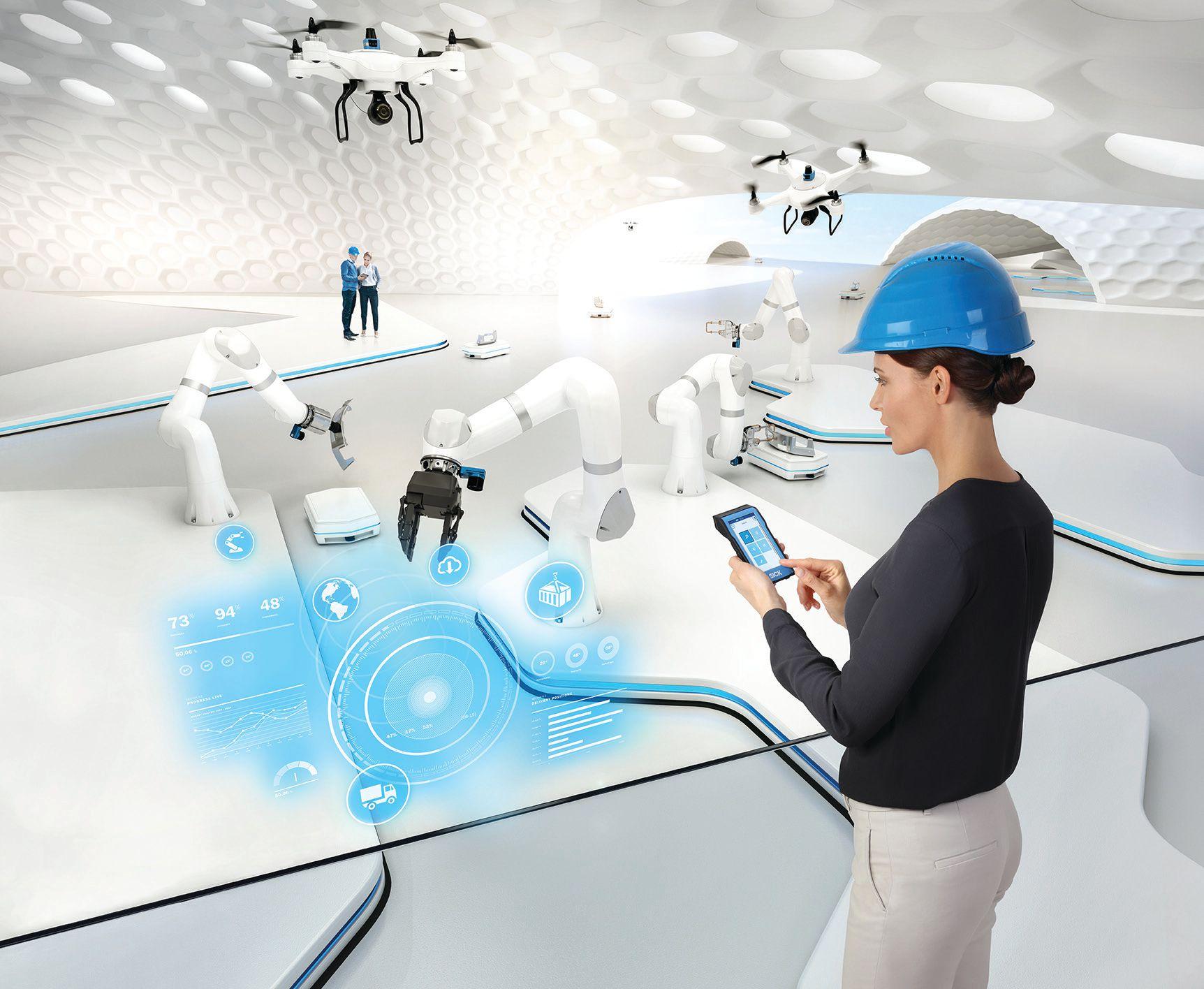
embracing Industry 4.0 in a big way with its state-of-art 4.0 NOW Factory, which it unveiled at Hannover Messe 2019. 4.0 NOW is a fully connected plant that uses data from sensors, parts and equipment to develop a 360-degree view of operations and, in turn, optimize production control.
In January, I got a preview of SICK’s new factory in Freiburg, Germany and it is every bit a utopia as it sounds (p. 20). I was curious to dig up what realistic takeaways the model setup might offer to Canadian manufacturers, and I came away with this: data may be the most powerful tool out there, but unless you contextualize it, it’s useless.
S o if you don’t know how to read your data? Starting small is the easiest – and most affordable – way to get into the Industry 4.0 mindset. “A fairly small investment in sensors can result in a major return on investment,” advised Erik Josefsson, VP and head of advanced industries at Ericsson during Hannover Messe this year. On p. 14, Jennifer Rideout from Cisco Canada has more insight on how to connect your plant with data in this month’s Going Digital column. And if you still need convincing, check out more tips how to take the data dive on p. 24.
For more highlights from Hannover Messe, watch for our wrap-up in the next issue, and check automationmag.com for recaps, photos and a highlights reel. | MA
Your resource for Canada’s industrial automation news
Carrie Halle, Paul Hogendoorn, Paresh Kansara, Jeff McBee, Ray Richter, Jennifer Rideout, Donal Waide
Manufacturing Automation is published seven times a year by:
Annex Business Media 111 Gordon Baker Rd., Suite 400, Toronto, ON, M2H 3R1 Tel: 416-442-5600 Fax: 416-442-2191
Printed in Canada ISSN 1480-2996
Publication Mail Agreement #40065710
CIRCULATION
email: lmalicdem@annexbusinessmedia.com
Tel: 416-510-5187
Fax: 416-510-6875
Mail: 111 Gordon Baker Rd., Suite 400, Toronto, ON, M2H 3R1
SUBSCRIPTION RATES
Canada — $43 per year
United States — $75.50 (US) per year
Foreign — $86 (US) per year
Students — $20.50 per year
ANNEX PRIVACY OFFICER
email: privacy@annexbusinessmedia.com
Tel: 800-668-2374
CONNECT
EDITORIAL ADVISORY BOARD
AL DIGGINS, Chairman of the Board, Treasurer and General Manager, Excellence in Manufacturing Consortium
DAVID GREEN, Technology and Business-to-Business Consultant
KARIN LINDNER, Founder and Owner of Karico Performance Solutions
DON MCCRUDDEN, Vice-President, Business Development, Festo
DAVID MCPHAIL, President and CEO, Memex Automation
NIGEL SOUTHWAY, Business Productivity Consultant and Author on Lean Thinking
BILL VALEDIS, Vice-President, Precision Training, Products and Services Inc.
Occasionally, Manufacturing Automation will mail information on behalf of industry related groups whose products and services we believe may be of interest to you. If you prefer not to receive this information, please contact our circulation department in any of the four ways listed above.
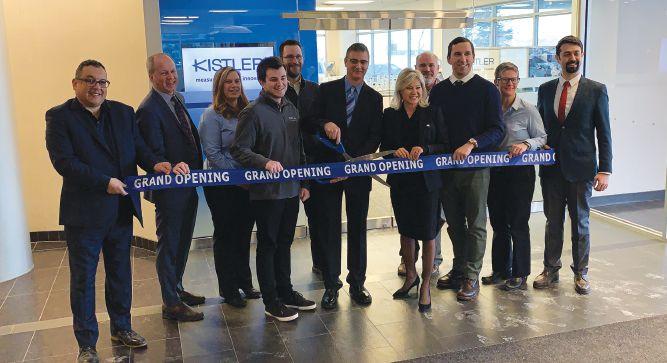
The Kistler Group, a manufacturer and supplier of dynamic measurement technology, opened a new location in Mississauga, Ontario on February 19 to support customers and manage sales in Canada.
The company says the expansion reinforces Kistler’s commitment to grow operations with customers’ increasing demands. Kistler will support the automotive sector, which is dependent on assembly, joining and forming processes, in-depth expertise and new products. Kistler will also provide aircraft and space testing expertise and additional services.
As a full measuring chain supplier, Kistler offers signal conditioning, data acquisition and engineering know-how for its wide portfolio of sensors.
“Companies like Kistler are an essential part of Mississauga’s thriving innovation ecosystem that is well connected and supportive of emerging trends that require Industry 4.0 and other advanced technologies in the workplace,” says Bonnie Brown, director of economic development for the City of Mississauga.
TTG Automation to expand for assembly
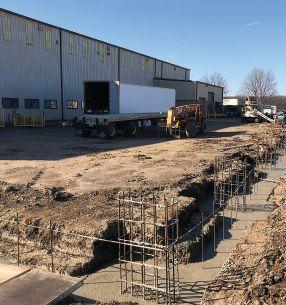
TTG Automation, a Tooling Tech Group company and supplier of secondary tooling, fixtures and
automation solutions, is building a 17,000 square-foot expansion to provide more room for assembling its automated systems.
The build is expected to be completed by September 2019 and will expand the current 47,000 sq. ft. building in Temperance, Michigan by over 35 per cent.
TTG Automation offers design, engineering, fabrication, build, commissioning and
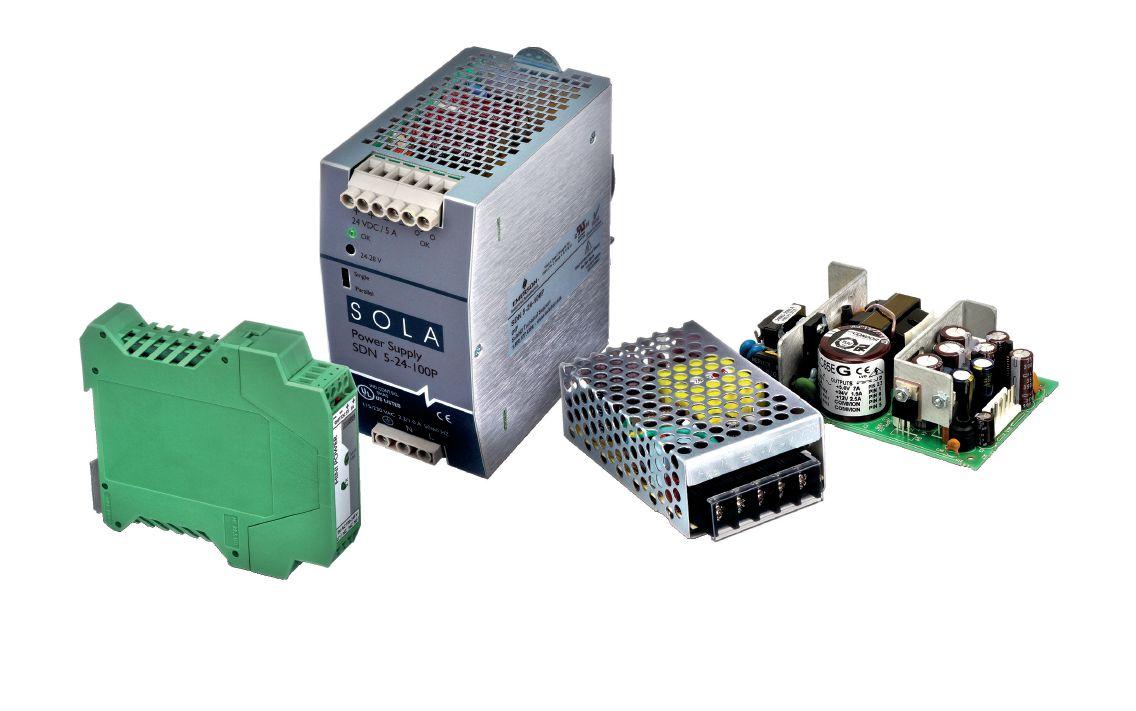
“Low cost” doesn’t have to mean “low quality”.
AUTOMATION UPFRONT
SAFETY
Ontario manufacturer fined $130K after worker injury
Ventra Group Company has pleaded guilty to an offence levied by the Ontario Ministry of Labour and received a fine of $130,000 after a worker was critically injured in machinery at its plant.
The offence took place September 30, 2017 in Peterborough, Ontario, where it is licensed to manufacture injection-moulded plastic vehicle components. Ventra Group Company is based in Nova Scotia.
According to the Ontario Ministry of Labour, the incident took place when Ventra hired a contractor for industrial cleaning services at the plant. The worker, who was alone, approached the robot cage at an injection-moulding machine, intending to enter it for cleaning.
The two robots that are located inside the cage pick, trim, and place vehicle bumpers from the injection-moulding machine onto a conveyor. The door to the robot cage was interlocked so as to shut both robots down upon opening the door. The interlock did not shut down the parts conveyor.
The parts conveyor was partially inside and partially outside the robot cage, and remained continuously running. The worker entered the robot cage through the door to clean inside, and then exited to clean an area outside the cage near the conveyor.
Seeing some plastic pellets under the conveyor, the worker reached between existing guards on the conveyor, going beneath the conveyor to sweep the pellets with one hand. To access the moving drive shaft area, the worker squeezed through a small gap. The worker’s hair caught in a rotating
drive shaft located near the tail pulley and beneath the conveyor, resulting in a critical injury.
The company pleaded guilty for failing as an employer to ensure that the machinery was equipped with guards that would prevent access to the moving part, in accordance with the Occupational Health and Safety Act.
INVESTMENTS
Ontario robotics company raises $23.6M
in funding
Avidbots, a Kitchener, Ontario–based robotics company, has raised $23.6 million in a new round of funding, which it says will be used to expand its staff.
The Series B funding was led by returning investor True Ventures. Other returning investors include GGV Capital, SOSV, Real Ventures, and 500 Startups Canada. New investors include Next47, BDC Capital, and KCPL. Next47, a global venture capital firm backed by Siemens, was the largest investor in the round.
Avidbots designs and builds autonomous connected robots. Its first product is Neo, a robotic floor scrubber for industrial and commercial locations including warehouses, manufacturing sites, malls and airports. Manufactured in Avidbots’ 40,000-square foot facility in Kitchener, Ontario, Neo is in use today in over a dozen countries.
The company says that most floor-cleaning machines are existing manual models retrofitted with hardware and software that allows them to travel a few pre-programmed routes, whereas Neo is the first purpose-built commercial robotic floor scrubber that uses AI to optimize performance.
Neo does not just follow a set path, but instead continually learns from its environment to change its route on the fly—avoiding obstacles and adapting to new floor layouts. Neo has a vertically integrated technology stack that incorporates proprietary software and a unique hardware design, as well as advanced 3D sensors and cameras. Connected to the cloud through WiFi and 4G, Neo includes 24/7 monitoring and automatically receives regular software updates to continuously gain new functionality.
Avidbots was founded in 2014 by graduates from the University of Waterloo. To date, Avidbots has raised $36 million in venture capital financing.
Feds invest over $772K for automation in Quebec
The federal government has announced over three quarters of a million dollars in investments in three Quebec manufacturing companies to expand their operations with new automation equipment.
The agency Canada Economic
Avidbots, a manufacturer of industrial cleaning robots based in Kitchener, Ontario, has raised over $23 million in Series B funding to increase its staff.
Development for Quebec Regions (CED) has issued a total of $772,979 in repayable contributions to Fabspec, Technolaser and Aciers Richelieu in the Sorel-Tracy region of the province.
The respective projects will generate $2.2 million in total spending and will result in the creation of 21 jobs.
Fabspec Inc. specializes in the fabrication of large and complex mechanically welded parts, and will use its funding to acquire and install new automated production equipment, including automatic welding machines, dynamic turning rollers and a plasma cutting table, and to implement new management software.
Technolaser Inc. will acquire automated production equipment, including a fibre-optic laser cutting machine, a deburring machine and a packaging machine. The company operates in the laser cutting sector, and also
provides design, bending, tapping, mechanical welding, rolling and assembly services for various types of materials.
Aciers Richelieu Inc., a fabricator of complex mechanical parts and equipment for the heavy industry sector, will install new automated production equipment, including a plasma cutting table with a 5-axis head, and to upgrade the CNC band saw.
MILESTONES
Honda of Canada Mfg. celebrates 50 years
On March 11, Honda Canada celebrated 50 years in business at an event at the company’s head office near Toronto.
Honda Canada has sold more than four million vehicles since incorporating in 1969. The ceremony launches a full year of anniversary activities designed
to celebrate the milestone with customers, dealers and partners.
“Honda planted roots in Canada with a vision of contributing to Canadian society. We are proud of our associates, dealers, partners and suppliers, who have played
an important part in our growth and have helped improve the communities where we live and work,” says Gardner.
Four years after arriving in Canada with motorcycles and power products, Honda sold its
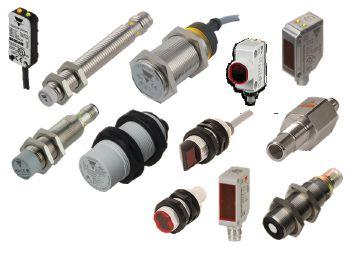
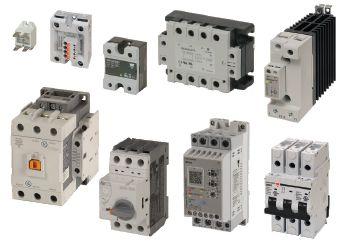
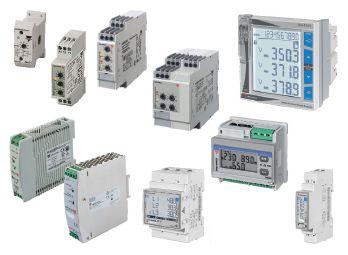
CARLO GAVAZZI has the solution for your application needs, whether it’s our industry leading solid state relays, energy meters, contactors, motor controls, monitoring relays or sensors, now available with IO-Link communications.
Contact us today, and one of our field sales representatives will show you why we are one of the fastest growing automation companies worldwide. We’ll even provide a free evaluation sample to qualified OEMs.
Dave Gardner, president and CEO of Honda Canada Inc. (left) and Toshiaki Mikoshiba, chairman and CEO of Honda North America, Inc.
AUTOMATION UPFRONT
first Civic. As the first Japanese automaker to build cars in Canada, Honda of Canada Mfg. (HCM) cut the ribbon on its first manufacturing plant in Alliston, Ontario, in 1986.
A second plant was brought online at the Alliston facility in 1998 to build the Honda Odyssey minivan, and in 2008, HCM began building four-cyclinder engines at a third facility in Alliston. To date, more than eight million cars and light trucks have been built at the Alliston facility, which currently employs 4,200 associates.
LAYOFFS
Politicians voice support for FCA auto workers
A second round of auto-worker layoffs in recent months has led politicians to assure workers as the automotive sector undergoes significant transformation.
Economic Development Minister Navdeep Bains went to Windsor, Ont. on March 29 to voice his support after Fiat Chrysler Automobiles N.V. said it would cut 1,500 jobs at its assembly plant in the city.
“We’re here to support workers, we want to fight for every single job,” he said by phone ahead of a
meeting with FCA president Reid Bigland.
On March 28, the company said it would cut the third shift at its Windsor plant, which produces the Chrysler Pacifica and its hybrid version, as well as the Dodge Grand Caravan, at the end of September to better align production with global demand.
The now looming cuts add to the 2,600 unionized jobs at risk after General Motors said in late November it would shut production at its Oshawa, Ont. assembly plant by the end of the year.
The combined cuts will affect tens of thousands of spin-off jobs.
Bains said the government would include the Pacifica hybrid model in an electric vehicle rebate program announced as part of the most recent federal budget after the union complained that it didn’t meet the criteria.
“That should help Canadian families that are trying to drive cleaner vehicles to do so in a more affordable way,” he said.
The government could also use a federal strategic innovation fund to potentially entice new investments in the sector, said Bains.
“We think we’re really well positioned to continue to see new mandates here in Canada for the automotive sector.”
Ontario Premier Doug Ford
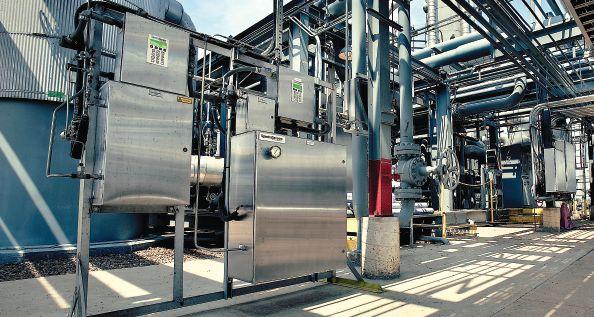
Endress+Hauser is now the exclusive distributor in Canada for SpectraSensors, which are used to measure contaminant levels in gas processing and chemical plants.
said he was committed to lowering electricity prices and taxes to help attract investment, and that the provincial government was ready to support those affected. – The Canadian Press
Endress+Hauser is now the exclusive sales and service source for SpectraSensors in Canada. The sensor company’s gas analyzing technology is used to measure contaminant levels in natural gas and gas processing operations, refineries and chemical plants.
Endress+Hauser Canada will assist customers to choose analyzers with the proper sensitivity level to generate consistently accurate readings of analyte, such as moisture (H2O), hydrogen sulphide (H2S), carbon dioxide (CO2), oxygen (O2), acetylene (C2H2), ammonia (NH3) and gas composition. Customers will have access to the factory-trained local resources of Endress+Hauser, training in Process Training Units, bilingual telephone support and on-site services (commissioning, maintenance and repair). Endress+Hauser can help customers incorporate the data stream from their analyzers into their IT infrastructure, including IIoT systems.
MOVERS AND SHAKERS
Industrial services provider Wajax Corporation has announced the resignation of Darren Yaworsky, senior vice-president, finance and chief financial officer, for personal reasons. Yaworsky will remain with the company until the release of its 2019 first quarter financial results. The corporation has commenced a search for a new chief financial officer, the results of which will be announced in due course.
CenterLine (Windsor) Limited, a builder of custom welding and assembly lines for the automotive industry, has made two new appointments to its marketing team. Phil Campbell has been promoted
to VP global sales and marketing. In this new role, Campbell will continue to support sales clientele, while collaborating with CenterLine Global Affiliates (CGA) to grow their business with shared global customers in their respective international regions. Kathleen Cvitkovic has been appointed to the position of corporate marketing manager and will report to Campbell. She will be responsible for managing all aspects of CenterLine’s marketing initiatives.
Bombardier has appointed Steeve Robitaille as senior vice-president, general counsel and corporate secretary for Bombardier Inc. Robitaille will succeed Daniel Desjardins,
who will continue to serve as a special advisor to Alain Bellemare, president and chief executive officer for Bombardier Inc., and as chairman of Bombardier Transportation’s board of directors. Robitaille brings more than 25 years of high-level legal and transaction experience to the role.
Jean-David Tardif is taking over as president and chief operating officer of Cascades Tissue Group after Jean Jobin stepped down from his role after 26 years to pursue other opportunities. With a bachelor’s degree in mechanical engineering and an MBA, Tardif first joined Cascades in 1997. His career path has led him to work successively for each of
the company’s three groups. In the Tissue Group, he was vicepresident, consumer products, from 2013 to 2017. Since December 2017, he has held the position of vice-president, operations for Cascades Containerboard Packaging.
The Excellence in Manufacturing Consortium (EMC) has announced a new field service advisor for the Burlington, Oakville, Hamilton, Niagara and St. Catherines consortiums. Craig Mannell joins the team after several leadership roles in rail car manufacturing, job shop welding, elevator manufacturing, metal storage systems and automotive parts manufacturing. In the coming months, Mannell will be in touch with EMC members and community. | MA
Phil Campbell
Kathleen Cvitkovic
Jean-David Tardif
Craig Mannell
INDUSTRY WATCH
BY PAUL HOGENDOORN
Paul Hogendoorn is president and co-founder of FreePoint Technologies. He can be reached at paul.hogendoorn@getfreepoint.com or getfreepoint.com. “Measure. Analyze. Share. Don’t forget to share!”
Trump, Trudeau and the rest of us
Hardly a day goes by without a political headline, and unfortunately, most of those headlines have little to do with anything that makes a difference to manufacturers, but the significant policies that lawmakers put in place do. It is worth examining these policies objectively, independent of preconceived political notions about the leaders or the parties they belong to. When you do, you may come to some unexpected conclusions: the perceived right-leaning U.S. government has provided a catalyst for positive social and environmental stewardship, and the perceived socially and environmentally conscious Canadian government’s policies take the country in the opposite direction.
The most significant policy that affects all manufacturers in North America is the new United States-Mexico-Canada Agreement (USMCA), which replaces the North American Free Trade (NAFTA) agreement. The two biggest differences in the new agreement are the country of origin rules and new labour provisions. It was largely the Trump administration’s agenda that caused NAFTA to be renegotiated and replaced by USMCA.
Under the new agreement, cars must have 75 per cent of their components manufactured in Mexico, the U.S., or Canada to qualify for zero tariffs (up from 62.5 per cent under the old NAFTA), and 40 to 45 per cent of the parts have to be made by workers who earn at least $16 an hour by 2023. Mexico has also agreed to pass laws giving workers the right to union representation, extending labour protections to migrant workers, and protecting women from discrimination. These are policies usually more associated
with the “left” than the right, but they were initiated by the U.S. The rationale may have been that U.S. factory jobs would be protected by creating a more competitive playing field for U.S. operations, but the net result is also improved working and social conditions for Mexican workers, and their society in general.
Responsible governments attract responsible investments from responsible manufacturers, while irresponsible governments do not.
T he automobile industry has created a healthy middle class in many countries over the last century, but Mexico is not yet one of them. In the U.S. and Canada, the average auto factory worker’s annual income is roughly two times the cost of the product they produce – a 2:1 ratio. In Mexico, the ratio is likely 0.5:1, meaning the average worker is not likely able to afford the cars they help build. In my opinion, this is not the automobile companies’ doing, as most of them recognize their factories do more than just build cars – they help build a consuming market for them, too. (Ford initially created the middle class by literally doubling wages, forcing all manufacturers to do the same to attract workers.
Toyota has often stated, and demonstrated, that they “will build their cars where their customers are buying their cars.”) Trump’s policy may have been intended for the U.S. worker, but it will have significant positive impact for the Mexican workforce as well.
Meanwhile, in Canada, the Trudeau government’s carbon tax and energy policies are likely to have a significant negative effect on manufacturing. As Asian and European automakers are scrambling to open assembly or Tier 1 supply plants in North America, the higher costs of manufacturing in Canada due to the new tax and the already-high cost of energy mean very few of those plants are likely to end up north of the border.
R esponsible governments attract responsible investments from responsible manufacturers, while irresponsible governments do not. Ontario and Queretaro (in Mexico) provide good examples of that. The province of Ontario has only had one major “greenfield” investment by an automaker since the mid-1980s. Through the McGuinty and Wynne governments, artificial incentives were required just to keep running the large plants that Ontario had, and even that wasn’t enough. Even though Doug Ford’s provincial
Conservative government is working hard to demonstrate “Ontario is open for business,” the federal government’s energy policy and carbon tax will likely throw a wet blanket on their efforts.
The Queretaro region in Mexico has been widely recognized as having the most consistently responsible governments in that region for decades, and it has been rewarded with investments from major automobile producers from around the world – and it looks to be attracting far more as a result of USMCA – including from a lot of Canadian-owned companies. (And who can blame them?)
From a global environment and human rights point of view, the USMCA is a net positive. Keeping plants open in the U.S. and Canada is better for the environment globally, as environmental regulations are tougher and more likely to be enforced in those countries. Improving wages and worker’s rights is also net positive globally, but for Canada, it may be simply a matter of holding on to the manufacturing industry we still have.
B eyond the noise of the headlines of the current leaders, the policies and decisions their governments make will have a far longer-lasting impact. For better, or worse. | MA
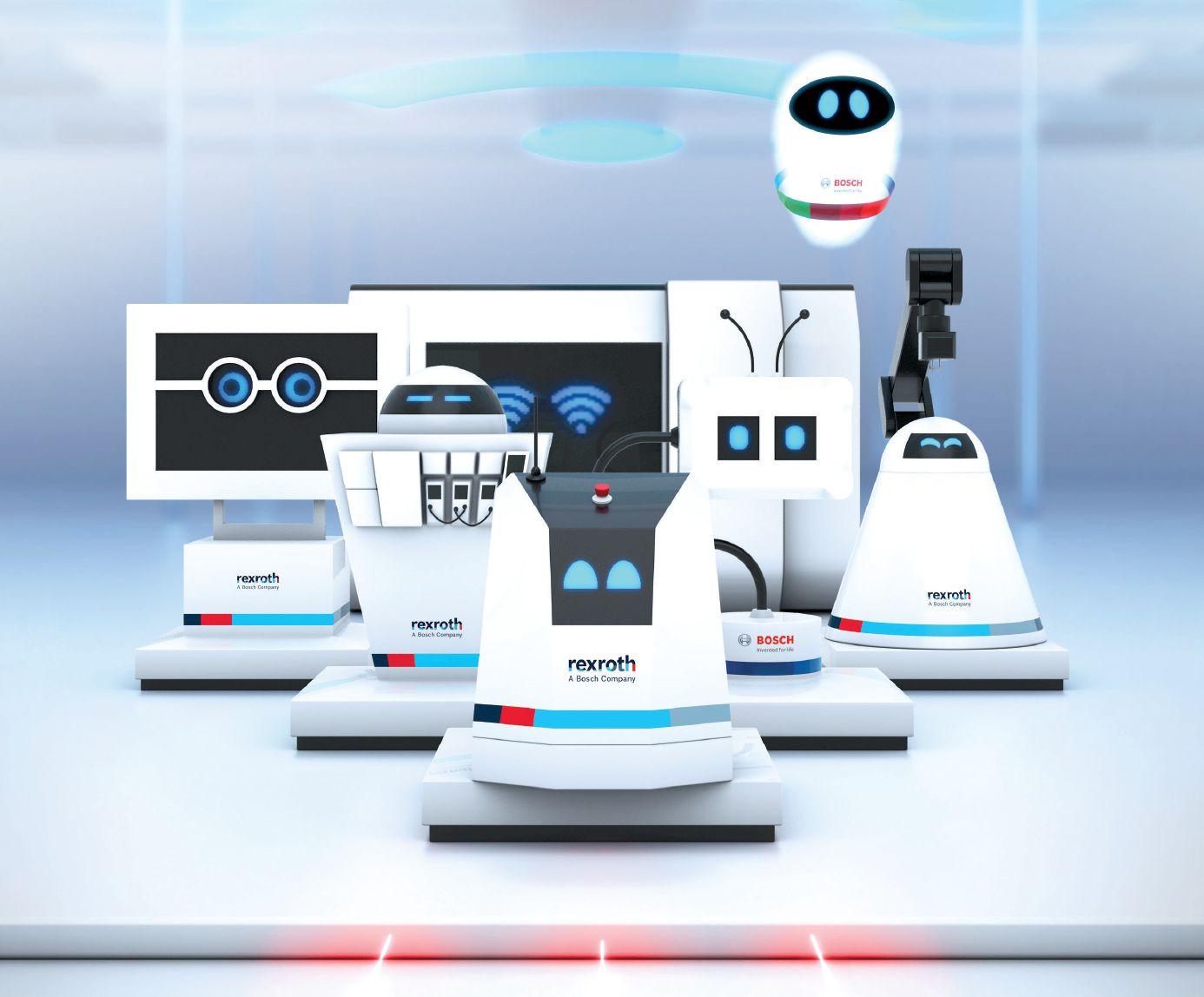
Complete motion control solutions - from Mechatronics, Conveyance, Assembly Handling, and Tightening Systems, to Linear and Electric Drives and Controls Technology
Rely on Bosch Rexroth, the world leader in drive and motion control technologies that power today’s most advanced manufacturing systems. You can rely on our local manufacturing, applications engineering, and commissioning expertise as well as our complete local support services.
Our automation solutions drive your manufacturing performance with fast throughput, precision, repeatable efficient motion control for maximum uptime. We’re set to help you achieve smarter, more productive automation solutions for your factory of the future today.
Because the Factory of the Future begins Now. develops Next. and goes Beyond.
Order your free Factory Automation Resource Kit: www.boschrexroth.ca/factoryautokit For expert advice call 1-855-REXROTH (739-7684) or email us at info@boschrexroth.ca
MACHINE SAFETY
BY CARRIE HALLE
Improving worker safety in robotic welding
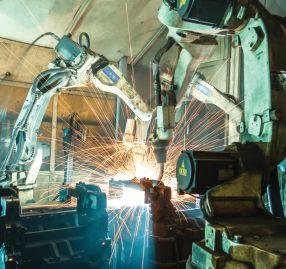
Robot density in Canada has been on the rise for more than a decade and reached 145 units per 10,000 employees last year. Growth was mainly driven by installations in the automotive industry. In Canada, as in around the world, one of the most common uses for industrial robots is arc and spot welding.
R obotic welding provides Canadian manufacturers with several competitive advantages. Most importantly, it makes them more productive while generating more consistent, higher quality welds and reducing waste. Robots also empower manufacturers to address the current shortage of skilled welders to recruit.
I n addition, by taking the human element out of the welding process, robots eliminate operator dangers such as electric shock, exposure to gases and toxic fumes and flash burns to the eye’s cornea. Ironically, with the implementation of these robots, new dangers have replaced the old ones – which is why it is critical for manufacturers to follow best safety practices when implementing a robotic welding program.
Are industrial robots safe?
Robotics professionals are quick to point out that while industrial accidents involving robots and robotic welders do happen, they are infrequent. But when they do happen, they are usually fatal.
The first recorded death by robot happened in 1979 when a worker collecting parts from a storage facility was hit and killed by a one-ton robotic arm. Fast forward to June 2015, when a German Volkswagen factory employee was crushed to death when setting up an industrial robot. A month later, a similar type of accident involving a robot occurred in India. And yet another accident happened later that same year at a Michigan
auto parts manufacturer where a robotic arm swung and crushed the head of a maintenance worker between a hitch assembly. In December of last year, a Chinese worker was impaled in a horrific accident by a rogue robot in a porcelain factory.
C loser to home, in August 2016, a maintenance worker in an Ontario manufacturer entered a robot cell without locking off the power. While carrying out the repair, the worker felt pressure and saw it was the robot pressing the back of his body. Although two colleagues were able to retrieve him, the worker still suffered serious and permanent injury.
Robot accidents typically occur during non-routine operating conditions, such as programming, maintenance, testing, setup, or adjustment, when the employee is temporarily within the working envelope. In most cases, safeguards are either absent, improperly installed, or were bypassed by the employee.
Who is responsible for robot safety?
In Canada, robot safety is shared between all stakeholders ranging
from manufacturer to end user, as outlined in CAN/CSA-Z434-14, Industrial Robots and Robot Systems. It is an adoption, with Canadian deviations, of ISO 10218-1 & 2 from the International Organization of Standardization. By adopting ISO 10218-1 & 2 the robot standards for Canada’s CSA, USA ANSI, ISO and EN ISO are harmonized with the goal of moving toward a single global standard that is consistent from country to country in the design and application of robotic cells. The measures and procedures of the Industrial Establishments Regulation also may apply. According to the standard, the manufacturer, integrator and installer have the shared requirement to provide “information for use” to the user of the robot and robot system. The user has the responsibility to apply this information in developing training and safe work practices. That said, the standards largely speak to the supply chain and do not tell end users how to safely run robots or even how to turn them on. Canada did add value by offering user-directed information in annexes to its standard rather than
in separate technical reports like in the U.S. version.
Understanding robotic safeguarding
The first step in developing a safety strategy for a robotic welder or any type of robot is to conduct a risk assessment that takes into account the severity of potential injury, frequency of exposure to a hazard and the probability of injury. Once an option, a thorough risk assessment is today required in CSA-Z434.
Once completed, an action plan must be implemented to take on the hazards identified by the risk assessment. Typically, an effective safeguarding system for robotic welders is a combination of electrically interlocked perimeter guards, safety light curtains, safety laser scanners and pressure-sensitive safety mats. Automatic weld curtains and high-volume ventilation systems can also minimize exposure to hazards in the welding environment. Torch length and robot reach must to be factored in when designing the system. Here is a review of suggested equipment:
• Perimeter guards are designed to keep machine operators and other plant employees safely away from the robotic welding cell other than when they must enter for loading and unloading workpieces or maintaining the welding equipment, robot and other machinery. Perimeter guards are positioned around a robot work envelope and incorporate gates equipped with interlocks so that all automatic operations of the robot and associated machinery will stop when any gate is opened. Robotic welders tend to do the same thing again and again, and cannot generally tell if a worker is in vicinity. That’s why factories establish “danger” or “kill” zones with
Carrie Halle is the vice-president of marketing and business development for Rockford Systems, LLC.rockfordsystems.com
perimeter guards that people have to stay out of while the robot is operating.
• A laser scanner is a reliable, cost-effective safeguard installed around robotic welders. These are fully programmable devices that use an infrared laser to scan their surroundings and measure distances. A laser scanner can be set up to scan on a horizontal or vertical plane. Should a person or object come into contact with the infrared beam, any hazardous machine motion stops.
• A light curtain system is another common safeguard used with robotic welding equipment, especially in situations where an operator requires frequent access to a cell. Most systems include a transmitter that emits infrared light to the receiver that, when triggered, stops hazardous machine motion. The transmitter and receiver can be installed top to bottom (vertical protection field) or side to side (horizontal protection field). The sensing field can be desensitized to ignore some objects but respond to other objects of a defined size, or muted for temporary suspension to allow material feeding.
• Pressure-sensitive safety mats are yet another option for robotic welding equipment. They can be used around the perimeter of the cell, or more commonly, installed as a secondary safety device inside of perimeter guarding systems. When a worker stands on the mat, the metal plates make contact and hazardous motion stops. Pressure-sensitive safety mats are not be used as primary safeguarding except when all other means are not applicable. Also, when installing mats, ensure they’re located so that an operator or other employee, when stepping onto the mat, cannot reach into the point-of-operation hazard prior to the machine’s hazardous motion coming to a
complete stop.
Along with these measures, it is critical to remember the human variable. For instance, if a safeguard prevents the operator from loading or unloading parts from the cell, they may remove it without understanding the dire ramifications. Improperly designed safety equipment frustrates workers or, worse yet, leads to a false sense of security, and ultimately can
create accidents.
Training is essential: Employees must be familiar with all operational aspects of a robot welder, including the full range of motion, known hazards, programming information, locations of emergency stop buttons and power sources, and the importance of safety barriers, as well as procedures for freeing a colleague who becomes trapped.
Welding has always been a dangerous job, and there is no doubt that robots are making it safer by performing hazardous, repetitive tasks. But given the fact that tens of thousands of industrial robots are now working in close proximity with employees and often do not have the sensory ability to detect if those employees are in their vicinity, safety must to be kept top of mind. | MA
BY JENNIFER RIDEOUT
Making the link: data and the connected factory GOING DIGITAL
Ma nufacturing data is growing at an exponential level, and unless you find a way to move, compute and analyze it, it’s going to be a huge burden on your IT team.
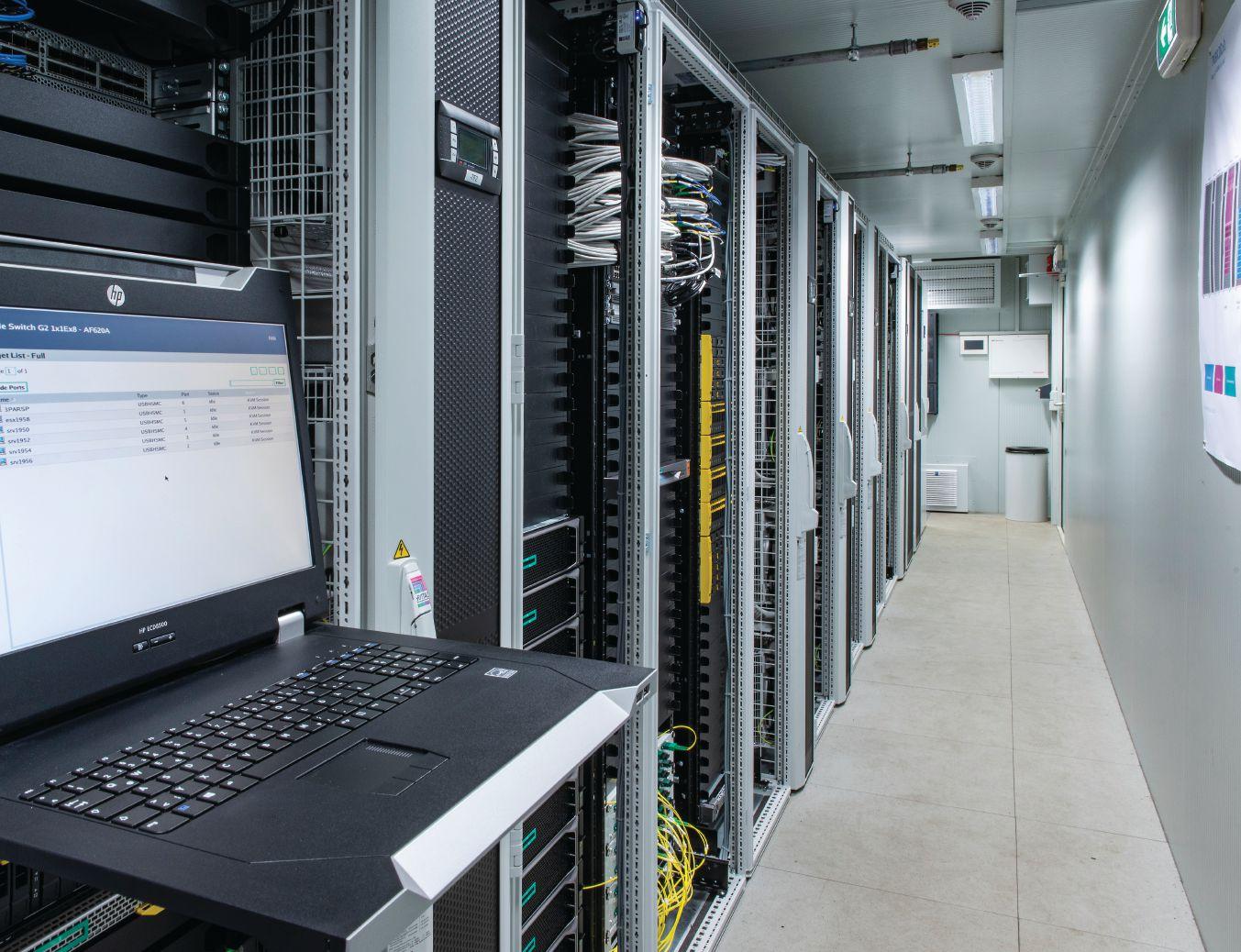
Some perspective: In 2017, manufacturers generated 1,912 petabytes of data. That’s equivalent to 426 million full-length DVD-quality movies. Manufacturers are dealing with so much data that research firm IDC predicts that by 2020, 80 per cent will need to extensively restructure to place data at the centre of their processes to increase speed, agility, efficiency and innovation.
So what can you do? If you haven’t already started to think about how data is impacting your production environment, it’s time
to do so. There’s no way to avoid the influx of information that will be generated by your machines, operational equipment and processes. But by taking a proactive approach you can ensure you’re collecting and saving the important data and taking best advantage of it to keep your operations running efficiently, productively and safely.
Connect the dots to maximize the value of data
A proactive approach starts with making IT a priority on the factory floor and across the entire business. While manufacturers are embracing technologies and have made great strides over the last decade or so, many are still operating with disparate data silos and unconnected devices.
Jennifer Rideout is the manufacturing marketing manager for Cisco Canada. She is responsible for developing go-to-market strategies for the manufacturing sector in Canada, including channel alignment and content development. She can be contacted at jerideou@cisco.com.
Adopting a connected environment, where data is collected from monitoring points across the factory floor, enhances the value of data with benefits like reduced downtime and waste.
W hile evolving IT doesn’t happen overnight, here are a few important things to consider when
looking to make a change:
• Connect the factory floor. Industrial Ethernet in particular (wired and wireless) is changing the game by providing benefits such as narrowing the gap between IT and operations technology, driving interoperability and
increasing visibility.
• Distribute compute power at the edge, fog, cloud and data centre. Extending out to all of these areas provides greater knowledge and faster operations. Traditionally only networking devices were deployed at the edge, which doesn’t provide much compute power for data, and results in poor visibility. But new compute and analytics solutions enable edge devices to provide real-time insights and control.
• Integrate data, apps, virtualization and platforms. This is key to maximizing the data you collect. Tearing down the silos of information will create new opportunities for not only the factory floor, but also the business as a whole.
• Deploy intelligent security that’s network integrated and context aware. A security breach on the factory floor can result in safety issues and threaten a company’s reputation. Mitigate risk by securing your equipment and network.
Avoid data overload to focus on the benefits
Collecting and managing high volumes of data provides many benefits, but don’t let data overload become a hindrance. You can avoid this pitfall by assessing where specific data should go, how often if needs to be sent and how it will be used. Consider the following when reviewing your data behaviours.
1. Frequency: Unnecessary data pulls can lead to data overload, network latency or – in extreme cases – even take the network down. Pull only what you need, when you need it.
2. Prioritization : Using Time-Sensitive Networking (TSN) and automating quality of service (QoS) parameters will aid in prioritizing critical traffic and ultimately ensuring network integrity.
3. Processing: Mission-critical data needs to be seen in real-time with analysis completed and response times measured in milliseconds.
Consider a hybrid solution of edge computing and centralized data computing within the data centre.
4. Virtualization: Virtualization supports increased business flexibility through centralized management, pooling of network resources and more. It can also positively impact data centre design, data consumption storage, security
and network performance.
5. Orchestration: Use automation to manage and reduce the complexity of your orchestration processes. Map out who in your organization is receiving data, how they use it, and control this sharing at the highest level.
6. Visibility: OT and IT teams need to understand how the network works and support
education to increase network automation and adoption. Consider implementing dashboard tools that report information and provide teams with the context they need to be successful.
Don’t wait to start planning for the future. The data deluge is here and won’t disappear anytime soon. Embrace the potential of your connected factory now. | MA
We understand how critical it is to find sustainable business process improvements in an ever-changing world.
PERSPECTIVE + PERFORMANCE
You streamline and automate your processes while complying with regulations and minimizing risks.
Remain compliant and minimize risk.
“We
Kyle Shipps
Calibration Manager
HOT TOPIC
BY RAY RICHTER
AI: A misused term
Let me start by saying I’m a computer analyst/programmer, an electronics engineer, and a Microsoft partner. Currently, I’m semi-retired and refocusing my company, UniMatrix Technologies, to be more electronics oriented. I have been working with electronics, firmware, software, computer networking, remote control in both the military and industrial spaces, and automation control for almost 40 years, and as a business analyst for the last 20 years. I did a lot of advising to companies as a third party on whether the technology that was presented to my clients matched what my clients hoped it could or would do.
My problem is with the use of the term “AI.” For the last two years (especially in the last year), I have noticed more and more companies trying to sell their products under the guise of artificial intelligence (AI) – when it is, in fact, the excellent computer code being written by really intelligent programmers that makes software seem like AI, even though there is no AI code being written. In the military weapons industry, they say that if you want to sell something, say it is “just like Star Wars or Star Trek” and I believe most industries are using that same
It is relatively easy to write code that tells a business owner which machine is being used the most and which one is making the most money – and it isn’t AI.
mentality to sell products today using the term AI.
Let’s start with what is intelligence, according to Merriam-Webster: “The ability to learn or understand or to deal with new or trying situations.” I follow what is going on in the world of AI and I can honestly say that there is no real AI program written yet. The closest we have come is in deep machine learning but, it is still not AI – it is smart programming and machine learning. There is a line in the movie The Fifth Element that says, “Anticipation denotes intelligence.”
For this to work in software, the software would have to be able to anticipate in all situations and not just a timeout error. I have talked to other programmers about AI and what we came up with is this: In order for a computer to have AI, three things have to be integrated together. First, you need to have primary parameters that cannot be changed but are the basis for everything that follows. These first primary parameters or laws would be similar to Isaac Asimov’s three laws for robots but, in an expanded form and implemented in such a way that the firmware cannot be changed in any way, shape or form.
Second, the software must be able
to ask questions, whether to itself or to a human. These questions would be based on human-child development such as “What is this?” and it must be able to examine the object and be able to update its database/library. Third, it must have the ability to rewrite and compile its own code to change the minor rules/parameters. As a child learns, the child must rewrite the rules and expand on them – this is the basis of learning. For example, if I write code that says “Objects are hot,” the software should be able to change that to “Not all objects are hot” as it learns. Now this becomes a major problem because one would have to write laws/parameters that limit what can or cannot be rewritten – same as a child being scolded, but in computer code. If the software cannot find what it is looking for in its libraries/database, it should be able to ask a human for help and update its database such as in “neural networks.” Of course, this would mean a need for big data storage. Another good example would be to ask a child and software (via a robotic arm) to remove an egg from one carton and place it into another carton. My granddaughter, who is three years old, did this and when she crushed the egg picking it up, she realized that she had
Ray Richter is a computer analyst and founder of UniMatrix
used too much pressure to pick it up, that eggs are fragile, and what an egg is. For software to do this, it would need to recognize what an egg is, that it used too much pressure to pick up the egg, then check its tactile pressure sensor/s and realize the pressure point that was used is too much, and then store that information for later use – but that’s after it realized the egg is broken. The code for this would not be easy and it would be very complex. Having software that can predict something based on captured data does not constitute AI but rather was taken from insurance company programs that use complex mathematics and algorithm code, which in turn were taken from programs that can do astrophysics modeling. AI is far more complex than what is out there now.
The problem with salespeople is that they don’t tell you all the things that are needed to implement technology, and using the term AI makes things even worse. This misuse of the term “AI” imposes that the system you just bought or are planning to buy will need very little in the way of system integration. This is far from the truth. It is relatively easy to write code that tells a business owner which machine is being used the most and which one is making the most money – and it isn’t AI, it’s just big data mining.
My prediction for the upcoming year entails more use of big data, IIoT, better, smarter software, security,
There is no real AI program written yet. The closest we have come is in deep machine learning but, it is still not AI – it is smart programming.
and the cloud. Until the petroleum industry and the U.S. and Canadian tariffs improve, not much is going to change. So now is not a good time to be investing in the so-called AI promises. You’ll also see more companies upgrading minor systems/components and software to deal with antiquated data and systems. Yes, Canada will eventually reach Industry 4.0 but it will be slower than hoped for or expected. I believe Canada is at 3.5 right now and comfortable being there.
You will also see more consolidation of services and production, and plant closures. And you’ll see more companies trying to sell products using the term AI. Software makers usually create what I call a foundation package, and this is what they sell to you. It usually consists of several modules that work together – but remember, this is a starter package. This starter package must be customized to your specific business model. If it contained AI, then one should only have to tell it what your business model is and it would figure out the rest. AI software would transfer all your data to the new software, including your accounting accounts (GL, AR, AP, assets and so on), transfer your ERP, and search out and communicate with all of your equipment that is network connected. I have written networked asset software that searches out and catalogues anything on a network. We have smart software, not AI software.
Software makers usually allow for one to any number of rewrites –maybe for one year and anything over that is an extra cost. So-called AI software has to be customized for each and every application. The next big cost is data transfer from one software program to another. I have had to write programs just to transfer the old data format to the new format. So not only does one have to buy new hardware and software, they also have to pay the cost of migration and rewrites. Once word gets out – whether it be positive or negative – other companies may shy away from upgrading to Industry 4.0. The SMBs I talk to have told me that the economy is shrinking, companies are having cash flow problems – “I’ll pay you when I get paid” – and companies are now demanding a faster ROI than before.
I have noticed that some companies lately have gone from using the term AI to “smart,” so hats off to them and their honesty. As far as real AI, look to development coming from fringe automation research companies and higher-learning institutions such as MIT. Microchip manufacturing companies are coming out with some really great products – but this is the foundation of what will come out in future products for use in smart systems.
I will say that we have basic AI software when that software can duplicate what my three-year-old granddaughter can do. | MA
Safety Laser Scanner PSENscan Experienced system planners and design engineers know the score: the monitoring of danger zones is just as indispensable for automation as protection is on the mountain. Risks must be detected immediately and processed reliably Based on many years of experience in the field of optoelectronic sensors, Pilz is now taking the next step With a new product group: flexible, configurable safety laser scanner for productive area monitoring Play it safe: sensor technology, control technology, drive technology and visualisation. A one-stop shop. The complete solution from Pilz
Pilz Automation Safety Canad
A NEW ERA IN CAMERA CONTROL
The
is gaining traction – here’s why
For the past decade, system integrators have been promised that the USB3 and GigE Vision interfaces they relied upon would gracefully evolve, delivering faster and faster throughput speeds to keep up with increasing camera resolution and frame rates. Ten Gigabit Ethernet via USB3 and GigE Vision would be within reach without added expense, complexity or heat, they said. And this could all be done without a frame grabber. That has not been the case.
Ironically, it was CoaXPress or “CXP” – a serial communication interface standard based on a frame grabber – that answered the machine vision industry’s promises back in 2009. The driving force behind the development of the CoaXPress standard was the need to overcome cable length, speed and ease-of-use limitations of legacy digital video interfaces in order to meet the requirements of high-end and future-generation imaging applications. CoaXPress – a mash-up of “express” and “coaxial” – was developed by a consortium of six industrial companies: Adimec, Eqcologic, Active Silicon, AVAL DATA, NED and Components Express.
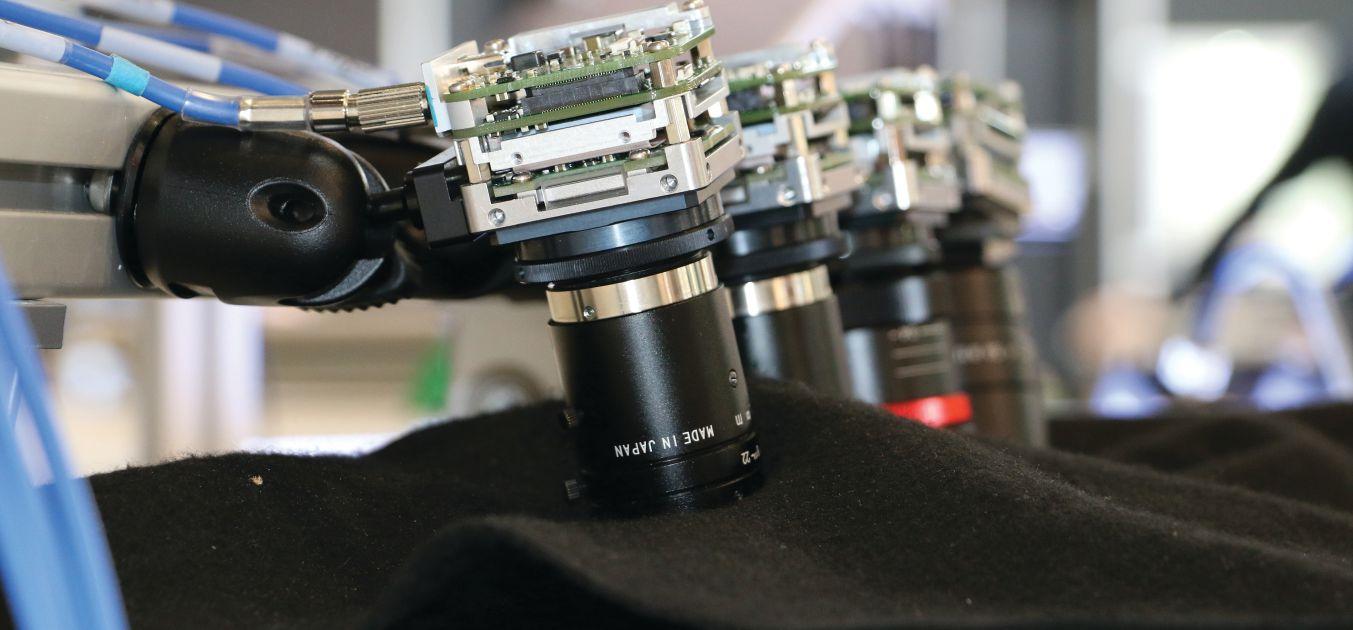
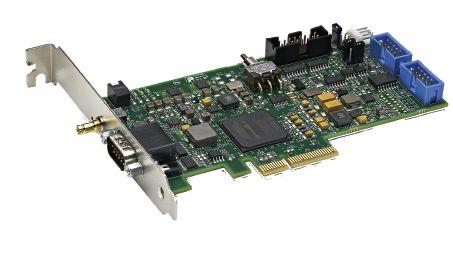
C XP supports up to 6.25 Gbps from camera to frame grabber over a single, long-range coaxial cable; this is approximately six times faster than GigE Vision and 40 per cent faster than USB3. For higher CXP bit rates, two or more coaxial cables can be used in parallel, i.e., by scaling to four cables, data rates of 25 Gbps can be reached. In addition, CXP offers the benefits of a low-speed uplink channel used for camera control or triggering, while a 24V power supply can deliver up to 13 watts per channel to a CXP camera.
The CXP 2.0 standard
The newest version of the interface, CXP v2.0, increases data rate speed to 10 Gbps (CXP-10) or 12.5 Gbps (CXP-12) per link, which allows a design of cameras that can run up to five gigapixels per second with four CXP channels, for example. CXP 2.0 is compatible with CXP 1.1 cameras and frame grabbers, plus allows for a higher upstream data rate and supports several GenICam features.
In addition, CXP 2.0 supports a new, more robust micro BNC connector instead of the familiar, larger BNC connectors. The micro BNC is comparable in size to DIN 1.0/2.3 connectors, yet
retains the robustness of the standard BNC connector. The micro BNC supports the required high frequency signals for CXP 2.0 and can achieve a smaller pitch if needed when placed next to each other.
The challengers
Going head-to-head with CXP 2.0 is the new 10 Gigabit Ethernet (10 GigE Vision) interface. Introduced in 2016, 10 GigE provides a tenfold increase in data transmission speeds over its predecessor, GigE, and was specifically targeted for high-speed testing environments. The 10 GigE requires up to seven watts, in addition to the camera’s power requirement, which is roughly twice that of other interfaces. It leans on the PC’s CPU and internal memory bus for operation because processing and buffering cannot be offloaded to a frame grabber FPGA or to memory. PnP discovery and operation is also required under all circumstances, making for a complex system subject to bottlenecks. High-data applications using 10 GigE actually need a frame grabber to offload CPU and memory.
Similarly, USB 3.1 Vision (SuperSpeed+) is limited to one to three metres with a passive cable, versus 40 metres for CXP, USB 3.1 Vision requires expensive active cables for each camera on a typical system.
A new era: single-link CXP
The original version of CXP (v1.1) and its follow-up (v1.1.1) were designed primarily for larger and quicker sensors,
but now that this product category is maturing, a new avenue has emerged: small, single-link CXP solutions. It is here that CXP truly shines and holds the greatest potential to disrupt the status quo.
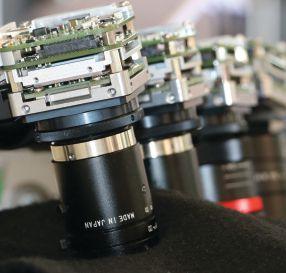
First-generation CXP cameras were bulky, energy inefficient and cost considerably more than similarly featured GigE or USB3 cameras. That has changed with the latest incarnation of single-link CXP cameras that combine ultra-compact dimensions with lower costs, reduced power requirements and all the speed of a full-sized CXP camera. CoaXPress 2.0 will push single lane speeds to 12.5 Gbps, qualifying the single-link CXP camera/frame grabber solution not only for high-speed ma chine vision but also for airborne and naval optronics, homeland security and other industrial ap plications.
A single-link CXP system is easy to set up. It features a CXP camera with a single link connector, usually BNC or DIN, along with a single-link frame grabber with a DIN connector. Street price
CoaXPress – a mash-up of “express” and “coaxial” – was developed by a consortium of six industrial companies.
for a 4MP CXP camera, a single link frame grabber, and a cable of two to five metres is about 15-25 per cent higher than a similar USB3 offering, but offers 40 per cent higher bandwidth. As the cable length increases, the price gap between CXP and USB3 narrows.
Some manufacturers may opt for higher bandwidth quad-link CXP cameras but at single-link speeds. This versatility enables the system designer to achieve greater distances, yet still maintain all the capabilities and advantages of a frame grabber system.
The advantages here of a CXP single-link system are uses where a small camera will fit (29 x 29 mm) but USB3 isn’t quick enough any longer.
Another advantage of the single-link CXP solution is cable length. In the real world of
industrial imaging, cable routes are rarely straight lines. This is especially true in the packaging industry where an entire machine can be as long as 10 metres. Cabling in these systems can be as much as twice that. A 20-metre coaxial cable is a more cost-effective solution.
Since its first demonstration in 2008, the CoaXPress standard has established a history of over 10 years, with an increase in the number of its end users and manufacturers that produce CXP products.
USB3 and 10 GigE seem to solve many limitations, but when power consumption and cost increases are introduced, CoaXPress rises as the winner, especially in light of its newest version, CXP 2.0, that doubles its speeds to 12.5 Gbps. | MA
Donal Waide is director of sales for BitFlow, Inc. bitflow.com
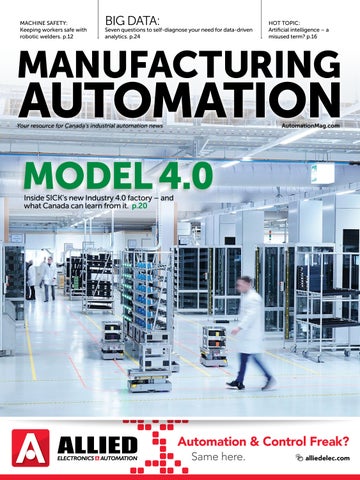
MODEL 4.0
Sensor manufacturer SICK takes us inside its new Industry 4.0 factory in Germany. What does it mean for Canada?
BY KRISTINA URQUHART
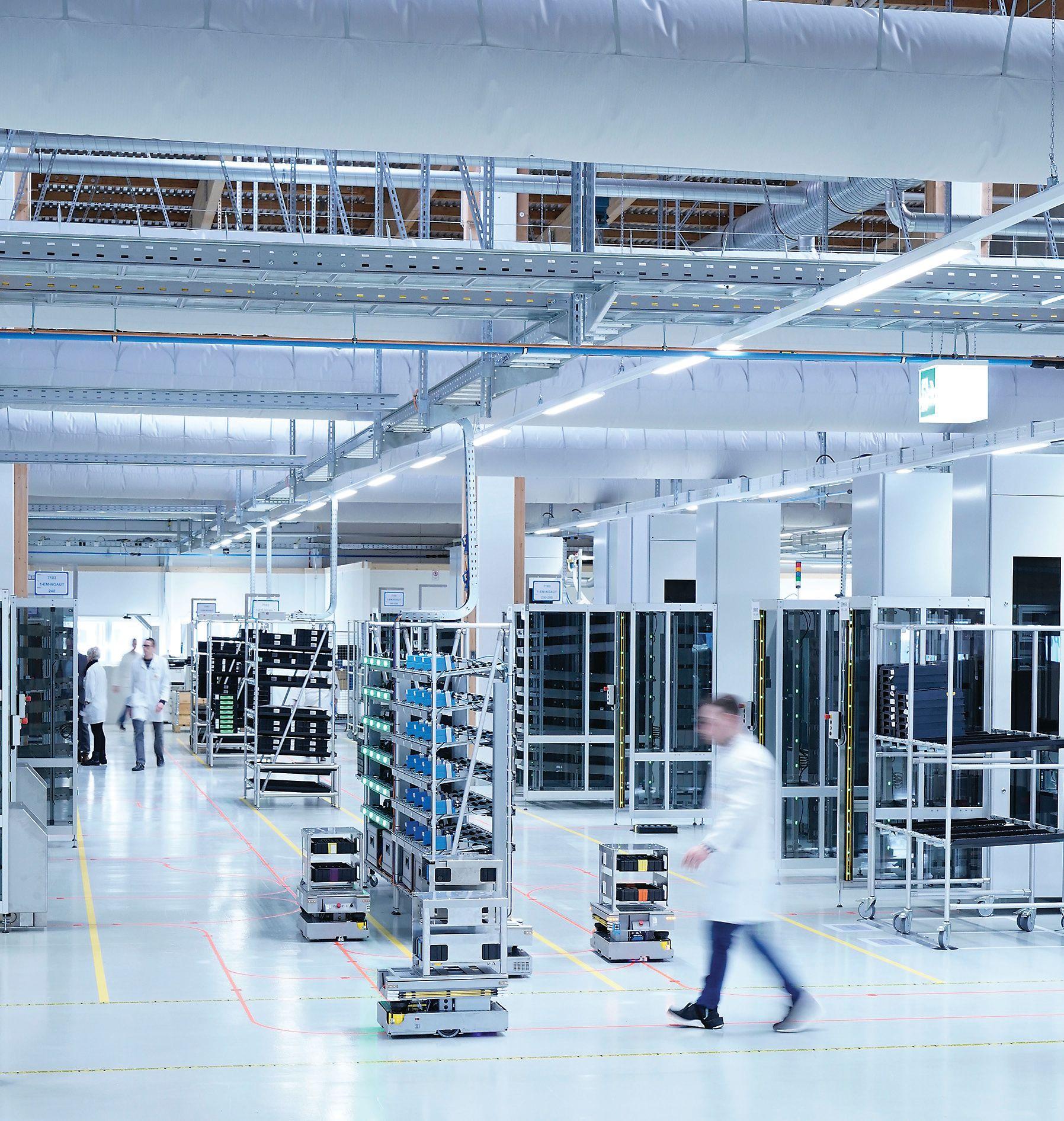
When I first stepped into SICK AG’s sparkling new 4.0 NOW Factory in Freiburg, Germany earlier this year, the first thing that struck me was how quiet it was. To be clear, there was much production going on – the space
will manufacture 1.2 million pieces of the company’s sensor-related solutions per year once fully commissioned, joining other SICK manufacturing facilities in the United States and Asia as one of the company’s most productive hubs for sensor making. But this new factory is markedly different from its counterparts.
The 4.0 NOW Factory is
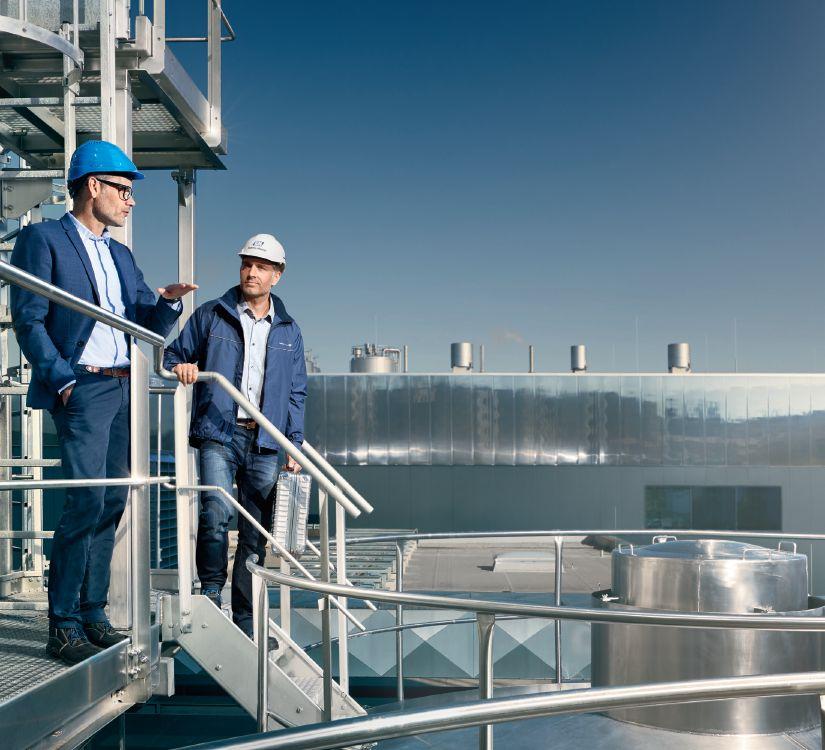
automation at its peak – a new home for Industry 4.0 technologies and processes, all located under one roof. Only 13 people are currently employed here, with the rest of the work completed by industrial robots in flexible manufacturing cells, or by autonomous guided carts (AGCs) on the shop floor. The purpose of 4.0 NOW is not to replace human workers, but to show how they can thrive alongside automation to achieve maximum efficiency – consider it a test bed that demonstrates the capabilities of Industry 4.0 practices, in addition to being a fully functioning manufacturing plant.
“In our business, industrial automation and Industry 4.0 are two sides of the same [coin]. They’re directly linked together,” Dr. Robert Bauer, chairman of SICK AG’s executive board, told me and the other members of a press tour at the company’s Waldkirch, Germany headquarters in January 2019. “The data-driven
idea of Industry 4.0 is to better organize the factory.”
A factory for the future
With the 4.0 NOW Factory, SICK is doing exactly that – breaking down traditional line-oriented production into non-linear “technology cells,” and using sensors to collect actionable data.
“The key component of Industry 4.0 is autonomous flexibility on the production line,” says Bernhard Müller, senior vice-president Industry 4.0 at SICK. With 12 manufacturing cells that can be reconfigured to produce a multitude of SKUs, that flexibility translates to 1,050 square metres (11,302 square feet) of total space – a relatively small footprint compared to the average manufacturing plant.
The factory is still in a ramp-up phase after beginning operation in Q2 2018, with one shift of 13 workers and a target of three shifts. The AGCs use SICK sensors to move freely from cell to cell
The 4.0 NOW Factory will not only allow SICK to build products on demand and reduce its inventory level, but also achieve increased OEE and just-in-time orders.
along six aisles, employing pickby-light technology to fill and transport trays of components. The production control system is also able to interact with manual workstations, which are connected to the machines. In one corner, several of the factory’s workers attend to a small, more traditional-in-style production line – an unofficial proof-of-concept that automation is changing the roles of humans in manufacturing.
Once at full capacity, 4.0 NOW could theoretically manufacture 500,000 product variants, allowing for more customer orders and better resource efficiency. “We are facing the fact that our market is really dynamic,” says Joachim Schultis, head of operations for photoelectric sensors and fibres at SICK. He projects that 4.0 NOW will not only allow the company to build products on demand and reduce its inventory level, but also achieve increased OEE and just-in-time orders.
The factory uses a SICK-developed software integrated with enterprise resource planning (ERP) software to continuously upload data from all of the AGCs, components and production cells to a cloud. This enables the use of tools such as BOSCH Production Performance Management, a protocol that captures data from sensors and machines to analyze process efficiency and execute predictive maintenance. From there, SICK can further optimize the logistics in the factory, from travel paths of the AGCs to control of the material flow.
Depending on the application and accuracy needed, SICK employs a range of positioning technologies for its mobile applications, including ultra-wide band tags, LiDAR contour mapping, line guidance sensors and infrastructure sensors. True to the company tagline “Sensor Intelligence,” SICK has also developed a software ecosystem, dubbed
By implementing adaptive safeguarding solutions in Industry 4.0–style manufacturing cells, such as a camera that records an event only if it’s been triggered by a safety breach, maintenance or shutdown can be limited to just one cell rather than the whole line.
AppSpace, to solve applications via apps on programmable SICK devices. AppSpace supports sensor applications, data-to-information applications, or the integration of both. Users can either download pre-built SensorApps or develop their own SensorApps by defining the application logic and customizing a dashboard based on their individual needs.
Going all-in on an Industry 4.0-enabled factory is bold in the marketplace, says Müller. He estimates that while 30 to 40 per cent of German companies have “islands” of Industry 4.0 concepts, like a predictive maintenance program or autonomous guided vehicles, only one to five per cent of them employ automated material flow, which is integral to total process optimization.
The hallmarks of Industry 4.0 design principles are connectivity, transparency, flexibility, and fast, decentralized decisions, Müller says. The common goal is to reach “Lot Size One” – the concept of a single item quantity for an order – at the cost and speed of mass production, with resource efficiency.
“You get a lot of noise about automotive factories being in Industry 4.0,” he says. “They have perfected their production lines but always in the same manner they have done it before. Not in a disruptive way [based on] data.”
Bringing Industry 4.0 to Canada
Craig S. Smith, president of SICK Ltd., the Canadian branch of SICK AG, says there are some remaining barriers to implementation of Industry 4.0 concepts in Canada.
“I think there’s fear. It’s normal to think, ‘Oh, technology is going to take my job,’” he says. “Yes, some doors in old-school manufacturing may be closing, but that opens up new opportunities in other areas around technology.”
Despite technology shifting the types of roles that are available, Smith notes that competency will still be one of his biggest challenges in promoting the Industry 4.0 mindset with Canadian manufacturers. Unemployment rates nationwide are low, at 4.8 per cent, and he’s had unfilled positions at the company for over a year.
The other challenge to establishing Industry 4.0 practices in Canada is the rate of upgrade. “A manufacturing facility isn’t going to do a complete rebuild again; they have to do a stage build. They need to keep their manufacturing running and build in the new flexible manufacturing concepts out there over time,” says Smith. “We do site visits; we do training; we try to understand our customers’ biggest problems. And to understand how we can help them to
reduce costs, improve production yields and reduce cycle times.”
Smith has been leading SICK Canada since 2009, shortly after SICK AG acquired AMKO Systems, a Toronto-based distributor of SICK process automation instruments. In April 2012, Smith was tasked with bringing the company’s factory automation and logistics automation businesses into Canada, and he’s since grown the company from $7 million to over $30 million per year in sales. In June 2019, SICK Canada celebrates its 10th anniversary with a move from its 1,031 square-metre (14,000-square-foot) office space in north Toronto to a 2,230 square-metre (24,000-squarefoot) building next door, with plans to build a customer-facing showroom of sensor products.
Twenty-five per cent of SICK Canada’s revenue comes from the process automation market in Western Canada, and about 80 per cent of the company’s factory automation business is located in the Ontario-Quebec manufacturing corridor. Smith sees opportunities in logistics automation, where SICK Canada has seen 24 per cent growth in the last five years in airports, health care, transportation and consumer goods manufacturing. The factory automation side is also poised to grow as Industry 4.0 concepts begin to take hold in Canada. Smith plans to add two new subject matter experts in 2019 to handle mobile applications, and the company is working closely with customers to develop new solutions with products from the German headquarters that are tailored to individual manufacturing needs.
Roots in safety
Founded in 1946 by Dr. Erwin Sick, SICK AG now has more than 50 subsidiaries, equity investments, and agencies, and manufactures 40,000 different products in presence detection, industrial safety, gas analysis and flow measurement, motion control, identification, and measurement systems.
SICK’s Outdoor Technology Centre (OTC)
In 1952, SICK began serial production of its flagship product – a safety light curtain that stops a machine should a foreign object make its way past the sensor. Over the past 67 years, the company has added more safety-centric products to its portfolio, including photoelectric sensors, opto-electronic protective devices and vision systems.
Industry 4.0 is redefining what a safe product means in 2019. Now that machines and humans are working collaboratively, the leading thought is that instead of the machine stopping altogether if it detects a presence, it should slow down and enter a “safe mode” to prevent accident. “Safety in the past was a secure safety, so nothing happens ever,” explains Müller. “And now we try to make it more efficient while not injuring anybody.”
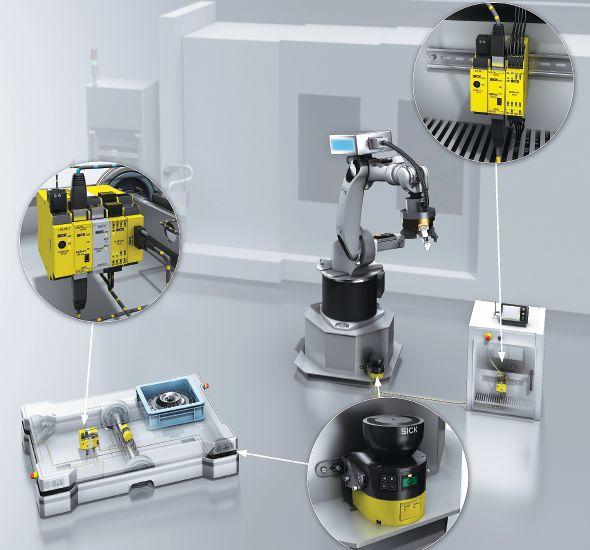
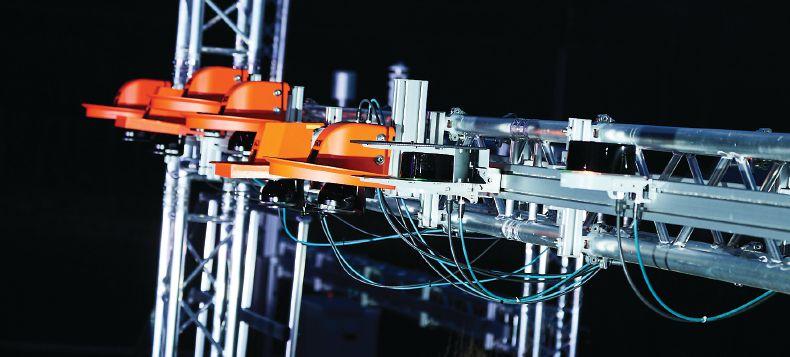
The company has developed laser scanners with fields of vision that can respond to positioning of objects – for example, an autonomous vehicle equipped with one of these scanners won’t stop if it’s turning right but detects a human on the left. And by implementing
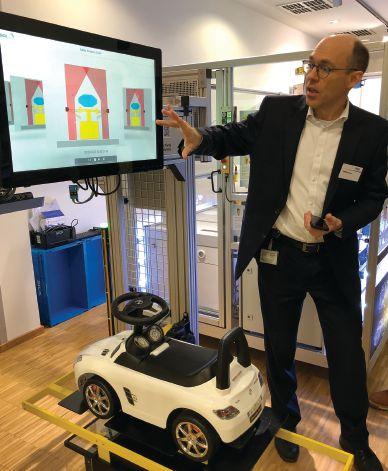
adaptive safeguarding solutions in Industry 4.0–style manufacturing cells, such as a camera that records an event only if it’s been triggered by a safety breach, maintenance or shutdown can be limited to just one cell rather than the whole line (pictured, bottom left).
Investing in the future
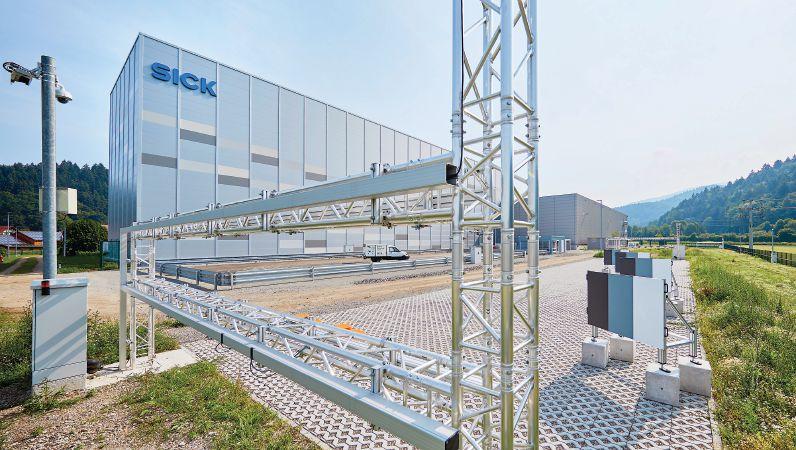
SICK AG invests 10 per cent of its gross revenues every year back into developing integrative solutions. In 2017, that amounted to EUR 169.4 million for research and development. Over 1,110 of the company’s 8,909 employees work on R&D teams in cooperation with industrial partners, universities and institutes. The company holds around 3,000 patents. SICK is testing outdoor automation technologies for harsh environments at its Outdoor Technology Centre near Freiburg in Buchholz, Germany, which opened in summer 2018.
There are another 15 proprietary projects underway that the company calls “start-ups” – research teams devoted to development of new products and processes. “Some of them probably won’t work in the longer picture, but other ideas will come from them,” notes Smith. “In Canada, we’re taking a home-grown approach and bringing back that technology
and knowledge to the education system.”
S ICK Canada recently partnered with Toronto’s Humber College to build awareness of Industry 4.0–ready sensor technologies as part of an advanced manufacturing consortium comprised of eight companies at the college’s Barrett Centre for Technology Innovation.
Over the next three years, SICK Canada will provide sensors and services worth $765,000, new training opportunities for students and staff in sensor intelligence and industrial automation, and two new scholarships.
“What I find in Canada is we’re not investing in youth. People are in internship programs working for free, and frankly, that drives me crazy,” Smith says, adding that despite the industry taking some big hits – such as layoffs at GM and Fiat Chrysler – there will be different types of jobs opening up as Canadian manufacturers employ new technologies.
“ The part that I’m energized about is that we have organizations out there that are looking at things through a different lens,” he says. “There’s an opportunity to build the next phase of manufacturing in Canada. We have the drive to be better as a country in the innovative part of manufacturing. Industry 4.0 is a part of that.” | MA
Long-range sensors at the OTC
HOW MUCH BIG DATA DO YOU NEED?
Seven questions to self-diagnose your need for data-driven analytics
BY JEFF MCBEE
Isit down for discussions all the time with managers and executives who question how Industry 4.0 is relevant to their operations. They are busy, budget conscious and understandably reluctant to take on the risk of adopting new technologies.
The good news for them is that the first step toward Industry 4.0 doesn’t have to be a giant leap. Industry 4.0, at its core, is about data. Not just collecting data – that’s old news – but organizing and analyzing it in a timely and integrated manner to improve efficiency, quality and time to market.
Of all the datasets available to a manufacturer, one that offers incredible value but is still often overlooked and underused is final assembly part data. This encompasses all the data from each sub-assembly test and process as the part/assembly moves along the assembly line.
Making more effective use of this data with modern collection and analytics tools
can have a big impact on a manufacturer’s operations. And it doesn’t require a high-risk or high-cost approach.
Here are seven questions to consider that can help your team decide if it is time to take the first step.
1. Is your production line serialized?
If the answer is yes, half the battle is won already. If a line is producing parts that are serialized, it’s easy to create a “birth history record” for each part, indexed by its serial number. All data from every process and test that touches that part can then be collected into this single record for easy retrieval and analysis. Modern data collection and analytics can also be applied to batch manufacturing,.
2. Are customers pushing for improved traceability?
This question is most relevant to manufacturers that operate as part of the supply chain of
a larger OEM. Clearly, the time for change is at hand if customers are beginning to ask for quality and compliance assurances that the status quo simply cannot deliver. Accountability and transparency are both hallmarks of Industry 4.0.
Was a product built to spec – and if so, where is the data trail to show it? Were there any quality issues that might raise a red flag – again, where is the data trail to prove there wasn’t? If a defect has been identified, can your team triage the situation and trace the parts and final products that are suspect?
In-depth analysis of parts data is key to address these questions. An OEM’s reputation is defined by the market’s perceptions about the quality, safety and reliability of its products. No supplier wants to be considered the weak link in that value chain because it lacks the data capability to deliver an acceptable level of quality assurance.
3. Are quality issues eroding profitability?
Maybe it’s high scrap and rework rates due to failures at test stations along the line. Or an issue that doesn’t show up until an end-ofline test where the only recourse is a costly
Having the data analytics capability to catch quality issues as soon as possible, as close to their point of origin as possible, is crucial.
teardown and a production halt. Maybe that trailer full of product about to pull out of the loading dock should be held back. Then there are the warranty issues that raise the need for a recall.
W herever the quality issue arises, it is going to cost you time and money. Your reputation may take a bruising, too. Suppliers can no longer hide behind their OEMs in a recall situation. When something like a car gets recalled due to a faulty airbag or steering system, it’s the supplier of those components that ends up in the media spotlight having to account for itself.
H aving the data analytics capability to catch quality issues as soon as possible, as close to their point of origin as possible, is crucial. If current methods of quality assurance and inspection are failing to catch defects before they have impact on the bottom line, it is time for a change.
4 Are there process and test stations that are persistently problematic?
Every production line has trouble spots that give operators and quality engineers grief. It could be a finicky leak test, a poor-performing press-fit operation, difficulty connecting the dots to trace a leak failure due to a flaw with an upstream process, or a need to reduce cycle times to boost output. Additional challenges come from model variance, when a production line has to produce different models of the same product and maintain the same standard of quality across all of them.
Modern data collection and analytics are key to gain the timely insight that is needed to manage all these scenarios, to improve and maintain quality, efficiency and yield.
5. Are data silos making it difficult for you to use your data in this way?
Few manufacturers that I encounter would say “no” to this question. Their Industry 4.0 challenge isn’t collecting new sources of data – it’s to do a better job of integrating and analyzing the data they have. Their ability to do so remains handcuffed by process and test station equipment on the line that is of different vintages from a variety of suppliers. Each will claim some measure of data analysis capability, but the data isn’t easily accessed, and the functionality just isn’t there because these machines don’t communicate with each other. Data is trapped in silos, perhaps tracked by part serial number in one machine, and by date or time stamp in another. These scenarios make timely and efficient data analysis all but impossible.
6. What would you be able to achieve if you could make better use of your data?
The impact is far-reaching:
• Optimize your test stations to achieve a reliable pass-fail in the shortest cycle possible.
• Continuously monitor and improve the performance of your production stations to reduce unexpected downtime and more readily adapt them for product variances.
• Boost first-time yield by reducing scrap and rework rates.
• Provide proof of compliance to customers.
• Boost initial quality to reduce the frequency of warranty claims.
• Have the data archive for root cause analysis and traceability when warranty/quality issues do arise.
• Narrow the scope of a recall to
only those parts/units that the data flags as suspect. Recall just those serial numbers.
• Then use this insight to refine and tighten the limits of the relevant process and test stations, to prevent the same flaw from happening again.
• Further to this, work with that historic data at any time in a simulated test bed for continuous improvement and to pre-empt future quality issues.
7. Do you need to provide better reporting, faster?
For most manufacturers that I encounter, the status quo means having to take days, even weeks, to pull reports to trace the root cause of a quality issue. Data silos are one part of the problem. Having to wade through piles of spreadsheets to manually compare and crunch numbers is the other. This is a delay you
can ill-afford if a quality issue has halted production or made you doubt whether those pallets on the loading dock are okay to ship.
G iven how often we hear horror stories about failed digital transformation initiatives by large OEMs or Fortune 500 companies, it’s only to be expected that small to mid-sized manufacturers don’t want to rock the boat. But migrating the production line to Industry 4.0 doesn’t demand risky wholesale change or a costly rip and replace.
Instead, the required technology investment can be additive, through vendor-agnostic data platforms that take data from various sources. Best of all, they are designed to start small and scale. | MA
UNITRONIC® SENSOR/FIELDBUS
Transmit Data in Demanding Industrial Environments
• Real-time data, signal, and control communication
• PVC, PUR, or TPE jackets resist abrasion, impact, extreme temperature, and torsion
• Industry compliance: PROFIBUS, DeviceNet, CAN/CANopen, AS-Interface, INTERBUS
www.lappcanada.com
Jeff McBee is a regional sales manager for Cincinnati Test Systems. cincinnati-test.com
NEW PRODUCTS
COMMUNICATIONS & NETWORKING
I/O hubs for compact machines
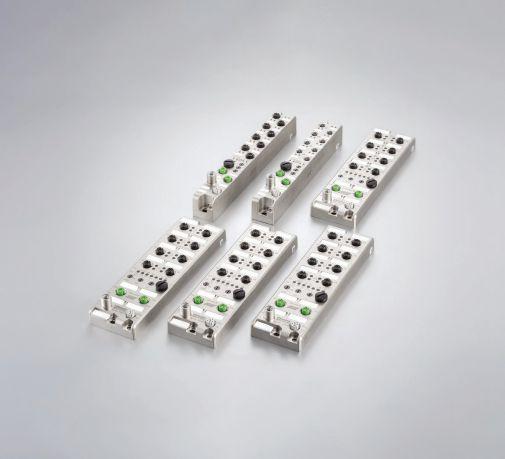
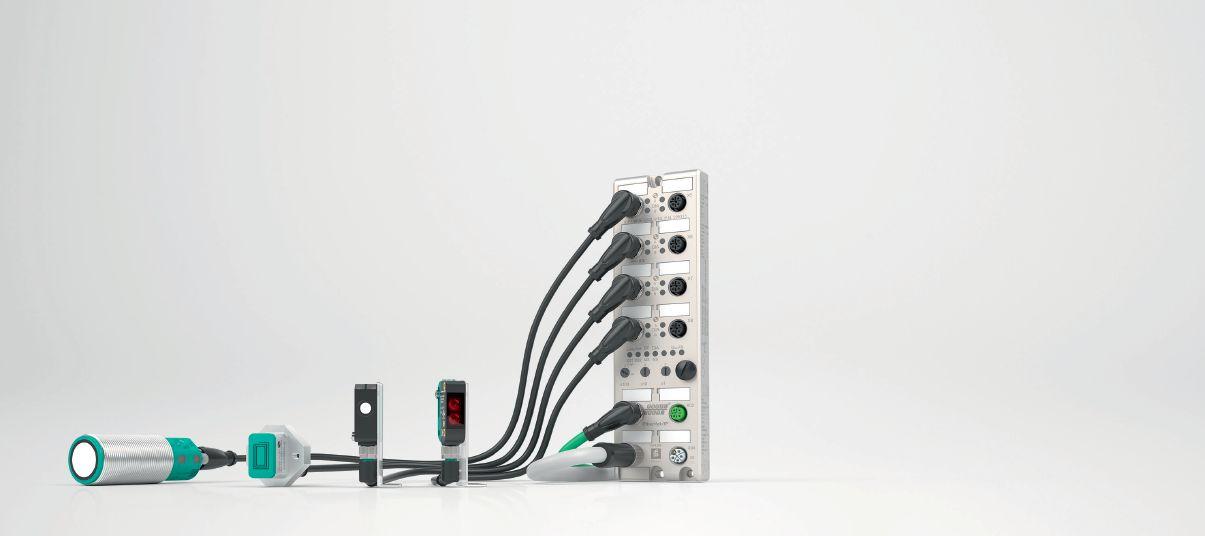
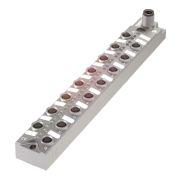
Balluff has debuted I/O hubs that deliver M8 quick connect to enable distributed modular architecture for compact footprint machines and end effectors. The M8 I/O hub portfolio enables Balluff IO-Link masters to host up to 248 discrete sensors on a single network node. Ports on the configurable hub can be configured as input or output, providing short circuit and overload protection per port. Like its M12 I/O hub portfolio, the Balluff M8 portfolio has IP67 robust metal housing suitable for most harsh industrial environments, has input only and has a configurable I/O option.
balluff.com
Industrial control with built-in security
Serial I/O module with independent ports
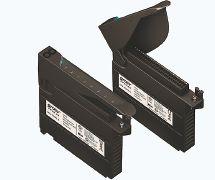
Opto 22 has released the groov serial I/O module GRVCSERI-4 for communications.
MOTION CONTROL
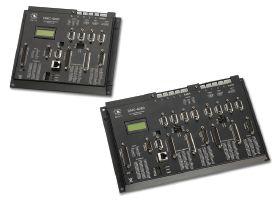
Motion controller with RISC processor
This module plugs into the company’s groov Edge Programmable Industrial Controller (EPIC) chassis alongside the company’s discrete and analog I/O modules, to provide a mix of analog, discrete and serial signals at any location. This new module provides four independent and isolated serial ports for this purpose, communicating with RS-232 or
Linear rotary actuators for pick-and-place
RS-485 serial devices. Up to four modules can be installed in one groov EPIC chassis, providing a total of 16 serial ports to support these communication requirements. Each port is selectable for RS-232 or RS-485 mode, with programmable termination and bias as well as half- or full-duplex options in RS-485 mode. Baud rates of up to one Mbps are supported. opto22.com
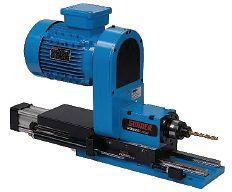
Precision feed slides for modularity
Rockwell Automation’s Allen-Bradley ControlLogix EtherNet/IP communication module is, the company says, among the first industrial devices to use the CIP Security protocol from ODVA. The protocol helps make sure only authorized devices are connected in industrial operations. It also helps prevent tampering or interference with communications between those devices. CIP Security is the first industrial automation protocol to support transport layer security (TLS). rockwellautomation.com
Galil has released a new standalone motion controller, the DMC-40x0, packaged with optional multi-axis drives in a compact, metal enclosure. The unit operates standalone or interfaces to a PC with Ethernet 10/100Base-T or RS232. The controller includes optically isolated I/O, high-power outputs capable of driving brakes or relays, and analog inputs for interfacing to analog sensors. The controller and drive unit accepts power from a single 20-80 VDC source. It is available in one through eight-axis formats, and each axis is user-configurable for stepper or servo motor operation. With a powerful RISC processor, DMC-40x0 controllers provide such advanced features as PID compensation with velocity and acceleration feed-forward, program memory with multitasking for simultaneously running eight applications programs, and uncommitted I/O for synchronizing motion with external events. electromate.com
SMAC Moving Coil Actuators has introduced the new LCR16 series linear rotary actuator, ideal for pick-orient-and-place applications. The devices provide precision z-theta motion within one small actuator. A variety of LCR16 linear rotary actuators are available with either direct drive or gearbox-equipped rotary units. The vacuum built-in shaft through the rotary motor is available for some models to
prevent dust build-up in the unit. These actuators can be programmed to control force/ torque, position and velocity in all axes at the same time with feedback capability. SMAC’s patented “Soft-Land” function enables the unit to gently land on a delicate component with a controlled force to avoid damage of both the component and the actuator. The actuator is constructed with a direct drive brushless servo motor with 35 mm stroke and 24VDC operation with a five-micro encoder. It’s designed with linear guide built-in lubrication. electromate.com
Suhner has redesigned its precision slides with improvements such as rigidity and compact design, including a variety of optional slide assembly features and accessories. The Suhner feed slide program is based on a modular design concept and includes four basic slide sizes. Within the four size classes, there are a number of different stroke lengths ranging from 150 mm to 630 mm, and up to four different feed options such as pneumatic feed with external hydraulic brake cylinder, with or without peck-feed function; pneumatic feed with integrated brake cylinder that allows feed control over the entire stroke length; hydraulic for higher feed forces; and a CNCcontrolled, servo motor and preloaded nut & ball screw. While Suhner slide assemblies offer a number of standard features, there are additional options such as central lubrication for right- or left-hand slide lubrication, cam rail and switch assembly including telescopic or bellowtype way covers. suhner.com
DATA ACQUISITION
RFID read/write heads
Pepperl+Fuchs has expanded its IO-Link portfolio with new RFID read/write heads that operate in the HF range according to ISO 15693 and offer a read/ write range of up to 13 cm. The housing designs are rugged and compact, ideal for use in harsh industrial environments, and come in three sizes. A standardized IO-Link interface enables connectivity to most common bus systems. The new RFID components can be easily connected to a PLC with integrated IO-Link master or to any IO-Link master on the market. For this purpose, Pepperl+Fuchs’ Ethernet IO-Link master offers optimal connectivity and consistent configuration. The ability to connect up to eight IO-Link devices reduces costs per channel and makes data transfer more efficient, says the company. pepperl-fuchs.com
IIoT platform for factory optimization
ATS Automation Tooling Systems has unveiled the Illuminate Manufacturing Intelligence platform for factory optimization
Cameras and Software
with the Industrial Internet of Things (IIoT). The platform uses real-time machine performance data to increase throughput, improve uptime, decrease cost and boost quality on the factory floor – enabling agile data-to-decision in minutes. It gives insights on the essential machines, lines, cells and processes that propel manufacturing business. It works on all manufacturers’ equipment,
PROCESS CONTROL
Drive series for pump, fan and compressors
and features visual KPIs, business intelligence analytics, and reporting capabilities for a live, multi-layered data view of equipment performance for operational insight. Operators can troubleshoot and share
process and product issues/ solutions, prevent downtime through proactive equipment maintenance, drive greater operational efficiency, and unlock performance for sustainable production improvements. The platform pinpoints where to focus resources to have the maximum effect on line throughput. Data is accessible on a secure, webbased platform.
atsautomation.com
where corrosive gases such as hydrogen sulphide are present. Sinamics G120X can be linked to the cloud-based Siemens Mindsphere IoT operating system by using Sinamics Connect 300 and the Mindsphere app Analyze MyDrives. This offers users the
KEEPING AN EYE ON YOUR PROCESS. EASILY.
If you want to detect the smallest errors in the production process, you must take a close look and fully utilize the potential of the images. Machine Vision from Balluff makes it easy. With our intelligent software, the precise cameras are simple to set up and intuitive to operate – minimum experience required.
Knoop and Brinell hardness scales within the selected
LEARN MORE: balluff.ca/vision
POWER SUPPLIES
DC power supplies with battery control modules
AutomationDirect has added PSV series power supplies and universal battery control modules to the RHINO DC power supplies lineup. RHINO PSV “Value” series DIN rail power supplies are available in a wide selection of voltage and wattage ranges. 5V RHINO DC supplies are available in 15- and 25-watt ratings with 12V supplies at 48W. 24V DC supplies are available in 30, 50, 100, 120, 240 and 480W; and 48V supplies are rated up to 120W. Also added are universal
battery control modules that provide uninterruptible 24VDC bus voltage and offer battery protection for over voltage, deep discharge, short circuit and reverse connection. Alarm outputs indicate input, output and battery conditions. automationdirect.com
Lithium-ion uninterruptible power system
Eaton has launched its 5P rackmount lithium-ion uninterruptible power system (UPS) in North America. The 5P lithium-ion UPS uses lithium-ion batteries that provide enhanced performance compared to lead-acid batteries, with extended service life up to eight years. Eaton’s 5P
lithium-ion UPS includes an on-board battery management system to provide insights into battery performance, charge cycles and active temperature monitoring to keep the user informed of the lifecycle of
MATERIAL HANDLING
Hydraulic upender
Verti-Lift has released a hydraulic upender with a V-cradle design, ideal for ergonomic positioning of cylindrical products. With a 6,000-pound capacity, these devices can re-position heavy loads. All Verti-Lift hydraulic upenders feature 0-90 degree tilt angle, hold-down tabs on all four corners, a/c 110 volt, single-phase motor with 15-amp draw and standard hand controls for lowering/ raising tilt. Optional accessories
their UPS battery. The UPS also provides network security with the optional industry-first UL 2900-2-2 compliant Eaton Gigabit Network Card, designed to protect against cyber threats. eatoncanada.ca
include foot control, oversized platforms to suit specific material handling requirements, roller conveyors, accordion skirts, remote power units and PLC control. verti-lift.com
MACHINE SAFETY
Safety monitoring for delta kinematic systems
B&R Automation now offers SafeROBOTICS functions for tripods to safely monitor all types of delta kinematic systems. Serial axes can be also be included in the calculations, for example when tripods are mounted on moving platforms. Safe robot monitoring is implemented using the safety functions Safely Limited Position, Safely Limited Orientation, Safely Limited Joint Position and Safely Limited Speed. It is also possible to safely monitor multiple points with regard to speed, orientation and position in space. SafeROBOTICS functions are based on a generic description of the kinematic chain in which the geometric properties of the robot are defined. The safety application can be isolated from the geometric definitions. This makes it possible to switch to another tool with a different contour without having to actually touch the safety application itself. br-automation.com
Safety monitoring and control devices
AutomationDirect has added the ReeR MOSAIC system of safety monitoring and control devices, which is modular for
managing all safety functions of a single machine or an entire plant. As a standalone controller, the M1 master MOSAIC module has eight inputs, two safety outputs, two status outputs and two inputs for Start/Stop interlock (RST) and external device monitoring (EDM). By adding up to 14 expansion modules, the safety controller system can have up to 128 inputs, 16 safety outputs, 16 RST/EDM inputs, 32 status outputs and EtherNet/IP or MODBUS TCP/ IP connectivity. The MOSAIC M1 master module, input expansion modules, and output safety and status expansion modules are DIN rail mount and 24VDC powered; all modules have removable terminal blocks with screw contacts. The expansion modules connect to the master module via a ReeR proprietary five-way bus. automationdirect.com
MA’s Technology Handbooks
are a series of digital magazines that focus on a single product category within Canada’s manufacturing industry. Posted on MA’s website as an interactive flip-style magazine, our Technology Handbooks provide specific market and product information, as well as trends within that specific product category, to machine builders, component manufacturers, end-users and system integrators.
For more information, contact Klaus Pirker at kpirker@annexbusinessmedia.com or (416) 510-6757.
WIRE & CABLE
Cordset with Deutschstyle connector
Binder USA introduces the new M12-DT cordset, moulded to a Binder M12-A cordset with a black PTFE-coated locking nut. The Deutsch-style rectangular connector with silicone rubber seal offers IP68-rated ingress protection to withstand harsh environments. The M12-DT is available in two-metre and fivemetre cable lengths. It has four contacts, a current rating of 4A and a voltage rating of 230V. The cordset is ideal for various manufacturing industries. binder-usa.com
Hybrid servo cable for use in energy chains
igus has introduced a flexible cable for use in energy chains that delivers motor power and feedback functions through a single cable. The new CF280. UL.H cable is a hybrid servo cable compatible with motors and drives from over 39 manufacturers. CF280.UL.H has been tested inside an energy chain with a seven-times bend radius for up to eight million cycles. igus.com
ADVERTISER INDEX
BACKSTORY
Implementing secure IT systems in production environments
One goal of a digital transformation within a manufacturing environment should be to achieve real-time processing of measured values through the use of more information technology (IT) and additional sensors. This will enable innovative applications, such as machine learning, process optimization and predictive maintenance, which can only be done via big data analysis. Deviations can be recognized very quickly, increasing the reliability of these environments.
One consideration is where to put any IT systems (such as an edge computing system) within a production environment. This requires input from a range of different departments: facility
What MA published in...
2017
“Which cooling solution is installed will ultimately depend on the amount of heat produced inside the panel and the environment in which it is installed.”
2015
“[Edge computing] will tremendously improve data processing capabilities and create significant value without complex data transportation and management.”
2012
“As energy prices continue to fluctuate, more manufacturers will be looking for energy management solutions to gain better visibility into energy consumption in their manufacturing operations.”
2016
“Edge analytics close to control level along with new mobile offerings brings new applications to the shop floor.”
2011
“The focus towards enhanced operational excellence while ensuring efficient energy management necessitates integration of process control and power management.”
management, fire prevention and safety managers, production managers, IT managers and other specialists in network technology and production planning.
Project managers should therefore start planning with the relevant departmental managers at an early stage to identify any issues. It may mean finding an alternative space or even building a whole new facility to house the additional IT systems, but it’s just as likely that a business will be able to retrofit IT systems in the manufacturing hall.
I n general, companies should select the best possible locations for IT systems from a technical security perspective as well as to support well thought-out network cabling. Ensuring there is sufficient distance to the
manufacturing devices will protect IT systems from heat, dirt and vibrations. To make the whole installation more robust, including the server platform, manufacturers can use software to conduct a security analysis. So-called network vulnerability tests check the systems for known but still open security weaknesses.
Without this protection, in extreme cases, attackers could shut down the fans in intelligent cooling systems or turn off switchable power distribution units (PDUs).
If areas of a production plant cannot be shut down while installation work is in progress, then it may be advisable to install pre-configured IT containers that are equipped with the required active IT components. Companies can therefore expand their IT capacities to decentralized production sites quickly and safely using what are termed “edge” data centres. | MA
Paresh Kansara is product manager for industrial and outdoor enclosures at Rittal.
We stock enough power to brew a 12 oz. cup of coffee for the entire population of New Orleans. Put that in your mug and drink it.
Solution for fan, pump, water and wastewater applications
SINAMICS G120X: The new generation of cost-effective, reliable and easy-to-use variable frequency drives
• Input voltages 500–690V and 380–480V – increased ruggedness with mains variations
• Simple selection, ordering and easy set up – saves ordering and commissioning time
• Integrated DC link choke – reduces cost by eliminating need for input reactor
• Coated circuit boards – gives robust design for protection against environmental pollutions
• Integrated safe torque off SIL3 – easy to achieve safety standard