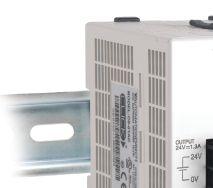
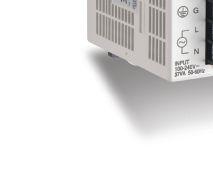
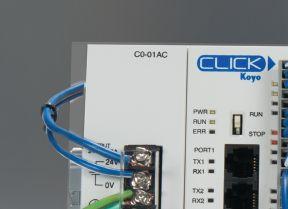
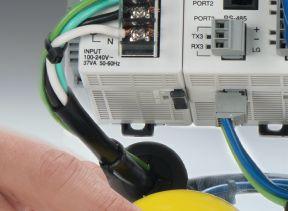
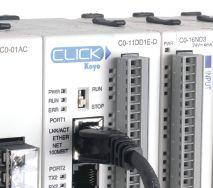
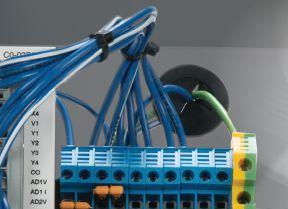
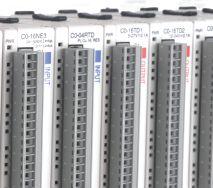
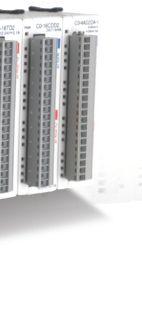
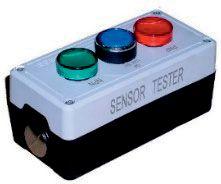
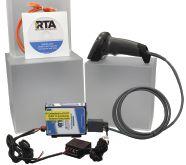
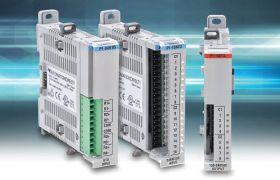
Whether it’s around the house or on the job, you can automate with ease using CLICK PLCs.
• Compact size and easy programming make CLICK ideal for small applications and beginner projects
• Easily expandable with snap-on I/O modules for up to an additional 128 discrete or 48 analog I/O points
• Serial ports on-board; models with Ethernet also available
• Now available with high-speed inputs
Canadian manufacturers are starting to invest in AI, but not necessarily in the areas that are getting all the
Jacob Stoller
A
David Gersovitz
Connecting
Meyers
FROM THE EDITOR
BY KRISTINA URQUHART
LETTERS TO THE EDITOR
In the last issue, we asked for your thoughts on AI. From a reader:
Using AI may speed up some processes and tasks, but without a thorough plan from end to end, it will backfire. Some processes hold back production, causing bottlenecks.
The AI conversation continues
In my last letter, I asked you about how artificial intelligence (AI) factors into your operations. We’ve published one comment (at left) from a reader who notes that unless a manufacturer solves pre-existing production inefficiencies, a costly AI system won’t provide much ROI.
You may have an automated spray paint line that can do over 1,000 units a day, but your assembly line can only do 300 a day. The sprayer is waiting, not operating at capacity. Or vice-versa, where there’s a backlog of assembled parts that you end up warehousing. It is a waste to have a fast assembly line only. Will AI produce, but then other things slow everything down? This may be why Canadian manufacturers dabble in technology, or can’t afford the whole implementation to be efficient, so we are held up.—Sandro DiClemente
As I was about to send this month’s issue to press, I received a letter from another reader about the industry’s use of the term AI to describe what he says is not in fact artificial intelligence at all, but rather mining of big data combined with machine learning. Semantics, maybe, but he makes good points (we’ll publish his comments in an upcoming issue). He also built on the letter at left, and pointed out that implementing hardware and software isn’t always where the expenses end for manufacturers – often, AI-branded software must be customized, too, which comes at a further cost.
This conversation is one I suspect we’ll be having throughout the year. It’s serving as a suitable backdrop to this month’s feature article, “AI Meets the Real World” (p. 19), in which Jacob Stoller, a business journalist, investigates where Canadian manufacturers are at with AI in 2019. His interviews corroborate the findings of the Forbes Insights report I quoted in my January letter – that Canada is in a nascent stage when it comes to AI, but it’s because manufacturers are still testing, and they (rightfully) won’t bring it to scale without proper plans in place.
W hen we first discussed the direction for the article, Jacob told me that based on his talks with industry leaders, he’d been getting the sense that manufacturers are starting to cut through the media- and sales-fuelled
EDITORIAL ADVISORY BOARD
expectations about what AI might be able to do for them. As a result, he thought we may actually be in a stage of what he called “semi-automation” –or AI technologies used in conjunction with human operators. The experts consulted in our cover story confirm that “semi-automation” may be not only an appropriate term for what’s currently happening in Canada, but also a more realistic concept for manufacturers to budget for.
Planning for digital transformation in general is perhaps where the focus should be for Canadian manufacturers – because with the correct infrastructure in place, any future AI integration should, in theory, be more seamless. Enterprise resource planning is one way to do that. On that note, I’m pleased to introduce a new quarterly column called “Across the Enterprise” on p. 12, written by Jonathan Gross, managing director at Pemeco Consulting. Alongside the column, which will help you prepare your plant for Industry 4.0, Jonathan is leading a webinar series co-presented with Manufacturing AUTOMATION called Integrating the Enterprise: ERP Best Practices, where he will delve into more detail on these topics, and offer the tools you need to create your blueprint for digitalization. Our first free webinar, “The IIoT: ERP Best Practices,” takes place March 21, 2019 at 1 p.m. EST and will cover the building blocks of digital transformation – from the cloud and big data to AI and cybersecurity.
Speaking of the latest technologies, I’ll be at Hannover Messe from April 1 to 5. If you’re attending the fair, too, let me know via email or social media. It would be great to meet you and continue this AI conversation! | MA
AL DIGGINS, Chairman of the Board, Treasurer and General Manager, Excellence in Manufacturing Consortium
DAVID GREEN, Technology and Business-to-Business Consultant
KARIN LINDNER, Founder and Owner of Karico Performance Solutions
DON MCCRUDDEN, Vice-President, Business Development, Festo
DAVID MCPHAIL, President and CEO, Memex Automation
NIGEL SOUTHWAY, Business Productivity Consultant and Author on Lean Thinking
BILL VALEDIS, Vice-President, Precision Training, Products and Services Inc.
Your resource for Canada’s industrial automation news
Occasionally, Manufacturing Automation will mail information on behalf of industry related groups whose products and services we believe may be of interest to you. If you prefer not to receive this information, please contact our circulation department in any of the four ways listed above.
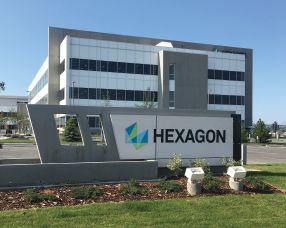
Hexagon’s Manufacturing Intelligence division, which specializes in metrology and manufacturing solutions, has expanded into western Canada with a new office in Calgary, Alberta.
The new 160,000 square-foot, silver LEED-rated location and its staff will serve the region’s range of manufacturing industries including aerospace, oil and gas, advanced composites, MRO, agriculture, bus and rail, machinery, wood products and more. The facility will accommodate business offices and a training room, with space to offer seminars covering Hexagon’s metrology and manufacturing technologies including laser trackers, CMMs, software and automated solutions.
Heading the regional office, Alberto Silva will serve as a sales engineer for west Canada, covering Manitoba through British Columbia. Silva’s background includes the oil and gas industry and the manufacture of rotating machinery.
“We are excited to now locally serve the growing manufacturing industries of western Canada,” says David Hill, commercial operations manager for Canada at Hexagon Manufacturing Intelligence. “The Smart Factory movement is opening people’s eyes to the benefits of dimensional measurement throughout the product development cycle.”
The regional office is located at the Hexagon Calgary Campus, which opened in September 2018.
OUTLOOK
Study: Canadian manufacturers’ 2019 predictions
Canadian manufacturers are optimistic about their prospects in 2019, but significantly less confident than last year as concern mounts that Trump administration policies and other
disruptive factors will affect their businesses, according to a new survey of senior manufacturing executives.
PLANT Magazine ’s Manufacturers’ Outlook 2019 study shows 39 per cent of senior company executives are very optimistic about the coming year, compared to 44 per cent last year.
They’re either very or somewhat concerned about what’s
going on in America. U.S. protectionism is very worrying to 65 per cent of executives compared to 54 per cent last year, followed by U.S. protectionism (65 per cent), President Donald Trump’s impact on nation-to-nation relationships (61 per cent) and changes resulting from the NAFTA renegotiation (56 per cent).
“Canadian manufacturing has been booming, but there are
Hexagon’s new office in Calgary, Alberta is LEED-certified.
AUTOMATION UPFRONT
storm clouds on the horizon and that’s eroding Canadian CEOs’ confidence in 2019,” says Jeff Brownlee, publisher of PLANT Magazine, which commissioned the survey.
How are companies staying ahead of the risks? Two-thirds (66 per cent) are conducting assessments, 29 per cent regularly and 37 per cent sometimes. Regulatory change leads the list of concerns for 41 per cent.
The survey, completed in partnership with Grant Thornton LLP, SYSPRO Canada and Machines Italia with the Italian Trade Commission, is based on 501 replies from senior manufacturing executives.
Despite their concerns, manufacturers are demonstrating their confidence with plans to make significant investments in their businesses. Top choices for investment over the next three years are machinery, equipment
and technology (75 per cent of respondents) and training (63 per cent). Average investment is more than $1.7 million.
Controlling costs tops the list of challenges for 65 per cent of respondents, followed by pressures on prices (61 per cent) and filling skills needs/management talent (46 per cent).
Respondents demonstrated a very limited engagement with IIoT, which connects and optimizes machines via the internet. Only seven per cent are applying IIoT capabilities, 32 per cent are not familiar with these capabilities and 31 per cent said they were not applicable.
Most of the surveyed companies (66 per cent) fall into the small business category (under 100 employees). The survey, which was conducted by Toronto research firm RK Insights, has a margin of error of +/- 3.6 per cent, 19 times out of 20.
NEW Network-Capable Absolute Encoder from EPC
For EtherCAT communication in a precision absolute encoder, we’ve got your solution.
EPC’s Model A58E Series Encoders feature networking capability and are EtherCAT ready. The Model A58E Series Encoders:
TRAINING
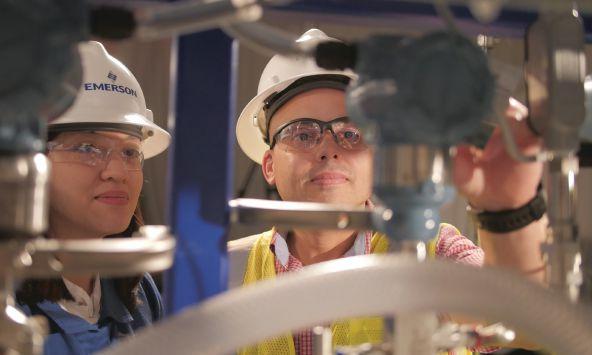
Emerson launches digital automation training
Emerson has launched a portable automation technology training tool that helps workers safely and efficiently maintain their plants.
The Performance Learning Platform reinforces the requirements for digital transformation and helps close the skills gap as the Industrial Internet of Things (IoT) era continues to change the way manufacturing and process companies do business.
piping system, tanks, pumps and a fully scalable suite of Emerson instrumentation and final control valves linked to a DeltaVTM distributed control system. Each unit ships with an integrated video library that provides stepby-step instruction in a range of realistic scenarios. A lab workbook and supporting eLearning courses are also available.
EMC starts new Lean training program
The Excellence in Manufacturing Consortium (EMC) has kick-started a new three-year program to help Northern Ontario manufacturers become more globally competitive.
• applications, including bus, ring, and star con gurations
Are easily designed into a wide variety of
Come in a compact 58 mm package
• Are available in Shaft or Hollow Bore construction
• Retain position information even in power-o
• scenarios
• 43 bits Multi-Turn Resolution
O er up to 16 bits Single Turn Resolution, or up to
Questions? Call us today. When you contact EPC, you talk to real engineers and encoder experts who are ready to help you.
1-800-366-5412 www.encoder.com
“We designed the Performance Learning Platform as a flexible, hands-on training tool with real-world instrumentation that will help bridge a critical knowledge and skills gap that continues to challenge the industry,” says Jeff Hackney, global educational services director for Emerson’s Automation Solutions business. “This gap exists in large part because technological advances are outpacing the industry’s current training strategies and tools.”
The Performance Learning Platform provides process control and instrumentation simulation to train or refresh current workers on how to monitor and control complex operations involving pressure, flow, level and final control valves.
The platform features a complete working control loop
EMC, a not-for-profit consortium serving and supporting Canada’s manufacturing industry, is running the “Advancing Lean Initiatives for Northern Ontario Industry” initiative with support from the Federal Economic Development Agency for Northern Ontario (FedNor). The program will include opportunities for productivity knowledge, networking resources and new management and productivity system training.
As part of the project, EMC will deliver 42 lean management training events over three years in North Bay, Sault Ste. Marie, Parry Sound/Muskoka, Sudbury, Timmins and Thunder Bay. The initiative will also create opportunities for business and
Emerson’s portable Performance Learning Platform provides training on process control and plant safety.
community leaders to share ideas and best practices, while providing a forum for knowledge exchange regarding energy, supply chain, health and safety, human resources and marketing.
Last August, EMC wrapped up a two-year lean manufacturing program for Northern Ontario with another investment from FedNor, which saw significant success – 10 of the companies that participated reported savings of $10,000 to $499,000, depending on their area of focus.
SICK partners with Humber College on sensor education
SICK and Humber College have partnered to build awareness of new industry automation sensor solutions and Industry 4.0–ready sensor technologies as part of Humber College’s Barrett Centre for Technology
Innovation (Barrett CTI).
Over the next three years, SICK – a manufacturer of sensors, safety systems, machine vision and other industrial automation equipment – will provide sensor technologies and services worth $765,000, new training opportunities in sensor intelligence and industrial automation for Humber students, and dedicated support through new scholarships called the SICK Canada Leadership & Vision Awards.
The partnership will also include employment and exchange pathways for Humber students to work at SICK, educational programs in the areas of smart sensors, factory, logistic and process automation, Industry 4.0 and the Internet of Things, and STEM outreach and awareness events to inspire secondary school students to consider industrial automation careers.
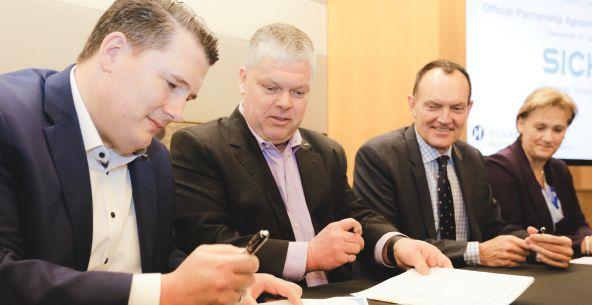
SICK Canada and Humber College have signed an agreement that will see SICK provide $760,000 in technologies to the school.
SAFETY
Ontario manufacturer fined $60K after injury
Rex Pak Ltd., a food blending and packaging co-manufacturer, has been fined $60,000 by the Ontario Ministry of Labour after one of the Rex Pak’s workers received a permanent injury while assessing a sugar-filling line at
the company’s industrial facility in Scarborough.
Denise Sabatini of Markham, a director/officer of Rex Pak, was also fined $3,500 by Justice of the Peace Paula Hy Phui Liu in Toronto court.
The accident occurred on February 24, 2017. According to the Ministry of Labour’s investigation, Rex Pak had installed temporary perimeter fencing
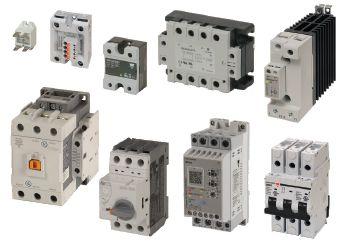
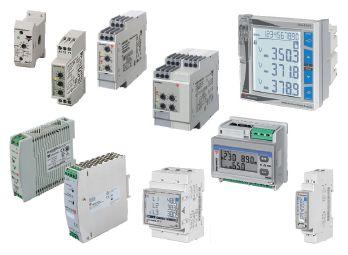
CARLO GAVAZZI has the solution for your application needs, whether it’s our industry leading solid state relays, energy meters, contactors, motor controls, monitoring relays or sensors, now available with IO-Link communications.
Contact us today, and one of our field sales representatives will show you why we are one of the fastest growing automation companies worldwide. We’ll even provide a free evaluation sample to qualified OEMs.
AUTOMATION UPFRONT
around the sugar-filling line as an interim measure while a longterm guarding solution was being manufactured by a third-party engineering company.
The worker did not turn off the agitator that was attached to the hopper for the sugar-filling line before moving the temporary perimeter fence.
The worker placed a hand on a moving drive belt, which drew the hand into a pinch point between the drive belt and the agitator pulley, causing the injury.
According to the ministry’s report, Rex Pak failed to adequately ensure that measures and procedures were taken to avoid an in-running nip hazard for the worker in accordance with the act and regulation.
PRODUCTION
New automated inspection machine for aerospace
The National Research Council (NRC) and Fives, an industrial engineering group, have partnered to develop a machine that will improve the efficiency of manufacturing composite parts for the aerospace industry.
The companies are developing an advanced profilometer called
the Fives Automated Fibre Placement Machine that will provide faster and more accurate part inspection using an innovative form of optical technology.
This in-process inspection technology will help manufacturers meet strict standards by providing measuring information without limiting the process functionality. The NRC says that faster, better measurements will speed up manufacturing processes and reduce the risk of errors.
Fives has already started the last testing stage of the next-generation profilometer with customers and expects to begin commercializing the technology before the end of 2019.
Fives designs and supplies machine and process equipment for various industrial sectors.
Brose to cut 100 jobs in Ontario
Autoparts maker Brose Fahrzeugteile says it will cut 100 jobs at its London, Ont., operations by the end of the year.
The German company says it is adjusting production capacity at the manufacturing facility to meet shifting customer demand.
Brose Canada produces seat components and adjusters for its main customers including Ford
Motor Co., Fiat Chrysler Automobiles, Volkswagen, Subaru, and Mercedes-Benz.
The company says its focus is on supporting those affected by the job cuts by providing transition options, including potential relocation to other Brose production facilities.
Brose, which started operating in London in 2005, has more than 600 employees at two facilities in Canada.—The Canadian Press
DEAL MAKERS
CAMM forms Automate Canada cluster
The Canadian Association of Mold Makers (CAMM) recently
announced the new name for the national automation arm of their association.
Automate Canada will be the new global cluster of companies specializing in manufacturing automation solutions, concentrated on the Windsor automotive corridor in Ontario.
The new arm will provide the automation sector with opportunities in the industry including trade shows in India, Brazil, Germany and USA. In addition, Automate Canada will be the members’ voice for all House of Commons meetings, trade agreement conversations, government exposure and will work to increase their reach to Industry Canada.
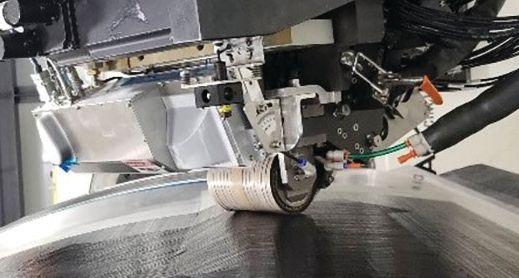
This Fives Viper Automated Fibre Placement machine, integrated with NRC profiling technology, enables high-quality, real-time in-process inspection for the aerospace industry.
MOVERS AND SHAKERS
Bombardier Inc. has announced a new leader of its train unit. Danny Di Perna has replaced Laurent Troger, who recently resigned. Di Perna will report directly to chief executive Alain Bellemare. He joined Bombardier in November to lead its aerostructures and engineering segment after leaving GE Power, where he was VP, global sourcing.
AMETEK Surface Vision, a provider of automated on-line surface inspection solutions, has appointed Francois Levac as the director of sales. Formerly manager of sales for the paper industry in the Americas and Canada, Levac will support Surface Vision’s existing customer base and grow new relationships
by enhancing representation across North America and Latin America.
Turck Canada has added three new employees to its workforce: Carlos Linan is in technical sales for Greater Toronto Area East, Jose Sanchez is the new automation application specialist, and Michael Branco is in technical sales for Greater Toronto Area West. Linan worked at Baumer Canada, Panasonic Electric Works of America and Pilz GmbH, and brings extensive experience and understanding of factory automation and systems selling to Turck. Sanchez
MOVE SECURELY INTO THE CLOUD
Amazon Web Services WAGO Cloud
Other Cloud Services
has technical experience from Novatech Analytical Solutions, Halliburton Energy Services (oil and gas) and diverse industries. He has a strong understanding of PLC, HMI, motor controls and field devices. Branco has years of technical sales and service experience in the area of industrial automation, having worked with a wide range of customers from OEMs to end users in industries such as automotive, food and beverage, pharmaceutical, packaging and more.
Universal Robots has appointed former KUKA Canada president and CEO Chris Claringbold as area sales manager for Canada. Based just north of Toronto, Claringbold will continue the development of Universal Robots’s sales and distribution business in Canada, develop regional strategic large accounts, and initiate the hiring of Canadian-based technical staff. Chris will report directly to Stu Shepherd, area sales manager for the Americas. Claringbold brings over 35 years of robotic automation experience to Universal Robots. Prior to joining Universal Robots, Chris was president and CEO for KUKA Robotics Canada as well as president and COO at Prodomax Automation, one of the largest system integrators and automation companies in Canada. He also has eight years of automotive experience from working for Magna International. | MA
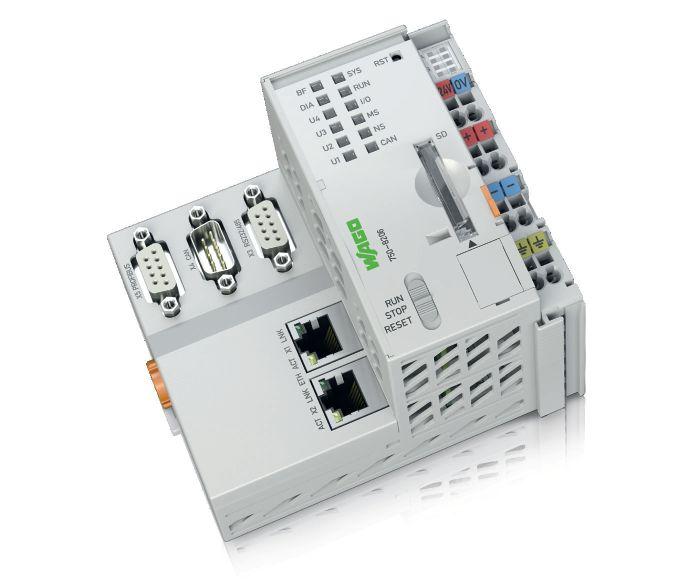
Direct Field to Cloud Connection with the PFC Series Controllers
• IIoT-ready with native MQTT and TLS encryption
• Built-in VPN and Firewall for increased network security
• Simplify data routing and reduce latency
• Interface with existing controls via onboard fieldbus gateways
www.wago.ca/pfccloud
Carlos Linan
Chris Claringbold
Jose Sanchez
Michael Branco
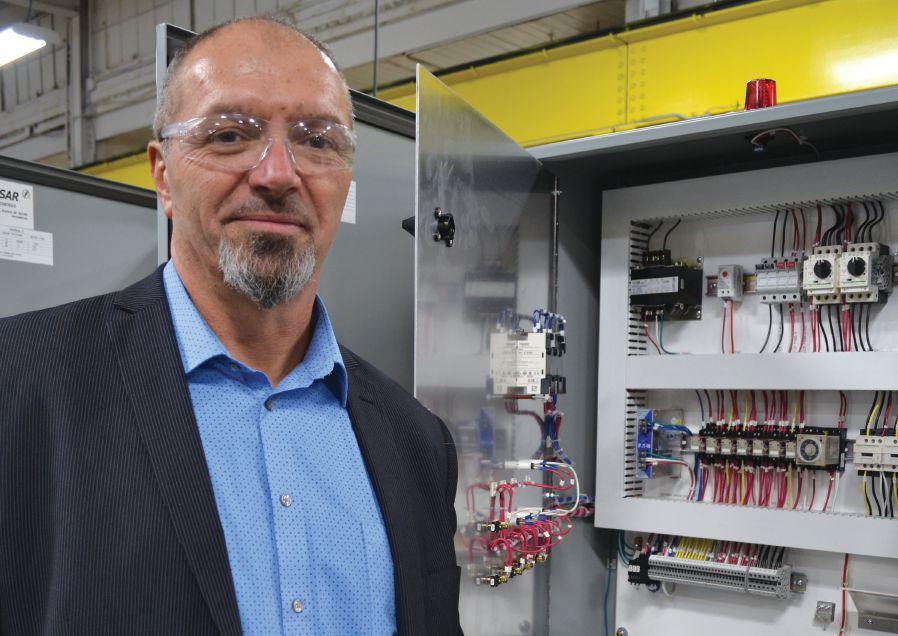
GEORGE MICEVSKI, president of control panel company Tulsar Canada, discusses how bringing some automation into the company’s custom manufacturing helped to realize sales goals.
MA: What drew you to a career in manufacturing?
GM: I’ve only been with Tulsar for three years. I worked at Amazon before, but before that I was at two other pump companies and a railway manufacturer. So I’ve been in manufacturing for most of my whole career. Right now, I enjoy the R&D part of it so much, because you can put your thumbprint on things that are going to be here forever. It’s cool just designing stuff and watching it come to life. We’ve redesigned [our enclosures] and we’ve tried to eliminate hardware out of a lot of the components we use. We’re always trying to think about the end user.
MA: Tulsar Canada moved to a bigger production facility in 2017. Can you tell us more about the company’s growth over the last few years?
GM: In 2011, Tulsar was purchased by Zoeller Corporation, a manufacturer of pumps for water and wastewater, out of Louisville, Kentucky. They wanted a control panel company to add on to their product line. We were only doing custom panels when they purchased us – small little assemblies. In 2017, we relocated our 25,000 square feet space into this facility at 135,000 square feet, and since then we’ve added quite a bit of standard product manufacturing. We spent half a million dollars to open up an R&D team, so now we’re developing new products for the industry. We’ve gone from 30 people in the beginning of 2016, to 96 right now, and we’re expected to get to over 100 in the next few months.
One thing we do is try to get our customers their product on time. Back in 2016, we invested $20,000 on metal fabricating machinery for manufacturing little components, which up until
then had accounted for 80 per cent of our late deliveries. So we eliminated that. Seventeen per cent of our business was in making cords for another pump company in the U.S. and in Mexico and our vendor was always late. So in 2018 we purchased the vendor out of Toronto, and relocated their 30,000 square feet of wire and cable processing to our facility here in Brantford, Ontario.
The growth that we’ve had has been incredible and it’s mainly been through either acquisition or internal sales of new product. Three years ago, the CEO [gave] me the task to grow the company from around $4 million to $20 million in five years. And we’re halfway there.
MA: Who are some customers on the industrial side using your control panels?
GM: In the Waterloo Region, we do community parks where there are splash pads for kids. A
lot of the wastewater treatment facilities in Ontario, or for industry where they have pumps operating in their pits. Union Gas, Suncor, TTC, the airport.
MA: Why has it been important for Tulsar to retain many of the manual processes in its manufacturing?
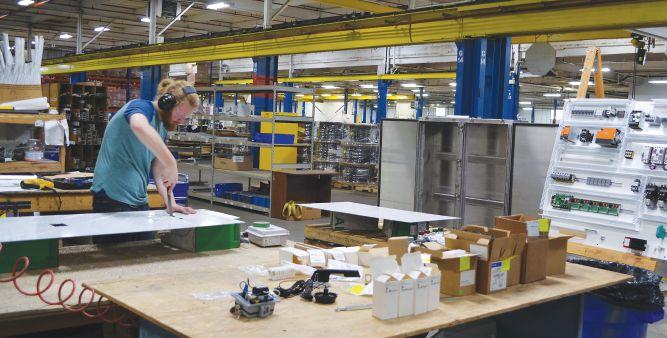
GM: We try to automate as much as we can for the repeat, standard product stuff. But the custom panels are still hand-built because the applications can be critical. We have to guarantee
that what we’re sending out is 100 per cent right. And we have checks all the way through. So the guys assemble it, and when the wirers start to wire it, they actually check every component that was put in there to make sure it was the right one. Because a lot of times, they’re close but they’re the wrong voltage or amperage and it can cause a problem later. And then everything out of this facility is 100 per cent tested. There’s nothing that we ship out that hasn’t been tested.
MA: Where have you introduced automation in the repeat product manufacturing process?
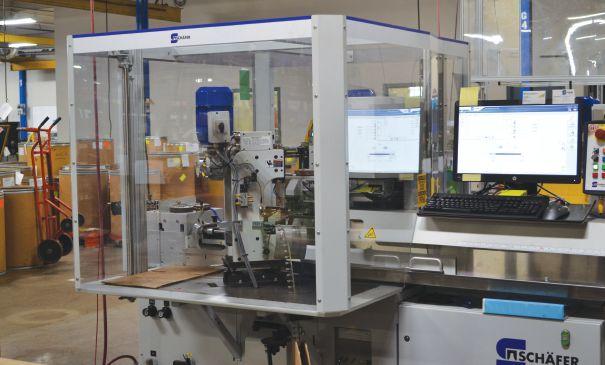
GM: Instead of hooking things up manually for testing, we installed a big control panel where we just put the product in, clamp it down, and hit a button and all the testing gets performed and logged automatically. If it’s a Wi-Fi–enabled product (that will alarm to your phone if there is a problem), the machine actually generates a specific serial number, so we’ll know the IP address when we have to update it.
The testing area can test up to 10 different types of products, and a product must run through testing for 250,000 cycles without an error before getting packed to go out.
MA: How are you able to solve your customers’ biggest challenges?
GM: Most people don’t understand the technology that’s available. Because of the vendors that we carry, we have the most up-to-date technology all the time. Companies like Schneider Electric, ABB, all those guys – they always call on us to explain what the latest and greatest technology is. We get invited to conferences – a recent one was Schneider in Toronto, who showed that with one little box the size of a cell phone, you can control your house or your factory. All this technology is out there, and people don’t realize it.
And a lot of the time, what our customers ask for is not actually what they need. There are not too many people who have the expertise we have in house – our engineering ability to custommake whatever people need and provide them with a full specification.
We ran into a situation in the U.S. where we quoted a job and we got a phone call [from a customer] asking, “What are you guys smoking? You’re 60 per cent higher than your competition!” And when
we sat down and went over the other quote, they weren’t getting a certified panel. They were getting a panel where the vendor had written that they don’t guarantee it meets any kind of spec – whereas we look into the codes and specs [in any province or state] and make sure that whatever comes out of this facility gets dropped onsite to be installed immediately and that it
passes everything.
We communicate with our customers directly. There’s no third-party. So when a customer is talking to one of our engineers, they’re talking to the guy who is
Connecting you to productivity!
actually doing their job. We’re not assuming things, and you’re not expecting things that you’re not going to get because it was never talked about or specified. | MA
The Core product range from Festo featuring the Stars of Automation: Festo quality at a competitive price covering 80% of your automation tasks. From actuators to accessories for factory and process automation.
Reduce your procurement complexity for both the electric and pneumatic control chain by simply following the stars.
ACROSS
BY JONATHAN GROSS
The urgency for Canadian manufacturers to embrace Industry 4.0
Industry 4.0 – or the fourth industrial revolution – refers to a cyber-physical environment that self-optimizes. The system collects data, creates its own analytical models, makes decisions and optimizes the factory. This is why Industry 4.0 is also called the “Smart Factory.”
Let’s see how this could work.
Our sample company – which is based on a real-world scenario – produces a grain-based fuel in bulk. It also produces various co-products, some of which are higher margin than the primary products. Interestingly, profits can be maximized when primary product yield is slightly suboptimal.
Humans can’t effectively optimize production for profit. The mathematical models and degree of process control micromanagement make it impractical, if not impossible. Optimization would demand almost continuous adjustments based on weather conditions, equipment processing parameters, water quality, forecasted demand, raw material quality, finished good and co-product quality requirements and supply costs, among other things.
It’s this type of scenario where Industry 4.0 systems would excel. A self-guiding system could quickly analyze the inputs and vary production parameters to optimize profits.
continue to thrive as a manufacturing hub, notwithstanding its high-wage economy. The authors proposed a framework based on smart, cyber-physical systems that connect equipment, software and people. The final report was presented at Hannover Messe in April of 2013.
O ur process-manufacturing scenario is what the framers of Industry 4.0 had in mind – intelligent product customization in mass production environments, where the customizations are delivered by self-optimizing systems.
Global trading partners who used to compete on cost alone are now competing on cost, value and service dimensions.
The history of Industry 4.0
Industry 4.0 was conceived as part of a German government strategic initiative to computerize manufacturing with the goal of protecting the country’s position as a manufacturing powerhouse.
In April of 2011, a working group presented a draft white paper with the thesis that Germany can
The urgency for Canadian manufacturers
For many Canadian manufacturers, the question isn’t whether they should transform. It’s whether they can survive without implementing Industry 4.0 systems.
Canada is a relatively high-wage economy. Apart from some recent (and hopefully temporary) trade frictions with our neighbours to the south, global trade barriers are being knocked down, providing foreign competitors with easier access to our markets. And, to further
press the issue, global trading partners who used to compete on cost alone are now competing on cost, value and service dimensions.
China, for example, recognized that its window to continue building an economy on the back of cheap, low-quality goods was closing. In 2015, China released a strategic plan – Made in China 2025 – aimed at upgrading strategically important industries. It also targets Industry 4.0 sectors, including: robotics, AI, IoT, smart appliances and machine learning.
According to Oxford Economics and BCG research, China accounted for 27 per cent of the world’s value-added manufacturing output at the end of 2017, which was 1.7 times more than the U.S. and 4.4 times more than Germany. According to that same research, China’s exports have increased dramatically, even while its labour cost base has increased.
To remain competitive, Canadian manufacturing companies need to invest in next-generation industrial and business models to protect and expand their market share.
The four pillars of Industry 4.0
Industry 4.0 is that next-generation framework. If we reflect
on the evolution of business technologies, the central theme has always been to automate and integrate processes with a view to eliminating transactional and decision-making frictions.
MRP (materials requirements planning) sought to remove frictions between sales and operations by time-phasing purchase and manufacturing material requirements with demand for those resources. ERP (enterprise resource planning) came next. This innovation removed finance and accounting frictions by integrating the operational transactions to general ledger, accounts payable and accounts receivable modules.
Today, we’re seeing previously siloed manufacturing control and execution systems being integrated with enterprise software systems – systems that drive production, equipment maintenance, quality and inventory processes.
What makes these integrated systems “Industry 4.0” is the layering of artificial intelligence that has autonomous capability to learn from data, make decisions and optimize transactional and execution system processing.
When designing your organization’s Industry 4.0 environment, you need to consider four
Jonathan Gross is the managing director at Pemeco Consulting. He helps his clients architect and implement technology environments that integrate ERP with the edge. pemeco.com
overlapping principles, according to the authors of Design Principles for Industrie 4.0 Scenarios:
1. Interconnection. The systems need to connect people, machines, sensors, devices and software through the Internet of Things (IoT) and allow them to communicate with one another.
2. Information transparency. The data collected through interconnection needs to be made available to operators for decision-making.
3. Technical assistance. The intent is twofold: 1) to shift low-value tasks from people to cyber-physical systems, and 2) for systems to provide people with information to make timely and effective decisions.
4. Decentralized decisions. The systems need to be able to make their own decisions and take autonomous action.
Returning to our above process-manufacturing example, the company would need to make sure that its distributed control systems, enterprise software systems, scales, tank sensors, and other equipment are all connected. The data from all of those systems would need to be collected in a data lake (a warehouse that stores big data sets), and have cognitive analytics to bring timely insights to the operators.
And, perhaps most importantly, the system needs the capability to decide and act autonomously. For example, when the system’s artificial intelligence “brain” discovers a higher profit mix of primary and co-product, it needs to be able to automatically adjust production.
Getting your organization ready for Industry 4.0
It’s against this backdrop of urgency for Canadian manufacturers that my firm Pemeco Consulting has partnered with Manufacturing AUTOMATION. We’re collaborating on a multimedia content hub that will be filled with best practices and templates that you can use to plan and execute your Industry 4.0 transformation plan.
We’ll cover:
1. The basics. You’ll learn about the building blocks, and how they piece together, including: IIoT, AI, enterprise software and control systems.
2. Planning. You’ll gain access to templates that you can use to map and budget for changes to your organizational structure, information architecture and business processes.
3. Implementation. This scale of transformation is disruptive and risky. You’ll see guides that cover change and project management, data governance, testing and training.
4. Risk management. Privacy, cybersecurity and automation-related job losses are but a few of the big-time challenges and risks. We’ll help you to address the issues and
mitigate the risks. If you’re embarking down the Industry 4.0 path, you don’t need to do it in the dark. We hope to enlighten your journey with experiences of those who have preceded you | MA
More than 500 components for handling and assembly.
INDUSTRY WATCH
BY PAUL HOGENDOORN
Principle. Process. Practice.
Ispent this past weekend volunteering as a timer at a swim meet hosted by my granddaughter’s club. There were 800 swimmers and 1,500 race heats. At eight lanes per heat, it meant about 12,000 individual races had to be timed, each lane manned by three qualified timers and a strokes-and-turn judge in order for the time to be “official.”
Imagine the confusion, chaos and noise – all those teenage athletes, all the family and friends cheering loudly and the constant churning of water. It all had to be done in about 16 hours, split over two days. And it all ran like clockwork.
The planning required is immense, but the organizers have the benefit of experience and processes that have been refined over many years of running previous events. Everyone has a job to do, and everyone knows their job and has been trained for it.
I got to the event at 8 a.m. The first race is at 9 a.m. All of the volunteers, myself included, have had to attend training sessions to be certified to perform the tasks. At 8:20, the race officials have a quick huddle. At 8:30, the timers and strokes-and-turns judges have an assembly to review and remind everyone of their roles, the objectives and the procedures, and at 8:45 we head down to our assigned positions on the pool deck.
At 9 a.m. precisely, the first race begins. As a timer, the process I have to follow is simple: at first whistle, I check that my watch is reset and ready. The swimmers step on to the diving blocks. Two or three seconds later, the starter says “on your mark” and my focus is entirely on a strobe light that will flash in unison with the starter’s horn. About two seconds later, the horn blasts and the strobe flashes, and my job is to start my watch as precisely as possible. The yelling and screaming begins, as fans and teammates exhort their favourite swimmers. About 35 seconds later, the first swimmer touches the finish pad, and then the other seven in quick succession. My job at that point is to focus all my attention on the lane that I am timing and stop my watch as precisely as I can to the swimmer’s touch of the
Paul Hogendoorn is president and co-founder of FreePoint Technologies. He can be reached at paul.hogendoorn@getfreepoint.com or getfreepoint.com. “Measure. Analyze. Share. Don’t forget to share!”
wall. Within three or four seconds of the last swimmer touching the pad, the starter whistle blows, and the next group of racers step up to the diving platform. I relay the previous swimmer’s time to one of my lane-timer colleagues who records it, then I reset my watch and set my focus back on the strobe light. There is typically less than 60 seconds from the start of one race to the start of the next, and in that time, swimmers are marshalled into position on the pool deck, or out of the pool and out of the way. Six or seven hours later, the day’s racing is complete.
Principles still trump process –something to keep in mind as we consider where Industry 4.0 may take us.
The whole experience drills into me the importance of process, of having everyone know their job and do it well. I also think of the swimmers, and the hours of practice they put in between meets, in an effort of shaving seconds, or tenths of seconds, off their times. My granddaughter, for instance, is at the pool training five days a week –two days at 5 a.m. before school, and three days after school. They practice with a purpose, and their purpose is to get better at each stoke, with their turns and with their endurance. With intentional and disciplined practice comes better results.
After my day timing, I got a chance to think about principles and how they can modify a process. About two hours into the event, everything was running in harmony; there was a distinct rhythm and pace to the whole process. Suddenly, the pace changed. Instead
of a three-second gap between the end of one race and the whistle to start the next, we paused for about a minute. A swimmer at my end of the pool rolled to the bulkhead in her wheelchair and crawled onto the diving block where she sat instead of stood. An attendant assisted another swimmer on the other end of the diving block, helping her to stand. A few seconds later, the whistle sounded, followed by “take your mark” and the starting horn and strobe light, and the race was on. Six swimmers finished in the typical time range for the event, but the swimmer closest to me didn’t have the use of her legs and the swimmer on the other end only had the use of one arm. All the other swimmers cheered them on.
The break in the rhythm and cadence reminded me that the processes of the event are important, but they are not the reason the events are held. The events are held for the swimmers, and clubs are formed to do more than develop swimmers; they develop character, perseverance, a sense of belonging, and a sense of fair play. The clubs, and the meets, develop character in young people, not to mention teaching a thing or two to the old people volunteering. Process and practice are more critical to success in manufacturing today than at any previous time. (Just think of the focus on Lean, for example). But principles still trump process – something to keep in mind as we consider where Industry 4.0 may take us. | MA
Our Smart Sensors are the future-proof approach for making your automation network more efficient and improving its performance: The sensors are flexible and adapt to any new production order on command. They monitor operational safety and enable predictive maintenance. They solve applications decentralized and efficiently with Smart Tasks. The right step on the path to Industry 4.0. We think that’s intelligent. www.sick.com/smart-sensors
BY JONATHAN WILKINS
Automating safety
According to the Association of Workers Compensation Boards of Canada, over 29,000 manufacturing workers suffer a job-related injury each year, accounting for nearly 12 per cent of all workplace lost-time claims. How can automation help to reduce this figure?
Accidents in the workplace can be caused by multiple factors. However, some industries are prone to a higher risk of accidents than others. Reports suggest that injuries in manufacturing are most commonly caused by unintentional contact with objects, overexertion and, of course, accidental slips, trips and falls.
Considering the heavy-duty equipment used in the manufacturing sector, these common injury causes still illustrate a massive improvement on the historical reputation of health and safety in manufacturing. Some quick research into the appalling factory conditions of the Industrial Revolution puts this into perspective.
W hile manufacturing’s approach to health and safety has dramatically improved, much of this is attributed to government regulation and the introduction of machine safety procedures
and guidelines.
Automation will displace some roles in the manufacturing realm, [but] the positive impact automation has on human safety far outweighs the negatives.
Automation has long been hailed as the ultimate technology to increase the speed, precision and efficiency of manufacturing processes. However, its capacity to remove human workers from these potentially dangerous tasks is usually portrayed in a more negative light – often due to fears about job losses.
According to a recent ADP Canada Sentiment Study, one in four Canadians are worried about the increasing use of robotics and automation in the workplace. While there is no denying automation will displace some roles in the manufacturing realm – in
fact it already has – the positive impact automation has on human safety far outweighs the negatives.
Safety through hardware automation
Consider industrial robots as an example. These machines have long been used in manufacturing to separate human workers from dangerous processes. For instance, traditional six-axis robots were first deployed to production lines in the 1960s to remove the presence of workers from some aspects of the production line.
Much of this robotic deployment was in the automotive industry, which
Safety Laser Scanner PSENscan Experienced system planners and design engineers know the score: the monitoring of danger zones is just as indispensable for automation as protection is on the mountain. Risks must be detected immediately and processed reliably Based on many years of experience in the field of optoelectronic sensors, Pilz is now taking the next step With a new product group: flexible, configurable safety laser scanner for productive area monitoring Play it safe: sensor technology, control technology, drive technology and visualisation. A one-stop shop. The complete solution from Pilz
Pilz Automation Safety Canad
Jonathan Wilkins is the marketing director of industrial automation components supplier EU Automation. euautomation.com/us
often requires the movement of heavy objects and materials. By eliminating the need for human workers to interfere with these processes, manufacturers can rest assured machines will handle this task. What’s more, as robots like these are often required to operate in robotic work cells – reinforced by metal barriers to separate the machine from humans on the factory floor – there is no opportunity for workers to be harmed should the robot ever malfunction.
That said, implementing automation for safety is not limited to heavy-duty processes, nor does it require the deployment of robots. Health and safety of much simpler processes, such as box opening and packaging, are also benefitting from the introduction of automation.
Box-opening automation is a good example of this. While cuts and lacerations may seem like minor injuries, at least compared to some manufacturing accidents, these injuries still account for many hospital visits each year (in the U.S., it’s one million hospital visits annually – similar data is not available in Canada). Naturally, these injuries can vary in severity. However, in some instances, lacerations can result in stitches and even permanent damage to the worker.
Almost every manufacturer requires box-opening processes in its delivery and warehousing processes, but removing blades from this task simply is not an option. As an alternative, more manufacturers are turning to automated box-opening technologies to remove humans from this hazardous role.
Safety through software automation
Safety automation is not limited to physically restricting humans from dangerous tasks. New software technologies are also introducing intelligent ways to reduce the likelihood of hazardous processes on the factory floor. Much of this is possible through machine learning and predictive analytics technologies.
Machine learning describes a type of artificial intelligence (AI) that allows software to learn and develop while it is in operation. Using this technology, industrial IT systems can search through manufacturing data to highlight dangerous processes.
For example, by using machine learning through a supervisory control and data acquisition (SCADA) platform,
a manufacturer can identify if a piece of equipment is repeatedly showing signs of overheating, and isolate the exact point in time or temperature that the equipment might fail.
By consciously monitoring this piece of equipment, the software can immediately alert an engineer if the machine is getting close to the point of failure and act before disaster strikes. In this instance,
the equipment could be close to breaking down or, in the worstcase scenario, catching fire due to excessive overheating.
Automation may have a poor reputation when it comes to job security. However, its potential to protect workers on the factory floor should not go unnoticed. What’s more, implementing safety automation does not need to be an expensive investment. | MA
BY JENNIFER RIDEOUT
The manufacturing CIO: a bridge from IT to OT GOING DIGITAL
Jennifer Rideout is the manufacturing marketing manager for Cisco
She is responsible for developing go-to-market strategies for the manufacturing sector in Canada, including channel alignment and content development. She can be contacted at jerideou@cisco.com.
Manufacturing chief information officers (CIOs) are busy people with a wide range of duties. They deal with issues ranging from IoT to security, and modernizing the plant floor to supporting an array of business applications.
A key consideration for most manufacturing CIOs is the changing roles of operation technologies (OT) and information technologies (IT). Once happy to reside in separate silos, the last few years have seen a blurring of the lines between OT and IT, and a growing overlap between them thanks to the rise of IoT, cloud computing and analytics. For example, the majority of plant floors now incorporate wireless devices, IoT sensors and other technologies.
This evolution has enabled plants to support industrial applications, and has improved collaboration among workers by granting them mobile access to voice, video and data tools. Massive amounts of real-time operational data, critical to improving operations and the bottom line, can be accessed in record time. Yet all this has also created new challenges, as companies must maintain suitable infrastructures to support these capabilities along with the ability to securely move, store and compute this data.
As a result, the role of the manufacturing CIO is also evolving with the critical need to bridge the IT and OT teams successfully. They must ensure that collaboration is not only successful across groups, but that processes, technologies and new business models are all considered with an eye to unlocking new opportunities.
Here are 5 ways manufacturing CIOs can help bridge the IT/OT gap within their organizations:
1. Find common ground through strategic alignment
In most organizations, IT and OT often have different priorities. IT may prioritize security, while OT wants to maximize efficiency and uptime. It can be difficult to get IT and OT employees to agree on a set of action items. Start by
conducting an internal audit to identify the challenges you’re facing; and get people in both departments to agree on the ones that need to be addressed immediately. Once the challenges have been identified and a consensus built around them, marshal the resources of each IT and OT employee, and empower them to collaborate to align their priorities and devise a strategy to address the challenges.
Conduct an internal audit to identify the challenges you’re facing; and get people in both departments to agree on the ones that need to be addressed immediately.
2. Train for the future
People in both departments need to start speaking the same language. Proper training is crucial to get people in IT to understand the wants and needs of those in the OT department – and vice-versa. The focus of training should be on preparing IT and OT for a future where their duties are increasingly intertwined. To that end, both camps should learn not only the job duties and responsibilities of the other, but also how they can work together on projects that require both of their skillsets. Training can build trust and camaraderie, and enable the sharing of valuable knowledge – all of which are critically important given the convergence between IT and OT roles.
3. Create incentives
Even after common ground has been found, challenges will still crop up. One way to ensure that these challenges don’t overwhelm the organization and obstruct real progress is to create incentives that are relevant and attractive to
everyone involved in IT/OT integration. Creating a company-wide incentive, like a bonus plan, can increase buy-in while also increasing employees’ willingness to work across department lines.
4. Adopt the right techniques
When deploying new technologies, it’s important to make decisions that will pay off in the long term. Any OT worker can testify to the longevity of manufacturing technology (consider the number of PCs on factory floors that are still running Windows XP). No matter which vendors you choose, it’s important to start with a logical set of goals and ask the right questions. Your goals should dictate which technologies you adopt.
5. Dream big; start small
Before you rush headfirst into revolutionizing your operations, start with a small, manageable project that has clear objectives and can show immediate returns. When it comes to bringing IT and OT closer together, it pays to walk before you run.
The road to IT and OT convergence isn’t always a straight line. As technology changes at such a rapid clip, things will continue to evolve. But it’s worth remembering that, when IT and OT converge, the results can be amazing. Manufacturing CIOs must be the catalyst to bridge the divide, and bring positive and profitable results for the business. | MA
Canada.
ARTIFICIAL INTELLIGENCE MEETS THE REAL WORLD
Canadian
manufacturers are starting to invest in AI,
but not necessarily in the areas that are getting all the press
BY JACOB STOLLER
One of the hottest topics at this year’s World Economic Forum in Davos was the wave of automation expected from advances in artificial intelligence (AI), and the consequent displacement of workers. This anticipated realignment was depicted as good or bad news depending on who was speaking and
who was listening.
“They [executives] see AI as a golden ticket to savings, perhaps by letting them whittle departments with thousands of workers down to just a few dozen,” wrote New York Times business columnist Kevin Roose, citing off-the-record interviews at the event.
Such dramatic scenarios make great headlines, but according to Michael Martin, the national IoT executive for
IBM Canada, the emerging scenario, at least in manufacturing, is not about legions of intelligent robots taking over entire plants.
“At IBM, we view AI truly as an augmentation to the human worker,” says Martin. “We don’t see it as a total replacement of workers. That’s a big myth.”
Furthermore, the areas likely to have the most impact are not widely discussed, according to Dr. Alexander Wong, University of Waterloo engineering professor, Canada Research Chair in the area of artificial intelligence, and a founding member of the Waterloo Artificial Intelligence Institute.
“There are a lot of things that people talk about, because they have a high
profile, or are flashier,” says Wong. “Predictive maintenance, where data from installed sensors is used to build an AI model that predicts when maintenance is required, is one example. Another is applying AI in visual quality inspection to identify if a product or a part has a defect.”
Wong says that robotics often get a lot of attention “because robots are cool. But there are quite a lot of different applications that people are now just starting to think about that could actually have an even bigger impact on manufacturing.”
AI deployment in Canadian manufacturing is in early stages – Martin estimates that North America is two years behind Europe. Although most projects aren’t yet being revealed to the public, many are underway.
“ We’re working with a number of different manufacturers on proof-ofconcept or pilot programs with the intention of going into production,” says Michael Gardiner, manufacturing industry solution executive for Microsoft Canada in Mississauga.
Wong, Martin and Gardiner are not yet able to name companies, but Toyota Canada, whose parent company has pledged a billion-dollar-plus investment in AI with a mandate that includes improving manufacturing processes, is clearly one to watch.
“ There’s a lot going on in the background,” says Wong, who notes
Artificial intelligence (AI) refers to the ability of a machine to simulate or surpass human behaviour, activity or thought.
that much of the activity has been in automotive and aerospace. “There are a lot of use cases where I’m talking to different manufacturers and helping them plan. But it’s not at the stage where we’re seeing massive deployment just yet. Once that happens, it will be quite game changing.”
New capabilities
One of the most familiar forms of AI in industrial environments is machine learning. Unlike previous approaches that apply fixed rules and algorithms developed by programmers, a machine learning AI essentially builds it own models from collected data by trial and error. Because of the enormous “brute force” of modern computing, the approach allows AI models to consider millions and millions of possible scenarios, and to continually adjust to changing circumstances. It also means usable information can be extracted from a much wider range of sensed data than was previously possible, creating new possibilities.
“A lot of people focus on visual inspection,” says Wong, “but there are other kinds of sensors that you can also leverage to identify things. Acoustic inspection is another thing the people are starting to look into. And at the end of the day, this could actually be just as important if not more important than visual inspection.” Acoustics could reveal, for example, an incorrectly
installed part, or a motor about to fail.
In many cases, AI depends on large amounts of data, so the technologies that feed it – often discussed in the context of Industry 4.0 – are essential to the AI picture. Martin cites a few examples – blockchain, edge computing, the MQTT network protocol and Internet of Things (IoT).
“I see it as an ecosystem,” says Martin. “AI gets all the press, but there are also a number of unsung heroes. Without IoT on the front end, you couldn’t get to AI on the back end.”
Conversely, because of its unique ability to leverage the mountains of IoT-generated data that companies are already collecting, AI provides a huge opportunity for advancement.
“You need to look at your data as an asset,” says Dr. Cindy Gordon, AI spokesperson for the Canadian Advanced Technology Alliance (CATA) and founder of SalesChoice, an AI SaaS predictive and prescriptive guiding selling company. “Some people call it the new oil, but I honestly think it’s the new oxygen.”
Improved safety
Worker safety is another emerging AI use case not often discussed, and also, one of the most illustrative examples of the power of AI. “AI can identify if workers are wearing hard hats or safety equipment, or are in an area that is not quite safe,” says Wong. “Is there heavy equipment coming in where there may be a collision course? These greatly improve productivity as well as safety of the plant.”
A weakness of traditional rulesbased AI methods is that when designing algorithms for manufacturing, especially for worker safety applications, it’s easy to leave out a factor – perhaps one that wasn’t anticipated - allowing a window where injuries can occur.
“ You’d have to write millions and millions of rules based on all these different factors,” says Wong, “and in a dynamic environment – in real life – your rules are never perfect.”
With machine learning, on the other hand, the rules are determined by all of the information that is collected. “ So why not let data drive it?” says Wong.
New ways of collecting safety data are evolving as well. “One of the trends we’re seeing is the use of wearable
“There’s a lot going on in the background…but it’s not at the stage where we’re seeing massive deployment just yet. Once that happens, it will be quite game changing.”
technology that allow us to geo-locate workers in the plant,” says Martin. “This might mean that a line shuts down automatically if somebody’s in the wrong place.”
Another focus is developing robots that sense the presence of humans. “We have to interact between the human and the machine,” says Martin, “and therefore, we need to have this worker safety component everywhere, whether it’s underground mining, or manufacturing on a line, or tuning a jet aircraft ready to fly across the world.”
Better processes
As Canadian manufacturers strive to become globally competitive, many are using advanced manufacturing
SEW-ECDRIVES-CANPACK11x4-2018.pdf 1 25/01/2018 11:08:02 AM
A recent study by Forbes Insights ranked Canada last out of 10 countries in its adoption of AI. Of those companies that have adopted AI, only 31 per cent say it’s been a successful implementation, compared to 58 per cent in Germany.
methodologies like Lean and Six Sigma to streamline their processes, reduce waste, and become quicker to adapt to changing conditions. Some are now also turning to AI to further improve those work processes.
For example, AI can help companies apply the Lean principle of building quality into manufacturing processes instead of layering quality inspection later as an add-on. “A lot of metrics around quality are captured after we’ve made something,” says Gardiner. “AI helps people detect problems before they occur.”
AI can also improve supply chain visibility, allowing companies to practice Just-in-Time manufacturing –which aims to reduce production times
as well as customer response times – with smaller inventory buffers and tighter time lines. “With IoT and AI, we might know when the components left, how many are on the truck, where the truck is, whether a snow storm will be a factor, and then the factories can start to interact with each other, and with the transportation system in between,” says Martin.
AI’s singular ability to handle a virtually limitless number of factors will likely be leveraged in complex use cases such as reducing scrap, saving energy, eliminating time-wasting steps, or meeting overall equipment effectiveness (OEE) targets.
It’s important, however, to view the technology not as a panacea, but as a way to enhance what people are already trying to do. “AI is a very big term,” says Gordon, “so we need to get very clear on the use case and the problem that we need to solve.” | MA
Jacob Stoller is a journalist and author who writes about Lean, information technology and finance. jacobstoller.com
HANDLING AND AUTOMATED CONTROL
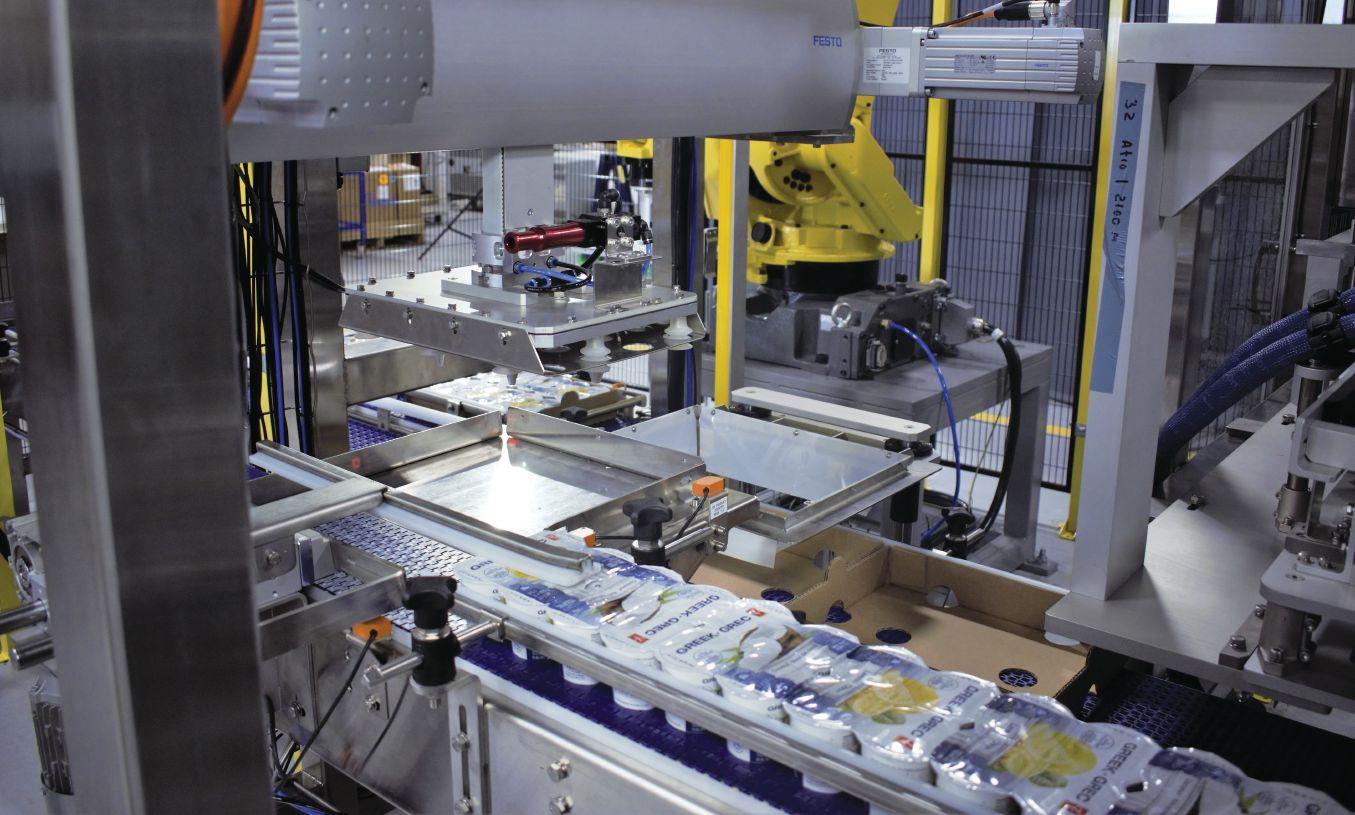
Nuspark installed a bottom-mounted Festo EXCT-100 high-speed linear gantry with vacuum gripper for case loading at the Shepherd Gourmet Dairy facility, supported by a Fanuc six-axis
A machine builder creates a compact case-loading application for a dairy manufacturer
BY DAVID GERSOVITZ
In the highly competitive world of custom machine design, being open to change is a key to sustaining success. Modifying a tried-and-true concept with new technology – even when the old would satisfy the customer’s requirements – can capture cost savings and other benefits without adding complexity. Case in point: Canadian machine builder Nuspark used a smart substitution strategy to replace its top-mounted, Delta-style tray loader on two case-loader/palletizers custom-built for Shepherd Gourmet Dairy in St. Marys, Ontario.
Before its recent acquisition by Saputo Inc., Shepherd began an expansion to add volume and formats to meet increasing consumer demand for products such as its Greek- and Icelandic-style yogurts. Shepherd had installed a third filler in the food zone and needed more tray loading and palletizing capacity in the packaging room. Its existing setup was a single tray loader
with manual palletizing.
Nuspark’s was the winning bid, and while not the lowest, price was certainly a major consideration, says Boris Motskin, general manager at the Toronto-based machine builder. The order called for two new machines with integrated tray forming, loading and palletizing rated at 10 trays per minute, as well as a standalone palletizer for the existing tray loader. New machine #1 would load 500-gram and 900-gram round tubs, and potentially other sizes (the standard tub, no matter the capacity, has the same universal four-inch diameter lid). New machine #2 would load four-packs (two-by-two) of peelback, single-serve cups.
Building custom case packers and palletizers for food and beverage is Nuspark’s bread and butter. “We emphasize a respect for our customer’s real estate – every machine is one of a kind, depending on the restrictions and constraints that our customers have,” says Motskin. “With Shepherd, they gave us
the space and said, ‘We have to fit three lines in here.’” Every Nuspark case/tray packer, whether rated for 10, 25, 100 or 600 products per minute, is based on some common principles, including exclusively single-frame, stainless-steel construction (all welded in-house), top running of all cabling and IP67-rated sensor connectors as standard. The packer employs brand-name componentry throughout: Festo pneumatics, Nordson glue dispensing, Fanuc six-axis robot for palletizing, and Bosch Rexroth and Allen-Bradley electrical systems.
Previously, the company would have used top-mounted Delta-style tray loading comprised of a two-axis robot and servo motors from two different manufacturers for tray-loading in a project of this type. Instead, Nuspark engineers substituted a compact, bottom-mounted Festo EXCT-100 high-speed linear gantry with vacuum gripper, combined with a motion control package, also from Festo.
On Shepherd’s new machine #2, the gantry loads a full 24-cup tray with a single pick, which is less than its maximum payload weight of 10 kilograms. The EXCT’s two fixed servo motors drive a toothed belt arranged in a T-shape. The motion control package, configured for Ethernet IP, synchronizes the interaction of the servos to control the movement of the interface along
The gantry with vacuum gripper selected for the palletizing application is capable of 90 picks per minute.
robot for palletizing.
“We emphasize a respect for our customer’s real estate – every machine is
one of a kind, depending on the restrictions and constraints that our customers have.”
the horizontal (Y) axis with a consistent pick accuracy of +/- 0.1 millimetres.
Substituting the EXCT for the Delta-style top mount lowered the overall machine cost. “The benefits as a whole are functionality, ease of integration is important, and the cost is probably the most important thing because at the end of the day we still have to be competitive in the market,” says Motskin.
The EXCT-100 is rated for up to 90 picks per minute, but high-speed motion wasn’t needed here. “We had been investigating this gantry for some time and it was just a matter of getting the right application for it,” says Motskin. “We preferred for a first experience not to try it on a higher speed application,” he says, so his team could get comfortable with the new technology and bring the end user on board more easily.
The all-in-one hardware/software motion control package can be set up to control any standard Festo Cartesian robot as well as the specific applications they are to perform, with
no special programming knowledge required. The robot and motion control package come pre-assembled and pre-tested and can be coupled together, whereas the Delta-style top-mount that Nuspark has used exclusively up until now requires in-house assembly. (The location of the gantry is another potential benefit – there was no height restriction at Shepherd, notes Motskin, but there could be in other projects, and the top mount rises well above the top of the machine frame.)
The Shepherd project showcased the versatility of Festo’s motion control package concept, which is helping to break psychological barriers about combining handling solutions with control systems from different suppliers. As part of the pre-planning phase, says Ray Reginato, industry segment account manager, electronics and assembly at Festo Canada, his team also performed detailed cycle-time analysis, which showed that the EXCT/motion control combination would perform just as well
with the end user’s single-phase, 230V power supply as it does with three-phase 480V, which is the available power supply for all previous installations in Canada.
Says Reginato, “The ability of this combination of technologies to work equally well with 230V power provides more OEMS and end users with an attractive alternative for case-packing applications.”
BRING YOUR MACHINE TO LIFE WITH CUSTOM SOFTWARE
Aerotech can partner with you to design a custom automation solution for your specifi c application to make your machines easy to use.
In our concept machine at right, Aerotech could design and manufacture a wireless joystick interface or an app for your phone to control the flight, walking, and stinging actions.
Aerotech’s standard software is fl exible enough to program in nearly any language. If you need a special interface (operator interface or programmatic interface), Aerotech can design and develop this with you using an Agile process. Contact us today to get started.
The EXCT gantry loads a 24-cup tray of yogurt with a single pick, and two fixed servo motors drive a toothed belt.
David Gersovitz is a marketing communications professional who works with a number of manufacturing clients including Festo. festo.com
A NEW DAWN FOR DATA
Connecting numerous SCADA systems leads to a bright future for a solar products manufacturer
BY JIM MEYERS
Canadian Solar is a fast-growing global company that knows how to leverage technology to streamline its processes. With a variety of utility-scale power projects, Canadian Solar has subsidiaries in 20 countries on six continents, with more than 12,000 employees. Founded in 2001 in Ontario, the company provides solar energy solutions, and is a manufacturer of solar photovoltaic (PV) modules. In 2011 the company began providing operations and maintenance (O&M) services for utility-scale solar plants, first in Ontario, then globally. Today, Canadian Solar O&M provides services in Canada, the United States, Japan, Europe, Australia and China.
As the O&M division grew, a key challenge was bringing in
numerous kinds of data from a variety of systems used by solar plants operated by Canadian Solar. To help create a solution that would allow the company to ingest all this data in a streamlined fashion, Canadian Solar brought in system integrator Eramosa Engineering, which has offices in Guelph, Calgary, Toronto, Detroit and London. The consulting engineering firm specializes in supervisory control and data acquisition (SCADA) systems, along with automation, process control, system integration, instrumentation and control, and electrical engineering.
“Eramosa and Canadian Solar have been working together for the past few years to add SCADA systems to their solar plants throughout Ontario,” says Clayton Balfour, system integrator for Eramosa. “We were then approached by them to [build] a
more global, more central monitoring platform.”
T he resulting solution is CSEye – a custom, computerized maintenance management system (CMMS) and asset performance–monitoring application for utility-scale, solar-plant O&M.
Implementing the software
CSEye is based on Ignition by Inductive Automation, an industrial application platform with several tools for building solutions in SCADA, human-machine interface (HMI), and the Industrial Internet of Things (IIoT). The Ignition platform helped Canadian Solar and Eramosa to provide
access to critical operational data from various existing SCADA architectures while allowing the project to scale as needs arose.
Didier Thevenard, senior manager of operations and analytics for Canadian Solar O&M, says the company’s focus is on large, utility-scale solar plants that produce electricity from the sun. “We operate about 40 of those sites in Ontario, Canada, and in California. All those different sites have their own SCADA systems,” he says. “To monitor them, we used to have to connect to each and every one of them independently. Our vision was to bring all the data from those various sites to one single platform, to have all
our monitoring data in one place.”
With Ignition as its foundation, CSEye provides a single application environment that pulls historical and real-time data from various architectures including OPC-UA, Modbus, Ethernet IP, Siemens Ethernet, and RESTful web services. The hub-andspoke architecture with cloud-hosted central gateway and historian allows server and resource scalability. The system has more than 40 spokes, with more planned for the future. With the software’s unlimited licensing, Canadian Solar does not need to pay more fees for additional clients, devices, tags, or projects.
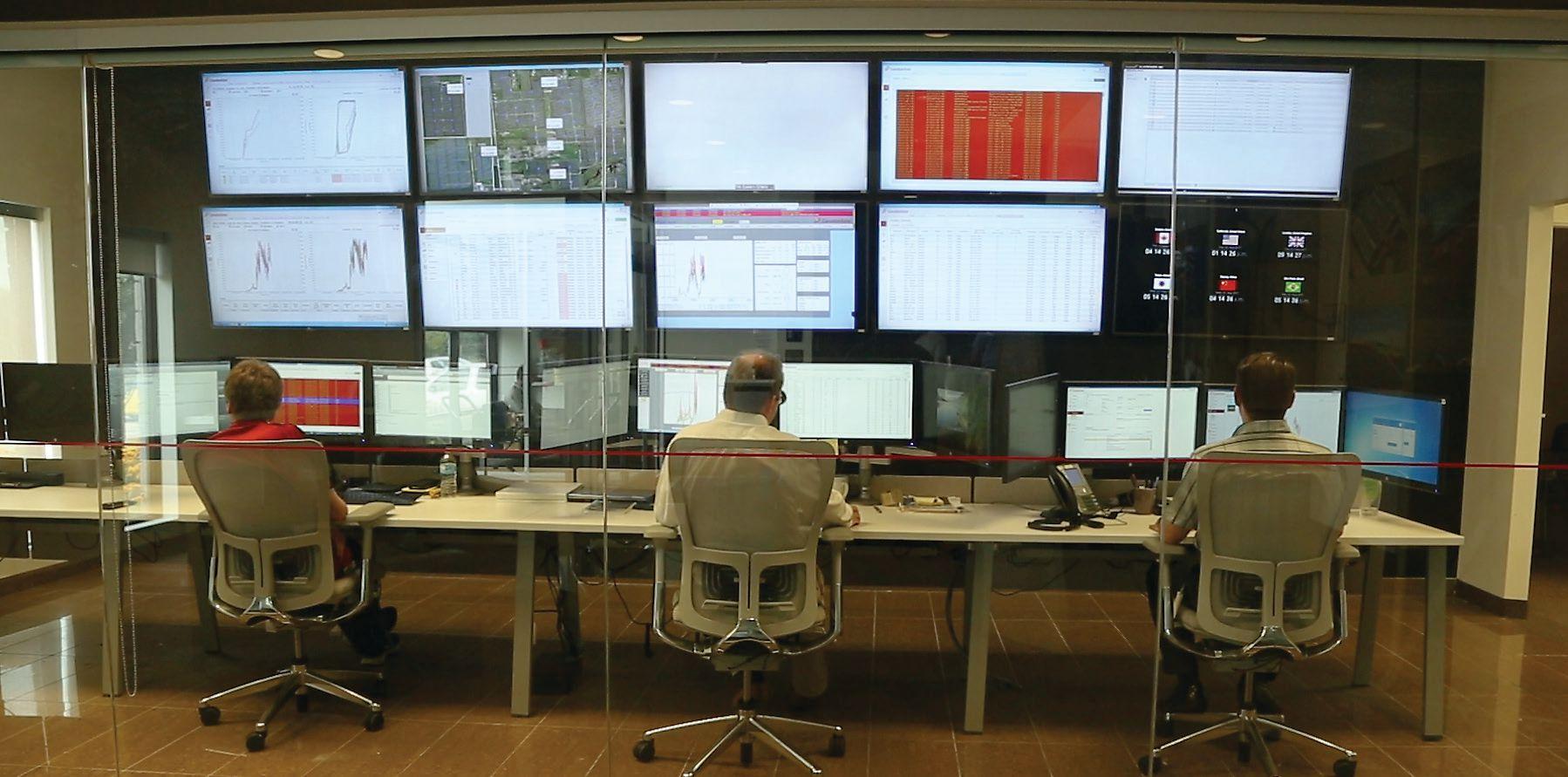
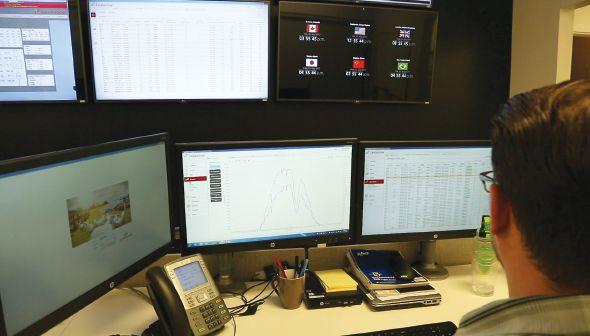
“CSEye is our online, cloud-based platform for everything that deals with monitoring, management of operations and maintenance activities, and reporting,” says Thevenard. “Now everybody in our group is using it. For the operators, that’s their workhorse –that’s what they look at all the time. It’s been used by our engineering team to log issues, track work orders and track warranty claims. It’s been used by our analysts to do all the reporting and sending [of] daily and monthly reports to clients. It’s even been used by our clients themselves.”
Pete Samson, technical group leader for Eramosa, points out that Canadian Solar has a number of roles to manage, from field technicians and data analysts to senior managers and maintenance workers. “Centralizing
The CSEye maintenance management system pulls historical and real-time data into 40 different “spokes,” with more planned for the future.
all of these services through a single system has definitely streamlined their processes and increased operational efficiency,” he says.
Transitioning to success
Previously, Canadian Solar had separate systems for performance monitoring, maintenance management and reporting. As the company’s portfolio expanded globally, it was clear that the many disparate tools involved would not scale to meet the needs of the O&M team. A new approach was needed.
The new system reliably feeds historical data from each spoke for nearreal-time analysis. It uses distributed tags for centralized alarming and alarm management. It uses spokes with templated tagging structures, allowing for integration to the central gateway. The system also has standard charting tools for performance monitoring, while also providing fully customizable Python scripting and database queries
for development of the maintenance management system.
B uilding out the custom application brought a single application generating specific and relevant content for all users. Canadian Solar can now respond more quickly to performance deviations and reduce the amount of lost power-generation opportunities. The company can also turn system alarms into actionable work orders with technician dispatch and resolution tracking. And it’s all on an architecture that’s ready for future adaptation and enhancement.
“Canadian Solar has been really happy that we’ve been able to bring all their data into a central location, and optimize it so they can get the information they want,” says Eramosa’s Clayton Balfour. His colleague Pete Samson says Canadian Solar will also benefit from new projects that move closer to the network edge, using existing infrastructure under the Ignition automation software. | MA
• Rapid switching capacity
• Easy to install
• Operate in harsh conditions
• Short circuit & overload protection
• Reverse polarity protection
Photoelectric
Jim Meyers is the success manager at Inductive Automation. inductiveautomation.com
NEW PRODUCTS
ELECTRONIC COMPONENTS
Spring terminal rectangular connectors
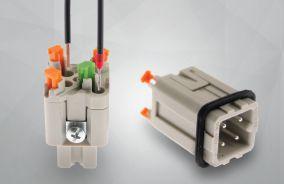
Mencom is now offering ILME “SQUICH” spring terminal rectangular connectors, used in a variety of industrial machinery in rugged industrial environments. With the SQUICH (already open) spring insert technology, no tool is required to terminate rigid and/or flexible cables (up to 2.5mm2) to the contacts in the connector. The inserts provide a safe and reliable connection and will endure severe vibrations on harsh manufacturing floors. In addition, when used with the IP65 housings, they offer gastight connections. A unique coding system is available to prevent incorrect coupling that may cause consequent damages and breakdown. These coding pins can be set with multiple configurations, so several enclosures can be mounted together. According to EN 61984, the three- and four-pole (size 21.21) SQUICH inserts are rated 10A, 400V.
mencom.com
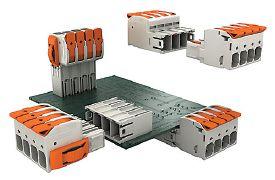
current and voltage capacity relative to its size. The MCS MAXI 832 Series is made for wire sizes 18 to 4 AWG and features wire-to-board and wire-to-wire configurations in two- to six-pole variants. These touch-proof connectors (even in unmated condition) feature low mating forces yet high contact forces between mating components for safe connections. They also feature flexible coding, so changes can be made even after the connector is already installed. wago.com
Micro-mini connector for IoT
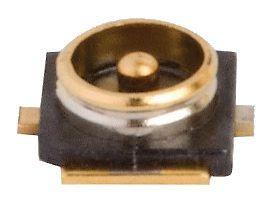
Amphenol RF has introduced the small form factor AMC4 connectors, a micro-miniature product series that features push-on coupling design. The AMC4 is ideal for IoT applications which require space-efficient, economical designs. The AMC4 PCB jack connector offers electrical performance from DC to 6 GHz and operates at 50 ohms. This precision-stamped and -formed connector is designed to mate with the previously released AMC4 jumper and is interchangeable with both the I-PEX MHF4 and Murata HSC connectors. amphenolrf.com
Lever-actuated PCB connector
WAGO has introduced the MCS MAXI 832 Series, a lever-actuated PCB connector for high-power applications up to 66 A/600 V, and up to four AWG conductors. The tool-free, push-in connector with lever operation has high
Compact solid-state relays
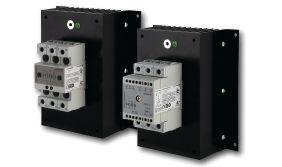
Carlo Gavazzi has launched the RGC3 48 series, the newest addition to its portfolio of three-phase RGC3 solid-state relays (SSRs). The RGC3 48 series is a 48 AAC per phase–rated device with a panel mount or through-wall mount, natural
convection heat sink. To keep the dimensions compact, the existing RGC3 solutions at higher current ratings (above 40 AAC) use forced ventilation and require a supply voltage. Through-wall mounting offers an additional benefit of keeping the heat generated during the operation of the SSRs outside of the enclosure, away from other sensitive electronic equipment. The relays are available with line voltage ratings up to 600VAC, either DC or AC control, with optional system monitoring featuring electromechanical relay alarm and auxiliary output. gavazzionline.com
Transformer and socket in M12 factor
HARTING’s M12 Magnetics product line offers a transformer and socket in the M12 form factor with IP65/67 ratings. With 10Gbit and max PoE+, M12 Magnetics is a miniaturized interface for power and data. Conductor tracks can be made lighter and more direct because they don’t have to be arranged around many different components. harting.ca
AUTOMATION SOFTWARE
Offline robotic programming software
OCTOPUZ Inc. has introduced a new suite of tools for optimizing robotic toolpaths. PathFinder is comprised of seven tools, with two of the key tools being PathAnalyzer and PathSolver. PathAnalyzer will automatically review original toolpaths while detecting and identifying collisions joint limits, reach limits and singularities. Using the generated report, users can self-resolve issues or allow OCTOPUZ to automatically solve on behalf of the user. PathSolver will leverage the PathAnalyzer tool to identify limitations and systematically resolve errors and present the ideal toolpath to the user. Once the process is completed, the new toolpath can be accepted and is ready to be uploaded to the robot. OCTOPUZ’s offline programming and simulation solutions are ideal for a wide range of industrial robots including KUKA, FANUC, ABB and Yaskawa Motoman. octopuz.com
CAD/CAM software with fillet finishing
OPEN MIND Technologies has introduced 2019.1, a new release of its hyperMILL CAD/ CAM software suite. This version includes an expanded finishing module, process optimizations such as a new thread milling module, a new function for reducing calculation times, tool database flexibility and CAD optimization. The new five-axis prismatic fillet finishing function in hyperMILL MAXX machining enables the geometry and automatic inclination of barrel cutters to be applied similar to high-feed cutters, using a plunging and pulling movement at extremely high feed rates. Maximum performance is attainable using conical barrel cutters (also known as arc segment or circle segment end mills). Ball or bull nose end mills can also be efficiently used. openmind-tech.com
PROGRAMMABLE CONTROL
Pre-configured barcode scanning for PLCs
Real Time Automation, Inc. (RTA) has added pre-configured barcode scanning packages to its 435NBX ASCII to PLC gateway offering. RTA’s ScanDr. packages add barcode scanning to MicroLogix, ControlLogix, CompactLogix, PLC-5 and SLC5/05 Allen-Bradley PLCs. RTA’s ScanDr. barcode scanner packages add data capture technology directly with AllenBradley PLCs. Just enter the PLC type and the PLC’s IP address into the gateway. RTA provides an AOI, so there is no ladder logic to program. The ScanDr. comes in corded and cordless versions and provides scanners for industrial and rugged conditions.
rtaautomation.com
Safety controller for programmable applications
Beckhoff Automation recently released the TwinSAFE safety controllers for adaptation to the specific safety requirements of individual machine concepts. The new safety controllers are based on the established EL6910 TwinSAFE Logic terminal, and
the TwinSAFE system can be adapted specifically to the exact requirements of a machine concept as well as to a broader spectrum of programmable safety applications. The new I/O components include EtherCAT digital and supply terminals with safe inputs and a IP67-protected digital combi module with safe inputs and outputs. Like a dedicated controller, the safety project on the corresponding TwinSAFE I/O component can
establish direct communication relationships with other safetyrelevant devices and preprocess the data internally, making it possible to implement highly granular machine modules. beckhoff.com
I/O module for micro-modular PLC
AutomationDirect has added more AC, DC and analog I/O modules to increase the capabilities and versatility of the Productivity1000 micromodular PLC. The microstackable P1000 PLC system can be expanded with up to eight I/O modules for a total of 128 discrete I/O points or 48 analog I/O channels. Newly
ENCLOSURES & WORKSTATIONS
Enclosure coolers for sensitive electronics
Vortec’s enclosure coolers are designed to keep small electronic components cool in control panels, which the company says helps to protect sensors, solenoids, relays and PLCs. A small mounting footprint allows use in confined space. Various models are available, from 400 to 5,000 BTU, with air consumption from
8 SCFM to 70 SCFM. Vortex tubes convert compressed air to a low-pressure cold-air source to keep components protected so they can operate. Most Vortec enclosure cooler models are controlled to regulate cabinet temperatures within a specified range, and operate in ambient temperatures up to 175°F (80°C). vortec.com
Rack mount units with extended depths
Hammond Manufacturing has introduced 4U high versions and added extended 559-mm depths
added direct-current P1000 modules include higher-density 16- and 15-pt VDC models, and eight- and 16-pt VAC/VDC input versions. I/O modules are auto-discovered and added or removed using a single latch mechanism. There are no placement restrictions and no power budget limitations. QR codes are printed on each module to access specifications and wiring diagrams. automationdirect.com
to all heights of its RM family of 1U - 4U 19-inch rack mounting and desktop enclosures. 1U to 3U half-width versions are also available. The all-aluminum construction consists of a heavy-duty extruded frame with removable vented or plain top and bottom covers. hammfg.com
Our pressure sensor with display
Compact and rugged. Convenient with easy-to-read display. Pressure value directly via IO-Link. Comes ready to install. Can be used as pressure sensor or as pressure transmitter. Just one of over 30,000 Balluff products of proven quality. Ask your sales partner or inform yourself online.
SHOP
Balluff.ca
NEW PRODUCTS
Photoelectric
sensor with IO-Link
Rockwell Automation has added the Allen-Bradley 42AF RightSight M30 photoelectric sensor to its smart sensing portfolio. Built with IO-Link capability, the sensor delivers data and diagnostics from the sensor directly into a control system, which the company says can help minimize downtime and increase productivity. With this capability, the sensor provides information such as signal strength, location, proximity alarms and timing functions that help create operational efficiencies. The 360-degree high-visibility LED power and status indicators further assist in setup, monitoring and troubleshooting. Featuring multiple sensing modes, the sensor is also available in adjustment-free models and teachable versions that adjust sensitivity and output configuration. rockwellautomation.com
are ECOLAB approved. With IO-Link sensor communications, each sensor becomes fully programmable and customizable, allowing more than half a million setting combinations. The IO-Link enables additional advanced functionalities such as quality of run, quality of teach and diagnostic parameters. The capacitive proximity sensors with IO-Link are IP69K certified in M18 and M30 housings, with programmable sensing distance and hysteresis. The sensors have configurable output/inputs, and temperature and dust alarm outputs. gavazzionline.com
Smart sensor for condition of bearings
Capacitive proximity sensor with IO-Link
Carlo Gavazzi has launched capacitive proximity sensors with integrated IO-Link. Based on the company’s fourth generation of TRIPLESHIELD sensors, the CA18CA and CA30CA series can be used for automation applications where sensor flexibility or sensing performance needs to be constantly and accurately monitored and logged. The sensors are housed in robust IP69K certified housings, which
Light-section 2D vision sensors
ABB has launched the ABB Ability Smart Sensor for Dodge-mounted bearings. The technology provides an early indicator of any potential problems by assessing the condition of bearings from vibration and temperature information. The company says this helps to prevent downtime on applications such as bulk material handling conveyors typically found in the mining, aggregate and cement industries, as well as applications in the food and beverage and air handling sectors. The sensor uses algorithms to assess, manage and ensure performance of components. The sensor mounts to the bearing and communicates wirelessly via a smartphone, which ensures health data is easily accessed in locations that may be difficult to reach. abb.com
Pepperl+Fuchs has released the SmartRunner Matcher, a compact, camera-based lightsection sensor that combines both the evaluation process and the interfaces in one device. The device features a specially pre-configured firmware that enables it to specialize in extremely precise profile comparisons. Using LEDs and a 2D camera, the SmartRunner Matcher compares the current profile to the taught-in reference profile. When the scanned profile matches the reference profile, the Matcher sends a “good” signal. When the profile deviates from the reference, it sends a “bad” signal. A 2D vision sensor requires significant object contrasts for it to perform a viable evaluation. In comparison, the Matcher “sees” succinct shapes and edges. An example of its use is alignment of parts in automotive manufacturing. pepperl-fuchs.com
radiant heat from frequent weld flashes and conducted heat from molten welded materials. The new sensors are available in M8 tubular housings, with a five-metre heat-resistant PTFEjacketed cable, and block-style housings with a five-metre silicone cable. balluff.com
LVDT signal conditioner with cybersecurity
Inductive sensors for high temperatures
Balluff has released a new line of extended-temperature proximity sensors, with a maximum temperature rating double that of standard sensors, the company says. The sensors provide non-contact object detection in ambient temperatures from 130 °C / 266 °F up to 150 °C / 302 °F. Balluff’s sensors offer heat resistance by using a liquid crystal polymer face. Both the active electronic and passive sensing components are included in the head of the unit and housed in stainless steel. This makes them ideal to battle the heat found in many industrial automation environments including robotic weld cells, where localized temperatures increase due to
Alliance Sensors Group has introduced the S2A, its latest LVDT signal conditioner. This signal conditioner offers a LVDT/RVDT setup and has been engineered to work with a wide range of LVDTs, RVDTs and inductive half-bridge sensors including three-wire GE LVRTs and GE gas turbine buck-boost style LVDTs. The signal-conditioning module has cybersecurity tamper prevention and notification features.
The S2A offers push-button calibration, which the company says reduces the set-up time by a factor of 10. The internal microprocessor eliminates any need to calculate jumper connections for gain, range, etc.
The new S2A DIN-rail-mounted module can be “hot swapped” into an existing installation, with original calibration data saved and then reloaded into a new module via its RS-485 port. For installations involving multiple position sensors, the signal conditioners can be master/ slaved to prevent cross talk between sensor signals.
alliancesensors.com
ROBOTICS
Gripper emulates lizard grip
OnRobot has announced the general availability of the Gecko Gripper, its tool that uses millions of micro-scaled fibrillar stalks to adhere to a surface using powerful van der Waals forces, mimicking the same way that geckos climb.
The Gecko Gripper lets robots pick up flat, smooth objects, which the company says can lead to energy savings over existing products such as vacuum grippers, which require compressed air. The Gecko Gripper interfaces with any robot and is based on the nimble gecko lizards native to the Southern Hemisphere. Its initial design the Gecko Gripper progressed from a Stanford research project to the NASA Jet Propulsion Lab to industry through multiple collaborations. The original NASA use-case was for salvaging and repairing satellites such as solar panels, given the Gecko Gripper’s ability to operate in a vacuum. Also now available is the updated RG2-FT gripper, which now has built-in force/torque sensing, supporting work in piece detection and centering. With in-built six-axis F/T and proximity laser sensors at the fingertips, the RG2-FT gripper can “see” and “feel” objects. onrobot.com
Modular gripper for picking
Dresspack configurator for any robot
Soft Robotics has released the mGrip, an on-demand, modular automation system for picking. Each kit comes equipped with the components needed to build tools with limitless configurations and spacing options. When paired with the Soft Robotics Control Unit, the mGrip gripper can cycle three to four times per second, keeping up with even the most demanding applications. The circular kit includes all the components needed to build a circular tool with either four or five fingers. This kit handles a wide set of geometries with a spacing range of 65mm to 155mm. The parallel kit includes all the components needed to build a parallel tool with either two, four or six fingers. The parallel kit also handles a wide set of geometries with a spacing range of 40mm to 120mm. mGrip kits are offered in both a standard (aluminum) and food-safe (stainless steel) option. softroboticsinc.com
MA’s Technology Handbooks
are a series of digital magazines that focus on a single product category within Canada’s manufacturing industry. Posted on MA’s website as an interactive flip-style magazine, our Technology Handbooks provide specific market and product information, as well as trends within that specific product category, to machine builders, component manufacturers, end-users and system integrators.
For more information, contact Klaus Pirker at kpirker@annexbusinessmedia.com or (416) 510-6757.
igus has developed a new robot dresspack configurator, a free online tool that can be used to find the ideal cable management system for virtually every robot available on the market. Energy supply systems, which are capable of high-performance, threedimensional movements, protect cables and hoses during the highly dynamic motions of industrial robots. Many automated units work three
shifts and are expected to last for many years. The multi-axis energy chain protects moving cables on the robot in every direction and therefore can increase the service life of the automated unit, says the company. The user selects the robot manufacturer and then decides on the type and model as well as the axes they want to equip. The next step is the choice of a retraction system, which keeps the energy chain under tensile stress, to avoid looping and protect against damage. A picture then shows a visualization of the robot and the components of the energy supply system. The components can also be added to the shopping cart and another click will take users to CAD models of the components. igus.com/quickrobot
ADVERTISER INDEX
What MA published in...
BACKSTORY
RFID goes beyond barcoding
Radio-frequency identification – RFID – is coming in from the cold. It is no longer just for tracking movements of equipment or consumer goods within warehouses or beyond to store shelves. The proliferation of industrial-grade RFID hardware and software is making radio-frequency transmission a reliable, cost-effective and mission-ready technology for the shop floor. It provides real-time tracking of production tooling, cycles or products as the latter move through build-up stages.
For example, RFID has had strong uptake in injection moulding, where it ensures the right mould is being used and the right program run; it works exceedingly well managing modular toolsets of any kind. Another example: in my company’s model Smart Factory,
manufacturing is carried out in modular, reconfigurable cells. The progression of products as they are built up is tracked by RFID.
RFID is ideal for preventive or predictive maintenance programs and parts inventory management, including smart shelving strategies that reduce labour, loss and stock-outs. Again, in my company’s local manufacturing, we use RFID to track our crimp tools. The tracking is linked to a database that is automatically updated when a tool goes out for maintenance. (Many RFID tags can store enough data to track the maintenance history of that component and link it to a broader database; the same information is accessible to technicians at the machine or in the back office.) These are increasingly popular and readily scalable applications. The
2011
“The future of automation lies in non-contact, non-optical tracking across longer distances, with the ability to gather a diverse amount of data.”
2012
“Passive wireless sensors are just one of the options in the ‘tool box’ for reducing dependency on wired connectivity and adding functionality without wires or cables.”
2014
“Bluetooth tags will likely take the place of RFID tags, which are lower power and need to be close to a transmitter to work.”
2012
“Imagine an RFID tag with integrated sensors that can detect cumulative shock and moisture during manufacturing and then visually self-identify with a warning on an integrated e-ink display.”
2017
“From planning to distribution, manufacturers have the ability to collect data through sensors, RFID tracking and software programs, and use that data to their advantage.”
wheel has already been invented and “hardened” for industrial use.
In addition, RFID is being featured in emerging Industry 4.0/Industrial Internet of Things configurations. A sensor can be placed on an RFID tag to measure temperature, vibration or movement. Sensor data can be captured by radio-frequency transmission and uploaded directly to enterprise systems, or distilled in edge computing devices, then made available for higher-level analysis. RFID is more flexible than barcoding. It’s robust. Industrial-grade RF tags usually have a long service life. In general, RFID transmissions don’t penetrate walls, so can’t be skimmed from outside the plant. For added security, data can be encrypted. Perhaps best of all, RFID can be readily integrated – or retrofitted – into virtually any production environment. | MA
Ed Garstkiewicz is product strategy manager, RFID at HARTING, Inc of North America. harting.com
We stock enough power to brew a 12 oz. cup of coffee for the entire population of New Orleans. Put that in your mug and drink it.
Reduce costs with virtual commissioning in TIA Portal
Rule out faults early – accelerate commissioning
In TIA Portal, use Step 7 and Simatic S7-PLCSIM Advanced, as early as the configuration and engineering stages, to simulate and validate… … the controller functions – with no need for real controller hardware.
Use an API interface to integrate external simulation tools…
Simulate several PLC instances interacting with each other.
Scalable simulation as required
… and test and optimize the controller in the context of a virtual machine or an entire system.
This ensures that the actual commissioning process is fault-free, cost-efficient, and runs seamlessly.
By simulating the entire process or machine installation, including the controller and HMI, and by evaluating it based on a virtual model, local commissioning time is reduced thanks to PLCSIM Advanced, the controller’s digital twin. Virtual modeling software such as SIMIT or Mechatronics Concept Designer and its run-time can easily access PLCSIM Advanced and provide the necessary virtual process or machine physics.
Experience the benefits of Digitalization at: siemens.com/tia