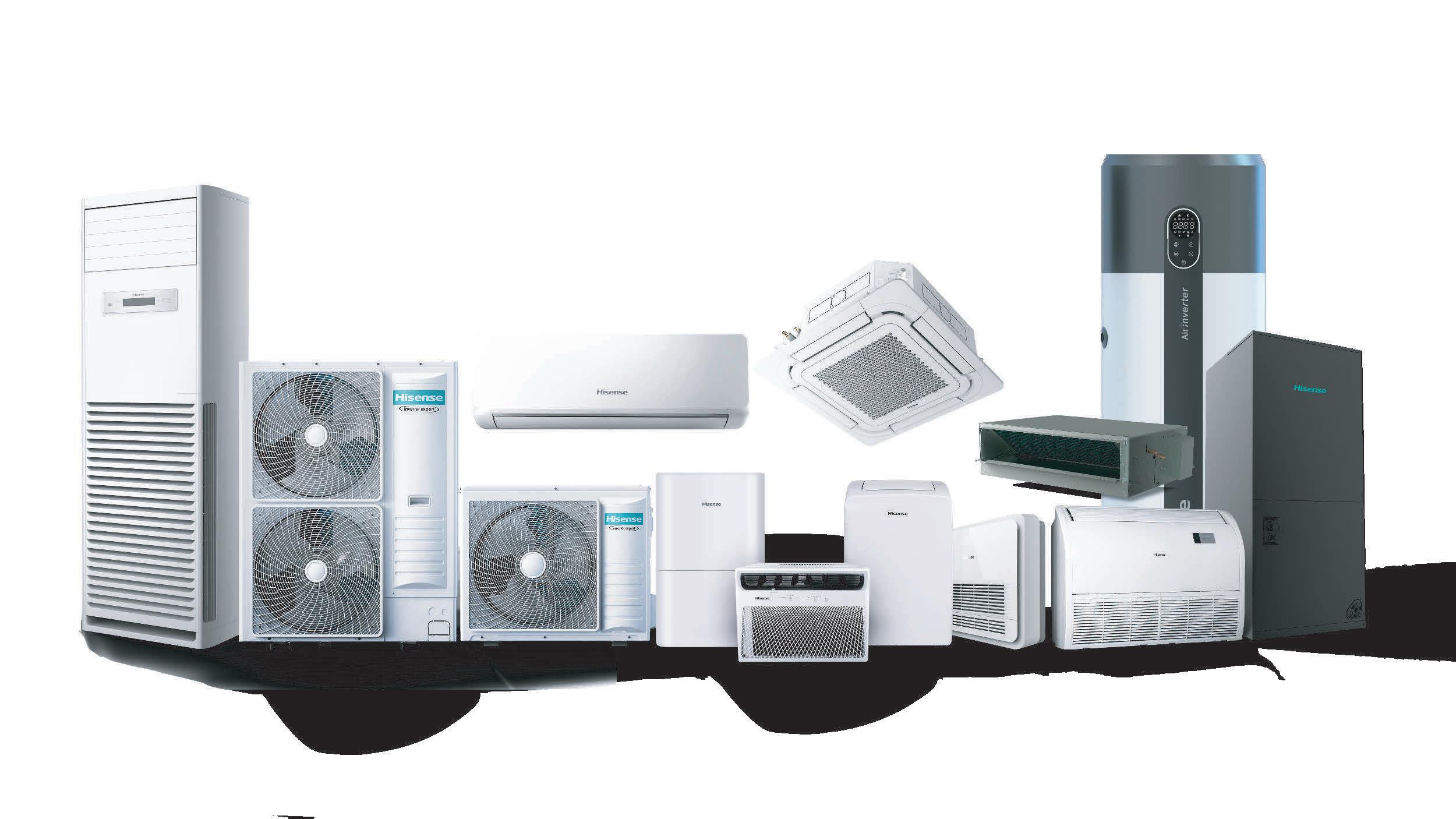

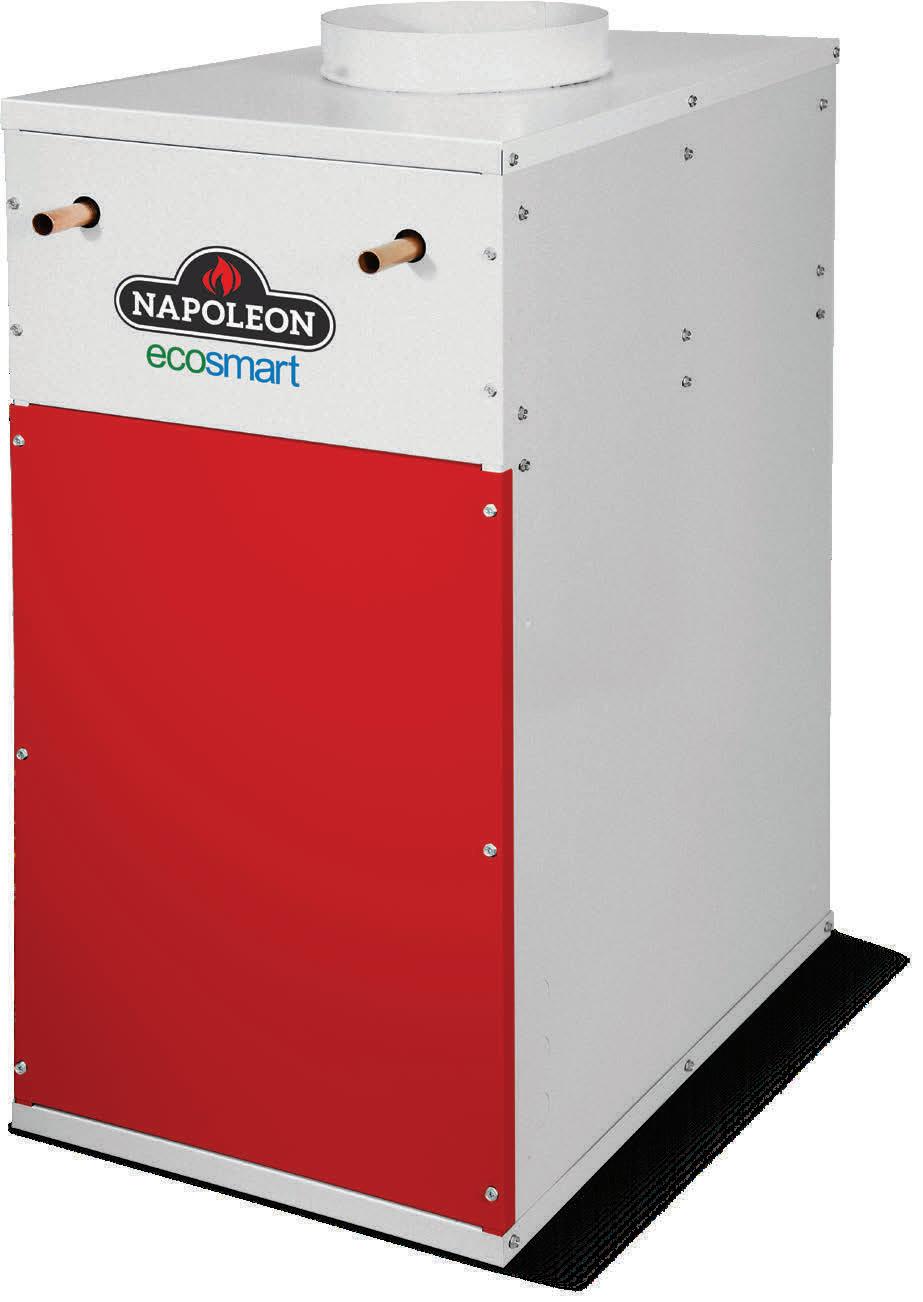

NAPOLEON ® ECOSMART HYDRONIC AIR HANDLER
Napoleon Ecosmart hydronic air handlers use hot water from a boiler, tankless water heater, or heat pump to deliver consistent, energy saving heat.
By transferring heat through water instead of air alone, they offer a quieter, cleaner, and more efficient alternative to traditional forced air systems.
Designed for multi-position installations, each unit fits into tight spaces while delivering the performance to heat full sized homes with ease.

NAPOLEON ® EQ ® FUSION HYBRID SOLUTION
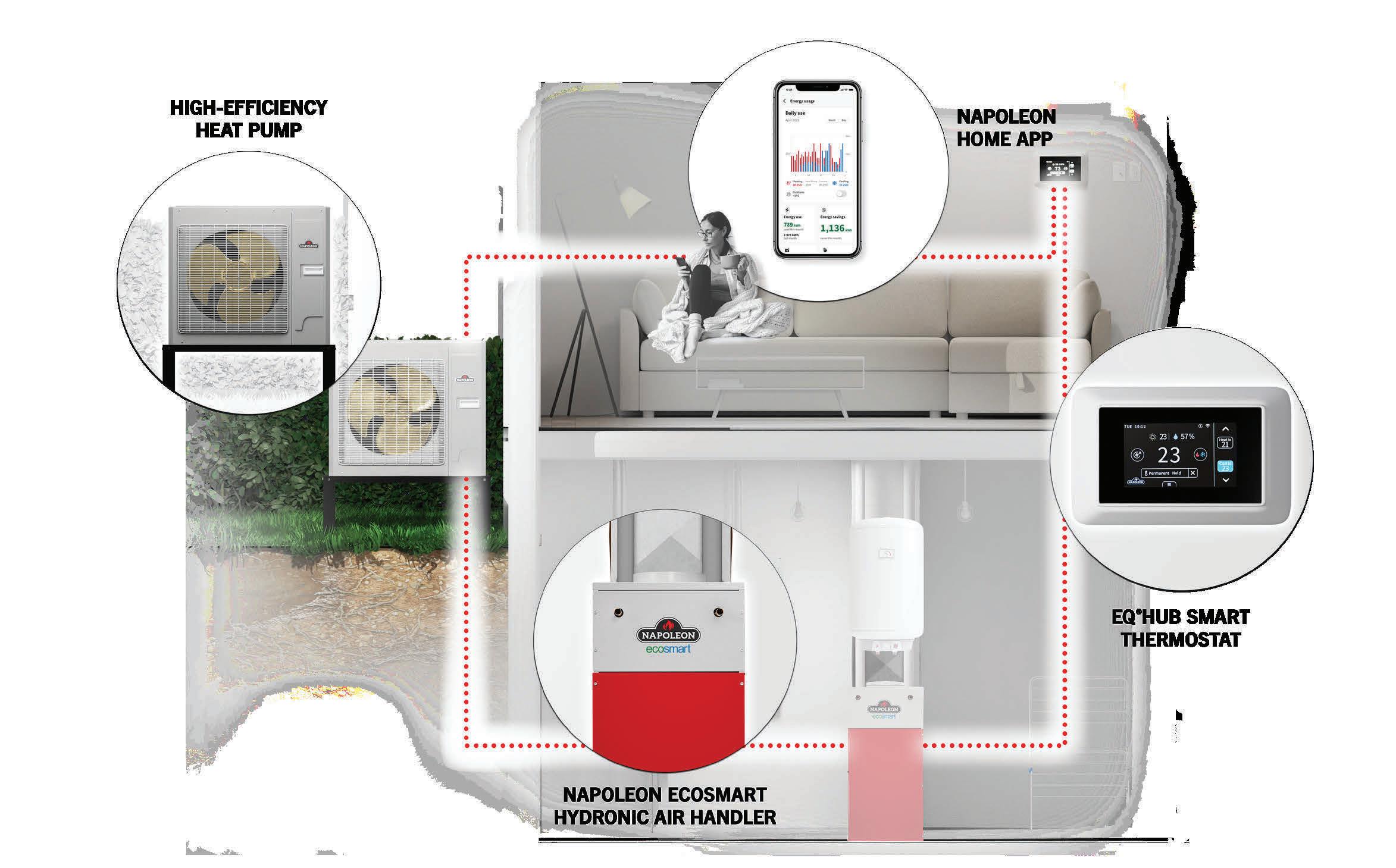
The Napoleon EQ®Fusion Hybrid Solution combines a high efficiency heat pump with a hydronic air handler, all intelligently managed by the EQ®Hub Smart Thermostat for unmatched comfort and energy efficiency.
• Smart electric/gas switching
• Simultaneous operation for max savings
• Backup heat & compressor protection
• Auto fuel selection by utility rates
• Zone control: up to 5 zones, 10 sensors/zone
• Humidifier & dehumidifier integration
• Compact, flexible installation
• Rebate & grant eligible

14 COVER STORY
HVAC
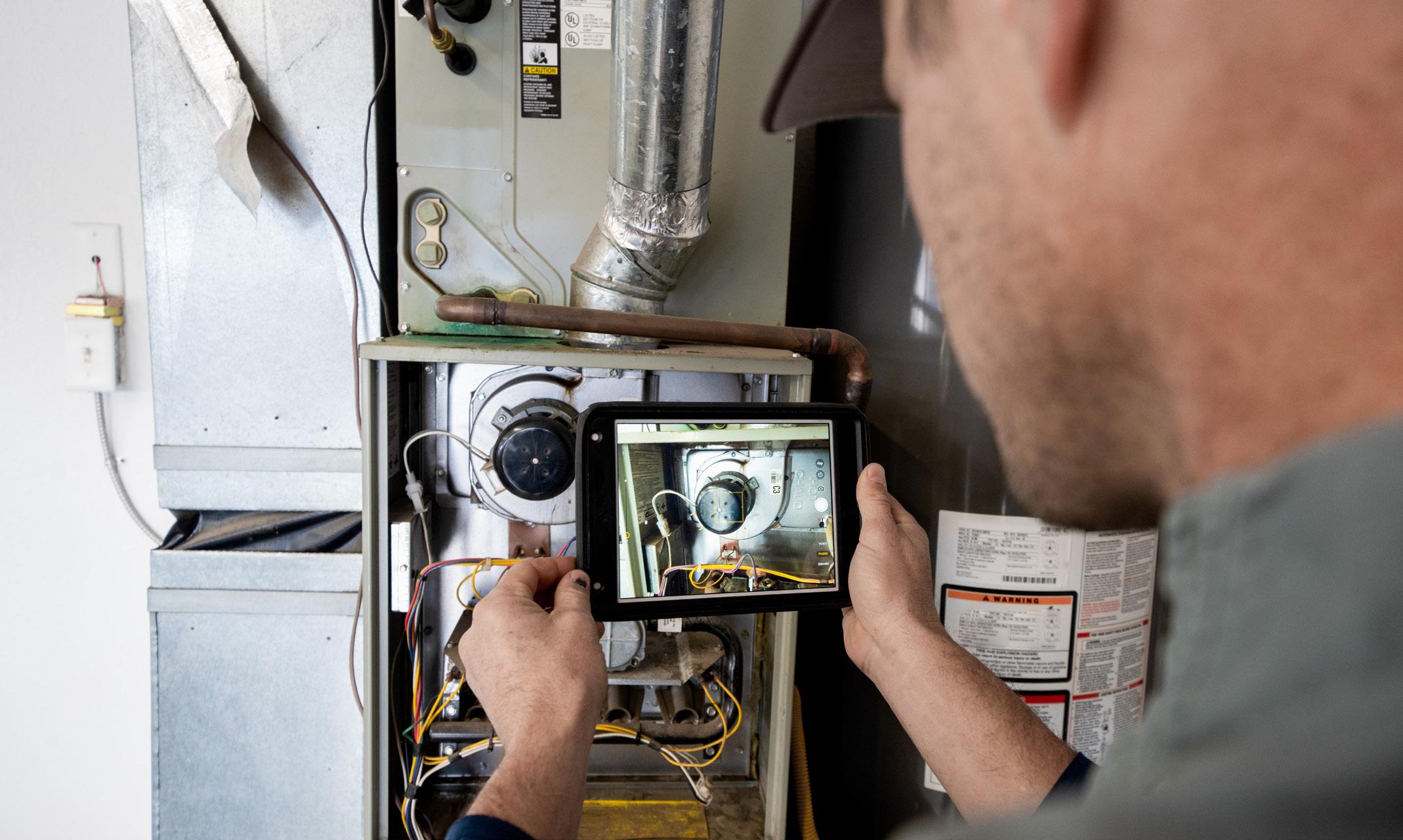
TROUBLESHOOTING WITH INTENTION
Exploring the philosophy of residential HVAC diagnostics and reinforcing the importance of continuous learning. By Ian McTeer
20
HYDRONICS
MULTIPLE APPROACHES
Creating hydraulic separation within closed-loop hydronic systems can be accomplished in many different ways. By
John Siegenthaler
26
30MM
HYDRAULIC SEPARATION
Together with John Siegenthaler we point out how to achieve hydraulic separation in hydronics systems. By Doug Picklyk
30
INTEGRATED DESIGN
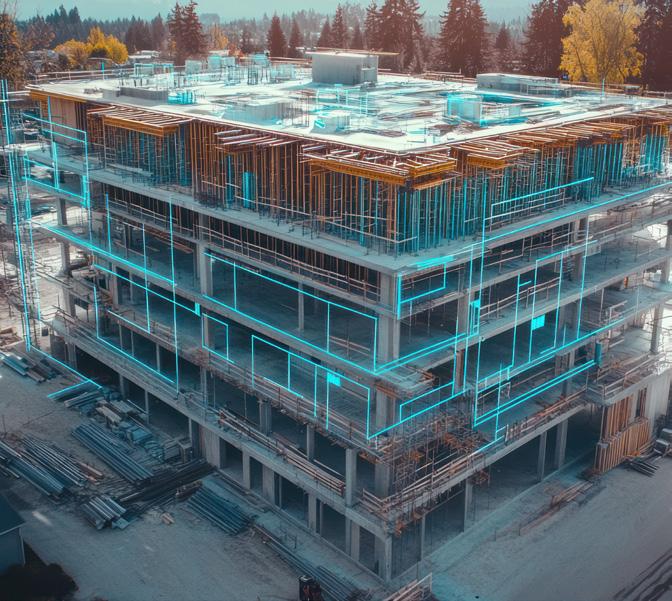
EFFICIENCY IN EVERY DROP – PART 3
The efficiency and effectiveness of hydronics and heat pumps in modern buildings is reliant on smart system design and unified controls.
By Zachary Londo, Jean-Claude Rémy & Chris DesRoches

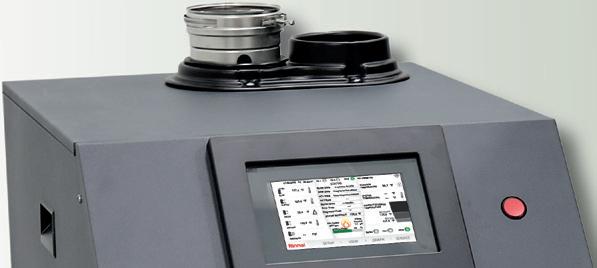








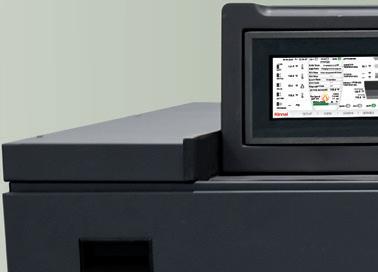








• Up to 98% Thermal E ciency
• 301,000 – 1,000,000 Btu Models
• 10:1 Turndown Ratio
• Intuitive 7" Touchscreen Display




• Stainless Steel Water Tube Heat Exchanger (ASME H stamp)
• 2 Wall-Hung, 3 Floor-Standing Models
• Factory Certified Common Vent


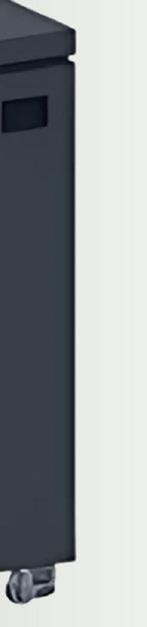


• A companion to the RCB Series, Rinnai’s new Commercial Water Heater Series is compact, rolls in easily, and sets up fast
• Perfect for high-Btu applications where space is tight
40 PLUMBING
BACKFLOW PREVENTION
Recognizing efforts to raise the level of awareness of cross connections and the tools that keep our drinking water safe.
By Doug Picklyk
VIVA LAS VEGAS
AHR Expo hits the strip in February 2026 as HVAC/R professionals flock to Las Vegas for the industry’s largest North American trade show and conference.
PLUS: 2026 AHR INNOVATION AWARD WINNERS
By HPAC Staff
A WINTER PLAYBOOK FOR FINANCIAL CONTROL
Why a weekly cash flow forecast beats checking your bank balance, providing improved operations and peace of mind.
By Matthew Birch
THERMOSTATIC EXPANSION VALVES
EXPLAINED
Critical to the refrigeration system, understanding TEV fundamentals goes a long way to identifying potential system problems.
By Dave Demma
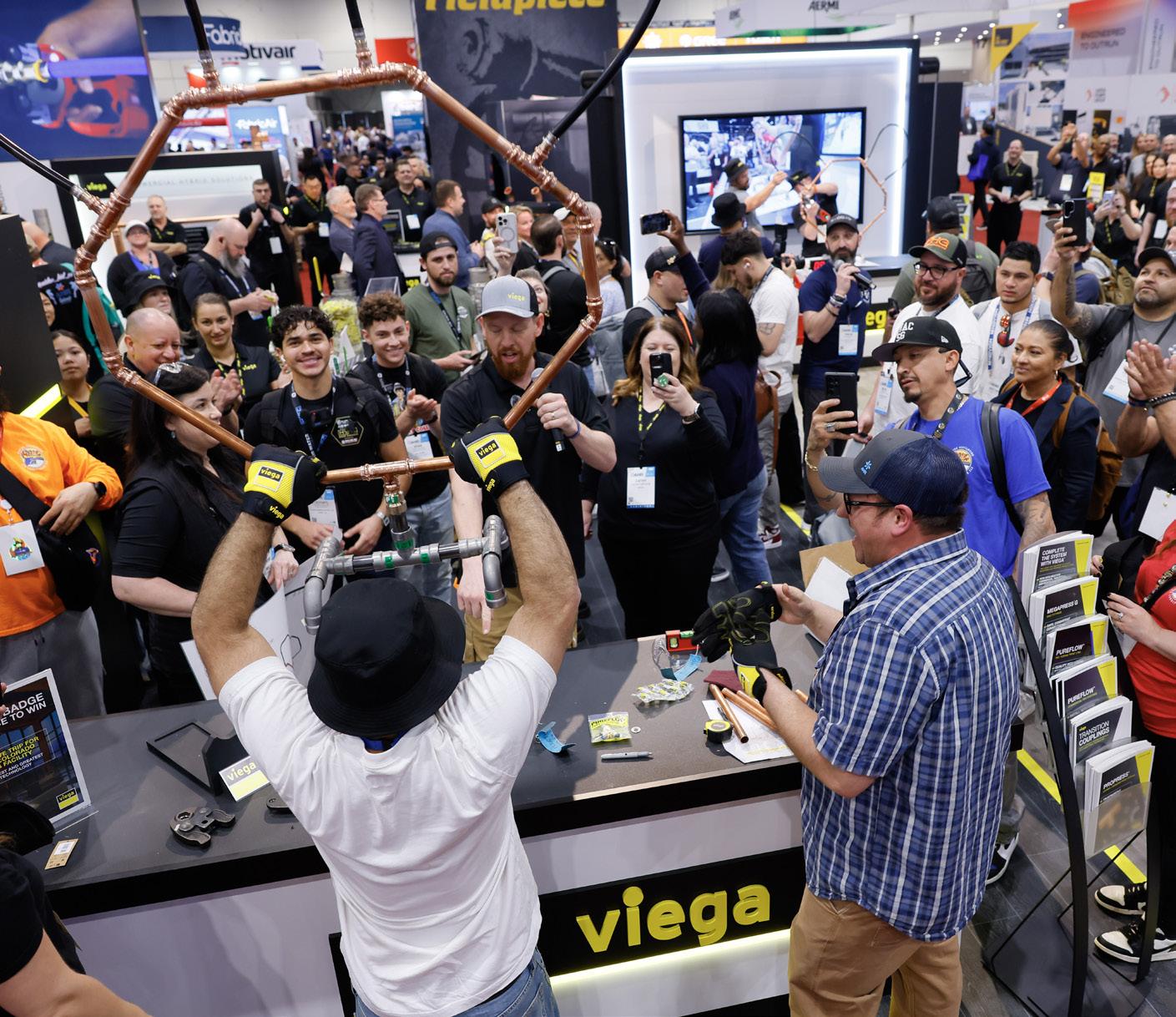
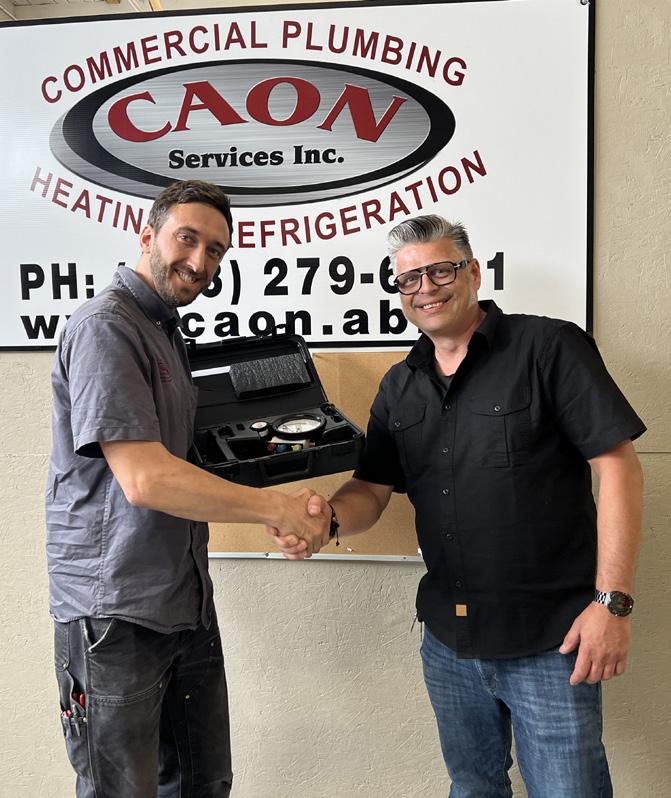

DILLON, AND I’M GLAD I DID. Industry trade shows and events are great places to see new technology, but even more important is the opportunity to reconnect with friends in the industry and meet new people. It’s a gathering where everyone has a common interest in the welfare of the trades
As Liam explained to me, and can be read on his website, he began in this industry as a warehouse helper and went on to earn his Red Seal as a refrigeration mechanic. But ups and downs in his work life, combined with mental health and substance abuse battles, left him lost. It took a while, but he found his way back and now he works in a leadership role. His new purpose is to give a helping hand to others in the construction trades who are struggling because he’s personally been there.
In the plumbing and HVAC world, December usually marks the start of two things: the rush of emergency calls as temperatures drop, and the rare moment when we all stop to catch our breath and reflect on the year behind us. The holiday season is meant to be a time of celebration, gratitude and connection, but for many people it can also be a difficult period of the year.
The skilled trades attract hardworking, resilient men and women who pride themselves on problem solving and showing up no matter the weather or workload. But beneath that toughness, many technicians, installers, apprentices and even owners are quietly carrying burdens.
Mental health challenges don’t take the holidays off. Stress, loneliness, financial pressure, grief, depression and anxiety can intensify this time of year. The long hours, physical strain and unpredictable nature of the work add to it. And like every profession, the trades aren’t immune to substance-use struggles. Drug and alcohol dependency affects more people than most realize.
The holiday season is a reminder that behind every uniform is a human with a life beyond the job. As coworkers, leaders and members of the trade community there are always ways to help. Support doesn’t mean having the answers. It can be as simple as checking in with a colleague who seems off their game. Something as small as, “You doing alright?”—can make a difference.
Contractors and business owners can take this further by fostering a culture where mental health is not ignored or stigmatized. Mental health is health, and there are many trusted places where people can turn.
For many, simply knowing their employer or coworker cares enough to guide them toward help can be life changing. It's why Liam launched nostracura.ca. Having gone through challenges himself, when he says, “I know what you’re talking about.” He means it.
As we wrap up another busy year, let’s take a moment to extend that same care inward—to our own teams and to ourselves. Compassion is not just good leadership; it’s the foundation of a strong, healthy, trade workforce.
From everyone at HPAC magazine, we wish you a joyful, peaceful and restorative holiday season. Take care, stay safe, and may the coming year bring health, happiness and continued success to you and your teams.
– Doug Picklyk, Editor
Reader Service
Print and digital subscription inquires or changes, please contact Angelita Potal, Customer Service
Tel: (416) 510-5113
Email: apotal@annexbusinessmedia.com
Mail: 111 Gordon Baker Rd., Suite 400, Toronto, ON M2H 3R1
EDITOR Doug Picklyk (416) 510-5218 dpicklyk@hpacmag.com
DIGITAL Macenzie Rebelo (416) 510-6851
EDITOR mrebelo@hpacmag.com
GROUP Danielle Labrie (226) 931-0375
PUBLISHER dlabrie@annexbusinessmedia.com
ASSOCIATE David Skene (416) 510-6884
PUBLISHER dskene@hpacmag.com
NATIONAL Amanda McCracken (647) 628-3610
ACCOUNTS amccracken@hpacmag.com
ACCOUNT Kim Rossiter (416) 510-6794
COORDINATOR krossiter@hpacmag.com
AUDIENCE DEVELOPMENT Urszula Grzyb (416) 510-5180
MANAGER ugrzyb@annexbusinessmedia.com
MEDIA Emily Sun
DESIGNER esun@annexbusinessmedia.com
PUBLISHER Peter Leonard (416) 510-6847 pleonard@hpacmag.com
CEO Scott Jamieson sjamieson@annexbusinessmedia.com
PUBLICATIONS MAIL AGREEMENT NO. 40065710
Heating Plumbing Air Conditioning (established 1925) is published 6 times per year by Annex Business Media. HPAC Magazine is the leading Canadian business publication for the owner/manager of mechanical contracting businesses and their supply partners. ISSN: 0017-9418 (Print) ISSN 2371-8536 (Online)
Contents Copyright © 2025 by Annex Business Media may not be reprinted without permission.
SUBSCRIBER SERVICES:
To subscribe, renew your subscription or to change your address or information please visit us at www.hpacmag.com.
Subscription Price per year: $44.88 (plus tax) CDN; United States: $114.24 CDN; Elsewhere: $125.46 CDN; Single copy Canada: $8.00 CDN. Heating Plumbing Air Conditioning (establish 1925) is published 6 times per year by Annex Business Media. HPAC Magazine is the leading Canadian business publication for the owner/manager of mechanical contracting businesses and their supply partners.
MAIL PREFERENCES: From time to time we make our subscription list available to select companies and organizations whose product or service may interest you. If you do not wish your contact information to be made available, please contact us via one of the following methods: Tel: 416-510-5113, Fax: 416-510-6875; E-mail: apotal@annexbusinessmedia.com; or by mail: 111 Gordon Baker Rd., Suite 400, Toronto ON M2H 3R1 Annex Privacy Officer
Privacy@annexbusinessmedia.com
Tel: 800-668-2374
HPAC Magazine receives unsolicited materials (including letters to the editor, press releases, promotional items and images) from time to time. HPAC Magazine, its affiliates and assignees may use, reproduce, publish, re-publish, distribute, store and archive such unsolicited submissions in whole or in part in any form or medium whatsoever, without compensation of any sort.
NOTICE: HPAC Magazine, Annex Business Media, their staff, officers, directors and shareholders (hence known as the “Publisher”) assume no liability, obligations, or responsibility for claims arising from advertised products. The Publisher also reserves the right to limit liability for editorial errors, omissions and oversights to a printed correction in a subsequent issue. HPAC Magazine’s editorial is written for management level mechanical industry personnel who have documented training in the mechanical fields in which they work. Manufacturers’ printed instructions, datasheets and notices always take precedence to published editorial statements.

Proud member of:




www.hpacmag.com


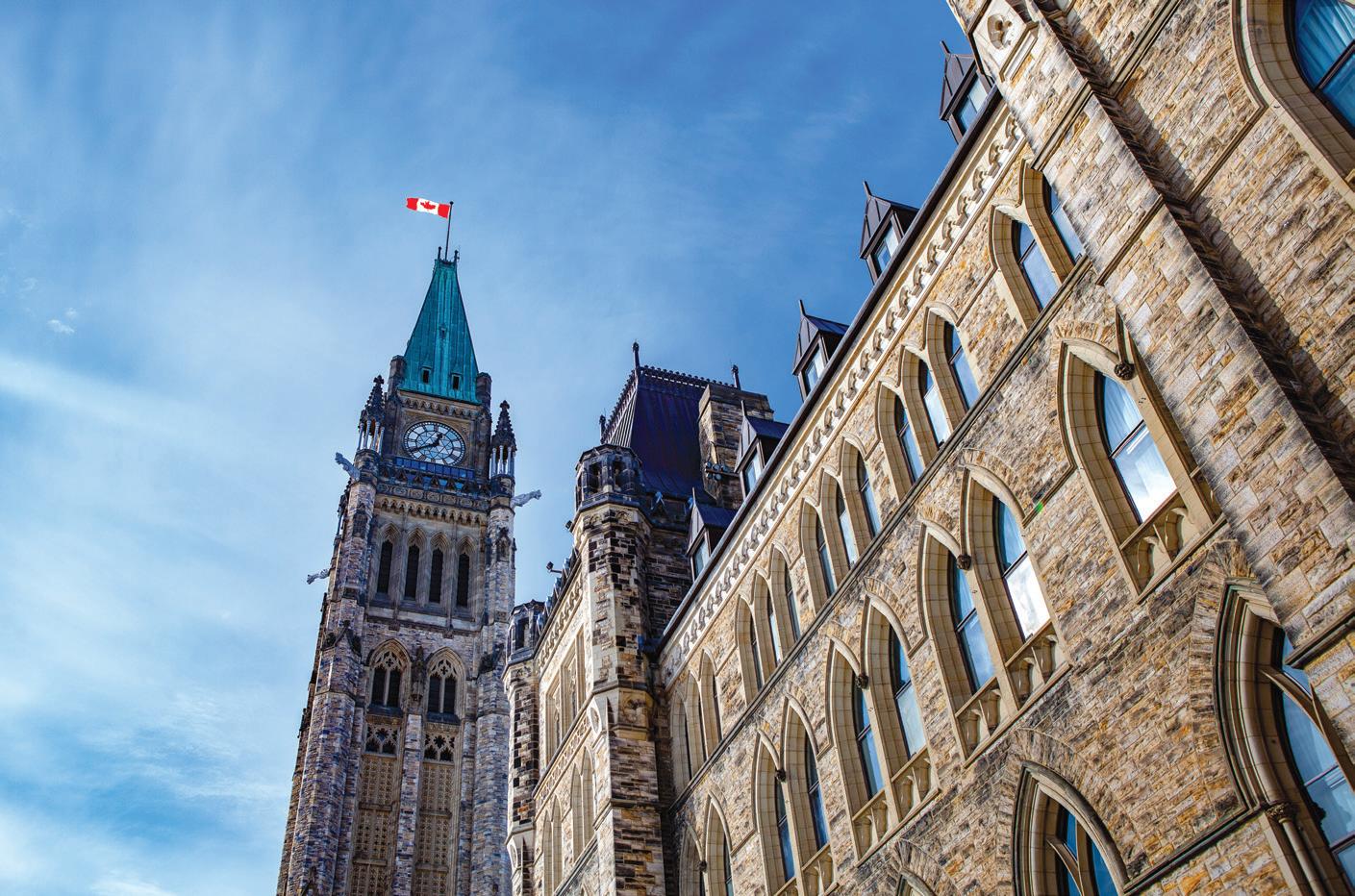
Representatives from the Heating, Refrigeration and Air Conditioning Institute of Canada (HRAI), the Canadian Institute of Plumbing and Heating (CIPH) and the American Society of Heating, Refrigerating and Air-Conditioning Engineers (ASHRAE) convened on Parliament Hill, Tuesday, October 7th, to hold a press conference and present a unified statement to the Federal Government.
Under the banner, “We make life better for Canadians,” the contingent of association leaders shared a proposed roadmap for positioning the Canadian HVAC/R and plumbing industries for success across six priority areas:
Energy Savings & Retrofits: Since buildings in Canada are responsible for 18% of national greenhouse gas (GHG) emissions, the HVAC/R and plumbing industries are positioned to lead retrofit solutions that help Canada achieve its net-zero goals. As such, the associations recommend that representatives from the HVAC/R and plumbing industries play key advisory roles offering guidance when the government is developing new regulations and/or incentive programs that encourage building owners and homeowners to invest in new HVAC/R solutions.
Workforce Development: A BuildForce Canada report highlights the need for Canada’s HVAC/R workforce to quadruple by 2030 to meet net-zero goals. “The industry lacks the skilled workforce capacity to deliver on Canada’s objectives,” voiced Joe Muchynski, national Chair of the HRAI and vice president with Arvin Air Systems. “We recommend that the Federal Government commit to establishing a $100 million decade-long HVAC/R workforce re-training fund to subsidize tuition and up-skilling for HVAC/R and plumbing professionals and support the establishment of national trade certifica-
tion for HVAC/R and plumbing technicians, with the aim of certifying 5,000 workers by 2030.”
Indoor Environmental Quality : “We recommend that the Federal Government convene with the HVAC/R and plumbing industries and technical organizations and relevant scientific and health experts to advise on the adoption of appropriate standards and building codes, the establishment of professional certifications and training requirements for indoor air quality assessments and solutions, and support a communications programs to educate Canadians about the health benefits of investing in improved indoor environmental quality,” said Dennis Boyce, past-President of ASHRAE, adding, “HRAI specifically recommends that the Canadian government commit $5 million towards this communications campaign.”
International Trade: “Canada’s HVAC/R and plumbing supply chains are at risk of serious harm from any further escalation from cross-border trade disputes with the United States,” noted Brent Cornelissen, Chair of CIPH and CEO of +osb. In addition, Martin Luymes, vice-president of
government and stakeholder relations with HRAI, noted: “While we understand the government may need to consider [further] retaliatory measures, the HVAC/R industry’s products and services are too essential to be caught in the crossfire of trade disputes.”
Enhanced Regulatory Coordination: “Additional regulatory harmonization between the Federal Government and the provinces is needed to streamline the adoption of new technologies, encourage sustainable construction and improve Canada’s ability to meet its climate and housing goals,” added Cornelissen. “We recommend, accelerate federal/provincial collaboration to harmonize and accelerate building, plumbing and energy codes, promote interprovincial agreements and reduce trade and regulatory barriers in the construction industry.”
Investment in Infrastructure: The group recommends: the government expand tax credits and scientific research and experimental development (SR&ED) tax incentives to encourage made-in-Canada sustainable technologies. hrai.ca ciph.com
The Ontario Building and Construction Tradeswomen (OBCT), a committee of the Provincial Building and Construction Trades Council of Ontario, has released the results of a 2025 Advancing Recruitment and Retention of Women in the Building Trades survey, revealing both progress and challenges facing women working in Ontario’s construction sector.
The report identifies that while most women are committed to long-term careers in the industry, systemic barriers continue to affect recruitment and retention.
Currently, women represent just 5% of on-site trades and occupations in Ontario’s construction sector, with only 14,200 women working directly on the tools.
The survey gathered insights from 342 women across Ontario and five key takeaways included: women are committed to staying


in the trade; women often discover trades later in life (so earlier outreach is being encouraged); worksite culture remains a challenge (52% reported experiencing harassment); structural barriers limit participation (65% cited need for better-fitting PPE); more women in leadership is key to retention (67% said women in leadership is the top priority for long-term retention).
The report calls for coordinated action among labour, employers, and government to strengthen recruitment and retention through 16 recommendations, including: targeted outreach to schools; zero-tolerance enforcement for harassment; mandate/legislate anti-discrimination and anti-harassment training in all apprenticeship, union, and employer programs; improvements to personal protective equipment, washrooms, and childcare solutions; mentorship programs to support women’s advancement; accountability through transparent reporting on women’s participation and progress.
“We can’t afford to lose skilled tradeswomen to preventable barriers,” said Kate Walsh, program manager of the OBCT. “When women succeed in the trades, the entire industry benefits, from improved safety and innovation to stronger recruitment and retention overall.” obctradeswomen.com


TECA and BCIT have partnered to launch a new microcredential program designed to meet the growing demand for skilled residential heat pump professionals.
Industry-recognized certification through TECA
Hands-on learning in BCIT’s post-secondary environment
Accessible tuition – affordable rates with additional grant opportunities for eligible participants
Upskilling support – provincial funding streams available to help workers advance their careers
This program combines TECA’s industry expertise with BCIT’s proven training approach, giving professionals the skills and certification needed to succeed in Canada's growing clean energy sector.
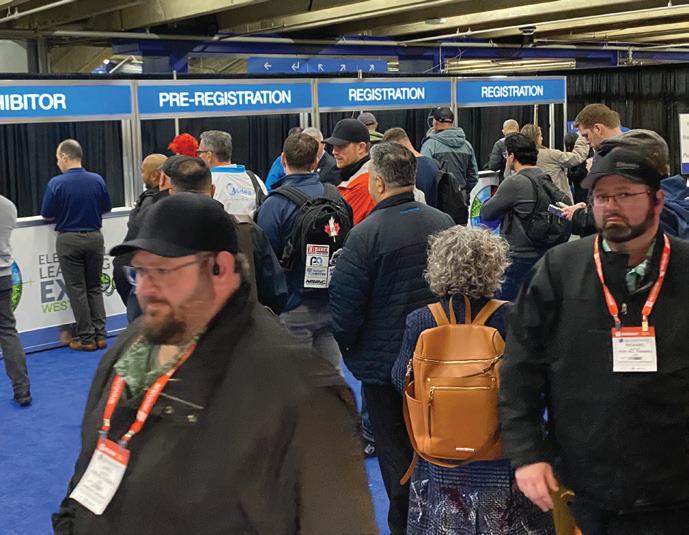
Returning to Vancouver after four years, the 2025 edition of CIPHEX West added a new partner and new attractions, while the trade show and conference also revisited some similar features of past events and seemed to maintain a distinctive easy-going West Coast energy, laid back.
The name of the two-day event (held November 5th & 6th) was expanded to CIPHEX West and Electrical Learning Expo since the Canadian Institute of Plumbing and Heating (CIPH)—producers of CIHPEX West—joined forces with the British Columbia Electrical Association (BCEA) and the Alberta Electrical Alliance (AEA) to add an electrical contractor element to the show. But by far the plumbing and heating exhibits dominated the show floor area.
Once again held at the PNE Pacific Coliseum (the original home of the Vancouver Canucks), this year featured more exhibits on the upper concourse along with some new features including an Educational Build Event with some recognizable social media influencers— including EH Team members—putting together a boiler panel and also assembling an HVAC furnace.
The upper concourse level also included a New Product Stage, where Colin Sadler, president of John Sadler Plumbing and Heating of Vancouver, hosted a series of equipment company representatives, and together they talked through some new product features.
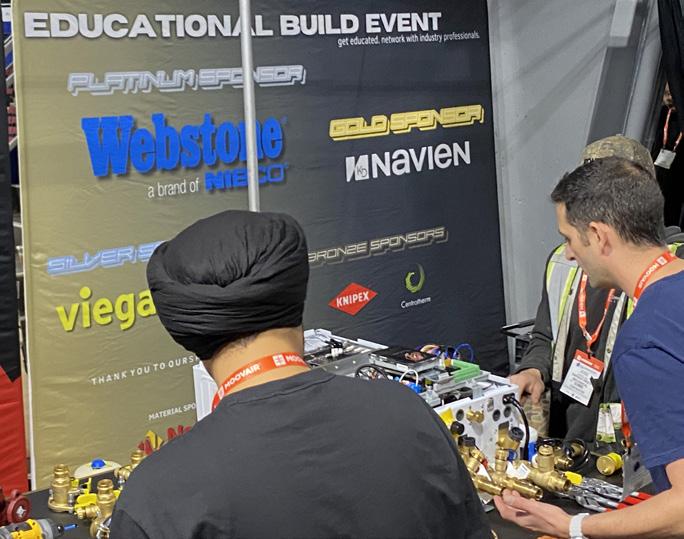

The main show floor, down one level with booths located both within and outside the confines of the hockey rink configuration, was lined with exhibitors, and the main Learning Theatre with educational sessions on the hour was located just off the main show floor.
The session topics ranged from pump sizing and code-compliant firestopping, to the fundamentals of grease separation and the return of a familiar panel discussion on the future of hydronics.
For many visitors and exhibitors this
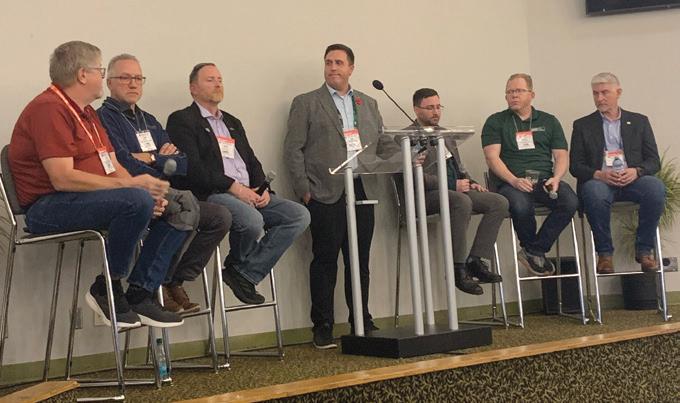
type of gathering is an opportunity to reconnect with friends and colleagues while also gaining insights on new products and applications. The informal networking and gleaning information about current industry market dynamics from different perspectives, both within the local region and from different parts of the country, also makes the experience valuable for those who make the time to attend.
The next edition of CIPHEX West will be taking place in Calgary, November 3 & 4, 2027. ciphexwest.ca
Prime Minister Mark Carney tabled the 2025 federal budget, titled Canada Strong: Budget 2025, prioritizing capital projects and spending in an aim to build resiliency and infrastructure across the country.
The budget projects a $78.3 billion total deficit for the fiscal year. Capital spending, including the construction of infrastructure and homes, accounts for 58% of 2026’s projected deficit. This includes $213.8 million to the Major Projects Office over the next five years for the execution of projects to strengthen Canada’s autonomy, resilience and security.
The Mechanical Contractors Association of Canada (MCAC) commends the budget and its priority to strengthen the nation’s construction industries,but cautioned
these goals can only be supported through collaboration and policies supporting mechanical contractors and related trades across Canada.
“Mechanical contractors across the country are integral to building and maintaining the infrastructure and built environment that is required to ‘Build Canada Strong,’” said MCAC CEO Tania Johnston. “We look forward to helping the government to align on policies to directly address workforce development and retention, productivity-improving investments, and the sustainability of mechanical and major trade contractors across the country.”
The Canadian Construction Association (CCA) was also complementary, but noted the federal government must remain mindful accommodating both union and non-union workers among the large volume of projects budgeted for across the country.
“Union training programs play an im -
portant role in building Canada’s workforce, but we must ensure equitable access to training and credential recognition for all workers, including the 70% of Canada’s construction workforce that is non-unionized,” said CCA CEO, Rodrigue Gilbert. “If we want to build more homes and infrastructure faster, we need investments that don’t leave the majority of workers behind.”
A note from the Heating, Refrigeration and Air Conditioning Institute of Canada (HRAI) highlights how the budget lacks a climate emphasis but it does support some industry goals including the focus on re-training, In a post-budget news announcement, HRAI remarks that while the budget does not include much in terms of new support for tariff-hit sectors it does reference previously announced funds, including $3.7 billion over three years to support workers, enabling them to “re-skill and retool”. mcac.ca cca-acc.com hrai.ca

Exploring the philosophy of residential HVAC diagnostics and reinforcing the importance of continuous learning.
BY IAN MCTEER
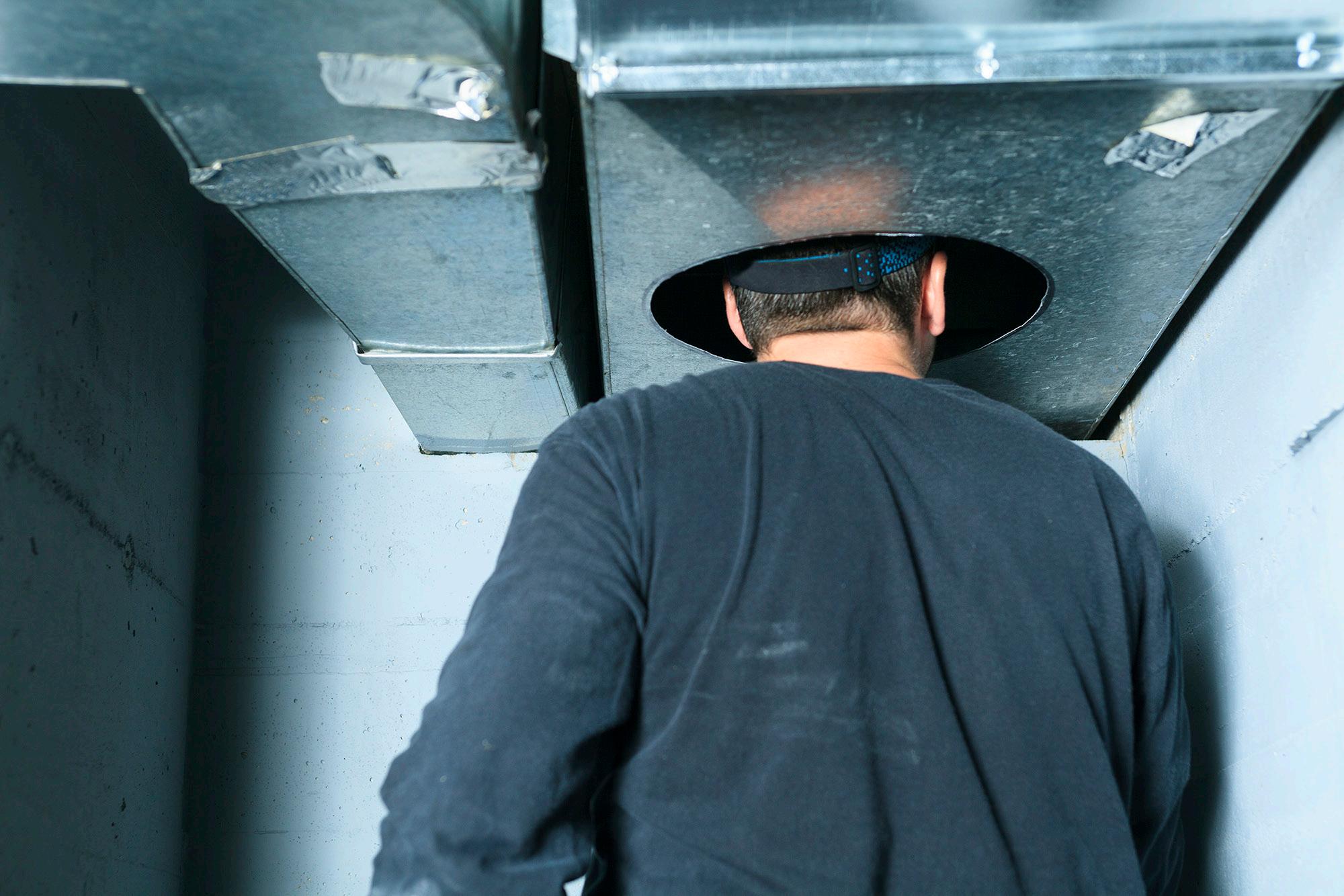
Almost everyone finds themselves regularly troubleshooting something or other: whether it’s a car that won’t start, a phone that won’t charge or a computer that refuses to cooperate. Most of us will at least attempt to resolve the issue, regardless of our expertise. After all, isn’t that what YouTube and social media tutorials are for?
Sometimes the instruction manual helps—if you can find it, and if it actually addresses your problem.
Recently, my sophisticated all-in-one washer-dryer tripped the 15-amp breaker in my panel. The machine boasts a diagnostic feature that sends data to a smartphone app whenever there’s a problem. Much to my surprise, after running the “smart diagnosis,” the app reported: “no problem detected.”
In my universe, a tripped breaker is definitely a problem. Yet, after resetting the breaker and checking for obvious faults, the machine worked normally.
I’ve since installed an ammeter in the dedicated 115 VAC circuit to gather more data before calling in an expert. It seems, at least for now, machine learning and “smart” diagnostics aren’t quite on the same page as the rest of us.
Once the fall heating season arrives, “no heat” service calls become a daily reality for HVAC technicians. With a backlog of appointments and a mitt full of urgent calls, it’s easy for even experi -
Continued on p16

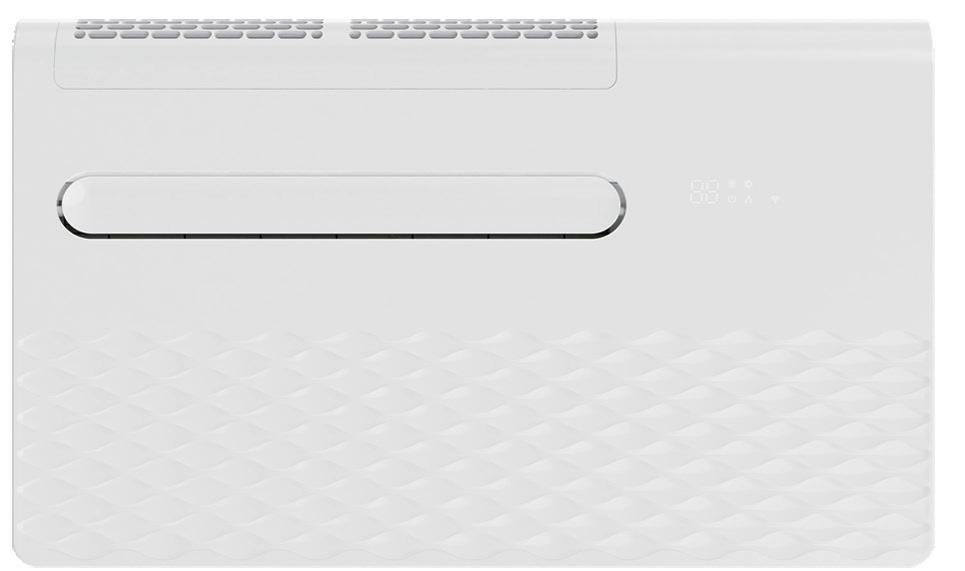

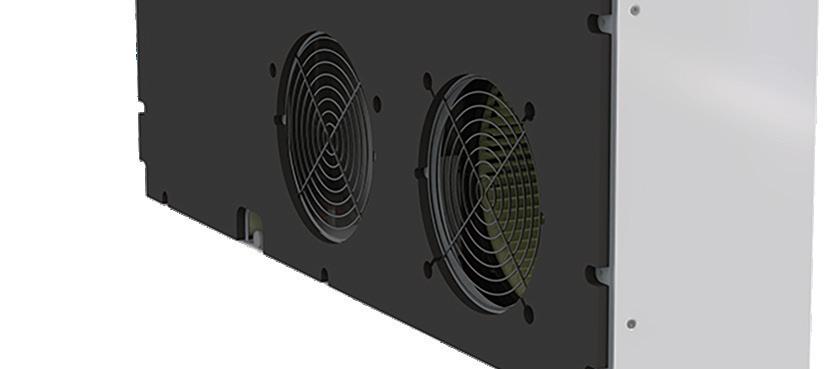
With its dual-hole design for air intake and air exhaust, this Monobloc Heat Pump is a great solution that is easy to install and ideal for the user’s comfort in situations where placing a condensing unit outside the building is not possible or desirable.

enced techs to miss the real problem— sometimes fixing an obvious issue while overlooking a deeper fault.
The truth is, many HVAC systems suffer from misapplication or improper installation, leading to premature failures that aren’t always addressed during a rushed service visit. Often, the proper fix is expensive, and technicians may hesitate to alarm the customer, opting instead for a quick solution to restore heat.
While some problems stem from a lack of regular maintenance, which can lead to tense discussions about service costs and responsibility. These challenges underscore the importance of troubleshooting with intention: taking the time to diagnose thoroughly, communicate honestly, and consider both immediate needs and long-term solutions.
In my former role as a field service representative, I regularly provided product knowledge and servicing seminars for experienced technicians and installers. Every seminar began with an equipment installation overview, because so many service calls stem from installation faults—such as improper ducting, vent pipe sizing and slope, incorrect vent termination, control wiring issues, control board settings, gas pressure settings, and more.
The challenge is especially acute for technicians who service all makes and models. One minute they’re working on a gas fireplace; the next, a modulating boiler. With little time to consult a hundred-page installation manual, it’s understandable that a technician might jump to a quick conclusion, one that may or may not resolve the real issue. Not that I had a flawless troubleshooting career. I made my share of mistakes over the years, but sometimes I managed a triumph!
Early one heating season, I was dis-
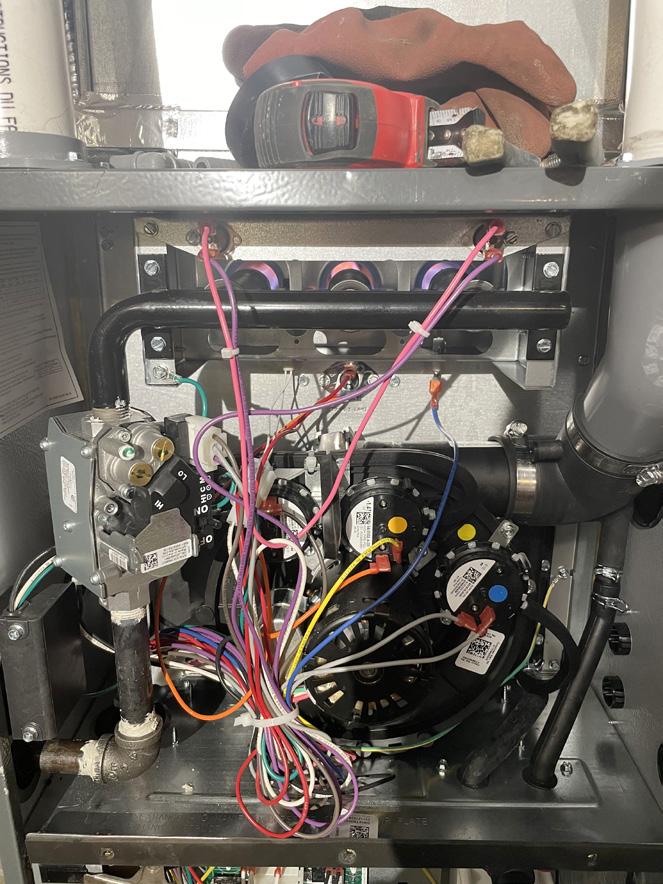
patched to service a Lennox G14 Pulse furnace, a unit known for its unconventional combustion cycle, and one I had no formal training on. When I arrived for the call, I learned that several technicians had already tried to fix the problem, replacing parts like the gas valve, control board, flame rod, flapper material, and even the fan relay, all without success. It struck me that this furnace probably didn’t need yet another new part. So, I ran it through a cycle. It started, pulsed a few times, then shut down, sounding much like a car engine sputtering out of gas.
Using a manometer, I measured 7-in. of static pressure in the service gas line, but the working pressure dropped to zero as soon as the unit demanded fuel.
The homeowner assured me the unit had worked properly for years; no alterations had been made to the gas piping. So, I checked outside at the gas meter and discovered the pressure regulator vent was blocked by a large, abandoned wasp nest. Once I cleared the nest, the furnace resumed proper operation.
This experience taught me that effective troubleshooting starts with resisting the urge to jump to conclusions
based on assumptions. Sometimes, the real issue is hiding in plain sight.
Thus, the best diagnostics begin with observation, especially with the knowledge that something might be amiss since day one.
Before tools come out of the bag, take some time to look around. If the snow is up to your knees, check the vent termination and gas regulator for blockages caused by snow or freezing rain.
Indoors, use a bright flashlight and have a mirror handy. Look for water pooling, and listen for noises. Talk to the owner, ask about any odd system behaviour, and when did it start?
Look for smart thermostats that have performance logs; I used to carry a small notebook to log observations and serial numbers, a smartphone can do all that now. This isn’t wasted time; it’s detective work in which technicians ask “Why?” at every step looking for answers that make sense.
Technicians too often must deal with equipment malfunctions that were inevitable since startup. In residential highefficiency gas furnaces, increased heating efficiency depends less on condensing heat exchangers and precision burners and more on dramatically increased airflow.
Modern furnaces running at a 60F temperature rise require much more air movement than their older counterparts rated for a 100F rise. Limit control failures are frequently caused by insufficient airflow—even when the air filter, evaporator coil and secondary heat exchanger components are clean.
For instance, many homes originally had an 80% AFUE furnace rated for a 100F rise, requiring about 592 cfm and typically paired with an 8- x 18-inch trunk duct. When these old blisters are replaced with, for example a 60K Btu/h 95% AFUE condensing furnace, this new
unit will likely demand approximately 27% more airflow, despite a 33% smaller gas input.
Swapping out the limit control may restore heat temporarily, but the underlying airflow problem remains, risking premature heat exchanger failure.
Perhaps the best solution derived from intentional troubleshooting in this situation is to have an expert conduct a proper load calculation meant to ensure the furnace and ductwork are correctly sized to support long-term reliability.
Effective HVAC troubleshooting starts with understanding the system’s purpose and design. Service managers should consider why a particular furnace, boiler or rooftop unit was specified for a troublesome job, and what performance it was meant to deliver.
This means reviewing the original load calculations, equipment specifications and control strategies. When problems arise, it’s not enough to identify
what isn’t working, because the technician must ask why the unit is behaving this way. Are the controls operating as intended? Is the equipment matched to the building’s needs?
By investigating both the symptoms and the underlying design, technicians can provide solutions that address root causes, not just temporary fixes. Figuring things out as you go is no longer an effective strategy.
Imagine an automobile mechanic who insists on replacing your expensive engine management computer simply because the engine won’t start; even though it turns over. Most of us would expect the mechanic to first check the basics, like whether there’s enough fresh fuel in the tank.
Yet, in HVAC troubleshooting, it’s surprisingly common for technicians to jump to replacing parts when faced with
start-up issues, flame failures or poor performance.
Is a new part always the answer? Not necessarily.
For example, electronic circuit boards are “fueled” by a steady voltage supply, so verifying voltage at the board should be an early diagnostic step before considering replacement.
All gas-fired appliances depend on a properly sized and unobstructed fuel supply line to operate under all conditions. Canada’s B149.1 code book, specifically Annex A, provides capacity tables (such as Table A.2) which detail the maximum natural gas flow for schedule 40 steel pipe including fittings at pressures from 7-in. w.c. to 14-in. w.c., assuming a 1-in. w.c. pressure drop. When diagnosing issues like delayed ignition or persistent flame failures, it’s essential to check for fuel input problems.
on p18

While technicians often verify the manifold pressure (typically 3.5-in. w.c.), two upstream tests are equally critical: static pressure and working pressure in the gas line.
The static pressure, measured with the appliance off, should be around 7-in. w.c. Once the unit is running, the pressure should not drop by more than 1-in. w.c. A significant drop points to an undersized or restricted gas line, or, as I discovered with the Pulse furnace, a problem with the utility gas supply regulator.
One of the most valuable resources a service technician can have is accurate, comprehensive start-up and commissioning data. For residential work, it should become a best practice leading to standard procedure.
In my view, having the ability to compare current readings to original values will help to reveal deviations from optimal performance. Complex problems should be more easily diagnosed reducing guesswork and unnecessary parts replacements.
Start-up data provides a baseline snapshot of how the system performed when it was new and properly configured. What data should be recorded?
Typical start-up/commissioning data includes, but is not limited to:
• Equipment model and serial numbers.
• Instal date and installer contact info.
• Initial operating pressures (gas, refrigerant, static, working, manifold) .
• Gas meter timing.
• Voltage readings at key components.
• Airflow measurements (CFM, temperature rise/drop) .
• Control settings (thermostat, board configuration) .
• Combustion analysis results (for gas or oil-fired appliances) .
• Ductwork sizing and air filter type.
• Venting system details.

Code soure guide for gas-fired appliances.
“Before tools come out of the bag, take some time to look around.”
• Any deviations from manufacturer specs or site-specific notes.
Technicians, contractors and homeowners all benefit from this approach: it saves time, reduces costs and ensures that systems deliver reliable comfort for years to come. In short, intentional troubleshooting begins with intentional documentation.
There is a lot of sophisticated equipment in the field intended to better utilize resources such as natural gas and electricity. Ironically, fewer skilled technicians and installers are available to shepherd all these products, especially when things go wrong.
Manufacturer installer guides and service literature exist, but too often the documents are not immediately available on the jobsite and are not designed for quick reference under pressure.
Some equipment has a QR code providing video support that can be helpful if the technician has the time and a decent wireless signal. And third parties like Xoi Technologies enable remote diagnosis with real-time video support, workflow automation and access to manuals along with training content.
LiveSwitch, a recent entrant into the HVAC world having expanded its expertise from other home services, can help with diagnosis using live video combined with visual images provided by a technician’s smart phone aimed at the problem area.
I follow the HVAC Know it All website, Bryan Orr’s HVAC School, and ESCO Institute to name several of my sources, because writing about today’s HVAC is almost as daunting as the actual handson experience.
In the end, I believe all companies must provide frequent, targeted inhouse training so technicians will have the knowledge needed to troubleshoot complex systems. The most successful service companies invest in regular morning seminars or weekly sessions where technicians can review recent service calls, discuss new technologies, and share best practices.
Ongoing education not only improves first-time fix rates and reduces call backs, but training sessions also help build a culture of great teamwork. When technicians (and installers) feel more supported and prepared, they are better equipped to install, commission and solve problems with intention. <>
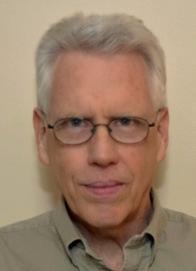
Ian McTeer is an HVAC consultant with over 35 years of experience in the industry. He was most recently a field rep for Trane Canada DSO. McTeer is a refrigeration mechanic and Class 1 Gas technician. For comment, he can be reached at imcteer@outlook.com.

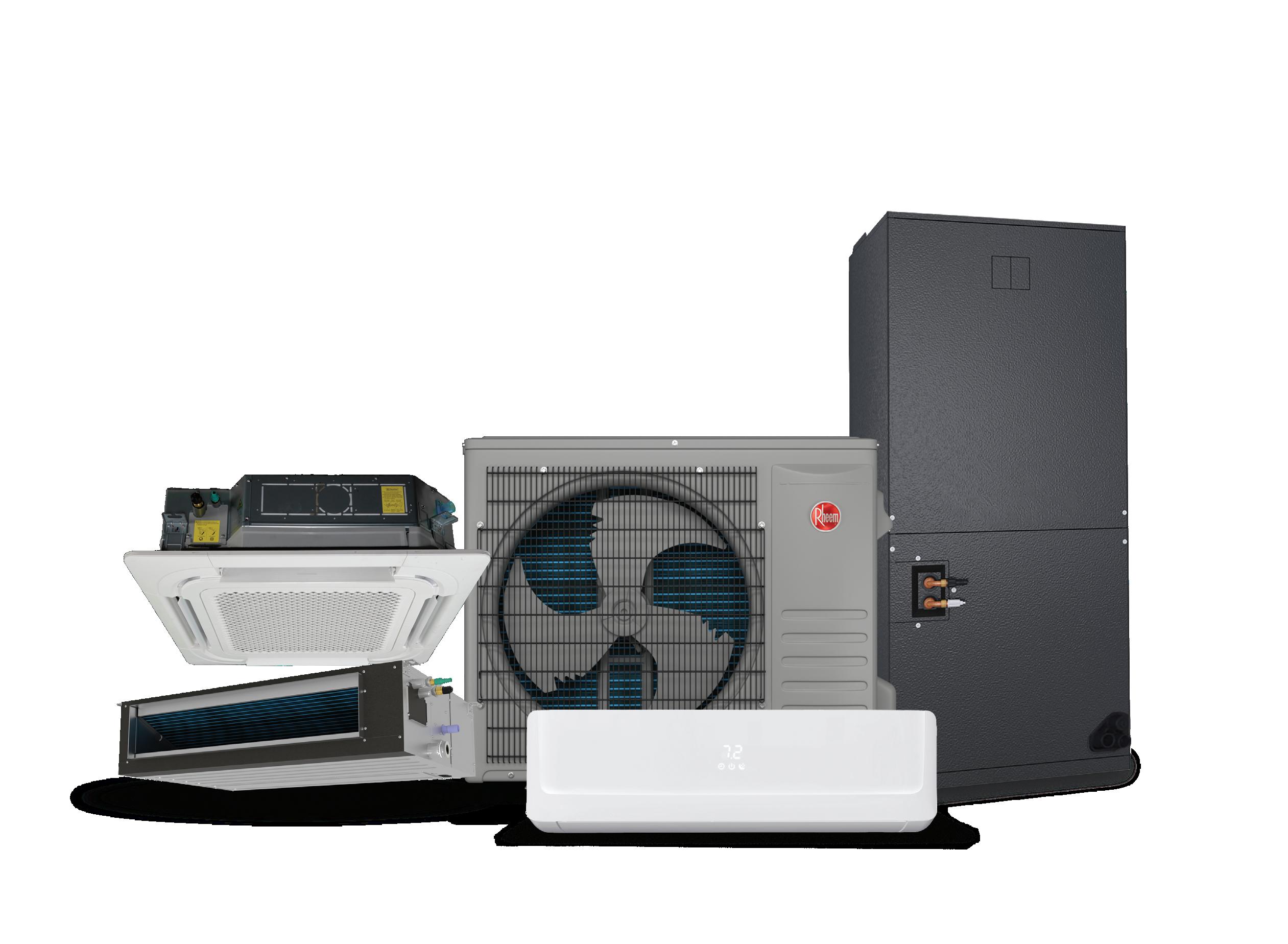
VERSATILE, SUPEREFFICIENT & ULTRA-QUIET
Keeping your home comfortable has never been more convenient—or customizable. Designed to match your unique heating and cooling needs, Rheem® Floating Air™ Ductless Mini-split Systems are available in single and multi-zone options. Plus, every unit offers high energy efficiencies and quiet operation, delivering year-round peace of mind.
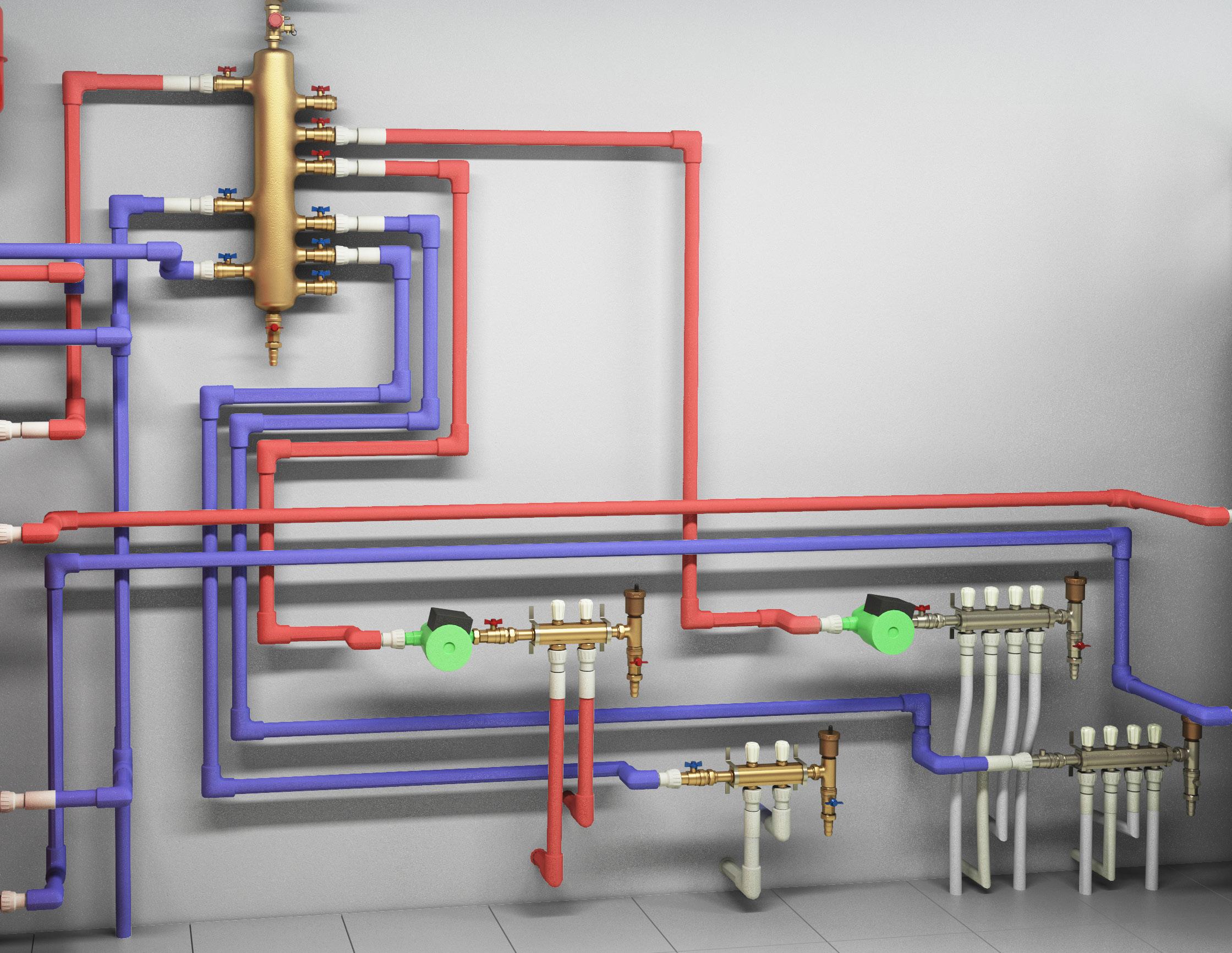
Creating hydraulic separation within closed-loop hydronic systems can be accomplished in many different ways.
BY JOHN SIEGENTHALER
any technologies have their “glory days,” those times when technical improvements happen quickly, performance gains are impressive, and interest is strong. In my opinion, the 1940s through the 1990s were the glory days of aviation. Huge progress was made, starting with the propeller-driven fighters that helped win World War II, and extending through research jets that could fly five times the speed of sound just three decades later. A lot of kids, including me, wanted to be a pilot and strap themselves into one of those incredible machines.
Although less glamorous than aviation, North American hydronic technology also had its glory days. In my experience, this period began in the mid 1980s when PEX tubing made its way here from Europe. Prior to PEX, residential hydronic heating was mostly two or three of zones of fin-tube baseboard supplied from a cast iron boiler.
These systems worked, but they weren’t very “sexy.” In those days there weren’t many homeowners who wanted to give their guests tours of their boiler rooms.
The availability of PEX tubing led to a revival of interest in radiant panel heating. Although there were plenty of early mistakes (like stapling PEX to the side of floor joists and expecting it to heat the space above), progress was made.


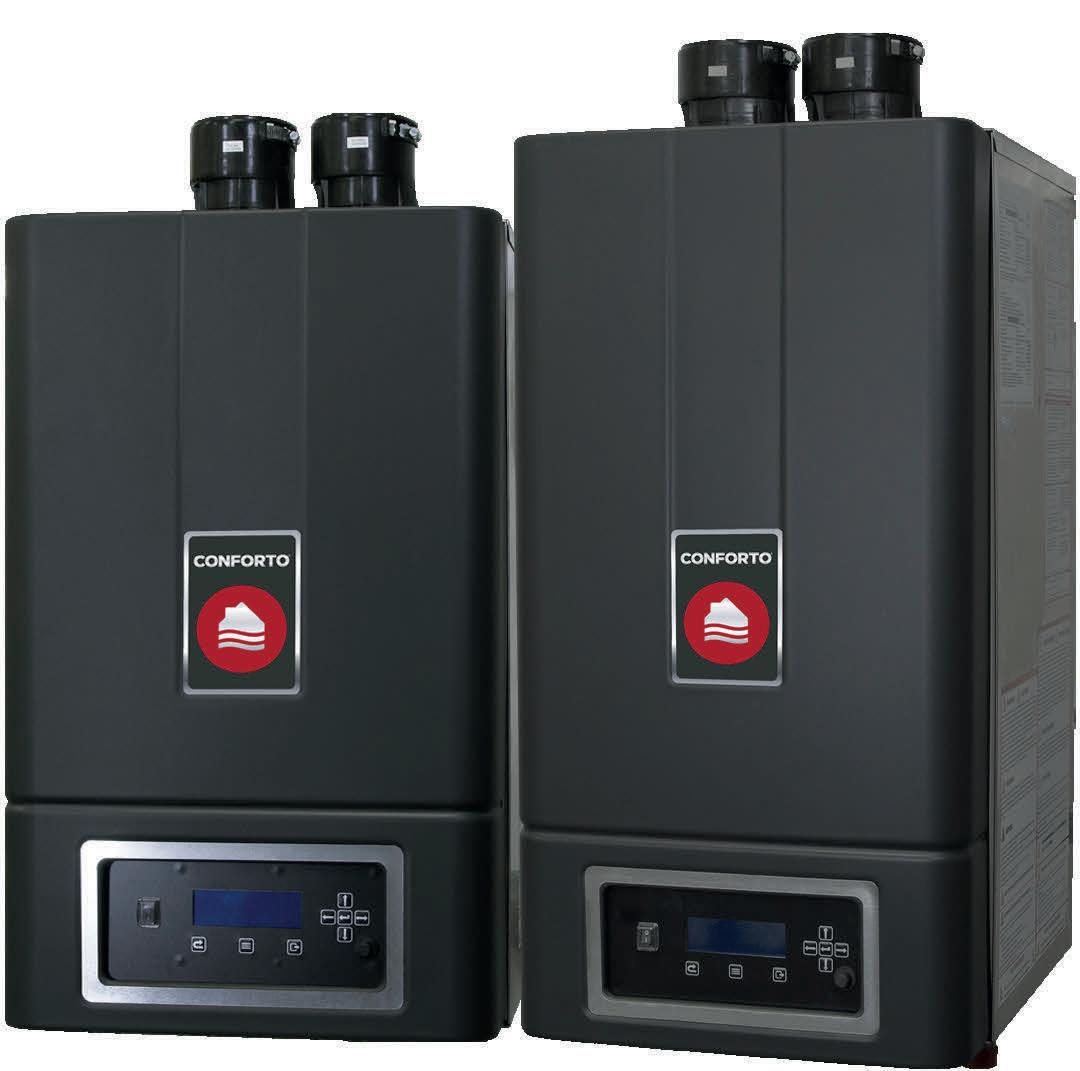
+
+ Up to 10:1 turndown ratio (residential boilers)
+
+
Boasting efficiency greater than 95%+
Direct venting up to 150 ft
Built-in cascade control up to 16 boilers
Display can be set up to 18 languages
Limited warranty 10 years on heat exchanger
Warranty 5 years residential & 3 years commercial on parts
Soon designers were looking for ways to expand systems beyond just radiant panel heating. They wanted to incorporate multiple boilers, higher temperature emitters along with low temperature radiant panels, and domestic water heating into the same system. Houses were growing in size and adding “thermal amenities” such as snow melting and pool heating. The multiload systems designed for these projects usually included several circulators, often of different size and performance, and in many cases two or more of those circulators operated simultaneously.
This all led to an increase in problems that could be summarized as the big circulators “bullying” the small circulators. There were large shifts in flow rates
depending on which circulators were operating at any time. I even witnessed one system where interference from a large circulator completely stopped flow in a circuit powered by a smaller circulator, even with the latter running on its highest speed setting.
While trying to solve these problems the North American market eventually rediscovered a technique that had its roots back in the 1960s: primary/secondary piping.
Coupling one circuit to another circuit using a pair of closely spaced tees all but eliminated any interference between the circulators in the two circuits.
Designers, including myself, began
Very minor change in circuit 1 flow rate when circulator 2 is running
cranking out schematics where multiple secondary circuits, each serving a different load, were coupled to a primary loop using pairs of closely spaced tees.
For the most part these designs worked, and the primary/secondarytechnique grew in popularity.
Still, I’m convinced that a significant percentage of designers or installers don’t fully understand why closely spaced tees do what they do. They just install the tees as shown on plans and wait for the “magic” to happen.
Primary/secondary piping is one of several ways to achieve hydraulic separation. It’s one way to couple two or more overlapping hydronic circuits, each with its own circulator, so that the circulators don’t interfere with each other.
If you understand the underlying principle of hydraulic separation, you’ll understand why a pair of closely spaced tees is one way to achieve it.
Consider the hypothetical piping system shown in Figure 1 (previous page). This system consists of two parallel circuits, each with its own circulator. Assume that the circuits can have dif-
ferent pipe sizes, pipe lengths, fittings, etc. And notice that the two circulators are also different in size.
The two circuits “overlap” at the “bulge” to the left of the circulators. We can call this bulge the common piping because it is shared by each circuit.
Because it has a wide cross section, and its length is relatively short in comparison to the lengths of each circuit, the head loss across the common piping will be very small.
Start by assuming that circulator one is running, and circulator two is off.
Figure 2 shows the pump curve of circulator one (orange), along with the head loss curve for circuit one (green).
That head loss curve includes the head loss of the piping in circuit one, and the very small head loss across the common piping.
The operating point, the location where the pump curve crosses the head loss curve, corresponds to a flow rate of 10 gallons per minute (gpm).
Next, assume that circulator two in Figure 1 is turned on, and circulator one remains on. The total flow of both circuits now passes through the common piping. This will cause a slightly higher head loss across the common piping, which will slightly increase the total head loss of circuit one.
The change is represented by the
blue curve shown in Figure 3. For comparison, the original (green) head loss curve for circuit one is also shown.
Notice that the operating point moved very slightly to the left, from the (green) dot to the (blue) dot. This slight change causes the flow rate in circuit one to drop from 10 gpm to 9.9 gpm.
That change, for all practical purposes, is of no consequence. Thus we can consider the two circulators in this system to be hydraulically separated from each other. This desirable effect is a result of the two circuits “sharing” common piping that has very small head loss.
Another way to think about two circuits that are hydraulically separated is to image each circuit as being physically separate from the other (see Figure 4).
The flow rates that would be established by each circulator in its associated sub-circuit (such as 10 gpm in circuit one, and 12 gpm in circuit two) would be approximately the same regardless of the two circuits “overlapping” as shown on the left, or completely isolated from each other, as shown on the right.
So here’s the take away: Anything that couples together two or more hydronic circuits, each with its own circulator, and where the head loss of the coupling method is very small, results in hydraulic separation of the circulators.
There are several hardware configurations that meet this criteria:
1. A pair of closely spaced tees (classic primary/secondary piping).
2. A buffer tank piped as either a twopipe, three-pipe, or four-pipe configuration.
3. A typical cast iron boiler combined with short/fat headers.
4. Or, a hydraulic separator (low loss header) combined with short/fat headers.
These hardware configurations are all illustrated in Figure 5. All of these arrangements bring together two or more circuits, each with their own circulator, in a way that creates very little head loss where the two circuits overlap.
For the closely spaced tees, this overlap is a tube stub just long enough to join the tees side by side.
For systems with buffer tanks piped as shown in Figure 5, the buffer tank is the low head loss common piping. The large cross sectional area of the tank produces very low flow velocities inside the tank, and thus very low head loss.
The cast iron boiler consists of several sections that each have large cross sectional areas and thus create very low flow velocity and head loss. Still, it’s important to use what I call “short/fat headers” to preserve the hydraulic separation effect of the cast iron sections up to the point where the circulators connect to the system.
Then there’s a hydraulic separator. The cross-sectional area of the vertical portion of the separator is about nine times larger than the cross section of the piping connected to it. This reduces flow velocity to about 1/9th that in the piping, which again results in very low head loss.
The nice thing about a hydraulic separator is that it also can provide efficient air and dirt separation for the system. To “preserve” the hydraulic separation it’s also important to use short/fat headers on both sides of the separator. Another benefit of headers and a hydraulic separator, relative to a classic series loop in primary/secondary pip ing, is that each parallel load circuit re ceives the same supply water temp.
Combinations of the details shown in Figure 5 can also be used in the same system. One example of such a combi nation is shown in Figure 6.
In this system the fixed speed circula tor (P1) providing flow through the wood gasification boiler is coupled to a vari able speed shuttle circulator (P2) using a pair of closely spaced tees. This de coupling allows (P2) to adjust speed as necessary to maintain the boiler inlet temperature high enough to prevent sustained flue gas condensation.
The variable speed injection circulator (P3) is hydraulically separated from the oil-fired boiler circulator (P4) and the distribution circulator (P5) by two more sets of closely spaced tees.
This system has five circulators and four points of hydraulic separation.
Although the overall schematic may look complicated, think of it as broken up into five subsystems (Figure 7).
The flow rate established in each of these subsystems is essentially unaffected by flow rates in the other four subsystems. That may be hard to believe when looking at the overall system, but it’s true.
There’s no “magic” involved with hydraulic separation. Anything that couples two or more circuits together so that the piping they share has very low flow resistance, and thus very low head loss, can provide it.
In this context it’s a really a simple concept, but also one that’s extremely useful in hydronic system design.
By the way … I don’t think the “glory days” of modern hydronics technology have ended. The opportunities at hand for creative system designers continue to expand.
Water is still the best stuff on earth for moving thermal energy around. Just make sure your designs respect the concept of hydraulic separation to “keep the peace” between potentially competing circulators. <>

John Siegenthaler, P.E., has over 40 years of experience designing modern hydronic heating systems and is the author of Modern Hydronic Heating & Cooling (4th edition) as well as Heating with Renewable Energy (for more information visit hydronicpros.com).

The thermal storage tank provides hy draulic separation between variable speed circulators (P2) and (P3). Note that the piping circuits containing these two circulators tee together very close to the tank. This minimizes head loss in the short headers that connect the tees to the tank.
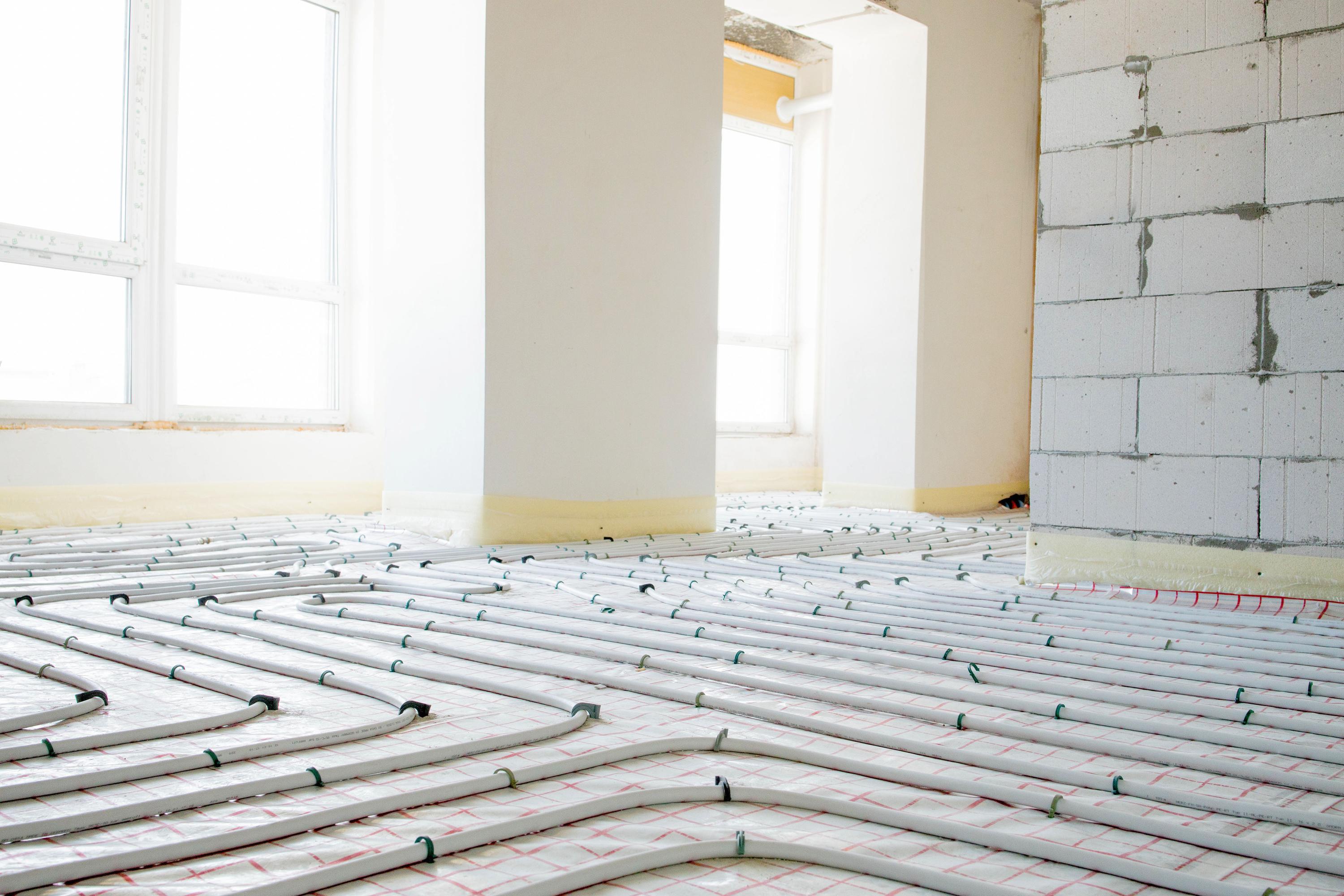
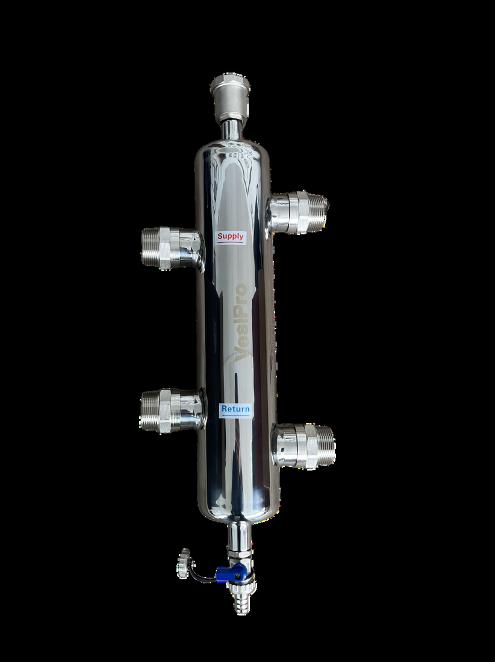

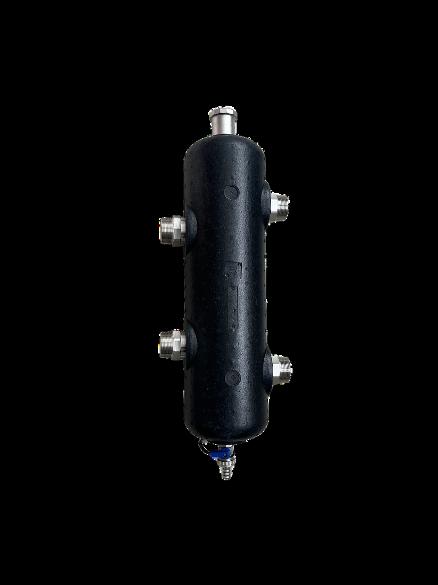
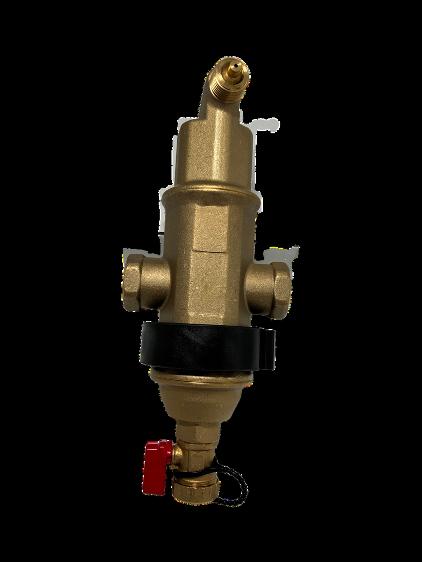

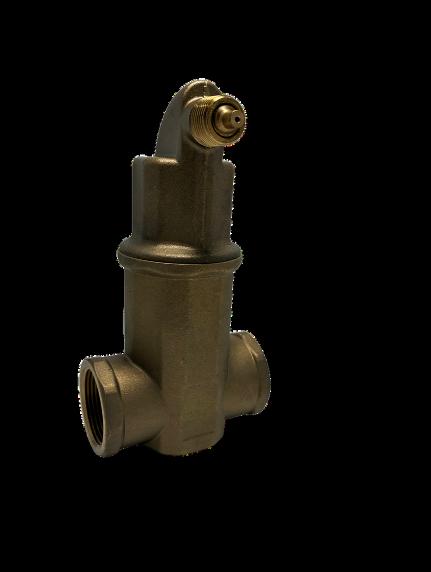
Together with John Siegenthaler we point out how to achieve hydraulic separation in hydronics systems. BY
DOUG PICKLYK
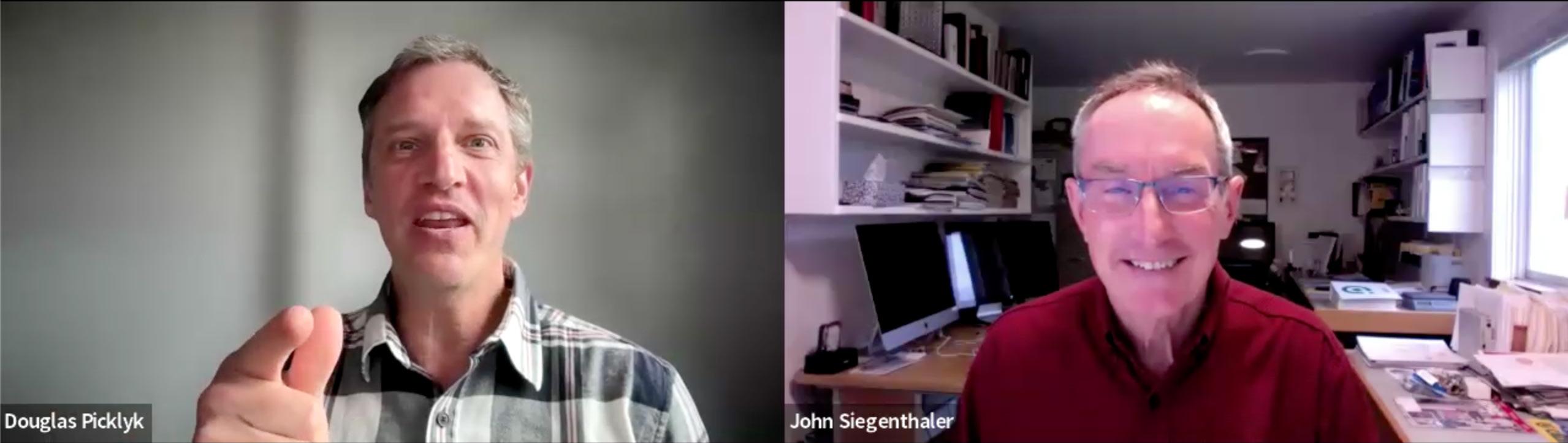
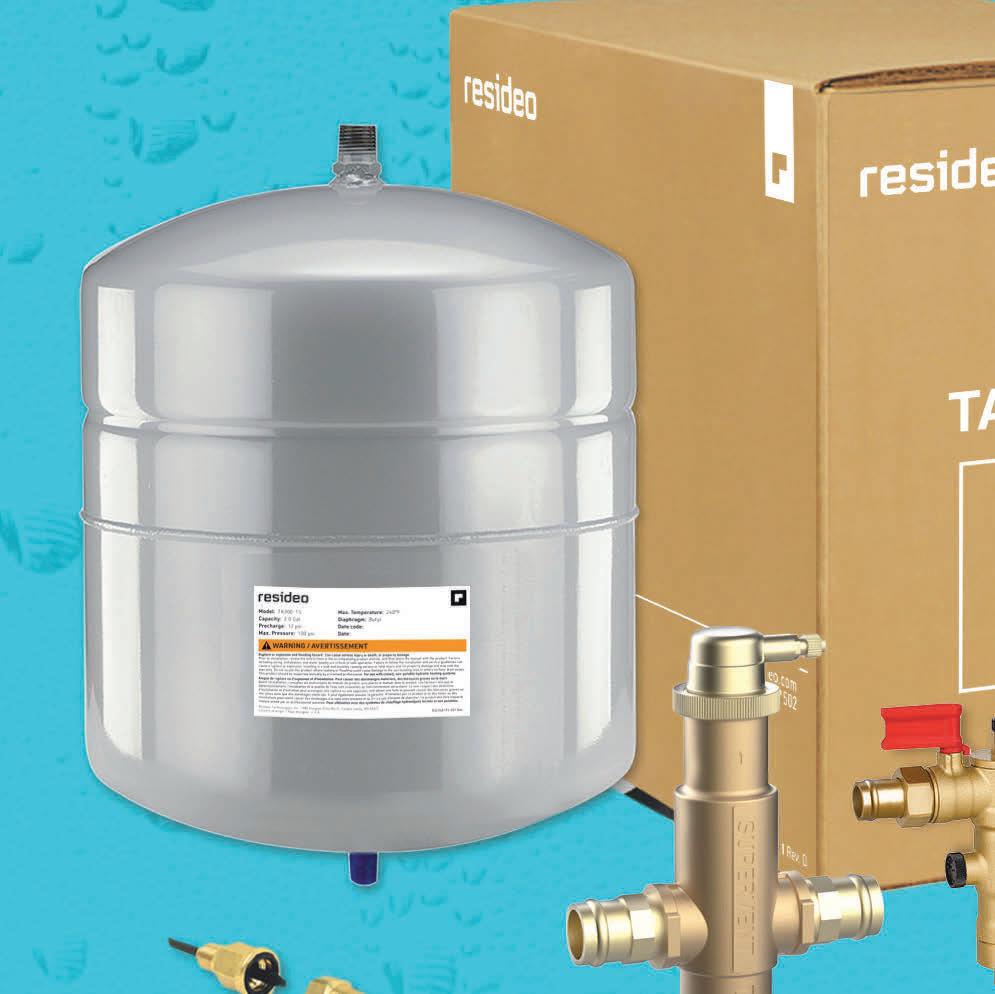
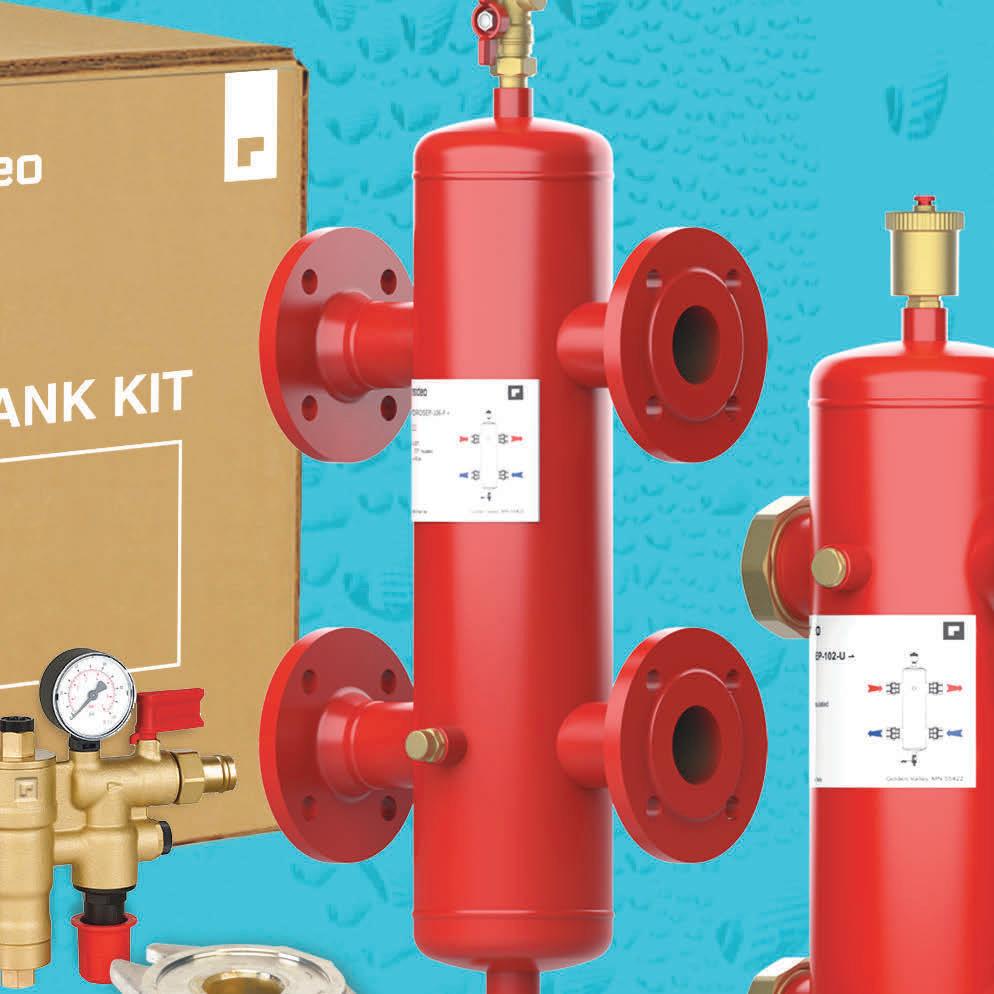
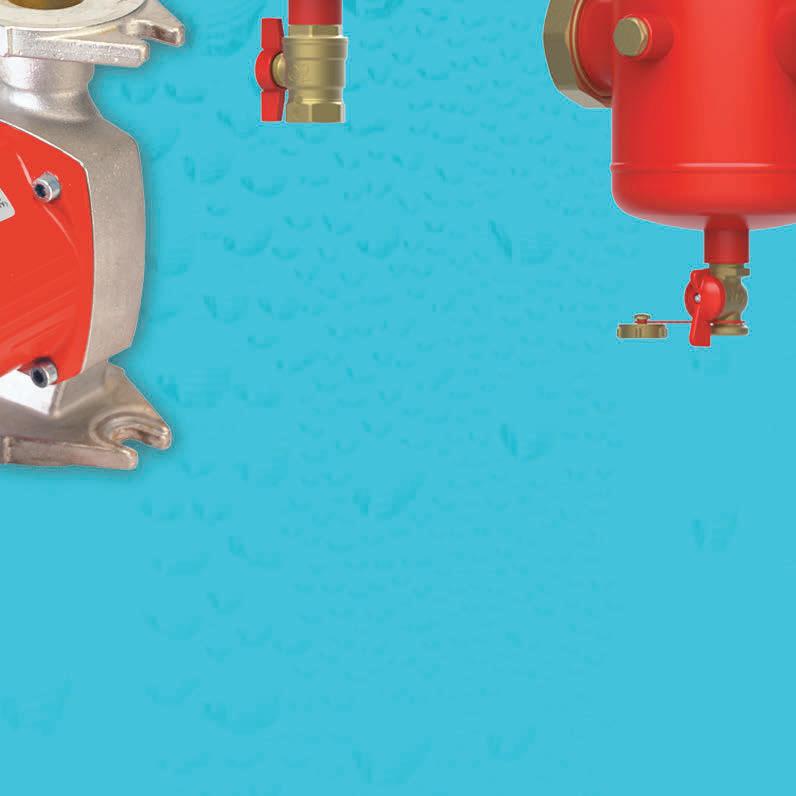
On October 30th HPAC Magazine once again hosted a free live webinar, part of the ongoing 30 Mechanical Minutes series of free webinars, and this one featured hydronics industry expert John Siegenthaler joining us for a conversation on the topic of hydraulic separation. The sponsor for this edition of 30 Mechanical Minutes was Residio, a manufacturer with a broad portfolio of products, covering HVAC, thermostats, security systems, and of course plumbing and specifically hydronics products including hydraulic separators.
To illustrate the basic concept of hydraulic separation, Siegenthaler shared an illustration of two kids in conflict, one larger than the other. “The big guy represents a bully on a playground and think of that guy as the big circulator in a system, and then think of the small guy as a small circulator,” explained Siegenthaler.
“Unfortunately, if two or more circulators “see” each other from a pressure dynamics standpoint—if they can communicate their pressure differentials in the same system—they will interfere with each other, and typically the larger circulators can cause the smaller circulators to operate at lower flow rates than they normally would if they were running by themselves.”
It’s the attempt to avoid this struggle over control of the flow that requires the pumps (circulators) to be separated on a closed-loop hydronics system, thus the need for hydraulic separation, he explains.
“The general idea is, whenever you have a hydronic system
with two or more circulators that are capable of running at the same time (and today that is the vast majority of systems), we need to make sure that they are hydraulically separated from each other,” he says plainly.
What’s important for hydronics contractors, system designers and installers is the ability to look at systems, whether schematics or installed systems in the field, and identify where there is common piping leading to two circuits or more and ensure there is no interaction between the circulators. To ensure there is no interaction will depend upon the head loss (or the pressure drop) through the common piping. “The lower the head loss is, or the lower the pressure drop through the common piping, the less the circulators will be able to interact with each other,” he says.
Siegenthaler insists that hydraulic separation is not a concept that you either have it or you don’t have it, because in theory you can never have perfect hydraulic separation, but if you make the pressure drop quite low in the common piping it will be adequate.
One change in modern hydronics has been the introduction of modulating variable speed electronically commutated motor (ECM) circulators, as opposed to the common fixed-speed circulators.
For example, you might have a system that has a variable
Continued on p28

speed circulator on the same header as a fixed speed circulator, and the variable speed circulator can be set to respond to the pressure differential it feels. A lack of hydraulic separation could cause conditions that would fake out what that variable speed circulators is trying to do on its own circuit.
So Siegenthaler always recommends hydraulic separators in systems with variable-speed circulators.
Designing common piping with very low head loss and pressure drop characteristics can be accomplished in many ways.
“If we look historically at the North American hydronics market, rolling the clock back at least 20 maybe even 25 years ago, many systems were being designed with what’s called primary/secondary piping where we use closely
Ensure your HVAC/R appliances, equipment and components are certified to meet the latest regulatory requirements utilizing low global warming refrigerants. Intertek’s experts will help you gain compliance and certification for flammable refrigerants with speed to market.
+1 800 WORLDLAB (967 5352) icenter@intertek.com Intertek.com/HVACR FOR MORE INFORMATION
spaced tees to separate the hydraulics of one circuit from the hydraulics of another circuit,” he says.
The closely spaced tees are where the two circuits overlap, so that is the point of common piping, and because the tees are right next to each other the pressure drop through those connections is almost zero.
“Because the pressure drop is so low between the tees the flow rates in those two circuits that overlap at those tees is essentially independent of which circulator is going to operate,” explains Siegenthaler.
In answer to, “How close should closely spaced tees be positioned?” He was very clear: “As close as you can get them.”
“Primary/secondary piping was first developed around commercial chilled water systems, and these systems typi -

cally use larger pipes, 3-in., 4-in., even larger in some cases. So putting two 4-in. tees next to each other you might have close to a foot between the centre of one tee and the centre of the other. But there’s no reason to have them a foot apart if it’s smaller piping.”
He notes that there are companies that make fittings that essentially give you the equivalent of two closely spaced tees in a single fitting. And he’s noted some installers have also used a tool called a Tee Drill where they can drill two holes in a pipe and spin out the collars necessary for the two connections.
Siegenthaler also showed other methods of creating hydraulic separation including hydraulic separators and buffer tanks. He explains that in a hydraulic separator the flow velocity slows down to about one-ninth of the entering flow rate, and thus because it slows down you have very little pressure drop between the top and bottom of that separator.
The nature of these devices also allows the ability to collect and vent air bubbles at the top as well as collect dirt sediment at the bottom. And newer versions are also designed with magnets to remove iron oxide, or magnetite, out of the system.
He also showed three variations of buffer tank piping (4-pipe, 3-pipe, and a 2-pipe) with the tank providing the separation.
He then also pointed to the cast iron boiler as a component that has a very low pressure drop as flow goes through it. “We had hydraulic separation in hydronic systems decades ago when we were largely using only cast iron boilers; we just didn’t realize it. And if we follow the history of hydronics, when boilers with much higher pressure drop characteristics started to come into the market (some of the initial condensing capable boilers), suddenly there were problems with flow that were never present with cast iron boilers.
When it comes to sizing headers Siegenthaler has long referred to “short fat headers,” and what he’s suggesting is to keep headers as short as possible and be generous in how you size the pipe. “I would say your header should be, at a minimum, one pipe size larger than your branches, and even more generous would be two pipe sizes larger.”
Why? Because the idea is to keep the pressure drop in the headers as low as possible and create the best hydraulic separation.
“Hydraulic separation a very powerful concept, and it’s a broad concept as well,” says Siegenthaler. “It’s not limited to just primary/secondary piping with closely spaced tees, and it’s not limited to just systems with a hydraulic separator in them. It can be achieved with buffer tanks, it can also be achieved with low head loss boilers, like a cast iron
What’s the maximum velocity for common headers?
“If you have a header with several circulators that are being supplied by the header, take the total flow when all those circulators are operating (assuming all those circulators can operate simultaneously), and size the header pipe so that under that total flow rate condition the flow velocity doesn’t exceed two feet per second.
What is the most cost-effective way to achieve hydraulic separation?
If you’re using a cast iron boiler just keep your headers short and fat, and you’re done. A hydraulic separator would displace the need for an additional air separator and dirt separator. People figure they can install an air separator, dirt separator and a pair of tees cheaper. Well, the hardware might be less expensive, but not by much, and you have to consider the labour and space in the mechanical room.
Where to put the expansion tank when using a hydraulic separator?
The place not to put it is at the bottom of the separator, it’s going to collect dirt onto the diaphragm in the expansion tank. Put it on either side at the bottom of the hydraulic separator.
boiler. There are many solutions.”
A recording of this session (and past episodes of 30 Mechanical Minutes) is
FREE WEBINAR I JAN 13 @ 2PM ET
VISIT HPACMAG.COM AND SCROLL DOWN TO 30 MECHANICAL MINUTES.
There you can select from a number of recent hydronics focused episodes featuring John Siegenthaler.
• Hydraulic Separation
• Hydronics and Thermal Storage
available at hpacmag.com under the webinars tab, and on our YouTube channel youtube.com/@hpacmag. <>
Sponsored by Virtual Content for Real Time Professionals MISSED PREVIOUS EPISODES?
• Glycol and Hydronics
• Electric Boilers
• Air-To-Water Heat Pumps

The efficiency and effectiveness of hydronics and heat pumps in modern buildings is reliant on smart system design and unified controls.
BY ZACHARY LONDO, JEAN-CLAUDE RÉMY & CHRIS DESROCHES
The Laws of Physics do not change. Heat will always move from hot to cold, and this remains true for hydronic systems used within commercial buildings. Present and future challenges require better management and control of heat flow in buildings beyond trying to slow down the transfer from inside to outside through better insulation. Improving internal heat flow entails better piping arrangements with multiple heating/ cooling sources, diversified terminal units and, of course, improvements to
how everything is controlled like a perfect symphony.
In the design process, especially with mechanical design, controls are often an afterthought added into the project specifications at the eleventh hour. Instead, controls should be viewed as a critical aspect of holistic design, which is why they are one of the fundamental pillars we’ve identified in this series of articles which identify the promise of heat pumps and hydronics as keys to efficient building designs.
Controls act as a conductor, ensuring all systems work together instead of fighting against each other. Without properly tuned controls, you are left with setpoint hunting, short-cycling, under or overheating or even premature failure of equipment and unnecessarily high operating costs. This is why it’s important to keep controls in mind early and often in the process of thermodynamic design. Ask yourself, “What am I trying to achieve, and how do I do it?”
Large commercial or institutional buildings often have diverse loads with different terminal units at different supply water temperatures which directly influences piping strategies and controls. In Canada, most heating systems using heat pumps require some kind of supplemental heat for the coldest period of winter. The first step to adding an auxiliary heat source is understanding how it should be piped, and when it should run.
Passing the supply water from a heat pump and then through a “booster” to achieve higher fluid temperature (piping units in series) is usually not a good idea. Just like in an orchestra, each part of the system must be able to work independently to achieve proper results and maximize efficiency.
While both primary and auxiliary heat sources will add energy into the supply loop, their design flow and delta T requirements will vary. An in-series piping
Continued on p32

Continued from p30
strategy disrupts the system’s harmony which is why they need to be piped in parallel, where each source can “inject” the energy it produces into a common, primary loop, or something equivalent like a storage tank.
One of the simplest solutions for the coldest days when the heat pump cannot keep up with the load, and temperature in the system begins to drift, is to shut off the heat pump and turn on an auxiliary boiler. This solution provides resilience and redundancy to the design, and it also allows the less efficient boiler to turn on only when needed, eliminating system downtime. How can the piping strategy accommodate that?
While all projects are different and piping strategies will vary, each with their unique control requirements, the most common design in Canada involves the use of a heat exchanger to decouple the glycol-water mix, required for its antifreeze properties by the outdoor air-towater heat pumps, from the 100% water used within the rest of the building (see Figure 1, next page).
This design requires an additional pump, but it reduces the total volume of glycol needed and its negative performance impacts. Using glycol for the entire heating distribution would require increasing the flowrate compared to 100% water, and it can add up to 30% more head depending on the concentration (requiring more energy). Of course, there is also the added cost of the glycol and feed tank if used for the whole system. This can more than offset the price of the heat exchanger and an additional pump. There are additional control advantages that will be apparent when this article discusses delta T’s.
With the heat exchanger in place, the boiler is postitioned on the secondary side of the system, heating water in -
stead of glycol. The boiler has its own elevated setpoint to manage, and the heat pump may or may not act as the first stage of heating to the system. The key to having this setup controlled effectively is to ensure the return temperature comes back low so the heat pump will keep working.
If the return temperature on the secondary side comes above the setpoint of the heat pump, the unit will shut off its compressor resulting in non-optimal usage of the boiler and potential shortcycling of the heat pump.
A simpler way to integrate auxiliary heat is by substitution: If the outdoor temperature drops below a predetermined point the heat pump shuts off and the boiler becomes the primary source. Again, each building is unique and thus the design should be tailored to suit, since the equipment used is much more complex, rather than trying a one-size-fits-all approach.
When multiple heat pumps are used, flow must be managed in the system. Most heat pump units now have integrated pumps that serve the unit needs based on load and delta T. Controlling this is simple since the unit has its own internal sensors. It confirms flow with a
flow switch and only starts the compressor when it has detected a flowrate.
At the heat pumps, heating and cooling often requires a different flowrate which is frequently overlooked. One option is to use a variable frequency drive (VFD) to get two flowrates, a heating flow and a cooling flow, in which case the terminal units and distribution is sized for fixed delta T’s for both heating and cooling.
The other option is to size the system and terminal devices for the higher of the flows (usually cooling) which will result in a smaller delta T in heating. Either method is a tradeoff between performance and control simplicity.
To design a variable flow system using a large, centralized, pump would require several control valves in the system. This adds complexity and could lead to “ghost flows,” providing heating or cooling when it’s not desired. The pump will have to modulate between the smallest and largest design flows between heating and cooling modes, which may not be the best option.
Using multiple pumps in parallel offers some redundancy in case of pump failure (you don’t lose the whole system) and allows for more precise control of
terminal units. In the piping design, using closely spaced tees, low loss headers and storage tanks permit independent operation and easier balancing in such situations. There is a need for isolation valves when the pressure differential developed by the pumps is higher than ~13psi (30 ft. of head). Going beyond this may induce “ghost flow.”
Because of such widely varying conditions, in the plant room and zones, primary-secondary (P-S) piping is preferred over a single primary loop system. P-S allows more flexibility and simpler con -
trol of the terminal units in the buildings at many different sets of conditions that can vary drastically.
The primary (plant) side maintains the outlet water temperature setpoint, in effect isolating it from the dynamics of the loads in the building. With this strategy, the secondary side of the system can be operated and controlled much more effectively.
When a heat exchanger is used, it permits different delta T’s between the mechanical room and the terminal units. Typically, at very cold design conditions of -15C to -20C, the heat pump will be limited to producing about a
10F-degree delta T, yet several terminal units will work at different flow rates and delta T’s.
We can now size fan coils, air handling unit (AHU) coils or radiant systems on higher temperature differentials, typically 20F-degree delta-T, cutting the flow rate in half, reducing the size of pipes, valves, pumps (thus also reducing cost) while delivering comfort to the occupants and providing control flexibility by having two independent control systems working together.
From the last issue, the benefits of a decoupled ventilation system used to leverage hydronics and use lower heating temperatures and higher cooling temperatures was explained.
There are several controls considerations to keep in mind to ensure that the ventilation strategy is controlled effectively.
Demand control ventilation (controlling zone ventilation based on space CO2 levels) means only ventilating spaces when needed. This can offer significant improvements over variable air volume (VAV) systems to reduce energy consumption. In fact, without using demand control ventilation, energy usage of the system could increase the need for additional heating or cooling in zones because the ventilation air still needs to be treated. What better way to save energy than to reduce the ventilation and the associated energy required to condition the fresh air and maintain the zone setpoints.
Zone ventilation also requires relative humidity (RH) control. If either humidity or CO2 is out of range of the desired setpoint, the room air should be flushed with fresh, pre-treated air from the central dedicated outdoor air system (DOAS) unit to get the setpoint back into the desired control range.
Centrally, at the DOAS unit the ma -
chine controls the leaving air temperature setpoint as well as a humidity setpoint. Enthalpy wheels may be used to provide a “first stage” of dehumidification (or humidification in winter) and sensible temperature.
After air-side recovery, the remaining post heating/cooling treatment of the air can be controlled using water from the central plant to achieve a neutral air temperature that is in the 40-60% RH range. From there, the zone equipment handles the rest of the sensible load to satisfy the temperature setpoint (see Figure 2).
As discussed in previous articles, when DOAS is used to decouple the latent load from the zones, by supplying fresh pre-treated air to the zones directly with smaller ducts, this also facilitates the use of low temperature heating and high temperature cooling for the remaining sensible loads at improved efficiencies.
In heating mode, lower heating temperatures can be used with radiant systems that modulate to maintain the room temperature setpoint by regulating the water flow to the slab or to other heat emitters in the space.
In summer, when the building requires cooling, the water temperature to the local zones must be carefully managed when using radiant cooling. The first and most important rule for radiant cooling is to keep the humidity level below 50% for optimal operation.
Monitoring the fluid temperature relative to the zone dew point is essential, and the water temperature supply to the zone should be kept above the dew point to avoid condensation. Mixing valves are usually used to mix return water into the supply to the zone to ensure the surface temperatures in contact with the water are above the dewpoint. When DOAS systems are sized properly, and when humidity and
fresh air supply to the space are properly controlled, the additional sensible load can be managed using higher cooling temperatures.
Dehumidification still must occur somewhere in the system, typically this is achieved by using a chilled water temperature from the central plant at the traditional 42F to 44F. This is a temperature that is cold enough to dehumidify the
“An integrated design process considering piping in conjunction with controls is imperative.”
fresh air by overcooling the air to about 50F to 55F to dehumidify the outside air. Since 55F air is too cold to send to the zones, it must be reheated to about 65F to 70F before supplying the fresh air to the spaces. When heat recovery chillers, or four-pipe heat recovery heat pumps are used, this is a great way to get the reheating energy for “free” at the central plant by recovering the heat to the hot water loop, instead of rejecting it outside like what is done with a conventional chiller.
If additional sensible cooling is required in the spaces, it is usually supplied from a second chilled-water loop, kept above the dew point by mixing return water with the supply water to each tertiary loop to ensure a temperature that is above the dew point. From there the warmer chilled water loop provides sensible cooling in the zones.
There are other methods and strategies, however these options all involve decoupling the latent and sensible loads somehow to achieve energy efficiency
and comfort. Humidity and fresh air must be properly controlled where cooling is required, and the different parts of the system must work together in unison.
While integrating the individual pillars (building envelope, indoor air quality, heating/cooling, controls) required for a high efficiency building might seem more complex to design, it is merely an adaptation of integrating heat pumps and their specific needs into the design.
In order to optimize the efficiencies of the components, we cannot avoid the fundamentals of heat transfer, fluid flow, humidity management and the required controls if we seek to fit the pieces properly together.
One must also consider that piping a heat pump to a system is not the same as a boiler. Designs from a decade ago might have been simple and routine, sizing components with rule-of-thumb calculations, but in today’s world an integrated design process considering piping in conjunction with controls is imperative to achieve the stringent performance targets of a low-carbon, highly efficient system without compromising comfort.
The next and final article in this series will look at integrating all of these principles into retrofitting existing systems, a requirement that is estimated to makeup a significant portion of the HVAC market in the coming decades. <>
This four-part series is a collaboration among: Zachary Londo, PE, is a senior design engineer with GF Building Flow Solutions (Uponor); Jean-Claude Rémy is a business development manager with GF Building Flow Solutions (Uponor); and Chris DesRoches, P.Eng., is the business development manager, heating and cooling, with Swegon North America.
Over $12,000 worth of hydronic equipment will be won including:
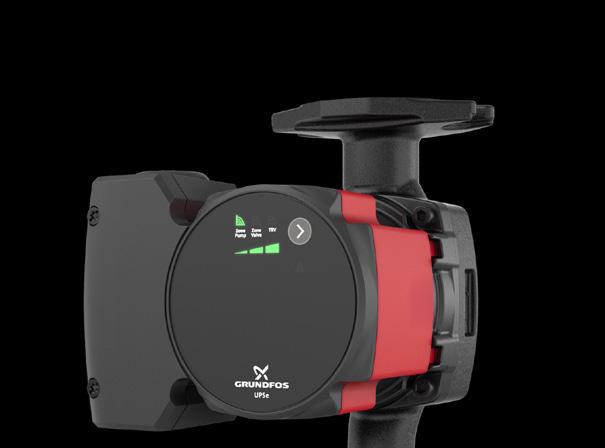
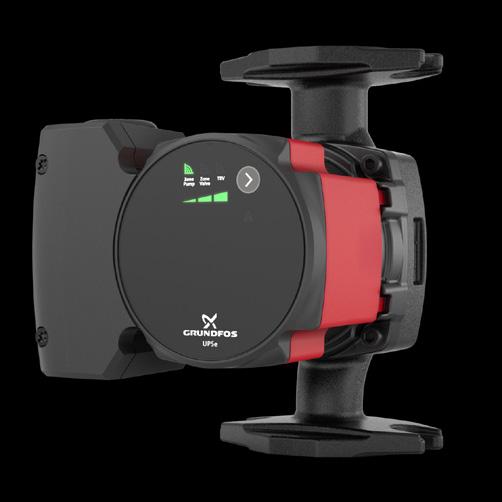
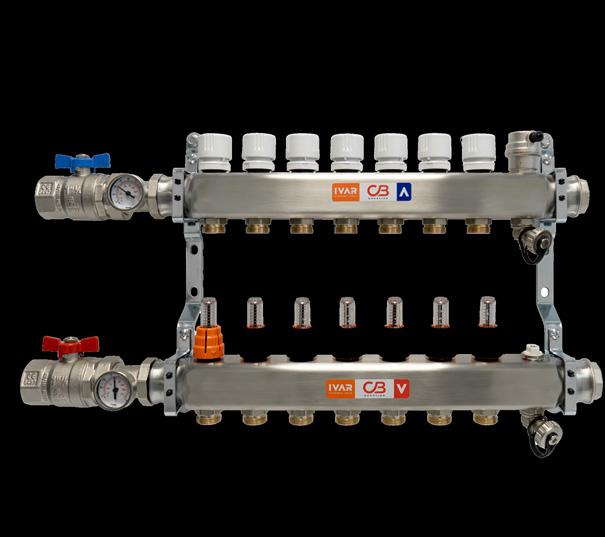


Thank you CB Supplies and Grundfos Canada for rewarding Canadian excellence in hydronic installations!

Send us pics of your installation. Include a brief description of the particular challenges that you faced with this installation and how you overcame the obstacles. Submissions are limited to one per contractor, per category. Deadline to enter is July 31, 2026. All submissions will be featured on screen at Modern Hydronics - Summit 2026.
There are three categories:
• Commercial installations
• Residential new build
• Residential retrofit
The three winners will also be announced by John Siegenthaler at the Summit. In addition to having your winning entry shared across our social media channels you’ll also be interviewed by HPAC’s editor and featured on the cover of the October edition of HPAC!


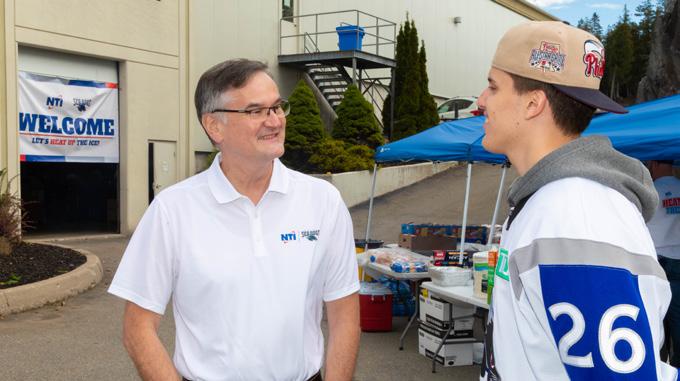
NTI Boilers/Ariston Canada, headquartered in Saint John, New Brunswick, has struck up a partnership with the local major junior hockey team, the Saint John Sea Dogs. As part of the relationship, NTI has a rinkboard ad along with the NTI logo displayed with some other signage in the arena.
In early November NTI Boilers legally changed its name to Ariston Canada to reflect its parent company, the Ariston Group. Strictly legal in nature, the NTI brand will continue to be used in the marketing and sales of its products. ntiboilers.com
>> Carrier Enterprise Canada announced a new distribution agreement with Kerr Controls, whereby Kerr will be the exclusive Atlantic distributor for both residential and commercial Carrier branded products. kerrcontrols.ca
>> Barclay Sales now represents the made-in-Canada Vulcano high velocity and low velocity hydronic air handlers. vulcanoair.com barclaysales.com
>> Rinnai opened a warehouse in Canada, stocking and shipping from a Canada Cartage Logistics Solutions’ distribution centre in Markham, Ont., offering direct access to major Highways 404 and 407. www.rinnai.us
>> Carrier Enterprise Canada has moved its headquarters, including a distribution centre and wholesale parts
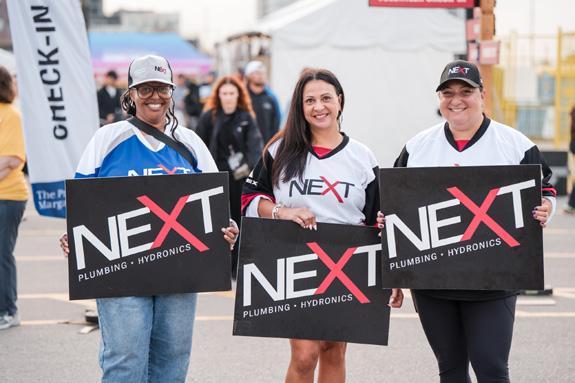
NEXT Suppy Scores Again … at this year’s Road Hockey to Conquer Cancer tournament, held at the end of September as a fundraiser for The Princess Margaret Cancer Foundation, NEXT staff together with customers, vendors, friends and family led the event in both the number of teams (30) and people participating (over 400) as well as fundraising dollars (over $600,000) to win the Corporate Cup. Michael Storfer, CEO of NEXT, was the Honourary Chair of the event. Overall, the tournament raised $3.2 million this year (a new record).
Daikin Applied Americas has acquired Chilldyne, specialists in liquid cooling systems for high-performance data centres. Earlier this year (August) Daikin Applied acquired DDC Solutions, a San Diego-based developer of high-density cooling cabinets and management software for data centres.
Chilldyne’s liquid cooling distribution unit (CDU) technology uses a negative pressure system that delivers chip-level cooling. The system removes heat directly from processors through cold plates. daikinapplied.com chilldyne.com
store, to a new 116,000 sq. ft. facility in Brampton, Ont. The new site with 24 bay doors and a drive-in door is more accessible than its previous Mississauga location. carrierenterprise.ca
>> Bradford White Canada will soon be stocking Bock oil-fired water heaters (32- and 50-gallon). This follows the parent company’s acquisition of Wisconsin-based Bock Water Heaters in April of this year. bradfordwhite.com
>> Mits Airconditioning is now the master distributor for Exinda Eco-Energy Solutions products across North America, including Exinda’s residential and commercial air-to-water heat pumps across Canada (excluding Quebec and the Maritimes) and the U.S. mitsair.com exindagroup.com
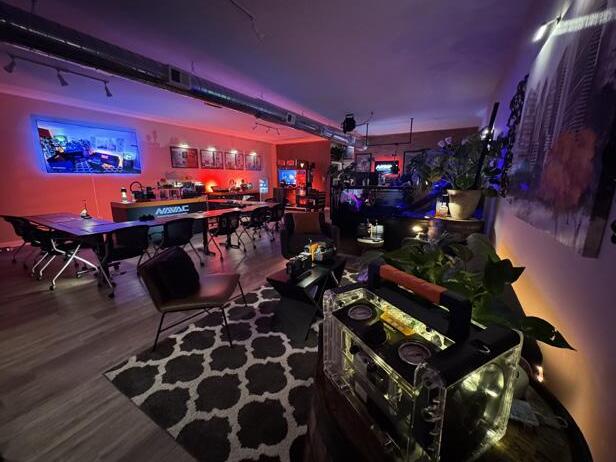
VAST Industrial Corp., a privately held Canadian holding company which owns Unilux HVAC Industries, has acquired The Whalen Company, the Maryland-based manufacturer of heat pumps and fan coil products for the high-rise HVAC market in North America, the same space as Unilux HVAC.
Alex Heisz, director of Vast, will become president of Whalen. “The acquisition of The Whalen Company is an exciting opportunity to bring together two of the premier brands in North American high-rise HVAC,” said Heisz in a media release.
Founded in 1962, The Whalen Company were pioneers of the vertical stack concept, and Whalen products are operating throughout North America with an install base of over 750,000 units. vastindustrialcorp.com
David Minnis has joined Navien as the national HVAC sales manager. With over 25 years of industry experience, most spent in the wholesale space, Minnis brings management, sales and previous contractor experience to the role. Based in Ontario, he is responsible for growing the new HVAC business across Canada.
Uponor has announced the retirement of Dan Kirkpatrick. Serving customers across Canada for 37 years, Kirkpatrick began as a design technician with Canapex, followed by Wirsbo then Uponor— now GF. He has held various roles since, his primary title being technical field representative.

Stone Mountain Technologies, manufacturers of the Anesi gas absorption heat pumps, has appointed Brad Monaghan as their North American sales director. With over 25 years of HVAC and water heating experience, Monaghan has been with the company since 2022.

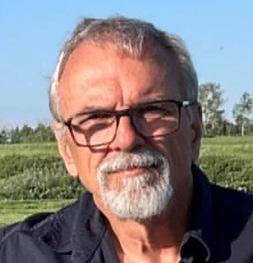

Fujitsu General America has appointed Bojana Prorok as director of sales – Canada. Based out of Toronto, Prorok brings over 15 years of experience in residential, commercial, design/build, and plan/ spec HVAC. In her new role she is now responsible for Fujitsu’s residential and commercial HVAC products across Canada.

Fowler Sales Agency, a manufacturer’s representative agency in Ontario, has welcomed back Leah Chamberlain as Eastern Ontario territory manager. Chamberlain, a seasoned HVAC and mechanical industry professional with over 25 years of experience in sales, supporting contractors and manufacturers, is based in the Ottawa area.
MIFAB welcomed Penelope Hilgartner as regional trench drain business development manager covering the Canadian regions along with northeast and southeast U.S. Hilgartner brings over four years of experience, and was previously with Zurn.


Boiler and water heater manufacturer Triangle Tube announced on November 3rd that it has ceased operations.
The West Deptford, NJ-based company announced on its website that as a part of this closure, all orders for equipment and accessories will not be processed, with spare parts to be available for purchase through stocking distributors as availability allows.
Additionally, all purchases will no longer be under warranty as of November 3.
The news follows a product recall in February of this year for Triangle Tube’s Prestige Solo, Prestige Excellence and Aerco Esteem condensing gas boilers, in cooperation with the U.S. Consumer Product Safety Commission (CPSC) and Health Canada. Despite the company’s closure, the product recall remains in effect.
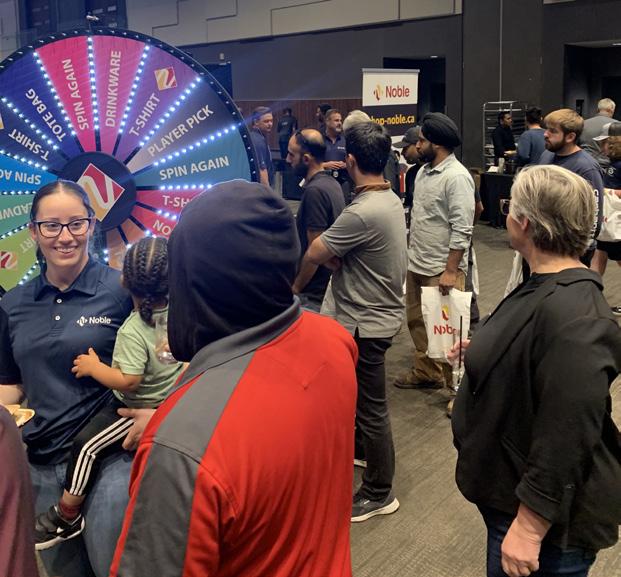
Noble hosted its 2025 Fall Tradeshow on Oct. 2nd at the Universal Event Space in Vaughan, Ont., just north of Toronto. There was plenty of food and drink, over 85 brands on display and prizes to be won.
A.O. Smith signed a definitive agreement to acquire LVC Holdco (Leonard Valve) with the transaction set to close in the
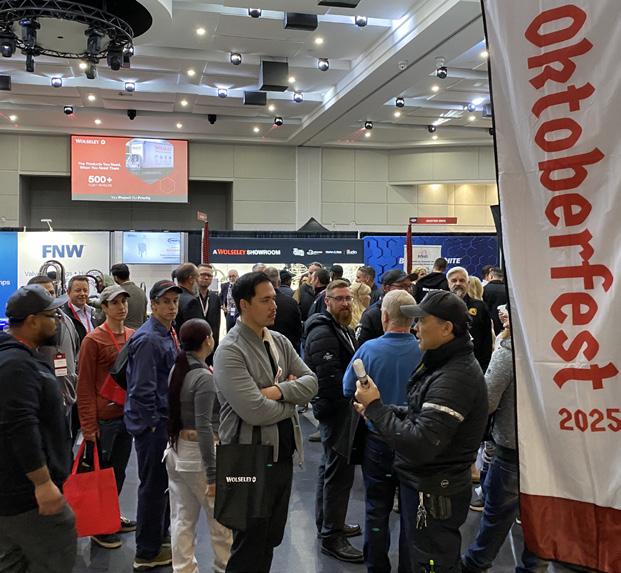
Wolseley Canada held a series of Fall Expo events this year including Oktoberfest in Toronto on Oct. 23rd (photo above), Montreal Oyster Night (Nov. 12) and the Calgary Expo (Nov. 18).
Founded in 1911, Leonard Valve is a leader in digital and thermostatic mixing valve technologies for commercial and institutional applications, while its HeatTimer brand provides boiler controls that optimize hydronic heating. Together, their solutions ensure control of water temperature in both commercial and institutional settings including hospitals, schools, universities and industrial facilities.
“This acquisition represents a compelling strategic fit and a meaningful expansion of A.O. Smith’s presence in the water management market,” said Steve Shafer, A.O. Smith CEO. aosmith.com leonardvalve.com
Copeland is set to grow its Vilter industrial heating portfolio with its acquisition of German-based heat pump manufacturer SPH - Sustainable Process Heat.
SPH manufactures high temp. heat pumps of up to 180C for industrial steam applications. In addition to the expansion of Copeland’s Vilter range, the transaction also increases Copeland’s range of supported refrigerants across its industrial customers and thus expanding its portfolio of sustainable heating solutions in this sector of the industry. copeland.com spheat.de
MARCH 25–27, 2026
Metro Toronto Convention Centre
South Building
Get hands-on with the latest equipment, tools & tech
Connect with 500+ suppliers & manufacturers
Stay sharp with live demos, code updates & training
Unlock timesaving & profit-boosting solutions

Recognizing efforts to raise the level of awareness of cross connections and the tools that keep our drinking water safe.
BY DOUG PICKLYK
In the world of potable water protection and backflow prevention, certified cross connection testers and inspectors across Canada are on the lookout for situations in buildings where cross connections can present a risk to local water systems.
What are cross connections? A cross connection is any piping connection, temporary or permanent, between a potable water system any potential source of contaminated fluid. Consider the cross-connection at make-up water lines leading to a hydronic heating system or an irrigation system as examples. The water make-up lines used in most boiler or chiller applications lead to systems that may contain treatment chemicals or glycols. These connections require protection so those contaminated fluids can’t flow back into the potable water supply.
Two conditions which can cause backflow to occur are cases of backpressure or back siphonage. Backpressure is when a building’s water system is at a higher pressure than the potable water supply causing water to be pushed back into the potable water piping.
Back siphonage happens when negative pressure exists in the potable water system causing water to be sucked back into the potable water supply. This could happen during a water main break or during repairs.
The solution for backflow prevention
is maintaining an air gap between the supply and the source of contamination or the installation of backflow preventers where cross connections exist.
In Canada, the Canadian Standards Association (CSA) B64 is the technical standard for backflow devices (there are two volumes: CSA B64.10:23Selection and installation of backflow preventers; and CSA B64.10.1:23Maintenance and field testing of backflow preventers).
CSA B64 is part of the National Plumbing Code, but potable water is a municipal responsibility so local codes vary by jurisdiction. Cross connection control specialist (CCCS) certification is a credential that may be required by local municipal bylaws for plumbers involved in installing, maintaining, and testing backflow prevention devices in commercial, industrial, or multi-residential properties.
This certification is governed by sections of the American Water Works Association (AWWA), including the Atlantic Canada Water and Wastewater Assoc. (ACWWA), Quebec (Réseau Environnement), Ontario Water Works Assoc. (OWWA), the Western Canada Section (WCS AWWA), or B.C. (BCWWA).
Certification programs are run through accredited plumbing schools across the country and CCCS recertification is also generally required every five years.
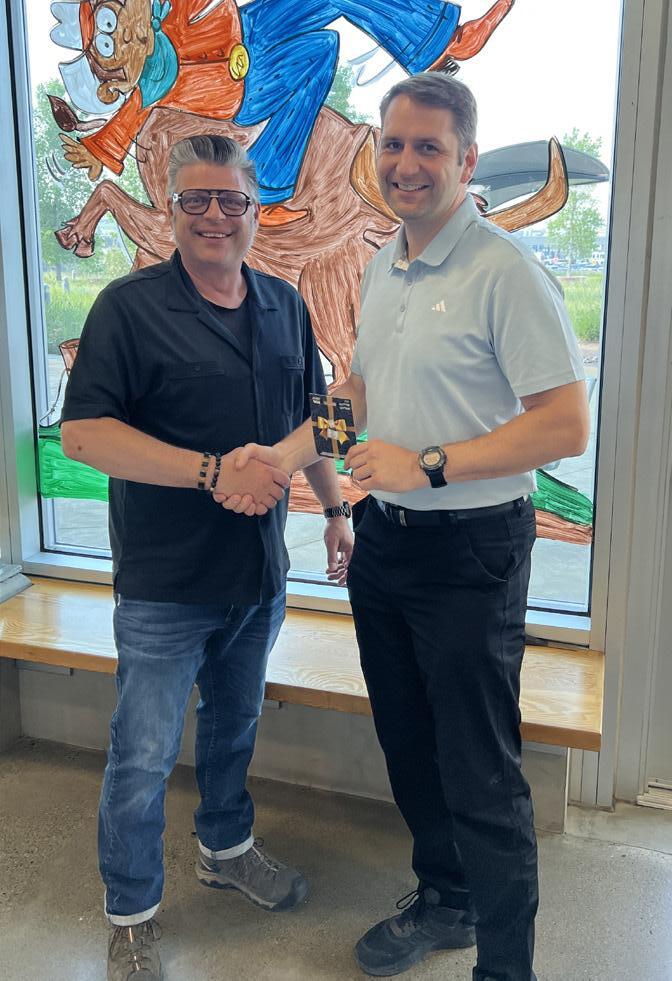
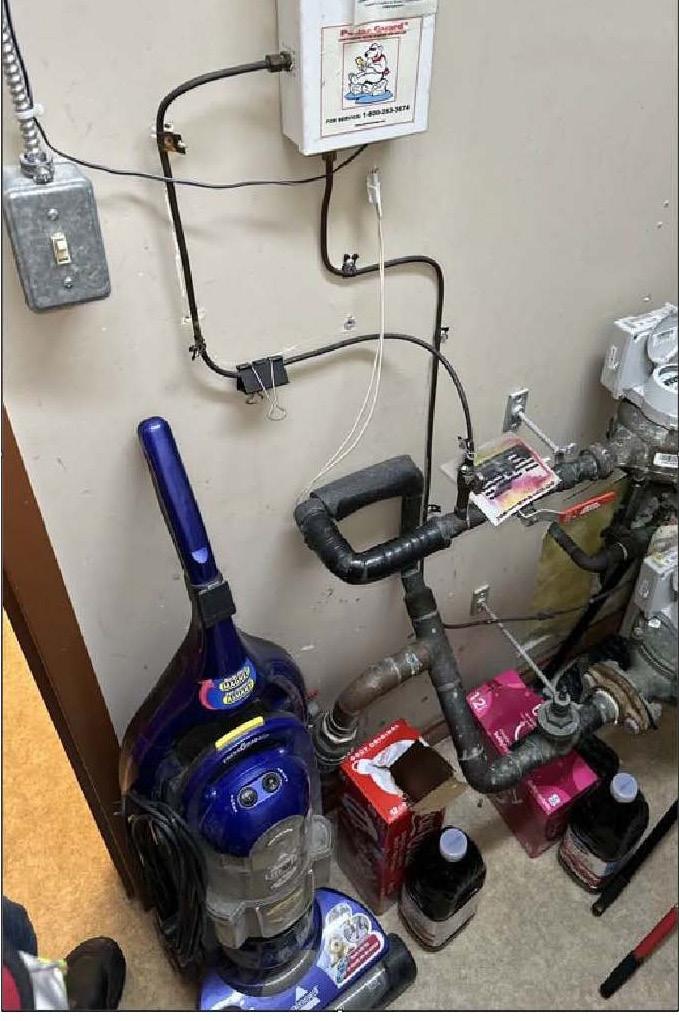
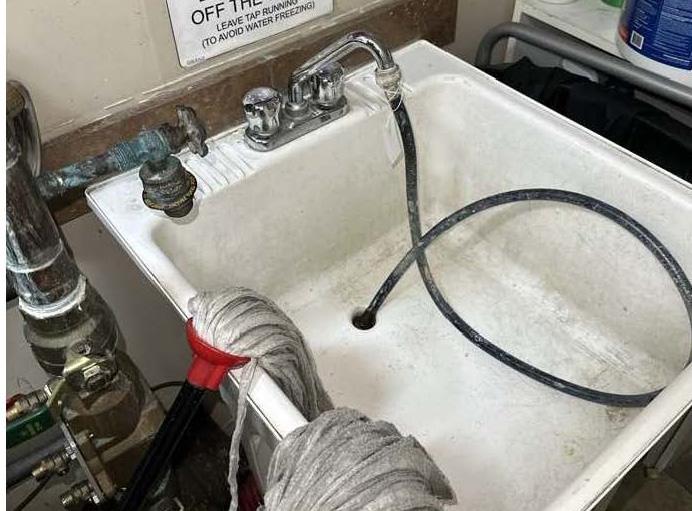
This bad and ugly inspection also revealed an air gap issue among other things.
On August 16th, 2021, Watts initiated the inaugural National Backflow Prevention Day, an annual day to recognize the role of backflow prevention and cross-connection control and celebrate those who install, maintain and test backflow preventers.
August 16 was selected because on that day in 1933, a backflow incident occurred at two hotels near the Chicago World’s Fair resulting in nearly 100 deaths. The incident led to the establishment of the Foundation for CrossConnection Control and Hydraulic Research and to safe plumbing regulations for backflow assemblies.
In Canada, the Cross Connection Control (CCC) committee of the WCS AWWA launched its Bad and Ugly cross connections contest in 2014 to raise greater awareness of cross connections and to educate water industry representatives in the field
The contest has been going strong ever since, and testers and inspectors from across the country are invited annually to send in photos and explanations of the dangerous cross connections they have witnessed.
The winning entries in this year’s Bad and Ugly Cross Connection Control photo contest are Eric Reijne of Caon Services Inc. in Calgary (tester category), and Craig Befus, CCC Inspector with the City Of Calgary.
For Rejine, his cross connection control testing led to an interesting discovery on a reduced pressure (RP) backflow preventer.
“Discovered maintenance staff had used a screwdriver and electrical wire to hold the RP relief drain closed,” noted Reijne in his entry. “The device was rebuilt and retested,” he confirms, adding that, “Before the repair, relief did not leak until the screwdriver was removed.”
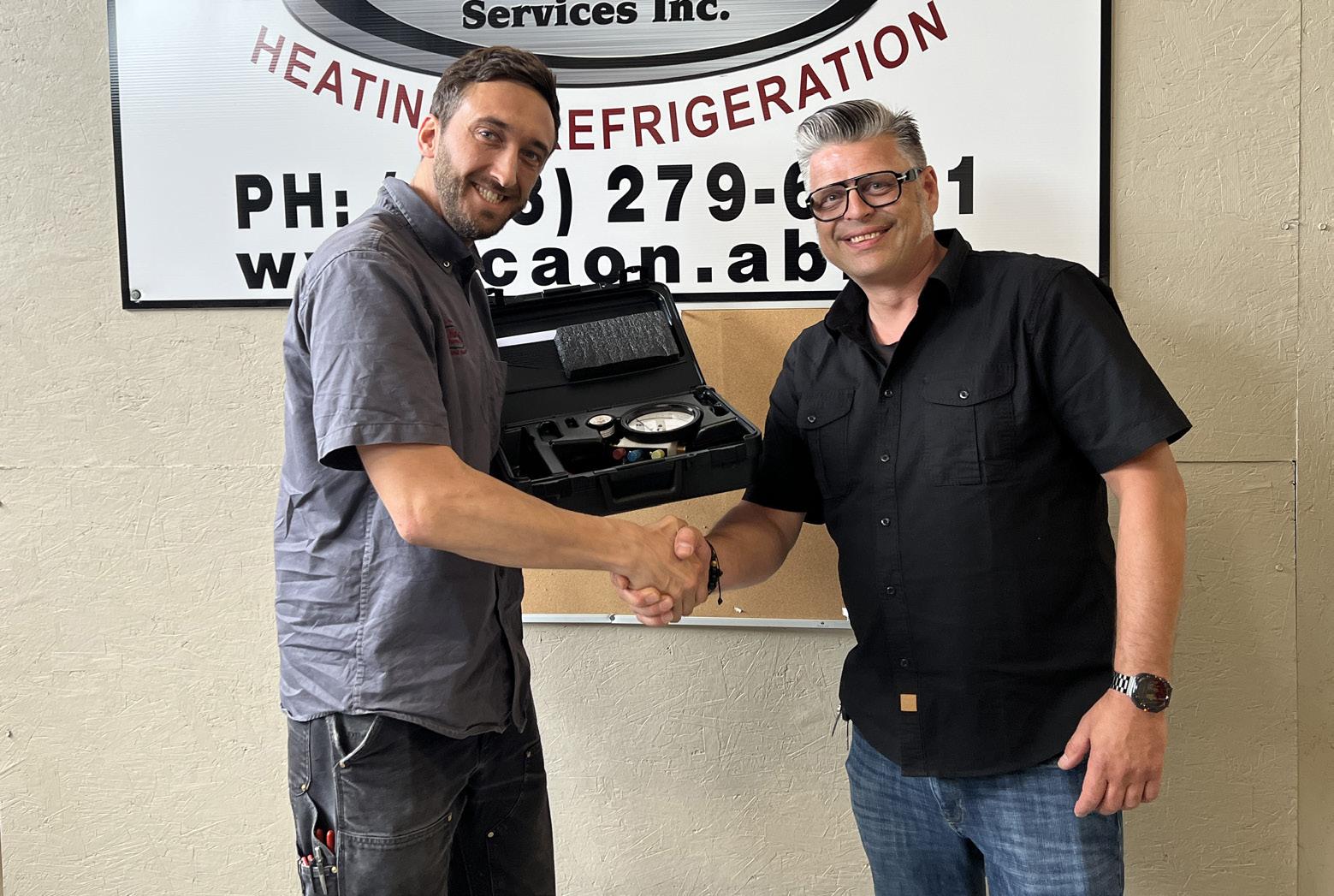
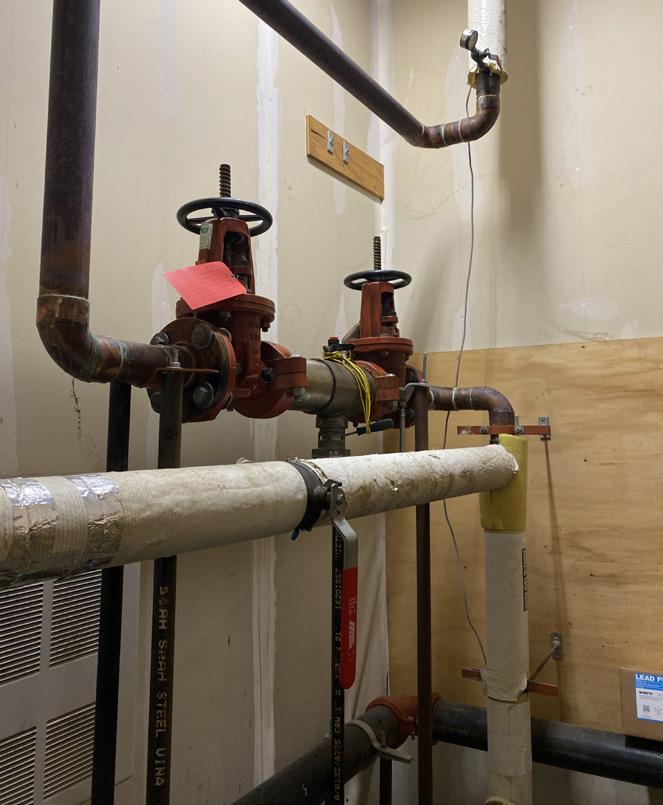
Tester Eric Reijne discovered a unique method for keeping a relief valve in order.
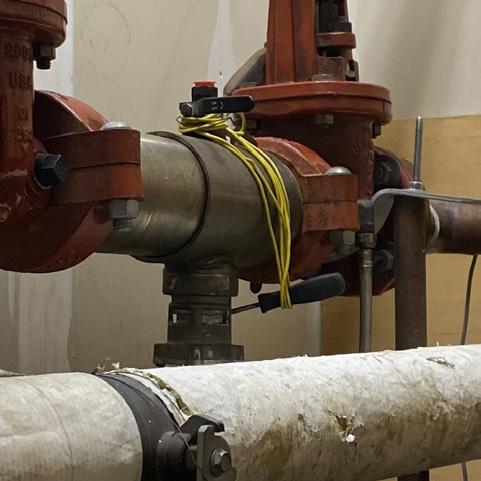
For the inspection conducted by Befus, something was out of order in the waterline in this building.
“I conducted an impromptu inspection of this premises due to the absence of a recent inspection on record. Site maintenance escorted me to the meter room, which was obstructed by mop buckets and hoses draped over piping,” notes Befus in his contest entry.
“Upon inspection, I observed a water line connection upstream of both the
water meter and backflow preventer, an immediate red flag.
“The site contact claimed the City of Calgary had instructed them to install the line to prevent service line freezing. However, the City’s frost prevention guidance only recommends leaving a tap running during cold spells; it does not endorse or mention upstream installations.”
But that wasn’t all. “Additionally, the copper line was improperly connected to the sanitary trap arm downstream of the p-trap, without an air gap, and the premise isolation and irrigation backflow assemblies were also significantly overdue for annual testing.”
He notes that post inspection the water line in question was disconnected from the drain and the site is still being actively monitored for compliance.
The WCS AWWA CCC committee thanks Watts Canada for supplying the test kit prize in the tester category this year, and the committee also encourages back flow testers and cross connection control inspectors from across Canada to consider snapping photos of the bad and ugly scenes they see and consider placing an entry in next year’s contest, visit: wcsawwa.net <>
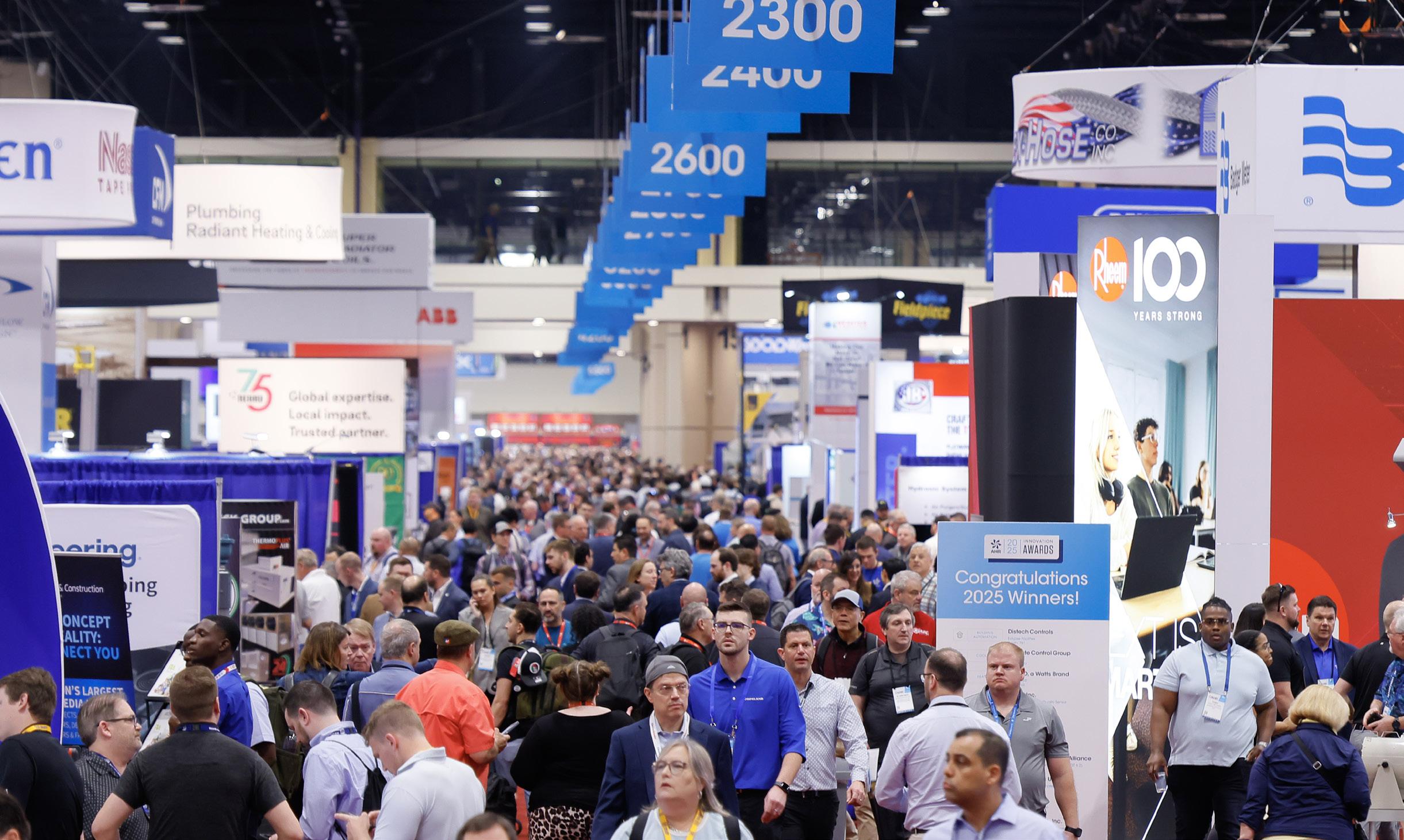
AHR Expo hits the strip in February 2026 as HVAC/R professionals flock to Las Vegas for the industry’s largest North American trade show and conference.
For an escape from the winter chill, the Air-Conditioning, Heating and Refrigeration Exposition (AHR Expo), the largest annual gathering in North American of HVAC/R industry professionals, is heading to the entertainment capital of the world, Las Vegas, for three days of engaging trade show exhibits and educational conferences, February 2 to 4, 2026.
Like past editions of the Expo since 1930, manufacturers and suppliers from around the world will be on hand to showcase their latest innovations, but when the show is over the attractions in the original Sin City can range from the legendary casinos, to spectacular shows like the Wizard of Oz at the Sphere, or even catching the Golden
Knights host the Vancouver Canucks on February 4th at the T-Mobile Arena.
But don’t forget why you’re there. The AHR Expo places an emphasis on educating contractors and engineers while also providing a marketplace for manufacturers and distributors. The event is co-sponsored by the education-focused ASHRAE (the global society of heating, refrigeration and air conditioning engineers) and the Air Conditioning, Heating, and Refrigeration Institute of America (AHRI).
The full schedule for the 2026 AHR Expo Education Program includes hundreds of sessions, including over 100 free subject-specific seminars, a panel series featuring the popular ‘State of
DATES
Monday, February 2, 2026
HOURS: 10 AM – 6 PM
Tuesday, February 3, 2026
HOURS: 10 AM – 6 PM
Wednesday, February 4, 2026
HOURS: 10 AM – 4 PM
Las Vegas Convention Center, Central and South Halls
AHREXPO.COM
the Industry’ forum,plus vendor-hosted new product presentations and more.
“Over the years, the AHR education program has grown into an important complementary asset to the show floor experience, lending an opportunity for deeper understanding of what’s happening within the industry, how to apply
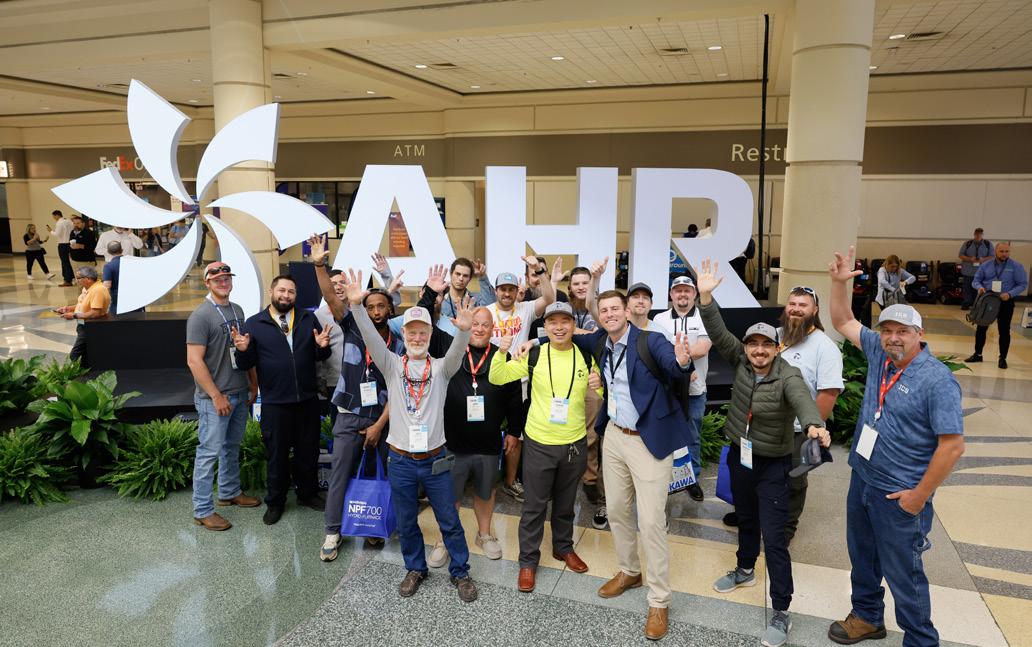
skill and knowledge, and how to prepare for shifts,” said show manager, Mark Stevens, in a past release.
The AHR Expo website (ahrexpo.com) allows attendees to search through the long list of educational sessions using keywords (like heat pumps), or you can search by topic, session type, speaker or date.
This year’s series of free panel discussions includes the 2026 State of the Industry: Today’s Market, Challenges, Opportunities & What’s Ahead (Tuesday, 10 a.m.). This session is always standing room only and puts leaders from industry associations including ASHRAE, AHRI, HARDI, and NCI on the hot seat to share their visions for the year ahead.
Other interesting panels this year include: Heat Pumps: Scaling for Commercial and Residential Markets (Monday, 1 p.m.); The Evolution of Ventilation & Energy Recovery: The Growing Role of ERVs in HVAC (Monday, 2:30 p.m.); and although the topic is U.S. focused there is a panel called State of Play: Refrigerant Policy in the U.S. (Monday, 10 a.m.); and there is also Data Center Demands: Cooling Solutions, BMS Advancement and the Next Generation of HVAC (Tuesday, 11:30 a.m.); and on the sales side, Mitigating Misinformation: Customer Communication that Scales (Tuesday, 2:30 p.m.).
Although there are many regional, code and legislative differences between the U.S. and Canada, the everyday concerns and trends affecting HVAC/R professionals are cross border.
Also, sifting through the 130 seminars available, you’ll find many featuring the latest updates on AI in HVAC, preparing your workforce for the future of the trades, and on Tuesday at 11:30 a.m. there is a session on ‘Decarbonizing Commercial Heating with Hydrogen – Boilers, Water Heaters & HVAC,’ being presented by AHRI and GTI Energy.
There will also be several sessions focused on heat pumps, including Why Heat Pump Projects Fail, 11:30 a.m. on Tuesday, and A2L Safety and Mitigation Technology Overview, Tuesday, 2:30 p.m.
Canada’s own Trevor Matthews (Refrigeration Mentor) will be
Continued on p44


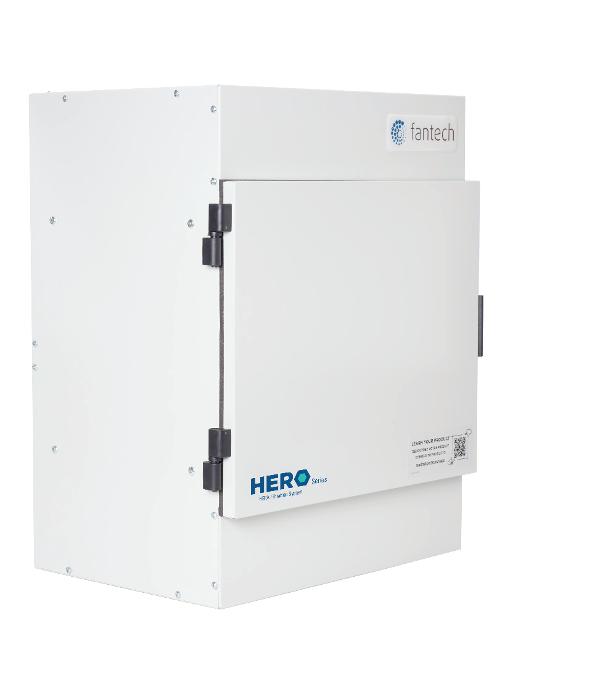
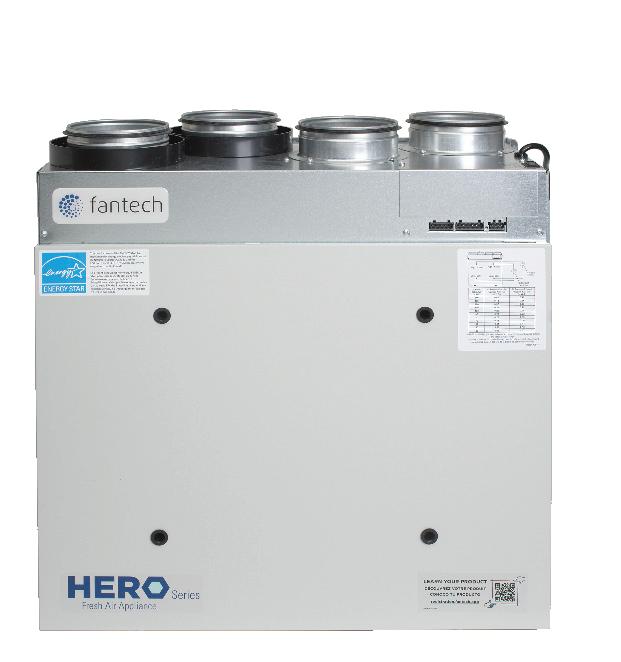
Continued from p43
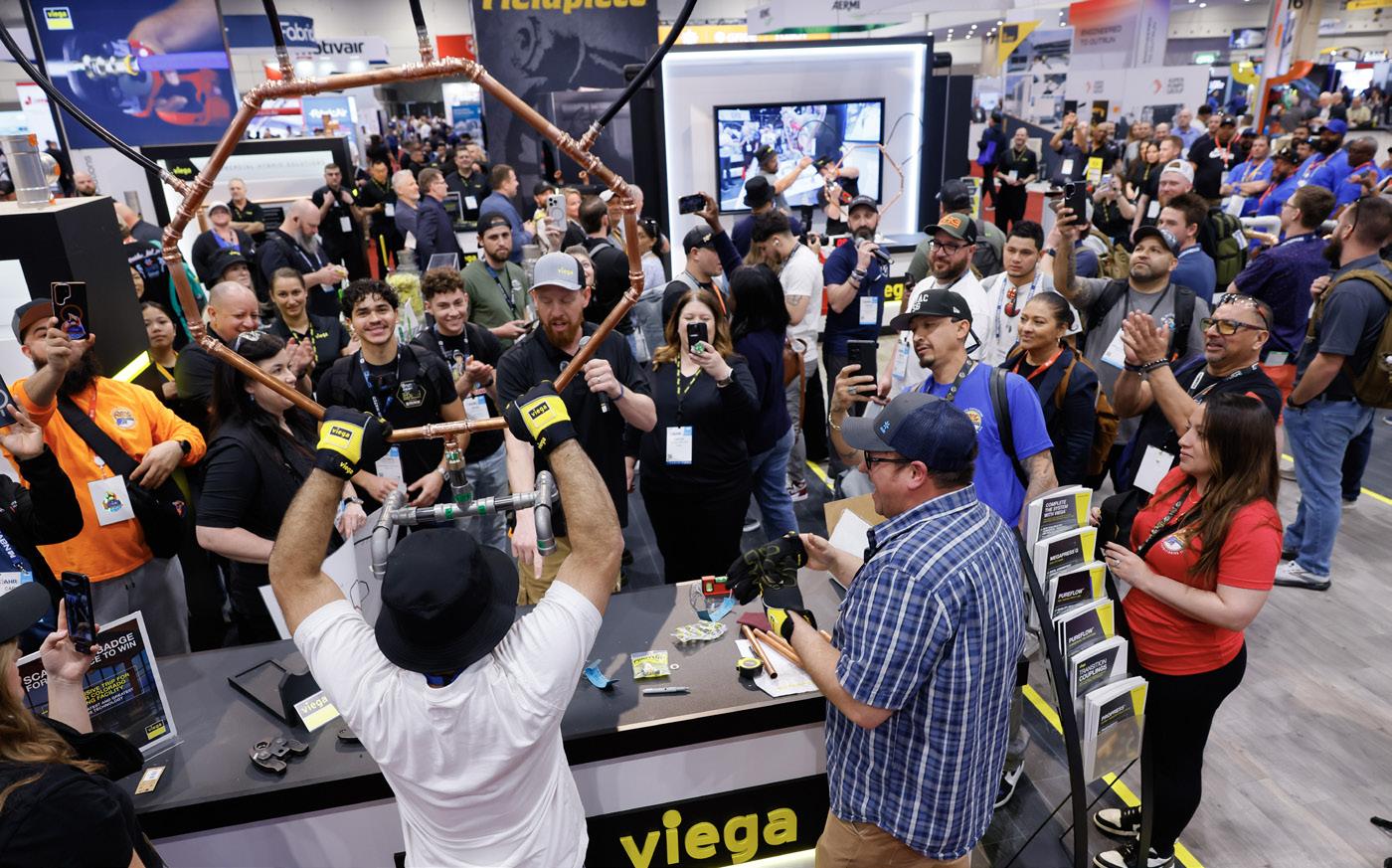
activities that attract crowds and build excitement at the show.
presenting a session on Mastering CO2 Refrigeration Basics and Beyond, Tuesday, 1 p.m.
Another Canadian, Quebec-born Karine Leblanc, will be presenting Culture, Conflict & Connection: EQ on the Jobsite and in the Office, a session that will apply to anyone who works with people designed to help improve overall communication (Monday, 8:30 a.m.).
If your focus is on learning about new products, aside from walking the show floor, the New Product Theater will be hosting more than 150 presentations, each lasting approximately 20 minutes. These free sessions, all listed on the ahrexpo.com website, will provide brief overviews of product announcements from the technology experts.
Industry podcasters and many HVAC/R social media influencers are once again headed to AHR Expo for the sixth edition of the Podcast Pavilion. Witness in-person interviews with industry personalities. When you need a break from walking the show floor, grab something to eat and head to the Podcast Pavilion to sit in on industry conversations. The Refrigeration Mentor (Trevor Matthews) will be among
the personalities sharing knowledge at the Pavilion, speaking at Noon on Monday, 3 p.m. on Tuesday, and early at 9 a.m. on Wednesday. You can check out the complete schedule online.
On the massive show floor attendees will also be able to visit the exhibitors who were named the winners of the 2026 AHR Expo Innovation Awards. In addition, during the show one of the winners will be announced as the Product of the Year.
In total there are expected to be over 1,800+ exhibitors at AHR Expo 2026, from the largest manufacturers to niche players and start-ups, and the show is anticipating over 50,000 HVAC/R attendees coming to learn and network.
Attendees who pre-register can skip the registration lines, and you can curate your experience using the show’s personalized planner. My Show Planner is a personal agenda that syncs with the AHR Expo App on your phone. The online tool allows visitors to map out and manage their show floor visits and education schedule in advance.
Details and instructions for registration and downloading the AHR Expo App are all available at ahrexpo.com <>
On October 23rd organizers of the AHR Expo announced the winners of the 2026 AHR Innovation Awards, an annual program which receives hundreds of entries from manufacturers all putting forward their latest designs, including all-new solutions and improvements on existing products and technologies.
The collection of entries are reviewed by a panel of third-party judges made up of ASHRAE members, and the judging evaluations are based on overall innovative design, creativity of the product or service, suitability and benefit of the product or technology in real-world application, as well as overall potential market impact.
“The achievement of an AHR Innovation Award winner is a meaningful distinction in HVAC/R,” says AHR Expo show manager, Mark Stevens. “The Innovation Awards not only highlight these accomplishments, but also act as a benchmark for excellence, honouring the creativity and dedication shaping our industry's future.”
This year’s winners (described on the following pages) were chosen across 10 categories, and at the 2026 AHR Expo in Las Vegas (February 2-4) one overall 2026 Product of the Year winner will be selected from among these 10 category winners.
All 10 of the products will also be recognized and on display on the show floor at the AHR Expo.
The Connected Solutions suite from Honeywell provides building owners and service providers with cloud-based tools for remote monitoring, predictive maintenance, energy optimization, and asset lifecycle management. Honeywell has made connectivity a core capability of it products, from sensors and devices to software and platforms, and since it’s now a native feature it’s easier to use automation and AI to discover and connect components. The suite of applications streamline operations, reduce costs, and improve sustainability efforts through a unified platform turns traditional building management into a connected, data-driven experience. buildings.honeywell.com
The Copeland heatingoptimized modulating vapour injection portfo lio of compressors for OEMs of residential heat pumps, commercial RUs and chillers combines two-stage tandem and variable-speed com pression platforms with vapour injection tech nologies to deliver flexi bility in achieving the capacity and efficiency requirements of cold climate and commercial heat pumps for hot air and water applications. copeland.com
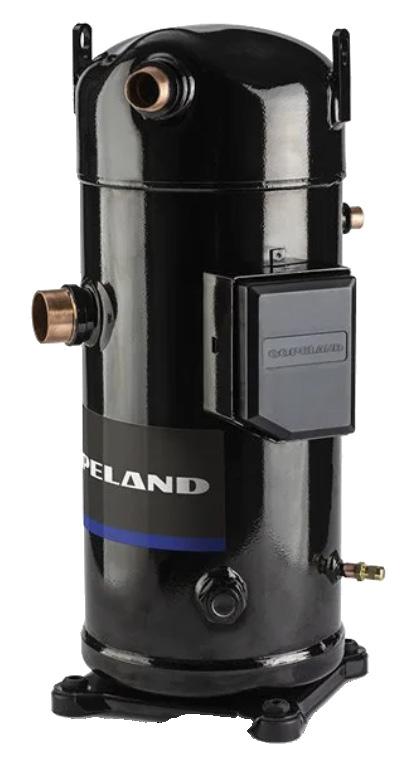
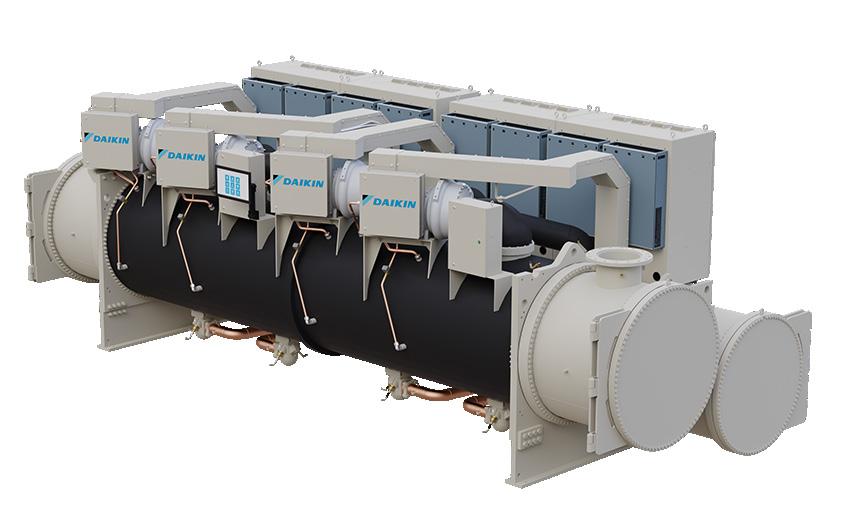
The Daikin Magnitude WME-C Quad is the first dual circuit series counterflow chiller that delivers up to 3,000 tons of capacity using the company’s magnetic bearing compressor technology. With four compressors, the units offer part-load efficiency, reliability and uptime. Using direct drive technology, integral variablefrequency drives and R-513A, or R-515B refrigerant, the unit is up to 40% more efficient than standard centrifugal chillers. It offers a wide operating envelope, including condenser leaving water temps up to 130F. Its unique RideThrough technology also allows the chiller to maintain operation during power loss for up to 17 seconds. daikinapplied.com
The Airest from Sharp is the first mini-split heat pump with built-in MERV 14 certified filters. It captures over 99.9% of dust before it enters the unit. Because high-efficiency filters can increase airflow resistance, Sharp has equipped the Airest with four centrifugal fans to produce higher static pressure, allowing air to flow more easily through the filter The heat pump is engineered with the heat exchanger positioned near the air outlet which allows dry air to circulate inside the unit, keeping internal humidity low and minimizing moisture buildup, which reduces the risk of mould growth. With an airflow reach of 43 feet, Airest cools or heats, and purifies the air. sharphvac.ca
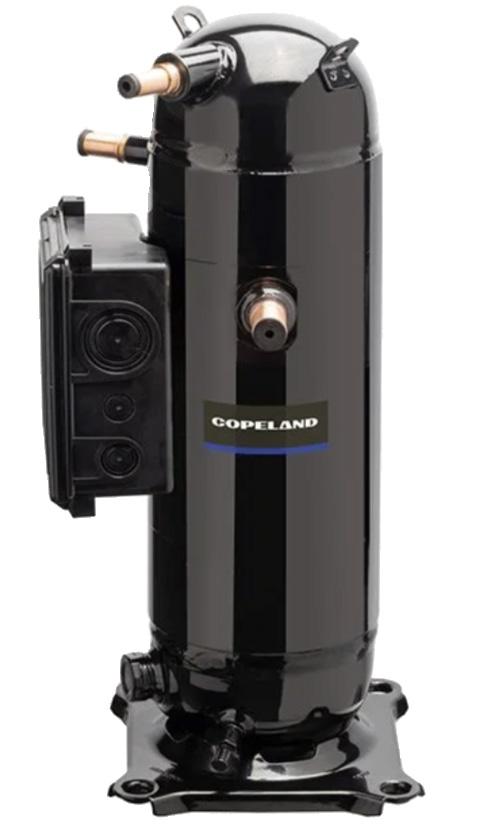
The Copeland transcritical CO2 scroll compressor marks a new era of simplicity, scalability and sustainability for small-footprint, distributed CO2 refrigeration. Featuring dynamic vapour injection (DVI) technology, which enhances efficiency and simplifies design, the transcritical-rated compressor alters CO2 refrigeration system designs and applications in North America, so distributed CO2 systems can now be applied across various retail sectors and store sizes, including new store installations, remodels and phased retrofits of aging hydrofluorocarbon (HFC) systems. copeland.com
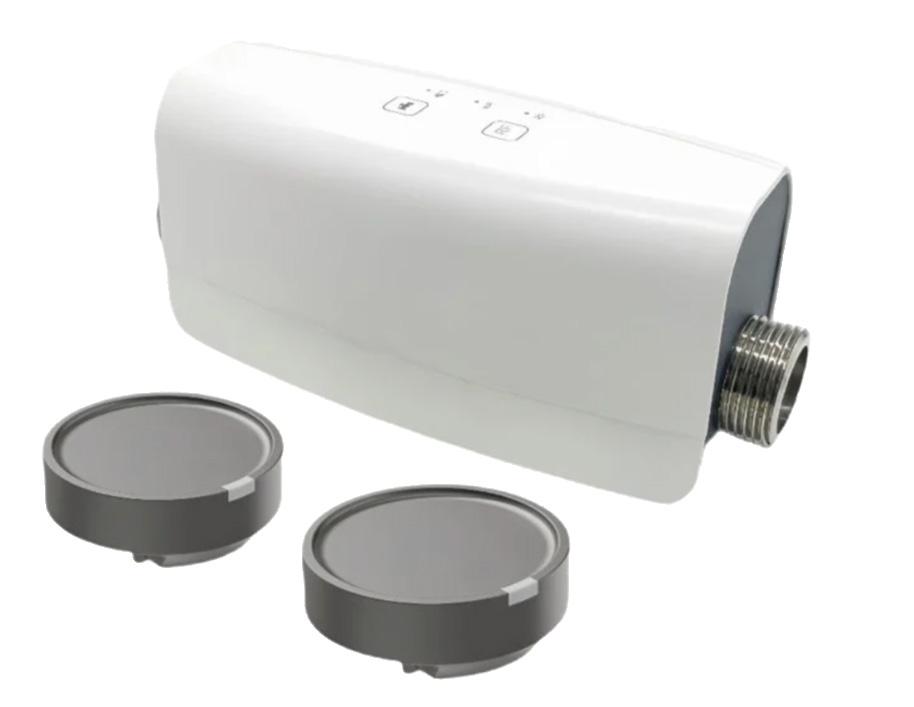
LeakStop III from IDC Fluid Control is a fully automated water leak detection system for homes and small commercial buildings. The system is built to alarm in the event of a leak detection. Using wireless sensors on the floor and a connected valve on the water line, when the water flow is continuous and exceeds a preset and programmable maximum value, the system automatically shuts down water flow. idcgroup.com.cn
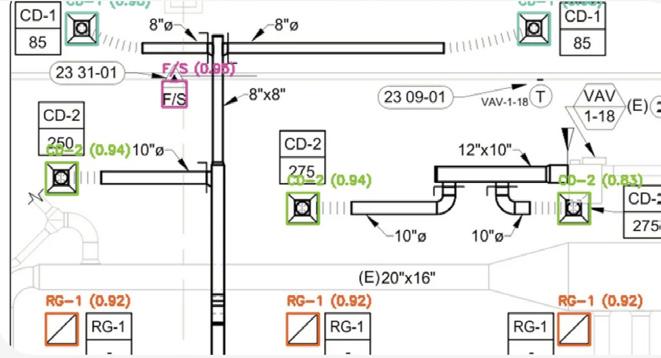
Rebar is the first AI-powered takeoff platform built for HVAC. The software reads construction plans, identifies mechanical pages, marks equipment and generates accurate takeoffs in minutes—eliminating hours of manual work. Purpose-built by industry experts, Rebar helps estimators and reps move faster, win more jobs and streamline the entire sales process. withrebar.ai
Continued on p46

Blue Frontier’s technology to cool and dehumidify is an evolution away from refrigerants and the vapour compression cycle. The technology uses liquid dessicant to control humidity and temperature. As a dedicated outdoor air system (DOAS), it’s proven to be 300% more energy efficient than current technologies, and contains a dispatchable thermal storage battery and can independently control dew point and dry bulb temperature, providing improved comfort. bluefrontierac.com
SAMMi (systematic autonomous management and monitoring intelligence), a new product from CSG Compressors, is an AI-powered HVAC and refrigeration monitoring and dispatch system that detects compressor abnormalities in real time before they cause breakdowns. It autonomously alerts and dispatches technicians, saving time, money, and product loss. The technology uses machine learning to analyze patterns in compressor behaviour, temperature fluctuations, power usage and other metrics. Easy to install and scalable, SAMMi works with a wide variety of compressor equipment types turning reactive maintenance into smart, seamless prevention. sammi-ai.com
The ACH580 variable frequency drive from ABB Motors and Drives enables seamless control when paired with up to six ABB EC Titanium motors, optimizing energy efficiency, reducing installation complexity, and lowering total cost of ownership. This intelligent fan array solution delivers high performance and simplified permanent magnet motor management for advanced HVAC applications. abb.com
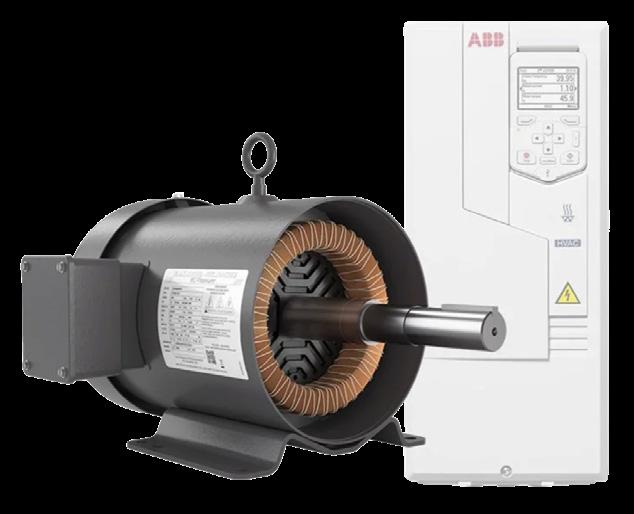



Why a weekly cash flow forecast beats checking your bank balance.
BY MATTHEW BIRCH
For many plumbing and HVAC owners, December feels like a wellearned exhale. The furnace season rush has passed. Crews are still steady with service calls, but the chaos of November breakdowns has eased. The bank balance looks healthy — maybe even great — after weeks of strong billing.
That was exactly where Chris found himself last December. His company had just wrapped a record month. Trucks were finally paid off, overtime was tapering, and his business account showed almost $90,000.
So he relaxed. He gave holiday bonuses, prepaid some supplier invoices, and treated his team to a well-deserved dinner. But by mid-January the calls had slowed, collections lagged, and the account balance had slipped under $20,000. Payroll was due next week.
Chris hadn’t done anything “wrong.” He’d done what most owners do — taken comfort in his bank balance and tried to estimate the rest in his head:
“I’ve got payroll next Tuesday, a supplier payment Friday, and a $12,000 deposit coming in soon. I should be fine.”
Except, like most of us, he forgot a few things: vehicle insurance renewals, credit-card payments, tax installments.
The truth wasn’t that Chris didn’t understand cash flow. He did. The problem was that keeping track in his head wasn’t enough.

Your bank account tells you what you have today, not what’s coming tomorrow. It’s like checking the thermostat instead of the weather forecast — helpful for now but useless for planning.
Most owners know this. They understand their balance doesn’t show upcoming payroll or supplier payments. But in the middle of a busy season, they “do the math” mentally — adding expected receivables and subtracting upcoming bills, hoping the cushion holds.
That’s not ignorance; that’s overload. Running a trades business is already demanding — dispatching crews, quoting, managing customers, so doing rolling mental math with dozens of moving parts is too much to track accurately.
The result? Loose estimates, gutbased decisions, and a quiet hope that cash will stretch until the next big deposit lands.
A weekly cash-flow forecast replaces
hope with clarity. It’s not about predicting the future perfectly — it’s about seeing enough of it to stay calm and in control.
At its simplest, a weekly forecast is a short table, often one page or one spreadsheet tab, showing what’s expected to come in and go out over the next eight to 12 weeks. It includes:
• Opening balance: What’s in your account right now.
• Expected inflows: Customer payments, progress draws, or new deposits.
• Expected outflows: Payroll, supplier bills, fuel, rent, insurance, loan payments, taxes.
• Closing balance: What’s left at the end of the week if everything happens as planned.
Continued on p48
Continued from p47
That’s it. No fancy software required. Many owners start by listing the next eight Fridays, noting what’s coming and going each week.
Once you start tracking it, patterns emerge. You’ll see that the second week of every month is tight because payroll and supplier invoices collide, or that mid-winter AR collections lag two weeks behind billing. Suddenly, your “cash surprises” stop being surprises.
Monthly reporting is useful for accountants, but it’s too slow for operators.
A weekly view keeps you close to the ground. It lets you anticipate and adjust before problems compound.
• Payroll rhythm: If you pay weekly or bi-weekly, monthly reports hide cash crunches.
• Seasonal swings: In December and January, cash inflows often slow just as expenses stay high.
• Small corrections: A short weekly check-in lets you move supplier payments, collect an overdue invoice, or delay a purchase — all before you hit the red zone.
Every owner has done the “mental math” routine: “We’ve got $40K in the bank, payroll’s $18K, and I’ve got two deposits coming, we should be good.”
But as businesses grow, the moving parts multiply: payroll taxes, warranty claims, supplier terms, vehicle repairs, credit-card cycles. What seems simple becomes mentally impossible to track. When you stop relying on mental math and start tracking numbers weekly, you replace uncertainty with awareness. You stop guessing and start planning. The forecast doesn’t eliminate surprises, it just makes them visible early enough to act. That visibility is power.
Here’s a secret benefit most owners don’t talk about: it’s easier to stay disciplined when someone else is watching.
When you review your forecast with a professional bookkeeper or fractional CFO each week or every other week, you gain two huge advantages:
Accountability. Just knowing someone will be reviewing numbers with you keeps the process consistent.
Interpretation. They help spot patterns you might miss like, payment issues, or AR bottlenecks.
You don’t need long meetings. Thirty minutes is often enough to compare actuals against last week’s forecast, update any changes and roll forward.
That short rhythm builds calm. Owners often describe it as financial therapy. It’s not about judgment; it’s about partnership.
A professional bookkeeper becomes your financial accountability coach. They help you turn the forecast into action, whether that means timing draws, smoothing payables or building a reserve buffer before the next slow spell.
Winter magnifies the need for control. Collections slow as customers stretch payments after the holidays. Workload can fluctuate with weather patterns, a warm spell quiets the phones, a cold snap floods them.
This is the season when a weekly forecast earns its keep:
• You’ll see exactly how many weeks of cash you can cover if work slows.
• You can plan which supplier bills to pay early (for discounts) and which to hold until collections improve.
• You can set aside tax or insurance payments instead of letting them sneak up in February.
More importantly, a clear forecast lets you sleep better knowing you have a plan, even when the phones are quiet.
Start small. Block 30 minutes on Friday mornings.
1. Update the week’s actual inflows and outflows.
2. Review what’s coming next week.
3. Note your lowest projected balance in the next 6–8 weeks.
4. Adjust early, call customers, move supplier payments, or tighten expenses if needed.
If you stick with it for a month, you’ll wonder how you ever ran the business without it.
This simple rhythm turns guesswork into leadership. It’s not about being an accountant, it’s about owning your numbers instead of letting them own you.
Checking your bank balance gives you comfort for a moment. A weekly cashflow forecast gives you confidence for the month ahead.
When you can see the dips before they arrive, you don’t panic, you plan. You use your numbers to make decisions instead of letting your emotions make them for you.
Winter will always test cash flow in the trades. But with a simple weekly forecast and a trusted advisor by your side, it doesn’t have to test your nerves.
<>

Matthew Birch is the founder of Legacy Profit Solutions, a firm that helps trades-based business owners build stronger financial foundations through strategic bookkeeping partnerships and accounting advisory services. If your plumbing or HVAC company is ready for a more experienced bookkeeping firm or CPA, Legacy can introduce you to a trusted professional who understands your business and your goals. Matthew@LegacyProfit.ca.
Critical to the refrigeration system, understanding TEV fundamentals goes a long way to identifying potential system problems.
BY DAVE DEMMA
The course of study to become a doctor is rigorous; four years of undergraduate study, medical school, internship, residency, and then if one makes it through that lengthy apprenticeship, they have earned the right to practice medicine in one of many specialties. Why does it take so long?
Simply put, there is so much at stake. The human body can simplistically be viewed as a biological machine with some basic parallels to a mechanical refrigeration system. The heart is a pump, the veins are “pipes” supplying blood to the intended locations and the nervous system is a complex electrical circuit, with the brain as the central control.
If you can agree with the comparison, would it then be such a stretch to think of the refrigeration technician as a refrigeration doctor? If so, perhaps the technician can benefit from emulating a doctor’s methods in analyzing technical problems?
For example, would a doctor suggest a heart transplant because he is “pretty sure” the patient’s heart is not operating properly? Of course not!
The foundation for making that decision was formed years ago. It would not have been learned by watching a 60-minute YouTube video, but a thorough study coupled with years of ob -
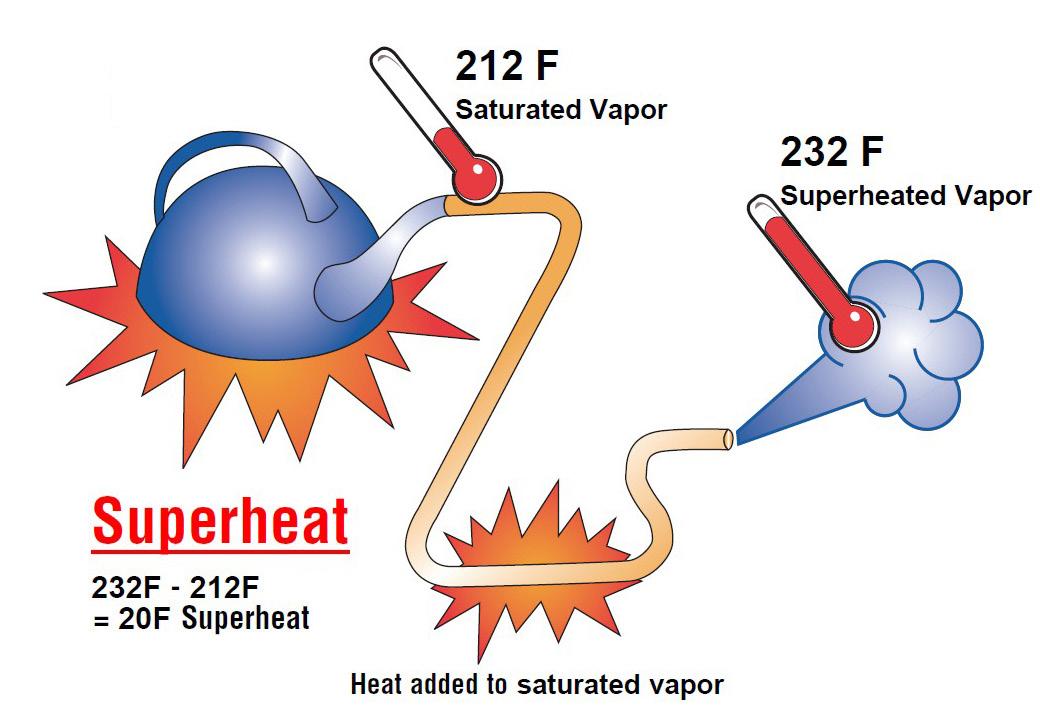
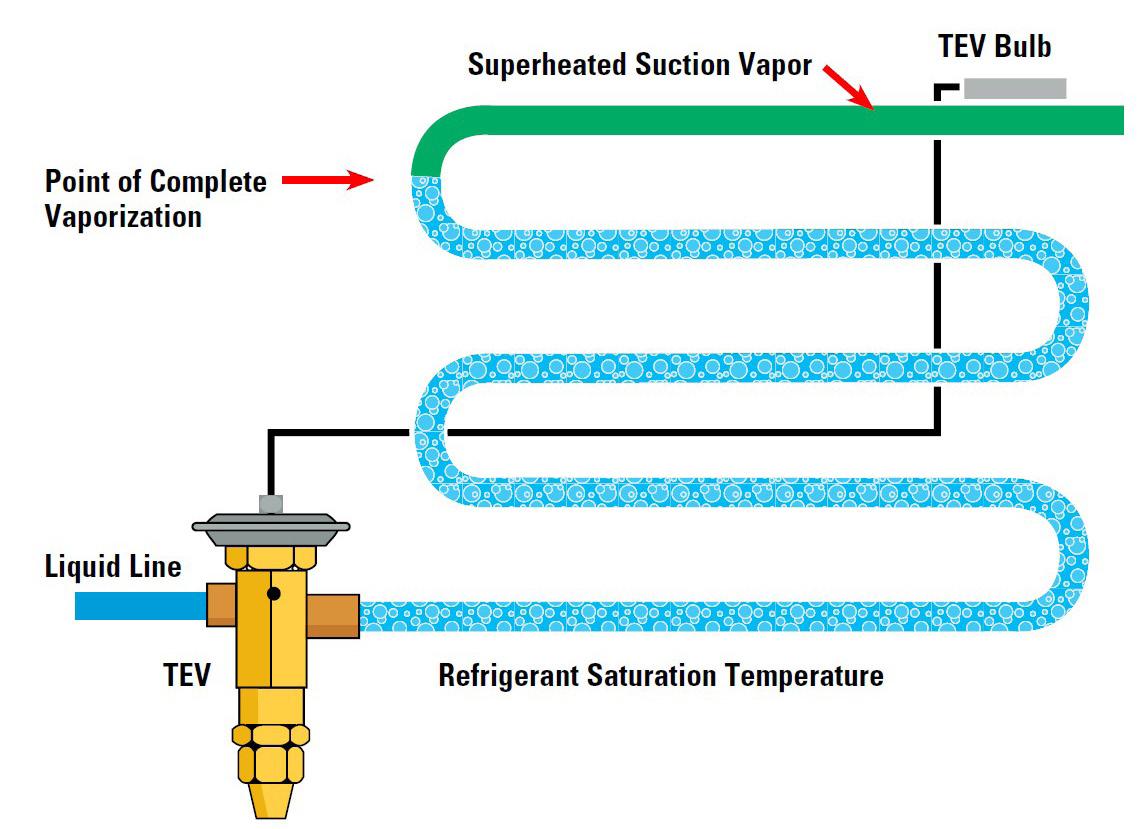
serving a practicing doctor diagnosing, performing operations and then real on the job training. Any hint of mystery surrounding the diagnosis would have disappeared long before having to make the crucial decision to recommend the transplant.
So, what can a refrigeration technician learn from this discipline? Well, let’s discus the thermostatic expansion valve (TEV) from the perspective of being a refrigeration doctor.
Let’s go back to Refrigeration 101. The refrigeration system is designed to remove heat from the space to be conditioned with the end goal being a constant temperature in the space. The refrigerant is simply the medium for transferring heat from one place to another.
Saturated liquid refrigerant is fed to the evaporator, and transferring heat from the space to the refrigerant results in the liquid boiling into a vapour. It is the function of the TEV to provide the exact amount of saturated liquid refrigerant to the evaporator to meet the requirements of the heat transfer load. Is this a constant load? No. So the TEV must be a refrigerant flow control and respond to changes in system conditions. Which system conditions? Temperature and pressure. When known, these two conditions can be converted to superheat. By maintaining a constant superheat at the evaporator outlet the TEV can ensure the proper amount of refrigerant is being fed to the evaporator.
So, what is superheat, and how much is the proper amount of superheat?
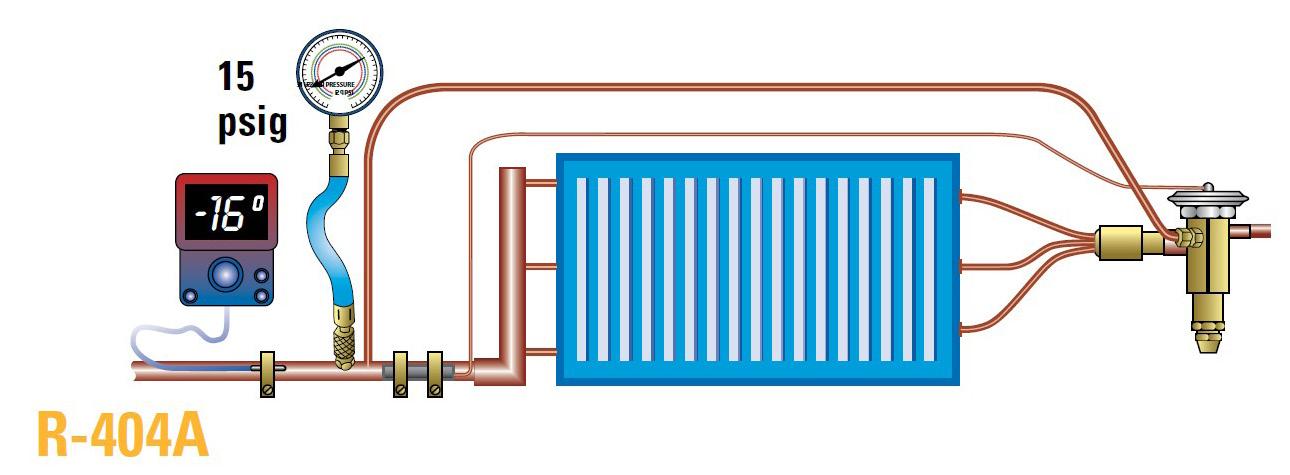
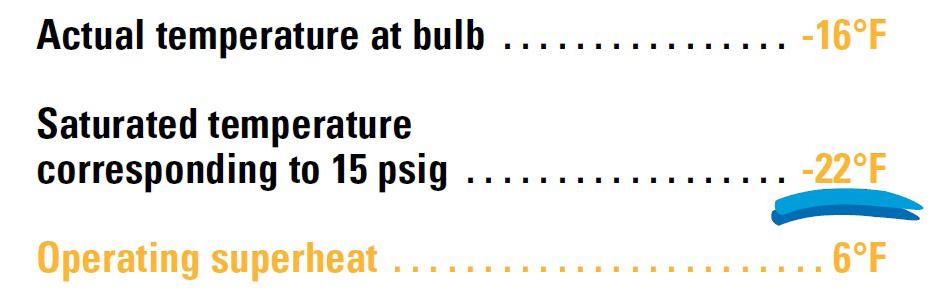
Whoa, this is way too much work. If something’s not working, wouldn’t it be much easier to just say the TEV is bad, replace it, and be done with it? Well, do you want to be known as a refrigeration technician who is merely a parts changer or a refrigeration doctor?
Figure 1 (previous page) shows a kettle of boiling water, it’s used to illustrate the principle of superheat. At sea level, water boils at 212F (100C). This is the point where water changes states from liquid to vapour, the saturation temperature.
A liquid’s temperature cannot be raised above its boiling point; therefore the vapour leaving the kettle is also at 212F. If additional heat is added to the vapour then its temperature will increase. By definition, the difference between the vapour temperature and the saturation temperature, at a given pressure, is superheat.
In Figure 1 the saturation temperature is 212F, and the heated vapour temperature is 232F. The superheat is the difference between the two: in this case, 20 degrees.
Let’s look at what happens in the evaporator. Figure 2 shows a TEV supplying saturated liquid and vapour to the evaporator inlet. Using a fan to blow the relatively warmer air in the space across the evaporator coils containing the relatively cool refrigerant will allow heat transfer to occur; heat from the air is transferred to the refrigerant.
This causes the saturated liquid refrigerant to boil. If the TEV is set correctly there will come a point near the outlet of the evaporator when the last molecule of liquid boils into vapour, the point of complete vaporization.
The remaining portion of the evaporator is used to superheat that vapour. As the load increases or decreases, or as the point of complete vaporization moves closer to, or further away from, the evaporator outlet, the TEV will close or open to
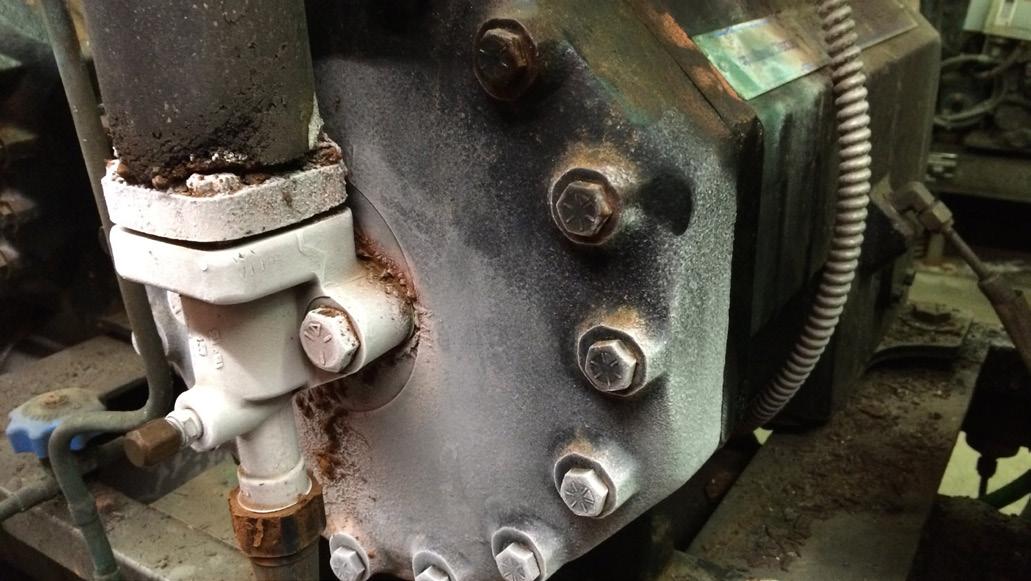
maintain a constant superheat at its bulb location.
The only way to ensure there is no liquid present at the evaporator outlet is to maintain some amount of superheat.
So, what is the proper amount of superheat? That is really up to the equipment manufacturer, and it is typically determined in their test lab.
How is the superheat measured? Figure 3 (above) shows a typical low temperature R-404A refrigerant application, and the proper method of measuring superheat.
Pressure and temperature are required to calculate the superheat. Since the TEV controls superheat at its bulb location, this is where the measurements must be made. Measuring the pressure establishes the saturation temperature at the bulb location. Knowing the actual temperature at the bulb will reveal whether the refrigerant is superheated (vapour) or saturated (liquid and/or vapour). Subtracting the saturation temperature from the actual temperature will yield the superheat. Of course, if the superheat is too high the TEV is underfeeding, and if it’s too low the TEV is overfeeding.
There are some technicians who fear seeing ice on a suction line; particularly if is at the compressor inlet. In actuality, without any sound data procured with instruments, the only absolute fact one could derive would be that the pipe is at a temperature which would produce ice (32F/0C or less).
Let’s look at this example: saturation temperature of -22F, actual temperature of -16F (so 6F degrees of superheat). If the vapour is superheated there cannot be any liquid present. Yet a pipe at -16F will have frost on it.
At 250-feet away in a remote machine room the suction line temperature may have risen to +10F; still cold enough for moisture content in the air to condense and freeze on the compressor suction service valve. Ice…yes. Floodback…an emphatic NO!
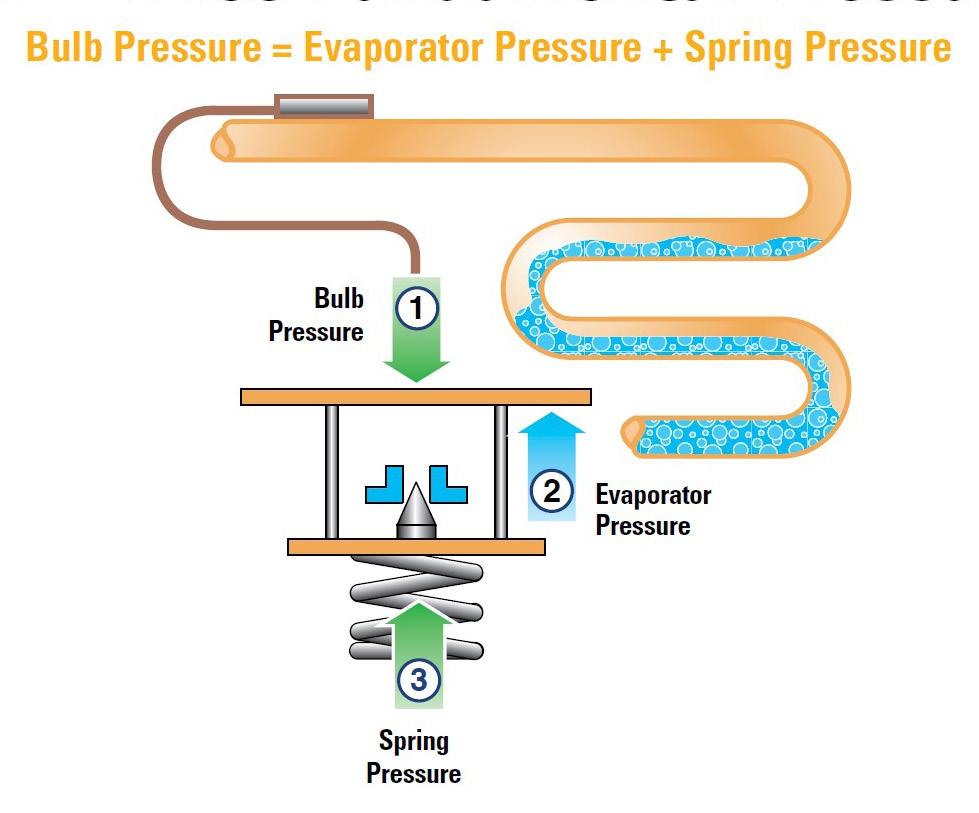
viding point between the two teams.
A charge of some fluid is present in the sensing bulb, and it too has a temperature pressure relationship. Team Opening Force (sensing bulb pressure) is influenced by bulb temperature, which then causes the fluid in the bulb to reach a specific pressure. The closing force team has two members: evaporator pressure and adjustment spring pressure.
If the opening force team momentarily becomes stronger than the closing force team, the diaphragm moves downward opening the valve port. This only happens when the superheat has risen above a set-point, causing the bulb temperature to increase, which causes the bulb pressure to increase, which moves the valve pin away from the port, which allows more refrigerant to enter the evaporator.
25_011822_HPAC_DEC_CN Mod: October 20, 2025 4:39 PM Print: 11/10/25 page 1 v2.5
pressure at the sensing bulb location. If the pressure at the TEV outlet (evaporator inlet) is very close to the pressure at the evaporator outlet, it can be used as a close approximation of the value we need.
This is what an internally equalized TEV does; uses its outlet pressure as an approximation of the pressure at the evaporator outlet. That pressure is transferred under the diaphragm via excessive leakage around the pushrods or through a dedicated passageway. The external equalized TEV comes with a third fitting on it which allows a connection to be made to the evaporator outlet. This pressure is then allowed to travel through a dedicated passageway in the TEV body to the bottom of the diaphragm (See Fig. 6).
What about troubleshooting the TEV? The TEV is a superheat control. The first step in troubleshooting would be to measure the superheat at the sensing bulb location. A second beneficial piece of information would be to compare the actual suction pressure to what the expected suction pressure should be. For example, an air conditioning system should be operating at the pressure that corresponds to a saturation temperature of between 40F and 45F. Comparing the actual pressure to the expected pressure will reveal whether the compressor is experiencing low load, high load, or normal load. Understanding the forces which determine the TEV operation makes it easy to logically prepare a list of potential causes for underfeeding/overfeeding symptoms. In addition, on sin -
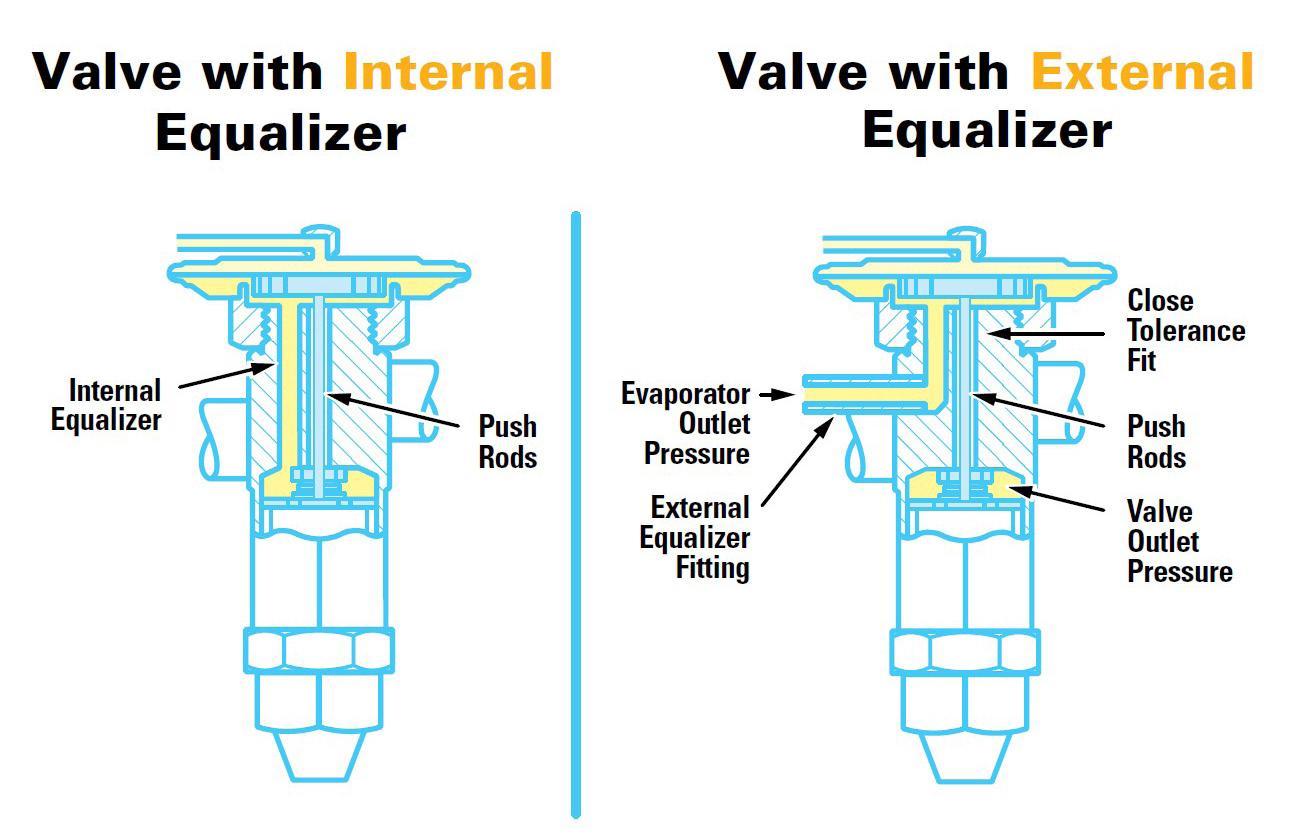
gle compressor applications the suction pressure will reveal the relative load on the compressor. When analyzing the suction pressure with the superheat one can make deductions.
1. Low suction pressure (compressor under a low load) paired with high superheat (TEV underfeeding) dovetails together nicely. One would expect the suction pressure to be low if the TEV were underfeeding.
2. High suction pressure (compressor under high load) paired with low superheat (TEV overfeeding) also dovetails together nicely. One would expect the suction pressure to be low if the TEV were overfeeding.
3. Low suction pressure (compressor under low load) paired with low superheat (TEV overfeeding) doesn’t seem like a logical pair. However; there are several conditions that would lead to this.
High superheat is the result of insufficient refrigerant flow in comparison to the load requirement. Possibilities: TEV too small, superheat adjustment incorrect; external equalizer plugged up; debris in the TEV port restricting refrigerant flow; contaminant in the TEV body preventing the valve’s pin or pushrods from moving; TEV element which has lost its refrigerant charge; insufficient liquid feed to the TEV inlet (plugged strainer or filter-drier, flash gas in the liquid supply); or excessive pressure loss in the liquid line, resulting in liquid flashing prior to the TEV inlet. Since 100% liquid at the TEV is required to maintain valve capacity, any reduction in liquid flow will result in an underfeeding TEV.
Not all superheat abnormalities are the result of TEV failure. This is where the refrigeration doctor must expertly diagnose the cause, rather than be

Likewise, keep in mind that the evaporator is a heat transfer device, and rated airflow is required for the evaporator to operate at its rated capacity. If the airflow is reduced below the design CFM, then the TEV now becomes too large for the reduced heat transfer ability of the evaporator.
Reduction in air flow can be the result of: dirty air filters or dirty evaporator coil; loose, worn, or slipping belt; an iced up evaporator; incorrect fan motor, fan blade, or malfunctioning motor.
All of these conditions will result in a low load condition, resulting in low suction pressure. If the reduced load is severe enough, the TEV will not be able to maintain its superheat setting, resulting in overfeeding/low superheat.
While this discussion has revolved around the TEV, the larger point is that the technician should approach trouble
logical process based upon a solid foundation of system operation, understanding the function of each system component, understanding the operation of each system component, using the proper instruments to garner information about the operation of the system, and then using that information to make a logical deduction of the problem. And finally, realizing that finding the problem doesn’t necessarily equate to determining the root cause of the system problem. Going the extra mile to determine and correct the root cause is the stuff that doctors are made of. <>

Dave Demma holds a degree in refrigeration engineering and worked as a journeyman refrigeration technician before moving into the manufacturing sector where he



March 24, 2026 | 6 - 11 PM Metro Toronto Convention Centre Room 718 for a formal evening of celebration in honour of our charitable partnership with Habitat for Humanity Canada. Featuring JUNO Award & Canadian Screen Awardnominated singer-songwriter, Peter Katz. Join Us Learn more & register at: www.ciph.com/page/CIPHCharity



January 31-February 4
This year’s technical sessions follow nine tracks and include over 100 sessions. Key topics include: energy storage and grid resiliency; pathways to decarbonization; AI; indoor environmental quality for healthy buildings; refrigeration and refrigerants; and more. ashrae.org/conferences
February 17-19
The Kitchen & Bath Industry Show (KBIS) is North America’s largest trade show dedicated to kitchen and bath design. This event brings together 650 exhibitors showcasing the latest products, trends, and technologies in nearly 500,000 sq. ft. of exhibit space. kbis.com
March 31 – April 2
Boiler Expo, presented by the American Boiler Manufacturers Association (ABMA), is an event for anyone engaged in the purchasing, operation and maintenance of boilers in commercial, institutional and industrial environments. abmaboilerexpo.com
May 20
Returning to the Vancouver Convention Centre, this fifth edition of the Heat Pump Symposium delivered by the Heating, Refrigeration and Air Conditioning Institute of Canada (HRAI) will include a day filled with educational sessions and a trade show element featuring the latest in heat pump technologies. heatpumpsymposium.ca

February 2-4, 2026
The Air conditioning, Heating, Refrigeration (AHR) Expo returns to Las Vegas to showcase the latest in technology advancements for the industry. Co-sponsored by ASHRAE and AHRI, the expo and conference is the largest of its kind in North America. ahrexpo.com
March 15-18
The Air Conditioning Contractors of America Association will gather at Caesars Palace in Las Vegas for educational sessions focused on leadership, finance, operations and workforce development. In addition to sessions and exhibits, there is plenty of informal networking. accaconference.com
April 13-15
The International Ground Source Heat Pump Association event includes two full days of presentations, exhibitor displays and a lot of time to network with industry professionals. This year’s event is being held at the Ameristar Casino in St. Charles, Missouri. igshpa.org
June 14-16
The Annual Business Conference is the Canadian Institute of Plumbing and Heating’s premier event bringing together senior leaders representing manufacturers, wholesalers and agents for a mix of business and social programming. The event will be at the Algonquin Resort is St Andrews, New Brunswick. ciph.com
February 16-19
Taking place this year in Indianapolis, Indiana, the Water & Wastewater Equipment, Treatment & Transport Show (WWETT Show) is an annual trade show and conference for wastewater and environmental service professionals. wwettshow.com
March 25-27
The Canadian mechanical and plumbing industry once again comes together at the Metro Toronto Convention Centre, south building, in downtown Toronto for the nation’s largest trade show that takes place every two years. cmpxshow.com
May 6-7
The Mechanical Electrical Electronic Technology show is returning to the Moncton Coliseum in Moncton, New Brunswick. Featuring the latest equipment, products and technology on the horizon, this will be the 26th edition of this eastern Canadian trade event. meetshow.ca
June 27 – July 1
The global society of heating, refrigerating and air conditioning engineers will be holding its five-day annual conference in Austin, Texas. The program will include technical sessions covering all of the latest developments in building science.
ashrae.org
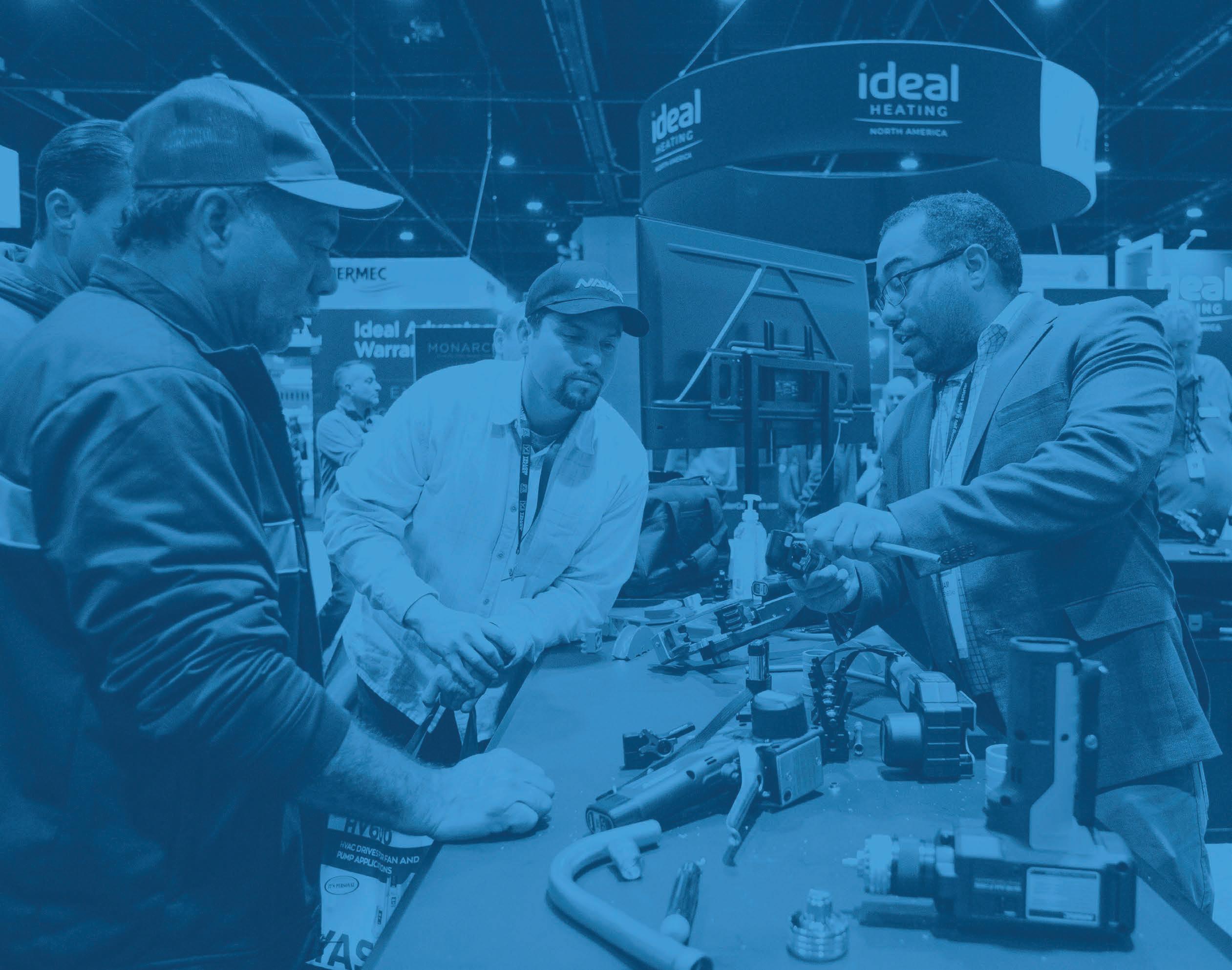
Get hands-on with the latest tools and learn tips from expert-led training and education sessions. Engage with pros from across the industry and discover cost-effective and cutting-edge solutions to real-world problems. AHR is your place to expand beyond your day-to-day.
FEB 2 -4

Available across Canada at these fine distributors
Western Canada
Ontario
Quebec
Atlantic Canada