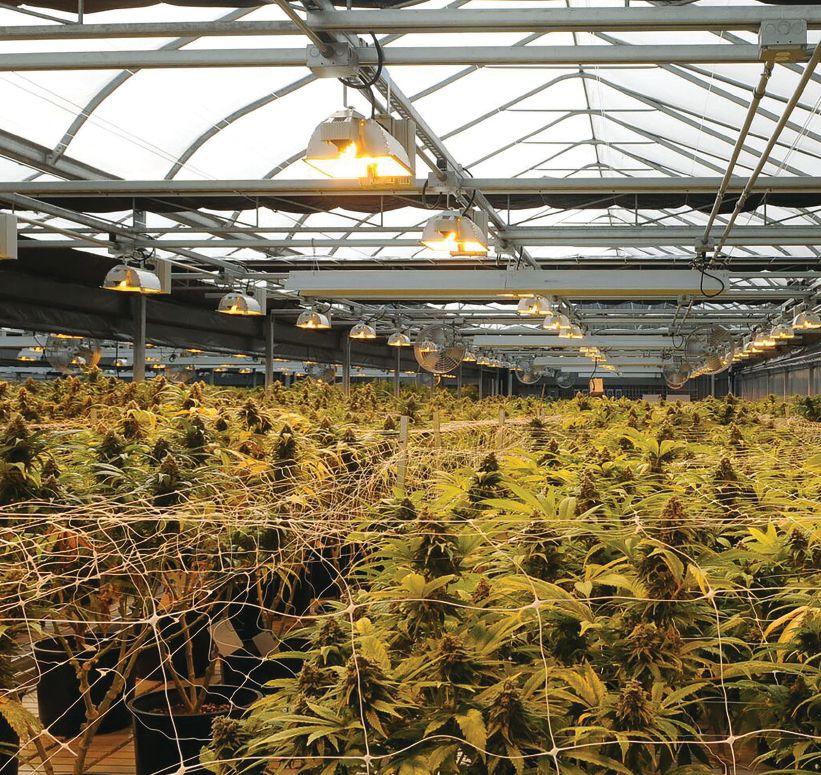
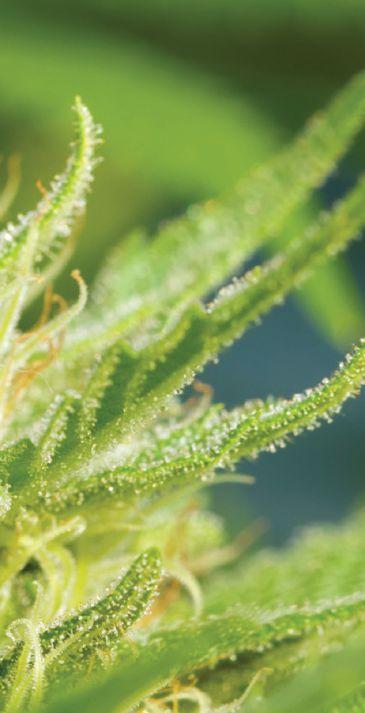
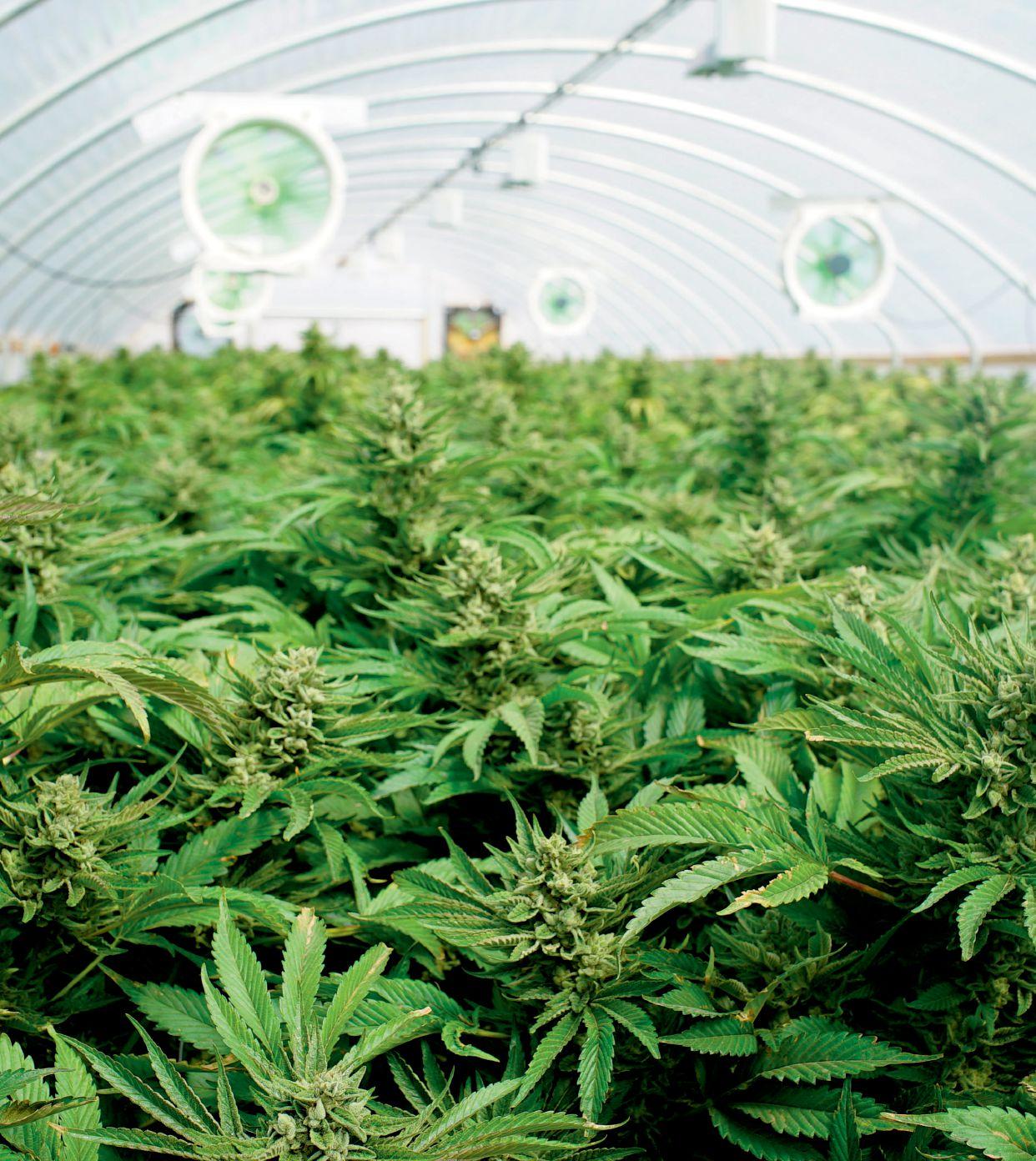
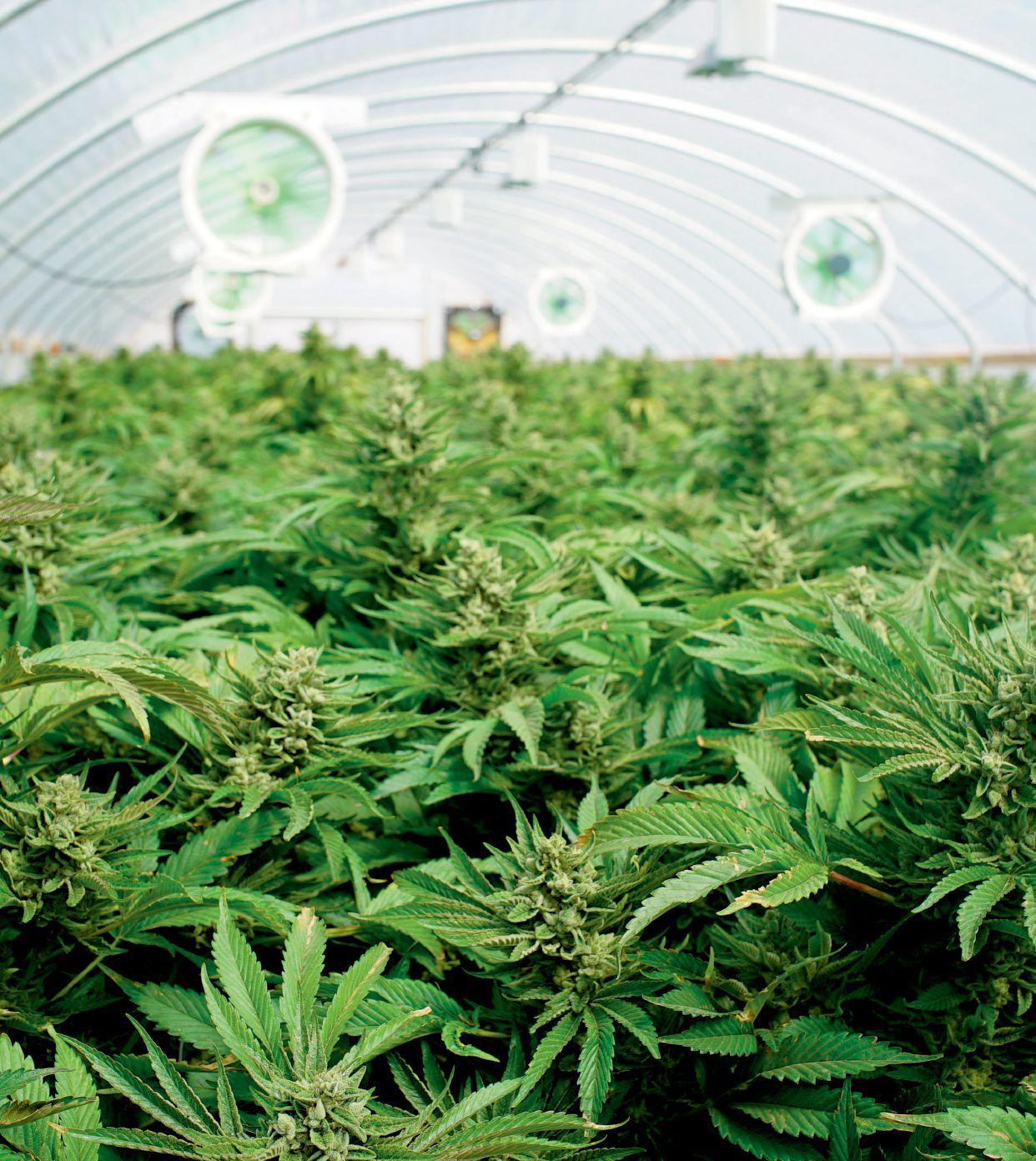
If you are planning to move your cannabis growing into a greenhouse, it is critical to understand these Top 10 industry myths BY LEIGH COULTER
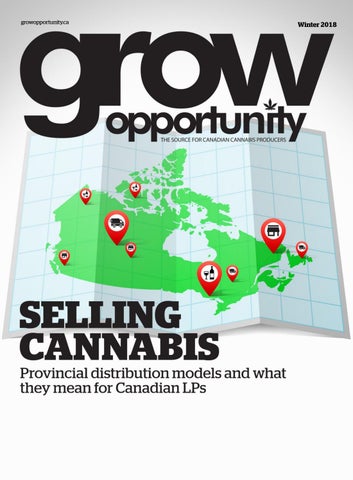
18 COVER STORY Coast to Coast Distribution Before recreational legalization arrives this summer, LPs across Canada need to start looking at how they can sell their cannabis in each province BY TREENA HEIN
22 LED Lighting for Optimization
Why temperature and CO2 are vital variables to examine when deciding on the proper lighting for a grow room BY DR.
MATT WHEATLEY
By Paul Grossinger
Opportunities and Challenges
This past November, accounting giant Ernst & Young (EY) released a 12-page report focusing on the opportunities for Canadian licensed producers (LPs) of cannabis. Conversely, in that very same report, it noted that an uncertain operating landscape also exists, thus presenting enormous challenges for LPs.
The title of the report, which is largely based on a survey of LPs, drives the point home: How do you define your future in an undefined market? EY’s report was released as wild market swings were hitting listed cannabis companies in both Canada and the U.S.
The Toronto Star’s David Olive recently described some realities of the undefined cannabis market in his article, 6 reasons an investment in the pot industry will likely go up in smoke . He noted that from August to November 2017, investors helped drive up the stock-market value of several Canadian industry leaders, including Canopy Growth by 107 percent, Aurora Cannabis, 147 percent, and Aphria, 49 percent. Much of his article focused on the potential negative impact of low-cost production in the black market even after the legalization of both medical and recreational marijuana, estimating these markets will reach $1.3 billion and $6 billion, respectively, by 2021.
These market-size estimates put forth by Olive are probably on the low side, with other predictions reaching toward
$10 million (January 2016 via CIBC extrapolating Colorado cannabis market numbers) and as much as $22.6 million (Deloitte in October 2017). Olive, however, explains this relatively small market will be under consolidation pressure when there are already some 70 publicly traded marijuana firms in Canada and at least another 20 privately held cannabis firms – with many more awaiting licenses. Olive’s assertion is certainly debatable considering the role of small businesses driving Canada’s agricultural sector. There is certainly merit in his point, however, that the high number of public LPs and start-up surge in Canada is largely the result of America’s refusal to decriminalize pot at the national level.
Cannabis LPs, will face competition from established companies in industries like pharmaceuticals tobacco, and alcohol.
In January 2018, the Canadian Press reported that U.S. Attorney General Jeff Sessions moved to quash an Obama-era policy that allowed legalized marijuana production to increase in that country. The news created a negative impact on marijuana stocks as Sessions’ memo stated he will instead let prosecutors in the states where marijuana is legal to decide how to enforce federal law, which still prohibits the drug. Industry players expect
this proposed U.S. stance to become a positive for the Canadian cannabis industry – as larger LPs begin to consolidate and expand globally.
As for the aforementioned EY report, it found that 37 percent of Canadian LPs are focusing on scaling up capacity and production to meet anticipated post-legalization demand. The report explains the ability to raise capital to support the cost of increased production, or even the willingness to invest given the current regulatory uncertainty, are key challenges. In January 2017, however, Vice reported that for the first time a Big Six Canadian bank led an equity financing round for Canada’s largest Cannabis producer, Canopy Growth Corp., with the Bank of Montreal co-leading the underwriting of a $175-million stock sale with GMP Capital.
EY also points out how entrepreneurial cannabis LPs, will face competition from established companies in industries like tobacco, pharmaceuticals and alcohol, which are well positioned to enter the cannabis market. A slow licencing process, explains EY, affects the ability to raise capital and cultivate in time for legalization when the medical market alone is expected to reach 500,000 patients by 2021, which translates into a projected demand of 150,000 kg of cannabis flower.
These divergent numbers indeed show the challenges for LPs to define their future in an undefined market.
Winter 2018 Vol. 2, No. 1 growopportunity.ca
EDITOR
Mari-Len De Guzman mdeguzman@annexbusinessmedia.com 289-259-1408
EDITOR Paul Grossinger pgrossinger@annexbusinessmedia.com 416-510-5240
ASSOCIATE PUBLISHER Adam Szpakowski aszpakowski@annexweb.com 289-221-6605
ASSOCIATE PUBLISHER Adam Szpakowski aszpakwoski@annexweb.com 289-221-6605
NATIONAL ADVERTISING MANAGER Nashelle Barsky nbarsky@annexweb.com 905-431-8892
NATIONAL ADVERTISING MANAGER Nashelle Barsky nbarsky@annexweb.com 905-431-8892
NATIONAL ACCOUNT MANAGER
NATIONAL ACCOUNT MANAGER Sarah Otto sotto@annexweb.com 888-599-2228 ext 237
Sarah Otto sotto@annexweb.com 888-599-2228 ext 237
ACCOUNT COORDINATOR Mary Burnie mburnie@annexweb.com 519-429-5175 888-599-2228 ext 234
ACCOUNT COORDINATOR Mary Burnie mburnie@annexweb.com 519-429-5175 888-599-2228 ext 234
CIRCULATION MANAGER Barbara Adelt badelt@annexbusinessmedia.com 416-442-5600 ext.3546
MEDIA DESIGNER
CIRCULATION MANAGER Barbara Adelt badelt@annexbusinessmedia.com 416-442-5600 ext.3546
Brooke Shaw
MEDIA DESIGNER
Brooke Shaw
GROUP PUBLISHER Martin McAnulty mmcanulty@annexbusinessmedia.com
PRESIDENT & CEO Mike Fredericks
GROUP PUBLISHER Martin McAnulty mmcanulty@annexbusinessmedia.com
MAILING ADDRESS
COO
P.O. Box 530, 105 Donly Dr. S., Simcoe, ON N3Y 4N5
Ted Markle tmarkle@annexbusinessmedia.com
PRESIDENT & CEO Mike Fredericks
MAILING ADDRESS
P.O. Box 530, 105 Donly Dr. S., Simcoe, ON N3Y 4N5
SUBSCRIPTION RATES 1 year subscription (4 issues: Winter, Spring, Summer, Fall): 1 year offers: Canada $25.00 + Tax USA $35.00 USD FGN $40.00 USD GST # 867172652RT0001
SUBSCRIPTIONS
SUBSCRIPTION RATES 1 year subscription (4 issues: Winter, Spring, Summer, Fall): 1 year offers: Canada $25.00 + Tax USA $35.00 USD FGN $40.00 USD GST # 867172652RT0001
Roshni Thava rthava@annexbusinessmedia.com Tel: 416-442-5600, ext. 3555 Fax 416-510-6875 or 416.442-2191 111 Gordon Baker Rd., Suite 400, Toronto ON M2H 3R1
Tel: 416-442-5600, ext. 3555 Fax 416-510-6875 or 416.442-2191 111 Gordon Baker Rd., Suite 400, Toronto ON M2H 3R1
Occasionally, Grow Opportunity will mail information on behalf of industry-related groups whose products and services we believe may be of interest to you. If you prefer not to receive this information, please contact our circulation department in any of the four ways listed above.
Occasionally, Grow Opportunity will mail information on behalf of industry-related groups whose products and services we believe may be of interest to you. If you prefer not to receive this information, please contact our circulation department in any of the four ways listed above.
We recognize the support of the Government of Ontario
Emerald Goddess® is designed to be the most potent biocatalyst on the market today. It contains invigorating ingredients helping your valuable plants grow strong and bear big fruits. Achieve SIMPLE, EASY SUCCESS with Emerald Harvest.
Aurora Cannabis to Purchase CanniMed
Aurora Cannabis struck a deal valued at $1.1 billion to buy rival licensed producer CanniMed Therapeutics, bringing an end to a hostile takeover battle between the two marijuana companies. During a public war of words before agreeing to talks, CanniMed argued that Aurora’s earlier all-stock offer valued at up to $24 per share was too low, given the wild swings in marijuana stocks. The deal also means CanniMed abandoned plans to acquire Newstrike Resources Ltd., paying a $9.5-million break fee .
Minimum Wage Costs
Licensed medical marijuana producer Aphria calculated that Ontario’’s 21-per-cent minimum pay jump from $11.60 to $14 per hour would add another $600,000 to its overall wage costs each year. “If this increase had been in effect in the current quarter, the company’s ‘all-in’ cost of sales of dried cannabis per gram would have increased by approximately $0.12 per gram,’’ stated the Leamington, Ont., company in recent financial documents. That’s an increase of nearly six per cent from its all-in cost of $2.13 per gram during the quarter ended in November 2017.
Aphria and Nuuvera Combine Expertise
Licensed marijuana producer Aphria Inc. reached an agreement to buy medical cannabis firm Nuuvera in a cash-and-stock deal that it says values the company at $826 million. The deal builds on a partnership between the companies as it combines Aphria’s production with Nuuvera’s expertise in cannabis processing and extraction. The combination will also help grow Aphria’s international footprint. Analysts expect consolidation to accelerate in the sector ahead of the legalization for recreational use of marijuana this summer.
8.8 MILLION raised by Aqualitas, a newly licensed Nova Scotia producer of medical cannabis
Feds Change Access to Cannabis Security Requirements
On January 25, Health Canada announced two important changes to the physical security requirements under the Access to Cannabis for Medical Purposes Regulations (ACMPR) that impact licensed producers of cannabis for medical purposes. Health Canada explains these changes are based on nearly 1,000 physical inspections since 2013.
First, LPs will no longer be required to meet the vault and storage measures outlined in the existing Directive on Physical Security Requirements for Controlled Substances. Previously, LPs had to maintain a high-security vault for the storage of cannabis products.
Secondly, LPs will no longer be required to maintain 24/7 video surveillance inside the rooms
where cannabis is being cultivated, propagated or harvested. All access points to these rooms, however, must be under 24/7 video surveillance in order to record all entries and exits. Jeff Hannah,owner of JH & Associates, a risk management consulting company, believes these changes are a step in the right direction.
“Really what [Health Canada] did is they acknowledged the fact that cannabis that is in the growing cycle, what we call ‘wet cannabis’, is not attractive to people to steal because you can’t do anything with it, and they’re acknowledging that,” Hannah explains. “So they’re taking away a good amount of the security around that because it was never really practical.”
Your journey begins here
Health Canada has granted AgMedica Bioscience Inc. (formerly AgriMed Botanicals Inc.) its first license to grow under the Access to Cannabis for Medical Purposes Regulation (“ACMPR”).
Established in 2014 and based in Chatham, Ontario, AgMedica Bioscience Inc. is a vertically integrated biotech company focused on producing high quality and consistent medical and adult-use cannabis at its state-of-the-art production facilities.
As we expand, we are always seeking top talent to join our incredible team! Please visit agmedica.ca for updates and new opportunities. The journey continues!
By Matt Maurer
The Dawn of the M&A Era Legal Matters
If there was one word to describe the Canadian cannabis industry in 2017, it would be explosive.
On the medical side, we saw registered medical patients under the Access to Cannabis for Medical Purposes Regulations (ACMPR) increase significantly, ultimately surpassing 200,000 people before the end of the year.
On the recreational side, we finally saw the Canadian Government in April 2017 make good on its election promise by tabling Bill C-45, the Cannabis Act, in the House of Commons. The legislation was quickly approved through the House and put in front of the Senate before the year was out.
If you are reading Grow Opportunity, you are probably also someone with more than superficial industry knowledge and ultimately aware, that under the Cannabis Act, all producers who are Federally licensed to cultivate and sell cannabis under ACMPR in the medical regime will immediately be able to cultivate and sell in the recreational market when it opens later this year.
It is a poorly kept secret that our government is concerned about the ability of the market to ensure that supply meets demand when the recreational floodgates open. This is a legitimate concern. One has to look no further than south of the border to read stories of long line-ups and empty shelves in the early days of legalization in a variety of American states. It should come as no surprise then, that in May 2017 on the heels of the Cannabis Act being introduced, Health Canada announced it was modifying the existing ACMPR licence application process by, among other things, making it easier for existing licensed producers to obtain licences for expansions and second
Matt Maurer (mmaurer@mindengross.com) is Chair of Minden Gross LLP’s Cannabis Law Group in Toronto. He provides business and regulatory advice to a wide range of cannabis industry stakeholders.
sites. Health Canada also introduced changes to streamline the process and speed up review times for applicants in the queue. The ultimate purpose of these changes is to quickly increase the number of licensed producers, in order to help ensure that demand can be met come legalization of the recreational market.
The numbers do not lie: 38 producers were licensed between 2013 and 2016; and then 47 licences were handed out in 2017 alone. The granting of a new licence, which was once a rare and noteworthy event, quickly became relatively commonplace.
Thirty-eight producers were licensed between 2013 and 2016; then 47 in 2017 alone.
This trend is expected to continue into 2018. There are still hundreds of applicants in the queue and some predict that the industry could see more than 200 licensed producers by the end of this year. Whether or not that figure is accurate is up for debate. What is undebatable, however, is that the number of new licenses will continue to rise sharply this year and beyond. It is unlikely there will be space for everyone who wants to become licensed.
Initially, it is likely that supply will outstrip demand and that producers will be able to sell as much as they can grow. However, it is only a matter of time until the scales balance, or tip the other way, and prices start to fall. When Canadian cannabis becomes a commodity like it did in the U.S., the competitive pressure on producers will start to rise exponentially.
At the tail end of 2017, we saw the precursor of what is likely to be a wave of mergers and acquisitions within the industry.
Entities such as Canopy Growth Corp. began acquiring late-stage applicants and adding them to its stables. Canopy also took nearly a 25 per cent interest in existing producer TerrAscend Corp. just before the end of the year.
Aurora Cannabis appears to have reached an agreement to acquire CanniMed Ltd., in a deal waiting for regulatory approval, with a move to cement its status as one of the largest players in the industry. As a result, CanniMed had to end its planned merger with Newstrike Resources Ltd. (UP Cannabis Inc.), but the latter company showed its interest in consolidating to become a bigger market force.
These M&A examples illustrate three types of motivators that we will likely see drive consolidation over the next few years.
Some established producers have the desire to grow as big as reasonably possible in order to gain a competitive advantage in the domestic market and to solidify their position at the front of the global market before companies from other countries have the opportunity to participate in a meaningful way.
Certain producers who are already significant in size will desire to come together in order to ensure that they will remain competitive domestically.
A number of small producers, particularly newly licensed producers and late-stage applicants, will all be amenable to selling for a variety of reasons. Some may simply be looking to cash in after having completed the licensing process. Others may not have sufficient capital to execute on envisioned business plans after grinding through a longer than expected process to become licensed. And some may look at how the landscape has dramatically changed since they first started the process and question whether they can realistically be competitive on a long term basis.
Consolidation within the industry is inevitable. This process clearly ramped up in 2017 and it is reasonable to expect the process accelerate in 2018. As such, the more interesting question is not when will consolidation begin, but rather who will it impact before 2018 is over.
By Dr. Mohyuddin Mirza
Dr. Mohyuddin Mirza (drmirzaconsultants@gmail.com) is an industry consultant with more than 37 years of experience in crop development, production and marketing. He specializes in the technical aspects of hydroponics and systems for plant production.
Beware of Powdery Mildew
There are many diseases of cannabis that have the potential of destroying cannabis crops, but if I have to pick one to be especially fearful of it would be Powdery Mildew. It is just not a theoretical calculation, I have seen it happen.
Powdery Mildew (PM) is a group of fungi, which cause mildew symptoms in many crops. It is one of the world’s most common agricultural concerns, with wooly aphids or other sucking insects often serving as vectors of transmission.
One can see the symptoms and probably very easily diagnose and describe. PM can appear on old or young leaves and the fungus can take on entire fully mature crops. The point is that it can infect cannabis crops at any stage of growth. Once the leaves are covered with PM fungus, the plant’s photosynthesis process is significantly reduced and that affects the its growth.
As the term Powdery Mildew indicates, the symptoms appear as small, tiny white spots on lower leaves or younger leaves. Before turning white, they are greyish, brownish spots mostly on top of the leaves and can spread very fast if temperature and relative humidity are conducive. The appearance of symptoms is very important to understand when planning control measures.
PM infections will start as tiny specs on the upper surface of leaves. The spots and clearer symptoms appear when spores have germinated and started to grow – a condition commonly known as mycelium. Mycelium
STRATEGIES TO CONTROL OR REDUCE THE INCIDENCE OF POWDERY MILDEW
Focus on plant health.
Avoid condensation on leaf surfaces by monitoring relative humidity.
Know about dew formation points.
Use air filtration systems, UV disinfection systems and Ozone in the air supply.
Use vapourized sulphur powder at the proper time.
are growth strands and require high relative humidity for spore germination and establishing colonies. This phase requires high humidity and condensation as free water on leaf surface.
After experiencing white spots in the beginning, the entire surface of the leaf can then be covered by white spores in the second phase of growth. This is when the PM fungus starts sporulating, and producing more spores. They are produced in millions.
These are hardy structures and can stay dormant for a long time. These spores are produced when the climate conditions are drier. Most of the growers produce their cannabis plants at temperatures around 23C to 25C and a relative humidity of around 50 per cent. These conditions are very favourable for production of spores.
For cannabis producers, one of the key questions during the production stage is: Are some strains more susceptible to PM than others?
Well, although not claimed by suppliers of cannabis strains, I have seen some strains that are more susceptible than others. I am sure more research will be done to study PM resistance and tolerance, but until then growers have to make their own observations and select strains which are tolerant or have some resistance.
Another question is: What climate conditions does PM happen the most in? The answer for this raises yet another question and that is where do spores come from to start with?
The fungi in this category are described as facultative parasites, meaning that they are specific to their hosts. For example, PM attacking cucumbers does not
attack tomatoes and vice versa. So spores can be in the air, in a ventilation system, in the greenhouse or in the indoor structures. The spores may be sitting on the leaf surface and waiting for the climate conditions to be ripe for initiating infection and spreading in the crop.
This fungus is quite interesting in the sense that it needs high relative humidity for spores to germinate and lower humidity for producing white spores.
It is important to understand a few basic growing functions. During the light period, plants carry out what is called photosynthesis, that is the light energy is fixed in the leaves whereby carbon dioxide is combined with water and the end result is carbohydrates. These carbohydrates are made and stored in leaf cells. Water is used up in this process. This water is supplied through the irrigation system and cannabis plant transports it to leaves whereby minerals are retained in the cell and water is transpired out of the stomata. Some water is used by metabolic functions of plants and the rest is transpired. This water in the air contributes to relative humidity in the air.
During dark periods, the stored carbohydrates are broken down and water is released. This is the water that contributes to higher relative humidity. If the interaction of temperature and relative humidity is not managed properly, then dew can be formed and result into the start of an infection process for PM.
Paying very close attention to climate is going to be the key to control Powdery Mildew. Growers should know about the set points for temperature and relative humidity and learn about Moisture Deficit or Vapour Pressure Deficit.
Cultivation
By James Eaves
James Eaves is a professor of management and entrepreneurial finance at Université Laval. He received his Ph.D in Agricultural Economics from the University of California, Davis. His research focuses on profitability for growing in control environments.
Increase Yields Through Better Space Allocation
Cannabis yields can be substantially increased by allocating space more efficiently between vegetation and flowering rooms. Consider a simple case where the same room is used for both vegetation and flowering to grow a single variety with a four-week vegetation and an eight-week flowering period. The room can hold 500 m2 of flowering plants, and each m2 produces 1,000 grams of flower. For each week, Table 1 indicates if the room is being used for vegetation (V) or flowering (F). The table shows that each 12-week harvest produces 500,000 grams of cannabis, or an average of 5,952 grams per day (500,000 grams/84 days).
Because vegging plants take up less space, the room is under-utilized for four weeks each harvest. The 500 m2 can be fully utilized by separating the room into three smaller rooms – one small vegetation room and two larger flowering rooms. The vegetation room should be large enough to produce enough plants to exactly fill a flowering room. So, the optimal size of the room depends on the maximum expected size of a flowering plant compared to that of a vegging plant. If a flowering plant takes up three times the space of a vegging plant, then space is fully utilized with a single 71.4 m2 vegetation room and two 214.2 m2 flowering rooms. Table 2 illustrates the production
cycles for this scenario.
Each harvest is 51 per cent smaller than the single room case, but each occurs 67 per cent faster. The result is that the average yield per day (after the first harvest) increases to 7,653 grams from 5,952 grams (214,300 grams/28 days), or a 28.6 per cent increase.
The benefit of dividing the space depends on what impacts the relative space used by vegging and flowering plants. If, for instance, the genetics or the growing strategy caused the relative size of flowering plants to be 1.5 rather than three times larger than vegging plants, then the optimal size of the vegetation and growing rooms would be 125 m2 and 187.5 m2, respectively. In this case, the resulting average daily yield would be 6,696 grams per day (187,500 grams/28 days), or 12.5 per cent higher than the single room case.
One benefit of using a single room is that the grower will spend less time and labour moving plants from a vegetation room to a flowering room,
which can take several days depending on the size of the room and the amount of automation involved. Staying with the previous example, imagine it took three days to breakdown the 125 m2 vegetation room and put a 187.5 m2 flowering room online. In this case, to appropriately evaluate average daily yields, we should add an additional three days to each harvest cycle (187,500/(28 + 3)). This combined with the relatively smaller flowering plants reduces the improvement from dividing the 50 0m2 room from 28.5 per cent to just 1.6 per cent.
Government regulations can also have a large impact. For example, employee movements in and out of rooms must be electronically logged, and the resulting additional time caused by that process adds up. If employees spend, in aggregate, an average of three additional minutes a day moving themselves and objects in and out of a room, that adds up to 18 lost hours a year. Moreover, each room is required to have
at least two aisles wide enough to allow for a wheelchair to turn around. Each time a new room is built, a higher proportion of space is lost to aisles. When plants are spaced too closely they compete for light, causing growing spurts that can lower the plant value. The further apart vegging plants are spaced, the lower the benefits of having separate vegetation and flowering rooms. Nonetheless, what constitutes too close depends on factors like genetics, lighting and training, all of which can be manipulated by the grower.
By developing a deeper understanding of growing decisions, space allocation and profit per m2, the grower can optimize space allocation and make better choices like what strains to grow. Companies that thrive will be those obsessed with operational efficiency, to which space management is central.
Note: This article summarizes an article researched by James Eaves and Mitch Galton from Fluence Bioengineering.
Greenhouse Misconceptions
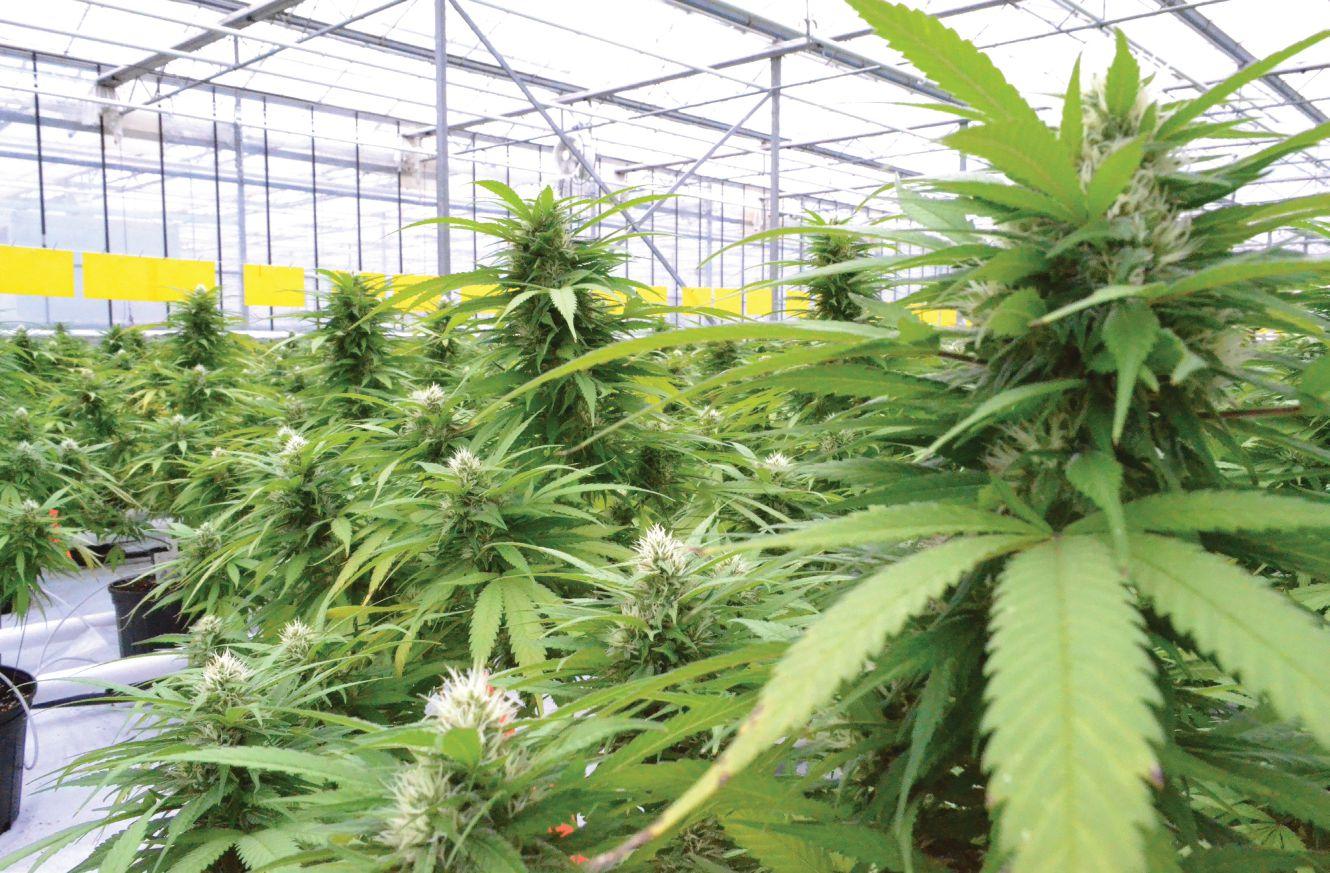
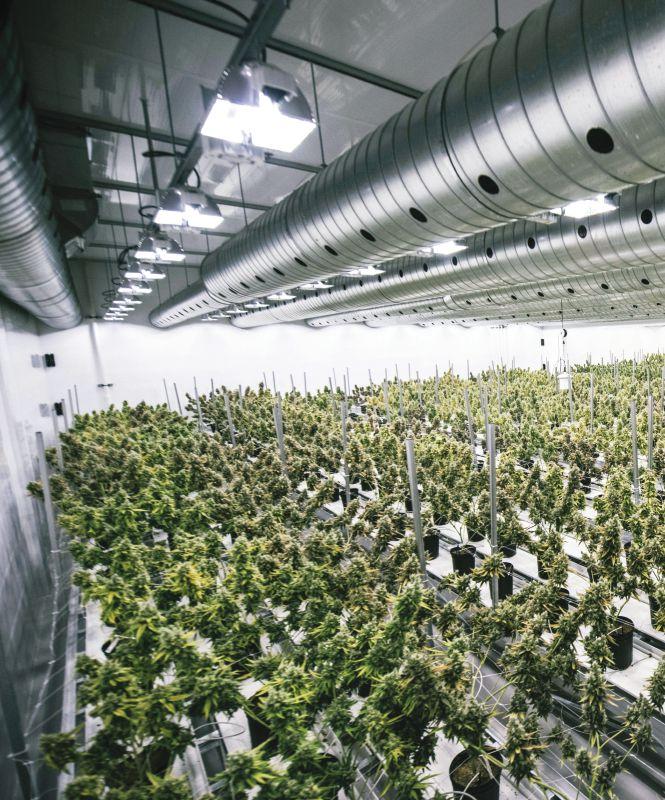
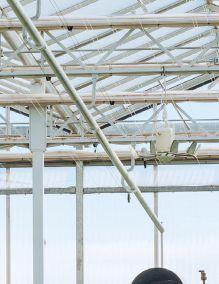
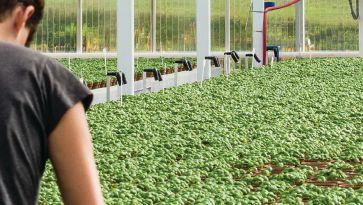
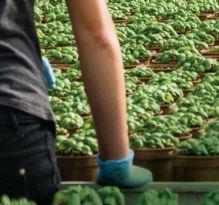
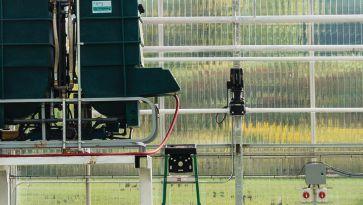
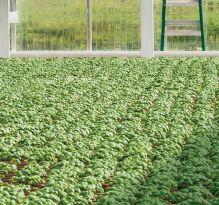
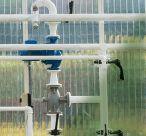
If you are planning to move your cannabis into a greenhouse, it becomes critical to understand the truth about these Top 10 industry myths
By Leigh Coulter
As the cannabis industry continues to gain legal status around the world more and more cannabis growers are learning about commercial-scale horticultural production techniques and, of course, that means greenhouse growing. Anxious to grab a piece of one of the hottest greenfield industries in decades, many consultants have jumped into the picture claiming to be manufacturers and greenhouse experts. Unfortunately, these groups are not always well informed and often perpetuate wrong thinking.
Here are the 10 most-frequent misconceptions we hear being told to cannabis growers looking to move to greenhouse growing.
1. You can’t grow in a greenhouse in the winter
If someone tells you this, walk away immediately and block their email, because they clearly have no understanding of the greenhouse industry. Tomatoes, peppers, roses, lilies, lettuce, among others, are grown in abundance throughout Canada, the northern United States, Europe and Japan year round. Niagrow Systems was established in 1978 with the sole purpose of providing top quality heating systems for greenhouse growers throughout North
America, and thousands of greenhouse growers can attest that with a properly designed greenhouse heating system, quality plants can been grown year round.
2. You must heat a northern greenhouse year round
Only slightly less ridiculous than the first statement, this comment is an indication of little understanding for how greenhouse technology is adapted to different geographic needs. Often smaller companies who are more locally focused will make this kind of error. If the company you are working with is not from your geographic region then take this misstatement as a sign that they are not knowledgeable enough to give you proper greenhouse advice. Greenhouse heating design experts factor in the climactic region,
the style and size of greenhouse, the specific needs of the crop, and the insulation factor of the greenhouse glazing material. Properly designed greenhouses are built to provide the ideal environment for your crop. If you consider how often your climate is below your desired cannabis crop temperature, you will quickly see what percentage of the year you will need to be able to heat the greenhouse.
3. You must provide year-round air-conditioning for southern greenhouses
A modification of the northern greenhouse misconception, these misinformed people are painting a large region with a single brush. Every project needs to be looked at individually because there is no one and
MYTH #6: One of the misconceptions of growing cannabis in a greenhouse is that you do not need heat because there are lights. Well, think again.
only “cannabis greenhouse.” In Southern California, Mexico and Eastern Texas, for example, fan and pad systems work very well for greenhouse growers. In environments with higher humidity levels like Puerto Rico, for example, fan and pad systems are not effective. A greenhouse without a cooling system of some type will not be able to get below ambient temperature, so considering your climate will help you determine if additional cooling is needed, and if so how often.
4. Dutch greenhouses manufacturers understand cannabis growing best In the Netherlands growing cannabis is illegal. With all the freedoms that Amsterdam offers cannabis consumers, growing the plant is not legal. On the other hand, medical marijuana has been legal in California since 1996 and in Canada since 2001. North
American greenhouse manufacturers have considerably more experience with legal cannabis growing than manufacturers from other parts of the world.
5. There is a specific greenhouse design for cannabis
This one is popular with supply companies who are interested in fitting growers into a cookie-cutter model rather than working with the grower to find the best solution for them. Greenhouses have many different options, and growers should want to work with a greenhouse manufacturer that is interested in helping them grow. Different geographic regions and different licensing regulations require different growing techniques, systems and greenhouses.
6. I don’t need heat in a greenhouse because I have lights
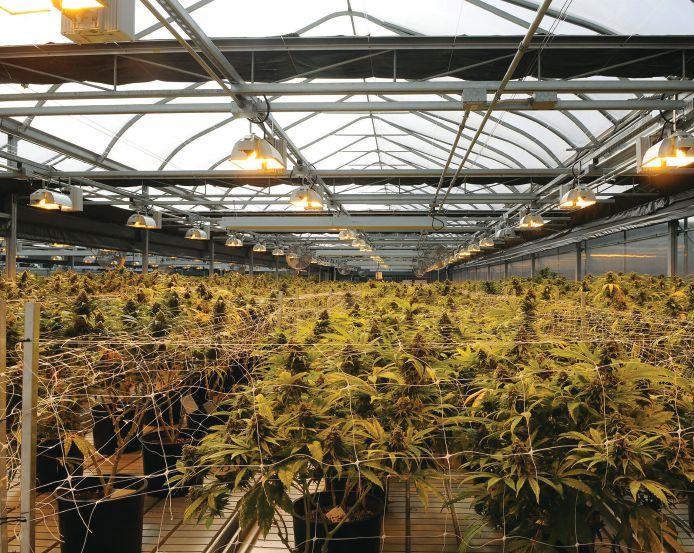
There is a great deal of talk within the cannabis industry about the amount of heat that lights generate, and when you move from an indoor grow to a greenhouse you will still want to have lights. In a greenhouse, however, the lights are for supplemental purposes to give you a boost when natural daylight is not enough. So if you want to use your lights for heat, and you are growing cannabis, and you want light for only 12 hours a day while flowering, you still have 12 hours that potentially need heat but have no light. And since this 12hour period is going to be at night, the temperatures outside the greenhouse will also be at lower temperatures.
consultants would like to believe the entire success of a grower is due to the greenhouse structure and greenhouse equipment, this is just not the case. Top-quality growers will grow top-quality plants, and poor-quality growers will grow poor-quality plants. What the right greenhouse structure and the right greenhouse systems will do is make it easier for good growers to grow top-quality cannabis. Many of the systems, like environmental control computers, light deprivation screens, rolling benches, fertilizer injectors, etc. are more about production efficiency than specific plant quality. Plant quality generally goes up with proper use of hightech greenhouse systems because the automation reduces human error variables. Often it is wiser to add technology in stages so you and your staff are able to fully understand the benefits of new greenhouse systems.
8. The capital investment in a greenhouse grow is more than what is in a warehouse
When building a greenhouse, the capital investment is typically significantly less than a warehouse indoor grow. If you believe that growing cannabis in a greenhouse is the right approach for you, make sure you are building a relationship with a real greenhouse manufacturer, a company that can show you how to get the most value from your greenhouse build.
9. Light deprivation is brand new technology
Outside of the cannabis industry, light deprivation curtains are referred to as blackout curtains. This is common commercial greenhouse technology used for many plants that benefit from adjusted daylight hours; including poinsettias,
kalanchoes and chrysanthemums. Vertical and horizontal curtains, light traps on fans and more help cannabis growers use economical commercial greenhouse technology to adjust the environment inside the cannabis greenhouse to the ideal plant environment.
10. You can expect an ROI of less than a year for a cannabis greenhouse
Fantastic returns on investments are often quoted by equipment suppliers and consultants to garner excitement and separate you from your money. Don’t believe anyone that is too quick to throw out ROI promises without taking the time to understand your business plan. There are a lot of people out there who think growing cannabis is easy money. Those of us who have been in the business for a while know this is far from the truth.
The PipeDreemz advantage is engineered to provide our clients with a turn-key methodology for the complete planning, construction and continued support of their grow facility. Your hard work and aspirations built from the ground up, growing into a rich, vibrant and green future. WHAT
WE DO
YOU? Here is an overview of how we’re boosting our clients’ efforts and GROWING their bottom lines:
Streamlined Application Review and Assembly – Minimal client input required; PipeDreemz will facilitate the majority of the process for you.
Site Approval –
Site location is critical. We will review and report on our client’s site acceptability.
Security Design & Implementation –
Internal and external security design and installation of security systems.
Standard Operating Procedures –
We can supply you with recommended procedural guidelines (SOP’s) for processes within the facility, QA/QC, security, production, record-keeping and sanitation
Regulatory Oversight –
We keep your builder and facility within the regulations and security requirements.
On-Site Training –
Our multidisciplinary team will visit your site and train your staff on the required regulatory processes and procedures.
Production Planning –
We have 45 years’ experience with production planning for commercial production facilities including marijuana.
Engineering Design –
Good Manufacturing Practices and Good Production Practices are applied to the building design. Advice and recommendations on equipment, and everything in between.
COAST TO COAST DISTRIBUTION
Before recreational legalization arrives this summer, LPs across Canada need to start looking at how the various provincial distribution models of cannabis will impact how they sell and go to market with their product
By Treena Hein
The monumental day is almost upon us. July 1 is just around the corner and as implementation of Bill C-45, Canada’s national Cannabis Act, approaches, provinces and territories are navigating the windy road of distribution and sales, which in turn will directly impact the path licensed producers (LPs) across the country take when developing their own sales and marketing plans.
Several provinces – Quebec, Ontario, New Brunswick and P.E.I – have already earmarked their liquor commissions to manage cannabis distribution through both online and dedicated retail stores. It will be similar in Nova Scotia, but in this Atlantic Canada province, cannabis will be sold in stores alongside alcohol, where in the
other aforementioned provinces, cannabis and alcohol will be sold separately.
As for the Prairie provinces, Alberta will allow dedicated private retail stores to sell cannabis, but will have online sales managed by its gaming and liquor commission. Saskatchewan is indicating it will allow private retail stores, and in Manitoba, stores will be private, with the Manitoba Liquor and Lotteries Corporation securing supply and tracking sales. British Columbia has plans to open sales to both public and private entities, while the Yukon has confirmed it will use a public/private model for store and online sales, with governmental distribution.
In fact, Manitoba is the only province or territory so far that is open to private retailers offering direct sales online.
In terms of these how different
sales avenues will impact how companies cultivate recreational cannabis, Nick Dean believes that no matter the avenue, retailers will lean on LPs to anticipate consumer demand. After sales start piling up, notes the president and CEO of Emblem Corp., buying patterns will be the big factor in determining what his firm and other firms grow going forward.
In terms of branding, Dean believes the building of brand identity will be critical to differentiate legal recreational cannabis from the black market and to differentiate LPs from each other. He thinks
brand success will have to factor in both the consumers who like to show off a brand to their social circle and consumers who buy brands not as showpieces but on the basis of trusted quality.
DIRECT ONLINE SALES
The Manitoba plan of direct LP online sales is one that many in the industry would like to see within all provinces (or indeed, across provincial borders), but it’s an idea that has so far not received much traction.
“From a perspective of industry diversity and fostering entrepre -
First Nations demand governance of cannabis distribution on reservations
At a fall 2017 meeting of the Assembly of First Nations (AFN), Chiefs expressed various views on distribution and sale of cannabis in Canada. Some Chiefs want the AFN to request a delay in the implementation of Bill C-45, while others feel ready to deal with the new legislative paradigm. However, there was general consensus that First Nations must determine its own rules for the use, distribution and sale of marijuana on reserves.
neurial participation, my position is that the more open marketplace the better,” states Dan Sutton, managing director at Tantalus Labs in Vancouver.
Sutton feels centralized online governmental distribution, with its requirement for the creation of new e-commerce platforms and the existence of physical distribution centres, will hurt the competitiveness of both smaller producers and new entrants. This is because provincial distribution agreements will likely hinge on volume and price – mechanisms that favour larger producers.
“Economies of scale create exceptional downward pressure on production costs in cannabis cultivation, as they do in industrial agriculture at large,” he notes. “Capital expenditures and staffing requirements are front-loaded for LPs, and a production footprint of 100,000 square feet does not increase cost of production 10 times relative to a 10,000-square-foot producer.”
Dean would also like to see a direct-to-consumer e-commerce recreational model available coast to coast, similar to what is available for medicinal cannabis. “We are also
In September 2017, the AFN created a National Working Group on Cannabis to address all of the issues surrounding legalization of marijuana. The AFN states on its Website that this Group will “assist First Nations in all regions to be engagement-ready and in a better position to assert their rights, title and interests when the new cannabis legislation comes into effect.” Ontario Regional Chief Isadore Day and Quebec-Labrador Regional Chief Ghislain Picard are leading the file. The group is planning to “meet with various Federal departments and agencies on the legislation, and hold bi-lateral discussions so that First Nation input is heard at all levels.”
SELLING CANNABIS: With each province establishing their own cannabis sales model, Canadian LPs better know their go-to-market strategy sooner rather than later.
fond of models proposed by provinces such as Alberta, allowing for both the public and private sectors to participate,” he says, adding that a main objective for legalizing recreational cannabis stated by the Federal government was to take profit away from organized crime, but unless sales and distribution are done correctly, that objective may never be realized.
“To compete with a multi-billion-dollar illegal market from which many Canadians are generally comfortable purchasing, the legal market must provide a superior customer experience at reasonable prices.”
Furthermore, Dean asserts that allowing LPs to ship recreational cannabis directly anywhere in the country, in conjunction with provincial stores, would provide customers with a variety of purchasing options – “without requiring 13 provinces and territories to invest millions of taxpayer dollars of capital to build their own e-commerce Websites and pay for the necessary supply-chain infrastructure.”
Mitchell Osak at consulting firm Grant Thornton in Toronto is also in support of national direct online sales. He, Sutton and Dean are among many in the industry who note that this sales avenue also makes non-compliant business actions easy to identify.
“Online commerce platforms can feature special safeguards such as authentication and anti-fraud functionality that can prevent unauthorized behaviour,” Osak explains. “Furthermore, platforms can also generate a digital paper trail that can be used to track consumer and supplier activity, thereby designing in compliance and allowing for the quick identification of non-compliers.”
CHANCES OF CHANGE
So, what are the actual chances that more provinces will allow direct company-to-customer sales of rec-
“We are also fond of models proposed by provinces, such as Alberta, allowing for both the public and private sectors to participate.”
– Dan Sutton, Tantalus Labs
reational cannabis, or that direct online sales will be allowed across provincial borders? Sutton believes that while they are low now, they will increase in the future as industry dynamics become easier to analyze.
“We need to demonstrate that public health and safety outcomes are not inherently compromised by direct-to-consumer ecommerce,” he says, “then make the case for industry growth and competitiveness over time.” He comes back to the firm belief that “there is no material way centralized warehoused distribution adds value to producer, retailer or end-user.”
Dean is also hopeful that direct sales will be allowed as the industry matures, similar to what has happened with alcohol (first only available through government channels and now sold directly to the public at wineries, breweries and so on). “In order to compete with the black market,” he concludes, “regulators need to take a consumer-first approach.”
Osak says that no matter what the sales avenue, in addition to growing quality product at scale, LPs should focus on building operational, financial, product and marketing capabilities.“Competing in this market will be a marathon,” he notes, “not a sprint.”
Treena Hein is a freelance writer based in Pembroke, Ontario.
ONLINE SALES: To better compete with the Black Market, many business leaders feel regulators must take a customer-first approach like in Manitoba.
• NATIONAL RECREATIONAL LEGALIZATION SLATED FOR JULY 1ST
• CANADIAN SHARE PRICES REACHING RECORD HIGHS
• LICENSED PRODUCERS EXPECTED TO GROW 250% BEFORE JULY 1ST
Dr. Matt Wheatley began his career as a cannabis grower by planting his first garden while enrolled in botany classes at Weber State University in northern Utah. He is an independent consultant with LumiGrow Inc. (lumigrow.com).
LED Lighting for Optimization
Temperature and CO2 are huge factors to examine when deciding what type of lights LPs should utilize in their grow rooms
By Dr. Matt Wheatley
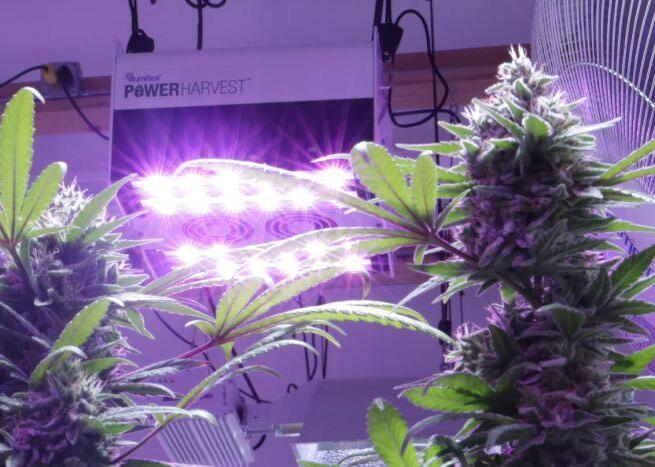
The newest generation of powerful LED grow lights have changed the way that licensed producers (LPs) maximize profits and crop quality. Growers at LPs often ask what adjustments need to be made to their growing environment in order to optimize their facility for LED lighting.
Well, one answer to these questions is that new and experienced growers who want to reap the benefits of an LED strategy should familiarize themselves with the relationships between environmental factors that affect the efficiency of photosynthesis; leaf temperature, humidity, carbon dioxide concentration, and light intensity.
When it comes to lighting, LPs should keep in mind the following factors: The effect of temperature on photosynthetic rate; how temperature and CO2 concentration are intimately linked to plant growth at higher temperatures; and compare the differences between ambient temperatures in high-pressure sodium (HPS) and LED grow rooms.
LEAF TEMPERATURE VERSUS AMBIENT ROOM TEMPERATURE
When scientists discuss photosynthesis and temperature, they typically reference
leaf temperature, not the ambient room temperature. This makes sense given that the biochemistry of photosynthesis takes place inside plant’s leaves. In contrast, when grow-room designers discuss temperature, they usually reference the ambient room temperature. In most growing environments, the leaf temperature will be higher than the ambient air temperature surrounding the plant. This is especially true for plants grown under HPS lights, which emit infrared radiation that is absorbed as heat by the plant.
TEMPERATURE REQUIREMENTS
FOR PHOTOSYNTHESI
S
RuBisCO is the plant enzyme responsible for the chemical reaction that begins carbon fixation. This chemical reaction is seen as the conversion of CO2 and water into simple sugars during photosynthesis. The chemical reaction that RuBisCO performs is temperature dependent. With full sunlight and ambient CO2 concentrations of about 300 ppm, as well as a temperature range of 5°C to 27°C, the rate at which CO2 is absorbed by the plant and
LIGHT AND YOUR ENVIRONMENT: Dr. Matt Wheatley explains growers who want to leverage LED lighting should take the time to understand environmental factors like photosyntheses efficiency, leaf temperature, humidity, carbon dioxide concentration, and light intensity.
HUMIDITY IS KILLING YOUR CROPS. AND YOUR PROFIT MARGIN.
Humidity. It’s the constant threat that no one wants to talk about. However, with our exclusive Agam VLHC technology, air is continuously dehumidified and filtered, capturing and neutralizing fungal spores on contact. You get healthier, more abundant crops, use less fungicides and cut energy costs by about 60%. Start clearing the air today.
Visit envirotechcultivation.com/agam to watch Agam VLHC in action.
converted to sucrose increases as the temperature increases, leading to increasing gains in net photosynthesis.
If the internal leaf temperature rises above 27°C, RuBisCO enzymes begin to perform the reverse reaction, with some of the RuBisCO enzyme converting sucrose and oxygen into CO2 and water in a process known as photorespiration. As leaf
temperatures approach 40°C, net photosynthesis will become negative as the plant burns more carbon than it gains. So, under normal ambient CO2 levels, a grower will achieve the greatest growth with leaf temperatures just below 27°C.
Fortunately, an indoor grower can adjust their environment to achieve optimal growing conditions. Controlled environments
allow growers to maintain optimal temperatures, carbon dioxide concentrations, light intensity and relative humidity. So, let’s explore how a grower can adjust the growing environment to take advantage of high rates of growth that occur at high temperatures.
THE IMPORTANCE OF CO2 ENHANCEMENT FOR HIGH TEMPERATURE GROWING
Increasing CO2 concentrations will extend the temperature range in which RuBisCO may fix CO2 into sugar. With increased CO2, we see that as temperature increases so does the rate of the chemical reaction that RuBisCO performs. This works because an increase in CO2 concentration means that the ratio of chemical substrates to products is being increased. If the CO2 concentrations are increased from ambient 300 ppm to 1,500 ppm, the change in the ratio of reactants to products will allow
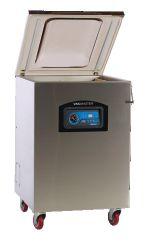
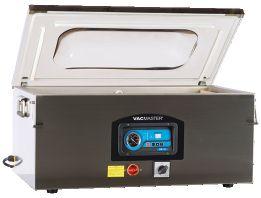
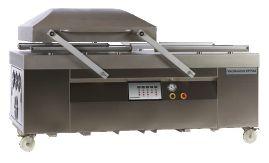
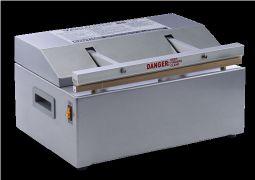
VacMaster Chamber Vacuum Sealers
plants to continue to fix CO2 into sucrose at leaf temperatures well above 27°C, all the way up to about 36°C!
And as the temperature increases, so does the rate of carbon fixation and plant growth. This means, that if they are careful with their environmental controls, growers may achieve very high rates of carbon fixation and plant growth at leaf temperatures well above 30°C.
INFRARED RADIATION CREATES LEAF TEMPERATURE GRADIENTS DOWN THE CANOPY
HPS bulbs emit a large infrared peak between 800 nm and 900 nm. This infrared peak significantly increases leaf temperatures at the top of the canopy, where most of the infrared light is absorbed. When examining the differences between leaf temperatures of plants grown in the same room under either HPS or LED lights, we
will see significant temperature differences that infrared light causes.
In one study, the photosynthetic activity and internal leaf temperature of leaves was measured at different distances from the light source. The internal leaf temperature measurements were very clear.
The leaves of plants under LEDs did not show an increase for internal leaf temperature significantly above the ambient room temp at any distance between two and four feet from the lamp. In contrast, the leaves of plants under the HPS lamps showed a wide range of internal temperatures.
GH_AndyLang_June2016 copy.pdf 1 2017-10-17 9:45 AM
With HPS lamps, the highest temps were apparent at the top of the canopy and lowest internal leaf temperatures were at the bottom of the canopy. This partially explains why HPS lamps produce topheavy crops while LED lighting creates a more uniform canopy.
Since the rate of carbon fixation by
RuBisCO is affected by leaf temperature and CO2 concentration, increasing the ambient temperature in LED-lit rooms will increase the rate of photosynthesis and plant growth.
RAISE THE TEMPERATURE IN A LED ROOM
Based on scientific study and experimentation, researchers have found an increase in the ambient room temperature of 5°C to 7°C in LED-lit rooms, relative to temperatures in HPS grow rooms, is necessary to achieve similar internal leaf temperatures and plant growth rates as those experienced by plants in HPS-lit rooms.
However, it is important to keep in mind that as the ambient room temperature increases, the relative humidity decreases, and proportionate adjustments should be made to the relative humidity to adjust your Vapour Pressure Deficits.
Security
By Thomas Gerstenecker
Securing Cannabis from Point A to Point B
Did you know that banks are not Federally mandated to use armoured transport to move money, but they do. Primarily, to reduce theft, keep insurance premiums low and maintain shareholder confidence – just to name a few reasons.
This also holds true in the cannabis industry for there are no regulatory requirements for using a security company to safely transport cannabis. However, that doesn’t mean it shouldn’t be used in support of Health Canada’s Access to Cannabis for Medical Purposes Regulations (ACMPR).
I am often asked, “Why do you need armed officers and armoured trucks for cannabis? Just use Canada Post... or, You don’t see the provincial liquor stores using security when transporting liquor.” My answer doesn’t always suggest armoured vehicles nor armed officers. It all depends on the amount and value of what we transport – it’s all about applying fundamental risk management practices. Theft from a cannabis transport vehicle has other higher risk factors, including: the ease of moving the packages; product being quickly introduced into the black market; the LPs reputation is at stake; stakeholder confidence; and duty-of-care.
Regardless of the size of the operation, every LP should look at the security of their supply chain, including how they transport their product. Secure transportation may come in the form of a soft-skin (non-armoured) van transporting 10 Kgs of dried cannabis, or 2,000 live plants delivered to an LP in a neighbouring province, or 600 cubic feet of cannabis transported
is
across Canada. Whatever the situation, the key is getting the product to the end destination, but making sure the cannabis is delivered intact, especially when dealing with live plants.
Every time cannabis is transported between locations, an enhanced secure transport plan should be in place, which could include an armoured vehicle, armed officers, a detailed route and action plan, supported by real-time GPS monitoring and geo-fencing software, among a number of other critical components, such as courier Chain of Signature software.
Chain of Signature is vital, regardless of size or value of load being transported. This allows companies to monitor each package/transport in real time using state-of-the-art technology, in addition to the product to be released from the outgoing
LP. Hence the need for extensive cannabis-specific liability insurance.
When it comes to securing the product via supply chain, LPs must always consider a number of critical factors, including when to use a secure transport supplier. Given the type of cargo being transported, it doesn’t always fall within the norm, at least not yet. As mentioned, ensuring your product is not compromised during transport may be critical to the growth of your operation, and may directly impact your customer and key stakeholder base. Below, I provide a few tips to keep in mind when partnering with a secure transport supplier.
Ideally, cannabis shouldn’t be transported in standard cash-intransit trucks that may have other liabilities, such as cash alongside, which may increase the risk when it
Thomas Gerstenecker (thomasg@3sixtysecure.com)
the founder and CEO of Sixty Secure, an Ottawa based company providing secure transport of cannabis for licenced producers.
THEFT PROTECTION: When transporting cannabis, LPs must follow some basic risk management principles and have a chain of signature process in place.
The ability to not only provide effective vehicle tracking, but enhanced real-time monitoring of the vehicle and cargo packaging itself is a key component to Chain of Signature.
Security
comes to attacks – it’s an added risk that LPs should seriously consider. In addition, other variables include the cleanliness of the cargo area; the ability to have ambient temperature controlled systems (HVAC) for the product, particularly during extreme temperatures and longer haul shipments. The supplier vehicles should allow easy on and off loading via dock-level and/or forklift access. This reduces the time it takes to load/unload (no hand-bombing), but also less wear and tear on the package itself, and less exposure to extreme temperatures, be it hot or cold.
Providers should also have the flexibility to offer a menu of options. This allows greater flexibly when it comes to the type of vehicle used (armoured or non-armoured), as
well as the number of security officers, and if they require to be armed or unarmed. It all comes down to applying risk fundamentals, with the ultimate goal of saving time and money.
The ability to not only provide effective vehicle tracking, but also enhanced real-time monitoring of the vehicle and cargo packaging itself is a key component to Chain of Signature.
LPs should have drivers who have security clearance, basic cannabis knowledge, and can appreciate the cargo they are transporting. In addition to associated potential risks in terms of impact of the cargo not being properly secured in place, or during long haul/extreme temperatures, the value of having the right ambient temperature is easily seen.
While the above points are certainly not exhaustive, they do provide a snapshot into some areas to be concerned with.
The cannabis market within Canada is moving fast, so when it comes to secure transport of the product in various forms, careful consideration must be given when using secure transport companies. A risk-based approach will also define the level of transport needed as many situations are unique. Ensuring Chain of Signature, cannabis-specific insurance coverage, enhanced efficiencies when loading/unloading, professional and cleared security officers, and providing the right ambient cargo environment are key aspects that will guarantee successful product delivery.
ADDRESSING THE NEEDS OF BUSINESSES AS WE CULTIVATE THE SEEDS FOR ENERGY SOLUTIONS
• Direct Purchase Planning
• Asset Optimization
• Strategic Commodity Plan
• Market View
• Forecasting
• Balancing
• LDC Interface
• Recommendations
Dedicated to Energ y E xcellence
As an agricultural owned energ y co-operative, the only one of its kind in Ontario, we bring a new approach to natural gas and electricity markets.
Call for a free energ y consultation: 1-866-818-8828 • 519-763-3026 www.agenerg y.coop
By Dan Sutton
The Authenticity of Innovation
Innovation distilled into its simplest meaning is creating new things. From fire pits and sharp stones to quantum computing and nuclear fusion, innovators create value for themselves and their users.
The term innovation often aligns with technology, but the process happens across art, commerce, community and everywhere else the human spirit urges it forward. Innovation is often the genesis of exceptional financial opportunity; however, the path to creating new things rarely seems to be rooted in financial thirst.
In a cannabis paradigm, teams that effectively anticipate changing consumer needs by creating new trends and categories have an unprecedented opportunity in front of them. Product development in the United States has created new markets for modern cannabinoid delivery methods like vapourization, edibles and extractions. Many more markets are on the way. These markets have grown substantially across states with legalization, with innovators leading the pack in value creation for their investors.
A culture of innovation is not a byline in an investor deck. It is a function of enterprise design that must be fostered from day one. Jon Doerr, general partner at KPCB, hunts for the core DNA of his founders and early team members. He
states simply, “Your greatest challenge will be building a great team.”
Jim Collins, author of startup bible Good to Great, boils it down to “putting the right people on the bus.” The individuals who populate your team are the only true differentiator in a world that pulls to commoditize everything over time. The next generation of cannabis unicorns will need to take this timeless team-building advice one step further to reap the value innovation can create.
In a cannabis paradigm, teams that effectively anticipate changing consumer needs by creating new trends and categories have unprecedented opportunity in front of them.
Aligning employees with fostering each other’s successes creates a feedback loop of innovation momentum. Cannabis enterprises are diverse, but the best seem to have a collection of humans with differentiated and interesting skill sets.
Most corporate leaders are new to the space. Cannabis growers know and love the plant, while agricultural specialists thrive in process and team management. As for quality assurance professionals, they thrive on curiosity, science and empiricism. In the age of automation, integration and decentralized systems, software specialists
add exceptional value. Add in human resources, finance, marketing, and administration, and you have a patchwork quilt of specializations that need to be unified in pursuing the common mission.
The personalities that I see across my team have different motivators and different resource needs. They solve problems in unique ways, and in ways that inspire others to see through a novel lens. Leading cannabis teams must work consistently to align the incentives of a diverse and talented organization. This is the clearest path to benefit the greater community of end users and stakeholders, but such alignment is difficult to finesse.
I was lucky – when my cofounder, Alexander Close, and I sat down to craft our first brand choices and plot the path forward, the Simon Sinek “Start with Why” TED Talk was only a few months old. We reveled in this concept, fleshing out our thinking on why we really wanted to build Tantalus Labs from core principles.
Why do you get out of bed every day and do what you do? If that “Why” is a beacon to bright minds and great people, they lean into collective success with a commitment that money cannot buy. Great teams around the world attract thinkers who care passionately about sustainability, technology, software, design – perhaps just meeting new challenges in general. Good teams retain that talent
by fostering the ability to contribute.
When it works, the success of this chemistry is one of the great joys of start-up culture. A group of smart people from different backgrounds in a commercial enterprise is a powerful unit of social progress.
When they are given permission to debate honestly, they grow deeper respect.
When they are challenged but not pressured, they grow deeper ambition.
When they care so deeply for the mission and each other that they are radically candid about small course corrections, they grow more sensitivity.
The individual evolves to the benefit of the whole.
Many people ask me how to pick winners in this great green rush. I most often see the world through the lens of a founder and, at this time in my life, almost all of my waking hours are spent thinking about my team and our path forward. The answer that I usually give is to find the teams that seem poised to execute, take an earnest look at the motivations of the founders, and trust your instincts.
Innovation for the sake of making money sometimes wins, but innovation for the sake of solving a genuine user problem is a more authentic opportunity. Support companies that prioritize innovation with organizational structure and alignment of core values, and you will surely be rewarded.
Dan Sutton is the founder and managing director of Tantalus Labs. Born and raised in Vancouver, he has worked in teams developing innovative technologies for a diverse range of sectors, from high field magnetics to nuclear fuel.