A modest proposal for simplifying sustainable building regulation
18 Under the Glass: Silliker Glass, Borden-Carleton, P.E.I. Silliker is using aggressive investment to ship glass from the Island to pretty much everywhere in Atlantic Canada.
22 Beyond spreadsheets
Industrial AI may be the tool that finally moves construction companies past ‘90s-era information technology.
24 New product showcase
Move more glass easier...build a quick model of a room... grab better thermal images...make pretty glass...
Canada’s Glass Associations
The
High-profile wildfires doing substantial property damage to urban areas in B.C. and Alberta have spurred NRCan to look at creating Canadian building standards for wildfire resistance. The consultation process has just begun, but it seems likely that some day soon we may see new codes requiring resistant facades in wildfire-prone areas. Robin Urquhart has worked on rebuilding communities destroyed by wildfires and joins GlassTalk to share his deep knowledge of this topic.
Building on success
We’re moving forward with you.
EDITORIAL
GLASS CANADA
June 2025
Volume 37 • Number 2
Annex Business Media
P.O. Box 530, Simcoe, Ontario N3Y 4N5
READER SERVICE
NEXT ISSUE
Top Glass 2025 was one of our best ever with a hall full of over 60 exhibitors and over 360 glass people visiting to see them and our expert session presenters. I can’t tell you how gratifying it is to see glass people getting together like this and clearly enjoying the opportunity to meet and greet their friends. I think we’re filling a need with this show and, if the many kind words we get on the day are any indication, we are getting at least most of it right. Keep it short, keep it convenient and keep it inexpensive. One day of intensive activity rather than a drawn-out event. That seems to be what everyone wants and we’re happy to deliver it. There are too many contributors and supporters to thank here so I won’t try except to say THANK YOU to our exhibitors, sponsors, presenters, panelists, event staff, venue staff and association partners who make it all happen. I will make a special shout-out to Trulite Glass and Aluminum who really went beyond expectations hosting our plant tour the day before the show. Ray, Alicia, Joel, Hector, Amanda, Lucy, Peter, Andy, Neil, Scott, Annika, Shah, Jinu, Nathanael and everyone I’m missing...thank you for the wonderful effort.
• Great Glazing
• RFID tagging
So it’s on to the next. Top Glass West will return to Calgary for the second time on October 22, with a tour of Goldray Glass on Oct. 21. Our session details are being ironed out, but there will be presentations on wildfire-resistant glazing, vacuum insulating glass and our usual codes and standards updates. GAMA will be involved, hopefully doing their apprentice awards presentation again. Our first edition in Calgary was so encouraging...now we just have to make it grow. Mark your calendars, tell your friends and watch your inbox for more details. See you at Top Glass West!
You’ll see in our cover story that I’m using this issue to launch a conversation that I hope will bring some clarity to the future direction of sustainable construction regulation in this country. No, I have no standing or expertise with which to do this. But with major new priorities for sustainable building on the horizon, I think we need to look at the way we’re regulating and incentivizing sustainable construction and avoid taking bad routes that force us to double back or even engage in counterproductive behaviour. We need to, as business guru Steven Covey used to say, “begin with the end in mind.” That involves putting the focus back on the real objective, which is to reduce the amount of carbon dioxide released worldwide, and ensure that every measure we adopt serves that ultimate purpose. Because some of the things we have done have not always done that. I think there’s an opportunity at this moment in history where we are starting to introduce embodied carbon to the conversation to avoid another decade of laborious regulatory development that might take us into another cul-de-sac. It’s a topic I’m going to be writing and talking a lot about over the next while and I hope you’ll join in with your comments and arguments. And I’ll be bringing some top minds into the conversation who do have the standing and expertise to venture an educated opinion. Summer is finally arriving and my best wishes go out to you and your teams for a successful building season. Thanks as always for reading and listening.•
@GlassCanadaMag
Print and digital subscription inquiries or changes, please contact Angelita Potal, Customer Service Rep.
Tel: 416.510.5113
Fax: 416.510.6875
Email: apotal@annexbusinessmedia.com
Mail: 111 Gordon Baker Rd., Suite 400, Toronto, ON M2H 3R1
EDITOR/PUBLISHER | Patrick FLANNERY pflannery@annexbusinessmedia.com 226.931.0545
GROUP PUBLISHER | Danielle LABRIE dlabrie@annexbusinessmedia.com 519.429.5187
AUDIENCE DEVELOPMENT MANAGER | Shawn ARUL sarul@annexbusinessmedia.com 416.510.5181
MEDIA DESIGNER | Graham JEFFREY
CEO | Scott JAMIESON sjamieson@annexbusinessmedia.com
SUBSCRIPTION RATES
Canada - 1 Year $37.74 (plus tax)
U.S.A. - 1 Year $86.70 (in CDN dollars)
Publication Mail Agreement #40065710 Printed in Canada ISSN 0843-7041
Occasionally, Glass Canada will mail information on behalf of industry-related groups whose products and services we believe may be of interest to you. If you prefer not to receive this information, please contact our circulation department in any of the four ways listed above.
Ontario Glass and Metal Association president, Blake Sanders (SpandrelTech), released the following statement outlining the association’s position on the imposition on tariffs by the U.S. and Canadian governments. This statement was issued at the end of March, before Trump’s April 2 “Liberation Day” announcement that left Canada off the list of countries subject to additional tariffs. Canadian exports to the U.S. that lack “country of origin” designation under the CUSMA free trade agreement are still subject to 25 percent tariffs (10 percent for potash and energy) – the so-called “fentanyl tariffs.” Canadian aluminum and steel exports are tariffed an additional 25 percent using an even more bogus national security rationale. Canadian retaliatory tariffs continue to be applied to about $30 billion of American imports, including doors, windows, fenestration framing, wood building products, powered hand tools and door and window hardware. However, Canada’s exemption from additional tariffs on “Liberation Day,” means the immediate threat of more retaliatory tariffs, including tariffs on float glass, has been lifted for now. Sanders’ message to members follows:
It is with great frustration that I write this article. As the president of the Ontario Glass and Metal Association (OGMA) and a fellow industry member, I am with all of you in trying to navigate the economic trade war between Canada and the United States of America.
The OGMA expresses deep concern over the recent imposition of tariffs by the U.S. on our products. These tariffs threaten the livelihoods of countless workers across Canada and disrupt trade relations between two longstanding allies and partners.
Canada’s glass and metal sectors have a rich history of innovation, quality and sustainability, and we are proud to contribute to the global economy. We believe that fair and open trade benefits both nations, promoting growth, job creation and a stronger economic partnership. The imposition of tariffs undermines these principles and threatens the competitiveness of our industry in an increasingly interconnected global market.
Our industry is committed to working closely with the Canadian government and our U.S. counterparts to find constructive solutions that protect
jobs, promote innovation and ensure mutual prosperity. We remain hopeful that this issue will be addressed through diplomatic channels, focusing on collaboration rather than barriers that hurt workers, businesses and consumers on both sides of the border.
We urge both governments to continue to engage in dialogue and work toward a fair resolution that strengthens the Canada-U.S. trade relationship and ensures that Canadian businesses can continue to compete on a level playing field.
The American government has placed tariffs on aluminum and steel exports in the amount of 25 percent. Aluminum and steel are vital materials used by numerous industries, including automotive, aerospace, construction, and technology. The imposition of reciprocal tariffs disrupts the trade flow and undermines Canada’s longstanding position as a global leader in aluminum and steel production. It places Canadian aluminum and steel producers at a significant disadvantage while increasing costs for downstream industries that rely on access to competitively priced materials.
We urge the government of Canada to take immediate and effective action to address these tariffs. Canada’s aluminum industry has a strong record of sustainability, innovation, and meeting the highest global standards. We encourage the Canadian government to engage diplomatically with our trading partners to remove or reduce these reciprocal tariffs, ensuring a fair and level playing field for Canadian businesses.
While we work through this trade war, we want you to remember that the OGMA stands with all of you. We will work with government agencies to try to keep the negative economic impacts to a minimum. With uncertainty at an alltime high, I encourage you to contact me or any OGMA board member with questions or concerns.
COMING EVENTS
June 10 - 12
GPD Finland Tampere, Finland gpd.fi
June 16 - 18
FGIA Summer Conference Online fgia-online.org
June 19
Fenestration Canada Tour: Groupe Bellemare Trois-Rivieres, Que. fenestrationcanada.ca
Sept. 10
FGIA Western Region Summit Online fgia-online.org
Sept. 18
OGMA Fall Golf Tottenham, Ont. ogma.ca
Sept. 29 - Oct. 2
NGA Glass Conference Ypsilanti, Mi. glass.org
Oct. 6 - 9
FGIA Fall Conference Indianapolis, Ind. fgia-online.org
Oct. 20 - 21
Top Glass West Calgary, Alta. topglasswest.ca
Oct. 24
OGMA Rockwool Tour Milton, Ont. ogma.ca
Nov. 4 - 6
GlassBuild America Orlando, Fla. glassbuildamerica.com
CANADA’S GLASS ASSOCIATIONS
AVFQ
Last April, we held our Annual Conference with a record attendance of more than 400 participants. We are now focusing on our Omnium that will be on August 27. We are also working on new short training clips on the following topics: linear economy, BIM and robotization. Our training program also still offers the FIT Window Installers Training, which presents good practices with regard to the CSA A440.4:19 standard. The training is available in English and French. It allows you to acquire the knowledge to take the Installer Certification Program exam. Several other training courses are also offered, including Curtainwall Installation; CSA A500:16 Standard for Building Guards; Project Management in Construction; and CSA A440.6:20 High Exposure Fenestration Installation. Having now been in office for more than six months as general director, Maggie Champagne observes: “We have a rich industry with a rare quality, which is joining forces in conviviality and collaboration. What sets us apart is not only the expertise of the members of our group, but this ability to move forward together and promote collective intelligence”
GAMA
GAMA continues to work closely with the PGAA Apprenticeship and Industry Training Group to drive change in Alberta’s apprenticeship legislation. Our current focus is on amending the Designated Trades and Restricted Activities Regulation under the Skilled Trades
and Apprenticeship Education Act. While our initial proposal included broader legislative amendments, we are now pursuing a more targeted ask focused solely on updating the restricted activities to better reflect today’s trade realities. This proposal is currently being finalized in presentation format and will be shared with the My Skilled Trades Network advisory group soon. The Alberta Cabinet Shuffle on May 16 brought a new minister for advanced education, Myles McDougall. PGAA/ GAMA is working through various channels to meet with Minister McDougall and engage in meaningful dialogue about the future of skilled trades training. Our ongoing advocacy is guided by the top priorities of industry representation; reform of the STAE; consistent regulation enforcement; clear trade qualifications; improved MySTN transparency; and establishing key performance indicators for apprentice programs.
AGMCA
During the months of March, April and May the Architectural Glass and Metal Contractors Association and International Union of Painters and Allied Trades and the Ontario Council of the International Union of Painters and Allied Trades met to discuss all outstanding issues in connection with the 2025-through-2028 Ontario collective agreement in the institutional, commercial and industrial sector of the industry. We are pleased to inform all glazing contractors in Ontario that as a result of provincewide voting held on May 10,
members of the glaziers union voted in favour of ratifying the AGMCA’s final offer in negotiations. We believe the agreement, which will see an eightpercent total package increase distributed evenly over the next three years is fair to AGMCA contractors, the glaziers union and its members. The negotiated increase was exactly in line with several other major trades in the construction industry. The AGMCA would like to thank all of its member contractors for their input during the lead-up to negotiations. Through their efforts we were able to establish a clear mandate that we were ultimately able to achieve. We look forward to three more years of labour stability in the province. For more information on the AGMCA, please visit our website, or email us at info@ agmca.ca
OGMA
As 2025 came around as our 35th anniversary year, so did our new logo. In it, you can see the steel structure of the building as it is being cladded with the glass and panel exterior. We have also launched a whole new website. The new platform will make events and news updates easier for our members to find. We have a new directory being added to the website which allows for a seamless connection between our members. On behalf of the OGMA, president Blake Sanders would like to
extend a heartfelt thank you to our dedicated board members: Yoga Arulnamby, April Donvito, Keith Elmer, Robert Maggiacomo, Steven Peso, John Rania, Heather Sakai and our newest member, Bryan Deroche, for proudly representing OGMA at the Top Glass Conference on April 30. A special thanks also goes to our administrator, Lori Brooks, for her support throughout the event. Thank you to everyone who visited the OGMA booth to connect, learn more about membership benefits and chat about our upcoming initiatives. We were especially proud of our own Andrew Dolphin, who served as a keynote speaker and brought his signature energy and humour to the panel discussion.
Held on April 10 at the Richmond Hill Country Club, the OGMA Spring Seminar drew a good-sized crowd for presentations on key industry trends: Thank you to our speakers and attendees for helping make this event both informative and engaging.
This year’s Members’ Meetand-Greet was another hit!
Held at BATL Axe in Vaughan, the evening was packed with fun, laughter, and networking. OGMA members had a chance to connect, relax, and get a little competitive – all at no cost to members.
Upcoming events: save the dates! OGMA Race Night returns in July (flyer out in early June); the fall golf tournament happens Sept. 18 at Woodington Lake Golf Club; and our fall plant tour on Oct. 24 will be hosted by Rockwool.
We are pleased to officially welcome Bryan Deroche of CS2 Construction Sales to the OGMA board of directors.
Mercado becomes sales director at West Coast Glass
West Coast Glass has announced the appointment of Earl Mercado as its director of sales, bringing a wealth of experience in the architectural glass and glazing industry to the team. With a distinguished career spanning nearly 20 years in the world of building materials, Mercado has built a reputation as a strategic leader, technical stalwart and solutions-oriented professional. His expertise in high-performance glass and facade design solutions has helped to brand his name as a respected resource throughout the industry. His deep understanding of the North American glass industry, coupled with a passion for innovation, positions him as a valuable asset to West Coast Glass.
“I’m excited to join West Coast Glass and contribute to it sizeable growth,” says Mercado. “Rusty [Neubauer] and the team have built an incredible brand and a stellar reputation rooted in providing exceptional levels of quality and service. I look forward to continuing to build on that legacy and to grow-
ing the reach of West Coast Glass.”
In his role as director of sales, Mercado will oversee sales strategy, client engagement and business development efforts, further enhancing West Coast Glass’s position as a leading supplier of premium architectural glass solutions.
“We’re thrilled to welcome Earl to the team,” says Jorge Prado, general manager at West Coast Glass. “His industry knowledge and leadership will be instrumental as we continue to grow and serve our customers with the highest level of expertise and service.”
Mercado holds a bachelor of science degree from California State University, Fresno, and a master’s degree in business administration, finance and accounting from the University of Liverpool, U.K. With an understanding of the importance of industry advocacy, Mercado has participated in technical committees for the National Glass Association and the Rainscreen Association in North America.
West Coast Glass is owned by Collingwood, Ont.,’s Agnora.
Q1 Toronto condo sales hit lowest level since 1990
The Greater Toronto Hamilton
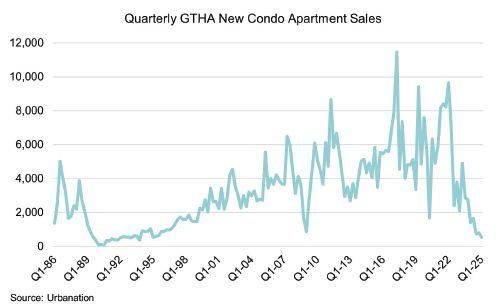
Area new condo apartment market reported a total of 533 sales in the first quarter of 2025, declining 62 percent year-over-year and 88 percent below the 10-year average to reach the lowest quarterly total since 1995. The 215 new condo sales in the city of Toronto in Q1 fell to its lowest level since 1990, according to the Q1-2025 Condominium Market Survey by Urbanation Only two projects launched for presales in the first quarter, totaling 275 units. Since the beginning of 2024, 28 presale projects totaling 5,734 units were either put on hold, cancelled, placed in receivership, or converted to purpose-built rental, including four projects totaling 1,042 units in Q1.
Unsold new condominium inventory totaled 23,918 units, increasing six percent from a year ago and 58 percent higher than the 10-year average. Unsold inventory was equal to 78 months of supply based on the pace of sales averaged over the last 12 months, a record high that was approximately seven times greater than a balanced level of 10 to 12 months of supply. Unsold inventory was made of up 10,934 unsold units in pre-construction projects, 11,073 unsold units in under-construction projects and 1,911 unsold units of standing inventory in completed projects. The number of com-
pleted and unsold units more than doubled compared to a year ago to reach its highest level since Q1 1993. Completed and unsold inventory is expected to continue rising this year as an additional 2,411 unsold units are currently scheduled to be completed by the end of 2025. This is in addition to any presold units that ultimately fail to close.
Of the new condo sales that occurred in Q1 2025, selling prices averaged $1,151 per square foot, down seven percent from a year ago when units were selling for an average of $1,232 per square foot. Furthermore, of the projects generating sales activity, incentives were heavily employed, including significant cash-back credits at closing, rental guarantees and extended deposit payment schedules. Overall, asking prices for unsold inventory averaged $1,339 psf, a two-per-
cent decline from a year ago. This illustrates the large gap between prices that buyers demand versus prices that most developers need to sell for in order to build.
A total of 497 condominium units started construction in the GTHA during Q1 2025, dropping 79 percent from a year ago and 88 percent below the 10-year average to reach its lowest quarterly total since 1996. While condo completions decreased 16 percent from the record high last year to 9,495 units in Q1 2025, they remained 67 percent higher than the 10-year average. Condo completions are projected to total 31,396 units in 2025, surpassing last year’s record of 29,671 units, before falling to 17,487 units in 2026. As of Q1-2025, there were 69,042 condo units under construction in the GTHA, a decline of one-third over the past two years.
“The new condo market is currently working through its most challenging period to date, which has become further impacted by the uncertainty and cost escalations caused by the trade conflict with the U.S. With the Toronto region relying on condos for more than one-half of its total housing development, the magnitude of this slowdown will result in severe supply repercussions, ”said Shaun Hildebrand, president of Urbanation.
Accolades for Top Glass
Canada’s architectural glass show was a big success on April 30, welcoming over 360 glazing contractors, glass fabricators, architects and specifiers to the International Centre in Mississauga to visit 60 exhibitors, network and attend exclusive educations sessions from top experts. The right word for the show floor would be “buzzing.” Vendors reported steady traffic all day. It was also a full house in the education sessions. Amy Roberts from the Fenestration and Glazing Industry Alliance teamed up with Terry Adamson of Fenestration Canada to deliver and update on coming changes to codes and standards and to talk about Fenestration Canada’s new software tool that will allow contractors to model energy efficiency for different sizes of commercial glazing. Matt Christie of Walker Glass, Adam Mitchell of Agnora, Adam Shearer of iMagic and Andrew Dolphin of BVGlazing made up the Glass Marking Panel. Each expert took on a different technology for marking glass and educated the audience on its pros, cons and unique aspects. Steve Peso (Tremco) of the Ontario Glass and Metal Association presented the Award for Excellence in Design to Habdan Siddiqui of Graziani Plus Corazza Architects for their Thirty Six Zorra project in Etobicoke, Ont. Universal Aluminum took home the Award for Excellence in Execution for its work on the Allan Gardens Conservatory Palm House Restoration in Toronto. The glaziers rolled in strong hosting the Training the Future panel. Travis Nevins of the International Union of Painters and Allied Trades moderated, with Alex Shikhman of Building Envelope Systems Installations; Noel Marsella of the Architectural Glass and Metal Contractors Association; Jamie Clifford from the Ontario Finishing Trades Institute; and
Matt Fox, IUPAT’s glazier training specialist, sharing their insights into what the glass workforce of the future will look like and where the needed workers will come from. The IUPAT team made it fun with their custom hockey jerseys. They raffled one off to a lucky winner. Juliette Cook of Half Climate Design tested assumptions about sustainable building and what it’s going to look like in the coming era of embodied carbon.
Comments on the day
Erdem Gogceloglu (Klaes): “Thank you for organizing such an lovely event , it was great to see the different sectors under same umbrella”
Steve Legg (Rochester Insulated Glass): “Great show, and we hope be a part of it again in 2026!”
Bruce Cooke (Commdoor): “Was a pleasure to have Commdoor take part once again at Top Glass - we will exhibit again for ‘26 Appreciate all your help in getting us back up to
Woods replaces Harris at NGA
The National Glass Association has announced Lakisha Ann Woods as NGA’s new president and CEO effective July 14, 2025. Woods will replace 35-year NGA veteran, Nicole Harris, in the association’s staff leadership role. Woods is the former executive vice-president and CEO of the American Institute of
Architects, where she grew revenue 40 percent and grew membership to a historic high of over 100,000. Woods also previously served as president and CEO of the National Institute of Building Sciences, where she led efforts to expand the organization’s programs and markets while growing and strengthening its membership base. Prior to joining NIBS, Woods was the senior vicepresident and chief marketing officer at the National Association of Home
speed with taking part. Thank you.”
Rob Botman (Glassopolis): “It was a good show this year. The best yet!”
Carols Padernal (Kear): “Thank you very much for hosting such an amazing event. It was very well organized, and we thoroughly enjoyed it. We will certainly be returning next year.”
Rick MacCallum (Rimac): “Great show all around. It was very busy and there always seemed to be someone to speak with at our booth. Busy right until the end of the day.”
Olha Nikolaievska (Excel Projects) on LinkedIn: “There’s something truly energizing about being surrounded by glass experts, bold innovations and fresh ideas at Top Glass.
As a team specializing in high-rise glazing and restoration, we at Excel Projects Ontario always tuned into the latest advancements and this year’s show was packed with value. From insightful panel discussions to great floor conversations, we left with new connections, a stack of business cards, and plenty of inspiration.”
Val Voznyi (Glass Pro Solutions) on LinkedIn: “Thank you, Top Glass 2025! What a great debut for Glass Pro Solutions! It was a busy, exciting, and rewarding day – full of valuable conversations, long-time friends and new connections. A huge thank you to the organizers, Glass Canada magazine, for putting together such a focused and wellrun event and to all the visitors, customers and industry partners who stopped by our booth. Your energy, questions, and insights made this a fantastic experience. Top Glass was a clear reminder that the Canadian glass industry is strong, collaborative, and forward-thinking – and we’re excited to be a part of it.”
Builders, where she oversaw a 27-member team responsible for all marketing and revenue-generating programs, including sponsorship sales and partnerships with major national companies. Woods is also a past chair of the board for the American Society of Association Executives, served on the MPI Advisory Board and is a Certified Association Executive. She also previously served as vice-chair of the U.S. Green Building Council board of directors.
Report from CGC 2025
FenCan’s second annual Canadian Glazing Conference brought together commercial glazing professionals, industry leaders and construction specialists from across the country to the Civic Hotel in Surrey, B.C., on April 8. The event provided a collaborative platform to discuss the latest trends, challenges and innovations in glazing and fenestration.
Participants explored how tariffs are impacting the glazing industry and possible solutions to safeguard manufacturers and suppliers from adverse effects. These priorities demonstrated Fenestration Canada’s commitment to addressing key pain points in the industry while fostering knowledge-sharing and collaboration.
The day kicked off with updates from Brent Friesen, commercial chapter chair, and Paul Warltier of Competition Glass and co-chair of the Glass and Glazing Recruitment Committee. Both reported on their successful efforts to build the commercial chapter and promote the glazing industry to young people.
A standout session led by Jonathan “JoMo” Layton of Layton Consulting, shed light on challenges surrounding compliance of imported fenestration products with Canadian building codes. “Nearly all complaints regarding imported products have grouped around energy compliance,” said Layton. “It hasn’t been structural or NAFS air/water. It’s thermal. It’s the energy impact on the building and the windows itself.” Layton also introduced updates to Fenestration Canada’s size-specific thermal calculator, a groundbreaking tool that promises to aid industry professionals in enhancing performance accuracy.
The priorities at CGC demonstrated Fenestration Canada’s commitment to addressing key pain points in the industry.
FENESTRATION CANADA
Arthur Huard from NVOY Architectural Products introduced attendees to LuxWall’s vacuum-insulated glazing technology alongside the latest fire-resistive glazing solutions. This session provided insights into VIG advancements manufactured in North America that focus on dramatically improving building energy efficiency.
Brian Hubbs from RDH Building Science delivered a fast and furious series of case studies. Hubbs walked the packed audience through challenges and solutions linked to facade risk mitigation and energy-efficient retrofitting while emphasizing the importance of certified materials.
Tariffs and trade were at the forefront of this year’s CGC event. Adrian Edge, Fenestration Canada’s Director of Codes and Regulatory Affairs, delivered a highly engaging discussion about the impact of tariffs, sharing strategies to mitigate disruption to supply chains while navigating the complexities of cross-border trade regulations. Edge shared that FenCan has hired a lobbyist in order have conversations with Ottawa. Reaching key government personnel to communicate the industry’s messages can be difficult to do, even for national associations. By engaging professionals, FenCan hopes to maximize its leverage as the voice of the Canadian glass industry. The move was felt to be extra urgent at this time in order to get the point across that float glass must not be the target of any Canadian retaliatory tariffs in the event the U.S. expands the trade war. Thankfully, that threat seems to have receded for now, but we stand ready to respond to future events.
One of the most noteworthy presentations came from Murray Frank of Constructive Home Solutions, who spoke about the repercussions of seismic activity on fenestration. He highlighted critical design approaches necessary to align with building code updates and emphasized how the industry is evolving in anticipation of significant seismic events.
Recorded sessions from the Canadian Glazing Conference are live on the Fenestration Canada YouTube channel so attendees and those who missed the event can revisit the insights shared.
This event was a testament to Fenestration Canada’s role as the go-to resource for Canadian glazing professionals. With over 400 members and growing, FenCan is well-positioned to lead the industry into a new era.•
by AMY ROBERTS
Amy Roberts is FGIA’s Director of Canadian and Technical Glass Operations.
B.C.’s cooling mandate
The demand for highly energy-efficient fenestration products continues to rise. One can address this need by increasing the number of cavities in the insulating glass unit. This method, while effective, can create new challenges. IGMA TM-1300, Design Considerations for Multiple-Cavity Insulating Glass Units, the definitive technical manual on this topic, is set to be re-published with updated guidelines for designers, specifiers, fabricators and installers of multiplecavity IGUs. The document focuses on requirements for multiple-cavity IGU that differ from those for single-cavity units. As the world moves towards triple-glazed IGUs, it’s helpful to review some of the basic design considerations for these products.
One of the primary challenges in designing multiple-cavity IGUs is managing the air pressure changes within the cavities. TM-1300 gives guidance on how to deal with variations in temperature, barometric pressure, wind load, or altitude, helping to prevent seal stress and/or glass deflection. the use of capillary tubes is among the measures addressed. Fabrication of multiple-cavity IGUs presents unique challenges. The inability to visually inspect the sealant bond line for centre lite(s) is a significant issue, as the next spacer layer visually blocks skips or voids. It is also possible to over-press one layer and under-press another when the unit sandwich is built. Another challenge is the link between handling and cleanliness. In multiple-cavity IGUs, the centre lite(s) has two “clean” sides unlike double-glazed IGU. Therefore, it is recommended to refer to TM-3100, Visual Quality Guidelines, when fabricating multiple-cavity IGUs. The glass can be processed
Fabrication of multiple-cavity IGUs presents unique challenges.
vertically or horizontally just like a single-cavity IGU. However, sealant thickness can be inconsistent when processing horizontally. Narrower cavities (for instance, six-millimeter), which are often used with multiple-cavity IGU, may require vertical processing, especially for large sizes, to ensure glass centres don’t touch. When glazing, it is important to adequately support all glass lites with setting blocks. If not, the glass lite can create edge seal shear on the improperly supported lite, potentially causing premature IGU failure. Multiple-cavity IGUs are usually 50 percent heavier than dual-lite IGU as they contain additional glass and other materials. When selecting hinges, cranks and other hardware, the IGU’s weight must be taken into consideration. For hollow framing, stiffening channels and/ or inserts may be needed to ensure adequate rigidity.
Many glazing cavities are designed for a dual-lite IGU, and multiple-cavity IGU will be constructed, often as an afterthought, to fit an existing glazing cavity. It is important to review the water path for proper drainage to ensure all lites are fully supported and do not block water drainage channels. The basic structural considerations for the use of multiple-cavity IGUs will follow established guidelines for the structural framing portions of the units. The horizontal support member deflection due to the IGU’s weight must not exceed three millimeters or 25 percent of the recommended edge clearance, whichever is less. The twist of the member is to be limited to less than one degree. When multiple-cavity IGUs are being considered for structural glazing, the appropriate bond line width for the secondary silicone seal must be carefully reviewed to ensure negative design-wind-load conditions are met appropriately. Additionally, thermal stress must be evaluated to determine if glass lites require heat treatment to prevent glass breakage. To determine glass strength to ensure proper resistance to uniformly distributed loads, such as from wind and snow, one must consult ASTM E1300-24, Standard Practice for Determining Load Resistance of Glass in Buildings
Adhering to guidelines and best practices, such as illustrated above, will be crucial to maximize the potential of multiple-cavity IGUs. By understanding the complexities, designers, specifiers, fabricators and installers can effectively leverage the benefits of triple-glazed IGUs to meet the growing demand for high-performance building solutions.
Find your copy of IGMA TM-1300 in the FGIA online store at FGIAonline.org/store. •
FGIA
ONE NUMBER
A modest proposal to refocus Canada’s sustainable construction policy.
by PATRICK FLANNERY
Successive Canadian governments have wanted Canada to do its part to slow or stop climate change by reducing the amount of carbon dioxide we put into the atmosphere. Key to that effort is an effort to reduce the amount of CO2 produced to build, maintain and operate our buildings, which have been identified as being responsible for about 40 percent of Canadian emissions. As providers of glazed facades, we’ve been called upon to do what we can to assist in that effort. Here’s what that effort looks like as a matter of practical reality.
Every year, at every glass industry conference, a technical analyst or building science guru gets up in front of the audience and presents a series of eye-watering slides. On each are rows of numbers arranged into columns and tables. These numbers show the allowable values for various aspects of a building’s glazing: thermal transmission through the centre of glass; thermal transmission through the whole assembly; airtightness and solar heat gain. There will be different numbers for airtightness depending on the elevation of
the installation, the amount of obstructions around the project and the expected wind load in the area. There will be different numbers for solar heat gain depending on the region the installation is in and the number of heating days it experiences.
There will be one set of these numbers coming from the National Energy Code for Buildings. Depending what province your product is going to, there may be another set of these numbers overriding them. If you are in a big municipality, there may be yet another set of these numbers. In most cases, there are up to four more duplicate sets of numbers reflecting different tiered compliance paths the project can follow.
To verify whether your assembly meets any of these numbers, you need to follow testing and certification methods set out by the National Fenestration Research Council, the Canadian Standards Association and/or the Fenestration and Glazing Industry Alliance. This involves more rows and slides showing numbers for the testing sizes and conditions like wind and water pressure, temperature on either side of the assembly, IG fill level and more.
All of these rows and columns of numbers will then be accompanied by further rows and columns showing what the numbers were in the past and what they either have changed to or will change to in the near future. Each changed number will require at least an analysis by an engineer to make sure the fabricator’s present designs comply. In some cases they will require re-testing. In some cases they will require a full redesign. The production of the numbers themselves – old and new, here and there – reflects thousands of hours of work by industry committees, engineers and codes and standards officials.
All of these numbers and efforts add up to one thing: regulating the degree of insulation provided by the glazed portions of a building facade. They are relevant to carbon dioxide emissions to the extent that the insulating value of the facade reduces the emissions produced to create energy for the building. If the building is heated and cooled by electric-powered HVAC equipment, and if the electricity is produced by wind, solar, hydroelectric or nuclear sources, all of the above numbers become almost completely irrelevant to the building’s impact on climate change. Electrification of HVAC systems is a significant focus of the Canada Green Buildings Strategy, with incentives in place to encourage heat pumps and solar power in ICI projects. It’s likely we’ll see natural gas and oil heating phased out over the coming decades.
There is one number that matters to the question of climate change: the amount of carbon dioxide (there are other greenhouse gases, but CO2 is the major concern) released into the atmosphere as a result of a building’s existence. Where in the world the CO2 is released doesn’t matter. How it is released doesn’t matter. When it is released doesn’t matter when we understand that the goal is to permanently reduce the amount of CO2 we release. Yes, CO2 released in the future is not warming the planet today. But it will when it does, so simply delaying release is of little benefit. The relevant metric is the total CO2 released over the lifespan of a building as a result of its construction, use and eventual demolition.
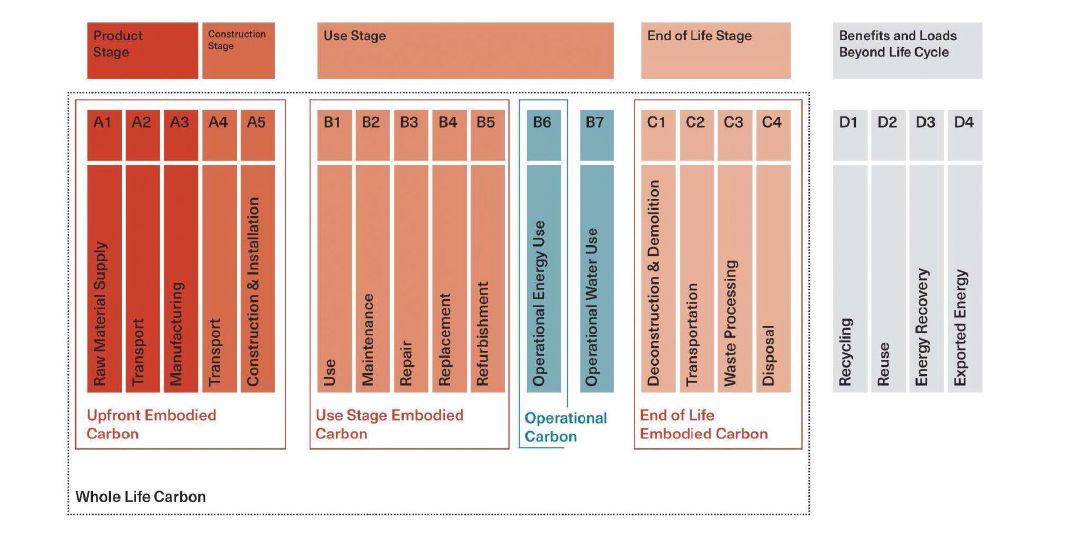
By now, most of us are probably familiar with the chart showing stages A through C of the building lifecycle that identifies the different ways a building project releases CO2 through time. The only true metric of the building’s contribution to climate change is the one number for carbon dioxide release that results from measurement of all the inputs on that chart. All of them – from extraction of raw materials through disposal of the demolished building and everything in between. With no compartmentalization of the various building components such as facade, mechanical, structural, electrical and infrastructure.
Yet for the better part of 50 years now, the research and development focus in our industry has looked like the number-filled conference rooms described above. That’s because governments have been engaged in an on-again-off-again program to nudge the glazing industry down the path to more insulating products. It’s required decades of committees, research and standards development, building incremental change cycle after cycle, for one simple reason: the market hasn’t demanded it. The jury is back and the verdict delivered – people will not pay a nickel extra for energy-efficient buildings unless the energy savings pencil out to overall savings. And do so within a time frame when the owner still expects to own the building. In the case of most commercial and condominium builds, that time frame is zero. Absent a market incentive to boost energy efficiency, the only alternative for governments has
WHY JOSEPH?
Lineal processing automation
Exceed 95% material yield
Save at least $800,000/year in material costs with our Zero Scrap Saw and lineal optimization software
Your specs are our marching orders — customizing controls, outfeeds and tooling is just part of the job “Catalog-only” doesn’t cut it
Unthinkable throughput targets
Need two complex parts completely cut, fabricated and ready for the next step in under 60 seconds? No problem
sales@josephmachine.com Consolidate machines, reallocate labor, improve ergonomics, lower costs and enhance part quality
josephmachine.com
By plugging in data for each of these life cycle stages, it should be possible to model the total carbon dioxide released by a building project over its existence.
been regulation, carefully phased in so as to not depress construction activity. Thus the endless slides full of numbers that shift a few decimal points year by year. Thus the wrangles over metrics and methods (ER versus U-value? Standard sizes versus algorithms?). Thus the parade of shifting goalposts.
And thus a focus that has amounted to a colossal false-start for reduced carbon building. It is only in the last 15 years or so that standards writers have started to focus on embodied carbon, developing the framework for product category rules that can define how much carbon is emitted in the manufacture of a glazed assembly. It’s only in the last 10 years that code officials have begun to signal that they will begin to phase embodied carbon reporting, then limits, into the nation’s building codes. Yes, LEED existed before that and did establish a holistic framework for determining a building’s overall carbon contribution, but it includes a suite of other environmental factors (contribution to ocean acidification, use of finite resources, the “healthiness” of the indoor environment) and is a voluntary certification. So it never enjoyed widespread adoption, though parts of it may serve as a roadmap forward for the
vision expressed here. What has happened on the ground is that building engineers in Canada and around the world have spent at least 30 years driving innovation in reducing operational carbon only to be faced today with the need to at least put a significant additional consideration into their designs. In some cases, considering embodied carbon will require revisions to existing designs. In others, it may actually require tearing up designs entirely or even opting for less-insulating glazing.
The infamous example is triple glazing. In the tiered energy codes introduced in the 2020 NECB (which followed B.C.’s Step Code in 2017), the highest levels of energy performance called for a centre-ofglass U-value of 0.82. This was a rating really only achievable with vacuum insulating glass (too expensive and not available in quantities at the time) or triple-glazed insulating glass with low-E coatings. Provinces and municipalities signalled their intentions to phase in progressively higher tiers for compliance. Today, it is still the stated intention of Natural Resources Canada’s Green Building Strategy to mandate the highest tier by 2032. Accordingly, R&D departments in fenestration manufacturers across the country have scrambled
to design, develop and test triple-glazed products so they can meet market demand when the code requires it.
But triple-glazed fenestration uses more glass. One-third more, to be specific. The glass production process is highly carbonintensive, releasing tons of CO2 to produce the 1,500-degree temperatures required. Triple glazing requires larger frames, using more framing material. Fenestration framing material, especially aluminum, is very carbon-intensive to produce. Triple-glazed assemblies are also heavier and more awkward to install, possible requiring the use of carbon-emitting machinery where none was needed before.
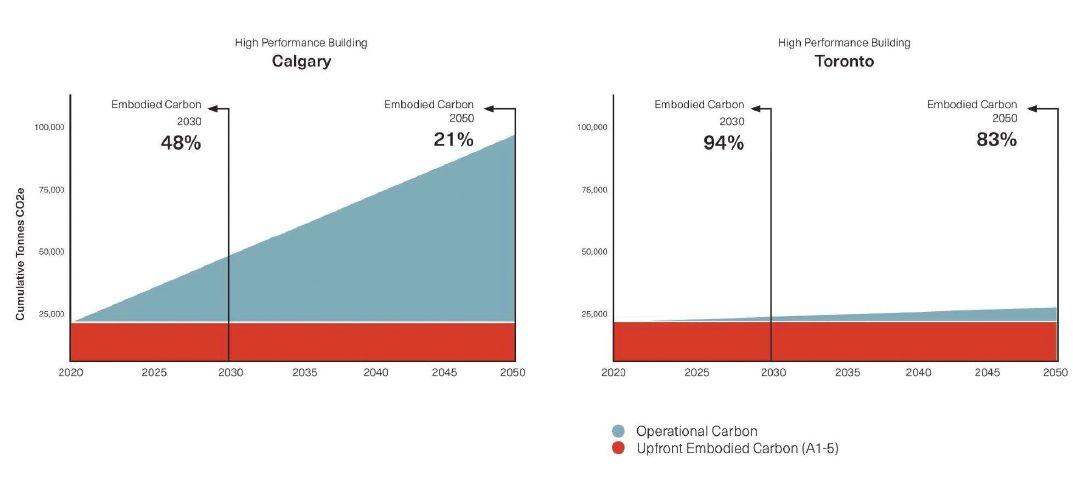
So while the triple-glazed facade may save some operational carbon over the life of a building, it introduces a significant embodied carbon cost up front. In buildings powered by low-carbon energy sources, as discussed above, operational carbon savings may have little impact on the overall carbon budget of the project. Analysis by Claudio Sacilotto of Novatech suggests that, in Ontario’s energy grid, it would take 25 years of operational carbon savings to offset the additional embodied carbon introduced by installing tripleglazed vinyl windows in a residence versus
double-glazed – even if the residence was heated by natural gas.
By lasering in on operational carbon ever since the oil crisis of the 1970s, construction technology development in this country has gone in generally the right direction, but by the wrong route. Consequently, without changing the path, it will never arrive at its precise destination of a built environment that generates the lowest possible carbon release. No question, the development of more insulating facades has been beneficial and will be beneficial to the extent that buildings generate lower carbon emissions from fossil fuel use to power them. It is also beneficial to the extent that property owners have experienced and will experience lower energy costs – however property owners have voted with their wallets on that front, clearly preferring saving money on upfront engineering today over saving energy costs tomorrow. But by ignoring embodied carbon for decades, and embarking on regulatory regimes without it, governments have forced untold millions of dollars in R&D and process investment that will now
need to be at least partially unwound. It’s as if they told us to build cars that would go as fast as possible, but never allowed for the need to upgrade the brakes.
And another directional wrong-turn looms. We are still in the early phases of introducing embodied carbon to our codes and standards. But already another word is gaining volume in building science circles: resiliency. Resiliency assesses a building’s likely useful longevity and its propensity to be repaired, maintained, upgraded and even recycled over time. In one sense, it is an outgrowth of embodied carbon life cycle analysis, since the objective of a more resilient building is to avoid having to release CO2 by manufacturing new components for it or demolishing it entirely and building a new one. But resiliency also addresses the need for buildings of the future to withstand the effects of climate change, including more frequent extreme weather events and different conditions in the regions where they are designed and built. So in some cases the need for resiliency could be in tension with embodied and operational carbon calculations. What
if you designed a facade made out of bamboo that achieved the lowest overall carbon release because the building was heated by solar power? Let’s say the facade is so carbon-friendly that you could replace it entirely every 20 years and still have a net gain on the carbon budget. But it doesn’t hold up too well through freeze/thaw cycles. If temperatures fluctuate too much in the winter, it will only last 10 years. By focusing on operational efficiency and low embodied carbon, but ignoring resiliency, you’ve made a facade that is not optimized to minimize carbon release.
On the next leg of our journey toward a minimum-carbon built environment, we should avoid taking off down the wrong path in the right direction again. We should load into our GPS the final destination – the lowest possible carbon release as a result of a building project – and follow that route. We should replace all the slides full of numbers with one number.
Denmark is close to doing this. According to an Aalborg University report, Climate Impact from New Construction, (thanks to Juliette Cook of Half Climate
Operational carbon has far less relevance in areas with cleaner energy grids. That’s one reason why cookie-cutter prescriptive rules will never result in the best solutions.
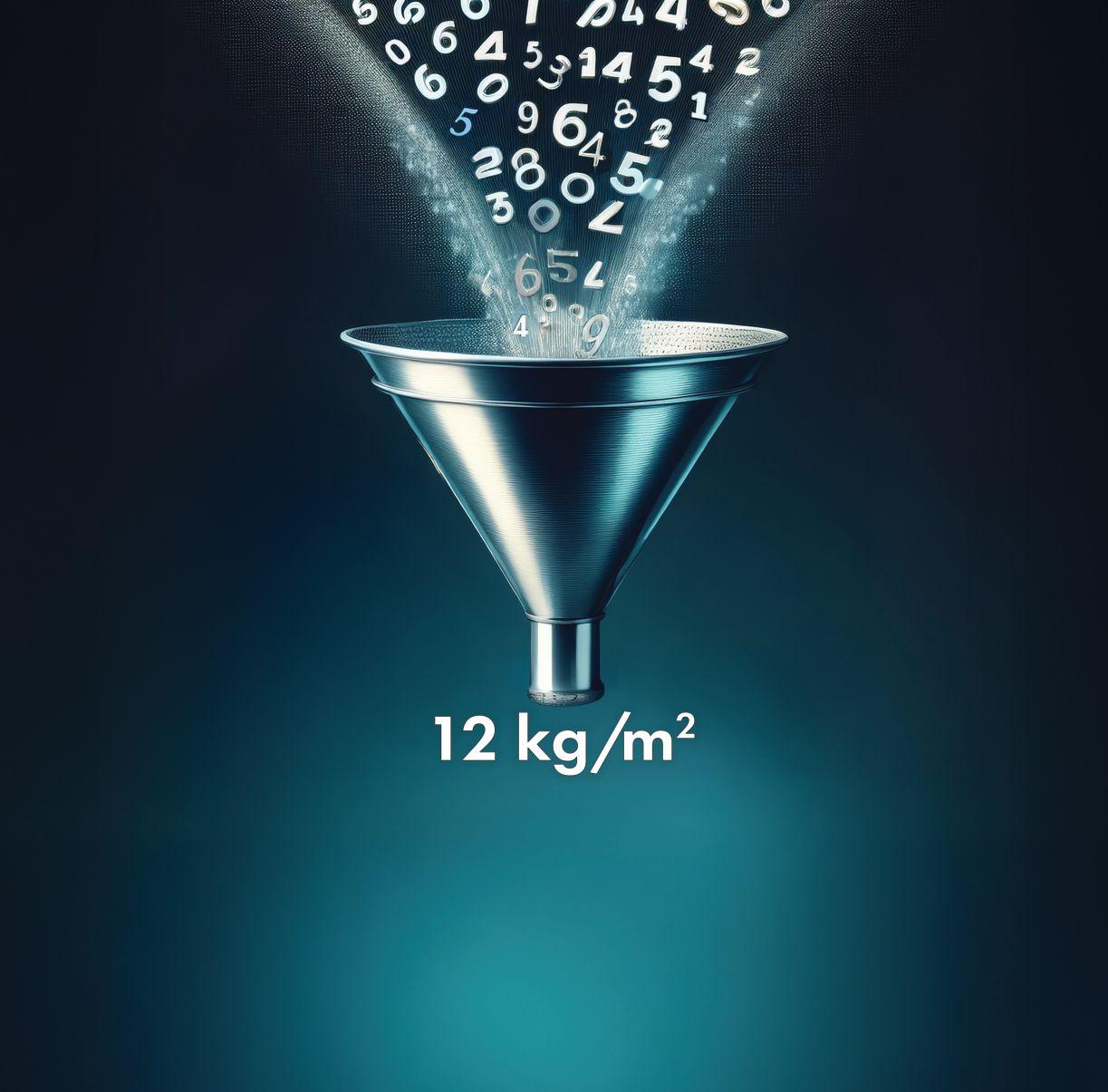
Design for the information) it’s Department of Built Environment has established a limit of 12 kilograms of CO2 released per year per meter squared of structure. That number includes manufacture of the products, replacement of building components, operational energy use and end-of-life demolition and disposal (chart sectors A1-3, B4, B6 and C3-4). Denmark plans to add sectors A4-5 (construction and installation activities) as a separate calculation capped at 1.5 kilograms emitted per meter squared per year. That’s it. Denmark doesn’t care what the building is made of, how insulating it is or is not, how airtight it is or how it is heated and cooled as long as it all adds up to something less than these carbonrelease targets.
The one-number system would place a limit for total annual carbon emissions from all sources on the building project, not the building itself or any individual component. The project owner would be required to submit a life cycle analysis for the whole project, from inception to its projected end of useful life, using approved sources of carbon-emission information for each stage. Approval of the LCA would be part of the permitting process and confirmation that the approved model had been followed would be part of the final inspection process. There would be no energy-efficiency or embodied carbon
requirements on any particular part of the project. If the architect wanted to have open holes instead of windows and crank up the heat to compensate, that would be fine as long as they could show the overall carbon release didn’t exceed the limits. If they wanted to make the roof out of highcarbon steel but heat the building with sunlight and geothermal, they could do that as long as the project didn’t exceed its carbon budget. The one-number system would unlock absolute maximum design flexibility for architecture and maximum potential for innovation in finding ways to hit aggressive carbon targets under budget.
For glass fabricators, little would change except for the need for product engineers to spend hours looking at slides full of numbers from various jurisdictions’ energy regulations. For standardized products, they would develop good, better, best energy efficiency options and attach test results generated at test labs (using whatever sizes and configurations they want) and EPDs compiled using EPDs from their component suppliers. For custom projects, the EPDs from suppliers would be fed into software that generates the carbon load of the design and projects it over the expected life of the facade. Thermal transmission, solar heat gain and air/water tightness would be tested to spec as usual, with the difference that the target values would
not be determined by a standard written a thousand kilometers away in a different decade. The glass fabricator would just provide these test numbers. Their impact on the operational carbon of the building would be assessed by the architect and used to contribute to the whole-building LCA.
Glazing contractors, having received the carbon impact numbers for the products from the fabricators, would need some way to produce a carbon impact statement for their shipment and installation activities. Much of this could come just from reasonable estimates of energy use on site for vehicles, lift equipment, heaters and generators. Generic numbers could even be used extrapolating from time spent at certain tasks. As in any energy regulation, the objective need not be actual, realworld, completely accurate measures of energy used and carbon emitted. Reasonable estimates and projections can do the trick, and are all that are practically possible anyway.
Under a one-number system, the responsibility for producing a carbon budget for a project would fall to the project owner as part of the design approval process. Architects will need to collect certified EPDs from their product suppliers – something most building component manufacturers are busy producing now –
and use them to produce a budget for constructing their design. The project engineer would add data for the project infrastructure – roads, parking, utilities, landscaping, maintenance – and project those carbon costs forward over the expected life of the building using metrics like Energy Use Intensity. When all this data is integrated, the total amount of carbon dioxide released by the building project would then be known, and would be the sole determinant of whether the project meets government energy standards.
The big remaining barrier to easily producing project carbon budgets is software that can integrate all the inputs and generate the one number. These products are in development. the day is fast approaching when construction software platforms such as ProCore will have all the carbon release numbers for each element of a construction project attached, just as they have cost information attached today. From there, a full carbon budget for any project is just a click away, and can be updated by integrated AI whenever a parameter is changed. We should not underestimate
the potential impact of such a system. A project engineer trying to get their carbon budget in under the target could play with literally any element of the project. Instead of going back to the glass fabricator and insisting on a two basis-point reduction in Uvalue of the glass, he could specify renting electric equipment on the job site. Instead of reducing window-to-wall ratio, he could specify a low-carbon cement or pave the parking lot with a non-asphalt-based product. Trade-offs that can’t be contemplated under the present performance-based regulation regimes, which are today solely focused on operational carbon, could come into play and unlock tremendous design creativity. Project owners would be able to design and build the projects they want and that their target markets demand. Developing better software design tools with integrated carbon cost information should be a request to digital suppliers from this industry and from governments.
A straw poll of industry experts by Glass Canada has revealed the major outstanding barrier to adoption of a onenumber regime: the lack of the necessary
EPDs and approved methods for gathering and applying carbon-release information to generate the needed models (some of this feedback will be attached to the online version of this article). The present lack of capability in existing software tools noted above would be another practical barrier to adoption, as generating a whole-project carbon-release budget for every project could be an unreasonable burden without AI help. That’s why this article should be seen as an argument for a future direction for regulators rather than a call for immediate change. For too long, the North American effort to make construction more climate-friendly has proceeded without the end in mind, focusing on first this and then that individual element of the building. Years of R&D have been applied inefficiently to parts of the problem and resulted in some cases in downright counterproductive efforts. It’s time for those interested in making Canada’s built environment less impactful on climate change to look at each of their efforts and ask if they serve the ultimate goal in the best possible way. •
WHY CHOOSE RIMAC?
www.metalcurving.com
A well-tempered glass business
Prince Edward Island-based Silliker Glass gives Atlantic glaziers a local option.
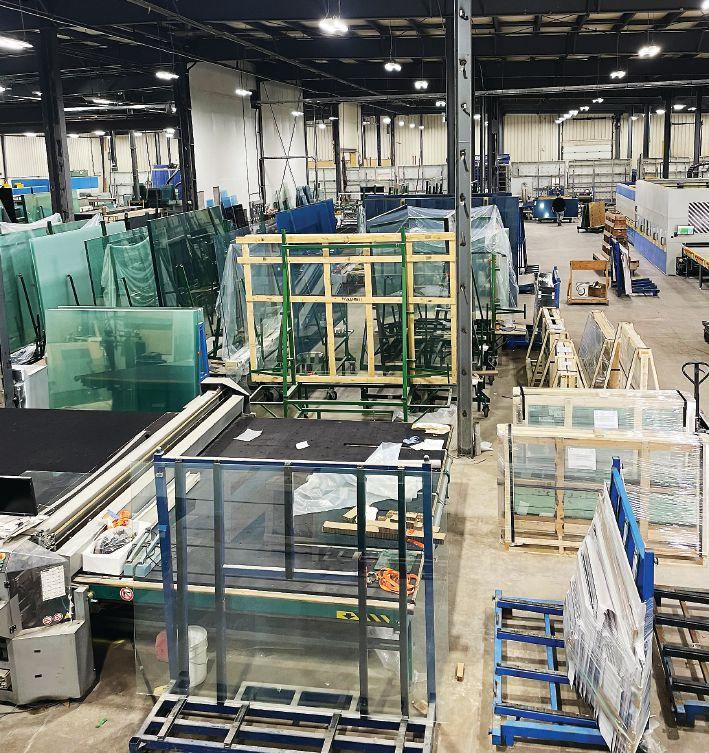
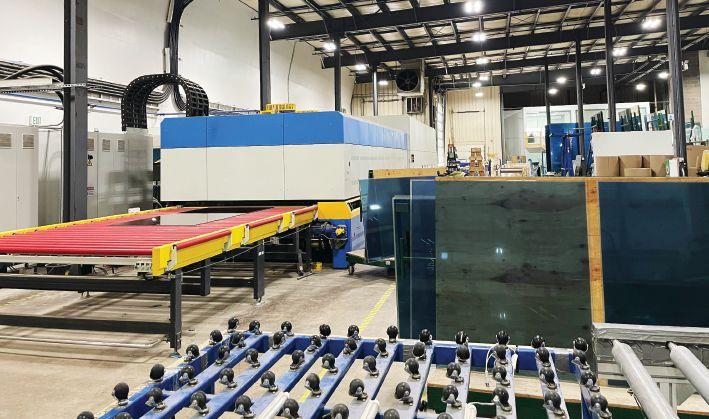
This area full of processed tempered glass hints at the volume of products that Silliker Glass produces.
AT A GLANCE | Silliker Glass
Seeing shortcomings in the ability for tempered glass manufacturers to serve Atlantic Canadian customers, Prince Edward Island-based Silliker Glass decided in 2010 to pivot from their traditional bread-and-butter commercial and industrial glass installation activites to manufacturing tempered glass. The result of their radical pivot and considerable investment is that the company now operates out of four locations spread across Prince Edward Island, New Brunswick and Nova Scotia.
“Most of the people down here were sourcing it from Quebec and the lead times were just exponentially long,” says Matthew Silliker, company owner and grand-
son of company founder Ed Silliker.
The decision to commit the company to such a capital-intensive change was informed by the alignment of several stars, including the availability for purchase of a building the federal government had used during the construction of the Confederation Bridge that connects the Island to the mainland, government funding and the ever-increasing specification of glass building exteriors by architects, according to Silliker.
“They’re pushing the envelope on what glass manufacturers can supply and provide. As America changes and grows, the glass seems to be at the forefront of that growth,” Silliker says. “My father and my
Owner: Matthew Silliker
Locations: P.E.I, New Bruns wick, Nova Scotia
Main services: Tempering IGU
Fabrication
Employees: 100
Total plant: About 100,000 square feet
Instituted: 1965
uncle thought it was a good idea to jump at the opportunity, and with the building available and government funding and [ar-
chitecture] trending in that direction, they ran with it. This was the first time bringing an oven to Atlantic Canada for tempering glass. There is a significant capital investment required to do something like this, but my uncle and my father saw an opportunity to capitalize on, and so far, so good,” says Silliker, who has worked with the company for over 20 years.
Silliker Glass’s head office and largest plant, at 65,000 square feet, was acquired in 2018 and is known as Plant 167. It is in Borden-Carleton, a small town near the foot of the Confederation Bridge, just across the highway from Silliker’s 2010 purchase: that former government building, which Silliker refers to as Plant 68.
A third facility, which Silliker acquired with the purchase of City Thermopane in 2019, and referred to as Plant 420, is in Beresford Belle-Baie, on the Baie des Chaleurs and just a 25-minute drive south of the Port of Belledune on New Brunswick’s east coast.
Silliker also operates a 20,000 squarefoot aluminum fabrication shop in BordenCarleton and a 10,000 square foot alumi-
num fabrication shop in Mount Uniacke - a roughly 20-minute drive west of Halifax.
The history of Silliker Glass stretches back to the early 1960s when Ed Silliker founded G. E. Silliker Construction in Summerside as a contracting business. By 1965 the company was specializing in commercial and industrial glass installations. Ed’s sons Ron and Stacy took over
Silliker’s glass tempering capabilities allow Atlantic contractors to source locally.
UNDERtheGLASS
the business in 1981, incorporated it and changed the company name to G. E. Silliker and Sons.
“In the past, the company was well known in the glass industry for doing commercial and industrial jobs. In June of 2010, we stopped doing installations and became a supplier to the glass industry. In October 2010, we moved to our new location in Borden-Carleton. The new shop [Plant 68] has many new pieces of equipment, which allows us to produce many new products, which had only been available from outside of the Atlantic Provinces,” the company website explains.
In Plant 68 Silliker manufacturers tempered glass over six millimetres, for applications such as showers, railings storefronts and entrances. Silliker has carried out several renovations and additions to it and the co-located aluminum fabrication shop. The latter was recently enlarged by 15,000 square feet.
Plant 167 is the company’s newest facility. “The main shipping department and key administrative roles are located here. It has the same glass manufacturing capabilities as the other plants, but here we mostly stick to glass products under six millimetres for window applications,” Silliker explains. Its production areas include two tempering ovens, four cutting tables, two seamers , five washers, multiple polishers, a laminated glass oven, four insulating glass unit lines and a paint line. This is also where the company’s biggest oven is located, with a bed capable of accepting a sheet of glass 86 by 168
inches.
“This is the biggest piece that we can temper,” Silliker says. “We might put 30 or 40 small pieces in an oven or just one large piece. It fluctuates from run to run.”
The company’s glass products include insulated glass units, commercial windows, entrances, storefront systems, showers, railings, clear and tinted glass, low-E and reflective float glass, laminated, pattern, specialty glass, mirrors and polycarbonate sheets.
Even though the company switched tack to become primarily a manufacturer of tempered glass, it continues the aluminum fabricating work that it began in 1980. This includes window and door frames, curtainwall, doors and thermal doors. “We also carry hardware such as handles, hinges and electronic openers. Aluminum fabricating is a growth portion of our business, but it’s also an insurance portion of our business as well,” Silliker explains.
The tempering work is currently divided between Plant 167 and Plant 68. Plant 420 in Beresford Belle-Baie manufacturers the majority of the annealed insulated glass units. It has a tempering oven, but it is not online yet. Sized at 35,000 square feet when Silliker bought City Thermopane, Silliker added 10,000 square feet to it in 2023.
The company employees about 100 people. As a glass company, employees need to have particular attributes, Silliker explains. “Fitness and attention to detail are the biggest things. People need to be safety-conscious. They need to pay attention to detail
for quality issues. Without our outstanding staff we wouldn’t be able to work within the industry. Their commitment to serving our customer base is second to none.”
Keeping the production areas clean is a constant task due to the protective layer of dust that comes on the raw sheets of glass. “There’s a lot of dust brought into the facility from the glass receiving process. The glass has to be put through our automated washers after we cut it to size and take the sharp edges off, a process referred to as seaming,” Silliker says. The production floors are constantly being wet-mopped with little Zamboni-like machines, and the equipment requires constant cleaning as well.
The company’s geographical reach is mainly Atlantic Canada. Deliveries are made using three company tractor trailers and three straight trucks equipped with piggyback forklifts. “We wouldn’t ship much further than Montreal. We deliver the glass ourselves, but we’ll send certain things via common carrier to get something quickly to a rural location that is not part of our normal delivery route,” Silliker says.
While Silliker sources some of its glass from the United States (“As of right now, there’s no tariff on glass,” Silliker notes.) it also sources glass from around the world. “We’ve been tapping the international market long before [the United States’ 2025 tariffs],” he says. As for tariff threats, Silliker says, “We have an international broker that we use for glass. We wake up every morning and we’ve got the news on to see what came out the night before. That’s right. You have to check every few minutes to see what the latest [tariff] idea is. We’re ready.”
In that understated way that sounds like home to anyone raised on the east coast, Silliker summarises the rapid expansion and success of his company’s big dive into tempered glass: “For the most part we’re just out here trying to get by and enjoy what we’re doing the best we can and service our clients the best we can. It’s not an easy business to get in, and our customers are still learning what our product offerings are, including our growing capacity to offer more of our high-quality laminated glass. We appreciate the local support. In today’s world, supporting people within the communities we support is paramount to the success of our region. We need to continue working together to push back against the shifting markets.” •
Matt Silliker is the third-generation owner of Silliker Glass.
by CLAUDIO SACILOTTO
The next big thing
In the early 1990s, Shuji Nakamura of Nichia Corporation invented the blue light-emitting diode, enabling the creation of energy-efficient white light and full-colour displays. LEDs consume up to 80 percent less energy than traditional incandescent and halogen bulbs. Since electric lights account for around 25 percent of the world’s electricity consumption, Nakamura’s invention has had a profound environmental impact.
Over the last few decades, the fenestration industry has seen such technological advancements as thermally broken frames, polymer-based reinforcements, multiple panes, noble gas fills and low-emissivity coatings. Yet, while these developments have made meaningful progress, they represent incremental changes. Many believe the industry has reached a technological plateau. What is needed now is a revolutionary breakthrough – something akin to the impact of the blue LED.
One technology that promises to be that breakthrough is vacuum insulating glass. Over the past few years, VIG has transitioned from an industry buzzword to a fast-approaching reality. It is increasingly featured in seminars, conferences and industry podcasts, signaling growing momentum and widespread interest.
For those unfamiliar, VIG is a high-performance glazing solution that drastically reduces heat transfer by utilizing a vacuum between two glass panes. Unlike conventional double-glazed windows, which rely on air or argon gas as insulating layers, VIG nearly eliminates thermal conductivity. With no air molecules between the panes, heat transfer through conduction and convection is drastically minimized, resulting in significant energy savings.
VIG has the potential to become a standard component in sustainable building practices.
THE ENGINEER
The most significant advantage of vacuum insulating glass is its superior thermal performance. A single VIG pane, usually between eight and 12 millimeters thick, delivers nearly three times better insulation than a conventional dual-pane IGU, but in a slimmer, lighter form. VIG can also be integrated into hybrid units, combining a VIG pane with a standard pane to create a “hybrid vacuum IGU.” These systems significantly outperform triple-pane IGUs and, in many cases, rival the insulating values of insulated walls – an impressive feat for a transparent material.
Given its advantages, why hasn’t VIG already taken over the market? The quick answer is cost, largely driven by the technical and manufacturing challenges involved.
First, the glass must be extraordinarily flat – particularly difficult when producing tempered glass, which is commonly used for its strength and safety. Even minor warping can compromise the vacuum seal.
Second, achieving a durable hermetic seal around the perimeter has been a significant technical challenge. If the seal is breached, the vacuum is lost and the unit’s insulation performance collapses. Visually, failed VIG units often show support pillars that have fallen out of alignment and pooled at the bottom of the pane.
Lastly, manufacturing VIG requires specialized equipment and significant capital investment. Until recently, these factors made VIG production prohibitively expensive. However, with increasing demand and advances in production techniques, the costs are starting to decrease. Today, the lifetime energy savings provided by VIG make the investment more justifiable, and several manufacturers are scaling up operations to meet growing market demand.
Vacuum insulating glass represents a major leap forward for the fenestration industry. Its exceptional thermal and acoustic insulation, combined with a slimmer profile and environmental benefits, make it an ideal choice for energy-efficient, modern buildings. While challenges such as cost and durability remain, the future of VIG looks bright. As production scales and prices fall, VIG has the potential to become a standard component in sustainable building practices, much like the blue LED revolutionized lighting a generation ago.•
Claudio Sacilotto is director of engineering for Novatech Patio Doors.
Beyond spreadsheets Industrial AI can help rebuild
ing, with the right
In this environment of persistent economic uncertainty the construction industry is challenged to find ways to improve project performance by delivering projects in shorter timescales, on time and on budget, with minimal defects and re-work, while also meeting growing environmental, social and governance requirements. This is increasingly difficult, as companies face fierce competition and low project margins, sometimes as narrow as one to two percent. To keep projects profitable, businesses need to accurately estimate projects and manage costs (labour, equipment rental, materials, sub-contract package costs and overheads), cash flow and contract and project change, while monitoring actual and committed costs
North American fenestration standards. Uncompromised quality, service, and support for over 40 years.
and tracking project progress.
AI trends in the construction and engineering industry include automated and autonomous equipment and robotics; smart design and BIM tools and virtual reality; asset performance management; and predictive maintenance using smart sensors and Internet of Things. Other case examples are drones to measure project progress and smart cameras and wearables to improve health and safety on the construction site. In addition, there are major AI improvement opportunities that will be realized in the core project and asset lifecycle processes. The term industrial AI is now being used to describe these AI use cases.
However, the majority of organizations are still at the beginning of their digital transformation journeys, and there is work to be done before organizations experience the real business benefits. Historically, the sector has lagged in digital adoption, relying on disjointed business systems and manual processes, such as spreadsheets, which compromise data accuracy and decisionmaking. Moving forward, industrial AI technology, coupled with the right digital backbone, can play a pivotal role in how data is captured, analyzed and used to optimize project outcomes.
A strong digital foundation for AI success
For construction and engineering organizations to reap the full value of AI, a reliable digital foundation is required to ensure strong systems and quality data. A house cannot be built without a foundation, the same as an AI system will not be effective without a digital backbone. This is where that comprehensive ERP solution comes in. The transition to data-driven management will be vital for unlocking AI’s full potential. When it comes to data and data analytics, AI has the potential to collect, process, and analyze large amounts of data from various sources, including ERP systems, to provide insights and predictions for construction projects, such as site conditions, project risks, forecast future project costs and margins and performance indicators. All of this is a great leap forward from the traditional use of spreadsheets.
Improved project financial control processes include project estimating, project budgeting and project forecasting. Automation and intelligent forecasting have great potential. Today, most companies manage these processes using non-integrated processes and with the use of many manual Excel spreadsheets.
If we have high-quality consistent data, AI can help identify project and business process anomalies and, with the use of AI agents, automate the required actions. This will allow management to focus on other tasks instead of spending too much time collecting data and documents and writing reports.
AI can use intelligent character recognition to scan and interpret documents, reducing manual data entry and improving accuracy. This is particularly valuable for handling large volumes of documents such as goods received notes on construction sites or perhaps reconciling bids.
AI can be used to improve risk management by identifying and evaluating risks and opportunities, helping managers take corrective actions promptly. This enhances the overall control and management of projects.
AI agents can analyze contract and project changes providing recommendations to mitigate potential issues and improve
project outcomes. This helps in managing the financial and operational aspects of projects more effectively. AI agents can also analyze effects on the project margin and timeline based on the changes.
By automating repetitive and time-consuming tasks, AI agents can improve operational efficiency, reduce costs and enhance the overall productivity of construction and engineering companies.
Construction and engineering companies often have diverse businesses that do more than deliver design and construct projects. For example, their services may include manufacturing, asset management and rental of equipment and service or facilities management. There are also many AI opportunities that can be implemented for all functional areas of the business: asset management, service management, finance, inventory management and supply chain, human capital management, manufacturing, purchasing, health and safety and ESG.
For construction and engineering organizations, AI will increase overall efficiencies, standardize processes, enable greater project and business control and build resilience to optimize processes and improve decision-making. Ultimately, for industrial AI to deliver real value, it needs the support of comprehensive ERP that will allow construction and engineering organizations to safely take the first steps on their transformation journey. •
Kenny Ingram is vice-president of construction and engineering at Institute for Fiscal Studies, a U.K.,-based economics research organization. .
Glass has manufactured tempered glass for showers, railings, entrance systems, interior partitions and architectural glass applications since 2007. • Tempered up to 96 x 144 • Custom Laminated up to 86 x 144 • Bent Tempered Laminated to 66 x 96
PRODUCTSHOWCASE
Fast space modelling
goiguide.com
Planitar has introduced the iGuide Planix R1, a fast, lightweight and affordable lidar-equipped 360-degree camera system for creating accurate floor plans, 3D tours, ESX files, CAD drawings and 3D models. Designed to replace older rotating camera designs which are slower to operate and costly to process, the Planix R1 can produce professional results with a single snap from a high-resolution, 360-degree, lidar-equipped device that can go anywhere and capture both very small and large spaces. Once captured, the rich property data can seamlessly be uploaded to the iGuide Portal via mobile app. Depending on the project type, an iGuide 3D virtual tour and floor plan can be delivered in minutes, with complete 3D CAD drawing packages available within a few days. Planix R1 key features include improved visuals with better colours and contrasts for higher-quality images powered by the fully integrated Ricoh Theta X 360-degree camera. The R1’s lidar delivers enhanced accuracy, limiting measurement uncertainty in distance measurements on floor plans to 0.5 percent or better and in square footage to one percent or better. The R1 is small
Let the dog out
kolbewindows.com
Pawport has partnered with Kolbe Windows & Doors to expand installation possibilities for its Pawport Smart Pet Door. Homeowners will be able to purchase a wooden or glass door or floor-to-ceiling window from Kolbe with a Pawport Smart Pet Door already installed, providing sleek, highly secure options for homeowners looking to add convenience and functionality while enhancing the esthetics of their home. Pawport is a patented, smart, secure pet door that retrofits onto existing pet doors in seconds, instantly converting old fashioned, flimsy, unsightly and vulnerable pet doors into high-security doors that can be controlled
Seven new finishes
averydennison.com
via an app and integrated into a smart home. Pawport connects via WiFi to the Pawport app, enabling remote control and management; curfew and other scheduling functionality; voice control via Alexa, Siri, or Google; and pet-specific tracking and usage data. Pets utilize the door by virtue
Avery Dennison Graphics Solutions has introduced its new Auravate decorative window film series that provides a cost-effective, retrofit solution to modernize existing glass windows, doors, showers, partitions and more. The Auravate series films are suitable for residential and commercial applications. The series includes seven new films with various frost/tint/design patterns to add privacy to a room while providing an elevated design esthetic. The film designs still allow natural light to permeate the space for maximum daylighting and enhanced tenant wellness. The seven film finishes are Ash Linen, Blue Sandstone, Dual Vapor Gradient, Fluted Deco, Oak Frost, River Waters and Sandstone. All of the films are suitable for interior installation and the Oak
and weighs just one kilogram, making it easy to carry in any camera bag and combine with other gear. The system cover protects imaging and measurement optics from elements during storage. The device features all-day battery life and replacement batteries can be conveniently obtained from hardware stores. No monthly fees means flexibility and no extra fixed costs. Processing and one-year hosting are included with the iGuide pay-per-project fee structure and customers can download their data for self-hosting or offline use. For professionals in real estate, architecture, engineering, construction, insurance and restoration, the Planix R1 is a suitable solution for rapid indoor space plotting.
of a small, lightweight, waterproof Bluetooth collar tag that verifies the pet and opens Pawport when the pet is near. Pawport’s partnership with Kolbe offers a customizable door or window solution tailored to any home. Pre-installed offerings include the Pawport Smart Pet Door, available in 13 finishes, and the optional weatherproof Outdoor Pet Door, enabling a dual-door operation that works in sync for superior insulation and security. Constructed of high-grade steel and aircraft-grade aluminum and finished with a durable powder coat, the Pawport Outdoor Pet Door is built to withstand harsh conditions and climates while maintaining a refined, modern look.
Frost and Sandstone finishes also offer the option of exterior installation if preferred. Building design sustainability initiatives can also be achieved with select Auravate films. Four of the films in the series were designed with a non-PVC construction: Blue Sandstone, Dual Vapor Gradient, Ash Linen and Fluted Deco.
Thermal imaging smartphone
ulefone.com
Ulefone has launched the Armor 28 Ultra series, a lineup of rugged smartphones including the Armor 28 Ultra Thermal Version, which introduces AI-powered thermal imaging capabilities. The Armor 28 Ultra Thermal Version offers professional-grade thermal imaging. It features a ThermoVue T2 thermal sensor, enhanced by SharpenAI and FusionAI technologies,
which reduces image processing time by 50 percent. With a thermal sensitivity of under 40 milliKelvins and an accuracy of plus or minus two percent, the device achieves thermal resolution of 640 by 512, delivering exceptional image quality and detail. This makes the Thermal Version suitable for professionals in fields such as construction, engineering and emergency response.
Move test walls the easy way
combilift.com
Combilift unveiled its pioneering self-propelled inloader Combi-SPI at Bauma 2025. This machine is purpose-built for the transport of high loads, such as precast concrete, wall panels or glass A-frames, within production facilities and yard environments. The design objective was to create a versatile solution capable of handling 30-tonne loads on industry-standard inloader pallets with superior visibility, agility and ease of operation. The collaboration with Spaansen, a specialist in precast concrete, influenced the design through to the final stages. Early prototypes focused on reducing overall length and width and enhancing manoeuvrability for working in busy production facilities. However, the project took a significant turn when Spaansen opted for a fully electric model mid-development. This shift required a complete redesign to integrate the electric wheel motors as well as fit the interchangeable batteries into the legs of the machine. The result has been a side-facing cab that provides operators with a clear view
of both the load and direction of travel, ensuring enhanced safety and precision. Adjustable sliding load supports along the chassis accommodate various load lengths and heights during travel. The pivoting front dual-wheel configuration eliminates the need for suspension, optimises stability and gives a tighter turning circle. With a 300-millimeter ground clearance the SPI is designed for both concrete and gravel yards, offering reliability across diverse work environments. It’s available in electric power with an interchangeable battery system, diesel and LPG, catering to different operational needs. The large solid tires enhance durability and reduce yard maintenance. The short chassis enhances load support with a low centre of gravity and offers more manoeuvrability, especially while operating within production facilities. The Self-Propelled Inloader aims to transform yard-based logistics by eliminating the reliance on multiple trailers and shunters, significantly enhancing efficiency and reducing operational costs for businesses handling oversized, high loads.
BUILDING ENVELOPE TESTING
by RICH PORAYKO
Rich Porayko is business development director for Fenestration Canada Commercial
Sustainability and locality
At a planned height of over 300 metres, The Holborn Group is proposing to build what would become Metro Vancouver’s tallest structure. Any proposed tall building is good news at this point. However, if this proposal passes and the skyscraper gets built, chances are the glazing will be supplied from offshore because local companies simply can’t compete with foreign suppliers who do not have the same health, safety or environmental standards as Canadian businesses.
British Columbia’s Step Code comprises some of the most stringent energy regulations in North America. While these initiatives aim to reduce carbon emissions and support a more sustainable future, their implications have reverberated across industries, particularly within Division 8.
The requirements of Clean BC demand significant investments in research, development and production capabilities to meet these high standards. However, the tightening of regulations has unintentionally pushed much of this manufacturing work overseas. Cost pressures and limited domestic support incentivize developers to purchase glazing systems from countries with less stringent environmental and safety regulations. This shift often results in increased reliance on imported products made in facilities that may employ outdated practices, lack environmental safeguards and compromise worker safety.
For local glaziers and architects committed to sourcing sustainable materials, this presents a unique challenge. The environmental benefit of improved energy-efficient buildings is often offset by the carbon footprint tied to transporting materials across the globe.
A sustainable, Canada-based supply chain could reduce dependency on international imports.
THAT’S RICH
These dynamics place the onus on policymakers and industry stakeholders to strike a better balance in which local manufacturing can thrive while adhering to strict environmental goals. Advocating for greater investment incentives, tax relief or grants could encourage domestic innovation and maintain production within North America, all while preserving stringent safety protocols and minimizing environmental impact.
The way forward requires collaboration and forward-thinking policies to support local manufacturing while achieving sustainability goals. Policymakers and industry stakeholders must find ways to balance environmental regulations with economic feasibility.
Governments could introduce tailored grants, subsidies, and tax relief to encourage innovation in sustainable material production.
Developing alliances between architects, builders, and local manufacturers could foster the adoption of greener technologies while creating economic momentum.
Authorities might commit to greater traceability when sourcing building components, ensuring transparency about the embodied carbon and environmental footprint of each material used.
By nurturing a sustainable, Canada-based supply chain, the industry could build efficiencies that reduce dependency on international imports while lowering emissions.
The construction of iconic projects like Holborn’s proposed development provides an opportunity to showcase the best of both innovation and sustainability. However, achieving a truly sustainable future for B.C.’s building industry will require more than advanced architecture and cutting-edge designs. It will demand systemic changes to enable local manufacturers to thrive under these new regulatory frameworks.
Collaboration between governments, architects, developers and manufacturers is essential. By aligning local industrial growth with sustainability objectives, British Columbia can lead the way in pioneering smarter, greener buildings.
For now, as we look up at the inspiring designs altering Canada’s skylines, let’s also consider how we can build stronger foundations for the local industries that make these projects possible.•
STAND OUT FROM THE COMPETITION. BECOME A FENESTRATIONMASTER® .
Set yourself apart with the premier education and certification program for glazing and fenestration professionals.
FGIA’s flagship program now includes new coverage of the NAFS Canadian Supplement, Canadian codes and energy, and insulating glass.
Why become a FenestrationMaster?
Expand Your Expertise —Learn about a wide range of industry topics.
Stay Current—Keep informed of evolving industry standards and best practices.
Stand Out—Certification proves your professional expertise
Learn Your Way—Online courses and proctored exams designed for your schedule
Customize Your Learning – Explore new à la carte options
Elevate your career and join the ranks of over 500 industry leaders. Sign up today at FGIAonline.org/FenestrationMasters.
Canada’s Own Source for Specialty Glass
Glassopolis proudly supports the Canadian glass industry. We manufacture in Canada, employing Canadians, to serve Canadian customers and partners with the best fire-rated and specialty glass products. We have been here for 113 years.