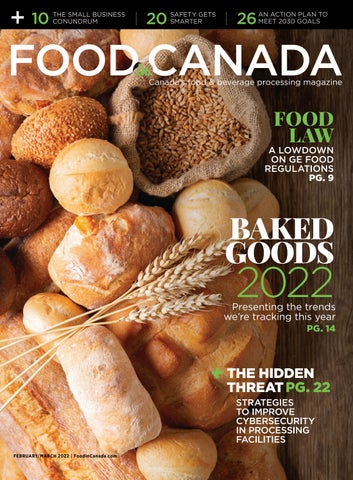
FIC - February - March 2022

Page 1


Compact pressure sensors and switches with 360° custom-colour status display

256 colours

Individually selectable:

Measurement in progress

Sensor switching

Process malfunction

Reader Service Print and digital subscription inquiries or changes, please contact Anita Madden, Audience Development Manager Tel: 416-510-5183 Fax: 416-510-6875

Email: amadden@annexbusinessmedia.com

Mail: 111 Gordon Baker Rd., Suite 400, Toronto, ON M2H 3R1

ED ITOR | Nithya Caleb ncaleb@annexbusinessmedia.com 437-220-3039

MEDIA SALES MANAGER | Kim Barton kbarton@annexbusinessmedia.com 416-510-5246

MEDIA DESIGNER | Alison Keba akeba@annexbusinessmedia.com

ACCOUNT COORDINATOR | Alice Chen achen@annexbusinessmedia.com 416-510-5217

GROUP PUBLISHER/VP SALES | Martin McAnulty mmcanulty@annexbusinessmedia.com

COO | Scott Jamieson sjamieson@annexbusinessmedia.com

Occasionally, Food in Canada will mail information on behalf of industry related groups whose products and services we believe could be of interest to you. If you prefer not to receive this information, please contact our Audience Development in any of the four ways listed above.

Annex Privacy Officer Privacy@annexbusinessmedia.com 800-668-2384

No part of the editorial content of this publication can be reprinted without the publisher’s written permission @2022 Annex Business Media. All rights reserved. Opinions expressed in this magazine are not necessarily those of the editor or the publisher. No liability is assumed for errors or omissions.

Mailing address

Annex Business Media

111 Gordon Baker Rd., Suite 400, Toronto, ON M2H 3R1

Tel: 416-442-5600 Fax: 416-442-2230

ISSN 1188-9187 (Print) ISSN 1929-6444 (Online)

The state of AI adoption

The latest McKinsey Global Survey on artificial intelligence (AI) indicates AI adoption is growing, and that the benefits remain significant.

The survey was conducted from May 18 to June 29, 2021. It covered nearly 1,800 respondents from across a range of industries around the globe. The survey content and analysis were developed by Michael Chui, a partner of the McKinsey Global Institute and a partner in McKinsey’s Bay Area office in the US; Bryce Hall, an associate partner in the Washington, DC, office; Alex Singla, a senior partner in the Chicago office; and Alex Sukharevsky, a senior partner in the Moscow office.

Fifty-six per cent of survey respondents reported AI adoption in at least one function, up from 50 per cent in 2020. AI adoption was common in service operations, product and service development, and marketing and sales. The top three use cases were service-operations optimization, AI-based enhancement of products, and contact-centre automation.

The results also indicate AI’s impact on the bottom line is growing. The share of respondents reporting at least five per cent of earnings before interest and taxes (EBIT) that’s attributable to AI has increased year over year to 27 per cent, up from 22 per cent in the previous survey.

Respondents also reported greater cost savings from AI than previously. The biggest year-over-year changes was

in product and service development, marketing and sales, and strategy and corporate finance. Nearly two-thirds of the respondents said their companies’ investments in AI will continue to increase over the next three years.

Best practices

This is the fourth annual survey on the state of AI by McKinsey, and for the first time, MLOps (machinelearning operations, meaning best practices for the commercial use of AI) and cloud technologies emerged as critical differentiators.

The survey looked at the practices of companies seeing the biggest earnings boost from AI (high performers) and found they were not only following best practices, such as including MLOps, but also spending more efficiently on AI and taking advantage of cloud technologies.

“There’s evidence that engaging in such practices is helping high performers industrialize and professionalize their AI work, which leads to better results and greater efficiency and predictability in their AI spending. Three-quarters of AI high performers say the cost to produce AI models has been on par with or even less than they expected, whereas half of all other respondents say their companies’ AI project costs were higher than expected. Going forward, the AI high performers’ work could push them farther ahead of the pack, since both groups plan to increase their spending on AI by roughly the same

amount,” said the report’s authors.

The survey also found high performers run 64 per cent of their AI workloads on public or hybrid cloud, compared with 44 per cent at other companies. “This group is also accessing a wider range of AI capabilities and techniques on a public cloud. For example, they are twice as likely as the rest to say they tap the cloud for natural-language-speech understanding and facial-recognition capabilities,” said the authors.

Risk management

High performers are more likely than other organizations to engage in a range of activities to mitigate their AI-related risks—an area that continues to be a shortcoming for many companies’ AI efforts.

Cybersecurity was the most recognized risk among respondents. When asked why companies aren’t mitigating all relevant risks, survey respondents said it’s because they lack capacity to address the full range of risks they face and have had to prioritize. The second-most common response from those seeing lower returns from AI adoption is that they are unclear on the extent of their exposure to AI risks.

Access the full report at www. mckinsey.com/business-functions/ mckinsey-analytics/our-insights/globalsurvey-the-state-of-ai-in-2021.

Nithya Caleb ncaleb@annexbusinessmedia.com

Roquette opens world’s largest pea protein plant

Roquette opens the world’s largest pea protein plant in Portage la Prairie, Man. The 200,000-sf plant has the capacity to process 125,000 tons of yellow peas per year. When combined with Roquette’s plant in France, the company’s capacity now rises to 250,000 tons of peas per year.

News> file

New partnership to develop farm-to-fork ecosystem for lupin in Canada

Lupin Platform, Inc., Hensall Coop, Lumi Foods and Puris have come together to establish an integrated ecosystem to increase the production of, and processing of, lupin in Canada. The $7.3-million project will develop a lupin supply and value chain.

The project will be led by Lupin Platform. Hensall Co-op will take on agronomic research and testing for the novel crop. The novel lupin ingredients will then be used by Lumi Foods and Puris to develop new plant-based products.

Infarm raises $200M to accelerate global expansion of vertical farms

Urban farming company Infarm raises $200 million in a Series D funding round. The investment included partic-

ACQUISITIONS

ipation from existing and new investors, including the Qatar Investment Authority, Partners in Equity, Hanaco, Atomico, Lightrock and Bonnier.

The additional capital will serve to expand the deployment of the company’s vertical farms in the US, Canada, Japan and Europe, and to enter new markets in Asia-Pacific and the Middle East with both in-store farming units and Infarm Growing Centres.

GoodLeaf builds a new vertical farm in Calgary GoodLeaf Farms, Canada’s largest commercial vertical farming company, is building a 74,000-sf indoor vertical

> Ag Growth International acquires Eastern Fabricators that specializes in the engineering, design, fabrication and installation of stainless-steel equipment and systems for food processors. Eastern operates three facilities in Canada with two in Prince Edward Island and one in Ontario.

> Strong Roots , a plant-based frozen food company, and McCain Foods announce a strategic partnership, with McCain Foods investing USD55 million in Strong Roots to take a minority stake in the business.

> Lactalis Canada adds Kraft Heinz’s Grated cheese business to its growing portfolio as part of the Group’s US affiliate completing its acquisition of Kraft Heinz’s Natural, Grated, Cultured and Specialty cheese businesses in the United States and entire international cheese business outside North America.

> Nature’s Path expands its brand portfolio with a majority acquisition of Anita’s Organic Mill , manufacturers of organic whole grain flours. Anita’s Organic Mill will retain its own distinct branding and join the Nature’s Path family of brands including Love Crunch, EnviroKidz and Que Pasa.

farm in Calgary. The new farm will create about 70 skilled and unskilled job opportunities in the city. Construction is underway. It is expected to be completed by the end of 2022. The Calgary farm will produce more than 1 million lb of fresh, leafy greens annually, which will be on the shelves of grocery stores across Western Canada by early 2023.

Roquette Canada, Avena Foods and YoFiit partner to improve the nutrition and functionality of plant-based foods

YoFiit, Avena Foods and Roquette Canada have partnered to solve technical challenges in formulating plant-based milk, probiotic-rich yogurt and other functional plant-based analogues with a key focus on maintaining the nutritional equivalency to animal-based products, achieving higher functionality than existing products in the CPG industry.

YoFiit will lead the development of new food manufacturing techniques and novel food products. Avena and Roquette Canada will supply the ingredients for the project and will gain important knowledge about the functionality and performance of their ingredients in unique and innovative CPG products.

Blendtek Ingredients opens new office in Ontario

Blendtek Ingredients opens its newly constructed 85,000-sf headquarters in Cambridge, Ont. The new building will

house Blendtek’s head office, manufacturing and distribution facilities, and is designed to increase production capabilities, advance innovation in product development and support expanded partnerships in Canada, the United States and Europe.

To support product development, a new research & development lab and test kitchen have been constructed to focus on growing food categories, such as plant-based, gluten-free and sugar-reduced products. The processing facility will be Safe Quality Food and Organic certified and accommodate both retail ready and larger format industrial packaging sizes.

Merit Functional Foods’ new facility is commercially ready to process plant proteins

Merit Functional Foods, a solutions-based plant protein company, has announced its new 94,000-sf facility in Winnipeg, Man., is fully scaled to supply food and beverage companies with pea and canola proteins.

The accelerated greenfield construction project, which took just over a year to build, was completed in December 2020. With construction, commissioning and optimization complete, Merit can ensure ample supply of pea and canola protein is locked-in to fulfil the growing demand for plant-based brands. Merit is the first commercial facility in the world with the capability to produce food-grade canola protein.

Cargill unveils new soluble rice flour

Cargill launches SimPure 92260, a soluble rice flour that exhibits similar taste, texture and functionality as maltodextrin, an ingredient commonly used as a bulking agent and flavour carrier. SimPure soluble rice flour provides similar viscosity attributes, bulking agent functionality, and sensory profiles compared to 10 DE maltodextrin, en-

PEOPLE

> Jennifer Hayes has been appointed as the first woman chair of the Canadian Dairy Commission for a four-year term. A dairy and beef farmer on Quebec’s Gaspe Peninsula, Hayes is the third generation to farm at PineCrest Farms in Shigawake, which she co-owns with her father and uncle.

> Ferrero Canada promotes David Rabu as vice-president, trade marketing and category management. In this newly created role, Rabu will lead the development and implementation of Ferrero Canada’s sales strategy across trade and shopper marketing, revenue and category management, and e-commerce.

> Bill Fielding , business director, now leads the Kemin Proteus group. He is responsible for the general management of Kemin Proteins, as well as business strategy and global expansion. Fielding earned his bachelor’s degree from Furman University.

> GoodLeaf Farms promotes Jeff McKinnon as senior vice-president of network development. It has hired Laurent Mareschal as CFO, and a new position, vice-president of engineering and automation, has been filled by Jerry Dover

> Festo promotes Jean-Francois Paquette as Canada sales director. In his new position, Montreal-based Paquette will focus on leading the sales objectives and planning strategy for the Canadian sales organization, setting and meeting revenue and profitability targets for Canada as part of the North American region goals.

> Farm Credit Canada (FCC) announces Gil Miner will oversee its Atlantic operations, following the retirement of his predecessor FAaith Matchett. Miner lives near Moncton, and will lead the Atlantic team of 30 employees from FCC’s Moncton office.

> AAK , a manufacturer of specialty vegetable fats and oils, promotes Jason Glaser as director of sales for the US Central Region and Canada.

abling simple, one-to-one replacement in a variety of applications, including reduced-sugar bakery products, dairy, powdered beverages, convenience foods, sauces and dressings, snacks, cereals and bars and seasoning mixes, and as a flavour carrier.

Organic Meadow launches North America’s first zerocarbon milk carton

Organic Meadow partners with Elopak to launch North America’s first, and only, carbon-neutral milk carton. The Guelph-based (Ont.), farmer-owned co-operative, has transitioned its 2L organic milk to Elopak’s carbon-neutral paperboard milk carton, Pure-Pak Natural Brown Board. This sustainable package is the first carbon-neutral carton of its kind in North America.

Eat Beyond adds Beyond Moo Foods to its portfolio

Eat Beyond invests in Beyond Moo Foods. Beyond Moo offers a full line of oat-based dairy alternatives including yogurt, kefir, spreads (cream cheese) and butter. All of the products are free of dairy, gluten, nuts, soy, preservatives and artificial flavours.

Puratos Canada partners with Everspring Farms

Puratos Canada partners with Everspring Farms to introduce new varieties of sprouted grains to its product lineup.

Nestled in Seaforth, Ont., Everspring Farms takes a distinct approach to sprouted grains: they develop a unique, natural and sweet taste while maintaining a tender texture using sprouting systems custom designed for each type of grain or seed. The option of fermenting the grain after germination allows for even more possibilities for flavour.

NEW PRODUCTS

Dynatrol designs a bulk solids level detector

Dynatrol DJ CIP Bulk Solids Level Detectors can operate as high-, mid- and low-level indicators for bulk solids materials ranging from low-density flakes and powders to pellets and heavy granular materials. Examples of food industry applications vary from potato flakes to almonds, frozen fruits and vegetables, as well as flavourings,

spices and additives. Some Dynatrol level detectors can be used in temperatures exceeding 300 F and below freezing and refrigerated services. These level detectors contain no moving parts, gaskets or seals and rely on mechanical oscillations to determine if the probe is

covered or uncovered. The Dynatrol DJ point level detectors are constructed for a long operating life and are approved for Class I, Group D; Class II, Groups E, F & G; and Class III services.

www.dynatrolusa.com

Cremer offers multi-counter machine systems

Cremer has broadened

It’s been said that we eat first with our eyes. That adage drives researchers, farmers and food companies to seek new food innovations. Look no further than farmed salmon. It is known for being a rich source of antioxidant carotenoids, which also lends the salmon an iconic orangepink hue. Studies have shown consumers preferentially purchase, and are willing to pay more for salmon with a deeper flesh colour (a perceived sign of quality). However, salmon isn’t naturally pink— wild fish absorb carotenoid pigments from their food like small crustaceans or algae. Salmon farmers achieve this colour using fish feed with synthetic pigments or those isolated from biological sources like kelp or shellfish. Pigments comprise an estimated 20 per cent of salmon feed costs, but it’s viewed as a necessary expense to maintain fish health and product quality. Consequently, researchers in South Korea and the US have been racing to develop ‘two-fer’ carotenoid-containing plant crops to cut feed costs (picture a salmon eating orange edamame).

GE foods

Using genetically engineered (GE) plants to improve feed nutrition or impact food characteristics isn’t a new concept. GE foods and feeds are tightly regulated by Health Canada and CFIA, and may raise a number of considerations for businesses across the food supply chain. It’s important industry stakeholders considering developing or using GE plants for animal feed (as well as others in the supply chain) are aware of how these products are regulated in order to make appropriate business decisions.

One fish, two fish, pink fish…grey fish?

In addition to the regulatory approval process itself, which is lengthy and complex, GE plants may raise questions related to product labelling, claims and general consumer perception (both within Canada and in export markets), which impact the cost-benefit analysis of developing or using these plants. For example, in Canada, food companies must ensure claims are not misleading to consumers, and there can be ambiguity regarding the relationship between animal feed and claims made for the resulting food product.

Colouring agents

Continuing with the salmon example, non-GE carotenoid colouring agents for animal feeds are tightly regulated by CFIA. The maximum allowable content depends on the pigment type and intended use, both of which impact animal and consumer safety. For example, the carotenoid, astaxanthin (mainly responsible for salmon ‘pinkness’), is approved up to 80 gm per tonne in complete salmonid fish feed. Despite this, CFIA does not have published guidance on whether or how the use of such feed ingredients should be taken into consideration for food claims related to salmon’s method of production or colour.

When it comes to GE claims, the voluntary labelling and advertising of foods that are and are not products of Genetic Engineering Standard (the Voluntary Standard) provides guidance on claims related to foods and ingredients that are not products of genetic engineering. However, the Voluntary Standard notes that “animal feeds…do not affect whether a food or ingredient is considered to

be or not to be a product of genetic engineering,” which is consistent with the approach CFIA and Health Canada have taken with respect to novel feed and food approvals. Neither the Voluntary Standard nor CFIA guidance specifically contemplate claims that may be acceptable or problematic for animal-derived foods impacted by the use of a GE animal feed.

As a result, even if a new carotenoidcontaining plant crop can be developed and approved by CFIA and Health Canada for use as salmon feed, companies that advertise and sell food products derived from salmon raised using that feed, will need to carefully consider the claims about their product. The same will be true for other animal-derived foods and GE feeds that may be developed in the future.

General consumer perception about foods derived from (or impacted by) genetic engineering will also play a significant role in future adoption of GE animal feeds that impact food characteristics. Although genetically engineered food products are prevalent on Canadian supermarket shelves today, some consumers are wary about their benefits and safety. There is ongoing debate around the potential for mandatory GE food labelling. It’s impossible to predict how consumer hesitancy will be weighed against specific benefits that may result from GE feeds, including product quality.

Katrina Coughlin is an associate in the Ottawa offices of Gowling WLG, specializing in food and drug regulatory law. Contact her at katrina.coughlin@gowlingwlg.com. Jennelle Patterson, PhD, is a scientific research clerk with GowlingWLG.

SThe small business conundrum

mall food businesses are having a surge of public support during the pandemic. There’s so much to love about local businesses, from local supply chains and employment development to unique flavours reflecting tastes of place. However, those of us in food safety see a myriad of challenges.

Pivoting

into a regulated space

Many small businesses are working in regulated environments. For example, restaurants have to comply with municipal public health regulations. During COVID-19 shutdowns, many of these establishments pivoted toward packaged goods, which have a different risk profile than ready-to-consume foods. Ghost kitchens and rental kitchens grew exponentially, thereby creating opportunities for entrepreneurs to get into packaged goods manufacture.

By coupling the boom in packaged goods with e-commerce platforms, restaurant-based food service establishments began selling products beyond the borders of their municipalities. While popular products garnered the interest of major retailers, they were not ready to scale with Safe Food for Canadians Preventive Control Programs or other HACCP-based and audited food safety programming. Restaurant business was not prepared for labelling, traceability and risk-based preventive controls. The risk when consuming a popular soup or a sauce immediately is drastically different from consuming from a jar or package at a later time. These ghost kitchens and incubator systems must find a way to transition SFCR risk-based preventive control systems in a scalable and cost-effective manner.

Permission for home food business

As many people have been laid off, especially from food service, several pivoted

toward creating food products at home for hyper-local sales. In some provinces, such as Ontario, rules allow for preparation of food products within the home, but with risk-based criteria.

Home-based businesses are supposed to be regulated, but most are flying below the radar, forcing inspectors to become innovative, such as looking for postings of food products on social media platforms.

It’s challenging. Economically, we want to encourage entrepreneurship and economic activity, especially for women, recent immigrants and the unemployed, but most home kitchens are not prepared for minimizing allergen and microbial cross-contamination and traffic patterns. Few people can segregate their home kitchens from pets and family life.

Home food industries are intended to be low-risk products, such as low moisture baked goods, candy and popcorn, but, in reality, many are encroaching on high-risk products. Allergen cross-contamination is likely to be poorly managed, and temperature control and monitoring are questionable. Innovations such as video inspection could allow for better oversight. Requiring food handlers’ certification and submission of recipes to inspection would be easy checkpoints for managing food safety.

Over regulated small businesses

Conversely, while some businesses are escaping regulatory oversight, others are being over-regulated relative to their risk level. Safe Food for Canadians Regulation is intended to provide frameworks for riskbased activity, but is being overshadowed by multi-level inspection. Small business is often caught between the various levels of inspection (municipal, provincial, and federal), causing conflicts between inspection services, extended confusion, and loss of business for the establishment.

Access to knowledge resources

It’s been challenging for small business to access knowledge resources. Canadian inspection services are reluctant to counsel establishments. While online resources are available, expert guidance is missing. Food Processing Skills Canada has been active in developing learning tools for small business, but more resources are needed.

Importance of peer communities

In food safety and quality methodology, the Quality Circle model is critical. Ishikawa’s Quality Circle uses a team-based approach, where members of the quality and food safety team gather on a routine basis to promote best practices. In large firms, an expert is usually a part of this circle because the scale of the company covers the costs of this expertise. Small companies lack in-house experts or the cash flow to hire consultants.

Government-funded food safety extension services are commonplace in other countries. They work at an arm’s length from the regulatory agency providing education and consultation to businesses through taxpayer support. Until Canada invests in formal extension services, peerbased communities of practice can help support the needs of small business.

Thanks

I’d like to extend thanks to Dr. Ron Wasik for his generous contributions to the Food in Canada Focus on Food Safety column. I have big shoes to fill.

Editor’s note: We welcome Amy Proulx as the new Focus on Food Safety columnist.

Amy Proulx is professor and academic program co-ordinator for the Culinary Innovation and Food Technology programs at Niagara College, Ont. She can be reached at aproulx@niagaracollege.ca.

We’re FCC, the only lender 100% invested in Canadian food, serving diverse people, projects and passions with financing and knowledge. Let’s talk about what’s next for your business.

FMerchandising matters

or brand owners selling through retail channels, it’s critical to squeeze out time for store visits. In-store reviews provide valuable insights to identify and address issues affecting sales.

Let’s look at merchandising. Analyzing planograms reveals strategies employed by retailers as well as a brand’s competitors. A wealth of insights can be gleaned, such as category segmentation, leading brands, breadth of private label programs, changing competitive landscape, brand positioning and differentiation, target demographics, packaging formats and pricing and promotion strategies.

Retail chains determine product shelf placement based on merchandising strategies for each banner and category. Planograms typically reflect category segmentation, sales velocity, profitability and how a category is shopped, with a goal to optimize sales and profit.

Location, location, location

Consider whether your brand is merchandised in the right category. With nonstop product launches, the assortment shifts, and new categories emerge. It’s worth investigating if a different category presents better opportunities to drive sales. For example, merchandising salad toppers in fresh produce instead of centre store.

Think like a retailer

Impactful package design that stands out from the competition is a no-brainer. Also, think about merchandising and build in flexibility to accommodate different scenarios when designing packaging.

For products in cartons, having a secondary display panel gives stores merchandising options. A box of spaghetti can be displayed two different ways if the panels meet minimum labelling requirements.

The simple addition of a hang hole makes pouches and cartons peggable, providing display alternatives.

Ensure package dimensions fit the shelf slot. Packaging that is too tall is relegated to the top or bottom shelf, impairing visibility and accessibility.

An excessively wide package takes up valuable linear shelf space that could otherwise accommodate two or more facings. For retailers, the more facings the better. Is the case pack appropriate? Ensure a full case of product fits within the allotted space. Alternatively, too small a case can sell through quickly and reduce on-shelf availability.

Retail ready packaging (RRP) is favoured by grocery chains for labour and cost savings. Walmart coined the phrase “PDQ (Pretty Darn Quick) display” for shelfready shipping cases that make restocking a breeze.

has one sku in a category, the item will get lost on shelf.

When developing a marketing strategy, consider category segmentation. Leading brands and store brands are often merchandised in a block, creating a “billboard effect” with heightened shelf impact. However, a brand comprising multiple segments within a category can result in items being scattered across the set. For example, conventional, glutenfree and organic products will likely be merchandised by segment, rather than in a block.

Ensure on-shelf availability

Shelf-ready brands that eliminate merchandising obstacles have a stronger chance of making it into shopping carts.

Think strategically

Premium product placement in the “bull’s eye zone”, which is at or just below eye-level, is reserved for leading brands that can afford to pay for the privilege. In the absence of deep pockets, brands that satisfy an unmet need and/or generate incremental sales may be able to negotiate better shelf placement.

Lone products on a shelf, referred to as orphans, are best avoided. If a brand only

Out-of-stocks kill sales. Don’t assume it’s the retailer’s fault. It’s important to identify the root cause, which can be due to a variety of supply chain factors. Even data integrity issues can disrupt order fulfillment. Don’t overlook missing shelf tags—no tag, no replenishment. Paying distributors or brokers to provide store support can be a worthwhile investment.

In conclusion, shelf-ready brands that eliminate merchandising obstacles have a stronger chance of making it into shopping carts, and thereby maintaining the listing.

As a CPG food consultant, Birgit Blain gets brands ready for retail. Her experience includes 17 years with Loblaw Brands and President’s Choice. Contact her at birgit@bbandassoc.com or learn more at www.bbandassoc.com

Photo

Innovation and brand distinction IN BAKED GOODS

Healthy, good and interesting: Which baked goods will lead in 2022?

Baked goods satiate, comfort, satisfy, and fill us. As a front-line source of sustenance, baked goods continue to inspire and express many of the hopes, concerns, worries and aspirations we seek in 2022.

The past two years have been marked by surges in home baking, along with desire for convenience, health, and immunity.

After the pantry-loading attitudes and flour shortages of 2020, baked goods processors are reconsidering their product assortments. The largest category of ‘baked goods’ comprise bread, pastries, and sweet baked foods including cakes, with category sales rising nine per cent in 2020 (Food In Canada Industry Report, 2021). Leading baked category CPGs are simplifying production, questioning their inventories, rationalizing their SKU offerings, and improving their consumer responsiveness. According to Food Navigator, the strains of the ongoing pandemic may shift consumers from the practical and austere toward decadence, the extraordinary, and a celebration of holistic well-being, along with a much-needed dose of fun and adventure for our mental health in 2022.

PRODUCT DEVELOPMENT

Consumers want wholesome and healthy products than refined carbohydrates and sugars. People are seeking functional benefits

in products, and their accompanied ingredients. Healthy digestion, gut microflora and stronger immune systems can be met in new fibre formulations, and with ingredients such as nut flours and dark chocolates. Some consumers will continue to seek products for specialized diets such as paleo, keto, vegan, and allergen-, grain-, and dairy-free (Food Navigator, Dec. 9, 2021). Baked goods that help strengthen immunity will also be supported.

Fruits, proteins, and high fibre content could mix with reishi, chaga, or other exotic mushrooms as novel ingredients in baked goods. Oats and whole grains remain popular, and in demand. Baked goods low in refined carbohydrates, trans- or saturated fats, sodium, and refined sugar, while higher in natural omega-3s, vitamins, minerals, and antioxidants resonate with leading health trends. Consumers are seeking reductions in the use of preservatives, fructose corn syrup and artificial sweeteners or synthetic ingredients (RJ Frometa, Sept 29, 2021, Vents Magazine).

Baked goods brands are experimenting and meeting all of these various consumer health trends in many ways. Nevada-based Nature’s Bakery is a maker of clean-label, plant-based, nut-free, and non-GMO soft baked goods, best known for its fig bar. Rule Breaker, an allergen-friendly snacks maker uses chickpeas as its ingredient in brownies that are high in protein and fibre while free from 11 allergens, including dairy, sesame eggs, soy, and wheat. Baked goods brand Stonemill Bakehouse, which has a facility in Langley, B.C., focuses on plant-based, dairy-free,

The strains of the ongoing pandemic may shift consumers from the practical and austere toward decadence.
Photo © Grafvision / Adobe Stock

non-GMO and sustainable baking. In 2020, it launched the Honest Wellness line of protein breads that are vegan with no added fat, dairy, or soy. In 2021, Voortman Super Grains launched a ‘better-foryou’ cookie and using real fruits and whole grains (Food In Canada Industry Report, 2021). The brand is expecting a 30 per cent annual growth rate. Consumer demand for healthy, natural, clean labels will continue strong in 2022. Embassy Ingredients has actually created a product line of Necol colours derived from plant pigments for a wide range of baking applications (Snack Food & Wholesale Bakery, Oct. 27, 2021).

Strong consumer demand for ethical, healthy, and, at times, animal-free ingredients has pressed brands to seek alternatives. Dairy and egg substitutes can come from wheat, soy, flax, or peas. However, replacing eggs’ varied functions in baking is challenging.

Manitoba-based Merit Functional Foods has created a line of Puratein canola plant proteins. These proteins are intended to serve as an egg-alternative for cakes, with functionalities including for whipping. Distinct diets, such as ketogenic, can be achieved with substitutes, such as stevia lead, chicory root fibre, cassava flour, coconut oil, flax seed, or rosemary extract. Desire for fibre fortification can come from new processing technologies and ingredients with multiple functions. The trend in upcycled foods and immunity can be found in Fiberstar’s Citri-fi, produced from the byproducts of citrus juice processing. Immunity can

be enhanced with healthier plant and nut fats and oils. Companies such as Epogee have developed EPG oil (derived from rapeseed) to replace up to 85 per cent of the digestible fat in a formulation, with 92 per cent fewer calories (Brewster, IFT, Aug. 1, 2021). Los Angeles-based Bougie Bakes has come onto the West Coast US market prominently in 2021 with the production and marketing of their direct-to-consumer bakery with an assortment of sugar-, dairy-, and gluten-free cookies, brownies, and muffins. The co-owners emphasize premium ingredients, such as pink Himalayan salt, and the use of eggs from pasture-raised hens. They use coconut oil instead of ghee, along with almond flour, plant-based collagen, and unsweetened vanilla macadamian milk. Their products are baked-to-order with no preservatives, and their range of distinct flavour and ingredient combinations include pumpkin pecan pies, peppermint brownies, and orange-cranberry muffins. With a nod to sustainability, they use tins that are reusable by their clientele (Watrous, July 12, 2021, Food Entrepreneur).

BRAND VALUES

While value for cost of product, safety, flavour, and health are important baked goods drivers, sustainability and brand ethics will remain a strong element in consumer concerns with their foods. The baked goods sector will seek to align with broader food sector’s goals to scale its positive impact and build consumer confidence. Packaging will remain an oppor-

Consumers are seeking functional benefits in products.

Baked goods brands are experimenting and trying to meet the demand for clean label, healthy, and sustainable products.

tunity to differentiate a brand, as long as it is also safe and hygienic. Sustainability indicator labelling, such as soil regeneration, carbon neutrality, circularity, and the use of upcycled ingredients all have increasing currency with consumers (E. Schroeder, Oct 20, 2021, Baking Business). Upcycling may have a major breakthrough in 2022, and in the baked goods sector this may manifest with the use of used fruits, coffee grounds, or banana peels as natural flavourings. Partnership between farmers, millers and bakers for artisan goods will open possibilities for greater use of heirloom heritage grains to strengthen social value, minimize food waste, and provide greater social value in supply chains (M. Smith, Baking & Snack, Oct. 21, 2021)

THE JOY OF EATING

Amidst the surging desire for good health, and a greater social sustainability conscience, simple indulgence through satisfying, comforting baked goods that inspire nostalgia and pleasure may really rise this year. Baking techniques from old cultural traditions could resonate with North American markets. Search for Calic bread, a Korean take on garlic, cheese and sourdough bread was up over 1,200 per cent in 2021, while people also sought flavours at once nostalgic, new and comforting, such as Smores Brownies or pancakes with distinct ingredients (Food Navigator, Dec 9, 2021). Consumers in 2022 may also gravitate toward the exotic and spicy, an escape to faraway lands, seeking the space between triedand-true flavours and a desire to break from the monotony and extension of the pandemic with tastes such as blood orange, key lime and clementine, or exotic spices from Asia and the Americas. Baked goods providing consumers with indulgent flavours and aromas such as pizza, pasta, fries, cheese, and chocolates could find eager audiences (E. Crawford, Food Navigator, Dec 16, 2021).

NEW AFFINITY INTEGRA™ DICER

TRIUMPHS OVER CHALLENGING PRODUCTS

The new Affinity Integra excels at processing challenging, difficult-to-cut applications such as high-fat content, cold temperature, sticky, or brined products. The clean-cutting action achieves high yields of precise, targeted cut sizes well within customer parameters, and may be integrated to replace Model RA series machines already in the field.

Visit the Urschel website for more information.

Granulations: Cream-filled Cookie & Chocolate Crunch Bar

Dices:Strawberry,Garlic,&Relish

Blue Cheese Crumble, MozzarellaStrip,&CheddarDice BaconCrumble,SalamiStrip, &PorkBellyDice

The need to curtail PLASTIC WASTE

Combining incentives and business initiative can help address the issue —

Advances have been made in curtailing plastic packaging waste, (or there is a mixed bag of ineffective, half-baked measures) across the world. In the US, depending on the region, plastic bags are banned in several states. In Canada, a federal initiative, has targeted single-use plastics. At the municipal level, in 2018, Montreal and Vancouver banned the use of some single-use plastics.

CPG food companies have their own motivations. For example, Haagen-Daz developed a reusable aluminum container to run a test pilot. Innovation is emerging everywhere. In March 2021, Food Navigator reported how US-based MiTerro has developed a patent pending technology that creates biomaterial from agricultural waste.

A Walker et al 2021 study in Humanities and Social Sciences Communications draws attention to single-use plastic packaging in the Canadian food industry. The authors note that since the middle of the 20th century, plastics production has doubled each decade, and nearly 7 billion metric tons of plastic waste have ended up in landfills, leaking into groundwater and waterways, and impacting marine, terrestrial and aquatic ecosystems. Low-cost food packaging convenience has led to single-use plastics dominating decades of product designs. Since the 1950s, approximately 40 per cent of plastic produced globally is designed for single use, discarded soon after use. Food industry experts, business leaders, politicians, activists and economists are reframing the equation to see this massive waste

as a lost economic opportunity. According to the World Economic Forum, in 2016, 95 per cent of the value in plastic packages, worth USD80 to 120 billion annually, is lost to the economy. From a Deloitte 2019 study, plastics are big business, contributing CAD35 billion annually in sales. The critique presented by industry is Canada currently does not have sufficient infrastructure to manage plastic waste recycling. When it comes to packaging, an important question for CPGs is: Will people actually pay for costs associated with sustainable packaging? According to Food Navigator, supply chain transparency will dominate the post-pandemic food scene, and consumers are seeking brands they can trust.

Consumer perceptions

In 2019, the Agri-food Analytics lab at Dalhousie University, Halifax, conducted

a survey of more than 1,000 Canadians to better understand consumer perceptions on the single-use plastic dilemma. The findings suggest young people are more mindful of plastic waste than older generations, but that most Canadians are not willing to pay greater than 2.5 per cent for single-use plastics solutions at retail. The study indicates favour for government partnerships, and the use of new green packaging. Three quarters of respondents agreed media education and industry pressure would create the conditions for waste reduction. Further, Walker et al in 2021 add that consumers play an important role in market adoption of alternatives because they are decision-makers in purchasing packaging products. The fix is not an easy one. Canadians have come to expect selection, variety, safety, shelf-life and afford-

Photo © Kajanan / Adobe Stock
Nearly 7 billion metric tons of plastic waste have ended up in landfills.

ability in their food packaging. In part, experts need to outline a pathway for plastic waste management of recyclable, biodegradable and compostable options that hold industry accountable for materials used.

Extended producer responsibility

By 2018, more than 125 countries had created regulations on packaging types. What is emerging are policy tools that place onus on managing packaging with the manufacturers themselves. Called extended producer responsibility (EPR), this empowers consumer goods producers to think holistically about the after use of packaging. The catch is there are implications in terms of co-ordination, infrastructure and logistics. EPR requires redesigning packaging systems with technical, operational and practical standards. For CPGs aspiring toward greater sustainability and less waste, there are a string of supply chain implications. Meanwhile, policy and regulatory pressure are not likely to ease as a circular economy gains momentum.

In June 2021, the Ontario government outlined plans for transferring management of its blue box recycling program to industry, in essence bringing EPR to Canada’s most populated province. While in principle Ontario had set high targets for recycling plastic waste, short-term targets have been reduced. The province held consultations with businesses on feasible targets, but critics, such as the Toronto Environmental Alliance have noted that plans have been watered down due to industry pressure. In Ontario, industry covers about 50 per cent of the costs of the recycling program, and diversion rates from landfills have stalled at about 60 per cent for the past decade and a half, with up to a third of plastic waste going to landfills.

According to a report in the Globe and Mail by Jeff Gray and Kathryn Blaz-Baum, the current government in Ontario has said a new industry-led system could save the province and municipalities $150 million annually. The new provincial EPR program remains unclear, with packaging producers, product manufacturers and retailers expected to set up systems to fund and run the program.

Speaking for the Circular Innovation Council, its executive director, Jo-Anne St. Goddard, expressed concern that ‘for the next five years [to 2026], we do not have targets to hit, and doubly concerning, we are suggesting targets that do not really have significant levels of improvement’.

Initiatives

It is evident private brands are stepping up initiatives to address plastic waste. In February 2021, TerraCycle launched the Loop program in Canada with lead partner Loblaws. Customers will have food items delivered in reusable containers, paying a reimbursable deposit for containers, and a $25 fee (waived if the order is over $50). Customers place items in a Loop bag and a pick-up is arranged. Burger King and Tim Hortons plan to have similar initiatives and pilots with Loop in the near future. Alternatively, others in the packaging industry are focused on materials made entirely of plants, and often fully recyclable. Dutch company Avantium is on track to commercializing PEF by the end of 2023, a plastic that uses 100 per cent plant-based bio-polyesters. PEF can replace materials such as PET, glass or aluminum in food grade containers. Avantium has partnered with Carlsberg brewery to produce the first paper beer bottle and reduce its value chain carbon footprint by 30 per cent by end of decade.

From an industry standpoint, there are no easy answers. A positive industry-wide partnership formed the Canada Plastics Pact in 2021 with the objective of keeping plastics out of the environment and in the economy. With signatories including some of Canada’s largest private companies, environmental foundations and associations, the Pact has created a multi-stakeholder, industry-led, cross-value chain collaboration aimed at directly addressing plastic waste and pollution. These types of partnerships offer co-ordination, logistics and resources at the required scale, which is beyond any one jurisdiction, consumer, or company. We need to watch and participate closely in these efforts.

By offering food items in reusable containers, Loblaws and Loop are taking steps to reduce food packaging waste in Canada.

SAFETY GETS SMARTER

Inspecting the new era of food safety — BY ERIC GARR —

Driven by ever-stricter safety regulations and the need for traceability across the supply chain, food manufacturers are turning to inspection solutions with improved precision and greater digital capabilities.

Beyond identifying contaminants, smarter technology is being used within or alongside inspection systems to improve efficiency, compliance and, ultimately, profitability. Traceability is, and will continue to be, a key priority for the industry.

Digital testing

The speed at which a food company can publicly pinpoint the source of a contaminant is imperative, as it can minimize the damage caused by a recall. While inspection systems, such as metal detectors and x-rays, are an integral first step in quality control, proper management with regular testing is vital to ensure optimum protection.

Automatic digital testing software is starting to gain industry acceptance. This technology is designed to complement manual processes, allowing for tests and records to be activated automatically and even remotely, if required.

Leveraging digital concepts for this critical step in food safety compliance provides manufacturers with a true measure of how each inspection machine is performing. Testing interoperability not only removes the risk of human error, but also reduces labour costs and safety hazards associated with manual checks, in addition to providing an audit trail for traceability purposes.

From paper fail to digital trail

The next step in food safety involves the elevation of systems running on paper. Paper-based record-keeping hinders traceability required to better understand and respond to the increasingly complex supply chain in the event of unprecedented circumstances. Digital tools are helping to address these issues, allowing manufacturers and retailers to remove potentially unsafe products from the market more quickly and review the root cause for preventative measures.

Advanced new systems with data collection and paperless test routines will become more prevalent. For example, manufacturers might opt for a combination metal detector and checkweigher capable of pre-configuring every test by retailer code of practice and product being inspected. Integrated sensors can confirm when a check has been conducted, generating a dated digital due diligence report that

is signed by the operative on the screen for full transparency.

Built-in data capture with remote access means quality assurance managers can troubleshoot and generate reports from their phone, laptop, or tablet, with the test parameters and machinery functionality all in one place.

The future of metal detection tech

As much as food manufacturers must adopt inspection equipment with improved sensitivity levels, an equally important criterion is to eliminate false rejects.

Identifying metal within conductive products can involve changing the frequency to minimize the effect. However, this can have a devastating impact on the accuracy of a detector, as operators might lower the sensitivity to the point where contaminants pass through.

To overcome this issue, some food firms are turning to systems offering

Some food firms are turning to advanced systems that offer multi-orientation, multi-scan detection.
Photos courtesy Fortress Technology

multi-orientation, multi-scan detection. Compared to the traditional single or dual frequency food metal detectors, this new methodology uses multiple coil sets to drive the electromagnetic fields in different directions. Rather than missing a metal contaminant because it hasn’t aligned with a specific field, it looks for signals over a broad spectrum, from various angles. The stronger disturbance from one field compensates for a weaker signal from another. In essence, it’s like running numerous systems all at once.

This newest approach to metal detection addresses previous limitations. Notably, orientation effect and identifying flat metal contaminants in product with a low side profile. Alongside eliminating the risk of false rejects and ensuring high sensitivity, in-built automatic product track-

ing and data capture software will further increase transparency and traceability.

X-ray or metal detection

When it comes to adopting smart technologies, it is unwise to compare metal detection and x-rays. Metal detectors can identify all types of metals, while x-ray

machines are worth investing in if there is a contamination risk of other foreign materials.

Factory layouts and the placement of inspection machinery is another important consideration. When working together, an x-ray system will favour an in-line position, whereas metal detectors are better located toward the end of the processing line, often after packaging.

X-rays and metal detectors are complementary technologies. The same can be said for advanced inspection systems. Smart technology must be implemented alongside more effective and modern approaches to preventative measures and safety strategies.

CIP MINI

Eric Garr is the regional sales manager, Fortress Technology.
Digital test technology can be fitted to bulk, gravity, pipeline, and conveyor style metal detectors.

THE HIDDEN THREAT

Strategies for improving cybersecurity in meat processing facilities —

In early June 2021, the US arm of JBS announced it had paid the equivalent of $11 million to address a ransomware attack.

Ransomware is malicious software, which blocks access to a victim’s IT system or encrypts important data in the system, holding it ransom until demands are met. In short, a company or institution is paralyzed until it releases the required funds.

In a press release, JBS USA CEO Andre Nogueira said, “This was a very difficult decision to make for our company and for me personally. However, we felt this decision had to be made to prevent any potential risk for our customers.”

JBS also said it spends more than USD200 million annually on IT and employs more than 850 IT professionals globally to manage and protect its data.

As is the case when anything negative hits close to home, this attack has forced North American food companies to take stock of their IT infrastructure.

“Cybersecurity is something that certainly caught our industry’s and the whole business community’s attention,” says Jean-Michel Laurin, president and CEO at Canadian Poultry and Egg Processors Council. “I know the government – more specifically Public Safety Canada and Communications Security Establishment – have been leading a public awareness campaign focused on businesses, their employees and thirdparty services providers that support our members. As for our association, our involvement has been focused on sharing information and intelligence with members.”

Food and Beverage Canada CEO Kathleen Sullivan notes that although her organization currently has no cybersecurity working group, the issue is a top concern for Canada’s 8,000 food and beverage manufacturers. Every company must have both attack prevention and contingency plans in place, she says. Sullivan also recommends mock events as

useful training and exploration exercises in order to prepare for cyberattacks or other emergencies.

“Even if the real crisis is not exactly what you’ve practiced,” Sullivan explains, “you are still more prepared.”

Expert perspectives

To get further insight and guidance on cybersecurity at this point in time, Food in Canada reached out to some world-renowned experts such as Dr. Apala Ray, ABB’s global cybersecurity manager, process industries division.

Ray notes cyberattacks can be generic or more targeted, but in both cases, they are very serious.

“In food and beverage, cyberattacks could jeopardize the supply chain from suppliers to manufacturers,” she explains. “Shipments from manufacturers to customers could be affected, and in the worst case, a cyberattack could affect the industrial control system (ICS) and even affect food product safety and integrity.”

Cybersecurity is a major concern for Canadian meat processors.

Even if the attack does not directly target ICS and automation systems, it can paralyze operations, costing billions in lost business and cleanup activities.

Indeed, according to Paul Griswold, chief product officer of Honeywell’s Connected Cybersecurity business, cyber attackers will continue to increase their focus on industrial and manufacturing targets due to the potential of large ransom payouts.

“The shutdown of a plant is very quantifiable in terms of dollars of revenue lost per hour,” he says, “and high ransom amounts are being set accordingly.”

The problem posed by ransomware and other types of cyberattacks is acute for operational technology (OT) systems employed in manufacturing, Griswold explains, because many of these systems run on old and outdated hardware and software. Compounding the problem are the concerns from company leadership

OUR STORY IS CANADIAN

We are Canadian, owned and operated. And for over130 years, we’ve been sweetening lives by offering our customers only the highest quality products.

about security monitoring affecting the production process.

However, Griswold says that “in reality, OT systems can be effectively monitored from a cybersecurity perspective. But companies must implement solutions that are specifically built for this purpose.”

A

breakfast charcuterie.

CANADIAN MEAT AND EGG PRODUCT TRENDS

The Canadian meat and egg sector, like all the others, has taken notice of how the pandemic has changed consumer trends and has therefore adjusted its product offerings and marketing campaigns.

For example, the pandemic increased home cooking, and ‘cooking fatigue’ set in quite quickly, motivating consumers to seek out new flavours.

Accordingly, “Canadian retail and foodservice operators can leverage inspiration from global markets of Canadian pork for new and innovative merchandising options, cooking methods and flavours,” explains Kevin Mosser, Canada Pork International’s marketing director.

For example, they can access Canada Pork’s new ‘Sizzling Stir Fry’ program, which includes new product options and point-of-sale support materials for retail and foodservice operators. Canada Pork also offers other product ideas, pork merchandising and marketing support and other resources on its websites.

Eggs also fit perfectly with the current consumer trend of exploring global flavours. Eggs are a staple part of many cuisines worldwide, “from colourful bibimbap topped with a fried egg to egg biryani,” explains Kim Kessler, nutrition manager at Egg Farmers of Canada.

She pinpoints the trend of breakfast charcuterie, a collection of foods displayed on a large serving board. Grocers can create their own brunch boards, she says, complete with mini quiches or hard-boiled eggs.

Inspiration is also central to marketing beef in Canada right now. Canada Beef president Michael Young reports a 167 per cent increase in searches on its

website for ideas and inspiration since the start of the pandemic. Since there’s a resurgence in QR code use since COVID began, Canada Beef is now launching a digital consumer information portal called ‘BIG’ (Beef Information Gateway), accessible via a QR code or the barcode on each beef product package.

“We believe that customer experience is key and the BIG solution will be a game changer for the beef sector,” says Young. “Our goal is to simplify selection, preparation and enjoyment of a wider variety of beef cuts, and we plan to invest with retail clients to bring the gateway to consumers. We also have long-term plans to use the gateway to introduce new cuts, new preparation methods and receipts to serve a wider scope of consumers across Canada and the export marketplace.”

Uncertainty has also driven up demand for comfort foods. These include eggs along with (for some consumers) certain meat products such as chicken sandwiches from fast food restaurants.

This is evidenced, says Canadian Poultry and Egg Processors Council CEO JeanMichel Laurin, by the chicken sandwich ‘wars’ that heated up in 2020 among major fast food restaurants.

The pandemic has also boosted interest in local foods. Laurin reports customers of his association members are doing more to emphasize “they are sourcing products raised by Canadian farmers and processed in Canada.”

Local food interest, he says, is a matter of having greater trust in the health and safety of local products, but also a desire among Canadians to support local jobs and businesses.

Solutions

The first thing companies must do, says Mike Lester, director of cybersecurity strategy, governance and architecture at Emerson, is to perform a thorough threat analysis using industry-proven references.

“Like other manufacturers, food processors must align their different systems—from operations, manufacturing systems and enterprise systems to IT security and plant cybersecurity—around business continuity and resiliency objectives,” he says. “Together, these groups should perform a thorough threat analysis and from there, develop an in-depth strategy to mitigate those threats and operational risks.”

Food processors must align their different systems—from operations, manufacturing systems and enterprise systems to IT security and plant cybersecurity—around business continuity and resiliency objectives.
– Mike Lester

Food product makers should also specifically consider the degree of independence of their control and safety functions in processing lines, and where there is opportunity to apply network segmentation or isolation. Additionally, companies should examine aspects like where connections to access operational or monitoring data are needed, and whether ‘legacy systems’ have been isolated for protection if they are not capable of more advanced security functions.

Ray adds that everyone working at the firm needs to follow fundamental security practices in their daily work when creating and storing passwords, working outside the office, and storing and sharing data and information.

As with any difficult scenario such as the recent JBS attack, there are silver linings to be had, even if they are restricted to an increase in sector awareness.

In Griswold’s words, “due to recent attacks, many industrial/manufacturing companies are beginning to greatly increase their attention on OT security, which is very positive.” Hopefully attention will turn to action before another attack occurs.

Photo courtesy
Egg Farmers of Canada

TAn action plan to meet 2030 goals

here are fewer than 100 months until 2030, the focus of a thousand and one climate and business targets that a moment ago probably seemed to you far away to be a cause for concern, but not outright urgency.

According to the Intergovernmental Panel on Climate Change, we need to reduce carbon emissions by 40 to 45 per cent by 2030 to avoid temperature increases of 1.5 C by the middle of the century.

Given the agri-food industry is responsible for one-quarter of the world’s greenhouse gas (GHG) emissions, is the world’s largest economic system and the industry at greatest risk, it feels more important than ever to take stock of how we are collectively doing on this journey to 2030.1

Performance review

The World Benchmarking Alliance (a European nonprofit) recently published a report analyzing how the world’s top 350 agri-food companies, which represent half of the global food and agriculture revenue, are performing against the Sustainable Development Goals (SDGs).2 The findings are alarming. They are:

• “The food industry is not taking environmental responsibility.”

• “The food business is failing people.”

• “Companies need to step up for a… decade of action.”

Those are just the titles of the key findings. Upon digging into the data, we find the majority of the 350 companies have no strategy in place for reducing risk of deforestation. Only 10 per cent can be sure their supply chains don’t contain child labour, and just seven per cent have science-based targets to reduce GHG emissions that are aligned to the 2030 Paris Agreement. This clearly shows the industry is not on track to meet SDGs.

From a purely Canadian perspective,

the best Canadian company on the list (McCain) is ranked 55. What needs to change? We need to make it simple, easy and profitable for every CEO, CFO and entrepreneur to reduce their GHGs. We also need to do this together at an unprecedented scale and speed.

Action plan

I give you a sustainability action plan, so there’s no excuse for not implementing it.

Action Plan Step 1: Ask for help (this is the most important step in the whole process. You can’t and shouldn’t try to do this on your own).

Action Plan Step 2: Figure out your GHG levels. Water, energy, transport, waste… all emit GHGs. Use tools to calculate your current levels of emissions and focus your energies on Scope 1 (direct emissions from what you own or control) and Scope 2 (indirect emissions such as the purchase of electricity) to get your direct operations in order.3 You can then begin to focus on Scope 3 (i.e. your supply chain).

Action Plan Step 3: Set your target and commit to reducing emissions to that level by 2030. Then tell your teams, board, investors, customers and anyone else who needs to know.

Action Plan Step 4: Build your 100month plan to get there.

The most important step in this process is the first one: ask for help from peers, colleagues, friends in food or even in other industries, as well as the myriad organizations and nonprofits who exist to support you in this work. Call me! Again, no-one needs to do this alone. We need to move quickly, and we need to be sharing knowledge.

With only seven per cent of our industry taking the 2030 goals seriously, we have a long way to go. I’m not prepared to entertain the idea that we won’t get there. The countdown is on. Let’s do this together.

Notes

1 Visit https://ourworldindata.org/ environmental-impacts-of-food.

2 Access the report at www. worldbenchmarkingalliance.org/ publication/food-agriculture/#keyfindings-anchor.

3 Find tools at https://ghgprotocol.org/ calculation-tools#cross_sector_tools_id.

Cher Mereweather, CEO of Anthesis Provision, is a Canadian-based food industry sustainability expert.

Turn static files into dynamic content formats.

Create a flipbook
Issuu converts static files into: digital portfolios, online yearbooks, online catalogs, digital photo albums and more. Sign up and create your flipbook.