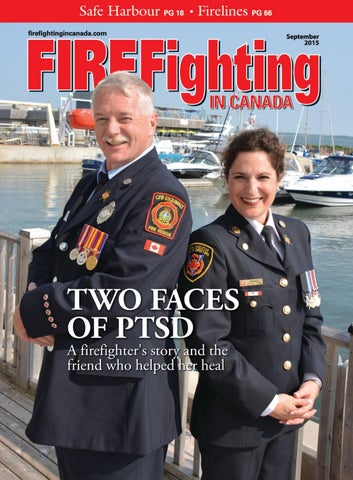
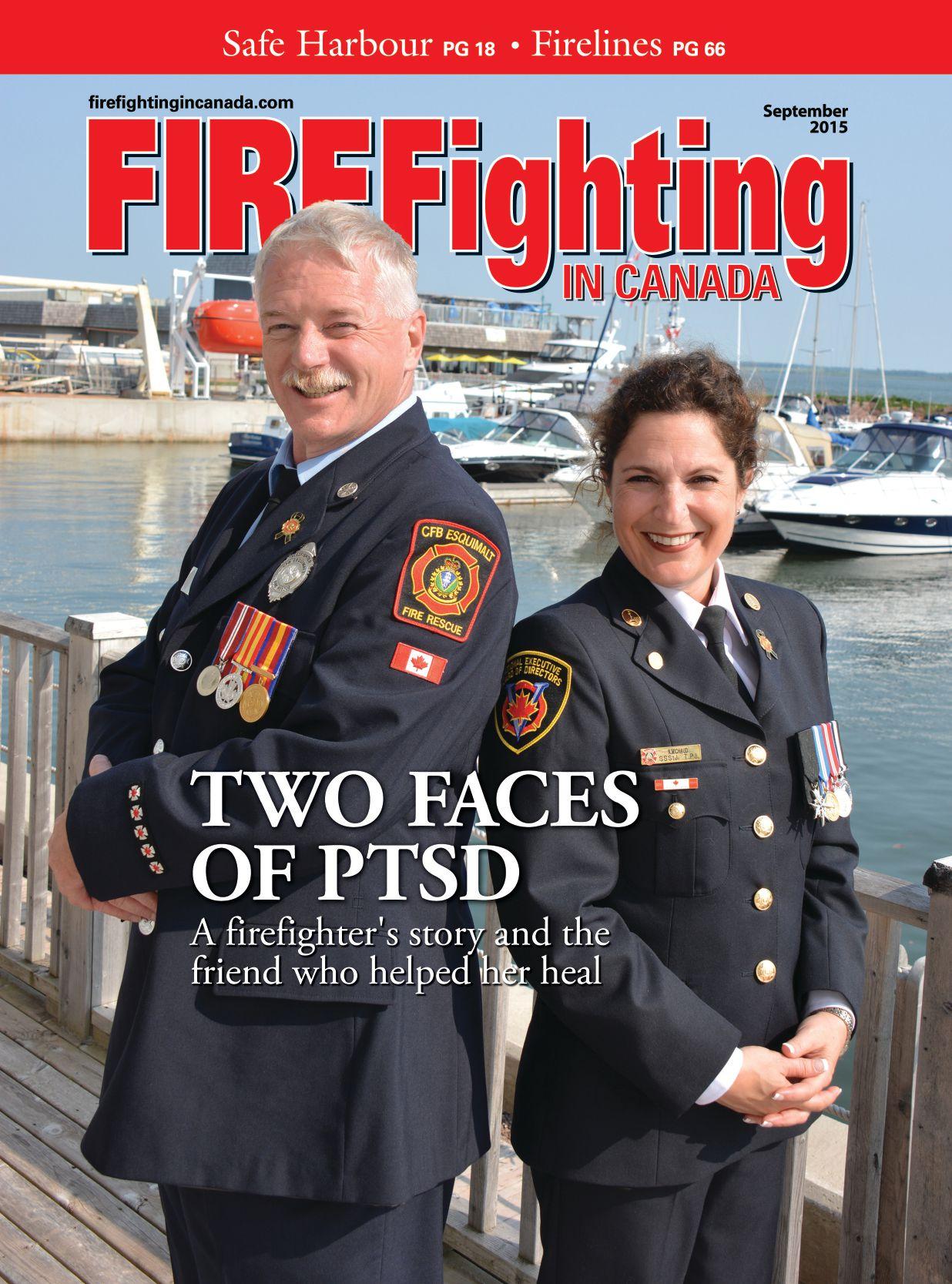
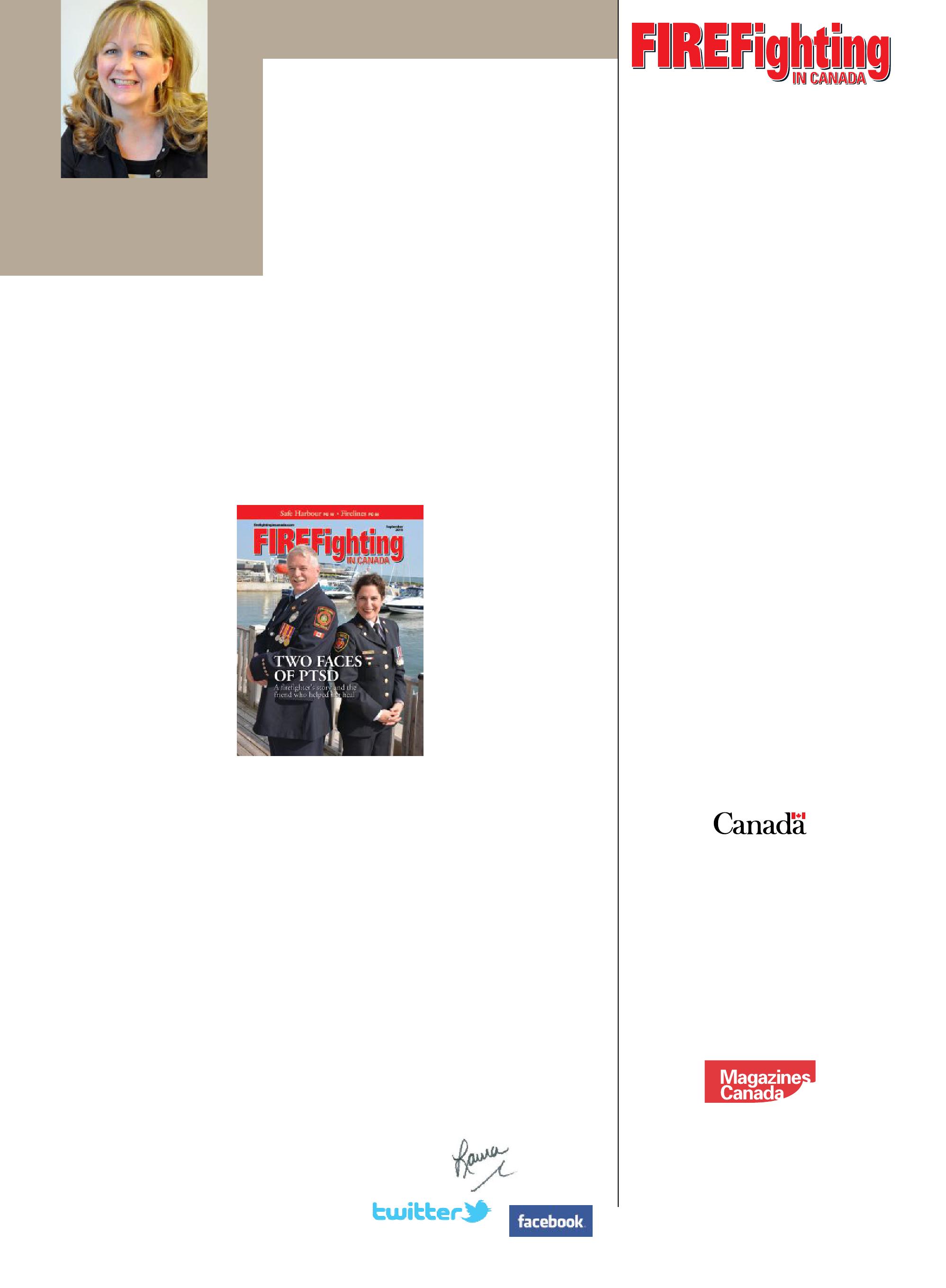
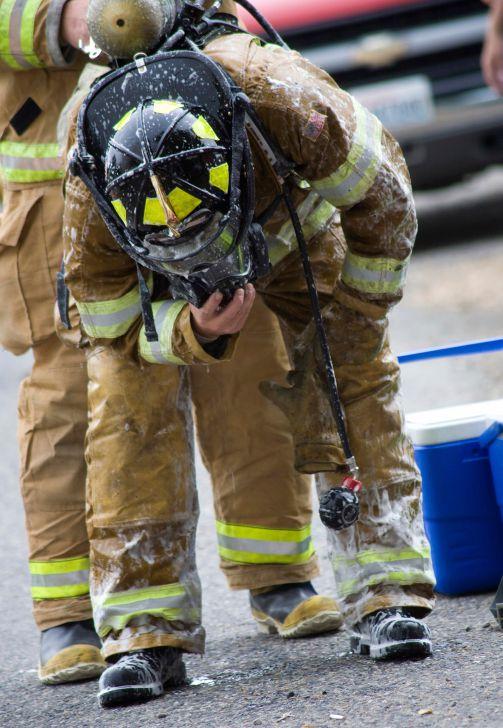
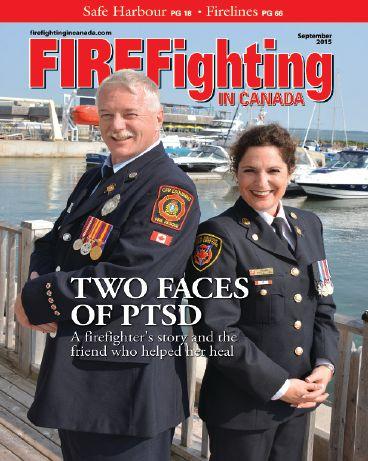
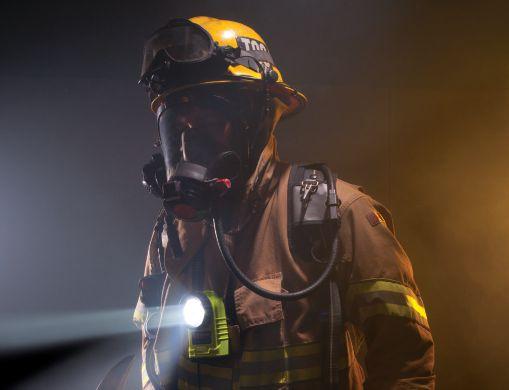
It was years before firefighter Nathalie Michaud’s post-traumatic stress disorder was diagnosed and treated. Today, thanks to the help of friend Wayne Jasper, Michaud tells her story of pain and recovery.
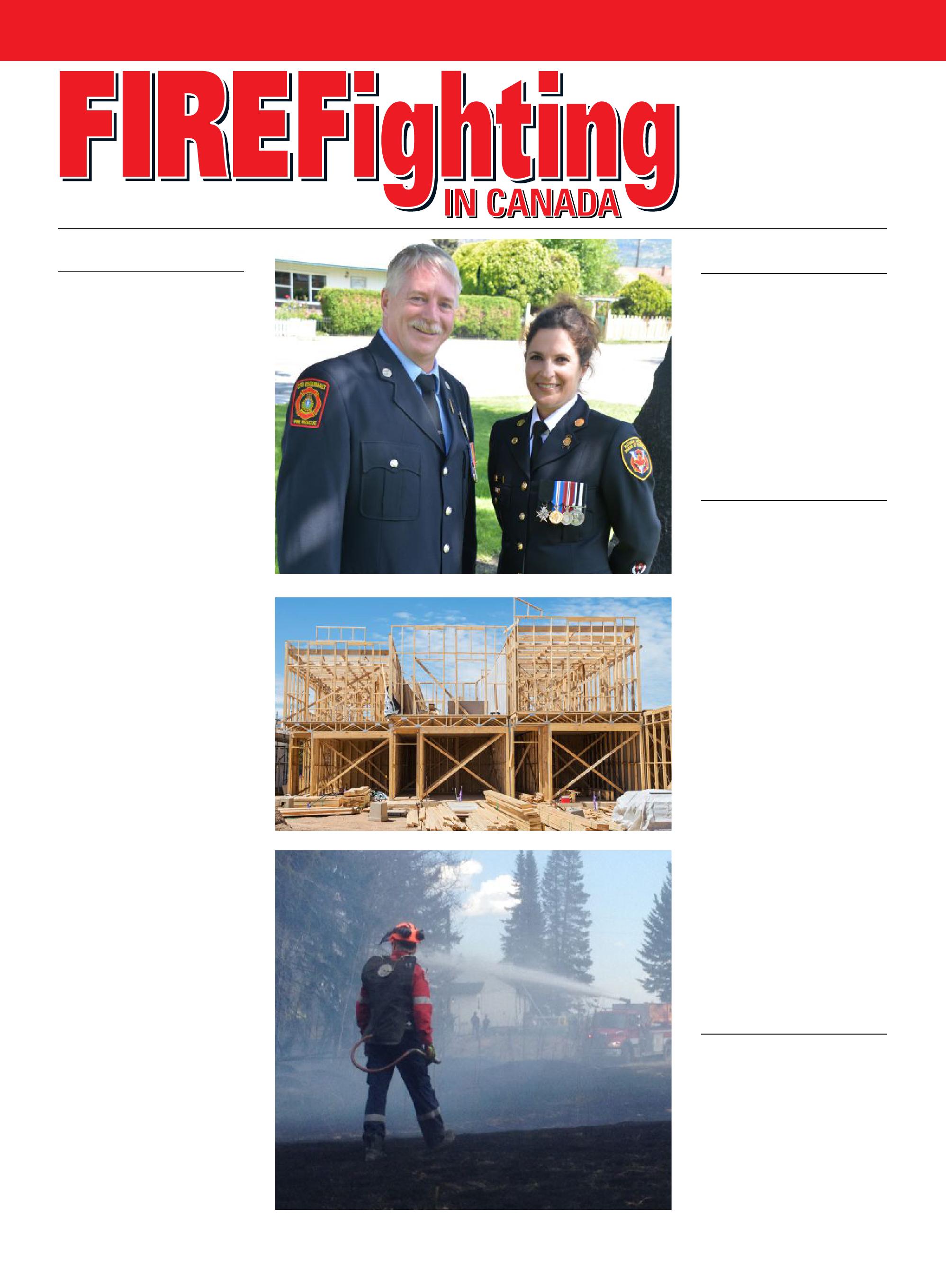
30 PREPARING FOR WOOD FIRES
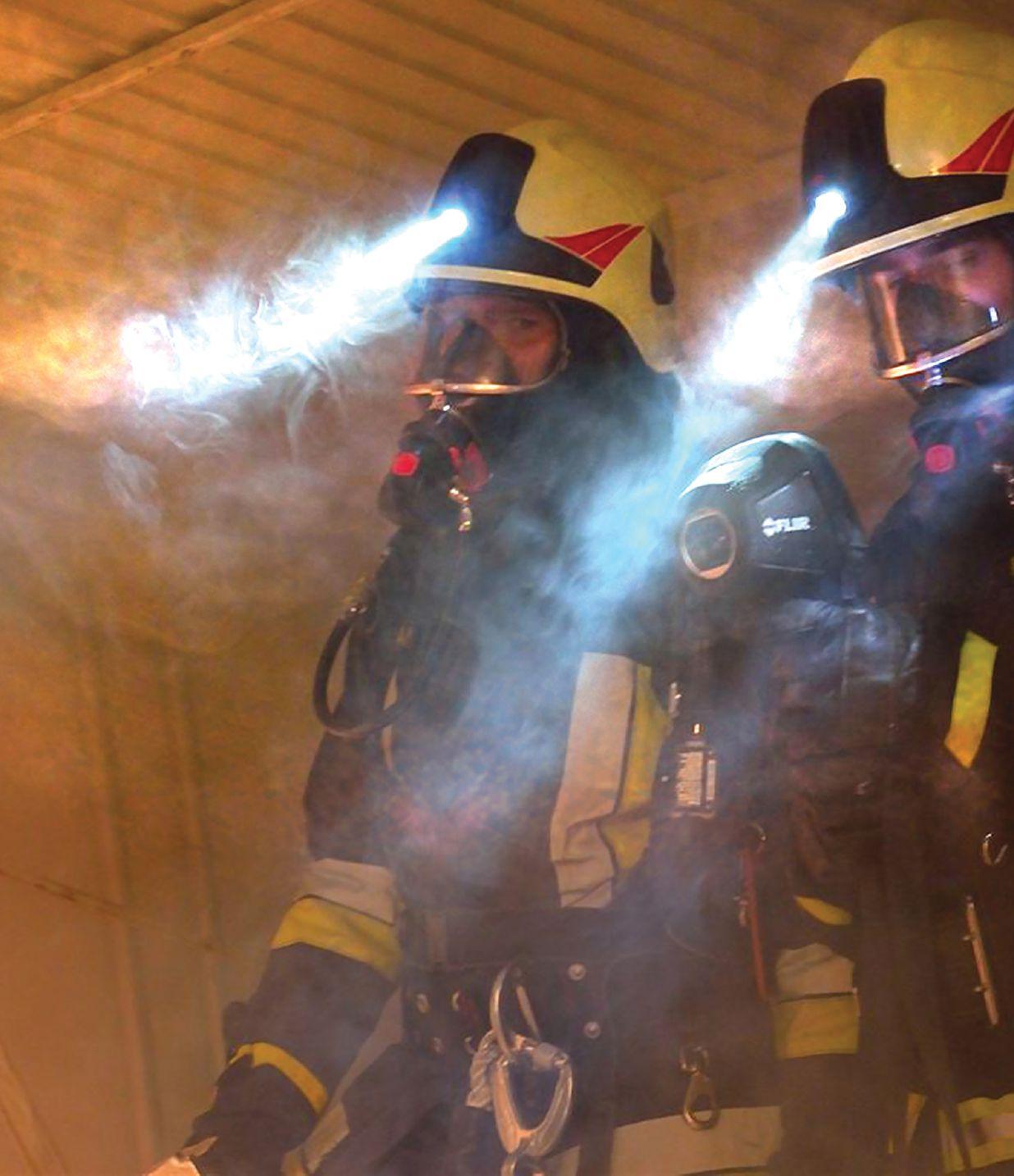
The Canadian Wood Council, working with the University of the Fraser Valley in British Columbia, has produced resources that can help firefighters prevent and respond to construction-site fires.
50
DEALING WITH TRAUMA
Firefighters who choose to ignore the effects of witnessed traumas can create unhealthy barriers. Firefighter and mental health clinician Matthew Johnston details the signs of traumatic stress and techniques to reduce symptoms.
60
TACKLING THE INTERFACE
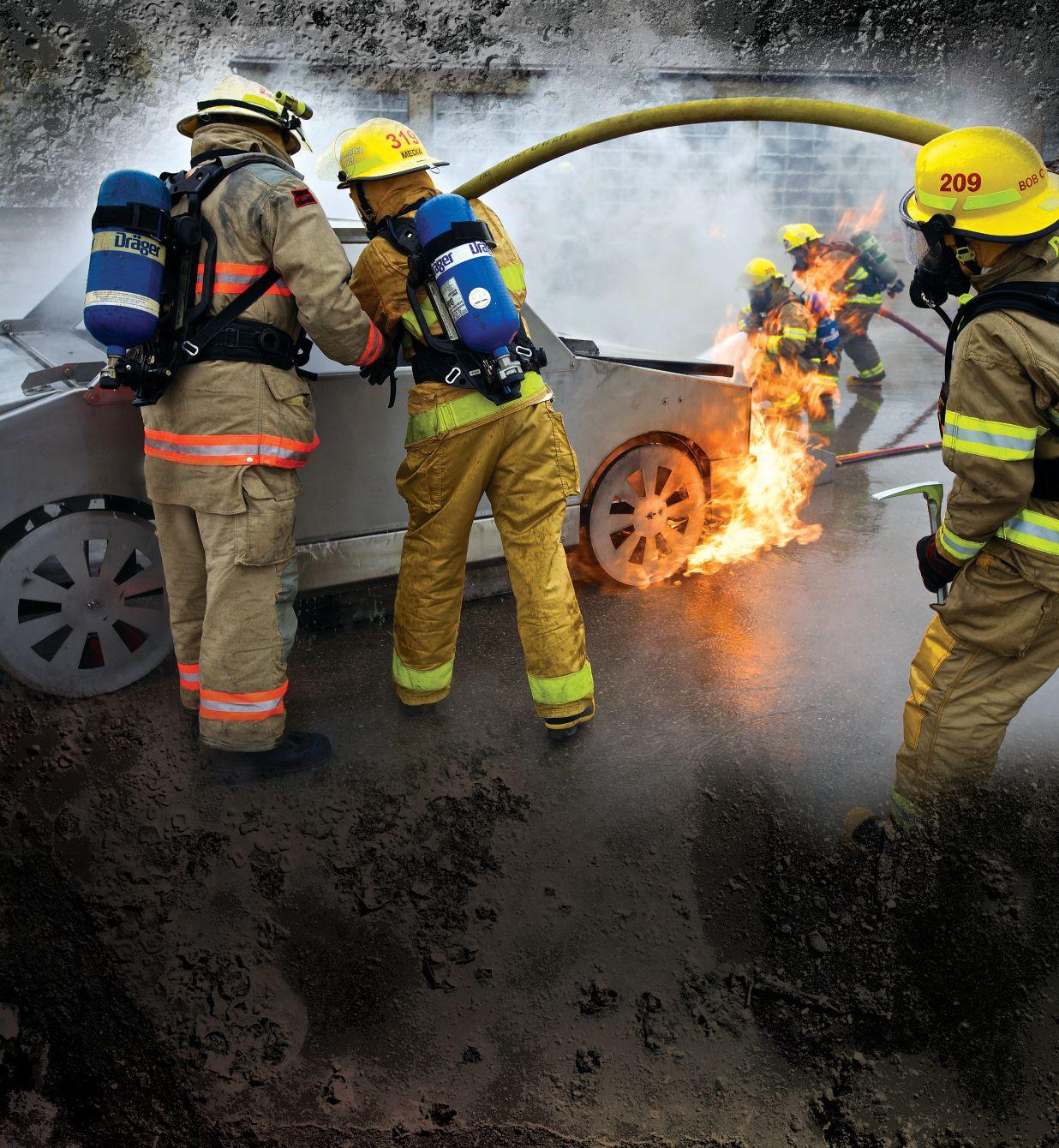
In May 2011, 40 per cent of Slave Lake, Alta., was burned by wildfires. Lesser Slave Regional Fire Service Chief Jamie Coutts explains what agencies have learned from that experience, and how the solution is to bridge the training between wildland fire fighting and structural fire fighting.
BY LAURA KING Editor lking@annexweb.com
M
COMMENT
Reaching mental-health milestones
y last editorial about first-responder mental health and our commitment to write about it, was in March. Since then, Manitoba included PTSD in its presumptive legislation, fire chiefs in British Columbia passed a resolution to work with the province to do the same, and Ontario chiefs launched a training program to help identify signs and symptoms of occupational stress injuries (see page 7).
As those milestones developed, Nathalie Michaud and Wayne Jasper travelled across Canada, telling firefighter groups about mental health and the need to talk – and ask – about it.
I first met Nathalie in Penticton, B.C., in June and heard her sometimes-unbelievable story of survival after finding her husband, Fire Chief Richard Stringer, hanging between trucks in the fire hall in Otterburn Park, Que., in January 2010. Stringer’s PTSD was never diagnosed; he never got help.
in Summerside, P.E.I., at the Maritime Fire Chiefs Association conference in July, were the most compelling I have witnessed – as raw as Fredericton firefighter Jeff Mack’s chronicle of PTSD and alcoholism after he and his partner were almost killed in a 2005 fire, and as captivating as that of engine driver David Griffin, whose seven colleagues died in the Sofa Super Store fire in Charleston, N.C., in 2007.
In the first six months of this year, 28 Canadian first responders ended their lives, unable to cope with what they experienced on the job.
ESTABLISHED 1957
SEPTEMBER 2015 VOL. 59 NO. 6
EDITOR LAURA KING lking@annexweb.com 289-259-8077
ASSISTANT EDITOR MARIA CHURCH mchurch@annexweb.com 519-429-5184
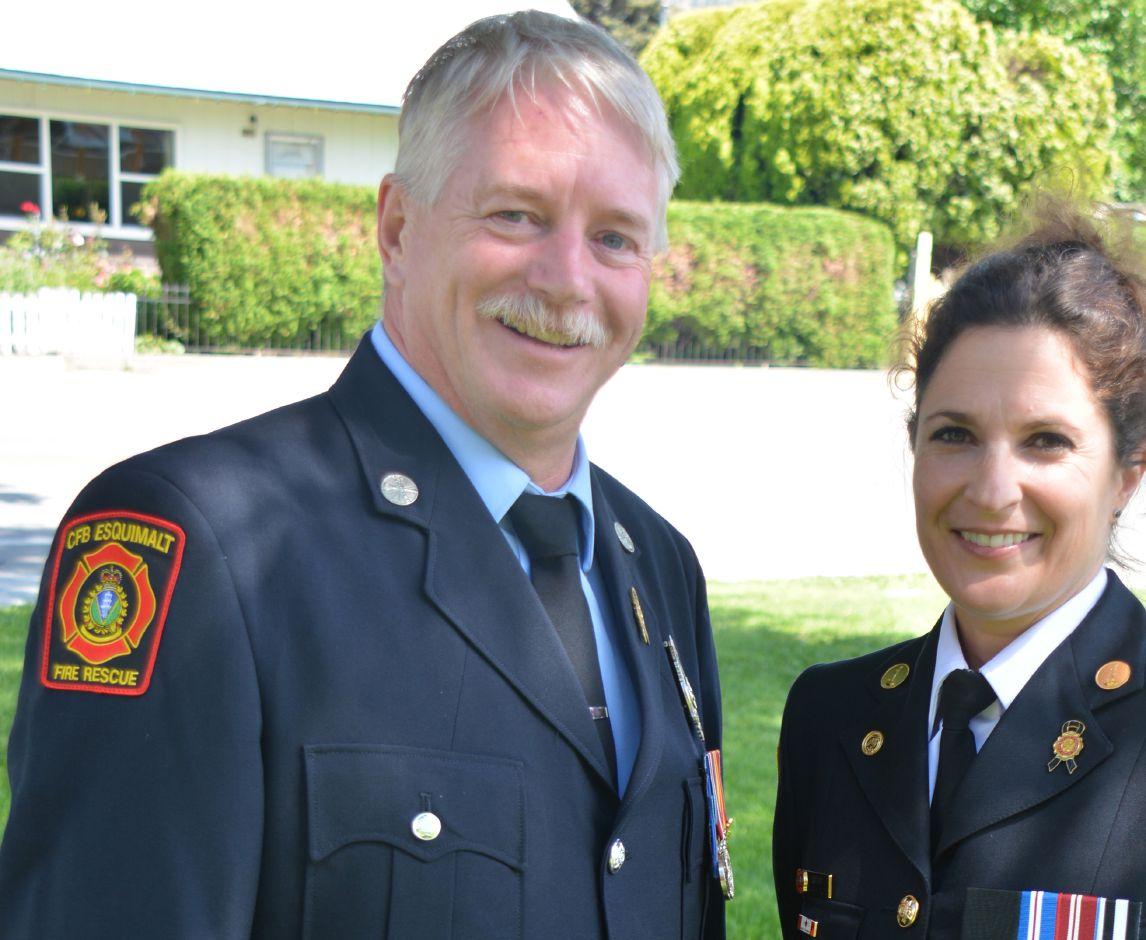
Firefighters Nathalie Michaud and Wayne Jasper following their presentation in Summerside, P.E.I., in July. See story page 10.
Nathalie’s PTSD – the result of Stringer’s death and her experiences after 9-11 and Lac-Megantic – was identified, albeit not until 2014; her new-found resilience, along with Jasper’s unconditional friendship and support, is remarkable.
Nathalie’s presentations at the Fire Chiefs Association of BC conference and
In Penticton and in Summerside, fire chiefs spoke to me after the presentations about their PTSD and treatment. One chief is off work and struggling to have his counselling covered –having to document each incident over his 20-plus year career that caused him stress; another is working through a fire-service boundaries issue that has been played out in newspapers, and has had to navigate a similarly challenging system.
Now that we’re talking about mental health and the (perceived) stigma has been all but extinguished, proper identification, treatment, and a streamlined system that helps rather than hinders those who require coverage, are necessary. Achieving those milestones is the next challenge.
Canada – 1 Year - $24.00 (with GST $25.20, with HST/QST $27.12) (GST - #867172652RT0001)
USA – 1 Year $40.00 USD
We acknowledge the [financial] support of the Government of Canada. Occasionally, Fire Fighting in Canada will mail information on behalf of industry-related groups whose products and services we believe may be of interest to you. If you prefer not to receive this information, please contact our circulation department in any of the four ways listed above.
All advertising is subject to the publisher’s approval. Such approval does not imply any endorsement of the products or services advertised. Publisher reserves the right to refuse advertising that does not meet the standards of the publication.
www.firefightingincanada.com
PHOTO BY LAURA KING
STATIONtoSTATION
ACROSS CANADA: Regional news briefs
Stratford adopts bylaw that alerts firefighters to danger
PHOTO BY MARIA CHURCH
“The assistance and support we got from the local level, the provincial level, the international level, was tremendous,” Lukachko said.
The firefighter built his case around research and data provided by the United States-based National Institute for Occupational Safety and Health (NIOSH). Other essential information and support came from the Ontario Professional Fire Fighter’s Association, the International Association of Fire Fighters, the local union, and a local insurance company.
buildings would amount to just $3,400 – less than $4 per decal – and that the bylaw would not affect building permits or insurance rates.
“We were able to answer a lot of questions before (councillors) posed them,” he said.
Stratford Chief John Paradis said council unanimously supported the bylaw that improves firefighter safety and costs taxpayers next to nothing.
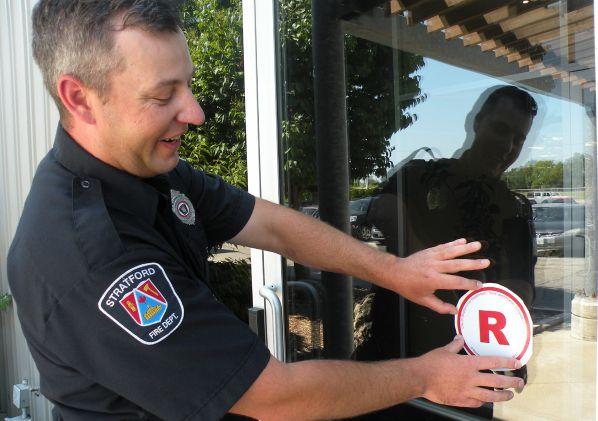
An Ontario city has passed a bylaw requiring all applicable buildings to display decals that warn firefighters of wooden truss and lightweight constructions.
City council in Stratford, Ont., adopted the bylaw on June 22 with a oneyear compliance period for all commercial, industrial, and multi-family residential occupancies.
Stratford firefighter Mike Lukachko, the lead behind the bylaw proposal, believes it is the first of its kind in Canada and said it would not have been possible without support from many partners.
THE BRASS POLE
Promotions & Appointments
RON JENKINS is the new chief and director of emergency services for the Georgina Fire Department in Ontario. Jenkins is a 34-year veteran of the fire service, and was most recently a deputy chief in Toronto. He has been a
volunteer firefighter in Georgina since 1992, and is a member of provincial, national and international fire chiefs associations.
TIM CRANNEY was promoted to chief in Severn, Ont., in early July. Cranney began his firefighting career with Severn Fire and Emergency Services as a volunteer in 1986 he had served as deputy chief in charge of
Lukachko estimates that there are about 900 truss and lightweight constructions in Stratford and they are often difficult to point out. Many storefronts have antique facades, but were renovated with less expensive lightweight components.
As part of the proposal to council, Lukachko determined that emblems for all 900
operations since 2006.
MORGAN HACKL became fire chief in Saskatoon on Aug. 1. Hackl has 28 years of experience with the Saskatoon Fire Department, was a senior captain and battalion chief before becoming assistant chief in 2014. As chief, Hackl is responsible for communications and community relations for the department.
“They didn’t hesitate,” Paradis said. “They actually asked us, ‘What more can we do?’ It’s such a common sense thing because it costs so little.”
Both Paradis and Lukachko said they are more than willing to share the proposal and all relevant research with other departments to take to their councils.
“It’s just about keeping our firefighters safe,” Lukachko said.
– Maria Church
Retirements
Saskatoon Fire Chief DAN PAULSEN retired July 31 after 31 years with the city’s fire department. Paulsen, 60, was hired in 1984 and served as a firefighter, training officer and assistant chief before becoming chief in 2012. He holds professional certificates from Dalhousie
Firefighter Mike Lukachko demonstrates where emblems must be displayed on Stratford buildings that have lightweight constructions.
Ontario chiefs launch mental-health initiative
Ontario’s fire chiefs hope a mental-health program developed for the Canadian military will help firefighters across the province build resilience against occupational stress injuries.
The Ontario Association of Fire Chiefs (OAFC) announced in July a partnership with the Mental Health Commission of Canada to bring the Road to Mental Readiness to its members and their fire departments.
Road to Mental Readiness, or R2MR, is a training program originally developed by the Department of National
Defence for members of the Canadian Armed Forces that addresses stigmas and identifies the signs and symptoms of occupational stress injuries.
OAFC president Matt Pegg said preventing and treating occupational stress injuries – including PTSD and traumatic mental stress – is a priority for the association.
interview. “Our commitment and our goal is to move that from discussion to action.”
“There has been a lot of fantastic discussion around mental health,” Pegg said in an
OAFC members passed a resolution at their annual conference in May to institute mental-health training and education. This year, 28 first responders have died by suicide in Canada, according to the Tema Conter Memorial Trust. Last year, 27 first responders took their lives between April 29 (when the
Rookie firefighters outfitted with new gear
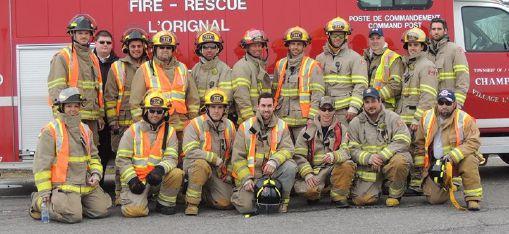
Four recent recruits at L’Original Fire Department in Champlain, Ont., about 90 kilometres northeast of Ottawa on the Quebec border, are likely thanking their lucky stars – or their safety officer.
Thanks to L’Original firefighter and safety officer Dan Dupont’s application to the 2015 annual Globe Gear Giveaway earlier this year, the rookies are each being outfitted with a brand-new set of Globe’s state-of-the-art turnout gear.
The all-volunteer department
with 26 active firefighters is one of the first three recipients chosen for the annual giveaway, a partnership among Globe, DuPont Protection Technologies and the National Volunteer Fire Council. A total of 13 departments in Canada and the United States will eventually be awarded four sets of turnout gear.
Dupont said in an interview that his department, like many others, is strapped for cash and usually forced to give new recruits old gear.
“It’s rare that rookies get
University, Western Oregon State College and the University of Saskatchewan, and was involved with the Saskatchewan Association of Fire Chiefs.
BOB STEVENS, fire chief for Gibsons and District Volunteer Fire Department in British Columbia, retired on July 24. Stevens started out as
a Gibsons firefighter in 1979 and became the department’s first full-time chief in 1995; he worked as a mechanic and maintenance technician before becoming chief.
Last Alarm
DON GLENDINNING, former editor of Fire Fighting in Canada, died in June at 82 years old. Glendinning became
trust began tracking numbers) and Dec. 31.
The OAFC plans to use a train-the-trainer course to disseminate the R2MR program. The first class of 24 will be schooled in January to become qualified R2MR trainers.
Cost of the program and how it will be covered for firefighters is still being worked out, but Pegg said he expects the OAFC will likely fund the first training course and those trainers will then share their skills with fire departments across Ontario.
– Laura King and Maria Church
L’Original Fire Department in Champlain, Ont., is one of the first three recipients of the 2015 Globe Gear Giveaway.
new stuff,” he said. “They were so happy about it.”
Dupont said the department can now look at using its budget
involved with the magazine in the 1970s and built contacts within the firefighting community. He started out as a marketing manager for the magazine and became and editor and publisher.
Fire Chief RODNEY HOULE of Sables-Spanish Rivers, Ont., died suddenly on May 30. Houle, 46, was also the chief building inspector and a
for needed ice and water equipment to respond to incidents on the Ottawa River.
–
Maria Church
volunteer for many community fundraisers.
JAY EASTON, a firefighter in Surrey, B.C., died on June 2 while recovering from a vehicle collision. Easton began with the Surrey Fire Service in 1996 and was involved with the Surrey Fire Fighter’s Charitable Society and the IAFF local.
PHOTO
STATIONtoSTATION
BRIGADE NEWS: From departments across Canada
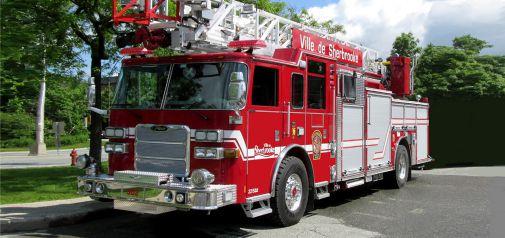
Sherbrooke Fire and Rescue Service in Quebec took delivery in May of a Pierce-built aerial ladder. Built on an Arrow chassis and powered by a 550-hp Detroit engine and an Allison 4000 EVS transmission, the unit is equipped with a 1,750-gpm pump, a 500-gallon tank, a Husky 12 foam system, Code 3 and Q2B Federal Signal sirens, Code 3 and Whelen emergency lights, and a 6.5-kilowatt Smart Power hydraulic generator.
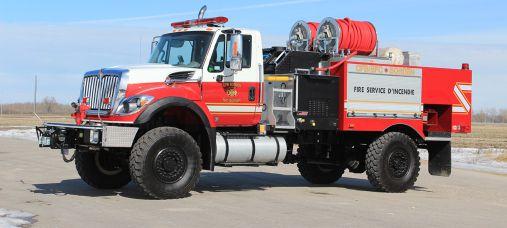
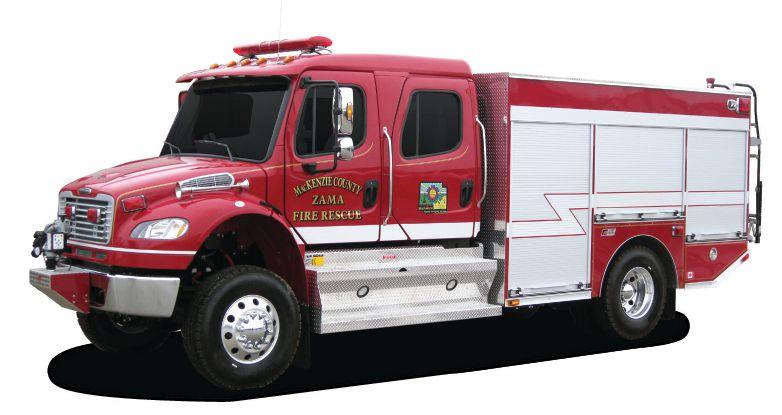
Canadian Forces Base Borden in Ontario took delivery in March of a Fort Garry Fire Trucks-built range firefighter vehicle. Built on an International 4x4 chassis and powered by a 330-hp MaxxForce 9 engine and an Allison 3000 EVS transmission, the unit is equipped with a Waterous CPD-2 pump and Aquis CAFS, a 1,000-gallon tank, a Federal Signal backup camera system, Amdor ground lighting, Newton 10-inch quick dumps and two Hanny aluminum hose reels.
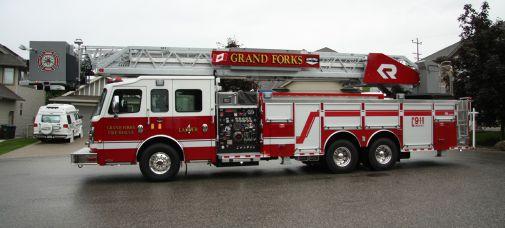
Grand Forks Fire Rescue in British Columbia, under Fire Chief Dale Heriot, took delivery in June of a Rocky Mountain Phoenix/ Rosenbauer-built aerial. Built on a Commander 4000 chassis and powered by a 500-hp Cummins ISX engine and an Allison 4000 EVS transmission, the unity is equipped with a 1,500-igpm Waterous pump, a 500-gallon tank, a Foam Pro 2002 system, 360-degree LED ground lighting and an eight-kilowatt hydraulic generator.
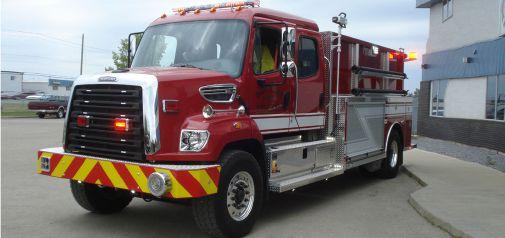
Pass Creek Fire Department in British Columbia, under Fire Chief Brian Beblman, took delivery in June of a Rocky Mountain Phoenix/Rosenbauer-built pumper-tanker. Built on a Freightlner chassis and powered by a 400-hp Cummins ISL engine and an Allison 3000 EVS transmission, the unit is equipped with a 425igpm Waterous pump, a 1,500-gallon tank, Whelen M-9 body mounted lights, and two Akron Scene Star push up telelights.
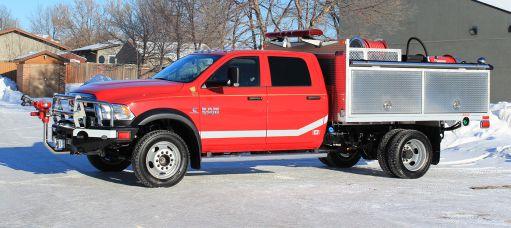
The Government of Saskatchewan Fire Management & Forest Protection Branch took delivery in March of a Fort Garry Fire Trucks-built wildland. Built on a Dodge 5500 chassis and powered by a Cummins ISB engine and a Asin automatic transmission, the unit is equipped with a Darley portable pump, a 400-gallon tank, Darley Fast Foam and Chemguard generator, Federal Signal smart siren, LED emergency lights, one-inch hose reel with Reeltex hose and a Fire Fox bumper turret.
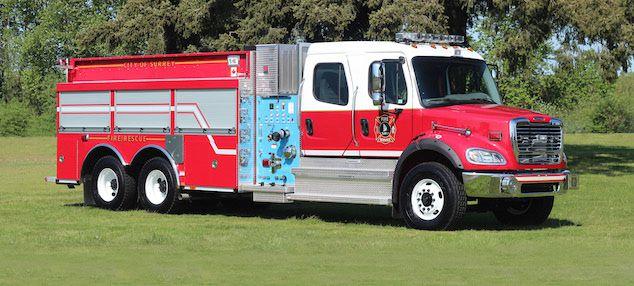
The Surrey Fire Service in British Columbia, under Fire Chief Len Garis, took delivery in June from Safetek Emergency Vehicles, three Smeal Fire Apparatus-built tankers. Built on Freightliner M2-112 chassis and powered by Allison 3000 EVS transmissions and Cummins ISL 9 450-hp engines, the trucks are equipped with Darley PSM 1,500 IGPM pumps, 2,000 IG UPF water tanks and Darley Purifire 4S10F water purification systems.
CANADIAN FORCES BASE BORDEN
GRAND FORKS FIRE RESCUE
SHERBROOKE FIRE AND RESCUE SERVICE
PASS CREEK FIRE DEPARTMENT
GOVERNMENT OF SASKATCHEWAN
SURREY FIRE SERVICE
Two faces of PTSD
A firefighter’s story and the friend who helped her heal
By NATHALIE MICHAUD and WAYNE JASPER
Editor’s note: It’s not often a conference speaker silences a room and brings delegates to tears. That’s what happened in June in Penticton, B.C., and in July in Summerside, P.E.I., when firefighter Nathalie Michaud told fire officers her story about post-traumatic stress. The story is remarkable, ugly, even shocking. Wayne Jasper’s story is equally as compelling, that of a friend and fellow firefighter, connected by compassion but geographically more than half a country away. Here is their story.
NATHALIE
I have learned what PTSD can do and how it can start. The simplest way I have found to describe it is this: PTSD is like the imprint of the emotion that stems from an event but your brain blocks it and locks it away because it’s too much to process. And, even though as time goes by, your brain knows the difference between what is real and what isn’t; it’s the emotional imprint that silently grows inside, just like a tumour.
On Jan. 30, 2010, Fire Chief Richard Stringer saw no way out. Depression, desperation and the presence of unrecognized PTSD got the best of him. That morning, Chief Stringer left his home while his wife slept and went to the fire department to face his last battle, his last demon –and hanged himself.
Nathalie Michaud and Wayne Jasper met at the Canadian Fallen Firefighters Foundation memorial service in Ottawa for her late husband, Chief Richard Stringer; their conversation about PTSD turned into a friendship through which both firefighters have learned a lot about post-traumatic stress, coping, healing, strength of character and loyalty.
Chief Stringer had been my fire chief for the previous five years.
Richard Stringer was also my husband.
My world got turned upside down and changed forever the moment I found him. I shut down and no one saw it.
No one ever warned me of what was waiting for me in the future. When I closed my eyes at night, all I saw was the image of him hanging between the two fire trucks, the images and sounds of me running around in the hospital from department to department so I could officially identify his body; no one could really direct me as to where he was, so I had to ask at least five people in different departments. “Can you tell me where the body of my husband Richard Stringer is? I have to ID his body.”
The small town speculated; I was blamed. His suicide was in the media; there
was nowhere for me to hide to grieve privately, to deal with rumours, wait for the official police report.
During this time, I felt nothing but shame and incredible guilt, and I had so many unanswered questions.
The day of his funeral, when the casket was carried out, two salutes took place: the first was a general salute by all firefighters, followed shortly after by a salute called by members of Chief Stringer’s Otterburn Park Fire Department. Even though I wasn’t in uniform, as his firefighter, by reflex, I saluted along with the rest of my department, clinging to my husband’s helmet. I was also his wife saluting my husband for the very last time.
This was followed by the wail of the Federal Q siren. To this day, that siren is a trigger and every time I hear it, I’m thrown back to that moment and I must deal with it.
Richard’s suicide and all that followed created PTSD that was finally diagnosed five years later. For those five years, I suffered in silence, not knowing that PTSD was slowly growing inside me ever so quietly and robbing me of who I was.
I can tell you what it feels like to follow the coffin of your husband clinging to the last thing you will ever have of him – his helmet; to never again hear his voice, his laughter, his touch, his comfort, his friendship. It rips you apart and all the million tiny pieces are scattered in such a violent way that even magic can’t glue you back together.
The guilt, the questions, the shame, the loss of who you are . . . they can kill you and it never really goes away. Richard’s suicide caused PTSD in me. His suicide, his death, also stripped me of my identity. I’m changed forever.
In my fire community, I’m forever Nathalie the widow of the chief who committed suicide. So to cope with all of it, I learned how to live dead inside. According to the police report, I missed him by maybe
PHOTO BY LAURA KING
30 minutes. I live with that every single day. Could I have stopped him?
In July 2013 in Lac-Megantic, I was prepared to do the job for which I had been trained.
As I got closer to the site, my heart sank, but my heart rate went up and so did my blood pressure; this was a feeling I recognized but chose to ignore. I kept pushing forward to get the job done.
That’s what’s expected right?
I felt OK until it was time to head back to the fire department for a break. Walking ahead of a group of firefighters, I kept looking back at the disaster site, wondering how it could be that a nearby church survived intact and how those streets and buildings, just on the other side of the railroad tracks, were reduced to dust.
My brain just could not compute the scene.
Then I realized that familiar crunching sound that I had been hearing all along was coming from under my boots. I stopped dead in my tracks, looked at my feet and got thrown back to 9-11, which had changed me forever. I could no longer tell where I was – in the situation from the past or in the present moment in Lac-Megantic.
WAYNE
I consider myself fortunate to have met Nathalie several years ago while our respective organizations worked to honour Canada’s fallen firefighters in Ottawa. We had become friends over the years and in the fall of 2014, after a meeting, we had the chance to talk about presumptive legislations governing workplace illnesses for firefighters, and the subject of PTSD came up. After a brief conversation, Nathalie indicated to me she had been recently diagnosed as suffering from PTSD. This caught me a little by surprise initially as I wasn’t sure what to say next. I wondered if it was even OK to ask her about it or if some of the things I would say or ask would make it worse.
I have to admit, I was one of those people who didn’t realize what it means to try to deal with PTSD on a day-to-day basis, but after Nathalie talked about it for a while, I felt she was reaching out hoping that maybe I would talk about it with her more. The more she said, the more I realized I had to ask her.
I wanted to know how PTSD affected her job, how it affected her life off the job. Will it ever go away or even get better?
How do you get PTSD? How does PTSD get you? Is there anything I can do to help? That’s a ton of stuff; would all these questions overwhelm her?
What did I really know about PTSD as it affects emergency-services workers other than what most of us have heard, which is that people with it are prone to severe depression and in the worst cases, committing suicide? Even tougher to digest were the next questions: had suicide crossed her mind? And how in the world do I even approach discussing that with her?
I decided to take that chance and ask her if she wanted to talk about her story. I was willing to listen and I really wanted know what she was going through.
And then I listened . . .
And I have to say that some of what I heard, including several incidents to which Nathalie had responded, hit me very hard, especially the affects the PTSD was having on her. Little did I know I was one of very few people who crossed the line and spoke with Nathalie about her PTSD. I also didn’t know it at that time, but the conversation we were having about PTSD that evening would eventually help to save Nathalie’s life.
The conversation wasn’t about just the events that caused Nathalie to develop PTSD, but also what was happening to her mentally and physically because of it. I was not expecting to hear how much PTSD disrupted her life or the extent to which it had changed her abilities to do what would appear on the outside to be normal, easy, everyday tasks that most of us take for granted.
I remember on one occasion I chatted on the phone with Nathalie while she grocery shopped so I could provide a distraction from others who might encroach on her “bubble” at the checkout, so she would know there was someone with her whom she trusted. I remember thinking how horrible it must be to live that way, wondering if you are going to get through the day. Surely there must be some coverage and help available, I thought. It quickly became clear that it wasn’t that easy.
NATHALIE
Wayne was one of the few people who dared ask or talk to me about PTSD and I felt that 100 pounds lifted off my shoulders because finally I could talk to someone.
Being asked questions and talking made me lose some sense of loneliness and isolation.
I’ve learned that there are two ways PTSD can kill you: the first way, you’re alive, slowly dying inside as PTSD controls the every essence of you; the second is suicide.
Living with PTSD and not knowing or understanding what was happening to me was extremely difficult and frightening. However, once I was diagnosed by qualified medical personnel, my life became easier to manage.
When I got the diagnosis I didn’t do a happy dance in the doctor’s office, but the diagnosis gave me hope.
I have PTSD.
PTSD does not have me.
PTSD does not define me.
PTSD is not about what’s wrong with me, it’s about what happened to me.
After proper diagnosis in summer of 2014, I went in November to a private therapy centre called La Vigile. It was also there, that because of a trigger, I discovered I had PTSD from Lac-Megantic. One of the biggest things I learned was that with each traumatic event in my life, I was stripped of the feeling of safety; this changed how I see the world and I now constantly watch over my shoulder, which is known as hyper arousal.
The following is my day-to-day life, before and after diagnosis.
My first battle is realizing that my eyes are open and I have to get up and face the day. I’m always scared of what the day will bring – or do – to me.
Sleep
• I have insomnia, but when I do sleep, I get cold sweats so badly I need to change my clothes and sheets.
• I keep lights on all over the house; darkness is now frightening.
• I self-medicate with prescription drugs but when this was not enough, my best friend became tequila and then more alcohol took over.
Eating
• I had little or no appetite because of my high level of anxiety.
• I rarely dine in restaurants because I can’t stand crowds and noises. If I go, my back needs to be against the wall so I can see all around me at all times. I have to have at least one direct route to an exit and I always have two exit plans that I go over and over and over in my head during the dinner. You think I enjoy dinner like this?
Hyper arousal
• Anxiety.
• Outbursts, anger, irritability, lashing out, over reacting, guilt, shame, insecurities about my own mind and actions.
• am constantly watching over my shoulder and am jumpy.
Triggers
• They can come up and bite me in the behind and there is never ever a way to prepare.
Flashbacks
• On a daily basis.
Reviviscence
• This starts with a trigger, then a flashback and then, something happens and brings me back so deep inside that I’m disconnected from reality. During that time I’m reliving the event all over again and I have no control. There is a window of about 10 seconds to get me out of that state, if I’m lucky. Sometimes it can be so strong that I spiral down very quickly and don’t even have time to realize what’s happening and then, well, the outcome is not good.
Symptoms
• Due to hyper arousal, I get very impatient and can be aggressive when there is too much noise.
• I avoid public places and or crowds or any kind, clothing stores, malls, restaurants and even grocery stores.
• I have short-term memory loss and my cognitive abilities are reduced. Thankfully, they are returning due to continuous therapy.
Other symptoms that appeared as PTSD and got worse before diagnosis
• Lack of concentration.
• Lack of interest in anything.
• Detached from surroundings and avoiding people, including friends and family.
• Depression hit. This led me to think about suicide and the “how.”
• Suicide became more and more present in all thought process and a plan took form.
• Suicide became a beautiful “life.”
On that one night, I was intoxicated, got in my truck and drove to a specific train crossing. I sat there in my truck, waiting for the train to end it for me.
Today, I know why the train tracks were the best way for me:
1. I saw and know the destruction a train can do and the chances of survival are slim.
2. I didn’t want my parents to have to identify my body like I had to ID Richard’s body. I needed to ensure there would be nothing to ID.
Coming out in public and talking about PTSD openly, I had to fight my fears of being judged by my peers, never getting a promotion and not getting hired elsewhere within my fire community because I am labeled.
Darkness and silence are the two killers that wait for PTSD sufferers.
If you feel anyone may be showing signs of PTSD, it’s extremely important that you do not wait for him or her to come to you but instead go to your friend or colleague as soon as possible and be ready to listen without judgment.
Most of all, follow up. Never leave that person’s side, because if they trust you enough to share their darkest fears, they need you there throughout the healing process too.
INDICATIONS: Allerject® 0.3 mg (0.3 mL Epinephrine Injection, USP, 1:1000) and Allerject® 0.15 mg (0.15 mL Epinephrine Injection, USP, 1:1000) are indicated for the emergency treatment of anaphylactic reactions in patients who are determined to be at increased risk for anaphylaxis, including individuals with a history of anaphylactic reactions. Selection of the appropriate dosage strength is determined according to patient body weight.
Allerject® is intended for immediate self-administration for the emergency treatment of severe allergic reactions (Type I). Following treatment of anaphylaxis, the patient must seek immediate medical attention.
* Comparative clinical significance unknown.
Allerject® 0.15 mg for patients weighing 15 kg to 30 kg (33 lb. to 66 lb.) (Consider using other forms of injectable epinephrine if doses lower than 0.15 mg are deemed necessary) Unidose 0.15 mg/0.15 mL epinephrine auto-injector [1:1000]
Allerject® 0.3 mg for patients weighing over 30 kg (66 lb.) Unidose 0.3 mg/0.3 mL epinephrine auto-injector [1:1000]
Available in two languages: English or French
Contraindications:
No absolute contraindications
Relevant warnings and precautions: For Your Emergency Kit
•Inject into the outer thigh
• Use of more than 2 sequential doses
• Use in patients with cardiogenic, traumatic, or hemorrhagic shock; cardiac dilation; cerebral arteriosclerosis; cardiac arrhythmias; coronary artery or organic heart disease; hypertension or hyperthyroidism
• Patients with organic brain damage or Parkinson’s disease
•Patients with narrow-angle glaucoma
•Use in diabetic patients
•Patients with sulfite sensitivity
•Patients with concomitant asthma
For more information:
Please consult the Prescribing Information at: products.sanofi.ca/en/allerject.pdf for important information relating to adverse reactions, drug interactions and dosing information which has not been discussed in this piece.
The Prescribing Information is also available by calling us at: 1 800 265-7927
As emergency workers, we always work as a team. In a fire, it’s always two in and two out, and this is no different.
In July 2014 when I was told by my doctor and psychologist that I needed to enter a detox or therapy program, my response to them was, “F--- off! I don’t have a problem!”
In mid-October, while having a dinner meeting with a trusted and respected friend, he asked me how I was and waited for an actual answer. Then he asked, “How’s my favourite firefighter really doing?” I collapsed.
He had noticed signs back in April, but I was closed when he approach me. He strongly suggested a centre that helps only emergency first responders, a 30-day closed therapy program that also deals with PTSD. I told him, “Call now before I change my mind.”
He called La Vigile. A staff person stayed on the phone with me for two hours and there was a follow-up call every day until I went in on Sunday, Nov. 2 – the day my new life started.
WAYNE
As I took the time as a friend to be there for Nathalie, something else became very apparent to me about PTSD – it doesn’t just affect the person suffering from it. In fact, someone suffering from PTSD can bring on much mental pain and anxiety to those who are close to them as they try to figure out what that person is going through. Inevitably, their friends, loved ones and co-workers can be affected by the actions of the person suffering from PTSD and may need assistance dealing with that aspect of it – they may start to struggle just as much while caring for someone suffering from PTSD.
Through our conversations, I know firsthand how hard it was to listen to Nathalie talk about what she was going through and not know if I had the ability to help her get through a triggered emotion, or even whether I might say the wrong things and make it worse.
It was heart-wrenching for me to process Nathalie explaining to me how the nightmares and depression brought on by PTSD were getting the best of her, that she couldn’t see any other way to make the pain stop other than the worst-case scenario we were trying to prevent.
As Nathalie underwent her 30-day closed therapy session at La Vigile, she was able to communicate only briefly with friends and loved ones on the outside. Through these very brief periods of contact, it felt like I was drowning and I was only able to break
the surface long enough to get a taste of how she was doing, but not long enough to get the full breadth of how her therapy was progressing. This made it extremely hard for me as Nathalie’s friend to make it through to the next phone call, not having a full understanding of how she was doing until the next time we talked. It was very difficult to determine at what level the therapy was helping Nathalie.
As Nathalie went through her therapy, I found it extremely difficult to stand by her throughout all the changes she was experiencing, but I refused to turn my back on her. There was no way I was going to let her down when she needed the support of a friend she trusted as she went through this learning process.
Inevitably though, realizing the PTSD sufferer is being given the necessary support and treatment can lift a great burden off the shoulders of family, friends and loved ones, which makes it much easier for them to cope as well.
What I have learned in talking with Nathalie about PTSD is how important it is to stand beside a person through the darkest moments just by listening without judging; it may be the single most important thing you can do for that person. And be prepared to listen a lot, because once a PTSD sufferer finds that comfort level and trust in talking with you, he or she can sometimes talk for hours as everything comes to the surface. Allow the person space but always be aware that someone suffering from PTSD may spiral downward unexpectedly and sometimes just being there without saying anything can do the most for that person. Do not put any pressure on someone to get over it or suck it up, but instead be there while he or she makes adjustments to come through a triggered emotion; doing so can make the world of difference.
I am very fortunate to have some good friends on my department with whom I have been able to share a lot of this; one of them asked me a question that I did not expect. Surprisingly, several days later with no knowledge that I had been asked this question already, Nathalie asked me the same question. I’m sure I had a deer-in-the-headlights look as I fumbled for an answer.
It was clear to both Nathalie and my colleague that I made a very serious commitment to help her get through the hardest moments in dealing with PTSD, and to be that trusted friend she could call on and talk to at any time of day or night, to help her get through the
crippling moments. So far so good.
The question: What did I think would happen to me if all the efforts to help Nathalie failed and she took her own life anyway?
The question haunts me. I had thought about it but never really accepted the fact that it might happen, and I still don’t want to. But the question made me think, and with what I know today about how PTSD can affect friends and families, it made me wonder how her PTSD was now affecting me.
PTSD is a horrible illness that can take its toll on more than just the person suffering from it.
NATHALIE
Since my therapy at La Vigile I’ve learned to better understand my symptoms and what causes them.
The hardest part of the therapy was Nov. 29, 2014, the day I came out and had to live my new normal in a world that had not changed.
I constantly have the haunting thoughts, “Will I get triggered? Will I be able to control it? Do I tell? Will they judge me?”
Another question is how and when do I tell someone I just started to date that I have an illness, an injury that is so taboo and judged? Will he run with his feet glued to his behind?
The man who chose to not run after I told him I suffered from PTSD asked why I wanted to speak out. Why put myself out there and risk it all – my reputation, my career, the goal, the big picture?
It’s time to talk, to change things. My voice will be heard.
But our voices together will be louder.
Nathalie Michaud has been a paramedic, firefighter, fire-prevention officer and fire investigator during her 15-year career in emergency services in Quebec. She is on the board of the Canadian Volunteer Fire Services Association and has been its Quebec director since 2012. She is also on the board of the Federation quebecois des intervenants en securite incendie since April. Nathalie is a master instructor for St. John’s Ambulance. Contact her at Nmichaud1102@videotron.ca
Wayne Jasper has served more than 32 years in the fire service, 30 as a career firefighter with CFB Esquimalt Fire Rescue in Victoria. He has also served nine years on the board of directors for the Canadian Fallen Firefighters Foundation as LODD application-committee chair. Contact him at wayne.jasper@icloud.com.
BY KEITH STECKO Fire chief, Smithers, B.C.
IA firefighter’s journey into darkness
n June I attended the BC Fire Expo and Fire Chiefs Association of BC conference in Penticton. During the conference, I sat in on one session in particular that stirred powerful emotions not only within me but also in every fire officer in the entire room. The energy was raw, and, at times, the silence was deafening. It was a story told by firefighter Nathalie Michaud about her post-traumatic stress disorder (PTSD).
This was the first time that Michaud stood in front of a packed room and bared it all: the dark thoughts and feelings of suicide and hyper vigilance; waking up in the middle of the night in a sweatsoaked bed; flashbacks; self medicating with alcohol; anger and helplessness. She relived the horrific images, smells, and sounds that have haunted her.
On Jan. 30, 2010, Michaud reported to her station in Otterburn Park, Que., for duty and found Fire Chief Richard Stringer hanging in the fire hall. Not only was Stringer her chief, he was also her husband.
As I looked around the room packed with fire officers, it was as if all the air had been sucked out of it.
Three years later, Michaud was one of the responders to LacMegantic and explained that she was often referred to as the rock by her peers and the people who know her well. They saw her, she said, as steady and strong, but, as she pointed out in her talk, “It turned out to be the very thing that also hurt me.” How else was she expected to act when something traumatic happened?
I sat still in my seat and listened to Michaud tell her story of finding her husband. I watched her, standing tall in her uniform, stoic and steadfast, occasionally trembling, sometimes squeezing her stress ball. It was obvious to me that every word she uttered came at a great emotional cost as she summoned strength to tell her story.
people I have had the pleasure to meet. She stands a beacon of light for those who are suffering from PTSD in silence. She described the effect of the disorder with perfect clarity: “I’ve learned that there are two ways PTSD can kill you. First, you’re still alive, but you’re slowly dying inside. Second, suicide.”
Later at the conference I connected with two of my colleagues; both confided in me that they were struggling with PTSD. One colleague had just starting to talk to someone about his experience. As we talked, I could see by the look on his face that it weighed heavily on him.
My other colleague has been off work and has been receiving help, however, insurance coverage is limited and he is desperately seeking all avenues of assistance, including worker compensation. The situation has been emotionally draining and stressful for him; the process includes recounting his many years of responding to various traumatic calls in order to determine if he actually is suffering from PTSD.
In both of these circumstances, I mentioned to my colleagues that suffering in silence needs to stop. Coming forward and opening up is the most important step to take. Keeping the poison of PTSD inside will only continue to erode a person and can become very destructive. I was
Maybe the most important action you can take is to check in with one of your fire-service colleagues . . .
’’
grateful that they felt they could talk to me openly about how they feel.
When Michaud stepped back from the lectern to signal that she was done, the audience stood and erupted with applause. It was a clear demonstration to Michaud of the support from her fire-service family.
Michaud is no doubt one of the bravest and most courageous
Keith Stecko is the fire chief and emergency program co-ordinator in Smithers, B.C. He joined the fire service in 1986 as a firefighter/paramedic level 2 advanced life support, served in the Canadian Armed Forces, and is a graduate of the Lakeland College bachelor of business in emergency services program and the public administration program from Camosun College. Contact Keith at kstecko@smithers.ca and follow him on Twitter at @KeithStecko
I believe that PTSD treatment needs to be a national strategic priority for all fire-service associations. That means pursuing and having clear discussions with provincial and territorial governments to have PTSD recognized under presumptive legislation. If a first responder is diagnosed with PTSD, the condition should be presumed to have risen out of and in the course of employment, unless the contrary is proven.
Members of the fire service respond in their communities with pride. The first word in their vocabulary is action, and they do so by putting both their physical and emotional safety at risk.
We need to talk about PTSD openly, and support and educate one another without fear of being seen as damaged goods, marginalized or cast aside. Maybe the most important action you can take is to check in with one of your fire-service colleagues and ask, “Is everything OK?”
BACKtoBASICS
Getting water to and on the fire – part 2
BY MARK VAN DER FEYST
It is vital that firefighters hone the skills necessary to get water to and on a fire in order to avoid interruption of suppression efforts.
Part 1 of this series, in the August issue, covered the steps and skills needed to get water from the hydrant or water supply to the truck. The next step is advancing the preconnect hand line.
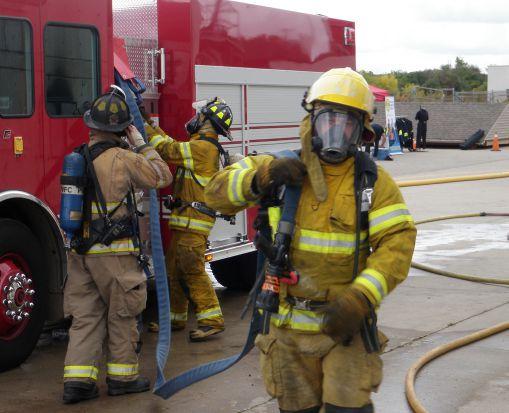
Most fire trucks in service today have at least two pre-connected hoselines ready to go when needed. The main purpose of a preconnect is to reduce the time it takes to unload the hose from the truck, roll or deploy it out, hook it up to the pump discharge outlet and then charge the line with water.
With a preconnected hoseline, firefighters need only pull off the hoseline from the hose bed and flake it out so that it is ready for water. These two steps can be practised with the following drill.
There are a few options available for loading a preconnect hoseline. All options are all variations of the flat load with perhaps a loop or two for easy pulling, or perhaps a minuteman load with easy pull off and easy deployment.
The basic hose load is the flat load with no loops or variations. As you can see in photo 1, the basic flat load has all of the hose ends lined up evenly at the edge of the hose bed. The nozzle lies on top of the hose load. Advancing this basic type of hose load can be done in one of two ways: the efficient (right) way or the long (wrong) way.
Photo 2 shows the long way. One firefighter grabs the nozzle and starts to walk toward the door of the building or fire location. The single action produces a spaghetti noodle. Just as a spaghetti noodle is produced from a press, a pre-connect hoseline that contains 60 metres (200 feet) of hose will produce a very long line of hose as it is pulled off of the truck.
As the firefighter with the nozzle pulls at the hose, the remainder of the line is pulled off the truck by either the backup firefighter or the driver/pump operator. This method is a time-consuming way to pull hose off the truck and ready it for advancement into the structure. Also, at the door of entry for the attack, the nozzle is attached to a straight line of hose extending back to the truck. It will now take a great effort to advance the line into the building. This method of hose deployment is a waste of time and resources.
The efficient or right way to pull the load off the truck is to use the folds of the hose as leverage. As you can see in photo 1, the flat load has many loops from the folds that are the perfect size into which to insert fingers. With gloved hands, a firefighter can use three of four fingers per loop to pull a half portion of the
Photo 1: The basic flat load has all of the hose ends lined up evenly at the edge of the hose bed, which creates loops that can be used to pull the load off the truck.
PHOTOS BY MARK VAN DER FEYST
Photo 2: The wrong way to advance the hose is to grab the nozzle and start walking toward the door of the building or fire location before the hose is unloaded. This will create a spaghetti noodle of hose that will be difficult to advance during the attack.
load off the truck in one movement. In the same movement, the hose is thrown on the ground to the firefighter’s left side.
Repeat the motion with the remaining folds to pull the rest of the load off of the truck. The second section of the load is thrown to the ground on the firefighter’s right side.
In two quick movements, a firefighter has the entire hose load on the ground and ready to be flaked out. Now, lying on the ground with the nozzle are the couplings of the line.
Depending upon the number of hose lengths that were packed for the preconnect, there will be three or four couplings on the ground: two on one side and one or two on the other side. A firefighter grabs the nozzle from the one side and looks for a coupling on the other side. Once both are in hand, the firefighter starts to walk toward the door for entry.
If the hose load is pulled off the truck the efficient way, the entire hoseline should flake out by the time the firefighter gets to the door of the structure. The firefighter will also have the nozzle and one coupling in hand.
Depending on which coupling the firefighter grabbed, he or she will have either 30 metres (100 feet) or 15 metres (50 feet) of extra hose. Having the nozzle and coupling at the door is a more efficient and easier way to advance the line into the structure.
Marking the middle coupling in your hose load will help ensure the firefighter grabs the right one every time.
Once the hose is stretched to the door, the backup firefighter can help by flaking out the line so that there are no kinks. At this point the firefighters are ready for water.
Photo 3 shows an example of the improper way to flake out hose. The hose should be lined up perpendicular as opposed to parallel to an entry point. Try pulling/advancing a hose around the corner of a building – it will work against you and you will fatigue quickly. Firefighters should line up their hoses in the direction of their travels to ease advancement.
In the next issue, we will look at getting water from the truck to the nozzle and then making entry to get water to and on the fire.
Mark van der Feyst has been in the fire service since 1999 and is a full-time firefighter in Ontario. Mark teaches in Canada, the United States and India. He is a local-level suppression instructor for the Pennsylvania State Fire Academy and an Instructor for the Justice Institute of BC. He is also the lead author of Pennwell’s Residential Fire Rescue book. Mark@ FireStarTraining.com
Photo 3: An improperly flaked hoseline runs parallel to the building entrance. For ease of advancement, the hose should run perpendicular to the firefighters’ line of travel.
BY TOM DESORCY Fire chief, Hope, B.C.
MAlways leave them wanting more
y life has been built around philosophies – I try to treat people as I wish to be treated and I constantly tell myself that any problems I might have are really not as important to most others. I guess that’s just good teaching, from my parents and my peers.
One of the biggest things I live by comes from the time I spent in drama class in high school, when our teacher first taught us the mantra of the stage: “Never forget,” he said, “always leave them wanting more.” I’ve been doing that my entire life.
I was fortunate to speak on this topic last year at the annual Newfoundland and Labrador Association of Fire Services convention in Gander. My message was simple: never overstay your welcome in everything you do.
When you come to think of it, Shakespeare was right when he said that our world is essentially a stage and we are simply actors in one giant play. This is the point at which I refer to the example of a typical volunteer firefighter – here you have an individual who by day may be your child’s school teacher or the manager at the local auto parts store, but becomes a truly different person when the pager sounds. People you may not expect – like a radio DJ for example, who you’re used to hearing every morning when your alarm sounds – could be your fire chief. Imagine that!
The point is, when we put on that uniform or turnout gear, our customers see us as firefighters, and in small communities in particular they likely know us as someone else. It’s at this moment that we really shine, when they see us playing our parts to perfection and leaving them with a great feeling once the performance is over.
.
are the refrains that echo through the fire halls across this country. Even I use those phrases, as a chief officer, when asked by the media about our members. I always do my best to remind the public that these are special people in our community, and I remind them that when they shop in the grocery store today to forgive the clerk if she looks a little tired because she’s been out at a fire scene most of the night.
Readers of this column are more than familiar with my three Rs of the fire service – recruitment, retention and retirement. It’s in the third R that my philosophy comes into play – knowing when it’s time to go. As an actor, if you’ve ever been in a show on a long run, it’s very tough to see it end. The fire department is no different; not only have you been around these people but you’ve been around them in situations like no other, you’ve seen them at their best in often the worst of situations. It’s a tough subject but one that needs to be talked about: it’s important to not only have this conversation but to talk about the next steps. Do we find a place for our retired members? Sure we do, it’s just not at the end of a hose.
I’m a person who wants it all, at least all that I’m lucky enough to get. I don’t recklessly live every day as if it’s my last but I’m aware
. . Shakespeare was right when he said that our world is essentially a stage and we are simply actors in one giant play.
Can we equate acting with performing? Sure we can. Again, when we are “on stage” in front of the public doing what we do best, what we’ve been trained to do, we are truly different people. This is not to say we are playing a firefighter but we are acting in a different role that people may not be used to. In that role, now, more than ever, we want to perform at our best and I’m proud to say we most always do.
So as firefighters why don’t we take bows, appear for curtain calls? Simply because that’s just not us. “It’s nothing,” or, “It’s what we do,”
Tom DeSorcy became the first paid firefighter in his hometown of Hope, B.C., when he became fire chief in 2000. Originally a radio broadcaster, Tom’s voice could be heard in the early 1990s across Canada as one of the hosts of Country Coast to Coast. Tom is very active with the Fire Chiefs’ Association of B.C. as communications director and conference committee chair. Email Tom at TDeSorcy@hope.ca and follow him on Twitter at @HopeFireDept
’’
that the show may end sooner than I’d like it to. As the song goes, “Yesterday is history, tomorrow is a mystery and today is a gift, that’s why it’s called the present.” With that being said, I’m not a bucket-list kind of guy; I’ve got enough check lists in my day-to-day life, so I prefer to recognize significance in everything I do. Speaking in Gander, I was reminded that there was a day when I was the all-night radio guy in that city in 1992 via satellite. To me, that was significant – who knew I’d visit there more than 20 years later?
I firmly believe that everything in life happens for a reason. We certainly influence those reasons through our actions, and if my actions never have people tire of my presence then I’ve accomplished my goal. When people don’t want to see me anymore, then I’ve stayed too long. Hopefully that’s not for a while, because I’m enjoying this show and the cast of characters that make it what it is.
Certificate in Fire Service Leadership
Name Position Department
Shauna Lynn Baccus Firefighter
Jonathan Balabuk Firefighter
Saskatoon Fire Department
Thunder Bay Fire Rescue
Drayton Bussiere Deputy Chief Lacombe Fire Department
Edward Andrew Coady Firefighter
St. John’s Regional Fire Department
Jason Scott Durocher Firefighter Amherstburg Fire Department
Ronnie Enman Captain Summerside Fire Department
Jason Graham Captain Calgary Fire Department
Roger Hachey Lieutenant Bathurst Fire Department
Evan Hawkins Firefighter
Martin Eino Hynna Training Officer
Mark G. J. Kress Firefighter
Brent J. Kyle Firefighter/Paramedic
Marc Lefebvre Training Officer
Reno Levesque Training Officer
Russell Lynch Firefighter
St. John’s Regional Fire Department
Thunder Bay Fire Rescue
Regina International Airport Fire Department
Brandon Fire Emergency Service
Brandon Fire Emergency Service
Georgina Fire Department, Township of Georgina
St. John’s Regional Fire Department
Robert D. MacLeod Senior Firefighter Kennebecasis Valley Fire Department
James McConkey Firefighter Whitchurch-Stouffville Fire & Emergency Services
Paul Francis Nixon Senior Firefighter
Evan Carter Noddin Lieutenant
Chris O’Reilly Firefighter
Kennebecasis Valley Fire Department
Point Lepreau Emergency Response Team
St. John’s Regional Fire Department
Brian Quigg Senior Firefighter Saint John Fire Department
Donald Rea Captain Caledon Fire and Emergency Services
Marc Robichaud Lieutenant
Joseph Schumacher Firefighter
Bathurst Fire Department
Waterloo Fire Rescue
Matthew Daniel Sidney Lieutenant Canadian National Emergency Services
David Smith Crew Leader Grand Bay-Westfield Fire Department
Darryl J. Thompson Firefighter/Certified Training Officer Caledon Fire Emergency Services
Michael Waite Captain Brampton Fire and Emergency Services
Trevor Wawryk Captain Whitchurch-Stouffville Fire & Emergency Services
Doug Wheatland Firefighter/Paramedic
Brandon Fire Emergency Service
Dave Wilson Captain Whitchurch-Stouffville Fire & Emergency Services
Certificate in Incident Command
Roree Payment Deputy Fire Chief Clearview Fire and Emergency Services
Certificate in Fire Service Administration Graduates
Certificate in Fire Service Administration
Brian Bell Captain-Maintenance Coordinator Langford Fire Rescue
Nicholas J. Brenner Fire Marshal
Alexander Freeman Fire Prevention/Public Education Officer
Brandon S. Northrup Fire Chief
Certificate in Fire Service Administration, Human Resource Management
Stephen Erbland Firefighter
Dale W. Gartshore Captain
Certificate in Fire Service Administration, Strategic Planning
Gregory D. Jones Fire Chief
Jon Lasiuk Acting Captain
Fort McMurray Fire Department
Markham Fire and Emergency Services
Cramahe Township Fire
St. John’s Regional Fire Department
Sarnia Fire Rescue Services
Amherst Fire Department
Toronto Fire Services
Patrick James Mahoney Fire Chief/Manager of Protective Services Sturgeon County
Roy E. Nolan Jr. Captain
Daniel Smith Deputy Chief
Shawn R. White Acting Lieutenant
Saint John Fire Department
Quinter West Fire and Emergency Services
Kennebecasis Valley Fire Department
BY GORD SCHREINER Fire chief, Comox, B.C.
TFind strength in working together
he fire service is a business like no other; its main purpose is to serve and protect its citizens and keep its firefighters safe. Services do not need to compete with each other, but rather work together and share with each other. Together we are stronger. That means working closely together both internally (within our fire stations) and externally (within the broader fire and emergency-service community).
Internally: When all members (including leaders) of a fire department are pulling in the same direction, both the department and firefighters thrive. The result of this unison is a better place to work and better service for citizens. Firefighters who share with each other are typically better prepared for their next incident. Sharing knowledge and gently pushing each other to be better makes firefighters safer and more effective. Great firefighters are here for the team, not for themselves, and the team is here for our citizens. Together firefighters are stronger, whether that means helping each other with training, fitness, job searches or life challenges. When we play as a team everyone wins!
I visit many fire stations each year and I can tell quite a bit about a fire department after meeting some of its firefighters. I am happy to say that most fire departments get it – fire fighting is a team sport, not a place for people who put themselves before others.
Externally: When fire departments reach out and work with other fire departments (and other emergency-service agencies) the same benefits can be found. Fire departments that share and train with other fire departments increase the safety and effectiveness of their firefighters and organizations. Helping each other helps departments to enhance the services they provide to their citizens.
my answer was the Internet. The Internet allows us to share information quickly and also to see what others are doing (right or wrong). I have good friends who are leaders in the fire service whom I have never met in person, yet we are constantly sharing and trading ideas.
I love having other firefighters and departments visit us to train because it broadens our own training as we learn from each other. Fire departments that work closely together to deliver their important services thrive, and their citizens receive better value for their taxes. Mutual-aid agreements assist departments in ensuring adequate resources are available. Automatic-aid agreements assist departments in providing timely responses. Both types of agreements work with little increased costs but provide huge benefits both for the community and the fire departments. Large or small, modern fire departments must realize that they can’t go it alone. Developing strategic partnerships is a win-win situation for us all.
Training together prepares us to work together during a mutualor automatic-aid incident. Sharing resources with each other is common sense and fiscally responsible.
My department has also benefited from me travelling all over
We don’t need to reinvent the wheel – just borrow a wheel and maybe make it spin better, then pass it on to others. ‘‘ ’’
My department constantly trains with others departments. We are also always looking to improve and find new and better ways of doing things. I know first-hand that interaction with other departments has helped our department to improve its services, increased safety and made us better. We are always willing to share our training centre, training props, lesson plans, PowerPoints and guidelines with others as we know that most will do likewise. When I share something with another department I simply ask that if members of that department improve it, to let us know about the improvements so we can consider them. I was recently asked what I thought was the most significant change in the fire service over the past several years;
Gord Schreiner joined the fire service in 1975 and is a full-time fire chief in Comox, B.C. Contact him at firehall@comox.ca and follow him on Twitter at @comoxfire
Canada delivering my Safe and Effective Scene Management (#stopbad) program. I visit dozens of fire departments each year and I learn from all of them. In fact, I have learned so much from visiting other departments that I often come home with some great ideas as to how to improve our services and/or training at my department. Some of the best ideas I have seen come from some of the smaller fire departments that need to be more creative due to smaller budgets (doing more with less). I freely share all that I have learned.
Those few departments that, for whatever reason, choose to go it alone, are only hurting themselves and their communities. Working closely with neighbouring fire departments is a win-win for all involved and is also expected by our citizens and politicians. We don’t need to reinvent the wheel – just borrow a wheel and maybe make it spin better, then pass it on to others.
Loaded with safety, comfort and mobility features for unmatched performance, Flame Fighter® bunker gear offers a variety of custom outer shell fabric, liner system, hardware and pocket options to fit your specific needs. This hard-working gear also includes the following game-changing Starfield LION fire protection technology:
• Patented IsoDri®* moisture management reduces the water absorbtion and helps gear dry faster between runs
• Exclusive Ventilated Trim allows vapor to be released, reducing the risk of scald burns
• Thermashield™ provides an additional layer of liner material in the upper back and shoulders to protect against compression burns
• Move-N-Hance™ crotch gusset increases mobility by reducing bunching, twisting and pulling
• Flex Knee™ for easy, natural movement
• Stay Rite™ sleeve wells integrate the sleeve’s liner into a full-length wristlet so that when you reach, the entire sleeve moves with you
For more information about Flame Fighter bunker gear, contact your Starfield LION sales representative at 1.800.473.5553 or visit us online.
Preparing for wood fires
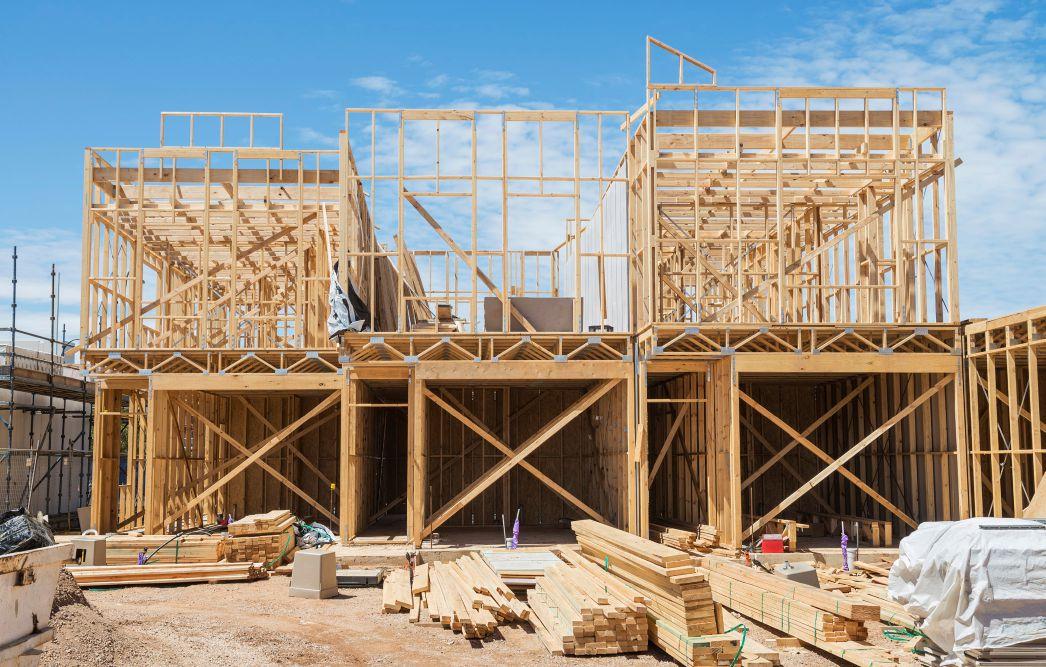
TOP The Canadian Wood Council and the University of the Fraser Valley aim to help firefighters learn to reduce the risk and losses of wood construction-site fires with new resources such as a firefighter guide to wood project and systems awareness
RIGHT It is estimated that more than 100,000 building projects in Canada each year involve woodbased construction.
New resources for firefighters can help in prevention and response to construction-site blazes
By LEN GARIS, PAUL MAXIM and KARIN MARK
As wood becomes an increasingly popular building material in Canada, there is a corresponding need for fire-safety resources for both the construction industry and emergency responders.
To meet this need, the Canadian Wood Council, working with the University of the Fraser Valley in British Columbia, has produced an in-depth guide and research papers with the goal of reducing the risk and losses from construction-site fires. The project was funded through a grant from Natural Resources Canada.
“We know from research that once
fire-safety systems are in place, wood-based buildings are as safe as any other type of building,” said Michael Giroux, president of the Canadian Wood Council. “However, like all buildings, they are vulnerable to fire during the construction stage, before those systems are installed. As representatives of Canada’s wood industry, we want to help ensure that construction sites across Canada that use wood are as safe as possible.”
The guide and research papers can be downloaded for free at cjr.ufv.ca or www.cwc.ca and include:
• Construction Site Fire Safety: A Guide for Construction of Large Buildings – practical tools and
information for the construction industry (also available in French).
• Construction Site Fire Response: Preventing and Suppressing Fires During Construction of Large Buildings – analysis and response information for the fire service (also available in French).
• Firefighter Wood Project and Systems Awareness: A Resource Guide – sources of information on fire-safety topics related to wood-based construction.
Information for the project was gleaned from best practice, legislation, regulation and standards from Canada, the United States and Europe.
While the materials focus on the design, planning and construction phases of new buildings, the content is also relevant to projects involving existing buildings, such as demolition, alteration or repairs.
It is estimated that more than 100,000 building projects in Canada each year involve wood-based construction (e.g. light woodframe, heavy/massive timber post-and-beam, cross-laminated timber). These numbers may mushroom in the future following changes to the 2015 National Building Code and National Fire Code that allow the construction of wood buildings of up to six storeys.
With this widespread and growing use of wood comes the need for a greater focus on construction fire safety, both from the perspective of builders and emergency responders.
Regardless of the building materials used, construction sites present fire departments with a different set of challenges than those associated with completed buildings. The construction stage is the most dangerous point in the lifespan of any building, due to a number
of risks, including proximity of combustible materials as ignitions sources (e.g. electric equipment and hot work such as welding and roofing); lack of completion of any built-in fire-safety systems such as sprinklers; absence of doors, finished walls and other separations that may slow fire spread; and potential site security issues.
The widespread use of combustible products such as wood on a construction site, along with the introduction of taller wood buildings, can add a further level of risk and complexity to both fire prevention and response. There have been numerous examples of large-scale construction fires in Canada, including those in Calgary in March 2015, Kingston, Ont., in December 2013, and Richmond, B.C., in 2011. Typical hazards at construction sites include:
• Temporary heating equipment
• Smoking
• Waste disposal
• Open burning
• Spontaneous ignition
• Cutting and welding
• Electrical malfunction
• Flammable and combustible liquids
• Flammable gases
• Explosives
The leading causes of fires in buildings under construction or demolition are incendiary or suspicious events, open flames and embers and heating equipment.
Fire safety is the responsibility of everyone involved in construction projects, including the construction industry, employers, workers, site visitors, and provincial and local authorities. Some of these responsibilities are laid out in standards, codes or legislation, such as provincial occupational health and safety regulations.
Construction companies also have a vested interest in promoting fire safety at their sites from a business standpoint. Financial losses can be significant because fire departments in general take defensive approaches to construction-site fires as there is typically no need for occupant rescue. As a result, the focus at construction fires is firefighter safety and to prevent the fire from spreading to adjacent buildings.
Despite extensive property damages and financial losses typical of construction fires, many Canadian fire departments have limited experience preventing and suppressing fires at large construction sites. And construction-company managers may not fully understand the risks of inadequate on-site fire-prevention procedures and equipment, or know how to implement the appropriate measures.
These factors are a recipe for catastrophic losses, and is the focus of the new Canadian Wood Council publications that specifically tailor information to people who play roles in preventing and responding to construction-site fires.
Download the Canadian Wood Council publications for free at cjr. ufv.ca or www.cwc.ca
Read this article in full at firefightingincanada.com/hot-topics/ research
Len Garis is the fire chief for the City of Surrey, B.C., and an adjunct professor at the University of the Fraser Valley. Contact him at LWGaris@surrey.ca
Paul Maxim is a professor in the Department of Economics and the Balsillie School of International Affairs at Wilfrid Laurier University in Waterloo, Ont.
Karin Mark, based in Metro Vancouver, is a former award-winning newspaper reporter who writes for publications and corporate clients.
■ Internal Ladder & Suction Hose Storage
■ 1000 IMP/1200 US Gallon Copoly Tank
■ Heated Pump Compartments
■ Gear Box Rise (For better driveline angle)
■ Freightliner Chassis
■ Aluminum Body (5083 Salt Water Marine Grade)
■ 20 Year Body Warranty
■ Darley PTO Rear Mount 1050 IMP/1250 US Gallon Pump
■ Grass Nozzles Option
■ Foam System Options
■ 12V Bumper Turret w/ Joystick Option
■ 100’ Hose Reel Under Cab Option
■ Aluminum Body (5052 Fresh Water Marine Grade)
■ 10 Year Body Warranty
■ High Side Compartments
■ Aluminum Extruded Rub Rails
■ Amdor Roll Up Doors
■ Two Speedlay Hose Beds
■ Short Wheelbase
■ Side Control Pump House
■ 800 IMP/960 US Gallon Water Tank
■ Foam System Options
■ Freightliner or International Chassis
■ Wildland Option
CAFC strives to better serve members
By PAUL BOISSONNEAULT
It’s hard to believe it has been a year since I became president of the Canadian Association of Fire Chiefs (CAFC). It has been a whirlwind with lots on the go.
In that short time I had the privilege of meeting many of our members and stakeholders – at provincial/territorial conferences, representing the fire services in front of federal ministers and parliamentary committees, and interacting with industry partners.
CAFC initiatives range from rail safety and legislative change to member-services programs and engagement of pipeline and telecommunication companies. The CAFC is sharing and exchanging ideas to help build relationships that will serve the association well in the future.
Over the years, I have watched the CAFC mature and grow. With a board-supported strategic vision and a solid focus on meeting member needs, we have worked collaboratively with our provincial and territorial partners to develop new initiatives and projects large and small that will benefit the fire service. Internally, we have formalized our governance structure and adopted an open, transparent culture that welcomes participation and communication from members. In short, the CAFC is well positioned for the foreseeable future.
The CAFC is proactively seeking opportunities to address the needs of Canadian fire services. During the past year we have seen a number of initiatives come to fruition – mainly because of discussions generated by the grassroots. Those initiatives have included a partnership with the Alberta Fire Chiefs Association to bring its Answer the Call volunteer recruitment program Canada-wide, collaboration with the Canadian Council of Fire Marshals and Fire Commissioners to obtain a federal grant to finally build a much-needed national fire information database, a strong presence at the federal political level, and work to launch a revamped chief fire officer (CFO) program for 2016. As fire services large and small deal with emerging issues in the workplace and in their
L’ACCP s’efforce de mieux servir les membres
Par PAUL BOISSONNEAULT
Il est difficile de croire qu’un an déjà s’est écoulé depuis que je suis président de l’Association canadienne des chefs de pompiers (ACCP). Ce fut un tourbillon d’activités.
Dans ce court laps de temps, j’ai eu le privilège de rencontrer plusieurs de nos membres et de parties prenantes, lors de conférences provinciales/territoriales, au moment de représenter les services d’incendie lors de réunions avec les ministres fédéraux et des comités parlementaires et lors d’interactions avec les partenaires de l’industrie.
Les initiatives de l’ACCP vont de la sécurité ferroviaire aux modifications d’ordre législatif aux programmes et services à l’intention des membres, à l’engagement des industries du secteur des pipelines et des télécommunications. L’ACCP partage et échange des idées afin de nouer des liens qui serviront bien l’Association à l’avenir.
Au fil des ans, j’ai observé l’ACCP grandir et mûrir. Dans le cadre d’une vision stratégique soutenue par le Conseil d’administration et solidement axée sur satisfaire les besoins des membres, nous avons travaillé en collaboration avec nos partenaires provinciaux et territoriaux afin de développer de nouvelles initiatives et de nouveaux projets, petits et grands, qui profiteront aux services d’incendie. À l’interne, nous avons formalisé notre structure de gouvernance. Nous avons adopté une culture ouverte et transparente qui encourage la participation et la communication des membres. En bref, l’ACCP est en bonne posture pour l’avenir prévisible.
L’ACCP recherche activement des occasions de répondre aux besoins des services d’incendie du Canada. Au cours de la dernière année, un certain nombre d’initiatives se sont concrétisées, principalement en raison de discussions générées par la base. Parmi celles-ci, notons un partenariat avec l’Alberta Fire Chiefs Association pour mettre en œuvre son programme de recrutement de volontaires Answer the Call à l’échelle du pays, une collaboration avec le Conseil canadien des directeurs provinciaux et des commissaires d’incendie pour obtenir une subvention du gouvernement fédéral pour enfin mettre en place la base de données nationales sur les incendies dont nous avons tant besoin, une forte présence au palier politique fédéral et le lancement d’un programme remanié de chef d’état-major (CÉM) prévu pour 2016. Alors que les services d’incendie, grands et petits, traitent des questions
communities, it behooves us to keep working together closely to ensure strong fire services from coast to coast to coast.
In a vast and very diverse Canada there is an absolute need for representation and the involvement of membership. The CAFC works hard in the interest of its members, who present themselves as stewards of public safety for the communities they serve. The talent that exists within the chief-officer ranks of Canada’s fire services is necessary for the heavy lifting required to effect positive change. Departments of all sizes are represented by the CAFC and the benefits of membership are captured through involvement. The CAFC has committed to assist its members by providing services and resources of relevance. The association’s commitment to a national Answer the Call program, the improved CFO program, and online learning initiatives will address some gaps related to resourcing and expertise. I am committed to reaching out to non-member fire services and ensuring that they understand their voices and representations are vital to the CAFC, and that we are an association focused on inclusion and diversity. We are experiencing growth in this particular membership category, but there is still an opportunity for more.
I cannot miss a chance to point out that a tremendous amount of work goes into any conference, and that the 2015 Fire-Rescue Canada – the country’s premier national networking opportunity for chief fire officers – in Victoria this month will be a great success.
Fire-Rescue Canada 2016 is in St. John’s, N.L., next September and I hope to see you there. Our friends in Newfoundland and Labrador are always great hosts!
As I continue this journey as president into 2016, I do so with a very positive outlook and with great anticipation of what’s ahead. One area of focus will certainly be the need for a collaborative approach with stakeholders concerning mental health and post-traumatic stress disorder. Our personnel are our greatest resource and we need to find the assistance measures required for this very complex and challenging issue.
In this together is a great mantra for the CAFC and will keep its members focused on the collaborative approach and spirit of volunteerism that defines us. I will continue to work extremely hard along with our board and national advisory council members to fulfill member expectations and affect necessary change. I look forward to continuing to represent the great people of the fire service in Canada and working with all of you in the next year.
Paul Boissonneault is the president of the Canadian Association of Fire Chiefs and fire chief for the County of Brant Fire Department in Ontario. Contact him at Paul.boissonneault@ brant.ca
émergentes en milieu de travail et dans leurs communautés, il nous incombe de continuer de travailler en étroite collaboration pour assurer des services d’incendie forts, d’un océan à l’autre.
Dans un pays aussi vaste et diversifié que le Canada, il y a un besoin absolu de représentation et de participation de l’effectif. L’ACCP travaille d’arrache-pied dans l’intérêt de ses membres qui agissent à titre d’intendants de la sécurité publique dans leurs communautés. Le talent qui existe dans les rangs des chefs d’état-major des services d’incendie canadiens est nécessaire pour faire le gros de la besogne requis pour effectuer des changements positifs. L’ACCP représente des départements de toutes tailles et les avantages de l’adhésion sont capturés par la participation. Nous nous sommes engagés à aider nos membres en fournissant des ressources et des services pertinents. L’engagement de l’Association envers la mise en œuvre d’un programme national Answer the Call, l’amélioration du programme de CÉM et les initiatives d’apprentissage en ligne combleront certaines lacunes liées aux ressources et à l’expertise. Je suis déterminé à tendre la main aux services d’incendie qui ne sont pas membres et à tenter de leur faire comprendre que leurs voix et leurs représentations sont essentielles pour l’ACCP qui se veut être une association axée sur l’inclusion et la diversité. Nous vivons une croissance dans cette catégorie d’adhésion particulière. Mais, on peut toujours faire plus.
Je ne peux pas rater une occasion de souligner l’énorme quantité de travail que représente la préparation d’une conférence. FRC-2015, la principale opportunité de réseautage national pour les chefs d’état-major qui se tiendra à Victoria ce mois-ci sera un grand succès.
FRC-2016 aura lieu à St. John’s en septembre prochain et j’espère vous y voir. Nos amis à Terre-Neuve et au Labrador sont toujours d’excellents hôtes !
C’est avec une perspective très positive et avec une grande anticipation de ce qui est à venir que je poursuivrai mon périple comme président en 2016. Je suis honoré et privilégié de servir en tant que président de l’ACCP. Je le fais avec responsabilité et en faisant vœu de servir nos membres, le Conseil consultatif national et le Conseil d’administration.
La nécessité d’une approche de collaboration avec les intervenants en matière de santé mentale et du syndrome de stress post traumatique sera certainement un domaine d’intérêt. Notre personnel est notre plus grande ressource et nous devons trouver les mesures d’assistance voulues à cette question très complexe et difficile.
« Solidaires » est un excellent mantra pour l’ACCP qui gardera ses membres axés sur l’approche collaborative et l’esprit de bénévolat qui nous définit. Je continuerai de travailler très dur avec les membres du Conseil d’administration et du Conseil consultatif national pour répondre aux attentes de l’effectif et pour affecter le changement nécessaire. Je me réjouis de continuer de représenter les gens formidables des services d’incendie du Canada et de travailler avec vous tous l’année prochaine.
Paul Boissonneault est le président de l’Association canadienne des chefs de pompiers et il est chef des pompiers pour les services d’incendie du comté de Brant, en Ontario. Communiquez avec lui à Paul.boissonneault@ brant.ca
Partnering to recruit volunteers across Canada
By CAFC
Aprogram to help fire departments recruit and retain volunteers will be available across Canada in 2016.
“Basically, departments have been reinventing the wheel and creating their own recruitment systems,” said Peter Krich, president of the Alberta Fire Chiefs Association.
“This program, known as Answer the Call, gives departments all the tools they need to get positive messages about recruitment to their communities and enables them to focus on the business of fire fighting.”
In 2010, Volunteer Alberta outlined the challenges associated with finding and keeping volunteers. The AFCA responded by developing the Answer the Call recruitment and awareness campaign. The Canadian Association of Fire Chiefs (CAFC) has partnered with the Alberta association to expand the program nationally.
Essentially, Answer the Call was designed to celebrate the contributions of volunteer firefighters through stories and to inspire others to join local fire departments.
Andrew Kencis, a volunteer captain with Yellowhead County in Alberta, is one of several firefighters featured in the campaign.
“I still remember the feeling of passing through the police traffic control and being assigned to be with a senior [fire department] member helping out on an accident scene,” Kencis says in the campaign literature.
“It was that moment I realized that this was exactly what I was looking for . . . to be directly involved with helping our community and at the same time fulfilling a deep desire in my life to be active in situations where I would be tested and given different opportunities to grow in courage, resolve, determination, and strength.”
The goal of the campaign is to help departments attract more volunteers from various demographics and to bolster the ranks of volunteer firefighters.
For the most part, municipal fire departments have fended for themselves to recruit, screen and retain the best volunteers. Municipalities must seek out innovations and best practices,
pour recruter des volontaires, partout au Canada
Par CAFC
Un programme visant à aider les services d’incendie à recruter et à retenir des volontaires sera disponible partout au Canada en 2016.
« Fondamentalement, les départements réinventent la roue et créent leur propre système de recrutement » a déclaré Peter Krich, président de l’Alberta Fire Chiefs Association.
« Ce programme, connu sous le nom d’Answer the Call, procure aux départements tous les outils dont ils ont besoin pour susciter une réaction positive dans leurs communautés. Ils peuvent ainsi se concentrer sur la lutte contre les incendies ».
En 2010, Volunteer Alberta soulignait les défis associés au recrutement et au maintien des volontaires. L’AFCA a réagi en développant la campagne de recrutement et de sensibilisation Answer the Call. L’Association canadienne des chefs de pompiers (ACCP) a établi un partenariat avec l’Association de l’Alberta pour offrir le programme à l’échelle nationale.
Essentiellement, Answer the Call a été conçu pour célébrer la contribution des pompiers volontaires par l’entremise d’anecdotes et pour en inspirer d’autres à se joindre aux services d’incendie locaux.
Andrew Kencis, capitaine volontaire dans le comté de Yellowhead (Alberta), est l’un de plusieurs pompiers sous les feux des projecteurs.
« Je me souviens encore de mes émotions au moment de passer le poste de contrôle de la circulation de la police alors que j’étais affecté à un membre chevronné [des services d’incendie] prêtant main forte sur les lieux d’un accident » de raconter M. Kencis dans la brochure de la campagne.
« C’est à ce moment-là que j’ai réalisé que c’était exactement cela que je cherchais, à savoir aider notre communauté tout en réalisant un de mes désirs profonds de me retrouver dans des situations dans lesquelles je serais mis à l’épreuve et qui me donneraient l’occasion de croître en courage, en détermination et en force ».
L’objectif de la campagne consiste à aider les départements à attirer davantage de volontaires de diverses couches démographiques et de renforcer les rangs des pompiers volontaires.
Pour la plupart, les services se sont débrouillés seuls pour recruter, sélectionner et retenir les meilleurs volontaires. C’est souvent par essai et par erreur que les municipalités doivent trouver innovations et pra-
often through trial and error.
With the support of Answer the Call, recruiting will finally enter the digital age. Departments will be able to take advantage of online information resources, marketing materials and templates that support their activities. With time and resources already stretched, departments will be able focus more on running their departments, serving their communities and responding to fire and emergency calls, and spend less time worrying about effectively advertising their volunteer opportunities.
An Answer the Call logo featuring a firefighter with an axe will be available for all departments to use to promote volunteerism. The logo is also available as a window cling-on for local businesses that support volunteer firefighters.
The Answer the Call campaign will greatly enhance Canadians’ awareness about openings for volunteer fire fighting, Krich says.
The provincial campaigns are intended to reach people who may not have considered volunteer fire fighting, such as those who don’t realize such opportunities exist or those who assume volunteer fire fighting is limited to a certain demographic.
“Alberta recognizes the substantial number of volunteers in the province and the importance of maintaining the strength of our responder base,” said Krich, who is the fire chief in Camrose. “The high percentage of volunteers in Alberta is mirrored across the country.
“This collaboration with CAFC,” he said, “helps us build on our original vision of supporting and recruiting volunteers – extending beyond the Alberta border to help promote safety and protect people in communities right across the country.”
> Camrose Fire Chief Peter Krich outlines Alberta’s Answer the Call recruitment and retention program to BC chiefs in Victoria last June. The CAFC has embraced the program and is rolling it out nationally in 2016.
tiques exemplaires.
Avec le soutien d’Answer the Call, le recrutement entrera finalement dans l’ère du numérique. Les départements seront en mesure de tirer parti des ressources d’information en ligne, des documents de commercialisation et de modèles qui soutiennent leurs activités. Compte tenu du temps et des ressources déjà utilisées au maximum, les départements pourront mieux se concentrer sur leur gestion, servir leurs communautés et répondre aux situations d’urgence et aux incendies, et consacrer moins de temps à publiciser efficacement leurs possibilités de bénévolat.
Un logo Answer the Call mettant en vedette un pompier, la hache à la main, sera mis à la disposition de tous les départements pour promouvoir le bénévolat. Le logo est aussi disponible en autocollants pour fenêtres pour les entreprises locales qui soutiennent les pompiers volontaires.
La campagne Answer the Call permettra de grandement conscientiser les Canadiens aux ouvertures dans la lutte volontaire contre les incendies, a déclaré M. Krich.
Les campagnes provinciales visent à atteindre les personnes qui peuvent ne pas avoir considéré se porter volontaire dans la lutte contre les incendies, comme celles qui ne réalisent pas que de telles possibilités existent ou qui assument que ce genre de bénévolat se limite à une certaine démographie.
« L’Alberta reconnaît le grand nombre de volontaires dans la province et l’importance de maintenir la force de notre base de premiers répondants » a ajouté M. Krich, chef des pompiers à Camrose. « Le pourcentage du nombre de volontaires en Alberta se reflète à travers le pays ».
« Cette collaboration avec l’ACCP », a-t-il dit, « nous aide à prendre appui sur notre vision originale qui consiste à soutenir et à recruter des volontaires au-delà des frontières de l’Alberta pour promouvoir la sécurité et protéger les communautés partout au pays ».
> Le chef de pompiers de Camrose, Peter Krich, explique le Programme de recrutement et de rétention « Répondre à l’appel » aux chefs de pompiers de la Colombie-Britannique, à Victoria, en juin dernier. L’ACCP a adopté le programme et le déploiera à l’échelle nationale en 2016.
PHOTO BY ROB EVANS
The Answer the Call campaign evolved from the recommendations in the 2010 report by Volunteer Alberta. A shortage of volunteers had forced some departments to suspend their readiness for emergencies during daytime hours, and others to shut down altogether.
The lack of volunteers also forced fire services in Alberta to take a hard look at themselves. The AFCA’s 2010 report on recruitment and retention states that, “The issue of recruiting and retaining firefighters is a worldwide issue that we in the Alberta fire service were naive enough to believe wasn’t affecting us.”
Ignoring the issues was no longer an option.
“During our 2008 annual conference,” the report states, “our membership debated a resolution on recruitment and retention and it became evident we did have issues. It was time to stop hiding our heads in the sand and look at who and what we are when it comes to recruiting new members and keeping the old.”
When the national campaign launches in late 2016, volunteer departments across Canada will see the benefits of Alberta’s farsighted initiative.
“Increasing the reach of this campaign will help us connect with Canadians from coast to coast to coast who may be looking to answer the call to serve as volunteer firefighters within their communities,” said CAFC president Paul Boissonneault.
“Fire departments across the country will benefit by being able to access tools to help develop their own hub for recruiting and celebrating volunteer firefighters.”
The campaign will also partner with corporations and interested community stakeholders to generate awareness of volunteer opportunities and celebrate the contributions these dedicated individuals make to their communities.
> A national version of Alberta’s Answer the Call volunteer recruitment campaign will be available to all Canadian departments in 2016.
La campagne Answer the Call a évolué au fil des recommandations contenues au rapport 2010 de Volunteer Alberta. Une pénurie de volontaires avait obligé certains départements à suspendre leurs préparations à des situations d’urgence pendant les heures diurnes tandis que d’autres devaient mettre la clé sous la porte.
L’absence de volontaires avait également contraint les services d’incendie de l’Alberta à se regarder d’un œil critique. Le rapport de l’AFCA de 2010 sur le recrutement et la rétention stipule que « la question du recrutement et de la rétention des pompiers est un problème mondial. Et nous, au sein du service d’incendie de l’Alberta, avons été assez naïfs pour penser que cela n’avait rien à voir avec nous ».
Ignorer les problèmes n’était plus une option.
Toujours selon le rapport : « Lors de notre conférence annuelle de 2008, notre effectif a débattu d’une résolution sur le recrutement et la rétention. Il a fallu se rendre à l’évidence, nous avions des problèmes. Il était temps d’arrêter de se cacher la tête dans le sable et de chercher à savoir qui et ce que nous sommes quand vient le temps de recruter de nouveaux membres et de retenir les anciens ».
Lorsque la campagne nationale sera lancée à la fin de l’année 2016, les départements volontaires partout au Canada constateront les avantages de la clairvoyance de l’Alberta.
« Élargir la portée de cette campagne nous permettra de communiquer avec les Canadiens d’un océan à l’autre qui souhaitent peut-être se porter pompier volontaire dans leurs communautés » a déclaré le président de l’ACCP, Paul Boissonneault.
« Les services d’incendie de tout le pays bénéficieront de pouvoir accéder à des outils leur permettant de développer leur propre centre névralgique pour recruter et célébrer les pompiers volontaires ».
La campagne établira aussi un partenariat avec les entreprises et les parties prenantes de la communauté intéressées à sensibiliser l’opinion aux possibilités de bénévolat et à célébrer les contributions de ces personnes dévouées à leurs communautés.
> En 2016, tous les départements canadiens auront accès à une version nationale de la campagne de recrutement de volontaires de l’Alberta intitulée Answer the Call.
Fire data project to help determine risks, resources
By LEN GARIS and KARIN MARK
Agroundbreaking national fire-data project that is expected to be launched this fall will help fire officials make confident, evidence-based decisions about policy, resource use, and other critical matters affecting the safety of Canadian communities.
Federal funding was announced in June for a pilot national fire-information database project that will gather and unify 10 years of fire information from across the country and create Canada’s first national system for collecting fire statistics.
Co-ordinated by the Canadian Association of Fire Chiefs (CAFC) and the Council of Canadian Fire Marshals and Fire Commissioners, the three-year, $850,000 project is funded by the Canadian Safety and Security Program, led by Defence Research and Development Canada’s Centre for Security Science, in partnership with Public Safety Canada.
“Without trusted evidence-based data, first responders cannot act with confidence when making choices to improve policy, co-ordinate activity, or operate in the most impactful manner,” said Duane McKay, present of the council of fire marshals and commissioners.
CAFC president Paul Boissonneault said the database will help fire officials to better understand incident dynamics and actual and potential threats to public safety. Boissonneault said the benefits will extend to the broader public-safety community for years to come.
“This first-ever national perspective on fire data will reveal insights into the incidents, response and impacts of threats we face,” he said.
Evidence-based decision making has become increasingly important for government agencies following the economic downturn, said project researcher Paul Maxim, a professor at Wilfrid Laurier University in Waterloo, Ont.
“Fire officials are facing increasing pressure – from both the public and government decision makers – to justify their decisions and actions with hard data,” Maxim said.
“In meeting these demands, fire officials are often forced to use limited regional information. They have typically
les risques et les ressources
Par LEN GARIS et KARIN MARK
Un projet national révolutionnaire sur les données relatives aux incendies qui devrait être lancé cet automne permettra aux pompiers de prendre en toute confiance des décisions fondées sur des preuves sur les politiques, l’utilisation des ressources et autres questions critiques affectant la sécurité des collectivités canadiennes.
Le financement fédéral d’un projet pilote sur une base de données nationales sur les incendies qui permettra de recueillir et d’unifier dix ans d’information à ce sujet et de créer le premier système national de collecte de statistiques sur les incendies au Canada a été annoncé en juin.
Coordonné par l’Association canadienne des chefs de pompiers (ACCP) et le Conseil canadien des directeurs provinciaux et des commissaires d’incendie, le projet de trois ans au coût de 850 000 $ est financé par le Programme canadien de protection et de sécurité dirigé par le Centre des sciences pour la sécurité nationale de Recherche et développement pour la défense Canada, en partenariat avec Sécurité publique Canada.
« Sans données fiables fondées sur des preuves, les premiers intervenants ne sont pas en confiance au moment de faire des choix lorsqu’il s’agit d’améliorer les politiques, de coordonner les activités ou de fonctionner de la manière la plus percutante qui soit » a déclaré Duane McKay, président du Conseil des directeurs provinciaux et des commissaires d’incendie.
Aux dires de Paul Boissonneault, président de l’ACCP, la base de données aidera les pompiers à mieux comprendre la dynamique des incidents et les menaces réelles et potentielles à la sécurité publique. Il a ajouté que les avantages s’étendront à la sûreté de l’ensemble de la communauté pour des années à venir.
« Ce premier regard national sur les données d’incendie révélera un aperçu de l’incident, de la réaction et de l’impact des menaces auxquels nous sommes confrontés » a-t-il dit.
Les décisions fondées sur des données probantes revêtent de plus en plus d’importance pour les organismes gouvernementaux au lendemain du ralentissement économique a déclaré le recherchiste du projet, Paul Maxim, professeur à l’Université Wilfrid Laurier, à Waterloo, en Ontario.
« De plus en plus, les autorités en matière de feu font face à des pressions accrues, à la fois des décideurs publics et gouvernementaux, pour justifier leurs décisions avec des donnée sûres à l’appui » a ajouté M. Maxim.
lacked comparable national data, or data linked to other relevant characteristics of the locations in which fire incidents take place.
“The lack of robust, available data also makes it difficult for them to identify and address emerging trends and issues.”
The national perspective on fire data that will be developed through the database project is expected to provide deeper insights into how, when, where and why fires take place. This information will enable fire services to strategically deploy resources and identify major trends that could lead to changes
In the first year of the pilot, Statistics Canada will collect and standardize a decade of fire records from Canada’s provinces and territories. ‘‘ ’’
in fire policy and regulation.
At a national level, for instance, Canada-wide statistics could be used to build a business case for changing the national building code to require more sprinkler systems in residences. On a local level, a fire department could compare its own fire statistics to those of its region or province to identify gaps in service and to plan where to apply future resources. Initiatives such as these would help reduce fires, property damage, injury and death.
Many exciting possibilities for research could grow from this project, Maxim said. For example, layering fire statistics on top of other data – such as income, crime, health and demographics – could lead to a greater understanding of existing public-safety threats and how to address them.
Work on the concept began in 2011 when the CAFC launched a year-long project to explore the development of a database.
British Columbia’s University of the Fraser Valley co-ordinated the research and consultation on behalf of the CAFC. The project ultimately led to the successful grant application for the development of the database.
In the first year of the pilot, Statistics Canada will collect and
« En répondant à ses exigences, les autorités en matière de feu sont souvent contraintes d’avoir recours à une information régionale limitée. Elles manquent généralement de données nationales comparables ou jumelées à d’autres caractéristiques pertinentes sur les lieux des incendies.
« L’absence de données fiables fait qu’il leur est difficile d’identifier et de traiter les nouvelles tendances et questions ».
Un document de recherche publié en 2011, intitulé Can We Develop National Canadian Fire Statistics for Emergency Planning?, signé par Rhéaume Chaput, chef des pompiers de Kingston (Ontario), récemment à la retraite, cite l’ancien directeur régional canadien de la NFPA, Sean Tracey : « Un des plus grands défis [pour] provoquer des changements dans l’industrie de la sécurité- incendie est l’absence de statistiques fiables à cet égard ».
Les perspectives nationales sur les données sur les incendies qui seront développées dans le cadre de la base de données provisoire devraient fournir un aperçu plus approfondi sur comment, quand, où et pourquoi les incendies se déclarent. Cette information permettra aux services d’incendie de déployer stratégiquement des ressources et d’identifier les grandes tendances qui pourraient conduire à une modification de la politique en matière d’incendies et la règlementation afférente.
Au niveau national, des statistiques pancanadiennes pourraient, par exemple, être utilisées pour former des arguments dans le but d’apporter des modifications au Code national du bâtiment afin d’exiger l’installation d’un plus grand nombre de systèmes de gicleurs résidentiels. Au niveau local, un service d’incendie pourrait comparer ses propres statistiques à celles des régions ou de la province pour identifier les lacunes et pour planifier où utiliser les ressources futures. Des initiatives de ce genre contribueraient à réduire les incendies, les dommages matériels, les blessures et les décès.
Selon M. Maxim, plusieurs possibilités de recherches passionnantes pourraient naître de ce projet. Superposer des statistiques sur les incendies à d’autres données, comme le revenu, la criminalité, la santé et la démographie, nous permettrait de mieux comprendre les menaces à la sécurité publique existantes et la façon de les aborder.
Les travaux sur le concept ont débuté en 2011 alors que l’ACCP lançait un projet d’un an pour explorer la possibilité de développer une base de données. Ceci comprenait une consultation auprès des départements des services d’incendie et des parties prenantes partout au pays, une recherche sur les systèmes de gestion de données canadiens existants publics et privés, sans oublier l’examen de modèles de pratiques exemplaires internationaux pour la collecte et la diffusion des données.
L’Université de la Colombie-Britannique de la vallée du Fraser a coordonné la recherche et la consultation au nom de l’ACCP. Le projet a finalement abouti à l’obtention d’une subvention pour développer la base de données.
Dans la première année du projet pilote, Statistique Canada recueillera et normalisera une décennie de dossiers sur les incendies provenant
standardize a decade of fire records from Canada’s provinces and territories. The database will be mapped against the variables established in the Canadian Code Structure on Fire Loss Statistics published by the fire marshals and commissioners in 2002.
The resulting database will provide the capacity to conduct evidence-based research on fire incidents across Canada with a high level of confidence and accuracy. Work on the database is expected to start this fall.
In the final two years of the pilot, the project team will test and apply the data and link it to other social databases to provide insights into risk, trends, vulnerable sectors and other factors that affect public safety.
The team will also consider how standardized data could align to the National Information Exchange Model – a standardized approach to exchanging data that is being adopted in Canada – to enable effective information-sharing and management.
The collected data will be made available to public safety and research communities through 24 regional data centres operating in academic and research facilities across Canada, along with a web-based portal.
New research is another key focus of the project. Funding will be provided to Canadian researchers and academics to look into priority topics related to public safety, security, risk management and related matters using the fire database and linked datasets. Potential topics will be collected from stakeholders at industry events, and a research funding oversight committee will be established to review submissions and oversee research projects.
The process by which the data from across the country will be aggregated, standardized and defined will mark a technical advance for Canada’s fire community; it will result not only in a new national fire dataset but also improved methods for collecting data.
The development of real-time remote access to the webbased portal by authorized users through any browser will improve access to the database and may lead to broader use and application of the data.
As well, national fire statistics have never been linked on this scale to other social datasets across Canada. The resulting information will reveal the full spectrum of public-safety and security trends, holding value not only for Canada’s fire community, but for all those working to promote public safety and security.
Progress on the project can be followed on the CAFC website, www.cafc.ca
Len Garis is the fire chief for the City of Surrey, B.C. Contact him at LWGaris@surrey.ca
Karin Mark, based in Metro Vancouver, is a former award-winning newspaper reporter who writes for publications and corporate clients.
des provinces et des territoires du Canada. La base de données sera définie en regard des variables établies au Canadian Code Structure on Fire Loss Statistics publié par les directeurs provinciaux et les commissaires en 2002.
La base de données qui en résultera permettra d’effectuer des recherches fondées sur des preuves sur les incidents d’incendie à travers le Canada avec une grande confiance et précision. Les travaux sur la base de données devraient commencer à l’automne.
Dans les deux dernières années du projet pilote, l’équipe testera et appliquera les données et les reliera à d’autres bases de données sociales pour fournir des indications sur les risques, les tendances, les secteurs vulnérables et d’autres facteurs qui influent sur la sécurité publique.
L’équipe examinera également comment aligner les données normalisées au National Information Exchange Model, une approche normalisée pour l’échange de données qui est en cours d’adoption au Canada, pour permettre le partage efficace de l’information et de la gestion.
Les données recueillies seront mises à la disposition des communautés de la sécurité publique et de recherches par l’entremise de 24 centres de données régionaux opérant dans les établissements universitaires et de recherche partout au Canada, grâce à un portail en ligne.
La nouvelle recherche est un autre élément clé du projet. Un financement sera octroyé aux chercheurs et aux universitaires canadiens qui se pencheront sur la sécurité publique, la sûreté, la gestion des risques et les questions connexes à l’aide de la base de données sur les incendies et les ensembles de données jumelées. Des sujets potentiels seront sollicités auprès des parties prenantes lors d’événements de l’industrie. Un comité de surveillance du financement de la recherche sera mis sur pied pour revoir les demandes et superviser les projets de recherche.
Le processus selon lequel les données seront regroupées, normalisées et définies à travers le pays marquera une avancée technique pour l’industrie de la sécurité-incendie du Canada. Elle se traduira non seulement par un nouvel ensemble de données nationales sur les incendies, mais aussi par l’amélioration des méthodes de collecte de données.
L’accès en temps réel à distance sur le portail en ligne par les utilisateurs autorisés via un navigateur permettra d’améliorer l’accès à la base de données et pourrait conduire à une plus grande utilisation et application de la base de données.
En outre, des statistiques nationales sur les incendies n’ont jamais été jumelées à cette échelle à d’autres ensembles de données sociales à travers le Canada. Les informations qui en résulteront mettront à nu le spectre complet de la sécurité publique et les tendances en matière de sécurité, tenant valeur non seulement pour l’industrie de la sécurité-incendie au Canada, mais pour tous ceux qui travaillent à promouvoir la sûreté et la sécurité publique.
Pour suivre l’évolution du projet, veuillez consulter le site web de l’ACCP à www.cafc.ca.
Len Garis est le chef des pompiers de la ville de Surrey, en ColombieBritannique. Vous pouvez communiquer avec lui au LWGaris@surrey.ca
Karin Mark, basée dans la région métropolitaine de Vancouver, en Colombie-Britannique, est une ancienne journaliste primée qui écrit pour des publications et des clients corporatifs.
BY DOUGLAS TENNANT Fire chief, Deep River, Ont.
TMind the leadership gap
here is a struggle these days at the top level of fire-service management. The struggle is internal; chiefs must decide whether to concentrate on public safety or support the political/fiscal war on spending.
I hear rumblings that the cost of emergency services is increasing too fast. We need to cut costs; taxpayers can not afford to continue to pay high prices for fire protection.
I also hear the concerns from the public when a toddler dies in a house fire. Such was the case in January 2014 when a two-year-old died in a house fire in Langley, B.C., Shortly after a fire in May of 2015, Fire Chief Rick Ennis, chair of the Missouri Fire Sprinkler Coalition, asked on social media, “Why are we not giving the [recent] fire death of a two year old in a new home the attention it deserves?”
I personally and professionally know the pressures and stresses of addressing the affordability of establishing and maintaining a fire service. I also know the importance of public fire safety and the stress of dealing with a fire death – especially one that could have been prevented. Why is it then that we in the fire service toggle so easily between concerns about public safety and those about affordability? Why do we not give potentially preventable fire deaths and injuries the attention they deserve, yet quickly turn to fiscal concerns, attempting to cut costs by reducing services to the public that funds us in the first place to protect them? Why is there a leadership gap or disconnect between affordability and public safety? Are we fire-service/public-safety leaders or are we fire-service treasurers?
bridge the gap between enhancing public safety and reducing costs to municipalities. Just as a combination of education and legislation on the topics of seatbelts, smoking and drinking and driving has saved lives, the same could be true for home fire sprinklers.
We need to implement massive home-sprinkler campaigns, coupled with strong municipal/provincial legislation mandating the installation of sprinklers in newly constructed homes.
The Ontario Association of Fire Chiefs also supports mandated sprinklers. According to the OAFC, 220 jurisdictions across North America already have requirements in place for residential sprinkler systems.
Firefighters, officers and especially chief officers need to tackle the concerns about affordability of fire services by emphasising public safety through the installation of home fire sprinklers. We can’t keep trying to cut costs by reducing service levels through successive budget cuts. We can’t keep going to the store with $10 expecting to buy $20 worth of groceries, and then expect to eat healthy.
Not only will home fire sprinklers save lives and prevent injuries to homeowners and firefighters, they will save money for home owners through lower insurance premiums when combined with public fire safety
Are we fire-service/public-safety leaders or are we fire-service treasurers?
I’m all for keeping taxation as low as possible; however, I also believe that you get only what you pay for. I must temper that sentiment with the fact that my first priority as a fire-service leader is public safety. How can we give potentially preventable fire deaths the attention they deserve and attempt to cut costs? Can we bridge the gap?
Fire Chief Cynthia Ross Tustin of the Township of Essa Fire Department in suburban Ontario has the taken up the challenge on this issue. She is leading the charge on the installation of home fire sprinklers and is adamant that having more homes outfitted with sprinklers is the way forward. She is steadfast in stating that residential sprinklers would not only help prevent fire deaths and injuries, but would also reduce firefighter cancer rates and health risks to homeowners.
Saving lives, preventing injuries and lowering property loss through the installation of residential sprinklers may be the way to
Doug Tennant is the fire chief in Deep River, Ont. Contact Doug at dougietennant@gmail.com
’’
education and working smoke alarms. This will address affordability.
As fire service leaders we have a mandate to be the leaders on public fire and life safety all the while being mindful of fiscal concerns. We need to eliminate the leadership gap between affordability and public safety through a pan-Canadian home sprinkler campaign.
We need to get off our duffs, take encouragement from Chief Ross Tustin and be local champions in our communities on this issue. We need to foster stronger partnerships with our colleagues in the sprinkler, construction and insurance industries to save lives, prevent injuries, reduce property loss and be affordable at the same time. Just as most of us have embraced smart phones, eco/green technology in our fire trucks, and the use of tablets in our pumpers, it is time to install fire sprinklers in our homes; we can’t afford not to.
You lead as you are.
BY ELIAS MARKOU
WELLBEING
A firefighter’s guide to detoxification – part 2
In the past 200 years there have been tremendous advancements in science, technology and industry. But our dependence on chemicals to make our lives easy and convenient has left a lasting footprint on the natural world and on humans – an illness price, if you will. Academic literature and research continue to make connections between chemicals and their cancer-causing properties.
As the first on scene to hazmat calls and structure fires, firefighters are exposed to a higher-than-average volume and variety of cancer-causing chemicals. Firefighters have a vested interest in understanding detoxification and why it’s important to help the body eliminate toxins through a science-based, effective detox program.
We know from many of our own experiences that the body is very resilient and can adapt to many situations, both positive and negative. However, unmanageable volumes of chemicals are accumulating in the body faster than the body can remove them. In many individuals, the total toxic load often leads to cellular dysfunction, hormonal imbalances, metabolic syndromes, full-body inflammation, nutritional deficits and extreme health issues such as cancer.
It is important to remember that one chemical-exposing agent does not create an out-of-control health issue. We know that most chemicals are fat soluble and so they love the fatty tissues in our body. Toxins enter the body and travel through the bloodstream to their eventual resting place. All organs in the body are supplied by the blood, which means they are continually exposed to low levels of toxins. A firefighter’s greatest risk of chemical exposure occurs during fires or hazmat calls.
and accumulate in the body instead of being eliminated.
A good detoxification program aims to improve bowel and liver health. Such a program also moves toxins out of their storage sites in the fatty tissue, supports the liver’s ability to break them down, and supports the functioning of the other major organs of elimination: the skin, the lungs, the kidneys and the gastrointestinal tract.
To help firefighters detoxify their bodies, I created a program that combines nutritional modifications, functional detox supplementations, herbal medicines, water therapy, and infrared sauna therapies.
A diet high in vegetables is the key to a comprehensive detox program. Most notable are the cruciferous vegetables – broccoli, cabbage, cauliflower, Brussels sprouts, kale and rapini. Cruciferous vegetables are packed with glucosinolates phytonutrients that can help heal the liver and allow it to eliminate toxins.
Studies that show herbal medicines such as curcumin, which is found in turmeric root, can increase the production of liver enzyme detoxification pathways.
Why an infrared sauna? Infrared heat penetrates the body tissues to a depth of more than 3.8 centimetres (1.5 inches), deeper than
A diet high in vegetables is the key to a comprehensive detox program. ‘‘ ’’
The liver plays an important role in detoxification; it detoxifies or inactivates and excretes toxic chemicals, drugs and hormones, those made by the body and those that come from outside sources. After the liver inactivates the toxic substances, the bowels, lungs, kidneys, or skin eventually excrete them. The liver is also a major blood reservoir; it filters more than 1.4 litres of blood per minute and removes bacteria, toxins and various other unwanted substances from circulation. Too much pressure on the liver from overeating, rich or poor-quality food, environmental stresses, overwork or emotional stress can cause liver overload. Overload leads to a decreased ability to clear toxins and hormones, and the manufacture of bile. An overloaded liver allows toxic and waste material to pass into the blood
Elias Markou is in private practice in Mississauga, Ont., and is the chief medical officer for the Halton Hills Fire Department. Markou was a volunteer firefighter for six years and is now a firefighter health expert and blogger. Contact him at dmarkou@mypurebalance.ca
a conventional sauna, which relies on convection rather then conduction to produce heating. The infrared sauna uses heat stress and increased circulation to facilitate lipid mobilization and excretion of fat-stored toxins through various excretion pathways, including perspiration. The functional food is a rice protein-based nutritional supplement designed for use in detoxification protocols, as an adjunct to liver and bowel detoxification, and for systemic inflammatory control and allergy relief.
The program takes 28 days to complete, and firefighters who have gone the distance tell me it was difficult but very rewarding. Patients often experience health improvements such as mental clarity, restored energy levels, weight loss, decreased allergies, improved sleeping patterns and lowered blood pressure. Most importantly you will be one step closer to a healthy liver and a cleaner body.
Read part 1 of this series at firefightingincanada.com/hot-topics/ health-and-safety
Dealing with trauma
Learn what caused the wound in order to begin recovery
By MATTHEW JOHNSTON
Have you ever found yourself at a social event and sparked up a conversation with a random person that went something like this: Random person: “So what do you do for work?”
You: “I am a firefighter.”
Random person: “I could never do that . . . to see what you must see.”
You probably brushed this comment aside and moved along with your evening. But this conversation is an important reminder that in order to deal with the duties of professional fire fighting, at some point in your life, your mind was forced to alter the way you interpret a traumatic experience. As with the formation of a callous on your hand, your mind had to blister first in order to thicken and harden.
This psychological process meant that you had to let the analytical aspect of your mind – getting the job done – suppress nearly all of your natural emotional responses. This shift, through training and experience, changed the way your brain organizes information to the point that what was once considered traumatic became a normal part of your daily reality.
Recent events have made it clear that witnessing trauma can affect firefighters to the point that they become victims of their own professions. In the summer of 2014, Global News reported that 13 Canadian first responders had committed suicide over the spring of that year. In the 10 weeks that followed, the number rose to 23, and by publication, according to the organization Tema Contour, the number was at least 29. (The actual number of first responder suicides is likely significantly higher than media reports suggest as many suicide completions are often masked by lethal methods that appear accidental.) The spike in numbers indicates a firm systemic mental-health crisis is now gripping first responders across Canada. Media articles often point to post-traumatic stress and other mental illness as the root causes of first responder suicides, which paints a bleak picture for the struggling individual who may be apprehensive to reach out for mental-health support.
Adding to the stigma, the suicide of a colleague often leaves many co-workers in shaken, introspective states, filled with questions and uncertainties of how effective they are at assessing their own personal mental health and wellbeing. For these reasons, first responders, employers and mental-health professionals across Canada have the common interest of finding new ways to assist first responders in recovering from the trauma they regularly experience.
If a struggling first responder chooses to ignore certain signs and symptoms of PTSD, traumatic imagery has the power to dominate attention and is intensified by the thoughts and feelings that accompany emotional pain.
CURRENT CHALLENGES
Global News reported last year that some of the Toronto police officers who had taken their own lives were getting various forms of psychological services and supports. First responders that may be struggling with symptoms consistent with post-traumatic stress disorder (PTSD), often have the daunting task of undoing many years of trauma in the face of time-limited therapy.
Well-intentioned therapists commonly implement a variety of short-term, solution-focused interventions in the hope of temporarily alleviating the layered effects of longstanding trauma. These deeply seeded traumatic memories continue to resonate within
• Lo w flo w loss (minimal pressure loss)
• Protected by Micralox® including the water way
• Storz can be ordered in full time swiveling or ridged connection
• Pressure relief valve (4 different orientations, field adjustable)
• Standard 3/4 bleeder valve for both models (installed left or right)
the individual’s being well beyond the clinician’s office, and are often camouflaged by more recognizable and, oddly, more acceptable personal crises, such as divorce, interpersonal conflict and substance use. This therapeutic complexity makes traditional employee-assistance programs (EAPs) inadequate in addressing the often multiple, traumatic work-related events that underlie many of the personal crises faced by struggling first responders.
There is a unique subculture in a paramilitary workplace that extends into the lived emotional reality of first responders. Police, firefighters, paramedics and prison staff work under a command structure in which personal decision-making is restricted by industry protocols and department guidelines. This paradigm of training creates dependable, logic-based behaviour that dominates personal thoughts and actions in the face of extremely stressful situations. These protocols serve to reassure first responders that they did everything they could during a potentially traumatic situation. However, many first responders struggle the most when they physically leave work, yet remain emotionally handcuffed to the memory of a troubling call. In order to understand the power of a traumatic memory, first responders may benefit from exploring how their workplace duties and subcultures impact their everyday functioning.
BUILDING A WALL
Our limbic system consists of brain structures that largely govern emotions, behaviours and long-term memory. During a potentially traumatic encounter, first responders are trained to remain calm so that emotional and behavioural patterns follow predictable paths, reflecting industry best practices. This consistency requires first responders to place personal feelings, beliefs and sensations on hold as the analytical mind overrides the emotional challenges of the circumstances.
In order to achieve a calm state, the limbic system is suppressed to cope with the demands of a situation that would either paralyze or cause most humans to flee the given situation. The traditional fight, flight or freeze reaction to stress and anxiety –responses that have been integral to human evolution – are simply not behavioural options for first responders attending emergency situations.
Over time, first responders attending calls of a traumatic nature, typically develop
a strong dissociative barrier between risk and action. This allows first responders to run into a burning building, confront a robbery suspect or quell the bleeding of a young child. In these moments, the needs of civilians supersede the physical and emotional harm that first responders may experience. While such actions may be well-suited for risk-taking personality types, it also shows the power that a well-trained analytical mind can have in overriding the natural emotional and behavioural reactions to a dangerous situation.
Without a variety of techniques to release the effects of witnessed traumas, the analytical minds of first responders can build up like dams and create barriers that interrupt natural flows and ranges of emotions. A restricted emotional energy leaves a struggling first responder to experience a fast-flowing, albeit limited range of thoughts and feelings. These buoyant thoughts and feelings have a tendency to fuel a hyper-aroused state of mind that can produce raw, unprocessed emotional reactions. As unresolved trauma continues to build, the integrity of an emotional and cognitive dam is often breached, which releases uncontrollable images that prevent healthy recovery from taking place. A lost sense of internal control can ultimately progress towards the debilitating state of mind known as PTSD.
If a struggling first responder chooses to ignore certain signs and symptoms, traumatic imagery has the power to dominate attention and is intensified by the thoughts and feelings that accompany emotional pain. This type of imagery can become so powerful that the mind misinterprets or ignores important social cues to the point that it can drive friends, co-workers and loved ones away without any awareness on behalf of the struggling individual.
A closed loop of traumatic thinking and feeling fuels a hyper-aroused state that leads a first responder to having difficulty unwinding from work and experiencing sleep disturbances that exacerbate anxiety-based symptoms. Therefore, it is important for first responders to identify activities that cultivate a peaceful state of mind and quell restlessness. It is only during these moments that traumatic material will have adequate time to aerate, leading to effective stress recovery.
You should seek the help of a professional mental health clinician when you have:
• Difficulty sleeping including frequent
nightmares and night terrors
• Unwanted thoughts and feelings that affect concentration
• Flashbacks and powerful, troubling imagery Chronic fatigue and loss of interest in usually enjoyable activities
• Irritability towards others including co-workers, strangers and loved ones
• Addictions including alcohol, drugs and body enhancement supplements
• Self-isolating behaviours, including a lack of interest in social connectedness
• Frequent feelings of hopelessness, shame and/or guilt
• Compulsion to work excessively at the expense of important relationships
INVEST IN YOUR MENTAL HEALTH
One of the advantages that some first responders have is the opportunity to achieve adequate work-life balance. Shiftwork rotations combined with holidays throughout the year enable members to have sufficient time off to engage in healthy self-care activities. These opportunities allow firefighters to experience both physical and emotional recovery from work-related duties – but only if the first responder is open to actively engaging in healing practices. While hobbies and interests should not be viewed as an alternative to accessing mental-health services, engaging in regular, healthy activities can lead to many of the same outcomes as effective talk therapy.
Tip: The more resistance you have to engaging in a healthy activity, the more you should push yourself to do it. Limbic memory steals a lot of healthy energy and taking an active approach to quell its powerful impact is one of the few ways to accelerate recovery from work-related stress.
During difficult times, first responders, as with all humans, have a tendency to turn away from many of the activities that can bring them greater work-life balances. Immersing in healthy activities fosters a state of mindfulness – where the first responder’s full attention is in the present without conscious awareness or judgement. This state of mind is a universal stress-recovery practice that reduces the dissociative barrier between the analytical and emotional mind.
During mindfulness-based activities,
emotional pain is allowed to aerate spontaneously and naturally. We simply feel better after spending time in nature, finishing a hobby-based project or helping others. Keeping up with a variety of mindfulness-based activities is especially important for first responders who are resistant to accessing professional mental-health services.
Common activities that cultivate mindfulness:
• Breathing exercises and cardiovascular activities including sports and hiking
• Creativity woodworking and restoration activities
• Healing imagery, music, photography and cooking
• Compassion – volunteering and helping others
• Connectedness – spending time with loved ones and friends
• Nature engagement camping, fishing and hunting
• Physical healing massage therapy and yoga
• Spiritual religious practices and setting time aside to experience silence Engaging in mindful self-care measures along with talk therapy allows firefighters to not only digest the effects of work-related trauma, but also reclaim a healthy emotional life. A life filled with positive relationships, an improved outlook and ultimately greater life expectancy are goals that everyone should strive for, and deserves. Mindfulness activities can reduce symptoms consistent with PTSD, while also counteracting other related psychological issues including depression and anxiety.
Moving forward, the test for all first responders is finding ways to actively engage in healthy activities during the most challenging points in their careers and lives. While this process will involve a level of vulnerability that may be unfamiliar to most, the emotional crises faced by first responders across Canada warrant the need to embrace and expand on additional ways to recover and heal from witnessed trauma.
Dedicated to #287, #318 and #445; rest in peace, brothers.
Matthew Johnston is a full-time firefighter in British Columbia and a trained mental health clinician. He is certified in critical incident stress management and operates a mental health clinic that specializes in treating first responder trauma. Email him at matt@centeredlifestyle.com
LEARN MORE ABOUT OUR LIVE FIRE TRAINING SYSTEMS AT WWW.DRAEGER.COM/FIRETRAINING STAY ONE STEP AHEAD OF EVERY FIRE WITH OUR LIVE FIRE TRAINING SYSTEMS.
Dräger can help you build the confidence and skills you need to fight fires safely and effectively. That’s because we offer a full range of Class A (wood-fueled) and Class B (propane-fueled) live fire training systems: from the Swede Survival system that teaches the warning signs of flashover, to portable systems that make live fire training convenient and affordable. Essential tools for essential training.
TRAINER’SCORNER Grow into the mentor role
By ED BROUWER
Isat down to write this column between wildfires in late June. Our wildland fire-suppression crew based in Osoyoos, B.C., had just returned from actioning one of the dozen or so fires that resulted from a lightning storm that passed through the area two days before. While we came off reasonably well, our neighbours two hours south in Wenatchee, Wash., suffered tremendous loss. A fire there scorched about 1,194 hectares (2,950 acres), destroyed 29 homes and damaged four business complexes in the commercial area to varying degrees. Although it is now thought that the Wenatchee fire was human-caused, the speed of fire spread is evidence of the tinder-dry conditions we were facing at the time.
Our crews remained on standby so I had a limited amount of time to work on this column (it was well overdue). One of my crews is made up mainly of Indo-Canadians who have names like Harsimran, Shiraz and Gurvir, and so I got tagged as Bindar Dundat. These guys crack me up. I have, in fact, been there and I’ve probably done that. And this, as strange as it may sound it, was the basis for this column.
I’m 62 years old and still completely sold to the Canadian fire service. I’ve been an officer for more 24 years now. My two sons, Aaron and Casey, and I were often the first ones geared up in SCBA and making entry. Both these guys are still active firefighters; Aaron with Prince George Fire Rescue and Casey with Osoyoos Fire Department, both in British Columbia. And, so my wife and daughter don’t feel left out, I have to tell you (proudly) that they have both spent hundreds of hours on the fire line as wildland firefighters.
The fact I’ve been there and done that has enabled me to be a successful trainer, and hopefully an equally successful mentor.
Although some folks say 60 is the new 40, my body tells me differently. More and more I find myself choosing the roles of incident commander and safety officer (lookout) rather than the gazelle running up the hill to dig a guard. I think subconsciously I have resisted that change. In many ways I have struggled with this aging thing. It bothered me that I wasn’t the best choice for the entry team.
And then the other day on the fire ground I realized that I failed to see the importance and necessity of my role change. In conversation with my crew I discovered that I do have valuable insight and experience to share. Many of you are in or entering this same season in your lives. Don’t sell yourself short, for you too can be a Bindar Dundat.
Please know that true mentoring isn’t in a group setting; it is generally between two people. As a mentor, you shouldn’t let the new guy struggle to reinvent the wheel. Help him or her, and invest time and energy into his or her progress. Spend time sharing
True mentoring is generally between two people. Spend time sharing your insights, struggles and victories with that pupil, and challenge him or her with thought-provoking questions.
The long-term goal of training instructors is to make sure that their teams can function without them. It’s the instructors’ responsibility to make sure that someone is ready to take their place.
If you are old enough to remember the Ed Sullivan Show . . . begin mentoring others immediately. ’’ ‘‘
your insights, struggles and victories. Challenge pupils with questions, and get them to think.
I noticed that there are a number of departments that send their senior members to various training events. Consider this: training can easily turn into a cost without return when we send someone for training who already has those needed skills or knowledge. I suggest choosing a younger firefighter; one who shows an interest in learning. Send him or her to as many training events as your department can afford. Invest in youth now and the dividends will be big in the future.
Every once in a while you come across students who actually want to learn more; they are curious. There are a couple of firefighters I’ve actually taken under my wing. Mentoring can become useless and frustrating when it is forced on individuals, so I have invited them to assist me in running our department’s training program.
Duo-Safety Ladder Corp.
Mentoring is a long-term path and is limited only by the experience of the mentor. You certainly cannot give more than you have to offer.
In the long run our job as training instructors is to make sure that our teams can function without us. It’s your responsibility to make sure that someone is ready to take your place, and that takes time and effort.
What if something were to happen to you, and you were unable to return to the department? Who knows where the training records are? Who would fill your role? Would your department have to start over?
And if you haven’t already, prepare others to take your place. Don’t wait too long.
If you are old enough to remember the Ed Sullivan Show, eight tracks and the Friendly Giant, then you should begin mentoring others immediately.
Yes, it is scary to switch roles, but, brother, it will without doubt be one of the best investments you’ll make.
Ed Brouwer is the chief instructor for Canwest Fire in Osoyoos, B.C., and training officer for Greenwood Fire and Rescue. He is also a fire warden with the B.C. Ministry of Forests, a wildland urban interface fire-suppression instructor/evaluator and an ordained disaster-response chaplain. Ed has written Trainer’s Corner for 13 of his 26 years in the fire service. Contact Ed at ebrouwer@canwestfire.org
Tackling the interface
Preparing urban and wildland firefighters post-Slave Lake to handle structural protection
By JAMIE COUTTS
The wildland/urban interface is a tricky area as it encompasses forested areas and the urban sprawl.
In Alberta, we are lucky to have a state-of-the-art wildland training centre in Hinton. We are also lucky to have many qualified schools, and fire departments that provide instruction to become NFPA 1001 structural firefighters.
All agencies try to tackle the wildland/ urban interface problem with some type of training – NFPA 1051 (wildland) or Environment and Sustainable Resource Development (ESRD) S-215 sprinkler training – which is tough, because no agency focuses solely on structural protection during wildfires.
I can say from the experience that we had in May 2011 when 40 per cent of our town was burned by wildfires and another 45 homes lost in the surrounding area, that we were unprepared.
I have spoken across Canada about what happened that day, and in the years since. I like to think that our regional fire department has done phenomenal work to try to get ourselves to a new standard. I am not saying we are the best, or that we are the only ones who can do it. What I’m trying to say is that there is a need, and firefighters from both wildland and structural departments are trying hard to fill that need.
The solution, as I see it, is simple: get firefighters from both sides, who are already the best at what they do, and bridge the training between wildland fire fighting and structural fire fighting. (Let’s call it cross training.)
As I stared at 12 Avenue SE in Slave Lake while 35 houses, dozens of campers, and even more vehicles burned around me, I remember two distinct thoughts: 1. We were never taught to expect anything like this. 2. I will do my best to make sure nothing like this ever happens again. These
thoughts were later joined by another: this happened in Kelowna in 2003, why didn’t we all learn from that?
Since 2011 the Lesser Slave Regional Fire Service has been involved in several projects to better train our firefighters and make our community safer.
The government of Alberta spent $20 million in and around our community to FireSmart the area and make it safer for the future. I can tell you from the grey hair and stress that this has been no easy feat, but I will also say it had to be done, and the pressure to provide accountability was immense.
The project hinged on the seven disciplines within the FireSmart Canada program: fuel management, education, legislation, development, planning, training and inter-agency co-operation.
Within each discipline there were dozens of projects, committees, meetings and discussions. After four years I can also tell you that I could not be more proud of our government here in Alberta, our municipalities, and all of the people and agencies that came together. Is the FireSmart project done? No. But I will say that we are headed in the right direction, with the right people, equipment and knowledge. We have tried very hard to share what we have learned and to engage new agencies along the way.
Which brings me to this 2015 wildland fire season. It doesn’t take long looking at news articles to recognize that this wildland season has been a bad one, and, as I write this on July 27, I understand that it is a long way from over. We have a young team of fire-service professionals here that was custom built after the 2011 fires, as part of the FireSmart program. This FireSmart crew is trained in all aspects of the fire world including wildland fire fighting, NFPA 1001 structural fire fighting, 1002 aerial ops, 472 dangerous goods, Emergency medical responder, S-215 structural protection, search and rescue, basic fire safety codes officer, technical rescue, ICS 200, emergency preparedness and chainsaw faller certification.
At first glance I always get the comment, “These guys are over trained!” That couldn’t be farther from the truth. It has taken all these courses and more, combined with practical, hands-on experience to get our firefighters to a level that allows them
TOP A custom-trained crew of firefighting professionals in Alberta, created after the Slave Lake wildfire in 2011, check the perimeter of an urban-interface fire outside of Flatbush, a two-hour drive north of Edmonton.
RIGHT Thomas Lougheed, Ryan Coutts and Robb David, all members of the FireSmart crew, are trained to have complete access to all fire and emergency incidents. PHOTOS
complete access to all fires and emergency incidents. We use this crew to train our other full-time, part-time and volunteer firefighters. We use this crew as a first-up team to deploy to all types of incidents in our area and throughout Alberta. This team is our connection to dozens of agencies that make up our regional protective-services team.
Since 2011, this team has deployed to 11 separate large-scale incidents in Alberta. We have worked from High River in the south to High Level in the north, trying to pay forward all the help that people sent us in our time of need. We work very closely with Alberta Environment Sustainable Resources Development to supply this crew as a helicopter attack crew, and to do structure-protection deployments for ESRD.
Working closely with ESRD has given us training, experience and insight that we could not have amassed on our own. This FireSmart crew has led all of our firefighters to new levels of success; this year we have done five deployments, with 40 different firefighters from our region, helping other communities protect their citizens. We have learned a ton at each deployment, and I hope that we have spread some of our knowledge.
Everywhere we go our firefighters know that the message is simple: work together, help the people, put your ego in your pocket. This might sound simple but egos and personalities can jeopardize any well-meaning operation. We were very lucky to be called on to assist the Wabasca Fire Department and the Bigstone Fire Department in the Wabasca area north of Slave Lake to protect both of these areas from a wildfire that was just a few kilometres from homes. Thousands of people were evacuated and we were part of a privileged team of structure firefighters, wildland firefighters, RCMP, EMS, and emergency management/municipal/First Nations people who stayed behind to protect the homes. We worked hand in hand, all firefighters, forestry personnel, and emergency agencies.
While all of this was going on we had a fire two kilometres from residences just outside of Slave Lake in Municipal District 124. This fire caused the evacuation of dozens of people and crews had to get in there and provide structure protection to nine homes.
After just a few days off, ESRD asked us to head to the High Level district to assist with structure-protection duties. After a
six-hour drive it was straight to a 50-home structure-protection job with the High Level firefighters.
Our FireSmart crew was excited to be able to help such hardworking, dedicated firefighters. The crews worked together and accomplished the job while bombers flew over, and helicopters bucketed, and wildland firefighters fought fire just 500 metres from their location. Fire Chief Rodney Schmidt asked us to send a few more firefighters and some trucks to help with the fight. Three days in, we sent more people and more equipment to join High Level, Peace River, Grande Prairie County, Greenview County and Fort Vermillion firefighters. We all trained together, we all learned from each other, and we all were given the opportunity to help protect the citizens in the area.
This firefighting operation was headed by the dedicated professionals with ESRD, in this vast area – three complexes under the management of an area team (a first for me for sure). The daily work keeping hundreds of people, dozens of aircraft and dozens of pieces of heavy equipment all under control within the ICS model was amazing. ESRD’s
COMBINATION WRENCH
• Fits Standard Rocker Lug Hose ends from 1/1/2” (38mm) thru 4” (100mm)
• Mounts on the side of the Truck or inside a compartment
• Holds one or two wrenches
• Each wrench is securely held independently by a stainless steel spring clip
• Weight: 10 oz.
• 5” mounting hole centres for 3/8” bolts
THE CLARE WRENCH - Do E s THE W o R k of 3 WRENCHE s!
team pushed through the chaotic days and nights in some of the worst forest-fire conditions on record.
During this High Level deployment, a group of firefighters from many towns and First Nations was sent to the Tall Cree Reserve about 120 kilometres from High Level to do structure protection of 39 homes on the north reserve, while 144 people were evacuated. The First Nation firefighters were very gracious and allowed us the use of their fire hall and then their main office as a bunkhouse. There were scary times as the fire sped toward the mixed team of firefighters. Bombers, helicopters and wildland firefighters did the daily battle with the fire to keep it away from all the structures. No homes were lost and no one was injured. Another reserve, at Meandering River, was on standby; this community started its preparation and crews attended the reserve to make an attack plan and do a structure-protection plan. Luckily the wildland firefighters were able to keep this fire away from the community.
On the long drive home we watched as fire columns spotted the skies around our area and wondered when the next fire
would need us. It came as little surprise when a fire 30 kilometres north of Slave Lake threatened a wildland campus owned by our local college. Wildland firefighters were waging war against this fire that was burning in conditions and had fire behaviour unlike any other season.
On the way to this fire we drove through the wildland fire to get to cabins while the ESRD wildland firefighters were doing structure protection on remote sites to the north. Eventually we also worked together to sprinkler a camp, and as per our unusual bad luck, a helicopter crashed close by while we were on site. (The pilot was saved by another pilot and engineer; he had a concussion and broken jaw but, fortunately, survived the experience.)
This was the end of a very, very long spring and early summer: our first prescribed burn was March 29 and this fire finished up for us on July 21.
I have seen firsthand how well all emergency service groups, governments and citizens can work together. I am proud to have been a part of this unforgettable year. I have also watched in horror as thousands of people were evacuated while emergency
workers from all types of groups fought to save their homes in Saskatchewan, British Columbia and other areas of Alberta. We have been able to work with firefighters from Alberta, Ontario, Idaho, Australia, New Zealand and South Africa this fire season. We have the privilege of working in many areas with many groups, all of whom did an unbelievable job of protecting communities and extinguishing wildland fires.
In our area, we are trying to do a better job moving forward. We have plans to train more people, expand our training centre and share our knowledge with all who will take it. We strive to improve ourselves, and to absorb as much as we can while we continue the war on fires. Continued work with all emergency and government groups, and First Nations, will only add to our region’s abilities. As always, I hope people will read this, share their stories and get out of their comfort zones to become bigger participants in the emergency world. Don’t wait for them to come to you – go to them first.
Jamie Coutts is the fire chief of Lesser Slave Regional Fire Service. Contact him at jamie@slavelake.ca
BY DAVE BALDING Fire chief Golden, B.C.
ALeadership lessons from a transplanted chief
few months ago I accepted the position of fire chief in the Town of Golden, B.C. As I learn and grow into my new role, I am reminded of important facets of leading a diverse group of people who make up a fire department.
Over time I’m becoming more familiar with the community, the department and some prominent local issues; but getting to know the members of the department – those who make the organization tick – is of paramount importance. Of course I’m interested in the hard information such as strengths, weaknesses, qualifications and the like, but I also want to know members’ aspirations, their histories, what troubles them and much more. I want to know them like, well, family.
One of our members lost his father to a medical emergency a few weeks after I started. I had not met the father, but I, along with a number of our members, attended the service. Why? So we could support our colleague when he likely needed it most.
As I work with our officers, I gradually learn their leadership styles, their insights about the department, its way of operating, its challenges and its strengths. My relationships with the officers are much more than operational; they’re personal too. I enjoy hearing anecdotes about previous calls and meeting the partners who support our members; these are vital ways to become part of the fire family.
.
A rapport is also developed with my supervisor as we get to know each other’s work styles and priorities. Elected officials have significant impacts on many aspects of a fire department, from budget considerations to capital projects, levels of service and much more. Those relationships are works in progress and may need to start anew after an election season. A cardinal rule with CAOs and councils is that they don’t like surprises; approach them with solutions rather than problems.
risks that are not being addressed? Is there public appetite for other changes in our organization? The fire department should, in my view, be part of the social fabric of the community, which means it is critical for the fire chief to be immersed in the community outside of the provision of emergency services.
We are a small enough community and fire department that I may occasionally have to operate our trucks or other equipment. I must be familiar with the department’s engines, quint, rescue truck and all other equipment. Because it is a small department, I would not expect my members to perform any task that I couldn’t.
Another bonus of being in a smaller centre is engaging with citizens while promoting fire prevention; that might mean presenting to a class in one of our schools or conducting fire- and life-safety inspections in our businesses and other public buildings. Relationships are built in the community, too, as we educate building owners as to why compliance is so vital in order to reduce harm to occupants and minimize property loss.
It was bittersweet leaving the community and department in which I had become an integral member, but it is an absolute thrill
. . it is an absolute thrill to create new connections and take on the challenge of leading and managing a new department. ‘‘ ’’
Building relationships also extends beyond the municipality to leaders of other emergency organizations, industry representatives and other governmental and regulatory folks. It will take some time to acquaint myself with everyone, but it will be time well-invested.
Getting to know the community here is not only a treat, it’s essential too. There is a ton to learn about historical and current issues as they relate to the fire department. I need to gauge whether we’re delivering the right services at the appropriate levels. Are there
Dave Balding joined the fire service in 1985 and is now fire chief in Golden, B.C. Contact Dave at dave.balding@golden.ca and follow him on Twitter at @FireChiefDaveB
to create new connections and take on the challenge of leading and managing a new department. I will spend a lot of time observing and learning over the next little while.
I will also be an agent of change in some respects. There will be procedures, equipment and philosophies that remain, and others that will change. Change for change’s sake is unwise; so is holding on to current practices simply because we’ve always done it that way.
A move to a new department brings into focus many of the strengths and qualities that are needed for day-to-day and long-term leadership of a fire department. It is also an opportunity to reflect on the importance of leadership. Effective leaders, whether a day or a decade into their positions, continually build and strengthen relationships, are fully engaged in their organizations and their communities and are constantly striving to improve themselves.