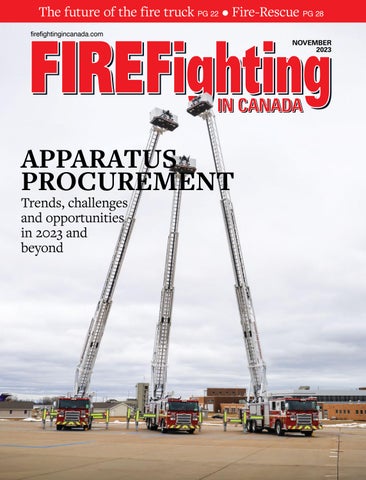

APPARATUS PROCUREMENT
Trends, challenges and opportunities in 2023 and beyond
WHAT A YEAR.
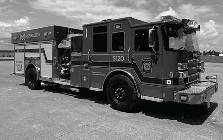
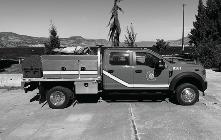
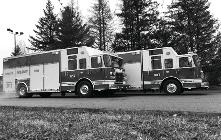
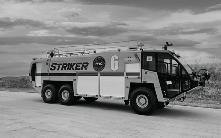
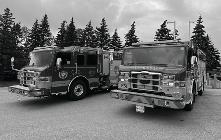
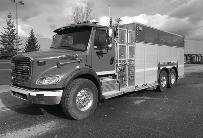
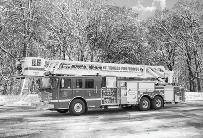
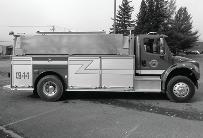
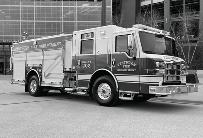
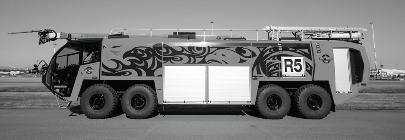
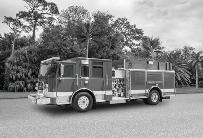
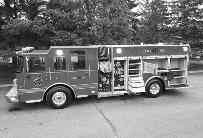
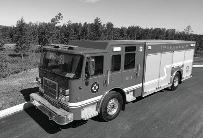
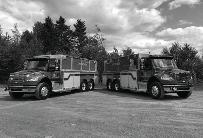
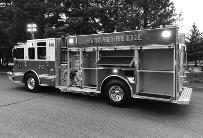
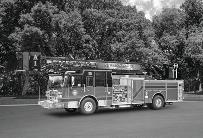
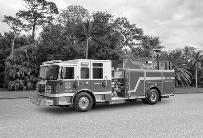
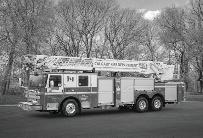
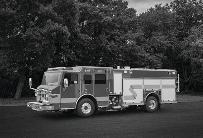
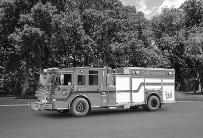
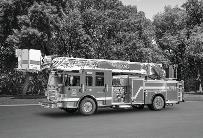
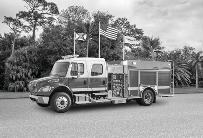
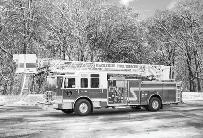
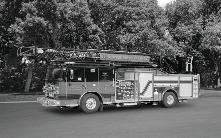
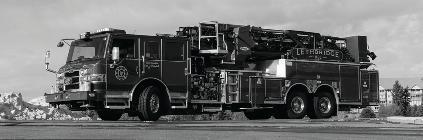
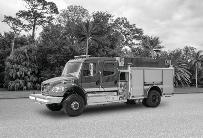
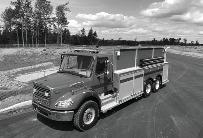
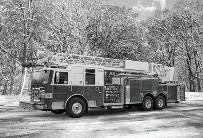
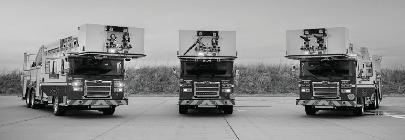
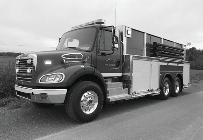
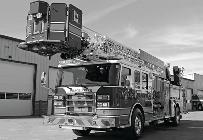
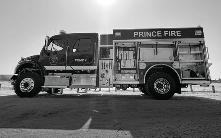
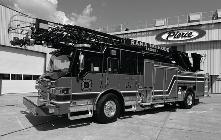
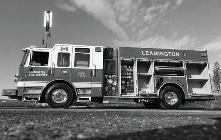
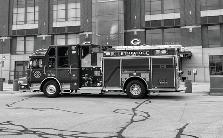
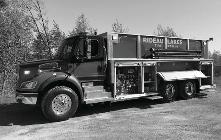
Commercial Emergency Equipment is Canada’s largest emergency apparatus dealer, delivering more Ladders, Platforms, Quints, Rescues, Wildland & WUI trucks, ARFF vehicles, Pumpers, and Tankers than anyone else in 2023 from our nationwide branch network. Congratulations to our customers who put Commercial apparatus in service this year.

10 APPARATUS PROCUREMENT
A look at trends, opportunities and challenges in today’s fire truck purchasing environment.
By Laura Aiken
28 FIRE-RESCUE
The Canadian Association of Fire Chiefs held their annual conference in Halifax on the heels of Hurricane Lee. By Laura Aiken
34 CANADA ON FIRE
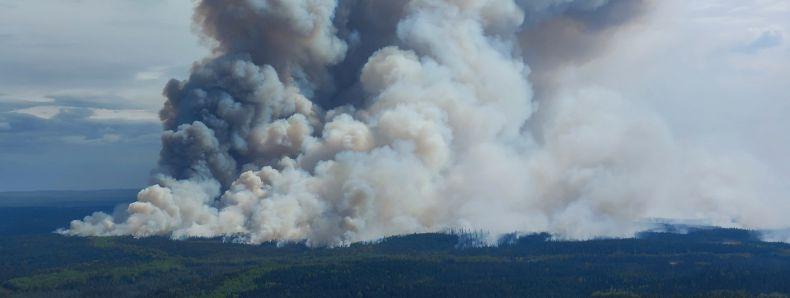
Rounding up another historic wildfire season in Canada. By Elena De Luigi
38 TACKLING A HISTORIC FIRE IN VAUGHAN
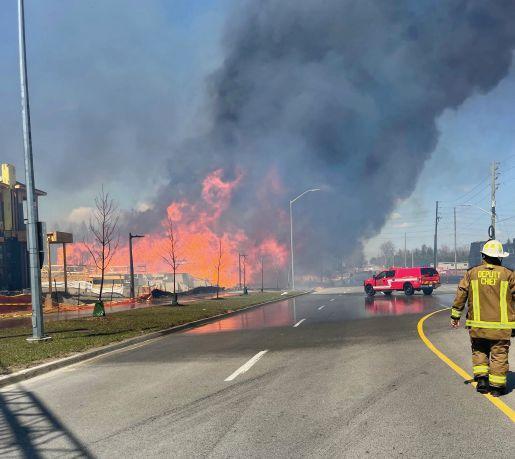
Over 50 firefighters and 71 residential units damaged or destroyed. How Vaughan Fire fought one of their city’s biggest. By Deputy Chief Grant Moffatt
42 LEADERSHIP IN THE TIME OF CLIMATISTRY
Change is all around, but the guiding principles of leadership remain the same. By Kirk Hughes
46 THERMAL IMAGERS AND COLD WEATHER EMERGENCIES
In cold weather situations, thermal imagers can play a crucial role in improving situational awareness and enhancing operational effectiveness. Here’s how.
By Manfred Kihn

BY LAURA AIKEN Editor laiken@annexbusinessmedia.com
WWhere’s that crystal ball at?
hat happens when life as we know it is turned on its head by the most unexpected? The fire service prepares for exactly this scenario, but it is only human to crave knowledge of the outcome. Sureness seems hard to come by these days.
Pre-covid, life and its lemony curveballs were standard, but in many senses, it was business as usual — stable, predictable, with a certain air of expectations you could count on.
Consider that the longest running bull-market in S&P 500 stock history ran from March 9, 2009 to March 9, 2019, representing a 330 per cent rise over a 10-year period, reported Investopedia. Quite the hot streak. This is not to say the global economy was on fire, in fact 2019 marked a slowdown in global growth. (Not the greatest precipice from which to launch a worldwide pandemic).
go-round yet. It’s still a bit of a tilt-a-whirl, but with no end in sight.
ESTABLISHED 1957 NOVEMBER 2023
VOL. 67 NO. 7
Reader Service
Print and digital subscription inquiries or changes, please contact Angelita Potal, Customer Service
Tel: (416) 510-5113
Fax: (416) 510-6875
Email: apotal@annexbusinessmedia.com
Mail: 111 Gordon Baker Rd., Suite 400, Toronto, ON M2H 3R1
EDITOR LAURA AIKEN laiken@annexbusinessmedia.com 416-522-1595
ASSOCIATE EDITOR ELENA DE LUIGI edeluigi@annexbusinessmedia.com 416-510-5143
PUBLISHER ADAM SZPAKOWSKI aszpakowski@annexbusinessmedia.com 289-221-6605
ACCOUNT COORDINATOR CATHERINE GILES cgiles@annexbusinessmedia.com 416-510-5232
BRAND MANAGER PAULA INGLIS PInglis@annexbusinessmedia.com 437-774-7961

ON THE COVER
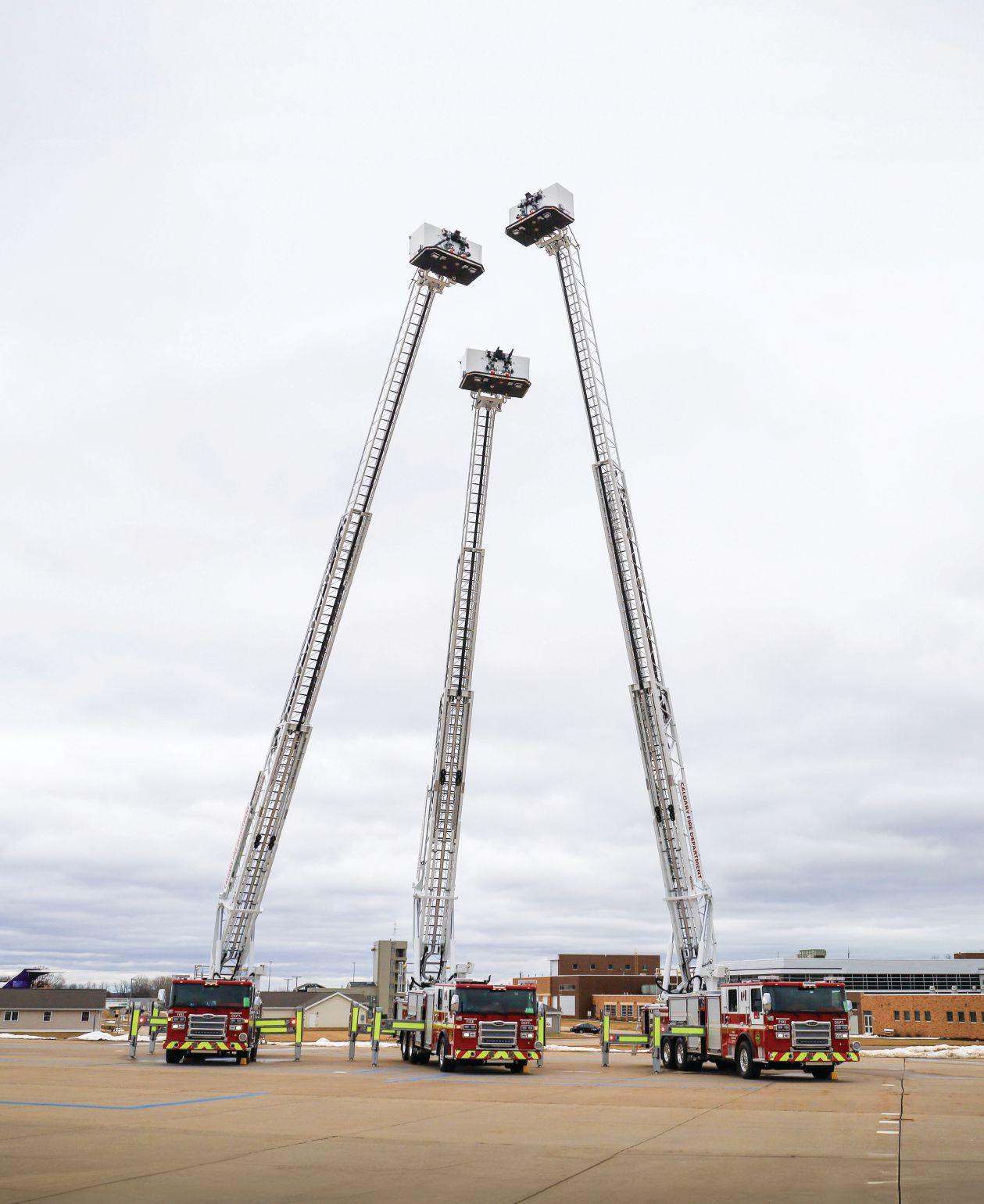
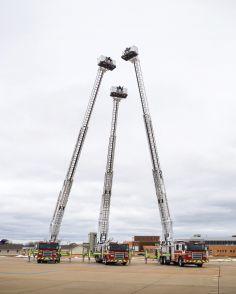
These new platforms are the first three sold under Commercial’s 10-year aerial contract with Calgary. For more on buying, see page 10.
And now, labour shortages, inflation and supply chain issues hinder businesses of all stripes, and certainly fire truck manufacturers, whom I bet would love a crystal ball on longer term parts pricing and availability. These factors contribute to a sense of instability.
The very real headwinds of recruitment and retention and a second historic year of wildfires adds to this sense of unraveling. The phrase “extreme weather events” is now common vernacular. Did life really feel more predictable before covid and we have yet to settle back into a less volatile place? History is bookmarked by large events causing worldwide upheaval, but we forget the pain by the time we are faced with another because we enter a period of seemingly relative stability. We have not hit this merry-
In reality, predictive modelling was very much in tune with what has happened in the world. A pandemic was due at some point, and climate change is nothing new. Sitting in our post-pandemic world, we have the challenge of how we will prepare by prediction for the wildfires, floods, hurricanes and other seismic events alongside increasing costs of everything and attrition issues. Despite our spidey senses, we are in a place of reaction. Without a crystal ball into this chaotic future, we need to move away from kneejerk government responses, harness collective intentions informed by the experience based expertise of many first responders, and get funding, legislation and personal efforts aligned. But where will the money come from? How careful will our governments be to allocate funds to where they will make the most impact? Will they listen to the lobbying and advice of Fire’s national and provincial associations; the fire chiefs? Monumental change happens when a collective vision collides with collective action. And that change can be the thing that brings not only a sense of stability, but a spirit of optimism, which is one thing our world could do with a little more of.

AUDIENCE DEVELOPMENT MANAGER BEATA OLECHNOWICZ bolechnowicz@annexbusinessmedia.com 416-510-5182
MEDIA DESIGNER BROOKE SHAW bshaw@annexbusinessmedia.com
GROUP PUBLISHER PAUL GROSSINGER pgrossinger@annexbusinessmedia.com
PRESIDENT/COO SCOTT JAMIESON sjamieson@annexbusinessmedia.com
PUBLICATION MAIL AGREEMENT #40065710 RETURN UNDELIVERABLE CANADIAN ADDRESSES TO CIRCULATION DEPT.
P.O. Box 530, SIMCOE, ON N3Y 4N5 e-mail: subscribe@firefightingincanada.com
Printed in Canada ISSN 0015–2595
SUBSCRIPTION RATES
Canada – 1 Year - $25.50 (GST - #867172652RT0001)
USA – 1 Year $58.50 (CDN)
Annex Privacy Officer Privacy@annexbusinessmedia.com Tel: 800-668-2374
Occasionally, Fire Fighting in Canada will mail information on behalf of industry-related groups whose products and services we believe may be of interest to you. If you prefer not to receive this information, please contact our circulation department in any of the four ways listed above.
No part of the editorial content of this publication may be reprinted without the publisher’s written permission ©2023 Annex Business Media. All rights reserved. Opinions expressed in this magazine are not necessarily those of the editor or the publisher. No liability is assumed for errors or omissions.
All advertising is subject to the publisher’s approval. Such approval does not imply any endorsement of the products or services advertised. Publisher reserves the right to refuse advertising that does not meet the standards of the publication.
www.firefightingincanada.com
STATIONtoSTATION
ACROSS CANADA: Regional news briefs
Canadian fire halls are going green
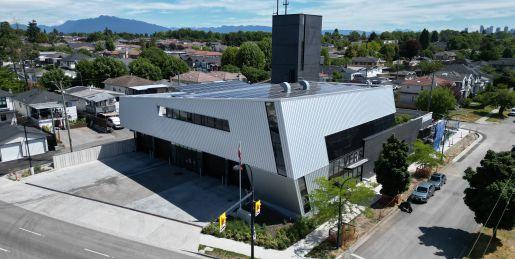
Several energy efficient fire stations have opened across Canada. The City of Edmonton opened its 31st fire station, and it’s the city’s first net-zero energy building, which means the total amount of energy used by the building on an annual basis is expected to be equal to the amount of renewable energy created on the site.
Edmonton’s Windermere fire station features a rooftop solar installation, geothermal heating and cooling system, solar array with 382 modules at 375W each, total rated solar capacity of 143kW, geothermal field of 35 boreholes at 70 metresdeep, R-35 exterior wall insulation, roof insulation of R-50, underslab insulation of R-20, double-glazed Low-E windows, LED lighting with occupancy sensors, and six sidefolding bay doors.
“This station has been a significant project for Edmonton Fire as we continue to meet the service needs of Edmontonians and our growing city,” said Fire Chief Joe Zatylny in a press release. “In the coming years, Edmonton will be home to two million people, and this station
THE FIRE HALL BULLETIN
Promotions & appointments
Surrey, B.C., appointed several new executive positions.

SHELLEY MORRIS is the city’s new deputy chief of community engagement, emergency management and diversity. She began her career as a firefighter in 1997 and moved
up to the role of assistant chief in 2017. She holds an MBA from the University of Lincoln, and is skilled in incident command, public safety, emergency services and management.
ROBERT ALDCORN has been appointed to be the city’s deputy chief of operations.
BEN DIRKSEN was promoted to assistant deputy chief of oper-
will play an important role in ensuring the safety of both our growing city and our firefighters.”
The building design received the Canadian Architect 2018 Award of Excellence. The budget for planning, design and construction was $21.5 million. The fire station has been open and serving the city’s southwest since July 7.
Further west, the Vancouver opened a zero-carbon fire hall. Nearly 60 per cent of Vancouver’s carbon pollution comes from burning gas to heat buildings and hot water, reported the City. The new fire hall was constructed to a zero emissions standard and achieved LEED Gold certification, net zero energy and is on track to achieve Passive House certification.
“This state-of-the-art facility will ensure the City of Vancouver is resilient to potential disasters,” said Fire Chief Karen Fry in a news release. “The new fire hall 17 is part of Vancouver Fire Rescue Services long-term fire hall plan and will meet service needs for the next few decades.”
Located at 7070 Knight Street, the new fire hall was designed to be a post-disaster communications hub and is also the second largest training site for Vancouver Fire Rescue Services.
In Ontario, the City of Mississauga is constructing two new fire halls. Station 125 is expected to open in the fall of 2024 and is designed to be a net zero energy facility. The construction of Station 125 is connected to a city-wide plan to build six new fire stations over the next 12 years in an effort to optimize emergency response times.
Station 125 and other fire halls across Mississauga, such as Station 123 which is scheduled to open in 2026, is expected to further improve response times to meet the city’s goal of first truck response in four minutes or less, 75 per cent of the time.
ations. He began his career in 1996 with the Surrey Fire Service and moved up the ranks.
MARK SETER has been named assistant chief of training. He began his career as a firefighter with the Surrey Fire Service in 1995, and moved up the ranks to acting captain, training officer and station captain. He has been the acting assistant chief of operations since 2019.
DARREN MAJOR has been promoted to assistant chief of fire prevention. He has volunteered with Port Moody Fire Rescue and became the city’s fire prevention captain in 2018.
RICHARD BODNARK is the new assistant chief of operations. He began his career as a firefighter and moved up the ranks.
Vancouver’s carbon-zero fire hall is located at 7070 Knight Street.
PHOTO: CITY OF VANCOUVER
Harbour Grace Volunteer Fire Brigade receives $150,000 for new response unit
In September, community members, the mayor and town councillors, along with the members of The Harbour Grace Volunteer Fire Brigade in Newfoundland and Labrador, came together for two funding announcements.
On Sept. 12 at the brigade’s social building, they were joined by Premier Dr. Andrew Furey, area MHA Pam Parsons, who is the Minister Responsibility for Women and Gender Equality, and Fire Commissioner Robert Fowler. The first announcement was $150,000 for the purchase of a new response unit housing all the high angle rescue team’s equipment. Presently, the brigade’s equipment is stored in the firehall and has to be exchanged with other response equipment before answering the call for assistance. The funding was based on a cost sharing agreement between the provincial government and the
municipality. The Harbour Grace Volunteer Fire Brigade’s high angle rescue team is the only team in the area and provides coverage from Holyrood to Bay De Verde.
On Sept. 13, they were joined by Victoria Battcock, manager of digital marketing and communications for Trades NL. Battcock presented a cheque in the amount of $7,000 to firefighter Bobby Lynch. The funds were attained by the brigade from an application submitted by Lynch to Trades NL in conjunction with former Chief Jim Barnes. The funding is part of the Trades NL Community Giving Program, which organizations applied for in the spring of 2023. The fire department applied for the Health and Wellness Impact Grant, which is awarded to selected initiatives that will have an immediate impact on the health and well-being of communities by enhancing programming, equipment or
facilities.
Trades NL is an organization that represents 14 building trades unions in Newfoundland and Labrador. Part of their mandate is giving back to communities across the province. There are five building trades union members on the fire brigade, and Trades NL says without the workers, the community giving program would not exist.
Battcock spoke on behalf of Trades NL’s executive director, Darin King, and said: “Volunteer firefighters are heroes in our communities, and we are proud to support Harbour Grace and the entire region with this donation…Bobby and Jim truly went above and beyond to ensure that we understood the importance of the anticipated high angle rescue equipment. The community should be proud of them and the entire brigade for their dedication.”
- Fire Chief (Ret.) Roberty Lynch
Ontario invests $20.5 million in wildland fire management
The Ontario government strengthened wildland fire fighting efforts by investing $20.5 million in wildland fire management.
The funding is expected to be used over three years to enhance aerial fire suppression technologies, recruitment and training, enhancing skills development, promoting and maintaining safety, and building capacity to support Indigenous wildland fire management and community resilience.
Eligible fire rangers are expected to be reimbursed for expenses related to training and reviewing collective agreement entitlements, including stand-by and on-call pay.
Retirements

The Town of Caledon, Ont., is saying goodbye to Fire Chief DAVE FORFAR for a second time. Forfar stepped in as the interim chief in January 2022, but he had previously held the role from 2013 to 2016 when he retired after 36 years of service. He has also served as the deputy fire chief for Barrie Fire and
Emergency Services where he was responsible for training, fire prevention and communication, and as an acting platoon chief and district chief for Markham Fire and Emergency Services.
KEVIN DUNCAN, deptuy chief in Napanee, Ont., retired from the department after 27 years. He began his career as a volunteer firefighter in 2006 with Greater Napanee Fire Services and
The province said in a press release it also allocated some of the money to invest in science and risk assessment, including entering into collaborative research agreements with universities and other institutions to better understand the evolving science behind wildland fire management.
Furthermore, the government is working on several staffing improvements, including developing a psychological safety program to prevent and respond to mental stress and protect the overall psychological well-being of staff working in the wildland fire program.
became a full-time firefighter in 2011. He moved up the ranks to deputy fire chief in 2022 and has held several roles, including fire prevention officer. Duncan has also been an instructor at Loyalist College in the pre-service firefighter education and training program.
Last alarm
Former EMT and Fire Chief LARK ISBELL passed away at the age
of 83. He was the youngest of seven children, a lifelong resident of High River, Alta., and trained as a firefighter in Vermillion. IsBell spent nearly 30 years with the High River Fire Department and Highwood EMS. He retired in 1999 after leading the department for his last 10 years in the service. IsBell also did rodeo flat racing and was a chuckwagon outrider. He owned and operated E and R Trucking.
BY MATT PEGG Fire Chief Toronto
LLEADERSHIPFORUM
Asking for help
eadership is often described as being a very lonely place. In my experience, this is undeniably true at times. I commonly speak with leaders, both within the fire service and well outside it, who express and describe the pressure, stress and loneliness that complicates and frustrates their lives as a leader.
I can attest to the realities of being alone in my office, dealing with pressures, issues, and difficult situations that other members of my team may not be aware of. This can quickly feel like a very cold, lonely, and even nasty place at times.
In our team, we make decisions together and the members of my command team are regularly involved in the most challenging and sensitive issues. This is how good decisions get made – by leveraging the perspective, expertise, and advice that each of our team members bring to the table. But, without any doubt, there are times where the Chief must make the toughest of decisions and face the criticism and angst that comes with the most difficult situations and issues.
It is important to remember that leaders are people first. And, like every other person, leaders sometimes make mistakes and incorrect decisions. There are also times when leaders find themselves so conflicted in making an important decision that they get stuck. We can be so close to an issue, and the consequential impacts of that pending decision, that we feel as though we concurrently agree and disagree with the decision we are about to make.
As leaders, it is easy to lose the perspective and clarity that comes with being one step removed from the issue at hand, which can quickly put even a savvy leader in a quagmire.
be candid with me, who are willing to point out the potential pitfalls associated with what I am considering, who will tell me when I need to change course, and who will be honest with me when I have made mistakes that I need to correct.
Above all else, what our personal advisors end up providing for us, especially when we get stuck as leaders, is perspective. They can see factors, issues and considerations that may not be readily apparent to us at that point in time. As a former commercial pilot, I am reminded that this perspective is what is referred to in aviation as situational awareness, whereby pilots are always thinking, planning, and evaluating what lies ahead of the aircraft before they arrive there.
The loss of situational awareness in a flight deck can have catastrophic safety consequences, just as the loss of perspective and situational awareness on the part of a leader can result in very bad decisions being made that can affect considerable numbers of people.
There have been times when I have been both 100% in support of a proposed course of action, while also being 100% concerned about the impacts and potential unintended consequences that come with making that decision. ‘‘ ’’
There have been times when I have been both 100% in support of a proposed course of action, while also being 100% concerned about the impacts and potential unintended consequences that come with making that decision. There are times when we need additional clarity and perspective to make the right decision.
This is why every leader needs a personal contact list of people whom they trust, respect and value to provide them with candid, direct and unbiased feedback, and advice when they need it the most. All of us need help from time to time, and it is crucial that leaders not hesitate to ask for and accept that help as required. My personal contact list is comprised of a small group of trusted colleagues and friends whom I know will always
Matthew Pegg is the chief with Toronto Fire Services, having previously served in Georgina, Ajax and Brampton, Ont. Contact Matthew at matthew.pegg@ toronto.ca and follow him on Twitter at @ChiefPeggTFS.
I am beyond thankful for the great people who give me this type of perspective and advice when I need it the most, especially when it is hard for them to tell me what they know I need to hear. It takes courage, confidence, and awareness to be that advisor, and it is not work for someone who lacks the willingness to have hard conversations with someone they care about.
Make sure you know who to call when you need the advice and perspective of a trusted colleague, friend, or mentor. Make sure that you make that call, without hesitation, when you find yourself getting stuck in the decision-making process.
And above all else, be prepared to accept and consider the advice and perspective that you receive. The impacts and outcomes of the decisions you are about to make depend on it.
APPARATUS PROCUREMENT
Trends and challenges in the world of buying fire trucks
By LAURA AIKEN
The nuts and bolts of apparatus procurement are still nuts and bolts — specs, tenders, bids, buys — but the wheels are sure driving in some interesting directions.
The innovation and engineering housed inside these big red beasts that turn heads faster than a sasquatch sighting has entered pretty epic territory with the accomplishment of made and sold electric fire trucks, idle reduction technology, SAM systems, and a bounty of other customization options. That territory may be bumping up against new environmental realities, namely labour shortages on the mechanical and manufacturing side, parts and delivery delays, and cost increases far past the pale of ordinary inflation, all of this resulting in a current eye towards simplification.
Rob Anselmi, division chief for mechanical maintenance/equipment and asset management at Toronto Fire Services, writes his own specs
and said that if he were to make a prediction in procurement trends, it would be towards more standardization, for example, a rural pumper, a city pumper, etc. In his view, this will be in part driven by the backlog in delivery times and need to consider whether you can live without certain add-ons if it means your truck will get built a heck of a lot faster.
A lot of customization also contributes to driving up prices, he noted: “There should be a reason why everything is on the truck, and they have to last about five times as long as your average work truck.”
In the small Ontario town of Niagara-on-the-Lake, Fire Chief Jay Plato put forward a similar consensus when looking ahead and seeing cost as his biggest challenge. He’s currently looking at a pumper with a budget of around $900,000 when just a handful of years ago he said that would have been closer to $600,000.
“It’s a huge cost when trying to balance municipal projects.”
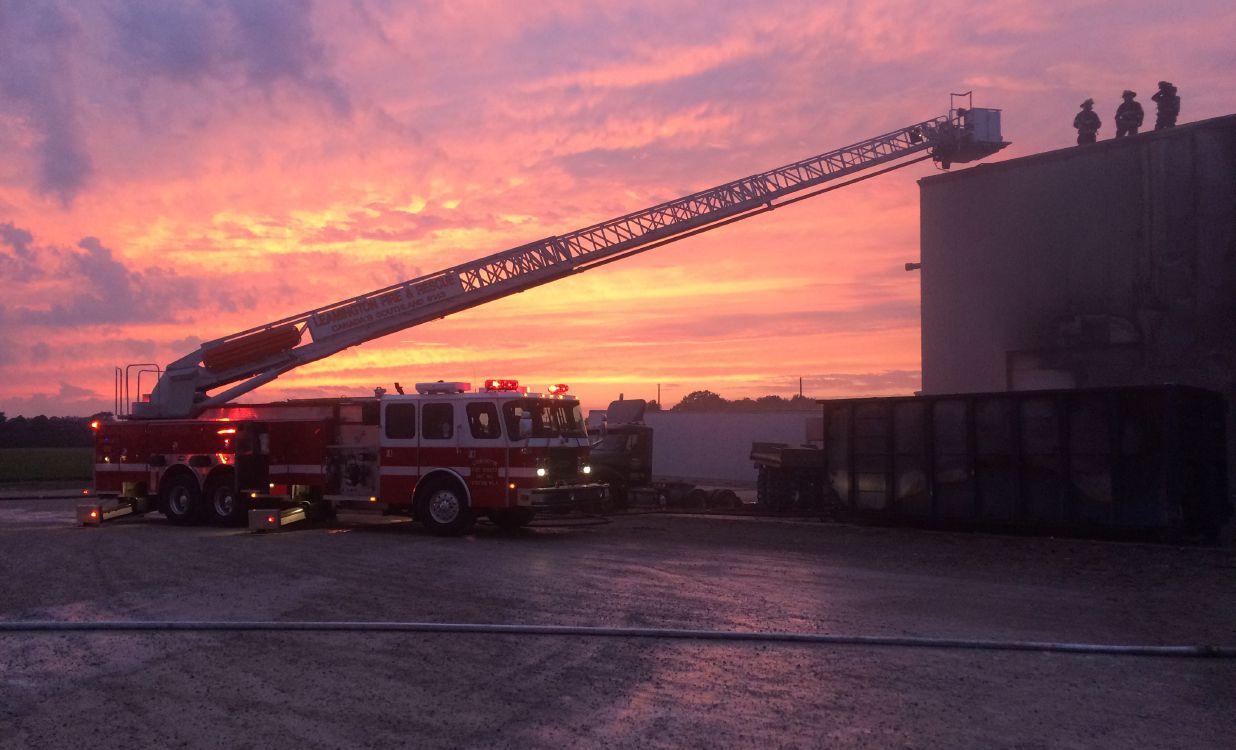
An aerial hard at work, always a head turning sight.
‘‘
’’ It’s hard to make cost projections. Hard to do the timing with your budget. The time it takes for bid responses and getting everything back…vendors take a long time to get answers on things like chassis costs, virtually every time I get an addendum question to extend the deadline.
Custom trucks are very expensive, he said, and it’s necessary to weigh out the pros and cons of custom versus stock models in terms of price and whether the stock model will suit your community. Plato said they typically write their own specs under the desire to create a level of standardization across the fleet, though of course the trucks do not all have to be the same.
From the perspective of someone who hears from dealers and buyers, Tyler Hannemann, manager of supplier relations at Canoe Procurement Group of Canada, said part of the communication they hear from their supplier side is a desire for Canoe to work with its members, who are the municipalities, on getting a more common spec because they will get the truck and service for it faster. Hannemann is seeing a timeline of three months from tender post to tender award, and then a multi-year wait for trucks. He has seen some vendors on the fire apparatus side extend warranties and recertify pieces to keep the truck insurable and on the road while waiting for a new chassis to come in. There is uncertainty and stress around the timelines on all sides.
But the service piece is not one to underestimate. Fire is grappling with recruitment and attrition challenges on its member side, while the mechanical trades run a parallel and no less frightening arc toward massive shortage. Anselmi said the division recently advertised for technicians and got about half the responses he normally does, and the pool of candidates included some that weren’t even mechanics or were missing credentials. In Niagara-on-the-Lake, Plato has a contract with an EVT and uses the local heavy truck mechanic as well, but that person is aging, and there isn’t necessarily another in the wings to replace him.
Dealers undoubtedly want to deliver, but the wildcard pricing, backlog and labour shortage that has been dogging manufacturing since covid persists. In Toronto, this has meant a move away from the threeor four-year deals that would have been preferable in the past, said Anselmi. Now, with vendors shying away from long-term pricing, it’s a “one shot and done.” He recently placed a single order for 30 trucks with Dependable, and the deliveries will then be spread out.
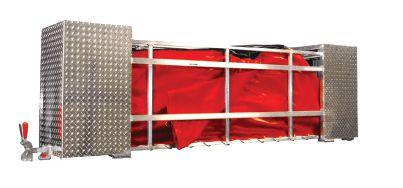
PORTABLE TANK RACK
Organize, transport, and store your folding frame tanks effortlessly. Our sturdy racks secure tanks during transit, preventing damage or shifting. Designed for firefighters and emergency responders, Stay prepared with Husky® portable tank racks – the reliable choice!
The short-term pricing also makes the timing process difficult as there can be a mismatch between the pricing terms and time it takes to get a PO issued, he said. The fire department was able to get the funding method for apparatus changed from a specific annual spend to a regular evaluation style of funding that can keep up with the rapid rise in apparatus costs.
“It all boils down to the same problem,” he said. “It’s hard to make cost projections. Hard to do the timing with your budget. The time it takes for bid responses and getting everything back…vendors take a long time to get answers on things like chassis costs, virtually every time I get an addendum question to extend the deadline.”
A couple summers ago in Niagara-on-the-Lake, the department spec’d a chassis, received alternative pricing for a different one, decided on the original, but without a timeline for delivery they ended up switching the chassis to the alternative.
“This was summer 2022,” Plato said. “Not sure if we’ve pulled out of there yet.”
PROCUREMENT GROUPS
Cooperative procurement groups have been generating plenty of buzz in Canada, particularly with the advent and expansion of Canoe, a wholly Canadian owned entity that also serves as the lead agency on a Sourcewell contract to assure compliance in Canada. Canoe Procurement Group of Canada launched in 2021, born out of the Rural Municipalities of Alberta, a non-profit organization that started in 1936 with the procurement of rat poison, said Hannemann. Canoe is now one of the biggest public sector buying groups in the country, with 11 provinces and territories participating. The adoption of the Canadian Free Trade Agreement in 2017 was significant factor in this expansion.
“The CFTA meant you had to go to RFP if the aggregate was over their thresholds,” said Hannemann. “On the municipal side, one fire truck is over it.”
Canoe operates an admin-fee model, but not one paid by the end

‘‘ In the world of fire trucks, if you don’t like the weather, give me a minute...Things are always changing, timelines are always changing, and that makes planning challenging. ’’
user. Vendors make a submission, and with it is an offer for a percentage on the dollar value of each apparatus sold, said Hannemann. Then, those revenues are split with a local non-profit they work with. Contracts with vendors are termed, usually three to four years. Regionality does not affect the score, he added.
“You can win a Canoe national award for the provinces you operate in. Just do the best submission you can, be competitive and win it.”
Canoe creates a standing offer with multiple suppliers under one category in a process of guaranteed compliance. The pricing structure and contract are completed, and you sort out how to spec it and what your budget is, said Hannemann, but the “price is going to be the price.”
Jesse Patenaude, manager of business development, works with the municipalities. He said the focus belongs in the value-added services from Canoe, rather than a “race to the bottom for price.” It is very time consuming to respond to all of the fire apparatus tenders that come in, so the idea is for Canoe to take the administrative burden away and for

the vendor to talk about value rather than price. The programs are not low-cost options, he said, but “total value best in class option, looking at the total cost of ownership and providing the best spend for the rate payer – taxpayers.”
Insofar as trends in the marketplace go, Hannemann said “social procurement,” as in what companies are doing to be more sustainable and aligned with the the net-zero and diversity and inclusion goals of municipalities, is evolving globally and in Canada.
“The evolution of the GPO has been pretty fun in Canada. There are some unique opportunities that wouldn’t exist before. It’s definitely taken off.”
THE ROAD AHEAD
Small and big departments are facing similar challenges in terms of cost and delivery when it comes to apparatus procurement. Much has changed, but some things remain the same and one of them is seeking input from others as you work towards a final decision. Plato engages his volunteer members by getting their input into what is and isn’t working on the trucks, helping facilitate a feeling of ownership in their role and the community they serve, and he does so as part of a retention strategy. Toronto’s division division is in the process of reforming the apparatus committee post-covid for design and function consultation, and input comes in via several other channels. Apparatus procurement is a big spend, and often an exciting one to put together. Today’s environment is certainly keeping it interesting, and the road ahead a bit mysterious.
“In the world of fire trucks, if you don’t like the weather, give me a minute,” joked Anselmi. “Things are always changing, timelines are always changing, and that makes planning challenging.”
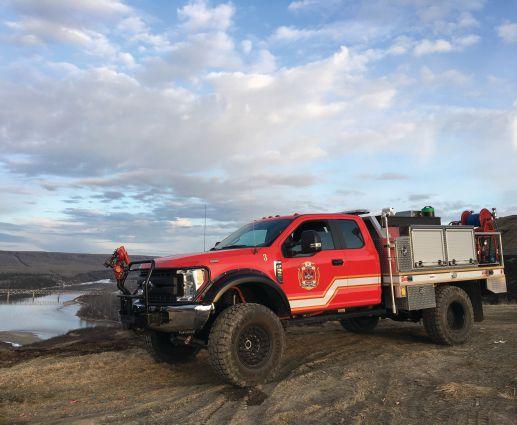
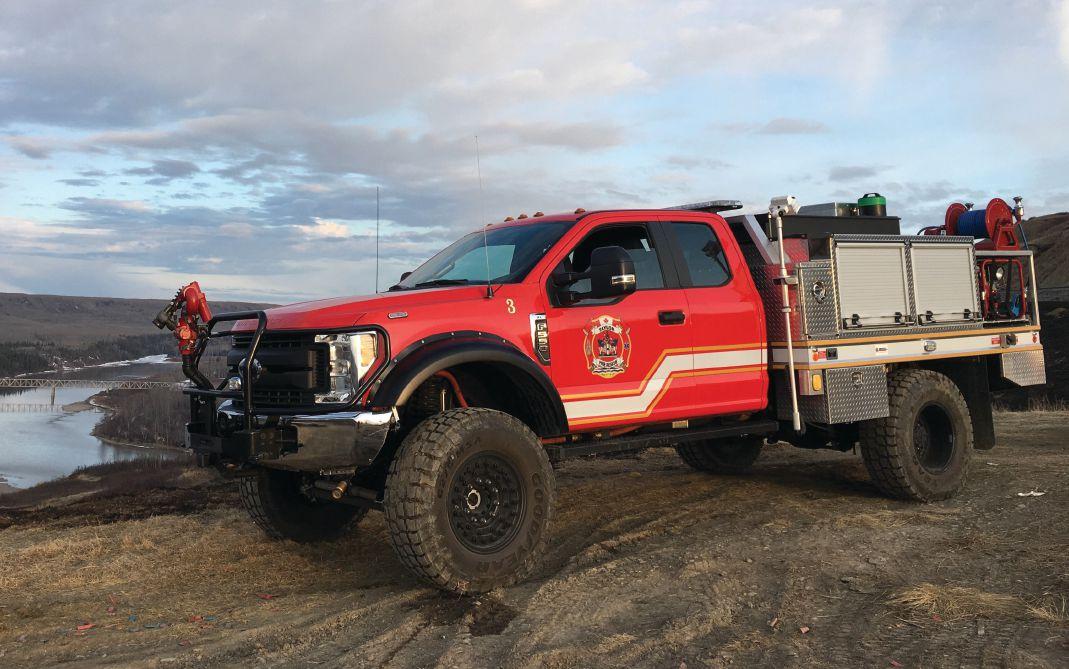
This rugged brush truck is ready for off-roading.
STOCK
quickly? Rosenbauer has stock units to fit your department’s needs ready for expedited delivery. Everything from mini pumpers, aerials and the all-electric RTX are available. Scan the QR code to view our inventory.


BACKtoBASICS
Hose Packs, Part 1
By MARK VAN DER FEYST
On our fire trucks, we will have different configurations for our hose lines with some being pre-connected or others being a dead lay with the expectation of hooking up to a discharge when advancing. There are times when there will be hose arranged in a kit or load to be used for high-rise operations.
Most fire departments will not have high-rises to respond to, so they opt out of having these kinds of kits or loads on their trucks, but they will have buildings that contain standpipe systems. These buildings will be both horizontal such as a big box store or vertical such as a low-rise, mid-rise or a high-rise building. Standpipe systems will require a hose to be brought in to be secured to it, to be charged with water from the system and then used to suppress fire. This is where standpipe hose kits are named after. Instead of being labeled a high-rise kit, they can be called standpipe kits.
Another way to look at this is to call them hose packs as opposed to standpipe kits or high-rise kits. This term has been coined by Captain Brent Brooks from Toronto Fire Services as a way to remove the stigma associated with hose kits being used for “standpipe ops” only or “highrise ops” only and nothing else. By calling them “hose packs” they take on the multi-purpose role to be used on the fire ground for different situations that may be presented with.
There are three types of hose packs that can be used in the fire service – two are well known with the third not being that popular. The three types are the Denver Load, the New York Load, and the Chicago Load. We are to look at each of the three hose packs in terms of how they are folded or packed, and the benefits and negatives of them.
The first hose pack is the Denver Load. As the name alludes to, this hose load comes out of the Denver Fire Department – more specifically, from and by Assistant Chief Dave McGrail. It was he who designed and created the Denver Load based upon his experiences in dealing with standpipe/high-rise fires. Most hose loads that are configured using this load are going to be 2 ½”, or 65mm in diameter, which assists with making the load. Using a smaller hose diameter is a little more challenging, but still doable. In terms of discussing using the larger or smaller hose diameter for standpipe operations is another discussion.
To start the hose load off right, the firefighter needs to take the female coupling, lay it out on the ground and then place a mark on the hose 32” or 81 cm from the end of the female coupling. If there is no pre-made mark on the hose or the department does not want to mark the hose, a way to determine the demarcation is to use a Velcro hose strap that is 32” or 81 cm in length. The Velcro hose strap can be placed on top of the hose to measure back from the end of the female coupling.
Once this mark has been determined, the hose will then be folded in towards the female coupling just like making a horseshoe load like shown on Photo 1. When bringing in the first fold of the hose, it needs to stop
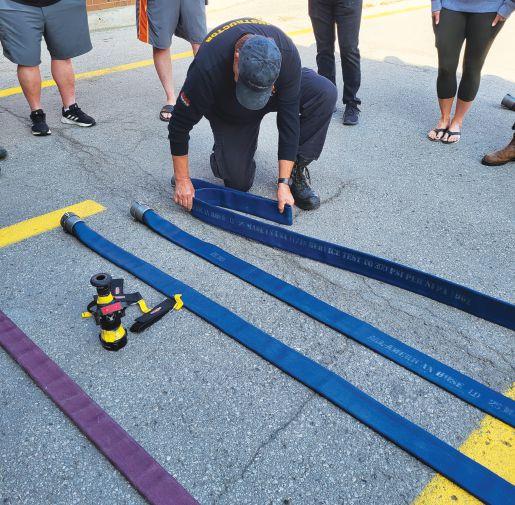
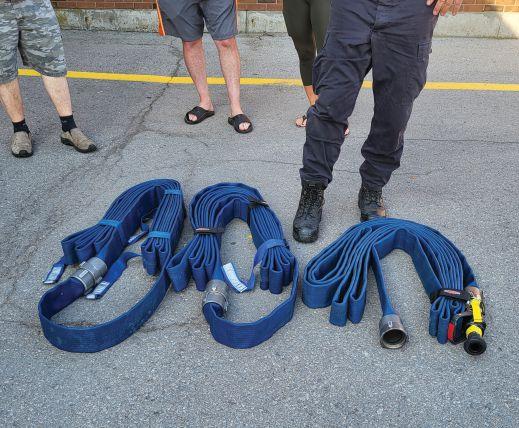
Photo 1: For the Denver Load, once the appropriate mark has been determined, the hose will then be folded in towards the female coupling just like making a horseshoe load.
PHOTOS BY MARK VAN DER FEYST
Photo 2: Place the three bundles on the ground side by side with the nozzle pointing toward the fire.
CLEANING IS A GIVEN. WE THINK DECONTAMINATION SHOULD BE TOO.
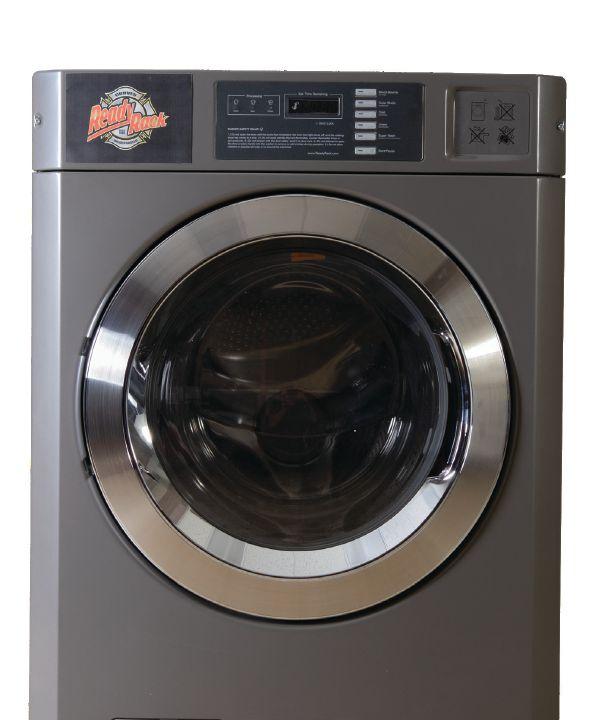
A recent study reclassified firefighting within the highest occupational cancer risk category. At Ready Rack, we’ve been sounding this alarm for years, which is why we offer a line of products to help mitigate exposure to on-the-job carcinogens. From highly specialized extractors and dryers to science-based Decon Ready™ decontamination solutions and wipes, all designed to improve the health and wellness of firefighters while keeping PPE service-worthy.

Exce
BACKtoBASICS
short of the coupling so that the end of the fold is even with the end of the female coupling. This will expose the female coupling out from the hose load to be used later on to finish the hose load.
The hose is continued to be folded in a horseshoe fashion staggering each of the folds so that they are not lining up evenly but staggered so that the hose load will stay tight and slim when completed. Once all the hose has been wrapped around in a horseshoe fashion, the male coupling should be on the opposite side from the female coupling. The hose pack will be split open in the middle to provide a better view of the two parts of the load, with the male and female couplings being joined together. There should be only about one foot of hose hanging out from the load which is the two couplings joined together – the remaining slack of the hose can be folded into the load in different ways.
At this point, the hose load can be strapped with three Velcro hose straps or other types of straps. The hose load needs to be stood up vertically so that the weight of the firefighter can be used to compress the hose load to push out the excess air and to strap the load and make it as tight as possible. Two hose straps go on the male coupling side and the one strap goes on the female side. This will be done for three bundles in total with one of the bundles having a nozzle attached to it.
As you will see in photo 2, the three bundles are placed on the ground side
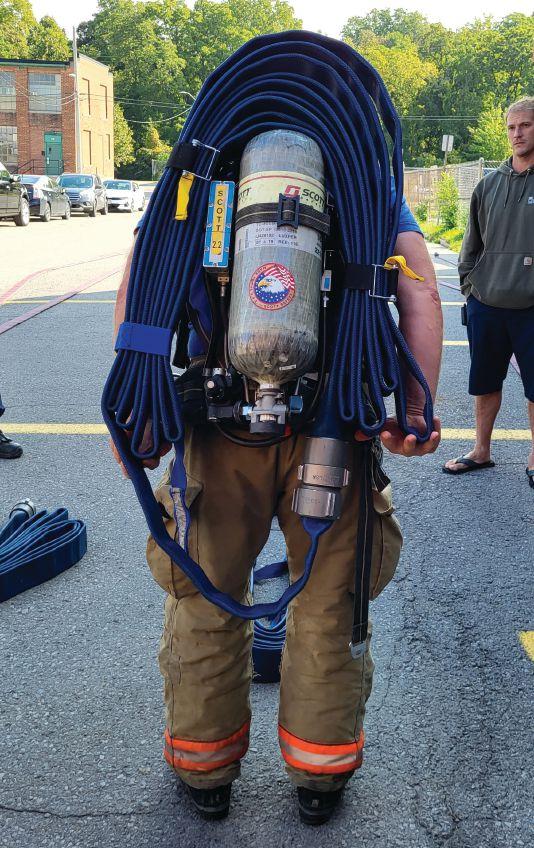
by side with the nozzle pointing toward the fire. From here all three bundles can be connected to each other to form one hose line connected to a water source. One of the advantages of the Denver Load is that it can be carried on the back of the SCBA cylinder as shown in Photo 3, leaving your hands free to carry other equipment.
One of the disadvantages with the Denver Load is the packing of the load — it will require two sets of hands to fold it properly. It also takes repetitive practice to remember how to fold it properly. For those departments that do not use these types of loads often, it can be easily forgotten and become complex to fold.
Another disadvantage is the storage of the load on the truck. Due to its size and horseshoe configuration, it needs to have a compartment large enough to store it standing vertically hanging over a round object or lying flat horizontally. With the Denver Load, you are choosing it for specific reasons that meet your department’s needs and operations.
Mark van der Feyst has been in the fire service since 1999 and is currently a firefighter with the FGFD. Mark is an international instructor teaching in Canada, U.S. FDIC and India. He is the lead author of Fire Engineering’s Residential Fire Rescue & Tactical Firefighter books. Contact him at Mark@FireStarTraining. com.
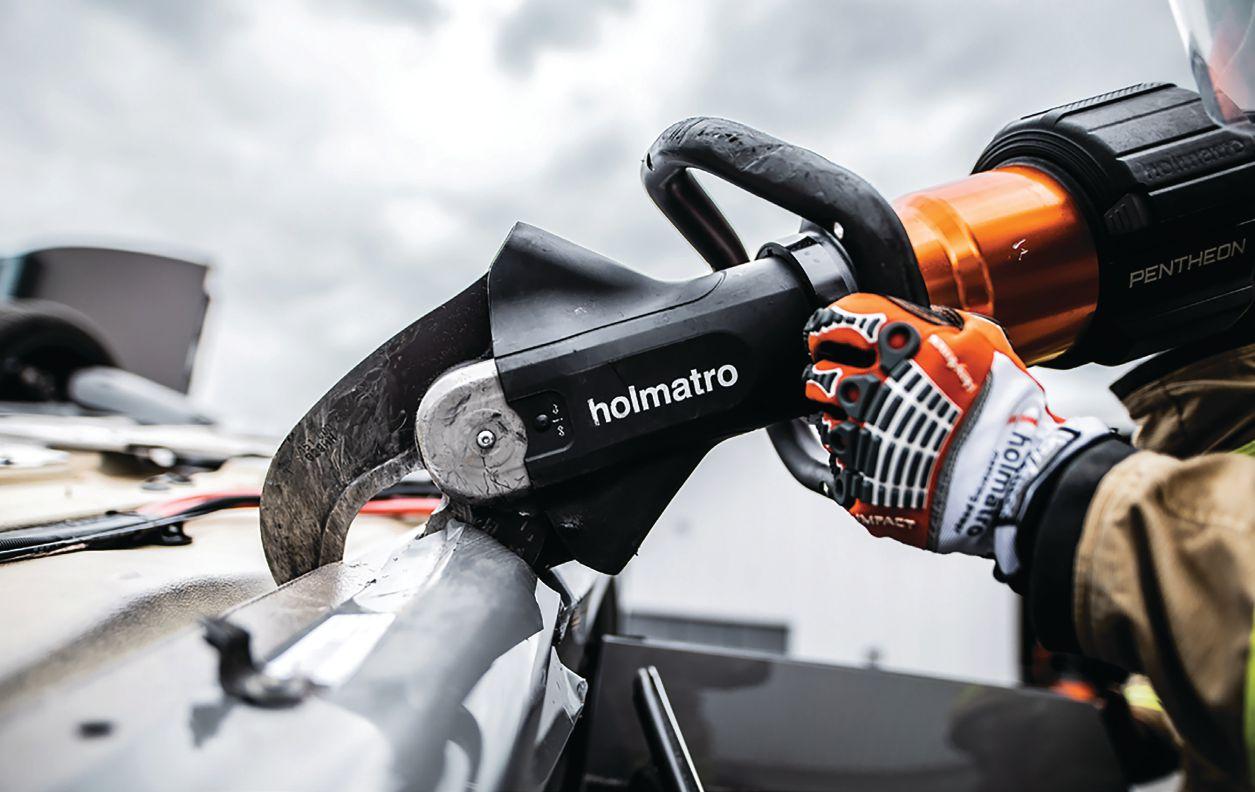

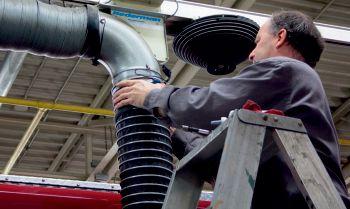

Photo 3: One of the advantages of the Denver Load is that it can be carried on the back of the SCBA cylinder

Pentheon PCU 50 Cutter


WHY FORT GARRY FIRE TRUCKS?
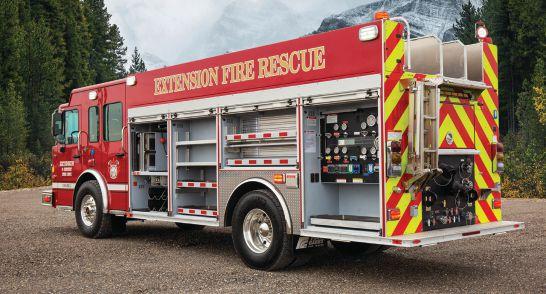
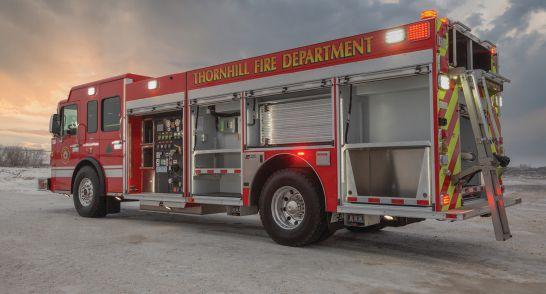
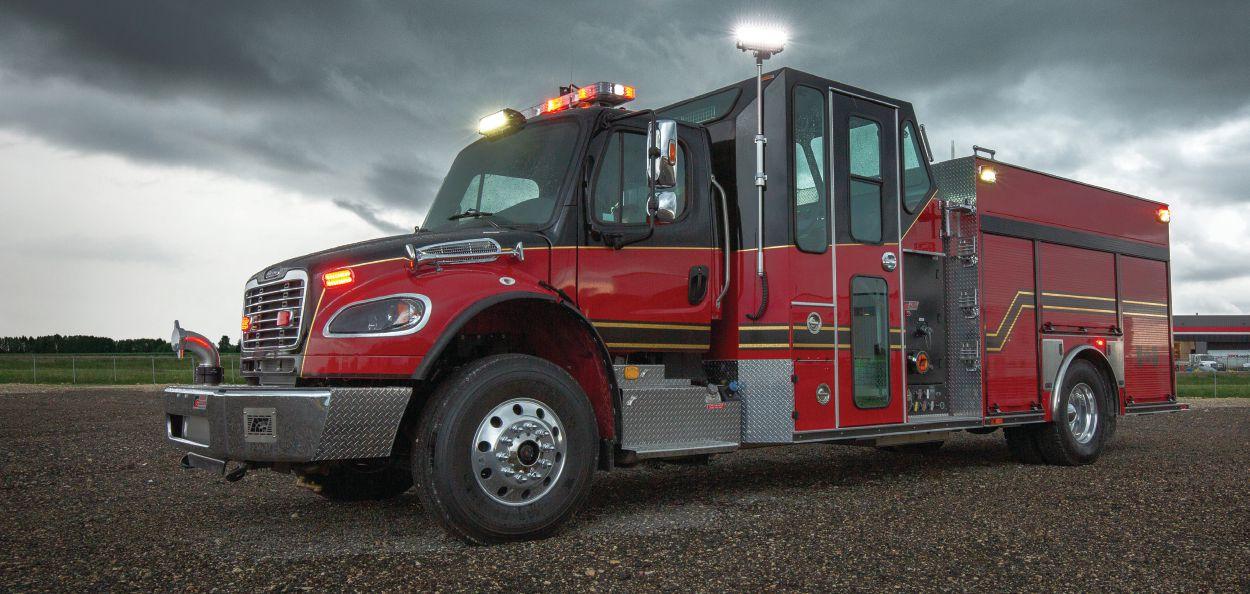
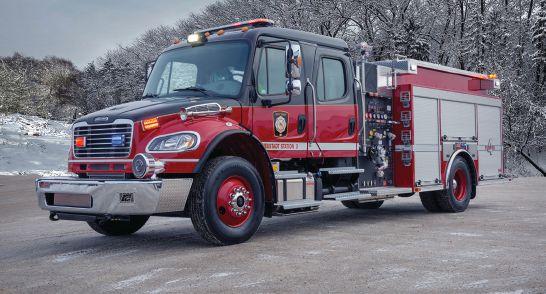
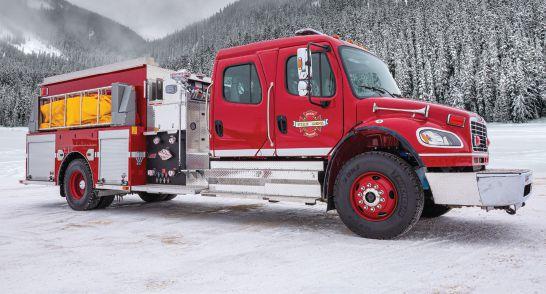
Our emergency rescue-max bodies provide fire departments with the performance of a pumper and the storage of a rescue and are customized for flexibility and maximum performance with side-mount, topmount, and top mount enclosed 3-man and 4-man crown options available. Be confident knowing you’re properly equipped for nearly any possible situation with our full-framed 6061- T6 aluminum extruded sub-frame utilizing 5083 saltwater marine-grade aluminum compartments.

ER-X 4-Man Crown with SAM
ER Pumper - Rear Mount Extension Fire Rescue
ER Pumper - Side Mount Thornhill Fire Department

WHY FORT GARRY FIRE TRUCKS?
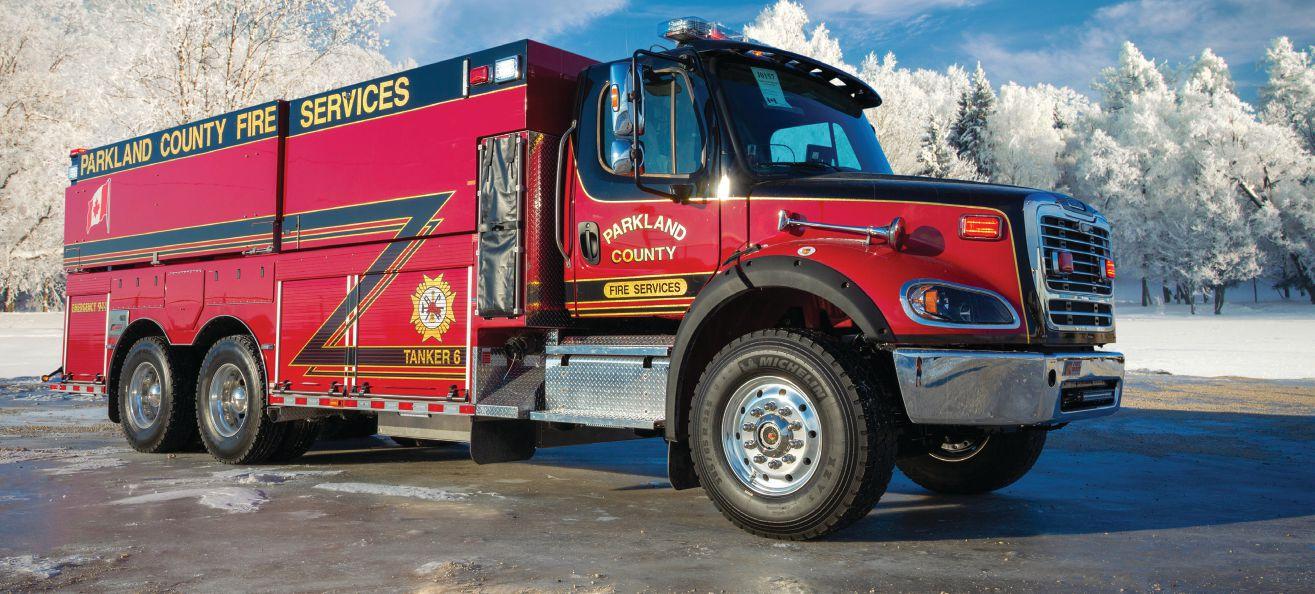
Our Crusader bodies are among the strongest and corrosion-free in the industry featuring a complete welded body and full 6061-T6 aluminum extruded sub-frame structure combined with 5052 freshwater marine-grade aluminum panels. Our Crusader pumpers deliver pump panels and controls designed with firefighters in mind while using the highest quality pumps and plumbing in the industry. Our tankers feature a wide range of tank capacities from 1500 to 3500 imperial gallons along with a variety of porta-tank options making for One Tough Truck your fire department and community can rely on.
Crusader Tandem Tanker 3000 I.G. Parkland County Fire Services
Crusader Pumper 800 I.G. - Side Control West Grey Fire Department
Crusader Pumper 1000 I.G. - Top Mount Kersley Volunteer Fire Department

BY LAURA KING NFPA Regional Director Canada
TNFPAIMPACT
Standard eliminates moisture-barrier test
here has been a lot of talk about the proposed new standard, NFPA 1970, which, if issued in 2024, will cover bunker gear, work apparel, SCBA and PASS. Essentially, NFPA 1970 consolidates four already-existing standards into one streamlined document, with some changes.
The second draft of 1970 was posted on the NFPA website (nfpa. org/1970) in early October for public comment; anyone could view the draft and recommend changes through a notice of intention to make a motion (NITMAM) until Nov. 1. Proposed NITMAMs accepted by NFPA’s motions committee will become certified amending motions, then go to NFPA’s technical meeting in June for a vote.
There was overwhelming interest in the first draft of the proposed standard during the public input stage. The technical committee for the standard provided extra time for public input to ensure a thorough review of the first draft of NFPA 1970, Standard on Protective Ensembles for Structural and Proximity Firefighting, Work Apparel and Open-Circuit Self-Contained Breathing Apparatus (SCBA) for Emergency Services, and Personal Alert Safety Systems (PASS).
The proposed standard is organized in such a way that chapters one through nine and annexes A, B, G and H comprise NFPA 1971 (bunker gear); chapters one through four, 10 through 14, and annexes A, C and H constitute NFPA 1975 (work apparel); chapters 1 through 4, 15 through 19, and annexes A, D, and H make up NFPA 1981 (SCBA); and chapters 1 through 4, 20 through 24 and annexes A, E, F and H are NFPA 1982 (PASS).
According to an NFPA Xchange blog by Christian Dubay, NFPA’s vice-president, engineering and research and chief engineer, the technical committee for NFPA 1970 has made the following changes to the second draft of the proposed standard based on public input:
• Added specific testing requirements to verify a manufacturer’s PFAS-free gear claim. (6.5.1)
• Added a requirement to make reported test results available as part of the user information. (6.5.12, 8.14.3, & Table 8.21(a))
• Revised the procedure and application for contamination removal efficiency testing introduced in the first draft (9.9.3)
• Updated a list of restricted substances (8.21, 9.10)
• Added a more extensive listing of requirements for per- and polyfluorinated compounds, including tests for total fluorine and total extractable organic fluorine (8.21, 9.10)
• Added of a new test method for liquid barrier performance, as measured by impact penetration and hydrostatic penetration, to protect against bloodborne pathogens (9.11)
• Removed the tests for liquid repellency and for leaching of material substances (9.76 and 9.77 in the first daft)
To view the second draft report, go to nfpa.org/1970 and click Next Edition.
Additionally, the committee substantively changed the multiconditioning procedure, which they described as intended to replicate the wear and tear a typical outer shell may experience. ‘‘ ’’
• Removal of the xenon arc light test, not just as a stand-alone test method as proposed in the first draft of NFPA 1970, but also from the proposed multi-conditioning procedure (9.1.2.1)
• Additionally, the committee substantively changed the multi-conditioning procedure, which they described as intended to replicate the wear and tear a typical outer shell may experience (9.1.21)
• Added explanatory material for the definition of per- and polyfluoroalkyl substances (PFAS), explaining that the measurement of PFAS in the standard is performed to report the total levels of PFAS in protective clothing materials and measuring levels of specific PFAS chemicals against restricted substance levels (A.3.3.133)
Queries about the second draft can be submitted through nfpa. org/1970 by clicking Ask a Technical Question.
To stay on top of NFPA 1970 as it makes its way through the standards development process, go to nfpa.org/1970 and click Receive email alerts.
For more detail about what’s in the proposed standard and why, scroll down further at nfpa.org/1970 to find First Draft Committee Information and Second Draft Committee Information. Technical committees minutes and notes can be downloaded.
As Dubay wrote in an earlier blog about 1970, NFPA does not create the standards, rather NFPA facilitates the standards development process.
To be part of a technical committee for a standard that interests you, click on Technical Committees, or email me at Lking@nfpa.org.

Laura King is NFPA regional director for Canada. Contact her at lking@nfpa.org.
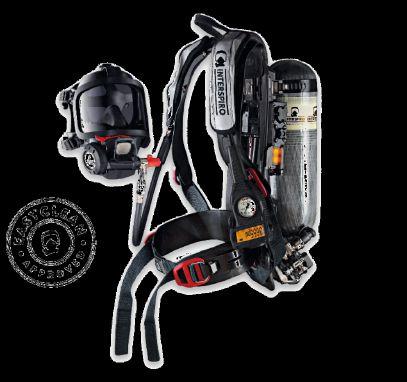
CANADIAN SAFETY EQUIPMENT IS PROUD TO BE A DISTRIBUTOR FOR THE INTERSPIRO RESPIRATORY PROTECTION LINE. THEIR STATE OF THE ART S9 INCURVE IS ONE OF THE MOST COMFORTABLE SCBAs YOU WILL EVER WEAR.
GIVE US A CALL AT 0182 OR EMAIL US AT INFO@CDNSAFETY.
No company has a richer history in respiratory protection than . Their innovations have become industry standards, time and


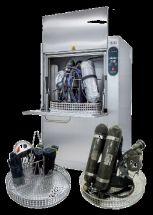
The Solo SCBA Decon/Washing machine was designed and built for one purpose only…to protect Fire Fighters from Cancer causing agents found in the Smoke and residue left on their SCBAs. As an added bonus it can clean Gloves, Boots and Helmets In addition, it substantially lowers the time spent decontaminating firefighter equipment. The SOLO is the only SCBA decon machine that meets both NFPA and CSA standards.
ü REDUCED HEALTH RISK ü SAVES TIME 2/PKS IN 8 MIN ü EASY TO USE
Qualified by MSA, SCOTT, DRAEGER & INTERSPIRO for cleaning their SCBAs.






WASH/DECON TWO SCBAs In 8 minutes. Also cleans, boots, gloves Aand helmets.


AVAILABLE IN SINGLE OR THREE PHASE


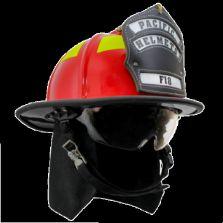

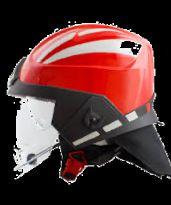

GEAR RACKS - HOSE RACKS & DRIERS- BOTTLE STORAGE – GEAR EXTRACTORS & DRIERS THE SAFEST, MOST COMFORTABLE STRUCTURAL FIRE FIGHTING HELMETS YOU WILL EVER WEAR.







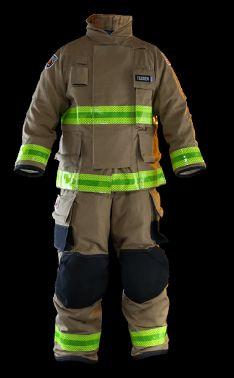

As the ONLY gear in the industry utilizing Active Posture Design, these turnouts are built to achieve a fit that conforms to you! To get the lightest, most breathable, and most flexible gear in the fire service, pair FXR turnouts with our exclusive TECGEN71 outer shell for increased weight reduction.

NFPA APPROVED STRUCTURAL FIRE HELMETS
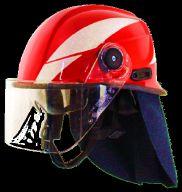
With the FirePRO Series, outfitting every firefighter with a costeffective, lightweight thermal camera has never been easier or more economical. The FirePRO 300 boasts a high-resolution sensor of 320 x 240, while the FirePRO 200 offers a robust 200 x 150 sensor resolution. Both enable firefighters to regain their bearings in challenging, low-visibility conditions.
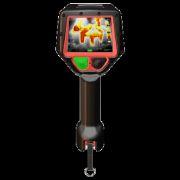

AttackPRO™ Series cameras are the decision-making weapons of choice for captains and commanding officers. Designed for simplicity and durability, AttackPRO and AttackPRO+ deliver superior image performance and are built to withstand drops and extreme temperatures. Find the seat of the fire, direct primary search crews, and effectively attack the fire with enhanced clarity and detailed colorization.
AttackPRO+ is everything you love about AttackPRO but with the NFPA 1801-2021 certification.

AttackPRO's Mixed Gain mode allows firefighters to see detail in the hottest and coolest regions of the scene at the same time without freezing and switching modes. Mixed Gain simplifies and improves thermal imaging for the fire service.
FXR Custom Turnouts
The future of the fire truck
By CHRIS DENNIS
The November edition of Fire Fighting in Canada always focusses on apparatus. I have always enjoyed this month; the articles in it sway more towards the apparatus, equipment and the service side of our business. I find, after being in the fire service for as long as I have been (which is a long time), that when it comes to building new trucks, there are always lots of players that want to get involved in the process. Some departments depend on committees. Some just the fire chief and their staff. Other departments put their faith in what is the latest and greatest or buy right off the shelf. Whether you’re full-time, composite or all volunteer, you, as the department, know what’s best for the communities you serve. This article is going to look at the future of building a truck, what that looks like when it comes to training, what parts might be like to source, and how the fire truck builders are going to be able to supply these parts with dynamics changing often.
Let’s say you want to buy a custom or commercial chassis fire truck. Pre-pandemic, a custom build took anywhere from six to 12 months based on the manufacturer. If it was a commercial chassis, such as a Freightliner, Pete or International on a custom apparatus it could have
been even sooner. Stock or demo trucks were available in both configurations. If it was an aerial device you spec’d, these took a bit longer than an engine or pumper. If it was a rolling toolbox, squad, rescue or hazmat, timelines were about the same. If you are not building a new truck anytime soon, hey, you’re in luck. If you’re building now, you already know where I am going with this. To build an NFPA compliant custom truck today, we are seeing anywhere from 16 to 24 months. You have the capital and you build the spec. You order the truck in 2023 and you get it in 2025. What happened? Where is the disconnect? How did all this change from 2019 to 2023? I have not looked into stats or data to answer this. I don’t have to. Ask and you will hear why. Since covid, the supply chain has gone from lots of raw materials and lots of in-stock parts to bolt on, and lots of labour available, to the exact opposite.
The car companies realized in year two of covid that manufacturing came to a standstill when people were not coming to work. Parts and raw materials to build vehicles were no longer readily available. To have mass amounts of inventory sitting on dealership lots and in vacant fields and parking lots across the country was no longer the case.
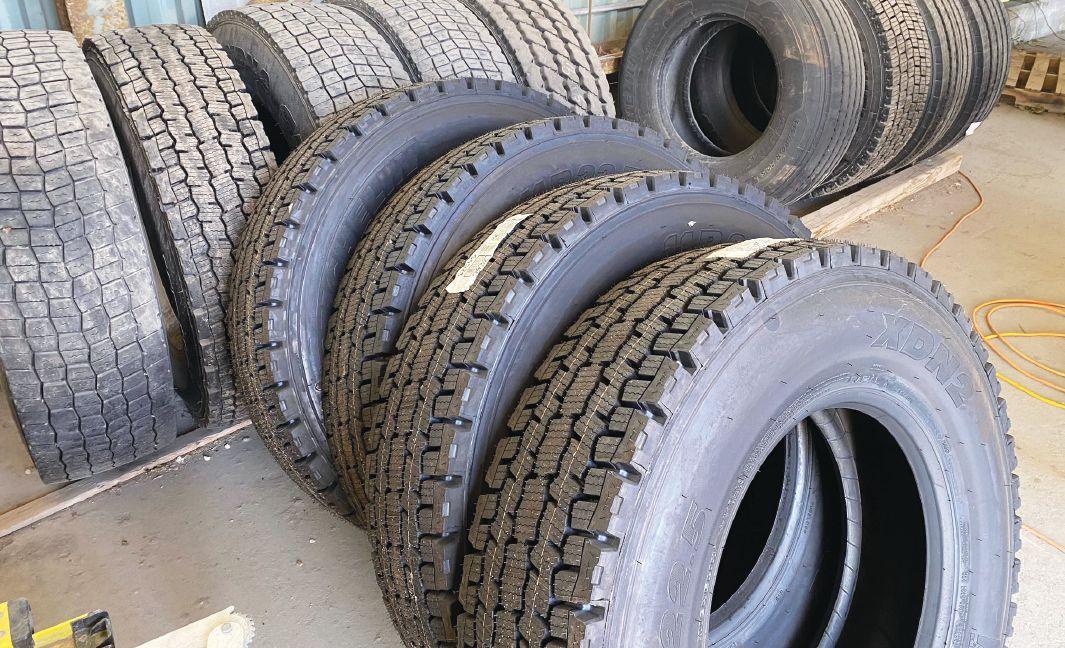
An inventory of spare tires makes sense when the new reality is a world of often unusually long wait times
PHOTOS BY CHRIS DENNIS
Now, in 2023, it seems the car builders have realized they no longer have to build up big inventory. They will wait for the vehicle to be ordered. The customer waits and this saves the builder time and money. If the customer is not happy with the wait, they move on to next car dealer. Personally, we unfortunately lost a 2019 Ford Explorer to an accident (only property damage, no people hurt). We ordered a replacement, and it came in 2023. Good news is that it is a 2023 model. Bad news is that we had to accept what they built us or the price would change dramatically. The blessing is we can make it what we ordered. The price increase was over $15,000. Take it or leave it is what we got.
If you had a new vehicle on your lot and another dealer had a customer wanting the vehicle, there was no such thing as a dealer helping another out. This vehicle was being sold for full list price because the customer had to have it — to lose it to another dealer was not happening. Dealerships got creative making purchasing deals with customers. I heard dealers could not order vehicles and make them demos as it cost the dealer too much to bring it in and that was because there was nothing being built in mass numbers. If this is true, I am sure if I was the new vehicle dealer, a plan could be hatched. Example: I want a pick-up truck. What I want is six months away. I settle for what they have or can get right away. However, I also order the one I want. When it comes in, the dealer takes the less desirable one at full
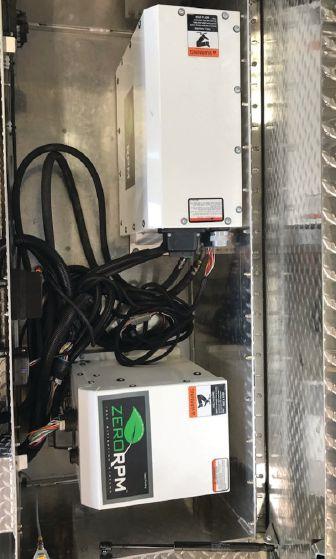
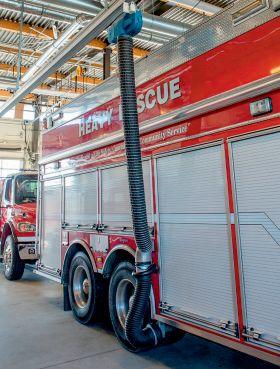
Systems like this eco idle reduction system are part of the new wave of technology that needs extra consideration in terms of service needs.
face value and sells me the one I really wanted at the price set six months ago. They get a vehicle back with road mileage on it. They sell it at more than market value as people need it and I get the vehicle I wanted at the price agreed (even though it’s inflated).
Fire truck builders are not the same. Fire trucks have always been built on demand. The cookie-cutter fire truck could be built but it would have to be done through a selling dealer. The selling dealer would have to then be able to bankroll the build and hope they could sell it once built. In discussion with a few fire truck dealers, what I’m hearing is that they can’t even have a cookie-cutter truck built as the demand for trucks is so high, and the lead times for materials and parts is so far out, that the department spec built truck will be done first.
The next thing to take into consideration is the dollar value of this truck. Purchasing agreements are a must. The bid request goes out, the build is awarded to a selling dealer, and the price is locked in. Please be sure you make sure the price agreed on stays that way. The market, as we know, changes daily, weekly, monthly. Clothing, food and utilities seem almost impossible to budget for nowadays. The selling dealer will have to inflate today’s truck cost to offset whatever the cost in a few years will look like, or write in the proposal a price increase as time goes on. It’s crystal ball stuff. Who will know what is going to happen price-wise? Well, we know it won’t go down. The automotive sector is worse. Remember what I said earlier? Order a truck today and get it two years from now — not two months, not 12 months, but about two years. There is no way, unless a written contract is broken, will they stick to price given. If they do, I am sure the price was inflated to begin with just knowing that when it is done the

TECHTALK
market will have caught up to what it’s worth. If you can secure a long-term purchasing agreement with a specific builder for a certain number of vehicles over a predetermined timeline, the bottom line and fine print is important. I am sure legal departments within the municipalities will, and are, busy protecting the financial side of the business. A custom or commercial built pumper purchased in 2006 was $250,000 to $450,000. The same truck today is $1 million.
I wrote an article in early 2023 for Fire Fighting in Canada about the electric fire truck. I am excited to see how electric fire trucks will work out, but I think we will wait for “the other guy” first. Like the EV car market, the evolution of this design changes like we change our outfits. The battery design, and the truck design, the electric and solution systems being installed, all happened so fast that the engineers are seeing they can do better. The trucks we saw late last year and this year in the EV market have already changed. Once you get it, it may have already been re-designed. As any mechanic will tell you, when you ask this question: “If I buy or do this now, will it change or break again later on?” — the answer is — “I wish I knew the answer to that. My crystal ball fell off the table
long ago.” What we do know for certain, is that the future of fire truck building is changing.
THE FUTURE
The new rig has arrived! It’s exciting, it’s new, and it replaces “old yeller” who was over 20-years-old. Traditions bring us all together where we roll out the old and push in the new. I want the new truck to be operational and ready for the business we provide. That’s why we replaced it — to be dependable. The last thing we need is to take it out of service for a repair at the selling dealer or repair shop, which may also now be an issue. Repair facilities are often understaffed, over-booked and getting parts is a whole new ball game. The wait times for parts we have seen run out to six weeks because they are not available.
My suggestion here is this. If you purchase a non-spec built truck (let’s call it a demo), then you get what you get. If you spec-build a truck, do your homework. Know what every part is that is going on the truck. Have an idea if the part or piece is going to be available, or if it is a one-off thing you are picking because it’s cool. Or, if the truck is a pedigree and all the truck pieces are outsourced and made specific for that builder, ask those questions. For example,
take a simple thing like a windshield. If it’s a commercial truck, the odds are the OEM, and for sure aftermarket, should be able to secure one quickly. If it’s a custom truck with a window opening proprietary to the manufacturer, that means they have an outside company building this glass for them. They depend on that outside source to be able to supply this one-off glass when building, and again when needed four years from now for a crack, chip or delamination. Pre-covid, this was not-somuch an issue. Hopefully, when you need it, the fire truck builder has stock, or the outside company is still in business and you can order and wait for one. Ask this simple question of anything. Are the parts used readily available at any outside source? Granted, some parts can only come from the builder (steering and suspension). Does the builder use vehicle specific parts or are they off-the-shelf available parts? The surprise should not be when the truck is down. If the parts could be an issue later, then you may want to put into the spec extra parts to be delivered when the truck is done. This drives up the cost again.
The issue with parts is worldwide. It includes everything that has a part to be purchased for repairs. Recently we needed eight drive tires. I spec a specific make and model of Michelin. In our case, this is because they work well for us. We are also part of a national fleet purchasing program. The size is common even for over the road trucks and the model as well (not a unicorn, as we say). There was nothing in captivity. I looked into Goodyear as well as Bridgestone and Toyo. My concerns are always size tread design for the tire position and load range. I was surprised, but because the size is popular, the tire people were out of stock. No raw materials. So, my simple request became a challenge. I was able to work this out and get the truck on the road, saying that this is what I do for our department. Your department may not have a dedicated apparatus division and you may depend solely on your fleet or outside repair facility. You believe what they tell you, that’s why you trust and deal with them. However, sometimes you may have to go at it harder to find what they say is not available.
This holds true for other wear and tear items. I would suggest calling your local parts dealer and checking to see if simple things like
Innovation Innovación a Créateurs
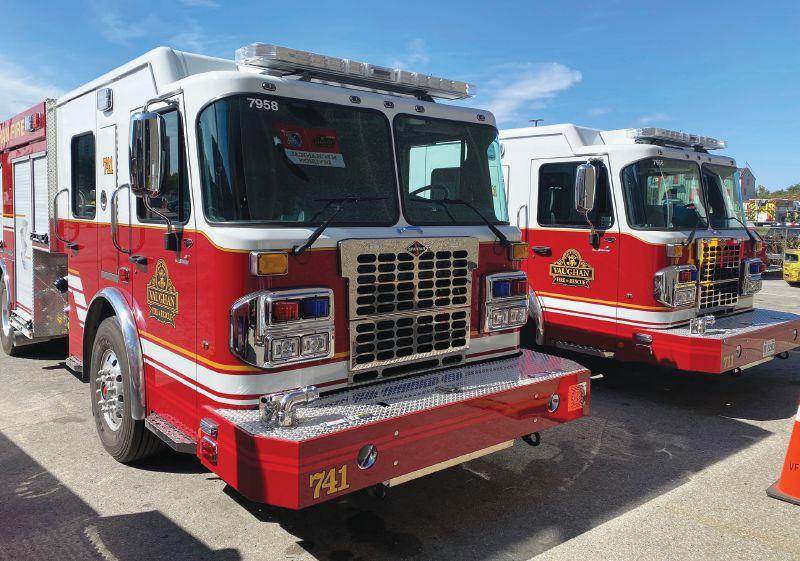
Two new trucks equipped with green technology at Vaughan Fire.
TECHTALK
brake parts, steering parts, suspension parts, lighting, door handles, seat belts and especially air bags are available. When you get your answer, you can make a calculated decision. Do I do what I have never done before and keep stock on wear and tear items because they have no stock now, or wait and hope they do when the time comes? Vaughan Fire is, for the most part, a single source department. A lot of one thing fits many trucks so we stock one or two of these things. However, we also have a division dedicated to fire truck repair — your FD may not. If not, call your local truck repair shop to see if they stock pads, rotors, drums, shoes, and spring kits, for example, for your trucks. If not, ask them to check availability. If limited, have them stock it for when the time comes. It will. I now stock tires. Something I never did before. We have always been just-intime. I wrote a report to the deputy and fire chief suggesting more money be put in the budget for stocking more parts. Tires alone can be upwards of $10,000 for eight drive tires or
$2,000 to $4,000 for super singles. Your repair budget will need to be increased so the rigs are not parked. We are coming into cold weather. Out of service waiting for parts may mean they sit outside. This means more cost to winterize pumps, etc., until parts come in. You need to be more proactive with parts so you are not caught by surprise.
Last item with trucks of today is how quickly technology is changing. I belong to a Facebook group of fire truck repair technicians and EVTs across Canada and the U.S. called F.A.T. Fire apparatus technicians community, this great group of unsung men and women in this great fire service that keep these rigs on the road. It amazes me what level of service each department does. It’s a great source for troubleshooting and helping other technicians. One item I see more often now than before is the level of electronic questions being asked. If you have a say in who fixes your trucks, be sure they are up-to-date with the latest technology
and solutions in your trucks. We recently took delivery of three new engines. These engines are equipped with a system called ECO IDLE-TEC. This is almost a hybrid of sorts. It’s a lithium-ion battery mounted on top about 24-inches in size with an inverter battery charger. This unit, once programmed is not only the 110v power source or generator, it also will shut the diesel engine down to control emissions and take over the entire electrical system as if the diesel engine was still running. This saves on fuel and greenhouse gases. This system will not shut the truck engine down if in regen pump gear or aerial PTO function. Operational training is needed as well.
Take care, be safe, and if you have any question email me. Remember my friends be safe, stay healthy and rubber side down!
Chris Dennis is the chief mechanical officer for Vaughan Fire and Rescue Service in Ontario. He can be reached at Chris.Dennis@vaughan.ca.




FIRE-RESCUE 2023
Chiefs from across Canada converged on the east coast for a summit
of critical conversations
By LAURA AIKEN
Sometimes, there are things you just don’t see coming. Hurricane Lee threatening the very occurrence of Canada’s national fire service conference was one of them. With umpteen hours of planning invested, and chiefs and vendors flying in from all over the country, news of a tempestuous hurricane whipping its way along the east coast had the Canadian Association of Fire Chiefs (CAFC), and all those attending its Fire-Rescue conference from Sept. 17-20 in Halifax, keeping a close watch on its expected landfall.
The CAFC sent daily updates preceding its Sunday start, with expectations on cancellation averted — the storm was to acquiesce just in time. Saturday winds reaching more than 90 km/h whipped through downtown Halifax, closing the airport to all flights. The National Hurricane Center in the U.S. clocked Lee’s post-tropical touchdown at about 4:00 pm in Long Island, N.S., flooding roads, downing trees, and cutting power for tens of thousands. Halifax councillor Pam Lovelace told CityNews that as of midday Saturday, 27 per cent of Nova Scotia, eight per cent of New Brunswick and three per cent of P.E.I. residents had no electricity.
As fate were to have it, the calm after the storm arrived, and this editor flew in early Sunday morning to a breezy, grey day that even turned out some patio sun come afternoon. All in all, a few scheduled to attend were unable to rescheduled flights, but luck was onside and mostly everyone made it into the eastern capital whose downtown streets slope so persuasively toward the sea.
The Westin Nova Scotian hotel served as co-host to the CAFC and its 300 conference participants. The trade show opened Sunday evening, followed by opening ceremonies and a welcome reception.
Chief Ken McMullen, president of the CAFC, touched on the importance of coming together.
“To my colleagues, delegates, board and NAC members, companions, exhibitors, sponsors, CAFC staff and staff of the Westin Nova Scotian, your presence and perseverance says to us how you feel about the fire service and the people within it…FRC 2023 was an opportunity to honour those who are here and remember those we have lost. We will celebrate excellence. We look for ways to improve, and most importantly we will be together.”
CONFERENCE AGENDA: A BUFFET OF TAKEAWAYS
Fire-Rescue packed a lot of critical conversation into its three-day agenda, and what follows is by no means comprehensive, but rather a curation of highlights.
A broad stroke look at what’s happening in Fire and EMS called out some pretty universal challenges across the country. Recruitment and retention were mentioned by mostly all of the provincial and territory chiefs delivering the cross-country check-up, including national defence. Chiefs from Alberta, B.C. and the Yukon spoke about wildfires; the metro chiefs’ perspective expanded on this with concern of the extreme weather events and municipal FDs not being equipped and trained to respond, these events also being tiring to crews and damaging to equipment. P.E.I. brought up issues around proper use of generators and climate emergencies. As part of the conference, a case study of an extreme weather event was shared by Fire Chief (Ret.) Tom DeSorcy, who presented a video on Hope, B.C.’s 2021 atmospheric river event.
There is much ado about medical. The opioid crisis is hitting B.C., Alberta and Saskatchewan particularly hard. In Manitoba, EMS wait times and the impacts of a streamlined healthcare system being offloaded on FDs were of chief concern, while Ontario noted the changes impacting Fire provincially on the EMS front with the transition to MPDS triage and simultaneous dispatch, alongside incoming NextGen 911. In Nunavut, the fire department is also dealing with all things medical, including facing a lot of suicide calls. Internally, mental health of members and WSIB claims were concerns noted by several provinces.
In terms of training and attrition, managing the mandatory certification legislation for firefighters in Ontario is still a hurdle in terms of attainability and costs. In Nunavut, no roads mean all goods and people are flown in, making the cost of everything high and training difficult for most FDs. Yukon flagged aging leadership and time commitments for its volunteer ranks, the latter seems likely to be of universal concern for volunteer and composite departments. Staffing, in Fire and healthcare, was cited as Newfoundland and Labrador’s biggest issue.
Governance and government reform is impacting New Brunswick and Nova Scotia, while Quebec highlighted the need to discuss more strategies for fire prevention.
Aging infrastructure, public and municipal expectations, tax credits and the need for a modernized funding program were amongst the other national issues identified provincially.
The CAFC has been lobbying for a national fire advisor as a key part of its federal mandate and welcomed the U.S. Fire Administrator, Dr. Lori Moore-Merrell, to address the room and share the history and insights into the U.S. organization. In America, the Federal Fire Prevention and Control Act came into effect of 1974 to establish a national training academy, manage the delivery of pub ed, data collection and research and tech, as well as oversee and support the National Fire and Emergency Training Center. It indicated a national
PROUDLY CELEBRATING OUR 40TH ANNIVERSARY
As we celebrate our 40th year in 2023 along with our customers and employees, we are mindful of the journey that has taken our company from small local builder to a North American leader in specialized vehicle manufacturing. Since 1983 we have worked to meet the highest standards of our industry by listening-to and learning-from the customer and employees who have chosen to be a part of the MAXIMETAL story. We are grateful for our journey and excited for our future as we embark on the next chapter as part of the Oshkosh Corporation group of companies and their passionate, dedicated and
To support those who keep our families safe and comfortable by designing and building
fire administrator be appointed by a president, and report to the administrator of FEMA. The CAFC has been advocating for a similar model to exist in Canada.
AN UPDATE ON EAST HASTINGS, HOARDING AND COMMUNITY SAFETY
The 100-block of East Hastings Street in Vancouver is legendary amongst Canadian homeless encampments. By 2022, safety hit an all-time low for its residents; the violence compounded by an intensified post-COVID opioid crisis. Then, a major fire rocked 169 East Hastings on July 6, 2022. The scope of the fire problem on Hastings was tough to gauge, said Vancouver Fire Chief Karen Fry. They didn’t have the data categorized correctly, but they knew fires were up, fueled by a trend towards inhalation and torches — veritable fire starters — to consume opioids. A small correlation was found between fires and overdoses.
Vancouver Fire Rescue Services (VFRS) has responded to an onslaught of overdoses on Hastings, and firefighters didn’t feel safe in part because entering tents for a medical call might mean facing a hatchet or a gun in the face.
When gangs are allowed to settle into encampments, the residents weaponize, she said.
The risk of inaction was too great, even though such costs as displaced persons facing additional hardship were a reality. The fire chief is responsible for applying the Fire Service’s Act; for removing fire safety hazards for residents and enforcing fire by-laws, in addition to responding to the medical emergencies, she prefaced.
“If you know there’s a risk to loss of life or buildings and don’t do something…so we did something. Once you make a decision, stick to it,” said Fry.
The first step was to determine the stakeholders, everyone from the citizens of the encampment and Vancouver to Fire. Next was to understand how the 2022 Hastings crisis came to be – how it emerged from an unaffordable housing crisis, an end to police assistance in enforcement (tents stayed overnight), and more opioid dependency. On July 25, 2022, VFRS issued an order to remove the tents, but Fry said this was ineffective without police presence. Fry worked to engage and align the key stakeholders, plan, and take action.
This action resulted in a significant teardown
of the encampment on April 5. The police and city staff were brought in to assist. Crews took down 94 entrenched structures and removed 50 propane tanks from the encampment zone. Over 71 personal storage totes were provided to individuals and housing alternatives were sought for the decamped. In the wake of the April initiative, VFRS received 27 fewer overdose-related calls the week of April 3-9 than the previous week and 82 fewer than the two weeks earlier, reported a city press statement. Enforcement and removal continues, and this monumental task hasn’t been without its backlash. Fry said it was key to “stay the course,” face the criticism head on, track the data, and focus on your obligations and results.
Moving eastward across Canada, Assistant Chief Yvonne Raymer shared housing initiatives and challenges in Saskatoon, where she turned the audience attention to hoarding, a significant community and firefighter safety issue. For fighters, this is risky on several fronts, such as trip hazards and risk of structural collapse. Once, Saskatoon firefighters went in with no knowledge of air quality, had to wear their SCBA, and found two deceased in the house.
Clean, Green,
Power for Optimal Performance.
Saskatoon also faces challenges with unsafe and inadequate housing and has an encampment process in place that focuses on showing respect to the residents, building trust, and offering supports. About 40 per cent of the unhoused accept housing support, and around 80 per cent will take some form of help such as transportation or food.
Raymer said they are seeing a record number of derelict structures being closed, and the action taken has been to provide a notice of closure rather than an eviction.



Continuing eastward, Winnipeg Fire Paramedic Services Deputy Chief Scott Wilkinson talked about street level community risk reduction. When it comes to substance use, meth psychosis is a danger to firefighters, and associated community safety issues include loss of life/disability, strain on the healthcare system and connected problems like crime. He also brought up human trafficking as something Fire can become more aware of because firefighters are out in the communities and can help police and victims by being eyes on the street if they know what to look for. These are not just social issues, said Wilkinson, they are risk issues, and they are not just metro problems.
Metro or rural, service levels and changing expectations in the community are a definite conversation for 2023 and beyond. Leduc
Reliable
County Fire Department Chief Keven Lefebvre, who was joined by Erica Thomas from Transitional Solutions, introduced a key slide that identified the challenge a fire chief is faced with when determining service levels: develop and run a department that can provide the level of service that is acceptable to the “public it serves, the public officials it reports to, and those who operate the service.” All this in an environment of changing expectations, and for the fire chief, consideration of numerous municipal risks: “inadequate response times, reduced firefighter safety, loss of life, legal and liability issues, negative public perception, economic impacts, regulatory non-compliance, improper apparatus and equipment procurement, increased or unnecessary costs and increased fire spread and property damage.”
STILL REDUCING THE STIGMA, SHEDDING LIGHT ON CANCER
The awareness around mental health in Fire has no doubt grown, but it is in some ways still a preteen when it comes to reducing the stigma. Private disclosure still seems preferred by firefighters, said Joy MacDermid, a professor at Western University in London, Ont., who has been involved in extensive research on firefighters. MacDermid stated this in the context of her evaluation of how well the PeerOnCall app works for the fire sector. Her findings suggest firefighters like texting or using resources within the app because it is more private, meaning there is still a stigma in coming forward. That being said, in a smaller department, texting isn’t totally anonymous and people may be able to figure out who is texting based on details being discussed. Communities can join together, which makes it more anonymous. One of the salient benefits appeared to be the ability to hear from other people who understand the context of what you face. This is a powerful connection not only in mental health, but in the face of a cancer diagnosis — and there has been some new research to report on regarding cancer risk in firefighters.
Paul Demers with the Occupational Cancer Research Centre (OCRC) shared the findings of a 2019 advisory group formed through the International Agency for Research on Cancer (IARC). The researchers looked specifically at cancer in firefighters via 52 studies, 12 case reports and seven meta-analyses. They looked at several site-specific cancers and correlations to fire fighting.
The strongest evidence linked mesothelioma, bladder, colon, prostate, testicular, melanoma,
non-Hodgkin’s lymphoma and lung cancers to fire fighting. They found two cancer types with sufficient evidence to be linked, and they were mesothelioma and bladder. Demers noted that asbestos, a triggering factor for mesothelioma, doesn’t burn but stays up in the air. There are also a number of components in fire smoke that have been linked to bladder cancer. There was limited evidence for colon, prostate, testicular, melanoma and non-Hodgkin’s lymphoma. On final evaluation, they classified occupational exposure as a firefighter as a Group 1 carcinogen. This is a change from 2007’s IARC classification
of Group 2B (possibly carcinogenic to humans). Researchers noted a lack of consistency across some of the studies, no evidence that risk increases with more exposure (a limitation across all cancer sites), and possible confounding factors like non-work sun exposure for melanoma. Research gaps were identified, and in 2022 the OCRC and Health Canada co-hosted a workshop in Ottawa to identify priority firefighter cancer research areas. The workshop report is expected to be released soon. Some of these gaps include under-represented subsets of the firefighter population like wildland, mili-
tary, aviation or characteristics like females or non-white ethnicities, alongside non-suppression jobs like fire investigators.
Current data is also indicating, contrary to the current line of thinking, that the overall cancer risk to firefighters over the general population may not be as high as previously thought, he said.
TAKING CARE AND TAKING THE LEAD
Two keynotes designed to inspire closed out the conference.
AWARD WINNERS
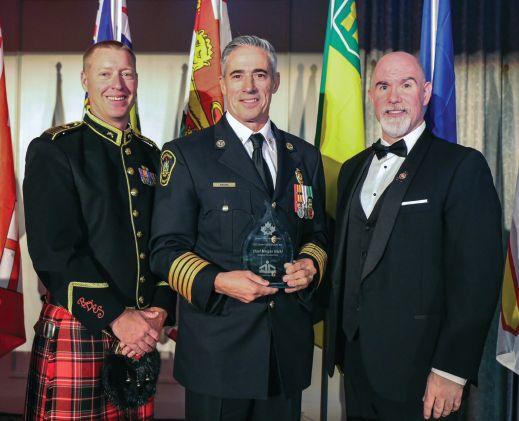
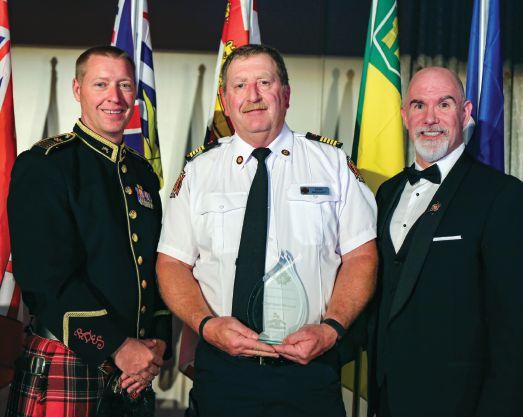
The gala dinner took place Tuesday evening, including the presentation of the Fire Chief of the awards by Fire Underwriters Survey.
• Volunteer Fire Chief of the Year: Dean Mineault, Beausejour Brokenhead Fire Department
• Career Fire Chief of the Year: Morgan Hackl, Saskatoon Fire Department
• Proud Practices in Equity, Diversity & Inclusion Award: Edmonton Fire Rescue for its Employees Facing Equity, Diversity and Inclusion (EDI) program
• President’s Award: Deputy Chief Richard Amnotte, Lévis fire department in Quebec
First up, Captain Rashawn Fulcher with Sacramento Metropolitan Fire Protection District in California. Fulcher, who runs a coaching and consulting business, was a national level champion athlete and the youngest Black fire captain in his area. His presentation, “Taking Care of “Our” People and Ourselves (slowing down to speed up),” focused on equity, diversity, inclusion and leadership.
“Life’s about navigating turns,” he said. “You go too slow, and you’ll be hit from behind, but too fast and you’ll hit something else.”
Diversity is not a destination, but a journey measured in milestones, he added; diversity must move from being a priority to being an intrinsic value. And the pathway is what Fulcher calls “educational grace.”
“The way we move forward is to know we are going to fail, but it gives us the room to move, to explore.”
Fulcher’s “slow down to speed up” message is about having the emotional intelligence to recognize the feelings at play in any given situation. Slowing down to meet someone at their emotions saves time in getting the issue solved, he explained, so this speeds things up.
“If we acknowledge the emotions, we move the ball forward,” he said, adding that you give a piece of yourself away to everyone you meet, positive and negative, so try to genuinely see everyone you meet — really see them.
To close the conference, Toronto’s Fire Chief Matthew Pegg dialled in on truths at the heart of high-performance leadership. He first considers skill, and that while skill is often a metric of promotion it is rarely the catalyst to termination. Teams fail because of a lack of trust, he said, an absence no skill can compensate for.
Though one can be skilled with words in a way that matters. Facing three daily press conferences during his time as Toronto’s COVID-19 incident commander, he learned that the “impact of your words is inversely proportional to the number of words used.” Be efficient with your remarks and those words will hit harder.
During an incident, it’s about managing your “span of control.” Know what you can delegate: work, responsibility and authority. And what you cannot: your expertise and accountability. Within the personal span of control, the difference between ambition and obsession comes down to the sphere, he said: Ambition means controlling oneself. Obsession is the fixation on controlling everyone else. Ambition equals awareness where obsession creates blindness. Importantly, he said, ambition left unsupervised can become obsession.
When you refrain from using positional power, that’s actually a strong demonstration of that power, he said.
“Being a consistent leader is real gift to your team.”
In the end, the opportunity to gather Fire friends and colleagues from around the country was a gift to a fire service facing several urgent issues that need information sharing and brainstorming to mobilize solutions. Extreme weather like the near conference-canceller Hurricane Lee being one shared nationally, along with recruitment and retention. Canada’s fire service proves to be on the precipice of change.
Next year’s national conference will be held in Montreal.
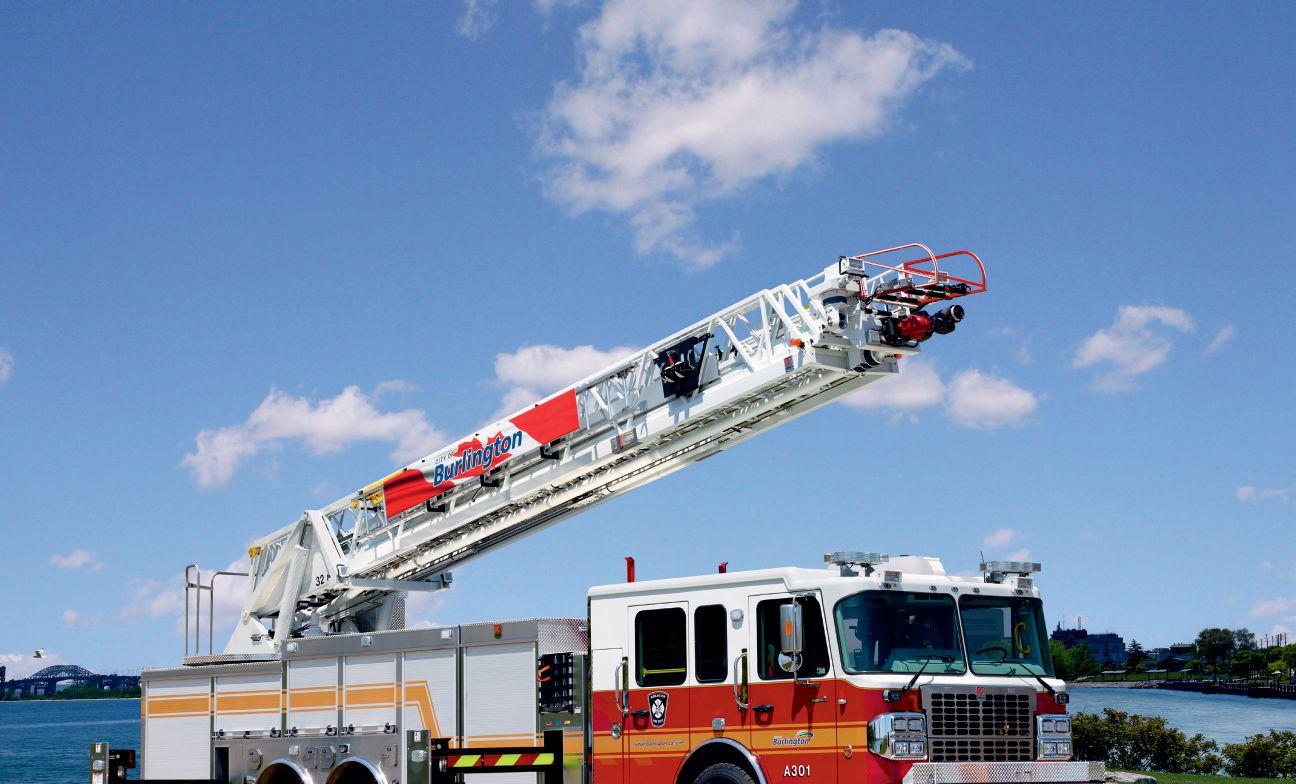

Career Chief of the Year, Saskatoon’s Morgan Hackl, with CAFC president Ken McMullen (L) and Michael Currie, VP for Fire Underwriters Survey.
Volunteer Fire Chief of the Year Dean Mineault of Beausejour Brokenhead Fire Department with CAFC president Ken McMullen (L) and Michael Currie, VP for Fire Underwriters Survey.

REACHING NEW
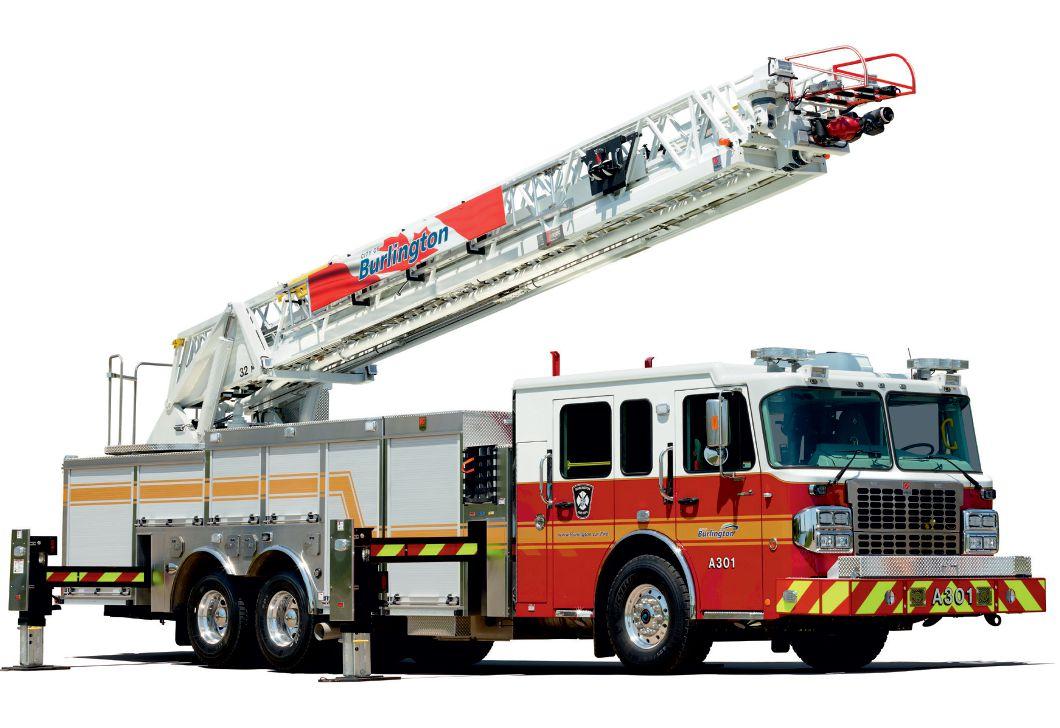
Count on our 107' heavy-duty rear mount ladders for their robust design, 750 lbs. tip load (wet) at 0 degrees and excellent vertical reach. Available in a quint or traditional truck style, the 107’ rear mount ladder is configured with a unique outrigger design and placement that allow departments to achieve full operational capability on a 12-percent grade (downhill and uphill).
The 107’ Rear Mount Ladder is available with multiple options and configurations to serve your departments needs. When the challenge is great, this 107' heavy-duty rear mount ladder will never let you down. It’s one more way Spartan Emergency Response is Putting First Responders First.

Scan for more information, or contact your Spartan Emergency Response dealer today.
Canada ON FIRE
This summer, wildfires raged from coast to coast to coast.
Thousands of people were evacuated, unsure of whether or not their homes would still be standing when they returned. Neighbourhoods were destroyed. The Canadian Armed Forces were deployed to assist and global help was brought in. Canada experienced its worst wildfire season on record in 2023. And a tragic one for firefighter deaths.
Devyn Gale, 19, from Revelstoke, B.C., was killed on July 13 by a falling tree while she was clearing brush with her team near a wildfire in a remote area outside her hometown.
Acho Dene Koe band member Adam Yeadon, 25, from Fort Liard, N.W.T., died following an injury while battling a blaze near his community on July 15.
Ryan Gould, 41, from Whitecourt, Alta., died on July 19 when his helicopter crashed while he was fighting a forest fire in northern Alberta.
Zachery Freeman Muise, 25, from Waterford, Ont., died on July 28 while helping to contain the Donnie Creek wildfire in B.C.
Four subcontractors with B.C. Wildfire were all killed in a head-on collision with a tractor-trailer on Sept. 20 in B.C. while they were travelling to the Kamloops base after a 14-day wildfire deployment in the Vanderhoof area.
Over the last 25 years, the Canadian government reported that about 7,300 forest fires have occurred each year. There have been more than 6,400 fires in 2023, as of Oct. 3.
Since 1990, wildfires across Canada have consumed an average of 2.5 million hectares per year. Until this summer, when more than 18.5 million hectares burned in 10 provinces and two territories, as of Oct. 6. The country spent many weeks sitting at a Level 5 preparedness level, which means all hands on deck, with little room for shared resources.
In terms of fire suppression, costs over the last decade in Canada have ranged from about
The numbers behind the worst wildfire season on record
By ELENA DE LUIGI
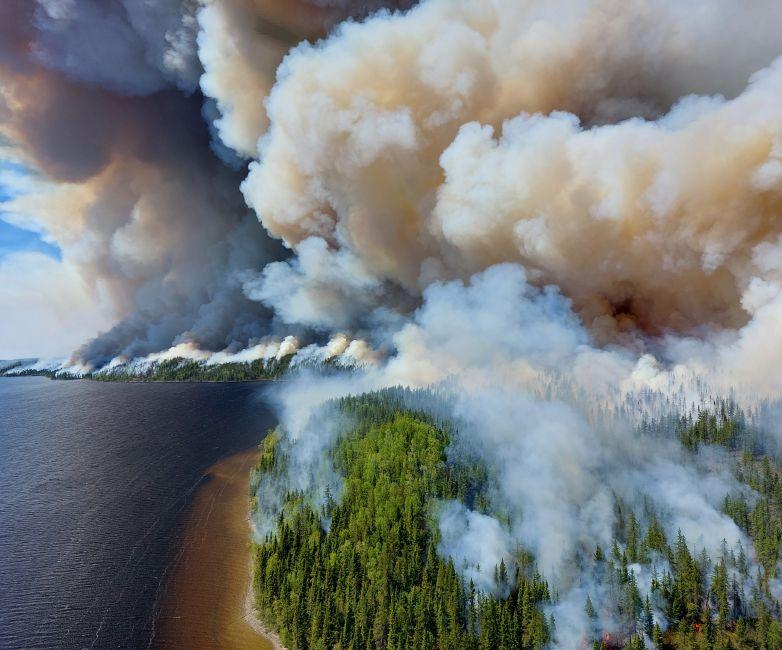
$800 million to $1.5 billion per year. In 2022, the federal government launched the Fighting and Managing Wildfires in a Changing Climate program – Equipment Fund, which is expected to provide $256 million over five years, starting in the 2022 to 2023 season, to support the provinces and territories in procuring specialized wildland fire fighting equipment. The Training Fund provides $28 million over five years to train 1,000 new community-based firefighters, to reduce the risk from wildfire and support community-based capacity. Throughout the season, the federal government acquired more than 5,000 fire fighting personnel from the United States, Mexico, Portugal, Spain,
France, South Africa, Costa Rica, Australia, New Zealand and Chile to bolster crews fighting wildfires in multiple provinces. level.
In September, Canada gave $65 million to six provinces and territories to buy specialized wildland fire fighting equipment such as fire crew trucks and PPE. Single and multiyear agreements were made with Alberta, British Columbia, Nova Scotia, Saskatchewan, Northwest Territories and Yukon through the program’s Equipment Fund.
British Columbia and the Northwest Territories are expected to receive the maximum available funding, with B.C. receiving $32 million while the N.W.T. would see more than
A prescribed burn west of Mistissini, Quebec.
PHOTO: GENEVIEVE POIRIER
$28.5 million. Both would get the funding over five years.
The agreements with the six provinces and territories build on the first phase of the Wildland Firefighter Training Fund, which put nearly $38 million towards hiring, training and retaining 630 firefighters and 125 Indigenous fire guardians in June.
Additionally, the federal government announced a long-term investment in the WildFireSat mission, set to launch in 2029, but it did not provide details on the amount. Officials also committed to improving resilience strategies and preparedness efforts to reduce disaster risks.
BY PROVINCE AND TERRITORY
In New Brunswick, 856 hectares burned this summer. The largest fire was the Stein Lake fire, which was 504 hectares and burned down one home. The province said it spent approximately $3 million to deploy firefighters to other provinces and territories.
At press time, Nova Scotia had 215 wildfires, burning a total of 24,819 hectares. Sixty homes were destroyed in the Barrington Lake fire, which burned 23,379 hectares. It was the largest fire of the year and in the province’s recorded
history. The Tantallon fire, which was burning at the same time as Barrington Lake, burned down 151 homes and consumed 969 hectares.
The Department of Natural Resources and Renewables spent about $7.6 million fighting wildfires this year, as of Sept 21. It does not yet have a final cost for deploying and acquiring firefighters as needed because some invoices are still outstanding, however the province has about 300 wildland firefighters at its disposal. Prince Edward Island had eight small wildfires which burned a total of 7.9 hectares. There was no major damage, no structures lost and no injuries or deaths.
In Newfoundland and Labrador, 21,883.3 hectares had burned as of Sept 22. The largest fires in the province occurred in Labrador, with Julienne Lake burning 10,560 hectares, Northern Labrador burning 4,852 hectares, and Ashuanipi Lake burning 2,300 hectares. Only one shed was lost. The province said the total costs associated with forest fire suppression activities would be determined at the end of the fire season, however it has 44 permanent staff and 17 auxiliary wildland firefighters.
In Ontario, there were 716 confirmed wildland fires as of Sept. 21, which burned 421,565 hectares across the province. At this same
date last year, there had been 255 fires that had affected 2,522 hectares. The 10-year average shows 675 fires having affected 163,609 hectares of land in Ontario. The province said 10 structures – outbuildings in remote areas – were lost as a result of wildland fire activity. The government also increased its base funding for emergency fire fighting this year by an additional $35 million for a total of nearly $135 million.
In terms of personnel, Ontario has deployed 576 firefighters so far to Alberta, British Columbia, the Yukon, the Northwest Territories and Minnesota. To help fight its own fires, the province received fire fighting assistance from the United States, Mexico, and the Canadian Forest Service. It also accepted inbound fire fighting aircraft from the Northwest Territories and Minnesota. In 2023, Ontario’s Ministry of Natural Resources and Forestry hired approximately 661 new and returning fire rangers. The province has 142 fire-ranger crews consisting of four to six staff per crew.
Sioux Lookout 33, on the western edge of Wabakimi Provincial Park, was the largest fire in the province, and was still burning at 62,378 hectares as of Sept. 21. Other fires of note include Cochrane 7, located northeast of Abitibi Lake, which burned 37,742 hectares,

and created a significant amount of smoke that travelled south to the Greater Toronto Area, Ottawa and parts of Quebec. Cochrane 11, located approximately five kilometres west of Fort Albany, burned 805 hectares.
In Manitoba, 198,633 hectares had burned as of Oct. 1. The province’s total budget allocated for wildfire suppression in 2023 was nearly $51.3 million for the 2023 season. Manitoba has 58 full-time and 339 seasonal wildfire suppression personnel. It operates seven air tankers, nine helicopters on long-term contracts and others on short-term, as needed.
In Saskatchewan, approximately 742,000 hectares have burned as of Sept. 20. The provincial government provided $91.77 million to the Saskatchewan Public Safety Agency (SPSA) in 2023. The agency currently has more than 100 fire fighting ground personnel. Two of the largest wildfires in the province this year were the Shaw and Vermette fires. The fires were approximately 191,000 hectares and 88,000 hectares, respectively.
In Alberta, 1,022 wildfires have burned more than two million hectares within Alberta’s Forest Protection Area so far this season. The government said in an email that it does not yet know how much it has spent on suppression this season. The province currently has 1,578 personnel from Alberta Wildfire on the ground fighting wildfires in various capacities, including specialist support staff.
The province spent $175 million on a recovery program for municipalities and Metis settlements affected by wildfires, however it does not know how much it spent on wildfire suppression so far this season.
The five largest wildfires in Alberta as of Sept. 23 include the EWF-031 fire, which was part of the Pembina Wildfire Complex, and burned 201,931 hectares, the Long Lake fire which burned 188,333 hectares, the SWF068 fire, which was part of the Kimiwan Complex, burned 143,039 hectares, the Fort Fitzgerald fire which burned 130,805 hectares, and the Basset Fire, which burned 234,164 hectares as of Oct. 3.
In British Columbia, approximately 2.46 million hectares have burned as of Sept. 19, with approximately 1,300 firefighters engaged in fire response. B.C.’s fire management budget for the 2023 wildfire season was more than $204 million. Since April 1, the BC Wildfire Service has spent an estimated $742 million on suppression efforts.
Initial estimates provided by the Insurance Bureau of Canada say this summer’s wildfires
BY THE NUMBERS
Since 1990, wildfires across Canada have consumed an average of 2.5 MILLION HECTARES PER YEAR. Until this summer, when more than 18.5 MILLION HECTARES burned in 10 provinces and two territories, as of Oct. 6.
B.C.’s fire management budget for the 2023 wildfire season was more than $204 MILLION. Since April 1, the BC Wildfire Service has spent an estimated $742 MILLION on suppression efforts.
in the Okanagan and Shuswap regions resulted in more than $720 million in insured losses. These wildfires are now the most expensive insured event ever recorded in British Columbia, and the tenth costliest in Canada’s history.
The Bush Creek East wildfire caused more than $240 million in insured damage while the McDougall Creek, Clark Creek and Walroy Lake wildfires caused more than $480 million. Combined, insured losses from the Bush Creek East and McDougall Creek wildfires this year exceed the cost of the last major wildfire in Okanagan Mountain Park near Kelowna in 2003. That fire 20 years ago resulted in $200 million in insured damage.
More than 270 structures are confirmed to have been destroyed. In addition, the Bush Creek East wildfire caused extensive damage to public infrastructure, including damage to hydro poles that resulted in power outages for thousands of people.
In West Kelowna, officials confirmed that 70 homes were affected by the wildfires, and 20 were lost in Westbank First Nation. In Kelowna, three homes and two outbuildings were completely destroyed, with a further three being destroyed in Lake Country. In the areas of Traders Cove and Lake Okanagan Resort, an estimated 100 structures were completely destroyed. The Lake Okanagan Resort was also destroyed.
Since wildfire response and recovery efforts, including assessing damages, are still underway, B.C. does not have a count of structures lost or an estimate on the cost to repair and rebuild. However, Fire Fighting in Canada previously reported that nearly two hundred homes were lost in the West Kelowna fire.
One of the largest and most damaging fires in B.C. was the McDougall Creek fire adjacent to West Kelowna. The fire burned an estimated
13,970.4 hectares as of Oct. 3, and displaced thousands of residents for weeks. Other fires of note as of Oct. 3 include the Great Beaver Lake fire which burned 48,396.3 hectares, the Lucas Lake fire which burned 34,853.6 hectares, and the Tatuk Lake fire which burned 44,641.7 hectares. The Knox Mountain fire burned 6.3 hectares, just two kilometres northwest of Kelowna. The Donnie Creek fire was still burning out of control as of Oct. 4 at 619,072.5 hectares, the largest in B.C. history.
B.C. requested firefighters from other provinces and international firefighters which were currently on the ground or incoming. The government does not yet know how much these fire fighting resources will cost. However, 20 communities in B.C.’s Columbia Basin received $2.5 million from the province and the Columbia Basin Trust to prepare for and reduce the chances of wildfire.
In the Yukon, wildfires have burned 223,942 hectares, as of Sept. 25. One non-inhabited structure (a decommissioned shed) was lost in the wilderness. The territory spent $42.1 million on fire fighting resources, which includes the $3.3 million it spent on prevention and mitigation activities such as FireSmart.
Each season, the Yukon has 75 initial-attack firefighters in regional bases across the territory and another 40 staff managing crews, aircraft and providing logistical support. There is also a sustained-action, 20-person unit crew via Yukon First Nations Wildfire. The largest fires were the Illusion Creek fire which burned 25,000 hectares, and the MacMillan River fire which burned 23,115 hectares. A combined $1.55 million from the federal and territorial governments was spent to reduce wildfire risk through First Nations-led FireSmart projects.
In the Northwest Territories, 4,163,423 hectares have burned as of Oct. 4. Thousands of people were evacuated from Yellowknife, Hay River and Fort Smith as wildfires raged close by. The Hay River fire was burning 521,681 hectares, the Fort Smith fire joined the Taltson complex which sat at 550,957 hectares, and the Yellowknife fire burned about 167,000 hectares.
In Quebec, five million hectares have burned as of Sept. 20. The province said it has cost an estimated $200 million to suppress the wildfires.
Nunavut does not have any trees; therefore, it does not experience wildfires.
As the season comes to a close, the fire service reflects on the growing threat of wildfires and climate change in Canada and where we go from here.
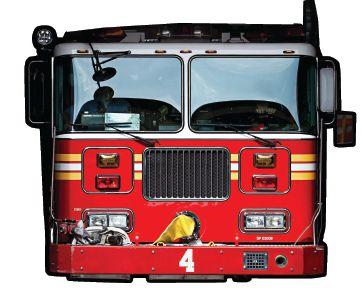
Fire and Life Safety Educator, 4th Edition
$127.45 | Item # 36255
This new Fourth Edition provides fire and emergency service personnel, and civilians with the basic information necessary to meet the job performance requirements of NFPA 1030. This manual focuses on life safety educators assigned to the implementation, management, and administration of fire and life safety programs, as well as the life safety educator’s role as an integral part of a department’s or organization’s community risk reduction program.
Residential Firefighting: Training and Drills
$53.45 | Item # 1593705824
In the intense and demanding world of firefighting, where every decision can make a life-or-death difference, proficiency is paramount. In this text acclaimed fire expert David F. Clark delivers a must-read guide for those who battle hostile fires. He provides actionable advice for firefighters to enhance their skills through frequent hands-on training, ensuring they are well-prepared for the challenges they face on every residential fire call.
High-Rise Buildings: Understanding the Vertical Challenges
$149.35 | Item # 1593705800
High-rise buildings remain the defining feature of urban areas, and even 20 years after 9/11, challenges remain in fire and life safety. This book, the product of experienced high-rise firefighting experts and high-rise emergency planners, promises to be a defining text in the field. Learn how to manage and respond to all-hazards events within the high-rise environment. Authors Tracy, Murphy, and Murtagh dive into what cognitive command is and how it played a role in many high-rise fire cases.




TACKLING A HISTORIC FIRE IN VAUGHAN
By DEPUTY CHIEF GRANT MOFFATT, VAUGHAN FIRE AND RESCUE SERVICE
In my 36 years as a firefighter, I have seen everything from small bonfires to large industrial blazes, but April 12 was a day I won’t soon forget. It was on that day that Vaughan Fire and Rescue Service (VFRS) fought one of the largest fires in our city’s history.
Despite the unrelenting efforts of more than 50 firefighters, who battled the flames for two and a half hours, the fires damaged or destroyed 71 units within a new residential site in the Pine Valley Drive and Teston Road area. And while the cause of the fire is still under investigation by the Ontario Fire Marshal, the experience is one our crews will never forget and provides an opportunity to learn from for future response efforts.
Let’s go back to that day. The initial call came around 1:00 pm about a structure fire to the roofs of three units in a residential construction site, with heavy black smoke visible from Major Mackenzie Drive and Islington Avenue, which is almost five kilometres away. Firefighters were dispatched to the scene where it was reported the fire was spreading due to high winds.
Very quickly, we could see there were approximately 12 to 18 homes behind the original three that were also on fire. Crews set up a defensive aerial operation to protect the homes to the south, and surrounded the area to try to contain the fire from spreading further.
Crews were not only battling the flames but also the wind as the fire continued to spread. At this point, 13 of VFRS’s 14 trucks with 54 firefighters, four chief officers, several York Regional Police (YRP) officers and multiple EMS units were on the scene, and a nearby neighbourhood was evacuated as a precaution.
Since the footprint of the fire was so large, we leveraged YRP’s resources to help us identify where to deploy firefighters. Using a helicopter from the regional police air support division, our firefighters used forward looking infrared (FLIR) technology to see where the fire was spreading in real-time. When a new heat signature appeared, we redeployed firefighters to put out the hot spot. This enabled us to try and stay one step ahead of the fire progression.
By 3:00 pm, two hours after arrival, most of the fires had been contained and crews remained on scene to conduct any salvage and overhaul operations that were needed.
WHAT CAUSED THE FIRE TO SPREAD SO QUICKLY?
Weather can be your friend or your enemy. The wind speed and direction influenced how the fire travelled from west to east, which caused the fire to spread rapidly.
In addition to the wind, April had been unseasonably warm and dry. These conditions, combined with the intense heat from the fire, required
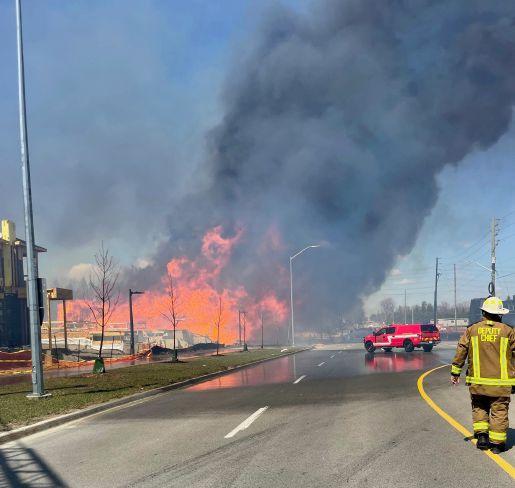
firefighters to rotate on and off the scene to keep everyone safe. We knew it was important our firefighters had somewhere to rest and recharge with medical monitoring. As always, we took the necessary precautions, however, despite this, the conditions were such that some of our firefighters had to be seen in a local hospital to be evaluated due to exposure to the intense heat.
The heat not only affected those working to stop the fire, but also created equipment challenges. By the time the fire was extinguished, several fire trucks had been damaged – including melted lenses or lights due to their proximity to the fire.
In addition to the fire in the immediate subdivision, the high winds moved embers creating brush fires about a kilometre away in a ravine area east of Pine Valley Drive. Additional apparatus and firefighters from both VFRS and Township of King Fire & Emergency Services were needed to help contain those quick-moving flames. VFRS also deployed 18 recruits, who were in the classroom at our headquarters, to help fight the fire. Elevated devices were used to flow water into a forested area to knock down fires as they threatened an additional residential construction site. Multiple lines were pulled to hit hot spots all throughout the
Over 50 firefighters responded to the Vaughan fire that damaged or wrecked 71 units at a new residential site.
PHOTO: VFRS

forest. The high winds and dense tree cover made it difficult to access and extinguish the hot spots which became very labour intensive utilizing chainsaws to gain access deeper into the woods. Firefighters worked on this area for several hours to ensure the fire was completely out.
LESSONS LEARNED
There are always lessons to be learned after every fire, no matter how big or small. Here are some of the takeaways we learned following this incident. Requesting help early on is critical both for additional on scene resources as well as coverage for the city of Vaughan. Despite our depth, the majority of VFRS resources were committed to this incident. It can be easy to forget, there is still a whole city that needs protecting. Utilizing mutual aid agreements with other fire departments to help backfill your stations is vital to ensure continuity of service. That day, Richmond Hill Fire and Emergency Services, Brampton Fire and Emergency Services, Township of King Fire & Emergency Services and Markham Fire and Emergency Services stepped in to help keep our day-to-day services going while our crews focused on battling the massive fire.
Further to that, leveraging our colleagues at YRP and York Region Paramedic Services for on-site support was key. YRP officers assisted with restricting access and ensuring the safety of the public while also assisting with aviation support and its thermal imaging technology to locate fire pop-ups. York Region Paramedic Services provided valuable medical support and a large medical unit for firefighters who needed medical monitoring. It is important to recognize, fire can happen anywhere at anytime, and not all fires are the same. Being prepared and having a plan in place before an incident is crucial to success.
I would also like to recognize and commend the VFRS staff, as well as all others on scene who combined their efforts and ensured we had no serious injuries and we were able to minimize the property loss caused by this fire.
ABOUT VAUGHAN FIRE AND RESCUE SERVICE
In 2021, VFRS responded to 11,063 calls in Vaughan and dispatched 1,291 calls in King Township. The successful operation of VFRS depends on its dedicated staff in the following units.
The Communications Division handles all calls for emergency services and maintains close contact with York Regional Police and surrounding municipal fire and emergency contact centres.
The Operational Division provides full service emergency response for fire incidents, sudden medical emergencies, technical rescues, hazardous material incidents, and chemical, biological, radiological and nuclear incidents.
The Mechanical Division ensures all fire fighting equipment and trucks are ready and up-to-date on all current Ministry of Transportation commercial vehicle and NFPA safety standards.
The Training Division ensures firefighter skills are upheld and enhanced; it also conducts annual maintenance training required for all firefighters.
The Fire Prevention Division provides public education, fire investigation services, and ensures buildings and properties are constructed and maintained in accordance with applicable fire and life safety regulations.
The Emergency Planning Division ensures City staff as well as residents and businesses are prepared for an emergency.
All units work together to create an efficient and high-quality level of emergency service where we serve with pride and honour.







Leadership in the time of Climatistry
Change is all around, but the guiding principles of leadership remain the same
By KIRK HUGHES
Don’t bother Googling it, Climatistry (a mixture of the word climate and chemistry) isn’t a real word, but there is no word to describe the interesting time the fire service is quickly transitioning into, so I’ve given it this invented moniker.
Change is inevitable, and innovation and technology have vastly improved the fire fighting profession, yet this is a unique period contrasted against the backdrop of an altering climate, interconnected with technologically advanced communities, and the shifting constructs of the traditional environment of the fire station. One of the more prevalent challenges is the struggle to link previous tried and true leadership styles while appealing to the modern generation of firefighters’ needs, wants and expectations. The up-and-coming rank and file have differing expectations, and with that comes a host of new and unexpected obstacles. To overcome these hurdles, the goal of any leader is to adapt to the change, and the best way to do so is to embrace the core leadership traits and apply them with some humility and flexibility.
So, what are the core leadership traits? Sounds like a buzzword of sorts, and every department will have differing vision statements and nomenclature that try and capture the main points of what they want their leaders to exemplify. Generally, it emphasizes the position of responsibility and authority, but it still boils down to three main takeaways: being firm, friendly, and fair. These are the core competencies that make up the framework of an effective leader in the evolving fire service.
There are many goals for any leader to achieve, but one of the most critical is making followers resilient to the adverse effects of the job. Exposure to gruesome sights, sounds, smells, and dealing with chaotic and frightening scenes impacts the psyche of any first responder. Followers tend to do well in those circumstances when they know their leader will respond in a
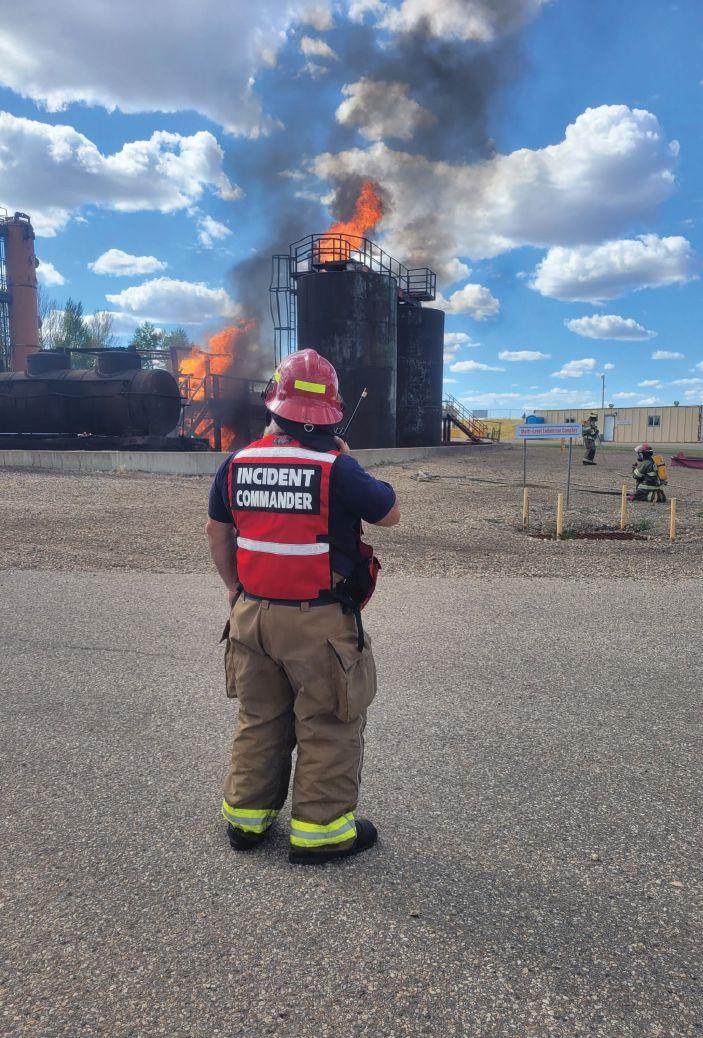
Whether in a position of management in the field, or in the administrative chair, a leader must always consider the welfare of the people they command, as well as the job that has to be done.
PHOTOS: KIRK HUGHES
specific way. Knowing with relative certainty the consequences of your actions is a liberating concept for anyone, but in those high-pressure situations, understanding how a leader will react brings stability to an otherwise tense and emotionally charged scenario. Being firm doesn’t mean being inflexible, it just means that the leader’s actions and directions are often familiar, as predictable as possible, and ultimately, their decision-making process is as confident as allowable under the circumstances. This is a hard skill for young leaders to master, and it does take extensive exposure in order to fully appreciate the difficulty of this skillset, however it is a lasting one as a person grows into a more senior position. Being firm is a mindset, it includes giving orders based on the best available information, being flexible enough to alter that order if new information comes to light, but still maintaining an unwavering stance, especially in situations where difficult orders or decisions must be made and carried out. Sometimes, as a leader, hard calls must be made, it’s the price of wearing the shoulder braids, but if your followers know that you are working in their best interest, for the greater good and favourable outcomes, they tend to be more understanding and willing to accept that decision than they would be if they didn’t have the solid belief in the principles and firmness in resolve of their senior leadership. That may all sound a tad harsh, being firm in and of itself is usually seen as being of strict resolve, however if properly mixed with a strong sense of belonging, born out of such things as camaraderie, then it tends to take the edge off. For the sake of fluency, this stage is often referred to as friendly, in the sense that it encompasses the key components of most emergency services personnel: dedication, self-discipline, compassion, etc. As a leader, those traits must be more present and upfront to alleviate the heavy hand that often comes with command. Subordinates react more effectively to a leader that they have positive feelings towards, generally appreciate and fundamentally respect. Being friendly doesn’t equate to being weak; the argument is the opposite. A strong leader that is firm in their deportment yet still approachable with a positive attitude, often has a successful crew. The rationale is extensive, but it generally boils down to empowered employees that are trusted, respected, and cared for, tend to be more loyal, willing to take on more complex assignments and want to perform at a high-level to maintain the relationship they are experiencing.
Since leadership itself has hundreds of different styles, techniques, methods, and approaches, it is foolhardy to think they can all be boiled down to three simple phrases.
’’
So, how does a leader build that rapport with their subordinates, especially those in the new up and coming generation? A solid question, with ample answers, but sticking to the theme of core competencies, the main thrust is always to treat them with dignity and respect, empower them, invest in them and, simply, push them to succeed, not only for themselves, but for the overall health of the organization as a whole. A subordinate that feels that their leadership is professional yet approachable, will be a valued member of a team and a pleasure to lead.
A firm resolve and a friendly demeanour are keen aspects of a good leader, but the last piece of the pie has to be fairness. People will take a lot of grief in their job, their hobbies, or their social lives, but rarely will they take it if they do not think what is occurring is fair. It’s a balancing act to be fair while maintaining a position of authority. Merging competing interests is never an easy task, but a common one amongst leaders. Being fair comprises facets of honour, neutrality, equality and more importantly, being reasonable. The main teaching point when explaining fairness is to remove self-interest and replace it with an over arching desire to be unbiased. Easier said than done truthfully, as unconscious biases invade many aspects of life in general, however being mindful of those preconceived notions is always the best first step when debating if a decision is based in the merits of fairness. Being equitable,
yet maintaining a logical principle based in established processes helps. For example, if a decision must be made in relation to a promo tion, then making a selection based on a criteria which includes a coherent set of explainable benchmarks such as training or seniority, then the results are not based on individual prefer ences but rather can be viewed as legitimate in their conclusion. That way the decision can be seen as transparent, consistent and, critically, in its totality – fair.
At times difficult decisions will result in some getting angry, feeling their needs weren’t met and the impact on them exclusively was unfair. That is bound to happen in any organization that has hierarchy, such as a fire service, and is disheartening to leaders that struggled with reaching the end result while trying to evenly apply the aspects of fairness to the decision. In those circumstances, the only real recourse is to communicate the process to everyone involved and try to answer questions and concerns with the core tenets of firmness, friendlessness, and fairness. Even then, sometimes no answer will satisfy, and the last recourse is just to accept it, deal with the fall out, and move on.
As the field of fire fighting evolves and grows, so too must the leaders that wish to command firefighters. Since leadership itself has hundreds of different styles, techniques, methods, and approaches, it is foolhardy to think they can all be boiled down to three simple phrases. Leadership, like fire fighting, requires expe rience, education and mentorship. Finding a style is paramount, but like all professionals maneuvering through the maze of challenges and changes that will serve to improve the fire service, maintaining the roots of the core com petencies cannot lead you astray.
Kirk Hughes is the Director of Protective Services and Fire Chief for the County of Vermilion River in Alberta. Kirk previously served in the Royal Canadian Mounted Police as well as several fire services across Ontario, Manitoba, the Northwest Territories and Southern Alberta. His Facebook page can be found at Protective Services – County of Vermilion River.
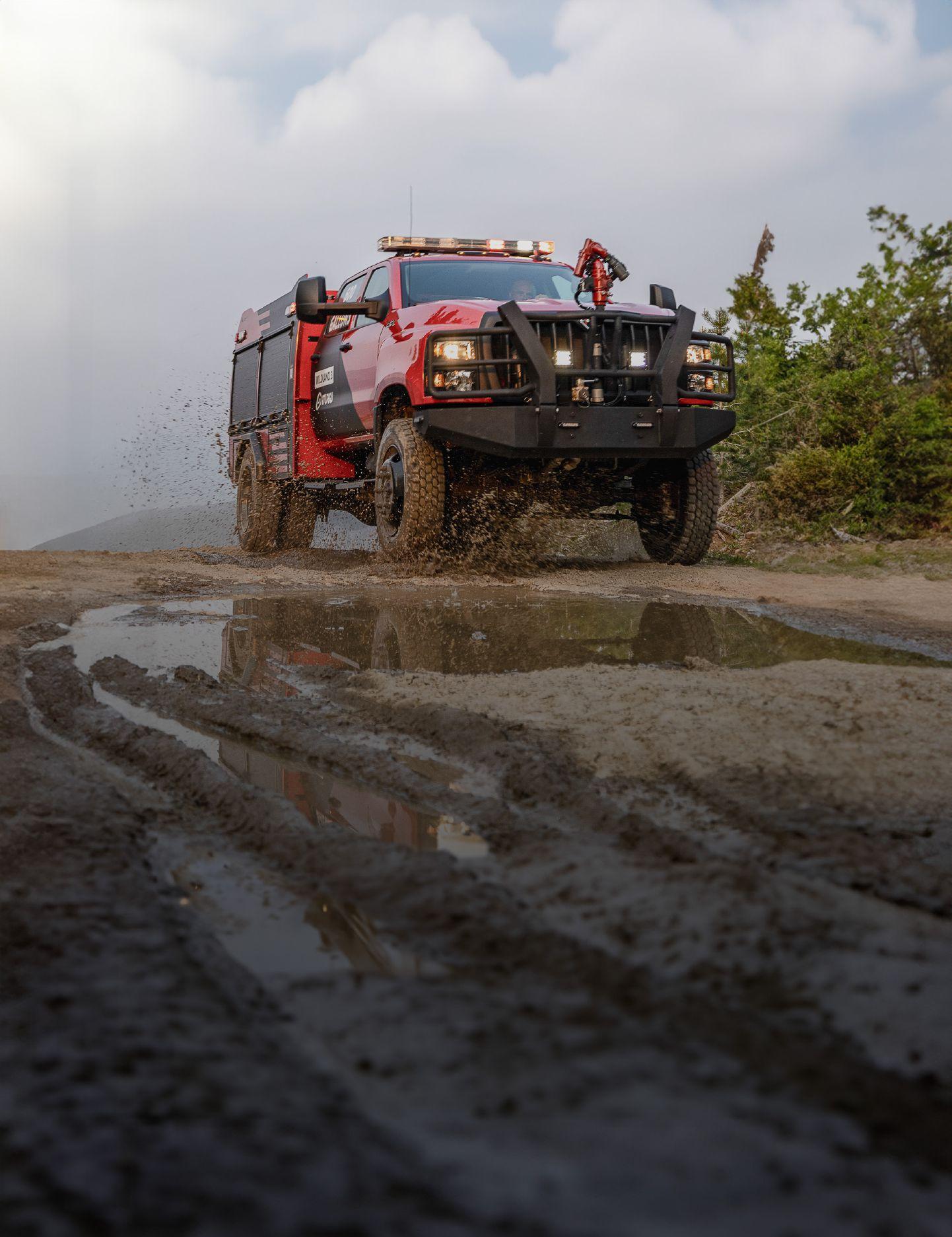
More than just a colour on a helmet or a title, being a leader means making a call, often in rapid time.
PHOTOS: KIRK HUGHES


THERMAL IMAGERS AND COLD WEATHER
By MANFRED KIHN
In your part of the country at the time of this November edition, you may already be experiencing adverse weather conditions and perhaps even have some snow. The use of a thermal imager (TI) in cold weather emergencies can be extremely beneficial for fire fighting and rescue operations. Thermal imagers detect and display infrared radiation, which allows firefighters to visualize heat signatures and temperature differences. In cold weather situations, these devices can play a crucial role in improving situational awareness and enhancing operational effectiveness. Here’s how thermal imagers can be used in cold weather emergencies.
Locating victims: In cold weather emergencies, such as snowstorms or freezing temperatures, victims may become hypothermic when they get lost. Thermal imagers may help locate individuals

by detecting their body heat signatures and can be used for a quick patient assessment to help determine if there is frostbite and/or hypothermia. A quick scan of the victim’s face, arms, fingers, legs and feet can show the affected areas. The basic colourization in a thermal imager is: white is hot, black is cold and everything else in between are shades of gray. So, using a TI to check for cold extremities will show up as darker or black. This is valuable information to relay to the medics or hospital staff for appropriate treatment.
Search and rescue: When responding to accidents in remote, cold environments, thermal imagers aid in searching for survivors by identifying their body heat against the cold background. This can speed up search and rescue efforts and increase the chances of locating people quickly such as lost or missing snowmobilers, injured downhill and cross-country skiers, etc. Understand that detection of infrared



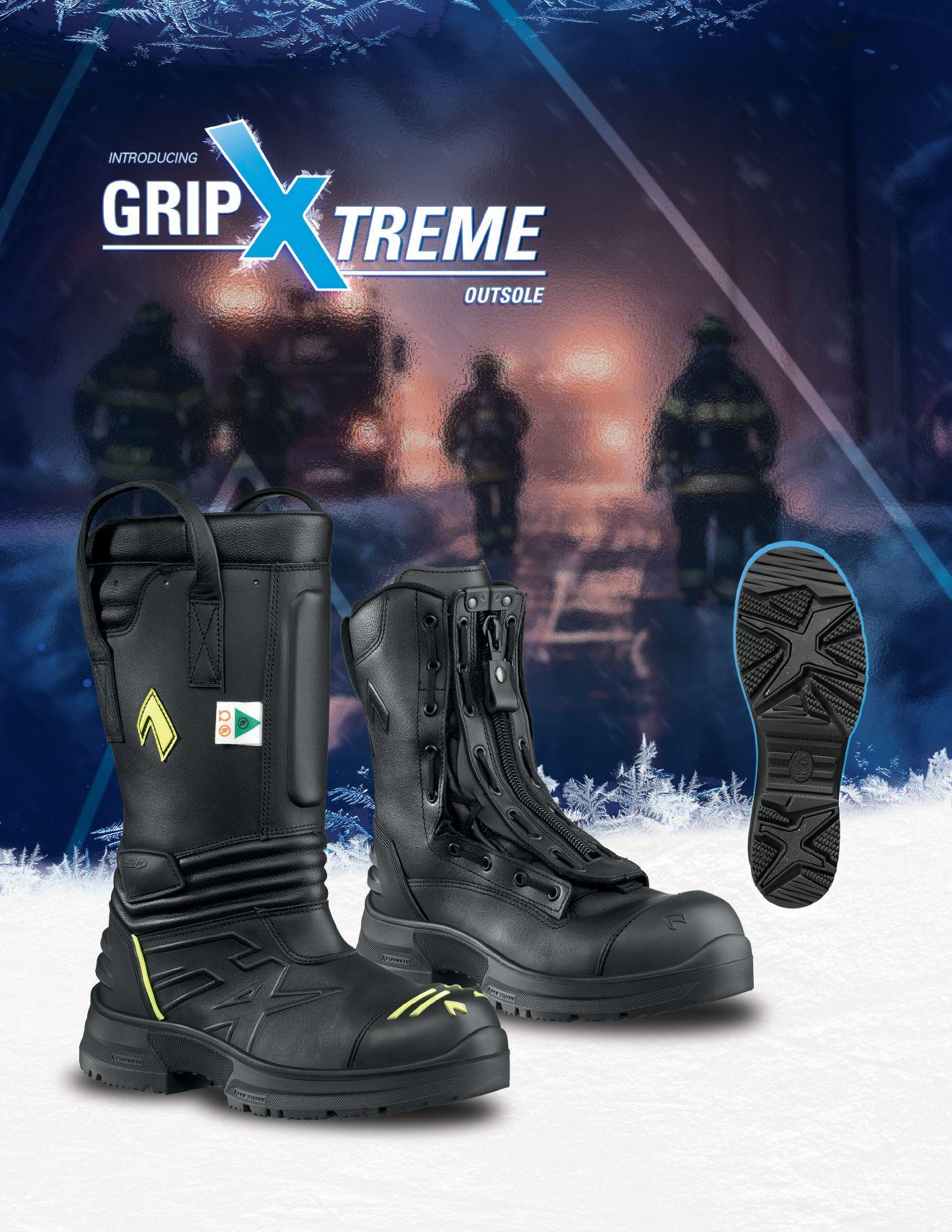

GRIP
cannot penetrate through any thickness of snow, so in areas that are affected by avalanche conditions, a thermal imager will not be effective. Image contrast is a factor that needs to be taken into consideration as the colder temperature will provide a better definition due to the greater initial thermal differential with warmer objects. Footprints in the snow can be seen for a long time with the use of a TI. Even though we are not tracking any sort of heat signature, the footprints are detected due to the disturbance in the snow’s emissivity.
Fire fighting: Thermal imagers are used by firefighters to detect hidden fires and hotspots, even in cold conditions. They can identify sources of heat within structures that might otherwise be hard to locate due to the presence of snow or ice. This capability can prevent fires from reigniting or spreading.
Structural assessments: In cold weather, the performance of buildings and structures can be affected by temperature changes and freezing conditions. Thermal imagers can help assess the structural integrity of buildings by identifying areas with different heat patterns, leaks or other anomalies. Extreme ice buildup may indicate weaknesses with potential for collapse.
Monitoring equipment: Cold weather can impact the functionality of machinery and equipment, leading to overheating or freezing. Firefighters can use thermal imagers to monitor the temperature of equipment and mechanical systems to prevent failures and maintain operational readiness.
Vehicle accidents: Thermal imagers can aid in locating and identifying occupants of vehicles involved in accidents, especially if they are trapped, injured, or ejected and unable to communicate their location.
Hazmat situations: In cold weather emergencies involving haz-

ardous materials, thermal imagers can help detect leaks or spills by identifying temperature differences caused by the release of these substances.
Image degradation: When it is raining, foggy or snowing, image degradation can occur because the water particulates absorb the infrared before it reaches the TI, giving you are very grainy image on the display. There is nothing wrong with your TI, just remember that there are visual limitations using a TI and this occurrence can be one of them.
To effectively use thermal imagers in cold weather emergencies, it’s important for fire service personnel to receive proper training in their operation and interpretation. Additionally, maintaining the equipment’s battery life and protecting it from extreme cold is crucial to ensure the thermal imager’s functionality during critical operations. If you are outside for an extended period of time, perhaps on a victim search and rescue, keep your spare batteries on the charger or as warm as possible like in your inner pocket.(Photo courtesy of Bullard – footprints in the snow which has disturbed the emissivity)
Overall, the integration of thermal imaging technology into cold weather emergency response can enhance the safety of responders, increase the efficiency of operations, and improve the chances of successful outcomes in challenging environments.
Until next time stay safe and train often.
Manfred Kihn is a 19-year veteran of the fire service. He is Bullard’s fire training specialist for thermal imaging technology. He is cesrtified through the Law Enforcement Thermographers’ Association as a thermal imaging instructor and is a recipient of the Ontario Medal for Firefighters Bravery. You can e-mail him at manfred_kihn@bullard.com.

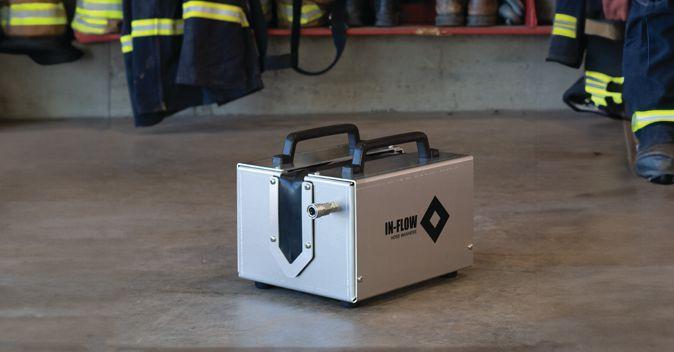
Designed by volunteer firefighters
■ Eliminates time-consuming, ineffective, manual washing methods
■ Four high-pressure nozzles and two brushes clean both sides of your hose in one pass
■ Operates with standard 3-4 gpm pressure washer or UHP fire pump
■ Lightweight, compact, easy to store and maneuver
■ Used in fire departments across Canada
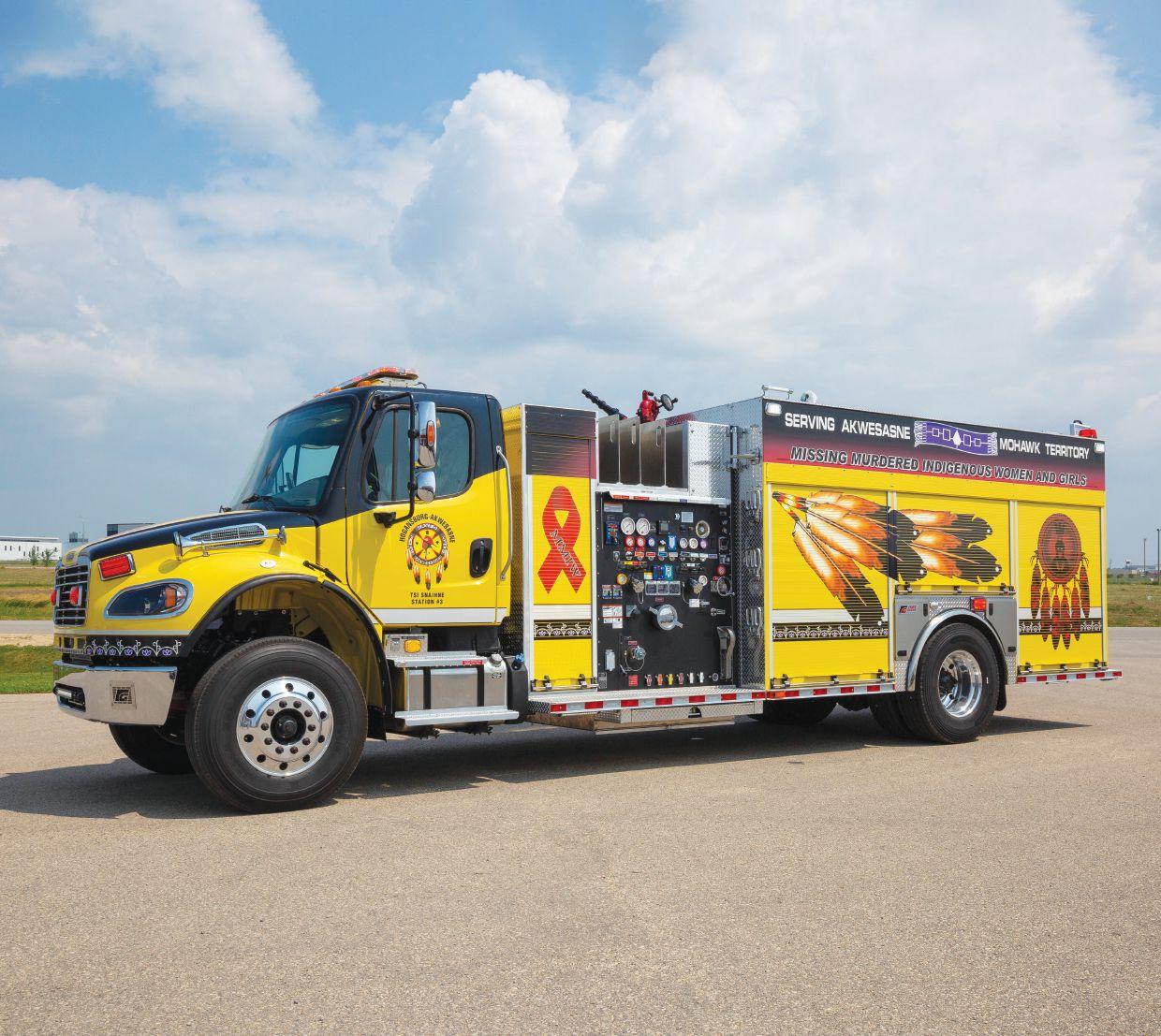
APPARATUSDIRECTORY
AN ALPHABETICAL LISTING OF MANUFACTURERS, SUPPLIERS AND DEALERS OF APPARATUS AND COMPONENTS TO THE CANADIAN FIRE SERVICE.

1200 DEGREES ONTARIO
402 Harmony Road
Ayr ON N0B 1E0
Tel: 800-254-2049
Company Email: jclimie@1200-degrees.com
Web: 1200degres.com
1200 Degrees Ontario combines a complete service offering: trucks, service and equipment. It has several representatives on the road and a mobile maintenance fleet. 1200 Degrees Ontario works together with the Quebec team to offer the same high standards that have made the 1200 Degrees group famous, while possessing its expertise specific to Ontario.
A.J. STONE COMPANY LTD.
62 Bradwick Dr. Vaughan ON L4K 1K8
Tel: 416-785-3752
Toll free: 800-205-3473
Fax: 416-781-2827
Company Email: order@ajstone.com
Web: www.ajstone.com
A.J. Stone has proudly served the needs of the First Responder Services of Ontario since 1972 by featuring quality products, knowledgeable sales team, and training support.
A.J. Stone supplies equipment from MSA, Task Force Tips, LION Protects, Paratech Rescue, FireBull, Enforcer, Genesis Rescue Systems, Streamlight, Innotex Bunker Gear, ProTech Gloves, Safe-T-System, CET and much more!
We service what we sell!

AIR TECHNOLOGY SOLUTIONS CANADA INC.
251 Queen St. S., Ste. 512 Mississauga ON L5M 1L7
Tel: 905-826-6682
Toll free: 866-735-1480
Fax: 866-511-6904
Company Email: info@airmation.ca
Web: www.airmation.ca
Air Technology Solutions is dedicated to our Clients, offering updated, timely, full service Indoor Air Quality (IAQ) solutions. Air quality concerns are mitigated using a unique combination of professional indoor air quality assessment coupled with solutions. Off the shelf or customized site specific air cleaning equipment is available to resolve IAQ issues. Our technical experts review client requirements and budgetary availability. The finest appropriate air cleaning systems are provided. Air Technology Solutions is a leader in Diesel Exhaust Remediation and is the ONLY environmental tested and proven filtration system to exceed standards: NFPA, NIOSH, OSHA and ASHRAE. Building and facility managers, business owners, contractors, architects, and engineers have been working with Air Technology Solutions since 1986 to resolve IAQ needs. Employee and personnel safety and health are key issues. Breathing safe air in the workplace is of utmost importance. We provide global customized solutions to control contaminants, pollutants and odours in your facility. We look forward to servicing your requirements.
AIR VACUUM CORPORATION
PO Box 517
Dover NH 03821
Tel: 603-743-4332
Toll free: 800-540-7264
Fax: 603-743-3111
Company Email: sales@airvacuumcorporation.com
Web: www.airvac911.com
Breathe Clean Air with AIRVAC 911®
The AIRVAC 911® Engine Exhaust Removal System provides 24/7 protection by controlling the spread of hazardous contaminants in your station so that everyone can breathe clean air. Protect 100% of the apparatus bay area by constantly monitoring and automatically removing diesel exhaust and particulate matter from your station without interfering with daily operations or affecting emergency response time. AIRVAC 911 is fully automatic. At the heart of our four-stage filtration system Is the High-Efficiency “HEPA MAX 3000” (MERV 16) filter that has the ability to remove particles 0.3-1.0 microns in size at an efficiency of greater than 95%. Our system also removes off-gassing and engine exhaust that re-enters the building.
• No hoses, vehicle attachments or tail pipe connections
• No building modifications, ducting or external exhaust fans
• Address Hot Zones within your station
• Remove off-gassing of turnout gear, hoses and parked vehicles
• Counter off-gassing of secondary pollutants
• Remove engine exhaust that re-enters the building
• Flexibility to move vehicles from bay-to-bay
• Half the cost of hose systems
• Energy efficient LEED/Green design
• NFPA 1500 / OSHA / GSA Compliant
• Made in the USA
For a free quote: www.airvac911.com sales@airvacuumcorporation.com 800-540-7264
APPARATUSSHOWCASE
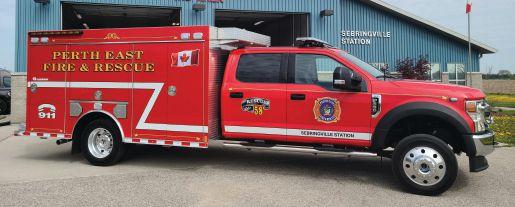
This mini-rescue is constructed around a Ford F-550 chassis with a 430HP 7.3L PFI gas engine and TorqShift 10-speed transmission. The Rosenbauer FX body has around 435ft3 of compartment storage space. Whelen warning lights illuminate the chassis and body.
DEPARTMENT: Perth East Fire Department, Ontario
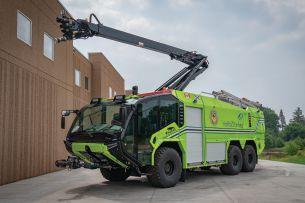
This Panther ARFF has a Rosenbauer N80 2100 GPM pump and is powered by a 700HP Volvo Penta D-16 engine. It is supplied by a 3,000 G water tank and a 400 G foam cell. It flows water through a roof-mounted 54’ Stinger HRET with a Rosenbauer RM65 turret and a bumper-mounted, high-volume, low-attack Rosenbauer RM35 turret. Features include an electric ladder gantry, water and foam level lights, and a Command Light Knight 2.
DEPARTMENT: Halifax-Stanfield International Airport, Nova Scotia
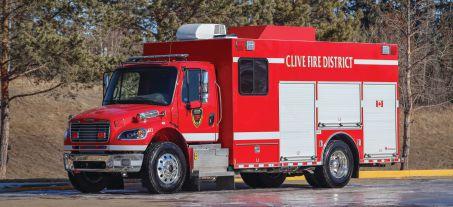
This rescue vehicle is manufactured on a Freightliner M2-106 chassis with the Rosenbauer FX body, powered by a 330HP Cummins L9 engine and an Allison 3000EVS transmission. The body contains a front command area with seating for three and a rear rehabilitation area with seating for six. It also features an electric awning, a Command Light Knight, a refrigerator, coffee maker, and microwave.
DEPARTMENT: Lacombe County – Clive Fire District, Alberta
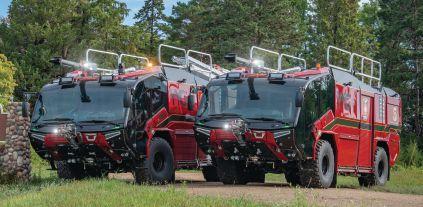
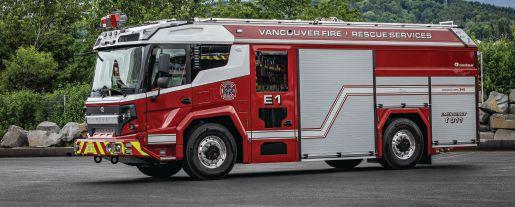
This all-electric, 92.5-ft wide RTX is driven by 2 Volvo Penta electric motors delivering 360kW/490 HP powered by two 66kWh batteries. It features all-wheel steering that allows for a 47.5’ turning radius and an RM35 roof turret with pump and roll capability at any speed. Hendrickson adjustable air suspension provides four available ride heights and all-wheel drive.
DEPARTMENT: Vancouver Fire Rescue Services, British Columbia
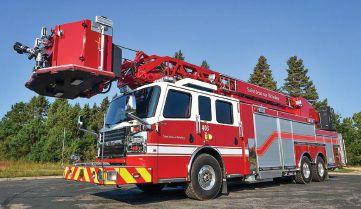
This 101’ King Cobra rear-mount aerial platform is built on the Rosenbauer Commander Chassis and EXT body, powered by a 500HP Cummins X12 engine. It features a Waterous CSUC20 2250 GPM pump supplied by a 600 G water tank and a 30 G foam cell. The aerial features an 8’ articulating jib, SMART aerial controls, short-jacking capability, and an Allison 4000EVS transmission.
DEPARTMENT: Service de Sécurité Incendie de Saint- Jean-sur-Richelieu, Quebec
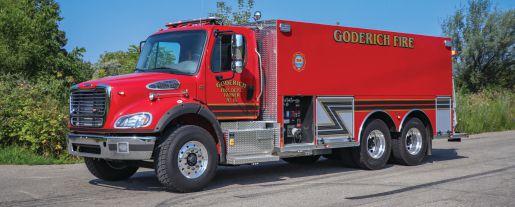
Built on a Freightliner M2-112 chassis and Rosenbauer FX body, this tanker holds 3,000 G of water and is powered by a 450HP Cummins L9 engine and an Allison 3000EVS transmission. It features a Darley HM 500 GPM pump and it is lit with Whelen warning lights.
DEPARTMENT: Goderich Fire Department, Ontario
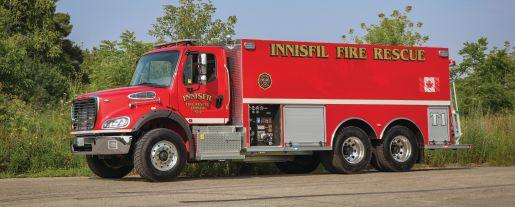
DEPARTMENT:
Built on a Freightliner M2-112 chassis and Rosenbauer FX body, this tanker holds 3,000 G of water. It is powered by a 450HP Cummins L9 engine and features a Darley HM 500GPM pump and an Allison 3000EVS transmission. A Whelen warning light package lights up the chassis and body.
Innisfil Fire and Rescue Services, Ontario
APPARATUSDIRECTORY

BEARSPAW PROTECTAPUMP - SEPARATORS
927A Goldstream Ave
Victoria British Columbia V9B 2Y2
Tel: 778-404-7385
Company Email: info@protectapump.com Web: protectapump.com
The Fire World’s ONLY Drafting (Water/Debris) SEPARATORS for Natural Water Sources For Safe SHALLOW Drafting in: Creeks – Lakes – Wetlands – Rivers – Oceans
• Eliminates RISK of Sand – Gravel – Weeds Damage that causes Expensive Pump Repairs and Downtime!
• Increases # of drafting sites: Gives you the Choice of Drafting from Sources closest to the Fire – rather than only the ‘safe’ one you know
• Easy & Stress-Free Drafting in less than 12”/ 30cm Depth: No Floatation / Suspension / “Babysitting” Required
Made in Canada — 120-Day Money Back Guarantee Fact Check Us:
See Videos of Fire Chiefs using BearsPaw Separators & ask your colleagues.
Contact a Retailer near you for more information & possible demonstration.
Visit ProtectaPump.com
CANADIAN SAFETY EQUIPMENT INC.
#3 – 2865 Argentia Rd.
Mississauga ON L5N 8G6
Tel: 905-826-2740
Toll free: 800-265-0182
Fax: 905-272-1866
Company Email: info@cdnsafety.com Web: http://www.cdnsafety.com
We supply Industrial and Fire SCBA’s, SCBA Decon Washer, Thermal Cameras, CAF Systems, Fall Protection, Bunker Gear, Fire and Rescue and Ballistic helmets, Fire Hose, Communications Equipment, Nozzles, Fittings, Hazmat Suits, Ventilation Fans, Gas Detectors, Confined Space Rescue Equipment, Water and Ice Rescue equipment, Industrial and Municipal Safety and Lone Worker Protection systems.











CARL THIBAULT FIRE TRUCKS INC.
38 Thibault St. Pierreville QC J0G 1J0
Tel: 450-568-7020
Fax: 450-568-3049
Company Email: mthibault@thibaultfiretrucks.com Web: www.thibaultfiretrucks.com
We are a Canadian based company and we manufacture a full line of fire apparatus which includes aerial ladders, pumpers, tankers, rescue units and vacuum tankers. We provide parts and other related products.

CET FIRE PUMPS MFG.
75 Hector St. Pierreville QC J0G 1J0
Tel: 450-568-2719
Toll free: 888-844-2285
Fax: 450-568-2613
Company Email: sales@fire-pump.com Web: www.fire-pump.com
No Hydrants, No Problem!
CET Manufactures Portable Pumps, Skid Units, Brush Trucks, Glider Kits, Foam Trailers, Water Tanks, and UTV Fire Units to help you fight fire where static water sources may be your only option.
The Flow Starts Here!
CITY VIEW SPECIALTY VEHICLES
1213 Lorimar Dr. Mississauga ON L5S 1M9
Tel: 416-249-4500
Toll free: 866-739-3956
Fax: 416-249-6665
Company Email: inquiries@cityviewvehicles.com Web: cityviewvehicles.com
City View Specialty Vehicles is the Ontario dealer for Rosenbauer America. Rosenbauer America has a Canoe Procurement Group of Canada/Sourcewell contract for direct purchases of all type of fire apparatus, including aerials and platforms, pumpers, tankers and the RTX electric fire truck. City View is in Mississauga and Ottawa, each with in-house and on-road service capabilities with 310T and EVT trained staff. We are dealers for Cummins, Allison, and Meritor, and capable of completing minor service up to full engine overhauls. City View has extensive experience with hybrid-electric vehicle repairs, and is a dealer for electric vehicle charging infrastructure.
COMMERCIAL EMERGENCY EQUIPMENT CO.
591 Chester Road
Delta BC V3M 6G7
Tel: 877-443-2626
Toll free: 800-665-6126
Company Email: info@comemerg.ca
Web: www.comemerg.ca
Commercial Emergency Equipment is Canada’s largest dealer for Pierce Manufacturing, MaxiMetal, BME Fire Trucks, and Oshkosh Airport Products. We provide sales, parts, and service for all makes of fire apparatus, and support our customers through our nationwide branch network.
Commercial Emergency Equipment Co. strives to exceed customer expectations in everything we deliver. With over 75 years in the truck equipment industry, we take pride in a proven track record of providing expert truck equipment solutions, top quality products, and first-class service to our customers.
We are a sole-source service provider with 24/7 mobile Emergency Vehicle Technicians, offering inspections, preventative maintenance, mobile pump testing, foam system calibration, aerial maintenance, ground ladder testing, as well as comprehensive apparatus training.
We warehouse an extensive inventory of OEM and aftermarket parts, tools, and equipment ensuring quick delivery and reduced downtime to our customers.

CSE INCENDIE ET SÉCURITÉ INC.
5651 Chemin St-Francois
St. Laurent QC H4S 1W6
Tel: 514-737-2280
Toll free: 866-737-2280
Fax: 514-737-2751
Company Email: info@cseis.com
Web: www.cseis.com
We supply Industrial and Fire, SCBA’S, SCBA Decon Washers, Gear Extractors and Dryers, Thermal Cameras, CAF Systems, Fall Protection, Bunker Gear, Fire, Rescue and Ballistic Helmets, Fire Hose, Communications Equipment, Nozzles, Fittings, Hazmat Suits, Ventilation Fans, Gas Detectors, Confined Space Rescue Equipment, High Angle Rescue Equipment, Ice and Water rescue equipment, Boots and Gloves. Everything for Fire Fighting, EMS, Law Enforcement, Industrial and Municipal Safety and Lone Worker Protection Systems.
PIERCE RESPONDER PUMPER | COMMERCIAL EMERGENCY EQUIPMENT
APPARATUSSHOWCASE
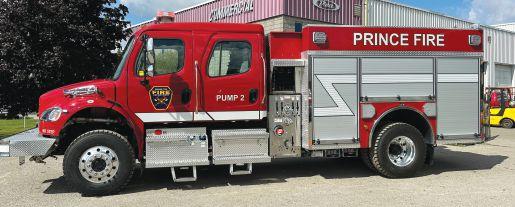
Built on a Freightliner M2-106 4x4 chassis, Pump 2 is pump-and-roll capable with a Waterous CXPA PTO-Driven 1250 GPM pump, 1000 G tank, HuskyTM 3 foam system, scene lighting by HiViz LED, emergency lighting from Whelen, and a Task Force Tips Typhoon remote bumper monitor.
DEPARTMENT: Prince Township Fire Department, Ontario
MAXIMETAL PARAGON PUMPER/TANKER | COMMERCIAL EMERGENCY EQUIPMENT
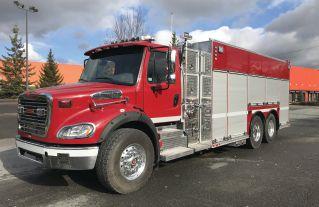
This apparatus was built on a Freightliner M2-112 chassis and is powered by a 505HP engine. Tanker 2 has a Waterous 1500 GPM midship pump, 3000 G tank, FoamPro 2001 foam system, PARAGONTM optimized pumphouse configuration, and a TITANTM equipment rack.
DEPARTMENT: Cenovus Energy Emergency Services, Alberta
MAXIMETAL FORD MINI PUMPER | COMMERCIAL EMERGENCY EQUIPMENT
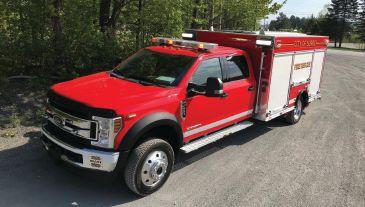
This apparatus is built on an F550 crew cab, and features a Hale midship 1250 GPM pump, 230 G tank, FoamPro 2001 foam system, and Whelen Lighting warning and scene lights, including 2 telescopic flood/spot lights.
DEPARTMENT: Surrey Fire Service, British Columbia
PIERCE 107’ ASCENDANT LADDER | COMMERCIAL EMERGENCY EQUIPMENT
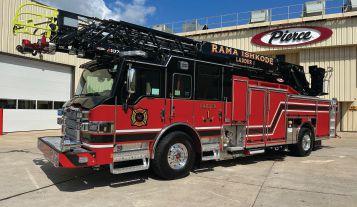
1 is built on a Pierce
DEPARTMENT
a
OSHKOSH GEN 3 STRIKER 8X8 ARFF VEHICLE | COMMERCIAL EMERGENCY EQUIPMENT
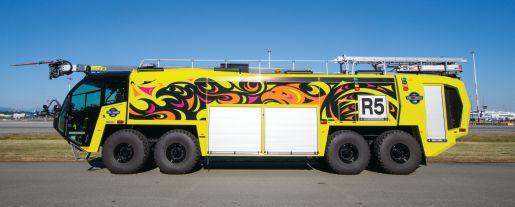
Adorned with a bold Musqueam livery, RED 5 features a 17,034L tank, 2,044L of foam, 249kg of dry chemical, roof and low-attack bumper turrets, and a 65’ Snozzle® HRET with piercing tip. This Striker® is powered by dual Scania DC16 16.4L V8 engines producing 770HP and 1950 ft-lb each. YVR’s newest Striker® also has TAK-4® Independent Suspension, rear-steering, and a 10KW hydraulic generator.
DEPARTMENT: Vancouver International Airport Fire and Rescue, British Columbia
COMMERCIAL TYPE 6 WILDLAND BRUSH TRUCK | COMMERCIAL EMERGENCY EQUIPMENT
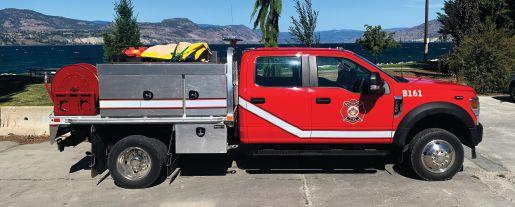
Built on an F550 chassis, Brush 161 is a fully-custom, in-house build by Commercial Emergency Equipment. This apparatus features a CET skid unit with a 300 G tank and 20 HP 300 GPM pump. B161 also features an emergency lighting and siren package from Whelen.
DEPARTMENT: Naramata Fire Rescue Service, British Columbia
(3) PIERCE 100’ AERIAL PLATFORMS | COMMERCIAL EMERGENCY EQUIPMENT
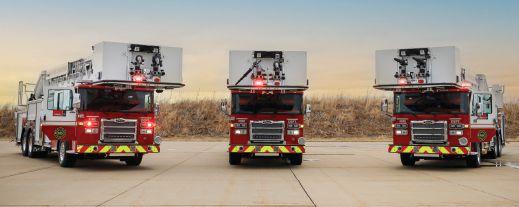
Sold under Commercial’s 10-Year aerial contract with the City of Calgary, towers 19, 25, and 31 are identical Pierce 100’ heavy-duty aerial platforms on EnforcerTM chassis. These apparatus are no pump/no tank “truck company” configurations with 500HP Cummins X12 engines, TAK-4® Independent Front Suspension, and Pierce Command ZoneTM electronics.
DEPARTMENT: Calgary Fire Department, Alberta
PIERCE 110’ ASCENDANT PLATFORM | COMMERCIAL EMERGENCY EQUIPMENT
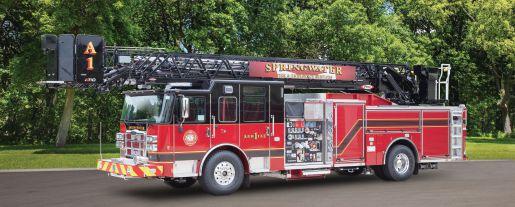
Ladder
Impel® chassis with
450HP Cummins L9 engine, TAK-4® Independent Front Suspension, Pierce PUCTM 1500 GPM pump, and a 500 G tank. This ladder has a 6KW Harrison PTI generator, 360-degree camera system with stabilizer placement cameras, and lighting from Whelen and HiViz LED. This build also features a special memorial dedication along the black stripe on top of its Lumicoat cab, body, and ladder paint.
: Rama Fire Rescue Service, Ontario
Built on an EnforcerTM chassis, Aerial 1 is powered by a 450HP Cummins L9 and features a Waterous CSU 2000 GPM pump, 500 G tank, HuskyTM 3 foam system, lighting by Whelen, and scene lighting from HiViz LED.
DEPARTMENT: Springwater Township Fire and Emergency Services, Ontario
APPARATUSDIRECTORY
DARLEY
325 Spring Lake Drive
Itasca IL 60143
Tel: 630-735-3500
Toll free: 800-323-0244
Company Email: jimdarley@darley.com Web: www.darley.com
You serve others. We serve you.
Founded in 1908, Darley provides the highest quality pump, technology, and equipment solutions for first responders around the world. With origins in Midwest manufacturing, Darley offers a complete line of unmanned systems, immersive training technology, equipment and pumps. More information is available at www.darley.com.
For more than 48 years, E-ONE has been the cutting-edge builder of:
• Aerial ladders and platforms
• Custom and commercial pumpers and tankers
• Rescues of all sizes
• Industrial trucks
• Aircraft rescue firefighting vehicles
INNOVATION EVERY DAY: Leading the way with advanced engineering and innovative design, E-ONE is an industry leader in product innovations, new technologies and exceeding customer expectations. Recent product advancements include the Vector, the first North American style fully electric fire truck. With 327 kWh of proven automotive-grade batteries, Vector delivers the longest electric pumping duration in the industry. Other recent advancements include the 100” wide Cyclone Cab, HR 100 aluminum aerial ladder, short jack for HP 100 Platform, Active Air Purification System, Air Transportable ARFF vehicles, AXIS Smart Truck technology, the ECO IDLE-TEC idle mitigation system and clean cab options.
E-ONE’S SUPERIOR AERIAL DNA: The DNA of E-ONE aerials consist of a unique design that gives E-ONE the advantage of stability and brute strength. The welded extruded aluminum construction will never rust or need repainting, resulting in a lower cost of ownership. Key design features include a 2.5 to 1 structural safety factor, crisscross under-slung jacks, integral torque box chassis, and the strongest cab in the industry.

FERRARA FIRE APPARATUS, INC.
27855 James Chapel Rd., PO Box 249 Holden LA 70744
Tel: 225-567-7100
Toll free: 800-443-9006
Fax: 225-567-7675
Company Email: info@ferrarafire.com Web: www.ferrarafire.com
Take Command with Ferrara
Ferrara Fire Apparatus is a premier manufacturer of fire trucks and emergency response vehicles offering a full line oof pumpers, aerials, industrial, wildland, and rescue apparatus. Working hands-on with both municipal and industrial fire departments, the Ferrara team thrives on understanding response needs to custom design fire apparatus that will stand the test of time.
DRAEGER SAFETY CANADA LTD.
2425 Skymark Ave., Unit 1
Mississauga ON L4W 4Y6
Tel: 905-212-6600
Toll free: 877-372-4371
Fax: 905-212-6602
Company Email: susan.yu@draeger.com
Web: www.draeger.com/en-us_ca/Safety/Firefighting
Contact us at +1 877-372-4371 to learn more about SCBA, live fire training system, fixed gas and flame detector, mobile gas detector, thermal imaging camera, drugs and alcohol testing equipment and the rest of our portfolio.
Product services and technical training courses are offered at our Mississauga, Ontario and Edmonton, Alberta locations throughout the year. Arrange for service of your SCBA and gas detector now.
E-ONE
1601 S.W. 37th Ave.
Ocala FL 34474
Tel: 352-237-1122
Fax: 352-237-1151
Company Email: info@e-one.com Web: www.e-one.com
E-ONE. STRENGTH THROUGH EXCELLENCE.
E-ONE, a full spectrum builder of fire apparatus, is the pioneer and recognized leader in extruded aluminum and stainless-steel construction. With their advanced engineering, fully integrated manufacturing and highly engaged dealer network, the proud customer focused E-ONE team delivers strength through excellence.
SAFEST CAB IN THE INDUSTRY: Keep your crew safe with the cab that withstands over 5 times the static roof load and over twice the frontal impact required by NFPA 1901. The structural roll cage type design provides maximum protection and comfort for firefighters.
INTEGRAL TORQUE BOX CHASSIS: The integral torque box chassis is a unique design that provides a solid foundation and low center of gravity for the truck. This provides outstanding stability and strength, with the same 2.5 to 1 structural safety factor as the aerial device.
For further information on E-ONE apparatus or to find an E-ONE dealer near you, visit e-one.com
• Darch Fire (Member of 1200 Degrees) 9-402 Harmony Road, Ayr, Ontario N0B 1E0 800-254-2049
Territory: Ontario
• FireTek Emergency Vehicles LTD 30686-A Matsqui Place Abbotsford, BC V2T 6L4
Territories: Alberta, Saskatchewan, Nunavut, British Columbia, Northwest Territories
• Keewatin Truck Service
610 Keewatin St., Winnipeg, MB R2X 2R9 Phone 204-633-2700
Territory: Manitoba
• Techno Feu Apparatus Maintenance (Member of 1200 Degrees)
105 Route Marie-Victorin Saint-Francois-Du-Lac, PQ J0G 1M0
Territories: Quebec, Atlantic Canada
Taking crew safety and apparatus durability very seriously, Ferrara uses a fine-tuned construction process and heavy-duty materials to build the strongest fire trucks in the industry. We offer a custom chassis product line that exceeds minimum requirements, making them the safest available. With its extra-heavy-duty construction, you can take command with Ferrara.
For more information on Ferrara apparatus or to find a Ferrara dealer near you, visit ferrarafire.com
• SAFETEK EMERGECY VEHICLES
30686-a Matsqul Pl., Abbotsford BC V2T6L4 833-347-3835
www.firetrucks.ca
FIRE FIGHTING IN CANADA/CANADIAN FIREFIGHTER
PO Box 530, 105 Donly Dr. S. Simcoe ON N3Y 4N5
Tel: 289-221-6605
Fax: 888-404-1129
Company Email: aszpakowski@annexbusinessmedia.com
Web: www.firefightingincanada.com
Canada’s National Fire Publication since 1957. Buyers Guide test
APPARATUSSHOWCASE
PIERCE 110’ ASCENDANT PLATFORM | COMMERCIAL EMERGENCY EQUIPMENT
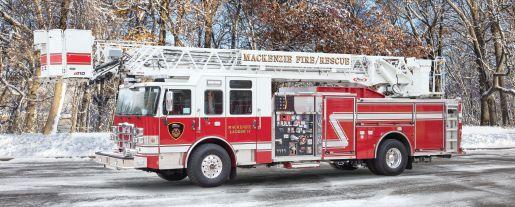
Ladder 11 is an EnforcerTM powered by a 450HP Cummins L9 engine. This apparatus is equipped with a Waterous CSU 2000 GPM pump, 500 G tank, HuskyTM 12 foam system with 20 G cell, and TAK-4® Independent Front Suspension.
DEPARTMENT: District of Mackenzie Fire Rescue Department, British Columbia
PIERCE IMPEL PUC RESCUE PUMPER | COMMERCIAL EMERGENCY EQUIPMENT
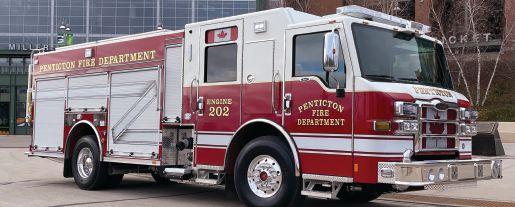
Assembled on an Impel® chassis, Engine 202 is powered by a 450HP Cummins L9 engine, and features TAK-4® Independent Front Suspension, 1,500 GPM PUCTM pump, and Pierce Command ZoneTM electronics.
DEPARTMENT: Penticton Fire and Rescue, British Columbia
(2) PIERCE IMPEL PUMPERS | COMMERCIAL EMERGENCY EQUIPMENT
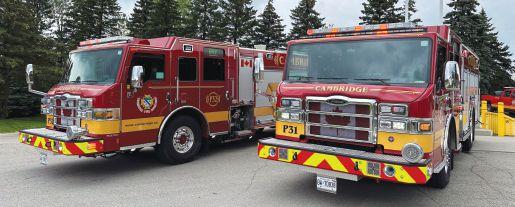
Pumpers 31 and 32 are both Pierce Impel® Chassis, powered by 450HP Cummins L9 engines. These builds feature 650 G tanks, 1500 GPM PUCTM pumps, HuskyTM 3 foam systems, Pierce Command ZoneTM electronics, lighting by Whelen, and both are equipped with Pierce Idle Reduction Technology (IRT).
DEPARTMENT: Cambridge Fire Department, Ontario
(2) PIERCE ENFORCER PUMPERS | COMMERCIAL EMERGENCY EQUIPMENT
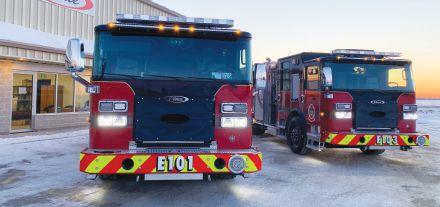
MAXIMETAL MAXISABER PUMPER | COMMERCIAL EMERGENCY EQUIPMENT
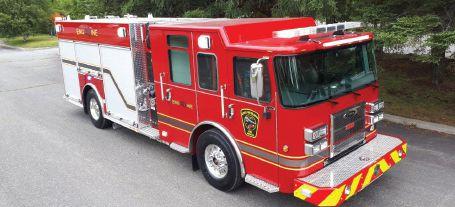
Engine 40 is built on a MaxiSaber chassis and is powered by a 380HP Cummins L9 engine. This apparatus has a Waterous midship 1500 GPM pump, 1000 G tank, warning lights by Whelen, scene lights by HiViz LED’s, and a PARAGON™ pumphouse.
DEPARTMENT: Leeds and the Thousand Islands Township Fire Department, Lansdowne, Ontario
PIERCE 100’ ASCENDANT PLATFORM | COMMERCIAL EMERGENCY EQUIPMENT
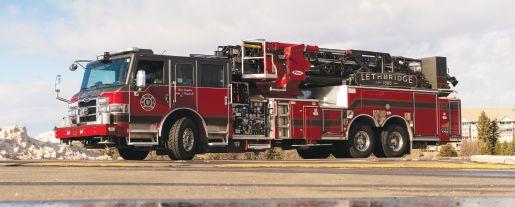
Lethbridge’s Tower 11 is built on a Velocity® chassis and powered by a 650HP Cummins X15 engine. This apparatus features a 300 G tank, 2000 GPM Waterous pump, HuskyTM 12 foam system, Pierce Command ZoneTM electronics, and TAK-4® Independent Front Suspension.
DEPARTMENT: Lethbridge Fire & Emergency Services, Alberta
OSHKOSH GEN 3 STRIKER 6X6 ARFF VEHICLE | COMMERCIAL EMERGENCY EQUIPMENT
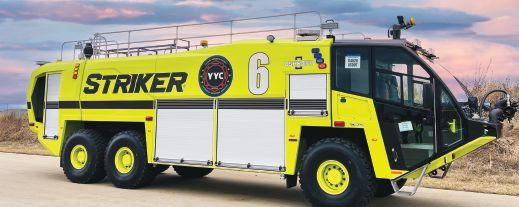
YYC’s RED 6 has an 11,356 L tank, 1590 L of AFFF, 227kg of dry chemical, a Waterous pump, and TAK-4® Independent Suspension. RED 6 is powered by a Scania DC16 V8 engine outputting 670HP and was delivered with a 10KW generator and FLIR Camera.
DEPARTMENT: Calgary International Airport Emergency Response Services, Alberta
PIERCE 110’ ASCENDANT PLATFORM | COMMERCIAL EMERGENCY EQUIPMENT
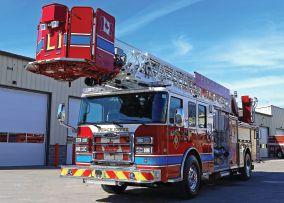
DEPARTMENT: Peace River Fire
DEPARTMENT: Winnipeg Fire Paramedic
Engines 101 and 103 are Pierce EnforcerTM Chassis with a 450HP Cummins L9 engines, Hale 1750 GPM pumps, and 500G tanks with 40G Foam cells. These apparatus both feature Pierce Idle Reduction Technology (IRT), TAK-4® Independent Front Suspension, HuskyTM 3 foam systems, Pierce Command ZoneTM electronics, and lighting from HiViz LED and Whelen.
Service, Manitoba
Ladder 1 was built on an EnforcerTM chassis and is powered by a 450HP Cummins L9 engine. This apparatus features a 500 G tank, Waterous midship 2,000 GPM pump, HuskyTM 12 foam system, Pierce Command ZoneTM electronics, and TAK-4® Independent Front Suspension.
Department, Alberta
APPARATUSDIRECTORY
of equipment for the most extreme conditions in the world. We are a Bronto Skylift articulated aerial platform dealer, as well as the exclusive Canadian distributor of Sutphen Corporation aerial ladders and platforms. We truly build “One Tough Truck” and boast over 100 years of quality.
COAST TO COAST SALES AND SERVICE NETWORK:
FIREHALL BOOKSTORE
PO Box 530, 105 Donly Drive S.
Simcoe ON N3Y 4N5
Tel: 877-267-3473
Fax: 877-624-1940
Company Email: info@firehallbookstore.com
Web: www.firehallbookstore.com
Firehall Bookstore is your headquarters for training & public education materials, providing resources to the Canadian Fire Service and its professionals including textbooks, DVDs, NFPA standards, and fire safety & prevention educational materials for community outreach. Product lines include: NFPA, IFSTA, Jones & Bartlett, Fire Engineering Books, Action Training Systems, Pearson/Brady, Exam Preps from Dr. Ben Hirst/Performance Training Systems as well as our Firehall Mall section offering gloves, lights, tools and accessories from A.J. Stone and ResQTech.
FIREHALL.COM
PO Box 530, 105 Donly Dr. S.
Simcoe ON N3Y 4N5
Tel: 289-221-6605
Fax: 888-404-1129
Company Email: aszpakowski@annexbusinessmedia.com Web: www.firehall.com
Firehall.com provides an excellent forum for exchange among firefighters and others involved in the fire service. Advertising options include banner ads and e-blasts and offer extensive exposure to the rank and file.
FORT GARRY FIRE TRUCKS LTD.
RR 2, 53 Bergen Cutoff Rd. Winnipeg MB R3C 2E6
Tel: 204-594-3473
Toll free: 800-565-3473
Fax: 204-694-3230
Company Email: brian nash, bnash@fgft.ca Web: www.fgft.com
Fort Garry Fire Trucks is Canada’s oldest and largest manufacturer of high-quality fire apparatus offering a complete line of quality pumpers, tankers, rescues, aerial devices, and custom-designed and engineered specialized units. With headquarters based in Winnipeg, Manitoba, Canada, our customers emanate from cities, towns, and municipalities throughout Canada, the U.S., and abroad with the harshest weather, climates, and terrain. We boast one of the largest fire apparatus engineering departments amongst our competitors, devoted to the design and production
• Brian Nash — Vice President – Sales –bnash@fgft.ca; Toll-Free: 1-800-565-3473 (ext. 3471) Cell: 204-981-7845
• Chad Kamminga — Service & Warranty –ckamminga@fgft.ca; Toll-Free: 1-800-565-3473 Direct Phone: 204-594-3478
REGIONAL SALES REPRESENTATIVES:
• Atlantic Canada — Adam Baldwin –abaldwin@fgft.ca; Toll-Free: 1-800-565-3473 (ext. 2006); Cell: 902-888-9806
• Eastern Ontario & Quebec — Peter Somerton –psomerton@fgft.ca; Toll-Free: 1-800-565-3473 (ext. 2005); Cell: 613-859-5747
• Central Ontario — Chris Pilek – cpilek@fgft.ca; Toll-Free: 1-800-565-3473 (ext. 3481); Cell: 204-296-1915
• Northern Ontario — Bob Lock – block@fgft.ca Toll-Free: 1-800-565-3473 (ext. 2004); Cell: 705665-2195
• Manitoba & Saskatchewan — Lance Spencer –lspencer@fgft.ca; Toll-Free: 1-800-565-3473 (ext. 3475); Cell: 204-995-3895
• Alberta — Taylor Young – tyoung@fgft.ca; Toll-Free: 1-800-565-3473 (ext. 3466); Cell: 204-298-9923
• British Columbia — Al Anderson & Bryan Anderson – Fire Power Emergency Apparatus – alan@firepowerplus.com or bryan@firepowerplus.com; Phone: 1-250-668-2673 or 1-250-3271904
• Northwest Territories — Rick Penner – rpenner@ fgft.ca; Toll-Free: 1-800-565-3473 (ext. 2024); Cell: 204-981-5118
• Manitoba / Northwestern Ontario / Nunavut Aboriginal / Northern Sales Manager — Ron Lavallee –rlavallee@fgft.ca; Toll-Free: 1-800-565-3473; Cell: 204-791-1167
• Yukon — Gil Bradet – Nordique Fire Protection; sales@nordiquefire.ca; Phone: 867-334-6603
• United States (West) — Lloyd Hamilton – US Fire Equipment; lloyd@usfireequipment.com; Phone: 253-863-1301
• United States (East) — Philip Vander Molen –Vander Molen Fire Apparatus; vmfire@verizon.net; Phone: 315-952-7787
FSI® NORTH AMERICA, A DIVISION OF FIRE SAFETY INTERNATIONAL INC.®
311 Abbe Rd. Sheffield Lake OH 44054
Tel: 440-949-2400
Fax: 440-949-2900
Company Email: sales@fsinorth.com Web: www.fsinorth.com
FSI – Celebrating 25 years of serving the Life Safety Market worldwide 1997 – 2022
FSI North America® is a Full line supplier of mobile, portable and fixed DAT® series hazmat decon shower systems. Shower Systems include traditional water/ solution based decon, electrostatic equipment only decon, and Far UVC 222nm Disinfection.
FSI® TEAS® (Temporary Emergency Air Shelters) shelter systems, offered in among the world’s largest range of size and configurations, serve for Command, Isolation, Field Hospitals/Alternate Care from 101,000 beds, Sleeping, Fire Fighter Rehab, Temporary Morgues, and so on.
FSI® offers a complete range of Isolation Chambers, Rooms, Shelters, and Beds/Chairs systems.
FSI® also offers a complete range of sizes and configurations of Trailer Systems, Rescue Boats, Smoke Ejectors, and EMS supplies such as the FSI Transporter Disposable Backboards, Triage Tape Systems, FSI Medical Field Cots, and Mortuary supplies such as body bags.
APPARATUSSHOWCASE
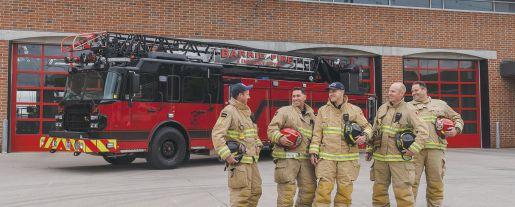
Built for Barrie Fire and Emergency Service were two Smeal 32M/105’ Aerials constructed on Spartan Gladiator ELFD chassis with Cummins X12 500HP engines, and Allison 4000 EVS transmissions. These aerials feature Hale QMax pumps with a flow of 2,000 IGPM, 400 IMP gallon water tanks, and a foam cell with 20 IMP gallon capacities. Ample storage is included featuring hose bed storage, shelves, roll out trays, and other miscellaneous equipment.
DEPARTMENT: Barrie Fire and Emergency Services
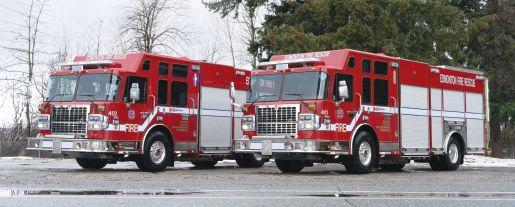
These Smeal Custom Pumpers were built on Spartan Gladiator LFD chassis with Cummins L9 450HP engines powered by Allison EVS 3000 transmissions, and feature Darley EM2-Stage pumps with a flow of 1,750 IGPM, 400 IMPG water tanks, Akron Electric deck gun, FoamPro 2002 with a 40 IMPG capacity, Command Light light tower and a SG09 generator system.
DEPARTMENT: Edmonton Fire Rescue Services, Alberta
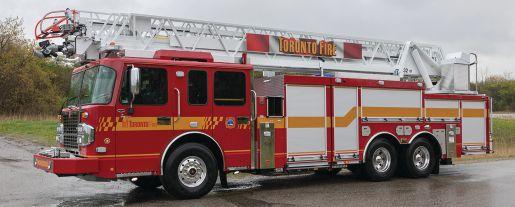
These six aerials were built on Spartan Gladiator MFD chassis with Cummins X15 565HP engines powered by Allison 4000 EVS transmissions and feature Darley EM pumps with a flow of 1,500 IGPM, and 420 IMP gallon water tank capacity, EHL hose load storage, angled aerial access, heavy-duty aluminum interiors, and ZeroRPM idle mitigation systems
DEPARTMENT: Toronto Fire Services
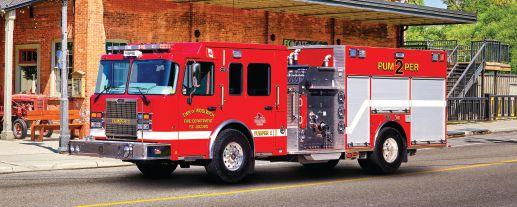
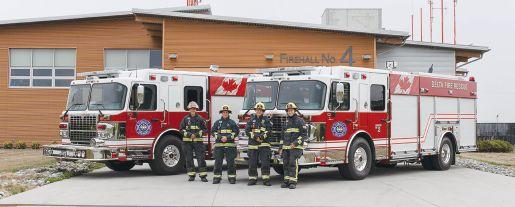
These twins were built on Spartan Gladiator MFD chassis with Cummins X12 500HP engines powered by Allison 4000 EVS transmissions for Delta Fire and Emergency Services. These pumpers have Hale QTWO pumps with a flow of 1,500 IGPM, 500 IMPG water tanks, and FoamPro 2002 foam systems with a capacity of 30 IMPG, and ZeroRPM idle mitigation system.
DEPARTMENT: Delta Fire and Emergency Services, British Columbia
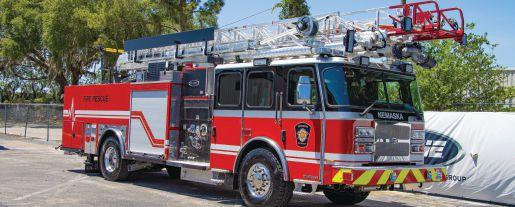
Built on a Typhoon chassis with 58” CA and fueled by a Cummins L9 450 hp engine, 3000 EVS transmission, Nemaska Fire Department’s new aerial features a 75’ welded extruded aluminum ladder, an 1892 liter water tank and a 6000 lpm Hale Qmax Pump.
DEPARTMENT: Nemaska Fire Department, Quebec
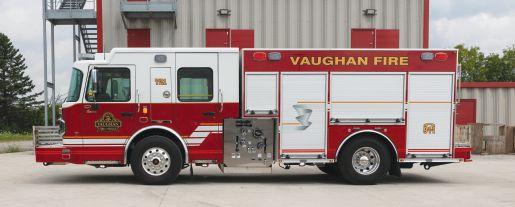
This Spartan ER IPS-NXT pumper was built on a Spartan Metro Star MFD chassis with a Cummins X12 500HP engine powered by an Allison 3000 EVS transmission. Equipped with a Waterous CSU pump with a flow of 2,000 IMPG, 420 IMPG water tank, and a Waterous Aquis 3.0 foam system with a 20 IMPG capacity, and ZeroRPM idle mitigation system.
DEPARTMENT: Vaughan Fire and Rescue Service
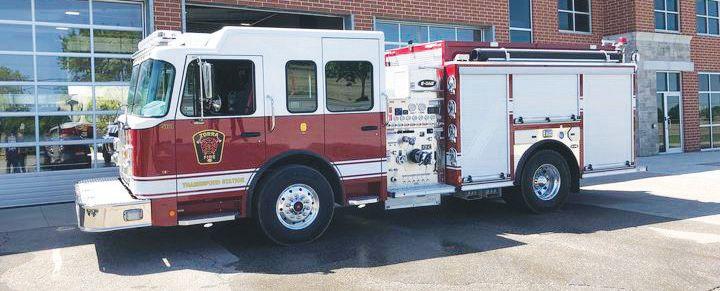
Built on a Spartan FC 94 chassis and fueled by a Cummins L9 380 hp engine, 3000 EVS transmission, Zorra Fire & Emergency Services’ new engine features a 3899 liter water tank and a 5679 lpm Hale Qmax
DEPARTMENT: Zorra Fire & Emergency Services, Ontario
Built on a 94” wide KME Panther LFD with 10” Raised Roof chassis and fueled by a 450 hp engine, 3000 EVS transmission, Woolwich Fire Department’s new engine features a 1250 gallon water tank, 20 gallon foam tank, FoamPro 2001 Foam System and a 1,500 gpm single stage pump.
DEPARTMENT: Township of Woolwich Fire Department, Ontario
Pump.
APPARATUSDIRECTORY
HIGHWATER HOSE INC.
12 rue Willard
East Angus QC J0B 1R0
Tel: 888-832-4310
Toll free: 888-832-4310
Fax: 819-832-4340
Company Email: sfraser@mercedestextiles.com Web: www.highwaterhose.com
Worldwide supplier of a wide range of rubber covered and lightweight, layflat fire and industrial hoses.
A NEW EVOLUTION IN FIRE FIGHTING:
• Deluge™ - Designed for high volume water supply where excellent friction loss, packability and cold temperature flexibility are critical.
• X-Stream® Plus - Designed for aggressive interior attack where excellent abrasion and cut resistance are essential and where color-coded attack lines are crucial.
• Available with iReflect®, WAYOUT® Couplings and iDentify® Coding System
OUR CANADIAN DISTRIBUTORS
• indsales.ca - Labrador
• cumings.ca - NS, NB, PEI
• seaboardindustrial.ca - Cape Breton
• larsenal.ca - QC
• municipalequipment.ca - S./S.E. ONT
• transcanadasafety.ca - N./N.C. ONT
• soucisalosafety.com – N./N.C. ONT
• realsafety.ca - MB
• wfrfire.com - BC, AB, SK, YT, NWT
HUB FIRE ENGINES
3175 McCallum Rd.
Abbotsford BC V2S 7W5
Tel: 604-859-3124
Toll free: 888-611-2896
Fax: 604-859-5821
Company Email: office@hubfire.com Web: hubfire.com
Our ongoing mission is to build quality and drive trust. Since 1959, our commitment to delivering the highest performing fire-rescue vehicles in Canada is guided by our pursuit of firefighter safety and efficiency. Our renowned customer-centric focus is provided through an experienced and dedicated team of in-house designers, fabricators, and finishers. Everything that bears the Hub name is purpose-built to achieve the highest possible standards and deliver maximum lifecycle value.
HUSKY PORTABLE CONTAINMENT
7202 SE International Ct.
Bartlesville OK 74006
Tel: 918-798-4415
Toll free: 800-260-9950
Fax: 918-333-2004
Company Email: sales@huskyportable.com
Web: www.huskyportable.com
HOLMATRO, INC.
505 McCormick Dr. Glen Burnie MD 21061
Tel: 410-768-9662
Fax: 410-768-4878
Company Email: info-usa@holmatro.com Web: www.holmatro.com
Holmatro is the world’s leading rescue equipment supplier. Our equipment is used by first responders around the world in rescue, special tactics and industrial applications. With two high-tech production plants in North America and Netherlands, we maintain the strictest quality, safety and performance standards in the market.
At Holmatro, we are dedicated to developing innovative tools using leading technology. Our Pentheon Series is the newest line of battery powered equipment that offers users the unrestrained performance, unparalleled speed and ultimate control you have never experienced before. And with battery management made easy, you are always rescue ready!
To see our newest products, schedule a demo and request more information, visit holmatro.com. You can count on us, for life.
Husky Portable Containment is a manufacturer of firefighting and environmental safety products. We specialize in portable water tanks used in water shuttle operations. We also manufacture salvage covers, hose bed covers, staging mats, strainers, decontamination pools and showers, bladder tanks and spill containment berms.
KME
One Industrial Complex
Nesquehoning PA 18240-1499
Toll free: 800-235-3928
Company Email: kme@kmefire.com Web: www.kmefire.com
KME is Engineered to Serve!
KME is a manufacturer of high quality, custom fire apparatus serving communities across the country. Choose from a wide range of products that includes Aerials, Pumpers, Tankers, Rescues, and Wildland vehicles. Our nationwide network of sales and service centers supports you long after the sale with the parts and service you need to continue your life-saving
missions. For more information on KME Fire Apparatus or to find a KME dealer near you, visit kmefire.com
Your KME authorized dealers include:
• METZ FIRE & RESCUE 3-304 Stone Road W. #325, Guelph, Ontario N1G4W4 519-763-9955
• SAFETEK EMERGECY VEHICLES 30686-a Matsqul Pl. Abbotsford BC V2T6L4 833-347-3835 www.firetrucks.ca
• 1200 Degrees 105, route Marine-Victorin St-Francois-du-Lac, Quebec JOG 1MO 888-568-2777
• DEPENDABLE EMERGENCY VEHICLES 275 Clarence St. Brampton, ON L8W 3R3 1-800-268-0871

KOCHEK CANADA
62 Bradwick Dr., Vaughan ON L4K 1K8
Tel: 416-602-0404
Company Email: sales@kochekcanada.com Web: www.kochek.com sales@kochekcanada.com
Robin Lewis, Customer Service laura@kochekcanada.com
Laura Kenyon, Regional Director
MAXIMETAL INC.
9345, 25e Ave
Tel: 418-228-6637





Saint-Georges, QC G6A 1L1
Toll free: 800-510-6337 Fax: 418-228-0493
Company Email: maximetal@maximetal.ca Web: www.maximetal.com
MAXIMETAL, an Oshkosh Corporation company, is a dynamic, innovative company with 40 years’ experience designing and building optimized intervention vehicles for Fire & Emergency as well as Power & Utility customers. OUR MISSION: To support those who keep our families safe and comfortable by designing and building vehicles that stand out for their quality and ingenuity.
MAXIMETAL is represented by Canada’s most robust apparatus dealer network, coast-to-coast. Find your dealer here: maximetal.com/find-a-dealer/
TANKER | FORT GARRY FIRE TRUCKS
APPARATUSSHOWCASE
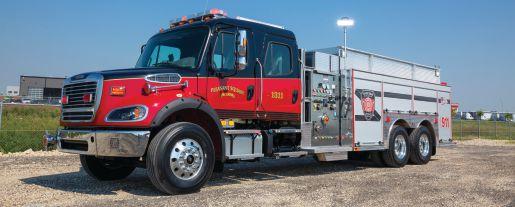
This pumper tanker was built on a Freightliner M2 112 crew cab chassis and is powered by a Cummins L9 450HP diesel engine and an Allison 3000 EVS transmission. This 5083-salt water marine grade aluminum unit features a Hale Midship pump, 2 FRC Scene Lights and a 2000 IG tank.
DEPARTMENT: Pleasant Square Volunteer Fire Department, New York
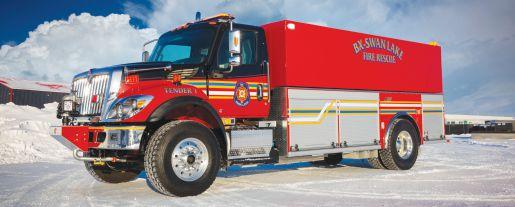
This fire tanker was assembled on an International HV607 regular cab chassis that is powered by a Cummins L9 350HP diesel engine and an Allison 3000 EVS transmission. This 5083-salt water marine grade aluminum unit features a Hale PTO pump, a poly 2000 IG tank, and a Foam Pro 1600 – Class A foam proportioning system.
DEPARTMENT: BX Swan Lake Fire Rescue, British Columbia
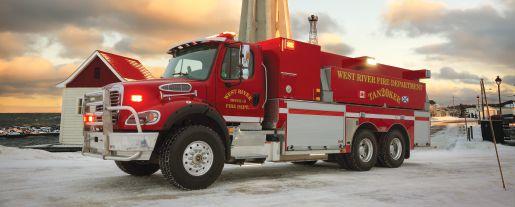
This wet-side tanker was built on a Freightliner M2 112 tandem chassis with a Cummins L9 505HP diesel engine and an Allison 4000 EVS transmission. This 5083-salt water marine grade aluminum tanker comes with a Hale Sidekick 750 GPM pump, a 3000 IG tank, and a Zico hydraulic portable tank holder with a Husky 2900 IG porta tank.
DEPARTMENT: West River Fire Department, Nova Scotia
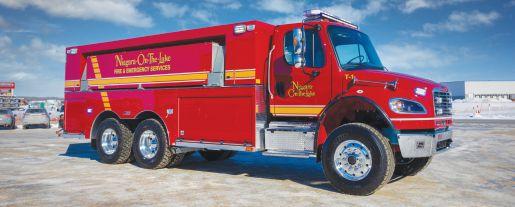
WALK-AROUND RESCUE | FORT GARRY FIRE TRUCKS
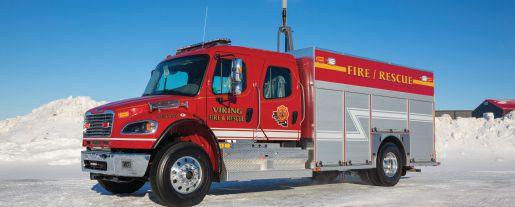
This 16-foot walk-around rescue was manufactured on a Freightliner M2 106 crew cab chassis that is powered by a Cummins L9 360HP diesel engine and an Allison 3000 EVS transmission. This 5083-salt water marine grade aluminum build features a rooftop Command light, ample compartment space with various slide-out tool boards, tip-down trays, and two hydraulic hose reels.
DEPARTMENT: Viking Fire & Rescue, Alberta
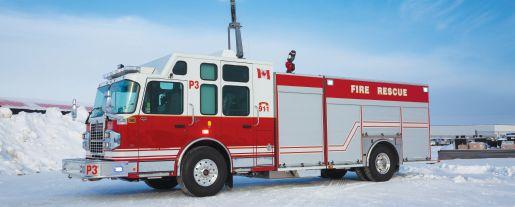
This emergency rescue pumper was crafted on a Spartan Metro Star 20-inch raised roof chassis with a Cummins L9 450HP diesel engine and an Allison 3000 EVS transmission. This 5083-salt water marine grade aluminum pumper features a Hale Midship QFLO 1250 pump, an 800 IG tank, a rooftop LED Command Light, and a Foam Pro 2001 –Class A foam proportioning system.
DEPARTMENT: City of Cornwall Fire Services, Ontario
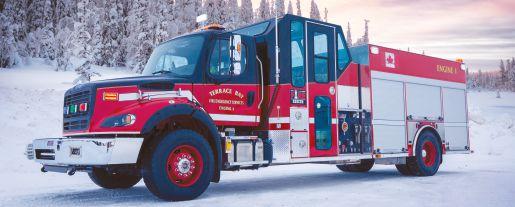
DEPARTMENT: Terrace Bay Fire & Emergency Services, Ontario
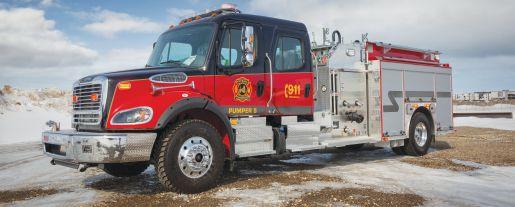
DEPARTMENT
PUMPER
TANKER | FORT GARRY FIRE TRUCKS
RESCUE PUMPER | FORT GARRY FIRE TRUCKS
TANKER | FORT GARRY FIRE TRUCKS
RESCUE PUMPER | FORT GARRY FIRE TRUCKS
TANKER | FORT GARRY FIRE TRUCKS
MXV PUMPER | FORT GARRY FIRE TRUCKS
APPARATUSDIRECTORY

MEIKO CLEAN SOLUTIONS CANADA INC.
P.O. Box 21138, Meadowvale Postal Outlet
Mississauga ON L5N 6A2
Tel: 800-556-3456
Toll free: 800-55-MEIKO
Company Email: info@meiko.ca
Web: www.meiko.ca/en_us
Breathe easy with TopClean Series from MEIKO: A multiple-machine solution for PPE and SCBA cleaning and decontamination.
TopClean units use time, temperature and chemo-mechanical action to provide exceptional cleaning for masks, SCBA packs, bottles, helmets, boots and more. They wash every crevice and surface of your PPE to effectively remove dangerous toxins and residues. Years of scientific research went into the design that delivers the same level of clean, every time.
As the leading global manufacturer of cleaning and disinfection technology for nearly 100 years, MEIKO can help you take safety and hygiene to a whole new level. Say goodbye to manual cleaning and invest in MEIKO’s professional decontamination solution.

MERCEDES TEXTILES LTD.
Montreal QC
Tel: 514-335-4337
Fax: 514-335-9633
Company Email: sales@mercedestextiles.com Web: www.mercedestextiles.com
For over 45 years, Mercedes Textiles has proudly delivered the most innovative and reliable water delivery systems to the firefighting community. From hoses & couplings to portable pumps, municipal to forestry, we put our technology where your courage is.
FIRE HOSE & COUPLINGS:
• KrakenEXO® – The most advanced UL-listed attack fire hose on the market – weighs less, kinks less, flows more water, beats the heat
• MegaFlo® Breather – Large volume attack & supply hose designed for fastest deployment, easiest recovery & best packability
• Highwater Hose Inc. – We offer of a wide range of rubber-covered lightweight, lay-flat & industrial hoses via our partner brand
• Many hoses available with iReflect® & WAYOUT® couplings and iDentify® Coding System – all manufactured under one roof, customized to your specifications, & NFPA 1961 compliant
• Best warranty on the market: 2-year All Hazards, 10-year manufacturing defects & Lifetime against delamination (2-10-L)
POWERFUL FIRE PUMPS:
We are a leading manufacturer of high pressure, lightweight, portable fire pumps for forestry & municipal fire applications. When you need water, we deliver.
OUR DISTRIBUTORS:
• www.indsales.ca – Labrador
• www.cummings.ca – NS, NB, PEI
• www.seaboardindustrial.ca – Cape Breton
• www.larsenal.ca – QC
• www.municipalequipment.ca – S/S.E. ONT
• www.transcanadasafety.ca – N/N.C. ONT
• www.soucisalosafety.com – N/N.C. ONT
• www.realsafety.ca – MB
• www.wfrfire.com – BC,AB,SK,YT,NWT
METZ FIRE AND RESCUE
3-304 Stone Rd. W. Guelph ON N1G 4W4
Tel: 519-829-9149
Fax: 519-763-6682
Company Email: john@metzfirerescue.com Web: www.metzfirerescue.com
Canadian dealer for KME Fire Apparatus. Specializing in custom and commercial pumpers, aerial, rescue, tankers and wildland units.

NEDERMAN CANADA
5865 McLaughlin Road Unit 1 Mississauga ON L5R 1B8
Tel: 866-332-2611
Company Email: customerservice.ca@nederman.com Web: www.nederman.com
With 75+ years of experience and well over 100,000 installations, Nederman offers diesel exhaust extraction systems designed specifically for emergency and fire vehicles. From the planning and design stage to installation, commissioning and maintenance support Nederman is your clean air partner.
Nederman Magna Systems reliably capture 100% of dangerous diesel exhaust emissions with source capture technology that prevents fumes from traveling throughout the station. Exhaust fumes are removed right at the tailpipe – the most efficient method. Our system design supports ergonomic attachments and quick-release when speed is required for fast station exits. Magna Systems have no coiled hoses or loops and saves space between trucks.
Nederman’s wide variety of product solutions are trusted at thousands of fire stations around the world with high quality construction and exceptional performance that maximized protection.
NFPA
c/o Firehall Bookstore, PO Box 530, 105 Donly Dr. S. Simcoe ON N3Y 4N5
Tel: 877-267-3473
Fax: 877-624-1940
Company Email: info@firehallbookstore.com
Web: www.firehallbookstore.com
Canadian distributor for NFPA standards, memberships, Fire Prevention Week™, Sparky the Fire Dog® and other public education items.
ONTARIO FIRE TRUCK INC.
1397 Old Hwy 99
Dundas ON L9H 5E3
Tel: 905-628-3324
Toll free: 800-474-6698
Company Email: sales@ontariofiretruck.com Web: ontariofiretruck.com
Ontario Fire Truck Inc. is Ontario’s first choice for Fire Apparatus Service & Sales. We are your first and only call for Fire Apparatus Service, Sales & Testing! We offer you the finest repairs in the industry; we offer a 24 hour, 7 days a week service. All of our service staff is fully licensed Class “A” & “T” both provincially and EVT certified. We are fully insured and have over 30 years experience to provide the best service at your location. Our fully stocked mobile service trucks travel all over Ontario! Why take your truck anywhere, we come to you for both Service and Testing!
Our Sales staff has over 80 years combined experience in the fire industry, we offer only the finest Seagrave Fire Apparatus, and Our Company believes only the best will do! We are the authorized sales and Service Company for Seagrave fire apparatus and equipment companies.
“The bitterness of poor quality remains, long after the sweetness of low price is forgotten”
RESCUE PUMPER | FORT GARRY FIRE TRUCKS
APPARATUSSHOWCASE
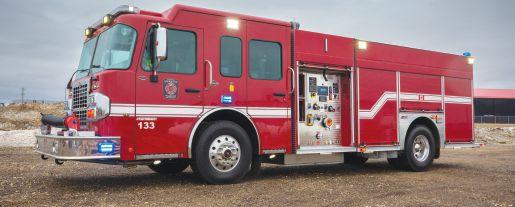
This emergency rescue pumper was manufactured on a Spartan Metro Star 10-inch raised roof chassis with a Cummins L9 400 HP diesel engine and an Allison 3000 EVS transmission. This 5083-salt water marine grade aluminum pumper features a Hale Midship QMAX XS 1500 (SAM System) pump, an 800 IG tank, a rooftop Elkhart Cobra rooftop monitor, and a 3.3 A&B ADT smart foam system. DEPARTMENT: Walkerton Fire Department, Ontario
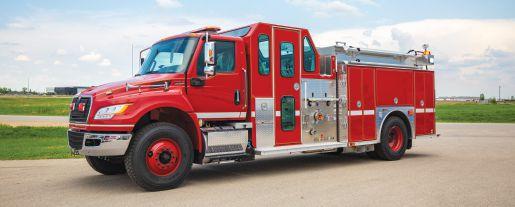
This MXV pumper was assembled on an International MV607 regular cab chassis and is powered by a Cummins L9 300HP diesel engine and an Allison 3000 EVS transmission. This 5083-salt water marine grade aluminum pumper features a Hale Midship DSD1250 pump and a 1000 IG tank.
DEPARTMENT: Nunavut Fire Marshal’s Office, Nunavut
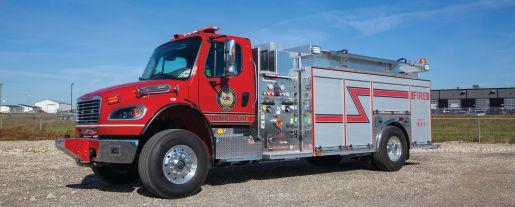
and
pumper
was
by a
on a Freightliner M2 106 regular cab
L9 360HP diesel
and an Allison 3000
This 5083-salt water marine grade aluminum build comes equipped with a Waterous PTO CXPA1250 pump, a 1500 IG tank, and a custom 2660 IG Husky porta tank.
DEPARTMENT: Thorhild County Emergency, Fire & Rescue Services, Alberta
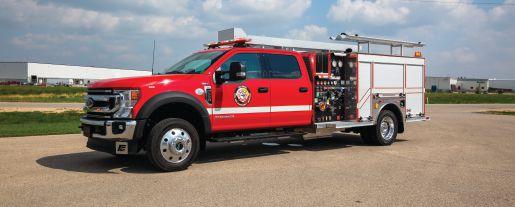
This mini rescue pumper was built on a Ford F550 4x4 crew cab chassis with a 6.7L V8 diesel engine. This 5083 salt-water marine grade pumper comes equipped with a Darley LSM1000 pump, a 250 IG poly tank, and a Federal Signal emergency lights package.
DEPARTMENT: Lac Seul Fire and Emergency Services, Ontario
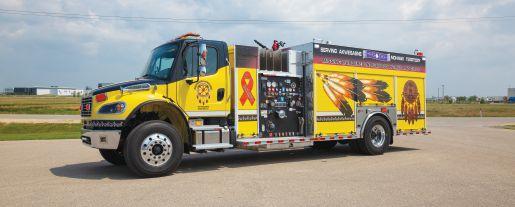
This emergency rescue pumper was built on a Freightliner M2 106 regular cab chassis and is powered by a Cummins L9 360 HP diesel engine and an Allison 3000 EVS transmission. This 5083-salt water marine grade aluminum build comes equipped with a Hale Midship DSD1250 pump, a 1000 IG tank, TFT Crossfire rooftop monitor, and a Foam Pro 2001 – Class A foam proportioning system.
DEPARTMENT: Hogansburg Akwesasne Volunteer Fire Department, Quebec/New York
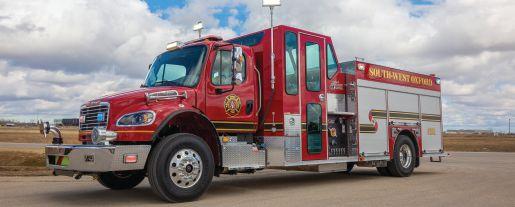
This emergency rescue pumper was crafted on a Freightliner M2 106 regular cab chassis and is powered by a Cummins L9 360HP diesel engine and an Allison 3000 EVS transmission. This 5083-salt water marine grade aluminum unit comes with a Hale Midship DSD1500 pump, an 800 IG tank, 2 FRC LED floodlights, and a Foam Pro 2001 –Class A foam proportioning system.
DEPARTMENT: Southwest Oxford Township Fire Department, Ontario
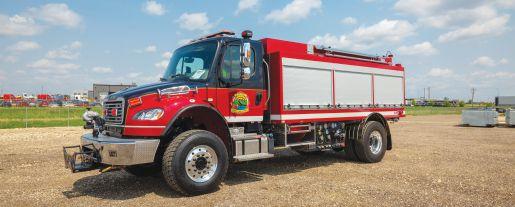
This water delivery truck
a Zico hydraulic porta tank rack, and a 2500 USG Husky porta tank.
DEPARTMENT: Lak’Was Wildfire Water Service, British Columbia
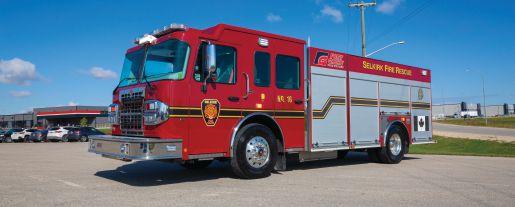
This emergency rescue pumper was crafted on a Spartan Metro Star 10-inch raised roof chassis with a Cummins L9 380HP diesel engine and an Allison 3000 EVS transmission. This 5083-salt water marine grade aluminum pumper features a Hale Midship QMAX XS 1500 (SAM System) pump, an 800 IG tank, and a SAM injection Class A foam system.
DEPARTMENT: Selkirk Fire Rescue, Manitoba
RESCUE PUMPER | FORT GARRY FIRE TRUCKS
MXV PUMPER | FORT GARRY FIRE TRUCKS
RESCUE PUMPER | FORT GARRY FIRE TRUCKS
PUMPER TANKER | FORT GARRY FIRE TRUCKS
This
tanker
manufactured
chassis
is powered
Cummins
engine
EVS transmission.
WATER DELIVERY TRUCK | FORT GARRY FIRE TRUCKS
MINI RESCUE PUMPER | FORT GARRY FIRE TRUCKS
RESCUE PUMPER | FORT GARRY FIRE TRUCKS
APPARATUSDIRECTORY
PIERCE MANUFACTURING INC.
PO Box 2017
Appleton WI 54912-2017
Tel: 920-832-3000
Web: www.piercemfg.com
Pierce Manufacturing: Perform. Like No Other.
It’s more than a tagline. It’s a lifeline extended to every firefighter served, and the expectation of every person and product at Pierce Manufacturing Inc. Behind the design of every highly customized and engineered pumper, aerial, tanker and rescue unit is a team of professionals whose mission is to build a truck, exactly how it’s ordered. The Pierce team pours everything they have into making sure a fire truck is ready to perform.
Pierce heavily invests in product development and programs to advance firefighter safety, education and performance. Performance-driven design means Pierce is continually evolving to provide firefighters with industry-leading advancements and unmatched innovation. As a subsidiary of Oshkosh Corporation (NYSE: OSK), the experienced team has access to an arsenal of cutting-edge technologies and revolutionary processes which have contributed to the development of six custom chassis and best-in-class innovations. Innovations include the Volterra™ platform of electric vehicles, Ascendant Class of Aerials®, Pierce Ultimate Configuration (PUC™), Command Zone™, Idle Reduction Technology, TAK-4® Independent Suspension and Husky™ Foam Systems to name a few.
Commitment to performance extends beyond Pierce’s factory walls and into the communities served. A significant part of the Pierce legacy involves giving back to the community and the fire industry. Partnerships include the Firefighter Cancer Support Network, the National Fallen Firefighters Foundation, and Volunteer & Combination Officers Section of the IAFC.
See the Pierce difference for yourself at piercemfg.com.
PLYMOVENT
5655 Kennedy Road, Unit 1
Mississauga ON L4Z 3E1
Tel: 800-465-0327
Company Email: david.k@plymovent.com Web: www.plymovent.com
Since 1975, we have made it our business to ensure clean air in fire stations. We provide high-quality products to protect firefighters and others from exposure to hazardous diesel exhaust. Our source capture and removal systems are the recommended method for controlling exhaust emissions at your station. Breathe clean air at work with Plymovent. #hookupthehose
ROCKY MOUNTAIN PHOENIX
Head Office: 6415 Golden West Ave.
Red Deer AB T4P 3X2
Tel: 403-347-7045
Toll free: 800-494-4210
Fax: 403-347-7049
Company Email: info@rockymountainphoenix.com
Web: www.rockymountainphoenix.com
Rocky Mountain Phoenix is your one-stop-shop for top-of-the-line innovative fire truck and fire equipment products and services. We offer a comprehensive line of emergency apparatus and emergency equipment, brands you know and trust; Rosenbauer, MSA, Innotex, CET Fire Pumps, HURST Jaws of Life, Akron Brass, Haix, Key Hose, MSA Cairns, Task Force Tips, Ready Rack, Firecraft and many more.
We service what we sell. We provide 24/7 service for all your emergency fire apparatus and fire equipment through our Shop Service and Mobile Service. Annual fire pump testing, fire truck and fire equipment service and repairs for British Columbia, Alberta, Saskatchewan, Manitoba, Nova Scotia, PEI and all of Canada’s Arctic.
Visit Us: rockymountainphoenix.com
BRANCHES:
• 103-2285 Queen St., Abbotsford, BC V2T 6T3 Tel: 604-864-7303 | Fax: 604-864-4938 | Toll Free: 1-888-815-0500
• 320 Logan Rd., Bridgewater, NS B4V 3J8 Tel: 902-298-0415 | Toll Free: 1-844-530-4003
SAFETEK PROFIRE
1775 Meyerside Drive, Unit 11-12 Mississauga ON L5T 1E2
Tel: 905-564-7900
Toll free: 877-572-0040
Company Email: sales@firetrucks.ca | parts@ firetrucks.ca | service@firetrucks.ca
Web: www.firetrucks.ca
From our beginning in 1993, Safetek Profire set out to be a different kind of company. One that honoured and celebrated our customers. Get to know us and you’ll soon discover that our passion is to serve. We are proud to represent some of the most recognized fire-rescue vehicle brands including: E-ONE, EVI, KME, Ladder Tower, Metalfab, Smeal, Spartan, and SVI.
OUR MISSION:
Serving Those Who Keep Our Communities Safe.
* Not all brands are available in all regions.
SANI GEAR INC.
545 Trillium Dr, Unit 4
Kitchener ON N2R 1J4
Tel: 519-893-1235
Toll free: 888-660-1840
Company Email: firesafe@sanigear.ca
Web: http://www.sanigear.ca
Sani Gear Inc. is a verified ISP (Independent Service Provider) located in Kitchener, ON, and in Gatineau, QC. Sani Gear completes advanced cleaning, hydrostatic testing, advanced inspections, and full repair services, using all NFPA compliant materials. All services provided meet NFPA 1851 - 2020 edition, and are recognized by all manufacturers as a warranty center in Canada. Established in 2003, we have gained the trust of all departments from small volunteer services to large full time services. We pride ourselves on providing the same level of service to all of our customers no matter the size of department.

SEATS CANADA INC.
1800 Bonhill Road
Mississauga ON L5T 1C8
Tel: 905-364-5843
Fax: 905-364-7822
Company Email: seatsinfo@seatscanada.com
Web: www.seatscanada.com
We offer a complete line of quality Emergency Vehicle seating for driver, officer, crew, wall mount and jump seats. Engineered for comfort and safety, these seats have easy exit flip-up split headrest and are manufactured in a wide variety of covering material.
MAXI SABER PUMPER | L’ARSENAL
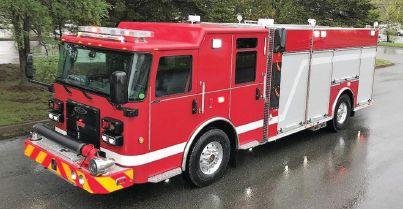
APPARATUSSHOWCASE
| MAXIMETAL
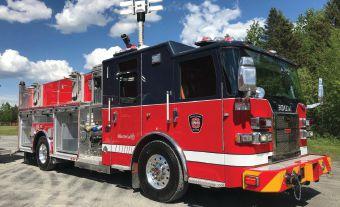
This Maxi Saber pumper was built on Pierce Saber FR 450HP chassis with a Waterous 1250 IGPM pump and features a FoamPro foam system.
DEPARTMENT: Service de protection contre l’incendie de Valcourt, Qebec
MAXIMETAL PARAGON-TITAN PUMPER-TANKER | SAFETY SOURCE FIRE
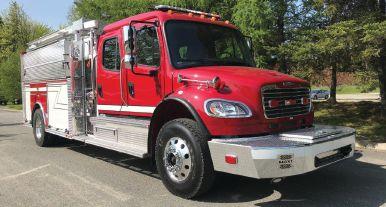
This 1000 IG pumper-tanker was assembled on a 4-door, 360HP Freightliner M2-106 chassis, and comes equipped with a 1050 IGPM Maxi Paragon™ pumphouse configuration, and a Maxi Titan hydraulic rack for ladders, suction and portable tank.
DEPARTMENT: Village of Norton, New Brunswick
(2) MAXI SABER HEAVY RESCUES | COMMERCIAL EMERGENCY EQUIPMENT
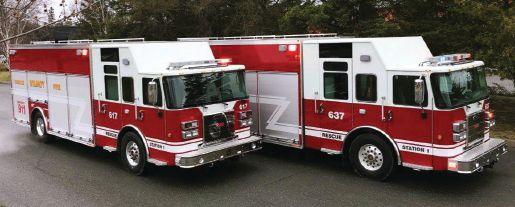
DEPARTMENT
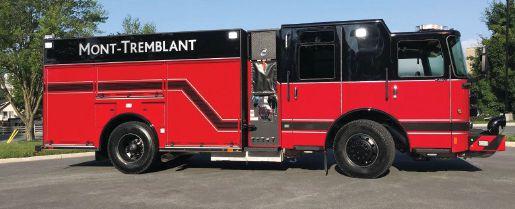
These 7 trucks, delivered in 2023, are 440 IG pumpers built on Pierce Saber FR 450HP chassis and come equipped with HALE QMAX-XS 6000 LPM pumps and low hose bed configurations.
DEPARTMENT: Service de sécurité incendie de Montréal, Quebec
MAXIMETAL F550 MINI-PUMPER | SAFETY SOURCE FIRE
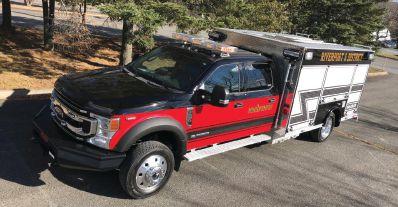
This mini-pumper was built on a 4-door 4x4 F550 chassis. The 230 IG truck comes equipped with a 1050 IGPM midship pump and a FoamPro 2001 foam system.
DEPARTMENT: Riverport District Fire Department, Nova Scotia
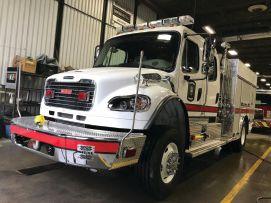
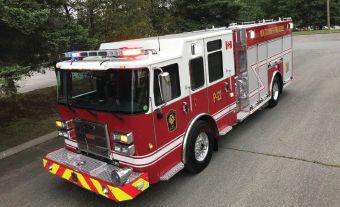
DEPARTMENT
(7) MAXI SABER PUMPERS
These 2 walkaround heavy rescue apparatus were built on Pierce Saber™ FR chassis with 24” raised roofs. Features include custom upfit with transverse slide-outs, multiple tool boards and winch mounts on both sides and walk-up rear with deep coffin compartments all around.
: Wilmot Township Fire Department, Ontario
MAXIMETAL PARAGON WUI PUMPER | MAXIMETAL
This Maxi 750 IG WUI pumper was crafted on a 375HP 4-door Freightliner M2-106 chassis, and comes equipped with a 1050 IGPM Maxi Paragon™ pump and roll configuration, bumper monitor, booster reel and a Zico rack system for ladders and suction.
DEPARTMENT: Bell Helicopter (Textron), Quebec
This Maxi 1000 IG pumper was built on a Pierce SaberTM FR 450HP chassis. Features include a 1250 IGPM pump in the Maxi ParagonTM pumphouse and the Pierce Idle Reduction Technology system.
DEPARTMENT: Mont Tremblant, Quebec
MAXI SABER PARAGON PUMPER | L’ARSENAL
Built on a Pierce Saber™ FR chassis, this Maxi 840 IG pumper comes equipped with a 1250 IGPM Waterous pump in the Maxi Paragon™ pumphouse and a Pierce HuskyTM 3 foam system.
: New Tecumseth Fire Rescue, Ontario
MAXI SABER PARAGON PUMPER | COMMERCIAL EMERGENCY EQUIPMENT
APPARATUSDIRECTORY
SPARTAN EMERGENCY RESPONSE
907 7th Ave. North
Brandon SD 57005
Tel: 605-582-4000
Company Email: info@spartaner.com
Web: www.spartaner.com
Spartan Emergency Response (Spartan ER) is a leading designer, manufacturer and distributor of custom emergency response vehicles, cabs, and chassis. Driven by a commitment to quality and innovation, Spartan and its portfolio of brands Spartan Fire Chassis, Smeal, and Ladder Tower (LT) offer a broad range of apparatus to meet your department’s specific needs and requirements.
Spartan has a rich history in fire apparatus manufacturing with over 250 years of combined experience. Fire Truck design, development, manufacturing and after the sale support have always been at the heart of the company and continues today.
At Spartan, we work with you from the start to translate your trucks specs into a design that gives you the right mix of safety, speed, agility, ergonomics, and serviceability that will last for the long haul.
SAFETEK EMERGECY VEHICLES
30686-a Matsqul Pl., Abbotsford BC V2T6L4 833-347-3835 www.firetrucks.ca
WATERAX INC.
6635 Henri-Bourassa W., Montreal QC H4R 1E1
Tel: 514-637-1818 | Toll free: 855-616-1818
Company Email: info@waterax.com
Web: www.waterax.com
Trusted by wildland firefighters around the world, WATERAX sets the industry standard by developing innovative, portable fire pumps and water-handling equipment designed to withstand demanding applications and rugged environments. With a time-tested legacy of reliability, WATERAX carries on its mission to place powerful, precision engineered pumps into the hands of the men and women who need to move water to protect our forests and most cherished natural resources from the ravages of wildfires!

ZIAMATIC CORP. (ZICO)
10 West College Ave., PO Box 337, Yardley PA 190678337
Tel: 215-493-3618 | Toll free: 800-711-3473 | Fax: 866-493-1401
Company Email: sales@ziamatic.com
Web: www.ziamatic.com
For over 50 years, Ziamatic Corp. has provided first responders with the tools and equipment they need to make their jobs safer, easier, and more efficient every day. If you want quality, you want ZICO.
STARFIELD LION
23 Benton Road, Toronto ON M6M 3G2
Tel: 416-789-4354 | Toll free: 800-473-5553 | Fax: 416-789-5475
Company Email: starfieldcustomersupport@lionprotects.com
Web: www.starfieldlion.com
Starfield Lion has a legacy and ongoing vision of introducing PPE that is designed to ensure the health, safety and performance of the first responders who serve our communities. Your safety is our top priority. Your needs drive our innovations, we listen and develop the solution.
PIERCE BX PUMPER | COMMERCIAL EMERGENCY EQUIPMENT
APPARATUSSHOWCASE
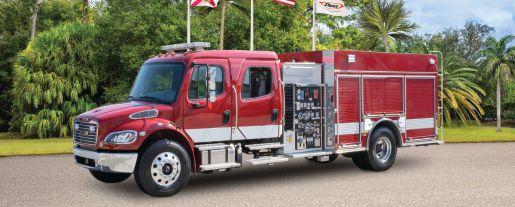
Built by Pierce Manufacturing on a Freightliner M2-106 chassis, Kelowna’s newest pumper is powered by a 360HP Cummins B6.7L engine. This build features a 1000 G tank with a 30 G foam cell, 1250 GPM Waterous CXPA pump, Husky™ 12 foam system, and Whelen emergency lighting.
DEPARTMENT: Kelowna Fire Department, British Columbia
PIERCE F550 MINI PUMPER | COMMERCIAL EMERGENCY EQUIPMENT
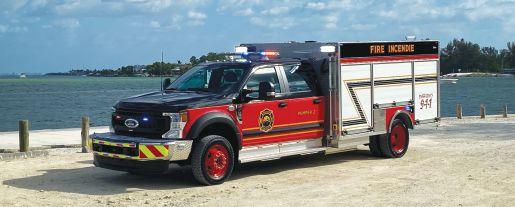
This Pumper 2 was built by Pierce Manufacturing on a Ford F550 chassis and is powered by a 330HP Ford Powerstroke diesel engine. Mini pumper features include a Waterous CXC20 1250 GPM pump, 250 G tank, 20 G foam cell, and a Hercurles™ CAFS system. This initial attack vehicle also has a Whelen lighting package, and an extended front bumper with attack line.
DEPARTMENT: French River Fire Department, Ontario
MAXIMETAL – MAXISABER PUMPER - PARAGON - IRT | L’ARSENAL
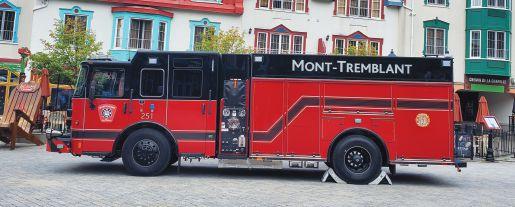
A special unit made for Tremblant, this full black out Pierce Maxisaber is also hiding a green heart. This beast, with a Cummins L9 450HP engine, was also set up with Pierce Idle Reduction Technology . The unit also has a special feature, the PARAGON™ pump panel that is protecting the control and making the usage more efficient by having the intake and discharge apart.
DEPARTMENT: Tremblant Fire Department, Quebec
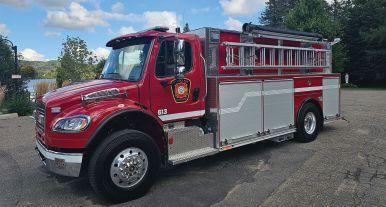
This Maximetal unit was crafted on a Freightliner M2-102 chassis and is a one-of-akind compact tanker. With the PIC (pump in compartments) pump panels, the tanker creates the ability of having a load of water in a smaller truck. Adding up two Zico racking for the ladder and the folding pool keep it compact. The heart of this PIC tanker is a Cummins L9 360 HP.
DEPARTMENT: Saint-Adolphe d’Howard Fire Department, Quebec
PIERCE 107’ ASCENDANT TANDEM LADDER | COMMERCIAL EMERGENCY EQUIPMENT
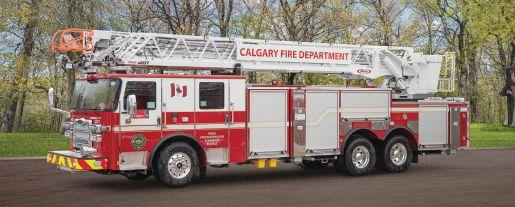
Calgary’s newest ladder is a rear-mount Ascendant® 107’ on a Pierce Enforcer™ chassis with a 500HP Cummins X12 engine, TAK-4® Independent Front Suspension, Pierce Command Zone™ electronics, and was built with a no pump, no tank configuration to maximize equipment storage space.
DEPARTMENT: Calgary Fire Department, Alberta
PIERCE HEAVY-DUTY RESCUE | COMMERCIAL EMERGENCY EQUIPMENT
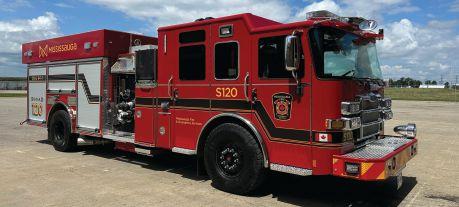
The Squad 120 was assembled on a Pierce Enforcer™ chassis, and features a 470HP DD13 engine, 600 G tank, 2000 GPM pump, Husky™ 3 foam system, Pierce Command Zone™ electronics, and emergency lighting from Whelen.
DEPARTMENT: Mississauga Fire & Emergency Services, Ontario
PIERCE – ENFORCER – ASCENDANT 107’ - PUC - SINGLE AXLE | L’ARSENAL
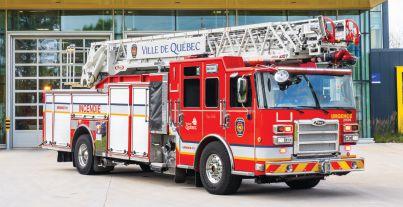
Quebec City, known for the views, hills and the small streets in the old city, has acquired yet another compact Ascendant® 107 single-axle ladder. With the Cummins L9 450HP engine, a PUC™ Pump of 1500 GPM and 500 G of water, this pinnacle of a fire truck will assist firefighters in their hardest work.
DEPARTMENT: Quebec City Fire Department, Quebec
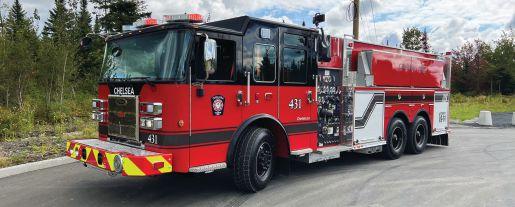
with their Pierce-Maxisaber
acquired last year. The semi-black out truck is a true jewel to look and even better to run.
DEPARTMENT: Chelsea Fire Department, Quebec
The first Tandem Pierce-Maxisaber in Quebec has been delivered to the Chelsea Fire Department with the capacity for 2400 G of water alongside a 1500 GPM pump, Cummins L9 450 HP engine on a Saber® chassis. This Pierce made-in-Quebec apparatus will go along
pumper
APPARATUSSHOWCASE
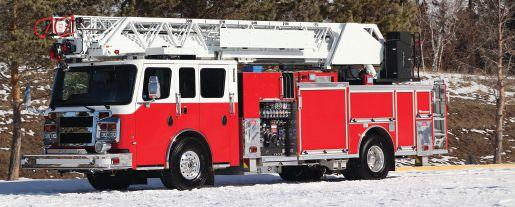
This Rosenbauer 100-ft single axle Viper aerial was built on a 2022 Rosenbauer Warrior 6000 4-door cab and chassis with a 450HP Cummins L9 engine, featuring a Rosenbauer N 1250 IGPM PTO pump with pump and roll, 100-ft 4-section Rosenbauer Smart Aerial with intuitive joystick and wireless remote controls, 4 hot-dipped galvanized Smart outriggers, and Fire Research scene lighting.
DEPARTMENT: Beaumont Fire Services, Alberta
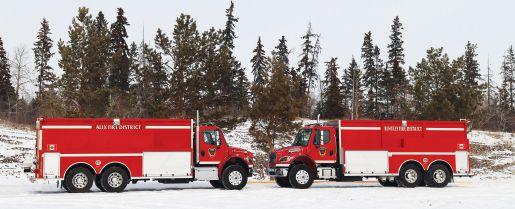
These 2 Rosenbauer tandem water tenders were each crafted on a 2023 Freightliner M2-106 2-door cab and chassis with a 330HP Cummins L9 engine and a Rosenbauer 3/16” aluminum extruded and formed body. These tenders each have a Darley HM500 PTO pump with pump and roll, enclosed side mount operator’s panel, and a Fire Research PumpBoss 400 pressure governor.
DEPARTMENT: Alix Fire District and Bentley Fire District, Alberta
| ROCKY MOUNTAIN PHOENIX
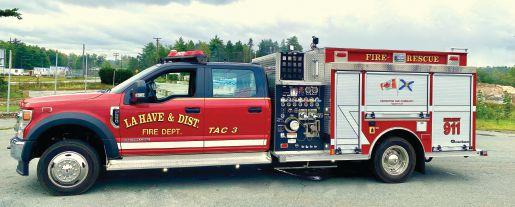
This Rosenbauer mini-pumper was made on a 2022 Ford F550 4-door 4x4 cab and chassis with a 330HP 6.7 L Powerstroke engine and a Rosenbauer 1/8” aluminum extruded and formed body, featuring a Rosenbauer NH 1250 IGPM dual pressure splitshaft pump, side mount operator’s panel, Rosenbauer FixMix high pressure foam system, and FireTech scene lights.
DEPARTMENT: LaHave and District Fire Department, Nova Scotia
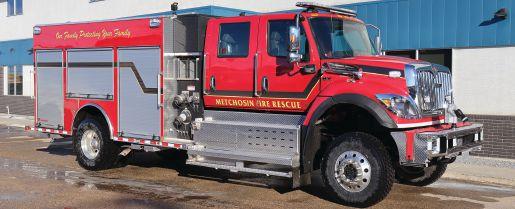
This Rosenbauer commercial MP3 pumper was built on a 2021 International HV507 4-door 4x4 cab and chassis with a 400HP Cummins L9 engine and a Rosenbauer 3/16” aluminum extruded and formed body. Features include a Rosenbauer NH 1250 IGPM dual pressure PTO pump with pump and roll, Fire Research InControl 400 pressure governor, Rosenbauer FixMix high pressure foam.
DEPARTMENT: Metchosin Fire Rescue, British Columbia
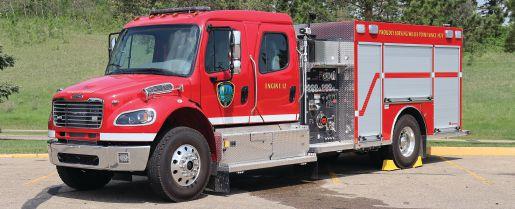
Built on a 2023 Freightliner M2-106 4-door cab and chassis with a 330HP Cummins L9 engine, this Rosenbauer commercial side mount pumper features a Rosenbauer N 5000 LPM PTO pump with pump and roll, LH operator’s panel, Fire Research PumpBoss 400 pressure governor, FoamPro 1600 system with onboard 20 IG Class A tank, 1000 IG water tank, and crosslays over the pump.
DEPARTMENT: Willis Point Fire Department, British Columbia
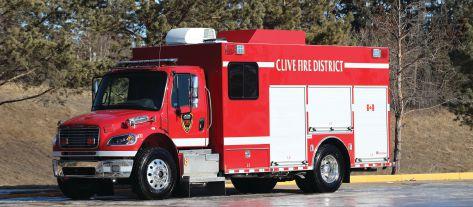
Assembled on a 2023 Freightliner M2-106 2-door cab and chassis with a 330HP Cummins L9 engine and a Rosenbauer 3/16” aluminum extruded and formed body, this Rosenbauer Commercial walk-in rescue includes an 18’ body with a front forward facing climate controlled walk-in crew area for 3, RH awning, 30 kW PTO generator and a Federal Signal audible warning package.
DEPARTMENT: Clive Fire District, Lacombe County, Alberta
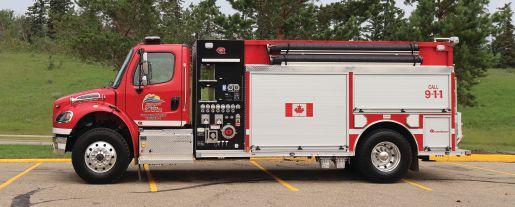
Crafted on a 2023 Freightliner M2-106 2-door cab and chassis with a 360HP Cummins L9 engine and a Rosenbauer 3/16” aluminum extruded and formed body, this Rosenbauer Maverick pumper-tanker includes a Darley PSP 1050 IGPM PTO pump with pump and roll, Fire Research PumpBoss 400 pressure governor, and a Rosenbauer EZ-Climb rear access ladder.
DEPARTMENT: Brownvale Fire Department, MD of Peace, Alberta
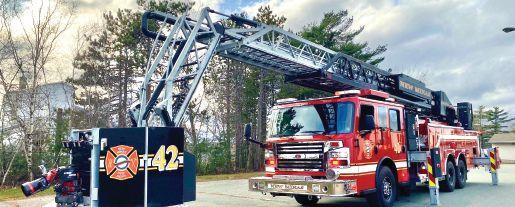
and
DEPARTMENT: New Minas Fire Department, Nova Scotia
and
PUMPER | ROCKY MOUNTAIN PHOENIX
WATER TENDERS | ROCKY MOUNTAIN PHOENIX
RESCUE | ROCKY MOUNTAIN PHOENIX
MINI-PUMPER
PUMPER-TANKER | ROCKY MOUNTAIN PHOENIX
PUMPER | ROCKY MOUNTAIN PHOENIX
This Rosenbauer 101-ft King Cobra was forged on a 2022 Rosenbauer Commander 60” flat roof 4-door tandem cab and chassis with a 600HP Cummins X15 engine, its Rosenbauer Smart aerial features an intuitive joystick controller
operation over the short-jacked side, and the platform has an articulated fly section, and Whelen siren
warning light package.
ARTICULATED PLATFORM | ROCKY MOUNTAIN PHOENIX
APPARATUSSHOWCASE
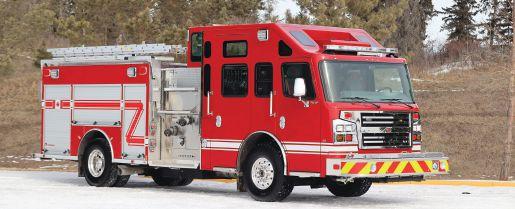
Built on a 2022 Rosenbauer Commander 4-door cab with a 24” raised roof, and a chassis with a 380HP Cummins L9 engine this Rosenbauer custom TME pumper includes a Rosenbauer N 1250 IGPM PTO pump with pump and roll, the hosewell, FireTech scene lighting, Whelen siren/warning light package, RH dual arm hydraulic ladder rack, and a Rosenbauer EZ-Climb rear access ladder.
DEPARTMENT: North Battleford Fire Department, Saskatchewan
TANKER-PUMPER | ROCKY MOUNTAIN PHOENIX
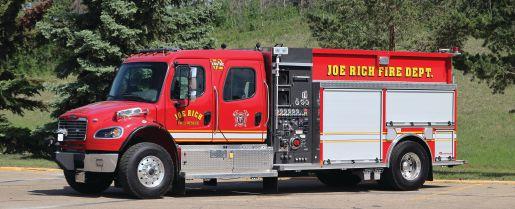
This side mount Rosenbauer Maverick commercial pumper-tanker built on a 2023 Freightliner M2-106 4-door cab and chassis with a 360HP Cummins L9 engine and a Rosenbauer 1/8” aluminum extruded and formed body. Rosenbauer swivel dump, Federal Signal siren/warning/scene light package and a Rosenbauer EZ-Climb rear access ladder.
DEPARTMENT: Joe Rich Fire Department, Regional District of Central Okanagan, British Columbia
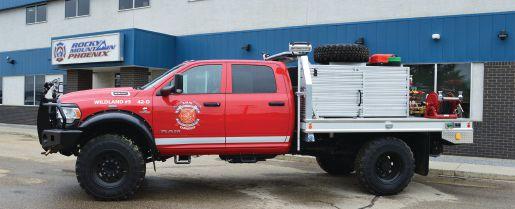
Assembled on a Dodge Ram crew cab chassis with a 6.7 L diesel engine, this wildland apparatus features PS aluminum compartment with Amdor rollup doors, 1 DS swing out tool board, 2 DS fixed tool boards, heavy duty bush bumper, and 41” Super Singles wheels with a 3.5” lift kit. The CET Fire package has a 450 USG water tank and a 10 USG integrated foam cell.
DEPARTMENT: Carnduff Fire Department, Saskatchewan
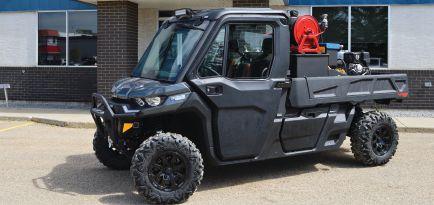
2022
aluminum
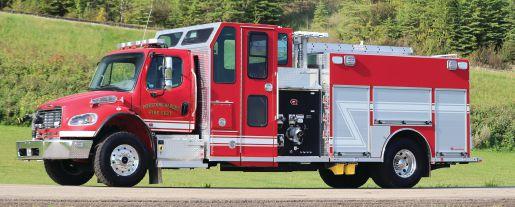
This Rosenbauer commercial Top Mount Enclosed (TME) pumper was assembled on a 2023 Freightliner M2-106 2-door cab and chassis with a 360HP Cummins L9 engine and a Rosenbauer 3/16” aluminum extruded and formed body. Features include Rosenbauer FixMix high pressure and FoamPro 2002 normal pressure foam systems, RH hydraulic ladder rack, and 20’ Will-Burt LED vertical light tower.
DEPARTMENT: Pipestone-Albert Fire Department, Manitoba
|
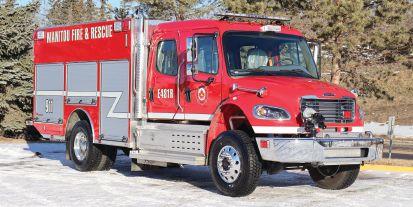
Assembled on a 2023 Freightliner M2-106 4-door 4x4 cab and chassis with a 360 HP Cummins L9 engine and a Rosenbauer 3/16” aluminum FX extruded and formed body, this Rosenbauer Coyote commercial rear mount pumper features a Rosenbauer NH 5000 LPM dual pressure PTO pump with pump and roll, and Rosenbauer FixMix high pressure foam system.
DEPARTMENT: Manitou Fire & Rescue, Saskatchewan
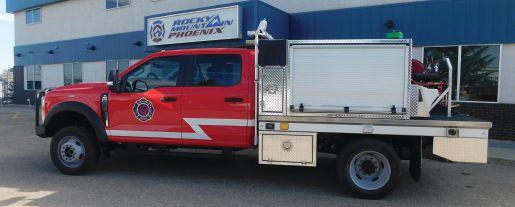
This specialty truck was crafted on a 2023 Ford F550 crew cab chassis with 60” CA, extra heavy duty front end suspension, 7.3 L V8 gas engine, 10-speed automatic transmission, 4 wheel anti-lock braking system, 19” Argent painted steel rims, 2.3” productivity screen in IP cluster instrumentation centre, remote keyless entry and AdvanceTrac® with RSC® (Roll Stability Control™).
DEPARTMENT: Diamond Valley, Alberta
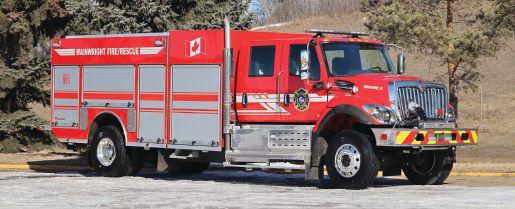
on a 2022 International HV507
4x4
a
DEPARTMENT: Whitefish Lake First Nations, Alberta
DEPARTMENT: Wainwright Fire / Rescue, Alberta
PUMPER | ROCKY MOUNTAIN PHOENIX
PUMPER | ROCKY MOUNTAIN PHOENIX
PUMPER
ROCKY MOUNTAIN PHOENIX
WILDLAND | ROCKY MOUNTAIN PHOENIX
SPECIALTY | ROCKY MOUNTAIN PHOENIX
This
Can-Am UTV features 14” cast
wheels, hydraulic power tilt bed, 4500 lb winch, XT front bumper, full hard roof, 3 position glass tilt-up windshield, full door with power windows, air conditioning, panoramic mirrors, 7.6” digital display with keypad and the addition of a CET Skeeter pack consisting of 50 USG water tank and 5 USG foam cell.
UTV | ROCKY MOUNTAIN PHOENIX
Built
4-door
cab and chassis with
360HP Cummins L9 engine, this Rosenbauer commercial side mount pumper features a Rosenbauer NH 1250 IGPM dual pressure PTO pump with pump and roll, enclosed LH side mount operator’s panel with all handwheel controls, and Fire Research PumpBoss 400 pressure governor, hose.
PUMPER | ROCKY MOUNTAIN PHOENIX
APPARATUSSHOWCASE
WILDLAND 6 MAX | SAFETEK PROFIRE
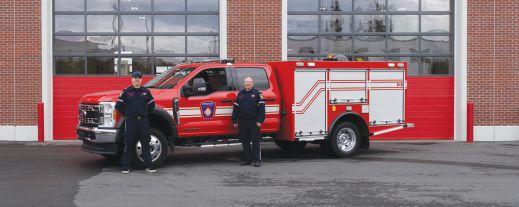
Built on a Ford F-550 XLT chassis with a bolted aluminum body featuring a Whelen LED warning light package, Weldon Node, dual battery system, and custom center console. The body holds a Hub built slip-in unit with a Darley 1.5 AGE 24k pump with a flow of 150 IGPM and a 250 IMP gallon water tank capacity.
DEPARTMENT: Cenovus Energy Inc. - Foster Creek Emergency Services, Alberta
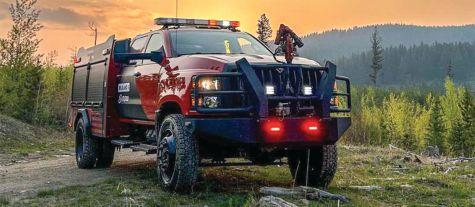
The District of North Vancouver Fire Rescue Services is looking forward to enhancing their abilities to provide customer service and firefighter safety with their order of a Wildland 3. With a sleeker profile, lighter apparatus sizing, and all the benefits of a traditional Type 3, they’re maximizing their wildland, structure protection, and initial attack capabilities.
DEPARTMENT: District of North Vancouver Fire Rescue Services, British Columbia
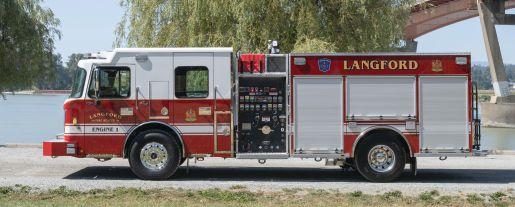
This custom pumper rescue was manufactured a Spartan Gladiator chassis with a Cummins L9 450HP engine powered by an Allison 3000 EVS transmission. Featuring a Waterous CSUC20 pump with a flow of 1,500 IGPM and water tank capacity of 750 IG, plus a FoamPro 2001 with a capacity of 30 IG. It also features stainless steel plumbing, custom CoPoly storage systems, in-cab EMS cabinet, and more.
DEPARTMENT: Langford Fire Rescue, British Columbia
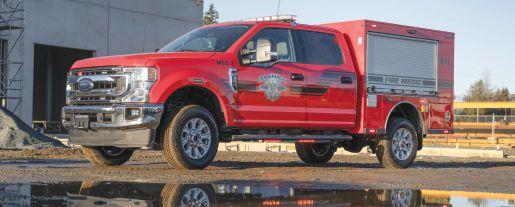
| HUB FIRE ENGINES
This commercial pumper was built by Hub Fire Engines on a Freightliner M2-112 chassis with a Cummins L9 450HP engine powered by an Allison 3000 EVS transmission. This build features a Hale Qmax-175 pump with a flow of 1,500 IGPM and water tank capacity of 800 IG, Hub SCBA storage, Zico EZ Loc SCBA brackets in cab, Hale MIV-E master intake valves, and more.
DEPARTMENT: Coldstream Fire Department, British Columbia
Built on a Freightliner M2 chassis with a Cummins L9 350HP engine powered by an Allison 3000 EVS transmission. Featuring a Hale AP50 pump with a flow of 420 IGPM and water tank capacity of 1,7000 Imperial Gallons, stainless-steel Newton electric dump valve with swivel and Fireman’s Friend direct tank fill features.
DEPARTMENT: Kelowna Fire Department, British Columbia
Built a Spartan Metro Star chassis with a Cummins L9 450HP engine powered by an Allison 3000 EVS transmission. The pumper comes equipped with a Waterous CSUC20C pump with a flow of 1,750 IGPM, water tank capacity of 1,000 Imperial Gallons, and FoamPro 2001 30 IMP gallon foam tank, Waterous 140-SP CAF System and Elkhart Auto Tank Fill.
DEPARTMENT: North Cedar Fire Department, British Columbia
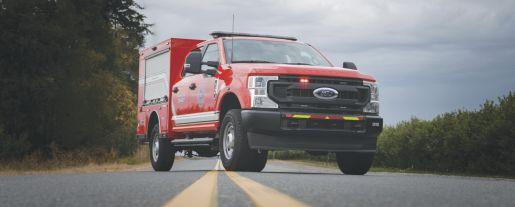
PUMPER
WILDLAND 3 | SAFETEK PROFIRE
TENDER | HUB FIRE ENGINES
PUMPER RESCUE | HUB FIRE ENGINES
PUMPER | HUB FIRE ENGINES
The ProMedx is the ideal combination of maneuverability and efficiency that’s purpose-built for today’s emergency medical response demands in the fire service. With 2/3 of their calls being medical, Saanich Fire Department, is choosing to respond with the right sized vehicle allowing them to respond quicker and more efficiently. Featuring a custom fabricated center console, power distribution center, Whelen emergency lighting package, and more.
DEPARTMENT: Saanich Fire Department
The ProMedx is inspired by the challenges firefighters face every day while responding to emergency medical calls with traditional fire and emergency vehicles. Built on a Ford F350 4x4 crew cab chassis with a bolted body construction, custom-built centre and rear seat console with MDT installation, Xantrex Freedom XC 2,000W/80AMP inverter charger, climate controlled medical compartment, Whelen Hercules HC node, and custom tool and equipment mounting.
DEPARTMENT: Vancouver Fire Rescue Services, British Columbia PROMEDX | SAFETEK PROFIRE
APPARATUSSHOWCASE
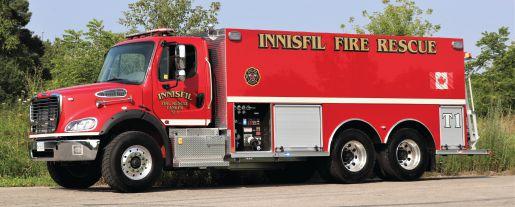
This Rosenbauer America tanker was built on a Freightliner M2-112 chassis that includes a Cummins 450HP engine, Darley HM 500 USGPM pump, FRC pressure governor and tank gauges, Rosenbauer FX 1/8” aluminum body, Whelen Ion-Series red and blue warning lights and M-Series scene lights, A.H. Stock electric dump valve, and enclosed portable tank and suction hose storage.
DEPARTMENT: Innisfil Fire and Rescue Service, Ontario
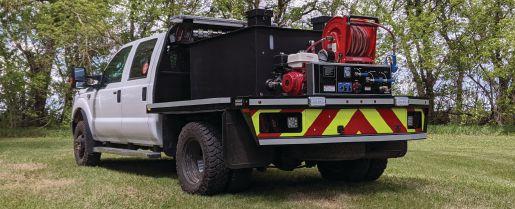
Built on a Ford F-350 Super Duty chassis, the OTEX RANGER UHP-10 skid unit is mounted to a rugged flatbed and features a 300 USG tank with a 10 G foam cell, a 10 GPM ultra-high-pressure pump with a precision foam system, 200 feet of UHP handline, and a Feniex Quad lighting package.
DEPARTMENT: Outlook Rudy Fire Department, Saskatchewan
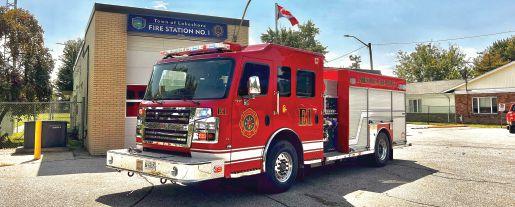
This Rosenbauer America pumper was built on a Commander 6011 chassis and includes a Cummins 450HP engine, Weldon Vista screen and 6 seats. Featuring a Waterous CX 1,500 USGPM pump, Foampro system with 20 USG foam tank, and FRC pressure governor and tank gauges, the Rosenbauer FX 3/16” aluminum body has ROM doors, a 1,000 USG water tank, Whelen M-Series red and blue warning/scene lights and powered hosebed doors.
DEPARTMENT: Lakeshore Fire Department, Ontario
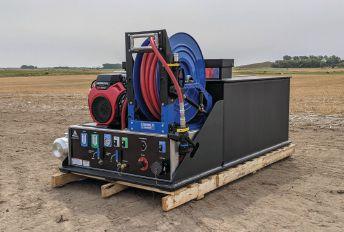
Built on a Ford F-450 Super Duty chassis, the OTEX RANGER UHP-20 skid unit comes equipped with a 300 USG tank with a 15 G foam cell, a 20 GPM ultra-high-pressure pump with a precision foam system, 200 feet of UHP handline, an Elkhart pistol grip nozzle, FRC tank level gauges and auto water and foam tank refill.
DEPARTMENT: Martensville Fire Department, Saskatchewan

SKID UNIT | OTEX MANUFACTURING
SKID UNIT | OTEX MANUFACTURING
BY VINCE MACKENZIE Fire Chief Grand Falls-Windsor Newfoundland and Labrador
TVOLUNTEERVISION
A sustainable wildfire defence
his Canadian wildfire season has surely been unprecedented. Ironically, around this time last year, we were saying the same of 2022. A similar narrative played out during this record-breaking year.
Wonder what the 2024 wildfire season will bring. We expect it not to be a lame one considering all the aspects around climate change. The volunteer and composite fire services brace for what is in store for us. Most of Canada’s urban wildland interface fire risk is bordered in communities under our jurisdictions. The smaller towns are at a higher risk of having to completely evacuate the entire town. Large cities typically evacuate in sections and are better able to house and care for evacuees locally. They also have better transportation networks to handle the volume.
Never in my over four decades long fire fighting career have I seen such destruction and abnormal fire behaviour around wildfires on a consistent basis. As wildfires erupted this year in communities from coast to coast to coast, massive destruction ensued. Entire neighbourhoods were burned down. Communities evacuated for long periods of time. Unfortunately, this now seems to be the norm.
It also seems that confusion still exists in our governments as to what the two different fire services are. Let me talk about the terms wildfire and wildland fire fighting. The words sound similiar, but they mean two different things. Wildfire is just that, a fire event we once called forest fire, brush fire, etc. Wildfires occur across Canada, and not only in the wildland (trees and vegetation), they burn buildings as well. Wildland fires are typically fires that involve forests and the like. It is when the wildfire approaches the urban interface — houses, neighbourhoods and communities — that municipal fire departments engage early in the fight.
Structural firefighters in paid, volunteer, or composite fire departments, are not primary wildland firefighters, and vice-versa. We assist each other and work in partnerships many times, but when major events happen, the skills, tactics, and equipment needed to respond are very different. Municipal fire departments concentrate on structural protection and wildland firefighters concentrate on the fires occurring in forested areas. Rarely do you see municipal fire departments respond deep in forests. Our fire departments coordinate structural and community protection and life safety. This is where coordination in emergency management is essential, but to expand on that is a topic for another column.
This summer, the federal government approved hundreds of thousands of dollars to train wildland firefighters. The armed forces were deployed. This is all good and appreciated but is it really what our fire service needs to be effective in the future? While funding has been approved to train wildland firefighters, I fear the volunteer firefighters in Canada’s smaller communities will not receive much of this training. Instead, it will be allocated for wildland firefighters. Therefore, once again, we need to be careful of interchanging the terms wildfire fire fighting and wildland fire fighting. Our volunteer fire departments, where a high number of the interface fires occur, need better and more specific training and equipment in wildland urban interface fire fighting.
Should there be such a heavy reliance on our military for fire emergencies and are they capable? Our military does an admirable job, but some will tell you that their training in wildfire would be very limited and usually consists of one day, mission specific assistance to get a community through the immediate crisis. We need our fire fighting forces to deploy in minutes or hours. The Canadian armed forces are more like days and weeks.
There is already a force available in Canadian communities, look no
What Canada needs is a trained force comprised of firefighters from across the country that are trained, equipped and rapidly deployable to relieve our weary hometown firefighters. ‘‘ ’’
Vince MacKenzie is the fire chief in Grand Falls-Windsor, N.L. He is an executive member of the Canadian Association of Fire Chiefs and the current president of the Maritime Fire Chiefs Association. Email Vince at firechief@ townofgfw.com and follow him on Twitter at @FirechiefVince.
further than your fire department. If we only had better funding for training and equipment, and I mean real sustainable funding, not knee-jerk reaction funds. We need a program that funds this specialized workforce on the long operations that wildfires in our communities demand. Volunteer firefighters in smaller communities can rarely stand up for a long-time during crisis because they also have day jobs that they must attend too. Asking volunteers firefighters to be able to deploy for long periods of time is simply not sustainable. What Canada needs is a trained force comprised of firefighters from across the country that are trained, equipped and rapidly deployable to relieve our weary hometown firefighters. This will take a new approach to traditional fire suppression models. Climate change has certainly changed the game. It’s time for of us to rethink and update our game as this new reality becomes the norm in Canada.


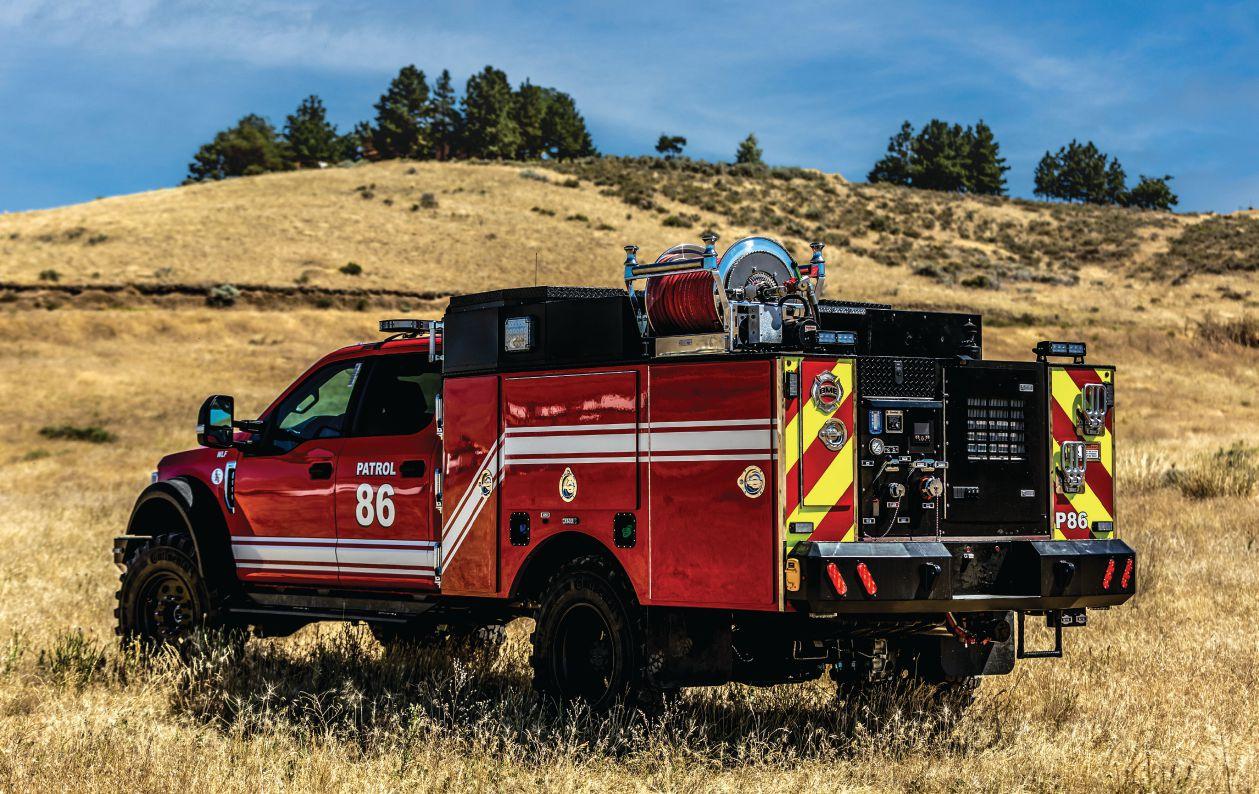
COMMERCIAL EMERGENCY EQUIPMENT IS CANADA’S LARGEST DEALER FOR WILDLAND APPARATUS
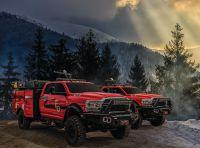
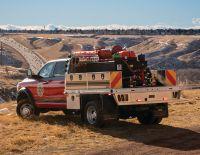
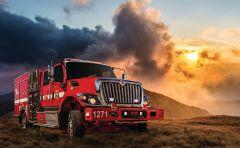
Commercial Emergency Equipment are Canada’s wildland apparatus specialists. With an expansive branch network across Canada, and access to the best wildland apparatus available, Commercial is a clear choice for your next wildland project. From the most capable offroad vehicles to value-driven light-attack trucks, Commercial has the perfect brush truck or WUI solution for your department.
Contact an Apparatus Specialist today to start building your next wildland truck.