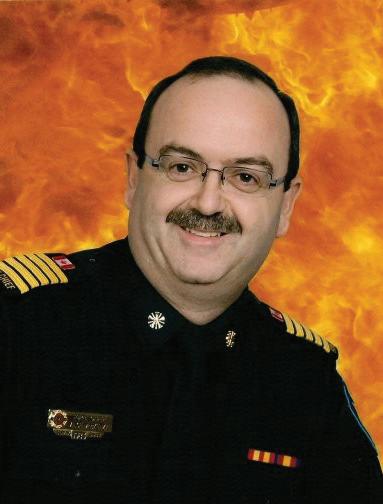
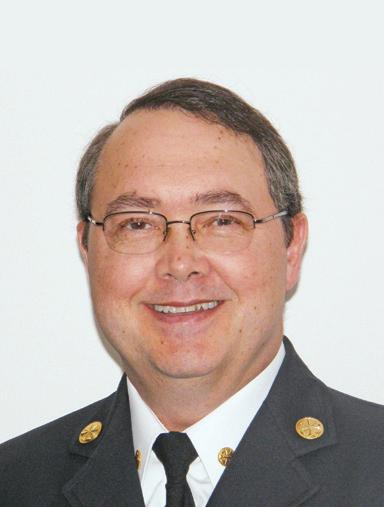
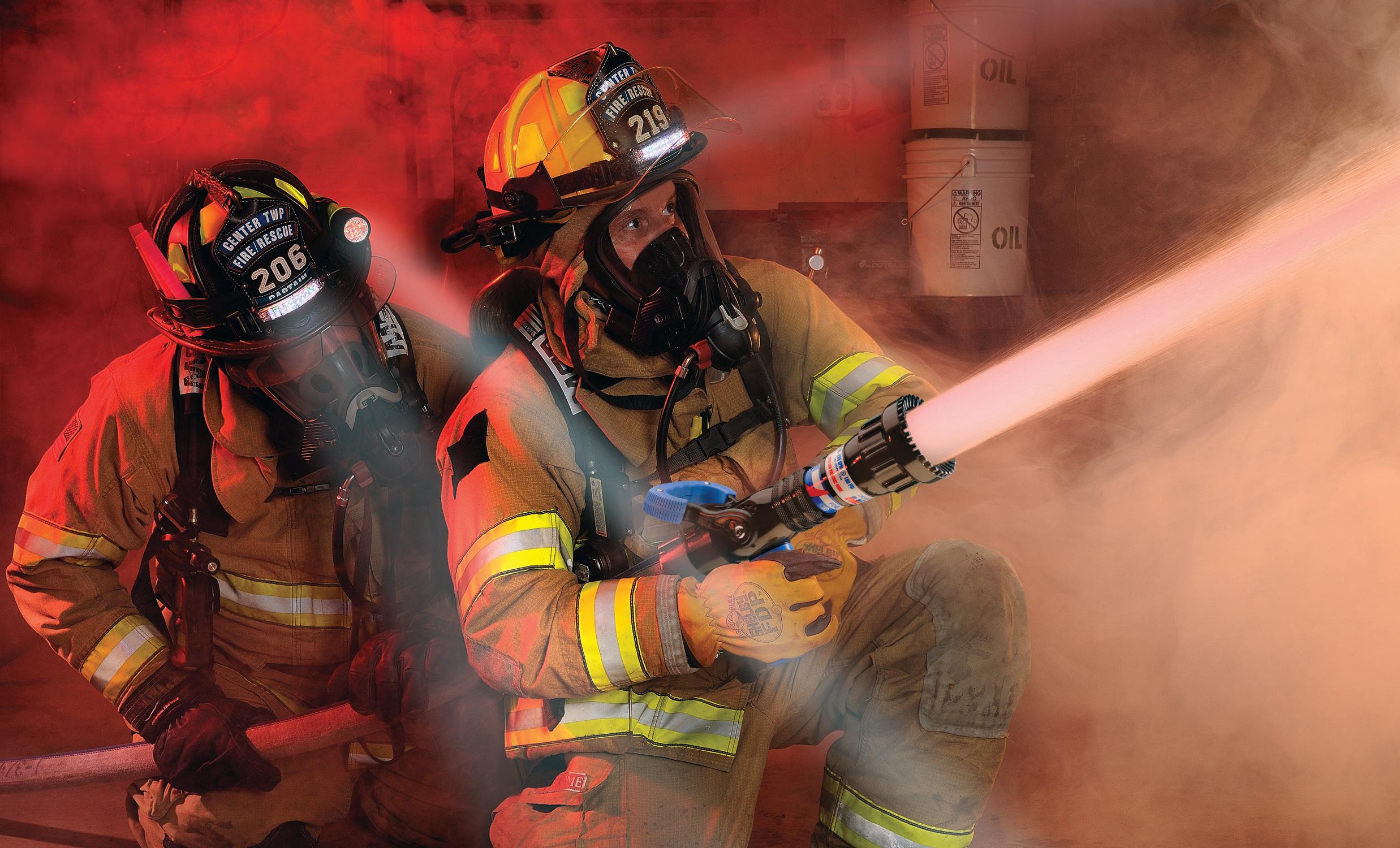
As Laura King reports, fire officers Tony Lippers, Ken Day and Hector Babin share a mission. All three fought vigorous forms of cancer and are determined to help others understand the need for self-care, advocacy and firefighter safety.
By Laura King
A CLEAR MESSAGE
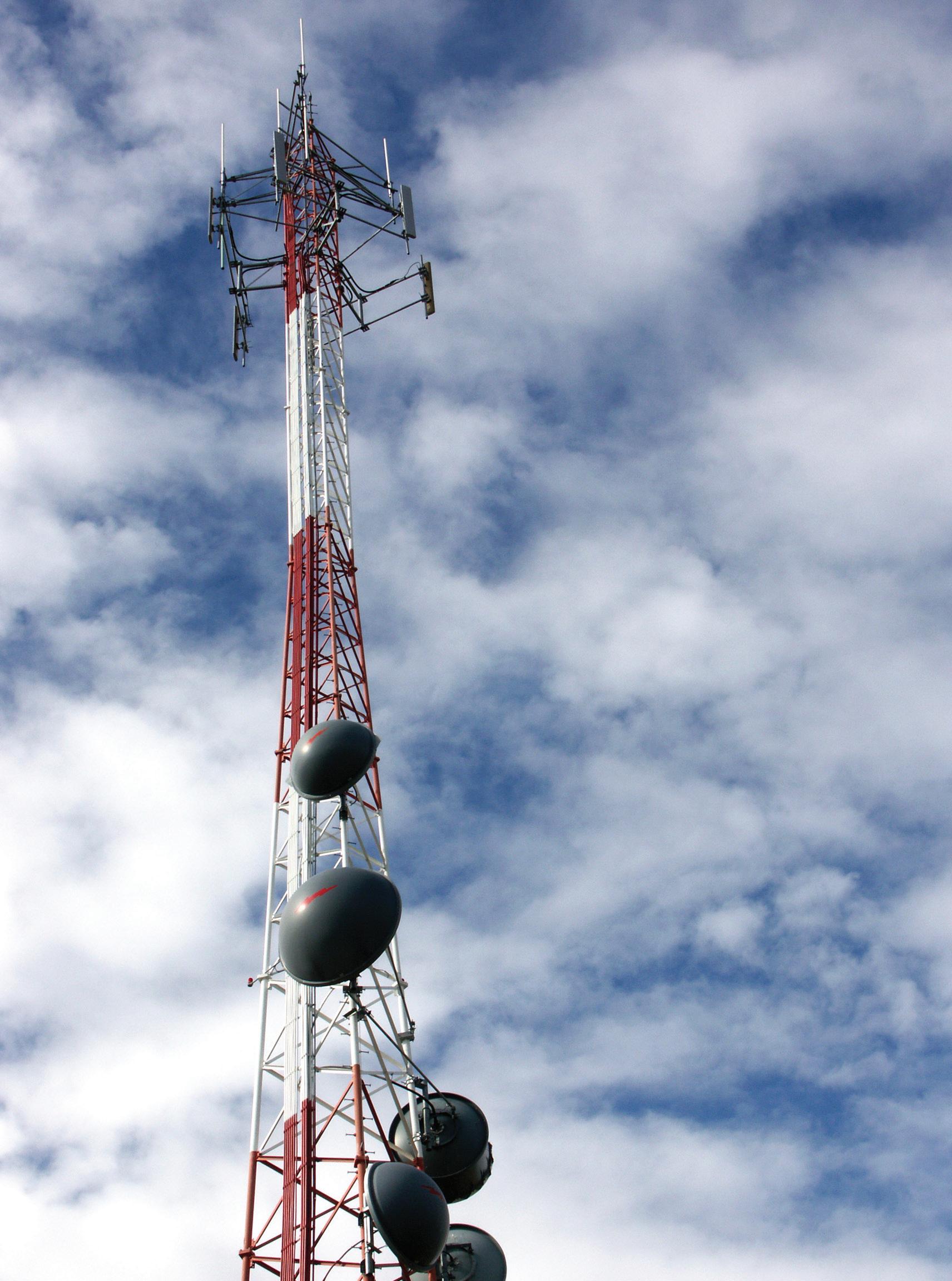
Although it appears that Ottawa is prepared to designate a portion of the wireless spectrum for emergency responders, opponents are making their voices heard and, as Stefan Dubowski reports, police, fire and ambulance groups need to do the same.
By Stefan Dubowski
BY LAURA KING Editor lking@annexweb.com
Slaying dragons COMMENT
y 18-year-old son – a strapping lad of six feet, four inches and 210 pounds who plays defence for the Oakville Blades junior A hockey club, can box-squat 550 pounds, and has been taught by parents and coaches to do as we say, not as we do –thinks he might like to be a firefighter.
He fits the mould. He’s big, fit, smart, he listens, and he thrives on discipline and teamwork –not surprising for a kid who has played rep hockey and lacrosse for most of his life.
He has watched me learn about the fire service over the last five years and we sometimes talk about the cool things I get to do – photographing the Oakville Fire Department’s high-angle rescue training inside the cavernous Ford plant, or learning how to use a thermal imaging camera inside the burn room at the new fire training facility in Fredericton.
“I would have recommended fire fighting to anybody,” he said. “But now, knowing what I know, I wouldn’t want my kids to do it.”
I had figured that by the time my children would be ready to try to get on the job that we’d be smarter about things like exposure to toxins, and that cancer-related deaths would be declining thanks to better fire-ground decisions and early detection.
ON
THE COVER
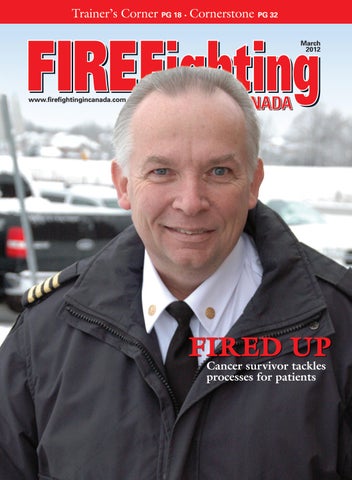
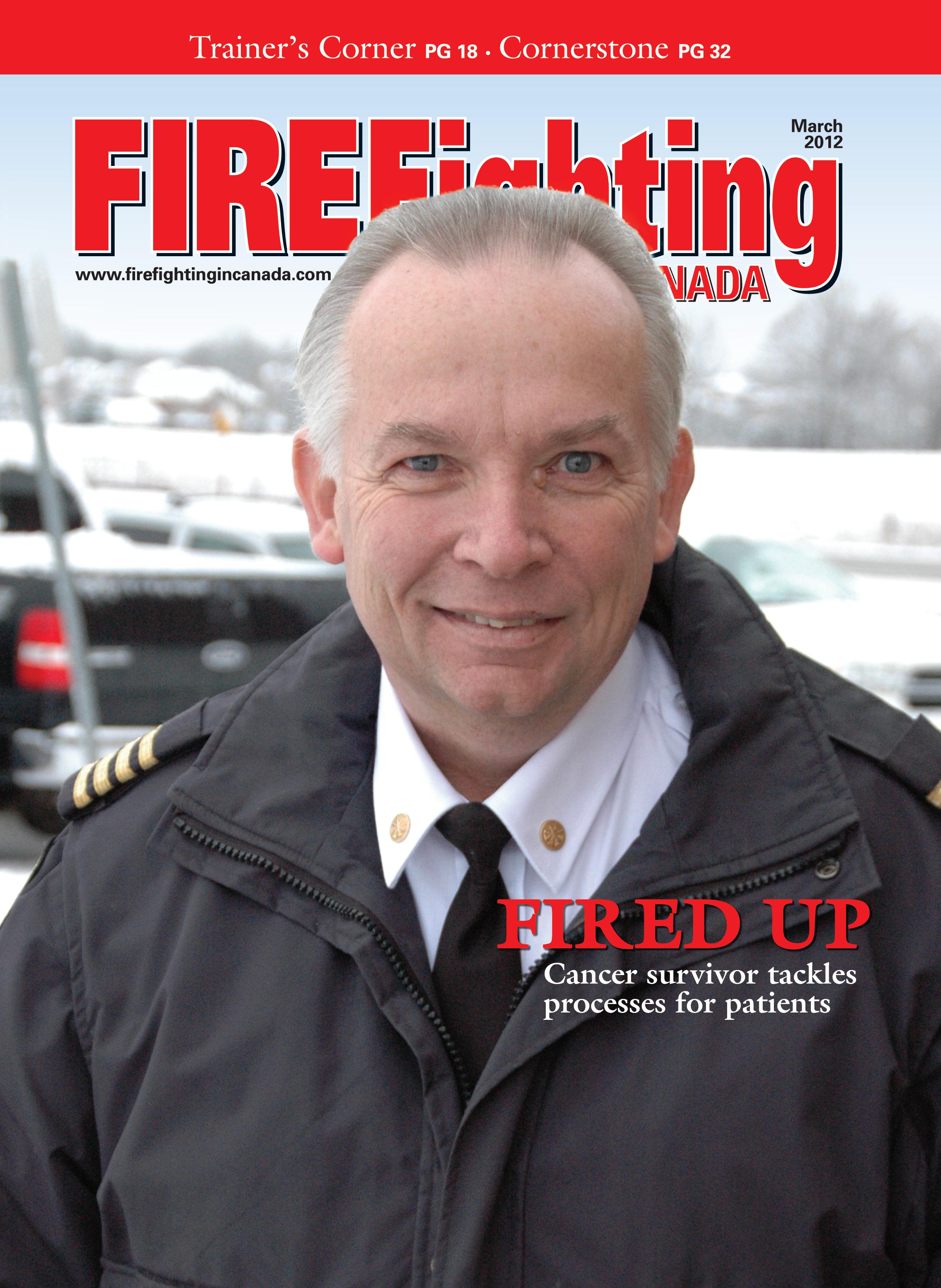
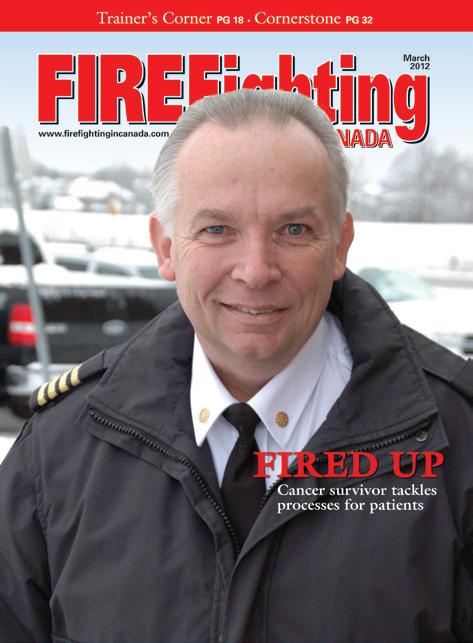
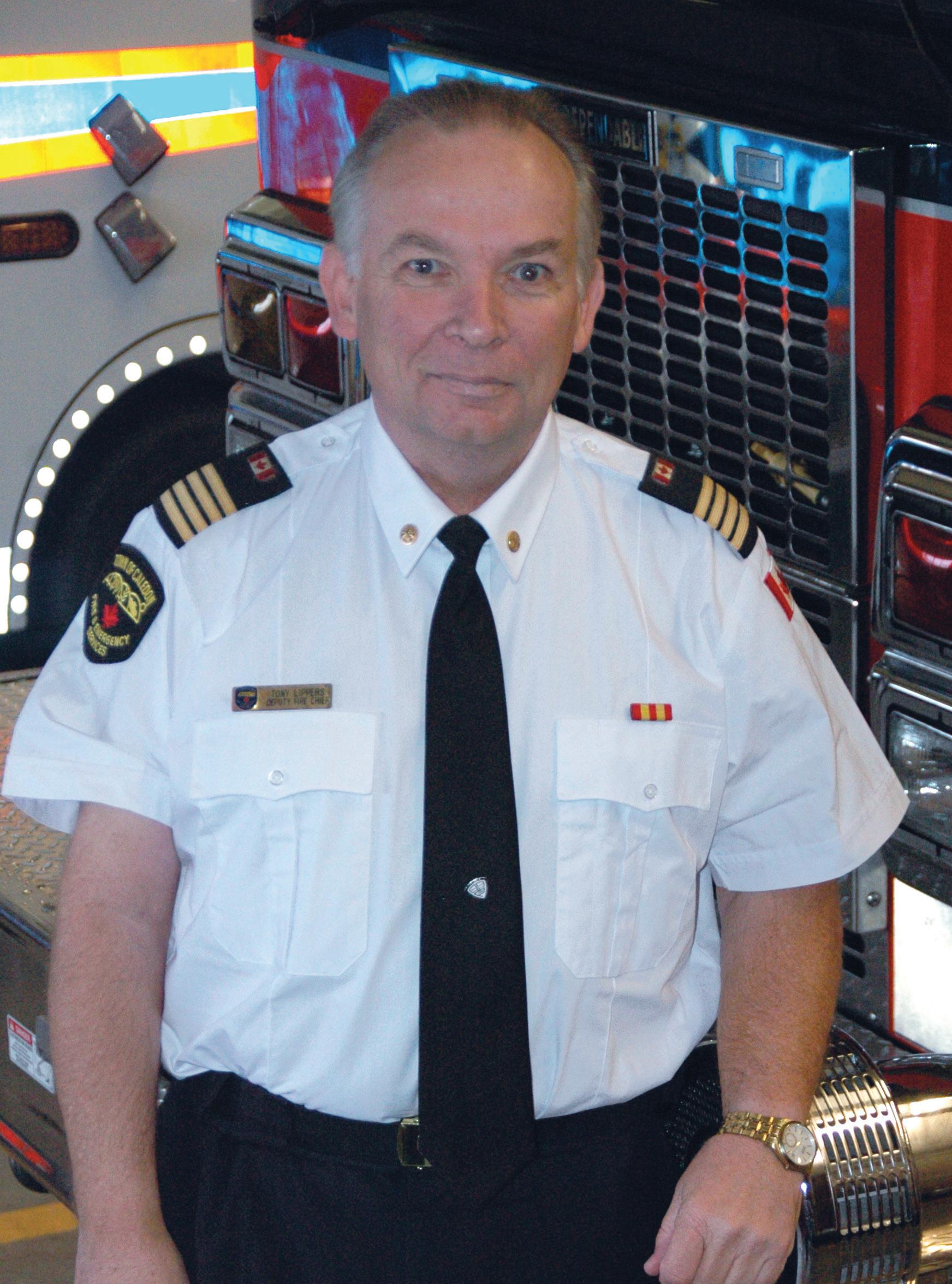
Tony Lippers, the deputy fire chief in Caledon, Ont., is determined to make the patient-care process easier for others following his fight with esophageal cancer. See story page 10.
Fire fighting seems to be a good fit for him. He says he doesn’t want to work behind a desk. He’s extremely empathic and he’s a quiet observer rather than a ringleader.
He’ll finish out his junior A eligibility, hopefully go on to play NCAA hockey in the States while getting a college education, and then, presumably, look for a pre-service spot.
Or so I thought. In the middle of writing the cover story for this issue, I had a phone conversation with former Toronto district chief Peter Sells about the status of his (late!) Flashpoint column. We got to talking about the story (see page 10) and about our kids – his two girls are around the same age as my two boys. And then he dropped the bomb.
But as I listened to the tape of my interview with Tony Lippers, the deputy chief in Caledon, Ont., who survived esophageal cancer, talked with Dave Sutton, the new chief in LaSalle, Ont., whose friend and former chief Ken Day died suddenly last summer of complications from colon cancer – at just 47 – and followed the journey of Hector Babin, the volunteer chief in Eel Brook, N.S., as he willed himself back to health, the magnitude of the matter began to sink in.
Astoundingly, one in three firefighters will contract some form of cancer, compared to one in eight for the rest of us.
In every issue of Fire Fighting in Canada we list promotions, retirements and, in the Last Alarm section, deaths. In so many cases the short write-ups contain that clichéd phrase that has become so horribly familiar – after a courageous battle with cancer. Courageous, indeed. More courageous than fighting fires or attending car wrecks? I’ll let you be the judge of that but, to me, those who fight to slay this dragon of a different kind are the real heroes.
I wonder what my son – who, at 18, still thinks he’s invincible – will say about that.
Canada – 1 Year - $24.00 (with GST $25.20, with HST/QST $27.12) (GST - #867172652RT0001)
USA – 1 Year $40.00 USD
We acknowledge the financial support of the Government of Canada through the Canada Periodical Fund (CPF) for our publishing activities.
Occasionally, Fire Fighting in Canada will mail information on behalf of industry-related groups whose products and services we believe may be of interest to you. If you prefer not to receive this information, please contact our circulation department in any of the four ways listed above.
All advertising is subject to the publisher’s approval. Such approval does not imply any endorsement of the products or services advertised. Publisher reserves the right to refuse advertising that does not meet the standards of the publication.
www.firefightingincanada.com
PHOTO BY LAURA KING
STATIONtoSTATION
ACROSS CANADA: Regional news briefs
Truck project spirals into windfall for Newfoundland town
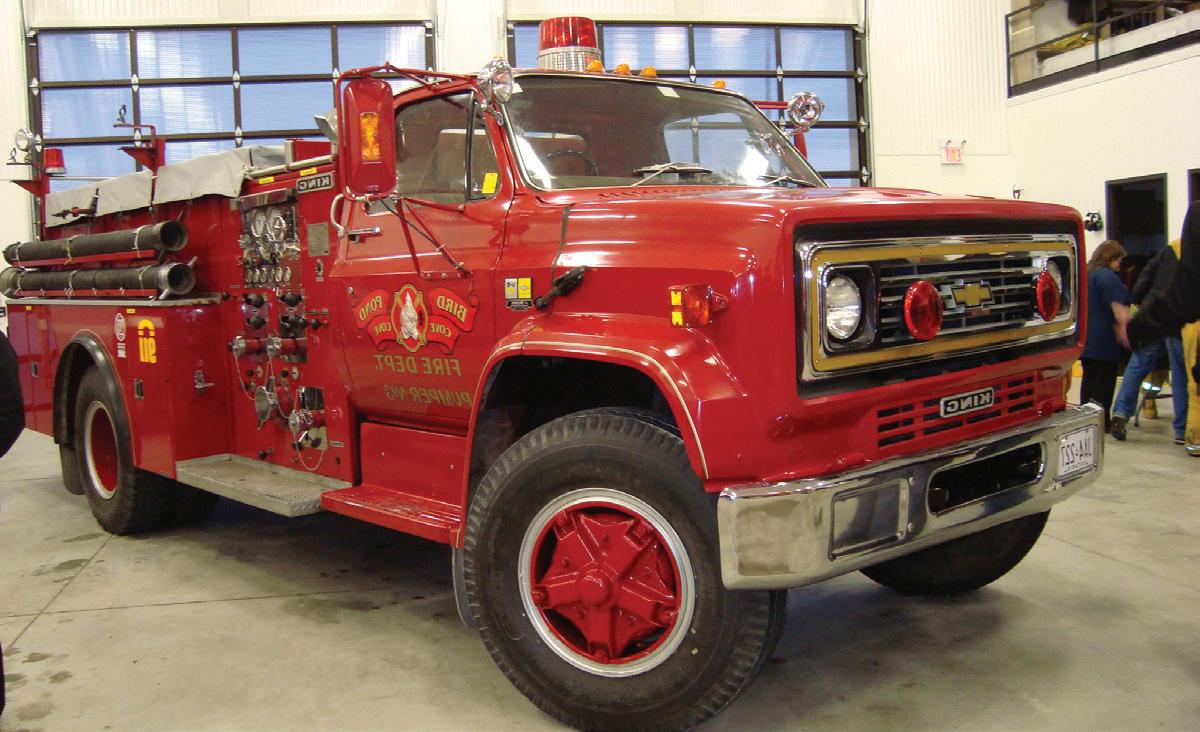
A small project to help a tiny community in Newfoundland get a working fire truck turned into a mammoth outpouring of goodwill.
Fire departments, suppliers,
Huron, Ont. Central Huron’s 30-year-old pumper was in good shape but wasn’t being used, so Cooke started looking for a home for it – a department that needed and would appreciate the
manufacturers, corporations, and even an MP pitched in to make sure a truck from Ontario got to Bird Cove, N.L., without a hitch.
The plan originated with Steve Cooke, the fire chief in Central
well-maintained pumper.
After a some research, Cooke connected with Richard May, the mayor of Bird Cove. With a lot of planning and logistics, and a mention on CBC radio
THE BRASS POLE
Promotions & Appointments
LEE GRANT was named fire chief in Oakville, Ont., on Dec. 5. Grant had been a deputy fire chief in Oakville since 2008 and replaces Richard Boyes. Grant, treasurer for the Canadian Association of Fire Chiefs, came from Peterborough where he began his career as a firefighter in 1980.
LARRY THOMAS has been promoted to deputy chief of the Surrey Fire Service in British Columbia. Larry has an extensive background in labour relations and recently held the posi-
and in our editor’s blog at www.firefightingincanada.com, the story took on a life of its own as businesses, manufacturers, suppliers, communities and individuals offered time, energy, ingenuity and money to get the truck to its destination.
Darch Fire made sure the truck was in working order.
Carter’s West End Garage in Clinton, Ont., fully serviced the truck. Dean Smith of Huron Transmission and Krown gave it a thorough rust proofing.
The truck left Clinton on Feb. 16 for Tavistock, Ont., then rode on a float to Moncton, N.B., compliments of Sommers Motor Generator Sales Ltd.
A new logo was designed and donated by Artech Signs & Graphics in Seaforth. “It incorporates a stone effigy of a bear, which was unearthed in an archaeology dig near Pond Cove and represents the indigenous population of the area before settlement,” says Cooke.
Two Bird Cove firefighters were flown to Moncton, thanks to a donor who purchased their plane tickets. And, the truck was
tion of secretary-treasurer for the B.C. Professional Fire Fighters Association and the B.C. Professional Fire Fighters Burn Fund.
DAN STACK was named fire chief of the Sudbury fire service in Ontario. A 34-year veteran, Stack began his career as a firefighter with the City of Sudbury in 1978. He worked his way through the ranks as captain, platoon chief and acting deputy, prior to his promotion to
loaded with equipment from local fire departments and a fireequipment supplier that sent six large cartons of gear and equipment to Central Huron to go on the truck. Tiesma Industrial Coverings Inc. of Clinton designed and built a custom tarp to protect the equipment loaded into the hose bed. Local donors and the County of Huron helped to defray fuel costs.
From Moncton, the truck was driven to North Sydney, N.S., where it boarded the ferry to Port au Basques, N.L. MP Ben Lobb (Huron-Bruce), worked with Marine Atlantic to arrange free passage. The Bird Cove-Pond Cove firefighters were then to take the truck to its new home.
Cooke says he heard from Mayor Richard May of Bird Cove that morale had soared.
“He said people there can’t believe the generosity being demonstrated by people they don’t even know. He said you can see the rise in spirits daily as people go about their day-today routines.”
- Laura King
deputy fire chief of operations in April 2009.
BRIAN WOZNIKOSKI was recently promoted to assistant chief of the Surrey Fire Service
A 30-year-old pumper from Central Huron, Ont., made its way to its new home in Bird Cove, N.L., in February thanks to the generosity of fire departments, suppliers, manufacturers, corporations and an MP.
PHOTO BY STEVE COOKE
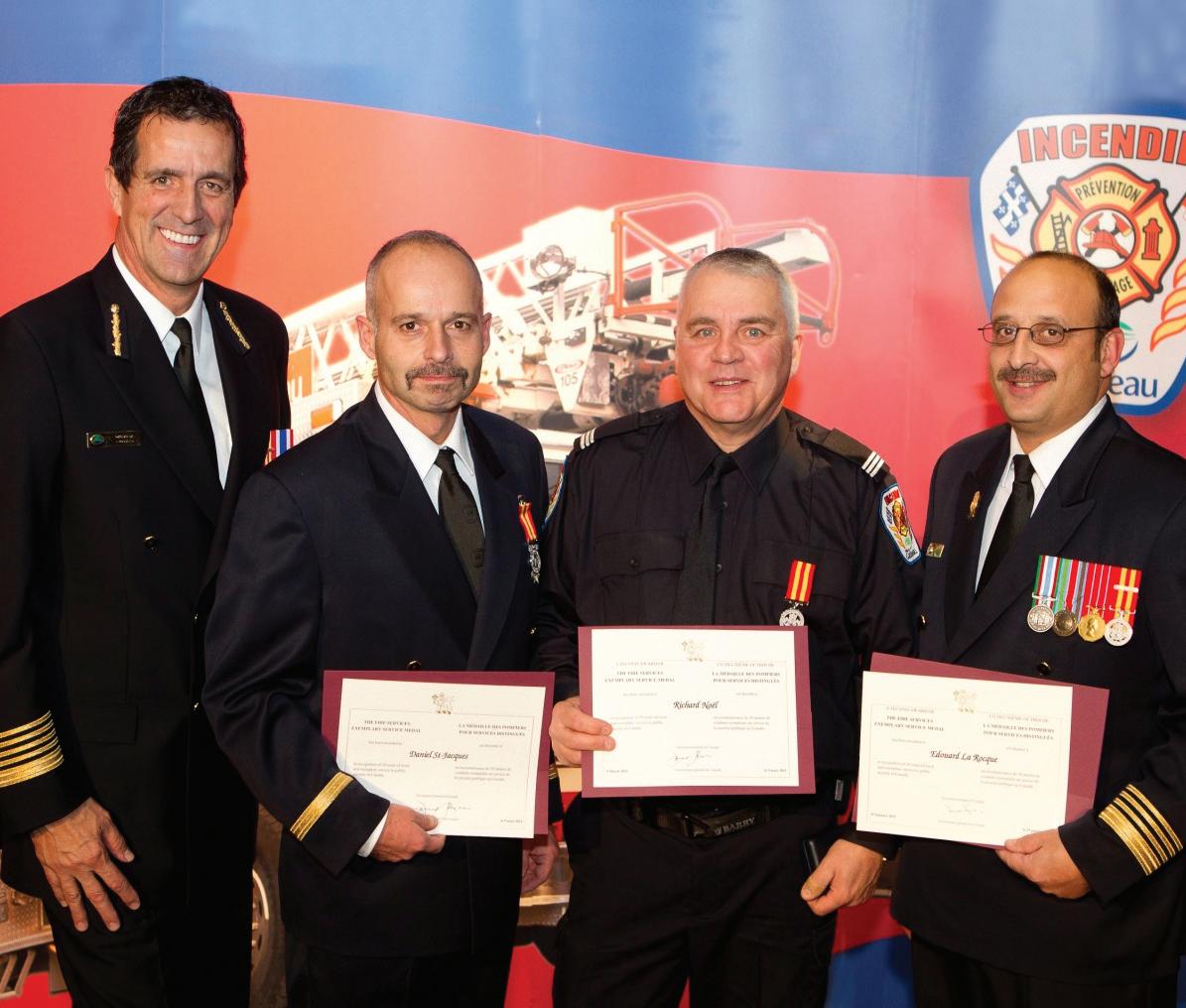
Department honours exemplary service recipients
Gatineau, Que. – The Gatineau Fire Service in Quebec honoured three of its members with the presentation of exemplary service medals for their longstanding contributions to the department.
The recipients received their 20- and 30-year exemplary service awards in a ceremony on Nov. 29.
Deputy Chief Édouard La Rocque and Capt. Richard Noël received 30-year awards and Operations Chief Daniel St-Jacques received a 20-year award.
During the ceremony, 9 members were promoted to their new ranks. Alain Loyer was promoted to chief, fire prevention. Mario Marquis and Jacques Lemay were promoted to captain. Mario Calvé, Stéphane Denis, Denis Diotte, Dany Fortin, Steven Girouard and Martin Vézina were promoted to lieutenant.
The evening closed with the swearing in ceremony of 28 new recruits and two fireprevention agents.
- Gary Barnes, division chief of operations, Gatineau Fire Service
Gatineau Fire Service Director André Bonneau (left) stands with Daniel St-Jacques, operations chief, who was awarded with a 20-year exemplary service medal, and Capt. Richard Noël and Édouard La Rocque, deputy chief – prevention and logistics, who were honoured with 30-year exemplary service awards.
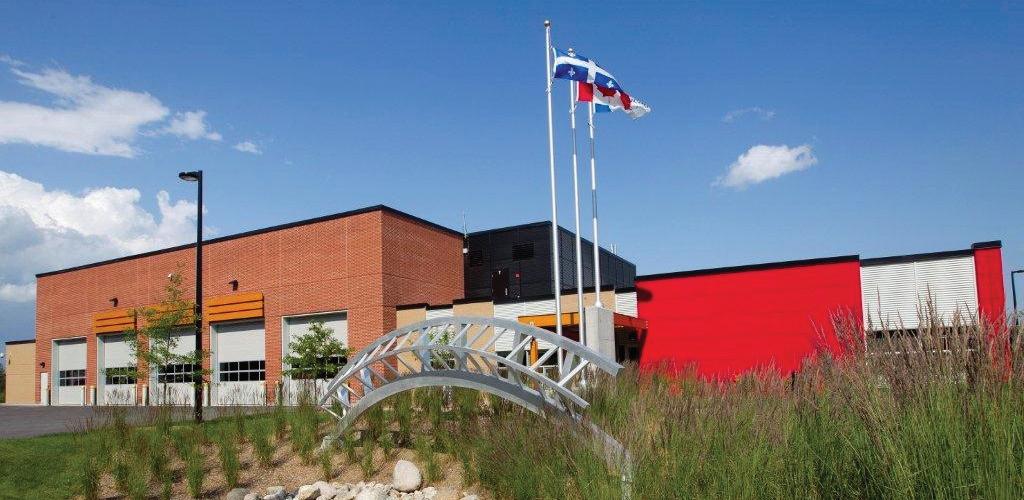
Gatineau opens second LEED-certified station
Gatineau, Que. – On Nov. 7, the Gatineau Fire Service in Quebec inaugurated its second LEED-certified (silver level) fire station. Fire Station 8, in the Buckingham sector of the city, was relocated in accordance with the priorities set out in the City of Gatineau fire-coverage risk plan. The plan was put in place in 2006 and spans nine years, ending in 2015. Once
completed, the Gatineau Fire Service will provide a 10-firefighter response in 10 minutes or less to 98 per cent of the city.
Under this plan, Station 8 was relocated and replaces the two original fire stations that served the municipalities of Buckingham and MassonAngers prior to municipal amalgamation in January 2002.
The station is a one-storey building with five apparatus bays. Space off of the apparatus bays houses a workshop, an SCBA cleaning and repair room, a drying tower for hoses, locker space for bunker gear and a compressor with an SCBA filling station. Living
quarters for the personnel, a training room and offices for the captain and lieutenant complete the layout. The total area of the building is 1,500 square metres.
The station houses a pumper truck, ladder truck, two water tankers, a reserve pumper and a rescue boat. The station is staffed with eight firefighters per shift: a captain, a lieutenant and six firefighters. Two additional firefighters per shift will be added by the end of 2014 to ensure a response time of 10 firefighters in 10 minutes to the area protected by this station.
- Gary Barnes, division chief of operations, Gatineau Fire Service
in British Columbia. A 31-year veteran, his knowledge and experience in suppression, training and prevention will be an asset to this role.
STEVE BOYD is the new deputy fire chief for Oshawa Fire Services in Ontario. Boyd began his firefighting career in the private sector and joined the Oshawa fire department in 1987. He will oversee the suppression, communications and training divisions.
Retirements
GERALD BRETHOUR, firefighter with the Brock Township Fire Department in Ontario, retired Dec. 31 after 25 years of dedicated service.
JOHN PILGRIM, captain with the Brock Township Fire Department in Ontario, retired Dec. 31 after 46 years of dedicated service.
TOM HARRISS, firefighter with
the Brock Township Fire Department in Ontario, retired Dec. 31 after 32 years of dedicated service.
Last Alarm
JOHN ALLES, a captain and 27-year member with the Elora Fire Station in Centre Wellington, Ont., died on July 20 at the age of 50. John was well liked for his easygoing personality and his concern for firefighter safety.
WILLIAM GEORGE BRISBIN died July 8 in Toronto in his 68th year. He was a firefighter for 35 years and a retired fire chief for 20 years with the Baltimore Fire Department in Ontario.
JOEY STOJKIEWICZ, deputy fire chief in Timmins, Ont., died July 15 at the age of 53. He served the fire service for 35 years, culminating in the position of deputy fire chief for the City of Timmins since 2005.
Fire station 8, the second LEED-certified (silver level) fire station in Gatineau, Que., opened Nov. 7, replacing two original fire stations.
STATIONtoSTATION
BRIGADE NEWS: From stations across Canada
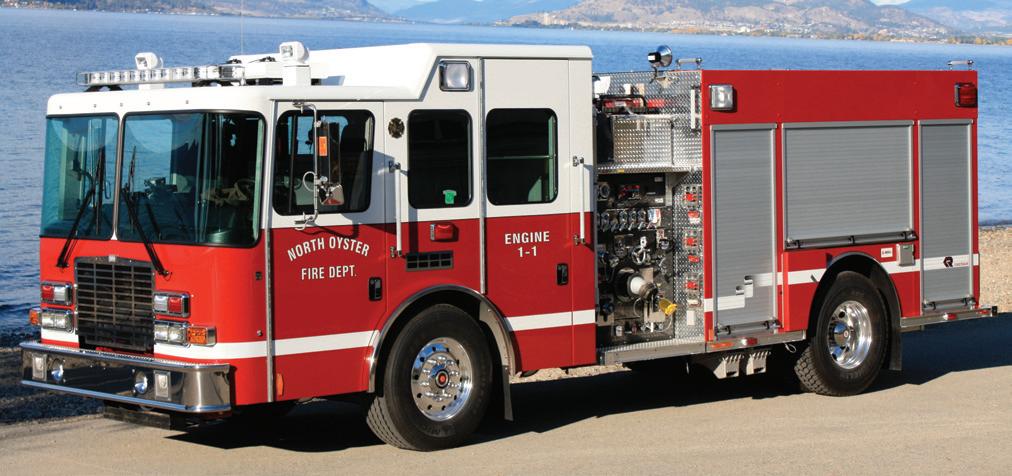
THE NORTH OYSTER FIRE DEPARTMENT in British Columbia, under Chief Jason DeJong, took delivery in October from Rocky Mountain Phoenix of a Rosenbauer-built pumper. Built on an HME 1871W chassis and powered by an Allison 3000 EVS transmission and a Cummins ISL 400-hp engine, the truck is equipped with a Waterous 1,050-IGPM pump, a FoamPro 1600 foam system, a 1,000-IG UPF-poly tank, a 5,000-watt Honda generator, a FireCom communication system, 12 air bottle cylinder storage, OnSpot tire chains, a Whelen LED lightbar and a Whelen LED warning light package.
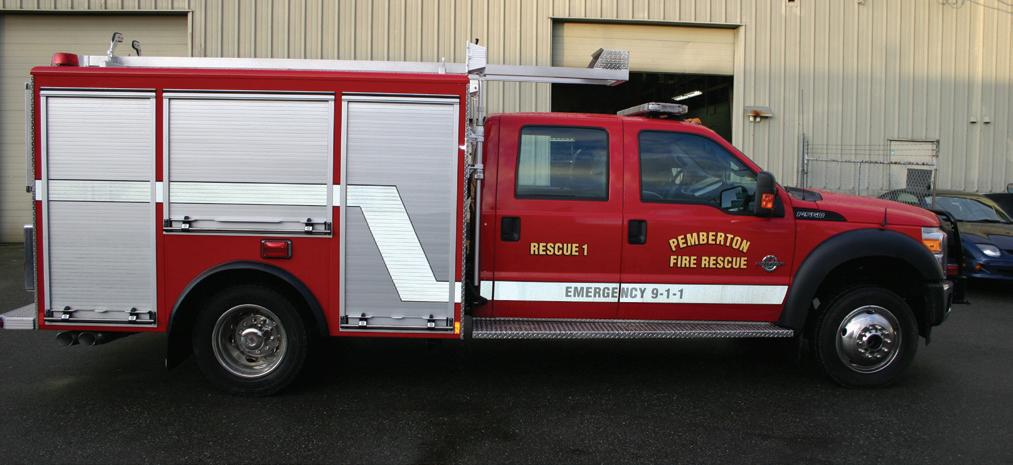
PEMBERTON FIRE RESCUE in British Columbia, under Chief Russell Mack, took delivery in December of a Hub Fire Engines & Apparatus-built light rescue unit. Built on a Ford F550 chassis and powered by a six-speed automatic transmission and a 6.7-litre diesel engine, the truck is equipped with Hub custom overhead ladder storage, M12000 Warn Winch and grille guard, Honda threekilowatt generator, 500-watt Extendalites and four body winch receivers.
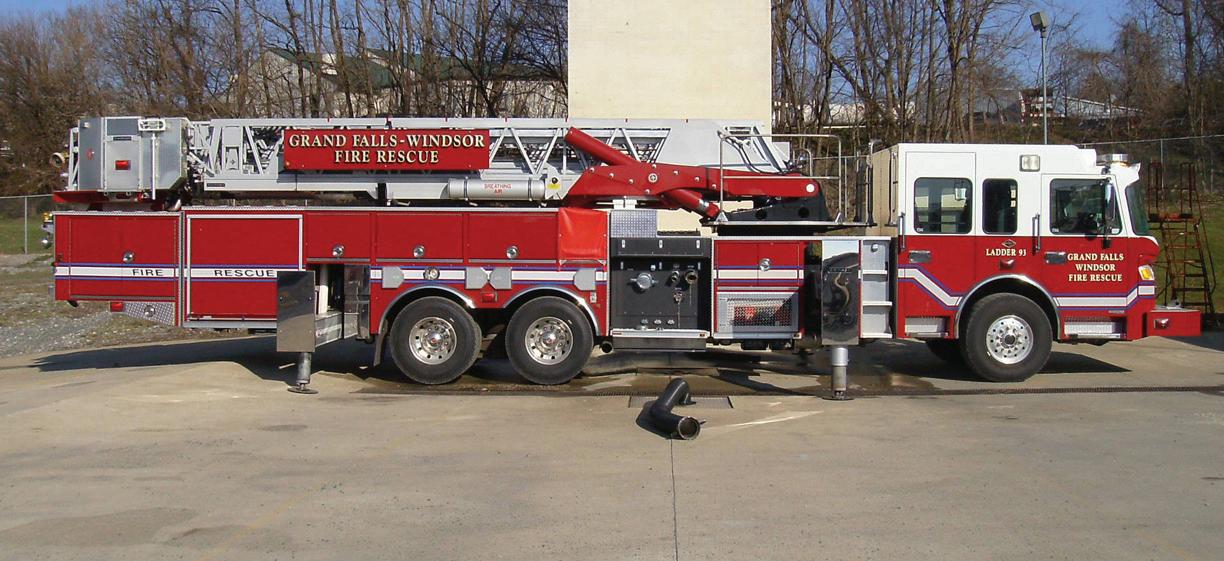
THE GRAND FALLS-WINDSOR FIRE DEPARTMENT in Newfoundland, under Chief Vince MacKenzie, took delivery in October from Dependable Emergency Vehicles of a Crimson Fire-built aerial unit. Built on a Spartan Gladiator chassis and powered by an Allison 4000 EVS transmission and a Cummins 500-hp engine, the truck is equipped with a Hale 8FG 1,500-IGPM pump, a 300-IG pro-poly water tank, a Whelen light package and roll-up doors.
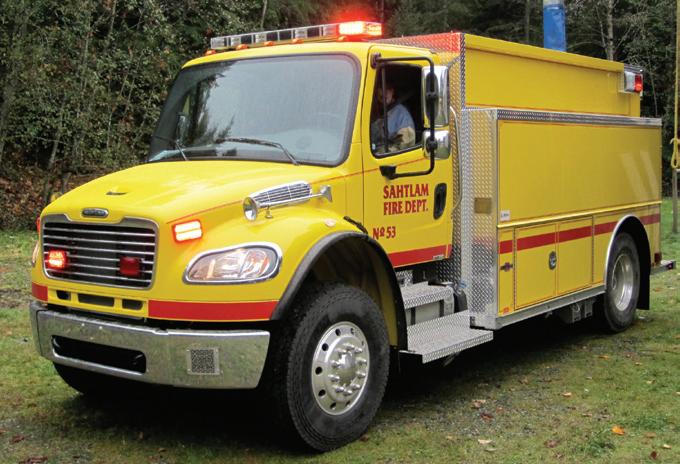
THE SAHTLAM FIRE DEPARTMENT in British Columbia, under Chief Allen Reid, took delivery in November from Rocky Mountain Phoenix of a Rosenbauer-built tanker. Built on a Freightliner M2-106 chassis and powered by an Allison 3000 EVS transmission and a Cummins ISC 300-hp engine, the truck is equipped with a Darley portable pump, 1,634-IG UPF-poly water tank, a Whelen LED light package, dual portable tank storage, four-inch direct tank fill, 180-degree swivel dump chute and Whelen PSTANK Level lights.
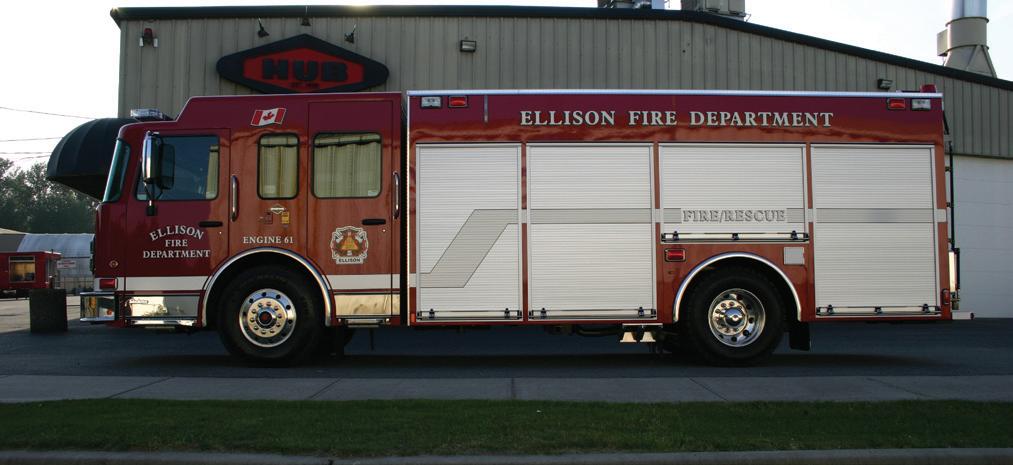
THE ELLISON FIRE DEPARTMENT in British Columbia, under Chief Kurt Szalla, took delivery in August of a Hub Fire Engines & Equipment-built pumper. Built on a Spartan Gladiator chassis and powered by an Allison 3000 EVP transmission and a Cummins ISL 425-hp engine, the truck is equipped with a Waterous S100D 1,500-IGPM pump, a FoamPro 1600 foam system, a 700-IG copoly water tank, a TFT Hurricane monitor, a Zico Access ladder, a Smart Power 10-kilowatt generator and a Command Light tower.
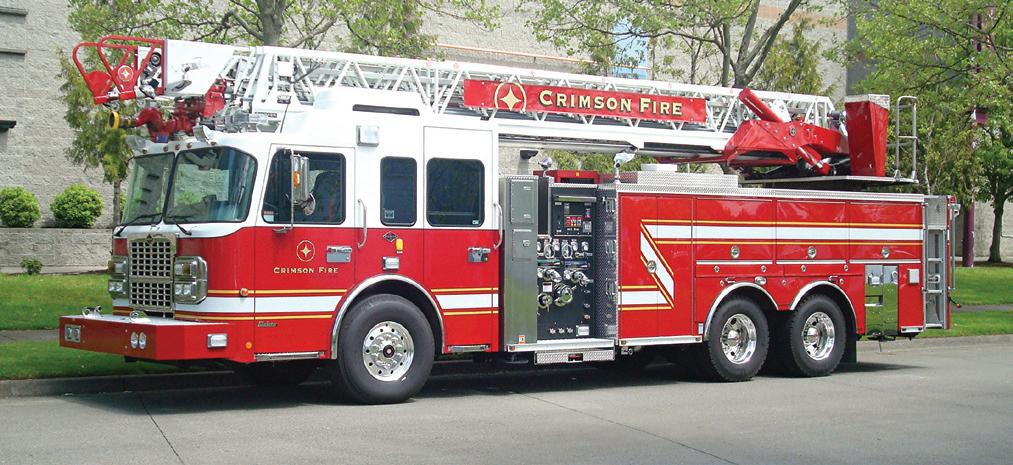
GANDER FIRE RESCUE in Newfoundland took delivery in December from Dependable Emergency Vehicles of a Crimson Fire-built aerial truck. Built on a Spartan Gladiator chassis and powered by an Allison 4000 EVS transmission and a Cat 525-hp engine, the truck is equipped with a Hale QMAX 2,100-IGPM pump, a Whelen light package, roll-up doors and a 103-foot aerial ladder.
NORTH OYSTER FIRE DEPARTMENT
PEMBERTON FIRE RESCUE
GRAND FALLS-WINDSOR
THE SAHTLAM FIRE DEPARTMENT
THE ELLISON FIRE DEPARTMENT
GANDER FIRE RESCUE
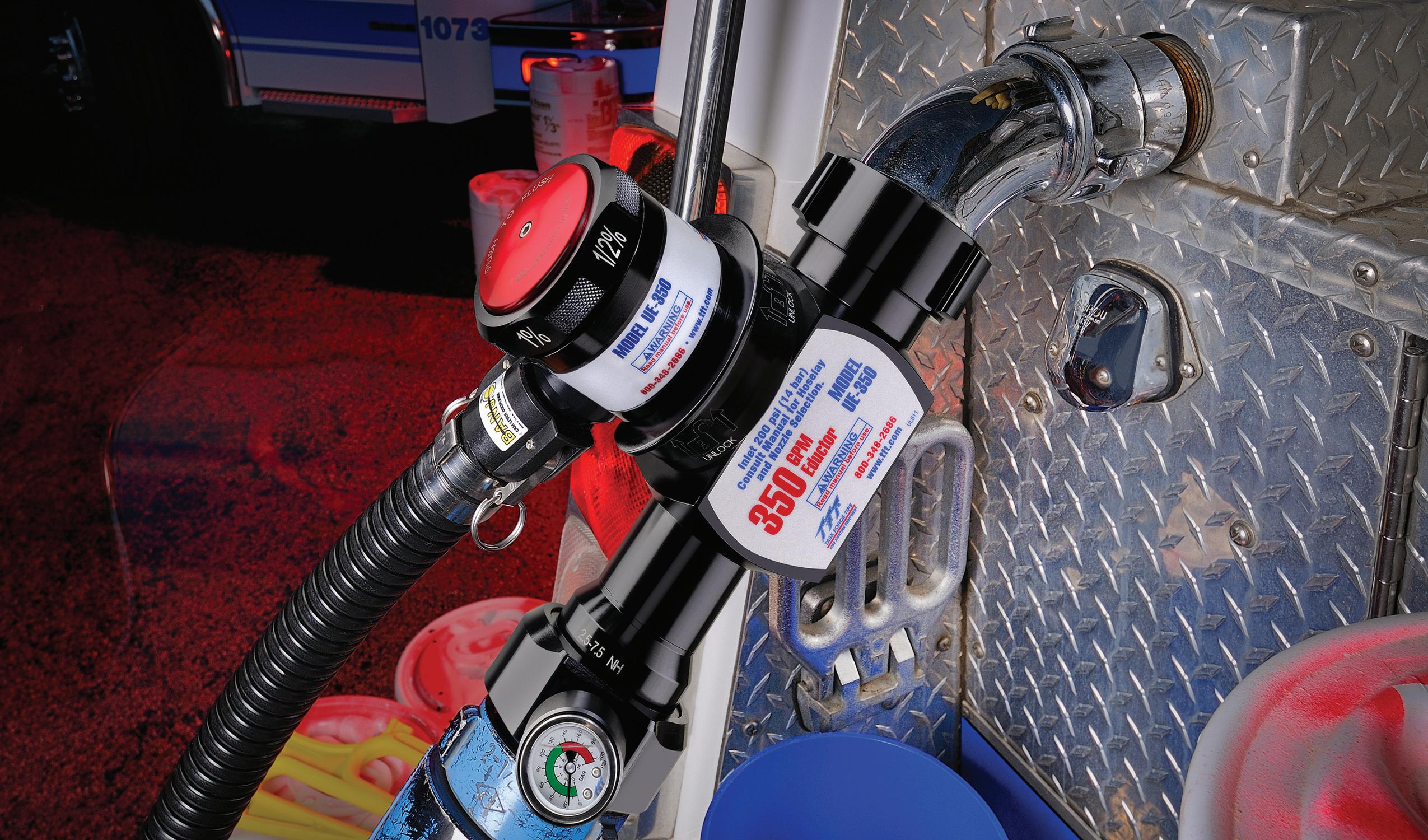
A Foam Eductor that Flushes Itself…
With the touch of a button, TFT’s Foam Eductor Series can completely flush all residual foam concentrate ensuring successful injection during the next foam operation.
Offering injection ratios of ¼% up to 6% and flow choices from 60gpm up to 350gpm, these eductors are the ideal choice for all Class A, AFFF, or Alcohol Resistant foam concentrates.
To learn more about how you can dramatically improve and simplify your foam operations, contact your local TFT dealer today.
350 GPM Eductor with Integral Go/No Go Gauge
F IRED UP
Cancer survivor tackles processes for patients while others advocate for firefighter safety
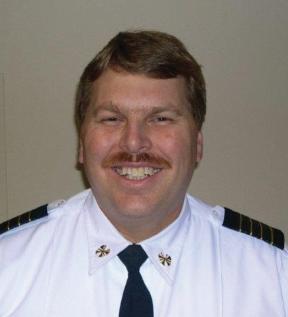
LEFT: LEFT: Caledon Deputy Fire Chief Tony Lippers is healthy after experiencing esophageal cancer and is poised to help others navigate the confusing and often overwhelming patient-care process.
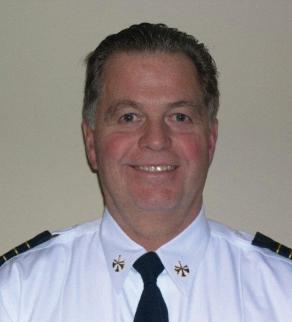
ABOVE: Volunteer Fire Chief Hector Babin of Eel Brook, N.S., is relentlessly positive in his pitch for firefighter safety despite his cancer diagnosis.
Editor’s note: Tony Lippers, Ken Day and Hector Babin share a mission. Tony, the deputy fire chief in Caledon, Ont., conquered esophageal cancer and is determined to create a mechanism to make the patient process easier for others.
Ken, the late chief in LaSalle, Ont., valiantly fought the colon cancer that stole his life last summer, but his message of self-care and advocacy survives.
And Hector, a carpenter and volunteer fire chief in tiny Eel Brook, N.S., perseveres as his cancer spreads, yet relentlessly preaches safety to firefighters along Nova Scotia’s Acadian shore.
Tony and Hector tell their stories, in their own words, to editor Laura King, while LaSalle’s new chief, Dave Sutton, speaks on behalf of Ken, his longtime friend and mentor.
TONY LIPPERS, DEPUTY CHIEF, CALEDON, ONT.
I’ll take it from the start. I had complications in swallowing on April 15. On April 16, I had a gastroscope done in Chatham. They sent a biopsy away. About a week later it was confirmed that I had cancer, located in the esophagus.
So, I did a Form-6 here in Ontario, which is an injury or disease form, and submitted that to the WSIB [Workers Safety and Insurance Board] through the municipality. It took almost two-anda-half months for them to process it.
Along with that, all your medical records and whatever else from the surgeon or general practitioner, the oncologist, all these entities – are all submitted to WSIB for their endorsement or denial.
I went through the [WSIB] process and was accepted, being under the presumptive legislation. I was told at that time from the adjudicator that my medical expenses would be covered to the age of 65 but no more, no less.
From that, I was put on a plan and referred to a surgeon. When I say plan – I mean I had to go through seven weeks of chemo and radiation to try to reduce the size of the mass or the cancer cells, if not eliminate them.
So, as I went through that process, which is not a fun process, not only on me as an individual, but also on my family because you’ve got to go [to hospital] every day, and, of course, it’s not cheap when you consider parking and loss of time at work, you know, if you’re self-employed, or if your significant other is self-employed, that can put a huge strain on an individual, and again, I’m lucky because a person in Windsor would have to travel two hours for this; I had to travel less than 40 minutes to the Southlake Regional Health Centre in Newmarket, and I had, in my opinion, one of the best surgeons and oncology doctors that was accessible to me.
So, after I’d gone through this process and myriad tests, the surgeon I had was so thorough he wanted to know after the chemo and radiation where it [the cancer] was, how big it was, and what it looked like, so that when I had the actual surgery they knew exactly what they were doing. So I commend them for doing the tests but I wasn’t prepared, or the expectation wasn’t that it would be that in depth.
I knew the oncology was not pleasant; but other than the basic orientation that they give you when you start, I wasn’t prepared. I had a chemo pump for five weeks, so it’s like carrying an umbilical cord with
PHOTO BY LAURA KING
a 10-pound weight. So, when I say I wasn’t prepared for some things – the pump was one of them – and how sick I actually got. It seems like it gets worse before it gets better.
I had the surgery, which was a pretty major surgery in the context of things. I had complications. I was told these things could happen – but they did happen. So, in my case, I got blood clots in my lungs. Out of the 28 days I was in the hospital, 23 of them were in ICU. I came out, and here in Ontario they want you to be on your own – or in your own setting – as fast as possible, which is a good thing, but the support at home through St. Elizabeth home care – although it was good, it was not what I was offered in a hospital setting. There was nobody that you could go to and say, the surgeon told me that this was going to happen, and it’s not happening, so are you putting me at risk?
I didn’t know then – and it creates a bit of an unnerving situation, on the domestic side as well as the health side – I didn’t expect it to be this long. And I figured yes, it’s a major operation – they say a broken bone or things like that are six to eight weeks until you’re physically fit to do a firefighting job – in my case I’m not a first-level entity and I find it hard some days just to sit at this desk. They’re saying that possibly because of the clots, instead of being a sixto eight-week thing, it’s months.
In my case, I lost a lot of weight; they told me it would take almost a year to start to gain weight and it wouldn’t be much. As the surgeon said, the days of my 32-ounce Porterhouse are over! He refers to it as grazing. If you have anything to do with your digestive tract, it changes what you can consume, not just the amount. It’s a huge, huge transition. Everybody’s different, but in my case stuff like gravy – I can’t digest. You don’t know what you can consume and what you can’t. The surgeon’s office or dietitian’s office will tell you – in my instance, for example, Doritos or nacho chips, no matter how much you chew them they still have sharp edges, so for a digestive
tract that has been cut and severed, that’s not a good thing. But your body will tell you what you can and can’t have.
It changes everything – your lifestyle, diet. When I say diet I’m referring to your family – either you’re going to prepare yourself a different meal than the rest of your family or it’s all combined and everyone’s diet’s going to change. In some cases it’s a huge, significant change. And then again, it affects you, but it affects your immediate family. Everything that you go through in this process, if you don’t have the support, not only of the health-care practitioner, but your immediately family, it’s a long road.
So, I’ve had a couple of sit downs with the surgeons – in the broad sense. In the fire industry, one in three firefighting personnel, whether volunteer or career, will succumb to some sort of cancer, directly. Some will be more severe than others. Each one of us has a different makeup, so it will affect us differently, but it’s one in three.
In the general population, it’s one in eight. I asked him if he would be interested in taking this a step further – because I didn’t know what I was entitled to in presumptive legislation and how it related to our industry – my interest was to design a workshop in which you would get what the expectations are if you have cancer, and of course, in Ontario, the rules that go along with that, as well as the health-care side – what you can expect from a surgeon, a hospital, the business.
I was told by the surgeon [Dr. Julius Toth], that if I were to break my ankle or wrist or elbow, the assessment portion – the testing portion – could very well take anywhere from a year to 14 months – whether it’s physio or CAT scans. When you get cancer, you move right to the front of the line. So the system actually works in your favour; rather than wait weeks for tests, you wait days. That is one huge plus, because the name of the game is to get rid of whatever mass you have.
I can’t emphasize enough the physi-
cals and testing for cancers related to the fire field. So get tested once a year. I was between stage two and stage three when I was diagnosed. If you catch it at stage one, it’s not as severe or lengthy a process. I have been cut open pretty good – that may have not been the case if it was stage one.
The next steps? I have to, I guess, create a business case. I am going to forward it to my provincial body to maybe do a workshop from the firefighter or fire-service side, and then the medical side.
And I asked the surgeon if he would be part of that and he said by all means. The surgeon had explained everything to the T. That’s one thing that put not only me but my family at ease as to the procedure – why I’m doing tests, what the outcome of the tests are – not the results but why you’re doing the tests, what the expectations were, the pros the cons. He made us feel a part of the process.
The process with chemo and radiation – for me it was seven weeks. And then you have gestation period. Your hemoglobin is low . . . they can’t operate on you within this period of time. For me that was five weeks. So from the time it started on April 15 to surgery on Aug. 16, and 28 days later I was released from the hospital to home, and from that point to now I’m about 1,000 per cent better.
[Dr. Toth] guided the process – I’m sure he has influence in the process because he has his own ward at the hospital – but there’s no stone unturned. And he told me that the sooner you start this process the better off you are. He also told me that cancer – it doesn’t matter what type you have – loves sugar. So, some of the tests I had – after he told me this all made sense. It’s like Pac Man – it doesn’t matter whether it’s the lymph nodes or the cells – they give you a CT scan and the CT scan has glucose with a dye, and they have a thing called a PET scan, where they introduce vitamin C into your body and take another picture, and they have an internal ultrasound (gastroscope) – so all three of these are like overheads, they put them all over each other – and because cancer loves sugar, they just pop. When they did me, they did me head to toe because they had to determine whether the cancer had spread. Before they did this it was explained to me, so I knew why I was having these tests. I think I’ve had until now eight gastroscopes.
The quality of care I got, in my opinion, was top. What I propose to do – I didn’t know what the expectations were; not medical expectations, because obviously the way they do prostate cancer is different than what I had done. But how it should come together. I went through the WSIB but I was unsure how that system worked;
I was unsure how oncology worked. I was unsure of this world that I was entering. I have never been sick before, so my exposure to the emergency room or to a surgical arena – I had never been, other than as a first responder when you package a patient and are doing CPR on the way to the hospital and doing patient transfer. I didn’t know. I think everybody goes through the same thing that I did but no one talks about it.
I thought that a couple of months and I’d be back to the swing of things but that’s not the way it is.
The procedure I went through – I had an incision in the front and one in the back. Because the mass wasn’t as big as what was anticipated there were no sutures in the neck. They collapsed the lung and did the whole procedure through the ribcage. I have staples on the inside and sutures on the outside. There were nine tubes out of my body and there was more discomfort than pain, but I was on a drip for quite a while as well as another drug. I was treated quite well. In the ICU, there’s a nurse for every patient – it’s one on one. When I went to Dr. Toth’s ward, it was one nurse for every three. Generally it’s one for 10, one for 12. So, on the treatment side and on the medical side, I think that not just because I was in the fire industry, because people come from all walks of life, I was treated great with pretty much
every medical advance known. The system worked for me really well.
So, getting back to the next steps. What I’m proposing to do is, whether it’s a provincial entity or a national entity, not to have a database but to have somewhere to go so you can say, ‘I’ve just been diagnosed and what are my next steps?’ To my knowledge, there is nothing like that and it’s kind of a bitter pill to swallow when both the chiefs and the firefighters association sat on the working group to create the presumptive legislation. Again, every case is different but there have to be some consistencies to the process.
I phoned [the Ontario Association of Fire Chiefs] and of course there was nothing available. But you have the Ken Days, right. I knew Ken, but I had no idea what he went though or what his family went through. I’m fortunate, so far, that I’m clean.
Ken had complications. I can understand people keeping it to themselves because it’s a very personal thing, but I’ve been in this business for 28 years and in the fire service, generally, they pack together and offer their assistance in any way or means, it’s just that this is one of the occasions where you’re looking for some assistance about expectation, and there isn’t any. Yet I know that the chiefs and firefighters associations sat on committees and my assumption is that they know what the expectations should be – or
somebody does, so I’m researching that and am hopefully going to put something together for everybody.
DAVE SUTTON, FIRE CHIEF, LASALLE, ONT., ON BEHALF OF KEN DAY
I was obviously very close with Ken, and being colon cancer, he had many of those issues – the unknowns. His wife had graduated as a pharmacy assistant, so that helped, especially early on with the apprehension and scariness of the unknown, the doctorspeak and referrals among the specialists and surgeons. He felt left out and felt that he wasn’t getting proper explanations.
As fire chief, there’s the whole personal dignity issue – everyone wanted to come in and see him. He found it all very difficult and being such a gregarious people person, it was difficult all the way.
One of the other issues that was so difficult was that he was always in control and always the guy who makes things better; in this instance, there was a total lack of control and information, so Ken was out of his element and that was every difficult and frustrating on a psychological level on top of the medical issues and diagnosis. Here’s a guy who’s on top of his game and in control,
Continued on page 34
The late Ken Day (front), who was the fire chief in LaSalle, Ont., died in July at just 47, of complications from colon cancer. Like Tony Lippers, Day struggled to understand the patient-care process and wanted to ensure that firefighters heed the need for self-advocacy.
BACKtoBASICS
Truck company operations – ventilation from above
BY MARK VAN DER FEYST
As discussed in previous columns, ventilation is an important task on the fire ground when trying to suppress fire. Ventilation helps to remove hot gases and smoke, reduces the chances of flashover, smoke explosions or backdraft, increases visibility in the structure and provides fresh air for victims inside. Every structure fire requires some form of ventilation; choosing the best method is sometimes the hard part.
In a single-family residential structure, ventilation can be horizontal (with open windows and doors, using mechanical devices such as positive pressure fans or natural air currents), vertical (with a hole cut in the roof), or by hydraulic means. The bulk of your department’s structural fire calls is likely for residential buildings with peak roofs. But let’s turn our attention away from single-family residential structures and focus on commercial/industrial buildings, multipleresidential structures, highrises and low-rises. These types of buildings have at least two common features: height and flat roofs.
Buildings with these height variations present some obstacles to ventilating. The height may not allow for any ground-ladder access but may require aerial access, the roof type may be such that it cannot be cut easily, or perhaps the fire is between two floors in a multiplestorey building.
In these types of situations, one option is to ventilate the structure from above. If the building has windows close to the top of the roof or above where the fire is located, those windows are a great alternative. The rooftop will likely be accessed by ground ladder, by an aerial ladder, or by the building’s inside stairwell. If possible, establish a secondary means of escape before commencing any operation – just as we establish two ways off of a residential building.
It is vital to wear proper personal protective equipment when conducting this type of ventilation. You need to ensure that you are well protected with SCBA and structural firefighting gear given that you will be located above the fire and will be blasted with smoke and hot gases when the window is broken.
Ensure that the flat roof is safe. Sound the roof as you walk across it to check for structural integrity. If the roof feels soft or has too much bounce in it, it is probably not safe. You should also check visually for bubbling tar, which is never a good sign and needs to be avoided.
It is important to bring a good set of tools with you whenever you conduct certain functions on the fire ground. For ventilation on a flat roof, you need:
• Roof hook or pike pole (preferably six feet long)
• Bag of utility rope
• Flat-head axe
• Halligan bar
• Rotary saw or chainsaw (preferably a rotary saw)
Bringing only an axe or pike pole limits your ability to complete the assigned task.
There are three ways to complete venting from above. The first
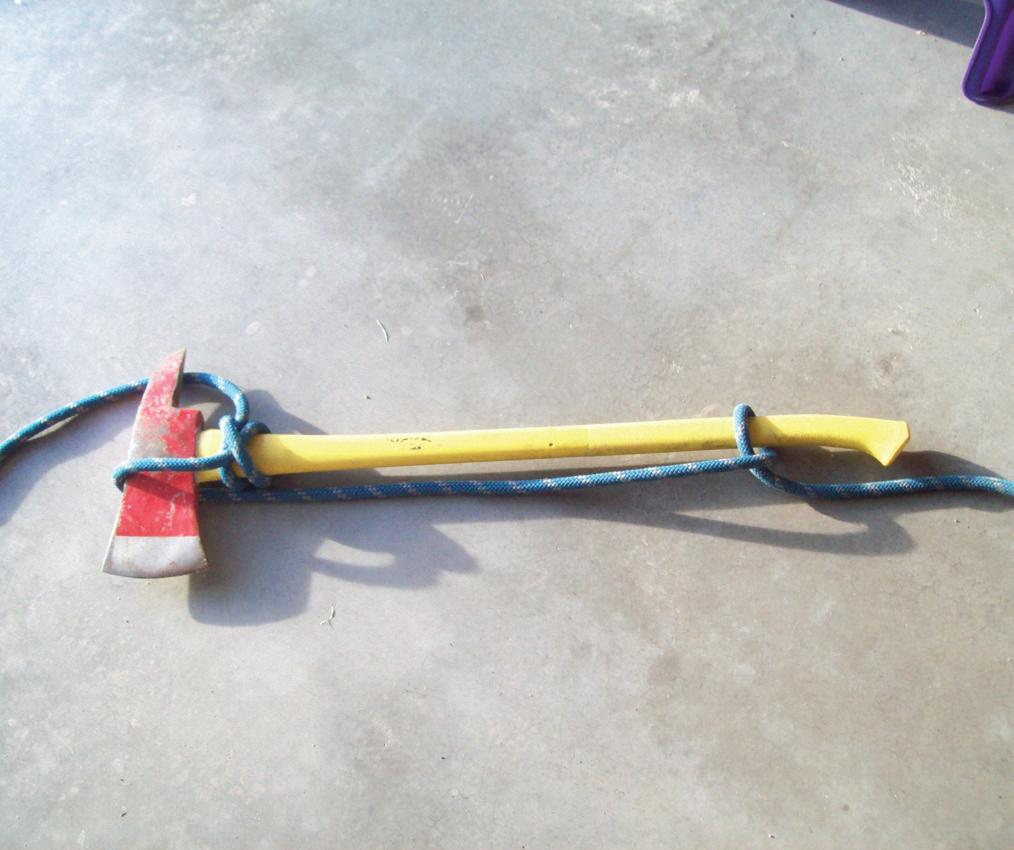
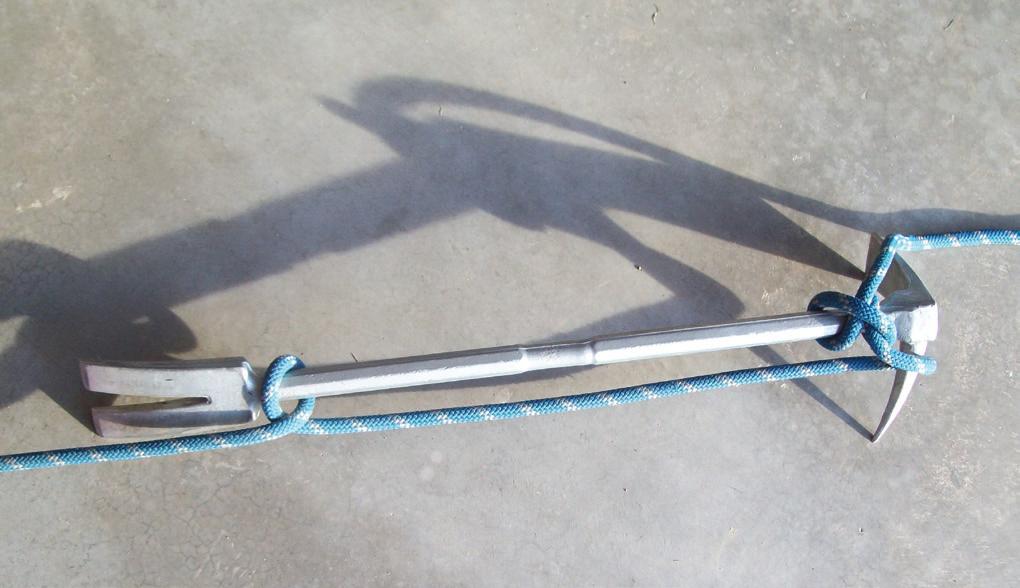
Photo 1: Secure the Halligan with a rope, using a clove hitch and a half hitch.
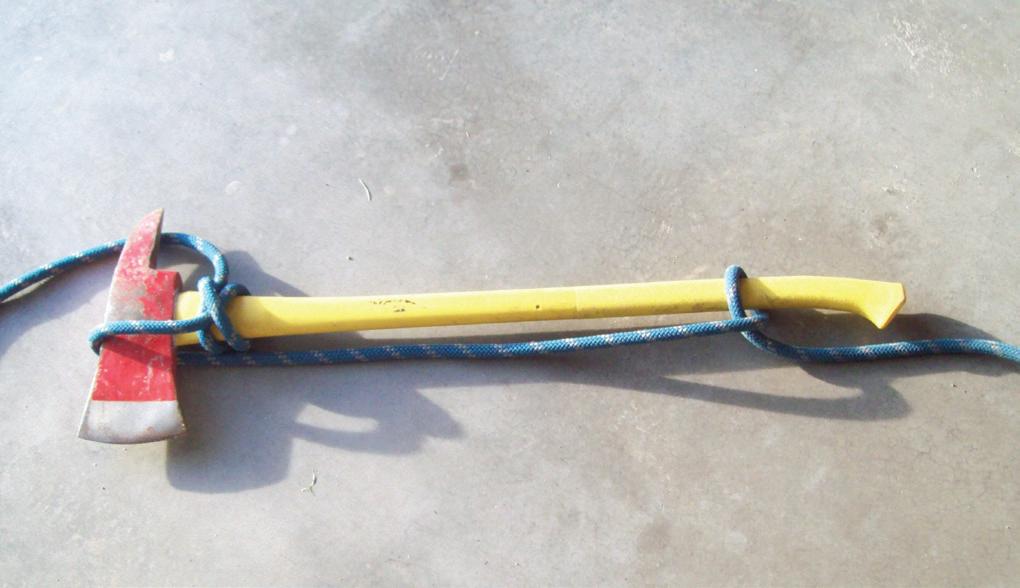
Photo 2: If there is no Halligan available, an axe will do the trick.
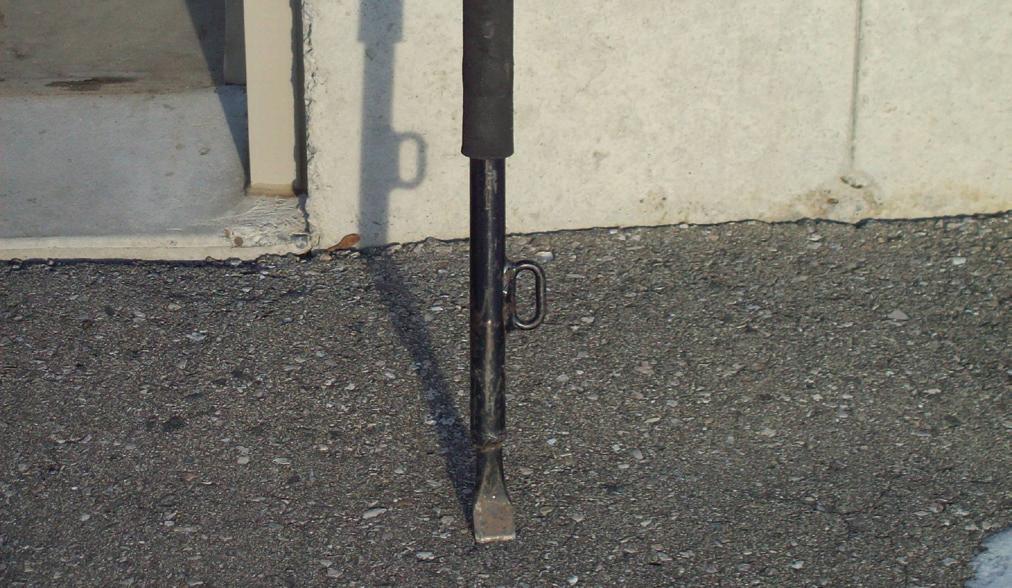
Photo 3: The six-foot roof hook has a link through which a carabineer can be hooked and attached to a rope to complete vertical ventilation.
PHOTOS BY MARK VAN DER FEYST
Ventilating from above can be used in highrise buildings with flat roofs; firefighters can vent the window below from the floor above.
method involves using a pike pole or a roof hook. The tools need to be long enough (minimum six feet, but the longer, the better) to allow you to reach over the edge of the building and break the glass out below. The firefighter who is breaking the glass will need to be secured by his partner so that he does not fall over the edge.
When breaking the glass, the firefighter needs to make sure that he does not lose the grip on the hand tool. Doing this requires a bit of upper-body strength. A striking action may be repeated a few times to ensure that the window is broken and cleared out enough to warrant effective ventilation. This process can cause fatigue if numerous windows need to be cleared.
The second method is to use a piece of rope and a hand tool, such as a Halligan. The idea here is to secure the hand tool with the rope and then toss it over the edge as a pendulum to break the window. First, secure the Halligan with the rope. Do this the same way you would prep the tool to hoist to the roof, as learned in Firefighter 1. As shown in photo 1 (on page 14), the Halligan is secured using a clove hitch and a half hitch. Do not use a rope larger than 12 millimetres (half an inch) in diameter –the smaller the diameter, the better. This allows you to ensure the hand tool is tightly secured and ready for deployment.
When the tool is secured, the firefighter will lower the tool over the edge to measure and mark where the window is. Once the hand tool is at the middle of the window, stop lowering it and use one of your hands to mark off the distance on the rope. The firefighter will position one hand (left or right) at the spot where the rope is supposed to pendulum in order to break the window. This hand will be the static, or anchor, hand, as it will not move when tossing the tool over the edge. Once the rope is marked, it can be retracted back up to the roof. When the firefighter is ready to toss the tool over, he will grab the hand tool and toss it over the edge,
making sure the other hand (the static/ anchor hand) does not move and is holding the rope at the proper mark. As the hand tool is being tossed out, it will swing like a pendulum and break the glass upon contact.
This action can be repeated several times to clear out as much glass as possible. A downside to this option is that the rope can be destroyed by glass pieces cutting it. This is why it is best to use utility (or other smaller diameter) rope over life-safety rope. A variation to this would be to use an axe as shown in photo 2 (on page 14).
The third method is to use a roof hook outfitted with a welded chain link at the bottom. As you can see in photo 3 (on page 14), the six-foot roof hook has a small link that allows you to hook in a small carabineer attached to a piece of rope or secure it with just rope and a figure-eight follow-through knot. The same operation can be conducted as described for the Halligan but with the roof hook. The disadvantage with the roof hook is that it is much lighter than the Halligan or the axe. The Halligan has more weight in the adze and spike end than the roof hook has in the hook end. The laws of physics and gravity mean that the Halligan is more effective. The Halligan can also be outfitted with a small link welded to it near the fork end, allowing it to be used in the same manner.
This technique of venting from above can be effective if conducted properly. It can be challenging to find a place in your community to practise this type of ventilation. Abandoned buildings that are slated for demolition are a great option. Getting permission will be the hard part.
Mark van der Feyst is a 13-year fire-service veteran who works with the City of Woodstock Fire Department in Ontario. He instructs in Canada, the United States and India. Contact him at Mark@FireStarTraining.com
TRAINER’SCORNER
Better fire-ground communication
By ED BROUWER
Our focus this month is a universal fire-ground problem: communication. It is impossible to competently manage any emergency incident if your communication is a mess.
Two types of factors contribute to communication problems on the fire ground: hardware and human. Weak signals, SCBA-muffled radio transmissions, dead or dying batteries, and – my favourite – trying to operate a radio with gloves on while looking through your BA mask in the dark.
Firefighters must be trained to speak in clear and concise sentences. They should also be instructed in basic radio discipline, specifically, knowing the difference between nonessential radio traffic and emergency traffic.
At our last practice we experienced waitress syndrome: you know, when dining at a restaurant, and at the exact moment your mouth is full of food, the waitress asks, “How is everything?” Our entry teams were practising bringing a fully charged line up a flight of stairs. Strange, but in both cases, just as the team was three or four steps from the second floor landing, the incident commander called just to see how they were doing. Each time, crew members stopped their ascent, fumbled with gloved hands for the radio, and struggled to make themselves understood.
At our debriefing we agreed to the need for clip-on speaker/mics. I also gave the rookies permission to postpone responding to the IC’s call by saying, “Stand by one,” until they were safely positioned at the top of the landing. Simple, but a big stress reliever.
As we visit other departments with our SOO HOT program, I am continually shocked at the miscommunication on the fire ground. This has nothing to do with hardware failures, and, for the most part, can be completely eradicated with the introduction of one unassuming word: from.
Firefighters must be taught this word during their basic radio communications training. Simply put, when one radio connects with another radio, firefighters should always use the word from. So, if engine one is going to communicate with you, the IC, it should sound like this: “IC from engine one”– not, “Engine one to IC,” which is so often the case.
Very seldom is the fire ground a place of perfect order and tranquility. There is myriad radio traffic, and although you may be popular, it is not all directed at you. Firefighters should monitor background chatter but not necessarily give it their full attention.
All or one of us should be listening for our call signs; in this case, the call sign is IC. Suddenly, amid the ongoing radio traffic, you hear “IC”. Because you are listening for your call sign (IC) you only hear IC – you likely did not hear “Engine one to . . . ” Your typical response will most likely be, “Say again for IC,” or “Who is calling the IC?” However, by always using from, you will know who is trying to get your attention. Hearing your call sign (IC) will get your attention, and as you listen, you will hear, “. . . from engine one”.
Miscommunication on the fire ground can have fatal consequences. You need only read one fatality report to understand that loss of situational awareness (promoted by poor communication) is a major contributing factor to fire fatalities and injuries. According
Weak signals, SCBA-muffled radio transmissions, dead or dying batteries, and attempting to operate a radio with gloves on while looking through your BA mask in the dark all contribute to communication problems.
to the book Improving Firefighter Communications, “Good human communications skills and procedures will help promote safety even in the face of technical difficulties.”
It is also important to acknowledge that information was received. Saying “copy” or “got it” is not sufficient. Firefighters must be taught to take the time to repeat information back to the speaker. This must be done consistently during practice scenarios, fire-ground incidents and mop up in order for it to become second nature. An exchange should sound something like this:
“Engine one from attack one.”
“Go ahead attack one.”
“We need 100 psi on line one.”
“Roger that attack one, 100 psi line one.”
By repeating the request, any miscommunication is nipped in the bud. As noted in Improving Firefighter Communications, safe and effective fire-ground communication is a two-way process.
My son Casey bought me a copy of Sherlock Holmes by Arthur Conan Doyle. It was in the first story, “A Scandal In Bohemia,” that I stumbled across a quote that actually describes a fire-ground phenomenon.
Holmes, speaking to Watson says, “You see, but you do not observe. The distinction is clear. For example, you have frequently seen the steps
which lead up from the hall to this room.”
“Frequently.”
“How often?”
“Well, some hundreds of times.”
“Then how many are there?”
“How many? I don’t know.”
“Quite so! You have not observed. And yet you have seen. That is just my point. Now, I know that there are seventeen steps, because I have both seen and observed.”
You see, but you do not observe. There are many indicators on the fire ground that things aren’t going as planned. We may see, yet not observe. I believe that improved communication skills (speaking and listening) will lead to a higher level of situational awareness, which, in turn, will lead to more effective fire-ground communication.
The forestry service has long embraced the concept of watch-outs for firefighters in our risk/hazard assessment of operations. These scenarios were developed to provide specific instances that firefighters might face where their personal safety could be compromised.
Examples of these watch-out situations are:
• The fire is not scouted and sized up.
• You are in an area not seen in daylight.
• Safety zones and escape routes are not identified.
• You can’t see the main fire and are not in contact with someone who can.
• You are not informed of tactics, strategy and hazards.
• No communication link has been established with crew members or your supervisor.
It would be prudent for us to come up with a watch-out list for structural fire-ground operations. This would certainly increase situational awareness and thereby increase the effectiveness of communication.
The IC must identify and communicate hazardous conditions and indicators so that proper actions can be taken to avoid injury or fatality.
As chief of our wildland urban interface crew, I am obligated to provide a crew briefing before allowing any of my firefighters to partake in suppression activities. Firefighters are great at taking orders; however, they will communicate much more effectively if they know what is going on and why. This will also reduce stress and increase situational awareness, allowing for better decision making and more effective communication on the fire ground.
A 60-second (or shorter) briefing can make a world of difference in increasing situational awareness. Basically, a briefing allows each member to understand the language of that particular fire incident. Think of it as “A Minute To Win It!”
There are five areas we discuss in our briefings:
• What do we have? Results of size-up observations.
• Strategy: offensive or defensive, critical life safety information (occupants).
• Hazards: recognition of the hazards.
• Give clear fire-suppression directions: assignment of specific task or tasks; identification of hazards associated with the assignment.
• Questions/concerns: Does everyone know what we’re doing and why? What are we overlooking?
Firefighters have an obligation to themselves and others to provide the best communication possible. Why not start implementing this strategy at your next practice? Victory loves preparation. Until next time, stay safe out there.
Ed Brouwer is the chief instructor for Canwest Fire in Osoyoos, B.C., and Greenwood Fire and Rescue. The 21-year veteran of the fire service is also a fire warden with the B.C. Ministry of Forests, a Wildland Urban Interface fire suppression instructor/evaluator and a fireservice chaplain. Contact Ed at aka-opa@hotmail.com
A clear message
It seems likely that the federal government will set aside a portion of the wireless spectrum specifically for first responders, giving firefighters and other emergency services access to wireless broadband connectivity in the future. But that doesn’t mean the battle for better communication technology is over.
In fact, representatives of a tri-service committee representing fire, police and ambulance say it’s time for first responders to ramp up arguments in favour of dedicated broadband for emergency communication to make sure the federal government stays pointed in the right direction.
“We still need to be out there pitching and selling it, especially now,” said Pascal Rodier, superintendent, British Columbia Ambulance Service.
Rodier, plus Bill Moore, superintendent of the Halifax Regional Police, and Michael Sullivan, division chief with Ottawa Fire Services, made presentations at the Fifth Canadian Public Safety Interoperability Workshop in Ottawa in December. Representing the Tri-Service Special Purpose Committee on 700 MHz for Mission-Critical Public Safety Data, they pointed out that the federal government seems to understand the need for emergency broadband services, but there’s still plenty of work to do.
The government plans to auction off wireless spectrum at the 700 MHz frequency in the next year or two – a frequency that works very well for high-speed wireless data connections. The prospective bidders include Bell Canada, Wind Mobile, and other wireless communication service providers.
The Tri-Service Committee is working to ensure that the government sets aside a portion of the spectrum for first responders, such that emergency workers will be able to use broadband communications down the road.
If the government doesn’t set the spectrum aside, first responders will have to share the airwaves with everyone else, committee members argue. That means during emergencies, first responders could be competing with people watching videos and downloading apps, which could make it difficult for emergency-services personnel to establish a connection.
Battle for broadband needs support from Canada’s emergency services
BY STEFAN DUBOWSKI
Some groups are opposed to a dedicated broadband spectrum for emergency services, including communications service providers who say that even if there is a dedicated spectrum, money will not be available to install the technology required to use it. They want the spectrum to be made available to wireless providers.
Moore said the committee is encouraged by the response it has received from the government so far. After the last federal election, Prime Minister Stephen Harper sent a letter to Chief William Blair, president of the Canadian Association of Chiefs of Police. “Our government is committed to setting aside spectrum for emergency responders as part of the next wireless spectrum auction,” Harper wrote.
But the government has also been hearing from organizations opposed to the set-aside. In a public consultation last year, Industry Canada received comments from communication service providers indicating that a setaside would be the wrong thing to do.
Wireless phone company Mobilicity, for instance, said that even if emergency services get the spectrum, they won’t have the money to install the technology required to use it. If the set-aside spectrum was auctioned off to wireless service providers, however, “the additional funding that is raised could be used to contribute to the cost of building a network in other spectrum ranges, or to support wireless operations that can be given priority usage and roaming rights on the commercial spectrum.”
Wind Mobile also disagreed with the setaside. “Wind believes that any commercial wireless operators that are successful in bidding in the auction for 700 MHz spectrum should work with public safety agencies to ensure that their needs are met and should provide access to their networks as required based on their actual needs and on reasonable commercial terms.”
The Tri-Service Committee submitted comments to the public consultation as well, arguing in favour of the set-aside. Rodier said most of the submissions from other groups and individuals supported the committee’s stance.
But that was nearly a year ago, and the broadband issue has fallen off the radar screen for many first responders, Rodier said.
“A lot of the energy has died off.”
What should firefighters do to support the drive for emergency broadband services? According to Moore, they should be contacting members of parliament, provincial government representatives and municipal councillors to explain the importance of the set-aside.
Public-safety organizations also need to move forward on developing procedures to deal with broadband data, Sullivan said. What if dispatch receives a request for assistance via text message? What if the caller wants to forward a picture of the accident scene? It’s the kind of detail that would help first responders attain situational awareness more quickly – but only if they have the procedures in place to accept and process the information coming in.
Sullivan said that after an earthquake in
The cost of a new broadband communication system is among the challenges for emergency services.
the Ottawa area, fire dispatch fielded 500 calls in one hour. Add broadband information to the equation and it won’t be long before dispatch is overwhelmed, he said.
Governance is another important issue, Moore said. He explained that in United States, the government and emergency services created the Public Safety Spectrum Trust to oversee the spectrum licence. Canadian authorities need to create a governance model for the spectrum on this side of the border. Should it be a trust? A non-profit organization? A society? Should it operate as a single national body, or should it consist of regional entities?
Many questions remain on the business side as well, Moore said: how will we pay for a new broadband communication system? Who will be in charge of building it out? How will negotiations with technology providers be handled?
Work is underway to address these issues, he said.
Asked if he thinks the government will set aside the spectrum for public safety organizations, Moore said he’s confident it will, given the encouraging letter from the prime minister on the subject.
Rodier seemed less confident. “Our impressions are that they want to look at it,” he said, explaining that the public consultation on the auction is a good sign.
Sullivan said emergency services can’t afford to be left behind in the broadband era. “I think they have to set the spectrum aside,” he said.
Stefan Dubowski is a freelance writer based in Ottawa.
BY LES KARPLUK
Fire Chief, Prince Albert, Sask. AND LYLE QUAN
Fire Chief, Waterloo, Ont.
OLEADERSHIPFORUM
Surviving the chaos through communication
ur columns for 2012 will focus on how to survive the chaos in today’s fire service. We define chaos as unpredictability in the behaviour of a complex profession that can lead to confusion among employees.
Leadership is challenging at the best of times and can often be overwhelming. The pace of change in the fire service and the expectations of the communities we serve require firefighters and chief officers to be as nimble as possible in adapting to the challenges they may face.
During organizational uncertainty, staff look to the leadership team to see them through the adversity. Trials and tribulations such as budget reductions, political interference and low department morale can impact the administrative side. Personnel issues such as post-traumatic stress disorders, marriage breakups and changes to staff can cause (or add to) chaos in the department.
Chief officers and firefighters tell us that the work landscape has changed. Perhaps a more notable observation is the sense of entitlement that has permeated the workforce: many fire-service personnel we’ve spoken to say this sense of entitlement is real and needs to be jointly addressed; others view the presumption by senior officers of a sense of entitlement among younger firefighters as condescending, thinking the focus and priorities of the new generation of firefighters are misunderstood by the veterans. Regardless of your personal view, any member of the fire service can attest to the change in the workforce expectations from our staff and our community leaders.
Our community leaders expect more for less –not only from the fire department, but also from all departments operated by the town or city. This external challenge can exacerbate our efforts to engage our staff because we have fewer financial resources to invest into what may be seen as a non-essential program of team building and staff development. Karen Ellis, a U.K.-based consultant and coach, noted in a 2010 piece called “Grace Under Fire” in www.trainingjournal.com, that historically, workers have entered into psychological contracts with employers, under which employees held a long-term sense of devotion and dedication to the organization. Today, the short-term agreement is more prevalent, in which there is less of a commitment and reduced loyalty to the organization. In fact, Ellis says employees will stay with an organization only if they feel there is meaningful work that is fulfilling and develops work competencies. Some of our new firefighters fail to respond to, and/or will resist, the command-and-control leadership style that has be ingrained in our profession for more than 100 years.
This can be attributed to the fact that the new firefighters may believe that the command-and-control paramilitary style has only one place in our profession, and that is during emergency incidents. Without understanding this new landscape of generational differences, many in the profession have found themselves in unpredictable positions, or even in a state of confusion, regarding the expectations of the various generations in our workplaces.
Today’s fire-service leaders must understand this fact and remain resilient during turbulent times. Open communication and information sharing are critical and go a long way to foster trust in the organization, whereas the paramilitary style can prevent the open sharing of information and can essentially shut down the informal lines of communication. Without the existence of informal lines of communication, employees may be cautious of new department endeavours and even view creditable projects with suspicion.
Resilience is mandatory for any fire-service leader. Keeping focused in difficult situations is what separates the mature leader from the rest of the organization. At times, the paramilitary command-and-control leadership style may work (for example, in emergency incidents); however, it is rigid and lacks emotional connection, so use it sparingly and only when required. A catch-22 exists where the leadership of the department attempts to balance the command-and-control method
‘‘ Keeping focused in difficult situations is what separates the mature leader from the rest of the organization.’’
with a team-based decision-making model.
Adversity in the fire profession is the norm. Few members in the fire service can argue against the fact that we need to deal with the ups and downs in the profession in a timely manner. What is important is the ability to bounce back from those events. The ability to cope and be flexible during times of chaos will separate the strong leaders from the weak.
Les Karpluk is the fire chief of the Prince Albert Fire Department in Saskatchewan. Lyle Quan is the fire chief of Waterloo Fire Rescue in Ontario. Both are graduates of the Lakeland College Bachelor of Business in Emergency Services program and Dalhousie University’s Fire Service Leadership and Administration program.
Gen. George S. Patton, a United States army officer in the Second World War, said, “I don’t measure a man’s success by how high he climbs but how high he bounces when he hits bottom.” Look at those times of chaos as an opportunity to learn and grow. Remember, no matter how hard we try, everyone fails once in a while. How you learn and how you bounce back from those incidents is what demonstrates what type of leader you are.
People are our strength and, as leaders, the more we work at building trust and understanding within our team, the easier it is to deal with those chaotic events.
BY SEAN TRACEY
Canadian Regional Manager, NFPA
WNFPA improves process for standards development
hile preparing for this column on incident management, I thought I would give you an update on changes to the NFPA 1561: Standard on Emergency Services Incident Management System, as the standard is up for republishing in 2014. However, I realized that doing so could be an opportunity to showcase all the changes to the NFPA standards process since last year and identify how you can get involved in the refinement of NFPA 1561. Remember, NFPA does not write the standards – we just publish them. We need readers like you to take ownership of these changes to the standards as they affect you.
For those not in the know, the NFPA’s board of directors recognized as a priority the need to revise the standards-making process in order to make it more inclusive. This resulted in a number of significant changes announced in November 2010 and approved by the NFPA board. These changes not only result in a further clarification and streamlining of the standards-revision process, but also set up more time for the technical correlating committees to do their work. The most noticeable change is the discontinuation of the terms report on proposals (ROP) and report on comments (ROC). These have been replaced with the more colloquial terms first draft and second draft. These changes will be made for documents that are scheduled for rewrite in 2014 and onward. Change submissions can now be done electronically, making the process much easier. A much more detailed explanation of the changes can be found at www.nfpa.org, including YouTube video links describing the changes – all very 21st century!
The current 2008 edition of NFPA 1561 is widely referenced throughout NFPA standards and contains the basic elements required to improve the safety, health and survival of responders. It is an excellent resource on what is recognized as the basis of an incident-management system for any emergency-response organization.
no approved NITMAMs, the standard will be released. If there is a NITMAM, change proponents will be given their due at the annual meeting and NFPA members will vote on the proposed change at the annual meeting. Votes are now conducted electronically on all motions. This process unfolds on the NFPA website under the codes and standards tab. If there are any issues, contact me, and I can guide you through the process.
In December, a new policy was announced regarding the NFPA’s support of participants like you, who would be categorized as enforcers. It is open to technical committee members from the United States and Canada. In recognizing that many enforcers cannot attend technical committee meetings because of public-sector employer restraints, the NFPA has increased the support it provides to these individuals on technical committees. This includes reimbursement of most of the travel and lodging expenses to attend technical committee meetings. This will help to attract and retain enforcers like you in writing NFPA standards.
Outside of the standards process, the NFPA Canadian Regional Office has renewed its sponsorship of the PTSC-Online website, www. PTSC-Online.ca. You will note that NFPA-Canada has a dedicated section on the site. We aim to use this as a means to create discussion forums with input on standards changes of particular interest
‘‘ Change submissions can now be done electronically, making the process much easier.’’
At the time of publication, the proposed 2014 edition will have completed the first call for comments and the first draft should be published Aug. 7. Comments on the second draft will be open until Nov. 16. (Remember: anyone can send in suggested changes; you need not be an NFPA member.) The second draft will be published on July 19, 2013.
You have until Aug. 23, 2013, to decide if you have any concerns with the proposed changes and wish to make a floor motion at the NFPA annual meeting against any of them. This is called a notice of intent to make a motion, or NITMAM. The NFPA Standards Council determines whether the NITMAM is acceptable. If there are
Sean Tracey, P.Eng., MIFireE, is the Canadian regional manager of the National Fire Protection Association International and formerly the Canadian Armed Forces fire marshal. Contact him at stracey@nfpa.org
to Canadians, and to help us formulate our policy efforts in Canada. We also see the page as a potential forum through which we can alert Canadians to standard changes that might be of interest to them, and to solicit feedback. In addition, the page can be used to post downloadable presentations on subjects of interest to authorities having jurisdiction such as NFPA 96 (inspection basics), and inspection of care homes, for example. The site gives the fire service a place to discuss key fire-safety issues, such as industrial fire brigade standards and wildland urban interface. We can initiate new discussion forums. And it is all free. Please check out the site.
We believe we are making the entire standards-development process more accessible. We are also looking for ways to extend our reach on key issues of concern to the fire service through PTSC-Online. In doing so, we hope to see broader use and understanding of the standards and, thus, a more fire-resilient Canada.
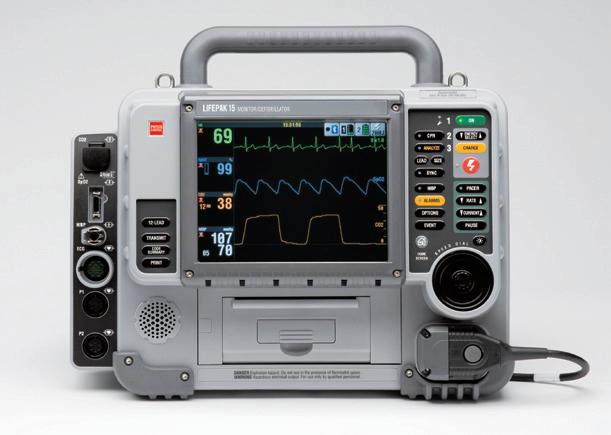
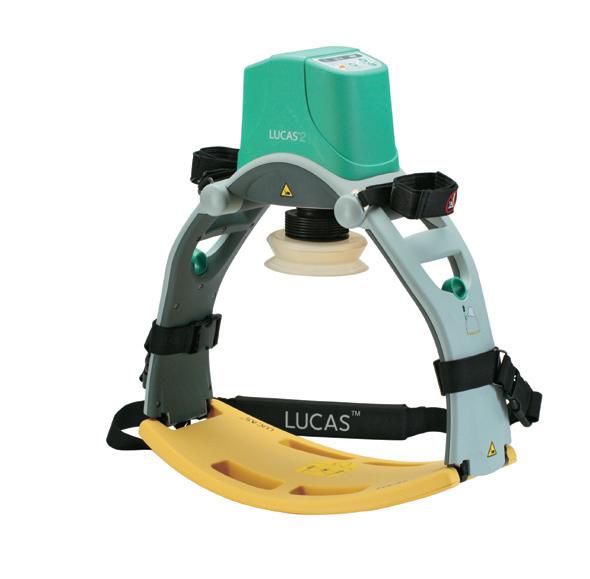
LIFEPAK 15 + LUCAS Perfect Partners
Perfect partners work together to create the best possible outcome for their patient. They support each other without duplicating effort. Designed based on years of partnership with EMS, the LIFEPAK® 15 monitor/defibrillator and the LUCAS™ 2 chest compression system work together to support your team in managing cardiac arrests. LUCAS 2 is designed to provide continuous, uninterrupted compressions while helping to reduce scene complexity. The 15 provides the power of 360J, plus the most advanced monitoring parameters available. Both are designed to be easy to understand and use by trained care providers. For more information, visit www.physio-control.com.
BY VINCE MACKENZIE Fire Chief
Grand Falls-Windsor, N.L.
TVOLUNTEERVISION
Tax-credit clarification necessary and favourable
he volunteer firefighter tax credit announced in the 2011 federal budget was a welcome addition in support of the volunteer fire service. In my last column, in December, I wrote about the 200 hours needed to qualify for the tax credit, and the definition of on-call. The Canada Revenue Agency (CRA) had indicated on its website that firefighters “on-call for firefighting and other related emergency calls” were eligible for the tax credit, but there was confusion about the term on-call.
I am happy to write again on this topic, as the CRA clarified the meaning of on-call in a Jan. 20 update to its website (go to www.craarc.gc.ca, search the word firefighter and click on Volunteer Firefighter Tax Credit (VFTC)). It seems the questions raised in December’s column were valid and were on the minds of many volunteer firefighters and fire chiefs. In my view, this clarification is favourable. Meeting the 200-hour criterion would have been challenging for rural firefighters had attendance to emergency calls and training been the only eligible activities. Smaller communities don’t have the numbers of emergencies to facilitate those kinds of hours, but the provision of 24-hour coverage demands that firefighters be on-call and maintain a constant vigil. This clarification by the federal government recognizes the commitment of volunteer firefighters and allows most volunteer firefighters to qualify for the new tax credit.
Determining on-call hours for each volunteer firefighter should not be difficult, but some departments may need to modify some of their documentation or scheduling practices. Many volunteer departments, including my own, schedule personnel to be on-call so that firefighters are obligated to be available and to respond when their crews are on duty at specific times. Some departments have weekend duty crews; others have week-long engagements on a rotating schedule. If a firefighter will be unavailable, out of town, or otherwise unable to respond, most departments have a system under which another firefighter is scheduled to fill in and thus be on-call. This ensures a minimum response. Some communities may not have such systems, so I recommend that departments adopt this practice for documentation purposes and to ensure a response adequate for firefighter safety and backup.
provisions for firefighters who are not available. This could lead to dangerous situations; having limited personnel handicaps fire departments into providing service only to a level to which they can safely respond. Having an official schedule and a documented system of duty crews for volunteers not only helps to maintain safer and constant coverage, but also aids in documenting on-call time to satisfy the tax man when firefighters claim the new credit.
There’s more new information on the CRA’s website about the tax credit that is relevant to eligibility, mainly surrounding primary duties or primary hours. Primary hours are defined as time spent responding to and being on-call for firefighting and related emergency calls as a firefighter, attending meetings held by the fire department, and participating in required training for suppression and prevention of fire. I agree with this. Other types of duties include maintenance and public fire education, for example. The criteria require that more than half of the 200 hours be spent doing primary duties. Most members of volunteer fire services are suppression firefighters, but some provide support through maintenance, public education, administration and dispatch.
Fire-service leaders advocated for the tax credit on the basis of appreciation for those who provide 24-hour fire protection. So, requiring at
Fire-service leaders advocated for the tax credit on the basis of appreciation for those who provide 24-hour fire protection. ‘‘ ’’
Looking at NFPA 1720, fire officers need to know what capabilities they have at scenes. Occupational health and safety practices require that fire officers know as much as possible about incoming resources in order to keep crews safer. Some smaller departments have limited personnel, essentially placing everyone on-call all the time, and no
Vince MacKenzie is the fire chief in Grand Falls-Windsor, N.L. He is the president of the Newfoundland and Labrador Association of Fire Service, the second vice president of the Maritime Fire Chiefs Association and a director of the Canadian Association of Fire Chiefs. E-mail him at firechief@grandfallswindsor.com
least half of the 200 hours to be primary duty hours, including on-call time, makes sense. One can argue that the tax credit was not intended for those in fire departments whose services are valuable but do not participate in the 24-hour vigil that offers protection to our citizens. If the tax credit were offered to those support personnel, every volunteer in any credible service club or organization would seek some kind of tax relief.
So, what makes firefighters so special that they deserve a tax credit? Few organizations require the training, risk, dedication, time and physical fitness that the fire service demands to conduct its primary duties. Members of most other volunteer community service organizations get to pick and choose their hours to serve; firefighters don’t have that luxury. Hence, being on-call is recognized for firefighters whose lifestyles usually include family and personal sacrifices in order to meet their fire-service obligations. Recognition of volunteer firefighters, in the form of the tax credit, is a worthy investment by the government of Canada and the provinces that have implemented similar benefits.
BY LYLE QUAN Fire Chief Waterloo, Ont.
OOpening your mind before opening books
ver the years, I have recommended numerous books on topics ranging from leadership, to risk management to embracing uncertainty. All the books I have written about have not only made a positive difference my life, they have also changed or enhanced the way I view the world and how I deal with others – both in the workplace and in my personal life. Even though my focus when writing about these books has been to educate those in the fire service about all of the aspects and challenges that we face in our industry, the goal has also been to demonstrate that we are not alone and that many others (in all professions) deal with the same basic issues.
As a result of my columns, I have spoken to and received many e-mails from those who have read my articles and have taken my advice and read many of these books. And, on several occasions, I have received feedback from readers who have either gotten a great deal out of a book that I have recommended, or that a specific book didn’t have any real impact. So, the question is, why do some benefit more from a particular book than others?
To begin with, there is an old saying, which, in my opinion, is at the root of this question: When the student is ready, the teacher will appear (author unknown). I hold this to be true when it comes to learning about most things in life, especially when it comes to reading a book. Whether it’s a book on leadership or about project management, what you get out of the book depends on your frame of mind and what you are looking for in that book. If you are ready to learn about that specific topic, then you will be more receptive to embracing the concepts put forth. If you are in a negative (or doubting) frame of mind, then the book may not be able to penetrate that negative wall that has been erected by your attitude.
and what you’re hoping that the book in your hand will offer you: a promotion, the greater likelihood of succeeding in the challenges that are facing you or simply, to be better at what you are presently doing. If you can answer this question, then you will be more focused and more open to what you read.
With all this in mind, I thought it best to introduce just one book that I believe will get those leadership juices flowing again and make you think about your next steps.
The book is Leadership on the Line, Staying Alive through the Dangers of Leading, by Ronald Heifetz and Marty Linksy (2002).
David Broder of the Washington Post says (about this book) that, “There are many books about leadership, but I know of none more realistic about the risks and rewards of challenging an organization than this one. It is ‘tough love’ applied to the real world.”
Leadership is about supporting your people, communicating with them and leading by example. But as Broder notes, leadership sometimes means you can’t be everyone’s friend. That doesn’t mean you respect these people less; it means that sometimes you need to push them outside of their comfort zones.
Authors Heifetz and Linsky cover several key leadership points, such as:
• People do not resist change, per se. People resist loss. In other words, it’s not the change that people fight; it’s the possibility
Leadership is about supporting your people, communicating with them and leading by example. ‘‘ ’’
So, what is the answer? First and foremost, you need to understand what you want in life and in your career. What are your goals, both short and long term? Do you want to simply find an answer to a question relating to a process, do you want to know how to better manage your staff, or do you want to understand how you can become a better leader? All the finest leaders I have met, heard speaking at seminars or with whom I worked, had several key traits that have made them successful at what they do: they believe in the people with whom they work, and they truly want to leave the organization better than when they arrived. But, most importantly, they are lifelong learners, which means they face the world with inquiring minds.
So, take some time and think about what you truly want in life
Lyle Quan is the fire chief of Waterloo Fire Rescue in Ontario. He has a business degree in emergency services and a degree in adult education. Lyle is an instructor for two Canadian universities and has worked with many departments in the areas of leadership, safety and risk management. Email: thequans@sympatico.ca
of moving outside their comfort zones or, perhaps, the risk of losing something that they’ve gotten used to over the years.
• Leadership requires disturbing people at a rate they can absorb. As leaders, we sometimes try to move things ahead too quickly. So, if you see that deer-in-the-headlight look on some of your staff, then you may be pushing them faster than they can handle.
• Tactics of leadership involve making observations, asking questions, offering interpretations, and taking actions. Communicate with your staff, offer input and make sure it is followed up with an action.
I know this book will give you some food for thought relating to leading your people and supporting them in times of change. Change is a fact of life; it’s how you introduce it and communicate the value of the change that will make the difference between success and failure.
Leadership on the Line (2002) is published by Harvard Business School Press and can be purchased through Chapters.ca and Amazon.ca.
Chimney Fire Extinguisher*
Extinguishes Chimney Fire in Seconds!
PRICED AT UNDER
Independent testing shows that Chimfex® extinguishes* a chimney fire in an average of just 22 seconds.
The Original Chimfex® Chimney Fire Extinguisher* is the first line of defense for controlling chimney fires:
• Great for use in fireplaces or wood-burning heaters
• Allows the homeowner to react quickly and effectively to a chimney fire
• It’s the same top-quality product used by professional firefighters nationwide – proven effective for over 40 years
• Chimfex® is accepted by the CSIA
Continued from page 13
and at this point he lost all control and had no background information and in the initial stages, that made it that much more difficult.
Getting information out there to the fire service – we’re pretty protocol driven and to have the information in terms that firefighters can handle and in an accessible format that is familiar to us . . . that would be ideal.
For Ken, the colon issue started as it does with a lot of folks, experiencing bleeding and whatnot, back in spring of 2010. Initially it was kind of downplayed by the doctor; he was having some bleeding, they thought it was probably a little tear – something minor – and they gave him some medication to relax the bowel.
For several weeks it wasn’t a big deal and they said it should heal on its own. Then they did a colonoscopy and found the cancer. They started him on a fairly aggressive round of chemo and radiation to shrink the tumour through the summer. He came back to work part time for a couple of weeks before his major surgery in November and in the interim they found a tumour in the kidney as well. The surgery was to remove the one kidney completely and a section of the colon. Consequently, there were some complications of surgery – they nicked something in the urinary tract – so that complicated the recovery, but the prognosis was positive and the six-month checkup was good and everybody believed all along that he was on the road to recovery.
At around the end of May – for a month or so things weren’t going right – and at the end of May or early June he got the terminal diagnosis, and I really think some of the issues he had with healing with the urinary tract made it difficult for them to find the recurrence of the cancer. He was told the cancer was back with a vengeance. He was readmitted about a month prior and he passed away on July 29.
I think, particularly in his case – he was a very young guy, just 47 when he passed away – most of these screenings for normal, healthy folks who aren’t predisposed to some of these recognized cancers that firefighters are – start at age 50. With the health-care system, the doctors are reluctant to do the tests. Ken’s thing was that no matter what age you are, educate yourself about what you are predisposed to and get tested. As great as the medical system is, they aren’t knowledgeable about firefighter issues and we have to advocate for ourselves about the known cancers and we have to accept responsibility ourselves and get pre-screened.
That was really the focus of his concern. That, and, just general lifestyle issues: take responsibility for your own health and recognize the dangers of the job. There’s been a lot of research out there – by union and chiefs associations – but it’s up to us to take advantage of what’s available.
As in Tony’s example, the process side worked very well. There was a good rapport with WSIB as well. But on the medical side, not so much. There was a lot of indecision and unknown. Communication with the patient was one thing but communication among the specialists and the flow of information wasn’t the greatest. It was difficult to navigate.
HECTOR BABIN, FIRE CHIEF, EEL BROOK AND DISTRICTS, N.S.
For me, it started in September 2008. I was on a job site and bled through my rectum. It was a tumour and was at stage two. I had no symptoms at all, or so I thought. But after all this I found out there had been symptoms – I had been tired – I thought it was my age but it was a symptom. People don‘t realize it – but the doctor told me I should have been checked 10 years before.
After I bled, I ended up going to a specialist in Halifax and he told me that I would have a stoma [colostomy] bag – for life. And I think I was more scared of my stoma bag than the cancer; I fainted
I was being treated for hemorrhoids – wasn’t bleeding a lot. This was in March or April, and my specialist in April said any time you are bleeding you should see a specialist. I was operated on in October of 2008; there were no problems. In January 2009 I ended up going to Halifax for radiation, for six weeks. It’s worse than a sunburn – very painful; the last week I could hardly walk. It was best just to lay flat. I passed through that and in July, when the Maritime chiefs convention was in Pictou County, I got a call from the doctor and he told me I had spots in my lungs. And I asked why, and he said there’s a .001 per cent chance that the stuff will travel and settle somewhere else in your body, and that’s what happened to me. Chemo started in August 2009, and stopped in March. And I’ll tell you this, I just found out that the spots have grown a bit, and I start back on chemo again next week. I’ll start Monday – then I sleep Monday and Tuesday. Wednesday they disconnect me – I have a chemo bottle that takes 48 hours to go through my body. And by Friday I’m back to new again.
[As for line of duty], I can’t say yes or no. We used to walk around after the house fire was out, walk inside investigating, and apparently now they’ve found out that that’s the worst. You swallow it; it’s in your nose. How can you prove it now?
My insurance through the Fire Services Association of Nova Scotia (FSANS) would have paid me $2,000 if I had applied within a year – so now I’m not eligible. Even if you’re in a career department there’s a window during which you have to apply. The reason we don’t have compensation as volunteers is that it costs so bloody much. We pay $3,600 a year for my department through FSANS.
After the last 15 or 20 years, they want you to wear your air pack when you’re overhauling or investigating and wait until the smoke clears. And now fire marshals will not come to your site for 24 hours and a lot of time they’ll wear masks. So now you’re wondering, what did I do wrong for the last 20 years? You swallow a little smoke and back then it was nothing, and now it’s all occupational health and safety.
It’s all about education. I’ve learned it since my sickness – because of my sickness, I have been talking to all my departments in the Municipality of Argyle and I will talk to Yarmouth too – I was just elected president of the Argyle Municipal Firefighters Association –and my topic is safety, training and liability. And it all comes together. If you’re not trained, you’re not going to do it safely; if you’re not trained, you’re not going to be reliable. So I tell them, wear your air pack, wear your seatbelt in the truck. Take the extra four minutes to assess the situation. Take your time – look at the big picture. It’s finally trickling down.
I take it one day at a time. I have two families – my daughter, my son and my wife, and my sisters and brothers-in-law. And then I have the firefighting family. I’m so attached to my fire department that I go talk to one of my members – my deputy chief – and I asked him to tell my firefighters what’s going on, about the stuff in my lungs. They know if I don’t show up that I’m not feeling good. It goes up and down, but what keeps me going, a lot of it is the fire service – seeing the young guys move in. We just had an election of officers and I had two younger guys become captains – and they are all gung ho, and it makes me feel good that I can go and do what I need to do for myself.
We had a page that a carbon monoxide detector went off and I’m 15 minutes away from my department and I just made one phone call and I knew they knew what they were dong – you’ve got to have confidence in your firefighters. It’s been very challenging for me but, thank God, I have a lot of friends.
I have mornings when I get up and bring my dogs in, and I look at Facebook and sometimes I see that a firefighter lost his life and I just cry – when they die doing things that can be prevented. It has to stop. And it’s all because of training. Yes, I’m sick, and it might take my life or it might not. But when you have an accident at a fire scene or because you’re not wearing your seatbelt, that kills me, because I know it can be prevented.
KOCHEK® Rural Systems Your Single Source of Water Supply
Lightweight, fle xible, and durable are the trademarks of Kochek’s P VC suction hose
■ WATER STORAGE UNIT IDEAL FOR REMOTE AREAS
The Hexagon Water Dam is a Waterwall water storage unit from Cintec, developed to meet the needs of the firefighters who fight remote fires. The innovative inflatable Waterwall dam is designed to provide additional rapid water storage for firefighting appliances where main water supply is unavailable.
The Waterwall dam allows a tanker to empty water into the unit and leave location to refill. Meanwhile, the fire appliance can instead draw water from the Hexagon storage unit, enabling a more timely and efficient fire response.
that deploy the eDispatches system can download the eDispastches app for free. When a call is dispatched, the speaker on the phone opens up with an alert tone followed by the actual audio dispatch. Didn’t catch the address? Use replay and hear it again. Recipients are also able to control their personalized settings from the app itself.
The eDispatches system is totally automated and does not require your dispatch to be involved at all. For more information, visit www.edispatches.com.
■ CROWNWEAR HEAD LINERS KEEP THE SWEAT OUT
Designed to be the ultimate sweatband, CrownWear head liners’ advanced moisture transport system keeps you cool and dry, while unique filtration technology keeps your gear clean.
It is the only brand designed specifically for the fire ser vice Our patented, field repairable, poly-lock collar and hose are backed by an industr y leading warranty
C all: 800-420-4673 or on the web@Kochek.com.
Strainers
® Durable P VC Hose with lightweight design
The dam can be quickly inflated using readily available air pumps or compressed air supply. As soon as the dam is inflated, the device is ready to receive water. The unit is designed to withstand uneven ground and gentle slopes, making it an especially viable option for remote and rural fire response locations.
The light-weight, compact unit measures can be adjusted in size and capacity and can hold 2,745 U.S. gallons.
Visit www.cintec.com/waterwall for more information.
■ TURN SMARTPHONE INTO PAGER WITH EDISPATCHES
Fire, EMS and other emergency-service personnel can use the eDispatches mobile apps on their iPhone and Android smartphones, allowing the smart phones to operate similar to a voice pager with stored voice.
The eDispatches system has sent audio dispatches via text and phone calls since 2004, and now, members of departments
■
Engineered to maximize comfort and facilitate the evaporation of sweat, the hightech, versatile design is breathable, stops itching, and even prevents sunburn.
Built to handle the toughest conditions, the dual-layer system enhances your body’s own thermoregulation, keeping you cool in the summer and warm in the winter. Visit www.crownwear.com for more information.
■ CONTROL WATER DAMAGE WITH THE SHUTGUN
Fire damage can be expensive, but so can the water damage caused by an activated sprinkler head. An activated sprinkler system can take time to deactivate once the initial incident is under control. The Shutgun is a simple tool that will shut off an individual sprinkler head. Should the
ALL-TERRAIN LENTRY LIGHT UNITS NOW AVAILABLE WITH LEDS
LEDs are now available on all-terrain, portable LENTRY scene lighting systems by Ventry Solutions, Inc.
Portable LENTRY units combine Honda-series generators with extendable, all-terrain legs and telescoping lights. Each LED light used on a LENTRY system telescopes, is 120 volts, generates 20,000 lumens of light, draws only two amps, and uses just 240 watts of power. Each LED lamp head is comprised of 60 ultra-bright white LEDs, 48 for flood lighting and 12 focused spot lights. The unique lens helps direct flood lighting onto the work area and simultaneously a spot light beam into the distance.
Multiple telescoping LEDs are available on a single portable LENTRY Light System with your choice of height, standard or extra tall.
LENTRY Systems are quiet, bright, and fuel efficient, standing 3.5 to nine feet tall, with legs and lights that retract for storage and transport. These rugged units brightly illuminate any scene, on-road and off, helping first responders be safe and efficient no matter the terrain.
Visit www.ventry.com to see the available LENTRY units.
KE P Suction Elbows
fire rekindle, the Shutgun includes a fusible link that releases when heated, prompting the gun to drop out and reactivating the sprinkler. The single handgun design makes it fast, easy and safe to use, even from a ladder. For more information, visit www.cdnsafety.com.
■ HURST COMBINATION TOOL IMPROVES EFFICIENCY
The SC 350E combination tool, part of the Jaws of Life Edraulic line of rescue tools from Hurst, is engineered to free rescue workers of power units and heavy hoses, eliminating the set-up time associated with traditional rescue tools.
The SC 350E combination tool has all the power and flexibility to help rescuers rip, cut or bend steel as needed without the need for hoses or a power unit, yet the option to plug in and power the tool with a cord.
Specifications:
• Spreading force: up to 24,500 pounds
• Pulling force: up to 11,015 pounds
• Pulling distance: 14.6 inches (371 millimetres)
• Dimensions (l x w x h): 35.75 x 8.86 x 11.42 inches (908 x 225 x 290 millimetres)
Morphix Technologies has introduced three easy-to-use Chameleon chemical detection safety kits for first responders or fire personnel: Clan-Meth Lab Detection Kit, HazMat Detection Kit and Chemical Suicide Detection.
The Chameleon kits are field-configurable chemical detection units that offer a low-cost, easy-to-use, hands-free solution to protect the safety of professional personnel whose job it is to be the first on the scene. The Chameleon is a wearable, configurable sensor that is designed for easy on/easy off fit on the wearer’s forearm and can be worn over most turnout gear. The sensors change colour when toxic gases are present and require no power source or calibration. The Chameleon detects gases and vapours in the air where other technologies only detect hazards in liquid or aerosol forms. For more information, visit www.morphtec.com.
Are you a good candidate to take on a secondary career as one of our Ontario representatives? Visit www.PPES.ca today for additional details.
BY PETER SELLS
Is the right to strike right for those we serve?
In the end, it worked out. Corner Brook firefighters voted 95 per cent in favour of the city’s final offer and did not walk off the job. It seemed like I had been reading an old newspaper that had been packed away somewhere for a few decades, or that maybe there was another town called Corner Brook in the United States or the United Kingdom – someplace dysfunctional. I couldn’t get my head around the possibility of firefighters striking or being locked out in Canada – not in this century, anyway. But there it was, in black and white.
One thing was clear: the firefighters of Corner Brook were not the instigators of the situation in which they found themselves. The labour-relations environment in Newfoundland was such that there were no options remaining other than to apply a rights-based tactic. A quick primer for you:
The path to resolution of a conflict can be through interest-based negotiations, enforcement of rights by one or both sides, or through the application of power. Interests, rights, powers. In the absence of a negotiated settlement, the threat or implementation of a legal strike or lockout is within the rights of a union or employer. Such enforcement of a party’s rights does not represent the application of power, regardless of the extremes and hardships that such action often imposes on individuals and communities. Examples of truly power-based solutions are wildcat strikes in which workers who are not in a legal position to withdraw services do so regardless, illegal pickets or blockades, work-to-rule tactics, or unilateral contracting out of services currently under contract.
Corner Brook firefighters had a legal right to strike. That is the essence of the problem. In 1985, under similar circumstances, they were backed so tightly into a corner that they exercised that right. Management staff responded to emergency calls in the interim, but, fortunately, there were no structure fires. After three days on the picket lines, both parties agreed to arbitration and a settlement was eventually reached. Had the strike gone into the fourth day, the stakes would have been raised when a building caught fire in the former town of Curling, near a large oil-tank farm. It is hoped that firefighters would have ceased their walkout in the event of such a fire, but that will remain a hypothetical exercise.
and what is legal are not always the same. Even what is legal under one statute and what is legal under another may not be completely in alignment. A quick read of Newfoundland and Labrador’s Fire Protection Services Act does not reveal any requirement for a municipality to have a fire department, but it does say that:
The fire commissioner shall . . . advise the minister, municipalities and industry with respect to establishing fire departments and the requirements for organizing and equipping those fire departments, for training firefighting personnel and evaluating their firefighting capabilities and those other fire protection requirements which may be necessary . . .
I’m extrapolating here, but if Corner Brook has a fire department then it must have been deemed necessary to establish such an organization. If a fire department is necessary on one day, then it must have been necessary for three days in March 1985, and it must have been necessary in January 2012.
Oxford defines necessary as “needed to be done, achieved, or present; essential.” A fire-protection requirement that may be necessary is therefore a service that has been deemed essential. Nevertheless, under the prevailing labour laws in Newfoundland
‘‘ Deep down, we all know that fire protection is an essential service, one that is a civic right and a moral imperative.
’’
and Labrador, Corner Brook firefighters apparently have the right to withdraw such service.
So, a strike by firefighters is legal under one statute, and contrary to the provisions of another statute. Clear as mud.
Deep down, we all know that fire protection is an essential service, one that is a civic right and a moral imperative. However, what is right
Retired District Chief Peter Sells writes, speaks and consults on fire service management and professional development across North America and internationally. He holds a B.Sc. from the University of Toronto and an MBA from the University of Windsor. He sits on the advisory councils of the Ontario Fire College and the Institution of Fire Engineers, Canada branch. Contact him at peter.nivonuvo@gmail.com
This is not an exclusively local issue. The root problem is that services that are essential to the ongoing health, safety and wellness of our society are not given equitable weight across Canada, or even within individual communities. Workers in any service that directly impacts public safety and/or the core infrastructures of Canadian society must be designated as essential and must have access to compulsory arbitration in lieu of the right to strike.
We live in the greatest country on Earth and we all deserve fire protection, law enforcement, health care (from pre-hospital emergency response to the best trauma centres and hospitals possible), clean water, waste management, public transit, well-maintained transportation networks and uninterruptable public education systems.
Smooth Bore Performance from a Combination Nozzle…
TFT’s Mid-Force dual pressure automatic nozzle offers you a choice of maximum flow, or maximum reach and penetration from a single nozzle. The low pressure mode provides target fire flows with greatly reduced nozzle reaction, and the integrated slide valve produces a turbulence free straight stream, even when gated.
To learn more about how you can dramatically improve your initial attack flow operations automatically, contact your local TFT dealer today.