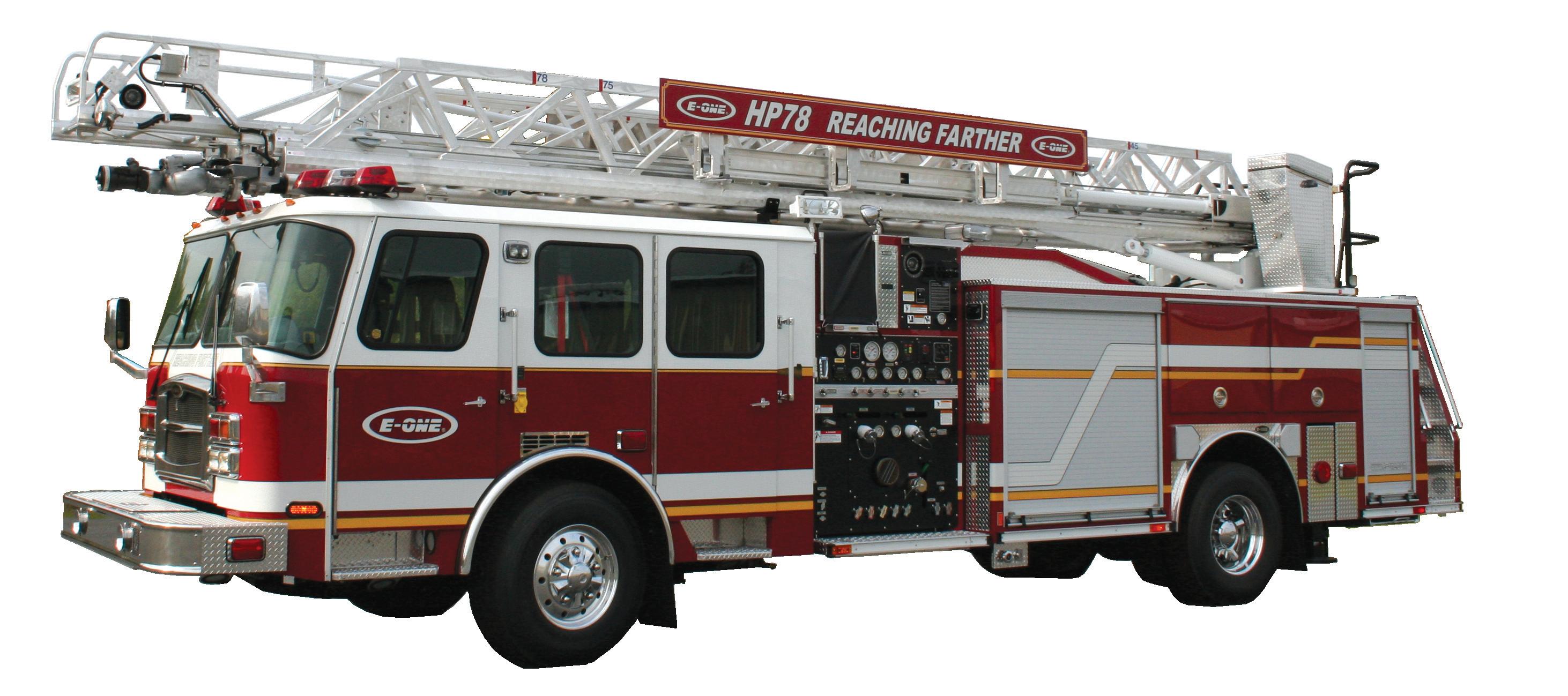
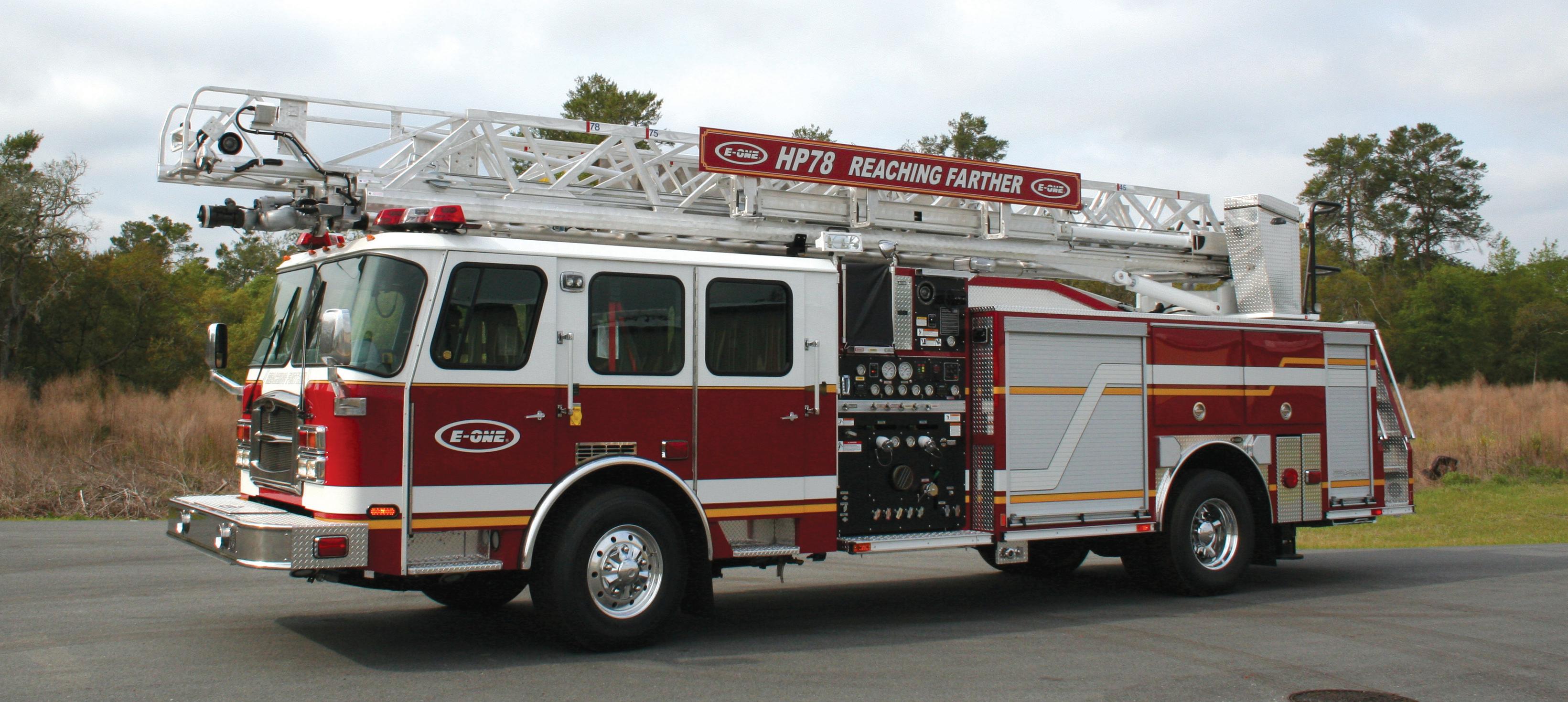
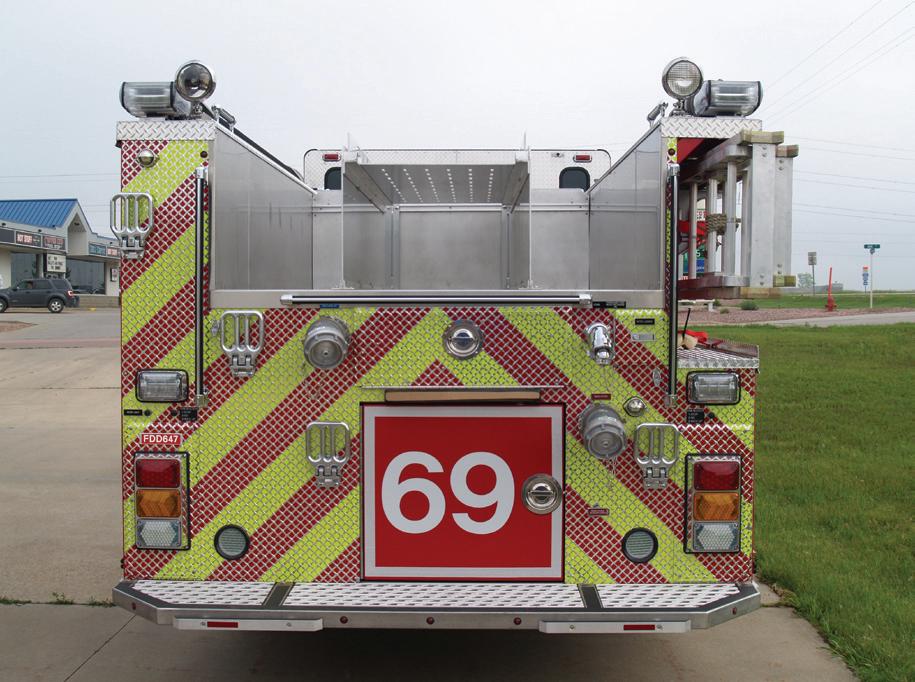
With more than 28 years of aerial experience and an industry-leading performance record, E-ONE continues protecting your team at the scene by delivering on our founding principles of innovation and safety. Featuring a 750-lb tip load, the new ToughTruss™ aluminum aerial design, a 2.5 to 1 structural safety factor, and a 78’ reach, the new HP 78 offers increased rescue capability and additional reach over similar products in its class. Combine this with generous compartment space, ground ladder storage, hosebed and tank size, and you’ll see why the new HP 78 allows you to carry the equipment and personnel necessary to protect your team at the scene.
Carry more, reach farther with the new HP 78.
www.E-ONE.com For
Phone:
Phone:
When lives are in the balance and seconds count.
Phone:
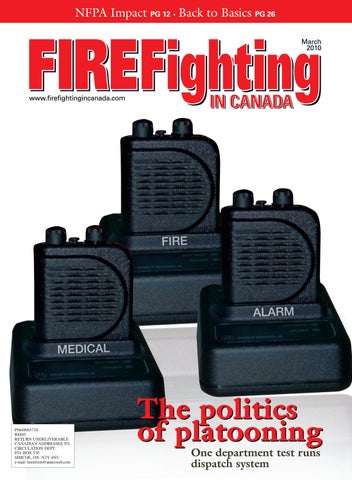
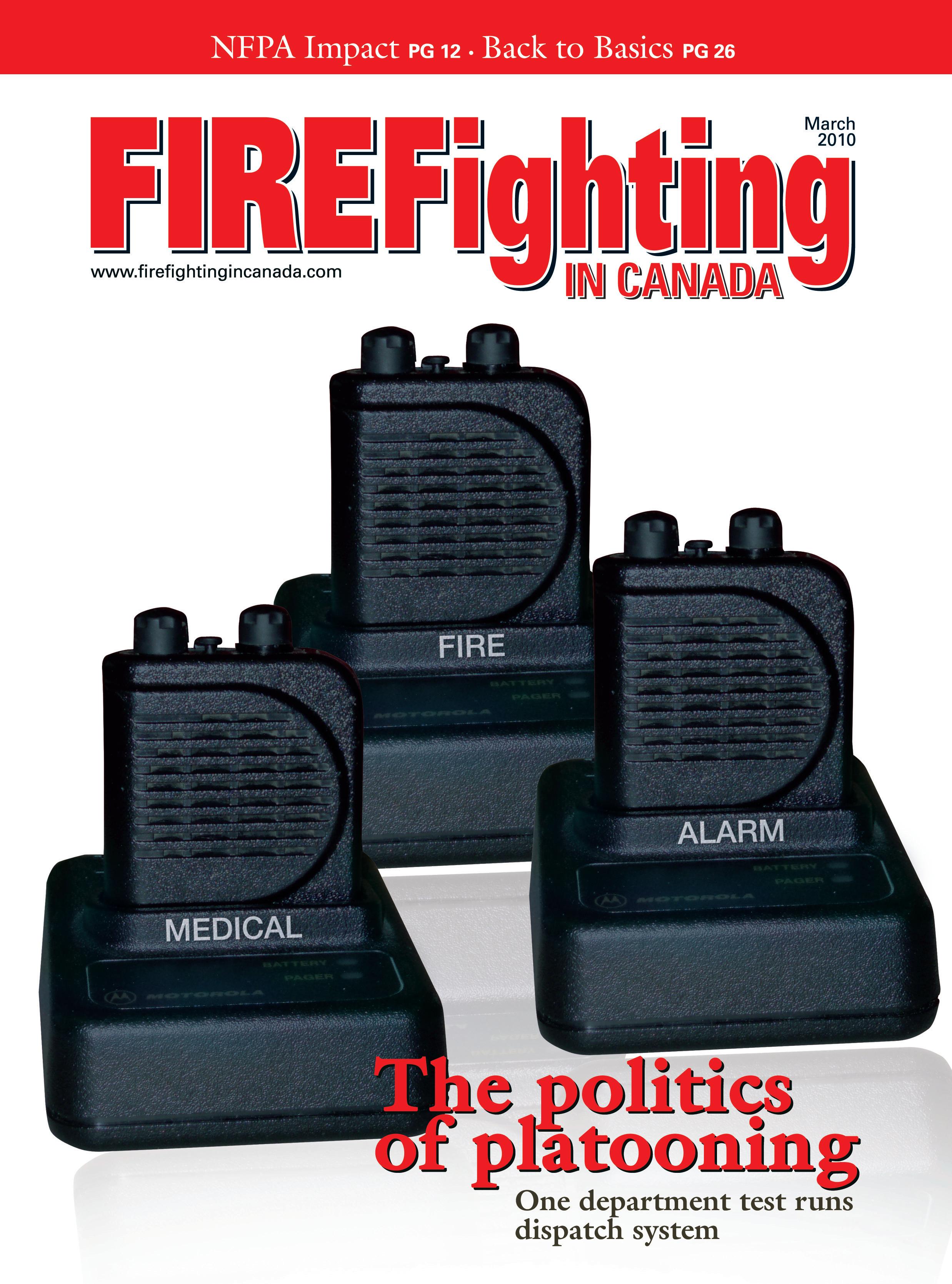
The poliTics of plaTooning
In March 2009, Caledon Fire & Emergency Services in Ontario instituted a pilot platooning program under which only some firefighters would be paged out to certain CO and medical calls. The aim of the platooning project was to determine if the municipality could call fewer firefighters to some incidents and maintain an adequate level of service. Laura King reports on the results and the pros and cons of platooning.
24 negligence, parT 2
Lawyer Timothy Wilkin continues his study of negligence cases in Canada and the lessons learned by fire departments, municipalities and the legal community, with profiles of three situations – two in Ontario and one in Manitoba – that offer valuable insight into the way the process works.
VERY
FEW THINGS CAN SURVIVE AN INFERNO.
OUR MISSION IS TO MAKE SURE YOU’RE ONE OF THEM.
The flames build. The smoke gets thicker and more intense by the second. People are fleeing. And what do you do? You push forward ready to do battle. It goes against every natural human instinct. But then again, firefighters are a different breed. For your infinite courage and selfless dedication, we salute you. But more importantly, we’re going to do everything we can to protect you. We’re MSA. And we equip firefighters with the most advanced thermal imaging cameras, helmets, air masks and gas detection devices available. Coincidentally, we’re somewhat of a different breed ourselves. You see, we’re a safety innovations company that’s been on a relentless crusade to protect lives for more than 90 years. Today we protect firefighters, soldiers, construction, iron and steel workers, oil riggers, utility workers, miners, consumers and hundreds more. Wherever there are workers who need to be protected, we will be there.
Cutters Edge Rescue Saws are designed and built to deliver 100% reliable, high performance cutting in the most demanding and extreme conditions encountered by Fire and Rescue Professionals.
MULTI-CUT Fire Rescue Saw
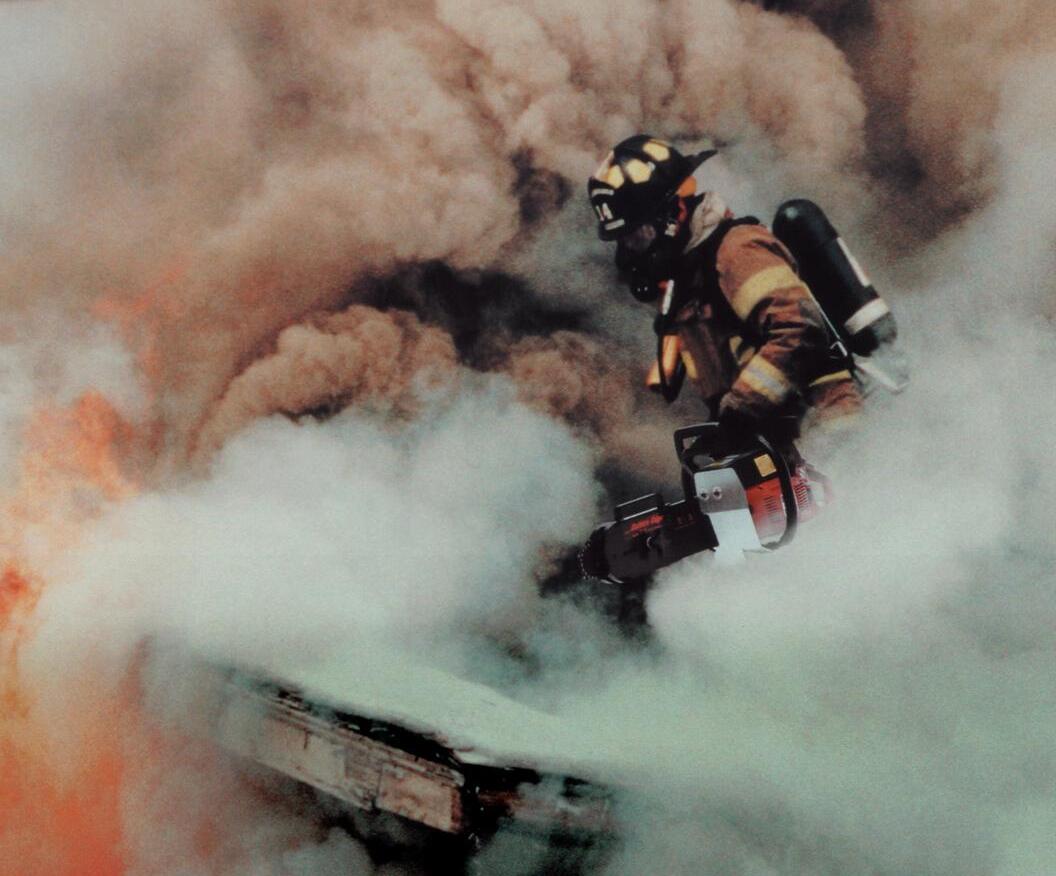
The Cutters Edge Original for Ventilation, Forcible Entry and Rescue Operations and built specifically to operate in hot, smoky fireground conditions. The patented BULLET® Chain cuts faster, safer and lasts up to 20 times longer than standard chains.
Gas Powered Concrete Rescue Saw
Cuts reinforced concrete up to 16-inches thick in minutes with the patented GCP SealPro® Diamond Chain and powerful 101cc engine. It’s fully portable, operates in any position and just one water hose needed for dust-free cutting in rescue situations.
Rotary Rescue Saw
Look for the New Generation, More Powerful Rotary Rescue Saw in Early 2010.
Fully Equipped Sawing Kits are Available for All Three Models
WESTERN CANADA
WFR Wholesale Fire & Rescue Ltd. Calgary AB - Ph 403-279-0400
E-Mail: c.fireandsafety@ns.sympatico.ca Contact Your Local Cutters Edge Dealer
E-Mail: hpicard@areo-feu.com
E-Mail: jkenny@nf.sympatico.ca
CE2171 MULTI-CUT Rescue Saw
CE101C Concrete Saw
CE735R Rotary Rescue Saw
By L AURA kIN g Editor lking@annexweb.com
B
comment
Shifting the way we think
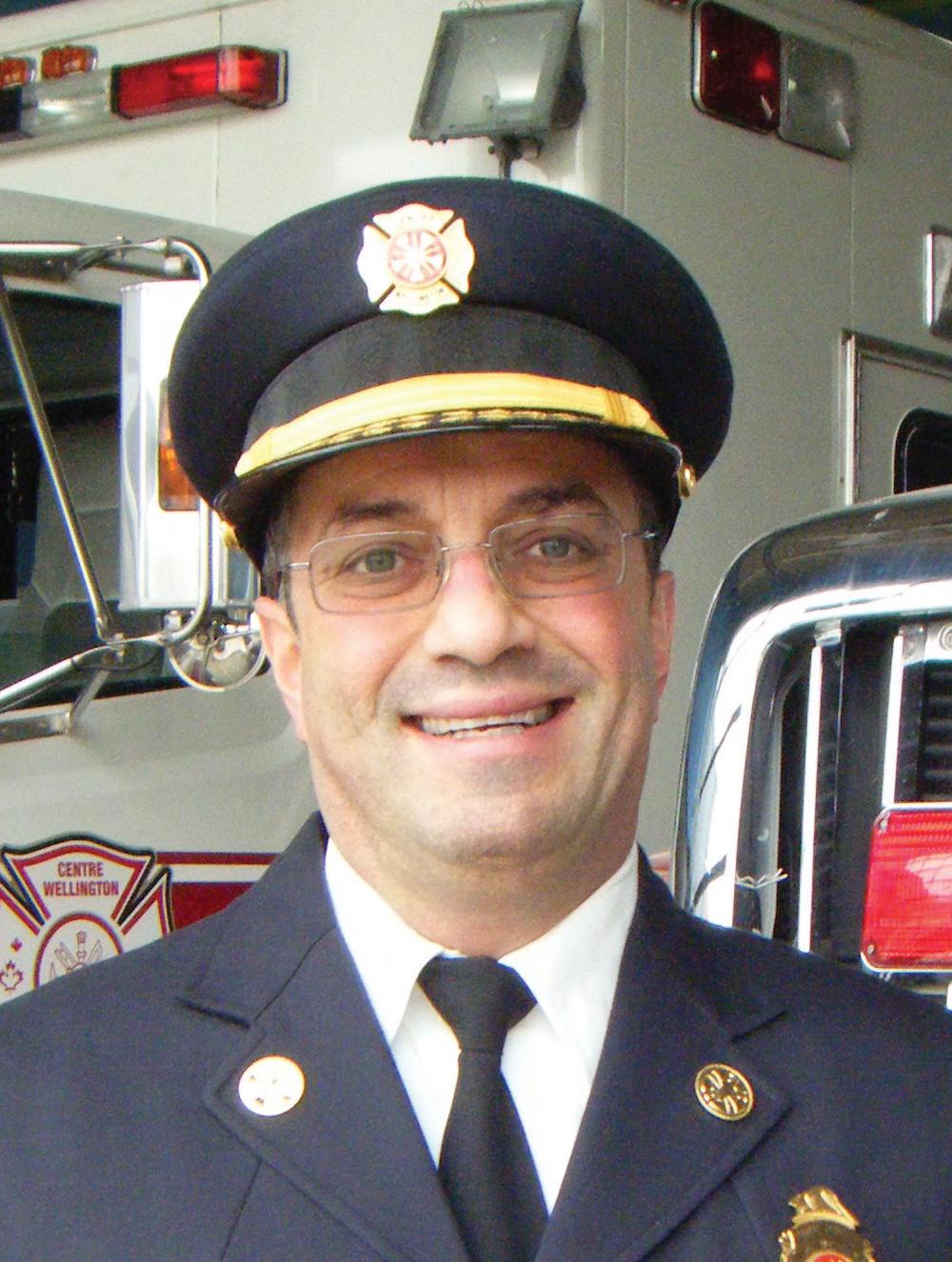
rad Patton wrote about platooning in our June issue, wondering if the opposition in his department to the suggestion that only some volunteer firefighters would get paged out to certain calls was simply because people don’t like change.
“You would have thought I had sold their homes and families and drunk their last beers,” Patton said of the reaction to the idea to cut down on unnecessary page outs.
Patton is the chief in Centre-Wellington, Ont., and our straight-talking Volunteer Vision columnist. He proposed platooning to his crews – meaning that only half the station’s firefighters would be paged out for carbon monoxide and medical alarms. Everyone would still be paged to all other alarms – fires, motor vehicle accidents and rescues. There were howls of protest and the issue was dropped. But the logic remains. Just under half of the calls at Centre Wellington are what Patton describes as platoon calls or alarms that require low manpower.
starting on page 14. While it turned out that platooning wasn’t right for Caledon because of logistics issues, there is an understanding among some fire service leaders that it’s time to take a hard look at dispatch systems given the considerable changes in the roles of the fire service in the last 20 years.
The types of calls to which fire departments respond have shifted significantly but the dispatch system that was established to respond to structure fires – paging out a full contingent of firefighters – is still the norm.
Read the full story on page 14.
“The ambulance is sending just two people, so why am I paging out 25?” Patton asked in his column.
Good question. And one that was asked by municipal councillors in Caldeon, Ont., who got wind of complaints by some of the area’s 245 volunteer firefighters that they were getting burned out from going to so many low-manpower calls. With volunteer recruitment and retention an issue in many communities across Canada, it seemed to make sense to try to figure out a way to reduce the stress on volunteer firefighters and the interruptions to their work and family lives.
After much research and discussion, Caldeon Chief Brad Bigrigg instituted a four-month platooning project, the results of which are explained in our cover story
Chilliwack, B.C., which is blessed with a plethora of volunteers, used a platoon system for a while – and it worked. Its volunteer numbers dropped a bit and it went back to the old system but the template for the platoon structure is in place and can be reinstituted.
Platooning does not mean the chief is in cahoots with the municipality and is trying to cut volunteers’ pay. It’s just a more effective way of managing a response so that 20-plus volunteers aren’t woken up in the middle of the night or called away from their day jobs to respond to a minor incident.
As Patton said: “I thought, who wants to get paged out at two in the morning for a CO alarm when there is no chance of making the responding apparatus? You get up, get dressed, rush down to the hall, place a tick beside your name so you get paid and your attendance is recorded, then go home back to bed. Or, perhaps you leave your employer to figure out how to get along without you while you go down to the station just to sign in.”
It’s time for a paradigm shift. Welcome to the 21st century.
PRESIdENT MIKE FrEDErICKS mfredericks@annexweb.com
PuBLICaTIOn MaIL agrEEMEnT #40065710 PaP registration #8885 rETurn unDELIVEraBLE CanaDIan aDDrESSES TO CIrCuLaTIOn DEPT. P.O. Box 530, SIMCOE, On n3y 4n5 e-mail: lmorrison@annexweb.com
Printed in Canada ISSn 0015–2595
CIRCULATION e-mail: lmorrison@annexweb.com
Tel: 866-790-6070 ext. 206
Fax: 877-624-1940 Mail: P.O. Box 530 Simcoe, On n3y 4n5
SUBSCRIPTION RATES
Canada – 1 year - $25.44 (includes gST - #867172652rT0001) uSa – 1 year $50.00
We acknowledge the financial support of the Government of Canada, through the Publications Assistance Program and the Canada Magazine Fund, toward our mailing and editorial cost. Nous reconnaissons l’aide financiere accordee par le gouvernement du Canada pour nos coults d’envoie postal et nos coutl redactionnels par l’entremise du Programme d’aide aux publications et du Fonds du Canda pour les magazines.
From time to time, we at Fire Fighting In Canada make our subscription list available to reputable companies and organizations whose products and services we believe may be of interest to you. If you do not want your name to be made available, contact our circulation department in any of the four ways listed above.
all advertising is subject to the publisher’s approval. Such approval does not imply any endorsement of the products or services advertised. Publisher reserves the right to refuse advertising that does not meet the standards of the publication. www.firefightingincanada.com
Photo by t om DeSorcy
statIontostatIon
across canada: Regional bews briefs
Education fund to help families of fallen firefighters
Beginning this fall, the Canadian Fallen Firefighters Foundation will provide financial assistance for children of fallen firefighters who want to pursue higher education.
The education program will provide three qualified students with one-time bursaries of $3,000 each.
“We hope this program will help families of the fallen who are unable to afford post-secondary education for their children,” said Capt. Robert Kirkpatrick, president of the CFFF. “We want to pave the way forward for these children who have lost a parent and help ease the financial burden of their families, many of whom have lost their primary income earners. It is also another way we can say thank you to the brave individuals who have paid the ultimate price in serving their communities.”
As part of the next step of
its education program, the CFFF also plans to award a four-year scholarship for the academic year 2011-2012.
To be eligible for the 2010-2011 bursaries students must apply in May and June 2010. Information and applications are available at www. cfff.ca/en/programs/ bursary/.
The education fund is made possible through ongoing donations from the community and businesses.
“In particular, we would like to thank the Motorola Foundation of Illinois, which provided the seed funding without which this fund would not have been possible,” said Kirkpatrick. “We’re hoping to find some Canadian businesses and individuals who can contribute additional dollars to the fund so that we can help more children of fallen firefighters realize their dreams for the future.”
the B rass pole
promotions & appointments
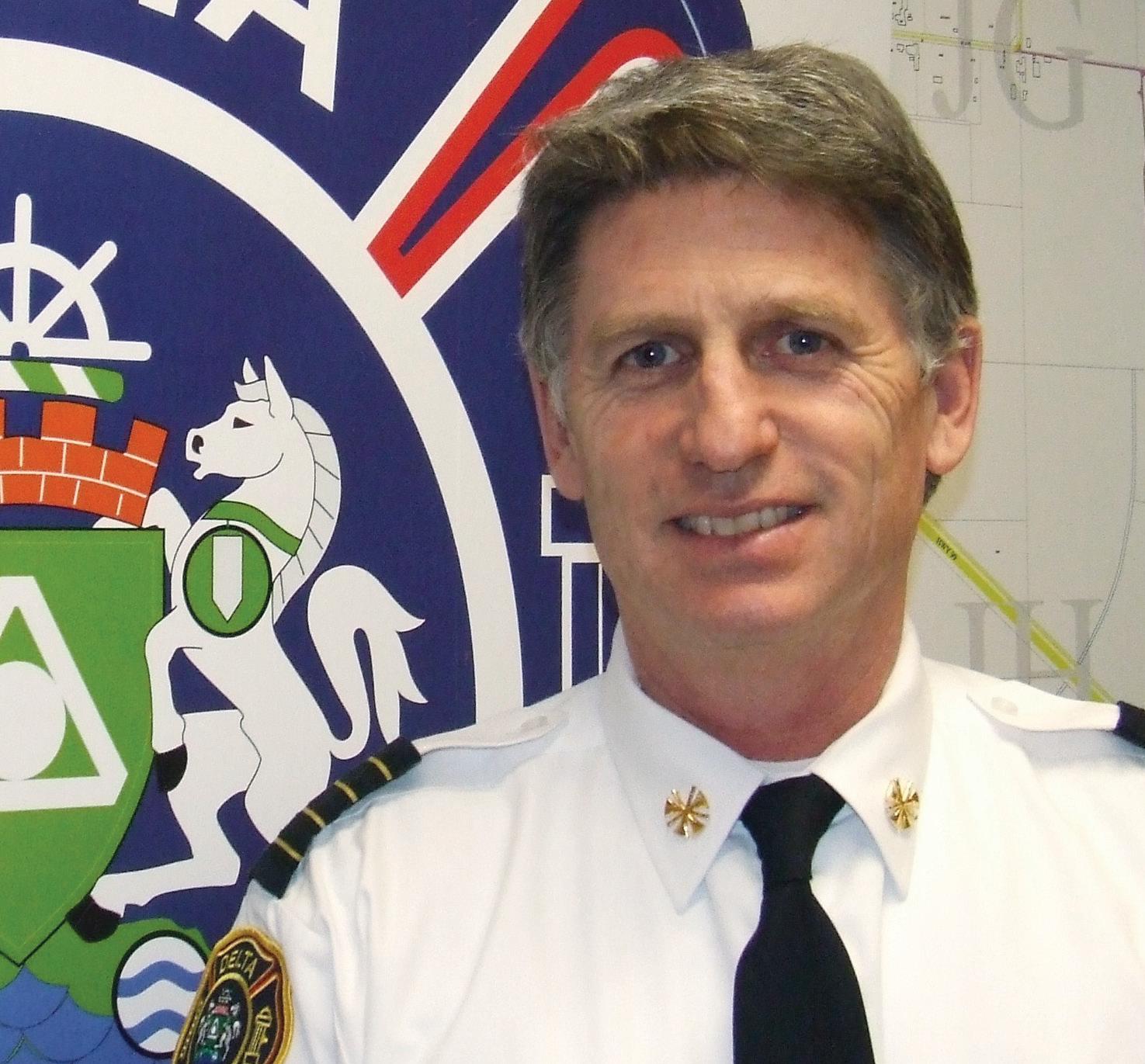
kEN SIm is the new deputy chief of operations for the Delta Fire & Emergency Services in
B.C. he joined the department in 1980 and was a lieutenant and captain before taking on the deputy role on Feb.1. Sim is trained and certified in many specialties including scuba diving.
PAUL SCHOLFIELd is the new deputy chief of fire protective services for the Delta Fire & Emergency Services in B.C. Scholfield worked for the Canadian Coast guard for several years before jointing
CFFF needs help confirming names for memorial
The Canadian Fallen Firefighters Foundation is asking all Canadian fire departments and associations to verify the names of all firefighters who have died in the line of duty since 1848.
The names will be etched onto Canadian Firefighters Memorial, which is scheduled for unveiling in 2012. The official list can be found at www.cfff.ca.
“We want to make sure we honour all firefighters whose deaths have been confirmed as line of duty deaths,” said Capt. Robert Kirkpatrick, president of the CFFF. “We’re therefore asking Canadian fire service personnel to check the names. If they find a name missing, we’re asking that they submit an online application as soon as possible.”
In order to meet the 2012 deadline, the foundation has one year to verify the almost 1,000 names that will be on the memorial.
The memorial was announced last fall, after the foundation raised $1 million and the Canadian government awarded a grant of $2.5
the Delta department on april 2, 1991. Scholfield is a hazmat instructor and is CBrnE trained. he attained his JIBC fire leadership diploma in 2009 and took over as deputy on Feb. 1.
million. Capt. Kirkpatrick is confident the foundation will raise the additional $500,000 to complete the project.
Firefighters who died in the line of duty after 2003, but who have not yet been honoured, may also be eligible to be included in the national ceremony, which is held annually on the second Sunday in September. The cut-off date for this year’s ceremony is March 15.
The foundation subsidizes the expenses for the families of these firefighters to attend the ceremony in Ottawa. A family of any firefighter who died after 2003 also has the option to attend at any upcoming ceremony and may defer their attendance for several years.
Applications may be completed by family members or representatives of individual fire departments or firefighter associations.
For more information on the application process or the ceremony weekend, please contact lodd@cfff.ca or call the CFFF at 613-786-3024.
JEFF BECkwITH is the new deputy chief for The City of Prince rupert. Beckwith has more than 10 years’ experience with Prince rupert Fire rescue. he was promoted to deputy chief on nov. 10.
dAVId HARdER is the new chief of the Lillooet Fire Department in B.C. harder takes over from Pat Sullivan, who has been chief since May but is moving out of the area. harder served as deputy chief under Sullivan.
NFPA releases report on home fires
While just 32 per cent of home heating fires involve space heaters, they are involved in 79 per cent of home heating fire deaths, according to the new report Home Fires Involving Heating Equipment released Feb. 11 by the NFPA (go to www. NFPA.org and click on news and publications). Heating equipment continues to be the second leading cause of home fires behind cooking and the second leading cause of home fire deaths behind smoking.
The leading factor contributing to space heater fires in general was heating equipment too close to things that can burn, such as upholstered furniture, clothing, mattress, or bedding. Other leading factors contributing to home space heater fires were failure to clean, which is principally related to creosote build-up in chimneys, and leaving an operating space heater unattended.
In 2007, U.S. fire departments responded to 66,400 home structure fires that involved heating equipment. These fires killed 580 people, injured another 1,850, and were responsible for $608 million in direct property damage.
retirements
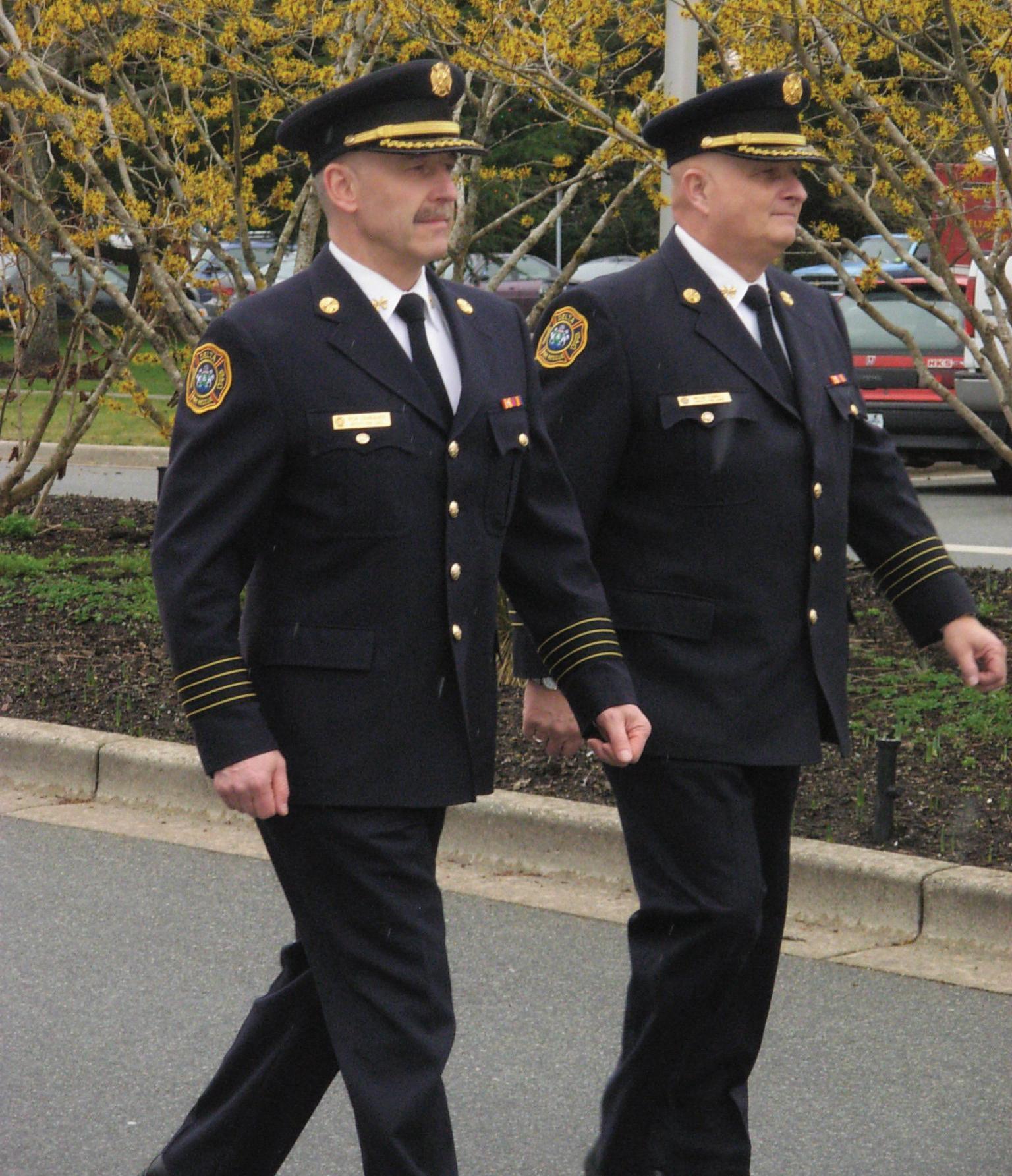
Deputy chiefs RICk LEHBAUER and BRyON FUNNELL have retired from the Delta Fire & Emergency Services in B.C. Lehbauer’s career spanned 33 years, beginning as a volunteer in april 1976. he became a paid firefighter in October 1976 and worked his way through all officer positions before being promoted to deputy chief of operations. Funnell’s career spanned 35 years, beginning at the
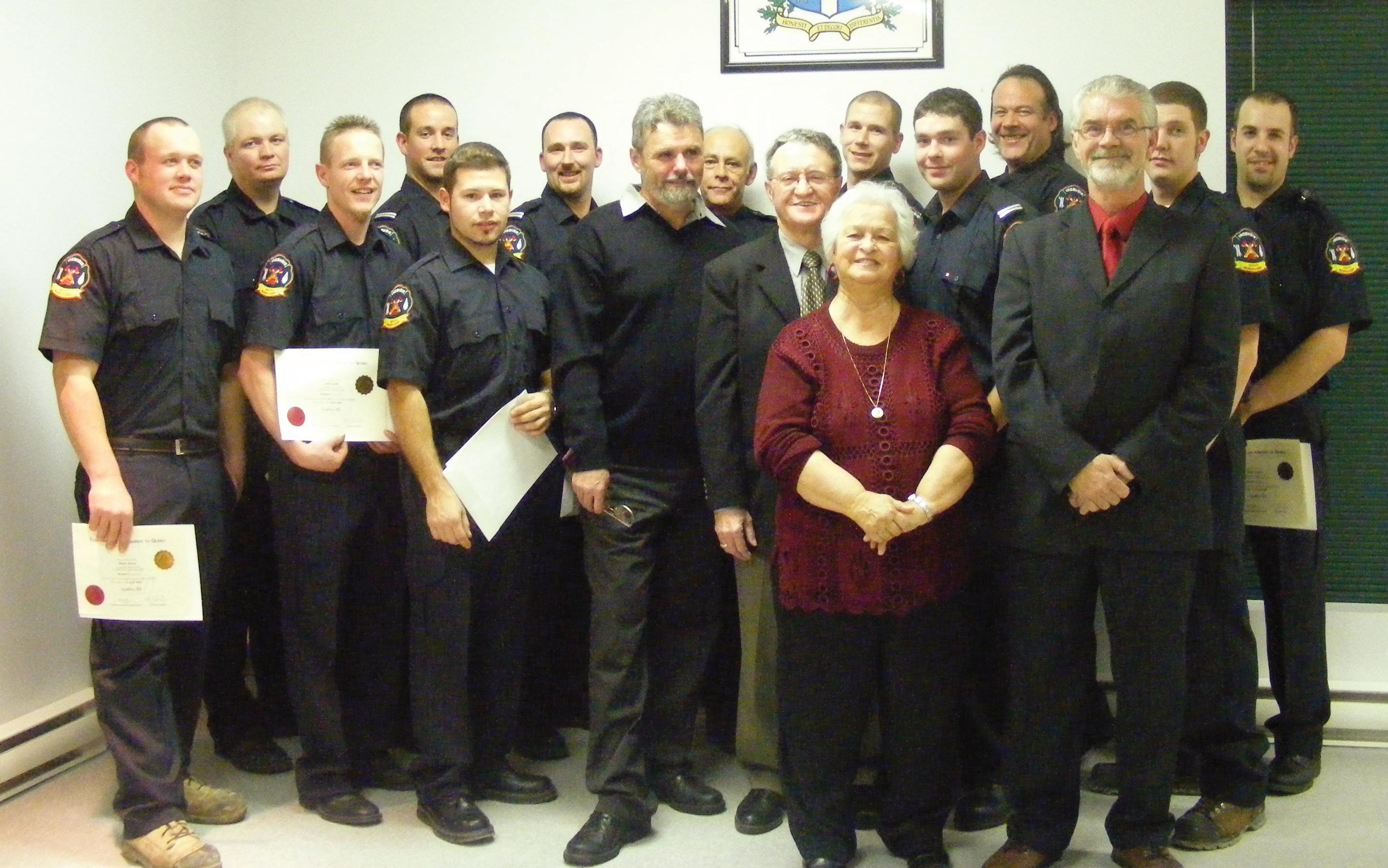
On Dec. 3 2009, after two years of courses, 14 firefighters from the Mayo – Mulgrave & Derry Fire Department in western Quebec received their Firefighter I diplomas from the Quebec National Firefighters School. Pictured are (left to right) Martin Dionne, Chris Achtell, Curtis Lavell, Lt. Kevin Berndt, Eric Berndt, Lt. Sylvain Laframboise, Mayor of Mulgrave & Derry Michel Kane, John Rae, M. Gilles Lavergne of the Quebec National School for Firefighters, chief administrator for MRC Papineau Paulette Lalande, Jesse Carling, Lt. Brandon Lalonde, Ron Laurin, Mayo Mayor Gaetan Brunet, Chris Farnand and Simon Cadieux. Adam Achtell and Eric Gagnon were also part of the graduating class.
IAFC launches online career centre
The IAFC has launched a new online career centre that includes Canadian postings.
The expanded job site - www. careers.iafc.org/home/index. cfm?site_id=9202 - offers several new features:
• Personal job alerts – Get weekly or daily job alerts tailored to your career preferences.
• Easy-to-use resumé posting
university Endowment Lands Fire Department in august 1974. he joined DFES as a firefighter in March 1975 and served in
– Build, save and upload your resumé at no cost and update as often as you wish.
• Identity protection – You decide which employers and recruiters contact you about potential jobs. They can review your credentials online, but your profile is anonymous until you approve their request for contact information.
• Personalization – Save routine searches, store jobs, keep notes, post multiple cover letters, communicate with employers through an internal messaging system and more!
• Career-builder tools –Access such resources as career coaches, a content library and an Ask the Experts tool.
all officer positions until he became deputy chief in charge of fire protective services.
last alarm
Point Edward, Ont., volunteer firefighter gARy JAmES kENdALL, 51, died Jan. 31 in hospital after becoming trapped under ice during a training exercise. Kendall was a 17-year veteran of the fire department, who twice won the Fire Chief’s award for displaying exemplary
compassion towards another human life through an act of unselfish contribution above and beyond the call of duty.
Capt. mICHAEL HUTCHINg of the Whitby Fire and Emergency Services in Ontario died Feb. 5 after a battle with cancer. hutching statred his career as a volunteer with WFES on May 22, 1980, and became a full-time firefighter on March 16, 1897. he was promoted to captain on Jan. 7, 2002.
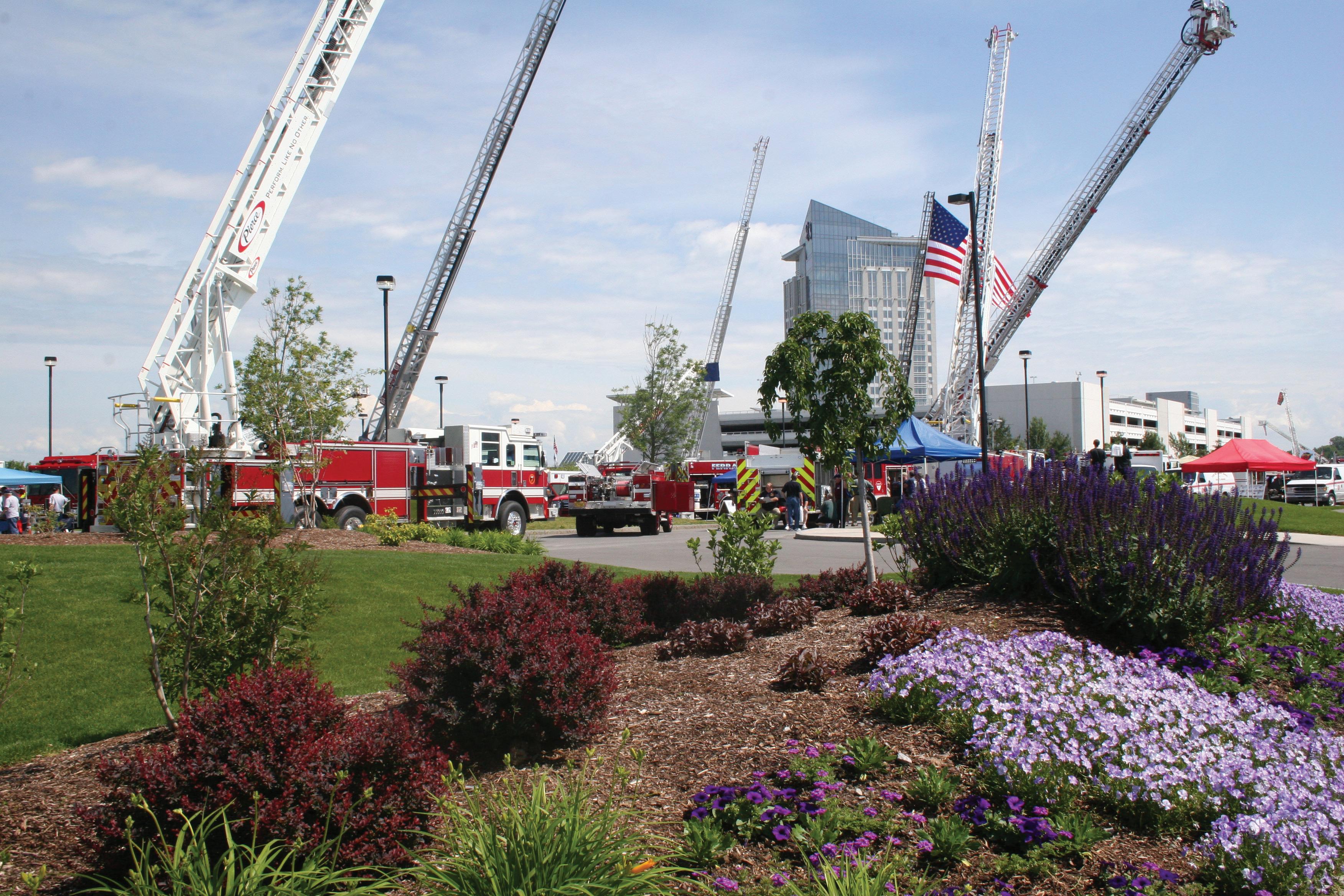
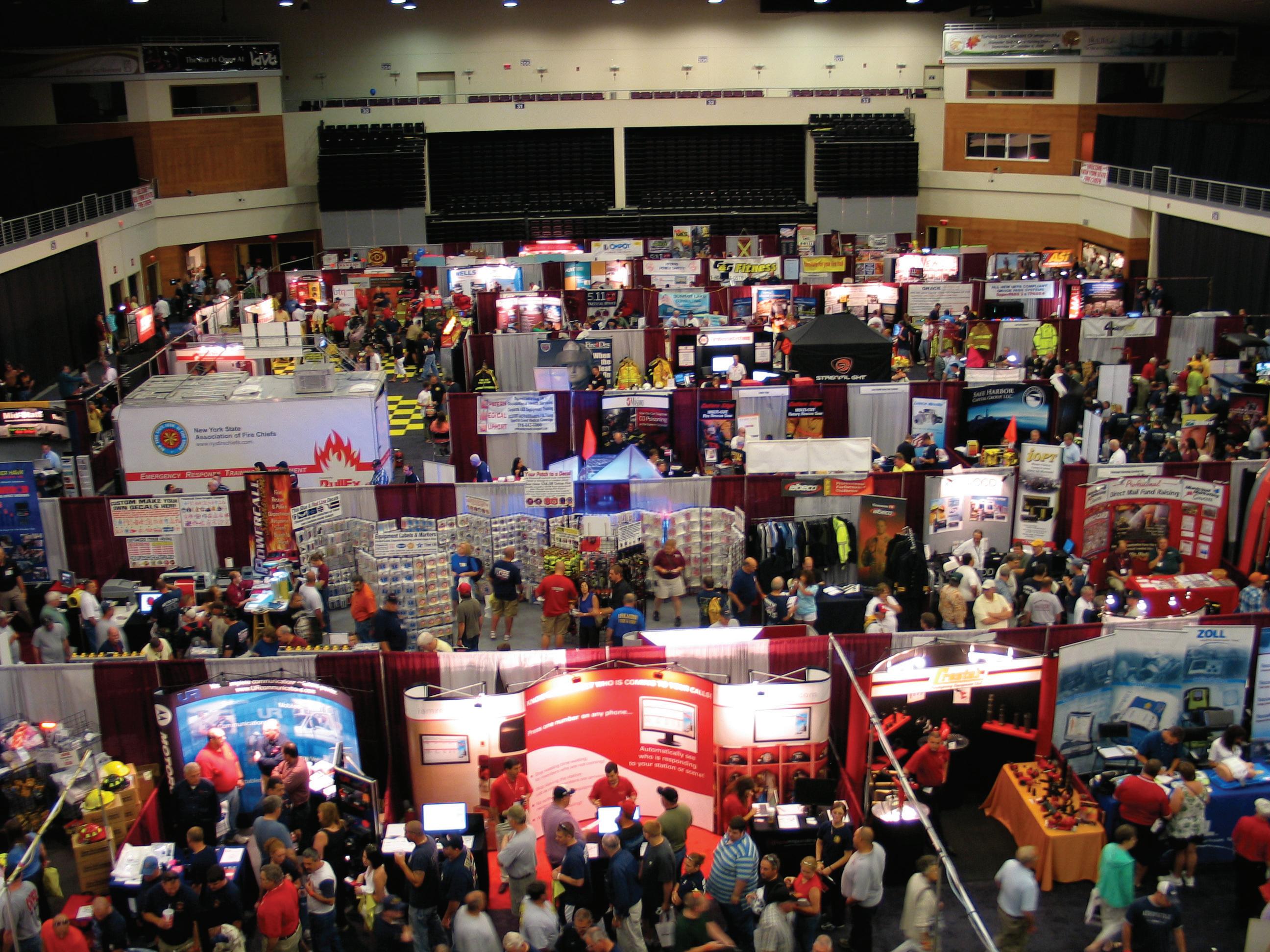
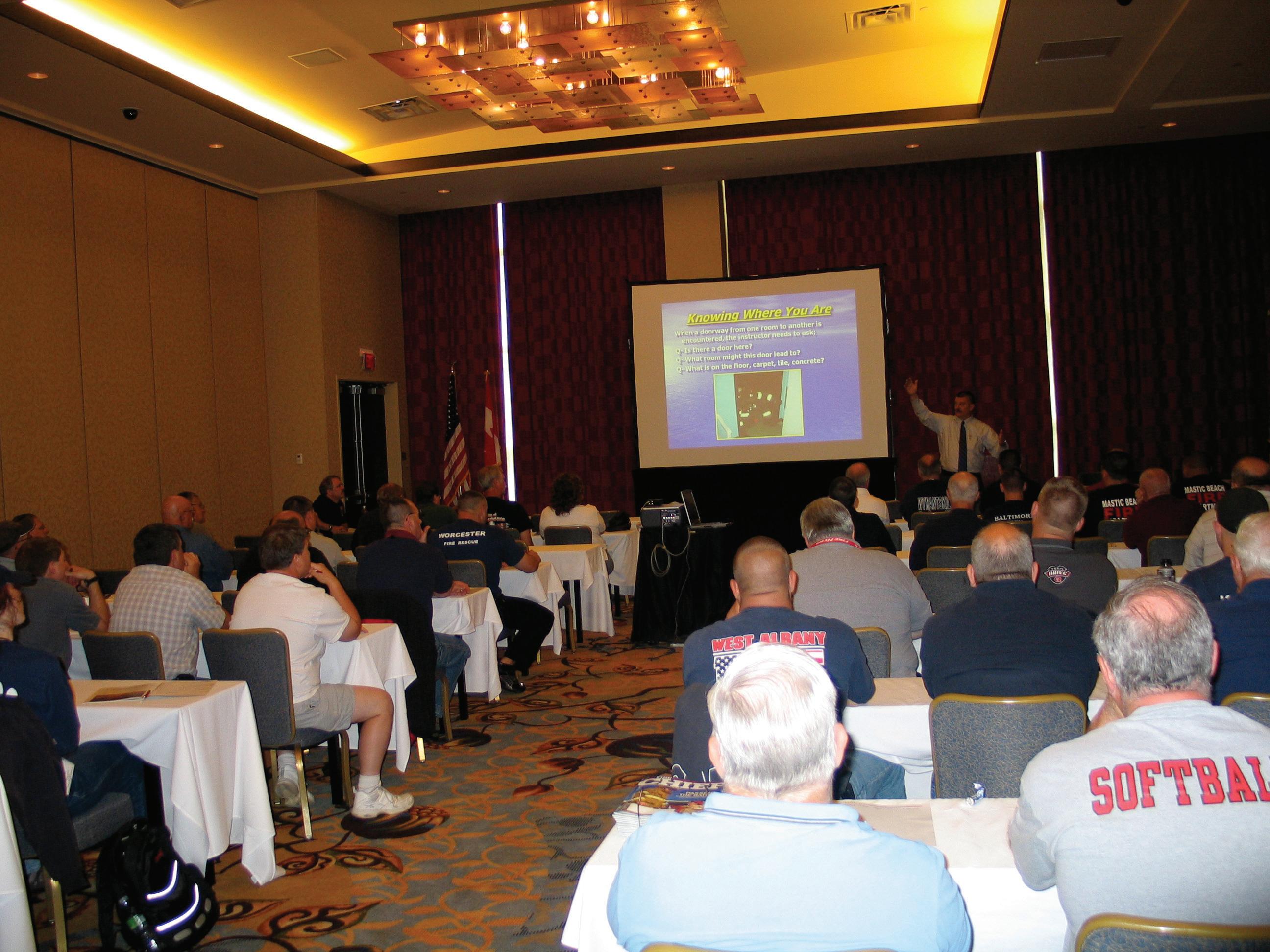
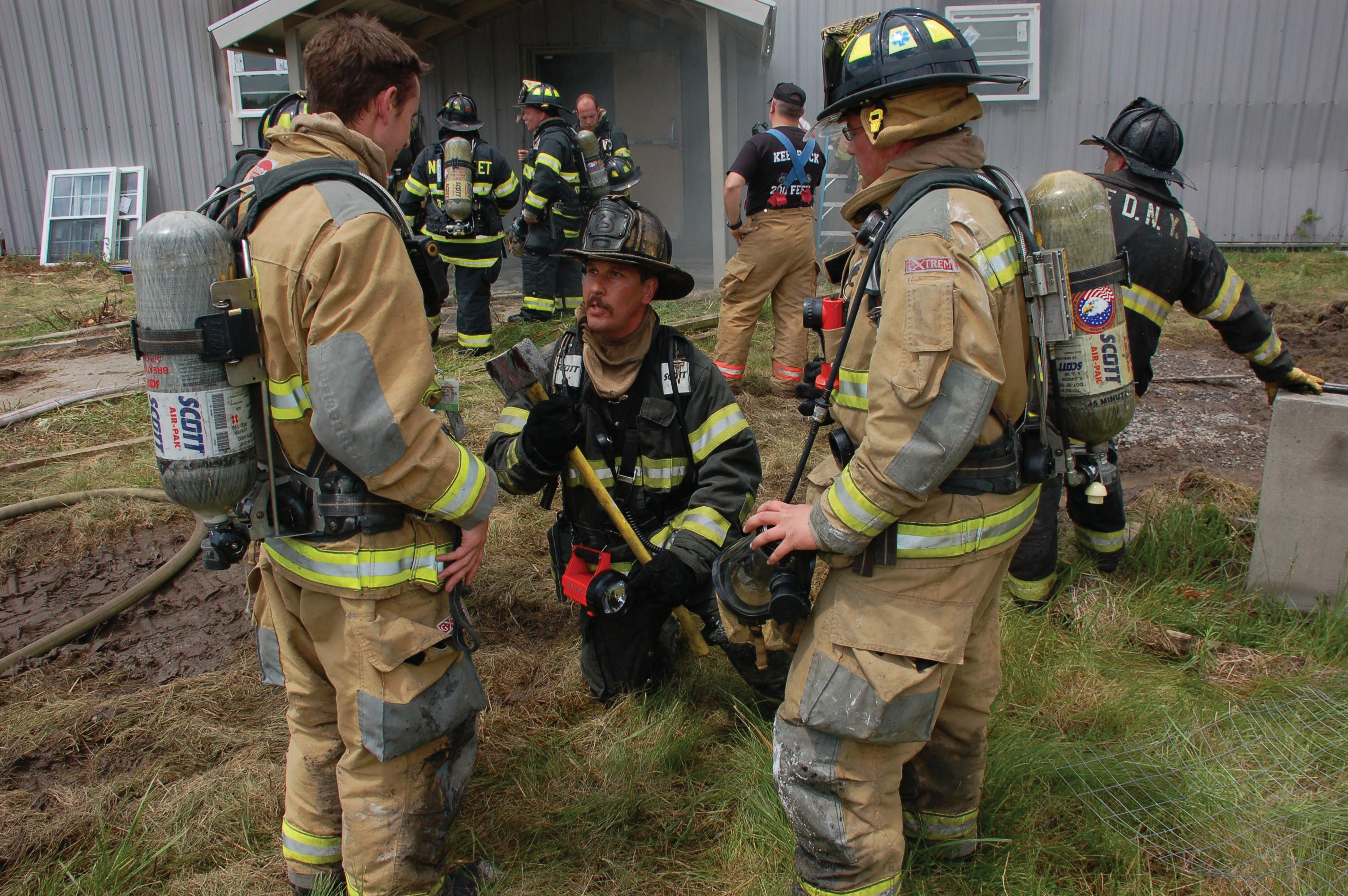
Emergency Services Conference & Expo
• Indoor and outdoor exhibits (Thursday-Saturday).
• Hundreds of exhibitors from across North America displaying a variety of fire, EMS, and rescue products.
• Free One Day Tickets for entry to exhibits from vendors!
• Four days of educational workshops.
• Hands-On Training with live fire sessions.
• State-of-the-ar t venue, conveniently located just off of the NYS Thruway (I-90) at Exit 33 in central New York.
Education Program includes these industry leaders:
• Battalion Chief Steve Chikerotis – Chicago F.D.
• Captain Michael Dugan – FDNY
• Retired Deputy Chief Vincent Dunn – FDNY
• Lieutenant Paul Hasenmeier – Huron F.D.
• Safety Officer Peter McBride – Ottawa F.D.
• Retired Deputy Assistant Chief John Norman – FDNY
*Education Programs open to Conference Registrants only.
statIontostatIon
B r I gade news: From stations across Canada
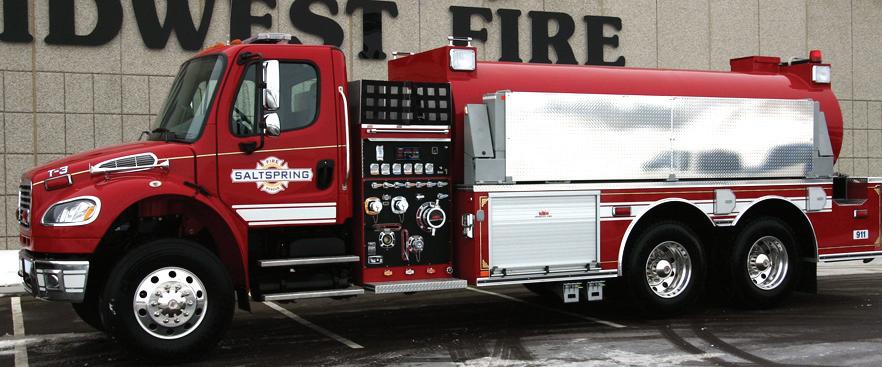
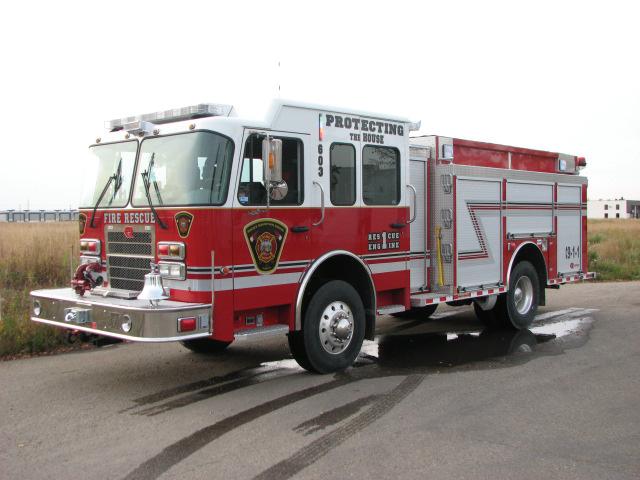
The SALT SPRINg ISLANd FIRE dEPARTmENT in B.C. took delivery in January of a Midwest Fire-built tanker-pumper. Built on a Freightliner M2-106 chassis and powered by an Allison 3000 EVS transmission and a Cummins ISC 330-hp engine the truck is equipped with a Hale MBP 1000 pump, 3,000 IG folding water tank and LED warning lights.
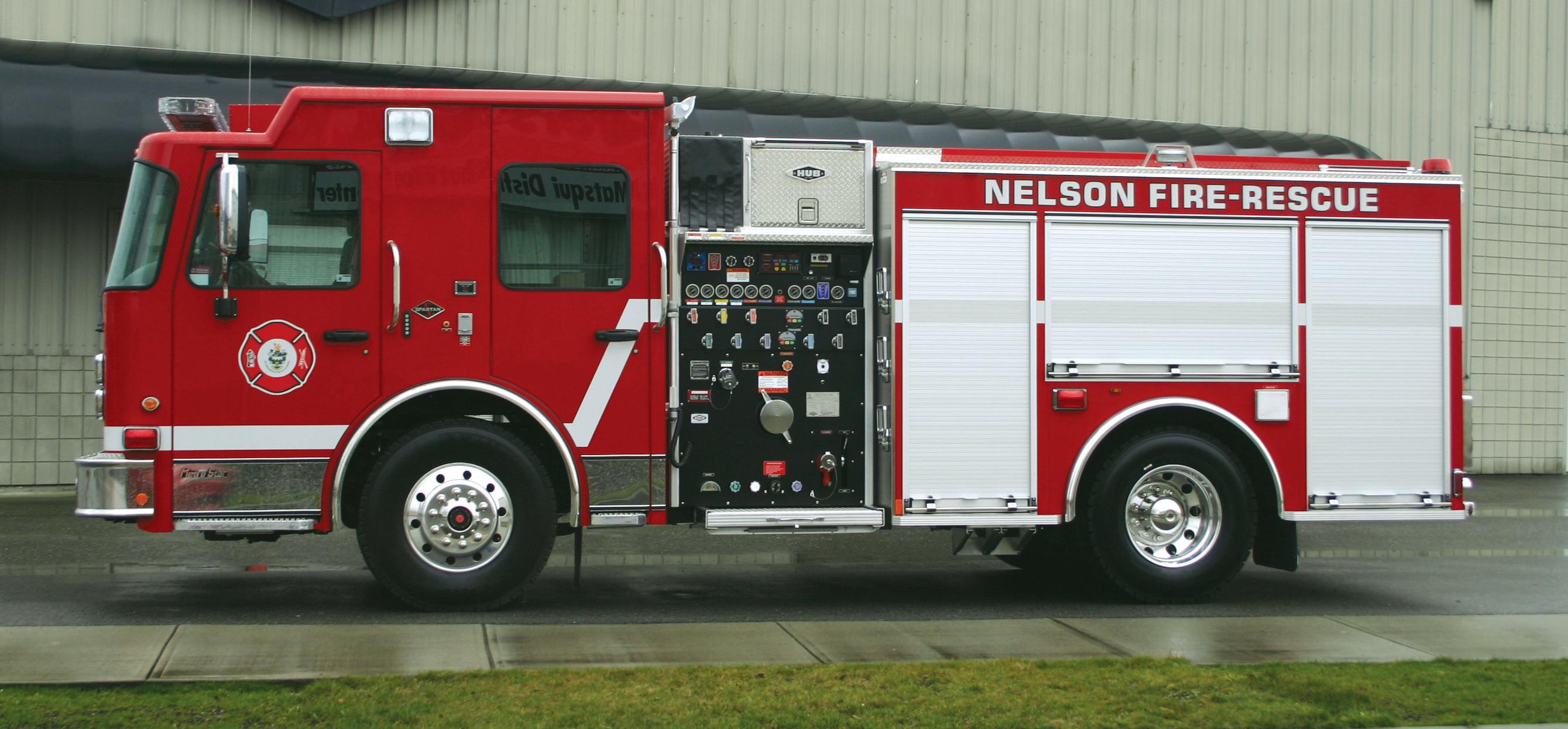
NELSON FIRE RESCUE in B.C., under Chief Simon Grympa, took delivery in February of a Hub Fire Engines & Equipment-built pumper. Built on a Spartan Metro Star chassis and powered by an Allison 3000 EVS transmission and a Cummins ISL 425-hp engine the pumper is equipped with a Waterous CSU 1,500 IGPM pump, Foam Pro 2002 foam system, 500 IG co-poly tank, Whelen light package and Sigtronics intercom system.
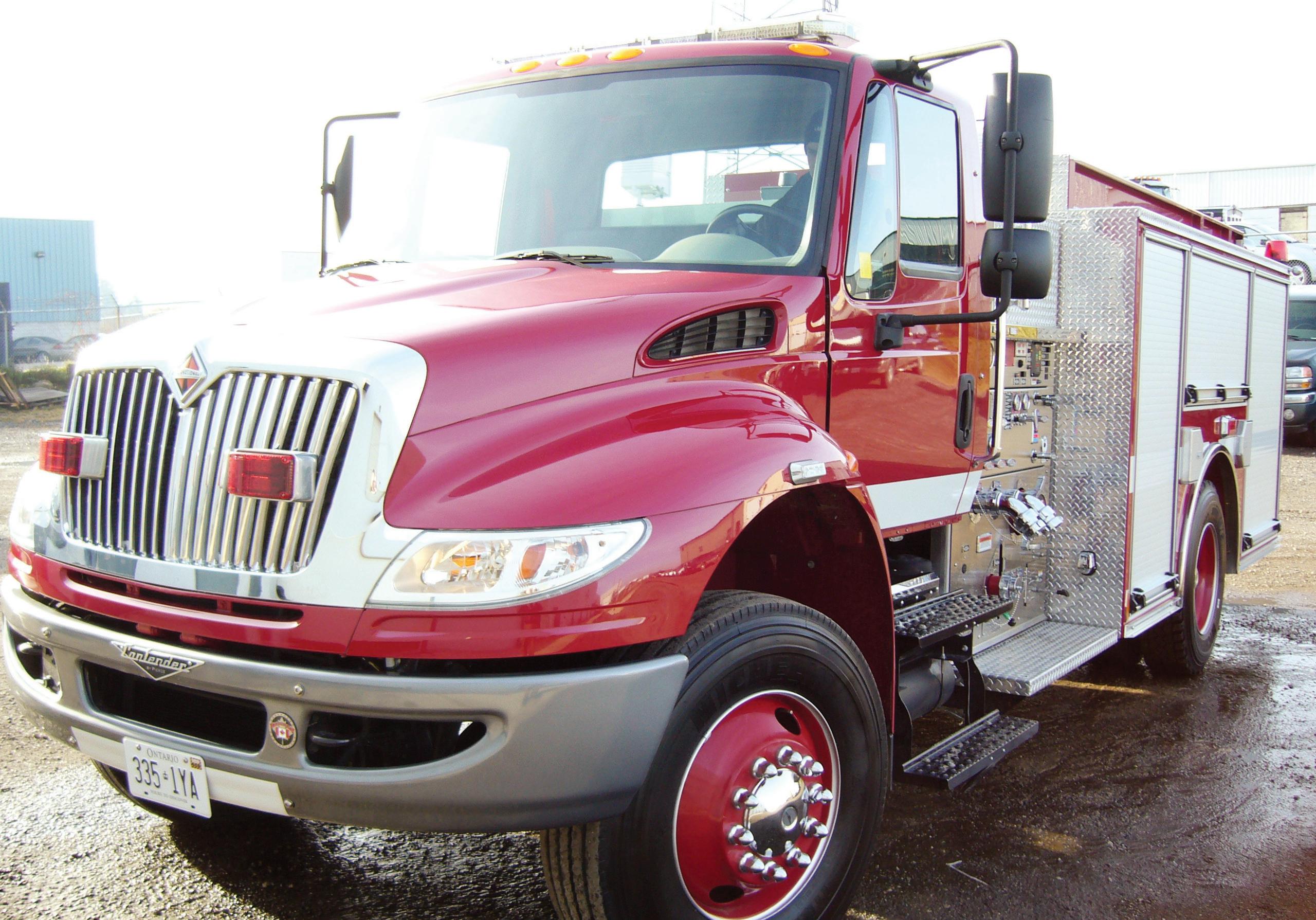
The gORE BAy FIRE dEPARTmENT in Ontario, under Chief Mike Steele, took delivery in December from Darch Fire of a Pierce Manufacturing-built pumper. Built on an International 4400 chassis and powered by an Allison 3000 EVS transmission and a MaxxForce 9 330-hp engine, the pumper is equipped with a Waterous 1,250 IGPM pump, Foam Pro 1600 foam system, 1,000 IG water tank, portable Honda generator and telescoping scene lights.
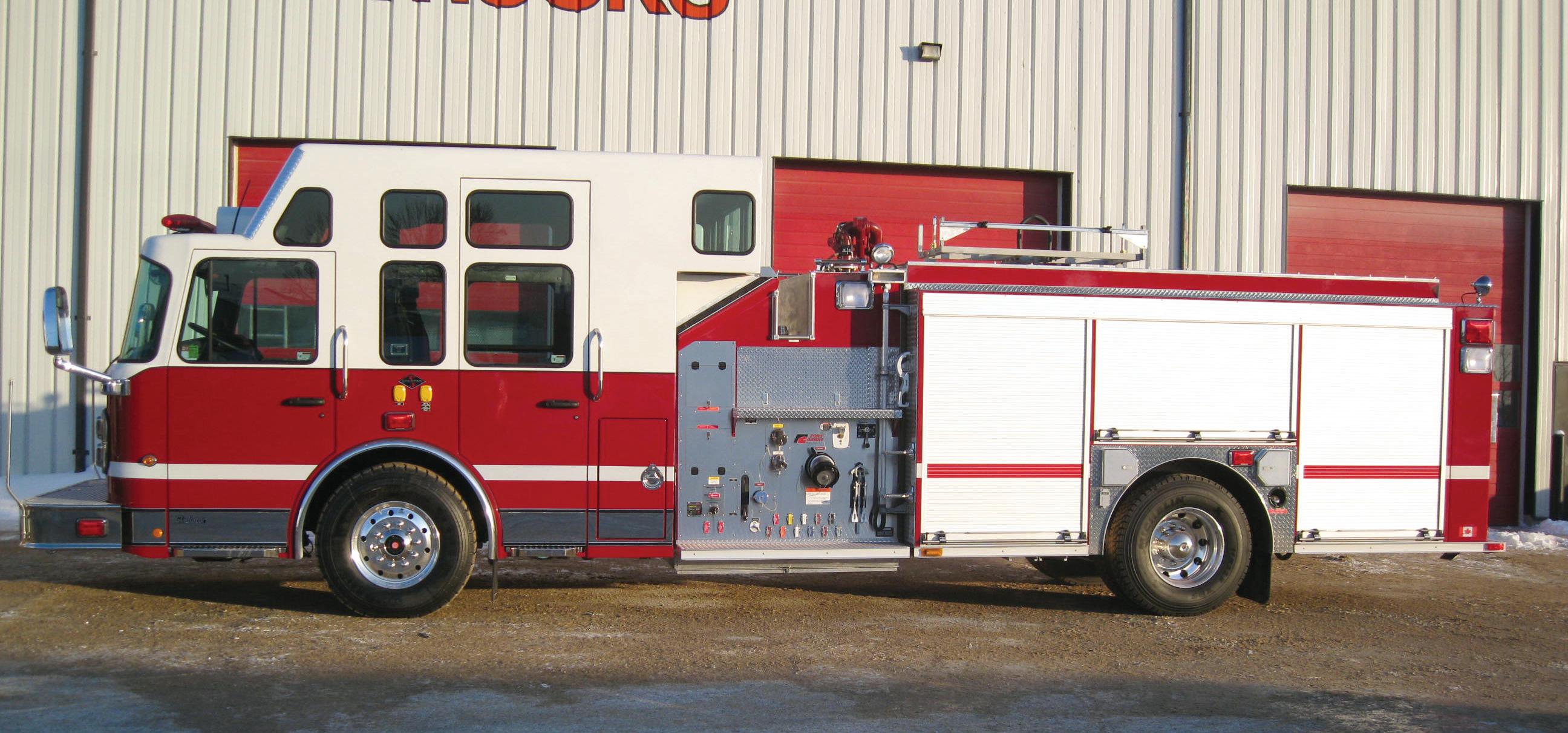
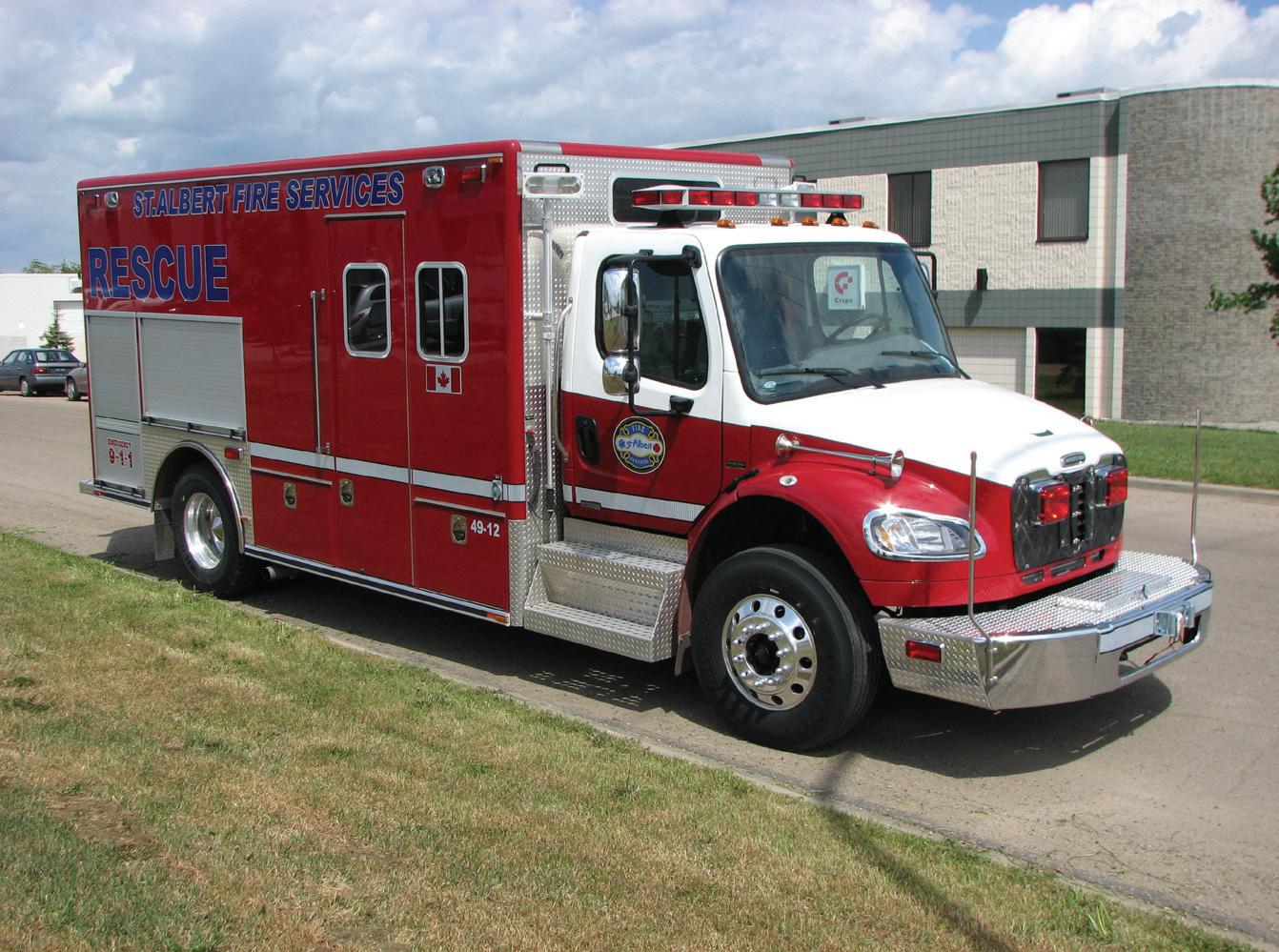
The ST. ALBERT FIRE dEPARTmENT in Alberta, under Deputy Chief Daryl Bliss, took delivery in January of a Fort Garry Fire Trucks-built pumper. Built on a Spartan Gladiator chassis and powered by an Allison 3000 EVS transmission and a Cummins ISL 400-hp engine, the pumper is equipped with a Waterous CSU 1,500 IGPM pump, a 600 IG co-poly water tank and Foam Pro 2002 foam system.
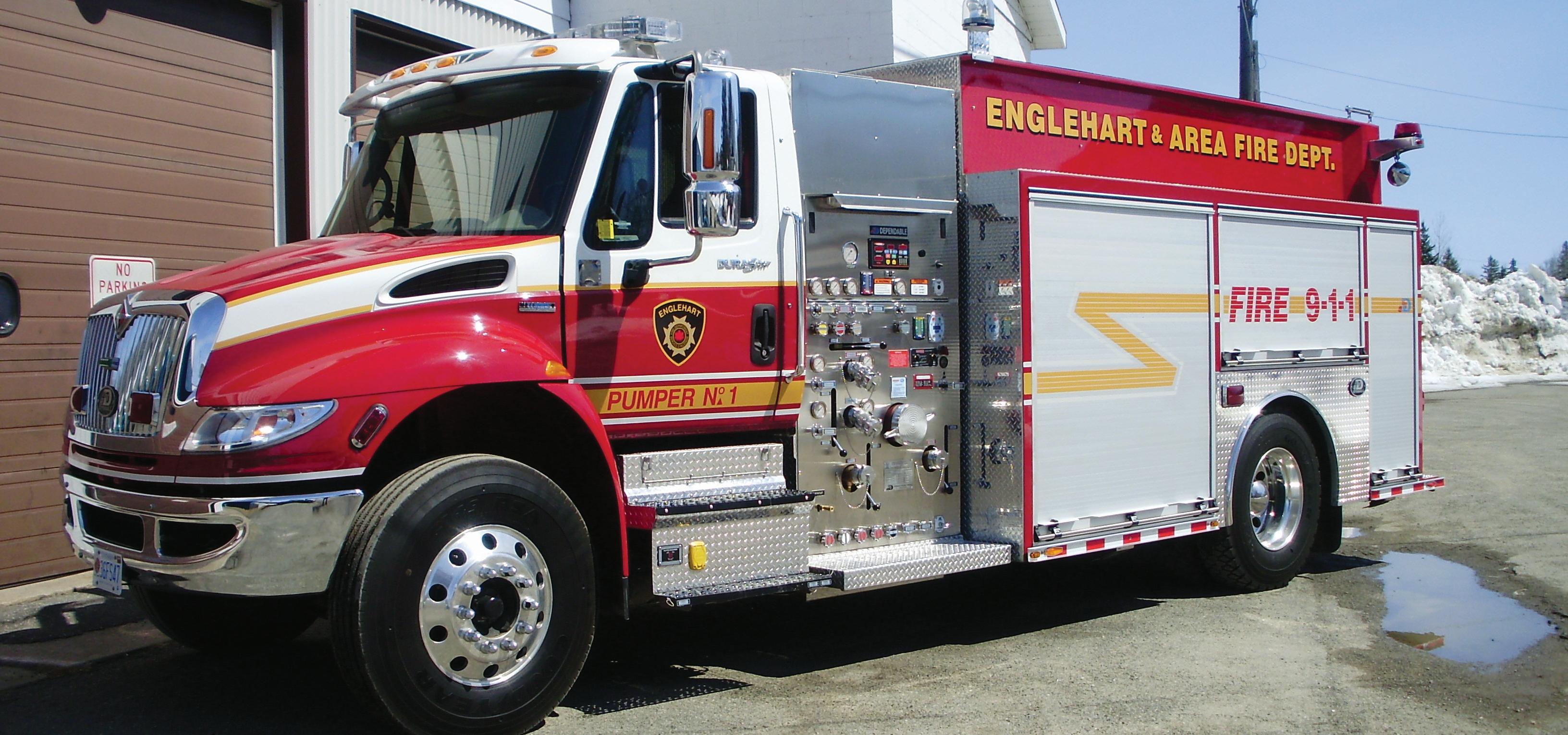
The ENgLEHART & AREA FIRE dEPARTmENT in Ontario, under Chief Greg Johnson, took delivery in May of a Dependable Emergency Vehicles-built rescue unit. Built on a International 4400 chassis and powered by an Allison 3000 EVS-P transmission and a Navistar Maxxforce 9 engine, the truck is equipped with a Waterous CS-1250 pump, PTO Pnuemax comressed air foam system, Waterous Aquis 2.5 foam system, 1,000 IG co-poly water tank, and a Whelen light package.
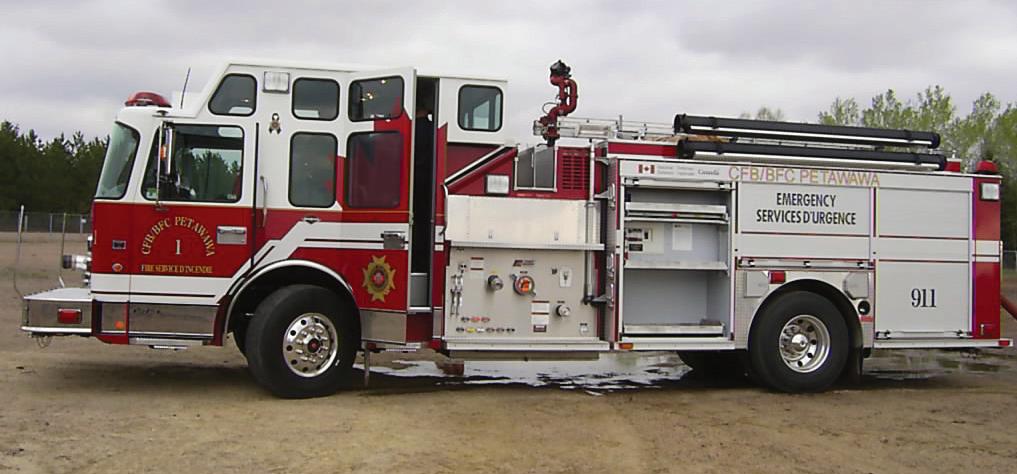
CFB
in Ontario took delivery in May of a Fort Garry Fire Trucks-built rescue pumper. Built on Spartan Metro Star chassis and powered by an Allison 3000 EVS transmission and a Cummins ISC 330-hp engine the unit is equipped with a Waterous CSU 1500 pump, 800 IG co-poly water tank, Foam Pro 2001 foam system, a Harrison MCR 8.0 Kw hydraulic generator, F.S. LED light package, Setcom intercom systems, backup cameras, Garmin GPS, Dual Vista III Multiplex screens and Amdor H20 ground lighting.
The
PETAwAwA FIRE dEPARTmENT
SALT SPRINg ISLANd
NELSON
gORE BAy
ST. ALBERT
ENgLEHART & AREA
CFB PETAwAwA
By SEAN TRACE y Canadian Regional m anager NFPA International, Ottawa, Ont.
a
U.S. fire service has Canada beat
report from the NFPA that compares fire departments in Canada and the U.S. reveals some surprising and disturbing trends. Every year for the past eight years NFPA has mailed out a survey to Canadian fire departments. The latest and most telling report has been released from NFPA and is available to NFPA members at www.nfpa.org. The report is entitled Fire Departments in Canada, 2006-2008. For the first time, the report attempts to make a comparison between the Canadian and U.S. fire services. In the past I have said that the fire services in both countries were culturally the same – by that I mean we share the same standards, equipment and practices. This report is intriguing in that in almost all categories there were marked differences between Canadian and U.S. fire departments. The results beg the questions why and what do we do with this information?
The NFPA survey is compiled from a mailing that goes out to one-third of departments each year with an enclosed, paid envelope for the respondents. Over this three-year period, 1,733 fire departments responded, which represented a 28 per cent return rate. The survey responses came in from all areas of Canada and therefore appear to be a reasonably accurate snapshot of the fire service in Canada.
The first two tables show the number of career and volunteer firefighters in communities based on the population sizes of these communities. Canada reported fewer career firefighters based on community size than the U.S. while both countries had similar percentages of volunteer fighters. It was noted that in the U.S. there was a higher number of career fire departments – Canada appears to have a higher reliance on volunteer fire departments. In simple terms, a medium-sized city in Canada is more likely to be protected by a volunteer fire department than in the U.S.
Impact
size. Again, the differences between Canadian and U.S. communities were significant. In all community sizes in Canada, the numbers of pumpers and aerials were well below comparable communities in the U.S. Why?
What does this tell us? What does it mean? Is this acceptable? Is this just the Canadian way? Do we have to accept this?
One explanation could be our respective histories and views towards public protection, more specifically the military. Throughout Canadian history we have been rather trusting and reliant on a militia approach. We have always relied on the response to come from within the community and had a voluntary response to threats. The U.S. has always had larger government agencies and a higher expectation of established community protection and a higher expectation of public service. This we can see in the larger numbers of career firefighters in the U.S. and the greater acceptance of an established fire service. This translates to more career firefighters per community and more apparatus. The U.S. just seems more willing to pay for a public protection service.
What will this mean for Canadian communities in the future? Well, we are already forecasting that the generation succeeding baby
The U.S. just seems more willing to pay for a public protection service.
Subsequent tables further highlight significant differences between the countries. Canadian departments tended to cover a larger geographical area than their U.S. counterparts. OK, this may be a no-brainer. But in medium-sized communities, the areas being covered were orders of magnitude greater in Canada than in the U.S. The results also showed that there were significantly fewer fire stations per 100 square miles in Canada than in the U.S. This translates into longer runs and higher response times in Canada than for similar sized communities in the U.S. The report then compared the numbers of apparatus – both pumpers and aerials – based on community
Sean Tracey, P.Eng., MIFireE, is the Canadian regional manager of the National Fire Protection Association International and formerly the Canadian Armed Forces fire marshal. Contact him at stracey@nfpa.org.
boomers will have less interest in volunteerism. U.S. departments will suffer less because they have a higher proportion of career departments. Canadian fire departments will have a greater threat in future years as the volunteer replenishment flow dries up. This, in turn, will likely result in higher loss rates in Canada than in the U.S. We will, therefore, need to look at alternatives to maintain our standards. This will mean enhanced codes to prevent and control fires (including a reliance on residential fire sprinklers). We will also need a greater reliance on public education programs or we risk seeing our fire loss rate drop further below that of the U.S.
I have always considered Canada and the U.S. fire services to be culturally the same. The most recent survey from NFPA is highlighting that this may not be the case as there are telling gaps between the two countries. Should we accept this? This has potential repercussions for Canada in the future unless we begin to take action now.
like similar-sized communities across Canada, the picturesque town of Caledon, Ont., has a composite fire department and many of its 65,000 residents know each other and the fire chief.
That small-town connectedness is how Caledon councillors learned about concerns that some volunteer firefighters were getting called out to too many minor incidents – false alarms, CO calls and medicals – and were starting to tire of the disruptions in work, sleep and routine.
Caledon Fire & Emergency Services Chief Brad Bigrigg was asked to find a solution to the perceived burnout and on March 1, 2009, the department instituted a pilot program under which only some firefighters would be paged out to certain CO and medical calls. The aim of the platooning project was to determine if the municipality could call fewer firefighters to some incidents and maintain an adequate level of service.
Essentially, the trial added more than two minutes to Caledon Fire & Emergency Services response times due to traffic and infrastructure issues and Caledon has since returned to its original paging and dispatch protocols.
In a December report to council, Bigrigg bluntly concluded that platooning might work in some suburban areas but it is not a good system for his community right now, primarily because of logistics and station locations.
But alternative deployment models could indeed become the norm for Canadian fire departments because of the changing nature of the fire service.
Over the past two decades the number of emergency calls has increased considerably and the variety of emergency services provided has expanded. Fire departments are also facing challenges recruiting and retaining volunteer firefighters. This had led some fire service leaders to ask whether departments are overworking the volunteer firefighters they have.
Operational systems in North American fire services are organized around responses to structural fires. But with more than 80 per cent of calls for medical incidents and MVAs, the longstanding system of paging out a full contingent of volunteer firefighters for all calls may not make sense, says Barry Malmsten, executive director of the Ontario Association of Fire Chiefs.
“What business gears 100 per cent of its operational staffing and equipment deployment protocols based on five per cent of its business needs?” he asks.
Fire departments must be equipped and staffed to deal with fires. But most calls are not for fires, so is it necessary to deploy a full fire response to other incidents? If departments deploy too many
volunteer firefighters to calls for which they are not needed, will the firefighters become frustrated with the constant interruptions to their personal lives and resign? How do departments maintain response times and deploy only the appropriate number of firefighters for the incident? How do they build flexibility into the system? This was the challenge for Caledon.
■ caldeon’s case
Nestled northwest of Toronto and famous for its undulating hills, Caledon employs a full-time chief, deputy chief, fire prevention officer, inspector, public education officer, two training officers, three administrative assistants, three captains, 11 full-time firefighters and 245 volunteers at nine stations that protect 270 square miles. It has 11 pumpers, one pumper/aerial, eight pumper squads, seven pumper tankers, two water tankers and one command/lighting unit. Caledon Fire & Emergency responds to about 2,200 calls a year. Three stations were involved in the platooning project –Snelgrove, Bolton and Palgrave.
In his report, Chief Bigrigg said a number of options to help reduce the perceived strain on volunteer firefighters were considered including scheduling, implementation of duty crews, paying only those who attend an emergency scene and platooning. After consulting with firefighters and other Ontario chiefs, the platoon system was determined to be the most advantageous and least disruptive option.
Under the platooning system, about 65 per cent of the participating stations’ volunteer firefighter strength was paged for medical emergencies and carbon monoxide alarms where no medical symptoms were present. Generally, Bigrigg said, the system would page between 12 and 18 volunteer firefighters per station between 7 p.m. and 7 a.m. during the business week.
“It was hoped that there would be sufficient volunteer firefighters available to maintain adequate staffing, response times and response capabilities without the need to page all volunteer firefighters from the participating fire station,” Bigrigg said.
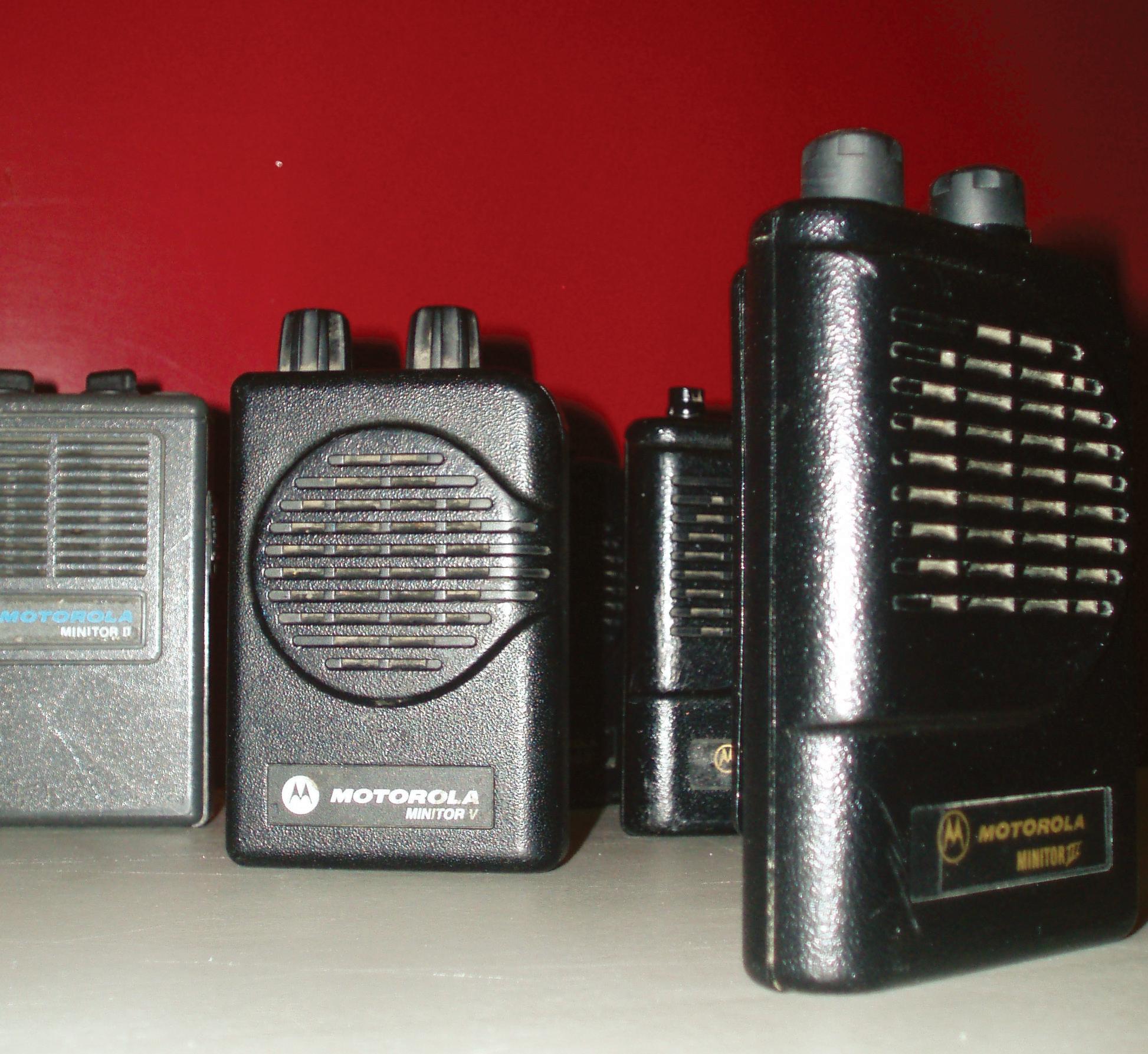
The table from Bigrigg’s report shows the average departstation and arrive-scene times for the test period. Incidents analyzed during this period were medical emergencies and carbon monoxide detectors activated with no medical symptoms only. Of the 104
EAST
ALTON CALEDON
CALEDON
emergency incidents where the platoon system was used during the pilot project period:
• 14 (13.4 per cent) incidents had a depart station time of less than five minutes, which is the standard expectation for volunteer fire stations.
• 90 (86.6 per cent) incidents had a depart station time greater than five minutes. This triggered the paging of an additional platoon or neighbouring fire station, which is the industry norm.
• 29 (27.8 per cent) incidents had and arrive scene time of less than 10 minutes, which is the standard expectation for volunteer fire stations.
• 57 (54.8 per cent) emergency incidents had an arrive scene time greater than 10 minutes.
• 18 (17.3 per cent) emergency incidents were cancelled by EMS either because EMS was already on scene or EMS was departing the scene and fire was not required.
According to Bigrigg’s report, the average depart-station time for Caledon in 2008 was 5.45 minutes. The average arrive scene time in 2008 was 8.67 minutes. Project data shows the departstation times were about 2.5 minutes greater than the average 2008 times and the arrive-scene times were about 2.3 minutes greater than the average times.
In many cases, Bigrigg said, the assembly time for an adequate fire crew at the station caused a delay in the overall arrive-scene times.
“The overall arrive-scene times are critical to the nature and quality of the response provided by Caledon Fire & Emergency Services,” the chief said. “While there was no public concern expressed regarding an increase in response times there were con-
cerns raised by both fire and EMS personnel.”
In addition, Bigrigg said, the medical director of the Base Hospital Program reviewed the data and expressed concern about the increase in response time. And, he said, the Office of the Fire Marshal was concerned that the longer response times could be viewed as a reduction in a previously established level of service.
Caledon, Bigrigg said, faced some unique challenges that impacted the success of the program, including:
• The amount of traffic congestion, the number of controlled intersections and the number of traffic signals in the Bolton Fire District. It simply takes a long time for responding volunteer firefighters to travel to the Bolton station.
• The limited number of volunteer firefighters in each fire station. The fire stations were designed for a limited number of volunteer firefighters and are too small to house additional PPE.
• The amount of time and the time of day that volunteer firefighters spend travelling to and from their workplaces outside the municipality.
• The limited amount of free time that volunteer firefighters actually have.
• The amount of time that volunteer firefighters spend outside the community.
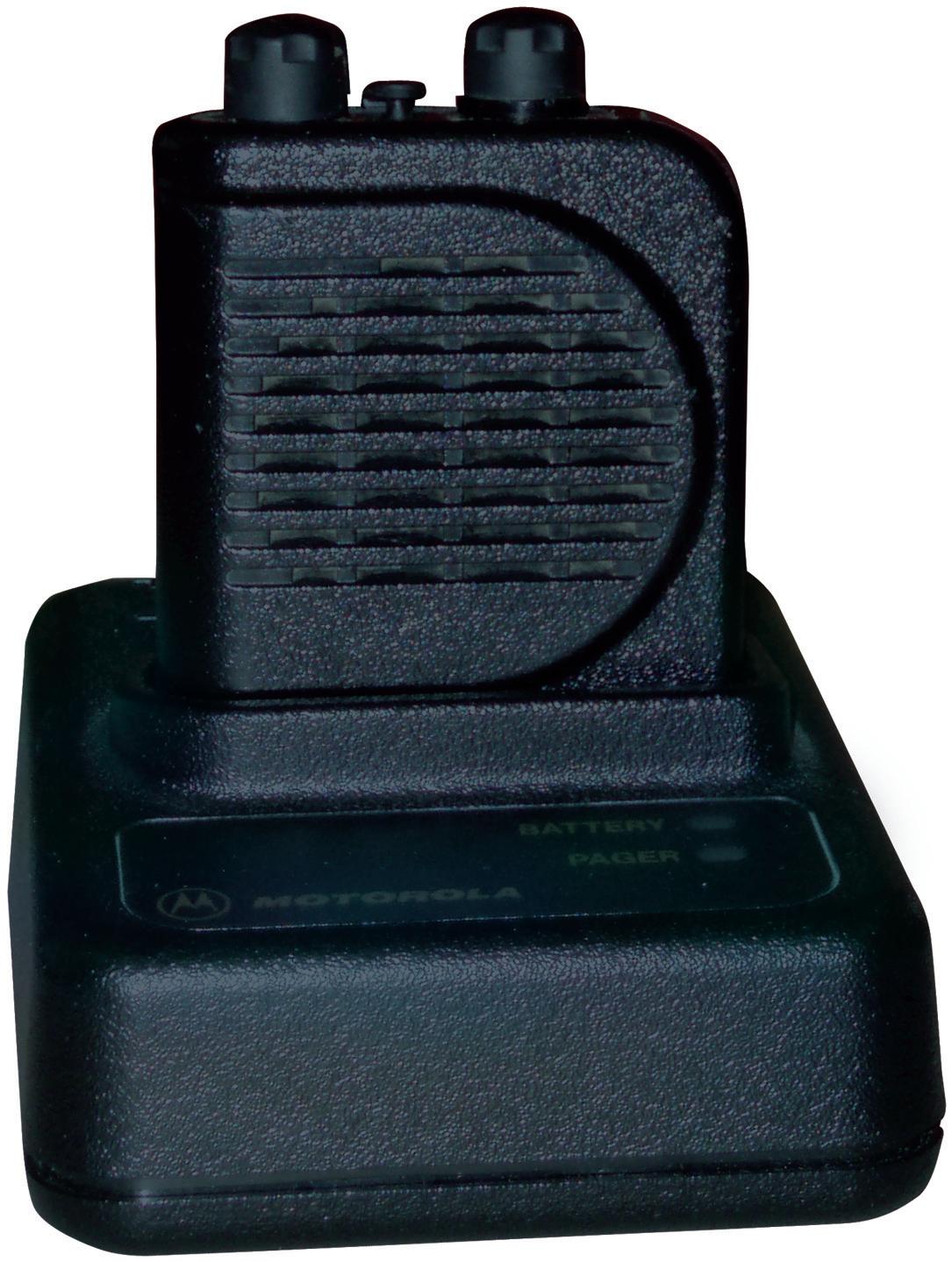
Financially, Bigrigg said, there were no salary savings during the platooning project. The purchase of 90 additional pagers was included in the approved 2009 capital budget and there was no impact on the capital or operating budgets.
Bigrigg warned council that the increase in response times could put the municipality at risk for civil liability if a slower response time created a serious risk of life-threatening injuries.
■ The background
Bigrigg spoke to the Ontario Association of Fire Chiefs conference about platooning in April 2008, shortly after the pilot project got underway.
“I was doing this because I was directed to do so. It was assigned work and something that I felt that we should try,” Bigrigg told the OAFC. “I am not a proponent or a detractor of platooning; I was carrying out assigned work.”
Admittedly, Bigrigg said, Caledon was sending between 25 and 30 firefighters to most calls. “Ultimately,” he said “we were trying to put the right number of firefighters on responses and provide good protection to the people of Caledon.
“Word around town was the volunteer firefighters were too busy; that there were too many nonessential calls and too many volunteer firefighters standing around.
“Nobody had come to me and said ‘We’re stressed out and doing too much’. It was the firefighters talking to councillors and neighbours at the grocery store and telling them they’re going to CO calls . . . and councillors decided to address this at council.”
Bigrigg is a straight-talking chief with a stellar reputation but his firefighters were skeptical about the platooning project.
“When I went to stations to talk about this, the immediate response was that it was just a cost-cutting remedy,” he said. “I don’t believe that was true – salaries for volunteer firefighters were increased by $150K [in 2008] – this was trying to help the firefighters.”
Bigrigg and his chief officers had to choose three stations to test the platooning system – one urban, one suburban and one rural.
Continued on page 29
BOLTON
By B RA d PATTON Chief Centre- wellington, Ont.
oTraining prevails despite the risks
ur condolences to the community of Point Edward, Ont., in the recent loss of volunteer firefighter Gary Kendall during an ice rescue training exercise.
A quote from Ontario Premier Dalton McGuinty: “A tragic event like this reminds us that many Ontario communities depend on the commitment and courage of volunteer firefighters. They give up time with their own family to protect other people’s families. They put their own safety at risk to make their community a safer place.”
It is truly a tragic event when a family and community lose a firefighter. On Jan. 30, the Point Edward Volunteer Fire Department was conducting an ice rescue exercise when things went tragically wrong, resulting in the loss of Gary Kendall. We must not let this deter us from training. Let’s learn, improve and never forget, or all our losses will have been in vain.
Training is one of the most important things we do. It is supposed to increase our safety, not threaten it. No one plans to put lives at risk during a training evolution; in fact, firefighter safety is always our priority. We go to great lengths to ensure safety while making the training scenarios as real as possible. This is where things get more difficult: How do we make it safe and keep it safe while conducting a real world training exercise?
I used to hear firefighters say they train one way but do things differently at the scene. If I ever heard that on the training ground, it would be time to stop everything, have a meeting and ask what needs to be changed. Do we need to change the way we train or do we need to change how we carry out our activities at the emergency? Maybe both have to change.
policies and standard operating guidelines, then to review – with everyone involved – any external regulations pertaining to the training/practice.
Ice rescue training is included on our department’s list of annual mandatory training. Every year, the lesson plan is reviewed and improved by the instructors, then followed by about eight hours of training.
Centre Wellington Fire & Rescue did an ice water rescue last year; we were called out for mutual aid by a neighbouring fire department for a vehicle that was swept off the road by flood water and fast-moving ice. When we arrived at approximately 2300 hours we discovered that a pickup was trapped in loose ice and was being forced down the river with the driver trapped on top of the cap. Crews donned immersion suits and water rescue PFDs with quickrelease harnesses and helmets. They started into the ice field with ropes attached to haul teams on the shore. Problems soon began due to the unstable ice. The in-water crews would alternate among swimming, pushing the ice out of their way and climbing over the ice. Unstable pieces of ice would often roll over when crews were on top of them. It didn’t take long for the ropes to get tied up in
Any time you see a good department, you know it has a good training officer. ‘‘ ’’
As far as I’m concerned, training officers have one of the toughest jobs in volunteer departments. Any time you see a good department, you know it has a good training officer. Training officers must do a lot of behind-the-scenes work well before they start teaching. They meet regularly with senior officers to ensure what they are teaching is what is going to be enforced in the field. The first step in good training is research. Training officers then write a lesson plan that is approved by the department. A lesson plan creates a written record of what is being taught, how it is being taught and who is doing the teaching. The first part of the lesson plan is to review all the applicable internal
Brad Patton is fire chief for the Centre Wellington Volunteer Fire Rescue Department in Ontario. Centre Wellington, with a population of 28,000, covers 410 square kilometres and has stations in Fergus and Elora. Contact Brad at BPatton@centrewellington.ca
the ice. The ropes became so tangled that the rescuers had to disconnect the ropes to safely reach the victim. In the end, everything worked out well and it was a great job done by the firefighters.
Premier McGuinty was absolutely right when he said: “A tragic event like this reminds us that many Ontario communities depend on the commitment and courage of volunteer firefighters. They give up time with their own family to protect other people’s families. They put their own safety at risk to make their community a safer place.”
I would add this: Great volunteer fire departments all over Canada are committed to hours of training and, yes, sometimes that training is dangerous but so is the job they do protecting thousands of lives everywhere.
Ice water rescue is complex and every year we learn more and train better. If anyone has ideas or comments regarding how to improve our training, please contact me.
B y L ES kARPLU k Fire chief, Prince Albert, Sask.
AN d Ly LE Q UAN
d eputy chief, g uelph, Ont.
IReframing your future as a fire service leader
t is with enthusiasm and great anticipation that we cowrite this column. Our friendship and journey into the challenges of leadership in the fire service began several years ago when we were classmates in the Lakeland College bachelor of business in emergency services program. As we discussed our assignments, we found that even though we are from different parts of the country, many of our staffing, service and leadership issues were similar. We tend to have the same mindset on leadership and its challenges and in 2010 we will be reframing our futures as writers for Fire Fighting in Canada
In our first column, it is only fitting to write about reframing your future on an organizational and personal level. Reframing the future of the fire service begins with hiring the right people and taking the steps to change a negative culture into a positive, proactive culture. There is a tendency in the fire service to overlook the importance of the recruitment process. Whether a career or volunteer department, the recruitment process sets the foundation for the future. Hire the right people and the probability of having issues with them is greatly reduced; hire the wrong people and the department will inevitably be dealing with issues caused by those people. We know there are no surprises in these statements, as we have yet to talk to a fire chief who has not had to deal with some type of personnel problem.
Over the years, there has been a focus on firefighter competency skills as a foundational element for the recruit, which leaves a huge gap for those interpersonal and intrapersonal skills required by today’s firefighter.
We all appreciate employees who get along with people at all levels; therefore, we need to seek out employees who have these good interpersonal skills, such as communication, problem solving and teamwork abilities. These skills enable you to work with others in a friendly and efficient manner. When it comes to new employees, we can easily incorporate interview questions that will help us understand the level of the candidate’s intrapersonal/motivational skills
When Lyle and I have presented to our peers, our focus often comes back to the need to understand who we are, what our staff expects from us and what we expect from our people. One of our joint presentations was titled “Your people – support them or abandon them.” In this presentation we discussed the need to hire the right people based on their technical and personal skills and we touched on how to help your present employees by giving them the tools they require. Many people refer to these tools as “soft skills” but, as another fire chief noted, these really are the “hard skills” because our type “A” personalities make us more action oriented than relationship oriented.
The other challenge is to develop and hone these skills in our present employees. Sure, it’s easy to place this responsibility on the fire chief but the chief is not in the best position to develop these skills. The chief can take the necessary steps to educate and develop employees but this is just one step in developing these soft skills in employees. We need to use all our talent, which means training and supporting our front-line officers in the skills and challenges relating to coaching and mentoring.
If we fail to develop these personal skills in our people, the depart-
There is a tendency in the fire service to overlook the importance of the recruitment process. ‘‘ ’’
Intrapersonal intelligence is defined as the ability to understand what motivates you, what makes you get up in the morning and what you truly believe in. Understanding our intrapersonal intelligence leads to the self-understanding needed to work effectively with others. Evaluating or getting a glimpse of a recruit’s aptitude in this area is easier said than done but this is just as critical as firefighter competencies.
Les Karpluk is the fire chief of the Prince Albert Fire Department in Saskatchewan. Lyle Quan is a deputy chief with the Guelph Fire Department in Ontario. Both are graduates of the Lakeland College Bachelor of Business in Emergency Services and Dalhousie University’s fire administration program.
ment spends unnecessary time communicating, problem solving and developing the team. Whether in management, union or the volunteer ranks, the development of these essential skills is a key to reframing our future. The future of the profession belongs to those who understand and grasp this concept.
So, a challenge to all chief officers: we need to ensure that our people have all the tools required to do the job. We need to reach out to those departments that have incorporated these skills into the recruitment process and the training syllabus for their present employees. Take advantage of the network available within the fire chiefs associations – they have a lot to offer and they can also become a conduit for sharing our lessons learned.
It’s easy to call yourself a leader but are you doing everything needed to ensure that your staff are physically, intellectually and emotionally prepared to do their jobs? From east to west, our communities and our staff deserve this from our profession.
TRAINER’Scorner
What’s in your turnout gear?
by ed brouWer
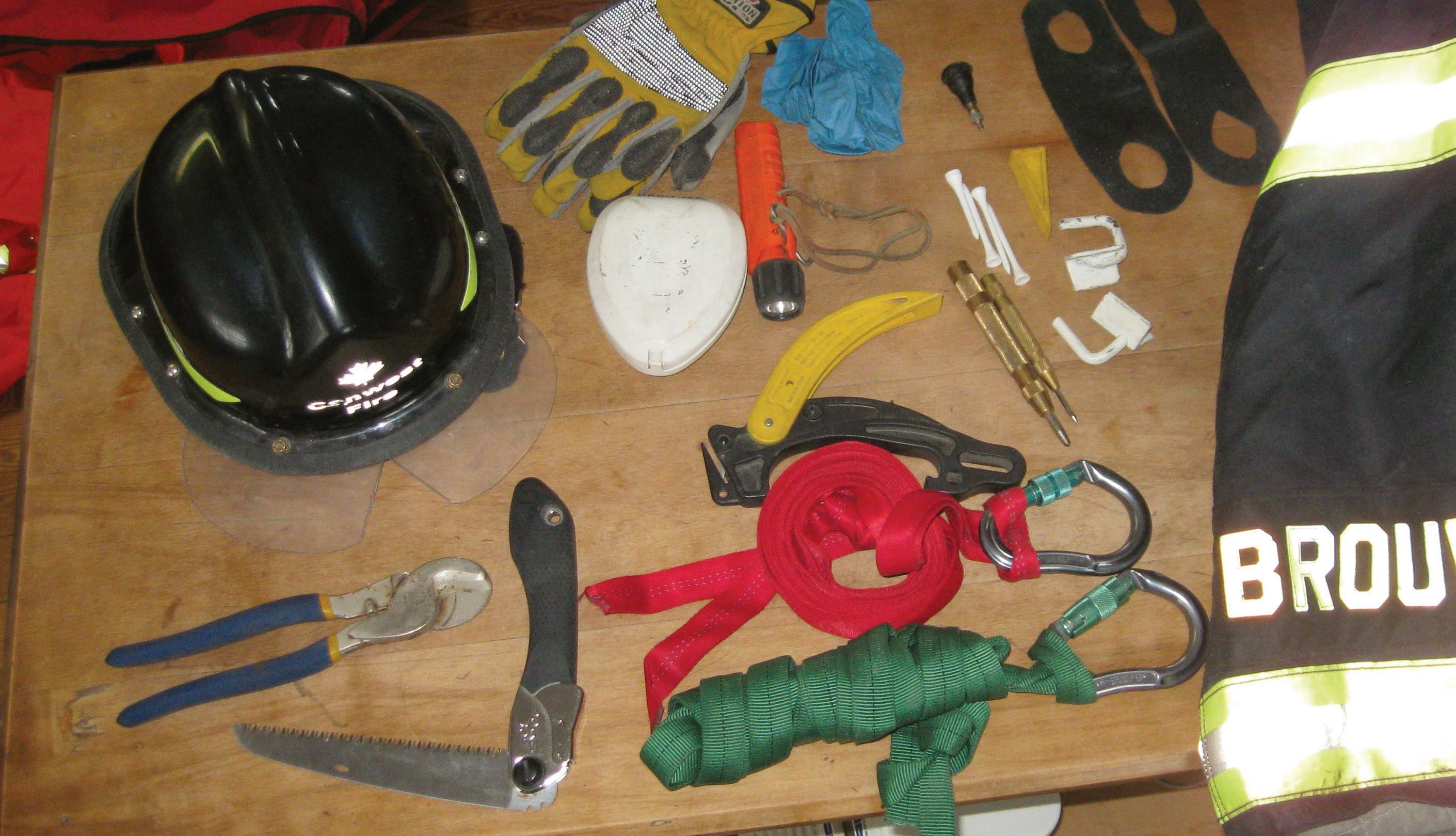
the last few topics in Trainer’s Corner have been somewhat intense, so I thought it might be time for something a little lighter. Much like the question asked by the spokesperson for ING Banking, What’s in your wallet? I ask you, What’s in your turnout gear?
During our hot summer weekends our instructors often get firefighters to don their PPE and then ask them to empty their pockets. The results: everything you can imagine to nothing whatsoever.
It may seem a bit harsh but we ask the firefighters carrying nothing if they actually know the purpose of those big pockets on their bunker gear. One group of firefighters said their department didn’t allow them to carry tools in their pockets. The department feared making holes into the gear.
I know I could get into trouble, but I tell firefighters it’s their gear. It is fitted to you. It is your protection. A tool in your pocket could very well save your life, or the lives of your fellow firefighters. Imagine being hooked by a piece of wire that could easily be cut by a pair of wire cutters, but alas the cutters are in the toolbox on the truck. Now it becomes a RIT situation and more firefighters are put at risk. There is no honour in a LOD death that could have been prevented by carrying a $14 pair of cutters, whether or not they may cause a wear hole in the gear.
There are different schools of thought regarding which equipment should be carried in your bunker gear. As you read the list below, please keep in mind that some firefighters respond only to structure fires, while others respond to all types of calls – MVIs, structural fires, vehicle fires, urban interface fires, first response medical and others.
We asked a number of firefighters these questions:
• What’s in your turnout gear?
• Why did you choose that specific item?
I have listed their responses by item name followed by the various amounts or types:
• Webbing: 24 feet of one-inch tubular webbing; 16 feet of webbing.
• Odds and ends: Golf tees; one-inch radiator hose clamps; window punch; seatbelt cutter; a picture of family / people cared for; safety glasses; and pocket mask.
As you can see, it’s quite a list. After deciding what you need to
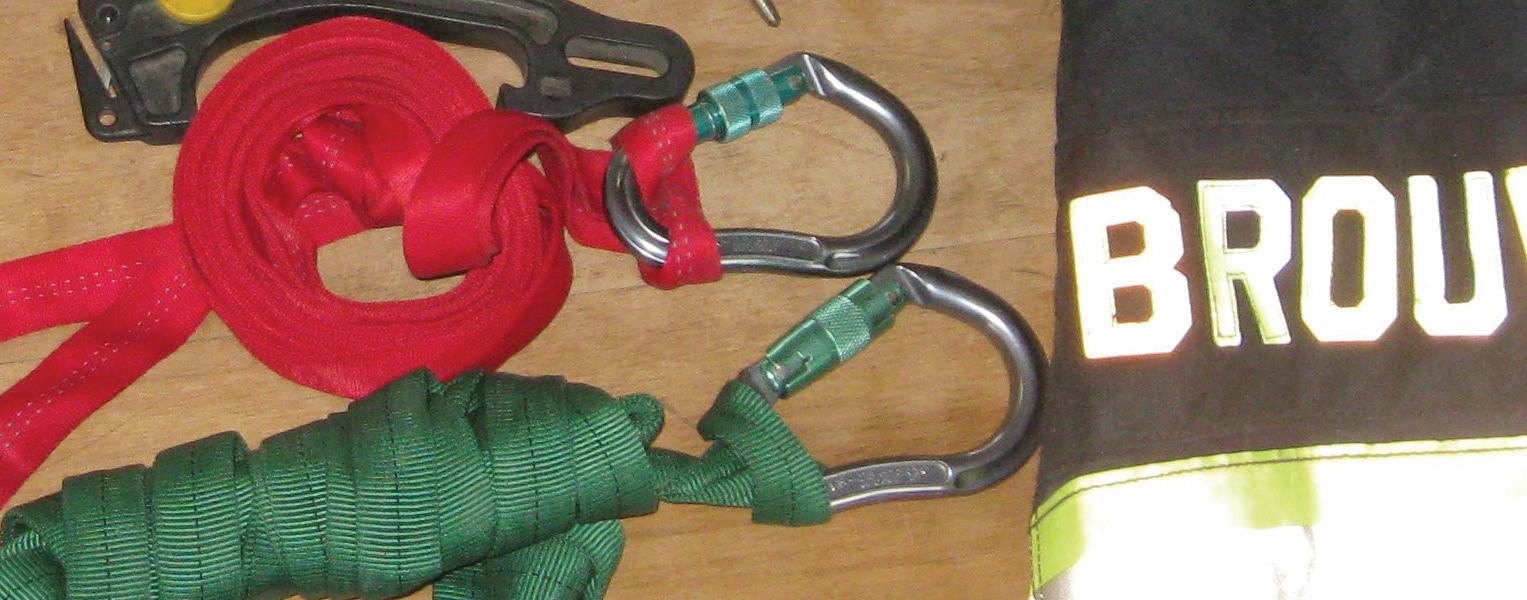
Ed Brouwer carries a flashlight, webbing, golf tees, centre punches, gloves, cutters, multi-tool, valve stem remover, face mask, notebook and pen, chocks, latch stoppers, rope, folding saw and wire cutters.
carry, the next question is where? Realtors say, “Location, location, location.” In this case, location is everything. Think about trying to get at your wire cutters while wearing SCBA and lying on your side. Some firefighters keep structure tools such as wedges or webbing on the right side, and auto extrication tools such as seatbelt cutters, a Res-Q-Wrench or a window punch on the left. Bunker pant pockets usually carry hand protection, rope, utility gloves and more webbing.
■ WhaT you may noT need To carry
One firefighter carried an extra Nomex hood for filter breathing during SCBA failure. This is not a good idea. Firefighters with SCBA malfunction or failure have a better chance of being revived if they keep their mask on. Inhaling even a trace amount of super heated fire gases may cause the larynx to close, thereby robbing you of breath. Air management and calling a mayday early give you the best chance of survival.
One firefighter suggested carrying an electrical tester. Although this may help during the investigation stage, in the heat of battle with the fire dragon, treating wires as live is your best bet for survival.
Photo
It seems a large number of firefighters carry Leatherman tools or multi-tools but I wonder how many have actually used them in a fire? These small tools are awkward to open and work with at the best of times let alone with gloves on in poor light.
■ some suggesTions
The No. 1 thing you should have in your pockets is an extra flashlight. I tied a short piece of leather strip to the flashlight; it hangs out of my pocket for a quick find.
There are a variety of door wedges being carried. Being able to ensure that the door you just opened stays open could mean the difference between life and death. Door wedges can also be used to stop sprinkler heads. The plastic wedges slip out of position easily; the wooden ones are a bit better but the best are our homemade steel ones – simply a piece of one-inch, angle-iron cut into one-inch pieces with a one-inch steel rod hook welded to it. Hang the hook over the hinge of the opened door and the angle iron keeps it from closing.
I don’t carry vice grips but some firefighters swear by them to loosen or tighten bolts, as a door wedge or they clamp the vice grips on an overhead track to keep the door from coming down. I carry two lengths of webbing; 12 feet (looped to six feet) of one-inch webbing tied with a water knot attached to a four-inch aluminum carabineer, and a 20-foot (looped) piece also tied with a water knot and attached to a four-inch aluminum carabineer. They can be used separately or hooked together for longer reach. Their main purpose is for self-rescue and RIT operations. Other uses include carrying tools and lowering and raising tools.
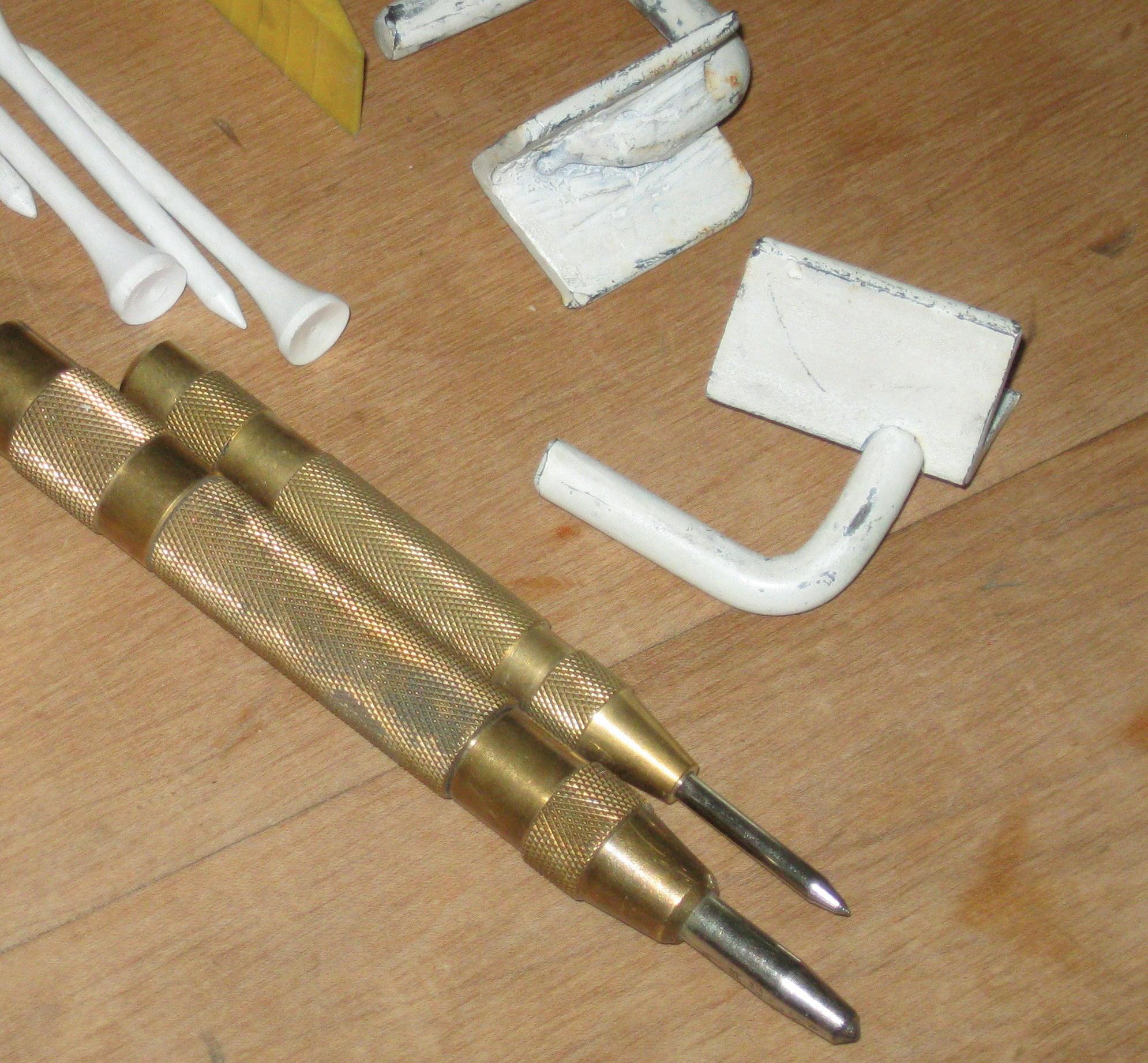
Because we respond to many MVIs, I carry some special items: four golf tees to use as quick plugs for fuel tank leaks; two spring-loaded centre punches for popping windows; heavy duty latex gloves to be worn under my extrication gloves in case of the need to help with EHS; heavy duty cutters for battery cables; and a Task Force multitool that includes a seatbelt cutter.
I made a valve stem remover so that rather than cutting the valve stem off to deflate the tires I can just take out the valve stem. Then, when the tow truck operator needs to load the vehicle, we replace the valve stem and use the compressed air from the tow truck to re-inflate the tires. I carry a pocket mask in its case in my inner coat pocket. I also carry a small notebook and pen. At my age, I dare not rely on memory alone!
For structure fires, I carry two steel door chocks, one plastic door chock, two door latch stoppers made from a piece of inner tube with two, one-inch holes cut in them (looks like a Zorro mask). Stretch one hole over the doorknob, pull the inner tube over the latch and hook the second hole over the doorknob on the other side of the door. Should the door close it can’t latch because of the inner tube. I also carry 50 feet of three-eighths inch braided rope. I can use it for large area searches or as a RIT recall line.
Among my favourite tools are a folding saw and HD wire cutters. The wire cutters are 9.5 inches long with insulated handles. They have an incredibly powerful two-inch bite. My wife bought me the Pocket Boy Folding Saw for Christmas one year. It is lightweight with a seveninch micro blade that cuts through a 2x4 stud in seconds. I have used my Big Ed clip-on flashlight for six years and it has never failed me.
That sums up the possibilities for your carry-on equipment with one exception – the helmet. I don’t carry tools in my helmet but I do carry two things there – my accountability name tags and a photo of my grandkids.
Ed Brouwer is the chief instructor for Canwest Fire in Osoyoos, B.C., and the training officer for West Boundary Highway Rescue. The 20-year veteran of the fire service is also a fire warden with the B.C. Ministry of Forests, a wildland interface fire suppression instructor/evaluator and a fire-service chaplain. Contact Ed at ed@thefire.ca
negligence 101
Bylaw enforcement important for municipalities
By TImOThy WILKIN
Editor’s note: Lawyer Timothy Wilkin of Cunningham Swan Carty Little & Bonham in Kingston, Ont., prepared a review for the Ontario Association of Fire Chiefs of reported Canadian court cases in the last 15 years that dealt with negligence by municipalities and their fire departments. We looked at two cases in the February issue of Fire Fighting in Canada. Three more cases are below. A final instalment will appear in May.
case 1. smiTh v. Jacklin (1994) – facTs
The plaintiff was a tenant in a rooming house that was destroyed by fire on April 11, 1991. The plaintiff was injured in the fire and commenced an action seeking damages against various defendants, including the fire department, for failing to properly carry out its obligations under its fire prevention bylaw.
Another tenant of the rooming house negligently caused the fire by attempting to cook a meal in his room. The plaintiff could not escape from his third floor room down the only stairwell and suffered injuries and burns when he had to jump from a window.
The plaintiff did not sue the municipality or the fire department for any shortcomings in fighting the fire, but rather sued them for negligence with respect to its prevention procedures, including inspection and enforcement of the Ontario Fire Code.
The Parry Sound Fire Department had notified the owners of the boarding house by letters in 1984 and 1986 about deficiencies in the building, including the lack of an alternative exit from the second and third floors, and advised them that the deficiencies constituted violations under section 9 of code.
At the time of the fire, the fire chief had been acting as the fire prevention officer. He had not established a timetable or schedule for ensuring compliance by the property owners and instead, had relied on voluntary compliance with the code.
The plaintiff alleged that since the town had passed a fire prevention bylaw imposing a positive duty on the fire department to inspect buildings and enforce the code, the town owed a duty of care to any person who might make use of a deficient building.
■ legal issue:
• Was the fire department negligent by not inspecting the rooming house and not enforcing of the code?
■ courT’s findings
The town was found to be 25 per cent liable to the plaintiff for injuries suffered in the fire because it had failed to enforce the fire prevention bylaw against the owner of the building, which contributed to the plaintiff’s injuries.
The town’s decision to pass a fire protection bylaw was a discretionary policy decision. Section 12 of the bylaw created the Division of Fire Prevention and imposed on the deputy chief the duty to conduct fire prevention inspections of premises and enforce the code.
A negligence claim alleging that an Ontario fire department failed to ensure an adequate water supply was unsuccessful.
Once the municipality assumed this obligation, it owed a duty of care to building occupants, including the plaintiff, to enforce the code. Failure to discharge this duty according to a standard of reasonableness contributed to the plaintiff’s injuries, which were a foreseeable consequence of the breach.
Though liable to the plaintiff for personal injuries caused by his difficulties evacuating the building, the municipality was not responsible for any of the personal belongings that had been lost. Construction of a second stairwell according to the Ontario Fire Code would have saved the plaintiff from personal injury but would not have made a difference with respect to the loss of his belongings.
The owners of the building, the tenant who caused the fire and the plaintiff, who had been in a deep alcohol-induced sleep that slowed his slow reaction time, shared the balance of liability.
■ lessons learned
It was a policy decision for council about whether it would pass a bylaw assuming responsibility for the enforcement of the Ontario Building Code. However, once a municipality imposes on itself or its employees a positive duty to carry out certain stipulated fireprotection services, it will be negligent if it fails to carry out those duties in a reasonable manner and will be liable for any injuries or losses that are a reasonably foreseeable consequence of that negligence.
case 2. bayus v. coquiTlam (1993) – facTs
The plaintiffs were tenants in a duplex. The tenants discovered a fire in the carport of their unit and called 911, but gave an incomplete address that caused some confusion about which municipality the property was located in.
Continued on page 34
Offering: A 2 course certificate in incident command for experienced incident commanders. Please contact our office for more information.
Are you looking to take on more responsibility in your Department? Trying to round out your technical ability with leadership skills? Preparing to advance your career?
At Dalhousie University we offer a three course program, the “Certificate in Fire Service Leadership” to career and volunteer fire officers.The 3 courses Station Officer: Dealing with People,Station Officer:Dealing with New Operations and The Environment of the Fire Station are all offered in each of our 3 terms, September, January and April. The program can be completed in one year.
For more information and a program brochure please contact:
Gwen Doary,Program Manager
Dalhousie University Fire Management Certificate Programs 201-1535 Dresden Row,Halifax,Nova Scotia B3J 3T1 Tel:(902) 494-8838 • Fax:(902) 494-2598 • E-mail:Gwen.Doar y@Dal.Ca
You will also find the information in our brochures or at the following internet address:Web site:http://collegeofcontinuinged.dal.ca
BACktoBASICS Hand tools for truck companies
by mark van der feysT
In the fire service we have many tools that we carry on our apparatus or in our pockets. Our fascination with tools is a longstanding tradition – just take a look at the vendors at trade shows and you will see hundreds of tools on display. We have tools designed for every imaginable situation; if there isn’t a tool for a certain situation just wait and there will be. Tools give us the ability to complete the tasks that have been assigned to us; they are an extension of our hands.
In basic training we teach firefighters to bring a hand tool of some sort. This is for two reasons; one is for personal survival and the other is for operational purposes. The matter of which tool to choose is sometimes a challenge but it’s important to choose the proper tool to do the job. Most of us bring just one hand tool because this is the way we have drilled, but
we all have two hands and therefore can carry two tools. So why not carry two tools? If you are a truck company firefighter, you will know the value in having two tools with you when trying to complete a task. If there are two of you assigned to a task that means there are four hand tools at your disposal. Remember this saying, “two hands, two tools.”
At any truck company operation, we have a selection of tools at our disposal. In Back to Basics in August, I listed the 10 functions for which a truck company is responsible. Here they are again:
• Rescue
• Ventilation
• Forcible entry
• Reconnaissance
• Laddering
• Overhaul
• Elevated master streams
• Salvage
• Utility control
• RIT
Knowing these 10 functions dictates our tool requirements. The tools from which we select for truck company operations can be used for the majority of these 10 functions. (The only function that does not require hand tools is elevated master streams.) The basic tools for truck company operations are Halligan bar, roof hook, pike pole, axe (both flat head and pick head), chainsaws and rotary saws. All of these tools can be used to accomplish the nine truck company functions.
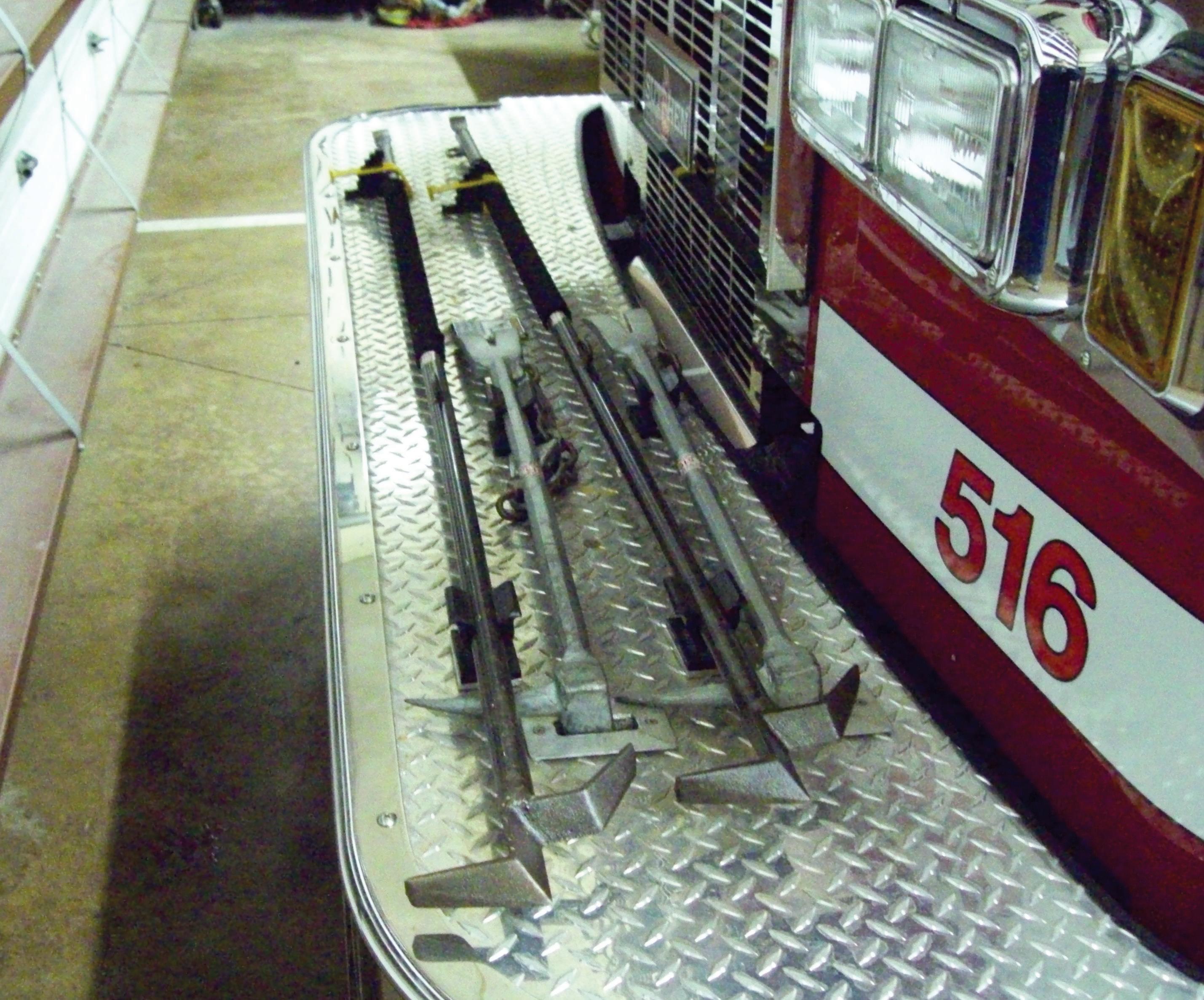
Photo 1 shows the roof hook and the Halligan bar. The Halligan bar is the most well known tool in the fire service. Invented by Hugh A. Halligan, a New York City firefighter, the Halligan bar is used primarily for forcible entry operations. It is the one tool from which we can benefit the most. Law enforcement agencies also benefit from this tool when they are forcing open doors to serve warrants. There are many Halligan bars on the market: the Halligan bar, the Hooligan bar and the Pro-Bar.
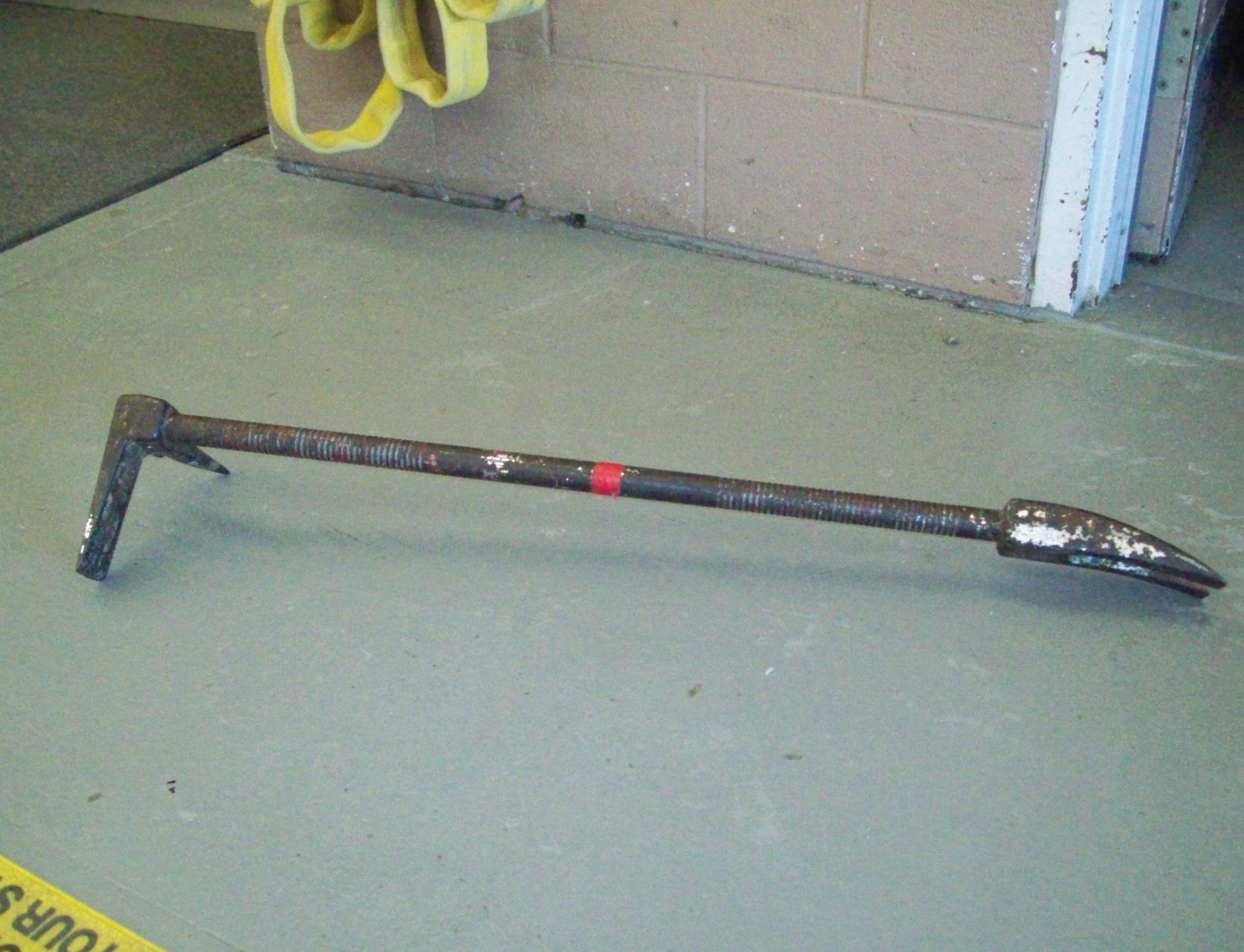
The Hooligan bar is an imitation bar (see photo 2). It has two pins holding the fork end and the adz end to the shaft.
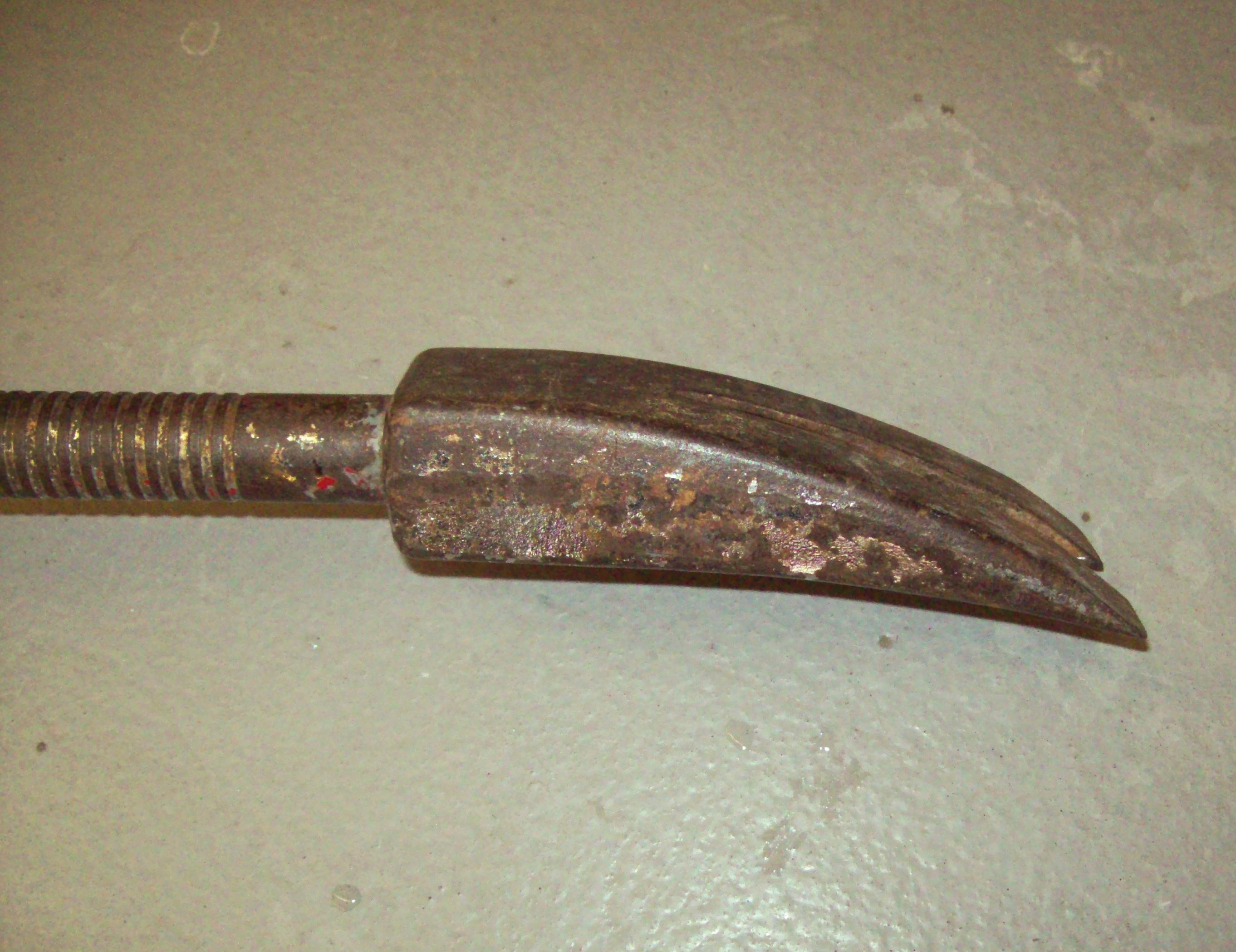
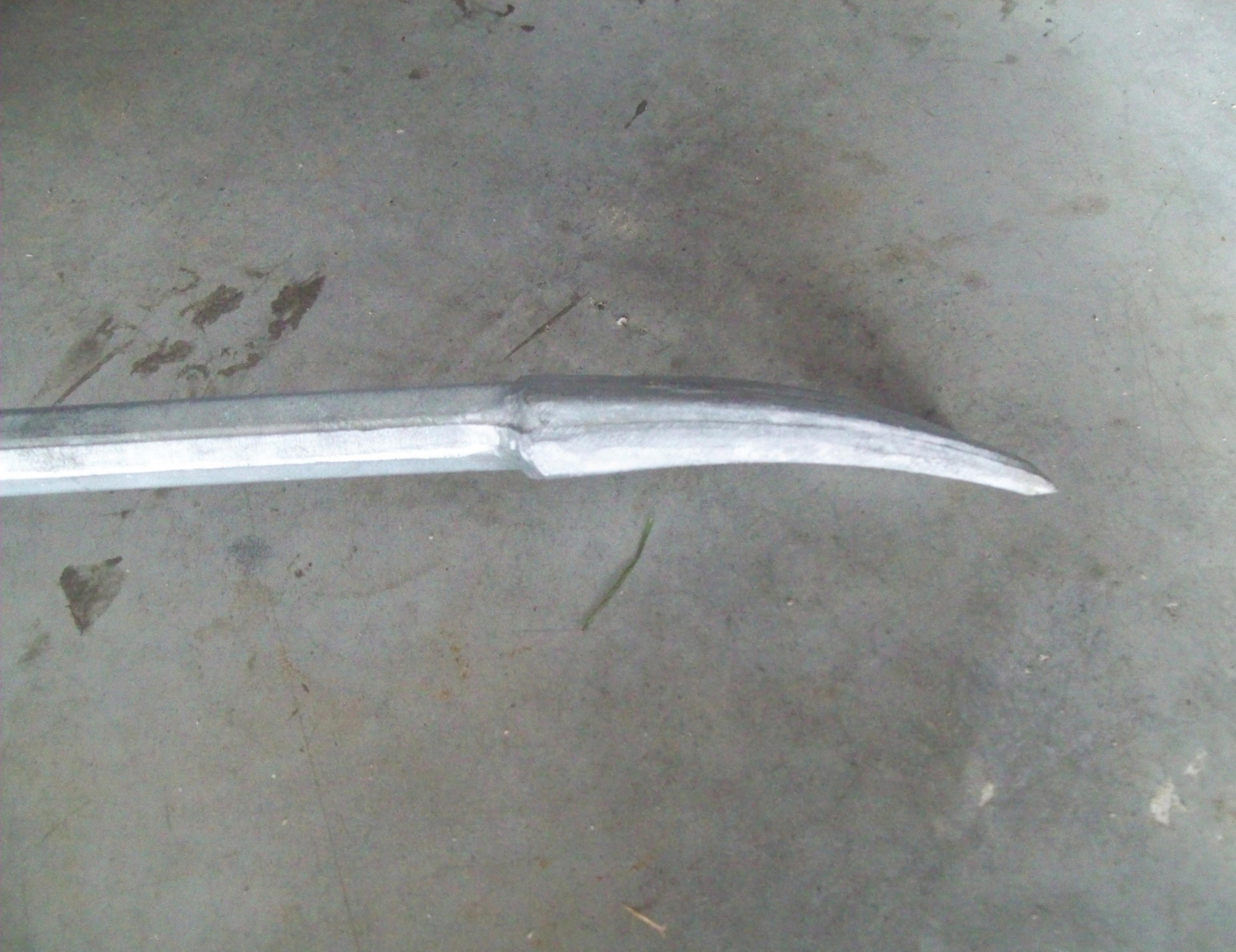
The Halligan bar has two welds holding the fork end and the adz end to the shaft. Hugh Halligan’s original design used one piece of forged steel. This is referred to as the Pro-Bar on the market. It is balanced when carried and offers the most advantages when being used for forcible entry operations. The forks are bevelled such that they are on a slight angle to allow the best fit between the door frame and the door. They are also slimmer in design. Other imitation bars have their forks at extreme angles and are thicker than the original design (see photo 3). This offers very little advantage when using them for forcible entry. The thicker the fork, the harder it is to force open a door. The thinner the fork, the easier it will be to force the fork between the door frame and the door.
The Halligan bar can also be used for search operations as an extension of our arms; it can be used in ventilation operations for clearing out windows and it can be used for self extrication as an anchor point for firefighter survival.
The roof hook is another favourite tool of the truck company firefighter. Rising again out of the New York City Fire Department, this tool is designed for roof operations when trying to accomplish ventilation. These tools come in varying lengths with the most common being five- and six-foot lengths. As you can see in photo 1, the top of the tool has two angled hooks that are spaced apart from each other. The top hook has a sharp edge to it, allowing the user to penetrate through different surfaces both outside and inside the structure. Once penetrated through, the hook can then be used to pull down or pry the material off of the surface. It also serves well for sounding the roof when stepping onto it, and for advancing on the roof.
The bottom of a roof hook can have different ends. Some have a pry wedge, a fork, a D-handle, a ram knob or a gas shut-off tool. The most popular choice is the pry wedge. This allows the user to pry open various items, such as scuttle hatches, when trying to gain entry or ventilate.
The roof hook is also useful when conducting overhaul operations. The hooks allow the firefighter to pull off wall mouldings, trim, lath and plaster, tin ceilings, drywall, and door/window casings. By penetrating the wall surface or ceiling area, the hook
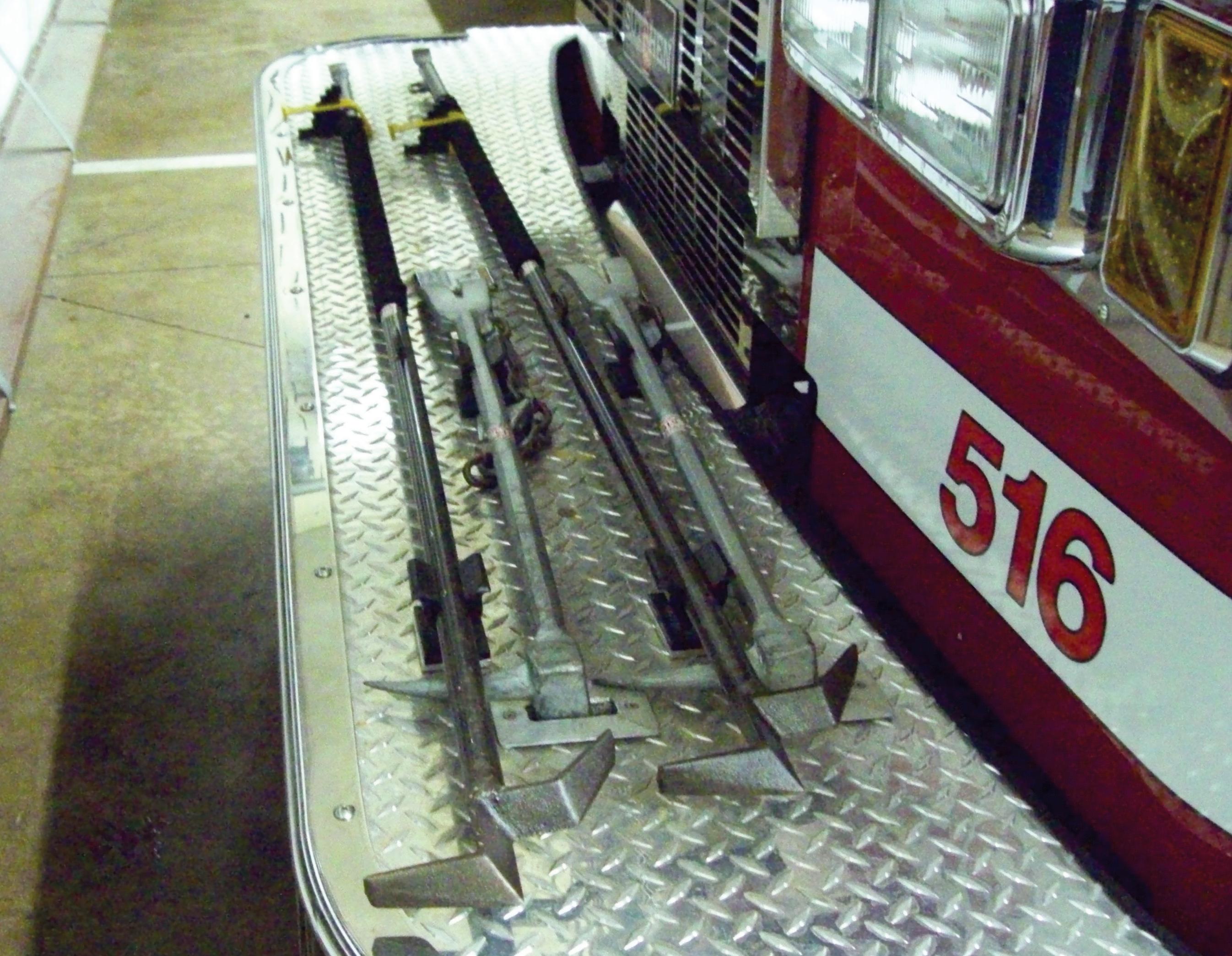
can be used to create an inspection hole. The roof hook is lightweight and is made out of one piece of metal. The original roof hooks are constructed from aircraft steel. Other versions are made from fibreglass and are not as strong as the aircraft steel models. The diameter of the hook is user-friendly, unlike pike poles, which can be cumbersome when wearing structural fire gloves. Many fire departments mount these two tools in different places on the apparatus. In photo 1, truck 516 has both tools mounted on the front bumper. These tools can also be mounted on the side of the apparatus near the rear passenger door, up by the platform on an aerial device, or with the ground ladders.
One firefighter with these two tools can accomplish a multitude of tasks on the fire ground. Having two tools in two hands, a firefighter – whether truck company or not – can be a valuable asset to the incident commander.
Mark van der Feyst is a 10-year veteran of the fire service and works for the City of Woodstock Fire Department in Ontario. He is an instructor for the PennsylvaniaState Fire Academy and the Justice Institute of BC and an associate professor of Fire Science for Lambton College. Contact him at Mark@FireStarTraining.com
Photo 1: The Halligan bar and the roof hook – two favourite tools of the truck company firefighter
Photo 2: The Hooligan bar has pins at the top and bottom end holding the fork and adz end to the shaft.
Photo 3: The fork end of the Hooligan bar. Notice the thickness of the fork at the shaft end
The fork end of the ProBar. The original design calls for a slimmer fork, allowing it to be versatile.
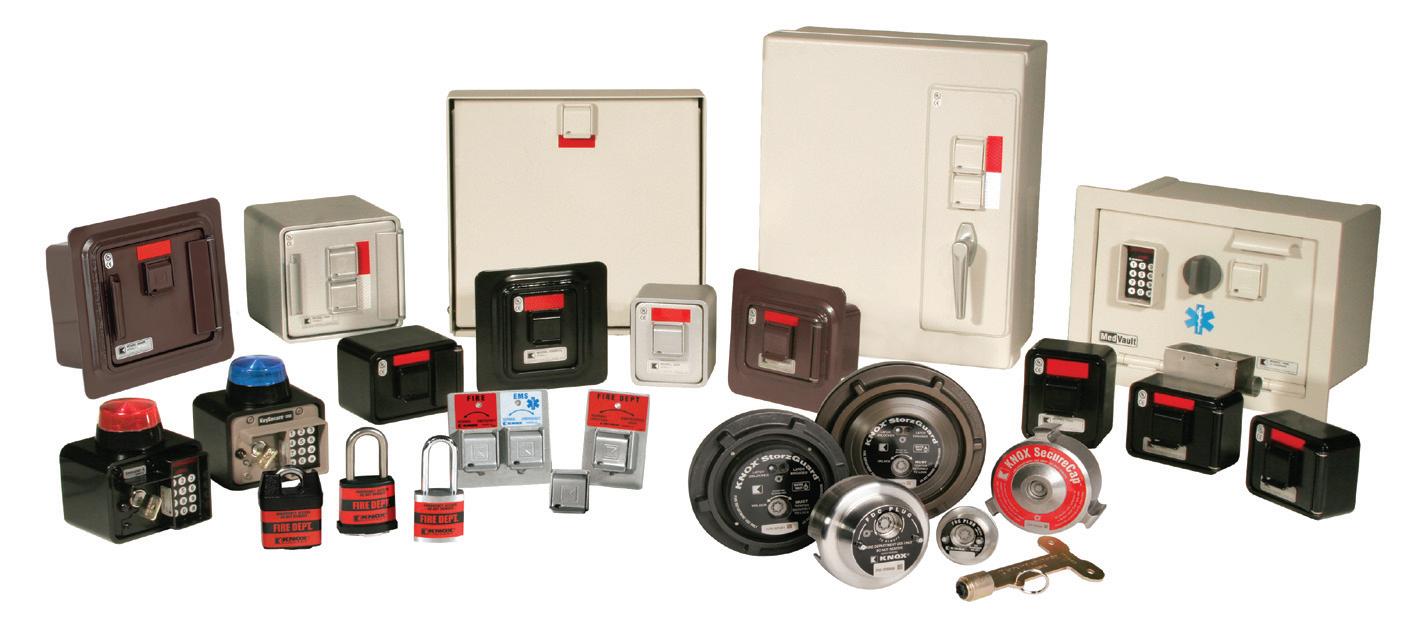
Knox-Box® Rapid Entry System
Emergency responders require a secure rapid entry system that allows fast access without damage to property or delays waiting for keys. The Knox-Box® Rapid Entry System is a comprehensive UL listed key control system that includes high security key boxes, cabinets, key switches, padlocks, master key retention devices and locking FDC plugs and caps. Rely upon the Knox System for all your rapid entry needs.
Continued from page 15
Caledon’s district chiefs then determined which volunteer firefighters would be in each platoon.
For Bigrigg, the most frustrating part of the pilot project was the skepticism by firefighters about management’s intentions and the belief that platooning was simply a way to cut their pay. Some firefighters, he said, didn’t understand that management was under a directive to try to improve what was perceived to be a difficult situation for volunteer firefighters who were getting called out too often.
Indeed, there was talk among firefighters of a boycott – of not responding to pages –but in the end everybody tried to make the system work, Bigrigg said.
Interestingly, he said, there was no public feedback on the platooning system despite several stories in the local newspaper about the new system.
Bigrigg said he believes a platoon system can work in a suburban area but that Caledon needs infrastructure changes, specifically the scheduled relocation of one station, for a platooning system to be effective.
Overall, he said, the aim of the platooning project was to reduce stress on volunteer firefighters and his concern now is to make sure that happens.
“If our original concern was that our volunteer firefighters are wearing down, and if the pilot didn’t work, are we doing something else?”
Bigrigg says that while the platooning wasn’t right for his department under the present circumstances, initiatives over the last year have had a significant impact on the volunteers, including improved triaging of calls by EMS, better management of call volume and a widening of the coverage
area of the career staff at the Bolton station, which has reduced the number of page outs for volunteers.
■ WhaT’s ahead
Malmsten expects an operational sea change in the fire service in the next 10 to 15 years but says it won’t happen until departments like Caledon experiment with potential new systems, determine what works and what doesn’t, and then share their findings.
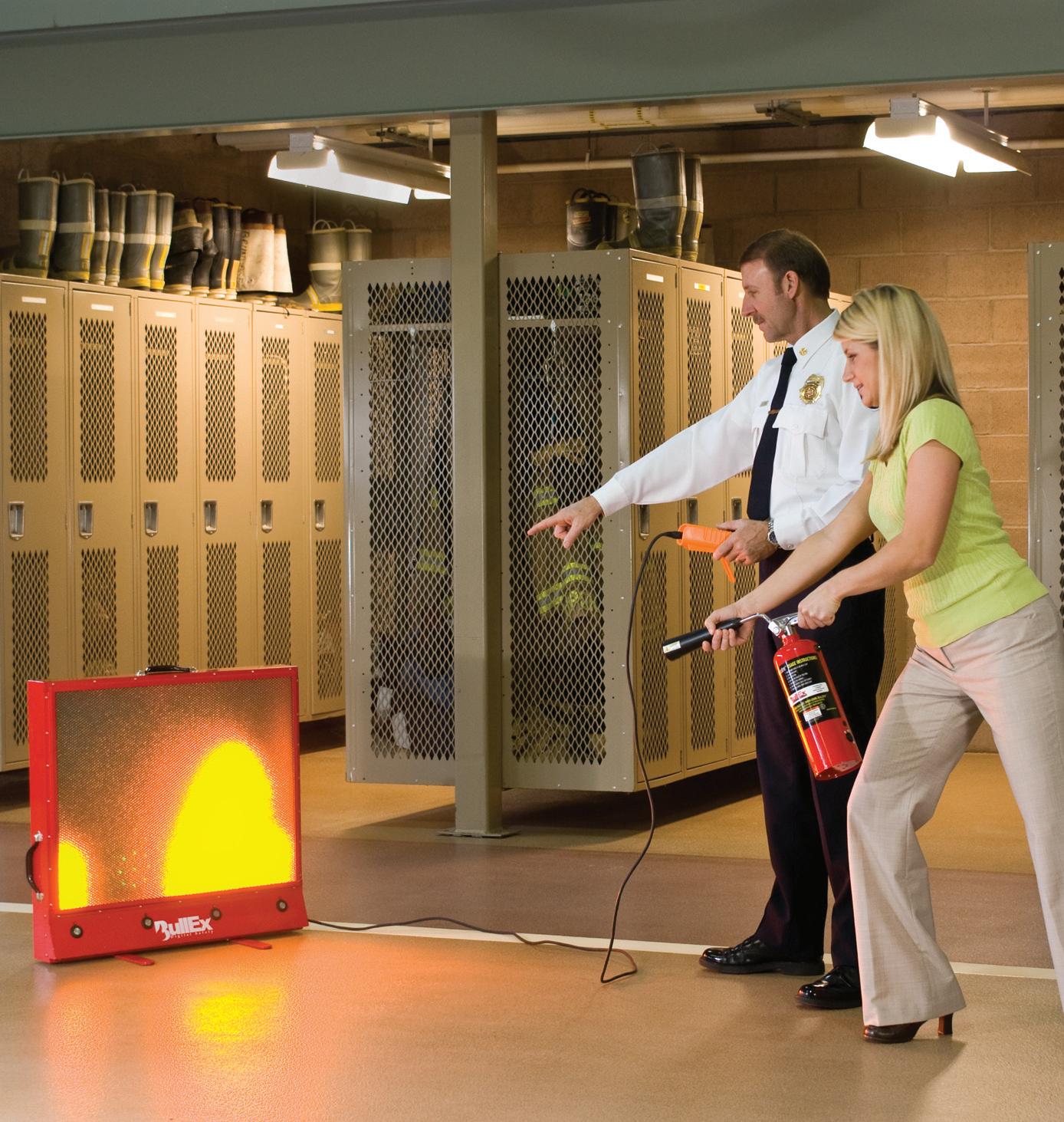
The BullsEye extinguisher training system uses laser-driven training extinguishers and LED driven digital flames to provide a realistic simulation for trainees while eliminating the hazards of conventional fire extinguisher
training. Trainees learn how to effectively use a fire extinguisher without the cost and clean-up associated with using dry-chemical or CO2 extinguishers.
TRUCkchecks
ULSD and filtration
by don henry
It’s important to look at the problems with diesel fuel systems and the filtration needed.
ULSD (ultra low sulphur diesel) fuels are fuels with no more than 15 parts per million of sulphur content. LSD (low sulphur diesel fuel) are diesel fuels with no more than 500 parts per million of sulphur content. The move to ultra low sulphur content is to allow the application of newer emissions control technologies that should substantially lower emissions of particulate matter from diesel engines. These systems can greatly reduce emissions of oxides of nitrogen and particulate matter.
This change to ULSD from LSD was to happen in Canada on Sept. 1, 2006, the same time as in California and one year before the rest of the U.S. for on-road applications. Up until this time, the acceptable maximum sulphur content was 500 ppm. To meet the 2007 emission standards, new fire apparatus are equipped with aftertreatment exhaust components (see Truck Checks November 2009 at www.firefightingincanada.com). These new and expensive aftertreatment devices cannot handle fuels with sulphur levels higher than 15 ppm. High sulphur levels can pollute the new exhaust devices. Even one tank of LSD fuel is estimated to be enough to ruin a system. So why would a person use LSD instead of ULSD?
What you might not know is that the concentration of sulphur in diesel fuel produced or imported for use in off-road engines shall not exceed 500 ppm from June 1, 2007, until May 31, 2010, and 15 ppm after that date. This means a farmer could buy and use LSD in a tractor. This fuel is often called marked farm fuel or purple diesel, depending on which part of the country you live in. Many municipalities, towns and cities have an exemption from the road tax that provincial and federal governments put on fuel and they use this cheaper marked fuel. It is OK, as long as the engine is in the town backhoe, snow blower or loader. It would be a big mistake to use this LSD diesel fuel in a 2007 or newer fire truck. You will quickly pollute the after-treatment devices. Use only ULSD on these trucks. And, to make sure you don’t make the mistake, use ULSD on all of your diesel-fuelled units.
■ WinTer and summer diesel fuel
In Canada, it is necessary to have two types of diesel fuel. During the spring, summer and fall the fuel is called No. 2 diesel. The lighter, winter fuel is called No. 1 diesel fuel. For example, Esso will blend a lighter, winter diesel No. 1 from Oct. 22 to March 15, and a heavier, summer diesel from March 16 to Oct. 21. The main reason to blend this lighter fuel is to solve the cloud point problem. Summer diesel fuel will not flow in cold, winter temperatures. The temperature at which this happens is called the cloud point. To ensure that the fuel will flow, the oil refiners will either remove the paraffin wax that causes this problem from the fuel or blend in an additive to prevent the wax from gelling. Wax has a heat value when it burns. While it is true that summer diesel has more energy per pound than winter diesel, I believe it would be difficult to detect while simply driving. It may show up during a pump test and for that reason I would recommend that the annual fire pump
test be conducted with a full tank of summer diesel.
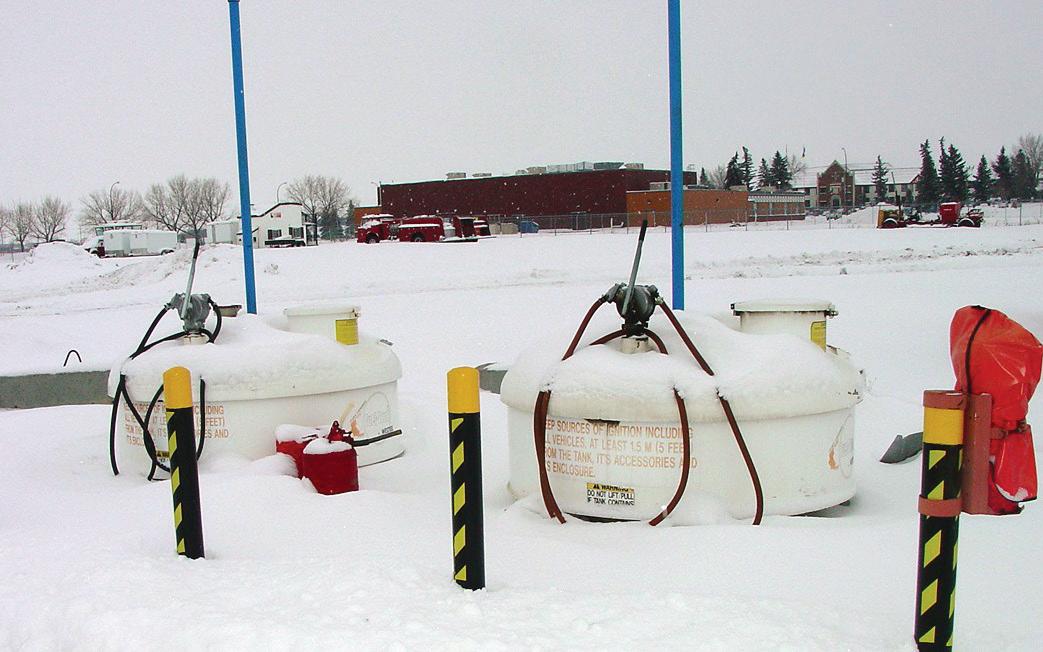
Now, I know you are sitting back and thinking, does he not know we park our fire trucks inside during the winter? Many departments have an outside fuel storage; this can be very handy during a power failure such as those caused by ice storms. If your department buys its fuel locally, from a commercial fuel station, and you have an extended power outage, how are you going to get fuel for your trucks? If you use an outside storage facility, I strongly suggest that you fill these tanks with only a winter-grade diesel. You can always pump winter diesel in the summer but you cannot pump summer diesel in winter.
■ ceTane number
Cetane number, or CN, is a measurement of the combustion quality of diesel fuel during compression ignition. It is a significant expression
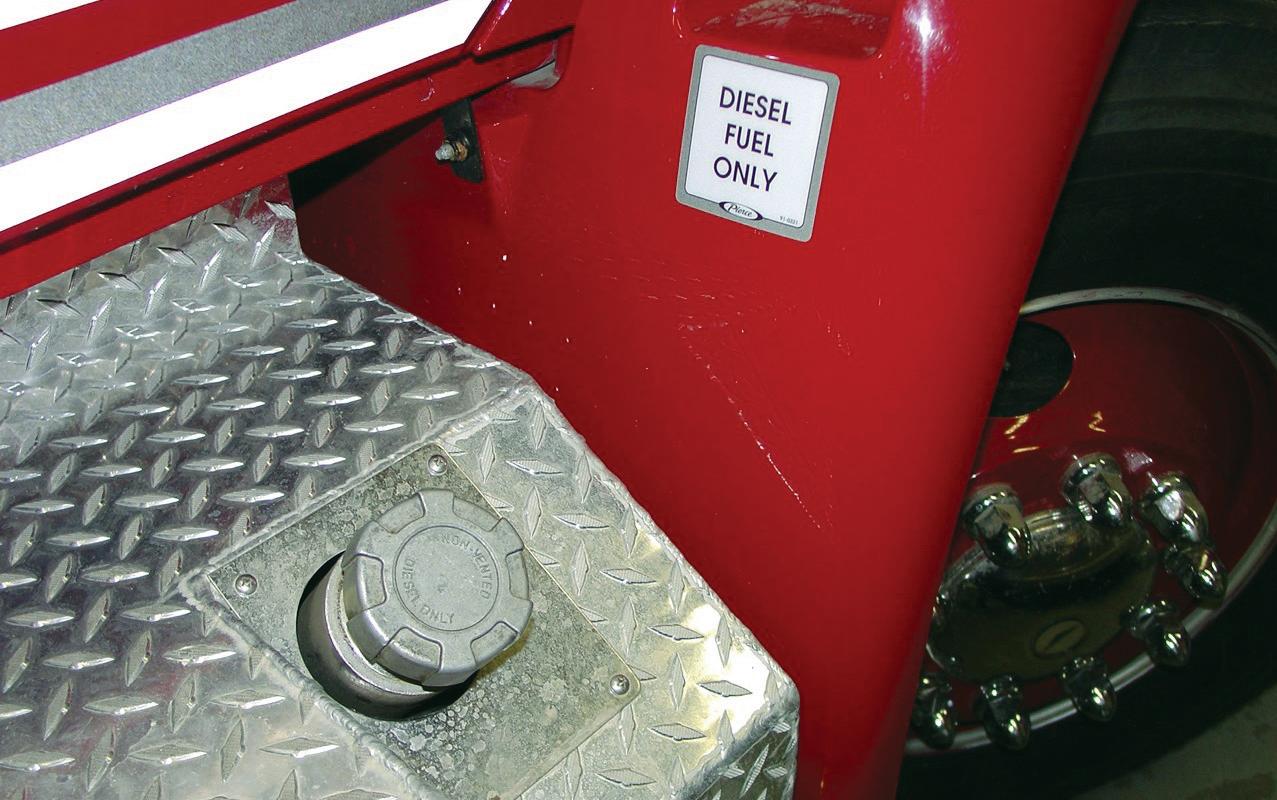
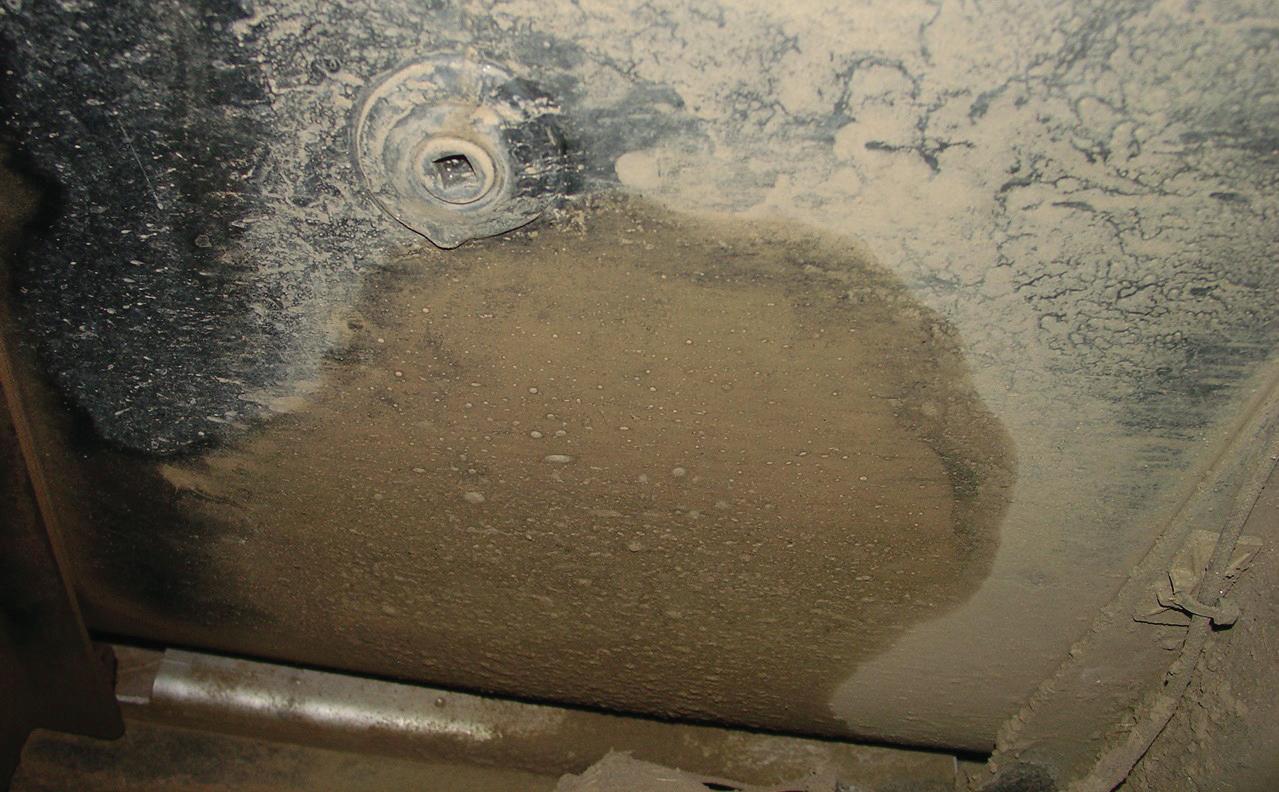
Typical diesel fuel tank.
of diesel fuel quality among a number of other measurements that determine overall diesel fuel quality.
The cetane number is a measure of the ease with which the fuel is ignited in the engine. It is most significant in relation to low-temperature startability, warm-up and smooth, even combustion. Fuels with a low cetane rating have high ignition lag that may cause an amount of fuel to collect in the combustion space before ignition occurs. High maximum cylinder pressures are reached and engine knocking results.
The cetane number of the fuel should meet the engine manufacturer’s minimum recommendation for the type of service. In North America, this number is normally at least 40. Most refineries ship diesel fuel with a 42 to 46 cetane rating. A cetane number higher than the required 42 does not dramatically improve engine efficiency or operation.
Fuels with high cetane ratings have low auto-ignition temperatures and hence are easier starting than fuels with low cetane ratings. This ease of starting is noticeable at cold temperatures – not a real problem for fire apparatus parked inside.
It is a common misconception that diesel fuels with high cetane ratings are more powerful and therefore burning this fuel will give you a more powerful truck.
I have heard it said that premium diesel may extend the life of the engine particulate filter. I cannot find any study that relates engine particulate filter plugging or the need for regeneration to a higher cetane level in the fuel.
Some fuel suppliers market their fuel as premium and it may have a higher cetane number. I am not a great believer in premium diesel fuel and, to my knowledge, there is no government standard that even defines premium diesel fuel in regards to a cetane number.
■ fuel filTers
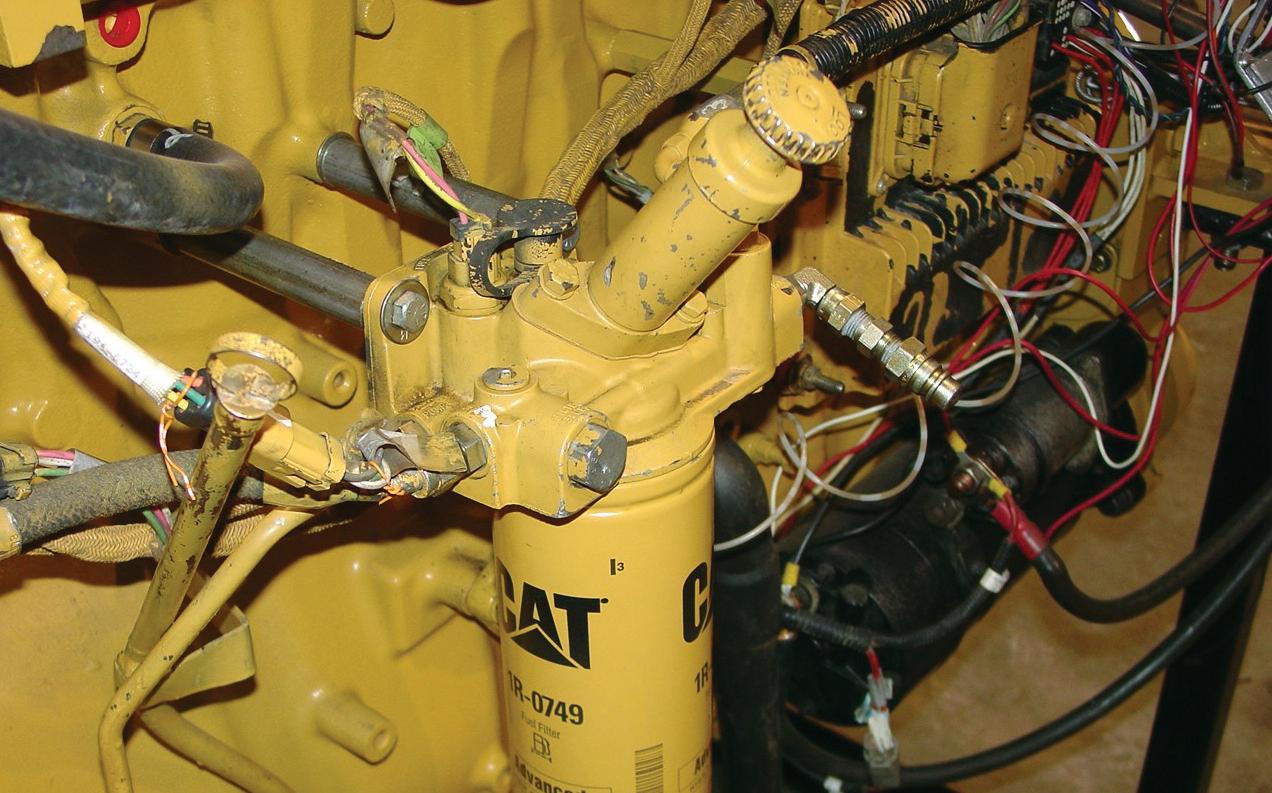
There are normally two filters in a diesel fuel system, a primary and a secondary filter. These are often two separate housings or, in some cases, they are contained in one housing holding both filters.
The primary filter is the first filter downstream from the fuel tank but before the lowpressure fuel-transfer pump. The secondary filter is the last filter before the very expensive high-pressure, fuel-injection system.
This is no place to save a few dollars on substandard filters; buy what the manufacturer recommends and change them when recommended. Just because the guy at the auto parts store says it will fit does not mean it’s as good as the original.
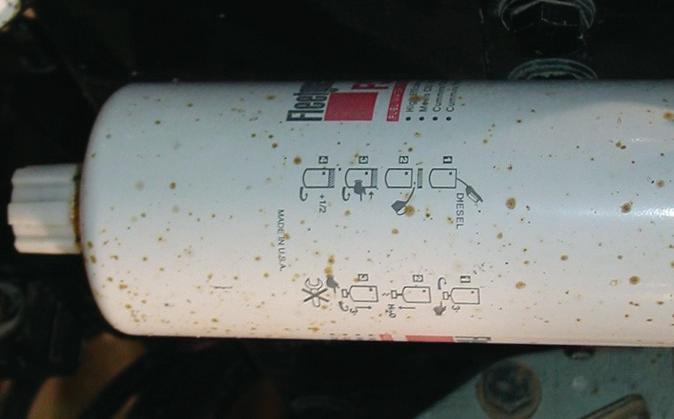
It is not a best practice to fill the replacement filter with diesel fuel before installing it.
This practice can allow contaminated fuel to get past the filter elements and flow downstream to the injectors. The reason for this practice was that it allowed the technician, in some cases, to not have to go through the time-consuming process of bleeding air from the fuel system after a filter change.
Many filters have water traps and, in some case, a water-in-fuel indicator.
If you do decide to change your own fuel filters, and it is not that difficult, then make sure you run the truck after the change to make sure you do not have any air in the fuel system.
An excellent, free interactive training CD is available from Baldwin Filter (number PKG475). It covers oil, coolant and fuel systems and their maintenance. Contact Jean Seitz at jseitz@baldwinfilter.com and note that you read my column on coolants and would like a copy of the CD.
■ sTorage life
If diesel fuel is properly stored it is not unusual to get just one to two years of storage life from the fuel.
If you wish to extend this life it will be
SmartDummy — InteractIve Search & reScue manIkIn
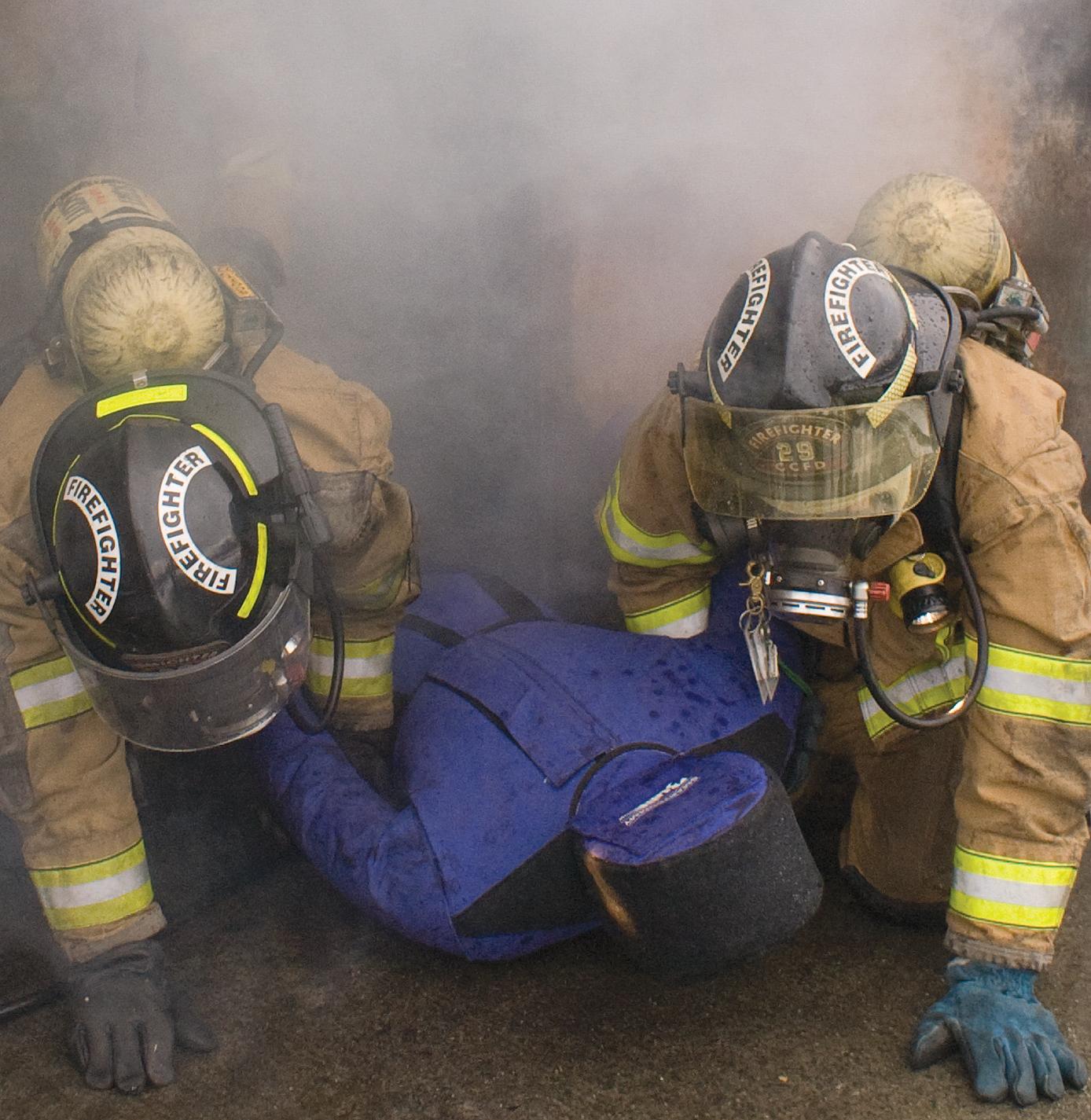
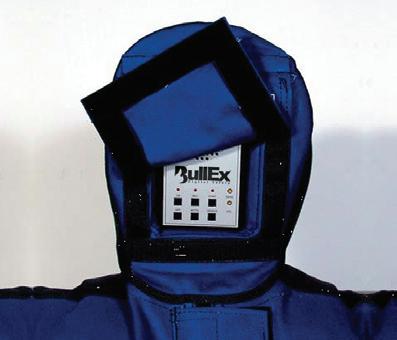
BullEx SmartDummies are tough enough to handle serious training and smart enough to interact with rescuers. As trainees call out, the SmartDummy listens and responds with a built-in VoiceBox. Record messages for continuous or sound activated playback. The SmartDummy can cough, call out for help or direct rescuers to find additional victims. To see the SmartDummies in action, check out our videos at www.bullexsafety.com.
TRUCkchecks
necessary to add a diesel fuel stabilizer. You may ask why the oil companies do not do that for you. About 95 per cent of all diesel fuel is consumed within two months of being produced. The fact that you wish to have your reserve truck sit for two or three years with the same fuel in the tank is not really a concern for the oil companies.
Fuel life can be extended if the fuel is stored with very little water in it. The ASTM 975 fuel test that is used at the refinery will allow up to .05 per cent water. In a 1,000-gallon fuel delivery, that would mean five gallons of water. This, of course, does not account for the water that may already be in the tanks from condensation.
Condensation in above-ground tanks is more of a problem than with underground tanks because of rapid changes in air temperature cause moist air to be drawn into the above-ground tanks. Take, for example, an above-ground fuel tank after a two- or three-day heat wave. A rain cloud could dump an inch or two of cooling rain on the tank; the fuel in the tank cools and contracts. This will cause the tank to draw moisture-laden air into the tank. Never try to use alcohol to remove this water. That trick works fine with gasoline fuels but does not work with diesel fuels. The alcohol will not mix with the diesel fuel and will only damage the engine injectors.
Water is very destructive to the fuel injectors and high-pressure injection pumps. But bacteria that can grow in fuel that has a high water content cause additional headaches. The byproducts of these little bugs can cause some real big problems. Their waste will plug the fuel filters with slime. It will often have a vinegary smell to it. It is possible to kill the bacteria with a bactericide made for diesel fuel systems. The problem is that now the dead bacteria will be transported to the filters and further plugging will occur. Bacteria grow best in warm conditions, with stale older fuel; they can be a problem in rural departments that do not use the truck as much as urban departments.
To detect water in gasoline or diesel fuels in below-ground or on-vehicle fuel tanks, a chemical strip can be used. It will change colour if there is water in the fuel. Go to www.Jamestowndistributors.com for an example of the test kit. If no water is being detected, then a routine, once-a-month check would be acceptable.
When a large amount of fuel is dumped into an underground tank it can stir up the water and sediments in the bottom of the tank. Now you know why some people, when they see a bulk tanker delivering fuel to
their favourite gas station, often want to wait a day to fill up their own trucks.
The ASTM D227 oxidation stability test is a good indication of the expected life of a diesel fuel. This test measures how much sediment and gum will be deposited after keeping the fuel at 95 C in the presence of oxygen for 16 hours. It has been estimated that this roughly corresponds to one year of storage at 25 C.
A result of less than 20 mg/L of sediment
and gum after the test is considered acceptable for normal diesel.
There is a very useful standard called NFPA 110 emergency and standby power systems. It contains a lot of good information.
Don Henry teaches the Automotive Services Technician and Heavy Equipment Technician programs at Lakeland College in Vermilion, Alta. He can be reached at don.henry@lakelandcollege.ca
Fully Involved FIre TraInIng SySTemS [
The BullEx Vehicle Fire Prop is a heavy-duty training tool with intense flames, smart controls and real heat that challenges firefighters to meet your training objectives. Multiple burn zones
allow you to create engine, passenger compartment, fuel spill and tire fires. To see the Vehicle Fire Prop in action, check out our videos at www.bullexsafety.com.
The fire department was eventually dispatched, but the maps available to the dispatcher were out of date and did not indicate that the duplex was on a dead-end street. As a result, the fire department arrived three to four minutes later than it should have.
Approximately 10 minutes elapsed between the time of the initial dispatch and the time when water was first applied to the fire. Expert evidence demonstrated that a proper response time was five minutes.
■ legal issue:
• Was the municipality negligent in the delivery of firefighting services provided to the plaintiffs?
■ courT’s findings
The court found that the city owed the plaintiffs a duty of care to provide adequate firefighting services by responding in a reasonable manner and without negligence. The failure to maintain up-to-date street maps and addresses constituted a breach of that duty. The city was negligent and held 15 per cent liable for the plaintiffs’ damages on the basis that had the fire trucks arrived earlier, there would have been less damage to the duplex.
The court determined that the most significant reason for the fire department’s delay in reaching the fire was the tenants’ own conduct at the time of the 911 call. Therefore, the tenants were found to have been contributorily negligent for the balance of their loss.
■ lessons learned
Citizens are not entitled to expect a standard of perfection from their fire departments, or even a standard applicable to the best trained and equipped fire departments. Instead, they may expect a high standard of service consistent with the resources the community has made available for fire protection.
One of the basic requirements for all municipalities is that their fire departments maintain up-to-date maps in order to avoid unnecessary or unreasonable delays in reaching a fire.
case 3. bell v. Winnipeg (1993) – facTs
A fire at the plaintiff’s home on June 8, 1984, caused the destruction of the house and its contents, totalling $342,000. The person who initially reported the fire to 911 incorrectly informed the dispatcher that the home was outside the city’s limits.
At the time, there were no mutual-aid
agreements between the city and the two surrounding municipalities. In the absence of an agreement, a decision had to be made about which municipality had jurisdiction over the fire.
Though the precise location of the fire was not yet known, the duty fire captain dispatched one unit to the general location in an effort to locate the fire. In the meantime, and after asking other personnel, the dispatcher realized the location was within the city and dispatched the fire equipment to the property eight minutes after the call.
The home was totally involved in fire when the first personnel arrived. The fire had advanced rapidly between the time of the call and the arrival of the firefighters. The firefighters experienced trouble because of an inadequate water supply (the fire was in a non-hydrant area) and excessive mud. The firefighters feared that the firefighting equipment would get stuck in the mud because they were sinking into it over their ankles.
A check was made to determine whether there was a person in the home. The firefighters then started taking steps to control the fire.
The plaintiff brought an action in negligence against the city of Winnipeg and the fire chief. The plaintiff’s expert was critical of the fact that a Coventry pump with hard suction capable of drawing water from a
dugout approximately 350 metres from the home was not brought on the first truck to arrive at the scene.
■ legal issues:
• Was the fire department negligent in failing to respond in a timely manner to the 911 emergency call advising of the fire?
• Was the chief negligent in failing to properly and adequately instruct the firefighters as to the location of the boundaries of the city?
• Was the department negligent in the manner in which firefighting efforts and equipment were applied at the scene (Did it fail to provide adequate and effective firefighting equipment to fight the fire? Did it fail to use the fire fighting equipment properly? And did it fail to use proper and adequate fire fighting techniques?)?
■ courT’s findings
The action was dismissed. There was no negligence attributable to the department or the chief. The decision was upheld on appeal to the Manitoba Court of Appeal.
The plaintiff was responsible for instructing his family and tenants on how to give information about the property’s exact location and how to reach the home in the event of an emergency.
The court found that the Coventry pump would have been brought on the first unit had the first 911 call given proper directions. It was the judge’s opinion that the department’s policy was carried out and no negligence could be attributed to the pump not being carried on the first unit.
There was also no negligence on the part of the firefighters in the strategy used and the methods employed to fight the fire. The firefighters determined it would be unsafe to attempt to draw water from the lagoon because of the excessive mud. In exercising this judgment, the judge found that they were not negligent.
■ lessons learned
A fire department will not be held to a standard of perfection. If a department is incorrectly informed of the location of a fire and therefore slow to arrive on the scene, it cannot be held responsible for any additional loss that might have occurred.
The courts are prepared to assess a department’s strategy, methods and performance against a standard of reasonableness in the particular circumstances. However, there will only be a finding of negligence where it is clear that the department performed below the standard that would be normally be expected of a properly trained department operating in similar circumstances.
Part 3 will appear in May.
BullEx Smoke Generators were designed with one goal in mind: to create the most realistic fire training smoke possible. BullEx Smoke Generators continuously produce thick, heavy smoke without recharging or reheating. Whether
you’re doing search & rescue, ventilation or initial fire attack drills, these Smoke Generators don’t stop until your training is done.To see the Smoke Generators in action, check out our videos at www.bullexsafety.com
Principles of Vehicle Extrication, Third Edition
Item#: 36755 I Price: $60.50
Fire and emergency services personnel provide more than just fire protection. Quite often they are called upon to extricate patients from vehicles (automobiles, trucks, buses, trains, etc.) that have been involved in accidents. Occasionally, these extrication incidents involve uncommon locations or situations where the vehicles involved may have entered the water or structures, or are hanging from overpasses or bridges. Rescue personnel may also have to extricate patients who have become entrapped in machinery or amusement park rides.
The third edition of Principles of Vehicle Extrication contains updated information on the hazards presented by extrication operations, vehicle extrication incident management, vehicle anatomy, passenger restraint systems, vehicle extrication tools and equipment, hybrid-powered vehicles, machinery extrication situations and procedures, and emergency medical system considerations at extrication operations.
NFPA 600: Standard on Industrial Fire Brigades 2010
Item#: 60010 I Price: $40.70
This standard presents requirements for organizing, operating, training, and equipping industrial fire brigades. NFPA 600: Standard on Industrial Fire Brigades also contains requirements for the occupational safety and health of industrial fire brigade members while performing fire fighting and related activities.
Topics covered that apply to all industrial fire brigades include:
• Education, training, and drills
• Organization
• Medical and job-related physical requirements
• Equipment
• Apparatus
In addition, NFPA 600 also provides specific requirements for industrial fire brigades that perform:
• Incipient stage fire fighting
• Advanced exterior fire fighting only
• Interior structural fire fighting only
• Advanced exterior and interior structural fire fighting
Order today and make sure your team has the knowledge required to handle fire prevention and fire protection challenges in workplace environments.
CLASSIFIED ADS
SPECIALTIES
SPECIALTIES SERVICES
EDUCATION AND
LIVE FIRE FIGHTING EXPERIENCE: Short and long term courses available, Municipal and Industrial fire fighting. Incident Command System, Emergency Response/HazMat, three year Fire Science Technology Diploma program. Lambton College, Sarnia, Ontario, call 1-800-791-7887 or www.lambton.on. ca/p_c/technology/fire_emerg_resp.htm. Enrol today!
USED EQUIPMENT
FOR SALE: Used Jordair/Bauer breathing air compressor. IK120 7.5HP 3 stage, capacity 9.3 SCFM. Date of manufacture July 2005, low hours, full low sound enclosure, brand new upgraded purification. Like new condition. Full 1 year warranty. Current Jordair model equivalent FireKat5 120 ultra silent. E-mail bd@adgastech.com for pictures. Phone enquiries Toll Free 1-866-725-7751.
EMPLOYMENT OPPORTUNITY
OPPORTUNITY: Interested in auto extrication and hydraulic rescue tools? Want to run your own business? A leading rescue tool manufacturer (TNT Rescue Systems) is looking for individuals within dedicated territories throughout Canada to provide demonstrations, service and repair hydraulic rescue tools used in auto/truck/bus extrication and industry applications. For more information call 1-800-205-3473 and ask for Mike Stone.
APPARATUS
By PETER SELLS
Why we need fit fire officers
on Boxing Day I stepped onto my bathroom scale and saw a number that I never, in my life, expected I would see. For some reason, even after all the hints my body has given me over the last 20 years, this was the one that hit me like a ton of bricks. OK, not a ton exactly, but an eighth of a ton, which is too much on a five foot eight frame. I can hear myself breathing all the time. I snore like a bear, to the extent that I wake myself up sometimes. It is an absolute wonder that at the age of 50 I have not become diabetic after decades of carrying this weight. I’ve tried to turn myself around a few times before. In 1995 I lost 47 pounds in six months, then turned around and gained it all back. Plus 10. Then another 10. This is now a life-threatening situation and I have some serious decisions to make if I want to be around to know my grandchildren.
Enough about me; how about some good examples of fitness? Since last summer I have been involved with introducing the FireFit competition to the firefighters of the United Arab Emirates. As a result, I have met or reconnected with a group of Canadian firefighters for whom physical excellence is a way of life. Any excuses I could dream up based on my age would be a complete joke. Guys like Cyril Fraser from Halifax, Charles McGregor from Toronto or Craig Harnum from the Marine Institute in Newfoundland are out there training hard year round and competing just as hard within their over-50, over-45 and over-40 age groups. My Dubai roommate, Randy Kalan, is one year younger than me. For two weeks I watched him train a group of firefighters in their 20s and 30s until, most days, he was the last man standing. So, there go any excuses based on age. These guys are lean, mean firefighting machines.
same firefighters.
One last good example for you; the creation of a fitness/wellness culture at Brampton Fire and Emergency Services in Ontario. From the Brampton website: Brampton Fire and Emergency Services have a fitness program with documented results. The vast majority of our people continue to exceed a minimum fitness standard that is the highest of any department. Fitness is now a very important value in our department culture and is considered to be an integral part of a well-balanced life.
The fitness standard referred to is the entry standard for new members. Such standards have been exhaustively defended as bona fide job requirements of firefighters. Not mentioned is how Brampton Fire took that concept one step further and is encouraging lifelong fitness in its members. Brampton has taken the position that fitness is also a bona fide job requirement of company officers and chief officers. All of the literature on firefighter fitness and age backs this up. If it makes sense that a 25-year-old body is subjected to an adrenalin rush when the bell goes off, doesn’t it also make sense 25 years later? Company officers will be in the thick of the battle with their teams, within the same compressed time frame that places such huge demands on the heart and
... fitness is also a bona fide job requirement of company officers and chief officers. ‘‘ ’’
Next example; the IAFF Wellness-Fitness Initiative (WFI). The Calgary Fire Department was the first Canadian fire service to implement this important program. I will mention it briefly here, and direct you to an August 2009 article in Fire Fighting In Canada (http://www.firefightingincanada.com/content/view/4399/213/).
Programs like the WFI don’t just happen because a few people think that wellness/fitness for firefighters is a good idea. This took concerted effort and determined leadership. Our IAFF representatives sometimes have a tough job to do – in this case to advocate a program that monitors the fitness and healthy lifestyles of firefighters and, simultaneously, to protect the legitimate privacy concerns and human rights of those
Retired District Chief Peter Sells writes, speaks and consults on fire service management and professional development across North America and internationally. He holds a B.Sc. from the University of Toronto and an MBA from the University of Windsor. He sits on the advisory councils of the Ontario Fire College and the Institution of Fire Engineers, Canada branch.
lungs. Chief officers, while perhaps not in the middle of the fight, are also required to act quickly and come to a high state of alertness and action without warning. So, if you want to be a company officer or chief officer in Brampton, you are required to demonstrate your physical fitness for the position. If you don’t aspire to those levels, then go ahead and follow my bad example.
For the last 14 years of my career I was in an administrative position as a training manager. It was very sedentary work; most of the day was spent at my desk or in meetings. However, each of my workplaces was equipped with exercise equipment, that I rarely used. If I had ever made a career decision to transfer back into firefighting operations I would have been kidding myself. So, now I am two months into my lifestyle changes. I have lost 15 pounds and I am starting to feel better about myself.