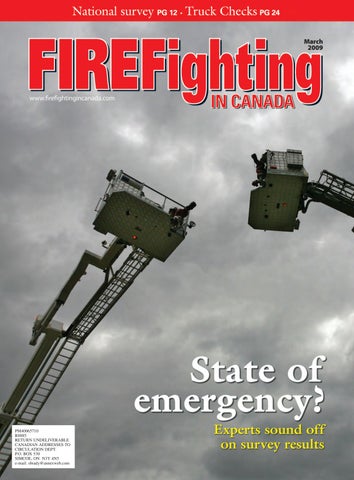
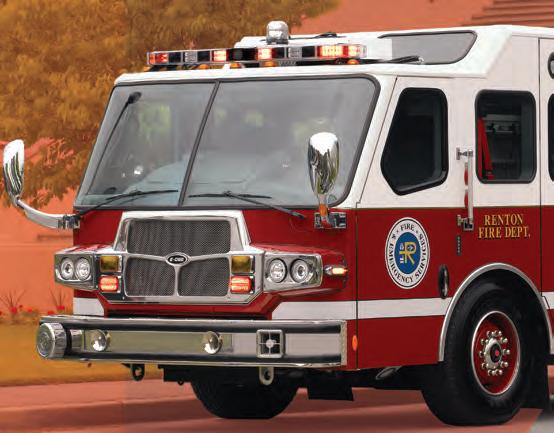
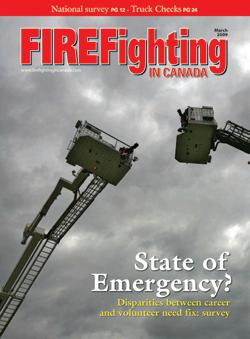
Most of the fire officials with whom we shared the data from our national fire department survey agreed that Canada’s fire services are underfunded, undertrained undervalued and accustomed to making do with aging equipment and strained resources rather than operating at optimum levels of safety and performance. Somebody call 911. Laura King reports.
34
FIRE GROUND COMMUNICATION
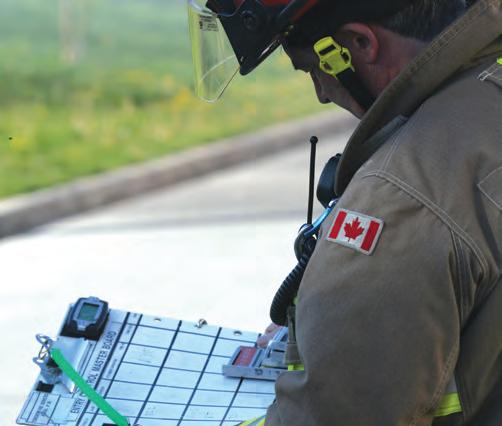
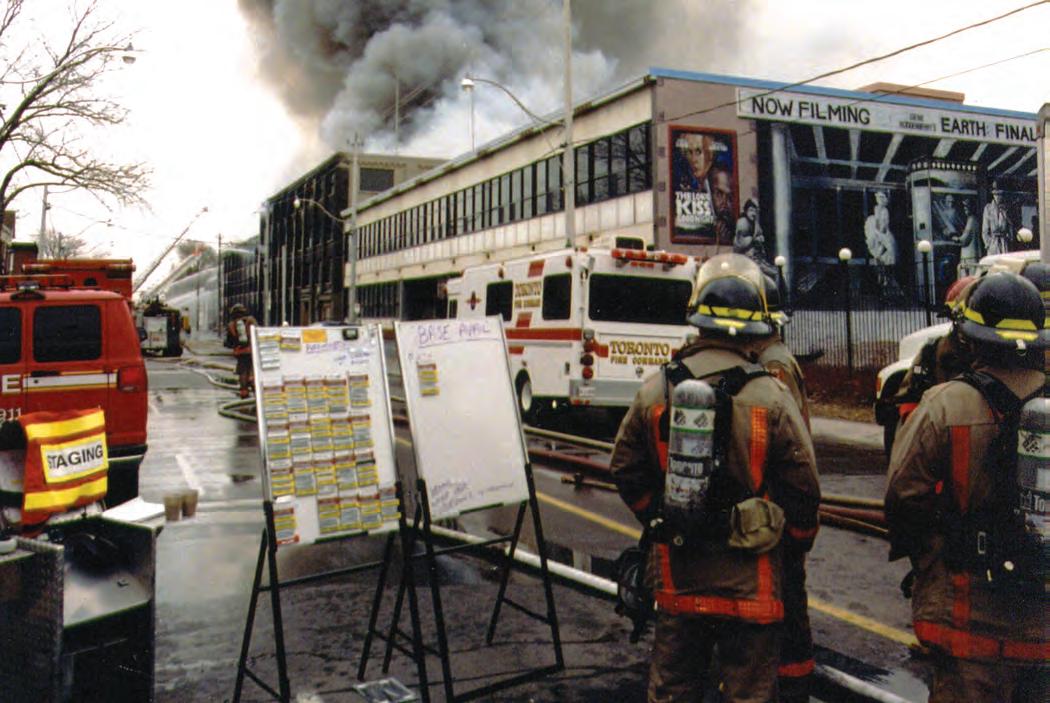
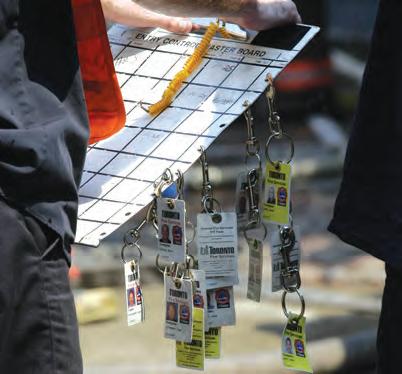
As Peter Sells reports in his look at communication on the fire ground, instituting a system of signs and signals need not be complex, but it does require dedication and discipline.
BEST PRACTICE
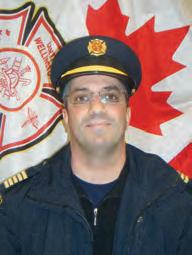
Chief Brad Patton of Centre
Wellington Volunteer Fire Rescue Department in Ontario has implemented a nine-step hiring process that cuts cost, increases efficiency and keeps the powers that be happy.
BY LAURA KING Editor lking@annexweb.com
WCOMMENT
Finding out what’s really in a name
hen we set out to craft a national survey of fire departments, we wanted to provide hard facts and figures so chiefs could bolster their cases for more funding for apparatus, equipment and training.
We now know that large percentages of apparatus, bunker gear and SCBA being used across the country are more than 15 and 10 years old respectively (see details on page 12 and at www.firefightingincanada. com), that budgets for public education are lacking, that the fire service is aging and that recruitment and retention are major issues.
We’d surmised much of this but our survey backs up our claims and shows conclusively that there are gaps between volunteer and full-time departments and that many fire services are challenged to find the time and money to adequately train their firefighters.
volunteer moniker because they know the term doesn’t play well with the public, then clearly it’s time for change.
Maybe, with that change, will come muchneeded respect and, in turn, parity with those known to the public as professional firefighters. Lots of people who get into car accidents or experience house fires have no idea that their local departments are staffed by volunteer or paid on-call firefighters. And few know the difference. But municipal politicians do and if they’re the ones who need convincing, then maybe it’s worth seeing how they argue against replacing 10year-old bunker suits for their municipal fire departments instead of the local volunteer brigade.
ON THE COVER
Check out the results of our survey starting on page 12.
We asked our editorial advisory board to comment on the survey findings and recommend solutions. Many did so and we thank them for their insight. It was particularly interesting to see how their comments differed depending, mainly, on which type of department they’re from.
One recommendation for bringing volunteer departments on par with their full-time counterparts was to eliminate the word volunteer and replace it with the word municipal. We’ve heard that argument before, from Volunteer Vision columnist Brad Patton, the fire chief in Centre Wellington, Ont., one of the largest volunteer departments in the province. Patton described in a recent column how volunteer firefighters on his watch took scissors to department stickers to remove the word volunteer before putting them on their vehicles. Pretty telling, if you ask me.
If the men and women who volunteer (or are paid on call) don’t take pride in the
Congratulations to the winners of our national fire department survey contest and thanks to everyone who participated. Four names were drawn Jan. 29 from the 490 survey replies. Three of the four winners are from Nova Scotia. My Bluenose roots had nothing to do with this – it’s just coincidence!
The winners of firefighting texts from our Annex Bookstore are: Shaw Andrews, Guysborough Volunteer Fire Department, N.S. – Essentials of Fire Fighting; Port William Volunteer Fire Department, N.S. – Fundamentals of Fire Fighter Skills; Fire Chief David Sponagle, Thorburn Fire Department, N.S. – Fire Protection Handbook.
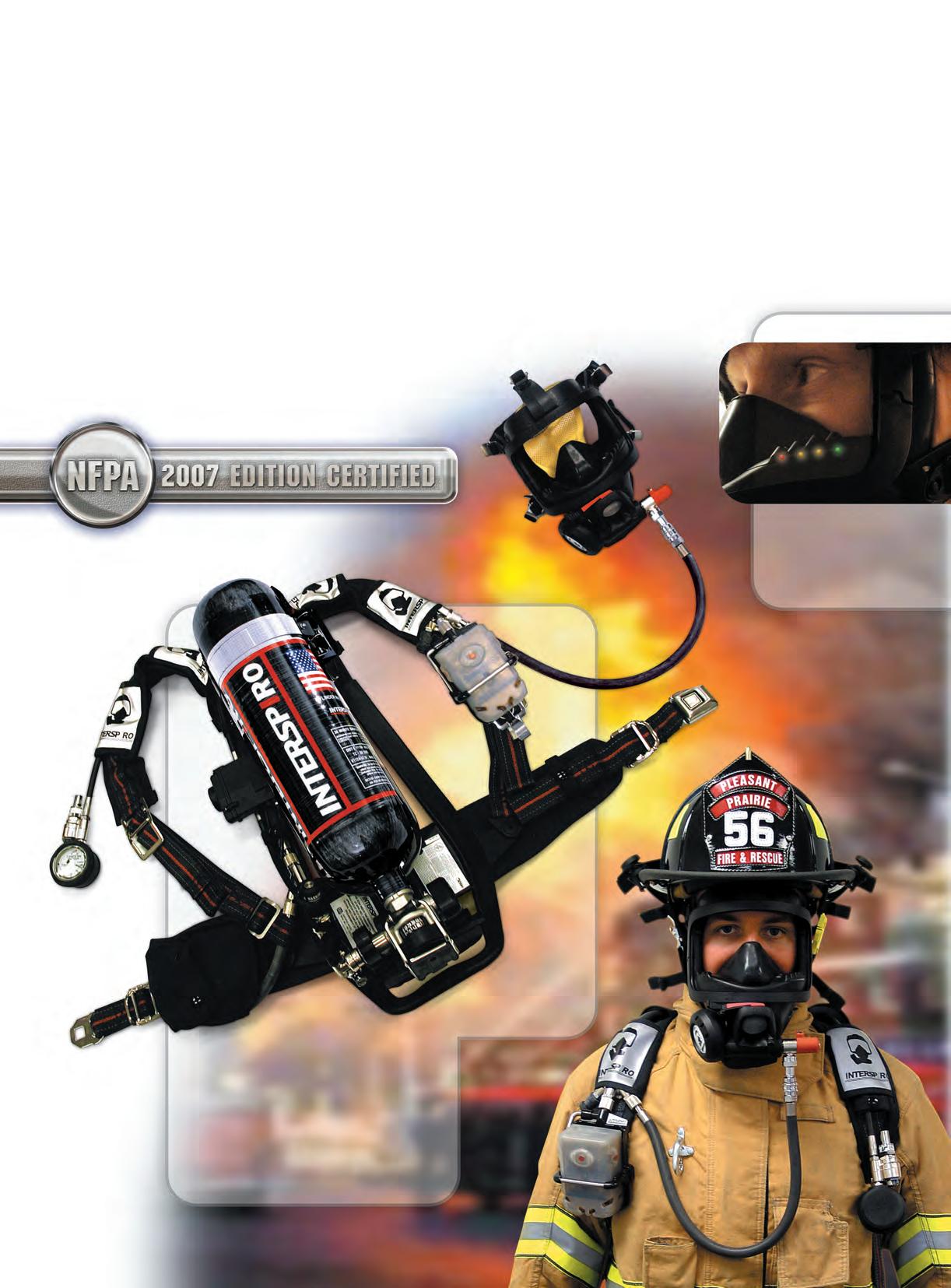
Lastly, hearty congratulations to Steve Windsor and the Lake County Fire Department in B.C., the winner of our grand prize, an Interspiro S6 SCBA 2007 edition valued at $12,000!
PRODUCTION ARTIST KRISTA MISENER kmisener@annexweb.com
GROUP PUBLISHER MARTIN MCANULTY fire@annexweb.com
PRESIDENT MIKE FREDERICKS mfredericks@annexweb.com
PUBLICATION MAIL AGREEMENT #40065710
PAP Registration #8885
RETURN UNDELIVERABLE CANADIAN ADDRESSES TO CIRCULATION DEPT.
P.O. Box 530, SIMCOE, ON N3Y 4N5 e-mail: sbrady@annexweb.com
Periodical Postage Paid at Buffalo NY. USPS 007-276, ISSN 0015-2595. Published eight times per year (Feb., March, May, June, Aug., Sep., Nov., Dec.) by Annex Publishing & Printing Inc. U.S. Office of Publication c/of DDM Direct.com, 1223 William St. Buffalo NY 14240. U.S. Postmaster send address change to P.O. Box Niagara Falls NY 14304. Printed in Canada ISSN 0015–2595
CIRCULATION
e-mail: sbrady@annexweb.com
Tel: 866-790-6070 ext. 206
Fax: 877-624-1940
Mail: P.O. Box 530 Simcoe, ON N3Y 4N5
SUBSCRIPTION RATES
Canada – 1 Year - $25.44
(includes GST - #867172652RT0001)
USA – 1 Year $50.00
We acknowledge the financial support of the Government of Canada, through the Publications Assistance Program and the Canada Magazine Fund, toward our mailing and editorial cost. Nous reconnaissons l’aide financiere accordee par le gouvernement du Canada pour nos coults d’envoie postal et nos coutl redactionnels par l’entremise du Programme d’aide aux publications et du Fonds du Canda pour les magazines.
From time to time, we at Fire Fighting In Canada make our subscription list available to reputable companies and organizations whose products and services we believe may be of interest to you. If you do not want your name to be made available, contact our circulation department in any of the four ways listed above.
All advertising is subject to the publisher’s approval. Such approval does not imply any endorsement of the products or services advertised. Publisher reserves the right to refuse advertising that does not meet the standards of the publication.
PHOTO BY JOHN RIDDELL
STATIONtoSTATION
ACROSS CANADA: Regional news briefs Longtime volunteer reaches milestone
■ SASKATCHEWAN
Donald H. McIntosh reached a milestone this past year by serving 40 years as a volunteer firefighter. Don has served on the department continuously for 40 years including a twoyear term as chief. He is presently the first deputy chief.
Don has been instrumental in developing the department from one equipped when he first joined with a small, one-ton pumper unit requiring members to drive to the scene in their personal vehicles,
to our present department equipped with two large (by small-town standards) pumpers, a rescue unit complete with Jaws of Life, two smaller rapid response / wildland units and a tank truck, all housed in our now 18-year-old fire hall.
Don’s service and dedication is exemplary to volunteers everywhere. Besides being a husband and father of four children, Don runs his own auto body repair shop, has a fairly large family farm operation and still finds time to volunteer with
the local ambulance service (a separate organization).
This kind of selfless dedica-
Community introduces HomeSafe program
■ BRITISH COLUMBIA
Surrey, B.C. – An innovative home safety program has been introduced in Surrey that will provide residents with new tools to improve the safety of their own homes and to learn more about the hazards that typically create home fires. The HomeSafe Program is the creation of the Surrey Fire Service, developed by fire service members who provided suggestions
and recommendations to cut down on the number of private dwelling fires in the City of Surrey. Through a partnership with the University of the Fraser Valley, new evidencebased strategies have been developed for the HomeSafe Program.
Four specific initiatives are contained in the HomeSafe Program: Free home safety inspections. Residents can
THE BRASS POLE
Promotions & appointments
BRAD YOCHIM has recently been promoted to the position of chief for the Wallace District Fire Department in Virden and Elkhorn Manitoba. Brad has been a member of the WDFD Station 1 in Virden for 28 years and has been chief of Station 1 for six years. He was recently promoted to chief for both stations and is the first full-time
chief for the department. The Wallace Fire Board saw a need for one chief to operate the entire department in order to streamline the operation, bring the two stations closer together and make the department more efficient and accountable to ratepayers. Yochim is a casual instructor at the Manitoba Emergency Services College in Brandon, head of training for the local mutual-aid district
request a free home safety inspection at any time to identify and address safety concerns. Fire-setter intervention program. Developed in collaboration with Fraser health, Surrey RCMP, School District 36 and Surrey Fire Services, the program will provide resources to families of juveniles who have been involved in fire play or fire setting. Child and seniors welfare training.
and co-ordinator for the hazmat operations team for the district. Prior to his appointment as chief Yochim was the fire services officer for WDFD with responsibilities in fire inspections, pre-incident planning and public education.
The Township of Edwardsburgh/Cardinal has appointed DON MIDDLETON to the position of fire chief. Don brings more than 20 years of
tion to community and human kind in general has earned him the Firefighters Exemplary Service Medal with two bars from the Governor General, the Saskatchewan Volunteer Service Medal and recently recognition from the Stoughton Town Council, The Rural Municipality of Tecumseh Council and the Stoughton - Tecumseh Fire Department board and membership in the form of plaques and certificates. –Pat Slater, fire chief, Stoughton-Tecumseh Volunteer Fire Department
Surrey Fire Service personnel will receive additional instruction from Fraser Health Child Protection representatives to assist in recognizing indicators of abuse or neglect. Fire Prevention Week/public displays. The Surrey Fire Service will canvas neighbourhoods during fire prevention week to increase public awareness about fire safety, prevention and escape information.
fire experience and is known by many members of the fire service for his experience as an instructor. He assumed his duties as chief on Jan. 5.
The Municipality of Port Hope, Ont. has hired ROB COLLINS as director of Fire & Emergency Services. He start his new position Jan. 26. He was deputy fire chief in the Town of the Blue Mountains and prior to this was the deputy chief at
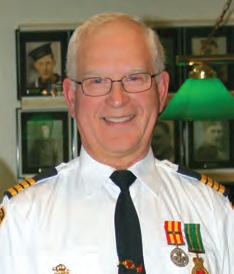
Don McIntosh
Wireless providers to upgrade 911 service
■ CANADA
The Canadian Radio-television and Telecommunications Commission announced Feb. 2 that Canadian wireless service providers have one year during which to upgrade their 911 services. By Feb. 1, 2010, at the latest, emergency responders must be able to determine the location of a person using a cellphone to call 911 with much greater precision.
“With more than 20 million wireless subscribers in Canada, it is imperative that emergency responders can quickly and accurately locate those who use their cellphones to call 911,” said CRTC chairman Konrad von Finckenstein. “I am pleased that the industry has come forward
with a technical solution, and that there is now nothing standing in the way of the implementation of enhanced 911 features. The safety and security of Canadians will be greatly improved as a result.”
In an emergency situation where the caller is unable to speak or cannot identify his or her location, the ability to provide emergency responders with more accurate information of the cellphone’s location can make the difference between life and death. Current 911 services rely on the position of the cellphone tower nearest to the caller. As such, emergency responders are only able to determine if a caller is in a sector within the area served by the tower, and not a specific area
or location.
The enhanced features that will be implemented over the next 12 months represent a significant improvement to current wireless E911 services. Using wireless-location technology such as Global Positioning System or triangulation technology, emergency responders will be able to receive a caller’s location generally within a radius of 10 to 300 metres.
Although the CRTC has given the wireless industry a one-year deadline to put the enhanced 911 features into operation, they will be available in some markets much sooner. The commission encourages wireless service providers to offer the enhanced 911 features as
soon as possible.
Wireless service providers must inform their customers of the availability, characteristics and limitations of their enhanced 911 services before they are implemented, and reiterate them on an annual basis thereafter.
In addition, any new wireless service provider entering the Canadian market after Feb. 1, 2010, will be required to support the enhanced 911 features from the moment it launches.
Firefighters burned by federal budget, says CAFC
Ottawa – The Canadian Association of Fire Chiefs has expressed disappointment that last week’s federal budget did not recognize that supporting the Canadian Fire Services should be regarded as an economic imperative deserving urgent attention.
“The fire services are crucial underpinnings of the Canadian economy. By protecting businesses, property and lives, we are an integral part of the economic infrastructure of
Canada” said Calgary Fire Chief Bruce Burrell.
“We regret that the federal government has opted not to deal with measures that CAFC has long been advancing to enhance the ability of the fire services to better serve and protect Canadian communities and the country as a whole, “ he added.
“CAFC accepts that priorities must be set while the current economic crisis is addressed. At the same time, we seek assurance from the government
that personal income tax relief for volunteer firefighters and increased funding under the Joint Emergency Preparedness Program will be dealt with in the near future,” Burrell said. Ninety-one per cent of all Canadian communities are protected by volunteer fire departments. The economic base of these towns and villages is mostly made up of small, family owned businesses. The limited financial resources of these enterprises make them particularly vulnerable in the current
economic downturn. Their decline or failure as a result of fire or other disaster would seriously erode municipal tax and employment bases. The volunteer fire services are the first line of defence for these businesses and their municipalities.
The fire services are a major component of Canada’s public safety and security infrastructure. Enhanced funding of them by the federal government should be viewed as a meaningful investment in infrastructure building and support, Burrell emphasized.
Tyendinaga Fire Department. He replaces Chief Frank Haylow who served as Director of Fire & Emergency Services for five years and retired Dec. 31.
The Town of Collingwood has hired ROSS PARR for the role of deputy fire chief. Ross brings more than 20 years of progressive fire suppression and leadership experience to the management team of the Collingwood Fire Department.
He assumed his duties as chief on Jan. 5.
Retirements
Capt. WILLIAM SMITH retired Aug. 22 after 35 years of service with the Paris Fire Department in Ontario.
After 24 years of service, Brudenell, Lyndoch and Raglan Deputy Fire Chief LAURIE KELLY retired from the department at
the end of December. Laurie was one of the founding members of the department in Quadeville and had been the training officer. He moved to Quadeville from Guelph 25 years ago, when there was no fire department in Quadeville. A group got together to form a department and about 25 volunteers signed up.
Last alarm
Capt. JOHN LOCH, formerly
with the Prince Albert Fire & Emergency Services in Saskatchewan passed away on Dec. 31, 2008. John started with Prince Albert Fire in 1957 and retired in 1989 with 32 plus years of dedicated service.
BRUCE PAINE, 68, passed away Dec 31. He served with the Chatham-Kent Fire Department Station in Ontario for 38 years. He was deputy station chief.
STATIONtoSTATION ONtheWEB
BRIGADE NEWS
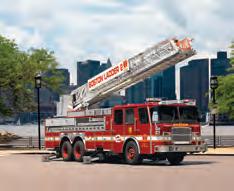
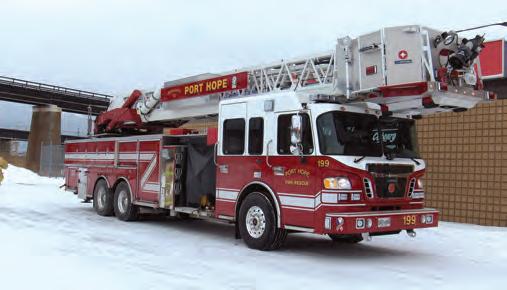
PORT HOPE FIRE DEPARTMENT, in Ontario, under chief Frank Haylow took delivery in January of a Dependable Emergency Vehicles-built aerial on a Spartan Gladiator chassis with an Allison 4000 EVP transmission, Caterpillar C13 engine, Hale Qmax 2000 gpm pump, FoamPro foam system and 300 gallon propoly water tank.
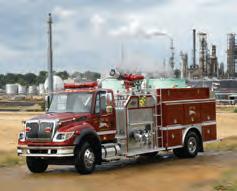
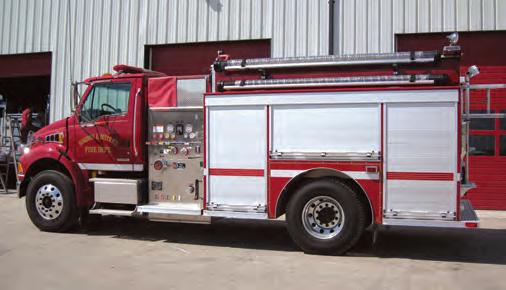
NOKOMIS AND DISTRICT FIRE CO-OP, in Saskatchewan, under chief Dale Shanks, took delivery in June of a Fort Garry Fire Trucksbuilt pumper on a Sterling Acterra chassis, with a Cat C7 300-hp engine, 3000 EVS transmission , Darling PSP 1,000 pump and a 1,000-imperial gallon co-poly tank.
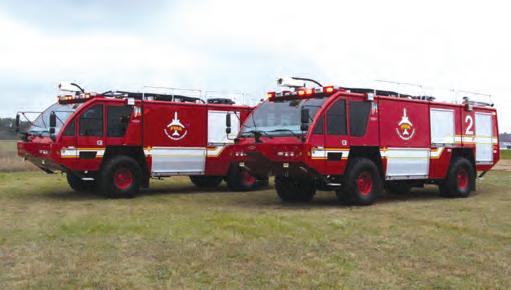
FORT MCMURRAY AIRPORT, in Alberta took delivery of two Rosenbauer ARFF Panthers on Rosenbauer Motors chassis with Panther 1500 bodies, twin disc, six-speed transmissions, 1,600gallon water tanks, 1,850-gpm pumps, 210-gallon foam cells and Onan 10kW hydraulic generators.
Cross-Canada news
Check in daily for news from across Canada.
Web exclusive
In a two-part web-exclusive series, longtime Fire Fighting in Canada contributor Robert Lynch looks back on his time as a firefighter, and eventual fire chief, in Harbour Grace, N.L. “Now, as a volunteer fire brigade in a rural Newfoundland and Labrador town, we could not afford to purchase bunker gear for all hands,” Lynch recalls. “It was determined that experience would decide who got new gear and when. Always seeking a silver lining, I saw a way to benefit from this move. It was simple – if we were getting new gear then there would be more old gear to scrounge.”
Web exclusive
Exclusively online in March, we preview the results of our national fire department survey, with a focus on apparatus and personal protective equipment.
See the digital version of Fire Fighting in Canada on our home page for the earliest access to our monthly columns, departments and feature stories.
PORT HOPE
NOKOMIS
FORT MCMURRAY
BY BRAD PATTON Canadian Regional Manager NFPA International, Ottawa, Ont.
BVOLUNTEERVISION
Getting our training priorities straight
efore anyone gets upset with my view here, let me explain. I believe Canadian fire services have achieved our goal with regards to fire prevention – or we’re very close to achieving it – and now it’s time to move on.
Unlike our brothers and sisters in police and ambulance services, in my opinion, we have met our primary objective. We have significantly reduced the number of fires that we respond to. The other agencies still have their same basic challenges, be they high crime rates or patient outcomes. And they now have much larger budgets and more staffing, but I’ll stick to the fire service issues here so I won’t get into too much trouble with other emergency agencies.
When I started in the fire service some 30 years ago, the department I was with responded to between 275 and 300 fire calls a year. Now I believe that department responds to fewer than 50 fires a year.
The fire service attacked the issue of fire prevention by declaring all-out war on fires. We devised a multi-pronged attack, consisting of public education programs for all ages and strict code enforcement. We lobbied governments for changes in new building construction designs and materials. We went after new buildings, old buildings, high-occupancy buildings and highrisk buildings. We tackled the problem of fire in our society and we have been successful.
Now I believe we are at a point when it’s time to change direction, to re-focus our collective thrust and priorities. Just so I’m clear, I don’t mean we should forget about prevention and public education. These need to be maintained. I’m just saying it’s time to focus our collective energy on the next big problem.
never been as dangerous as they are today. The extrication of people involved in motor vehicle accidents is more complex and more dangerous than ever. All departments may need to respond to hazardous chemical spills, trench collapses, building collapses, different types of weather emergencies. We also respond to in-water rescues, high-angle rope rescues, etc. The training list is long and daunting. We need to make protecting our own our new No. 1 priority so we can protect others better.
We need to embrace this problem with the same vigour we did fire prevention. It should be mandatory that every county, region or department have a full-time training officer and provincially approved standard training programs.
No longer should we be allowed to train firefighters with old or outdated lesson plans. No longer should it be permissible not to have detailed lesson plans and sign-off forms for all firefighters. Each lesson should end with a detailed test that becomes a permanent record that shows all firefighters understood what they were taught and can apply it in the field of operations.
Municipal councils, fire boards, fire chiefs and provincial
The fire service attacked the issue of fire prevention by declaring all-out war on fires. ‘‘ ’’
This, in my opinion is training our staff to meet the diverse needs of our customers. Now is the time to legislate change and provincially monitor training programs to ensure compliance.
We need to standardize the training programs, the objectives and outcomes like we did with fire prevention codes – zero tolerance with non-compliance. We need to educate fire chiefs, municipal councils, other governing bodies and the public about the fact that we need to train our firefighters better – much better.
Firefighters require one of the most diverse skill sets of any occupation. The hazards associated with structural fire fighting have
advisories must all ensure that volunteer firefighters get a level of training to ensure they can safely and quickly respond to all types of emergencies – as firefighters, engineers, chemists, electricians, medics, and so much more.
As volunteer firefighters, we need to ensure that our training is unsurpassed. The time we have with staff is limited, so let’s put the energy into it that it deserves.
After every training session or practice, everyone involved should walk away knowing that they obtained a new skill to improve their performance, or that they have learned a safer and faster way to do an old skill.
In cold language, we have always said we are No. 1, that our safety is monumental and that we will risk a lot to save a lot.
Now is the time to put training our firefighters before all else.
Just my thoughts from this side of the desk.
Brad Patton is fire chief for the Centre Wellington Volunteer Fire Rescue Department in Ontario, one of the largest volunteer departments in the province, with stations in Fergus and Elora.
STATE OF EM
MERGENCY?
Country-wide survey reveals aging equipment, inadequate budgets, disparities between career and volunteer but not all departments have the same needs
By LAURA KING
FFIC’s national survey of fire departments found that large percentages of fire service equipment – bunker gear, SCBA and apparatus – are older than recommended by the NFPA; in some departments, all bunker gear is more than 10 years old.
EDITOR’S NOTE
In September, we asked you to help us help the fire service make its case for more funding for training, apparatus, personal protective equipment and public education.
We based our country-wide survey of fire departments on what we thought we knew – that equipment is out of date, that volunteer recruitment and retention is a challenge, that training in volunteer departments is an overwhelming task that sometimes doesn’t get done properly, and that public education gets short shrift in the budget.
We were right.
Now, it’s time for next steps.
The story below summarizes the survey results, the reactions of fire officials from coast to coast and their suggestions for action to correct budget inequities and other challenges. For another take on the survey, turn to Peter Sells’ Flashpoint column on page 46. To see the survey results, go to www.firefightingincanada.com. And for a list of the winners of our survey contest, see page 4 or go to www.firefightingincanada.com.
Lastly, we’d like your input on the survey results and your thoughts on proposed solutions to the challenges of training, funding, aging equipment and volunteer recruitment and retention. E-mail us at lking@annexweb.com. We’ll post your thoughts on our website and in our May issue.
Are Canada’s fire services in a state of emergency? If you’re a glass-half-full person you might interpret our survey results this way: two-thirds of departments have high-tech thermal imaging cameras; most firefighters at a scene carry a radio to communicate with each other; and all departments have working apparatus suitable for their municipalities. Sounds good, right?
But if you’re a glass-half-empty thinker you’d see the data like this: apparatus, bunker suits and SCBA are getting old and unsafe; the average budget for public education is less than the cost of a week’s worth of fire-hall groceries; one-third of departments don’t have TICs; and training volunteer firefighters to appropriate standards is like trying to convince the Ontario government of the need for mandatory residential sprinklers – darned near impossible.
State of emergency? Most of the fire officials with whom we shared our data in February agreed that Canadian fire services are underfunded, undertrained undervalued and accustomed to making do with aging equipment and strained resources rather than operating at optimum levels of safety and performance. Somebody call 911.
■ THE BIG PICTURE
Clearly, from the 490 responses to our survey (most of which were from volunteer departments) many volunteer departments operate on shoe-string budgets with aging equipment and apparatus, no time and little money to train and less funding for public education than Stephen Harper spends on a suit.
Not only that, the survey results show that although more than half (53.3 per cent) of firefighters are under 40 years old, the other half
PHOTO BY JOHN RIDDELL
PHOTO BY DON HENRY
(46.3 per cent) – you guessed it – are over 40. Once again, it depends how you look at it but there’s no question that Baby Boomers are retiring and many departments are having trouble with recruitment and retention.
“If you take these numbers and factor in the number of departments that are not full time (in other words, rural), you might see that there is a crisis brewing in recruiting firefighters in smaller rural departments,” says Randy Vilneff, training officer at the 27-member Marmora and Lake Fire Department in Ontario, about half way between Ottawa and Toronto.
Bernie Turpin, a district chief with Halifax Regional Fire and Emergency Service and president of the Maritime Association of Fire Chiefs agrees: “The large number of Baby Boomers retiring from the career departments has made openings for new blood in the career departments, thus lowering these averages. [But] in small rural departments, like my old one in Blandford, the average age is over 50 years.”
■ AGING APPARATUS
As expected, the survey results show that more than one in three fire trucks in use today was built more than 15 years ago. That’s before 1994 – before free trade, before the Lillehammer Olympics. Seems like a long time ago, doesn’t it?
“This not only creates problems in servicing the trucks,” Vilneff says, “but also in them being up to standard with regards to safety features, lighting (strobes, flashers and scene) and pump capacity.”
According to the data, 20 per cent of volunteer departments said all their pumpers are more than 15 years old, 22 per cent said all their tankers are more than 15 years old and four per cent said all their aerials are more than 15 years old.
SURVEY STATS
A four-page survey was designed jointly by Fire Fighting in Canada and Readex Research. The survey was bound into 5,300 copies of the September 2008 issue of Fire Fighting in Canada. Data was collected via mail, fax and electronic survey from Sept. 19 to Dec. 10. The survey was closed for tabulation with 490 usable responses, a nine per cent response rate.
The margin of error for percentages is ±4.2 per cent at the 95 per cent confidence level. That is, 95 per cent of the time we can be confident that percentages in the actual population would not vary by more than this in either direction.
Percentage of equipment over 10 years old
base: 490 respondents (*91 mail respondents)
Percentage of equipment over 15 years old by type of fire department
By contrast, no full-time departments have pumpers over 15 years old; all pumpers and tankers at three per cent of full time departments are more than 15 years old.
Bruce Whitehouse, president of WHITING Canada in Burlington, Ont., parent of roll-up door maker Amdor Inc., looks at the results from a manufacturing point of view, noting that if aging apparatus
are not replaced now, in five years almost 40 per cent of equipment will be more than 20 years old and replacement costs will be even higher.
“The process to spec and build apparatus can take many months – for some larger and more complex pieces it can take well over a year. We can’t just decide to take action today and take delivery tomorrow. It is time
to fix the fleet issues before they become a problem that is too big to deal with.”
According to the survey, more than 80 per cent of departments have between one and four pumpers; 72 per cent have between one and four tankers and 27 per cent have between one and four aerials. This appears to be an accurate reflection of the fact that rural departments don’t need aerials and urban departments don’t need tankers.
■ PPE
On average, according to the survey, 32 per cent of bunker suits and 35 per cent of SCBA are more than 10 years old. What’s more, 12 per cent of departments indicated that all of their SCBA are older than 10 years.
According to the Ontario Association of Fire Chiefs, there have been on average 28,569 fires a year in the province over the seven years between 2001 and 2008, resulting in 101 deaths, 862 injuries and almost $414.3 million in property damage.
In its February 2008 submission to the Ontario Liberal government, the OAFC said these numbers show that fire is deadlier than all natural disasters combined, yet funding for the increased demands on fire department has not kept pace.
The OAFC’s own 2008 survey indicated that 42 per cent of all fire vehicles in Ontario are over 15 years old, 17 per cent of all firefighter bunker suits are over 10 years old, 22 per cent of all self-contained breathing apparatus units are over 10 years old and only 12 per cent of departments have radios that are capable of communicating with police and ambulance during emergencies.
“This aging equipment does not meet industry standards, and the insurance industry would find equipment of this age suspect,” OAFC president Richard Boyes said. “We’re worried that the equipment may fail when it is needed most.
Vilneff, whose department is volunteer / paid on-call, is a glass half-full kind of guy: “Reverse the stated age percentages [in the FFIC survey] and you discover that twothirds of all gear and SCBA are under 10 years old,” he says. “This is probably the best statistic in the report. Perhaps it shows a serious commitment to personal protection.”
Halifax’s Bernie Turpin, whose sprawling, regional department comprises volunteer and career operations, sees it differently: “The age of PPE and SCBA is also alarming. One-third of the PPE and SCBA is more than two NFPA standards revision cycles old and the technology is out of date; the gear is likely well worn.”
Tom DeSorcy, the chief in tiny Hope, B.C. (population 8,000) is pragmatic. “I think this stat won’t help a department with a low call volume as it’s very hard to
Reasons for calls mean summary by
base: those answering (fill-in responses)
justify replacing old equipment that doesn’t appear to get used, at least in the eyes of the ratepayers.”
And Whitehouse, a manufacturer and member of a joint manufacturers-association governmental committee pushing for federal funding for fire equipment, takes a big-picture approach.
“If a safety inspector enters into an industrial establishment and finds someone operating with out-of-date safety equipment there are serious consequences. Why should the same governments that enforce the safety standards for industry be allowed to turn a blind eye when 35 per cent of SCBAs and almost one-third of bunker gear are beyond the age that is generally considered safe for use?”
Len Garis, the chief in Surrey, B.C., worries 10-year-old bunker gear and SCBA do not provide the best personal protection, regardless of the amount of use, given the technological advancements in the last decade.
■ OTHER EQUIPMENT
Almost two-thirds of respondents said their fire department has one or more thermal imaging camera; one-third of departments surveyed have no TICs.
“With the price of technology today, it is almost a crime that we can’t equip every truck with this tool that can be so effective at saving the lives of the public and fire service personnel,” says Whitehouse.
Others, like Garis, aren’t so keen on thermal imaging technology.
base: 490 respondents (multiple answers) *“other” includes mutual aid partners, other fire departments, dispatch, public works, each other/ base, DNR, and any other mention
“I am not personally sold on this equipment,” he Garis. ”It invites firefighters into areas that may not be suitable.”
Escape plans. We know public education works. But the next step – educating builders and governments about the benefits of residential sprinklers – is a big one. Although 58 per cent of respondents indicated their fire departments have a fire prevention / public education officer, typical respondents indicated their 2008 public education/fire prevention budget was just under $2,000; 30 per cent reported budgets of less than $1,000. Certainly, those numbers apply to volunteer departments and not large, urban centres with full-time public education officers and the budgets to match.
“These numbers are appalling,” Vilneff says. “Fifty per cent of departments have a PE/FP budget of under $2,000! This is, in my humble opinion, definitely the worst statistic in the report.”
■ TRAINING
Respondents were asked about their biggest training challenge. A full list of responses is on our website at www.firefightingincanada. com but here’s a sampling:
Percentage of self contained breathing apparatus over 10 years old by type of fire department
Access to proper training facilities and materials;
Cost of training courses and cost to travel to courses/facilities; Attendance at training sessions; Funding; No training officer; No live fire training facilities; Keeping trained volunteers.
Hope, B.C.’s Tom DeSorcy sums it up: “On the subject of training, I can’t help but stress the difficulty in training firefighters to a career standard on a volunteer schedule. It’s next to impossible. Yes, training dollars are important but you can’t buy time.”
Garis offers some solutions.
“We hear this loud and clear in B.C. from both career and volunteer. I think this is mostly driven by standards that make it harder to meet, especially by volunteers and probably the circular nature of volunteer turnover. Most [volunteers] do not get the experience by the sheer lack of calls. I call this the cycle of concern. It is endless and will get worse as standards drive us even further into professional qualifications.
“Clearly, as the fire service is largely volunteer the cycle of concern needs careful examination; perhaps there needs to be a distinction around qualifications matched with size of service, call experience, risk in the community served to grade of service provided. Oh, and, of course, liability is a strong driver; perhaps an exemption might relieve some of this pressure.”
Vilneff says the short-term fix is to pump more money into fire departments as was done several years ago in Ontario through government grants. Long term, Vilneff says, •
base: 490 total respondents; between 30 and 269 respondents in each segment
Proportion having fire/prevention public education officer
municipalities and the public have to think differently about their fire departments.
“Instead of calling our fire departments and firefighters volunteers, let’s call them by their correct name. It is a municipal fire department and the firefighters are paid oncall firefighters. Unless they are true volunteers, then the name should be ditched.
“As long as we continue to refer to ourselves as volunteer, there will not be the profile (and respect and budget) given to the departments by politicians and the public. I don’t think that we can depend on the departments to initiate this change; it should come from the fire marshal’s office in each province as an initiative or directive.”
BACKtoBASICS
Re-introducing the 2.5-inch hose
BY MARK VAN DER FEYST
In the fire service we always look for ways to improve ourselves either through technology or our methods of operation. We have seen this with the introduction of the thermal imaging camera, 1.5-inch hose, two-inch hose, positive pressure ventilation fire attack and other advancements.
As we go into the future, we sometimes need to bring the past with us. This is not to say that we must rely on tradition to fight fires, rather that we remember the foundational principles of fire fighting. We tend to forget the basics of fire fighting in the name of progress and technology. The basic concept of putting water on the fire to extinguish it is still the best and most effective way to fight fires. The old saying, big fire, big water, holds true to this day.
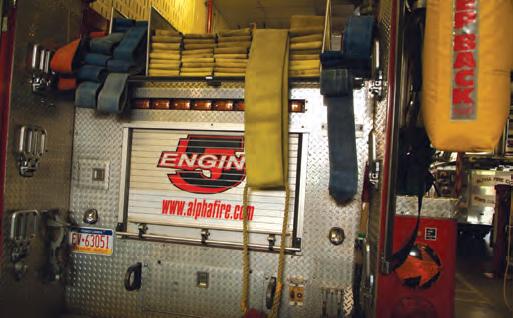
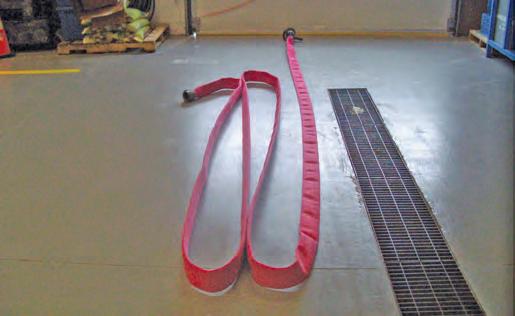
The 2.5-inch hoseline has become a forgotten tool. Sure, we have a pre-connected 2.5-inch line on our trucks and we also pack spare 2.5-inch line on the back of our engines for supply lines or ground deluges (see photo 1), or for our standpipe/fire department connections, but do we ever use the 2.5-inch hoseline to attack a fire? The answer is no, we don’t. In my 10 years of service, I can remember only one time when a 2.5-inch handline was pulled off as the first attack line for an interior attack. It was at an auto-body shop fire and the first arriving engine pulled of a 2.5-inch handline. That officer quickly recognized he had big fire that required big water. The other times a 2.5-inch line was used were for defensive operations involving a ground deluge.
So why don’t we use the 2.5-inch hoseline for offensive interior fire fighting? The answer usually has something to do with manpower shortages, the hose being too heavy to advance or fear of causing too much water damage. While these answers are true to some degree, we need to remember our building blocks of fire fighting, most importantly, big fire, big water.
The 2.5-inch handline can deliver the big water we need for a quick, aggressive initial interior attack. We need to deliver a big, quick knock-out punch when we have a fire, whether big or small. Just as a boxer’s objective is to knock out his opponent with a one-punch hit, so too should our objective be to knock down the fire. One quick punch, delivered by a 2.5-inch nozzle will accomplish this.
I’m sure most of us have heard or seen the acronym ADULTS. This acronym spells out when we should use a 2.5-inch handline. The ADULTS principle is usually applied to high-rise operations and standpipe-equipped buildings.
Advanced fire conditions upon arrival – this applies to when the first-arriving officer on scene witnesses an advanced fire or predicts that the fire will become advanced during the time it takes to set up operations.
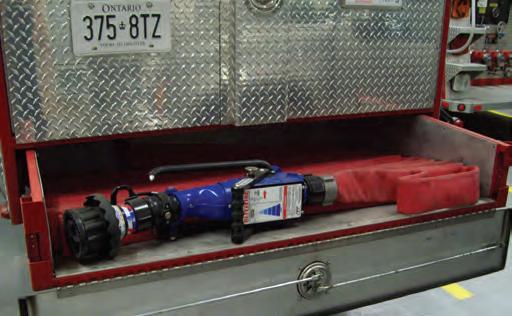
Defensive operations – the 2.5-inch line is perfect for setting up defensive operations with master-stream devices. (See photo 2.)
Unable to determine the location or the extent of the fire – in high-rise and standpipe-equipped buildings, if no fire is showing, there could be a serious fast-moving fire deep
Photo 3: Flaking the hoseline out perpendicular to the doorway allows firefighters to more easily advance the line.
Photo 2: Master-stream device supplied by a single 2.5-inch line. Easy deployment can be achieved by a single person.
Photo 1: Back of an engine company with 2.5-inch preconnected handlines.
PHOTO BY
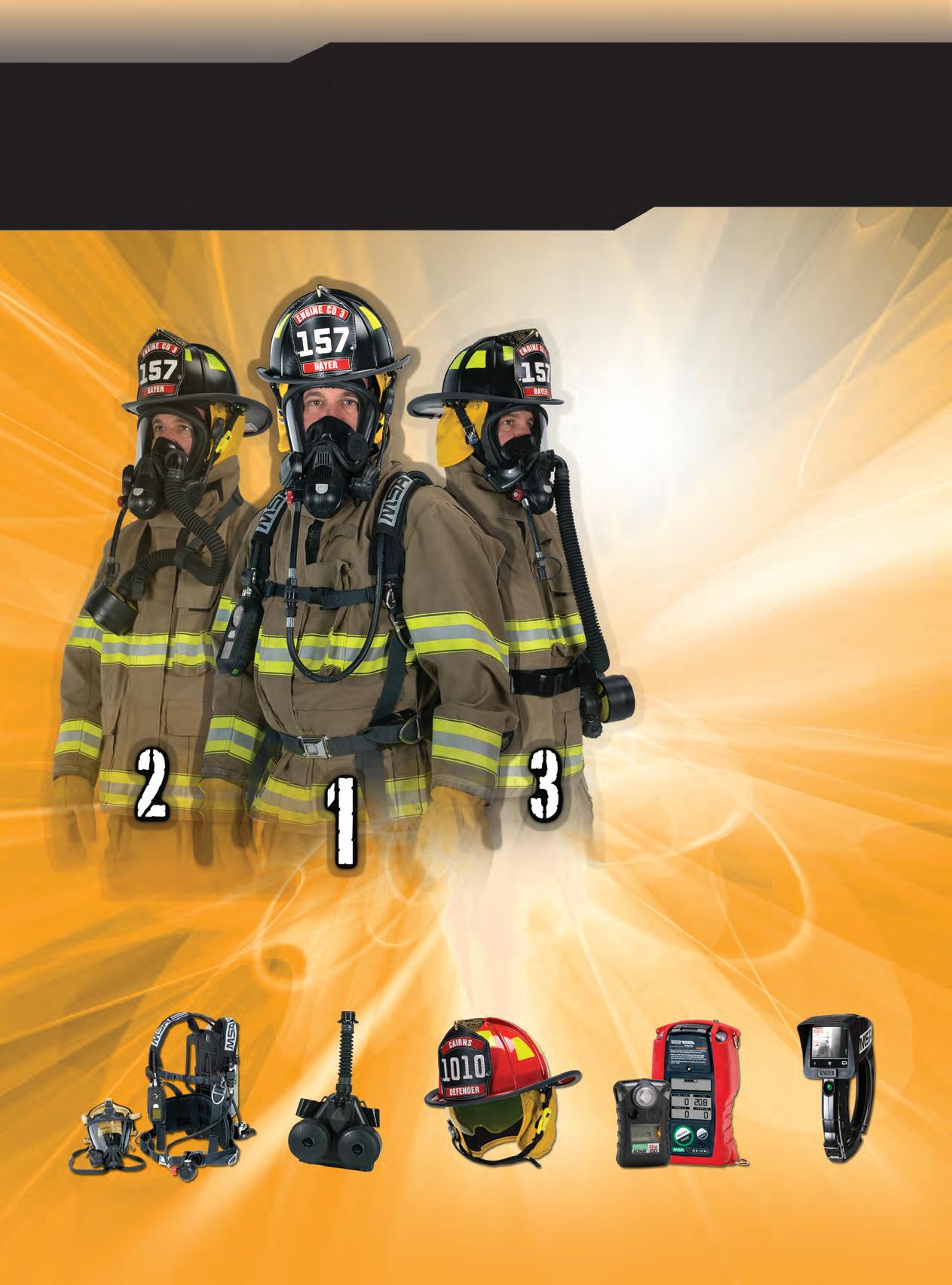
With MSA’s NEW FireHawk® M7 Responder Air Mask
1 Use Firehawk M7 CBRN SCBA for firefighting and rescue
2 Switch to Firehawk CBRN Gas Mask (air-purifying respirator) for scene management, after low hazard level is assessed
3 Convert to Firehawk CBRN PAPR (powered air-purifying respirator) for long-term comfort and use
Each model meets/exceeds the latest requirements of NFPA & NIOSH standards
For more information, call your local Globe dealer or Safedesign.
BRITISH COLUMBIA AND ALBERTA
Coquitlam, British Columbia 800-667-3362
Calgary, Alberta 800-661-9227
Edmonton, Alberta 800-222-6473
Kamloops, British Columbia 250-374-0044
Nanaimo, British Columbia 250-758-3362
Prince George, British Columbia 250-960-4300
QUEBEC
LaSalle, Quebec 800-905-0821
ATLANTIC PROVINCES
St. John's, Newfoundland 800-563-9595
Dartmouth, Nova Scotia 800-567-1955
Saint John, New Brunswick 800-567-1955
MANITOBA AND SASKATCHEWAN
Thompson, Manitoba 204-778-7123
BACKtoBASICS
within the building.
•
877-253-9122
www.safedesign.com
Large, uncompartmentalized areas –these areas lead to rapid fire extension and growth. These types of fires need to be stopped right away. Using a 2.5inch line will accomplish this.
•
•
Tons of water – when you need lots of water, a 2.5-inch is the choice. It allows you to flow high volume with low pressure.
Standpipe operations – these operations require 2.5-inch hose for the same reasons as above: high volume at low pressure.
This acronym is very accurate. The key is to know when to apply it. This takes practice and training. If we train with 2.5inch handlines consistently then there will be no surprises when we have to pull a 2.5inch line for the first time at an incident. How much water can a 2.5-inch nozzle deliver? Expect to flow between 100 and 500 gallons per minute depending upon the manufacturer. A great amount of water can be delivered using a 2.5-inch hoseline. This is what makes the 2.5-inch handline a versatile tool. It can be used for defensive operations and offensive operations. Larger hoses, such as three-inch inch, four-inch and so on, cannot be used for anything but defensive and supply operations.
Advancing a 2.5-inch line seems like an impossible task when you have limited manpower, but is it really? As mentioned, training on advancement will help in this area. The minimum number of firefighters advancing a line will be two to three. If you have the luxury of having four people advancing the line then you are ahead of the game. Large city departments will commit two engine companies to advance one 2.5-inch line. This is usually done in high-rise situations. When it comes to a typical residential structure fire, a small company of two to three people can advance a 2.5-inch line with ease. That is not to say that it will be easy; it will be hard work. Advance the line dry as far as you can, then charge it with water will help. This cuts down the work needed to advance the line. With the line dry, it is a good idea to flake the line outside in a pattern that allows you to advance with a bit of help from the hose. (See photo 3.) Flaking the hose perpendicular to the doorway of the structure allows the hose to be pulled in line with the advancing party. When you flake the hose parallel to the doorway of the structure, you have to pull the hose around a corner and this makes your job extremely difficult.
Usually we advance hoselines with water flowing at full pressure. With smaller lines such as one-inch and 1.5-inch, this can be accomplished with ease. When it comes to the 2.5-inch, this cannot be done because there is too much back pressure going against the advancing team. The key here is to close your nozzle halfway. This allows water flow to continue with enough protection being provided while allowing the team to advance the line. Less back pressure allows you to advance the line with two or three people. You need one person to help pull hose around corners and another to help back the nozzle man. Once you have advanced the line as far as you want, then re-open the nozzle completely to ensure full flow for fire knockdown. This technique takes practice to perfect.
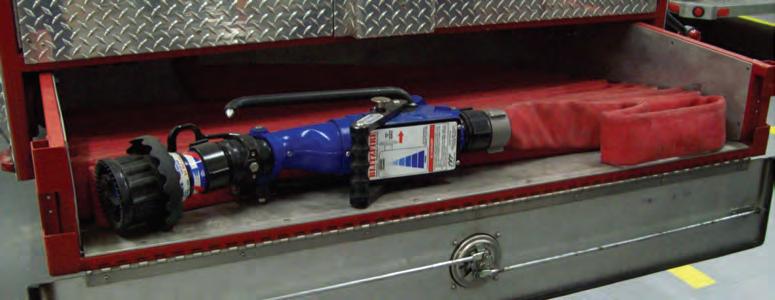
We can also use 2.5-inch master streams for offensive operations. Different manufactures produce master-stream devices that are fed by a single 2.5-inch hose. In photo 2, we see an example of one such device. These master-stream devices deliver large volumes of water with quick, easy setup. These devices can be set up, with water flowing, and then left unmanned. There is a safety feature that turns off water flow when it senses any movement by the master-stream device. These devices are great for interior offensive operations. Large structures are the ideal setting for these guns. Any large fire inside a large structure (high rises, warehouses, mansions) a perfect setting for a master-stream device for interior attack to achieve a quick knockdown.
The 2.5-inch hoseline has been around since the beginning of the fire service and at one time was the only hose used to fight fires. With the introduction of smaller diameter hoses, we have forgotten about other weapons at our disposal, such as the 2.5-inch hoseline.
By bringing the past with us, we can achieve our goal of quick knockdown and increase our ability to become effective firefighters. This will only be accomplished by going back to basics.
Mark van der Feyst began his career in the fire service in 1998 with the Cranberry Township Volunteer Fire Company, Station 21, in Pennsylvania. He served as a firefighter and training officer for four years, then joined the Mississauga Fire & Emergency Services, where he served for three years as a firefighter and shift medical instructor. He is now the training division captain for the City of Woodstock Fire Department in Ontario. Contact Mark at mvanderfeyst@gmail.com
TRUCKCHECKS Diagnosing starter condition
By DON HENRY
uring a recent fourth-year heavy equipment technician class we set out to determine whether an oscilloscope can be used to diagnose starter condition.
A starter takes 12 volts of DC (direct current) and produces a pulsed DC current. How efficiently it does this is an indication of the condition of the brushes, field windings and armature windings.
As a starter begins to wear down, its brushes no longer contact the commutator on the armature, or the armature windings can open. This often happens at the solder that connects the windings to the commutator. This solder can melt because of long cranking periods or starter overload. Ether condition creates an open to current to flow.
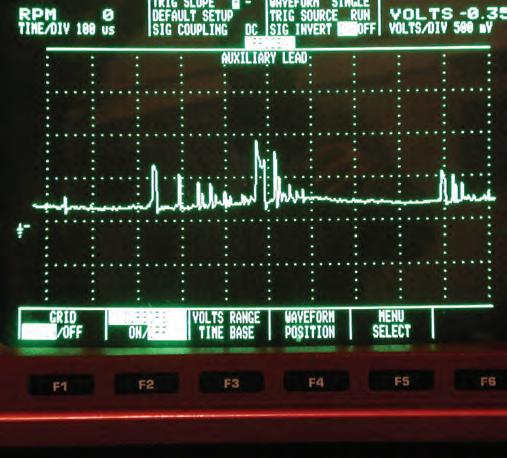
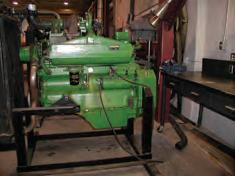
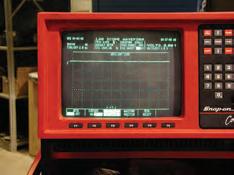
The engine chosen for this test was an agriculture engine of 619 CID (cubic inch displacement) with a common 40 MT Delco starter (see photo 1). A well-charged 1200 CCA battery was used to crank this engine in a warm shop with 15W-40-weight engine oil. The test results of three cranks were an average draw of 590 amps and an average cranking speed of 260 rpm. The rpm was taken with a phototack. This amperage draw is acceptable for a diesel engine starter of 619 CID, the normal rating being less than one amp per CID. The rpm is well above the minimum of 200 rpm considered for normal starting. Remember, it’s not how long you crank a diesel, it’s how fast. While the test was conducted, an oscilloscope was used to look at the pattern of the DC. You will see the line is very flat with almost no ripple (see photo 2).
We suspected this starter was in good shape and upon disassembly we were proven correct. There were no opens, shorts or grounds in the fields or starter armature. The brushes were in serviceable shape, made good contact with the armature and the brush springs were still firm, not having been overheated to the point of losing their temper.
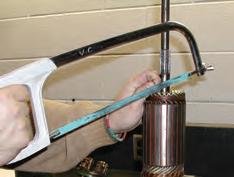
I then had a student with a hack saw cut one of the armature windings creating an open in the armature windings. (See photo 3). It should be noted here that it is not possible to detect an open in an armature winding with either a test light or a normal ohmmeter, as there are always two armature windings that come to each commutator bar, not just one wire. An ohmmeter or test light would indicate that the circuit is good because of the second wire still being intact.
In truth, the break in the armature windings almost always occurs where the wire joins the commutator bars – it was just easier to cut the wire with a hack saw. We reassembled the starter and connected it to the same engine. During this time we also recharged the battery. The test results now were very different. The amps now measured – after an average of three tests – at 690 amps; not a great increase but the engine’s cranking speed was now measured at just 170 rpm. This is a great decrease in cranking speed but likely would not be noticed by the driver-operator as the engine would most likely start and run in a warm fire hall. During the entire above test, no diesel fuel was given to the engine so it could not start during this test and most cranks were of about 10 to 12 seconds in duration. The oscilloscope pattern was now very different.
This was a recurring pattern, and, I believe, indicated the open wires to be the problem. The voltage spike was made by the collapsing magnetic field. Over time this will cause the commutator bar
before the open commutator bar to burn The reason for this is the self induction of a collapsing magnetic field. When electrical current flows in a wire a magnetic filed in created around that wire. When the current stops flowing in the circuit the magnetic field collapses. This creates a very high voltage often called a spike. Normally there is more than enough contact area between the starter brushes and the armature commutator bars to carry the current. But remember, we have a open winding (the one we cut with the hack saw). As the armature rotates, the brushes have less area to conduct this current and as the magnetic field finally collapses a massive voltage spike is finally caused, seriously burning the last good commuter bar with which the brush was in contact. Why did it not burn the commuter bar connect to the open wire? Simply, you can not make electricity flow in a open circuit. You can watch this happen if you pull an
619 CID engine
Pattern of a normal starter.
PHOTO 2
Cutting armature windings.
PHOTO 3
Abnormal pattern.
FIGURE 1
PHOTO 1
PHOTOS COURTESY DON HENRY
TRUCKCHECKS
extension cord out of the wall socket when it is conducting current; you will see a voltage spike. That spike is small compared to the 600 amps in an engine starter circuit.
Now, will you rush out and buy an oscilloscope? Probably not, but with the other uses it has with electronic engines and alternators this may just be enough to justify the $5,000 to $6,000 cost. You may work in a town or city municipal shop that also services the city’s gasoline engine fleet and have access to an oscilloscope. With the advent of OBD 2 code readers, the city may not be using its oscilloscope much and be happy to lend it to you. It is possible to record a normal pattern of a starter during a routine service, and now with a normal baseline to work with you will be able to refer back to it. Some more advanced scopes will allow you to save the pattern in the computer or memory for later recall and comparison. If you cannot perform the above work then at the very least record the engine starter draw in amps and the engine rpm cranking speed at least once a year during an annual inspection. If you detect a large drop in rpm and a rise in amperage draw, it’s time to replace the starter. Of course, it is also important to ensure that the voltage drops between the battery and starter are correct. I believe this same technique could be used on items such as the 12-volt vacuum primer pump, 12-volt foam pumps and 12-volt hose rewind motors, to name just a few. In the future I will look at the effect of worn bushings on oscilloscope patterns and report my findings.
I am pleased to report that my latest copy of the EVT News and Notes has arrived and the following people have attained the Mater
Fire Apparatus Technician level: George Barnard of the Kitchener Fire Department, Ont.; Kenneth Lawrence, City of Prince George, B.C.; Steve Rieger, London Fire Department, Ont.; Charles Simmonds, City of St. Catharines, Ont.; Simon Upshon, Surrey Fire Services, B.C.. And, congratulations to Brent Baraga, Calgary Heath Region Transport, for attaining the Master Ambulance Technician level.
Remember, the next test dates are June 6 and Oct. 17. Go to www.evtcc.org for more info.
Now, a few training opportunities: an always great conference is coming up on May 1 at the Ontario Fire College. Go to http:// home.cogeco.ca/~omoa/ for more info.
The EVTA of British Columbia training conference is May 27-31 in Nanaimo. For more detail, go to www.evtabc.com.
My organization, the Apparatus Maintenance Section, offers a workshop Aug. 26-27 in Dallas as a two-day conference for Fire Rescue International, put on by the International Association of Fire Chiefs. This premier show presents a tremendous amount of fire apparatus to look over. Many departments will bring both their fire chief and technician; the two will often walk the floor and it’s great to see the technician pointing out to the chiefs some of the finer points of certain fire apparatus. For more info go to www.ams-iafc.com.
BY E. DAVID HODGINS Managing Director Alberta Emergency Management Agency
ILEADERSHIPFORUM
Acceptable service: Are we there yet?
t’s a new year, a new beginning and a good time to be frank. So let’s begin with a couple of questions: Why do people believe that Canadian fire services consistently provide extraordinary service? Why do they assume the fire services habitually go above and beyond the call of duty to exceed expectations?
Is it because all fire departments are really good at what they do? Or has it come time for us to inform taxpayers about what they should expect of us and the actual costs associated with department services? Should people be given details about what could be delivered if additional money were invested in prevention, mitigation or response services? And what about identifying the service outcomes if the budgets were reduced?
The media and the public seem to unconditionally accept the fact that their local firefighters will respond to emergencies and do their very best under the most challenging circumstances. They tend to avoid making unkind comments about us in public because they do not know the ins and outs of our business.
Now, here is a soul-searching question: Have we been spoiled by the media and the public? Unlike the police, fire services are not subjected to critical media scrutiny. Perhaps it is not such a bad thing that the police are routinely interrogated as it challenges them to find ways to improve their response capabilities in order to maintain community confidence.
But what about the fire services? Is it time we got serious about openly reviewing and improving our firefighting capabilities and effectiveness? I want to make one thing clear: This is not about the need for more, bigger or better resources. The fact that there is lots of room for service improvements is, I realize, a challenging topic to write about. After all, we are not accustomed to airing our dirty laundry in public. However, I believe we need to ask ourselves some tough questions. To begin with, are we really that good? Could we do better?
could have been done differently, we focused on the need for all of us to be candid about ways to improve firefighting strategies and tactics. Now, I know some of you are thinking we’re just arm-chair quarterbacks. But others, I hope, are thinking it’s about time we had a serious discussion about the quality of customer service and our response capabilities.
If you were to ask me to look for the central theme of our conversation, it would be the need for education and training that are directly related to the incident command system. There is still far too much freelancing and too many free-ranging behaviours on the fire ground.
I know that scores of fire officers have taken ICS courses and they know how to organize a systematic and effective fire attack. However, the challenge is the need for the officers to ensure all on-scene personnel adhere to the rules of engagement as spelled out within the ICS. Basically, it’s an issue of all responders needing to understand the ICS and ensuring they follow its prescribed principles.
We are talking about the ICS but remember, this is not our first exposure to a structured-systems approach for the fire ground. Remember the fire ground command system developed and put
Is it time we got serious about openly reviewing and improving our firefighting capabilities and effectiveness? ‘‘ ’’
Recently I had lunch with two retired senior fire officers. Both are experienced, knowledgeable and held in high esteem within the fire services. Since their retirement they have spent considerable time reviewing major fire events across Canada in order to understand and recommend ways for firefighters to provide better customer service while staying safe.
As we discussed some recent high-profile fire events and what
David Hodgins in the managing director, Alberta Emergency Management Agency. He is a former assistant deputy minister and fire commissioner for British Columbia. A 30-year veteran of the fire service, he is a graduate of the University of Alberta’s public administration program and a certified emergency and disaster manager. Contact him at David.Hodgins@gov.ab.ca
forward by the fire services guru Al Brunacini back in the early ’80s? Chief Brunacini understood the need for command and order to ensure firefighter safety and effective extinguishment. At the end of the day, it comes down to more, better and the right training for firefighters. Only with this training will they be able to complete all expected fire ground tasks and use the apparatus and equipment competently and safely.
Amid the need to analyze and improve our performance, we face the urgency of the impending grey wave of retirement. The retirement of experienced individuals will negatively impact the delivery of customer-focused fire and emergency services.
And that begs the question: What should we be doing to ensure those who will be taking their place have the necessary skills?
BY LYLE QUAN Deputy Chief Guelph Fire Department,
Ont.
MCORNERSTONE
The ethics of making good leadership decisions
any articles have been written about how to be a good manager or leader and how to communicate with staff and peers. However one thing that is sometimes overlooked is the practical application of ethics. Even the most polished leadership skills won’t effectively drive home your vision of the future if your staff and peers don’t trust you or believe in you.
Firefighters are trusted and are viewed as caring people with good values. However, as we move up the ladder of success, we can become more results oriented, which, at times, may mean that it’s more about getting the job done than doing it with integrity.
Ethical leadership is all about doing the right things, which also means owning up to the mistakes we make. I have found that a simple, sincere apology goes a long way. But the key point here is that you are sincere about what you are trying to do. Sure, you can get away with doling out insincere apologies or words of praise for a while but sooner or later people will see through this.
This brings me to two books, The 4th Secret of the One Minute Manager, by Ken Blanchard and Margret McBride and The Power of Ethical Management by Ken Blanchard and Norman Vincent Peale.
The 4th Secret is about honesty, integrity and understanding what self-worth is all about. This quote from the book sums it all up for me: ”Honesty is telling the truth to ourselves and others. Integrity is living that truth.”
Before we can be good leaders we need to understand what self-worth and integrity are all about. Blanchard and McBride note that self-worth is not based on the opinion of others, rather it’s about being willing to admit our mistakes regardless of the outcome. Self-worth is also knowing it’s impossible to gain enough recognition, attain enough power or own enough stuff; it’s being comfortable with who you are and what you are legitimately trying to accomplish for the good of the team.
I found this book quite refreshing in its simple message about getting back to the basics of what a good boss (and person) is and how easy it is to lose sight of these simple points relating to personal and professional integrity.
In the second book, Blanchard and Peale build on the first book’s message relating to honesty and integrity, starting off with a salient point: “There is no right way to do a wrong thing.”
Blanchard and Peale offer readers a list of points and questions to ask themselves when trying to discern how ethical they are when dealing with people. For example, when dealing with a problem and considering a plan of action, ask yourself:
1. Is it legal – will I be violating either civil law or company policy?
2. Is it balanced – is it fair to all concerned? Does it promote a win-win relationship?
3. How will it make me feel about myself – will it make me proud? Would I feel good if my family knew about it?
The book also asks readers to ask themselves some hard questions relating to the types of mangers they are. What is your focus and are you adhering to the five principles of ethical power, which are:
1. Purpose – are you walking the talk when it comes to meeting
Before we can be good leaders we need to understand what self-worth and integrity are all about. ‘‘ ’’
On the topic of integrity, the authors give us the following points as our integrity guide:
I know what I did may be inconsistent with the kind of person I want to be;
I am better than my behaviour; I forgive myself;
I make amends for all harm done; I demonstrate I have changed by changing my behaviour.
Lyle Quan is the deputy fire chief – administration with the Guelph Fire Department in Ontario. A 27-year veteran of emergency services, he is a graduate of Lakeland College’s Bachelor of Applied Business: Emergency Services and Dalhousie University’s Fire Service Leadership and Administration Programs. Lyle is an Associate Instructor for the Ontario Fire College, Lakeland College and Dalhousie University. E-mail: thequans@sympatico.ca
the organization’s mission statement?
2. Pride – are you proud of yourself and your organization?
3. Patience – maintaining a balance between obtaining results and caring how we achieve these results;
4. Persistence – commitment to live by ethical principles;
5. Perspective – taking time to pause and reflect.
When all is said and done, a sincere and ethical leader gives everyone else credit when things go right and takes full responsibility when things go wrong. However, many of us have seen the opposite – the self-centred leader who takes credit when things go well and blames everyone else when things go wrong. Don’t be a self-centred leader; support your people and give them credit where credit is due. If you make a mistake, own up to it.
Both books are gems with a great deal of uncluttered information that is worth referring to regularly, and both are available online through Amazon and Chapters.
Ingleside, ON
CORNER
The dangers of the front wall
By ED BROUWER
Trainer’s Corner is dedicated to giving you the tools to make good judgment calls on the fire ground. “Good judgment comes from experience. Experience comes from bad judgment.” (Author unknown) Unfortunately, in our profession, bad judgment can result in devastating and sometimes fatal results.
When it comes to the topic for this month’s column, front-wall collapse, I admit that I have no experience at all. All but one year of my fire service has been in rural departments. Yet the need to address this safety concern is paramount. Although there are a number of deadly fixtures on the front walls of burning buildings that have collapsed and killed firefighters, there is little printed material available.
In order to do justice to this topic I enlisted the help of my friend Vincent Dunn, specifically his 2005 training newsletter Front Wall Collapse.
Other than Dunn’s newsletter, Firefighting Strategies and Tactics by James Angel et al. (2000 Delmar Thomson Learning) has the most pertinent information.
With permission from Dunn, we’ve reproduced the key points from his newsletter. If you have Internet access feel free to go to his website, www.vincentdunn.com, for a downloadable copy of the complete newsletter.
Incident commanders, although careful to size up each incident with consideration given to firefighter safety, too often miss the obvious – the front wall. The deadly fixtures on the front wall I referred to earlier are a parapet, marquee, canopy or a cornice. Any one of these fixtures on the front wall of a burning building should be monitored continuously for any sign of failure.
A parapet, according to the Delmar’s Firefighter’s Handbook 2nd Edition, (now out of print) is “the extension of a wall past the top of the roof.”
Parapets (typically masonry) are free standing and are used to give the building a finished look. Business owners use parapets to hide roof equipment, hang signs and support utility connections. Dunn, in his newsletter, describes a marquee, canopy and a cornice as follows:
A marquee is a large metal structure attached over the entrance to a theatre or store. A marquee extends from the front wall out to the street and is used to display signs.
A canopy is a cloth, wood or metal covering over a building entrance designed to protect people from the weather.
A cornice is a horizontal ornamental construction along the entire front wall of a building, usually near the top.
Now that we have an idea of what these fixtures look like and what purpose they serve let’s discover how fire and collapse can cause them to become deadly.
Consider a marquee; very few understand that as water streams are being applied to a burning building, water from those streams can enter into the hollow portion of the marquee. Normally there are drain holes within these fixtures but during a fire these can become clogged. If that were to occur the hollow would fill with water and collapse due to excess weight. In turn, if the
Protective or decorative canopies or cornices are hazards to firefighters.
marquee collapses it can pull the parapet wall down with it, crushing firefighters below.
Perhaps you’ve seen the photo often used by training officers of seven or eight firefighters standing on top of a small porch roof or canopy? It begs the question, “What were they thinking?”
Speaking of canopies, the IC should not order hoses to be stretched or ladders to be placed on top of a canopy roof. Firefighters have been killed (outside the building) operating hoselines beneath a canopy that collapses. The area beneath a canopy should be considered inside the collapse danger zone.
Dunn reminds us that one of the greatest tragedies in the
FRONT-WALL STRATEGIES
Four strategies Vincent Dunn suggests an IC use to safeguard firefighters when the front wall of a burning building appears about to collapse.
Use the reach of the hose stream. Firefighters should use the 50-foot reach of a hose stream.
A collapse zone can be established by the IC. A collapse zone is the distance equal to the height of the wall in danger of collapse.
• • • fighters will be away from the front of the building wall in danger of collapsing.
Flank the front wall.
Firefighters operating hose streams can be positioned in front of adjoining buildings and their hose streams can be directed on the burning building from a flanking position. The stream may not be as effective but the fire-
•
Corner safe areas can be established around the burning building. If the front wall and all the other walls of a burning building collapse outward simultaneously (which is very unlikely) there would be four corner areas on the fire ground where fewer bricks would land. These are the socalled four corner areas.
Probability of survival is greatest in the four corner safe areas. When there is danger of collapse a safety strategy used by an IC is to position firefighting apparatus inside the four corner safe areas.
history of fire fighting was caused by a canopy collapse. It occurred in a burning meat packing plant in Chicago in 1910. During the fire, a brick wall and a canopy attached to it collapsed. Twenty-one Chicago firefighters were crushed to death beneath the crumpled metal canopy and bricks.
According to Front Wall Collapse, parapet walls are free standing. A freestanding wall is considered by engineers to be the least stable of three basic types of wall (free standing, nonbearing and bearing wall) because it has fewer connections to a structure. The more connections a wall has to the structure, the more stable the wall.
Dunn further explains it this way: “A parapet wall built over a one- or two-storey commercial building with large display windows beneath it is a collapse-prone structure because the parapet walls are often supported by steel beams. A steel beam spans the large windows and supports the parapet wall above. If, during a fire, the steel beam designed to support a parapet is heated to 590 C and starts to expand, warp, twist or sag, it can collapse the parapet wall off its foundation.” A small shock during a fire, the impact of a master stream or an aerial ladder can cause a parapet wall collapse.
“Ironically,” Dunn says, “a parapet wall often supports a marquee, canopy or cornice. This is an unstable structure supporting an unstable structure.” Dunn reported some additional details regarding marquees. “A marquee beam goes through a parapet wall and is connected to a roof or floor beams behind the facade. The marquee may also be connected to the parapet by steel cables.”
If a marquee collapses during a fire, it can pull the facade wall down with it.
Continued on page 38
Fire ground communication
The evolution of incident command and why it matters
By PETER SELLS
PHOTOS BY JOHN RIDDELL
Instituting a system of signs and signals need not be complex, but it does require dedication and discipline.
Fighting with a large army under your command is nowise different from fighting with a small one: it is merely a question of instituting signs and signals. – Sun Tzu, The Art of War
The brilliant and mysterious General Sun Tzu envisioned and practised this concept with large armies made up of conscripted troops, legions assigned by allied warlords, professional mercenaries and captured prisoners (fighting under threat of the sword). The resources he controlled were diverse in terms of experience, motivation, dialect and equipment. Despite the considerable obstacles to mounting an organized large-scale military campaign in the politi-
cal and economic chaos of China in the Warring States Period (403-221 BC), Sun Tzu reduced the commander’s workload to a manageable level.
How does this system of instituting signs and signals translate into the modern context of multi-agency operations?
Within each agency’s operational sphere, all members must understand and adhere to their responsibilities under their agency’s system of signs and signals, essentially, and Incident Management System (IMS).
At the organizational level where the agencies’ command systems overlap, all members of all agencies must understand and adhere to an identical
Offering: A 2 course certificate in incident command for experienced incident commanders. Please contact our office for more information.
Are you looking to take on more responsibility in your Department? Trying to round out your technical ability with leadership skills? Preparing to advance your career?
At Dalhousie University we offer a three course program, the “Certificate in Fire Service Leadership” to career and volunteer fire officers.The 3 courses Station Officer: Dealing with People,Station Officer:Dealing with New Operations and The Environment of the Fire Station are all offered in each of our 3 terms, September, January and April. The program can be completed in one year.
For more information and a program brochure please contact:
Gwen Doary,Program Manager
Dalhousie University Fire Management Certificate Programs 201-1535 Dresden Row,Halifax,Nova Scotia B3J 3T1 Tel:(902) 494-8838 • Fax:(902) 494-2598 • E-mail:Gwen.Doar y@Dal.Ca
You will also find the information in our brochures or at the following internet address:Web site:http://collegeofcontinuinged.dal.ca
The result of a system of signs and signals must be the ability to mobilize a group functioning as a single unit toward a common purpose.
system of signs and signals (unified command).
The specific system to be used in large-scale multi-agency operations, as well as which agency will take the lead under given circumstances, must be formally agreed to in advance.
Instituting a system of signs and signals need not be complex, but it does require dedication and discipline. The result must be the ability to mobilize a large, diverse and capable group functioning as a single unit toward a common purpose.
The signs and signals we use to communicate are not transmitted by Sun Tzu’s flags and drums. Today we use radios, mobile phones, computer-aided dispatch and all the other wonderful toys that we group together as communications technology. Without communications, the methods we have of organizing work on the emergency scene would be meaningless. In fact, our current practices, despite their basic similarities to ancient military theory, were developed in the era of modern communications.
All fire services operate with a set of local best practices that are inherently similar. Before the 1970s, in North America at least, few fire services had formalized or codified these behaviours into what we now call an IMS. In fact, older communities on the east coast and Great Lakes, whose fire departments were formed in the 18th and 19th centuries, had long traditions of ingrained practice that had become automatic and were passed on to new generations through rote and experience. Nick Brunacini, son of retired Phoenix Fire Chief Alan Brunacini, put it this way in his blog on www.bshifter.com:
“The East Coast Fire Service is older than its West Coast cousin. Big eastern cities developed the operational model they use to conduct structural firefighting operations centuries before the advent of the portable radio and incident command systems. Over the years these departments wrote down what worked best and kept it tacked to the wall in the poop deck. When the wall was completely plastered and three layers deep with operational orders some enterprising member of the company . . . three hole-punched all the pages and organized them into a binder. This became the American Fire Service’s first set of SOPs. Our country’s earliest firefighters celebrated this momentous event by roasting a buffalo and burning down the British Embassy.”
Notwithstanding Nick’s comments, it was primarily the newer western communities, undergoing rapid growth in the 20th century that led the way in getting these things down in black and white. They had to – they had fewer experiences from which to draw. Also, flush with cash in the booming 1950s and ’60s, they had a greater opportunity to integrate many of the post-war technologies as they grew. A notable exception to this east/west divide is FDNY, where a vast amount of firefighting art and science was put to paper and where experiments in fire ground radio had been taking place since 1913.
Despite the vision and diligence of fire departments in striving for continuous improvement, many of the 20th century’s most significant advancements in fire protection practices occurred in reaction to our failures. During the disastrous California wildfire season of 1970, during which 16 lives and 700 structures were lost, it was noted that poor communication and co-ordination among multiple agencies hampered their efforts, no matter how genuinely they wished to cooperate. As a result, within two years the California Department of Forestry and Fire Protection, the Governor’s Office of Emergency Services, the Los Angeles, Ventura and Santa Barbara County Fire Departments and the Los Angeles City Fire Department joined with the U.S. Forest Service in the development of the systems that became known as FIRESCOPE (Fire Resources of Southern California Organized for Potential Emergencies, the quintessential example of a combined acronym and mission statement). One of the first achievements of this group was a formal agreement on common Incident Command System terminology. Although originally developed as a multi-agency system for the wildland environment, ICS was adopted for urban use by the Los Angeles Fire Department in 1978. Therefore, ICS could be thought of as having been developed from the top down, with a system designed for large agencies at upper tiers of government later being adopted for local use.
Alan Brunacini’s first edition of Fire Command was published in 1985. This text introduced most of the North American fire service to the command practices that had been developed locally in Phoenix up to that time. Widely and rapidly adopted, primarily due to the fact that many of its basic practices were already in common use if not formalized as SOPs, many of the book’s principles have grown from the ground up. Many fire services had difficulty, mostly cultural, in adopting ICS because they would wait until they felt an incident was large enough to warrant formalization before establishing a static command post, sectoring the scene and implementing fire ground accountability. The interruption in focus from keeping things moving to getting things organized was not only confusing, it was dangerous. Having a fire ground command mentality – where local incident command begins when the first unit arrives at the scene (typically within minutes) and then grows to suit the size and character of the incident – better suited the minute-by-minute reality of urban fire fighting than the hour-by-hour or day-by-day scope of the wildland environment.
There also are differences in terminology between California’s ICS and Phoenix’s FGC. For example, in ICS a working unit of
PHOTO BY JOHN RIDDELL
firefighters organized geographically, on the east side or the fourth floor, would be called a division. If they were organized functionally; for example, for ventilation or fire attack, they would be called a group. Brunacini refers to either as a sector. He also wryly notes that this 30-year debate persists only because the original authors are still alive, but the point is well taken. All language evolves, and technical terminology is no different in that respect. I have always felt that Brunacini’s term “marginal” for the strategic mode during the period of change to defensive from offensive operations would be more intuitively described as “transitional”, but at last report he is still alive and kicking so I will let that one lie.
In the meantime, in 1982 the FIRESCOPE ICS had developed further into the National Inter-agency Incident Management System (NIIMS). In 1993 the IMS consortium began producing model procedure guides that sought to harmonize the best practices of each existing system. Most recently, by presidential directive, the National Incident Management System (NIMS) was issued in 2004. The cynic in me suspects that the sitting president found “nims” easier to pronounce than “ni-ims”, but there’s more to NIMS than a name change. It is an integrated system of protocols that, according to FEMA, will “enable responders at all jurisdictional levels and across all disciplines to work together more effectively and efficiently . . . .One of the most important best practices that has been incorporated into the NIMS is the ICS, a standard, on-scene, all-hazards incident management system already in use by firefighters, hazardous materials teams, rescuers and emergency medical teams.”
NIMS divides management teams, their equipment needs and training requirements into five levels: type 5 is at the city or township level or up to 12 hours’ duration; type 4 is at the county or fire district level for 12 to 36 hours; type 3 involves state agencies or large metro areas for two to seven days; type 2 is at the national level for seven to 14 days; and type 1 is also at the national level for huge incidents of more than two weeks’ duration.
So to put this in a Canadian perspective, consider the following: type 5 is your first-alarm response to Mrs. Smith’s kitchen fire or an MVC on the highway; type 4 is a mutual-aid fire or a multiplealarm fire in the city (these two types alone represent the majority of emergency responses and the greatest risk to property and the lives of firefighters and taxpayers); type 3 represents the tornadoes in Barrie or Edmonton, the fires at Plastimet or Sunrise Propane, or the August 2003 blackout; type 2 could be compared to the Hagersville tire fire or Mississauga derailment; and type 1 to the 1998 ice storm or the SARS outbreak of 2003.
The National Incident Management System was set up to aid in the response to the largest yet least frequent emergencies. As Alan Brunacini puts it, “99 per cent of our local, all-risk tactical activity is managed by type 4 and type 5 management teams.” After all, assuming the resources are in place, where’s the risk to the responder at a 17-day defensive tire fire? Alan and his sons Nick and John have developed a training system specifically to address the risks associated with incident operations at type 4 and type 5 responses. Their Blue Card Command Training and Certification Program meets the bottomup needs of the first-due incident commander within the context of the top-down NIMS mandates. Blue Card Command Training was schedule to be available in mid-February through Medteq Solutions (www.medteqsolutions.ca) in a combination online/in-class setting in order to efficiently disseminate this important information. As our industry continues to further define and demand best practice at all levels, tools like Blue Card for the development of command and decision-making expertise are invaluable.
Whether you call it communicating with signs and signals, fire ground command, ICS, NIIMS or NIMS, seamless communication and co-ordination will keep us safer at all emergency scenes – local, regional or national.
TRAINER’SCORNER
Continued from page 32
Dunn continues: “A marquee is a cantilever beam supported only at one end. This is considered by engineers to be the least stable of the three basic beam designs: a cantilever beam [supported at one end]; a simple support beam [supported at both ends]; and a continuous support beam [supported at both ends and the centre].“A canopy is more of a collapse danger than a marquee, Dunn says.
Similar to a marquee a canopy is a cantilever beam, but where a marquee is one large continuous beam, a canopy is made up of non-continuous beams. These multiple beams are held together by cables or bolts. Because these continuous beams are only supported at one end, if any one part fails, it can trigger a complete canopy collapse.
According to Front Wall Collapse, the most dangerous type of canopy is a metal or woodshed suspended over a truck-loading area. These corrugated tin or wood canopies are designed to provide protection for workers and products from the weather. In older parts of some towns, skylights, originally designed to provide light on the platform below, are sometimes tarred over. These would certainly collapse if stepped on should a firefighter mistake it for a scuttle cover.
Some canopies have a system of tracks and rails suspended from the underside. “Heavy products unloaded from trucks or railroad cars are attached to the rail system and pushed inside the building,” Dunn says. The IC should be aware that the weight of these rail systems heightens collapse danger.
Another cantilever structure on the front
wall is a cornice. The important difference with the cornice is that a cornice can burn and spread fire.
Dunn says. “A cornice may be constructed of wood or combustible plastic and it may have a wood framework inside, and/or wood shingles outside.”
The IC should understand that flames blowing out of a window below a cornice will spread to the cornice. Flames may then spread along the underside of the cornice or inside its framework to another exposure.
A cornice destroyed by fire can collapse off the facade. Firefighters operating at one end of a building can be crushed under a falling cornice that starts to collapse at the opposite end.
Special thanks to everyone who helped us out with this topic. I was reminded of Joe Cocker singing, “With a little help from my friends.” With that in mind I am going to ask for your help. If you would be interested in networking with me as a resource for Trainer’s Corner please e-mail me your contact info.
Ed Brouwer is the chief instructor for Canwest Fire in Osoyoos, B.C., and the training officer for West Boundary Highway Rescue. The 20-year veteran of the fire service is also a fire warden with the B.C. Ministry of Forests, a wildland interface fire suppression instructor/evaluator and a fire-service chaplain.
Contact Ed at ed@thefire.ca
Additional items on a front wall make it more prone to collapse and pose. According to firefighting training materials, incident commanders too often miss the obvious – the front wall.
Emergency responders require a secure rapid entry system that allows fast access without damage to property or delays waiting for keys. The Knox-Box® Rapid Entry System is a comprehensive UL listed key control system that includes high security key boxes, cabinets, key switches, padlocks, master key retention devices and locking FDC plugs and caps. Rely upon the Knox System for all your rapid entry needs.
www.knoxbox.com
Best practice
Department’s nine-step recruiting process efficient, effective and defendable
By BRAD PATTON
We have a nine-step hiring process that has been refined over the years and has proven to be very successful in hiring the right people. I define the right people as those who fit into the organization, will help us grow, are constant learners, have a high degree of commitment to provide excellent service and have great retention value.
Step 1: Evaluate how many firefighters you need. Sounds simple, but you would be surprised at how few chiefs really do this. They simply hire to the same number of staff as they have always had and no one questions the number or the history behind the number. Is it really 25 or should it be 27 or 32? This is a good time to ask the officers and firefighters what they think. Are they often short of staff or are there too many?
Whatever the number that works best for you, and before you go to council or the fire board for approval, you have to figure out the best number of staff, what the maximum and minimum number are and how often you want to go through the hiring and recruit-training process. For example, say a total of 26 per station works for your department – one district chief, five captains, 20 firefighters. The hiring process is complex and takes several months (as it should). It is followed by 100 hours of recruit training before the new guys are allowed to respond to alarms. It takes us almost a full year from advertising, selecting and training before we have a fully functional firefighter – each time we hire. If we have to do this every year or every two years, it is hard on existing staff and everybody can get burned out.
So, we made a report to council outlining the hiring process, the number of staff needed and the total cost. We requested approval for a hiring policy that stated we would hire to a maximum of 25 firefighters and begin the hiring process over again when we reached a low of 18 firefighters, That is our hiring spread – when we reach a low of 18, we then hire to a high of 25. The cost for extra bunker gear, lockers and pagers is saved by spreading out the hiring timetable from every two years to every five or six years. You need to look at your own staff to see what numbers work best for you.
Step 2: Advertise and then advertise some more. We all think we know our communities and word of mouth will spread the need for firefighters but I have found we miss a lot without advertising. Place ads in local newspapers, on radio stations and put up lots of posters. Put the posters up everywhere – in arenas, libraries, legions, halls and town office. The posters need to be as professional as you can afford to make them. I’ve found a strong first line seems to grab attention. For example, Are You Good Enough?, Join The BEST Team, Only the Smartest & the Strongest Ride Our Trucks. You get the idea. The posters should present a lot of information - qualifications you are looking for, catchment areas and contact numbers (day and night).
Taking stock of your department’s needs and understanding your hiring spread saves money by broadening the hiring timetable.
Step 3: Prepare and hand out recruiting packages. Each package should contain:
Application;
Description of the complete hiring process;
Physician consent form;
Contacts to obtain a drivers abstract and police records search;
Aptitude sample questions;
Details of the physical test;
Details on the interviews.
Step 4: Information nights. We have two or three mandatory attendance nights for anyone interested in becoming a volunteer firefighter. Everyone must sign in at the information nights, then we cross reference the applications. Applications of those who don’t attend an information night are discarded.
Application information nights have grown a lot over the years. Applicants are strongly encouraged to bring their spouses or close friends because being a good volunteer firefighter is a big commitment and successful applicants need the support of everyone close to them in order to go the distance. The information night is a time when we open up, lay all the cards on the table and tell it like it is: lots of training, few fires, lots of medical calls. The sessions usually last about 90 minutes.
We start off with a few words from the mayor, who thanks everybody for their interest in community safety, then the fire chief, district chiefs, captains and, finally, some words from the last recruits we hired about their thoughts when they joined and what they are now. Then we talk about the selection process.
The questions we get are amazing and underscore the value of the information nights. Can I just go to fires? I didn’t think we had to respond to calls 24/7. You mean we have to go to medicals on Christmas day? When can I drive a fire truck? Applicants often don’t really know what we do. The information night is the most important part of the hiring process. By the end of the night everyone has a lot more knowledge and can make a better decision about whether they want to continue with the process. This saves a lot of time down the road.
Step 5: Create a standard application and use a template to score it. Each applicant receives marks for education, references, daytime
availability, past related employment, type of driver’s licences and so forth. Short list your best applicants.
Step 6: Administer an aptitude test similar to the ones that are used for applicants seeking full-time firefighter positions. (Really, it’s the same job, just harder with less pay.)
Step 7: Physical agility test. We do ours in-house, simulating actual duties.
Step 8: Interview. All our interview questions are prewritten, complete with expected answers plus extra space if the applicant gives a good answer to a question that we didn’t think of and it’s worth marks. The Interview panels are made up of three staff – a senior officer, a captain and a firefighter. Each takes turns asking questions. The final score is the average of the three interviewers’ total scores.
Throughout the process, applicants are notified of their marks in writing and are treated with respect. We are professionals and we treat all applicants like professionals. We constantly ask applicants for feedback on the process.
Step 9: All the scores from all the hiring steps are brought together for a total mark. Until this point, the only time someone is eliminated is at the application review or if they could not reasonably complete the physical test. We then pick the top scorers.
This is a long process and at this point we have not even started training the recruit. I have found this process to be open, fair and defendable. I have also found that we have hired long-term volunteer firefighters who have great potential for promotion.
These are the people who will, within a short time period, make life and death decisions. Your community will invest thousands of dollars in training and equipment on these recruits. They are your department’s ambassadors and its future. Be very selective. It’s time well spent.
Brad Patton is fire chief for the Centre Wellington Volunteer Fire Rescue Department in Ontario, one of the largest volunteer departments in the province, with stations in Fergus and Elora.
QUEBEC REP: HQ Distribution Inc., Attn: Barbara Krzywoszanski Tel: 514-667-7034 Fax: 514-667-7104
e-mail: barbara@hqdistribution.com
MARITIMEREP:
Attn: Bert Fusk
Tel: 506-458-9463
Fax: 506-458-9463
e-mail: bert@stokes-int.com
BY SEAN TRACEY Canadian Regional Manager NFPA International, Ottawa, Ont.
OPrevention still the key to reducing fire losses
ver the past decade Canadians have experienced increased costs for the deployment of firefighting services. These are due in part to the increased expenses to train, deploy and equip firefighters. Cost-conscious community leaders will begin to question these costs, seeking tangible measurements of the benefits of these services. We need to do a better job proving our benefit to our communities and we can no longer rest on the high regard of taxpayers for the fire services.
The best way to do this is to focus on reducing property losses. And the best way to reduce property fire losses is to eliminate fires before they occur or contain them before the fire department arrives. We therefore need to place a greater emphasis on fire prevention.
A review of national fire statistics compiled by the Canadian Council of Fire Marshals and Fire Commissioners (last report dated 2002) showed that despite the increased costs, new technology, new building codes and standards, fire losses have increased in the past decade by 5.8 per cent in adjusted dollars. Yet, as costs increased and codes became more stringent, there has been no corresponding decrease in fire losses.
A significant portion of fires occur in older properties that are not equipped with current fire-protection systems and are not subject to the current building code. (The Canadian Commission on Building and Fire Codes estimates that 50 per cent of all construction underway in Canada is outside of the scope of the building code). Low-cost public housing is in short supply and once lost to fire will not likely be replaced.
A review of loss history in most communities will reveal that fires are more frequent in these kinds of occupancies and the majority of occupants do not carry household insurance. We know that residential fire sprinklers save lives but they can also protect irreplaceable public housing. Retrofitting municipally owned housing with sprinklers can ensure life safety and the continued use of these units. Similar cases can be made for the increased protection of other high-value assets such as schools, hospitals and essential industries. We cannot rely on the building code to change these; it is in the hands of the fire-prevention community to convince the public of the need to rethink fire prevention in our communities.
to protect these businesses through an enhanced, co-operative, fireprevention program that works with the business owners.
Fire prevention personnel can work with community leaders to evaluate their risks and, if necessary, upgrade their fire protection or safety systems to reduce the potential for fire losses. This would be an excellent way to showcase the value of fire-protection services in the community. We then need to report these activities to municipal councils. New tools in fire prevention reporting can be found in NFPA’s Fire Protection Research Foundation recent report Measuring Code Compliance Effectiveness for Fire-Related Portions of Codes.
The further need to focus on fire prevention was also recently highlighted in the Institute of Fire Engineers U.S. Branch in its Vision 20/20 National Strategy for Fire Loss Prevention report. This was funded through a Department of Homeland Security grant to develop a comprehensive strategy for fire prevention in the U.S. The project’s goal was to help to bring together fire prevention efforts and focus efforts collectively to effectively address the fire problem in the U.S. The key strategies of the plan were:
Strategy 1: Increase advocacy for fire prevention;
Strategy 2: Conduct a national fire safety education/social
We need a greater focus on fireprevention activities as it is only through these that we can make a dent in the fire losses across Canada. ‘‘ ’’
marketing campaign;
Strategy 3: Raise the importance of fire prevention within the fire service;
Strategy 4: Promote technology to enhance fire and life safety;
The status quo does not work. We need to increase the value of fire prevention by evaluating fire risks in our communities and have specific programs to address these risks, regardless of the size of our communities. A recent U.K. insurance study found that 80 per cent of businesses will not reopen following a major fire. Are there any businesses that your communities are prepared to do without? Communities need
Sean Tracey, P.Eng., MIFireE, is the Canadian regional manager of the National Fire Protection Association International and formerly the Canadian Armed Forces fire marshal. Contact him at stracey@nfpa.org
Strategy 5: Refine and improve the application of codes and standards that enhance public and firefighter safety and preserve community assets.
The full report is available at www.strategicfire.org. Note that none of these strategies calls for the formation of more effective firefighting systems. Rather, they frame a national strategy that should be the basis for the role of our much-needed national fire advisor.
We need a greater focus on fire prevention activities as it is only through these that we can make a dent in the fire losses across Canada. Every community should have a primary focus on fire prevention focused specifically on the risks within that community, with fire suppression being a measure of last resort.
LETTERS to the EDITOR
Dear Editor,
Just to clarify on your article “Volunteers allowed to use lights, sirens” (Station to Station, December 2008), in Ontario, changes to the Highway Traffic Act (1997) state that “a firefighter may display an intermittent green flashing light while responding to emergencies”
This does not permit the fire fighter to speed or drive carelessly and must obey all traffic signs/signals under the Highway Traffic Act when responding to an alarm.
This also indicates light not light bars or numerous lights.
Your magazine is very informative. Keep up the good work
Thanks,
Dave Thomson, President Fire Fighters Association of Ontario
Dear Editor,
I have just read Sean Tracey’s article concerning Ethanol and BioDiesel fuels in the December issue of Fire Fighting in Canada and thought I should comment about training that has been conducted in Sarnia’s socalled Chemical Valley on these fuels.
I completely agree with Mr. Tracey that the fire service in Canada has really not addressed the issue of these alternative fuel additives. In the fall of 2007 a training session was offered at the Ansul Fire Technology Center in Marinette, Wis., sponsored by the Renewable Fuels Association of the U.S. and by the Ethanol Emergency Response Coalition. Surprisingly, although a number of Canadian fire officials were invited, I was the only Canadian present.
A number of years ago when Ontario’s first ethanol plant in Chatham, Ont., was built, the Chatham Kent Fire Department had us develop a hands-on live fire training program for its training officers and a number of its firefighters.
In 2006, Suncor Energy built an ethanol plant within sight of our facility. We developed training programs for its plant operations personnel to fight both ethanol and regular hydrocarbon fuel fires. This training has been ongoing.
In 2008, a new ethanol plant was constructed in Aylmer, Ont. Chief Sam Taylor of Aylmer and Chief Peter Barbour of Malahide (the community surrounding Aylmer) have had more than 50 of their firefighters trained at our facility to deal with liquid fuel fires, including ethanol.
In 2009, Lambton College will be continuing this training and will also be offering an open course for municipal fire fighters to teach them the hazards of liquid fuels,
including ethanol.
As Mr. Tracey stated, most firefighters are not aware that their standard fire fighting agents and tactics will not work on fuels containing as little as 10 per cent ethanol. Although most municipalities do not have ethanol plants within their jurisdictions, they do have rail cars and transport trucks carrying fuel with an ethanol component every day in their area. At present, the placarding of a gasoline tanker is “1203” whether the fuel is 100 per cent gas or
whether it contains 90 per cent gas and 10 per cent ethanol. Fire departments need to consider every gasoline emergency as one that requires alcohol resistant foam and related tactics and application rates. Hopefully, the word will get out before we have a major fire emergency involving ethanol rather than as a result of one!
Doug Scale C.R.S.P. Professor, Lambton College Fire and Emergency Response Training Centre
Just
the touch of a button...
...empties your tanker safely. No need for two-man crews, you don’t even have to leave your truck!
Our Newton Kwik-Dump Valve, Model 1070 Valve with 5018 Auto Chute (shown) can be electrically or air operated. Just the touch of a button empties your tanker, and gets you on your way - FAST! Contact us for more information. Brochures and CD-ROMs available.
A.H. Stock Manufacturing Corp. 8402 Center Road Newton, Wisconsin USA 53063 Phone: 920-726-4211 Fax: 920-726-4214 sales@ahstockmfg.com www.ahstockmfg.com
2009 National Fire Codes, Softbound Set
The 2009 National Fire Codes Softbound Set is a comprehensive library for reference and research. Be prepared to tackle any job with complete code and standard information... and total confidence!
NFPA’s 15-volume NFC Softbound Set consolidates the nearly 300 codes and standards governing fire, electrical, and building safety today, making access and research fast and easy.
Stay up-to-code with this powerful and portable resource for the office or the firehouse!
Work on the leading edge of your field with documents that reflect the latest technologies, developments, and practices. Your NFC Softbound Set includes more than 40 newly revised 2009 edition codes and standards, including major documents such as:
• NFPA 1: Fire Code
• NFPA 101: Life Safety Code
• NFPA 54: National Fuel Gas Code
• NFPA 70E: Standard for Electrical Safety in the Workplace
• And dozens more!
Every document you need is here – plus a time-saving Master Index
Item#: NFC09ST
Price: $1,786.05
Fire Inspection and Code Enforcement
A reference manual for both uniformed and civilian inspectors, Fire Inspection and Code Enforcement (Seventh Edition) is a comprehensive source of information. This manual educates inspectors about the principles and techniques of fire prevention and life-safety inspection and code compliance. It addresses NFPA 1031, Standard for Professional Qualifications for Fire Inspector and Plan Examiner, Levels I and II of the 2009 edition. In addition, this manual has also been written to meet the learning objectives of the Fire and Emergency Services Higher Education (FESHE) Principles of Code Enforcement course.
Item#: 36741 Price: $107.93
EDUCATION AND TRAINING
CUSTOM TRAINING PROGRAMS: MESC will provide custom design training programs. Other courses available include: Building standards, Rescue program, Emergency Medical, Management Program, Fire Prevention, Public Safety and Hazardous Material. Manitoba Emergency Services College, Brandon, Manitoba, phone: (204) 726-6855.
LIVE FIRE FIGHTING EXPERIENCE: Short and long term courses available, Municipal and Industrial fire fighting. Incident Command System, Emergency Response/HazMat, three year Fire Science Technology Diploma program. Lambton College, Sarnia, Ontario, call 1-800-791-7887 or www.lambton.on. ca/p_c/technology/fire_emerg_resp.htm. Enroll today!
BY PETER SELLS District Chief
“
TFLASHPOINT
Taking a new look from outside the box
o think outside the box, we must first see that we’re in a box – once we do that, the rest is (relatively) easy.”
–Peter de Jager
Change management consultant Peter de Jager has made a career of looking at problems from different angles. This is a valuable skill, especially when the mainstream thinkers are all operating from the same perspective. Looking at the compiled results of the Fire Fighting in Canada 2008 national fire department survey (www.firefightingincanada.com), I can’t help but get the impression that collectively we are all in the same box, looking at our common issues from the same viewpoint.
Structured surveys can have a tendency to do that, intentionally or not. These information-gathering tools will sometimes channel responses into categories. In fairness, the surveys must be structured and designed strategically in order to allow for meaningful analysis of the responses. Also, the reality may be that the surveyed population actually does break down into those who face issue A, those who face issue B and so on. That being said, I found the survey results as interesting for what they did not report as for what they did report.
A large number of respondents stated a need for more funding for fire service training. Frankly, the surprise would have been if anyone had said “No, thanks, we have more than enough right now.” But of course, the survey asked “What is your fire department’s biggest training challenge?” not “How’s training going for you these days?” So, funding realities and the question as posed have put us in de Jager’s box and asked us to whine about money, time and resources. Still, nobody responded with “Our biggest challenge is making the best use of the limited funding available to us” or “We are struggling to optimize our training activities.” These responses would indicate that someone recognized they were in a box, stepped outside of it and looked back in from a new angle. Until that happens, the frustration will continue.
least generate some lively discussion. Live fire training is a waste of time, in most cases. If you want your people to learn how to pull hose into a building, have them pull hose into a building – up the stairs, proper carry, on the correct shoulder as you go up the fire escape; all the old drills. If you don’t have that stuff down pat, what purpose does it serve to have a fire burning? If you need to work on hose streams, why do it in the dark? If you need dark conditions for search and rescue, a smoke machine or blacked-out facepieces would be way cheaper and way, way safer than burning an acquired structure. Sure, feel free to respond to this column – that’s what it’s for. Just read the rest of this before you write anything down.
I challenge anyone to look at the line-of-duty deaths that have occurred at fires in Canada over the last 30 years or so, and find one that demonstrated that firefighters need more task-level training at live fires. Our fallen comrades have been lost or improperly accounted for (North York, Kitchener), trapped in structural collapses (Barrie), placed in unnecessarily aggressive positions (Yellowknife, Etobicoke), caught in flashovers or untenable fire conditions (Winnipeg, St. Thomas) or otherwise victimized by tactical or strategic decision making that did not match the situation. Some
I’m about to get myself in trouble . . . Live fire training is a waste of time, in most cases. ‘‘ ’’
Another trend popped out at me that is nothing short of a paradox. Despite the identified shortfall in training resources, 29 respondents made specific mention of one of the most time- and staff-intensive training activities we have in our industry – live fire training. Watch out, I’m about to get myself in trouble again, or at
District Chief Peter Sells writes, speaks and consults on fire service management and professional development across North America and internationally. He holds a B.Sc. from the University of Toronto and an MBA from the University of Windsor. He sits on the advisory councils of the Ontario Fire College and the Institution of Fire Engineers, Canada branch.
instances are understandable, given the rapidly changing and chaotic environment in the first few minutes at a structure fire. We can be placed in danger beyond our ability to recognize it as such in our haste to make a fast rescue. But some of these deaths were the result of bad decisions, pure and simple.
Despite this record, not one respondent to the survey mentioned a need for more command, incident management or decision-making training. Many such programs are available, through your formal or informal networks, online from colleges, academies or other training providers, or by in-house mentoring of your junior members by those with years of experience.
Make the most of your limited training resources. Ensure that the time and money spent have a net positive result in fireground effectiveness and safety. See the box and step outside for a fresh look.
TOUGHER.
The durability of our CROSSTECH® 3-Layer Moisture Barrier makes it the right choice for today’s challenging environments. And thanks to its rugged 3-layer construction, this moisture barrier addresses the increased emphasis NFPA 1851 places on long-lasting turnout gear service. For the best combination of durability, heat stress reduction, thermal protective performance, and liquid penetration, there’s no other product like it.
For every challenge you encounter, rely on the most rugged moisture barrier on the market today— CROSSTECH 3-Layer Moisture Barrier.