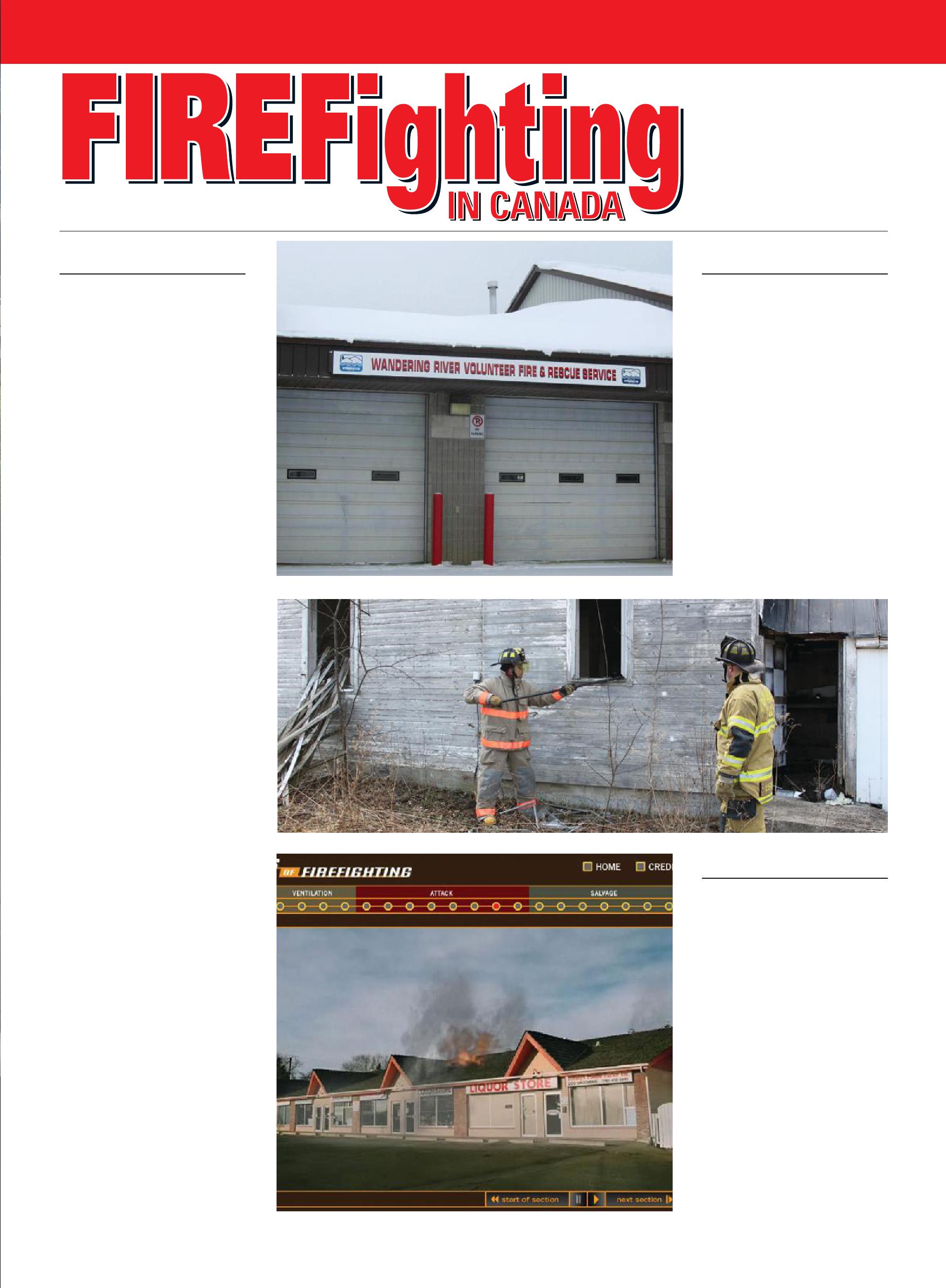
The Alberta Fire Chiefs Association has tackled recruitment and retention head on with a tool kit for chiefs and the support to implement changes and best practices. Laura King reports. 16
E-LEARNING ENTHUSIASTS
Initially skeptical, Edmonton Fire Rescue Service is on track to recoup its entire initial investment in an e-learning program that has worked wonders. By Ellen Whybrow.
24 SENIORITY VERSUS EXPERIENCE
In a personal story full of irony and introspection, Jay Shaw reflects on seniority and experience and how the words are interpreted by Canadian departments.
28 MANAGING THE MESSAGE
Canadian fire-service leaders say staying funded, equipped, staffed and ahead of the vicious circle of sacrificing something to achieve something else is the biggest challenge for fire departments. By James Careless.
BY LAURA KING Editor lking@annexweb.com
A COMMENT
R and R, Alberta style
s Canadians, we are lucky in innumerable ways. Our education and health care are the envy of much of the world. Most of our neighbourhoods are safe and our kids have incredible advantages and opportunities. We enjoy the freedom to say what we think without fear of a knock on the door in the night. We are, compared to great swaths of the world, comfortable, safe and secure.
And with that comes a set of assumptions. We assume that when we’re sick, a doctor will help to make us better. We assume that when we send our children to school, they will get an education.
And we assume that when we call 911 on what may be the worst day of our lives, someone is going to come and help.
That last assumption is fine if you live a populous area – Halifax or Lethbridge or Kelowna or Trois-Rivieres or countless others.
But if you live in a really rural area, you’d better recalibrate your assumptions.
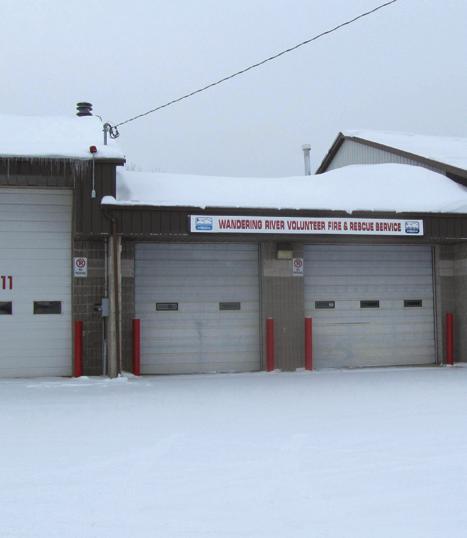
at volunteer firefighter recruitment and retention, the topic of this month’s cover story on page 10. Long before Wandering River announced its closure in June, other Alberta departments had disbanded daytime service because their volunteer firefighters weren’t available during business hours.
It doesn’t matter what industry you work in, finding the best people and then holding on to them is a challenge.
If you’re a leader in a volunteer fire department – where you have to recruit people and get them to work either for free or for a very modest stipend –those challenges are exacerbated tenfold.
PRODUCTION ARTIST KRISTA MISENER kmisener@annexweb.com
GROUP PUBLISHER MARTIN MCANULTY fire@annexweb.com
PRESIDENT MIKE FREDERICKS mfredericks@annexweb.com
PUBLICATION MAIL AGREEMENT #40065710 RETURN UNDELIVERABLE CANADIAN ADDRESSES TO CIRCULATION DEPT.
P.O. Box 530, SIMCOE, ON N3Y 4N5 e-mail: lmorrison@annexweb.com
Printed in Canada ISSN 0015–2595
CIRCULATION
e-mail: lmorrison@annexweb.com
Tel: 866-790-6070 ext. 206
Fax: 877-624-1940
Mail: P.O. Box 530 Simcoe, ON N3Y 4N5
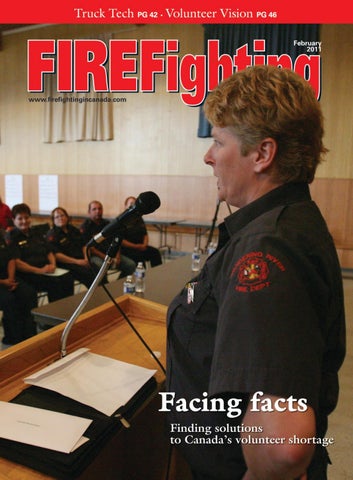
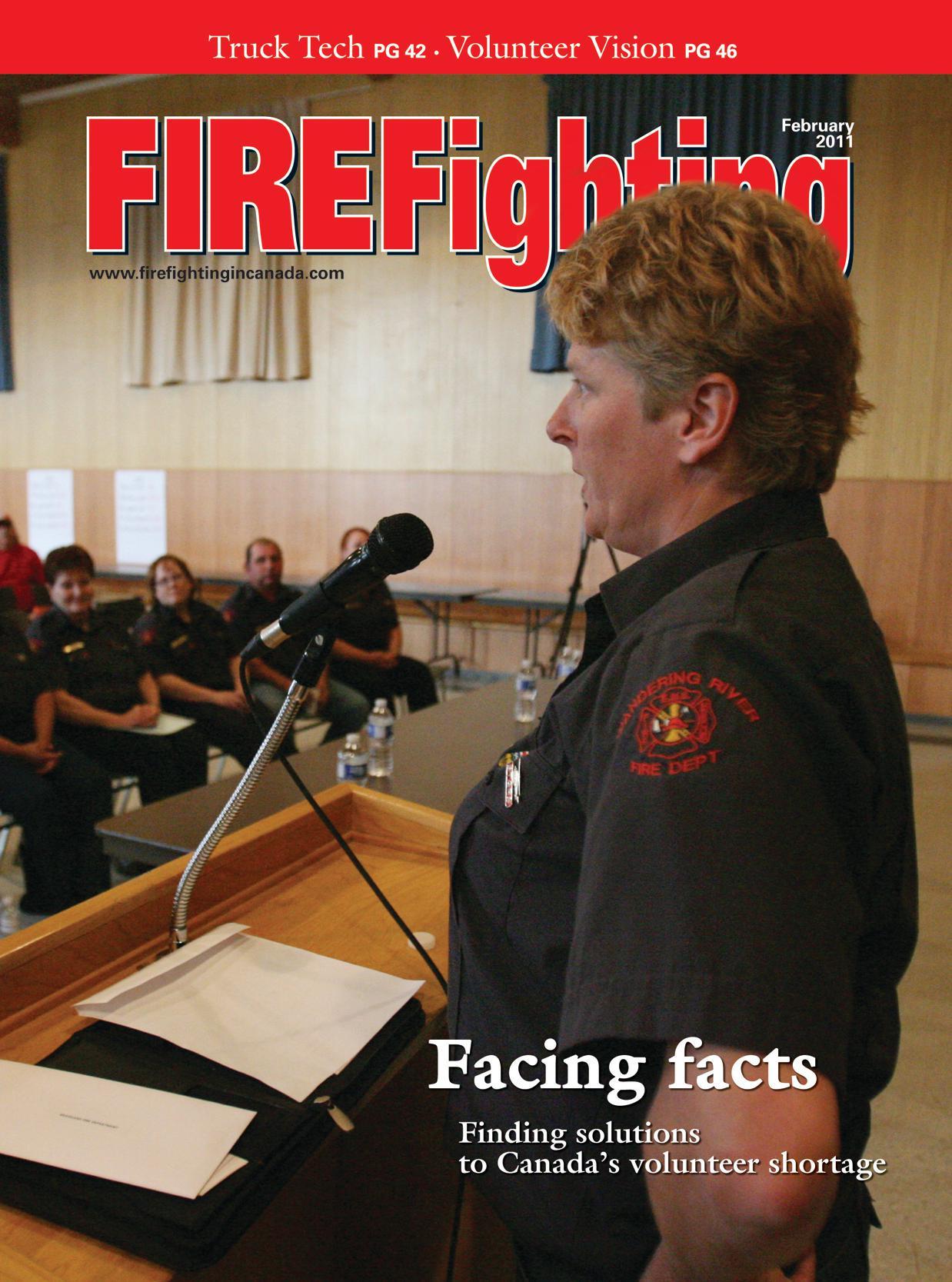
Acting Wandering River Fire Chief Sheri Johnson addresses a community meeting at which she explains why she and her staff chose to suspend service. See story page 10.
Almost everyone in the Canadian fire service knows the story of Wandering River, Alta. The tiny community on Highway 63 between Edmonton and Fort McMurray suspended emergency services last summer when the seven female volunteer firefighters became overwhelmed by the workload, and quit.
Needless to say, Wandering River is now a bad place to have the worst day of your life, a fact yet more complicated because Highway 63 is regarded as one of the most dangerous in Alberta. Crash victims now have to wait as long as 90 minutes for a response from a neighbouring jurisdiction.
The plight of departments like Wandering River was among the factors that spurred the Alberta Fire Chiefs Association to look deeply
When your small, rural, volunteer force is run off its feet, even the most minuscule and mundane task has the potential to be the straw that breaks the back of an overworked firefighter.
So, in addition to trying to help find volunteers, the Alberta association is providing departments with a tool kit of helpful templates, tips and best practices on a range of things from setting up recruitment drives to sample welcome letters to spouses of new volunteer recruits.
Canadians are right to have an expectation of security – including the expectation that pretty much wherever we are, when bad things happen, someone is going to help. Governments need to understand that their role in that equation includes supporting the men and women who answer the call as volunteers, and, even further, supporting the leadership to make it easier to recruit and retain those people.
Here’s hoping that message gets through in Alberta and – as we always hope – that the rest of the country pays heed.
SUBSCRIPTION RATES
Canada – 1 Year - $24.00
(with GST $25.20, with HST/QST $27.12) (GST - #867172652RT0001)
USA – 1 Year $40.00 USD
We acknowledge the financial support of the Government of Canada through the Canada Periodical Fund (CPF) for our publishing activities.
Occasionally, Fire Fighting in Canada will mail information on behalf of industry-related groups whose products and services we believe may be of interest to you. If you prefer not to receive this information, please contact our circulation department in any of the four ways listed above.
All advertising is subject to the publisher’s approval. Such approval does not imply any endorsement of the products or services advertised. Publisher reserves the right to refuse advertising that does not meet the standards of the publication. www.firefightingincanada.com
ON THE COVER
PHOTO BY RICK MCWILLIAM, EDMONTON JOURNAL
STATIONtoSTATION
ACROSS CANADA: Regional news briefs
Lockeport Volunteer Fire Department celebrates 130 years
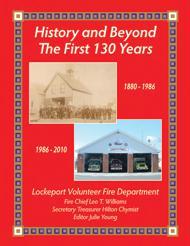
The Lockeport Volunteer Fire Department in Nova Scotia held its 130th anniversary open house during Fire Prevention Week, Oct. 7-9. Besides an open house for the community with displays, handouts, door prizes, a 50/50 draw, a slide show and demonstrations, the department launched a history book titled, History and Beyond: The First 130 Years. The 170-page book chronicles the department’s history from the time it was formed in 1880 and
features photos, emergency stories and collages.
The Lockeport Volunteer Fire Department recently celebrated its 130th anniversary, and has commemorated the department’s history in a book. History and Beyond:The First 130 Years is available for purchase through the department.
Many hours of research were required to gather information and photos from local archives, beginning in November 2009. Meetings and interviews were held with locals and past members who had information on incidents. The history commit-
P.E.I. government supports push for tax credit
Prince Edward Island is the first provincial government to call on Ottawa to provide income tax relief for volunteer firefighters.
On Nov. 18, Justice and Public Safety Minister Doug Currie moved a resolution calling on the federal government to implement the $3,000, nonrefundable income tax credit
to volunteer firefighters who have put in 200 hours of service annually. The resolution was moved and debated on Nov. 18, with 20 fire chiefs and firefighters in dress uniform viewing the proceedings from the visitors’ gallery of the legislature.
Several MLAs and cabinet ministers spoke in favour of the motion. Opposition Leader
THE BRASS POLE
Promotions & Appointments
KEN MCMULLEN has been appointed fire chief for Rocky View County in Alberta. McMullen began his firefighting career with Winnipeg Fire Paramedic Services in 1976 and has served as a technical rescue co-ordinator and a fire prevention officer, an investigator for the arson task force and a
senior captain. In 2003, McMullen became fire chief for the Town of Lincoln in Ontario. He was appointed deputy chief for the Town of Oakville in 2006 and in
Olive Crane put forth a surprise amendment to the resolution, calling on the province to lead the way on this issue and put in place a provincial income tax credit for volunteer firefighters. The government side of the house spoke in favour of amendment, with the finance minister stating that the government supports the
tee at the department – Fire Chief Leo Williams, secretary and treasurer Hilton Chymist, editor Julie Young and publisher Ulrich Johanns at Seeblick Printing – worked diligently to bring this book to reality. Sales started immediately after the launch, and all active and retired firefighters were presented with a free copy.
To purchase a copy of the book for $25, contact the department at 902-656-2927. – Julie Young
2007 became the fire chief in Tecumseh, Ont.
Two Newalta Corporation employees have joined the company’s emergency
amendment and will consider it the spring budget.
Resolutions are not binding to the government, however, most members of the legislative assembly said the tax credit resolution is likely to pass as both the government and the opposition support it and 2011 is an election year.
– Dave Rossiter
response division. ROGER BOJANOWSKI is the division’s new branch manager, with almost 20 years of experience in business and safety management in the radioactive materials sector. His work experience is supported by an environmental sciences diploma and industrial certification as a millwright. JOHN STULL –a certified hazmat technician, tank-car specialist, Canadian Emergency Management College first responder, and
New hall for Winkler Fire & Rescue
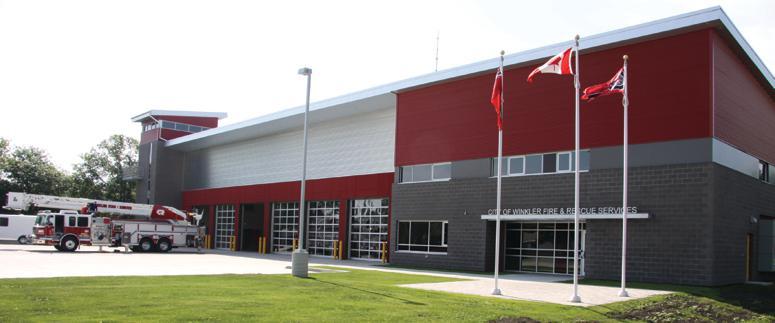
When Garry Klassen was hired as the first full-time fire chief in Winkler, Man., in 2002, it was obvious that the old downtown fire hall, built in the 1970s, had become too small.
“We were cramped for space. We had our trucks bumper to bumper and when you have that you can’t check your equipment or train properly,” Klassen says.
Construction began on the new hall in April 2009. The new station opened for business on Feb. 14, 2010, and celebrated its grand opening on June 5 with tours of the station and the apparatuses.
The priority for new building was proper traffic flow. Firefighters responding to an emergency come in the back door of the building, get their gear on, and go out the front, so there are no worries about
accidents happening as trucks leave the station.
Other priorities included more space between vehicles, a floor that drains well and is easy to clean, a water supply to each vehicle and a hose tower.
When planning for the new hall, Klassen considered both the community’s present and future needs. Besides six bays to house emergency equipment, the fire hall needed more space for classrooms and training. A key factor in
The new fire department in Winkler, Man., opened on Feb. 14, 2010, with better traffic flow and space for classrooms and training.
the design of the new building was to ensure it was built to post-disaster standards, so it would survive a major event like a tornado and remain operational in the aftermath of such an event. As part of that planning, the new fire hall also serves as the Emergency Measures Organization headquarters The building is ideally
located for quick response to fires and accidents. The site for the new hall meets NFPA regulations stipulating that response times should be about five minutes.
And of course, it wouldn’t be a fire station without a brass pole, which was brought over from the old station, “mostly for nostalgia,” Klassen says. – Winkler Fire & Rescue
Scholarship established for public safety research in B.C.
A British Columbia fire service conference, organized by the City of Surrey and the University of the Fraser Valley (UFV), raised $30,000 to support public safety research.
The symposium, called Managing highrises: A Systems Approach for the Fire Service, was held Sept. 15 at the Justice Institute of British Columbia. About 175 members of the
confined space entry and rescue specialist – is the division’s new operations supervisor. His combination of hands-on experience and extensive training are welcome capabilities.
B.C. fire service and related fields attended the conference, which promoted the use of best practices and fact-based decision making to establish systems for managing highrise incidents.
Proceeds from the symposium will be used to provide a $5,000 research grant and to establish the City of Surrey Fire Research Endowment – the first scholarship fund in British
Last Alarm
DAVID ERNEST (ERNIE) BARRETT passed away peacefully on Oct. 18 in his 97th year. Barrett was a lieutenant with the Royal Canadian Dragoons, serving in Italy and The Netherlands during the Second World War. Following the war, he joined the Office of the Ontario Fire Marshal and was principal of the Ontario Fire College from its establishment in 1949 until
Columbia that specifically supports public safety research.
Surrey Fire Chief Len Garis noted that the research funds are a natural fit with the conference, which shared the successful system Surrey developed for managing highrise fires through research by the UFV’s Centre for Public Safety and Criminal Justice Research and the John Jay College
of Criminal Justice at City University of New York.
“Research funds are hard to come by,” said Garis. “This funding creates a place to have independent, credible, thirdparty work done in terms of answering questions. It will be there forever, and as the endowment grows, so will the body of research.”
– City of Surrey
his retirement in 1977.
After a courageous battle with cancer, LARRY POWER passed away Nov. 27 in his 49th year. He was a firefighter with the Canadian Armed Forces and in 1994 joined the Hamilton Fire Department at Station 8 as a career firefighter.
Retired Deputy Fire Chief MURRAY SABADOS died suddenly on Nov. 28 in Weyburn, Sask., at the age of
55. Sabados started with the Weyburn Fire Department in 1980 and was promoted to deputy fire chief in 1993. He retired in 2005 after 25 years of service.
STATIONtoSTATION
BRIGADE NEWS: From stations across Canada
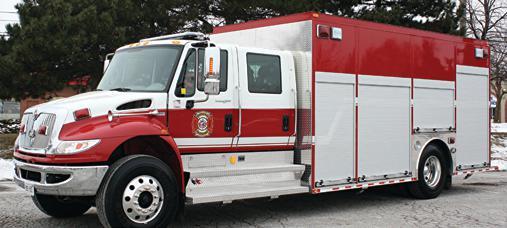
The MUNICIPALITY OF CHATHAM-KENT FIRE DEPARTMENT in Ontario took delivery in December of a Dependable Emergency Vehicles-built heavy duty walk-in rescue truck. Built on an International 4400 SBA 4X2 chassis and powered by an Allison 3000 EVS transmission and a MaxxForce 9 310-hp engine, the truck is equipped with Amdor roll-up doors, a Luma bar, Whelen Light package, FRC telescopic lights and poles, a DTAC heat and cooling system and storage for 18 SCBA bottles.
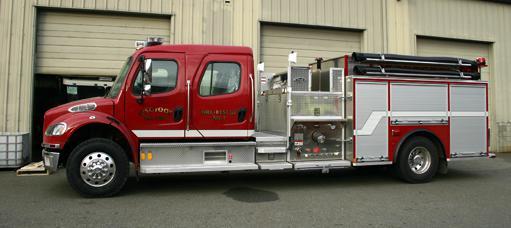
The OSOYOOS FIRE DEPARTMENT in British Columbia, under chief Rick Jones, took delivery in November of a Hub Fire Engines & Equipment-built pumper. Built on a Freightliner M2 chassis and powered by an Allison 3000 EVS transmission and a Cummins ISC 300-hp engine, the pumper is equipped with a Waterous CSC 10C 1,050-IGPM pump, a Waterous 140 SP compressedair foam system, Foam Pro 2001 foam system, a 1,000-IG co-poly water tank, Zico Electric LAS ladders, Whelen Light package, Extendalites and Waterous automatic water tank fill.
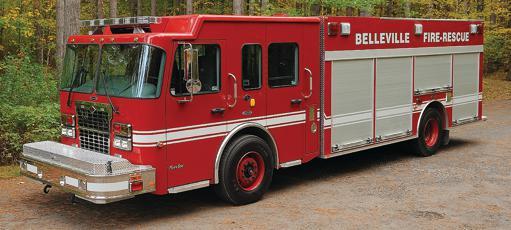
The BELLEVILLE FIRE DEPARTMENT in Ontario, under chief Rheaume Chaput, took delivery in October of an Eastway Emergency Vehicles-built rescue truck. Built on a Spartan Metro Star chassis and powered by an Allison automatic transmission and a Cummins ISC 330-hp engine, the truck is equipped with a PTO generator, Whelen LED emergency lighting, Will-Burt tower and water rescue and roof compartments.
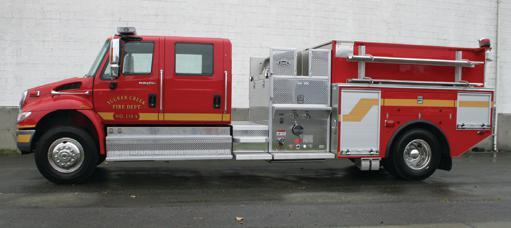
The SUCKER CREEK FIRE DEPARTMENT in Alberta, under chief Harold Willer, took delivery in October of a Hub Fire Engines & Equipment-built pumper. Built on an International 400 chassis and powered by an Allison 3000 EVS transmission and a MaxxForce 300-hp engine, the truck is equipped with a QPAK 100 840-IGPM pump, a Foam Pro 1600 foam system, a 1,000-IG co-poly water tank, Whelen Light package, Extendalites and custom storage for eight SCBA bottles.
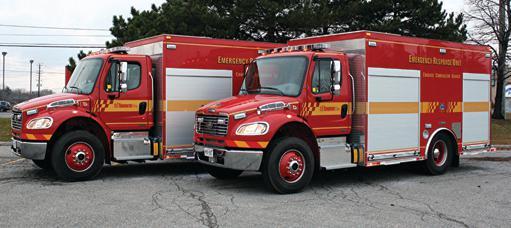
TORONTO FIRE SERVICES, under chief William Stewart, took delivery in November of two Dependable Emergency Vehicles-built Airlight trucks. Built on Freightliner M2 106 chassis and powered by Allison 3000 EVS transmissions and Cummins ISC 30-hp engines, the trucks are equipped with Hannay reels, Command lights, Harrison hydraulic generators, roll-out trays, Honda 3500 portable generators, Amdor roll-up doors, 1,200-pound rear lift gates and Whelen Light packages.
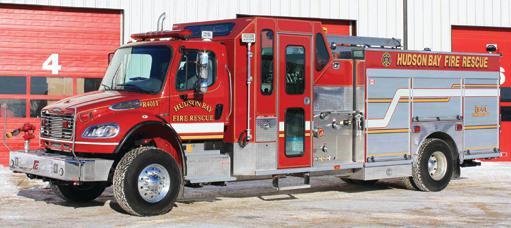
The HUDSON BAY FIRE DEPARTMENT in Saskatchewan, under chief Wayne Tchorzewski, took delivery in January of a Fort Garry Fire Trucks-built pumper. Built on a Freightliner M2 4X4 chassis and powered by an Allison 3000 EVS transmission and a Cummins ISC 330-hp engine, the pumper is equipped with a Darley PSPC 1,050-IGPM pump, a Foam Pro 2002 A/B foam system and an 800-IG co-poly water tank.
MUNICIPALITY OF CHATHAM-KENT
BELLEVILLE FIRE DEPARTMENT
OSOYOOS FIRE DEPARTMENT
THE SUCKER CREEK FIRE DEPARTMENT
TORONTO FIRE SERVICES
HUDSON BAY FIRE DEPARTMENT
Proudly Representing:
Facing facts
Alberta tackles recruitment and retention, produces model and tool kit for volunteer departments
By LAURA KING
PHOTO BY THE FIRE WITHIN
The 120-page report on firefighter recruitment and retention in Alberta begins like this: The issue of recruiting and retaining firefighters is a worldwide issue that we in the Alberta fire service were naive enough to believe wasn’t affecting us.
The report was released in May at the Alberta Fire Chiefs Association (AFCA) conference, about a month before the seven female members of the Wandering River Fire & Rescue Service in northern Alberta quit because they couldn’t keep up with the demand for their firefighting, medical and extrication services on Highway 63.
During our 2008 annual conference, our membership debated a resolution on recruitment and retention and it became evident we did have issues. It was time to stop hiding our heads in the sand and look at who and what we are when it comes to recruiting new members and keeping the old.
And so, in late 2008, the AFCA and the Alberta Emergency Management Agency delved deeply into a crisis that is strangling volunteer and composite fire departments across Canada.
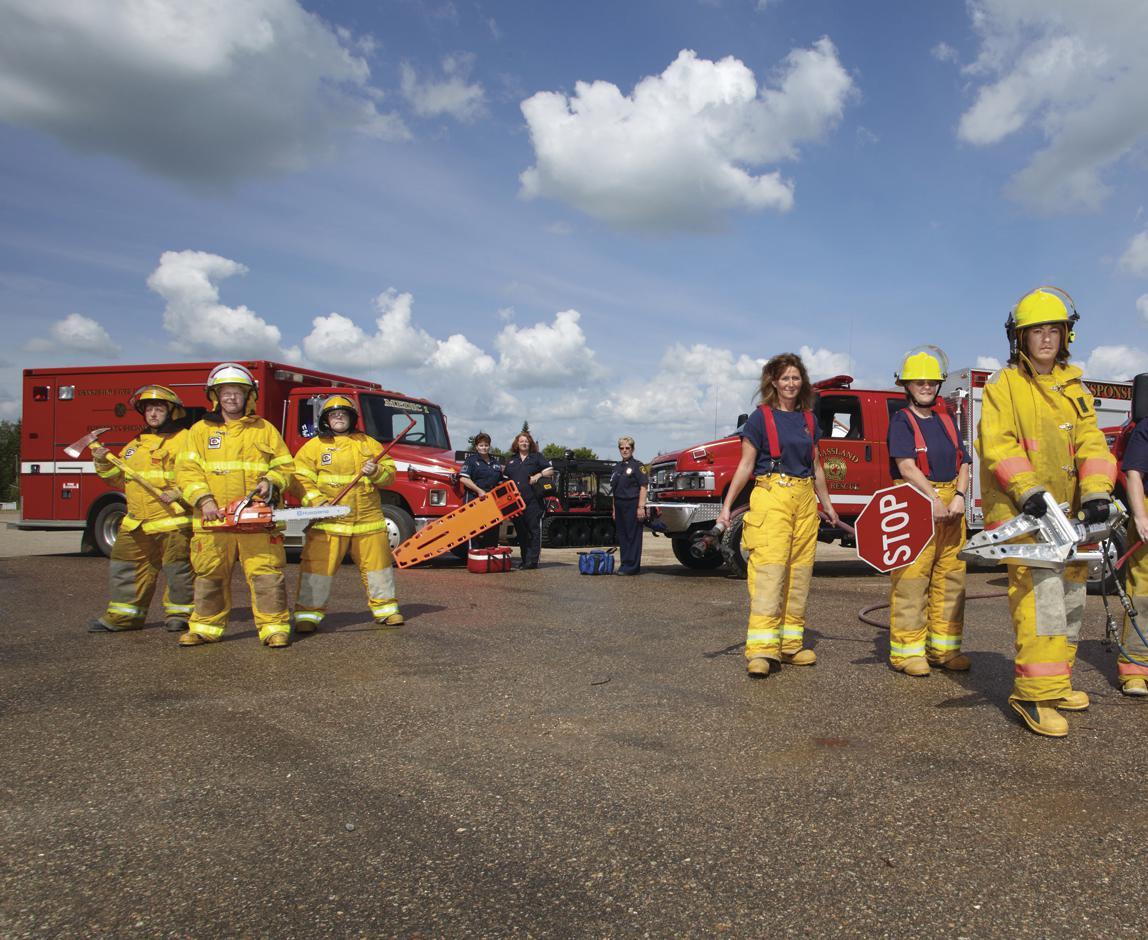
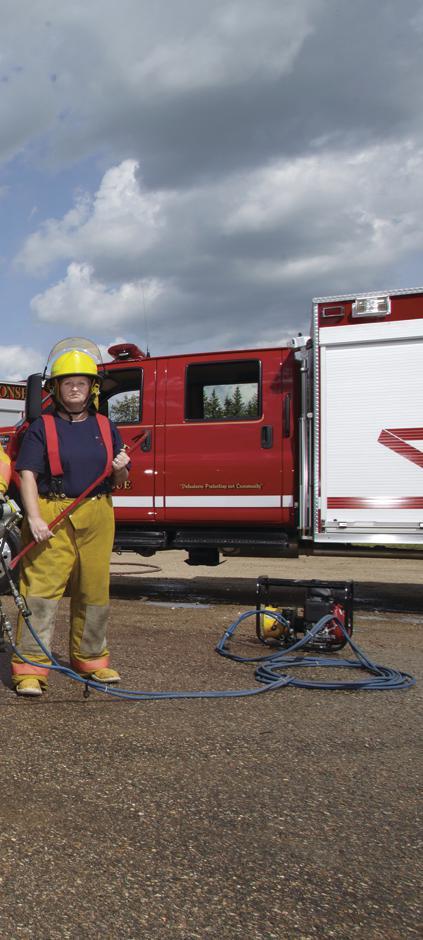
LEFT AND ABOVE : Firefighters from Grasslands (left) and Wandering River, Alta., pose for a photo for a fundraising calendar. Grasslands had responded to Wandering River’s calls but has stopped doing so due to the demand and the dangers on Highway 63. Wandering River shut down because its volunteers couldn’t meet the demand for service.
The report – and its so-called tool kit for fire chiefs – is a groundbreaking document, a model for other provinces and a think-outside-the-box package that its authors hope will restore departments like Wandering River and prevent others from similar fates.
Not all the tools are painted red and have lights and sirens but we, as innovative fire chiefs, will still see the value of the tools and we can paint it [the report] red if we need to make it work for our individual services.
The report includes 15 initiatives for fire departments to embrace, from involving current volunteer firefighters in planning formal recruitment drives to establishing childcare services and diversity policies. Each initiative comes with a series of tools and templates to provide consistency for fire chiefs and to make it easier for them to implement the recommended strategies.
Bonnyville Fire Chief Brian McEvoy was the president of the AFCA when the process began and he co-chaired the
16-member recruitment and retention working group. In perhaps the most significant outside-the-box move, the working group brought in experts on volunteering to help with the project, along with fire-service and emergency management leaders.
“Volunteer Alberta brought its expertise from working with all segments of the volunteer spectrum and were able to look at our organizations and operations without the red lights and sirens,” McEvoy said in an interview.
“They looked at us as a volunteer organization, and by looking at it that way they got a different view of it. They saw it for the raw components and they didn’t see it for the romanticized, fight-fires-save-lives type of thing.”
McEvoy admits that the relationship with Volunteer Alberta (www.volunteeralberta.ab.ca), a provincially funded, not-forprofit support agency, was tumultuous at first, but committee members worked hard to correct the misunderstandings.
“Volunteer fire fighting is probably the highest level of commitment in the volunteer world,” says McEvoy, who put things in perspective for the group by comparing members of community service groups to volunteer firefighters.
“The comment I made was the primary difference between The Kinsmen Club and a fire department staffed by volunteers is that if there aren’t enough people to hold a meeting on a Tuesday then you reschedule the meeting but you can’t reschedule a fire.
“That was a key learning component on their side that we had to get over and once we got over that, then we could look at this issue in as broad a spectrum as possible. Once they got that, they looked at the type of people we were attracting and how we could attract them.”
At first, fire chiefs in the seven AFCA regions to which members of the working group travelled to gather information were reluctant to admit there were problems with recruitment and retention. But later, as word spread about the committee, and chiefs started comparing notes and understanding the group’s objectives, the magnitude of the problem became clear.
Additionally, the committee learned that problems and solutions discussed at the original fact-finding meetings spread from chief to chief, and by the time the group got further into the process, departments in some communities had started implementing strategies discussed around the table at earlier meetings in other communities.
“In some cases, we would sit there and
everybody would say, ‘We don’t have a problem,’ until they started talking, then all of the sudden they’re saying ‘Maybe we do.’ It became quite interesting as we went through it,” McEvoy said.
For working group members, learning and accepting that the Alberta fire service is indeed mired in a recruitment and retention crisis was the first part of the project; the second part was the development of strategies for recruitment and retention of volunteer firefighters and the creation of the tool kit to help chiefs find and keep good people in their departments. This is primarily where Volunteer Alberta’s expertise prevailed.
As McEvoy explained, many volunteer groups have screening processes for their members and those members work toward goals –fundraising, community spirit or building a playground for children, for example. Setting goals promotes co-operation, drive and morale, and achieving goals results in satisfaction and pride.
“If there’s a goal and purpose they can work toward then everything’s good,” McEvoy says of firefighters. “You don’t see problems on the fire ground because everyone has a common goal. But you have problems in the fire hall.”
The solution is to provide added value for volunteer firefighters so that they see a purpose for giving up their family time and free time to train; defining and claiming that communal purpose makes volunteer firefighters want to give back to their communities.
“People look for a focus and they want a focus,” McEvoy says. “If you give it to them, things run smoothly.”
But that’s easier said than done. In many cases, says McEvoy, volunteer fire chiefs are good at putting out fires or responding to collisions but don’t have the leadership or management skills that the job now demands.
“When we move people up, we give them the position but we don’t give them the tools to do the job,” he said. “We have people who come up in the fire service that are extremely good at the response component, but that’s only about 10 per cent of the job. We’ve come a long way in Alberta developing good officer training tools and if you take a look at the departments that are thriving you will see that they have good officer training skills – that’s not just fire training, it’s training in the management components.”
Continued on page 50
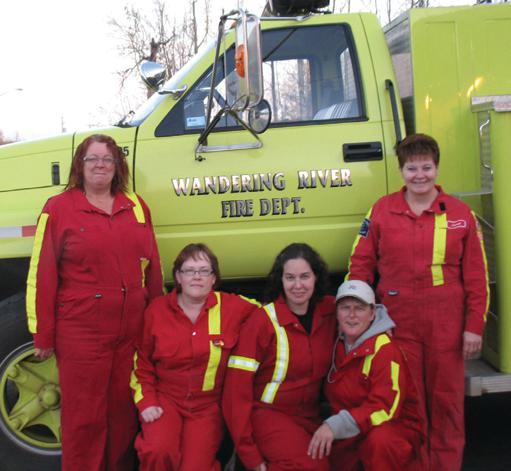
The all-female crew of the Wandering River Fire Department: Deputy Chief Maureen Hagan (left), firefighters Jennifer Batiuk and Carolyn Brucker, Acting Chief Sheri Johnson and firefighter Janet Smydmiller.
PHOTO COURTESY SHERI JOHNSON
E-learning enthusiasts
Initially skeptical, Edmonton firefighters train online and reap benefits
By ELLEN WHYBROW
The idea of using a computer as part of firefighting training was initially met with eye-rolling and statements such as, “It will never work.” This was not the warm welcome needed to incorporate change when e-learning was first proposed at Edmonton Fire Rescue Services (EFRS) in the early part of the new millennium. Fire fighting is a physical occupation, so how does e-learning fit in when the training is hands-on?
But change was needed. Everyone in the fire service is aware of the cost and scheduling challenges associated with increased training demands in a post-9/11 world. To overcome these barriers, EFRS identified the use of Internet technology and a learning management system (LMS) as a strategy to provide theoretical content and testing online. This would reduce time spent in a classroom and focus training events on practical applications. Half a decade later, EFRS is on track to recoup its entire initial investment with a program that has saved dollars while increasing practical training time.
THE PROCESS
To start, EFRS undertook a year-long process to select an LMS. The selection process included a request for proposal with 33 mandatory and 46 discretionary requirements. A blind review of the proposals between two teams narrowed 13 initial respondents down to two. These two companies went head–to-head in proof-of-concept testing, consisting of a series of interviews, a thorough product review and pilot testing of the products. In the end, EFRS chose Desire2Learn, a Canadian company from Kitchener-Waterloo, Ont.
STRATEGIES
Having great technical tools is just part of this kind of project. There was already a big barrier looming over the project; many Edmonton firefighters were concerned that Internet training would replace critical practical training events. To ensure this project had staying power, EFRS focused on four key strategies:
1. Use of project champions: While e-learning as a concept was championed by management, the success of the project had to be determined by firefighters themselves. Will they use the resources and will they like them?
To ensure firefighters’ comfort with technology, a call went out to the operations staff asking for participation in what was called an LMS support team. This consisted of eight to 10 firefighters, mostly younger staff members, who participated in training sessions covering basic tech-
nical and navigational procedures. The team then took this knowledge to fire stations throughout Edmonton. The early sessions were focused on familiarizing senior captains, who were mostly older fire rescue staff and generally less familiar with digital technologies. These sessions were later expanded to include all operational staff.
The use of project champions also included the selection of well-respected firefighters from the floor on course development projects. Their involvement provided a level of credibility to the projects and an internal stamp of approval.
“I worked as a technical advisor,” says station Capt. Dennis Hushagen. “It helped to make sure that we were concentrating on issues that were of interest to the guys. I had an opportunity to assist in identifying things that were more important or needed to be highlighted better (like safety issues) . . . And the best part of the whole thing was I got to be a movie director.”
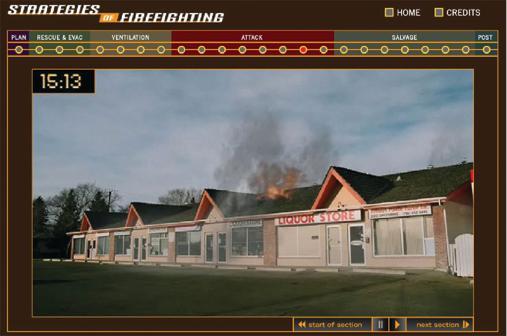
2. Key resources: The value of technology is not in itself, but whether it is used. Firefighters are obviously interested in fighting fires, particularly those that pose a challenge and danger to themselves or others. One resource was the depiction of an incident that posed a particular challenge due to the building construction and ventilation strategies required. Using a limited amount of video, pictures, a few animations showing fire growth in a contained attic, discussion questions and an audio track of radio communication at an incident, a pseudo-simulation was produced that allowed firefighters to review an incident and decision-making points relevant to tactical priorities.
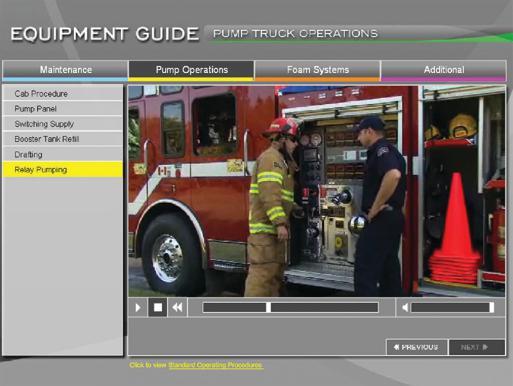
The care and operation of fire apparatuses is also very important. Apparatuses contain features that are complicated and have great impact from a servicing and response point of view. XML flash templates were used to organize flash video files accessible through a custom-
Figure 1: An online depiction of an incident that posed a challenge because of building construction and ventilation strategies worked well as firefighters were able to review the incident and decision-making points relevant to tactical priorities.
ized collapsible menu. The menus were organized around themes relevant to mechanical equipment: maintenance, operation and troubleshooting. The menu lists are customized to each vehicle. Each listing launches a flash video on relevant procedures. The template can be reused for any vehicle and virtually any piece of equipment.
“I’ve had feedback from people who have used the videos quite readily. I think also that they are programs that are flexible, so updates can be inserted into them in a quick, timely fashion,” notes Hushagen. “And to get the information out fairly readily to people, just a notice is needed to have people review the programs. It’s a good way to connect.”
3. Meeting needs: It is always important to meet learner needs. Brian Riddel, Edmonton’s hazmat training co-ordinator, expressed an interest in getting information and photos about a close call incident involving a rail car carrying the chemical styrene. From this conversation, a course site devoted to post-incident reviews was generated, allowing the posting of incident summaries. One survey comment from a firefighter notes: “I think the format is done quite well. I usually talk about the post-incident reviews with my crew. The lessons-learned section is particularly good. We have had some questions about these and their conclusions. It is a great way to get informed about what happened at a fire when you have been off last block (shift).”
4. Blending e-learning with practical learning: No one ever learned to fight a fire reading a book or watching a video. “. . . With our job environment, there has to be a practical component,” Riddel notes, “We’re hands-on people.”
Figure 2: Desire2Learn’s fire apparatuses program includes XML flash templates and flash video files accessible through a customized collapsible menu. The menus are organized around themes: maintenance, operation and troubleshooting. Each listing launches a flash video on relevant procedures.
One example of how the blend of e-learning and emergency response can work together came from training officers involved in medical education and recertification. The training officers launched a new program with required pre-study materials. All firefighters are asked to complete a pre-study portion with an online exam before a scheduled practical in-service is conducted at each fire hall. “Last year’s
recertification came at a very opportune time,” says firefighter Rob Cavell. “We had just finished our recertification online when the medical trainers came to present the latest version of CPR and any changes EFRS would be implementing. The next morning, we were just finishing our daily checks when a 911 call came in and we were dispatched to a 29E cardiac arrest. We arrived on scene first and began the CPR protocols. When EMS arrived, the process was well underway and the transition was seamless. Firefighters will most likely perform CPR many times in their career, but to have the refresher immediately before the call was definitely a bonus.”
RESULTS
Everyone wants to see results. In these days of accountability to the taxpayers, e-learning has shown substantial benefit in just four years with the following results:
• Total training days saved in 2009 alone were 605. Using a formula to calculate costs associated with taking a firefighter off shift and replacing that person ($1,334.03/day), cost avoidance1 for the year was $807,087, of which $128,067 was direct cost savings.
• Cumulative cost avoidance from 2006 to the end of 2009 was $1,499,972. Based on these data, the city will recoup its investment in the project by the end of 2010.
• High satisfaction overall with the library of resources available. Ninety-two to 95 per cent of firefighters agreed that the resources were interesting and that they would use them. EFRS management has supported the project through an increased focus on practical training. “E-learning is augmenting the practical. It can confirm or re-familiarize after the practical,” notes Hushagen. “There are also opportunities for e-learning to be an introduction prior to the practical component.”
FUTURE
After a slow beginning, e-learning is now an important resource within EFRS, and the benefits of e-learning are starting to surface.
“I was kind of a pro-practical, anti-e-learning person. I’ve been changed,” admits Riddel. “I’ve learned a lot . . . Working on certain projects, I do see a lot of value in e-learning. I see a lot of value in having a file system where if you’re looking for certain information, you just log in to a computer . . . So there is a kind of organizational advantage to it as well,” he adds.
The future of e-learning will continue to evolve as new needs emerge and new technologies become available. EFRS is now moving toward an increased emphasis on group learning and post-incident review that will further enhance teamwork and effective practices with the branch. We look forward to the next 10 years and beyond.
Ellen Whybrow has nine years’ experience as an instructional system designer in both academic and training environments.
SIZE MATTERS ! New 2186 MULTI-CUTTM
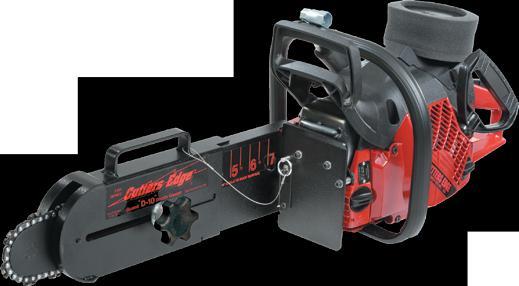
With more power than any other Fire Rescue chainsaw available and up to a 24" bar and the D-10 Guard/Depth Gauge for safety, speed and ease of use. Equipped with the BULLET® Chain that cuts safer, faster and longer than any other carbide chain made.
Gas Powered Concrete Rescue Saw
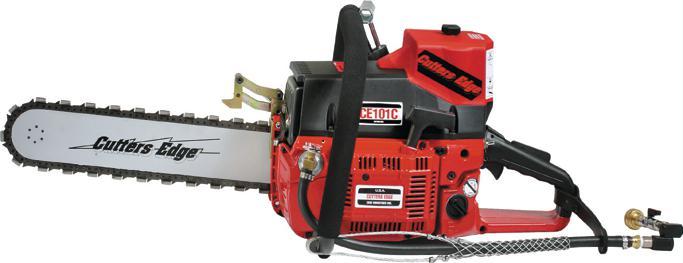
Cuts reinforced concrete up to 16-inches thick in minutes with the GCP SealPro® Diamond Chain and powerful 101cc engine. It’s fully portable, operates in any position and just one water hose needed for dust-free cutting in rescue situations.
The New Generation Rotary Saw is Here !
Rotary Rescue Saw
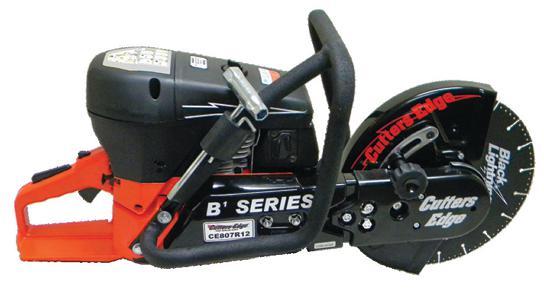
The CE807R Rotary Rescue Saw has a new, more powerful 80.7cc engine and a non-slip rubber Full-Wrap Handle for all position cutting. A new 4-Stage Air Filtration System, incorporating a High Performance K&N Filter as its third stage assures outstanding performance in all cutting conditions. Fully-equipped Sawing Kit is available plus Black Lightning and Black Star Diamond Cutting Blades.
BY TIM BECKETT Fire chief Kitchener, Ont.
ISTRAIGHTTALK
Using the tools we already have
t’s a new year, with new budgets and new challenges. And this year, we need to focus on changes, new ideas and new concepts for the fire service and the public we protect.
Many fire departments worry about getting the numbers of emergency incidents up to justify their existence. OK, maybe that’s overstating things a bit, but there is concern about justifying staffing requirements and larger budgets. What if the numbers decline? What if the numbers plateau? And what if we lived in a perfect world and had no fires? To that, I would say we have done our jobs and done them well.
In many ways, fire prevention has taken a back seat. I recall listening to fire chiefs and firefighters who were of the opinion that fire prevention would put us out of business. Further, they said, fire prevention is the area in which we accommodate firefighters who are hurt and injured. Sound archaic? Sure it does, but the problem is that there are still some people in our business who have that mindset.
The days of the fire service just showing up and fighting fires are over. We have bolstered our public education programs; we have tried to ensure that there are smoke detectors in all homes. Anyone in Canada who doesn’t know that smoke detectors are required in homes has likely been totally isolated from society. Regardless, many homes do not have working smoke detectors and far too many people die in fires – deaths that should never occur.
As fire-service professionals, we need to step up and ensure that we are enforcing the fire codes. We need to use deterrent tools such as tickets, fines and compliance orders in the same way that police enforce seatbelts and speed limits. This would mean that everyone in the fire service – from the probationary firefighter to the fire chief, and all in between – needs to be vigilant and enforce the rules.
public safety, such as automatic sprinklers in care facilities (I still believe this is one of the most effective tools to increase safety for firefighters and residents of these homes), governments have told us to start using what we already have: enforcement tools.
As fire-service professionals and leaders, we need to stop taking responsibility and assuming liability for people who fail to take the necessary steps to meet fire code requirements. We continue to install smoke alarms in residences that don’t have them, still wanting to be the good guys. Instead, people who violate these laws need to be ticketed (although we must still provide protection by installing a smoke alarm before we leave). We continue to approve fire-safety plans for buildings such as care facilities and seniors homes that may not stand up if challenged by a fire, and we refuse to close operations or buildings that are unsafe because of what people may think. By failing to take action, we accept some of the liability and responsibility.
Care facilities require fire-safety plans that identify safety measures for their staff and residents. In Ontario, fire chiefs, or their designates, have reviewed and approved many of these plans, yet many of these facilities likely do not have appropriate plans or appropriate staff on hand to properly evacuate people from the building. How many
By failing to take action, we accept some of the liability and responsibility. ‘‘ ’’
For many in the fire service, code enforcement is not popular; most of us are more comfortable being the good guys, showing up when someone is in trouble and trying to make things better. Looking back, perhaps if we had been more vigilant about code enforcement in the past, there would have been fewer fire fatalities and we wouldn’t have had to show up at all; in other words, something bad may never have happened, and people may not have died. If issuing a ticket or a compliance order results in a properly installed smoke alarm, which allows people to escape a fire without injuries or death, then that makes you a good guy in my eyes.
As the fire service continues to advocate for more tools to increase
Tim Beckett is the fire chief in Kitchener, Ont., and the president of the Ontario Association of Fire Chiefs. Contact him at Tim.Beckett@ Kitchener.ca.
chiefs out there have signed off on a fire-safety plan without considering the responsibility that goes with it? Is there sufficient staff to evacuate, and, if so, can the evacuation be completed in a reasonable amount of time? If the answer is no and you have signed off on the fire-safety plan, you are accepting the responsibility and some of the liability for the municipality, and, perhaps, personally. The fire service cannot continue to accept this responsibility.
The fire service needs to focus on fire prevention and enforcement. We need to start putting resources towards these services and ensuring that they are the core of our business. We need to consider using fire-suppression staff in fire-prevention activities. Company officers need to become more active with code enforcement and issue tickets and orders for violations. We need to start doing our jobs differently to meet our mandate of protecting the public.
Seniority versus experience
One firefighter’s story about the difference between what is learned and earned
By JAY SHAW
In December 2006, a defining event happened to my family that made me better understand the culture, brotherhood and camaraderie that exists in the Winnipeg Fire Paramedic Service. In some ways, it solidified my belief about why I chose this vocation in the first place. In other ways, it made me very aware of the perceived but invisible line between seniority and experience, and my role at that time as a very junior member of my service.
My family cottage had burned down and the newspaper headline read, “Fireman’s cabin up in smoke.” No one was injured, insurance covered the losses and the support was tremendous from all, save one detail: An overzealous reporter had tracked down my phone number and wanted a few tidbits for the story. The questions were laced with irony given that a firefighter’s second home had been destroyed by fire: How do you feel as a fire victim? Can you see the other perspective? I tried to answer respectfully and spoke about how the shock of seeing the damage was too real, even though I had been to fires before. Somehow my answers were perceived as arrogant, and the story erroneously read that I had been to “hundreds of fires.” A fouryear member of the fire service being at hundreds of fires – wow!
The backlash in the halls was swift and unkind. For the better part of two years after the article was published I was greeted by peers at every fire I went to, asking me what number this was, or “How many fires today, Shaw?” Had I crossed some line? Why the harsh criticism for something that I did not say? I had told the reporter that we go to hundreds of calls, and that I had never truly understood the loss until I stood in the charred rubble of my own cabin. Even as a rookie, my 18-month probationary period was smoother than this. A seasoned, respected veteran called me at the hall and offered his condolences on the loss of our cabin, while lecturing me on the finer points of media relations and all things related to seniority. It was apparent that the culture of our seniority/experience system did not allow for comments of this kind to be stated by someone with my limited experience.
Since that day, I have been hyper aware of my role in regard to my seniority level and experience, and I now believe that the two words are very different. Would I have faced the same criticism had I actually been to hundreds of fires, as the reporter had stated? What if I had 30 years on the job, or even 15 years, all of them at our busiest station for structure fires? Were firefighters upset that I mistakenly claimed to have had hundreds of fires under my belt, equating to tons of experience, or that I had four years on the job and not enough seniority to back up the claim? Firefighters do not like to boast or brag about accomplishments – we prefer to acknowledge
Firefighting tradition holds that senior personnel work their way up the ranks while more junior staff must pay their dues.
the whole team in calls that might have received attention. Have you ever had to buy a round because you got your picture in the paper? Most firefighters are considerably humble. Maybe it is just the Canadian in all of us to be gracious and put the team first, but I think it goes deeper than the maple leaf.
The fact is that the terms seniority and experience mean very different things, yet they are tied to one another through a system of beliefs, values and rights of passage that the fire service has embraced for decades. Seniority and experience decide almost everything in our fire service, from how we treat each other to how we are promoted. Think about your service and how the two terms are used. What do you make your junior members do that senior members do not? Who eats first in your kitchen? Who gets up to answer the phone? Who does a 12-year veteran ask when he or she has a training-related question? These questions can be answered many ways, but consider what criteria you used. Did you use seniority, merit, rank, or operational factors to decide? There are no perfect answers. The system of beliefs we honour – in which I believe and which represents our semi-military structure (the basis for the foundation of an earned respect) – correlates nicely into the teaching of discipline, span of control and unity of command. Without these lessons and foundational principles we would have chaos. However, none of this equates to experience and how we look at these two terms in relation to our culture, hiring, promotions and living in the hall with our peers. Do you as a firefighter respect the rank (seniority), or the time on the fire ground (experience) that a member has, or both? If you have seniority, do you have experience? How do you define and defend your fire department system? Does your department’s culture of seniority cross any lines or policies such as respectful workplace?
Deputy Chief Frank Lamie, a 35-year veteran currently with Toronto Fire Services, who has held many positions in his respected career, explains how he sees the difference between seniority and experience.
“I think that experience is a judgment call, so we have defaulted
PHOTO BY LAURA KING
The pecking order in Canadian fire departments is based on seniority and experience. While seniority is easily quantifiable – but not necessarily an accurate predictor of leadership abilities or skill – experience is often subjective.
to seniority as its objective. But I do agree that many members with very high seniority have very little experience due to their position and assignments when gaining that seniority. The saying goes, ‘Do you have 30 years of experience, or one year 30 times?’ I think the latter is more often the case. In operations, quiet stations offer very little experience.”
Lamie’s comments are brutally honest in a generational paradigm of fewer fires and more of everything else. This does not mean that some members with many years of service are not qualified to do their jobs, as training is the great equalizer in all operational matters. Toronto Fire Services has a six-step modular system of training and examinations for officers in operations and fire prevention. When a member has passed all six modules, then seniority is the deciding factor in standing and promotion.
Fire Chief Len Garis of the Surrey Fire Department in British Columbia says seniority and experience are different but related in many ways.
“The difference between seniority and experience is subjective. Seniority you earn from time in on the job; experience is what you get while earning your seniority. The problem is the subjective nature of experience.
“We [the Surrey Fire Department] have developed and use a great training tool to make sure our officers and firefighters have the proper balance of skills and education to perform at a high level. Our training for officers is third-party accredited, which adds credibility and a sense of pride in accomplishment.”
Chief Garis’s observation allows senior-
ity and experience to be accumulated at the same time, but there is still the issue of quantifying the differences among individual firefighters’ experiences. This issue will be harder to determine, thus we must fall back on training to level the playing field.
Too often, we equate experience with how many fires a member has fought and what a member has seen and learned from those events. Fire-service experience is bigger than this one shrinking aspect of what we do. Emergency medical services, motor vehicle collisions, specialty rescues, hazardous materials and prevention all build a collective “experience” that defines who we are and what we have accomplished in our careers. How we treat each other and how we hold one another accountable to a culture that honours our veteran firefighters is one of the most admirable qualities of this profession, as the shifting change has been from measuring firefighters’ worth by the soot on their helmets to a more balanced approach that uses judgment, as Lamie suggests. And for the record, I’ve never counted!
Jay Shaw is a nine-year member of the Winnipeg Fire Paramedic Service, and has more than 15 years’ experience in health and emergency services. He has worked in hospital emergency rooms, with rural ambulance services and with the Canadian Forces fire service. A lifelong learner, Shaw is completing graduate studies in disaster and emergency management at Royal Roads University, and has a strong passion for collaborative disaster and fire-service research. Contact him at jayshaw@mts.net
BY
PHOTO
LAURA KING
Managing the message
Organization and advocacy are keys to progress, say fire-service leaders
By JAMES CARELESS
TOP: Finding qualified and strong leadership among the next generation is one of the many challenges the Canadian fire service is experiencing. Fire-service leaders say staying funded, equipped, staffed and ahead of the vicious circle of sacrificing something to achieve something else is the biggest challenge.
Fire Fighting in Canada recently brought together seven fireservice leaders from across the country for a virtual roundtable to discuss the state of the Canadian fire service.
Tim Beckett is president of the Ontario Association of Fire Chiefs and fire chief with the City of Kitchener.
Dennis Berry is the fire marshal and director of fire and life safety for Yukon Government Community Services Protective Services Division.
Stephen Gamble is president of the Fire Chiefs Association of British Columbia, first vice-president of the
Canadian Association of Fire Chiefs (CAFC) and chief of the Port Coquitlam Fire Department.
Tim Jenkins is president of the P.E.I. Firefighters Association and a captain in the Charlottetown Fire Department.
Vince MacKenzie is the chief of the Grand Falls-Windsor Fire Department in Newfoundland and president of the Newfoundland and Labrador Association of Fire Services.
Rob Simonds is Chief of the Saint John Fire Department in New Brunswick and president of the CAFC.
Bernie Turpin is past president of the Maritime Fire Chiefs Association and
BY
PHOTO
LAURA KING
Go Beyond The Standard 1081 PLUS
administrative chief with Halifax Regional Fire and Emergency.
FFIC: WHAT IS THE BIGGEST CHALLENGE FOR THE CANADIAN FIRE SERVICE TODAY?
Turpin: As a service provider, the fire service consistently scores at the top of the list when citizens are polled on their satisfaction with the services available to them. But somehow, we haven’t convinced governments at all levels that we need adequate resources. How often are career departments targeted for budget cuts, manpower reductions or station closures? How often are volunteer department budgets cut or frozen, with the suggestion that the department must fundraise the rest?
Simonds: We need to ensure that we are clearly relevant to our constituents and our elected officials. There are a lot of issues competing for governmental and public attention. We need to make sure that our elected leaders pay as much attention to fire protection as they do other issues regarding public safety. As fire chiefs, it is our responsibility to do this, so that we are allocated the resources we need to protect the public.
Beckett: The biggest challenge that the fire service faces is the shrinking pool of available leadership. We have many great leaders in the service. However, as we continue to see an ever-increasing demand placed on the fire service, the word is that talent applying for positions is weak.
While young recruits are lining up to get into urban fire departments, recruitment and retention is a growing issue for rural departments, meaning the fire service needs to change its recruiting strategies and goals.
Get 1081 certification with a PLUS. You’ll train and test for certification, PLUS you’ll spend an extra day on site training with live fire evolutions. You not only learn how, you learn why. Advanced Exterior Industrial Fire Brigade Member certification available late spring 2011. Prepare to be Prepared www.fireacademy.unr.edu FSA is a program of the University of
Photo: Pressurized ammable liquid re ev o lution using FSA’s Process Unit Prop.
Jenkins: In the rural areas, recruitment and retention is a really big issue for volunteer departments. With an increasing number of people not working where they live, it is getting more difficult to field a volunteer fire department 24/7.
Gamble: In British Columbia, our Fire Services Liaison Group recently released a report entitled Transforming the Fire/ Rescue Service. In it, we identified a number of issues that need to be addressed. They include establishing a fire services advisory board, broadening the provincial fire commissioner’s mandate to cover all aspects of the British Columbia fire/ rescue service, standardizing training and competency standards, and addressing support training and retention for volunteer departments. The short answer is that there is no one central challenge, rather a large number of them.
Berry: While I can’t speak for the nation as a whole, I feel I can speak with some authority on those areas that are rural by nature and are served by volunteer fire departments. In this environment the challenge we are facing is an aging demo-
graphic, termed the “grey tsunami” by researchers, combined with a new generation that has a different perspective of what “volunteering” means and lifestyles that no longer have the free time previous generations had to commit to volunteer activity. This change in civic perspective is taking place within a shrinking rural population.
To compound this shift in firefighter availability (recruitment and retention), we have changes in building practices and materials that have led to hotter, faster fires, combined with increased public expectations for specialized rescue and vehicle extrication. These changes have required a corresponding increase in training and time commitment from volunteers.
MacKenzie: For the Canadian fire service as a whole, the challenge is in the sheer number of issues to be managed, to maintain adequate services while keeping pace with changing and evolving technologies, legislation, occupational health and safety, building construction and due diligence, to name a few.
This equates to finding competent and visionary leadership in all facets and ranks of the Canadian fire service, both large and small, who are aware of and can manage these issues.
Fire fighting today is so much more complex, and staying funded, equipped, staffed and ahead of the relentless Catch-
22 game of sacrificing something to achieve something else is the biggest challenge.
FFIC: DO YOU SUPPORT THE CREATION OF THE OFFICE OF A NATIONAL FIRE ADVISOR?
MacKenzie: Absolutely, without a doubt. A senior public official that would advocate for Canadian public safety with special attention the fire service is crucial to give governments insight to the challenges just mentioned. It is crucial for the government of Canada to understand and be advised on so many areas that affect public safety. The government of Canada should play a more active role in the fire service, similar to our neighbours down south, and a national fire advisor and agency is the first logical step.
Simonds: Definitely, which is why the CAFC has been advocating for this position to be created. I absolutely believe that the federal government needs to have a principal advisor on fire protection issues. We are concerned that there is no one within the inner circle of government that can speak to and advocate for fire safety.
Jenkins: Yes, I do. Anything that leads to communication between government and the Canadian fire service is a bonus.
Turpin: The creation of a national fire advisor should be high on the agenda for all fire-service personnel. Unlike police and emergency health care, there is no central repository for information that could show just how essential our service is to the citizens of the country. We need a national voice that can identify the information that will be useful to the fire industry and government, and that has the support of the
fire service to collect the data; only then will our industry be able to make its case for the things that need to change.
Berry: Yes, I support the creation of the office of a national fire advisor. A national fire advisor is the only way for fire and life safety to become recognized as a national issue with a consistent, clear and focused message.
FFIC: WHAT STEPS MUST THE CANADIAN FIRE SERVICE TAKE TO BETTER CO-ORDINATE ADVOCACY EFFORTS ON ISSUES SUCH AS RESIDENTIAL SPRINKLERS, TAX CREDITS FOR VOLUNTEER FIREFIGHTERS AND RECRUITMENT AND RETENTION CHALLENGES?
Gamble: Greater synergy between the provincial and federal fire associations. Consistent messaging. Using every opportunity to promote these initiatives whenever the fire service is in front of the media, politicians, industry, all three levels of bureaucrats in government – especially planning, building, and safety divisions –and most importantly, the public.
Beckett: The Canadian fire service needs to focus common interests with one song sheet. We have several voices, which is good, but many times, we go to the politicians with conflicting messages.
Simonds: We need to speak with one voice. The Canadian Association of Fire Chiefs is well positioned to fulfil this role, given that our directors represent every province and territory. We also cover career, volunteer and aboriginal fire departments, so the CAFC is the natural body to lobby on the fire service’s behalf.
MacKenzie: The Canadian fire service needs to create and build relationships with all stakeholders, both inside the service and outside the service, who have issues affecting the fire service and public protection. Creating a viable working environment and networking will be the most powerful tools to go forward. Co-ordinating the entire fire service together will generate better buy in from all who have issues to move forward.
Berry: Organization and advocacy of the Canadian fire service, similar to the Canadian police service, is the only way for fire and life safety issues to be brought to national, provincial and territorial and municipal attention.
FFIC: WHAT ISSUES/VALUES/ TRADITIONS ARE GETTING IN THE WAY OF PROGRESS IN THE CANADIAN FIRE SERVICE?
Turpin: Ours is an industry that is very fragmented by one of the traditions that
PHOTO BY LAURA KING
FootGear
For more information, call your local Globe dealer or Safedesign
British Colum B ia and a l B erta Guillevin
Coquitlam, British Columbia 800-667-3362
Calgary, Alberta 800-661-9227
Campbell River, British Columbia 250-287-2186
Edmonton, Alberta 800-222-6473
Fort St. John, British Columbia 250-785-3375
Kamloops, British Columbia 250-374-0044
Nanaimo, British Columbia 250-758-3362
Prince George, British Columbia 250-960-4300
Trail, British Columbia 250-364-2526
Que B e C H.Q. Distribution LaSalle, Quebec 800-905-0821
atlanti C provin C es K & D Pratt Ltd. St. John's, Newfoundland 800-563-9595
Dartmouth, Nova Scotia 800-567-1955
Saint John, New Brunswick 800-567-1955
m anito B a and s askatC hewan Trak Ventures 204-724-2281
many of our members feel is paramount to them – independence. What they don’t see is that police and emergency health have been able to use their national organizations to get the recognition they deserve.
Another problem we face is the number of firefighters who allow their pride in their department to hide the problems of the service in general. Every firefighter belongs to “the best” fire department. When we get a chance to speak with those who have influence over our destiny (voters, politicians and bureaucrats), we like to report that things are going well: we are well trained; we have the tools we need; we have good leadership; the world is turning the way it should. But this type of pride doesn’t allow people to understand that there are needs and shortcomings within the fire service.
Berry: I think the tradition of quietly doing our job without complaining is what hurts the fire service.
Beckett: The one tradition that needs to change is the lower value that we place on prevention. We put a lot of emphasis on suppression and operations, yet we fail to add the necessary resources to put strong pro-active fire prevention programs in place. We remain in our reactive state. We need to evaluate all our programs with the same rigour we do for operations.
Jenkins: We have got to do something to bring together departments in regions and provinces. In Prince Edward Island, for instance, we have some 70 different municipalities, 36 different fire departments and as many different rates for fire protection and training standards with no common correlation among them all. This just doesn’t make sense, and it certainly doesn’t lend itself to efficient mutual aid.
MacKenzie: The fire service needs to look outside of its own box and promote and market itself. All the traditional solutions have been worked and reworked. Innovation embracing a greater focus on leadership and core values must be built upon and improved. There are areas of tradition that we can build on, as the public already admires us, but fire departments have to show good value to maintain the status quo these days. The tradition of us constantly accepting doing more and more with less, and fewer resources to do it, has to stop. The federal government has a larger role to play, but the tradition of fire being solely a provincial and municipal responsibility has to be reworked.
services we perform for our communities. We need to bridge this information gap.
FFIC: WHAT WILL IT TAKE TO MAKE THE THREE LEVELS OF GOVERNMENT TREAT THE FIRE SERVICE THE SAME AS OTHER EMERGENCY AGENCIES AND ORGANIZATIONS?
Beckett: I think the issue is about competing for government dollars at the same level as police and EMS. I believe that we are treated fairly. However in Ontario, government at the regional level versus the local municipal level is much different. With police and EMS operating at the regional level, they compete for a different tax dollar – arguably, there is only one taxpayer to get this money from – than fire does.
Berry: Organization and advocacy of the Canadian fire service, similar to the Canadian police service, is the only way for fire and life safety issues to be brought to national, provincial, territorial and municipal attention.
Gamble: The government needs to fully understand what we do, the value of our service, and what the implications would be if there wasn’t a fire service in Canada – especially the cost if there weren’t people willing to do this work.
Simonds: Again, it comes back to having a co-ordinated strategy and one voice for advocating on behalf of the Canadian fire service. We need to speak with one clear, focused voice, and we need to make sure that voice is heard at the highest levels of government, which is why having a national fire advisor would help.
MacKenzie: There needs to be one solid voice coming from the provincial and territorial associations, in co-ordination with our national board, with a national and comprehensive strategy to effect real, positive change. The federal government has to have clear policy on what levels and basic rights of fire and life safety protection should be permitted to every Canadian citizen, regardless of the size of their municipality, then help fund it to achieve it for all Canadians.
877-253-9122 www.safedesign.com
Simonds: Believe it or not, there is a general lack of understanding among elected officials and the public about what the Canadian fire service does. People know we put out fires, but they don’t know all the
Turpin: All of the above, and strong leadership. We follow a hierarchy in our department structures to ensure we are all working toward the same goal and we are moving in the same direction. Until we get our act together on a national scale, we will continue to move in circles and not find the way to move ahead.
James Careless is an Ottawa-based freelance writer and frequent contributor to Fire Fighting in Canada.
Lyle Quan is the fire chief of Waterloo Fire Rescue in Ontario. He has a business degree in emergency services and a degree in adult education. Lyle is an Associate Instructor for the Ontario Fire College, Lakeland College and Dalhousie University. Contact him at thequans@sympatico.ca
•
•
•
• Rated 7,500lb Working Load
• Manual Operation
•
•
• Built in Voice Protection Unit
• Operate on Multiple Channels
TRAINER’SCORNER
Firefighter rescue preparedness
By ED BROUWER
This column is dedicated to the greatest resource in the Canadian fire services – you, the men and women who so faithfully train our firefighters. The list of skills that should be taught at the basic firefighter level can seem overwhelming. However, one skill set in particular stands out: firefighter rescue.
The rescue of a downed firefighter may have to be handled by any firefighter on scene. Let’s face it – most departments across Canada do not have the manpower for a dedicated rescue squad. So, all firefighters (regardless of their rank, responsibilities or experience) must be ready to step up to the task.
Here are the applicable standards in the rescue of a downed firefighter:
■ NFPA 1500: STANDARD FOR FIREFIGHTER
SAFETY AND HEALTH
6.5.1: The fire department shall provide personnel for the rescue of members operating at emergency incidents if the need arises.
6.5.2: The rapid intervention crew shall consist of at least two members and shall be available for rescue of a member or a team if the need arises. Rapid intervention crews shall be fully equipped with the appropriate protective clothing, protective equipment, SCBA, and any specialized rescue equipment that might be needed given the specifics of the operation underway.
■ WCB 31.23 – ENTRY INTO BUILDINGS
• When a self-contained breathing apparatus must be used to enter a building, or a similarly enclosed location, a team of at least two firefighters must make the entry.
• Effective voice communications must be maintained between firefighters inside and outside the enclosed location. During the initial attack stages of an incident, at least one firefighter must remain outside.
• A suitably equipped rescue team of at least two firefighters must be established in the scene before sending in a second entry team and not more than 10 minutes after the initial attack.
• The rescue team required by subsection (4) must not engage in any duties that limit their ability to make a prompt response to rescue an endangered firefighter while interior structural firefighting is being conducted.
In order to comply with NFPA 1500 and WCB 31.23, I suggest complete hands-on training to these standards, including the donning of full turnout gear and SCBA, more than just once a year. Try to incorporate as many obstacles as possible that may be found in an actual situation. Please do not limit your rescue to residential scenarios.
We must push for continued advancements in self-rescue and savingour-own training levels. I often conclude my column with the statement, “Train like their lives depend on it, because they do.” In other words, we dare not train to the minimum (just enough to deflect or minimize lawsuits).
I have thought of approaching the good people at MythBusters (the popular Discovery Channel program that uses science to test the validity of rumours and myths) to once and for all bust the fatal RIT myths that
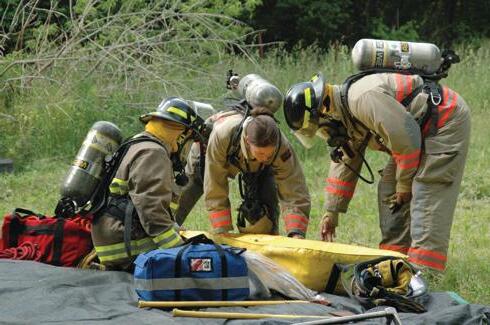
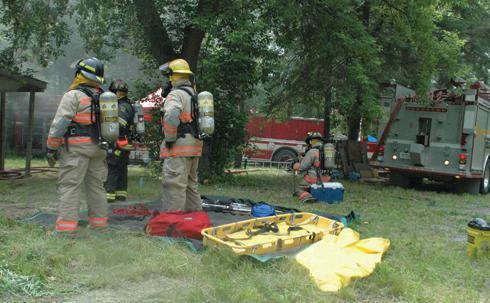
TOP: All firefighters should train on rapid intervention, as these firefighters did during a live burn exercise at Six Nations, Ont., last summer.
BOTTOM: During RIT practice, be sure crew carry a complete breathing apparatus (including harness and face piece). A downed firefighter may have damaged his regulator or face piece.
we have embraced. These myths include the notion that a rapid intervention crew can get a firefighter out using one bottle of air and the belief that a firefighter in trouble will want to be rescued. Yes, you read that correctly. It’s sad, but true. Just as someone drowning may become combatant and fight off a rescuer, there have been situations in which a firefighters in trouble will resist help. A possible cause of this may be the firefighter’s pride; a firefighter may resist even calling for help for fear of looking weak. This is mainly the fault of poor training and our portrayal of firefighters as superheroes – “first ones in, last ones out.”
However, carbon monoxide is responsible for a large percentage
PHOTOS BY LAURA KING
TRAINER’SCORNER
of accidental poisonings and deaths around the world every year, and firefighters are susceptible to carbon monoxide poisoning on the job. Firefighters may show signs and symptoms of carbon monoxide poisoning (such as headache, dizziness, weakness and disorientation), and as such, can become victims of the fire. Here’s an example: Novato, Calif., firefighter Steven Rucker may have been overcome with carbon monoxide when he died fighting the Cedar wildland fire in Wynola, Calif., on Oct. 29, 2003.
The report from the National Institute of Occupational Safety and Health concluded that “hypoxia,” a reduced amount of oxygen in the blood and tissues, explained why Rucker appeared disoriented and confused and actually started walking toward flames when ordered by his captain to retreat to the safety of a house minutes before his death.
“While (the hypoxia) findings can explain (Rucker’s) confused behavior, it is unclear why his captain and other crew members, working under similar conditions, did not experience symptoms or signs of carbon monoxide poisoning,” the federal report says.
Here are some facts regarding rapid intervention that we at Canwest have noted from our Saving Our Own hands-on training sessions.
First and foremost, rapid intervention is seldom, if ever, rapid. It takes about four minutes for rapid intervention crews to enter after mayday.
• A 3000-psi bottle gives you 16.5 to 18.5 minutes.
• It takes about six minutes to find a downed firefighter.
• It takes about 25 minutes to get two firefighters out.
• It could take 12 firefighters to rescue one downed firefighter.
• One out of five rescuers will get into trouble.
The following are the top 12 reasons why firefighters get into trouble on the fire ground. Unfortunately, these situations do not often end well.
• tunnel vision
• inadequate survival training
• inexperienced officers
• inadequate understanding of fire behaviour
• failure to recognize deteriorating conditions
• freelancing
• inadequate communication skills
• failure to control doors
• opening doors, walls, ceiling or roof without a charged hose line
• failure to maintain an escape route
• ventilating at wrong location or time
• inadequate understanding of building construction
The interesting thing about this list is that every one of these reasons could easily be addressed through proactive training. If these are the main reasons firefighters are being killed, is it not reasonable to think we should address these areas through our training programs? Perhaps you should consider using these topics as a 12-week training schedule.
I urge you to remember that there is no such thing as a “routine” fire. There is the ever-present danger of the unexpected. If there’s a natural place for Murphy’s Law to exist, it’s the fire ground. Some unexpected events include flashover, backdraft, rapid fire increase, explosion, collapse and cardiac emergency. As much as these are unexpected events we can still prepare for them by proactively preparing our members.
The rescue of a downed firefighter may be necessary due to entrapment, SCBA malfunction, injury or medical emergency, or simply because the firefighter got lost or became disoriented. No matter the reason, there are really only two kinds of victims: those who are out of air; and those who will soon be out of air. With that in mind, when you practise RIT, be sure your rapid intervention crew carries in a complete breathing apparatus (including harness and
Continued on page 48
TRUCKTECH
Small engine care
By CHRIS DENNIS
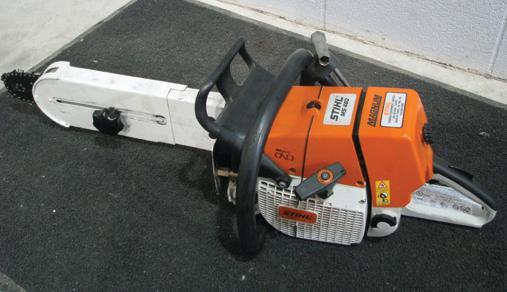
Whether your department is staffed by full-time firefighters, volunteer firefighters, or both, you likely have some small gasoline-powered equipment on your trucks – chainsaws, positive pressure fans, remote generators, portable pumps, heavy hydraulic pumps and quick-cut saws, to name a few (see photo 1).
Most of these pieces of equipment have four-stroke or simple two-stroke engines. Both types of engines have benefits and drawbacks, and both styles of engines have a place in the fire service, so there really is no such thing as a bad two-stroke or four-stroke. The application of the engine is what matters. Be sure the right engine is ordered to do the job; if the equipment power is not effective enough, it will not do the job.
■ TWO-STROKE ENGINES
Chainsaws, quick-cut saws, portable pumps and marine outboards all use two-stroke engines. They are categorized as internal combustion engines.
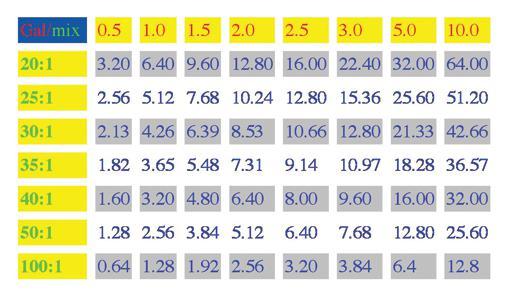
Gasoline and oil are mixed together to create a fuel mixture that is poured into the gas tank. The mixes are in ratios determined by the manufacturers, so check the owner’s manual for the correct mix of gasoline and oil.
This simple chart at the right may give you a hand in mixing the ratios. It’s a good resource for those who are unsure how to mix.
■ SIMPLE TWO-STROKE PRE-MIX ENGINES
Positives
• These engines are lightweight.
• Powerful: The spark plug is fired only once on every revolution, giving it twice the power of a four-stroke engine, which fires the spark plug every other revolution.
• No oil sump: You could have a portable water pump on a steep incline slope and it will continue to run as the fuel and oil are mixed, lubricating internal parts.
• There are fewer moving parts inside.
• These engines are less expensive because of their simple design.
Negatives
• These engines are noisy (high decibels from exhaust).
• High exhaust emissions: Not all of the fuel and oil mix is burned in the combustion chamber.
• Marine two-strokes leave an oily slick in the water of unburned oil and gas from exhaust.
• These engines have lower fuel efficiency.
• These engines are more likely to fail sooner, as they run at much higher RPMs (revolutions per minute) with very little lubrication on moving parts.
■ FOUR-STROKE ENGINES
Positives
• Oil sump to hold engine oil: this helps to lubricate more moving parts.
• No fuel and oil to mix, resulting in fewer hassles to worry
Photo 1: Chainsaws, quick-cut saws, portable pumps, and marine outboards are examples of two-stroke engines. They are categorized as internal combustion engines.
The top row represents gallons and the side bar is the fuel/ mix ratio. The numbers in the middle are ounces of oil to use.
about (mixing ratios).
• Engines are less likely to fail as the RPM curves are lower and the parts are continuously lubricated with oil.
• Low oil shutdown sensors
• Lower exhaust emissions
• Great fuel efficiency
• Quiet and smooth-running
Negatives
• Heavy
PHOTO BY CHRIS
KOCHEK® LDH Systems Your Single Source of Water Supply
• Expensive to repair
• More moving parts
• Unable to position on any angle as the oil in the sump must be in the oil pump pickup tube or it will not be lubricated. For example, if a chainsaw had a four-stroke engine, it would be difficult to keep all the moving internal parts lubricated as this piece of equipment can be used at many different angles.
Some of you will know this already, and for those who do not, welcome – you are now among the firefighters and officers who use these tools to help in life rescue and the protection of property: Murphy’s Law will strike as soon as a piece of equipment is needed, so it’s important to learn how to keep this equipment in peak shape and at operational readiness.
We all know that gasoline is less volatile in its liquid state than it is in its vapourous state. There is a difference between winter and summer gas. Summer gas is less likely to be as volatile in the colder months than it is in the warmer months due to its blending. If you do not change the gas in your small engines to winter gas from summer gasoline, the small engines will be harder to start, as the summer gas blends do not allow vapours to be as volatile. The colder the air, the less likely it is that these gas vapours will ignite in the combustion chamber. The small engines will be difficult to start in the winter with summer gas and the engines in the summer that run winter gas will run hotter, causing premature engine wear and damage. Fuel that’s stored out of season can evaporate. It can also hurt engine performance. Winter-grade fuel uses more butane as an additive; this is due to its high RVP (Reid Vapour Pressure). RVP is the vapour pressure of gas measured
Hydrant Converters
Storz Adapters Valves Storz Wrenches Storz Elbows
51K Manifold
Photo 2: This is an internal combustion engine, with more moving parts, that does not require fuel and oil to be premixed in the gas tank.
PHOTO BY CHRIS DENNIS
Best case training for worst case scenarios
The live fire training you need before you need it! Nothing prepares you for a structure fire like the real thing. Dräger Swede Survival training systems provide actual fire conditions for firefighters using Class A material. Dräger Swede Survival trainees build confidence in 5 phases of live fire training: Flashover Observation, Interior Attack, Backdraft, Garage, and Multi-Story. In Dräger Swede Survival systems, firefighters can practice Entry, Search and Rescue, Suppression and Rapid Intervention (RIT) techniques under realistic and stressful conditions. Going in prepared. With Dräger.
BY TOM DESORCY Fire Chief Hope, B.C.
AVOLUNTEERVISION
Searching out the power within
re you afraid to use the M word around your fire hall? That’s right, I’ll say it . . . motivation. The word is thrown around quite regularly in the career officer ranks, but I wonder about the volunteer fire halls. Is motivation something that you, as a career chief, work at? Do you take steps to actively motivate your volunteer firefighters? Do you feel the need to explore the theories and hierarchies of motivation or bring in speakers and coaches to keep everyone on your team pumped up?
If that’s the case, then good for you, because it seems to be harder these days to help the team stay focused. Then again, maybe you’re not doing anything at all – at least, not on purpose.
Take a look around at some the exceptional people you have on your side and tell me you’re not motivated every day. It’s no secret that we face challenges in the volunteer fire service, and these challenges make it increasingly difficult to keep our players (and their heads) in the game.
High on that list of challenges is call volume. How do members stay motivated as part of a team that doesn’t scrimmage? If you’ve played sports, you know the benefits of a lot of practice, but it sure is nice to play a real game once in a while.
The fact is that we don’t go on fire calls every day and, unlike our colleagues in many urban centres, our trucks aren’t constantly running and our people aren’t always using the gear and equipment.
Career halls respond to fires, medical calls –you name it. I would hazard a guess that engines in many career departments don’t have a chance to cool down before the next call. In many volunteer departments, not rolling out regularly makes it harder to maintain that state of readiness: therefore, it’s that much more important to use training time to cover off the little things that can easily be forgotten. It’s called fire practice for a reason, right? Those departments that don’t get a call for weeks at a time can appreciate this challenge, but how about those departments that can go years without a run? It sure makes you wonder how departments like that stay motivated, and it’s remarkable that they do.
many calls. Even the types of calls can weigh heavily on the volunteer staff. Take the overworked scenario, for example. While some departments may not get a call for a long stretch, there are some that get four or five calls in a weekend. How’s your motivation level now? Check with your member who just happens to own a business and see how he feels about leaving his store for the third time in a day. How do you motivate that individual?
Calls such as false alarms and CO detectors can also be an issue. But for chiefs of volunteer departments, simply seeing the members show up at 2 a.m. on a cold winter night for stuff like that, especially when the alarms are continually false, is motivation in itself.
That’s why I think it’s so important to look within your department. To start, think of how you can draw personal motivation from your volunteers. As a career chief of a volunteer department, I go to work every day as a firefighter. I live it and breathe it everywhere I go. I often pause and reflect on what motivates me and my volunteers. It doesn’t take long for me to realize that it’s those pressures and strains that are unique to the volunteer or rural fire services that keep me charged.
For most of us, serving small communities is a key motivator.
It’s those pressures and strains that are unique to the volunteer or rural fire services that keep me charged. ‘‘ ’’
If it’s not a lack of calls that drags down morale, it may be too
Tom DeSorcy became the first paid firefighter in his hometown of Hope, B.C., when he became fire chief in 2000. Originally a radio broadcaster, Tom’s voice could be heard in the early 1990s across Canada as one of the hosts of Country Coast to Coast. DeSorcy is married with two children, aged 27 and 19, and enjoys curling and golf. He is also very active with the Fire Chiefs’ Association of B.C., and chairs the communications and conference committees.
Have you ever considered that each and every one of your firefighters volunteers for the same reason? Think how it must feel for your crew to respond when called upon to help someone in their community. There in itself is one of the greatest motivators in a fire department. Because we are mostly located in smaller communities, we know a lot of the people we protect. When that pager goes off, someone with whom we are personally acquainted may need our help. So what if it’s that third false alarm – we know the elderly resident down the street likes to cook and tends to burn the toast a lot, or maybe she just likes to have the firefighters drop by. Regardless, chances are we’re OK with that in a small town.
Motivation comes in many different forms and it tends to sneak up on us. The key is recognizing and capitalizing on that motivation that may be unique to those of us in smaller communities.
TRAINER’SCORNER
Continued from page 40
face piece). The downed firefighter may have damaged his regulator or face piece. What you do consistently at practice will eventually be demonstrated on the fire ground.
The fire service is big on acronyms and one that comes to mind now is RC COLAS: Radio Communications and staying, Calm, Oriented, Low, Aware of Surroundings. The following is a brief outline of RC COLAS:
Radio communications: It is difficult for firefighters working inside a burning building to make tactical decisions without the input of other firefighters reporting conditions from outside. From a survival point of view, a radio may well be the one piece of equipment that makes the difference for the trapped or disoriented firefighter.
Stay calm: When confronted with danger, humans react by instinct. Our brains release chemicals (such as adrenalin) into our bodies and we go into fight-or-flight mode. I believe our basic instincts can be enhanced or empowered by repetitive training. As an example, firefighters who have repeatedly practised following a hose line out
Just
of a building are less likely to panic should they become disoriented: the higher the level of confidence, the lower the likelihood of panic should something go sideways. Lastly, but not least, it is vitally important that this confidence comes from the top down. Calm and confident leadership is absolutely crucial.
Stay oriented: A high percentage of firefighters killed inside structural fires simply got lost. Good, clear communication between the entry team and the incident commander is paramount. The information coming to the incident commander from the firefighters inside should enable the incident commander to map the progress of the firefighters as they move through the structure.
Stay low: All firefighters should know that the most severe heat and smoke conditions exist at the highest levels within a burning room. A firefighter who is suddenly exposed to high heat will have only a few seconds to think and act to safely escape the situation.
Stay aware of your surroundings: Many who are hurt or killed at interior structural fire operations were never aware of the dangerous conditions they were in until it was
the touch of a button...
too late. It is absolutely imperative that firefighters know what is going on around them.
Observations of smoke colour, density and speed, coupled with the firefighter’s understanding of basic fire behaviour, can be lifesavers. Monitoring the area around you and listening to the reports of the conditions outside your particular room can give you those few extra seconds to retreat to an area of safety.
Even in mop-up or overhaul, expect the unexpected.
In a firefighter’s world, survival is the only benchmark of success. Until next time, stay safe, and train like their lives depend on it, because they do.
Ed Brouwer is the chief instructor for Canwest Fire in Osoyoos, B.C., and Greenwood Fire and Rescue. The 21-year veteran of the fire service is also a fire warden with the B.C. Ministry of Forests, a Wildland Urban Interface fire suppression instructor/ evaluator and a fire-service chaplain. Contact Ed at ed@thefire.ca
Battalion Chief John Salka
is a veteran of the FDNY and responded to the 9/11 terror attacks. He is the author of “First In, Last Out - Leadership Lessons from the New York Fire Department” and will share some of the lessons learned after September 11, 2001.
Saturday April 9th, 2011
Doors opening at 9 a.m.
Presentations finish at 3:30 p.m.
Ilderton Community Bible Church Ilderton, Ontario
Hosted by Middlesex County Mutual Aid Association
Sunday April 10th, 2011
Doors opening at 9 a.m. Presentations finish at 3:30 p.m.
St. Anne’s Secondary School Clinton, Ontario
Hosted by Huron County Mutual Aid Association
Opening presentation by Deputy Chief Butch Cobb (retired), Jersey City Fire Department. Deputy Chief Cobb responded to the World Trade Centre as mutual aid on 9/11 and was present when the towers fell. He will share stories and lessons learned from the scene. Don’t miss this 9/11
Continued from page 12
Another issue, he said, is the disconnect between municipal administrations and their volunteer fire departments. McEvoy cites municipalities with populations of between 10,000 and 15,000 that operate volunteer fire departments but have never given their fire chiefs access to services such as human resources departments.
“When these municipalities do senior staff training, why are they not inviting the fire chief? The fire chief in a town of 8,000 to10,000 is a director or senior manager of that town. I see it all the time –these guys are not considered when the senior managers or CEOs look at doing management training for their staff.
“In one case, a town brought in a consultant to do conflict resolution training for all senior managers and the fire chief found out about it afterwards when talking to the planning director. There’s that disconnect.
“As a manager within a fire department – volunteer or composite – you’re caught between a rock and a hard place; the firefighters look at you as a senior manager and the rest of the municipal management looks at you as an annoyance.”
Chad Sartison, a volunteer firefighter and member of the working group, says the recruitment and retention report provides the first step toward a paradigm shift in the way the Canadian volunteer fire service works.
“The great conundrum surrounding this issue is that there are as many opinions on recruitment and retention as there are people talking about it. Although talk is good the Alberta study takes the talk one step further,” says Sartison, president of The Fire Within.
“This study represents government and the Alberta chiefs association coming together. It not only acknowledges the challenges facing chiefs but it arms them with hard data, not the anecdotal rhetoric that usually accompanies this discussion.
“Canada’s volunteer chiefs, however, are still on the sharp end of the spear and this study only represents a beginning. My fear is that the fire service and government has yet to undergo the tremendous contextual shift needed before studies like this can be put to good use and that ultimately will be up to the chiefs who read it.”
As for Wandering River, McEvoy expects the department will benefit from the report and the tool kit that provides those outsidethe-box ideas, strategies and mechanisms to find and keep new volunteer firefighters.
“They will be able to take some things from it – the components in our tool box on community involvement and spousal support will help them to evolve their service,” he said.
“One of the things that will go a long way in addressing the
Fort McMurray Wandering River
Edmonton 63
Recruitment and retention is a Canada-wide problem but it has been particularly evident in Alberta, where departments have closed or reduced service. Departments along the busy Highway 63 to Fort McMurray are particularly challenged.
[Wandering River] issue is better co-operation with surrounding services – getting together and looking at and developing an emergency response strategy on that Highway 63 corridor. But that requires a lot of inter-municipal co-operation and support from the provincial government and it will take some time.”
That’s exactly what Wandering River Acting Chief Sheri Johnson believes. In an interview in late January, two days before Athabasca
ISSUES IMPACTING RECRUITMENT AND RETENTION
• Employer-related – a lack of support of volunteer fire fighting by employers. Employers were especially unsupportive of the on-the-job time volunteer firefighting requires.
• Family-related – volunteer fire fighting requires a time commitment, which separates volunteer firefighters from their loved ones at unpredictable
times; being called away from work impacts family income.
• Availability of people – many people work outside the community during the day; Alberta’s transient population makes retention difficult.
• Time commitment – there are increased demands on volunteers’ time, and many different ways to spend free time – i.e.,
entertainment or with family. Codes of practice and disciplinary action for missing training are necessary, but discouraging, for firefighters.
• Perceptions and public image – people may begin volunteer fire fighting without properly understanding the role, or the overall experience; volunteer firefighters may quit after traumatic
experiences. The local reputation of the fire department also may not encourage volunteerism.
• Structural challenges – unrealistic demands from municipalities, but low funding; a lot of time taken up by administrative tasks; high turnover of volunteers.
-Recruitment & Retention, sub-committee report to the 2010 annual AFCA conference
The Northeast’sPremier Emergency Services Conference & Expo
FIRE 2011 will feature:
• Indoor and outdoor exhibits (Thursday-Saturday).
• Hundreds of exhibitors from across North America displaying a variety of fire, EMS, and rescue products.
NYSAFC Annual Conference June 15-18, 2011
Turning Stone Resort •Verona, NY
• Free One Day Tickets for entry to exhibits from vendors!
• Four days of educational workshops.
• Hands-On Training with live fire sessions.
• State-of-the-ar t venue, conveniently located just off of the NYS Thruway (I-90) at Exit 33 in central New York.
Education program includes industry leaders:
Rich Blatus • Alan Brunacini • John Buckman • Mike Ciampo
Butch Cobb • Mickey Conboy • Mike Dugan • Billy Goldfeder
Bobby Halton • Paul Hasenmeier • Michael Healy • Jay Jonas
Tim Klett • Robert LaGrow • John Lewis • Mike McEvoy
Mark McLees • Robert Moran •Jeff Pindelski • Bob Pressler
Tom Richardson •John Salka • Curt Varone • Tom Wutz
*Education Programs open to Conference Registrants only.
R AND R INITIATIVES
The report outlines several initiatives for struggling fire departments:
1. Involve current volunteer firefighters in planning formal recruitment drives.
2. Raise local awareness through traditional and new media activities.
3. Engage in local public relations.
4. Use promotional items (such as bumper stickers, hats, t-shirts, mugs, sports bags with customized messages for firefighters, spouses and families) to draw attention to how volunteer firefighters are key contributors to the community.
5. Attend trade shows.
6. Engage in regular and ongoing outreach with local employers.
7. Engage community groups regularly.
8. Reach out to recruitment audiences with targeted messages (the report provides sample messages for groups such as women and immigrant and First Nations populations).
9. Regularly engage with political stakeholders.
10. Bolster firefighter psychological support services.
11. Develop a spousal support network.
12. Establish child-care services.
13. Establish diversity policies.
14. Create firefighter service recognition awards.
15. Establish a proper volunteer screening process.
For each initiative, the report provides a series of tools, from sample key messages for target audiences to fact sheets about volunteer fire fighting for employers.
County Council was expected to formally shut down the Wandering River department, Johnson said the municipality has to take a hard look at the role of its volunteer fire department.
“Part of this has to be put on the municipality to say we’re only willing to let our fire department go to our city limits,” Johnson said “We’ve never been told that we don’t have to go further than that. Mariana Lake is 102 kilometres north of us and that’s where [the regional] boundary stops, and we have gone further than that when we’ve been asked to.”
Johnson says she and the five remaining female volunteer firefighters (three of whom plan to resign whether or not the department closes) have done the best they can to fulfil their obligations but sending two people to an extrication call on a dangerous, busy highway is simply not safe.
Meanwhile, Johnson hopes the report is a wake up call that alerts municipalities to the fact that the volunteer firefighting system needs to incorporate more regional thinking.
“We are a small community so we don’t have a base to draw from. About 65 per cent of our community is 65 and older, so if we have 200 to 300 people, we’re drawing from 100 of those available to volunteer. The other factor is that a lot of the people in this community have stood up and said we don’t want to be on this highway [as volunteer firefighters].”
The report can be downloaded from the AFCA site at www. afca.ab.ca. Click on news, then scroll down to Recruitment and Retention Final Report, July 5, 2010.
On the Web: The Redwood Meadows Fire and Emergency Services has created a recruitment and retention model that works. Story and photos by Rob Evans.
BY SEAN TRACEY Canadian Regional Manager, NFPA
ONFPAIMPACT
The need for consistent and persistent messaging
ur best hope for reducing fire fatalities lies in public education. We need to identify and change behaviour in our at-risk communities. Public education needs to be the first line of defence against fires in our community, and what better way to mitigate the impact of fires than to prevent them from occurring in the first place?
To do this, we need to have a set of consistent fire safety messages that can be delivered in every community – and not just during Fire Prevention Week. These can be delivered in the community based on a specific incident, but at the same time, these messages should be based on our understanding of proper actions for safety. The NFPA has done this through its recently released NFPA Educational Messages document (2010 edition). Fire chiefs or public affairs officials considering delivering fire-safety messages to the public should ensure that their messaging is in line with this document.
The NFPA has been involved in public safety messaging for decades and has made sure that its themes have been consistent and have targeted high-priority threats. However, experiences have refined the messages over time. The problem is that different fireand burn-safety messages can be confusing, especially to children and older adults. We need to make sure the messaging is clear, and correct.
To help eliminate this confusion, the NFPA Educational Messages document was produced. It follows a similar refinement process to an NFPA standard. The Educational Messages Advisory Committee (EMAC), a committee of public education officials, oversees the document, which can be downloaded at http://www.nfpa.org/emac.
The committee is to annually review all the NFPA’s public education messaging. The committee is chaired by Bev Gilbert, a staff member at the Office of the Ontario Fire Marshal, and the only Canadian on the committee. The committee is made up of a broad cross-section of public educators, safety experts and representatives of other associations with similar concerns to those of the NFPA. Proposed changes to the NFPA Educational Messages document can be made in writing to the EMAC; the committee members will review the submissions and vote on them.
rental units. The messages have each been viewed and vetted by the EMAC’s experts and will be updated as required with majority approval. The messages are also checked to confirm that they are in line with the NFPA standards.
As for being persistent, the fire service needs to be proactive in its messaging. We cannot just wait for Fire Prevention Week to pull out a banner and expect to see a drop in fire deaths; we need seasonal campaigns. We need to seek opportunities to deliver messages. To help, the NFPA sends out a monthly newsletter to public educators, called the NFPA Safety Source. This is an excellent reminder and identifies information and messaging resources. The NFPA has also established a network of public education advisors across North America. The aim of this group is to share best practices and each June NFPA sponsors group members’ attendance at a one-day conference ahead of the NFPA Safety Conference. Common issues are discussed and the network is there to support the members’ activities.
The preparation of the NFPA Educational Messages document is an important first step in making sure that the fire service is consistent in its messaging. Any public messaging you do should be
We need to be relentless in our messaging and seize any opportunity to remind people of the threat they face daily.
cross-referenced with this document. But more needs to be done. We need to be relentless in our messaging and seize any opportunity to remind people of the threat they face daily.
The document covers 17 topics, from smoke alarms and carbon monoxide awareness to portable fire extinguishers. For example, the chapter on smoke alarms covers issues including proper installation, testing and maintenance, replacement, persons with disabilities and
Sean Tracey, P.Eng., MIFireE, is the Canadian regional manager of the National Fire Protection Association International and formerly the Canadian Armed Forces fire marshal. Contact him at stracey@nfpa.org
To help ensure that communities have adequate resources for fire prevention and public education, the NFPA has established a committee to look at scales for the numbers of these personnel. Proponents of the standard, such as the Canadian Association of Fire Chiefs (CAFC) and the International Association of Fire Chiefs, hope that it will have a similar impact to that of NFPA 1710/1720.
The CAFC has had a committee working on a similar project for a number of months and is actively seeking involvement on the NFPA committee. Stand by for more information on this as the document is prepared over the next two years.
TRUCKTECH
Continued from page 44
at 100 F. Summer fuel may use butane, but in lower quantities. Atmospheric pressure in gasoline must have an RVP below 14.7 psi. If a fuel has an RVP greater than that, excess pressure builds up in the gas tank and the fuel could boil and evaporate. Winter-grade and summer-grade fuels should have different RVPs to protect against this.
The additives in gasoline today may also
cause another issue in small engines: The viscosity of the fuel begins to break down so its ignition point decreases, making it harder to start. Once started, the engine will not run at its full potential, causing early spark plug failure. We add gasoline fuel stabilizer to fresh fuel only, to help keep the gasoline in a better state. Adding stabilizer to already bad gas will not help as the damage is already done. Stabilizer allows the gasoline to stay together longer; however, the
The BullEx BullsEye™ digital fire extinguisher training system allows you to provide training when and where it is convenient, indoors or out — regardless of the weather. Featuring interactive laser training extinguishers, there is no need for time consuming clean-up or the expense of recharging dry chemical or CO2 extinguishers. Check out our website for grant success stories and read how other fire departments are using this innovative technology.
ignition point of the vapours still depletes. Change the gas outright.
I did my own study over two months on summer gas in a glass jar. I filled the jar half full of gasoline without stabilizer and let it sit on a bench. Over the two months, I watched the gas separate. There was actually a thick film on the bottom, and the yellow liquid above it is a product of gasoline. I am no chemist, but I can tell you from expierence that an engine using this gas wiill not start and, if left to sit in an engine, this gas will turn to a hard substance that will require dismantling the fuel system of the engine to clean it out.
Even the small rubber fuel lines on these engines can become hard and brittle if old fuel is left for long periods of time. Here’s a rule of thumb for changing the gas: When the clocks are turned an hour ahead in the spring, change the gasoline on your small engines, just as we change the batteries in smoke alarms. In the fall when the clocks are turned back and again the batteries in the smoke alarms need to be changed, replace the gasoline in the small engine. A little extra time and money now will save a lot of down time and money later.
■ SMALL ENGINE EQUIPMENT CHECKS
I will not go into detail about how to inspect all the parts of small engine equipment but I want to stress the importance of ensuring that the equipment is being checked properly. When the engine is started and run up during truck checks, don’t immediately shut it off. You might as well have rolled in the snow, jumped in a hot tub for a few moments, then gone back into the snow and stayed there without any time to warm up. Engines rarely get to warm up, so in time, they slow down and break. Firefighters responsible for the equipment will start and warm up the tools, then allow for cool down. The engine parts that have been superheated will quickly expand, and if they are not left to slowly cool down, internal damage will occur, resulting in a breakdown. In the long run, this, too, will save on untimely repairs.
Care and maintenance are a large part of keeping the equipment we have in firstclass shape. Take the time to incorporate these practices into your inspection routine and the result will be longer lasting small engines.
Chris Dennis is the chief mechanical officer for Vaughan Fire & Rescue Service in Ontario.
BACKtoBASICS
Truck company ops – ventilation
BY MARK VAN DER FEYST
Ventilation is a major component of truck company operations. Ventilation is the systematic removal of heat, smoke and unburned gases and the replacement of bad air with clean air. Ventilation allows crews to suppress the fire more quickly, and, to a certain degree, ventilation removes the intensity from the fire.
Ventilation can be accomplished in a number of ways, and depending on the situation, a team of firefighters can use one or more ventilation options. Each method has benefits and drawbacks but each can be effective for the application for which it is chosen.
One method for quickly ventilating a structure is to remove the windows. This is known as horizontal ventilation. This task can be accomplished by one firefighter on the outside of the structure. Armed with certain tools, this firefighter can be very effective in the removal of hot gases, smoke and heat. Because the firefighter is on the outside of the structure, accountability can be maintained with the incident commander or the incident safety officer.
Before any windows are removed or broken, a few important factors must be considered and a quick size-up must be performed. The size-up includes life safety, fire and smoke conditions, the structure and adjoining buildings, and the other operations that may be taking place.
■ LIFE SAFETY
• Determine where the occupants are inside the structure? Are they located between the fire and the opening?
• Identify escape routes for rescues.
• Determine the effects of ventilation on the victims inside: Will it increase or decrease their chances of survival?
• Are you venting for life?
■ FIRE AND SMOKE CONDITIONS
• Are backdraft or flashover conditions present?
• Will the opening lend to the development of the fire?
• Are you venting for fire?
■ THE FIRE BUILDING AND ADJOINING BUILDINGS
• How close are the exposures?
• Will venting create auto exposure?
• What size are the windows? They need to be a good size to allow for proper removal of smoke and hot gases and the introduction of clean air.
■ OTHER OPERATIONS
• Are search operations being conducted?
• Is the hoseline in place, ready for fire suppression?
• Will the vent opening draw the heat and smoke toward attacking crews or away from them?
• Is this a co-ordinated effort?
Knowing where the fire is located will help in selecting the window(s) to be removed. Arbitrarily breaking windows for the sake of ventilation will not work; this can (and will) lead to disastrous consequences. This information can be communicated from the interior
1. Removing the windows is a quick way to ventilate the structure. This method of ventilation allows the firefighter to stay outside the building and is a good way to maintain accountability.
Photo
PHOTOS BY MARK VAN DER FEYST
Photo 2. The firefighter avoids exposure to any smoke, hot gas or fire by turning his back to the building while swinging the roof hook to break the window.
Photo 3. It is vital to remove everything from the window, including any sashes, screens or debris. The window can act as a secondary means of egress, and any obstruction may hinder the rescue.
A Breath of Fresh Air
Celebrating 35 Years of Supplying Compressor Systems to Canadian Fire Departments
JORDAIR TECHNOLOGY: The new “FILL-KAT” (tm) linier filling station provides perfect SCBA filling profiles at any fill rate. Unlike the orifice system the fill rate is perfectly controlled at the desired rate over the complete fill. This method is the safest and least stressful to the cylinder and provides the coolest possible fill. Please contract the factory or your Jordair distributor for full information on linier filling of SCBA cylinders.
Offering: A 2 course certificate in incident command for experienced incident commanders. Please contact our office for more information.
Are you looking to take on more responsibility in your Department? Trying to round out your technical ability with leadership skills? Preparing to advance your career?
At Dalhousie University we offer a three course program, the “Certificate in Fire Service Leadership” to career and volunteer fire officers.The 3 courses Station Officer: Dealing with People,Station Officer:Dealing with New Operations and The Environment of the Fire Station are all offered in each of our 3 terms, September, January and April. The program can be completed in one year.
For more information and a program brochure please contact:
You will also find the information in our brochures or at the following internet address:Web site:http://collegeofcontinuinged.dal.ca
Jordair Compressors Inc. 101-7950 Huston Road
Delta, B.C., V4G 1C2
Tel: 604-940-8101 Fax: 604-940-8131
Web site: www.jordair.ca
BACKtoBASICS
search crews, the interior fire attack crews or the incident commander to the outside ventilation crew.
The firefighter assigned to take out the windows must be equipped with the proper tools. The location of the window dictates the type of tools needed. If a second-floor window needs to be broken, then a ground ladder or a long pike pole is required. For second-floor applications, it is safer to use a ground ladder in conjunction with a smaller hand tool than to use a long pike pole. With a long pike pole, there is a higher risk of falling glass coming down on the firefighter, although using a ground ladder takes longer than using a long pike pole.
Good tools to use for window ventilation are the pike pole (six to eight feet), the roof hook (five or six feet), an axe or a haligan. Pike poles and roof hooks allow you to reach the target without getting too close. A pike pole that’s too long prevents you from having full control of the tool; a shorter pike pole or roof hook gives you full control over the operation.
In photo 1, a firefighter is assigned to take out the ground floor window. He is equipped with a five-foot roof hook and safety glasses. As this was a training exercise, an SCBA was not worn. The firefighter in the photo is positioned to break the window with a forward chopping motion. His body is facing the window as he uses his arms to complete the movement. He is still off to one side of the window, allowing him to be protected from any expulsion of hot gases, smoke or even fire. You will also notice that he has started up high on the window and is working his way down to the bottom. This ensures that the falling glass does not become a hazard for the firefighter.
In photo 2, instructor Tim Llewellyn demonstrates another way for firefighters to position themselves to break the window without fatiguing quickly. Notice how his back is to the building; this protects him from any expulsion of smoke, hot gas or fire. Instead of using a forward chopping motion to break the window, he uses a rotational motion to swing the roof hook, keeping his arms static. Swinging the roof hook with all of his body allows him to exert more force to break the window, without tiring too quickly. Depending on the type of window, a good amount of force may be necessary to complete the task. This position forces the firefighter to stay to the side of the window, as opposed to the previous position, which allows a person to slowly creep in front of the window.
In photo 3, all the glass has been broken and removed from the window but the task is not complete until the entire window is open and clear. Y The window needs to be removed, sash and all (including the screen) to be an effective, ventilated opening and a secondary exit for firefighters. A screen on a window decreases the amount of smoke and hot gas that can exit the room. When everything is removed from the window, rake your roof hook along the sides of the window frame to ensure no sharp jagged pieces of glass are present.
Removing a window for ventilation may seem simple but firefighters need to keep in mind all the considerations mentioned above. Seize opportunities to break windows during practice sessions and work on these different positions to determine which one works best for you.
Mark van der Feyst is a 12-year veteran of the fire service. He currently works for the City of Woodstock Fire Department.
Bill Stone, Debbie Stone, Mike Stone, Joyce, Tyler
A.J. Stone Co. Ltd. has proudly served the needs of the fire/rescue and first responder services of Canada since 1972, featuring quality products, knowledgeable sales reps, and training support. A.J. Stone supplies equipment from MSA, TNT Rescue, Paratech Rescue, Akron, Kochek, Angus Fire, Marsars Ice/Water Rescue, Innotex Bunker Gear, Glove Corp., Airboss, Luminite, E.S. Safety Systems, CET and much more. We service what we sell!
Self-Heating Action Meals - nutritious meals for isolated responders. The lightweight kit contains pre-cooked meal + heater, providing hot food in minutes without matches, fire, stove, electricity. A favourite for emergencies or fires.
Mission AirBoss-Defense is specialized in the design and manufacture of firefighter boots and CBRN protective handwear, footwear and gas masks. Besides being the only Canadian manufacturer of rubber firefighter boots, AirBoss-Defense is also proud to supply defense forces and first responders worldwide.
AIR TECHNOLOGY SOLUTIONS CANADA INC.
251 Queen St. S., Ste. 512, Mississauga, ON L5M 1L7
Tel: 905-826-6682 Fax: 866-511-6904
Toll Free: 1-866-735-1480
e-mail: info@airmation.ca
website: www.airmation.ca
Randall Weber, VP Marketing & Sales, Canada Air Technology Solutions is dedicated to our Clients, offering updated, timely, full service Indoor Air Quality (IAQ) solutions. Air quality concerns are mitigated using a unique combination of professional indoor air quality assessment coupled with solutions. Off the shelf or customized site specific air cleaning equipment is available to resolve IAQ issues. Our technical experts review client requirements and budgetary availability. The finest appropriate air cleaning systems are provided. Air Technology Solutions is a leader in diesel exhaust remediation. Building and facility managers, business owners, contractors, architects, and engineers have been working with Air Technology Solutions since 1986 to resolve IAQ needs. Employee and personnel safety and health are key issues. Breathing safe air in the workplace is of utmost importance. We provide global customized solutions to control contaminants, pollutants and odours in your facility. We look forward to servicing your requirements.
Steve Robertson, P.Eng., director of canadian sales and business development
Cell Phone: 519-670-4564
District Managers: Eastern Canada - Normand Gareau; Central Canada - Ray Thompson; Western Canada - Jeff French; customer service representative Michael Kling, 330-287-7071, mkling@ akronbrass.com; Director of Canadian Sales, Steve Robertson, srobertson@akronbrass.com
AMERICAN AIRWORKS
PO Box 1000, Sophia, WV 25921-1000
Tel: 304-683-4595 Fax: 304-683-3257
Toll Free: 1-800-523-7222
e-mail: ray@americanairworks.com
website: www.americanairworks.com
Ray Lambert
HP breathing air compressors - oxygen cylinder refilling, DOT & ASME air cascade systems, BoomBox containment fill stations, air control panels, Haskel boosters - Sierra boosters, Survivair SCBA sales, service parts and Thread Saver. We also sell Circul-Air hose washers, hose dryers, respirator washers, respirator dryers, Posichek 3 SCBA flow testers and many SCBA accessories. We custom build mobile air trailers.
ARÉO-FEU/AREO-FIRE LTD.
Head Office: 5205 J.A. Bombardier Longueuil, QC J3Z 1G4
Tel: 450-651-2240 Fax: 450-651-1970
Toll Free: 1-866-426-9991 (Ontario)
e-mail: info@areo-fire.com
website: www.areo-fire.com
Tim Rafter, 613-662-3253, (Eastern + Central Ontario), Daniel Kyrodrin, (Inside Sales), Joel Jobin (Sales Director)
Committed to meeting our customers needs, we are proud to offer a wide range of top-of-the-line tools, clothing and accessories for fire fighting and emergency intervention. For over 40 years, we have continued to add new, high-quality products so that you can find everything you require under one roof.New toll free line for the province of Ontario: 1-866-426-9991Repair services on: SCBA, gas detection, portable pump, pumper trucks, aerial ladder, etc. Authorized parts and service center for: Hale, Waterous, Darley, KOEHLER
We build pumpers, tankers, rescues, rapid response and mini-pumper vehicles designed for need, built for your budget. Custom manufacturing of quality emergency and specialty vehicles for police, fire, EMS and industry. If you can dream it up - we can build it
BIERNAT FIRE INC.
1080 34e Ave., Lasalle, QC H8P 3A2
Tel: 514-595-1142 Fax: 514-595-0511
Toll Free: 1-866-595-1142
e-mail: mbiernat@ican.net
Mark Biernat, President Fire Research Corp. - www.fireresearch.com
FoamPro - www.foampro.com
Darley Pumps - www.darley.com
Will-Burt - www.will-burt.com
Trident - www.tridentdirect.com
PhosChek - www.phoschek.com
Thuemling - www.thuemling.com
AWG - Fittings - www.awg-fire.com
NewMar - www.newmarpower.com
SmartPower - www.smartpower.com
C-MAX FIRE SOLUTIONS
3044 Sawmill Rd., St. Jacobs, ON N0B 2N0
Tel: 519-664-3796 Fax: 519-664-3624
e-mail: fireinfo@c-max.ca website: www.c-max.ca
Clare Weber, President; Kathy Falkenberg, Sales & Service
Canadian family owned and operated business that offers a higher standard of service and sales for all your Fire Apparatus needs. C-Max Fire Solutions offers 24 Hour service from EVT Technicians with fully stocked service trucks. We offer pump testing and repairs to all makes and models. We offer ground ladder testing as per NFPA 1932. We are also Ontario’s factory sales and service centre for KME Fire Apparatus.
CANADIAN SAFETY EQUIPMENT INC.
2465 Cawthra Rd., Unit 114, Mississauga, ON L5A 3P2
Ross Humphry, Rory Hunt, Steve Rittenhouse, Scott Gamble, Chris Hamilton, Chris Moore
We supply SCBAs, Thermal Cameras, Auto Extrication, CAF Systems, Fall Protection, Bunker Gear, Fire Hose, Communications Equipment, Nozzles, Fittings, Hazmat Suits, Ventilation Fans, Gas Detectors, Confined Space Rescue Equipment, High Angle Rescue Equipment, Boots and Gloves. Everything for Fire Fighting and Confined Space Rescue.
We are a Canadian based company and we manufacture a full line of fire apparatus which includes aerial ladders, pumpers, tankers and rescue units. We provide parts and other related products.
CARRIER CENTERS
6 Edmondson Street, Brantford, ON N3T 5N3
Tel: 519-720-1113 Fax: 519-752-0370
Toll Free: 1-866-896-3588
e-mail: evinfo@carriercenters.ca
website: www.carriercenters.ca
Paul Martin
Carrier Centers is proud to be the E-ONE fire apparatus dealer for Ontario and Atlantic Canada. When you need full-service for all makes and models of mission critical vehicles including parts, mobile on-site pump testing, aerial inspection, refurbishing, collision repair and more, make Carrier Centers your first choice to help your department keep your community safe. For sales, parts, and service inquiries please call 1-866-896-3588. For information regarding additional offerings including heavy trucks, walk-in vans, lease and rental, reefers and air conditioning, and body shop services, visit us online at www.carriercenters.ca
CODE 4 FIRE & RESCUE INC.
26 Oneida St., PO Box 1297, Hagersville, ON N0A 1H0
Tel: 905-768-9254 Fax: 905-487-1517
Toll Free: 1-800-387-2286
e-mail: chris@code4.com
OR linda-nbbpai@nbnet.nb.ca website: www.code4.com
Chris Christie, Linda Patterson
Please call Linda at 1-800-665-4900 for all your Hurst Extrication needs! Service, sales and training. Proudly serving those who serve others.
COMPAIR CANADA
871 Cranberry Court, Oakville, ON L6L 6J7
Tel: 905-847-0688 Fax: 905-847-8124
e-mail: info@compair.ca website: www.compair.ca
Chris Brohman, General Manager
Compair Mako manufactures, sells and services a complete range of breathing air systems. This includes compressors, air storage systems and containment fill stations.
Accept only the best portable pumps, skid units, CAFS, foam trailer, glider kit, water tank, brush truck and fire apparatus. A century of engineering for the bravest!
Command Light manufactures elevating, lighting towers that have been tested to -40 and to 90 mph wind. Command Light . . . see what you’ve been missing.
CUTTERS EDGE
PO Box 846, 3855 23rd Street, Baker City, OR 97814
Tel: 541-524-9999 Fax: 541-524-9996
Toll Free: 1-800-433-3716
e-mail: info@cuttersedge.com
website: www.cuttersedge.com
Thomas Ruzich
Manufacturers of The MULTI-CUT fire rescue saw with patented BULLET Chain, concrete cutting chainsaw with diamond chain and a rotary rescue saw with choice of black star diamond blade, the longest lasting diamond blade or the black lightning blade, the fastest cutting diamond blade available.
COMMERCIAL
SOLUTIONS INC.
4203-95 St., Edmonton, AB T6E 5R6
Toll Free: 1-877-301-FIRE (3473)
e-mail: fireservices@csinet.ca
website: www.commercialsolutions.ca
Troy Mutch, National Fire Services Manager
CIRCUL-AIR CORP.
350 Pfingsten Rd., Ste. 105, Northbrook, IL 60062
Tel: 847-480-9600 Fax: 847-480-9900
Toll Free: 1-800-795-1150
website: www.circul-air-corp.com
Circul-Air Corp. has been manufacturing hose washers, hose and turnout gear dryers and hose storage racks since 1940.
Commercial Solutions is the proud distributor of a full line of firefighting products and equipment including Morning Pride and the Fit-5. With branches across Canada, Commercial Solutions also provides working solutions for companies in the oilfield, manufacturing, industrial and natural resource sectors with a broad range of industrial, bearing and power transmission, field, survey, fall protection and safety products.
DALEX CANADA INC.
157 Adesso Drive, Concord, ON L4K 3C3
Tel: 905-738-2070 Fax: 905-738-6610
Toll Free: 1-800-387-3507
e-mail: equipment@dalex.ca
website: www.dalex.ca
Ashlynn McConvey
Milnor Gear Guardian Washer-Extractors with programmable wash formulas for decontaminating fire fighting gear. Prolong your gear’s life and save on cleaning costs. Come and check out our approved turnout gear drying cabinets.
DALHOUSIE UNIVERSITY COLLEGE OF CONTINUING EDUCATION
John Darch, Susan Miller, Todd Finnie IGNITE THE PASSION, CREATE THE CONFIDENCE Darch Fire is the premier dealer for fire and emergency vehicles and equipment in Ontario. Darch Fire is the Ontario dealer for Pierce Manufacturing. The Pierce product line includes pumpers, rescues, aerials, tankers and specialized response vehicles. Darch Fire is also the dealer in Ontario for Holmatro rescue tools. Darch Fire provides sales, service, parts and support for the Holmatro line of products. Other product lines available include fire hose, foam, self contained CAFS systems, nozzles, monitors, hand tools, porta-tanks, flashlights, equipment mounting brackets, etc. You can trust the Darch Fire fleet services team to keep your fire apparatus up and running and well maintained. In-house and mobile service available. The parts team at Darch Fire can access most parts for most makes and models of fire apparatus in service today.
Design & manufacture custom fire pumpers, rescues, tankers, aerials, haz-mat, air-lighting units, minis, EMS & police support vehicles & equipment. Collision and restoration estimates, complete on-site vehicle collision and restoration, large custom paint shop. Apparatus repairs and MTO certification. Spartan Dealer, Freightliner, Sterling, International, Kenworth, Peterbilt, Mack, Ford, General Motors chassis. Sales. Service and parts for Hale, Darley and Waterous pumps. Extensive parts inventory. Sales and repairs of all makes of Emergency lighting, hose, nozzles and fire related equipment. Friendly, courteous and knowledgeable one stop shopping for fire apparatus and related equipment since 1975. CANADIAN DEALER FOR:
Draeger Tubes detect over 500 different gases. Our gas Analyzer CMS combines high accuracy with simplicity and flexibility. Portable and fixed gas detection are available for many toxic and combustible gases. Draeger’s respiratory line ranges from half mask cartridge respirators to SCBAs. We also specialize in Confined Space Training Trailer, the Live Fire Training Systems, the Swede Survival Flashover Systems and Submarine Escape Devices.
DUPONT PERSONAL PROTECTION
PO Box 2200, Streetsville, Mississauga, ON L5M 2H3
Lorne Strachan, Erhardt Schumann, Robert Hebert, Dan Guitar, Rose Santia
DuPont is a global science company, which develops high performance materials and technologies that make a difference in people’s lives. DuPont Personal Protection is a world leader in the area of workplace safety, offering consultation services and some of the best known brands in protective apparel, including Nomex , Kevlar , Tyvek , Tychem and ProShield. / Registered trademark/trademark of E.I. du Pont de Nemours and Company. DuPont Canada is a licensee.
Developer of the SafeTsystem. A complete compressed air cylinder storage and handling system for SCBA cylinders and O2 cylinders. Providing safe, secure, apparatus and station storage, as well as providing safe, efficient manual handling capabilities. Canadian Manufacturers Representative for Reverse Control. The safest backing system available, providing direct communication between your apparatus driver and their spotter. Canadian Manufacturers Representative for the Luminite. The portable, inflatable emergency scene light tower. Canadian Manufacturers Representative for the Click-Mate. The universal SCBA thread adaptor for compressor fill stations. Canadian Manufacturers Representative for the Air Bandit. Wildland firefighting filter bandana for quick and comfortable respiratory protection.
E-ONE, INC.
1601 S.W. 37th Ave., Ocala, FL 34474
Tel: 352-237-1122 Fax: 352-237-1151
e-mail: info@e-one.com website: www.e-one.com
CANADIAN DEALERS Manitoba, Northwestern Ontario & Nunavut:Carriere Fire & Safety, Craig Warren, 369 Archibald St., Winnipeg, MB R2J 0W6 Tel: 204-233-3737, Fax: 204-237-7675; B.C., Alberta: First Truck Centre Vancouver Inc., 18688 96th Avenue, Surrey, BC V4N 3P9, Tel: 604-888-1424; Ontario and Atlantic Canada: Carrier Centers, Paul Martin, 6 Edmondson St., Brantford, ON N3T 5N3, Tel: 519-720-1113; Quebec: Techno Feu Inc., Robert Traversy, Jacques Boisvert, 105 route Marie-Victorin, St. Francois du Lac, QC J0G 1M0, Tel: 450-568-2777, Fax: 450-568-0211.
FDM SOFTWARE
113 - 949 West 3rd St., North Vancouver, BC V7P 3P7
Tel: 604-986-9941 Fax: 604-986-7130
Toll Free: 1-800-986-9941
e-mail: info@fdmsoft.com
website: www.fdmsoft.com
Lynne Boucher
With over 20 years experience and 120 installations serving hundreds of jurisdictions throughout North America, FDM Software is a market leader in Fire/ EMS enterprise solutions. The company provides powerful and flexible Records Management (RMS), Computer-Aided Dispatch (CAD), mapping and analysis solutions that help save lives and protect property across the continent. The FDM advantage is that our solutions are entirely customizable to meet your agency’s business requirements. You get the best of both worlds with a complete off-the-shelf application and the option to modify everything from the structure and the appearance to the behavior of the software.Based in North Vancouver, BC, FDM also has offices in Ontario, Canada and Missouri, Utah and Washington State, USA.
Neil Greene, Bill Lowry, Greg Rivers, Luc Thibault Eastway Emergency Vehicles designs and manufactures fire apparatus for both major urban centers and small volunteer fire departments. Each unit is built with the same attention to detail, ensuring quality, strength and durability. Complete product lines of pumpers, tankers, rescue, wildland and hazmat vehicles are available. Design work is done using 3D Solid modeling. All manufacturing is done at our Ottawa facility. ULC certified annual pump tests. Used fire trucks are available, each with factory certification and warranty. Collision repairs and refurbs are performed with quick turn around, thus minimizing vehicle down time. Financing is available with competitive rates and flexible payment terms. Eastway Emergency Vehicles is proud to be celebrating 42 years as a 100% Canadian family owned and operated business.
FEDERAL SIGNAL CORPORATION
2645 Federal Signal Dr., University Park, IL 60466
Headquartered in University Park, IL, Federal Signal Corporation’s Safety and Security Systems Group is a leader in enhancing public safety, security and well-being in communities around the world. Total-system solutions from Federal Signal help law enforcement, fire rescue and EMS, and emergency management leaders protect people, property and the environment every day. Canadian Dealers: FIDES Marketing, Tel: 514-426-5262 Fax 514-426-1982
FIRE ENGINEERING BOOKS & VIDEOS
1421 S. Sheridan Road, Tulsa, OK 74112
Tel: 918-831-9421
Fax: 918-831-9555
Toll Free: 1-800-752-9764
e-mail: BookMarketing@pennwell.com
website: www.FireEngineeringBooks.com
Janie Green, Marketing Coordinator. Fire Engineering Books & Videos, a division of PennWell Corp., is your leading source for fire service training materials. We publish a variety of books and videos in areas including Strategy & Tactics, Management, Career Advancement, Technical Rescue, Training, Risk Management, and more. We also produce videos and DVDs to enhance your training. Quantity discounts available.
FIRE FIGHTING IN CANADA/CANADIAN FIREFIGHTER/EMS QUARTERLY
Advertising Manager, Catherine Connolly Editor, Laura King
FIRE-DEX, INC.
780 South Progress Dr., Medina, OH 44256
Tel: 330-723-0000 Fax: 330-723-0035
Toll Free: 1-877-347-3339
e-mail: info@firedex.com
website: www.firedex.com
Fire-Dex is a quality manufacturer of head-to-toe protective firefighting clothing and emergency response apparel. We manufacture a full line of NFPA compliant structural turnout gear. Our turnout product line features FX Gear, custom turnout gear, Express Gear, and Chieftain turnout gear. FX Gear is custom gear with enhanced features such as a seamless collar, ergonomic leg, and DexFlex elbows, knees and back. Fire-Dex custom gear is available in a style and size to meet your needs. Express gear is available in five models and ships in five days or less. Fire-Dex also manufactures two models of NFPA compliant ParaDex EMS gear, Chieftain Wildland gear, USAR and Extrication Gear. We are now proud to also offer athletic-styled leather fire boots and rubber boots in addition to our gloves, hoods, helmets and gear bags.
Firehall Book Store, a division of Annex Publishing & Printing Inc.
PO Box 530, 105 Donly Drive S., Simcoe, ON N3Y 4N5
Manufacturer of: A. Medical Bags First Responder, Airway Management, Oxygen, Backpacks. Features: Bags totally washable for bloodborne pathogen in minutes. Toughest bags with life cycles up to 15 years. B. Firefighter Bags Turnout Gear, RIT, SCBA, HiRise Hose, Hydrant Tool Bags.More products on our website - visit www.firetechmfg.com
Catherine Connolly, Advertising Manager Firehall.com provides an excellent forum for exchange among firefighters and others involved in the fire service. Advertising options include banner ads and e-blasts and offer extensive exposure to the rank and file.
Since 1989, Firecom has been privileged to provide hearing protection and communication systems that enhance safety and productivity of first responders. Firecom s wireless headset system is the industry standard and the proven wireless solution when performing critical, life-saving services. Visit www.firecom.com
Canada s Premier facility dedicated exclusively to providing the best in bunker gear cleaning, assessing, decontamination and repair. NFPA 1851:2008 compliant, ISO 9001: 2000 registered, ETL verified for all fabric repairs and all moisture barrier repairs. Locations: Calgary, Toronto, Detroit, Montreal.
FIRST TRUCK CENTRE 18688 96th Ave., Surrey, BC V4N 3P9
First Truck Centre is your dealer for BC, AB, YT & NWT for E-One, a full line dealer for parts and service. Pumpers, Rescues, Aerials, Haz-Mat & Tankers.
FISHER’S REGALIA & UNIFORM ACCOUTREMENTS CO. LTD.
1 King St., Unit 8, Barrie, ON L4N 6B5 Tel: 705-720-2294 Fax: 705-720-2274
Custom fit dress uniforms and everything that goes with them. Shop online at www.fishersregalia.com
Proudly serving those who serve for 36 years.
FORT GARRY FIRE TRUCKS LTD.
2521 Inkster Blvd., Winnipeg, MB R3C 2E6
Tel: 204-594-3473 Fax: 204-694-3230
Toll Free: 1-800-565-3473 Ext. 2006
e-mail: jcodling@fgft.ca website: www.fgft.com
John Codling
Fort Garry Fire Trucks offers a complete line of quality fire apparatus, including pumpers, tankers, rescues and aerial ladders.
FP2 (Ingenious Software)
1423 Park St., Nelson, BC V1L 2H7
250-352-9495 206-350-7750
Toll Free: 1-866-352-9495
e-mail: fp2@fp2.ca website: www.fp2.ca
Jeremy Murphy
FP2 is powerful, flexible, cost-effective software that can manage every aspect of your Department. Integrated reports, accessible user interface and responsive client support make your life easier. Affordable price that won t break your budget! FP2 comes standard with the incident reporting tools appropriate to your province, lots of end-user customization tools and a complete service/support package.You’ll wonder how you lived without it, and go home early for a change. Ask us about the New FP2 today!
FSI NORTH AMERICA,
A Division of Fire Safety International Inc. 311 Abbe Road, Sheffield Lake, OH 44054
Full line supplier of mobile, portable & fixed hazmat decon showers, shelters, field hospitals, surge capacity systems and accessories. Also offer rescue boats, PPV fans, and EMS supplies such as the FSI Transporter Disposable Backboards, triage tape, FSI medical Field Cots and mortuary supplies. Ask us about our new line of blast mitigation products.
GLOBE MANUFACTURING COMPANY, LLC
37 Loudon Rd., Pittsfield, NH 3263
Tel: 603-435-8323 Fax: 603-435-6388
Toll Free: 1-800-232-8323
e-mail: info@globefiresuits.com
website: www.globefiresuits.com
Stephanie McQuade
Problem: Your current turnout gear restricts your performance. It’s physiology. When you move your arms to work in front of you or raise them up to work above you, you need more length across your back and more length under your arms or else your movements will be restricted. Our AXTION back with full-length expansion pleats and AXTION sleeve with pleats and darts on the front and back of each sleeve allows unrestricted movement with or without an SCBA and produces minimum coat rise when you reach up. Globe Firefighter Suits - Turning out the world’s best.
Groeneveld specifies and designs automatic greasing systems for all types of equipment. We are committed to after sales service, training and support across North America within our global network. Groeneveld helps you save time and money. Our proven system reduces downtime, improves efficiency and extends component life.
HASTINGS BRASS FOUNDRY LTD.
236 Clark Dr., Vancouver, BC V5L 3H3
Tel: 604-253-2811
Fax: 604-253-3133
Toll Free: 1-800-653-2811
e-mail: hasbra@telus.net
website: www.hasbra.com
Robert Worner
HASBRA FIREFIGHTING EQUIPMENT - Serving the Firefighting Community Through Quality Distributors Since 1916. ISO 9001-2000
HEARTZAP SERVICES INC.
751 Main St. E., North Bay, ON P1B 1C2
Fax: 866-253-3915
Toll Free: 1-866-764-8488
e-mail: sales@heartzap.ca
website: www.heartzap.ca
Ray Snow
HeartZAP Services Inc. is a private authorized Canada wide Nasco, Simulaids & ZOLL distributor. We are one of Canada s leading medical supply distributors for emergency medical and industrial first aid and also offer a full line of health & safety products, including AEDs and emergency equipment. We provide courses through our training division, Ready 4 Rescue, in first aid, CPR/AED, and many other specialty training programs. We offer health care training equipment for emergency response organizations ranging from very basic simulators for teaching CPR to highly advanced full bodied computerized simulators for training paramedics and nurses in a variety of skills.
Manufacturer of hydraulic, pneumatic and manually operated rescue equipment.
HUB FIRE ENGINES & EQUIPMENT LTD.
PO Box 10, 3175 McCallum Rd., Abbotsford, BC V2T 6Z4
Tel: 604-859-3124 Fax: 604-859-5821
Toll Free: 1-888-611-2896
e-mail: info@hubfire.com website: www.hubfire.com
Sales: Harvey Goodwin Parts: Linda Welsh
Canada’s oldest fire apparatus manufacturer with a full parts facility and on site mobile service.
INDUSTRIAL SCIENTIFIC CORPORATION
Unit 1A, 153 Pembina Road, Sherwood Park, AB T8H 0B9
Tel: 780-467-2423 Fax: 780-467-2105
e-mail: info@indsci.com
website: www.indsci.com
Industrial Scientific Corporation is a global leader in designing, manufacturing, selling and servicing gas monitoring instruments, systems and related products. With continuous improvements in engineering and R&D, lean manufacturing operations and expanded service capabilities, Industrial Scientific is widely known for providing rugged, dependable products that excel in monitoring hazardous gases in the most demanding work environments in the world.
INNOTEX
275 Gouin St., PO Box 2980, Richmond, QC J0B 2H0
Tel: 819-826-5971 Fax: 819-826-5195
Toll Free: 1-888-821-3121
e-mail: mike.mondoux@innotex.ca
website: www.innotex.ca
Mike Mondoux
INNOTEX INC. is a North American leader in the development, manufacturing and distribution of high quality Firefighter Suits. INNOTEX; Protection Through Innovation.
JORDAIR COMPRESSORS INC.
101-7950 Huston Road, Delta, BC V4G 1C2
Tel: 604-940-8101 Fax: 604-940-8131
Toll Free: 1-800-940-8101
e-mail: info@jordair.ca
website: www.jordair.ca
Sean Rowand
Exclusive Bauer agent for Canada. New Fire-Kat Systems for 2006. Factory certified Jordair/Bauer training course offered. NFPA 1901 Fill Systems. ISO 9001-2000.
JUNKYARD DOG INDUSTRIES
440 Horsham Road, Stes. 4 & 5, Horsham, PA 19044
Tel: 267-803-1440 Fax: 267-803-4447
Toll Free: 1-800-574-8228
e-mail: jydinfo@cavtel.net
website: www.junkyarddogindustries.com
John K. Evans/ Susan Franke
Keeping It Simple - Junkyard Dog Industries
ZStrut and XTend Rescue Strut Systems and the SideWinder Rescue Stabilization Jack are the easiest and most affordable products used by rescuers worldwide. See our line of fire, rescue and EMS products online including equipment bags or find your local dealer.
The JIBC is a world leader in education and training. Renowned for our hands-on, simulation-based educational approach, we offer courses and programs ranging from firefighter pre-employment training to a Bachelor of Fire and Safety Studies. Let us help you take your career to a new level!
K&D PRATT GROUP INC.
55 Akerley Blvd., Burnside Park, Dartmouth, NS B3B 1M3
Tel: 902-468-1955 Fax: 902-468-6756
Toll Free: 1-800-567-1955
e-mail: peter.cardoulis@kdpratt.com OR gary.bolt@ kdpratt.com
website: www.kdpratt.com
Peter Cardoulis
Branches: Nova Scotia 55 Akerley Blvd., Dartmouth, NS B3B 1M3 Tel: 902-468-1955 Toll Free Within NS: 1-800-567-1955 Fax: 902-468-6756
Contact: Gary Bolt e-mail: gary.bolt@kdpratt.com Newfoundland 126 Glencoe Dr., Mount Pearl, NL A1N 4P7 Tel: 709-722-5690 Toll Free: 1-800-563-9595
Contact: Wade Parsons, Peter Cardoulis e-mail: peter.cardoulis@kdpratt.com
K&D Pratt represents numerous manufacturers and suppliers operating in all facets of the fire industry and delivers products, services and training that meet the needs of industrial, municipal and offshore clients in many varied and diverse situations. The products available include: municipal and industrial fire response vehicles, self-contained breathing apparatus supply and certified repair, workplace preparation products, fire fighting and rescue equipment, municipal and industrial fire hose, forest fire fighting equipment, breathing air compressors, interior hose cabinets and accessories, complete line of fire fighting protective equipment, engineered and pre-engineered fire control system design and Installation fully supported with our on-site technical and services division.
KENWOOD ELECTRONICS CANADA INC. 6070 Kestrel Road, Mississauga, ON L5T 1S8
Kenwood provides Mission Critical and comprehensive radio communication solutions to government, public safety, utility and commercial enterprises. A worldwide provider of mobile and portable transceivers and custom turnkey trunking systems in Analog and Digital (including NEXEDGE & P25) formats. Kenwood’s enhanced portfolio of ancillary products include a complete line of Accessories, Mobile Video Surveillance Cameras and Recorders, GPS receivers, AVL & Text Messaging software. For detailed information on all Kenwood voice and data communication products call 1-800-775-0148 ext. 312 or visit www.kenwoood.ca and http://nexedge.kenwood.com
KIDDE CANADA INC. Angus Fire Division
340 Four Valley Drive, Vaughan, ON L4K 5Z1
Tel: 905-695-6060 Fax: 905-660-4670
Toll Free: 1-800-667-0423
website: www.kiddecanada.com
Contact Us: Western Canada Sales: Gary Darling ext 6261 (Gary.Darling@kiddecanada.com), Ontario, Manitoba & Atlantic Sales: Jeremy Laviolette ext 6075 (Jeremy.Laviolette@kiddecanada.com), Quebec Sales: Marcel Demers ext 6264 (Marcel.Demers@kiddecanada.com), Business Support and Information: Mike Calderone ext 6070 (Mike.Calderone@kiddecanada.com), Inside Sales & Customer Service: Barry Coldwell ext 6245 (Barry.Coldwell@kiddecanada,com).
The legacy of Angus Fire goes back over 200 years. Tradition, combined with innovation has allowed Angus to become the world leader in the manufacture of fire fighting equipment.Canada s first choice in high quality hoses and foam products, the Angus Fire brand offers performance second-to-none, while Kidde Canada s sales and technical support team ensure the legendary Angus Fire service level is maintained to the highest industry standards.
INC.
3131 Autumn Hill Crescent, Burlington, ON L7M 1Z3
Tel: 416-948-6124 Fax: 905-592-1999
Cell: 416-948-6124
e-mail: lkenyon@kochek.com
website: www.kochek.com
Laura Kenyon, Regional Sales Manager
At Kochek, we take pride in manufacturing only the finest quality strainers, fittings, adapters, suction hose systems and other specialty equipment to meet a wide variety of water transfer needs. Our Canadian warehouse is now well stocked to expedite shipments across the country. Laura Kenyon looks forward to the opportunity to assist your industry or fire department in protecting the lives and homes in your community. For more information about Kochek products contact Laura and please remember to check our website regularly for new information being added to help you in your fight against fires.
KS SIRENS INC.
1978 Windsor Road, Kelowna, BC V1Y 4R5
Tel: 250-712-1127 Fax: 888-456-1677
KNOX COMPANY
1601 W. Deer Valley Rd., Phoenix, AZ 85027
Tel: 623-687-2300 Fax: 623-687-2283
Toll Free: 1-800-552-5669
e-mail: info@knoxbox.com website: www.knoxbox.com
Cynthia Jones, Mktg. Communications Mgr. The KNOX-BOX Rapid Entry System is a complete emergency access system operated with a high security master key. Fire departments in North America have been depending on Knox key boxes, vaults, cabinets, key switches and padlocks since 1975. Other products include locking FDC plugs and caps for protecting water based fire protection systems.
Toll Free: 1-800-456-0811
e-mail: firemed@kssirens.com
website: www.kssirens.com
Selina Stephens
Specializing in custom fire and medical patches, pins, reflective custom tees, insignias, medical and fire bags, retirement awards and first aid gifts and collectibles.
KUSSMAUL ELECTRONICS CO., INC.
170 Cherry Avenue, West Sayville, NY 11796-1221
Tel: 631-567-0314 Fax: 631-567-5826
e-mail: sales@kussmaul.com
web site: www.kussmaul.com
Michael F. Guzman, Tom Nugent
LABELNET INC.
Unit 6, Suite 232, 250 Dundas St. S., Cambridge, ON N1R 8A8
High Definition Woven Patches and Insignia that you can actually read! We also produce traditional embroidered patches, crests, crested hats, epaulette rank striped slip-ons. Colourful, durable, reasonable!
Since 1959, Lakeland College Emergency Training Centre has set the standard for firefighting instruction. Today we provide a wide range of emergency services training, including medical, disaster preparation and more to people throughout Canada and beyond. Visit www.lakelandcollege.ca for details.
LAMBTON COLLEGE FIRE AND EMERGENCY RESPONSE TRAINING CENTRE
Visit our website: www.lambton.on.ca/fertc We offer short-term courses in: industrial and municipal fire fighting hazmat - awareness, operations, technician, technician refresher, tank car specialist levels gasoline tanker rollover confined space entry/rescue incident management custom training to meet specific client needs. We also offer certificate and diploma programs.
KOCHEK CO.,
LEVITT-SAFETY LIMITED,
2872 Bristol Circle, Oakville, ON L6H 5T5
Tel: 905-829-3668 Fax: 905-829-2919
Toll Free: 1-888-453-8488
website: www.levitt-safety.com
Levitt-Safety has over 75 years of experience and expertise in the fire and safety industry. We offer a wide variety of products and services emphasizing our unwavering commitment to the protection of fire fighters. Depend on us to ensure your department stays safe and efficient.
LOCUTION SYSTEMS, INC.
1626 Cote Blvd., Ste. 325, Golden, CO 80401
Tel: 303-932-0014 Fax: 303-384-9014
e-mail: info@locution.com
website: www.locution.com
Offering automated 911 dispatching for Fire & EMS; automated zoned dispatching & fire station alerting technologies. Versions for radio & IP-based version for fire stations. Serving small, medium & large public safety departments in Canada and the United States.
M&L SUPPLY
14935 County Road 2, PO Box 269, Ingleside, ON K0C 1M0
At M&L Supply, Fire & Safety, we pride ourselves in being able to offer our customers top quality products and exceptional customer service. We are a team of 9 Sales Representatives knowledgeable about the equipment we sell and experienced in their use in real life situations. As part of our commitment to customer service, M&L Supply is proud to offer five certified technicians and three service trailers for the service and repair of Amkus Extrication Equipment and Task Force Tips Nozzles, Cutters Edge, Bullard, Snap Tite, Chemguard, Honeywell as well as sales and service for Scott AirPaks. We are also pleased to provide quantitative fit testing to assist departments in meeting the requirements of their individual respiratory protection programs. Check us out on the web at www.mnlsupply.com and find out what we can do for you. YOU FIGHT WHAT EVERYONE FEARS, WE SUPPLY THE TOOLS
MDG FOG GENERATORS LTD.
10301 avenue Pelletier, Montreal, QC H1H 3R2
Tel: 514-272-6040 Fax: 514-722-3229
e-mail: info@mdgfog.com
website: www.mdgfog.com
MDG is globally recognized in the industry as the leader in fog/smoke production. We design and manufacture a wide range of the most reliable Fog/ Smoke Generators and customized Systems since 1980. Our Generators produce a safe and non-toxic fog/smoke. MDG’s products will improve the realism and quality of the training you provide. Products: MAX series, SINGLE/DUAL Series, Professional Modular Fog System and accessories.
MEDTRONIC OF CANADA LTD.
99 Hereford St., Brampton, ON L6Y 0R3
Fax: 1-866-430-6115
Toll Free: 1-888-879-0977
website: www.physio-control.com
For more than 50 years Physio-Control, Inc., maker of renowned LIFEPAK® defibrillators, has been developing technologies and designing devices that are legendary among first response professionals, clinical care providers and citizens everywhere. Our defibrillators set the standard upon which an entire industry was built. From the beginning, our product development was customer-driven. It still is. With over 650,000 LIFEPAK® external defibrillators in operation worldwide, Physio-Control is the global leader in external defibrillation. For more information, please call 1-888-879-0977
e-mail lifepakcanada@medtronic.com or go to www.physio-control.com.
METALFAB LTD.
847 Central St., Centreville, NB E7K 2E8
Tel: 506-276-4551 Fax: 506-276-3648
Toll Free: 1-800-561-0012
e-mail: rastacey@metalfabfiretrucks.com
website: www.metalfabfiretrucks.com
Ryan A. Stacey, CET, Sales & Marketing Manager Manufacturer of fire department pumpers, tankers and rescue vehicles. Serving all of Canada and the Northern New England states.
METZ FIRE AND RESCUE
3-304 Stone Rd. W., Guelph ON N1G 4W4
Tel: 519-763-9955 Fax: 519-763-6682
e-mail: john.metz@sympatico.ca
John Metz
MICMAC FIRE & SAFETY LIMITED
121 Ilsley Ave., Unit K, Dartmouth, NS B3B 1S4
Tel: 902-468-6060 Fax: 902-468-9090
Toll Free: 1-800-667-3030
e-mail: sales@micmacfs.com
website: www.micmacfs.com
Henk Engels
Paul Campbell, Government of Canada Inside/ Outside Sales; Roland LeBlanc, Walter Wilson, Outside Sales, NS; Emile O Brien, Andre Grandmaison, Carla & Jim Brown, Outside Sales, NB; Steve Collette, Outside Sales, PE, NS; Dwayne Young, Doug Wilson, Inside Sales; Henk Engels, Steve Rogers, Pierce Fire Apparatus Specialists; Bernie Ryan, Shipping/Receiving; Denis Ward, Branch Mgr., NL; Jim Peddle, Inside/Outside Sales, NL; Trent Powell, NL; Trent MacLean, Andre Grandmaison, Sales & Service Specialists for Holmatro & Scott Health & Safety for NS, NB, PE. Micmac Fire & Safety Ltd. has been located in Burnside Industrial Park in Dartmouth, Nova Scotia since 1984. We provide products to Fire Departments, Hazmat Teams, Government, EMS and Police Departments, etc. We presently have a staff of over 20 people and service all of Atlantic Canada. Most of our knowledgeable representatives have over 25 years experience in the fire & safety business.
MIDWEST FIRE
PO Box 524, 901 Commerce Road, Luverne, MN 56156
Tel: 507-283-9141
Toll Free: 1-800-344-2059
e-mail: tlmwf@iw.net
website: www.MidwestFire.com
Tom Leckband
Midwest Fire specializes in manufacturing Tankers (Tenders) and Tanker-Pumpers for fire departments world-wide. We are based in Luverne, MN - the heart of the midwest and North America. Since 1987, we ve been in the business of serving one specific purpose: MOVING water for Fire Fighters like you. We don’t claim to be all things to all people, but we are proud of the reputation we’ve built by our commitment to being the best in everything that we do. Midwest Fire We specialize in MOVING water.
MINE SAFETY APPLIANCES COMPANY
5535 Eglinton Ave. W., Ste. 222, Toronto, ON M9C 5K5
Tel: 416-620-2533 Fax: 416-620-9697
Toll Free: 1-800-MSA-2222
e-mail: info@msanet.com
website: www.msafire.com
Kerin Sparks
Established in 1914, MSA is a global leader in the development, manufacture and supply of sophisticated safety products that protect people’s health and safety. Sophisticated safety products typically integrate any combination of electronics, mechanical systems and advanced materials to protect users against hazardous or life-threatening situations. The company’s comprehensive line of products is used by workers around the world in the fire service, homeland security, construction and other industries, as well as the military. Principal products include self-contained breathing apparatus, gas masks, gas detection instruments, head protection, respirators and thermal imaging cameras. The company also provides a broad range of consumer and contractor safety products through retail channels. These products are marketed and sold under the MSA Safety Works brand. MSA has annual sales of approximately $914 million, manufacturing operations throughout the United States and Europe, and more than 40 international locations. Additional information is available on the company’s Website at www.msanet.com.
NFPA
c/o Firehall BookStore, PO Box 530, 105 Donly Dr. S., Simcoe, ON N3Y 4N5 Tel: 519-429-3006 Fax: 1-877-624-1940
Northline s strong core of experienced people will respond to customer needs and understand the market that we provide our product to. Northline is a Canadian based manufacturing facility offering: LDH hardware, suction hose, strainers, Storz adapters, threaded fittings and dry fire hydrant products. Please contact us with questions that you may have. We value your commitment to Northline products and look forward to working with you.
Buy Motorola online - Radios, Batteries, Pagers, Headsets, and Speaker Microphones. www.NovaCommunications.com proudly supports fire departments across Canada.
Nova Communications Engineering and Service are able to support: Two-Way Radio and Paging Systems, Satellite & Cellular Phones, GPS Tracking, Rugged and Handheld Computers, Towers, UPS systems, Wireless Data, Mobile Video. Please contact us at www.NovaCommunications.com or call 1-877-721-7070.
NOVA SCOTIA FIREFIGHTERS SCHOOL
48 Powder Mill Rd., Waverley, NS B2R 1E9
Tel: 902-861-3823
Fax: 902-860-0255 or Toll Free: 1-866-399-FIRE (3473)
Providing high quality training for emergency responders for over 40 years. We offer a full range of courses to meet all of your training requirements. We are distributors of IFSTA, Brady, Pennwell, Delmar, Action Training and Sling Link products.
ONSPOT OF NORTH AMERICA, INC.
555 Lordship Blvd., Stratford, CT 06615-7124
Tel: 203-377-0777 Fax: 203-380-0441
Toll Free: 1-800-766-7768
e-mail: onspot@onspot.com website: www.onspot.com
Patrick D. Freyer, President
This system permanently fastens to the vehicle’s rear suspension and allows the operator to engage and disengage tire chains at the flip of a dashboard switch without stopping, to enhance traction and braking in forward or reverse.
ONTARIO FIRE TRUCK INC.
1397 Old Hwy. 99, Dundas, ON L9H 5E3
Tel: 905-628-3324, Cell: 905-577-3471
Fax: 905-627-0521
Toll Free: 1-800-474-6698
e-mail: sales@ontariofiretruck.com
website: www.ontariofiretruck.com
Wayne Robillard, Earl Lewis, Jason Lewis, Jacqueline Robillard
Ontario Fire Truck Inc. is Ontario’s first choice for fire apparatus service & sales. We are your first and only call for fire apparatus service, sales & testing! We offer you the finest repairs in the industry; we offer a 24 hour, seven days a week service. All of our service staff is fully licensed Class A & T both provincially and EVT certified. We are fully insured and have over 30 years experience combined to provide the best service at your location. Our fully stocked mobile service trucks travel all over Ontario! Why take your truck anywhere, we come to you for both service and testing! Your test site or our mobile pump test trailer, our sales staff has over 60 years combined experience in the fire industry, we offer only the finest fire apparatus, and our company believes only the best will do! We are the authorized sales and service company for many fire apparatus and equipment companies. The bitterness of poor quality remains, long after the sweetness of low price is forgotten
PIERCE MANUFACTURING
PO Box 2017, Appleton, WI 54912-2017
Tel: 920-832-3231
Fax: 920-832-3084
website: www.piercemfg.com
Pierce Manufacturing Inc., a subsidiary of Oshkosh Truck Corporation (NYSE: OSK), is the leading North American manufacturer of custom fire apparatus. Products include custom and commercial pumpers, aerials, rescue trucks, wildland trucks, mini-pumpers, elliptical tankers, and homeland security apparatus. In addition, Pierce designs its own foam systems and was the first company to introduce the Side Roll Protection System to fire apparatus. To learn more about Pierce, visit http://www.piercemfg.com
POK OF NORTH AMERICA INC.
500 Henry Street, Cambridge, MD 21613
Tel: 410-901-9900 Fax: 410-901-9160
e-mail: info@pokfire.com website: www.pokfire.com
Pete Karlson
PPE SOLUTIONS
INC
Bunker Gear & More!
PPE SOLUTIONS INC.
1585 Josephine Dr., Val Caron, ON P3N 1N2
Fax: 1-877-999-0316
Toll Free: 1-888-999-0316
e-mail: info@PPES.ca
website: www.PPES.ca
Daryl Kretzschmar; Steve Proctor, Kevin Lochner, Helen Kelly, George Valade
A leading provider of protective apparel and equipment to the Ontario fire service. Browse, order or request a price quote online at www.PPES.ca
ROM CORPORATION
6800 E 163rd St., Belton, MO 64012-5463
Tel: 816-318-8000 Fax: 816-318-8100
Toll Free: 1-800-827-3692
e-mail: sales@romcorp.com
website: www.romcorp.com/fire
Steve Touchton
PATCHMAN, THE
PO Box 995, Onoway, AB T0E 1V0
Toll Free: 1-866-672-4033
e-mail: patchman@xplornet.com
website: www.thepatchman.ca
Scott Williams
HI VIZ Experts for NEON HIR Reflective graphics and DiamonDiamonds, clothing, detailing, embroidery, patches, uniforms and much more.
POK is a worldwide company in business for over 30 years supplying over 2500 products in the area of firefighting, fire suppression equipment, monitors, nozzles, valves, foam equipment, brackets . . .
Tom Richards, Vice President, Distribution Services Portable LED emergency lights. 10 user selectable flash patterns. Rugged, waterproof, floats, can be run over. LED s - red, blue, red/blue combination, amber, red/amber combination, green, white, infrared. Battery or rechargeable versions. Weight7 ounces. Used by hundreds of fire departments in the U.S. and around the world.
When the fire service needs compartment access solutions, you call on the single source industry leader ROM Corporation. From introducing roll-up compartment doors to the North American fire service in the 1980s to our brand-new LED compartment lights being introduced in 2010, ROM is the recognized innovator in compartment access solutions. With doors, lights, cargo trays, hose bed covers and perfect match wet paint - plus a support staff of eight territory managers and a ten-member customer development team - ROM is truly your resource partner for excellence made to order.
ResQtech s mission from the outset has been to provide quality products to the fire industry backed by quality people providing quality service. Utilizing 22 years of knowledge and experience in the fire industry, ResQtech is able to provide its customers with a complete line of firefighting solutions that meet their every need.
ROCKY MOUNTAIN PHOENIX
Head Office: 6415 Golden West Ave., Red Deer, AB T4P 3X2
Tel: 403-347-7045 Fax: 403-347-7049
Toll Free: 1-800-494-4210
e-mail: info@rockymountainphoenix.com
website: www.rockymountainphoenix.com
Rocky Mountain Phoenix is a leader in the supply of vehicle solutions, products and services to the emergency response and fire combat industry.
RUD CHAIN INC.
840 N. 20th Ave., Hiawatha, IA 52233
Tel: 319-294-0001 Fax: 319-294-0003
Toll Free: 1-800-553-7993
e-mail: steve.blood@rudchain.com
website: www.rudchain.com
Rick Ransom, Rotogrip Product Manager Rud Chain, Inc. manufactures ROTOGRIP
Automatic Snow Chain System, especially suited for emergency vehicles. ROTOGRIP features a proven universal mounting system designed for a wide range of vehicles and suspensions, providing excellent traction on snow and icy roads in forward and reverse, at low speeds (up to 30-mph). The driver can engage the tire chains with just a flip of a switch.
SAFEDESIGN APPAREL LTD.
34 Torlake Crescent, Toronto, ON M8Z 1B3
Tel: 416-253-9122 Fax: 416-253-0437
Toll Free: 1-877-253-9122
e-mail: sales@safedesign.com
website: www.safedesign.com
Don King, Vice-President/Sales
Specialists in firefighters’ protective clothing. Complete line of thermal protective PPE. Globe firefighters suits, Shelby Firewall Gloves, Globe EMS lifeline, Black Diamond footwear, PGI Cobra Hoods & Wildland clothing, Workrite stationwear, firefighters helmets, Cairns protective clothing. Globe footgear, Globe USAR clothing/Tech Rescue. Exclusive dealer network coast to coast.
SAFETEK EMERGENCY VEHICLES
1775 Meyerside Drive, Unit 11, Mississauga, ON L5T 1E2
Safetek Emergency Vehicles specializes in emergency vehicle service, maintenance, electrical installations, apparatus refurbishment, custom fabrication, and much more. We service all makes and models of fire and emergency apparatus. Our EVT certified technicians are trained and equipped to handle any repairs, maintenance, and refurb projects that you need, and our experienced crews work with a focus on both speed and quality; meaning that your apparatus spends less time in repair, and more time in front-line service.
SAFETEK EMERGENCY VEHICLES LTD.
30686A Matsqui Place, Abbotsford, BC V2T 6L4
Tel: 604-504-4590 Fax: 604-850-2397
Toll Free: 1-866-723-3835 (SAFETEK)
e-mail: sales@safetekev.com
website: www.safetekev.com
Brian Dunn, Ontario; John Witt, Corporate Office Serving Canada’s Emergency Services Coast To Coast With A Complete Line Of Fire, Rescue, Ambulance and Specialty Emergency Vehicles For Fire, EMS and Police Agencies.
WESTERN CANADA: 30686-A Matsqui Place, Abbotsford, BC V2T 6L4 Tel: 604-504-4590 Fax: 604-850-2397 Contact: John Witt (President); EASTERN CANADA: 1775 Meyerside Dr., Units 11 & 12, Mississauga, ON L5T 1E2 Tel: 905-564-7900, Toll Free: 1-877-572-0040, Fax: 905-564-7904
Contact: Brian Dunn
SAFETY SOURCE LTD. 518 St. Mary s St., Unit 1, Fredericton, NB E3A 8H5 Tel: 506-453-1995 Fax: 506-453-9985
e-mail: chris@salusmarine.com OR customerservice@salusmarine.com website: www.salusmarine.com/product/sar Chris Pettinger
SALUS is an award winning industry leader in the manufacture and supply of recreational PFDs. We also manufacture shore-based, swift water and ice water rescue PFDs for rescue professionals. The SAR660 and SAR770 rescue PFDs feature one-size fits all sizing and are designed to provide quick donning for both large and small personnel.
Salus also offers a selection of high end flotation suits. Please visit our website for details.
SCOTT HEALTH & SAFETY
4320 Goldmine Rd., Monroe, NC 28110
Tel: 704-291-8421 Fax: 704-291-8420
e-mail: dmckinney@tycoint.com
website: www.scotthealthsafety.com
Dan McKinney
Scott Health & Safety is a premiere manufacturer of innovative respiratory and other personal protective equipment and safety devices for first responders, industrial workers, police squads, militaries and rescue teams around the world.
SEATS CANADA INC.
1800 Bonhill Road, Mississauga, ON L5T 1C8
Tel: 905-364-5843 Fax: 905-364-7822
e-mail: seatsinfo@seatscanada.com
website: www.seatscanada.com
Hasan Mohammed
We offer a complete line of quality emergency vehicle seating for driver, officer, crew, wall mount and jump seats. Engineered for comfort and safety, these seats have easy exit flip-up split headrest and are manufactured in a wide variety of covering material.
Securitrim 2002 is a specialized supplier of both 3M and Reflexite microprismatic reflective sheeting for commercial and emergency vehicle graphics. Brighter graphics enhance motorist safety and is now mandated by law for fire apparatus. Securitrim 2002 is marketing for installation over diamond checker plate.
SEI INDUSTRIES LTD.
7400 Wilson Ave., Delta, BC V4G 1H3
Tel: 604-946-3131 Fax: 604-940-9566
e-mail: seisales@sei-ind.com
website: www.sei-ind.com
Humphrey Tam
SEI Industries Ltd. is primarily involved in the design, engineering and manufacturing of products for the aviation, fire suppression, exploration and environmental management industries. More than 1,000 helicopter operators and fire fighting agencies around the world rely on our award-winning Bambi Bucket for their aerial fire suppression needs. Our firefighting division offers the finest firefighting portable water relay and dip tanks, slung load and vehicle transport tanks and collapsible backpacks used by firefighters globally for the past 25 years.
SMEAL FIRE APPARATUS CO.
PO Box 8, 610 West 4th, Snyder, NE 68664
Tel: 402-568-2224 Fax: 402-568-2346
e-mail: sales@smeal.com
website: www.smeal.com
Delwin Smeal, president; Jeff Hunke, regional sales director; Jeff Wegner, regional sales director
STC Footwear is a Canadian Manufacturer of NFPA 1971 2007 edition structural leather firefighting boots. Our boots are made in Montreal. They exceed CSA grade one toe, plate and ESR standards as well as meet the latest NFPA standard. They use Crosstech fabric and the latest Vibram Fire & Ice soles as well as non-metallic puncture proof midsoles. New to STC are Survivor First Responders Boots meeting NFPA 1999 requirements.
Save 30 to 60 per cent on your SCBA cylinder costs! SCI sells SCBA and high capacity cascades cylinders directly to fire departments through our dealer network. Departments can save up to 60 per cent by purchasing cylinders in this manner. SCI has sold over three million cylinders in 33 years with zero field service failures and no recalls. Only SCI can claim this stellar safety record. If you are tired of paying too much for spare and replacement cylinders, contact SCI.
SUTPHEN CORPORATION
PO Box 158, Amlin, OH 43002
Tel: 614-889-1005 Fax: 614-889-0874
Toll Free: 1-800-726-7030
e-mail: sutphen@sutphencorp.com website: www.sutphen.com Dan Sutphen
Microprismatic custom made one piece pre-striping is now available in easy to install sheets, excellent for full rear coverage.
SVI TRUCKS
1511 E. 11th St., Loveland, CO 80537
Tel: 970-667-5146 Fax: 970-667-3343
Toll Free: 1-888-784-1112
e-mail: bobs@svitrucks.com
website: www.svitrucks.com
Robert Sorensen
SVI Trucks is the fire and police industry’s premier builder of custom rescue, hazmat, air/light, command/communications, bomb/SWAT vehicles, and now, fire rescue boats. Built on custom or commercial cab/chassis. SVI Trucks - limited only by your imagination.
TASK FORCE TIPS, INC.
3701 Innovation Way, Valparaiso, IN 46383-9327
Tel: 219-462-6161 Fax: 219-464-7155
Toll Free: 1-800-348-2686
e-mail: sales@tft.com
website: www.tft.com
Rod Carringer, VP of Sales and Marketing; Jim Menkee, National Sales Mgr.; Brian Podsiadlik, Cdn. Mgr.
We go the extra mile to give you personalized service that is second-to-none. Technical assistance is available when you need it, from knowledgeable staff with many years of fire service experience. Our helpful sales staff stands ready to assist you, whether it s simply to accept your order, quote pricing, or to answer your questions. If it’s service or repair parts that you need, our service department will help you get to the root of your problem and offer the best solution to meet your needs with 24 hour turn around on all equipment sent back for service. Providing the best service to our customers is not just a goal, it’s our way of doing business every day here at Task Force Tips. Please contact our local authorized distributor for all your fire suppression needs: K & D Pratt, Ltd. (Maritime and Atlantic) 800-563-9595; ABC Fire and Safety (Winnipeg, MB) 800-665-1250 ; Boivin & Gauvin Inc. (L Ancienne-Lorette, QC) 800-463-1590; M & L Fire & Safety (Ingleside, ON) 886-445-3473; Superior Safety (Thunder Bay, ON) 800-465-6822; Wholesale Fire & Rescue (BC, AB, SK, YT, NWT, NT) 800-561-0400
At TechTrade we understand that perhaps the greatest threat to hand safety on the fireground is when a firefighter s gloves are removed during operations. Our mission for the Pro-Tech 8 gloves is to provide unsurpassed dexterity, comfort, fit and grip without sacrificing world class thermal and other protective properties. By providing this level of performance we believe a firefighter is more likely to keep his or her gloves on during fireground operations which are the ultimate enhancement to safety. Whether operating radios, rope rescue systems or during other fireground operations, the versatile Pro-Tech 8 gloves maximizes gloves-on capability which in turn maximizes user protection and safety.
TRANS-CARE RESCUE
PO Box 559, Langham, SK S0K 2L0
Tel: 306-283-4496 Fax: 306-283-4456
Toll Free: 1-800-717-RESCU
e-mail: trans.care@sasktel.net
website: www.trans-carerescue.com
Bill McCombs, Sheila McCombs Fire and rescue equipment, sales, service and training
UNIFOAM COMPANY LIMITED
5746 Finch Ave., Unit 2, Scarborough, ON M1B 5R2
Tel: 416-335-0514 Fax: 416-335-0515
e-mail: unifoam@total.net
website: www.total.net/~unifoam
George Vestergom Jr.
Manufacture and development of fire fighting foams - alcohol resistant, AFFF, Class A, training foams as well as wetting agents, foam control agents and fluorosurfactants.
URBAN TACTICAL, A division of Corporate Security Supply Ltd.
891 Century St., Winnipeg, MB R3H 0M3
Tel: 204-989-1000 Fax: 204-989-1010
Toll Free: 1-800-563-5566
e-mail: sales@urbantactical.ca
website: www.urbantactical.ca
Geoff Gray, (geoff@corporatesupply.ca)
We supply products that exceed the needs of our customers (law enforcement, military and first responders) with functional innovation while delivering exceptional value. Our line of clothing, boots and accessories are designed for comfort, functionality and usability.
UTIL-EQUIP MFG. INC.
80 Norwich Ave., Woodstock, ON N4S 8Y6
Tel: 519-537-6678 Fax: 519-537-7312
e-mail: uti@on.aibn.com
Don Stoddart
Suppliers of Emergency Bodies Ground Ladder Testing Aerial Ladder Testing
VFIS
145 Wellington Street W., 8th Floor, Toronto, ON M5J 1H8 Fax: 416-596-4067
Toll Free: 1-800-461-8347 website: www.vfis.com
Kip Cosgrove, Canadian regional manager VFIS is Canada’s largest insurer of accident and sickness coverage. We have been protecting Canada’s heroes since 1991. We have the most comprehensive coverage in Canada.
Paul Darley, CEO; James Long, VP; Jim E. Darley, National Sales Mgr.; Michael Whitlaw, Eqpt. Sales Complete source for firefighting pumps and equipment. Three-hundred-forty-eight page colour catalogue featuring turnout gear, hose, nozzles, pumps, EMS, tools and much, much more. Shop online at www.edarley.com
Our mission is to invent, make and deliver comprehensive water handling solutions. Our sense of urgency when responding to emergency situations is the foundation of our reputation and is what made us the preferred choice in a field where trust matters most.
ZIAMATIC CORP. (ZICO)
10 West College Ave., PO Box 337, Yardley, PA 19067-8337
Tel: 215-493-3618 Fax: 1-866-493-1401
Toll Free: 1-800-711-3473
e-mail: sales@ziamatic.com
website: www.ziamatic.com
Mike Adams, Vice President - Sales Ziamatic Corp. (ZICO) was founded in 1958 with the intention of providing the men and women of the fire services industry with products that make their profession safer and easier. Over 50 years later ZICO remains a leader in SCBA bracket and ladder rack technology.
xwave designs, installs and maintains dispatch and communications systems for police, fire and EMS. Our suite of products includes the multi-agency, multi-jurisdictional xwaveCAD computer aided dispatch system and our wireless mobile and hand-held applications ROADS, OnPatrol, and OnRescue. As a systems integrator, xwave will also tailor its system to meet the client’s unique requirements.
Fisher’s Regalia Patchman, The Rocky Mountain Phoenix
BADGES & JEWELLERY
Fisher’s Regalia
K&D Pratt
KS Sirens Inc.
Patchman, The
COLLECTIBLES
Fisher’s Regalia
KS Sirens Inc. Patchman, The
DECALS & EMBLEMS
Fisher’s Regalia
K&D Pratt
KS Sirens Inc.
M&L Supply
Patchman, The Trans-Care
DIE CAST MODELS
KS Sirens Inc. Patchman, The
DRESS UNIFORMS & CAPS
Fisher’s Regalia
K&D Pratt
KS Sirens Inc.
M&L Supply
FOOTWEAR
A.B.C. Fire & Safety
A.J. Stone
Canadian Safety Eqpt.
Fisher’s Regalia
M&L Supply
ResQTech Systems
Rocky Mountain Phoenix
Safedesign Apparel
Safety Source Trans-Care
GARMENT BAGS
Firetech Mfg.
K&D Pratt
KS Sirens Inc.
M&L Supply
ResQTech Systems
Safedesign Apparel
GIFTWARE
A.J. Stone
Fisher’s Regalia
KS Sirens Inc.
Nova Scotia
Firefighters School Patchman, The
JACKETS –CUSTOMIZED
Fisher’s Regalia
KS Sirens Inc.
M&L Supply
Patchman, The Starfield - Lion
LAPEL PINS
Fisher’s Regalia
KS Sirens Inc.
LabelNet
M&L Supply
Nova Scotia
Firefighters School Patchman, The
NAME PLATES
Fisher’s Regalia
KS Sirens Inc.
M&L Supply Patchman, The Starfield - Lion
OUTERWEAR
Canadian Safety Eqpt.
Fisher’s Regalia
KS Sirens Inc.
M&L Supply Patchman, The PPE Solutions Inc. Starfield - Lion
PATCHES
Fisher’s Regalia
KS Sirens Inc.
LabelNet
M&L Supply Patchman, The
RANK INSIGNIA
Fisher’s Regalia
KS Sirens Inc. LabelNet Patchman, The
RED HATS OF COURAGE STATUES
KS Sirens Inc.
REGALIA
Fisher’s Regalia
K&D Pratt
KS Sirens Inc. LabelNet
Patchman, The
STATIONWEAR
A.J. Stone
Canadian Safety Eqpt.
Fisher’s Regalia
K&D Pratt
KS Sirens Inc.
M&L Supply Patchman, The PPE Solutions Inc.
ResQTech Systems
Rocky Mountain Phoenix
Safedesign Apparel
Safety Source
Starfield - Lion
TROPHIES & AWARDS
Fisher’s Regalia
KS Sirens Inc. Patchman, The
T-SHIRTS –CUSTOMIZED
Firetech Mfg.
Fisher’s Regalia
KS Sirens Inc.
M&L Supply Patchman, The Trans-Care
• Pull up banner (80cm x 200cm)
• 1,000 brochures
• 6' draped table cover
with company logo
(more
BY PETER SELLS
A Standard operating RIT
human being should be able to change a diaper, plan an invasion, butcher a hog, conn a ship, design a building, write a sonnet, balance accounts, build a wall, set a bone, comfort the dying, take orders, give orders, co-operate, act alone, solve equations, analyze a new problem, pitch manure, program a computer, cook a tasty meal, fight efficiently, die gallantly. Specialization is for insects.”
Robert A. Heinlein, the late science fiction author, put those words into the mouth of Lazarus Long, his 2,000-year-old everyman, in the 1973 novel Time Enough for Love. It’s been about 35 years since I’ve read that book, but the quote, or at least the last line, has stayed with me. Looking it up just now, it struck me how many of Heinlein’s task examples are relevant to firefighters.
I’ve been thinking about the topic of this column for some time, and it has sparked some spirited discussion in some of the classes I have taught in recent months. A very intense media spotlight was focused on the fire service in early January when two Toronto firefighters, who were aggressively protecting a downtown exposure, fell from the roof of a neighbouring building into a partially collapsed burning structure, for which the strategy had already been declared defensive. The mayday calls and subsequent RIT deployment were successful in removing the two injured firefighters from harm’s way. Rather than providing a debriefing or critique of that day, I would like to explore the philosophy, methodology and purpose of rapid intervention operations at mayday incidents.
First, here’s a definition, courtesy of Wikipedia: “Firefighters (historically, firemen) are rescuers extensively trained primarily to put out hazardous fires that threaten civilian populations and property, to rescue people from car incidents, collapsed and burning buildings and other such situations.”
Although the academic world frowns on Wikipedia as a source, this is not an academic paper. It seems obvious that firefighters are rescuers extensively trained to rescue people from collapsed and burning buildings, so let’s accept that as the premise for the rest of this column.
ground to the purpose of search and rescue of mayday firefighters, and who have been trained and equipped accordingly. Since those mayday firefighters are people requiring rescue, being part of a rapid intervention team would appear to fall within the scope of every firefighter’s skill set. To be an extensively trained rescuer would necessarily include the ability to perform as a member of a rapid intervention team.
Rapid intervention should not be a specialty for elite teams only; it must be integrated into the training of all firefighters. We need to start looking at rapid intervention as a standard function of operating in a hazard zone. Further, all officers on the fire ground who are managing tactical operations (i.e., all sector officers) must have the resources (people and equipment) at hand to deploy a rapid intervention team in their sector at all times. I will refer you to my November 2009 FlashPoint column for a description of the on deck deployment model developed by the Phoenix Fire Department as an excellent way of ensuring this response capability.
With regards to mayday, the only substantial difference between rescuing little Johnny trapped in his bedroom and rescuing firefighter Johnny trapped under the basement stairs is that firefighter Johnny is equipped with bunker gear and SCBA, giving him a survivability factor in conditions that would otherwise be untenable. As a result, if fire-
Rapid intervention should not be a specialty for elite teams only; it must be integrated into the training of all firefighters.
’’
Next, let’s agree that a mayday situation is one in which one or more firefighters are lost, trapped, injured or otherwise not able to make their way to safety without aid from others. Logically, would that not include the mayday firefighters as people requiring rescue from collapsed or burning buildings? That being the case, the definition of firefighter given above would implicitly include the ability to rescue co-workers who had found themselves in a mayday situation.
Looking at this from the opposite direction, rapid intervention teams are pairs or crews of firefighters who are dedicated on the fire
Retired District Chief Peter Sells writes, speaks and consults on fireservice management and professional development across North America and internationally. He holds a B.Sc. from the University of Toronto and an MBA from the University of Windsor.
fighter Johnny gets himself into a difficult situation, his team members must also face it in order to get him out. The “risk a lot to save savable lives” meter has swung way into the red zone. However, the same command and control protocols that were in place before the mayday call should still be in place. If anything, a higher degree of fire ground accountability and entry control discipline may be needed. To quote Alan Brunacini, “A mayday will go the same way as tactical operations were going before the call. If operations were under control, then the mayday has a good chance of working out well. If there was a lack of control before the mayday, it may turn out badly.”
Bad things are going to happen on the fire ground, despite our best efforts, but you should be able to manage your team out of a mayday situation with the same systems that were in place when it happened. If you can’t, and you are scrambling to gain control, losing precious seconds in the process, then you were not in control to begin with.