All advertising is subject to the publisher’s approval. Such approval does not imply any endorsement of the products or services advertised. Publisher reserves the right to refuse advertising that does not meet the standards of the publication. www.firefightingincanada.com
4 FROM THE EDITOR
Help us help you through survey
6 OVERVIEW Underfunded fire services need hard data to appeal for bigger budgets
10 SASKATCHEWAN SAFC compiles list of priorities
12
PRINCE EDWARD ISLAND Back to basics
16 QUEBEC Reform underway 17 ALBERTA Growth fuels demand 18
NEW BRUNSWICK Fire services await review
19 ONTARIO Provincial stats indicate trouble
22
BRITISH COLUMBIA Finding an optimum fire service
28 NEWFOUNDLAND AND LABRADOR Association tackles challenges
34 NOVA SCOTIA Building partnerships crucial
36 FLASHPOINT Defining the issues for our fire services
39
NORTHWEST TERRITORIES Retention challenges
48 GOVERNMENTAL AFFAIRS COMMITTEE Working together
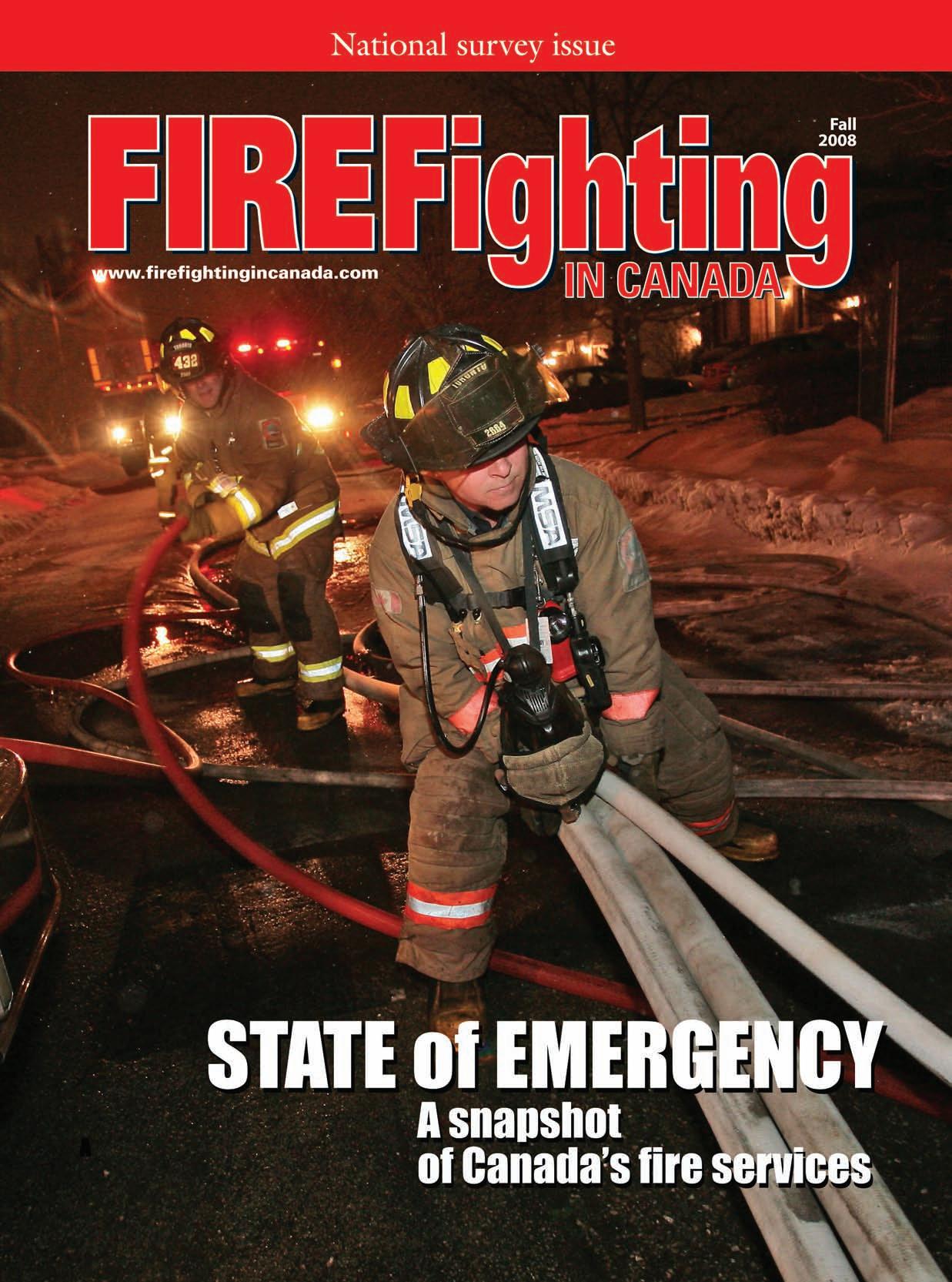
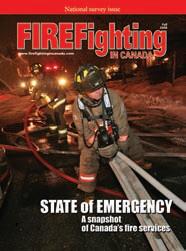
On the cover
Toronto firefighters lay hose lines while fighting a three-alarm house fire in west Toronto in February. Fire services across the country face funding, training and equipment challenges. Photo by John Riddell
N Help us help you through survey
ow, it’s your turn.
Since I arrived on this job some 18 months ago, every month I’ve tried to offer relevant commentary on developments in the fire service.
I spend a lot of time on the phone – listening more than talking, getting a measure of what the men and women of the fire services across Canada are talking about; what concerns you; what inspires you.
Admittedly, that’s an imperfect way to take a pulse.
So, as I said at the top, it’s your turn. In this special supplement to Fire Fighting in Canada, we are asking every fire department we can reach in Canada to participate in a survey on the state of the service, with particular emphasis on infrastructure and equipment.
Regular readers will already know that concern over the deteriorating state of the tools of the fire services in many parts of Canada is a recurring theme here, as is the need to push this matter onto the political agenda.
Marshalling the arguments to get the attention of the politicians at local, provincial/territorial, and federal levels is a massive challenge in the absence of data to define the problem.
And that is what is at the core of this survey.
We’re asking you to give us the lay of the land. Tell us about your department and the area you serve.
Tell us about the state of your equipment and apparatus. Tell us about your training.
Once we get the data in, we’ll crunch the numbers and come up with a comprehensive, national snapshot of the physical state of Canada’s fire service and hopefully, we’ll be able to accurately define and describe the problems.
With a federal election widely anticipated this fall, or next spring at the latest, the timing is perfect for a project like this,
Tgiving you the data you need to make these issues more of a political priority in your area.
But the first step is much more basic: you have to take a few minutes to participate.
We know how busy you are but without comprehensive participation, the integrity of data suffers. So we’re putting some fun incentives in place to hopefully get this project on your agenda for a few minutes.
If I have learned one thing in this job in 18 months it is this: the work of fighting fires and responding to emergencies is not a business. It is supported by important industry and suppliers, but it’s not an industry. It is a service.
The fire service.
The men and women staffing the big-city fire houses of Canada, turning out for Tuesday night training at small volunteer departments in rural Canada, are all there to serve.
We are here to support and inform you, to tell your stories, to help give voice to your concerns.
This survey is important. It will advance your cause and give you data to raise the profile of your issues with the political decisions makers. It is an opportunity to be heard.
We are grateful for your participation. It will make a difference.
hanks to all provincial association reps who helped us put this survey supplement together (you can read their contributions inside), and to the chiefs from across the country who helped us formulate the survey questions. The essays written by the provincial chiefs’ association presidents and directors paint a clear picture of the funding challenges faced by Canadian fire services. As you’ll note, there is a consistent theme among the submissions: working together will give the fire services from coast to coast to coast a louder, more respected voice that is more likely to be heard in provincial capitals and in Ottawa.
Underfunded
Canada’s fire services need hard data to appeal for bigger budgets
BY JAMES CARELESS
Thanks to aging apparatus and equipment, Canada’s firefighting capabilities are in decline. Only a serious cash infusion by governments at all levels will stop the decline and turn it around.
That’s the sobering conclusion of firefighters and their suppliers across this country, many of whose views you will find in this special edition of FFIC.
“The house isn’t falling down yet, but the foundation is definitely cracked,” says Barry Malstem, executive director of the Ontario Association of Fire Chiefs (OAFC).
“It’s a very serious problem,” adds Rick Suche, president of Fort Garry Fire Trucks. “We service apparatus as well as sell it, and we are working on trucks that are 15, 25, 30 and even 40 years old that are still in regular use!”
■ THE SCOPE OF THE PROBLEM
FFIC is conducting a countrywide survey of Canadian fire departments to accumulate hard data on the ages and conditions of apparatus/equipment in use today. Presently, no such countrywide data exists. However, a sense of how things stand has been achieved in Ontario, thanks to a recent OAFC survey. Based on its results – which are detailed in by OAFC president Richard Boyes in this issue – 42 per cent of all Ontario fire vehicles in Ontario are over 15 years old while 17 per cent of all firefighter bunker suits and 22 per cent of all self-contained breathing apparatus units are over 10 years old.
“It’s not just a matter of older equipment wearing out; much of what is in use today doesn’t meet current NFPA [National Fire Protection Association] safety standards,” says Malstem. “In a sense, somebody’s moved the benchmarks and all the older stuff no longer complies.”
However, it is not the NFPA that has changed the standards, but rather the firefighting professionals who make up its membership, says NFPA Canadian regional manager Sean Tracey. “We don’t write our standards; the fire services write them,” he says. “And make no mistake, any changes have been written in the blood of firefighters who have died using equipment that proved to be unsafe, despite the fact that it met earlier standards.”
Back to the scope of the problem: Lacking data from other provinces, Tracey suggests looking at U.S. studies into aging apparatus/equipment to gauge the situation in Canada. Based on a 2006 survey compiled by the U.S. Fire Administration, which is part of the Department of Homeland Security, 17 per cent of all U.S. fire engines/pumpers are 15-19 years old, 19 per cent are 20-29 years old, and 13 per cent are 30 years old or more. All told, 49 percent of all U.S. engines are 15 years old, or older.
In addition, 59 per cent of all U.S. fire departments have “at least some SCBA units that are at least 10 years old,” says the 2006 U.S. Fire Administration report (available online at www. usfa.dhs.gov/downloads/pdf/publications/fa-303-508.pdf). “An estimated two-thirds (66 per cent) of departments have at least some personal protective clothing that is at least 10 years old.”
OVERVIEW
Not surprisingly, the preponderance of problems are in small departments serving communities of under 2,500, where the tax base is minimal and firefighters are usually volunteers.
“From my experience in doing training across the country, the Canadian fire service mirrors extremely well what is happening in the U.S.,” says Tracey. “As a result, I would say that the U.S. data is a good approximation of the problems we face in Canada.”
■ THE RISK FACTORS
Walk into any firehouse in Canada and chances are you will find gleaming fire apparatus no matter how old the trucks are. Clearly, these vehicles are well maintained, so why should their ages matter?
The answer, says the OAFC’s Malstem, is that even the bestmaintained machines wear out with age and use. As they wear out, these older trucks break down more often, simply because an increasing number of their parts are approaching the failure point. Typically such breakdowns don’t happen in the garage, but rather on the road en route to a fire or medical call, when the truck is actually in use. “That’s the worst time to have a mechanical failure, when someone’s life is at stake,” he says.
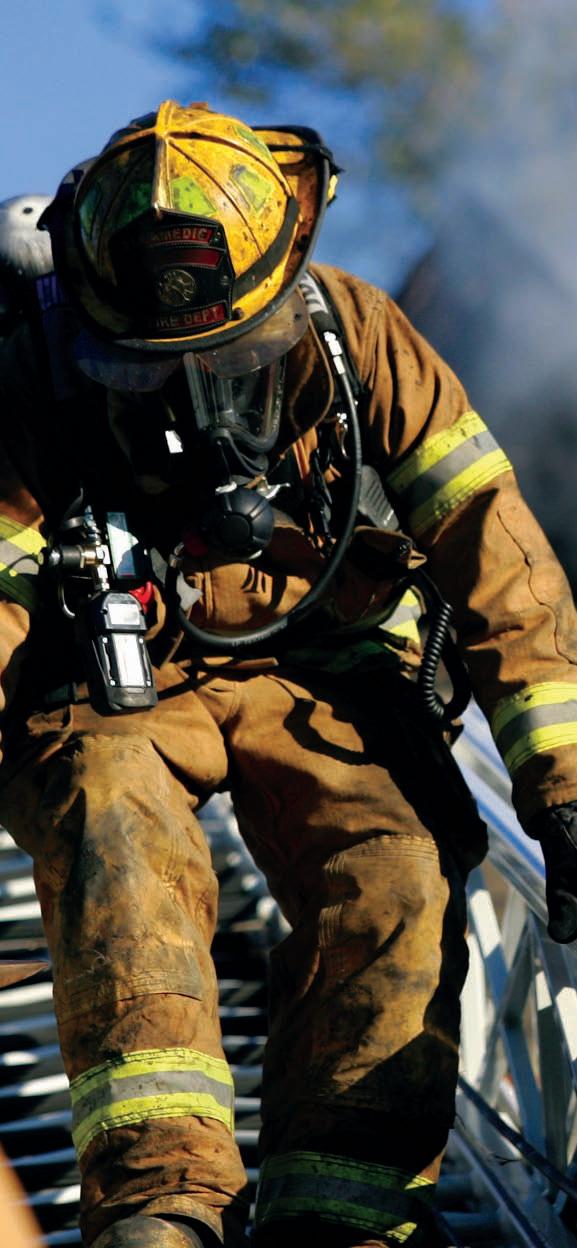
Apparatus is not the only thing that wears out; so does bunker gear. “Bunker gear should be replaced every 10 years,” Malstem says. “The rationale for this is because bunker suits absorb toxins. Although they can be cleaned, by the tenth year, the material has lost its ability to wash out properly.”
“When a turnout coat ages, we typically see deterioration in the moisture barrier,” says Robert Tutterow, health and safety officer with the Charlotte (NC) Fire Department. “We also see the reflective trim lose its effectiveness, and in some cases the thermal barrier breaks down as well. The problem is that the moisture and thermal problems aren’t visible to the naked eye. You have to cut the coat open to see what shape they are in.”
Again, even in those instances where older apparatus/ equipment is in mint condition, they no longer meet current NFPA standards. Since those standards have truly been written “in the blood of firefighters”, ignoring them puts firefighters and, by extension the people they serve, at risk.
As for replacing older equipment under current funding levels, “That’s a huge challenge,” says Ernie Polsom, acting fire commissioner of the Alberta Emergency Management Agency. “It used to be that you could pick up a decent set of breathing equipment for $1,500. But to be compliant with today’s standards, you have to spend $6,000 for the right unit. Unfortunately, not many departments have seen their budgets go up by 400 per cent, if any.”
■ THE NEED FOR HARD DATA
Politicians are constantly being asked for cash from all quarters. As a result, they tend to brush off those whose demands seem unfounded or at least not backed by facts. Besides, when it comes to their local fire departments, one can’t blame our elected representatives from seeming skeptical: The fire trucks are all so shiny; what possibly could be wrong with them?
This is where hard data, like that compiled by the OAFC and the U.S. Fire Administration, comes in. It puts solid facts in politicians’ faces, and gives local departments something to provide to the press in order to whip up public support. At the end of the day, it is the public that the politicians listen to, at least if they are making so much noise that they cannot be ignored.
This is why FFIC is conducting its survey, and why it is so important for all Canadian fire departments to answer it. Only with the kind of hard data generated by the OAFC, collected nationally, will Canadian firefighters have the ammunition needed to win the battle for more funding. If not, then the decline in Canada’s firefighting capabilities will go unchecked at the cost of more firefighter and citizen lives.
SAFC compiles list of priorities
BY GARTH PALMER
The Saskatchewan Association of Fire Chiefs has been working very hard over the last several years compiling a small list of priority issues within the fire service. It remains our focus to initiate this change through the political environment. Our first attempt at this in 2007 was met with many challenges, and at the end of the day a Public Safety Review Committee was struck by the minister of corrections and public safety to address some of the issues. The fire service is represented on this committee by the presidents of the Saskatchewan Association of Fire Chiefs and the Saskatchewan Volunteer Firefighters Association.
■ BACKGROUND
The fire service in Saskatchewan faces many challenges similar to those faced by services such as education, health care and others. In the fire service, additional stressors are present because a significant portion of the service is delivered through part-time and/or volunteer personnel. Additional factors including the demographic shift to urban from rural, an aging population, an increase in the number of people working at more than one career (for example, agriculture and another source of employment) are also putting stresses on much of the Saskatchewan fire service. These challenges and stressors are at an all-time high in the province’s history.
In the past, the role of the fire service was overwhelmingly focused on fire prevention and fire protection. Over time, that role has evolved significantly. It is estimated that about two-thirds to three-quarters of the incidents to which fire departments respond do not involve fire.
Traditional responsibilities of fire prevention and fire protection have been expanded to include rescue response of every description (air, rail, highway, construction, domestic), health response (day-to-day medical), natural disasters (floods, tornadoes, ice storms), rescues on land and water (building collapses, highway and rail disasters) and hazardous materials issues (highway, rail, storage).
Some of this considerable change will have even greater effect in the future if a strategy is not developed and implemented on a priority basis. When considering the impact of the population shift to urban from rural and the aging of the baby boom generation, the fire service is facing challenges that include recruitment, retention and retirements. Local fire service leaders are expected to fill the resulting voids. Areas such as training, leadership development and adequate funding required to sustain the core structure of a high-quality fire service are being challenged.
The Saskatchewan Association of Fire Chiefs has considered these challenges and believes the required solutions can best be achieved through a shared commitment between the provincial and the municipal governments. In this regard, the SAFC submits the in the following five priority-issue areas:
■ FUNDING OF FIRE SERVICE INITIATIVES THROUGH REGIONALIZATION
1
Currently the government of Saskatchewan collects a one per cent sales tax on fire insurance premiums, and such tax is deposited to the
general revenue fund of the government. The SAFC contends that this revenue should be redirected to the fire service through the Office of the Fire Commissioner to provide: Ongoing training incentives; Equipment purchase incentives; Co-ordination incentives.
■ THE ROLE OF THE FIRE COMMISSIONER
2
The Office of the Fire Commissioner has withdrawn from its responsibilities and now serves as an advisory service on request. The SAFC wishes to see the Office of the Fire Commissioner expanded to:
Reflect the Fire Prevention Act;
Increase capacities in its ability to provide training and its ability to co-ordinate and support the delivery of emergency services to communities in Saskatchewan.
■
MANDATORY FIRE PROTECTION
3
Currently each local government (municipal or rural) determines “if” its municipality has fire protection. The Saskatchewan Association of Fire Chiefs believes that every citizen of Saskatchewan should legitimately expect to receive a reasonable level of fire protection and that municipalities, without loss of their autonomy, shall provide this protection and inform their rate payers of this level of service.
■ COMMUNICATION
4
The provincially subsidized radio system is slated for decommissioning by 2010. The SAFC has stated the need for a longterm interoperability communication strategy. The government of Saskatchewan must ensure that all emergency response agencies (fire, police, ambulance, utilities and public works) have an affordable and reliable communications system that allows each agency to communicate internally and has the capacity to switch to a common interoperable channel when needed for multi-agency incidents.
■ PRESUMPTIVE LEGISLATION FOR ALL FIREFIGHTERS:
5 Currently only full-time career firefighters are covered by presumptive cancer and heart-disease legislation. The government of Saskatchewan should expand the current presumptive legislation for full-time career firefighters to include part-time and volunteer firefighters.
Through the newly formed Public Safety Review Committee we are hopeful that some of the above priority issues will be addressed. If this does not occur the SAFC is prepared to change our strategy to better effect change.
Garth Palmer President Saskatchewan Association of Fire Chiefs
PRINCE EDWARD ISLAND Back to basics
Co-ordinating among departments key to getting message out
BY TIM JENKINS
We in Prince Edward Island are facing a number of challenges. P.E.I is home to 36 fire departments, 1,000 volunteer and a handful of career firefighters. Our small size has its advantages and disadvantages, but overall we face the same challenges that are recognized throughout other parts of Canada.
The familiar fire-service saying, “one hundred years of tradition unimpeded by progress”, is alive and well in the fire service. Our small size and luck have assisted us in having a very low number of firefighter injuries or deaths. Health and vehicle collisions continue to be the most common causes of firefighter deaths (75 per cent-plus), yet we focus 95 per cent of our efforts toward fire-ground practices. Some of our jurisdictions have recognized that stopping at every red light means really stopping, not just slowing down a bit, and that seatbelts are for firefighters too! As Chief Billy Goldfedder stated at the Maritime Fire Chiefs Association conference, “we have not invented a new way to kill a firefighter in a hundred years, we just keep doing it the same way over and over again.” P.E.I is not immune; standard operating procedures need to be developed, followed and enforced or the courts or tragedy will determine our fate for us.
The nature of our volunteer fire departments is that we never know who will show up at an incident yet many departments have not adapted a formal system of incident command. Chief Alan Brunacini stated some 30 years ago that, “without an Incident Command System in place at every call, there is freelancing, and freelancing kills us.” In most cases we do not need to develop these systems or protocols, we just need to adapt and adopt. This is basic stuff that some departments have fully embraced but others have yet to acknowledge.
We have some aggressive fire prevention programs in P.E.I., yet we still respond to deadly fires every year in which there was no working smoke detector in the home. We have been preaching this message for a long time and it seems to be getting old, but we need to continue with it until the losses are stopped. While there are new strategies and tactics with fire prevention, it appears that we need to continue to focus on the basics every chance we are given.
Recently, on P.E.I., we have been able to bring departments together and present a unified voice toward improving our 911 systems, upgrading our radio system and improving medical first responder protocols.
We face challenges with fire department funding. While there are limited funds available for some departments, others are not eligible because they are not attached to a municipality. There have also been requests for provincial support to provide interest-free loans for apparatus and infrastructure. There is merit to these requests, and we need to come together and support them.
As other jurisdictions have expressed, we at times can be our own worst enemy. We spend a lot of time and effort fighting the same battles in each of our stations and fail to use the power we can tap when working together. There is little co-ordination of resources, resolve or political power. Not surprisingly, a recent survey of firefighter beneficial programs that are in place across Canada shows that P.E.I. is on the tail end of the scale. While there are a number of reasons for this, the principal factor is it that we have not consistently
presented a unified voice to ask for what we want (and deserve). Issues such as presumptive cardiac/cancer legislation, provincial tax credits, line-of-duty death benefits and funding for training need significant attention in order to bring us in line with the rest of Canada.
Fire departments across P.E.I., and, indeed, the provincial training faculty, are sorely in need of significant funding so we can provide the expanded services for which we are called upon. It will likely be a long time before we are funded the same as other emergency services but we need to start closing that gap. Volunteers spend as much time fundraising to keep fuel in the apparatus as they do responding to calls, attending ever increasing training and maintaining equipment. These increasing demands are contributing to the difficulty in recruiting volunteer firefighters. The incentives added by provincial legislation and financial resources for firefighters are important for recruitment.
Our P.E.I. firefighters’ training school is something that we are very proud of. With the limited resources available because of our size, a number of talented individuals over the years have done an incredible job of keeping our firefighters trained with the best programs available. Dedicated volunteers have provided us with everything we could need up to this point, but stiffer training requirements, regulations and expanded technical rescue and response areas are demanding that we increase our administration abilities to the point that we need to add career staff positions. We are reviewing our ability to provide IFSAC certification to our volunteers but it is quite possible that we will not be able to do this on our own because of costs and required administrative overhead that we do not currently have.
Our provincial training facility has done an admirable job of enhancing equipment and programs available to Island firefighters but we have outgrown our basic infrastructure. We need new classrooms and apparatus facilities as well as significant equipment upgrades. The P.E.I. fire school is training commercial enterprise in fire extinguishers and confined-space rescue, as well as undertaking other activities that are well outside our mandate in order to finance basic training for our firefighters.
Our provincial director for the Canadian Association of Fire Chiefs has been active in pursuing requests for a national fire advisor, as well as promoting the federal firefighter tax credits and these initiatives need our support. On a provincial level, we need to be better organized and more vocal about our mutual concerns. We need to work together as a unified body to address our common causes. Chiefs, company officers and firefighters should work to become involved in or at a minimum support our provincial and federal concerns.
We are extremely proud of our fire service in P.E.I., and will continue to strive for the best for our communities but we need help along the way. Please respond to the survey in an effort to our unified voice in the Canadian fire service.
Tim Jenkins President P.E.I. Firefighters Association
Reform underway
Fire Safety Act has major impact
BY SERGE TREMBLY
Fire safety reform in Quebec culminated in the passage of the Fire Safety Act in June 2000. Since then, the province’s various fire departments have been called on to review their objectives in the context of planning their future, all with one goal in mind: improving the safety of Quebecers, no matter where they live in the province.
This greatly anticipated legislation is the cornerstone of reforms that better define the different levels of responsibility in fire safety and clarify the required activities of all those involved. It sets the parameters for the main aspects of fire safety, which are prevention, emergency organization, intervention, training of fire department personnel, and investigation of the point of origin, probable causes and circumstances of fires. It aims to achieve improved organizational effectiveness, more rational use of resources and equipment and greater use of preventive measures.
The new legislation also establishes requirements to ensure that fire safety personnel carry out their activities in a professional manner. The regulation respecting the conditions governing the exercise of functions within a municipal fire safety service, enacted in 2004, sets out the minimum training requirements for all firefighters in the province. The creation of the école nationale des pompiers du Québec in 2000 is another part of that process, as it ensures the relevance, quality and consistency of fire-safety training.
An innovative aspect of this legislation is the establishment of a regional fire-safety planning process. This new approach requires fire departments in the province to be aware of the risks in their regions and have a strategic plan (fire safety risk cover plan) to guide their development and support their activities. The plans must be carried out in compliance with the fire safety policies of the Minister of Public Security. These policies introduce a new way of managing fire risks based on better knowledge of risks and an emphasis on prevention. When a plan fulfills these policies, it obtains a certificate of compliance from the minister. This certificate ensures that the municipality and the fire department are exempt from liability for any damage that may result from their intervention during a fire.
■ POSITIVE IMPACT FELT
Quebec has 732 municipal fire departments and 21,750 firefighters, officers and chiefs. Of the 17,625 firefighters, four out of five are part-time. Of the 3,992 full-time firefighters, about 60 per cent are employed by the Service de sécurité incendie de Montréal (SIM), the largest fire department in Quebec and the second-largest in Canada behind Toronto.
The SIM has covered a lot of ground since 2002. First, it consolidated 22 fire departments into one. The organization then expanded to the point that it now has 2,300 permanent firefighters and 400 support staff. This transformation required a long period of adjustment and a comprehensive review of the way the organization operates – something other departments in the province
have also faced as a result of the municipal amalgamations in 2002.
Through municipal government funding, the SIM has benefited from an investment of almost $80 million from 2004 until 2011 to upgrade its vehicle fleet. It has also received significant funding for the construction and renovation of its fire halls.
Like the 86 regional county municipalities and urban communities of Quebec, the City of Montreal has submitted its draft fire safety cover plan to the minister of public security. Developing this plan was a challenging task for the SIM, as it was for most Quebec fire departments, since it involved detailing all the fire risks in the region. Practically speaking, the plan must help optimize our resources and help provide more effective fire coverage for the whole region.
All the municipalities in Quebec will have their plans implemented over a five-year period. So far, 86 plans have been submitted to the minister and 37 have been certified. If the SIM’s draft plan is approved as scheduled, its implementation should begin in 2009. Ultimately, 209 new staff will be hired and $30.4 million in capital budget funding will be provided. Ongoing funding of $24 million will then be provided annually for the operating budget.
The implementation of the fire-safety risk cover plans will not be easy, since it will again require a great deal of effort on the part of all the managers in the field, with several obstacles still to be overcome. Consider the particular aspects of each region to be protected, the fact that almost half the Quebec population lives in one per cent of the province and the upgrading of the vehicle fleet, which is so important to improving fire safety.
Prevention, the cornerstone of the reforms, will henceforth be founded on stringent municipal regulations with effective inspection programs, quality incident analysis and the hiring of additional specialists.
The intervention component, for its part, is a complex aspect of operations management. Obtaining an adequate strike force for the class of risk within the prescribed time involves dealing with response time, staffing, equipment and water supply, which is a huge challenge. To minimize the loss of life and property, many regions have to rely more on mitigative measures, such as selfprotection, prevention, education and public awareness.
Water supply remains an issue for a number of municipalities in Quebec in places without water systems; it requires a great deal of complex co-ordination. To address that, research and development into alternative firefighting methods is presently being pursued in Quebec.
In closing, I would like to underline the considerable efforts that various authorities and departments have devoted to fire safety in Quebec in the past few years. Their contribution was and is essential to ensuring the safety of the residents of Quebec. Lastly, please remember: fire safety is everyone’s business!
Serge Tremblay President Association des chefs en sécurité incendie du Québec
ALBERTA
Growth fuels demand
Fire service needs funding, changes to keep up
BY BRIAN MCEVOY
Alberta’s growing and ever-changing economy is creating new demands on our fire services. As such, we no longer need water to deliver the majority of the services we provide. The tools we use are progressively becoming more diverse and complex as we adapt to the needs of the society we protect. However, the commitment we require from our firefighters and fire services is also dramatically increasing.
The new Alberta means managing motor vehicle, high angle, water and ice rescue calls, managing medical first response, dangerous goods response and the provision of ambulance services. It also means managing fire investigation, fire inspection, public education and emergency services communications.
In addition to these visible front-line services, infrastructure needs have expanded in our services. Radio systems are no longer just simple walkie talkies. The Alberta government is developing the Alberta First Responders Radio System, a 700 MHz P-25 compliant system that provides inter-operability for all emergency first responders. This system is cumbersome and will take considerable work by fire services to ensure that as this system is developed it continues to meet the front-line needs of fire services in rural and urban centres. Once this system is operational, significant commitment to training is required in a province where time for training and skills maintenance is eroding.
Changes to provincial legislation in the areas of Occupational Health and Safety and commercial vehicle operation have placed enormous training requirements on the fire service. The training required by the regulations in these two areas is quite onerous and many fire services, in order to comply, have been forced to reallocate available training time traditionally used for basic firefighting skills maintenance.
As issues of training requirements increase, so do issues of recruitment and retention of firefighters in both career and noncareer roles. The fast pace of Alberta is having a profoundly negative impact on our non-career fire services. Firefighters are no longer able to commit the hours necessary to training and maintaining their firefighting skills. With the increased training commitment imposed by provincial regulations as discussed above, we are burning out firefighters at a high rate.
At one time it was reasonable to expect an average of seven years of service from a non-career firefighter. Recently, this has slipped to five years and is projected to slip to three years.
Additionally, it is becoming more and more difficult for firefighters to be available on a 24-hour basis. Pressures brought on by the labour shortage in Alberta has made it harder for firefighters to respond to calls during work hours. This has resulted in communities having to significantly reduce services Monday through Friday from 8 a.m. to 5 p.m. Some fire services have publicly stated that their communities are not protected during these hours.
The government of Alberta also recently announced the transfer of all ground ambulance service responsibility to the province. This places additional pressure on the fire service and it is still unclear how this will impact the numerous integrated services in Alberta. With recruitment and retention an already identified problem, the potential of losing large numbers of cross trained firefighter/medics to the provincial EMS system could become a reality.
This move will also have significant impact on emergency services communication and 911 centres throughout the province that currently provide integrated emergency communications for police, fire and EMS. The province has announced its intention to reduce the number of EMS dispatch centres, which will result in a complete re-evaluation and restructuring of emergency communications for all three services.
With the tremendous development of industrial infrastructure in rural Alberta, primarily related to the oil and gas industry, the risks for rural fire services have changed dramatically. Small, rural fire services that traditionally dealt with wildland fires and farm structures now have increased industrial hazards and transportation issues. The need for additional training, equipment and expertise has placed unprecedented requirements on fire services resulting in issues with recruitment and retention.
Some municipalities are in need of additional funding to support the increased training commitments and the acquisition of equipment and infrastructure necessary to mitigate the risks. In many areas, municipalities have not been able to keep pace with these needs and industry has undertaken to mitigate some risks directly. This has resulted in the creation of a large industrial fire response capability with more competition for available emergency service workers, creating issues of recruitment and retention for both career and noncareer services.
Overall, the fire service in Alberta is facing a system sustainability problem. As we continue with the pace of life, we will need to change from our traditional fire system and this will create struggles as we work to meet the needs of our province. New challenges, new external regulations and new funding needs will emerge. As a fire service, we will realistically evaluate our capacity and resources and work with our municipal and provincial leaders on our capabilities and our needs.
We will continue to work with The Alberta Emergency Management Agency, The minister’s Fire Service Advisory Committee, the Alberta Urban Municipalities Association and the Alberta Association of Municipal Districts and Counties to create a sustainable fire service for Albertans. The research has been completed and the recommendations are pending with provincial cabinet. We will work hard to ensure sustainability in Alberta for the future.
Brian McEvoy President Alberta Fire Chiefs Association
Fire services await review
Study of local governance likely to impact departments
BY ROBERT SIMONDS
The New Brunswick Association of Fire Chiefs (NBAFC) historically recognized by the provincial government as the “voice of the New Brunswick Fire Service,” is committed to working with government and community stakeholders on matters of critical interest to our service. As the voice of 171 fire departments and 5,000 fire fighters in our province, I am pleased to report that as of late the N.B. fire service has enjoyed a measure of success in lobbying our government to introduce new initiatives designed to enhance the protection of our firefighters and better prepare them for the rigors of their work.
The recent introduction of presumptive cancer legislation by the provincial government is tangible evidence of the progress that has been made with respect to enhancing the safeguards to our firefighters. We are both pleased and proud to acknowledge that the legislation includes both our career and volunteer firefighters. The introduction of this much-needed legislation was (in large part) due to the extensive lobbying undertaken by the NBAFC and the International Association of Fire Fighters (IAFF). Although the regulations that will accompany the new legislation will not be announced until September we take comfort in knowing that the burden of proof as to how a firefighter acquired cancer will no longer reside with the individual firefighter.
Secondly, I am pleased to advise that the province of New Brunswick has most recently enhanced the liability protection afforded to volunteer firefighters in the Local Service Districts (LSDs) of our province. Previously, these individuals who provide fire protection to the unincorporated areas of our province had limited liability protection and as such were in jeopardy of having to personally defend themselves in the event that litigation emerged from their participation in an emergency response. Accordingly, the new coverage will serve to protect their interests and the interests of their families.
Additionally, the province most recently increased its funding to deliver basic firefighting training to our volunteer firefighters. The new funding is an increase of more than 300 per cent from the previous funding provisions, which will result in better coordination and standardization of basic training for volunteer firefighters in the province. Although the funding provisions did not address the permanent acquisition of live fire simulators (which are required in the remote areas of our province) the additional funds will undoubtedly support a more prescriptive and focused approach to basic firefighting training.
On a go forward basis we are hopeful that the renewed emphasis on training will be but one of many new initiatives designed to improve the operational capacity of the fire departments in the province.
I would acknowledge that similar to our provincial and territorial counterparts, the N.B. fire service is not without its challenges. Many fire chiefs in our province continue to be challenged to effectively respond to fire protection issues in their communities given the limitations of the existing Fire Prevention Act and the absence of updated regulations. Furthermore, an aging population, a migration of our youth from rural New Brunswick to the urban centres and increased training requirements has collectively made the recruitment and retention of our volunteer firefighters a major concern within the province.
Although we are hopeful that effective strategies can be developed in response to this challenge we know that government must take a more hands-on approach to supporting and developing long-term strategies.
Currently, the government of New Brunswick is undertaking a comprehensive review of local governance. Headed by Commissioner Jean Guy Finn, a former provincial deputy minister, it will examine all aspects of the structures that support the cities, towns, villages and Local Service Districts in our province. Most recently it has been reported that Finn will make recommendations that will impact the N.B. fire service and has questioned the need for 171 fire departments. Recognizing the challenges and fragmentation that has occurred in other jurisdictions with amalgamations and regionalization we have met with the commissioner and have requested that he commit to consulting with the stakeholders of the N.B. fire service before any radical changes are introduced.
Other ongoing challenges include: the need for better integration between the provincial ambulance service and municipal fire departments; a cost-effective strategy to resolve interoperability issues between co-responders; and the need to resolve the increased frequency of false residential fire alarms, which invariably strip the resources from many local fire departments and often result in our volunteer firefighters having to leave their place of employment to respond.
Fortunately however, we continue to maintain a positive and productive relationship with the Office of the Fire Marshal in the province of New Brunswick and we routinely meet with the ministers in government who have responsibility for the fire service to discuss priorities and concerns. Collectively, our efforts have enabled us to make progress in some areas and have positioned us to continue to be a credible voice for the New Brunswick fire service.
Robert Simonds President New Brunswick Association of Fire Chiefs
Provincial stats indicate trouble
Survey results expected to reflect national trend
BY RICHARD BOYES
Do you think the fire service in your province is in need of support? I am sure you have an opinion but can you prove it? Have you got the necessary facts/data to convince the politicians? In most cases the answer is no!
The Ontario Association of Fire Chiefs is working with Fire Fighting in Canada on this survey because we believe we need to determine the state of the fire services right across the country. We think the results will surprise everyone and will give us a compelling case to present to the politicians on the need for provincial and federal funding.
Let me share with you some of the facts/data that we have been able to collect in Ontario.
In provincial legislation the province of Ontario has specific responsibilities under the Fire Protection and Prevention Act and the Emergency Management and Civil Protection Act. In order to meet these responsibilities, the provincial government relies on the 30,000 municipally funded, trained and managed firefighters (10,700 full time and 19,200 volunteers) to carry out these responsibilities and to respond when emergencies threaten the life and property of Ontarians. The province benefits tremendously from this partnership but in our view it is not contributing its fair share of the funding.
There are 478 fire and emergency services departments across Ontario. Last year, they responded to more than 487,000 calls for help – roughly equivalent to about one call every minute of every day throughout the year.
Over the past seven years, there have been on average 28,569 fires a year in Ontario, which take a terrible toll, including some 101 deaths, 862 injuries and almost $414.3 million in property damage each year. This makes fire deadlier than all natural disasters combined.
Fire calls, however, represent only a small percentage of the work of the Ontario fire and emergency services departments. Last year, for example, only 15 per cent of all responses were for fire-related emergencies. Fire departments also respond to motor vehicle collisions, life-critical medical calls, floods, building collapses, uncontrolled releases of contaminants into the environment (chemical spills), ice and water rescue, trench rescue, high-angle rescue, ice storms, tornados and other emergencies.
Over the past 10 years, the population of the province has increased by 13 per cent but the volume of calls to the fire service has grown by 38 per cent. The investment in the equipment, staffing, training and public education programs of the fire service has not kept pace with this rising demand and we are concerned that this shortfall may have tragic consequences.
Is our equipment and apparatus up to the job?
Our preliminary research indicates that 42 per cent of all fire
vehicles in Ontario are more than 15 years old; 17 per cent of all firefighter bunker suits are more than 10 years old; and 22 per cent of all self-contained breathing apparatus units are more than 10 years old. This aging equipment does not meet industry standards and the insurance industry would find equipment of this age suspect. We’re worried that the equipment may fail when it is needed most, endangering the lives of the public and the lives of our firefighters.
Many fire and emergency services departments don’t have the necessary tools: Just 12 per cent of the fire departments in Ontario have radios that are capable of communicating with the police and ambulance services to co-ordinate personnel and responses during emergencies; 23 per cent of the fire stations do not have a set of heavy hydraulics for extracting people trapped in motor vehicle collisions; and 44 per cent of the fire stations do not have a thermal imaging camera to locate people in a smoke-filled building.
Do we have the skills and the staff to get the job done? Do we have enough fire prevention officers and public education officers? The myriad new responsibilities require additional training. Do we have sufficient training funds?
Do we need additional full-time firefighters to assemble proper fire attack teams or to accommodate growth? Do the volunteer and composite fire departments need fulltime staff to support the volunteers and to complete the necessary administrative paperwork? Do we need additional resources to recruit and retain volunteers?
Aging fleets, outdated equipment, insufficient funding and staffing challenges – we estimate that the cost to bring Ontario up to standard is close to $1 billion.
We are asking you to join us in making a meaningful contribution to the fire services across the country by completing the Fire Fighting in Canada survey. We are especially encouraging fire departments in Ontario to complete the survey, as it includes questions that were not asked in the earlier OAFC questionnaire. We need to have all fire departments across the country respond to the same questions so provincial comparisons can be made and so a comprehensive picture can be presented to the provincial and federal governments.
It is time to speak up, but we need the data. Help us to help you. Respond to the survey.
Richard Boyes President Ontario Association of Fire Chiefs
KERMEL® has developed HEROSKIN™, an exclusive range of fabrics intended to be worn by Emergency Responders, Wildland Fire Fighters, and Station Wear Apparel. Permanently flame-resistant, HEROSKIN™ products guarantee a high degree of protection, comfort and resilience.
The KERMEL® fiber used in HEROSKIN™ is a Polyamide-Imide fiber; meaning it is non-flammable. It provides excellent thermal insulation, and has great mechanical strength with a high degree of resistance to chemicals. KERMEL® has an almost rounded circular cross section and its low modulus give it a soft and silky touch.
One of the main assets to KERMEL® compared with other fibers lies in the fact that it is solution-dyed during the
manufacturing process. This distinctive feature makes it possible to achieve the best results for color fastness. Additionally, KERMEL® does not pill. Thus enabling garments made from HEROSKIN™ fabrics and knits to maintain a faultless appearance that is everlasting.
For more than 30 years, KERMEL® has been at the forefront of innovation, developing many technical solutions offering protection in outer fabrics, membrane supports, thermal barriers and comfort linings. These many fabrics are used to make lasting uniforms for fire and police services; for all types of special clothing subjected to extreme conditions, including wildland firefighting, special flying suits, military tank and crew uniforms; and for garments in high risk industries.
The KERMEL® new generation of HEROSKIN™ fabrics used in emergency interventions meet the most stringent standards of safety complying with the NFPA 1975, NFPA 1977, and NFPA 2112.
Essential Fiber Properties
NON-FLAMMABILITY
PERMANENT COLOR
EXTREME COMFORT
INCREDIBLY DURABLE
RESISTANCE TO CHEMICALS
Finding an optimum fire service
BY STEPHEN GAMBLE
The services being provided by the fire departments in B.C. have increased dramatically in the past five years.
We are currently spearheading a Model for the Fire Service of B.C. project with other fire service associations (union, volunteer, training, prevention and local governments). The vision developed by the members of the Fire Services Liaison Group for this project is: “To have a competent level of fire and emergency services that is supported by sustainable resources for all residents of and visitors to the province of British Columbia.”
Following are some of the issues facing the B.C. fire service providers.
Training that is accessible and affordable and is recognized by the standards to be set by the Office of the Fire Commissioner. Funding that is adequate to provide the services requested by citizens. Because the B.C. fire service is governed by local jurisdictions, there are no consistent funding mechanisms, but rather political will.
Recruitment and retention is a big problem. Most communities are protected by volunteer or paid-on call fire departments and as businesses close and housing prices escalate, people are relocating. With the commitment to training and maintaining skills, many of the volunteers find it too difficult to work full time and volunteer for the fire department.
The Office of the Fire Commissioner over the past 10 years has seen its budget reduced dramatically and is experiencing staff shortages and difficulty recruiting personnel on the salaries offered in the public sector. The regional OFC offices closed a few years ago and support for fire departments 24/7 is difficult as the OFC lacks fire service advisors accessible to all areas of the province. Fire departments in B.C. are first responders and the governance structure for pre-hospital care is undergoing changes to streamline the provision of service. The Emergency Health Commission is overseeing the system but the fire service is experiencing constant problems with dispatch and types of call to which it is asked to respond. Most first-responder fire departments are providing the service with no funds for training, supplies or payment for services provided as the B.C. Ambulance service is provincial and fire first responders are locally governed.
B.C. is prone to wildfires. This province has seen an increase in the numbers of people building and recreating in forested areas.
B.C. fire departments provide initial attack capabilities for the Ministry of Forests Protection Branch and/or provide structural crews to battle larger or threatening interface fires. After the 2003 firestorm that affected the Kamloops, Kelowna and Cranbrook areas, a commission found that cross training, communications and equipment were problems.
The Provincial Emergency Program relies on local fire rescue services but obtaining the authorities and payments for services provided is a constant struggle. Many fire chiefs are also the emergency co-ordinators for their communities, handling flooding,
wildfires, wind and ice storms and other disasters. Because the fire service is a local government service we experience problems with out-of-jurisdiction responses that get mired in bureaucracy. There are a number of educational facilities in our province but there is no co-ordination among them and it is difficult to gain credit from one institution after having taken courses at another. Most institutions are in the metropolitan areas, which makes it difficult and costly for volunteer firefighters to travel for training or to access education in their local areas.
A large area of our province is not covered by 911 service. Because of our topography, cell phones are inoperable on major highways and some valley/remote locations. This also creates of dead space for radio communications for fire departments if their responses are in remote sections of their jurisdictions.
Records management in B.C.’s fire service is difficult and not properly maintained. Volunteer and/or smaller fire department officers are tasked with providing community service as well as report and record keeping when their positions are often unpaid or are in addition to full-time employment and family needs. Historically, in B.C., no statistical information has been gathered or maintained, which leads to an inaccurate account of provision of service, types of responses and history of problems and issues.
B.C. recently adopted objective-based building and fire codes. The province has been reluctant to approve local government sprinkler bylaws, which hampers the fire service’s ability to be flexible in future planning.
The Fire Services Act has not been updated in years. The authorities, powers and permissions in the act are not reflective of the services provided today by. Attempts have been made to modernize the act but it is not a priority of the current government.
Our province is slow to adopt any industry standards such as NFPA.
There is no requirement in B.C. for a fire department to be registered or accredited. There are no statistics as to the number of fire services or types, areas served by fire and/or rescue services, the numbers of firefighters, records of training or accreditation or equipment used or available. The FCABC believes the Office of the Fire Commissioner should be responsible for the registration of services provided and should do regular audits for the better protection of our citizens and the safety for our firefighters.
The OFC Local Assistants to the Fire Commissioner (LAFC) program is in disarray. There is no official record of badge numbers or holders. Mandatory training in order to obtain an LAFC badge or maintain the LAFC status has not been constant. Many fire officers find it difficult to be employed by their local governments and to act as an LAFC for the OFC, creating conflicts in certain situations.
Stephen Gamble President Fire Chiefs’ Association of B.C.
BY VINCE MACKENZIE
T Association tackles challenges
he Newfoundland and Labrador fire service consists of some 300 fire departments ranging from relatively large operations to very small ones. These include two fully career services in metro areas, a handful of composite operations in towns with populations of more than 6,000, and myriad volunteer operations in communities or local service districts with populations of 5,000 or less. A good number of volunteer departments are in reasonably good shape while others struggle to various degrees. A handful of these volunteer departments may be on the verge of closure, with aging vehicles and limited personnel in shrinking rural communities if solutions are not found.
In my opinion, most fire services in Newfoundland and Labrador are still fairly strong and vibrant despite the fact that many are face enormous challenges. Indeed, some are actually struggling to survive. The erosion of the fire services has been apparent in the last 10 years or so and cannot be ignored. This trend does not appear to be just a provincial issue but a national one.
Our association has recognized the challenges in today’s fire department administration and has developed an administration training seminar that helps to provide tools to the fire departments, municipalities and local governing bodies. This seminar is delivered by our association and attempts to arm all stakeholders with strategies to achieve long-term stability and deal with standards, training and finance. The seminar is offered across the province to ensure good participation. The seminar explores the many outside forces that are changing the face of the fire services. Some of these forces are out of the control of the fire services, such as outward migration and the urbanization of smaller communities. This is having a detrimental effect on the availability of personnel in fire departments, thus recruitment and retention issues arise.
The NLAFS is working co-operatively with all stakeholders on issues surrounding the recruitment and retention. A joint committee was struck to examine the issue. It includes the fire services association, members of elected municipal councils, municipal administrators, the provincial fire commissioner’s office and members of the house of assembly. This working group is looking in depth at the issues surrounding recruitment and retention and possible solutions to some of the challenges facing Newfoundland and Labrador fire departments. A final report of the working group is anticipated in early 2009.
Firefighter minimum training standards have been in the forefront in Newfoundland and Labrador for the past couple of years. In 2006, the association brought forward a resolution asking the province for minimum training standards for firefighters of all levels, with firefighter safety being the focus. It was recognized that due to the different sizes of the various departments, the standards should be broken into classifications for the individual departments. Therefore, the standards being suggested are at three levels. The first level is the orientation level, which would be a requirement of all firefighters
regardless of community or department size. This pertains to fire scene safety awareness, hazard recognition, PPE, and Occupational Health and Safety. The second level is the defensive firefighting level, at which standards will be set for firefighters operating only in defensive exterior firefighting tasks and positions. The third level is for offensive firefighting – interior firefighting operations where training to the job performance requirements of NFPA 1001 standard – level one is the minimum standard recommended. The three minimum levels were determined because it was recognized that not all rural departments are equipped or trained to operate offensively.
In Newfoundland and Labrador, regionalization of the fire service is increasingly being explored. There is an understanding that fire fighting is an expensive business and that where geography permits, it may be easier to administer fire services, equipment and personnel by having communities join together in regional fire services. In some locations, several small fire departments operate independently of one another in relatively close proximity. In addition, decreasing populations in some areas makes regionalization the only viable solution.
Insurance coverage protecting our firefighters has also been at the forefront. We have led the lobby to increase the level of protection for firefighters in the performance of their duties. Last year, the provincial government doubled the death insurance benefit to firefighters to $200,000. Volunteer firefighters are covered under the Workers Compensation Commission for injury on the job during emergency calls and training. Also, cardiac coverage has been increased to volunteer firefighters through the work of another joint committee within our association. This pertains to the removal of some pre-existing cardiac conditions.
In the absence of a fixed provincial fire school, delivery of training is done by the provincial Fire and Emergency Services office. The office used to offer individual one- and two-day courses but the format was changed this year to a mobile, regional fire school concept that features a 10-day fire school twice a year in strategic locations. This makes it easier and more affordable for departments to send firefighters to courses. Many courses had been cancelled in previous years due to low enrolment. The new format was piloted in May 2008 and was very successful, with some 20-plus courses being offered to firefighters and more than 250 course participants attending over the 10 days.
Obviously, firefighter training is a major topic within the fire service. The availability, quantity and frequency of training is paramount to the overall strength of any fire services, large or small.
As an association, we constantly strive to expand on these recent successes as it is recognized that these are positive initiatives, but more work lies ahead.
Vince MacKenzie Director
Newfoundland and Labrador Association of Fire Services
ResQtech Today
On January 3, 2008 ResQtech moved to its brand new 8,000-square-foot facility designed to better service the needs of fire departments throughout the fire service. Utilizing the strong team we have established at ResQtech in addition to our larger facility, we feel we are better equipped to provide industry-leading service to complement our quality products.
In our continued commitment to provide innovative products, we have aimed to align ourselves with leaders in the industry who have a shared commitment to innovation. Our most recent partnership is with Elkhar t Brass who has selected ResQtech as their master dealer in Ontario. Through this partnership ResQtech will be able to provide innovative technologies in nozzles and monitors at competitive prices.
The Roots of ResQtech
In 1985 we opened our doors to fire departments with the vision of ResQtech becoming the leading distributor of fire fighting solutions. Since the beginning we have maintained a commitment to our customers, continually seeking innovative products that better meet the needs of today’s firefighter backed by quality service.
Throughout the years we have continued to expand our offerings so that we are better able to serve the needs of firefighters at one convenient location. Over the years one thing has and always will remain the same and that is our unwavering commitment to those in the fire service.
Personal Protection
Accessories
The Starfield-Lion Story
In 1979, Starfield Safetywear Manufacturing Company was created. We began manufacturing industrial clothing for such companies as General Motors, Hudson’s Bay Mining and 3M Company. By the late 1980’s, we began to build structural fire fighting bunker gear that was compliant to the original CGSB 155.1 and NFPA 1971 Standards for Structural Fire Fighting Clothing. Hamilton, Vaughan and Peterborough were amongst our first municipal Fire Department customers.
As our company grew, by the mid 1990’s we expanded our bunker suit offering and branched out into other safety apparel for First Responders including:
• Fire Retardant Police Tactical Clothing
• NFPA 1975 compliant Station and Work Clothing
• NFPA 1977 compliant Wildland Fire Fighting Clothing
• EMS shirts, pants and jumpsuits
In 2000 we earned our designation for ISO 9001 Quality Management System. Our growth has been the direct result of a groundswell of support from Fire Departments and other First Responders across Canada and parts of the United States.
The Power of Two
In May of 2002, we were purchased by Lion Apparel, the World’s Largest manufacturer of Safety Apparel, based in Ohio. Over the past six years, we have worked diligently to pool resources with our parent company. As a result we now offer innovations such as isodri® bunker gear, Ventilated™ reflective trim, Phoenix™ coat pocket systems and more! Simply stated, the union between Starfield-Lion and Lion Apparel is an excellent fit. We invite you to learn more about the “Power of Two.”
We are also the master Canadian distributor for:
• Paul Conway™ Helmets
• Lion RescueWear™
• Tactix™ USAR Apparel
Commitment to Service
We are happy to announce the addition of Robert Hosselet as the National Sales Manager for StarfieldLion. He brings many years of experience in servicing the First Responder community and shares our desire to achieve results based on integrity and teamwork.
Robert, along with our top-notch customer service team and dealer network are committed to finding a tailored solution for your clothing needs. We have worked with departments in the past to design specific pockets or features that fulfill their unique specifications.
Product Information
For more information on the company or our product line please visit www.starfieldlion.com. Our new and improved website features product information, certifications and user guides. You can find dealer contact information for your area or request a free brochure.
Facilities
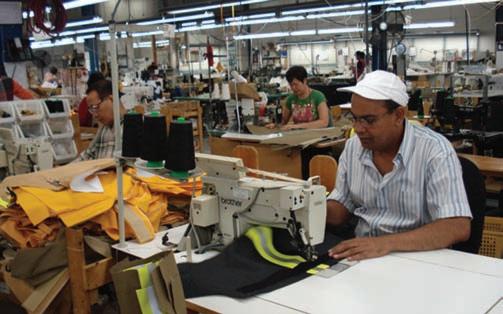
We employ approximately 60 people in our office and manufacturing facility in Toronto. All of the bunker gear and clothing that falls under the Starfield-Lion brand is proudly made in Canada.
Whether you are on your own or part of a group, let us know when you are coming to Toronto. We would be pleased to provide you with a full plant tour. We guarantee you will have a enjoyable and educational experience. Hope to see you soon.
• MT-94™ Chem-Bio Suits 1020
Toronto, Ontario M6A 1C8
Tel: 800.473.5553
Fax: 416.789.5475
Email: infos-l@lionapparel.com
www.starfieldlion.com
United voice, message, needed for change
BY TOM BREMNER
T Building partnerships crucial
he fire service of Nova Scotia is not in a crisis state – yet – but we need to create and experience better support and partnerships to address the numerous issues facing the fire service in this province.
It is wrong to believe that any single level of government, individual or group is going to fix our problems or that large amounts of funding will straighten things out. Foremost, the fire services of Nova Scotia have to address the internal issues (you all know what they are) that have mired the service for decades.
It’s time to cut to the chase: As firefighters, do you believe that Nova Scotia’s fire services are fairly funded compared to the other emergency service providers?
There is not one fire service in Nova Scotia that does not have challenges. Is it not time to start building for the future? Have we not heard enough empty promises – MLAs at banquets with lots of stories, thanks and praise but little else? Have we had enough of being left out of any long-term funding support? Are we tired of feeling that the safety of firefighters in Nova Scotia does not seem to matter to our politicians? Over time, every element of fire service operations needs to be supported and modified. This can be achieved through the many opportunities for partnerships that are out there, as long as we (the leaders) create the business plans that are required to sell our service capabilities.
There are numerous laws/standards and guidelines to help support our fire services. Because there is a cost connected to most of these initiatives, most politicians choose not to attach themselves to the fire service. Will it take a future court decision or a line-of-duty death to change this way of thinking? When is enough, enough? We have witnessed tragedies in other Canadian cities such as Yellowknife and Winnipeg, where line-of-duty deaths were at least partially blamed on lack of training because of insufficient funding. Does this have to happen here to initiate change?
The fire services of Nova Scotia need to start making noise so the residents (our customers, the taxpayers) start to better understand the true status of our fire services. Yes, we have fire services in Nova Scotia that have lots of equipment, funding and personnel but they are a minority.
A public awakening to the issues facing the fire services is long overdue. The fire services have failed to make taxpayer and politicians aware of our internal and external issues. We need to come out from underneath our individual departments and start building a stronger united fire service. If we don’t, our survival is in question.
There is no doubt that there will be some fire services that will close due to issues such as lack of funding, lack of human resources, less-than-acceptable equipment, outdated and/or unsafe
apparatus, lack of insurance coverage for the department and individual firefighters, etc. That said, some departments will be smart enough to amalgamate before they are forced to close. Witnessing the closure of rural fire service, without a vision for the future, will leave us in a bigger mess than we are now. If we think we have problems now, let’s just keep building our individual empires and then see what issues we face.
We should all be fed up with hearing about all the other emergency services in Nova Scotia receiving millions each year from businesses and all levels of government to help them address their operational and resource requirements. Where is the support for the fire service? Sure, we have received bits and pieces from time to time but that’s all – pacifiers to keep us happy to some extent. We need to wake up and realize that we are providing numerous resources every day to many other agencies that are receiving all kinds of funding from the municipal, provincial and federal governments as well as other support, while we receive little or nothing.
All of us have responded to alarms that were the responsibility of other agencies – DOT, RCMP, EHS, DNR, NSPI, coast guard and many others – because those agencies don’t have the personnel to address the situations. Is it time for the fire service to start considering saying no – that we will not respond to other agencies’ emergency situations that do not have life saving issues, protection of property or a fire or threat?
Let’s wake up and start fighting for our piece of the pie. We need to use the technology available to us, and the strong leadership, partnerships, vision and communication that we possess to work for the required changes. The fire service can only create positive results when we realize that we need to build and implement a strong, realistic business plan approach to address these issues.
The firefighters of Nova Scotia can create change by making the public aware of our plight. We need their help to make the politicians from all levels of government take notice and understand what is necessary to provide protection and safety to the public, their properties and our firefighters.
It is time for the firefighters and the public to call in a united voice for change. Once we get inside the heads of the taxpayers and the politicians, watch and see what happens. All we need is one supportive politician who will carry the torch for the fire service and its needs. Only then we will begin to enjoy the committed partnerships that are so badly needed.
Until that happens we need to be united, and relentless, in our approach for change.
Tom Bremner, President Fire Services Association of Nova Scotia
Find out by enrolling today and train where firefighters learn from the best. The Greater Toronto Airports Authority’s state-of-the-art Fire and Emergency Services Training Institute (FESTI) offers hands-on training courses ranging from basic fire extinguisher to NFPA firefighter level I and II as well as a variety of rescue programs. Clients from across the globe in search of top quality instruction make FESTI their first choice for their emergency response training needs.
Defining the issues for our fire services
Challenges are opportunities for success
BY PETER SELLS
Igot a phone call once from a fire captain who was so agitated that the only things I could make out were “this training thing we are supposed to do”, “it came from the training division” and “you guys in the training division”. My response was overheard by one of my colleagues, who burst out laughing hearing only my side of the conversation. I said “Now that we know whose fault it is, what’s the problem?”
The point? We can sit here all day dishing out responsibility for the shortcomings of the fire service and when we are done, nothing will have changed. Without a clear definition of a problem, no solution will be forthcoming.
That is the whole point of the Fire Fighting in Canada national fire service survey. A comprehensive photo album of exactly where we are collectively as a fire service in Canada will allow us to progress toward where we need to be next year or 10 years from now. Whether you choose to perceive shortcomings as “service gaps” or “opportunities for improvement” is a matter of personal and organizational philosophy. Regardless, without an analysis of our current situation we will neither be able to effectively move towards an ideal nor convince the holders of the purse strings to allow us the resources to do so.
Some of the snapshots we will see in this photo album are as follows:
Of course the fire service has a constantly expanding mandate, from EMS to technical rescues of all description to diligent fire inspections to public education. This is creating budget pressures for fire chiefs and forcing them to sort out competing priorities. Chiefs have a tough job to do, since, as the federal Liberal opposition leader once famously said, “Do you think it is easy to make priorities?” Easy? Maybe not, but that’s what’s on your plate. This expansion of services has been going on for 30 years or more, so that can hardly be considered new. The ironic thing is that a generation ago we got into
some of these areas as a way of justifying maintaining standing armies of truck-polishing firefighters in our cities, when all we had to do was look to the insurance industry for our raison d’être.
Some communities or regions have a rapidly changing risk profile, with Fort McMurray being a prime example of an industrial boom. Even at the extremes of change there is time for proper planning.
Our apparatus and equipment are aging. We need newer infrastructure, bunker gear, breathing apparatus. This should also not have come as a surprise, even if the trucks are nice and shiny. None of this stuff aged overnight. Fire chiefs should have 10-year capital plans in place for replacement of all of these items. The plans should be tightly intertwined with municipal master plans for growth and revenue. Consider pooling your resources regionally or provincially to increase purchasing power. Look for opportunities for standardization. Learn to talk “bean-counterese” – do an internal rate of return calculation on maintaining your current equipment versus buying new versus a lease-and-maintain contract. This last option is an underused strategy. For example, instead of buying bunker gear and keeping it until it falls apart, lease it for a set period as part of a comprehensive program of clean, current, well-maintained personal protective equipment.
Training and education demands have grown, not only due to new service mandates but also to more stringent Occupational Health and Safety regulations. This one may be new to the fire service, but not unique to the fire service. All areas of industry are under tighter scrutiny in this regard. As the saying goes, “Resistance is futile.” Do the training you are supposed to do, keep the records you are supposed to keep, and you won’t be paying the fines you can’t afford to pay. The result will be a safer workplace – maybe a little prickly and grumbly until we get used to it, but safer nonetheless.
It is increasingly difficult to recruit and retain volunteers, to the point
•
•
that some communities cannot maintain adequate response staffing during regular business hours. If this is the case in your community, consider the possibility that you have outgrown your operational model. Every council wants a vibrant, thriving community with good schools, well-equipped community centres and a healthy commercial tax base. Well, there ain’t no such thing as a free lunch. If you can’t recruit or retain volunteers, try harder. If you can afford a paid-on-call force, then pony up. Offer non-monetary incentives wherever possible. It may be time for you to establish a composite staffing model. At the very least, you may have to hire enough full-time firefighters to staff the hall during the weekdays. Or you can just maintain the status quo, let your insurance ratings drop and see what that does to your tax base.
Your fire service is sustainable. In fact, chances are that it needs to grow. Chiefs must elicit support from taxpayers and councils. Use your provincial associations as a tool for solidarity. Use benchmarks, statistics and global research to define best practices relevant to your community. Educate your decision makers on the need for the establishment of such practices and the pitfalls of not doing so. There may be help on the horizon, but don’t wait for it, keep working.
The Federation of Canadian Municipalities and the Canadian Association of Fire Chiefs, among other stakeholders, have requested that Parliament support the establishment of the Office of the National Fire Advisor. The mandate of the office would include:
Recommending national fire training standards, fire prevention and education;
Co-ordinating provincial and territorial fire prevention activities;
Developing strategies at a national level for Fire Prevention Canada;
Co-ordinating a national fire service response to both domestic and international emergencies;
Serving as the national link for provincial and territorial fire marshals and commissioners;
Ensuring that national fire-related statistics are compiled and distributed in a timely and standardized manner; and Representing the interests of the Canadian Fire Services with respect to National Building Code and National Fire Code.
A National Fire Advisor is a great idea if the mandate is backed up by an adequate budget, the authority to act and if the office is listened to. The federal government cut the position and office of the National Science Advisor less than four years after the post was created. According to the trade publication Research Money, the Canadian scientific community had high hopes for the office but was disappointed with its results because of underfunding. Let’s hope that if a National Fire Advisor is appointed the same fate is not inevitable. Let’s also hope this is not a paper exercise that ends up complicating matters. The establishment of the U.S. Department of Homeland Security only served to add an additional layer of bureaucracy and rendered FEMA incapable of a proper response to Katrina, probably the most long-anticipated and planned-for disaster event in history.
Who’s in charge of FEMA now? A former fire chief. He’s grabbing the bull by the horns and making changes. Follow the example.
Retention challenges
BY MERLIN KLASSEN
The Northwest Territories fire services are facing similar challenges to other services and departments across Canada: the increased requirements of legislation for firefighter safety and training; the labour shortage; increased operating costs without the corresponding increases in funding; and the changing needs of the new generation of volunteers. Along with this is the uniqueness of fire fighting in the Arctic regions of Canada, which include limited or no mutual aid partners, isolation, travel distances and combining today’s training needs into the traditional cultural values of small, remote communities.
Attracting, training and retaining firefighters, either career or volunteer, is the biggest challenge in the north and will continue to be an issue for both the near and distant future. The lure of highpaying jobs in the mining sector and the typical two-week in and two-week out rotation has limited the availability of staff for both response to emergencies and for training. Along with this, the needs and requirements of the new generation of firefighters have placed
Canadian Made
Eldon FIRE EQUIPMENT
an increased stress on attracting and retaining staff, as the younger generation is very involved with several activities in their lives and has limited time to devote to the fire department. This is forcing us to review how we schedule both the traditional evening practice as well as extra training courses.
Training of firefighters for the north presents many challenges as well. The major stumbling block is the remoteness of communities and the travel distances and associated costs that are required by fire departments to attend training sessions. As there are limited yearround roads in place the majority of travel is by air, which was costly prior to the recent surge in fuel prices. The other challenge is the organization of training courses, which is extremely complex with organizing work schedules, instructor availability and co-ordinating with multiple departments. Along with this there is a need in some areas to schedule around traditional hunting and fishing times.
One of the strong points that the NWT Fire Service has with training, is a program designed by the Fire Marshal’s Office. This
Continued on page 44
AUTO EXTRICATION INNOVATION
Canadian Safety Equipment I
n recent years American Rescue Technology has been leading the field with new and innovative designs and technologies used in their GENESIS line of Auto Extrication Tools.
One of their newest innovations has been the introduction of the OSC One Step Coupler which eliminates the need to switch the pump valves when changing tools. The OSC makes the tools “Hot Swappable” allowing the tool operator to switch tools on the go, with the pump fully engaged. The One Step Coupler eliminates the need for rescuers to communicate between the pump operator and the tool operator. In fact OSC eliminates the need for a man to be stationed at the power unit. This allows extrication to be performed easier with less manpower.
The introduction of “Boron” or “Ultra High Strength Steels – (UHSS)” by the Automotive Industry to reduce weight, decrease fuel consumption and increase passenger safety has tested the cutting abilities of today’s cutters and most have come up lacking the ability to cut UHSS. That is except for GENESIS, offering their line of “Boron Capable” cutters. Taking it further, GENESIS felt that it was time to introduce a new cutter to the market, one that could successfully cut the highest level set by NFPA 1936 in all five categories of steel. All the GENESIS tools are all tested to the NFPA 1936-2005 edition standard. The NEW “ALL 9” cutter has a performance level rating of 9 in all five categories (the highest level a cutter can score for each piece of metal cut in accordance with the NFPA scale listed within NFPA1936), the first and ONLY cutter to do so.
in conjunction with the OUTLAW pump. Nothing gets in the way of its goal to free the victims in the fastest and safest times possible. It should come as no surprise that seven winners of the US National TERC competition in the last eight years used GENESIS tools.
Dan Zinge, a District Chief from the National and International TERC award winning Palm Harbour Fire Department is quoted as saying that “Genesis gives us that edge”. He goes on to say “Since we switched to Genesis, our team has experienced a rebirth in our extrication abilities which translates to our current success on and off the street”.
The winners of the 2008 U.S. National TERC competition are from Englewood, Florida. When they entered their first competition they placed eighth in the Regionals. After a couple of years competing they felt they had the experience but “our tools were lacking” said Captain Scott Lane, the team IC. “We got an opportunity to train with GENESIS tools and we noticed an immediate difference.
GENESIS tools have long been known for their power, speed and ease of use. The introduction of the MACH III OUTLAW Mini Simo pump has taken the GENESIS tool speed to a new level. It is a thing of wonder to watch the ALL 9 cutter used
When we tried the GENESIS equipment we were amazed at the power and speed with which it was able to cut through the “B” posts. The GENESIS tools gave us the confidence we needed in our equipment to make a real run at winning”. With only one month of practice with the new tools Englewood went on to place fifth in last year’s US Nationals and then went on to win the overall National Title at the TERC competition in New York this year. Englewood went on to trade in eight sets of their existing tools for eight brand new sets of “Boron Capable” GENESIS tools. “Now we have the confidence in competition and real life to be able to make the critical cuts.
For further information on GENESIS tools contact Canadian Safety Equipment at (800) 265-0182.
NORTHWEST TERRITORIES
program took recognized NFPA 1001 training courses and broke them down into defensive and offensive courses. This allows for both ease of delivery and instruction and allows the communities to train their firefighters based on their level of service statement and the equipment and tools that they have. Another advantage to this program is that it can be transferred to recognized NFPA 1001 training courses and aids in the attainment of certified training for those firefighters who wish to advance their training an look at career positions within the fire service.
Prevention and education will be our strongest tools to ensuring fire safety in the north. There are several quality programs in effect and the key to their continued success and the development of new initiatives will be resources in the form of staff, funding and commitment from government. Inspections are mainly conducted by request and or complaint do to the current funding and staffing levels. With an increased commitment in funding this service can be more proactive and will increase the fire safety levels with in the north.
Recently the fire chiefs association, the Fire Marshal’s Office and the Yellowknife fire department worked together with the National Research Council on compressed-air foam systems for residential sprinkler systems. These systems require a lower designated water supply and also reduce some of the water damage associated with traditional residential sprinkler systems. Although not all of the results are final it looks like this system will have a high degree of application for the north. It is this type of collaboration and
partnership that will also further increase the fire safety of both the north and for the fire service in general.
Ensuring that all firefighters have adequate personal protective equipment that is well maintained and meets the requirements of the NWT Fire Prevention Act is another challenge that must be addressed. Without being repetitive, this can be largely addressed by adequate funding. One challenge that aligns itself with the remoteness of the north is the lack of exposure to new products available to the fire service as well as an increased turnaround time for repairs and maintenance for tools and equipment. The NWTFCA has tried to address this by hosting a trade show in conjunction with our AGM. This year we had 10 suppliers demonstrating their products with attendance from municipal, airport and industrial fire departments. We are planning a larger show for 2009, which should assist the CAOs and fire chiefs in making decisions on purchases for their departments.
As with most other provinces and territories in Canada, an effective lobby voice with the decision makers is required. We must be proactive with this at both the local and territorial levels, ensuring that all involved understand the issues and requirements facing the fire service. It is equally important that workable solutions and long term strategic plans are developed and then resourced appropriately.
Merlin Klassen President
Northwest Territories Fire Chief Association
Dear Fire Industry Leader:
January2008
This year marks our company’s 100th Anniversary! The Darley Family is proud to have served the world’s fire service since 1908. A lot has changed over the years, but our passion and commitment to the fire service has not.
This is the first in a series of 4 chronicles giving you a glimpse into our proud history in 25 year increments.
WilliamS.DarleyfoundedW.S.Darley&Co.in1908inChicago.William was an inventor who began our company with a vision of serving the growing municipalities across the USA with integrity and passionate service. He offered his inventions and other fire and municipal supplies through a series of catalogs modeled after the Sears-Roebuck catalog. His business model was “low factory direct pricing”.
In 1926, the fire truck market was dominated by a handful of large companiesthatmanufacturedhighendfiretrucksontheirownhand-built custom chassis for about $4,000 - $5000. My grandfather saw an opportunity to expand his manufacturing operations. He approached HenryFordandsignedadealtobuildoneofthefirstcommercialpumpers onaFordModelAchassisandoffereditatapriceunder$1,000.Communities acrosstheUSArushedtopurchasetheseeconomicalpumpers.
By 1915, the company grew into a complete source for municipalities. Darley manufactured and distributed everything from leak locators, metal detectors and traffic signals to a complete line of firefighting equipment including the manufacturing of fire hose and nozzles.
In 1932, Darley’s fire apparatus manufacturing operations were booming in Chicago. In response, other fire apparatus manufacturers collectively put pressure on the fire pump manufacturers not to sell Darley a pump. W.S.Darleyrespondedbyhiringthechiefengineerofoneofthosecompanies and set up pump manufacturing operations in Chippewa Falls in 1933.
Look for future publications which will feature our next 25 years of Darley history:years1934-1958.Ifyoucan’twait,checkoutourwebsiteforacatalog archive and other historical information at www.darley.com/100years.
Paul C. Darley President pauldarley@darley.com
Dear Fire Industry Leader:
April 2008
To commemorate our company’s 100th Anniversary, this is the second in a series of four chronicles sharing our proud history. This ad highlights the years 1933–1958. Darleybeganmanufacturingpumpsin1934,justasAmericawascomingoutofthe Great Depression. William S. Darley decided to establish his pump manufacturing plant in Chippewa Falls, Wisconsin at the bequest of a young engineer who joined Darley from another pump manufacturer. This engineer, Pete Yates, was originally from Chippewa Falls and he wanted to return to the area where he was raised and loved. It proved to be a wise move for Darley. Although 350 miles from his headquarters in Chicago (about a three day drive in those days), Chippewa had a pool of skilled German immigrant craftsmen.
As our country went to war in 1941, W.S. Darley & Co. had an opportunity to serve our country by manufacturing thousands of pumps and fire trucks for the military. We were awarded the coveted Army/Navy E Award for “Excellence in War Time Production” three times for producing products to support our troops. When the war ended in 1945, thousands of Darley pumps were left in countries aroundtheworld.Localfiretruckbuildersnoticedhowcompactandefficientthe pumps were. Darley’s export business was launched as these companies began buying Darley pumps for use on their own trucks in their countries. In1951,BillDarley,thesonofW.S.Darley,graduatedwithanengineeringdegree from Purdue University. Darley would grow under his leadership. Look for future publications which will feature our next 25 years of Darley history: years 1959-1983. If you can’t wait, check out our website for a catalog archive and other historical information at www.darley.com/100years.
Our founder, William S. Darley, died soon after the plant was established. His wife, Mary, became president of our company. She hired her late husband’s protégé, Joe O’Reilly, who successfully ran the business for over 25 years.
Paul C. Darley President pauldarley@darley.com
GOVERNMENTAL AFFAIRS COMMITTEE
Working together
From coast to coast, our fire services provide first response to a growing list of situations. Whether it is a motor vehicle accident, chemical spill, natural disaster or a structural fire, we count on our fire chiefs and their fire departments to answer the call and they have always been there for us. But aging fleets, outdated equipment and insufficient funding to correct these and other issues are threatening the capability of the fire services in Canada.
For this reason, members of industry and various fire service agencies have joined together to create the Canadian Fire Service: governmental affairs committee. The CFS:gac is dedicated to ensuring that adequate funding is available so that our fire services are capable of fulfilling the role of first responders now and in the future.
Supported by both FAMA and FEMSA (see below for information on both these organizations), the CFS:gac was organized in 2007. Since then, it has been building identity and gaining representation and support from various provincial fire chiefs associations, including Manitoba, the Maritimes and Ontario. FAMA and FEMSA have helped to support a similar group of manufacturers and partners in the U.S. Since 2001, the U.S. organization has been instrumental in encouraging the U.S. Congress and Senate to grant funding in excess of $3.3 billion for the purchase of new equipment, updated fire apparatus and for improved training.
It is common knowledge that the fire services in Canada need more and better funding if they are to succeed in their mission of being first responders. In fact, the Canadian need may be greater – a much smaller population spread across a much larger land mass makes it more difficult to fund, train and equip fire departments.
The combination of fire service representatives, fire apparatus and component manufacturers, plus loose equipment and gear manufacturers gives the CFS:gac comprehensive knowledge of the issues faced by the fire services. It also brings together the collective interests of thousands of individuals who are either members of the fire service, or whose livelihood is dependent upon healthy, efficient and progressive fire departments.
A recent study showed that almost $1 billion is required to bring apparatus, equipment, training and staffing up to current standards – in Ontario alone.
Another study showed that emergency responses have increased by 40 per cent in the last 10 years. The same study has shown the number of fire service accidents, injuries and fatalities has declined substantially. Training, better equipment and more NFPA compliant fire apparatus are all credited with saving lives and helping to make the fire service more efficient. But the majority of our municipalities continue to be protected by underfunded departments using apparatus and equipment that are more than 15 years old.
If we won’t allow our children to ride in school buses that are more than 15 years old, why is it that we will entrust the lives of our loved ones to fire apparatus and equipment that are old and don’t meet current standards? What will it take for us to realize that the health of our fire service has a direct influence on the health and well-being of our loved ones.
Leaders of the fire service have an admirable heritage of answering the call and getting the job done by whatever means is available to them. We all know that doing that day in and day out is ultimately going to cost in terms of dollars, and, eventually, lives. No matter how creative one is, it is unrealistic to expect a fire chief to continually answer the call without proper training, apparatus, equipment or manpower.
Everyone has a role to play in making sure our Canadian fire services can continue to fulfill their roles as first responders. If you are a member of the fire service, then don’t be shy about standing up and saying enough is enough. Take the time to respond to the Fire Fighting in Canada survey. When the results are published, let your local and provincial politicians know the situation and help them to understand that increased funding is absolutely necessary for the continued health of our fire service and our loved ones. And let them know that an effective fire service is also a necessity for a healthy economy. If you are a member of an industry that supports the fire service, take a few minutes to review the survey data when it is published and then let your local and provincial politicians know the truth about the training, apparatus and equipment needs of the men and women we rely upon to be our first responders.
In addition to being an advocate for the fire service, you can support the dedicated group who make up the CFS:gac. By speaking as one voice, we can ensure that we accurately identify, address and communicate the most important needs of the fire service.
Although there is a long road ahead, with much work to be done, the CFS:gac is hopeful that a co-ordinated and focused effort will ultimately result in dramatically increased funding from all levels of government. It just makes good sense to ensure that we have a well equipped, healthy, trained and safe fire service – one that is ready to meet the demands of today and one that is prepared to meet the challenges of tomorrow.
There is no doubt the term “first responder” applies to the men and women of our fire services who will always be the first to arrive at any incident or disaster. We owe it to our country, ourselves and our loved ones to make sure that those men and women get the funding they need to ensure that our first responders can continue to do exactly that – respond first.
The Fire Apparatus Manufacturers’ Association (FAMA) is a non-profit trade association organized in 1946. Members of FAMA are committed to enhancing the quality of the emergency service community through the manufacture and sale of safe, efficient emergency response vehicles and equipment.
The Fire and Emergency Manufacturers and Services Association (FEMSA), organized in 1966, is a non-profit trade association for the fire and emergency services industry, representing over 150 manufacturers and service providers. Its programs and services are designed to promote the growth of its members and the overall industry.
Bruce Whitehouse President Canadian Fire Services:governmental affairs committee
Task Force Tips
Task Force Tips’ founder Clyde McMillan invented the world’s first automatic nozzle some 30 years ago.
Aside from revolutionizing the firefighting industry by using the principle of automatic pressure control, the new nozzle also introduced the world to TFT — a Midwestern company that was driven to create and improve on products that make life easier and safer for firefighters the world over.
Practical firefighting experience, along with listening and understanding the unique challenges facing the industry is what lead to the design of a new portable ground monitor called the “Blitzfire” – a lightweight 500 gpm device with a distinctive, patented, blue finish. It is the first ever initial attack monitor for high flow interior and exterior attacks.
Another TFT brainchild is the PRO/pak, a portable foam eductor system ideal for small spills, extrication applications, and similar incidents. Today we have some 20,000 units in service, with instructions printed in six different languages.
TFT’s purchase of Jaffrey Fire Protection Company was an attempt to fill a weakness in the firefighting community. “We picked up Jaffrey because we, as firefighters, knew that we were unhappy with the LDH equipment that was being produced at the time,” Rod Carringer said. “Across the board, all LDH equipment was suffering from the same problem: Corrosion. You could put out the best product, but after it sat on site or wherever for a time, corrosion would eat away at it in every case, every time.” The simple difference here was not in the metals used, or chemicals in the water. The difference was in the coatings – the nozzles and the monitors have TFT’s patented coatings and the LDH hardware didn’t.
“When we applied what we already knew about coatings to our entire LDH line, it made all the difference,” Carringer said. With the addition of its LDH line, TFT can now handle water coming from a source to the truck and everything from the fire truck out.
“People have come to know us as this company that makes great nozzles – which we still do. But we also have great monitors, valves, adapters, Jumbo
and regular BIVs, a whole new line of remote control equipment. We even make one of the only hard suction hoses in the world that doesn’t leak! TFT is so much more than just nozzles.”
The Typhoon, TFT’s newest monitor, went through some 15 revisions and tweaking with CFDS before introduction of the new 1,500 gpm monitor, that was specifically designed for aerial and platform use.
As the technology evolves, so does TFT’s workforce. Many of the 170+ employees are highly skilled technicians. The new equipment is computer numerical controlled (CNC) and digitally operated, with a heavy influence of automation and robotics.
When Task Force Tips purchased an old factory sitting on 25 acres of land, they knew that they would someday use that building and land to grow. What they didn’t know was how quickly they would nearly double in size and outgrow this new 40,000 square feet of warehouse. TFT recently broke ground to add 98,000 square feet to its south location, and has added five new demo trucks to their fleet.
It all started in 1968 on a Sunday morning with a paper napkin and a red felt pen. Where it will end has yet to be put on paper.