You put it all on the line and so do we. E-ONE’s HP 100 Platform delivers unmatched safety and performance. Crisscross under-slung jacks allow you to get closer to the scene, create a lower center of gravity for increased stability and deploy in less than 40 seconds so you’re ready to tackle the tough jobs in no time.
When lives are in the balance and seconds count.
FEATURES
10
ELLIOT LAKE AFTERMATH
Proponents of Canada’s HUSAR teams argue that Ottawa has made a political decision about an operational issue without considering the potential ramifications, and they’re working with Public Safety Canada – not necessarily to reverse what they call a short-sighted decision, but to find an alternative response model that works.
by Laura King
16
THE FUNDING GAP
Sean Tracey wears a different hat as chair of the Canadian Centre for Emergency Preparedness, and, in the wake of the Elliot Lake mall collapse, has a lot to say about Ottawa’s decision to cease support for Canada’s heavy urban search and rescue (HUSAR) teams.
22 DISPOSABLE RESCUERS?
Like many other emergency responders, former CAN-TF3 HUSAR team member Shawn Sweeney was frustrated by the media coverage of the Elliot Lake mall collapse and advocates a better co-ordinated system with municipal, provincial and federal support.
BY LAURA KING Editor lking@annexweb.com
TDeteriorating from the inside out COMMENT
he dust had barely settled in Elliot Lake, Ont., where two people died under horrible circumstances in a preventable tragedy, when the calls came for multiple investigations and a coroner’s inquest (see Flashpoint, page 38).
The circumstances that led to the collapse of the Algo Centre Mall, and the response to it, will be dissected through the public inquiry, the Ministry of Labour investigation and the inquest. Dozens of decision makers will be held accountable for their actions before and during the incident. Politicians will continue to demand answers to what is perceived by those outside the emergency service as a delayed response.
It has been well documented on our firefightingincanada.com and firehall.com websites, in blogs and in the opinion pages of leading newspapers that the federal portion of the funding for the HUSAR units was eliminated under the omnibus legislation to enact the 2012 budget.
Assistance Team, or EMAT, and NOHERT.
As I wrote in the January 2008 issue of Canadian Firefighter, “the scene, reminiscent of the 1995 bombing of the Alfred P. Murrah Federal Building in Oklahoma City that claimed 168 lives, was a mishmash of debris and rubble, fire, dust and victims, meticulously crafted to resemble the real thing.”
I remember being overwhelmed – and impressed –by the scale of the response: the maze of fully equipped medical tents; the seemingly endless supply of food, water and tools; the accommodations for the responders; the beehive of a command centre; and the taxpayer dollars – two million of them – spent on the exercise.
ON THE COVER
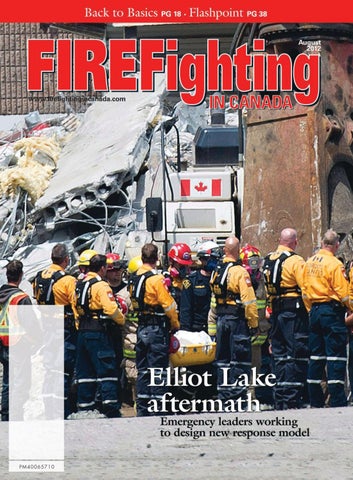
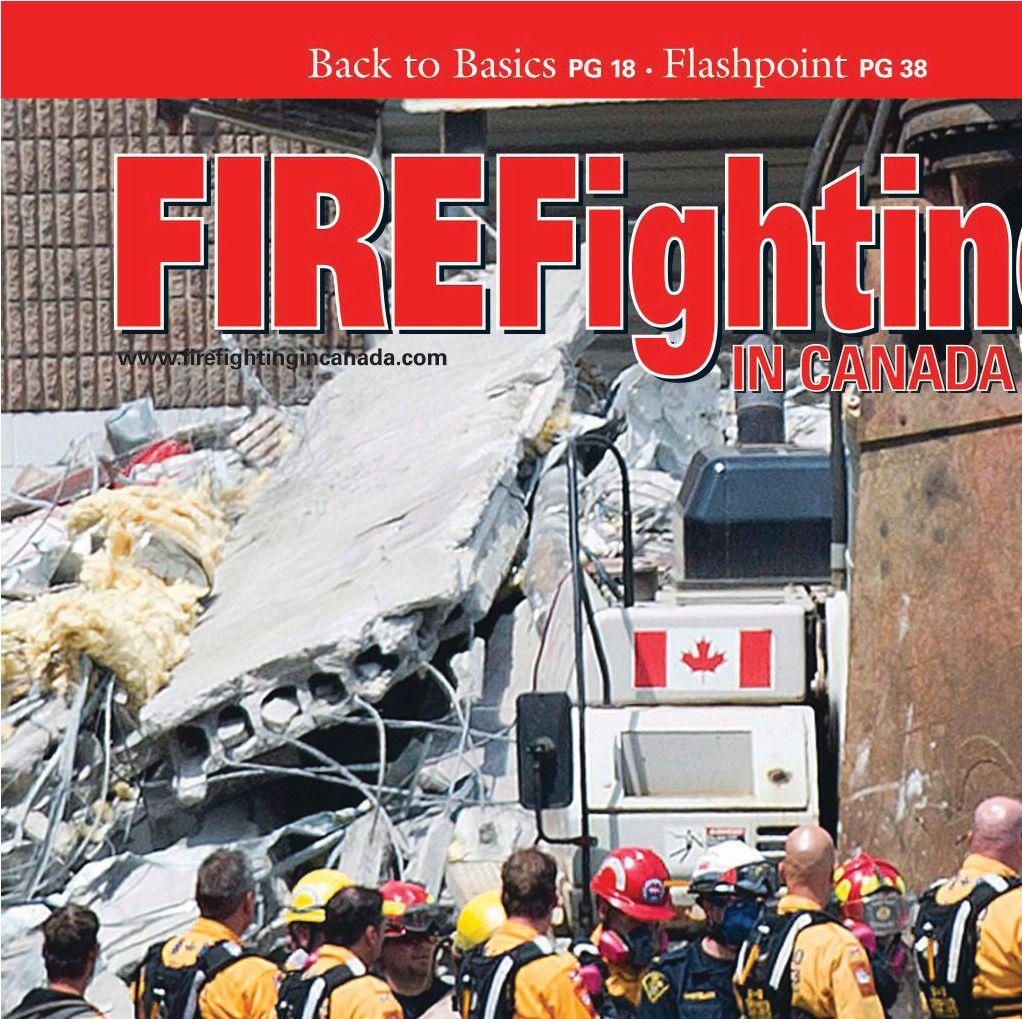
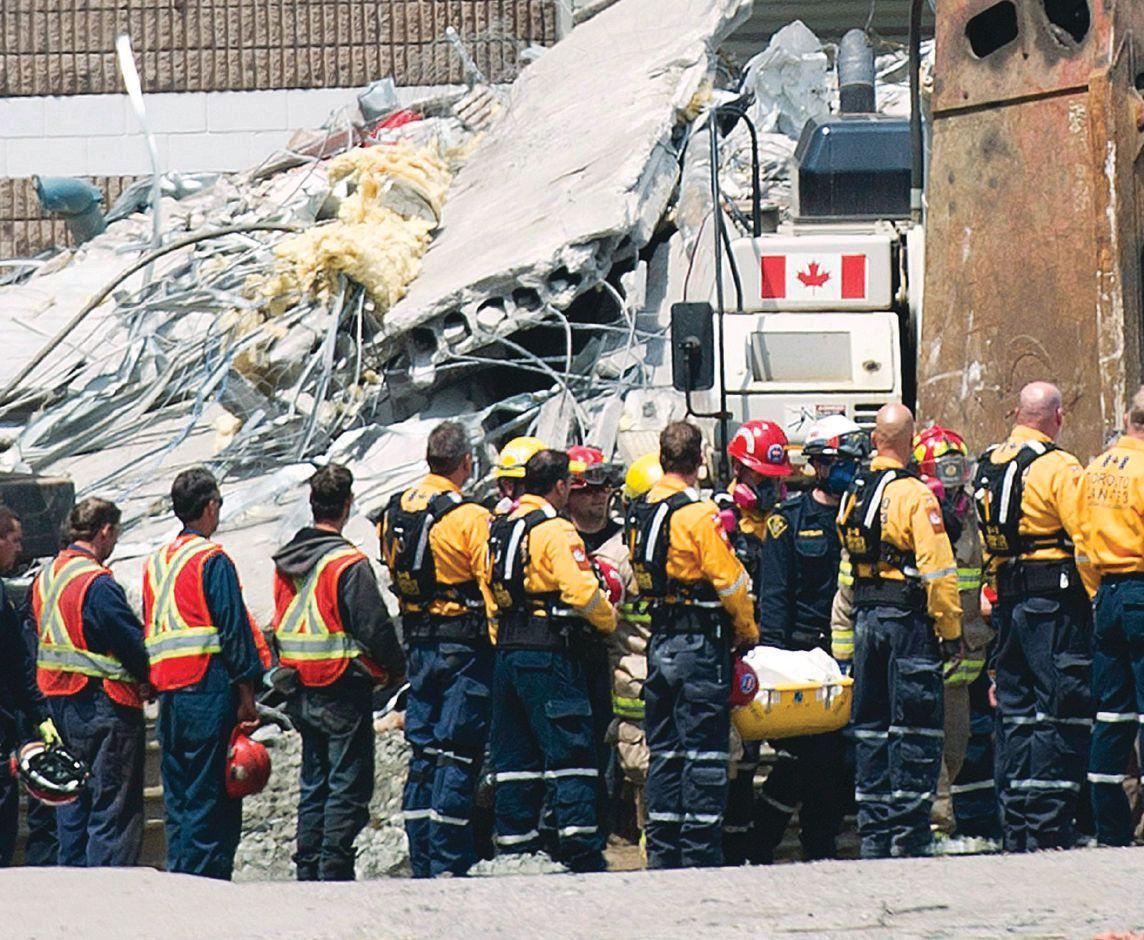
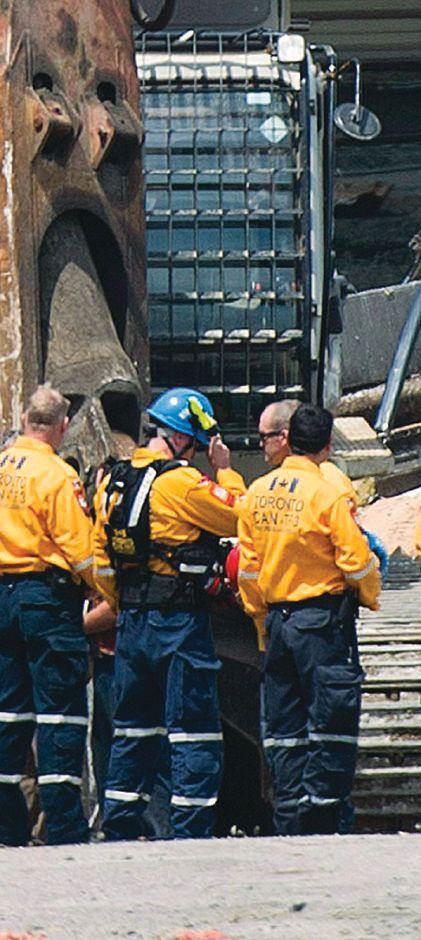
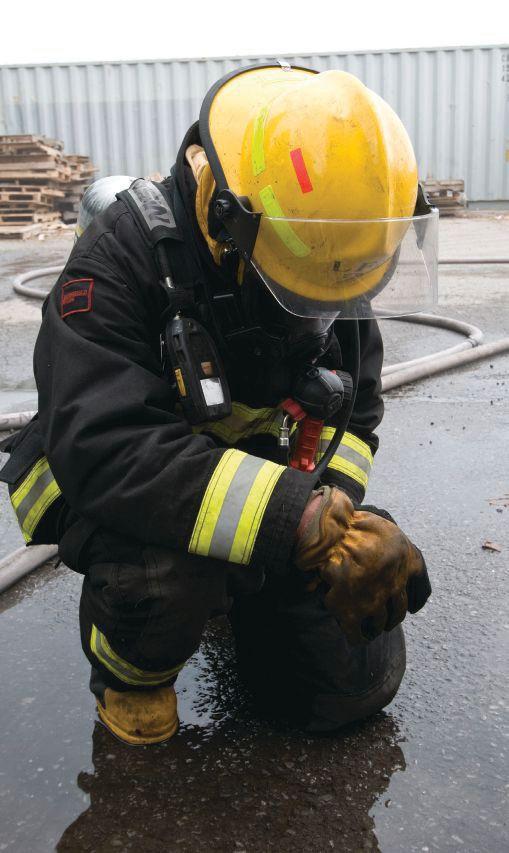
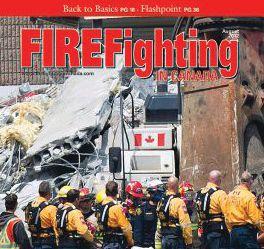
Members of Toronto’s CAN-TF3 HUSAR team bow their heads in respect as firefighters remove the second body from the wreckage of the Algo Centre Mall in Elliot Lake, Ont., in late June. See cover story page 10.
Less well known is the fact that another disaster-response team, the Ottawa-based NOHERT – the National Office of Health Emergency Response Teams, which was formed after 9-11 and the SARS outbreak – also faces an uncertain future. In addition, Ottawa is closing the search-and-rescue coordination centres in St John’s and Quebec City, and the Kitsilano Coast Guard Rescue Station in British Columbia is being shuttered.
Back in November 2007 I spent a raw, frigid day at a disaster exercise in Toronto. Four of Canada’s five HUSAR teams were on site at the old Constellation Hotel, along with Ontario’s Emergency Medical
Back then, it not only looked like there was a plan. There was a plan.
From where I sit, that no longer appears to be the case. Sure, the Public Safety Canada website is impressive with its myriad lists of response agencies and mission statements, but can the fire service stand by and be grateful for a pittance in the form of a tax credit for volunteers while the stalwarts of the country’s search-and-rescue capability are hacked away at from within?
If you let the pillars of your most skilled, most valuable services crumble – however seldom they are called to action – sooner or later they will collapse, and the loss will be measured in ways you can’t calculate. Just ask the people in Elliot Lake.
(with GST $25.20, with HST/QST $27.12) (GST - #867172652RT0001)
USA – 1 Year $40.00 USD
We acknowledge the financial support of the Government of Canada through the Canada Periodical Fund (CPF) for our publishing activities.
Occasionally, Fire Fighting in Canada will mail information on behalf of industry-related groups whose products and services we believe may be of interest to you. If you prefer not to receive this information, please contact our circulation department in any of the four ways listed above.
All advertising is subject to the publisher’s approval. Such approval does not imply any endorsement of the products or services advertised. Publisher reserves the right to refuse advertising that does not meet the standards of the publication. www.firefightingincanada.com
PHOTO BY THE CANADIAN PRESS
STATIONtoSTATION
ACROSS CANADA: Regional news briefs
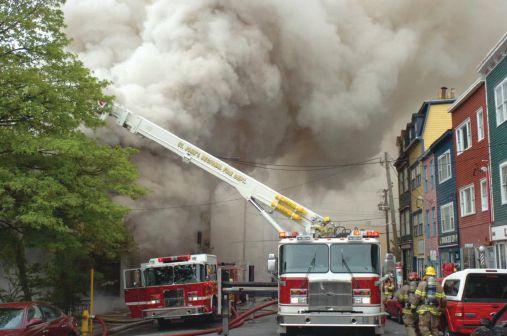
St. John’s department achieves highest insurance grade
The St. John’s Regional Fire Department’s FUS rating has improved to class 1 (residential and commercial) following some hard work and improvements. Just two other Canadian cities – Hamilton, Ont., and Montreal – share that rating.
The St. John’s Regional Fire Department has boosted its fire-insurance grade to class 1 (residential and commercial), a designation enjoyed by just two other Canadian cities.
The boost follows an evaluation in 2011 by the Fire Underwriters Survey (FUS), which looked at 22,000 risks. The survey established zones of risk within St. John’s and adjacent Mount Pearl (the
THE
St. John’s department covers Mount Pearl), and these became the benchmarks for the overall evaluation.
A FUS review grades firedepartment on factors such as administration, communication, operations, training, fire safety and inspection, and a municipality’s ability to provide water for fire fighting. As a result of the review, the St. John’s Regional Fire
BRASS POLE
Promotions & Appointments
JON REHILL was promoted to deputy fire chief of administration for the Cambridge Fire Department in Ontario on May 28. Rehill joined the CFD in 1991 as a firefighter and progressed through the ranks to captain, and most recently, chief of public education.
ED THIESSEN was appointed deputy fire chief for the LaSalle Fire Service in Ontario on May 30. He is an 11-year volunteer member of the LaSalle department, most recently serving as captain.
DEAN ALLISON of the Sunny Corner Volunteer Fire Department in New Brunswick has been appointed to the board of directors of the Canadian Volunteer Fire Service
PHOTO BY ST. JOHN’S
Department booted its grade from class 1 (residential) and class 3 (commercial); the improvement is expected to result in lower fire-insurance rates for commercial properties. Montreal and Hamilton, Ont., are the only other cities that have achieved the class 1 (residential and commercial) standard.
St. John’s Regional’s new communications centre received scores ranging from 93 per cent to 100 per cent. The FUS report says that the centre is well designed and constructed, and is operated by well-trained staff who are committed to excellence.
The department’s administration was also commended by FUS, and was called a model for the fire service in Canada. The department received a score of 99 per cent for this category and was encouraged by FUS to continue with its apparatusreplacement program.
Operationally, the FUS report says the department provides strong and knowl-
edgeable leadership, which has been accomplished through the support of management and the union.
The department’s training programs scored almost 100 per cent, with improvements to be made in the area of live fire. Training facilities scored 92 per cent. Maintenance facilities and programs were being reorganized when the survey was done and many of the issues identified then have since been addressed.
The fire safety division, which includes fire prevention and fire inspection, scored between 96 per cent and 100 per cent.
Water-supply requirements previously identified by FUS have been addressed more efficiently, and water is now supplied from two separate plants. The report says that mapping and distribution improvements will continue in order to provide better domestic flows and to balance those flows when new demands are made in the future.
- Olivia D’Orazio
Association. Allison, who has served 21 years in the fire service, most recently as deputy fire chief, is now representing the volunteer firefighters of New Brunswick.
Volunteer fire chief TIM BLAKE has been appointed full-time fire chief for the Campbellford/ Seymour station in Trent Hills, Ont. Blake has been with the department for 25 years and has been volunteer chief since 2001.
PHIL DAWSON has accepted the position of deputy fire chief for the Town of East Gwillimbury. Dawson was
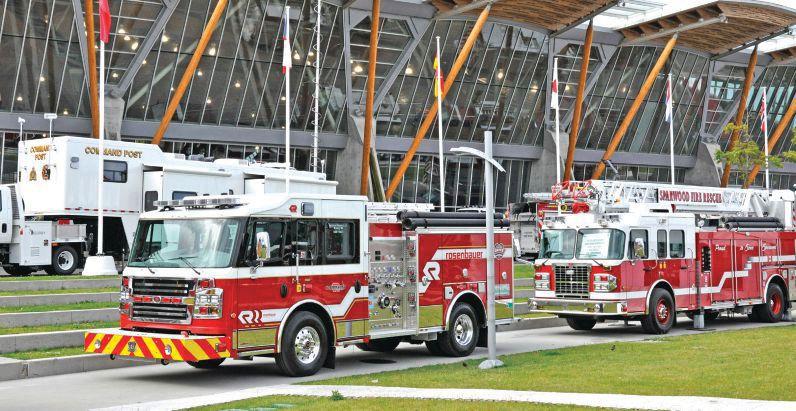
More than 225 delegates attended the annual Fire Chiefs Association of B.C. conference and BC Fire Expo June 3-7 in Richmond, at the Delta Vancouver Airport and the Olympic Oval. Almost 125 exhibitors indoors, and another 35 outside, displayed at the trade show. Randolph Mantooth from TV’s Emergency provided the opening keynote with Mike “Pinball” Clemons closing out the week. The education portion of the conference was overwhelmingly well received by the delegates as they learned, shared and networked with their colleagues and friends over four days. The Okanagan city of Penticton hosts the 2013 conference and expo May 25 to 29.
Junior firefighter weekend puts kids in the jumpseat
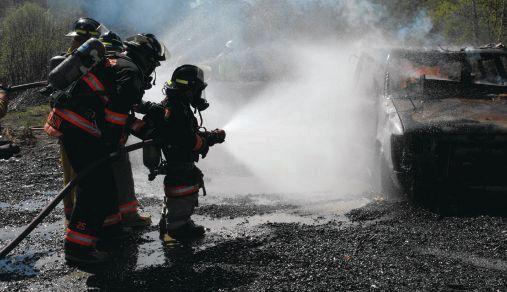
Many of the children who participate in the annual junior firefighter training weekend in Lunenburg, N.S., come back to join the department’s junior firefighter program, says Lt. Tony Hunt, who is a counsellor with the program.
This year, about 60 children between the ages of 12 and 19 participated in the twoday event. The students came from several fire departments throughout the Lunenburg area, and participated in handson training sessions that taught the basics of fire fighting and vehicle extrication.
The weekend event – which, in May, marked its fourth anniversary – serves as an introduction to the world of fire fighting. Participants engage in hands-on training sessions,
deputy chief with Richmond Hill Fire and Emergency Services for four years.
ANDY SCHULTHESS, chief of Standard Volunteer Fire in Standard, Alta., has announced his retirement after 12 years of service. He worked as an ambulance operator in Calgary before moving to Standard, where he became fire chief in 2000.
run by qualified supervisors.
The weekend, which is part of a wider program that the Lunenburg and District Fire Department offers, is free to children, though departments are charged a modest $10 for each child.
“We looked at it as, these are our future firefighters,” Hunt says. “We think it’s good to get these kids prepared for if they want to [become firefighters] down the road.”
Many of the children have parents on the department, while others just like the idea of putting out fires and cutting up cars, Hunt says. The children participate in live fire training – controlled car fires –and handle hydraulic tools for vehicle extrication.
“It’s both educational and
fun,” Hunt said. “When I was growing up, when fire prevention week came around, and the fire chief came to the school and we could look at the fire truck – that always amazed me. And the kids now love it, too.
“During fire prevention week now, we open the entire building, and kids love it. They get a tour of the hall and they can sit in the driver’s seat. And some of these kids eventually become junior firefighters.”
- Olivia D’Orazio
DOUGLAS E. TURNER, a captain with Mississauga Fire and Emergency Services in Ontario, retired after several years of service, including more than four years in the City of Mississauga.
PAUL AGAR, a volunteer firefighter with the Grand Valley and District Fire Department in the Township of East Luther Grand Valley, Ont., retired at the end of April. He joined the department
in 1967 and served 45 years in the fire service as a captain, deputy chief and acting chief.
Last Alarm
ANGIE NEMETH, 43, and BEATRICE SORENSON, 51, volunteers with the Royal Canadian Marine Search and Rescue, died June 3 during a training accident.
BARRY QUINN, a captain with Ottawa Fire Services and for-
mer secretary/treasurer with the Ontario Professional Fire Fighters Association, died suddenly on June 16. He was 56 years old.
PHOTO BY RIC RAYNOR
A firefighter in Lunenburg, N.S., helps a junior man the nozzle to fight a car fire.
PHOTO BY LUNENBURG JUNIOR
STATIONtoSTATION
BRIGADE NEWS: From stations across Canada
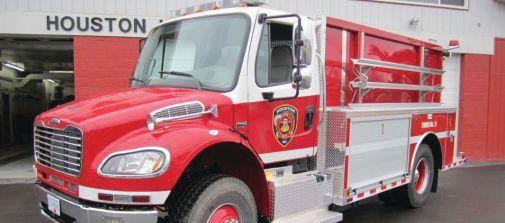
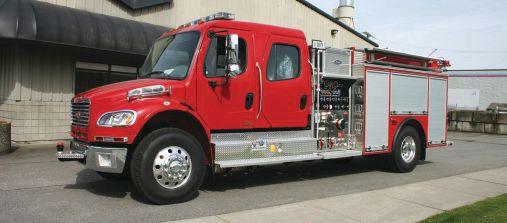
The HOUSTON FIRE DEPARTMENT in British Columbia, under Chief Ken Thomson, took delivery in April from Rocky Mountain Phoenix of a Rosenbauer-built tanker. Built on a Freightliner M2-106 chassis and powered by a Cummins 300-hp engine and Allison transmission, the truck is equipped with a 1,500-IG water tank, Hale AP 425IGPM pump, Rosenbauer 180-degree swivel dump chute, 150-watt HID telescoping floodlights, a Whelen LED light package, a Whelen siren and speaker package, and LED ground and step lighting.
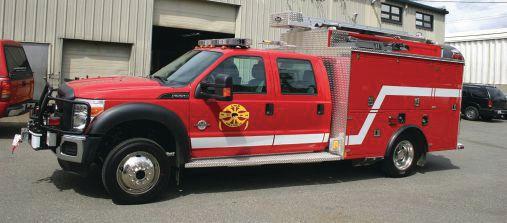
LOWER NICOLA INDIAN BAND FIRE & RESCUE in British Columbia. under Chief Lindsey Tighe, took delivery in June of a Hub Fire Engines & Equipment-built light-attack unit. Built on a Ford F550 4X4 chassis and powered by a six-speed automatic transmission and a 6.7-litre V8 diesel engine, the truck is equipped with a 250-IG co-poly water tank, a Whelen light package, a Warn grill brushguard, a Warn electric winch, a Honda 3-kilowatt generator and Light Tower command lights.
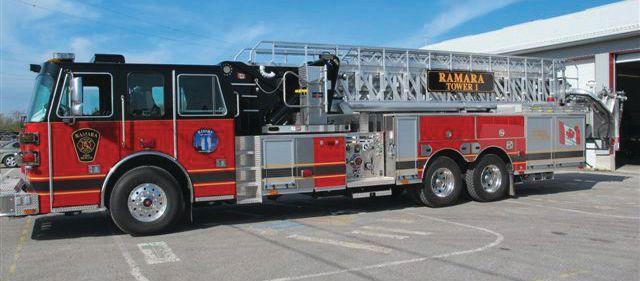
The TOWNSHIP OF RAMARA FIRE / RESCUE located in Brechin, Ont., under Chief Tony Stong, took delivery in October of a Fort Garry Fire Trucks-built aerial platform. Built on a Sutphen Monarch chassis and powered by an Allison 4000 EVS transmission and a Cummins ISM 500-hp engine, the truck is equipped with a Hale QMax 1500 pump, 300-IG co-poly water tank,, 20-IG foam tank, Onan 10-kilowatt generator, FRC Focus telescoping lights, 115foot ladder set, rearview camera and Whelen LED light package.
CFS ALERT in Nunavut, under Fire Marshal Major Rick Dunning, took delivery in March of a Fort Garry Fire Trucks-built aircraft rescue vehicle. Built on a KME AT ARFF chassis and powered by a Twin Disc TD61-1179 chassis and a Caterpillar C-13 520-hp engine, the truck is equipped with a Hale RME 2000 1,600IGPM pump, 5,000-litre GRP plastisol water tank, F.S. light and siren package, Federal Signal 3 backup camera system, Setcom 1300 intercom system, Bostrom SCBA seats, four FRC 1000w Focus lights and Akron 3356 roof turrets.
ST. WALBURG & DISTRICT FIRE RESCUE in Saskatchewan, under Chief Clinton Gory, took delivery in June of a Hub Fire Engines & Equipment-built pumper. Built on a Freightliner M2 chassis and powered by an Allison 3500 EVS transmission and a Cummins ISC 300-hp engine, the truck is equipped with a Waterous 1000-150P 840-IGPM pump, 1,000-IG co-poly water tank, Foam Pro 1600 foam system, Whelen LED light package, Elkhart Sidewinder remote control monitor, Havis push up light and Elkhart CAF valves.
LA CRETE FIRE DEPARTMENT
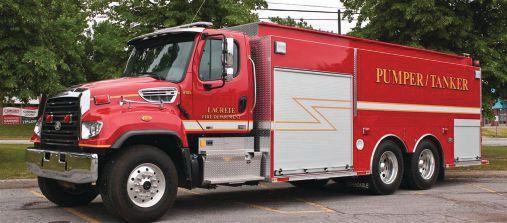
The LA CRETE FIRE DEPARTMENT in Alberta, under Chief Peter Wiebe, took delivery in June of a Dependable Emergency Vehiclesbuilt tanker. Built on a Freightliner 114SD chassis and powered by an Allison 4000 EVS transmission and a Detroit Diesel 450-hp engine, the truck is equipped with a Darley 840-IGPM pump, a 3,000-IG ultra-poly water tank, Foam Pro 1600 foam system, Whelen LED lights, and a rear-mounted swivel dump valve.
HOUSTON FIRE DEPARTMENT
LOWER NICOLA INDIAN BAND FIRE & RESCUE
TOWNSHIP OF RAMARA FIRE / RESCUE
CFS ALERT
ST. WALBURG & DISTRICT FIRE RESCUE
Initial Attack Done Safely
Elliot Lake aftermath
Emergency-services leaders working to design new response model
By LAURA KING
When Ottawa quietly announced in the spring that it would stop funding Canada’s five heavy urban search-and-rescue (HUSAR) teams in 2013, fire-service leaders say there had been no consultation with emergency services or the fire chiefs in the cities where the teams are based, no analysis of the business case that led to the launch of the teams more than a decade ago, and no risk analysis to detail what the withdrawal of federal money would mean to emergency response in Canada – emergencies such as the collapse of the Algo Centre Mall in Elliot Lake, Ont., on June 23.
And that’s what angers those who are fighting to ensure that Canada maintains its ability to respond to incidents such as that in Elliot Lake; proponents of the HUSAR teams argue that Ottawa has made a political decision about an operational issue without considering the potential ramifications, and they’re working with Public Safety Canada – not necessarily to reverse what they call a short-sighted decision, but to find an alternative response model that works.
LEFT: Members of Toronto’s CAN-TF3 HUSAR team bow their heads as firefighters remove a body from the rubble of the collapsed Algo Centre Mall in Elliot Lake in June. Federal funding for the HUSAR teams was eliminated in the 2012 budget and Ottawa’s contribution to the five teams dries up in March.
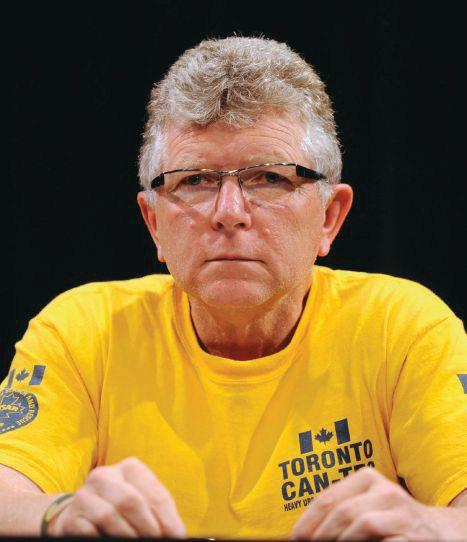
ABOVE: HUSAR’s Bill Neadles has said wishes he had chosen his words differently when he told reporters that the search was ending for victims in Elliot Lake. Neadles said the team would have stayed in Elliot Lake for weeks to help the town.
Ironically, on June 26, the day before rescuers in Elliot Lake removed the first of two bodies from the rubble, representatives from the Canadian Association of Fire Chiefs (CAFC), the Canadian Association of Chiefs of Police (CACP) and the Emergency Medical Services Chiefs of Canada (EMSCC), met in Ottawa with Public Safety Canada to discuss what they call a transition plan to preserve the HUSAR teams.
“Right now the discussions are very preliminary,” CAFC president Rob Simonds said in an interview in early July. “We’re looking at some solutions that will possibly take an all-hazards approach to emergency response.”
Simonds said he couldn’t divulge details but made it clear that discussions were more focused on a modified response model rather than on restoring federal funding for the HUSAR teams.
“I know that in terms of the financial pressures that are facing the government, I am not overly optimistic that funding would
be coming forward,” Simonds said.
Still, the fire, police and EMS chiefs have asked Public Safety Canada to look for any alternative funding that might be available to the teams.
“The CAFC, CACP and the EMS chiefs have challenged the government to go back and examine what options there are to secure funding to sustain these teams into the future,” he said.
Simonds says that when he initially approached Public Safety Canada after the funding cut was announced, and challenged the department to explain the logic behind the withdrawal of federal money and the future plan for emergency response, bureaucrats recognized that there should have been consultation with emergency-services leaders.
“I think certainly in hindsight they would acknowledge that the path forward could have been considered much more thoroughly,” he said.
Simonds said those advocating for the HUSAR teams are open to a new response model.
“If we look at our risk profile across the country it absolutely necessitates having teams that can be deployed and whether they’re light or medium or scout teams that can assess, there has to be some consideration given to those facts,” he said.
“As much as HUSAR has become the focal point [after Elliot Lake], we’re also looking at CBRNE and other issues so that there can be a seamless response to these types of incidents, that would have multiple levels of response and involve all three levels of government.”
Whatever the result of the discussions with Public Safety Canada, it will be tested at an exercise in October, Simonds said, “to examine how effective the emergency response and management would be with whatever the new response model would look like.”
THE BACKGROUND
The funding model is simple. Ottawa provides $3 million a year for Canada’s urban search and rescue (USAR) and heavy urban search and rescue (HUSAR) teams through the Joint Emergency Preparedness Program (JEPP). Funding for light urban search and rescue teams – there are several across Canada – is shared equally between Ottawa and the provinces. Ottawa provides one-third of the funding for the five HUSAR teams – in Vancouver, Calgary, the province of Manitoba, Toronto and Halifax – to pay for operations and maintenance. The rest of the funding comes from the provinces and the municipalities in which the teams are based.
PHOTOS BY THE CANADIAN PRESS
The HUSAR teams received $1.87 million in federal funding for 2012-2013 (the funding dries up at the end of March) and a total of $9.7 million since 2009.
Public Safety Canada’s rationale for the cut is that the objective of the JEPP program, which is to enhance local emergency preparedness and response capacity, has been met. That statement lacks logic, say those working to convince Ottawa to restore the HUSAR program.
If there was an earthquake, say, in Vancouver, the Vancouver team would not be able to respond and would count on the other teams,” says Sean Tracey, chair of the Canadian Centre for Emergency Preparedness. “What happens if there’s a major issue in Saskatchewan or Quebec? Or somewhere in Newfoundland and Labrador or New Brunswick? This was the whole concept of having national resources positioned in the provincial regions.
“It’s also a bit disingenuous,” Tracey told albertaprimetime.com. “This is a highly technical search-and-rescue capability. By a logical extension of the federal government’s argument here, is the national military search-and-rescue capability also now supposed to be a provincial responsibility? It’s not right. We know that we need this capability. We do provide federal military support for national search-and-rescue, aircraft
support for search-and-rescue capabilities, and ground search and rescue teams. Why are we withdrawing funding for the heavy urban search and rescue teams on a program that was initiated by the federal government on a review of the landscape back in 2001 after 9-11?”
Although emergency response is a provincial responsibility, Tracey says, Ottawa recognized when it established the JEPP program and the HUSAR teams that there was a gap in response capabilities that required federal support.
Indeed, Public Safety Canada evaluated the HUSAR units five years ago and found that without federal funding, there was a risk that the teams would not be sustainable.
“There is a need for the federal government to continue contributions to build capacity and capability for teams focused on heavy urban search and rescue,” the report says.
“The HUSAR teams have a need for ongoing operating and maintenance funding to ensure sustainability. Without such funding there is a risk that some or all of the HUSAR teams will not survive.”
Essentially, Ottawa’s own analysis found that provincial and municipal governments did not have the financial resources to cover the federal portion of the funding for the HUSAR teams.
“Because they do not have adequate funds for ongoing operations and maintenance . . . the sustainability of their organizations is in jeopardy as is their ability to fulfill their missions in the long-term,” the report says.
“Their assertion is that continued development and future sustainability of HUSAR teams for co-ordinated national deployment is dependent upon contributions from the federal government. They want the federal government to provide funding to ensure the sustainability of the HUSAR teams.”
Public Safety Minister Vic Toews’ office sees it differently. The HUSAR funding cut made national news during the coverage of the response to Elliot Lake. In an email widely distributed to media, Toews’ office said that 90 per cent of emergencies in Canada are managed by municipalities or at the provincial or territorial level.
“Our government has supplemented provincial emergency preparedness by investing in equipment and training for urban search and rescue teams, firefighters, police and other first responders,” the email said.
“Moving forward, our government is focused on delivering long-term disaster prevention funding to help provincial and territorial governments build infrastructure to protect against natural disasters.”
In Ontario, Community Safety Minister Madeleine Meilleur said the province can’t
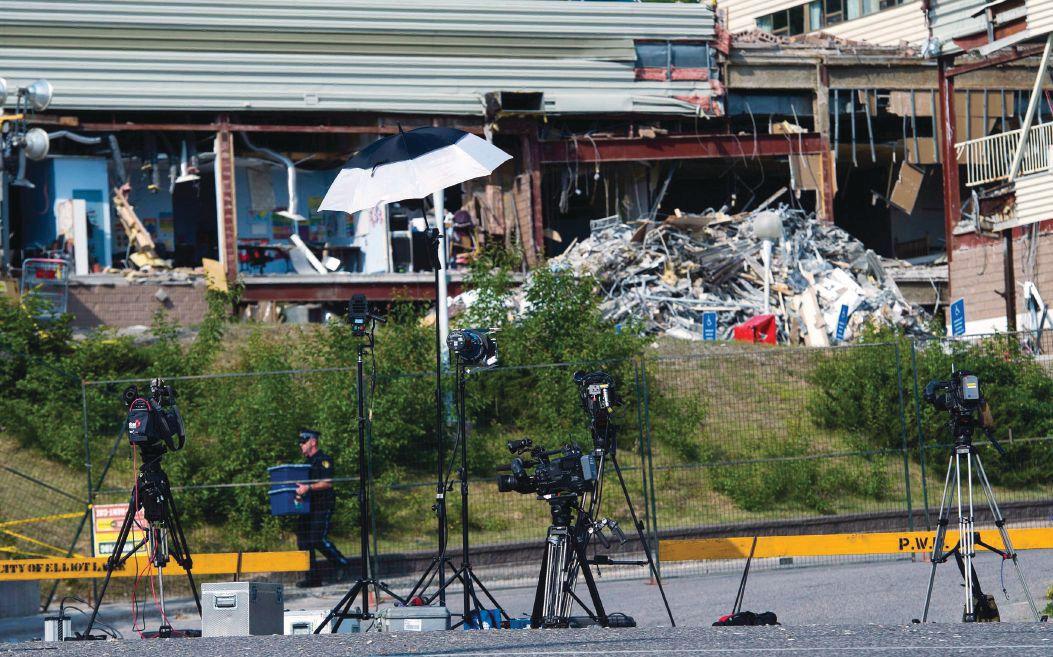
Cameras from media outlets outside the Algo Centre in Elliot Lake, Ont., on June 28, a day after the recovery of two bodies fro m the collapsed structure. Emergencyservices leaders are working with Ottawa to try to find funding to maintain Canada’s HUSAR teams, the only teams fully trained in heavy urban search and rescue.
PHOTO BY NATHAN DENETTE, THE CANADIAN PRESS
“The only way you can manage a HUSAR problem is with co-operation and partnerships among the three levels of government.”
- Vancouver Fire Chief John McKearney
assume the federal portion of the funding for Toronto’s HUSAR team.
“[The] federal contribution was approximately 10 times provincial assistance and the unavailability of this funding will significantly impact the ability of Toronto to maintain provincial HUSAR capacity,” she said.
THE ARGUMENT
The decision on June 25 to halt the search in Elliot Lake’s Algo Centre because the risk of further collapse was too high drew criticism from uninformed pundits and grieving townspeople who reacted in anger.
Then, TV reporters and newspaper columnists did some Google searches and pontificated that although the HUSAR teams train hard, they are seldom deployed and have little experience with large-scale collapses (the teams’ mandate specifies that they not be deployed outside of Canada). Did the Toronto HUSAR team need help in Elliot Lake from better-prepared American search-and-rescue teams, the reporters wondered?
Later, after Tracey and others told reporters about the funding cut –which was news to most Canadians outside of the emergency services even though it had been announced more than two months earlier – some wondered if the withdrawal of federal support mattered given that the team couldn’t do what observers thought it should have done in Elliot Lake: get the victims out quickly.
While experts such as Tracey and Bob Simpson from Calgary’s CAN-TF2 team did media interview after interview in an effort to correct misconceptions about the role of the HUSAR teams and explain the preparation and technical expertise necessary to enter a collapsed structure, others have been working the political and bureaucratic side.
As the CAFC’s Simonds explained, when the HUSAR teams were developed, Ottawa had prepared a business case that indicated where the teams should be located. He says that information must be considered now as part of the process to determine what happens next.
“From a risk-analysis perspective there had to be a reason to put teams in place in certain geographical areas of this country,” Simonds said.
“If that has changed, what does that new risk analysis look like? What kinds of teams do we have? In the absence of having that information or undertaking that analysis, that’s where many of the fire chiefs across Canada
are coming from in terms of their positions on this.”
Simonds suggested that several smaller teams strategically located across the country – such as the heavy hazmat team in New Brunswick – in addition to scout teams from smaller jurisdictions, could do size-up and incident action plans before other types of teams arrive to do the heavy lifting, so to speak. But, he reiterated the need for federal, provincial and municipal participation.
Vancouver Fire Chief John McKearney agrees.
“The only way you can manage a HUSAR problem is with co-operation and partnerships among the three levels of government,” he said.
“My annualized cost is $1.4 million, of which, year in and year out, the federal contributions have been between $400,000 and $500,000, so it’s really one-third of the equation, and then the taxpayers of Vancouver and some tax base in the province has been picking up the balance. To believe that the City of Vancouver can continue [to cover] that full cost is not realistic.”
McKearney says that without federal funding the teams’ ability to maintain their equipment will unravel and the units will falter.
“It was only in last couple of years, since 2006 and 2007, that Public Safety Canada really finally stopped changing seats and put in good leadership and has put together what is truly now a national approach to heavy urban search and rescue,” he said.
“So my feeling is to pull out now, the five teams . . . will begin to recede because there are so many other [funding] priorities in everyone’s day. Without this balance of money, the emotion will change and the wind will be out of the sail and emergency leaders will start to shift their services to different needs, and that’s detrimental to our citizens.”
Essentially, McKearney said, those working with Ottawa are aiming to convince bureaucrats that the teams are vital to public safety in Canada.
“It doesn’t have to be JEPP,” he says, “but there has to be a funding approach that says we want this to continue. Come the third quarter of this year, if there’s no change, we’re going to have to come up with strategy on how to change this – but in most provinces, the teams will likely recede to something that’s regional and provincial.
Continued on page 35
The funding GAP
The mall roof collapse in Elliot Lake, Ont., was a tragic accident. The media focus has been on the response but this incident highlights an even greater potential concern: What would have been the response had the Toronto HUSAR team not been available?
This is a legitimate question when we consider that the federal majority funding for these teams will be withdrawn in 2013. What would the response have looked like? Can you imagine the outcry and national embarrassment?
In the 2001 federal budget, $20 million was set aside to develop a national HUSAR program. The intent of the Joint Emergency Preparedness Program (JEPP) funding was to build national response capabilities where none had existed. Teams were set up in Vancouver, Calgary, the province of Manitoba, Toronto, and Halifax, the concept being that the teams would be available regionally as well as for national and international response.
In the case of HUSAR, federal funds covered 75 per cent of the cost to develop these teams. After this initial seed money, ongoing support would come from JEPP funds matched by the provinces and/or municipalities. This represented about $400,000 per team per year or, to quote Deputy Chief Tom Sampson of Calgary’s Task Force 2, “the cost of an empty can of pop” per Canadian per year. A review commissioned by Public Safety Canada of the HUSAR program back in September 2007 stated: “The HUSAR teams have a need for ongoing operating and maintenance funding to ensure sustainability. Without such funding there is a risk that some or all of the HUSAR teams will not survive.”
In the April 2012 budget, the federal government made a decision to withdraw all JEPP funding, stating, “The original objectives of this program, namely, to enhance local emergency preparedness and response capacity, have been met.” Really? By what measure? The federal govern-
Canada needs united voice on HUSAR support
By SEAN TRACEY
When federal funding for Canada’s five heavy urban search and rescue teams dries up in March, there will be no specialized agencies to respond to disasters such as structural collapses.
ment’s response to numerous inquiries was that emergency response was a provincial responsibility. According to two different sources within Public Safety Canada, “the management of emergencies continues to be a provincial responsibility. We expect the provinces to cover the cost of items within their capacity,” they said.
If the above statement is true and the federal government wants nothing to do with emergency response, then what about the military’s role in search and rescue? This is a national capability providing expensive assets to support the regions in search and
Continued on page 34
PHOTO BY THE CANADIAN PRESS
SPARTAN TELSTAR
This articulated aerial sets a new global standard for aerial performance and all calls capability. It offers several industry-leading features highlighted by a 138-foot telescopic and articulated aerial platform, which supplies an “up, over, and down” range of motion for navigating around parapets ladders and maximized compartmentation, you are ready for any situation.
INTRODUCING SPARTAN ERV
1975 1912 19621997 2003 2012
Luverne Fire Apparatus builds Quality Manufacturing is founded in Talladega, AL
Spartan Motors is created
Spartan Motors, Inc. purchases Luverne Fire Apparatus & Quality Manufacturing
Luverne and Spartan Motors, Inc announces SPARTAN ERV Response Vehicles),
BACKtoBASICS
Engine company ops –holding the line
BY MARK VAN DER FEYST
Different-sized hoselines can be used as offensive weapons or defensive tools to suppress fire. The most commonly used hoselines are one-and-a-half-inch, one-and-theequarter-inch and two-and-a-half-inch, each flowing a different rate of water and producing different nozzle reactions.
As few as one firefighter, or as many as four firefighters can be needed to hold the line, depending on the diametre of the line, the amount of water flowing and the required pressure being pumped from the apparatus. Many firefighters fatigue quickly when manning a hoseline and then have a hard time trying to maintain control. There are different ways to hold the line.
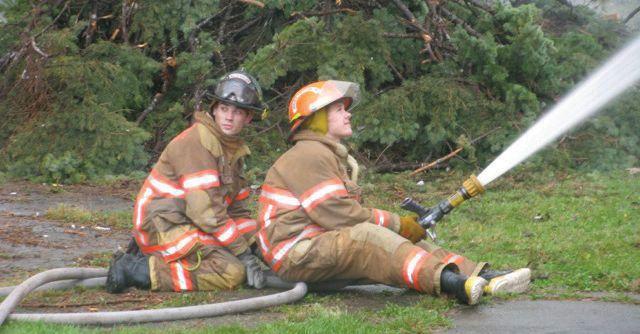
The sitting method is the most common way for a single firefighter to hold the line. The firefighter turns the hose into a circular shape and then passes it underneath itself, so that he or she is able to sit on the hose at the point at which the two sections are in contact with each other. As shown in photo 1, the firefighter in the orange helmet is sitting on the two sections, and controlling the hoseline. Although this method allows just one firefighter to manage a small-diameter or a large-diameter hoseline, it is not very ergonomic; lower-back fatigue sets in quickly while reaching/ hunching forward to hold the nozzle and control it. This method works well only for defensive positions.
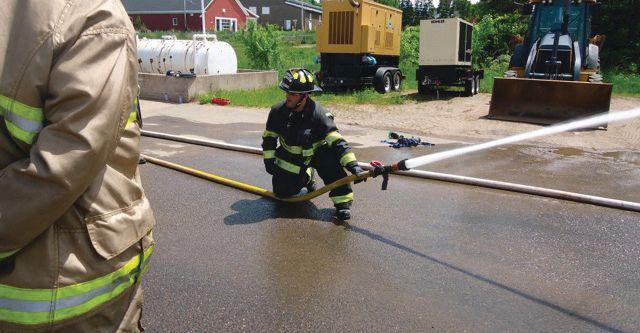
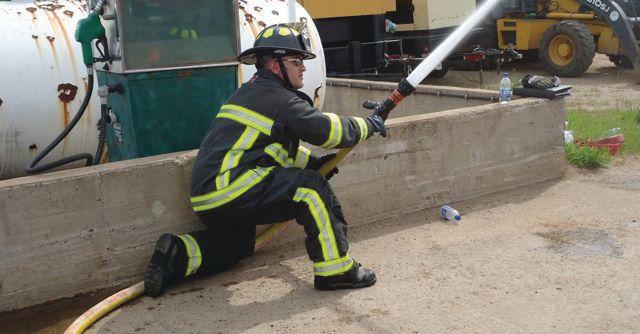
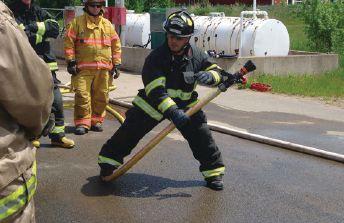
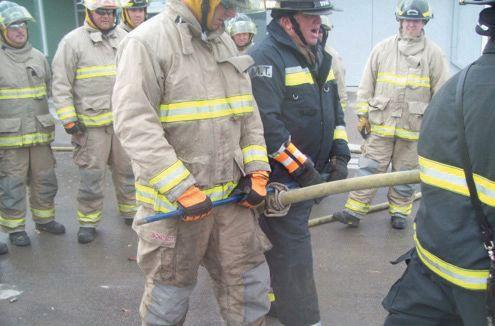
Another way for a single firefighter to manage a hoseline is to kneel on it. This method allows one firefighter to control the hoseline while a partner is away momentarily conducting other tasks if on interior assignment. Kneeling uses the firefighter’s body weight to hold the line in place while delivering water. This nozzle reaction is directed toward the ground, with the knee resting on the hose, as seen in photo 2. On the inside of a structure, the corner of the baseboard and the floor area can be used to push the hoseline into with the knee holding it in position, as seen in photo 3. The foot can also be used in a standing position for interior attack, as seen in photo 4. This allows a firefighter to direct the stream of water through doorways of rooms across the hallway when trying to control the fire. The second firefighter may be away pulling in more hose or searching a nearby room. With the other team member committed to his or her duties, the nozzle firefighter can still be effective by holding the line in place using body weight, and applying water at full pressure and flow.
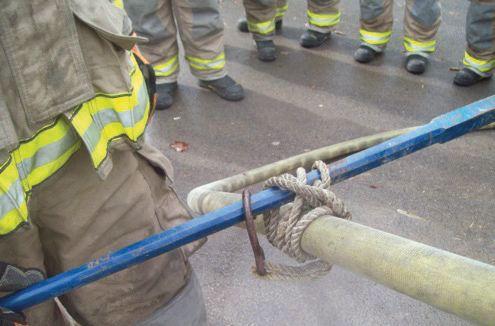
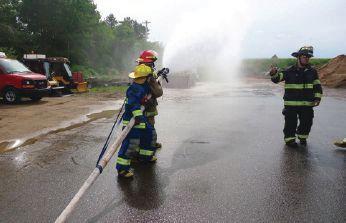
For larger-diameter hoselines, a pry bar along with rope or webbing can be used to construct a T-handle for the hoseline, as seen in photo 5. Using this T-handle allows two firefighters to stand side by side to hold the line while a third firefighter controls and direct the nozzle. As shown in photo 6, the rope or webbing used to secure the pry bar to the hose is wrapped around in a crisscross fashion. The T-handle allows the firefighter team to stand or kneel while holding the line, and advance the line in unison. The T-handle is far enough back from the nozzle to give the firefighter
Photo 1: The firefighter in the orange helmet controls the hoseline by turning it into a circle and passing it under itself, then sitting on the crossed section.
PHOTOS BY MARK VAN DER FEYST
Photo 3: Inside the structure, a firefighter can use his knee to push the hoseline into the corner of the baseboard and floor, further securing the line.
Photo 2: The firefighter kneels on the hoseline, using his body weight to hold the line in place.
4: This method can also be performed in a standing position, allowing the firefighter to direct the stream through doorways and across hallways.
6:
is
manning the nozzle enough room to control and direct it without any interference. This method is primarily used for defensive positions or for large interior operations such as a commercial warehouse or big-box store.
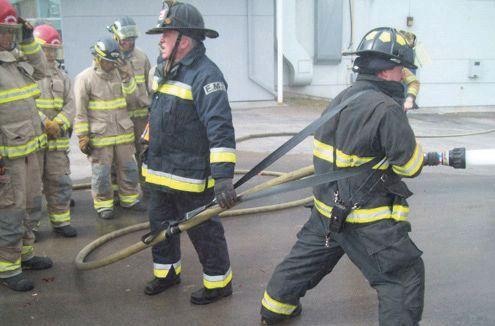
Webbing is a great aid for holding the line. The firefighter in photo 7 is holding the hoseline with a webbing strap around his shoulder. The webbing strap should be long enough to allow the firefighter to produce a gentle angle from where the girth hitch is created up to the shoulder. If the angle is too sharp, the firefighter will feel himself being pulled down because of the nozzle reaction. Webbing should be between 10 and 15 feet long and it needs to be a closed loop; this can be accomplished by tying a water knot at the end. The webbing is tied in a girth-hitch fashion, which means simply passing the webbing through itself and tightening it. A girth hitch
Photo 5: A pry bar secured with rope forms a T-handle, allowing two firefighters to stand side by side, while a third firefighter directs the nozzle.
7: A firefighter uses a webbing strap around his shoulder to hold the hoseline. The strap is long enough to allow the hose to rise to the shoulder at a gentle angle, and is on the outside of the firefighter’s body, allowing for an easy release.
is not recommended for any life-safety application but will suffice for holding a hoseline. Notice how the firefighter in photo 7 has the webbing strap around his outside shoulder. This allows the firefighter to quickly drop the hoseline and walk away should the need arise; the firefighter simply turns to the right and the webbing strap falls off with no entanglements. Having the webbing on the outside shoulder allows the firefighter to face the hose, and, therefore, better oppose the nozzle reaction. If the webbing is on the inside shoulder, the nozzle reaction forces the firefighter to stand square with the hose, putting him in an awkward position.
If two or three firefighters are being deployed, then two webbing straps can be used, leaving one firefighter to control and direct the nozzle, as seen in photo 8. This method works well for defensive positions.
Mark van der Feyst is a 13-year veteran of the fire service and works for the City of Woodstock Fire Department in Ontario. Mark is an international instructor, teaching in Canada, the United States and India. He is a local level suppression instructor for the Pennsylvania State Fire Academy and an instructor for the Justice Institute of B.C. Contact him at Mark@FireStarTraining.com
Photo
Photo
The rope
tied in a criss-cross pattern to secure the pry bar to the hoseline.
Photo
Photo 8: Each firefighter manning the hoseline will require his or her own webbing strap.
Disposable rescuers?
Rebutting the firestorm of media criticism over Elliot Lake
By SHAWN SWEENEY
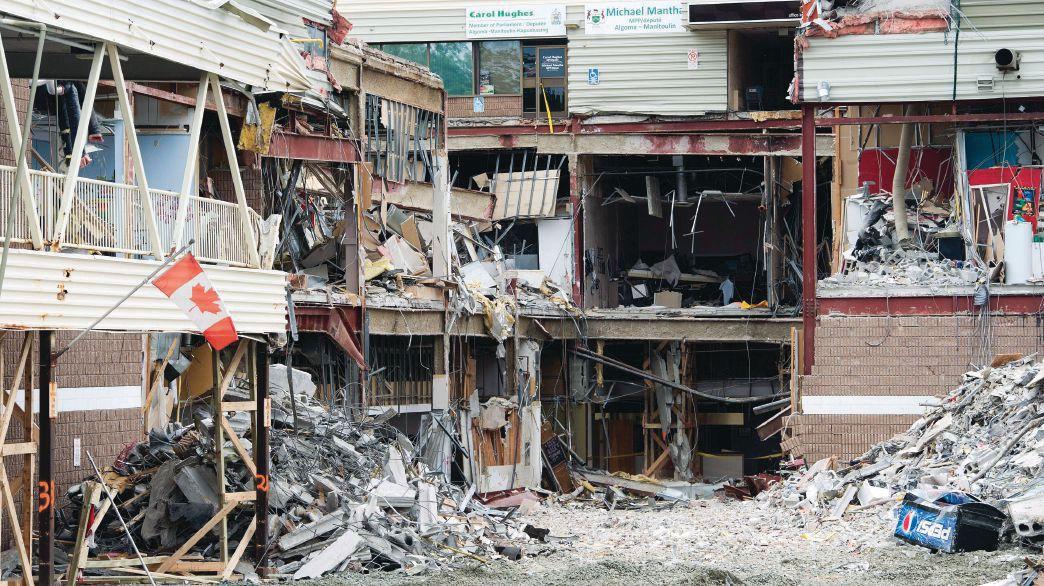
ABOVE : Most Canadians watching the tragedy unfold at Elliot Lake’s Algo Centre Mall were not aware of the technical aspects and specialized processes needed to ensure safety following a structural collapse.
Editor’s note: Like many emergency personnel, former CAN-TF3 member Shawn Sweeney was frustrated by the coverage of the rescue effort in Elliot Lake, Ont., after the collapse of the Algo Centre Mall in June. Sweeney, the deputy chief in New Tecumseth, Ont., shares his thoughts on the commentary and provides some insight into HUSAR operations.
It’s an understatement to say that some of the commentary about the collapse of the Algo Centre Mall in Elliot Lake, Ont. – particularly that relating to specialized resources and operations, technical
rescue and its processes and systems, and, to a degree, the individuals involved in the rescue/recovery operation – was, at times, off base.
From my perspective as a former member of Toronto’s CAN-TF3 Heavy Urban Search and Rescue (HUSAR) team, the coverage and commentary – on national TV and by national and local newspaper columnists – was so far off it made me want to close the newspapers and turn off the TV and the Internet.
I have been, and always will be, a huge supporter of technical-rescue disciplines and the specialized personnel, equipment and training that go along with them.
BY
PHOTO
I know I’m preaching to the converted but I felt it necessary to outline and explain some of the background to this type of response and, in doing so, support a group of rescuers who deserve to be supported.
To my mind, the members of Toronto’s HUSAR team who spent five days in Elliot Lake after the roof of the Algo Centre Mall fell in and trapped – and ultimately killed – two women, deserve better than the thankless, uneducated criticism of grieving townspeople, uninformed journalists and self-serving politics that they suffered.
Some observers and pundits seem to have decided, based on the aforementioned columns and TV reports, that the dangerous and specialized work undertaken by HUSAR members deserves to be thankless. Indeed, this was some of the sentiment relayed to me by a friend and active CAN-TF3 member in a conversation following his return home from Elliot Lake.
My emergency-management experiences tell me different. What casual observers don’t know is that in a collapse situation such as Elliot Lake, a call to the HUSAR team is a call for help from a specialized resource, but not necessarily a call for rescue or recovery; until team members assess the situation, there is no assumption of the kind of operation the team will perform. The operation is determined by findings from size-up, various surveys, and available and ongoing information. Indeed, search-and-rescue equipment has been known to produce false positives – indicating life where there has been none. In addition, search-andrescue environments can be untenable and unsafe for rescue until hazard mitigation is undertaken.
Newspaper columnists and critics seemingly want first responders to question ourselves, our mandates and our work; the barrage of criticism that followed the call to stop the Elliot Lake search because the building was so unstable it could have further collapsed without warning, seems to have divided us on the question of what some have labelled disposable rescuers –an ugly term. Do we sacrifice the lives of rescuers when we know it’s unsafe to go in? No, we don’t. Everyone goes home. Have those who advocated going in at any cost forgotten NFPA 1500, Standard on Fire Department Occupational Safety and Health Program, and its principles? 1.Activities that present a significant risk to the safety of members shall be limited to situations where there is a potential to save endangered lives.
(Risk a lot to save a lot.)
2.Activities that are routinely employed to protect property shall be recognized as inherent risks to the safety of members, and actions shall be taken to reduce or avoid these risks. (Risk a little to save a little.)
3.No risk to the safety of members shall be acceptable when there is no possibility to save lives or property. (Risk nothing to save nothing.)
4.In situations where the risk to fire department members is excessive, activities shall be limited to defensive operations.
We may all have our own interpretations, wording and standard operating guidelines but we share much common ground from department to department. We can also learn and improve together as a group of responders, and a service. While much of the media coverage and commentary on Elliot Lake got me to reflect and wonder about changes to a number of things, such as crisis reaction and emergency communication, human nature and behaviour, and media nature and behaviour, our services have already incorporated a lot of changes and best practices; we just have to help others understand why and how our policies work.
Let’s remember the fire-and-rescue service mission, to save lives and protect property while balancing risk. Your department’s mission may be worded differently but the intent and execution the same.
So, some thoughts:
To those who have posted otherwise in the media, rescuers are not disposable. Remember, the rescue complex kills. Indeed, one HUSAR resource, the Department of Fisheries and Oceans field operations guide (FOG), clearly states that safety of team members is paramount: The emergency response team (ERT) members shall place their own safety and that of their team as the first priority.
Technical rescues and structural collapse rescues are not unplanned and unco-ordinated processes. For those who haven’t had an opportunity to work in these specialized disciplines, here is some detail from IFSTA’s Technical Rescue for Structural Collapse manual with some observations (in parentheses).
PLANNING AND SCENE ASSESSMENTS
Basic pre-plan:
1.Response area survey (I would recommend
Continued on page 36
TRAINER’SCORNER Surviving PTSD – part 3
By ED BROUWER
Emergency-service workers respond to floods, earthquakes and airline crashes where the death tolls and property destruction can be overwhelming.
The Canadian Disaster Database contains detailed disaster information on more than 900 natural, technological and conflict events (excluding war) that have happened since 1900 at home or abroad and that have directly affected Canadians.
The CDD tracks “significant disaster events” that conform to the Emergency Management Framework for Canada definition of a disaster and meet one or more of the following criteria: 10 or more people killed
100 or more people affected, injured, infected, evacuated or homeless an appeal for national/international assistance historical significance significant damage/interruption of normal processes such that the community affected cannot recover on its own
The database describes where and when a disaster occurred, reports the number of injuries, evacuations and fatalities, and gives a rough estimate of costs.
Listed among the top Canadian disasters are:
1775 – Newfoundland hurricane, 30-foot waves, more than 4,000 lives lost
1825 – The great Miramichi fire, 16,000 square kilometres burned, 160 lives lost
1873 – Nova Scotia hurricane, 900 destroyed buildings, 100 lives lost
1885 – The great Labrador gale, 190 kilometre-per-hour (km/h) winds, 300 lives lost
1903 – Frank rockslide in the Northwest Territories, 60 people killed
1912 – Regina cyclone, 28 lives lost, 2,500 homes lost
1913 – Great Lakes storm, 145 km/h winds, 250 lives lost
1929 – Grand Banks earthquake, 28 lives lost, 10,000 people lost their homes
1954 – Hurricane Hazel in southern Ontario, 216 millimetres of rain, 150 km/h winds, 81 lives lost, $1 billion in damages
The aftermath of most of these disasters had one thing in common: the presence of emergency first responders.
Disasters can cause severe psychological disturbance not only for the victims, but also for the first-responding emergency workers. There is a growing need for disaster-response chaplains, not necessarily to support the victims but to aid and watch over the well-being of the first responders.
Certainly the reaction to a disaster depends, to a degree, on the severity and duration of the event. Vulnerability factors in individual responders also play a part.
On a personal note, 2003 will go down in history as the year British Columbia burned. Not only was our fire crew among the first to respond on Aug. 16, but also we were the last crew released from the Okanagan Mountain Park fire on Sept. 24.
During our battle with the fire dragon, our families were twice
forced to leave their homes. We were trapped twice by extreme fire behavior, once needing to be heli-lifted out. We were numb with exhaustion, sleep deprived, weary and mentally and physically spent. We were on the edge emotionally to the point that when someone held up a “God bless the firefighters” sign we broke into tears. We had not personally lost anything, but the sheer duration of this wildland urban interface fire caused us to take each loss personally.
You can’t fight the fire dragon for more than 30 days and not get emotionally hooked. A number of firefighters narrowly escaped death when they became trapped by flames and smoke in
Responding to natural disasters is a key trigger for posttraumatic stress disorder.
PHOTO BY MITCHELL BROWN
subdivisions while attempting to protect Kelowna from a rank-six wildfire. We were told that as a result of this overwhelmingly emotional event, a few of them quit fire fighting altogether.
According to researcher Margaret Gibbs and others in Disasters, A Psychological Perspective, first responders and disaster workers are at particular risk for post-traumatic stress disorder (PTSD) and other negative emotional consequences of disaster.
Disaster workers often spend more time at incidents than others, cleaning up or digging out, as crews did after 9-11. In that situation, feelings of helplessness and lack of control were prevalent as workers searched for but were unable to find identifiable bodies.
Psychologists have many theories about what causes the disorders such as PTSD, depression and anxiety, but little is conclusive in terms of what it is exactly about a disaster that leads to emotional damage.
In addition to the life-threatening and job-related stresses firefighters encounter in their professional lives, researchers have noted that many cope with personal and family issues from children with special needs to the death of a loved one, to aging or invalid family members, terminal illness, divorce, and the demands of raising a family.
In addition, according to a piece in the Minnesota Fire Chief newsletter back in 1981, “The dangers of the job create anxiety in the firefighter’s family.” Many emergency-service workers feel that their loved ones and friends do not understand the magnitude of their duties or the emotional strain they must endure daily.
Ten years later, in 1991, The International Association of Fire Chiefs’ Foundation noted that firefighters “want to protect loved ones from what happened” on the job.
Other researchers have noted that firefighters’ spouses must cope with the constant stress, sacrifice and frustration of living with the worry that their husbands or wives are “constantly walking into the jaws of danger.”
The least the Canadian fire service should do is provide PTSD awareness education for spouses or parents of firefighters.
Even with the constant exposure to life-threatening situations and the multitude of mentally and emotionally challenging emergency calls, most firefighters are reluctant to discuss the death, carnage and human suffering they witness on
OUR SCHOOL ALSO HAS FIRE DRILLS. 850ºF FIRE DRILLS.
Our Pre-Service Firefighter Training Program is taught by the best firefighters of today, for the best firefighters of tomorrow. That’s why half of our firefighting course is hands-on training. The other half is the essentials you need to be the greatest. Talk to us about our intense firefighting program. APPLY TODAY www.festi.ca
How many firefighters died just after retirement from complications they incurred on the fire ground 10 to 20 years prior?
the job with their families and friends. However, the signs are there if one knows what to look for.
What about the thousands of firefighters who have succumbed to cancers caused by toxic fumes inhaled during prolonged battles with the modern-day fire dragon? Let’s look at two examples, the Horticultural Technologies fire in Kitchener, Ont., in 1987 and the Plastimet fire in Hamilton, Ont., in 1997.
It didn’t take long before the firefighters who attended the Horticultural Technologies fire on March 6, 1987, started to die. Twenty-five years later, the Kitchener Fire Department is still burying its dead from that fire.
In May 1989, Dave Ferrede, age 32, went on sick leave and was subsequently diagnosed with primary liver cancer. He was dead a month later. Then, Capt. John Edward Stahley was diagnosed with primary liver cancer. He died in July 1990 at age 54. During the summer of 1989, Sgt. Lloyd MacKillop of the Waterloo Regional Police Service, who had been the supervising police officer at the fire, developed cancer. He died in May 1990 at age 48. Firefighter John Divo, who was also the local union president, was diagnosed with terminal cancer in his lungs and spine. He died in April 1990 at age 46.
Around the same time, firefighter Henry Lecreux was diagnosed with Parkinson’s disease. He died in February 1993 at age 52. Parkinson’s disease has been linked to chronic exposure to a number of chemicals. The following spring, William Misselbrook, who was the day-shift platoon chief at the fire died of liver cancer. He was 64. Several other firefighters who attended the blaze have skin cancers, prostate cancer, Parkinson’s disease and many other health problems. Twenty three of the 69 firefighters called to the blaze have either cancer or Parkinson’s disease.
At the Plastimet recycling plant fire, polyurethane foam and about 400 tonnes of derelict auto parts, left behind by a scrap-metal firm, began to burn. About 225 firefighters struggled to control the blaze for the next four days. The air was thick with toxins, benzene, vinyl chloride and dioxin. In the following weeks, almost 100 Hamilton firefighters complained of infected eyes, skin rashes, and respiratory
and gastrointestinal disorders.
How do we deal with the massive wave of stress that flows from major incidents like these? How many firefighters died just after retirement from complications they incurred on the fire ground 10 to 20 years prior?
The reason we call PTSD the silent killer is that many emergency responders are not disabled by these types of experiences until 10 to 15 years later. These traumas are like heavy chains that survivors drag with them through life.
What type of stress loads did their 10 years of suffering and the mountain of medical bills place on their families? How much stress was added by the fact that there was no real recognition of their sacrifices and no financial compensation, no retirement days to go fishing, no weekends with the grandkids or great grandkids?
How many of these brave men and women were honoured with a line-ofduty-death ceremony? How many died without any form of recognition worthy of their sacrifice? I believe the number is staggering.
What’s the bottom line? No matter how strong or well trained we are, everyone is susceptible to PTSD. If you know someone who may be suffering from PTSD, reach out and give as much support and understanding as possible. Lead him or her to trained professionals and do not assume that time will heal emotional wounds. Buried traumas can come back to haunt healthy people.
We are too often hindered by our history and tradition. It is high time that those who have the power to effect change in the area of PTSD in the Canadian fire service do so. It is only reasonable to protect our greatest resource – our firefighters. Until next time, please stay safe out there.
Ed Brouwer is the chief instructor for Canwest Fire in Osoyoos, B.C., and Greenwood Fire and Rescue. The 21-year veteran of the fire service is also a fire warden with the B.C. Ministry of Forests, a Wildland Urban Interface fire suppression instructor/evaluator and a fire-service chaplain. Contact Ed at akaopa@hotmail.com
Storz
BY TOM DESORCY Fire chief Hope, B.C.
RThe radical concept of paying to volunteer
ecently I was invited to attend a volunteer fair in our community. This was held not only as an appreciation of volunteers in our town, but also to showcase the various organizations that rely on this workforce to survive.
The fair was set up like a mini trade show, with various groups and organizations each given table space and the opportunity to promote what they do and, ultimately, sign up more members. A perfect fit for the volunteer fire department, right? Bring in some paraphernalia, sign up some new recruits. Life is good.
Well, it didn’t quite work out that way. First off, there was not a large turnout. It’s safe to say this was due to the time of day – a weekday afternoon.
As well, the typical visitor to an event like this was already there – behind a table, volunteering – and the demographic most represented was senior citizens. The rest of us were actually paid by the organizations we represented.
So, where have all the volunteers gone? Could it be that giving freely of your time is not desirable anymore? Perhaps people simply don’t have the time to give or could it be that the day is long gone when volunteering meant saying, “I’ll help; just call me if you need me.”
I guess the point is that back in the day, helping out in your spare time was just something you did.
In most homes, just one parent worked and there just didn’t seem to be the distractions we have now. Maybe it was the fact that I grew up in a small town and we didn’t have today’s home entertainment options.
Young families have different priorities now and live in a can’t-send-your-kids-outside-untilthe-streetlights-come-on-anymore world. It seems like it’s just easier to stay at home.
.
beating down the doors and, believe me, we’re not alone. When the local Show and Shine Car Show can’t get people to step up what chance does the fire department have?
With training the way it is now and the risk associated with our business, a volunteer really has to be dedicated to get involved, which is why most of the younger recruits come with an agenda to turn what we teach them into a firefighting career in a larger department. Sure, we gain the best trained firefighters we can get, but we lose the desired retention of a long-serving member of the department. And that older demographic, which is used to volunteering, is not prepared to undergo the regimen we require, and therein lies the problem. Is there a solution?
Let me be a little bold here: To all those departments that continue to be farm teams, that spend lots of money on members only to have them move on, maybe it’s time to think outside the box and put a value on what we offer.
Today, we are providing a service for members as well as the taxpayers, and maybe it’s time we created a demand and stopped giving away this service for free. It appears that the definition of a volunteer has changed; therefore, we should change along with it. Think
. . maybe it’s time we created a demand and stopped giving away this service for free. ‘‘ ’’
I’ve done the demographic check in the fire hall and, unfortunately, we are getting older. We always assumed either that we would be here forever or that someone would come along when needed, but that is not exactly the case anymore. So, are the volunteers lined up at the door of the fire hall to get into your department?
When we say volunteers in the fire service (at least in most parts of Canada), often they’re paid on call, but even then, they’re not
Tom DeSorcy became the first paid firefighter in his hometown of Hope, B.C., when he became fire chief in 2000. Originally a radio broadcaster, Tom’s voice could be heard in the early 1990s across Canada as one of the hosts of Country Coast to Coast. DeSorcy is married with two children and enjoys curling and golf. He is also very active with the Fire Chiefs’ Association of B.C as Communications Director and Conference Committee Chair. Email Tom at TDeSorcy@ hope.ca
about what charging an entry fee to join the department would do for retention; people are more likely to be committed to a cause when they have something invested in it. The concept is not new, in fact it’s become commonplace in large events and is particularly important when costs such as uniforms and the like are involved.
This radical concept wouldn’t work everywhere, but if you are fortunate to have the volunteers lined up at the door, then we just may be on to something. At least it beats putting this recruitment ad in the newspaper:
“Wanted: Community-minded individuals for a position in public service. Applicants must be in good physical condition and available on call, to work 24 hours a day, seven days a week with little or no notice. Must be able to operate in a stressful and often life-threatening environment. Successful applicants will be vigorously trained for this non-paying position.”
Any takers?
More Power
In Less Space
It’s compact profile fits under seats or hugs the wall in storage compartments, leaving more room for gear and equipment. Its optional slide-in mounting plate facilitates easy installation & removal in tight areas.
The 40 amp smart circuitry provides high boost voltage, quickly replenishing batteries, then reverts to float voltage.
The new waterproof indicator provides both digital and bar graph display of battery condition.
Specify the LPC 40 for large charge capability when you are small on available space.
Continued from page 16
YOU PROTECT THE PUBLIC
For your cleaning, decontamination, inspection, testing, repair and record keeping of your firefighter’s protective clothing... we have you covered!
24/7 access to FIRETRACK®, the online data base that provides you with complete details of your C&M Program with FSM. We do the work for you!
ETL Verified ISO 9001 Registered Fast turnaround Complete Bunker Gear Rental Program – Toronto Location
(Toronto) 1-888-731-7377
rescue. This was the very same rationale for setting up the HUSAR teams – HUSAR is highly specialized search and rescue. By extending the federal government’s position on provincial responsibility for emergency management, then the military should have no role in military search and rescue – is this next to be cut?
HUSAR capability was developed to rectify a national deficiency. There are no comparable capabilities anywhere in Canada, and what does exist would be a minimum of 72 hours away. The military could respond with the Disaster Assistance Response Team (DART), command and control, and soldiers. These personnel would be without the skills, training or equipment to perform technical search and rescue. I know this because of my 20 years of experience as a military engineering officer – there is no capability in Canada that matches what the HUSAR teams offer. The prime minister’s suggestion that the military could respond to Elliot Lake was an empty statement. It would have been a great learning experience had Ontario Premier Dalton McGuinty called Stephen Harper’s bluff and asked for military assistance. Perhaps then all of Canada would have seen just how thin our national public safety network is.
Federal support for HUSAR is necessary because expecting municipalities to bear the full burden of a regional or national response is unfair. Provinces can choose to pick up the funding slack after Ottawa discontinues its support for the HUSAR teams, but what about the provinces that don’t have HUSAR teams? If a major earthquake happens in Ottawa or western Quebec, the planned response is to send the HUSAR team from Toronto and potentially other teams. Co-ordinating this type of national response is the ideal role for a federal government – to provide safety and security when there is no viable alternative.
I will be frank: I do not necessarily blame the politicians for cutting the funding; I blame Public Safety Canada. In a brief conversation with Graham Flack, the acting deputy minister for Public Safety Canada, he advised that the decision to cut JEPP funding was made because there are a number of existing higher-profile programs such as aboriginal policing and crime prevention. JEPP was low man on the totem pole.
As JEPP’s funding had not previously been reduced, and the program is seen by bureaucrats as having a lower public profile, it was cut. No consultation was undertaken – so much for building partnerships with the provinces and territories. No one looked at what capabilities emergency-services leaders wanted to retain or the repercussions. Nothing. It was a simple money decision made by public safety policy analysts with no experience in emergency services.
In my opinion, this is another clear indication of the need for a national fire advisor. Had a national fire advisor been in place when discussions about funding cuts were happening, there would have been someone to argue for the retention of this unique response capability in Canada.
The question over the next year will be whether the provinces or other players will take up the funding. Will agreements among provinces be put in place to maintain regional response? If this cannot be accomplished then the teams will likely disband slowly.
The Elliot Lake roof collapse will quickly fade from the minds of most Canadians. May it have one benefit: to shine a light on the rush to cut JEPP funding. What is needed is for Canadian fire and emergency services to not let this opportunity pass and to speak up for the HUSAR teams. Let your MP know your views. Who knows – your town could be the next Elliot Lake.
(Montreal) 1-514-312-3708 Mid-West USA (Detroit, MI) 1-866-877-6688
Sean Tracey, P. eng. MIFireE, is the Canadian Regional Director for the National Fire Protection Agency, chair of the board of the Canadian Centre for Emergency Preparedness and formerly the Canadian Armed Forces fire marshal. Contact him at stracey@nfpa.org
Continued from page 14
“I think everybody believes in a tri-party agreement that involves a number of good steps, a system that determines who goes where and when, good accountability. It’s a very complex approach but it’s got a low-frequency use and we’re looking at how to manage it.”
McKearney, like Simonds and Tracey, is frustrated with the critics who have questioned the benefit of funding for such specialized teams that are rarely called out.
“It’s an insurance piece,” he says. “You have to have a certain readiness. The fire service or heavy search and rescue is really a civilian army in times of crisis and their skill sets are specific to something that overwhelms.”
In Vancouver, where the threat of an earthquake looms, McKearney and others have been working constantly with provincial and municipal officials to establish an efficient and effective complete response system.
“We have been working with different emergency responders and different public servants who do certain jobs so that not everyone has to be trained on every job,” he says.
“The advantage is that these are people who work 24-7, and these are their skills anyway – police handle technical search and canine, the engineering branch handles structural integrity and logistics, and our provincial ambulance and their contracted doctors work as part of the medical team, so it’s compartmentalized.
“Before, we had everyone trying to do everyone else’s job. I think we’re about as efficient as we can be but it’s still a huge undertaking.”
McKearney says that collectively, the fire service has a lot to offer in an all-hazards approach.
“With heavy teams supplanted across the country, the CAFC and Public Safety Canada should then work closely to have some of the skill sets and tooling up of the fire service across the country to be medium capable or light capable, and that’s what we’re doing in our province. Medium-capable teams – which are generally fire services – can click into the heavy teams, so that they know each other, know procedures, and then you have a web of competent emergency responders who have the same skills although their mandates are a bit different.”
Retired Toronto Fire Services Chief Bill Stewart is also frustrated by the funding issue. Until the HUSAR secretariat was established three years ago, a committee working with Public Safety Canada was doing so “off the corner of a desk,” he says of the overall lack of federal support.
Stewart is convinced that without federal funding the Toronto HUSAR team will fold, because, he says, the City of Toronto will not pick up the funding slack.
Stewart and others – Sean Tracey in particular, along with the CAFC – advocates having a national fire co-ordinator in Ottawa to help bureaucrats and politicians understand the technical complexities of emergency response. Ottawa has said previously that it is not interested.
“National emergency response and public safety is a federal responsibility and I don’t know how you disconnect fire from public safety,” Stewart says. “If you had someone in Ottawa who could explain what the necessities and capabilities are then we may not be in this position today.”
Stewart has a retort for the critics who have questioned the need for the HUSAR teams.
“If you choose to do nothing, you have nothing,” he says. “Having a capability is your capability should something occur. If we sit and do nothing and aren’t prepared to handle it, what do we do then? We can’t begin to train the day the building comes down.”
Interestingly, Stewart says, on two or three occasions the federal government has used Toronto’s HUSAR building as the backdrop to announce details of emergency preparedness week.
“And Minister Toews stood there and extolled the virtues of the program. How did that change?” Stewart asks.
“It was a decision by bureaucrats. If it were run by the cops . . . we probably wouldn’t have lost it. That’s the reality.”
a check/review/revise of your local emergency response plan, or ERP; make sure all risks are considered)
2.Plan development (Check/review/ revise your local ERP; ensure all risks are considered)
3.Resource identification (All risks; are there ERP finances and emergency spending limits? Is there enough funding?)
4.Locally available resources (Are you ready for a structural collapse? Does your department or do nearby departments have a level of response capability for a light- or medium-class collapse?
5.General support resources (for structural collapse. What do you have?)
WHAT ABOUT AN OVERALL PLAN?
Developing the Incident Action Plan (IAP) Phase I – Assessment and command of the collapse area: Information gathering Reconnaissance Building triage
Large-scale search priorities
Phase II – Removal of all surface victims as quickly and safely as possible
Phase III – Searching all voids and accessible spaces for viable victims
Phase IV – Selected debris removal
Phase V – General debris removal
SOME SAFETY CONSIDERATIONS FOR A SEARCH PLAN?
Conducting a search:
Structural hazards evaluation: The greatest area of concern for rescuers is not with fully collapsed structures, but with those that have partially collapsed. It is strongly suggested that structures specialists or structural engineers be contacted during this phase, both for safety reasons and to quickly receive additional opinions on all critical decisions. (Think about shoring plans and timing – which can take eight-hours or more per section of exposed sides of the opening (4), and then multiply that by the number of floors.
Logistics: You can’t use pressure-treated lumber for shores so you need to find an available source of shoring material. Is the structure even shoreable? (Think about the Pentagon after 9-11 and the
components of that structural collapse; the building design required custom or non-standard pipe shores because the complex structure of the building, which included non-standard ceiling height, and the complex structure meant that it took longer than normal to install the shoring.)
Victim search and access:
Be aware that heavy and multi-storey shoring may be the only safe procedure. Note: Conventional shoring may be ineffective due to the weight of pieces involved. (Indeed, both the Algo Centre and the Pentagon were constructed of pre-cast concrete. To have searchers enter into a collapsed area for search and rescue, four sides would have to be shored over two storeys. In addition, the team would have to deal with any overhead slabs such as that on the Alfred P. Murrah Federal Building in Oklahoma City that was bombed in 1995. So what should structural-collapse rescue and its foundation look like for the fire service and other specialized agencies? Is the basis of this type of operation formed by disposable rescuers?
Ideally, our rescue capabilities would span all agencies and rescue-service disciplines, including trained community volunteers, and be funded and supported by all levels of government. One thing I know for sure is that Insp. Bill Neadles, commander of the Toronto HUSAR team – or any of the other HUSAR teams and their members – can dig me out on any day or night.
Shawn Sweeney has served for the past five years as the full-time deputy chief of New Tecumseth Fire Rescue in Ontario. He is a technical-rescue instructor in rope, confined space, water rescue, and firefighter survival/RIT at the local, provincial and federal levels. He is an NFPA level III instructor and provincial trainer/facilitator and a member of the County response team’s (CBRN-hazmat) senior working group and training group. He was a firefighter, captain of special operations, and a HUSAR team co-ordinator during his 12 years with Toronto Fire Services and is in his 19th year of service. He is a second-generation volunteer firefighter.
Are you a good candidate to take on a secondary career as one of our Ontario representatives? Visit www.PPES.ca today for additional details.
BY PETER SELLS
From JEPP-ardy to quadruple Jeopardy
The collapse of the roof of the Algo Centre Mall in Elliot Lake, Ont., in June raised a lot of questions: What were the root causes of the collapse? Could anything have been done to prevent it? Was the emergency response adequate?
As the official processes play out, how will the rights of all parties be protected?
Section 11(h) of the Canadian Charter of Rights and Freedoms provides that, “Any person charged with an offence has the right, if finally acquitted of the offence, not to be tried for it again and, if finally found guilty and punished for the offence, not to be tried or punished for it again.”
This provision against double jeopardy is an important protection against malicious prosecution, false arrest or other misuse of authority. With a criminal investigation by the Ontario Provincial Police (OPP), an Occupational Health and Safety Act (OH&S) investigation by the Ministry of Labour (MOL), a coroner’s investigation by the Ministry of Community Safety and Correctional Services, and a public inquiry under the auspices of an appointed commissioner all having been announced or begun, are any parties responsible for the collapse of the Algo Centre Mall potentially facing quadruple jeopardy?
Section 11 of the Charter applies to criminal prosecution only. The other quasi-judicial actions are not investigating offences under the Criminal Code of Canada. Looking at them one at a time:
The Office of the Chief Coroner is responsible for determining circumstances of death, specifically who was the deceased, where did the death occur, when, how and by what means did the death occur.
In certain circumstances governed by legislation, a mandatory coroner’s inquest will be called. If the answers to the five questions are determined by investigation, a discretionary inquest may still be called if there may be a broader public interest in an open and full hearing of the circumstances of a death. Such interest may be served through coroner’s jury recommendations to prevent other deaths in similar circumstances.
no criminal responsibility can be determined, employers and supervisors can be prosecuted and may be subject to financial penalties and personal incarceration.
As with coroner’s inquests, an MOL investigation may identify and recommend preventive actions. A coroner’s inquest arising from the same incident will not begin until the MOL has completed its work, in order not to interfere with the investigation and to make use of its findings.
The purpose of the Public Inquiries Act is to “establish an effective and accountable process for public inquiries where there is a public interest to independently inquire into facts or matters, and make recommendations regarding those facts or matters.” That’s a fairly vague statement of purpose, which leaves a broad scope of circumstances under which inquiries may be called.
Each of the other processes is mandated by statute, whereas a public inquiry is called at the discretion of the government. This is a very expensive undertaking, which appears to be similar in purpose to a coroner’s inquest. However, the considerable investigative powers given to a commissioner appointed to conduct an inquiry allow for a greater depth of investigation.
‘‘ . . . I predict that the reinstatement of federal support for HUSAR task forces will be recommended . . .
The purpose of an inquest is not to place blame or make a finding of legal responsibility. Criminal proceedings arising out of a death must be resolved before an inquest can be held.
In Ontario, the MOL is responsible for investigating OH&S violations that may have factored into a workplace death. Although
Retired District Chief Peter Sells writes, speaks and consults on fire service management and professional development across North America and internationally. He holds a B.Sc. from the University of Toronto and an MBA from the University of Windsor. He sits on the advisory council of the Institution of Fire Engineers, Canada Branch. Peter is president of NivoNuvo Consulting Inc, specializing in fire-service management. Contact him at peter.nivonuvo@gmail.com
’’
I don’t have any information on which to base an opinion on the OPP investigation. My crystal ball says that the MOL investigation will not result in any charges, unless the lottery kiosk where the victims were located was operated directly by the owners of the mall. The coroner will determine fairly quickly that the two deceased, an employee and a customer of the lottery kiosk, died accidently of traumatic injuries, but no inquest will be called due to the duplication of purpose that would occur with the public inquiry. Recommendations will include more rigorous enforcement of building inspections, particularly of rooftop parking facilities. The increase in the average weight of personal vehicles over the last 30 years will be cited as a factor. Call me a dreamer, but I predict that the reinstatement of federal support for HUSAR task forces will be recommended, if not the entire Joint Emergency Preparedness Program.
Call me a cynic, but that funding will not be reinstated until several months before the next federal election is called.