Mail: 111 Gordon Baker Rd., Suite 400, Toronto, ON M2H 3R1
Subscription rates:
Canada – 1 yr $17.50 CDN
USA – 1 yr $34.50 CDN
Foreign – 1 yr $46.50 CDN
From time to time, we at Drainage Contractor make our subscription list available to reputable companies and organizations whose products and services we believe may be of interest to you. If you do not want your name to be made available, contact our circulation department in any of the four ways listed above.
All advertising is subject to the publisher’s approval. Such approval does not imply any endorsement of the products or services advertised. Publisher reserves the right to refuse advertising that does not meet the standards of the publication. www.drainagecontractor.com
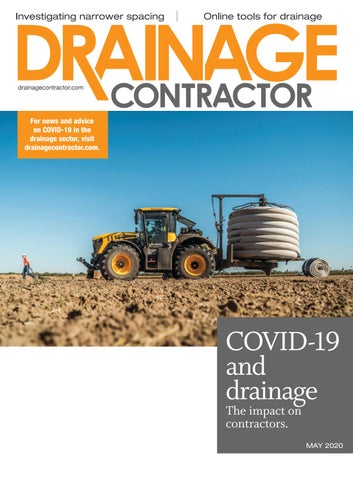
How the pandemic is impacting drainage contractors.
Coming up with maps for older, existing systems.
How tight is too tight for tile spacing?
Online tools can help contractors plan better installs.
Accounting for impermeable surfaces.
Planning for safe installation of subsurface systems.
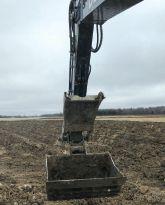
Manitoba contractors install tile on frozen potato fields During the winter, tile drainage contractors were left with little choice but to install tile on unharvested potato hills after a tough potato harvest in Manitoba. Machinery had to drive over frozen lumps in the ground instead of over a fallow surface, making for a challenging install. Read more at drainagecontractor.com
Part of larger communities
COVID-19 shows how businesses and lives are intertwined.
by Stephanie Gordon
In past years, planning for our May issue begins in March. This March, however, was anything but normal as a global pandemic set off a chain reaction that was felt in every corner of everyday life.
In this issue, you’ll read about COVID-19 and its impact on the drainage industry, but this wasn’t part of my original plan. As we’ve seen around the world in the last few months, COVID19 has forced everyone to pivot their plans and priorities.
For drainage, and specifically agricultural drainage, many states and countries are viewing your services as essential and you are allowed to continue with the addition of some extra safety protocols. Because of this, one would think work days would be business as usual, and when I asked our Drainage Contractor Facebook community how COVID-19 has impacted their businesses, some responded and confirmed they were “still going strong.”
I wrote these stories in my editorial to document our industry’s history during this time.
However, our businesses and lives are always intertwined with others. Even though drainage contractors are allowed to continue working, they’re still impacted by the COVID-19 domino effect. Other members of our Facebook community said their countries were in lockdown and there were delays in receiving supplies. One contractor said the shutdown of area schools allowed him to hire teenagers who would normally be in school at the time, pointing to how community impacts trickle down to local businesses.
Finally, one contractor shared that he donated $500 to his local foodbank as a way to help those in need who aren’t able to be working. He also laid out a challenge to other contractors to match the donation and another drainage company also donated $500 to their local foodbank. This action is echoed in Rob Burtonshaw’s U.K. Update column on page 34, where he writes how contractors
are rising to the occasion and helping neighbors with tasks like groceries.
This is only the tip of the iceberg. I would also like to spotlight the following for their work to make the spring months amid a global pandemic a little brighter: Jaques Farm Drainage and Watkins Drainage for each donating $500 to their local foodbank; all the North American extension staff for continuing their work online; Terra Point Commercial Wash for offering truck drivers a free lunch when they come in through the wash; Prinsco for hosting a virtual concert for its teams and customers; and all the businesses and manufacturers who are keeping operations running smoothly while practicing social distancing or adhering to lockdowns.
By the time you receive this issue, the situation may be different – and I hope it is. I wrote these stories in my editorial to document our industry’s history during this time. Along with COVID-19 coverage, you can read about online tools to help you plan better installs on page 22, or ways to come up with maps for older, existing tile systems on page 14.
Whatever this tiling season has in store for you, remember you are part of the larger drainage community who is here to help and – as a bonus –already appreciates the benefit of tile drainage. DC
DOING THE RIGHT THING.
It doesn’t come easy for everyone. But at Fratco, it’s what has made us a leader in the drainage industry for almost 100 years. From precise manufacturing processes to high-quality products, top-notch customer service and everything in between, we prioritize making things right. Because to us, there’s no other option.
BEYOND DRAINAGE SURVEY REVEALS OPTIMISM FOR AGRICULTURAL DRAINAGE INDUSTRY
Over the winter months, Drainage Contractor conducted a Beyond Drainage Survey to see if contractors were diversifying their businesses beyond agricultural drainage. Here is an initial summary of the data collected, with a more comprehensive analysis to come in the future.
Thirty percent of survey respondents were between the ages of 55 and 64, with the second largest group (25 percent) being between 35 and 44. Similar to agriculture, the drainage industry is commonly made up of multi-generational family businesses and this could explain the two largest age groups. A staggering 60 percent of survey respondents said their company has been in business for more than 20 years – again, speaking to succession in the drainage industry. The second largest result, at 15 per cent, was companies that have been operating for 10 to 15 years.
Nearly 92 percent of survey respondents work in agricultural drainage, with a minimal amount (less than four percent) of people also working in municipal, turf and road drainage.
Knowing how many acres a contractor works with in a given year, or how much demand there is in their area, can help understand why a contractor might diversify their business. There was a large range of responses for how many acres one tiles in a year: lowest: 20-40 acres; most common: between 1,000 to 2,000 acres; and highest: 125,000 and 1,000,000 acres.
When not tiling, survey respondents do a variety of other tasks such as: snow removal, ditching, excavating, soil conservation projects, equipment repair, custom farming, ponds, septic systems, consulting, residential drainage, construction, drainage design, tile repair, land levelling, farming (beef, cash crops), trucking, site work/prep, and more.
Most of the projects outside of agricultural drainage are related to land improvement and found in industries outside of agriculture. These results show that the skills of a contractor are transferrable across industries.
When it came to why diversify, most answers centered around making use of equipment year-round, retaining employees, keeping revenue flowing, and an improved client base. For some, being more active throughout the year allowed them to stay top of mind for clients.
Finally, the most interesting question asked survey respondents what they think the drainage industry could look like in 10 years. The answers were diverse but some common themes for the future emerged: a push for more technology use in drainage, more regulations in the future, and a need for a more holistic view on water management and the environment that is not solely focused on drainage. Some answers were location dependent, with one respondent saying they think the demand for drainage will increase as land prices continue to rise. Another respondent said they think there will be fewer contractors and more farmer-owned machines. A lot of respondents emphasized the need for agricultural drainage to be seen in the larger picture of water management, soil and yield benefit, and the environment. While most of our readers are sticking to agricultural drainage for now, it could mean that the way they make the case for drainage will be what diversifies, explaining tile drainage through multiple perspectives from agronomic to environmental.
Drainage Contractor wishes to extend its appreciation for everyone that shared their thoughts on the survey. Congratulations to TJ Kaffar with Kaffar Tiling in South Dakota, the winner of the Beyond Drainage Survey cash prize draw! Stay tuned for more in-depth analysis of the survey results.
U.K. CONTRACTORS ASSOCIATION NAAC APPOINTS NEW CEO
The National Association of Agricultural Contractors (NAAC) appointed Jill Hewitt to be its CEO following the retirement of Duncan Russell.
The NAAC was formed in 1893 and is the representative organization for agricultural and amenity contractors in the U.K. who supply all types of landbased services to farmers, government, local authorities, sports and recreational facilities.
Hewitt previously ran the organization from 2000 to 2013, but stepped down from the role to attend to a family crisis. She remained active in the organization as a consultant and leading the NAAC’s political and technical work in the interim.
“I am delighted to be back at the helm of the NAAC at such a critical time for the land-based industry,” Hewitt said in a released statement. “With over 90 percent of farmers using a contractor it is vital that the NAAC is at the forefront of political negotiations to ensure that we are properly recognized in a postBrexit era.”
In 2019, the Land Drainage Contractors Association (LDCA) merged with NAAC to form a stronger voice for land drainage contractors in the United Kingdom. The LDCA was originally part of NAAC but broke away in 1984 before re-uniting in 2019. Now, all drainage contractors are a part of the NAAC again. The move was to allow all contractors to reap the benefits of being part of a larger organization, while retaining and consolidating their lobbying power.
NSF INTERNATIONAL’S NEW LAB EXPANDS PLASTIC PIPE TESTING CAPABILITIES
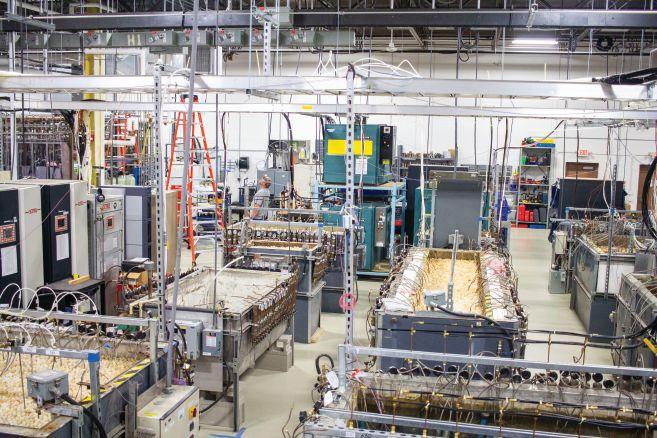
NSF International, a public health and safety organization, completed the moves of two of its laboratories to one new 20,000-square-foot space in Ypsilanti, MI.
The expanded location brings together all of NSF’s plastics testing and certification capabilities under one roof. NSF International is an independent testing and certification organization for the plastic industry, including PE, PE-RT, PEX, PP, CPVC and PVC pipes. They conduct advanced chemical and structural testing on plastic pipes, fittings and valves, metal fittings and components, manifolds, solvent cements, thread sealants, PVC ingredients and plastic materials for global applications.
The plastic testing laboratories have been relocated from Aurora, ON and from within the NSF International global headquarters in Ann Arbor, MI. The new facility, the
Willow Run Laboratory, is about 15 miles from NSF’s headquarters.
Because of its large capacity, the new Willow Run Lab offers pipe manufacturers a fast turnaround time for testing. That same large capacity, along with the lab’s testing capabilities, allow plastics manufacturers to take advantage of their certification needs and their R&D projects under the same roof.
The new Willow Run lab can also facilitate faster market entry for plastic piping companies. These products are heavily regulated by the plumbing codes and some utilities. Therefore, manufacturers need to obtain third party certification, such as certification offered by NSF International, which includes extensive plastics material and product testing.
PIPE PRODUCER ACCUPIPE RETURNS TO MANITOBA
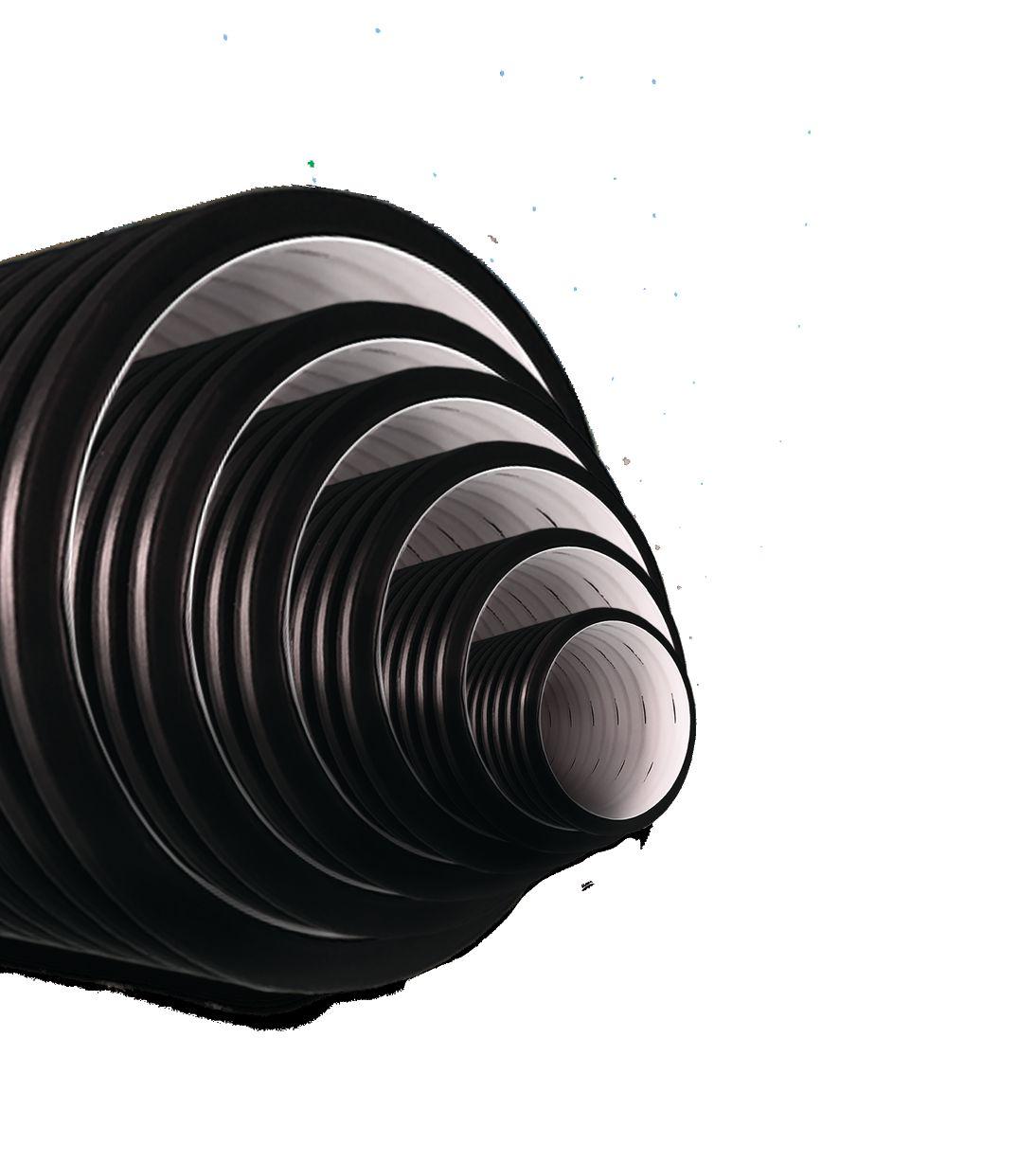
AccuPipe Inc. have re-entered the pipe manufacturing industry with the purchase of Prinsco’s Winkler, MB operation in February earlier this year. AccuPipe will continue manufacturing HDPE tubing, or drain tile, for the agricultural, commercial, and construction communities.
If the AccuPipe name sounds familiar, that’s because it is. In 2012, AccuPipe was founded in Winkler, MB in response to a growing interest in tile drainage and the difficultly of obtaining a supply of pipe. However, a year later Prinsco Inc., a pipe manufacturer based in Willmar, MN, purchased AccuPipe in December 2013. Now, seven years later AccuPipe has resumed ownership over its original operation and is a division of the Precision Land Solutions (PLS) group of companies.
Garnet Peters, who originally spearheaded the AccuPipe start up and is still with the PLS Group commented, “It’s really business as usual for us. The
staff is staying on and we’re committed to producing the same quality product at cost effective price points right here in Manitoba.”
In 2013, when Prinsco acquired AccuPipe and established Prinsco Canada, the American company also announced plans to build a second plant in Taber, AB that was expected to be up and running in 2014. Currently, the Taber plant remains permanently closed.
Prinsco operates locations across the U.S. in Arizona, California, Iowa, Illinois, Minnesota, Missouri, North Dakota, South Dakota, Utah and Wisconsin. It no longer retains ownership over its last Canadian location.
The Winkler operation under AccuPipe is now 100 percent Canadian owned and operated. The Winkler operation returning to local ownership and continuing to provide product locally will allow for benefits such as re-investing in the economic growth of southern Manitoba and a more seamless experience for clients of PLS.
Times are a’changin’
An update on the past, present and future of LICA.
by Bob Clark II, LICA National president
Hello all. I hope everyone is doing well. I can’t help but to recall Bob Dylan’s 1964 song “The Times They Are a-Changin’.” COVID-19 has captured the headlines and attention of the entire planet, and rightly so. I can't speak to all locations, but in Indiana, things are not like normal. Our company's services are still considered essential work and we continue to provide services on all project sites. Though making sure that we have strong safety processes in place, adapting our office to virtual work, and getting new COVID-19 related precautionary practices implemented on each job site has been challenging for a small business like ours. I am sure that most of you are facing similar, if not more challenging situations. I want everyone to know that my prayers are with you, your families, your employees, and anyone you love or know who is at an elevated risk.
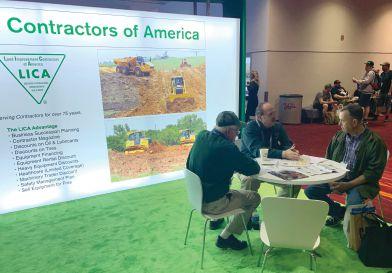
With all of that said, I would like to provide you a rundown of major LICA (Land Improvement Contractor of America) related updates. Earlier this month, LICA held its winter convention in Las Vegas, NV, in conjunction with the 2020 ConExpo. The convention was very well attended and LICA's booth at ConExpo was very well staffed by LICA's Green Team! The Green Team are all the LICA volunteer members who help recruit new prospects and promote LICA while at ConExpo. LICA members also presented at some of the educational seminars and those seminars were very well attended.
LICA's summer convention is scheduled, at the time of publishing, to be held in Niagara Falls, NY from July 7 to 11, 2020. There looks to be something for everyone this summer.
We hope to have the History of Farm Drainage and the LICA Contractor book published by our summer meeting. It will be a leather-bound, 230-plus-page book that endeavors to share the story of the LICA contractors, their predecessors, and their efforts to repurpose significant parts of the United States, from swamp, forest
and wetland to the fertile lands we now associate with America and its heartland. Stories of advancements in technology, the establishment of LICA chapters across the country, as well as discussions of the environment and conservation are woven into this history of farm drainage. A must have for every drainage contractor!
As I write this article, LICA is also in the process of establishing an updated Memorandum of Understanding (MOU) with the Natural Resources Conservation Service (NCRS). Currently we are finalizing the language to be used in the MOU with the NRCS. LICA recently signed an MOU with the National Association of Conservation Districts (NACD) at the winter convention earlier this month. LICA continues to partner with like-minded associations such as, NACD, International Erosion Control Association, Agricultural Drainage Management Coalition and others to help guide policy makers regarding the next generation of best management practices at the highest levels of government.
These times of shelter-in-place and essentialonly travel will be here for a while, but also gone before you know it. In the meantime, let’s all do our best to help mitigate this pandemic together! Be safe, wash your hands, and keep your distance! DC
LICA's booth at ConExpo was well staffed by LICA's Green Team. Photo courtesy of LICA.
CONTRACTOR AT WORK
COVID-19 AND DRAINAGE
How is the pandemic impacting contractors?
How is COVID-19 affecting your business? That is a question Drainage Contractor magazine asked a number of businesses across the industry as the novel coronavirus went from being a far-off concern to front-page news.
by TOM WALKER
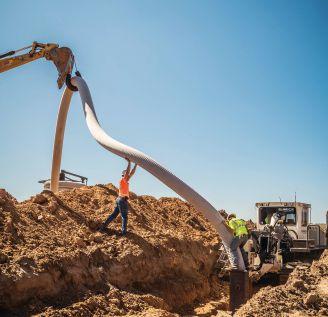
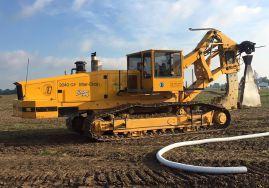
LEFT: Workers travel in individual vehicles to the job site, machines are being sanitized after use, and operators do not switch machines as a COVID-19 protocol.
RIGHT: Agriculture is considered an essential service and is exempt from restrictions, so many drainage projects in agriculture are continuing as normal.
The impacts of the global pandemic vary around the world, but certain terms such as “social distancing” are found far and wide. Generally, throughout North America, work is continuing. It is not strictly “business as usual,” but projects are being completed.
Depending on the location, there are variations between regional government guidelines for sheltering in place and the closing of non-essential businesses and this can dictate what work is being allowed. “Michigan has halted all residential and non-essential commercial construction,” explains Bob Clark II, president of Clark Farm Drainage, in Indiana. “But in Indiana and Ohio we haven’t seen that issue yet.” New York, Pennsylvania and Washington states have also limited non-essential construction, but that can mean different things for different states.
Agriculture is considered an essential service and is exempt from restrictions, so projects in agriculture are continuing. “We have to set up the fields so farmers can plant,” says Keith Jaques, owner of Jaques Farm Drainage in Ontario. Clark agrees. “Guys are going to want to start planting in a couple of weeks,” Clark adds. “It’s way too muddy right now but we have to get projects done so we are working away.” At present, the slowing economy has not had a significant effect on projects. “I’ve got dairy farmers who are being told to dump milk,” says Mike Neeb of Roth Drainage in Ontario. In Canada, milk production is subject to supply management and amounts are controlled to ensure a good return. The, hopefully shortterm, dumping of milk is a result of many factors, including transportation and storage logis-
tics, and reduced demand. “So they are humming and hawing, and they might not do the project until the fall.”
Clark says farmers in Indiana have been affected by poor commodity prices recently. “But I haven’t had anybody call me and cancel a project because corn fell 40 or 60 cents,” he says. Government funded jobs are a wild card at the moment, contractors say, and it will depend on budget adjustments coming out of the COVID-19 situation.
There is an impact on developing new contracts. “It is hard to look at a drain tile map from six feet away,” quips Matt Dull, vice president of sales and marketing for Ellingson companies in Minnesota. “And we can’t go a sit at a grower’s kitchen table to have a conversation about their field.”
It is a good thing that technology has advanced the way it has, Dull says, and job details can be sent by electronic means. But it is hard to develop new business relationships over the phone. “Having a remote conversation is a lot easier to do with an established customer,” Dull says.
First and foremost, COVID-19 has brought a focus to worker and customer safety, but companies report that it has not been especially onerous. Ellingson benefits from working in a number of industries, including electrical and oil and gas. “Working in those industries requires us to have a higher standard of safety than we might need in say agriculture,” Dull says. “But we carry out those requirements company wide.”
Others have stocked up on cleaning and sanitation supplies and developed a COVID-19 protocol. Workers travel in individual vehicles to the job site, machines are being sanitized after use, operators do not switch machines, and lunch breaks are staggered, or taken alone. Maintenance shops are practicing distancing, and no one shares tools. Offices are closed and managed remotely from home and if you are sick, you stay home. It’s not hard to practice social distancing in the field, contractors agree.
It is not that much of a burden, Dull explains. “We have put in COVID-19 safety precautions and as long as we are following those along with all other safety items we are getting work done,” he says. “Morning meetings have even more of an emphasis on risks at the job site.”
“It takes time to do this stuff and we are not going to be as productive,” Neeb adds. “Sure, driving your own truck is an added expense, but if it can get us to work we will do it.”
The supply chain of an essential service is also essential, and generally contractors are not having issues with materials. “I have talked to tile manufacturers and because they are supplying agriculture they are allowed to keep working,” Jaques says. “A lot of companies already have tile produced. So far we haven’t seen any delays.”
But sick workers can slow down suppliers. “If you have a cough you have to stay home,” Clark says. “I’m having problems getting supplies to a job site because they are short a couple of drivers.”
Roth Drainage says the pandemic has led them to have more of a focus on cleaning. “We weren’t real careful with that in the past,” Neeb admits. “Now after a person is finished with a machine we disinfect it.”
Dull with Ellingson in Minnesota adds to that, “Always make sure - and I am assuming every other contractor does this - that you understand the potential hazards and take care of your customers and take care of your team and you will be good.”
DRAINAGE AND COVID-19 IN SOUTH AFRICA
South Africa declared a National State of Disaster and issued a nation-wide lockdown order enforced by the police and army for 21 days until April 16. The lockdown restricted the population to their homes except for food, medicine and medical care, and collecting welfare grants. Essential service workers remain on the job. As of April 16, the country had 3,953 confirmed cases of COVID-19, and at the time of publishing, President Cyril Ramaphosa announced the country will start to gradually ease the lockdown starting May 1.
Johnnie van der Walt and his partner Chris Green run Precision Drainage in South Africa as a diversified business including some direct agriculture in hay making and land prep. “We are a registered essential service in agriculture, so we are allowed to travel and continue those operations,” Johnnie says. But the drainage side of the business has halted.
“The lockdown has unfortunately forced the pipe manufacturing factory to close, so we cannot get our pipe at all,” Johnnie explains. “We also cannot get permits from the law enforcement for ‘abnormal transportation’ so our drainage projects are currently stalled until after the lockdown,” he says. Johnnie says that this points out a weakness they have always known in their business. “We do not manufacture our own pipe, so we have zero control over our biggest input which is a risk,” he says. “We would like to start our own pipe production factory, but currently the costs are too high.” There is lots of potential work for agriculture drainage in South Africa, Johnnie says. “We have high incidence of salinity and sodicity in irrigated soils so drainage forms part of the mitigation against this,” he notes. “But there is no government support for commercial farmers and they must pay for improvements out of their own cash flow.”
“We run a lean business model with just six other employees,” Johnnie says. “The South African economy is not strong and we have issues with crime, corruption, and racism, but this is an abnormal situation and we are flying by the seat of our pants.”
His advice? “Keep going, keep positive and this too shall pass.”
In Ontario, the fact that he and his company are still going strong was not lost on Keith Jaques. “We are still working but a lot of people are not, and you see people hoarding and running the supermarkets empty,” he says. “We knew there would be more people going to the food bank so as a gesture we made a donation to the food bank here.” Jaques has taken that farther and has issued a challenge to other contractors through the “Farm Drainage and Conservation” Facebook page. “Ken Watkins from Watkins Drainage matched that $500 to his local Salvation Army,” Jaques says.
“We see doom and gloom,” Dull says. “But it is nice to know that so many aspects of our world are operating just fine.” DC
Q&A
Drain Tile Safety Tips
Q&A With Bob Clark III, Clark Farm Drainage
The Drain Tile Safety Coalition sat down with Bob Clark III, a third-generation drainage contractor and vice president of operations for Clark Farm Drainage, to get his tips for keeping employees safe on the job site.
Q: You share our goal – zero accidents while tiling. What do you do to help your employees keep safety top-of-mind for each job?
A: Safety starts by being aware of your situation. We support this by starting each day with a safety briefing at the job site that outlines our tasks for the day, the risks involved and how we will mitigate each. We also reinforce the importance of making eye contact with each other, particularly when working around large machinery, and wearing proper personal protective equipment (PPE) on every job. When we are working near pipelines or utility lines, we review line locator markings and discuss how the location or depth of those lines will impact the job.
Q: Do you provide formal safety training to employees in addition to onsite safety briefings each day?
A: Yes. Throughout the year, we provide formal training on trench safety and other topics relevant to our types of work.
Q: What else do you do to help your employees stay safe?
A: We always call 811 to have underground pipelines and utility lines marked as part of our project planning process. Our project management process requires a call to 811 for every job in order to move to the next step in the project. And we tell our employees that we want everyone to go home safe, every day. Our employees know that their safety is our priority.
About Bob Clark III
Bob Clark III is the vice president of Clark Farm Drainage. He is an Advisory Council member for the Drain Tile Safety Coalition. Bob has served as an Indiana Soil and Water Conservation Society committee member and Indiana LICA Board Member. He is a certified Technical Service Provider in Drainage Water Management for the NRCS and holds a professional certificate in Watershed Management from Purdue University. Bob is a frequent contributor to industry publications including Drainage Contractor, The Journal of Agricultural and Biological Engineering and The LICA Contractor. Learn more at clarkfarmdrainage.com.
DRAINAGE MANAGEMENT SYSTEMS
THE VALUE OF TILE MAPS
How to map older, existing tile drainage systems.
The agronomic value of tile drainage has never been more obvious. It is not unusual for farms to have a mix of newly grid-tiled fields along with fields that were pattern tiled 40 to 70 years ago.
by STEVE HOFFMAN
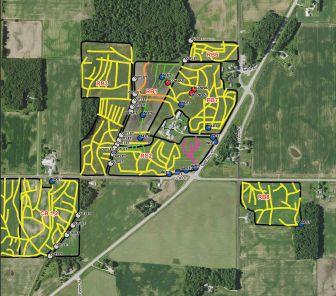
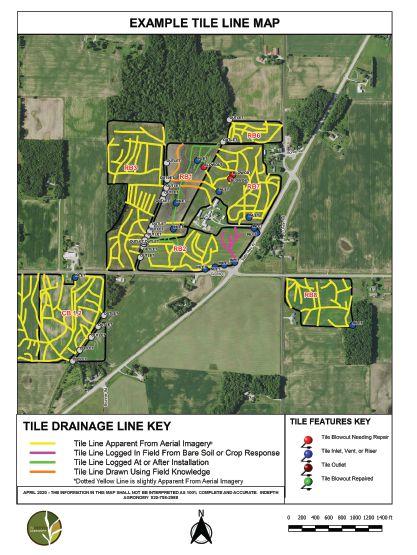
By using multiple georeferenced air photos in a GIS program such as QGIS, one can usually piece together a decent map of tile systems in a field by drawing in apparent lines using as many good images as possible.
Photo courtesy of Steve Hoffman.
Unfortunately, GPS mapping of tile systems at the time of installation was not a widely used option until relatively recently. There are many reasons to have a good map of each field’s tile system. It is important to know the location of inlets, vents and outlets when manure is applied to a tile drained field. Nutrient management plans require a setback or an immediate incorporation zone around tile inlets and vents. Outlets require monitoring during and after manure application. If you have ever stumbled through tall grass for the length of a ditch looking for an unmarked tile
outlet, you will recognize the value of a good tile system map.
Clay and concrete section tile systems that were installed 40 plus years ago have been showing their age for quite a while now. Tile blowouts and suck holes are a hazard to surface water quality during and after manure application. With a good tile map, it is relatively quick and easy to check for tile blowouts. If a new grid tile system is on the wish list but not affordable right now, it might be practical to improve the existing system by adding a branch line. Having a map of the existing tile drainage system is very helpful when planning an upgrade.
THE ”JIGSAW PUZZLE” MAPPING METHOD
So how can we come up with decent tile drainage system maps for older, existing systems? The only practical option I know of to develop a map for those systems is the “jigsaw puzzle” method. By using multiple georeferenced air photos in a GIS program such as QGIS, one can usually piece together a decent map of tile systems in a field by drawing in apparent lines using as many good images as possible. These aerial images are available from governmental agencies such as the National Agriculture Imagery Program (NAIP) as well as from mapping apps such as Google Earth and Bing Maps. Several aerial imagery services offer multiflight packages spaced out through the growing season. A well-timed bare soil image as the soil begins to dry in spring usually provides a very good picture of the drain tile locations. Aerial imagery can also be useful in-season when excessive rainfall occurs over an extended
period. The excessive rainfall causes stunting of the crop, while areas over the tile lines are taller and greener. Improved crop growth over tile lines can also be seen during an exceptional drought. I have even seen some highresolution satellite imagery that clearly showed drainage lines in a field.
As imagery options become more numerous it will be easier to put together the puzzle in a shorter period of time. High resolution satellite companies are starting to offer “a la carte” purchases of imagery that allow you to preview historical images to see which ones fit your need before purchasing the image. I have not found it possible to develop drainage system maps in fields that have a permanent vegetation cover.
It is very useful to provide a copy of the preliminary map to the farmer or landowner. I make it clear that the lines that have been drawn look like they could be drainage lines, but they also might be other temporary features such as a travel lane, ephemeral gully erosion, etc. I ask the farmer or landowner to cross off the lines they know are not drainage features
and also to hand draw missing lines they know exist. The maps should use colorcoded lines base on the evidence used to create them - logged during installation, apparent from imagery, logged from crop response or dry soil lines, or based on field knowledge of the drainage system. It is also helpful to have the farmer or landowner mark the location of all known outlets, inlets and vents.
The next step in developing a drainage system map is ground truthing. Springtime, before tillage occurs, is a great time to ground truth the drainage feature map. The perimeter of a field can be driven with an ATV before vegetation regrowth occurs to look for inlets, outlets and vents. Features that have not already been mapped can easily be logged with one of many available GPS devices or apps. This is also a good time to drive the lines looking for blowouts and suck holes that may have developed in no-till situations. Apparent lines can be followed to the ditch to confirm the location and condition of the outlet. Georeferenced photos of tile features can be a useful tool to remind us of components that need
maintenance. If you are using a full featured GIS program to develop the drainage features map, you should consider adding attribute information such as such as date of installation, tile diameter and material, and direction of flow.
A map is only useful if it is available when needed. Maps that are stored in a Cloud system can be accessed on smart phones and tablet computers. These devices can run apps that allow you to record new features as field activities are performed. Google Earth is a useful app that can show a “live” GPS map of tile features that can be used in the field.
Like all maps, a drainage feature map should never be considered to be 100 percent complete. It is meant to be a living document that will need to be updated as previously unknown features are discovered or new ones are installed. DC
Steve Hoffman is the president and managing agronomist of InDepth Agronomy, an independent agronomy business located in Wisconsin. He is a certified CPAg, CPCC-I and has been developing drainage system maps for his clients since 2008.
RESEARCH
NARROWER SPACING
How tight is too tight for tile drainage spacing?
Southern Ontario’s clay-based soils are some of Canada’s most productive - and expensive - farming acres. The vast majority of these acres are tile drained: a necessity in the heavy, compacted, slow-to-drain soil. But, are the acres tile drained at a spacing that allows maximum crop productivity?
by MADELEINE BAERG
Tony Kime presented an offer to the farmer group: if anyone wanted to run a close-spacing trial, Bluewater Pipe would donate the tile. In quick succession, three farmers stepped forward to participate in the trial.
For decades, farmers in southwestern Ontario have depended on tile drainage, at first draining depressions and valleys, then in the 1950s and ‘60s using patterned four-rod spacing. By the early 1970s, 3-rod spacings became common thanks to the advent of plastic corrugated drainage pipe and the development of the drainage plow. In the 1990s, GPS and yield monitors allowed farmers to see yield improvements over the tiles, which began a push towards closer and closer spacing. Today, it is common to install 15-foot spaced drainage in fields with heavy clay soil. What’s still not fully understood, however, is the economic return of close spacing. That question is what several of Middlesex County’s farmers, together with pipe manufacturer Tony Kime of Bluewater Pipe, are keen to answer.
“What is too close? Who knows, but over the next five years we will get some data,” says Kime, who plans to donate about 120,000 feet of pipe to 10 test sites installed between 2019 and 2021. “I’m excited to be participating in this project with young and entrepreneurial farmers who are wanting to push the limits on their production.”
The rationale for tighter tile drainage is counter-intuitive at first glance: installing more tile can translate to more drought-resistant crops. How? Desaturating the soil early in the season allows soil to warm quicker, increases air in the soil, and improves microbial activity. All of these factors allow plants to root more deeply, ultimately giving the roots more ability to withstand later season drought.
“In southwestern Ontario’s clay soil, which has
low hydraulic conductivity, roots may not thrive in between tiles,” Kime says. “Farmers see it: the highest yield is within four to five feet of the tiles.”
Drainage tile can also help later in the season. Big rain events in the summer often occur on the hottest and most, to a certain point, ideal growing days. Tighter-spaced tiles can get excess water out more quickly during high-rainfall events, allowing plants to get growing again more quickly.
“If you agree with the assumption that waterlogged soil stunts growth for a short amount of time, then de-waterlogging the main root area as fast as possible means you’re giving plants hours more [in] growing time. When you’re looking at pushing management practices to the limit, hours of growing time matter,” Kime says.
The idea for trialing tightly spaced drainage came to Kime as he participated in Middlesex County’s soil crop meetings. The meetings bring together progressive farmers to share soil quality, soil health, nutrient management and water quality improvement recommendations. To Kime, however, the discussions seemed to miss an obvious opportunity.
“Over the last couple years, I have been watching these guys doing lots of development on practices above ground - strip tillage, pushing fertilizer applications to the limit, doing everything they can to see what yield impacts they can achieve - but in all these test plots, they were never reporting on what was below ground.
“Every one of these farmers believes in drainage already. There’s no one who goes to a soil crop meeting who isn’t already intensively draining, and who doesn’t understand that drainage is the best payback they can make on their land. These guys are all researchers and businessmen: they want the best farming practices you can do.”
So, Kime presented an offer to the whole group: if anyone wanted to run a close-spacing trial, Bluewater Pipe would donate the tile. In quick succession, three farmers, all of whom are related, stepped forward to participate in the trial.
Third-generation grain farmer, Eric Dietrich, was first to contact Kime and first to commit a field.
“We farm in a highly productive area. In our part of the world,
land is usually very valuable. Because we usually have excessive rain rather than not enough, tile drainage is a huge part of what allows us to do more with our farmland,” Dietrich says. “I’m all about return on investment and sustainability going forward for the next generation. If there are ways we can improve farmland and get better ROI - and I think tight tile spacing could be one of those things - we might as well test that.”
In the spring of 2019, Kime and Dietrich installed tile drainage into an 82-acre, untiled field that Dietrich had recently purchased. They installed 25-foot spaced drainage into approximately 70 of those acres and 12.5-foot spaced drainage into the remaining 12 acres. Dietrich intends to install similar spaced tile into two additional fields this coming season.
Two other farm families also jumped on the opportunity in the fall of 2019. “These are young, highly educated farmers who work really hard and are open to pushing to the limits,” Kime says.
By the end of 2021, Kime expects to have helped farmers install 10 new, tightly tiled (10’, 12’, or 15’ spacing) eight to 10-acre plots within larger systematically tiled fields.
“What we’re getting is test plots that can be compared to the rest of the field,” Kime says. “All of those farmers are using the latest mapping technologies and are managing the fields very tightly, so they’ll very quickly see if there’s benefits to the tighter spaced tile.”
Like everything else in farming, tightly-spaced tile drainage is not a silver bullet solution to all problems, nor can it be analyzed entirely on its own. Instead, spacing maps can serve as additional information farmers use to try to improve field management.
The project hopes to have 10 new, tightly tiled (10', 12' or 15' spacing) plots by the end of 2021.
“They have soil type maps and nutrient maps and yield maps and so many other layers: a drainage map will be one more layer,” Kime says. “Ultimately, these will be pretty sophisticated data sets that may take a bit to interpret. But, we’re dealing with farmers who believe in and are skilled at using data to manage their farms.”
Margaret May, the regional program lead for southwestern Ontario with the Ontario Soil and Crop Improvement Association (OSCIA), sees potential in the tightly-spaced tile concept.
“We’ve been running some compaction days to show the effects of heavy equipment and tire configuration on the soil. We’ve had many conversations with farmers about why their tile spacing is not working at 30’ or 50’. It’s probably because we’ve compacted the soil down deep over many years. We think the only way to remediate that is to split the tiles.”
One year in, Dietrich is pleased with yield results from his field where tightlyspaced drainage was installed last spring. He cautions that the results available to date are based only on a single field in a single year. And, he adds, any analysis of
results needs to be done while keeping in mind that installation happened in wet, early spring, less than ideal conditions, and last year’s very late planting date in southwestern Ontario translated to poorer overall yield.
“We've had conversations with farmers about why their tile spacing is not working at 30' or 50'.”
“We saw about $25-$30/acre better return on that field, or about a three percent return on investment in one year. That’s fairly minimal but I think there’s potential for better in future years. And, it all depends on how a person looks at it. Tight drainage tile doubles your cost but it’s a 20 plus year investment. You can’t expect all your money back in one year. Forward thinking guys look very
Drain Systems
long-term. I don’t need it to pay me back immediately for me to think that it’s worth doing.”
In addition to yield return, Dietrich sees tight drainage offering less quantifiable benefit. By entirely solving drainage issues via the tight spacing, Dietrich expects to have a better starting place for on-farm research.
“Now we have a stage to test from. There are so many unknowns: obviously yield differences are big, but what about fertilizer efficiencies, soil temperaturesthere are so many options going forward for research. We’ll get research off this area for the next 40 years.”
Ultimately, producer uptake of tighter tile-spacing will depend on economics.
“Do I think everyone will go to 10-foot tile. No. No way,” May with OSCIA says. “But if you had a highly productive farm where water was an issue, maybe you’d consider 10-foot tile on parts of it. I don’t think it’ll be routine thing by any means but it may show some promise in certain locations. There is pretty high interest among farmers in seeing how the results turn out.” DC
PLOW & WHEEL TRENCHERS
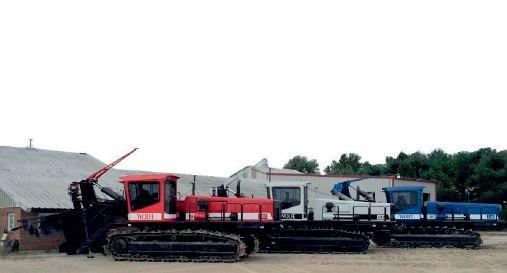
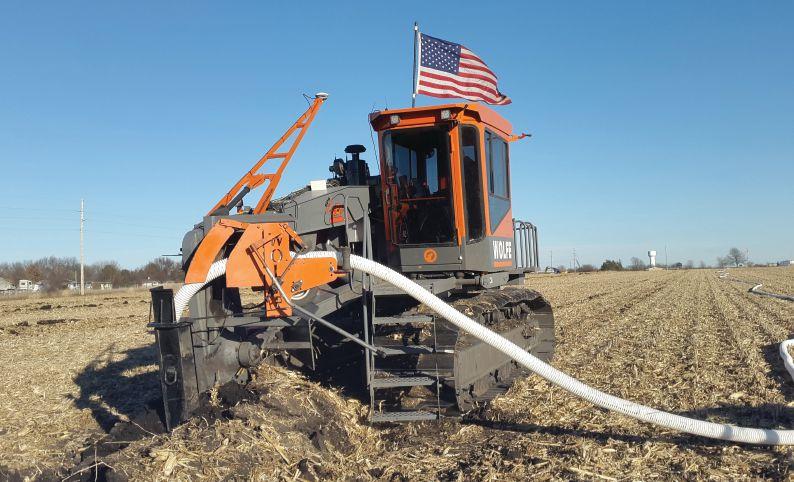
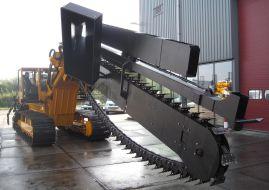
Wolfe Heavy Equipment continues to set the tone for powerful agricultural and commercial trenching equipment. Wolfe’s versatility, superior manufacturing and expert service along with reduced fuel consumption provides increased profitability.
TECHNOLOGY
ONLINE TOOLS FOR DRAINAGE
Online technology can help contractors plan better installs.
When it comes to designing the best drainage systems, the majority of the work happens before the plow ever reaches the field. Most of it happens in virtual space - on design software, and, lately, online.
by JULIENNE ISAACS
Tom Scherer, an associate professor in extension engineering for North Dakota State University (NDSU), leads NDSU’s annual Ag Tile Drainage Design Workshop. The workshop includes a lesson on online tools that can help contractors prep for an install, he says.
“In the workshop, we say you are going to spend several months planning your tile system before you lay anything in the field. The planning is sometimes the hardest part – getting all the permits, field information and doing the layout. There is no one right way to subsurface drain a field. You can do it multiple ways, but the installation is critical,” he says.
Together with the switch to higher-value commodity crops and increased land prices, advances in technology served a crucial role in making tile drainage more affordable on many more acres, Scherer argues.
“Technology has made it a lot easier to plan,
lay out and install systems, and to do it more cost-effectively,” he says. “It’s made a big difference. It’s like a lot of things – a lot of great ideas have to wait for the technology and development of tools to catch up with it.”
John Scott, a digital agriculture extension coordinator at Purdue University, agrees the accuracy and availability of tools is improving all the time. But what matters most when it comes to shiny new tools, says Scott, is how they’re used.
“Layering that information to get value - that’s where the future is,” he says. “We’re not good at it. We’re good at developing new tools and trying new tools, but as an industry, agriculture is not very good at leveraging the data we collect.
“I think that’s the key for the future of agriculture, whether it’s row cropping or drainage,” he says.
Knowing the field history and soil types, hav-
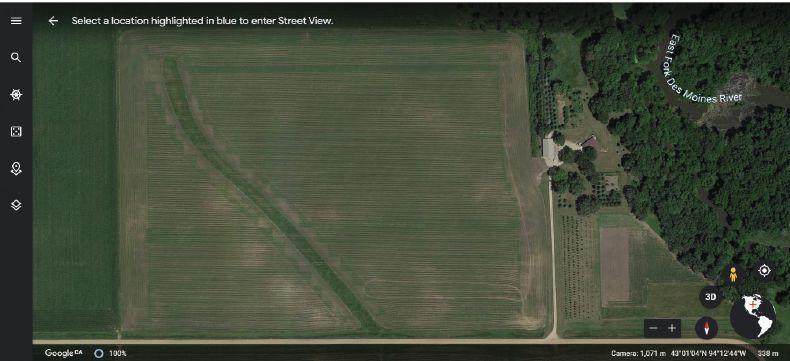
Google Earth gives contractors a birds-eye view of a farmer’s field.
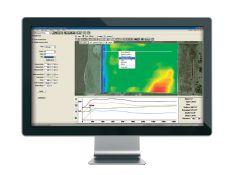
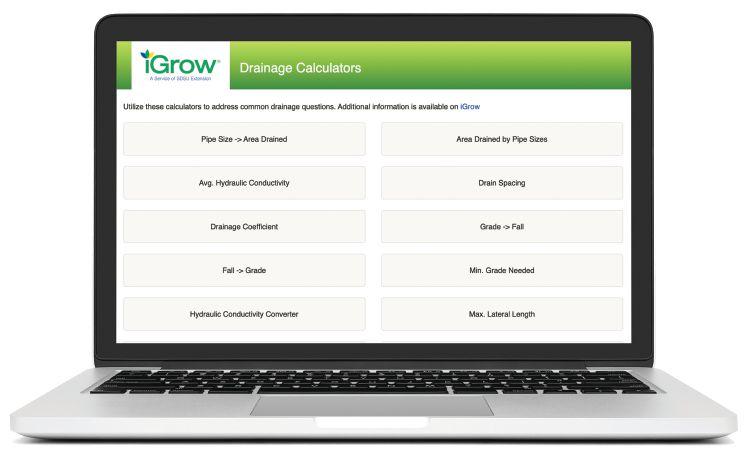
South Dakota State University hosts a series of drain spacing calculators on their website. Contractors can calculate spacing based on field characteristics.
FIND THE TOOLS ONLINE
Tool:
Good for:
Google Earth: google.com/earth A bird’s eye view of the land.
NRCS-developed Web Soil Survey: websoilsurvey.sc.egov.usda.gov
Canadian Soil Information Service: sis.agr.gc.ca/cansis/
NDSU pen-access portal to LiDAR elevation data: gishubdata. nd.gov/dataset/lidar-data-download
Canadian GIS and Geospatial Resources: canadiangis.com/free-canadalidar-data.php
Google Timelapse: a Google Earth feature found within viewing options
Manitoba’s Drainage and Water Control online portal: gov.mb.ca/sd/water/water-rights/ drainage-and-water-control/
Can estimate Ksat values up to five feet.
Historic soil information across Canada.
Overlaying detailed soil survey data on maps, compatible with Google Earth.
Calculating answers for drainage questions such as spacing, drainage coefficient, area drained by pipe sizes, and more.
Estimating the capacity of tile drainage systems when you know grade and pipe size.
Downloading LiDAR elevation data and this tool is best for those familiar with LiDAR data.
Accessing LiDAR data for Canada.
ing a plan before going into the field and leveraging that information to have better conversations with farmers is critical. There are a few online tools that can help build a strong design foundation for a drainage system.
ONLINE TOOLS
Brett Sheffield, president of Manitoba’s NextGen Drainage, says his company uses a few online tools during its preliminary due diligence process for every project.
“We have several main tools we use online that give us an inside look on what the field is before we get there,” Sheffield says.
Google Earth gives NextGen a “birdseye view” of a farmer’s field while contractors are talking with them in an initial phone call, Sheffield says. “This helps to get an idea of what target areas they may be interested in or infrastructure concerns with outlets, such as highways and gravel roads.”
A very comprehensive tool for U.S. contractors is the USDA’s National Resources Conservation Service (NRCS)developed Web Soil Survey, which has digitized U.S. soils; Scherer says the tool can estimate Ksat values to a depth of five feet. Saturated hydraulic conductivity (Ksat) is the ease with which pores of a saturated soil transmit water. In Canada, historical soils information can be found via the Canadian Soil Information Service website.
Scherer also recommends a similar tool that also uses the digitized soils information from the NRCS called SoilWeb, a Google Earth overlay developed by the California Soils Resource Lab available on their website.
South Dakota State University hosts a series of online drain spacing calculators on their website, Scherer says. Once contractors have a handle on soil types they can plug those values into the calculators to determine spacing based on a field’s characteristics.
NextGen’s team regularly uses Prinsco’s drainage calculator, Sheffield says.
Viewing how maps have changed over time, including wetlands and crop cycles.
Contractors applying for approval for drainage projects in Manitoba.
For topographical conditions in the field, the North Dakota State Water Commission hosts an open-access portal to LiDAR elevation data. This information is also available via the NRCS. Canadian portals to LiDAR
DESIGN
DESIGNING LONG-TERM
Accounting for impermeable surfaces.
It often feels that society responds to challenges, rather than planning in advance. Drainage is no different. The majority of these quotations are going to the larger and more experienced construction companies.
Nevertheless, I am often called upon in mid-season (and during a snowstorm) to help “size” a particular job for temporary heat. It can be a challenge for the best of us.
I would expect that the majority of calls drainage contractors receive result from a customer seeing a problem such as erosion or ponding, and wanting it fixed. So, when I saw news reports of flooding in the U.S. and Canada this past fall, I thought about our drainage program and what challenges might be coming in the future.
A common theme in flooding events has been the increase in impermeable surfaces - pavement and concrete that prevent the water from soaking into the ground. The flooding in Toronto in August 2018, resulted from 2.95 inches or 75 millimeters (mm) of rain in downtown areas, and Black Creek rose 11.5 ft (3.5 meters) in 90 minutes. In June 2017, my area was hit with a one-in-100-year storm event, and received 6.7 inches (170 mm) of rain in seven hours.
So, what does this have to do with rural drainage? Plenty.
When we design municipal drainage systems, the engineer will account for the area requiring drainage and the land use. Is the land use primarily row crops or permanent pasture, or forested?
What they will rarely account for is impermeable surfaces in farmsteads. As
by JACQUI EMPSON LAPORTE
farm buildings become larger, the volume of water that runs off the roof and paved areas also increases.
Adding to this overall change in farm construction are factors that lead to an increase in buildings and pavement. Farm safety in the poultry industry is a move
from multi-story facilities to single story buildings, but more of them to house the same number of birds. Modernized animal welfare standards are increasing the number of square footage (ft2) per animal. Technology and efficiency in barn design are resulting in larger areas
for traffic flow and transportation.
Let’s take this example.
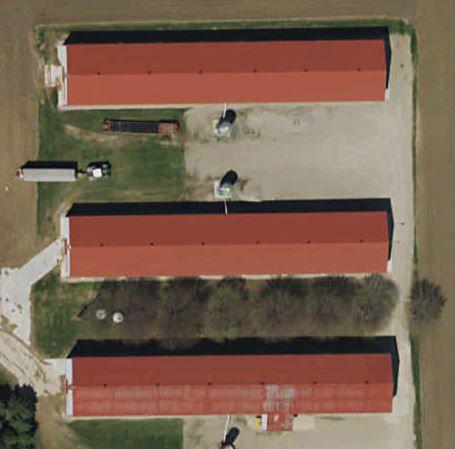
There are three poultry barns, approximately 9800 ft2 per structure.
If we got two inches of rain in one storm event, that would equal 1633 foot cubed (ft<3) of water per structure, or 4899 ft3 from the roofs alone. Historically, this water would simply infiltrate the soil, or run off the farmstead into adjacent fields for infiltration.
If the barn downspouts are directed into the tile drainage system, this is a huge amount of water for the system to absorb in a relatively short period of time. The tile systems are going to discharge into a municipal drain. Even if the tile system can handle it, the receiving municipal drain or channel down the line must also be able to manage it. Even if they can hold the volume of water in open channel systems, they might not be able to handle the speed at which the water enters the system. This results in the high degree of fluctuation in water levels, similar to the Black Creek experience, where water levels rose and fell in quick succession. In addition, some of the storm events are happening during the winter period, when infiltration will be non-existent.
“If the barn downspouts are directed into the tile drainage system, this is a huge amount of water for the tile and municipal drainage system to absorb in a relatively short period of time.”
If those structures were in an urban area or even used for something other than agriculture, there would be a requirement for a stormwater management plan.
I am not suggesting that we should move in a regulatory site-specific direction, but rather consider unique opportunities in rural areas. Could we incorporate a rural cistern sort of system that would could be used for firefighting? Some building standards offer some relief from the requirement for fire walls if there is an onsite source of water. Insurance companies may also be interested in any structures that provided rural hydrants.
In Ontario, we don’t usually have a need for irrigation, but in future, maybe we will. Could this be an opportunity to see the collection of water as a benefit, instead of a cost? For farmers and tile contractors, the time to think about this is in the pre-construction period. For engineers and drainage superintendents, what impact will large impermeable surfaces have on municipal drain designs? DC
Jacqui Empson Laporte is an environmental specialist and a member of the drainage team for the Ontario Ministry of Agriculture, Food and Rural Affairs. You can find Jacqui on Twitter at @notrunningfast.
•
•
•
•
•
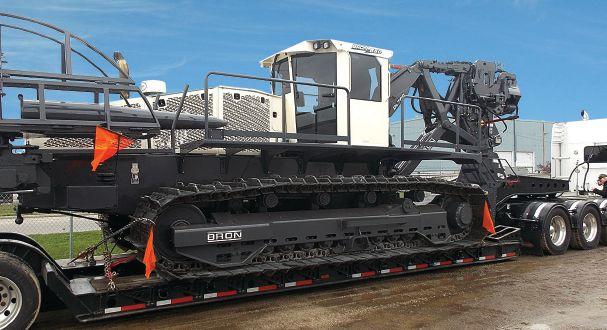
www.rwfbron.com
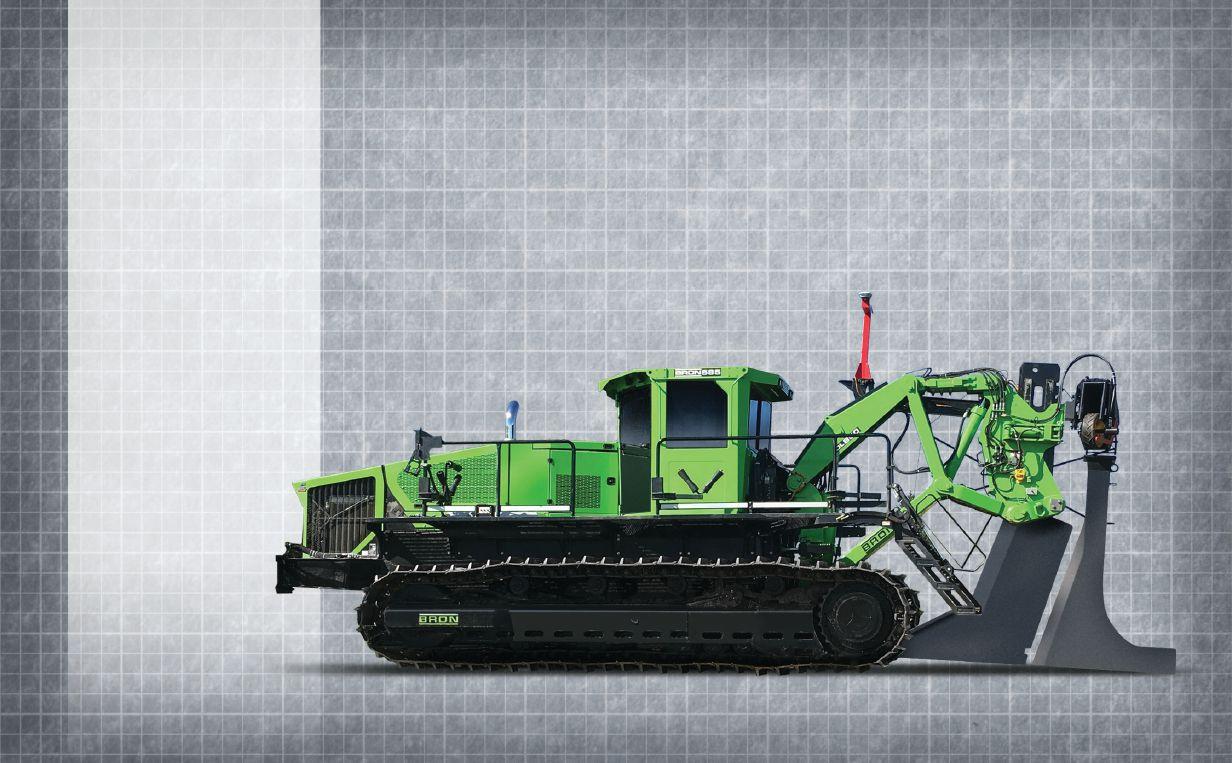
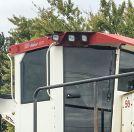
■ Five Core Cooling System exceeds cooling for Tier 4 engine standards
■ Quieter Reconfigured Cab Interior for Operator comfort
■ Standard DL 850 Drainage Plow increased strength & durability
■ LED Light Package for increased visibility for those long days in the field
■ Improved swing mechanism for the Onboard Reel for smoother reel speeds & consistent torque
■ Optional hydraulic rear step raises out of the way when plowing and lowers when required.
■ Standard oscillating track frames.
■ Fluid Samples for All Fluids
■ 150 Point Machine Inspection
■ Internal Inspection All Drivetrain Components
■ Required Factory Repairs
■ New & Used Equipment Sales
■ Parts & Service all BRON Products
■ Selected All Makes Parts for Construction Equipment
■ Certified Rebuilds on BRON Products
■ Custom Fabrication
■ New Paint
■ Factory Tested
■ New Certified Serial Number Assigned
■ 6 Month Warranty Assigned
■ Repairs on all Drainage Plows & selected Construction Equipment
■ Parts Facility in Marine City Michigan
■ Road Service for all BRON Products & other selected Equipment
■ Parts Facilities in Woodstock ON and Marine City MI.
by KAPIL ARORA
PLAN AHEAD
Planning for a safe installation of subsurface drainage systems.
During the installation of drain lines, equipment used has the potential to contact buried utility lines that may exist under the field.
Farmlands across the country have lines buried below the surface to transmit or transport different utilities. These utilities include natural gas, oil, steam, petroleum, electric power, telecommunications, and several others. Utilities usually run parallel to the road in rights-of-way, but some, especially pipelines, cut across fields.
Most drain lines in the farmland of the upper Midwest were installed in the late 19th and early 20th centuries. A number of these systems need upgrades, either by retrofitting or replacing the systems altogether. At the same time, the number of utilities crossing fields has increased as utility providers plan and build to meet increased demand. These buried utilities present challenges to the safe installation of new, or upgrades to existing, subsurface drainage system.
Safely installing subsurface drainage tile when utilities are present requires more effort
than a call to 811 before you start to install. Safety really begins several months (even years) in advance when the system is designed.
The design of a subsurface drainage system typically consists of locating and sizing three main components: an outlet, a main line to convey water to the outlet, and laterals to collect water from the field and convey it to the main line. Laterals are smaller than the main line and are installed across the field at known spacing and depth. The entire system functions by gravity to discharge the water through the outlet.
The presence of buried utilities can impact the location and size of the outlet, main line and lateral. These issues are best addressed during the planning and design phase.
OUTLET
The outlet is typically the starting point for planning and design. Its location is influenced by its ability to convey the drainage water to a
Safely installing drain lines by plowing or trenching begins by contacting 811 when planning and designing the subsurface drainage system.
stream, roadside ditch, or a neighbor’s system. Where enough grade is not available in the field, an outlet may be placed at the stream bottom. Erosion along the stream bank and streambed can cause changes in elevations over time.
Lower elevation placement of an outlet can become a hindrance if utilities are buried along the stream edge or roadside. In such cases, it may be beneficial to alter the elevation of the outlet or to move it to a different location that does not cross the buried utility line. In cases where outlet locations are limited and moving it may not be feasible, working with the utility owner during the design phase to engineer a workable solution is one alternative.
MAIN LINE
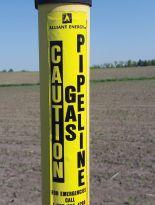
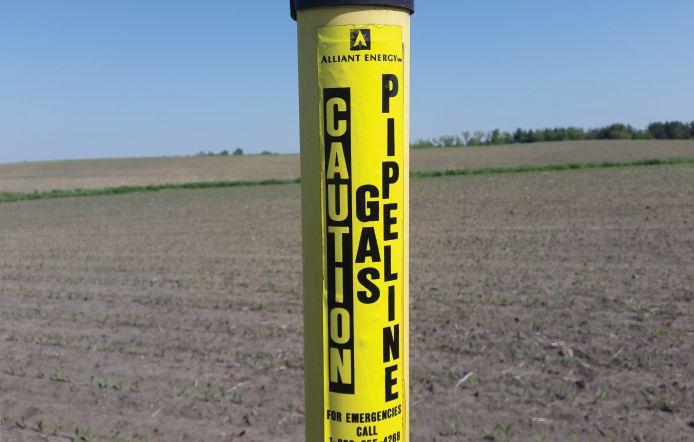
The main line is typically installed five to eight feet below the surface but can be shallower or deeper depending upon field topography. Both the location and depth can be impacted if a buried utility, especially a pipeline, crosses the field. The presence of a pipeline marker is one indicator that a pipeline might cross the field.
It should not be assumed that pipelines are buried in a straight line from marker to marker. Markers merely indicate the approximate location of the utility. Potential exists that it is not installed in a straight line. It is essential that 811 is contacted during the planning phase to determine how the utility crosses the field. This information can be used when completing the drainage design. The National Pipeline Mapping System (NPMS) can provide information on select buried utilities in different states, but a call to 811 should always be made prior to designing as well as digging.
Another factor to consider is the depth of the utility crossing the field. Erosion of top soil over time can cause significant changes in elevation. Such elevation changes may not be obvious as tillage operations may cloak them. In these cases, it can be helpful to make elevation measurements with an accurate measuring device such as a global positioning system or a transit. Installation of a drain line can be impossible if it is close to, or below, the pipeline depth.
In such cases, it is helpful to plan a separate system on either side of the buried utility if multiple outlets are feasible. This minimizes crossing over the utility during drainage installation. The presence of only one outlet location can still be handled by planning two systems and crossing over the utility only once near the outlet. Working with the utility owner can help ensure crossovers are properly engineered with no impact to buried lines. Engineers specializing in drainage designs
to protect the pump’s motor from running dry
can be employed to handle complicated issues and ensure safety and adequate drainage. Laterals can be planned in a similar manner so passes over the buried utility are eliminated or minimized.
Time lapse typically exists between planning and installation of a drainage system and can be significant if bottlenecks exist in neighbor relations or specific county/drainage district approvals are needed. Any new utility line installations during this time lapse should be accounted for prior to installation of the drainage system.
Prior to installation, 811 should be contacted again to have utilities marked according to state law (usually two to three days prior to beginning work, depending on your state). Some utility owners prohibit digging within 50 feet of their facility unless their representative is onsite. Most state laws require no mechanical digging within a specified area around the facility (tolerance zone). Visit your state’s One Call website to learn about the tolerance zone in your state.
LATERALS
Connecting laterals to the main line requires digging junction holes. Drain lines larger than 12 inches in diameter are manufactured in fixed lengths and installation typically requires the digging of trenches to connect them. Outlet installations also require trenching or junction holes.
Trench safety can prevent personnel injuries or stuck equipment. Junction
holes or trenches deeper than four feet may need to be widened at the top to prevent collapse. Check Occupational Safety and Health Administration (OSHA) and local requirements as wall reinforcements may be needed depending upon the field conditions and the depth of excavation.
Planning a drainage system given the presence of pipelines may appear complicated, but ignoring such details can result in significant time loss and damages. Planning the drainage system by contacting 811 during the design phase can help minimize challenges during installation. Additional information about excavation safety can be obtained
at PipelineAgSafetyAlliance.com or by contacting your state’s One Call Center. For information about your local One Call Centre, including Canada, visit clickbeforeyoudig.com. DC
Kapil Arora is an agricultural engineering field specialist with Iowa State University Extension and Outreach. He is the coordinator for the Iowa Drainage School. He can be reached at pbtiger@iastate.edu.
Walking through what marketing and automation can do for your business.
by Chrissy Wozniak
Chrissy Wozniak is cofounder of The Uncommon Ground Inc., a processfocused marketing agency based out of Niagara Falls, Ontario.
Marketing is much different today, and this calls for a different mindset. This generation has less brand loyalty, and businesses can no longer solely rely on relationships built by the older generation. Marketing doesn't work alone, but with your entire business. You may increase leads through marketing but you won't have an efficient way to transform leads to satisfied customers. Process-Focused Marketing looks at the sales and marketing process as a whole in three steps.
The first step is to build a framework. Write down what happens from the first marketing effort to project completion. Write down every action, every form filled out, every email sent, every document signed. Include where are you answering your phone when a lead comes in. Most contractors do a lot of work from their trucks, and this needs to become part of a simpler process. You would be surprised at how much waste exists in the process and how much of this can be organized, delegated and automated.
Next you need to assess your current software. Out of date software wastes time, costs money, and most modern integrators are not compatible with obsolete software. Also, some business owners don’t realize how affordable automation and integrations have become. The utilization of cookies – tiny text file created by a website – is imperative to a successful company. Cookies provide a way for the website to recognize you and keep track of your preferences. They let companies know the products that you’ve been looking at on their websites. Companies that use cookies can have their sales people automatically notified when a potential customer appears interested in their products. Now the sales person doesn’t have to guess who needs attention!
Next, create a written plan and set clear goals. This doesn't have to be complicated, just write down a point form plan on a sheet of paper. Set out your goals and share them with your team.
The second step is to find your voice, and project it. Refine your message. What makes your company special, what sets you apart?
Next, define our target audience and plan where to find it. Who is your ideal customer? Once you know who they are, you can research where to find them. You'll need to set a marketing budget and plan your spend, allocate where every penny is going. When you have a set budget you can take comfort in the fact that you are doing the right thing, and you’re in the right places because you have a well thought-out plan.
The third step is to measure the results. The framework you created from the first step will support the structure of HOW you measure the results. It’s important to discern what data is important for your company. Data like web traffic, closing ratio, ROI on marketing dollars, length of time from estimate to sale, length of time between sale and project completion are all important types of data to consider measuring. Without a way to measure what’s working, you’re just spinning your wheels.
You need to be agile and make decisions that will move your company forward. These decisions will come from data. There are many software options that can help, many of which can collect data and send reports automatically. We use SharpSpring for our clients, because it gathers data and assists in other ways to create an efficient sales process. Google analytics gives excellent data on web traffic and behavior, and MailChimp provides great analytics on email marketing. The aim is to reduce workload and increase efficiency, so using automation and reliable tracking software is invaluable.
The overall goal is to systematize the sales and marketing process to make it scalable and repeatable. The more scalable and repeatable your process is the more profitable your company will become. Once completed you will have a reliable framework, a clear relevant message that is broadcast to your target audience, and the data necessary to adjust in real time. Once your sales and marketing process is fully implemented you can expect to gain the productivity of one to three employees, without adding a cent to your payroll. DC
CONTINUED FROM PAGE 23
data can be found on the Canadian GIS and Geospatial Resources website.
NextGen uses Google Timelapse to find wetlands that are always present, versus cultivated acres that go through wet and dry cycles, Sheffield says. New regulations in Manitoba mean Class III wetlands (seasonal ponds characterized by marsh vegetation that dry by midsummer) can’t be tiled without a high per-acre contribution payment.
Online permit applications are the next step for NextGen, Sheffield says. In Manitoba, these can be registered on the Sustainable Development online portal.
“There’s an effort underway to take a look at, ‘Okay, now we know how to put it in better, how do we make it perform better? How do we make that tile make more money for the farmer?’”
THE FUTURE OF DRAINAGE TECHNOLOGY
Andy Mackrill, a drainage system design specialist with Ecosystem Services Exchange, says contractors only adopt new technologies or tools if they meaningfully improve efficiency.
He says there “aren’t a ton of new tools coming out” in either the public or private sectors, but the more automated online design tools are coming more from the private side, while data-driven methodology and guidelines for practice come from the public sector.
Most design tools aren’t yet online, but some companies are moving in that direction. For example, this summer North Dakota-based Ellingson Drainage plans to launch a web-based tool for working with producers.
Charlie Schafer is president of Agri Drain, sister company of Ecosystem Services Exchange. He says industry-led developments are aimed both at improving contractor efficiency and improving the systems themselves.
“There’s an effort underway to take a look at, ‘Okay, now we know how to put it in better, how do we make it perform better? How do we make that tile make more money for the farmer and give them a reason to implement new practices?’ [We’re always trying] to take advantage of the technical systems available and achieve high performance water management, reduce risks and provide that environmental uplift,” Schafer says.
It’s a hefty list of goals, but as technology improves, so does contractors’ ability to meet them.
“When you’re trying to get to that level of accuracy, having these tools is huge. Accuracy and availability of new technology is improving, and contractors are starting to embrace that,” Scott says. DC
NEW PRODUCTS
CATERPILLAR REVEALS NEW FAMILY OF SMALL EXCAVATORS
Caterpillar revealed a new family of small excavators –the 313 GC, 313 and 315 – at CONEXPO 2020 held in Las Vegas, NV. The excavators span the 13 to 15 size range in compact radius excavators.
The 313 GC excavator, according to Caterpillar, provides up to 10 percent lower fuel consumption than previous models, up to 25 percent lower maintenance costs, and a larger cab for improved space and visibility. The machine easily works on slopes and moves around the jobsite with 10 percent more swing torque. The smart mode meets power needs by automatically matching engine and hydraulic power to digging conditions. The auxiliary hydraulic options
AD INDEX
also give the owner the versatility to use a wide range of CAT attachments. The machine’s operating weight is 30,400 pounds and it has a maximum digging depth of 19.8 feet.
The 313 small excavator has many similar features to the 313 GC. However, the 313 has increased productivity of up to five percent over its previous model 313F. The 315 excavator has many similar features as well and boasts increased productivity of up to eight percent over its previous model. The new family of excavators focuses on high performance, comfort, and productivity.
CONSERVATION BEST PRACTICES MANUAL AVAILABLE FOR DOWNLOAD
Conservation Learning Group, a think tank based at Iowa State University Extension, published the Whole Farm Conservation Best Practices Manual to aid farmers in selecting conservation measures.
It was designed primarily for farmers just starting out through three years of adopting conservation practices. The manual provides information on implemenation and expected outcomes for tillage management, cover crops and diverse rotations, and edge-of-field practices such as wetlands, bioreactors, saturated buffers, controlled drainage and prairie strips.
In addition, it includes comprehensive graphical decision tools to aid farmers in determining the best approaches for each area on their farm. The manual is available for free download (store.extension.iastate.edu/product/15823) or in hard copy from the ISU Extension Store.
COVID-19 SAFETY RESOURCES
The Occupational Safety and Health Administration (OSHA) has an entire resource web
page for COVID-19, found on osha.gov/coronavirus/ and released Guidance on Preparing Workplaces for COVID-19, which is found in its list of publications and available in Spanish. Some guidelines listed are:
• Encourage workers to stay home if they are sick
• Allow workers to wear masks, in addition to their normal personal protective equipment (PPE)
• Advise workers to avoid physical contact with others and to increase personal space to at least six feet where possible
• Promote personal hygiene and provide alcohol-based hand rubs containing at least 60 percent alcohol if workers don’t have access to soap and water
• To the extent tools or equipment must be shared, provide and instruct workers to use alcohol-based wipes to clean tools before and after use
For Canadian contractors, visit Canada.ca/coronavirus or your province’s health authority.
U.K. UPDATE
Pandemic and plows
Reflecting on business resilience in times of crisis.
by Rob Burtonshaw I
write aware that by the time you read these words at least a couple of weeks will have passed and at the moment it seems like quite a while away. We are working day to day, and have learnt that time moves at a different rate during a pandemic. It seems to be moving faster, the situation changing every day.
I hope the situation will improve, but as I have written here before, predictions are a fool’s game. Perhaps I should write about something else but to do so would be to ignore what appears to be the greatest issue the company has faced for many years, perhaps the greatest in its 75-year history. Our staff level is currently around 40 percent of what it was two weeks ago, we are running as best as we can but the world has turned upside down. Jobs have been delayed or cancelled and some of our suppliers have closed. We have a plan in place and with the assistance being offered to us by both our bank and the U.K. government, I remain optimistic. However, this tested the company like nothing before, especially following an extremely wet winter which left us unable to work for long periods. So far the business has proven robust enough to cope with what has been thrown at it, which is in part down to luck and partly to planning. We have also tried to spread the economic risk by working in multiple industries. Our work load is split between construction - mainly cross county pipelines - sports field drainage and agriculture. Many other contractors have specialized in one of these sectors which has advantages and limitations too. Creating a robust business is an easy phrase but one with little meaning. Everyone would like a strong business, the question is: what practical steps can be taken to achieve it? I’m sure the only answer is profit. Profitable business which carry little debt and own the space they work out of can survive the troughs and hope to take advantage of the peaks. Those already struggling to create regular profit will falter. Profit is king
and you cut costs or earn more money.
Well I’m afraid I’m a cost cutting sceptic. I understand the argument, and trimming fat from the bone sounds good. But the only way to make significant savings is to cut expenditure on either materials or labor. From my experience, poor quality materials and poor-quality people just add to the cost, on top of adding stress. Cut either and eventually it will come back to bite you.
I see no alternative to earning more. Generating more sales is the key. Time spent creating work is always time well spent, whether that be submitting estimates or attending farm events. It is easy to sit back and wait for the phone to ring, rather than being proactive. Trying to make sales can be, let’s be honest, daunting. Striking up conversation with strangers or people you hardly know is not easy for most people. However it is effective and over time, with practice, it is possible to improve and, what is more, most people in this world tend to be polite and excuse your clumsiness.
The silver lining to the coronavirus outbreak so far has been the reaction of people. On a whole, government guidelines have been obeyed and a spirit of community has developed. People are eager to help their neighbors and those less well positioned to withstand the outbreak. Here in the U.K. over 750,000 people volunteered to help the NHS (National Health Service) following a government request which originally asked for 250,000 volunteers. In trying times people have come together and I think that is worth remembering. From my experience I’m happy to declare that our industry will offer help, whether it’s calling friends who live alone, collecting groceries for those in need, or rising to the occasion when we’re asked to. During my Nuffield Scholarship travels in 2013 I met with more than 50 contractors throughout the world, and without exception, all welcomed me warmly and offered sincere assistance. I’m sure all will do so again to others in need at this time. DC
ISN’T
Now More Than Ever
With the challenges facing our world today, your work matters now, more than ever. Hats off to our customers who are out there right now installing tile and helping farmers grow healthy crops, even in the toughest conditions. Dig deep, go hard, and count on us to have your back.