CPK - September 2019

Page 1


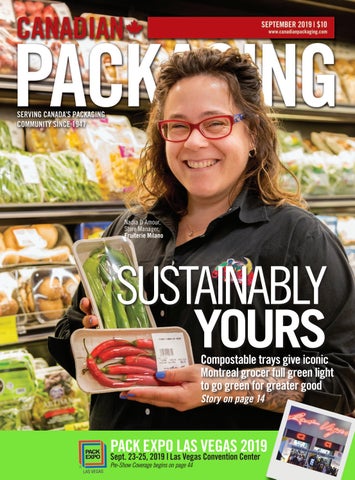
SUSTAINABLY YOURS

Compostable trays give iconic Montreal grocer full green light to go green for greater good Story on page 14

Nadia D’Amour, Store Manager, Fruiterie Milano

The smarter way to print is with true CIJ innovation

Videojet 1860 Continuous Inkjet Printer

True predictability

Industry-first ink build-up sensor provides true predictability and warnings of possibly degrading print quality, even before a fault occurs.

True remote services*

Multiple access options (Ethernet™, WiFi) and secure VPN communication meet highest standards in the industry as part of VideojetConnect™ Remote Service, and help to improve machine uptime and customer experience.

* Subject to availability in your country

True IP rating

Optional IP66 rating for entire cabinet and hygienic design following industry guidelines; easier integration with slanted printhead design.

True scalability

Workflow modules help to customize the printer to perform the exact need required. It is easy to adapt the printer with new capabilities and functionalities, and to meet growing demands.

SEPTEMBER 2019

VOLUME 72, NO. 9

SENIOR PUBLISHER

Stephen Dean • (416) 510-5198 SDean@canadianpackaging.com

EDITOR

George Guidoni • (416) 510-5227 GGuidoni@canadianpackaging.com

ASSISTANT EDITOR

Alanna Fairey • (416) 510-5228 afairey@canadianpackaging.com

MEDIA DESIGNER

Brooke Shaw • (519) 428-3471 bshaw@annexbusinessmedia.com

ACCOUNT COORDINATOR

Barb Comer • (888) 599-2228 ext 210 bcomer@annexbusinessmedia.com

CIRCULATION MANAGER

Anita Madden • (416) 442-5600 x3596 AMadden@annexbusinessmedia.com

VICE PRESIDENT

Tim Dimopoulos • tdimopoulos@annexbusinessmedia.com

COO Scott Jamieson

ANNEX BUSINESS MEDIA

111 Gordon Baker Rd., Suite 400, Toronto, ON M2H 3R1; Tel: 416-442-5600.

Canadian Packaging, established 1947, is published 10 times per year except for occasional combined, expanded or premium issues, which count as two subscription issues.

PRINTED IN CANADA

ISSN 008-4654 (PRINT), ISSN 1929-6592 (ONLINE)

PUBLICATIONS MAIL AGREEMENT NO. 40065710

CIRCULATION

e-mail: rthava@annexbusinessmedia.com

Tel: 416-442-5600 ext. 3555

Fax: 416-510-6875 or 416-442-2191

Mail: 111 Gordon Baker Rd., Suite 400, Toronto, ON M2H 3R1

SUBSCRIPTION PRICE PER YEAR (INCLUDING ANNUAL BUYERS’ GUIDE: Canada $78.50 per year, USA $138.00 US per year, Outside Canada

$156.50 US per year, Single Copy Canada $10.00, Outside Canada $27.10. From time to time Canadian Packaging will mail information on behalf of industry-related groups whose products and services we believe may be of interest to you. If you prefer not to receive this information, please contact our circulation department in any of the four ways listed above.

ANNEX PRIVACY OFFICER

Privacy@annexbusinessmedia.com

Phone: 800-668-2374

DISCLAIMER: No part of the editorial content of this publication may be reprinted without the publisher’s

THE NEW BLUE BOX BLUEPRINT

Started up in earnest in the early 1990s, Ontario’s famed Blue Box curbside recycling program was never originally expected to evolve into a moneymaking machine—its primary initial mandate driven by an urgent need to address Ontario’s full-blown landfill crisis. And while it never claimed to be an ultimate cure-all for all of the modern society’s throwaway habits and excesses, it worked well enough at the outset to have been adopted as a general blueprint for recycling in 150 countries around the world, according to the program’s administrator Stewardship Ontario.

Inevitably, however, the program started showing signs of running out of steam in terms of its overall effectiveness, with recycling rates for household trash like newsprint, plastic and glass containers, aluminum and other packaging waste stalling in the mid-60s percentage range.

Furthermore, with many new packaging products coming on the market that were not around when Blue Box first got off the ground—think multibarrier stand-up pouches, single-serve coffee pods, combination blister-packs, etc.—Blue Box seemed unable to keep Ontario residents up-to-date on what household waste they could put in their Blue Bins without contaminating the recycling stream.

So it should not come as a shock to learn that about a third of all the waste collected through the Blue Box program nowadays ultimately ends up in the landfill anyways, according to a new report prepared for the provincial Ministry of Environment, Conservation and Parks, which urging a sub -

COVER STORY

We

stantial overhaul of the existing Blue Box ecosystem over the next six years.

Authored by special advisor on recycling and plastic waste David Lindsay, the report identifies seven key areas that the government and all other key stakeholder must address in the next six years to preserve the Blue Box program’s viability.

This includes providing a common collection system for all Ontario municipalities, standardizing Blue Box contents, determining eligible sources for Blue Box materials, setting effective design targets and, most notably, making product manufacturers responsible for bearing the collection costs of their product packaging. Whereas municipalities and industry currently share the costs of Blue Box collection on 50-50 basis, Lindsay’s report urges the province to make consumer brand-owners and manufactures fund all the collection costs by 2025.

So far, at least, the government’s response has been fairly open-minded to the idea, especially in light of rising Blue Box costs estimated to increase by $10 million each year after 2019. According to the environment minister Jeff Yurek, “It’s clear that Ontario’s current Blue Box Program is unsustainable.

“Hopefully by the end of the day we create a new economy of recycled products here in Ontario because of the program that’s going to be put in place,” said Yurek, adding this would free up precious new funding for the municipalities.

“The cost of the program will be transferred over to the producers, businesses and industries creating the waste: they will be the ones who will be paying for the recycling program when this change occurs.”

We’ll see … in 2025?

Iconic Montreal grocer embarks on a sweeping sustainability initiative with the help of compostable molded-fiber trays in its fresh produce aisles.

photography by Pierre Longtin

DEPARTMENTS

COLUMNS

FEATURES

Bedding products supplier sleeping easier after installing

sensitivity metal detection system to keep unwanted debris at bay.

of packaging

on high-speed production lines.

Dry

foods distributor hits the packaging sweet spot with award-winning recyclable stand-up pouches.

of a job.

Continued

PLANT-BASED DAIRY PRODUCER LAUNCHING ITS CULT FAVORITES IN CANADA

With demand for plantbased protein products in Canada soaring through the roof, California-based Miyoko’s Creamery has picked an exceptionally opportune time and place for its first international expansion.

Having already established itself as something of a cult favourite in many U.S. markets, the leading U.S. plant-based butter and cheese brand made a tasteful Canadian market debut last month with the launch of its award-winning vegan butter at more than 1,000 grocery stores across the country last month, including Sobeys, Loblaws, Save-On Foods and Longo’s, as well as other smaller boutique grocers.

Produced and packaged at Miyoko’s processing facility in Petaluma, Ca., the company’s bestselling Organic European Style Cultured Vegan Butter is promised to melt, spreads, bakes, sautés and taste just like the highest-quality dairy butters, according to the company’s founder and chief executive officer Miyoko Schinner.

“Canada has really embraced the plant-based movement, with nearly 10 per cent of Canadians

considering themselves vegetarian or vegan,” says Schinner.

“What I find most heartening is how so many omnivores are enthused about plant-based food options and have been asking us to cross the border for years,” says Schinner, crediting Vancouver-based branding agency Fluid Creative for working with his company’s in-house package design team for all the translation work from English to French that had to be incorporated into the package design.

Already one of the most widely distributed vegan cheese and butter brands in the U.S. with distribution in more than 12,000 stores, Miyoko’s Creamery recipes use only real, whole food organic ingredients like nuts, legumes and plants, awhile eschewing fillers, additives or GMO ingredients.

The company also ensures that it partners with ethical and environmentally conscious suppliers, Schinner points out.

With cashews being a major ingredient in Miyoko’s cheeses and butters, the company has partnered with the Dutch supplier Tradin Organics to source organic

cashews from small farmer producers in Vietnam with the highest scores from third-party audits for working conditions and environmental standards.

As a result of these sustainability efforts, Miyoko’s products generate up to 98 per cent less greenhouse gases in production than their cow-based counterparts, according to Schinner.

“Consumers under 35 are the primary drivers for delicious plant-based food innovation: they want flavor and they don’t want to feel they’re giving up any of their favorite foods,” he states.

“They also get the importance of saving animals, the earth and preserving their health,” Schinner says, citing the new Canada’s Food Guide as validation of his company’s move into the Canadian market.

“We want to delight the palate of all butter loving Canadians who want a creamy, cultured, good-foryour-gut), buttery experience with zero cholesterol,” he states.

Schinner adds that Miyoko is planning to follow up the Canadian launch of its butter later this fall with the phased introduction of its artisan vegan cheeses across Canada, including the award-winning Double Cream Classic Chive, Fresh Vegan Mozzarella and its premium cheese wheels in flavors such as Aged Black Ash, Sharp Farmhouse and Smoked Farmhouse

STEAM WHISTLE BREWING BREAKING THE MOLD WITH NEW PRODUCT LAUNCH

One great beer ultimately deserves another, so after brewing only one style of beer for 19 years, Torontobased Steam Whistle Brewing has broken its original “one beer” premise of being a one-beer company by adding a new product to its flagship Steam Whistle label.

Packaged in distinct blue cans, the new Steam Whistle Premium Pale Ale is made according to the exacting standards of the Bavarian Purity Act of 1516—just like its original bestselling Steam Whistle Pilsner —at the company’s newly opened state-ofthe-art brewery in west-end Toronto.

COOL SUMMER TREATS WITHOUT THE GUILT TRIP

Counting calories can be a real killjoy for consumers seeking relief from summer heat with a trusty old helping of ice cream. But thanks to companies like Montreal-based CoolWay, Canadians have never been as spoilt for choice as now in chilling out with a delicious lowcalorie ice-cream product without the guilt trip of high caloric content of most conventional frozen dairy treats.

Although it’s only been introduced to Canadian retail market just over a year ago, the company’s flagship CoolWay brand of low-calorie, high-protein ice cream is now available in 15 different flavors, following recent launches of the new Birthday Cake, Cherry Fudge Brownie, Chocolate Chip Cookie Dough, Lemon Cake, Maple Swirl, Mocha Brownie Fudge and Strawberry Cheesecake recipes.

Retailing across Canada at Walmart, Metro, No Frills, Longo’s, Whole Food Market, Farmboy, FreshCo and select Sobeys stores, the company’s diverse offerings—packaged in colorful 500-ml pint-size tubs designed by Bo Branding & Design Co. of Montreal—range from 280 to 390 calories per 500-ml container, which is about 1,000 calories less per pint than traditional ice-cream brands.

“We have grown to become the Number One craft beer in Canada with only one beer,” says Steam Whistle’s vice-president of marketing Tim McLaughlin, “but we have heard loud and clear from our customers that they would like to see more beers from us.”

McLaughlin says that Steam Whistle conducted an extensive research project reviewing the Steam Whistle brand earlier this year, which showed that 92 per cent of Steam Whistle Pilsner drinkers were willing to try another beer from Steam Whistle.

In fact, Steam Whistle has already used its new

brewery’s ample new production capacity to launch a brand new Von Bugle brand of Munich-style lager earlier this year.

However, the new Steam Whistle Premium Pale Ale is the brewer’s first new beer under the Steam Whistle label.

“In terms of the style of the beer, our pale ale is still easy to drink and crisp, but more hop-forward than our pilsner,” says McLaughlin.

“We will remain true to our standards of brewing a pure ale with no additives, preservatives or artificial foam enhancers.”

Faster on the market with your machines. Very

In addition to the new flavors offered in the pint-sized tubs—manufactured by Smithville, Ont.-based Stanpac CoolWay has also expanded its product portfolio with the introduction of 88-ml ice-cream bars. (See Picture)

Made with 100-percent Canadian milk sourced from a dairy in Halifax, N.S., the single-serve Cookies & Cream and Salted Caramel ice-cream bars contain only 80 calories per serving, and can be found in the freezer aisles of Quebecand Ontario-based stores operated by Walmart, Metro, No Frills, Longo’s, Whole Food Market and Farmboy.

Schneider Electric‘s PacDrive 3 system delivers 50% more power and now syncs up to 130 servo axes including robot axes with new controllers. From now on, automate a large number of your machines with just one technology and thus get to the market faster. Made possible by the motion control solution PacDrive 3 from Schneider Electric.

NOTES & QUOTES

nPrinting inks manufacturer INX International Ink Co. of Schaumburg, Ill., has announced completion of the expansion of its R&D (research-anddevelopment) complex in Chicago’s west end—nearly doubling the facility’s production space up to

70,000 square feet and prompting the hiring of about 20 new chemists and support staff to service the expanded on-site lab. (See Pictures) Commenced in the fall of 2017, the expansion project has provided critical new production space to house the company’s digital solutions offerings and other fastgrowing market segments, according to the company’s R&D director Mark Hill. “The expansion effort focused on growing specific markets such as energy curable inks and coatings and inkjet ink technologies of all types,” Hill explains. “With increasing demand for our products, we added 5,000 square feet to our digital print applications lab, which now houses several types of inkjet printers, printhead makers, and delivery systems for more complete ink testing capabilities.”

nLeading German plastic processing machinery manufacturer Arburg GmbH + Co KG has commenced a major 22,600-square-foot expansion of Arburg, Inc. facility in Rocky Hill, Conn., to create more space for building and acceptance testing of complete turnkey systems, customizing, stock machines to customer specifications, and house a significantly larger spare parts warehouse. “In recent years, our business in the US has developed significantly better and faster than expected [and] our U.S. headquarters is already reaching its capacity limits,” says Friedrich Kanz, managing director of Arburg, Inc. According to Arburg, the new building will be equipped with modern logistics and a gantry crane with a lifting capacity of 40 tonnes, while also housing additional rooms for customer training and technical seminars.

nProtective packaging products manufacturer Pregis LLC has announced the opening of the company’s new Pregis IQ innovation headquarters in Aurora, Ill. Staffed with ISTA -certified lab engineers, the new 50,000-square-foot facility is fully equipped to provide customer-focused training, design and testing services using related testing protocols to develop performanceoriented, cost-effective protective packaging solutions, with special emphasis on e-commerce applications. “As a protective packaging thought leader and innovator, we will be using creative packaging design, material science, sustainability and automation services at Pregis IQ to help customers solve specific packaging challenges,” says Pregis chief innovation officer Tom Wetsch. “We will also be using a data and metrics-based approach to create advanced solutions that support market trends and meet customer needs.”

nLorenz Conveying Products Corp., manufacturer of pneumatic conveying products based in Cobourg, Ont., has completed the acquisition of Flow Valves International, Evanston, Ill.-based manufacturer of Syntron and SMS Iris brands of flow control valves. “The addition of the Iris flow valves to our product line is the perfect fit with our other products, and will allow us to service our customer base more effectively from the new location,” says Lorenz Conveying Products president Peter Lorenz, adding the newly-acquired plant in Normal, Ill., will now operate

under Lorenz Conveying Products USA Inc. corporate banner going forward.

nPretium Packaging, Chesterfield, Mo.-based manufacturer of plastic containers and closures, has completed a US$2-million installation of new reheat stretch PET (polyethylene terephthalate) blowmolding at its production facility in Troy, Ala. According to Pretium, the new equipment can produce both cold- and hot-fill PET plasic containers for condimenta, sauces and dressings—as well as readyto-drink teas, energy drinks, coffee and other beverages—in sizes ranging from six ounces to two-liter volume capacities. “While demand from small- to

medium-sized companies for condiment containers, as well as hot-fill bottles, continues to increase, many suppliers are not willing to provide smaller stock quantities that many of these processors and bottlers require,” says Pretium’s director of operations Randy Neibarger. “Our objective is to serve that niche.”.

nFood packaging equipment supplier Rovema North America, Inc. of Norcross, Ga., has been honored with the 2019 Supplier Excellence Award for Innovation from leading confectionary producer Hershey

NOTES & QUOTES

Company in recognition of its efforts in the launch of Hershey’s Doy-type stand-up pouches for several of its well-known milk chocolate brands. The collaborative project involved multiple models of Rovema’s BVC series Flex Machines—continuous-motion vertical form, fill and seal (VFFS) unit that, in addition to the Doy-style bags specified by Hershey, can also produce pillow, gusseted and quad bags with or without zippers.

nLeading German industrial conglomerate Robert Bosch GmbH has announced plans for the sale of its Bosch Packaging Technology unit to a newly incorporated entity managed by the Luxembourgbased private equity fund CVC Capital Partners (CVC), which currently manages more than US$75 billion of assets worldwide. Under the agreement signed by both parties last month, Bosh Group is expected to transfer its entire global packaging technology business—including over 6,100 employees in 15 countries—to CVC by the end of the year, pending all the required regulatory approvals. “Bosch Packaging Technology is a strong company in an attractive market with long-term growth prospects [and] an excellent reputation for quality and innovation, a broad product range, a global footprint, and experienced associates,” says CVC managing partner Alexander Dibelius. “Together with the management team, we will work to take the business forward in the years ahead, and to make it even more competitive.”

FIRST GLANCE

QUICK AND EASY

The new QuickLabel QL-120X tabletop digital color label printer from AstroNova, Inc. is a flexible, highquality, efficient solution for on-demand digital color label printing, featuring economical high-capacity ink cartridges and efficient, dye-based inks. Equipped with next-generation printhead technology, the QL-120X prints three times more labels (over the life of the printheads) than the original QL-120 system, with its four individual, snap-in, color printheads facilitating rapid on-site changeover. The QL-120X enables users to print labels as narrow as 0.5-inch or as wide as 4.2-inches on the same device, using a wide variety of media types ranging from matte to high gloss paper and synthetics to deliver superior durability in a wide range of applications. AstroNova, Inc.

A SAFER TRAY

E. Hofmann Plastics has expanded its range of food-grade MAP (modified atmosphere packaging) trays with a new line of antimicrobial trays incorporating a special contact layer that can kill harmful bacteria such as Listeria and Salmonella on contact, according to the company, without sacrificing structural integrity. Made with #5 recyclable polypropylene, the trays were tested against conventional PP in an independent lab, where the trays were found to reduce antimicrobial activity by up to 96 per cent, while still providing a highly effective oxygen barrier layer to ensure optimal food freshness and shelf-life performance.

Foreign Body Detection

INTUITY

Metal Detector for installation on conveyor belts

 Innovative user interface

 Best metal detection performance with Multi-Simultaneous-Frequency-Technology

 Specialized Compliance Mode software

 Active detection performance displayed via Detection Forecast Algorithms

OUTSIDE THE BOX

The paperboard division of Rayonier Advanced Materials has announced the launch of its new folding-grade Kallima box coated paperboard as a low-weight option for a broad range of packaging, cartoning, POP display and other projects requiring foldable, printable and boxable solution. According to the company, the Kallima box is the only FBB (folding boxboard) grade currently manufactured in North America. Coated on one side and available in 14-, 16- and 18-pt grades in sheets and/or rolls, the Kallima box paperboard’s low-density, multi-ply board characteristics bring significant savings due to the basis weight advantage over competing SBS (solid bleached sulphite) products, while facilitating consistent printability and reliability on the press.

Rayonier Advanced Materials

SOLVING THE CASE

Designed for mid-range applications, the new M236 case sealer from A-B-C Packaging Machine Corporation—available in tape and adhesive sealing models—offers many high-performance features to ensure highly reliable operations in speed range of 15 to 25 cycles per minute. The machine’s metering roller feed accepts cases back-to-back or spaced and automatically aligns with changing line speeds, while the powered minor flap tucker ensures positive inner flap closing and the outer flaps are closed by contoured flap folders that fold the flaps squarely—even when running cases with poor or undefined scores. Moreover, the adhesive sealing Model 236 has a sealing section with rollers that compress against each case to ensure secure adhesive bonding even when running cases with minor case height variations.

A-B-C Packaging Machine Corporation

EXTREME MEASURES

Designed to deliver high flow rates and reliable compressed air pressure control in a range of harsh environments with corrosive atmospheres, extreme temperatures or explosive zones, Festo’s new filter regulator combines filter and pressure regulator functions in a single space-saving design with patented seal technology protects against back flow and ensures reliable exhausting without special accessories. With its housing and interior made entirely of premium stainless steel to ensure high corrosion resistance, the UV-resistant PCRP functions reliably outdoors at temperatures ranging from -60°C to +80°C, with its rugged construction making it suitable for use in potentially explosive zones 1, 2, 21 and 22, according to Festo.

Festo, Inc.

THE INCREDIBLE BULK

A new ultra heavy-duty bulk bag filling system from Flexicon Corporation is designed to provide reliable intake of abrasives, highdensity solids and other difficult-to-handle bulk materials from upstream processes or storage vessels and fills the material by weight into bulk bags. Intended for mining, glass, ceramics and other demanding industrial applications, the system is comprised of heavygauge variants of the company’s patented TWIN-CENTERPOST filler and FLEXICON flexible screw conveyor consolidated on a robust skid with integral forklifting tubes for mobility. The filler is equipped with fill head height adjustment to accommodate all popular bag sizes, pneumatically retractable bag hooks and an inflatable connector to seal the bag inlet spout, with an optional feed chute outlet port featuring a high-efficiency filter sock for dust-free air displacement during filling. The FLEXICON conveyor consists of a steel outer tube with a rugged flexible screw that self-centers as it rotates to preventing material from grinding between the screw and tube wall, while eliminating the need for a bearing at the intake end.

Flexicon Corporation

LIVING LARGE

Requiring just one operator and designed to improve the efficiency of distribution operations, the new Series 2300 large-volume sorting conveyor from Eaglestone Equipment is outfitted with adjustable-speed pneumatic sorting arms that automatically divert products into containers, and then shift to a different receptacle when cartons are full. Featuring bright LED lights to indicate when each container is nearly or completely full, the Series 2300 conveyor can sort both random and single product production batches through the use of eye safe infrared scanners to identify barcodes. The Series 2300 can be supplied with numerous options to suit various application requirements, including retracting ends, diverting chutes, blast gates, push-offs, stainless-steel casters, etc.

Eaglestone Equipment

STUDY SAYS DRINK CARTONS GREENER THAN GLASS

Ink Jet Printer

An major new life-cycle assessment (LCA) study from German environmental researchers claims that singleuse beverage cartons compare favorably to reusable glass bottles, while also strongly outperform ingsingle-use PET (polyethylene terephthalate) plastic bottles across the fresh milk, juice, and UHT milk market segments.

The LCA study is based on an analysis of the German beverage packaging market, with expert reviews by the German Federal Environment Agency (UBA)

The conclusions are globally relevant and support the findings of previous reviewed LCAs that beverage cartons offer environmental advantages to alternative forms of packaging, according to a leading German beverage carton

UXSeries

Next-generation leadership performance

Hitachi’s UX Series continuous inkjet printers represent the pinnacle of innovation in marking and coding technology, all while showcasing Hitachi’s reputation for Reliability, Efficiency, and Ease of Use.

Environmentally friendly while realizing a low running cost

High reliability, and reassured maintenance and service networks

Simple touch panel operation and maintainability

producer SIG, a member of the German Beverage Carton Association FKN, which commissioned the LCA study to support informed decisions on packaging by food producers, consumers, and policy-makers.

“The latest LCA confirms once again that beverage cartons are the preferred environmental choice for milk and juice packaging,” says SIG’s chief executive officer Rolf Stangl.

“These results are based on standard beverage cartons that are around 75 per cent renewable and SIG already offers customers innovative products that are linked to up to 100-percent renewable content,” Sangle says, stressing that science-based LCA is fundamental to SIG’s approach to product responsibility.

As Benedikt Kauertz, scientific director at IFEU, explains: “The results show that beverage cartons for milk and juice are advantageous compared with single use PET bottles.

“For milk, beverage cartons are even better than the reference system, reusable glass bottles, and for juices beverage cartons perform on a par with the reference system,” Kauertz points out.

“For UHT milk, where no reusable packaging option is available, beverage cartons perform better than the singleuse PET bottle alternative.”

Reusable packaging options, such as glass bottles that are returned to producers to be used again, are assumed to be the best option, the LCA study notes.

That is why reusable options, where available for a particular market, are used as the reference system for comparison.

Based on an analysis of all three-market segments, the beverage carton performs as well, or in the case of fresh milk, even better than reusable glass bottles.

In fact, cartons have been found to perform significantly better than the alternatives on climate change––the category given highest ecological priority by the UBA.

The climate results for cartons are 78 per cent lower than reusable bottles for fresh milk, 37 percent lower than reusable glass bottles for juices, and 71 percent lower than PET bottles for UHT milk, according to the study.

The high proportion of renewable material used to make cartons contributes to their environmental performance, together with their design, which reduces impacts from transport and distribution.

The results are underpinned by the industry’s commitment to sourcing from responsibly managed forests, according to the report, which plces high value on the positive contribution that renewable materials make to the environmental performance of beverage packaging.

Sept. 17-18

Hartsville, S.C.: 2019 Sustainability and Food Waste Summit, international conference by Sonoco FRESH (Food Research Excellence for Safety and Health). To register, go to: www.sonoco.com/form/sustainabilitysummit-enrollment

Sept. 23-25

Las Vegas, Nev.: PACK EXPO Las Vegas, international packaging technologies exhibition by PMMI, The Association for Packaging and Processing Technologies. Concurrently with Healthcare Packaging EXPO. Both at the Las Vegas Convention Center. To register, go to: www.packexpolasvegas.com

Sept. 24-27

Brussels, Belgium: Labelexpo Europe 2019, labeling technologies exhibition by Tarsus Group plc. At Brussels Expo. To register, go to: www.labelexpo-europe.com

Sept. 30 – Oct. 2

Monaco: Luxe Pack Monaco, luxury products packaging exhibition. At Grimaldi Forum. To register, go to: www.luxepack.com

Oct. 5-9

Cologne, Germany: Anuga 2019, international food and beverage industries exhibition by Koelnmesse. At Koelnmesse fairgrounds. To register, go to: www.anuga.com

Oct. 10-12

Manila, Philippines: Pack Print Plas Philippines, packaging, printing and plastics trade show for the ASEAN region by Messe Düsseldorf Asia. At SMX Convention Center Manila. To register, go to: www.mdna.com

Oct. 15-17

Indianapolis, Ind.: International Robot Safety Conference, by the Robotic Industry Association (RIA). At JW Marriott Indianapolis. To register, go to: www.robotics.org

Oct. 16-23

Düsseldorf, Germany: K 2019, world fair for plastics and rubber by Messe Düsseldorf GmbH. At Messe Düsseldorf fairgrounds. To register, go to: www.mdna.com

Oct. 23-26

Shanghai, China: E-PACK TECH 2019, ecommerce technologies and packaging solutions exhibition by Ipack Ima. At Shanghai New International Expo Centre (SNIEC). To register, go to: www.epacktech2019.com

Oct. 28-30

Niagara Falls, Ont.: Ontario Craft Brewers Conference & Suppliers Marketplace 2019, by Ontario Craft Brewers (OCB). At Scotiabank Centre. To register, go to: www.ontariocraftbrewers.com

Oct. 28-30

Charlotte, N.C.: Time is Money, annual fall conference of the Flexographic Technical Association (FTA). At Sheraton Charlotte Hotel. To register, go to: www.flexography.org/fall19

Nov. 4-6

Paris, France: Sustainable Cosmetics Summit Europe, conference and exhibition by Ecovia Intelligence. At Hotel Marriott Champs-Élysées.To register, go to: www.sustainablecosmeticssummit.com

Nov. 12-13

San Jose, Ca.: Collaborative Robots, Advanced Vision and AI (CRV.ai) conference by the Association for Advanced Automation (A3), Advanced Imaging Association (AIA) and the Robotics Industry Association (RIA). At Doubletree by Hilton San Jose.To register, go to: www.visiononline.org

Nov. 19-22

Milan, Italy: SIMEI 2019 (International Enological and Bottling Equipment Exhibition), by Unione Italiana Vini. At Milano Fiera-Rho. To register, go to: www.simei.it

Nov. 29-30

São Paulo, Brazil: Sustainable Foods Summit, international sustainability conference by Ecovia Intelligence. To register, go to: www.sustainablefoodssummit.com

Dec. 5-7

New Delhi, India: drink technology India, beverage, dairy and liquid food industries trade show by Messe München GmbH. At Pragati Maidan grounds. To register, go to: www.messe-muenchen.de

Dec. 9-11

Cairo, Egypt: Pacprocess MEA, packaging exhibition for the Middle East Africa (MEA) region by Messe Düsseldorf GmbH. At Egypt International Exhibition Center. To register, go to: www.pacprocess-mea.com

GREEN LIGHT FOR GREATER GOOD

Iconic grocer bids arrivederci to fresh produce packaging waste with compostable and renewable thermoformed molded fiber trays manufactured in Canada

Genuine packaging sustainability does not happen overnight or in isolation.

Which is why progressive retailers who truly believe in the virtues of reducing their carbon footprint have much to gain from hooking up with business partners with extensive experience in developing effective sustainable packaging solutions.

Founded in 1954 in Montreal’s famed Little Italy district, independent grocer Fruiterie Milano offers a compelling proof of the benefits of such strategic alignment.

Celebrating its 65th anniversary this year, the popular grocer has long been acknowledged as one of eastern Canada’s best shops to purchase authentic made-in-Italy specialty foods and delicacies—ranging from olive oils and fresh pastas to buffalo mozzarella and other gourmet cheeses, along with a broad array of Italian deli meats such as capicolo, prosciutto,

sopressata, mortadella and numerous salami varieties.

Considered a landmark Saint Laurent Boulevard institution by the area’s residents, many of them descendants of early Italian newcomers to Canada during the early 20th Century, the thriving family business has expanded nearly a dozen times since founder Vincenzo Zaurrini first opened its doors as a small boutique specializing in imported Italian-made foods.

Nowadays, employing about 100 people and stocking a broad selection of mainstream food and beverage products in addition to its Italian novelties,

Above: Founded 65 years ago by Vincenzo Zaurrini, Fruiterie Milano has continued to operate from the same location in the city’s Saint-Laurent street district, having gone through numerous facility expansions over the years to establish itself as one neighborhood’s landmark institutions and favourite meeting places.

Left: Fruiterie Milano store manager Nadia D’Amour proudly showing off the compostable EarthCycle™ trays, manufactured in Canada by CKF Inc. and distributed by Veritiv, that the iconic store began using earlier this year to package pre-portioned fresh produce as part of the company’s ambitious and far-reaching sustainability initiative.

Fruiterie Milano has recently embarked on a quest to raise its community profile by embracing newer and more eco-friendly product packaging than it has in the past.

According to store manager Nadia D’Amour, the primary impetus for this change came primarily from the store’s own loyal customers, who would often express their concerns over apparent product overpacking and other packaging excesses to the store management and employees.

Upon seeing these comments becoming more common and frequent, current owners Celia and

Mario Zaurrini recently decided there was no better time than the present to turn over a new green leaf in the company’s illustrious history.

Just as the Fruiterie Milano owners began identifying opportunities for introducing more sustainable packaging to their operations about a year ago, they got a well-timed call from a sales representative at Veritiv Canada, Inc.’s Montreal office inquiring about their packaging needs and requirements.

“It was a case of very good timing for both ourselves and Fruiterie Milano,” according to Pascal Lacasse, Veritiv Canada’s director of packaging sales for Quebec and eastern Canada.

“We contacted them just as they started looking for a partner to supply the right packaging products that would help improve their environmental profile,” Lacasse told Canadian Packaging in a recent interview.

Specifically, they wanted to replace all the polystyrene foam trays they were using with something that did not end up going to landfill and stay there forever.

“As it happened, we also just began stocking an exciting new alternative solution to the traditional foam trays commonly used by grocery retailers for packaging smaller quantities of fresh fruits and vegetables,” Lacasse relates. “It was a very happy coincidence.”

“Once they saw what we had to offer, they wasted no time in placing the initial order and proceeding to move ahead with their sustainability program.”

Manufactured in Canada by Hantsport, N.S.-headquartered CKF Inc., the EarthCycle™ brand thermoformed pulp trays distributed by Veritiv are made from a blend of wood fibers— using a proprietary process to create fully compostable, renewable and recyclable trays with outstanding shelf-life properties for the top-sealed products placed inside them.

According to CKF’s director of market development Shannon Boase, “Being certified home-compostable and also widely recyclable in most common

paper waste streams gives EarthCycle packaging a lot of environmental credibility.

“It is a terrific sustainable alternative to help retailers reduce their dependence on single-use plastics and other non-recyclable materials.”

Developed as an alternative for plastic packaging used for smaller-sized fresh fruit, vegetables, berries and mushrooms, the home-compostable EarthCycle packaging received widespread global acclaim earlier this year at the massive Fruit Logistica 2019 international trade fair for fruit and vegetable marketing in Berlin, Germany, where it picked up a bronze (third place) Fruit Logistica Innovation Award from hundreds of entries submitted to the competition.

For store manager D’Amour, who joined Fruiterie Milano a little over a year ago, the multiple environmental benefits offered by EarthCycle packaging made it a very easy sell.

“We had set ourselves a goal of zero waste in 2019,” says D’Amour, “and these EarthCycle trays provided a perfect starting point for us.”

“When I came on-board, I heard many customers asking us in-store whether it was possible, for example, to replace the non-recyclable trays we used for fruits, vegetables and meat,” she recalls.

“I also came across many of the same types of comments being made on the social networks.”

“We realized then that we had to change our way of doing things,” D’Amour relates, complimenting the grocer’s owners for initiating the company’s drive to embrace sustainable packaging solutions—starting with the fresh produce aisles.

“So we introduced one format, then a second immediately after, and before long our customers soon realized that we were using a new type of tray to

A Fruiterie Milano employee uses a rudimentary manual
The Montreal branch of leading packaging materials and machinery distributor Veritiv Canada supplies Fruiterie Milano with EarthCycle trays and the top-sealing films used for packaging fresh produce fruits and vegetables in convenient portion sizes right on-site.

Competing SRP requirements cutting into your efficiency and profitability?

WestRock Automated Packaging Systems’ innovative shelf- and retail-ready packaging design to automation solutions reduce the need for third party repackaging and the associated packaging and freight redundancies. Efficiently run one- and two-piece structures in-house while satisfying multiple retailer requirements and increasing your sales lift.

Learn more by visiting us at PACK EXPO, Booth C-2223 and see Meta® Duo in action, our newest two-piece SRP technology for multi-channel, in-house automation.

westrock.com/aps aps@westrock.com

package our fruits and vegetables,” D’Amour recalls.

“Naturally, they wanted to know the characteristics of our new trays, and when we explained to them that they were recyclable and compostable, their reactions were overwhelmingly positive.”

Fruiterie Milano currently uses eight different sizes of EarthCycle trays to pack its fruits and veggies onsite in overwrap stretch film that is also supplied by Veritiv Canada via the company’s local sales reps.

“We also made it a point to use film that could be recycled, assuming that it ends up in the right waste stream,” D’Amour says, “because we are very serious about achieving our zero waste targets.

“We have been very fortunate to be able to count

on the great advice we received from Veritiv sales reps, who are continuing to guide us through our search for more sustainable packaging products.”

According to D’Amour, she is currently working close with Veritiv to introduce new sustainable packaging for the hot soups and meals that Fruiterie Milano also sells on-site from its busy deli counter.

“Our collaboration with Veritiv Canada is enabling us to launch all kinds of initiatives to meet the demands of our customers by reducing our environmental footprint,” D’Amour states.

“We are very keen on maintaining this relationship because we want to continue to innovate in grocery packaging.”

“Our interest in compostable and recyclable packaging products demonstrates how serious we are about making sustainability our core business value proposition.”

According to Veritiv Canada’s Lacasse, Fruiterie Milano’s sustainability program provides an accurate reflection of the urgency of introducing more sustainable packaging by virtually all Canadian grocery operators large and small.

“We have been carrying what would be considered sustainable packaging options for about 15 years now,” Lacasse notes, “but it is in the last two years that the demand for more environmentally-friendly packaging solutions has really taken off in a big way across the grocery sector.”

Grocery retailers have long been a significant and important customer base for Veritiv Canada, whose vast inventory comprises different packaging, printing and facility management products sourced from various suppliers.

“In the past, prospective customers would begin their inquiries with questions about price, quantities, deliveries and all the other standard purchasing questions,” he says, “whereas today sustainability either tops the list or comes very near it.”

Says Lacasse: “I think that after 15 years or so that environmental sustainability has finally become a real public issue, consumers are finally realizing how urgent and important this issue really is for all of us, and they are finally using that knowledge to put pressure on their brands and retailers to address these concerns.

“Veritiv is excited to provide innovative sustainability solutions to its customers so that we can all become better stewards of this planet,” Lacasse sums up.

SUPPLIERS

Veritiv Canada, Inc. CKF Inc.
Open seven days a week, the Fruiterie Milano store on Saint Laurent Boulevard is widely acknowledged as one of the best places in Canada to purchase authentic Italian specialty foods and delicacies, along with a comprehensive range of mainstream everyday grocery items.
Fruiterie Milano is currently working with Veritiv Canada on ways to expand EarthCycle packaging beyond produce to other product categories, such as fresh meat, in the near future.

Want to start a distillery? Here’s what it really takes…

Entering the distilling market is a long-term venture and understanding product development is an investment. Once a distillery has a range of products and a market, then follow these 4 tips for determining production requirements:

Pick the Right Partner Work with an integrator that sees your vision. The process design needs to allow the distiller to input artisan touches to products but be sophisticated enough to be exible and enable the distiller to concentrate on meaningful variables while minimizing basic control.

Equipment Production design needs to include equipment that will last and is repeatable. Distillers need to have a process and equipment that can reproduce a successful product – from brewing and the stills to the distillation equipment. They need automation to capture the movement and trends as well as document the process for review and duplication.

Control System A controls platform needs to be exible, stable and stand the test of time - to expand and grow with the distillery business. It needs to be able to capture and manage data, handle recipe management and inventory control. The key is to have data available at the time of production and a way of storing it for future planning.

Plan for the Future It is critical for a distillery to have a long-term plan so that when elements of the process change, the automation framework is in place to allow for growth and continuous improvement. Plan for the future versus having to rework or redesign the process down the road.

Operating inside a fully-renovated 184-year-old historically designated stone building in downtown Guelph, Ont. since the start of the year, the Spring Mill Distillery houses a world-class arsenal of distilling equipment, including the towering stainless-steel fermenters (inset) rising almost the entire height of the building, for the production of premium-quality craft whiskey, vodka and gin products.

TEAM SPIRITS

Upstart craft distiller blends its brewing expertise with process control automation to put itself on solid gowth path

Patience may be an increasingly rare virtue in today’s world of instant consumer gratification, but for companies focused on the timeless pursuit of quality, purity and craftsmanship, the ultimate rewards are more often than not well worth the wait.

As a founder and former owner of one of Canada’s most successful beer companies of all time, John Sleeman is a living personification of everything that is good and noble about artisanal authenticity in the production of high-quality, well-crafted and cleverly packaged products for which Canadian consumers will happily pay a well-earned premium in a compelling display of brand loyalty and appreciation.

Having steered the Guelph, Ont.-based Sleeman Breweries from its humble beginning in 1988 through its emergence and pre-eminence as one of Canada’s first large-scale craft brewers right up to its astonishing $400-million sale to global Japanese brewing giant Sapporo Breweries in 2006, Sleeman has definitely more than earned his right to coast and bask in the golden afterglow of an extraordinary career.

But that just wouldn’t be John’s style. Rather, in addition to faithfully carrying on with his duties as a Sleeman Breweries chairman of the board, the 65-year-old entrepreneur is on a quest to replicate his remarkable success in the beer business with the new craft-spirits venture called Spring

Mill Distillery

Also located in Guelph, the recently-launched distiller is an independent, privately-funded enterprise co-owned by 14 individual investors—with Sleeman owning the biggest minority share—aiming to position itself as one of the country’s top producers of craft whiskey and other distilled spirits such as vodka and gin.

“John and I had initially started discussing this idea back in 2010,” says Spring Mill’s vice-president of operations and master distiller Doan Bellman, one of the distillery’s founding co-owners and, notably, the very first brewmaster that John Sleeman hired way back in 1988 to start his then-fledgling microbrewery in Guelph.

“We are both fans of fine whiskeys made around the world,” says Bellman, “and naturally we have plenty of background in alcohol beverage production that we think will give us a competitive edge in the growing market for craft whiskey.

“The difficulty is having to wait for three years to have a sellable [whiskey] product,” says Bellman, citing the patient aging process required to produce a quality whiskey, “whereas a startup brewery can have a sellable product in three weeks’ time.

“Hence this is a very patient money enterprise built on a lot of patient capital,” says Bellman, citing “many millions” of dollars spent on renovating and retrofitting the landmark 184-year-old building where Spring Mill has commenced production of its flagship Spring Mill brand of craft vodka and gin in early spring this year.

“We spared no expense in putting together what we think is the finest craft distillery in Canada,” Bellman told Canadian Packaging on a recent visit to the 20,000-square-foot operation housing two towering, four-meter-high copper pot stills hand-craft-

Vice-president of operations Doan Bellman, one of 14 investors who jointly own the craft distillery, was the original brewmaster at Sleeman Breweries, where he worked closely with the brewery’s well-known founder John Sleeman.

AUTOMATE NOW

The clear custom-shaped 750-ml glass bottles supplied to Spring Mill by Bruni Glass are decorated using a high-end ACL (spliced ceramic label) printing process by Stanpac.

ed in Scotland by the famed distillation equipment specialists Forsyths

“It was a hugely capital-intensive project.”

Also housing two giant custom-built wooden “washback” vats made from the Douglas fir trees grown in Western Canada and shipped to Scotland for hand assembly, the designated Heritage Building facility has been making exceptionally good use of all the impressive best-of-breed distilling and processing equipment expertly laid out for optimal production throughout the building’s four storeys.

“We’ve been getting very good feedback right now on both our vodka and gin products,” says Bellman, adding the company is actively expanding its current limited base of about 100 LCBO (Liquor Control Board of Ontario) outlets carrying the premium-priced Spring Mill vodka and gin brands.

Currently retailing for $39.95 for a 750-ml bottle, the Spring Mill vodka and gin are packaged in shapely clear custom glass bottles supplied by Bruni Glass and deftly decorated via the high-end ACL (applied ceramic label) printing process by Stanpac in Niagara Falls, with Erin, Ont.-based A.O. Wilson Ltd. completing the packaging ensemble with tight-fitting wood-top bottle closures and the colored polylaminate bottleneck seals.

As Bellman readily agrees, the whole see-through look of the package is a nod to the once-revolutionary clear-glass beer bottles introduced to the Canadian beer market by Sleeman Breweries to great effect back in the 1990s to break up the decades-long stranglehold on Canadian beer bottle design by the so-called “stubby” bottles favoured by the country’s two dominant brewers Molson and Labatt’s “John always had a keen appreciation for the role that packaging plays in product marketing,” Bellman says, “and playing up the transparency angle with this see-through packaging look just seemed like a natural fit and compliment for our premium products that, in my opinion, are as good as any other established brands out there.”

As Bellman relates, “We are proud to be continuing on with the philosophy John started at the [Sl-

Spring Mill’s vice-president of operations Doan Bellman (left) and Jeremy Meyer, territory account manager for central Canada with Omron Automation Americas, taking a look at live equipment status reports displayed in real time on the Omron touchscreen HMI (human-machine interface) terminal embedded into the plant’s main control panel.

eeman] brewery, which is based on the belief that having the right equipment, the right ingredients, and the right know-how can enable us to produce some of the finest products in the world.”

Says Bellman, “My experience as the Sleemans brewmaster and, in later years, as vice-president of technical services in charge of all the engineering, quality assurance and brewing, enables me to bring a lot of attention to detail in the brewing process that precedes the distillation stages of spirits production.

“Most people don’t know this,” Bellman explains, “but you need to be able make high-quality beer [on-site] before you can proceed to use that beer to make high-quality whiskey, or any other distilled spirit.

“You may have the best stills with the best separation technology,’ Bellman states, “but the stills will not fix any mistakes you may have made in the brewhouse earlier in the process.

“That’s why attention to detail in the brewing process is critical to translating that know-how into the quality final product.

“It is not the stills alone,” Bellman proclaims. “It is the whole process: from start to finish.”

To illustrate the point, Bellman likens operating a still to playing a complex musical instrument like the organ, “whereby you use different pieces of equipment to heat the liquid to release alcohol from the original [beer] solution and then condense the alcohol vapor back into the liquid form.

Measuring

over three meters in height, the all-copper stills installed at the Spring Mill Distillery building were hand-crafted in Scotland by the world’s leading and best-known distillation equipment manufacturer Forsyths, founded back in the 1890s.

AUTOMATE NOW

“You can play that tune in many different ways in terms of using different ingredients and all the different valves and other instrumentation to reach the desired boiling temperatures,” says Bellman, “which is why you have so many different vodkas out in the market, for example.

“There is a multitude of combinations and permutations of what you can do to effect the end product,” Bellman notes, “but it is the know-how behind the mechanical process of distilling that has the most important bearing on the final product quality.”

According to Bellman, Spring Mill goes through a lot of effort to source soft winter wheat to use as the base grain for its distilled products, along with many sought-after botanicals from around the world used for flavoring.

As for getting the distillery’s stills to perform like a fine-tuned organ, Bellman knew that the operation’s long-term success would be heavily dependent on installing the right process control solution, along with all related instrumentation and hardware, that would withstand the test of time and the vastly increased output down the road once the barrelled whiskies reached their maturity.

After trying several different engineering firms, Bellman eventually settled on proceeding with the project with LSI Control Systems Integration Canada ULC of Aurora, Ont., which has extensive experience of working with breweries and utilities that supply them with water and electricity.

“I have known Doan for a long time since Sleeman Breweries first opened up,” says LSI’s brand

manager Ian Richardson, who spearheaded the fairly complex automation and integration project at the distillery that commenced in early 2018.

As Richardson relates, integrating automation at a retrofitted facility, rather than at a brand new one, presented a number of unique technical challenges to address.

“This was a brownfield site in a historic building,” Richardson says, “so Spring Mill had a lot of architectural issues for the trades people to work on, such as routing for electrical supplies, process piping and utility piping.”

While that was being addressed, LSI began working on budgeting and preliminary drawings of how the system would operate, which Bellman quickly endorsed.

“Once we developed the process and instrumentation drawings, equipment lists, instrumentation selections and utility requirements, we started the automation discussions [and] by early 2018 we had a good handle on how the place was going to operate,” Richardson recalls.

While Spring Mill insisted on maintaining an artisanal hands-on approach to its production, “We both knew that there were many features that could be automated and displayed that could assist in their production, but still give them the autonomy of controlled production.”

According to Richardson, this included automating the brewing process that supplies the base alcohol, as well as utilities and grain feeds.

Says Richardson: “There was always going to be

a learning curve as to the distilling of alcohol [and] the best way to learn was to start with most configurations in manual.

“As the knowledge expands and we become more comfortable with the process, we could then decide which features could be automated.

“We anticipated that long-term we could automate most functions,” Richardson states, “so we needed the hardware in place so we could convert easily.

“Therefore we needed to be flexible in the design,” says Richardson, explaining LSI’s decision to select Omron’s well-proven Sysmac machine automation platform for the distillery’s process control infrastructure.

“We looked at several platforms and evaluated them based on installed base, flexibility, support capacity, ease-of-use, and our experience on the platforms,” he recalls.

“But understanding Spring Mill’s goals was imperative,” Richardson says, “which is why the automation platform had to be flexible.

“In the long term, they want to produce high-end whiskey products that could be aged five to eight years or longer, so they would need a platform that wouldn’t be obsolete by the time they put their first high-end products on the market.”

Richardson says LSI worked closely with electric components distributor Aztec Electrical Supply Inc. of Mississauga, Ont., and Omron Automation Americas to identify and validate all the key automation components and devices that would be

Configured and integrated by LSI Control Systems Integration Canada ULC of Aurora, Ont., the OMRON Sysmac automation platform controlling Spring Mill’s distilling process controls a multitude of valves, switches, regulators, alarms and other critical instrumentation deployed on the high-end distilling equipment to ensure a smooth-running process from
Housed inside the main control panel cabinet, the Omron S8VK series power supplies are compact and highly reliable devices designed to facilitate easy installation with minimal wiring requirements, while boasting rugged design and construction that enables their safe and stable operation in harsh industrial environment across a broad temperature range.
For now, the Spring Mill Distillery is using a manual vacuum-operated four-station filler to fill its bottles of gin and vodka at rates of up to 12 bottles per minute, while also manually applying the wood-top closures supplied with polylaminate neck seals by A.O. Wilson Ltd., utilizing various basic packaging supplies purchased from Uline Company.
The Spring Mill Distillery goes through great lengths to source the highest-quality oak aging barrels it can find to store the various craft whiskey products currently awaiting their maturation dates in the building’s barrel house.

one integrated module could easily divert, transfer and sort multiple package types?

Divert and transfer module

Very small packs? Polybags? Not a problem for Modsort® divert and transfer conveyor modules! The Modsort module can do left and right sorting on the fly for a wide range of package types and sizes. It is safe, quiet, versatile and cost effective.

Let our experts support you choosing the right system for your application or check it out at: regalbeloit.com/packaging www.regalbeloit.com Creating a better tomorrow™...

AUTOMATE NOW

installed at the distillery.

“We asked a lot of tough questions of Aztec and Omron,” Richardson relates. “From our perspective the risk in the learning curve lay in being able to program the project, as we were working with intrinsically safe devices, explosion-proof devices, standard devices, and a variety of suppliers of instruments and equipment.”

After a series of live tests and demonstrations, Richardson became increasingly convinced that the Omron Sysmac platform would provide the best solution for Spring Mill’s process control needs.

“In the end, it was not so much a question of how much this will cost, but more a consideration of how much support Omron was willing to provide,” he states.

“Our mandate at LSI is to exceed expectations of the customer,” he says, “I was only willing to promote this op-

Omron controllers, I/O terminals and other automation devices were expertly configured and programmed by LSI Control Systems in a way that will enable the distillery to ramp up its production capacity and throughput down the road without any major downtime or interruptions.

tion if I knew that this was going to be a real partnership.”

With flexibility being a critical consideration, Omron supplied high-performance automated valves with modular components to accommodate any future changes, along with instruments capable of performing variable duties.

“In many cases we selected instruments that had a bigger range in anticipation of a bigger potential operating window,” he says.

“We also used Omron’s remote I/O blocks that could be easily expanded as required—keeping wiring local to the change but the process connected to the main PLC (programmable logic controller).

“It has been proven to be a learning experience,” he says, “and we have had to change our logic to accommodate the operations.

“But with a flexible platform, most of our changes are code-related, rather than hardware-related, which keeps the new capital costs down.”

In the end, the Omron Sysmac automation platform proved to be a cost-effective solution with plenty of flexibility to accommodate Spring Mill Distillery’s future production needs, states Richardson.

“I think it is fair to say that it was success story for both Spring Mill and LSI,” Richardson says.

“The platform has proven to be flexible enough to handle the many changes and additions as we walk down the learning curve, and the displays satisfy all the customers concerns, and addition to being customized as we go on.

“We are already in discussions about doing data acquisition down the road,” Richardson adds. “With the platform is already set up for it, it’s just a case of selecting what data and how to present it.”

For his part, Bellman says he is very satisfied with the flexibility offered by the Omron Sysmac automation platform in terms of accommodating further growth in the company’s product portfolio and capacity.

“Our stills were designed to produce a wide range of products,” Bellman says, noting that the distillery has everything in place to produce the four main whisky types that include the Old World-style Scottish and Irish whiskies; the traditional American-style bourbons; and the Canadian-style rye whiskey.

“We will definitely continue to look at other products to produce here that can stand on their own in the marketplace,” says Bellman, “but the main focus for now is supporting our existing two brands and gearing up towards the launch of our first whiskey products to celebrate our three-year anniversary.”

According to Bellman, the timing for the company’s phased entry into the craft spirits market could hardly be better.

Says Bellman: “As the population ages, people tend to drink less but they tend to drink better.

“Today’s consumers are increasingly choosing quality over quantity,” he says, “and we want to tap into that mindset.

“We have seen this happen in the beer industry with the rapid growth of the craftbrewing segment,” he concludes, “and we are already seeing this trend unfolding in the craft distillery business, where we believe Spring Mill will have a strong role in the sector’s continued growth.”

PILLOW TALK

Bedding producer can sleep with a clear conscience thanks to vigilant metal detection system

No good night sleep is complete without the perfect fluffy pillow, an art that North York, Ont.-based Hollander Sleep Products has mastered in their 100-year long history of developing high-quality bedding products.

Founded by Leo Hollander, the U.S.-based business predominantly focused on making luxury pillows, which quickly expanded into making other sleep products as the business took off.

Today, Hollander is owned by private equity and has two manufacturing facilities in Toronto and the other is in Montreal, while there are at least seven manufacturing facilities in the U.S. as well, servicing the U.S. marketplace.

“Canada is a unique market,” observes Chris Matukas, vice-president of sales.

“We just strive to make a great pillow and great products and great duvets and mattress pads for the Canadian marketplace.”

For a number of years, Hollander has been a proud supplier to warehouse dynamo Costco Canada, distributing their Beautyrest, Pacific Coast Feather and Great Sleep brands.

Hollander is committed to its procedures in safety and overall quality assurance, as Matukas and shares that there is always a risk that a broken sewing needle could accidentally end up in the pillow and his team needs to be prepared to rectify the situation.

“Even though we have needle guards on sewing machines and we have very experienced sewers, needles do wear out and they do break––it’s very rare, but it does happen,” Matukas told Canadian Packaging during a recent visit to the 135,000-square-foot, 85-employee operation working two shifts on multiple machines to keep pace with orders.

“At that moment, we can quarantine that particular sewer station and do a full inspection.

“We collect all of the pieces of the broken needle and put it in our broken needle record book, so that we have an actual assessment and categorization of that broken needle or replaced needle.”

Matukas is not the only one who takes the risk of contamination very seriously.

Due to a number of quality and safety require-

Vice-president of sales Chris Matukas poses proudly with a pillow that had been successfully run through the Fortress STEALTH Metal Detector System at Hollander Sleep Products’ 135,000-square-foot facility based in North York, Ont., which houses 85 full-time employees.

ments as per their agreement with Costco Canada, Matukas and the QA (Quality Assurance) teams had to re-evaluate the metal detection systems that Hollander had in place.

“We found that the metal detection machines that we had that we purchased from China were inferior,” Matukas recalls.

“They weren’t doing the job that we needed, they weren’t detecting to the level that we needed, and therefore we had to find another source to help us maintain our level of quality for Costco Canada.”

In their search for a more efficient metal detector, Matukas began consulting with Fortress Technology Inc., with discussions going back and forth for about a year’s time.

After much deliberation, Hollander decided to

METAL DETECTION

Hollander operators have praised the Fortress STEALTH Metal Detector system for its user-friendliness and accuracy, a major upgrade from the metal detectors that the facility had been using previously.

ing a better chance of catching small and minute needles.

“We had to get quite finite in our detection and found that the Chinese machines that we were using were not detecting to the level that we required,” Matukas explains.

“Working with Fortress and the technology that they’re using provides a far better detection scenario.”

Prior to installing the STEALTH Metal Detector, Matukas and his operators would have to do ninepoint tests on the metal detector systems to ensure that they are still operating at peak performance. Now, they do not have to do that.

“We now do a simple single test where we put the actual test card in the middle of the track and we let it go through the machine because the center is the weakest point of the machines detection,” Matukas elucidates.

“If it detects it at the weakest point, we know that the machine is operational and we can go back into production we do that every two hours during the course of the day to ensure that the machines are at peak operating condition.

“If it isn’t, we stop and recalibrate.”

In the synthetic pillow process, Hollander sources synthetic fibre that’s inside the pillow from North American sources, predominantly in the U.S., while the shells come from china, and poly bags, cartons and the corrugate are all sourced from Canadian companies that Hollander has partnered with.

lease a Fortress STEALTH Metal Detector system, as they continue developing machinery or metal detection, more specific to their requirements with Costco Canada.

“It provides us the certainty that we’re catching everything that we possibly can from a metal perspective,” Matukas explains.

“We’re really trying to mitigate any kind of metal source that may have fallen into the manufacturing process.”

Renowned for its superior accuracy and reliability, the STEALTH Metal Detector has built-in data software that helps to catch product contamination.

A feature that is unique in Matukas’ eyes is the way the STEALTH Metal Detector does detection, due to the system’s lower aperture and smaller opening hav-

When the raw materials arrive at the facility, the factory workers then promptly fill the pillows onsite.

The pillows are then run through the STEALTH Metal Detector, to ensure that it is free from any broken needles that may have inadvertently made its way into the product.

Once it successfully passes through, operators then package the pillows in the corrugate, put it on the pallet and then it is shipped off to the customer.

In the event the STEALTH Metal Detector catches a contaminated pillow, the machine makes a loud beeping sound and the belt that carries the item through the aperture stops automatically.

The workers there call in the QA department and they perform a full inspection to see where the con-

LEFT: Matukas shows off the Pacific Coast Feather brand of bedding products, which Hollander supplies to warehouse dynamo Costco.

METAL DETECTION

the event a needle inadvertently

tamination might have occurred.

“It really helps us have a second set of eyes to mitigate any metal falling into the pillow,” Matukas reflects.

While the STEALTH Metal Detector has only been installed at the facility for just a couple of months, Matukas has already seen a noticeable difference in the overall quality of Hollander’s pillows.

“They run more efficiently than the Chinese metal detection machines that we have so it actually has enhanced our production cadence,” Matukas extols.

“Because of the sensitivity of the machines, we are going to catch more potential issues and therefore we

have a far higher level of confidence that the machines are doing what they’re meant to do.”

Since the installation, the partnership between Fortress and Hollander has been smooth sailing thus far.

Praising the smooth process and straightforward lease agreement, Matukas has been impressed by the customer service that Hollander has received from Fortress.

“They came in and installed machines, gave us training, and they have a contact that our QA manager can call in case they’re really stuck,” Matukas shares.

While the STEALTH Metal Detector is currently on lease from Fortress, Matukas shares that Hollander’s

Montreal facility purchased the system, which fortress built on their behalf based on their specifications for mattress pads.

Because of the experience in Montreal and through leasing with them, Matukas says that there is a good chance that the Toronto-based Hollander facility will end up purchasing from Fortress altogether.

For now, Matukas shares that the number one priority for Hollander is to maintain their business and to continue to grow in an ever-competitive marketplace, knowing that retailers choose their suppliers based on the overall quality of the product.

“There are many players out there manufacturing pillows and coming from various sources,” Matukas says.

“We’re fortunate enough we can manufacture in Canada and supply our Canadian customers with a quality product and that’s one of the reasons why we still have manufacturing in Canada.

“We can control the whole process and therefore we know that the customer is receiving product that is built by Canadians for Canadians.”

With several internal and retail awards accredited to their commitment to safety and superior products, they serve as a testament to Hollander’s commitment to giving their customers the bedding commodities that they deserve.

“Quality control has to be on top of things, because you’re trying to protect the public,” Matukas reiterates.

“It’s just like the food that you buy––you trust the food that you’re buying, so you need to trust the products that you’re buying as well.

Concludes Matukas: “Especially if you’re sleeping on it like a pillow.”

SUPPLIERS

Thanks to its lower aperture and smaller opening, the Fortress STEALTH Metal Detector has the unique ability to catch even the smallest of needles that may have inadvertently fallen into the pillow during the sewing process, detecting to the superior level that Hollander requires.
In
makes its way into the pillow, the Fortress STEALTH Metal Detector will make a loud beeping noise and the belt will automatically stop, allowing the Quality Assurance department to act fast.
While the Toronto facility is currently leasing the metal detector, Matukas shares that Hollander will likely purchase the STEALTH Metal Detector system from Fortress, as he has seen a noticeable difference in the overall quality of Hollander’s pillows and bedding products.

Yes, we can solve that too.

WestRock Automated Packaging Systems’ innovative e-commerce packaging design to automation solutions help streamline your process, improve your supply chain and lower your total cost.

Learn more by visiting us at PACK EXPO, Booth #C-2223 where you can watch live demos of two of our newest e-commerce package right-sizing automation innovations, BoxSizerTM and Pak On DemandTM Pouch System.

westrock.com/aps aps@westrock.com

THE WAFFLE SHUFFLE

Dutch cookie manufacturer sees the sweeter side of life thanks to ultramodern integration line

Family-owned Schep’s Bakeries Ltd. has come a long way since its humble beginnings as a small business for small specialty stores over 35 years ago.

Founded by Dutch-born Arie Schep, Schep’s Bakery quickly blossomed into the only stroopwafel manufacturer in North America, distributing the Double Dutch waffle cookie assortments into larger retail stores in Canada and the U.S. market.

For the past eight years, the Norwich, Ont.based Schep’s Bakery facility stands at an impressive 50,000-square-feet, where they are conveniently at the centre of a predominantly Dutch community.

“We’ve grown from a smaller shop to a bigger shop,” says Schep’s Bakery president Jacco Schep, who has taken up the mantle from his father and has continued to oversee production of only the best waffle cookies, credited to a tightly guarded family recipe.

“Making waffle cookies is what we do––it’s our main focus,” extols Schep.

A true Dutch delicacy, a stroopwafel is a wafer made from two thin layers of baked dough with a golden caramel syrup filling in the middle. While it was first made popular in the Netherlands, nowadays stroopwafels are enjoyed worldwide.

While most stroopwafels are traditionally filled with caramel, Schep’s Bakery has created glutenfree and organic varieties, and a plethora of flavours requested by their customers, which include fan favourite, Cookies & Crème.

“If demand is there, we will create it,” Schep told Canadian Packaging during a recent visit to the lively 55-employee facility working on two-shifts, six-days-a-week schedule throughout most of the year, with steady demand upticks throughout the year.

“Everything changes daily––there’s trends and there is necessary changes.

“As a business, you try to go along with it as much as you can based on how big the market is for that particular trend.”

To show their commitment to producing high quality stroopwafels, the Schep’s Bakery plant has earned the internationally recognized GFSI (Global Food Safety Initiative) and BRC (British Retail Consortium) certifications, while the stroopwafels are Kosher, gluten-free, and only use Non-GMO and sustainably sourced ingredients.

According to Jonathan Schep, the younger of the two Schep brothers, consumers have provided them with glowing reviews of their stroopwafels.

“Customers just love the product,” says Jonathan. “We look at the quality more than at the quantity

LEFT TO RIGHT: Schep’s Bakeries Ltd. president Jacco Schep shows off the different varieties of stroopwafel products (pictured inset) with the help of Propack technical sale representative Joseph Bradley and younger brother and plant manager Jonathan Schep at the 50,000-square-foot Norwich, Ont.-based facility.

AUTOMATE NOW

of what we do.”

“It’s always about how it tastes, and how it looks.”

Adds Jonathan: “We have our own in-house R&D (research-and-development) lab to develop new flavours and waffle types.”

Although Schep’s Bakery will continue to make top-notch stroopwafels, the Schep brothers are mindful that they are doing business in an increasingly competitive market.

“The industry is competitive, ” Schep reiterates.

“Even though we are the only stroopwafel manufacturer in North America, there is definitely competition out of other parts of the world, which keeps the business interesting.”

To stay afloat in an increasingly competitive and demanding market, the Schep

brother’s sought the help of Propack Processing & Packaging Systems Inc., a leading supplier of custom robotic packaging solutions.

Specializing in high-speed pick-and-place structures for applications such as cakes, cookies, candy, granola and snack bars, Propack has been a faithful partner of Schep’s Bakery for over a year and a half.

“A lot of machines were considered during the process of making the decision on which company to use and why, and I think that in the end, Schep’s Bakery chose Propack,” says Joseph Bradley, a technical sales representative for Propack.

“We were able to work together as a team, and as a team we developed a system that we believe is beyond what’s available in the market as a standard offering.”

The Propack Row Distribution System (RDS), which has been installed at

A bird’s eye view of the Propack Row Distribution System (RDS), which had been installed by Propack to help speed up production at the 55-employee facility.
A close-up of the Propack Flexible Robotic Top Loader loading the wrapped stroopwafel products into cartons prior to distribution.
The waffle cookies are run through a METTLER TOLEDO metal detection system to check for any possible contaminants that may have inadvertently made their way into the product before being distributed for retail sale.
The METTLER TOLEDO Hi-Speed checkweigher offers precision weighing to avoid product waste, while also allowing for increased product performance.

AUTOMATE NOW

the plant for about six months, uses AC motors and servo technology to receive rows of prepared stroopwafels from upstream processing equipment and coordinates product delivery on-time, on-demand to low, medium, or high-speed wrapping machines.

A flexible machine, the younger Schep brother has no qualms about singing its praises.

“The RDS distribution system that we have is one of the most advanced in the world,” Jonathan shares. “There really is nothing else out there like it with all of its capabilities.”

Prior to being distributed and sold throughout North America, the waffle is baked as per the family recipe’s instructions, the waffles are filled with the syrup and it is then cooled.

Once they have cooled, the waffle cookies are promptly distributed in rows on the RDS’ main belt, where the central panel controls system determines which line the cookie will go.

“The system has the ability to deliver those rows to multiple packaging streams simultaneously or independently,” Bradley explains.

“This includes distributing stroopwafels to high speed wrappers and then sending them further downstream to robotic carton loading.

“Or, the RDS can make a decision to deliver products to the scale and bagging system instead of to the wrappers.

“We can also wrap the product and then send it to the baggers instead of going to the cartons.”

Having met in the initial stages of Schep’s Bakery looking for a partner, the Schep brothers were very clear about what they wanted the overall line to look as an integrated packaging line as one system from Propack.

Suffice to say, Propack provided everything and more in the eyes of Schep’s Bakery.

“Everything had to be integrated along with all of the programming and Propack took care of everything from start to finish,” Jonathan says.

“From purchasing the machines, to getting them all here, to installing it and setting it up, and commissioning it, everything has been good––what more can we say?”

The RDS system relies on a SEW-Eurodrive motor for optimal power distribution to move the stroopwafels up the production line.
Schep’s Bakery uses a Hitachi small-character inkjet printer supplied by Harlund Industries to apply barcodes and other key product data onto the finished stroopwafel product.
The Dutch cookies making their way to the spiral conveyor system, which transports the stroopwafels at a continuous flow.
The stroopwafel cookies are guaranteed to be fresh thanks to the top grade resealable stand-up style pouches that Schep’s Bakery uses.
The mini stroopwafel products are sealed thanks to the Swifty Bagger 3600 (See Sidebar).

IN THE BAG AUTOMATE NOW

Supplied from The Paxiom Group, Schep’s Bakery uses a state-of-the-art Swifty Bagger 3600 for their stand-up pouches as well as a PrimoCombi multihead weigher, which were seamlessly integrated into Propack’s Row Distribution System (RDS)

The PrimoCombi multihead weigher’s two main goals are to achieve high accuracy requirements and high production rates.

When the center of the PrimoCombi multihead weigher is filled in bulk with stroopwafels, the feeder pans promptly transport the finished product to the weigh bucket where it is then weighed and measured before it is sent to the Swifty Bagger 3600.

Specifically engineered for dispensing snack foods and baked products, the PrimoCombi multihead weigher has been praised for its accuracy and is guaranteed to deliver stroopwafels to the bags within a set range.

Engineered for medium to high production rates, the Swifty Bagger 3600 offers speeds of up to 35 pre-made bags per minute, which greatly excels production for Schep’s Bakery.

The Swifty Bagger 3600 also includes a comprehensible bag magazine for pouch loading, automatic zipper opening device,

and bag shaker at the fill station for product levelling and an integrated exit conveyor.

This system is able to accept pre-made pouches of multiple sizes, of length and width, and several different styles of bags.

The Swifty Bagger 3600 will also accept bags with or without a zipper feature, depending on the request of the customer.

According to Jonathan, the Swifty Bagger 3600 has been an asset to Schep’s Bakery, thanks to its flexible and user-friendly interfaces.

Schep’s Bakery has not only reaped the benefits of Propack’s flexible integrated line, but also from their professional aftercare services and support.

In the event of a malfunctioning machine, skilled technicians from Propack are available to assist Schep’s Bakery, no matter the time or situation.

“We’re about an hour away, so it gives us quick and easy access to react,” Bradley explains.

“We stock a lot of spare parts and we have mechanical, electrical and programming technicians available that have been working together with the team at Schep’s to make sure that we’re reacting to any requirements in regards to performance.”

Reflecting on the work that Propack has provided for them, Schep is so pleased with the overall work

that Propack has provided, that future purchases from Propack seem almost definite.

“What Propack is able to deliver is above and beyond what we were even thinking, but also above and beyond what is available out there,” Schep explains.

“They’ve been there for us every step of the way, any time of the day.”

“Without them, our newest facility would not be where it is not.”

Looking ahead, the older Schep brother is certain that the future of stroopwafels will continue to be bright and that Schep’s Bakery will continue leading the way by developing new products for both the health and snack markets.

“We see a big future and we see a lot of growth in

“We are able to do bags with naked product,” Jonathan explains. “But we also have the ability to do bags filled with individually wrapped waffles.”

Noting that the Swifty Bagger 3600 helped Schep’s Bakery to expand its overall product line, Jonathan feels that the machine has not only been a benefit for Schep’s Bakery, but also for their customers.

“It’s a great machine that has all of the capabilities we need,” Jonathan adds.

“People are looking for a quick treat, so why not deliver it to them in a beautiful bag with a re-closable seal that retains the freshness as if it was just baked in your own kitchen?”

it,” Schep says with confidence.

“Right now, our hope is to be the leader in the market and to stay the leader.

Concludes Schep: “That’s why it’s really important to know what the consumer wants and to deliver what they want.”

PACKAGING FOR FRESHNESS

SWEET LITTLE THINGS

A sustainable flexible packaging solution enables Quebec snack-food distributor to tap into promising new growth opportunities

For Maxime Busseau, feeling like a kid in a candy store comes naturally in his role as general manager of Les Aliments Jardi Inc. (Jardi Foods) in Sherbrooke, Que.

Founded in 1987, the former mom-and-pop candy

shop and importer of dried fruit, nuts, chips and other popular snacking treats has enjoyed a remarkably rapid rise up the industry ranks since Busseau joined the company in 2015 as part of its acquisition by Quebecbased private equity group MB Capital

With more than $20 million invested in about a dozen independent corporations operating in different business segments across North America, MB Capital has carried out a number of capital-intensive

projects to swiftly turn Jardi Foods into a modern and efficient food enterprise supplying the Quebec and eastern Canada retail markets with a remarkably diverse selection of bulk dry foods.

Ranging from basic mainstays candy sweets like mints, gummies and chocolates to a growing variety of dried fruits, nuts and seeds, along with an extensive offering of spices, seasonings, soup mixes and other dry food ingredients, the company has something to

Jardi Foods general manager
Maxime Busseau proudly displays high-quality nut mixes and dry fruit products packaged inside new fully-recyclable stand-up pouches.

PACKAGING FOR FRESHNESS

offer for just about any snacking of festive occasion one could think of.

All in all, Jardi Food sources an estimated 300 different types of product from across North America and around the world to maintain a highly diverse product portfolio comprising well over 600 SKUs (stockkeeping units).

“Our business has been growing by about 10 to 12 per cent a year since MD Capital purchased Jardi,” Busseau told Canadian Packaging in a recent interview, citing MD Capital’s keen focus on maintaining that growth momentum well into the future through “proactive ongoing investment” in new production, marketing and packaging capabilities.

A major part of those investments has been tied to moving Jardi into a brand new 24,000-square-foot facility in 2015, according to Busseau, followed by a year of bringing all of the plant’s operations and equipment up to levels required for achieving the coveted SQF,

Level 2, food safety management standard certification of the Safe Quality Food Institute

“Our new plant got a 98-percent score during our recent SQF audit,” Busseau states, crediting the certification for enabling the company to line up important new retail customers such as Dollarama and Costco retail chains.

Already a long-time supplier to the Quebec-based IGA, Metro and Provigo grocery outlets, Jardi is currently exploring ways to boost its private-label business with its retail customers, according to Busseau, to complement the promising growth of the company’s own flagship Jardi retail brand.

“We went through all the careful steps to ensure that our new facility would have sufficient extra capacity and space to accommodate our future growth demands,” Busseau states.

Currently employing 80 full-time people over a two-shift, five-days-a-week schedule, along with a

Jardi Foods’ busy 24,000-square-foot production facility in Sherbrooke houses five production lines to package of broad assortment of dry bulk products into retail packages shipped to leading grocery operators in Quebec and eastern Canada.
Each of the five packaging line at the Jardi Foods production facility in Sherbrooke, Que. features a high-accuracy S+S metal section system at the end of line to check each fished packages for any signs of product contamination to ensure optimal quality control and product safety.

PACKAGING FOR FRESHNESS

nightly cleaning/sanitation shift, the Jardi plant houses five high-performance, automated packaging lines to pack its varied products inside three primary packaging formats that include pillow bags, translucent rigid plastic bowls with snap-on closures, and flexible stand-up pouches.

“We are definitely keen on using packaging automation to maintain high productivity levels,” states Busseau, citing an impressive list of recently installed critical production machinery such as Ishida automatic multihead scales; high-sensitivity S+S metal detectors installed on each packaging line; and high-speed Hayssen bagging and vertical form-fill-seal (VFFS) machinery, among others.

While the operation still relies on manual labor to load the finished packaged inside corrugated cases and to assemble them on the shipping pallets, “We are definitely open to the idea of automating our secondary packaging operations once we get the volumes to justify the investment,” Busseau states.

That may happen sooner rather than later in light of the marketplace success and acclaim of the company’s new line of Jardi brand fruit-and-nut mixes packaged in eco-friendly, fully-recyclable plastic stand-up pouches developed by the Montreal-headquartered TC Transcontinental Packaging

“It was actually an article in Canadian Packaging that convinced me to approach Transcontinental to see if they could provide me with a sustainable packaging solution that our retail customers are increasingly demanding from all their suppliers,” Busseau relates.

“It was a story about a compostable peanut bag that was used to package single-serve peanut portions at baseball parks,” he recounts, “and I thought it was a great idea that could also work for our nut products.”

After initial consultations with Transcontinental, however, Busseau realized that a compostable solution would not be practical for Jardi for the time-being, primarily because of a shortage of adequate industrial composting facilities located nearby.

Maxime Busseau displays the built-in consumer convenience incorporated into the package design in the form of a sturdy PTC (press to close) resealable closure applied to the pouches inline during the actual pouch making process at the TC Flexstar Packaging facility in Richmond, B.C.

Instead, TC Transcontinental presented Jardi with another highly sustainable packaging option in the form of fully-recyclable, multibarrier flexible stand-up pouches with resealable PCT (press-to-close) closures and outstanding shelf-life properties.

“We are proud and delighted to be the first food company in Canada to use this innovative sustainable packaging format,” say Busseau, noting that the sturdy, puncture-resistant pouch is already used to package about 65 different Jardi brand SKUs at the plant.

“This pouch performs very well on our stand-up pouching line that runs between 20 and 24 pouches per minute, depending on the product, and our retail customers are really happy bout being able to offer consumers a viable sustainable packaging option.”

In fact, the pouches’ impressive environmental attributes enabled the Jardi brand to pick up the Silver Medal award in the Sustainable Package category of the PAC Canadian Leadership Awards national packaging competition earlier this year—an honor that Busseau calls a “thrilling” accomplishment.

“For a relatively small company like ours, sharing the stage with so many big global brands was a very special milestone for us in the company’s history,” Busseau extols, while lavishing praise on all the hard work behind the scenes performed by Transcontinental Packaging to make it happen.

“They have proven to be an exceptionally helpful and service-focused partner with extraordinary knowledge and understanding of packaging sustainability,” Busseau proclaims, “while also taking care of all the product protection and shelflife requirements.”

Produced by Transcontinental’s TC Flexstar Packaging subsidiary in Richmond, B.C., the custom-developed pouches are formed on a Totani pouchmaking machine from a PE (polyethylene) multilayer film incorporating an EVOH

A Jardi Foods plant employee unloading bulk product into the hopper of the automatic multihead scaling system that measures and dispenses the pre-measured quantities of product down to the filling machinery on the plant floor below.

PACAKGING FOR FRESHNESS

(ethylene vinyl alcohol) barrier for optimal oxygen resistance.

According to TC Transcontinental Packaging’s business development account manager Roberto Travaglini, “Until this development, a multilayer PE/EVOH flexible packaging barrier film was not cur-rently commercialized for a food product anywhere in Canada

“Until now, such as structure could not have been recycled because of the durability of the polymers involved and the incompatibility of the polymers in the structure,”Travaglini adds.

To overcome this limitation, Transcontinental workedcloselywithrenownedindustrypartners Dow Chemical Company and Charter NEX Films to incorporate Dow’s proprietary RETIN resin technology into the fiIm in way that would make the EVOH barrier compatible with existing recycling streams.

“Blending ar t, science and technology, we were able

to develop one of the first commercialized package for food that hits all the notes: 100-percent recyclingready, EVOH barrier for product preservation, superior seal strength, and optimal durability,” Travaglini states.

Says Travaglini: “Our collaboration was the perfect match for our commitment to sustainability and innovation that runs deep throughout our organization, both in our operations and our partnerships.

“This multilayer recyclable pouch with barrier brings an innovative new sustainable product to the industry,while still protecting the flavor and the freshness of the products,” Travaglini states.

“All suppliers have sustainability commitments and at this point in time,” Travaglini points out, “and this breakthrough technology can open doors for a lot more food packaging applications that require barrier properties for freshness and to be recyclable now ”

Having secured the authoritative third-party eco-

alition (SPC), the sturdy bags can be recycled in all Canadian municipalities that accept the HDPE #2 typeplastics,meaningthatallcomponentsinthepackage are recyclable once product has been evacuated.

“By promoting and supporting innovation in flexible packaging, we encourage more businesses to develop better eco-responsible solutions,” says Travaglini, crediting Jardi Foods for its enthusiasm in bringing this new flexible packaging innovation to market with such award-winning aplomb.

Not surprisingly, Busseau is happy to confirm his fondness for the new stand-up package, decorated with a splash of sunny-yellow dropback and a cleverly designed brand logo stylized into a ‘smiley face’ letter J graphic that was created by local graphic designers Bingo Design

The top left tearoff corner of the package also boasts the easily recognizable arrowed triangle recycling symbol to reinforce the brand’s sustainability credentials and to sway consumers to make an environmentalchoice right at the shelf level.

With the clear bottom half of the front panel allowing consumers to have a thorough look of the product inside that package, “This package is as transparent as it is sustainable,Busseau notes.

“We intentionally wanted to keep the graphics simple but also playful,” Busseau says, “the reinforce the ‘treat’factor of our products.

“It’s supposed to be a fun product that people can enjoy without having to feel guilty a out it,” he says, and he environmental message of our packaging is a key part of that appeal.

“Itisaninherentlysustainabledesigninmanyother ways as well,he adds.

“It is lightweight,allowing for reduction in fuel use for transportation; it preserves product freshness to mitigate food waste;and it can be reused for refills for other products or for storing small items,”he notes.

“Also,it is important that this still performs exceptionally well on the filling equipment, so that pro-duction and machinability are optimized, and has exceptional seal strength,” says Busseau, noting the new pouches provide the products inside with six- to nine-month shelf-life, depending on the product, and up to a full year for snacks with minimal moisture content.

According to Busseau,the success of the new standup pouch has already prompted him to look for similar eco-friendly packaging options to replace the nonrecyclable plastic pillow bags the company runs on two its five lines for candy treats and other products

“Now that we know what’s available out there in terms of technology and feasibility, we can feel con-fident about moving forward and making all of our packaging more recyclable for the benefit of our customers, the consumers and the environment,” he states.

“All our plastic bowls and caps are already made from fully-recyclable PET (polyethylene terephthlate),” he explains,“so after having done this conversion to re-cyclable stand-up pouched from Transcontinental, we are eager to make all our product packaging truly sus-tainable.

“And while we will consider all the options available in the market for doing so,” he concludes, “I am looking forward to see what the good folk at Transcontinental can come up for us to make it happen

SUPPLIERS

Maxime Busseau says he is extremely proud of receiving the Silver Award in Sustainable Packaging category of the PAC Canadian Leadership Awards national packaging competition earlier this year for the new recyclable stand-up pouches, custom developed by TC Transcontinental Packaging, used for some 65 different Jardi Foods products.
A sampling of some of the attractive multipack packaging created by Jardi Foods for some of it retail customers.

FAST FOOD FOR THOUGHT

A custom machine enables a Kentucky food processer to strip plastic film off chubs of meat before slicing into patties

Here’s something to ponder while you’re eating that breakfast sandwich at your favorite fast food joint. Imagine how that pork patty got to your bun. You might think that perfectly round patty travelled an unbroken path of automation from the meat packer to your restaurant.

Yet, as Toronto machine builder Nuspark discovered, there are gaps, like removing the plastic film manually from log-like chubs of processed meat before they’re sliced into patties.

The lack of an automated solution isn’t because of technical constraints; stripping chubs isn’t rocket science.

There are machines that do high speed stripping of hot dogs and sausages, but a Kentucky food processor couldn’t find one for stripping three-foot-long, fourinch-diameter chubs of processed meat for its patty supply operation.

At the customer’s behest, Nuspark designed and built a custom machine, which uses Festo’s stainless steel CRDSNU pneumatic cylinders to actuate most of the functions.

As Nuspark general manager Boris Motskin recalls, it wasn’t a job the Canadian machine builder was looking for when it first approached this customer––it’s well outside the former’s core business; in food and beverage, that’s end-of-line packaging applications.

“We went in there to look at some packaging automation, and the project we were discussing just kept getting put off and put off,” he says.

“Eventually, we asked them what bigger priorities they had, and they introduced us to this application.”

Nuspark scoured the automation marketplace to verify there wasn’t an existing solution that would meet the customer’s needs, and then proposed a custom one.

“We felt this would be a good R&D project for us and a good first project with this customer to try to get us into more standard applications.”

The customer also accepted that it would be an R&D project. It took about a year to develop, build and test the machine before it was installed last fall.

Stripping and slicing chubs is done in a cold room. These are unpleasant jobs for staff, especially the manual stripping, which necessitated rotating workers in and out throughout the day.

The first step for Nuspark engineers was to understand how an automated process might work.

“We knew how quickly specific devices work,” says Motskin. “But at the outset, we didn’t know how many devices we would need to incorporate.”

The customer’s specification called for stripping about 15 chubs a minute in continuous operation. Nuspark’s challenge was to achieve that without doing inordinate damage to the product.

“That means starting the peel, maintaining the integrity of the product so it still is a sellable piece of meat, then peeling it continuously throughout the entire length so there isn’t any remaining skin on the chub––we had to get all that right,” says Motskin.

A batch of chubs from the freezer is loaded manually on to a step feeder. The machine positions a pair of them for stripping along parallel pathways, then pushes them forward to the stripping mechanism.

Industrial sized pins are inserted into each end, which prevents the chub from rotating as a pair of jaws are lowered to make the initial incision at the top.

The front pins drop down, pulling the film with it, as the chub is pushed forward and out of the casing.

Although Nuspark had to make the incision as minimally invasive as possible, there was no avoiding some damage.

“You have to get underneath the film to begin removing it. That was something we had to work with the customer to understand––what amount of damage would be acceptable,” Motskin explains.

The rounded chub ends, in which the pins are inserted, aren’t suitable for restaurants, and are discarded. There is no discernible imprint of the stripping process on the patties, so the folks in Kentucky are comfortable with the finished product.

The throughput speed reflects a balance between the downward motion to cut the film and the forward motion to remove it––so there is just the right amount of slack, which assures there is no damage or film left on the chub. A pair of servos manage the speed throughout the peeling sequence.

Keeping everything clean is another challenge. The machine has to be washed down multiple times a day. The chubs begin to thaw as soon as they come out of the freezer, and the more the surface warms, even just a degree or two, the more fat and meat residue sticks to the machinery.

The Festo CRDSNU stainless steel cylinders and complementary tubing and fittings were designed for extremely easy wash down and extremely long, uninterrupted service life in sectors like food and beverage.

“Our main concern in selecting these cylinders was to have this in a cold room environment where they will be exposed to a rigorous cleaning on a continuous basis and make sure we don’t have them failing,” says Motskin.

“We have them in various sizes, actuating practically all functions – essentially everything from the initial infeed to the actual stripping, to the final push to remove the rear clip and release the chub to the discharge table.“

The newest CRDSNU variants offer features like self-adjusting end cushioning and long-life dry-running seals.

The cylinders on the Kentucky machine include the self-adjusting cushioning option, which means they never need the periodic adjustment required of manually adjusted cylinders.

If there is a larger market for it, the machine builder will likely have to adapt it to other sizes of chubs–– there is no standard chub size supplying the fast food market.

Some food processors might require a machine with the flexibility to handle multiple sizes or different meats, like hamburger or minced chicken.

But right now, that’s only food for thought.

Down in Kentucky, Nuspark’s pioneering machine is stripping almost 14 chubs a minute in continuous operation. Each chub yields 24 patties, so a minute’s output is sliced into over 330 patties. If you happen to be having breakfast in the Bluegrass State, you may be eating one.

SUPPLIERS

A close-up of Festo’s stainless steel CRDSNU pneumatic cylinder stripping plastic film off chubs of meat before it is then sliced into meat patties.
Festo Inc. Nuspark

SUSTAINABLE SUPERIORITY

Leading

organic superfooods producer maximizes production efficiencies at a busy cereal processing facility with state-of-the-art packaging automation

The demand for healthy, organic cerealbased products is on the rise, with revenue in Canada for breakfast cereals alone expected to reach 1.2 billion U.S. dollars by 2021.

Consequently, manufacturers need to expand their production capacities and equipment.

The Vancouver-based superfood manufacturer Nature’s Path Foods, Inc. offers consumers high quality, organic and planet-friendly products whilst demonstrating that packaging need not cost the earth.

In order to reduce material waste and boost production efficiency, the company reached out to leading global packaging machinery manufacturer Bosch Packaging Technology, which is represented in Canada by Charles Downer & Co. of Richmond Hill, Ont.

Proudly offering premium, organic and sustainable products to customers all over the world, Nature’s Path Foods, Inc. deeply cares about the health of its customers and the planet, which is why the company is committed to promoting sustainable practices.

Nature’s Path was one of the first companies to sign onto the Food Trade Sustainability Leadership Association’s Declaration of Sustainability

By upgrading their case packing equipment with a solution from Bosch, Nature’s Path managed to significantly reduce cardboard consumption while also boosting production efficiency.

ON THE RIGHT PATH

Founded back in 1985, the company has adjusted to a number of developments in the retail industry, which includes the recent trend towards wholesale warehouse clubs and supercenters.

These retail outlets offer larger package sizes for customers who want to bulk buy staple ingredients and stock their pantries.

In order to meet this demand for their wholesale products, Nature’s Path decided to offer their products in large stand-up bags and folding cartons of up to 2-kg.

For their corn flakes, granola and crunchy cereals weighing between 325-gram and 750-gram, Nature’s Path began to look for more flexible packaging options.

Whilst market factors and consumer trends certainly influence company processes, they are not the only driver.

“Every decision we make must align with our

Nature’s Path director of engineering John Oucharek strikes a proud pose in front of the Elematic 3000 WA wrap-around case packer, which experts from Bosch Packaging Technology suggested the company use to carton their different sized boxes of cereals, granola and corn flakes.

AUTOMATE NOW

triple bottom line––being socially responsible, environmentally sustainable, and financially viable,” John Oucharek, director of engineering at Nature’s Path explains.

“In 2010, we became zero-waste certified and pledged to become completely carbon neutral by 2020.”

“This step consequently entailed looking at the environmental impact of our packaging.

Oucharek adds, “As a result, we strive to use our packaging material as efficiently and effectively as possible, and Bosch Packaging Technology has been a reliable partner throughout this journey.”

Nature’s Path has been working with Bosch for a number of years now, starting with a complete packaging line for cereal bars in Blaine, Washington in 2012.

Over the years, the company has expanded their production capacities in order to accommodate their growing 100-percent organic product range, including cereals, oatmeal and granola.

FORMAT FLEXIBILITY

Nature’s Path started looking for highly flexible case packing solutions for their production sites in Sussex, Wisconsin and Blaine, Washington that would address a very specific challenge: Packaging such delicate products into large, household-size packs.

This can be tricky in terms of filling level, bag roundness and form stability.

The Bosch experts examined these particular needs in great detail and proposed the Elematic 3001 WA wraparound case packer for medium and large sizes for the production site in Blaine.

The machine cartons 325- and 750gram boxes of Crunch, Hemp Plus Granola and Corn Flakes

The site in Blaine also needed a new cartoning solution for boxes of cereal bars, so Nature’s Path purchased the Elematic 3001 WAH for hooded wraparound cases.

Bosch also suggested the Elematic

3000 WAH XXL case packer to carton the 225-gram and nd 650-gramstand-up bags of the Qi’a superfood breakfast cereal at Nature’s Path’s production site in Sussex, Wis.

SHELF IMPACT

These case packers are ideal for shelf- and retail-ready products that are transported, stored and displayed in large cases, such as corrugated display bins placed at the end of supermarket aisles.

The machines offer maximum flexibility as they can handle up to 35 different formats, pack styles and product

sizes.

Nature’s Path’s processing and packaging lines for cereals comprise a number of machines for filling and cartoning stand-up bags.

As the last machine in the line, Bosch’s Elematic case packers collate the packaged products into corrugated cases.

The Elematic forms and fills up to 25 cases per minute via the lowerator principle, which stands out for its gentle handling and compact case packing.

To make sure the Elematic 3001 WA would integrate into the existing production line, Bosch experts at the packag-

The future is circular

Plastic packaging doesn’t have to be single use, proper recycling practices can make it sustainable, and KRONES has the technology to do it. Harnessing KRONES technology will make your company part of a closed-cycle economy that helps reduce plastic waste and save the environment.

Machinery

416-627-3595

tino.knoll@krones.ca

AUTOMATE NOW

ing design center in Remshalden, Germany worked with Nature’s Path to find a tailored solution for their packaging needs.

“The Bosch team proposed a case packing solution that offers us high production speeds, maximum flexibility and an improved user experience,” Oucharek explains.

“In doing so, they have helped us become more sustain-

able.

“We managed to reduce our need for corrugated case material by 15 percent, which translated into substantial cost reductions as well as a significant contribution to our environmental mission.”

The Elematic 3001 WA was designed with usability in mind.

SHOOTING BLANKS

ables operators to quickly clean and adjust the machine.

Thanks to the Elematic Click System, which is a standard feature on the Elematic 3001 series, format changes are tool-free and completely reproducible. A clearly audible clicking noise indicates to operators when the parts have successfully locked into place.

Loading blanks into the machine is hassle-free and back friendly due to the low blank magazine.

The case packer’s open and easy-access framework offers another user-friendly advantage: it not only boosts visibility throughout the cartoning process, but also en-

This eliminates adjustments and minimizes errors, while reducing scheduled downtimes.

Format changeovers can be performed in approximately eight minutes - depending on the grouping pattern.

The machine also features an external hotmelt granulate container and an HMI intuitive control panel which enables operators to program format selection, position, speed, timing and glue position.

ALL ABOUT TRUST

The relationship between Bosch and Nature’s Path is built on trust.

“Having worked together for so long, we have established very close ties, despite the distance and time differences,” Oucharek explains.

“With Jeff Downer, we have a trusted contact person on the ground.

Throughout the project, we truly felt that Bosch was there for us.

“For any further questions or issues, we knew we could reach out to Bosch Packaging Technology’s comprehensive customer services via their hub in Raleigh, North Carolina.

Concludes Oucharek: “The team at Bosch took our specific needs into account and really valued our feedback.”

Charles Downer & Co. Ltd.

INSPECTION PERFECTION

Ready-to-eat foods manufacturer invests in top-notch X-Ray inspection technology to ensure optimal product quality and safety

Firmly established in the market for premium foods, Ireland-based Swift Fine Foods produces quality ready-to-eat meals, soups and convenience foods for retailers.

They also have a successful part of their business supplying caterers, mainly in the healthcare sector.

In Ireland, Swift Fine Foods is also the largest manufacturer of ready-made meals, with a state of the art food manufacturing facility in Lough Egish, Co Monaghan and they are continuously focused on their growth.

THE CHALLENGE

Whilst in the past the business has been satisfied with the detection of metal using conventional metal detectors, they considered commercially and safety-wise it would be beneficial to enhance inspection to scan for more than just metals.

Therefore, they decided to investigate upgrading their inspection equipment.

The increasing challenge for Swift Fine Foods is multiple sources of contamination that can be introduced during production.

For example, with vegetables arriving in bulk, whilst the produce goes through a strenuous cleaning process, there is still a need to check for contaminants like grit.

Plus, some recipes bring the risk of bone contamination that would have negative consequences to their retailers and healthcare customers.

Inspection detection needed weekly for:

• 150,000 to 180,000 meals

• 12 tonnes of food service & healthcare products

Having successfully run their food manufacturing lines with metal detectors for many years, Swift Fine Foods approached QPM, the distributor of Loma Systems prodcut inspection technologies in Ireland, to discuss how they could assist in improving their inspection techniques beyond metal detection at their manufacturing facility in Ireland.

The brief was also to find a solution that met their budget constraints.

THE SOLUTION

In response to the brief, Loma’s QPM carried out a full audit of Swift Fine Foods to determine the right solution for their product lines.

QPM recommended and demonstrated the X5 Spacesaver to detect various contaminants, check product weight and integrity, plus with fail-safe functions it ensured Swift Fine Foods were retailer code of practice compliant.

Following the initial successful installation of the X5 Spacesaver, Swift Fine Foods were then further introduced to the X5C, which was promptly installed to all of the lines, as it offered the smallest footprint.

These X5C’s were specified with pusher reject mechanism onto a gravity roller rack, with the necessary fail-safes in place.

As Swift Fine Foods director Paddy Grimes relates, “This project was a considerable investment that involved all our production lines.

“We explored various Check & Detection suppliers and selected Loma’s X5 Spacesaver and then X5C X-Ray. The support from Loma and QPM has been highly professional, with the Loma team ensuring the right inspection solution for our business.

“Financially the Loma proposal stacked up and commercially we are in a very strong position as we can tell our customers all our lines are fully contaminant checked, which has resulted in new contracts.

Grimes concludes: “This is critical considering we work with leading retailers and healthcare providers where safety is a key concern.”

THE SHOW OF THE YEAR

Upcoming PACK EXPO Las Vegas poised to deliver a thrilling mix of packaging excellence and innovation to showcase the industry’s competence to address future challenges

As the year’s most comprehensive packaging event in North America, the upcoming PACK EXPO Las Vegas 2019 trade show will showcase the latest packaging technologies to help manufacturers improve operations and stay competitive.

Co-located with Healthcare Packaging EXPO 2019 at the Las Vegas Convention Center Sept. 23-25, 2019, the three-day event will bring together 2,000 exhibitors and 30,000 attendees to a lively industry display covering over 900,000 net square feet of exhibit space.

With exhibitors and attendees representing over 40 vertical industry markets and nearly 130 countries, PACK EXPO Las Vegas—produced by PMMI, The Association for Packaging and Processing Technologies—will offer a wide range of equipment and technology solutions across many CPG industries.

Participating in Packaging EXPO Las Vegas and Healthcare Packaging EXPO will foster many progressive new ideas and solutions that can move businesses forward and help companies compete in a crowded marketplace.

Exhibitors and attendees will be able to discover new trends, gain inspiration from applicable solutions in use among other industries, and uncover insights to evolve their packaging operations both tomorrow and 10 years down the road.

THE ROBOTICS ZONE

Making its Las Vegas debut at Booth #N-850, the Robotics Zone will showcase the latest advancements in industrial robots.

For the first time, industries like food, consumer packaged goods and life sciences are expanding robotics applications across their entire production lines in significant numbers.

According to this year’s PMMI’s report titled Robotics Implementation 2 Innovation, 70 per cent of OEMs (orginal equipment manufacturers) predict increasing the use of robotics on their machines to meet the application demands of end users.

The Robotics Zone will also feature live demonstrations of artificial intelligence, end-of-arm tools, collaborative robots (cobots) and pick and place/relocation activities, including:

• Object Detection and Flexible Grasping with Artificial Intelligence Demo, sponsored by Siemens Digital Industries US;

• Comau’s Interactive Wearable Exoskeleton will allow attendees to try on a wearable suit and per-

form assisted task and product handling;

• Soft Robotics End-Of-Arm Tool Exhibit demonstrates an end-of-arm tool designed to mimic the human hand to grasp and manipulate items that vary in size, shape and weight;

• The KUKA Robotic Pianist live in concert;

• The Ready Robotics Bowling Robot;

• Pick and Place/Relocation activities in action, compliments of the University of Waterloo and Septimatech Autonomous Robot.

Situated in the Robotics Zone, the  Future Innovators Robotics Showcase will welcome attendees with the PACK EXPO Omron Greeter Robot. The exhibit will also offer interactive demonstrations by local robotics teams.

Visitors to the Robotics Zone will see robots packing food into backpacks to feed children on the weekends as a part of  PACK for a Purpose: Robots Fighting Hunger, in collaboration with Blessings in a Backpack.

Exhibitors Bosch Packaging Technology, Inc., Chicago Electric, FANUC America, ProMach Performance Services with ABB, Soft Robotics, and Cognex and Universal Robots in partnership with Allied Technology will supply robots for this cause.

EDUCATIONAL SESSIONS

At PACK EXPO Las Vegas and Healthcare Packaging EXPO, attendees and exhibitors are invited to grow, learn and accomplish professional goals by seeing machinery in action and meeting with peers about new technology and how to solve specific problems. Attendees can explore new technologies, case studies and industry breakthroughs through free, on-floor education sessions at Innovation Stages, located in the North Hall for Healthcare Packaging EXPO and the Central Hall for PACK EXPO Las Vegas, where exhibitors present 30-minute seminars throughout the day.

Situated at Booth #C-1053, the Forum will offer free, 45-minute learning sessions on the latest indus-

try trends, including hands-on activities, small discussions and Q&A each day of the show. Organizations hosting interactive sessions at The Forum include the OpX Leadership Network, Contract Packagers Association (CPA) and Robotic Industries Association (RIA)

The Amazing Packaging Race is designed to show university students exciting possibilities in the packaging industry. CareerLink LIVE @ PACK EXPO, PMMI’s online job board, is another opportunity for PMMI, CPA, IoPP members and consumer packaged goods (CPG) companies to meet with students and veterans who are pursuing careers in packaging and processing.

Before the floor opens on each day of the show, attendees are invited to join the complimentary Vision 2025 breakfasts for interactive discussions on firstcome, first-serve basis, focusing on key industry topics including asset reliability, onboarding and request for proposal (RPF) strategies.

In addition, PMMI will also be offering seminars on risk assessment and the fundamentals of field service, as well as a certified trainer workshop.

NETWORKING OPPORTUNITIES

The Packaging & Processing Women’s Leadership Network (PPWLN) connects women in packaging and processing, allowing them to hear from women leaders in the industry and build relationships with peers through networking.

Attendees will be able to hear from Ellen Ochoa, the first Hispanic woman ever to go to space, as the keynote speaker at the PPWLN breakfast on Tuesday, Sept. 24, 2019, at 7:30 a.m. in Room N-247.

Sponsored by Rockwell Automation, the PACK gives BACK gala returns to PACK EXPO Las Vegas and Healthcare Packaging EXPO benefitting NS2 Serves—a non-profit group dedicated to helping recent U.S. military veterans transition from combat boots to business suits.

Headlining this year’s event will be the legendary Steve Miller Band—one of the most successful U.S.

PRE-SHOW REPORT

rock bands known for a long list of timeless radio hits such as The Joker, Livin’ in the USA, Take the Money and Run, Jet Liner, Jungle Love and Abracadabra

The PACK gives BACK fundraiser will take place on Monday, Sept. 23, kicking off with a networking reception at 4:00 p.m., followed by a performance by The Steve Miller Band at 5:00 p.m. in the North Hall of the Las Vegas Convention Center. The US$95 tickets include drinks and hors d’oeuvres.

During the show, attendees can network and recharge at the Beverage Cooler Lounge (Booth US7629), the Snack Break Lounge (Booth US-7628) and the Candy Bar Lounge (Booth US-7201), which will also hold a reception on Tuesday, Sept. 24, from 3:305:00 p.m.

The Reusable Packaging Learning Center, located in Upper South Hall, will showcase how investing in reusable packaging assets can increase supply chain sustainability and cost-efficiency.

Making its debut, the first Technology Excellence Awards competition will recognize exhibitors’ innovative technology never seen before seen at PACK EXPO Las Vegas and Healthcare Packaging EXPO

All registered attendees will be able to vote on their favorites among the finalists selected in specific market segments, with live voting right when the show

opens at starting Live voting will take place starting when the show opens at 9 a.m. on Monday, Sept. 23, running through noon of Tuesday, Sept. 24.

After a successful launch in 2018 at PACK EXPO International, the PACKage Printing Pavilion will focus on the advantages of digital printing showcasing the latest in cost-effective solutions for smart, short-run, on-demand, cost-effective, variable data and personalized packaging.

Attendees can evaluate new products, technologies, and suppliers that will take projects to the next step, with in-booth product demonstrations and educa-

tion sessions providing valuable opportunities for visitors to get to know suppliers and their products in-depth and ask questions.

Located in the North Hall, Healthcare Packaging EXPO is the only pharmaceutical event featuring hundreds of pharmaceutical industry suppliers showcasing crossover solutions from related industries such as food and beverage.

As such Healthcare Packaging EXPO will unveil offers the broadest range of equipment and technology solutions for pharmaceutical and medical device manufacturers in North America, while also providing Healthcare Packaging EXPO attendees with full open access to all PACK EXPO Las Vegas show features.

All in all, PACK EXPO Las Vegas and Healthcare Packaging EXPO will present a valuable opportunity to see solutions from other vertical industries to help address production challenges and boost innovation; evaluate new products, technologies and suppliers; and discover what’s trending and find unexpected solutions from other industries.

From all of us at the PMMI, we look forward to seeing you there!

Innovative Packaging Solutions

Gentle and quick, clean and safe, variable and flexible. Meet your requirements, while making your packaging tasks even more efficient with Festo.

To register for PACK EXPO Las Vegas 2019 online, go to www packexpolasvegas.com

Convenience, food safety and sustainability drives innovation in pet food packaging ONLY THE BEST FOR FIDO

Sixty-eight percent of U.S. households, or about 85 million families, own a pet, according to the 2017-2018 National Pet Owners Survey conducted by the American Pet Products Association (APPA). This is up from 56 per cent of U.S. households in 1988, the first year the survey was conducted.

The U.S. holds the largest share of the worldwide pet care market as more Americans take on ownership of dogs, cats, reptiles, small mammals and fish.

The continuing trend of pet humanization and the willingness of American consumers to opt for premium pet food brands has spurred continued growth in the sector. Moreover, the increase in the number of non-traditional households with no children, coupled with high levels of disposable income is boosting the per-capita pet expenditure.

This increase in pet ownership has created a robust market for pet food packaging. Across all industrialized countries, pet food is expected to achieve annual growth rate of 12 per cent.

As a result, manufacturers should expect to see continued demand for growth within flexible packag-

Championing Industry 4.0

ing for pet food categories, according to the Flexible Packaging Assessment report from PMMI, The Association for Packaging and Processing Technologies

An increase in pet adoption, innovation in packaging, and the rising disposable income of pet owners drive growth.

With this added disposable income, pet owners are also seeking out premium and innovative pet food products, which have helped to boost market growth. Today’s consumers are demanding packaging options that not only protect pet food from spoilage but also have quality standards similar to human food packaging.

To see how brand-owners are responding to these trends with their packaging, there is no better place

Industry 4.0, is poised to change the manufacturing world in ways that may be difficult to visualize and comprehend. We continually hear about the benefits of 4.0, but when can we start to see them? The best form of vetting is seeing it in action—first-hand. So yes, visualizing 4.0 is exactly what we are going to do.

We are excited to announce our 4 Million dollar investment into building a live, functioning industry 4.0 laboratory at Humber College’s North Campus. Aside

to start than the upcoming PACK EXPO Las Vegas 2019 trade show later this month.

Organized by PMMI and co-located the Healthcare Packaging EXPO, the biennial three-day exhibition—running Sept. 23-25, 2019—will showcase innovations from more than 2,000 exhibitors spanning over 900,000 net square feet of exhibit space

Processors are looking for cost-effective solutions for all types of pet food formats, including stand-up pouches, chub and roll-style pet food that can be used for fresh, frozen, heat-treated and shelf-stable products.

People also want U.S. Food and Drug Administration (FDA)-compliant materials.These stringent pet food quality regulations can be a possible restraining feature when it comes to packaging innovation.

Plastic in the form of PVC, HDPE, PET and others are some of the most widely used materials in the pet food market to protect food from contaminants and preserve nutritional value.

These materials offer a high barrier, cost efficiency, temperature resistance and durability. These characteristics, along with features such as single-serve flip open and zipper flaps, add customer appeal in the pet food packaging market.

As the growth of the pet food market increases, so has the number of players—increasing the options available on the pet food shelves.

Brands are looking for ways to make their products stand out as somehow unique in this extremely crowded market, whether it’s from inventive designs

from being a 4.0 visual aid, the lab will act as a research and development hub allowing students the opportunity to explore new technologies that go well beyond 4.0.

Corporations will be invited to the lab and have the opportunity to ask questions and take a first-hand look at relatable system solutions and workflows before making the transition to industry 4.0.

While this lab is in its infant stages of development, we encourage you to subscribe to our social channels for play-by-play updates and articles about the value of transitioning to Industry 4.0. We love this shift.

PMMI

PRE-SHOW REPORT

enabled by advances in flexible packaging and printing technologies, or through convenience features such as advanced closure systems.

Developments in flexographic printing have given pet food brands room to be truly creative with displaying their products on store shelves.

Best practices for flexographic printing have evolved to the point where it’s possible to combine visually striking designs with the cost advantages of flexo.

To enance consumerappeal, the pet food industry has started to incorporate convenience features such as common closures traditionally used in the snack food industry..

The desire for convenience has contributed to interest in features like audible and tactile zippers, providing both sound and sensation when closing and pocket-zip zippers that allow users to tear open the entire width without terminating the gussets, providing an added tamper-evident feature.

Additionally, easy-tear zippers provide a clean tear line without having to laserscore the package.

That said, some package scoring is related to the senses as well as to convenience. For example, some packages are using micro-scoring to enable users to smell the treat right away when they pick up the package and push air out.

In addition to flexible packaging, the demand for tubs and cups is projected to benefit from the need for convenience features and lightweight pet food packaging.

Durability is also a key attribute in this market. Buying in bulk continues to be a popular trend. With these larger and heavier packages, puncture-resistant films and easy-open laser scoring to prevent the package from ripping down the side are features consumers appreciate.

Many pet food brands are concerned with maintaining consumer confidence in the quality and safety of their product.

Even as companies have been taking major strides to improve the quality and safety of their pet food, every product recall adds to the public concern about the quality and consistency of the food they are buying for their pets.

The fats and minerals in pet food are susceptible to oxidation when exposed to oxygen, which can cause undesirable flavors. Flexible packaging with highbarrier film works to prevent oxidation and maintain product freshness.

Metalized films or foil are recommended for this same reason. In addition, features like one-way degassing valves and resealable pouches can help reduce

oxygen exposure, extend product life and create loyal customers.

In addition to safety, sustainability motivates consumers to purchase certain brands of pet food. Consumers continue to be increasingly aware of and concerned with the waste and environmental impact of traditional packaging methods.

Environmentally friendly packaging can often influence consumer purchasing decisions.

Processors today have many options when it comes to materials that are more sustainable

or at least less impactful on the environment. For example, they can use materials sourced from renewable resins and stay away from petroleum-based resins. Companies are looking at using packages such as stand-up pouches made from 100 percent recyclable polyethylene (PE), eliminating the need for lamination with other substrates and simplifying the recycling process.

To see it all in one place, make sure you’re all set and ready to go for PACK EXPO Las Vegas 2019

For more information and to register for PACK EXPO Las Vegas 2019 online please go to www.packexpolasvegas.com

Looking for the lowest total cost of ownership, highest quality packaging automation solutions available for meat producers? We've got the industry's widest array of solutions, including tray sealers, thermoform/fill/seal, flow wrappers, vertical baggers, stretch overwrap, FLOW-VAC equipment, and secondary packaging solutions for meat and other food and non-food products. Our personal attention and top-rated customer service maximize your uptime with 24/7 technical support, remote diagnostics, and more.

PRODUCT SHOWCASE

Packaging excellence and innovation await you at PACK EXPO

Las Vegas 2019 WHAT HAPPENS IN VEGAS

SEE ROBOTS AT PLAY

Omron Automation Americas will display the company’s comprehensive range of robotics, machine vision and other leading-edge automation technologies with a live demonstration of souvenir candy tins being assembled right in front of the visitors’ eyes. Designed to facilitate optimal cooperation between humans and machines, Omron’s advanced automation solutions to promote harmony on the shop floor through improvements in safety, speed and efficiency are driven by innovative AI (artificial intelligence) programs that learn from workers on a daily basis, with the aim of allowing humans to safely interact with Omron’s collaborative and mobile robots designed to adapt to workers’ changing needs. As one of the main sponsors of the PACK EXPO Las Vegas show’s Robot Zone pavilion, Omron will offer visitors a chance to play dice with the company’s TM Series collaborative robot (see picture) as well as interact with its LD mobile “greeter” robot.

Booth #LS-5970

(Also Area N-850D)

NO LOAD TOO BIG OR SMALL

Nuspark Inc. will unveil the company’s extensive

range of cartoners—available in both horizontal and vertical loading configurations— combined with Nuspark turnkey validation services with the aim of enabling endusers to move from quickly move from packaging operations to a fully-automated single or multi-machine solution including full product QC (quality control), on-demand label application, printing, scanning, complete database integration, third-party party equipment integration, and Industry 4.0 support. With throughput speeds ranging from 10 up to 80 cartons per minute, Nuspark ‘s high-performance cartoners are well-suited for a multitude of demanding applications in the pharmaceutical, food-and-beverage, and other consumer goods industries with their multi-station indexing turrets that facilitated several integrated options, including leaflet insertion, labeling, printing, scanning, open flap detection, product detection, check weighing, and automatic reject for simple and efficient quality control within a single machine. Moreover, Nuspark cartoners can also be configured to accept airplane or reverse tuck cartons, glue closure, and auto-bottom cartons to easily accommodate the users’ current packaging materials or support material cost-saving initiatives.

Booth #C-5433

SOME FOOD FOR THOUGHT

Videojet Technologies, Inc. will display the numerous advantages of the company’s newly developed V498 foodgrade inks. Developed for use on the company’s Videojet 1000 line of continuous inkjet printers, the green-colored Videojet V498 ink is backed by the Videojet iQMark designation to verify that it is responsibly designed and manufactured to maximize contrast, adhesion, and uptime and to help meet users’ safety, environmental, and regulatory requirements. Formulated with food grade materials on the internationally recognized GRAS (Generally Recognized as Safe) List, the new ink ideal for printing codes on eggshells and other selected foods. Dissolves completely when exposed to water or water-based fluids, The ink is particularly useful on tea bags and on other food contact materials such as flavoring pouches inserted into boxes of dry soup or noodles, along with the more mainstream food packaging applications that include paper bags, paper labels and paperboard boxes.

Booth #C-2006

JUST GO WITH THE FLOW!

Gerhard Schubert GmbH will display the company’s the lightline Flowpacker packaging line that

ABB Pack Expo 2019
Unlike anything we’ve done before!

ABB has the leading portfolio of packaging robots and equipment that increase productivity and simplify the installation of automation systems of all sizes. Make sure to visit us at Pack Expo to see our all new, next-generation robotic demos!

• The IRB 360 FlexPicker® seamlessly integrated with B&R Automaton intelligent track technology for efficient small-batch production

• PickMaster®, the new third-generation of ABB’s picking and packing software that reduces commissioning and changeover times to a fraction of the norm

• A vision-enabled palletizing system that can adapt to infinite box variations on the fly

Pack Expo Booth # C-2051. www.abb.com/robotics

PRODUCT SHOWCASE

combines its high-performance Flowmodul and Pickerline machines on one compact, high-speed system featuring Schubert’s patented, state-of-the art sealing technology for exceptionally gentle and packaging of delicate heat-sensitive products gently into flowpacks. According to the company, the machine displayed a the show will be delivered to a leading North American baked goods manufacturer right after the exhibition to package freshly baked croissants and Danish pastries into flowpacks. The integrated Flowmodul is equipped with Schubert’s new patented sealing technology featuring an ultrasonic sealing system closes the flowpack’s longitudinal seam, along with a heat-sealing system with a flying cross-sealing unit that adapts to the variable speeds of the upstream pick-and-place robots and to ensure high sealing quality with consistent sealing times. The machine also integrates Schubert’s 3D image recognition system to detect product position, orientation, height and quality—ensuring that the robots pick up only the flawless products. For its part, Schubert’s lightline machine series includes three compact preconfigured packaging machines—the lightline Cartonpacker for erecting, filling and closing cartons; the lightline Pickerline ; and the lightline Flowpacker for packaging products into flowpacks—into one compact multipurpose system.

Booth #US-7649

ROBOTIC SHAKE & BAKE!

Harpak-ULMA will unveil the new range of collaborative robot options as part of a ‘smart’ connected Bakery packaging platform that provide an optimal solution to accommodate the commercial bakers’

unique automation needs stemming from an inherently wide variety of product sizes and forms—raw, baked, wrapped, unwrapped, etc.— as well as delicate products that require extra gentle handling. Manufactured by Universal Robots, these new collaborative robots provide cost-effective bakery automation for product movement and palletizing efforts since they can work with even the most fragile products of virtually every size, shape, weight and form. According to Harpak-ULMA’s president Kevin Roach, “Cobot integration allows producers to maintain safe and clean operations while operating at higher speeds and overcoming staffing challenges that hamper productivity. We intend to make it easier for customers to leverage advanced automation hardware and software to overcome their toughest productivity barriers and deliver unfair competitive advantage.”

Booth #6101

THE MELTING POT

Valco Melton will display the benefits of the company’s new EcoStitch and PackChek end-of-line packaging solutions that can save companies millions of dollars in adhesive costs in a broad range of icarton closing and case sealing/erecting applications. The EcoStitch solution is an all-electric hotmelt application solution with innovative melter options—including small tankless systems as well as larger-sized traditional melters—that can signifi -

cantly reduce the amount of hot melt that is required for sealing cases and cartons, while implementing a unique “large, nozzle-low pressure” application method. For its part, the PackChek inspection system utilizes both thermal and visual imaging to inspect the heat signature of every package to ensure that hot-melt glue has been applied to the correct locations. According to Valco Melton, the award-winning PackChek system is designed to catch missing glue beads, out-of-position beads, and weak glue beads in real time to ensure proper , consistent and repeatable hot melt application.

Booth #C-4809

ELITE PERFORMANCE

Paxiom Group Inc. will demonstrate the company’s highperformance XPdius Elite vertical form, fill & seal (VFFS) machine. Capable of producing up to 100 bags per minute, the XPdius vertical bagging machine includes twin servomotors and drives to ensure total control over acceleration, deceleration and positioning while maintaining high performance levels throughout the production process. Designed with the operator in mind, the machine’s standard features include a heavy duty one-piece stainlesssteel welded frame; vacuum pull belts for ultimate film control; and a hinged electrical enclosure that allows for dual mechanical access on either side of the bagging machine. Available options include gas flushing, polyethylene seal assembly, a hole punch, pivoting pouch support, bag squeezers to reduce air in headspace, and provisions for accommodating code dating/printing devices.

Booth C-4429

The four-day seminar provides an overall view of the subject of machinery safety and gives to attendees the understanding of safety regulations and standards in reference to existing machinery, as well as to the design and construction of new machinery. The training provides guidance on how to implement the legal and statutory requirements pertaining to machinery.

Langley , BC - September 24-27 Mississauga, ON - September 17-20 - November 19-22 Montreal, QC (French training) - October 15-18 CMSE® is a globally recognized qualification enabling a

PRODUCT SHOWCASE

FEEL THE HEAT

Heat and Control, Inc. will unveil a comprehensive range of food product handling and quality control equipment that incudes a broad variety of high-performance Fastback horizontal motion conveyors; FastBack revolution proportional gate; Ishida checkweighers and X-Ray Inspection Systems; CEIA metal detectors; onmachine seasoning systems; Varilift bucket conveyors; incline transfer conveyors; accumulation equipment; and leading-edge process controls and information systems.

Booth #C-1623

THE DREAM MACHINES

IMA Dairy & Food will demonstrate a wide range of Hassia brand machinery that includes the P-Series portion-pack machines (see picture) featuring a new frame and guarding package for easier machine accessibility and offering stringent hygiene levels up to FDA-filed, low-acid aseptic. In addition, the company will also display the new M-Flex aeries of multilane form-fill-seal machines offering single-roll operation for expanded printing choice, as well

as incorporate a new “cell board conveyor” discharge that controls round cups through the case-packing process. According to IMA,  Hassia’s M-Flex Series F600 form-fill-seal (FFS) sachet machine can produces four-sided sealed sachets at a speed of up to 80 cycles per minute on as many as 16 lanes, while offering single-roll functionality for reduced machine downtime, significant film savings and higher productivity levels.

Booth #C-3200

TAKE IT TO THE PILOT

Agr International, Inc. will demonstrate its new Pilot Vision+ in-the-blowmolder vision system designed to accurate inspection and quality management of plastic bottles containing a high percentage of rPET (recycled polyethylene terephthalate) materials. Designed to work in conjunction with today’s high-speed reheat stretch blowmolding equipment, the Pilot Vision+ system offers a modular approach to defect detection that works within the blowmolder., with the system’s open architecture allowing for simultaneous management of up to six cameras in multiple locations. Some of the features of this system include color preform cameras for managing color variations, simple configuration and operation, large-screen user interface and defect categorization by mold/ spindle and defect type. As part of Agr’s Process Pilot family of products, Pilot Vision+ can be combined with Process Pilot for a total bottle management solution, providing the ability to detect random occurring defects as well as manage the process to maintain precise material distribution, even with the lightest and/or most difficult-toprocess bottle design.

Booth #6538

THE VIAL INTENT

Tekni-Plex, Inc. will display the advantages of the automatic Pentafill fill/ seal machines injection-molded unitdose packaging applications, whereby the fillers receive pre-made vials that provide a higher level of precision, functionality and quality control compared to traditional blow/fill/seal

methods across a broad range of pharmaceutical, diagnostic, medical device, veterinary and cosmetic applications, with significant practical advantages of more uniform wall thickness and reclosability. Because they are injection molded, instead of blow molded, the vials offer a more attractive physical appearance (no burrs), uniform orifice/drug delivery, flexible closure design and printing capability, ability to injection mold with barrier materials vs. only one material, more uniform wall thickness, and reclosability.

Booth #N-206

(Healthcare Packaging EXPO )

BEST TIME TO CONNECT

Wintriss Controls Group will be showcasing its new ShopFloorConnect Version 6.0 software for OEE (overall equipment effectiveness) and shop-floor data collection applications. Designed to collect downtime and production efficiency data from every machine in the manufacturing operation, display it in real time, and produce indispensable manufacturing reports—including detailed OEE reports in a variety of formats—the Version 6.0 has a fresh new

design format for fast, easy access to all data, and several new features for more robust, user-friendly reporting and dashboard customization, flexible scheduling capabilities, and various machine interface enhancements that can significantly increase manufacturing capacity and profitability by identifying and quantifying excessive production losses and bottlenecks.

Booth #US-8460

A TRULY UNIQUE EXPERIENCE

tna Packaging Solutions Pty Ltd plans to stage an immersive, interactive experience in a multi-sensual environment that will enable visitors to explore tna’s capabilities as a single-source solutions provider for their packaging and processing machinery needs. The Australian-based company will leverage AR technologies such as 360-degree videos and virtual product models, to give visitors a better spatial understanding of larger products—and even end-to-end production lines— that will include everything from tna’s high-performance batch fryers to its turnkey packaging and distribution lines.

Booth #US-7304

Proximity Sensors with IO-Link and IO-Link Smart Configurator

Inductive Sensors with IO-Link

Rugged Ø4, M5, M8, M12, M18 and M30 housings, offering extended ranges up to 22 mm. Easily configured, providing advanced functionalities such as the detection counter (RPM) and the speed controller. Each sensor is fully programmable, providing the means for hundreds of configurations in a single device.

IO-Link Smart Configurator

Configure any IO-Link sensor or actuator via a wireless device that replaces the need to program via a USB IOLink Master connected to a PC or via a network connected master device. The portable Smart Configurator can be used anywhere, as it’s battery powered and equipped with WiFi for IODD files, sync and cloud storage.

Capacitive Sensors with IO-Link

Popular M18 and M30 diameter sensors provide the ideal solution for applications where flexibility or sensing performance needs to be constantly and accurately monitored and logged. IO-Link mode provides added functions such as: QoR (Quality of Run), QoT (Quality of Teach) and Diagnostic Parameters.

CHECKOUT

TASTEFUL PACKAGING FIT FOR ANY SEASON MEGAN MOFFAT

When it comes to packaging, consumers are always looking for fresh new options to experiment with. I tend to look for what is functional for my lifestyle, but I also crave aesthetically pleasing designs and graphics. As the fall season approaches I decided to purchase my usual grocery list essentials, but with unique brands I’ve only recently stumbled upon. Each packaging option offers bold colors, eco-friendly materials, and playful designs that enticed me to give them all a try.

With a recent subtle design change, the venerable J.R. Watkins Hand Soap brand still boasts the same highquality ingredients from natural sources. The main difference between the new label design is that the vintage typography and subtle art deco graphics are now front and center. The peachy splash of color showcases the whimsical, yet simple geometric shapes and stylized lines to create a nostalgic look. Vintagethemed packaging is always popular among customers as it not only reflects on past cultures and memories, but these designs tell a story of tradition. J.R. Watkins has been producing quality products since 1868, so it’s natural for the brand’s identity to be steeped in history, as vintage packaging designs are exceptionally effective at communicating authenticity to the consumer. By having the J.R. Watkins typography positioned front and center, consumers can instinctively trust the product over modern minimalist designs throughout the personal care isle. Despite the

brand’s age, J.R. Watkins still makes an important connection with modern consumers, using a bottle made from 25-percent PCR (post-consumed recycled plastic), while also adhering to cruelty-free product testing. With the product also free of any harmful ingredients like parabens, dyes, phthalates, and formaldehyde, the J.R. Watkins hand soap is not only non-toxic and safer for consumers, but ultimately the environment as well.

As a French Press die-hard, I’m always looking for unique bags of coffee to enjoy with my partner. Balzac’s “Atwood Blend” is packaged in a brown paper bag with a pair of chickadees snuggling up on a branch with floral buds in bloom. The graphic itself is delightful and inviting with the muted blue backdrop and spring accents. Artful and organic, the packaging reflects Balzac’s brand and noble cause that proceeds from your purchase are going towards. One of the world’s most prolific authors, Margaret Atwood is a Canadian treasure and also a bird lover. As Balzac’s mentions, her deep commitment to the environment and concern for avian ecosystems helped create this special blend to raise funds and awareness for Canada’s Pelee Island Bird Observatory (PIBO), which is a non-profit organization devoted to the study and conservation of migratory birds. As for that Organic and Bird Friendly certification stamps on the bag, this particular blend is roasted in small batches, which reduces energy consumption up to 80 per cent, compared to a conventional roaster. All in all, the end result of your purchase is just as smooth and satisfying as the coffee is!

Gourmet du Village has a line of dips unlike any other brand I’ve come across. Packaged in a slim paper envelope, the unique packaging design instantly creates interest and intrigue. The large watercolor drawing of the bright red bell pepper is tantalizing for legions of consumers to tend to eat with their eyes. It wasn’t until I picked up the envelope that I realized it opened like a recipe book. With two recipes listed, consumers have the choice of making a hummus or traditional vegetable dip with this dip mix, where all that’s required are kitchen basics for this cupboard staple. A small cut-out in the packaging also allows consumers to get a peak at the contents of this dip mix. With all-natural blends of herbs and spices you can actually see, Gourmet du Village’s unique recipe-box-in-disguise packaging makes serving guests effortless and convenient, without any quality shortcuts.

Megan Moffat is a

ADVERTISERS’ INDEX

Maximize Your Profit Margins

By Minimizing Your Waste

METTLER TOLEDO’s comprehensive portfolio of product inspection solutions inspect accurately and efficiently from the start to the end of your packaging line, ensuring food waste does not eat into your profits.

Download your complimentary white papers to discover how METTLER TOLEDO’s industry-leading inspection systems are reducing waste in bulk food, ready-meals, and meat, poultry and seafood applications by visiting www.mt.com/ca-reducewaste today.

Turn static files into dynamic content formats.

Create a flipbook
Issuu converts static files into: digital portfolios, online yearbooks, online catalogs, digital photo albums and more. Sign up and create your flipbook.