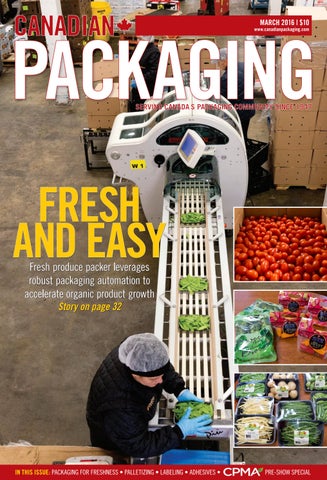
FRESH AND EASY
Fresh produce packer leverages robust packaging automation to accelerate organic product growth
Story on page 32


![]()
Fresh produce packer leverages robust packaging automation to accelerate organic product growth
Story on page 32


NO. 3
SENIOR PUBLISHER
Stephen Dean ⢠(416) 510-5198
SDean@canadianpackaging.com
EDITOR
George Guidoni ⢠(416) 510-5227 GGuidoni@canadianpackaging.com
FEATURES EDITOR
Andrew Joseph ⢠(416) 510-5228 AJoseph@canadianpackaging.com
ART DIRECTOR
Brooke Shaw ⢠(519) 428-3471 x264 bshaw@annexweb.com
PRODUCTION MANAGER
Barb Vowles ⢠(416) 510-5103 BVowles@annexbizmedia.com
CIRCULATION MANAGER
Barbara Adelt ⢠(416)-442-5600 x3546 badelt@annexbizmedia.com
VICE PRESIDENT Tim Dimopoulos ⢠tdimopoulos@annexbizmedia.com
PRESIDENT & CEO Mike Fredericks
ANNEX BUSINESS MEDIA
80 Valleybrook Drive, North York, ON, M3B 2S9; Tel: (416) 510-5198; Fax (416) 510-5140.
Canadian Packaging, established 1947, is published 11 times per year except for occasional combined, expanded or premium issues, which count as two subscription issues.
PRINTED IN CANADA
ISSN 008-4654 (PRINT), ISSN 1929-6592 (ONLINE)
PUBLICATIONS MAIL AGREEMENT NO. 40065710
CIRCULATION
e-mail: rthava@annexbizmedia.com
Tel: (416) 442-5600 ext 3555
Fax: (416) 510-5170
Mail: 80 Valleybrook Drive, Toronto, ON M3B 2S9
SUBSCRIPTION PRICE PER YEAR (INCLUDING ANNUAL BUYERSā GUIDE): Canada $73.95 per year, Outside Canada $120.95 US per year, Single Copy Canada $10.00, Outside Canada $27.10.
From time to time Canadian Packaging will mail information on behalf of industry-related groups whose products and services we believe may be of interest to you. If you prefer not to receive this information, please contact our circulation department in any of the four ways listed above.
ANNEX PRIVACY OFFICER
privay@annexbizmedia.com Phone: 800-668-2374
DISCLAIMER: No part of the editorial content of this publication may be reprinted without the publisherās written permission. Ā©2016
reproduce, publish, republish, distribute, store and archive such unsolicited submissions in whole or in part in any form or medium whatsoever, without compensation of any sort.
We acknowledge the financial support of the Government of Canada through the Canada Periodical Fund of the Department of Canadian Heritage for our publishing activities.

here are times when local events and developments have far-reaching implications and influence far above their natural weight and clout in the grander scheme of things.
Itās always been a source of wonder and amazement to yours truly how, for example, the results of a caucus straw poll in tiny Iowa or New Hampshire set the tone and momentum for eventual selection of nothing less than the leader of the free world.
In similar vein, the recent decision by the Camden, N.J.-headquartered food multinational Campbell Soup Company to make a voluntary disclosure of any genetically-modified ingredients present in its products to comply with a pending legislation in the state of Vermont, effective July 1, 2016, has much broader implications for the entire North American food processing business.
If this disclosure was to be limited solely to Vermont, the move would hardly be the subject of numerous national news headlines across the U.S. earlier this year.
But in a bold breakaway from most of its food industry peers, Campbell publicly announced its full support for enactment of a federal legislation requiring full GMO (genetically-modified organism) disclosure on all packaged food products.
Given that until then the company had spent over US$1 million fighting efforts to impose similar mandatory labeling in California and Washington State, this decision puts the Campbell Soup directly at odds with its one-time allies at the Grocery Manufacturers Association, which had spent millions lobbying the U.S. Congress to pass a bill
that would make GMO labeling purely voluntary, while pre-empting any state regulations on the subject from coming into law.
āWe will withdraw from any coalition that doesnāt support mandatory labeling,ā Campbellās chief executive officer Denise Morrison told The New York Times (January 8, 2016), explaining that having a federal legislation would prevent the far more chaotic and cumbersome state-by-state patchwork of same-but-different state laws that would ultimately cost food producers far more to comply with.

āWeāre optimistic that a federal solution can be reached in a reasonable amount of time,ā says Morrison, ābut if thatās not the case, weāre preparing to label all our products across the portfolio.ā
If that indeed turns out to be the case, it doesnāt take a great stretch of imagination to see such GMO labeling spilling over into Canada sooner rather than later, which may force Ottawaās hand to address that matter on a federal level before some of the provinces decide it falls under their jurisdictions.
Under either scenario, though, Canadian consumers will be the ultimate winners by virtue of obtaining instant access to the secretly-guarded GMO product information they have long been denied. And in that light, full credit to Campbellās for putting honesty first!
16 FROM PALLET TO
By Andrew Joseph Quebec vegetable processor leverages high-payload robotics to move its products into the marketplace.


22 STRENGTH IN NUMBERS By George Guidoni Canadaās fresh produce sector working hard to accelerate industry growth.
28 A SPIRITED ENDEAVOR By Andrew Joseph Distilled spirits giant makes a strong case for tankless adhesive applicating technologies.

35 READY TO SERVE By George Guidoni Iconic soupmakerās new recipe for reconnecting with Canadian consumers.
36 MASTERING THEIR CRAFT By Andrew Joseph Ontario craft-beer startup relies on digital label printing to grow its market presence.
38 A SHOW LIKE NO OTHER A quick SIAL Canada 2016 pre-show primer.

40 CUT ABOVE THE REST By Ronnie Cons The right way to choose the right meat packaging equipment for your needs.
A cool climate may not naturally be a winemakerās best friend, but thatās not really a problem for various up-and-coming vintners in southwestern Ontarioās Niagara Region that are truly devoted to their craftālike the Niagara-on-the-Lake-based Southbrook Vineyards.
Located on a 150-acre property boasting 60 acres of vines to grow a select variety of organic red and white grapes, the companyās recent launch of its new Seriously Cool red and white varietals marks a welcome recovery of the regionās grape crops back to their former glory days before the exceptionally harsh winters of 2014 and 2015 significantly reduced the local harvests.
Produced in strict adherence to the Sustainable Winemaking Ontario standards developed by the Wine Council of Ontario, the Seriously Cool label currently comprises two varieties of easydrinking wines now retailing across Ontario in 750-ml bottles made exclusively from recycled glass.
According to Southbrook Vineyards, the 2012 Seriously Cool Red is a dry, well-balanced, medium-body blend of Gamay, Pinot Noir and Zweigelt with flavors of juicy red fruit, cherry and cedar, enhanced with earth and smoky notes to create a savory foundation that āpairs beautifully with dried meat platters, steak frites, duck confit, and pizza and pasta with red sauce.ā
For its part, the floral 2015 Seriously Cool Chardonnay Light is a light- to medium-bodied white wine with lush fruit on the palate and a whiff of oak that make it a perfect complement with fresh and bloomy rind cheeses, white bean spreads, pasta
with cream sauce, white-fleshed fish and roast chicken.
According to Southbrook Vineyards proprietor Bill Redelmeier, both wines make optimal use of the unique taste profile of locally-grown grapes boasting ripe concentrated flavors with vivid aromatics and zesty acidity on the palate.
āContinuing in the Southbrook tradition of producing the best quality wines with locally available grapes, we are very excited to showcase the Seriously Cool wines,ā says Redelmeier, adding the Seriously Cool moniker for the wines was selected as a tribute to the local regionās āseriously awesomeā suitability for high-quality agri-food production.
To get that point across graphically, Southbrook Vineyards retained the services of Toronto-based graphic design agency Messenger to create the suitable labels.
Composed of bold geometric patterns in vibrant colors that include near-fluorescent orange and pink mixed in with other vivid colors drawn from Southbrookās palette used to describe grape varietals, the wallpaper-like labels are actually an extension of the artistās Awesome Series art and design project she began in 2012, which pays homage to leading Bauhaus movement artists like Josef Albers, Gerhard Richter, Maya Hayuk and Herbert Bayer.
āOne of the things I like most about these labels is that they are part of a series,ā says Wills. āAnd the recipe for the series is simple: Pattern plus Color equals Happiness.
āPeople love patterns,ā Will explains. āThink of

your favorite tie, your coolest socks, or the cushions on your sofa that you love and treasure.
āThey exist for no other reason than that you like them, and on some level they bring you joy and a means of self-expression,ā says Wills, relating that Messenger works with Toronto-based labeling converter A1 Label Inc. to produce the selfadhesive labels for Southbrook Vineyards using a Hewlett-Packard Indigo WS6000 digital press and the traditional methods of embossing and spotvarnish screening.
āThe variable digital printing is one of the things that made this family of labels possible, because it enabled us to print the designs for each series together in a consecutive sequence right off the printer,ā she explains. āBecause the bottling, labeling and casing are all done simultaneously, it is possible to have all three designs featured inside each case of both the red and the white wines.
āThe four-color Indigo digital press has an extended gamut of three special colors,ā she adds, āwhich is how we were able to achieve such vibrant colors on the labels.ā
Getting fresh fruits and vegetables to the point-ofsale in prime condition is a remarkable achievement of modern food science, and so is enabling them to virtually sell themselves well before their due date.
And thanks to some outstanding behind-thescenes work by the Mississauga, Ont.-based Chantler Packaging Inc., Canadian consumers and retailers alike are in for a real treat following last monthās Canadian commercial launch of the proprietary PrimePro Core ethylene absorbing film technology incorporated onto microfluted corrugated materials.
Made with special proprietary equipment, these ultra-light PrimePro Core -treated compact containers were specifically developed for retail-ready merchandising and displaying of four to 10 fresh fruits or vegetables per pack, according to Chantler, which first piloted the technology overseas in partnership with Flexomed, a package printing and graphics company based in Valencia, Spain.
The converter took the existing PrimePro shelf-life extension film technologyāformulated to remove the ethylene gas plant hormone that the triggers the process of ripening and decayāand laminated it to corrugated trays and compact boxes in a simple process requiring no additional materials or extra labor for tying, sealing or gassing the produce.
āThe produce industry is always looking for innovation and we are to proud to offer a new and competitive advantage in packagingā, says Francisco Vercher, international sales manager for PrimePro in Europe.


āWhat we have is something that is effective throughout the entire supply chaināeven on the retail floor.ā
Last summer, PrimePro Core won the Best Food Packaging 2015 award in the LiderPack Awards competitionāheld each year in Barcelonaācelebrating excellence in packaging and point-of-sale advertising in Spain.
To enter the competition, PrimePro Core ās efficacy had to go through extensive testing on various fruits and vegetables by Centro Tecnológico de la Conserva y Alimantacion (National Technology Centre of Packaged Food), which is acknowledged by the Spanish government as the countryās center of research and innovation.
āThis new product and test results really show how versatile the PrimePro technology is, without any complicated application methods,ā says Grant Ferguson, vice-president of sales and marketing at Chantler Packaging. āItās not just your ordinary MAP (modified atmosphere packaging) technology.
āConvenience is key with PrimePro Core,ā states Ferguson. āIts incorporation into rigid produce retail corrugate and paperboard easily extends shelflife, but more importantly, it reduces food that goes to waste.
āWe are confident that this solution can help our friends in Canada, the U.S. and even South America,ā says Ferguson, āand weāre excited to expand PrimePro Core to high-value commodities such as pears, cherries, stone fruit, and organics.ā
Thereās no better way to get into the consumersā mindsets than to ask them directly what makes them tick or turns them off inside a retail environment.
And thatās exactly what market researchers at the Toronto-based BrandSpark International have been doing for the last 13 years as part of the companyās annual BrandSpark Canadian Shopper Study report thatās used to determine the winners of the companion Best New Product Awards (BPNA) competition.
āThe sheer number of new products that appear on the store-shelves each year can be overwhelming,ā says BrandSpark International president and chief executive officer Robert Levy.
According to Levy, this yearās Canadian Shopper Study surveyed more than 39,000 Canadians about a broad range of their shopping habits, with results then being used to determine the BNPA winnersā resulting in 71 winning products across multiple categories in the health-andbeauty, food-and-beverage, householdcare and kids products segments. (See pictures above for products selected as having the best packaging)
āThe competition and the study distinguish the products that are truly innovative,ā says Levy, āwhile providing manufacturers with important insights about what Canadians look for while they shop.ā
Here are some of the notable highlights that this yearās Canadian Shopper Study reveals about the Canadian consumersā shopping patterns and behavior: Canadians embrace innovation and are willing to pay for new products that deliver results.
āWeāve seen Canadiansā interest in new products remain strong through economic ups and downs, with 75 per cent embracing innovation,ā says Levy, adding that 67 per cent of survey participants are willing to pay āa little moreā for a new product that truly appears to be improved.
Canadians split on household shopping trips.
According to survey results, more Canadians enjoy household shopping than not, with 52 per cent of shoppers saying that hunting for deals makes the trip fun; 56 per cent regularly shopping at multiple stores to get the best prices; and only 33 per cent saying that the convenience of one-stop shopping is more appealing than the lowest prices.
The ānaturalā over-the-counter health products resonate with 53 per cent of Canadians.
āPrice is not always the only factor for over-the-counter health products,ā says Levy, citing 55 per cent of Canadians willing to often spend a lot more for health products they know work.
āDespite the fact that 70 per cent of Canadians think that natural claims, which are not regulated like organic


claims, are often exaggerated, the promise of more natural products remains broadly appealing,ā says Levy.
Canadian shoppers believe in organic food products but arenāt willing to pay for them.
According to the study, only 36 per cent of Canadians are convinced that organic food products are healthier, and only 23 of the surveyed consumers buy them on a regular basis. However, 60 per cent of Canadians stated they would buy more organic food products if they were less
expensive, with 42 per cent agreeing that organic products are better for the environment.
Brand loyalty is declining as Canadians become ādeal hunters.ā

The study finds that 45 per cent of Canadians shoppers are not as brandloyal as they were a few years ago, which is a 33-percent increase from the 2014 survey. āThis decrease in brand loyalty appears to be driven in part by rising food prices and the low dollar, as weāre seeing promotions drive product switching more than ever,ā says Levy, citing the 75 per cent of shoppers who regularly check the retailersā weekly print flyers for low-price promotions. Robert Levy, President and CEO, BrandSpark International


n Custom paperboard packaging converter Beneco Packaging of Mississauga, Ont., and its Toronto-based subsidiary SoOPAK specializing in short-run offset folding-carton printingāhave made the annual PROFIT 500 list of Canadaās fastest-growing companies, compiled by the Canadian Business and Profit magazines, for the second year in a row by placing 432nd overall and 81st among the fastest-growing manufacturing companies. āThis achievement reflects the strength of our company and the dedication of our team,ā says Beneco president Yajun (Carol) Jiang (see picture) , citing the companyās annual revenue growth of 91 per cent in the last five years. āWeāre very proud of our technology, services and solutions and our excellent staffāall of which reflect our vision to serve the short-run packaging needs with unique, high-quality, attentiongrabbing promotional cartons.ā


Founded in 2004, Beneco operates a state-of-the-art, 45,000-squarefoot facility offering a comprehensive range of advanced packaging capabilities from prepress and creative graphic design to waterbased and UV coating, embossing, window patching and gluing. āWe work hard to make our customer experience very positive by keeping a ācustomer firstā mindset and using technological advances to facilitate easy folding carton order purchasing,ā says Jiang, who also made last yearās prestigious W100 list of Canadaās top female entrepreneurs compiled by the Canadian Business and ChĆ¢telaine magazines. āWe have dedicated knowledgeable folding carton consultants looking after every customerās order [and] weāre the


first company with an online folding carton platform to make online ordering easyāproviding instant quotes and live support from our product specialistsāto bring added value to each customer.

n While a humble folding carton may not be synonymous with innovation, the way that California-based FoldedColor Packaging goes about producing its folding cartons online has recently earned it a selection as a finalist in the global 2016 Edison Awards competition, celebrating excellence in new product and service development worldwide. Said to be the only online folding-carton supplier with a fully-integrated web-based order entry system, FoldedColor allows customers to select box templates online, obtain instant pricing, edit online or offline, approve their design through an interactive 3D proof, order short print runs as low as 50 boxes, print unlimited spot colors at no additional charge, and receive their order in as little as five to seven business days. āWeāre thrilled to be among this yearās Edison Awards finalists,ā says FoldedColor president Jan Steiner, who will be in attendance at the Edison Awards Gala in New York City on April 21, 2016, when this yearās winners will be publicly revealed. āThis recognition is a testament to our teamās innovation, and it further validates our position as
a game-changer in the folding carton space.ā According to Steiner, all the ordered folding cartons are manufactured from fully-recyclable, SFI (Sustainable Forestry Initiative)-certified SBS (solid bleach sulfite) paperboard, using the companyās proprietary extended color gamut printing technology and a seven-color offset printing process that produces brilliant colors and graphics.
n Pro Mach, Inc., a diversified packaging equipment supplier headquartered in Cincinnati, Ohio, has completed two major acquisitions in the early part of 2016, including:
⢠EPI Labelers, a prominent manufacturer of high-performance labeling systems and solutionsā including tamp, blow-on, wipe-on, two-panel, corner-wrap and printand-apply systemsābased in New Freedom, Pa.
⢠Stork-Texwrap, manufacturer of the popular Texwrap brand of automated shrinkwrapping systems and related accessoriesā including L-bar sealers, side sealers, tunnels, infeed devices and conveyorsābased in Washington, Mo.
āTexwrap has an excellent product line and talented people that complement our existing capabilities and customer base,ā says Gary Evans, head of Pro Machās End of Line Group business unit. āTheir knack for solving customer problems using cost-effective and proven technology makes them a great addition to our businessāgiving Pro Mach one of the strongest and most thorough distributed product lines in the industry and strengthening our position as a world leader in packaging machinery solutions and customer service.ā

Chrisā strength lies in seamlessly on-boarding large customers with multiple SKUās, supporting launches for private label brands as well as, overseeing significant retail campaigns for major Canadian food manufacturers, transitioning customers onto new and advanced structures, and, providing guidance and insight into his customerās research and development endeavours. Additionally, Chris has deep experience in the pet food category where he gained a strong knowledge base of this marketās unique flexible packaging and marketing requirements. Through this engagement in the pet food Industry, he has played a vital role in supporting new and innovative flexible packaging research and development efforts.
Chris is enthusiastic about joining the TC Transcontinental Packaging team and sees their dedication to food safety, creation of innovative flexible packaging, research and development, and, most-significantly, to TC Transcontinental Packagingās aggressive growth and acquisition strategy as significant market advantages.
Chris attributes his success in the flexible packaging industry to his core philosophies: You need to treat your customerās business as if it is your own. The flexible packaging we produce for a customer is vital to their success, and as a business partner you need to be all in and stand behind the product.
Working closely with customers in their research and development efforts is important to remaining relevant, supporting customer success, and maintaining long-term relationships. Integrity and trust must be earned and worked for every day.
Chrisā philosophies are aligned with TC Transcontinentalās core values of innovation, teamwork, respect, and performance, which make him a perfect addition to the team.
TC Transcontinental Packaging offers concept to consumer flexible packaging solutions from design, production art, and plates through flexible print and laminating. Everything we do is geared towards creating a unique customer experience that supports their flexible packaging needs.


Capable of forming, filling and sealing laminated, metalized and polyethylene materials in a broad variety of shapes and sizes up to eight-inches-wide at speeds of up to 80 pouches per minute, the new VerTek 800 vertical form-fill-seal seal machine from WeighPack Systems Inc. features a compact design with a simplified swiveling mount for the vertical back seal for ensuring an even and precise seal, with the open-frame design facilitating quick access for maintenance and service. Equipped with a tool-less removable film shaft, forming collar, pull belts, and front and back jaw assembly, the VerTek 800 pouching system is equipped with an integrated encoder and a 10.4-inch color touchscreen interface for userfriendly operation.
WeighPack Systems Inc.
401


Designed to bring the Numatics 501 Series directional valveās high-flow characteristics and compact size to pneumatic panel applications, the new Numatics 501 Series panel mount adapter plate from ASCO Numatics eliminates the need for complex tubing routing and bulkhead fittings, according to the company, while reducing custom machining and drilling requirements and simplifying panel layout. Well-suited for applications in the process in the process industries where directional control valves are installed in a cabinet due to environmental or packaging constraintsāincluding food-and-beverage, pharmaceutical and packaging machineryāthe high-strength panels are engineered to withstand a broad range of harsh environmental conditions to maintain optimal system integrity and reliability, according to the company.
ASCO Numatics 403

Designed for use with Graco Inc.ās InvisiPac TankFree hot-melt adhesive applicating systems, the companyās new LineSite remote monitoring solution enables operating personnel to check temperatures, review critical performance metrics, view how much adhesive each line is using, and monitor machine
diagnostics from a smart phone, tablet or computer by tracking and transmitting real-time data from individual InvisiPac systems onto a single, local storage device. Designed to capture all critical data in an intuitive graphical format for quick and easy review, the LineSite device allows users to view adhesive consumption over time to spot trends and make quick adjustments, view live temperatures, graph system parameters to analyze historical performance, and even link to detailed troubleshooting instructions from virtually anywhere by logging in from a local network or by enabling web access through the external portal. Graco Inc.
404

Comprising a high-speed blowmolder/ unscrambler, filler and labeler in one blocksynchronized machine, the new 3Bloc system from Krones AG subsidiary Kosme s.r.l. is available in two versions to suit the specific requirements of both PET (polyethylene trerephthalate) and HDPE (high-density polypropylene) containers in busy bottling environments. For PET bottles, the innovative block configuration with a blowmolder can be equipped with either a pressure-sensitive Flexa Sensicol labeling station or wraparound rollfed labeling for handling cylindrical, square and odd-shaped PET containers at speeds of up to 16,000 bottles per hour. For its parts, the HDPE-compatible version replaces the blowmolder with an unscrambler for erecting and placing the empty containers on the line as they are being fed in at robust throughput speeds of up to 25,000 bottles per hour.
Krones, Inc.
405

Manufactured by BestCode Products and distributed by Weber Packaging Solutions, Inc., the new BestCode Series 8 industrial marking and coding systems are designed for highly reliable and legible CIJ (continuous inkjet) printing of best-by, lot code, sell-by, expiration codes and other important identifying marks and codes on industrial and consumer goods to ensure product traceability with high-speed, non-contact, instantly dry marks and codes on a wide range of substrates, including plastic, glass, paper and more.
Weber Packaging Solutions
406


Cognex Corporationās newly-released In-Sight 2000 series product line is said to combine the power of the companyās advanced In-Sight vision systems with the simplicity and affordability of a vision sensor for solving a myriad of errorproofing applications with the benefits of a simple set-up and a modular design with interchangeable lighting and optics. Featuring an integrated, high-performance image formation system consisting of field-interchangeable lenses and a patent-pending LED ring light that produces even, diffuse illumination across the entire image, the In-Sight 2000 eliminates the need for costly external lighting, while allowing users to easily swap out the lens and change the color of the integrated ring light as needed for their application.
Cognex Corporation
407

mk North America has expanded the companyās VersaMove pallet handling and conveying systems to offer three different pallet system platformsā including VersaMove Standard, VersaMove Plus and VersaMove Ultra āto accommodate a broad range of load requirements from 80- up to 700pound pallet loads. Fabricated from extruded aluminum, each of the three highly flexible systems allows for easy expansion and redesign, according to the company, via quick and easy mounting of required hardware and components onto the conveyor frame. Designed for easy integration into the existing workflow of fast-paced automated assembly and other mass-production environments, each system is versatile enough to handle lighter-duty conveying applications.

The new Raptor HPL turntable stretchwrapping machine from Muller is a heavy-duty, semiautomatic turntable that can wrap up to 35 loads per hour. Equipped with a user-friendly control panel to provide full flexibility to create customized wrap patterns for each unique application, the Raptor HPL model stretchwrapper utilizes patented strain gauge technology to enable electronic film feed and corner compensation, while its motorized power pre-stretch system provides up to 250-percent adjustable film tension control to ensure optimal film usage, facilitate superior load containment, and minimize the risk of product damage. In addition, the Raptor HPL turntable now features Mullerās patented Logo Wrap enhancementāpreviously available only on its Octopus series ring-style stretchwrappersāto enable valueadded branding and custom messaging functions. Muller 409

The new model CH-100 tamper-band applicator from American Film and Machinery is a fast, high-efficiency butterfly mandrel style tamper band applicator designed for continuous, 24-hour operation at low to medium speed rates across a broad range of food-and-beverage, pharmaceutical, nutraceutical, health-and-beauty, consumer goods, household chemicals and other manufactured goods industry applications. With the applicatorās compact housing constructed from 304 grade stainless steel and anodized aluminum to provide strength, reduce vibration and ensure quiet operation, the CH-100 model boasts a touchscreen control interface for programming product runs with quick set-up, while its single-blade guillotine cutting mechanism provides extremely smooth and effective cutting motions for a diverse range of plastic banding options up to 50 to 70 microns in thickness. The new model comes complete with stepper motor-driven, single-film unwind with tension control, cutter assembly, and pneumatic cylinder to provide accurate and consist-
ent tamper-band application, along with a photoeye sensor system to allow for precise register cutting, as well as an innovative quick-change system for switching the machineās mandrels with a simple turn of the knob.
American Film and Machinery
410

Designed for high-performance packaging, cartoning and kitting applications, the MPP3H robot from Yaskawa Motoman features a parallel link arm configuration with a direct-driven rotary axis to simplify design and increase reliability, with its robust MotoPick software optimized to perform high-speed picking operations by synchronizing multiple robots, vision systems and multi-part conveyors. According to the company, the MPP3H robot has several key features to facilitate easy line integrationānotably a large, 80-mm thru-hole at the base for allowing endof-arm tool cables to be routed through the center of the robot, thereby facilitating less complex cabling and reduced cable lengths. The thru-hole can also be used to mount the valve pack at the base of the threekilogram payload robotāthereby reducing the payload the robot has to carry.
Yaskawa Motoman 411

Columbia Machine has completed the redesign of its HL (High Level) family of palletizersā including the pictured HL6200, HL7200 and HL9200 seriesāto enhance safety, flexibility and performance with a contemporary, completely modular, and exceptionally user-friendly palletizing machines equipped with highly advanced safety and guarding systems. Designed for continuous around-the-clock operation, the redesigned HL6200 model palletizer is equipped with an operator-friendly Product Manager interface terminal to create and modify layer patterns, view and export production reports, adjust drive speeds and timer settings, and to access manuals and schematics through a single control terminal. Moreover, the machineās bi-parting stripper apron and case stops enable the HL6200 to create gaps both frontto-back or side-to-side to palletize up to 120 cases per minute depending on the selected stacking pattern, according to the company.
Columbia Machine 412


For a tiny country like the like the Baltic state of Estonia in northern Europe, little steps forward in packaging sustainability often have a big positive impact for business enterprises like the Valio Eesti dairy.
Founded in 1992 soon after Estonia achieved its independence from the former Soviet Union, Valio Eesti has been producing over 150 different milk and cheese products for the Baltic region and Italyāmaking it one of the largest dairy companies in the Baltic region.

Aware of its growing carbon footprint, a few weeks ago the dairy switched the packaging of its popular Valio brand of probiotic yogurt and kefir drinks to the lightweighed HDPE (high-density polyethylene) bottles developed by Greiner Packaging, its long-time supplier of thermoformed dairy cups.
āWe were able to use our comprehensive know-how of different plastic-processing technologies to implement a sustainable and costoptimized product solution for our customer,ā explains Günter Ausserwƶger, sales director at the Kavo division of Greiner Packaging in Kremsmünster, Austria.
The new blowmolded HDPE bottles (see picture)
are ānot only practical and consumer-friendly,ā Ausserwƶger relates, ābut they also but also stand out in respect to sustainability due to their low weight and optimized use of plastic material.
āWe even developed a unique injection-molded cap specifically for this customerās 100-ml bottles, as the requested standard solution did not exist in the market.ā
In addition to the 100- ml containers of kiwi, strawberry-banana, plum and tutti-frutti yogurt flavors and 300- ml bottles of blueberry, cappuccino and chocolate-mint kefirs, the dairy also started using Kavo-made 275- ml bottles to package its brand new line of yogurt smoothies.
Produced in banana-strawberry-kiwi, mango-passion fruit, pear-apple-banana flavor combinations, the new yogurt smoothiesāa first in the Estonian marketāare targeted primarily at families with children and sold all over the Baltic region.
āHealthy eating is booming and the demand for berry flavor, vitamin-rich drinks and smoothies is increasing all over the Baltics,ā says Ausserwƶger. āThese resealable bottles also perfectly suited for enjoying these healthy beverages on the go.ā

Leading German medical device manufacturer
Gerresheimer AG has launched what the company claims to be the worldās first fully renewable plastic tablet packaging made from sugarcane.
Unveiled at last monthās Pharmapack Europe 2016 pharmaceutical industry exhibition in Paris, France, the new Biopack container features a distinct spacesaving rectangular design to facilitate more efficient packaging for transportation, while its internal leaflet compartment (see picture) creates additional surface space on the outside to provide for more effective branding that would otherwise be used to print the required product information.
āBy using biomaterials our customers contribute to the reduction of greenhouse gas emissions, thereby protecting the environment and avoiding unnecessary waste,ā says Niels Düring, Gerresheimerās global executive vice-president for plastic packaging.
āBiomaterials are the renewable alternative to conventional PE (polyethylene) and PET (polyethylene terephthalate), and sugarcane is one of the more attractive substances used to make biomaterials.
āIt produces a material with exactly the same characteristics as conventional plastics, while also being fully recyclable.

A year may not sound like a really long time, but for progressive companies like the global processing and packaging equipment group Tetra Pak, one year can make a huge difference in packaging sustainability.
Introduced in Europe in January of 2015, the companyās Tetra Rex Bio-based drink carton has made its North American debut a few weeks ago in the U.S. with the launch of the Tetra Pak Gable Top Bio-based carton, which was especially adapted for the needs of the U.S. market.
āEnvironmental excellence is one of Tetra Pakās strategic priorities and a driver of our product development activities,ā says Carmen Becker, president and chief executive officer of Tetra Pak Inc. in Denton, Tex.
āWe are proud to be the first to offer a fully renewable carton package to the U.S. market because we believe that increasing the renewable content of our packages is not only good for the environment, but
also offers our customers a competitive advantage.ā
According to Tetra Pak, the new cartons are made solely from renewable materialsādefined as natural resources that can be replenished over timeādeveloped from a combination of paperboard and sugarcane-derived plastics.
āWeāre proud to be the first to offer a fully renewable carton package to the U.S. market and believe that increasing the renewable content of our packages is not only good for the environment, but also offers our customers a competitive advantage.ā
Notably, Tetra Pak customers currently using the standard half-gallon gabletop with or without closure can easily transition to the new bio-based version without the need for any additional investment or modification to their existing filling machines, according to the company.
The successful U.S. launch of the Tetra Pak Gable Top Bio-based package follows a long line of successful innovations in sustainability at Tetra Pak over the last year, including the launch of the fully renewable Tetra Rex Bio-based package in Europe; the global launch of the industryās first bio-based cap; and the successful introduction of bio-based coatings for all the Tetra Pak cartons produced in Brazil.
All told, the companyās sustainability efforts have been recognized with seven prestigious awards in that time-frame, including first-place ranking in the Sustainable Category of the global Ethical Corporation Responsible Business Awards competition.
Remarkably, the company expects to ship more than 100 million of Tetra Rex Bio-based cartons to customers during the course of 2016, citing a fastgrowing customer base across Scandinavia that already comprises leading regional dairy producers such as Valio, Arla Foods, Wermlands Mejeri and TINE AS.
āWe believe that growing our business sustainable is not just good for the environment, but also improves our competitiveness by providing effective product differentiation,ā says BjĆørn Malm, director of corporate responsibility at TINE in Oslo, Norway.
āThanks to the Tetra Rex Bio-based packaging, we have been able to take a significant step towards our own environmental goals and have committed to making all our milk cartons renewable from next year forward,ā he adds.
āThe success of Tetra Rex Bio-based in its first year is extremely encouraging for us,ā says Tetra Pakās executive vice-president of product management and commercial operations Charles Brand.
āWe are very proud to be the first company to deliver a package made entirely from plant-based materials.
āEvery package is traceable to its origināhelping customers to enhance their brand and to communicate with consumers,ā Brand concludes.
āThis is a significant milestone in Tetra Pakās longterm ambition to provide 100-percent renewable packaging across our entire product portfolio.ā

Residential recycling bins and organic waste containers have become so ubiquitous and commonplace in the last few years that itās easy to forget that someone actually has to manufacture these essential workhorses of successful waste diversion programs.
And by any objective measure, leading injection-molded plastic products manufacturer IPL Inc. clearly succeeded in its recent epic undertaking involving the manufacture, distribution and delivery of over 1.2 million rolling carts and kitchen containers to 317,000 homes located in the Regional Municipality of Peel, the second-largest municipality in the province of Ontario after Toronto.
Headquartered in Saint-Damien, Que., IPL was awarded a $45-million contact in 2014 to supply residents of the fast-growing cities of Mississauga, Brampton and Caledon with three kinds of cartsāincluding waste carts, organics carts and recycling cartsāas well as provide all the related maintenance support over a 10-year period.
In order to deliver such a high number of carts, the IPL plant in Saint-Damien pushed the limits of its manufacturing and distribution capabilities to produced the carts and ensure their timely delivery to a central distribution center in Mississauga.
To ensure efficient distribution of the carts to 317,000 homes in such a short time, IPL also used a new technology utilizing smart phone scanning, whereby every produced cart was initialized with a unique chip containing the cartās serial number, GPS (global positioning system) coordinates and the home address, with files uploaded upon delivery.
Using RFID (radio frequency identification) technology, the delivery team could scan the cart with a smart phone to know exactly where and how to deliver each cartāmaking the delivery process much easier and faster.

Using the same technology, the management team was able to do live monitoring of the delivery process.
āThis project allowed us to position ourselves a notch above any North American competition,ā says Paul Palazzo, vicepresident of sales and marketing at the companyās IPL Environmental division, which was the responsible for the project.
āNot only were we faster and more efficient than any of our competitors,ā Palazzo notes, ābut the technology used in this project will also help us manage the Peel Regionās ongoing growth and the 10-year maintenance and service agreement that is also an integral part of this project.ā
Says Palazzo: āBecause the IPL carts were actually made in Canada, they were specifically designed to withstand the various extremes of the North American climate.
āThese smartly designed and cost-effective containers come in a range of practical sizes to provide effective solutions that work, furthering IPLās 70-year tradition of manufacturing excellence, while protecting the environment.ā
Cutting corners may not always be the best route to packaging innovation, but the new revolutionary technique developed by leading Swedish pulp and paper producer SCA (Svenska Cellulosa Aktiebolaget) to produce round corrugated board packaging is an inspired example of out-of-the-box thinking on many levels.
Unveiled last month, the new Arcwise packaging design combines natureās robust round geometries with the high rigidity of corrugated board is said to enable impressive package stability, while reducing the packaging weight by up to 30 per cent to improve environmental performance for a broad range of transport packaging, retail-ready and consumer packaging, according to the Stockholm-headquartered company.

āThe technique opens up totally new possibilities for packaging designs that are attractive to both customers and consumers,ā says Arcwise business manager Rickard HƤgglund.
āOur surveys show that people generally prefer rounded shapes to angular ones,ā says HƤgglund, noting that the Arcwise process can be easily deployed in standard corrugated board production facilities.
āBecause round packaging is so eye-catching and attracts consumer attention in the retail environment, we think both designers and brand-owners will find these new opportunities very interesting,ā says HƤgglund, adding that the patentprotected process is now available to packaging manufacturers worldwide under license.


September 27, Golf at Legends on the Niagara
What emerging concepts, packaging innovations and technologies will flourish in 2025? Omni-channel, big data, analytics, virtual, 3D, digital printing, interactive, robotics, artificial intelligence, computer-aided design, drones, technical and biological nutrients, nanotechnology.
PAC invites you to register today for this forward-thinking conference. Early adoption and implementation of these emerging trends, ideas and innovations will be the difference between winning market share or the threat of business survival.
Visit www.pac.ca/2016-conference.html for more information or email labraham@pac.ca
March 22-24
Toronto: FABTECH Canada, metal forming, fabricating, welding and finishing exhibition by SME. At Toronto Congress Centre. To register, go to: www.fabtechcanada.com
April 4-7
Atlanta, Ga.: MODEX 2016, international supply chain exhibition and conference by MHI. Concurrently with Supply Chain & Transportation USA. Both at the Georgia World Congress Center. To register, go to: www.modexshow.com
April 10-12
Scottsdale, Az.: 2016 Executive Leadership Conference, by PMMI-The Association for Packaging and Processing Technologies. At Hyatt Regency Scottsdale Resort & Spa. To register, go to: www.pmmi.org.elc
April 12-14
Calgary: Growing Strong, annual convention and trade show of the Canadian Produce Marketing Association (CPMA). At BMO Centre. Contact Selena Karkash of CPMA at (613) 226-4187, ext. 213; or go to: www.convention.cpma.ca
April 13-14
Green Bay, Wis.: Converters Expo, package converting technologies exhibition by Packaging Strategies. At Lambeau Field Atrium. To register, go to: www.ConvertersExpo.com
April 13-15
Montreal: SIAL Canada 2016, North Americaās food innovation show by Expo Canda France Inc. Concurrently with the SET 2016 food industry equipment exhibition. Both at Palais des congrĆØs de MontrĆ©al. To register, go to: www.sialcanada.com
April 13-17
Tehran, Iran: IranPlast 2016, international trade fair for plastics, rubber and packaging by the National Petrochemical Company (NPC). At the Tehran International Permanent Fairground. To register, go to: www.iranplast.ir
April 14-15
Vienna, Austria: Global Release Liner Industry Conference & Exhibition 2016, by AWA Alexander Watson Associates. To register, go to: www.awa-bv.com/events
April 19-20
Oakville, Ont.: CPES2016, conference by the Canadian Printable Electronics Industry Association (CPEIA). At Sheridan College conference center. To register, go to: www.cpes2016.ca
April 26-27
Mississauga, Ont.: Partners in Prevention 2016, national occupational health and safety trade show and conference by Workplace Safety & Prevention Services (WSPS). At The International Centre. Contact WSPS Customer Care Department at 1 (877) 494-9777; or go to: www. PartnersinPreventionConference.com
May 1-3
Mississauga, Ont: Bakery Showcase 2016, national baking industry trade show and conference by the Baking Association of Canada. At The International Centre. To register, go to: www.bakingassoccanada.com
May 10-12
Rosemont, Ill.: Food Safety Summit, conference and exhibition by BNP Media. At Donald E. Stephens Convention Center. To register, go to: www.foodsafetysummit.com
May 17-20
Mexico City: EXPO PACK MƩxico 2016, packaging technologies and materials exhibition by PMMI-The Association for Packaging and Processing Technolo -

gies. At Centro Banamex. To register, go to: www.packexpo.com
May 23-25
Indianapolis, Ind.: ANTEC 2016, international plastics technical conference of the Society of Plastics Engineers (SPE). At JW Marriott Indianapolis. To register, go to: www.antec.ws
June 7
Mississauga, Ont.: Top 50 Packaging Ideas Expo, tabletop exhibition and networking event by the Canadian Packaging magazine. At Mississauga Convention Centre. Contact Stephen Dean at (416) 510-5198; via email sdean@canadianpackaging.com , or please go to: www.top50packagingideas.com


Fresh veggies processor rebounds from unforeseen setbacks to reach new levels of production efficiency with high-speed, high-payload robotic palletizing

ANDREW JOSEPH, FEATURES EDITOR
PHOTOS BY JOHN PACKMAN
For any manufacturer or processor, regardless of the industry, keeping things fresh is key in gaining and maintaining oneās customer base. Within the produce industry, freshness is even more important with the requirement to keep the product and brand ideas as fresh as the fruits and vegetables offered to the customer base. Bonduelle Group āa globally-dominant processed vegetable producing company headquartered in Villeneuve dāAscq, France and all its international divisions, including Canadaāis just such a business. Founded in 1853 by Louis-Antoine Bonduelle and partner Louis Lesaffre-Roussel, it began life as Lesaffre et Bonduelle, Alcools de lāAbbaye, a grain and juniper berry distillery situated in the northern part of France.
Eventually in 1926, at the companyās birthplace, brothers Pierre and BenoĆ®t Bonduelle turned an old barn into a cannery and installed a pea sheller, copper containers, a canning machine and sealer. This is where the companyās growth really took off, producing about 1,000 tonnes of canned peas a year, but with the harsh realities of WWII, oper-
ations were suspended in 1940.
When the war ended in 1945, and its own farms unable to satisfy customer demand for its canned peas, Bonduelle began to buy fresh vegetables from other local farms to supplement its own harvests, and created its own brand.
In 1963, a new plant was built in EstrƩes, France, and with continued growth it is now the largest vegetable cannery in the world, with approximately 2.15-million square feet of covered production space.
Since the conclusion of WWII, the past 70-plus years have seen Bonduelle enjoy rapid and steady growth in the canned and frozen vegetables industry, selling its products through supermarkets, restaurants and institutional food services everywhere.
The 1960s saw the company improve the exports of its veggies and the freezing of its veggies, including adding subsidiary companies in Germany, Italy and the U.K., with exports accounting for about 50 per cent of the companyās turnover.
After setting up a commercial presence in Brazil in 1994, Bonduelle later built a huge facility thereāits first in the Americas.
With multiple acquisitions in-between, Bonduelle officially entered the fresh produce sector when it purchased the France-based Salade Minute and its
four dedicated plants in 1997.
In 2007, Bonduelle expanded its operations into Canada when it acquired Aliments CarriĆØre and its Arctic Gardens brandāa well-known leader in veggies and frozen foods that also provided the company with access to an additional 39,500 hectacres of prime farmland.
Arctic Gardens remains a key brand for Bonduelle


in Canada.
Nowadays, the Bonduelle Group is broken down into four specific units: Bonduelle Europe Long Life; Bonduelle Fresh Europe; Bonduelle Americas; and Bonduelle Development, and is led by the sixth-generation of the Bonduelle family, Christophe, who serves as its chairman and chief executive officer.
Part of the Bonduelle Americas division, the Canadian headquarters is located in Montreal, and features: two canning and two frozen facilities in Quebec; two frozen plants and a canning facility in Ontario; and a mainly frozen vegetables operation in Lethbridge, AB.
āWe receive vegetables from within a 200-kilometer radius from wherever in the world a Bonduelle plant is located,ā Bonduelle Americas project engineer for Ontario, Sergio Murcio told Canadian Packaging during a visit to the huge Tecumseh, Ont. facility that packs mostly frozen vegetables, but also does canned vegetables, too. āWith a tight radius, it ensures we receive the freshest vegetables for our plants to process and pack and get to the consumer.
āBonduelle contracts with local farmers, but for items we do not grow, we do purchase as required from around the world.ā
All told, however, Bonduelle has some 128,000 hectares of land throughout the world which is either farmed by itself or by its agricultural partners, and considers itself to be the world leader in ready-to-use vegetables offering: canned vegetables; frozen vegetables; processed fresh vegetables;
and prepared vegetables in the form of salads.
According to Murcio, the Tecumseh facility packs its own Arctic Gardens brand, but also copacks for many Canadian retailers.
Frozen vegetables used for the Arctic Gardens brand includes: sweet carrots, green beans, corn super sweet, peas, wax beans, asparagus, broccoli, edamame, cauliflower, green beans, spinach, red and green peppers, mushrooms, onions, sugar snap peas, water chestnut, bok choy, green and yellow zucchini, lima and romano beans, potatoes, as well as flavored and fried potatoesāused by Bonduelle to create some 25 SKUs (stock-keeping units) of Arctic Gardens vegetable mixes for various soup and stir fry recipes, as well as individual veggie product bags.
āOverall, the Tecumseh facility produces approximately some 60 SKUs,ā notes Murcio.
The Arctic Garden frozen vegetables come in standup foil packs of varying sizes, from 300-grams, 500g, 600g, 650g, 750g and 1.75-kilogram. Excluding the largest package format, in most instances, the key difference in package weight is because of specific vegetable product density.
āWe produce simple polybag formats, a vertical bag format, sealed upright DOYpack, as well as a vegetable-in-sauce line,ā mentions Murcio.
Murcio reveals that, āBonduelle is the largest supplier of canned and frozen vegetables in Canada, and we continue to expand in to the U.S. as well.ā
The Tecumseh plant was originally home to a
Green Giant canning factory when it opened in 1931 and after several years and different owners, a freezer tunnel was added in 1968 and it began to pack frozen vegetables for the first time.
Bonduelle took possession of the plant in 2007, and with its quality Arctic Gardens brand made significant inroads into the Canadian marketplace.
While a massive fire devastated the Tecumseh Bonduelle plant in July of 2014 causing approximately $50-million in damages, the company confidentially suggested it would reopen within two weeksāand it did.
Nowadays, the HACCP (Hazard Analysis Critical Control Point) -certified, BRC (British Retail Council A-rating)-audited and GMP (good manufacturing policies) plantāalso organic-certified and Kosherāwith 80-million pounds of capacity employs some 100 full-time employees, increasing to include over 400 seasonal workers between June and December.
āBonduelle operates the packaging facility 24-hours-per-day, seven-days-a-week from Labor Day to Easterāour peak demand periods,ā mentions Murcio, adding that the rest of the year chugs along nicely with three-shifts-a-day, five-days-aweek.
āApproximately 80 percent of our production at the Tecumseh plant is for individual or mixed frozen vegetables in the stand-up and pillow-type packaging, as well as a third variety featuring the veggies and a sauce in a bag,ā says Murcio.
āThe remaining 20 percent of the operation is dedicated to vegetable canning,ā he notes.


āThe bag packaging is a year-round operation for us at the Tecumseh plant, while we only do canning for about two or three months a year,ā Murcio relates. āWe pack vegetables, of course, but we also pack rice and pasta to ensure we are constantly running,ā notes Murcio.
The facility houses four canning production lines, and an additional four frozen packaging lines with a fifth line to be up and running soon, notes Murcio.
āWeāre always open for technological improvement at Bonduelle,ā he offers, āwith a focus on health and safety for our employees, but also for our customers.ā
It was after the fire, where all of the plantās frozen warehouse and shipping docks and packaging lines were destroyed, that Murcio sought out a new palletizer to place the sealed cartons of product packages on a wooden pallet and prep for customer transport.
āI was the one who wanted to ensure our palletizer was robotic,ā he says.
Opting to work with Grimsby, Ont. headquartered Jantz Canada āa leading systems solutions provider and machinery integrator specializing in high-quality builds of machinery, conveyor systems and robotics for the food industryāthe new palletizer utilizes an ABB IRB460 palletizing robotic system, what ABB and Jantz acknowledge as the fastest palletizing robot on the planet.
Jantz Canada manager of robotics and applications Garth Dangerfield has been involved with the Bonduelle project from the start.
āJantz was chosen out of eight bidders on the project because we offered a full turn-key supply.
āIt means that everything we supplied was designed and manufactured under one roof,ā relates Dangerfield.
āAlong with costing, we were able to provide a lead time that met Bonduelleās needs.
āIn the end, I believe it was also comfort in having local representation and support that played a large role in Jantz Canada being allowed the opportunity to work together with Bonduelle.ā
Prior to its installation in September of 2015, Bonduelle had been using three workers to stack cartons onto the pallets, but as Murcio says, ārobotics enabled Bonduelle to better utilize our employee talents, while giving us a faster production line.ā
Jantz Canada designed and built a custom palletizing solution for Bonduelle that is able to handle a range of carton sizes and the single-sized wood pallet it prefers to use.
The palletizing solution features: a cell, a PLC (programmable logic controller)āan operator interface that includes an operator display with the whole cell set-up and run; the IRB460 palletizing robot; a special end-of-arm
tool designed by Jantz; an infeed conveyor; pallet build and exit conveyors; and a perimeter guard with gates and light curtains.
āThe infeed conveyors, pallet handling and pallet dispenser system were designed and manufactured at Jantz Canada,ā notes Dangerfield.
āWe also designed and manufactured a clamp-style endof-arm tool that allows the robot arm to better grip the cartons one-at-a-time for placement on the waiting pallet,ā Dangerfield says, adding that āanyone can contact me for their automation needs and Iāll make sure they receive exactly what will work best for them.ā
After a pallet is filled with neatly stacked cartons in a specific pattern, the system indexes the finished pallet out of the work cell for fork-lift pick-up while a new pallet is deposited from the pallet dispenser onto the pallet conveyor to move into the build station to begin anew the palletizing routine.


Itās not a box. Itās a billboard.


āWe love the new robotic system built for us by Jantz Canada,ā says Murcio. āIt offers low maintenance and flexibility while making our overall production line run more efficiently without costly bottlenecks.ā
The IRB460 certainly lives up to its unofficial moniker as the fasted palletizing robot in the world, able to work with 60-kilogram cartons at 2,190 cycles/hour or 2,040 cycles/hour with 110-kilogram loadsāwhich ABB claims is some 15 percent faster than its nearest rival.
The robot system utilizes RobotStudio Palletizing PowerPac software from ABB, that allows users to configure, simulate and program the IRB460 and its gripperāall with little to no robot experience for the operator.
Murcio acknowledges that it is a combination of gripper, software and the ABB robot that makes the IRB460 palletizing system such a fast option for Bonduelle.
The IRB460 is the smallest member of the ABB palletizing family, yet possesses a reach of 2.4-meters with a carry-

ing capacity of up to 110-kilograms.
With four axis, it offers a compact design for an efficient use of floor spaceā1,007-mm x 720-mm.
āThe four axis robot is optimized for palletizing, providing a shorter cycle time, lower weight of robot arm, higher payload, and low complexity,ā opines Dangerfield, noting that ABB has nearly 30 years of experience in the palletizing sector.
For Bonduelle, having a robot arm capable of picking a payload of 110-kilograms was more than enough lifting power but, says Murcio, āitās always good to have capacity even though we are currently using the IRB460 to palletize three cartons per pick-up for a total of 18-kilograms.ā
Some of the other equipment used by Bonduelle at the Tecumseh facility includes:
⢠Safeline PowerPhase Pro metal detection systems manufactured by Mettler-Toledo;
⢠Nordson ProBlue glue application units utilizing hotmelt adhesive from Technical Adhesives;
⢠3M manufactured 3M-Matic tape carton sealers;
⢠Eriez Magnetics vibratory shakers;
⢠Markem-Image S martDate X60 for high-resolution thermal transfer printing.
āOur current facility has had many major upgrades over the past several years,ā explains Murcio. āWe recently installed a new horizontal form/fill machine in 2010 to help us meet and exceed customer demands.
āAs well, we are in the final stages of completing a new 100,000-squarefoot warehousing complex on the property,ā sums up Murcio.


Nothing keeps your product fresher than MAP packaging produced on a Ross IN inline tray sealer.
n Produces MAP packages using preformed trays of almost any size or shape āeasily packages your entire product line.
n Consistently produces packages with reliable, high-quality seals that extend shelf-life.
n Fast, highly flexible, and extremely easy to operate.
n Innovative tool/storage cart allows rapid, tool-less changeovers between tray sizes in 10 minutes or less.
n Stainless steel washdown construction and IP67 components.
n Compact footprint allows it to fit into tight areas.
n Test the Ross IN for yourself. Contact us to set up a demonstration at the Reiser Customer Center.


āThings have been moving along quite well for Bonduelle in general, and in Canada specifically.
āThanks to the great work put in by Jantz Canada on our robotic palletizing unit, it has helped make our end-of-line operation that much more efficient.
āIt has certainly helped us to get our product out the door faster to our customers.ā


BY GEORGE GUIDONI, EDITOR
If the nationās economic health is an accurate reflection of that nationās eating habits, then Canadians still have a bit of work ahead of them to improve their daily diets in the years ahead for the sake of their own economic prosperity, according to current chairman of the venerable Canadian Produce Marketing Association (CPMA) in Ottawa.
The good news is that doing so is as easy as having an extra apple or so a day and adding a few extra veggies to their dinner plate, says Mike Furi, manager of procurement and pricing at The Grocery People Ltd. (TGP) subsidiary of the Saskatoon, Sask.-headquartered industrial products and services group Federated Co-operatives Limited.
āWeāre eating more fruits and vegetables than Americans but less than the Europeans,ā says Furi, noting that the countryās current per capita consumption of fruits and vegetables of 4.38 servings per day still falls considerably below the seven to 10 daily servings recommended by the Canadaās Food Guide nutritional guidelines formulated by Health Canada a few years ago.
āThe economic burden of low fruit and vegetable consumption, estimated at more than $4 billion per year, is a result of us not only being unable to drive the economy forward as well as we could, but also due to the added health costs traced to bad dietary habits that manifest themselves in high numbers of overweight Canadians and epidemic obesity levels,ā Furi states.
āThis works out to about $127 for every Canadian each year, simply because weāre not as healthy as we could be or should be,ā Furi told Canadian Packaging in a recent interview about various recent initiatives launched by the 91-year-old CPMA under his one-year tenure as the groupās chairman.
āIf every Canadian was to increase their fruit and vegetable servings by one portion a day, it would add $3 billion to annual spending on fruits and vegetables in Canada, which in turn would create about 30,000 new jobs,ā says Furi, citing recent research on the subject conducted by The Conference Board of Canada.
āBut even beyond the jobs and tax revenues generated,ā Furi expands, āwhat is really important is the relationship between the health of our industry, which is a major economic engine, and the health of the nation at large.ā
With a few weather-related or seasonal exceptions for some commoditiesāsuch as the current shortage of strawberries during the El Nino yearāsupply of plentiful fruit and vegetable options is rarely a problem these days for Canadian consumers willing to do their part, Furi asserts.
āThe world is so small today, that whatever consumer wants, we (suppliers) can get it: there are very few items today that you canāt get 52 weeks of the year,ā he states.
āWith air freight delivery and sophisticated container ships we can easily move product from places

Originally formed in 1925 in Montreal under the Eastern Canada Fruit and Vegetable Jobbers monicker, the Canadian Produce Marketing Association represents all the major growers, shippers, packers, importers, exporters, distributors, wholesalers, shippers, retailers and foodservice operators that are responsible for more than 90 per cent of all the fresh produce sales across Canada each year.
like South Africa and Australia to anywhere in Canada, under conditions that prevent the product from deteriorating.
āItās quite amazing what we can do today with the technology we have, and itās only going to get better,ā says Furi, citing innovations such as climate-controlled, in-store shipping containers and igloo-style greenhouses that enable crop cultivation even in Canadaās extreme north.

While Furi acknowledges the general rise in prices for many imported produce commoditiesālargely tied to the low Canadian dollarā most fruits and vegetables retailing across Canada are hardly out of reach for most consumers.
āIf you spend two dollars on fresh apples instead of a bag of potato chips, and then slice them up to feed to your children as a snack, itās a win-win all around,ā Furi reasons.
āIt is healthier for them; it will fill them up better; itās good for our farmers and our economy; and itās a cost-saving opportunity for the consumer,ā Furi states, pointing to lack of effective consumer education and communication as the biggest roadblocks to more widespread fresh produce consumption.
āPart of it is the general misunderstanding that itās not that hard to eat healthy,ā says Furi, citing CPMAās recently-launched Half Your Plate marketing campaign, developed to encourage Canadian consumers to make fruits and vegetables count for half of their daily food intake.
Featuring popular celebrity chef Michael Smith as the programās āculinary ambassador,ā and formally endorsed by the Canadian Public Health

Association (CPHA), Canadian Cancer Society and the Heart & Stroke Foundation, the Half Your Plate initiative has been extensively communicated via various social media channels āto reach out to the millennial generation,ā says Furi.
āEven though the program is less than a year old, it already has very strong support within the retail industry,ā Furi relates, pointing out that many leading supermarket chains like Walmart, Sobeyās, Loblawās, Safeway and Longoās prominently display the programās distinct graphic logo in their weekly flyers. (See Above)
āUltimately, we hope that the new [federal] government also adopts it as part of a new national food policy in the near future,ā Furi says.
āIt already has strong support among the [Health Canada] bureaucrats as a great additional way to educate the consumer about all the benefits of greater fruit and vegetable consumption.ā
Furi says the recent demographic shifts in the Canadian population make-up allow for a unique opportunity for the campaignās message to get traction with the general public, especially with the ever-

Smart describes the precision mandrel-forming technology from WestRock. Whether itās our high performance MetaĀ® Tray 8 ā which outperforms any other tray in the produce market ā our 2-piece Meta 8 telescoping case design or our high performance Meta RCT 8, the Meta System is versatile to meet the needs of your operation.
To learn more about our precision mandrel-forming technology, contact WestRock Automated Packaging Systems at 407.843.1300.
Of all the great food industry trade shows taking place in Canada every year, the annual CPMA Convention and Trade Show of the Canadian Produce Marketing Association (CPMA) truly stands out as a benchmark of excellence for shelf-life and longevity.
With the showās 91st edition scheduled to kick off soon at the BMO Centre at Stampede Park exhibition centre in CalgaryāApril 12-14, 2016āthis yearās show takes on an even bigger significance than usual, by virtue of bidding farewell to Calgary as one of the eventās regularly scheduled host cities.

vegetable sector.ā
According to Furi, the show will provide an ideal opportunity for packaging manufacturers and suppliers to showcase their latest packaging innovations directly to key corporate decision-makers in the retail sector.
āThere will be a lot of retailers looking at a lot of packages to find something unique to give them the extra edge they need in the marketplace,ā he states.
growing variety of fresh produce available on the grocery shelves.
Says Furi: āFor one thing, Canadians have started to travel around the world a lot more, discovering new products like mangoes and other commodities that they wish to enjoy at home, and our retailers have responded in kind by making them widely available.
āAlas, the show has simply outgrown the Calgary market,ā CPMA chairman Mike Furi told Canadian Packaging in a recent interview explaining the groupās decision to begin rotating the annual fresh produce industry get-together between the larger municipal centers of Toronto, Montreal and Vancouver.
āIt was a really bittersweet decision because Calgary is a really cool and beautiful city, offering many charms and things for visitors to do any time of the year,ā says Furi, a frequent business traveler to Albertaās largest city as manager of procurement and pricing for The Grocery People (TGS) business unit of Federated Cooperatives Limited in Saskatoon, Sask.
Organized under the theme Growing Strong, the three-day event is once again expected to draw over 3,000 fresh produce industry professionals from across Canada and 22 other countries, according to CPMA estimates to date.
āThis keystone event will provide a unique forum for industry leaders to enhance their business opportunities in Canada through an exceptional combination of education and networking opportunities,ā CPMA states.
āOur show regularly attracts key decision-makers and customers from the fresh produce sector, including industry executives, members of the fresh produce supply chain, and government representatives who are directly or indirectly involved in the Canadian fresh fruit and
āEven though the show is a completely Canadian event designed for the Canadian marketplace, it continually draws people from all over the world because of the massive and focused networking opportunities it provides.
āYou have a much better opportunity to network with 3,000 people rather than 30,000 to 40,000 people,ā he points out, noting the showās revised Tuesday-toThursday schedule being introduced this year to facilitate more convenient business travel for the attendees and exhibitors alike.
āWe have made several changes to the show that our membership has asked us to address,ā Furi notes, āand as a result the Calgary show is already selling out very fast.
Featuring a Canadian celebrity entrepreneur, business leader and television personality Arlene Dickinsonāof the Dragonsā Den television series fameāas a keynote speaker, along with an extensive conference and educational program, the Growing Strong theme is a fitting tribute to the quality of this yearās event, according to Furi.
āThe theme Growing Stronger is all about exploring how we can all network and connect to make the whole industry stronger, and also to make our next generation and their children stronger by teaching them to consume more fruits and vegetables.ā
For more information on attending the CPMA Annual Trade Show & Convention in Calgary, April 12-14, 2016, go to: www.convention.cpma.ca

mk North America is a leading worldwide manufacturer of aluminum conveyors, workpiece pallet conveyors, stainless steel conveyors, and extruded aluminum framing. With over 25 years of diverse industrial know-how, superb quality, constant innovation and application engineering excellence, mk North America, Inc. offers you a perfect solution for any application.


āThe other thing is the big demographic shift unfolding in Canada, whereby we expect about a million new Canadians to arrive to our country by 2020,ā he continues. āA thing like mango is a staple for them, not an exotic fruit, and they expect to find it at their grocers at any time of the year.
āAs a result, what used to be seasonal is now a conventional listing for most of our major retailers,ā Furi points out.
āWe are seeing bigger produce sections at many supermarkets because weāre eating more produce and a bigger variety of it.
āThat variety is expanding because thatās what the consumers want,ā Furi notes, ābut as our accessibility to more product variety has changed, we need to see that Canadian consumers are willing to change their eating patterns along with it, so that they can get the full health benefits of that change.ā
To facilitate that change, Furi says the industry is looking forward to the impact of pending amendments to the current Safe Food for Canadians Act regulations, notably in respect to allowing produce distributors greater flexibility to making health claims for some of their commodities.
Furi explains: āThe government currently does not allow us to advertise the presumed benefits and āhealth claimsā for bulk format produce unless it is accompanied by a whole lot of scientific documentation.
āThe new changes, which we are expecting to be implemented in coming months, would in fact allow us, for example, to make a generic comment that oranges are healthy for you as a good source of Vitamin C, without having to go through all that extensive documentation and validation process.
āIt may seem like a little thing, but it can make a big difference in the marketing of our products,ā says Furi, crediting CPMA for its proactive lobbying efforts in bringing such change forward.
āThe CPMA has been instrumental in getting this change,ā Furi says, praising the association, comprising over 800 membercompanies nationwide, for its highly effective advocacy work on the industryās behalf in general.
Says Furi: āThe CPMA is really unique in terms of representing Canadaās entire produce food chain literally from field to fork, including retailers, growers, distributors, importers, logistics, packaging suppliers and everyone else in between.
āThis enables CPMA to address issues on an industry-wide level, rather than a specific group level, which in turn helps us to make the politicians understand the

40 years with collaborative service, speed to market, food safety confidence and flexible packaging that stands out on the shelf.
⢠Packaging PrePress & Design ⢠Flexographic Printing ⢠Rollstock
⢠Lamination ⢠Converting: Bags & Pouches
⢠Package Engineering & Development ⢠Industry-leading Food Safety Processes, and much more!

Product packaging is playing an increasingly important role in the marketing of an ever-growing variety of fresh fruits and vegetables retailed across Canada, with consumer convenience, extended product shelf-life, carbon-footprint reduction, and the health-and-wellness trend expected to drive greater per-capita consumption.
entire Canadian marketplace better,ā he explains.
āOur advocacy efforts have changed in the last five years insofar that we are now more focused on making more contact directly with the politicians, which has enabled us to be very successful in getting our message across with maximum impact.
āMoreover, the CPMA provides a whole range of valuable resources, including many educational tools and networking opportunities through the work of multiple committees made up of people from all the different links of the food chain.ā
As Furi points out, āOur membership retention rate is well above 90 per cent, which is a pretty good indicator of the value that CPMA membership offers to our members.ā
According to Furi, CPMA membership offers tremendous networking opportunities to packaging suppliers of all types looking to serve the multibillion-dollar produce sector.
āThe packaging function is extremely important in todayās marketplace that is all about convenience,ā he notes.
āThe more convenient we can make it for consumers, the more opportunity there is for them to purchase it, the healthier they can get, and the more prosperous the industry can become.
Says Furi: āTodayās packaging innovations make it possible for consumers to just pick up a bag of precut salad and be on their way, or to ship produce in breathable bags that extend product shelf-life by letting good air in and bad air out, which greatly reduces product spoilage and food waste.
āWe are also starting to see more top-sealing in Canada, whereby bagged produce is topped with a sealed layer of film instead of rigid plastic lidding,ā Furi relates, āwhich notably reduces the environmental footprint throughout the supply chain.
āThey have had great success with this packaging in Europe,ā he points out, āand this is going to become a huge thing in the Canadian produce sector in coming years.ā
While Furi acknowledges that Canada will continue to rely on imports for a significant portion of the fresh fruits and vegetables consumed in this country for the foreseeable future, āThe products


that we do grow here in Canada are quality products that canāt be beat by anything grown elsewhere, with the taste profile and nutritional value that are second to none.ā
In fact, Canada is a pretty decent produce exporter in its own right, says Furi, citing substantial exports of Canadian-grown apples to Europe and Asia; stone fruit crops like cherries and blueberries to European countries; big shipments of seed potatoes to the U.S.; and significant U.S.bound shipments of tomatoes, cucumbers and peppers produced by greenhouse operators in British Columbia and southwestern Ontario in the Leamington area.
All in all, the Canadian fresh produce industry is in āa pretty good place at the moment,ā according to Furi, who nevertheless says he is concerned bout potential shortage of both skilled and unskilled labor in coming years to sustain the industryās growth well into the future.
According to Furi, who has worked for TGC for the last 22 years, āThere are many people in the industry in my age bracket who will be approaching retirement in the next five to 10 years, so we really need a lot of new young professionals to come to fill
these positions and to do these jobs justice,ā he says.
āAt the moment, however, we donāt seem to have enough new blood and people coming in with the required levels of knowledge, so our knowledge base may be facing a deficit down the road.ā
At the same time, it is becoming increasingly difficult to find the seasonal, manual laborers required to get the raw product out of the fields for the low wages such work pays.
That said, CPMA is keenly aware of the issues and is working hard to address them, according to Furi.
āWe have the right kind of industry leadership that understands what we have to do to continue to keep this industry viable, with emphasis on maintaining the sustainability of Canadian farm operators over the long term,ā Furi states.
āItās a great time to get into an industry that is so dynamic, so fluid and just so much fun, where every day is different from the one before,ā Furi sums up.
āItās the kind of business where what you think you will get done by the end of the day and what you actually end up doing are rarely one and the same, which makes it a very exciting profession to be in,ā he concludes. āThere are huge opportunities in this industry for the next generation of young people to build a very successful and rewarding career path for themselves.ā
The M-Series print and apply labellers are so compact they fit easily into any production environment.
Lightweight, and adaptable the range of M-Series configurations allows you to match to your specific needs.
Our proven, robust design ensures you have reliable codes in the fastest production line or pallet installation.


Global spirits producer installs highly versatile adhesive applicating technology to ensure a clean look and optimal product protection for its retail shipping cases

BY ANDREW JOSEPH, FEATURES EDITOR PHOTOS BY PIERRE LONGTIN
One thing you can always say about Diageo plc, is that it certainly has spirit.
Founded in 1997, the London, U.K.based British multinational giant is a producer of alcoholic beveragesāa major producer of beer and wine, and the worldās largest producer of spirits.
Via its offices in 80 countries, Diageo sells its products around the world to some 180 nations taking in some US$71-billion in revenues last year via its highly popular and well known brands, such as: Smirnoff, the worldās best-selling vodka; Guinness, the worldās best-selling stout beer; Baileyās, the worldās best-selling liqueur; and Johnnie Walker, the worldās best-selling blended Scotch whisky.
The companyās slogan is āCelebrating Life, Every Day, Everywhereā, a tip of the hat to the invented company nameāDiageoācreated by the Wolff Olins branding agency in 1997, after Irish beer giant Guinness (aka St. Jamesās Gate Brewery) and property conglomerate Grand Metropolitan merged earlier that year.
Diageo is derived from the Latin word ādiesā which means ādayā, and the Greek root āgeoā which means
āworldāāand is meant to refer to the company providing a pleasurable experience to the world every day, something the company is eager to live up to.
Since the merger, Diageo has divested itself of a number of business such as Pillsbury, Burger King, and even the Bushmills Irish whisky brand, but was also quite busy in acquiring businesses and brands, such as: Turkish liquor company Mey Icki in a US$2.1-billion transaction; Indiaās United Spirits for approximately US$1.8-billion; and tequila brand Don Julio, and Brazilās premium cachaƧa brand, Ypioca
In Canada, Diageo has over 50 brands, approximately 1,600 active SKUs (stock-keeping units), with close to 20 product-related launches and more than 20 active marketing campaigns every year.
Within Canada, Wirtz Beverage Canada, an off-shoot of the Chicago-based Wirtz Beverage Group, has been distributing Diageo beers, wines and spirits.
If the name sounds familiar, itās because the company is owned by Rocky Wirtz, the man who owns the National Hockey Leagueās Chicago Blackhawks team. Wirtzās grandfather, Arthur Wirtz Sr., teamed up with other investors in 1946, including Montrealās James Norrisāthink NHL Norris

of
adhesive application systems at
Valleyfield
technology that helps the
uses
remain clear of char and dried adhesive materials to ensure minimal maintenance requirement, minimal machine downtime, and a long service life for the highly versatile equipment.
phy for the best defensemanāso acquiring distribution rights for Diageo products was described by Wirtz as a kind of homecoming.
Prior to establishing distribution rights in Canada, The Wirtz Beverage Group had previously worked

together with Diageo to distribute the alcohol beverages in several American states.
Diageo Canada Inc. had, in 2015, announced a $6.4-million investment at its Salaberry-de-Valleyfield, Que. plant with plans to install a new canning line to capitalize on Canadaās fixation on ciders, coolers and refreshments category.
The entire Canadian market grew by 9.5 per cent for the year ending March 31, 2014, and Diageo has set its sights to gain a larger slice of that market segment.
Already owning about 15 percent of Canadaās ready-to-drink market, Diageo had a 2014 launch for BevĆ©, a vodka-based sparkling fruit drink produced and marketed specifically for the Canadian market.
Canadian Packaging recently visited Diageoās state-of-the-art production facility in Salaberry-deValleyfield, a small, picturesque city in southwestern Quebec, a plant it acquired in 2008.
The Valleyfield siteāalong with Diageoās largest North American distillery in Gimli, Manitoba and responsible for the distilling of the Crown line of Canadian whiskeyāsupports renewable gas capturing from nearby landfill sites, which aids in reducing the carbon footprint by 80 per cent in Valleyfield and 95 per cent in Gimli.
Among the many brands of distilled beverages, the Valleyfield facility also works its magic on the Smirnoff line of vodkas, an alcohol beverage distilled from corn, which makes it a gluten-free drink.
That freshly installed canning line at Valleyfield is being used to pack a range of ready-to-drink products such as Smirnoff Ice Slim Cans, BevĆ©, Jeremiah Weed, and other beverage innovations, increasing Diageoās total annual volume of ready-to-drink beverages at the Salaberry-de-Valleyfield site by some 500,000 cases per year.
However, the most recent purchase at the Quebec facility has a sticky story behind it.
Mounted upon a case packer manufactured by Hartness International, are four Nordson Freedom hotmelt adhesive systems that apply a pattern of glue to box flaps to provide a secure seal on the corrugated packaging used to transport the bottles and cans to the retail outlets.
According to Nordson Canada regional manager Dave Petteplace, āDiageo recognizes Nordson as providing the best tankless technology in the industry, inclusive of direct sales and service support, reliability, improved productivity, enhanced energy efficiency, increased profitability and efficient use of floor space.ā
Petteplace says that Diageo had actually been a long-standing customer of Nordson Canada, well before the Freedom units were installed there in October of 2015.
He recalls that the actual purchase opportunity


came by way of a re-capitalization on the legacy Henkel Easy-Pack program that was implemented at Diageo a number of years previous.
āThis time, the Diageo team was seeking improved application and bead deposition onto the flaps of the corrugated cases,ā says Petteplace. āPlus, they hoped it could enhance adhesive savings.
āIām happy to say that Nordson hit the mark on all three Diageo requests.ā
Thanks to the tankless technology, the Freedom adhesive system is able to provide freedom from downtime associated with char and contamination.


āTankless melting helps prevent adhesive degradation and char that occurs in conventional melter tanks,ā explains Petteplace. āReduced char means minimizing clogged filters, applicators and nozzles, and correspondingly, it means a reduction in downtime due to maintenance and, of course, lost production.ā
The Freedom platform of tankless adhesive application systems focuses on automated filling, enhanced start-up times and the MiniBlue II adhesive technology, which Petteplace says is seven times faster than legacy technology.
The Diageo Valleyfield facility houses four Freedom lines, with each line offering a two hose/gun pairing.
According to Petteplace, these MiniBlue II applicators on Diageoās Freedom systems have SureBead modules that feature a needle-and-seat design, and not the more standard ball-and-seat option.
āThe SureBead modules have a self-cleaning design,ā be -

ā¢


gins Petteplace, āwhich means that during each stroke, the needle inside the module punches down through the nozzle, clearing away any debris or clogs of charred or dried adhesive.
āThe benefit of it all, is that it provides companies like Diageo with time and money savings on having to change adhesive system nozzle applicators.ā
The needle punching down against the nozzle also provides a clean cutoff, providing the same benefits of less adhesive wasted through stringing and machine pollution, and less downtime from adhesive accumulating on the line.
The SureBead modules are easy to install, says Petteplace, noting that the regular module can be easily replaced using just two screws, āWe call it EasyOn technology.ā
According to Nordson, the Freedom melter heats up to 50 per cent faster than other traditional melter units, which Petteplace says means that the adhesive systems ācan be ready to use in half the amount of time, while the MiniBlue II applicator can operate at a dispensing time as low as four milliseconds.ā
Nordson says its MiniBlue II applicator has the longest life for comparable parts in the industry, as well as the highest speeds.
Its compact size and close coupling of the solenoid allows for extremely fast actuation and up to 8,000 cycles per minute.
Inside the module is Nordsonās proprietary single-convolution elasometric bellow technology that allows the seal inside the module to flex with the needle through each stroke.
The end result means no wearand-tear from sliding through the sealāa common concern within older application modules where the friction of the needle moving up and down actually shortened the life of the applicator.
āIt also offers a clean cut-off with its needle-and-seat design,ā explains Petteplace, āmeaning it is easy to save adhesive by using a stitching pattern.ā
For Diageo, it means the entire production line runs smoothly, with fewer headaches for the line operators or for everyone in corporate concerned about making delivery deadlines.
By using the Freedom tankless systems, Nordson representatives feel that Diageo will achieve an average of 38 per cent reduction in energy costsāa greener solution, not to mention company cost-savings.
āWeāre really quite proud of our Freedom series,ā mentions Nordson account manager StĆ©phane MassĆ©, who is the first line of contact for the Diageo Valleyfield facility. āWith its
automatic fill system, the Freedom provides two huge benefits: It keeps debris out of the adhesiveāresulting in less char and blockage, keeping the adhesive pure and flowing easily through the systemāand less labor time spent filling the melter, less humor error in over-filling and underfilling, and increased operator safety because thereās less dealing with hot equipment.ā
MassƩ notes that with other traditional adhesive units utilizing tank systems, they must be refilled anywhere from one to four times per eight-hour shift.
āBut with a tankless system like the Freedom, it can run for multiple shifts without the need for any operator interface,ā MassĆ© says. āThis frees the operatorās time for other tasks. āAs well, with less char in the system, it also means fewer nozzle clogs, fewer filter changes, less system flushing, fewer spare partsāall resulting in cost savings over time.ā
A sensor contained within the melter continuously monitors the level of adhesive, and when it reaches a low level, it alerts the system to automatically supply small amounts of solid adhesive to the heated reservoirāhuman intervention is not required.
āMelting small amounts of adhesive when it is needed will give Diageo and other customers a more accurate use of materials, rather than having large tanks of adhesive melting and cooling and forming char as the system goes off and on throughout the workday,ā explains MassĆ©.
For ease of operator use, the adhesive pattern generator can be directly controlled from the systemās intuitive and easy-to-use Optix touchscreen, whereby a mere tap of the screen can reduce the amount of adhesive being by up to 50-percent with the stitching pattern.
āThe Optix interface is modeled after standard cell phone control, so operators require very little training with the easy-to-understand icons and language,ā adds MassĆ©.
For diagnostic purposes, the GUI will show on the screen exactly where an issue is and what needs to be done to correct it to get the Freedom hotmelt adhesive system running back to optimal performance.
The system can also store a large number of recipe patterns for alternate sealing options that can be selected using visual representations that make changeovers quick and painless.
Some of the other equipment utilized by Diageo at its Valleyfield facility include:
⢠TECHNOMELT Supra 400
Cool high-quality case and carton sealing adhesive designed and manufactured by Henkel. Designed to apply at 275°F to pro-


vide a reduction in energy costs, it maintains excellent heat-stability, is non-charring and has lowodor emission;
⢠a model D320i scribing laser system manufactured by Domino Printing Sciences features a 30W laser that is ideal for coding on a wide variety of substrates at low- to high-speeds. It easily and clearly applies serial numbers and batch codes, 2D data matric codes and bar codes, logos and graphicsāas well, if necessary, the more complicated European and Asian language characters;
⢠for self-adhesive labeling, Diageo uses the Krones Autocal system that applies labels that are sturdy, elastic, water- and slip-resistant. Thanks to two horizontally-oriented label rolls, the Autocal with the APS 4 label applicator can operate at speeds up to 60,000 containers per hour, depending on label size;
⢠an accumulation table designed and manufactured by Storcan to provide continuous flow and circulation of bottles or cans of Diageo spirits along the production line;
⢠a Mettler Toledo Express Check in-motion weighing system featuring an IND560 terminal to better achieve extremely accurate weights of Diageo products to ensure customer satisfaction;
⢠smooth conveyor systems manufactured by the Ville St. Laurent, Que.-based Trio Pac;
⢠and OEM (original equipment

manufacturer) SEW-Eurodrive motors providing smooth operation to the conveyors and Hartness International case-packer.
Petteplace adds: āFor anyone who ever thought that an adhesive system is ājust a gluerā, Nordson has designed a wide range of systems that work within a processorās specific parametersāboth budget and technical needsāto ensure they get the proper seal protection for their own product range.
āFor Diageo, we suggested the tankless automatic Freedom series of melters with the MiniBlue II applicator to provide them with optimal adhesive capability to ensure worker safety, energy savings, best adhesive control and usage,ā relates Petteplace, ācombined with technology that provides them with a longer life on the melter that wonāt cause downtime to their busy production line, enabling them to focus on the business at hand of producing and packing their quality spirits.ā
Summing up, Petteplace says working with Diageo āhas been a great partnership.
āThey have in place four excellent Freedom adhesive application units that will provide them with an excellent ROI (return-on-investment) of less than a year,ā he states, āas well as product that simply looks great.ā


BY PIERRE DESCHAMPS
PIERRE LONGTIN
Many a book has been written adequately noting and describing the health benefits of Mother Natureās fresh fruits and vegetables for the average human being, but for one Quebec company, keeping things fresh has provided a well-deserved financial benefit and respect within the Canadian produce industry.
First opening its doors in 2007, the Montrealheadquartered Les Aliments Bercy (Bercy Foods) is a successful family-owned processor and packer of fresh produce, as well as an importer and distributor of organic products.
Bercy Foodsārun by founder and company president Michael Orsiniāis a sister company of Courchesne Larose Ltd., well-known and re -
spected as one of Canadaās oldest and largest fruit and vegetable importers and distributors.
Before settling in at its current 40,000-squarefoot state-of-the-art facility in Montrealās northend back in 2009, the initial success of Bercy Foods caught the company off-guard, causing the upstart business to twice move into larger facilities over a three-year span.
Following the lead of its founder and company president Michael Orsini, Bercy Foods maintains a healthy fascination with the technical developments within the industry, always seeking to enhance its own production process.
By following the innovation trend, Bercy Foods quickly became a Canadian leader in its field, standing out with its multiple offerings within the fresh ready-to-eat segment of the fruits and vegetables industry.

The term āfreshā is easily glossed over by the consumer, who simply wants to eat a fresh product but cares little for how it arrives at the market in such pristine shape.
For Bercy Foods, however, ensuring that the customer and consumer get what they need is a key focus.
āAt Bercy Foods, our mission has always been to ensure that sanitary conditions are met and maintained throughout the productās lifecycle to ensure that the retailer offers only the best to its customers,ā Bercy Foods director of research and development Jinan Al-Douri told Canadian Packaging during a recent interview.
When it comes to the sale of organic produce, ensuring the pesticide-free fruits and vegetables are safe for consumption is a full-time concern for Bercy Foods.
The produce processor maintains a cooperative relationship with its producers and distributors, and also lays out its own distribution channels allowing it to continually monitor and track the quality of its products from farm-to-fork.
As one of the leaders in the wholesale distribution of fresh organic products in eastern Canada, Bercy Foods ensures all of its organic products respect the regulations of Ecocert Canada, a certification body that assures organic consumers that they are getting a pure organic product, taking into consideration that all the farming, packing and storage standards are met.
Al-Douri says that Bercy Foods understands that with the company involved in the highly competitive fresh produce market, customer and consumer perception is everything and so the quality of its fruits and vegetables needs to be consistently
a
top quality.
While even the most cursory look by the consumer can help determine whether or not to purchase a particular fresh product, Bercy Foods is aware that things are quite different when it comes to ready-to-eat packaged foods.
Al-Douri says that Bercy Foods products are packed on site, with the packs and contents tested daily to better ensure a high level of food safety.
āNot only do we do our own tests on the spot, but we also mandate a third-party external laboratory in Montreal to do the same to ensure we only provide a safe and healthy product that meets and exceeds the highest industry standards,ā she explains.
The recent creation of a ready-to-eat products division at Bercy Foods means thereās a need for processed food products and packaging.
For many companies involved in the ready-to-eat market segment, the whole or pre-cut veggie platter is a key product for all involved.
āThese days, it seems that no one has enough time to prepare full meals at home,ā notes Al-Douri. āWhen Bercy Foods decided to enter the ready-to-eat food segment, we knew from the get-go that any product we offered had to provide the consumer with time-saving benefits, while still maintaining the healthy aspects of the vegetables and ensuring it had an appropriate shelflife for the customer, too.ā
Because Bercy Foods was able to attain and maintain those goals from the outset, āwe have been able to grow our reputation in the market day-after-day, providing high-quality products that also maintain traceability and offering an exemplary level of safety,ā notes Al-Douri.
On top of the ready-to-eat products found in major Quebec food chains, Bercy Foods specializes in a few distinctive niches.
According to Al-Douri, it sorts, washes and packs its cherry and grape tomatoes for customers under the Delicioso and Qualiplus labels, as well as under its own brand, Verdania, āall in a first-class hygienic environment.
āWe spare no effort to ensure to ensure we produce products that maintain their high quality.
She continues: āIn salads, sauce or in their pure unprocessed form, our tomatoes have an important nutritional value, and we know that it is important to the consumer.
āWe also offer sweet peas and snow peas, two products that are so packed with vitamins and bursting with freshness that itās like eating candy,ā extols Al-Douri.
While the natural flavor of its fruits and vegetable is paramountāan excellent starting point is always required in the produce industryāBercy Foods is quite aware that how the food is processed and how it is packed and packaged is of equal importance in maintaining its quality.
One of the newest pieces of equipment at Bercy Foods is a Fabbri Model 55 Plus stretch film wrapping machine supplied by Reiser Canada and installed in September of 2015.


ā FCC is key to our company


At a much lower cost of ownership than x-ray systems, this new simultaneous multi-frequency technology provides food producers, a cost effective alternative for their food safety programs.
The Interceptor, effectively processes the transmission and reception of multiple frequencies continuously over a broad spectrum. This revolutionary operation facilitates an improvement in detection capabilities of up to 100% with stainless steel, especially when inspecting traditionally difficult āwetā products.


Fabbri is a market leader in the design and manufacture of automatic stretch film wrapping machines used in food processing facilities worldwide.
Quite expectably, before making any sort of capital investment, Al-Douri says the company did its due diligence to determine the best machine for its situation.
āBefore opting for the Reiser Fabri 55 Plus, we did a lot of research,ā notes Al-Douri. āWe visited industrial fairs where we were could see and compare what the market has to offer.
āAt the end of the day we went with Reiser.ā
According to Al-Douri, Bercy Foods has had good previous experiences with Fabbri equipment, but what really tipped the scales towards the Reiser machine was the Model Plus 55 ās āefficiency, speed, flexibility for ease of maintenance and simplicity to afford proper daily cleaning.ā
For Al-Douri, the Model 55 Plus has worked like a charm performing as advertised since its installation.
āWe chose this model because it can wrap between 35 to 55 containers a minute, which corresponds well with the speed of the rest of our production line,ā relates Al-Douri, adding that along with possessing modern servo efficiency, other key factors in opting for the Fabbri Model 55 Plus are its ability to change a film roll quickly and, āthe fact that to operate the machine we only require one operator.ā
Able to handle a wide range of tray sizes, the Fabbri line of automatic stretch film wrapping machines from Reiser produce a low-cost, highly-attractive package that maintains that just-packed fresh look on the retailer shelves.
Able to store up to 99 tray ārecipesā, the easyto-use operator-friendly controls utilize a full-size screen for easy manipulation that also provides self-diagnostic analysis.
Reiserās Fabbri Model 55 Plus stretches plastic film to overwrap fresh food products in preformed trays with Al-Douri noting that Bercy Foods uses the Model 55 Plus to wrap its vegetables via two types of Styrofoam packagingā No. 2 and No. 42 trays.
For cartoning of the finished product, Bercy Foods uses an Eagle Packaging Machinery tray former supplied by WeighPack Systems. Installed in 2009, this VASSOYO AIR tray former uses a Nordson adhesive system to erect product-style trays with stacking ledges at
speeds up to 25 cycles per minute.
Although there are many reasons for the success of Bercy Foods in the highly competitive market segment of fresh fruits and vegetables, Al-Douri says it can be narrowed down to three key factors.
āFirst, we pack fresh fruits and vegetables, and have an automated system to apply a special identification label that indicates our fresh guarantee,ā Al-Douri points out.
āAs well, our dedicated staff is thoroughly trained to ensure our finished packaging consistently conforms to the needs of our customers which helps us maintain superb quality control,ā he continues.
āLastly, in order to preserve our guarantee of quality and freshness, Bercy Foods packs its products and delivers them daily to our customers, so that the consumer can always be assured that they are purchasing a genuinely fresh product.ā

BY GEORGE GIUIDONI, EDITOR
If it takes a pure heart to make a really good soup, as the great Ludwig Van Beethoven once famously eulogized, then Campbell Company of Canada certainly appears to have its heart in many right places.
Fresh off celebrating its 85th anniversary of operating in Canada, the iconic soupmaker is on a mission to reverse the prolonged steady trend of declining soup consumption in Canada with a range of new consumercentric initiatives aimed at triggering a ācategory rejuvenationā through open dialogue with Canadian consumers, according to the companyās president Ana Dominguez.
Citing a new āchapter of transparencyā for one of Canadaās leading food processorsāemploying over 700 people at its landmark Toronto production facility and national headquarters in the cityās west endāColombian-born Dominguez hopes to strike a responsive chord with the Canadian shoppers by coming clean about the ingredients and the processes used to make its famed Campbellās masterbrand of condensed and ready-to-eat soups, along with a growing number of new products aimed at the sought-after millennial generation of young, information-savvy Canadian consumers placing a high premium on natural ingredients and environmental sustainability.
āWe have worked very hard to earn the consumersā trust over 85 years, and now we have to work even harder to keep it,ā Dominguez declared at a recent evening gala in downtown Toronto commemorating the companyās long-time success in the Canadian marketplace.
The timing for this ātransparencyā charm offensive could hardly be more urgent than now.
According to a recent study by the authoritative U.K.-headquartered market researchers Euromonitor International, Canadians consumed one per cent less soup by volume in 2015 than they did a year before, resulting in the corresponding onepercent decline in 2015 retail value sales down to $698 million.
Worryingly, the decline occurred ādespite efforts from manufacturers to try to activate the category through the development of new flavors and more convenient packaging,ā the report states.
āAs the ageing population grows in the country, an increasing number of Canadian consumers are switching to healthier alternatives or they choose to cook at home,ā the study observes.
āSome consumers view canned soups to be poor in taste and/or too āprocessed,ā therefore soups perceived as fresher, such as chilled soups, despite being small in the category, have performed well despite being small in the category,ā according to Euromonitor.
āRetail sales are set to continue their
decline by a value of one per cent,ā the report warns, āreaching $662 million [in 2015 prices] by 2020.
āThe negative forecast growth is primarily due to the decline expected in the more mature soup categories such as instant soup, dehydrated soup and canned/ preserved soup, as well as competition from other categories such as noodles.ā
With 83 per cent of the Canadian market being dominated by four leading soup producers, the gloomy forecast could well turn out to be a self-fulfilling prophecyābut not without a fullhearted challenge by Campbell to use the changed consumer landscape to its advantage through thoughtful and thorough consumer reengagement.

Ana
āThe changing consumer landscape is certainly changing the way we do business,ā Dominguez acknowledges, āwhich is why we need to align our actions and our products with consumer needs in order to stay relevant.
āChanging demographics, social-economic changes, and changing tastes all have an impact on the way we do business today,ā she states.
āConsumer eating patterns are changing as they are seeking fresher, less-processed food,ā Dominguez adds. āThey are more aware of ingredients, and they have higher expectations.
āMoreover, the digital age has dramatically changed the way consumers get their information and how they share that information and their opinions.ā
Despite having a perennial Number One bestselling brand of both condensed and ready-to-serve soup in Canadaāa well as being a market leader in the relatively new broth product categoryāthe company has no choice but to embrace these changes in order to respond to them effectively, according to Dominguez.
So far, the companyās response has been a fairly formidable statement of intent, as demonstrated by the late-2015 relaunch of the Healthy Request brand of completely preservative-free canned soups; expansion of the Daily Gourmet line of aseptically packaged, ready-to-serve soups to include more enticing, globally-inspired flavors and recipes; and the launch of an all-new range of Soup Kits to help home chefs create home-made soups from scratch in an hour or less.

Fittingly, the packaging of the companyās products has also undergone some notable changes in both appearance and function, with aseptic paperboard packaging increasingly being utilized to replace the traditional metal cans wherever feasible.
For example, the vast majority of Campbellās broth products produced in Toronto are packaged in resealable 900-ml cartons supplied by leading German aseptic packaging producer SIG Combibloc (see picture), which also makes the 500-ml cartons used to pack at least 10 different varieties of the Daily Gourmet soups.
āThe new aseptic packaging is easy to open, easy to hold and easy to pour,ā the companyās communications manager Alexandra Sockett told Canadian Packaging, adding the newly-redesigned resealable twist-off caps on broth cartons have been a big hit with consumers.
āWith our old carton packaging, consumers would sometimes find their thumbs would end up in the broth carton when they pushed down on the plastic nub to open it,ā she explains, āwhereas the new cap has a safety seal on the outside, which breaks through the foil seal underneath when twisted open.
āThis has solved the Number One complaint consumers had with the old box packaging,ā Sockett reveals, ābut there were other important packaging changes that consumers have found appealing.
āFor example, we added color bands to our new design to help consumers easily find the flavor variety they are looking for, as well as a new āAll Natural Flavorsā pack flash to the front of the packaging, while also clearly identifying out āGluten-Freeā options on the flash.
āSo far,ā says Sockett, āconsumer testing shows the new packaging is helping to increase the brandās āfindabilityā on the shelf, while also being more appetizing and eye-catching than our previous cartons.ā
Insofar as appealing to the younger audience, Dominguez says the companyās recently-launched www.whatsinmyfood.ca website was developed primarily to open up clear lines of communication with consumers about ingredients used in the companyās products.
āThis is a very serious commitment for us,ā says Dominguez, explaining the website is an extension of the companyās newly-formulated Real Food that Matters for Lifeās Moments global purpose statement.
āThis statement has launched a global change for our company in the way we look at our foods; the way we look at our interactions with consumers, the way we think about our food from farm to spoon; how the produce is grown and sourced; and how we select the ingredients we select to how we make our foods.
āThis new website lets people to gatherer a wide range of information about our foods and to provide answers to their most pressing questions,ā she continues, āwhile allowing us to share with Canadians the key facts on the quality of the ingredients we use, such as the fact that none of our canned soups or broths contain any artificial colors or flavors.
Says Dominguez: āWe are taking a new step in our transparency journey to increase the level of consumersā trust, whereby we will be open and honest about what goes in our food and how we make it.
āWe believe that having this candid conversation with consumers will lead to a new relationship between our brands and those consumers,ā she concludes, āwhich we believe will lead to a major revitalization of the entire soup category.
BY ANDREW JOSEPH, FEATURES EDITOR
PHOTOS BY ANDREW ALEXANDER
Like people in many countries around the world, Canadians sure do love their beer.
Forget the British penchant for room-temperature beer, Canadians like their beer cold and plentiful, consuming some 22-million hecoliters (one hectoliter 100 liters) of beer in 2014, with some 84 percent of that total reserved for beers brewed within Canada, according to data compiled by the Beer Canada trade association in its 2015 report.
While much of that total comes from popular consumption of the beers produced by a few of the big national breweries, the craft brewers beer market has been a popular market to tap for the inquisitive consumer looking to expand their taste palette.
Canadian per capita beer consumption in 2014 was 63.35 litersābased on the total populationā garnering a global 25th ranking.
āSo thereās room for growth,ā Nita Beer Company Inc. chief financial officer Bridget Carey told Canadian Packaging during a recent visit to their Ottawa-based beer brewing facility.
Carey and brewmaster husband Andrew Nita and a host of other private investors: Wesley Ross, Dave Brown, Jonny Vandewint, Shane Gregan, Andre Ouelette and Tyler āPonchoā Patterson; and three employees help produce around 35,000 liters of beer annually.
āOf course, thatās the recent pastāwe do have the capacity to produce 110,000 liters,ā notes Carey about the 2,100-square-foot facility that bears her husbandās family name.
Although currently on a leave of absence from Algonquin College in the Electrical Apprenticeship program to get the newly-opened Nita Beer business up-to-speed, professor Andy Nita and his wife live close to the brewery which is situated near to the Ottawa downtown.
āThe brewery is within walking distance from our home, which makes sense if you know Andy,ā notes Carey. āThirsty lad.ā
She says that her husband has always loved beer ever since he can rememberāhe was accepted into a brewing school in Scotland as a teenagerābut initially opted to pursue other educational and career choice. But unlike those who simply imbibe beer, he still had it in the back of his mind that he wanted to pursue a career that helps make beer great.
Nita Beer was formed in April of 2014, but because any great beer is made with more than just a love for the wobbly pop, Nita undertook a fiveyear odyssey beginning in 2009, to immerse himself in the art of beer.
While Carey is only partially-joking about agreeing to Nitaās idea to form their own brewery as a means to reduce household beer expense, she knew that once her husband set his sights on something,


he was going to do it and do it well.
āAndy not only read all about the theory of beer but talked to as many of the great brewmasters across North America before he developed his first recipe and attempted his first brew in 2011,ā says Carey. āWe havenāt looked back since.ā
After tearing through literally thousands of pages of brewing knowledge, Nita constructed a small beer batch system with a capacity of 30 liters.
Along with his teaching, Nita was also working as an electrician/contractor, and for eight months or so he experimented with his beer recipes and enticed his happy co-workers after work to sample his fine ales.
While the feedback was grateful, it also suggested that Nita open his own brewery, with many of those people putting their money where their mouth was to become investors.
Approaching two years as a functioning brewery, Nita Beers produces a wide spectrum of beers:
⢠the 5.8% alcohol by volume OPA (the brewery is cryptic as to whether it means: āOttawaās Pale Aleā or what Nita and Careyās kids call his grandfather, or even if itās a celebration of life as the Greeks see itāregardless, according to the brewery, the rich, amber hued beer offers
a more balanced flavor than other traditional IPAās maintaining an assertive hop bitterness;
⢠Ten12 āNita Beerās flagship blond ale, a 5% alcohol by volume deep golden beer is lightly malted with a smooth finish and crisp taste with a floral aroma, a light hop flavor and quick aftertaste;
⢠Perfectum, a 5% black, dry Irish stout usually only available during the winter months. Nita says it has notes of chocolate in its aroma, and possesses a thick, creamy head with a roasted malt taste.
⢠Cranshawās Spruce Ale, a 5% pale ale that incorporates the tips of Blue Spruce coniferous trees, which provides the beer with a unique flavor that Nita says harkens back to the oldtime beers;
⢠Flavored beers including Lone Wolf McAle an easy-drinking 5.5% beer spiced with fresh diced ginger; and the 5.5% Mr. Brown, a coconut-flavored brown ale.
Carey says that Nita Beer makes no apologies for the variety of beer it brews: āFrom the accessible that get non-craft beer drinkers interested in craft, to the extreme ones that only five percent of beer drinkers would like, we have attempted to sim-
plify the process of beer selection by creating a beer legend on our labels, to let them know if the beer is considered: fun; anytime; adventure; or extreme.ā
Nita beers are available at its retail store where it brews the beerāalso offering free tours and free beer samples, but notes that as of February, it delivered its first beers to a few local area Beer Store outlets, and have begun the application process to enter some of its tasty beers into the LCBO (retail outlet stores of the Liquor Control Board of Ontario).
According to Carey, the question of competition in the beer industry depends on whom one considers to be the competition.
āNita Beer is, quite obviously, a craft beer company,ā she begins. āAnd, while the craft beer segment is increasing in market share and is impacting the big boys, the number of craft brewers is growing.
āIn Ottawa, there are a few fairly large craft beer players, but also many smaller playersāwith the numbers still growing,ā offers Carey.
Carey and Nita agree that the brewery manufactures great beer, believe that the continued quarterly sales growth is due to a willingness to also learn from monthly lossesāto determine what caused them and how best to avoid them.
āItās a learning curve, to be sure, and not all fun and games, despite a penchant to want to have fun and games,ā relates Nita.
Carey says that a key focus for the brewery has been its ability to be community-focused, something that was made easier by its ācommunity labelā program.
āWe help artists, community organizations and volunteers obtain public visibility by adding their art or community events to part of our label,ā explains Carey saying they apply a second label of artwork and artist details to a can or bottle.
āItās via this program and our ability to change our small-batch labels, that we get to co-promote with the artist,ā she notes.
āThe artists get better visibility as people drink the beer, and Nita Beer achieves a level of respect as a community and local partner,ā Carey says. āItās win-win for everyone.ā
The label exchange that Carey mentioned is due to the breweryās purchase of an Epson TMC7500G label printer it purchased from DuraFast Label Company, a division of Sector Nine Distribution Ltd.
Because some of Nita Beerās bottling/canning runs are limited to 500, while others can go beyond 10,000, Carey says the company didnāt want to be stuck with an upfront pre-printed can investment if they didnāt think the beer would be a long-term beer.
āWe achieved our goal of flexibility and shortrun label production with the purchase of the TMC7500G label printer,ā relates Carey.
DuraFast Label Company, located in Toronto, serves as the one-stop shop offering complete solutions for company labeling needs serving the growing industrial and DIY (do-it-yourself) label printing markets.
Specialists in labeling, DuraFast also offers color label printers, ink cartridges and label media while offering high-quality product and service.
The Epson TM-C7500G color label printer is available in two versions: matte and gloss, with Nita Beer opting for the latter, as the āGā - gloss version, as DuraFastās Basat Khalifa informed them, is better suited for printing beer labels, not to mention labels for food, vitamins, baked goods,


coffee and tea products, wine and cosmetics.
āItās more of an industry standard in the beer industry to utilize glossy branding to not only give it more of a polished finish, but also to capture the consumerās eye,ā explains Nita.
According to DuraFast, the Epson TM-C7500G label printer can print high-quality attractive 1200 x 600 dpi (dots per inch) labels on glossy label materials such as glossy polypropylene, glossy clear levels, high gloss paper, and glossy polyester labels.
Featuring Epsonās most advanced printhead technology āPrecisionCore lineheadā, it is capable of printingāin colorāat a maximum speed of 300 millimeters per second at 600 DPI high resolution.
Capable of providing clear fine print with excellent gradation, Carey remarks that it is the printerās reliability and speed that has the whole brewery excited.
āThe Epson TM-C7500G is fast,ā she begins. āWeāll ask a member of our team for 250 custom labels, and within a few minutes of the request we have them in our hands and ready for application.
āAs well, the print quality of the Epson TM-7500G allows Nita Beer to produce labels with vibrant colors and sharp detail on demand and in-house, which allows us to keep production costs down,ā Carey notes.
She adds that working with DuraFast has been a very pleasant experience: āDuraFast Label was the right choice because not only did they suggest the right machine for us, but they also provided us with good prices for the printer and for the inks and labels, and whenever we have called looking for help or to purchase things, they have always provided us with a fast response.ā
Other equipment and suppliers utilized by Nita Beer includes:
⢠aluminum cans supplied by Ball Corporationās Beverage Packaging divisionāa global leader in metal beverage containers;
⢠a manually-operated canning system manufactured by Cask Brewing Systems Inc. of Calgary. With a two-person operation, approximately 10 cans per minute can be achieved. Cask is the official agent for the supply of aluminum cans to its customers for Ball Corporation;
⢠a stainless steel brewhouse designed and manufactured by Charlottetown, PEIās Diversified Metal Engineering, a company considered to be at the forefront of the global craft brewing market. Nita Beerās brewhouse consists of: a 10-barrel kettle; 10-barrel mash tun; 20-barrel hot liqour tank; 20-barrel liquor water tank; two 20-barrel fermenters; and a 20-barrel brite tank;
⢠a growler filler, and a Nita-designed and built four-head manual bottle filler.
Despite the automation, Nita Beerās are still made with a lot of manual labor.
āThe entire brew process is manual,ā relates Carey. āOur friend Mattāa very skilled craftsmanāmade an authentic mash paddle that we use instead of a motorized rake.
āAndy believes that to make good beer, regardless if the flavors are traditional or not, one must stay connected to the process.ā
Old-time traditions aside, maintaining consistent quality is very important to the consumer and to Nita Beer.
āWe also have a glycol system and temperature controls that are imperative to ensuring our fermentations are controlled to the proper recipe to produce a great beer every time,ā relates Nita.
Carey says the brewery enjoys being a small craft brewer: āPeople seem to like that we gear everything towards the craftāour beer, our labels, and especially the community approach.
āWeāre small, and we like it that way.ā
Nita smartly agrees with his wifeās assessment of the breweryās state of the union.
āWe are constantly thinking about what it means to be a craft beer manufacturer, and quite frankly, we have decided it goes far beyond making great, sometimes crazy beers.
āWe know that we wonāt go very far if our beers are not great, but we know thereās more to a business than just its products.
āFor us, craft is also about being a part of our community,ā sums up Nita. āWe have been so excited by all the people that have supported us by purchasing and trying our beer, by helping out at festivals and in the store, by giving us feedback on all of our operations and our beers, and by giving us creative ideas so that some days we can actually let our own brains turn off.
āNow itās time to give back to the community, which also keeps us flexible and growing.ā


Selling out a show months in advance is every promoterās dream, but as anyone whoās been to the annual SIAL Canada showcase of food industry innovation will agree, this is one of those rare trade shows that for the most part literally sells itself.
According to the showās Montreal-based producers Expo Canada France Inc., next monthās SIAL Canada 2016 exhibitionāalong with its complementary SET Canada 2016 display of food equipment and machineryāhad run out of available exhibit space by the middle of February, prompting organizers to find an additional 12,000 square feet


of exhibit space at Montrealās stunning Palais des CongrĆØs to accommodate unprecedented interest from food industry professionals from across Canada and the globe.
Running from April 13 to April 15, 2016, this yearās SIAL Canada will easily eclipse all the previous show records set last year in Toronto, which itself saw a 30-percent surge in visitors and exhibitors from the showās 2014 edition.
āI would sum it up in three points,ā explains show director Xavier Poncin.
āA robust increase in the representation from across Canada; international agreements that encourage the involvement of new countries; and positioning thatās unique within North America by exhibiting the best in retail, HRI (hospital, restaurant, institutional) foodservice and food processing all under

According to Poncin, one of the showās key growth drivers is a significant increase in international visitors exhibitors, which jumped by 36 per cent last
āDriven in large part by the numerous free-trade agreements signed by Canada, the show now attracts a growing variety of countries that are looking to give their business prospects a boost,ā Poncin explains, citing the showās āuniqueā cross-sectoral composition and appeal as one of its biggest draws.
āHaving all the agri-food professionals from the retail, food-processing and foodservice sectors present and well-represented in one place allows SIAL Canada to stand as the only international show in North America that simultaneously offers up food products, equipment and technological solutions,ā Poncin elaborates.
āIn fact, it seems that the Canadian agri-food industry as a whole has grasped the importance of taking part in this annual gathering, whether itās held in Montreal or Toronto,ā says Poncin.
āNever has the presence of businesses from Ontario and the rest of Canada been as strong as it is now, with growth standing at 60 per cent.ā

According to show management, this yearās SIAL Canada will feature more than 850 national and international exhibitors from 50 countries, hosting over 15,000 buyers from Canada, the U.S. and about 60 other countries.
As in the past, this 13th edition of SIAL Canada will serve up a broadranging conference scheduleāfeaturing more than 50 authoritative food industry experts as speakersā covering all the major topics and issues dominating the contemporary agri-food business, including:
⢠Food Innovation Across the World
⢠E-commerce: A Business Model Thatās Within Your Reach
⢠E-commerce: 5 Key Steps
⢠The Top 5 Tricks of Businesses Whoāve Succeeded at E-commerce
⢠Market Opportunities in the United States
⢠The Foodservice Revolution
⢠The Organic Consumer
⢠Purchasing Behaviors in Foodservice
⢠Generation Y in Foodservice
⢠Reducing and Managing Waste in Foodservice
⢠Trends and Perspectives in the Canadian Food Industry
⢠Putting Sustainable on the Menu: Catalysts, Challenges, and Best Practices Within the Industry
⢠Todayās Consumers and Their Motivations in Improving Their Diets
In addition, the SIAL Food Hub conference will focus specifically on the current hot-button issues in the foodservice industry with a panel of experts discussing various new approaches to foodservice costing as a means of improving corporate profitability performance.
āSpeakers will be invited to re-

evaluate, analyze and establish new methods of cost calculation that will produce better price-setting and, in so doing, allow businesses to increase their profitability,ā according to show management.
First making its Canadian debut in 2001, SIAL Canada is part of the global SIAL network of regional trade shows that also includes SIAL Paris, SIAL China, ExpoVinis Brasil, SIAL Middle East, SIAL InterFOOD Jakarta, and SIAL ASEAN Manila.
Between them, the SIAL shows bring together over 14,000 exhibitors and 330,000 visitors from more than 200 countries.
To register for the SIAL Canada 2016 show and conference, please go to: www.sialcanada.com

Your brand name goes on every package. You canāt compromise it with physical contaminants inside. Thermo Scientific⢠X-ray detection solutions are superior to metal detection for todayās innovative food packaging. Our sensitive, easy-to-use, affordable Thermo Scientific⢠NextGuard⢠X-ray Detection System meets a broad range of food safety and quality requirements. It makes X-ray detection and the ability to evaluate and adjust operation on the fly easy and affordable. You can even inspect packaged products for whatās missing and avoid under and overfills with new and easily customizable vision software. With our 65 years of product inspection applications expertise, youāll get the answers you need, simply packaged.

⢠Learn more: thermoscientific.com/xrayinspection


Some useful tips for well-informed meat packaging equipment selection

BY RONNIE CONS
Buying the right or wrong meat packaging equipment can spell the difference between an efficient and profitable meat packaging firm and a nonefficient operation with troublesome production and efficiency issues.
For any meat-packer, the choice of the right machinery will be determined by many varied factors, including the size of the food processing and packaging operations; its specific needs and requirements; its budget constraints; the expected output levels; future growth expectations; and the type of product to be packaged.
Considering the very broad range and variety of meat packaging equipment available out in the marketplace, making the wrong decision regarding this strategic capital investment is a very real and expensive possibility, unless all the variables mentioned above are properly addressed in advance of the purchase.
To use an example, letās consider a meat packaging company in the process of deciding whether to purchase the so-called FFS (form/fill/seal) or tray-sealing packaging equipment.
In basic terms, the FFS equipment uses rolls of film that are formed with the use of heat into pouches or other containers, whereby the pouch is then filled with the product and heat-sealed at the top end of the pouch.
Conversely, tray-sealing machines use pre-made trays that are filled with the food items and then shrinkwrapped with a layer of film, using heat to seal the container.
While the selection of either type of system should ultimately be based on the aforementioned companyspecific needs and requirements, each offers its own set of advantages over the other.
According to some meat-packaging equipment experts, some of the key advantages that FFS systems offer over tray-sealing equipment include:
⢠Greater flexibility in package size and package shape, since FFS allows for rapid programming a multitude of various package shapes, including packaging for bulky products.
⢠Higher packaging output, due to the fact that the production process includes package production in the same line process.
⢠Lower package costs, largely for the same reason as above.
For its part, tray-seal packaging generally offers the advantage of ensuring higher product protection levels, due to a sturdier seal, and some equipment experts argue that tray-sealed packaged are typically more leakproof than FFS packs.
Both FFS and tray-sealing equipment allow for the use of MAP (modified atmosphere packaging) techniques via gas-flushing and other features that are commonly shared by both types of equipment. With so many equipment manufacturers and


brands out in the marketplace, there are plenty performance trade-offs to consider.
For example, one machinery supplier may offer an FFS machine with better leakproofing capabilities than its competition, but with less efficient MAP capabilities for achieving extended product shelf-life.
To get this rather complex decision-making process rolling, the meat-packers must consider at least these following objectives:
⢠The desired product output;
⢠The types of products to be produced;
⢠Required transition speed from one product type and packaging to another;
⢠Equipment budget;
⢠Type of product and its related leak risks (i.e. meats with gravy);
⢠Washdown capabilities as relating to staff and time availability;
⢠Security of the equipment;
⢠Maintenance requirements and the level of difficulty as related to maintenance budget;
⢠Operational flexibility for increased output in relation to expected future growth.
It is generally a good idea to assign a weighted value to all the criteria above according to the relative importance of each criterion.
For some companies, for example, production speed may be more important than maintenance diffi-

culty; for others, the reverse may be true.
Itās important to keep in mind that buying the equipment will inevitably result in trade-offs between features, as one machine does not usually fulfill 100 per cent of all the buyerās requirements.
Once this is done, the company should then invite the chosen vendors to present and explain their productsāasking their opinions as to which product is best fitted for their needs, according to required features.
The buyer should then try to quantify each feature of the vendorsā products that are on the buyerās list of required features. For instance production output may be rated 100 per cent, but maintenance difficulty might be rated lower at 80 per cent.
Eventually, the meat packers should then be able to choose the product that is best suited for them by seeing which product has the highest overall ranking, without any criterion being rated below a minimum accepted level.
In summary, a well thought-out decision-making protocol will result in the purchase of the meat packaging equipment that is best suited for the end-user, resulting in enhanced performance and profits.
Ronnie Cons is the executive vice-president of C&C Packing Inc., a prominent Canadian meat and poultry distributor headquartered in Montreal.


n Globally-operating label manufacturing g roup CCL Industries Inc. has completed the acquisition of Hamilton, Ont.-based Mabelās Labels, Inc. and Mabelās Labels Retail, Inc.ātwo privately-owned label businesses with combined revenues of about $9.5 million last yearāin an all-cash transaction estimated at about US$12 million. Headquartered in Toronto and Framingham, Ma., CCL Industries says the two companies will continue to operate under the Mabelās corporate banner as part of its recently-formed Avery North America label converting business. āThis is the third bolt on acquisition we have made since acquiring Avery in 2013, as we continue to build our presence in the consumer and small business label market powered by software and digital printing,ā says CCL Industries chief executive officer Geoffrey Martin.
n Sun Chemical Corporation, supplier of printing inks, coatings, pigments and other consumables for
commercial and package printing applications headquartered in Parsippany, N.J., has reached an agreement to acquire most of the business assets of the Toronto-based Colmar Inks Corporation, manufacturer of liquid inks and coatings for the corrugated and paper packaging markets. āOur customer relationships are our most treasured asset and we are excited about the opportunity to serve new customers with the expanded capabilities of Sun Chemicalās global technology base,ā says Charles Murray, president of Sun Chemicalās North America ink business. āWe will work closely with Colmar and visit each customer to ensure a smooth transition through reliable, on-time delivery and consistent product quality.ā


n Jindal Films Americas (JFA), a prominent manufacturer of specialty BOPP (biaxially oriented polypropylene) films and a wholly-owned subsidiary of the New Delhi, India-headquartered Jindal Films LLC, has announced plans to move its U.S. research-and-development (R&D) center and national headquarters to the companyās existing manufacturing facility in LaGrange, Ga., which will undergo a massive US$180-million expansion that will create 240 new local jobs. āThis consolidation and expansion confirms our commitment to our customers and the industry in the Americas,ā says JFA chief executive officer and executive vicepresident Scott Van Winter. āWith favorable market growth in flexible packaging, labeling and industrial applications, this facility is ideally positioned for further expansion.ā According to JFA, the expansion will involve significant upgrades to the plantās orientation, metalizing, coating and slitting capabilities, including installation of a new 10.5-meter orientation lineāproviding additional capacity of 50,000 tons per yearāand the startup of a new metalizer with 10,000 tons of additional metalization capacity.
n Atlanta, Ga.-headquartered paperboard packaging group Graphic Packaging International, Inc. has reached an agreement to acquire the assets of Colorpak, a leading folding carton supplier in Australia and New Zealand operating three manufacturing plants in the region with combined annual capacity of 38,000 tonnes. āSimilar to our strategy in the U.S and Europe, we are committed to growing our business in developed food and beverage end markets and optimizing our global supply chain,ā explains Graphic Packaging president and chief executive officer Michael Doss. āWhile we currently have a wellestablished presence in Australia, the acquisition of Colorpak and its three world-class folding carton manufacturing facilities allows us to expand our proven integrated supply chain in the Australia and New Zealand food, beverage and consumer product markets.ā
n Dorner Holding Corp., the parent company of Hartland, Wis.-based industrial conveying systems manufacturer Dorner Mfg., has completed the acquisitions of Malaysian-based flexible chain conveyor manufacturer FlexMove as part of the companyās strategy to expand its customer base in overseas markets in Asia and Europe. āWe are excited to be adding a company whose views on product quality and delivery are in line with Dorner,ā says Dorner Mfg. president Terry Schadeberg, citing FlexMoveās well-established customer base in the food, beverage, automotive, electronic and other industrial sectors.
n Sabert Corporation, Sayerville, N.J.-based manufacturer of disposable foodservice packaging and cutlery products, has reached a definitive agreement to acquire Kalman Packaging Inc., Graham, N.C.-based manufacturer of thermoformed plastic hinged food containers for applications in the supermarket bakeries sector. āI am very excited about this deal and proud to become part of the Sabert family,ā says Kalman Packaging president Dan Kalmanides. āThis acquisition will enable Sabert to provide new innovation and versatile packages designed specifically for pies, cupcakes, muffins, and other bakery foods.ā
n Motion Industries, Birmingham, Ala.-headquartered distributor of power transmission and distribution products for industrial applications, has appointed Randy Breaux as senior vicepresident of marketing, distribution and purchasing; Kevin Storer as senior vicepresident of U.S. operations, in addition to his current duties as president of the companyās Mi Mexico subsidiary; and Tony Cefalu as senior vice-president of the companyās hose & rubber, shops and service centers.

n The Society of Plastics Engineers (SPE) of Bethel, Conn., has appointed William Sheehan as head of the associationās Strategic Business Development department; Allan Lee as IT operations manager; Kathy Schacht as manager of group services and volunteer resources; and Gene Havel as project manager.
n The U.K.-headquartered International Hologram Manufacturers Association (IHMA) has appointed Mark Deakes as the groupās new general secretary.


n Microscan Systems, Inc., Renton, Wash.-headquartered manufacturer of barcoding, machine vision and other automatic identification technologies, has appointed Dan Barnes as vice-president of operations.

n Naperville, Ill.headquartered Institute of Packaging Professionals (IoPP), has awarded the groupās Lifetime CPP (Certified Packaging Professional) Certificationādesignated for members who have been recertified as a CPP three timesāto Mary Slaga, packaging consultant at the St. Lous, Mo.headquartered rigid plastics packaging products group TricorBraun.
n Cambridge, U.K.headquartered product coding and marking technologies group Domino Printing Sciences has appointed Hillary Wright as group directory of human resources, with responsibilities for the companyās HR and Facilities departments.


Leading packaging suppliers under one roof at the same time ā ONE DAY ONLY! Network, discuss, and exchange ideas so you can drive your business forward!
Meet some of the most innovative suppliers of the best new packaging materials, containers, machines and automation options in:
ā¢
ā¢


odern consumers are really overwhelmed with the abundance of choice and information that goes with it. From company messages to lists of ingredients and catchy slogans, packaging has become loud, overcrowded and complicatedā prompting consumers like myself to keep an eye out for something that conjures up the feelings of nostalgia or handcrafted warmth.

The Taza Chocolate Mexicano Sampler is an inspired example of quality and authenticity conveyed through packaging. Handcrafted and made with real ingredients, Taza Chocolate comes in a handy die-cut folding carton holding a stack of eight disc-shaped Mexican chocolates of different enticing flavors to create an eye-catching presentation of the colorful paperwrapped treats, suitably enhanced with clear messaging to inform the shopper about the stone-ground process used to make the chocolate, the reasoning behind each of the eight bold flavors, and the noble social causes that the dairy-free, soy-free and vegan chocolate brand actively supports. Proudly boasting the authoritative USDA Organic, Direct Trade, Gluten Free, Kosher Pareve and Non-GMO Project Verified certifications, the product deftly employs playful graphics on each individual wrapper to denote the taste profile and to inform consumers how to enjoy the productsāeither as a snack or as a delicious Mexican-style hot-chocolate beverageāwith a recipe inserted just underneath the paper wrap. The interactive packaging not only celebrates the socially conscious brand, but also tells a real feelgood story in a straightforward and honest way.
The same goes for the Amola brand of salt marketed by the Vancouver-based Sea to Sky Seasonings,

Inc., which explicitly sets out to āblur the lines between necessity and luxury,ā as stated on the classy craft-box using bold white lettering and a sleek back palette to relay its message of historic inspiration. While todayās consumers may well take salt for granted, there is a reason that this everyday staple was once called āwhite goldā for centuries by traders and merchants of the day, with one-pound bars of salt often used in lieu of existing currency. Relaying this information in thoughtful, engaging manner right on the front of the retro novelty package in a fusion of old and new is a credit to the brandās marketing savvy, underscored with helpful recipe suggestions ranging from steak-and-mushrooms to the more adventurous camp-fire culinary creations.
always be a man of wealth, but you can always be a goddamn wealth of a man.ā With a brief list of easyto-pronounce natural ingredients, and a pledge to donate two per cent of all sales to charitable organizations for mental and physical health, the package is a perfect fit for a premium product targeting well-groomed men who want to look good and also feel good about their purchase.
by Megan


No stranger to vintage-inspired packaging, Toronto-based natural skin-care products distributor Rebels Refinery cleverly plays up the dandy appeal of its Wealth of Man brand soap bar with a depiction of a suit-wearing gentleman with a classic top hat ready to step out for a stroll on the town. The brown paper packaging is twinewrapped and wax stamp-sealed to create an ornately old-fashioned package that actually makes plain brown paper look really hip with its tongue-incheek graphics and a witty product slogan on the back of the pack that proclaims, āYou may not
Although growing numbers of consumers appear to be paying attention to more environmentally sustainable packaging options nowadays, there is no harm in reinforcing the message on the packaging itself, like the JOCO Coffee Cup traveling mugā made from recycled glassā has done with a distinctive, 100-percent recyclable, round paperbox cylinder offering plenty of helpful hints on the back on recycling and personal carbon-footprint reduction. With a direct āDonāt throw me awayā plea to the consumer printed underneath the lid, the package actually offers helpful graphic suggestions for consumers to repurpose the cylinder: use it to store coffee; as an alternative piggy bank; and even as āa snazzy bottle holder for your bike.ā Itās always neat to see products having fun with the package, even when conveying a message of profoundly serious importance.


