We get why solvent is king. It’s been around for a while, and other options have not been able to compete with its quality. But that’s changed. Improved water wash technology has arrived, and Flenex plates are the proof. They process 3x faster than solvent and 1.5x faster than thermal, and the lowest cost-in-use is a true difference maker. Plus, Flenex’s natural flat top dot allows high gradation and superior print quality with the ability to hold a 1%, up to 99% dot.
Lorem ipsum
∙ No more disposing of nasty chemicals
∙ No more waiting on drying time
∙ Just 30 minutes of total processing
Learn more and transform your plates at Fuji lm.ca/graphics
COOL FOR CATS
Canadian premium pet food manufacturer brings its innovative new raw meat cat food to market with high-impact flow-wrap packaging solution
By George Guidoni, Editor
Photos by Dave Stobbe
Cat people come in all shapes, sizes and personality traits all over the world. But whatever their differences, they all share incredible love and affection for their enchanting feline companions.
And while this enduring love affair may sometimes border on being obsessive to a fault, the emerging trend towards so-called pet ‘humanization’ and pet parenting has become a major growth driver of the booming Canadian retail pet food market worth an estimated $4.2 billion in 2020, according to Agriculture and Agri-Food Canada, and projected to grow to $5.6 billion by 2025.
Notably, this brisk growth has gone hand-in-hand with robust product innovation in the pet food industry, with 1,025 new pet food products lunched in Canada between 2016 and 2020. With so many brands and product categories locked in fierce
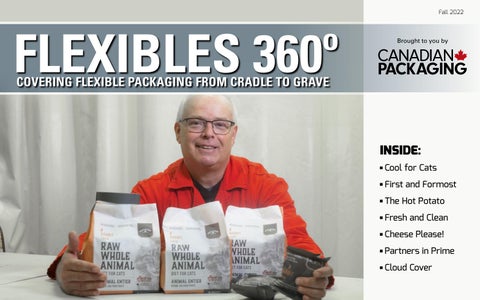
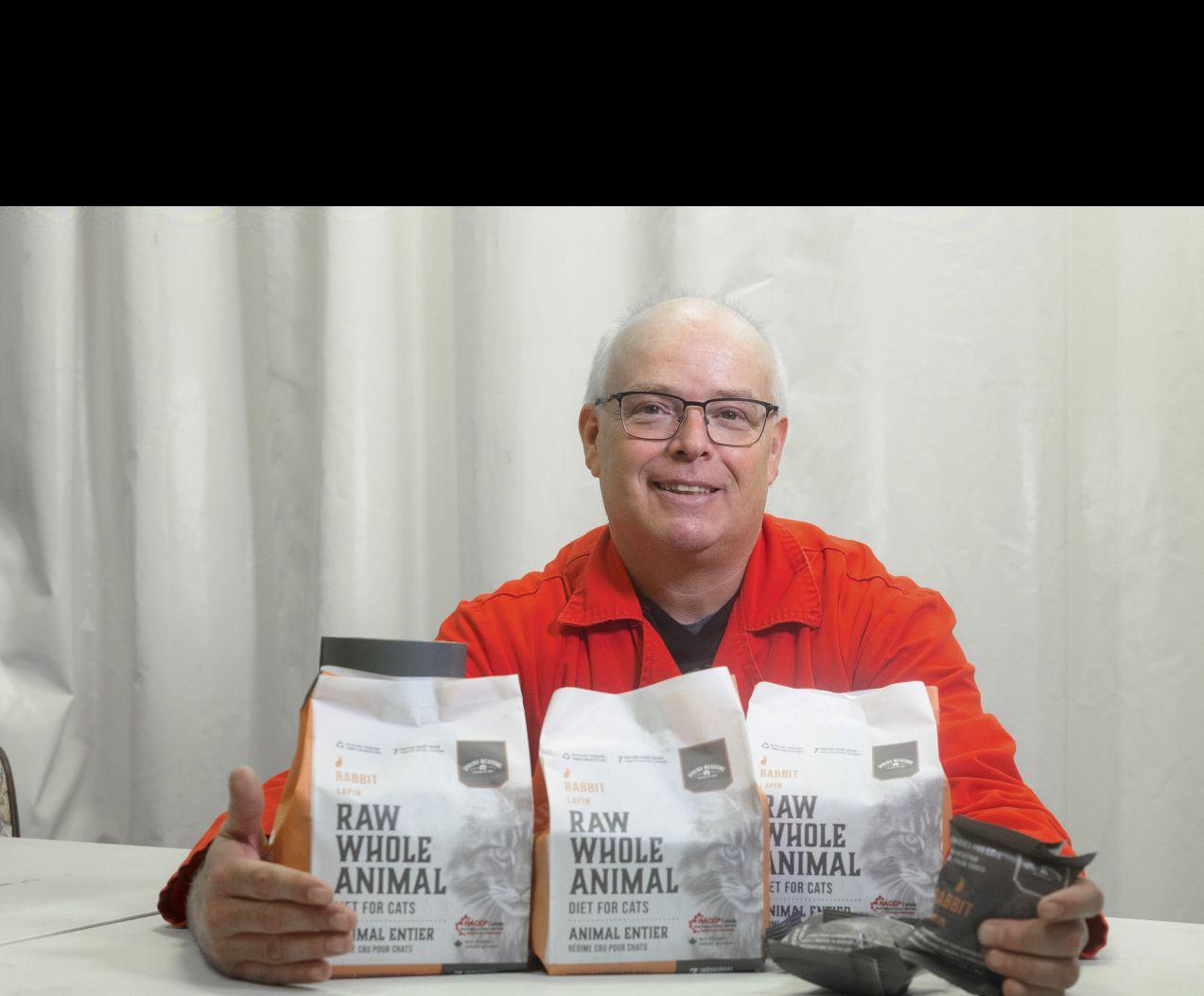
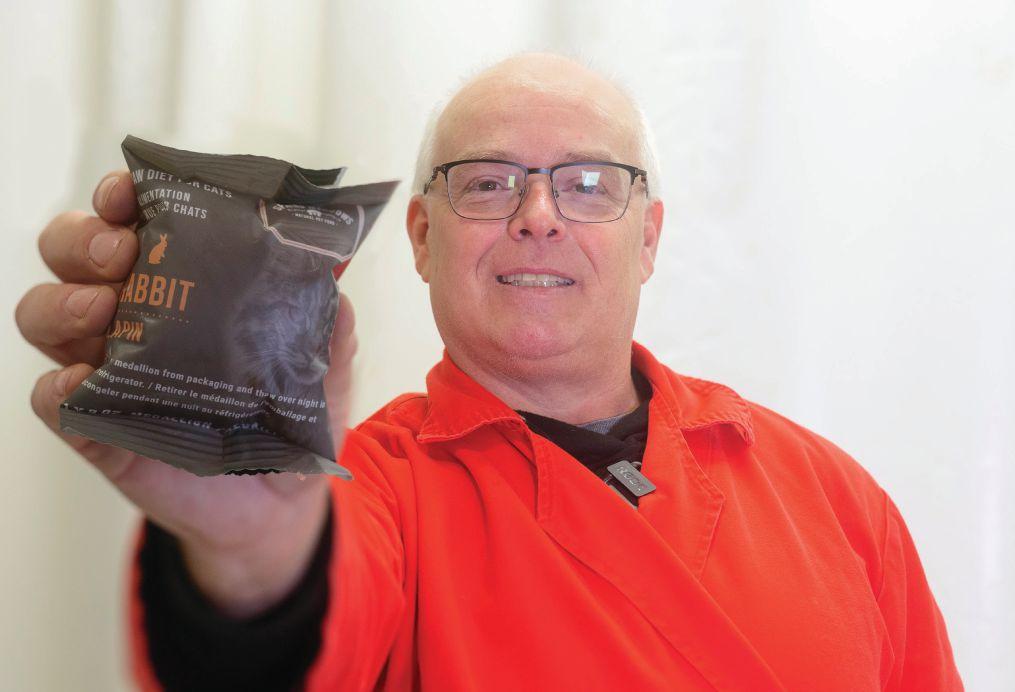
Jason Stovra proudly holds up a flexible flow-pack containing a nutritious, all-natural three-ounce serving of high-quality raw rabbit meat retailing across Canada under the company’s new Raw Whole Animal brand of premium cat food products manufactured in Saskatoon, Sask.
Spring Meadows Natural Pet Food production and operations manager
competition for market share and consumer loyalty, achieving strong product differentiation in a crowded marketplace is a formidable challenge often requiring significant capital resources to invest in new production equipment and capabilities.
For Saskatoon, Sask.-based Spring Meadows Natural Pet Food, the company’s 2018 acquisition by the Mississauga, Ont.-based Dane Creek Capital Corp. (DCCC) provided a perfect financial partner for helping the innovative pet food producer bring its technical capabilities up to par to the high levels of nutritional excellence of its premium-quality, hand-crafted cat and dog food patties eagerly snapped up by grateful Canadian pet owners for whom price is no object when it comes to their beloved four-legged family members.
Founded in 2004, Spring Meadows excels at manufacturing frozen raw ground animal pet food in a variety of product sizes to make it easy to feed small to large domestic animals, using a propriety double-grind process to achieve uniform find-ground texture and to remove any large bone pieces from the product.
Sourcing a broad variety of raw meat from reputable suppliers across Saskatchewan—including beef, bison, chicken, turkey, fish, lamb and rabbit—the 6,200-square-foot facility company currently produces 28 different SKUs (stock-keeping units) of cat and dog meat patties under its own flagship Spring Meadows brand label, along with doing some private-label work for a select group of like-minded customers placing high value on the benefits of raw meat diets for domestic dogs and cats.
According to Spring Meadows, these significant benefits include cleaner teeth, more pleasant breath, higher energy and vitality levels, a shiny coat, clear eyes, healthy skin, and fewer arthritic symptoms in older pets.
As the company’s website proclaims, “Choosing a raw food diet with a variety of different meats gives your pet a natural, healthy diet—the way nature intended.
“Frozen raw food is the freshest and is the easiest to digest, while finely ground bones in whole animal raw food provides a great source of calcium and phosphorous.
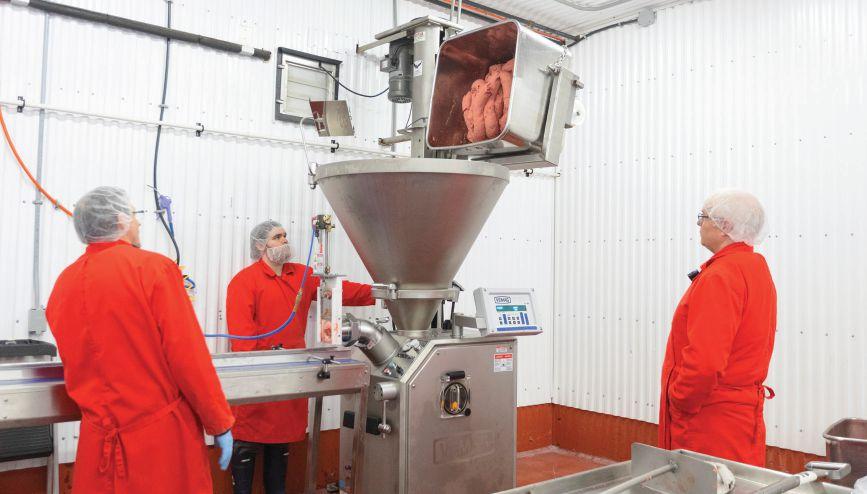
Top: Spring Meadows staff transfer a batch of freshly ground raw meat into the Reiser Vemag Robot 500 vacuum stuffer and portioner.
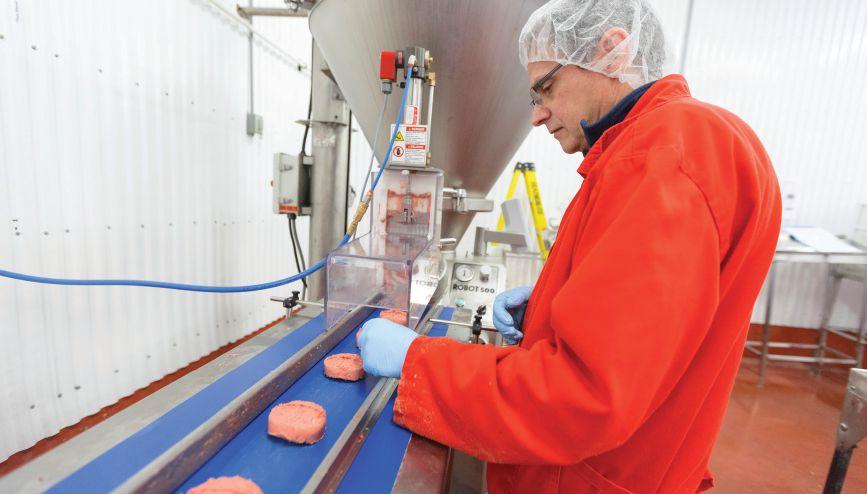
Bottom: Perfectly-shaped three-ounce medallions of raw meat emerge from the Reiser Vemag Robot 500 portioner on a food-grade conveyor transfer belt feeding them inside the Paxiom SleekWrapper i65 horizontal flow-rapping machines to be packed into individual single-serve, easy-open flow-packs.
“Whole animal food includes meat, bones, vital organs, heart, liver, lungs, kidneys and tripe—all the ingredients for full nutrition,” the company says, also citing the benefits of healthier muscles; lean strong bodies; better resistance to disease, allergies, ticks, fleas and worms; and fewer veterinary bills for the pet owners.
Nowadays operating as part of the United Raw Pet Foods Inc. division of DCCC, the company has recently taken a bold step of automating its pet food packaging process to improve with the start-up of a high-performance horizontal flow-wrapping machine supplied by the renowned Montreal-based packaging machine-builder Paxiom Group. (www.paxiom. com)
As Spring Meadows production and operations manager Jason Stovra relates, the company had to upgrade its packaging capabilities last year in order to execute a successful market launch of a brand new line of three-ounce raw ground meat medallions for cats.
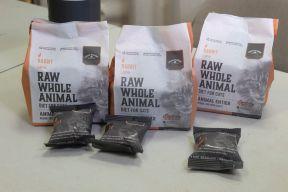
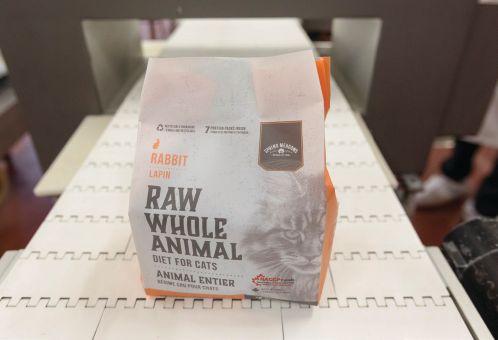
Produced in three innovative flavor varieties—including rabbit, chicken-and-duck and turkey-and—the Raw Whole Animal Diet for Cats line medallions are packaged in flowpacks, which are then packed in groups of seven inside recyclable multi-pack freezer pouches containing a full delicious serving of raw meat for each day of the week.
Unfortunately for Stovra and his dedicated five-person production crew, the plant simply did not have enough hands ondeck to try to pack all the individual portion-packs manually in sufficient quantities, and with the required quality, that this important product launch entailed.
To overcome this drawback, Stovra commenced a thorough search of the available automatic packaging equipment that would suit the plant’s current and future production requirements—ultimately contacting the food packaging machinery experts at Paxiom.
After several discussions, demonstrations and test runs conducted alongside Paxiom’s sales manager Luis Pilonieta, Stovra eventually decided to go with high-performance SleekWrapper i65 model inverted horizontal flow-wrapping machine.
a premium look befitting the innovative upscale cat
Manufactured in Italy by Paxiom’s ValTara srl sister company—the high-performance SleekWrapper i65 inverted servo-driven horizontal flow-wrapping machine is designed to deliver optimal reliability, simplicity and serviceability, according to the company.
Using five servo motors to facilitate quick and easy changeovers and adjustments, the machine’s servo drive help ensure
assures precise product positioning and smooth acceleration/ deceleration.
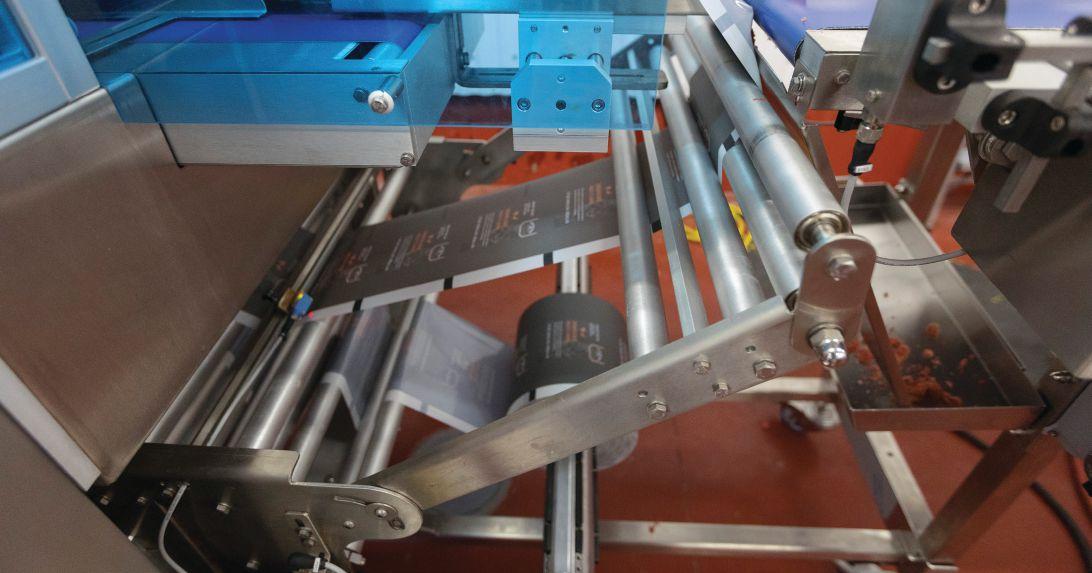
Well-suited for handling soft or sticky products, multipacks and other products that are difficult to push with the lug chain design found on conventional bottom-seal flow-wrappers, the SleekWrapper i65 feeds the rollstock film from below the product—securely carrying the hard-to-handle products on top of
A close-up view of the high-quality rollstock film loaded inside the SleekWrapper i65, printed on the HP Inidgo digital press technology by ePac Flexible Packaging Canada in Vancouver. According to Stovra, the film provides superior barrier protection to keep the product inside the pouches fresh and flavorful, while ensuring
food brand.
“I’m convinced that we’ll be able to meet future demands from the retail trade with our new technology.”
the packaging film from the former through the cutting head.
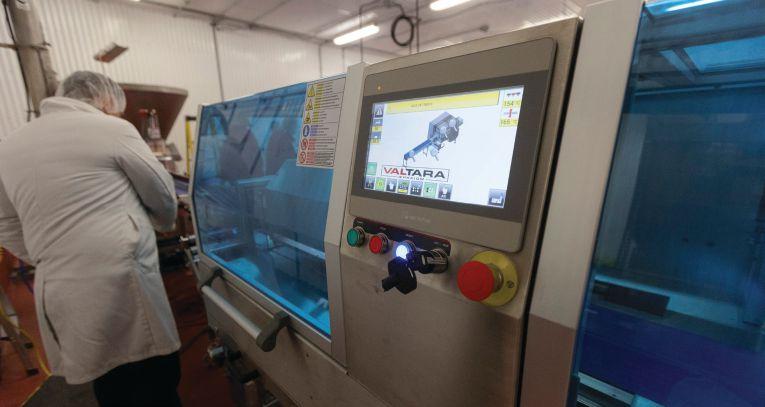
Boasting a sleek and compact design, the SleekWrapper i65 machine comes standard with stainless-steel frame construction, large user-friendly color touchscreen, automatic open/close rotary fin wheel assembly, rotary seal jaws with jam detecting logic, and the ability to pre-program and store product settings.
As Stovra happily acknowledges, he could not be more please about his equipment selection, along with the extensive customer service and support offered by Paxiom throughout the project—from testing and troubleshooting the machine at the company’s Montreal facility to the actual commissioning of the SleekWrapper i65 at the Spring Meadows plant in June of 2021.
Running virtually problem-free since start-up, the SleekWrapper i65 has enable the plant’s packaging line to process an average of 50 packs of the premium cat food per minute, representing a quantum leap in throughput and productivity for the HACCP (Hazard Analysis Critical Control Points)-certified plant.
“This was really the biggest single investment in automation we ever had at this plant,” Stovra confides,
“so getting the right type or equipment for packaging our premium product inside our premium-quality packaging was essential for us.
“So far, the machine has run like clockwork,” Stovra says, “running 50 packs per minute, or roughly 10 pounds of product, producing perfect hermetically-sealed packages to keep the product nice and fresh, as well as easy for consumers to open and dethaw.”
Moreover, by connecting and synchronizing the SleekWrapper i65 flow-wrapper with the Reiser Vemag Robot 500 vacuum stuffer and portioner forming the medallions, the installation has eliminated the need for the labor-intensive manual placing of finished patties onto the conveyor by hand.
“We typically fill the Vemag stuffer with about 300 pounds or so of the raw product, which comes out of after passing through built-in guillotine that splits the round meat mass into three-ounce medallions that are placed onto conveyor belt, one after another,” Stovra explains.
“The medallions rest on top of the film as they are pulled through the SleekWrapper,” Stovra continues, “where they are hermetically sealed for optimal freshness and come out at the other end of the
Top:
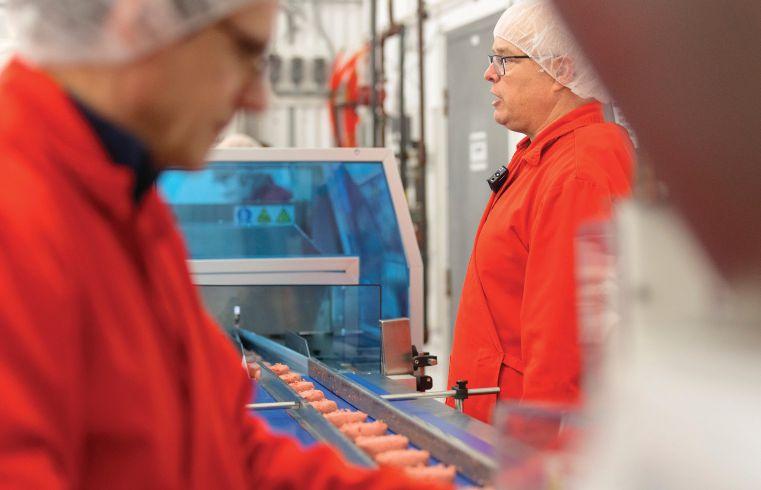
Production and operations
manager Jason Stovra (right) keeping a watchful eye over the Spring Meadows production line process inside the company’s HACCP-certified facility just outside of Saskatoon.
Bottom:
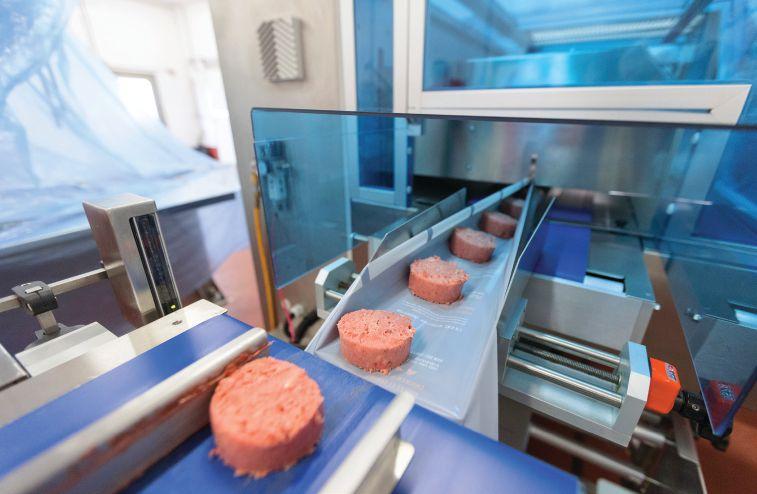
The portioned medallions are deposited on top of the ePac printed film at the entry into the SleekWrapper i65 machine, before being wrapped and sealed in individual flow-packs at 50 products per minute.
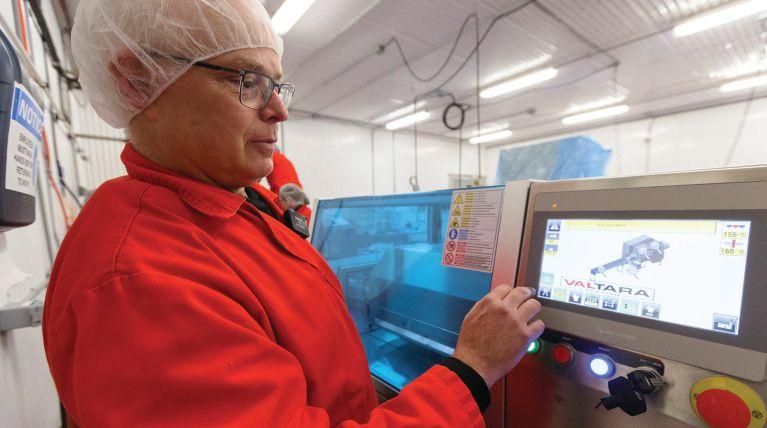
Top: Jason Stovra selecting a program recipe for the next packaging run on the SleekWrapper i65 machine using the system’s built-in HMI (human-machine interface) touchscreen terminal.
Bottom:
Manufactured in Italy by Paxiom’s sister company ValTara, the SleekWrapper i65 horizontal flow-wrapper boasts stainless-steel construction and fully-enclosed electrical and electronic components to ensure clean and reliable operation, with easy access for maintenance and cleaning.
machine, to be placed into bags of seven packs each.
“When everything is running perfectly, we can run the whole production run for the cat food medallions with just three people,” Stovra says.
“Once you have it all set up to go, you just press ‘start’ and it pretty much runs itself.”
To achieve the premium-quality look, the medallions are packaged in high-barrier, laminated rollstock film suppled by flexible packaging converter ePac Flexible Packaging Canada in Vancouver (www.epacflexibles.com), which uses the advanced HP Indigo digital printing press technology to apply the classy brand graphics onto the film surface.
“Everything really came together well with this project: a high-quality product in high-quality packaging produced on a high-quality machine,” says Stovra, citing the consumer-friendly design of the flow-wrap multipack packaging for the new raw meat brand.
“For the consumer, it’s as simple as remove the bag from the freezer, tear the pack open, put the meat on a plate to dethaw, and dinner is ready,” Stovra says.
“It has all the convenience of a can with all the quality of raw meat ingredients,” he says, “which makes it an important product dif-
ferentiator that can make raw pet food a more appealing option for new consumers to give it a try.”
For Rasmus Hvid, director of operations for the United Raw Pet Food, the success of new SleekWrapper installation at Spring Meadows is a validation of the company’s commitment to the raw meat category of the pet food market.
“This investment is as much about improving process efficiencies as it is about what kind of new business opportunities it will help us unlock,” says Hvid.
“Spring Meadows has always been a trailblazer in this industry with its unique raw meat products,” he says, “and the new packaging capabilities will enable us to offer consumers the level of convenience and user experience that none of our competitors can match.”
Says Hvid: “During the COVID pandemic, the entire pet food industry has seen fantastic overall growth at around six per cent a year.
“But within that market, the raw meat segment has been growing at a tremendous rate of about 25 per cent annually.
“It is a very promising market niche that is far outpacing the growth for conventional pet food products,” he asserts.
“We are seeing a lot of these al-
ternative pet foods, including gently-cooked or dehydrated products, starting to become a more common sight at many mainstream grocery stores,” Hvid says, “and being able to provide innovative consumer-friendly packaging for these types of products is only going to make them more visible and appealing to mainstream consumers.
“Making a correct decision on how you choose to design and display your product is a big challenge in the frozen pet food category, where you also have to make sure you have superior sealing and other technical issues to address,” Hvid says.
“It is something that we put a lot of time and effort into,” he says, “and we feel that we have found a real breakthrough packaging solution for Spring Meadows with the Paxiom equipment.”
For Paxiom’s Luis Pilonieta, working on the Spring Meadows installation was a satisfying and fulfilling professional experience that accurately reflects Paxiom’s deep commitment to outstanding customer service and formidable technological prowess.
“We had the machine set up and running withing two weeks of delivery,” he recalls, “and we had our field technician on-site there for several days to help with the commissioning and to provide staff training.
“Spring Meadows had an absolutely amazing new product to offer to the market, and we are very pleased to have provided them with the perfect automated packaging solution to bring it to market efficiently and cost-effectively,” Pilonieta states.
“For companies just starting out with automation, it can be a daunting experience,” he says, “which is why it is important for us to provide them with all the on-site and remote support that we can to make comfortable with the new technology and to implement a process that will help them succeed in the marketplace.
“Being able to work with the customer
and explain the whole process in the way that their staff could understand and absorb made a big difference to Jason
and his team,” Pilonieta concludes, “who were all a great pleasure is to work with.
“Knowing that you have made a real impact in helping your customer move forward and succeed by empowering them with technical knowledge and automation expertise to make them a more efficient business is the best compliment anyone could ask for.”
www.paxiom.com www.epacflexibles.com
on-site
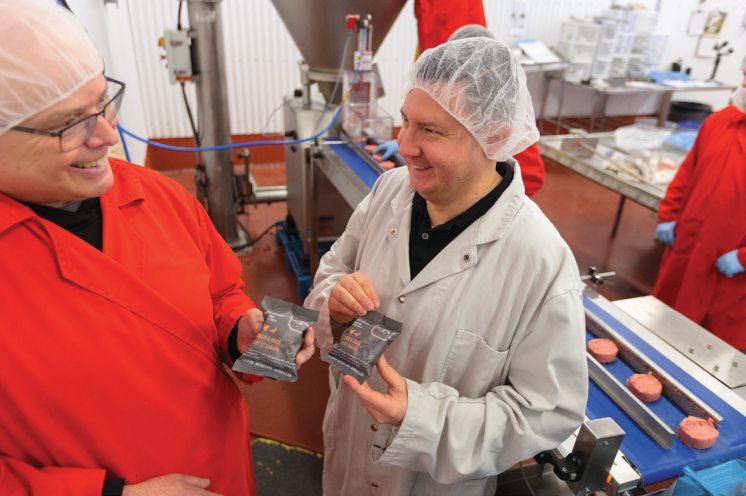
Jason Stovra and Paxiom’s sales manager Luis Pilonieta share a light moment alongside the packaging line equipped with the SleekWrapper i65 horizontal flow-wrapper.
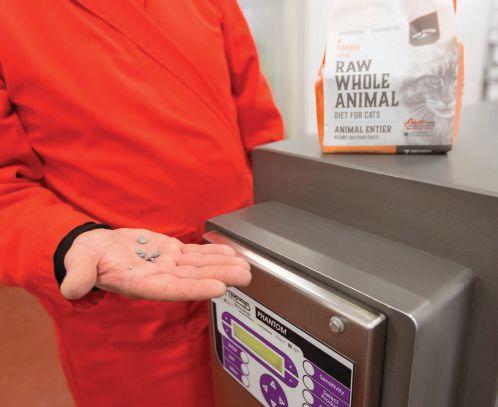
Jason Stovra shows off the tiny pieces of debris and other contaminants detected in a finished master bag of product by the powerful, high-sensitivity Phantom metal detection system manufactured by Fortress Technology Inc.
FIRST AND FORMOST
New ground meat packaging system a breakthrough for more sustainable and efficient meat production
Everyone is looking for new, better and more sustainable packaging in the grocery meat aisles, with ground meat products no exception.
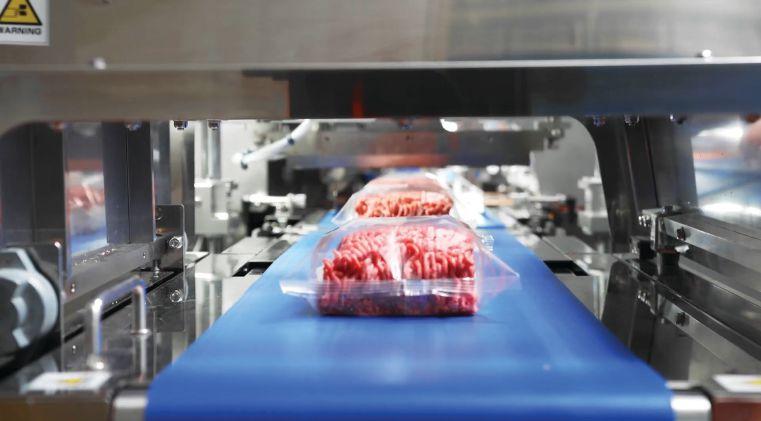
To respond to growing consumer demands for more sustainable packaging, Woodinville, Wash.based machine-builder Formost Fuji Corporation (www.formostfuji.com) has recently developed a new system for packaging ground meat that can eliminate more than 50 per cent of packaging materials that typically go into a standard package of ground meat, according to the company.
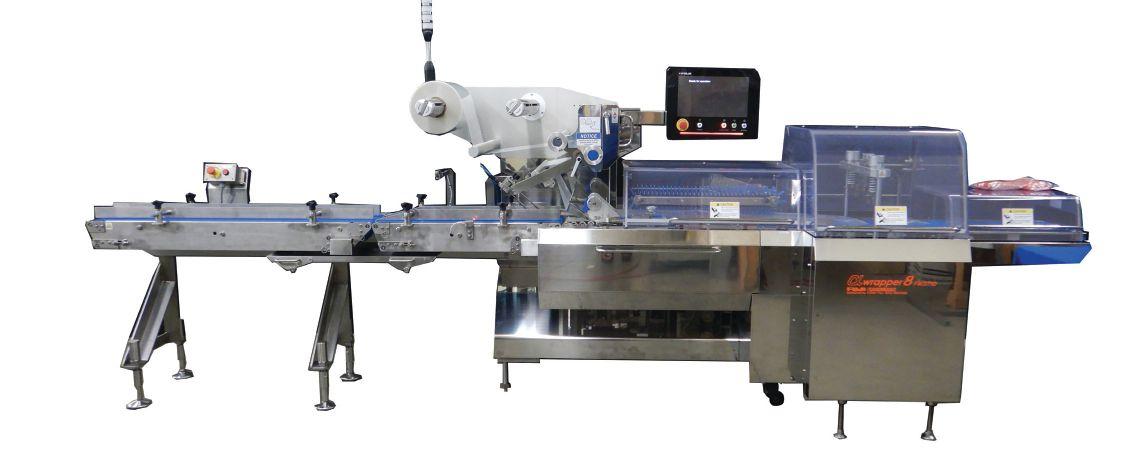
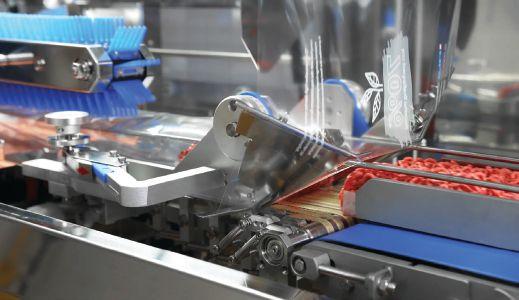
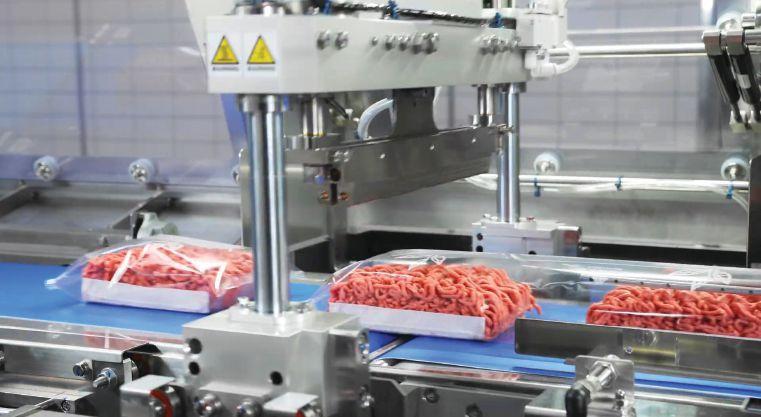
Designed for packaging ground meat without using foam trays, the Fuji Formost Ground Meat System provides an effective sustainable solution for the packaging of ground meat products in various sizes.
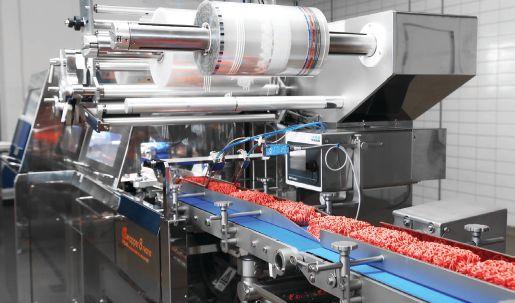
Distributed in Canada by Burlington, Ont.-based Abbey Equipment Solutions (www.abbeyequipment.com), the new Formost Fuji Wrapper is a horizontal flow-wrapper that is fed product from a ground meat line that includes a mincer, a portioner, a blade and weigher.
The portioned meat is then timed into wrapping material where the individual package is produced.
Develop with a keen focus on green sustainable production, the
system eliminates the need for extra materials such as metal clips, foam, plastic, and/or cardboard trays.
According to Formost Fuji, packaging film manufacturers are making great strides in developing decomposable material that, when combined with the environmentally friendly ground meat system, can significantly reduce the ecological impact of the packaging.
Along with weight reduction of the packgin itself, the full-featured system has a smaller footprint than current ground meat packaging systems used by most meat producers.
Moreover, the Formost Fuji Wrapper also offers significant advantages for shipping, storage, and valuable shelfspace. To start, the trayless package uses 50-percent less space on a truck, thus providing a 100-percent increase in shipping capabilities.
With twice as many trayless packages on a truck than with the trayed product, the system can take the equivalent of one truck off the road for every two that is currently used for shipping ground beef— thereby notably reducing the amount of GHG (greenhouse emissions) released into the atmosphere.
In today’s world, that is a valuable advantage to the producers and the consumers alike.
Another great advantage is the reduction of floor-space needed to produce this package, which is close to 50 per cent.
The conventional current package with a tray typically requires three machines for packaging, with many additional re-
quirements for more floor space, spare parts, and labor for maintenance.
Designed for wet duty, the Formost Fuji ground meat system includes a sanitary infeed conveyor designed for with simple belt removal and replacement—facilitating easy cleaning and inspection for plant personnel.
Also available in a sanitary design model, the system’s design allows for removal of the center seal unit to provide the operator the ability to easily clean, inspect, and maintain the wrapper.
Options for product size can vary when packaging with the flow-wrap ground meat system. The one-pound package is most common but larger sizes, but the machine can easily accommodate package weighing up to 35 pounds with simple changeover.
With the Formost Fuji Ground Meat System, the paper or absorbent pad can be used under the ground meat as it is gently transferred to the conveyor and into the flow-wrapper.
The new ground meat wrap produced by this system has excellent seal strength for product protection, as well as for maintaining package integrity and extended shelf-life.
In addition to creating a smaller package that takes up less room on storeshelves, the consumer will find this package easy to use with the ability to remove the product without having to handle the contents.
www.formostfuji.com www.abbeyequipment.com
The Formost Fuji Wrapper can work with a broad range of new-generation recyclable and PCR-content plastic films to help meat packers reduce their packaging footprint.
THE HOT POTATO
Danish vegetable processor using innovative microwavable bags to offer consumers quick and delicious meal solutions
Located on top of the Jundal peninsula in northern Denmark, the small railway town of Sindal seems like an unlikely hotbed of flexible packaging innovation.
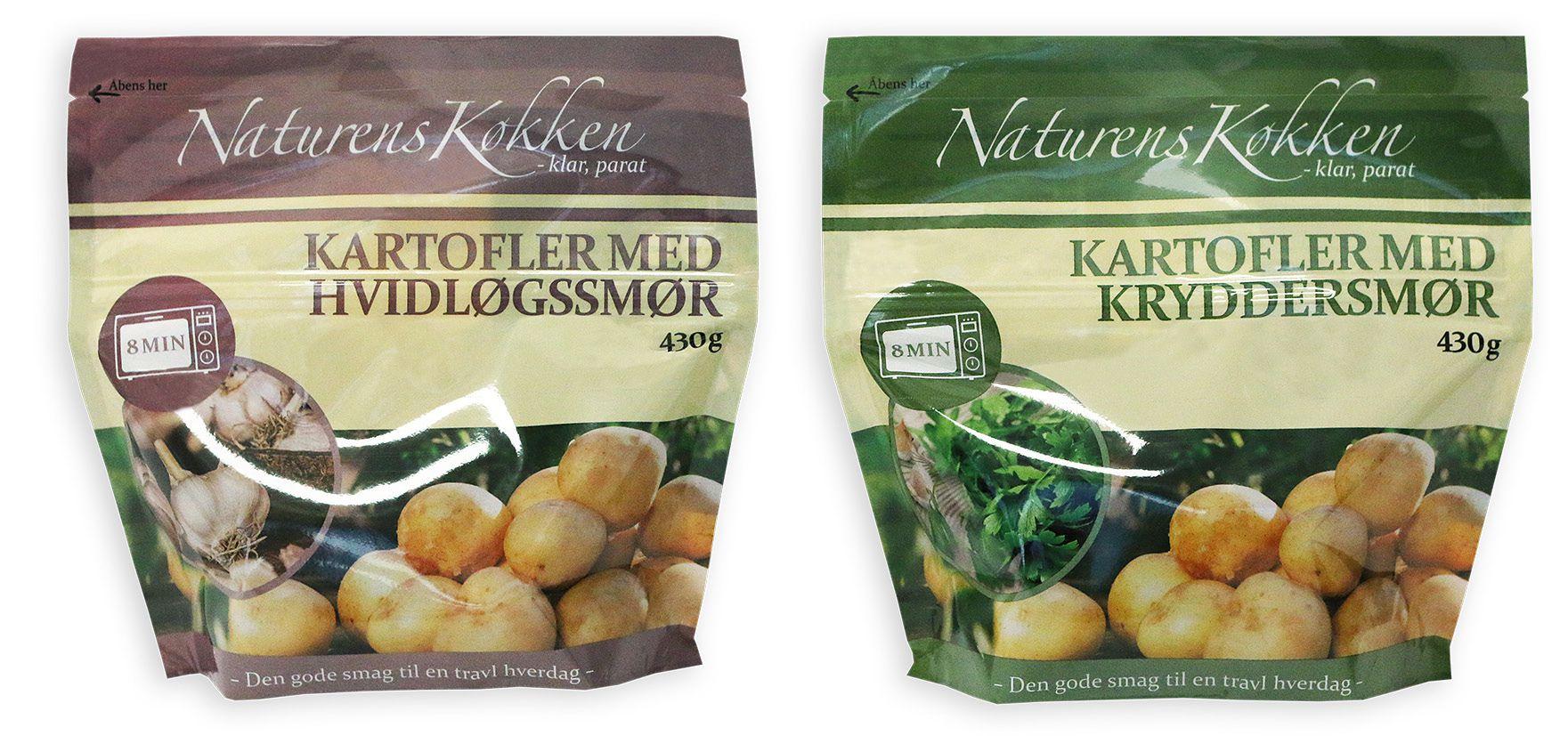
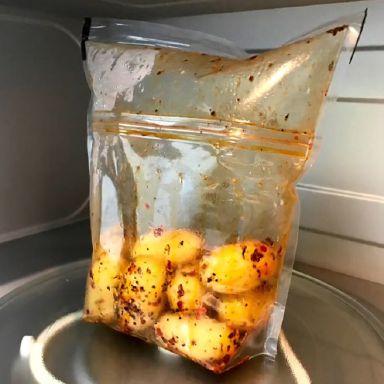
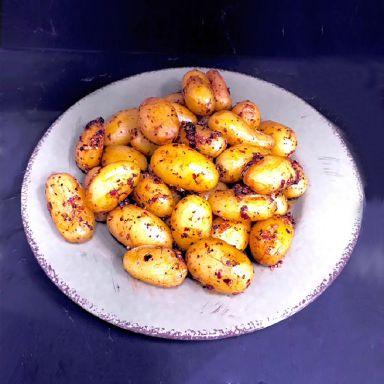
But it looks like the good folks at local root vegetables processor Kildespring didn’t get the memo—recently launching a new range of delicious, easy-to-make potato dishes in highly innovative microwavable bags that enable busy consumers to prepare a delicious meal or side-dish in only eight minutes.
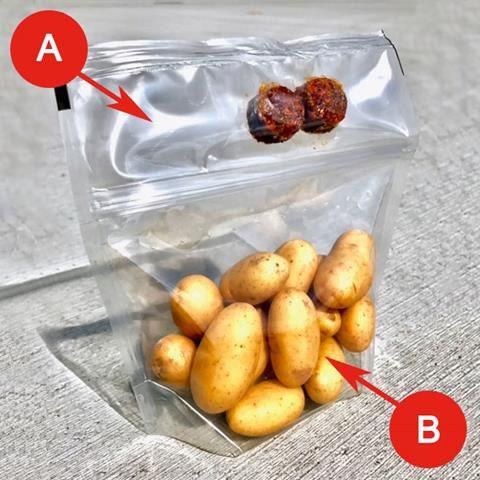
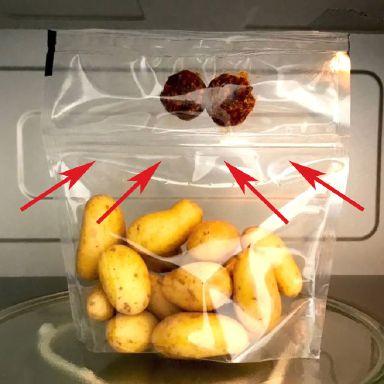
Launched earlier this year under the company’s popular Nature’s Kitchen brand label, the locally-grown potatoes are packed in the Schur Star Zip-Pop bags incorporating two interior compartments—containing potatoes in one and spiced butter in the other—that use the steam from potatoes to open both compartments and let the seasoned butter-balls melt down over the potatoes while being microwaved.
According to Kildespring, this gentler preparation method helps to preserve the valuable vitamins, minerals and other nutrients that are largely lost during the traditional cooking methods.
Sold under the on-pack tagline “Tasty choices for busy weekdays,” the new Nature’s Kitchen potato offerinsg will soon be joined by similar microwavable meal solutions consisting of sweet potatoes and mixed root vegetables, according to Kildespring, which installed the Shchur Star bagmaking machine on-site about a year ago.
“We were in the process of replacing the glass jars for our ready meals by a lighter solution when we were introduced to the Schur Star concept”, says Kildespring managing director Peer Slynge.
“On top of that, we faced issues in the packing process for our ready-to-serve sauces, again and again.
“But Schur’s presentation of their packaging machine made the decision easy,” says Slynge. “The packaging concept fits our production set-up perfectly.
“And as we need to pack a wide range of ready meals and convenience food, the versatility of the machine will be a great plus for us going forward.”
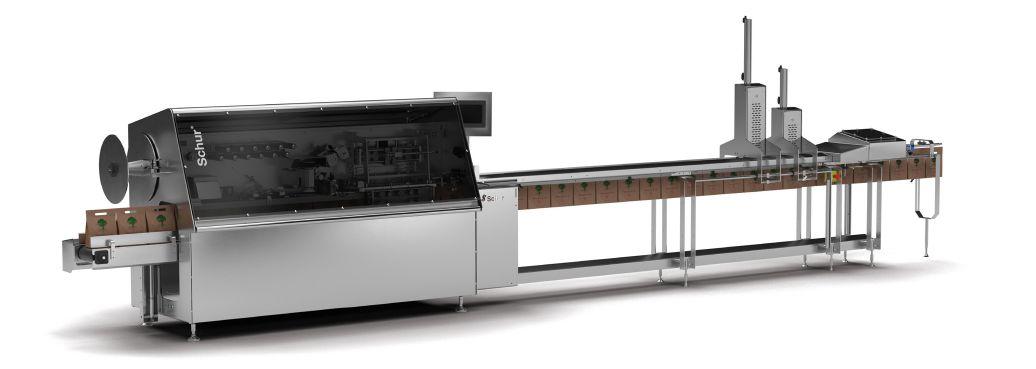
Manufactured in Germany by Schur Star Systems GmbH (www.schur.com), the Schur Star machine can be operated in manual, semi-, or fully-automatic modes, with changeovers between the filling methods, bag formats, and product types requiring only a few minutes.
Moreover, the versatile packaging machine can be easily integrated with a diverse variety of weighing, filling, labeling and marking systems, as well as processing equipment, to provide a complete turnkey line solution.
“The Schur Star Zip-Pop bag is new concept in Northern Europe and, in our opinion, it is a very exciting innovation,” Slynge states.“The short and gentle preparation method in the microwave preserves all minerals and vitamins, and we expect the products to be very attractive for busy working families.”
www.schur.com
FRESH AND CLEAN
Compostable packaging takes flight for home-delivered fresh pasta upstart
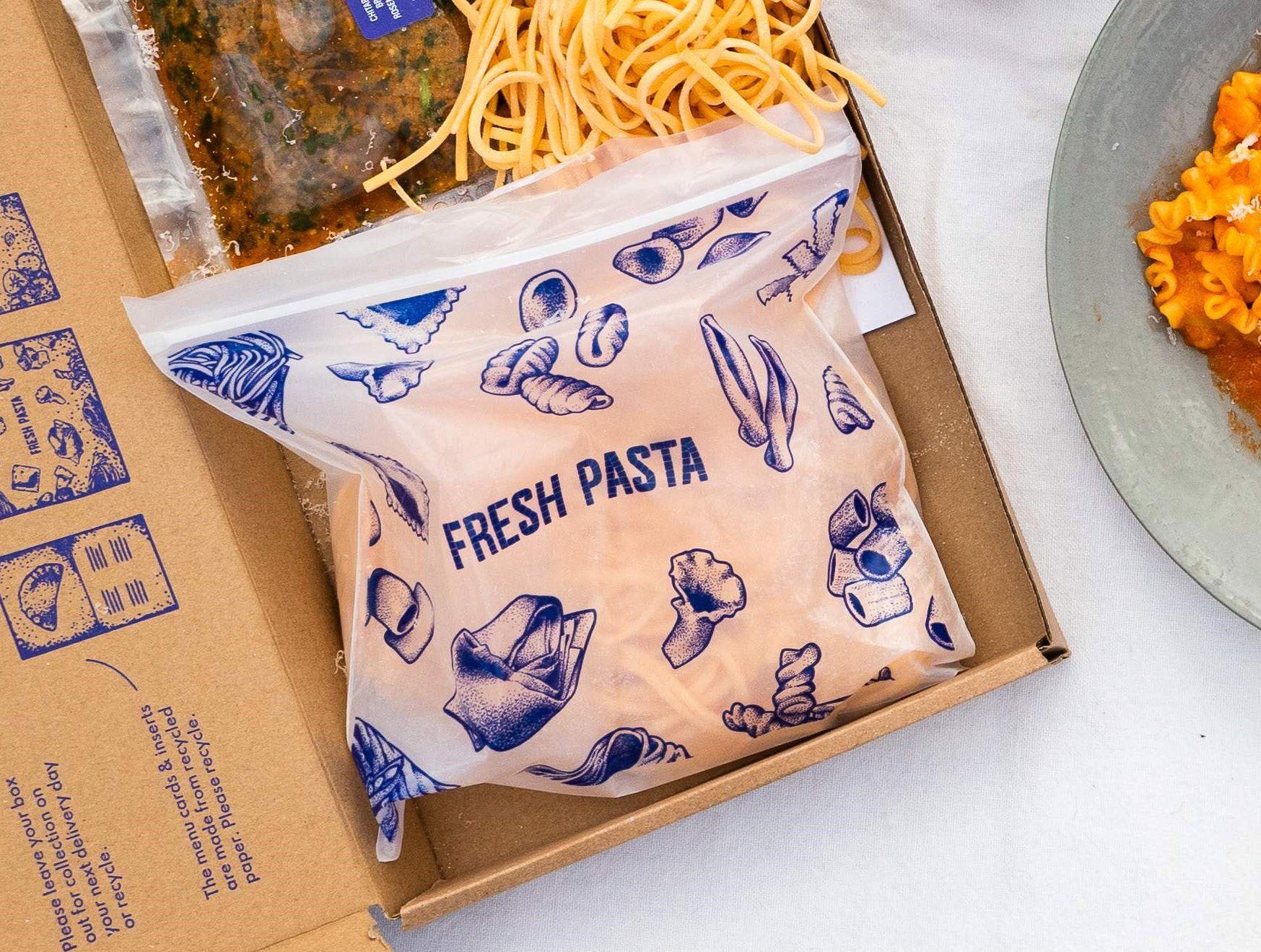
Founded in 2018 in London, England, Nonna Tonda Ltd produces a wide range of hand-rolled fresh pasta and homemade sauces distributed across the U.K. via subscription-based home delivery services.
As a company deeply committed to using only the freshest all-natural ingredients available, Nonna Tonda was keen from the outset to ensure that its product packaging would reflect its deep respect for the environment as well.
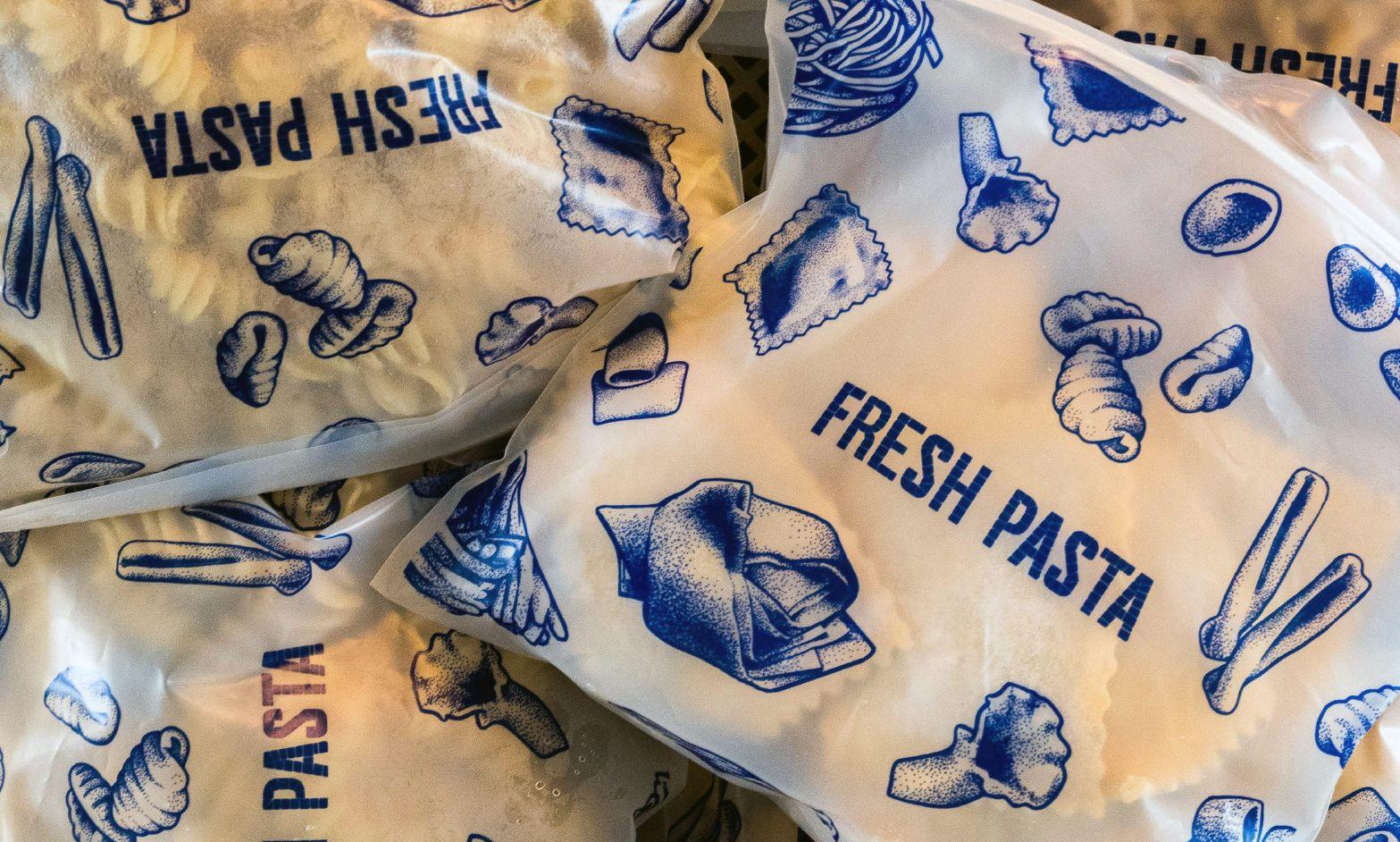
After looking around to find a suitable flexible package that would retain the freshness of the pasta and would also easily fit insider mailing boxes, the upstart company settled on the compostable C-Bag bio-plastic packaging distributed by global flexible packaging and lidding films group KM Packaging Services Ltd (www.kmpackaging. com).
Started up by a husband-and-wife team of James and Rebecca French soon after an extensive tour of Italy to learn the authentic way to make fresh pasta, the company’s home-made pasta dishes quickly became a hit during the COVID-19 lockdowns—offering consumers delicious pasta kits, consisting of fresh-made pasta, sauce and parmesan cheese, that could be easily prepared at home in less than five minutes.
As part of their selection process, the zippered bags were initially tested at Nonna Tonda, where they proved to be perfectly suited to the company’s pro-
duction and supply chain requirements, while also offering effective, high-impact graphic print design possibilities for the brand.
According to co-founder James French, Nonna Tonda was created to fulfill two primary objectives: to provide their consumers with delicious fresh pasta; and to do so as sustainably as possible.
As French attests, the C-Bag packaging has delivered brilliantly on both requirements.
“The bags are resealable,” he says, “and allow our product to remain fresh for longer periods.
“Also, our branding requirements were met by the bag being customizable,” French adds.
“In addition, the bags have helped us to be even more eco-friendly and have improved customer satisfaction,” he states
“We have received excellent service, all our requirements were handled with swiftness and ease,” he says, “providing us with the exact product for our needs.”
Produced by KM Packaging in partnership with Treetop Biopak (www.treetopbiopak. co.uk), the industrially compostable C-Range of bio-plastic packaging has similar properties and look and feel as conventional plastic.
Also including shrinkwrap, stretchhwrap and cling film, as well as adhesive tape and nets, the products will biodegrade if disposed of properly through home or industrial composting, depending on the material.
Ideal for numerous fresh produce and bakery applications, bio-based C-Bag has superior impact and puncture resistance, good material perforation, and makes a great carrier or waste bag for food and non-food products.
www.kmpackaging.com
www.treetopbiopak.co.uk
CHEESE PLEASE!
Upstart Canadian product of plant-based cheese products using leading-edge thermoform packaging technology to grow market share and customer base
By Andrew Snook
Photos by Naomi Hiltz
As people get older, lifestyle changes are not unusual. Most of us want to live long lives in good health. But sometimes it’s one major event in our lives that really opens our eyes to the need for profound serious change. For VEGCHEESE founder and president Lori Sroujian, it was a scary moment involving her father.
“This was never supposed to be a business. I was working in digital marketing for 10-plus years for various corporations, the last six years in pharmaceutical marketing,” she says. “But then my father had a stroke. Like all stroke cases, it was very unexpected. Thank God he survived and is doing well now.”
After her father’s stroke, Sroujian took a hard look at her family’s diet and decided they needed some major changes in their lifestyles.
“When this happened, we needed to make a shift in our diets, which was
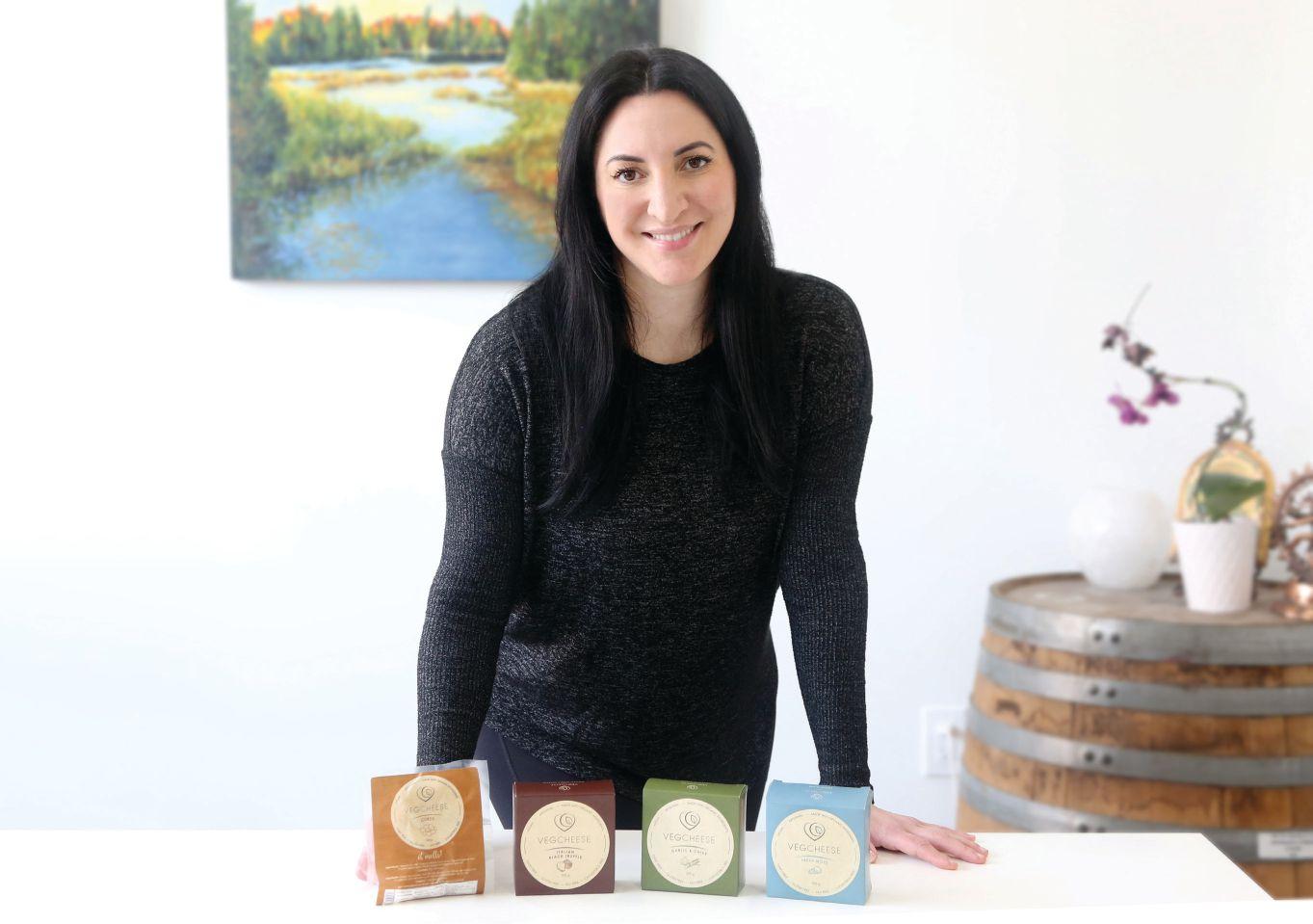
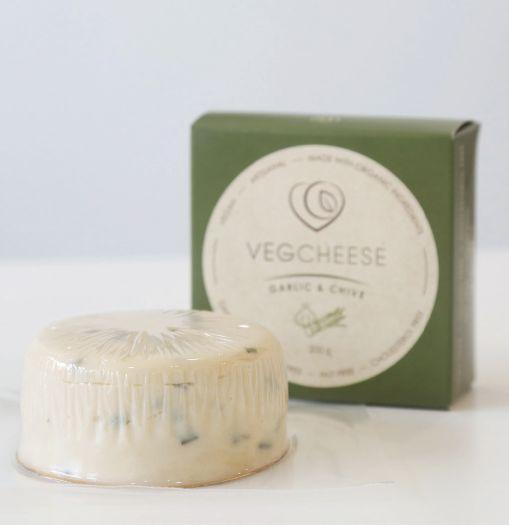
VEGCHEESE founder and president Lori Sroujian proudly displays the upscale packages of her company’s premium quality cheese products manufactured entirely with plant-based ingredients in Mississauga, Ont.
mainly meat- and dairy-based, and we wanted to see what it would be like to remove those animal-made products from our diets,” she says.
With the family all being big cheese lovers, they initially struggled with the idea of giving it up.
“We had such a hard time giving up cheese,” she recalls. “At the time no one loved the plant-based products out there enough to give up on dairy cheese.
“Many of them were many were nut-based, and with my family being Armenian, nut-based cheese felt more like hummus,” Sroujian says.
Since her family couldn’t find a plant-based cheese that appealed to them, she began experimenting in the kitchen at her condo, trying to figure out how to make her own plant-based cheeses.
“It was taking up my evenings and weekends. I’d go to work during the week and then spend the rest of my time experimenting,” Sroujian recalls.
After a few months of experimenting, she came up with a plantbased product that melted and tasted like cheese, and could also be placed on a cheese board, replacing the family’s traditional mozzarella.
“Friends and colleagues tried it and loved it,” Sroujian says. That’s really how it all started [and] soon after I decided to start this as a side hustle.
As she relates, “We signed up to a local Vegfest in Mississauga over three years ago. “From there we went right
(Clockwise from left)
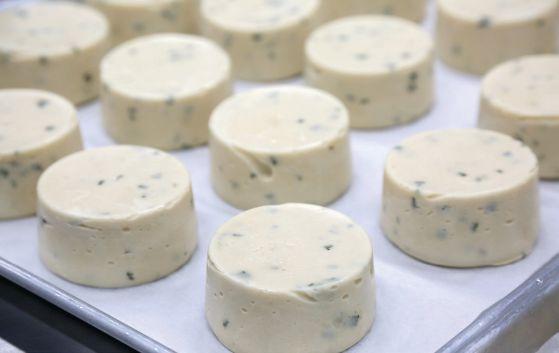
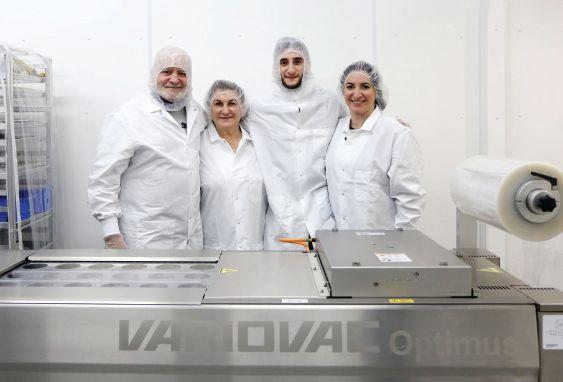
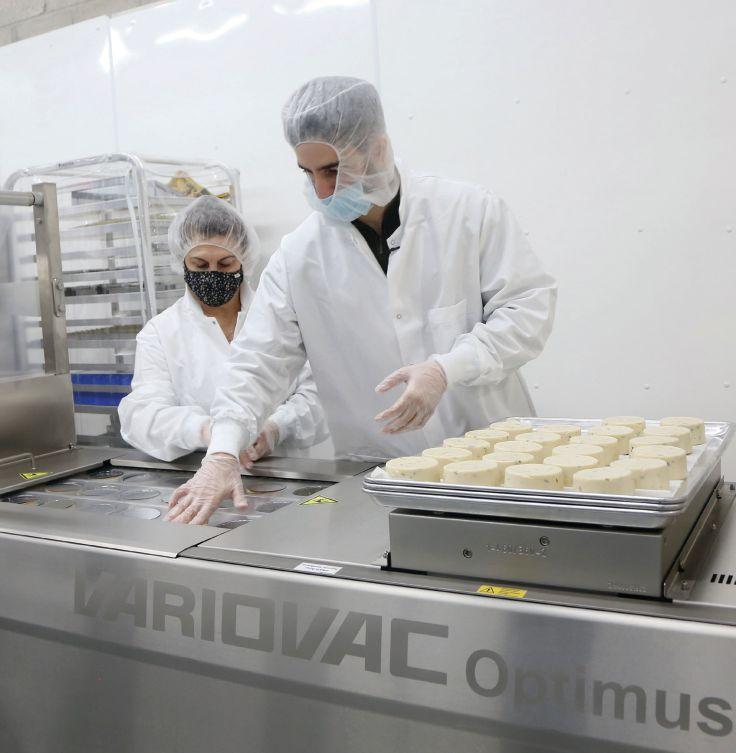
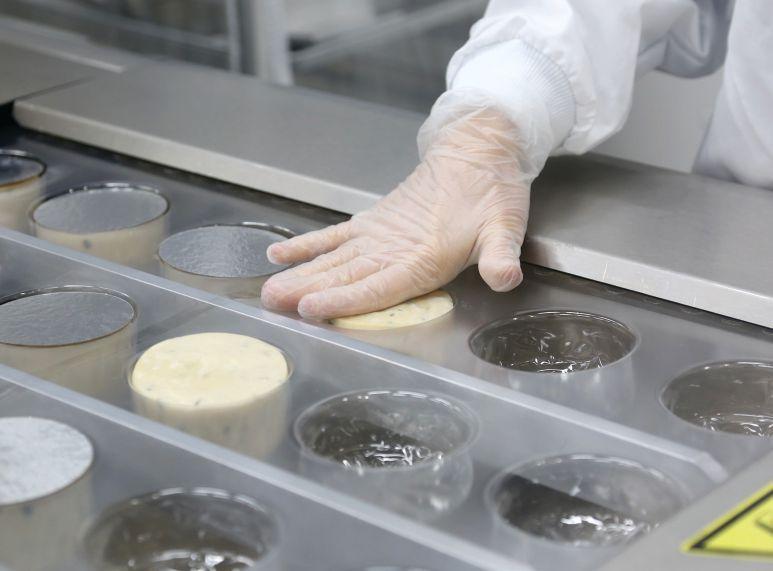
Perfectly-rounded portion of VEGCHEESE product placed on a carrying tray; Lori’s brother Aren placing the miniature chesse wheels inside the Variovac Optimus thermoform packaging machine’s cavities to prepare for the next packaging cycle; the tight-knit Sroujian family strikes a happy collective pose behind the Variovac Optimus machine.
into a commercial kitchen.
“We got our logo, built our website and made our cheeses. We went to the show and started selling. “We sold out during that one day. We sold over 300 cheeses, came home and said, ‘Okay this is a business.’
“Then it snowballed into what it is today after three-and-a-half years.”
Currently, VEGCHEESE products are being supplied to a wide variety of local retailers. The company offers four different retail products: Fresh Mozz, Garlic & Chive, Italian Black Truffle and Curds (plant-based cheese curds), as well as two foodservice SKUs (stock-keeping units) comprising plant-based curds and mozzarella.
“We are now in over 100 retail stores,” Sroujian, “and foodservice is another big component for us.
“For example, we work with Scotiabank Arena in Toronto, where they use our cheese curds for live events,” she says.
“We are speaking with some major retailers,” Sroujian acknowledges, “but I can’t disclose what’s
happening there right now. Hopefully we will be at major retailers in the next six months.”
Near the end of 2021, the company moved into its first production plant in Mississauga, Ont.
Commissioning of the plant was completed by early January and production was in full swing for the company comprised of four very close staff members.
“It’s all my family. My father is running our plant. My brother quit his full-time job in appraisal management to come work here full-time. My mom works part-time as an artist and part-time as a cheese maker,” Sroujian says.
“Once things settle down [post-COVID-19], we’ll bring in some hired help into the kitchen, because it is getting very busy.”
With an annual production in the thousands of kilograms, and demand continuing to increase, the new production plant was necessary to keep up with orders for the family’s popular cheeses.
It was outfitted with brand-new mixers on the production side of the operation, which Sroujian was able to purchase with confidence.
For the packaging side of the business, she knew the decision would require significant research.
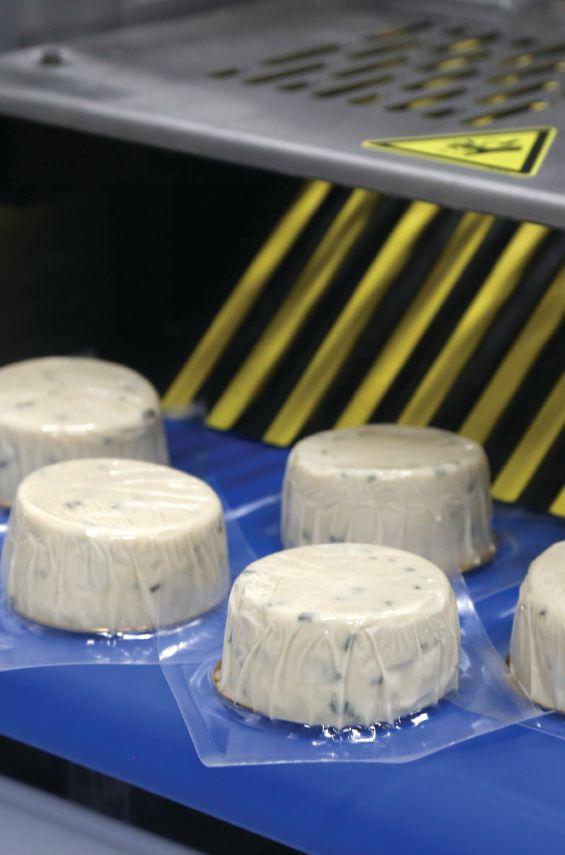
A close-up view of the hand-crafted rounds of plant-based cheese being placed inside the film-lined cavities of Variovac Optimus thermoform packaging machine prior to being sealed inside thermoformed film packs.
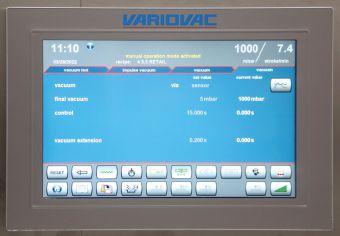
The user-friendly touchscreen HMI (human-machine interface) of the Variovac Optimus thermoform packaging machine facilitates very user-friendly programming and recipe selection.
“Our growth was really getting stalled because of the lack of equipment,” she says. “I don’t have a technical background, so I had to ask around.”
Part of her research involved attending trade shows to check out the various options available to enhance her packaging operation.
That’s exactly how Sroujian met Jeff Kennedy, sales representative for Reiser (Canada) Ltd. in Burlington, Ont. (www.reiser.com)
“I met Lori with her parents at the PACKEX Toronto exhibition three years ago,” Kennedy recalls. “She didn’t know what kind of packaging equipment she was looking for.
“She was really new to the processing industry, so she was just walking the show to see what kind of flavors were out there,” he says.
Although Sroujian was searching for packaging options to enhance production at the plant, that wasn’t her only motivation for embracing new packaging technologies.
Because manual packaging of vacuum packs requires a significant amount of physical labor, and with her parents overseeing the packaging department, she wanted to make things easier for them, Kennedy recalls.
Eventually, Sroujian ended up opting for Reiser’s high-end Variovac Optimus thermoform packaging system.
“This was my probably favorite sale,” Kennedy says, “because this machine made a real difference to their lives.”
Says Sroujian: “The quality of the products that Reiser makes is incredible [and] the price point made sense, given what we needed.
“We needed the dies to change quite easily because we have different sizes for retail sale,” she explains. “Products like cheese curds needed different dies, foodservice needs different dies,” Sroujian says, adding that being able to source locally available part was an important consideration.
“Parts coming from the U.S. or elsewhere can take quite a bit of time to arrive, and we just wanted to know that as the business is growing, if something were to break down, we could immediately have a solution,” she says.
“Also, the technical support and the service offered by Reiser was incredible.”
“They treated me like I owned a massive business,” she says, “even though they knew I was running a small operation that would take some time to grow.
“They never made me feel small. They treated me incredibly well and the follow-up service was excellent,” Sroujian extols.
By purchasing the Variovac Optimus thermoformer, Kennedy says VEGCHEESE is investing in flexibility for significant future growth.
“She bought a machine that is taking eight hours of packaging down to 45 minutes,” he says. “She understands that if she doubled or tripled her business, it would be no trouble at all.”
The Variovac Optimus machine is built with a solid stainless-steel frame and a washdown design that offers the highest hygiene standards.
It features an intuitive operating system with a seven-inch touchscreen display that can program and save up to 40 individualized machine recipes with multiple language options.
The thermoformer provides superior sealing, vacuum, MAP (modified atmosphere packaging), skinpack, steam and shrink-packaging capabilities.
Moreover, Reiser’s financing options were also very important for the upstart company.
“Reiser has a great financing program to support small food producers,” Sroujian says. “It would have been impossible to purchase a machine like this upfront: I don’t have investor angels,” she points out.
“My life savings have gone into this business to buy equipment, ingredients, packaging, and everything else required to scale our production.”
Perfectly sealed packages of VEGCHEESE brand plantbased cheese products exiting the Variovac Optimus thermoform packaging machine.
The production process involves a special mixing process of base ingredients that include organic soy milk, organic refined coconut oil, organic tapioca flour, organic apple cider vinegar, kappa carrageenan and sea salt.
The cheeses are then poured into individual moulds and left to set. Once it’s ready, the product is placed to run through the Variovac Optimus thermoformer for packaging, after which it is boxed and placed inside fridges.
Currently the labels are being applied manually, but Sroujian notes that one of the things she likes about the Variovac Optimus thermoformer is its flexibility.
“The machine does have options for add-ons. Another thing I love is that the machine grows as you grow, so I can add different components to it.
“But for the time being, it’s fast and does everything that we need,” she says.
As a small producer, Sroujian says finding a location to produce VEGCHEESE products was a challenge.
“A lot of small food producers start in a kitchen or commercial kitchen then go to a co-packer,” Sroujian reflects.
“But our process is very finicky, so I did a lot of research on finding a co-packer that can make our products for us, but we had a great deal of difficulty.
“I also wanted to have control of the quality of the products and the supply chain of the products,” she adds, “and so I made the decision as a self-funded small food business to build the plant.”
Finding a solid financial solution for renovating the plant took some time as well, as there weren’t a lot of options available, Sroujian points out.
Adding an extra layer of complexity, the company needed to navigate the many challenges unleashed by the COVID-19 pandemic, including supply chain disruptions, price increases and labor shortages.
To try and combat some of the lost foodservice business during the pandemic, VEGCHEESE turned to more aggressive direct e-commerce sales.
While it helped with the sales, it also presented its own set of logistics challenges, with the product requiring the use of ice-packs and overnight shipping.
Reiser Canada’s sales rep Jeff Kennedy (above) says he is proud of playing a part in helping family-owned VEGCHEESE to develop high-end packaging for the company’s unique range of plant-based cheese products.
“There’s been a lot of things that have been challenging for us,” Sroujian says. “Our customers in foodservice were suffering and struggling, and that affects us in trying to find the right balance of growing the business during the pandemic and keeping at it.”
One major goal for VEGCHEESE is expanding its reach and distribution.
While they love working with local retailers, Sroujian says she’d like to also work with larger retailers for increased accessibly to a wider market across Canada and then into the U.S.
Finding partnerships with other companies that could incorporate her plant-based cheeses as ingredients in their products is another major goal.
“Our products are great in meals,” Sroujian says, “so that’s something that will be big for us in the future.”
For Sroujian, the best part of running her own business has been seeing it evolve.
“Building something out of nothing and seeing it grow and mature at different stages is a very special experience,” she says. “Seeing my family work with me, seeing what the product does for the customers, getting that positive reinforcement and feedback: I live for it.”
Sroujian says she is excited about the future prospects for her company’s innovative products that uses only the best ingredients it can find.
“They are soy-based cheeses made with the finest-quality organic ingredients,” she says. “I make what our family eats, and our family eats our products daily.
“If I’m not going to feed it to my family,” she concludes, “I’m not going to feed it to my customers. We will always stand behind the quality of the products we create.”
www.reiser.com
PARTNERS IN PRIME
Global partnership to pave the way for waterless offset printing
While offset printing technology in flexible packaging is still not as widely used as gravure and flexographic printing, it has proven to be beneficial in short and medium runs due to its shorter time-to-market and flexibility, since offset plates can be imaged in mere minutes.
To leverage those advantages in today’s food and other consumer product markets where brand-owners are producing a greater variety of goods in smaller quantities, leading Japanese advanced materials manufacturer Toray Group (www.toray.com) has formed a partnership with European-based flexible packaging supplier Chemosvit (www.chemosvit.sk) to promote Waterless EB (electronic beam) offset technology as the sustainable solution for the future of flexible packaging.
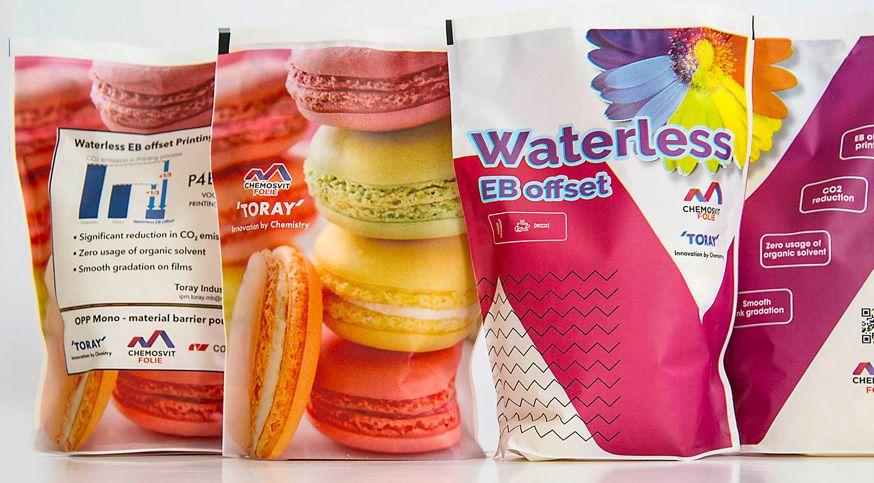
Earlier this year, the two companies revealed a new mono-material pouch sample with a barrier function, which they claim not only reduces CO2 emissions but also contributes to the advancement of Circular Economy.
Working without the use of solvents, the technology’s CO2 emissions are more than 80 per cent below those from gravure printing, according to Toray.
In addition to providing a 100-percent VOC-free process, it also allows for the aluminum printing plates to be recycled, while its energy consumption is much less that for other main printing processes.
According the Chemosvit, the Waterless EB offset printing will provide important insight into optimizing the film properties to achieve the best printing results.
As part of this joint endeavor, Toray has developed a special new water-washable ink, while singing up several major ink manufacturers to develop and commercialize the new formulation for more widespread use in the near future.
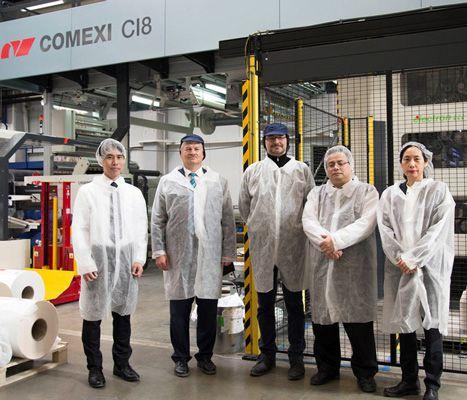
The new ink and material have recently been put to the test by SP Group—a leading Spanish supplier of retail flexible packaging, on a COMEXI CI8 offset press to produce monolayer flexible pouches with superior print quality and sharp, high-resolution images, in addition to full compliance with food contact materials regulations.
Says SP Group’s chief executive officer Francisco Bernal:
“Using such innovative technologies as Waterless EB offset, VOCfree printing has matched our core corporate principles of sustainability, while maximizing quality.”
The success of the test is a new milestone in Toray’s development of waterless printing technology, which started in the early 1970s.
The company started work on its solvent-free technology in 2015, and will continue work towards achieving 100-percent VOCfree production in all printing processes in the future.
www.toray.com www.chemosvit.sk
CLOUD COVER
How Industry 4.0 practices in flexo presses can help inexperienced operators work smarter
By Dave McBeth (DTM Flexo Services Inc.)
and Garrett Taylor (SOMA)
It’s not enough that there’s a materials shortage in packaging. Try finding experienced help. The graying of the print workforce and the tightening of available help is a challenge to all printers. This means fewer skilled press operators.
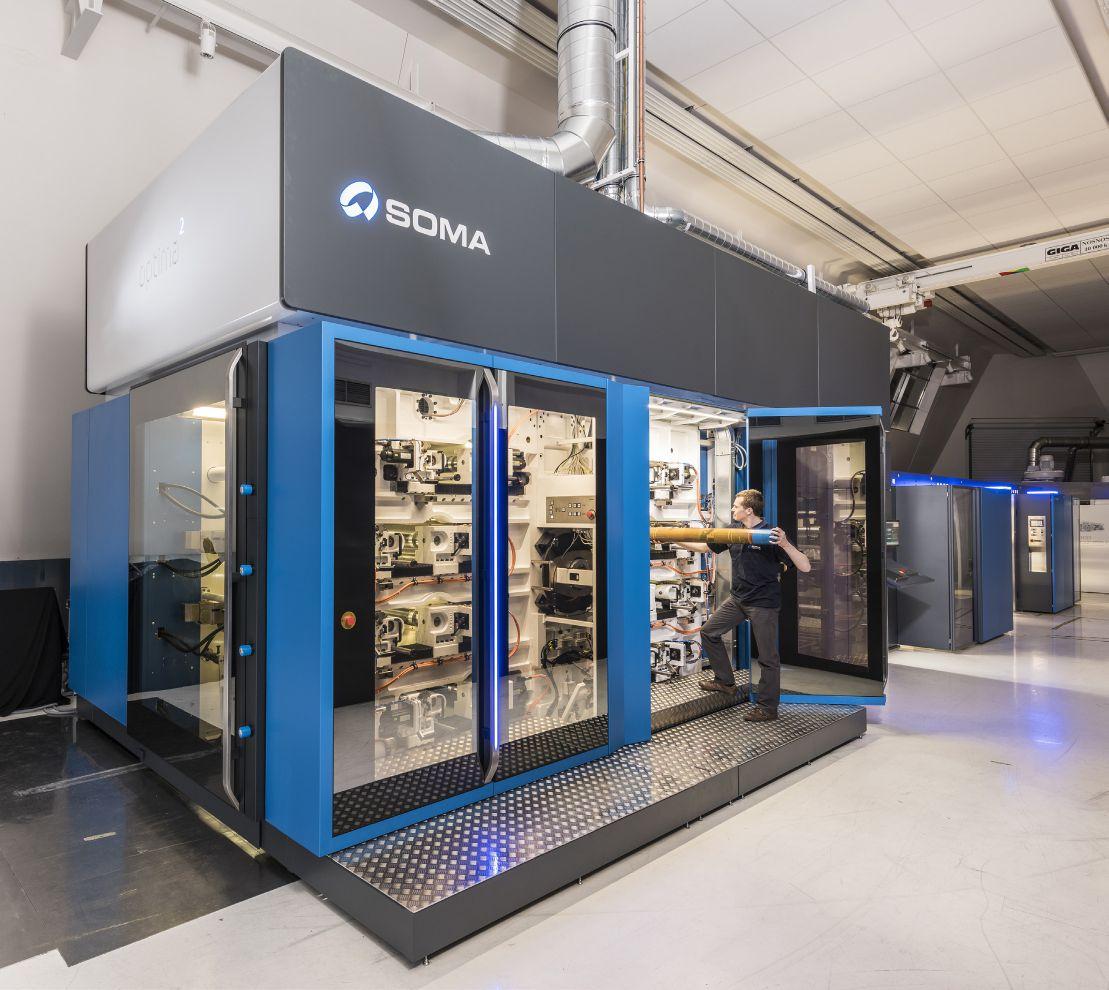
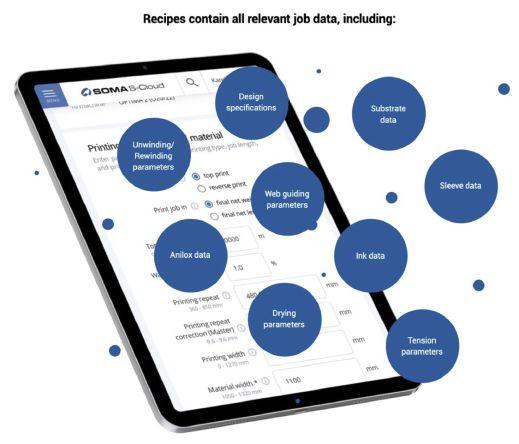
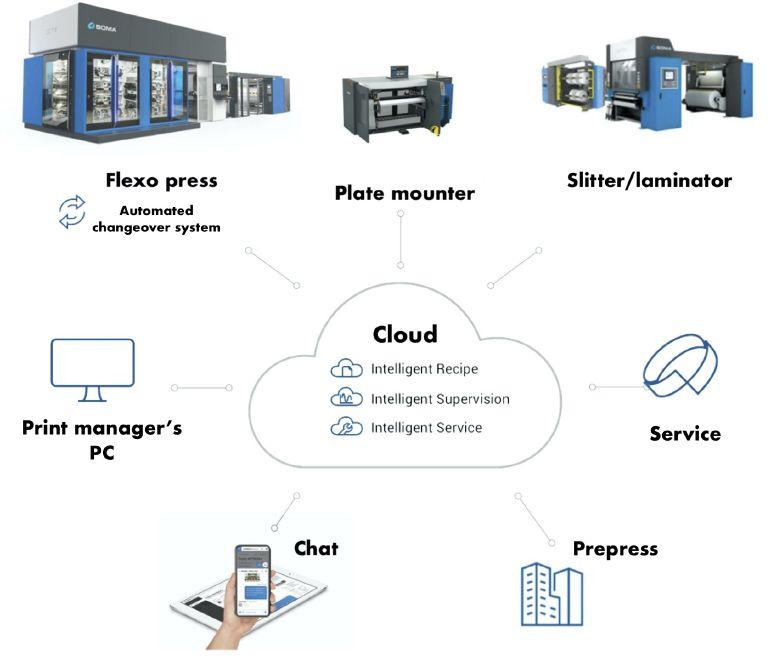
Flexo printing needs to continually meet the challenges of efficient changeovers while under the operation of a novice workforce. The latest intelligent automation technologies in flexo presses and mounters can do just that by using Industry 4.0 automation practices to ensure predictable and repeatable results. Some press companies have created what we like to call a ‘recipe’—a way to define the unique print characteristics of each job. The typical recipe contains all relevant job data, including de-
sign specifications; substrate, sleeve, anilox, and ink data; and unwinding/rewinding, drying and tension parameters, among others.
With a pre-defined recipe, operator errors are reduced because the parameters aren’t retyped. That recipe ultimately provides the foundation for efficient job changeovers on a plate mounter and flexo press.
The press operator works with pre-stored information so that working with a recipe takes a matter of minutes.
What are some of the things you can do with a recipe?
It makes the plate mounter set-up process easier and faster because the operator doesn’t have to enter any data. It’s already there.
The changeover process on the press can be operated more effectively.
They may provide additional functions such as calculating ink consumption. In fact, they can help import ink data for special brand color matching procedures.
Assuring that equipment can be connected and accurately define the process, anyone with permission can create, use and edit recipes—and they can be shared between machines.
Sophisticated flexo presses have found a way to use the Cloud to share recipe data between those involved with each job—both people and equipment.
It’s the glue that ties and streamlines everything together. From anywhere—even a flexo press control panel—job parameters can be edited, press performance can be displayed, and operators can ask for service assistance.
The Cloud may offer a quick problem-solving communications
channel for a printer. In case of an emergency, many presses can immediately connect to the press manufacturer’s service team, who often can identify a problem remotely.
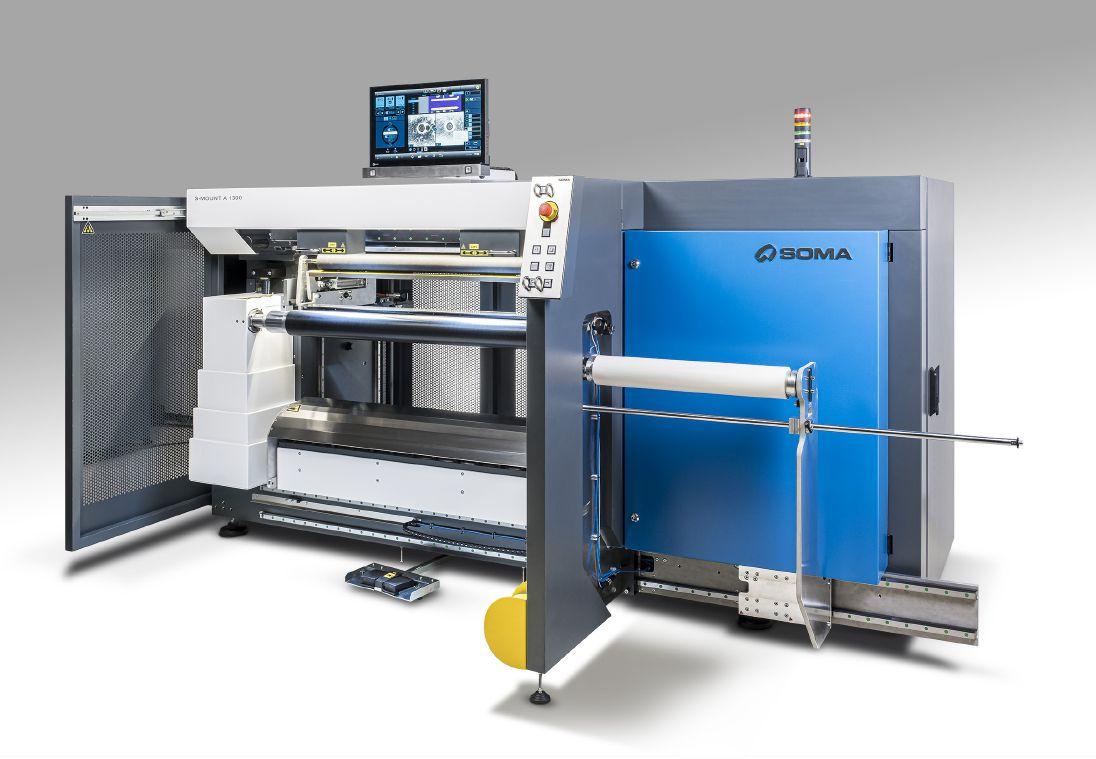
Even plate mounting can play a vital Industry 4.0 part upstream from the press, assuring flexo printing success. Automated mounting delivers exceptional precision and eliminates human errors. Operating automated mounters is simple and intuitive, and they are very productive. Automated systems can offer intelligent offline registration and impression settings—a powerful solution for short runs. During the process of mounting a flexo plate, essential data for registration and topography/impression settings are
stored in RFID chips in a slightly modified sleeve. When the sleeve is inserted into the flexo press, this data is read and prepared for fully automatic operation, assuring very quick—and accurate—settings. There is no longer a burden on the press operator to tell the press where to set register and impression. It helps to assure that every job is automatically in perfect registration.
This reduces makeready time and faster completion of jobs—along with almost zero set-up waste.The best jobs for automatic mounting are short runs, those requiring tight registration, and those that utilize expanded gamut printing. There is virtually no press downtime, so overall press efficiency increases.
This brings us to unskilled press operation. Any job changeover requires a number of steps that need to be taken in proper order. With an automated selfdirected system, even inexperienced operators may run the press and perform efficient changeovers. Each step is done properly, and in the correct order.
An automated changeover system takes advantage of the entire intelligent automation ecosystem. By connecting to the Cloud, the flexographic press operator can take advantage of the speedy transfer of the recipe—and all the information required to set a flexo press correctly.
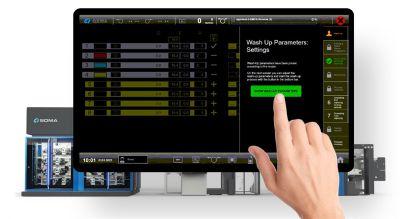
The flexo press user interface guides the press operator through all the steps involved from one job to the next.
The user interface provides text instructions, which describe what an operator should do next. In doing so, it reduces the number of tasks or may shorten required tasks, defines their optimal order, and automates as many steps as possible.
The system analyzes differences between the job just printed and the job that follows. It also advises what steps go first and last, because they don’t always work in the same order, in the same way, for each job.
For example, inking is not only about which printing decks need to be washed. The system also suggests the proper number of cycles, and how intensively you should wash them. It can help determine, job by job, the most efficient way to conserve ink.
It is very intuitive—for example, providing tension or drying temperature settings based on the chosen substrate.
If the system can do certain things by itself— for example, if it should open up a unit so a sleeve can be changed—it does so automatically, and reports that the task has been done. It also lets experienced operators overrule any suggestion at any time. The changeover process will continue, making adjustments based on the operator’s input.
After the job, post-production feedback can automatically report efficiency and energy consumption data.
Flexo must respond even quicker against digital. With an increasing shortage of skilled operators, fast, efficient makeready processes like intelligent automation make the press more competitive.
And, with a standardized, tutorial operating process, the same technology makes changeovers easier for gravure printers considering flexo.
A well-integrated system connecting devices and offering an automated, standardized tutorial process can minimize the need for expert human intervention.
These leaner Industry 4.0 processes can utilize less energy, less material—particularly helpful now—and reduced labor with a seamless experience.