VICE PRESIDENT Tim Dimopoulos • tdimopoulos@annexbizmedia.com
COO
Ted Markle • tmarkle@annexweb.com
PRESIDENT & CEO Mike Fredericks
ANNEX BUSINESS MEDIA
80 Valleybrook Drive, North York, ON, M3B 2S9; Tel: (416) 510-5198; Fax (416) 510-5140.
Canadian Packaging, established 1947, is published 10 times per year except for occasional combined, expanded or premium issues, which count as two subscription issues.
PRINTED IN CANADA
ISSN 008-4654 (PRINT), ISSN 1929-6592 (ONLINE)
PUBLICATIONS MAIL AGREEMENT NO. 40065710
CIRCULATION
e-mail: rthava@annexbizmedia.com
Tel: (416) 442-5600 ext 3555
Fax: (416) 510-5170
Mail: 80 Valleybrook Drive, Toronto, ON M3B 2S9
SUBSCRIPTION PRICE PER YEAR (INCLUDING ANNUAL BUYERS’ GUIDE): Canada $74.50 per year, USA $130.95 US per year, Outside Canada $149.00 US per year, Single Copy Canada $10.00, Outside Canada $27.10. From time to time Canadian Packaging will mail information on behalf of
service reported or advertised in this issue. Canadian Packaging receives unsolicited materials, (including letters to the editor, press releases, promotional items and images) from time to time. Canadian Packaging, its affiliates and assignees may use, reproduce, publish, republish, distribute, store and archive such unsolicited submissions in whole or in part in any form or medium whatsoever, without compensation of any sort.
We acknowledge the [financial] support of the Government of Canada
THE TIMES ... THEY ARE CHANGING
Now that there is an online app for just about anything you once had to search, find and confirm yourself, it seems inevitable that soon there will also be a robot to do a multitude of mundane manual tasks that many of us still do on daily basis without giving it much thought—both at home and at work. The big question is, How soon?
Although industrial robots have been around for decades, it is only recently that their potentially enormous impact on the global workforce has captured widespread public imagination and the attention of leading business, government and social leaders acknowledging their irreversible mass appeal and ubiquity in the modern workplace.
Whereas industrial robots were once neatly confined to carrying out the big Three D tasks identified as being dirty, dangerous or dull, the quantum leaps in digital and AI (artificial intelligence) software technologies over the last decade—along with spectacular breakthroughs in robotic design, intelligence and pricing—could spell doom for mind-boggling numbers of people employed not only in manufacturing, but also in a multitude of service industries spanning from retail clerks to bus derivers and bartenders.
With less work to go around for the growing population, the socioeconomic implications of such accelerated workplace automation can be a cause of severe anxiety for the fast-growing millennial generation still looking to establish its own definitive identity in the new world economic order.
Which is exactly what disruptive technologies do and have always done—ever since the original Industrial Revolution, in fact. But for all the social havoc and disruption caused in the past, the end result had inevitibbly manifested itself in more productive and prosperous societies, at least in the industrialized nations.
So why should it be any different this time around?
COVER STORY
DEPARTMENTS & COLUMNS
It’s easy to succumb to hysterics when looking at the numbers in isolation: they are grimly discouraging.
Only a year ago, the World Economic Forum (WEF) predicted the loss of five million jobs across 15 industrialized economies by 2020, linking it directly to the ongoing developments in genetics, artificial intelligence, robotics and other new-generation technologies.
According to WEF’s widely-cited The Future of Jobs report, “Developments in previously disjoined fields such as artificial intelligence and machine learning, robotics, nanotechnology, 3D printing, and genetics and biotechnology are building and amplifying one another.”
All this multidisciplinary convergence will usher in nothing less than the Fourth Industrial Revolution, the report contends, predicting a golden age for advanced robotics and autonomous transport, artificial intelligence, machine learning, advanced materials, biotechnology and genomics between 2018 and 2020.
That’s in less than in a year’s time for the first shock waves to ripple, which is hardly enough time for the sort of an epic and universal skill retraining initiative that would have be implemented to offset the expected decline in millions of white-collar office jobs that will bear the brunt of the future labor displacement.
“Across nearly all industries,” the report states, “the impact of technological and other changes is shortening the shelf-life of employees’ existing skillset.”
As with all game-changing pronouncements, there will be optimists hailing the liberation of blue- and grey-collar proletariat from routine mind-numbing tasks better left to robots, along with naysayers lamenting massive job displacement and the social friction it will cause.
Whatever side of the fence you find yourself on, dear reader, just keep in mind that this column you have just read was not written by a robot, yet.
George Guidoni
FEATURES
brand-owners.
By Andrew Joseph Ambitious Quebec producer of gourmet-quality sausages leaves nothing to chance in pursuit of optimal food safety.
OF
By Andrew Joseph Thriving fresh chicken processor beefs up production capacity with automatic stretchfilm wrapping machinery.
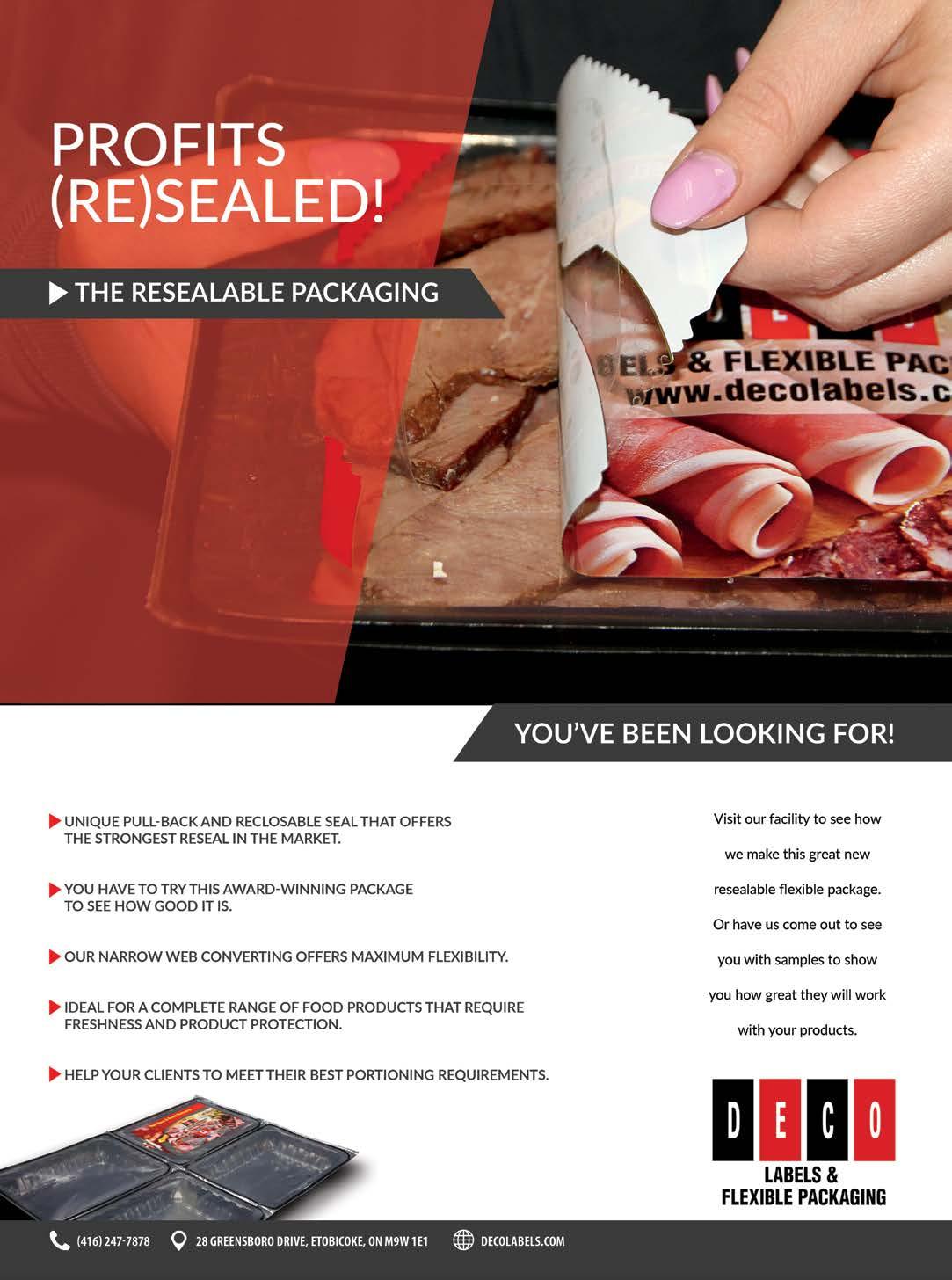
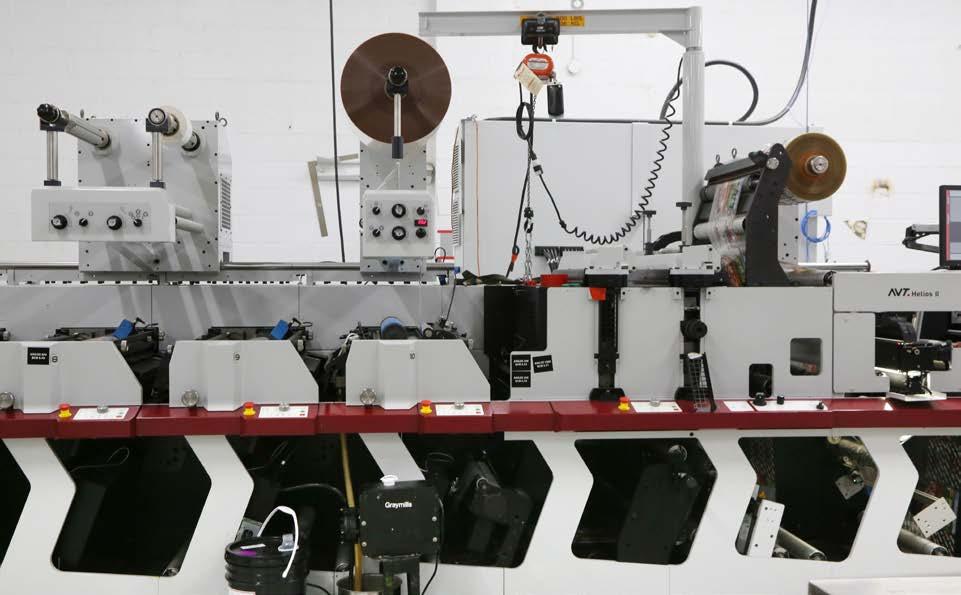
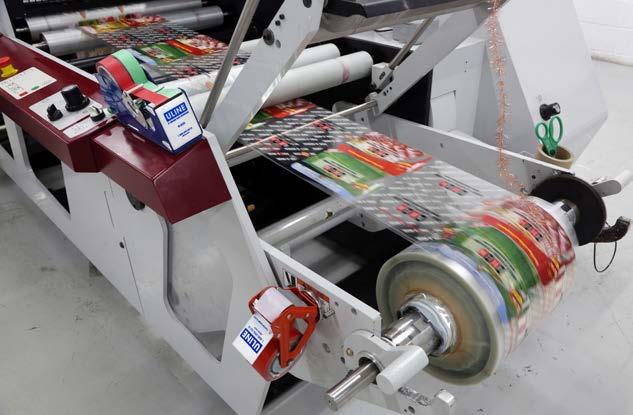
Toronto labeling stalwart invests in new narrow-web press technology to expand into flexible packaging. 41
Plastic processing systems manufacturer using advanced industrial control tech for enhanced machine performance. 48
Reaping the sweet rewards of packaging automation.
PRE-SHOW REPORTS
44
Joe
photography by Naomi Hiltz
PAPER PRODUCTS POWERHOUSE USES A DEFT SOFT TOUCH TO LAUNCH NEW CONSUMER TISSUE BRANDS
Leading Canadian paper products group Cascades Inc. has launched a brand new consumer line of high-quality tissue paper designed to fit the needs of today’s eco-sensitive consumers.
Consisting of three varieties of toilet paper and two varieties of paper towels, the new Cascades Fluff and Cascades Tuff tissues are expected to gradually replace all older Cascades-made tissue brands currently in the market, according to the Kingsey Falls, Que.headquartered company.
“We are proud to be launching a line of toilet paper and paper towels that is among the softest and strongest on the market,” says Cascades president and chief executive officer Mario Plourde, “while maintaining all of the green properties our products are famous for.
“This will give consumers the comfort and performance they’re looking for in a product, while protecting the environment,” he adds.
“We believe that through these new and improved products, Cascades will be chosen by a growing number of families across the country, thereby increasing our market share.”
To make an immediate connection with consumers, Cascades Tissue Group worked with Montrealbased branding service provider Sid Lee to develop the new packaging, complete with two new brandicon bunnies called Fluff and Tuff.
“Cascades’ research-and-development team worked for over two years reviewing each step in the construction process to finally arrive at the superior quality Cascades Fluff and Cascades Tuff products,” relates Jean Jobin, president and chief operating officer of Cascades Tissue Group in Candiac, Que.
“No detail was overlooked in improving families’ experience—from the manufacturing formula of the paper to its embossing and packaging,” Jobin states.
“To mark this important advancement, Cascades
decided to create cute fictional characters that embody the evolution of the Cascades brand,” adds Thierry Trudel, vice-president of marketing and communications at Cascades Tissue Group.
“Fluff is a bunny with a comforting softness that accurately reflects Cascades toilet paper,” Trudel explains, “while Tuff is confident, energetic and full of vigor, which aptly represents the sturdiness of this paper towel.
“Together, they form a dynamic duo—enhancing the lives of today’s families.”
Launched at in grocery stores and pharmacies in Québec in late March, the Cascades Fluff and Cascades Tuff brands are currently being rolled out across the country, supported by a multimedia advertising campaign featuring the voice of Gilles Girard, frontwoman of a famous 1960s Québec pop band Les Classels.
HAPPY ANNIVERSARY A BROTHERLY LABOR OF LOVE HEARTY AUTHENTIC COMFORT FOOD COMES IN FROM THE DEEP COLD
For a company founded in the basement of a family home, Toronto-based Gertex Distributing Inc. offers a compelling example of what young focused Canadian entrepreneurial minds can accomplish in 25 years.
Today operating out of a modern 75,000-squarefoot building stocking over 15,000 different SKUs (stock-keeping units) comprising all the traditional packing products such as cushioning supplies, corrugated products, pallet wrap, tapes—along with safety products and office supplies—the company has many reasons to celebrate its 25th anniversary this year.
Started up by a three brothers Brian, Paul and Michael Gertin, Gertex today employs over 20 people, while also operating its own delivery trucks and a logistics department to manage their clients’ inventories and provide JIT (just-in-time) delivery service.
To this day, all three brothers remain actively involved in the daily operations, with Michael and Brian managing a portfolio of Gertex’s key clients and Paul, who is legally blind, managing the in-house operations.
According to the company’s marketing manager Ted Larson, “What makes Gertex different is its motto, ‘Make the solution fit your needs, rather than making your needs fit a stock solution.’
“Gertex’s goal is to make sure the client is always provided with the product that offers the best solution for their needs by taking the time to understand the customers’ requirements and applications before recommending a product,” Larson explains.
“The company’s family values are evident in their business practices,” says Larson, who joined Gertex about two years ago.
“I have spent close to 30 years working with several well-known industrial distributors,” he relates, “and I believe Gertex to be unique amongst all the packaging and industrial distributors out there.
“In fact, I would says that Gertex is the proverbial ‘best-kept secret’ when it comes to distributors in Ontario,” Larson told the Canadian Packaging magazine, describing a recent service performed by Gertex for a leading printer manufacturer experiencing product damage in transit.
“To understand the issue, the Gertex rep asked to see how the printer was being packaged and discovered the product used by the company was not offering adequate protection, resulting in a 40-percent return rate,” Larson recalls.
“After analyzing the problem from start to finish, Gertex provided the client with a custom-designed foam cap which eliminated 100 per cent of the damage,” Larson relates, “while also reducing the labor time involved in applying the protective packaging by 80 per cent.”
Says Larson: “In today’s world, innovation is often associated with technology, but at Gertex it involves capitalizing on something we’re already doing for our clients—eliminating some of the stress often associated with managing supply chain.
“The company’s success over the years has been built on relationship, reputation and a handshake,” Larson concludes.
“The phrase ‘It’s good enough’ isn’t used at Gertex: that’s just not the way we do things.”
Eastern European cuisine’s influence on North American eating habits often tends to get overlooked, but not so with pierogies—tasty triangular dumplings filled with various ground meats, veggies, cheese, fruit and other hearty ingredients to make a healthy appetizer, dessert or main dish.
With such versatility making pierogies very much a mainstream meal solution across Canada, the number of competing branded frozen pierogies sold in this country continues to grow at a healthy rate, as evidenced by last month’s launch of the Peter & Pat’s Pierogies brand at all of the country’s Costco club store locations.
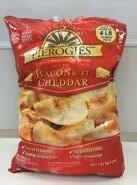
Made from 100-percent all-natural ingredients according to a closely-guarded 60-year-old family recipe, the brand’s new Potato, Bacon and Cheddar Cheese frozen pierogies—stuffed with real mashed potato, real savory bacon, and premium yellow cheddar cheese and seasonings—are packaged in family-sized four-pound bags constructed to provide the contents with at least 12-month shelflife inside the freezer, even after opening.
Already one of the bestselling brands in the U.S. with nearly a dozen flavor variations, the new Peter and Pats Pierogies variety is hand-crafted and co-packed for Costco at a Toronto foodprocessing facility, according to the brand-owner, predominantly using Canadian-sourced ingredients.
Low in fat and cholesterol, the high-protein pierogies contain only 260 calories per four-piece serving, and the versatile frozen product can be boiled, pan-fried, steamed or microwaved in just eight minutes to provide a nutritious and satisfying snack or meal at any time of the day.
From Left: Brothers Paul, Michael and Brian Gertin founded Gertex 25 years ago in their parents’ home garage.
CASCADES INNOVATIVE PACKAGING SOLUTIONS
ANSWERING ALL YOUR PACKAGING NEEDS, FROM YOUR FIELD TO THE MARKET!
Cascades Containerboard Packaging relies on facilities and equipment that are at the cutting edge of technology.
We pride ourselves in making high-quality products that are designed to match our clients’ needs and expectations. Discover more about Cascades by visiting our website.
NEWSPACK
HAPPY ANNIVERSARIES CONVERGE IN NEW PACKAGING ROLLOUTS
With Canada celebrating its 150th anniversary this year, it only seems fitting that the Oland familyowned Moosehead Breweries Limited—the largest Canadian-owned brewery operating in the country nowadays—is happily doing the same.
Even more remarkably, perhaps, the brewer’s long-time packaging supplier Crown Holdings, Inc. just happens to be gearing up to mark its own 125th anniversary this year—naturally taking the opportunity to supply Moosehead with special commemorative cans for its limited-time Anniversary Ale beer launch, made exclusively with 100-percent Canadian ingredients sourced throughout the country.
“Moosehead and the Oland family were the first true craft brewers, long before the craft beer segment we know today,” says Ron Skotleski, director of marketing for North America at CROWN Beverage Packaging in Philadelphia, Pa.
“Moosehead is thankful for long-time partners like Crown for supporting our branding, marketing and sales goals through outstanding packaging, especially in a year of major commemorative rollouts,” says Adam Reid, senior brand manager at Moosehead Breweries in St. John, N.B.
As Reid relates, “The Oland family’s passion for
beer has helped them steer Moosehead through devastating fires, the Prohibition, the Great Depression, two World Wars, obstructive trade barriers, and bruising competition from breweries 100 times its size.”
In addition to selling its beer brands across Canada from the Maritimes to British Columbia, Moosehead also ships its flagship Moosehead Lager brand to approximately 350 distributors in the U.S. “to underscore Moosehead’s mainstay status in the North American beer industry,” according to Reid.
In addition to the Anniversary Ale launch and introduction of new packaging for the Moosehead Lager brand—both using the 16-ounce aluminum cans manufactured at a Crown canmaking plant in Batesville, Miss.—Moosehead is also planning to reintroduce its grapefruit-based Moosehead Radler, with Crown supplying the 12-ounce aluminum cans from another canmaking facility in Lawrence, Ma.
Since its founding as the Crown Cork & Seal Company of Baltimore, Inc., Crown has built a diversified portfolio of metal packaging technologies to support the beverage, food, personal care, household and luxury markets.
Currently operating 146 plants in 36 countries and employing approximately 24,000 people,
Crown is credited with numerous breakthrough packaging innovations, including many specialty closures and easy-open can ends, among others.
“From the beginning, Crown has delivered technologies that enhance the experience consumers have with products through packaging,” says Crown’s president and chief executive officer Timothy Donahue.
“That pioneering mindset and spirit of curiosity still drives us today, and it has also been instrumental in our ability to help our customers build their brands regionally and globally, while setting new standards for convenience, production efficiency and sustainability.”
States Donahue: “We are proud to be celebrating our 125th anniversary milestone and are excited about the growth opportunities for metal packaging.
“Some of our latest efforts are designed to help brands add value to metal packaging through digital functionality and applications,” he sums up, “and we look forward to continuing to deliver innovations that respond to the evolving needs and values of brand-owners and consumers alike.”
FIRST GLANCE
ROBOTIC ASSISTANT
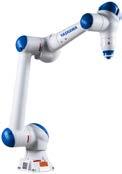
Featuring innovative power and force limiting technology, the new six-axis HC10 robot from Yaskawa Motoman is designed to work safely with, or in close proximity to humans, by automatically stopping in the event of contact with the operator— utilizing dual torque sensors in all joints to constantly monitor force to react quickly to contact. Offering 10-kg payload and maximum reach of 1,200-mm, the configurable HC10 can perform a broad range of material handling, machine tending, packing or light assembly tasks. Designed to eliminate operator pinch points, the robot’s through-arm utilities hide cabling and increase safety by reducing the risks of snagging or interference with other equipment, and the company’s Easy Teach software enables users to hand-guide
ing new program paths to facilitate quick deployment or redeployment.
Yaskawa Motoman
PURE INTENTIONS
Narrow-web ink specialist Pulse
Roll Label Products Ltd has announced the global launch of its PureTone
Food Packaging Compliant (FPC) UV flexo ink system, which is complemented by a new range of other FPC UV flexo products formulated specifically for the food label market. Developed for non-direct food contact labeling and packaging applications, the company’s new food packaging compliant ink range builds on the runaway success of its PureTone ink system to provide a total color management solution for narrow-web label printers, brandowners and retailers with superior
We
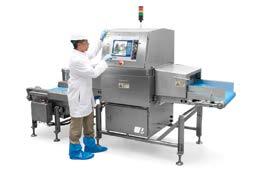
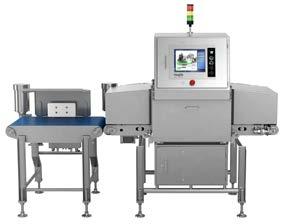
Our technology & support services will quickly help you inspect and reclaim your nished goods
INSPECT YOUR FINISHED GOODS, CASE OR PRIMARY PACKAGE:
• Food & Beverage
• Meat & Poultry
• Cosmetics & Pharmaceutical
• Consumer goods
• Industrial We also sell new equipment and offer lease to own or long
peatability, according to the U.K.-based company. As with the original PureTone ink system, PureTone FPC includes a high-strength process series and a monopigmented mixing base scheme to generate clean, crisp colors for easy and accurate color matching. Suitable for shrink films as well as general label printing, PureTone FPC enables label printers to benefit from the optimized color strength that allows for the use of lower film weights, increased press stability, complete prepress color control through digital ink management, and superior adhesion to a wide range of substrates, including coated papers and films.
WEAR IT ON YOUR SLEEVE
TEST OF INTEGRITY
Designed for high-speed container closure integrity testing, the new KLV series inspection systems from Bosch Packaging Technology employ a unique vacuum process and group testing methods to inspect between 250 and 600 glass containers per minute, according to the company. Capable of measuring leaks equivalent to hole sizes of less than five micrometers, the KLV 1360 model—developed specifically for inspecting glass vials used in the pharmaceutical industry—uses special inspection chambers, where the containers can be tested either individually or in groups, with the ability to inspect up to three containers simultaneously in one chamber. Said to be the first machine of its kind where the integrated robotic system not only feeds the containers that require inspection into the process, but adds reference samples for internal process control, the KLV system uses a slightly slanted transport system makes it possible to remove the containers from the inspection chamber sideways—eliminating the risk of leaks occurring due to tight closure gripping from above. The KLV 1360 also employs a star-wheel system ensures gentle transportation through the inspection process with minimal wear and tear, while its modular construction facilitates seamless integration into existing production lines.
Bosch Packaging Technology
FILL IN THE BLANKS
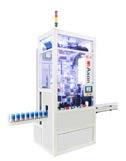
Designed for higherspeed applications requiring frequent changeovers and high throughput, the new model SLX 600 shrinksleeve applicator from Axon provides fast and precise sleeve application, with PLC (programmable logic controller)-monitored, trouble-free changeover on production lines operating at up to 600 units per minute, according to the Pro Mach company. Designed with the operator in mind, the SLX 600 features a simplified film path that facilitates film loading and high-speed sleeving operations, whereby its dual-servo timing screw precisely controls both the product position and sleeve application during the production cycle. The speed of the SLX 600 machine is fully automated and calibrated to the selected line rate, according to Axon, allowing the applicator to automatically speed up or slow down as needed. During changeovers, all the key mechanical adjustments are electronically monitored by rotary encoders and precision lasers, which allows the operator to simply select associated production specific recipe via the main HMI (human-machine interface) terminal. All the stored adjustment values can also display on the machine’s secondary HMI terminal, showing both current and targeted positions. When the target position matches the stored position, the associated fields change color from red to green on the display screen and, once all fields are green, the machine’s monitoring system unlocks and allows the machine to start. During operation, the SLX 600 shrinksleeve applicator continuously monitors this data to ensure it stays in correct adjustment throughout the production run, according to the company.
Axon (Division of Pro Mach, Inc.)
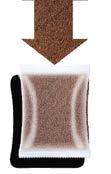
Developed to fill the needs of contract packagers and manufacturers requiring a single machine that works with a wide range of pouches and containers, the new PS1 Packserter desiccant inserting machine from Deitz Company may be easily adjusted to match different conveyor speeds, packet feed roll speeds, packet material thicknesses, container heights and diameters, and other criteria for fully-automatic insertion of desiccants, oxygen absorbers and other pouches into bottles. Well-suited for filling and packaging foods, supplements, pharmaceuticals, nutraceuticals and other moisture-sensitive products, the PS1 Packserter separates the desiccant pouches into individual packets from continuous strips and inserts them into bottles at speeds up to 100 pouches per minute. Boasting advanced sensing technology for unattended operation, the PS1 Packserter automatically raises an alert and stops the machine when the pouch supply is ready for refilling,
Pulse Roll Label Products Ltd
FIRST GLANCE
if a container hasn’t appeared under the discharge tube, or if a blockage prevents filling.
Deitz Company
THE INCREDIBLE BULK
The new fillpac R filling machine from the BEUMER Group is designed for filling bulk building materials and industrial powder products into high-strength bags in an efficient and gentle way at robust throughput rates. Capable of handling everything from fine powders to coarse granular products, the fillpac R filler can work with a broad range of bag types—including valve bottom bags and flat valve bags—using a highly efficient from-fillseal system to form bags from pre-fabricated tubular PE film and fill them with the specified product quantity, which is immediately verified with an inline weighing unit.
BEUMER Group
STICKY FINGERS
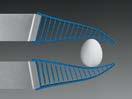
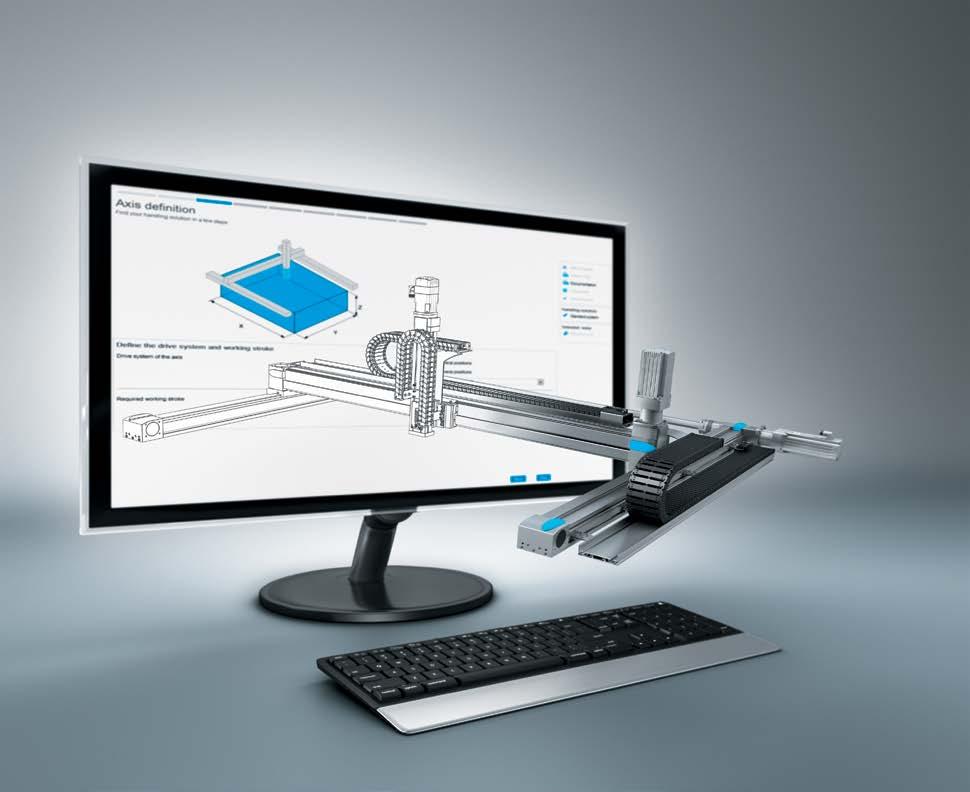
Designed to provide enhanced flexibility to a broad range of automated small-piece handling functions, the new DHAS adaptive gripper fingers from Festo Inc. offer a cost-effective, soft-touch solution for delicate, soft-touch handling of odd or variable shapes or delicate objects in a broad range of automated pick-andplace applications. With their elements combine the principles of positive and friction-based gripping, while simultaneously providing a large contact area for contoured surfaces, the bluecolored FDA-approved polyurethane fingers adapt to the work piece contour with safe, tweezer-like gripping motion that mimics the so-called Fin Ray Effect based on the physiology of fish tails, according to Festo. Available in three standard sizes of 60-mm, 80mm and 120-mm, these bionics-based grippers can be effectively used to insert work pieces into narrow containers or tight spaces; to grip and transport parts with irregular shapes and different diameters; and to ensure provide soft, nondestructive gripping and low-vibration transport of fragile parts. With their flexible but firm bond, there is no need to change the gripper for different sizes or shapes of the work pieces, according to Festo. In addition, a pair of DHAS grippers can also be easily adapted for use as end-of-arm-tooling on collaborative robots, where they can turn, insert, lift and move various objects as instructed across a broad range of industrial or service applications. Festo Inc.
MOVING RIGHT ALONG
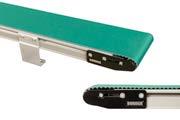
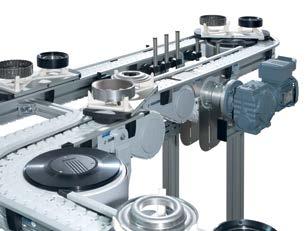
The newly-redesigned 2200 Series Precision Move Conveyors from Dorner Mfg. Corporation are engineered to ensure accurate movement of product at specific times, distances and intervals in the manufacturing and packaging of small- to medium-sized parts—providing greater product control and accuracy to automated applications such as machine integration, robotic pick-and-place, precision indexing, accurate part positioning, timed conveying, vision in -
spection and part handling. Capable of supporting loads of up to 200 pounds and offering belt speeds of up to 370 feet per minute, the redesigned 2200 Series Precision Move Conveyors provide an array of value-added features that includes: reverse V-Guide belt tracking along the entire length of the conveyor to provide seamless belt performance without the need for side guides; expanded conveyor sizes that now include a small, one-inch-wide conveyor option with tip-up tail for easy belt removal; additional servomotor support with selectable motor manufacture and model numbers; and additional gear ratios for enhanced performance.
Dorner Mfg. Corporation
BETTER TRAY PACKAGING
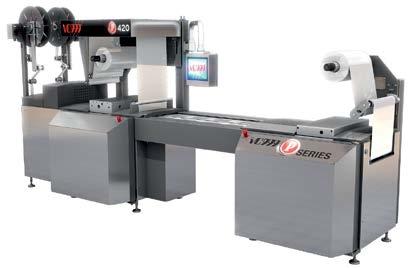
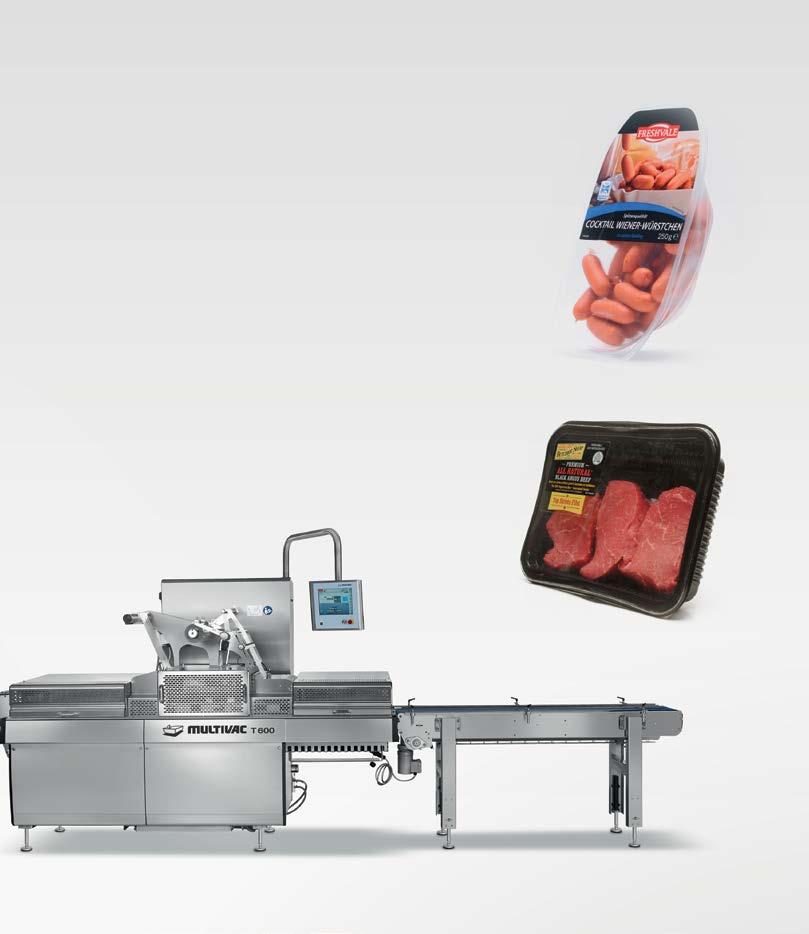
The T 600 traysealer features flexibility and highperformance. With its quick easy changeover, simple operation and MULTIVAC Hygienic Design™, simply opt for the better solution.
GREEN LABELS 101: DECODING ALL THE GREENWASH
From “natural” tea to “green” cleaning supplies to “eco-friendly” clothing, there are endless products being marketed with claims that attempt to convince consumers that they are making the right decision for the planet when shopping.
“Canadians are concerned about the state of our environment and worker conditions, and are opting for more sustainable, conscientious products and services,” says Laurie Simmonds, president and chief executive officer of Green Living Enterprises in Toronto.
“With companies using various ‘green’ claims and labels now more than ever, it can be difficult to distinguish between what looks and sounds ethical and sustainable, and what actually is,” says Simmonds.
As founder of a company that owns the popular annual Green Living Show held earlier this month the Metro Toronto Convention Centre—Simmonds says Canadian consumers owe it to themselves to recognize which of the socalled eco -labels displayed on consumer packaging are credible and based on merit.
“Product certifications alleviate this challenge for consumers, as any certified product has undergone a rigorous third party evaluation examining everything from environmental impact, ingredient procurement, worker conditions and compensation, to name few,” she says.
According to Simmonds, some of the less well-known but highly authoritative eco-labels out in the marketplace include:
• Fairtrade. Despite seeming obvious, Fairtrade is often a confusing term to many consumers, Simmonds points out. In a nutshell, the Fairtrade mark means the ingredients in a product have been produced by small-scale farmer organizations or plantations that meet social, economic and environmental standards.
• B Certified. Launched in 2006, B Certified is intended as the business conduct equivalent of Fairtrade to fruit or coffee, according to Simmonds. To obtain B Certified validation, companies meet the highest standards of verified social and environmental performance, public transparency and legal accountability. To date, there are 2,048 companies worldwide, in over 50 countries, to have achieved the B Certified status.
• Canada Organic. With eating of organic foods closely linked to a healthier and more sustainable lifestyle, the Canada Organic label and certification is one of the most recognized organic certifications in the world, according to Simmonds.
• Ocean Wise. With overfishing being the biggest threat our oceans face today, consumers who choose to eat seafood can make a difference by choosing fish that is responsibly sourced or by visiting restaurants sporting the Ocean Wise symbol—an assurance against overfishing, harm to other aquatic creatures, and protection of the marine ecosystem.
• Leaping Bunny. Used for personal-care products and cosmetics the Leaping Bunny certification from the Coalition for Consumer Information on Cosmetics denotes companies who made a voluntary pledge to eliminate animal testing from all stages of product development.
Says Simmonds: “We are all trying to make better choices for our health and well-being that will help build a better world, with a healthy environment and strong communities.
“Learning about these various labels is a great step in that direction.”
ASEPTIC MILK CARTONS POINT OUT THE MILKY WAY FORWARD
A product as pure and natural as milk should not have to apologize for any alleged environmental wrongdoings, and using the new one-liter combibloc EcoPlus aseptic milk cartons is certainly helping French-owned multinational retail group Carrefour to cast itself in a much greener light in the Spanish market.
Last month, Carrefour commenced selling its top three private label UHT (ultra-high temperature) milk products—including full-cream, semi-skimmed and low-fat milk—in elegant brick-shaped cartons claimed to reduce the GHG (greenhouse gas) emissions by 28 per cent, compared to conventional paperboard cartons.
“Thinking sustainably and, even more importantly, acting sustainably is a fundamental part of our corporate
principles,” explains Carrefour’s director of product optimization Xavier Appy.
“We have created a number of initiatives for the purpose of putting responsible, sustainable consumption within easy reach of consumers,” says Appy, noting the company has redesigned more than 350 products last year alone to eliminate unnecessary packaging; reduce the use of raw materials; optimize packaging sizes and logistics; and increase use of recycled and recyclable materials.
“In this context, using the new combibloc EcoPlus carton pack is a good example of our mindset,” he says.
According to Appy, the 28-percent carbon-footprint reduction claim has been verified in an independent, ISO -compliant LCA (life-cycle assessment) studyt
COMPOSTABLE FILM
An infinitely renewable and healthy product inside fully-biodegradable packaging may sound too good to be true, but that’s exactly what family-owned German confectioneries producer Mimi’s Garden has cooked up with its new range of organic energy treats made from sun-ripened dates.
Packaged in the compostable, biodegradable, cellulose-based chose NatureFlex film made from FSC (Forest Stewardship Council) -certified wood chips, the ball-shaped treats—available in Raspberry & Chia, Mango & Coco and Cacao & Hemp Seeds with Reishi flavor varieties—are nutrient-filled, vitamin-
based on the entire life-cycle of the carton—from the production of raw materials right up to the final manufactured carton pack.
“We’re confident that in terms of the environment, our environmental performance and also the consumer, we’ve made the right decision,” Appy states.
According to the German-based carton manufacturer SIG Combibloc, most of the carbon-footprint savings in the combibloc EcoPlus can be traced to a refined construction comprising more than 80-percent FSC (Forest Stewardship Council) -certified paperboard.
The fully-renewable bulk stucture of the carton incorporates a razor-thin polyamide layer acting as a barrier to protect the product from flavor loss and external odors, anlong with several ultra-fine inner and polyethylene layers to form a liquid barrier for the product and to keep moisture out.
“With the launch of UHT milk in combibloc EcoPlus, Carrefour is taking a stand for the environment, and leading the way in the Spanish market as a company that acts sustainably and responsibly,” says Ana Ruiz del Arbol, marketing manager at SIG Combibloc Spain
MAKES A NATURAL PERFECT FIT
dense snacks formulated to to provide consumers with an uplifting boost of energy.
“Our aim is to create a sustainable product in every sense of the word,” says Mini’s Garden founder Karolin Trockels, adding she selected the NatureFlex film to package the new products because it complements the company’s ethical values.
Manufactured by Japanese-based plastic films group Futamura, NatureFlex film can safely biodegrade under natural conditions in household
composts within a few weeks with no groundwater contamination, while providing effective barrier protection against mineral oil, aroma and moisture for the packaged products.
“It was important for us to not only select high-quality organic ingredients, but to pack it in an environmental friendly way as well,” Trockels states. “We feel that nowadays, consumers as well as supermarkets pay more attention to these standards when making their purchasing decisions.”
Smart Solutions from Apples to
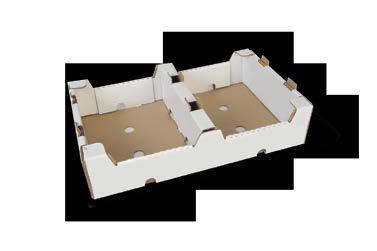
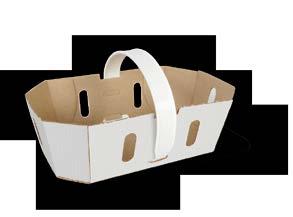
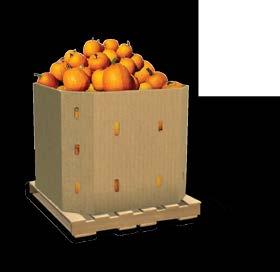
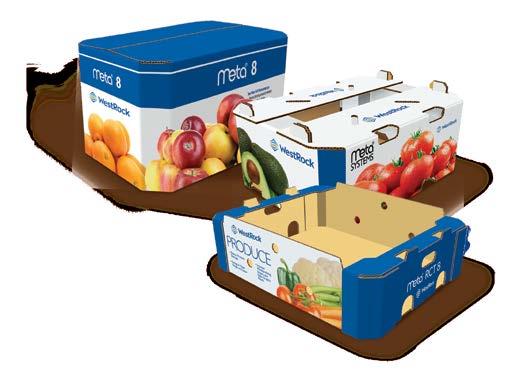
When it comes to produce packaging, corrugated containers are still the cleanest, most versatile and economical shipping solution for your products. They protect your produce as it travels from farm to table, safeguarding it from spoilage and damage. Showcase and promote your products in-store with corrugated solutions from WestRock.
Our corrugated containers:
• facilitate efficiencies throughout the supply chain
• are made from 100% renewable and recyclable materials
• promote superior brand messaging for maximum shelf impact
Whether you’re looking for a produce container, a shipper/display box or other innovative corrugated solutions, we help you manage costs, increase sales with dynamic graphics, mitigate risk, and improve your environmental impact.
Course 1 - May 2, 3, 4
What is SMART PACKAGING?
SMART PACKAGING is an active or intelligent interactive packaging system that delivers benefits and added functionality to the value chain.
What is our GOAL?
To accelerate the development and broad adoption of SMART PACKAGING innovations.
June 8, 2017 - intelliPACK Training Course October 17, 2017 - Get Smart Summit
Club de Golf Atlantide
May 31
Montreal, QC
Cardinal Golf Club
June 13
Newmarket, ON
Redwoods Golf Course
June 19
Langley, BC
Carlisle Golf Club
September 12
Carlise, ON
Mountain Woods Golf Club
September 15
Moncton, NB
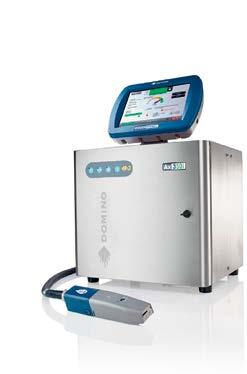
Express Packaging Chooses the Ax-Series Inkjet for a Reason.
Reason.
"It [the Ax350i] saves us money, it runs faster for us and we have clearer print. We've used other suppliers in the past but no one has equalled the production that a Domino printer puts out and the service that Domino technicians back it up with."
- Fred Hartzler, President, Express Packaging
“It [the Ax350i] saves us money, it runs faster for us and we have clearer print. We’ve used other suppliers in the past but no one has equalled the production that a Domino printer puts out and the service that Domino technicians back it up with.”
- Fred Hartzler, President, Express Packaging
To find out more or to book a demo, visit www.ax-series.com
THE RULES
THE BALANCE OF POWDER
Leading dry powdered goods co-packer continues to lead by example with strategic investment in advanced X-Ray product inspection technology
BY ANDREW JOSEPH, FEATURES EDITOR PHOTOS BY NAOMI HILTZ
Life is good at top of the food chain, especially when your company is doing all the right things to remain there.
And getting many things right is just how it’s been for Rex Pak Limited, an east-end Toronto food manufacturing company that is really hitting its full stride these days as Canada’s largest independent co-packer of dry powder goods, including a multitude of foodstuffs commonly found across a large sway of Canadian households.
“There is a 60-percent chance that if you open up your cupboards you are going to find a nationallybranded product in there that was actually made by us,” says Rex Pak vice-president of operations Denise Sabatini Fuina.
While citing strict client confidentiality for reluctance to reveal names, a recent visit by Canadian Packaging to the busy 100,000-square-foot, peanut-free production facility uncovered a highly diverse range of technical capabilities and skillful manufacturing competencies for manufacturing and packaging a wide variety of dry powder foodstuffs and other dry-mix products.
“Suffice to say that Rex Pak essentially produces everything from rice and pasta to cheeses and soup mixes, as well as sugar and sugar-substitute sachets,” Sabatini Fuina relates.
“We basically cover any type of food product in a dried powdered form.”
Founded by Louis Sabatini in 1973, the successful copacker’s day-to-day operations are nowadays expertly managed by the founder’s daughter Denise, and the son
high-sensitivity inspection for potential contaminants and foreign objects for all products packaged
providing full data
to meet food safety certification compliance requirements.
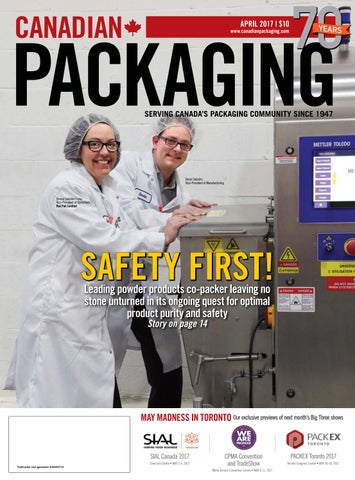
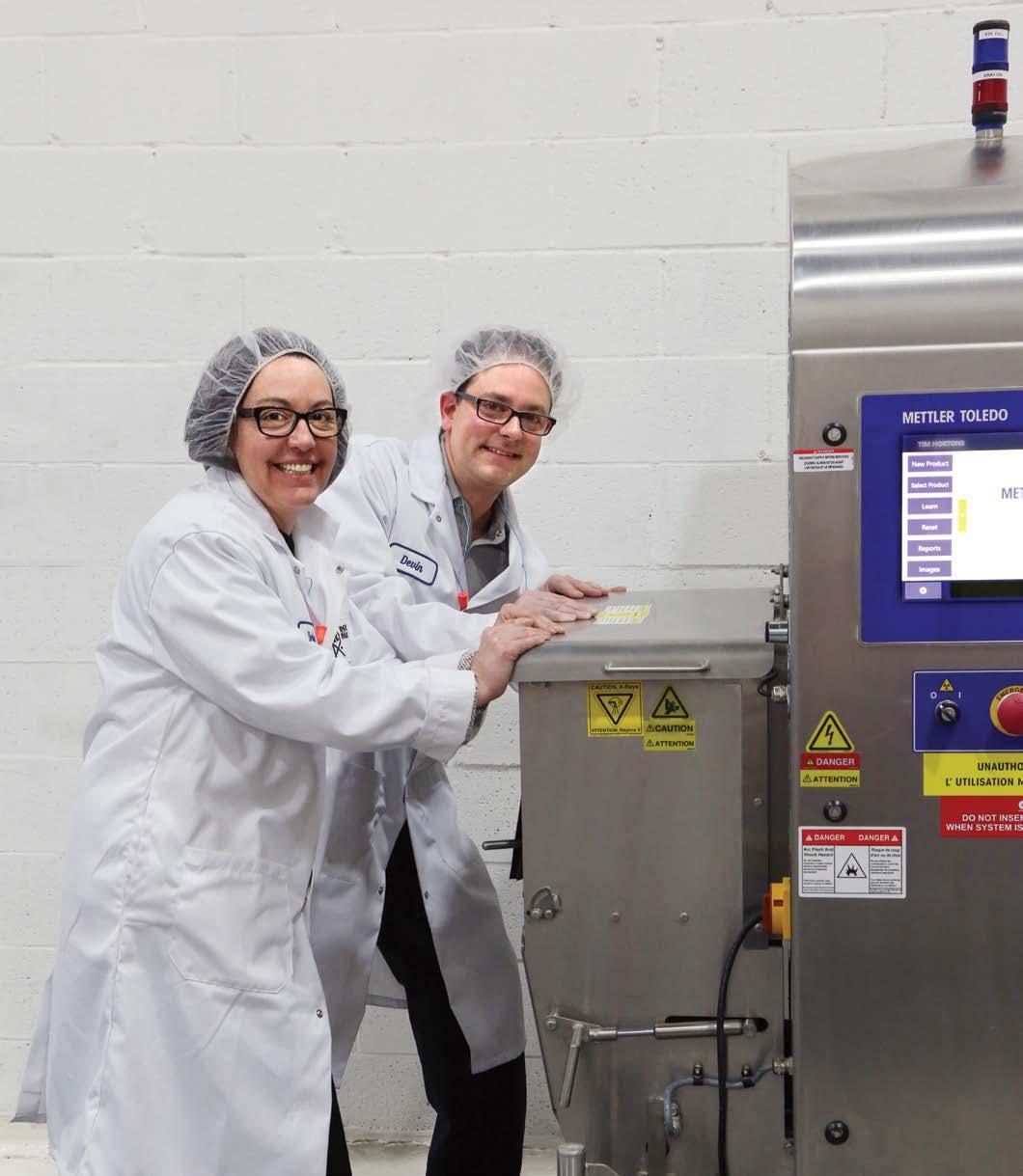
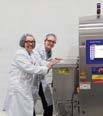
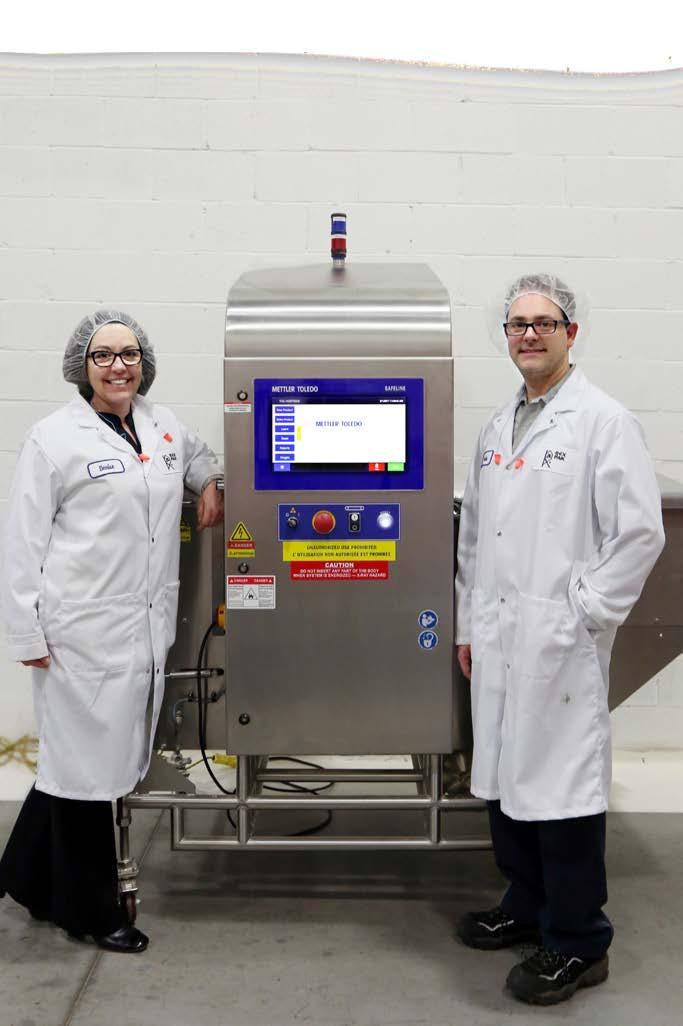
Above: Rex Pak Limited’s vice-president of operations Denise Sabatini Fuina and vice-president of manufacturing Devin Sabatini strike a pose with a Mettler Toledo Safeline PowerChek X-Ray inspection system recently purchased from the Oakville, Ont.-based Shawpak Systems.
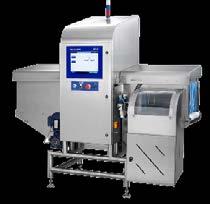
Left: The Mettler Toledo Safeline X33 X-Ray unit provides thorough
at the Rex Pak facility in Toronto, while also
capture
and vice-president of manufacturing Devin Sabatini—both proud torchbearers for their father’s affinity for manufacturing excellence and superior customer service.
“With over 40 years of expertise in the food industry, providing dry food blending and co-packing services, the concept of packaging has become more than a just business venture for us at Rex Pak,” Sabatini Fuina proclaims. “It’s an art form.”
As her brother Devin explains, serving customers in the ever-changing food industry requires a lot of flexibility from its co-packing business partners in order to keep the brand-owners happy and ready to respond quickly to all new trends in a timely manner.
According to Sabatini, the past 10 years have seen a lot of the CPG (consumer packaged good) brand-owners increasing delegation of its manufacturing functions to companies like Rex Pak.
OUTSIDE ASSISTANCE
“Prior to the past 10 years most of the major brand-owners employed their own packaging division at their own plant,” Sabatini relates. “But eventually they began to do away with those divisions after realizing that it was more efficient for them to hire co-packers, like Rex Pak, to deal with the tasks keeping up-to-date on the latest packaging line equipment, packaging for distribution, and so on.
“This allowed the brand-owners to rid themselves of that component, along with all the warehousing issues, as co-packers could now manufacture and package the product and send it complete to the customers’ DC (distribution center) for them,” he says, adding brand-owners can save themselves significant costs, time and effort by outsourcing these functions to contract packagers like Rex Pak.
“Rex Pak, like all co-packers, is in the business of removing a level of burden from the brand-owner, assuming it for ourselves.
“This development has allowed Rex Pak, already an established name in the Canadian co-packing industry, to become a market leader in the dry powder segment—allowing us to grow our business by leaps and bounds over the past few years,” he states.
Adds his sister: “Although we do not create recipes for customers, we do adhere to them in totality, as we want to continue to be a large part of our customer’s successes with the consumer public.
“In terms of our direct competitors, we maintain our competitive advantage in the market because of our superior short-run capabilities,” says Sabatini Fuina. “Simply put, we have the unique advantage of being able to perform quick changeovers.
“It means we can easily handle short production runs, as well as long production runs, without it creating bottlenecks in our production area,” she says.
“Ultimately it means more business opportunities for us.”
Sabatini Fuina cites the company’s vast experience and expertise in high-quality custom blending of powdered and dry bulk products to the exacting standards of its many national brand-owning customers as a key core competency.
One of 30 production lines housed at the Rex Pak facility, where the product is filled and sealed inside flexible stand-up pouches, which are then swiftly conveyed past a Mettler Toledo Hi-Speed Micromate model checkweigher to verify accurate product weight.
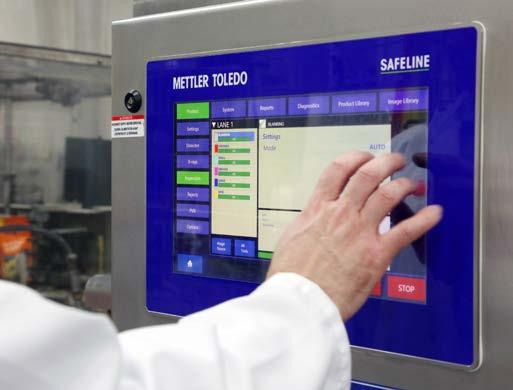
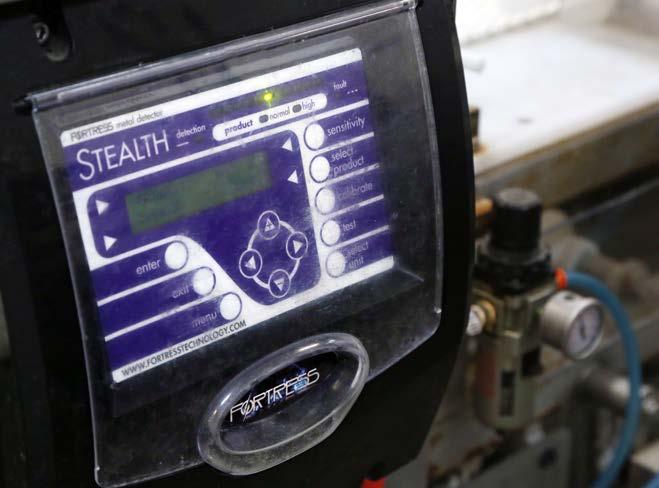
A close-up view of the easy-to-use Mettler Toledo Safeline X-Ray inspection system’s HMI (human machine interface) touchscreen terminal, designed to facilitate optimal product quality in demanding sanitary production environments.
Doing all its own blending on-site since opening its doors, the Rex Pak plant now houses three operational blending rooms, along with a separate weighing room to ensure exact measurements for all products in safe sanitary environments.
“Our blending rooms are both humidity- and climate-controlled,” says Sabatini Fuina, “and they are all equipped with state-of-the-art extensive dust filtration systems.
“Our blending stations have helped us create capacity and flexibility to handle the largest of customer orders all the way down to the unique, smaller customers,” she says, citing a broad range of co-packing service Rex Pak offers its customers, including:
• Straight Tolling—processing of raw materials for the customer and packaging;
• Blending—the mixing of ingredients as specified by customer recipes;
• Partial and complete turnkey options for blending, processing and packaging, and the purchasing of raw materials.
To service its large customer base, Rex Pak operates 30 highly-automated packaging lines, as well as a computerized quality-control and warehouse division, to achieve consistently quick turnarounds for all the production runs.
“A lot of our equipment is placed on wheels—allowing us to move equipment in and out of a production line,” notes Sabatini.
“This gives the mobility and flexibility we need to switch from big-pouch to small-pouch production in no time.”
The typical Rex Pak production line consists of a vertical or horizontal flexible pouch packaging option. With the market demand for flexible packaging continuing to soar, according to Sabatini, that plant’s
production lines are designed accordingly to meet that demand with a powerful arsenal of high-performance packaging equipment that includes:
• Horizontal form-fill-seal (HFFS) machines for processing dry-fill products such as hot chocolate powders, drink crystals, jelly powders and pudding mixes;
• Vertical form-fill-seal machines for production of various-sized pillow packs for such items as cakes and cookie mixes, confectionaries, snack-foods, and various items for the so-called Club Store packs;
• High-speed funnel-fill equipment for mediumand long-run packaging of dry food products such as seasoned rice, pasta and sauces inside resealable stand-up pouches;
• Various cartoners, including vertical volumetric cartoners for loose-fill products like macaroni and cheese and seasoned rice; intermittent-motion cartoners integrated with packing machines that automatically place pouches into a timed infeed conveyor buckets; and a manual load-style flexible cartoner that permits manually loading of a widerange of carton sizes;
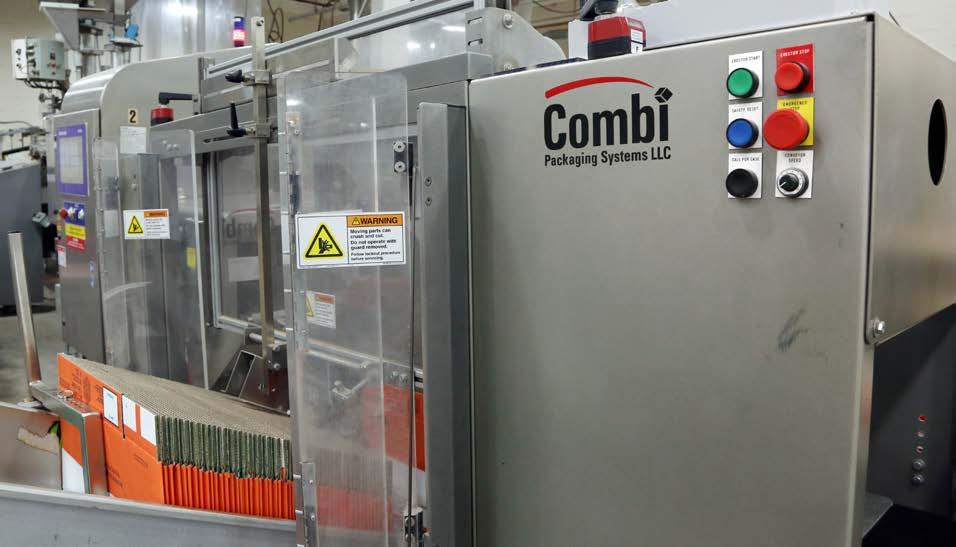
A fully-automatic Combi Packaging Systems cartoner, supplied to Rex Pak by Best Packaging of Milton, Ont., unfolding the corrugated box flats pre-loaded inside its magazine to keep the case-packing operation running at optimal operational efficiency with minimal downtime.
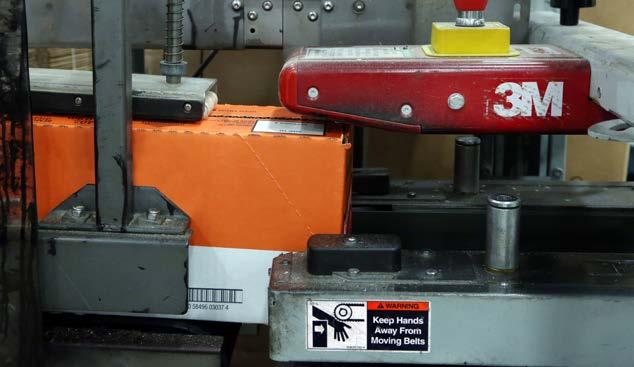
All the filled cases of product are reliably tape sealed by the rugged 3M carton sealing unit, also supplied by Best Packaging, to ensure optimal product protection for the contents of the box during transit and distribution.
• A broad selection of specialty equipment employed to add reclosable zippers to the top of a pouch; a vertical pasta machine for filling pouches, with the capability to create two individual pouches in one to combine different product ingredients and/or seasonings; a vertical cup line that uses scales, an auger and/or a slide-gate to fill a cup with two different products at the same time, such as cereals, candies or noodles; a steamer machine to fill packages of coffee, custards, gelatines and oats.
“Ensuring one’s usefulness to the customer is a full-time job in itself for Rex Pak,” says Sabatini.
“This is why we provide such a wide range of options,” says Sabatini, stressing the company’s Number One priority of meeting all the customer specifications and ensuring that customer and consumers receive the safest, highest-quality finished product possible.
“Our highly-skilled QA (quality assurance) team performs rigorous tests on all in-house blending and finished goods as per our customer’s specifications,” Sabatini relates.
“This includes continuous line monitoring and sampling, air-flow and weight control checks, and multiple sensory, organoleptic and cook-up tests.”
Being flexible to accommodate customer requests is also paramount in the co-packing business, he adds.
“Over the years there have been instances where our customers have made specific requirements to us regarding what they need for food safety assurance and compliance,” Sabatini says, noting the plant has recent updated its HACCP (Hazard Analysis and Critical Control Points) and the vaunted SQF (Safe Quality Food Institute) Level 2 certifications.
Boasting the highest possible licence granted by Agriculture Canada, the Rex Pak plant is also a federally-inspected meat and dairy processing facility, which is also
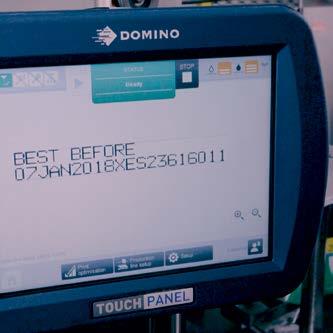
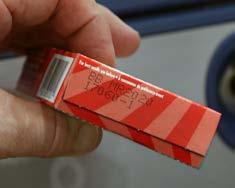
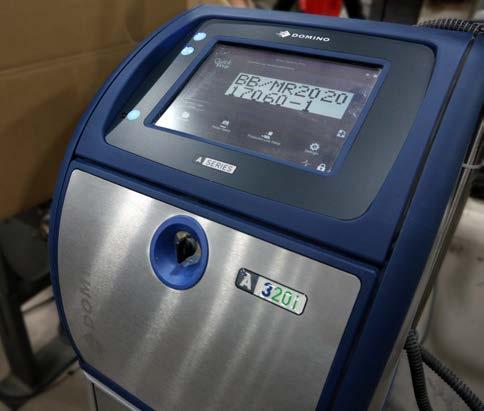
One of several Domino A 320i model continuous inkjet printers used by the Rex Pak plant to apply best-before data and lot-code data onto the product packages of various sizes product at high throughput speeds, generating clear and highly legible codes, text and other variable product information to ensure optimal product traceability.
subject to periodic USFDA (U.S. Food and Drug Administration) agency inspections.
Sabatini adds that Rex Pak also has an authorized government inspector on-site, along with a qualified trainer to coach and update plant employees on its HACCP program, which is continuously modified to ensure it remains at the highest level possible.
“And while we are a very obliging company for our customers,” he says, “We also want to ensure that the certifications we are asked to achieve are in both our best interests, as well as to those of the consumer public.”
Sabatini makes a point of crediting the company’s dedicated, hardworking staff for enabling it to remain true to its
founding cornerstone values of quality, flexibility, customer satisfaction and efficiency.
“Long ago, our father taught us that the foundation of these four cornerstones is achieved by assembling a great family of employees,” Sabatini recalls.
batini.
“However, we are transitioning away from the Mettler Toledo Micromate and Checkmate models to Mettler Toledo’s new XE controller,” he adds, noting the discontinuation of the analog Checkmate controller components used on the older-generation checkweighers.
Says Shawpak’s vice-president Larry Swift: “This is a major benefit to Rex Pak as they do not have to replace complete systems, as some of these units are highly-integrated with the existing packaging systems.
With quality cited as the first cornerstone, Sabatini says the company places a lot of faith into the many product inspection systems—manufactured by Mettler Toledo Safeline and represented in Canada through Oakville, Ont.-based Shawpak Systems Limited, which have been installed throughout the plant’s 30 production lines, as well as in the QA laboratory.
In addition to using Mettler Toledo’s Titrator Excellence T5 system to conduct a chemical analysis to identify the concentration of ingredients to meet the customers’ specs, the lab also employs other Mettler Toledo laboratory equipment such as the SmartSample Flexibility reader; and the InMotion Flex Autosampler analysis machine; and a model P25 printer.
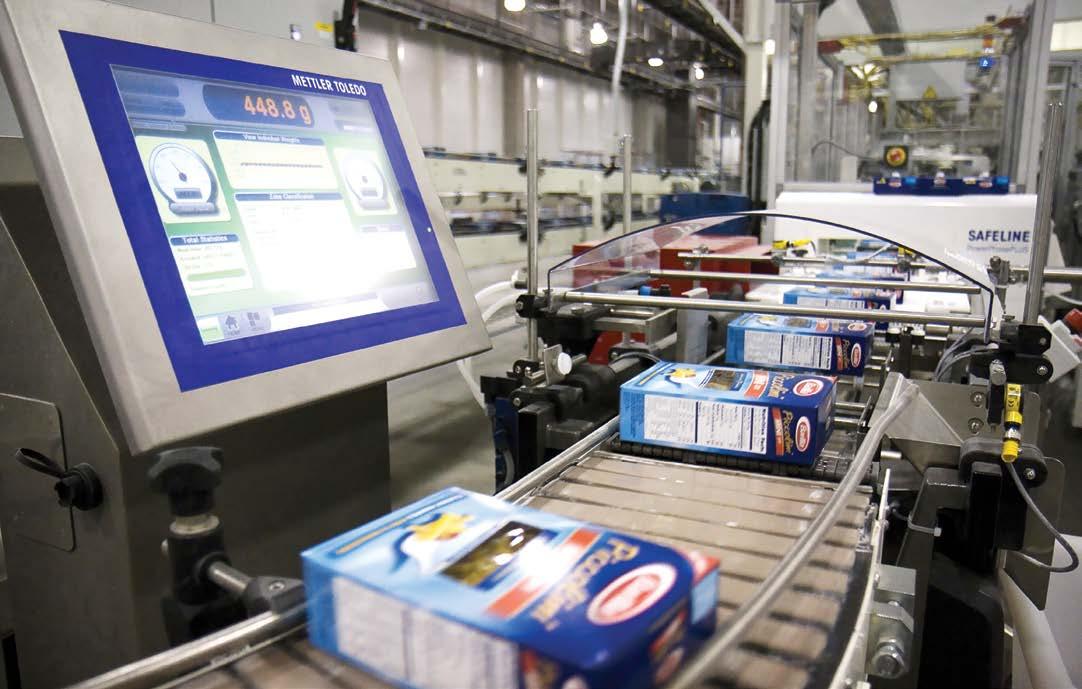
On the busy production floor, each of the 30 lines are equipped with both a Hi Speed Micromate checkweigher to weigh pouch fills; and a high-speed Checkmate checkweigher at the end of the line to weigh the total weight of each finished packed product before it is hand-packed into master cases.
“We have had nothing but great results from using these Mettler Toledo checkweighers,” says Sa-
“The upgrade will provide optimal data capture and statistical reporting functionality that will allow Rex Pak to track full production data, while enabling it to achieve quick ROI (return-on-investment) by controlling all the product trends more accurately.
“The Mettler Toledo Hi Speed XC checkweigher has been reviewed positively as a standalone solution on some of Rex Pak’s end-of-line applications,” Swift relates.
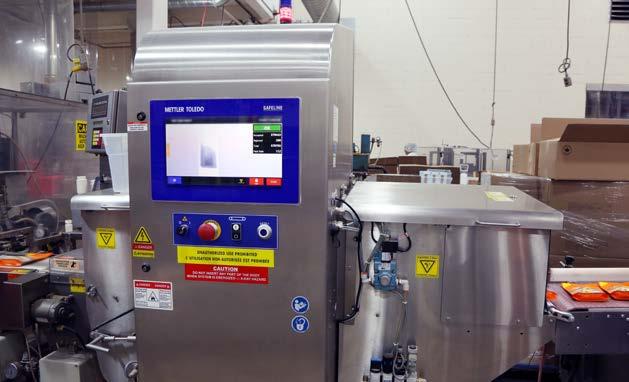
Other recent capital investments in product inspection at the plant include installation of three Mettler Toledo X-Ray systems, including a Mettler Toledo X33 installed in 2013—used for finished product inspection of filled, sealed and weighed bags—and two PowerChek models, which have been up and running since early 2016.
“While Mettler Toledo has a wide range of XRay products in its portfolio to suit many types of
application from pumped product to finished packages, Rex Pak opted for the X33 system, running at a mere 20 watts of power, due to its very low cost of ownership,” says Swift, adding that Rex Pak utilizes the PowerChek platform on its larger products, a system that is adept at handling multiple product type and changes, providing flexibility—an important factor for the co-packer.
As for the two new PowerChek X-Ray units Rex Pak purchased through Shawpak, Sabatini clearly likes what he has seen so far.
“We are very happy with these new X-Ray systems,” Sabatini states.
“They are very reliable, and the data it provides us goes a long way to fortifying our formal product safety quality control procedures.”
The PowerChek X-Ray units, along with the X33 X-Ray system can each run at speeds up to 250 feet per minute as a standard or up to a rate of 450 FPM on the PowerChek with a different conveyor configuration, according to Swift, whereby the actual running speed is limited only by the product handling and rejection speeds.
“We even calibrated the installed checkweighers to meet Rex Pak’s product sizes to obtain the maximum speed possible,” Swift relates.
“Mettler Toledo’s machines are built to provide solutions based on the customer’s actual requirements.”
Some of the value-added features of the Mettler Toledo X-Ray systems include:
• Allen-Bradley components from Rockwell Automation, as standard that are designed and built specifically for applications in the North American market;
• Optimal traceability, with the units offering full built-in due diligence and production monitoring
statistics, along with real-time process monitoring and the ability to save all the generated X-Ray images;
• Customizable material handling solutions, with Mettler Toledo and Shawpak working together to design the system to fit the customer’s production line requirements;
• Live HMI (human-machine interface) X-Ray power change—a key factor for co-packers that allows them to adjust the X-Ray power requirements to the product being produced without needing a service technician;
• Data capture for food safety certification requirements;
• Large technical service support across the U.S. and Canada.
Many of the package types utilized by Rex Pak contain a metal barrier within the film, so the only viable option for proper safety inspection, notes Sabatini, is to use an industrial X-Ray inspection solution.
“The wide inspection range of the X-Ray systems allows us to search for a wide-range of inclusions such as small stones and other natural products,” says Sabatini.
He says that Mettler Toledo has been a partner of Rex Pak since more stringent requirements surrounding food safety became de rigueur years ago, which was the initial reason it purchased their end-of-line checkweighing machinery.
“Nowadays, all of our Mettler Toledo equipment— from the checkweighing systems, and our new X-Ray and laboratory equipment—provides both the customer and us with complete peace-of-mind that only healthy and safe food is going to go out in the market,” Sabatini states.
Rex Pak continually upgrades all of its equipment,
says Sabatini, with new Mettler Toledo systems always given serious consideration.
“Their equipment just keeps getting better and better as time moves forward,” says Sabatini, “which makes it an easy choice to keep going back to them and our friends at Shawpak.
“More and more, our customer discussions reveal a high level of interest in having their products X-Rayinspected,” Sabatini sums up, “and we have also had many potential ‘would-be’ customer contact us to ask if we have X-Ray inspection units in place.
“So when the need arises to add some more X-Ray inspection systems to our operations,” he concludes, “we know exactly where to turn.”
See the video on the operation of the Mettler Toledo x-ray detector at Rex Pak on Canadian Packaging TV on www.canadianpackaging.com
SUPPLIERS
Mettler-Toledo Inc.
Shawpak Systems Limited
Rockwell Automation, Inc.
3M Canada Co.
Combi Packaging Systems LLC
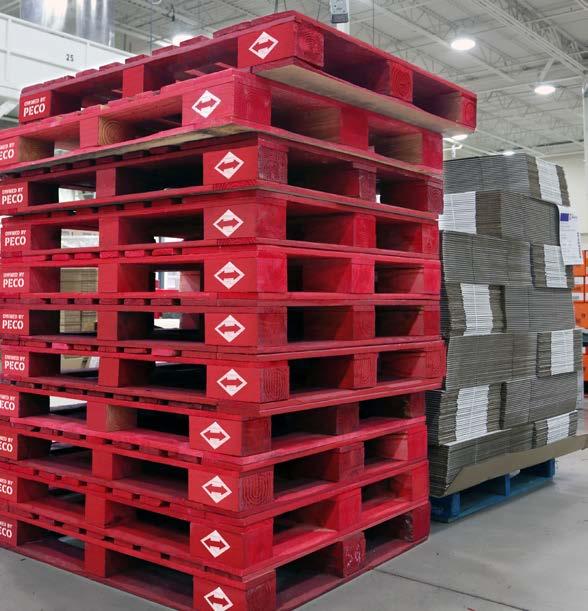
PECO Pallet, Inc.
Videojet Canada
Domino Printing Sciences
Best Packaging Systems Inc.
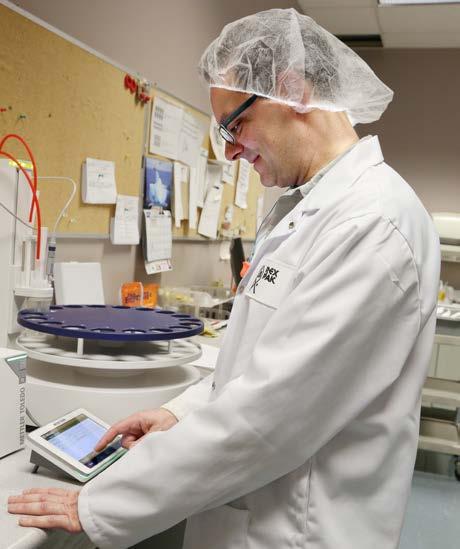
Rex Pak vice-president of manufacturing Devin Sabatini working with an HMI tablet that controls Mettler Toledo’s quality assurance laboratory equipment.
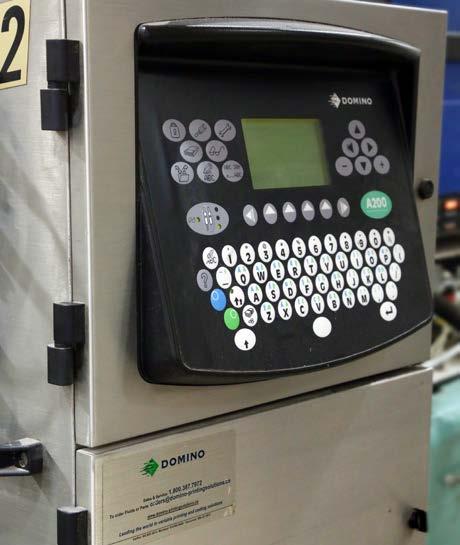
One of several Domino A200 CIJ printers used by Rex Pak to apply small-character codes onto the individual packs of product before they are packed inside the master cases.
PACKAGING FOR FRESHNESS
JUST ONE OF THE GUYS
Fiesty Quebec meat processor steps well outside the box to maintain bold uncompromising food safety standards in advance of nationwide product rollout
BY ANDREW JOSEPH, FEATURES EDITOR
Following long-established industry norms and conventions is fine for companies looking for stability as an end goal, but simply playing “follow the leader” is hardly a recipe for inspired innovation and breathtaking creativity that lies at the heart of true industry leaders and pace-setters.
For folks at the Richmond, Que.-based Le Gars de Saucisse (The Sausage Guys in English), simply being a small-town ‘me-too’ sausage maker content with just getting by on a day-to-day basis to eke out a living was never an option worth serious contemplation or pursuit.
Despite operating a relatively small sausage processing plant currently catering to the local Quebec market, The Sausage Guys is making impressive inroads in establishing and cultivating a wider following by going well and far beyond the common perception of what a sausage is for the average Canadian consumer.
In doing so, the high-aiming company is keen on becoming a true market leader, with national distribution to match, in a meat industry segment that, fairly or not, has long been saddled with a “scraping the bottom of the barrel” reputation for debatable quality of the quality of commonly used ingredients and product purity.
“While we know that such ‘iffy’ practices no lon-
ger exist in today’s marketplace, when we began our business we found that, with very rare exceptions, few sausage manufacturers stepped beyond the comfort zone of what ingredients could be put in a sausage,”
The Sausage Guys company president and co-owner Bryce Patriquin told Canadian Packaging magazine during a recent interview.
According to Patriquin, the family-owned business is aiming to build its path to success by using a combination of both traditional and non-traditional ingredients to create a varied mélange of flavors to lift the humble sausage from its mostly utilitarian raison d’etre into the gastronomic world’s more rarified heights and status.
As Patriquin explains, the company’s corporate
PHOTOS BY PIERRE LONGTIN
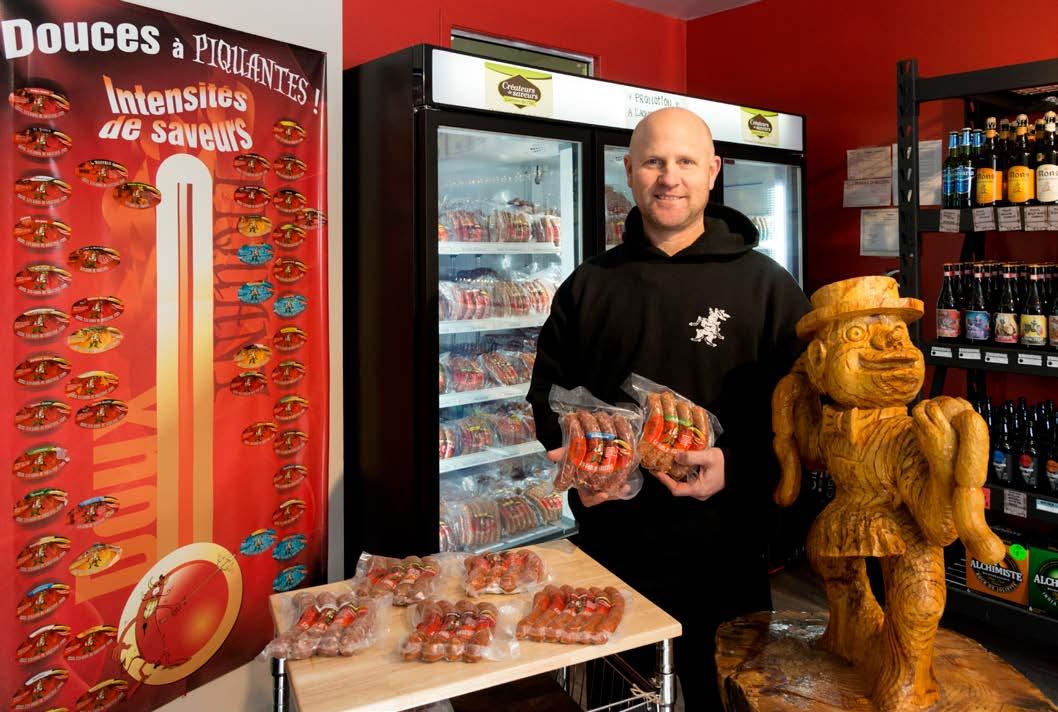
The Sausage Guys company president and co-owner Bryce Patriquin with some of the 60-plus non-conformist flavors the sausage maker produces at the Richmond, Quebec facility.
PACKAGING FOR FRESHNESS
name was developed as a playful moniker and nod to himself and his business partner Roxanne Labonté, who is not only a co-owner and in charge of sales and marketing, but is also is also the mother to their two children.
Now employing 32 people, “I may have to re-think the company name down the road,” Patriquin quips, “as we actually have more women working here than men.”
According to Patriquin, some of the sausage recipes the company produces today have been handed down through multiple generations of his family, but he readily admits to always being eager to experiment with the recipes.
“I began making sausages about 20 years ago, when we
used two hydraulic sausage stuffers that allowed me to perform some contract work for the local grocers,” he recalls. “We also did some market testing and recipe testing for other companies looking to invest in expensive equipment.
“We didn’t have a name then, but everyone who worked with us called me and my employees ‘the sausage guys.’
“I also owned a local area butcher shop, called The Sausage Guys, that produced good-quality sausages, so maybe that’s why the name stuck the way it did.”
After determining that the small butcher shop was not well-suited to producing the volume of sausage products demanded by its customers, Patriquin sold the shop and ac-
quired a nearby bakery.
Already in compliance with the provincial food safety inspection standards, the bakery was modified and equipped with some newly-purchased additional sausage-making equipment—setting Patriquin on the way to fulfilling his vision of making gourmet-quality sausage products for the general public.
“I’ve always been a foodie at heart,” explains Patriquin, “so whenever I travel or just go out with family and friends, I am never afraid to try different foods from different ethnic groups and cultures.
“So to make The Sausage Guys different, we sought to step outside the proverbial box, tap into ethnic flavors, and create high-end quality sausages, featuring bold new flavors and ingredients, at an affordable price-point for the consumers,” Patriquin explains.
In addition to helping erase the general public’s weariness about sausages containing “dubious” ingredients, The Sausage Guys is also dedicated to building a whole new image for sausages to associate the product with great taste and healthy ingredients as the norm, rather than the exception, according to Patriquin.
“If you think we are just spouting yet another marketing line, all you have to do is taste the quality of our sausages,” Patriquin asserts.
About 80 per cent of production at the company’s federally-inspected, 2,500-square-foot facility involves the processing of pork and chicken, Patriquin relates, with pork accounting for an 80-percent share of that workload.
“The remaining 20 percent of our production is spread out with processing other proteins such as beef, veal, lamb, turkey, venison, bison and duck,” says Patriquin, adding the company is currently in the process of completing an Eccocert certification audit to allow it to begin producing and marketing sausages made with organic ingredients.
In addition, the company is also involved in producing innovative salmon-based products, which are made at a different facility.
“I make about 65 kinds of sausages using different meats and proteins, as well as seven varieties of salmon,” says Patriquin, adding he’s working on creating a line of vegan sausage products, a new organic product line, and a few other novel sausage flavors he is sure will capture the consumers’ imagination and taste-buds.
Says Patriquin: “Why should a nonmeat-eater not be able to enjoy a similar taste experience as the other guy at
a barbeque?
“Besides the meat and the meat-free protein used in the product, what really takes things to a whole new level are the complicated mixture of spices that we use, including some exotic spices that are exclusive to us.”
To make the point, Patriquin lists a few sausage varieties that duly reflect the company’s genuine commitment to product innovation, including:
• Merguez, a reddish lamb and/or pork meat sausage with spices;
• Jardiniere, a boldly spiced pork sausage containing carrots, broccoli and celery;
• Jamaican/Jerk, spicy pork-based sausage with the famed Caribbean ‘jerk’ taste profile;
• Smoke House, a hot spicy sausage tinged with Mexican chili and chipotle flavors;
• Wine-Shrub, a low-fat sausage that tastes like wine;
• The Bock, a smoky sausage with robust beer flavor;
• Gingerbread, a sweet cinnamonflavored gingerbread sausage;
• Salmon Curry, tasting just as the name suggests.
“If there’s a food or drink that people like to enjoy, I’ll try and figure out a way to turn it into another tasty sausage creation,” says Patriquin, pointing out that all of his company’s sausages are gluten-free products.
“We do not follow the flow,” he proclaims.
“Even though the chipotle flavor has been ‘hot’ for the past year or so, I’ve been making my chipotle sausage, known as the Smoke House, for over 15 years now,” says Patriquin, calling Smoke House the company’s bestselling product and proudly citing the Best Product honors recently awarded to it by the Foodies Quebec magazine.
“I intentionally try not to look at what others are doing,” he says, “because it tends to diminish the whole creativity aspect of what I want The Sausage Guys to accomplish.”
Along with selling packaged sausages to grocery stores across the province of Quebec, Patriquin says the company also supplies nearly 80 SKUs (stock-keeping units) with different packaging sizes for foodservice customers, including hundreds of restaurants, hospitals, hotels, schools and universities.”
“We processed roughly 350,000 kilograms of sausages in 2016,” relates Patriquin, “although that still makes us a small company, compared to some of the big national processors who put out some 200,000 kilograms of sausages per week.”
Even so, The Sausage Guys prod-
ucts still find their way onto the retail shelves of larger retail chains—including Loblaw’s, Sobeys, Provigo, Metro, IGA and Avril—across Quebec.
Such is the strength of Patriquin’s belief in his company’s approach to business, that he has turned down multiple offers to co-pack other companies’ brands at his facility, which still houses just one production line dedicated to producing the company’s brand.
“I’m glad to hear that other processors like what we do, but I prefer the uniqueness of our situation,” he says.
“It has taken a lot of time and effort to get where we are today,” he says, “but with plans to go national soon, I feel that
The Sausage Guys is just getting started.”
As part of careful preparation for the impending national product rollout, the plant recently installed a new high-performance Vemag LUCKY LINKER all-in-one machine sausage production machine from the Burlington, Ont.-based food processing and packaging equipment supplier Reiser Canada
“Before I bought this machine I was using two hydraulic stuffers, running them virtually 24 hours a day,” Patriquin recalls.
“But the LUCKY LINKER takes the place of both those machines—and not only creating the sausages more efficient-
PACKAGING FOR FRESHNESS
ly, but doing so economically, saving me on labor costs,” he enthuses.
“You can’t go wrong when your bottom line improves the way our has with the Reiser Vemag LUCKY LINKER machine.”
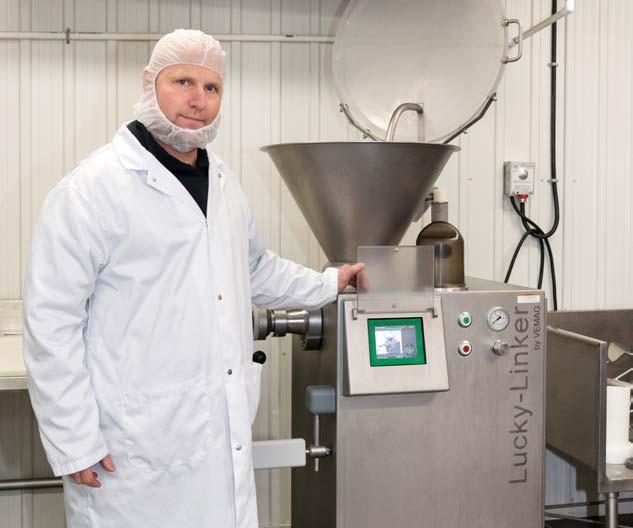
Designed to fill the production needs of smallersized sausage producers with tight space requirements, the small-footprint LUCKY LINKER comes equipped with all the subsystems and functionalities required for cost-efficient sausage production, including a built-in linker, a built-in portioner, a case holder, one linker horn set, and one straight filling horn.
According to Reiser, the sausage making equipment is flexible enough to create a wide assortment of products ranging from tiny cocktail wieners and small-diameter meat sticks to salami, frankfurters, pepperoni, large-diameter chubs and, of course, sausages.
With a filling rate of up to 4,400 pounds an hour, the LUCKY LINKER uses a stainless-steel doublescrew pump to provide a high level of portioning accuracy and smear-free filling, according to Reiser.
“What I like about the double-screw is that it provides a relatively gentle fill, meaning the sausages do not suffer damage as the casings are being filled,” Patriquin points out.
“Along with the exact weight portioning I receive from the machine, thanks to its near friction-free conveying of the sausage stuffing, the stainless-steel aspect of it helps ensure a long-lasting machine life,” he adds.
Topped with a see-through cover lid, the LUCKY LINKER’s 45-liter (100-pound) capacity one-piece
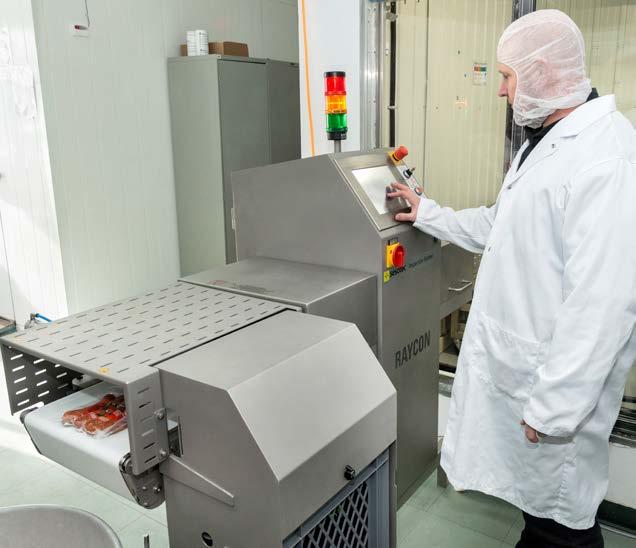
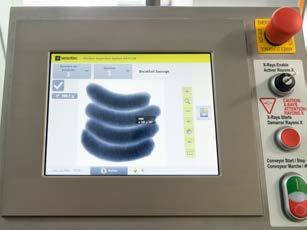
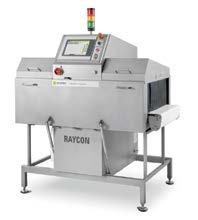
The Sausage Guys’ Bryce Patriquin works with the easy-to-operate Sesotec model Raycon 300—150 X-Ray system, able to inspect up to 300 units per minute. ( Top right) The HMI (human-machine interface) screen provides the X-Ray system operator with a clear view of each packaged sausage product being inspected at The Sausage Guys processing plant.
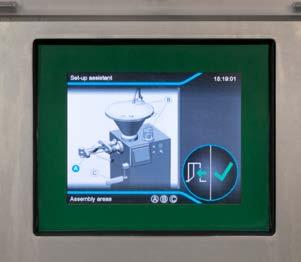
Patriquin shows off The Sausage Guys’ LUCKY LINKER sausage maker manufactured by Reiser brand Vemag. (Right) The set-up assistant on the HMI helps ensure that all aspects of the equipment are placed in optimal position to ensure portion accuracy and consistent sausage appearance.
enables the machine to maintain good product consistency and conformity throughout the production run, Patriquin notes, the mechanicallyadept Patriquin says the easy-to-use LUCK LINKER allows the company to create sausage conformity, regardless of the size of the output run.
“It has a nice easy-to-use touchscreen to keep the process running smoothly,” says Patriquin, “but what I really like is that it is a very simple machine to clean, ensuring we can do our jobs in a very effective manner under optimal hygiene standards.”
As Patriquin relates, pursuing high standards is an integral part of the company’s culture and skillset.
“Every time we have an opportunity to receive special training—be it for occupational safety purposes, product quality, or customer services—we jump on it,” says Patriquin states.
“I’m very happy with our employees,” he adds. “They are all highly qualified, with solid credentials, and the share the same vision as Roxanne and myself to create highest-quality products with the best value for our customers.
“We even perform our own product distribution to customers via our own two trucks,” says Patriquin, adding The Sausage Guys plant is currently working with SAI Global to achieve the increasingly important SQF certification of the Safe Quality Food Institute
To help steer this certification initiative onto the fast track, in late 2016 the plant purchased a Raycon 300— 150 X-Ray inspection system manufactured by leading German food inspection technologies group Sesotec GmbH
“I told my SAI Global trainer about a new X-Ray system I purchased and all of its wonderful capabilities,” Patriquin relates, “and she said she would pass the information along to other companies looking for superior food inspection equipment.”
The X-Ray system Patriquin purchased for The Sausage Guys was installed towards the end of 2016, but already he has seen how beneficial it has been to the company.
Featuring a large 300x150-mm inspection window, the high-speed Raycon can inspect either packaged or unpacked goods at rates of up to 300 pieces per minute, depending on the object’s length, detecting and rejecting all magnetic and nonmagnetic materials such as glass, ceramic, stone, bone, PVC, rubber, etc., even when contained within metallic or metal-coated foil.
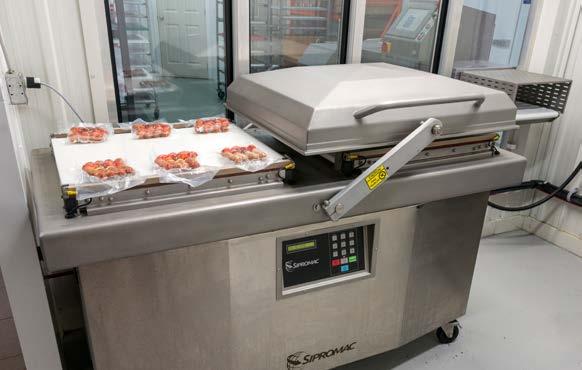
The Sausage Guys use a Sipromac double chamber vacuum machine featuring four sealing bars and two sealing chambers, enabling the sausage manufacturer to quickly pack high volumes of product.
PACKAGING FOR FRESHNESS
Along with performing its primary task of the necessary job of detecting all the possible contaminants or foreign particles in the product flow, the Raycon can also provide visual detection of misshaped products, as well as check for incorrect product weight.
Utilizing an assortment of multilane and multiproduct features, the Raycon X-Ray system can actually “learn” to recognize specific packaged product shapes, thereby allowing for different products to be handled on the same production run without triggering “false positives.”
By conducting the entire inspection process from the bottom up, according to Sesotec, the Raycon 300—150 effectively ensures that there are no blind corners missed during the scan.
Says Patriquin: “We have always gone to great lengths to ensure our products are safe, but the new Sesotec Raycon 300—150 is definitely a big step up over the type of product inspection type we used previously.
“It enabled us to really double-down on product safety,” he says, “providing us with real peace of mind as we strive towards becoming a federal-inspected meat business that can ship our products right across the country.”
While Patriquin says he was initially concerned that installing an X-Ray system would be an unnecessary extravagance for the plant’s tight confines, talking to Sesotec’s inspection systems sales manager Doug Pedersen eased his concerns.
“Not only was Doug Pedersen able to answer all of our
questions without hesitation, I was very impressed when a Raycon programmer came all the way over from Germany to train us on its safe operation,” he relates.
“It convinced me that a compact piece of equipment, does not have to be some sort of a bare-bones system,” Patriquin says. “But in addition to being perfectly compact for our needs, it provides us with a plethora of state-ofthe-art features and high throughput, so there is no risk of creating bottlenecks on the production line.
“The Raycon model X-Ray product inspection system from Sesotec is an essential part of our food safety system,” Patriquin asserts, “and I continue to be impressed by the level of service provided us by Sesotec.”
Adds Sesotec’s Pedersen: “What impressed me most about Bryce and The Sausage Guys, is that most company’s of their size might have gone a different route.
“But he wanted to have an industrial X-Ray system to show his customers that he was serious about food safety and serious about their concerns,” notes Pedersen.
“It’s tough not to root for a company like that.”
In the build-up to the eventual national product rollout, Patriquin says The Sausage Guys will continue to make inroads with consumers by participating in year-round events, festivals, food fairs and weekly taste tests in different grocery stores.
“These taste tests help reaffirm that consumers value our product not for being overrun with binder and filler,” he says.
“They see real value in out products being gluten-free, less salty and less fatty than many of the leading brands,” says Patriquin, adding the company is actively working with leading grocers Loblaw’s, Sobeys and Metro to get its products into their national distribution networks.
“Along with those partners,” he sums up, “we are getting closer all the time to achieving our goal, in large part thank to all the hard yeomen’s work put in by our Reiser Vemag LUCKY LINKER machine and our Raycon X-Ray detection system from Sesotec.”
PACKAGING FOR FRESHNESS
THE GAME OF CHICKEN
Toronto chicken processor gets into the faster flow of things with five new stretchfilm wrapping machines from Reiser
BY ANDREW JOSEPH, FEATURES EDITOR
HILTZ
In Canada, like in many other societies, chicken is the most widely-consumed everyday meat staple across most major consumer demographics.
As a healthy and affordable source of animal protein and other nutrients, it is always in high demand by grocers of all shapes and sizes striving to meet constant demand for poultry from Canadian con-
sumers on a daily basis.
Based in Toronto, chicken meat processor ADP Direct Poultry Ltd. plays its part with exceptional quick-to-market competencies that enable it to supply its customers with any type of short- or long-run packaged raw chicken product to ensure the retail shelves are always stocked quickly and reliably.
In addition to offering raw poultry products of turkey and chicken at its 22,000-square-foot head-
quarter facility in west Toronto facility, the company also operates a fully-cooked poultry products division that specializes in processed chicken and turkey, and it is also licensed to process beef, pork and lamb products at a second location in the city’s northwest end.
Owned and operated by Augo Pinho, Direct Poultry is a 100-percent Canadian enterprise that successfully leverages its speed-to-market capabilities to service its growing retail, foodservice and
PHOTOS BY NAOMI
Augo Pinho, Owner and Operator, ADP Direct Poultry Ltd.
PACKAGING FOR FRESHNESS
industrial customer base across North America with some 250 different SKUs (stock-keeping units) produced and packed at its main facility.
“Approximately 95 per cent of our business revolves around poultry—85 per cent for chicken processing and 10 per cent for turkey, with the remaining five per cent geared towards the other types of meat that we recently became involved with,” Pinho told Canadian Packaging during a recent visit to the busy central processing plant.
With a combined staff of 130 people at the two facilities, about 80 working at its headquarters—Direct Poultry runs a single eight- to 10-hour shift, five days-per-week, to process some 450,000 kilograms of meat every work week.
While Pinho acknowledges this volume positions the company firmly within the so-called ‘small-business’ ranks, compared to the output of some well-known meat processing giants out there, “What separates us from the competition is our speed,” Pinho asserts.
This ‘speedy’ business model can be traced back to 1989, when Pinho was still a Toronto high-school senior working in the industry part-time.
As he relates, Pinho noticed that the larger chicken processors were often unable, or unwilling, to supply the needs of the smaller mom-and-pop grocers, which often promoted many local stores would band together to create an order large enough for the large processors to take notice.
“It didn’t seem fair,” recalls Pinho, “so acting on my own, I decided to place a call to Maple Lodge, somehow getting a direct line to someone in charge.
“They provided me with product with a great margin, so I took the order and sold and delivered the product myself to all the local corner supermarkets,” Pinho recounts.
Despite already making more money than many adults in the industry, Pinho was encouraged to graduate from an institute of higher learning to ensure he also understood all the financial aspects of running his own business.
“After graduating, I wanted to get back into the business—still seeing that the larger chicken processors did not have the time or ability to adequately look after the smaller customer request,” says Pinho.
“My niche market was still there waiting for me to get back into.”
While Pinho no longer needs to drive around himself in a rented truck drop-
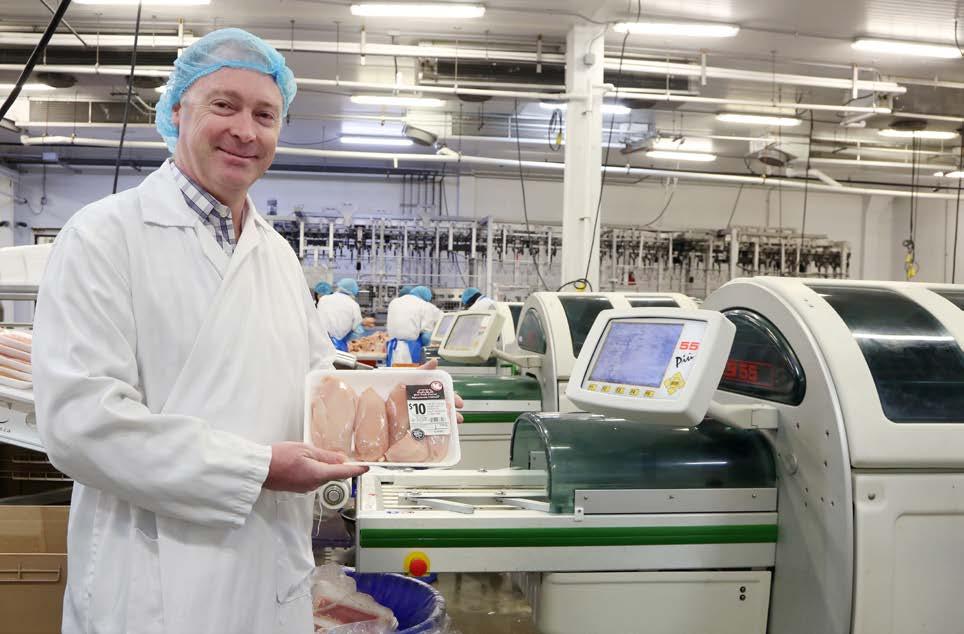
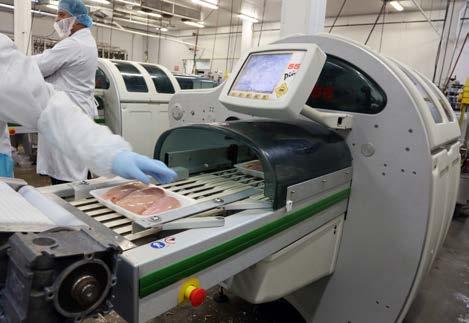
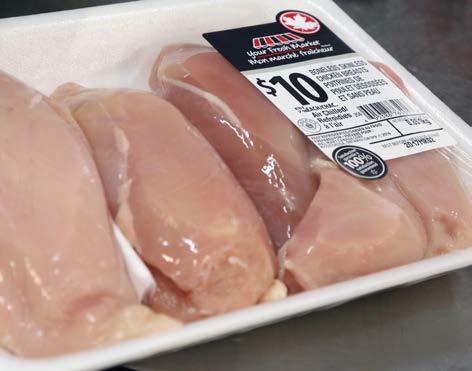
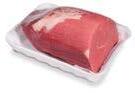
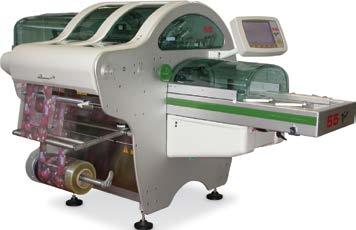
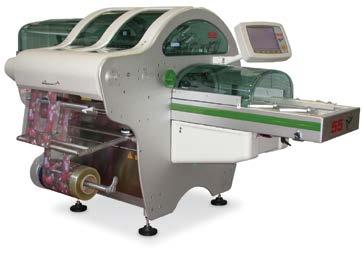
Standing alongside one of five Fabbri Model 55 Plus stretchfilm packaging machines purchased via Reiser Canada and installed at Direct Poultry, the poultry processor vice-president Christopher Hobbs holds up a tray of raw chicken product sealed quickly and efficiently with great shelf presence.
Trays of raw chicken breast are placed on Evok polystyrene trays manufactured by Cascades and conveyed through a Fabbri Model 55 Plus stretchfilm packaging machine from Reiser Canada that, depending on tray size, can package 35 to 55 units per minute.
one easily-integrated station could divert, transfer, and sort?
The MODSORT station is an innovative low-noise, low voltage modular transfer and diverter station. It can easily integrate with new or existing material handling systems, eliminating the need for a lift, pneumatics, or Z-direction position feedback devices, and can help achieve energy savings from 50-60% when integrated with a motorized roller-based system.
MODSORT utilizes System Plast™ 2253RT Roller Top Belt featuring a 1-inch on-center sphere array, allowing very small packages to be moved. Motorized Drive Rollers and controls allow flexibility in wiring, the ability to move everything from exceptionally small polybags to boxes, and safe, efficient, quiet and low-maintenance operation. For more information, visit www.RegalPTS.com/MatlHandling
PACKAGING FOR FRESHNESS
ping off orders to the mom-and-pop grocers, saying modern economics has more or less killed off that form of reselling activity, Direct Poultry still plays a highly viable role within the niche market segment.
“Yes, a large part of our business now revolves around working with the larger grocer chains,” explains Pinho, “but we still maintain our own small size advantage that allows us to perform quick changeovers to meet any customer’s emergency meat needs.
“Others can’t do what we do,” he says. “We’ve found our niche.”
Pinho says he takes great pride in the fact that both Direct Poultry facilities are Canadian federally-inspected, HAACP (Hazard Analysis and Critical Control Points)-compliant, USDA (United States Department of Agriculture)- and BRC (British Retail Council)-approved, as well as being Organic- and Halalcertified.
“Because we only recently expanded our reach with the purchase of the sec-
ond facility in the northwest part of the city, 85 per cent of our Direct Poultry business is currently dedicated for our fresh products,” explains Pinho.
“We currently produce 15 per cent of our output for the full-cooked and seasoned and frozen meat segments,” says Pinto, noting that the grocery segment takes up about 85 per cent of Direct Poultry’s business, with the remainder coming from the foodservice industry.
“We acquired the other facility as a means to expand the type of items we can offer our customer base,” Pinho says, explaining that a large segment of Direct Poultry’s customer base comprises many leading, well-known Canadian national grocery retailers.
“We didn’t want to put all of our eggs in one basket,” he quips, “but we really did want to expand our product base.”
By any measure, it’s a mission well-accomplished.
Today, the company offers a varied and diverse portfolio of both IQF (indi-
Pilz Services for Machinery Safety are international and customized. Our service professionals provide global support in all matters of functional safety in all industry sectors. From Risk Assessment to Safety Design to CE Marking. Profi t from our high level of knowledge of national regulations and standards! We reduce risk, implement technical machinery safety and take responsibility with the certification services we provide.
The PZ40 Evok polysterene tray from Cascades consists of 25 per cent recycled material, but is rated for the packaging of fresh produce, fish, meats and poultry products.
vidually quick-frozen) and fresh fully-cooked products such as wings, breasts, breast strips, diced chicken, quarter and half chicken, burgers, turkey burgers, chicken pizza crumble, sausage patties (turkey, chicken or pork) and meatballs.
“With raw meat, we offer a full line of both fresh and frozen chicken and turkey products, all of which can be packed fresh as tray-pack, in MAP (modified atmosphere packaging), and in bulk or IQF formats,” Pinho states.
Pinho says that Direct Poultry can also duplicate existing customer recipes or create a specific product to meet a need for anything from a LTO (limited-time offer), as a protein ingredient in a prepared meal, or as a regular menu item.
“We have a very experienced team of professionals who can help tailor a product to exactly what the customer wants,” says Pinho. “We also have the ability to ship across Canada or the U.S., with the flexibility to handle small or large production runs.”
With food safety a top-level priority for any legitimate food processor, Direct Poultry is highly dedicated to the cause.
Along with a metal detection unit placed on each of the processor’s five fresh packing lines at the central facility, Pinho says the company utilizes an O3 (ozone) system that constantly exhales small quantities of ozone throughout the plant to kill, not retard, all bacterial growth.
Another reason for utilizing the ozone system, he says, is that it helps to extend the shelf-life of the chicken product being packaged.
“We have even added this ozonized water to our washdown areas to ensure that all the possible bacterial proliferation is eliminated,” Pinho mentions.
Also helping the company with its ability to pack safe food within a short turnaround are the five Fabbri Model 55 Plus stretchfilm packaging machines recently purchased via Reiser Canada
As a machine builder, the Fabbri brand is known as a market leader in automatic stretch wrapping machines, and is often found in food processing plants and supermarkets worldwide to apply a stretched plastic film around preformed trays of fresh food products.
Pinho says he bought two of the Model 55 Plus two years ago, and liked them so much he bought three more seven months ago.
“Prior to purchasing a Fabbri Model 55 Plus stretchfilm packaging machine, we had older tray flowwrapping equipment that had servicing issues,” says Pinho. “The company who was providing the service was no longer able to get parts, so we needed an alternative—and found one in Reiser.”
The new Fabbri Model 55 Plus is essentially an overwrap machine that wraps plastic film over a product sitting on a tray—a machine that was created to satisfy a need within the food packing industry.
The preferred trays used by Direct Poultry are the PZ40 Evok polystyrene trays manu-
PACKAGING FOR FRESHNESS
factured by Cascades Inc.
By utilizes 25 per cent recycled material, the Evok trays—designed for packaging fresh meats, fish, poultry and fresh produce—add up to a 20 per cent reduction in greenhouse gas emissions according to the manufacturing location and compared with Cascades’ previous polystyrene foam packaging.
“We have a great relationship with Reiser,” acknowledges Pinho.
“Not only do we also have a great relationship with the Reiser technician, but the fact that the company is very easy to get a hold of when we require help to solve an issue helps put my mind at ease.”
However, Pinho was adamant that he simply didn’t go with Reiser because he likes the people, saying the machinery impressed him greatly.
“The Fabbri Model 55 Plus possess both efficiency and speed,” relates Pinho, adding that he admires its
Smart Solutions for Packaging
Visit KUKA at ADM/PackEx Toronto Booth 1610
KUKA provides a line of specialised robots for picking, packaging, bag palletizing, case palletizing, freezer palletizing and hygienic applications.
On each of the five lines, Direct Poultry uses a Stealth metal detection system manufactured by Fortress Technology to ensure food safety programs are met and surpassed.
PACKAGING FOR FRESHNESS
compact size and robustness as well.
“It’s built for speed and versatility and provides us with a very high level of productivity, able to handle a wide range of tray sizes without having to perform any changeover functions,” he says.
According to Reiser, the stretchfilm packaging machines are capable of producing between 35 to 55 packs per minute dependent on tray size—something Direct Poultry is very much in favor of, given its relatively short production runs that need to be on grocery shelves as quickly as possible.
The smooth speed and robust attitude of the Fabbri Model 55 Plus is aided by its use of stepper-drive ef-
our metal detectors are always supported
ficiency and its lack of cams or chains.
All models feature a user-friendly, programmable full-size control panel that includes self-diagnostic software to allow for easy operation and maintenance.
“Of great importance, however, is just how easy it is to perform a hygienic clean-up,” Pinho relates. “The Fabbri has an open design that allows our cleaning equipment impeccable access to ensure we not only have a quick clean, but a highly efficient cleaning process.”
After packaging by the Fabbri, the trays move along a conveyor past a Bizerba labeler/weigher/coder that weighs the product and applies product data and lotcode information to the applied label.
On each of the five production lines, the now packed poultry product passes through an inline metal detection unit to ensure food safety compliance.
We continue to provide complete support for our existing systems with readily available parts and a global service team.
Stay up to date without purchasing a new metal detector.
DISCOVER OUR NEWEST INNOVATION
At a much lower cost of ownership than x-ray systems, this new simultaneous multi-frequency technology provides food producers, a cost effective alternative for their food safety programs. Learn More: 888-220-8737/sales@fortresstechnology.com or stop by our booth:
Direct Poultry uses Stealth metal detection units manufactured by Fortress Technology, a globally-renowned designer and manufacturer of high-quality metal detection equipment headquartered in Toronto.
The Stealth uses digital signal processing technology and provides very sensitive levels to ensure it can detect even the smallest ferrous, non-ferrous and stainless steel inclusions.
For companies who require it, included data collection software with a USB transfer provides effective compliance with various safety programs such as HACCP-certification.
Having passed inspection, the finished product trays are then hand-packed into corrugated poultry boxes purchased by Direct Poultry via the Toronto-based Gertex Distributing Inc. but converted by WestRock WestRock produces 100 percent recycled paperboard, laminated paperboard products, folding cartons, corrugated boxes, displays, plastic packaging, and more.
“Although it’s true that things started out as a small business I could run by myself, I love the growth Direct Poultry has experienced,” sums up Pinho.
“The Fabbri Model 55 Plus stretchfilm packaging machines from Reiser have certainly helped us increase our production line efficiency, which enables us to not only keep our current roster of clients happy, but also to accept new customers.”
SUPPLIERS
Gertex Distributing supplies Direct Poultry with corrugated trays converted by WestRock.
A FORDABLE LUXURY
Toronto
label producer is using a new state-of-the-art printing press to create award winning labels and flexible packaging
BY ANDREW JOSEPH, FEATURES EDITOR
PHOTOS BY NAOMI HILTZ
Mixing business and politics may not be everyone’s idea of ideal work and life balance.
While Doug Ford has followed his political aspirations, brother Randy has focused on making Deco a leader in innovation in the labels and flexible packaging industry. But for Doug the fine line between public service and business prominence has always been a “passion,” says Doug, the self-described ‘work-
aholic’.
As co-owners of their family-owned Deco Labels & Flexible Packaging business—founded in westend Toronto by their late father Doug Ford Sr. back in 1962—the two elder Ford brothers strive to ensure that Deco leads the pack in technology and service, a vision their late father never lost sight of.
If anything, the tragic loss of their brother, Rob Ford, to cancer about a year ago has given them a renewed sense of drive, passion and purpose to make the family business—already one leading pressuresensitive label manufacturers in Canada—even stron-
ger.
Operating a busy 70,000-square-foot production complex a short drive east of the Toronto’s Pearson International Airport in the city’s west end—along with another 45,000-square-foot label and flexible packaging plant in Chicago—the company employs about 200 people in total while operating a busy seven-day weekly schedule.
“We are extremely busy with the amount of work we generate throughout the year, producing product for customers in the food, beverage, produce, health and beauty, household, confection and the promo-
(From left): Deco Labels & Flexible Packaging co-owners Randy and Doug Ford showing off the company’s innovative flexible packaging trays featuring a reclosable label seal.
Clean, safe conveying
Designed for maximum available production time and operating convenience, the new modular belt conveyor in stainless steel is robust, safe and easy to clean.
The standardized design and modularity make changes of the production line easy. It’s the smart, long-term investment in your bottom line and your operators!
For more information, please contact us at 610-973-8200 or by email at info.us@flexlink.com.
tional industry,” Doug Ford told Canadian Packaging magazine during a recent visit to the Toronto plant.
Set up as a full-service shop capable of looking after all their customers’ print needs and related requirements, the Toronto facility provides a broad range of printing options, finishing options and unique die cutting.
“We work with our suppliers to achieve the most effective way of delivering our products, to our customers, on a consistent basis without sacrificing quality and service.We remain at the forefront of technology in the labels flexible packaging markets and pride
ourselves on an easy to do business philosophy and our speed to market attitude,” says Randy Ford, explaining the company’s growing focus on producing more flexible packaging products.
Deco is currently producing various types of flexible packaging employing high definition printing. Specializing in resealable structures, pouches, lidding film, compostable film, printed flow wrap, citrus bag film and roll fed can wrap
“We are a proven leader in OnSerts and on-pack pieces and by offering pre-application of these pieces to the actual product label, we have raised the in-
Bringing to a total of 10, Deco’s latest printer addition is the Mark Andy 10-color, 22-inch P7 LED UV press that has helped the company save time and money in the production of resealable flexible packaging.
Randy Ford stands beside Deco Label’s VLI-500 rewinder from Mark Andy company Rotoflex, that uses a Unilux LED 2000 lighting strobe to help the operator check the rewind.
Deco Labels co-owner Randy Ford holding a roll of speciallydesigned resealable labels converted by the company’s Mark Andy P7 LED narrow web press.
novation bar,” says Randy Ford. “It is the same philosophy we have applied to our entering into the flexible packaging market. We saw a void in the industry; no one was servicing the small and mid-size flexible packaging users.
“We are having overwhelming success,” continues Randy Ford. “We offer superior service and outstanding print and just to complete the picture we truly are an innovator and partner with our clients on development projects.”
Discussing the continued growth and market demand for flexible packaging, particularly resealable packaging, Randy explains. “We have developed a process to marry a pressure sensitive structure to a film, usually heat sealable. Film structures include barrier films for deli, produce lidding film, cookie packages to wipes and more.
“It essentially enables us to kill two birds with one stone by providing customers with the resealability feature that they want and utilizing the ever increasing capabilities that we have,” he states.
In fact, Deco’s capabilities allow their clients to have printed base film, a printed pressure sensitive component or a combination of both.
The Deco resealable flexible package is a consumer friendly package that can be peeled opened and resealed simply by pressing it back down into place.
The company has even developed a proprietary tamper evident system that can be built into the structure, a point that Randy Ford says help make Deco a leader in the resealable product category.
“While we have been involved in producing flexible packaging for a long time, we actually made a concerted effort to become more involved in that market segment about four years ago,” says Randy Ford.
“By acquiring some new press technology, we have made great strides within the market,” he says, explaining the Deco plant’s recent purchase of a new 10-color, 20-inch-wide P7 LEDcuring press from flexographic printing technologies supplier Mark Andy Inc. of Chesterfield, Mo.
“We really like the ProLED UV LED drying option, which provides us with high-quality labels and new flexible packaging opportunities to explore,” he says.
While the commercial printing industry has some reservations about LED printing technology, mainly related to operating speeds, Mark Andy says that LED print head offers many advantages in creating smaller dot sizes to facilitate higher-quality finished
NOTHINGSAYS FRESH like FABBRI P A CKAGING
Fabbri Automatic Stretch Wrappers produce highly attractive packages that make your products look fresh and “just packed” Fabbri Stretch Wrappers use stretch film to package fresh meat products in preformed trays to provide an in-store wrapped appearance They emplo four-way stretch technology to produce tight, over-the-flange wrinkle-free packages with securely sealed b ottoms and a superb case presentation
And here’s something you might find even more attractive: Fabbri Stretch Wrappers can help increase your profitability Fabbri packaging is produced using low-cost packaging materials And when you factor in its Best in Class low cost of ownership, the Fabbri Stretch Wrapper is your most economical and affordable packaging solution.
Compact and robust servo-driven Fabbri packaging machines are built for speed, versatility and the highest levels of productivity Fabbri Stretch Wrappers can handle a wide range of tray sizes with no changeovers, producing up to 62 packs per minute All models feature a user-friendly full-size control panel for easy operation and maintenance Test the Fabbri at our Reiser Customer Center and see for yourself how it can improve your packaging Contact Reiser today
A sparkling in-house example of a resealble flexible pack Deco Labels is able to produce, using a reclosable label it manufactures to allow customer access to the interior product.
FLEXIBLE PACKAGING
print.
An LED printing press is also able to provide a superb print clarity with multi-level shading, according to Mark Andy, and the absence of any moving parts makes the operation more reliable and less prone to machine downtime due to mechanical issues.
Because the LED aspect of the press does not have any moving parts, the technology is considered to be more reliable, and not as prone to costly downtime concerns.
Before purchasing the P7 LED UV press 18 months ago, Deco had already sampled the benefits of LED technology by switching over its factory lighting system to the LED lights.
“When the time came to get a new press, we wanted to
Purity Through Innovation
Demonstrating the new
INTUITY
The latest in metal detection
be on the leading edge of technology,” says Randy Ford, noting this is the tenth Mark Andy press installed at the Deco plant over the years.
“We bought the Mark Andy P7 specifically because we wanted to increase our high-quality, narrow-web flexible packaging output,” explains Randy Ford.
While Deco initially and successfully produced its new flexible packaging solution on the plant’s existing equipment, he recalls, “The final output simply wasn’t at the level where we were happy with the quality.
“The biggest issues we had with the non-P7 equipment when we took on this flexible packaging task was an excessive amount of film waste during the initial production set-up, along with the amount of set-up time it required.
“It simply wasn’t as efficient a production process as we would have liked,” he continues, “and with the growing demand for more flexible packaging from our existing customers, we decided it would be prudent of us to make the investment into the press.”
Randy and Doug Ford both agree that they enjoy the simple design of the P7’s prints stations, allowing operators quick and easy access to execute fast changeover between the production runs.
Once the printed film comes off the 10-color Mark Andy P7 LED press, it passes through an AVT (Advanced Vision Technology LTD) Helios II 100 percent inspection system for qual-
ity assurances, and then through a slitting machine equipped with an easy-to-use Mitsubishi GOT (Graphics Operational Terminal) 1000 HMI (human-machine interface) terminal.
Designed specifically for label and narrow-web printing, the ATV Helios II is widely acclaimed in the industry a top-flight inspection system for spotting even the tiniest defects in print quality.
After printing, the run is transferred onto a VLI500 rewinder built by Rotoflex, also a Mark Andy company, featuring a built-in Unilux LED 2000 lighting strobe that makes it easier for the operator to see the film as it rewinds.
According to Mark Andy, the VLI-500 is ideal for tension-sensitive materials like labels and flexible film packaging, but it also works as well with foil, light cartons and other types of packaging.
Like the P7 LED press, the VLI-500’s LED lighting has a longer shelf-life than other standard bulbs.
“We’ve always been loyal to Mark Andy, always their big supporters,” says Randy Ford, “and using their Mark Andy P7 LED UV press has really allowed us to grow our flexible packaging market segment faster.”
“There is no question that the addition of the Mark Andy P7, the Rotoflex VLI-500 and what options we equipped them with have helped us greatly increase our product offering,” he adds.
All of the efforts Deco has made has now garnered them some accolades with some impressive
RAYCON D
Sanitary X-ray System
¾ X-ray Inspection ¾ Metal Detection ¾ Magnetic Separation
With the smiling visage of Deco Label founder and father, Doug Ford Sr. looking on between them, Randy (left) and Doug Jr. demonstrate the easy-to-open reclosable label feature the company is promoting with its line of flexible packaging.
FLEXIBLE PACKAGING
Because the Mark Andy P7 press utilizes LED (light-emitting diode) technology, it avoids heat malleability issues that could cause substrate stretch during a
Flexible Packaging that its end-product will have a consistent strength and quality.
award wins.
• 2014 Canadian Printer Awards–one Silver;
• 2015 PAC Global Leadership Awards—two Silver;
• 2016 Labelexpo/Flint Ink Global Printer Awards—three First Place wins in the LED category.
As was made clear by both Randy and Doug, “there is more to come.”
“We are extremely proud of the three first place awards that we received at Label Expo in 2016 for Flexible Packaging,” says Randy. “These would not have been possible without our great dedicated team here at Deco.”
The Ford brothers agree that keeping the company’s growth on the right track is an important part of keeping alive their father’s legacy of continuous innovation, superior customer service and giving back to the local community.
“We run the full gamut of programs, from the sponsoring of local youth soccer and baseball teams to supporting charitable organizations, breakfast programs, women’s shelters, and helping out kids in high-priority (disadvantaged) neighborhoods,” says Randy Ford.
Doug Ford concurs: “Giving back to the community is something our dad instilled in all of us early on.”
print run, ensuring Deco Labels &
Uline supplies two- and four-inch splicing tapes used by Deco Labels to conjoin two rolls of printed film.
A pair of First Place narrow web film awards from Labelexpo 2016 presented to Deco Labels for its quality production of UV Flexo LED shrinksleeve products, and for its superb work in producing UV flexible LED promotional materials.
AUTOMATE NOW
SUPERIOR PREFORMANCE
Canadian plastic processing machinery manufacturer leverages high-precision control technology to keep setting new productivity and quality standards in bottle preform and closure production
BY GEORGE GUIDONI, EDITOR
PHOTOS BY NAOMI HILTZ
For a product as lightweight and commonplace as a plastic beverage container, the staggering volume of heavy-duty research, science and engineering work that goes into its creation is truly extraordinary.
And while most ordinary consumers are unlikely to give it much thought while enjoying their favorite beverage— packaged in a convenient, resealable and attractive PET (polyethylene terephthalate) bottle—the plastic processing technology that makes it all possible in the first place is naturally top-of-mind for companies like Husky Injection Molding Systems Ltd. of Bolton, Ont.
Founded in Toronto in 1953 as a humble garage machine shop in the home of German immigrant Robert Schad, Husky’s relentless rise and growth to become one of the world’s largest suppliers of plastic-processing machinery is arguably one of the most compelling success stories in the modern history of Canadian manufacturing.
FAR AND WIDE
Today employing over 4,000 people worldwide—including about 1,000 production and office staff at its international headquarters in Bolton—the privatelyowned company has few corporate domestic counterparts in any industrial sector enjoying its exceptional worldwide geographic reach and universal acclaim for the world-class quality, craftsmanship and performance levels of its equipment.
Specializing in the design and manufacture of injection-molding machinery used in the production of PET containers and closures for beverage and food packaging applications, Husky is currently estimated to control more than 50 per cent of the global market for PET processing systems, which translates into many billions of plastic beverage containers produced around the world each year.
Jointly owned by leading private equity groups Berkshire Partners, LLC and OMERS Private Equity Inc., the company’s broad product portfolio includes highly automated injectionmolding machines and turnkey workcells, hot runners, molds, tooling and all other key related technologies used to produce high-quality rigid-plastic preforms, which are then inflated on other blowmolding or other processing equipment into the finished beverage, food and pharmaceutical containers.
Husky Injection Molding Systems director of engineering development Roman Pirog, who joined the company 21 years ago, discusses the technical challenges and intricacies involved in the production of plastic bottle preforms, produced worldwide in hundreds of shapes and colors on the high-performance injection molding machines manufactured by Husky at its headquarters in Bolton, Ont.
AUTOMATE NOW
“I really believe that diversity is the key to our company’s ongoing success,” says Husky’s director of development engineering Roman Pirog, a mechanical engineering graduate of the University of Toronto who joined the company 21 years ago.
“I think that we are a very unique Canadian company in terms of how much of our product is sold globally,” says Pirog, citing an extensive machine installation base spanning well over 100 countries across all continents.
In addition to other strategically-located equipment manufacturing sites in the U.S., Luxembourg, Austria, Switzerland, Czech Republic and China, the
company also operates dozens of technical support centers worldwide to provide reliable service to its far-flung customer base, according to Pirog.
For all that, the sprawling five-building complex on Bolton’s outskirts remains at the very heart Husky’s global operations—producing hundreds of highquality injection-molding machines such as:
• The bestselling, fully-integrated HyPET systems—featuring interchangeable molds of various sizes, a hot runner, a robot, a post-mold cooling system and all the required auxiliaries for high-throughput, high-precision and energyefficient preform production;
• The H-PET all-electric systems for lowervolume preform production, offering a diverse range of configuration to match the different users’ specific output requirements;
• The HyCAP integrated systems for high-speed production of precision-molded beverage closures;
• The HyperSync systems for production of pouch fitments, flip-top shampoo closures, and other specialty plastic closures for liquid detergents, condiments and various other liquid food and nonfood products.
“We take a lot of pride in the quality of all pre-
An aerial view of the many Husky injection molding systems being tested and put through their paces inside the product design, development and testing lab housed inside the company’s ADM (Advanced Manufacturing Centre) building in Bolton.
Shaped like little thick test tubes, the molded PET bottle preforms are collected for product quality assessment.
form systems and components we make here,” Pirog told Canadian Packaging on a recent visit to the company’s AMC (Advanced Manufacturing Centre) building, dedicated to the design, development and testing of new machines assembled for bottle manufacturers and beverage end-users enjoying robust worldwide demand growth for PET containers.
In addition, Husky also supplies its machines to customers who only use them to make mass quantities of preforms, which look like thick little rigid test-tubes with precision-cut threading around the neck area, for sale in the commodity markets worldwide.
“It’s a very ingenious process,” Pirog says, “and we are happy to be seen as the experts and leaders in this field by our customers, who over time have come to trust us for our knowledge and product reliability.”
As the preforms are made, the Husky machines are also used for incorporating the required barriers inside the preform structures to meet the customers’ various specs for oxygen and light permeation, as well as the coloring agents to achieve the required final look of the finished container or closure.
MEANS TO AN END
“We always strive to provide our customers with end-to-end solutions that meet their needs,” says Pirog.
“There’s a lot of science that goes into making a preform,” he notes, explaining that the threads molded into the preform remain unaltered during the subsequent process of inflating and pressurizing the main body of the preform into the final bottle shape.
“It’s similar to blowing up a balloon,” Pirog quips, “but in a much more hightech way where the PET preform is transformed into an engineered package through simultaneous stretching and shaping.”
According to Pirog, the high demand for Husky machinery is driven not only by the broader ongoing shift from glass containers to plastic, but also the high levels of design creativity and innovation taking place in the plastic packaging industry.
“We don’t dictate the bottle shapes; we assist our customers in getting the shapes they think will help them sell their products most effectively,” he explains.
“We are talking about dozens, maybe hundreds of different variations, just in the neck finishes alone, before you even get into the bottle volume, wall thickness, internal pressure, surface finishes, lightweighting and so on.”
According to Pirog, the high performance and quality levels delivered by Husky-built machines are closely linked to the company’s pioneering prowess in
AUTOMATE NOW
the development of hot runner molds incorporated into those systems.
“The hot runner technology has become a fast-growing business segment within Husky in recent years,” Pirog reflects.
Pirog explains: “Essentially, the hot runner’s job is to make sure every cavity in the mold behaves the same way during the fill process to ensure perfect melt distribution,” Pirog explains, “so that no one cavity gets filled with resin sooner than the other.
“This melt balance has to be achieved simultaneously with uniform thermal distribution,” says Pirog, noting the number of cavities in the mold can range from just two— typically used for system testing and troubleshooting—up
to 192 cavities or more on the high-cavitation systems.
“It takes a lot of science to make it work at fast cycle speeds and with a high degree of repeatability.
“We are a very engineering-intensive company with a lot of tools at our disposal, some of the best in the world,” Pirog says.
“But it’s not just about the tools: it’s about knowing how to use those tools,” he points out.
“A lot of our internal knowledge and process has been patiently developed and nurtured over the years with a lot of trial-and-error and validation.
“You can have your theories, assumptions and analysis tools, but there’s no substitute for proving them as fact with real testing on the shop floor,” he says.
AUTOMATE NOW
Roman Pirog shows off the user-friendly features incorporated into the new large-size Polaris HMI (human-machine interface) terminals, jointly developed with Husky’s long-time automation partner Beckhoff Automation, used across the company’s full range of injection molding systems.
Among the broad range of leading-edge technologies comprising Husky’s formidable toolkit, German industrial automation systems supplier Beckhoff Automation LLC occupies a very special coveted spot as Husky’s chief supplier of machine control and networking technologies.
According to Pirog, Husky’s “special relationship” with Beckhoff traces back to the late 1990s, when it first decided to leverage the promised advantages of thennew PC-based control technology across its main equipment lines.
“Beckhoff was one of the very first automation suppliers to provide industrial PC solutions, as well as the EtherCAT (industrial Ethernet) technologies, in the marketplace,” says Pirog.
“Prior to working with Beckhoff, our systems were based on the use of individual PLCs (programmable logic controllers) to control most of the machines’ functions.
“It was fine for the time,” he says, “but it certainly had limitations in terms of speed, processing and even operator interface capabilities.
“Choosing Beckhoff as a technology partner proved to be a very good solution both for us and Beckhoff, who has also grown robustly over the years by extending its technology into other machinery sectors.
“Today EtherCAT is a major standard for industrial interface communication, and over the years Beckhoff continued to provide us with higher-performance IPCs (industrial PCs) with faster scan-rates, as well as developing new HMI (human-machine interface) terminals and advanced I/O input/output) functionalities.”
Pirog says he is especially fond of the new, large-sized Polaris brand HMI terminal jointly developed by Beckhoff and Husky a couple of years ago as a new standard operator interface for all Husky injection molding machines.
“Putting intelligence into our machines has always been a big part of Husky’s philosophy,” says Pirog, “and the new Polaris interface is a testament to that mindset.”
AXES TO GRIND
As Pirog explains, the injection molding machinery has origins stemming from the basic machine design that would have multiple moving axes, dials and gauges for the operator to monitor and interpret properly.
“The dial and gauge feedback would be directly related to the pressures and speeds of the axes,” he relates, “and operators would have to be experts in deciphering all these multitudes of data to make meaningful adjustments to the injection process.”
Says Pirog: “It would be like driving a car and being provided with an RPM (revolutions per minute) value of how fast your wheels are spinning, rather than your actual traveling speed.”
“What we want to do is provide the operator with the speed, the information he needs, not the legacy information that should already be embedded in the machine to make it intelligent and easier for the operators.
“That’s where Beckhoff’s input is invaluable to us: Beckhoff’s hardware and Husky control software development allows the operator to concentrate on the parts being made—not the machine—by pursuing a ‘parts-centric’ approach to machine design, rather than a ‘machine-centric’ route.”
As Pirog explains, the new level of machine intelligence for the company’s HyPET and other machines has been achieved with the deployment of three main automation components developed and supplied by Beckhoff’s automation specialists, including:
• the customized 19-inch CP3919 control panel used as the new large-display Polaris operator interface, which replaced the earlier 12-inch display terminal;
• the robust multitasking model C6930 industrial PC controllers to drive all the of the machine’s main functions, including PLC and motion control, measurement technology, communication to auxiliary devices, and all the HMI functions.;
• the modular terminal system to implement a multitude of advanced I/O (input/output) functions throughout the machine operation, while providing detailed data for statistical analysis.
“There are usually hundreds of Beckhoff I/Os deployed on a typical Husky injection-molding machine,” Pirog explains.
“They are connected to all the sensors, valves, servomotors and other key components controlled by the powerful high-speed Beckhoff IPC, which runs all the process sequencing with the built-in TwinCAT software programs to ensure tight control for all machine operations, which is critical to an injection molding process of high-precision repeatability.”
Says Pirog: “Every time the two halves of the mold come together at high speed to make the preforms, you have several tonnes of mass that need to accelerate and
One Size Doesn’t Fit All
Squid Ink’s new family of CoPilot Printing Systems offers 3 different print heights for your different applications.
Squid Ink’s CoPilot 128 is a proven choice for printing small character codes or barcodes on egg cartons, PVC pipe, corrugate cases or more. The CoPilot 382 is ideal for replacing costly print and apply labels or printing GS1 barcodes on the side of a box. The CoPilot 256 fits right in between, making Squid Ink’s CoPilot family the ideal solution for your specific coding and marking applications.
For more information visit www.squidink.com or call 1-800-877-5658 for your local Authorized Squid Ink Distributor today.
AUTOMATE NOW
decelerate over a length of a half-meter and come to a controlled stop—in under a half-second—to avoid tool collision or high contact stresses.
“This also has to be done with extremely high repeatability,” he adds,“down to a few one-hundredths of a millimeter.”
As Pirog explains, the injection axis is another beneficiary of tight control through high-frequency, closedloop scan rates that ensure high repeatability in filling and setting the molded parts.
“This real-time control is greatly enhanced with the
Beckhoff IPC inside the machine running hundreds of I/ Os connected to control hydraulic valves, position feedback devices and other components, with all these process interactions displayed on the large-screen Polaris interface in easy-to-see graphics in real time.”
Pirog relates that Husky and Beckhoff actually conducted an extensive ergonomic analysis study to ensure an optimal user-friendly interface design for the operator, including eye-level positioning of the screen and highdefinition graphics.
“The vivid graphic display of all the different processes going on inside the machines provide the operator control with an intuitive feel for what the operator is controlling.
“The screen is laid out to flow in the same way as the processes inside the machine, with the preform displayed on the screen being geometrically accurate in scale to the physical preform being manufactured.
“This enables the operator to work via the HMI screen to adjust pre-determined machine parameters with maximum precision.
“In the past, the operator would actually have to calculate the shot volumes and make the required adjustments, whereas now the Husky machine control adjusts all the percentages automatically, preventing the risk of calculation errors,” says Pirog.
“The Polaris HMI generates an instant visual feedback from the Beckhoff I/Os right on the screen, be it cycle breakdown, event sequencing, energy measurement, stroke positioning, pressure tonnage, valve status, or any other critical piece of data.
“Our development strategy roadmap is guided by embedding more and more intelligence into the machine,” Pirog states.
“It’s all about meeting the operators’ needs by lessening their burden.”
In a similar vein, the Polaris interface incorporates a mix of “soft” touchscreen controls, requiring just a tap of the finger to activate, and tactile control buttons that actually produce a click that the operator can feel upon making contact.
“Our machines have come a long way since I started working at Husky,” Pirog says, “and Beckhoff technology has played a very positive impact on part quality, consistency, repeatability and cycle times.
“When I started, the average cycle time to make preforms on a 72-cavity mold was about 14 seconds,” he recalls, “but today we can go as fast as five seconds on a 96-cavity mold.
“It’s a big productivity gain that accurately reflects the value we provide to the market with more efficient, faster machines producing much better part quality,” Pirog relates.
“This improvement was not achieved in one Eureka moment: we first went from 14 to 11 seconds, then to eight, and so on,” he explains.
“There is always a limiting factor as to why a system can’t go faster,” he says, “but by identifying these factors and working to mitigate them, we have managed to change the market and change the expectations of productivity in preform manufacturing.
“Ultimately it was a combination of multiple technologies that helped us get to this point,” Pirog concludes, “but there is no question that Beckhoff technology has played a big part in this continuous improvement, and I’m sure it will keep doing so in our future product development as well.”
Husky is a world leader in manufacturing of hot runner machines used to enable even melt distribution in the molds.
A close-up view of the C6930 industrial PC controller from Beckhoff used to drive all of the Husky machines’ main functions.
AUTOMATE NOW
MOVING MOUNTAINS
Famed Italian pastry producer cooks up a winning recipe for packaging line flexibility with modular TLM technology
Located in an idyllic setting 940 meters above the sea level in Roverè Veronese in northern Italy, pastry products manufacturer Bonomi S.p.A. is a master at capturing the natural beauty of the surrounding Alpine foothills into memorable dessert creations enjoyed far beyond Italy’s borders.
With the company’s operations spread over 65,000 square meters of pristine land overlooking the entire plain of Verona, the family-owned business is wellknown for its broad range of authentic Italian pastries such as the Savoiardi brand of ladyfingers, the world’s largest; the Sfogliatine puff pastries; and Amaretti cookies and shortbreads, among other baked indulgencies.
Today, the company employs about 150 people to produce these brands at a modern and efficient 20,000-square-meter factory using some of the most modern automated packaging machinery out in the marketplace.
Packaging its diverse product range into a broad assortment of different-sized and shaped packaging formats, the Bonomi plant’s existing long-running packaging machinery found itself unable to accommodate the growing number of packaging formats handled at the plant.
To address the issue, Bonomi turned to the wellrespected German machine-builder Schubert Verpackungsmaschinen, manufacturer of the highly flexible TLM (top-loading module) machine technology using advanced pick-and-place robotics with customized tooling to ensure gentle product handling.
Not having had previous experience of working
with Schubert equipment, Bonomi president Renato Bonomi and his son made a trip to Schubert’s manufacturing operations in Crailsheim, Germany, to assess the potential purchase.
“The customer immediately understood the advantages of the TLM technology, whereby standard components, simple mechanics and an intelligent control system are brought together in a compact design,” recalls Schubert sales engineer Antonino Lanza, who supervised the whole project.
“We were able to convince the customer that the combination of F44 (robot) pre-grouping with the Transmodul conveying technology represented a far more compact, more accessible, and most importantly a more flexible solution than anything they had before.”
As Lanza relates, “The primary specific challenge in this project was to package the moving flowpacks in different configurations: either lying flat, standing on the short side, or standing on the long side.
“We solved this challenge with a combination of a pivoted product belt, well thought-out tools, and intelligent control technology,” says Lanza.
To ensure extremely gentle product handling, Schubert outfitted the TLM machine with vacuum cups that suck in the packs without exerting any pressure on the fragile contents.
Designed to pack Bonomi’s 135-, 200-, 400- and 500-gram flowpacks in display cartons or inside RSC (regular slotted case) cartons, the TLM machine can also group flowpacks can be the display cartons in different orientations, using three TLM submachines to do the trick.
When the product is placed onto the indeed conveyor, a Schubert 3D scanner detects the position of the packages and passes this information on to the two F4 robots, that pick up the products in the first sub-machine and pre-group them on the product conveyor belt, which can be quickly pivoted to adjust
Bonomi’s main production and packaging facility located in the scenic Italian Alpine foothills.
Bonomi was one of the first customers to opt for the latest generation of machines without an electrical cabinet.
AUTOMATE NOW
to the product stream.
Because the products are packed standing, the product belt is oriented so that an F2 filling robot can pick up the formations in the correct orientation and place them in the cartons.
The erection of the base section is carried out in interaction between an F3 robot and an F2 robot in the third sub-machine, where the F2 robot removes the boxes for the cover from the magazine and closes the open cartons at speeds of up to 115 packages per minute.
According to Schubert, these machines represent the latest generation of TLM packaging systems built without an electrical cabinet to enable greater equipment efficiency, availability and maintenance requirements, along with greater use of identical parts.
The new space-saving design accommodates a significantly more narrow top part of the TLM machine frame, while also reducing the number of electronic parts on the machine to just a few critical components.
With all the TLM modules easily combined or replaced as the packaging line requirements change, “Line extensions are intrinsic to the system’s design concept,” says Lanza.
“At the same time,” he points out, “the operation and maintenance of the machine are easier than ever.
“After realizing how Bonomi can benefit from the investment over the long term, Renato Bonomi finally decided not only to install our technology, but also ordered several other identically-built systems,” Lanza recalls.
“Quick and easy format changing was very important to us,” Renato Bonomi recalls, “and the Schubert TLM technology delivered just what it promised.
“Overall, the machine is easy to operate and we now need only one employee at the packaging system to operate it,” Bonomi states.
“Thanks to the modular design of Schubert machines,” he concludes, “in the future we will be able to integrate further modules to achieve higher volumes or more formats at any time we choose.”
SUPPLIERS
Ink Jet Printer
Gerhard Schubert GmbH
The secondary packaging is done in different types of cartons, including display cartons and pre-glued RSC (regular slotted case) cartons.
The vacuum grippers handle the fragile products as gently as possible, while the product belt (background) can be pivoted for pre-grouping.
Servo Driven Rotary Capper
THE BIG HIGH FIVE
Packaging technologies at the forefront of next month’s multifaceted industrial exposition
As the largest packaging event in Ontario, next month’s PACKEX Toronto 2017 exhibition in Toronto is a natural meeting place for packaging professionals to find the latest innovations, processes, and techniques that can enhance their projects, including digital printing, flexible packaging, adhesives, print-and-apply labelers, blister packaging and automation systems.
Running at the Toronto Congress Centre May 16-18, 2017, it is also one of five concurrent industrial trade shows organized under the ADM (Advanced Design & Manufacturing) Toronto 2017 umbrella, also including Automation Technology Expo (ATX), Design & Manufacturing (D&M), PLAST-EX and Powder & Bulk Solids (PBS)
With over 450 exhibitors confirmed in total for the five shows, packaging professionals will have plenty of opportunity not only to see the latest in their specific field, but to expand their horizons further by connecting with peers looking to partner
DOUBLE THE FUN
Sesotec Canada Ltd, a subsidiary of German–based Sesotec GmbH, leading manufacturer of optical sorters, metal detectors, XRay inspection and magnetic separation systems, will use the show to make a formal Canadian launch of the low-cost, entry-level version of the company’s wellproven Raycon D X-Ray inspection technology for reliable, high-speed detection of packaged products for the presence of metals, glass, stones, and other dense foreign materials, including those packaged in metallic foil.
In addition, the company will demonstrate its new INTUITY metal detector, featuring patented multi-simultaneous-frequency claimed to provide up to 50-percent higher sensitivity than other competing metal detection systems, according to the company.
Booth #1538
THE GRAND ENTRY
Multivac Canada Inc. will display the company’s
with innovative packaging companies with their own automation, design, plastics-processing and other advanced manufacturing solutions.
With one admission pass granting access to each of the five shows, expo organizers UBM have also organized a number of special on-site activities on each of the three days to provide attendees with information-packed educational opportunities through guided booth tours; special live technology demonstrations; the all-new Tech Theater to showcase the latest the advanced design and manufacturing solutions, and the Centre Stage series of conference sessions covering critical industry trends, best practices and many other developments of critical importance to the continued prosperity and competitiveness of Canada’s packaging and manufacturing industries.
Here are some of the free Centre Stage presentations scheduled for ADM Toronto 2017, offered on a firstcome, first-serve basis to all attendees:
• Industry 4.0 and Automation:The Future of Manu-
new entry-level R105MF thermoformer—designed for high-throughput production of skin packaging of a broad range of protein products in a visually appealing format that displays the product to maximum effect, while minimizing waste at the store level and providing robust product protection.
In addition, the company will also display its brand new G700 automatic tray-sealer for packaging freshproduce and ready-made meals at a brisk rate of up to 15 cycles per minute with modified atmosphere.
Designed to handle a broad range of plastic, aluminum, paperboard or multi-chambered trays in a variety of shapes, the G700 tray-sealer features a reliable, high-precision tray transport system to ensure gentle product transfer and quick changeovers.
Booth #1328
THE MEAT OF THE MATTER
PLAN Automation will showcase the new FA3/M X-Ray product inspection systems from Eagle Product Inspection—designed to provide inline fat measurement and contaminant detection for fresh, chilled, frozen and hot-boned loose bulk, frozen or tempered (‘naked’) meat blocks, and un-
facturing Begins Today, Ben Hope, Festo Inc.;
• Cutting Back Food Waste through Sustainable Packaging, Carol Zweep, NSF International;
• Speeding Up Speed to Market through Augmented and Virtual Reality, panel discussion.
• When Things Go Wrong: How to Address a Solids Flow Problem, Joe Marinelli, Solids Handling Technologies, Inc.
• Hopper & Silo Failures and How They Could Have Been Prevented, Tracy Holmes, Jenike & Johanson, Inc.;
• Chemical Migration Testing and Regulations for Food Contact Materials; Carmen Grindatti, NSF International;
• Big Data for Packagers: Harnessing, Reporting and Executing on Your Data, panel discussion.
For more show information and to register for the PACKEX Toronto 2017 exhibition, please go to: www.admtoronto.com
wrapped meat conveyed in plastic crates. The FA3/M uses third-generation refinement of Eagle’s patented DEXA (dual-energy X-ray absorptiometry) measurement technology—based on the innovative and proven single-beam geometry—to discriminate between fat and lean portions of 100 per cent of the product to providing highly accurate CL (chemical lean) measurements, while also weighing and detecting contaminants such as metals, glass, calcified bones and stones using advanced imaging software at high throughput speeds of up to 2,400 plastic crates or frozen blocks per hour, or up to 35 tonnes of bulk meat per hour.
Booth #1620
BEST MARKS IN CLASS
Weber Marking Systems of Canada will display the new Next Series 8 range of continuous inkjet printing systems from BestCode—outfitted with an array of valueadded features to facilitate reliable high-speed printing of both small- and large-character product codes and other variable product information in real time. Designed for optimal user-friendliness and performance levels even in harsh industrial environments, the new Next Series 8 continuous inkjet printing systems offer:
• Extended operation times, enabled by the advanced CleanStart feature for automatic printhead cleaning, providing more that 500 hours of operation between human interactions with the equipment.
• Automated end-of-day coding and marking routine, facilitated by the AutoOff Go Home button that automatically prompts the printhead cleaning and shuts the system down until restart.
• True non-contact printing of dry, permanent, and reliable marks and codes on a wide range of substrates, including plastic, glass, paper and more, with ink throw distances from12-mm up to 50-mm.
• High-speed printing at speeds exceeding 2,000 feet/minute for one line of text; over 600 feet/minute for two lines; and 300 feet/minute for three or four lines of text.
• Wide character size range: from 0.6mm on the edge of a toothpick or paperclip up to 19-mm print on sides of corrugated cases and other large-character applications.
• Large-volume ink and solvent tanks to hold multiple liters of fluids for extended run time, enabling continuous operation for over 1,000 hours between ink refills.
• Enhanced ease-of-use with a large 10.4-inch color touchscreen control panel offering a vivid display with large intuitive buttons and status indicators, along with OneTouch single-step operator functions used throughout the interface.
Booth #1128
CUTTING TO THE CHASE
Zünd America, Inc. will display a fully-configured, highly versatile G3 M-2500 mid-range digital cutting system—featuring 1,330x2,500-mm cutting area and a full range high-performance tooling and robotics——for creating attention-grabbing packaging and in-store displays from folding carton, corrugated cardboard, honeycomb/corrugated display board, ACM, PP, PVC and other rigid and flexible packaging materials.
The company will also demonstrate the latest version of its Zünd Design Center software—an easy-to-use Adobe Illustrator plug-in for creating packaging and three-dimensional displays using an extensive library of parametric designs that can be easily resized and decorated with graphics and other design elements, with preview and export capabilities for
both static and animated 3D designs.
Booth #1160
SAFETY ZONE
ASCO Numatics will display the full benefits of the new Zoned Safety Manifold that enables integration of safety functionality within a pneumatic valve manifold, including safe topping of actuators and unexpected startup; safe exhausting of pneumatic energy; and safe return of the actuators to a pre-deter-
mined position.
Constructed from the proven Numatics 503 Series valve and G3 Fieldbus Electronics platforms, it is designed to provide capabilities to integrate up to three electro-pneumatic safety zones in one manifold assembly, with each zone allowing for independent control and the ability to safely disable air and power to the pneumatic equipment controlled by each zone.
Booth #964
THE BUILDING BLOCKS
Balluff Canada Inc. will present a new family of machine mount network blocks designed for hygienic environments
PRE-SHOW REPORT
in the food-and-beverage industries that require frequent high-pressure washdowns and caustic cleaning.
Made from stainless steel and approved for an IP69K protection rating, along with ECOLAB certification, these network blocks support connectivity to the controller or PLC (programmable logic controller) via EtherNet/IP or PROFINET. With IO-Link onboard, the network blocks can seamlessly connect to a multitude of smart devices with standard M12 sensor cables—offering automatic configuration, parameterization and diagnostics features in addition to the sensor intelligence, while also offer connectivity via SNMP (Simple Network Management Protocol) to the enterprise-level network management systems.
Utilizing the virtual IP addressing technique, Balluff IO-Link masters can make IO-Link devices available to the network management systems gathering critical information from IO-Link devices for asset tracking and condition monitoring functionality for the system, without impacting the PLC or the machine controller.
Booth #1020
STACKED FOR STRENGTH
KUKA Robotics Canada will showcase the powerful capabilities of the company’s KR QUANTEC PA
family of palletizing robots, designed to meet all of today’s automation requirements for minimized footprint, shorter cycles, maximum availability and low operating costs.
Thanks to its slim design, these five-axis robots can reach stack heights of over 2.5 meters, while its 60-mmdimeter hollow shaft allows for fully protected routing of the energy supply to enable it to perform demanding palletizing tasks quickly and precisely even in ice-cold temperatures of -30˚C.
Booth #1610
HIGHLY ARTICULATE
ABB Canada will showcase the IRB 910SC model SCARA (selective compliance articulated robot arm) robot designed for operating in in a combined footprint to
perform a broad range of small parts assembly, material handling and parts inspection tasks.
Well-suited such as tray kitting, component placement, machine loading/unloading, assembly and other general purpose applications requiring fast, repeatable and articulate point-to-point movements also required in laboratory automation and prescription drug dispensing applications, according to the company.
Booth #914
THE FINE PRINT
Harlund Industries Ltd. will be showcasing the brand new UX Series inkjet printers from Hitachi
Equipped with an innovative ink recovery system that reduces fluid usage by 30 per cent compared to previous Hitachi models,
the UX Series continuous inkjet (CIJ) printers can generate up to six lines of text per printhead, with their 10.4-inch LCD touchscreen interfaces provides a wide, easy-to-see viewing angle and contact-type intuitive operation, along with generating a finished image of the finished print on the screen to help prevent any erroneous printing.
Booth #1428
THE X FACTORS
The Product Inspection Division of Mettler Toledo will conduct live demonstrations of its comprehensive range of checkweighing, metal detection, XRay and vision inspection systems, including the X33 series X-Ray inspection system capable of inspecting up to 300 products per minute.
CERTAINLY CANADIAN
Your shrink packaging advantage starts here at home. Damark shrinkwrap and bundling systems, made in Toronto for 45 years, produce millions of high quality packages a day for discerning companies worldwide.
Package Integrity. Precise wrapping, seal formation and heat application for consistent visually appealing packages. Superior Performance in a wide range of applications. Production Flexibility to your needs—semi-automatic, fully automatic, inline, full enclosure, or high speed.
Robust Reliability. Damark systems have been delivering results 24/7 for decades.
Easy Operation. Intuitive, ergonomic design for easy loading, operation and maintenance.
Uniquely Canada. Industry leading, world class solutions delivered by Canadian partners at Canadian value.
According to the company, the X33 series X-Ray inspection system uses advanced new high sensitivity detector technology allowing for a low-power (20W) X-Ray generator to assist food and pharmaceutical manufacturers in meeting their product safety compliance standards like the HACCP (Hazardous Critical Control Points Analysis) protocol.
Booth #1510
SAFE AS A FORTRESS
Fortress Technology, Inc. will unveil the company’s newgeneration Interceptor metal detector, featuring the company’s proprietary simultaneous multi-frequency technology to provide food producers—especially those with difficult packaging and processing applications—with a very cost-effective alternative for their food safety programs, compared to the more expensive X-Ray inspection systems.
Protected by the company’s comprehensive Never Obsolete Commitment guarantee for parts, software upgrades and global service for the life of the detector, the fully-automated Interceptor eliminates the need to test metal detectors manually by sending a signal—calibrated to a specified sphere size and metal type—to quickly test the detector’s performance, along with checking the operation of the reject system.
Booth #1360
ON REISER’S EDGE
Reiser Canada will demonstrate the company’s complete line of food packaging
TUESDAY, OCT 24, 2017 | 9AM-3PM
Leading packaging suppliers under one roof at the same time – ONE DAY ONLY! Network, discuss, and exchange ideas so you can drive your business forward!
Meet some of the most innovative suppliers of the best new packaging materials, containers, machines and automation options in:
• Package Design
• Packaging Automation
• Food Safety
• Package Decoration & Coding
• Retail Ready Packages
• Augmented Reality in Packaging
• Packaging Machinery
PRE-SHOW REPORT
equipment and solutions, including the high-performance Ross tray-sealing equipment; Repak form/ fill/seal (FFS) packaging machines Supervac vacuum chamber packaging machines; Fabbri automatic stretch wrappers; and Variovac form/fill/seal packaging machines. With all the cited product lines available in a variety of model sizes to meet virtually any production requirement, Reiser’s extensive range will allow visitors to choose the best packaging solution for their specific application.
One of the live product demonstrations will feature the high-speed, automatic Ross IN650 inline tray sealer designed for modified atmosphere (MAP) and vacuum skin packaging (VSP)—using preformed trays of almost any size or shape consistently producing packages with high-quality seals that virtually eliminate the risk of leaks.
Booth # 1110
READY TO GO WITH THE FLOW
Bosch Rexroth Canada will showcase the many performance and flexibility attributes of the company’s VarioFlow plus modular chain conveyor system designed offers universal and quick application, easy planning and assembly, low-noise and low-wear operation, and high conveying capacity.
Offering a choice of six conveyor widths between 65- and 320-mm, seven chain types, and two models in aluminum and stainless steel with FDA -compliant material, the VarioFlow conveyors achieve their lownoise operation by the use of special sliding bars with lateral fixation, low-friction materials and patented
hinge bolts, according to the company, while at the same time providing optimum sliding properties for reduced wear, even with high chain tensile forces.
In combination with the company’s MTpro planning software, the complete VarioFlow conveyor system can be designed in just a few steps—all the way from ‘drag and drop’ selection of components to order placement, including verification of workpiece carriers and complete system configuration.
Booth #1520
HOLDING THE BAG
WeighPack Systems Inc. will introduce the new Bin -
go Bagger wicketed bagging machine for packaging a broad range of food product inside pre-made polyethylene or laminated wicketed bags.
Constructed from heavy-duty welded stainless steel, the robust machine can run a broad variety of bag sizes at operating speeds of up to 25 cycles per minute with its vacuum-packing and gas-flush options making it especially well-suited for foodservice, institutional and bulk packaging applications.
Engineered for high-precision operation, the Bingo Bagger features a sturdy bag holding device with micrometer wheels and triple-axis handling options to maintain high accuracy, along with a simplified, single pneumatic sealing unit to perform the complete bag closing operation.
Requiring no adjustments to align the jaws, the compact and modular Bingo Bagger is also equipped with a quick-disconnect hopper for time-efficient product changeovers; an air reservoir for constant pressure and pneumatic stability; and a conveniently located trim unit for rapid removal and easy disposal.
The machine’s enhanced HMI (humanmachine interface) terminal features an upgraded control unit that includes manual and step mode for components, a recipe recall for specific products, and finger location for the pouch set-ups.
Booth #1320
DRASTIC MEASURES
PLAN Automation will unveil the new Celsius range of nondestructive temperature measurement systems from Celsius Instruments , designed to ensure superior product quality assurance for chilled and frozen food products by measuring the average temperature of the inspected items.
The Celsius system performs its measurements using microwave thermometry, which measures the equilibrium temperature rather than the surface or core temperature to obtain fast, consistent and accurate readings completely unaffected by the positioning of a temperature probe, like with other conventional methods.
By measuring the temperature of the products without penetrating the outer packaging or the product itself, Celsius will not miss any “hot” or “cold” spots that may be contained within the product mass, while providing many cost-savings due to product and packaging material waste, replacement probes and rejected product.
Booth #1620
HERE WE GROW AGAIN!
Canadian fresh produce sector in buoyant mood in the build-up to the industry’s showcase of product and packaging innovation
While last month’s underwhelming federal budget may have failed to generate much grassroots excitement and enthusiasm across the country, companies operating in Canada’s fresh produce sector should act quickly to embrace new opportunities offered by Ottawa’s announced creation of the $1.26-billion Strategic Innovation Fund
According to Ron Lemaire, president of the venerable Canadian Produce Marketing Association (CPMA) in Ottawa, the inclusion of the country’s agri-food industry as one of six key areas under the new Skills and Innovation Plan’s investment funding could not come at a better time for the country’s produce growers, wholesalers, retailers, importers and other key supply chain players.
“Innovation and growth are essential to our sector, and we hope the new funding will help the industry move to develop more digitally-savvy and high-tech ways to help us to build, drive and grow the business,” Lemaire told Canadian Packaging last month after the federal budget’s unveiling on March 22, 2017.
“We have long been a proponent of filling the skill gap in our industry, to maintain our ‘global’ talent base via various temporary workers programs and to expand our use of clean technologies,” says Lemaire, “and this new funding can be put to good use in all these areas.”
Some of the Strategic Innovation Fund allocations include:
• $70 million over six years to support agricultural discovery, science and innovation;
• additional funding for expanded adoption of clean technology by agricultural producers;
• $80 million to rebuild and reinvigorate the Sidney Centre for Plant Health of the Canadian Food Inspection Agency (CFIA) to create a “new, world-class plant health research facility that will help support the safety of Canada’s agriculture and agri-food sector, while facilitating trade and economic growth that benefits all Canadians”;
• $149.3 million over the next five years to renew the core food inspection programming delivered by the CFIA, which suffered severe budget cuts under the previous federal government of the Conservative Party of Canada
“Food safety is an extremely important area for the produce industry,” says Lemaire, “and while there’s never enough money to do all the things one would like to accomplish in a perfect world, there are definitely some real positives for agriculture producers coming out of this budget.
“After years of cutting programs, it is refreshing to see additional money being made available to kickstart some of the exciting new clean technologies being developed, new greenhouse lighting technology, vertical [indoors] growing, more effective water treatment, and new carbon capture technologies to put carbon to good use in our greenhouses,” Lemaire relates.
GREEN ENERGY
According to Lemaire, the greenhouse industry is becoming an increasingly important contributor to the overall well-being of the produce sector in Canada, generating about $1.2 billion in annual revenues and employing over 10,000 people.
With Ontario-based greenhouses accounting for about $820 million of that total, followed by British Columbia and Quebec, maintaining that growth momentum though continuous research-driven innovation will be critical in coming years, Lemaire says.
“The industry is pretty competitive right now because of the low Canadian dollar,” he acknowledges, “but there will be a massive [negative] impact if that changes in light of our high energy costs and, in some cases, higher labor costs than in many of the competing jurisdictions throughout North America.
“In fact, this is why we now see a lot of companies running operations in all three North American countries making up the NAFTA (North American Free Trade Agreement) trading zone.
“Some places just offer the sort of tax and labor cost incentives that we cannot match in Canada,” he states.
PRE-SHOW REPORT
While the whole future of the NAFTA agreement has been thrown up in the air in the wake of last year’s U.S. presidential election, Lemaire says it is far too early for the industry to get unduly worked up about any potential fallout from what looks like an impending renegotiation of the current trade framework.
“We currently run a trade deficit with the U.S. in fresh produce,” he says, “whereby we export $2 billion worth of fresh produce and import $4 billion worth annually.
“Moreover, there are 29 U.S. states for whom Canada is the largest trading partner for agricultural products,” Lemaire points out, “and they fully recognize that maintaining this close relationship is vital to their respective economies.”
Says Lemaire: “Right now everyone is waiting and preparing for the renegotiation of NAFTA, but we have to wait until the U.S. makes its move, which would give us 90 days to respond.
“Once we understand the intent of any proposed changes, we’ll have a better idea of where we can find common ground,” says Lemaire, noting the fundamentally paramount importance of the U.S. markets to Canadian produce companies, given its geographic proximity.
“The advantages of having a market to truck our exports, rather than ship by boat, are self-evident.”
On the domestic front, though, Lemaire says he is encouraged by the fact that the overall sales of fresh produce are continuing to increase on a yearly basis—even if this growth is not directly reflected in the per-capita daily consumption of fresh fruits and vegetables.
“Overall the consumers are still only consuming between about 4.3 servings per day, compared to the minimum of five servings recommended by Health Canada,” he sighs, “but we believe that it’s time we get away from the whole obsession with numbers, as it’s not having the impact we need.”
As a general rule of thumb, Lemaire believes that if Canadians make a concerted collective effort to fill at least half of their meal plates with fruits and/or vegetables—as per CPMA’s two-year-old Half Your Plate initiative—the numbers will take care of themselves.
“We would see per-capita consumption rise to seven to nine daily servings,” Lemaire suggests, noting he personally averages at least 10 daily servings by following this guideline.
“And I am not even a vegetarian,” he points out.
Lemaire says he is encouraged by the “growing momentum” that the Half Your Plate has gained in the public eye to date, stressing the importance of making this message stick with the fast-growing millennial demographic.
“This is where the packaging industry can play a really key role,” Lemaire proclaims, by addressing the younger generation’s often conflicting demands for greater sustainability and convenience.
“The traditional consumption patterns at the lower level are giving way to the emerging new demographic that is concerned about things like the use of plastics, inks, recyclability and so on, but is also often lacking the food skills to make fresh
produce a bigger part of their daily diet,” Lemaire says.
According to Lemaire, that’s both a challenge and an opportunity for packaging suppliers serving Canada’s $10-billion fresh produce industry that supports about 145,000 full-time jobs across the country.
Lemaire explains: “The consumers still want to be able to see and feel the products, so the challenge is that of creating a proper balance to let the product show itself off in the package, but at the same time leverage it to into a value-added proposition to provide real convenience and ease-of-preparation, while always maintaining the taste and the quality of the product.
“The biggest challenge for consumers is buying produce, which has already the supply chain, and keeping fresh it home, where it can sit there for a while.
“So there is a big demand in our industry for packaging innovations that enables better product venting and better-controlled atmosphere,” Lemaire states.
“In other words, more full-meal solutions and extended product shelf-life,” says Lemaire, calling the Canadian packaging sector “a highly valued allied partner” to the produce industry.
As such, packaging will play a highly prominent role at the CPMA’s upcoming 92nd Annual Convention and Tradeshow in Toronto next month, May 9-11, 2017, including introduction of a new, high-profile CPMA award for packaging innovation.
“We have highlighted packaging in the past,” Lemaire notes, “but this year we’re really going all-out to recognize and to showcase just how important the packaging side of the business is to the industry.”
Conveniently located at the Metro Toronto Convention Centre in the city’s downtown core, the three-day event—branded under the We Are Produce banner—is expected to draw over 3,000 professionals from across the produce supply chain, according to the CPMA.
With dozens of prominent packaging products and machinery suppliers exhibiting their latest innovations on the show-floor—including the likes of Cascades, Chantler, QuickLabel, Reiser, WestRock and Tempo Plastics, among others—the CPMA event is a must-attend for packaging professionals and industry stake-holders, according to Lemaire.
“Walking our trade show floor is really unlike any other,” he states. “Just seeing over 300 companies and 560 booth displays is bound to stir many imaginative ideas and novel concepts to drive further growth and development in the industry.”
Says Lemaire: “Being very competitive, Canadian produce companies are always actively looking for new ways to differentiate their products, and packaging can often be the prized value-added piece that the new consumer demographics can buy into.
“We have a very vibrant and dynamic domestic market for fresh produce across Canada,” he sums up, “and we want to continue to build on that foundation.”
To register for the 92nd Annual Convention and Tradeshow of the Canadian Produce Marketing Association, please go to: www.convention.cpma.ca
Ron Lemaire, President CPMA
FEAST OF FOODIE INNOVATION
Toronto set and ready to roll out the red carpet for SIAL Canada 2017
Since its debut on the Canadian trade show landscape back in 2001, the annual SIAL Canada food industry exhibition—along with its companion SET Canada food equipment expo—has enjoyed record-breaking growth year after year.
Alternating each year between host cities Montreal and Toronto to serve up a fresh masterclass of food industry innovation and savoir faire for the broad variety Canadian agri-food industry stakeholders, the evergrowing event shows little signs of slowing down any time soon.
Running next month May 2-4, 2017, at Toronto’s state-of-the-art Enercare Centre building by the city’s waterfront, SIAL Canada 2017 has already sold out all the available exhibit space weeks in advance, according to the show’s producers Expo Canada France Inc.
“It seems that the Canadian agri-food industry as a whole has grasped the importance of taking part in this annual gathering, whether it’s held in Montreal or Toronto,” says the show’s executive director Xavier Poncin.
According to Poncin, the event’s stellar repeat success stems from its unique strategic positioning that offers unrivaled business and networking opportunities for all agri-food professionals from the retail, food-processing and foodservice sectors under one roof.
Expected to draw over 15,000 visitors, the three-day event will feature 930 exhibitors displaying their products, technologies and innovations over 240,000 square feet of exhibit space—a 33-percent increase over the show’s last Toronto edition in 2015.
“SIAL Canada is a true meeting point for trends and innovations—it’s obvious that’s what’s at the heart of the show,” Poncin asserts.
“Our role is not to do what others already have, but instead to use our broad, unique expertise to blaze a trail by providing every industry business with advice and assistance regarding future opportunities.
“Each of the growing sectors, new consumption trends, innovations and key issues, which make our industry one of the world’s most competitive, are covered to benefit our clients,” says Poncin, noting that this year’s show will feature high-level business officials and dignitaries from the European Union (EU) countries.
“This year will, without any doubt, be the finest edition in our short history, without even mentioning the outlook on a macroeconomic level,” Poncin enthuses.
“This will be the first major international show in any sector to honor the European Union following the recent signing of the CETA (Comprehensive and Economic Trade Agreement) deal between Canada and the EU.
“We’re always ahead of the curve, and it is a tremendous pleasure for us to welcome the European Union as honored guests for the 2017 edition in Toronto.”
For the Canadian packaging sector, the annual SIAL Canada show is becoming an increasingly popular platform for displaying the latest packaging innovations from some of the industry’s top players, including the likes of Quicklabel, Richards Packaging, Weber Marking Systems, Swisspack Canada, Ampak and IBC Labels, among others.
“With so many different products being showcased from all over the world,it will be interesting to see the types of packages that originate from different countries and how they differ from package offerings in Canada,” says Carol Zweep, manager of packaging, food and label compliance for NSF International in Guelph, Ont.
“As a premier gathering place for packaging professionals, retailers, brand-owners and even foodservice operators, it will allow attendees to discover many new packaging products and trends, with opportunities to engage with new business partners.”
Says Zweep: “Packaging is an integral part of the product today: it contains the product; protects and preserves the product; and it informs the consumer about the product.
“As such, it is critically important to select the appropriate package to maintain the quality of the product and entice the consumer to purchase it,” she explains.
“The numerous international products presented at the show will provide valuable insight into trends and consumption habits of other countries,” says Zweep, citing Japan, Spain and Egypt and Cyprus as first-time SIAL Canada participants this year.
“At the exhibition, innovative products and their packages will be featured; there will be thousands of innovative food products and their packaging displayed at the show, representing more than 50 different countries,” Zweep says.
“Moreover, SIAL Canada will offer plenty of relevant content through its conference program by discussing
PRE-SHOW REPORT
topics such as packaging design, sustainability and innovation in general during the conferences and panel discussions.”
In fact, Zweep herself will address the hot-button issue of “Food Waste and Sustainable Packaging,” at 2:30 p.m., May 3, 2016.
“The presentation will provide information on the issue of food waste, reducing food waste through extension of shelf-life, and use of sustainable packaging solutions,” Zweep relates.
“As the show’s resident packaging expert, I will also be available to address packaging questions to support businesses throughout the show.”
As part of the show’s 14th edition, SIAL Canada will set up a designated Experts’ Village area (Booth #627), where show visitors and exhibitors will be able to take advantage of the vast pool of knowledge and expertise of many highlevel professionals from a variety of industry sectors, including:
• Renowned organic products expert Tia Loftsgard, executive director at the Canada Organic Trade Association;
• Cheese products expert Gurth Pretty, specialty-cheese buyer at leading Canadian retailer Loblaw Companies Limited;
• Food trends and innovation consultant Dana McCauley;
• Ethnic products specialist and consultant B.K. Sethi;
• Health-food market expert Jane Dummer, founder of Jane Dummer Consulting;
• Supply chain expert Saad Kadiri, industry managed services lead at GS1 Canada;
• Local foods procurement expert Franco Naccarato, program manager at Greenbelt Fund;
• Food packaging expert Carol Zweep, manager of packaging & food labelling services at NSF International;
• FDA (U.S. Food and Drug Administration) and compliance expert Bob Bauer, president of the Association of Food Industries
As always, SIAL Canada will present a varied and comprehensive program of conference sessions addressing a range of major agri-food industry issues, challenges and op-
portunities, including:
• The Canadian Grocery Industry – What Does the Future Hold?;
• The Future of Canadian Food Retailing;
• Growing Your Organic Opportunity – Navigating Growth and Export Opportunities in the Food Sector (panel discussion);
• Feast On: Delivering an Authentic Taste of Ontario to Consumers;
• CETA: Create New Opportunities for Your Agribusiness!;
• Where Does Innovation Come From in the Food Business?;
• Celebrate the Brand: Thoughtful Strategies for Design in Packaging;
• The Canadian Organic Consumer: Consumer Demographic and Market Insights;
• Key Issues and Challenges Facing Food Manufacturers and Processors: 2017 Updates;
• Risks in a Perishable Supply Chain;
• How to Navigate the Canadian Foodservice Sector;
• The Canadian Halal Market: Insights and Opportunities;
• Developing a Supply Chain Program for USFDA Foreign Supplier Verification Program Compliance;
• Food Waste and Sustainable Packaging;
• Canadian Food Loss + Waste: Focused on Solutions;
• How to Open Millennial Mom’s Wallet;
• Recent Canadian Industrial Agri-food Forecasts;
• Regulatory Reality vs. Commercial Reality;
• Food for Thought: How the Latest Census Is Redrawing the Map;
• Navigating the Canadian Grocery-Sector Landscape;
• How to Create Unique Food Products That Sell
Following the success of its first edition in Montreal last year, this year’s SIAL Canada will also feature the second SIAL Food Hub international summit on May 2, 2017, to examine Canada’s booming multicultural food market, which is growing at a robust rate of 14 per cent per year. According to recent market research:
• at least 16 per cent of Canadian consumers, and 35 per cent of Ontario consumers, buy ethnic food on a weekly basis;
• roughly 70 per cent of the growth in Canada’s overall consumer spending in the near future will be generated by visible minorities. In this light, the second annual SIAL Food Hub will provide a perfect platform to welcome a panel of experts to explore the timely theme, Multiculturalism: In Search of Authenticity, in the depth and detail that it deserves. The groundbreaking series of presentations will include:
• A Transition in Taste, presented by celebrity chef, restaurant owner, cookbook author and television personality Vikram Vij;
• The Multicultural Consumer, presented by Gary Berman, managing director of Multicultural Customer Experience, LLC. Presented by the Foodservice and Hospitality magazine, the show’s popular La Cuisine program will take on three topics of prime importance to the modern food marketplace: buying local, ready-to-eat meals, and food wastage. According to show organizers, the day will kick off with a panel of experienced culinary professionals, to be followed by demonstrations where visitors will be invited to cook a recipe with a chef.
This activity will provide a way of learning more about the approaches favored by renowned chefs who have already made their mark in a rapidly changing environment, with special guests including Jason Parsons from Peller Estates in Niagara; Jonathan Gushue from The Berlin restaurant in Waterloo; Martin Kouprie, who heads up The Globe Rosemont; and Gary Wildman from Longo’s
First making its Canadian debut in 2001, SIAL Canada is part of the global SIAL network of trade shows that also includes SIAL Paris, SIAL China, ExpoVinis Brasil, SIAL Middle East, SIAL InterFOOD Jakarta, and SIAL ASEAN Manila
Between them, the SIAL series shows bring together over 14,000 exhibitors and 330,000 visitors from more than 200 countries.
For more information, an updated conference schedule, and to register for the SIAL CANADA 2017 show and conference next month, please go to: www.sialcanada.com
Xavier Poncin, Executive Director, SIAL Canada
Carol Zweep, Manager, Packaging & Label Compliance, NSF International
n Renton,Wash.-abased barcoding and machine vision systems manufacturer Microscan has appointed Christoph Wimmer as director of customer experience and electronics.
n Supply Chain Wizard (SCW), Princeton, N.J.based supply chain software developer specializing in product serialization and traceability solutions for pharmaceutical and packaged consumer goods (CPG) industries, has appointed Alper Derici as director of product development; Aytac Atac as manager of digital innovation; and Julien Faury as manager of strategic initiatives.
n World Wide Packaging LLC (WWP), Florham Park, N.J.-based supplier of cosmetic packaging components and plastic tubes, has appointed Kevin Jean as creative lead of innovation, and Ed Quinn as senior sales representative.
EVENTS PEOPLE
packaging applications, has appointed Dennis Gagan as business manager. Gagan brings twenty-four years of the company’s Torayfan Division.
n Marchesini Group, Bologna, Italyheadquartered manufacturer of packaging equipment for pharmaceutical and cosmetics industries, has appointed Pietro Cassani as chief executive officer.
n Thermoform packaging machinery supplier Multivac, Inc. of Kansas City, Mo., has appointed Michael Johnson as regional sales manager in the western U.S. region, with a primary focus on food industry in the states of Alaska, Washington and Oregon.
April 19-21
Las Vegas, Nev.: CPP EXPO 2017, package printing and converting technologies exhibition and conference by H.A. Bruno, LLC. Concurrently with ISA International and Sign Expo 2017 exhibitions. All at Mandalay Bay Convention Center.To register, go to: www.ccpexpo.com
April 25-27
Orlando, Fla.: ICE USA 2017, International Converting Exhibition (ICE) by Mack Brooks Exhibitions Ltd. Concurrently with the InPrint USA industrial print show. Both at Orange County Convention Center.To register, go to: www.ice-x-usa.com
April 26-27
May 4-10
Düsseldorf, Germany: interpack 2017, global trade fair for packaging technologies by Messe Düsseldorf GmbH. At Messe Düsseldorf fairgrounds. Contact Messe Düsseldorf (Canada) at (416) 598-1524 for information on participating as part of the Canadian Pavilion or as individual exhibitor. For more general information and registration, go to: www.interpack.com
May 9-11
Toronto: We are Produce, annual convention and trade show of the Canadian Produce Marketing Association (CPMA). At Metro Toronto Convention Centre, South Building. Contact CPMA at (613) 226-4187; or go to: www.convention.cpma.ca
n Pharmaceutical processing and packaging equipment supplier Romaco North America of Hamilton, N.J., has appointed Mike Witowicz as packaging sales manager.
Toronto: North American Summit on Food Safety, food safety and quality conference by NSF International. At Toronto Airport Marriott Hotel.To register, go to: www.foodsafety.com
April 30 – May 3
May 10-11
New York City: Luxe Pack New York, luxury goods packaging exhibition and conference by Idice. At Pier 92.To register, go to: www.luxepack.com
May 16-18
n Screen Americas, Rolling Meadows, Ill.based supplier of digital printing systems and technologies for packaging and labeling applications, has appointed Joseph Falcone as regional sales manager for the U.S. midwest.
n Metal packaging products group Ball Corporation of Broomfield, Colo., has appointed Daniel Fisher as senior vice-president and chief operating officer for global beverage packaging.
n Australian-based integrated food processing and packaging systems manufacturer tna has appointed Piet Ising as its conveying products manager for the general foods business.
n Globally-operating packaging machinery group Bosch Packaging Technology of Waiblingen, Germany, has appointed Stefan König as the company’s new president, and Uwe Harbauer as head of sales.
n Toray Plastics (America), Inc., North Kingstown, R.I.-based manufacturer of polyester, polypropylene, bio-based and metallized films for flexible and rigid
n Industrial instrumentation and testing systems manufacturer MOCON, Inc. of Minneapolis, Minn., has appointed Alan Traylor to the newlycreated position of director of product management, and Maurice Janssen as senior vice-president of global sales and marketing.
n Industrial automation components supplier and systems integrator Beckhoff Automation LLC of Savage, Minn., has appointed Doug Schuchart as region manager for the U.S. northeast.
n SUN Automation Group, Glen Arm, Md.-based manufacturer of feeding, printing and converting equipment for corrugated box manufacturers, has appointed Robert Casella as capital and international projects manager.
Phoenix, Az.: Trending Now, annual forum of the Flexographic Technical Association (FTA). At the Sheraton Grand Phoenix Hotel.To register go to: www.fexography.org
May 1-2
Phoenix, Az.: INFO*FLEX, flexible packaging exhibition of the Flexographic Technical Association (FTA). At Phoenix Convention Center. To register go to: www.fexography.org
May 2-3
Mississauga, Ont.: Partners in Prevention 2017, workplace health and safety exhibition and conference by WSPA (Workplace Safety & Prevention Services). At The International Centre. To register, please go to: www.PatnersinPreventionConfer ence.ca
May 2-4
Toronto: SIAL Canada 2017, international food and beverage innovation trade show by Expo Canada France Inc. At Enercare Centre. To register, go to: www.sialcanada.com
May 2-6
Toronto: PACKEX Toronto, packaging technologies exhibition by UBM Americas. Concurrently with ATX Canada, Design & Manufacturing Canada, PLAST-EX and Powder & Bulk Solids as part of ADM (Advanced Design & Manufacturing) Toronto. All at the Toronto Congress Centre.To register, go to: www.packextoronto.com
May 16-18
Milan, Italy: Packaging Première, luxury goods packaging exhibition by Organizzazione Promozione Spazi srl (O.P.S.). To register, go to: www.packagingpremiere.it
May 17-19
Washington, D.C.: AWA IMLCON & IMDCON 2017, in-mold labeling & decorating conference and exhibition by AWA Alexander Watson Associates. At Hilton Miami Airport. To register, go to: www.awa-bv.com
May 23-24
n St. Louis, Mo.headquartered rigid packaging products group TricorBraun has appointed Greg Aukeman as package qualification manager, and Ryan Fichuk as packaging quality engineer, at the company’s TricorBraun Design & Engineering Group operations in Oak Brook, Ill.
Essen, Germany: Metpack 2017, international metal packaging exhibition and conference by Messe Essen Gmbh. At Messe Essen fairgrounds. To register, go to: www.metpack.de
May 3-5
New York City: Sustainable Cosmetics Summit, by Organic Monitor. At Park Central New York.To register, go to: sustainableconsmeticssummit.com
Chicago: Automation Conference & Expo, by PMMI Media Group. At Chicago Marriott O’Hare. To register, go to: www.theautomationconference. com
May 24-26
Toronto: CPES2017, printable, flexible & wearable electronics symposium by the Canadian Printable Electronics Industry Association. At Centennial College.To register, go to: www.cpex1017.ca
Faury
Falcone Gagan
Cassani
Witowicz
Traylor
Janssen
Schuchart
Aukeman
Atac
Harbauer
Derici
König
CHECKOUT JAAN KOEL
SAVING THE DAY WITH SILICONE MAGIC
Disappearing socks while doing laundry is one of life’s great mysteries that defy logical explanations. In my household, this strange phenomena has somehow resurfaced in recent years in my kitchen, where a whole bunch of lids for my cooking pots mysteriously disappeared one after another, leaving yours truly perplexed to the point of utter disbelief. Highly reluctant to by a new set of pots just for the sake of getting the cover lids they come with, I was happy to find a practical affordable alternative on a recent visit to the neighborhood Kitchen Plus retail outlet, which convinced me that I can’t be the only person on earth haunted by this puzzling repeated vanishing act. Distributed by CTG Brands Inc., the Luciano Gourmet line of silicone pot lids so far seem to do every bit as good a job as the original glass covers they have replaced in my kitchen—not only for cooking, but also for keeping any food leftovers fresh in my fridge, while providing an effective moisture and odor barrier inside. Held in place at the store’s accessories display rack with an attractive peg-holed paperboard sleeve, the variable-sized lids are offered in earthy shades of green, orange, white and blue colors to liven things up on the kitchen stove with a little artistic flair and sensible color-coding to help match the lids with the proper pot sizes. In the larger scheme of domestic life and bliss, I believe these food-grade BPA (Bisphenol A)-free lids provide a powerful testimonial to the timeless practicality of silicone, which enables the manufacture of countless useful practical products to make our modern lives easier, including sealants, and adhesives, lubricants, medicine, cooking utensils, thermal and electrical insulation, and so on. Invented in 1902, this heat-resistant, rubber-like compound doesn’t often get the respect it deserves among the majority of consumer masses, but there’s no such oversight in my kitchen now.
encased inside die-cut and peg-holed paperboard sleeves bearing a smiling Crazy Aaron caricature just beneath the hanging peg-hole at the top. The company also provides an attractive stand-alone retail display unit complete with a built-in video show and product samples that you can dig your fingers into and check out the limits of your creativity on the spot. So is this Crazy Aaron guy for real? You bet. According to his website, “I am an honest-to-goodness, living, breathing person and I do bear an eerie resemblance to our company logo.” I honestly can’t say if that in itself is good or bad for Aaron—you be the judge!—but there is no denying the considerable buzz this little package has generated in the marketplace. Since its initial product lunch in the late 1990s, the Crazy Aaron’s products have won numerous children’s toy awards from the likes of American Specialty Toy Retailing Association (ASTRA), Learning Express and Mr. Dad, among many others.
Microwaveable, dishwashable and also BPAfree, the M-Cuisine Microwave brand egg poacher from the U.K.-based kitchenware innovators Joseph Joseph Ltd. is a cleverly design contraption that takes out the formidable fear factor encountered whenever an inexperienced home chef decides to put a raw egg into the microwave. Leaving nothing to chance, the poacher comes fully-equipped with lift-and-drain colanders and a cool integrated egg cracker that peeks through a clever cutaway in the tastefully printed paperboard sleeve holding the entire package together. For egg-lovers wanting to give their frying pan a break now and then, this ingenious little device punches well above its tiny weight during the most important meal of the day.
BY JAAN
For all that, I probably can’t hold the candle to Crazy Aaron, the charmingly geeky brand icon displayed on the Crazy Aaron’s kits of Thinking Putty that glows in the dark, does not dry out, and offers a much broader range of playful possibilities than you would get with the traditional old-school Silly Putty brand products. Offered in at least 40 different versions—including Glow in the darks; UV reactive phantoms, Color shifters; Super magnetics, and Heat sensitive hyper colors —the silicone-based putties are packed in colorful branded round mint tins
Different people have different takes on the ongoing selfiemania craze, but to give credit where credit is due, kudos to Kikkerland Design Inc. for managing to fit their foldable Mini Selfie Stick tripods, which stretches out to 94 centimeters at full length, inside an eye-catching, compact 20-cm-long paperboard shelf hanger taking up minimal space on your travels. Offered in both iPhone - and Androidcompatible versions, it comes with a handy computer panel printed on the back that allows you to double-check compatibility with your specific phone prior to purchases. Using the contraption is simplicity itself: Just place it snugly into the spring-loaded plastic holder; plug it into the earphone jack; aim; and press the button to capture an image of yourself against a spectacular waterfall or mountain-range backdrop to share with the world on social media. Batteries not required.
Jaan Koel is freelance writer living in Toronto.
Capmatic SortStar bottle unscrambler is designed to handle a
PHOTOS
KOEL
Reduce the Three Main Types of Waste Time, Product, and Money
Waste is a problem during many stages of production and contributes to “acceptable” levels of loss every day. But is your current amount of waste acceptable?
Download our white paper ‘Improving Food Safety with Bulk Product Inspection’ and learn about the three main consequences of waste and how our next generation metal detection and x-ray inspection systems are reducing loss in bulk food applications by visiting www.mt.com/pi-bulk1712
Visit us at booth 1510 during PackEx 2017, May 16 - 18.