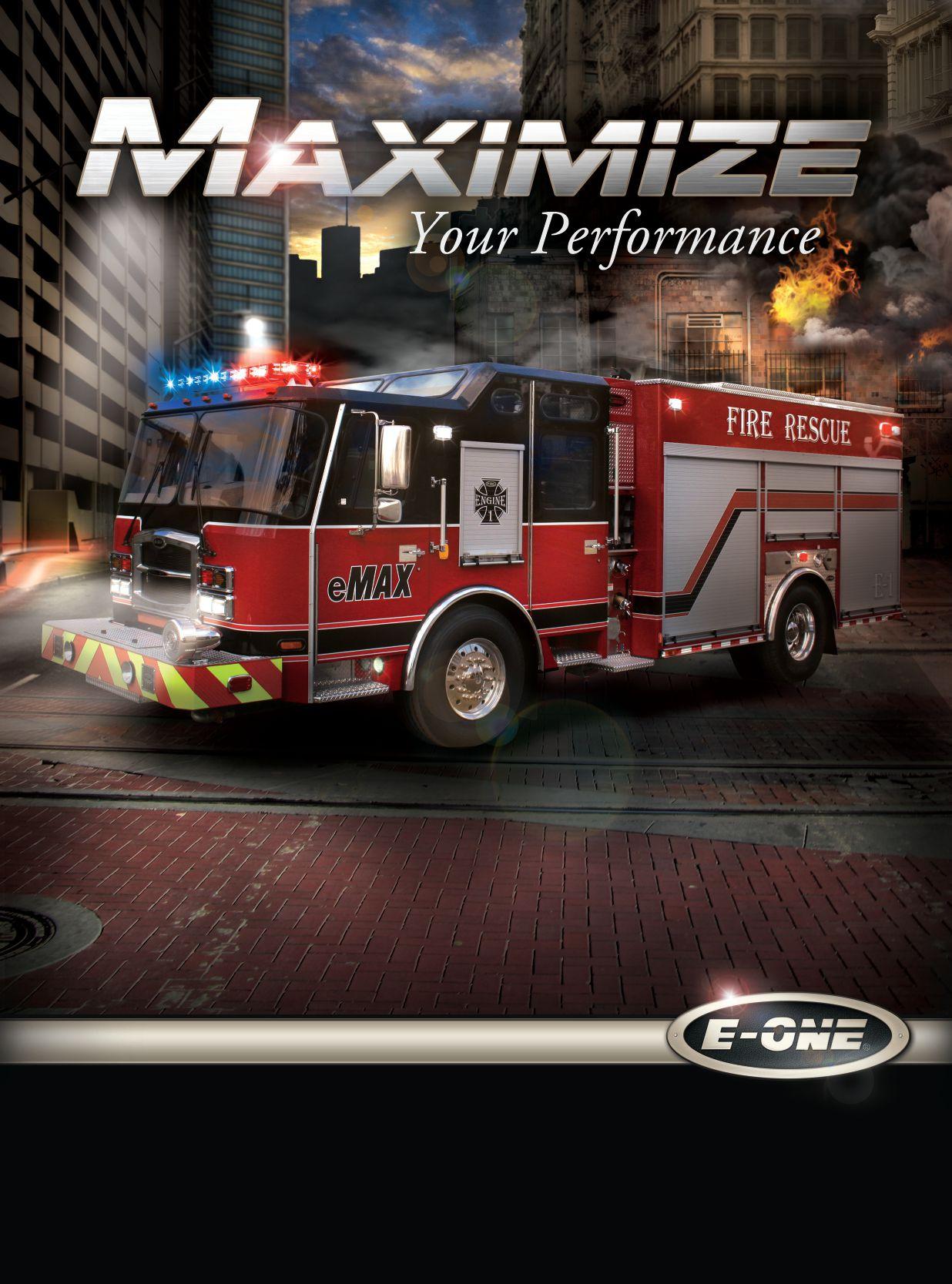
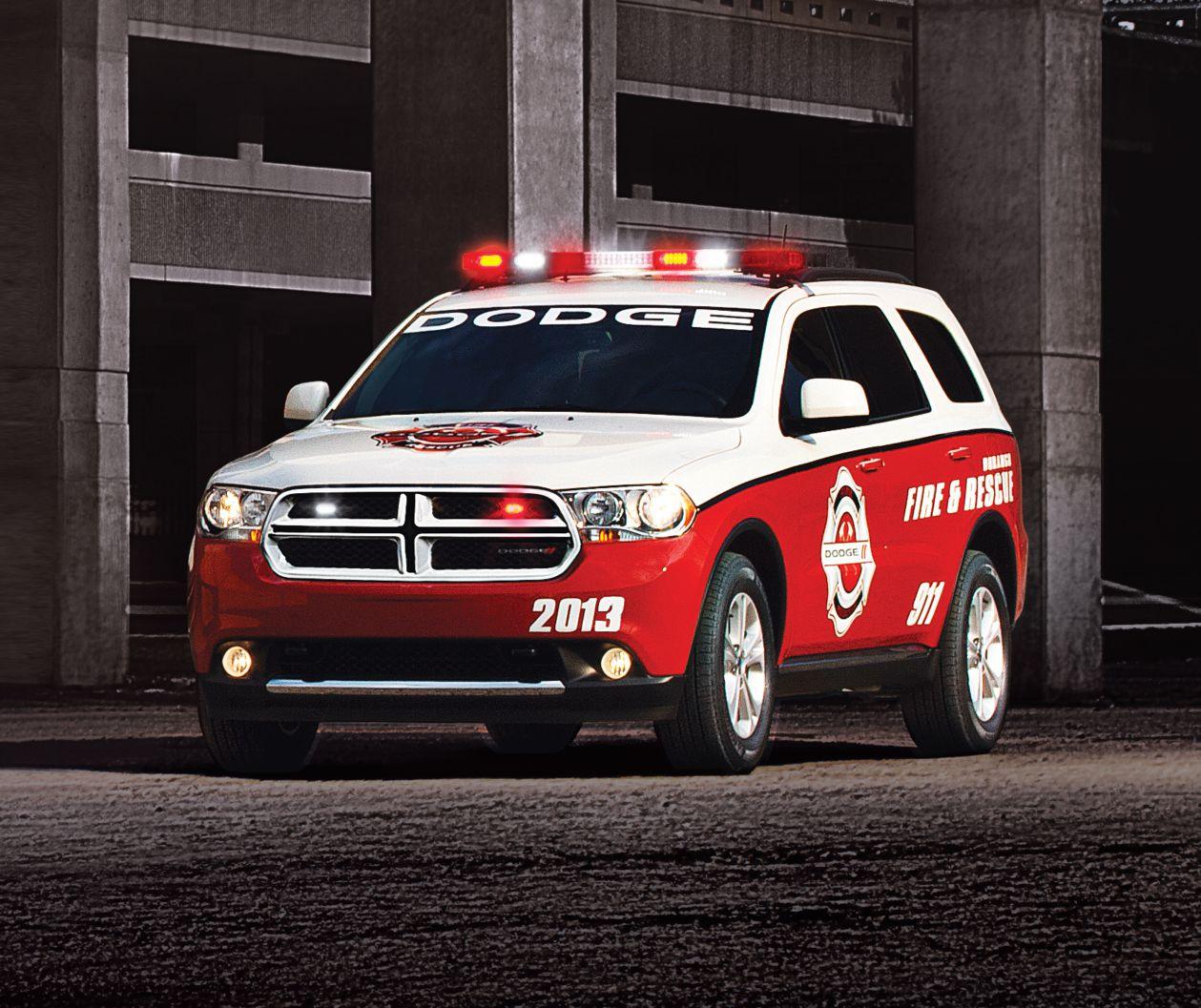
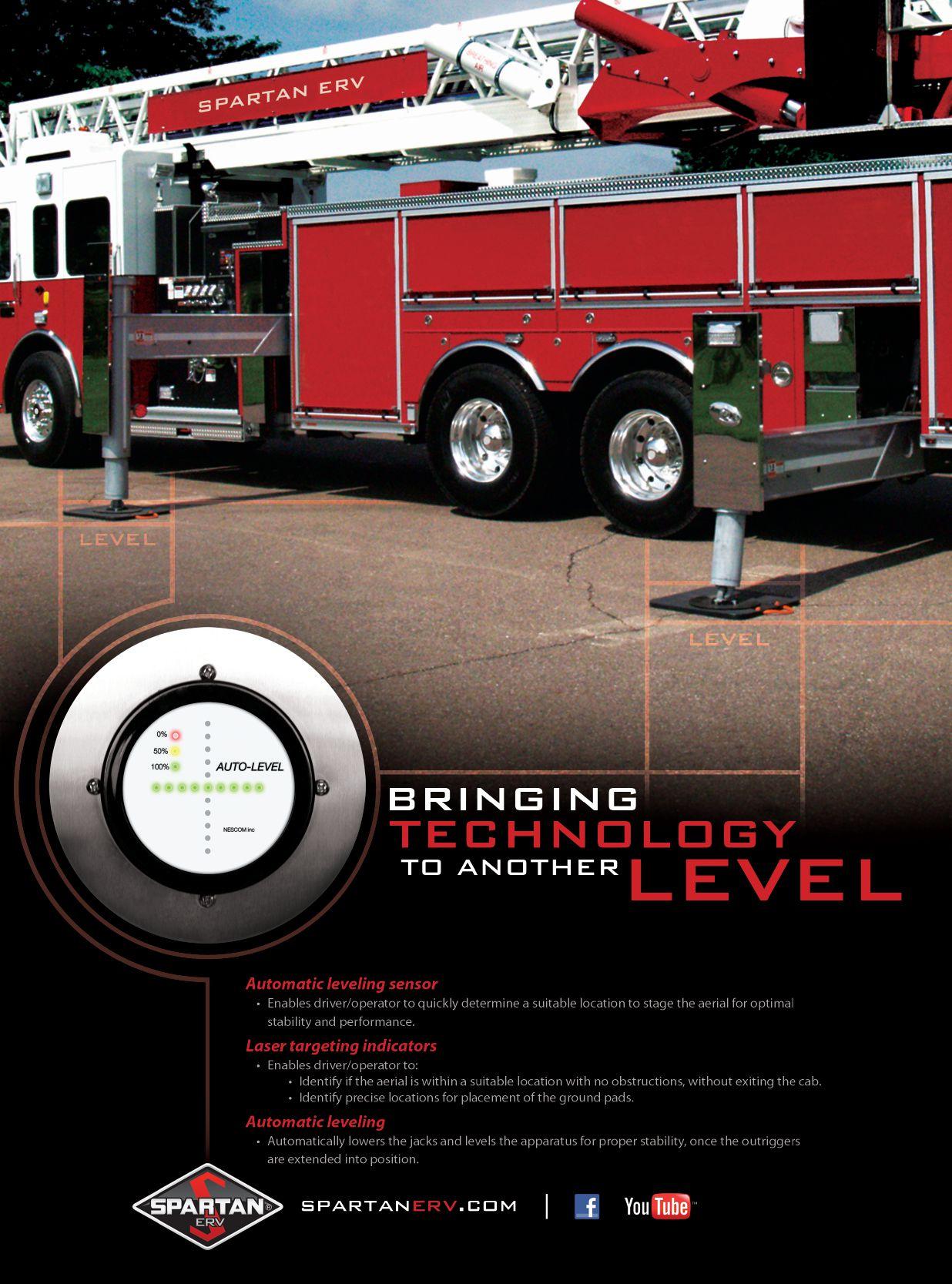
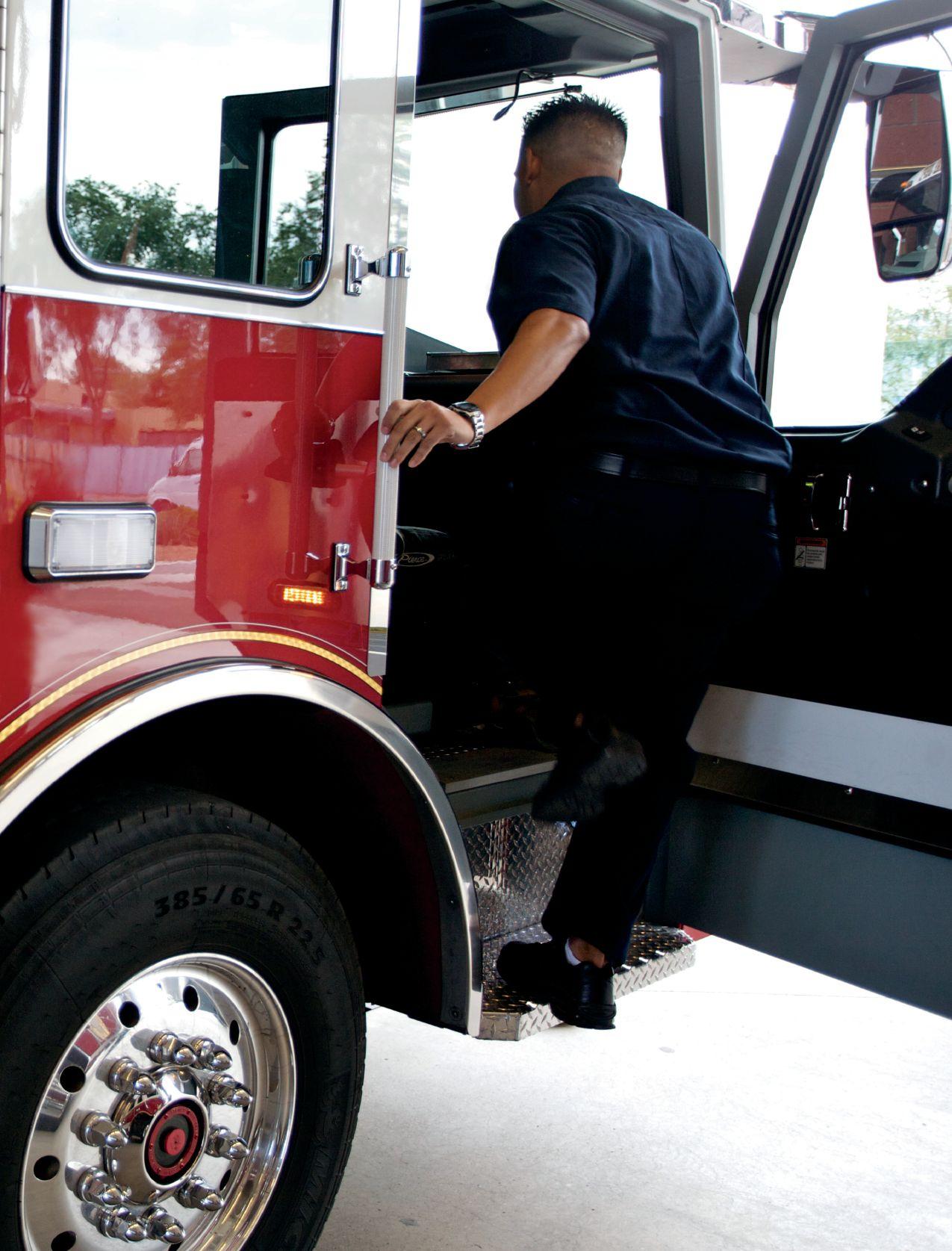
The all-new eMAX delivers innovative features for flexibility on scene and on the road. With enhanced configurations and a narrow pump panel, the eMAX boasts an amazing 586 cubic feet of storage. And the compact wheelbase provides maximum responsiveness for tighter turns and ultimate maneuverability.
Phone: 519-752-5431
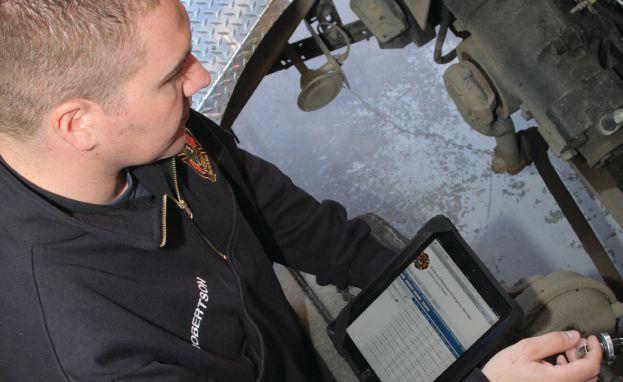
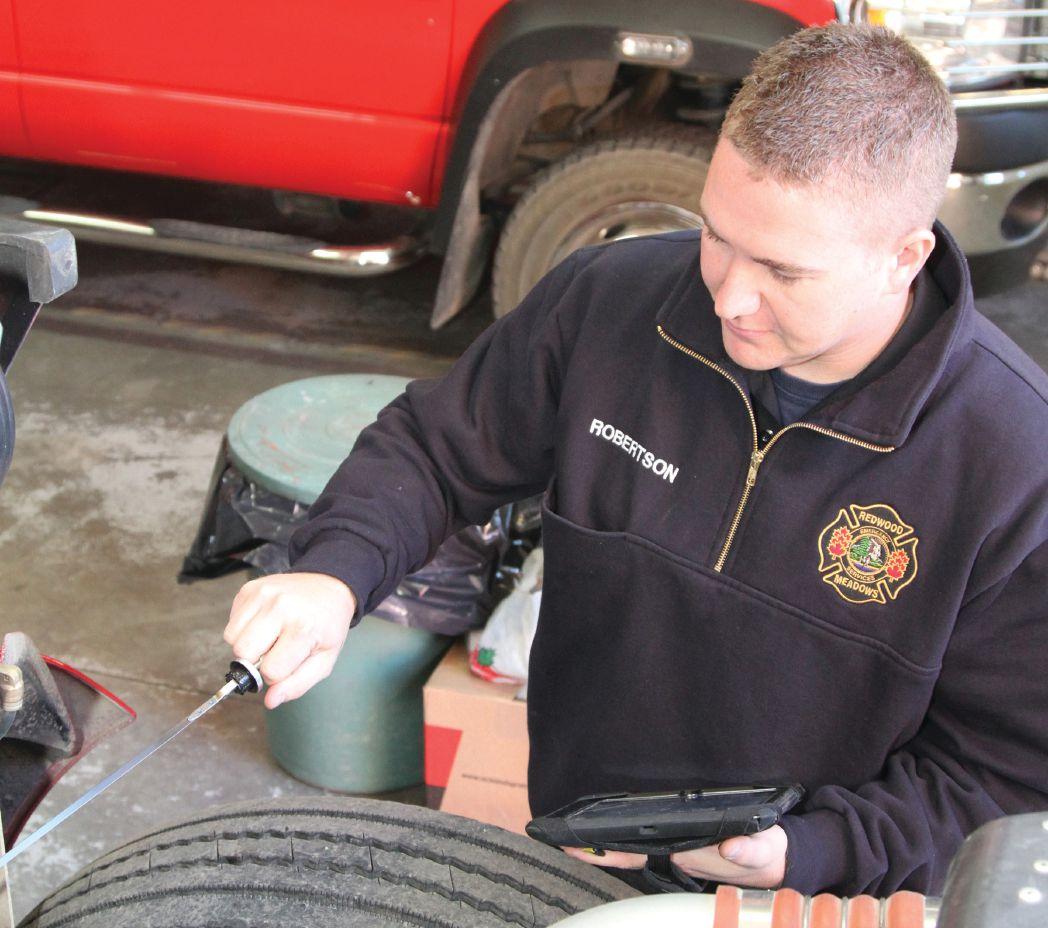
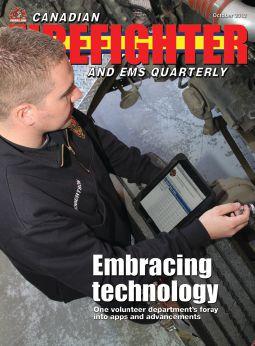
Capt./EMT Gary Robertson of Redwood Meadows
checks the oil in the first-due engine while filling out the truck check
hen I started this job in 2007, one of the first things I did in order to better understand the fire service was to look for numbers – numbers of fires in Canada nationally and by province/territory, numbers of fatalities, numbers of anything
You all know where I’m going with this: I couldn’t find numbers. I’m a words person and I don’t like numbers, statistics, data, charts, graphs or spreadsheets. But I knew that in order to grasp fire-service issues, I needed to know the story first, and numbers tell stories as well as words, sometimes better.
OK, admittedly, I found some numbers: they were on the website of the Canadian Council of Fire Marshals and Fire Commissioners (www.ccfmfc.ca), and they were from 2002 which, at the time, meant they were five years out of date.
While we weren’t quite the social media society in 2007 that we are now, it was still appalling that more complete data was not available and, what’s more, that everyone in the fire service knew it wasn’t available and was doing nothing about it.
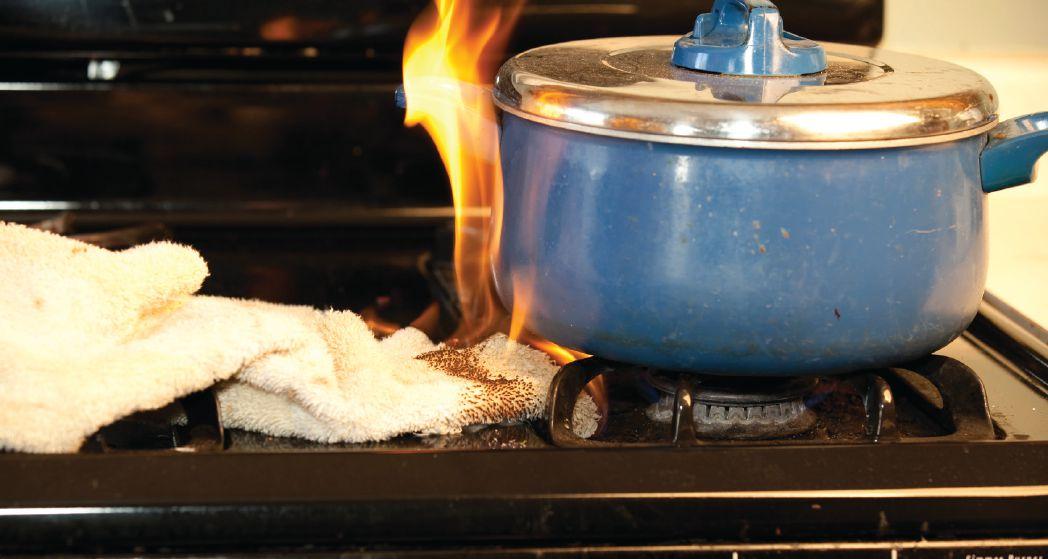
Enter Mahendra Wijayasinghe, manager of research and analysis in the office of the fire commissioner at Alberta Municipal Affairs. Wijayasinghe is a numbers guy. And he took it upon himself to pull together statistics on home fires – at least the ones he could gather from provincial and territorial fire marshals’ offices – and tell a very vivid story that identifies smoking and cooking as the primary causes of house fires in Canada (a fact that we’ve known through anecdotal evidence and numbers from some provinces) and points clearly to the need for more fire prevention and public education and the funding for it.
Last September, at the Canadian Association of Fire Chiefs and CCFM/FC conference in Calgary, Wijayasinghe presented his report on the data gathered from seven provinces and one territory; data from the rest of the country was not available. (Even the numbers that were available were a minimum of four years old.)
Wijayasinghe’s full report is on the CCFM/FC website but he has worked it into a more digestible version for non-numbers people like me, and you can read it on page 16. The numbers do indeed tell stories: stories of the need for more public education and fire prevention for certain segments of the population – seniors and smokers are the key demographics – and stories of the need for more effective programs about safe cooking.
Some associations have already started this type of targeted public education: in British Columbia, Surrey Fire Services has partnered with the Fire Chiefs Association of B.C., the University of the Fraser Valley, the Royal College of Physicians and Surgeons of Canada, and the office of Attorney General Shirley Bond, and has launched videos aimed squarely at certain demographic groups and a smoke-alarm campaign with the slogan We won’t rest until you install and test. It’s a great start. But it’s not enough.
For more than a year now, fire-prevention officer (and now acting deputy chief) Ken Sheridan of Norfolk County Fire & Rescue Services in Ontario has been writing in this magazine about the need for fire departments, suppression staff and officers to embrace public education and for equal – or even more – funding.
The words, numbers, charts and graphs that fire officers need to help convince councils that public education is a priority are in our story. Use them.
Canada – 1 Year $ 12.00 (with GST $12.60, with HST/QST $13.56)
(GST – #867172652RT0001)
USA – 1 Year $ 20.00 USD
Occasionally, Canadian Firefighter and EMS Quarterly will mail information on behalf of industry-related groups whose products and services we believe may be of interest to you. If you prefer not to receive this information, please contact our circulation department in any of the four ways listed above.
The volume of information that comes our way every day can be so overwhelming that we may not be reaping the full benefits of all the useful news and fire-service resources that are out there. Social media, e-mails, websites, forums, books and magazines pack our minds every waking second. We have never in history had such great and immediate access to the volumes of diverse information that we have today. I believe these abundant resources can play a huge and important part in our daily lives; how we manage them determines how much we gain from them.
As in any business, staying abreast of the latest information is critical to success. We are fortunate to have 24/7 access to endless innovations, ideas and stories from around the world. We are at a place in time at which we have all the tools at our disposal to build a better fire service and a better working environment. One problem: having too much of something can lead to confusion, stress and infobesity.
In today’s fire service, from a recruit firefighter to the fire chief, the information intake is not solely fire related; there are many opportunities for expanding our horizons, from business to HR, technology, and psychology. All this diverse information will help us grow and build a stronger fire service.
On the fire ground, too much information and too many incoming messages can negatively affect a firefighter’s situational awareness, just as too much cyber-data can alter one’s decision making and learning processes at work and at home. Being overwhelmed by a mass of information increases our stress levels, and we begin to absorb less and less.
method that I choose not to use is the browser bookmark function; I find the out of sight, out of mind premise comes into play with this tool.
One tagging method that I find easy and effective is tweeting the piece I find interesting via Twitter; this allows me to have a permanent bookmark that I can review later, from anywhere, online. Twitter is a powerful, professional information portal that can be easily accessed by computers and our phones. Twitter’s biggest informationage bonus is the fact that the micro information comes to you in bite-sized chunks and can be read very quickly and skimmed in just a few minutes. This greatly increases our intake overdose and allows us to quickly scan for interesting and thought-provoking posts and information.
ARJUNA GEORGE
I use a method that allows me to absorb a large amount of data, without the strain of information overload. I call this system STR – skim, tag and read.
To combat this, I use a valuable method that allows me to absorb a large amount of data, without the strain of information overload. I call this system STR – skim, tag and read. I review a large number of blogs, social media posts and magazines daily, and have found the need for a simple way to organize these resources and manage them in order to actually retain the valuable nuggets found in each of them.
Our social media feeds and inbox junk is camouflaging the real informative gems out there. So, how can one organize and decipher the valuable information from the mountains of junk? By using the STR method, you can quickly scan your resources, and then tag them for later. Skimming a website or magazine should take only a few minutes.
I use a number of tagging methods such as Post-it notes for magazines, or opening up a new window in my browser for online material. By using the browser method, I may find I have a handful of appealing articles to read at the end of my web skimming. I leave the items open to read when my schedule permits. One
The third and final step is to go back to the tagged resources and read only the interesting nuggets. This method reduces the time that could be wasted daily and provides valuable information. On average, people spend more than 30 hours a month online; I don’t see that number decreasing, but what we should be looking at is smarter time spent online.
Consider this: an incredible 900,000 blogs are posted every 24 hours. Even if one per cent of those interest you, that leaves 9,000 sources to funnel through. If you want to stay productive and stress free, then it is paramount to find ways to manage this overwhelming intake.
In order to avoid all the unwanted cyber-clutter, it is key to follow only active and interesting people whom you trust and who share valuable information. Over time, we reach a saturation point with the online forums and newsletters to which we subscribe, and we should begin to triage our inboxes. An estimated 20 per cent of our work e-mails are considered spam. Begin your triage by unsubscribing to forums that you do not read regularly; this will simplify your intake and allow you to focus on sites and blogs that provide you with value.
There are lots of ways to effectively manage and filter the massive amount of data. Figure out which way works best for you and enjoy the gold mine of fire-service resources. The information highway is not a tool from which you should distance yourself: embrace it, prioritize it, but don’t tune it out!
Hopefully, you skimmed this article, tagged it and came back to read it. The best thing you can do between alarms is to continually prepare and improve yourself. There are no excuses; the information is yours for the taking. Stay safe.
Arjuna George is a 15-year veteran and the deputy fire chief of operations on Salt Spring Island, B.C. E-mail him at ageorge@ saltspringfire.com.
Redwood Meadows Emergency Services (RMES)
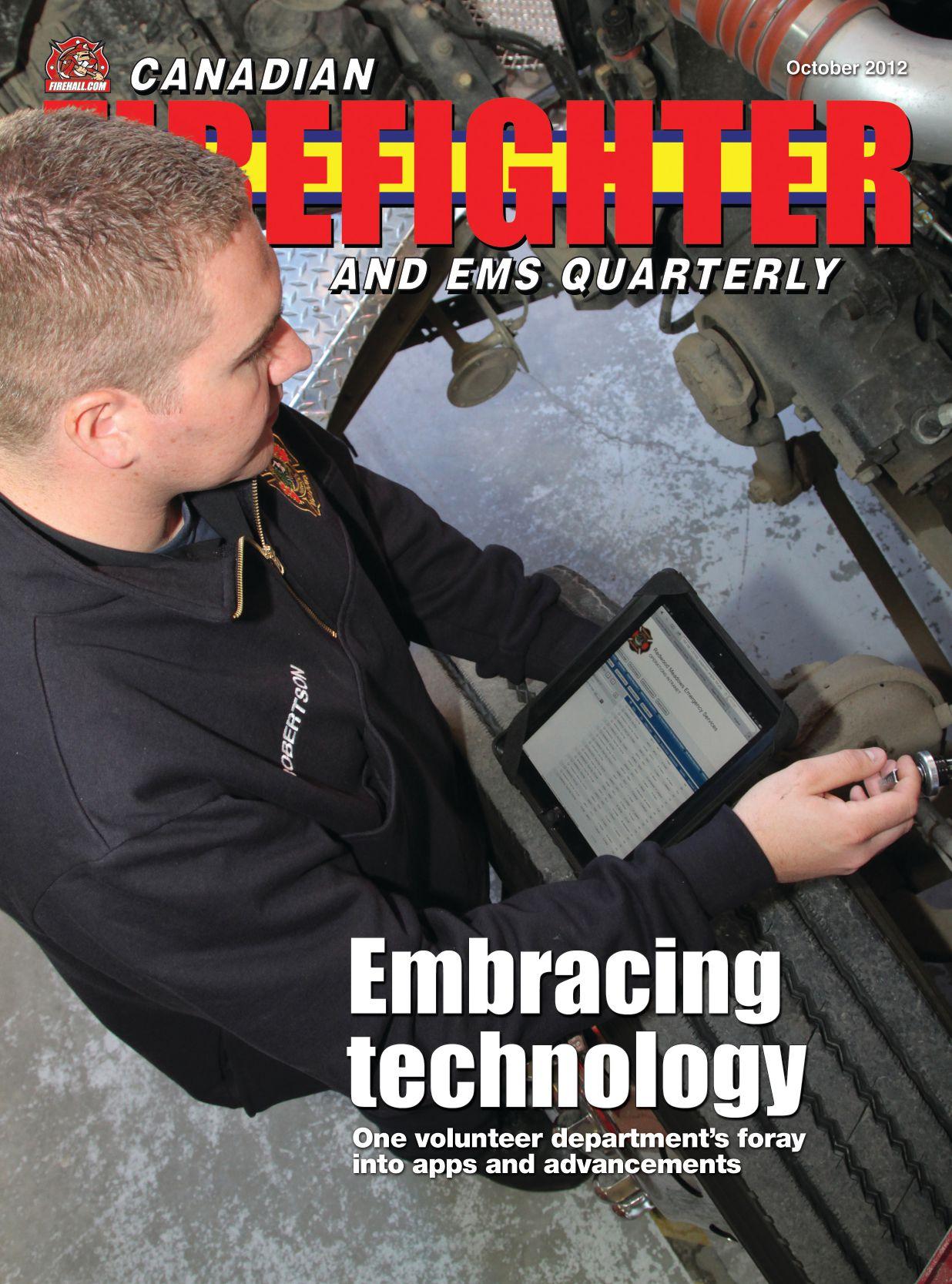
Capt./EMT Gary Robertson uses an iPad to complete equipment checks. RMES members have used their technical know-how to save money and implement new systems.
Embracing technology
One volunteer department’s foray into apps and advancements
By Rob Evans
There has been considerable debate in the fire service about the use of technology in the fire hall, on the trucks, and, in particular, at incidents. While many departments are making use of smartphones and social media, the 36-member Redwood Meadows Emergency Services (RMES) in Alberta and its volunteer members have combined internal expertise with innovation to create apps for iPads and other devices that are helping them do their jobs better.
As is the case in many Canadian departments, RMES started using bag phones – those bulky cellphones – on its rescue truck in the mid-1990s; these were added to the first-out engine early in the new millennium. The importance of having cellular communication on scene when dealing with sensitive issues has been immea-
surable: being able to phone dispatchers to explain requirements and requests without tying up radios on scene has been helpful both to command and to those who need to talk to command.
BlackBerrys were introduced in the department for the chief, deputy chief and chief training officer in 2009 and enabled instant communication through e-mail, text messages or BlackBerry Messenger – instead of having to wait until evening to check e-mails at home. Many of the younger members of the department were using iPhones and officers quickly recognized the benefits of these smartphones for crews on scene. The many apps available to fire and medical personnel, video and audio recording features and high-resolution still cameras on these phones added a whole new dimension to responders’ toolboxes.
For example, while following department SOGs, commanders can use pocket-guide apps. Medical pocket guides include such things
PHOTOS BY ROB EVANS
as pharmacology lists that help responders determine medications that patients may be taking. Audio and video can be used to record the scene or witnesses. And still digital photography can be used to capture scenes for inspections, investigations or files for future responses and pre-planning.
RMES placed iPhones onto our rescue and engine in March 2011 during a hardware upgrade with the cell service provider. After using the iPhones for almost a year on the rescue and first-out engine, the next logical step was to have iPads on the apparatuses. This was done in October 2011 with the rollout of new truck-check procedures. The iPads use many of the same apps as iPhones and are better for taking notes at incidents, such as insurance and homeowner information.
We quickly realized that iPads could be used for completing the necessary equipment checks and post- and pre-trip inspections required by Alberta Transportation. A database was built by a computer-savvy firefighter, which records every time an equipment check, inspection or weekly air-brake check is completed, including the time, date, operator and the firefighter completing the report. The database also keeps track of equipment deficiencies and maintenance requests. Reports of all post- and pre-trip inspections can be e-mailed to all officers and to the deputy chief. When an equipment order is requested or maintenance order is placed, the appropriate officer and the chief automatically get an e-mail.
Capt./EMT Gary Robertson, who is tasked with medical and equipment supply management at RMES, says this technology streamlines the process for replacing consumables and ensures that everyone is on the same page.
“It has helped us primarily by giving everyone a single point of contact to report supply needs or defects to equipment or vehicles,” he says.
The addition of iPads to the station for this purpose has resulted in the elimination of almost all paper and the clipboards that used to hang in the apparatus bays. In a short period of time, it has become common practice for the operator and another firefighter to complete a post-trip inspection while the officer completes his or her report in the office. In the future, Robertson says RMES hopes to develop the program even further.
“The searchable database has also made it easier to track trends,” he says. “Because it is searchable we can see how often we are ordering certain supplies or if a piece of equipment has a chronic issue.”
Making ordering easier for the officers and the equipment suppliers is also on the radar.
“While still in development, the goal is for supply requests to be drop-down menus that include the product code for the vendor it is purchased from,” Robertson says. “This will reduce the amount of time to put the orders together, as then I don’t have to search for the order number.”
Very little money has been spent on this technology because RMES is fortunate to have firefighters who are technically savvy and motivated to put their skills to work in the department. Overall about $1,500 has been spent to upgrade the phones and add the iPads. Phones were simply a hardware upgrade through the service provider, the iPads were about $600 each and RMES opted to pay for some additional support offered by the database company. The system has been set up using a program called PHPRunner, and firefighter/EMR Trevor Korthius has put in many hours developing and refining the system database. Korthius, says the system has not been without challenges.
“The biggest challenge was finding a program that would help us build an interface to our database that would be easy for me to use as I am not a programmer or database guy,” Korthius says. “I know a little about both but not enough to build this without help.”
Deputy Chief George Low says all the new hardware is impressive and helpful, but he believes the best addition to the technol-
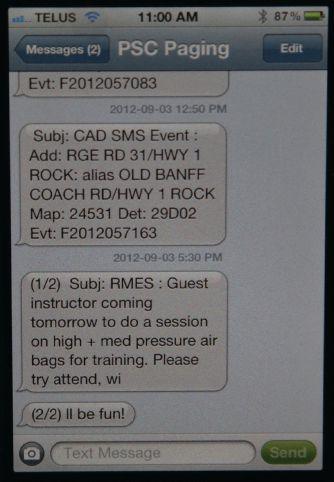
ogy that RMES uses is text messaging from dispatch to members’ cellphones.
“While the addition of iPads has been neat and allows us to access a lot of data quickly as well as interface with the intranet for post-trip inspections,” he says, “I think that the most significant change has been the addition of text paging to our smartphones.”
According to Low, text messaging allows RMES to alert members even when they are outside normal radio or pager range. Low says the e-mails firefighters also receive and which include an MP3 recording of the page-out and the links to audio feeds of RMES radio channels, are a bonus.
The link for the radio channels can be found on the RMES web site at www. rmesfire.org and has proven to be a popular addition. For example, during a gasstation fire in January, people across the country – from Newfoundland to Vancouver Island – listened to the department’s operations. This was also a breakthrough event for the department’s use of Twitter. Local media as well as media from Calgary were kept updated throughout the fire and were in contact with the fire chief prior to their deadlines. There are only a couple of people who have access to the Facebook and Twitter (RMESfire) accounts, which ensures that the message being delivered is consistent. The department is careful about the content being displayed through both sites but is still working to create a formal socialmedia policy.
As with any change, it has been difficult getting some firefighters to embrace all this technology.
“The one challenge has been getting people to adapt to the new system and put all requests through the intranet, but that will come with time,” Robertson says.
Rob Evans is the chief fire officer for Redwood Meadows Emergency Services, 25 kilometres west of Calgary. Evans attended the Southern Alberta Institute of Technology in 1989 and studied photojournalism. In 1992, he joined RMES after taking pictures of an interface fire and making prints for the department. He has his NFPA 1001 level II certification, NFPA 472 Operations and Awareness (hazmat), NFPA 1041 level I (fire service instructor), Dalhousie University Certificate in Fire Service Leadership and Certificate in Fire Service Administration and is a registered Emergency Medical Responder with the Alberta College of Paramedics. He lives in Redwood Meadows with his wife, who is a firefighter/EMT with RMES, and three children.
The most significant addition to the RMES technology arsenal is text paging to members’ smartphones, says Deputy Chief George Low.
They call me the fireman
That’s my name
Makin’ my rounds all over town
Puttin’ out old flames
Well everybody’d like to have what I’ve got I can cool ‘em down while they’re smolderin’ hot I’m the fireman
That’s my name
- George Strait, The Fireman
Anyone who has listened to country singer George Strait has heard this tune. Recently, when that song came on my truck radio, I began to question just what the label firefighter truly defines. Undoubtedly, the stereotype of the tough, vigorous hero riding in a shiny red fire truck is an image anyone can picture. But on a serious note, it became increasingly apparent to me that few people have an accurate understanding of what we do as rescuers.
Call me the fireman
order to maintain healthy and safe communities. A good example of this is the city of Seattle, Wash. Year after year, Seattle is recognized as the best city in which to have a heart attack. Seattle’s famed Medic One system boasts a survival rate of almost 52 per cent. Not only has Medic One been recognized by its medical peers on a global scale, but it has also gained great support from the citizens it protects. Through teamwork, public education and proven success stories, the Seattle Fire Department clearly does more than put out fires, and the public knows it.
LEE SAGERT
In large urban settings and small country towns, all of us are aware that we never truly leave our work at the end of a shift. Often I find myself envious of nine-to-five workers who can simply shut down the computer, lock the office door and forget work until they return the next morning. It may surprise some folks to know that when we are off duty we still carry on our dayto-day business as firefighters or paramedics. For example, I remember moving into a new house a few years ago and a neighbour came over to greet me. “Oh, great!” she said, “I feel so much safer knowing that we have a firefighter next door.” I’m sure that this scenario is familiar to many of you and illustrates my point, that we are firefighters 24/7, whether we like it or not. My neighbour assumed that if an emergency occurred at her home, I would be there to help. It is evident that our profession is held to a higher standard than most; we are expected to be healthy, act with safety in mind and set good examples. Many people do not realize that, even out of uniform, we are to some extent always on duty. Interestingly, just weeks after moving into that new home, my doorbell rang early one morning and there stood my neighbor obviously in distress; her mother had suffered a medical emergency and her first reaction was to go find the firefighter.
The public expects the highest level of professionalism from the fire service.
In previous columns I have highlighted the benefits of integrating EMS into the fire service. We have discussed an all-hazards, multirole response to caring for our communities, and the fact is that we can no longer divide our duties by responsibility. No longer do we simply fight fires, but we also respond to everything from medical emergencies to fluid spills. The public expects the highest level of professionalism from the fire service. Our roles will continue to grow and I believe we can make ourselves shine by showing society all the additional duties we perform. Structure fires are on the decline, yet other community needs are rising. It is vital to answer those demands in
The Webster’s Dictionary defines a firefighter as “one who extinguishes fires.” We all know there are many other tasks we do as rescuers. I recall a particularly busy night shift this summer during which I needed to use a full cache of skills and tools. The shift began with a standard equipment check, which, after calibrating gas monitors, updating onboard computers, rotating medications and doing other maintenance work on the engines, took about an hour. A waterline break at the mall, our first call, was easily controlled, but it was obvious the store’s employees had no idea how to deal with the massive pond of water. Needless to say, seven firefighters and a few squeegees saved the day – and I know this good deed will pay dividends for us in the future. Next, as a group of Girl Guides were given a station tour and were educated on fire safety, we were dispatched to attend a vehicle crash with patients trapped. This incident had multiple patients and suddenly I was thrust from my firefighting duties into running the hydraulic tools. Once the extrication was complete, I switched to the paramedic role and assisted by starting IV lines in the ambulance. Finally it seemed as if things were slowing down and plans for a nice dinner were in the works when a gentleman collapsed at a local gymnasium. “CPR in progress,” the radio called as we rushed to the scene. I was assigned to the airway for this cardiac arrest, and I carefully passed an ET tube and intubated the patient. Shortly after a few rounds of CPR and ventilations, a pulse began to strengthen and the room sighed with relief. I recall thinking to myself that night, we truly do it all – we truly are multi-role rescuers. One minute I’m operating a squeegee at a flood; the next minute a heavy rescue tool at a crash scene. Then I shift to educating students much as a teacher would and, lastly, I manoeuvre a delicate laryngoscope like an anesthesiologist. Our training and practice surely paid off. As we drove back to the station I began to chuckle, thinking to myself, maybe it is easier to just call me the fireman.
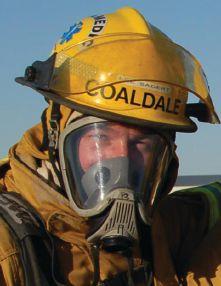
Lee Sagert is a career paramedic/firefighter with the City of Lethbridge in Alberta and a volunteer lieutenant with Coaldale Emergency Services. Lee is a former flight paramedic with S.T.A.R.S. and has trained at Oregon Health Sciences University in Portland. He resides in Coaldale, Alta., and enjoys photography and spending time with family. Contact him at leesagert@shaw.ca.
Circuit workout – take two
If you’re like me, you get bored quickly. Maybe that’s why we love fire fighting so much – every call is different from the last, and so it can be for your workouts. It really takes focus to make sure you are making the optimal effort. Changing your workout periodically is a great way to maintain an edge. Here is another circuit workout for you, but don’t hesitate to modify it to suit your needs.
Work up to one-minute-interval exercises with no rest between sets, but don’t be afraid to start with 30-second intervals with 10 seconds of rest between. Once you have completed the 10 stations, take a one-minute rest and start again. Three rounds through is excellent effort! Four rounds – fabulous!
Sand/water walk
Fill two five-gallon buckets with sand or water and go for a walk. If the buckets are too heavy empty out some sand or water. Challenge yourself with stepping over benches or stair climbing.
Core chops
Holding one of your sand/water buckets, stand with your feet shoulder-width apart. Move the weight from right to left at shoulder or chest height. To vary this movement, lift the bucket straight up and down (keep your arms as straight as possible) or pass it all around your body, changing direction. This is a great exercise for core control. Be sure to use a weight you can manage, but one that still challenges your stability.
Burpees (my favourite)
Hanging leg-ups
While you are hanging from a bar (use an aerial or door frame) lift your knees as high as you can and return them down. The straighter your legs and the higher you raise your knees, the better. Add a weight between your knees for extra challenge.
SHERRY DEAN
Changing your workout ensures you are making the optimal effort.
From a standing position, squat down to put your hands on the ground. Step or jump back so your legs are straight out. Step or jump back in to your hands, then stand straight up again. To vary the exercise, add a jump up as you return to a standing position, add a pushup at the bottom or add a pull-up (you’ll need a chin-up bar) from the standing position. For the superstar variation, add them all!
Dead lifts
From a standing position with weights (use what you have – equipment, hose rolls, short buckets, etc.) in your hands and arms at your sides, squat as low as safely possible and return to standing position.
Ladder run/crawl backs
Draw a ladder on the floor or use a purchased agility ladder. There are many variations of running a ladder, but right foot in, left foot in, right foot out, left foot out for each box is a good one. Feel free to change it up. Once you have moved to the top of the ladder, get down on your hands and feet. Keep your arms straight and body in a straight plank position (like the start of a push-up), then return to the beginning of the ladder moving backwards on your hands and feet.
Jump squats
This is simple and effective: keep your legs shoulder width apart, squat down and jump into the air. When you land, think about being cat-like and not making any noise; this helps to absorb impact. If you find this difficult, then start easy – barely take your feet off the ground. As you improve, reach for the stars.
Mountain climbers
Start in plank position with your arms fully extended and your body straight. Keep your glutes low without arching your back. Alternating right and left legs, bring your knees up toward your chin and return. Once you’ve mastered the centre movement, lift your knees out to the side and towards your ears, then return. Try to keep this exercise fast moving. To vary, balance your hands on one (centred) or two (a little wider than shoulder width) medicine balls or basketballs.
Pull-ups/pull-overs
If you have a chin-up bar, do some chin-ups or wide-grip pull-ups. When you modify your grip, it changes where you target your back. Remember – change is excellent. If you don’t have a chin-up bar, lie across a bench or over an exercise ball facing toward the ceiling. Reach above your head and lift/pull a weight (use what you have available) from over your head to above your chest. Keep your arms straight or move your elbows slightly outward. This movement uses the chest and back, but try to focus on pulling the weight over using your lats.
One-minute cardio
You choose the method, but work hard. Once your minute is finished, you get to rest for a minute. If you are tired and can’t complete the full minute, don’t stop moving. Slow things down, recover, jump back in when you can and then finish the minute. You want to be tired at the end of one minute. Then, do two more rounds! Stay safe, work hard and keep fit!
Sherry Dean is a career firefighter/engineer with Halifax Regional Fire & Emergency Service and a volunteer captain with the Blockhouse & District Fire Department. She is an NFPA level 1 instructor with hazmat technician and special rescue certifications. Sherry has more than 20 years of experience in fitness and training including the Scott FireFit Challenge, competitive bodybuilding, team sports and personal training. Contact her at sbdean@eastlink.ca.
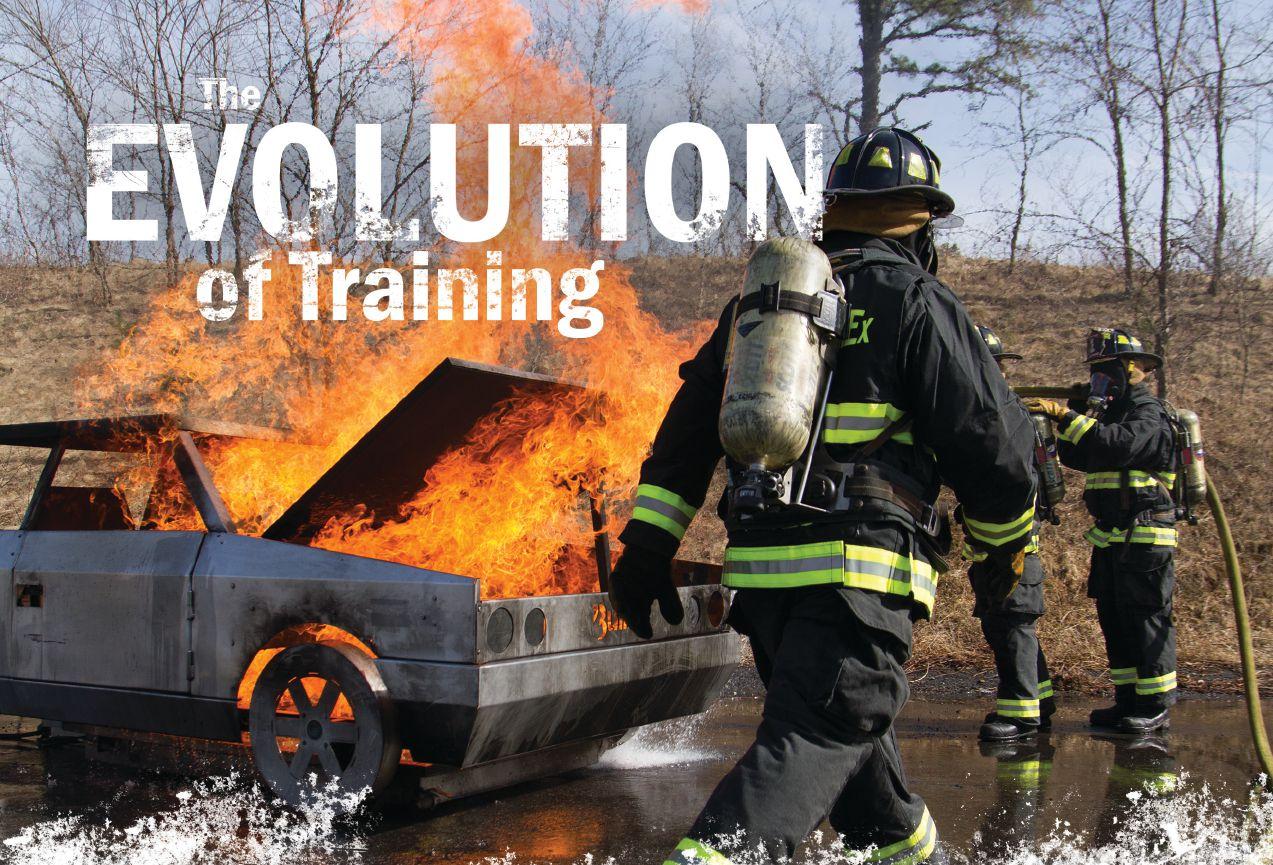
BullEx is Leading the Evolution.
As res become increasingly dangerous, incidents become more complicated and new threats emerge every day, the training tools required to address these challenges need to be real, effective and make the most impact on each and every trainee.
BullEx has led the way in reghter training by recreating the true experiences of the incident scene and building training tools that are tactical, hands-on and real. That’s why our rescue manikins can speak like real victims, our re props are built to burn hotter, and our smoke generators make the densest training smoke possible.
Our goal is to make the best tools possible to help instructors make a real impact on their trainees because training is what we are all about. We are Total Training.
Fireghter training has evolved… led by BullEx.
To vent or not to vent?
By Tim Llewellyn
One key fire-ground operation that is frequently glossed over and practised incorrectly or inaccurately in training programs is horizontal ventilation, specifically ventilation by interior search or attack crews as they move throughout the structure. As a student of the fire service, I often hear that the need for fire buildings to be opened up early is of paramount importance. I cannot dispute that statement – but, what is not emphasized strongly enough is that opening up the structure needs to be done with a bit of thought, planning and communication.
Here’s the scenario: you are part of a primary search crew performing an oriented right-hand search of a bedroom in a singlestorey residential structure with a fire in the kitchen area. Your officer is at the door of a room with the thermal-imaging camera. The smoke is thick, with visibility of about 15 centimetres. You can hear the engine crew over the radio calling for more hose. The heat level is moderate – not too hot, but not someplace you’d like to stay for long. As you turn the second corner, your right hand sweeps curtains and blinds. You recognize this as a window and your first instinct is to get this window open to let some of this heat and smoke out and improve visibility. But wait! Before you break open that window, a few things have to be considered. Let’s get into this a little more.
Interior crew members cannot indiscriminately break out windows or open exterior doors as they go. Crew members first need to determine whether they are venting for fire or for life. Venting for fire means opening up windows to make conditions easier for the hose team members when they open their nozzles on the fire; the steam they create will have somewhere to go other than back on top of them. Venting for life means replacing bad air with good air to give potential fire victims a greater chance of survival and to allow search crews to do their jobs under less threatening conditions. Here are a few of the questions that need to be answered before opening that window:
What is the prevailing wind direction and condition?
On windy days, if the fire and the wind are on the same side of the building, horizontal ventilation openings made on the windward side of the structure should be avoided. Even mild to moderate prevailing winds can cause extreme fire propagation downwind throughout the structure. This phenomenon is not just seen in highrise fire fighting. There are many documented cases of wind-driven fires in single-storey residential dwellings that have resulted in firefighter injuries and fatalities. All interior crews must make note of the wind conditions before entering the structure and avoid making openings on the windward side.
Is the hose team in place for fire attack?
If windows or doors are opened before the hose team is ready, the constant inrush of fresh air can and will cause the fire to grow and extend. If the outside venting firefighter breaks open the window to the fire room before the hose team has stretched its line, the fire can
Horizontal ventilation on the windward side of the building should be avoided; even mild winds can cause extreme fire propagation throughout the structure.
grow and auto-expose on the outside of the building and into upper floors or the attic space. The hose team and the ventilation team must communicate with each other when venting for fire. Hose team: let the vent team know you are in place and have good water. Vent team: let the hose team know when you’re ready to bust open the window.
Is the window in a room with an operational door?
If the room you are in does not have a door that you can close, such as in an open floor plan or a window at the top of the stairs, avoid opening the windows in that space until there is water being applied to the seat of the fire. It is important to remember that opening windows creates a chimney effect, and unless other ventilation has been established, the fire and heat will be drawn to the area of the new vent opening – and that may cut off your egress route. If the room has an interior door that can close and stay closed, the windows can be vented for life, allowing for a rapid search and quick exit, such as in a vent-enter-search scenario.
Where is the window in relation to the fire?
When venting for fire, horizontal ventilation openings should be made as closely as possible to the opposite side from where the hose team is directing its stream. Breaking windows to the side or to the rear of the hose team can cause steam and debris to be pushed back onto team members. Remember, when venting for fire, you are trying to make things easier for the firefighters on the hose team. So, back to the scenario from above: to vent, or not to vent?
Tim Llewellyn is a career firefighter for the Allegheny County Airport Authority in Pittsburgh, Penn. A volunteer firefighter since 1989, he currently serves for the Adams Area Fire District in Pennsylvania. He has recently been appointed as a suppression-level instructor for the Pennsylvania State Fire Academy. He has taught structural firefighting tactics extensively in Canada and the U.S. E-mail him at llewllyn.fire@gmail.com.
PHOTO BY MARK VAN DER FEYST
Born bold.
If you’ve always been a fighter, only Dräger will do.
Dräger equipment isn’t for everyone. It’s for people who have expected nothing but the best of themselves from the very beginning. When expectations are this high, only optimum fire equipment can rise to the occasion. Dräger makes equipment bold achievers can have confidence in. Our integrated portfolio revolutionizes firefighting technology with streamlined components that work together as one. The result: power to perform at your personal best.
Study confirms cooking, smoking are top causes of house fires
Compilation of national numbers validates need to improve public education
By Mahendra Wijayasinghe
Canadian fire statistics are elusive: the last available analysis of nationwide fire losses in Canada is the 2002 Annual Report of Fire Losses in Canada, published by the Council of Canadian Fire Marshals and Fire Commissioners (CCFM/FC). What’s more, statistics on home fires, which account for the majority of fire deaths and injuries in Canada, were not available in the 2002 report or in previous reports.
While anecdotal evidence indicates that most fires and fire deaths in Canadian homes are caused by cooking or smoking, there are no national numbers to back that up; statistics from most provincial fire marshals offices are available but, until now, have not been compiled and analyzed to form a national picture.
A study of available home-fire information by the public safety division of Alberta Municipal Affairs is based on a statistical analysis of fire-incident data from seven Canadian provinces and one territory: British Columbia, Alberta, Manitoba, Ontario, New Brunswick, and Nova Scotia (for 2007), Saskatchewan (for 2008), and the Northwest Territories (2003-2007). Data for the rest of Canada was either not available or was incomplete. Analytical programs based on software developed at Alberta’s Office of the Fire Commissioner were used for the analysis.
The findings are not surprising:
• Seniors aged 75 years and older have the highest risk of dying in home fires.
• Thirty per cent of all fires involved homes and 67 per cent
of all fire deaths happened in homes.
• Most home fires occur in one- and two-family dwellings, and this partly reflects their higher proportion in the housing stock.
• Cooking is the leading cause of home fires and home-fire injuries.
• Kitchens are the leading area of origin for home fires (22 per cent) and civilian home fire injuries (29 per cent).
• Just eight per cent of home fires started in the living room/ family room; these fires caused 33 per cent of home fire deaths and 17 per cent of home fire injuries.
• Nine per cent of reported home fires started in the bedroom. These fires caused 20 per cent of home fire deaths and 21 per cent of home-fire injuries.
• Smoking is the leading cause of home fire deaths.
Key variables used in the analysis were: year, property classification, source of ignition/igniting object, material first ignited, act or omission/possible cause, area of origin, deaths, injuries, and property losses. Results from a preliminary analysis of the data were presented at the CCFM/FC meeting in Calgary in September 2011, and subsequently posted on the CCFM/FC website. The report can be found at http://www.ccfmfc.ca/pdfs/report_e_07.pdf under the title, Fire Losses in Canada: Year 2007 and Selected Years.
We assume that the picture of home fire losses for Canada can be constructed with reasonable accuracy using fire-incident data gathered from the provinces and territory listed above, which represents about 75 per cent of the Canadian population. The definition of homes includes one- and two-family dwellings, apartments or
An analysis of numbers from seven provinces and one territory shows that cooking is the leading cause of home fires and home-fire injuries.
other multi-family housing, and mobile/manufactured homes. Analysis of home-fire data focused on fire deaths, areas of fire origin and fire causes. Fire data in homes subject to this analysis included a total of 13,256 home fires, 172 deaths, 1,168 injuries and $764 million in property losses. No further analysis was conducted on property losses due to data limitations.
Home-fire deaths
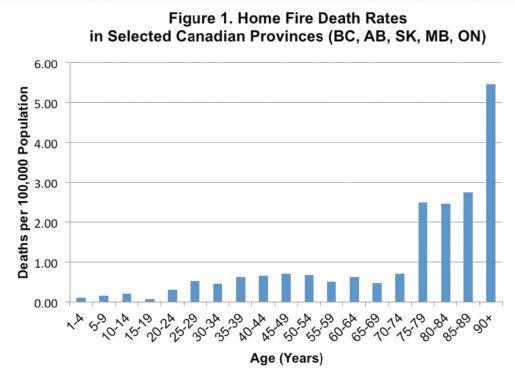
Fire deaths expressed as the number per 100,000 people within each age group are presented in Figure 1. Since ages of fatalities were not available from all jurisdictions, data from just five provinces were selected for this analysis. The risk of fire death increases dramatically for ages 75 and above. Compared to the average for the entire population, the death rate for those aged between 75 and 89 is 2.5 times the death rate for others. Those aged 90 years and older have rates that are five times higher. The vulnerability of older adults to fire deaths compared to the rest of the population is due to a combination of factors including limited mobility, higher incidence of mental and physical disabilities and increased use of medications. Seniors are becoming the fastest growing segment of the population in Canada; they therefore deserve closer attention both from the fire service and health practitioners.
Population data source: Demography Division, Statistics Canada, Ottawa. Prepared and presented by: BC Stats, BC Ministry of Labour, Citizens’ Services and Open Government. http://www.bcstats.gov.bc.ca/statisticsbysubject/Demography/ PopulationEstimates.aspx
Table 1 presents the distribution of home-fire deaths by type of property. The residential property category, made up largely of houses, accounts for the highest number of fire deaths in all jurisdictions. One- and two-family dwellings, apartments and mobile homes accounted for 82 per cent of all fires in residential properties and 83 per cent of all residential fire deaths (data not presented).
Table 1. Per cent distribution of fire deaths by property type and province
their homes. When the total number of fires and related deaths in all property classes in all jurisdictions was considered, homes contributed to 30 per cent and 67 per cent of fires and deaths, respectively.
Table 2. Contribution of homes to all fire deaths by province/territory
*Residential refers to properties with sleeping accommodation for normal residential purposes.
Table 2 presents the per cent contribution of homes to all fire deaths by province/territory. It is clear that, as in the United States, most fire deaths happen in places where Canadians feel the safest
*Data for NT is for 2003-07, for all other contributing jurisdictions is for 2007.
Home fires by areas of origin and causes
The per cent distribution of fires, deaths and injuries in homes is presented in Table 3. Most fire losses occur in one- and two-family dwellings. This is partly due to their relatively large representation in the housing stock.
Table 3. Home fires by type of home
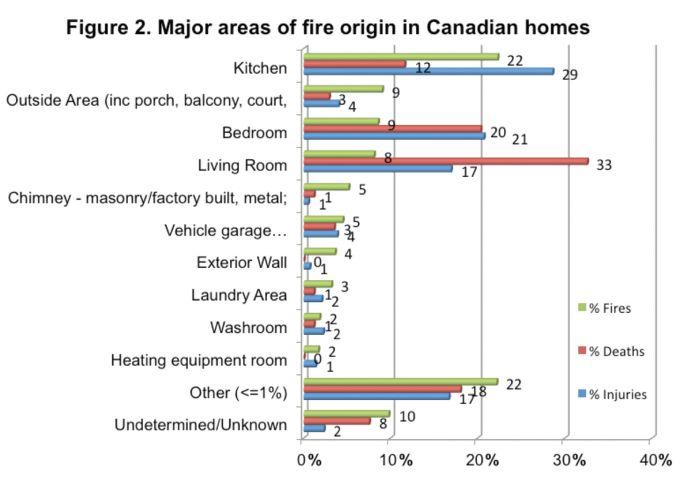
Major areas of fire origin in Canadian homes (see Figure 2) were:
• Kitchen – 22 per cent
• Outside area, including porch, balcony, court, patio, terrace and lawn – 9 per cent
• Bedroom – 9 per cent
• Living room – 8 per cent
• Chimney/flue-pipe – 5 per cent
• Vehicle garage – 5 per cent
• Exterior wall – 4 four per cent
• Laundry area – 3 per cent
A notable difference from this distribution – with chimneys being the primary area of fire origin – was seen in New Brunswick (31 per cent) and Nova Scotia (28 per cent). One-third (32 per cent) of all home fire deaths were caused by fires that started in the living room; 20 per cent resulted from fires originating in the bedroom; and 12 per cent were caused by fires starting in the kitchen.
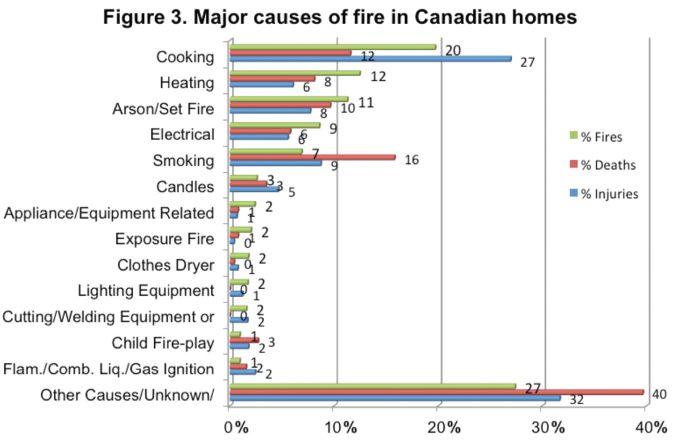
The major causes of home fires in Canada (see Figure 3) on the basis of data from the seven provinces and the Northwest Territories were:
• Cooking – 20 per cent
• Heating-equipment related – 12 per cent
• Arson/set fires – 11 per cent
• Electrical – 8 per cent
• Smoking – 7 per cent
• Candles – 3 per cent
• Appliance/equipment, clothes dryer, exposure, lighting equipment, cutting/welding or blow torch – 2 per cent each
• Child fire-play – 1 per cent
Where cause was identified, most fire deaths in Canadian homes were from:
• Smoking – 22 per cent
• Arson/set fire – 10 per cent
• Cooking – 7 per cent
• Electrical – 7 per cent
• Candles – 3 per cent
Child fire-play – 3 per cent
The leading cause of home fire injuries in Canadian homes were:
Cooking – 27 per cent
Smoking – 9 per cent
Aarson/set fire – 8 per cent
Heating equipment and electrical –6 per cent each
Candles – 5 per cent
About 50 per cent of all cooking-related fire injuries were from cooking-oil fires. Several considerations to keep in mind based on the available data: Not all jurisdictions strictly conform to the Canadian coding structure for coding fire incidents. Yet, the definition of homes among jurisdictions is remarkably similar. This enabled creation of one data set for analysis
of Canadian home fires.
A number of inconsistencies exists among jurisdictions, for example in definitions of fire, fire death, child, and fires with and without dollar loss. This study did not attempt to address these jurisdictional firedata differences.
Despite the data limitations, this study and the larger study posted on the CCFM/ FC website demonstrated that a fire picture for Canadian homes can be constructed. The findings on Canadian home fires in this study also correspond closely with those reported for the United States. This further supports the analysis and shows the remarkable similarity in home-fire patterns in the two countries. It is hoped that this analysis contributes to home fire prevention efforts in Canada.
Mahendra Wijayasinghe, PhD, is the manager of the research and analysis in the office of the fire commissioner, public safety division, Alberta Municipal Affairs.
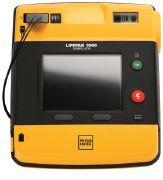
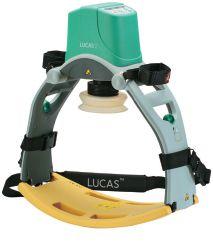
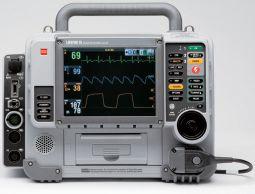
Perfect partners work together to create the best possible outcome for their patient. They support each other without duplicating effort. Designed based on years of partnership with Fire and EMS, the LIFEPAK® 1000 AED, LUCAS® chest compression system and the LIFEPAK 15 monitor/defibrillator work together to support emergency medical teams in managing cardiac arrests. For more information, visit www.physio-control.com or contact info.canada@physio-control.com.
RIT – lifting heavy objects
By Mark van der Feyst
Amayday firefighter may be pinned by heavy debris or objects that have collapsed onto him or her during interior or exterior operations. There are videos on the Internet showing a building collapsing partially on top of firefighters, trapping them beneath the burning rubble. This can happen easily while conducting fire-ground operations on the inside or the outside. For outside operations, it is imperative that collapse zones (one-and-a-half times the height of the building) be established to avoid the potential for entrapment by building material. When a firefighter is trapped underneath heavy debris or objects, there is no way that human muscle will be able to safely remove objects; removal will require the use of rescue tools and cribbing.
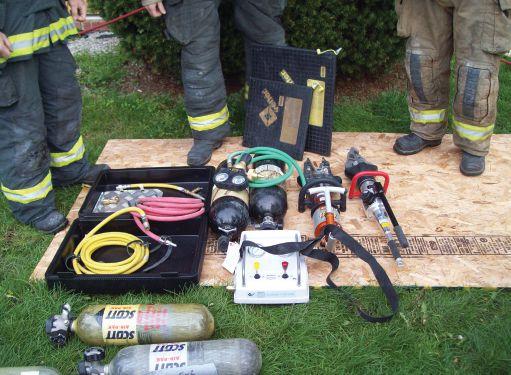
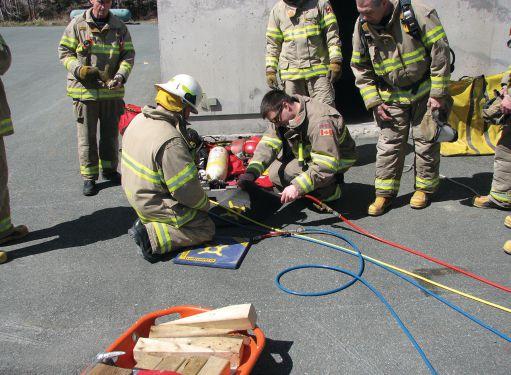
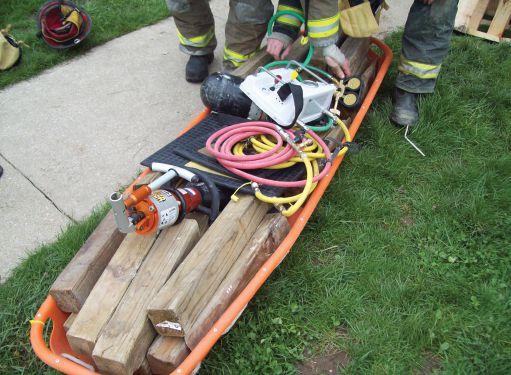
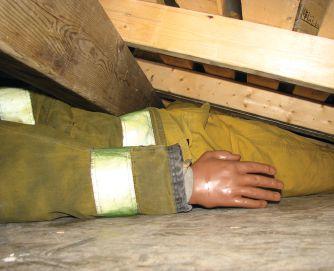
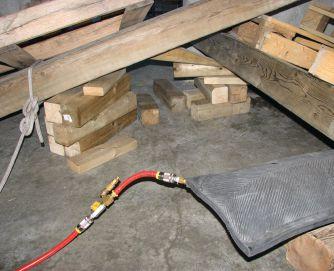
Time is against a firefighter on the fire ground. At the scene of a structural fire, having the right equipment staged and ready to go is crucial; leaving the equipment on the apparatus will delay any type of response. Airbags and hydraulic tools are among the equipment that will be needed for any type of heavy lifting (see photo 1). This equipment needs to be checked to make sure it is in proper working order and then left connected for rapid deployment (see photo 2). It’s a good idea to fill the stokes basket with the equipment and cribbing (see photo 3) so that two to four firefighters can bring in all the equipment at once.
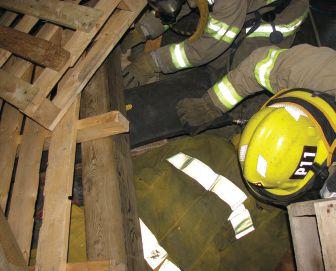
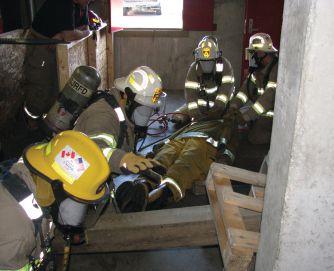
When a firefighter is trapped under heavy debris or objects, rescuers need to lift the objects only about an inch or two so that the firefighter can be dragged out and away. The small clearance will be enough to free the firefighter of any obstructions and remove him or her to a safer location (see photo 4). This lift can be accomplished using high-pressure air bags, which are generally used for autoextrication. Just one or two airbags are needed to accomplish the lift. Except in extreme circumstances, avoid double-stacking the airbags, which is a common practice in auto-extrication; doublestacking will require another set of airbags and the cylinders to operate them. It is better to use more cribbing than to double-stack the airbags.
Because the load on top of the firefighter is unstable, cribbing must be used to help stabilize the load. In case of secondary collapse, a stabilized load will provide a protective space around the downed firefighter.
Stabilizing the load also involves balancing the load. A collapse pile is very unbalanced as pieces of debris and objects are resting very precariously on each other. Any shifting of one object or part of the pile may lead to other objects moving and creating a secondary collapse. Cribbing the load around the firefighter also helps to balance the load to prevent unintentional shifting.
Once RIT members locate the downed firefighter and determine that the firefighter is pinned by collapsed debris, they need to start to sizing up the best spots for the airbags. When the airbags are in position (see photo 5) and the load has been stabilized, the lift can then commence. Cribbing must continue when rescuers are doing the lift – remember to crib as you go. With proper
PHOTOS BY MARK VAN DER FEYST
Photo 1: Airbags and hydraulic tools are among an assortment of equipment that is needed for heavy lifting on the fire ground.
Photo 2: All equipment should be brought to the staging area, checked that it is in proper working order and then left connected for rapid deployment.
Photo 3: Two to four firefighters can bring all the necessary equipment from the truck to the fire ground at once by filling the stokes basket.
cribbing in place, the load will not fall back down onto the firefighter if it shifts.
In photo 6, one airbag is used to temporarily raise the load so that RIT members can remove the firefighter (see photo 4). One airbag can be used to accomplish a lift but the process needs to be conducted very carefully.
This type of lift – where the load is being pivoted on one end – is called a cantilever lift. A cantilever lift can be very dangerous as it can shift very easily. Using two airbags on either side of the firefighter is a better option as the lift happens simultaneously on both sides with the weight of the load on the airbags.
Hydraulic tools such as the spreaders can be used to lift instead of airbags. The tools are quicker to deploy and operate but come with some risk: the load can slip off of the spreader tip very easily and quickly. If you search the web for a video showing
the NYPD using the spreaders to lift a car off of a pedestrian, you will see how quickly and easily the load can slip and fall back down onto the person. The crib-as-you-go principle needs to be applied.
Once the load has been lifted one to two inches above the downed firefighter, the firefighter can be pulled out and freed. As shown in photo 7, it will take one or two RIT firefighters to effectively remove the downed firefighter. Careful attention needs to be paid here, as pulling too hard and too quickly may create more problems. If the firefighter is caught on any debris, the removal process may shift the load or knock some of the cribbing loose and create an unstable load. One firefighter needs to be in charge of the operation and guide the removal of the downed firefighter, which involves good communication among all RIT members and a controlled pace of work to be effective.
Mark van der Feyst is a 13-year veteran of the fire service. He works for the City of Woodstock Fire Department in Ontario. Mark instructs in Canada, the United Stats and India and is a local-level suppression instructor for the Pennsylvania State Fire Academy and an instructor for the Justice Institute of B.C. E-mail mark at Mark@FireStarTraining.com.
Photo 4: Just a small amount of clearance – one to two inches – is needed to free the downed firefighter.
Photo 5: To ensure stabilization, cribbing must continue as the airbags are lifting the load.
Photo 6: A cantilever lift, which uses just one airbag, is effective but dangerous; two airbags and continuous cribbing is the best option for heavy lifting.
Photo 7: Once the load has been lifted, one to two firefighters can remove the downed firefighter, while a third RIT member oversees the entire operation and guides the removal.
Training for gold
This past summer I watched more of the Olympics than I ever have before. For the first time, I wondered about these athletes, marvelling at their incredible dedication to be the best in the world. It was exciting to see rowing and swimming but what impressed me the most were the endurance sports – longdistance events such as 10-kilometre bicycling, running and, of course, the decathlon.
What kind of training and preparation do these people do in order to get to this point in their lives? As a former junior hockey player, I recall running and lifting weights, hoping to be strong enough and fit enough to endure the punishment hockey can bring. But I am aware that to be an Olympic hero is more than that – it demands more diligence, more drive, more mental determination.
Those in the fire service require those same attributes. Firefighters are often looked upon as heroes. There is this mysticism that the public expects when we step out of the fire station and onto the bright, shiney truck, cloaked in turn-out gear, fearless and ready to intervene on their behalf. But do they know the other part of us, the part that awaits behind the closed doors, hidden from view?
There are fewer fires today than in days gone by, but fire losses continue to rise. There are more motor-vehicle collisions and medical calls than before and yet our identity is with fire; I suppose this is because fire is so unpredictable and uncontrollable without human intervention. Like the decathlete, the firefighter must be in superb condition and prepared for any situation. All fires will eventually go out after consuming all they can; we as a society cannot afford this. So, the firefighter is here to stay.
inefficiencies that will compound any scene. We must know our equipment, personal protective gear including SCBA, its function and all of its limitations. We must know the other equipment –power saws, fans, hydraulic rescue tools, nozzles – and, of course, how to use them safety. We should know how to drive our vehicles and pump water and raise an aerial ladder. We should know how to keep the fire station clean and presentable –who knows when a taxpayer will walk in for a visit. It’s important for visitors to see a tidy place – a place we are proud of, and a place for which we don’t have to apologize.
When it’s time to train, be on time and be ready to learn. Hone the skills you have learned in the past and help less experienced co-workers learn what you know. If you are running the training, know your stuff; your knowledge and your ability to pass it on will have huge repercussions – make them positive ones.
KEN SHERIDAN
Being a firefighter is more than a job; it’s a career that demands we be physically fit. Let’s face it: the job can be very demanding on the body. Consult a personal trainer or go online.
I talk to many firefighters not only in my own fire department but across Ontario and Canada and abroad. When I speak to our new recruits each year near the end of their training, I see myself sitting there many years ago, eager, excited and anticipating the difference that I would make. I talk about my experiences and what I’ve seen, what I expected and what I have learned. Most of all, I try to impress upon the recruits that fire is deadly, destructive and unforgiving both for the public and for us.
To be prepared for such a battle, we must be ready. How? Being a firefighter is more than a job; it’s a career that demands we be physically fit. Let’s face it: the job can be very demanding on the body. Consult a professional trainer or go online, get a program that you can do at home. Walk, bike or do whatever you need to in order to stay ready to perform your duties.
Know your role and responsibilities. Any gaps here can mean
Most of all we have to be ready mentally. I think this is where the volunteer firefighter has it the hardest – to drop everything at the body shop, grocery store, insurance office, warehouse or farm and respond to the station, quickly becoming the firefighter that you now need to be.
Strengthen your mind. Being mentally prepared is one of the most important aspects of being a firefighter. It gets easier with time and experience, but like physical fitness, mental fitness must be a regime that is ongoing. There are countless books and articles on positive thinking and personal development. Some firefighters pray, while others meditate daily to remain focused. Our minds are capable of so much – positive and negative.
Having confidence in your equipment and your abilities is the biggest part of this demand. Getting your head in the game will be much easier if you have looked after being competent in the job. This competence can breed confidence and that will make you a good and safe firefighter.
Though we may never become Olympians, we must train as if we would, practising and preparing our bodies and minds for the battles on the fire ground. Will you be ready to take your mark, get set, go?
Ken Sheridan is captain of fire prevention in Norfolk County, Ont. Ken is a certified fire prevention officer and certified fire and life safety educator for the Province of Ontario. He is a graduate of the Dalhousie University fire administration program and has more than 21 years in fire suppression and fire prevention. Contact him at ken.sheridan@ norfolkcounty.ca.
The right way to rest and recover
By now, summer may seem like a distant memory. For many of us summer in Canada is a time to relax and, if you’ve lived in our climate for even just a few years, you know you need to take advantage of summer weather before it’s gone. For many, summer is usually full of patios, rivers, lakes, golf courses, and often a few drinks find their way into all those activities. Fitness and nutrition sometimes take a back seat during the summer, and I’m certainly no exception. It can be tough to keep on track unless you have something to train for. So, if you took a break over summer and have struggled to get back to your routine, or if you’ve been off for an extended period of time, don’t worry, you’re not alone. You’re actually . . . normal. So, let’s to delve into your body’s methods of rest and recovery, and the best approach to reignite your drive and get you back on track.
It’s important for you to realize that taking a break isn’t always a bad thing. Your body loves to be pushed through training programs. Every so often, a brief stretch of time off to recover can prove beneficial. Each one of us responds differently to time off, but generally the harder you were training going into your rest, the more beneficial this rest period will be.
Recovery can be classified two ways:
to be worse, and your strength is going to be down. The first few workouts are when most people can get discouraged. Knowing this going in, it’s important to have a plan to push through early hardships and get back to work. Here is my basic plan to get back in the routine.
BRAD LAWRENCE
Even when motivated, your first couple of workouts after a period of rest and recovery will be tough.
Short-term recovery, which you may also know as active recovery, refers to the hours immediately after training and into the next couple days. Generally, with short-term recovery, it’s up to us to do what’s necessary to help our bodies. This is the time to properly replenish energy stores and fluids, and drive protein back into your muscles. This is why your post-workout nutrition is so important. Your body then takes the opportunity to rebuild and repair soft tissues such as muscles, tendons, and ligaments. The last part of your job regarding short-term recovery is plenty of sleep.
Long-term recovery deals with days, or even weeks off at certain times every year to give your body the rest it needs to move forward; basically, we’re preventing injuries and overtraining. This is why trainers and coaches are periodizing training programs. Periodical change and built-in rest periods not only prevent plateaus, but the rest can also help to prevent overtraining and injuries. This is also how many people justify a more laid-back training schedule through summer.
Any time we take a training hiatus it can go one of two ways:
1. You make a smooth transition and get back to the routine; strong and well rested.
2. You procrastinate and delay your return again and again. Obviously, the goal is to avoid option No. 2.
Even when highly motivated, your first couple of workouts after a period of rest and recovery will probably be tough, physically and mentally. It doesn’t take a personal trainer to tell you you’re going to be significantly less fit than when you stopped your training, depending on how long you’ve been inactive. Your cardio is going
Cardio to start
Whether you’re normally a driven runner or not, start your first day back with a cardio session. I’d recommend your first workout be a run. If you’re not a passionate runner, the first five or 10 minutes aren’t going to be fun. Push through this and give yourself at least 15 good minutes before you decide to pull the pin and turn around. The goal is to break through your body’s initial struggle. Pick one method of safely challenging yourself on your first run, as well. Choose something that will make you push and exert a decent effort, possibly a set of stairs, or even just a quicker pace to finish your run. If you can finish a good strong run on your first day, the rest of the initiation will be a piece of cake.
Half body training
You might find that you have to ease into weight training. Your muscles will bounce back and adapt quickly; the muscle memory is fresh, but you’ll want to give them a fair chance to catch up and avoid injury. If your workouts normally consist of just a few muscle groups per day, try expanding your training to a half body program. Half body programs are just as simple as they seem. Basically, you want to start with a foundation phase of training. Train your lower body the first day and your upper body on your next weight session. Take a full 24 hours between weight sessions. If your body feels up to an extra workout, add cardio to your scheduled day off. Stick to movements you’re comfortable with and weights you’re confident controlling; do two sets per exercise, higher reps (10 to 15) and keep a comfortable tempo. Here’s a sample program:
Day 1 – initial run
Day 2 – lower body
Day 3 – off/cardio
Day 4 – upper body
Day 5 – off/cardio
Day 6 – lower body
Day 7 – off/cardio
Day 8 – upper body
Try this basic foundation-phase program to bust your fitness slump and get you back in mid-season form.
Brad Lawrence is a firefighter with the Calgary Fire Department and a certified personal trainer who specializes in training and nutrition for emergency responders. E-mail Brad at bradmlawrence@gmail.com.
A challenging dangerous goods training pad; elaborate trench rescue and confined space rescue props; a mobile air ambulance prop built from the fuselage of a King Air 200.
These are among the new additions to our world-class training fields in Alberta. Other training props include an aircraft crash rescue simulator, facilities for dry chemical training, pumping pits, structural towers, and props that replicate oil refinery scenarios.
Are you ready for what’s next? You will be when you at
Anti-fog cloths offer up to 20 applications
Nanofilm Technology has released its Defog It antifog cloths in re-sealable pouches. Each cloth offers up to 20 applications of the anti-fog treatment.
The Defog It treatment coats eyewear with an anti-fog film, making it ideal for workers in heat, humidity, changing temperatures or cold. Now, the product comes in a zippered pouch, making reuse and accessibility easier.
For more information, visit www.defogitworks.com.
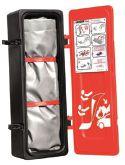
Leader releases fire blanket for vehicle fires
Leader has released an extra large blanket designed to isolate cars during a vehicle fire. The blanket can be deployed by two people, and helps to prevent the spread of a car fire. The product is particularly useful for fires that occur
in underground garages, where vehicles are close to each another.
In addition to preventing the spread of the fire, the Leader Stop blanket prevents the burning vehicle from being completely lost, and reduces the release of toxic gases and opaque fumes. Though not a replacement for traditional firefighting methods, the Leader Stop blanket helps to facilitate the intervention of firefighters.
For more information, visit www.leadergroup.eu.
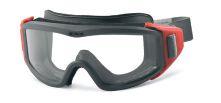
ESS goggles now NFPA-compliant
Eye Safety Systems has announced that two of its FirePro safety goggles have achieved compliance to the NFPA 1977 standard on protective clothing and equipment for wildland fire fighting.
The FirePro-FSTM goggles, which provide a full strap, and the FirePro-EXTM
goggles, which have snap-on/snap-off capabilities, are light weight and low profile. The goggles also provide a full-perimeter ventilation/filtration system and total helmet compatibility.
“Through obtaining the NFPA 1977 certificate of compliance from UL Lab, we are reinforcing the ESS promise of eye safety, quality, and improved utility,” said Eric Dobbie, ESS commercial program manager.
“Additionally, and perhaps most importantly, we are providing a means for government agencies or other organizations to easily acquire the compliant products end users want most.”
For more information, visit www.esseyepro.com.
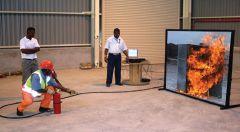
Pyrosoft releases series of digital fire simulators
Pyrosoft has released a series of industrial-grade digital fire simulators. The simulators – called Firefly, Flare, Firebird and Flamescape –use a rear projection screen to simulate a live fire and modified fire extinguishers to douse the fake flames.
The simulators are zero-emissions systems, making them environmentally friendly and operable in any weather conditions. Meanwhile, the use of rear projection enables trainers to set imitation fires to items and settings that are unique to participants.
The Firefly and Flare simulators are compact and easily portable, making them well suited to fire trainers who travel to training locations by car. The Firebird and Flamescape systems are larger and better suited to larger-scale scenarios, such as underground transit or urban centre emergencies.
Fore more information, visit www.pyrosoft.ca.
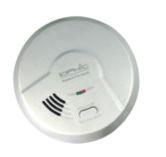
USI launches new smoke, fire, CO alarms
Universal Security Instruments (USI) has launched new smoke and fire alarms, and carbon monoxide alarms in Canada.
The IoPhic smoke and fire alarms respond up to 87 per cent faster
to slow, smouldering fires than conventional smoke alarms and eliminate false, nuisance alarms. The alarms use a single universal smoke sensing technology, which eliminates the need for a combination of ionization and photoelectric alarms.
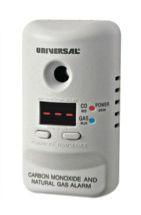
The new USI carbon monoxide and natural gas alarm is compact, covering just one outlet. The alarm has separate sensors for carbon monoxide and for natural gas, both of which are odourless and virtually undetectable.
For more information visit, www.SmokeAlarms.com.
Keybo introduces glove warmers for responders
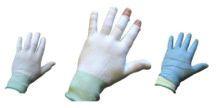
Keybo has introduced medical glove warmers for first responders. These thermal liners are intended to be worn under latex, vinyl or nitrile medical gloves to provide an extra layer of protection against extreme temperatures.
The warmers, which are available in small, medium and large sizes, are manufactured with ultra-thin nylon, allowing them to be worn under medical gloves. The index and middle fingers are left exposed, allowing for sensitive procedures, such as pulse checks, to remain unhindered.
For more information, visit www.keybomedical.com.
Kochek offers booster hose for forest fires
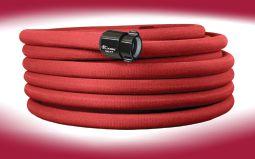
Kochek has introduced a new lightweight, kink-resistant, oneinch booster hose, designed for industrial, forestry and wildfire fighting.
The hose, which is available in red or green, is constructed from a single jacket of strong, 100 per cent polyester that maintains a lightweight and compact profile. The smooth thermoplastic polyurethane lining ensures minimum friction for maximum flow. It is resistant to ozone and abrasion, and has good resistance to oil and grease. The hose also offers low temperature performance and is available with field-replaceable couplings, low-profile flow-expansion rings, and lightweight re-attachable couplings.
For more information, visit www.kochek.com.
Ram Air introduces boot-drying attachment
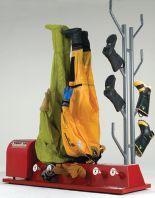
Ram Air has introduced a boot-drying accessory for the 4-IHT model of its gear dryers, made exclusively for drying PPE.
The boot-drying attachment fits into one of the dryer’s four ports, and can dry up to eight boots at a time.
Ram Air’s 4-IHT model, which is NFPA compliant, is designed to dry hazmat, immersion and dive suits, which standard gear dryers do not accommodate. The dryer has four ports, each with variable heights, and quickly and effective dries gear without turning it inside out. It also uses ambient air, keeping the gear manufacturers’ warranties intact.
For more information, visit www.ramairgeardryer.com.
A harvest of great firehall food
As difficult as it may be to acknowledge the eventual arrival of our Canadian winter, it is time to welcome a beautiful time of year that most people take for granted. As the normal routine solidly sets back in, we know that we are well into fall: trees with their rich fall colours, brisk clear nights and – a food lover’s dream – the fall harvest.
My family in south Florida often reminds me that the changing seasons are something not everyone in the world gets to enjoy and we should take advantage of what a new season can offer. When the days grow shorter and the mercury drops, our taste buds inevitably start to crave fall foods and flavours. Our Canadian farmers’ fields are bursting with an array of fall fruits and vegetables just waiting to be turned into that perfect heart-warming comfort food. We are well into the holiday and tailgate-party season, so menus must change to fit these special occasions. What a perfect opportunity to enjoy a drive to your local farmers market! Apples and pears, hearty greens such as brussels sprouts and kale, root vegetables and pumpkins are all fall favourites to be transformed into piping hot dishes. The health benefits of fall produce are also unmatched; these fruits and vegetables are often characterized by rich dark colours – indicators of an abundance of fibre, antioxidants and vitamins. Of course, we do tend to embellish these nutritious super foods with questionable ingredients (butter, brown sugar, bacon and cheese) to create comfort food, but that’s half the fun!
There is something about the food of this season that speaks to our hearts: the traditions of the holidays, comfort foods for cold nights and perhaps just enjoying foods that are harvested once a year during these colder months. Although I’m a beach bum at heart, the food and tastes of the fall season help put the memories of summer behind me. I’ve include four seasonal recipes that are sure to warm up your fire hall, celebrate your holiday season, or just bring the family together on a chilly autumn night. Enjoy!
Patrick Mathieu is a 13-year veteran of Waterloo Fire Rescue, where he is acting captain. He has won several cooking competitions and has helped raise thousands of dollars for charities by auctioning gourmet dinners at the fire hall. Contact him at stationhousecateringco@yahoo.ca
Turkey meatloaf
Ingredients:
• 1 tsp paprika
• ½ tsp brown sugar
• ¼ tsp onion powder
• 1 tsp Old Bay seasoning
• 3 tbsp soy sauce
• 1 large egg, lightly beaten
• 1 ½ cups barbecue sauce (reserve ½ cup to glaze the top)
Directions:
1. Preheat the oven to 350 F.
• 1 tbsp Worcestershire sauce
• 1 tbsp olive oil
• 1 cup chopped red onion
• 1 medium red bell pepper, chopped
• salt and freshly ground black pepper
• 2 cloves garlic, chopped
• 2 pounds lean ground turkey
• 1 ½ cups bread crumbs
2. In a large bowl, mix the seasonings, soy sauce, beaten egg, Worcestershire sauce and one cup of the barbecue sauce.
3. In a sauté pan over medium-high heat, add the olive oil. Then add the onion, bell pepper, salt, ground pepper and garlic. Sauté until the mixture is tender, then remove it from the heat and add it to the wet mix.
4. Pour this mixture into the bowl with the ground turkey. Add the bread crumbs and mix it together with your hands.
5. Transfer the meat mixture to a cookie sheet or baking pan. Using your hands, shape the meat into an oblong or rectangular shape. Alternately, you can pat the meat into a nine- by five-inch loaf and pour the ½ cup of barbecue sauce on top of the loaf.
6. Bake for 45 minutes. Remove and add the reserved ½ cup of barbecue sauce to the top and continue to bake for 20 more minutes.
Bacon baked apples
Ingredients:
• 1 pound extra-thick cut smoked bacon
• 4 to 6 spring fresh thyme, leaves only
• 4 medium apples, different varieties
• extra virgin olive oil
• 2 tbsp superfine sugar
• 1 bunch green onion, thinly sliced
Directions:
1. Preheat the oven to 375 F.
2. Arrange the bacon on a sheet tray, sprinkle with some of the thyme and bake until crispy, about 12 to 15 minutes.
3. Slice the apples from top to bottom, creating five to eight cross-sections of the apple. On a separate sheet tray lined with parchment paper, lay the apples out in a single layer and brush with olive oil. Sprinkle a little sugar and thyme on each slice then bake in the oven until the apples begin to soften and the sugar has melted and caramelized, about 12 to 15 minutes.
4. To serve, alternate apple and bacon slices to reassemble the apple. Garnish with green onions.
Brussels sprout gratin
Ingredients:
• 2 tbsp unsalted butter, cut into pieces; reserve extra pieces for the dish
• kosher salt
• 1 pound brussels sprouts, outer leaves and stems removed
• pinch of red pepper flakes
• 1 tbsp garlic, minced
• 1 tbsp shallots, minced
• pinch of nutmeg
• freshly ground black pepper
• ½ cup heavy cream
• ½ cup grated aged cheddar cheese
• ½ cup grated Gruyère cheese
• ½ cup bread crumbs
Directions:
1. Preheat the oven to 400 F and butter a two-quart baking dish.
2. Bring a large pot of salted water to a boil. Add the brussels sprouts and cook until they are tender, about eight to 10 minutes.
3. Drain the brussels sprouts and halve them lengthwise. Transfer the brussels sprout halves to the prepared baking dish and toss with the red pepper flakes, garlic, shallots, salt and pepper, then spread out evenly. Add the nutmeg to the cream and pour the cream on top. Sprinkle with the cheeses and breadcrumbs and dot with the butter pieces.
4. Bake the gratin until it is bubbly and golden brown, about 20 minutes.
Roasted root vegetable soup
Ingredients:
• 3 medium sweet potatoes, peeled and cubed into two-inch chunks
• 1 onion, cut into chunks
• 2 large carrots, peeled and cut into chunks
• 2 parsnips, peeled and cut into chunks
• 1 medium celery root, peeled and cut into chunks
• extra virgin olive oil, for liberal drizzling
Directions:
1. Preheat the oven to 425 F.
• salt and freshly ground black pepper
• freshly grated nutmeg
• 1 bulb garlic, roasted
• 6 cups vegetable stock
• a dash of honey
• a dash of hot sauce
• half-and-half cream (optional)
2. In a roasting pan, coat the potatoes, onion, carrots, parsnips and celery root in extra virgin olive oil, then season with salt, pepper and nutmeg. Roast the vegetables until they are tender and caramelized at the edges, about one hour.
3. Transfer the vegetables to a soup pot, along with the roasted garlic. Add the vegetable stock and simmer over low heat for 15 minutes. Purée the vegetables with a hand blender. Season the soup with honey and hot sauce to taste. If you find the soup to be too thick, thin it out with half-and-half cream.
Hand tools – part 1
Editor’s note: This multi-part series on the evolution of hand tools will detail alternative options to hydraulic tools so you’ll know what to do when the need arises.
By Randy Schmitz
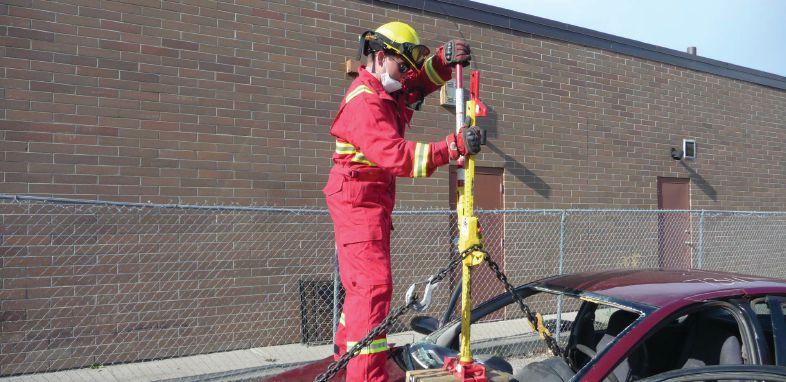
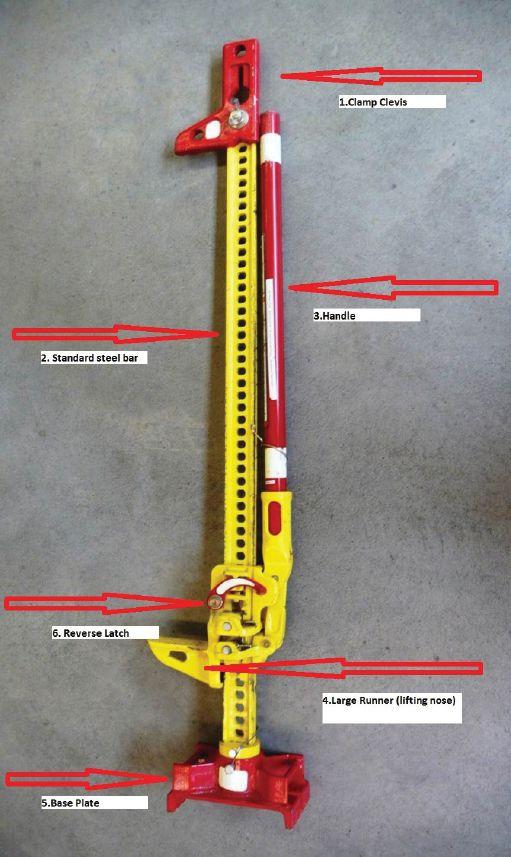
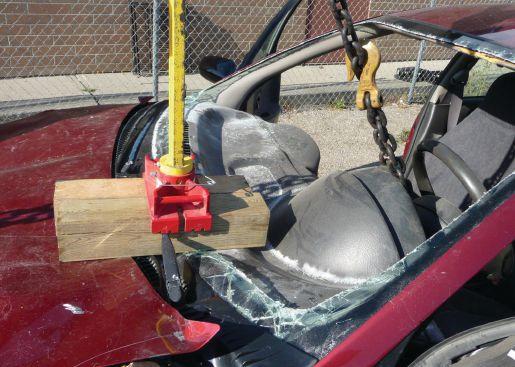
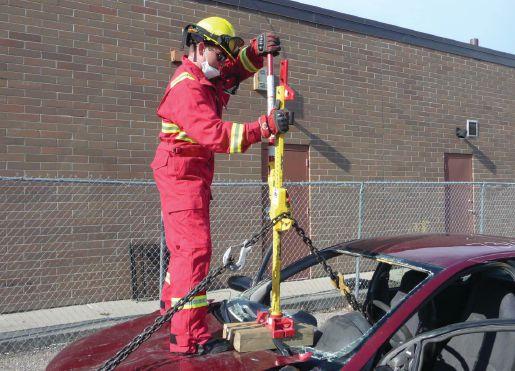
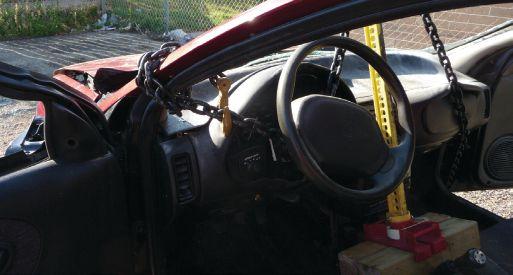
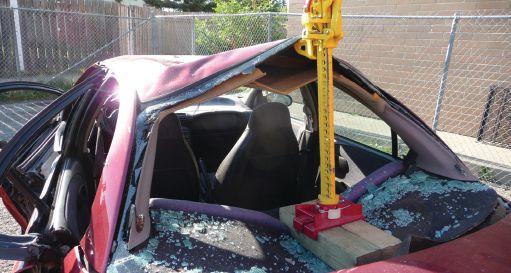
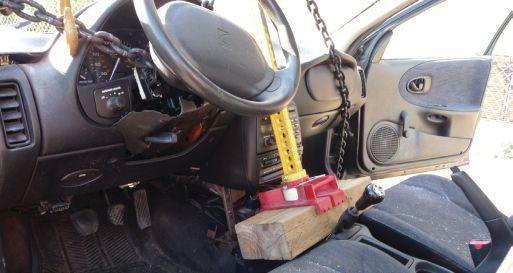
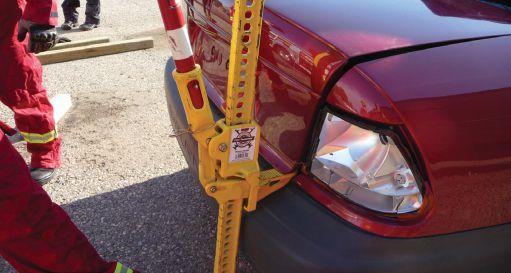
In the August 2011 Fire Fighting in Canada I talked about a new hand tool that had just entered the market called the First Responder Jack (FRJ) by Hi-Lift. This interesting design is a derivative of a common industrial tool known as the Hi-Lift Jack. I’ll give you a bit of history from the company that manufactures the jack, called the Bloomfield Manufacturing Company. Bloomfield started in 1895 in Indiana by Philip John Harrah and is still owned and operated by fourth-generation family members. The device was first called the Handyman’s Jack and a few years later was renamed the Hi-Lift Jack. The Jack’s basic design and function has not changed: it can lift, winch, clamp, pull and push, making it an extremely versatile all-in-one tool and the company’s best-selling product. The FRJ, however, has some modifications that pertain directly to vehicle-rescue situations. Photo 1 shows the tool’s operating parts.
Chris Burdyshaw and Jeff Pugh, firefighters with the Pierce County Fire Department, near Seattle, Wash., and members of the Puyallup Extrication Team (PXT), introduced me to the FRJ. I got to know these two gentlemen while I was judging extrication challenges in the area. During the events, there was always an area cordoned off for a show-and-tell demonstration where firefighters or tool manufactures could teach different techniques and demonstrate new products. Every year, Chris and Jeff would demonstrate the use of a Hi-Lift Jack with yet another improvement from the year before. They were always making homemade modifications to better use this hand tool for extrication work. When Jeff and Chris approached the Hi-Lift Jack Company to inform them of the alterations they had done to the product to make it more useful for vehicle extrications, Hi-Lift listened and the FRJ was born. The product can now be seen at trade shows, on eBay and in extrication classes, and is started to show up on fire apparatusses as standard equipment. One of the unique features of this jack is the base plate: it has a total surface area of 36 inches (90 centimetres), aggressive teeth to dig into soil, mud and pavement, and a chain slot and ratchet strap hook adapter. The width of the plate is seven inches (20 centimetres), allowing it to accommodate two 4x4s to increase support and surface area. The base plate can also be rotated 360 degrees with a removable pin system (see photo 2). The FRJ features florescent colours so users can easily see moving parts in low light conditions. There are three different Jack sizes: 60 inches (200 centimetres), 48 inches (100 centimetres), or 36 inches (90 centimetres).
Let’s look at the FRJ’s functions that apply to extrication.
Specifications:
• Approximate weight: 27 to 30 pounds (12 to 14 kilograms)
Photo 1: The components of the First Responder Jack, a derivative of the Jack All, have been modified to pertain directly to vehicle rescue situations.
Photo 2: The base plate of the First Responder Jack can be rotated 360 degrees using a removable pin system.
PHOTOS BY RANDY SCHMITZ
Photo 3: Place the jack base plate on the blocks, slide the slacked chain over the large runner (the lifting nose) and take up any slack in the chain prior to the lift.
• Tested capacity: 7,000 pounds (3175 kilograms)
• Climbing pins of specially processed steel with 125,000 PSI tensile strength and 100,000 PSI yield.
• Steel bar is manufactured of specially rolled extra-high carbon steel with minimum tensile strength of 80,000 pounds (36,287 kilograms) and carbon .69 to .82.9
• Steel handle, measuring 1 5/16 inches (33 millimetres) in diameter and 30 inches (80 centimetres) in length, of 14-gauge high-yield structural tubing with a minimum yield of 55,000 PSI.
Features:
• Adjustable top clamp/clevis for use in clamping and winching.
• Safety bolt designed to shear at 7,000 pounds (3,175 kilograms)
• Lifting unit automatically drops away when load is removed for speedy disengaging.
• Lifting nose measures 4.5 inches in length for positive contact with load.
• Steel bar can be reversed for extra-long life.
• Low pickup of 4.5 inches (11 centimetres).
• Mechanical advantage of 40 to one.
Fight Fires, not Paperwork
• Base plate measures 36 square inches (90 centimetres)
• Handle force required to raise 4,660 pounds (2,273 kilograms) is 177 pounds (80 kilograms) at 34 inches (90 centimetres) on the handle.
• Maximum rated load is 4,660 pounds (2,273 kilograms), up to 48 inches (100 centimetres), and has been tested to 7,000 pounds (3,175 kilograms).
• Upper 12 inches (30 centimetres) of the 60-inch (200-centimetre) jack is rated to 2,660 pounds (1,209 kilograms) and was tested to 4,000 pounds (1,818 kilograms).
For raising a stationary load:
1. Securely stabilize the load to prevent it from rolling or shifting as you lift.
2. Place the jack’s base plate securely on a firm, level and dry surface with the steel standard bar pointing straight up.
3. Lift the reversing latch until it locks in the up position.
4. Pull the handle away from the steel standard bar, releasing the handle clip spring.
5. Grasp the handle or the handle socket and raise the lifting mechanism until the large runner is completely and securely under the load.
6. Grasp the handle firmly with both hands. Carefully pump the handle up and down to raise the load. Do not use an extension on the handle.
7. The load will be raised on each down stroke of the handle. Watch the load and the jack carefully. Stop lifting if either one starts to move. Do not continue until it is safe to do so. When safe, stabilize and block the load.
8. When the load is raised to the desired height, place the handle in the upright position, clipped to the steel standard bar.
9. Block the load securely.
10. Lower the load onto the blocks.
11. Remove the jack from the stabilized load.
Unexpected movement of the jack handle may result in the user being struck, causing serious injury. Always keep your head away from and out of the path of movement of the jack handle.
If you overload the jack during operation, the shear bolt will break. If the shear bolt breaks, as it will at 7,000 pounds (3,175 kilograms), the jack’s handle will drop freely, though the load should still be supported. Use a jack with a larger load capacity to lower the load safely to the ground. Do not replace the shear bolt with a bolt of greater strength as this could cause the jack to fail and drop the load. Always use a shear bolt supplied by Hi-Lift Jack Company. Do not replace the shear bolt while the jack is under load and never use an extension or cheater bar on the handle.
The jack handle may move rapidly when moving the reversing latch and cause serious injury. Always place the handle against the steel standard bar with the handle clip spring holding it up before moving the reversing latch. This will prevent the handle from moving up and down rapidly. Ensure the handle is not in the horizontal position when moving the reversing latch.
It is important to remember that, during lifting and lowering, the weight of the load pushes up against the jack’s handle. If your hands slip off the handle, or if the handle is horizontal when you move the reversing latch, it may move up very quickly.
The jack must have a load of 150 pounds (68 kilograms) or more to lower step-by-step. Otherwise, the lifting mechanism will slide down to the base plate, dropping your load.
For lowering a stationary load:
1. Position the jack under the raised load and raise the stationary. 2. Remove the blocks from under the load.
Photo 5: Completely wrap and secure a rescue chain low on the A-pillar near the corner of the dash area.
Photo 7: Place the FRJ on the blocks on the trunk deck, and place the lifting nose just under the middle of the roof section at the outside edge.
Photo 6: A good position for the FRJ is on top of the transmission hump or shift console.
Photo 8: Place the FRJ lifting nose under a corner of the trunk lid lip. Apply force and slightly twist the trunk lid locking mechanism, which should then spring open.
PHOTOS BY RANDY SCHMITZ
3. Be sure the handle is in the upright position, clipped to the steel standard bar before lowering the load.
4. Move the reversing latch to the down position.
5. Grasp the handle firmly with both hands. Carefully pump the handle up and down to lower the load. The load will be lowered on each up stroke of the handle.
Task: Patient entrapment by the steering wheel
Equipment required: First Responder Jack; 5/8 of an inch (15 millimetre)-rated chain; two 18 to 24-inch (45- to 60-centimetre) 4x4 blocks of standard cribbing; a glass removal tool.
Option 1: Carefully remove windshield glass. Place two 18-to-24-inch (45- to 60-centimetre) 4x4 blocks side by side, directly on top of the firewall and in line with the steering column. Wrap the rescue chain low around the steering column. Next, attach the opposite end of the chain to a secure stable component located underneath the front of the vehicle, such as a stabilizer bar or frame component that is in line with the steering column. Make sure to allow a sufficient amount of slack in the chain to accommodate the runner or lifting nose of the jack to slide underneath the chain. Place the jack base plate on the blocks, slide the slacked chain over the large runner (the lifting nose) and take up any slack in the chain prior to the lift (see photo 3). The jack is now in position to lift the column. Ensure the reversing latch is locked in the up position and rotate the handle to engage the lifting nose until the chain is tight. Now, under direction of the extrication officer, operate the jack handle and carefully start to lift the chain (see photo 4). A rescuer is required to be in position near the patient to monitor movement as the steering wheel and column assembly begin to move upward and off the patient’s entrapped area. Create enough clearance between the patient and the steering wheel for easy removal; roughly four or five inches (10 to 12 centimetres).
Option 2: Remove the windshield and completely wrap and secure a rescue chain low on the A-pillar near the corner of the dash area (see photo 5). Carefully feed the chain under the steering column and across to the other side of the passenger compartment, through the open passenger door and locate a suitable and secure place to wrap the chain end around, such as the control arm or the vehicle’s frame. Place the FRJ as close to the steering column and the patient as is safely possible. Two 4x4 blocks may have to
be used under the base plate for more surface area and stability. A good position is on top of the transmission hump or shift console, as in photo 6. Place the lifting nose under the chain and take up any slack. The lifting handle should be through the windshield space to allow for a full range of operation. Operate the handle; lift until sufficient space is created.
Rear window tent:
This procedure is used to create space for a rescuer to access the interior and remove the patient rearward out of the vehicle. Remove the rear glass if it is still intact and place two 18- or 24-inch (45- to 60-centimetre) 4x4 blocks lengthwise on the trunk deck (the bulk head) so one end of the blocks are just past the edge of the rear seatback cushion. Place the FRJ on the blocks, and place the lifting nose just under the middle of the roof section at the outside edge (see photo 7). Operate the jack handle; continue to lift the roof section up in the middle so that the lower trunk deck and rear back seat cushion start to move downward creating space. Continue until a large egress hole or tent is created for patient removal.
Trunk lid access:
Place the FRJ lifting nose under a corner of the trunk lid lip. Due to the width of the lifting nose, a purchase point may have to be made for a secure point to lock onto. Ensure a solid base is available or use 4x4 blocks under the base plate. Operate the jack handle; the corner of the trunk lid will start to lift up. Apply a force and slightly twist the trunk lid locking mechanism, which should then spring open, as in photo 8. To have better control, a semi-loose ratchet strap hooked from either rear tire should capture the lid and prevent it from springing open uncontrollably when the lock gives way. This will also minimize the rear suspension from lifting up when the jack is operated. These are a few of the techniques that can be used with the First Responder Jack.
Keep safe!
Randy Schmitz is a Calgary firefighter who has been extensively involved in the extrication field for 19 years. He is an extrication instructor and has competed internationally. He is the education chair for Transport Emergency Rescue Committee (T.E.R.C.) in Canada, a T.E.R.C. International extrication judge and a tester and evaluator for manufactured prototype products for extrication equipment. He can be reached at rwschmitz@shaw.ca.
Opening the door to both tradition and technology
“When you’ve worked hard and are finally able to walk through the door of opportunity, you don’t slam it shut behind you, you leave it open and help others through.” – Michelle Obama
That, to me, is what the fire service is all about. By day I am a municipal law-enforcement officer but I’m lucky enough to work out of the fire hall under the direction of the fire chief, so I’m available for fire calls too. My co-workers – one is my supervisor, and the other was a summer student – are both eager to become firefighters. Can’t say I blame them, working in the fire hall, listening to the calls on the radio, and even being lucky enough to be out on patrol with me when I’ve been paged to a call once or twice has definitely sparked their interest (pardon the pun).
Over the course of the summer, their interest in joining our volunteer fire department grew into an obsession and many of our conversations revolved around what being a volunteer firefighter is all about.
They will hate me for saying this but, one of them even begged me to let them just sit in the truck with me while I backed it into the hall. How cute is that? I remember way back when I was one of those eager-beaver-can’t-wait-tojoin-the-fire-department-it’s-all-I-want-to-doeven-if-I-only-get-to-wash-the-truck wannabes. Wait a minute – that was last year! Maybe you never really grow out of that.
However, with the two minions – as I affectionately refer to them as in my Disptaches blog – their enthusiasm is contagious and that’s why I try to help them in whatever way I can in their pursuits to become volunteer firefighters, or perhaps even full-time firefighters someday.
the right people, and sometimes it’s a matter of being in the right place at the right time. One thing I know for sure is that finding someone who is willing to take the time to talk to you and give you some advice is worth its weight in gold.
It seems as though people like that are few and far between these days. With today’s technological advances, people spend more time texting, tweeting and messaging than they do talking face to face with people. The problem is that we’re missing out on so much that can be learned from other people in the fire service who are willing to share their knowledge and experience.
With today’s technological advances, people spend more time texting, tweeting and messaging than they do talking face to face with people.
I know how it feels to be on the outside looking in and, as Obama pointed out in her speech, when that door finally opens for you, you hold it open for the next person. I went through four years of being away from the fire department (following a move to a different town) and missed it every second I was away. When the opportunity to return to the fire service presented itself, I jumped at the chance even though it meant passing a written test, a fitness test and then completing a 100-hour recruit course with people half my age. This may not sound like much to some, but I found it incredibly intimidating for an almost 40-year-old woman who had been away from the fire department for four years. Even after completing the course, I had to wait another year before a position – and that door – finally opened for me.
So yes, I am familiar with the If-I-could-just-get-my-foot-inthe-door feeling, and the resulting excitement that occurs when you actually get the opportunity. Sometimes, it comes down to knowing
Not only knowledge and skills can be passed down, but perhaps, even more importantly, tradition. How many times have you heard someone in your hall say, “I remember, back in the old days . . . ” and then proceed to tell you some story about wearing turnout coats and high rubber boots to fire calls, or doing extrication with hand tools, or maybe even how the tanker was an old milk truck – and you could actually still faintly see the MILK logo on the side of the tank? (The milk-truck story is one of mine!) The stories are endless and can’t be told via text messaging.
We’ve all heard the fire-service saying, one hundred years of tradition unimpeded by progress. I like to think of today’s fire service – when we consider how far we’ve come and the technological advances available to us today – as a mixture of both rich heritage and tradition and amazing progress.
In our hall, we’ve just had three people promoted to captain. One female – our FPO and two males – one having been on the department for 20 years, who brings experience and tradition, and the other for just over four years, with plenty of training and progressive thinking; both are needed in the fire service in order to not only open that door but also to keep it open for new and old members alike.
Whether it’s the new guys who are excited to be getting involved with such a noble profession, like the minions, or an, ahem, older member like me, we all appreciate it when the knowledge of a few is shared among many, ensuring that the door remains open for those who wish to go through it.
Jennifer Mabee is a volunteer with the Township of Georgian Bay Fire Department in Ontario. She began her fire career with the Township of Georgian Bay in 1997 and became the department’s fire prevention officer in 2000 and a captain in 2003. She was a fire inspector with the City of Mississauga Fire and Emergency Services before taking time off to focus on family, and is excited to be back at it. E-mail her at jhook0312@yahoo.ca.