• Toronto police Staff Sgt. Heinz Kuck, presents the first of an annual series on urban graffiti and its affect on society.
• Joel Johnston filed a submission on the quest for less lethal response options with an overview of options available and examines the consequences of using.
• Dave Brown, Blue Line’s tactical firearms editor, published the top 10 tips for effective shotgun training.
February
• The Blue Line Forum on the www.blueline.ca domain is introduced. It is an internet chat area for everything about Canadian law enforcement, most topics are open while some have restricted access by job function.
March
• In an exclusive cover feature, Wayne Frechette, chief of the Barrie Police Service talked about his history with the Ontario Provincial Police, his decision to become the head of the Barrie police force and his leadership philosophy.
• Also featured are: bloodstain pattern analysis, forensic art, media relations and low light shooting techniques.
April
• Blair McQuillan profiled three RCMP officers who are working in one officer detachments in the small communities of Nunavut. A second article discussed the pressures placed upon them to work alone.
• Keith A. Gehrand examined the definition of a pursuit, attitudes towards them and the liabilities involved.
May
• Shift work survival tactics was the lead story and extensive information was shared from the National Sleep Foundation on how to cope, exercise and eat your way to better shift work.
• Other features included: transit security, the OPP’s computerized quartermaster system, and developing a firearms instructor model.
June / July
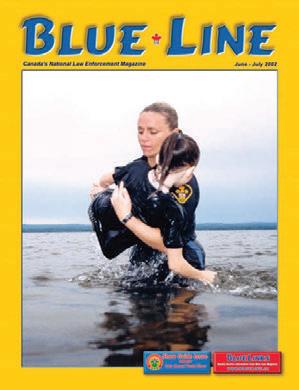
• The Peel Regional Police profiled their advances in Internet safety for children. Sgt. Doug Wilson explained how the service’s Internet safety program works and what the nation can expect from it in the future.
• Other topics included a caution regarding manpower shortages with an aging population and the psychological influence of the police uniform.
Blue Line Magazine introduces the Blue Line Forum at www.blueline.ca. This Internet chat area is for everything about Canadian law enforcement. Most topics are open to all law enforcement while other areas are restricted by job profile.
August / September
• Saskatoon, the Paris of the Prairies, was originally policed by the RCMP, but the history of the Saskatoon Police Service is not well known. Kathryn Lymburner profiles their enduring police presence in the community.
• Blue Line’s western correspondent, Elvin Klassen, contributes his first article, “Drug abuse resistance education at Topham School in British Columbia.”
October
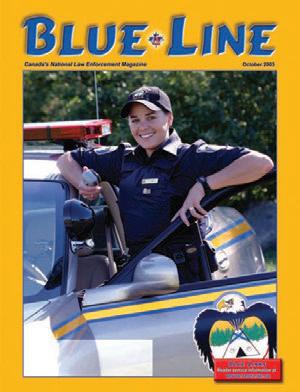
• Toronto Police Service hosted the International Association of Chiefs of Police Conference, only the second time it was held outside of the United States. Events of 9/11 overshadowed the conference. As stated by the publisher, “New York and indeed the world must mourn these losses. But we must get back up, as the American people have shown us so many times before, and move courageously onward.”
• Dr Dorothy Cotton contributes her first article on psychology. She is known for her no nonsense style of writing and unique insights into the behaviours of cops.
November
• The Fredericton Police Force’s 150th anniversary celebration is profiled.
• In his commentary Morley Lymburner explained the Canadian government’s aversion to firearms is keeping those who protect our borders unarmed. He pointed out the stark differences in border protection by the Americans and suggested Canada is living a wonderland dream.
December
• The lead story profiles Chrysler’s new “intrepid” prowler ready for the street plus an historical overview of Chrysler police vehicles.
• A cautionary overview in the use of new anti-terrorist legislation is detailed.
2002
January
• Toronto’s Graffiti Eradication Program has been under a national spotlight after it was deemed a huge success. In this story “Taking back the streets one wall at a time” Heinz Kuck describes the processes and the players in this campaign.
February
• Other than the annual Supply & Services Guide a major feature in this edition was a report on Canada’s internationally recognized national DNA databank. Its success was highlighted when the databank linked over 100 cases to convicted criminals the year before.
March
• Chatham-Kent’s police Chief John Kopinak, was the focus of the cover story. The police service was formed Sept. 1, 1998 amid the turmoil of a restructuring which had amalgamated 110,000 people in 22 separate communities into a single municipality. A big part of the success was created through the leadership of Kopinak.
• Blue Line’s east coast correspondent, Danette Dooley, was introduced.
April
Blue Line’s staff worked together to write up the first April Fools story. The story was about the acquisition of a surplus naval vessel for the OPP’s mobile police station. The name of the vessel? The HMOS Boniface of course.
May
• Edmonton residents didn’t hesitate when asked to help their police service get a helicopter. In the cover story it was pointed out that their faith wasn’t misplaced — in its first eight months of operation, the helicopter was involved in 1168 calls, 191 vehicle stops and helped end 22 pursuits.
June / July
• “Perhaps it’s time to look at the jury system in Canada,” stated Blue Line publisher Morley Lymburner. The option for trial by jury should be taken away from organized crime figures and terrorists who have long reaches capable of revenge. “Society can no longer afford the luxury of jury trials in these situations. Italy has proved it... Canada should adopt it,” he concluded.
• The Ontario Provincial Police was featured with an overview of reassurance to the community regarding their capabilities to keep Ontario communities safe.
August / September
• The Quebec City Police Service graced the cover of Blue Line and a profile of the founding city of Canada was presented by Mark Reesor.
• Also featured was a story about coping with school violence and one community’s response to bullying.
October
• Firearms editor Dave Brown profiled the Dakota Ojibway Police Service and pointed out that it is one of the most successful First Nations police agencies in the country. A second profile involved the St.Thomas Police Service.
• Blue Line Magazine became part of the curriculum taught at Niagara College to all students involved in law enforcement related courses. Gino Arcaro, Coordinator of Police Foundations, advised that not only was the publication up-todate but fulfilled the needs of a lot of subjects from psychology to sociology. “It actually gets them in tune with law enforcement right from the start,” he said.
November
• The Owen Sound Police Service was featured in this edition. Innovations included co-operative efforts with auxiliary police as well as traffic enforcement and court security supplied by retired officers wishing to make some extra retirement income. This was off-balanced by a feature from a discussion paper entitled “Blurring the line between private and public policing.”
December
• The Royal Newfoundland Constabulary and a historical perspective of their early beginnings, was the cover story.
• This issue also featured a history of the Borkenstein Breathalyzer, and the first training description of Extraordinary Rapid Deployment in school shooting incidents.
• Dave Brown illustrates some tips to help you nail the front sight onto your target faster.
With their slogan, “Proud of our Past,” Brantford Police Service celebrates its 125th anniversary with a gala evening and raises money for five local charities.
2003
January
• Blue Line Magazine commences its 15th year of publishing.
• News editor Les Linder, profiled the Ontario Police College’s spike belt safety course which emphasizes safety in deploying tire deflation devices.
• Ford, Chrysler and Chevrolet are reported as being the three most sought after fleet vehicles and this edition reported on the performance and suitability of each brand for police work.
February
• “Unmasking urban graffiti” was the cover story and S/Sgt. Heinz Kuck supplied an article which got to the bottom of the problem. Kuck described what motivates these urban artists and measures required to eradicate and re-direct their work.
• In another feature Heather Gray delves into the career altering experiences which can result from work place bullies.
March
• Moose Jaw Chief of Police Terry Coleman and his police service was profiled.
• Blue Line surveyed Canadian police services on their use of body armour. The survey indicated that every agency made body armour available, however there was no uniformity as to how they are to be worn.
April
• Metro Toronto Police S/Supt Jean Boyd, becomes the highest ranking female police officer in Canada and one of only 385 women on the 5,621 member Toronto force. “There is no end to opportunities for women today,” Boyd noted. “All you need to do is apply yourself and build up credibility.”
• All 18 members of the Montmagny Police Force are to be vaccinated to protect them from Hepatitis B after two officers come into contact with a suspect’s infected blood.
May
• The post 9/11 era brought Canadian Nuclear power facilities under the microscope. Durham Regional Police took over the job of providing a higher level of security for two plants in their jurisdiction. As S/Sgt Tim Knight noted they really had no choice but to supply the service. They owed that level of protection to their community.
• In a second article Blue Line took a look at what every police officer should know about radiation.
June / July
• The York Regional Police Service has grown from a collection of smalltown police forces to a modern, progressive service of 1,000 officers policing almost a million people. A story in this issue highlighted how this agency embraced modern policing tools, including a state of the art mobile command centre and helicopters for patrol.
• Firearms editor, Dave Brown, wrote about design flaws demanded by the RCMP for their firearms.
August / September
• A co-operative spirit is nothing new for the police agencies serving the Halifax area, reported Public Affairs Supervisor Theresa Rath Brien in her story about the Halifax Region. The 402 officers serving this region of a quarter million people come from both municipal police and the RCMP.
• Other stories dealt with conflict resolution programs in Calgary and pedophile lures used to seduce children.
• BC implemented Canada’s first province-wide, online police information system called PRIME.
October
• Canada’s newest police agency, The Treaty Three Police Service, was the cover story in this edition. The service’s first priority, it was reported, is to be a responsive, community based agency that’s not only accountable but in touch with the people it serves. As Chief Brian Rupert noted, he was ordered to “do it right or don’t do it at all — and so far I think we’re doing it right.”
• All Ottawa Police Service officers, civilian and volunteer staff are trained to save lives using Automated External Defibrillators.
• The profile on Delta Police Department looked at the leadership style of the chief and how they developed a strategic plan and established their vision with a focus on restructuring, decentralization, problem solving ownership and technology.
November
• A lead story on the Winkler, Manitoba Police Service shed light on how smaller police services are faced with unique challenges. Dave Brown described the co-operation between the police services of Altona, Winkler and Morden.
• Crossing the line between public and private policing models is a concern addressed by Ted Carroll.
• Carl Mason addressed the biggest health hazard to cops — the 12-hour shift. He relates a serious concern for this popular trend and attempts to bring a reality check for those considering the shift cycle.
December
• Seven years after Blue Line conducted its first Canadian firearms survey, a second one was published to see if the results had changed. Firearms editor Dave Brown discovered, most were largely satisfied with the choices they made.
• Both Manitoba and BC appeal courts unanimously upheld the validity of investigatory detentions and searches incidental to them.
2004
January
• Policing Canada’s only privately-owned toll road can present some challenges for a public police service. Perception can be a problem, for example, since motorists often perceive officers as toll collectors or agents for the owners. Publisher Morley Lymburner rode with one of the 33 Ontario Provincial Police officers who patrol Hwy. 407, just north of Toronto, and editor Mark Reesor looked at the technology behind the high tech highway.
February
• Handcuffs have been around for thousands of years and now publisher Morley Lymburner’s research highlights the intriguing history about this indispensable utensil appliance.
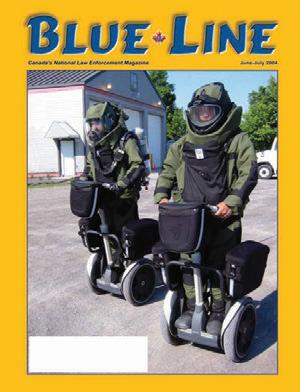
• Readers are introduced to the Segway and its many applications to police work.
March
• After a panel of judges reviewed many candidates, the Police Leadership Forum (PLF) selected OPP Chief Superintendent Kate Lines as the fifth recipient of the Police Leader of the Year Award. Lines was the fifth recipient of the Police Leader of the Year Award which was started in 1998. Blue Line Magazine had been a sponsor of the award since it was initiated.
April
• Things have changed a lot since CN Police were founded in 1923. West coast correspondent Elvin Klassen wrote how officers have protected railway property, passengers, and the public through the years and utilized the three E’s to reduce railway accidents: education, enforcement and engineering.
May
• Earning the trust of Old Order Mennonites and Amish, who still use horse and buggies, reject modern conveniences and practice non-resistance, can be a challenge. To learn about policing “the quiet of the land”, publisher Morley Lymburner went on a ride-along with an officer from Waterloo Regional Police’s Elmira detachment, which patrols areas with large populations of Old Orders.
June / July
• Staff writer Les Linder supplied readers with a realistic overview of current studies of anti-terrorism preparations in Canada.
• Blue Line writer Kathryn Lymburner provides an overview of several aspects of campus security at one of Canada’s largest universities.
August / September
• West coast correspondent Elvin Klassen talked to Vancouver Police Department (VPD) Chief Jamie Graham and profiled the force with some of its innovative programs.
• In a second profile Klassen wrote about the 157 officers of North Vancouver’s RCMP detachment who patrol “from sea to sky.”
• Mark Giles begins writing a regular column on media relations.
October
• York Regional Police Children’s Safety Villages was featured with a focus on how this environment teaches elementary children a broad variety of safety techniques in a kid-sized version of a town complete with electric cars, streets and traffic lights.
• Toronto Police Association member Doug Ramsey wrote an overview of the style of labour relations practised in this city.
November
• In a Blue Line exclusive, Fotios Nassiakos, head of the security operations for the Athens Olympic Games was interviewed and told readers how law enforcement agencies prepared themselves to handle the myriad of possible threats.
• Staff writer Ryan Siegmund discovered how new policies for Corrections Canada officers reflect increasingly dangerous conditions in Canada’s prisons.
December
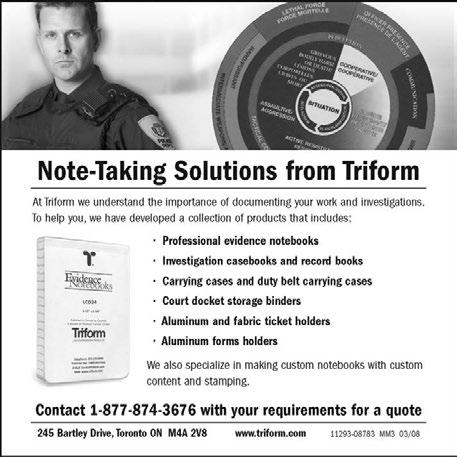
• The subject theme for this edition was firearms and less-lethal weapons. Vancouver Sergeant Joel Johnston graced our cover with a stylized and editorialized rendition of the use of force model. Joel explained the logic of incorporating a Taser capability within a police force’s use of force options.
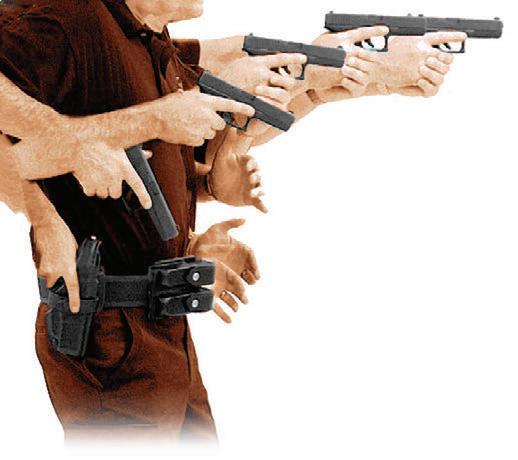
• Adhering to the philosophy that under stress you react how you have been trained, tactical firearms editor, Dave Brown, illustrates a new emphases on a fluid natural motion.
CanCom Sales represents and distributes Communications and Personal Protective Equipment from leading manufactures including radio accessories, headsets, earpieces, eyewear and hearing protection. Visit www.cancomsales. com for more information.
2005
January
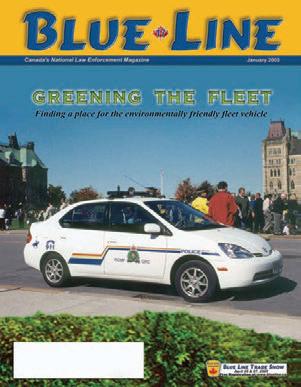
• The January police vehicle edition featured the Toyota Prius for fuel efficiency and the Dodge Magnum as the newest patrol vehicle.
• In another feature, Collines, Quebec Police Service was selected as Canada’s best dressed police vehicle. Runners up were vehicles from Windsor, York Region and Gatineau police services.
February
• The 2005 Supply and Services Guide issue featured RCMP forensic firearms specialist Darrel Harvey.
• The Ontario Provincial Police tactical unit celebrated 30 years of service. One of the founding members of the squad, Andrew Maksymchuk, wrote the feature article with a style soon to be recognized in his later book Muskeg to Murder.
• In a second article by staff writer Ryan Siegmund, the Calgary Police Tactical Unit’s training was highlighted.
March
• The Toronto Police Service designed and developed a ‘quadrate’ of events to instill community goodwill and a sense of cross-racial pride. S/Sgt Heinz Kuck, well known for combating urban graffiti, coordinated the program and tells how it captured the hearts and minds of Toronto residents.
• Thousands of people disappeared, many without a trace, during Argentina’s “dirty wars.” The military government was overthrown in 1983 and a forensic anthropology team was formed to begin excavating human remains. York Regional police officer Greg Olson was among those Canada sent to help.
• Four mounties, Brock Myrol, Anthony Gordon, Leo Johnston and Peter Schiemann, are gunned down on a farm near Mayerthorpe, AB.
April
• Although both Canada and the United States have spent many millions of dollars and made many announcements about how they’ve tightened border security, publisher Morley Lymburner, discovered that US Department of Homeland Security officers were much more vigilant than their Canadian counterparts.
• West coast correspondent Elvin Klassen profiled the Saanich Police Department and its annual tradition of lowering the crime rate and reducing its caseload by building relationships with the community, especially youth, through early intervention and asset building.
May
• London Police Service Cst. Jeff Arbing looked back at his agency’s 150 year history while Lisa Heslop profiled London’s innovative Family Consultant/Victim Services Unit, the first of its kind in Canada.
• In his commentary, Morley Lymburner states since police forces work on the four functions of prevention, enforcement, detection and administration, perhaps funding could be divided up. Municipalities pick up the costs of prevention and enforcement while the province picks up the costs of administration and detection; a simple concept that no one follows.
Not only did the Ottawa Police Service celebrate 150 years of community service – it also hosted the 100th anniversary of the Canadian Association of Chiefs of Police conference.
June / July
• Confiscating and destroying illegal firearms is important but discovering how they were brought into Canada is the job of the National Weapons Enforcement Support Team (NWEST). A branch of the National Police Service, NWEST offers police across the country training and support to shut down sources of illegal firearms.
• In an enlightening profile, the Greater Vancouver Transit Authority Police Service describes its function and processes. It is Canada’s first armed transit police service; other transit protection services are not actually called police.
August / September
• It was a year to remember for the Ottawa Police Service. Not only did it celebrate150 years of community service – it also hosted the 100th anniversary of the Canadian Association of Chiefs of Police conference.
October
• East coast correspondent Danette Dooley talked to Fredericton Police Chief Gordon Carlisle after heading the police force for 25 years. He was a police officer for almost half a century, retiring from the RCMP after 22 years to take over as chief of Fredericton, his home town.
November
• Hamilton Police Service featured its new ‘Beat Tracker’ system, which links officers on the street with incidents and calls accumulated in their patrol sectors. The simple system has increased the effectiveness of beat officers in responding to community needs and issues.
December
• “Practice makes perfect!” is an applicable slogan for “CBRN” response which relies heavily on specialized training and equipment and co-ordination. Freelance journalist and EMS worker, Simon Martin details this training in “Refining the Response”.
• Staff writer Kathryn Lymburner, completed the feature with an overview of what you need to know about CBRN.
2006
January
• Port Moody Police are selected for the best dressed police vehicle of the year and profiled by west coast correspondent Elvin Klassen.
• Dave Brown supplies an overview of the best performing cars for police work. The Dodge Charger and Chev Impala’s once again come out as keen competitors to the Ford Interceptor.
February
• When the level of non-emergent 911 calls reached 90 per cent, the Ontario Provincial Police decided to act with a public awareness campaign that started with a very effective open house media scrum at their communications centre.
• Mark Giles outlined three basic steps in dealing with miscommunication: admit the mistakes early, correct misinformation with proactive and reactive strategies, and communicate mitigating information.
March
• Peel Regional Police began a program called School/Police Emergency Action Response (SPEAR). This cover story included information about a comprehensive computer database and emergency preparedness plan for supervisors and responding officers. Information is now at their fingertips including floor plans, staging and evacuation areas and key information on staff and students.
April
• Imagine being one of 140 police officers policing 16,000 people scattered over 3.2 million kilometres – and 9,000 more in the Yukon – that’s roughly 40 per cent of Canada. Little wonder that RCMP Supt. Henry Larsen observed that any man who found things not to his liking should turn around and go home, since “the north is no place for softies.”
May
• Creating a commanding presence on the highways was the main theme of an article from the Ontario Provincial Police. They expressly began to target aggressive drivers and were taking a page from the best practices of other forces to reduce Ontario’s average toll of 600 traffic fatalities a year.
• The creators of the Police Training Officer (PTO) outlined the successful police training model based in problem solving and adult education philosophy.
June / July
• The strategies involved in policing the suburban fringe of Toronto was the topic as the Orangeville Police Service explained its challenges of keeping costs down and service levels up. Chief of police Rod Freeman credits the threat of extinction with making his service stronger and more focused on proper service delivery.
August / September
• The new chief of the Royal Newfoundland Constabulary Joseph Browne, a born and bred Newfoundlander, took up his new duties and was immediately thrust into welcoming members of the Canadian Association of Chiefs of Police to St. John’s. This profile of the RNC chief and oldest North American police service is written by east coast correspondent Danette Dooley.
October
• A story about nuclear power plant security introduced readers to the new
reality of private security at these facilities post 9/11. The Bruce Nuclear Power facility on Lake Huron possesses a world class armed security response team on par with the world’s best tactical teams. This feature explained that hardening the target was both their goal and their accomplishment.
November
• Double duty was the theme about twins in policing. Blue Line Magazine found ten sets of twins working in Canadian police services and drew out stories of confusion and disbelief from both colleagues and criminals.
December
• Abbotsford Police purchased a new helicopter. Challenged by a large municipality and abutting the U.S. border, this agency has many challenges not seen by average police forces across the country. One of the challenges is the city’s extreme growth along with a burgeoning drug trade.
Integral Designs celebrates 20 years of making serious expedition gear. The Special Purpose Gear is designed for specialized police, military, park rangers, EMS, and Search and Rescue groups.
2007 January
• Windsor Police Service was featured with the top best dressed police vehicle in Canada.
• Dave Brown presented an overview of the Michigan State Police Vehicle trials.
• A special feature focused on the Vancouver Police Department’s efforts to curb bar and night club violence.
• “Contaminated” was the title of a story by Trevor Stoddart regarding workplace sanitation concerns.
February
• The cover of the annual Supply & Services edition was graced by members of the Durham Regional Police. This was the lead into a story explaining how that agency keeps ahead of a constantly growing community.
• A report card of how effective each province has been in reducing impaired drivers.
March
• The cover story presented an overview of the Medicine Hat Police dogs and the recognition given to veterinarian Bob Fisher for his long service to them.
• Forensic artist Diana Trepkov explains the importance of postmortem drawings to assist the public with the identification of victims.
April
• You know you are making an impact when they start putting your name in the graffiti. In this feature story Cst. Lee Jones, assigned to the Saskatoon Police Anti-Graffiti Unit, takes pride in making an impact on the street gang and graffiti problems in his city.
• This issue also profiles the police services of Bermuda, the city of West Vancouver and Halifax Region.
May
• A profile on the Brockville Police Service focused on retiring Chief Barry King and his history of working with six different agencies.
• Criminalistics celebrates 40 years of manufacturing excellent law enforcement systems: Premier™, Hotdog™, Savvyfan™, SID™, Chem Print™, Enspecta™: www.criminalisticsinc.com.
June / July
• Staff writer Matt Collison wrote about the Waterloo Regional Police slogan “People Helping People,” focuses on the attitude that makes their
Brockville Police Service is celebrating 175 years of service. Its proactive approach to recognizing and developing youth assets enhances quality of life in the community.
communities safer. “It’s just the way we do business,” says Chief Larry Gravill.
• In another article the growing appearance of a street gang called MS-13 is explained.
August / September
• Policing the city of Calgary presents a myriad of unique issues. The cover story explained how these issues create advantages and disadvantages to its policing capabilities.
• Further profiles are presented on the Halton Regional Police Tactical team, a new police facility for the Kingston Police Service, a walk through the RCMP Museum and computer technology for the Smiths Falls Police.
October
• The Ontario Provincial Police Aboriginal Relations Team was the focus of the October cover story.
• A profile on Alberta’s Louis Bull Police Service was presented through the history and reminiscences of Chief Peter Bull.
• Four generations of policing within two families was profiled; the Lemke family in Ontario and the Kenney family from Newfoundland.
November
• The 50th anniversary of the Toronto Police Service was profiled by retired Inspector Mike Sale.
• Career management for experienced officers was presented by feature writer Irene Barath of the Ontario Police College.
December
• Dave Brown, the ubiquitous tactical firearms editor, accumulated and analyzed the information from a survey of police firearms in Canada. This comprehensive report detailed changes in firearms issued and used since Blue Line’s last survey ten years before. During this time many agencies disappeared, realigned and amalgamated and Dave’s study chronicled these stops, starts, changes and facts on firearms.
2008
January
• It was back to the future for Canada’s best dressed police vehicle. The OPP’s revived black and white design “is one of the most unique in Canada,” wrote Dave Brown. By taking a chance with the ‘retro’ look, it combined tradition, simplicity and innovation, going to great effort to bring “an old colour scheme up to today’s standards for all weather visibility, using modern reflective materials.”
February
• Vancouver searched far and wide for candidates to succeed retiring police chief Jamie Graham. “The exhaustive search spanned the country and came down to three internal candidates,” said mayor Sam Sullivan; deputy chief Jim Chu was the unanimous choice. “He has high credentials, an international reputation and he is highly regarded at city hall.”
March
• “Acquiring police recruits in Canada has turned into guerilla warfare, with few rules of conduct,” writes Morley Lymburner in a survey of Canadian police recruiting. “There are fewer consistent standards than in the past, and even less ethical considerations” as some agencies hustle to make up for regional disparities and a declining work pool. “To suggest we are re-arranging the deck chairs on the Titanic would be optimistic.”
April
• The OPP becomes the first North American police or civilian agency to regularly operate an unmanned aerial vehicle (UAV) in civilian airspace with federal approval. The force’s nine pound, electric powered aircraft, developed by Cst Marc Sharpe for just over $5,000, began its first operational mission at a Fort Severn, Ontario homicide scene, just four kilometres downstream from the shores of Hudson Bay.
May
• “You know you’re getting on when people begin jockeying for position to get your job, your waistline grows larger and inseam smaller, and your list of body parts you have more than one of include chins,” writes Dorothy Cotton. The news isn’t all bad though – “old coots” can still outdo youngsters when it comes to knowing what’s really important, coping and language skills, experience and expert knowledge.
June / July
• Impact projectiles deserve another look as a less than lethal force option, argues Colin Watson. New technology has made the devices safer and more effective, he notes, but they are still tainted by unintentional deaths from early devices. “Injury will likely result from using impact projectiles, however weighing injury with the risk of death or serious injury to a subject, citizen or police officer, it is a reasonable and life saving compromise.”
August / September
• Largely forgotten in the furor over that “fancy, wireless, ergonomically correct electronic device using a red laser for tracking movement... five or more buttons... (and) a scroll wheel” – aka the mouse – is the trusty old keyboard. The humble old device still has some tricks up its sleeve though, writes Tom Rataj, including a bevy of handy, time saving CTRL key shortcuts largely forgotten by many computer users.
October
• “While trying to be everything to everyone may work initially,” notes Mark Giles, “it often results in a lack of focus... (by) limiting the scope of its activities
and narrowing priorities to those linked to understandable and respected objectives, an organization can generate and maintain public and internal support – the very support needed” to maintain its credibility.
November
• Give ‘PEACE’ a chance, urges Newfoundland professor Brent Snook and RNC Insp John House. They were referencing an interviewing approach rather than the famous John Lennon song. PEACE (Planning and preparation, Engage and explain, Account, Closure, Evaluation) is a non-accusatory alternative to the antiquated and coercive techniques most agencies use, they concluded, but are just as effective.
December
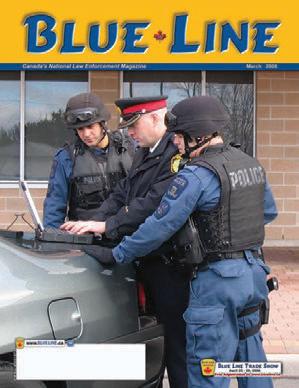
• Blue Line Magazine celebrates its 200th issue and 20 years of publishing for the law enforcement industry with a special anniversary edition.
We’ve given you 20 pages of highlights from 200 issues of Canadian law enforcement. To see the entire Blue Line Magazine catalgoue of articles, case law, special features or your favourite writers, order your limited edition 20th Anniversary Searchable DVD.
905-640-3048 for purchase
Train with the Best.
Road Range™ is a mobile training facility capable of both live fire and virtual training. Road Range eliminates the need for a separate training facility and is delivered complete and ready to shoot in 30 minutes or less.
Benefits of the Road Range include:
Live fire and virtual training capabilities in a mobile environment
A training facility you can utilize when and where you need it
A flexible alternative to traditional firearms training options
Easily transported for use at dispersed sites or parked in a permanent location
A cost-effective and timely solution for acquiring a training facility
Simplifies the logistics of firearms training
HEPA filtered ventilation system meets NIOSH design standards
Contact Meggitt Training Systems for a custom training solution. We service our customers from our offices in Medicine Hat and Montreal with service reps in Edmonton, Gagetown, Halifax and Victoria.
Meggitt Training Systems
#3-1735 Brier Park Road NW
Medicine Hat, Alberta T1C 1V5
Phone: 1 403 528 8782
Email: MTSCanada@Meggitt.com
Meggitt Training Systems Canada
Saanich Police road range
by Joetey Attariwala
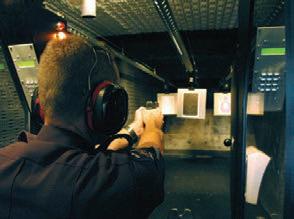
The Saanich Police Department in British Columbia recently introduced the first mobile firearms Road Range in Canada. Manufactured by Meggitt Training Systems, the Road Range leverages technology and environmental consciousness to provide a safe and readily accessible firing range for law enforcement agencies.
Since 2004, the BC government has returned 100 per cent of traffic fine revenue back into the communities that issued those violation tickets. Saanich Police has elected to use the revenue to improve and enhance the department and its public safety resources. Saanich Police Chief Constable Derek Egan was introduced to the Meggitt Road Range at a conference. From that point on, many aspects were investigated prior to the system’s purchase.
Environmental issues surrounding shooting ranges seem to grow year by year. The necessity of safety zones and the environmental impact of sequestered lead in range areas, along with noise pollution to surrounding communities are factors that limit the usefulness of many facilities.
Additionally, many outdoor ranges are exposed to inclement weather, which limits and sometimes prevents adequate training and instruction. New purpose-built shootingrange buildings can certainly address and even negate some of these issues, but are often cost-prohibitive. After looking at all the available options, Saanich selected Meggitt’s Road Range as the most cost effective, versatile and environmentally friendly choice as a firearms training facility.
“To date we’ve sold approximately 115 Road Ranges around the world and Saanich Police has proven itself on the leading edge as the first operator in Canada. We’re expecting more sales in Canada in the coming years as our Road Range offers versatility and costsavings,” said Spencer Fraser, General Manager for Meggitt Training Systems Canada.
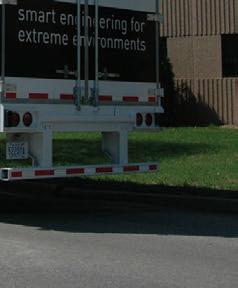
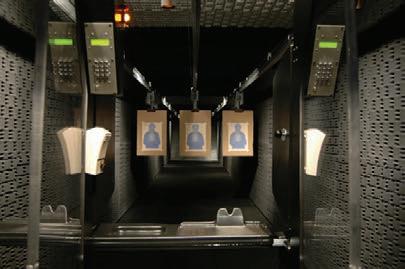
Integrated into a 53-foot trailer, the Road Range is a self-contained, state-of-the-art and ballistically-secure mobile shooting range that allows up to three officers to train simultaneously in high, low and no-light scenarios.
Integrated into the trailer is an RTS-360 target system, a target turning system designed to improve live-fire training through unpredictable, fast-action target presentation. Each of the three lanes of targets can independently move forward and back and can turn the target holder to the left or right, thus enhancing tactical training as the shooter is unable to anticipate target presentation.
The RTS-360 is integrated with the RangeMaster 9000, a PC-based menu driven system developed by Meggitt Training Sys-
tems, which controls targets, security systems and lighting. This system is operated from the range operator control room, at the rear entrance to the range and is separated from the firing lanes in front by a ballistic glass window.
“Half of the work we do on a day-to day basis occurs when natural light is poor or nonexistent,” said Egan. “The Road Range can simulate the actual conditions police officers can find themselves in – including red and blue strobe lights of a police vehicle.”
In addition to firearms qualification, the Road Range allows firearms training, weapons function testing, shoot/ no-shoot scenarios and more. The mobile nature of the Road Range allows it to be situated anywhere a department deems appropriate and negates the requirement of property lease/purchase, building permits and the like. Saanich Police were attracted to many of these features and key to these was the ability to train day and/or night in their own municipality without the impact of noise pollution to the community.
“When members are firing their weapons inside the Road Range, its amazing to stand outside and realize that the ambient noise of traffic on the adjacent street is louder. The best way to describe the sound of the Road Range in use is to imagine the blunted and distant sound of a hammer impacting a nail. If you didn’t know it was there, you wouldn’t have a clue officers were training to hone these critical skills,” said Sergeant John Price of Saanich Police.
Unlike outdoor ranges, the Road Range captures spent ammunition in a way that is safe for both the officers and the environment. Called the Reclining GranTrap, the patented design was developed to overcome the shortcomings of steel traps and to address environmental concerns of traditional shooting ranges.
The GranTrap de-energizes bullets and captures them with negligible lead dust or bullet fragmentation. The Reclining GranTrap allows for more efficient reclamation of spent rounds by virtue of its composition and structure and with the aid of rear access doors in the support structure behind the primary collection area. This primary collection area contains a larger volume of granulated rubber material, patented as GranTex, to absorb rounds and extend the service life interval.
The GranTrap was designed with a supply bin located at the top of the trap, which allows for continuous replenishment of GranTex in order to maintain a consistent depth across the trap. Behind the supply bin is a permanently
filled supplemental bin, known as a ‘safety bin,’ which serves to maintain ballistic integrity of the trap.
Standard to the Road Range is an air filter and purge system that draws outside air into the range to produce an average of 75 feet per minute airflow across the firing line. The exhaust air is filtered through two-stages with the final stage of 99.97% HEPA filtration before being safely discharged.
Sergeant Nick Ross of Saanich Police was one of the first range control officers to be trained and qualified to operate the new Road Range. According to Ross, “The initial course is three hours long and consists of a familiarization tour of the range, description of options available and then actually using the controls to operate the various systems. The training Meggitt provided was clear and concise and we all agree that the best way to get familiar with the system is to jump in and use it. I spent an additional three hours running through the controls on my own and after five to six hours I felt comfortable using it safely and to begin teaching other instructors on the proper use and capabilities of the Road Range.”
Saanich Police will have training officers qualified to operate the system on every platoon, thus leveraging training opportunities for all members during any shift.
“This new training facility will enable officers to maintain their high level of skill, but more efficiently and effectively,” said Saanich Mayor Frank Leonard. Although the Road Range can be mobile, Saanich has elected to situate their Road Range in a fixed location on municipality property so it’s easily accessible for officers while on shift.
“Acquisition of the Road Range is an excellent example of the willingness of Saanich Council to find innovative and cost-effective policing solutions – and it is in keeping with the commitment of all levels of government for greener choices,” said John van Dongen, Minister of Public Safety and Solicitor General for BC.
The latest high retention holster technology
by Dave Brown
Nobody wakes up one morning and thinks, “Today, I am going to lose my gun.”
That’s how we began our last review of high retention police holsters back in March 2000 and it still applies today. A holster is not just a place to store your pistol – it must be designed for the almost mutually exclusive tasks of protecting your sidearm against attack and releasing it quickly when drawn. Much like a parachute to a fighter pilot, a holstered sidearm always seems to be in the way when you don’t
need it but when you do, nothing else will do. The consequences of holster failure are unfathomable. Ninety per cent of all officers who lost their sidearm in a struggle with an assailant were subsequently shot with it, according to a recent RCMP study of police officers murdered in Canada over a 25 year period. The simple fact is, your gun WILL be used against you if you lose it. Nobody is going to grab it just to run down to the local pawnshop, and they’re not going to return it to the front desk of the nearest police station either.
Police holsters lead pretty tough lives. Ex-
posed to the elements, they get bumped, knocked, kicked around, ground into the dirt or just plain ignored 364 days a year, but they still must work perfectly the instant they are needed most.
Police holsters should be tested like parachutes; not by comparing looks and features but by how they operate in worst-case scenarios. The problem is that holsters are rarely tested in head-to-head comparisons, and few online users will divulge that they wasted hard-earned dollars on a poor design. Fewer still are crazy enough to buy a dozen holsters just to see if they can rip them apart.
No, that’s where we come in.
Here at Blue Line Magazine, we don’t regurgitate marketing promos thinly disguised as editorial content. We tell it like it is, good or bad. In fact, a few manufacturers still won’t advertise with us because we called them on the carpet for trying to foist poorly designed products onto the law enforcement market. (Because of this, my long-suffering publisher and ever-patient editor are forced to closely examine every word of what I write, looking for what they call “zingers.” Boss, if you are reading this, you can stop reading now. There are no zingers. Honest. Cross my fingers.)
Call us crazy, but we believe that properly testing high-retention holsters requires more than putting them on a belt and tugging a couple of times; you test them by timing how long it takes a determined person to pull out the gun. Also, if you want it to stay on your belt, you don’t slip it on and off a few times; you challenge the biggest guy you know to try to rip it off your belt in less than 30 seconds.
Holsters get broken; innocent polymers and carbon-fibres get destroyed. So be it.
A good retention holster should be able to protect its contents from an untrained attacker during an undefended gun grab for at least 20 seconds. (After 20 seconds, few assailants are likely going to stick around, even if the officer is unconscious.)
We also added new criteria for our 2009 test. Duty holsters should also be able to protect their contents from a knowledgeable attacker for at least ten seconds. (If you don’t think career criminals spend time practicing how to disarm police officers, ask any corrections officer who ever had to watch over an exercise yard.)
No holster is perfect; they all have compromises. Some trade off retention for speed; others are so secure you would need a key and PIN number to get your gun out. (Those of us over 40 may even remember the old flap holsters that combined a slow draw with a disturbing tendency to unceremoniously dump your gun out onto the ground every time you had to climb a fence.)
Times have changed, as you will soon read, for the better. Here is our lineup of what we consider the best holsters on the police market for 2009:
Duty holsters
Technology has come a long way in the eight years since our last comparison test. Holsters are lighter and stronger and fewer cows had to give up their skins for our benefit. Officers forced to carry increasing loads on their duty belts will welcome this change (not to mention the cows).
Interestingly, one area that hasn’t improved is draw speed. It still takes roughly the same time for a trained officer to draw from the holster and fire. What has changed since 2000 is the amount of effort it takes to train that officer. What once took hours and hours of training and practice to achieve proficiency can now be accomplished with a few minutes of training and a couple of practice draws a week.
The other significant improvement is the ability to re-holster in a hurry. With just one hand, officers can drop their sidearm back in the holster and attain high levels of retention instantly; a quick additional sweep of a hood returns it to full retention. This leaves their other hand always free to deflect or grapple with an assailant in situations where you suddenly no longer want a gun in your hand.
You may notice that we are not testing any nylon cordura holsters this year. Their stitched construction and innate flexibility just doesn’t provide the same level of protection as modern molded laminates or composites. It is even technically possible for a very goal-oriented assailant to force a finger deep inside a cordura holster and pull the trigger during a violent attack. Their previous advantage – light weight – is now less important, since nearly all the top laminate and composite holsters are just as light.
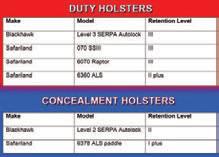
The following holsters meet our criteria for fast draw, good protection and light weight:
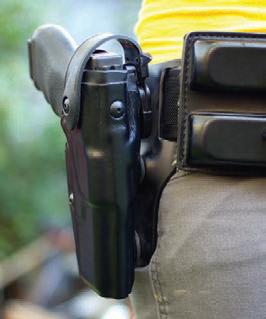
Blackhawk Level 3 SERPA – An injection molded carbon fibre composite makes this holster light and tremendously strong. It achieves triple redundancy protection, using passive (an adjustable tension screw on the side) and two active retention features (a thumb-operating pivot guard that springs up and forward and a trigger-finger-operated SERPA autolock button that firmly engages the trigger guard).
The pivoting hood remains locked forward until the sidearm is returned to the holster.
The Blackhawk easily withstood all the ripping and prying we could give it and survived our requisite 20 seconds from an attacker. It can be drawn from unusual position, the draw motion is natural and instinctive and we were excited about the possibilities of a lightning fast draw and high retention level, but....
Officers are attacked during dynamic situations. The more we tested this holster, using a variety of subjects and imposing stress and time limits, the more we began to notice a disturbing design flaw. Most draws were accomplished quickly and smoothly, but every now and then the gun would hang up in the holster, causing the shooter to experience a brief moment of panic and frustration.
The more stress added, the more often the draw was fumbled. We finally traced the problem to the fact that, under stress, all our test subjects would occasionally go for the depressed area behind the SERPA autolock button instead of the button itself.
The body tends to concentrate blood flow to the centre mass when stressed, leading to a rapid loss of flow to the extremities and a consequent loss of fine motor skills. When this happens, finger sensitivity is reduced and they can no longer feel the button. Under the stress of range testing, about one draw in ten would be slowed while the finger was repositioned.
While it is possible most officers would never experience this, we must still rate this hol-
ster unacceptable until Blackhawk addresses the problem and repositions the autolock button.
Blackhawk holsters (www.blackhawk. com) are available in Canada through a variety of distributors and retailers.
Safariland Model 070 SSIII – This is one of the most commonly issued holsters in Canada and has a well-deserved reputation for reliability. It won our last head-to-head comparison test in 2000, which goes to show just how long it has been on the market.
Constructed of a thermolaminate and using traditional button snaps, the holster’s triple retention is achieved through a thumb snap on top, mid-snap behind the trigger guard and a unique angular motion required to complete the draw. The holster can still protect from a gun grab at almost any angle, even if any two of these levels are defeated.
The 070 does take a while to break in and, until the draw is smoothed up from practice, it can be difficult to re-holster with one hand. It will also take a few seconds to do up all the snaps – difficult if not impossible to perform while desperately struggling with an assailant with your other hand.
The 070 provides good protection but is expensive to make and it takes hours of training to become proficient with it. Safariland recommends performing at least 200 draws before using this holster on duty. While it is still acceptable, there are newer designs on the market that should be considered.
Safariland Model 6070 Raptor – This holster uses modular construction and a tripleretention design, consisting of a rotating hood at the back of the slide that requires a thumb press and rotation to move forward, a mid-finger button at the back and a unique angular motion to com-
plete the draw. Safariland calls this rotating hood the SLS, which stands for Self-Locking System. It was designed to nearly duplicate the draw motions required by the 070 holster, so it would be a good replacement for agencies looking for a newer design.
In our tests, it withstood an attack even longer than the 070 and has a unique ability to be re-holstered with one hand, instantly returning to a double-level of retention. An additional quick sweep of the hand on the rotating hood engages the third retention level.
This is the holster that I have personally trained most officers on in the past few years and has proven to be durable, simple and reliable. The more I train on it, the more I like it. I rate it highly recommended.
While some users have reported situations where their soft body armour depressed the SLS hood enough to slightly rotate it out of the way, we could not reproduce this in either testing or training. The Raptor even comes with a plastic shield above the SLS (which is easily removed if you, like me, prefer to have it out of the way).
Safariland Model 6360 ALS – Safariland rates this holster as a Level II plus, which means it uses a straight-up draw motion, an SLS hood plus an Automatic Locking System (ALS) button on the inner side.
You can tell the company put a lot of thought into this design and the ALS button is perfectly placed for your thumb as it curls naturally around the back of the slide. Because the holster is slightly canted and requires a straight-up draw motion, the officer can pull it out very quickly and smoothly but an assailant would have more trouble duplicating the exact upward angle. This is why Safariland
conservatively rates it as a level II “plus,” and not simply a level II. (The other issue is that there is no standardization in holster retention levels and Safariland can call this holster what they want. See page 34 for more on holster retention levels.)
The ALS locks the sidearm firmly into the holster internally at the ejection port and, while the button only needs a short travel to disengage, we were able to pick up a person by the pistol, using only the strength of the ALS to hold it in place.
We would have no hesitation in recommending this model to any agency looking for a high retention holster that is also safe, reliable and easy to train on.
Safariland holsters (www.safariland.com) are distributed in Canada through R. Nicholls.
Concealment holsters
Concealment holsters have different priorities. If an assailant knows you are wearing a holster, it is because your firearm is already out and pointed at them, making the presence of a now-empty piece of leather or polymer on your hip a relatively moot point. That, or you have already done something seriously wrong. Either way, the need for multiple redundant levels of retention is not the highest priority.
Safariland Model 6378 ALS paddle –This holster is the paddle version of the 6360 ALS. It eliminates the rotating SLS hood but retains the ALS locking button, placed in exactly the same spot as the duty holster.
The ALS solidly locks the gun to the holster and I cannot honestly say I have ever seen a faster retention holster on the market. I think it would even beat all of the variety of pure competition holsters I have tried over the years – and I have tried many. (One of my competition holsters was personally given to me by Rob Leatham, many-time world practical pistol champion, so I can appreciate a fast holster!)
If I carried a concealed firearm for a living, this is definitely the one I would pick. The only infuriating part is that the paddle is always a struggle to remove from a waistband, but I think this is a tradeoff most of us would be willing to make.
This holster easily achieves our highly recommended status in the concealment category.
Blackhawk Level 2 SERPA – Man, we wanted to like this model, which is the concealment version of the Blackhawk Level 3 duty holster tested above. It eliminates the pivoting hood but retains the autolock button on the side. It can be installed as a belt holster, with clever sliding spacers for various sized belts, or as a paddle holster that quickly slips inside a waistband.
However, it suffers from the same flaw as the Level 3 – every now and then, under stress, users tend to go for the depressed area behind the autolock button and not the button itself.
Sorry Blackhawk. This is a great first effort but badly needs a repositioned autolock button. As I said in the Level 3 test above, most officers may never experience these rare hang-ups during a draw but our testing showed that as the stress level went up, the reliability of these SERPA holsters may sometimes go down.
In our mind, nine out of ten perfect draws is still not good enough. Ninety per cent might be okay for medical school and a remarkable achievement in law school but it does not cut it for police holsters.
Or parachutes either, for that matter.
by Dave Brown
Holster retention levels
This is what the numbers mean
Pop quiz. Which is better, a Level 3 or a level III? How can a level II plus holster be as good as a Level 3? If a .40 calibre sidearm is inserted into a level III holster, does that score 30 on the Dave Brown ‘hammer’ scale, but a 9mm gun in a level II holster only scores an 18?
Just who makes up these numbers anyway?
Well, the answer is – anyone who wants to. There is no standardization in holster retention levels. Unlike soft body armour, we are left with arbitrary numbers written by marketing departments and it is up to us to decipher them and decide what is most important for our purposes.
Until there is some degree of industry-
wide retention standards, agencies should choose holsters based on their capabilities and features, not arbitrary numbers.
These labels are not quite as arbitrary as they may seem, however. Manufacturers of law enforcement holsters need to keep their products competitive but also understand that they are selling to a relatively sophisticated audience. Over-selling their product’s capabilities may result in lost lives, not just lost sales.
Let’s look at some of the common elements in retention designations.
Level I
Outerwear that Communicates Authority
Level I, or single-retention holsters, are among the earliest designs and are still widely used for concealment holsters. The single retention usually consists of a button or snap, most often operated by the thumb. This level of retention should always require a gross motor skill of the shooting hand to operate and the hand position to release the snap should be as close as possible to a normal draw position from a completely open holster.
Level II
Double-retention holsters have an additional feature on top of the single-retention device. On some, it may consist of a tensioning screw that makes drawing the sidearm difficult unless levered upward from above, or an additional button or snap, most often operated by the middle finger of the shooting hand.
Here is where we at Blue Line take issue with some of the older designs on the market. A thumb-snap holster with a tension screw may technically make it a double-retention holster, but we would not recommend this design as a duty holster simply because a tension screw can be defeated by an aggressive assailant. (Nylon and leather holsters have even been literally ripped in two by extremely violent aggressors.)
A tension screw may qualify as one of the retention levels, but we want to see more than just a thumb-snap on top of it. Some other designs use a rocking motion of the sidearm instead of a tension screw and this is perhaps better but, as our head-to-head testing showed, assailants who don’t know how a holster operates can often just fumble their way to a solution by grappling back and forth. In fact, a straight-up draw from a slightly canted holster proved to be just as much protection in our tests as a forward or back rotation of the sidearm.
Level II Plus
Safariland originated the “level” designations, so they get to create this unique intermediate level. In their ALS holster, the first level is the rotating hood operated by the thumb and the second is the Automatic Locking System (ALS) button, also operated by the thumb. The “plus” part is the required straight-up draw motion. This is why we can recommend this holster. If the first level is ever defeated for any reason, the ALS is strong enough to take almost the entire weight of the officer.
Safariland is even rumoured to be revising its retention level designations on their SLS holsters, reasoning that the SLS rotating hood actually requires two motions: a downward push and a forward rotation. (Please Safariland, let’s not muddy the waters any further. Keep the existing designations!)
Level III
A triple-retention holster uses three redundant motions or devices. Here is where we would also accept a tension screw as part of the retention, provided the other two levels require a gross motor movement on the part of the officer. For example, Blackhawk’s Level 3 SERPA holster uses a tension screw, a release button on the side operated by the trigger finger, and a very clever protective hood over the back of the slide; it almost instantly springs forward when the officer passes their thumb alongside the inside of the slide in a normal shooting grip.
Level IV
A level IV holster is usually characterized as a level III, modified with an additional
feature. Safariland sells an optional “Sentry” button that modifies an SLS holster, bumping it up one full level. While we believe in good holster retention, we do not recommend level IV holsters for duty carry unless you are in an extremely high threat environment and, even then, we would first question your need to carry a sidearm in these situations. That, or your choice of careers.
Retention continuum
Officers should not need to rely solely on their holster’s technology to prevent a gun grab. Retention should be a continuum of defenses, beginning with not letting the bad guy get close enough to even try for your gun. If an aggressive attack is initiated, officers need to learn simple, dynamic breakaway tactics that rely less on fancy martial arts moves and more on unconscious reactions that can throw the assailant physically and mentally off balance.
However law enforcement officers may not always be in a good position to properly defend against a sudden attack. In those cases, it is nice to know the modern holster will do a pretty good job of providing those critical few seconds you may need to prevent a gun grab.
So hot shots, let’s try our pop quiz again. Based on what we have learned on holster retention levels, let’s say agency “A” uses 8 per cent level I holsters, 22 per cent level II and 70 per cent level III. How old is the bus driver?
Dave Brown has been Blue Line Magazine’s Firearms Editor for 13 years (Jan 1995). He is a tactical firearms trainer and consultant. He can be reached at firearms@blueline.ca .
Starfield Lion
Starfield-Lion is an established company with over 27 years experience in manufacturing a wide range of safety apparel for numerous first responder clients.
Our approach to business is based on a philosophy of values – dedication, quality, and innovation. We are committed to delivering high-quality, innovative products that are built with the customer’s safety as our top priority. We consider our customers to be the most valuable members of the StarfieldLion research and development team.
Our ISO 9001-Certified Toronto manufacturing complex is equipped to manufacture protective clothing that meet recognized standards.
In May of 2002, Starfield Safetywear was acquired by Lion Apparel and began doing business as the Starfield-Lion Company. Lion Apparel is one of the world’s largest manufacturers of protective clothing.
This means that we, a mid-sized Canadian garment manufacturer, have access to the key resources of a global company. This unique combining of synergies gives us the strengths of a large company, while allowing us to maintain our smaller company flexibility for garment customization. We offer fire retardant tactical clothing including shirts, pants, coveralls and oversized jackets. For more information call 1-800-473-5553 or visit our website at www.starfieldlion.com
PROFILE Ferno Canada
Much more than EMS
As a division of a global manufacturer, and a fast and broad procurement and supply network, Ferno Canada is a leading producer and distributor of equipment and supplies for rescue and tactical operations, hazmat/chembio decontamination chemical spill containment systems, incident command and triage, personal protection as well as EMS patient transportation-handling and care.
Partnering with a corporate division, traverse rescue, and now the primary canadian distributor for CMC rescue, ferno has become an important player in land and marine rescue operations. rescue operations equipment from confined space to water rescue and all the equipment and supplies required are important product-lines for the company. Its tactical rappelling equipment line that includes harnesses, gloves, and escape kits is light, compact, always dependable and, of course, comes in black and subdued colours.
The Ontario Ministry of Health’s award-
ing of the 2006-08 Hospital Decontamination, Spill and Crowd Control Contract to Ferno Canada has contributed to the company becoming a leader in hazmat/chem-bio decontamination and chemical spill containment systems. our goal is to also provide you with affordable, high quality equipment with a full range of tools for incident command, command post, mass casualty, triage, personal protective equipment and specialized disaster medical equipment.
Over the years, we’ve recognized our customer’s interest in independent product verification. We have strongly supported the creation of national standards for our the different industries, both by serving on standards committees and by making sure that a wide selection of our products are certified. By listening to customer feedback and gaining field experience, we continue to improve existing designs and develop new products and training procedures. We’re committed to making our
customers, police, rescue, fire and EMS more effective and safer.
After serving the pre-hospital emergency medical profession for over 40 years, Ferno and its Canadian division will continue to research, improve and expand its land and air rescue, law enforcement, emergency preparedness, mass casualty and equipment lines to our current as well as new customers. Ferno Canada is truly much more than EMS and welcomes the opportunity to put its partnering and solutions to work with you. Hands-on is our mission and collaboration with our partners and customers is imperative in today’s economy of ideas and economic uncertainty.
The ability to change and the drive to reach you with the product lines that address the real challenges of rescue operations hazmat, mass casualty as well as EMS underlies our mission, “When it’s critical, We’re there.”
PROFILE Accident Support Services International
Award winning Collision Reporting and Occurrence Management System
Accident Support Services International Ltd. (ASSI) has been facilitating centralized collision reporting to police and insurers since 1994 through “Collision Reporting Centres” (CRCs). Currently, ASSI has 20 locations, covering 22 police jurisdictions, and is growing rapidly. Over 70 per cent of collisions can be reported at CRCs, with minimal police involvement, reduced traffic congestion and minimized risk of secondary collisions. Manpower and operating costs savings are re-allocated to higher priority needs. Services using the system enjoy improved response times, increased Highway Traffic Act charges due to proactive, not reactive enforcement, and an increase in “No Insurance” and “False Statement” charges. Photo imaging the vehicle’s damage and “Reported to Police” sticker helps reduce insurance fraud.
ASSI’s Microsoft Award winning Collision Reporting and Occurrence Management System (CROMS) captures all collision details electronically to share data with all stakeholders, from police to road safety engineers, insurers and the Ministry of Transport Ontario (MTO).
CROMS has complete data capture capability and output of all official MTO collision
report forms, fail-to-remain forms, supplementary information forms, comprehensive forms, and personal injury forms. Implementation of CROMS has brought better accuracy and consistency of data; the drivers license swipe increases speed of data entry, with data mapping capability to meet individual customer and partner needs.
CROMS Geocode Mapping captures exact crash latitude and longitude. The system is capable of storing and transferring scanned documents and pictures, and contains edit triggers to generate investigation notification. It works with other systems seamlessly to cross populate e-ticketing solutions, or provide downloads and uploads to government systems or other approved databases. The centralized database matches data from different locations and jurisdictions, and services are flexible to meet the needs of each community, regardless of size.
Jurisdictions with insufficient annual collisions for a CRC can have access to this great tool, and are using it as an electronic records management system. Police simply scan in the completed on-scene report, and ASSI staff enter all of the information. The addition of the CROMS Analytics Portal in fall
2008 has added further value to the program. Users can analyze all information captured in a collision report through adhoc queries based on any field on their official collision report. The new technology allows speedy analysis of data. Users can easily request data for multi-dimensional results through information modifications, selections, rankings, calculations, etc. Collision sites can be plotted on a Google earth map view, a graphical view, and in a tabular view.
The Analytics Portal gives police the ability to analyze what is causing collisions by assessing driver actions, identifying problem areas where a disproportionate number of collisions are occurring, when collisions occur, and decide what times police officers should proactively enforce specific areas allowing for intelligence led enforcement to make roadways safer. Users are impressed with the ease of use. Obtaining reports and tabulation of statistics that used to take up to six months now takes seconds!
CROMS can easily be your risk free solution, whether you need a first step, basic solution with data entry services, or more sophisticated solutions including full in-car use.
Canada Law Book
Former Toronto Police Association head Craig Bromell, is to become the inspiration for an 11-part series of onehour dramas, CTV announced last month. A two-hour pilot was shot last summer and CTV executives liked it well enough to commission a full series. The pilot will now air as the first two separate one-hour episodes. Production of the remaining nine episodes will start in January. The series, called "The Bridge," stars Aaron Frank as rankand file cop Frank Leo.
Blue Line Magazine Publisher, Morley Lymburner, was honoured last month by the Canadian National Committee for Police/Mental Health Liaison. The organization, a sub-group for the Canadian Association of Chiefs of Police, presented him with their Community Service Award in recogntion of the support he has given the group since it started seven years ago. "Much of Morley's work is behind the scenes and may not be readily apparent to... the police or mental health community at large," stated Dorothy Cotton on behalf of the Association. She concluded by stating that Morley does indeed act as a role model for other businesses and organizations and that "the world would be a better place if everyone was inclined to do as he has done."
Ontario's Community Safety and Correctional Services Minister, Rick Bartolucci , has introduced a bill to make forensic pathology more accountable in hopes of restoring public confidence following a forensics scandal that branded innocent people as child killers. The proposed bill would create a new oversight council, a complaints committee and a provincial forensic pathology service, as recommended by the “Goudge Inquiry.” The primary focus of the inquiry was forensic pathologist Dr. Charles Smith whose evidence sent several innocent people to prison.
Shelley Hart, a woman with more than 30 years of service on the Winnipeg Police Service, has been named the department’s new deputy chief of police. Police Chief Keith McCaskill says Hart is a proven leader who is the best choice for the job. Hart, formerly an Inspector in charge of the major crimes section, says the chance to serve as deputy chief is an incredible opportunity. The veteran officer also says she wants to build relationships between police and the community.
Ontario's Liberal government is agreeing to take back all welfare and court security costs that had been downloaded onto municipalities in the 1990s. But it’s going to take 10 years - until 2018 - for them to complete their plan. The Association of Municipalities of Ontario complained that the province won’t start taking back the court security costs until 2012. Ontario mayors have complained court security costs add about seven per cent to local policing bills.
Canada’s industry leader in legal publishing
As one of Canada’s foremost legal publishers for more than 150 years, Canada Law Book has established itself as an industry leader, publishing some of the finest legal resources available. Our continued commitment to excellence helps ensure you meet your law enforcement responsibilities both knowledgeably and confidently every day.
Our line of police resources include:
• Martin’s Annual Criminal Code — Police Edition — provides decisions from all court levels and more reported and unreported cases than any other Code;
• Police Legal Access System (PLAS) on CD-ROM — features the complete up-todate electronic version of Martin’s Annual Criminal Code with annotations, synopsis,
cross-references, index and selected Acts and regulations;
• Martin’s Online Criminal Code — an online resource that offers you easy access to all provisions of the Criminal Code at any specific point in time and includes the current Code and all Codes back to 1955;
• Admissibility of Statements, Police Edition — shares the essentials every lawenforcement professional should know about confessions;
• Policing in Canada: Issues for the 21st Century — a collection of essays reflecting 20 years of policing experience in Canada and suggests a framework for the future; Enlist Canada Law Book as your ammunition for making a difference in the line of duty. Our word is the law.
Top law enforcement and public safety supplier
“A Division of PSP”
Atlantic Police was originally established in 1988 to provide specialized products to law enforcement agencies throughout Nova Scotia. 20 years and a name change later, APS Distributors is part of Pacific Safety Products Inc. and has grown to become one of the top law enforcement and public safety suppliers in the country.
With a sales, customer service team, and support staff of 35, including local account managers serving clients in every major region across Canada, APS is one of Canada’s largest law enforcement and public safety distributors.
Customer service and satisfaction is the key measurement for everyone at APS. Every decision is weighed against the interest of the customer. We’ve focused on specialty services like our in-house tailoring facility, our customized “Bag and Tag” program, and aggressive stocking practices on key lines. All these programs are designed to make your life easier, and dealing with us a pleasure.
We realize that you have a choice when choosing your suppliers. At APS we are striving to continually improve our business, with the goal of being your supplier of choice each and every time. We are committed to the ideals of superior customer service and superior products.
To protect our customers, APS ensures that the companies we represent take customer service and excellence as seriously as we do. Before we accept any product we test it ourselves, making sure it will meet the needs of our valued clients and partners. We are proud to represent some of the top brands in law enforcement and are the exclusive distributors for the following premium suppliers:
PSP (www.pacsafety.com): Pacific Safety Products, is a North American market leader for the supply of high-quality body armour, defence systems, and protective products to military, law enforcement and first responder agencies.
Established in 1984, PSP has grown to include more than 270 employees and operates out of two manufacturing facilities, one in Arnprior, Ontario and a new facility in Dover, TN that opened in 2006. These facilities are collectively equipped with complete research, design, production and distribution capabilities.
Headquartered in Kanata, Ontario, PSP has maintained its market leadership position by excelling in product research and design to serve the defence, law enforcement and security markets. The company operates one of North America’s most advanced ballistic research facilities for the development and testing of its state-of-the-art protective solutions. PSP has a well deserved reputation for providing the highest level of comfort and protection in products designed for the Canadian market.
Sabre Red: (www.sabrered.com) Security Equipment Corporation, a family owned and operated manufacturer, distributes its products worldwide. Agencies worldwide have switched to SABRE products because of it’s product performance, independent laboratory testing, quality control, HPLC guarantee, training and service. Ultimately, most agencies have switched to SABRE products due to performance and safety aspects. SABRE provides officers with the best AIP and the best chance to gain control of “goal oriented,” alcohol and/or drug induced and emotionally disturbed subjects without the need to escalate to a higher level of force.
Elbeco (www.elbeco.com) - Since the turn of the century, Elbeco has been manufacturing quality uniforms for our nation’s working men and women. The Elbeco philosophy has always been one of dedication to its customers. This core corporate goal has enabled Elbeco to become one of the largest manufacturers of professional uniform apparel in North America. Elbeco specializes in servicing the uniform needs of the law enforcement, corrections, fire service, transportation and emergency medical sectors.
Stinger Systems: (www.stingersystems. com) With the variety of control tasks facing officers today, Stinger Systems, Inc.™ equips officers with the newest technology available to them to date. Stinger Systems believes its less-lethal electro-stun weapons empower the law enforcement community with some of the safest, most effective methods on the market. The company is sincere about its slogan, “Dedicated to officer and public safety.” Stinger Systems provides leading edge products, unsurpassed training and excellent customer support. We’re here on a mission to help you serve, by developing alternative law enforcement products that not only save money -but save lives as well.
Beyond our exclusive brands we are proud to represent over 70 of the best brands for Canadian public safety and law enforcement agencies. Visit our website for complete product listings and company information. www.apsdistributors.ca
The Christmas
by Andrew Maksymchuk
It was Christmas Eve and I was one of the few married members, who had elected to work Christmas and take New Year’s off, while those with children enjoyed their Yuletide leave. It was a very cold Saturday and by suppertime most of the daytime workers and last minute shoppers were enjoying the snug warmth of their homes with their families in excited anticipation of Christmas morning.
Angel
The intensity of the frigid temperature and the desire to stay at home with family tended to clear the highway of traffic save for a few midnight mass churchgoers. No calls were coming through. It was as if everyone was at peace with themselves and each other. Even the usual static on the police radio was replaced by silence as if in respect of this holiest of nights.
Whether it was boredom or a desire for a change of scenery, I headed off the highway
and in the direction of the Kenora airport. With only an hour left on my shift I decided to patrol up to the airport. At a fork in the road I had a choice of proceeding to the right, the shortest and most-travelled route, which would ensure that I would be back to the detachment before shift’s end. The road to the left also eventually terminated at the airport. Little used, except by the two families living in seclusion a fair distance between each other, it would take me miles out of my way and put my off-duty time
well past the end of my watch. I stopped the cruiser and shone my flashlight out the side window onto the road to the left. The incessant frost crystals that had been sparkling in my headlights for the entire shift, had settled onto the hard-packed snow of the roadway obliterating even the remotest possible trace of recent traffic.
“Nobody’s been up that way for quite a while,” I thought, then found myself shifting the patrol car into reverse and turning left anyway. The further I travelled the more foolish I thought my reflexive decision had been.
A few miles along, the last thing I expected to see was the rear end of a car stopped on the roadway in the middle of nowhere. I pulled up behind the unlit vehicle. No exhaust was coming from the tailpipe and the rear window was frozen into an opaque state. Getting out of the cruiser, I approached with less caution than that used for a highway traffic stop, fully expecting to find the coupe empty. Abreast of the car I caught movement in the back seat through the frost-covered window, bringing me to full alert. In the front were two adult figures, both unmoving and slumped forward in their seats. I turned my attention to the rear where a small child, wrapped in an adult coat, was wriggling about. My first thought was that the adults had been overcome by carbon monoxide yet, by some miracle, the child was still alive. I rapped on the side window without getting a response. Bent on saving the child, I tried to open the driver’s door. It was either locked or frozen shut. I was about to go around to the passenger door when the
driver raised his head and slowly cranked down the window.
“Are you okay?” I asked in relief.
“Yes, we were just giving thanks to the Lord for your arrival,” the man said in a manner so calm it belied the seriousness of the situation they had been in.
By this time his wife had also finished her prayers, shivering against the cold, neither was dressed for the weather. In street shoes and clothing more suitable for festive occasions in milder climes, they had decided to wear their finest attire to town for early evening prayers. When their car had broken down on the return trip, the father had to decide whether to risk frostbite, and perhaps even his life, by trying to walk for help in the sub-zero weather, or wait in the car for someone to come along on that little-used roadway. He chose the latter, wrapped his little daughter in his light topcoat, then lead them in prayer. For over two hours they waited and prayed.
“Everybody get into the cruiser where it’s warm,” I said. “I’ll give you a ride home.”
I carried the girl to the police car and soon we were on our way to their farmhouse. While the two adults continued to shiver uncontrollably, anxious for a hot bath in the comfort of their warm home, the little girl recovered quickly and became talkative.
“Are you an angel?” she asked.
“I’m a policeman,” I said, somewhat taken aback and thinking to myself that’s one thing I should never be confused with!
“Daddy said if we prayed, God would send an angel to help us.” Before I could think
PROFILE Pearson Peacekeeping Centre
Great facilitators can make the difference between a typical learning experience and an exceptional one.
Course facilitators are instrumental in providing a framework and a receptive environment that is conducive to learning. The Pearson Peacekeeping Centre (PPC) relies on the talent and skills of its facilitators to deliver many of its training courses.
A few years ago, the PPC adopted activity-based learning as its principle methodology for the design, development, delivery and evaluation of learning products. This methodology has been praised as one of the best means for reinforcing and supporting the retention of knowledge and skills for adult learners.
“The facilitator is no longer ‘the sage on the stage’ but is rather ‘the guide from the side,’ says Dr. Ann Livingstone, Vice President of Research and Education at the PPC. “Our facilitators tell us they enjoy drawing from the specific skills and knowledge of course participants who provide a range of perspectives present in contemporary peace operations.”
The PPC is a Canadian-based institution dedicated to making international peace operations more effective through research, education, training and capacity building. Our facilitators, comprised of both active and retired academics, senior police officers, diplomats, humanitarians and high-ranking military personnel, many with practical experience in the field, help achieve the PPC’s high standard of training.
“At the PPC, we shift away from the traditional training paradigm,” says Glenn MacPhail, a facilitator for the past three years. “Rather than offer the ‘right’ answer, we encourage participants to develop their own conclusions, so they walk away understanding and remembering the course material.”
For more information on how to become a PPC facilitator, please visit www.peaceoperations.org
of a suitable reply, her father broke into the conversation.
“Sometimes policemen are God’s angels,” he said.
Somehow Christmas felt a little more special that year.
Andrew Maksymchuk is a retired Inpsector with the Ontario Provincial Police. He is the author of From Muskeg to Murder form which this excerpt has been taken. To order Mak’s book go to the book sales page in this edition or the web page at blueline.ca.
Canadian Police Knowledge Network
Delivering e-learning for Canadian cops
The Canadian Police Knowledge Network (CPKN) is a not-for-profit organization that works with the Canadian police community to design, develop, and deliver e-learning products.
Recognized as Canada’s leading provider of online police training, CPKN currently offers more than 30 e-learning courses and learning resources specifically designed to meet the needs of front line officers.
Recent releases include:
Recognition of emotionally disturbed persons
This two hour course reviews the broad categories of EDPs and provides recommended response strategies and approaches to deal with individuals in crisis. Funded by the Police Sector Council, this course is offered in both French and English and, until December 31st, is available as a free learning pilot to all Canadian law enforcement audiences.
Death notification
Informing someone of the sudden death of a loved one is one of the most difficult tasks an emergency response professional will perform. Adapted from MADD Canada’s
classroom-based seminar, this two hour course teaches police officers, victim support workers, and other emergency services personnel the most current, proven, and compassionate approaches to death notification.
Characteristics of an armed person
Developed by the Toronto Police Service and now offered to all police audiences through CPKN, this 45 minute course is designed to help officers identify the behaviours associated with individuals carrying concealed weapons. Using videos, audio and text-based narratives, and specific case law, this course reinforces the principles of officer safety while demonstrating methods of firearm concealment and the body movements and behavioural patterns of an armed person.
Endorsed by the Canadian Association of Chiefs of Police, CPKN is governed and guided by senior level police professionals and partners with policing agencies across the country to develop accessible, cost-effective training options for the benefit of the sector as a whole. For more information on available courses, please visit the CPKN website at www.cpkn.ca.
PROFILE Bushnell A no-nonsense approach
We learned it when we were young. The difference between right and wrong, that is. The difference between good guys and bad guys. The difference between taking a stand and looking the other way. Then, when we got older and answered the call to serve, we learned that having the right gear—the best possible gear—makes all the difference when the stakes are high. That’s why Uncle Mike’s entered the law enforcement arena 20 years ago. That’s why today, our products reflect everything we’ve ever learned about critical design and focused performance.
Call it a no-nonsense approach. One that serves the men and women who choose to wear a badge, and who lay it all on the line without hesitation. If you’re among those proud officers, please know this: We do what we do for you, for those you protect, and for the basic principles you uphold.
Whether you’re a budget-minded law enforcement agency wanting Leupold’s pedigree of accuracy or a hardcore hunter looking for the rugged durability of our line of tactical optics, the Mark 2 has you covered.
Vacations for Heroes
Helping you plan your perfect vacation
After twenty years of working in the travel industry in the various communities where my RCMP husband was stationed, I opened my own travel agency in Abbotsford, B.C. A few years later my husband retired and joined me in the business. We’re very proud of our son, daughter-in-law, and son-in-law who are active members of the RCMP. Our daughter heads up our group sales department.
It seemed the natural evolution of our business to now focus on offering a special service to police and other folks we consider to be heroes in our society. Folks who aren’t recognized or thanked often enough! We understand the lives our heroes live and enjoy working with you.
Vacations for Heroes offers the most personal service and the best possible travel value to society’s true heroes.
It is our commitment to do so and we consider it a privilege to work hard for you. There are many critical elements that are necessary to provide you with the dream vacations that you so rightly deserve. From the moment you call until the moment you return, we will guarantee you our professional assistance and support.
Our aim is to recognize society’s true
heroes and to offer you our thanks by helping you plan your perfect vacation. We are a “web” based business, but we assign a personal agent to each of you who will work with you, get to know you, and package your perfect vacation at the best price.
We constantly strive to remain of value to you and your families.
Warmest regards,
Connie Skrine, President Vacations for Heroes
A leader in tactical gear innovation
Since 1993, SEALS Action Gear has provided a wide selection of battle-proven and highly specialized tactical clothing and equipment to lawenforcement, military and security special operators in Canada and around the world.
We are also a leader in the field of tactical gear innovation, with the design of many one-of-a-kind items which are subsequently built by some of North America’s finest gear and clothing manufacturers.
Our solid relationship with our many suppliers ensures that we can deliver the best products, where you need it, when you need it!
SEALS Action Gear is a regular supplier to the tactical units of numerous Canadian law enforcement agencies, including the Royal Canadian Mounted Police, many municipal police departments, federal and provincial departments of justice, corrections, search and rescue organizations, as well as private security organizations.
We are a regular source of equipment for members and units of Canada’s Armed Forces, having supplied many mission specific items for operational deployments. Besides being widely used in North America, most of our clothing and equipment has seen extreme field-testing in such places as the Middle East, South America, the Balkans, Africa and South-East Asia.
PROFILE Tetragon Distributors
Celebrating 23 years of commitment to our customers’ needs
Tetragon Dist Inc. has been supplying the equipment needs of police, military and other government agencies in Canada since 1985, and are pleased to celebrate our 23rd Year in business. The company was started by Joyce McLorn who had previously worked with other companies in this field before striking out on her own.
Tetragon Dist Inc. maintains an office, warehouse and store front in Mississauga, ON, and from this location conducts business all across Canada. We provide a knowledgeable sales staff as well as web access through www. tetragon.ca. In addition we offer a printed “Tetragon” catalogue highlighting many of the lines we handle and a product specific “5.11 Tactical” catalogue for the Canadian market. As of September of this year Tetragon released our new catalogue, a good reference to our present long time clientele and new customer base.
Tetragon Dist Inc. has worked with many manufactures over the years including Simunition and Walther Pistols and has had
much success with the Walther P99 line in the Province of Quebec. Tetragon has twice received a “Distributor of the Year” award from Simunition and has made it the training product of choice in Canada. Tetragon not only supplies Simunition products, but also offers Simunition instructor training courses, to “Train the Trainer.”
Tetragon Dist Inc carries a large number of items in stock that are required by our market including products from such companies as 5.11 Tactical, Blackhawk, Danner, Simunition, and Surefire to mention a few.
Tetragon Dist Inc. is involved with the Ontario Women in Law Enforcement and has been proud to sponsor the award for Valour for the past three years. Tetragon has also been involved over the years with fund raising events with organizations such as Crime stoppers and the Canadian Forces.
Tetragon Dist Inc. realizes that business will change over time but one part will not and that is our commitment to focusing on our customers’ needs.
Discover the Explorer Experience with Impact Cases’ newest line of superior cases. Internationally known for custom aluminum cases, designed and manufactured in Markham Ontario, Impact is now the designated Master Distributor for Explorer Cases in Canada.
Used by law enforcement, military, aerospace and high-tech industries around the world, these injection moulded, dust and waterproof cases withstand the most extreme and hazardous conditions found on earth. Explorer Cases has one of the most comprehensive size ranges, with most cases slightly larger than current cases on the market.
We want you to count on Explorer Cases as the most reliable resource to carry your valuable equipment in the harshest environments. That is why you can FOREVER count on our cases’ warranty against breakage of materials and defects on workmanship that could affect the integrity of what you carry inside. After all, it is not by coincidence that all of our unbreakable cases have met the most rigorous military standard qualifications and are now so popular in extreme environments, no matter what human being, animal or fish you come across in your professional and life journey.
Security is assured with digital locking latches on selected models. For all cases, heavy duty padlocks are designed to fit snug to the case, making them invulnerable from impacts and impossible for thieves to cut.
A unique backpack carrying system, designed with comfortable padded shoulder straps, allows hands-free transport of equipment to any field site.
A compete set of removable padded bags with handles, internal adjustable dividers and lid panels with pouches are available on demand for most of the models. They protect and transport any kind of sensitive equipment and, thanks to their modularity, they can be easily combined when used in larger cases.
Impact Cases offers the most compete range of cases to fit any application. We manufacture custom aluminum Shock-Mounted Rackmount cases, standard hinged lid aluminum cases with a variety of interiors from empty or foam lined to custom inserts. If you have an application that requires a case for transport, equipment, field use, trade shows, demonstration or even storage, Impact Cases is your ONE STOP CASE SHOP.
Our in-house design department will customize any case, including the Explorer Cases. Stocked locally, delivery is never a problem. We are just a phone call away 1-800-881-7544, sales ext. 222.
LAKE CHARLES, La. - Police in Louisiana are crediting ‘sheer luck and stupidity’ for the arrests of two people on drug charges after officers made a routine phone call.
It all started when two police officers pulled over a car for a traffic violation.
The driver could not produce identification or a valid driver’s license, so the officers suspected the car was stolen.
They called the registered owner and left a message. When the owner called back, officers say, she apparently thought the message was from a drug dealer.
She was busted for allegedly trying to buy crack cocaine.
(The Associated Press)
DALLAS - Texas police officer Jerry Varner spotted a stolen truck while directing traffic - his own truck.
The suburban Dallas officer was on traffic duty outside a concert and didn’t even know his truck was missing.
But he says he recognized his maroon truck coming toward him.
Varner ordered the driver to pull over. But police say instead, the suspect slammed the truck into reverse and tried to get away.
He didn’t get far. Police cars surrounded the vehicle. Officers say they arrested James Matthew Herring when he attempted to run.
MADRID, Spain - A burglar who broke into a funeral home in Spain tried to fool police by playing dead, but two things gave him away.
First, he breathed.
Second, he wore grungy clothes rather than the Sunday best generally favoured by those settling in for an eternal rest.
Police and the Crespo Funeral Home say they had no idea what the 23-year-old man was trying to steal in the March 17 break-in in Burjassot, a small town just outside Valencia.
Neighbours living nearby alerted police when they heard the front door of the business being forced open in the middle of the night.
Police officers arrived with the owner, and eventually found the suspect lying on a table in a glassed-in chamber used for viewings of deceased people during wakes.
(The Associated Press)
DALLAS, Texas - Police didn’t have to go far to find $400,000 worth of cocaine - it was in an undercover car they’d been driving for two months.
An officer cleaning the car at a patrol station discovered more than 20 kilograms of cocaine carefully hidden in hydraulically controlled compartments.
Dallas police put the 2004 Infiniti into police service after seizing it during a drug raid along with a 1999 Honda that was later sold at auction.
Deputy Chief Julian Bernal says the narcot-
ics division searched both vehicles and found nothing unusual.
Bernal says police plan to contact the person who bought the Honda to find out if drugs are hidden in that car, too.
They’re also trying to find out who owned the cocaine that they’ve been secretly driving around with.
(The Associated Press)
HANOI, Vietnam - Faced with mounting public criticism, Vietnam’s Health Ministry suspended a widely ridiculed plan to ban short,
thin and small-chested drivers.
The ministry had recommended that people whose chests measure less than 28 inches be prohibited from driving motorbikes - as well as those who are too short (less than 4 feet, 8 inches) or too thin (less than 88 pounds).
When the plan hit the media, it prompted disbelief and scorn among members of the public, who envisioned the police pulling over female drivers to measure their bust.
The state-run Tuoi Tre newspaper quoted ministry official Nguyen Huy Quang as saying the proposal would be suspended.
“stupid” Look for the pattern
by Dorothy Cotton
I can’t believe I was so dumb. Trotting on the treadmill while watching TV, I reached for the remote to change the station – convinced, for some reason, that I could accomplish this without stopping. Needless to say, I was wrong, fell and managed to slash the side of my knee on the belt. Knees bleed a lot, as it turns out.
I was relating this incident to several friends and we ended up telling endless stories of all the dumb things we’ve done. Our miscues include:
• Trying to get the blades out of the electric knife without turning it off, resulting in several stitches;
• Standing on a rocking chair to change a light bulb (turns out light bulbs explode when they hit the floor);
• Hitting ‘reply’ instead of ‘forward,’ thereby e-mailing your snide remarks to the person you made them about (oh well – I didn’t like her anyhow);
• Driving the wrong way up a one way street, even though you’ve driven that street MANY times before and KNEW it went the other way;
• Picking up an item in a store and wandering out without paying (I was not intending to shoplift – honest!);
• Calling out the name of your partner in a moment of passion – and getting the name wrong.
These are fairly trivial items which only result in the occasional bruise, bump or embarrassment. I suspect we could compile quite an amusing list of silly errors, but we also know of little mistakes with much more significant consequences – lapses in attention while driving that end up with someone dying; stepping off the curb without noticing the big transport coming down the road; misreading the instructions on a pill bottle and overdosing….
Why do people – even us smart people – do really dumb things? There are several possibilities.
Sometimes we are dumb by accident; losing our focus and not thinking. Perhaps we’re tired, bored, preoccupied or repeating an action we have gotten away with many times before. Truth be told, I often change the TV station when running on the treadmill, but this time I was going a little faster than usual, the remote was further away and I had to turn more. The friend who cut his fingers on the electric knife has taken those blades out a thousand times before. Sometimes carelessness really is carelessness. We all know the solution – be more careful.
Sometimes we are dumb on purpose. We
drive too fast, cut corners or take small risks because underneath it all we think, “I can get away with this – nothing bad will happen to me.” Underlying all this superficial chatter is the basic belief that “I am special; I am a better driver/writer/thief than anyone else. I know I should not do this but because I am special, I can get away with it.”
Driving is a great example. Most people think they are better than average drivers who can safely handle over the limit speeds – so what might look like a dumb error is really a deliberate decision to act in a way that is bound to lead to no good.
Sometimes we are impulsive, acting first and thinking later. Some people are impulsive a lot of the time, but most of us are at least occasionally so. We have all had instances where we looked back at our impulsiveness and failure to think things out and said “I can’t believe I just did that.”
Sometimes people just don’t see the big picture and the mistakes coming their way.
I once interviewed a repeat offender* who had been arrested many times for holding up corner stores and was now doing federal time for a similar crime. The interesting thing was that he ALWAYS got caught but remained convinced that he could get away with the crime if he wanted to – really. The only reason he had been nabbed so many times was – well – things went wrong.
The first time, he was caught because an off duty police officer happened to be in the store. The second time it was icy outside; he fell and twisted his ankle, preventing him from getting away. The third time, his get-away driver panicked and left without him and the last time he was clearly identifiable in the security camera image. I suggested that perhaps robbing corner stores wasn’t such a good idea. His response? “Well, next time it will work because I will not repeat the same mistakes.”
He does not see the pattern of his behaviour – the similarities across all his offences; he only sees the differences. Each time he tried to rob a corner store, a different thing went wrong. He does not see that EVERY time he tried to rob a store, something went wrong – the big picture. His inability to see patterns is not limited to his criminal behaviour. I could tell you about several other areas in his life where he similarly just cannot see the pattern. Life is built on patterns. Learning is much harder if you cannot see them.
So what is the pattern in your life? When you look back at all the dumb things you have done, what is the common theme? If you can’t think of any dumb things you have done, ask your friends and family. They’ll be happy to remind you.
* Details of any real cases I have worked with are altered and disguised – so no, this is not someone you once arrested, even if it sounds that way.
Dr. Dorothy Cotton has been Blue Line’s psychology columnist, for 8 years (July 2001) she can be reached at deepblue@blueline.ca
PROFILE Thomson Carswell
A top 100 Canadian employer
Since 1864, Thomson Carswell has been providing the information tools and resources professionals need to better serve their customers, and the Thomson Carswell name has become synonymous with quality. Thomson Carswell exports Canadian authorship to the world and, in turn, draws on an international base of Thomson publishers for key audiences in this country.
Canadian legal, tax, accounting and human resources practitioners have relied on Thomson Carswell to provide them with the tools for success in their chosen field. Canadian professionals continually turn to Thomson Carswell for direct access to the best analysis and expert insight from the finest minds of Canada.
Headquartered in Toronto, ON, Thomson Carswell provides integrated information in a range of formats, including books, looseleaf services, journals, newsletters, CD-ROMs and online.
Editions Yvon Blais (www.editionsyvonblais.qc.ca), a specialized legal publisher in the Quebec market, has been part of Thomson Carswell since 1996. Lexpert (www.lexpert.ca), Canada’s leading source of news and informa-
tion about the business of law, joined Thomson Carswell in 2004.
Thomson Carswell is proud to be recognized as one of the Top 100 Employers in Canada for 2009.
In 2006, 2007 and 2008, Thomson Carswell was recognized as a Best Workplace in Canada, and in 2004, 2005 and 2006, was named as one of Canada’s 50 Best Employers.
Exceptional employees thrive in an exceptional work environment. Together, we have created a supportive culture that provides challenging and meaningful work, positive and respectful working relationships, work-life balance, and a sense of fairness and fun at work.
A strong community partner Thomson Carswell supports the communities in which it does business through a range of charitable and volunteer initiatives. Our corporate giving program and employee volunteer policy enable Thomson Carswell to address the needs of the local communities in which it operates.
For more information about Thomson Carswell, please visit www.carswell.com
Triform
Since 1981, Triform has been providing law enforcement products directly to end users and through a network of dealers. We understand the importance of documenting your work and incident investigations. Our product line includes professional evidence notebooks, investigation record books, ticket holders, notebook bands, and carrying cases. In 2005, Thomson Carswell became the exclusive publisher of the Triform suite of products.
Service and product quality are our key strengths. Through a state-of-the art manufacturing and distribution centre, large product inventories are maintained to ensure prompt shipment of orders. Many of our customers request personalized/ customized versions of our products to meet their specific needs and preferences. A dedicated Triform specialist ensures that customer inquiries and orders are handled with care.
Triform is able to customize section sewn notebook contents to suit your workplace situation. Options include custom content such as legislative, regulatory and “best practice” topics, as well as specialized stamping on both notebook and carrying case. Tell us what you want and we will provide you with a quote. We are quite certain that we can create the desired product at an economical price. For more information about Triform, visit www. triform.com, or speak with our Trifom specialist, Rica Dimaano, toll-free 1(800) 563-1666.
by Brian Ward
DNA Unlocking the mystery of
If your two parents hadn’t bonded just when they did – possibly to the second, possibly to the nanosecond – you wouldn’t be here! If their parents hadn’t bonded in a precisely timely manner, you wouldn’t be here either, and if their parents hadn’t done likewise, and their parents before them and so on, obviously and indefinitely, you wouldn’t be here! – Bill Bryson
The rules of inheritance were worked out by an obscure Austrian monk named Gregor Mendel in the mid-19th century. Using pea plants, he theorized the basic rules and they, unbeknownst to him, set out the rules of genetics and the role DNA plays in all living organisms. It wasn’t until the mid 1950s that scientists Crick, Watson, Franklin and Wilkins came up with the now famous picture of the chemical structure of DNA – the double helix.
The uprights of this structure are made of a type of sugar called deoxyribose and the whole helix is a nucleic acid, thus the whole structure is known as ‘deoxyribonucleic acid.’ The rungs, or loci, of the structure are composed of only four bases (or nucleotides): guanine (g), adenine (a), thymine (t) and cytosine(c).
Most of your DNA (80-97 per cent) is commonly junk or garbage, existing for the pure and simple reason that it is good at getting itself duplicated. It is the other 3 per cent that is used for medical purposes. The garbage DNA is used to make the comparisons for criminal purposes. The human body is composed of 60 trillion cells, give or take a few. Each contains a strand of nuclear or genomic DNA in its nucleus. Thanks to genetics, the strands are identical.
The body constantly loses and replaces its cells and when a new cell is created, the DNA is replicated exactly.
Our uniqueness
Oddly enough, 99.9 per cent of human genes are the same but the .1 percent that is different allows the science of genetics to confirm that no two organisms are identical. This DNA allows the body to create a unique individual by instructing cells to make proteins that determine everything from hair colour to susceptibility to diseases – so your close cousin could be a piece of brewer’s yeast or a sea slug.
Mathematically speaking, the statistics are impressive against two people sharing the same DNA – there’s only a one in 166 billion chance, on a comparison of the 13 strands of loci (or rungs). There are currently about 6.8 billion people on earth, so the odds are clearly against the same DNA profile occurring more than once.
Getting it right
Brit Raymond Easton was convicted of a burglary in 1999 based on DNA evidence found at the crime scene. The comparison was based on the match of six loci in his DNA profile.
Adamant that he did not commit the crime and offering irrefutable proof of his innocence, Easton and his lawyers forced another test. Based on a more detailed examination, with scientists checking 13 loci, it found that the DNA wasn’t his and he was cleared.
The dreaded ‘CSI effect’
The major applications of forensic DNA typing are:
• Criminal cases;
• Civil cases (usually paternity or immigration matters); and
• Identification of persons when other, easier methods fail or cannot be used, such as in mass disasters. This was illustrated by DNA’s major role in identifying victims from the 1998 Swissair crash off the coast of Nova Scotia.
There has been so much hype about DNA typing that an uninformed citizen could easily conclude the technology is the solution to every criminal justice problem in the nation. In fact, DNA typing is applicable only in circumstances where biological evidence has been deposited, recovered and yields DNA that can be typed.
The first DNA case
A British girl was raped and murdered in a Leicestershire village in 1983. No suspects were found but police arrested a 17 year old after a similar crime three years later. The suspect made statements incriminating himself in the second murder but not the first.
British forensic scientist Alec Jeffreys had been working on a process to match DNA from suspects and crime scenes. He was asked to compare samples from the suspect and the two murdered girls and found that the same suspect had indeed committed both murders – but it wasn’t the suspect police had in custody. A massive manhunt began for the real killer. All the males in the village were asked to donate samples of their blood for DNA testing, but
no matches were found.
The real killer, Colin Pitchfork, lived in the village but had paid a friend to take his place, so his blood wasn’t tested. ‘Loose lips sink ships’ and, while drinking in a pub, he bragged about what he had done. Someone turned him in and this time Pitchfork’s DNA was tested. They had a match. Documented in Joseph Wambaugh’s book The blooding, the incident gave rise to the term ‘blooding.’
Scene examination
Examining scenes for blood and fluids involves a scene analysis, followed by photographing it and your exhibits, both in close up format and in relation to its position in the scene. Measurements and meticulously kept notes are also critical.
Remember that the forensic scientist who will get the evidence wasn’t there and should be able to visualize the area. Assume that the evidence is infectious and handle objects only while wearing latex gloves. Contamination and safety issues may also mandate the use of face masks, coveralls and shoe covers.
These factors may also play an important part in future court proceedings. If in doubt, always consult with your FIS or a forensic scientist working on the case.
Blood has great evidential value when a transfer between a victim and suspect can be demonstrated, so all clothing from both the victim and suspect should be collected for laboratory examination. This procedure should be followed even if the presence of blood does not seem obvious. Forensic scientists can determine the presence of very small quantities of blood or other DNA-containing fluids. Investigators should look for towels, handkerchiefs, or rags that may have been used to clean up after the crime.
Other things to keep in mind:
• Floor cracks and crevices may have trapped blood.
• Carpets should be lifted to check for blood.
• Clothing holds other DNA secrets and should be treated as such.
• The presence of semen, saliva, blood and hair is very possible.
To be checked for nuclear DNA, hair must have a root or follicle. Even stained clothing may have DNA from skin oils in the stains and cast off dead skin cells. Remember to check the inside rims of hats, clothing labels, toques and balaclavas for cast off skin cells and oils.
Although the science of fingerprints has been around for a century, a latent print does not always yield an identifiable print. If there are not enough minutiae for a positive comparison, consider swabbing the print after it is examined. There may be nuclear DNA lurking in the background, and there is no harm in trying all your options!
Packaging the evidence
Do not package a fresh biological sample in a plastic bag. It quite likely contains a small amount of moisture, which will encourage decomposition of the sample to the point where it is useless. This is especially true in the case of a blood stained item. If not dried properly, blood will decompose quickly and has no evidentiary value.
The best choice is to air dry the sample in a safe, dry location and then package it in a paper bag or cardboard box. Should you find yourself, for example, as the officer guarding a victim at a hospital, the staff will often remove the clothing to work on the patient. You should ask for it. If it is blood contaminated, request a place where you can hang it while it remains in your presence. Consult with your FIS office or an investigator on the best way to keep custody or continuity of the item, especially if the patient is moved to a room – or the morgue.
Remember to keep meticulous notes about your actions. Wear latex gloves, put clean paper under the drying items to catch any evidence and include this paper with the evidence.
National DNA databank
The RCMP operates the national DNA database (NDDB) in its Ottawa laboratory. Since 2000, the bank has been mandated to provide a mechanism for a judge to order persons convicted of designated offences to provide either blood, buccal or hair samples from which DNA profiles will be derived. The samples can be used to determine a number of investigative leads, including:
• Scene to scene comparison where there is no suspect;
• Identifying a suspect;
• Clearing a suspect; and
• Potentially identifying an unknown deceased.
Statistics
(effective Oct 22, 2008)
• 10,393 offender hits - crime scene to offender;
• 1,598 forensic hits - crime scene to crime scene;
• 145,564 currently in convicted offender index (CODIS);
• 45,019 currently in the crime scene index (CODIS);
The NDDB receives 350 to 450 samples a week and will accept either blood, buccal or hair samples. “However, it has been our experience that blood samples provide the best source of DNA with the least amount of reprocessing or the need for obtaining a new sample from the offender,” according to its website.
“There are many reasons for this but typically the high success rate is undoubtedly due to proper sample collection and the relative amount of DNA present in a blood drop. Hair and buccal, although valid samples, are not easily collected and often do not yield adequate quantities of DNA following laboratory analysis. Consequently, this could lead to the need for re-sampling, which represents additional cost to the police and laboratory as well as an increased delay for processing the sample, obtaining a good result and making a match with ongoing case investigations.
“From a processing and efficiency perspec-
tive, the blood stain card is the ideal sample for the National DNA Data Bank. Unless there is a very specific reason not to take a blood sample (i.e. medical condition) we would recommend this is the sample of choice.”
Brian Ward is Blue Line Magazine’s Forensic Science editor and can be reached at forensic@blueline.ca .
No sight training builds officer confidence
by Tom Wetzel
Many agencies don’t do enough “no sight” or “limited vision” training and should consider using it to teach defensive tactics, use of electronic control devices and OC spray and simple job specific tasks such as handling duty belt equipment. I suspect many services appreciate the value of range training in low light shooting
– important because police often can’t control light conditions when encountering violent resistance from an armed subject – but overlook its value when training defensive tactics or other use of force options.
Many physical assaults against police take place in low or no light conditions, and officers must be prepared for vision reduction or loss that could result from eye injury, OC spray
exposure or low/no light conditions. Not only must they be prepared to defend against attack, they must be ready for other core tasks such as handcuffing a subject and radioing for help with either diminished or no sight.
On a recent OC training exercise, our officers practiced controlling a subject alone and in two man teams while blindfolded. The scenario involved bringing a resisting subject under control while temporarily blinded by OC spray.
Only basic equipment was used – training mats, blindfolds and headgear for the ‘resisting subject.’ Those not participating worked as safety officers to closely monitor the action. Officers had to rely on touch and instinct. When working with partners, they needed to recognize what their team member was doing and work together to control and handcuff the subject.
In the solo exercise, officers worked from a standing position to establish position and handcuff a standing subject. This was intended to acclimate them to working without sight. We followed this with the two man exercise where, as the resisting subject, I provided light to moderate physical resistance by trying to prevent officers from bringing my arms together for handcuffing.
We began training from a kneeling position to help prevent injuries. I made it clear that I would not grab for an officer’s holster, as this could change their use of force option in a serious way.
The program went well. Without the use of their eyes, officers were still able to maneuver and bring a subject under control, which was a training objective, and they learned what to expect if they lost their sight while completing a job task.
The use of no sight training should have a place in all agency training regimens because it helps give officers the confidence to cope with difficult situations while their vision is compromised.
Tom Wetzel is a northeast Ohio suburban police lieutenant, SWAT officer, trainer and certified law enforcement executive. Contact him at wetzelfamily05@sbcglobal.net for more information.
Female recruits in demand on the Rock
by Danette Dooley
More than 30 people, ranging in age from teenage to middle age, were attracted to a recent RCMP “women’s only” recruitment forum held at RCMP headquarters in St. John’s, Newfoundland.
Intended to run for about 90 minutes, the event stretched to almost three hours, with attendees peppering Insp. Maggie Smith and retired Staff Sgt. Gail Courtney with questions and listening to stories of their early years in a male-dominated profession.
A 26 year Mountie veteran, Smith recalls being not only the first female officer but also the first detachment commander in the remote native community of Forteau, Labrador. Staff anxiously awaiting her arrival; one member strained to see into her office.
“For God’s sake,” a colleague chided him. “She has to manage the detachment. She doesn’t have to pick it up and carry it anywhere!’”
Although she stands just 5’ 2,” and that’s with heels, Smith’s physique resembles that of a professional athlete and her self confidence makes her presence all the more powerful.
Courtney was one of the first female Mounties. She joined in 1974 and retired about two years ago after 33 years service. She continues to work on contract, assisting with recruitment.
Like all new recruits, the Newfoundland native spent her early years on street patrol. The few women in the force at the time carried their guns in their purses and patrolled in highheeled shoes and above the knee skirts.
“To be practical wasn’t an issue,” she recalls. “To look good in uniform was,” indicating how much the force has changed over the years.
Part of the forum was held in the gymnasium, where Kelly Power demonstrated what attendees could expect on the Physical Ability Requirement Evaluation (PARE). Power is now in the final stages of recruitment with the RCMP and is hoping to get the call to Depot before Christmas.
Power, 44, works with a community-based youth agency and says the decision to switch careers was not an easy one.
“I’d decided a long time ago that this was something I wanted to do. I just hadn’t been in the right place or felt it was the right time until now,” she says.
The RCMP isn’t just looking for women in their twenties, Power says. “Before I started this process I called and told them that I was 44 and that I’d turn 45 in depot. They told me that as long as I could complete all the requirements that age didn’t matter.”
Policing was a “dream job” for Cst. Colleen Noble, who has been a Mountie for 10 years. She was attracted by the more than 150 different career specializations available to members after they’ve completed their street patrol.
Applicants must have a high school diploma, valid drivers’ license and be motivated, physically fit and – above all – honest, says Noble.
“We’re not looking for anybody to be perfect but we do need them to be trustworthy and reliable, and we use our polygraph to test honesty rather than to find out what you’ve done in the past,” Noble says.
The RCMP is aiming to hire 2,000 new members this year, including about 300 to 400 from Atlantic Canada. More than 23 per cent of RCMP officers are female, though that number drops to 19 per cent in Newfoundland and Labrador, Noble says.
“The RCMP is growing in leaps and bounds,” says Courtney, “and it’s an organization that recognizes the value of all its members.”
The Royal Newfoundland Constabulary is also actively recruiting female officers. Since beginning in-province training in 2004, more than half the cadets hired by the force have been women, notes recruiting office Cst. Justin Soo.
Danette Dooley has been Blue Line’s East Coast correspondent for 8 years (April 2001). She can be reached at dooley@blueline.ca .
Building a better boot
Back in 1999, we started out to build a “better boot.” Better meant more comfortable than any other; it also meant meeting the highest level of performance under tactical and combat conditions. We did our homework. We used our lengthy experience; we tested and perfected; we did everything we knew to build a better boot. But until we had tens of thousands of satisfied wearers, the jury was out. Now, years later, the verdict is in. Original SWAT® is a BETTER BOOT.
Thousands have voted with their feet and trust Original S.W.A.T.®. But don’t take our word for it. Check out www.originalswat.com and read what our satisfied customers have to say about Original S.W.A.T. boots. All our testimonials are unsolicited and are completely genuine.
In creating the Original SWAT
brand, comfort, performance and value were the key objectives. And as we enter our 10th year of operation we continue to develop and upgrade our product line.
Our most recent innovation is our CSA approved “MF” safety line. The 2151 Classic 6” MF Safety, 2150 Classic 9” MF Safety, 2152 Classic 9” Side Zip MF Safety and the 2170 Classic 9” Waterproof MF Safety. All the boots in the MF series are CSA approved, composite toe and composite plate metal free (MF) safety boots making them the lightest most comfortable tactical safety footwear available.
“A better boot will only be the best boot for a limited time, but it will always be a better boot. We are still the best boot, and we are constantly working to retain that title and our wearers’ loyalty, “ states Terry Mackness, President/CEO.
Studying from a distance Dalhousie University
Dalhousie University’s Police Leadership Program has been providing first class leadership education to police officers since 1993. Our expert authors/instructors and applied adult education principles give students the best possible educational experience without the hassle and expense of travel. Our distance courses are designed and delivered so that personnel can stay home, continue to work and apply the new skills directly to their organizational role. Our Managing Police Performance: Coaching Skills for Police Supervisors workshops are offered in various locations across the country. Go to our website for details: www.dal.ca/cce or call Sherry at 902-494-6930.
PROFILE
Wolverine Supplies
A wide range of firearms and equipment
Wolverine Supplies has been in operation since 1989. In January 2006, John and Pat moved Wolverine Supplies into new expanded facilities which include a large showroom, work shop, warehouse and office area located in the Assiniboine Valley in south western Manitoba.
Wolverine Supplies caters to all types of shooting requirements, with business coming from hunters, target shooters and collectors as well as police and military customers from all across Canada. Their business philosophy is to supply quality service and full support on everything they sell, whilst supplying affordable firearms and accessories.
This has resulted in Wolverine Supplies establishing a well deserved reputation for customer service that ranks as one of the top in the industry thanks to a well trained and knowledgeable staff. Wolverine Supplies provides quality products to all their customers, these include products from Accuracy International (UK) long range rifles, Schmidt & Bender (Germany) premium optics, Brugger & Thomet (Switzerland) superb suppressors, rifles, and accessories. Sabre Defence (UK) range of AR15 style carbines and rifles, calibres 5.56 mm, 6.5 Grendel and 9 mm.
Information on these and many other products can be found on our website www. wolverinesupplies.com . We will supply products for trial and evaluation on written request from any police or military department.
Video surveillance & enforcement
A pilot project has been launched due to an agreement between the Sureté du Québec (Québec’s Provincial Police) and SAAQ/ Department of Motor Vehicles to use MES PLATES, a License Plate Recognition System developed by Group Techna. The Sureté du Québec (SQ) has begun testing hi-tech infrared cameras produced by Elsag North America.
In the SQ environment these cameras can capture between 3,000 and 5,000 license plates per day.
These cameras operate in conjunction with Groupe Techna’s state-of-the art LPR software MES PLATES. Patrol cars in Montréal, Québec City, Sherbrooke, and a host of other major cities across the province have been equipped with LPR since the beginning of August.
This system enables police to efficiently determine which vehicles are not authorized to be on the road. Whether it is from a suspended driver’s license, expired permit or DUIs these drivers will be apprehended and taken off the streets in record time due to this truly groundbreaking technology.
The video breakthrough in surveillance and enforcement
Every vehicle on the street has a license plate but not everyone is authorized to be driving those vehicles. Identifying individuals that have suspended licenses or that are involved in impaired driving or criminal negligence is key to preserving public safety on our roads and highways. Sureté du Québec officer Mélanie Paul states that in Québec alone, 95,000 people are driving with an expired license. Further, SQ Officer Jason Allard adds over 300,000 have suspended drivers licences. Three out of four of those people continue to drive with a suspended permit and in 17% of fatal crashes at least one of the parties involved has a suspended license. Tracking these drivers on Hot Lists is of major interest to law enforcement. LPR dramatically reduces the amount of time and manpower spent to accomplish this task since targeted license plates are right there on display.
In addition to impaired driving and expired or suspended licences, LPR can track stolen vehicles, assist in amber alerts and help locate
the owners/operators of vehicles who are wanted on outstanding warrants.
How it works
The cameras are connected to computers which have an up-to-date database that is provided by the SAAQ/ Department of Motor Vehicles. MES PLATES, the dynamic software module developed by Groupe Techna, facilitates the log and capture of this data in real-time, positioning Groupe Techna as a leader in mobile enforcement. Our software engineers in conjunction with Elsag North America, have married video inputs with image analysis software that identifies targeted plates using an onboard Hot List, and returns an alarm back to the operator in milliseconds. Depending on the application, the vehiclemounted video cameras, can capture as many as 8,000 plates per eight-hour shift at speeds in excess of 75MPH (120KM/h), while the officer is attending to other routine duties. For more information contact Michael Leccese at 514.953.9898 or visit our website at www.gtechna.com
PROFILE
Digital Ally
Advanced evidence capturing technology
Digital Ally, Inc. Introduces the DVM500 Plus, the DVM-750 with VoiceVault™ Advanced Wireless Microphone and the FirstVu™ Professional, Wearable Digital Video/Audio Recording System
The DVM-500 Plus is an upgrade to the DVM-500 In-Car Video System integrated into a rear view mirror. It includes a new ultra bright, sunlight-readable 3.5-inch colour TFT Monitor that allows easy viewing in all conditions, a new electronic locking door with key code access, and a new internal backup battery that provides up to 30 minutes of continuous operation in case of unexpected power loss.
The DVM-750 with VoiceVault™ is an upgrade to the DVM-500 Plus in-car video system integrated into a rear view mirror with the same new features plus the following significant upgrades and enhancements: the ability to connect up to three cameras and record from two cameras plus three audio
channels simultaneously; and full D1 (720 X 480) recording resolution utilizing the latest h.264 codec to provide the best quality and ensure every detail is recorded.
The new VoiceVault™ Advanced Wireless Microphone, included standard with the DVM-750, will include several industry-first features, such as on-board memory that can record audio evidence even when the officer is beyond the range of the in-car recording device. It has a transmission range of up to one mile, and bi-directional communication will allow officers to communicate with each other or listen to suspects inside the vehicle. Other features include GPS with “mark” feature, a memo function to record audible notes, full digital audio transmission, true frequency hopping technology, embedded date/time and GPS co-ordinates, vibrating covert signals and button press confirmation, and an emergency call feature that will send a “help” message
and GPS co-ordinates back to the vehicle if an officer is in trouble.
FirstVu™ is a compact, solid state professional, wearable digital audio and video recorder that can be attached to a law enforcement officer’s uniform. It has many of the features of the DVM series of in-car video systems, without being “tethered” to the police cruiser or other vehicle. Key features include easy-to-use four-button operation with vibrating notifications, infrared illumination, a lithium polymer battery for up to five hours of recording, pre-event recording capabilities, D1 high-resolution video (720x480) that records to reliable solid state memory, an integrated GPS with “mark” feature, and both LED and covert modes of activation.
For more information, contact Digital Ally, Inc. at 913-814-7774 or toll-free at 800440-4947 or visit www.digitalallyinc.com.
Seneca College PROFILE
Ontario’s first applied forensic program
Forensic science has made it possible to detect, investigate and prosecute offences in ways never before possible. As the relationship between crime scene investigations and laboratory examinations grows, investigators require advanced skills to meet the higher standards set out by the courts. Seneca College’s Forensic Investigative Studies Program offers professionals in law enforcement the opportunity to obtain a post-graduate certificate in this growing field through flexible learning.
Since 2004, Seneca, in partnership with British Columbia Institute of Technology (B.C.I.T.), offers a unique Forensic Investigative Studies program that enhances theoretical knowledge and investigative capabilities as well as providing a clear understanding of selected scientific principles, procedures, technologies and the legal issues involved in an investigator’s work.
Ideal for individuals who already have a certificate, diploma or degree in the field of law enforcement, serving police officers, or those with current relevant work history, the program
prepares participants for new employment or greater career opportunities. Graduates obtain the credentials needed to open doors to specialized investigative units, enhance investigative skills through an increased awareness of the types of forensic evidence that exists - what it can do, and how to properly collect and use that evidence - increase their knowledge about what constitutes evidence in a legal proceeding and improve their ability to testify in an expert matter before the courts.
The program offers ten subjects delivered by recognized experts in their respective fields. Subjects include courses in Geographic Profiling I, Forensic Anthropology – Rural Crime Scenes, Forensic Interviewing, Wound and Blunt Force Trauma Assessment, Forensic Video Technologies and Expert Witness Preparation. Students can complete the program in just over one year depending on the pace at which they choose to study.
“We’re very excited about the opportunities this program is providing for law enforcement professionals,” says Jeff Agro, Seneca College Public Safety and Police Studies
Program Co-ordinator. “Participants can begin their studies at any time. And our relationship with B.C.I.T. gives program graduates the opportunity to further their education by receiving advanced standing towards B.C.I.T.’s Advanced Specialty Certificate (Forensic Science Studies) or their Bachelor of Technology (Forensic Investigation). In fact, we have many graduates of our program presently pursuing further studies at B.C.I.T.”
In addition to this, the School of Public Safety and Police Studies, in partnership with other organizations, also offers ongoing professional development workshops. These workshops, which include topics such as Air Crash Recovery, Terrorism Preparedness, Forensic Photography, and Issues in Forensic Mental Health, are ideal for those seeking knowledge in a specialized area.
You can find out more information about these exciting educational opportunities by visiting www.senecac.on.ca/law, by calling Jeff Agro, Seneca College, at 416-491-5050 ext. 5090 or email at jeff.agro@senecac.on.ca.
by Tom Rataj
Go big stay home with HDTV
Canada and the rest of the world continues on the unstoppable juggernaut that is high definition television (HDTV). Screen sizes continue to grow, picture quality improves and prices keep plummeting.
&
While all HDTV’s look amazing, especially when compared against old tube sets, they are not all alike. There are a wide variety of differences in features that make the purchasing decision difficult. Understanding the good, better and best of these differences will help you make an informed decision before handing over your hardearned cash.
Generally, buying a cheap, “budget” set will leave you stuck with yesterday’s technology and not able to take full advantage of all the benefits HDTV has to offer both now and in the future. This is also important in the corporate world, where training videos and other educational materials will change to high definition (HD) over the next few years.
Going digital
Driving some of this transition is the legislated mandatory changeover to overthe-air (OTA) broadcast digital television (DTV), which happens in August, 2011 in Canada and February 17, 2009 south of the border. That’s when commercial programmers must complete the switch from their old analogue standard definition (SD) technology to digital. Old SD televisions will then need an external digital-to-analogue converter box to receive OTA signals. These should be available for under $100.
Cable and satellite companies will still be permitted to broadcast analogue channels, although they will also likely switch to all digital so they can sell and rent digital cable TV tuners.
Beyond the relentless march forward of technology, there are valid reasons for the switch to DTV. Digital transmission uses much less space within its assigned radiofrequency (RF) channel or “spectrum.” The government plans to auction off some of the unused space to the highest bidder. Other parts are intended to meet the expanding needs of public safety agencies.
The switch also allows broadcasters to
transmit all programming in HD or to include several lower resolution and digital standard definition channels in the same piece of RF spectrum. Additional programming features and data related to a particular program can also be simultaneously broadcast over the same channel.
HD vs SD
High definition television means a wide, rectangular screen with a ratio of 16:9 (16 units wide by 9 units tall), as compared to the old 4:3 SD ratio.
The primary reason HDTV’s are so much clearer is because of the amount of picture information they display at any given moment. There are two components to this – how many horizontal lines of resolution the TV is capable of displaying (a higher number is better) and 2) how they are “drawn” onto the screen.
SD televisions are limited to 480 lines of horizontal resolution while HDTV’s range from 720 lines on the low end of the scale up to 1,080 on the current top of the line sets. Both types of televisions “draw” the
image using either interlaced or progressive scan. With interlaced, the television does two quick passes, drawing every other line on the screen on each pass, while progressive scan draws every line on every pass, creating a much sharper image. Interlaced and progressive scan are denoted with an “i” or “p” appended to the horizontal resolution figure.
HDTV’s come in three horizontal resolutions 720p, 1080i and the current top resolution, 1080p, often advertised as Full-HD. Early first generation wide screen TV’s were often only enhanced definition televisions (EDTV) capable of just 480p horizontal resolution.
Another important feature that affects picture quality is the screen refresh rate. SDTV’s and many lower-end and mainstream HDTV’s feature a 60 Hz refresh rate, where the image is refreshed 60 times per seconds.
Better quality sets have begun to offer twice that refresh rate – 120 Hz (Sony calls theirs “Motionflow”) to improve the picture quality. Panasonic even offers a unique feature on some of its plasma HDTV’s known
as 480Hz “sub-field drive,” which effectively boosts the refresh rate to 480 screen refreshes per second.
Unlike old fashioned SDTV’s, which are basically just “dumb” displays, HDTV’s are packed with a wide range of sophisticated electronics that constantly process the incoming image information and can make rapid changes to optimize the picture.
Plasma vs LCD
Plasma televisions have long been the HDTV gold standard and, by all accounts, continue to lead. Their once significant price premium over similar sized LCD televisions has quickly eroded to the point where only a few hundred dollars often separate similar sized plasma and LCD sets.
Plasma generally produces truer, darker blacks and is better able to display fast moving action without suffering from blurred images. It is also the best choice for viewing in a darker environment and has a greater viewing angle (how far off-centre you can sit without losing picture quality).
One of its biggest drawbacks is power consumption; a plasma set generally consumes about twice the power of a similar sized LCD model. Plasma televisions may also suffer from burned-in images if the screen constantly displays fixed screen elements such as those used on all-news TV channels.
LCD is generally brighter and the lat-
est sets include excellent technologies to overcome the inherently slower technology, reducing or eliminating blurred images during fast moving action. Because they are brighter, the sets work well in bright environments. They are generally lighter, making them easier to move or mount on the wall. LCD televisions do not suffer from any image burn-in, so they are a better choice when regularly displaying fixed screen elements.
Other technical stuff
An HDTV set needs an “ATSC” tuner, which replaces the old North American NTSC television standard, to receive and display digital signals. Most better quality sets will include a tuner labelled as: “ATSC/ NTSC with QAM.” It is capable of receiving all non-digital standard definition channels, all digital signals and the unscrambled digital signals already freely available on OTA broadcasts.
In most major metropolitan areas, including Toronto, there are 12 or more free digital OTA channels already available. A $100 HDTV antenna and an ATSC tuner equipped television is all that is required to receive these channels.
After a lengthy battle to determine the winning format for the technology to replace DVD’s, the Sony developed Blu-Ray standard was proclaimed the winner this past spring. This has lead to wider selection, as
most other manufacturers have now licensed the technology and produced players. Prices have already dropped to under $300 and should drop more before Christmas.
Connecting other devices to an HDTV generally requires using a newer connection standard known as High Definition MultiMedia Interface (HDMI). Most HDTV’s will have at least 2 HDMI ports, but more are always better. Its biggest benefit is that one cable carries all the audio and video between the TV and other devices, so connections are very simple. Most newer DVD players and video game consoles use HDMI connections.
Decisions
The best advice is to stick with first-tier name brand manufacturers such as Sony, Panasonic, Sharp and Samsung, while buying the biggest screen size you can reasonably afford. Look for a Full-HD/1080p set with 120Hz refresh rate and all the other important features will likely be included.
Unfortunately, most units come with only a one year warranty, although some Samsung plasma’s are guaranteed for two years. Retail store extended warranties are generally not recommended.
Tom Rataj has been Blue Line’s Technology columnist, for 18 yrs (Nov 1991), and can be reached at technews@blueline.ca .
Court sets high standard for YCJA compliance
by Mike Novakowski
Compliance with s.146 of Canada’s Youth Criminal Justice Act (YCJA) must be proven beyond a reasonable doubt, not a mere probability standard, Canada’s highest court has ruled.
In R. v. L.T.H., 2008 SCC 49, the RCMP arrested a 15 year old accused following a car chase and advised him of his rights. L.T.H. said he did not want to speak to a lawyer and was turned over to city police about 12 hours later. They reviewed a young offender statement form with him – he said he understood his rights, did not want to speak to a lawyer, parent or adult and initialed and signed it. He was then interviewed and provided an inculpatory statement. The entire process was videotaped.
At trial in Nova Scotia Youth Justice Court L.T.H.’s mother testified that he had relied on her to explain questions on previous occasions when police interviewed him, and that she told police he had a learning disorder. The judge said the Crown had to prove beyond a reasonable doubt that a statement made by a young person to someone in authority met the requirements of s.146 of the YCJA.
She found the statement was voluntary –not induced by threats, promises, oppression, or trickery. However, she wasn’t satisfied L.T.H. understood the rights and options explained to him before giving his statement and the consequences of waiving them. The Crown hadn’t proven beyond a reasonable doubt that the requirements of ss. 146(2)(b) and 146(4) had been met.
Answering “Yes” to “Do you understand?” wasn’t enough to prove compliance. Rather, at the very least, the officer should have asked the young person to explain in their own words what the rights mean and the consequences of waiving them, the judge noted, ruling the statement inadmissible.
The Crown appealed to the Nova Scotia Court of Appeal arguing, in part, that the judge erred in ruling the statement inadmissible because she imposed an obligation to prove beyond a reasonable doubt that the young person understood the explanation. Justice Oland, authoring the judgment, noted that s.146 gives youth special protections when questioned by police or others in authority, in addition to those provided by the Charter.
Although the Crown must prove beyond a reasonable doubt that police clearly and appropriately explained L.T.H.’s s.146(2)(b) rights and options, it does not need to prove that he actually understood the explanations. There was also no requirement that the young person recite or explain his understanding back to police.
As for the waiver under s.146(4) , the Crown is required to satisfy a judge that the young person understood their rights and the effect of waiving them. The standard of proof
in establishing compliance is a probability standard, not proof beyond a reasonable doubt. Since the judge’s decision to exclude the accused’s statement was based on legal errors, the Crown’s appeal was allowed, the acquittal set aside and a new trial ordered. L.T.H. then appealed to the Supreme Court of Canada.
Subjective or objective approach
In a 4:3 decision, the majority of the Supreme Court concluded the test for compliance with the informational component under s.146(2)(b) of the YCJA wasn’t a “subjective test” – an approach taken by the trial judge – but rather an “objective” one. Justice Fish, writing the majority opinion, ruled the test “does not require the Crown prove that a young person in fact understood the rights and options explained.” An individualized approach is required which “takes into account the age and understanding of the particular youth being questioned.” He continued:
A purposive interpretation of s. 146(2) (b) makes clear that it requires persons in authority to make reasonable efforts to ensure that the young detainee to be questioned is capable of understanding the explanation of the rights being given. This follows from the clear wording of the section: The explanation must be provided in language appropriate to the particular young person’s age and understanding.
Without some knowledge of the young person’s level of understanding, the officer will be unable to demonstrate that the explanation was tailored to the capabilities of the young person concerned (para. 22).
As for the approach police should take on s.146(2)(b), Fish stated:
I take care not to be understood to require police officers … to ask young persons in every case to “recite back” or “explain back” their rights. In some instances, this may well demonstrate that the explanation was both appropriate and sufficient, and it may tend to show that the rights waived were in fact understood – which is
of course essential to the validity of the waiver, but “reciting back” or “explaining back” is not transformed by its evident utility into a legal requirement under s.146.
The reading of a standardized form will not normally suffice in itself to establish the sufficiency of the caution required by s.146(2) (b). Persons in authority must, in addition, acquire some insight into the level of comprehension of the young person concerned, since the mandatory explanation must be appropriate to the age and understanding of that young person.... Properly crafted and scrupulously applied, standardized forms nonetheless provide a useful framework for the appropriate interrogation of young detainees…. In short, adherence to standardized forms can facilitate, but will not always constitute, compliance with s.146(2)(b). Compliance is a matter of substance, not form. The trial court must be satisfied, upon considering all of the evidence, that the young person’s rights were in fact explained clearly and comprehensibly by the person in authority….
The requirement of understanding and appreciation applies to all young persons, including those who are no strangers to the criminal justice system. Section 146(2)(b) incorporates principles of fairness that must “be applied uniformly to all without regard to the characteristics of the particular young person…. This does not mean that experience in the criminal justice system is irrelevant to the inquiry as to the young person’s understanding. An individualized, objective approach must take into account the level of sophistication of the young detainee and other personal characteristics relevant to the young person’s understanding. Police officers, in determining the appropriate language to use in explaining a young person’s rights, must therefore make a reasonable effort to become aware of significant factors of this sort, such as learning disabilities and previous experience with the criminal justice system. (references omitted, paras. 26-30).
Standard of proof
Contrary to the appeal court ruling, which found the standard of proof moved from beyond a reasonable doubt (the explanation) to a balance of probabilities (waiver), the high court ruled that the standard of proof beyond a reasonable doubt should be applied throughout. This was consistent with the YCJA provisions, statement admissibility at common law and the high standards required in proving a valid waiver, wrote Fish:
In my view, the Crown’s evidentiary burden will be discharged by clear and convincing evidence that the person to whom the statement was made took reasonable steps to ensure that the young person who made it understood his or her rights under s.146 of the YCJA. A mere probability of compliance is incompatible with the object and scheme of s.146, read as a whole. Compliance must be established beyond a reasonable doubt (para. 6).
This high standard will not make it impossible for the Crown to discharge its burden. As the majority noted, “where compliance with the informational component is established beyond a reasonable doubt, the trial judge will be entitled –and, indeed, expected – to infer, in the absence of evidence to the contrary, that the young person in fact understood his or her rights under s.146.”
The trial judge wasn’t satisfied that the Crown discharged its burden. Since she had a reasonable doubt that the accused’s rights were explained to him in language appropriate to his understanding, and that he understood, and therefore could validly waive, his right to counsel – she found his statement inadmissible and acquitted him. Her findings on the issue of compliance with s.146 were supported by the evidence and entitled to deference. L.T.H.’s appeal was allowed, the order for a new trial set aside and his acquittal restored.
A different view
Three justices agreed that the Crown must prove beyond a reasonable doubt that a young person’s statement was made voluntarily but maintained that the standard of proof required in proving compliance with the s.146 “informational” and “waiver” requirements is one of proof on a balance of probabilities.
Justice Rothstein, authoring the minority opinion, noted that other than the confessions rule, the standard of proof for preliminary questions pertaining to the admissibility of evidence is one of a balance of probabilities. Applying a beyond a reasonable doubt standard to the informational and waiver requirements
under s.146 would be inconsistent with these other preconditions to admissibility. However, even if the trial judge applied a balance of probabilities test to police compliance with s.146, she still would have found the standard wasn’t met. Thus, the minority would also have allowed L.T.H.’s appeal, set aside the order for a new trial and restored his acquittal.
Mike Novakowski has been Blue Line Magazine’s Case Law editor for the past eight years. He can be contacted at caselaw@ blueline.ca .
Tactical
Functional innovation with exceptional value
Located in Modesto, California, 5.11 Tactical Series™ designs, produces and distributes the world’s most innovative tactical and public safety clothing, gear and accessories. Our mission is to create products that exceed the needs of our customers with functional innovation while delivering exceptional value. We do this by developing only user requested products through frequent, direct consultation with Law Enforcement, Military and Fire/ EMS professionals. Every item we offer is carefully engineered to enhance the safety, speed, comfort and performance of hard-working end users.
5.11’s distinctive clothing lines include tactical, covert, fire-retardant, uniforms, 5.11 Undergear, station wear, outerwear and footwear. Gear and accessories range from backpacks, bags, pouches, gun cases and slings to eye protection, duty knives, watches, gloves, holsters and more. Every product is constructed of premium materials, fabrics and/ or hardware for maximum durability in even the most demanding environments.
The company traces its roots to the seven-pocket 5.11 Tactical climbing pant that was later made standard issue by the FBI National Academy at Quantico, Virginia. When officers and trainees left the academy, many asked where they could purchase more pants. Before long, the authentic 5.11 Tactical Pant developed a worldwide following and is now the most popular and imitated design in the industry. End-users everywhere consistently choose comfortable 5.11 Tactical Pants for both on and off-duty wear. These practical, functional pants with their trademark slash pockets and utility strap have become bestsellers over the past 30+ years, spawning hundreds of other 5.11 products.
For some time, there has been a growing need for 5.11 products within the LE industry. Due to global security threats, the addition of special teams and other factors, buying habits of officers at uniform stores underwent a paradigm shift. In years past, officers only patronized uniform stores in order to pick up their A-class uniforms: shirts, pants, jackets and duty belt supplies. This was also traditionally the spot to order tailoring and alterations.
But things changed. Federal, state and local public safety departments expanded their arsenals of SWAT, bomb techs, air marshals, K9, HRT and other teams over the past 20 years. Many new plainclothes and undercover units have also been added. Special training regimens created increased
demand for additional specialty products. Before long, standard uniforms became just one segment of a much larger marketplace.
Until a few years ago, many uniform supply stores – unaware that the needs of special teams were changing – continued to focus entirely on supplying uniforms to local agencies. When 5.11 Tactical brought this to their attention, many shops expressed no interest in stocking the non-specified tactical clothing and equipment that 5.11 knew their customers needed. And not many stores were open to modernizing the way products were presented and marketed, either.
To help persuade store owners to expand their basic merchandise lines, 5.11 offered special incentives, free fixtures and assistance with product presentation. Before long, store owners noticed a jump in sales and welcomed the additional business 5.11 provided.
Today, when end-users walk into a uniform supply store, as they approach the 5.11 section they experience a full-scale retail environment complete with highimpact fixtures, dramatic signage and professional merchandise presentations. The results have revolutionized the industry, as customers not only purchase specified items, but also numerous impulse items. To help uniform stores meet the demand for more competitive, user-friendly environments, 5.11 developed materials and incentive programs that have considerably improved how stores stock and merchandise goods. Now federal, state and local officers and operators can obtain clothing and gear not just for duty wear, but as part of the entire LE culture and lifestyle.
Another branch of public safety – the Fire/EMS industry – is also benefiting from the expertise of 5.11. In 2008, 5.11 Tactical introduced multiple product lines to enhance the quality of Fire and EMS professionals’ lives worldwide. Just as with LE, 5.11’s Fire/EMS product development team creates only user-requested clothing and gear. Utilizing the input and feedback of Fire/EMS professionals, many exciting new items have been brought to market, including the Turnout Pocket Organizer, EMS Pant, Company Boot and more.
At 5.11’s frequent product development meetings, which are held at various locales across the globe, groups of roughly 25 officers, operators and firstresponders meet with 5.11 team members to discuss product improvement and future development.
5.11 partners with more than 1,200
5.11 Dealers across the globe, allowing end-users to see and try on our products through the brick-and-mortar retail experience. Our global website receives hundreds of thousands of visitors monthly and this year, 5.11 translated its nearly 3,000,000 catalogues into eight languages and distributed them worldwide across the Law Enforcement and Fire/EMS markets.
As of fall 2008, end-users can now order 5.11 products from their local 5.11 Dealers and have them professionally embellished through 5.11’s full-service Custom Shop in record time. Instead of purchasing items then sending them out for embellishment, users can have their orders fulfilled all in one place. 5.11’s Custom Shop offers expert customer service, custom embroidery, heat press, screen-printing and alterations. At this state-of-the-art facility, customers not only receive superior 5.11 quality products, but also superior embellishments as well. To order products and embellishments, see your nearest 5.11 Dealer. 5.11 is also introducing a revolutionary new flashlight in early 2009 that actually renders other rechargeable duty flashlights obsolete. Powered by a sophisticated energy management system, 5.11’s Light for Life UC3.400 Flashlight fully recharges in 90 seconds, uses no batteries, produces 270 lumens of output and has a runtime of 23.5 hours (98% uptime) in a 24-hour period. The UC3.400 is rated for 50,000 charge/discharge cycles with virtually no degradation and no memory – even in severe temperature conditions. That’s one charge a day for more than 135 years! When you factor in the price of the flashlight, zero maintenance or outlay for batteries and bulbs, and reduced electricity costs, you’re looking at an impressive return on investment. With nothing to replace over the course of 10 years, the Light for Life UC3.400 has the lowest operating cost of any duty flashlight on the market. Find out more at www.511tactical. com/lightforlife.
5.11 Tactical was ranked 211th on the 2007 Inc. 500 list, and is one of the fastest growing companies in the U.S. Built on a foundation of durability, quality and value, 5.11 Tactical’s team of more than 200 employees leads the industry in delivering functionally innovative gear, head to toe.
If you have questions about 5.11 Tactical products or services, please visit www.511tactical.com to locate your closest 5.11 Dealer or contact Customer Service at 866.451.1726.
Congratulations
I would like to recognize Blue Line Magazine’s progress over the years, to what it is today; a modern, timely and valuable resource on a wide range of policing issues.
It was not without risk that the publisher, Morley Lymburner, launched the magazine in 1989 and I can recall members of the policing community watching with interest to see where this little publication was headed.
It didn’t take long for Blue Line to expand its scope and address the interests of most areas of law enforcement.
We also noted the evolution from newsprint to glossy, and from black and white to colour. This publication has truly matured.
It’s my pleasure to offer congratulations to Morley and his team upon reaching this significant milestone of 20 years.
May you have every success in your publishing endeavours.
My long held wariness of any publication that has my name in it ended with Blue Line Magazine
I am not a professional writer so if my name was ever mentioned, something usually bad has happened to the Department or to me. If a Chief’s philosophy is to deliver bad news personally and leave the positive messaging to command staff or the media folks, Blue Line Magazine was a breath of fresh air.
Blue Line Magazine’s format and content was always different; a bit edgy but always upfront with their readers. Their articles and columns brought personalities and facts to your fingertips. Their weekly publication, Blue Line News Week, brings instant words from media across the coun-
try telling you what is “out there.”
In the event that something is inaccurate, they readily take steps to rectify the problem. I think Bue Line is a remarkable publication, truly Canadian with good solid articles from front line cops telling real life stories about what is going on now in our justice system.
I extend sincere congratulations to Blue Line Magazine, and all their staff, on their 20th anniversary.
Jamie Graham, Chief Constable (Ret.), Vancouver Police Department
Let’s see, the traditional gift for a twentieth anniversary is china and friends, Blue Line Magazine deserves not a crock but a treasure, for through two decades, despite adversity, the magazine has published a professional-style law enforcement publication on the national scene, offering news and views on a multitude of issues for the information and education of readers.
If that were not enough, the Blue Line Forum provides a cross-Canada communication link for sworn police officers, and Blue Line News Week is compulsory reading for professionals seeking to be informed on issues affecting policing across the country.
The annual trade show offers a showcase to key suppliers to the law enforcement market, and the magazine informs and educates through product information.
From the beginning, Blue Line set out to establish a consistently independent voice, unaffected by bias towards management or associations, and devoid of pandering to political interests. All this is due to Morley Lymburner, his loyal and industrious staff, and his partner and business manager Mary Lymburner. Together, they doggedly pursued their vision with
courage and perseverance.
Blue Line continues to make a genuine contribution to law enforcement in this country, and I am delighted to offer my most sincere congratulations.
Robert F. Lunney, Chief
of Police (Ret.), Edmonton Police
Service
Peel Regional Police
On behalf of the men and women of York Regional Police I would like to take this opportunity to congratulate Blue Line Magazine and its publisher Morley Lymburner on this 20th Anniversary edition.
Over the last 20 years I have watched this publication evolve into one of Canada’s premiere national law enforcement magazines. Through the dedicated efforts of Morley and his staff, officers from across Canada have access to informative and thought-provoking articles on issues affecting all police services in our country.
In addition to taking the time to provide important information on technology and training trends, Blue Line passes along updates on pertinent, far-reaching legal decisions and case-law that affect us all. It is always a pleasure to see the articles that profile the good work of the men and women in policing across our nation and it is clear the writers and staff at Blue Line Magazine work hard to do this.
Please accept my sincere congratulations on 20 years of dedicated service to the law enforcement community.