As a police officer, you may arrive first on the scene of anything from a minor theft or simple break-in to a complex homicide. Your approach and subsequent actions may make the difference between conviction or acquittal.
Initial dispatch
When notified of a crime scene, you should record the following:
• The time and subject of the call;
• Who made the call and what was said ;1
• Date, time and weather conditions;
• Circumstances of the complaint and location of the incident.
These notes are important and will refresh your memory, if required, when writing your report and during court proceedings.
The approach
After gathering the facts, approach the incident/crime scene. The level of assistance you require depends on the type of incident – for example, you may require back-up for a break and enter where the suspect(s) might still be inside.
Pay attention to details and make continuous observations, i.e. whether a driveway is paved or dirt. Take care not to destroy footwear or tire impressions leading to or from a building if there is a possibility they
Protecting the crime scene
In many instances, you will have to enter and secure the scene. The first and foremost consideration is officer and public safety, followed by determining the “path of contamination” – that is, “the path taken by the offender to and from the victim/crime”.2 It must be avoided, thus reducing the chance of destroying or contaminating evidence.
Depending on the crime scene, a perimeter may be required. If you need to cordon off the scene, “isolate a large enough area to prevent loss of evidence, never leave point duty until you are relieved and permit only essential personnel inside the scene”.2 If unauthorized police officers enter, the potential for contamination is increased, which may result in the evidence being damaged or even destroyed.
Contamination – altering a scene or evidence prior to it being recorded and collected – can occur in various ways. The perpetrator(s) can walk, touch or move items, which is often referred to as “path of contamination.” Civilian personnel such as witnesses or ambulance attendants may walk or touch items while attending to victim(s). Police officers entering/securing the scene can also cause contamination.
may be present. It’s also important to note environmental conditions, i.e. a windy day may blow the door closed or move possible evidence in the yard.
Search for evidence Exterior
Once the scene has been secured, you must conduct a preliminary visual examination of the exterior. This task is particularly import-
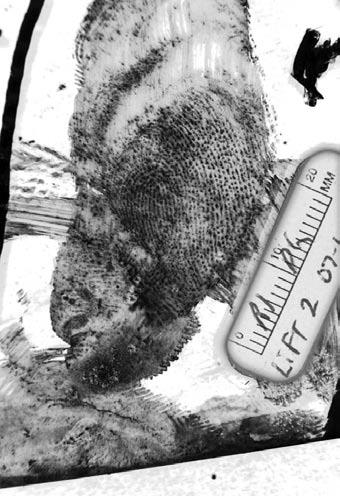
Fig.1: Fingerprints on broken glass at POE. (Photo by Cpl. Pat Gould, Moncton FIS)
ant as many types of evidence may be located (e.g. footwear and tire impressions, cigarette butts, tools etc.). Physical evidence must be protected from possible environmental conditions such as rain, snow or sun. At times, the best practice is to place a clean covering, such as a cardboard box, over the evidence.
Instead of covering a footwear/tire impression or other evidence made in the snow, it’s wise to protect it from sunlight by creating a shadow over it. A box covering it could create too much heat and melt the snow with a strong sun.
Another example is a tire tread impression made in mud. If the first responding officer observes this and it begins to rain, it should be covered and, if possible, water draining into it should be limited. Always document your actions and notify the forensic identification specialist when they arrive if you moved anything.
Point of Entry
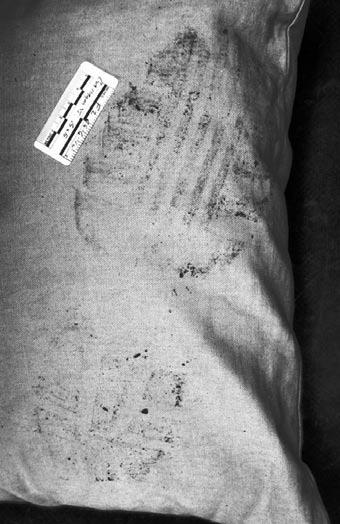
The point of entry (POE) is usually where a forensic identification specialist (FIS) has the best opportunity to locate physical evidence such as fingerprints (Fig. 1), trace evidence (hairs, fibres, DNA), footwear evidence (Fig. 2) and tool mark impressions. The POE should be secured and, if possible, avoided when entering or exiting the scene until the FIS officer can examine it.
Do not handle any evidence unless absolutely necessary – for example, a broken piece of glass with a suspected blood stain exposed to rain or snow must be moved to protect it, since it may be the only link to your perpetrator. It is imperative that officers
wear protective gloves when handling any exhibits, and “eating, drinking or smoking should never be allowed at a crime scene.” 3
Not only do you run the risk of leaving your DNA, you may also place yourself at risk of a health hazard. Always ensure you have the
necessary personal protective equipment (e.g. disposable examination gloves, mask, etc.) and practice proper personal hygiene.
If an investigator leaves the scene to deal with a suspect and then returns, ensure they do not contaminate the scene. They could unknowingly bring evidence from a suspect, such as hair, into the crime scene or transfer it to a police vehicle or interview room.
Care should also be taken when using the same cell to house suspects or the same vehicle to transport prisoners or witnesses, since this may result in transferring trace evidence such as hair and fibres from one person to another. This may be unavoidable but it’s important to show the court that all reasonable precautions were taken. If possible, use separate vehicles and cell blocks.
Although transfers are highly unlikely in most cases, defence counsel will take the opportunity to turn it into a major issue. This is also why the investigator dealing with the scene should not deal with the suspect. By avoiding this contact, you limit the possibility of cross-contamination of evidence.
References
1 Path of Contamination, P.106 Crime Scene Manual, 2005.
2 Crime Scene Examination Module, Page 9 Canadian Police College, Forensic Identification course, 2005.
3 Code of Police Practice, Collection and Preservation of Evidence, Part 1, Page 3. http://www.rcmp-learning.org
Corporal patrick Gould joined the RCMP in 1992 and has been posted at the Moncton FIS since 2004. He can be reached at Pat.Gould@rcmp-grc.gc.ca
Fig. 2: Footwear on cushion at POE. (Photo by Cpl. Pat Gould, Moncton FIS)
Un-shredder debuts and SIMs take the heat
by Tom Rataj
In these days of paranoia over identity theft, people are usually advised to shred any documents containing personal information. Most police and government agencies have strict policies about shredding confidential documents before disposing of them.
While that may be good advice for the vast majority of people and agencies, shredding is not a foolproof method of ensuring permanent confidentiality. Researchers at the Fraunhofer Institute of Production Facilities and Construction Technology in Berlin, Germany have developed a commercially viable ‘un-shredding’ machine.
The “E-puzzler” can rapidly reassemble mountains of shredded and torn documents in a fraction of the time it would take to put them back together manually. It was developed as part of an effort to reassemble the estimated 45,000,000 pages of secret records remaining from the former Communist East German “Staatssicherheitsdienst” (State Security Service or Stasi).
During the regime’s final few months, the Stasi command ordered that all paper records amassed since the country’s establishment after the Second World War be destroyed. Millions of documents were initially sent to commercial grade paper shredding machines and, as the fall of the state neared, agents began using office paper shredders to tackle the remaining mountains of documents. When they failed from overuse, agents resorted to hand-tearing documents, resulting in an estimated 600 million pieces of torn paper hastily stuffed into garbage bags.
The majority of these destroyed records were saved after the regime fell, in hopes they could one day be reassembled to shed
light on the operation of the Stasi and East German state.
Since the fall of the Berlin Wall in 1989, a dedicated group of 15 people have managed to reassemble about 10,000 documents. At that rate, it would take an estimated 600 to 800 years to complete the task.
The process of re-assembly was made somewhat easier by the fact Stasi agents put all the torn pieces of each document directly into the same garbage bag, so all the pieces of the ‘puzzle’ were at least in the same bag.
To address the issue and spur development of an automated technological solution, the Stasi Records Office (the agency with carriage of the records) issued a proof-of-concept challenge, which the Fraunhofer Institute won. Its E-Puzzler can process batches of up to 10,000 pieces of paper and electronically reassemble the documents within about one hour.
The machine uses a two camera digital imaging scanner to record each fragment. A computer program analyzes the pieces for features such as paper colour, shape and texture, fonts and other details that make each piece unique. Complex algorithms are used to match all the pieces and electronically reassembles the documents for analysis and archiving. A two-year, 400 bag pilot project is now underway.
The E-puzzler has also been helped Chinese archaeologists reassemble some of the broken Terracotta warriors found in the tomb of Emperor Qin and deciphered some of the poor quality Nazi records of concentration camp victims.
This technology could be a great tool for investigating a wide variety of serious criminal and terrorist cases involving shredded or partially destroyed paper records.
Visit www.fraunhofer.de for more information.
Baked SIM cards survive
The postage stamp sized Subscriber Identity Module (SIM) card found in GSMband cellular phones used on the Rogers and Fido networks generally contain all the user data kept on the phone. This usually includes the subscriber’s identity information, contact list or telephone book, ingoing and outgoing calls and text messages, pho -
Jan Schneider of Germany’s FraunhoferInstitute demonstrates the E-puzzler.
Photograph Above: by Herbert Knosowski/AP; Right: by Tom Rataj
tographs and a variety of other data.
The advantage of SIMs is that if a phone breaks or is replaced, the card can just be moved into another phone and the subscriber is back in business.
From the law enforcement perspective, SIM cards potentially contain substantial amounts of valuable information that could be direct evidence of criminal or other activity.
One would ordinarily presume that all the SIM data would be lost if a cell phone is damaged in a fire but this may not be the case. Electronics engineers Tony Kenyon and Benjamin Jones at the University College London (UK) recently conducted tests to determine whether SIMs can survive extreme heat.
They exposed 12 SIM cards to varying degrees of heat. Half were baked at 180 C (356 F) for 10 minutes, five were baked at 450 C (842 °F) and the remaining card was subjected to 650 C (1,202 F).
The first six cards were then connected to an electronic interface and data was successfully retrieved. The next five cards were effectively useless, although one functioned very briefly. Not surprisingly, the final card was inaccessible.
The researchers used a special rewiring technique to conduct the data access portion of the test, but pointed out that there are other techniques to access damaged cards. Their external contacts can also be connected directly to a processor capable of monitoring power consumption within the SIM. An electrical scanning microscope could then be used to read the electrical signals at various points of the internal circuitry, potentially extracting the data.
During their experiments, the researchers used acid to carefully strip the plastic exterior of each SIM card in order to expose the actual electronic chip contained within. This probably increases vulnerability to heat damage. One would suspect a card inside a phone would have substantial additional protection against damage from heat and fire, and would likely survive quite well.
The Madrid terrorist bombs in March, 2004 were partially carried out using SIM equipped cell phones to remotely trigger bombs placed on trains. While those phones and their SIM cards were destroyed in the blasts, investigators recovered two phones attached to unexploded bombs, and the SIM data provided valuable information about the individuals behind the bombings.
A SIM equipped cellular phone seriously damaged in a fire or other catastrophic event may be able to provide valuable evidence if it can be successfully accessed. Even a card which didn’t function in a phone or SIM card reader could yield its contents to a data recovery specialist.
A research paper on this project is in the latest issue of the Journal of Forensic Science International. Visit: www.elsevier.com for more information.
Kenora Police to amalgamate
KENORA, Ont. - Ontario Provincial Police will be Kenora’s next official police force if all approvals indicate a go-ahead.
Kenora city council voted last month by a 4-3 margin in favour of the provincial police takeover from the city-run Kenora Police Service. The decision must still be approved by the Ontario Civilian Commission on Police Services.
The plan calls for the provincial police to supply 42 officers dedicated to all of Kenora — including the two former townships of Jaffray Melick and Keewatin. Since city amalgamation in 1999 it has been policed by both the OPP and the Kenora Police Service.
The proposed service will have seven officers on
duty at any given time as well as an office Sergeant who could go out and help the other officers. Coun. Wendy Cuthbert says the force would also offer up to 39 more officers whenever required, along with specialists in drugs, guns and gangs.
A policing system by the provincial police will cost Kenora $5.26 million a year, saving the city about $1.2 million a year compared to the bid made by the existing Kenora Police Service.
“It’s a huge savings,’’ Cuthbert said Saturday. Current city police officers will be offered jobs with the provincial police under the new plan.
“So really, it would just be a matter of changing their uniforms,’’ Cuthbert said.
(Thunder Bay Chronicle-Journal)
technews@blueline.ca
Tom rataj is Blue Line Magazine’s technology editor and can be reached at
Listening for the right words
by Gord MacKinnon
We were well into the interview – I, a young aspiring detective and my older partner, a grizzled veteran who had grudgingly begun to share some of his interrogation secrets with a kid whom (as he later told me) had some potential.
We all smoked in those days; the subject was chain-smoking, my partner puffed his pipe (like Sherlock Holmes, I thought) and I lit the odd coffin nail just to keep in vogue. I could never inhale – cigarettes made me sick – but I didn’t want to seem like a complete wuss!
The suspect was in for rape and looked pretty good for it. Although his sheet was extensive, our man was pretty cool throughout the interview. He had a typical con’s ability to deflect questions with shrugs, lazy asides and numerous, “I don’t recalls.”
He’d met the girl in a bar and, after a number of drinks, they had retired to his car in the parking lot to get to know each other better. At some point – this from our victim’s perspective – the relationship had soured and she wanted to go home, since she now realized this guy was unlikely to be the man of her dreams.
From his perspective, she was ready, willing and able – and, no doubt, found him wildly attractive. Regardless of who was telling it, events took a decidedly unpleasant turn, which brings us to a late summer evening in a Mississauga Police interview room:
Partner: So she liked you – you said?
Suspect: Yeah, said I was her kind of guy. Partner: So – then what?
Suspect: Well – you know?
Partner: What.
Suspect: She wanted it.
Partner: Wanted it?
Suspect: Yeah you know – wanted it.
Partner: Wanted?
Suspect: Geezus – she was asking for it –wanted it – me!
Partner: Why would she come to us?
Suspect: I don’t know – geez – I didn’t mean to be so offensive!
Partner: Offensive?
Suspect: I mean – be forceful, you know?
Partner: Forceful?
Suspect: You know – make her do it man!?
Partner: Make her do it?
Suspect: I ain’t sayin’ no more – that’s it.
We pressed him further, trying to get a full confession, but he was on the defensive now, his eyes telling of a man who had already said too much and was now going to stonewall us, no matter what was said. My partner seemed quietly satisfied, for reasons that I, in my youthful exuberance, could not fathom.
I was ready to go further, and did when my partner asked, you want to ask anything, Gordie?
You bet. You already told us you had her in the car – you expect us to believe that you didn’t force yourself on her? C’mon – you know you did – you’ve done it before, you did
it this time. Don’t lie to us!
He looked at me like the snake that he was and asked, how long you been a cop?
Before I could reply, my partner held up his hand and said OK, OK, look, you want something to eat? The cretin looked pointedly at me and replied yeah, maybe the kid here could go out and get me a burger.
I was about to reply but the look in my partner’s eyes stopped me in my tracks. Yeah, we’ll get you somethin’. Gordie, go see if the sergeant has a car clear for a pick-up.
He was a great partner and mentor, and he knew we had this guy. The victim’s testimony, the physical evidence from the hospital “rape kit” and now the words from the bad guy’s mouth.
Asking the right questions, he always told me. and – more importantly – listening to the answers will often complete the chain and lead to the truth.
Our witness gave great testimony when the case finally went to trial. The subject was convicted of the charge of rape, as it was then known, and a good thing too; he was a wellknown rapist with a long sheet.
The one thing the judge focused on was the phrase didn’t mean to be so offensive, putting great stock in the accused’s “free spoken words” and his subsequent definition of what, exactly, he meant by that. I learned a lot from that interview.
Let the subject speak and define his own actions without trying to force the issue. When my partner heard the key words, he laid back and waited to see if he would elaborate further. We were dealing with a seasoned offender who, after realizing that he had said too much, declined to say more,
In my experience, most offenders will elaborate further with gentle prodding and low key questions aimed at getting them to throw further light on just what it is they mean.
Make the subject EXPLAIN themselves; don’t help or supply your own theories or pre-conceived ideas. Their own words will often be the key to what they did.
I eventually learned to smoke a pipe – you didn’t have to inhale and it sure beat those awful cigarettes. I wasn’t copying my old partner, honest!
We will cover a number of interview tactics April 29 at my Blue Line Trade Show course, drawing on examples much like this, from real cases illustrating cutting edge interview techniques.
S/Sgt Gprd macKinnon (retired) has 30 years in law enforcement. He will teach the course, Detecting Deception by Verbal Analysis at the Blue Line Trade Show April 29th.
Future trend: BOLF the migrating drug criminal
by Steve Walton
The challenges law enforcement face continue to evolve and diversify. In a pattern emerging across Canada, drug criminals who deploy, or know how to deploy, sophisticated tactics to avoid interdiction are migrating from urban to rural or outlying areas.
The motivation to engage in these activities is clear, as are the results. Drug criminals are broadening their scope because of:
• A desire to expand their market;
• A demand for their product(s);
• A certain naiveté by their prospective customer base;
• Inherent isolation and privacy;
• Less intense policing due to larger patrol areas and fewer officers.
The results are already becoming very evident. For the first time, many areas are noticing an increase in crimes against the person and obvious drug behaviours. In essence, the urban drug criminal has taken the city drug scene to smaller communities.
For decades there has been a tendency to deploy newly graduated police officers to outlying areas, allowing them to gain experience and slowly become immersed in the world of crime fighting in a measured response. Historically, the pre-requisite skill set in rural areas or smaller centres was quite different than that required in urban areas. This has changed and it is now time for law enforcement to adapt.
Regardless of how small or remote a community or how large its patrol area, now more than ever the officers responsible for policing it require appropriate skill sets and corresponding experience to address the migrating criminal.
It is incumbent on law enforcement agencies
mandated with keeping the public safe and preventing crime to provide their patrol officers with suitable incentives such as seniority and investigative moxie. This will ensure that they are ready, willing, and able to deal with the new face of crime rearing its head in rural and small town Canada.
They also must ensure these officers are proficient in drug investigations, not only to provide the areas they serve with an appropriate level of service but also to maximize officer safety.
When conducting a needs inventory of required skills for drug enforcement and investigating other high profile criminal activity, the following abilities are essential:
• Search warrant and wire tap acquisition;
• Physical surveillance and undercover/ covert response capabilities.
These skills have proven to be an effective and relevant response to high level criminal activity.
Please join me April 29 at the Blue Line Trade Show as we look at covert assignment training and how officers can improve their response to the migrating drug criminal.
Detective Steve Walton (retired) was a member of the Calgary Police Service for 25 years. He will teach the course Covert Assignment Training at the Blue LIne Trade Show on April 29th.
by Jay Hope
What animals and emergencies say about us
I recall hearing the expression when I was in policing that how we treat our prisoners says a lot about our society. The renowned statesman Mahatma Gandhi, who said “The greatness of a nation and its moral progress can be judged by the way its animals are treated,” also comes to mind.
His timeless words have taken on a very timely importance for those in emergency management. Animals live among us, fulfilling many different roles – companionship, service, work, food and wildlife.
In our post-Hurricane Katrina world, we have had to re-examine many of our assumptions and their effect on our planning process. In the past, we often assumed people would take care of their own pets during emergencies, the agriculture industry would manage as best it can and, although it seems almost too simple to say, wildlife would fend for itself. Wild animals often flee from dangerous situations much faster than humans.
We commonly assumed when planning evacuations that evacuees will all be human. Animals were usually an afterthought, if considered at all. That can no longer be our approach; they should now be an integral part of our emergency planning process.
This is not about being an ‘animal person;’ it is about employing responsive emergency management practices that ensure our communities are fully served.
Let’s focus on domestic animals for now, largely because the agriculture industry has a fairly sophisticated approach to emergency planning and wildlife tends to take care of itself.
More than 60 per cent of Ontario households have a pet and more than half have more than one. While I have no statistics handy to prove it, I assure you most pet owners think of their animals as family members. Emergency managers have to remember that and plan accordingly.
Katrina’s lessons are clear. We either include animals in our emergency planning or the communities we serve will – quite literally – suffer the consequences. The lives of many pets were needlessly lost in New Orleans and the emotional impact on their owners was enormous. Ultimately, some people died because they refused to abandon
their animals or risked their lives to rescue them.
The fact is, people often refuse to leave their animals in crisis, which causes a number of complications for police and other emergency responders. While these tragedies were not all preventable, many of them were and we should treat them as avoidable in the future.
We only have to look at our own record of past events to see how domestic animals fared in emergencies. Interestingly, the most significant and relevant event with respect to pets in Ontario is the Mississauga train derailment of 1979 and the subsequent evacuation of almost 250,000 people.
Residents were advised to leave their pets at home with enough food and water for two or three days. Thankfully, the situation was resolved fairly quickly and people returned to find their pets lonely but not much worse for the experience (except, I’m told, for one sad incident where a kitten drowned while trying to drink from a toilet!).
New Orleans residents were given that same advice. Then, as the days stretched to weeks, the enormity of the tragic consequences grew. People risked their lives trying to re-enter prohibited areas to rescue pets and animal welfare personnel were devastated by the number of dead or dying animals found during more official rescue attempts. Volunteer veterinarians worked around the clock to save some of these animals. Families, especially children, were often just as traumatized by the loss of their pets as the loss of their home.
Two different events, a quarter-century apart. The same advice to pet owners, but dramatically different outcomes. Perhaps the real lesson is that we tend to learn from tragedy, not tragedy averted. Regardless, we must put this lesson to use.
Ontario’s Emergency Management and Civil Protection Act was amended in 2006 to include a definition clarifying the status of domestic animals in emergencies and specify-
ing that they may be included in an evacuation order. Now, we must pursue this issue at the public education and planning levels.
In public education, the concept of the 72-hour personal and family preparedness plan has been expanded to include pets. Anyone can get involved and children seem very interested in helping to make their pets part of any family plan. In 2005, Ontario Girl Guides initiated a new merit badge for family emergency preparedness. I understand there was particular interest in how guides could contribute by making sure pets were included in family emergency plans and the kit of emergency supplies.
Emergency Management Ontario’s (EMO) provincial emergency response plan recommends municipalities consider animals in their planning process and suggests the Ontario Society for the Prevention of Cruelty to Animals (OSPCA) as a resource.
The OSPCA is an independent charitable organization mandated by provincial legislation to enforce any law in Ontario pertaining to the welfare of animal. It delivers services all over Ontario.
EMO is leading a working group on animals and emergencies made up of representatives from ministries with animal-related interests, interested groups and volunteer veterinarians who will provide us with their invaluable fieldlevel perspective. The objective is to co-ordinate expertise and efforts towards further supporting the most effective emergency management.
The test for any emergency plan is whether the preparation and response is truly comprehensive. We have to ask ourselves if all the components that make up each community have been addressed. While animals are now recognized as important in our planning, there is much work to be done.
Gandhi’s words guide us on this issue because we know, in our hearts, that how we treat our animals says so much about who we are as a civilized society – especially, perhaps, in an emergency.
Whether prisons or animals – I guess you can teach an old dog new tricks!
How much is too much?
by Wayne Van der Laan
A colleague and I were discussing search warrants the other day, and a topic investigators have debated many times through the years came up — how much should be included in the information to obtain a search warrant?
Some argue that an officer should include any and all information available to ensure they are not accused of withholding anything that may affect the issuing justice’s decision. If the warrant is challenged in court, they add, certain parts may be thrown out so more information makes it more likely to stand up.
Supporters of the “inclusion theory” argue, correctly, that if a warrant is challenged in court, defence lawyers will usually take a “death by a thousand cuts” approach.
They will attempt to undermine or discredit small parts of the warrant, hoping that the cumulative effect is to have the judge exclude certain portions of the information to obtain, leaving not enough evidence to support the issuance of the warrant.
Unfortunately, the inclusion approach also forces investigators to include information whose link to the offence is tenuous at best, irrelevant at worst. This can confuse the issue for the issuing justice and make the warrant writing process much more arduous. It can also lead to the writing of repetitive, time consuming and haphazard warrants.
The other side of the argument is made by those that believe warrants should be focused, targeted and written for the reader. Most warrants now include headings directing the reader to salient points and also draw links and conclusions based on the evidence presented. This makes for a much better overall presentation of the investigative theory, is much less confusing and clearly presents all of the evidence deemed to be relevant at that stage of the investigation.
Detractors of this approach argue that it leaves the door open to information becoming available later in the investigation that sheds new light on certain evidence available when the warrant was issued. Defence lawyers
might argue that the investigator is guilty of suppressing evidence that may have negatively influenced the issuing justice if this information is not in the original warrant. In other words, things that didn’t seem relevant at the time of writing might become relevant later in the investigation.
So what is the correct answer?
First and foremost, officers should remember that a search warrant is an investigative tool, used to gather evidence of an offence. The standard of proof for issuing a warrant is “reasonable grounds to believe” and not “proof beyond a reasonable doubt.” We use warrants to get the evidence that will bring us to the higher standard of proof, not the other way around.
Too often, officers confuse the issue, thinking that the case must already be investigated in order to get a warrant and it must include proof of the offence. This is not true.
The next question is how much should be included in the information to ensure the warrant can be successfully presented to a court. The answer, I’d argue, may well be “it depends”:
• It depends mainly on the nature of the offence.
For the more serious, the probability that the warrant will be challenged is much higher and thus more information should be included to stave off the argument mentioned above. This goes double for complex investigations where the relationship of certain pieces of information changes daily.
• It depends on the nature of the available information. If you are relying heavily on an informant, you might want to include more on the steps taken to verify the information given. If the information rests largely on the observations of police officers, then less verification might be justified.
• It depends on how strongly certain aspects of the case can be presented and how much foresight the investigator has in determining weak points and possible challenges. More information should be developed and included to ensure that the warrant is presented in a “Charter-proof” manner.
The argument goes on from there, but the point remains the same; the rules of warrant
writing are not written in stone, but change to suit the matter under investigation. Both approaches to warrant writing have their strengths, but the investigator need not tie themselves to any one approach, given the dynamic nature of investigative work. The key is to balance operational needs with experience, good judgment and a knowledge of ever changing search and seizure case law.
Speaking of case law, I asked a Crown attorney who I know to be the resident “expert” on search and seizure in her office, about the latest developments in issues and cases. She went on at length about cases such as Regina v. A.M. (a sniffer dog was used to detect drugs in a school), Regina v. Patrick (officers searched the garbage of an accused) and Regina v. KangBrown (officers approached a party in a bus station and formed grounds to make an arrest for drug possession). The common element to these court challenges was that they were all done without a warrant.
“Do you have any cases where search warrants were used?,” I asked. “Telus is trying to get compensated for costs associated to production orders; that’s about it right now,” she replied.
It appears those currently writing warrants are doing a pretty good job and it’s time to get more officers involved in the process. Please join me April 30 at the Blue Line Trade Show, where I will be teaching a one day introduction to the skills of warrant writing.
Wayne van der laan, has more than 20 years experience in policing with specific experience in CID, break and enter and auto squad. He has bachelor and masters degrees from the University of Guelph and lectures in the technique of investigative interviewing, with a specific focus on writing search warrant reports.
Arrest not required for resistance charge
by Mike Novakowski
A charge of resisting a peace officer under s.129(a) does not require an arrest, Alberta’s highest court has ruled.
In R. v. M.L.M., 2007 ABCA 283, a tactical unit head was told the accused may be a member of an Asian gang which had used stolen vehicles for numerous drive by shootings. The suspect may be armed, according to the information, and was alone in a stolen vehicle.
Police decided to use their seven member tactical unit to make the arrest as quickly and safely as possible. Members wore uniforms clearly indicating they are police officers and responded to high risk situations that may be too dangerous for regular officers to handle. Each member was assigned responsibilities that enhanced the safety of their unit and the public.
The arrest was made mid-afternoon on a clear day in the parking lot of a major store after M.L.M. exited and returned to his vehicle, which was parked between two others. A post blocked the front. The parking lot was icy in patches and busy with shoppers. When M.L.M. entered his vehicle, the tactical unit van, with emergency lights flashing, drove up and stopped
about 18 inches behind to block it.
Police smashed both passenger side windows, identified themselves, told M.L.M. he was under arrest and instructed him to place both hands on the dashboard. He instead inserted the key, started the vehicle, put it into reverse and hit the accelerator. The tires spun on the ice and police smashed out both drivers side windows and, concerned for public safety, Tasered the suspect, removing him through the window and subduing him. A piece of car window glass lodged in M.L.M.’s right eye during the arrest, making him legally blind in that eye, according to an eye physician and surgeon.
M.L.M. plead guilty to possession of a
stolen vehicle, but was also charged with dangerous driving, resisting a peace officer in the execution of his duties and other charges. An Alberta Provincial Court judge found he was operating a motor vehicle, even though it may not have moved — once started and put into reverse, he was operating it and “driving.”
His actions were also dangerous in light of all the circumstances. The vehicle was initially stopped in the parking lot of a major store, open for business, with other cars in the lot and people going to and from the store. Tactical unit members had surrounded his vehicle. Accelerating after being warned he was under arrest was dangerous to the public.
As for the resisting charge, M.L.M. knew he was surrounded by officers but ignored their commands and tried to drive away. He knew he was being arrested and was given more than one opportunity to comply. The Taser wasn’t immediately deployed and the fact he would not be allowed to exit the vehicle under his own power did not matter. Further, the officer was executing his duty when attempting to make the arrest. As a tactical unit member he was dressed in standard issue police tactical uniform, with clearly identifiable markings. M.L.M. was convicted of dangerous driving and resisting a peace officer.
He appealed to the Alberta Court of Appeal, arguing the trial judge erred in convicting him of dangerous driving, since he wasn’t “driving” or “operating” the vehicle, and finding he resisted a peace officer because he wasn’t under arrest when disobeying the officers.
Dangerous driving
Section 249(1)(a) of the Criminal Code makes it an offence to operate a motor vehicle in a manner dangerous to the public, having regard to all the circumstances, including the nature, condition and use of the place at which the motor vehicle is being operated and the
amount of traffic that at the time is or might reasonably be expected to be at that place.
Although a driver cannot, under the Criminal Code, “operate” an immobile or immobilized vehicle — stuck in a ditch or lodged on a traffic median so it can’t be moved without assistance, for example. A vehicle that may not move at one instant can still be operated; it may be temporarily stuck and driven back and forth only a short distance. In this case, there was evidence M.L.M. attempted to put the car in motion by starting and reversing it. The engine was accelerating and the vehicle actually moved backwards and struck the police van. The vehicle was only partially on ice and could have moved. M.L.M. was therefore operating the vehicle.
In upholding the trial judge’s view concluding M.L.M. operated the car in a manner dangerous to the public, the Court stated:
The test for dangerous driving is well established. The question to be asked is whether a driver’s operation of a motor vehicle amounts to a marked departure from the standard of care that a reasonable person would observe in the accused’s situation. The mental element of the offence is a modified objective one, meaning that it should be assessed objectively in the context of all the events surrounding the incident.
The trial judge reviewed the actions of the (accused) in light of all of the circumstances, including the location, the proximity of members of the public and the surrounding police officers and other vehicles. Reversing one’s
vehicle rapidly in close proximity to a number of individuals and in a shopping centre parking lot during shopping hours, where it should be reasonably expected that there will be pedestrians and other traffic, demonstrates a marked departure from the standard of care of a reasonable person in the same circumstances (reference omitted, paras. 16-17).
Resisting a peace officer
Section 129(a ) of the Criminal Code makes it an offence to resist a peace officer in the execution of his duty. This section does not require an arrest. In this case, the duty the officer was executing was an attempt to put M.L.M. under arrest. He did not co-operate, despite knowing the person was a police officer and that the car was stolen.
M.L.M. was also resisting. The trial judge found that he was given a reasonable time to comply with the officer’s orders to put his hands on the dashboard but instead tried to flee. This non-cooperation was resistance and a direct confrontation wasn’t required, the appeal court stated:
Starting a vehicle, placing it in gear and attempting to drive away from (the officer) who was executing his duties in attempting to carry out an arrest clearly amounts to more than passive resistance. It is an active use of force to resist a peace officer. There is no basis upon which to upset the finding that these actions amounted to resistance as required under s. 129(a). (para. 9).
M.L.M.’s appeal was dismissed.
by Mike Novakowski
More than pot smell required to arrest
The smell of burned marijuana, by itself, does not justify an arrest, Saskatchewan’s highest court has concluded.
In R. v. Janvier, 2007 SKCA 147, a police officer stopped a truck with a broken front headlight. He smelled a strong, pungent odour of burned marijuana when he was about a metre from the vehicle, leading him to conclude someone had been smoking in the truck, possibly within the past 20 minutes.
Janvier, the vehicle’s sole occupant, was immediately arrested and the truck searched. The officer found one gram of marijuana in a clothing pocket, seven grams in a boot and a trace amount in the truck’s console. The officer also found what he believed to be a list of contacts and money in denominations consistent with trafficking. The accused was charged with possession for the purpose of trafficking.
Janvier was acquitted by the Saskatchewan Provincial Court. The judge ruled that odour of burned marijuana alone did not provide the necessary grounds to arrest or search the vehicle. In his view, the odour in a confined space like a vehicle could provide a reasonable suspicion that marijuana was consumed at some time, but did not, without more evidence (such as a cloud of smoke) provide reasonable grounds the person in the vehicle recently consumed it.
The warrantless search was unreasonable, breaching Janvier’s s.8 Charter rights, and the evidence was excluded under s.24(2) . The Crown appealed to the Saskatchewan Court of Appeal, arguing the trial judge erred in his analysis.
Arrest
Section 495(1) of the Criminal Code allows police to arrest without a warrant. Justice Jackson, authoring the opinion of the Court, described this power:
(T)he arrest power depends on the type of offence for which the person is being arrested. A police officer may arrest anyone he or she finds committing an offence, but if a police officer only believes, albeit on reasonable grounds, that someone has committed or is about to commit an offence, the offence must be an indictable one before the police officer can arrest.
The distinction is a significant one in that it means, with respect to summary conviction
offences, a police officer can only arrest a person he or she finds committing the offence (emphasis in original, para. 10).
In this case, Janvier was initially arrested for possessing marijuana. This is a dual offence if the quantity possessed is 30 grams or more, but strictly summary if it’s less than 30 grams.
There was no evidence the officer believed there was more than 30 grams and no basis to determine quantity on smell alone, thus authority to arrest would need to arise from the stricter standard for summary offences. In other words, the officer would need to find Janvier committing the offence, unlike the arrest power for indictable offences, which permits arrests based on reasonable grounds.
Here, “the officer did not see, hear, or smell Mr. Janvier committing the offence of possessing marijuana and therefore did not find him committing that offence,” said Jackson. Nor could it be inferred from the smell of burned marijuana alone that there was more present, Jackson reasoned.
(Section) 495(1)(b) does not permit the officer to say “based on my experience, I believed I would find other marijuana present because I smelled recently burned marijuana.” Observation (i.e. the smell) of recently smoked marijuana is not an observation of current possession of additional unsmoked marijuana.
One might infer the presence of more marijuana, but one is not observing or smelling it and one is therefore not finding the person committing the offence of possession of additional, unsmoked, marijuana within the meaning of s. 495(1)(b). Section 495(1)(b) does not permit an arrest made on inference derived from the smell of burned marijuana alone (emphasis in original, para. 30).
Even if such an inference could be drawn from the smell by itself, it is not sufficient to give objectively reasonable grounds to believe that more, unsmoked marijuana is present. With the odour of raw marijuana, there is a direct relationship between the smell and its source – it is a sensory observation of its presence just as seeing it is – and provides grounds for arrest.
The smell of burned marijuana, on the other hand, is a sensory observation that marijuana has recently been smoked and does not provide the power to arrest. Moreover, there was no basis to assume that Janvier was the person who consumed it in the vehicle.
Jackson held that a reasonable person standing in the officer’s shoes would be unable to objectively conclude from the smell alone that there was more marijuana present, writing:
In summary, as a matter of statutory construction, s. 495(1)(b) does not permit an arrest based on the smell of burned marijuana alone. An officer smelling burned marijuana does not find a person committing the offence of possession of marijuana.
If, contrary to my primary conclusion, s. 495(1)(b) permits reliance upon an inference based on observation (i.e., smell), the smell of burned marijuana alone is not sufficient to support a reasonable inference that more, unsmoked marijuana will be present.
Arresting someone is the penultimate interference with liberty, short of being in custody. In the circumstances of a summary conviction offence, which is recognized to be a less serious offence, Parliament has established a more constrained arrest power (para. 48).
Since the arrest wasn’t lawful, the search incident to the arrest was also unlawful.
CDSA search power
Under s.11(7) of the Controlled Drugs and Substances Act (CDSA), “a police officer may exercise any of the powers in ss. 11(1) or (5) without warrant if the conditions for obtaining a warrant exist but exigent circumstances make it impracticable to obtain one.”
However, “the officer must have reasonable grounds to believe a controlled substance is on a person or in a place before searching the person or the place, without a warrant, if exigent circumstances exist making it impracticable to obtain a warrant.”
Before considering whether exigent circumstances exist, there must be reasonable grounds to conduct the search, Jackson stated: Plain smell evidence is recognized by this court. The smell of burned marijuana is evidence. When the offence is possession of marijuana, the smell of burned marijuana will be one factor to determine whether there are reasonable grounds to search. Taken alone, the smell of recently burned marijuana does not reasonably support the inference that additional marijuana is present (para. 54).
Thus, the officer did not have reasonable grounds to search Janvier or his vehicle under the CDSA.
Evidence exclusion
Although the evidence was non-conscriptive and its admission would not affect trial fairness – a reduced expectation exists with vehicles and the evidence was important to the Crown’s case – the Charter breach was serious.
Janvier wasn’t only searched without lawfully authority, he was also arrested without lawful authority. Further, the nature and amount of drug seized indicated that it wasn’t the most serious charge.
The trial judge’s assessment of s.24(2) was not unreasonable and the Crown’s appeal was dismissed.
by Mike Novakowski
Police misconduct reduces sentence
Alberta’s highest court has upheld a reduced sentence imposed as a Charter remedy because police used excessive force during an arrest.
In R. v. Nasogaluk, 2007 ABCA 339, police received information from a taxi company that an intoxicated male was driving a black truck. Officers attempted to stop it and a high speed pursuit ensued; at one point, police had to reverse to avoid being hit when Nasogaluk drove at them.
Nasogaluk eventually stopped but resisted arrest and would not comply with commands. Police struck him during the ensuing struggle, resulting in broken ribs and a collapsed lung. Police did not record the force used in subduing him or document his injuries, and the arrest or subsequent detention was not recorded on video. Nasogaluk received emergency surgery the day following his release to treat his injuries.
In the Alberta Court of Queen’s Bench Nasogaluk pled guilty to impaired driving and evading a police officer. At his sentencing hearing, the judge concluded police used excessive force during the arrest, breaching his s.7 (security of the person) and s.11(d) (presumption of innocence) Charter rights.
Although the sentencing judge noted Na-
sogaluk’s flight, pursuit and danger to police would usually require prison, he imposed a reduced sentence as a remedy under s.24(1)of the Charter. Nasogaluk was given a 12 month conditional discharge on each of the two counts.
The Crown appealed the sentence to the Alberta Court of Appeal arguing, among other grounds, that the judge erred in reducing it.
When an individual’s rights under the Charter have been violated, the court has the discretion to grant a remedy it considers appropriate and just in the circumstances. In doing so, a judge may exercise this discretion based on their careful perception of the nature of the right and infringement, the facts of the case and the application of relevant legal principles.
Justice McFadyen, on behalf of the court, concluded that a sentence reduction below what
would normally be imposed is a valid option: (A) reduction in sentence may be granted as a remedy for a Charter breach where the breach mitigates the seriousness of the offence, or imposes some form of punishment on the individual that should be factored in calculating the sentence. Generally, reductions in the sentence imposed should not be used as a means of punishing or sending a message to the police.
While we find that a reduction in sentence is an available remedy under s. 24(1) in some circumstances, it is a remedy to be used sparingly and as a last resort in extraordinary cases. This interpretation respects the provisions of the Criminal Code, which set out the objectives and principles of sentencing
There was a connection between the Charter breaches and the remedy sought in this case. The accused also suffered a hardship, as the sentencing judge found the excessive force caused the rib fractures and lung collapse.
He also concluded the failure to disclose the force used may have led to medical treatment being delayed. McFayden held the sentencing judge did not err in reducing the sentence.
Visit www.blueline.ca/resources/caselaw for complete cases. You can email mike novakowski at caselaw@blueline.ca.
by Brian Ward
A London beat officer is questioning a person acting suspiciously near children in a a playground. He unclips a small device from his duty belt and, with just a few keystrokes, accesses a vast array of information that would not have been available just a year ago.
Records at hand
The device is a BlackBerry, the Canadian designed all-in-one mobile phone, email device and web browser manufactured by Waterloo, Ont.’s Research in Motion (RIM).
London Police Service (LPS) senior support services director Eldon Amoroso and IT director Jeff Craigmile spearheaded the project. Working with records management system provider Versaterm, they added a unique component to the 20 BlackBerry smartphones available for front line officer use. Both men have been with the LPS for more than 28 years.
Unique accessibility
Officers can now access CPIC, the Police Information Portal (PIP) and the LPS records system database from the smartphone – resources formerly available only through office and mobile workstations. The video screen on the BlackBerry displays data about a suspect and mug shots or other graphics.
The devices have been dedicated to officers working surveillance, foot and bicycle patrol, motorcycles and schools, Amoroso explained. “It is working out so well that our officers want
to see smartphone access expanded to things like our radio dispatch system so they can see vehicle status and type of call they may be on,” Craigmile added.
Unauthorized access denied Security follows RCMP guidelines governing CPIC access, Amoroso said. An officer first logs on using a special code and touches a special tab to open the records system. “The data on the network is encrypted and incoming traffic is scanned by our service’s servers,” he added.
The devices operate on the Rogers cell phone network. Amoroso delights in the reaction of a homicide investigator who travelled to a mid-west US state as part of his investigation.
“The officer was amazed to discover that he could access London Police records on the Blackberry, and this included all the reports about his case. He was able to keep himself right up to date on the progress of the case. Previously he would have to identify himself to local police agencies and ask to use their fax facilities to keep current.”
Officer safety paramount
The LPS, with nearly 800 sworn officers and civilians, has a long tradition of partnering with the private sector to supply needed skills. Local staff define needs and work to improve the product. This has enabled it to streamline many procedures and enhance the information available to members.
Since the BlackBerry used by officers for records access does not function as a phone, “voice radio is still the king,” Amoroso said, but added radio traffic is reduced by use of mobile workstations. Not using the voice capability reduces billable air time, since data is transmitted in brief bursts or ‘packets.’
The devices are tough – damage has been limited to an occasional accidental fall – and the BlackBerry has an internal sensor which indicate if it has been dropped in water, he explained.
RIM on board
Nick Dawson, RIM public sector account manager, enthusiastically supports the LPS project. “This changes the way in which policing can be delivered... police services have spent millions of dollars on systems that gather information behind the walls of their data centres, and we can now provide a secure method to supply it to officers out in the field.”
RIM counts an increasing number of police forces worldwide as BlackBerry customers, including the Cape Breton Regional Police, which uses the devices instead of more expensive mobile workstations.
Compression technology, exclusive to RIM, allows information to be transmitted in small batches to avoid the extra cost associated with mobile phone transmissions, Dawson said. Data security of 256 bit encryption far exceeds many other technologies. The company is working on additional features, including better compatibility with mobile workstations.
Blue Line Trade Show & Courses
Covert Assignment Training
april 29: 0900-1600 Fee: $225 + GST
This one-day course is a comprehensive examination of the essential skills pre-requisite to effective covert operations. The training regimen includes: Understanding undercover objectives; Identifying operational responsibilities and duties; Covert operations checklist; Counter surveillance techniques; Close quarters combat techniques.
instructor: Detective Steve Walton (retired) was a member of the Calgary Police Service for twenty five years. For the last ten years of his career Steve was attached to the Drug Unit and was responsible for managing a drug undercover street team and high level drug investigations. Steve has supervised more than 120 undercover drug operations, 220 surveillances related to drug enforcement, and 780 undercover drug transactions. He is the author of the First Response Guide to Street Drugs books.
Terrorism vs Canada in the 21st Century
april 29: 0900:1600 Fee: $225 + GST
This one-day course is an examination of terrorism and the information an officer needs for effective policing in the midst of this threat. The course will include: An introduction to terrorism including types and infrastructure; How terrorism will change the way police officers do their jobs; Understanding the importance of intelligence and information; Evolution of terrorism.
instructor: marc Sand, CEO of V.I.P. Protection has a B.A. degree in Law and PhD. in Psychology. He has training in a wide array of commando, martial arts and other special operations disciplines. He is a guest lecturer on terrorism at St. Clair College in Chatham, Mohawk College campuses in Brantford and Hamilton. He has been a guest lecturer with several police services in Canada as well as the American Society of Industrial Security.
Detecting Deception by Verbal Analysis
april 29: 0900-1600 Fee: $225 + GST
This one-day course will examine how you can detect a liar every time by analyzing their verbal responses. Liars are frequently caught through their own verbal mistakes. You will learn: Five key words that liars use in their speech; Three words that tell you a liar has left something out; One thing liars always do on paper or in person, and how to turn it around on them; How to look at a statement and know deception is taking place; Two key phrases that signal a liar is skipping over critical or sensitive information.
instructor: S/Sgt Gord macKinnon (retired) with thirty years in law enforcement, has experience in a multitude of areas including criminal investigation, underwater search and recovery, fraud investigation and, Intelligence. Gord is an acclaimed lecturer in the techniques of investigative interviewing and is author of the book Investigative Interviewing.
Ontario gang investigators Course
april 29: 0900-1600 Fee: $225 + GST
The impact of street gangs has reached into every facet of law enforcement. From policing and courts to corrections and immigration, the activities of gang members require law enforcement professionals to be current and knowledgeable in order to maintain their personal safety and the safety of the communities they serve.
ontario Gang investigators association (onGia) will feature keynote speaker ron “Cook” Barrett, Gang Prevention Specialist from Albany, New York. Also presenting will be: D/Cst Chris Dodds, Halton Police, on weapon concealment; D/Cst mike press, Toronto Police, on gangs, weapons and firearms; and D/Cst Doug minor, Toronto Police, on gangs in pop culture.
Polarized protective eyewear
5.11’s new ANSI-compliant polarized protective eyewear looks, and fits great. 5.11 Tactical® teamed up with expert tactical trainer and decorated former U.S. Navy SEAL Jeff Gonzales to create competitively-priced premium protective eyewear. New for spring, polarized Harrier +P+ sunglasses meet ANSI Z81.1-2003 standards and deliver unsurpassed optical clarity, fit and ballistic protection with wrap-around styling. The extra-thick, topquality 2.2mm polycarbonate UV A/B smoke colored lenses, placed in a half-frame design, offer heightened visibility along the lower field of view. The Harrier’s low-profile black matte nylon frames feature 5.11’s Pflex™ technology — superior arm flexibility without breakage —and oil & sweat-resistant rubber touch points on nose and arms. Extras include a neoprene leash for a secure fit, a high-quality compression molded foam hardshell case with 5.11’s patent-pending, molle-compatible SlickStick™ system and a microfibre cleaning/storage bag. An incredible value priced at just $79.99, the high-performance Harrier +P+ is a must-have for every tactical professional. Experience the entire collection of 5.11/Jeff Gonzales Signature Eyewear at your local 5.11 Full Line Dealer or visit www.511tactical.com.
Full size single pistol case
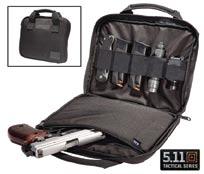
Transport your handgun with 5.11’s full size Single Pistol Case Field tested by Viking Tactics, 5.11’s new Single Pistol Case has it all. Its abrasion-resistant, water-repellent 1050D nylon shell surrounds closed cell foam padding that deflects moisture and holds five magazines in heavy duty elastic loops. Using top-of-theline YKK® lockable zippers, the case opens completely flat for a convenient cleaning surface. Your pistol or revolver is separated from your ammo in a padded compartment secured by an internal heavy duty YKK® zipper. A handle stiffener adds comfort and the markable namestrip simplifies identification. Discreet in appearance, the expertly designed Single Pistol Case is black and measures 8.5” x 12.5” x 1.5”. For durable quality like this, it’s hard to believe the case costs just $19.99. Find the full line of 5.11 Tactical Nylon gear now at your local 5.11 Full Line Dealer or visit www.511tactical.com.
VTAC 2 Point Sling
Mission-ready tactical web gear, packs and bags.
5.11 launches mission-ready tactical web gear, packs and bags as part of a new alliance with Viking Tactics, owned by combat veteran (RET) Kyle Lamb. One standout of this new line is the VTAC 2 Point Sling, which allows shooters to adjust the sling length for fast transitions from strong side to support side, and back. The rifle can be quickly snugged to the body, then instantly released. For additional information e-mail productinfo@blueline.ca or call 888-640-3048.
Rugged handheld for checkpoint security
The DAP CE3000B is a lightweight, rugged handheld computer that integrates the latest methods for physical access control in a portable form factor that operates in harsh field environments. Weighing only one pound, the computer provides fast, reliable Personal Identification Verification (PIV) for perimeter access control at checkpoints utilizing a “fast fingerprint” reader, scanner or smart card reader. For additional information e-mail productinfo@blueline.ca or call 888-640-3048.
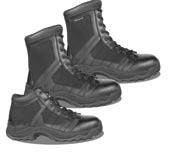
“Metal Free” CSA approved tactical boots
ORIGINAL S.W.A.T. is pleased to introduce a complete line of “Metal Free” CSA approved tactical boots to the Canadian market. Scheduled to be available in spring ‘08 the new metal free line consists of 3 styles: Style 2270, 9” Leather / nylon waterproof; Style 2232, 9” Leather / nylon; Style 2261, 6” Leather / nylon. All three styles feature a CSA approved composite safety toe and CSA approved non-metallic puncture resistant outsole. All boots will have the Green CSA triangle and the orange CSA omega label symbolizing “resistance to electric shock”. At just slightly more that 1kg. per pair these new tactical safety boots from ORIGINAL S.W.A.T are arguably the lightest CSA approved boots in the market. For more information please contact Original Shoe Co. Ltd. ph: 866-236-6601 web: www.originalshoe.ca email: info@ originalshoe.ca
Handheld LPR system
Retailing for nearly 50 percent less than most mobile one-camera system, the OSPRE 300 can be handheld by officers and others when a vehicle is stationary or mounted for independent operation. Developed in partnership with INEX this is an infra-red system that scans up to 60 plates a minute at distances up to 50 feet. The OSPRE 300 captures plates at speeds up to 100 mph. For additional information e-mail productinfo@blueline.ca or call 888-640-3048.
Swift water rescue
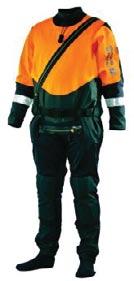
Mustang Survival has unveiled an innovative new personal equipment solution for swift water rescue. It combines the revolutionary new Swift Water Rescue Dry Suit PRO and industry leading Force 6 Flotation Vest to provide unrivaled protection. The dry suit’s fitted design minimizes drag and fatigue, improves rescuer effectiveness and optimizes agility. Articulated padding and abrasion resistant materials increase protection from debris. The Rescuer’s Personal Flotation Device is light weight, features rugged and durable materials, is easy to swim with and doesn’t hold dirt. For additional information e-mail productinfo@blueline.ca or call 888-640-3048.
SafeBOX
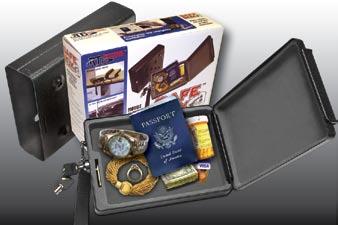
Small enough to mount almost anywhere and large enough to protect some of your most valuable possessions SafeBOX is also portable. Mount the steel sleeve in your car, unlock from the sleeve and it slides out becoming a portable lock box. It can be open and locked until secured back into the steel sleeve again. For additional information e-mail productinfo@blueline.ca or call 888-640-3048.
Blue Line Trade Show & Courses
Search Warrant Preparation
april 30: 0900-1600 Fee: $225 + GST
This one-day course is an invaluable resource for any investigator. Participants will learn the proper way to draft a warrant while avoiding the various hurdles placed in the way. You will learn: Theory and case law; Types of warrants; How to write a “charter proof” warrant; Exceptions when you don’t need a warrant; Telewarrants, and more.
instructor: a/Sgt Wayne van der laan (retired) has 20 years experience in law enforcement that includes service in Criminal Investigation Unit, Public Order Unit, Break and Enter Unit and Auto Squad. Wayne holds a Bachelor of Commerce and a Masters Degree from the University of Guelph.
Crime Scene management
april 30: 0900-1200 Fee: $125 + GST
This half-day course will look at crime scenes; Crime Scene management and, Handling of evidence for front line officers.
DnA: evidentiary Uses & misuses
april 30: 1300-1500 Fee: $125 + GST Both of Brian Ward courses may be combined for a fee of $225.
This half-day course will examine the history of DNA; A discussion of the national DNA databank and, The importance of Scene preservation for DNA management.
instructor: Brian Ward retired from policing in 2006 in the rank of Staff Sergeant. His career included 20 years with the Toronto Police Forensic Identification Service. He is forensic technology editor for Blue Line Magazine, teaches at Humber College and Durham College and provides private forensic consulting services.
managing the Pandemic
april 30: 0900-1600 Fee: $225 + GST
This one-day conference examines the latest facts used by the medical community to articulate its Pandemic Influenza Doctrine. Then will consider how these facts are analyzed by government ministries and businesses as they prepare for an outbreak; including considerations that police services must take as they develop their plans, and the challenges faced as the Ministry of Attorney General attempts to ensure the orderly performance of the courts. The conference closes with a presentation of the best practices and innovations being developed and applied by emergency management professional.
moderator: Jay hope, Ontario’s Commissioner of Emergency Management, is a distinguished police veteran with a career in public service and community safety spanning almost 30 years. Appointed as the OPP’s Deputy Commissioner, Strategic Services, in November 2004, he was responsible for developing the OPP’s strategic vision, including Aboriginal and First Nations policing, and media and corporate relations, policy, municipal policing contracts and training.
The in-depth World of insurance investigations
april 30: 0900-1200 Fee: $125 + GST
This one-half day course will include: Use of experts such as engineers, reconstructionists, ploygraph, DNA, forensic accountants, locksmiths; Use of such experts in arson, auto theft, break & enters and auto accidents; Summary of insurance legislation and how it aids in the investigative process; Police access to insurance investigation file.
instructor: Sue Collings is a former Toronto Police Officer who has worked for the past 12 years as an insurance investigator. Sue is currently the president of the Canadian Association of Special Investigations Units.
Course Registration includes free admission to the Blue Line Trade Show and a one year subscription to Blue Line Magazine.
Blue Line Magazine
For over 20 years, Blue Line Magazine has been the number one source for Canadian law enforcement information. Published monthly Blue Line is a must read for police, security, and law enforcement personnel across the country.
Blue Line Magazine
905-640-3048 www.blueline.ca
Weekly Police News Digest
This weekly digest of law enforcement news is compiled from more than 80 daily newspapers from all over North America, and e-mailed to your personal inbox each Friday. Subscribe today and stay on top of events important to you and your career.
Blue Line News Week
905-640-3048 www.blueline.ca
AUBURN, CA - A 1.4-kilogram Chihuahua mix named Tink helped police put a fugitive in the clink.
The dog’s Christmas Day adventure began when four suspects who were fleeing police crashed a stolen minivan into a hillside in Auburn, east of Sacramento, and one of them fled.
Tink, a Pomeranian and Chihuahua mix, found him hiding under a neighbour’s motor home and chased him into the woods, said Wendy Anderson. The dog belongs to her son.
Her son and husband directed a lawenforcement helicopter to where the 20-yearold man was hiding.
“The Chihuahua gave him up,’’ California Highway Patrol officer Jeff Herbert said.
VALDOSTA, GA - A southern Georgia sheriff faces federal charges accusing him of billing jail inmates for room and board and interfering with an FBI investigation of local judges.
An U.S. District Court indictment accuses Clinch County Sheriff Winston Peterson of perjury, obstruction of justice, using forced labour and extorting former jail inmates.
The 62-year-old pleaded not guilty to the charges in November and was released on $10,000 bond.
Investigators say the sheriff charged jail
inmates $18 per day for room and board.
County officials agreed in April, 2006 to return $27,000 to hundreds of inmates who paid the fees between 2000 and 2004.
Peterson also used an inmate to do work at a business run by his wife, investigators say.
LONDON - James Bond certainly didn’t get his job this way.
But a British intelligence agency is posting want-ads in video games.
Government Communications Headquarters or GCHQ is hoping to attract computer-savvy young recruits by going where they play.
The agency is embedding job ads in video games like “Tom Clancy’s Splinter Cell: Double Agent.’’
The ads will be on billboards within the online versions of the games.
A statement from GCHQ says they want to capture the imagination of people with a particular interest in information technology.
TOKYO - Did you just grope me? Shall we head to the police?
That’s the message women are flashing on their cellphones with a popular program designed to ward off wandering hands in Japan’s congested commuter trains.
Law Enforcement & Security Equipment
MSA’s Police Line of products range from respiratory protection to unmatched ballistic protection. With today’s increasing need for specialized police protection, we have invested in state-of-theart research and engineering capabilities.
MSA Police Line
888-396-5227 www.msanet.com
Digital Video Flashlight
The New Generation of Digital Video technology is so advanced and so small that the entire digital video and audio recording system is integrated into a high quality, water resistant machined aluminum law enforcement style flashlight.
DAVTECH Analytical Services (Canada) Inc.
613-831-6009 Ext 201 www.davtech.ca
Anti-Groping Appli by games developer
Takahashi was released in late 2005 but has only recently climbed up popularity rankings, reaching Number 7 in this week’s top-10 cellphone applications list compiled by web-based publisher Spicy Soft Corporation.
The application flashes increasingly threatening messages in bold print on the phone’s screen to show to the offender.
Users press an Anger icon in the program to progress to the next threat.
A warning chime accompanies the messages.
LAKE
COUNTRY, BC - Two bungling bank robbers were jailed in Lake Country, north of Kelowna, B.C., after they botched their getaway - twice.
RCMP Sgt. Tim Shields says while one man was in robbing the CIBC, the other was draining the truck battery by listening to music with the ignition off.
When the suspect ran back to start the vehicle, it wouldn’t turn over.
Shields says the pair then ran to the bakery next door and called a cab. Police arrived first and arrested them.
The pair faced several charges, including armed robbery, obstruction and using a disguise during an offence.
(CKOV)
by Robert Lunney
“On through the
hail...”
A visceral howl arose from the mob at the back of the arena, gathering strength and cresting at the stage, where a small party of municipal police association executives grinned and encouraged the din. The hair on the back of my neck rose. I had never seen Royal Canadian Mounted Police officers behave like that.
The year was 1973, the setting Ottawa’s civic arena and the event a rally for RCMP members protesting autocratic management and what they viewed as inadequate pay and benefits. Other more-or-less spontaneous gatherings were held in Toronto, Montreal and Vancouver.
I was the officer in charge of classification and compensation at RCMP headquarters at the time, responsible for supporting the top executive and preparing recommendations to deal with this unexpected outburst of discontent.
I attended the rally with recently appointed staff relations officer Bob Head. We sat in the front row watching Guy Marcil from Montreal and Sid Brown from the Metro Toronto Police Association expound on their philosophy of police labour relations. They ridiculed the absence of a contractual agreement, representative grievance procedure and collective bargaining in the RCMP.
While the two association presidents were persuasive, this was essentially an information meeting and petered out without any attempt to develop formal resolutions. RCMP members left to consider what they had heard but their grievances did not subside. Over the following weeks, a member’s committee emerged in Ottawa under the leadership of S/Sgt Bob Potvin.
Table talk
The federal treasury board held the purse strings for RCMP compensation. With the expiration of an existing one year agreement looming, pay section head Don Barnes and I opened discussions with board representatives.
Many serving officers at the time regarded this process as a sham and not a credible negotiation process, but in reality we modeled our preparations and list of proposals after those of the larger municipal police associations. With supporting data and arguments we vigorously argued our case with the same treasury officers who bargained pay with the powerful federal civil service associations.
This was my second set of negotiations. We settled for a marginal increase in the first year, holding our place against the compensation schedules of other major departments but not achieving improvements. The second round of negotiations were protracted. While preparing our case, I consulted my colleagues and bosses and attended at least one roundtable meeting of members disgruntled with their situation and meeting regularly. The depth of their dissatisfaction, not only with compensation but a variety of grievances, profoundly impacted my thinking about the direction and management of the force.
Renewal, of a kind
In the weeks following I drafted an aspirational paper entitled Renewal, proposing a fundamental change to the RCMP’s organizational culture and introduction of a more democratic and responsive style of management. Ross Pilkey, then the assistant commissioner in charge of all personnel issues, his deputy George Reid and I signed and submitted a recommendation to the commissioner encompassing the core message of Renewal and proposing an action program to counter internal unrest.
Several days later, our submission came back from the commissioner’s office with this handwritten note: “Whoever wrote this has no idea what is going on in the Force today.”
The instigator of the division representative system that emerged as the preferred option was Dep/Comm Peter Bazowski. He assembled
the resources, created the structure and found the funding to quickly get it off the ground. Although we had not completed pay negotiations, divisional representatives were assembled at Ottawa and Barnes and I made a presentation on the issues, progress and prospects.
We returned to the table with the treasury board and soon afterwards the commissioner met with senior board officials to agree on a settlement for the forthcoming year. For a short period, an RCMP constable was the best paid in Canada.
There was a spontaneous celebration at the sergeant’s mess at headquarters on the day of the announcement, and Potvin was hailed by his peers as the man responsible for this breakthrough. There was some truth in that, for the widespread discontent and unprecedented demonstrations handed us an ace card to play and we did.
I resigned from the RCMP in December 1974 as a superintendent with 21 years service to become chief of police in Edmonton, and never looked back. Although I had considered myself a ‘lifer,’ I realized my notions about change and the direction of the force were not compatible with reality.
Déjà vu
The forgoing tale would be of no contemporary significance had internal grievances related to the appropriation of pension and insurance funds not touched off another eruption of discontent inside the force. The chief investigator of this affair, David A. Brown, reported that the culture of the RCMP was “horribly broken.” I had an eerie feeling that I had seen this picture show before. The Brown report led directly to the appointment of a task force on governance and cultural change, which submitted 49 recommendations for change last December.
Parting shots
Since retiring from active policing I have laboured on the fringes of this business for 10 years, working as a policing consultant in the US and other countries, with an opportunity to examine a myriad of organizational problems and challenges for policing.
A seven year contract with the Oversight Commissioner for Police Reform in Northern Ireland afforded a ringside seat for the most dramatic example of rapid operational and cultural change for a police service in a democratic country.
Although it is now time for me to leave the field for the bleachers, like many cops I cannot resist the proverbial “parting shot.” I well know that this is usually ill advised, and do so with prompting from no one and with sole responsibility for my opinions. In the articles to follow, I will itemize and detail my personal wish list for an organization which I revere and owe so much.
This risks, I am keenly aware, another assessment that, “whoever wrote this has no idea what is going on in the Force today.”
This is the first of a three part series about renewal within the RCMP. robert lunney can be contacted at lunney@blueline.ca.