RCMP death policy should be reviewed, says coroner
KELOWNA, B.C. — The RCMP and the B.C. ambulance service have been asked by a coroner to review their procedures in dealing with human deaths and hypothermia.
The request stems from an incident in which an officer proclaimed a woman found on a street was dead before a doctor saw her.
Police were called to the scene after two passersby found Eva Kaspar, 34, lying by a tree at 8:40 a.m. on Jan. 1, 2005.
In her report of the incident, Coroner Betty Noble noted the officer looked for signs of life, but did not touch her. Noble said the officer noted there was frozen foam on both sides of Kaspar’s mouth, her eyes were open and appeared frozen, and her skin appeared frozen. After police proclaimed Kaspar dead, officers protected the area as a potential crime scene.
Officers told responding firefighters and paramedics of Kaspar’s status and said the incident may be suspicious. The ambulance crew left and cancelled the advanced life support unit en route, while police continued to examine the area for more than two hours.
An officer who removed Kaspar at 11 a.m. “expressed concern that her body had been limp when lifted at the scene,” Noble said.
The coroner examining the body at Kelowna General Hospital found no sign of rigor mortis and determined it was soft to the touch. A doctor, later conducting tests at the emergency department pronounced her dead at 12:15 p.m.
Noble said emergency health guidelines state that normal protocols for cardiac arrest should be followed because all hypothermic patients have a lowered metabolism.
“An emergency physician should be contacted to decide whether further resuscitation is required. For severely hypothermic patients, prevention of further cooling and rapid transport to hospital is required,” she said.
While unable to pinpoint when Kaspar died, Noble says the death happened between 3 a.m. and 12:15 p.m.
The events have prompted Kaspar to recommend the RCMP review its policy on human deaths and that the B.C. Ambulance Service review its guidelines for hypothermia and cardiac arrest.


Vowing his party will stand behind its promises to arm border guards with guns, the justice minister Vic Toews says it’s simply a “practical matter” of how soon officers can be trained and have firearms issued to them.Toews comments came a day after two murder suspects from California made a run for the border, and Canadian border guards left their posts fearing for their safety. Toews, who oversaw the arming of Natural Resources officers in Manitoba, says he felt disturbed by the incident.

Roy Hazelwood , a global expert on serial sex offenders says the joint RCMPEdmonton Police task force is doing a good job investigating the murder of 12 Edmonton area prostitutes despite no major breaks in the case. Hazelwood, a retired FBI crime profiler from the agency’s Behavioural Science Unit, says the Project KARE task force is open to criticism as it attempts to move forward with the complex investigation. “A lot of suggestions were made that we hope will help,” said Hazelwood. Project KARE believes a serial killer is responsible for some or all of the murders.
Red Deer city officials say they could use more officers, while the municipal leaders have discussed the idea of the city getting their own police service. In response, RCMP Commissioner Guiliano Zaccardelli told a news conference that the RCMP is meeting their long-term commitments. He acknowledged some temporary absences may occur because of injury, retirement or transfers, but offered that the RCMP brings good value to policing.

Toronto Police Staff Insp. George Cowley says new evidence and a reassessment of the case against Cst. Michael McCormack has prompted internal affairs to drop three of four Police Act charges. McCormack, a director of the Toronto Police Association, had been charged in 2004 over alleged ties to Jeffrey Geller , a used car salesman with suspected connections to organized crime. Cowley says new evidence prompted the charge of corrupt practice to be dropped. With one internal charge of discreditable conduct still pending, Cowley says the service will not fire him if found guilty, however, will seek a penalty ranging from a reprimand to a loss of pay.

Nitro, one of Vancouver police’s most experienced dogs, died this January doing what he does best, going after criminals. During his pursuit of suspected car thieves, the German shepherd, became engaged with a suspect only to lose his grip and fall under a moving train. A member of the force since April of 1999, Nitro had been involved in hundreds of arrests with his handler, Cst. Howard Rutter, who says the dog was not only his partner but his best friend. “We spent all shift with each other and when I went home he came with me ... to say I’m going to miss him doesn’t begin to describe my feelings.”


Chief Richard Deering of the Royal Newfoundland Constabulary suggested the province has lost its innocence, after commenting on an investigation into a porn and prostitution ring that allegedly involved 40 young girls. Deering says it’s the type of thing you read about it in other places but when it hits home in such magnitude it’s appalling. He says the probe will extend beyond the province if the investigationdetermines pornographic images have been distributed on the Internet.

by Robert Lunney
Thinking about outcomes — not activities
First in a series on Canada’s front line street officers as interviewed for Blue Line Magazine
Edmonton Police officer Sgt. Steve Young is a seasoned practitioner of the art of street policing with some interesting thoughts about public safety. Last year he was given the task of organizing, training and supervising a team of special constables to patrol Sir Winston Churchill Square, in the heart of the city. Young brought his personal philosophy of street policing to this challenge. These are his thoughts captured during an interview late last year.
People skills
We need to put creativity and discretion back into policing. Certainly one must know their policy and procedure, but the best written directives alone will not increase public safety and reduce crime and disorder. Policing is about people and relationships. Each situation is unique and officers need to read and recognize what will facilitate the best outcome. If we simply focus on adhering to strict policy compliance in pursuit of standardization, we risk missing out on a lot of individual analysis and creative solutions.
When you start off on beat policing, it’s not easy to approach people cold and ask ‘What’s happening?’ or ‘I haven’t met you be-
fore, my name is Steve, what’s yours?’ Many junior officers have difficulty engaging the public to gather information and persuade people to go along with simple requests. It is easy to confront someone to issue a ticket or to direct someone to do something they are com-

pelled to do, but we also need to develop relationships. To do this police need to be part of the community.
Engagement and relationships are more critical in street situations than in responding to calls, where we are collecting and documenting information for a specific purpose. Street drug markets can be controlled by skillful handling of informants and contacts. You keep people moving and disrupt their activities. You still do the law enforcement, but much of the time verbal tactics and body language get better results. If your approach is low key and you show them some respect, it’s surprising what drug dealers and street people will tell you.
Putting people skills to work
Street officers shouldn’t behave like bouncers, showing favour to some and rejecting others. We have to act professionally. There was a movie called Roadhouse with Patrick Swayze – he played the part of the new floor boss in a tough saloon. His operating code: “First you have to have the right people on the door. Next, there are three rules:
1. Expect the unexpected.
2. Watch out for each other; and
3. Be nice.”
Be nice? He told his staff, “Remember, it’s not about you.” Insults are ways of venting, expending aggression and impressing friends. No matter what they call you, don’t let it become about you. Keep your mind on what you are trying to accomplish. You need a high degree of emotional intelligence to handle some situations and we all make mistakes, but we need to know where our triggers are and not let them get to us. Retaliation erodes our authority.
People who live and hang out on the street react best if you show them evenhanded respect. Stop and chat with the gang members. When they show disinterest or frustration, you just stick with it, but be nice. This makes them uncomfortable and soon you won’t have to ask them to move along, they do so by choice. It is not necessarily the people you want to remove from an area, it is behaviours and activities. The people who participate in these activities and behaviours will naturally move on if there is a higher level of expectation. If they try to get at you with insults, just remain polite and pleasant and don’t resort to a parting shot.
Don’t bluff if you have no legal authority for moving people along or to carry out a personal search. You hurt yourself more if you resort to bullying. Get to know their street names and real names and use them whenever you have the chance. This reminds them that you know about them. They will avoid the location where that’s likely to happen. The physical presence of police is fleeting. You walk through an area and make it safe but crimes may happen minutes later so you have to work out ways and means for making an impression that sustains social control.
Networking for public safety
What we found in the Churchill Square project is that there were many security groups clustered about the square but none of them were connected. They included security at the public library, transit, city hall and contract security for buildings ringing the area, including a hotel doorman. The transit station and many of the buildings have surveillance cameras. When co-ordinated by police, the combination of these resources has the potential to make a major contribution to social control and act as a force multiplier in a way that the police alone could not achieve.
First, police must get to know the security agents and supervisors and understand their roles, capabilities and limitations. Most security officers are hard working people. Many have university or a law enforcement college certificate. You quickly realize that these guys are on the front lines and many of them are highly qualified for their jobs.
When we began to network with security, the results came quickly. Combined police and security officers identified and apprehended a man reported carrying a suspicious package on a transit train. He was 12 blocks from the station when stopped. Another time we picked up a man carrying a weapon far sooner than if only the police were involved.
Rapid information sharing is a challenge –and you always have to respect the limits of privacy laws applying to all parties – but this is an incredible, mutually beneficial opportunity to tap into the various security elements in a way that leverages policing efforts. The police do not own crime or disorder; it is a shared responsibility and if we, the public police, think we can do it all, we are kidding ourselves. When we work together, everybody raises their game.
Coaching & mentoring
Recruits out of training are proficient at officer safety, but people skills are not integrated in the training experience. That’s understandable, although the new field training officer programs are an improvement. Street skills are learned by observing others and practicing under supervision. Formal training can teach ba-
sic conflict resolution, but walking the beat with an experienced officer is the best way of learning the art of getting along with people and accomplishing those things that keep streets safe. Once mastered, these skills are the key to success in all other police functions.
We all have our role models. I learned from a former tactical officer who was particularly effective. Although he was an expert in emergency response, he was amazingly low key in dealing with difficult people using a quiet, engaging manner. He didn’t bark orders; he made reasonable requests and explained why. He got results even with the worst characters, but he was always very aware of what was going on around him. I learned how tone of voice and body language can gain compliance. There is no need to use high-risk tactics indiscriminately.
Policing as a logic model
I like to think of policing as a logic model. What is the objective? What are we trying to achieve? It comes back to Peel’s principles: “The basic mission for which the police exist is to prevent crime and disorder” and “The test of police efficiency is the absence of crime and disorder, not the visible evidence of police action in dealing with it.” It helps to understand the difference between task and function. We must stay focused and think about outcomes, not just activities. When you keep these principles in mind, you make better decisions.

Robert Lunney is the former Chief of Edmonton and Peel Regional Police Services. He may be contacted via eMail to Lunney@BlueLine.ca
Unique policing challenges in Surrey
by Elvin Klassen
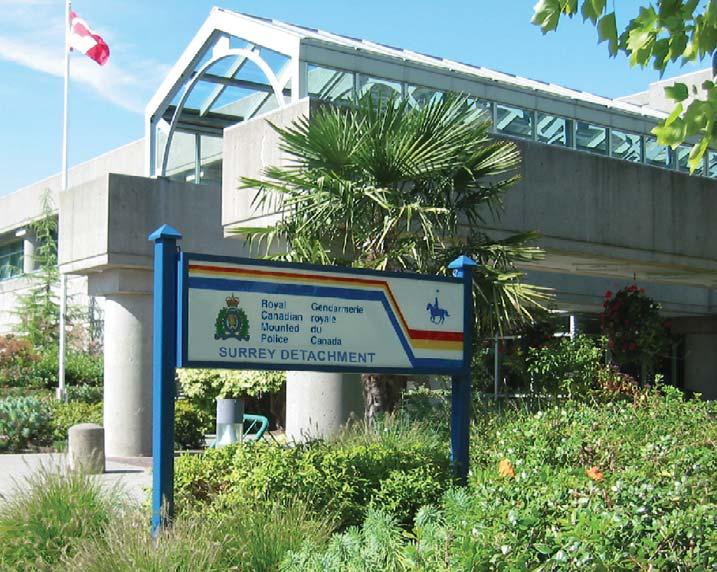
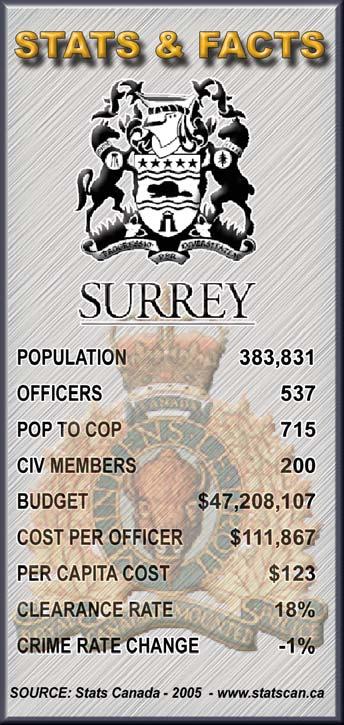
Surrey is one of the fastest growing cities in Canada and home to the largest RCMP detachment. The city’s population has almost doubled in the last 15 years and is fast approaching 400,000 people – and the detachment, which has policed the city since 1950, has grown right along with it, adding 141 officers since 2001.
The 537 officers and 200 civilians – 35 more officers are to be hired this year alone –currently handle an average of 900 calls for service each day. Surrey’s five districts, each with its own community police station, also have many volunteers and a thriving auxiliary constable program, currently almost 100 strong and growing.
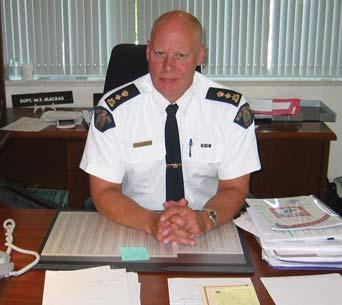
“I love what I do and am extremely proud of my staff and the work that they do,” says Chief Superintendent W. Fraser MacRae, who has been at the helm since June 2004. “I enjoy helping people and when I meet with my new officers, I wish them the same opportunities that I had and that they face it with the same enthusiasm.”
The city’s rapid population growth, coupled with the diverse needs of the community – about 40 per cent are visible minorities, the majority South Asian – has presented unique challenges, requiring equally creative solutions. Through extensive community consultations in mid-2004, four strategic priorities were identified – property crime, prostitution, street level drug activity and youth issues.
Staffing and structural reporting changes made to specialized units since 2003 have improved accountability and focus on day-to-day operations. Unit heads set clear monthly goals to deploy their officers appropriately. Five crime and intelligence analysts were hired to provide timely intelligence and mapping products. Patrol resources are now under a centralized watch command structure that provides broader routine call coverage to the five districts.
Each community police station has a neighbourhood liaison unit, which further identifies and addresses local issues and feeds intelligence back to the specialized units. An intelligence led structure is now in place. As the table below shows, the restructuring had a positive effect and four types of crimes dropped between 2003 and 2004.
Property crime strategy
The 24 percent decrease in property crime required implementing methods to identify, locate, arrest and keep high risk offenders in custody for longer periods. An offender profile was developed, partnerships enhanced and operational improvements made. Nearly 300 criminals were located and arrested between June and December 2004. More significantly, there was a 90 per cent remand success rate and an 85 per cent conviction/guilty plea rate.
Offender profile: The typical property criminal is a recidivist released either on bail or because charges were not approved. They steal vehicles to use in other crimes and avoid capture because they are aware of pursuit policies.
Improved partnerships: Increased intelligence sharing and partnerships with other law and justice agencies was initiated, including the Integrated Municipal Provincial Auto Crime Team (IMPACT), Surrey Crown Counsel and parole and corrections personnel. Operational improvements included:
•Report templates: A framework for investigators to effectively write show cause reports.
•Offender tracking: Includes information on when and where high-risk offenders will be incarcerated or released and a ‘top 50 offenders’ address list.
•Training on report writing, interrogation and tactical takedown techniques.
•Crime Stoppers: Integration and increased use of tips.
Strategic priority – youth
A variety of complaints about youth are responded to, including large group gatherings with illegal alcohol or drugs, loitering, noise complaints and vandalism of residential and commercial properties and fights, often involving assaults and weapons. Youth are often gone when officers arrive, making identity and apprehension virtually impossible. One inroad to gathering intelligence, deterring and preventing crime is through the school system.
Surrey had 64,000 public school students in 18 secondary and 99 elementary schools as of September, 2004. The Surrey School Board experiences the same challenges as the RCMP – diversity and growing enrolment in has become the province’s largest school district.
Nine school liaison officers (SLOs) work closely with each assigned school and are also responsible for some private schools and learning center programs. An additional five youth
officers will be assigned to the youth unit over the next year. The aim of the SLO program is to work with school administrators to take proactive and preventative approaches to student’s needs. Regular contact with police also enables youth to ask questions about drugs, gang recruitment, prostitution and bullying in an informal and non-threatening setting.
In conjunction with the SLOs, the youth intervention program provides a pre-charge diversion and prevention program for youth 917. Those involved in minor and non-violent offences are referred to the program by police officers. A youth counsellor provides guidance and potential solutions and victims are also encouraged to participate in the process.
A youth at risk team develops strategies and initiatives to identify and reach out to troubled youth, who make up 10 per cent of the school population but account for 80 percent of the school’s calls for service. Team duties include school liaison for alternative education programs, which serve 1,500 youth through seven alternative programs and six learning centres, risk assessments and developing partnerships with youth resources such as probation, youth curfew programs and various police volunteer co-ordinated programs.
Protecting Surrey Schools Together (www.psst-bc.ca/), an interactive youth focused web site provides information, education and a chance for students to anonymously report safety and security concerns. Reported issues are followed up by officers and/or school administration.
A new youth curfew check program monitors 20 high-risk youth who have probation conditions. Regular contact and curfew checks ensure compliance. The program is monitored and enhanced by the youth at risk team.
Outside the box
Several police officers have volunteered thousands of personal hours in ‘off hours’ programs. Each is designed to give youth the chance to experience positive and regular interaction with police officers in a non-threatening environment. All programs are provided free of charge and organized by dedicated RCMP officers who want to inspire and connect with young people. They include:
•Operation Impact Youth, which evolved from an annual high school basketball tournament called the Newton Knights. A partnership with several groups, this program provides a place for youth to play basketball every Saturday night. In the first six months of the 2005 program, an average of 183 youth participated each month – during that time, there was only one call for service to the high school where the program is held.
•Elementary school sports program: Once a week since 2002, a group of officers – ‘Team RCMP’– play various sports with elementary aged children. The program is an extension of the Newton Knights.
•Junior police academy: A one-day program for children six to nine, it is a series of youth day camps where kids experience a minipolice training camp, including a PARE test, fingerprinting and a mini drill exercise.
•Youth academy: Selected senior high school students are offered a two-week academy in a camp setting which is patterned after Depot training.
•LifeSaver 1000: A one-day program which has trained, to date, more than 5,000 grade eight and nine students in first aid.
Grow-op reduction strategies
Fire grow-op initiative: A bypassed hydro metre indicates a grow-op and is a known fire hazard. Abnormal electricity use is monitored and the information used to dispatch an electrical fire and safety team, consisting of two fire officials, a bylaw officer, an electrical inspector and two police officers. A notice is served at the residence, an inspection conducted and appropriate actions taken. If access isn’t given, power is disconnected. In a three month trial, 119 grow operations were interrupted and rendered safe. Costs are charged back to the property owner.
Proceeds of crime unit: As a complement to enforcement efforts, this full-time unit was developed as part of the drug section. The offence-related provisions of the CDSA allows for the restraint of property to ensure it is not available for further criminal activity. Forfeiture has
raised the financial stakes for marijuana growers. Seven residential properties, worth more than $2 million, have been forfeited to the Crown since 2003. There are currently 13 houses under restraint awaiting a forfeiture decision.
Partnerships
•Security Resource Group: After a warrant has been executed, this private security agency, made up mostly of retired police officers, is called in by the drug section to dismantle the grow operation. A sworn police officer stays on site to supervise and provide security, allowing the rest of the drug section to focus on reports and other components of the investigation. Costs are charged back to the property owner.
•Collisions: Fire fighters, who are trained as first responders and make critical assessments of the scene, attend all traffic collisions. If there are no injuries and evidence of criminality, they conduct a preliminary investigation and those involved are asked to report to the Surrey RCMP.
•Car 67: A partnership between Fraser Health Authority and the RCMP. A police officer and psychiatric nurse respond to mental health issues, freeing general duty members to answer other calls.
Surrey RCMP’s mission is to provide a sensitive, responsive, professional policing service, co-operatively with the community, to enhance security and livability in the city, within a healthy work environment.
For more information, contact Surrey RCMP media relations at surrey-media-relations@rcmp-grc.gc.ca or 604 599-7776.
Surrey churches Adopt-a-Cop
by Elvin Klassen

Seven churches in Surrey are adopting police officers through Adopt-a-Cop, a project aimed at strengthening links between police and the local community. The project aims to present a human face to policing, since most people’s only contact with an officer is either confrontational or through media-led situations.
Surrey RCMP Chief Superintendent Fraser MacRae and local co-ordinator Sgt. Dave Brown sent an information letter to all staff at the end of 2004 inviting prayer requests. It didn’t take long for them to respond; eight people asked for prayer in the first 24 hours alone.
Participating churches commit to adopting in prayer all those working at their local police station – officers and civilians. A co-ordinator at the station regularly supplies them information, which can range from details about high profile situations to human needs such as joyful occasions, births, deaths, sickness, marriages and relationships. Names are kept confidential.
Churches agree to pray for all areas of policing, including individual officers and everyone on a particular shift, for example. They pray for the overall work of the police in their area and adopt officers on both an individual and departmental basis. Prayer can occur personally, in small groups or during a large group worship service.
Most churches have a team of volunteers who pray at least once a week and are given special or urgent needs as they are relayed to the church co-ordinator, who is the only one to contact the police co-ordinator. These range from prayer for patrol officers who need wisdom to make ‘on the spot’ decisions, experience job related stress or feel pressured because the public doesn’t realize they have lives to lead outside of the police service.
Participants also pray that officers will be able to relax when off duty and maintain the integrity to resist corrupting influences.
Adopt-a-cop began in Britain in 1997 with the goal of promoting closer ties between police and Christians and has spread to 20 counties in the UK. Organizers say it has shown results, pointing to a high crime area in the British city of Manchester where juvenile crime and break and enters have dropped by 50 per cent. Local officials largely attribute the drop to the new connection that churches have with the community.
“I am in favour of anything that will build a rapport with the community,” says London Metropolitan Police Superintendent Ted Peel. “Adopt-a-cop has helped break down barriers between police and community, with local Christians giving support to their local police officers by praying for them.”
“Police officers need the support of the public to do their job and the prayers of the Christian public will make a difference,” says Chief Inspector Paul Hill, police liaison officer for the London Borough of Southwark. “It was the apostle Paul who said ‘You also help us by your prayers.’”
The program is growing in Canada, with Regina the most recent department to show some interest. The number of prayer requests increased significantly after Mayerthorpe, notes Canadian co-ordinator and former CN Police officer Brian Gannon.
A Washington DC area police department is also getting involved.
Contact Brian Gannon at briang@globalaid.net or 604 514-2044 for more information.

turned to the business.
The present wording of a BC Criminal search warrant is consistent with Wood’s analysis that the time frame be grammatically located after the word “premises” in order that entry only be required within the time frame mentioned. The BC search warrant wording read (see picture top of page).
However, entering too early or staying too late after the search is effectively completed pose serious problems.
In R. v. L.S.U. (1999) Docket:X051691 (BCSC), police obtained a search warrant to enter the accused’s residence between 2:30 PM and 8:30 PM. They entered at 2:18 PM, 12 minutes before the time specified on the warrant, but did not seize anything until 2:34 PM. During a voire dire in BC Supreme Court, Justice Stromberg-Stein found the search unreasonable; because police entered before the time specified, the search was in effect warrantless and therefore prima facie unreasonable. There were no exigent circumstances, no safety concerns and the search could not otherwise be justified.
In R. v. Moran, 21 O.A.C. 257 (OntCA) police were investigating a murder and applied for a warrant to search the accused’s premises and found a knife in a shed at 9:30 AM. Prior to warrant expiry at 9 PM, two police officers hid in the attic of the shed to watch and see if Moran

would return and approach the knife. Moran returned at 8:27 AM the following morning, looked up into the attic and the officers fled.
The trial judge ruled a “trespass occurred substantially after any right of access to the premises afforded by the search warrant had expired and was without legal justification,” violating s.8 of the Charter. In determining whether the trial judge properly admitted the evidence, Justice Martin of the Ontario Court of Appeal stated:
The privilege or right of the police to be on the (accused’s) premises terminated on the expiry of the warrant and they became trespassers at common law by remaining on the (accused’s) land after the search had been com-
pleted. No request to leave was necessary at common law.
From the preceding case law, depending on the wording of the warrant, it appears that only entry need be gained within the scope of the time frame outlined on its face. A search may extend beyond the time specified, provided it is reasonably necessary for the completion of the search. For example, the area to be searched may be large or the removal of items could take a considerable amount of time. If the items listed in the warrant are located, the search is completed and there would be no further practical reason to remain at the location. Under these circumstances, it would be reasonable for police to vacate the premises.
Heroic action by QPP saves trapped people in building fire
VALLEYFIELD, Que. — A Quebec Provincial Police officer is being credited with saving lives thanks to her heroic actions during a three-storey building fire.
Officers arrived on the scene minutes before firefighters, and witnessed the flames raging on the first floor and the smoke rising to the top of the building like a chimney. Officers acted quickly once the fire trucks arrived with necessary equipment.
“We went around the side of the building and could see three windows were open and three people trapped inside,” recalls Nicole Champagne of the Quebec Provincial Police.
Champagne and her colleagues knocked on doors and kicked them in to help people struggle through the thick smoke. The Officers had to break down 27 doors. In her search, Champagne found an elderly man and woman struggling to evacuate.
“I grabbed the woman and tried to get her out of the apartment. She was walking way too slow, so I decided to grab her in my arms,” Champagne said.
While helping the woman escape the blaze, Champagne noticed the trailing man had collapsed from a heart attack. After rushing the woman outside, Champagne went back into the burning building and pulled the man out with the help of a fireman who had just arrived.
Champagne, a five-year veteran of the QPP, said she was physically exhausted, but “energized” by the success of the rescue effort.
“I’m just really proud because we were able to accomplish something really fantastic and especially because there was such great co-operation between us and the other emergency services.”
Six people were injured and one woman was burned over 40 per cent of her body. Other residents suffered smoke inhalation.
The four-alarm blaze left 17 people homeless and destroyed two neighbouring buildings. The heart attack victim was recovering in hospital.


Routine border pocket search justified
by Mike Novakowski
The Ontario Court of Appeal has found that a pocket search conducted at the border was a routine screening procedure and didn’t pose any Charter issues.
In R. v. Hudson, (2005) Docket:C42765 (OntCA) the accused, who was with two friends and his two-year-old child, was refused entry into the US because he did not have his son’s birth certificate. Upon returning to Canada he was referred to secondary inspection, where he was taken to a private room and told to empty his pockets. Five counterfeit $50 bills were discovered and Hudson was arrested and charged with possession of counterfeit currency.
At trial in the Ontario Superior Court of Justice the judge excluded the evidence of the counterfeit bills under s.24(2) of the Charter, ruling the pocket search was an unreasonable search and seizure under s.8. In her view, the customs officer conducted a warrantless search, which was prima facie unreasonable, without any cause to suspect illegal activity or possession of contraband.
The Crown appealed to the Ontario Court of Appeal, arguing the trial judge erred in her analysis. Justice LaForme, with Justices Borins and Juriansz concurring, first examined bor-
der crossing jurisprudence. Some of the legal considerations include:
•Searches that are reasonable at the border may be unreasonable under other circumstances. For example, police may not arbitrarily stop and search a citizen walking down the street but travellers can be stopped by officials crossing an international boundary to ensure they or the goods they carry are permitted entry. As well, the law relating to the reasonableness of searches in general may not necessarily be relevant to the reasonableness of border searches conducted by customs officers.
•Travellers crossing an international boundary fully expect to be screened, typically involving the production of identification, travel documentation and a search process.
•There are three distinct categories of border searches:
1.routine questioning and procedures, which may involve a search of baggage or a pat or frisk of outer clothing
2.strip or skin searches conducted in private
3.body cavity search involving medical doctors, X-rays, emetics or other highly invasive means
The more intrusive the search, the greater the requisite justification and constitutional protection.

LaForme noted that the trial judge erred when she found the pocket search rested between a category one and two search. Rather than finding the pocket search fell into one of the discrete categories, she placed it on a continuum. LaForme stated:
In this case… the search did not fall between categories one and two; rather, the search was clearly a category one search. In the context of a border search, asking the respondent to turn his pockets inside out was no more invasive than a search of baggage, or a purse, or a pat down or frisk of outer clothing. At no time was the respondent strip-searched or patted down. Moreover, the border search in this case had only proceeded to a secondary inspection, which remains a routine part of the general screening process…
I conclude, therefore, that the trial judge erred by failing to recognize that a pocket search is a non-invasive routine screening procedure within the legitimate purpose of border crossings, which does not raise Charter issues (para. 38-39).
The Crown’s appeal was allowed and a new trial ordered.
Visit www.blueline.ca/resources/caselaw for the complete case. E-mail caselaw@blueline.ca to reach Mike Novakowski

Managing reputation key to positive public image
by Mark Giles

In real estate, it’s location, location, and location – but in public relations, it’s reputation, reputation, and reputation. Police and law enforcement agencies need to be in the right place at the right time, but they also need to be there with a good public image, and a solid reputation for professional competence and community service.
Some police agencies have a good reputation, usually earned through delivering professional police services and developing a strong brand image, combined with effectively managing issues and crisis communications over several years. Those with a poor reputation have usually earned it too – often through a lower standard of service, ineffective or no branding, and poor handling of issues or crises.
Too often, agencies focus primarily on the bottom line – ignoring investment in activities that build and manage reputation. Although money is important, it’s secondary to reputation, which ultimately impacts everything else, including the budget process.
“We can afford to lose money; we can afford to lose a lot of money; but we can’t afford to lose on reputation,” said business magnate Warren Buffet, speaking to his chief executives.
Traditional thinking was that government agencies with a monopoly on their ‘product’ –such as police, fire and correctional services –
didn’t need to place a high priority on reputation. The public did not have the option of switching to a competitor so bad news, poor brand image and a bad reputation were not always seen as problematic. This thinking has changed in recent years, however, as even public sector organizations have come to realize the benefits of effective reputation management.
Developing and maintaining a good reputation requires the right attitude and policies within an organization. First and foremost are efforts to protect the organization from negative attention. This doesn’t mean hiding inappropriate actions, but rather not doing them in the first place.
“Don’t do anything in business that can’t be reported on the front page of the newspaper,” said Buffet.
The importance of reputation becomes very apparent when things go wrong. When management or frontline officers make mistakes, the impact on an agency’s reputation often depends on good will built up previously and how it handles the current situation. By acknowledging the problem, assuming responsibility, volunteering the facts, minimizing speculation, and correcting misinformation as quickly as possible, dealing with the tough issues becomes much easier. Through transparency and competent handling of an issue, the damage caused can be minimized, even resulting in an improved reputation for honesty and integrity in the long run.
Managing reputation in a changing world
Public relations involve positioning and moving the lens through which audiences see an organization. Good public relations change

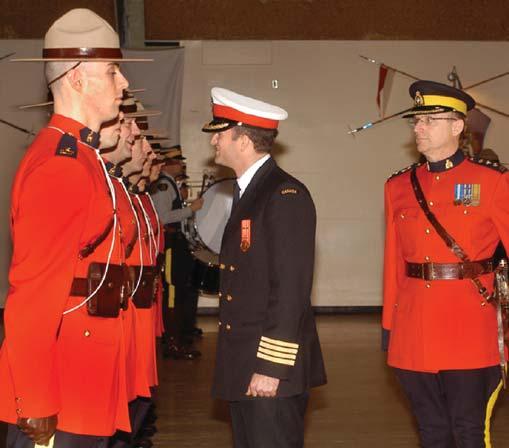
Canadian Forces Provost Marshal (military chief of police) Captain (N) Steve Moore reviews a graduation parade of new recruits with Chief Superintendent Pierre Ménard, commanding officer of the RCMP training academy in Regina. Good reputation management improves recruiting, enhances inter-agency co-operation and partnerships, and builds public confidence.
Photo courtesy of the RCMP
the public’s perception of an issue by showing another side of things – ideally the positive contributions made to the community, which build the brand and a good reputation.
Although reputation may be intangible, its impact on police organizations is very tangible. In today’s integrated and fast-moving information world, reputation management affects recruiting and retention; strategic partnerships with government, private sector and other law enforcement agencies; and most importantly, the public’s confidence in an agency’s service delivery.
Developing and maintaining public confidence is probably the best reason for effectively managing reputation. Without it, the job of a police agency and its frontline officers becomes much more difficult, as complainants, victims, witnesses and even accused persons may be less co-operative. Programs such as Crimestoppers are also less effective as potential tipsters may lack the confidence needed to provide vital information.
With the recruiting challenges facing Canada’s police agencies, the reputation of an organization can be a significant factor in attracting potential recruits and retaining current officers who may be considering a move elsewhere. Few police agencies function in isolation and a good reputation increases the likelihood that social and correctional services, schools, media, business and other law enforcement organizations will feel comfortable entering partnerships to deal with community issues.
Human resources, partnerships and public confidence are factors in reputation management for both police and non-police organizations. ‘Reputation management in a changing world’ was the theme of the 2006 International Public Relations Association Conference held in Cairo in January, which attracted a wide variety of high-profile delegates, and Egypt’s ministers of information and tourism. Egypt is making considerable efforts to increase tourism, but terrorist incidents like the hotel bombing on the Sinai Peninsula in July 2005 have a negative impact on perceptions of safety within the country, and ultimately its reputation.
“We need to make sure the world sees as much positive about Egypt before an incident arises,” said Nasser Kamel, chairman of the state information service.
This doesn’t mean ignoring reality or trying to override the negatives with a flurry of positives, but requires a sound reputation-management strategy that maintains the confidence of key audiences. To counter negative perceptions and manage its reputation, the ministry of tourism invited 200 journalists to Egypt to see for themselves that the country is no less safe than England, France, Spain or other tourist destinations. Media coverage amplifies the effect of any strategy, and this investment in managing reputation resulted in significant media coverage of Egypt as a tourist destination. As a result, tourism increased by six percent in 2005 despite the bombing and incidents in previous years.
“We don’t just want to promote, we want to engage and educate, and shape lasting perceptions about Egypt,” said Zohir Garranah, minister of tourism, “and we know that to do that, we’ve got to be in control of the messaging about Egypt’s tourism being exchanged in the media.”
Reputation management strategy
Whether a government ministry, corporation or police agency, those serious about managing their reputation will implement a strategy that includes:
1.Assessment of the status quo - this may require some research and a reputation audit, but can be helpful in determining where an organization stands from a reputation perspective. By benchmarking the status quo, a police agency can start with a reasonable view of reality and decide what steps are needed to manage its reputation effectively.
2.Structuring organizational thinking around reputation management – from the chief to the newest recruit, the importance of reputation to the organization must be emphasized.
3.Awareness of the broader picture – incorporating the issues, expectations, priorities and conflicts facing key stakeholders – including sworn and civilian members, potential recruits, community leaders and others – into the strategy will benefit everyone involved. It is often difficult to separate the reputation of organizations integral to an agency’s operations, such as a police union or association. Working closely with them will increase the potential for consistency in policy and information release – areas that impact reputation management.
4.Linking reputation management strategy to operational areas – just as media relations is incorporated into the case management plans of investigative units, and the visuals of the brand image are part of the uniform, vehicles and other products – reputation
management should link to an agency’s mission statement and vision; community relations, youth and school-resource units; and frontline patrol and investigative operations. All areas should be actively engaged in managing reputation, armed with relevant key messages supporting the work they do.
5.Monitoring executive-level actions – a police chief’s decisions and statements have a significant impact and should be consistent with the brand image and overall reputationmanagement strategy.
6.A means of measuring success – this function takes time and is difficult for most inhouse public and media-relations units to achieve. It is essential, however, if progress is to be measured and strategy adjusted accordingly. A professional public relations agency, with the necessary expertise, can be contracted to perform this service.
Reputation management doesn’t have to mean being everything to everyone, but it does mean integrating public relations and communications activities with strong service delivery, so that what a police service says it does is reflected in reality. To be successful, reputation management must be an ongoing process – one that communicates the good work being done, deals effectively with the tough issues, strengthens the brand image, and promotes confidence among both internal and external audiences.
Mark Giles is Blue Line’s correspondent for the National Capital Region, public and media relations, and militaryrelated issues.

by Tom Rataj
High-speed Internet through your cell
Many people have become accustomed to the advantages of high-speed Internet access at home and work. Unfortunately, until recently, users were relegated to pokey cellular data connections offering only dial-up connection speeds when unplugged from wired and short range wireless (WiFi) connections.
Cellular data connections just didn’t measure up to the amazing speeds on wired and wireless networks, especially when surfing or sending and receiving large documents. High-speed cable and telephone Internet service (also known generically as broadband) typically offers download speeds of up to six mega-bits per second (Mbps) or 6,000 kilobits per second (kbps), while good dial-up service can only manage 50 kbps.
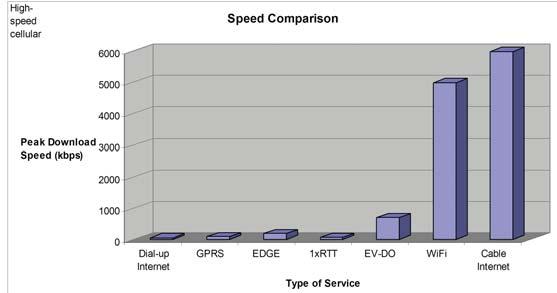
calls its product 1xEV-DO while Telus sticks with EVDO. The technology allows users equipped with compatible phones, Blackberries, personal digital assistants and laptops to achieve download speeds in the range of 400-700 kbps and upload speeds of 163 kbps.
In order to address this serious shortcoming, Canada’s three major cell phone service providers – Bell Mobility, Telus Mobility and Rogers Wireless (which also owns and operates the Fido network) – have now rolled-out their high-speed cellular data offerings.
Bell and Telus both provide extensive cellular coverage in all areas of Canada where service is available. Their networks both work on a North American designed technology known as Code Division Multiple Access (CDMA), which was developed by San Diego based Qualcomm. It is primarily used in North America, Japan, Korea, Brazil, Israel, Australia, New Zealand and Mexico and accounts for about a quarter of the worldwide market.
The latest high-speed cellular data technology used on Bell and Telus systems is Evolution Data Optimized (EVDO), which replaces the previous generation 1x technology. Bell
Bell and Telus currently offer the new service only in major markets – Vancouver, Edmonton, Calgary, Toronto and Montreal –while 1x is available nationwide. While not on par with true wired or wireless access, these services provide fairly substantial data transfer speeds over an extensive area.
Rogers Wireless and Fido also provide extensive national cellular coverage. Rogers bought Fido in November 2004 and integrated the two networks, which provided an extensive upgrade in coverage to Fido customers and increased capacity on the Rogers network. Both operate on the European developed Global System for Mobile Communication (GSM) technology, which dominates in Europe and Asia and accounts for three-quarters of the world market. Rogers also still operates its analog and digital Time Division Multiple Access (TDMA) network.
Rogers calls its high-speed data technology Enhanced Data for Global Evolution (EDGE), which supersedes the previous generation General Packet Radio Service (GPRS). EDGE offers download speeds of between 100 and 180 kbps and upload speeds of around 30 kbps, as compared to the 30-80 kbps download speeds of GPRS.
While EDGE is substantially slower than EVDO, it has some advantages, particularly for customers that travel overseas to Europe and Asia, where the same technologies are in place. Another edge – both GPRS and EDGE are available over the entire Rogers Wireless network.
EVDO and EDGE at work
Bell Mobility is currently working with a number of Canadian police agencies. The Hamilton Police Service uses the 1xRTT service to support patrol car laptops and the Peel Regional Police Service has begun using 1xEV-DO for the same purpose.
Telus Mobility has a long-standing relationship with the Durham Regional Police Service (DRPS), east of Toronto. The force began with ClearNet Communications, which was later purchased by Telus, using the Mike Network for voice communications and the Mike Packet Data service to support mobile data applications. Mike packet data is an older technology, offering only 22 kbps connections speeds.
Rogers also has police clients but we were unable to confirm which agencies it deals with. All of these cellular data networks offer a
variety of technologies and services to provide secure communication. Virtual Private Networking (VPN), a private network connection over the Internet, dedicated Internet Protocol (IP) pools and various other technologies ensure security and integrity of data and prevent eavesdropping.
There are also various agreements to provide voice and data priority for law enforcement customers using public cell networks, ensuring that they can continue to operate efficiently during large-scale emergencies or other periods of high traffic.
The future
Since the cellular market doesn’t stand still very long, locking in to one or the other technology is almost pointless. Equipment should be leased on short terms, allowing an easier upgrade path when technologies change. Switching service providers may also be necessary, depending on what your company offers.
While EVDO currently has a substantial lead in connection speeds, Cingular Wireless is already rolling out the next generation GSM based data technology, known as High-Speed Downlink Packet Access (HSDPA), in the US. It offers download speeds of 700-900 kbps today and up to three mbps in the near future.
Another GSM based data technology used in Europe, known as Universal Mobile Telecommunications System (UMTS), currently offers only 200 kbps download speeds, although future versions will offer speeds as high as 14 Mbps. UMTS is expected to replace
EDGE in Canada within the next several years.
The CDMA market is losing market share worldwide, partially because most new installations, including the hundreds of millions of new customer in China, will be using GSM.
Alternatives
A number of solutions use current WiFi technology to provide broadband networking in small zones (hotspots) such as in and around coffee shops and businesses. A newer technology, known as a ‘mesh network,’ offers networking over a large area by installing an interconnected grid of WiFi hotspots over an area. In some rural jurisdictions entire towns and rural area have WiFi access enabled through a mesh network operated by a regional municipality or private service provider.
A related technology known as WiMAX, also in its preliminary stages, offers a longrange, high-speed wireless network that is particularly good in locations where wired connections are difficult or impossible to install.
Anyone accustomed to having high-speed Internet access, especially business users, feel disconnected when away from their home or office. The extensive implementation of mobile computers and state-of-the-art productivity applications for police often exceeds the capacity of private data radio networks, making higher-speed mobile connections increasingly important.

Exercise tests readiness for potential terrorist events
OTTAWA — An international exercise intended to help governments test their readiness for potential terrorist events was plagued by e-mail glitches, cramped quarters and missing personnel, according to newly obtained memos.
The exercise conducted last April, garnered hundreds of participants from Canada, the US and Britain and was to provide insight into various challenges emergency management and national security officials may face in the event of a crisis.
The one week drill started with a mock terrorist organization releasing a biological agent causing pneumonic plague in New Jersey, and a dangerous chemical in Massachusetts. Thereafter, victims of the New Jersey attack travelled to Saint John, New Brunswick and Halifax as passengers on a luxury cruise ship.
Perpetrators of the attack were apprehended by the RCMP after crossing the Canadian border from Maine. However, a report of the drill indicated a request made from a fictional senior official to restrict the movement of people in New Brunswick went ignored.
The Canadian segment of the drill dubbed ‘Exercise Triple Play,’ clearly showed a need for fine-tuning, says Simone MacAndrew, a spokesperson for the Public Safety Department. In describing the exercise as a “tremendous learning experience,” MacAndrew says it also helped forge links with Britain that proved useful when actual terrorist bombings struck London just months later.
The draft report was among dozens of pages of memos about the exercise the Public Safety Department released under the Access to Information Act.


Tom Rataj is Blue Line Magazine’s technology editor and can be reached at technews@blueline.ca
by Danette Dooley
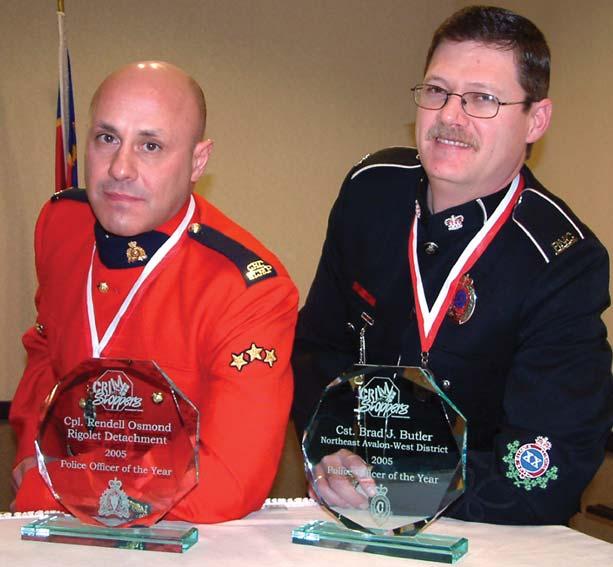
Royal Newfoundland Constabulatory (RNC) Cst. Brad Butler and RCMP Cpl. Rendell Osmond, the 2005 Newfoundland and Labrador Crime Stoppers police officers of the year, work hard at fighting crime and helping their communities.
Osmond is posted to the RCMP’s Rigolet, Labrador detachment, with prior postings in Clarenville, Hopedale, Placentia, Nain and Toronto’s Pearson International Airport. He devotes much of his spare time working to make Rigolet an active community and has done much to raise community pride, his nominators noted.
Top cops from the rock
“He regularly takes time out of his busy schedule to bring the youth of Rigolet into the local gymnasium every Tuesday night for two hours of physical activity,” said awards committee chair Paul Magee, reading some of the comments made by Osmond’s nominees.
Osmond is also the president of the adult committee of the Junior Canadian Ranger Program. Once when he was away, attendees heard, a Rigolet resident barricaded himself inside a building with a weapon.
“Even though Cpl. Osmond was away, this young man made a plea that he would only talk to Cpl. Osmond. He was contacted while on vacation, was able to intercede and the case came to a happy ending,” Magee noted.
A native of Corner Brook, Butler has worked with the RNC’s Community Services Section in St. John’s for the past four years. He also patrolled both St. John’s and Corner Brook and spent more than a decade in the force’s forensic identification section, where he earned a national award for his outstanding contribution to fingerprinting.
RCMP Cst. Laura Bemrose, a finalist for
the award, is the only DARE (Drug Awareness Resistance Education) officer in her district.
“To ensure the program is provided throughout the district, Cst. Bemrose on her own has taken on several schools in the Whitbourne detachment. This means that she has to balance her investigations while meeting her commitments to her DARE classes throughout the district,” Magee noted.
Finalist Marc Trioreau, well known for the time he spent policing Port aux Basques, Newfoundland, was nominated for the honour for the fourth time.
“Whether it be through youth programs or teams or whatever else he chooses to do, Mark spends many hours away from his family and friends,” working hard for the community, Magee noted.
Trioreau takes a great deal of satisfaction in influencing youth to make the right choice and say no to drugs.

RNC Constables Kevin Foley and Ken Walsh also made the short list from their force. Foley has spent over two decades policing in St. John’s and is well known in local schools, where he also delivers the DARE program. Much of his spare time is spent coaching young kids in several sports. Walsh works with the RNC’s street patrol division and also volunteers with the force’s dog unit; he completed a puppy-rearing program in 1995 and received an eight-week old German Shepherd puppy, which he trains daily.
RCMP Assistant Commissioner Gerry Lynch commended those who work so hard to make Crime Stoppers so successful in this province. The non-profit organization has received more than 16,000 tips, resulting in over 2,600 charges to date.
“Sometimes our profession is not a kind profession and we don’t always go out of our way to pat each other on the back and publicly acknowledge the good work that we’re doing,” noted RNC Chief Rick Deering, “so this is a really positive thing, coming here today in an environment of friendship and co-operation to do that.”
Deering summed up the comments of others during the awards ceremony, noting not only the tremendous contribution of police officers but also that of their families, who are there for them at the end of every shift.
“To all the nominees – unfortunately, at the end of this day, there will be one person from the RCMP and one person from the RNC who will be publicly acclaimed police officer of the year, but for all those nominated; in my eyes, you are all winners.”
You can reach Danette Dooley at dooley@blueline.ca

I am writing in response to Inspector John McKay’s article, “A Failing Success” – Blue Line, January 2006. I wish to respond to a number of common misconceptions that I suspect Mr. McKay shares with a proportion of your readership.
McKay’s description of the Downtown Eastside is accurate as far as it goes – the problems he describes are a result of a number of disastrous social policies that culminated in the early 1990s in what was arguably North America’s largest public health disaster in terms of epidemic injection drug use, HIV, hepatitis C and drug overdoses in conjunction with the largest open drug market on the continent.
the exchange facilities were overwhelmed by an influx of cheap, injectable cocaine in the ‘90s. Uncapped syringes are a potential hazard. In recognition of the problem, Vancouver has developed a sophisticated pick up program to ensure that no needle in a high volume area, lies on the street for more than four hours. Vancouver’s needle exchange does meet international benchmarks for equipment return (75 to 90 per cent return rates).
OPP improves policing in native communities
FOREST, Ont. — The Ontario Provincial Police was praised by native participants at an information session hosted by the Ipperwash Inquiry for taking steps to improve policing in Indian communities since the 1995 death of native activist Dudley George.
“This movement all began after the death of Dudley,” George’s brother Sam said after hearing of training courses offered by the provincial police since his brother was shot to death by a police sniper on Sept. 6, 1995, as police marched on native protesters.
“It’s as if Dudley gave them a little shove,” Sam George said.
His cousin, OPP Insp. Ron George, was one of the presenters at Friday’s forum.
“I personally don’t profess to have reached everybody,” Ron George told the session.
In response to this, the City of Vancouver, the Health Authority and the Vancouver Police developed and implemented the Four Pillars Strategy. This strategy resulted in major investments in each of the four pillars. These include – addictions, treatment enhancements, including improved access to withdrawal management (admission within two days vs three to six weeks), the addition of thousands of methadone treatment places in the Lower Mainland, (which incidentally, according to the Medical Director for addictions in Vancouver Coastal Health Authority, has more youth oriented addictions treatment beds than Alberta, Manitoba and Saskatchewan) – an increase in prevention efforts that have resulted in a decrease of two thirds in overdose death rates and a ten fold reduction in HIV incidence from 25 per cent to under two per cent per year, street upgrades that resulted in less open drug dealing and drug user congregations, and additional investments in housing, counselling and training.
Between 1995 and 2003 the law enforcement budget for the area doubled, and further increases to policing resources have occurred since 2003.
It is thus very misleading to state that the emphasis of the four pillars has been exclusively placed on harm reduction, or that harm reduction is disconnected from treatment, education or enforcement. It is undeniable that the harm reduction pillar has been the media focus, especially since the opening of North America’s only supervised injection site (SIS).
The SIS has been the subject of independent, third party, published scientific evaluation and shown to have significantly reduced a number of injection related harms – including reduced public injection, reductions in discarded injection paraphernalia and increased referrals for drug treatment. Comparing this site to hypothetical “safe rape or safe pedophile sites” is therefore completely inappropriate.
McKay also critiques the needle exchange policies that no longer require a one-for-one exchange. He blames this policy for “the thousands of uncapped, used syringes that addicts discard in parks and neighbourhood streets.” Your readers should be aware that the previous one-for-one policy is believed to have contributed to hundreds of HIV infections when
The Vancouver Police Department, its’ Chief and those inspectors and officers who worked with city and health officials to establish and support a range of interventions to address the public health emergency of injection drug use are to be commended.
It is clear that whatever is done in this neighbourhood needs to be critically examined to ensure that in attempting to manage down one problem, we are not inadvertently creating others of equal or greater significance.
The Downtown Eastside harm reduction initiatives have had this scrutiny and so far, the independent, scientifically measured outcomes are positive.
P. R. W. Kendall MBBS, MSc, FRCPC, OBC
British Columbia Provincial Health Officer

Bob Goulais, an official with the Union of Ontario Indians, praised efforts over the past decade to improve policing in aboriginal communities, but urged a concerted plan to stem drug abuse and promote native leadership in the force.
“We can effectively rid drugs from our communities, and we need to do that with leadership in police services,” Goulais said.
OPP Commissioner Gwen Boniface said the force has attempted to move forward in relations with aboriginal communities since George’s death.
“Some of them (initiatives) were ongoing, but you know my passion for these issues,” Boniface said.
The public inquiry into George’s death resumed Feb 6. George and two dozen other Stoney Point Indians occupied Ipperwash Provincial Park Sept. 4, 1995, claiming it contained sacred burial grounds.


by Dorothy Cotton
Peer pressure can trump penalties
I just don’t know what kids are coming to these days; they’re a bunch of wusses. Where is the old joy of adventure and mad recklessness we used to have back when I was a wild young thing? I was reading some drinking and driving stats recently and couldn’t help but notice that young people are just not keeping up their reputation as impulsive, impetuous, full of bad judgment and thinking they are immortal. Why, just the other day I heard a bunch of youngsters in their 20’s talking about who was going to be the DD when they went out that night. Hard to believe… .
There has been a huge drop in the amount of drinking and driving over the past few decades. It is really quite impressive; something along the lines of 30 to 40 per cent. That’s nothing to sneeze at, and did not occur simply by accident.
There are essentially three kinds of interventions used over the years to discourage drinking and driving – deterrence, social and moral controls. Deterrence not only increased the penalties for driving while impaired, it also increased people’s perception of them. Having penalties is one thing, but people also have to believe they might get caught and will be punished if that happens. Deterrence is a per-
sonal as well as a legal phenomenon and has meant making people aware of the likely outcomes of driving drunk. That includes all those gory ads showing hideous accidents and heartwrenching commercials about people who have been killed.
The second kind of intervention is social control. Many of the drunk driving campaigns have invoked social sanctions and pressure, attempting to make drunk driving decidedly uncool. For example, over the years when drinking and driving was decreasing, there was an accompanying increase in the number of people who said their friends would not approve of driving after drinking. Social control approaches include things like the ‘Friends don’t let friends drive drunk’ campaign.
The third angle on this is ‘moral’ or ‘internal behavioural’ controls, which refer to that little voice inside us that simply says ‘This is wrong. It is morally wrong; I should not be doing it.’ It means taking responsibility for yourself and making right decisions.
Taken together, these three interventions were pretty successful, but not completely so. There are still a number of people who don’t get the message. While the threat of disaster, approval of our friends and that little inner voice seems to keep most of us in line, some people STILL drink and drive.

What’s that all about, a bunch of researchers asked recently. Dr. Michael Greenberg and some of his buddies from the Drug Policy Research Center in Pittsburgh spent two years following a bunch of guys who had already been convicted at least once for drunk driving and were up on additional charges. They wanted to see who continued drinking and driving and who didn’t. Turns out that deterrence had no impact for these guys, which is actually not very surprising.
The evidence seems to be that increasing penalties work a little, for a short period of time, but that’s about it. Social pressure didn’t do much of anything for these guys either but interestingly, some decided, or were convinced, that driving under the influence was simply wrong – and these guys were much less likely to drink and drive in the two year period.
It appears that the route to changing the small minority of people who don’t seem to ‘get it’ as fast as the rest of us is not longer sentences or more peer pressure but someone, somehow, propping up that little voice. That’s an interesting observation because it shows that these folks are not very different from the rest of us.
In fact, the motivation underlying everyday compliance with the law for most of us is not fear of being punished, which is the basis of deterrence models. People’s primary motivations for obeying the law are ethical or moral in character. It’s about personal morality and the extent to which they think the law is consistent with their own feelings about what is right and wrong.
In some cases, personal and public morality are the same. Murder is illegal and most people also believe that it is morally wrong. However, in other cases this may not be true. Segments of the population do not view drug use, copying software and even ignoring parking laws as morally wrong, even when these behaviours are contrary to the law. This also applies to drinking and driving.
Drunk driving is a personal choice, a result of individual decision-making. There are lots of reasons why someone might want to drink and drive but for most of us, the moral implications of doing so are enough to keep us in line. If that does not do the trick, then a little dose of deterrence, with a peer pressure chaser, will do the trick.
It seems the factor separating the rest of us from the chosen few – the slow learners who have to get caught and punished a few times –may be moral intolerance. It doesn’t seem to be a matter of making the penalties harsher. If you can just get these people to see their behaviour as wrong, they may choose not to do it any more.
We hope.
You can reach Dr. Dorothy Cotton, Blue Line’s psychology columnist at deepblue@blueline.ca, by fax at (613) 5303141 or mail at: Dorothy Cotton RTC(O) PO Box 22 Kingston, Ontario K7L 4V7.
Provincial officers patrol Alberta’s highways
by Ryan Siegmund
Alberta has hired Provincial Protection Officers (PPO) to work with the RCMP on enhancing traffic safety patrols on provincial highways.
The PPO are conducting regular traffic enforcement, allowing the RCMP to focus on more serious crimes such as the movement of contraband, says Annette Bidniak, director of communications with the Solicitor General and Public Security.
The six-month pilot project which began in February, sees eight PPOs working out of two RCMP detachments. Two teams operate out of the RCMP’s Boyle detachment, patrolling Hwy. 63; the other teams are stationed in Strathcona County, patrolling Hwy. 21.
“The PPOs will always have a direct link to the RCMP and will never be far from them in the event they encounter a criminal code offence that needs to be dealt with, or an impaired driver who should have a breath test and an impaired investigation conducted,” says Bidniak. “Under provincial legislation, PPOs can issue someone a 24 hour suspension but they cannot enforce any criminal code violations or conduct investigations into criminal matters – that is where the dividing line is.”
A PPO is a special constable, which gives them authority under the Traffic Safety, Environmental Protection and Enhancement and Gaming and Liquor acts. While their
Interpol STD database registers stolen and lost documents
LYON, France — Less than four years following its creation, Interpol’s Stolen and Lost Travel Documents (STD) database now contains more than 10 million records.
Launched in June 2002 after Interpol and its member countries identified a clear link between terrorist activities and the use of lost or stolen travel documents, the database now holds details of passports, identity cards, visas and other documents from 93 countries and the United Nations Mission in Kosovo.
Many of the documents registered are blank, making them particularly valuable to criminals, who can easily insert photographs, descriptions and aliases.
In December 2005 Switzerland became the first country to provide access to the database beyond the National Central Bureau (NCB) to 20,000 federal agents at border control points, customs and immigration offices, embassies and consulates, enabling officers to verify instantly if a travel document is stolen.
The integrated solution connects Swiss databases to those at the General Secretariat, so that no separate check is required, and the information can be retrieved at the touch of a button.
“Four years ago this database did not exist, enabling criminals and terrorists to take advantage of what was a substantial loophole in border security,” says Executive Director of Police Services Jean-Michel Louboutin.
“While 10 million documents already entered in our database is a significant achievement, we know there are millions more which have not been registered. Each country has a duty of care to others and their citizens to share this information which could prove vital in preventing a terrorist attack, and catching international criminals.
“Through I-24/7, Interpol’s sophisticated communications system, the technology exists for countries to easily extend access to this and other databases to law enforcement officials at strategic points, such as airports and border crossings.”
More than 2,000 stolen travel documents have been identified by officers using Interpol’s STD database since its creation in 2002.
primary function is to hand out traffic tickets and enforce drinking and driving laws, they can also arrest individuals who have an outstanding warrant.
“Generally speaking, if the special constables pull someone over, run the licence plate, run the name and discover the person has an outstanding warrant, they can execute that warrant, arrest the person and hand him over to the RCMP,” says Bidniak. “If a person speeds away, they have no authority to pursue and they essentially become the best witness possible. They would provide all the information immediately to the RCMP and have them take over.”
The province hired 10 PPOs; two serve as alternatives, taking over when something takes an officer away from their duties.
Officers involved in the pilot project have been reassigned from other positions, including court security and prisoner transport. Other PPO duties include VIP and premier security. PPOs are given a basic eight-week training course on traffic enforcement and are trained and qualified to carry handguns. Other areas of focused training include a driving course from the RCMP, speed enforcement training, legal studies specific to traffic enforcement, conflict resolution, use of force and court and prisoner security operations.

All PPOs wear dark blue uniforms with a light blue stripe on the pants and are equipped with a service pistol, baton, pepper spray and handcuffs. They operate their own vehicles, marked with a ‘Solicitor General - Traffic Safety Unit’ decal because the officers fall under the department of the solicitor general and public security services.
The project is expected to cost about $350,000, which will cover the training, vehicles, equipment such as in-car cameras and reflective jackets and living expenses. PPOs are being housed near their areas of deployment because they are not expected to make the long drive from their permanent residences, such as Edmonton. Due to their re-deployment duties, PPOs will continue to earn anywhere from $35,000 to $45,000 per year.
Alluding to PPOs as a cost effective measure for traffic enforcement, Bidniak says the project is a very attractive alternative to the RCMP because it compliments its work instead of replacing it.
“This pilot project will test the feasibility of using provincial protection officers to complement RCMP resources because at this point, there are a number of more serious and complex investigations the RCMP needs to undertake,” says Bidniak. “While regular traffic enforcement is very important, the RCMP simply don’t have the resources to do it all... we will see how it plays out over the next six months.”
The project will be reviewed every month and progress reports completed. Success will be measured by the reduction of deaths and injuries on the province’s most dangerous highways. Highways 63 and 21, where the PPOs patrol, have both experienced a high number of collisions, fatalities and injuries.
RCMP assistant Commissioner Bill Sweeney views the PPOs as a welcome change, noting traffic enforcement reduced the Mounties’ ability to respond to calls.

Eight common mistakes in dealing with the media
by Jim Stanton
Mistake #1 – Letting the story get ahead of you
There are two times when you need to get to the media fast:
1.When an incident is breaking and you want to get your side of the story out first and 2.when a story gets ahead of you and the media calls about something you don’t know about.
Mistake #2 – Not ‘branding’
Before we look at two situations, I want to remind you to always ‘brand’ your department. It is not enough to say we, us or the department, you need to say the name of your police department – in full – throughout your interview.
Mistake #3 – Using jargon
Speak plainly; avoid jargon and abbreviations, such as person of interest and known to the police, and don’t run on. Get your messages out succinctly and clearly.
Mistake #4 – Hesitating
Let’s look at the first situation. You have just had a major incident take place but your senior officers are reluctant to talk to the media. You need to be rigorous in convincing them that you need to lead the story in a direction you would like to see it go, instead of being led by the media like lambs to the slaughter.
Mistake #5 – Saying nothing
Tell the media when you don’t know exactly what has happened. There is nothing wrong with saying ‘We don’t know the full circumstances of what happened but here’s what we can tell you’ and then going to some predetermined messages such as:
‘We take all such incidents seriously and have launched an internal investigation…’
‘Because of the circumstance surrounding this incident, we have called in outside assistance…’ (i.e.: special investigations unit)
‘We need the public’s help in finding out how this happened; if anyone witnessed this, please call…’
Mistake #6 – Not using the right person
It is critical to get a media savvy police officer out in front of the media as quickly as possible. Use a uniformed officer, especially if there is an issue about police conduct. He or she should be able to call on a senior, unarmed officer to move the story ‘up’ if the situation becomes more serious. Senior officers need to be comfortable in front of the media, must understand the importance of sending the right message as the situation evolves and need to be able to think on their feet in a media scrum.
Mistake #7 – Not calling the reporter back
When a story breaks, reporters will call everyone they can think of to get a quote they can weave into the narrative of the story. The person who calls back first has an advantage –it’s their call that sets the template for the rest of the story. The lesson – always phone back quickly, even if you don’t have answers.
Mistake # 8 – Worrying about the questions
Never mind what questions the reporter is going to ask, you can always reply by weaving your messages into your answer. Develop a good bridging phrase to help do this. For example, when asked a question, you can reply ‘Let me answer that by giving you some background…’ then get to a key message. You could also say ‘What we’re dealing with here is a
complex issue; let me tell you what our position is…’ and again go to your key message. The key to avoiding these common mistakes is planning, preparation and practice.
Jim Stanton will be teaching the two day course Policing in the Spotlight: Media Training at the Blue Line Trade Show April 25 & 26, 2006. Register at www.blueline.ca/tradeshow
Dirty little hands
by Tony Moreno
I was honoured to be the only US law enforcement officer to attend a gang/community involvement symposium in Chiapas, Mexico in 2004, participating along with dignitaries from the US, Mexico and various Central American countries.
We had some free time one day and headed out to do some sightseeing and shopping. We were warned about catering to some of the local people, who might try to ‘scam’ us out of our money by begging and using their economic plight to appeal to our sense of compassion. Giving in might bring an onslaught of other locals, we were told, who would mob us after seeing unsuspecting tourists giving away “free money.”

It was pretty warm and during one break, I snuck away from our group to a little store to buy some juice. As I looked through the fridge I felt someone, or something, pulling on my right pant leg. It was a small, dark haired, dark skinned little boy, about six years old, staring up at me. His face was dirty and his clothes disheveled. “Jugo. Senor, quiero jugo por favor,” he asked, telling me in Spanish that he would like some juice, since that is what I was grabbing for myself anyways.
I thought this may be a ploy to get money, and that he would tell his buddies I was handing out free cash, so I tested him by offering him cash. “Quiere dinero? Cuanto dinero quiere?,” I asked him.
To my amazement, he declined, once again stating, “Quiero jugo, senor.” I offered money again and again he declined. A little stunned, I concluded he really was thirsty and asked what kind of juice he wanted. “Y puede comprar uno para mi amigo tambien?,” he replied, asking if I could also buy some juice for his friend, who was smaller and dirtier than him and now standing alongside me, staring up at my confused expression.
I gave in and let them pick the juice they wanted. As I paid, the clerk acted as if they had just witnessed a drug deal go down and wanted no part of what was happening. As I
gave the boys their juice and we headed for the door, I still wasn’t certain that they hadn’t taken me and wondered if I would be mobbed by a flood of kids in the street.
For my own ‘investigative’ satisfaction, I stopped the older boy before we exited and asked, “Why don’t you want money?”
“If you give me money,” he replied, “once we get out there, someone bigger will just take it from me. When you give me juice, once I drink it, it’s mine.”
We went our separate ways. I wasn’t mobbed and felt bad because I had mistrusted these two little boys, who were only thirsty and relying upon their survival skills to get by. I saw them walk off to my left and, because I felt guilty, did not look back at them.
Ten minutes later, as our group was heading back to our bus, I glanced back towards the store, now half a block away, and saw the boys, huddled together in an alcove, nursing and still enjoying their juice. They were looking in my direction and both waved their dirty little hands in a friendly gesture to me. I waved back and someone asked me who I was waving at, since the boys were too far away to easily see.
“Aw, just someone,” I muttered, so moved that I couldn’t even talk. We left and I was quiet, deep in thought for the entire two hour bus ride back to the hotel. It was one of life’s moments that nails you right between the eyes.
I hope you take energy and motivation from this story and continue on in your life’s mission for the good of others – kids and young adults everywhere. If you happen to wonder why we do what we do, and where the reward and satisfaction lie, just look real hard. If you’re lucky, like I was on that day in Chiapas, Mexico, you’ll see ‘dirty little hands’ waving at you, too.
The motivation for your work then becomes very clear...
Tony Moreno will be teaching the one day course Lessons From a Gang Cop at the Blue Line Trade Show April 26, 2006. Register at www.blueline.ca/tradeshow
Forging Jamaica — Toronto bonds
by Linda Diebel - Toronto Star
Three people in one family are shot dead in a house in Jamaica. Cold-blooded, savage and seemingly without motive — until the police investigation reveals that the hit was ordered in Toronto, or New York or London.
It’s a growing profile for crimes on his Caribbean island, according to Jamaican Police Commissioner Lucius Thomas, who brought the message this past January to his Toronto counterpart, Chief Bill Blair. They met, along with senior officers on both forces, to discuss developing the kind of co-operation Jamaican police already enjoy with New York and Miami police.
At a closed-door meeting in January at Toronto police headquarters, Thomas made the point “that crime is international and that decisions criminals make in Toronto have an effect in Jamaica,” said Deputy Chief Keith Forde. “He told us that the criminals know the family tree.”
Decisions have yet to be made on how they’ll share information. But an exchange program is planned in which, for starters, two Jamaican officers will come to Toronto for advanced training in investigative techniques, while doubling as a resource.
Forde stressed that the discussions “should in no way be seen as proof that Jamaicans are a big problem here. I don’t want to see the real issue of violence in Toronto sidetracked by saying that,” he said. “It’s not fruitful. Crime in Toronto is a total community issue.”
He praised Thomas for his “exceptional knowledge” of the movement of criminals among Jamaica, Canada, the United States and Britain, as well as “his commitment to forming a partnership with Toronto police.”
He lauded Thomas’s passion for the job, in which he faces a huge task in turning around “a very sad situation in Jamaica.”
That is an understatement.
A single actor — say, Danny Glover perhaps — might play Thomas in a film version of his life. But it would probably take half a dozen officers to fill his shoes in real life, given what he has set out to accomplish in one of the very toughest police jobs.
Thomas, then 56, took over the 8,500member Jamaica Constabulary Force in January 2005. He had joined up at age 20 after finding that police work gave him the opportunity to “provide a shoulder for those who are weak, or a listening ear for those who have no voice.”
His first year as commissioner was a baptism of fire: a 13 per cent rise in murders, to more than 1,600 slayings in a population of less than three million.
He’s scrambling to root out corrupt cops, shut down gangs, arrest the drug-trade elites and re-instill pride in a civilian population that has grown mistrustful and afraid of police.
He works in one of the hemisphere’s bloodiest intersections, a major trans-shipment point for cocaine flowing out of South America and weapons coming from Haiti, among other places, in “guns-for-ganja” deals. Yet, Thomas
is “very optimistic we’re making a dent.”
“The challenges are great, but we are seeing some achievements,” he said, in an interview with the Toronto Star at a downtown hotel in late January.
His four-day visit was sponsored by the Jamaica Diaspora Canada Foundation, which represents many of the 300,000 Jamaicans who live outside their homeland. Thomas also met with Hamilton Police Chief Brian Mullan and spoke to the Jamaican-Canadian Association, urging 350 listeners not to let crime prevent them from visiting or retiring in Jamaica.
Jamaican Police Commissioner
Lucius Thomas
He said most murders in Jamaica are gangrelated, with members fighting over drugs, money and turf. He believes his officers are beginning to have an impact because they are now focusing higher, on the “four or five guys who ship 70 per cent or more of the drugs in Jamaica.”
April 25 & 26, 2006
10th Annual Blue Line Trade Show
Markham, ON
Trade show for law enforcement personnel from across Canada to view and purchase a wide spectrum of products and services of the latest technology in the law enforcement industry. Admission is free by pre-registration. Simultaneous six training courses require separate preregistration and fee. Registration and information at www.blueline.ca/tradeshow .
April 25, 2006
Unmasking Urban Graffiti III
Markham, ON
This half-day morning course by instructor Heinz Kuck, will help you understand graffiti offender motives, decipher the eight graffiti styles, teach how to design your own graffiti abatement project, and experience the development of tags by a graffiti vandal. Course details and registration at www.blueline.ca/tradeshow .
April 25, 2006
Methamphetamine Labs
Markham, ON
This half-day afternoon course instructed by SOLETA members will help you learn about meth. ingredients, how labs are set up, how to recognize indicators of lab activity, patrol issues related to shoplifting and officer safety when dismantling labs. Course details and registration at www.blueline.ca/tradeshow .
April 25 or 26, 2006
Non-Accusatory Interview Technique
Markham, ON
This one-day course by instructor Gordon MacKinnon, will draw on case law and rules of interviewing, witness psychology, teach how to detect deception and use techniques to get court admissible confessions. Course details and registration at www.blueline.ca/tradeshow .
April 25 & 26, 2006
Policing in the Spotlight: Media Training
Several of the “critical players” are now awaiting trial.
Thomas’s wife, Sylvia, and two sons — Kevin, a U.S. Marine, and Damion, a student — accepted his long hours years ago. He regards his job as a mission, and himself as a messenger about the changing face of crime.
“There are no borders for crime anymore, for moneylaundering, credit card fraud or drugs,” he said. “What affects people in Toronto affects us in Jamaica. When a person is involved in violent crime law enforcement around the world has to come together. The answer lies in working police-to-police. It’s as important as working government-to-government.”


Markham, ON
This two-day course by instructor Jim Stanton, will provide you with media training for your police service including proactive media techniques, workable key
phrases and messages, and building alliances. Course details and registration at www.blueline.ca/tradeshow .
April 25 & 26, 2006
CSI Crash Data Retrieval System Operators Update Markham, ON
This two-day course by CATAIR is for previously trained Collision Safety Institute (CSI) CDR system users. Upon successful completion of this update class, the student will be current on the systems supported by the CDR system form their original CSI class to those supported at the time of training. An exam will be held on the second day on material covered during the update training. Course details and registration at www.blueline.ca/tradeshow .
April 26, 2006
Lessons from a Gang Cop
Markham, ON
This one day course by instructor Tony Moreno, LAPD, teaches the history and culture of gangs, gang enforcement and suppression tactics plus tips needed to survive. Course details and registration at www.blueline.ca/tradeshow .
April 30 - May 3, 2006
Aboriginal and Diversity Conference
Toronto, ON
Hosted by the O.P.P, R.C.M.P, Toronto Police Service, First Nations Police Chiefs Association, Association of Black Law Enforcers, and Law Enforcement Aboriginal and Diversity (LEAD) Network. The theme is Building Trust and aims to bring together a wide spectrum of people who care about providing quality police service to Aboriginal and diverse communities to exchange ideas, hear from world-class presenters and build trusting and respectful relationships. Information and registration at www.cacp.ca.

May 31 – June 2, 2006
Western Canada Robbery Conference
Fairmont Palliser Hotel Calgary
Hosted by the Calgary Police Service Robbery Unit. Provided will be a mixture of lecture and case studies discussing a wide variety of fraud issues and practices. Cost is $250.00 per person. Information at http:// www.calgarypolice.ca/news/wcrc06.html or contact S/Sgt Dave Louie at 403-206-8746 or Det. Tim Shannon at 403206-8788 or wcrc.2006@calgarypolice.ca.
Including community key to eradicating graffiti
by Heinz Kuck
We have evolved through three important, yet linked, philosophies of ‘community policing.’ Beginning with the values of Sir Robert Peel, we subsequently gained knowledge on the fundamentals of community-based policing. The current trend is community mobilization, which teaches that the key to any successful crime management initiative must include sustained neighbourhood inclusiveness.
Police services have always fought hard to “serve and protect” within the trenches of our communities. Projects come and go and through it all, we have generally measured our successes through enforcement statistics –numbers of arrests, charges and seizures. It’s what we were trained to do – but all projects come to an end. We pull down the mug shots, roll up the pin maps and pack up the laptops and with a flick of the switch, the operations room darkens.
Then what? Has the community maintained important lessons on how to move forward or do they still wait with total dependence on their police service provider? Have residents developed the fortitude and capacity to maintain selfdirected projects? Will they continue the good work designed, developed and delivered in partnership with the police?
Community inclusiveness is the key to any successful project. Drawing partners with ex-
pertise in the area of interest is crucial. Problem-solving models, ideas, solutions and opportunities are limited only by the imagination of the project leader.
Within the realm of graffiti eradication, business improvement associations have provided resources and funding. Faith communities offer youth programs and family centered activities. Social agencies and institutions of learning con-

tribute human resources and location assets. Politicians provide mechanisms for change.
Early in the development of the Toronto Police Service Graffiti Eradication Program, we intuitively knew to seek out professional thinkers outside the constraints of the empirical policing experience. We spoke to city leaders, educators, urban planners, ethnographers and academics and involved ourselves in group discussions with at-risk youth, probation officers and clerics. Amongst all these exceptional people, one stood out as a beacon in her keen approach of looking at urban reclamation.
My first meeting with world-renown urban planner Jane Jacobs was in November 2001. I felt a little uneasy comparing my facts and figures of urban revitalization with this icon but Jacobs immediately put me at ease with her warmth and sense of humour. We shared a mutual respect for healthy city centres and agreed on what constitutes safe streets (including eradication of graffiti) and a ‘neighbourhood.’ We concurred that urban vibrancy is directly proportionate to the health and functionality of the larger organism – the city.
I last saw Jacobs in May 2005 at the Canadian Urban Institute Leadership luncheon, where the Jane Jacobs Lifetime Achievement Award (created in her honour) was awarded to author, journalist and activist June Callwood. I was proud to have spent some time with Jacobs and glad that I had contacted her.
The lesson is this: Whether it’s the lone neighbour on your own block, or a high profile specialist, let nothing prevent you from seeking out the advice, assistance and wisdom of an essential community partner. Strive to take your next crime management program to a higher level through community inclusiveness!
Staff Sergeant Heinz Kuck has served with the Toronto Police Service since 1979. He will present more on Project MORE in his Unmasking Urban Graffiti III course at the Blue Line Trade Show April 25, 2006. Register at www.blueline.ca/tradeshow
Staff Sgt Heinz Kuck with Jane Jacobs.

Field drug tests
The NIK Narcotics Identification System of kits are available for: Cocaine, Marijuana, Heroin, Methamphetamine, Amphetamine, LSD, Psilosybin, and more. Individually and factorysealed boxes ensure proper ampoule placement, quality and control.
Digital voice recorder

CVDS’ ComLog, a digital voice recorder, using mass storage techniques for instant recall buffering and DVD-RAM for long-term archiving, allows access from local and remote workstations over existing connections.
Thermal imager

Infrared Technologies , Recon LT thermal imager features left or right hand operation, optional spot temperature display, selectable polarity and start up time of 5 seconds. Powered by four AA batteries with six hours of continual operation.
Weapons storage
Colt Canada’s line of weapon storage solutions includes secure, lockable and stackable cabinets and expandable, adjustable weapon racks. Racks can accommodate rifles, shotguns and pistols of any size.
Radar/message trailer
Distributed by DavTech, the Galaxy Radar/Message Trailer can assist in the regulatio of speed limits or as a changeable message sign. Options include: solar panel, cellular modem, pager activation, and a towing hitch.

Tactical shield
Baker Batshield allows a tactical officer to aim and operate a long-gun or handgun, with both hands, while using their shield. The lightweight shield automatically narrows or widens for use on aircraft, buses, trains, boats, and other confined areas.
Flexible armour

Halo by ArmorExpress offers full wrap side coverage constructed with Synchro-Stitch, and covered with waterproof Ripstop covers. Available in NIJ Levels II & IIIA.
Remote video inspection
Tactical gloves
SnakeEye by Bock Optronics is a low-cost hand held remote video inspection system. Delivering clear, full colour video in a lightweight, modular and portable, system, SnakeEye allows your eyes travel where you can’t.
R. Nicholls features BlackHawk Hellstorm S.O.L.A.G. gloves with full wrist support, back of hand adjustment, quick drying, durable synthetic materials, and multi-layer synthetic design for enhanced gripping power, ideal for land or water operations.

ByBill Kaufmann Calgary Sun
It really is the longest undefended border on earth.
That Canada’s gunless border guards wish to be equipped with sidearms — with a patience worthy of waiting for Godot — is well known.
Less publicized are the other handcuffs worn by those same officers preventing them from securing the country’s first line of defence.
Canadians would be less than thrilled to know a police computer data list containing the names of 33,742 red-flagged individuals — criminals, fugitives, suspects, terrorists and the like — isn’t available to officers at the posts where public contact is first made at our border crossings.
Walkin’ the line

But I stand corrected — the names of 162 of the worst “lookouts” are provided to primary contact agents staffing the crossing booths, leaving a mere 33,580 of those names to secondary officers in a back room at the border.
That means the larger list will only come in handy if those primary officers are vigilant or lucky enough to make the right stop and refer the red flaggers to the secondary room.
Doing that without a gun, while those they stop could very well be armed, doesn’t translate into job safety.
It’s a situation that’s led to a number of work refusals by officers armed only with batons and pepper spray.
It begs the obvious question: how many
violent undesirables are entering our country literally under the noses of unsuspecting border service agents?
“What’s intelligent about not giving intelligence to our officers in the front line?” asks Erik Lupien, spokesman for the Customs Excise Union representing 5,000 officers.
It’s a see-no-evil, hear-no-evil philosophy the Canadian Border Service Agency wants to deepen by whittling down the list of 162, to discourage agents’ refusals, says Lupien.
In a test run last summer, the FBI’s ten most wanted failed to appear on Canadian border agents’ data bases, he said.
And the incident in late January at a crossing in Blaine, Wash., where Canadian officers stood down in the face of automatic weapons-toting border runners from the U.S. side,

is far from the only case of emergency refusal.
Days later, reports that a young kidnapping suspect armed with an M-16 could be headed towards an Ontario crossing from Michigan had a similar effect, said Lupien.
Even if they’d stood their ground, their instructions are to allow the offenders through and call for police backup.
But in some sections along the vast, serpentine frontier strip, police can be hours away, says Lupien.
Nine police stations that could support their border brethren in Quebec were closed 18 months ago, he adds.
Unguarded roads crossing the international boundary number more than 200.
When the union complained about the lack of proper computer hookups in 45 per cent of the 119 U.S.-Canada gateways, a dial-up system was supplied, said Lupien.
“The connections are so slow, they’re useless,” he says.
That, and the lack of intelligence, has prompted a number of embarrassing moments that at least ensure Canadian guards are on friendly terms with their U.S. counterparts.
“The guys call the U.S. customs across the border asking ‘can you guys run this information through?’” says Lupien.
“The Americans go ‘we know you have this intelligence problem, this is routine.’”
Lupien says U.S. authorities also came to the rescue in 2000, when their Canadian equivalents appeared to lobby Ottawa vainly for bulletproof vests.
Officers from New York State delivered a hoard of vests, ultimately shaming the feds into supplying them, he said.
To Canada’s border officers, the episode is symbolic of the culture of neglect they toil under.
While our leaders speak of shoring up national sovereignty through increased military spending, those supposedly upholding it where the rubber hits the road go without.
We even talk of giving our transit officers sidearms.
A Canadian Border Service Agency spokeswoman had essentially nothing to say about the database shortcomings or officers’ other concerns.
Officers are given the tools they need, are backed up by Mounties and their safety is our number one priority, was the rote response.
The incoming Tory government has pledged to supply firearms to our frontier sentinels and should be lauded for it.
But it’s clear the rot goes far deeper than a lack of firearms.
Two American fugitives were inches from a criminal haven in January. Nothing at the Canadian border could stop them.
Two American fugitives were inches from a criminal haven in January. Nothing at the Canadian border could stop them.

OUTOFPRINT