![]()


5 | Compensation is up, but junior staff numbers are down
Manufacturing pay is rising, but not evenly and not without risk.
8 | Is your salary high enough to overcome workforce gaps?
The 2026 Plant Engineering Salary Survey showcases some variations in data over the last study.
12 | Get can't-miss advice on electrical trends
Our panel of experts delivers must-have advice for power and electrical systems.
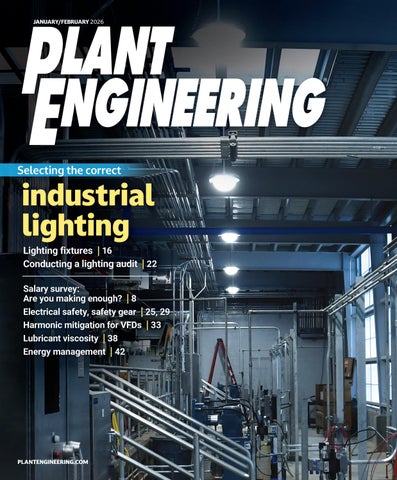
16 | Special considerations for lighting selections in industrial applications
There are many factors involved when selecting appropriate light fixtures for industrial environments.
22 | Think lighting audits are just about energy savings? Think again
Cost and energy savings from a lighting audit can be measurable and significant. But that’s just the tip of the iceberg.
25 | How to align OSHA, NFPA 70E for electrical safety
Electrical safety is key within various manufacturing and industrial plants.
29 | Why workers resist safety gear and how to change it
Industrial and manufacturing employees require safety gear on the plant floor. Learn four ways to encourage PPE use.
33 | Selecting the right harmonic mitigation solution for VFDs
As variable frequency drives (VFDs) become common in motor applications, the rise in harmonic distortion imposed on the power system must be mitigated.
38 | Lubricant viscosity is critical to efficient and reliable manufacturing
Lubricant viscosity plays a critical role in maintaining the performance, efficiency and longevity of manufacturing equipment.
42 | How to transform energy management with data
Companies can take steps toward energy efficiency and sustainability.
46 | What is the role of AI in connected automation platforms?


The most effective artificial intelligence solutions will be those delivered as part of a fit-for-purpose, seamless automation system.


Lubriplate’s ultra-high-performance, 100% synthetic lubricants have been engineered to provide unsurpassed performance in the most demanding plant environments. They provide a wide range of benefits designed to make your plant run better. Benefits include: extended lubrication intervals, lubrication consolidation through multiple application capability, reduced friction, extended machinery life and reduced downtime. Products include...
HIGH-PERFORMANCE SYNTHETIC GEAR OILS
SYNTHETIC AIR COMPRESSOR FLUIDS
SYNTHETIC HYDRAULIC FLUIDS
HIGH-PERFORMANCE SYNTHETIC GREASES
NSF H1 REGISTERED FOOD GRADE LUBRICANTS
ECO-FRIENDLY SYNTHETIC LUBRICANTS
SPRAY & SPECIALTY LUBRICANTS


AMARA ROZGUS, Editor-in-Chief ARozgus@WTWHMedia.com
SHERI KASPRZAK , Executive Editor SKasprzak@WTWHMedia.com
MICHAEL SMITH, Art Director MSmith@WTWHMedia.com
AMANDA PELLICCIONE, Marketing Research Manager A Pelliccione@WTWHMedia.com
H. LANDIS “LANNY” FLOYD, IEEE Life Fellow
JOHN GLENSKI, Principal, Automation & Digital Strategy, Plus Group, A Salas O'Brien Company
MATTHEW GOSS , PE, PMP, CEM, CEA, CDSM, LEED AP, Senior Vice President, CDM Smith
Are you a subject matter expert in one of these topics? Would you like to write an article on one of the topics below? If so, please submit an idea to: www.plantengineering.com/contribute-to-plant-engineering
• Asset management
• Battery energy storage systems
• Environmental health
• Expert Q&A: Asset management
• Expert Q&A: VFDs and VSDs
• Fall protection guidelines
• Oils and lubrication
• Preventive maintenance
• Pumps
• Safety and PPE
• System integration
Content For Engineers. WTWH Media focuses on engineers sharing with their peers. We welcome content submissions for all interested parties in engineering. We will use those materials online, on our website, in print and in newsletters to keep engineers informed about the products, solutions and industry trends.
The link below gives an overview of how to submit press releases, products, images and graphics, bylined feature articles, case studies, white papers and other media.
* Content should focus on helping engineers solve problems. Articles that are commercial in nature or that are critical of other products or organizations will be rejected. (Technology discussions and comparative tables may be accepted if nonpromotional and if contributor corroborates information with sources cited.)
* If the content meets criteria noted in guidelines, expect to see it first on the website. Content for enewsletters comes from content already available on the website. All content for print also will be online. All content that appears in the print magazine will appear as space permits, and we will indicate in print if more content from that article is available online.
* Deadlines for feature articles vary based on where it appears. Print-related content is due at least three months in advance of the publication date. Again, it is best to discuss all feature articles with the content manager prior to submission.
LEARN MORE AT: www.plantengineering.com/contributeto-plant-engineering

Manufacturing pay is rising, but not evenly and not without risk.
On the surface, the 2026 Plant Engineering Salary Survey offers reassurance. Most manufacturing professionals are earning more than they did a year ago, job satisfaction remains high and the majority feel secure in their careers. In a time defined by economic anxiety and rapid technological change, that stability matters.
But look closer and a more complicated — and more fragile — picture emerges.
but the data suggests that formal education is becoming an increasingly decisive divider in pay — and opportunity.

Amara Rozgus, Editor-in-Chief
Yes, manufacturing professionals are well compensated. More than half now earn more than $100,000 annually and salary growth for 2026 is expected to be modest but steady. Bonuses, where they exist, are tied to profitability and performance rather than speculative metrics, reinforcing a culture that values results over hype. Just as important, money is not the primary driver of satisfaction.
That’s the good news. The warning signs sit just under the surface.
Compensation trends reveal volatility depending on education, experience and geography. Advanced degrees are paying off, with dual bachelor’s degree holders seeing dramatic gains and master’s and doctoral professionals continuing to edge upward. Meanwhile, those with a high school diploma or associate’s degree saw significant drops in total compensation. Manufacturing has long valued hands-on experience,
Experience tells a similarly uneven story. Entry-level workers are earning more, likely reflecting competitive hiring pressures and the need to attract younger talent with digital skills. But professionals with five to nine years of industry experience saw steep base salary declines, offset only partially by higher bonuses. That mid-career squeeze is concerning. It risks creating a hollow middle, seasoned enough to carry institutional knowledge but not compensated in a way that encourages longevity.
Then there’s technology. Artificial intelligence (AI) now ranks among the top perceived threats to the profession, second only to uncertain political and economic forces. While engineers prioritize practical digital tools systems, uncertainty about AI’s role in decision-making is clearly weighing on the workforce.
The takeaway is not that manufacturing is in trouble — far from it. The sector remains stable, rewarding and meaningful for those already inside it. But pay trends are propping up an aging workforce while exposing cracks in succession planning and skills development. If manufacturers want compensation gains to be sustainable, they’ll need to focus less on rewarding the past and more on investing in the future. PE


Micro VFDs
Starting at $138.00
With sizes as small as 55mm wide, these drives provide the needed motor speed control without taking up large amounts of panel space.
General Purpose VFDs
Starting at $171.00
General purpose drives offer great value for a wide variety of applications including conveyors, pumps, fans, HVAC systems, and elevators.


AutomationDirect carries a full line of AC drives, from basic micro drives to full-featured high-performance drives boasting flux vector control and built-in PLCs. So, no matter the application or environment, AutomationDirect has an affordable drive solution for you!
High Performance VFDs
Starting at $281.00
High-performance AC drives are top-of-the-line drives that are usually specified when a high degree of precision in speed control is required or when full torque is needed at very low or zero speeds.


Washdown VFDs
Starting at $239.00
These NEMA 4X, washdown-duty drives are built to withstand harsh environments including food and beverage processing and water treatment facilities.


Safeguard unsafe areas with affordable


Common Sense is Great, but Sure-Fire Protection is Better

AutomationDirect has a comprehensive portfolio of certified machine safety components to guarantee your equipment is protected and your personnel are safe. A wide assortment of safety components from trusted brands in the industry is available including cable pull safety switches, hazardous area safety devices, safety relays and much more. All are in stock at low everyday prices, so you can keep your system safe without breaking the bank.


Starting at $73.00


Dold RK 6929 modules are compact safety relay extension modules from the SAFEMASTER series. They amplify and multiply safety relay outputs of existing safety relays or controllers, while providing galvanic isolation between control and power levels.
• Meet safety levels up to Cat. 4 / PL e or SIL 3
• Ideal for machine building and firing systems
• Force-guided contacts (IEC 61810-2) for safe diagnostics
• 1-channel or 2-channel connection
• Pluggable terminals
• Interface Type C Class:1 (compatible with semiconductor safety outputs)

• Space-saving, 17.55mm package


The 2026 Plant Engineering Salary Survey showcases some variations in data over the last study.
The 2026 Plant Engineering Salary Survey results were no surprise: Participants made more money (mostly) and were happy with their jobs. Beyond that, it’s a mixed story.
Based on respondents’ responses, the survey depicts a manufacturing and engineering workforce that is highly experienced, well-compensated and secure, yet facing a looming demographic crisis and technological uncertainty.
The respondents represent a mature, educated cohort. The workforce is predominantly male (88%) and aging, with 72% of respondents aged 50 or older. Education levels are high, with 66% holding at least a bachelor’s degree. This seniority translates into strong financial standing; 54% of respondents earn a base annual salary of more than $100,000, with 22% earning $150,000 or more.
Compensation appears stable rather than volatile. For 2026, more than half of professionals (57%) expect modest base salary increases of 1% to 3%, while bonuses are primarily tied to company profitability (52%) and personal performance (49%) rather than sales or stock metrics.
Despite the pressures of the industry, sentiment is overwhelmingly positive. Half of the respondents state they “love going to work every day,” and an additional 41% describe their job as “OK” or good. This satisfaction is driven less by money and more by intrinsic rewards; “feeling of accomplishment” is the top factor influencing satisfaction (16%), followed by relationships with colleagues and technical challenges.
Financial compensation ranks fourth in importance. Consequently, retention is high: 50% are not looking for a new job and 76% view manufacturing as a secure career path.
A cross-analysis of the demographic data and reported business challenges reveals a critical vulnerability. The industry is heavily reliant on a generation nearing retirement — 11% plan to retire soon. However, the No. 1 business challenge cited is “not enough junior team members to prepare for the future” (34%). This suggests a broken talent pipeline where knowledge transfer from the expe-
rienced (60 and older) demographic to a younger generation is stalling.
Technologically, the workforce is wary. While traditional engineering skills remain the most prized asset for advancement (28%), “artificial intelligence replacing human decision-making” is cited as a significant threat by 36% of respondents, second only to political and economic changes.
In the immediate future, practical tools like advanced programmable logic controllers, supervisory control and data acquisition systems and digital lockout/tagout systems are prioritized over more abstract concepts like blockchain or the metaverse.
The data presents the manufacturing engineering sector has a solid foundation of experienced veterans who feel safe and well-rewarded.
However, there are two challenges that show up for this industry, along with many other industries: a lack of new recruits as the veterans retire and the rapid encroachment of new technologies (AI) that threaten to alter the very structure of the work they enjoy.
Significant volatility occurred across education levels, with some categories seeing massive salary reductions while others saw substantial gains. Comparing year-over-year salary data, there were some shifts based on education:


3: Respondents to the study provided feedback on the many tasks they work on in any given day. Courtesy: Plant Engineering


• High school diploma: The average base annual salary dropped precipitously by approximately 34.6%, falling from $128,689 in 2024 to $84,179 in 2025. Nonsalary compensation for this group also decreased by more than 59%.
• Dual bachelor’s degree: This category saw a massive increase in base salary of roughly 46.7%, rising from $75,733 in 2024 to $111,146 in 2025. Furthermore, nonsalary compensation for dual bachelor's degree holders jumped from $1,833 to $14,400.
• Master’s degree: Base salaries increased by roughly 16.4%, moving from $110,734 to $128,905.
• Doctoral degree: Base salaries increased by roughly 13.4% ($117,000 to $132,678), though nonsalary compensation dropped by approximately 34%.
‘Data regarding tenure and experience revealed several inversions where less experienced workers saw gains while mid-level brackets saw drops. ’
• Associate’s degree: While the base salary saw a modest increase, nonsalary compensation plummeted by nearly 68%, dropping from $15,550 in 2024 to $4,909 in 2025.
Data regarding tenure and experience revealed several inversions where less experienced workers saw gains while mid-level brackets saw drops.
• Industry experience (5 to 9 years): This group experienced a sharp decline in base salary of roughly 31%, falling from $99,978 in 2024 to $68,675 in 2025. However, their nonsalary compensation more than doubled, rising from $6,481 to $16,301.
• Industry experience (less than 5 years): Conversely, entry-level industry workers saw their base salary rise by roughly 36%, from $65,164 to $88,691.
• Tenure with employer (40 or more years): Long-tenured employees saw a base salary increase of nearly 35%, rising from $105,425 in 2024 to $142,069 in 2025.
• Tenure with employer (15 to 19 years): Base salary increased by approximately 17%, going from $91,539 to $107,056.
• Tenure with employer (less than 5 years): New hires saw a base salary decrease of roughly 14%, dropping from $114,901 to $98,324. PE
Salary survey insights
uThe 2026 Plant Engineering Salary Survey shows that most respondents report higher salary levels and strong job satisfaction, reflecting a highly experienced, wellcompensated and secure workforce with modest expected salary growth.
u At the same time, uneven salary shifts by education, experience, age and region underscore deeper risks, including a weakening talent pipeline and concern over technological disruption as veteran workers near retirement.
MAY 27-28, 2026
BOSTON, MA


Our panel of experts delivers must-have advice for power and electrical systems.
• Understand trends in power management and electrical systems in 2026.
• Develop an understanding of electrical industrial system designs.
• Learn how emergin technologies like artificial intelligence are impacting energy management and design.
Q: What are the biggest trends in power and electrical systems going into 2026?
Matthew Keeler: The biggest trends are accelerating electrification, rising load density and a shift toward digitally enabled, resilience-focused system design. Industrial facilities face tighter timelines, longer equipment lead times and greater pressure to plan capacity earlier. At the same time, smarter monitoring, analytics and artificial intelligence (AI)-enabled tools are allowing owners to extract more value from existing infrastructure before investing in major upgrades.
Lanny Floyd: Two of the biggest trends in power and electrical systems going into 2026 are infrastructure renewal and capacity to meet data center demand.
Q: What are some of the biggest trends in energy monitoring and power management software?
Matthew Keeler: Energy management platforms are evolving from dashboards to intelligent systems. AI-enabled tools support load forecasting, peak management and better utilization of existing assets, reducing the need for immediate capital expansion.
Q: How is electrification changing industrial power system design?
Matthew Keeler: Electrification is pushing facilities to treat power systems as scalable platforms
rather than static installations. In my work with energy-intensive manufacturing environments, electrification and modernization are driving higher peak loads, increased sensitivity to power quality and the need for phased upgrades. Facilities are increasingly designing substations, switchgear and distribution systems with physical space, spare capacity and flexibility for future electrified processes.
Q: What is the role of smart grids on reliability and reliance?
Matthew Keeler: Smart grids improve reliability through advanced sensing, automation and faster fault isolation. For industrial customers, this provides better visibility into upstream disturbances and more coordinated responses to grid events. When paired with local automation, smart grids help reduce outage duration and improve operational resilience.
Q: How are microgrids changing energy independence for manufacturers?
Julie Holmquist: Our two manufacturing sites in Croatia are now equipped with solar panels, meaning these plants no longer must rely solely on the traditional energy grid. This trend promises to provide more flexibility to manufacturers who can balance their power bill with input from solar and wind. This investment should be calculated on a case-by-case basis to justify the overhead cost of panels/turbines. It also presents the opportunity for at least a partial backup power supply in the event of a main grid failure.
Lanny Floyd: Microgrids are not eliminating manufacturing dependence on utility supply, but they are helping to reduce dependence on utility reliability.


Q: What role does predictive maintenance play in reducing downtime in electrical systems?
Matthew Keeler: Predictive maintenance identifies degradation before failures occur. Artificial intelligence (AI)-enabled inspection tools allow organizations to process far more data than traditional methods. Similar approaches are used in high-safety environments like amusement rides, where platforms such as Mobaro support condition monitoring and maintenance efficiency.
Lanny Floyd: Predictive maintenance, specifically online continuous monitoring, is essential for electrical systems reliability and avoidance of downtime. AI will help effectively use data from continuous monitoring to optimize asset management.
Julie Holmquist: Preventive maintenance seeks to address an issue before it becomes a problem and creates downtime. Corrosion prevention is one important factor to consider. For example, the routine installation of corrosion inhibiting devices into electronic and electrical cabinets can cut down on failures caused by corrosion.
Q: What are some of the hidden costs from electrical downtime?
Julie Holmquist: The costs of electrical failure are real but sometimes difficult to calculate, especially before the problem occurs.
The repair costs such as with internal failures like corroded wires and contacts, as well as downtime costs at minimum the value of the production that was lost.
For example, a manufacturing company that produces $10,000 worth of goods per hour will lose that much revenue in an hour of downtime. The longer the downtime is, the greater the loss. Tech giant Siemens shares some eye-opening numbers of how much that might add up to for large-scale industries.
For heavy industry, they calculated the cost of one hour of downtime at more than $200,000 in fiscal year 2023, and for automotive, a cost of more than $2 million per hour. Of course, the potential causes of downtime can vary, but the impact is similar, which is why measures taken to avoid downtime — whether through corrosion prevention, predictive maintenance, redundancy or some other strategy — can have such a significant return on investment (ROI).

‘ Predictive maintenance, specifically online continuous monitoring, is essential for electrical systems reliability and avoidance of downtime. ’
Q: What are some examples of how corrosion prevention has reduced electrical failures and downtime?
Julie Holmquist: One electricity provider we worked with was facing expensive corrosion failures in outdoor electrical control cabinets during shipping, storage and operation. The problem was exacerbated near the coast.
They addressed the corrosion issue during shipping and storage by wrapping the cabinets in specialty packaging that contained Vapor Phase Corrosion Inhibitors (VPCI). Operational cabinets were maintained by installing small VPCI-emitting devices inside. The company found these steps to be a very simple, cost-effective approach to minimize remedial work and failure.


Q: How are regulations and sustainability goals influencing investment in power infrastructure upgrades?
Matthew Keeler: Sustainability goals and regulations are accelerating investment in electrification, efficiency, renewable integration and advanced monitoring. Utility-community partnerships, such as BC Hydro’s collaboration with the Haida Nation, illustrate how policy, sustainability and infrastructure planning increasingly align.
Julie Holmquist: In an age when consumers are often on the lookout for products made by manufacturers who exhibit stewardship and environmental responsibility, investing in these sources of renewable energy has become a significant part of shaping a company’s corporate environmental image. For example, Cortec has invested in renewable energy sources at three of its plants because we’re committed to sustainability and environmental responsibility.
Q: How is the rise of data centers and AI workloads affecting system design?
Lanny Floyd: Data centers must be continuously available, without interruption of services to customers. This requires designs to enable essential maintenance and to be resilient to equipment failures.
Matthew Keeler: Data centers and AI workloads are driving rapid load growth, higher power density, and stricter reliability requirements. Even facilities outside the data center sector are affected through regional capacity constraints and longer interconnection timelines, reinforcing the need for early planning.
Q: How is AI optimizing power systems and maintenance?
Matthew Keeler: AI is increasingly applied to both power system analytics and engineering workflows. In our own work, internally developed AI tools have fundamentally changed inspection processes by enabling high-volume image review and prioritization. This allows teams to scale inspections, identify issues earlier, and focus engineering effort where it delivers the most value.
Q: What lessons have recent grid failures or extreme weather events taught the industry?
Lanny Floyd: Grid failures and extreme weather have taught the industry that system designs must anticipate failures and events.


Matthew Keeler: Recent events have shown the importance of planning for extended outages. Organizations now consider fuel supply, communications, staffing, spare parts and environmental exposure alongside traditional electrical design criteria.
Q: What emerging technologies have the potential to disrupt the power industry in the next decade?
Lanny Floyd: AI will continue to drive data center growth for some time. Growth in the demand for energy, electrical equipment and skilled workforce will strain supply chains. The strain will have a negative impact on the ability to meet demand.
Q: How should organizations future-proof their electrical systems amid rapid technological change?
Matthew Keeler: Future-proofing requires modular design, data-driven decision-making, cyber-resilient architectures and workforce development. Designing for expansion and investing in analytics allow systems to adapt as technology evolves.
Lanny Floyd: Organizations need to form strategic partnerships with suppliers to enable effective planning and preparation for future needs.
Q: How are manufacturers balancing reliability with decarbonization efforts?
Matthew Keeler: Manufacturers are prioritizing reliability while sequencing decarbonization efforts. In practice, this often means starting with better measurement, monitoring and controls, followed by efficiency and demand management, before adding electrified processes or renewable generation to reduce operational risk.
Q: How are renewable energy sources reshaping traditional power distribution models?
Julie Holmquist: Our own experience as a manufacturer of corrosion inhibiting products includes a combination of traditional and renewable models that represent the diversification of power distribution.
Two of our facilities in Croatia have installed solar panels in the last several years to supplement their power source with readily available solar power. Our CorteCros facility on the Adriatic Sea is especially suited to take advantage of excellent sun exposure and draws most of its power from this form of renewable energy. Our headquarters in Minnesota doesn’t have physical solar panels, but we choose to invest a little extra in our power bill to contribute toward our energy company’s construction of solar and wind fixtures to help supply the grid.
‘ Manufacturers are prioritizing reliability while sequencing decarbonization efforts. ’
Matthew Keeler: Renewables are transforming distribution systems from one-directional to bidirectional networks. The BC Hydro and Haida Nation Solar North project in Haida Gwaii demonstrates how local renewable generation, storage and microgrid strategies can replace diesel dependence while improving resilience and energy sovereignty in remote communities. PE
Power insights
uTrends in electrical for 2026 include rising load density and a shift towards enabled, resilience-focused design.
uEnergy management systems are moving toward dashboard formats for easier evaluation.
uData centers and AI are driving rapid growth in power supply.


Greg Ward, EIT, CDM Smith, Pittsburgh; Orlando Cruz, PE, CDM Smith, Maitland, Florida; and Supasit Jong, PE, CDM Smith, Boston
There are many factors involved when selecting appropriate light fixtures for industrial environments.
Lighting systems in industrial and hazardous environments are subject to a unique set of challenges that extend beyond providing general illumination. In industrial areas, areas with accessibility restrictions and in harsh environments, lighting must be more than functional — it must be safe, reliable, durable and maintainable. Improperly selected or poorly maintained lighting can become a safety hazard and may result in early equipment failure or noncompliance with regulations.
This article is divided into three parts, each focusing on a fundamental aspect of industrial lighting in challenging environments:
• Classification of hazardous locations and explores the types of light fixtures suitable for these environments, with an emphasis on explosion protection and regulatory compliance.
Illumination in hazardous-classified environments necessitates using specialized light fixtures engineered to mitigate the risk of ignition from flammable gases, vapors, dusts or fibers. These fixtures must conform to stringent safety standards and regulatory frameworks to ensure operational safety and compliance. The fixtures must be listed or identified for the class and division of the area where they are to be installed.
Additionally, the temperature class (T Code) of the light fixture must not exceed the autoignition temperature of the gases, vapors, dusts or fibers in the environment in which the light fixture will be installed.
Hazardous locations are categorized based on the type and likelihood of the presence of ignitable substances. The classification system as defined in NFPA 497: Recommended Practice for the Classification of Flammable Liquids, Gases or Vapors and of Hazardous (Classified) Locations for Electrical Installations in Chemical Process Areas includes:
• Review considerations for light fixture selection in hazardous-classified areas.
• Understand why specific light fixtures are selected for maintenance purposes.
• Learn about light fixture selection for heavy-duty/ rugged environments. Objectives
• Design strategies for ensuring lighting systems can be maintained safely and efficiently, without disrupting operations or compromising worker safety.
• Critical standards and ratings used to select fixtures that can withstand extreme conditions, including ingress protection; material compatibility; and resistance to vibration, impact and temperature extremes.
• Class I: Areas where flammable gases or vapors are present, such as in oil refineries, chemical processing facilities or wastewater treatment plants.
• Class II: Locations with combustible dusts, commonly found in food processing plants, sludge drying processes at wastewater treatment plants or other manufacturing environments.
‘Hazardous locations are categorized based on the type and likelihood of the presence of ignitable substances. ’
• Class III: Environments containing ignitable fibers or flyings, such as textile mills or industrial sawmills.
Each class is further divided into two divisions, which indicate the probability of hazardous material presence:
• Division 1: The hazardous substance is present under normal operating conditions.
• Division 2: The hazardous substance is present only under abnormal conditions, such as equipment malfunction or accidental release.
To ensure safety in these hazardous-classified environments, light fixtures must be specifically designed and certified for hazardous use.
Explosion-proof fixtures are constructed to contain any internal ignition sources (e.g., sparks, heat), thereby preventing the ignition of the surrounding atmosphere. Explosion-proof housings are typically made from durable materials such as die-cast aluminum or stainless steel to provide strength, corrosion resistance and heat dissipation. They are designed to contain internal explosions caused by sparks or arcs, withstand high pressure and cool escaping gases through precision-machined threaded or flanged joints.
Intrinsically safe fixtures are engineered to operate with electrical energy levels sufficiently low to not produce a spark capable of igniting flammable gases, vapors or dusts in hazardous classified locations. By limiting the voltage and current within the fixture and associated wiring, these systems prevent

sparks or high temperatures that could cause ignition. This approach allows the safe use of lighting even in environments where explosive atmospheres may be present continuously or intermittently.
Intrinsically safe lighting is often used in areas where explosion-proof housings may be impractical or the lighting is required to be portable, such as
CLASS: Part of the NFPA system of classification for hazardous areas that defines the general type of hazard present.
DIVISION: Part of the NFPA system of classification for hazardous areas that defines the likelihood of hazardous material presence.
GROUP: Part of the NFPA system of classification for hazardous areas that further defines the hazardous material based on the properties of the substance.
EXPLOSION PROOF: Electrical equipment that can prevent an internal explosion from igniting the surrounding atmosphere.
INTRINSICALLY SAFE: Electrical equipment that can prevent an explosion by being unable to release enough energy to ignite a flammable atmosphere.
INVERTER: An apparatus that converts direct current into alternating current.
in a hazardous area of a wastewater
areas where personnel frequently perform inspections and maintenance.
When selecting luminaires for use in industrial installations, maintainability with minimal impact on operations is an important consideration. Without designing maintainability into a lighting system, the system will likely not be maintained, which can lead to unsafe working conditions. Because of requirements for the regular testing of egress and emergency lighting, the lighting system design should be configured to allow for testing while maintaining facilities in operation. Some ways to do this include:

• Using dedicated emergency lighting units, which are light fixtures dedicated to emergency and egress lighting apart from normal process lighting. This allows for easy testing and maintenance of emergency light fixtures with battery packs, apart from the normal facility light fixtures, which may be less accessible.
• Having emergency lighting systems that selftest. Some emergency lighting systems self test and locally indicate when there is an issue with the fixture; others can self-test and report to a central station, particularly if a lighting inverter or uninterruptible power supply is designed into the system.
Additionally, when working on top of process structures that require illumination, the designer should consider types of lighting installations that will allow the owner to safely access and replace luminaires with minimal effort. Some methods that may achieve this include:
• Mounting fixtures at heights that can be easily accessed using a standard 10-foot ladder.
• Locating light fixtures clear of tanks and equipment within industrial environments so that fixtures may be easily accessed for inspections and maintenance.
• Using light poles that hinge or swivel so that fixtures may be accessed and maintained.
• Mounting light fixtures separately from the main structure to enable maintenance using a bucket truck or winch system (for highmast lighting), avoiding the need to access confined or hard to reach areas of outdoor structures.
• Using plug-and-cord type light fixtures for easy replacement of fixtures in hard-to-reach areas.
Because of dirt build-up and sanitation requirements, certain facilities require frequent washdown of spaces and the light fixtures within them. In these types of facilities, it is important to select light
‘The lighting system design should be configured to allow for testing while maintaining facilities in operation.’
fixtures with adequate ingress protection (IP) ratings so that the fixtures may be cleaned with a hose or water jet without damaging the fixtures.
When taking this approach, the space and the equipment therein, including lighting, must be suited for washdown. Typical environments where washdown-rated fixtures are found include spaces in the food and beverage and chemical processing industries and some cleanroom environments.
In modern industrial environments, it has become standard practice to prioritize LED-based lighting over the use of traditional lamp-based fixtures. LEDs offer greater reliability, have a long operational life and are generally not subject to the frequent failures associated with conventional lamps. This translates to lower maintenance demands as the need for regular lamp replacements is greatly reduced.
Another important component in limiting maintenance and extending the service life of a lighting system is selecting a fixture rugged enough for the area in which it will be installed.
When selecting a light fixture for a harsh environment, some essential ratings and standards should be considered for almost all applications. These ratings help ensure that light fixtures will endure in even the most demanding areas. Key considerations include IP, material compatibility, impact and vibration resistance and temperature ratings.
The IP rating system and National Electrical Manufacturers Association (NEMA) 250 type ratings are standards that test the integrity of a fixture against foreign solids and liquids ingress. The IP rating system was developed by the International

Electrotechnical Commission (IEC) and is defined in IEC 60529. IP ratings are typically shown as “IP” followed by two numerals (e.g., IP 65) that indicate the level of protection against foreign solids and liquids ingress, respectively.
The NEMA 250 type rating system does not have a specific identifier that corresponds to its level of protection. NEMA 250 types address some aspects of light fixtures that IP ratings do not, such as fixture construction, corrosion resistance, icing effects, gasket durability and protection from coolants. These are not part of the IP rating system and such differences should be considered when selecting light fixtures.
In addition to NEMA 250 type and IP ratings, UL — a safety organization that sets industrywide standards for new products — provides listings for light fixture resistance against water ingress. The UL listings are generally lighter duty and address installation in dry, damp and wet locations.
uAfter reading this article, facility managers, engineers and designers can make more informed light fixture selections to enhance safety and extend fixture service life in demanding industrial settings.
uThe article explains how industrial lighting in hazardous and harsh environments must be carefully classified, designed and maintained using certified fixtures and rigorous standards to ensure safety, regulatory compliance, durability and long-term operational reliability.

Many harsh-environment light fixtures will include both a NEMA 250 type rating and an IP rating. Similarly, a fixture that meets NEMA 250 type and IP ratings will often also include a UL listing according to the degree of protection provided in the fixture. Although the NEMA 250 type addresses corrosion resistance, it does not determine the specific material of the light fixture housing, lens or hardware.
Enclosure and lens materials that are not compatible with certain chemicals may experience advanced degradation and lead to early failures. For example, a NEMA 4X rated light fixture with an aluminum housing would be adequate for an area with glycol exposure but would be more susceptible to corrosion in an area with sodium hypochlorite.
‘Industrial lighting in hazardous and harsh environments demands more than just adequate light levels.’
Unfortunately, there is not one universally corrosion-resistant material that has good compatibility with all chemicals. The exposed portion of fixtures such as the lens, housing and hardware should be selected with respect to the chemicals and treatment processes of any given area.
Other common aspects of light fixture selection include impact and vibration protection and temperature ratings. The IEC 62262 impact rating (IK) rating system defines the degree of protection that a light fixture has against mechanical impact, with ratings ranging from IK00 (lowest) to IK11 (highest). Light fixtures at risk of damage or vandalism should be selected to have a high IK rating. ANSI C136.31: Standards for Roadway and Area Lighting Equipment tests fixtures for vibration resistance at levels of 1.5 times the force of gravity (G), at 3G or up to 5G. Light fixtures can be tested by a third party and certified to meet the ANSI requirements.
Finally, the operating temperature rating of a light fixture must suit the application. A standard indoor light fixture has an operating temperature rating of approximately 32°F to 104°F. Environments with temperature extremes, such as high bays, hot areas of manufacturing plants or other unconditioned industrial areas and cold storage and cold climate areas often have ambient temperatures that are not within a standard light fixture’s operating temperature. These areas should have light fixtures selected with appropriate ambient operating temperatures for the environment in which they will be installed.
Industrial lighting in hazardous and harsh environments demands more than just adequate light levels, it requires a comprehensive approach that
prioritizes safety, suitability and maintainability. Understanding hazardous area classifications, designing for ease of maintenance and selecting fixtures rated for rugged conditions are all essential components in creating a reliable and compliant lighting system.
By applying the principles discussed across the three sections — hazardous location requirements, maintainability strategies and fixture selection standards — facility managers, engineers and designers can reduce risk, enhance operational efficiency and ensure long-term performance. Investing in the right lighting solutions not only safeguards personnel and assets but supports regulatory compliance and minimizes costly downtime across critical industrial operations. PE
Greg Ward, EIT, is an electrical engineer at CDM Smith. Orlando Cruz, PE, is a senior electrical engineer and technical lead at CDM Smith. Supasit Jong, PE, is a senior electrical engineer at CDM Smith.


Sean Grasby, Wesco, Pittsburgh
Cost and energy savings from a lighting audit can be measurable and significant. But that’s just the tip of the iceberg. From ensuring the safety and well-being of employees, to maximizing productivity and proactively managing materials, a professional audit can yield far greater returns over time than simply calculating energy savings.
Many plant managers prioritize energy savings as the driving factor when it comes to upgrading lighting components such as fixtures, bulbs, design and more. But while energy savings can certainly be a factor, the truth is, a proper lighting audit can have a positive impact on several aspects of plant operations. From safety and security to production lines, worker health to productivity, a professional lighting audit can provide benefits well beyond energy savings.
Here’s what a plant manager should consider when developing a strategic lighting plan to support successful operations.
Energy savings are a potential benefit from a comprehensive lighting audit and upgrade, but actual cost savings may vary heavily depending on the lighting situation. Facilities that already use LED lights, for example, might not move the energy
savings needle that much by going from one generation of LEDs to the next. The savings could be around 15%. However, making the leap from older fluorescent lights to LEDs could result in a significant energy savings — think up to 70%.
Cost and energy savings from a lighting audit and upgrade can be measurable and significant but will ultimately depend on a plant’s current lighting set up. As a result, plant managers should also take other factors into consideration when evaluating whether to upgrade their light fixtures.
Planned maintenance shutdowns are disruptive enough, but impromptu stoppages can be even more challenging to manage. While most unplanned outages can be attributed to machines going down or needing unscheduled maintenance, something as simple as a light going out can cause it as well. Low — or no — visibility can make it unsafe to operate machinery on the production line. And, depending on where the fixture is situated, a production line may need to be shut down so technicians can access and replace the bulb.
To ensure minimal impact to production lines, plant managers should work hard to stay on top of maintenance schedules to avoid emergency situations. Understanding when light fixtures reach the point of replacement can help plant managers ensure that lights don’t cause unplanned downtime.
As a side note, it might be worth keeping extra fixtures onsite for when emergencies do arise. Unlike the lights in homes, lights on the plant floor often can’t be picked up at a retailer. In fact, they may have long lead times or be difficult to source, especially if they’re older models. Having spares on hand ensures that if a component needs to be swapped, it can quickly be replaced.

Simply put, proper lighting is critical to ensuring safe plant floor operations, especially in areas with heavy equipment like forklifts. Additionally, if an area is poorly lit, workers may not be able to clearly see spills or other hazards on the floor, which could lead to unnecessary — and costly — injuries.
Outdoor lighting is often overlooked as a safety consideration but is essential to securing the facility’s perimeter and ensuring employees can get to and from their car safely. As part of an overall lighting evaluation, plant managers should regularly inspect the poles that hold the lights up to ensure that even when bulbs are up to code and bright enough, the poles aren’t going to falter. Further, to ensure the effectiveness of surveillance cameras, proper lighting must be in place to deliver clear video.
Emergency lighting is also an area that often gets forgotten. National Fire Protection Agency (NFPA) inspection and testing standards mandate 90 minutes of lighting on backup or battery power to ensure everyone inside can safely exit the building. Plant managers need to ensure they have the
lighting in place required to comply with this code requirement.
The quality, intensity and design of lighting significantly impacts plant workers' productivity and well-being. LED lighting has proven to improve an employee’s mood, alertness and performance compared to fluorescent lights.
While natural light is ideal, it’s not always realistic for every facility, especially for second or third shifts. LED lighting offers a good alternative with flicker-free illumination. Its color temperatures can also be adjusted to suit different areas: cool white or blue-enriched light for active workspaces and yellow light for break areas. Plant managers should evaluate when and where to install specific bulbs to support improved productivity and overall employee well-being.
• Learn about cost savings from a lighting audit.
• Discover the impact of lighting on safety measures and productivity gains.
• Determine artificial intelligence’s (AI’s) role in managing the lighting life cycle.

‘A partner can help plant managers understand where to start a lighting audit and ensure that it’s ideally suited to solve specific challenges.’
From a health perspective, inadequate lighting can lead to eye strain, headaches and fatigue. Conversely, lighting that is too bright can also cause similar issues. As such, it is critical to understand when bulbs need to be replaced. For example, while LEDs don’t typically burn out; they dim over time, which can cause eye strain. Fluorescent bulbs can have the opposite effect and be too bright, causing headaches. While fluorescent bulbs are no longer sold in many states, many companies that had a backstock may still be using them in their plants in the years to come.
In warehouses, poor lighting can also lead to costly picking errors if labels or barcodes are difficult to read.
Putting lamp replacements in 15- or 20-year-old fixtures or LED tubes in fluorescent fixtures is often a bad investment and can be dangerous.
At some point, older light fixtures become weak and inefficient, and in some cases, may not comply with current standards. If there's a fire, or an employee is injured, insurance may deny claims if it’s evident that the fixtures were not maintained or were faulty. Plant managers need to strategically evaluate on a case-by-case basis whether a new fixture or retrofit kit is the best option. In some cases, new fixtures may cost the same and would greatly improve the safety and aesthetics of a plant floor and can even qualify for rebates. As a side note, working with a professional lighting auditor can help ensure plant managers are aware of any potential rebates to improve return on investment.
Lastly, artificial intelligence (AI) is also proving to help manage lighting life cycles and support a strategic plant lighting strategy. From proactively alerting plant management of expected failure timelines and ensuring replacement parts are ordered in a timely manner, to determining the labor needed to replace the fixtures and then actually scheduling that labor, AI is a game changer.
Not only can AI manage the operational aspects of lighting replacements, but it will also be able to time lighting replacements with planned shutdowns to minimize disruptions. Plant engineers, already familiar with automation, will also be empowered to put auto-procurement in place.
Clearly, a lighting audit can have a variety of benefits beyond just energy savings. But depending on the facility’s situation, getting started might seem daunting. That’s why it’s important to have a trusted partner. A partner can help plant managers understand where to start a lighting audit and ensure that it’s ideally suited to solve specific challenges. They can help spot opportunities to use lighting to enhance operations or capitalize on rebates. And when it’s time to upgrade or replace a lighting system, they can source products.
From ensuring the safety and well-being of employees, to maximizing productivity and proactively managing materials, a thoughtful approach to lighting, starting with a professional audit, can yield far greater returns over time than simply calculating energy savings. PE
Sean Grasby is the senior vice president and general manager of U.S. construction at Wesco.
uEnergy savings is only one potential benefit of a lighting audit in a plant.
uWorkers benefit from lighting audits because poorly lit and overly bright workplaces impact worker health.
uLighting audits can help plants avoid costly shutdowns because they offer insight into what should be replaced so those replacements can be made during planned shutdowns.
Electric al safety in the workplace is a critical concern that demands adherence to established standards to protect workers from potentially life-threatening hazards. The Occupational Health and Safety Administration (OSHA) and NFPA 70E: Standard for Electrical Safety in the Workplace provide complementary guidelines that address hazard identification, risk assessment and the use of personal protective equipment (PPE).
Electrical hazards in the workplace pose significant risks to workers, ranging from immediate physical injuries to long-term health effects. Identifying and differentiating between these hazards is the foundational step in any electrical safety program, as emphasized by both OSHA and NFPA 70E.
OSHA identifies electricity as a serious workplace hazard that can lead to electric shock, electrocution, fires and explosions. Similarly, NFPA 70E focuses on protecting employees from shock, electrocution, arc flash and arc blast. By categorizing these hazards, employers can tailor their safety strategies to specific scenarios, thereby reducing the likelihood of incidents.
One primary category is electric shock, which occurs when electrical current passes through the body because of contact with energized parts. This hazard is prevalent in tasks involving live wiring or faulty equipment. According to OSHA, common causes include contact with power lines, lack of ground-fault protection and improper use of extension cords.
NFPA 70E defines electric shock as a dangerous condition where contact with or failure of equip-
ment results in current flow through the body, potentially causing burns, muscle contractions or cardiac arrest. Differentiation here involves assessing voltage levels; for instance, low-voltage shocks (less than 50 volts [V]) may cause minor discomfort, while high-voltage exposures (more than 600 V) can be fatal.
Workplaces must be inspected for shock hazards via visual inspections and voltage testing, thus ensuring workers maintain safe distances defined by approach boundaries in NFPA 70E.
Another distinct hazard is arc flash, an explosive release of energy caused by a short circuit or fault in electrical equipment. This differs from shock

• Learn to differentiate between different electrical safety hazards.
• Know how to perform a risk assessment to determine the proper PPE.
• Assess how to wear proper PPE and maintain wearing it correctly.
1: Employee collecting nameplate data from an enclosed oil filled transformer.
Courtesy: CDM Smith

flammable materials. These are thermal hazards, distinct from shock or arc events and are addressed in OSHA’s Subpart S by mandating grounding and overcurrent protection.
To differentiate effectively, workplaces should conduct hazard analyses that consider factors such as equipment condition, environmental conditions (e.g., wet areas increasing conductivity) and task specifics.
For instance, overhead power line work presents unique shock and fall hazards, while confined spaces may amplify arc flash risks due to limited escape routes. Training programs, mandated by both standards, should include real-world examples, such as case studies from OSHA inspections where failure to recognize hazards led to incidents.
By aligning OSHA’s broad regulatory requirements with NFPA 70E’s detailed hazard classifications, organizations can create comprehensive safety audits that identify and prioritize risks, ultimately preventing injuries and promoting a safer work environment.
‘OSHA identifies electricity as a serious workplace hazard that can lead to electric shock, electrocution, fires and explosions.’
because it involves radiant heat, intense light and pressure waves rather than direct current flow.
OSHA guidance recognizes arc flash as a key risk, noting that it can cause severe burns and can even ignite clothing. NFPA 70E provides detailed definitions, describing arc flash as a source of possible injury from thermal burns or blasts, with incident energy measured in calories per square centimeter (cal/cm²).
For example, in switchgear maintenance, an arc flash might be caused by tool slippage or dust accumulation, releasing energy equivalent to several sticks of dynamite. Differentiating arc flash from arc blast — the pressure wave accompanying the flash — is crucial; arc blast can propel shrapnel and cause hearing damage or concussions.
Electrocution, often a fatal outcome of electric shock, is differentiated by its severity and is a leading cause of workplace deaths. OSHA reports that many workers are unaware of hazards like discontinuous paths to ground or equipment misuse. NFPA 70E aligns by requiring de-energization of equipment (unless justified) to prevent such outcomes. Additional hazards include fires and explosions from overheated wiring or sparks igniting
Performing a risk assessment is crucial for electrical safety; the process determines the appropriate PPE based on identified hazards. NFPA 70E outlines a structured risk assessment procedure in Article 130.5, which integrates with OSHA’s emphasis on hazard recognition and control. This alignment ensures that assessments are not only compliant but also effective in minimizing exposure. The process involves systematic steps to evaluate shock and arc flash risks, determining PPE that matches the hazard severity.
1. The first step is to identify the tasks and equipment involved — this includes reviewing work scopes, such as troubleshooting circuits or installing panels and cataloging potential hazards, such as energized conductors. OSHA requires employers to assess workplaces for hazards that necessitate PPE, per 29 CFR 1910.132. NFPA 70E identifies shock hazards according to voltage and arc flash by fault current and clearing times.
For example, inside a manufacturing plant, assessing a 480-V motor control center would involve checking labels for incident energy levels.
2. The second step is to conduct a hazard analysis to determine the likelihood and severity of risks. This step uses the hierarchy of risk controls, elimination (de-energizing), substitution, engineering controls (e.g., barriers), administrative controls (training) and PPE as a last resort (see Figure 2).
NFPA 70E requires that risks be assessed via table method or calculations, such as IEEE 15842018: Guide for Performing Arc-Flash Hazard Calculations.
Severity is quantified; for arc flash, incident energy that typically exceeds 40 cal/cm² indicates extreme risk with the concussive shockwave risk associated with a high-level arc flash. Other likelihood considerations are equipment maintenance and testing history — poorly maintained gear increases fault probability.
3. The third step is to calculate or estimate specific risk metrics; doing so begins with the proper boundaries. For shock risk, define approach boundaries — limited (unqualified persons keep distance) and restricted (qualified only with PPE). These shock boundaries are determined by voltage level.
For example, a 480-V panel has a limited approach boundary of 3 feet 6 inches and the restricted boundary is 1 foot. The arc flash boundary and incident energy are calculated using the incident energy calculation method noted in NFPA 70E 130.5(G). Arc flash assessments may use software to model scenarios, ensuring conservative estimates if data are unavailable. OSHA aligns by requiring assessments to include non-electrical hazards, like falls during elevated work.
4. The fourth step, based on the assessment, is to select PPE. The PPE tables are different depending on which method is used to calculate incident energy and the boundaries. If the incident energy method NFPA 70E 130.5G is used, then the corresponding PPE tables are in Sections 130.5(E) and 130.5(G). If the arc flash PPE Category Method NFPA 70E 130.7(c)(15) is used, then consult the PPE tables located in 130.7(c)(15)(b) and 130.7(c) (15)(a). The category method categorizes PPE from 1 to 4, while the incident energy method breaks the PPE into two levels.
PPE consists of arc-rated clothing, hearing protection, safety glasses, arc-rated gloves with protectors, arc-rated face shield and balaclava or the

arc-rated arc flash suit and hood for higher levels; refer to the tables to appropriately address PPE needs. Document the assessment, including justifications for live work and review it annually or after changes, as per NFPA 70E.
5. The final step is to implement and train according to the findings. This includes obtaining an energized electrical work permit for live tasks that exceed 50 V. OSHA enforces this through inspections, citing failures in risk assessment as violations. Case studies, such as arc flash incidents from underestimated risks, underscore the importance of thorough processes.
By following these steps, workplaces align OSHA’s legal mandates with NFPA 70E’s practical guidance, ensuring PPE is appropriately determined and risks are effectively managed.
Wearing and maintaining proper PPE is essential for sustaining electrical safety, as it serves as the final barrier against hazards when other controls are insufficient. Both OSHA and NFPA 70E provide detailed requirements to ensure PPE is used correctly and remains effective over time. Proper usage involves selecting, donning and doffing equipment in a manner that maximizes protection, while maintenance prevents degradation that could compromise safety.
To wear PPE properly, workers must first ensure it fits correctly and covers all exposed areas. NFPA 70E mandates arc-rated clothing worn as outer layers, with no conductive items, such as jewelry. For shock protection, insulated gloves must be worn with protectors, rated for the voltage (e.g., Class 0 for up to 1,000 V).
FIGURE 3: Assessment of medium-voltage switchgear with internal arc flash detection. Courtesy: CDM Smith
‘Maintenance is equally critical, involving regu-
lar inspections, testing and storage.
’
AND
u
Electrical safety insights
uThis article explores how aligning OSHA and NFPA 70E fosters a safer work environment by improving electrical safety through proactive hazard management.
uEmployers must provide a safe workplace for employees and therefore are responsible for addressing electrical safety.
OSHA requires training on how to wear PPE, including adjustments for comfort without reducing efficacy, per 29 CFR 1910.132. In practice, for arc flash tasks, this means layering in a specific order: base nonmelting undergarments, arc-rated coveralls, balaclava, face shield and hard hat. Workers should inspect PPE before each use, checking for defects such as tears or contamination.
Maintenance is equally critical, involving regular inspections, testing and storage. NFPA 70E requires visual inspections before each use and additional periodic testing (e.g., dielectric testing for gloves every 6 months). OSHA echoes this in its PPE standards, mandating care, useful life assessment and disposal of damaged items.
Training reinforces these practices, with OSHA requiring instruction on limitations (e.g., PPE does not eliminate hazards but mitigates them). NFPA 70E integrates maintenance into the electrical safety program, requiring records of inspections. Common pitfalls include wearing compromised PPE, thus leading to injuries; statistics show not wearing PPE during assumed de-energized work is a top cause of arc flash fatalities.
By adhering to these guidelines, workplaces can maintain PPE integrity, aligning with OSHA’s enforcement and NFPA 70E’s consensus standards to promote sustained safety.
Aligning OSHA and NFPA 70E requirements creates a robust framework for electrical safety, emphasizing hazard differentiation, risk assessment and PPE management. By implementing these practices, workplaces not only comply with regulations but also protect lives, fostering a culture of safety and accountability. PE
25_006918_Plant_Engineering_AUG Mod: June 11, 2025 8:46 AM Print: 06/24/25 page 1 v2.5
Storage should be in clean dry areas to avoid ultraviolet damage or moisture. For arc-rated clothing, laundering must follow manufacturer guidelines to preserve ratings. Improper laundering, including the use of chlorine bleach or other prohibited chemicals, can significantly degrade the arc-rating performance of electrical PPE garments.
Jonathan Van Der Sluys, PE, is an electrical engineer at CDM Smith.


Industrial and manufacturing employees require safety gear on the plant floor. Learn four ways to encourage PPE use.
On a j obsite in Southern California, fewer than two-thirds of the workers were found to have kept their personal protective equipment (PPE) on throughout their full shift. Most of them admitted to taking off their gloves and respirators, which is a common occurrence for those who work in confined spaces. Once heat starts to build up in these spaces, the crews are going to look for ways to keep themselves comfortable. That’s a natural response, but it isn’t always a safe one.
The Occupational Health and Safety Administration has dedicated decades to implementing PPE standards. Below is a summary of these standards.
Billions of dollars have been invested on safety. But still, noncompliance remains a clear problem. In the construction industry alone, workers are more than five times as likely to die on the job as compared to other industries. And still, it is common to see some workers with their hard hats hanging on their belts instead of wearing them.
If PPE is designed to offer protection, then why do some workers still resist wearing it? Studies and simple interviews point to the same reasons: human factors. These factors, such as discomfort, cultural norms and even pride can all affect the way workers use their gear.
It’s too hot to breathe in this thing.
This or a version of it, is a common phrase in a lot of industries, mostly for tradesmen. On that jobsite in Southern California where it gets hot easily, taking the risk to take off a respirator sounds better than not being able to breathe at all. Many workers are doing this not because they purpose-
ly do not want to wear PPE. They do it because the PPE itself can be more punishing than the risks. Across the construction, manufacturing and health care industries, a 2025 study found that only a minority of workers consider their PPE as comfortable enough for them to use on a full shift. They mostly complain about the heavy hard hats, thick gloves that hinder their dexterity and masks that hinder them from breathing properly. These are serious concerns. A worker who feels their hard hat is too heavy or uncomfortable may be at greater risk of falling or slipping. With restricted dexterity, some may exert more force and risk getting injured. And wearing a respirator that hinders them from breathing won't feel like it’s protecting them. Combining or wearing all necessary PPE for compliance can lead to heat buildup, pressure
• Identify the key psychological and practical reasons why workers resist using PPE.
• Recognize how workplace culture and leadership influence PPE compliance.
• Apply evidence-based strategies to improve consistent PPE use.
• Demonstrate the role of empathy and communication in strengthening PPE compliance.

General requirements
Eye and face protection
Respiratory protection
1910.132
Employers must assess workplace hazards, provide, use and maintain PPE when hazards are present.
1910.133 Required when exposed to flying particles, molten metal, liquid chemicals, gases or light radiation.
1910.134 Requires a written respiratory protection program including medical evaluations, fit testing and training.
Head protection 1910.135 Required where there is potential for head injury from falling or flying objects or electrical hazards.
Foot protection 1910.136 Required when there is danger of injury from falling or rolling objects, piercing or electrical hazards.
Hand protection 1910.138 Employers must require appropriate gloves when hands are exposed to cuts, abrasions, punctures, chemicals, burns or temperature extremes.
Hearing protection 1910.95 Required when noise exposure exceeds 85 dBA (8-hour TWA).
TABLE 1: A table summarizing OSHA standards on personal protective equipment. Courtesy: TRADESAFE
PPE type
Primary discomfort issue Typical worker reaction Resulting safety risk
Hard hat Heavy, traps heat Loosens or removes intermittently Exposure to falling objects
Respirator Restricts breathing, builds heat Lifts or removes during tasks Inhalation of dust/ fumes
Gloves Limits dexterity, causes sweat Works barehanded for precision Cuts, burns, chemical contact
Goggles/face shield Fogging, pressure on face Pushes up or removes Eye injuries from debris or splash
Safety harness Restricts movement, causes pressure points Delays wearing or loosens Fall or impact injury
TABLE 2: Table showing common personal protective equipment discomfort issues, how workers react to them and possible safety risk. Courtesy: TRADESAFE
points and restricted movement. After just about 20 minutes of wearing a heavy helmet, goggles, respirator, tight harness and more, it can really become uncomfortable. And this feeling often leads to reduced concentration and taking shortcuts to finish the task.
In the end, when people can't breathe, are sweating too much or are too tired to continue working, comfort will win against compliance.
I know I have to, but …
Workers know the risks. People who work in industrial environments know the dangers that come with the work. They know that skipping a
hard hat may risk their lives. But the same workers would still skip the hard hat or the gloves when it gets uncomfortable or slows down production. This only means one thing: it is the worker’s attitude that affects their behavior in using or not using PPE and not their awareness of the risks.
Studies also agree. Surveys identified various reasons for PPE noncompliance, such as poor supervision, peer pressure, overconfidence and weak safety culture. Not ignorance of the risks or hazards. In fact, some workers are overconfident that they can avoid the dangers because they already know them. So, not using PPE does not mean the workers do not understand the risk; they do, but there’s always another reason not to do so.
Real men don’t need helmets.
Most high-risk industries are dominated by males. And there are social pressures that may damage safety campaigns just to prove being a “real man.” In some crews, wearing full PPE is still perceived as a sign of being weak or lacking skills.
Aside from this, compliance also depends on social norms. These include negative attitudes, peer influence and a lack of supervision. If workers perceive wearing PPE as negative, they affect each other’s perspectives in the long run. And without proper supervision from the management, it would be a challenge to encourage compliance. The truth is, if management takes PPE seriously and rewards workers who use it, then the culture will shift for the better.

I never had an accident anyway.
Feeling safe at work sounds nice at first. But it is true that the longer people work without experiencing an accident, the safer they feel, even without PPE. This is called “risk normalization.” And this usually happens among experienced workers. They may interpret years of not having an accident as proof that it is all right to skip certain precautions or safety gear.
Again, leaders or management can affect this mindset. If supervisors ignore small violations because a worker is “skilled” or has been in the industry for a long time, then other workers will view that as permission to do the same. Conversely, if leaders are consistent with enforcement and are seen to be following compliance, then the norm will dramatically change.
Workers are aware of the risks associated with not wearing PPE. They also know the rules. So what should leaders do to encourage PPE use? Target the four human factors: redesign for comfort, show empathy, be visible and consistent and educate by engagement.
1. Redesign for real comfort
Start the change with the gear itself. Invest in lightweight, breathable materials with better sizing. There are also advanced PPE that can predict when discomfort reaches a point where the user is most likely to remove the equipment. Personalizing PPE
for each worker’s size can go a long way as well. The more comfortable workers feel wearing their gear, the more they are likely to wear it.
2. Make safety a social value
Publicly recognize and thank workers for using their PPE. Make it a rewarding experience. Give out incentives. Be loud about what kind of attitude and culture you would like to see in the workplace. Emphasize the rewards more than the punishment.
Doing peer mentorship can also improve safety culture. Pair model veterans with new hires so they can adopt good safety habits. This will also help reinforce the message that PPE compliance is a “professional pride” and not a sign of weakness.
3. Lead visibly and consistently
Workers will always look up to their superiors. Be consistent with enforcing PPE use and make sure that the leaders are the first ones who use them all the time. When managers wear the same gear, it gives them credibility. But when the leaders themselves ignore small violations, then all other efforts for safety culture will go to waste. 4. Educate by engagement
Forget lectures and slide presentations. Interactive demonstrations and hands-on simulations are what would really make a change. Even brief training sessions that are focused on engagement can boost PPE use. Other ways to make training interesting include using gamified safety challenges, sto-
FIGURE 2: Infographic showing ways personal protective equipment use can be encouraged among workers. Courtesy: TRADESAFE
PPE insights
uEven with clear rules, some workers avoid PPE because of discomfort, inconvenience or a belief that it’s unnecessary.
uThis article explores the psychological barriers behind PPE noncompliance and how leaders can overcome them through communication, design improvements and positive reinforcement.
u By addressing the human side of safety, organizations can encourage consistent use and reduce risk.
‘
the
rytelling about real incidents and even peer audits with the intention to encourage and not simply correct.
At the end of the day, crews do not need another poster to look at and ignore; they need participation and involvement.
Acknowledge the human side of safety Compliance is not just about the policy or the rules and standards. It involves the human side of
safety and how the workers experience safety. When workers slip off their gloves or remove their heavy hard hats, they are not defying the rules. They are just coping with poor PPE design. Understanding this truth gives management a clearer picture of what really matters. It is important to listen to the discomfort complaints, find and design new gears and engage workers in selecting the PPE that is meant to protect and save them.
The lesson is clear: discomfort is the No. 1 barrier. Visible leadership and positive incentives drive lasting change and the human side of safety, which includes comfort, trust and communication, remains the most powerful control measure. Availability and provision of PPE alone are never enough. Address the discomfort, redesign for reality, rebuild trust and the next safety meeting might start with good news. PE


Configure a workbench to meet your needs. Configure a work bench to meet your requirements.
•Proline’s 3D configurator allows you to choose from four models, eight work surface choices and three frame colors.
•Choose from a heavy duty four leg design, cantilever design , hand crank adjustable or electric height adjustable.
•We
•With
Jacob Deitz, PE, CDM Smith,
As variable frequency drives (VFDs) become increasingly common in motor applications, the rise in harmonic distortion imposed on the power system by these drives must also be mitigated accordingly.
Variable frequency drives (VFDs) are commonly used to apply speed control to a motor as it starts, accelerates, decelerates and stops. Multiple topologies of VFDs are available, including a voltage-source inverter (VSI), current-source inverter and cycloconverter or matrix converter; the most common of these topologies is VSI.
VFDs with VSI topology operate via three major steps.
• The first step is the rectifier, which will take the incoming alternating current (ac) power and convert it to direct current (dc) power (see Figure 1). This can be with diodes in a bridge rectifier or insulated-gate bipolar transistors.
• The second step is the dc bus filter, which consists of inductors and capacitors that take the dc power and smooth out the waveform.
• The third step is the inverter section, which takes the smoothed-out dc power back into a pulse width modulated ac waveform (see Figure 2). This step controls the speed of the motor by modifying the duration of the on/off cycles to attain the desired speed. These drives are useful for applications where the motor needs to run at a demandbased rate (e.g., water pumps).
This process of converting the ac inputs into dc power (and back again) creates current draws in nonlinear pulses, instead of the sinusoidal voltage waves that come into the drive. This pulsed current draw includes harmonics that, in turn, cause voltage harmonics because of the voltage drop through upstream system impedances. Harmonics consist of
the integer multiples of the fundamental frequency (e.g., third, fourth, fifth), as shown in Figure 3. For example, a third harmonic on a 60-hertz (Hz) system would be 180 Hz.
For three-phase systems, these harmonics can be classified into three different categories, each causing different issues.
• Positive sequence harmonics have the same phase sequence as the original three-phase signal, but phase shifted by increments of 120 degrees. These can cause a motor to run faster than the intended speed from the fundamental frequency.
• Negative sequence harmonics have the opposite phase sequence of the original three-phase signal phase that was shifted by increments of 120 degrees. These can cause a motor to run slower than the intended speed.
• Zero sequence harmonics induce a higher current into the neutral conductor (assuming a neutral conductor is present, such as in a four-wire, threephase wye system).
In a balanced three-phase load, the neutral current is ideally close to zero. The third harmonic current and each multiple of it (Triplen harmonics), are added together as neutral currents — potentially overheating the neutral conductor. In a system without a neutral conductor, such as a three-phase delta system, the harmonics circulate inside the delta transformer and motor windings, thereby causing increased heat within these windings instead.
When not isolated, these harmonics propagate through the electrical distribution system, affect-
• Learn how variable frequency drives (VFDs) impose harmonic distortions.
• Review guidelines to determine an acceptable level of harmonics.
• Evaluate solutions to mitigate harmonic effects on a distribution system.

Courtesy: CDM Smith

Courtesy: CDM Smith
ing not only the plant system but the system owner (e.g., the electric utility) as well. Inter-harmonics — frequency components that are not integer multiples of the fundamental frequency (e.g., 75 Hz on a 60 Hz system) — are not included in these considerations for two reasons:
• They are harder to model in harmonic analysis.
• They have a smaller magnitude and associated impact on the voltage distortion within a system.
‘The higher the voltage of the system, the stricter the limits are on harmonic voltage distortion.’
While some magnitude of harmonics on a system is acceptable, a high enough level can cause overheating in windings, nuisance tripping of breakers and excessive current draw. As a result, equipment failures can occur (e.g., degraded transformers or interference in signals from sensors to supervisory control and data acquisition). The thresholds of acceptability are dictated by IEEE 519: Standard for Harmonic Control in Electric Power Systems and are evaluated at the point of common coupling (PCC). Refer to Table 1 - Voltage Distortion Limits and Table 2 - Current distortion limits for systems rated 120 V through 69 kV in the IEEE Std 519-2022 for these thresholds.
The PCC is the point in the power system that is closest to the system user where the system owner or operator could offer service to others. For industrial sites, this is typically the high-voltage side of the service transformer. For commercial/residential sites, this is typically the low-voltage side of the service transformers. These IEEE standards guidelines are categorized into voltage and current distortion. Voltage distortion evaluates individual load harmonics and the total harmonic distortion (THD) on a system. The THD is defined in IEEE 519 as:
“The ratio of the root mean square (RMS) of the harmonic content, considering harmonic components up to the 50th order and specifically excluding interharmonics, expressed as a percent of the fundamental. Harmonic components of order greater than 50 may be included when necessary.”
The higher the voltage of the system, the stricter the limits are on harmonic voltage distortion.
Current distortion evaluates the maximum short-circuit current, maximum demand load current under normal operating conditions and total demand distortion (TDD). The TDD is closely related to THD; however, the ratio of the RMS of the harmonic content is expressed as a percentage

of the maximum demand load current instead of the fundamental.
This maximum demand load current is “the sum of the RMS currents corresponding to the 15- or 30-minute maximum demand during each of the 12 previous months divided by 12.” Put simply, the greater the harmonic producing loads (e.g., VFDs) are, in comparison to the source capacity, the more impact the harmonics will have on a system and the stricter the limits are on harmonic current distortion.
Several options can mitigate these harmonics to below the acceptable thresholds. Some of these options include mitigation directly at the source of the harmonics. For example, instead of a standard six-pulse drive, supplying a 12- or 18-pulse drive will generate harmonics of a higher order. In general, the magnitude of a harmonic will decrease as the order increases.
Therefore, a fifth order harmonic generated by a six-pulse drive will typically have a lower impact than an 11th or 17th order harmonic generated by a 12- or 18-pulse drive, respectively. Both options are typically more expensive and larger than a sixpulse drive, but will provide fully integrated harmonic mitigation.
An alternative technology to the pulse drives (available from many drive manufacturers) are active front-end (AFE) drives. Implementation varies among manufacturers, but the AFE drives generally use IGBTs for their rectifiers (active) instead of the diode rectifiers (passive) used in most drives. This
allows for harmonic mitigation at the ac input by controlling the ac current from the source to a nearly sinusoidal current waveform. Some AFEs even support energy regeneration through motor braking. AFE pricing can be comparable to a 12- or 18-pulse drive and generally has a smaller footprint.
Line and load reactors can be added to drives to allow harmonic mitigation on both sides of the VFD; they are generally the cheapest harmonic mitigation option. The line reactor is located between the incoming power supply and VFD. These limit the harmonics, voltage spikes and transients coming into the VFD.
The load reactor is located between the VFD and motor. The reactor is sized based on the motor’s full-load amps and performs a similar function protecting the motor from harmonics, voltage spikes and transients. Both reactors are rated for the percent impedance (%Z) of the voltage system (typically 3% to 5%) and cause a corresponding voltage drop when running the full current rating (e.g., a 3% reactor will cause a 3% voltage drop).
As such, they are limited to the extent of their harmonic mitigation capacity by the voltage drop tolerance of the system and loads. A higher impedance reactor is preferable for longer cable runs and situations where the motor is more sensitive to harmonics. The reactors will typically expand the equipment footprint.
Line reactors and dc chokes are categorized similarly. The chokes are a drive add-on with comparable pricing and performance; they are located between the rectifier and dc bus and reduce the input current
FIGURE 3: Third-order harmonic current waveform overlayed on threephase power. Courtesy: CDM Smith
‘
Line and load reactors can be added to drives to allow harmonic mitigation on both sides of the VFD; they are generally the cheapest harmonic mitigation option.
’
‘Some harmonic mitigation can be implemented at a source level, typically the bus directly upstream from the drive(s).’
harmonics by smoothing the current waveform.
Drive isolation transformers (often the IEEE C57.18.10 H-factor transformers) can also be provided as an add-on harmonic mitigation tool. The transformers provide a sort of buffer between the power source and drive, adding inductive impedance to limit the voltage spikes generated by harmonics. These transformers can be better at addressing power quality issues than a line reactor and are generally more costly and require more space. The H-factor transformers are not to be confused with UL-rated K-factor transformers, which can be used to tolerate harmonics from smaller electronic loads but are not suitable for a drive isolation application.
uVariable frequency drives control motor speed by converting incoming ac power to dc and back to a pulse-widthmodulated ac waveform, a process that introduces harmonics, which can distort voltage and current throughout an electrical system. V
uFD-related harmonics are governed by IEEE 519 limits and can be addressed through mitigation strategies ranging from multipulse or active front-end drives to reactors, filters and transformers, selected based on cost, footprint and system performance priorities.
Phase-shifting transformers offer a similar option, but instead of just acting as an air gap, the windings of the transformer themselves are configured to cancel out harmonics. While this provides more mitigation than the drive isolation transformers, this is usually a more involved solution that requires specific design to the harmonics being generated. If mitigating harmonics fifth order and above, a pair of transformers is needed and the load must be balanced between them. This is different than the 12- and 18-pulse phase-shifting transformers, which are part of the rectifier or front-end of a drive and work to reduce the harmonics on the input to the drive.
Some harmonic mitigation can be implemented at a source level, typically the bus directly upstream from the drive(s). These solutions have the advantage of applying to an entire source bus, rather than a per load application. As a tradeoff, these are often more expensive than the drive-level options and will require more engineering to determine sizing and implementation.
One of these source-level solutions is a passive harmonic filter. These essentially boil down to reactors and capacitors in “T” or “π” topology (LC or LCL resonant circuits) connected to the power source. As harmonics are propagated onto the bus
from the drive(s), some will be drawn to the low-impedance LC circuit. This solution can come with some issues, such as poor power factor at low loading. In most cases, power needs to be disconnected if a motor runs in bypass instead of on the VFD.
Conversely, active harmonic filters act on a similar principle to the AFE drive products. The filters use current-sensing hardware to read the harmonics at the source. They then inject opposite currents to the harmonics to cancel them out. These are typically better than passive filters at achieving power factor correction to a desired level on a bus, but are more expensive. When compared to AFEs, they can be cheaper if many drives are being incorporated on the same source bus. Some manufacturers can even provide models that can be installed inside of motor center centers.
If a system (being added to) needs to operate on backup generator power, then it is not covered in the IEEE 519 because it is not a PCC. The acceptable harmonic distortion at generators should be evaluated with the generator manufacturer along with the specific loads expected to run in the backup scenario. In some cases, if the harmonic distortion exceeds the acceptable level for a generator, the alternator can be oversized to accommodate this. This employs the principle of lowering the ratio of load to source current that was also used by IEEE 519.
Given the range of options in addressing excess harmonics, it is prudent to consider which values (price, engineering time and footprint) are most important when weighing the pros and cons of each. Some may have a larger upfront cost for installation but can save money on reduced utility bills by moving the electrical distribution closer to unity power factor.
It can be worth it to install power analyzers and quality meters for this reason alone: just to monitor the effects of harmonics on a system. This is also a rapidly advancing field with new technology solutions identified regularly, so it is good practice to engage with equipment manufacturer representatives to keep abreast of the choices available. PE
Jacob Deitz, PE, is an Electrical Engineer at CDM Smith.
David Reh | Director of field engineering and training services, Lubriplate Lubricants Company
Proper lubrication is essential to maintaining the bottom line, but starting a lubrication plan can seem to be an overwhelming proposition. Not having an effective program can result in hundreds of hours of downtime and lost production. Where does one begin faced with such a daunting task? This article will discuss methods to implement a comprehensive lubrication program, or how to possibly improve one already in place.
The first thing that should be done is to define the program’s goals and objectives. Many plants want to consolidate inventory, reduce costs, and to ensure that the correct products are being used in the right places, especially in regard to any applicable legislation or food grade lubrication requirements. A qualified lubrication expert can assist with each of these goals, and advise you on what may or may not be a practical plan based on their experience.

Even a seemingly small accomplishment can be crucial. Some examples might include consolidating multiple gear oils into a single one, inventory reduction, or identifying an opportunity to save money through the advantages of using a superior lubricant. A few successes like these along the way help to keep the ball rolling.

Implementing a color coding plan, tagging equipment, and employee training are also smaller sized goals that can be accomplished fairly quickly with a moderate effort and reap much larger benefits in the long term. Another example of this is oil analysis. Oil analysis can be a good place to start, because it can be started on critical equipment without a lot of effort, and carries with it a potentially large return on the initial investment.
With each small part of the project that is completed, employees become more invested in the continuance of the program as it builds towards the conclusion a comprehensive lubrication program that saves money in the long run.
Lubriplate provides it’s customers with a complete extra services package. These services include a technical support hotline and e-mail, complete plant surveys, customized, color coded lubricant tags, lubrication maintenance software, plant user training and no charge oil, fluid and grease analysis. For more on this subject and customer assistance call 1-800-733-4755 or e-mail LubeXpert@lubriplate.com
Download the paper at: www.lubriplate.com/Resources/White-Papers/

David Turner, CLGS, CLS, OMA-I, and Matthew Gerber, CLS, OMA-I; CITGO; Houston
Lubricant viscosity plays a critical role in maintaining the performance, efficiency and longevity of manufacturing equipment. By understanding viscosity measurement, classification and selection, maintenance teams can ensure optimal lubrication, minimize wear and prevent costly equipment downtime.
• Define viscosity and explain how it affects lubricant flow, friction reduction and energy efficiency in manufacturing machinery.
• Identify how viscosity is measured and classified using International Organization for Standardization (ISO) and Society of Automotive Engineers (SAE) standards and understand the significance of viscosity index (VI).
• Select appropriate lubricants based on equipment design, operating conditions and environmental factors to optimize performance and extend equipment life.
Machinery and equipment are the backbone of most manufacturing plants and must be maintained to keep the facilities running at peak efficiency without unplanned downtime. That means all parts of the equipment and machinery should be checked to ensure successful runs happen, including the lubricants used in the equipment. Lubricants are a necessary component of day-to-day maintenance. Lubrication is used to reduce friction, reduce energy consumption and reduce wear. Choosing the right lubricants can make a world of difference in how smoothly a manufacturing plant operates, but to do that, it’s critical to use the correct viscosity for the equipment.
Viscosity in its simplest definition is a fluid’s internal resistance to flow. The more viscous a lubricant, the more resistance the lubricant has to flow. The opposite applies as well. The less vis-
cous a lubricant is, the less resistance the lubricant has to flow. Viscosity can be measured in a variety of ways, but the two most common are kinematic viscosity and dynamic viscosity. Dynamic viscosity is the measurement of viscosity under an applied force. When dynamic viscosity is converted to kinematic viscosity, the applied force is taken out of the equation and the only force on the fluid is gravity.
The most common viscosity measurement used by lubricant manufacturers is kinematic viscosity. It is measured by timing how long it takes for the fluid to flow a certain distance through a capillary tube under gravity. The kinematic viscosity is generally measured at 40º Celsius and 100º Celsius and has units of centistokes (cSt). In International System of Units (SI), centistokes have the fundamental units mm2/s. This standardizes the way people discuss viscosity. Two organizations have defined the main industry standards for viscosity. The first is the International Organization for Standardization (ISO). Industrial products are generally referenced by their ISO viscosity grades, which are equivalent to the kinematic viscosity measurement at 40º Celsius, plus or minus 10%. The ISO scale runs from 2 cSt up to 6800 cSt and sometimes much higher. Industrial hydraulic oils will generally be on the lower end of the scale, corresponding to ISO grades 22, 32, 46 and 68. Industrial gear oils will generally run higher, usually at ISO grades of 150, 220, 320, 460 and 680. Products at the higher end of the scale are very thick and products around 2 cSt are closer to the viscosity of water.
The second organization which defines viscosity standards is the Society of Automotive Engineers (SAE). These are often seen in engine oils and gear oils. Instead of referring to the viscosity measurement, SAE designates numbers that correspond to the viscosities in ranges. Unlike ISO viscosities,
‘Viscosity in its simplest definition is a fluid’s internal resistance to flow.’
these viscosities are defined at 100º Celsius. For instance, an SAE 30 engine oil has a kinematic viscosity between 9.3 and 12.5 cSt at 100º Celsius. This is where a viscosity approximate equivalency chart is helpful. It compares different viscosity grades. For example, the ISO 150 grade is comparable to a SAE 40 crankcase oil or an SAE 90 gear oil.
Viscosity Index (also called VI) is a measure of the change in viscosity of an oil in relation to temperature. All oils tend to get lower in viscosity as the temperature goes up. How much change occurs is determined by the molecular structure of the oil. Viscosity index was originally defined on a 0 to 100 scale, with 0 representing Gulf Coast naphthenic oil and 100 representing Pennsylvania paraffinic oil. Today, the scale can go below 0 in the case of some aromatic extracts and well above 100 in the case of some synthetic fluids. Viscosity Index is a unitless value that is calculated from two viscosity measurements, typically the viscosities measured at 40º and 100º Celsius. A product with a high viscosity index has a wider operating temperature window, since it maintains viscosity better over a wider temperature range. High VI oils are preferred in many applications where the operating temperature can vary widely.
When viscosity requirements are mentioned, you may hear terms such as monograde, multigrade, high VI or 10W-30, but without understanding the nomenclature, the meaning of the terms is not obvious. Monograde oils are oils with low or moderate viscosity index, typically less than 120. Examples of monograde lubricants are an ISO 32 hydraulic oil or an SAE 30 engine oil that has no viscosity modifier to raise the VI or to be a multigrade oil. These lubricants generally have very

small temperature operating windows but can be useful in certain pieces of equipment or work well in certain climates where a multigrade oil is not necessary. Equipment used only in the summer months, like residential lawnmowers, can operate using a monograde oil. In environments closer to the equator and the southern United States, monograde oils often work great in many pieces of equipment year round because these areas do not experience a lot of the extreme cold temperatures. In addition, equipment operated indoors in a more temperature-controlled environment often does not require oils with a high VI.
A multigrade oil is simply defined as a lubricant that provides both good cold-temperature start up

and the required viscosity for high-temperature operation. These oils are engineered to have a high viscosity index, which allows these oils to have a wider temperature operating window. Often, multigrade oils are designated with the letter W in the SAE viscosity grade. The lower the number before the W, which stands for winter, the lower the cold temperature properties of the lubricant. Engine oils with viscosities such as SAE 5W-20, SAE 0W-20 and SAE 10W-30 are multigrade oils.
and allows for lubrication consolidation. A rule of thumb is that lubricant consolidations should only be made plus or minus one viscosity grade. Consolidations beyond one adjacent viscosity grade may reduce energy efficiency and can also increase potential damage to the equipment. For the machine parts to work properly it is recommended that consolidations never go beyond an increase or decrease of one viscosity grade.
Viscocity insights
uViscosity is a fluid’s internal resistance to flow.
uViscosity Index (VI) is a measure of the change in viscosity of an oil in relation to temperature.
uProtecting moving parts is always an important factor to consider, so it’s critical to be sure that the viscosity is correct for the equipment, for the application and for the operating conditions.
On the industrial side, it's antiquated to use the term multigrade. Now, the common term is high VI, which stands for high viscosity index, but you may run into older pieces of equipment at a facility that have tags calling for a 5W-20 hydraulic oil. Nowadays, the industry has moved away from the term multigrade because there is a different set of testing required to define SAE multigrade lubricants. The same tests that are run on engine oils to meet the SAE multigrade requirements are not performed on industrial lubricants, even though the cold temperature properties that we are describing are very similar in industrial oils.
Products with higher viscosity index maintain viscosity over a wider temperature range and oftentimes you can use a single product with a higher VI in place of two products with adjacent viscosity grades. For example, you may have a need for an ISO 32 and an ISO 46 hydraulic oil, but you may be able to use a higher VI ISO 32 that maintains the viscosity well enough that can cover the ISO 46 grade as well so that you can use a single product instead of two. This simplifies lubrication needs
The first consideration when selecting a lubricant should always be the manufacturer’s recommendation. Equipment components, like bearings and gears, are designed for specific viscosity grades based on typical operating conditions, so the first action should always be to consult the equipment manual. In certain instances, you may need to modify the lubricant recommendation based on factors like temperature, speed or other operating conditions. A thicker lubricant may be required for equipment operating at higher temperature, higher loads or lower speeds. Conversely, a thinner lubricant may be necessary at low temperatures, lower loads or higher speeds. Protecting moving parts is always an important factor to consider, so it’s critical to be sure that the viscosity is correct for the equipment, for the application and for the operating conditions. Lubricants with viscosities that are both too thin or too thick can cause detrimental wear and reduce the life of the equipment.
Why thicker isn’t always better?
Just because an oil is thicker, doesn’t mean it provides better protection. Newer equipment is made much more intricately, and equipment lubrication requirements have started to move towards lower viscosities. For example, pumps, hoses and reservoirs have become smaller, with lower tolerance. That means that a lower viscosity lubricant is likely going to be required. If a lubricant that is too thick is used, it could cause too much strain on the parts and may lead to equipment failure. Equipment speed is also a factor to consider when selecting the lubricant’s viscosity and higher speed may require the use of a lower viscosity lubricant. If the equipment is running gears or bearings at high speeds, an oil with too high of a viscosity may result in higher internal friction, causing an increase in temperature and increased wear.

If a fluid’s viscosity at its operating temperature gets too thin, it will not provide sufficient film thickness to adequately lubricate the machine parts. The lubricant will be unable to reduce metal-to-metal contact, which will accelerate wear and generate heat. If a fluid’s viscosity is too thick you may start observing over-heating of the circulation pump, possible cavitation or other issues. If you have an oil that has too high of a viscosity, you're also going to start to see higher power consumption. Operational efficiencies are greatly reduced when incorrect lubricant viscosities are selected.
Lubricant viscosity is key to efficient operations
Understanding and selecting the right lubricant viscosity is key to maintaining efficient, reliable and long-lasting manufacturing operations. Lubricants not only reduce friction, but they also ensure that machinery runs smoothly, energy is used efficiently, and wear is minimized over time. The right viscosity allows lubricants to form a proper film between moving parts, preventing metal-to-metal contact and protecting vital components from damage. An incorrect viscosity can lead to excessive heat, increased energy consumption and premature equipment failure, resulting in expensive repairs and costly downtime.
The measurement and classification of viscosity such as ISO and SAE provide manufacturers and maintenance teams with a consistent way to select the most appropriate lubricant for each application. Understanding viscosity index and the differences between monograde and multigrade (or high VI) oils gives operators the ability to match lubricants
FIGURE 3: Effect of VI on operating temperature window. Courtesy of CITGO Lubricants
‘Operational efficiencies are greatly reduced when incorrect lubricant viscosities are selected.’
not only to the type of equipment but also to environmental and operational conditions. This ensures that the lubricant performs optimally across temperature ranges and load demands.
Ultimately, lubricant selection should always begin with the equipment manufacturer’s recommendations and then be adapted based on specific operating environments. Factors such as temperature, speed and load all affect the ideal viscosity for maximum performance and protection. The goal is to achieve a balance — an oil that is not too thin to lose its protective properties and not too thick to restrict flow and efficiency. When this balance is achieved, the result is improved equipment reliability, reduced maintenance costs and extended life. By giving proper attention to viscosity and its effects, manufacturing plants can enhance productivity, minimize unplanned downtime and maintain a competitive edge. PE
David Turner, CLGS, CLS, OMA-I is a senior technical services representative for lubricants with CITGO. Matthew Gerber, CLS, OMA-I, is a senior product specialist for lubricants with CITGO.
ENERGY EFFICIENCY AND MANAGEMENT
Rodrigo Alves, Kalypso, a Rockwell Automation business, Kiln Farm, United Kingdom
Though manufacturing is a significant contributor to greenhouses gases globally, companies can take steps toward energy efficiency and sustainability.
Manufacturing has a big carbon footprint. It’s responsible for a significant chunk of global greenhouse gas emissions, with U.S. manufacturing contributing to about 23% of global carbon emissions, according to the Environmental Protection Agency.
And while many companies want to be greener, the pressure to meet immediate customer and business demands often means sustainability takes
a back seat. But that’s changing fast. Sustainability is imperative for cutting costs and producing more with less. Digital transformation became the bridge that enables a significant return on investment (ROI) in sustainability, by unlocking a huge potential to optimize energy and the use of raw materials using data and artificial intelligence (AI).
Implementing digital technologies for energy management has historically been a cumbersome journey for organizations due to the complexities involved when considering the dependencies of connecting and installing energy meters across production facilities, ensuring that the meters are linked to a network infrastructure and setting up the minimum requirements to gather data. Also, applying analytics and AI to optimize energy efficiency may seem like a distant goal for many as establishing the foundation for connecting meters’
• Understand industry’s role in carbon emissions.
• Learn the ways in which technology can help manufacturers reduce their carbon footprint and be more energy efficient.
• Discover the four steps manufacturers can take toward energy efficiency. Objectives


data thoroughly across a plant can take a long time.
By leveraging agile methodologies and data science expertise, companies can develop an approach to streamline energy management and drive faster value and scalability.
Organizations should consider an agile approach that considers the context of energy, production and quality data together. By using data science tools that integrate, disparate datasets can drive faster value and scalability.
The journey starts with not only monitoring energy but also leveraging other types of data for optimization.
The first step is integrating energy data with production, product and operational information to contextualize how, where and why energy is being consumed across different parts of the plant.
Contextualizing energy data allows companies to enrich how systems and models generate insights into the factors influencing energy costs and losses — including production, products, operations and external variables.
By integrating these data sets, companies can plan production schedules based on a more precise understanding of how different raw materials perform across various machines and production scenarios, optimizing gains in productivity and quality.
Moreover, this multifaceted data integration helps avoid unplanned downtime and anticipate
machine breakdowns or raw material losses by detecting trends based on the historical performance of different datasets together.
The ROI is realized by not only reducing an organization’s energy bill but also by providing improvements in productivity and quality.
To demystify and expedite the complexity of the energy management journey, companies should follow these steps:
• Energy management system (EMS) deployment: The first stage involves deploying an EMS, which can be at a single meter level, delivering value even at small scales where meters are present. A new generation of EMS, which often uses an underlying data platform, offers advanced capabilities for monitoring and managing energy data, which can generate data-driven notifications of opportunities for improving energy performance and reducing costs. This can lead to significant energy savings and operational efficiencies.
• Energy contextualization: Energy consumption needs to be analyzed in the context of production processes. This may be achieved through data integration from other data sources, such as operational technology data from programmable logic controllers and manufacturing execution system or information technology data such as enterprise resource planning, weather and utility data. Contextualized data enables powerful use cases like detecting energy consumption anomalies versus production throughput, detecting energy loss areas
FIGURE 2: The four components to a company’s sustainability journey include an energy management system, energy contextualization, analytics and automation.
Courtesy: Rockwell Automation
‘By integrating these data sets, companies can plan production schedules based on a more precise understanding of how different raw materials perform across various machines and production scenarios, optimizing gains in productivity and quality.
FIGURE 3: Beginning a sustainability journey doesn’t have to be daunting. A manufacturer can begin with a single meter or at the equipment level.
Courtesy: Rockwell Automation

‘
By
reducing energy consumption, minimizing waste and optimizing resource allocation, businesses can significantly reduce their carbon footprint.
’
with the highest potential for optimization, identifying and anticipating how internal and external factors influence energy waste, analyzing energy and production data from a financial standpoint and setting the foundation for the following analytics levels.
• Analytics: Real-time data and analytics can optimize machine and production performance, forecast energy consumption and demand and simulate production scenarios. This data enables companies to plan more effectively –– producing the right products at the right time, using the correct machines to maximize productivity, improve quality and reduce costs. Machine learning models and predictive analytics help to read insights in between data patterns and provide insights for predictive maintenance and identify energy and material losses before they happen. These analytics-based methods enable better resource allocation, waste reduction and energy optimization throughout production or even on a single-machine level.
• Autonomous optimization: The next step is to transition from analytics to AI to enable optimization autonomously. Transitioning to autonomous control involves AI-driven closed-loop control of equipment parameters, such as through model predictive control or machine learning/AI agents that can minimize operator intervention while maximizing production yield and energy
efficiency. Autonomous methods also facilitate distributed energy resource dispatch through realtime optimization, which helps supply different sources of energy more efficiently and cost effectively, enabling a lower-carbon future. AI-driven production scheduling optimization also can lead to further gains by accelerating reaction to scenario changes and triggering automatic workarounds when problems arise during machine operation.
The integration of energy management with production processes not only drives operational efficiency but also contributes to sustainability and environmental targets. By reducing energy consumption, minimizing waste and optimizing resource allocation, businesses can significantly reduce their carbon footprint. Adherence to regulatory standards and emissions reporting also becomes more streamlined with integrated energy management systems.
For example, by implementing these solutions and methodologies, a food manufacturer maximized capacity of the line while reducing energy usage. Using model predictive control, it achieved:
• 12% reduction in energy consumption
• 15% increase in throughput
• 60% reduction in quality variability
‘Autonomous methods also facilitate distributed energy resource dispatch through realtime optimization, which helps supply different sources of energy more efficiently and cost effectively, enabling a lower-carbon future.’
In another example, a solar company used forecasting and AI models to identify energy-savings opportunities. The solution focused on pinpointing panels causing significant losses and addressing challenges such as accurate energy loss calculation through AI pattern detection, root cause analysis via AI-based energy degradation analysis and AI-based potential energy generation calculations. This initiative resulted in:
• 2.5% reduction in power generation
• 100% tamper-proof service log
• 35% increase in solar operations uptime
• 50% reduction in service manpower
The journey toward revolutionizing energy management requires a paradigm shift in mindset and approach. By integrating digital technologies, data analytics and AI-driven solutions, businesses can unlock new opportunities for efficiency, sustainability and growth. From deploying advanced energy management systems to harnessing the power of predictive analytics and autonomous control, the possibilities are endless.
Companies can start on a single meter or at the equipment level, beginning with the most energy-intensive one onsite. By applying these concepts with a narrower scope, the value will be proved faster and the path to scale to new meters, equipment, lines and sites will be easier and simpler from a technological and business standpoint. PE
Rodrigo Alves is a certified energy manager and a senior manager at Kalypso, a Rockwell Automation business.
uU.S. manufacturing contributes to about 23% of global carbon emissions.
uAnalyzing data is a significant step toward implementing sustainability practices in industrial settings.
uIntegrating energy management and production processes drives operational efficiency and sustainability.


AI AND MACHINE LEARNING
Claudio Fayad, Emerson; and Steve Williams, AspenTech
The most effective artificial intelligence solutions will be thosedelivered as part of a fit-for-purpose, seamless automation system.
There can be little doubt that the world — and industrial manufacturing in particular — is in a state of rapid transformation and artificial intelligence (AI) is at the center of that change. AI has been embedded in select industrial manufacturing technology for years, helping power early automation and emerging data analytics solutions. However, technology has finally reached an inflection point.
Improvements in machine learning and cloud computing have been combined with technological advances in natural language processing, data analytics and generative AI. These advances have dramatically increased the scope and scale of AI solutions, delivering technologies that are more powerful, personalized and efficient.
• Explain how advancements in artificial intelligence (AI), including machine learning, cloud computing and natural language processing, are transforming industrial manufacturing.
• Identify how AI tools, such as predictive maintenance and advanced process control, enable operational efficiency and flexibility in manufacturing.
• Analyze the benefits of integrating AI into holistic automation systems to overcome challenges and drive innovation.
The possibilities are both broad and complex. AI-driven automation and predictive maintenance solutions are forming an increasingly powerful foundation upon which organizations can improve their processes and workflows to promote operational excellence. Simultaneously, AI is the driving force behind robust analytics tools that compare, combine and even coordinate production and market data to drive better financial choices and mitigate risk across an organization’s entire enterprise. Such capabilities are only a small sampling of the existing and emerging benefits of modern AI solutions (see Figure 1).
Ultimately, businesses will increasingly adopt new AI solutions to improve how they operate, whether those solutions are fit-for-purpose and standalone or embedded elements of existing automation solutions.
However, in both cases, doing so effectively will mean finding ways to navigate an increasingly broad and complex landscape of solutions, each with its own capabilities and requirements. Therefore, it is worthwhile to consider how AI technologies can be implemented as part of a seamlessly integrated holistic solution across operations and the enterprise.
The world has seen dramatic change in just the past two decades and the manufacturing industry has changed along with it. Technology advances, increasing mobility and globalization, geopolitical shifts and more have created a volatile, uncertain, complex and ambiguous environment that has increased competitive pressures. As demand, supply chains, workforces and other key enablers of efficient operations continue to evolve, manufacturing organizations are shifting their strategies to an approach focused on flexibility, monitoring demand and changing production as necessary to meet changing marketplace needs.
Demographic change is creating significant challenges for the manufacturing industry. As an entire generation of expert personnel leaves the workforce, decades of institutional knowledge depart with them. Gone are the days of operators and technicians with decades of experience walking through the plant and identifying a worn bearing from an unusual sound or flagging a lubrication issue due to a strange smell.
As they increase in power and capability, AI tools will fundamentally redefine the way industrial manufacturers operate. AI will unlock unimagined flexibility, safety, sustainability and performance, helping organizations navigate the market and

demographic challenges that are barriers to operational excellence.
The same industrial AI tools that have been embedded in automation solutions for years will be a key part of those solutions, evolving and scaling alongside key automation tools to provide users with an intuitive, trustworthy way to continue leveraging AI for increased efficiency and decision support. It will be tightly integrated technologies, delivered as part of an organization’s seamless and comprehensive enterprise operations platform that will truly unlock a step-change in operation.
The foundation for such a technological leap is already available today and it will continue to improve and scale in the coming years. Now is the time to get on board and capture the innovation capabilities that will drive competitive advantage for years to come. PE
Claudio Fayad is Vice President of Technology of Emerson’s Process Systems and Solutions business.
Steve Williams is Vice President of Product Management, Portfolio Product Strategy at AspenTech.

AI insights
uArtificial intelligence (AI)-driven tools like predictive maintenance and advanced process control are transforming operational efficiency in industrial manufacturing.
uIntegration of AI with automation systems addresses challenges, enhances flexibility and drives innovation across the industry.
1: Cloud-powered artificial intelligence will unleash augmented tools and workflows. Courtesy: Emerson and AspenTech


McKenzie Burns, Marketing Manager MBurns@WTWHmedia.com
Rick Ellis, Director, Audience Growth 303-246-1250, REllis@WTWHMedia.com
Custom reprints, print/electronic: Matt Claney, 216-860-5253, MClaney@WTWHMedia.com
Information: For a Media Kit or Editorial Calendar, go to https://www.plantengineering.com/advertise-with-us.
Letters to the editor: Please e-mail us your opinions to ARozgus@WTWHMedia.com. Letters should include name, company, and address, and may be edited.


Engineered for ultra-premium efficiency, the DR2C Permanent Magnet Motor from SEW-EURODRIVE delivers the performance today’s operations require while reducing long-term energy costs. With up to 50% lower energy losses than standard IE3 motors, the DR2C reduces total cost of ownership (TCO) and enhances reliability. Built with Interior Permanent Magnet (IPM) technology, offering high torque density in a compact, space-saving design, enabling smaller motor sizes without sacrificing power. Optimized for continuous duty and high-cycle start/stop operation, the DR2C performs efficiently across a wide speed range. Ideal for conveyors, automated logistics, packaging lines, and manufacturing systems.