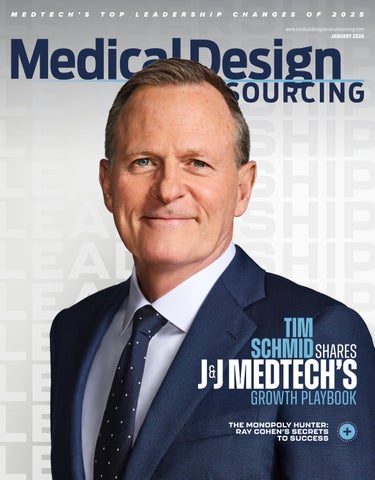
M E D T E C H ’ S
T O P
L E A D E R S H I P
C H A N G E S
O F
2 0 2 5
www.medicaldesignandoutsourcing.com JANUARY 2026
THE MONOPOLY HUNTER: RAY COHEN’S SECRETS TO SUCCESS
PARTNER WITH
FREUDENBERG MEDICAL
COSTA RICA
SECURE YOUR SPOT NOW!
READY TO TAKE YOUR MANUFACTURING TO THE NEXT LEVEL?
SECOND FACILITY
OPEN NOW
• Premier nearshoring destination • Advanced molding and extrusions • Assembly of catheters and finished devices • 86,000 sq.ft. production footprint • ISO Class 7 & 8 cleanrooms • FDA registered, ISO 13485
freudenbergmedical.com/costa-rica
2026_Medical Design & Outsourcing_8.5in_10.875in.indd 1 Freudenberg 1-26.indd 56
29.12.2025 1/14/26 17:27:19 12:00 PM
KeystoneElectric 1-26.indd 56 MD&O K-75 Cat 1-26p.indd 1
1/14/26 12/3/25 12:02 10:45 PM AM
Visit Us at MD&M 2026 BOOTH #2155
Faulhaber 1-26.indd 56
1/14/26 12:00 PM
SECURE YOUR SUCCESS GROWTH SPACE DESIGN QUALITY ASSEMBLY BEARING INNOVATION CONNECTOR SEALS RELIABILITY IDEAS TM
As the inventor of the edgewound wave spring with 100+ years of innovation, here’s why Smalley is The Engineer’s Choice®:
ᘩ 11,000+ standard parts in stock
ᘩ Customizable with No-Tooling-Charges™
ᘩ Trusted performance in 25,000+ applications
ᘩ Award-winning quality backed by leading industry certification
Smalley Wave Springs
ᘩ Same Force, Same Travel as a coil spring
ᘩ Lightweight and compact ᘩ Diameters from .118" to 120" in 40+ materials
Buy Now or Request Samples at smalley.com or Call 847-719-5900 Smalley 1-26.indd 56
1/14/26 12:07 PM
January 2026 • Vol.12 No.1 • medicaldesignandoutsourcing.com
WATCH EDITORIAL
CREATIVE SERVICES
PRODUCTION SERVICES
Editor in Chief Chris Newmarker cnewmarker@wtwhmedia.com
VP, Creative Director Matthew Claney mclaney@wtwhmedia.com
Customer Service Manager Stephanie Hulett shulett@wtwhmedia.com
Managing Editor Jim Hammerand jhammerand@wtwhmedia.com
DIGITAL MARKETING
Customer Service Rep Tracy Powers tpowers@wtwhmedia.com
Senior Editor Sean Whooley swhooley@wtwhmedia.com Editorial Director DeviceTalks Tom Salemi tsalemi@wtwhmedia.com
TUESDAYS
Managing Editor DeviceTalks Kayleen Brown kbrown@wtwhmedia.com
VP, Marketing Annie Wissner awissner@wtwhmedia.com Portfolio Marketing Manager McKenzie Burns mburns@wtwhmedia.com
AUDIENCE DEVELOPMENT
Customer Service Rep JoAnn Martin jmartin@wtwhmedia.com Customer Service Rep Renee Massey-Linston renee@wtwhmedia.com
2014 - 2016
2013 - 2017, 2021
Customer Service Rep Trinidy Longgood tlonggood@wtwhmedia.com
Director, Audience Growth Rick Ellis rellis@wtwhmedia.com
LEADERSHIP TEAM
Audience Growth Manager Angela Tanner atanner@wtwhmedia.com
CEO Matt Logan mlogan@wtwhmedia.com
Ryan Ashdown 216.316.6691 rashdown@wtwhmedia.com
Mary Ann Cooke 781.710.4659 mcooke@wtwhmedia.com
Susan Powers 708.341.3370 spowers@wtwhmedia.com
Jami Brownlee 224.760.1055 jbrownlee@wtwhmedia.com
Mike Francesconi 630.488.9029 mfrancesconi@wtwhmedia.com
Brian Toole 267.290.2386 btoole@wtwhmedia.com
Editor in Chief R&D World Brian Buntz bbuntz@wtwhmedia.com
2011 - 2020, 2024
SALES
DeviceTalks Tuesdays is a weekly virtual event that brings the insights and energy of our in-person events to your desktop.
2014 Winner
2024
Each DeviceTalks Tuesday will kick off with a quick briefing from the editors of MassDevice and Medical Design and Outsourcing. These presentations will give attendees insights on what trends will be moving medtech in the days to come. Be sure to check back frequently as new live events continue to be added.
WTWH Media, LLC 1111 Superior Avenue, Suite 1120 Cleveland, OH 44114 Ph: 888.543.2447 Fax: 888.543.2447
MEDICAL DESIGN & OUTSOURCING does not pass judgment on subjects of controversy nor enter into disputes with or between any individuals or organizations. MEDICAL DESIGN & OUTSOURCING is also an independent forum for the expression of opinions relevant to industry issues. Letters to the editor and by-lined articles express the views of the author and not necessarily of the publisher or publication. Every effort is made to provide accurate information. However, the publisher assumes no responsibility for accuracy of submitted advertising and editorial information. Noncommissioned articles and news releases cannot be acknowledged. Unsolicited materials cannot be returned nor will this organization assume responsibility for their care. MEDICAL DESIGN & OUTSOURCING does not endorse any products, programs, or services of advertisers or editorial contributors. Copyright©2026 by WTWH Media, LLC. No part of this publication may be reproduced in any form or by any means, electronic or mechanical, or by recording, or by any information storage or retrieval systems, without written permission from the publisher. SUBSCRIPTION RATES: Free and controlled circulation to qualified subscribers. Non-qualified persons may subscribe at the following rates: U.S. and possessions, 1 year: $125; 2 years: $200; 3 years $275; Canadian and foreign, 1 year: $195; only U.S. funds are accepted. Single copies $15. Subscriptions are prepaid by check or money orders only. SUBSCRIBER SERVICES: To order a subscription or change your address, please visit our web site at www.medicaldesignandoutsourcing.com/ subscribe-medical-design-outsourcing/
MEDICAL DESIGN AND OUTSOURCING (ISSN 2164-7135), USPS PUBLICATION #20970 is published 6 times per year: (January, March, May, July, September, November) by WTWH Media, LLC, 1111 Superior Ave., Suite 1120, Cleveland, OH 44114. PERIODICALS POSTAGE PAID AT CLEVELAND, OH & ADDITIONAL MAILING OFFICES. POSTMASTER: Send address changes to Medical Design & Outsourcing, 1111 Superior Ave., Suite 1120, Cleveland, OH 44114.
wtwh.me/DTtuesdays 4
Staff page_MDO_1-26_Vs2.indd 4
Medical Design & Outsourcing
1 • 2026
1/14/26 12:15 PM
Steute 1-26.indd 56
1/14/26 12:10 PM
HERE’S WHAT WE SEE
Leadership in Medtech: Authentic and authoritative expertise
A
s I reflect on 2025 and all the medical device industry successes of this past year, I’m overwhelmed. I’m overwhelmed not by these milestones — the first-in-human trials, regulatory approvals, product launches and deals — but by the people who pushed so hard and so persistently to reach them. And I’m thankful that these device designers and engineers, entrepreneurs and executives so often share their stories and what they’ve learned to help other device developers similarly succeed. They give our editors an early look when they’ve got big news to announce. They contribute to the conversation through interviews for our publications, conferences, podcasts and webinars. And they’re not trying to sell devices. They’re offering authentic, authoritative expertise in the spirit of medtech collaboration and innovation. We want to do more. In 2026, Medical Design & Outsourcing will launch new initiatives to build community in the medtech industry while ramping up our efforts to deliver exclusive medical device intelligence and insights. More than ever, we’re committed to connecting you with leading medtech professionals at major OEMs and groundbreaking startups. We’re kicking off the year with our annual Leadership in Medtech issue, featuring interviews with leaders like Tim Schmid at Johnson & Johnson MedTech, Intuitive’s Darla Hutton and medtech entrepreneur Ray Cohen. This issue also includes advice on medtech design and development covering electronics, software, tubing, ultrasound technology, regulatory strategy and nitinol. You’ll learn how medtech developers such as Medtronic, Abbott, Shifamed’s Adona Medical and Peytant Solutions developed novel or improved devices, and hear directly from eye surgeons about the most critical challenges in need of innovation. Beyond this first issue of 2026, we’ll 6
Editorial_1-26_Vs2JH-FINAL.indd 6
Medical Design & Outsourcing
1 • 2026
focus on minimally invasive medtech in March, diabetes and drug delivery in May, and surgical robotics in July, followed by our flagship Medtech Big 100 issue in September, the Women in Medtech issue in October and our Medical Device Handbook in November. Between our magazines, we’ll host live interviews with medtech experts through our webinars and DeviceTalks virtual and live events, and have a steady cadence of special reports planned to keep you informed, inspired and empowered to make the most of new technologies powering cutting-edge devices and systems. And we couldn’t do it without you, the medtech professionals who offer your expertise, attend our events and trust our publications to offer accurate and uniquely relevant information, as well as the suppliers, contract manufacturers and other supporters who sponsor all of these initiatives. We’re all in this together. We’re stronger together. And we’ll keep on saving lives together. As always, I hope you enjoy this edition of Medical Design & Outsourcing. Thank you for reading.
Jim Hammerand | Managing Editor | Medical Design & Outsourcing | jham m era n d @ w t w h me d i a . c o m |
www.medicaldesignandoutsourcing.com
1/14/26 12:16 PM
NO BOUNDARIES, JUST CONNECTIONS CUSTOM CABLE FROM COAST TO COAST
Since 1898, we've partnered with the most innovative companies around the world to solve complex challenges and advance technology. As industry leaders, you can depend on our decades of experience, unrivaled reliability, and custom cable solutions that power technology from coast to coast and around the globe.
New England Wire 3-24.indd 56
Manufacturing Custom Wire & Cable Solutions Since 1898 603-838-6624 • newenglandwire.com Lisbon, New Hampshire USA
1/14/26 12:04 PM
CONTENTS
medicaldesignandoutsourcing.com • January 2026 • Vol. 12 No. 1
DEPARTMENTS 6
HERE’S WHAT WE SEE:
11
ELECTRONICS:
14
IMAGING:
16
OPHTHALMOLOGY:
18
NITINOL:
• • • • • THE LEADERSHIP IN MEDTECH ISSUE
FEATURES
Leadership in Medtech: Authentic and authoritative expertise
36
The importance of ADCs in lowpower electrocardiography ASICs
ON THE COVER TIM SCHMID SHARES J&J MEDTECH’S GROWTH PLAYBOOK
Ultrasound-on-Chip miniaturizes devices and expands access
We sat down with Schmid to discuss spinouts, robots, M&A strategy and how to grow the world’s secondlargest device business faster.
Eye surgeons identify three critical ophthalmology innovation needs This Shifamed startup shares the shape memory secret behind its heart failure implant
46
20 PRODUCT DEVELOPMENT:
How Abbott dialed in the waveform for its Volt PFA system
23
REGULATORY:
27
RESEARCH:
Listening, learning and leading won FDA de novo classification for Peytant Low-intensity ultrasound shows promise for breaking down long COVID microclots
30 SOFTWARE:
Five tips from Philips for building trust in medtech AI
33
8
41
TUBING:
How Medtronic developed OmniaSecure, the world’s smallest defibrillation lead
Medical Design & Outsourcing
TOC_JAN26_Vs1.indd 8
1 • 2026
41 MEDTECH’S TOP LEADERSHIP CHANGES OF 2025 53
DEVICETALKS: Intuitive’s Darla Hutton on the leadership decisions that make women in medtech visible and device designs better
We recap the year’s biggest executive hirings, promotions and departures at Medtronic, Johnson & Johnson MedTech, Intuitive and other device developers.
46 THE MONOPOLY HUNTER: RAY COHEN’S SECRETS TO SUCCESS “Everybody wants to be successful,” Cohen says. “But the question I ask people is, ‘are you prepared to pay the price?’”
www.medicaldesignandoutsourcing.com
1/14/26 2:51 PM
Visit us at Booth 2893 Feb. 3-5, 2026 | Anaheim, CA
End-to-End Engineering Services Testing Services
Biocompatibility & Toxicology
From R&D to Scaled Production
Prototype Molding
YOUR FULL-SERVICE DEVELOPMENT PARTNER
Thermoplastic & LSR Injection Molding
COMPREHENSIVE EXPERTISE: From early-stage product development and biocompatibility testing to scaled production, we provide the full spectrum of engineering, testing, and manufacturing services to ensure a seamless process and faster time-to-market. CUTTING-EDGE CAPABILITIES: With advanced equipment and industry know-how, we offer specialized testing in drug stability, device verification, and biocompatibility services that few labs can match. TAILORED SOLUTIONS: Whether you are a startup or an OEM, our team provides customized consultative support, guiding your product through its entire lifecycle with precision and care.
5368 Kuhl Road, Erie, PA 16510 814-464-0790 | info@psnlabs.com psnlabs.com | psnmfg.com
PSN Labs 1-26.indd 56
ISO 9001 ISO 13485 ISO/IEC 17025:2017
1/14/26 12:06 PM
Full Page_Med Dsgn Outsourceing_2025.pdf 1 7/1/2025 10:00:48 AM
Impossible There is a lot we make possible... it’s all because we are unmatchable!
C
M
Y
CM
World Leaders in Micro-Mold Manufacturing Solutions ®
MY
CY
CMY
K
accu-mold.com Accumold 9-25.indd 56
®
1/14/26 11:58 AM
ELECTRONICS
The importance of ADCs in lowpower electrocardiography ASICs
By Ian Lankshear EnSilica
Standard ADC components seldom provide enough flexibility to meet the conflicting needs of today’s medical designs.
E
(ABOVE) Apple won FDA de novo classification for the Apple Watch ECG app and irregular heart rhythm notification in 2018. Photo courtesy of Apple
Images courtesy of MicroCare
Electronics_1-26_Vs3.indd 11
lectrocardiography (ECG) plays a central role in both diagnostic and ongoing health monitoring. This is especially true for wearable and implantable medical devices as they become more mainstream. As device requirements for power consumption, size, and signal quality grow stricter, many engineers are turning to application-specific integrated circuits (ASICs) to meet these demands. Within these ASICs, the analog-to-digital converter (ADC) must be carefully optimized for power efficiency, resolution, and noise control. In the first article of this two-part series, we’ll offer an overview of ECG systems, lead generation and how channel count affects ADC selection. In the second article, we’ll look at the principal trade-offs engineers face when choosing and refining ADCs for ECG ASIC design, providing context for tailoring these parameters to each use case. www.medicaldesignandoutsourcing.com
ECG waveform characteristics An ECG records the heart’s electrical activity, mapping out depolarization and repolarization events in the atria and ventricles. These signals tend to be quite subtle, as most frequencies are under 150 Hz. A standard ECG waveform has several distinct segments, each offering its own clinical insights. The P wave shows atrial depolarization. It is small (<0.25 mV) and low frequency. The QRS complex indicates ventricular depolarization and includes Q wave (initial negative deflection), R wave (the tallest, positive spike), and the S wave (negative deflection following the R wave — this segment carries most of the waveform’s energy and the highest frequency content, up to 150 Hz). Finally, the T wave (representing ventricular repolarization) is broader and smoother than the QRS complex. (continued on page 13) 1 • 2026
Medical Design & Outsourcing
11
1/14/26 12:24 PM
Critically Clean Critically Compliant Critically Covered
From Design to Manufacturing, to Reprocessing.
WE HAVE YOU COVERED SCAN TO LEARN MORE
High-Performance Cleaning, Coating and Lubricating for Medical Devices and Instruments MicroCare.com
Follow Us!
Come visit us to learn more!
MicroCare, LLC
Toll Free: 1 800 638 0125 Email: TechSupport@MicroCare.com
ISO 9001:2015 Registered © 2026 MicroCare, LLC. All Rights Reserved. “MicroCare”, the MicroCare logo, MicroCare Medical, “Tergo”, “DuraGlide”, “Swellex” and “Spec Clean” are trademarks or registered trademarks of MicroCare, LLC.
MicroCare 1-26.indd 56
BOOTH# 558 1/14/26 12:03 PM
ELECTRONICS
This illustration of a standard ECG waveform shows labelled intervals that serve as reference points in clinical and veterinary practice. Image courtesy of EnSilica
Intervals and durations such as the PR interval, QRS duration, and QT interval are key diagnostic markers. The specific shape of an ECG means that much of the clinically valuable information is found in short, well-defined periods. This makes adaptive sampling a practical strategy for conserving power, as most of the signal’s energy is concentrated around the QRS complex. The remainder of the ECG trace tends to be flatter, with lowfrequency sections.
Channels are the output traces generated by the ECG system. Each channel corresponds to one lead shown on the screen or paper. For example, a three-channel Holter monitor might display three leads at once (e.g., II, V1, V5). A 12-lead ECG uses 10 electrodes but computes 12 distinct leads mathematically and displays them across 12 channels. These distinctions help clarify how raw electrode signals become clinically meaningful ECG traces and highlight the importance of clear terminology and system design.
Leads, channels and electrode placement To make sense of an ECG system, it helps to understand the difference between electrodes, leads, and channels. Electrodes are the physical contact points placed on the skin. These stickers, clips or patches pick up the tiny voltage changes caused by the heart’s electrical activity. Leads are representations of the heart’s activity, formed by comparing electrical signals from two or more electrodes. A lead is not an electrode itself, but a derived voltage difference. In humans, the classic Einthoven’s triangle is formed by Lead I (left arm minus right arm), Lead II (left leg minus right arm), and Lead III (left leg minus left arm). In veterinary medicine, the same approach applies, though electrode placement is adapted to suit different animal anatomies, such as dogs recorded while lying on their side or horses using a base-apex configuration.
Lead generation methods Different approaches can be used to generate ECG leads, each providing a slightly different view of cardiac activity: Bipolar leads (Einthoven’s) measure potential differences between limb electrodes. Augmented leads (Goldberger) use a single limb electrode referenced against the average of the other two. Precordial leads (Wilson) use chest electrodes referenced to a limb average and are adapted for different species in veterinary applications. Special leads include vectorcardiographic or base–apex configurations, particularly for large animals. For ASIC designers, the number of ADC channels determines hardware complexity, while the number of leads is a matter of signal processing and mathematical recombination. Efficient multiplexing and fast ADC settling are essential for reconstructing multiple simultaneous leads when channel availability is limited.
(continued from page 11)
www.medicaldesignandoutsourcing.com
Electronics_1-26_Vs3.indd 13
Impact of channel count on ADC selection The number of channels in an ECG system directly influences the ADC requirements. In single- or dual-lead systems such as wearables and fitness monitors, one or two ADC channels are typically sufficient, requiring moderate resolution (10–12 bits) and ultra-low power operation. As channel count increases, for example, in five-lead telemetry or full 12-lead diagnostic ECG, the system complexity grows considerably. More channels require either several ADCs running in parallel or a single ADC capable of high-speed multiplexing with minimal settling delay. High-resolution incremental sigma-delta (∑Δ) ADCs are especially well suited to this task, offering flexible trade-offs between noise performance and conversion time. This makes it possible to digitize each channel under optimized conditions using just one ADC core. For advanced applications such as diagnostic ECG or fetal ECG, where signal amplitudes may differ by more than an order of magnitude, the ADC needs to provide both a high effective number of bits (ENOB) and a broad dynamic range to capture small signal details accurately and without distortion. Since both power consumption and data bandwidth increase with the number of channels, modern ECG ASICs tend to integrate front-end filtering and on-chip digital signal processing (DSP) that compress or preprocess signals before transmission. Choosing a suitable ADC architecture — one that aligns with the electrode configuration, resolution, and sampling rate — remains fundamental for achieving the best mix of performance, energy efficiency and silicon area in multi-channel ECG designs. Read more about that in our second article at wtwh. me/adcdesign. Ian Lankshear is co-founder and CEO of EnSilica, with prior experience in radar systems development at Siemens Plessey Systems and then semiconductor development at Hitachi and Nokia. Lankshear holds a first-class honors degree in electrical and electronic engineering. 1 • 2026
Medical Design & Outsourcing
13
1/14/26 4:16 PM
IMAGING
Ultrasound-on-Chip miniaturizes devices and expands access Butterfly Network co-founder and Chief Innovation Officer Nevada Sanchez explains the MEMS-on-CMOS device miniaturization breakthrough.
This image shows the Ultrasoundon-Chip mounted at the head of the Butterfly iQ+ probe with the protective rubber lens and aluminum shroud removed. Beneath the top membrane of the chip are thousands of microscopic drums that form the ultrasonic transducers of the chip, and below them are all of the front-end electronics. Image courtesy of Butterfly Network
T By Nevada Sanchez Butterfly Network
Butterfly Network co-founder and Chief Innovation Officer Nevada Sanchez developed the Ultrasoundon-Chip technology behind the Butterfly iQ, the world’s first handheld whole-body ultrasound system, and was previously a software engineer at Microsoft, Nvidia and Lockheed Martin. He holds degrees in electrical engineering and computer science, math and physics from MIT, where he won a Hertz Fellowship and the Henry Ford II Scholar Award. 14
Medical Design & Outsourcing
Imaging_1-26_Vs2-JH-FINAL.indd 14
1 • 2026
he single most transformative enabler of ultrasound miniaturization is the integration of microelectromechanical system (MEMS) ultrasound transducers directly onto a complementary metal-oxidesemiconductor (CMOS) platform, also known as Ultrasound-on-Chip. While ultrasound once required crystals and a full motherboard, this has been replicated and miniaturized onto a silicon transducer roughly the size of two postage stamps. This new approach results in significantly smaller ultrasound devices without compromising image quality or functionality. Moreover, it enables improved versions of the form factors such as handhelds, wearables, catheter tips and embedded sensors in robotic platforms. Redefining ultrasound through silicon integration The Butterfly Network platform is built on a mixed-signal, application-specific, integrated circuit architecture that tightly unifies analog front ends, analogto-digital converters, beamforming
engines, and digital interfaces. This semiconductor-centric approach reduces size, weight and power while enhancing scalability and reliability through standard semiconductor manufacturing processes. Historically, ultrasound systems have been hindered by bulky connectors and approximately 100 wires required to transmit signals between the probe and system. Alternatively, the Ultrasound-onChip consolidates up to 9,000 individually controllable elements directly onto a single, monolithic semiconductor die. This die integrates capacitive micromachined transducer elements, including signal processing, multiplexing, and digitization, which eliminates the inconvenient connectors by leveraging a custom MEMS-on-CMOS process. This process simultaneously reduces analog parasitics and enables element-level programmability. New architecture for precision and scale Adopting a mixed-signal approach early in the design process was essential for successful miniaturization. This approach refers to the integration of both analog
www.medicaldesignandoutsourcing.com
1/14/26 12:29 PM
and digital circuitry, often implemented as separate circuits within a single system. Traditionally, analog and digital functions are spread across multiple chips, resulting in inefficiencies, increased complexity, and longer latencies. By integrating both analog and digital processing onto the singular die, the Ultrasound-on-Chip technology deviates from this standard model and enables capabilities that would be otherwise impossible. This unified architecture combines signal conditioning, digitization and digital logic to enable aggressive size reduction without compromising performance. Rethinking the device’s architecture directly improved the end-user experience for both clinicians and patients. Handheld ultrasound systems are compact enough to fit in a lab coat pocket and power-efficient enough for the battery to last through a full clinical shift. Integrating more processing capability into the device’s chip enables even more streamlined and efficient designs. Portable ultrasound wands make it easier to serve patients in rural communities or anywhere else with limited access to medical imaging. Miniaturization also lowers device cost enough to support expansive deployment while retaining imaging quality. A single device can be used to scan multiple organ systems, eliminating the need for multiple probes or platforms. Achieving this level of portability, performance, and affordability without Ultrasoundon-Chip integration would require insurmountable trade-offs. Instead, this approach opens the door and expands the role of ultrasound well beyond the traditional cart. As such, portable ultrasound is becoming common in medical practices worldwide. Design trade-offs and thermal realities True portability is achieved by designing devices with in-situ digitization and minimizing reliance on analog signal paths. Reducing the number of interconnects decreases size and weight and enhances the overall reliability of the product. However, interconnect bottlenecks contribute significantly to the bulk of ultrasound systems and need to be addressed to enable compact designs. Moving to a single-chip framework may alleviate portability issues, but
it introduces new design constraints, particularly those related to thermal management. With high-density processing and transduction occurring on such a compact silicon die, localized heat generation poses a challenge to thermal performance. Ensuring low-power operation across all functions requires careful circuit-level optimization. Butterfly employs strategies such as duty cycling, power distribution, and thermal-aware software controls to prevent the chip from overheating. Managing heat effectively without compromising performance or introducing connectivity issues is crucial for maintaining image quality and ensuring dependable scanning practices. Why wafer-level integration is the final frontier in device miniaturization Finally, whenever possible, pursue waferlevel integration. Wafer-level integration provides advantages in terms of
manufacturing efficiency, reliability, and cost. Leveraging the mature, highthroughput processes of semiconductor fabrication facilities makes it possible to address product challenges at scale. This approach further consolidates functionality, simplifies assembly, and supports scalability for high-volume manufacturing of miniaturized devices. However, many companies underestimate the complexity of creating a process that is both robust and scalable for high-volume production. Solving the MEMS-on-CMOS integration problem was the core technical issue that the Ultrasound-on-Chip had to overcome and is what ultimately enabled the transition from a promising concept to a profitable, high-performing product. The beauty of Ultrasound-on-Chip is that it doesn’t just shrink the device. It also expands the possibilities of where and how medicine is practiced, ultimately to help improve health outcomes.
S H O CK
T ION SO A R B I V &
NEED TO REDUCE VIBRATION & SHOCK? We Have A Solution for That! 800.838.3906 | sorbothane.com
Medical Design & Outsourcing
MADE IN THE U.S.A.
15 Sorbothane_DesignWorld_Ad_B.indd 1
Imaging_1-26_Vs2-JH-FINAL.indd 15
S LUTION
1/4/24 9:15 AM
1/14/26 12:29 PM
OPHTHALMOLOGY
Eye surgeons identify three critical ophthalmology innovation needs Three members of BVI’s U.S. Surgical Leadership Council share where they see great potential for improvements in eye care. By Andy Chang BVI Chief Commercial Officer and members of the U.S. Surgical Leadership Council
T
he future of ophthalmic innovation is shaped not only by technology, but by the people who use it every day to transform lives. That’s why BVI created the U.S. Surgical Leadership Council (SLC), a group of leading surgeons committed to elevating surgical standards, addressing unmet clinical needs, and accelerating meaningful innovation across the spectrum of eye care. Each member of the SLC brings a unique perspective from the front lines of ophthalmic surgery. As practicing physicians and recognized thought leaders, they play a vital role in helping us anticipate what’s next and ensure that the solutions we deliver are built for real-world impact. In partnership with our industry peers and clinical collaborators, we’re proud to serve as an active agent of progress in ophthalmology.
BVI’s R-Evo Smart phaco machine in an operating room Photo courtesy of BVI
16
Medical Design & Outsourcing
Ophthalmology_1-26_Vs3.indd 16
1 • 2026
Below, three members of our U.S. Surgical Leadership Council — Dr. Robert Weinstock, Dr. Vance Thompson, and Dr. George Waring — discuss their thoughts on where innovation is most needed and where it has the potential to make the greatest difference over the next several years. The need for integration and true accommodative lenses By Dr. Robert Weinstock, director of cataract and refractive surgery at the Eye Institute of West Florida Over time, innovation in ophthalmology has largely been incremental. While we’ve seen an expansion in diagnostic and surgical tools, the result is a fragmented ecosystem of technologies from multiple manufacturers, many of which don’t communicate with one another. Today’s reality in both the clinic and operating room is a patchwork of standalone systems, with biometry, topography and OCT devices on one end, and femtosecond lasers, phaco machines and intraoperative microscopes on the other. What’s missing is seamless integration, including single platforms that consolidate these technologies into efficient, cost-effective solutions. That kind of innovation would significantly enhance workflow, reduce space and staffing needs, and improve patient outcomes. Another major gap is the lack of a truly accommodative intraocular lens. While we’ve made strides with multifocal and extended depth-of-focus lenses, we’re still cheating Mother Nature. The holy grail of lens-based
www.medicaldesignandoutsourcing.com
1/14/26 4:20 PM
vision correction — restoring full accommodation after cataract surgery — remains an unmet need. Achieving this would redefine what’s possible in lens replacement procedures. Infusion pressure: An overlooked challenge in cataract surgery By Dr. Vance Thompson, founder of Vance Thompson Vision and University of South Dakota professor of ophthalmology In modern cataract surgery, one of the biggest under-recognized issues is the excessive use of infusion fluid and pressure. This can stress intraocular tissues like the corneal endothelium and lead to vitreous hydration, often dragging lenticular debris into the vitreous. >> If I could improve one technology, it would be a fluidics system that limits infusion volume and pressure. Addressing this would make cataract surgery gentler, safer and more protective of the delicate internal structures of the eye. Looking ahead, I believe roboticassisted cataract surgery powered by artificial intelligence to precisely control infusion and other key parameters could become one of the most impactful innovations of the next five years. Such a system would offer real-time checks and balances to make surgery more consistent, efficient, and tissue-sparing. Presbyopia: the next frontier By Dr. George Waring, founder and medical director of the Waring Vision Institute
Harness our leading-edge vacuum technology . . . because lives depend on it.
Medical Vacuum Heat Treating Services Annealing • Stress Relieving • Aging • Brazing • Solution Treat and Age (STA) Harden and Temper • Diffusion Bonding Your high-value medical parts need special treatment. Solar’s leading-edge vacuum heat treating technology produces clean, bright, consistent results. From annealing to age hardening, rest assured knowing your life-critical parts were vacuum heat treated to your exact specs.
Presbyopia is a global epidemic, with more than 4 billion affected eyes and counting. As our population ages, the demand for surgical solutions is growing rapidly. It’s already the fastest-growing segment of our practice. Yet, there is currently no intraocular lens (IOL) approved specifically for the surgical management of presbyopia. This presents a major unmet opportunity. An IOL indicated for lens dysfunction, not just cataract, would unlock new pathways for industry investment, regulatory approval and broader patient access. With the right product and indication, we could see exponential growth in presbyopia-correcting surgery and finally bring meaningful relief to this large patient population.
For your prosthetics, guide wires, stents, surgical tools, device and battery cases, hypodermics and hypodermic tubing, brazements for analytical devices...and more, trust Solar Atmospheres to provide you with uncompromising quality.
1-855-WE-HEAT-IT solaratm.com
Eastern PA • Western PA • California • South Carolina • Michigan • San Diego
Medical Design & Outsourcing
Ophthalmology_1-26_Vs3.indd 17
17
1/14/26 12:38 PM
NITINOL
This Shifamed startup shares the shape memory secret behind its heart failure implant Adona Medical co-founder Brian Fahey explains how his novel nitinol implant can be safely adjusted inside a patient. Adona Medical cofounder and former CEO Brian Fahey
W
hen we first interviewed Adona Medical co-founder and thenCEO Brian Fahey in 2023, the Shifamed startup’s use of shape memory nitinol had obvious potential, even if he wouldn’t explain exactly how the new heart failure technology worked for competitive reasons. But we recently reunited near his company’s Los Gatos, California headquarters at DeviceTalks West in October 2025 to discuss the latest from the Adona team’s efforts to develop and commercialize their Delphi adjustable interatrial shunt. “It’s noncontact heat. That’s the key thing,” Fahey said. “That’s probably the most important thing that we’ve developed.”
By Jim Hammerand Managing Editor
Adona Medical’s Delphi adjustable heart shunt implant is shown here with a quarter for scale. Photo courtesy of Adona Medical
18
Medical Design & Outsourcing
Nitinol_1-26_Vs3.indd 18
1 • 2026
Many medical devices use nitinol for its superelastic properties, including cardiac implants for replacing or repairing heart valves, therapeutic catheters for cardiac ablation and renal denervation, and even a new intrauterine device (IUD). Superelasticity allows a nitinol device to spring back to its shape after being squeezed into a catheter and into a patient. Shape memory, on the other hand, uses shape-setting to form a nitinol device in a particular geometry that it can return to after it’s been deformed by force. The shape-setting process during manufacturing uses heat, and so does the process to trigger that shape memory and return a nitinol device to its predetermined shape. Adona Medical uses shape memory nitinol to adjust the size of its novel Delphi interatrial shunt any time after implantation. “We can make it bigger, we can make it smaller, and we can go back and forth thousands of times if we really needed to,” Fahey said. “That lets you dial in the size of the hole that you need for that particular patient. You’re no longer moving at one-size-fits-all medicine. And that hole may change over time, so you can then follow the patient.” Adona’s nitinol Delphi Shunt device is coated with ePTFE (expanded polytetrafluoroethylene) and has sensors that capture pressure readings from the left and right atria multiple times each day. The Delphi Shunt was implanted in the first human patient in October 2024. Adona completed enrollment for that first-in-human trial in June 2025 with ten patients and 100% procedural success.
www.medicaldesignandoutsourcing.com
1/14/26 2:49 PM
Adona Medical’s Delphi interatrial shunt is adjusted after implantation using an induction catheter to heat the shape memory nitinol. Illustration courtesy of Adona Medical
Of the nine patients who returned for follow-up, Adona said all of the implants were able to be adjusted to increase and/or decrease the size of the flow channel months after implantation. But how do they apply enough heat to trigger shape memory nitinol inside a patient without cooking them? First, Adona uses a proprietary shape memory nitinol formulation and manufacturing process, Fahey said.
Nitinol_1-26_Vs3.indd 19
“I believe we’re the only company in the world using [it, and it] probably took us the better part of a year to figure out,” he said. “But now that we have it, it’s really got a lot of utility [as a] platform technology.” After implantation, heat is delivered to the shunt in the form of electromagnetic energy, similar to wireless charging of a smartphone, he said. “We’ve got a catheter that is inductively coupled to our implant when it’s placed close to it [and] heats our implant from the inside out,” Fahey said. “The part that actually gets hot is targeted. It’s below several layers of thermal insulation.” The patient’s blood recirculating inside their heart acts as a quench for the heat, he said. “You just need to make sure the heat is wicked off by the circulating blood in the heart faster than it can diffuse through your thermal insulation. The targeting makes a big difference.” Adona Medical makes all of its catheters in-house, Fahey said. “We
have braiders, we have laminators. We don’t do extrusions, we don’t make our own raw materials, but we do everything else in-house.” And he offered advice to inspire and empower other device developers to take risks. “Don’t be scared of a huge project or a big swing. … An easier project oftentimes will be just as hard, but for different reasons. At the end of the day, if you’re struggling but you’re trying to solve a really hard, ambitious problem, I think for a lot of us that’s an easier struggle to deal with emotionally than [a different struggle like] figuring out paperwork. “Don’t be scared of big stuff,” he continued. “Take a big swing. Aim for it. People generally will applaud that level of ambition. Incremental innovation really doesn’t move the needle for the world. There’s nothing wrong with it. Our society benefits from it. But there’s nothing wrong with taking a big swing once in a while.”
1/14/26 12:45 PM
PRODUCT DEVELOPMENT
How Abbott dialed in the waveform for its Volt PFA system Abbott’s top electrophysiology doctor discusses the Volt’s development, lessons learned from first-gen systems and new challenges.
T
he Abbott Volt pulsed-field ablation (PFA) system wasn’t the first such system approved for treating atrial fibrillation (AFib), but that allowed the device developer to implement some design and engineering lessons from the first wave of PFA devices before securing its CE mark in March 2025 and then FDA approval in December 2025. “When I look at first-generation devices, we have taken a deliberately very different development path, especially for the waveform — the recipe of the energy,” Dr. Christopher Piorkowski, the chief medical officer of Abbott’s electrophysiology division, said in a Medical Design & Outsourcing interview when announcing the European approval. “All the other devices out there have developed a couple of waveforms, tested them and went into human clinical use,” he continued. “Our approach was fundamentally different. … Volt has a very different development path and very different expected performance and actually observed performance in the field compared to first-generation devices, just by the way we designed the waveforms on the catheter.”
The Abbott Volt pulsedfield ablation (PFA) catheter features a balloonin-basket design and eight nitinol splines. The system won FDA approval in December 2025. Image courtesy of Abbott
By Jim Hammerand Managing Editor 20
Medical Design & Outsourcing
ProductDev_1-26_Vs3.indd 20
1 • 2026
The biological effects of PFA PFA generates an energy field to kill heart muscle cells and isolate erratic signals without causing damage to nearby nerve cells. PFA’s biological effects aren’t yet fully known, and researchers are studying how PFA forms lesions and in what sizes, shapes, depths and durability. PFA safety is also in the spotlight, with potential side effects including hemolysis, bubble formation, coronary spasm and skeletal muscle recruitment. “All these are biological effects of the energy source and these effects should go into the design and the selection of the recipe of the waveform,” Piorkowski said. “That is what we have done in our waveform and our technology development. Our engineers are at the forefront of understanding the variety of these biological effects in the PFA world.” Hemolysis, for example, is “something we are not worried about at all” at Abbott, he said. “We have scientific publications from the CE mark trial [showing] we have no clinical relevant hemolysis, and that is attributable to the waveform design.”
www.medicaldesignandoutsourcing.com
1/14/26 12:53 PM
“Another example is skeletal muscle recruitment,” he continued. “When you look into the first-generation devices, there’s a lot of skeletal muscle recruitment, and the only way the physician can handle these procedures is by using general anesthesia and very deep sedation to keep the patient calm and keep the catheter stable at an intended ablation target site, because if there’s a lot of skeletal muscle recruitment, the catheter flies away and the lesion is not good. There are potentially adverse events, and that is not something that is desirable. We took out this aspect of significant skeletal muscle recruitment, and we have seen in our clinical studies that it works well. It works as intended. And now going forward, we will produce more scientific evidence on that beneficial aspect of our Volt catheter.”
The Abbott Current PFA generator Image courtesy of Abbott
The dangers of heat in nonthermal PFA PFA is considered nonthermal ablation because it kills heart muscle cells through electroporation (opening holes in the cell walls) rather than an application of heat with radiofrequency (RF) ablation or freezing temperatures with cryoablation. But PFA devices can have thermal effects. Johnson & Johnson MedTech recalled its Varipulse PFA catheters after an unusually high rate of strokes in patients, and warned after an investigation that those catheters can generate dangerous heat if not used as instructed. “It is not that RF and PFA are two strictly separated worlds of ablation,” Piorkowski said. “Both are electrical therapies, and there’s significant overlap between these two modalities. It is very easy to create PFA waveforms that have a heavy thermal footprint. And if you see applications where physicians are mandated to wait an extended time between individual PFA applications, you always have the suspicion there’s a thermal footprint at play and that the waiting time is also used to allow cooling down of the tissue.” He said that’s not the case with the Abbott Volt waveform, and that the system was subject to more regulatory scrutiny on that front than first-generation PFA devices. “When we started to enter the clinical trials and when we were in discussions with the various regulatory bodies, a lot of learning has happened on the side of the regulatory bodies, and they became aware of of these potential thermal footprints and introduced new testing. [It] wasn’t there for the first-generation devices, but they introduced it for us where we really needed to document that we have no thermal footprint,” he said. One test required the development team to deliver 70 pulses at high repetition in the same spot from the same electrode without a temperature increase in the tissue, he said. “That was essentially a proof point that there is not a thermal footprint in our waveform design and this is really a nonthermal therapy.” How Abbott dialed in the waveform for the Volt PFA system Piorkowski declined to divulge details of Abbott’s proprietary PFA waveform, but discussed the technology and its development in general terms. “A waveform consists of multiple pulses and pauses between the pulses,” www.medicaldesignandoutsourcing.com
ProductDev_1-26_Vs3.indd 21
Abbott Electrophysiology Chief Medical Officer Dr. Christopher Piorkowski he said. “We have to be very humble. Today we understand very little about the cellular effects of these different waveforms in terms of stunning, durable lesions, permanent cell death, etc. And therefore our approach was a very different one. Since we we did not know these cellular mechanisms but we wanted to create a waveform that serves our needs, we did a large empiric testing. So basically, for every biological effect — for lesions, but also for bubbles, for hemolysis, etc. — we developed an individual testing environment in preanimal models and in animals and then ran hundreds of waveforms through these testing stations and studied the outcome in terms of biological effects. And now we almost have a library of waveforms where we very clearly understand what these waveforms do on a biological level.” “I personally attended a couple of these experiments,” he continued, “and it was deeply humbling to see if just the pause between trains is changed by two or three milliseconds, suddenly the waveform has a very different behavior — makes way more arrhythmias, way more hemolysis — and it’s only a minimal change and no one can explain why this is happening. Therefore, we took an empiric approach, and I think that was successful.” Researchers tweaked the waveform parameters — the duration of the pulses, the pauses between the pulses, the number of pulses, polarity of the pulses — and found that hemolysis is “critically influenced by the waveform” (as well as other factors of device design, which we’ll cover later in this series). Waveform is also a factor in the formation of char and microbubbles during PFA. “Something that was very surprising to me as well [was] how much the microbubble performance changes depending on the waveform,” Piorkowski said. 1 • 2026
Medical Design & Outsourcing
21
1/14/26 12:53 PM
Rochester Electric 1-26.indd 56
1/14/26 12:06 PM
The AMStent System combines a minimally invasive delivery catheter with a self-expanding nitinol stent covered in a decellularized human amnionic membrane (DCAM). The DCAM, primarily composed of extracellular matrix (ECM) common to all human tissue, is intended to minimize the body’s natural foreign body response. Photo courtesy of Peytant Solutions
Listening, learning and leading won FDA de novo classification for Peytant Peytant Solutions CEO John Schorgl explains how proactive engagement, disciplined teamwork, and data-driven strategy turned a complex FDA marketing application into a lasting market advantage. By John Schorgl Peytant Solutions
B
ringing a truly novel medical device to market is not for the faint of heart. The FDA’s de novo classification process, designed for low- to moderate-risk devices without a predicate, offers enormous opportunity if granted, but requires vision, patience, and precision to execute. At Peytant, we recently completed this journey with our AMStent Tracheobronchial Covered Stent System, a catheter-delivered nitinol stent covered with an amnion-derived material, indicated for use in the treatment of tracheobronchial strictures produced by malignant neoplasms in adult patients. Achieving regulatory grant via a de novo pathway was a multiyear effort that taught us hard but valuable lessons about leadership, strategy, and collaboration.
www.medicaldesignandoutsourcing.com
Regulatory_1-26_Vs3.indd 23
Treat the FDA as a partner, not an opponent Understand that regulatory success depends on partnering with the FDA, not simply complying with it. We share a common goal of safe and effective treatments for patients. We called on the agency early and often, sharing data, asking questions, and being transparent about our rationale. This approach built trust and accelerated progress. We also designated a single official correspondent (our external regulatory lead, Lisa Pritchard of DuVal & Associates) to manage all communication with the FDA. That continuity was essential. Over a multiyear process, FDA staff can change and discussions can be hard to remember, but with one credible, >> 1 • 2026
Medical Design & Outsourcing
23
1/14/26 10:12 PM
REGULATORY
well-prepared liaison, communication is more productive and efficient for both sides. Build a cross-functional, disciplined team De novo submissions demand a staggering number of deliverables. Ours required more than 200 documents across engineering, regulatory, quality, clinical, and operations. A well structured, cross-functional team led by a highly skilled project manager is vital to the journey. Our team held disciplined weekly meetings to drive decisions, track progress and hold ourselves accountable. Our location in Minnesota’s Medical Alley boosted our chances of success. The Minneapolis–St. Paul region’s deep medtech expertise and collaborative culture gave us access to exceptional talent and experienced partners. One investor even told us, “I invested in Peytant because you’re in Minneapolis.” That environment helped us assemble and sustain the right team to take a complex product through the equally complex de novo process. Be strategic and proactive From day one, we developed a regulatory strategy that aligned with our business goals. Our first step was filing a traditional 510(k), even knowing there were still some issues to be resolved. Doing so forced the FDA to clarify our regulatory pathway and requirements, with FDA eventually stating that a de novo pathway would be preferred. That early stake in the ground saved time and money. Take initiative, propose solutions, and be ready to adapt as the FDA shows the way forward. The FDA’s regulatory structure is designed to manage complexity across a broad range of product types. It is organized into specialized centers: the Center for Devices and Radiological Health (CDRH) regulates medical devices and radiation-emitting products; the Center for Biologics Evaluation and Research (CBER) oversees biological products such as vaccines, blood, and human tissue; and the Center for Drug Evaluation and Research (CDER) governs prescription and over-the-counter drugs. Because many modern therapies blend these categories, the Office of 24
Medical Design & Outsourcing
Regulatory_1-26_Vs3.indd 24
1 • 2026
FDA required rigorous pre-clinical testing to support Peytant’s submission for its AMStent System, the first and only catheterdelivered stent covered with human-sourced amniotic membrane. Photo courtesy of Peytant Solutions
Developed with interventional pulmonologists and thoracic surgeons, the AMStent System (shown here during assembly) is engineered to treat tracheobronchial obstructions from cancers. Photo courtesy of Peytant Solutions
Combination Products (OCP) plays a coordinating role across these centers. OCP assigns primary jurisdiction based on a product’s primary mode of action — whether it functions mainly as a device, drug, biologic or combination of those — and facilitates collaboration when classification is unclear. This structure allows the FDA to adapt to emerging technologies while maintaining regulatory consistency. One challenge we faced was the uncertainty of our classification within this jurisdiction system. Would our AMStent System be considered a device, a biologic, or a combination of the two, and which agency would have primary jurisdiction? CDRH told us that the amnionderived biomaterial covering on our stent was a novel material that had not previously been used for this
type of device. We were able to support the submission with published research articles on human amnion, including NIH-supported studies, and prior FDA review of other devices using human biomaterials. Our proactive advocacy and preparedness kept us on track. This dialogue focused the agency on our specific use of amnion. The discussions around amnion triggered an inter-agency meeting involving the head of the OCP and representatives from CBER and CDRH to more closely examine our device. Ultimately, OCP asserted full oversight and assigned the AMStent to CDRH for review as a device, not a biologic or a combination product. This meant CDRH would have sole jurisdiction and enabled us to move forward with clarity.
www.medicaldesignandoutsourcing.com
1/14/26 12:58 PM
Know when to push and when to pivot FDA required an animal study to support our submission. When such requirements are issued, the instinct is to argue, but that can cost precious time and capital. Instead, we acknowledged, adjusted, and moved forward. Those early animal tests paid dividends later, generating data (38 claims reviewed by the FDA) we now reference for marketing and scientific papers. Keep detailed records and listen closely Every conversation with the FDA should be documented. The notes become your playbook when questions resurface months later. Just as important: listen between the lines. FDA reviewers often make subtle but crucial comments that can make or break a submission. In one meeting, for instance, a reviewer suggested we avoid describing our technology as a biologic and refrain from touting any regenerative benefits. They were signaling how to frame our story. By actively listening, we understood the guidance, adjusted our positioning, and kept the process moving. We also learned the importance of responding to FDA requests with specific testing protocols. Those aren’t required, but are helpful to gain critical alignment to sustain progress. Responding to an FDA request by outlining a protocol and presenting it to the agency helped gain alignment before moving forward, allowing us to drive the direction and extent of testing. For example, FDA requested a 90-day animal study. But we were working with pigs who don’t live that long when they have a pulmonary obstruction, so we documented and countered with a 30-day test as part of our protocol. This provided documentation to reference if a roadblock occurred along the way. The protocol “agreement” between the parties became a powerful tool. Culture Is everything Finally, none of this would have been possible without a culture of respect, collaboration and perseverance among the Peytant team. People must get along, communicate clearly and stay focused on shared goals. That culture — combined with technical rigor and the rich Medical Alley network — allowed a small, determined team to succeed when faced with challenges and bureaucracy that often stall innovation. The de novo process is demanding, but for those willing to actively partner with the FDA, plan strategically, and stay disciplined, it can yield an enduring competitive advantage beyond approval. At Peytant, it transformed us from a startup with a vision into a company defining a new category of care. John Schorgl is co-founder and CEO of Peytant Solutions, a medical technology company whose mission is to restore the structure and/or function of all lumens. Peytant’s AMStent System is the first step toward transforming the treatment of luminal diseases. 1 • 2026
Regulatory_1-26_Vs3.indd 25
Medical Design & Outsourcing
QUIET MOTORS REDUCE STRESS Diagnostic imaging should be seen and not heard MedTech equipment manufacturers demand that their motors not only run flawlessly, but also silently. That’s why you’ll find quiet Bodine Electric motors in CT scanners, mammography systems, blood collection centrifuges, and x-ray patient beds. If a patient’s peace of mind while using your equipment is important, then you need a Bodine. Learn how a quiet-running Bodine motor made mammography a little less stressful. bodine-electric.com | Peosta, IA USA | 773.478.3515 (USA)
25
1/14/26 2:53 PM
STOCK SPRINGS
YOU NEED IT.
WE HAVE IT.
25,000+
Stock
Springs
leespring.com • 888-SPRINGS (888-426-6655) • sales@leespring.com 140 58th St. Unit 3C, Brooklyn, NY 11220, USA
Lee Spring 1-25.indd 56
1/14/26 12:03 PM
RESEARCH
Low-intensity ultrasound shows promise for breaking down long COVID microclots Researchers are studying lowintensity focused ultrasound for noninvasive disruption of amyloid fibrinogen microclots. Openwater’s modular OpenLIFU device delivers the same kind of ultrasound technology as in the microclots study and is available for clinical research into other disease applications. Image courtesy of Openwater
By Aaron Timm Openwater
F
or patients suffering from long COVID, symptoms such as severe fatigue, memory lapses, and ongoing shortness of breath can persist for months or even years. One leading theory points to stubborn amyloid fibrinogen microclots that block blood flow and trigger inflammation. Now, new preclinical research suggests low-intensity ultrasound may provide a noninvasive way to break these microclots apart, laying the groundwork for future clinical studies. Amyloid fibrinogen microclots, which have been linked to long COVID, have also been identified in other chronic inflammatory conditions. Due to their size, these protein clusters circulate through small blood vessels where they block blood flow, limit oxygen and trigger inflammation. They’ve withstood existing clot-busting treatments such as blood filtration and drugs like recombinant tissue plasminogen activators (rtPA), both of which can carry significant patient risks. While this recent study was performed using preclinical laboratory models rather than human subjects, researchers tested whether lowintensity focused ultrasound (LIFU) at specific low frequency settings could effectively disrupt amyloid microclots.
www.medicaldesignandoutsourcing.com
Research_1-26_Vs3.indd 27
The results indicate that LIFU may offer a promising alternative to current therapies, potentially addressing the limitations and risks associated with existing drug-based and invasive procedures. Testing sound against stubborn clots Therapeutic ultrasound is already in clinical use for large clots like those caused by stroke or deep vein thrombosis (DVT), and can be used alone or with clot-busting drugs. But these regimens have not worked on the tiny amyloid clots linked to long COVID. In one international trial, blood flow was fully restored within two hours in 25% of stroke patients who received both ultrasound and rtPA, compared to just 8% of those who received drugs alone. Similar benefits appeared in deep vein thrombosis. Across eight medical centers, combining ultrasound with standard therapy achieved complete clot removal in 70% of cases. Unlike stroke and DVT clots, amyloid microclots are made of misfolded proteins that resist enzymatic breakdown. Filtration methods can physically remove them, but are invasive and carry risks of bleeding and infection. Drugs like rtPA affect the entire clotting system, increasing the chance of dangerous >> 1 • 2026
Medical Design & Outsourcing
27
1/14/26 1:08 PM
RESEARCH
Openwater used this in-vitro setup to demonstrate the ability of ultrasound to mechanically disrupt microclots in whole plasma. Image courtesy of Openwater
bleeding in the brain and the body. Even then, microclots often resist breakdown because of their amyloid structure. The study employed the Open-LIFU system (developed by Openwater) to target lab-made amyloid microclots and test whether the focused sound waves could fragment clots that had resisted other treatments. Unlike diagnostic ultrasound, LIFU delivers focused sound waves that trigger cavitation, which is the formation and collapse of microscopic bubbles. The motion generates enough force to break apart clots while suggesting the potential to spare surrounding tissue.
NON-CYTOTOXIC EPOXY for MEDICAL DEVICES Adhesive System
EP62-1HTMed
HIGH TENSILE STRENGTH of 10,000-11,000 PSI
SERVICEABLE FROM -60°F TO +450°F
RESISTANT TO:
→ REPEATED STERILIZATION → AUTOCLAVING → ETHYLENE OXIDE AND STERRAD®®
Hackensack, Hackensack, NJ NJ 07601, 07601, USA USA ∙∙ +1.201.343.8983 +1.201.343.8983 ∙∙ main@masterbond.com main@masterbond.com
www.masterbond.com
28
Medical Design & Outsourcing
Research_1-26_Vs3.indd 28
1 • 2026
Finding the right frequency For the study, researchers created artificial microclots from porcine plasma. They then placed the clots into a lab-on-chip device designed to replicate the 6mm diameter of a deep leg (popliteal) vein. Set in an acoustic water bath, the clots were exposed to four ultrasound frequencies — 150, 300, 500 kHz, and 1 MHz — to determine which could most effectively fragment them. Each frequency was tested under four conditions: ultrasound alone, ultrasound with microbubbles, ultrasound with rtPA, and ultrasound with both microbubbles and rtPA. In this laboratory model, fragmentation was most pronounced at 150 kHz, and the addition of microbubbles and rtPA further increased efficacy. In the lab model, the number of microclots dropped from about 500 to just 50, and the average clot diameter shrank from 19 micrometers to 7. Researchers theorize microbubbles amplified the effect of ultrasound by creating powerful microcurrents that helped break the clots apart and expose new surfaces, allowing rtPA to bind more effectively. These findings show that while ultrasound alone can disrupt microclots, it is more powerful when combined with microbubbles, and even more so with the addition of rtPA. www.medicaldesignandoutsourcing.com
1/14/26 1:08 PM
These images show microclot size before (top) and after (bottom) 1-minute focused ultrasound exposure at 150 kHz, showing mechanical fragmentation. Image courtesy of Openwater
YOUR TRUSTED PARTNER FOR PROVEN MEDICAL DEVICE COATING TECHNOLOGIES Superior Quality, Experience and Integrity You Can Rely On We work alongside you to transform your innovative medical device ideas into successful products. Some say partners, we say co-creators. With Surface Solutions Group, you get fast, on-time delivery, consistent and repeatable quality, and unequaled customer service and collaboration.
From the laboratory to the clinic This study showed that low-frequency ultrasound, especially when paired with microbubbles and rtPA, can fragment amyloid microclots in a controlled lab model. Microclots have proven resistant to the very treatments that reliably dissolve larger clots. Demonstrating that LIFU can disrupt them establishes a foundation for refining this approach and exploring its potential in clinical research. Translating these findings into clinical practice will require further studies in animal models and human subjects to assess safety, efficacy, and optimal treatment protocols. At the same time, the study also shows how established technologies can be repurposed to address an array of medical challenges. For a condition that has confounded researchers and debilitated patients, this work underscores how innovation often comes from reimagining existing tools rather than inventing entirely new ones. Aaron Timm is the CEO of Openwater, an open-source medical device startup. He was previously EVP and chief commercial officer at VivaLink, and before that was CEO of WorldCare Clinical (now called Voiant) and Synarc. Medical Design & Outsourcing
Research_1-26_Vs3.indd 29
13 PROVEN COATING TECHNOLOGIES FOR MULTIPLE APPLICATIONS The widest range of coatings available through a single provider.
WHERE INNOVATION & QUALITY MEET SUSTAINABILITY & SUCCESS TRUSTED
No and Low PTFE Formulations Water-based, Low Friction, Hydrophobic No Harsh Solvents, Hex Chrome, PFOS or PFOA
Let’s talk about your project. 773-427-2084 | surfacesolutionsgroup.com
29
1/14/26 1:04 PM
SOFTWARE
Five tips from Philips for building trust in medtech AI Philips Chief Innovation and Strategy Officer Shez Partovi offers recommendations for device developers to build patient and physician trust in artificial intelligence.
P
Philips EVP, Chief Innovation and Strategy Officer and Enterprise Informatics Chief Business Leader Shez Partovi
hilips says building patient and physician trust is a major barrier to adoption of artificial intelligence in healthcare, but found optimism among both groups that AI can improve patient care. That’s according to the device developer and manufacturer’s 10th annual Future Health Index. Philips — the world’s seventh-largest device company, according to the Medical Design & Outsourcing Medtech Big 100 — commissioned the survey of more than 1,900 healthcare professionals and 16,000 patients across the globe. In that survey, 79% of healthcare professionals were optimistic that AI could improve patient outcomes, compared to 59% of patients who were optimistic that AI can improve healthcare. And so far, doctors and nurses reported being let down by AI tools they’ve tried, Philips EVP and Chief Innovation and Strategy Officer Shez Partovi said in a Medical Design & Outsourcing interview ahead of the report’s release. “Of the healthcare providers, 70% said [they] are involved in embedding AI tools and developing technology. And then when we ask how often does it meet [their] needs, only 40% of them said it actually meets [their] needs,” Partovi said. “… As an industry, we are fortunate that our customer base wants to help design better AI-delivered technology, but maybe they’re also saying to us that we’re kind of failing them a bit.” The latest Philips report offered five recommendations for building trust in healthcare AI with patients and professionals, excerpted here with additional commentary from Partovi.
Photo courtesy of Philips
By Jim Hammerand Managing Editor 30
Medical Design & Outsourcing
Software_1-26_Vs3.indd 30
1 • 2026
1. Put people first in AI design “AI must be designed around the needs of both patients and healthcare professionals,” the report said. “Involving the right stakeholders from the beginning and throughout the process is essential for building trust and acceptance. Solutions should seamlessly support patient health routines and integrate into healthcare workflows and IT infrastructures, creating a frictionless experience for healthcare professionals and improving patient outcomes.” Partovi pointed to another survey finding: Patients and healthcare professionals alike wanted to maintain or increase their face-to-face time with each other. “They want AI to make everything else go away other than the crucible of that interaction between patient and physician,” he said. “It’s a really incredible realization that if you’re a builder of technology, you need to make yourself disappear.” 2. Enhance human-AI collaboration “AI’s true potential lies in enhancing healthcare professionals’ abilities and empowering patients and caregivers to manage health and well-being,” the report said. “While AI agents may handle certain tasks autonomously, human supervision remains essential when health is at stake. Healthcare professionals play a critical role in building patient trust through transparent communication about the role of AI, supported by comprehensive training starting from the beginning of their education.”
www.medicaldesignandoutsourcing.com
1/14/26 1:22 PM
Philips says its Epiq ultrasound systems offer faster exams and more confident diagnosis thanks to AI-assisted workflow and quantitative measurement functions. Photo courtesy of Philips
Partovi said patient optimism in AI’s ability to help rises to 85% when a healthcare provider is involved in the final decision-making: “Patients said, ‘If the technology you’re using is for operational things like scheduling and check-in, I’ll trust it more. But if you are using this AI-embedded technology to diagnose me, to treat me, to give me a prognosis, I will trust it more if there’s a doctor in the loop, if there’s a nurse in the loop.’”
“Lead with impact,” he said. “Do your studies. Demonstrate the efficacy. Don’t just say we have a beautiful feature. … Tell me what [it] is going to do, say you measured it, because that way as an industry you raise the bar.” With regards to fairness, device developers need to build AI models with diverse data so they can be finetuned to be applicable for the relevant patient populations, Partovi said.
3. Demonstrate efficacy and fairness “Both healthcare professionals and patients want assurance that AI works as intended, while regulators require evidence that it meets safety and performance standards,” the report said. “Consistent performance across relevant patient groups and clinical contexts is
4. Enable innovation with clear guardrails “To accelerate the delivery of potentially life-saving AI to patients, regulations should evolve to balance speed of innovation with safeguards that protect patients and build trust,” the report said. “Global harmonization of regulatory
“
LEAD WITH IMPACT. DO YOUR STUDIES. DEMONSTRATE THE EFFICACY. DON’T JUST SAY WE HAVE A BEAUTIFUL FEATURE. … TELL ME WHAT [IT] IS GOING TO DO, SAY YOU MEASURED IT, BECAUSE THAT WAY AS AN INDUSTRY YOU RAISE THE BAR.” essential, along with safeguards against bias to support non-discriminatory outcomes. Using representative, highquality data sets during development and validation can help mitigate biases and ensure fair outcomes for every patient.” Beyond talking about what an AI-powered featured is, Partovi said, show how it will improve patient outcomes or lower costs.
frameworks can reduce complexity and enable faster access to innovation without compromising on patient safety. Approaches like regulatory sandboxes can enable the responsible development and monitoring of AI, while maintaining consistent application of medical device regulations.” Clear, unambiguous regulations are needed to encourage innovation www.medicaldesignandoutsourcing.com
Software_1-26_Vs3.indd 31
without sacrificing safety, Partovi said. “Our call to action is asking our regulators to do what [they] do — but clearly — so we know exactly what’s the right side and what’s not accepted,” he said. 5. Build strong cross-sector partnerships “In healthcare, no one can go at it alone,” the report said. “Close collaboration across all ecosystem players — including healthcare organizations and professionals, patient groups, payors, policymakers, regulators, researchers and the health tech industry — is crucial for driving innovation and creating solutions that meet stakeholder needs and build trust. Aligned goals and incentives, including payment models, are essential to focus on what matters most: improving the health and wellbeing of patients and healthcare professionals.” Partovi said the medtech industry needs to collaborate with health systems, startups and regulators to take on the many challenges and headwinds facing healthcare. “There’s no winner-take-all,” he said. “… It is awfully tempting to be tech-forward. You have to invest in your customer’s problems, not in your ideas. And if [device developers and manufacturers] invest in customer problems rather than their ideas, everything they build will have a market.” 1 • 2026
Medical Design & Outsourcing
31
1/14/26 1:22 PM
A TRUSTED PARTNER TO AMPLIFY YOUR INNOVATION
From components and finished devices to the next generation of medical technologies, now more than ever, you can count on us.
ELE CT RO PH YSI OL OG Y
ION T A L
DU
O OM
UR
NE
Neuro Leads
Electrophysiology Catheters
Aspiration & Thrombectomy Devices
Medical cal Textiles les
Em Embolization Devices
Delivery Systems
STRUCTURAL HEART
NEUROVASCULAR
Implantable Pulse Generator Systems
Guiding Sheaths
Cardiac Leads
Introducers Guidewires
CO R & V ON A AS RY, CU PE LA RIP R A HE CC RA ESS L
Batteries & Capacitors
HM YT NT H R E IAC GEM D R A CA MAN
Strengthen your innovation with our rapid prototyping and clinical know-how to take you seamlessly from concept to production Get to market faster by utilizing our platform technologies and market-ready products that provide differentiated performance and portfolio expansion Extend your reach through our global R&D and manufacturing capabilities to consistently achieve design requirements, quality standards, and on-time delivery
Integer 1-26.indd 56
Integer.net | 833.722.3657
Products pictured © 2026 Greatbatch Ltd. and its affiliates.
1/14/26 12:01 PM
TUBING
How Medtronic developed OmniaSecure, the world’s smallest defibrillation lead After winning FDA approval for the right ventricle, Medtronic is aiming its OmniaSecure lead at the other side of the heart. The Medtronic OmniaSecure lead is the world’s smallest defibrillation lead, with an outer diameter of 4.7 French (1.6 mm) Image courtesy of Medtronic
By Jim Hammerand Managing Editor
T
hough the Medtronic OmniaSecure is the world’s smallest defibrillation lead, the product development story isn’t one of miniaturization. Instead, the world’s largest medical device company went in the opposite direction, scaling up one of its smallest products — the SelectSecure Model 3830 pacing lead — for a new purpose. “Rather than try to downsize … we took that lead and upsized it, which is an innovative approach,” Medtronic VP and Defibrillation Solutions GM Trevor Cook said in a Medical Design & Outsourcing interview. Medtronic won FDA approval of the technology in April 2025 for right ventricle (RV) pacing, sensing, cardioversion, and defibrillation with cardiac implantable electronic devices (CIEDs) for patients with life-threatening ventricular tachyarrhythmias or the risk of developing them. The approval includes pediatric patients ages 12 and up (and weighing at least 30 kg) if their cardiac anatomy is
www.medicaldesignandoutsourcing.com
Tubing_1-26_Vs3.indd 33
conducive to RV coil placement. Pediatrics ” is not always easy, but definitely a really important area to continue to innovate in,” Cook said. “… Oftentimes, they will need a device for the duration of their life.” Used for two decades in patients, the 3830 is a catheter-delivered, lumenless lead with an outer diameter of 4.1 French, offering the reliability and size Medtronic needed to win that pediatric indication. “It’s our most reliable lead from its base,” Cook said of the 3830 lead. “It’s also been used in conduction system pacing — that’s a hot area within pacing — and soon to be defibrillation.” OmniaSecure’s design and features The SelectSecure Model 3830 pacing lead is similar in appearance to the OmniaSecure defibrillation lead, but the new lead — Model 3930M — has a larger outer diameter of 4.7 French due to the additional insulation needed for defibrillation voltage. >> 1 • 2026
Medical Design & Outsourcing
33
1/14/26 1:31 PM
TUBING
The Medtronic SelectSecure Model 3830 pacing lead Image courtesy of Medtronic
Medtronic says OmniaSecure’s smaller profile compared to traditional defibrillation leads may reduce the potential for venous occlusion, tricuspid valve regurgitation or other complications. The OmniaSecure lead’s inner insulation is ethylene tetrafluoroethylene (ETFE) around the conductor cable and then a layer of silicone, while the outer insulation is 55D polyurethane. OmniaSecure also needed a new defibrillation coil that was as flexible as the lead and small enough to fit on it, but with enough surface area for effective defibrillation. “Those three things around the coil were critically important and and required a lot of time,” Cook said. The RV defibrillation coil along the length of the lead is made of platinum/ iridium-clad tantalum and delivers energy for cardioversion and defibrillation. The lead paces and senses between the defibrillation coil electrode and the helix electrode at the distal tip of the lead. That nonretractable helix is made of titanium nitride-coated platinum alloy and rotates with the lead for active fixation in the endocardium. The distal tip also has a monolithic controlled release device for dexamethasone acetate steroid to reduce inflammation. The conductor cable is made of MP35N, a nonmagnetic alloy of cobalt, nickel, chromium and molybdenum. That alloy is also used in the silver-cored conductor coil, which is insulated with SI (soluble imide) polyimide. Medtronic licenses that material from NASA for 34
Medical Design & Outsourcing
Tubing_1-26_Vs3.indd 34
1 • 2026
various leads due to its high resistance to heat, moisture and chemicals. Unlike larger catheter-delivered defibrillation leads, OmniaSecure has no stylet running through the middle of it for steering, using a cable throw instead for tensile strength, reliability and flexibility. “It’s a much more simple construction that we feel provides benefits on the reliability side and even the procedural side as well,” Cook said. Cardiac implant lead fractures are some of the most dangerous failures in medtech, and the longer lifespans of defibrillator patients and their implants makes durability even more of a challenge. The leads must flex with every single heartbeat over a patient’s lifetime.
“Making sure the lead can remain reliable through the duration of either the life of the patient or the life of the device is critically important,” Cook said. “Not only did we look at 3830 and its reliability — the strength of reliability you get in a cable that runs through the entire lead — and the flexibility you get in a small diameter lead,” he later continued, “but we also looked at all the potential failure points from leads in the past and developed bench top testing and modeling … to run it through millions of cycles of test to make sure that we’re comfortable with it when it gets in vivo.” What’s next for OmniaSecure Medtronic is now investigating the use of the OmniaSecure lead in the left bundle branch (LBB) area for an expanded indication, which Cook called “a new frontier from a defibrillation standpoint.” Medtronic said its LEADR LBBAP (Lead Evaluation for Defibrillation and Reliability in Left Bundle Branch Area Pacing) study is showing high defibrillation success when placed in
A Medtronic Cobalt XT DR implantable cardioverter-defibrillator (ICD) with SelectSecure and OmniaSecure leads Image courtesy of Medtronic
www.medicaldesignandoutsourcing.com
1/14/26 1:31 PM
the LBB area for patients indicated for an implantable cardioverter-defibrillator (ICD) or cardiac resynchronization therapy defibrillator (CRT-D). “The left bundle branch area is emerging as an option for more physiologic pacing for patients who receive an ICD or CRT-D to treat dangerous heart rhythms,” cardiac electrophysiologist Dr. Pugazhendhi Vijayaraman said in a news release after presenting those late-breaking results at Heart Rhythm 2025. “The option to place a lead in the left bundle branch area may provide for physiologic pacing by engaging the heart’s natural conduction system. These positive preliminary results for the LEADR LBBAP study are encouraging and highlight the potential versatility of the OmniaSecure defibrillation lead.”
Advice for device developers “Don’t think any idea is too big,” Cook said when asked for lessons from OmniaSecure’s development. “The marvels of innovation always seem to come together when you have partners like physicians and engineers, and then really good intentions in mind around, bringing an innovation to help patients. “There are definitely curves in the road that you need to navigate and that requires a little resilience, but then you end up with something like this that we think is a big leap in innovation that brings a lot of benefit,” he later continued. “Keep patients in line of sight and keep physician partners close to make sure you’ve got full visibility on all that you need to do and all that you can do.”
Medtronic VP and Defibrillation Solutions GM Trevor Cook
Asahi_2025-MDO_7.5x4.875_printer.pdf 1 7/1/2025 2:48:15 PM
Best in Class, High Performing Components for Your Medical Devices STREAMLINE your supply chain with Value-Added services
CUSTOMIZE our components to meet your performance requirements C
M
Product Design & Development / Contract Manufacturing of Finished Devices ISO 13485 • 9001
Y
CDMO / CMO Services Minimally Invasive Device Solutions Co-development Opportunities
CM
Access, Delivery, & Retrieval Systems
MY
Wire & Catheter Based Devices Contract Manufacturing
CY
Vascular Access Devices CMY
K
CABLES
CABLE TUBES
COILS
MACHINING & ASSEMBLY
PTFE LINERS + COATINGS
TUBING & BRAIDING
Guidewires, Therapeutic & Diagnostic Braided & Coiled Catheter Shafts Class 8 Clean Room
Filmecc USA, Inc. | 3002 Dow Avenue, Suite 216 | Tustin, CA 92780 | Phone: 949.756.8252 | filmecc-us.com
Tubing_1-26_Vs3.indd 35
1/14/26 1:31 PM
Johnson & Johnson MedTech leader Tim Schmid (left) and DeviceTalks Editorial Director Tom Salemi at DeviceTalks West 2025 Photo courtesy of DeviceTalks
BY TOM SALEMI DEVICETALKS EDITORIAL DIRECTOR
Cover FEAT_1-26_Vs4.indd 36
1/14/26 4:15 PM
JOHNSON & JOHNSON MEDTECH
WE SAT DOWN WITH SCHMID TO DISCUSS SPINOUTS, ROBOTS, M&A STRATEGY AND HOW TO GROW THE WORLD’S SECOND-LARGEST DEVICE BUSINESS FASTER.
M
ajor medtech companies like BD, Edwards Lifesciences, Medtronic and Stryker have sought to soothe investors and increase growth by shedding lower-performing and nonstrategic businesses over the past two years. Johnson & Johnson MedTech resisted that trend until October, when it announced plans to spin out one of its core businesses — DePuy Synthes — into what will be the world’s largest independent orthopedic device company. The move surprised many, including me. I was scheduled to interview Tim Schmid, EVP and global medtech chairman, at DeviceTalks West the day after the announcement and planned to ask why J&J MedTech had not yet shed any businesses. Instead, I asked Schmid why J&J MedTech is lopping $9 billion in annual revenue off its bottom line by spinning out DePuy Synthes. His answer: the pursuit of higher growth.
“We will move from a four-company focus to three. It’s all about cardiovascular, surgery and vision,” Schmid said. “So what you could expect ... is a much greater focus on innovating in those three areas.” Schmid took over the world’s second-largest medtech business (as ranked by revenue) in October 2023. He spent his career at J&J, including the last few years as leader of its Asia Pacific Group. That was the fastest-growing business at the company at the time, so he was seen as someone who could accelerate growth. A year earlier, Johnson & Johnson made a bold move to bolster its bottom line, paying $16 billion for publicly held Abiomed, maker of the Impella miniature heart pump used to assist hospitalized heart failure patients. But J&J recognized a greater need for fast-growing products. In our talk at DeviceTalks West, Schmid said only 18% of the company’s portfolio sold into markets growing at greater than 5% in 2018. This produced anemic annual growth of 1.5%, he said.
“IT’S ALL ABOUT CARDIOVASCULAR, SURGERY AND VISION. SO WHAT YOU COULD EXPECT ... IS A MUCH GREATER FOCUS ON INNOVATING IN THOSE THREE AREAS.” Today, thanks to acquisitions like Abiomed and intravascular lithotripsy leader Shockwave Medical, roughly half of J&J MedTech products fall in those high-growth categories. In the third quarter of 2025, J&J MedTech reported quarterly revenue of $8.4 billion, a 5.6% year-over-year gain. >>
www.medicaldesignandoutsourcing.com
Cover FEAT_1-26_Vs4.indd 37
1 • 2026
Medical Design & Outsourcing
37
1/14/26 4:15 PM
JOHNSON & JOHNSON MEDTECH
Those two major acquisitions and some smaller deals moved J&J’s cardiovascular business beyond electrophysiology into heart failure and peripheral vascular disease. Growth from these new products and EP delivered full-year revenue of $7.7 billion, a 21.4% increase in sales from 2023. (Compare that to 2020 sales, which were less than half that at $3.1 billion.) “We made a distinctive decision to … play a bigger role in the cardiovascular space,” Schmid said. “It’s an area where we can make the biggest impact on patients and certainly the greatest opportunity for us to drive returns for our shareholders.” The robotics race J&J’s Abiomed and Shockwave acquisitions were widely hailed. But growth from J&J’s legacy surgical business is harder to predict. J&J reported a 1.9% decrease in annual revenue for its surgical unit, citing a drop in China-based business as well as competitive pressure for energy and endocutter devices. The future growth of this business rests on one high-profile project: Ottava, J&J’s surgical robotics system. Promotional videos offer glimpses of a sleek design with robotic arms emerging from underneath the surgical bed. The design is important, of course, but the more critical element is giving J&J sales teams a way to fend off advances from longtime leader Intuitive and Medtronic, the surgical robotics newcomer that just secured FDA approval for its Hugo robotic-assisted surgery (RAS) system. Some wonder if J&J missed the opening for its own system. Schmid says that’s not the case. “While I haven’t been leading it before the last two years, I’ve certainly been part of the journey. And it is hard. Yeah, it is really, really hard,” Schmid said. “But I will tell you that today, J&J leads in open surgery, we lead in laparoscopic surgery, and our intent is absolutely to be a player in robotic surgery. “And we’re not naive. We know there’s a very significant incumbent in that space,” he continued. “But I can’t speak to a surgeon or a C-suite customer who isn’t demanding competition, because it makes everyone better. And given our leadership in those two categories I mentioned earlier, we have 38
Cover FEAT_1-26_Vs4.indd 38
Medical Design & Outsourcing
1/14/26 10:22 PM
JOHNSON & JOHNSON MEDTECH
“WE BELIEVE THAT THE INVESTMENT WE’VE MADE IN RONOVO GIVES US AN OPPORTUNITY TO LEARN AND ALSO BRING TO MARKET A TECHNOLOGY THAT IS DESIRABLE.” no doubt that there is a tremendous opportunity for us to participate.” Schmid sees the unique design as the first reason for optimism. The second is J&J’s position in the surgical instrument business. “While surgeons around the world are enjoying and appreciating the benefits that come with robotic surgery, what they miss is the best-in-class instruments that they get from J&J. … These are best-inclass endocutters, energy devices, and they’re not available on robots today.” He also cited the release of J&J’s Polyphonic digital ecosystem for applications and other data-analyzing tools used in the operating room as another lure for customers. In January 2026, J&J said it submitted Ottava for FDA de novo classification, covering general surgery procedures in the upper abdomen. The vision for vision J&J’s final high-growth business is vision, which serves 40 million people a year through vision correction, implants and surgical tools. Over the past five years, the vision business has had the second-largest increase in sales at 31%, only trailing cardiovascular. But vision sales increased by just 1.5% from 2023 to $5.1 billion in 2024. Vision sales tend to be tied more closely to consumer preference than other medtech businesses. Schmid said he sees an upside in the business, pointing to J&J’s Acuvue Oasys Max Multifocal for Astigmatism, the first and only daily disposable lens for both presbyopia and astigmatism. “Most of these patients didn’t think contact lenses were an option for them, and now they are,” he said. Schmid also sees huge growth potential from intraocular lenses that can be implanted to permanently correct vision and treat conditions like cataracts, with Tecnis lens sales growing at almost 15%. “We couldn’t be prouder of the impact we’re making in that particular area,” he said.
Going forward Schmid’s old territory — Asia — was once a steady source of growth. But even growing markets are looking to contain healthcare costs. “China is a bit of a headwind for us,” Schmid said. “That used to be a business that drove a significant portion of our growth. We’ve now been able to move resources to the United States and other markets to make sure we can offset that.” J&J spent $3.7 billion on R&D in 2024 (up 19% from the year prior) and maintains a busy investment program through the Johnson & Johnson Development Corp. venture arm that invests within the parent company’s core businesses. For example, JJDC participated in a $67 million Series D round in Ronovo Surgical, a Shanghaibased surgical robotics company. “We believe that the investment we’ve made in Ronovo gives us an opportunity to learn and also bring to market a technology that is desirable” in a highly competitive market, Schmid said. “This is our pathway to get there faster and to participate in one of the most exciting spaces within medtech in China.” Schmid also said J&J will remain an active buyer after spending $30 billion on Abiomed and Shockwave. Acquired companies can benefit from J&J’s size and scale in markets as well as backoffice functions like human resources and finance. But Johnson & Johnson is choosing to let these small companies be themselves. “We’ve learned that anything to do with driving innovation in [individual] businesses has got to be kept in the businesses,” he said. “When we acquired Abiomed and Shockwave, we just let them run.” Starting in January 2026, J&J MedTech is restructuring into “a more decentralized” business-unitled operating model to “cut down on bureaucracy, increase accountability and ownership, and help us move faster,” the company told employees in a memo. www.medicaldesignandoutsourcing.com
Cover FEAT_1-26_Vs3.indd 39
Next is letting go of DePuy Synthes, which operates in a sector with modest growth expectations. When it’s sold to either private equity or public investors, DePuy Synthes will become the world’s 14th-largest medical device company, The separation made sense for all involved, Schmid said. “Once the transaction is done, we immediately will have accretive top line growth and better margins,” he said. “Just as importantly, with such a broad portfolio, we have had to deprioritize our ortho business given its lower growth and margin profile. “As a separate company, it will compete head-to-head with dedicated orthopedic competitors,” he continued. “It was a difficult choice for all stakeholders, but one that we fundamentally believe will set up J&J as well as DePuy Synthes for greater success.”
Abiomed’s Impella CP with SmartAssist Pump Illustration courtesy of Johnson & Johnson MedTech
1 • 2026
Medical Design & Outsourcing
39
1/14/26 4:13 PM
IT IS NOT JUST A SPRING, IT IS AN APPLICATION DRIVEN SOLUTION
Rotor Clip Wave Spring
Coil Spring
IT IS Lighter, IT IS Smaller: IT IS a Wave Spring Rotor Clip Wave Springs are engineered to save space and weight by reducing spring heights up to 50%. Our experienced engineering team is ready to assist you in specifying a standard spring or developing a custom design in the material and size you require. From prototype to production, we'll provide you with the perfect spring solution for your application.
DREAM IT DESIGN IT MANUFACTURE IT SHIP IT INSTALL IT
IT IS THE RIGHT CHOICE rotorclip.com Rotor Clip 1-26.indd 56
1/14/26 12:07 PM
Medtech’s top
leadership changes of 2025
BY SEAN WHOOLEY SENIOR EDITOR
M WE RECAP THE YEAR’S BIGGEST EXECUTIVE HIRINGS, PROMOTIONS AND DEPARTURES AT MEDTRONIC, JOHNSON & JOHNSON MEDTECH, INTUITIVE AND OTHER DEVICE DEVELOPERS. www.medicaldesignandoutsourcing.com
Leadership Changes FEAT_1-26_Vs5.indd 41
edtronic leadership changes once again led the biggest medtech moves of the year. The world’s largest medical device company hired CFO Thierry Piéton from Renault in March, replacing former CFO Karen Parkhill. Parkhill left for HP in 2024 and was replaced by Gary Corona as interim CFO, but Corona left Medtronic shortly after Piéton’s hiring to join nVent as CFO. Medtronic also hired Kate Benedict from contract manufacturer Flex to be SVP and president of Acute Care & Monitoring, a business Medtronic previously planned to sell. She replaced Frank Chan, who’s now EVP and chief operating officer at Haemonetics. In July, Ivan Fong retired as Medtronic EVP, general counsel and secretary, replaced by Michelle Quinn from BD. Chief Technology and Innovation Officer Ken Washington retired from the company in November, followed by Jim Peichel’s promotion to chief technology officer. >> 1 • 2026
Medical Design & Outsourcing
41
1/14/26 1:54 PM
LEADERSHIP CHANGES
Insulet CEO Ashley McEvoy
Medtronic EVP and CFO Thierry Piéton Insulet hires Ashley McEvoy as CEO Insulet hired Ashley McEvoy as president and CEO in April, replacing Jim Hollingshead in the position he held since 2022. McEvoy spent nearly three decades in roles of increasing responsibility at Johnson & Johnson, ultimately serving as EVP and worldwide chair of J&J MedTech before announcing her resignation in October 2023. Since her appointment, McEvoy has shaped her executive team, including promoting Eric Benjamin to chief operating officer and Amit Guliani to chief technology officer. She also brought on former J&J leaders Manoj Raghunandanan as chief growth officer, Flavia Pease as CFO and Cristal Downing as chief corporate affairs officer. “This remarkable team that we have reflects the best of medtech, reflects the best of healthcare and reflects the best of this consumer industry,” McEvoy told us in a November interview.
Medtronic Chief Technology Officer Jim Peichel
Also leaving Medtronic were SVP and Chief Communications Officer Torod Neptune (succeeded by Amy Jo Meyer) and EVP of Enterprise Operations Greg Smith, who’s now chief supply chain officer at Walgreens. Former EVP and Cardiovascular President Sean Salmon retired after a long career with Medtronic in September. He was replaced by Skip Kiil, who was previously SVP and president of Medtronic’s Cranial & Spinal Therapies (CST) business. With Kiil’s promotion, Medtronic moved VP and Spine & Biologics GM Michael Carter up to SVP and president of CST. As part of its plans to separate the Diabetes business into a standalone company called MiniMed, Medtronic hired Chad Spooner as MiniMed CFO and moved Medtronic VP and Head of Investor Relations Ryan Weispfenning into the same role at MiniMed, replaced by Ingrid Goldberg. 42
Medical Design & Outsourcing
Leadership Changes FEAT_1-26_Vs5.indd 42
1 • 2026
“This remarkable team that we have reflects the best of medtech, reflects the best of healthcare and reflects the best of this consumer industry.”
Olympus CEO Bob White
Olympus taps former Medtronic leader as CEO After Medtronic eliminated his job in 2024, Bob White became CEO of Olympus in April. He succeeded Yasuo Takeuchi, who took over as acting CEO in October 2024 after then-CEO Stefan Kaufmann resigned over accusations that he bought illegal drugs. White spent 14 years with Medtronic, climbing to the position of EVP and president of the Medical Surgical Portfolio until Medtronic pulled out of the ventilator market. Before Medtronic, White worked at Covidien, GE HealthCare, Merge Healthcare and the IBM Healthcare Division. “Our priorities are pretty clear. It’s innovation and growth,” White told us in October.
www.medicaldesignandoutsourcing.com
1/14/26 1:54 PM
LEADERSHIP CHANGES
Intuitive CEO Dave Rosa
Intuitive makes a big change at the top In one of the biggest executive moves of 2025, Intuitive promoted Dave Rosa to CEO in July. After 15 years as Intuitive’s CEO, Gary Guthart is now executive chair of the board of directors. Guthart joined Intuitive in 1996 as a control systems analyst within the company’s first engineering team. He became VP of engineering in 1999, SVP of product operations in 2002, president and chief operating officer in 2006, and then CEO in 2010. Rosa joined the surgical robotics leader as its ninth employee in March 1996. Since then, he’s led teams across engineering, clinical and product development, marketing, regulatory and quality affairs and the commercial organization. Intuitive also named Darla Hutton as global VP of cardiac surgery (you can read more about her later in this magazine). >>
Intuitive Surgical Executive Chair Gary Guthart Medical Design & Outsourcing
Leadership Changes FEAT_1-26_Vs5.indd 43
43
1/14/26 2:56 PM
LEADERSHIP CHANGES
Masimo CEO Katie Szyman
New Masimo CEO emerges from investor revolt Masimo hired Katie Szyman as CEO in January 2025 to replace founder Joe Kiani, who resigned as CEO in September 2024 after he was ousted as board chair in a fight with activist investors. Szyman was previously worldwide president of advanced patient monitoring at BD and led the Critical Care business at Edwards Lifesciences before BD bought it for $4.2 billion in September 2024. At Edwards, Szyman led the introduction of the first AI technology cleared by the FDA in the patient monitoring space. Before that, she spent more than 20 years at Medtronic.
Baxter CEO Andrew Hider
Baxter turns to automation industry for new CEO Baxter hired Andrew Hider as CEO in July to replace Joe Almeida, who retired after nine years as CEO. Hider was previously CEO of industrial automation company ATS Corp., which counts medical device companies among its customers. Before that, he was CEO of Taylor Made Group and led several businesses at Danaher Corp. In October, Baxter EVP, Chief Operating Officer and Medical Products and Therapies Group Interim President Heather Knight left the company to become chief commercial officer at Solventum. (Earlier in the year, Solventum hired former Zimmer Biomet executive Rachel Ellingson as chief strategy and corporate development officer.)
J&J MedTech departures ahead of ortho separation The October announcement that Johnson & Johnson MedTech plans to separate its DePuy Synthes Orthopaedics business was sandwiched between two big-name departures from the unit. On Oct. 6, J&J MedTech Global Orthopedics Company Group Chair Aldo Denti joined Dentsply Sirona as EVP and chief commercial officer. About six weeks after the Depuy Synthes announcement, U.S. Orthopaedics President Leslie Storms left the company to become president of Ethos Veterinary Health.
44
Medical Design & Outsourcing
Leadership Changes FEAT_1-26_Vs5.indd 44
1 • 2026
Stryker President and COO Spencer Stiles
Senior leadership changes at Stryker Stryker, one of the world’s largest orthopedic companies, promoted Customer Solutions President Mike Carlin to president of Digital Robotics and Enabling Technologies in June. Robert Cohen, who previously held that role, became VP, Innovation and Technology, Orthopaedics. Erik Todd, who served as VP and GM of the company’s Robotics and Enabling Technologies unit, left a few months later, becoming CEO of Olympus surgical robotics venture Swan EndoSurgical. To end the year, Stryker promoted Orthopaedics Group President Spencer Stiles to president and chief operating officer. Those duties had been handled by CEO Kevin Lobo ever since Tim Scannell retired in 2023.
Other changes at the world’s secondlargest device company included Michael Bodner’s move to company group chair of Electrophysiology and Neurovascular in March and the exit of Neurovascular Worldwide President Mark Dickinson after a 26-year career at J&J. Dickinson was replaced by Christian Cuzick. And in July, J&J hired Dr. Gregory Michaudas chief medical and scientific officer for its electrophysiology unit.
Dentsply Sirona EVP and Chief Commercial Officer Aldo Denti
www.medicaldesignandoutsourcing.com
1/14/26 1:55 PM
LEADERSHIP CHANGES
More big medtech moves in 2025: • CMR Surgical hired Massimiliano Colella as CEO after the former chief commercial officer served as interim CEO following Supratim Bose’s resignation. • Enovis CEO Matt Trerotola retired in May, replaced by former LivaNova CEO Damien McDonald.
• Ambu North America Commercial Region President Steven Block stepped down in August, replaced by Scott Heinzelman. • Stephen From became CEO of Vicarious Surgical in August as it looks to advance its surgical robot platform. • Penumbra promoted Shruthi Narayan to president on Sept. 1.
• Smith+Nephew hired Ajay Dhankhar as chief corporate development and strategy officer in June.
• GE HealthCare hired Abbott DVP Ivan Martinez as chief strategy officer in August.
• Martha Aaronson became CEO at Merit Medical Systems in October after founder Fred Lampropoulos retired.. • Synchron hired former Dexcom CEO Andy Rasdal as chief of staff and Mark Brister as VP of R&D. Chief Technology Officer Riki Banerjee left the BCI developer in October.
• Moon Surgical hired Jonathan Conta as chief marketing officer, Jeff Semone as chief quality and regulatory officer, and Jeff Driggs as VP of U.S. sales in July. • Daniel Scavilla resigned as CEO of Globus Medical in July to take the same post at Dentsply Sirona. Globus EVP, Chief Operating Officer and CFO Keith Pfeil was promoted to president and CEO.
• Boston Scientific SVP and Endoscopy President Mike Jones left in September after nearly 31 years at the company and is now “exploring what’s next.” Boston Scientific EVP and Peripheral Interventions President Jeff Mirviss retired on Dec. 1.
Penumbra President Shruthi Narayan • Jakob Just-Bomholt joined Elekta as president and CEO in September. • Doug Godshall, who led HeartWare and Shockwave Medical through major acquisitions, joined pulsed-electric field developer Galvanize Therapeutics as CEO in September. • Longtime Edwards executive Larry Wood joined surgical robotics company Procept Biorobotics as president and CEO in September.
• BD EVP and CFO Chris DelOrefice left the company in December to join Ulta Beauty, with Vitor Roque serving as interim CFO. • Dexcom promoted President and Chief Operating Officer Jake Leach to CEO on Jan. 1, 2026. Former CEO Kevin Sayer was set to remain board chair, but Mark Foletta was named interim chair in September when Sayer started a temporary medical leave of absence, at which point Leach became interim CEO. • After 35-years as CEO at Henry Schein, Stanley Bergman retired at the end of 2025. He’ll remain board chair, with former Thermo Fisher Scientific EVP and Laboratory Products and BioProduction President Fred Lowery taking over as CEO.
PODCAST SPOTLIGHT
Ethos Veterinary Health President Leslie Storms
Join Tom Salemi, Kayleen Brown, Jim Hammerand, Chris Newmarker, Sean Whooley and special guest Chris Landon (the CEO of Natus Medical) as we discuss the top stories, tech and people of 2025 in a year-end DeviceTalks podcast at wtwh.me/dt2025.
www.medicaldesignandoutsourcing.com
Leadership Changes FEAT_1-26_Vs5.indd 45
1 • 2026
Medical Design & Outsourcing
45
1/14/26 10:28 PM
RAY COHEN
BY JIM HAMMERAND MANAGING EDITOR
“EVERYBODY WANTS TO BE SUCCESSFUL,” COHEN SAYS. “BUT THE QUESTION I ASK PEOPLE IS, ‘ARE YOU PREPARED TO PAY THE PRICE?’”
R
ay Cohen and Boston Scientific have done billions of dollars worth of deals in the past two years. As CEO of Axonics, he sold the neuromodulation developer to Boston Scientific for $3.7 billion. When that deal closed in November 2024, he became chair of SoniVie and by March struck a deal to sell the renal denervation (RDN) company to Boston Scientific for up to $600 million. Cohen did it again in October 2025 as board chair of Nalu Medical, the neurostimulation developer that Boston Scientific is buying for $533 million. In two interviews ahead of his latest deal, Cohen shared advice for device developers and the keys to his success.
46
Medical Design & Outsourcing
RayCohen FEAT_1-26_Vs4.indd 46
1 • 2026
“Everybody wants to be successful,” Cohen said. “But the question I ask people is, ‘Are you prepared to pay the price? Are you going to go out in the desert to break rocks and really bust your butt?’ I work like a maniac. There’s no detail that is too small for me to be worried about as we’re developing the product, as we’re running our clinical study, as we’re going to commercialize, on and on and on. There’s nothing that substitutes for effort.” “His approach — find the right market opportunity, raise the cash to hire the right people, keep them close and “work like a dog to make it happen” — sounds simple enough, but there’s more to it than that. And Cohen likes to look for particularly fat targets. >>
www.medicaldesignandoutsourcing.com
1/14/26 2:11 PM
www.medicaldesignandoutsourcing.com
RayCohen FEAT_1-26_Vs4.indd 47
1 • 2026
Medical Design & Outsourcing
47
1/14/26 2:12 PM
RAY COHEN
“In my career, I’ve tried to find the gaps in terms of what products are deficient with existing markets and existing reimbursement codes,” Cohen said. “The other thing I’ve done is I look and see who’s got a monopoly. If you’ve got a monopoly, I’m focused on what you’re up to, because you don’t have any competition and that means your people are soft and they’re selling product based on the fact there’s no other option.” ‘All roads lead back to capital’ Cohen co-founded Axonics in 2013 before knowing what, exactly, the neuromodulation technology would be used for. He was 55 years old at the time and didn’t want to launch
urinary and bowel dysfunction. For two decades, Medtronic controlled the market, bringing in $500 million in annual sales. Cohen and his team set out to build a better product and raised a $32 million Series A round, selling off 85% of the company. “As a founder, if you can maintain 15% equity for you and your team, that’s fantastic,” Cohen said. “The key is you’ve got to regreen yourself as you continue to raise money along the way. And that’s normal. Investors need management. Management needs incentives. But don’t hold equity because you’re worried about dilution. 100% of nothing is nothing, but a point or two of a few billion dollars changes your life and the life of your colleagues as well.”
“I love the medical device business. I feel privileged to have been in it for over four decades. … We are helping people,” Ray Cohen (right) said in an interview with DeviceTalks Editorial Director Tom Salemi (left) at DeviceTalks West 2025. Photo courtesy of DeviceTalks
a white-space project that could take more than a decade and a heavier fundraising effort than a market that already had reimbursement codes, but also didn’t want to be the fourth man in a three-man race. “If there’s three players in the market, I’m looking somewhere else,” Cohen said. “I’m not going to get involved.” He found what he was looking for in sacral neuromodulation to treat 48
Medical Design & Outsourcing
RayCohen FEAT_1-26_Vs4.indd 48
1 • 2026
A device developer’s not going to be able to raise venture capital funding these days with a total addressable market (TAM) under $100 million, Cohen said. And without funding, they can’t hire the talent they need. “All roads lead back to capital. … If you don’t have the people, you can’t get the job done,” he said. “It all comes down to: Is the deal financeable? Market size is the biggest single thing, because if I’m
Axonics developed the R20 sacral neuromodulation system, shown here with its remote (green) and charger (white). Image courtesy of Boston Scientific
going to plow money into something, I want to see it’s a big enough opportunity that it makes sense that in the end, my return on investment from the investor side is going to be big enough and worthwhile to be involved in that journey.” Building and leading a team With that cash raised, it’s time to hire the people who will be “rowing the damn boat and working our ass off,” Cohen said. “You’ve got to surround yourself with really good people who are highly motivated and buy into the vision,” he said. That means treating them with respect and sharing the wealth by paying them well (including fully paid healthcare benefits), giving them meaningful equity and holding everyone accountable for execution. “One of the keys to my success has been to find really good people,” he said. “… They have real hard skills. They’re all pointy individuals. In other words, they’re experts in one thing, and then you bring that group together so that you make that beautiful circle. You don’t need generalists. I’m the generalist. I need experts.” Cohen works with many of the same people from company to company, and all of them have “learned a very important lesson,” he said. “They can make money in salary. They’re good people,” he said. “Where do you actually pile up some chips? Equity and IPOs. That’s the lesson for people who are willing to take a little bit of risk. Because if you think working for a large company is not risky, they’re going to fire your ass and they don’t care. You’re just a name on a list [of] (continued on page 50)
www.medicaldesignandoutsourcing.com
1/14/26 2:12 PM
Interpower® NEMA & International Medical Cords with Fast Shipping. Made in America. Why not receive your medical cords the way you want them—customized. Add cord clips, customized lengths and colors, packaging and labeling to meet your needs. Interpower North American and international hospital-grade cord sets provide the correct amperages and voltages for medical devices such as portable CT scanners and X-ray machines, medical-grade treadmills, and ECMO machines worldwide. Interpower cords are made in America, and shipped anywhere in the U.S. without additional surcharges or duties. North American and Japanese hospital-grade plugs and receptacles bear the green dot, signifying the plugs have passed the rigorous UL 817 Abrupt Removal Test (UL 817, 18.2.4.1) and C22.2 No. 21-14 requirements for hospital-grade cords. Lock in your price today with Blanket Ordering: order a specific quantity of an Interpower cords at the current price (e.g., 1,000 cord sets), and request shipments as needed throughout a 1-year time frame. • • •
1-week U.S. lead times Same-day shipping on products in stock Made in and shipped from America ®
Order Online! www.interpower.com
®
Business Hours: 7 a.m.–5 p.m. CST
INTERPOWER | 100 Interpower Ave | Oskaloosa, IA 52577 | Toll-Free Phone: (800) 662-2290 | Toll-Free Fax: (800) 645-5360 | info@interpower.com
Interpower 9-25.indd 56
1/14/26 12:01 PM
RAY COHEN
(continued from page 48)
50,000 employees, 100,000 employees, whatever the number is. There’s nothing personal about it. They’re just going to do what they’re going to do. … Equity is the key to building wealth.” With a CE mark in the EU but before winning FDA approval, Axonics raised $120 million in its 2018 initial public offering and launched a spending spree to hire and train scores of salespeople and clinical specialists for commercialization. “I did the crazy thing and hired all these people, but when the bell rang, we were at it hard [and] there was so much demand we couldn’t make the damn product fast enough,” Cohen said. “… If you’re going to market, if you’re going to go and get involved in a gunfight, don’t bring a knife. Bring a bazooka.” Axonics reported revenue of $111.5 million in fiscal 2020, its first full year after commercialization. In 2021, Axonics paid $225 million for Contura and its minimally invasive Bulkamid treatment for stress urinary incontinence. It became a $100 million business for Axonics in about four years, Cohen said. Axonics started generating positive cash flow and then quarterly profits, drawing the attention of Boston Scientific. “Given the revenue line and the fact that the company could be accretive, voilá, a buyer shows up [and] made us an offer we couldn’t refuse,” Cohen said.
C
M
Y
CM
MY
A straight-talking leader Cohen is unusual among medtech leaders in his public opposition of federal changes that are hurting the medical device industry, healthcare providers and patients, calling the Trump administration “a bunch of buffoons.” He describes himself as “an independent conservative who believes in free speech and believes that brown people, however they arrived in this country, should not be rounded up indiscriminately, handcuffed and put on a plane to send to a gulag in a thirdworld country.” “That’s not right,” Cohen said. “That’s not America.” He reserved particular ire for Health and Human Services Secretary Robert F. Kennedy Jr., who has falsely linked vaccines to autism and spread other misinformation, presided over thousands of job cuts at
CY
CMY
K
SoniVie, which makes the Tivus renal denervation (RDN) catheter, was purchased by Boston Scientific in 2025.
Let Argon Medical Custom Product Solutions team up with you today.
Photo courtesy of Boston Scientific
50
RayCohen FEAT_1-26_Vs4.indd 50
Medical Design & Outsourcing
1/14/26 2:13 PM
RAY COHEN
“IF YOU’VE GOT A MONOPOLY, I’M FOCUSED ON WHAT YOU’RE UP TO, BECAUSE YOU DON’T HAVE ANY COMPETITION AND THAT MEANS YOUR PEOPLE ARE SOFT.” FDA and other HHS agencies, purged experts from advisory boards and cut research funding for drugs and devices. “RFK Jr. is the worst thing that has ever happened to America,” Cohen said. But he thinks Trump and his appointees are in over their head and that their policy changes will be overruled or undone in time. Asked what the medtech industry should do in response to tariffs, Cohen says, “Nothing.” “I don’t think they’re going to follow through because it’s so
complicated,” he said. “They’re not the best and the brightest involved in dealing with this … and they just keep flailing around from one thing to the next thing to the next thing. “The bigger issue is not so much tariffs, which will be fleeting in my view, but it’s really that they’re destroying the healthcare infrastructure of America,” he later continued. “… Why are we going backward?” Cohen is now focusing his time on giving back to medtech on the boards
AMERICA’S FIRST SPRINGMAKER More than just a manufacturer. We set the standard for world-class precision springs.
of OEMs and their partners while offering advice to smart people with phenomenal personalities and good ideas to break into big markets. “Part of my problem is I should have just retired and gone fishing or something, but I love the medical device business. I feel privileged to have been in it for over four decades. … We are helping people.” For more from our interviews with Ray Cohen, go to wtwh.me/ cohendt to listen to his entire DeviceTalks West 2025 keynote interview, wtwh. me/cohenadvice for more advice for device developers and wtwh.me/ cohenrdn for his perspective on the renal denervation market.
Constant Force Springs
Spiral Torsion Springs
Helical Isolators
Power Springs
Helical Springs
Torsion Bars
Wire Forms
Mechanical Assemblies
Spring Reels
Stampings
Variable Force Springs
SpringCompany.com | 1 Spring Ave. Lansdale, PA 19446 215.368.7700
RayCohen FEAT_1-26_Vs4.indd 51
1/14/26 2:13 PM
Supreme Performance for Small-Scale Applications
Compact Series Actuators
• 6 & 10 mm lead screw and 8 mm ball screw options • MAX stroke length up to 1000 mm • Integrated NEMA Mini-Rail Linear Guides 17 or 23 motor
• 5 sizes: 7, 9, 12, 15, & 20 mm • Self lubricating FreelonGold® • Withstands vibration & shock • Rail lengths up to 3,600 mm • Corrosion resistant
Miniature Ball Screws
• Metric sizes: 6 x 1, 6 x 2, 8 x 1, 8 x 2, 8 x 2.5, & 10 x 2 • Grades 5, 7, & 10 • Flanged and cylindrical nut configurations • Lengths up to 1,650 mm
Request a FREE Sample at bit.ly/BallScrew2026 Ball Screw
bit.ly/MiniRail2026 Mini-Rail 6402 E. Rockton Road Roscoe, Illinois 61073 USA +1.800.962.8979 • pbclinear.com
PBC Linear 1-26.indd 56
1/14/26 12:05 PM
LEADERSHIP
Intuitive’s Darla Hutton on the leadership decisions that make women in medtech visible and device designs better
Intuitive’s global VP of cardiac surgery traces how global connection, sponsorship, and inclusive design reinforce each other.
F By Kayleen Brown Managing Editor – D e v i c e Ta l k s
ifteen years ago, Darla Hutton was looking at Intuitive Surgical’s internal leadership and had a realization. “There weren’t a lot of women in leadership, at least on the commercial side of the business,” said Hutton, who’s now global VP of cardiac surgery for the surgical robotics developer. Today, it’s a different story. There are more women in leadership and more women involved earlier in device design to better represent the doctors who use their products and the patients they treat. For example, Intuitive’s new da Vinci 5 system has a redesigned surgeon’s console that can accommodate a pregnant doctor at the controls even through their third trimester. “That never would have happened if five or six years ago we didn’t have women sitting at the table designing that,” Hutton said.
www.medicaldesignandoutsourcing.com
DeviceTalks_1-26_Vs3.indd 53
In an interview at the DeviceTalks West 2025 Women in Medtech Breakfast, Hutton recalled her effort to start an Intuitive women’s group “with the goal of increasing representation, helping women fight this inner critic that we have in our heads, helping women find their voice at the table. “Through mentorship, sponsorship and allyship, we would end up raising women across the org,” she said. “And it worked. Our whole world and organization has changed because of that.” The new internal direction didn’t stay internal for long. In conversations with customers, Intuitive learned women surgeons “were actually struggling with very similar things that we were struggling with,” said Hutton. “It was the same conversation.” From there, Hutton took the model and moved it beyond the U.S. >> 1 • 2026
Medical Design & Outsourcing
53
1/14/26 2:18 PM
LEADERSHIP
Authentic, global connection changes what’s possible When Intuitive grew across Asia, Hutton saw the opportunity to extend the program to a broader network. “I wasn’t sure that we could do it because we were working across five different Asia countries with five different, very distinct cultures,” Hutton said. “And the question was could you put them all in a room and would it be worthwhile to talk about it?” Instead of treating culture as an obstacle to push past, Hutton made it part of the agenda. “You had some cultures that are a little more introverted than others,” she said, “and there needed to be this curiosity about learning about each other … learning where people’s mindsets were coming from, and learning how they show up authentically at work and what they were struggling with.” It was then that the real shift happened. “Once you learned about the cultures, you started to see the interaction changing, where they were making sure that everybody had a voice at the table,” Hutton said. The exchange uncovered cultural differences and how, by honoring them, they can work together more effectively and more authentically. “It was just this fascinating discussion of watching them support one another,” she said. “And I don’t think it’s any different than sitting in a room like this in the U.S. where we all come from different backgrounds and cultures.” Mentors guide. Sponsors decide. Leaders make it repeatable. Hutton distinguishes between the support of a mentor who helps a person grow and the support of a sponsor who changes what happens next. “A mentor is somebody that you can lean on, that you can talk to, that you can share your innermost thoughts so that they can guide you,” she said. “A sponsor is somebody that maybe you don’t share everything with, but you need these people because they’re making decisions about you when you are not in the room. “Every important decision in your career is typically made when you are not in the room,” she continued. 54
Medical Design & Outsourcing
DeviceTalks_1-26_Vs3.indd 54
1 • 2026
The Intuitive Surgical da Vinci 5’s surgeon console Image courtesy of Intuitive Surgical
“
THROUGH MENTORSHIP, SPONSORSHIP AND ALLYSHIP, WE WOULD END UP RAISING WOMEN ACROSS THE ORG. AND IT WORKED. OUR WHOLE WORLD AND ORGANIZATION HAS CHANGED BECAUSE OF THAT.” Mentorship and sponsorship only scale when they are treated as business practices rather than private relationships. “In order to do those things, we have to be able to build community, and it’s these communities that will help support everyone.” Hutton shared a way for women like her to build others up. She calls it “the extra door.” “Whenever I have someone come to me either for an opportunity like this or for advice, I try to not only open the door to the first elevator ride, but I try to send them to another female leader that can also open a different door for them. What that does is it creates a larger connection. It helps the person that you’re creating the community for. It also helps more female leaders get recognized. It gives them a voice to start to be the one on the stage.” When leaders build that kind of community and sponsorship, it advances women and helps keep top talent in the position to influence the decisions that matter. “For those of you that are developing products, I believe very much in inclusive design,” she said. “And we don’t do it enough in medtech.” Hutton pointed to some familiar
examples of design oversight outside of medtech. “Crash test dummies in the automotive industry were based on a male’s profile and so for years safety was based on that and not based on our body habitus,” she said. “You had NASA going to put the first female astronaut group together [but] didn’t actually design suits that fit them.” The same was true in medtech for a long time, with laparoscopic and handheld devices where “women weren’t strong enough or even men with small hands weren’t strong enough to power these devices, and so they had to be redesigned.” Inclusive design takes creativity, she said, “and that creativity requires diversity around the table, which means we need women in the design process.” If you build authentic connections across cultures, make mentorship and sponsorship repeatable, and make space for women to show up earlier in conversations that shape what gets built, you’ll turn representation into a measurable advantage. “It changed my whole perspective about what we can do in medtech,” Hutton said. “When we collectively bring our voices together, there’s this global ripple that can happen.”
www.medicaldesignandoutsourcing.com
1/14/26 2:18 PM
N N S T R A T I O N O W O P E I G E R
M AY 4 , 2 0 2 6 M I N N E A P O L I S , M N
M AY 2 7 - 2 8 , B O S T O N ,
2 0 2 6 M A
S U M M I T
m i n n e s ot a .d ev icet a lks.com
DTM-DTB26_RegOpen_8.5x10.875_Vs4.indd 1
&
E X P O
boston .device ta l ks.co m
1/14/26 3:26 PM
AD INDEX
Accumold..................................................................... 10 AllMotion........................................................................ 6 Argon Medical Devices............................................... 50 Bodine Electric Company........................................... 25 Cadence Inc................................................................. 19 Clippard..........................................................back cover Eagle Stainless Tube Corp.......................................... 38 Faulhaber Group........................................................... 2 Filmecc USA, Inc., a subisary of Asahi Intecc USA............... 35 Freudenberg Medical.........................inside front cover Integer TX..................................................................... 32 Interpower.................................................................... 49 John Evans’ Sons, Inc.................................................. 51 Keystone Electronics Corp............................................ 1 Lee Spring.................................................................... 26
Master Bond................................................................. 28 MicroCare Corp........................................................... 12 New England Wire........................................................ 7 Nitto Kohki................................................................... 43 PBC Linear.................................................................... 52 PSN Labs........................................................................ 9 Rochester Electronics.................................................. 22 Rotor Clip..................................................................... 40 Smalley........................................................................... 3 Solar Atmospheres, Inc............................................... 17 Sorbothane.................................................................. 15 Steute............................................................................. 5 Surface Solutions Group, LLC..................................... 29 Tegra Medical ....................................inside back cover
LEARN MORE
medicaldesignandoutsourcing.com
POWERED BY
56
Medical Design & Outsourcing
AdIndex_1-26_Vs1.indd 56
1 • 2026
www.medicaldesignandoutsourcing.com
1/14/26 2:19 PM
MD&O_FP_wirewalker_09.2025_pdfx1a copy.pdf 1 9/25/2025 9:14:03 PM
C
M
Y
CM
MY
CY
CMY
K
Tegra 1-26.indd 56
1/14/26 12:11 PM
Precision Pressure & Flow Control Designing efficient systems is about more than components and specifications—it’s about understanding how real requirements come together in the real world. By taking the time to understand the specific demands of your system, we bring decades of engineering experience and a people-first mindset to develop solutions that perform better, last longer, and fit exactly where they need to. Have a challenge you’re working through? Call or email us today and let’s connect our engineers with your engineers.
• Electronic Valves • Proportional Valves • Isolation Valves • Pinch Valves
Precision1-26.indd Pressure &56 Flow - DW.indd 1 Clippard
• Precision Regulators • Toggle & Stem Valves • Needle Valves • Electronic Controllers
• Pneumatic Assemblies • Special Manifold Designs • Pneumatic Circuit Design • Fittings, Hose & Tubing
877-245-6247 UNITED STATES • EUROPE • CHINA
1/8/26 11:59 3:09 PM 1/14/26 AM