
By Carson Frost STATESMAN SENIOR REPORTER
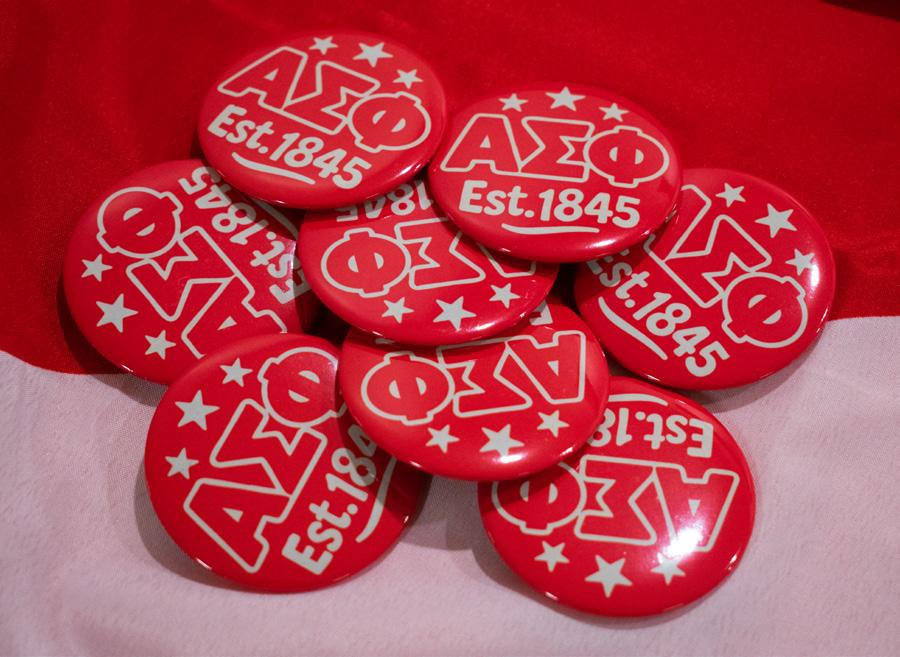
Alpha Sigma Phi, a national fraternity founded in 1845, is attempting to re-establish a presence at Utah State University after its previous chapter became inactive in 2024.
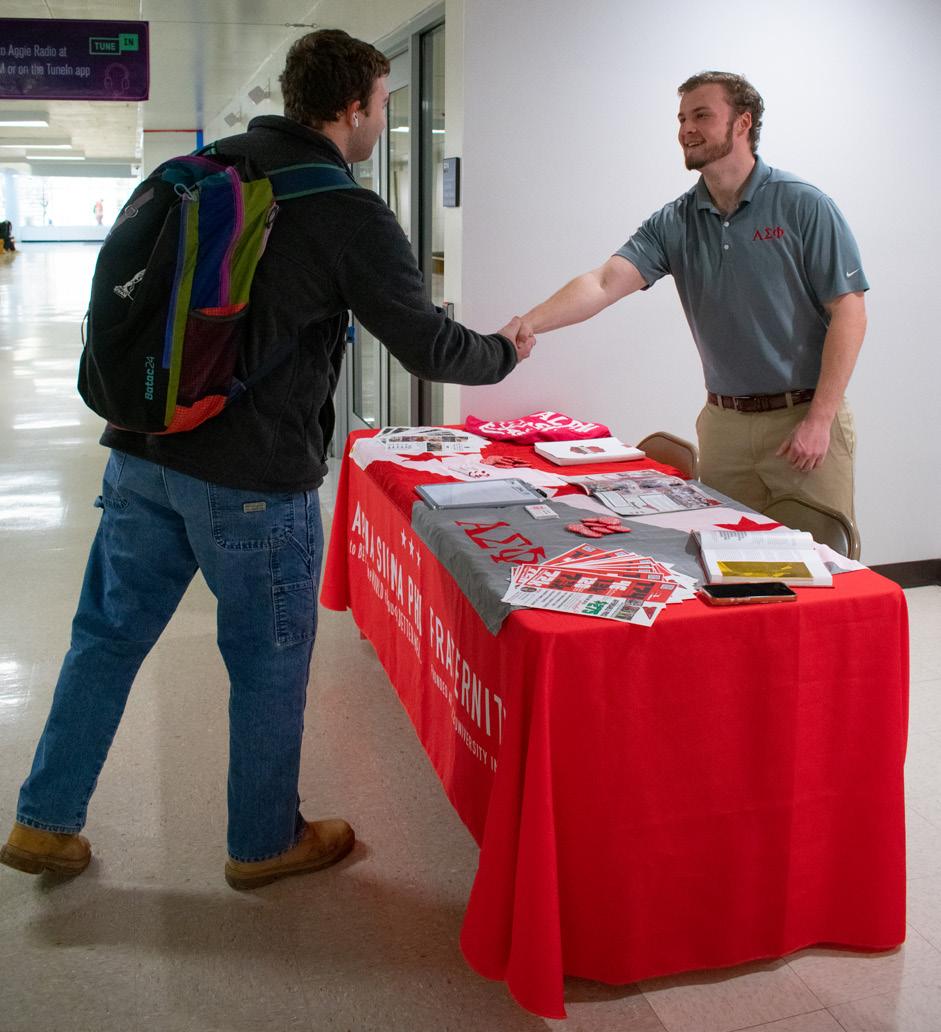
The effort is being led by Lucas Hannan, a coordinator of expansion employed by Alpha Sigma Phi’s national headquarters in Carmel, Indiana. Hannan arrived in Logan at the start of the spring semester and has spent the past several weeks recruiting students and laying the groundwork for what he describes as a “re-founding” of the fraternity’s Theta Zeta chapter.
“I go out to new universities that don’t have an active chapter of Alpha Sigma Phi, and I build them from scratch,” Hannan said. “I’m the recruiter. I’m the builder. I’m the teacher. I get to help these guys as a mentor.”
Alpha Sigma Phi originally founded a chapter at Utah State in 2015. Hannan said the organization did not shut down due to disciplinary action or misconduct but rather because it struggled to sustain recruitment over time.
“There were no issues when it came to violations or anything like that,” Hannan said. “Recruiting is hard, and sometimes chapters struggle. It was a mutual decision between the chapter and headquarters that it wasn’t working and needed a fresh start.”
While the chapter has been inactive for a little over a year, alumni interest helped prompt the current effort to return. Hannan estimated there are approximately 125 alumni from the former chapter who expressed interest in seeing Alpha Sigma Phi return to campus.
He identified Utah State assistant professor and provost Nathan Laursen, a founding member of the original chapter, as a key supporter, along with Gregory Maita, a national staff member and another founding member at USU.
While Hannan is leading recruitment on campus, his role does not include managing the university approval process. That responsibility, he said, falls to other staff members at
the fraternity’s national headquarters, such as the CEO and president.
“My role isn’t necessarily tailored to getting us approved by the university, but we do prefer to be affiliated with institutions because it provides structure and accountability,” Hannan said.
As of this semester, Alpha Sigma Phi is actively recruiting students at Utah State as part of a national expansion effort.
The university has not publicly clarified the fraternity’s current recognition status within its Fraternity & Sorority Life system, though Hannan said the group “already had that approval” dating back to its founding on campus in 2015 and that returning was largely about “rekindling that relationship a bit” and confirming it still had approval to operate at the university.
Hannan has recruited 10 members in his first two weeks on campus and hopes to build a core group of 30-40 members before he leaves Logan on March 1. He is scheduled to remain on campus for 55 days before handing leadership responsibilities to another national staff member, who will continue training and oversight.
One of those early recruits is Jay Sam Fong, a Utah State student and North Logan native who was approached by Hannan during the first week of the semester. Fong said he had not previously been involved in Greek life but was drawn to the idea of helping build a new organization from the ground up.
“I wanted leadership opportunities, a brotherhood and a way to give back to the community,” Fong said. “This isn’t about replacing your family, your faith or your responsibilities as a student — it’s supposed to support all of those.”
Fong said being part of a re-founded chapter allows members to shape its culture intentionally, particularly in a community where fraternities can face skepticism.
“We want to focus on service and personal growth, not just partying,” he said.
Hannan acknowledged concerns about hazing, alcohol use and time commitment are common among prospective members, especially at a university with strong religious and cultural influences like Utah State. He said Alpha Sigma Phi has a zero-tolerance policy for hazing and aims to provide an alternative vision of fraternity life.
“People have heard the stories,” Hannan said. “Those concerns are valid. The only way to address them is by being intentional about what we’re building.”
Membership dues for the new chapter are set at $275 per semester, which is lower than the campus average. The dues help cover insurance, national programming and conference participation.
As the chapter grows, Alpha Sigma Phi’s national housing corporation may eventually help secure a fraternity house, though Hannan said that would come later and only after the chapter reaches stability.
Both Hannan and Fong said community engagement will be a priority moving forward. Fong hopes the fraternity will organize food drives and partner with local charities in Cache Valley, while Hannan pointed to Alpha Sigma Phi’s national philanthropic partnerships, which include organizations focused on mental health, sexual assault prevention, substance abuse recovery and veterans’ housing.
Hannan said the chapter’s development will move through three phases — expansion, initiation and development — with continued oversight from national staff and alumni advisers throughout the semester.
“By the end of this semester, the goal is to be fully operational,” Hannan said. “Recruiting, giving back to the community and living out our values.”
For now, Alpha Sigma Phi’s return to Utah State remains a work in progress, but Hannan and Fong believe the organization can establish itself by prioritizing leadership, service and accountability.
“There’s skepticism around fraternities,” Hannan said. “I understand that. The only way to change that is by doing it right.”
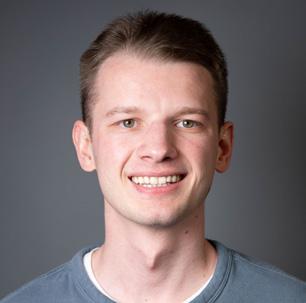
Carson Frost is studying journalism. His family originally hails from Los Angeles, and he is a fan of the Lakers, Dodgers and Philadelphia Eagles. He loves writing, making music and hitting the gym
— carson.frost@usu.edu
By Jillian Peterson STATESMAN REPORTER
Utah State University’s College of Engineering is expanding its administrative leadership by appointing Deepak Keshwani as its first associate dean of academic programs — a position designed to oversee curriculum, accreditation and statewide delivery.
The role was created to support growing enrollment and new program offerings, according to David Jones, the dean of the college.
Jones said the college is under pressure to reduce credit hours, reallocate funding and partner with other campuses — all of which he hopes Keshwani can help with.
“There’s not a shortage of areas we need to work on,” Jones said. “I’ve got more on my list than he can do.”
Jones said one of Keshwani’s top priorities will be expanding the energy engineering program to the Price and Vernal campuses. This effort aligns with funding approved during the 2024 General Session of the Utah Legislature, which appropriated money for Utah State to develop a rural-focused energy engineering program to support the state’s energy workforce needs.
My career has been really grounded in teaching, advising and student success.
— Deepak Keshwani
Keshwani is expected to begin this role on Feb. 1. He previously worked at the University of NebraskaLincoln, or UNL, for 16 years, where he was an associate professor of biological systems engineering and an interim associate dean.
While at UNL, Keshwani spent several years working with Jones.
“Keshwani is not a stranger to me at all. When I knew we needed additional help, he was one of the people on my mind,” Jones said. “Fortunately, through the process of a national search, he applied, and he emerged as the best candidate.”
Keshwani said he spent several years working in the classroom, teaching a range of courses from first-year orientation to capstone classes.
“My career has been really grounded in teaching, advising and student success,” Keshwani said. Keshwani plans to focus not only on increasing enrollment in the College of Engineering but also on increasing its student involvement and graduation rates.
“We admit students because we think they can succeed,” Keshwani said. “That means we have to create the environment for students to succeed.”
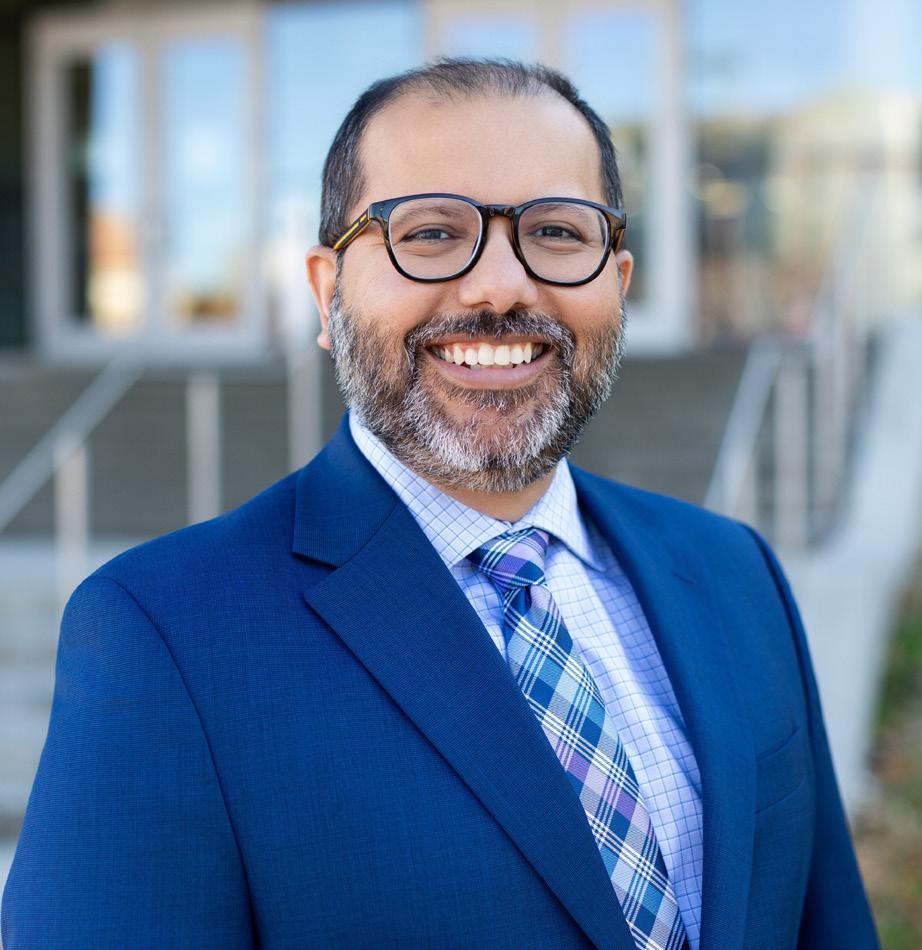
Keshwani applied for the new dean position because he felt ready to serve in a larger role at the college level.
“When this opportunity came up, it really resonated with me and what my goals are professionally — to help students co-create their learning,” Keshwani said.
Keshwani was also drawn to Utah State because it is a land-grant university.
“I was really looking for an environment where there was a deep commitment to the land-grant mission,” Keshwani said. “As I was talking to folks who had worked at Utah State, they talked a lot about that commitment and emphasis on working with communities and students.”
In addition to this position, Keshwani hopes to eventually get back in the classroom as a professor for the Biological Engineering Department in coming semesters.
“My job will initially be 100% in the College of Engineering office in an administrative role, but that was a tough decision for me,” Keshwani said. “I worked with students regularly, and I just finished teaching three classes last semester, so this will be an interesting change.”
Even though he won’t be teaching initially, Keshwani intends to stay involved with students through working with engineering student club leaders and the college’s ambassadors.
“My first official meeting on the calendar for the day I start is with a student, which is exactly how I would like it to be,” Keshwani said.
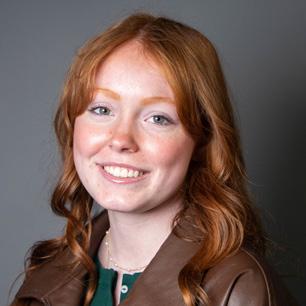
Jillian Peterson is a sophomore studying communication and media. She is a big fan of concerts, snowboarding and the Taco Bell drive-thru.
— jillian.peterson@usu.edu
McNeill
Moore
Packer
Peterson
Shelite
Ferraro

By Alyssa Caywood STATESMAN REPORTER
From aiding 46 families in May 2025 to 241 families in November 2025, the Utah State University Student Nutrition Access Center
Mobile Food Pantry is continuing to grow their community outreach efforts and assist Cache Valley community members in need.
The SNAC hosts a Mobile Food Pantry event each month in the Maverik Stadium parking lot. There are both drive-through and walk-up options available to those picking up food from the events.
These events are open to all USU students and Cache Valley community members in need. An income verification form must be completed, but no ID or other documents are required.
“It’s easy to get to and it’s free,” said Shelby Scott, a first-year student at USU studying biochemistry.
While currently most attendees are Cache Valley community members, USU students in need are also invited to go to the events to receive nutritious food options.
“We are trying to get the word out to students a little bit more, too, that they are welcome to come,” said Kaiah Thomas, SNAC student director and a USU senior studying dietetics.
Each household receives a selection of food items such as fresh produce, dairy products, bread, cereal
and shelf-stable goods. The available items vary by month based on donations.
“Typically, those distributions have a lot more fresh food than you’ll find in a normal food pantry,” Thomas said.
The mobile pantry program in Logan is a product of Thomas’ capstone project. It is a way to expand food accessibility to Cache County.
After reassessing data in February 2025, it was found that Cache County had a higher need for food to meet the needs of its food insecure population. Since the opening of Logan’s mobile food pantry, over 241 families have been aided with nutritional resources.
“Seeing how much of a need there is and being able to be a way of hopefully filling that need a little bit — I think that’s probably the biggest way I’ve seen it help,” Thomas said.
As the program expands, so does its need for volunteers.
Volunteering consists of loading food into people’s cars, directing traffic, helping with cleanup and other hands-on related tasks. Additionally, donations help to provide food for the mobile pantry.
“We rely heavily on volunteers at the mobile pantry,” Thomas said. “Volunteering with the mobile pantries is definitely a huge help to us and just a way to give back to the community, too.”
SNAC partners with the Utah Food Bank in Salt Lake City to supply enough food for the monthly event and
also accepts donations, along with local organizations like the Cache Valley Food Pantry.
The 2026 mobile food pantry dates are as follows: Jan. 13, Feb. 10, March 10, April 14, May 12, June 9, July 14, Aug. 11, Sept. 15, Oct. 13, Nov. 10 and Dec. 15.
More information can be found on the SNAC Instagram at @ususnac.

Alyssa Caywood is a first-year student studying journalism. She loves anything outdoors from backpacking to snowboarding to water sking. She loves to write and is stoked to be working with the Statesman.
— alyssa.caywood@usu.edu

January 15
Officers were dispatched to the north entrance of Old Main in response to a suspicious incident call for service. The complainant reported finding empty pizza boxes and napkins on the north stair entrance to Old Main and believed the garbage to be suspicious in nature. Officers arrived on scene and did not locate any trash at the north entrance of Old Main. No suspicious activity or items were observed in the immediate or surrounding area. No further action was taken.
January 16
Officers responded to a call requesting medical assistance at Aggie Legacy Fields. The complainant reported having chest pains. Upon arrival, officers found medical personnel was attending to the individual who transported to Logan Regional Hospital.
January 17
USUPD Officers provided security for the gymnastics event with approximately 1,500 attendees.

Fazilat Soukhakian’s piece, titled “Covered For Your Protection,” is displayed at the Biennial Faculty Exhibition in the Tippetts & Eccles Galleries, as seen on Jan. 21.
By Grace Colvin STATESMAN REPORTER
This month, Utah State University’s Department of Art + Design faculty are taking their talent from the classroom to the Daryl Chase Fine Arts Center in their own gallery.
From now until Jan. 22, the USU Art + Design Biennial Faculty Exhibition is on display at the Tippetts & Eccles Galleries, highlighting the artistic endeavors and research work of the department’s faculty and staff.
Taking place every other year, this month-long exhibition is completely free and open to the public. The galleries, which are located on the second floor of the fine arts center, house the display. Having debuted on Jan. 12, the exhibition is currently accessible to students and community members every weekday from 9 a.m. to 5 p.m. It celebrates creative work from nearly every member of the department faculty. According to Kathy Puzey, Art + Design department head, it’s a striking example of the creative diversity and broad range of its contributors.
“It’s faculty from all disciplines. You have designers, you have studio artists, we have ceramics,” Puzey said in an interview with The Utah Statesman.
Covering everything from pottery to printmaking, faculty members were given the freedom to submit any creative work they wanted to display, resulting in a collection that spans a multitude of subject matters and mediums.
“We’re all different makers and our research interests are also very, very diverse and different,” Puzey said.
For example, one of the many new works featured in the exhibition, created by associate professor of photography Fazilat Soukhakian, is a piece that aims to make a powerful statement about the unspoken stigma of the female body.
“This work feels very different from what I’ve done in the past,” Soukhakian said in an interview. “It’s really about opening up a conversation around what’s been done to women throughout history and even up until today and asking why the female body has been such a taboo subject.”

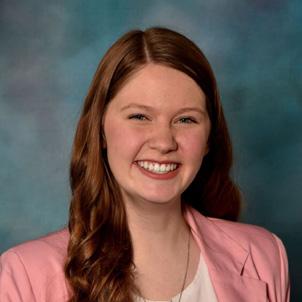
Grace Colvin is a sophomore in the theater education program at USU. After graduation, she plans to become a middle school drama teacher. When she isn’t writing or working on a play, she loves making crafts and woodworking. — grace.colvin@usu.edu

By Emma Barker STATESMAN REPORTER
After a day on the slopes, skiers and snowboarders can now trade their boots for a barstool and catch live music without leaving the mountain.
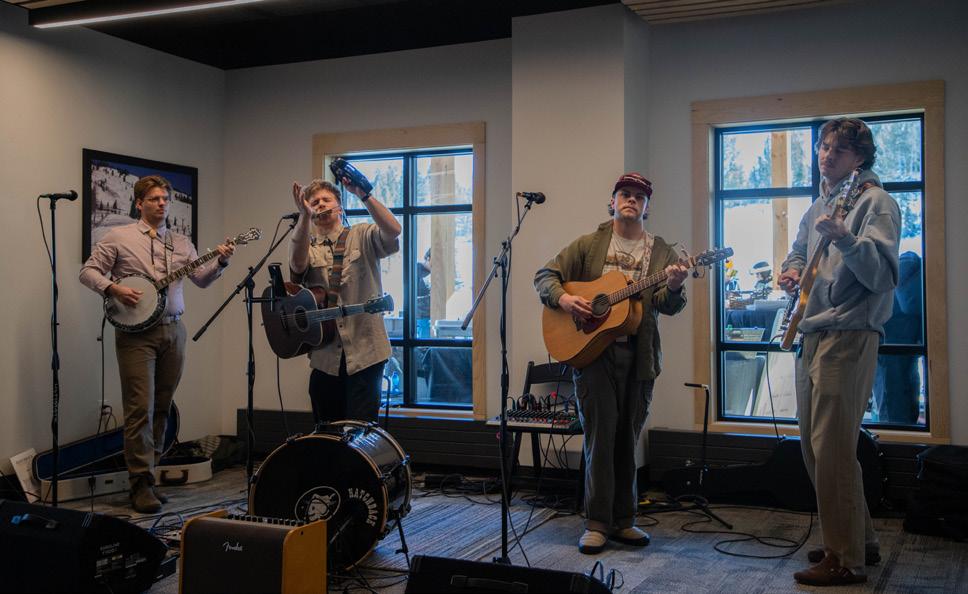
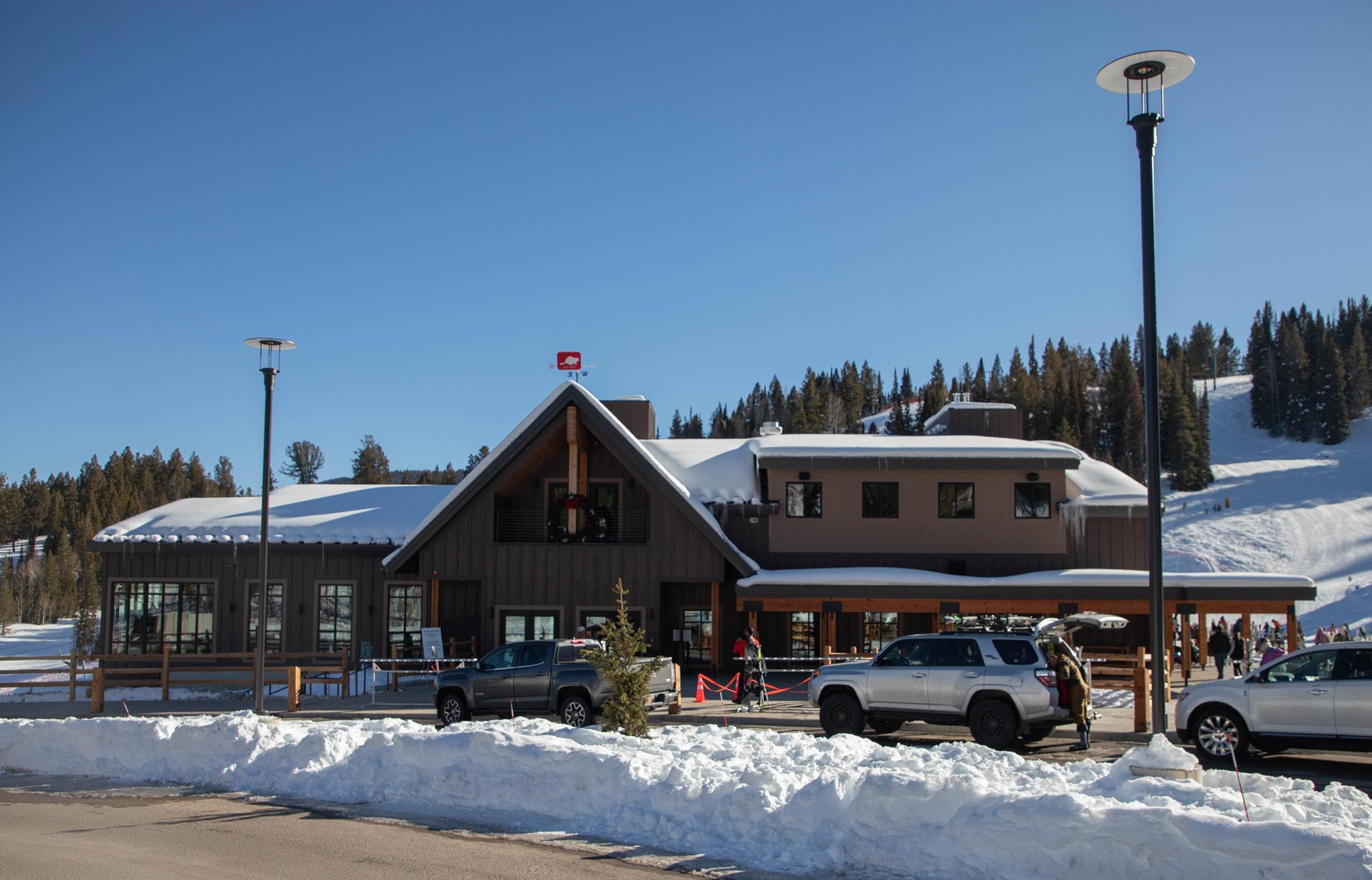
Beaver Mountain Ski Resort launched “Sounds on Sunday,” a free monthly concert series, on Jan. 18. The series is in the Aspen Room inside the recently opened lodge.
“Other resorts have done live music, especially on Sunday,” said Amie Hansen, the resort’s community relations and event manager. “We decided to do it just once a month to see how well the patrons like it. So far, we’ve got pretty good response.”
The Aspen Room, located on the bottom level of the lodge, was built as a dedicated event space reachable by the stairs on the north side of the lodge. Guests with limited mobility can use the elevator to access it.
The room already has summer weddings booked and will host its monthly concerts through the ski season. The next concerts will be held on Feb. 22 and March 22.
The resort secured a beer and wine license this season, allowing guests to pair live music with alcoholic beverages. The venue also has food, such as tacos, available for purchase.
“The goal is to start getting people familiar with the new building and just utilize the space that we have,” Hansen said.
Sunday was chosen to promote a relaxed atmosphere compared to Saturday.
“It tends to be the less busy of the days,” Hansen said. “It’s still busy, but it just seems a little bit chiller.”
The monthly concert runs from 12:30-5 p.m. with two bands performing at each event. The timing was chosen to let skiers enjoy runs before settling in for music or relaxing during après-ski.
The resort wanted to appeal to families who all want to go skiing but have different length preferences.
“I’ve run into a lot of people who were like, ‘My kids want to ski all day, but I like to do a few runs and then come sit in here and take a break,’” Hansen said.
All the featured musicians are from Cache Valley.
The Jan. 18 event showcased HATCHBACK and Erica Cheyenne and the Travelin’ Hippies. Erica Cheyenne and the Travelin’ Hippies will be returning for both the February and March shows.
“We’re a local resort,” Hansen said. “We try to maintain that feeling that we’re owned locally, we’re run locally. Everybody that works there is local, so we wanted to really focus on the local music scene.”
According to Hansen, live music is central to Beaver Mountain’s goal of creating a welcoming space beyond the slopes. Members of the Logan-based folk band HATCHBACK said performing at the resort carries personal meaning, especially as part of the first “Sounds on Sunday” series.
“Being approached and asked to play and being recognized by that establishment for the music is just a really special opportunity,” said band member Alex McCain. He added Beaver Mountain is the place where he “learned to snowboard and enjoy the long, cold winter,” making the chance to return as a performer especially meaningful.
For Erica Cheyenne and the Travelin’ Hippies, playing at Beaver Mountain aligned naturally with the resort’s emphasis on community and connection. The band described their sound as varied, blending singersongwriter folk, rock and country, with an emphasis on storytelling and attentive listening.
According to Erica Cheyenne Peart, a member of the band, they hope listeners leave the concerts feeling personally engaged with the music.
“I want them to feel connected to us and kind of know us,” Peart said.
Guests don’t need to purchase anything to attend the concert series, though the venue hopes patrons will support the resort with food and beverage purchases.
“I didn’t expect it to feel like a concert as much as it does,” said Olivia Lynn, an attendee of the Jan. 18 event. “I could see myself skiing for a little bit and then working for a little bit.”


Emma Barker is double-majoring in journalism and communications and sociology. When she’s not reporting, she enjoys spending time with her dog and husband, thrifting and attempting to keep her sourdough starter alive.
—
emma.barker@usu.edu
By Essence Barnes STATESMAN SENIOR REPORTER
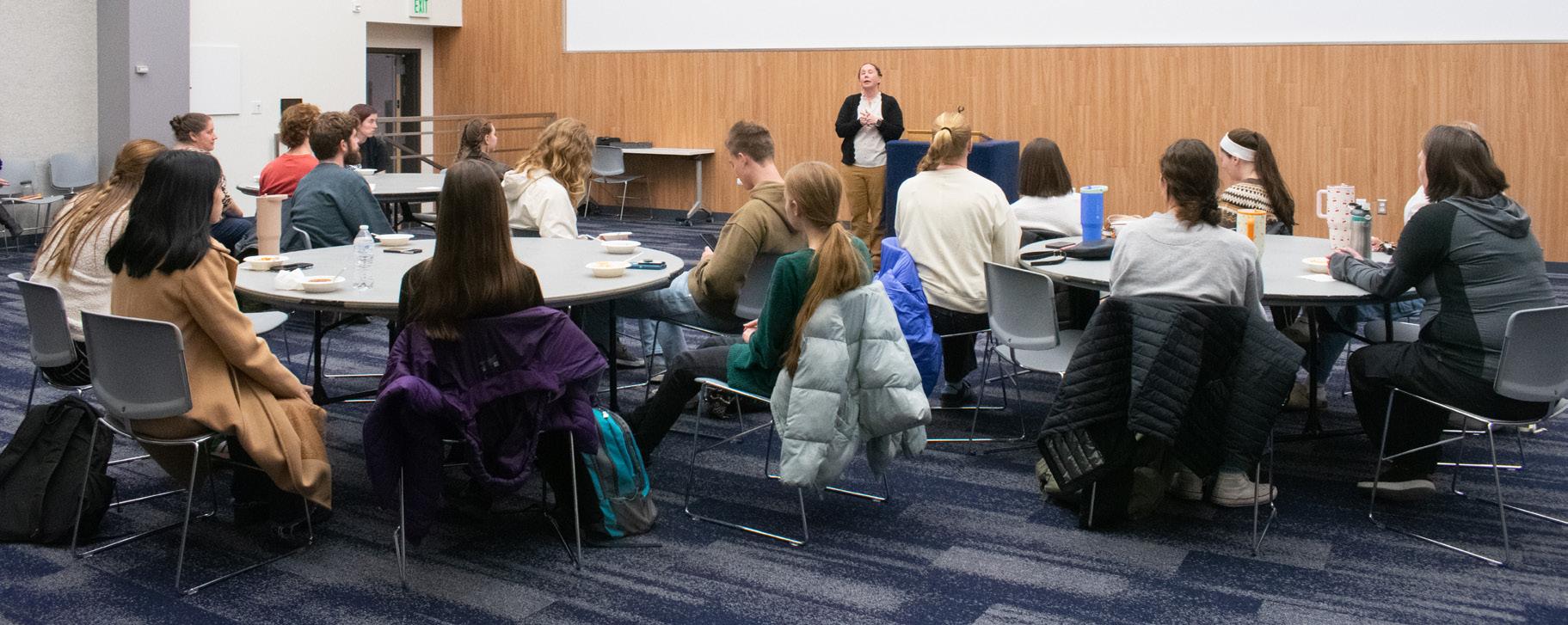
Utah State University’s Center for Community Engagement, or CCE, made a change to its Christensen Community Scholars Program this year, making it easier for program scholars and other students to integrate community work into their academic learning.
“Initially, it was one-credit class that all the scholars in this program needed to take,” said Nelda AultDyslin, assistant director for CCE.
The program, which gives students the opportunity to incorporate service-based community work into their education, now only requires scholars to attend three Community Voices & Engagement Speaker Series events to be eligible.
“Any student in any major can integrate their work with the community. Whether they’re doing volunteer work or a practicum or an internship, we want to recognize that they are working with the community,”
Ault-Dyslin said. “We also want to give them a good foundation of best practices in community work because there’s good ways and bad ways to try to make your community better.”
The speaker series events invite local community partner organizations to come and speak on a variety of different issues affecting the Cache Valley community and what people can do to address them.
“One of the purposes is to expose the students who come to this series to different volunteer opportunities that they might not have run into,” Ault-Dyslin said. “We wouldn’t choose something that we don’t already have a way for students to get involved in here locally.”
In the past, the series has had speakers from organizations involved in disability awareness, food security, immigration, refugee resettlement and others.
“I really like the idea of exposing students to different things because I think about when I was a student doing very similar work,” said Maia Taylor, staff
assistant for the CCE. “I had a very narrow focus on the kinds of things that I was doing, and part of that was purely interest. But when you learn about these other opportunities, you find these different areas of interest and ways to collaborate with what you’re interested in that you may not have thought about before.”
This year, Ault-Dyslin and Taylor wanted to ensure the changes made to the series expanded awareness and access for students looking to get into community service.
“This is all really about planting seeds because when it comes to community work, it moves very slowly,”
Ault-Dyslin said.
By planting these seeds, the duo hopes to encourage program scholars and students interested in the event series to get involved in community work down the line.



— essence.barnes@usu.edu
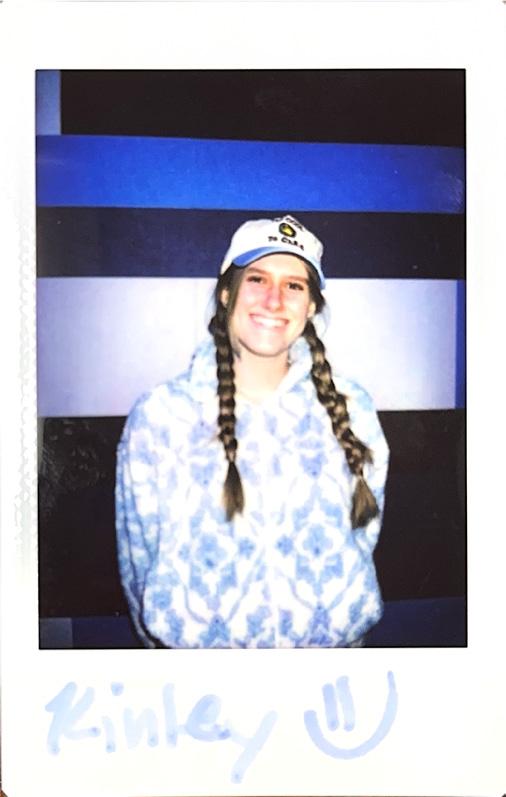
Kinley Posey’s “What’s the Mood?” focuses on connecting listeners with music that helps them feel understood — because nothing is better than when a song perfectly describes how you’re feeling. Catch her show on Thursdays from 9-10 a.m. on Aggie Radio 92.3 KBLU.











By Mia Nielsen STATESMAN REPORTER
The Utah State University Student Fee Board approved requests from Parking & Transportation Services and Campus Recreation. Their recommendations will be sent to USU President Brad L. Mortensen, after which they will be reviewed by the USU Board of Trustees and the Utah Board of Higher Education before final approval.
The board also voted in favor of the $10 increase to the spouse pass fee, which will follow a shorter approval process, as it is separate from student fees.
This year, the university will conduct a five-year comprehensive review to determine whether certain costs should remain as fees or be moved into tuition.
USU Interim Vice President for Student Affairs Krystin Deschamps shared recommendations from the executive board after reviewing the fee board’s deliberations. Deschamps said one dean doesn’t believe any of the fees should be passed but should instead be moved to tuition.
“Shuttles take you to classes. It should be a part of your tuition. The museum where students might have a nonmajor art class, that should be tuition,” Deschamps relayed from the unnamed dean.
Fee board members voiced concerns that moving fees to tuition may eliminate the transparency of the student fee line-by-line system.
Parking & Transportation Services: increase of $1.73, approved by Student Fee Board
Parking & Transportation Services requested a fee increase of $1.73 that would bring the total student transportation fee to $24. The fee increase would help to pay off bus upgrades, pay student employees and purchase a minibus.
Director of Parking & Transportation Services Tracy Hulse said they do not plan to ask for another fee increase for a few years. He outlined several ways the service is being improved, including a gradual shift to more accessible transit-style buses with a longer lifespan, a “request a ride” feature for the water lab route and a trial night route that will run from 10 p.m. to 12 a.m. for a two-week period during the spring semester. There are currently no set dates for the trial, but updates will be announced on the Parking & Transportation Services website and the Passio GO! app.
Hulse does not anticipate purchasing any new transit-style buses this year. Instead, they are considering purchasing a minibus to replace aging minibuses and to support chartering and “request a ride” services.
“If we didn’t see an increase, you wouldn’t see any kind of decrease in service,” Hulse said.
Student Kinsey Hill surveyed 578 students about their opinions on campus transportation and reported 87.89% of the participants supported a transportation fee increase of $1-3.
Campus Recreation: increase of $10.46, approved by Student Fee Board
Executive Director of Campus Recreation Spencer Bitner proposed a fee increase of $10.46, the first fee increase from Campus Recreation since 2015.
The fee would cover staff wages for an aquatic coordinator, staff salaries, bouldering wall expansion, student fitness programs, hourly wages for group exercise classes, student wages and esports repairs.
Bitner explained 87% of USU students engage with Campus Recreation. They also hire over 200 student staff. Currently, students can sign up for fitness classes for a fee of $35 per semester. Bitner said he hopes with the fee increase, these classes could be free.
School of Graduate Studies Senator Jamie Parry said that
a PE credit could cost graduate students, who aren’t always considered full-time students, $600-700. Parry said she sees group fitness classes as a great alternative.
“I think that these group fitness classes at the ARC are a wonderful way — especially for graduate students, who I advocate for — to still be able to utilize those amazing instructors that we have on campus,” Parry said.
This year, Campus Recreation was in a $345,184.56 deficit, which it hopes to alleviate by increasing revenue and raising $195,552.56. This leaves $149,632, which it hopes to receive from student fees.
Student Alex Bodrero expressed concerns about Campus Recreation’s spending history.
“I would hate to throw money at a fire that might not be subdued,” Bodrero said.
Deschamps said the ARC bond, which Campus Recreation pays for, is very complex, but there is no evidence of fiscal mismanagement.
“These are programs that keep students here,” Deschamps said.
Spouse Pass: Increase of $10, approved by Student Fee Board
The Spouse Pass gives a student’s spouse, who is not enrolled as a student, access to campus services and events, including athletic events, Campus Recreation facilities, USUSA events, buildings on campus and concerts and shows for a $40 fee. The cost of the pass is separate from student fees, and married students who wish to purchase the pass must pay at the Office of the Registrar every semester. Each organization that gives access to student spouses receives a portion of the revenue generated by the pass fee.
Executive VP and Fee Board Chairmen Max Alder suggested raising the price of the pass, which has not changed since about 2010, to $50. The fee increase is less than it would be if adjusted for inflation.
“I am in full support of an increase,” said USUSA President Brandon Sorensen. “You’re getting a basketball, football, soccer, every athletics type of season pass for $14.25 a season, tickets to all the music and theatre for $3.50 and getting to use great gym spaces for $8.75.”
Some board members voiced concern the $10 is a random increase and not strategic but said they recognize the importance of keeping the pass affordable for young couples and families.
Nora Eccles Harrison Museum of Art: implement a $5 fee, awaiting vote
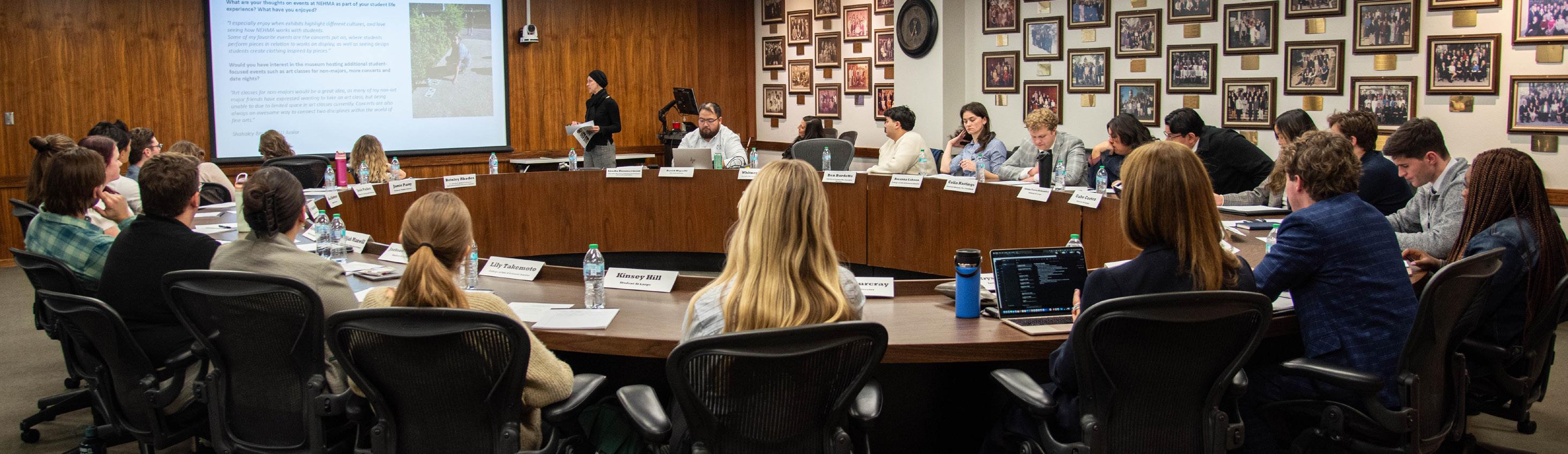
Katie Lee-Koven is the executive director and head curator of NEHMA. She said additional funding will help the museum uphold its commitment to free admission for students and the community and allow the museum to offer more events for students such as art classes, date nights and concerts. She hopes to hire more student employees and increase hours for current student employees.
“We employ at any time eight to 12 students, and we have between four to six interns every semester,” Lee-Koven said. Lee-Koven also noted with the addition of the Wanlass Center for Art Education & Research to the museum in April 2025, the museum is seeing more visitors.
“Ninety classes across the university come to the museum in a year,” Lee-Koven said. “With the new Wanlass Center, we’re already past 80 classes just from the fall semester.”
Student Events Executive Director and fee board member Josie Packer expressed concerns that the proposed fee is too high.
“I really can’t understand at this point why their events and marketing are so expensive. The budget that she had set aside for marketing is more than my personal events budget for the entire school year by over $10,000,” Packer said. “I’d really like to know exactly why that’s so expensive. I’m not saying it’s invalid, but I do think that their job is not to plan events, and so I think we should really be focusing on that when we vote.”
Other members of the fee board expressed appreciation for the museum and associated services.
“We are very fortunate to be a university that has an art museum of this size on campus. Most universities have art museums that are more the size of the Tippetts Gallery, which is very small,” said Caine College of Arts Senator Lily Takemoto.
Vice President and Director of Athletics Cameron Walker requested a $29.72 fee increase that would bring the total student fee for athletics to $145.
Walker said the student fee would enhance the student athlete’s experience, improve mental health and wellbeing resources for student-athletes and elevate the university’s institutional profile.
This fee request comes after a $26 decrease a few years ago. Walker said he does not plan to return and request another student fee increase next year and noted
universities with lower athletics fees charge students for tickets.
The university currently only employs a part-time nutritionist who Walker said cannot adequately support the needs of all student-athletes.
Fee board member Carter Guiness spent his first two years at Utah State on the Track and Field team and recognized the gap in nutrition support.
“To leave students that have just left home, that are working out for multiple hours every day, that probably don’t know a lot about nutrition or weren’t taught anything to just figure it out is kind of ridiculous,” Guiness said.
Beyond gaps in nutrition support, Guiness said stress adds another level of difficulty for student athletes the fee could help address.
“Student-athletes are consistently facing pressures where their spot or their scholarship is on the line,” Guiness said.
Beyond helping student-athletes, Walker said he believes a strong athletics program helps to showcase the university, something he finds more important than ever with the university’s decision to enter the Pac-12.
“We made a choice to compete with these schools. We need to be on par with these schools,” Walker said.
Walker described athletics as the university’s “billboard.”
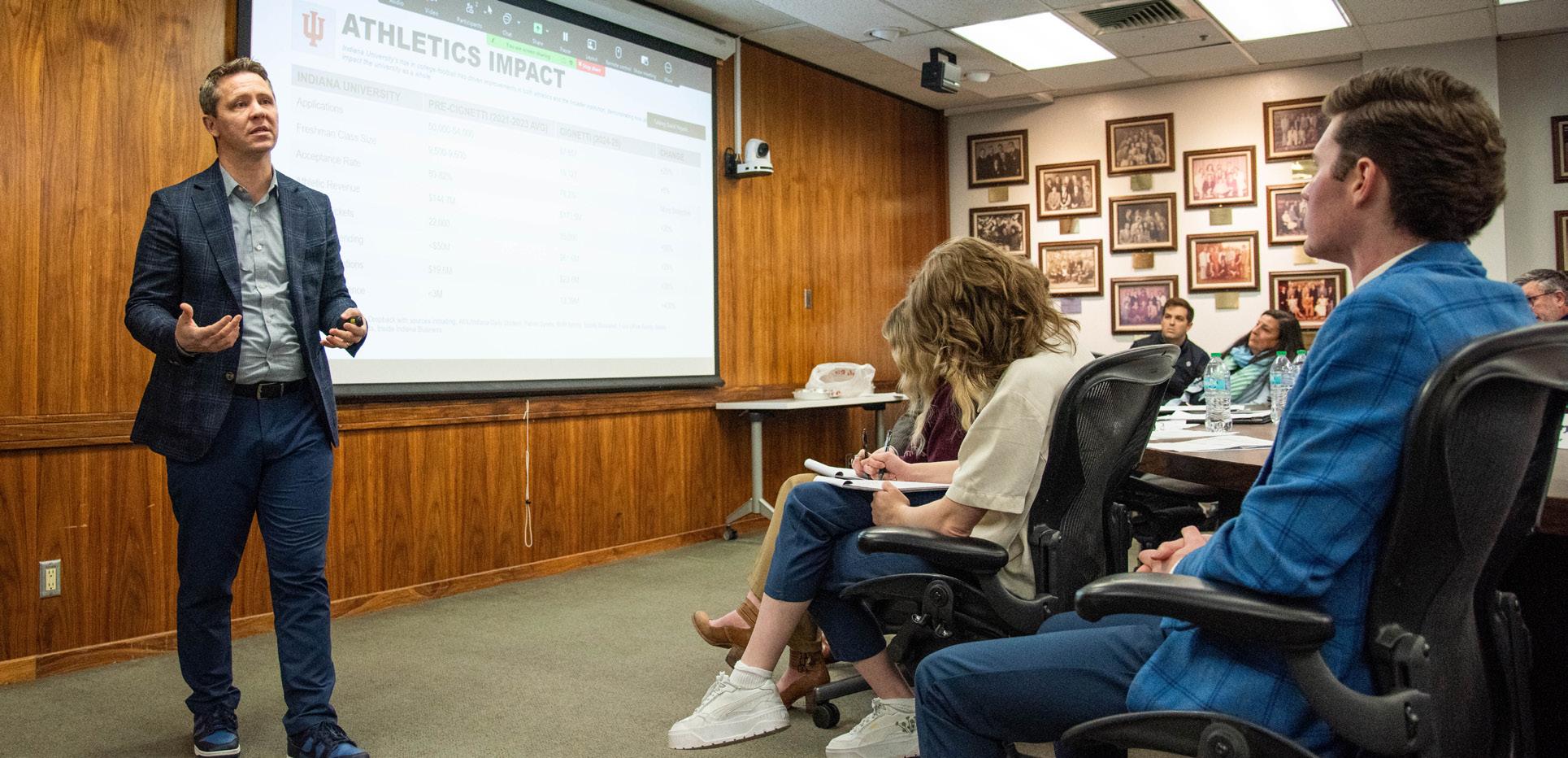
He believes improving the athletics program will bring awareness to university research and programs as well. He noted when the Indiana University Hoosiers achieved athletic success, the university saw more applications, larger first-year class sizes, more competitive students and more athletic revenue. He believes the same will happen at Utah State.
Some fee board members saw the possibilities for their departments more than others. S.J. and Jessie E. Quinney College of Natural Resources Senator Elijah Manwill hopes students in the nutrition program will be able to work with the USU athletes to gain relevant experience and believes that athletic broadcasts offer a significant opportunity to highlight student work in other fields.
“That little second clip where a robot that somebody built makes it onto a national TV commercial spot or you get a picture of students out in nature collecting samples that makes it into a national TV spot — that goes a long way,” Manwill said.
On the other hand, Takemoto said she doubts more money towards athletics would help fine arts students, many of whom, she said, don’t care about sports.
“There’s such little correlation with the fine arts and athletics, except for the marching band, which is not benefited at all by this fee,” Takemoto said.
Other board members also expressed hesitation. Packer recognized the need to improve certain areas of the athletics program but said she believes the athletics department should use other avenues to raise this money instead of raising student fees.
“I do not think it should be the student’s job to make sure that we have good athletics. I think that should be the athletics department job. We are an academic institution, and I really am against students paying for Bryson Barnes’s meal prep,” Packer said.

Mia Nielsen is a sophomore studying plant science and journalism. When she’s not writing, she enjoys live music, driving up Logan Canyon and daydreaming about moving to Spain. —mia.nielsen@usu.edu

By Dani Packer STATESMAN REPORTER
Sydney Jelen began the first meet of the 2026 Utah State University Gymnastics with a career high on the balance beam, getting a score of 9.875. This is a score both her and head coach Kristin White are excited about moving forward.
“We have had a really great start to the season. Our athletes have worked incredibly hard,” White said. “We’re really encouraged to see all of the hard work we’ve put in in the pre-season to be ready for season. I think we’re just looking to continue with the momentum and build off of that this year.”
Before coming to USU, Jelen was an allaround gymnast, getting awards in all four events: uneven bars, floor, vault and balance beam. Since starting college, she has narrowed her trade to balance beam and the uneven bars.
“I think it’s a very controlled event. You can still show your personality on beam, and you show your strength on bars,” Jelen said. “I just think it’s really exciting being able to land and stick your dismount on each event. It feels very rewarding.”
Although she is getting slightly higher points in beam, Jelen said the points don’t affect her personal efforts in each event.
“Right now, I’m really liking bars because I’ve come so far from last year and I feel more confident in myself doing that event,” Jelen said.
For Jelen, gymnastics is something that she has been working toward her entire life. She started gymnastics at four years old because of her love for competition.
“Competing has always been one of my favorite things to do. I like being under pressure,” Jelen said.
According to Jelen, her competitive drive has supported her career through her adolescence all the way to her collegiate years.
From an outside perspective, White said she has been able to see Jelen’s drive for many years.
“She thrives in competition,” White said. “When we were recruiting her and watching her, you could tell she really enjoyed gymnastics.” According to White, Jelen’s drive and enjoyment of the sport, has helped push her to be at the level she is currently.
Jelen said she loves gymnastics in part
for the competition but also for the energy and fun times she and her teammates have.
“She just has a very infectious personality. She’s a blast to be around,” White said. “We were really excited when she chose to be an Aggie.”
Jelen said she is interested in gymnastics for more than just the competition.
“I’ve always wanted to compete for a school and represent a school,” Jelen said.
She added her desire to be a collegiate athlete and her love for gymnastics brought her from Chicago to USU.
“I knew when I came to this campus I wanted to be here,” Jelen said. “The team environment was so cool, and I just really loved it here.”
Jelen said a good team dynamic is something she values and that USU has one she feels like she can fit in.
“I like being able to be with a team and make friendships throughout the way,” Jelen said.
Even as the team has changed over her years in the program, with seniors graduating and new recruits joining the team, Jelen said she is always excited to be with her team.
“The team always changes in a good way,” Jelen said. “The new coaching staff that came in this year is great. It’s been an amazing experience each year.”
Jelen, her coach and many others are excited to see what this season holds for her.
“She really competes at the highest level,” White said.

Dani Packer is a sophomore studying English literature. When she’s not studying, she can be found tearing up the dance floor or in the front row at the Spectrum.
— dani.packer@usu.edu
By Jayke Martin STATESMAN REPORTER
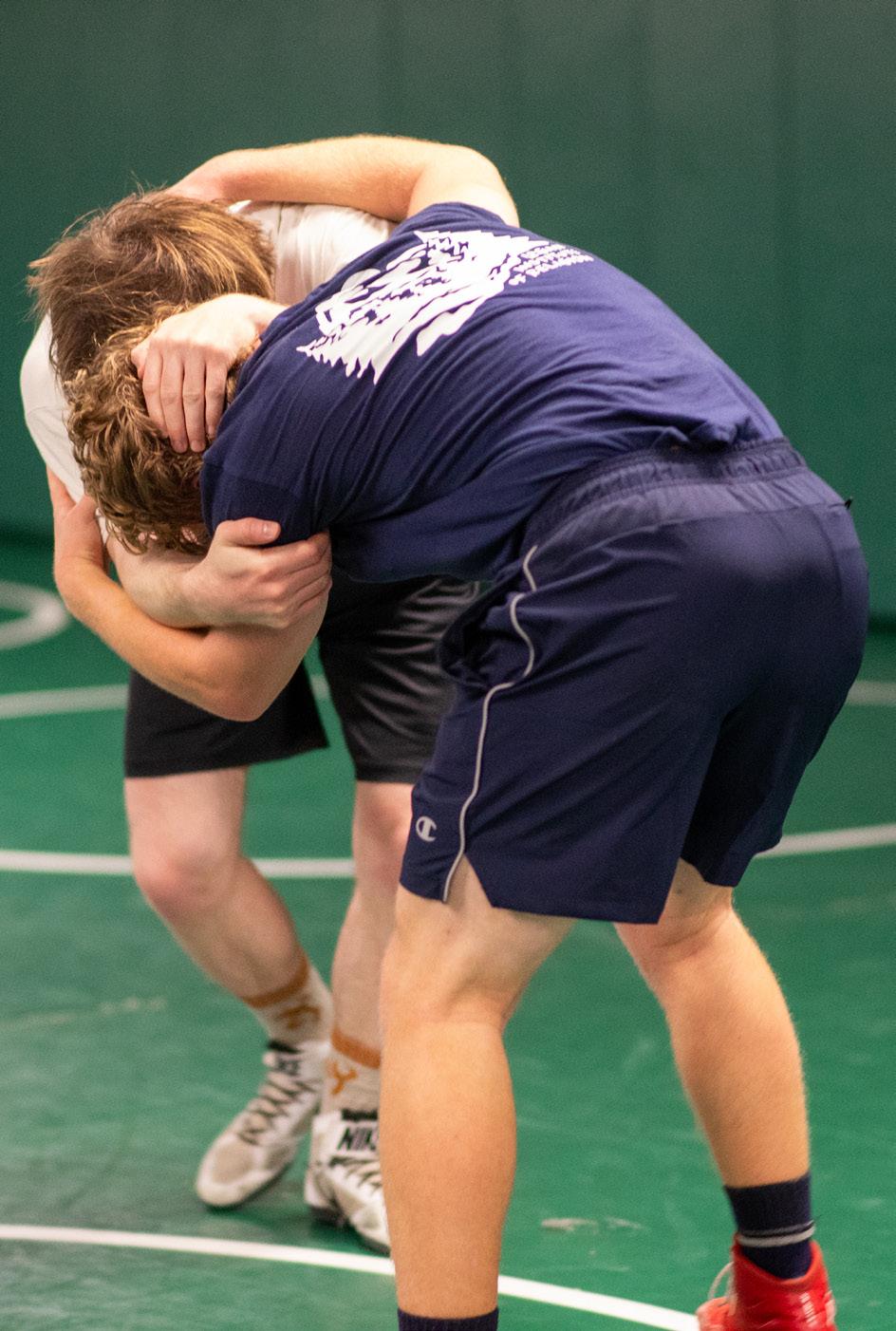
After several years of on-and-off activity, the Utah State University Wrestling Club has returned with a focus on creating something more permanent than past iterations. Current members say the goal is not just competing but building an organization that continues after its current leaders graduate.
“One of the things I’ve thought a lot about is sustaining it,” said club president Matt Scheer, a junior majoring in psychology. “I want it to be around still when I’m gone, and I think part of that is making it more than just our team but making it everybody’s.”
Interest in reviving the club began when several students independently contacted the university’s club sports coordinator asking whether a wrestling club existed. After connecting, the group organized during the spring 2025 semester and officially launched practices in the fall
Scheer said a key focus has been creating a structure that allows future members to take ownership of the club.
“It’s not Matt’s team, it’s not just his team, it’s all of our team,” Scheer said. “I think that we’ve been getting there, and I’m really excited to see that.”
The club currently has about 25 active members, though participation fluctuates as students balance academics, work and other commitments. Members range from longtime wrestlers to students who had never wrestled before joining the club.
“Our vision was to create an environment where people could come and wrestle. A lot of us have been wrestling for a really long time,” Scheer said. “We even have some people who’ve never wrestled before and are coming out, which is really awesome.”
Part of the motivation to restart wrestling at USU stems
If it’s still here when we’re gone, then we’ve done what we set out to do.
— Matt Scheer
from the university’s wrestling history. The campus’s George Nelson Fieldhouse is named after George “Doc” Nelson, who established Utah State’s original collegiate wrestling program in 1923 and coached teams to multiple championships.
“One of the things that I love about Utah State history is that we actually should be a really good wrestling team,” Scheer said. “It’s just kind of sad that for the longest time, we didn’t have a wrestling team, and so I would love to see it be something that continues.”
Practices are held multiple times per week, often in collaboration with local wrestling organizations and coaches in Cache Valley. Those partnerships help accommodate wrestlers of different skill levels and grow the community.
“When I’m feeling overwhelmed and my motivation is kind of getting down, but I have my teammates texting me, being like, ‘Hey, are you coming to practice tonight? We want to practice with you’” — that helps give me motivation,” said Jessica Harrison, the club’s co-vice president.
As club leaders look toward the future, they say longterm sustainability depends on who feels welcome and represented within the program. Building a team that lasts beyond its current leadership means creating space for wrestlers of different backgrounds and experience levels to participate and stay involved.
“One of my biggest goals for the club is just recruiting more women,” Harrison said. “Right now, we have a few women who are registered to compete, which has been really awesome, but where women’s wrestling is kind of a newer sport, that was one of the things that I wanted to see.”
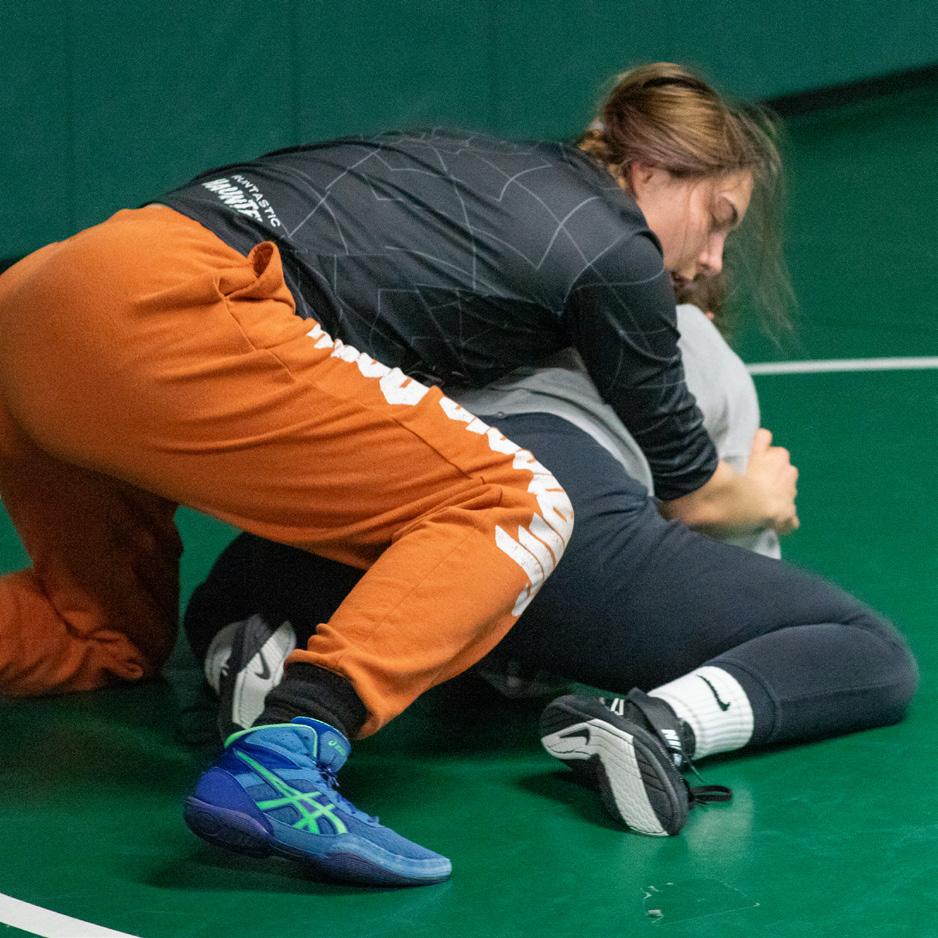
Harrison said expanding who feels welcome is part of a broader effort to build something that extends beyond the current roster. Creating a space for wrestlers of different skill levels and experiences helps establish a culture that new members can step into, even as founding officers prepare to graduate, according to Scheer.
“If it’s still here when we’re gone, then we’ve done what we set out to do,” Scheer said.
For members of the wrestling club, success this season has been measured less by competition results and more by whether the organization has created a place on campus where wrestlers can continue to train, connect and belong.

Jayke Martin is a junior studying journalism with a minor in theater. She loves reading and meeting new people.

By Mark Greenwood STATESMAN EDITOR
Aggie Nation, Thank you for reading the Statesman Sports Winter Magazine. In this magazine, you will find feature stories on athletes from men’s and women’s basketball and women’s gymnastics. From all of us at USU Student Media, we hope you find the stories and content in this magazine engaging and that it gives you some insight into the lives of student-athletes who make Utah State special.
Winters in Logan can be cold, long, snowy and downright dismal at times. Each of the included teams compete in the Dee Glen Smith Spectrum on USU’s Logan campus. For me, those winter nights inside the Spectrum watching and covering these teams and student-athletes offer a warm beacon I look forward to all year long. So much so that I even have a painting of the Spectrum framed in my apartment.
Anyone who has experienced the magic that resides inside the Spectrum knows this magic has little to do with the structure itself; it’s the Cache Valley community, the HURD, the student-athletes and the incredible moments we experience together that truly make it magical. Each studentathlete, whether born and raised in Cache Valley or experiencing Spectrum Magic for the first season, has a unique story to tell.
These athletes aren’t just special players — they’re special people. As we embark this winter to tell the stories of these special people, we thank you for your interest and support. We would also like to thank the
student-athletes, families, coaching staffs, SIDs and athletic department personnel for the access necessary to properly cover these teams and athletes.
This winter, I hope each of you can experience Spectrum Magic in your own unique way — one that can begin with the student-athlete connection in this magazine.
The Statesman Sports Desk Winter 2026 magazine is out now and available for pickup at events in the Dee Glen Smith Spectrum, in front of the Student Media office in the TSC and select locations around campus.
You can also read all the feature stories online at usustatesman.com or by scanning the code below.

Mark Greenwood is a junior at USU studying finance. He is an avid Los Angeles Dodgers fan and loves playing tennis and skiing.
— mark.greenwood@usu.edu

By Asher Schroader STATESMAN COLUMNIST




Asher Schroader is a junior majoring in creative writing. They are passionate about their novel projects, learning French and engaging in social and political action.
— asher.schroader@usu.edu


This column offers general mental health information and is not a substitute for professional counseling. Students in crisis or seeking professional support are encouraged to contact USU Counseling and Prevention Services (CAPS) at 435-797-1012, visit TSC 306 or access after-hours crisis support by calling or texting 988.
ear Shrink Wrap, I have a hard time winding down at night. How can I get my brain to let go when I have so many things I really do need to attend to the next day?
Dear Aggie,
You’re not alone! Many college students struggle with a “busy brain” at night. Since sleep is both a mental and physical experience, here are some evidence-based strategies that help calm your mind and prepare your body for sleep:
1. Do a “brain dump” before bed:
Research shows that writing down your worries and/or to-do list can reduce mental load and make it easier to fall asleep. After dinner but before bedtime:
- Jot down everything you need to do tomorrow with 1-2 priorities. A weekly “power hour” where you plan out your week may also be helpful.
- List any worries circling in your head and identify positive

steps. Having a dedicated “worry time” allows you to address concerns but limits the time you spend in unproductive rumination.
These methods tell your brain, “I don’t need to hold these or ruminate excessively — I’ve got a designated time for planning and problem-solving. Bedtime is time to rest my mind.”
2. Create a consistent wind-down routine:
Your brain loves predictability. Doing the same 3-4 calming activities every night that lower stimulation and don’t interfere with melatonin, sleep hormone, signal it’s time to rest. Studies show consistent routines also improve sleep quality over time. Try:

- Dimming the lights and putting your phone on night mode, cuddling with a pet, stretching or gentle yoga, showering or reading something light — no emails or homework right before bed.
- Listen to calming music and guided meditation or use a relaxation technique like deep breathing or progressive muscle relaxation.
3. Keep your bed for sleep — not stress
If you do homework, scroll or stress in bed, your brain learns that your bed = thinking zone. Try to use your bed only for sleep and rest so your brain associates it with relaxation. Remember to be patient with yourself — building skills takes time and practice! Also, winding down doesn’t mean your mind will completely empty. The goal is to lower the volume, not eliminate thoughts. If you need support, remember CAPS has both free and confidential professional therapy and REACH Peers, trained students who act as one-on-one mental health skills coaches.
— USU Counseling and Prevention Services







Forgotten at the end of time, Jack Burton ventures into unknown territory. He scavenges the lost landscapes of the human condition, burning the monuments placed by his oppressors. He yearns to one day see the fall of man — the one fantasy he hates to savor.









By Sydnie Fonoti