News
01
The Utah State University Transforming Communities Institute receives a new grant to train community justice advocates.
Utah State University, Logan, Utah
Lifestyles
02
Graduating students in music therapy will showcase their skills in a senior gala.
Sports
04
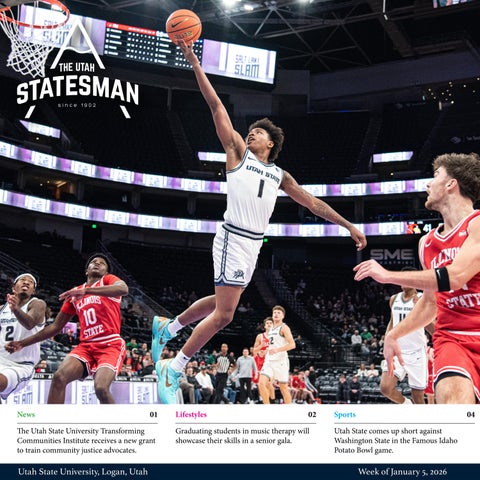
Utah State comes up short against Washington State in the Famous Idaho Potato Bowl game.
Week of January 5, 2026
Page 2 - The Utah Statesman, January 5, 202
New grant for community justice advocate training By Mia Nielsen STATESMAN REPORTER
T
he Utah State University Transforming Communities Institute received a new grant that will help train community justice advocates to provide legal information to members of the community. Jayme Walters is the executive director of the TCI and said many communities face an access-to-justice gap. Many people in low-to-moderate income groups are often unable to access legal support because of prohibitive costs or a lack of lawyers in the community. “They have to face those issues alone, and that’s problematic,” Walters said. The current training program prepares CJAs to provide support for debt-related legal issues. These issues involve essential needs such as medical care, housing, utilities and transportation. Without support to navigate these challenges, Walters said the consequences can be severe. “If they don’t have support during those difficult legal and financial challenges, they could find themselves homeless, not getting the medical care that they need or potentially losing their job because they don’t have the proper transportation,” she said. The curriculum prepares CJAs to help individuals better represent themselves legally: to prepare for court, understand forms and prepare for phone calls with creditors. Many of the CJAs are already involved in social work and will return after the training able to provide better help to their clients. “It’s another tool in their toolbox to do the work that they’re already doing,” Walters said. “It gives them another set of skills to be able to do something that will help their clients be in a better place so that they don’t have to refer them out to something that in a lot of cases, they can’t access.” The training program is still in its pilot phase. Currently, 21 people are finishing the program, and another group will start in January. Walters hopes to offer the training program every semester and expand to other topics. She hopes the institute can annually produce 50-75 CJAs in at least one topic, if not more topics in the future. Walters believes these CJAs will create a widereaching impact. “If a person is at a social service agency and their caseload is 30 and even just five of their clients are
PHOTO VIA UTAH STATE TODAY
experiencing financial, legal issues, then those are five people from just that one CJA that are being served at a given point in time,” Walters said. “It’s a way to exponentially help the state with these kinds of issues when we’re training a lot of people at one time.” According to an article by Utah State today, CJAs have recently helped with over 20 cases in Utah, with a total of over $117,000. Walters believes the program has implications beyond the state. “We’re excited to see where this goes. It’s an innovation. This is very cutting edge. This is not just new for Utah. This is a new concept for the entire country,” Walters said. The grant comes from an organization outside of Utah. “It gives us some confidence that people beyond our state see the value in this kind of work,” Walters said. Walters emphasized the program wouldn’t be possible
This is not just new for Utah. This is a new concept for the entire country. — Jayme Walters
without collaboration. The program was developed with community partners, including lawyers, judges, social workers and other professionals. It is supported by the American College of Bankruptcy Foundation and the Utah Bar Foundation.
Mia Nielsen is a sophomore studying plant science and journalism. When she’s not writing, she enjoys live music, driving up Logan Canyon and daydreaming about moving to Spain. —mia.nielsen@usu.edu
By Hazel Harris-Staples STATESMAN EDITOR
F
rom clinical settings to performing “Pink Pony Club” at a PoBev, students in the music therapy major at Utah State University are taking what they have learned in their classes and putting it to use. Mallory McAlister, a senior in the music therapy program, discussed what the music therapy program is and what it teaches students involved to do. “Music therapy itself is the clinical use of musical interventions in a therapeutic setting,” McAlister said. “Along with our classes, we have practicums where we’re assigned to a different site every semester. We go and do clinical work with a supervisor and get real-life experience.” Hannah Hunt, another member of the senior class, added onto that thought. She describes music therapy as “a form of therapy that uses music to achieve a client’s goals.” “That can be spiritual, physical, emotional, mental, behavioral or really anything,” Hunt said. These two, as well as other members of the music therapy program who are almost done with their bachelor’s degrees, are preparing for their upcoming gala: a place where they can share what they have learned and use music to connect with the community. The Music Therapy Senior Gala, which will be held on Jan. 24, is an end-of-level performance, jury and celebration where seniors in the program perform songs from their repertoire to a group of jurors as part of their graduation requirements. This type of performance happens for students of every year, but the parameters are different for their senior year, where the performance becomes a gala. The twist during the final jury, or the gala, is students do not know what songs they will perform and they must also do it in front of a live audience. “We keep what’s called a repertoire list, and by the end of our senior year, we have to have 60,” Hunt said. “For this gala, we give our professors our top 10 of those 60 songs, and then they put them in a hat, and then we go up and draw one, and whatever song is on that slip of paper, we just perform live in front of the concert.” According to Hunt, the gala is ultimately a celebration of what students learned during their time in the program. “It’s a little intimidating, but I feel like it is more of a celebration of how far we have come as seniors, showing the skills that we have learned and also just sharing music because music is connection,” Hunt said. “It’s what connects us.” McAlister discussed her experience preparing for the gala by sharing an insight into an internship she did at a children’s hospital. “In my practicum settings, I’ve used a lot of songs I already had memorized. This past semester, I worked in a children’s hospital, and many times, I didn’t know which clients I’d be seeing that day,” McAlister said. “I’d be pulled into a room and asked to play a song on the spot,
FREE SINGLE COPY
THE BOARD Avery Truman managing editor
Hazel Harris-Staples lifestyles editor
—————— Malory Rau news editor
—————— Ella Stott chief copy editor
editor@usustatesman.com
PHOTO SUBMITTED BY Mallory McAllister Senior students in the music therapy program pose for a photo.
and often, I already knew it. That will be similar during internships and future work — having a memorized song bank you can pull from at a moment’s notice is extremely helpful.” She gave examples of songs she had used in the practicum setting, ranging from “Home on the Range” by Tom Roush to “Born This Way” by Lady Gaga. Because the gala is a public performance, it is also an opportunity for students to explain what music therapy is and highlight their program. McAlister framed the concert as a way to introduce music therapy to the public and increase awareness of the field. “The concert really gives people insight into what music therapy is. We explain it, and you get to see how everyday songs that people already know can be used in a therapeutic setting,” McAlister said. “We’re also bringing awareness to our field and showing that music therapy is a real and valuable form of therapy. We want more people to learn about it since it’s not very well known.” Hunt hopes individuals who attend the concert will understand the value of music and the connection it brings. “Music is connection. It connects us all — it is something we can all relate to,” Hunt said. “It helps us to connect to other people and basically, if you want to just see some really awesome people play their instruments and have a good jam session, or if you like music at all, I would highly recommend it to anybody because it’s a really neat experience.” This year’s gala will be held on Jan. 24 at 7:30 p.m. in the Russell/Wanlass Performance Hall. Hazel Harris-Staples is a junior studying photography. She can be found reading, writing poems with refrigerator magnets and taking pictures on her digicam. —hazel.harris@usu.edu
Page 3 - The Utah Statesman, January 5, 2026
Gala to showcase graduating music therapy students
Student-run newspaper for Utah State University since 1902. Reporting online 24/7. Printed weekly during the school year.
life@usustatesman.com
news@usustatesman.com
copyeditor@usustatesman.com
sports@usustatesman.com
photo@usustatesman.com
—————— Mark Greenwood sports editor
—————— Jack Burton multimedia editor
The Utah Statesman Office TSC 118 435.797.1742 usustatesman.com Senior Reporters Essence Barnes Bailey Daniels Carson Frost Reporters Grace Colvin Emi Ludlow Jayke Martin Rory McNeill Dylan Moore Mia Nielsen Emma Shelite Kenadie Skye
Cover art by Jack Burton Published and distributed by USU Student Media 0165 Old Main Hill Logan, UT 84322
Senior Photographer Dane Johnson Photographers Alyssa Cook Elise Gottling Hadley Sintay Copy Editors Jaxon Charlton Camille Simpson Addy Wood Columnist Asher Schroader Letters can be hand-delivered or mailed to the USU Student Media office in TSC 118. They can also be emailed to editor@usustatesman.com.
For advertising inquiries TSC 118 435.797.1775 studentmedia@usu.edu
Page 4 - The Utah Statesman, January 5, 202
Utah State’s defense finds footing late in season By Carson Frost
STATESMAN SENIOR REPORTER
E
arly in the season, Utah State Football’s defense looked like a unit caught between ideas. There were flashes — a strong opener against UTEP, timely takeaways against Air Force — but also long stretches where breakdowns overshadowed effort. Explosive offenses exposed communication issues. Drives extended. Red-zone trips almost always ended with points. Then, slowly, something changed. It wasn’t one adjustment or one breakout performance. It was a process driven by budding chemistry, clearer roles and a growing confidence in how the defense wanted to play. “We’re finding our stride, and we’re gaining momentum,” said head coach Bronco Mendenhall. “The production shows that.”
But the more telling change was visual. Defensive backs arrived on time. Linebackers trusted their fits. Safeties communicated rather than reacted. Stability on the back end Much of that growth coincided with the return of safety Ike Larsen in Week 6. His presence allowed Utah State to settle its secondary, giving the Aggies more experience and flexibility. Noah Avinger, who had spent much of the first half of the season playing safety, slid back to corner, and his role expanded.
The growing pains Utah State’s early schedule offered little margin for error. Texas A&M and Vanderbilt — two of the most explosive offenses the Aggies faced all year — punished hesitation and inconsistency. Even in wins, yards piled up, and defensive series rarely ended cleanly. The defense could generate pressure. They could force turnovers. But they struggled to finish. Opponents almost never left empty-handed in the red zone, and fourth downs routinely turned into extended drives. The Aggies weren’t being outworked — they were being out-executed in the moments that mattered most. Defensive coordinator Nick Howell viewed those struggles as part of installing something new. “I think time just allows you to play better and get more comfortable in the scheme,” Howell said. “The guys have just learned how to really practice physical and tough and get their assignments down.” A turning point The loss at New Mexico in late October proved to be a breaking point — not just because it was one of the worst defensive showings this year but because it was one the Aggies felt was avoidable. “We left it with a bad taste in our mouth,” Howell said. “There were some bye weeks in there where we were able to self-scout and adjust things to fit our guys a little bit more.” From that point forward, the defense looked different — not necessarily dominant on the stat sheet, but more composed. Drives shortened, windows tightened and opponents had to earn every score. The numbers reflect that shift. Red-zone success against Utah State dropped from 96% in the first six games to 78% in the last six. Opponents’ fourth-down conversion rate dropped from 69% to just 33% in the second half of the season. It was clear that Utah State became far more effective in the highest-leverage moments
“Being able to have a player that coach can throw wherever is very helpful,” Avinger said. “That’s what I kind of take pride in as a player. I always tell coach, ‘Anywhere you need me on the defense, I will play for you.’” Less chaos, more control Utah State didn’t suddenly become a sack-heavy defense late in the year. In fact, raw sack numbers dipped slightly. But pressure became more consistent and coverage more reliable. Quarterbacks were forced to throw earlier, and drives stalled in situations where they previously hadn’t. Games like the road win at Fresno State — where the Aggies shut out the Bulldogs in the second half — highlighted that maturation. The Aggies weren’t just surviving possessions — they were closing them. “As the weeks went on, we got better and better,” Avinger said. “We had to lock in on the details. If it doesn’t look right in practice, how is it going to look right in the game? That confidence stacks. Once you see it work, you trust it more.” By season’s end, Utah State’s defense had found its identity. It was never flashy, nor was it perfect. But it was disciplined, connected and increasingly dependable in pressure situations — the very areas that define postseason football. As the Aggies prepare for their bowl matchup against Washington State, that growth matters. The Cougars thrive in tight, physical games, where patience and execution decide outcomes. Utah State’s defense learned those lessons the hard way. Through early setbacks and internal adjustments, their improvement wasn’t about doing more but doing things better. Now, they enter the postseason knowing exactly who they are — and how they want to play.
PHOTO BY Elise Gottling Brevin Hamblin runs the ball to the end zone during the game against Nevada at Maverik Stadium on Nov. 8.
“It allowed [Avinger] to play corner and Ike to play safety,” Howell said. “That’s another better player on the field and another really good player at corner.” Avinger’s season became a reflection of the defense’s evolution. Early on, his impact showed up mainly in tackles and interceptions. Later, it appeared in subtler but often more important ways: pass breakups on third down, tackles for loss in the red zone and pressure that forced hurried throws. With his versatility and week-to-week impact, Avinger earned HERO Sports Group of Five All-American second-team honors.
Carson Frost is a transfer student from Denver studying journalism. His family originally hails from Los Angeles, and he is a passionate fan of the Lakers, Dodgers and Philadelphia Eagles. — carson.frost@usu.edu
By Carson Frost
T
STATESMAN SENIOR REPORTER he Aggies spent much of their first season under Bronco Mendenhall trying to prove they belonged again on a bigger stage. On the afternoon of Dec. 22 at Albertsons Stadium, they got a clear look at what that stage will demand — and how much ground still remains. Washington State pulled away in the second half to defeat Utah State 34-21 in the 2025 Famous Idaho Potato Bowl, using explosive passing plays early and a punishing run game late to secure the win. “We came to win the game,” Mendenhall said. “Fell short. My responsibility is to have the team prepared to play and execute at a level that will hold through the entire game and be strong enough to help us win. I fell short as well.” The loss closed a season defined by resilience and flashes of progress for a Utah State team that entered the year with a new coaching staff, a largely rebuilt roster and expectations focused more on foundation than finish. It also offered a measuring stick against a Washington State program built with the depth and physicality Utah State will see regularly when it joins the Pac-12. Utah State’s defense set the tone early, repeatedly disrupting Cougars quarterback Zevi Eckhaus and creating opportunities the offense couldn’t convert. After forcing a three-and-out on the opening possession, the Aggies benefited from short fields twice in the first quarter following interceptions by safety Ike Larsen and cornerback Dylan Tucker. Larsen’s interception was his first of the season after missing the opening six games due to suspension, and it gave Utah State the ball inside the Cougars’ 15-yard line. But both chances ended empty — a missed 31-yard field
PHOTOS COURTESY OF Omar Saucedo, The Arbiter
goal and a red-zone interception — as Utah State struggled to find rhythm against Washington State’s disciplined defense. “We didn’t capitalize on a couple turnovers early on, which I think swung the momentum,” Mendenhall said. “We just ultimately didn’t play consistently enough, really in any phase.” Washington State struck first on a 41-yard touchdown pass from Eckhaus to Mackenzie Alleyne late in the first quarter, exploiting coverage over the middle — a vulnerability Utah State battled throughout the season. The Cougars leaned heavily on the passing game early, finishing the first quarter with more than 100 passing yards and no rushing yards, a sharp contrast from a team that relied on the run throughout much of the season. Utah State’s offense, meanwhile, sputtered. Quarterback Bryson Barnes faced constant pressure, was sacked multiple times and completed just 2 passes through much of the first half as the Aggies repeatedly found themselves pinned deep in their own territory. Several promising runs and returns — particularly from Barnes and Javen Jacobs — were negated by penalties, a recurring frustration during the year. Washington State extended its lead to 14-0 midway through the second quarter on a one-yard touchdown pass to Hudson Cedarland, capping a methodical drive that featured multiple seam completions and edge runs. Eckhaus consistently found space between Utah State’s linebackers and safeties, forcing the Aggies to defend horizontally and vertically. Utah State’s defense continued to fight, highlighted by linebacker John Miller’s chase-down sack and a goal-line stand on fourth down just before halftime. But the Aggies
entered the break still scoreless, managing fewer than 50 total yards of offense in the opening half. “That’s a strong defense,” Mendenhall said of Washington State. “They were as advertised. They were consistent, they executed and they were better in most circumstances.” Any hope of a Utah State turnaround hinged on halftime adjustments, but Washington State immediately flipped the script by establishing the run. Maxwell Woods and Angel Johnson gashed the Aggies on the Cougars’ opening drive of the third quarter, ripping off chunk gains that hadn’t been available earlier. The drive ended with a field goal, but the tone had shifted, and the Aggies felt it. “The ability to run the football was the difference in the game, particularly in the second half,” Mendenhall said. “We weren’t fitting cleanly, precisely nor consistently, and so you have to give Washington State credit.” Utah State’s offense continued to struggle until late in the third quarter when Barnes finally found a spark. After a rare deep completion to Brady Boyd and a pass interference call at the goal line, Barnes scored on a two-yard quarterback keeper to cut the deficit to 20-7.
— carson.frost@usu.edu
Page 5 - The Utah Statesman, January 5, 2026
Utah State comes up short against Washington State in Famous Idaho Potato Bowl game
Page 6 - The Utah Statesman, January 5, 202
Column: Utah State losing coaches, players should be celebrated By Mark Greenwood
STATESMAN EDITOR
O
n Dec. 23, former Utah State Volleyball head coach Rob Neilson was hired by BYU to be its new head coach after six seasons at the helm in Logan. In his tenure at Utah State, Neilson won four Mountain West championships and posted an overall record of 112-59, including an impressive undefeated conference slate and NCAA tournament win over Tennessee in his final campaign. Since that record-setting season, the Aggies have also lost top contributors and several All-Mountain West players to various Power 4 programs. For Utah State and its fans, Neilson’s departure was not a new, unforeseen development but a recurring reality. Just since Neilson’s hire in 2020, Utah State Men’s Basketball has seen three head coaches and numerous all-conference players leave for bigger programs before finding Jerrod Calhoun, now in his second season with the program. These departures almost always bring bemoans and figurative, or literal, tears from Aggie fans as they weep what might have been. While this mourning from the USU faithful is normal and expected, the departure of coaches and players for bigger, more prominent or higher-paying programs should be celebrated and congratulated more than complained about. As unfortunate as it is, the current landscape of college athletics does not favor mid-majors such as Utah State. The system has always favored the bigger schools with bigger budgets, and the transfer portal and NIL surge of the last 5 years has only exacerbated that issue. Every Group of 6 and mid-major fanbase can sit around and complain about it, but that will not change the reality. Because of that, continually losing coaches and athletes to the portal and to bigger programs needs to be encouraged and touted as a strength of Utah State, not a weakness. After all, BYU isn’t hiring Neilson because he has a track record of losing games. At the end of the day, a carousel of coaches and players is a sign
of success for the programs and universities that are losing them. Using USU basketball as an example, the only former head coach in the last 10 years not to get hired away to a new program was Tim Duryea, who coached from 2016 until his firing in 2018. Duryea posted an overall losing record in three seasons, with no conference championships and zero NCAA tournament appearances. That is the alternative to losing coaches to power programs. Similarly, Utah State athletes entering the transfer portal to make more money at a bigger school is a mark of on-field success in Logan that likely led to conference championships and postseason play. However, players and coaches eventually leaving does not mean the fans and community should not invest in those programs and individuals. “It’s not only how do you keep them, it’s how long can you keep them,” said head football coach Bronco Mendenhall on early signing day in early December. “The better that we do, the more tampering will happen … our relationships, our culture, our success will then possibly hold a player an additional year. It might not hold them for all five, but an additional year.” The issue of successful players entering the transfer portal is not a problem just mid-majors have, but all college athletic departments. Such is the nature of pay-to-play. Though as Mendenhall noted, the strong financial and vocal investment from the school and community may help keep coaches and players away from those opportunities, even if just for an extra year or two. The days of Stew Morrill coaching Utah State to titles and NCAA tournaments for 16 years with Jaycee Carroll playing his whole career in Logan are likely in the past. It’s a sad reality but a reality nonetheless. Coaches and players will continue to come, and we should enjoy them, invest in them and cheer them on while they’re here. And when the time comes, we should hope they have enough success to be lured away and wish them all the best on their way out.
PHOTO BY Dane Johnson Students Kyle Nalder, left, and Camron Potter pose with a banner of coach Rob Neilson at the volleyball game against Wyoming in the Wayne Estes Center on Sept. 28, 2024.
Mark Greenwood is a junior at USU studying economics and finance. He is an avid Los Angeles Dodgers fan and loves playing tennis and skiing. — mark.greenwood@usu.edu
Make the most of your potential with training, tools, and mentorship. Develop your skill set while pushing your abilities to the next level.
DECIDE TO LEAD. GOARMY.COM/OFFICER
For more information about Utah State Army ROTC contact Clyde Ratliff at 801-626-8609 or email clyderatliff1@weber.edu Or visit us at usu.edu/military-science/ ©2025 U.S. ARMY. PAID FOR BY THE U.S. ARMY.
Page 7 - The Utah Statesman, January 5, 2026
WE GIVE YOU THE SKILLS, YOU DECIDE WHERE THEY TAKE YOU.
Page 8 - The Utah Statesman, January 5, 202
Shrink Wrap How can I stay motivated through the darker winter months?
This column offers general mental health information and is not a substitute for professional counseling. Students in crisis or seeking professional support are encouraged to contact USU Counseling and Prevention Services (CAPS) at 435-797-1012, visit TSC 306, or access after-hours crisis support by calling or texting 988. Dear Aggie, Thank you so much for your thoughtful question! Winter can be a beautiful season, but it also brings some real challenges. Shorter days, colder weather and less sunlight can make it harder to stay active, social and motivated. The good news is there are gentle, effective ways to take care of your mental health during these darker months. 1. Get as Much Light as You Can Sunlight plays a bigger role in our wellbeing than we often realize. It helps our bodies make vitamin D, which supports bone health, immune function and even our mood. Light also helps regulate our natural sleep rhythms. Even a quick 15-minute dose of morning sunshine can make a difference. Try opening your blinds first thing in the morning, studying near a window or stepping outside during daylight whenever you can. For most people, bright light therapy, usually 30 minutes after waking up, using a 10,000 lux light — these lights are relatively inexpensive — is a safe, low-tono side effect, effective treatment of choice. Make sure to get approval from a doctor. You can also check in with your doctor about possible vitamin D supplementation, as over half the U.S. population is deficient by the end of winter. 2. Keep Your Body Moving Staying active in winter doesn’t have to mean braving the cold. Gentle movement, even when motivation is low, can boost your mood and energy. Think indoor yoga, resistance-band workouts, dancing around your room or taking a brisk morning walk with a warm drink. Remember: It doesn’t have to be intense to be helpful. The ARC also has many group classes and personal training sessions. As an added bonus, it also has many workout studios with large windows to allow for lots of natural light —
see the first suggestion! 3. Try Habit Stacking Habit stacking is a simple way to build new routines by attaching them to habits you already do. This works especially well when motivation is hard to find because your brain is following a familiar pattern. Here are a few examples: After you eat lunch, review flashcards for 5 minutes. After finishing a class, take 3 minutes to jot down or prioritize key points. While taking a walk, listen to a textbook chapter or lecture recording, when available. Small, consistent steps can make winter feel much more manageable. If you ever feel like you need a little more support, we’re here for you. You can visit counseling.usu.edu or call 435-797-1012 to connect with us. With care, — USU Counseling and Prevention Services
Navigating the political divide Editor’s note: Guest Columns and Letter to The Editors are pubished as submitted. Submission instructions are available at usustatesman.com. Can you relate to the following sentence? In the past, I have felt overwhelmed, frustrated, or hopeless after seeing updates on politics and recent events. Me too. When I see news and political updates on social media, I’m filled with dread and paralysis as I see extreme narratives being presented to me. What is real? Why is political violence everywhere? How did we get here? To understand why our democracy is breaking down, we need to understand what it takes for a democracy to work – an educated public and a shared sense of reality. Many historians argue that the invention of the printing press paved the way for democracy. As education became cheaper and more widespread, individuals no longer relied on an educated, elite class to rule them – they could cast educated votes on how they wanted to be governed. Democracy was a great step forward for humankind, but we are now seeing a breakdown. Today, many people spend hours on social media – tailored content that triggers euphoria or dread to keep you engaged and go viral. Your algorithm shows you a tailored, extreme reality – different from what your neighbors are seeing. Democracy is breaking down because we are losing our shared sense of reality. Political violence is on the rise – but wouldn’t a revolution seem valid if these distorted narratives were actually reality? We cannot make progress solving any problem – government overreach, the climate crisis, the cost of living - if we can’t agree on what the reality of the problem is. But what can I do? I’m just one person. Disengage from inflammatory media Don’t use social media as a news source – its goal is not to inform you, it’s to engage you. The easiest way to
do that is by provoking anger. Don’t engage. If you see something you don’t like, don’t engage with it – your engagement will only help it reach a larger audience. Get informed Get informed on what news sources are valid. I use Ad Fontes Media – a media watchdog and public benefit corporation – to identify trustworthy sources. Their Media Bias Chart ranks news outlets based on political bias and news value and reliability. Get your information from highquality sources. For news updates, I use Tangle, a non-partisan, subscriberfunded media organization. They provide a free newsletter with news updates that is trusted by both the left and right. Sign up for their free newsletter here. Get involved Social media has trained us to talk in inflammatory ways. Practice good faith communication to have productive conversations. Reengage in democracy – vote! Get registered. Information on how to get registered is here. Note: Utah voting system is a closed primary system, meaning that each political party has a closed election to choose its candidate for the general election, where only registered party members can vote. -If you are an active registered voter, your ballot will automatically be mailed to whatever address you listed when you registered. Learn about the candidates and cast your vote. Find other productive ways to get involved. USU’s Heravi Peace Institute is a great resource.
Sarah Sabey Peterson is a student in Masters of Anticipatory Intelligence at USU. She has worked as an intern at Tangle, a non-partisan, subscriber funded news outlet. — sarah.peterson@usu.edu
By Ella Stott STATESMAN EDITOR
A
s a Utah State University student who works a couple of part-time jobs on campus, I didn’t have much to do during winter break. As an English major, I also didn’t have any tests during finals week, which meant I returned home on Dec. 7. Therefore, I had a lot of time to consume media — I also went outside and touched grass, which was easy because there wasn’t any snow — and I compiled a list of my top 10 pieces of media during the break. Keep in mind, most of this isn’t new, but maybe some of these recommendations will be new to you. I’ll also give you a spoiler: No. 1 is “Heated Rivalry.” So, if you want to hear my review of this new show — which is obviously positive based on its position here — stick around. 10. Todd Phillips’ “The Hangover” This 2009 comedy is a classic — at least for my dad. Starring Ed Helms, Bradley Cooper, Zach Galifianakis and Justin Bartha, it follows a bachelor party as they go to Las Vegas for the weekend. Things are going well as they head out to party, but suddenly, we see them as they wake up the next morning, completely hungover and unable to remember anything from their night out. To their horror, they discover one of them, the groom-to-be, is gone. “The Hangover” is a hilarious quest to figure out what happened that night, complete with two weddings, villain Ken Jeong and even a baby and tiger in the friends’ hotel room. I now understand why this movie has occupied my dad’s mind for so long, and although I know they aren’t rated as highly, I will definitely be watching the sequels. 9. “Found Heaven” by Conan Gray I am self-righteous, so I certainly do feel like a “better” Conan Gray fan than others because I knew him — and not just “Heather” — before his recent, most popular album
PHOTO VIA CONAN GRAY OFFICIAL STORE
“Wishbone” came out in August. Last year, I was privileged enough to go to his “Found Heaven” tour in Phoenix, Arizona, where my sister and I sang our hearts out to all the songs, including standouts “Alley Rose” and “Winner.” “Found Heaven” was Gray’s third studio album and marked a unique shift for the artist, as he catered the album toward an ‘80s aesthetic. At first, this scared me because of how much I liked his previous albums, but it took just one listen for me to become enamored with the sound. This break, I revisited “Found Heaven” after spending so much time listening to Gray’s recent album, and with it, I revisited some of the most magical, heartbreaking and compelling songs out there. 8. “Animal Crossing: New Horizons” We all played “Animal Crossing” in 2020. If you didn’t, you probably know someone who did. With the release of the Nintendo Switch version of the game happening right at the beginning of the 2020 quarantine, people were spending a lot of their newfound free time engaging in the social stimulation game. I practically haven’t played since 2020, and I got to start my village from scratch. The game is so relaxing and provides a sense of accomplishment and pride as you develop your town, build relationships with the villagers and customize your house. My favorite part is getting to visit other islands, gather all its resources and abandon it for the benefit of my own village. Perhaps I should find a game that makes me look inward. Either way, “Animal Crossing” is a relaxing way of pretending to be social as the cold months hit us. 7. Odyssey Dance Theatre’s “Christmas Spectacular” As a dancer, I take every opportunity to go to as many dance performances as I can. Odyssey Dance Theatre, a professional dance company in Salt Lake City, is famous for putting on the Halloween show “Thriller,” which highlights performances inspired by popular Halloween or spooky tales. As someone who has participated in “Thriller” as a dancer and viewer, I was so excited to go to the “Christmas Spectacular” for the first time, where the company does the same thing for Christmas as it did for Halloween. Iconic Christmas stories, such as “The Grinch Who Stole Christmas” and “Rudolph the Red Nose Reindeer,” were turned into beautiful dances across a variety of styles, including ballet, jazz, contemporary, hip hop and my all-time favorite, tap. This show got my whole family in the Christmas spirit and amazed us with beautiful costumes, exciting new choreography and fun spins on classic stories. 6. Hernán Jiménez’s “Love Hard” I’m not a Hallmark Christmas girl, but I do love a holiday romcom. My all-time favorite is “Love Hard,” starring Nina Dobrev, Jimmy O. Yang and Darren Barnet in a hilarious and heartwarming tale of online catfishing. The title is a mix of two of the characters’ favorite Christmas movies: “Love Actually” and “Die Hard.”
PHOTO VIA BARNES AND NOBLE
Ella Stott is a senior studying creative writing and a media connoisseur. Please send her any and all recommendations for books, tv shows, movies and music. — ella.stott@usu.edu
Page 9 - The Utah Statesman, January 5, 2026
Review: Top 10 from winter break
2025 IN REVIEW
Page 10 - The Utah Statesman, January 5, 202
The Utah Statesman Photo Team Jack Burton Alyssa Cook Elise Gottling Dane Johnson Claire Ott Hadley Sintay
FREE Services include: Pregnancy Testing Limited OB Ultrasound
Last solution:
Options Consultations
www.prc-logan.com No pressure. No cost. Just care.
Sudoku puzzles are provided by www.sudokuoftheday.com.
Page 11 - The Utah Statesman, January 5, 2026
Pregnant?
Page 12 - The Utah Statesman, January 5, 202