USUSTATESMAN.COM
News
02
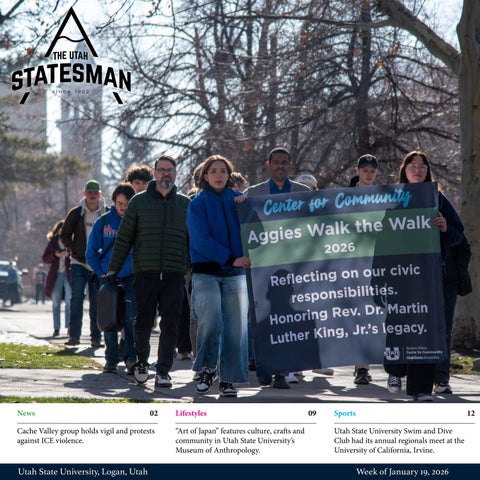
Cache Valley group holds vigil and protests against ICE violence.
Utah State University, Logan, Utah
Lifestyles “Art of Japan” features culture, crafts and community in Utah State University’s Museum of Anthropology.
09
Sports
12
Utah State University Swim and Dive Club had its annual regionals meet at the University of California, Irvine.
Week of January 19, 2026
Page 2 - The Utah Statesman, January 19, 202
Cache Valley group holds vigil, protests ICE violence By Bailey Daniels STATESMAN SENIOR REPORTER
T
he killing of American citizen Renee Good by an U.S. Immigration and Customs Enforcement, or ICE, officer on Jan. 7 sparked nationwide protests over the following weekend, and Cache Valley was no different. Citizens gathered in front of Cache County Historic Courthouse on Jan. 9 as part of the “ICE Out For Good” movement. The goals for the event were posted on mobilize.us, a website that allows organizers to promote things like events, petitions and fundraisers. The information for the vigil in honor of Good included the expectation for nonviolent action and no civil disobedience. The vigil included a table with fresh flowers, real and battery-operated candles and a book for attendees to write messages in, which will be sent to the Indivisible group in Minneapolis. Indivisible is an organization that describes itself on indivisible.org as “a grassroots movement of thousands of local Indivisible groups with a mission to elect progressive leaders, rebuild our democracy, and defeat the Trump agenda.” Susanne Jänecke and her husband Jim Evans helped organize the event. The couple can be found in front of the courthouse almost every Friday evening from 4-5 p.m. for a similar pro-democracy vigil. They are also the owners of a blog, found at wethepeoplecv.org, where they voice their opinions and share information about events.
out. It’s cold, but it’s colder in Minnesota in many ways.” Friend of the couple Becka Schultz went on to read a letter on the details of Good’s killing. As outlined in the letter, Good was a 37-year-old wife and mother. The letter also mentioned the names Silverio Villegas González, Chaofeng Ge and other people either killed by ICE or while in ICE custody. Julie Thuuin, the daughter of two immigrants, was also present at the vigil. “I think the biggest takeaway of this is if you encounter anyone that you know could be at risk, whether you’re walking down the street or you’re in the grocery store, it is imperative that you let them know you are an ally,” Thuuin said. “This is going to be an omnipresent problem for the foreseeable future, so our responsibility as community members is to connect with them and say, ‘I am here for you.’”
PHOTOS BY Bailey Daniels Protestors stand in front of the Cache County Historic Courthouse.
The vigil ended with information about Our Community Cache Valley, a non-partisan group that “shares concerns, ideas, skills, and resources to support our Cache Valley community and work toward a better future.” Information on events held by the organization can be found at ourcommunitycachevalley.org. “Sorrow is the loss of the innocent and the loss of innocence. We cry out, and we want to have the intercession of whatever comfort we can find. With the sight of undying justice, we must persevere,” Evans said. “Strengthen us with the sight of what is necessary that we might become a beacon of hope in this current time of darkness.” Claudia Soria speaks at the “Ice Out For Good” event.
Protestors as seen near N. Main Street on Jan. 9.
“We are asking you to take those candles and remember the people who have died from these events with ICE,” Evans said. “We really appreciate everyone who has come
Jänecke said a good way to let the people who may be at risk from ICE know someone is an ally is for Cache Valley to create a symbol. Every day, she wears necklaces covered in pins around her neck, each showing off her beliefs and allyship. Claudia Soria is an immigrant from Chile. She said when she immigrated to the United States, she was ecstatic, as her Chilean parents told her it was the greatest country in the world. She livestreamed the vigil on her personal social media page to show the Hispanic community there is a community showing up for them. “What happened in Minnesota, what’s happening all over the U.S., this is not the America I know,” Soria said. “My own children, when I left the house today, said, ‘Don’t get arrested. Don’t get deported.’ Why am I going out in fear? Why do my neighbors have to go out in fear? It’s not fair.”
Bailey Daniels is a senior studying technology systems. She loves Lana Del Rey, sweet treats and all things whimsical. — bailey.daniels@usu.edu
By Emma Shelite STATESMAN REPORTER
T
wo decades to the day after its opening, the Russell/Wanlass Performance Hall celebrated its 20th anniversary on Jan. 14 with a celebratory performance. The event featured mezzo-soprano Tamara Mumford and pianist Adam Nielsen — two Utah State University alumni who have ascended to the highest levels of the classical music world since their time in Logan. For the crowd of 400, the evening was a tribute to the venue’s legacy and the donors who made it possible. “Since the main goal of the hall is to elevate the student experience, we invited Adam and Tamara as outstanding alumni to give our current students a glimpse of how far a USU music degree can take them,” said Nicholas Morrison, executive associate dean of the Caine College of the Arts. The performance marked a full-circle moment for Mumford and Nielsen. Though they now grace stages at the Metropolitan Opera and Juilliard, the duo first performed together in a USU choir room. “We were little babies at USU together,” Mumford said. “He has known me from the beginning, and [it is] so important to have that trust with your pianist. I know him, I know his musicality and its instincts that I trust.” The program was as varied as the careers of the
PHOTO BY Malory Rau Mezzo-soprano Tamara Mumford performs at the 20th anniversary of the Russell/Wanlass Performance Hall.
performers, featuring selections from “Carmen,” “Bel Canto” pieces by Gioachino Rossini and American standards by Cole Porter, George Gershwin and Stephen Sondheim. Nielsen also performed solo piano pieces, including Claude Debussy’s “Clair de Lune,” a song Mumford noted was the inspiration for her daughter’s name. Beyond the music, the evening served as a memorial to the hall’s namesakes, Manon Caine Russell and Kathryn Caine Wanlass. The sisters each donated roughly $6 million to construct the facility, which opened in January 2006. For Mumford, the performance was deeply personal. She recalled how the Caine sisters supported her early career, attending her student recitals and helping fund her auditions for graduate school. “Not only were they involved in the foundation that provided that financial support for me, but Kathryn and especially Manon were just big supporters of me in the physical sense,” Mumford said. “They came to my performances when I was singing at USU. They were able to help support me in that adventure as well.” Architecturally, the hall remains a centerpiece of the university’s arts infrastructure. Designed specifically for acoustic perfection, the building features mechanical systems, such as heating and cooling, that are isolated from the performance space by a massive rubber gasket. This design ensures no mechanical vibrations transfer to the stage, creating a near-total silence Morrison said is essential for chamber music. “Every sound in the hall is audible, so you hear the quietest whisper,” Morrison said. While the hall is venue for the all of the Cache Valley community, its primary function remains academic. According to university data, 93% of the activities in the hall directly benefit students through recitals, master classes and professional recordings. As attendees departed the hall after the performance, they passed under Ann Preston’s “Passacaglia” sculpture, an installation based on the mathematical principles of Pythagoras and Fibonacci. Morrison noted the sculpture serves as a permanent reminder that the arts and sciences are “inextricably intertwined.” Reflecting on the milestone, Morrison emphasized the success of the hall is measured by its ability to foster human connection. “Attending a performance or exhibition can remind us of the power of the arts to bring us together and of what it means to be a member of this great family we call humanity,” Morrison said. Emma Shelite is a senior studying communications and journalism. Her writing is fueled by Dr Pepper and an extroverted personality. Outside of the newsroom, she is passionate about cooking, athletics and her love for dogs. — emma.shelite@usu.edu
Student-run newspaper for Utah State University since 1902. Reporting online 24/7. Printed weekly during the school year.
FREE SINGLE COPY
THE BOARD Avery Truman managing editor
Hazel Harris-Staples lifestyles editor
—————— Malory Rau news editor
—————— Ella Stott chief copy editor
editor@usustatesman.com
Page 3 - The Utah Statesman, January 19, 2026
Russell/Wanlass Performance Hall celebrates 20th anniversary
life@usustatesman.com
news@usustatesman.com
copyeditor@usustatesman.com
sports@usustatesman.com
photo@usustatesman.com
—————— Mark Greenwood sports editor
—————— Jack Burton multimedia editor
The Utah Statesman Office TSC 118 435.797.1742 usustatesman.com Senior Reporters Essence Barnes Bailey Daniels Carson Frost Reporters Emma Barker Alyssa Caywood Grace Colvin Emi Ludlow Jayke Martin Rory McNeill Dylan Moore Mia Nielsen Dani Packer Jillian Peterson Emma Shelite Kenadie Ferraro
Cover art by Jack Burton Published and distributed by USU Student Media 0165 Old Main Hill Logan, UT 84322
Senior Photographer Dane Johnson Photographers Alyssa Cook Elise Gottling Hadley Sintay Copy Editors Jaxon Charlton Camille Simpson Addy Wood Columnist Asher Schroader Letters can be hand-delivered or mailed to the USU Student Media office in TSC 118. They can also be emailed to editor@usustatesman.com.
For advertising inquiries TSC 118 435.797.1775 studentmedia@usu.edu
Page 4 - The Utah Statesman, January 19, 202
USU agriculture makes its way to southern Utah By Mia Nielsen STATESMAN REPORTER
With a major in agricultural education and a minor in nonformal and community-based education, Bair has seen many of the benefits of public education firsthand. “There is not a huge percentage of the population, nationwide and in Utah, that is directly involved in production agriculture, and along with that, there are a lot of misconceptions and misinformation that can get spread,” Bair said. “In my experience, one of the best ways to fight that is to give the community the opportunity to participate, to see what farmers and ranchers are doing and to ask them questions directly.”
T
he donation of the Dammeron Valley Vineyards isn’t official yet, but Utah State University Extension faculty are already imagining a new model of community-based agriculture in southern Utah. Utah State operates several extension centers and gardens throughout the state, including the USU Botanical Center in Ogden, which focuses on ornamental and horticultural demonstration gardens and offers community classes, and the Swaner Preserve & EcoCenter in Park City that functions primarily as a nature preserve. Unlike other extension centers, the vineyard would be the first site primarily focused on agriculture. “This would be the first such facility in the southern part of the state and would focus on grape production and possible other desert agriculture opportunities,” wrote Ken White, the senior vice president of statewide enterprise in an email to The Utah Statesman. Despite still being in the early stages, USU Extension faculty see the potential in the new center. Benjamin Scow is an extension assistant professor in Washington County with a background in fruit production. During his time at USU, he has worked with a few vineyards, including Dammeron Valley Vineyards. He says the landscape of Utah viticulture, or grape cultivation, has changed significantly in recent years. “About 15 years ago, there were less than five wineries in the state with an associated vineyard,” Scow said. Now, there are close to a dozen, and Scow explained the growing industry needs new resources. The vineyard would provide a place for researchers to study water consumption, pest identification and mitigation and what
PHOTO COURTESY OF USU EXTENSION Dammeron Valley Vineyard, as seen in October 2024.
grape varieties work best in Utah’s climate. “We’re hoping that it could give an opportunity for some grad students and specialists to come down and work in a climate that’s different than Logan to better represent the state,” Scow said. The backbone of the proposed center would be hands-on community engagement, offering workshops and classes to the public. The focus would be viticulture, but visitors could also learn about cut flowers, fruit and nut trees, horses, livestock and gardening. Sara Bair, president of the young farmers and ranchers club, said she believes many people have a natural interest in agriculture. “Agriculture is something that a lot of people are really drawn to, especially with plants and animals,” Bair said. “I think that it’s really essential for the future of the industry to be able to help people who don’t come from agriculture to learn how to be involved.”
Mia Nielsen is a sophomore studying plant science and journalism. When she’s not writing, she enjoys live music, driving up Logan Canyon and daydreaming about moving to Spain. —mia.nielsen@usu.edu
Make the most of your potential with training, tools, and mentorship. Develop your skill set while pushing your abilities to the next level.
DECIDE TO LEAD. GOARMY.COM/OFFICER
For more information about Utah State Army ROTC contact the USU Army ROTC main office at 435-797-7058 Or visit us at usu.edu/military-science/ ©2025 U.S. ARMY. PAID FOR BY THE U.S. ARMY.
Page 5 - The Utah Statesman, January 19, 2026
WE GIVE YOU THE SKILLS, YOU DECIDE WHERE THEY TAKE YOU.
Page 6 - The Utah Statesman, January 19, 202
Cache Chili-N-Chowder opens to public By Jillain Peterson STATESMAN REPORTER
C
ache Chili-N-Chowder, a food stand created by the owners of Romo’s Mediterranean Grill, held a soft opening on Jan. 8 in Logan and offers a 15% discount to Utah State University students with a valid student ID. The owners said they decided to open the stand because they wanted to bring something new and different to Cache Valley. “I’ve learned that this county is very meat and potato,” said Jill Romo, a co-owner. Romo said she wanted to incorporate that style of cooking into her own place. Located in front of the grill at 661 N. Main Street, the stand’s walk-up and drive-up options make it accessible to both pedestrians and drivers. Romo said the layout was designed for convenience and speed. For customers who want to sit and eat, there is seating available outside as well as inside Romo’s. Aside from chowder and chili, the menu also includes
cornbread and salad, along with baklava and brownies. “Our menu items are made from scratch,” Romo said. “The cornbread, the chowder, the chili, all of it is made here from scratch in small batches.” Romo said she wanted her food to feel home cooked and fresh. “I don’t use any seed oils, and there are no preservatives or chemicals,” Romo said. “It’s just good, pure food.” The chili and chowder bowls range from 8-60 ounces, with the biggest bowl advertised to serve four or more people. Chelsey Markham, a Hyde Park resident, heard about the stand on social media. In a statement sent to The Utah Statesman, she wrote that while she hasn’t been able to go to the stand yet, she is looking forward to having a local spot in Logan that serves both soup and cornbread. “Buying food from places like this helps support the local scene, people we actually know, instead of a huge chain,” Markham wrote.
PHOTOS BY Dane Johnson The menu of the newly opened Chili-N-Chowder sits in front of the stand.
Romo said she plans to rotate the menu either weekly or every two weeks to allow for a greater variety of flavors and recipes. “I’m most excited about the chicken noodle soup,” said Hadlie Griffen, the head server. Romo said she wants to serve warm, home-style comfort food during the cold winter months and then convert the stand into Chimneez Ice Cream in the spring and summer. The name is inspired by chimney cakes, which Romo plans to serve. “Chimney cakes are really cool,” Romo said. “It’s a sweetened, leavened dough that we wrap around wooden spools, and then we cook them on the wood.” The chimney cakes will act as cones for the ice cream. Next winter, Romo is hoping to use the cakes as bowls for the chili. She said both Chili-N-Chowder and Chimneez Ice Cream have been in the works for several years, so she is excited to see it all come together. While this project is ongoing, the owners are also planning to hold a grand reopening of the grill, since they recently changed the logo and building interior. Cache Chili-N-Chowder will have its grand opening on Jan. 22. Jillian Peterson is a sophomore studying communication and media. She is a big fan of concerts, snowboarding and the Taco bell drive-thru. The newly opened Chili-N-Chowder is seen at 661 N. Main Street on Jan. 15.
— jillian.peterson@usu.edu
Tune in to “perfect radio” for perfect music and perfect stories hosted by DJ perfect Hannah Potter. With different themes every week, “perfect radio” will be the perfect addition to your morning. Tune in every Wednesday from 10 a.m.-12 p.m. The USU Fiber Arts Club meets in the TSC International Lounge on Jan. 14. By Emma Barker STATESMAN REPORTER
Y
arn and thread spill across tables in the TSC International Lounge on Wednesday nights as students crochet between conversations about classwork and family drama. One individual pieces together a dragon puppet using reclaimed animatronic parts while another crochets a tie to gift to a family member. Welcome to Utah State University’s Fiber Arts Club, the place where “granny hobbies” are anything but stale. The club started almost five years ago with just a few members and has grown to host 10-20 regulars. Most are crocheters, but they also host other fiber arts enthusiasts such as knitters and the occasional wool spinner. “I think it’s really important for stress relief because pretty much every other day of the week, we’re all working on homework,” said Leona Bennion, the club’s current president. “This is my day of the week to chill for the night.” Bennion makes time for the club by requesting off work every Wednesday. They are not alone in prioritizing the fiber arts. “It gives an opportunity to just calm down a little bit,” Bennion said. “It’s also good to meet people with similar interests.” Adalene Long started the club as a sophomore in fall 2021 right as students returned to campus after the coronavirus pandemic. “I just felt like it was really important to come back and to have a space for people,” Long said. “I really was hoping it could be a way for people who had never crocheted before, never knitted before, to still come and enjoy and relax.”
PHOTO BY Elise Gottling
Long, who graduated in fall 2024, was surprised when she found out a fiber arts club didn’t already exist on campus. “I knew that there were so many people out there that do crochet,” she said. “It was sort of like postcoronavirus, and I just thought it was a great timing and opportunity to kind of start to bring people together.” The first year of the club wasn’t easy, though, according to Long. Some meetings were just Long and one other member sitting on the TSC couches, but it grew. In its second year, the club won USU’s Growth and Outreach award. Connor Hales, a club member, encouraged people not to be intimidated by the learning process. “When I first started, it was so hard, but it’s a lot of practice,” Hales said. “You can just turn your brain off after a while. My first couple projects were crap, but if you just set aside minutes a day to work on it, you’ll get good at it. I promise.”
Emma Barker is double majoring in journalism and communications and sociology. When she’s not reporting, she enjoys spending time with her dog and husband, thrifting and attempting to keep her sourdough starter alive. — emma.hatch@usu.eduu
Hysteria Def Leppard
Rockin’ Back Inside My Heart Julee Cruise
Suzanne Leonard Cohen
Carry the Zero Built To Spill
After the Love Has Gone Earth, Wind & Fire
Page 7 - The Utah Statesman, January 19, 2026
Fiber arts club: A space to unwind, connect
Page 8 - The Utah Statesman, January 19, 202
Intermountain Song Trails project documents history in the West By Essence Barnes STATESMAN SENIOR REPORTER
This project asks community members in the Intermountain West to share memories of songs they heard from childhood or family life. These song s humans move throughout history, the music recordings will then be archived on a publicly accessible and memories they carry travel with them. map, allowing anyone to view and listen to the ways This is a phenomenon Utah State University’s music has evolved throughout the region. “We’re really open to any kind of music and movement oral history archivist Joe Kinzer and folklorist Derek Piotr are attempting to immortalize through their new and labor and memory of the West,” Kinzer said. “It can community-based oral history project: the Intermountain be really broad, and we’re letting it organically evolve based on who we talk to.” Song Trails initiative. Some examples of songs they’re looking for include “We’ve been singing and making music since humanity began, so it’s kind of part of our DNA,” Kinzer said. “Just lullabies, cowboy songs, church songs, songs associated go to a movie and take away the soundtrack and you’ll with migration routes like the Mormon and Oregon Trails, protest songs or even pop songs. notice.” Kinzer and Piotr came together to collaborate on this project through a shared love of music, remembrance and archival work. While comparing music recordings that have been archived in the USU Fife Folklore Archives and Piotr’s own Fieldwork Archive, they came up with an idea for how to get the community more involved. “I really like this idea of activating archival materials, which is basically using them as memory anchors for oral history projects and engaging the community with archives,” Kinzer said. “Not just extracting things and hoarding them away never to be seen.” A cornerstone of Piotr’s fieldwork archive is the focus on the human voice, and all 1,700 recordings within it were filmed and sung by the participants who remember them. “I really value unaccompanied singing, particularly if the person isn’t a singer,” Piotr said. “I think there’s something really vulnerable about permanently putting a song down on tape when they’re not used to singing.” This is what the project aims to accomplish as well: encouraging participants to sing or hum fragments of songs they remember. “Even if you think it’s a tiny, insignificant song, we want to know about it,” Piotr said. “It will start to flesh out how people in the Intermountain West grew up, what they had access to, maybe what their religious life was like, what their schooling was like, where they went to camp, etc.” The main focus of the project is to look at the memories, stories and personal meanings participants associate with the music they remember. “We’re looking at memory — what does it trigger for you, what’s the meaning behind it, who sang it and how does that PHOTO BY Jack Burton reflect meaning in your life or connect you Joe Kinzer poses for a photo in the Merrill-Cazier Library on Jan 8.
A
to place,” Kinzer said. “We’re going back to the roots but also transforming it to engage contemporary memory in the community.” While anyone who lives or has lived in the region is welcome to submit a recording, the core oral history project is focused around collecting at least 20 interviews from various different prominent groups significant to the area. “One of the communities we’re looking at is descendants of Chinese railroad workers, which is missing from our archives,” Kinzer said. “We’d also appreciate Indigenous input, as these groups could provide the foundation of music and movement in the region before settler colonialism.” According to Kinzer, many of the recordings they have already received have been surprisingly but beautifully ordinary. “It’s the everyday songs that people remember the best, like ‘She’s Coming ‘Round the Mountain,’” Kinzer said. “They’re songs everyone knows, but they have a specific meaning for that person.” The overall focus of the project is on the songs and their attached memories, and both Kinzer and Piotr stressed they are not judging musical skill. “Just the act of someone, flesh and bone, using their voice and recording an old song really stands the test of time, especially in the face of deep fake voices and AI,” Piotr said. “It’s the impulse of ‘I want to share, I want to remember and I want to be human.’” This project was funded in part by the Utah Humanities Council and the Merrill-Cazier Library. The duo hopes to make access to the full archive of recordings available by the fall. “It’s not just nostalgia. It’s about understanding how people make meaning,” Kinzer said. “It shows the complexity of many stories, not just one.”
Essence Barnes is a third-year journalism student who enjoys reading, writing and storytelling. — essence.barnes@usu.edu
By Alyssa Caywood STATESMAN REPORTER
R
oughly 5,500 miles away, Japanese artistic traditions are deeply rooted in their culture. A new exhibit at Utah State University’s Museum of Anthropology allows Cache Valley community members the opportunity to experience a glimpse of this culture for themselves. On Jan. 10, the museum hosted “Art of Japan: Textile and Print,” an event celebrating the grand opening of the new Japanese art exhibit. The museum is located on the second floor of Old Main in room 252. Community members in attendance had the opportunity to learn about Japanese fashion, textiles, printing, calligraphy and more. The event included Japanese snacks, crafts and an organized art display. The new addition to the museum features several authentic pieces curated by USU senior art and design student Morgan Meyers. The exhibit includes traditional Japanese attire such as a formal kimono ensemble and a detailed undergarment colored vibrantly red and marked with family crest symbols. It also included an obi dyed with a shibori technique, a traditional method similar to tie dye, and a formal kimono ensemble. The obi is a wide, sash-like fabric meant to be tied around the waist with an elaborate knot. Attendees of the exhibit view Japanese textiles and art on display.
PHOTOS BY Jack Burton Japanese calligraphy is displayed in the “Art of Japan” exhibit in the Museum of Anthropology in Old Main on Jan. 10.
While the fabrics and knots are carefully and intricately designed, much of the artistic detail is deliberately concealed when fully assembled in order to reflect Japanese values of humility and respect. “This exhibit is a lot about how important fashion is,” Meyers said. Each piece embodies the time and artistry that goes into Japanese fashion and art. The displayed garments and fabrics include vibrant detail that showcases Japanese culture. “These are all objects from such a faraway place,” Meyers said. “It’s so important to be exposed to different cultures.” The exhibit additionally displays a handcrafted doll designed by a Cache Valley native who had the opportunity to spend time in Japan and learn from Japanese artists. After her death, her son gave the doll to USU senior lecturer Atsuko Neely, who gifted it to the display. “To my eyes, I think everything about that is authentic,” Neely said. Neely provided a calligraphy demonstration showcasing the artistry of Japanese calligraphy. To be proficient in calligraphy, one must master several brushstrokes before being able to create Japanese characters. She explained calligraphy allows for artistic and creative freedom. “Calligraphy seems to teach a whole aesthetic of Japanese culture rather than a superficial kind of commercial art,” Neely said. Neely’s father was a professional calligrapher, so she grew up around calligraphy. Now, she teaches a
calligraphy class available to USU students who want to learn that form of art. Crafts like origami, kogin-zashi embroidery and woodblock printing were available to community members as an opportunity to learn more about Japanese art. Each table was set up with materials and a museum employee to help explain the process and significance of each craft. The museum provides a cultural and historical opportunity for education. Cache Valley community member Sean Hilton attended the event with his children as an opportunity to learn about history. “I enjoy Japan,” Hilton said. “I also enjoy most things historical.” The museum hosts events on the first Saturday of every month. In February, the museum will partner with the Aggie Chocolate Factory to learn about chocolate making.
Alyssa Caywood is a first-year student at USU studying journalism. She loves to write and is stoked to be working with the Statesman. — a02477016@usu.edu
Page 9 - The Utah Statesman, January 19, 2026
‘Art of Japan’ features culture, crafts and community
Page 10 - The Utah Statesman, January 19, 202
USU Esports Arena to host open house By Grace Colvin STATESMAN REPORTER
T
his month, Utah State University Campus Recreation is ready to “level up” the virtual gaming experience. USU’s Esports Arena is set to host an open house event on Jan. 30, inviting students and community members to dust off their esports skills with its computer, console and arcadePHOTO COURTESY OF USU CAMPUS RECREATION style gaming equipment. Students use resources at the Esports Arena. Completely free and open to “It’s just an open invite to really anybody the public, the event will run from 5-10 who wants to come and check out the p.m., with attendees encouraged to stay as long as they like within the event space,” said Baily Kruzan, coordinator hours. The arena, located next to Maverik of marketing for campus recreation. “We Stadium, was created as a space for both want you to be able to use it and find it and competitive and recreational gamers to see what the space can offer.” Being on an esports team is not required play with their peers. The facility features a wide selection of esports equipment, to use the arena. Both memberships and including PC setups, Xbox, Nintendo guest passes are offered to students and Switch, PlayStation 5 and a selection of community members, which grant gamers access to the full range of equipment during board games. With the facility tucked away in the the facility’s listed operational hours. former Distribution Center next to the Usually, participants are charged a fee to stadium, many Utah State students may access the space and its equipment, so the not even know the arena exists. The open house event will serve as a “free trial” purpose of the upcoming open house, for anyone considering purchasing a pass. As an emerging aspect of Utah State’s according to campus rec associate director recreational department, the esports of programs and assessments Reed program may not be as widely known or Phinisey, is to change that. “We’re just trying to create a little bit of recognized as other campus activities like visibility and awareness,” Phinisey said in basketball, rock climbing and skiing. an interview with The Utah Statesman. “This is a low-risk opportunity for [students] to come and use the facility, experience esports and hopefully get them hooked. This will be a chance for them to come play some video games, interact with other members that are already there, maybe get involved with the clubs.” Aside from serving as a recreational facility, the arena also hosts USU’s various esports teams and clubs. “We have several competitive teams ranging from ‘Rocket League’ to ‘Smash Bros’ to ‘Call of Duty’ ... competing on both the regional, state and national levels,” Phinisey said. These teams use the arena to practice for tournaments and host events, and information on how to get involved will be available both at the open house and on the campus rec website.
Grace Colvin is a sophomore in the theater education program at USU. After graduation, she plans to become a middle school drama teacher. When she isn’t writing or working on a play, she loves making crafts and woodworking. — grace.colvin@usu.edu
PHOTOS BY Elise Gottling Karyn Sanford, 15, dribbles the ball down the court during a game against San Diego State at the Dee Glen Smith Spectrum on Jan. 10. By Jayke Martin
F
STATESMAN REPORTER or Karyn Sanford, basketball has always been part of her life. Playing college basketball far from her home in Bergen, Norway has helped shape her into a more complete player and leader for Utah State. Sanford, a senior guard on the Utah State Women’s Basketball team, grew up around the game. Both of her parents were basketball coaches and former players, and while she played multiple sports as a child, one stood out. “They gave me a choice to do a sport, and basketball had to be one of them,” Sanford said. “When you get older, you figure out which one you like most, and it was just always basketball that got me fired up.” Adjusting to the U.S. college game was not immediate. Sanford said differences in pace and physicality between European basketball and the NCAA forced her to reevaluate her approach. “It made me push myself to be better at all the little things that I didn’t really value before,” Sanford said. “Things that came super easy before, all of a sudden you have to put effort into.” Sanford arrived at Utah State with experience across multiple programs. Before joining the Aggies, she played at the University of Albany and later at Tarleton State University. Last season at Tarleton State, Sanford appeared in 28 games and averaged 4.2 points and 1.8 rebounds per game while shooting 91.7% from the free-throw line. She recorded season-high 14-point performances against
University of Nebraska and California Baptist University and played in 54 games over two seasons. After entering the transfer portal, Sanford said Utah State quickly emerged as the right fit. Familiarity with head coach Wes Brooks’ family and the culture within the program played a role in her decision. “It just felt right,” Sanford said. “I knew that this was a place I wanted to be just because of the community and the type of players that we have and the coaching staff.” One advantage for Sanford has been Utah State’s strong international presence. She said sharing similar experiences with teammates from abroad helped ease the transition. “There’s a feeling of being away from everybody that nobody understands unless they’re in the same situation,” Sanford said. “You bond way quicker with internationals because they understand what it’s like to be far from home.” Brooks said that shared background has helped strengthen team chemistry. “Even though they’re from different countries, they have similar stories,” Brooks said. “They all want to come to the States to play and do something special.” On the court, Brooks described Sanford as one of the most versatile players on the roster. “She can play one through five,” Brooks said. “Her size and her IQ allow her to do a lot of things.” He elaborated on her skill set, emphasizing how Sanford can impact the game in multiple ways. “I think she’s great. Her size allows her to drive and attack the rim really well and allows her to defend,” Brooks said. “Because of her size, her ability to pass and her IQ, she can do a lot of things. I refer to her as ‘a nice Draymond Green.’” Brooks added Sanford’s basketball intelligence is one of her greatest strengths. “Her IQ, her knowledge for the game, her feel for the game is just tremendous,” Brooks said. “I tell people she’s going to end up running the United States one day, just so brilliant with her intellect.” Sanford said her role on the team has evolved with each new challenge expanding her game.
Off the court, Brooks said Sanford has taken on a leadership role, particularly among younger and international players adjusting to college life. “She’s been a tremendous role model and mentor,” Brooks said. “She always cares about others.” As the season continues, Sanford said her focus remains on team success. “I want to do anything I can for us to be a great team,” Sanford said. For Sanford, Utah State has become more than another stop in her basketball journey. It has provided a sense of belonging far from home, built through shared experience and the game that brought her to Logan.
Jayke Martin is a junior studying journalism with a minor in theater. She loves reading and meeting new people. — jayke.martin@usu.edu
I knew that this was a place I wanted to be just because of the community and the type of players that we have and the coaching staff. — Karyn Sanford “Initially, I was trying to be more of a shooter like I’ve always been. Because of the situation we’re in right now, I’m a little bit of everywhere, having to guard people in the post, but I’m also having to be a driver and facilitate the ball,” Sanford said. “But I think that’s good because it gives you a lot of versatility with lineups and with highlighting a lot of different people in different games.”
Karyn Sanford prepares to shoot a basket against San Diego State on Jan. 10.
Page 11 - The Utah Statesman, January 19, 2026
From Norway to Logan, Karyn Sanford finds connection, growth at Utah State
Page 12 - The Utah Statesman, January 19, 202
A deep dive into Utah State Swim and Dive Club By Dani Packer
T
STATESMAN REPORTER his past semester, on Nov. 8-9, 2025, the Utah State University Swim and Dive Club had its annual regionals meet at the University of California, Irvine. At the meet, the team had five individuals qualify for nationals in the spring, and it is anticipating having at least three more qualify this semester. Four years ago, Glenn Mortensen became the team’s coach. “When I started, there were maybe a dozen kids on the team,” Mortensen said. “There are 108 kids who are a part of the team in one way or another.” Through Mortensen’s experience in his own swimming, he has been able to help the team succeed. He has also offered several new techniques for the team members to help them all on an individual level. “There’s an underground underwater window where I film their strokes. Then I sit on that bench over there and review their stroke and tell them everything that’s wrong with it,” Mortensen said. “I show them their strokes and compare the two and tell them why Katie [Ledecky] does it or Michael Phelps does it the way they do it and why they should change their stroke to look like that, and then when they do it, it makes a huge difference. Then we practice it that way.” While Mortensen has helped support the team’s skills, he has also helped boost friendship and morale on the team. “These kids — I’m just in love with them,” he said. According to Mortensen, the passion of the coaches and team helps them to create bonds with each other and feel like they have a place to belong at USU.
Kaitlyn Caldwell swims butterfly at the HPER pool during club practice on Jan. 9.
Laney Judkins, the club’s secretary, explains why she joined. “I just really like hanging out with my friends. The travel meets are really awesome because you just get to go on a vacation with all your friends,” she said. For Judkins, the community is why she has continued to stay on the team for all five of her years at USU. On Jan. 24, the team will have their home invitational. The Aggie Invite is going to have teams from around the state of Utah and the larger western United States in attendance, which the team is looking forward to. The team members encourage any who are interested in swimming to come try out practice or at least come to the meet and see what it is like. “The first two weeks of every semester, we do, like, a trial period,” Judkins said. “You can try out a few practices and see if it works in your schedule and everything. Then after that, you’ll have to pay dues. Then you can either do competitive or noncompetitive.”
Although the free trial this semester is over, the club contacts can be found at usu.edu/campusrec/ competitive-sports/club-sports/swimming-dive, where Corey Wendel, the club’s president, and other team leaders can help provide more information.
The travel meets are awesome because you just get to go on a vacation with all your friends. — Laney Judkins “We have our practices Monday, Wednesday and Friday,” Wendel said, inviting all to consider the team. In April, those who qualify will head to nationals at North Carolina State University. “I think we’re going to break a lot of the relay records,” Wendel said. “Last year we broke, I think, eight relay records, and I think this year, looking with the team we have, we could probably break at least five, maybe four.”
Dani Packer is a sophomore studying English literature. When she’s not studying, she can be found tearing up the dance floor or in the front row at the Spectrum. — dani.packer@usu.edu Utah State Swim and Dive Club team members practice underwater on Jan. 9 at the HPER pool.
PHOTOS BY Alyssa Cook
By Rory McNeill
A
STATESMAN REPORTER s the 2025-26 NFL season nears its close, Aggie fans look back at the production from former Utah State players across the league. Seven Aggies found spots on NFL rosters or practice squads, including three rookies. All statistics are according to the National Football League and Pro Football Reference. The first former Aggie is Green Bay Packers quarterback Jordan Love, who most recently appeared in the Jan. 10 wild-card game versus the Chicago Bears. In the game, Love completed 24 of 46 pass attempts for 323 yards and four passing touchdowns in the Packers’ loss to the Bears. Love, in his fifth season in the NFL and third as the Packers’ starting quarterback, started 15 games in the regular season but was sidelined for the final two games after suffering a concussion in week 16 versus the Bears. Over the course of the season, Love threw for 3,381 yards with 66.3% completion percentage. Love had a 9-5-1 record as the starter for the Packers. The next Aggie on the list is the Washington Commanders linebacker Bobby Wagner. In his 14th season, the 10-time pro-bowler started all 17 games for the Commanders, accumulating 162 total tackles,
79 of which were solo tackles, as well as 4.5 sacks. In the Commanders’ week 18 win over the Eagles, Wagner passed 2,000 career tackles, becoming only the third player in NFL history to pass the 2,000-tackle mark. Wagner currently sits only 59 tackles away from Hall of Fame linebacker Ray Lewis’ NFL tackle record, which is 2,059. A 4th round pick in the 2025 NFL draft, Jalen Royals had a quiet season to begin his career with the Kansas City Chiefs. Royals appeared in only seven games during the season, bringing in his first reception in week 18. In fact, Royals’ first target of the season came in week 18, when he was targeted three times and brought in two receptions for four yards. Cincinnati Bengals cornerback Jalen Davis appeared in seven games for the Bengals in 2025. Activated from the practice squad midway through the season, the eight-year veteran accumulated seven solo tackles, one sack and one interception, which came in the Bengals’ week 16 win over the Miami Dolphins. Deven Thompkins appeared in seven games this season for the Atlanta Falcons. While his role mostly consisted of kickoff and punt returns, Thompkins did bring in three receptions for 27 yards on the season. As a returner, Thompkins returned 12 kickoffs, averaging
Peanut Butter No-bake Cookies
— rory.mcneill@usu.edu
Our goals for the new year: 1. Get more space 2. Recover 40,000 lbs of food 3. Get a corndog
Find most of these ingredients at SNAC!
Instructions In a medium saucepan, combine sugar, milk, cocoa powder, and salt. Stir over medium heat until smooth, then bring to a boil. Boil for 1 minute, then remove from heat. Stir in peanut butter and vanilla until fully blended. Add oats and mix until evenly coated. Let cool slightly, then roll or scoop into golf ball-sized cookies. Place on parchment paper and let firm up for 15–30 minutes. Enjoy!
Rory McNeill is a sophomore from Rocklin, California studying mechanical engineering. He loves Aggie sports, skiing, golf and writing music.
SNAC’s New Year’s Resolutions
Pack the Pantry Results
Ingredients 1 ¾ cups granulated sugar ½ cup milk 3 tablespoons cocoa powder Pinch of salt (to taste) ¾ cup peanut butter 1 teaspoon vanilla extract 3 cups oats
23.4 yards per return. He also returned six punts, averaging nine yards per return. A four-year veteran, Thompkins was elevated from the practice squad three times during the season. Other Aggies in the NFL include rookie offensive lineman Wyatt Bowles, who spent time with both the Los Angeles Rams and Arizona Cardinals practice squads over the course of the season. Bowles played seven seasons with Utah State, appearing in 52 games for the Aggies. The final Aggie in the NFL is Denver Broncos rookie wide receiver Kyrese Rowan, who was signed to their practice squad at the beginning of the season.
Have you heard? 3 cheers for our Pack the Pantry champions: The Block A Brigade! Representing the Quinney College of Agriculture and Natural Resources + the College of Veterinary Medicine, this powerhouse team donated an incredible 1,507.57 pounds of food! We are beyond grateful for everyone who donated and supported this food drive. In total, we collected 3,724.65 pounds of food - and the pantry is packed! A special thanks to Dean Vanderwall and Dean Cardon for coming out to celebrate, take photos, and officially receive the Pack the Pantry belt
��
Not only does SNAC support students by providing access to quality foods, we host educational opportunities for classes and student projects. Our Masters of Public Health students will be teaching courses on meal budgeting throughout February. Undergraduate Dietetics students will be hosting take-home meal prepping courses in both February and March! For more information about SNAC visit our website snac.usu.edu or @ususnac on Facebook and Instagram
Page 13 - The Utah Statesman, January 19, 2026
Aggies in the Pros: Five former Utah State players appear in 2025 NFL
Page 14 - The Utah Statesman, January 19, 202
Men’s Basketball vs Nevada
Dane Johnson is a mechanical engineering student at USU. When not studying, he can be found exploring new places with his camera or on an evening stroll with his wife. — a02340940@usu.edu
FREE Services include: Pregnancy Testing Limited OB Ultrasound
Last week’s solution:
Options Consultations
www.prc-logan.com No pressure. No cost. Just care.
Sudoku puzzles are provided by www.sudokuoftheday.com.
Page 15 - The Utah Statesman, January 19, 2026
Pregnant?
Page 16 - The Utah Statesman, January 19, 202
USHE Needs You!
We are looking for:
2026-2027 Student Member Board Position
Applications are due
11:59 pm MST on Sunday, March 1, 2026
What to Expect... The Utah Board of Higher Education governs Utah’s public colleges and universities, overseeing the Utah System of Higher Education by setting policy, approving programs and missions, selecting university presidents, and advising state leaders on higher education funding. Appointed by the Governor, the Board includes one student member who serves a one-year term and represents students statewide by participating in Board meetings, hosting listening sessions, engaging in outreach, and contributing to presidential selection processes.
SCAN TO APPLY