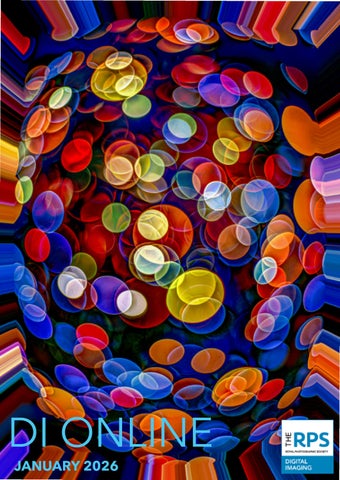
DI ONLINE
2026


![]()
2026


ThePhotographer:
Steve Morton
TheImageTitle: SMORTFIREWORKS
AbouttheImage:
More Abstracts by Steve stating on Page 12

Looking at our DI membership we know we have 1700+ members but we estimate that only around 40% actively engage in what we offer. The mystery is why members join us but then don’t take advantage of at least some of the workshops, webinars, groups and activities that we offer. The other thing we see is that having booked for a workshop or webinar we only usually get a 50% attendance on the day. Obviously life can get in the way sometimes, plus we record everything so just maybe that other 50% catch up later, but looking at the recording data we suspect not.
So the question we have to ask you is what and how can we do better to engage You our ‘silent’ members?
This is a serious question so we thought it would be a good idea to hold half yearly Members Evening to give you all the chance to meet the committee, to be able to ask any question of us and generally to talk through ideas of what you might like us to try to deliver for you. This Zoom meeting will be on Tuesday March 24th at 19.30. It’s free to DI members but we do ask that you book so that the system can send you the Zoom link. Book HERE
Given we have 1700+ members, and only 20 of us are on the committee, may I invite the other 1680 of you to consider if you could offer us a few hours each month to volunteer for a bit of work. We need a new DI Webinar Administrator. The current volunteer reckons it is only about 2 hours per month, plus attends the monthly Saturday webinars. You would liaise with the speaker via email, meet them online when we do the short pre-meeting to check out the technical aspect, prepare the promotional text and follow up email, working from pre-prepared templates. If you want more information then do email digchair@rps.org
Another role we need to fill is that of the assistant web content person. This would involve working with the web content person, agreeing who would do what and backing them up when they are away etc. Again for more info contact digchair@rps.org
The DI Committee is a happy team who all support one another, but each having a discrete role to play. New volunteers would be fully supported in their role and made to quickly feel part of the team. We do hope that you will seriously consider joining us. The more of us there are the less work each individual has to do.
We hope to hear from you and to see you at the Members Evening.
Regards Janet

There’s so much happening in our Group — and it really becomes clear as I compile this edition. It’s a bumper issue full of creativity, with plenty to share, get involved in, and contribute to. Inside, you’ll find a showcase of artistic and highly imaginative work that I hope will inspire you and perhaps encourage you to think about the direction of your own photography for the year ahead. Do you have a plan or a resolution? This is a perfect time for reflection and fresh starts — even a little spring cleaning, not just of your thoughts but maybe your computer and your image archive too. Start the new year with a clean slate, and my resolution is to ‘create with purpose.’
There’s plenty to look forward to — our AGM, Print Portfolio entries, a Keynote speech from our new CEO and the launch of an exciting new series of workshops designed to stretch your creativity and expand your skills. Lots of opportunities to fill those blank pages of your new diary and to lift the gloom of these wet and windy days that have ushered in the start of 2026. Enjoy.
Melanie Editor DI ONLINE


Second Place
Going Home for Christmas by Morag Forbes ARPS


My career as a scientific photographer at Monash University here in Melbourne, Australia has meant that my focus was primarily on the very accurate recording and reproduction of whatever I was photographing. However, my personal photography over the years has been the exploration of several other genres and styles.
Abstract imaging has been a genre to which I am attracted. There are many interesting images that can be created by deliberately recording out of focus scenes. This is something that is not obvious to the casual observer. Our vision is always automatically attempting to bring into sharp focus whatever we see. Discussing out of focus images immediately brings us to the Japanese term bokeh which literally means "blur" or "haze". Bokeh refers to the aesthetic quality of the out-offocus image. Today we are a little spoilt with the choice of lenses specifically designed to produce either "glowing," "soap-bubble," or "swirly" bokeh. This started a few years back with the Lomo Petzval lens which I have used to create unusual bokeh in some of my completely out of focus images. These speciality lenses are specifically designed with strong field curvature and uncorrected spherical aberration just like 19th-century Petzval designs that produce a distinct, swirling bokeh effect, isolating subjects with a dramatic, vintage character.
Another method I employ to create abstract images is to use image stacking. But the images I choose to stack are not a series of the type to produce extreme depth of field macro photographs. I sometimes stack images of the same subject, but they are photographs from different angles. This usually produces visually textured abstract images that I like, although the original subject’s identity can be lost.
Steve Morton
Steve can be contacted via steve@smort.net See his webpage: https://smort.net/


Back in mid 2023 Melanie and I discussed providing a one-year long workshop to encourage people to think creatively and make images based on emotions, light, tones, feelings, connectivity and communication over subject matter. Maybe not everyone’s approach but we found ourselves oversubscribed and three groups ran throughout 2024. When it ended a small number of people voiced that they wanted more, so in 2025 those people came together into one group and became our Year Two.
Leading this group has been a real delight. For those that signed up for year two only did so as they felt that they are more to give and more to learn. The group bonded quickly and they soon found that the second year was a heavier workload when it came to thinking how to go about some of our tasks. For some it was a new experience when I asked them to work on projects and collaborate with others. I can’t go into the details of all we have done as it has simply been so much but in the next few pages you will gain a flavour of some of the challenges.

We started the year with a collaborative piece of work we called Symphony. The challenge: To photograph the feeling of the instrument. This could be by touch or the sound it generates. At first, I saw some fear but soon enough people got themselves organised, workload was distributed and we began to see photographs appear in our image bank. We needed about 100 instruments to make a symphony orchestra and checking the layout we had to make a choice on overlapping images or filling a grid. To give every image a space we went for the grid, but this led to another problems. The layout of an orchestra is such that it is loaded on the left, so we had some unoccupied spaces top right. We filled it with the human voice.
Over a period of eight months the group produced 113 images to represent every instrument we could find in a symphony orchestra including the Trumpet, Double Bass, Viola, Horn, Trombone, French Horn, Xylophone, Violin (oh so many of those), triangle, flute, bassoon, piccolo and many more……we even made images for the odd things I did not know like Marimba, Timpani, Tam Tam and Vibraphone. Just the conductor remained to be finished before we put the files together in the layout of an orchestra. It became a mammoth piece of collaborative organisation. We hope you enjoy the final image.


Another piece of work we started at in January was a project named Spines, book spines that is. At the end of each month every person in the group produced an image that gave a feeling, a summary or snippet of that month. The images had to have the ratio of a book we would find on our shelf, and we would stack them every month to build an image over a 12-month period. The image you see here is at the end of November so still a month to go. We are also now looking for a suitable background and some organisation of the books themselves will need to take place before we finalise the image along with some embellishments, we do have a camera in there, but we need more.
As autumn began to creep in quite a few of us decided to meet for a day in London, yes I set the group a tough challenge for the day. As the day closed the conversation turned to many of the things we had and still are doing and could we continue into Year 3. I’m delighted to say we are moving into Year 3 and some very deep-thinking creativity will be done. We also have a Year 4 drafted…………. stay tuned to find out more of our Creative Group adventure.
Jonathan Vaines
We are still recruiting walk leaders so please contact martin@talkwalktalk.org if anyone has a local place that meets this theme. It is not an onerous role and walk leaders would be fully supported by the TWT admin team throughout.

I have always tried to capture light, patterns and candid shots in all my photography journey but becoming a member of the CD group has changed my joy in photography and now seems to influence my daily life... and I'm 71 years old which surprises me! Our group is collaborative and honest. We work to produce individual pieces or 'bodies of work' and these past 2 years have been so enjoyable and challenging. The back story to my images is usually on the quirky side. So often, the set task is in my head. I will get a concept idea with my phone when the light is there, often in a surprising place and of course a fleeting opportunity to stop time and capture the moment.
When a task is set, as a Group. we may groan. However, the thinking time, and sometimes disturbed sleep, focusses the mind and gives purpose to my image creation.
My first image was the result of a search for a ‘critical mass’ image. Standing looking out of the window at a beautiful sunset with raindrops reflecting on the roof of my husband’s Tesla car, I dashed out, barefoot, and took this shot as I knew that any second the light would shift. A Google Pixel 8 Pro phone image with post processing in Snapseed and Photoshop.

My second image was one of a set of collaborative pieces of work where we were asked to represent the instruments of a symphony orchestra. I was able to borrow an oboe. I used my Canon RP (which I love) and took several images. I overlaid them with the intention of conveying the components and tone of the instrument.


The set subject of’ Peninsular’ had me ‘stumped’ for quite a while. Until this autumn when I was walking around an air museum. I became fascinated with the oil trays under each old plane…all of which fly and perform in airshows and are kept in tip top condition. I gazed at the images as I popped them into Snapseed on my Google Pixel 8 and did some basic editing as I walked around the museum. So, my submission for this ‘peninsular topic’ was…..an oil tray masquerading as a beautiful geographical ‘birds eye view of the ‘Oil Peninsular under a Hawker Siddeley HS.748’
This image is an interpretation of the band, Blanco White, playing the song ‘Colder Heaven’. I love to take images of old artefacts in museums and captured these 3 primitive beings with my Canon RP. In Lightroom and Photoshop I added texture and replicated the layers several times to get a cold, static, metallic and ‘hard listen’ feel to the Band’s performance. The lyrics of this song have a sad and lonely theme.

While a lot of the Y1 course was about technique and learning new processes Y2 has been more about applying those processes and making creative images. As well as long term projects Jonathan throws us regular challenges. Two of these were Polymer and Inside the Body. We all have our individual styles and approach these challenges differently though we are all tending towards being more abstract than last year. Searching for inspiration I was taking photos at the harbour in Wells-next-the-Sea and saw all the lobster pots and ropes stacked up and thought they use polymer rope. I prefer to do my multiple exposures in Photoshop rather than in camera, partly because I can’t do blend modes in camera and partly because I prefer having more control and the ability to reuse the base images. So after taking many photos I got creative in Photoshop.
For my Polymer image I started overlaying a couple of photos of coils of rope with the difference blend mode, the next layer was a lobster pot again with the difference blend mode to create some interesting colours, I duplicated the layer and used Darker Colours then did a few different square crops and a few colour tweaks to end up with my final image.

Having got my polymer image the next challenge was inside the body so I reworked that image by distorting it and using the liquify tool to create a heart shape before taking it into Nik Color Efex to get the red colour that I thought better fitted with the theme.

Jonathan has been encouraging us to create what we feel rather than just representative photos of what we see. As an engineer I find expressing feelings more difficult but I did relate to the mental health challenge and produced an image for Anxiety I received some good critique from within the group and created another image that was less obvious than the first. Some of the challenges require a lot more thought and I have been falling behind on a couple of the long term projects so have a bit of catching up to do before the end of the year. I have enjoyed the larger group projects and was very pleased with the final result of the Symphony Orchestra.

For the past six months, we have been working on a project to produce one image representing each decade of our lives. It has been both challenging and cathartic to step back and distil each ten-year period into a single emotional essence. Rather than depict specific people or events, I’ve focused on capturing how each decade felt. I’m still working on my current decade, but I’m especially pleased with the image representing my early years, from birth to age ten. My starting point was happiness and stability, so I turned to the simplicity of primary colours and basic shapes along with a framework. When I came across a child’s windmill in a local shop, it immediately resonated - its bright colours and highly textured plastic perfectly captured the sense of joyful energy I wanted to convey.

When challenged to create an image representing Resistance, I spent considerable time reflecting on the many ways this concept could be interpreted. To me, resistance means saying “no”standing firm against pressure or oppression. In my image, the circular forms in the background suggest a multitude of faceless individuals struggling under constraint. The cross serves as the defiant “No,” while the thick layers of paint evoke years of unresolved conflict. The dominant red represents the blood that has been shed in the fight for freedom.


This one-off challenge truly tested me. Although I understood the term Critical Mass, it wasn’t a phrase I’d ever used - and that lack of personal connection made it difficult to visualise. After several false starts involving scales, building bricks, and even a bottle of bubbly (which didn’t go to waste!), I decided to return to research. I discovered that Critical Mass is also the name of a monthly cycling event held in London and in over 300 cities worldwide. This suddenly felt do-able for me - I know bikes! So that was the basis for my image. Although I regard this one as a bit of a failure, it highlighted for me the importance of having a personal connection, no matter how vague or distant, with any subject that I am trying to represent artistically.
For the last two years I've been fortunate to be a part of the Creative Development group, led by Jonathan Vaines. The purpose has been to promote image making that moves away from the formulaic approaches often found and to enable the photographers to reconnect with more creative approaches. A key underlying principle has been to encourage the group of photographers to have intent when taking or making an image. The intent, of course, is the photographer's own and it influences every stage of the image-making. Here are some of the pictures I have made over the last 12 months of the group.
While completing the Symphony Orchestra project it was recognised that it was lacking a choir so we were asked to produce images that conveyed the feeling of singing in a way that transcended the individual. This image is of the Angel of the North, taken using intentional camera movement, and it aims to show the otherworldly sensation of singing. The Angel rises above the earth, supported by the sound of the choir.

We were asked to produce an image that reflected the changes that took place during the months ending in ….ber. I chose to show the changes in weather with the autumn arriving and the transition to winter and wanted to capture the sensation of the blustery wind blowing the leaves. This composite was produced from 10 separate images and combined in Photoshop with the wind shown as a rotational ICM.

Many of the images produced by the group are composites which can put different images together to produce something that surpasses the individual photos. These are often quite abstract but nevertheless can convey a feeling as well as a message and can be very compelling. They are the type of image where the viewer will enquire what it is about rather than what it is of. It can be very satisfying to balance these images against found abstracts where there is minimal manipulation and the challenge is to see beyond what is immediate. This photograph was taken during a Creative Development photowalk in the City of London. To me the image illustrates the conflict between the implacable architecture of financial institutions and the separation from the world of humanity.

The Creative Development group has been set a series of challenges over the year and one has been to capture the feeling in the face of something tremendous. There are several possible interpretations but I chose to produce an image based on physical scale and attempted to create something that captured a sense of awe in the presence of a massive object. To produce this image I combined a photo of a car park in central Nottingham with one of Coquet Island lighthouse off the Northumberland coast. In reality the lighthouse is taller than the car park but I changed the perspective and relative sizes to create an image illustrating, Tremendous.

Already there are a number of exciting opportunities in 2026 to produce images and exhibitions that the group has started to work on. The emphasis is expected to be on the further development of a personal style and and regular critiques of photos. To see how it goes – watch this space.
My second year developing my creative photography has sometimes been challenging to set aside time to be alone and think. It’s not always easy to break away from the more technical side of photography ie a landscape, a portrait etc but produce creative images, conveying an emotion or just a single word instead. Somebody recently asked me where I get my ideas from and I have no real answer to that question. I have a notebook with scribbled drawings and ideas. Some never go any further than that, but it’s a start. I have at times felt I can’t do a certain challenge Jonathan has set and they’ve sat in my To Do list. I still have a few there now…… but eventually a spark ignites and I must say it feels good when the ideas flow and I create an image. So here are a few of the single images I’ve produced for Jonathan’s one off challenges.
After the hot dry summer we’ve had this year, the transition into autumn and winter has been welcome. This is an image of the colours that represent the BER months for me. The autumn leaves turning into shades of yellow, orange and red. Bonfire night, fireworks in the night sky and the glow of coming home to a real fire. Warm and comforting.


The word satisfaction implies “contentment.” Is just being content enough? My approach for this image was a line, a flat line plodding along until something happens and the line dips but picks itself up and gets back onto the path of satisfaction. Now that path could be higher up in the frame but the line is just satisfied where it is at the bottom.
A piece of land almost an island but still attached. This image encapsulates my favourite colours blues, pink and lilac. The spit of land is blue which would usually be the colour of the sea but I wanted to break that “rule” . No rules in creativity!

My scribbled notes were “chain” “beads” “DNA” “string”. I had recently been to a garden and had a photo of some dried vines so I used that for the basis of my image. Blue colour added and the red button duplicated for a splash of colour.


My photographic journey began with a Kodak Brownie 127, a present for my ninth birthday. My teenage years were taken up with art and music and family snaps. In my mid twenties I acquired an old Pentax and a 50mm lens. And so a serious photographic hobby began. I have always gravitated towards monochrome and so built a loft darkroom, freezing in winter and sweating in summer.
Over the years I’ve experimented with different photographic genres and tried new techniques to gain fresh perspectives. But surprisingly, despite being a fully qualified introvert,street photography was my first love, and it remains so. I was a member of Crown Monochrome for many years and successfully exhibited in the Cotswold Salon, WCPF and PABG exhibitions. In 2001 I began my digital journey, a three megapixel Samsung. I could experiment freely, review instantly. Also not having to carry a bag full of gear. Needless to say that didn't last long with the acquisition of a DSLR.

This was taken in a kindergarten in China 32 years ago. It was towards the end of the 80' s that I began to take photography seriously.
Now, with AI entering the creative landscape, the journey has taken another unexpected turn. I don’t see AI as a replacement for photography but as a new tool that allows precise post production of images. It invites questions about authorship, imagination, and what it means to “capture” reality.
My path from film to digital to AI hasn’t been a straight line, but each stage has deepened my understanding of seeing, creating, and staying curious. InChina, in 1993, I took a photograph of a young boy in a military outfit standing to attention. The background was cluttered and it really spoilt the image. I made a passable but not perfect alteration in Photoshop which took some time. Today I am able to transform it in seconds.
I have tried my best to write a short caption for each images but that has never been my forte, I prefer to let the images speak for themselves. Here are a few images to illustrate various styles and experiments


This is a composite of images taken with a mobile phone and blended in Snapseed which is a free app and excellent for post production with phone or tablet. An upgrade for Iphone/pad is available but no plans for Android.
Similar to the previous image but this is a straight shot taken through the window of a barbers' shop with a smartphone.

As well as street photography I also delight in taking flowers. This is an AI generated image, using one of my smartphone images, to create a surreal, abstract image.


This an AI generated image. It was inspired by the work of Anders Peterson in his book “Cafe Lehmitz”, images taken in a bar on the Reeperbahn. This was entered into the fun AI competition and was placed.
The original was taken with a Fuji camera. It's a rather cosmopolitan area of Bristol. With AI I had a middle aged lady sit on the sofa. Looking at it closely I can see that it's given her two right feet. Always pays to look carefully at AI images, especially hands and feet.

This image started life as a camera club portrait evening. I got AI to repose and have the model looking through a torn paper backdrop. To retain a likeness, it's best to include ‘DO NOT ALTER FACIAL FEATURES’in the prompt.

Another AI generated image. Unless you specify a position of a figure in the image AI will usually place it in the centre.


Above. An AI generated image of an Asian woman with strong lighting from the left. Some AI apps will try to offer a glamorous version so stating that the person's face reflects their age helps to generate a more truthful version.
Left. An AI image. The intention was to comment on the fact that many children prefer to use a smartphone or tablet rather that read a book. The shelf is stacked with books but the child is upset because his phone is broken.
As the first quarter of a century with all its advances in technology rolls over to the next where will photography go or, more importantly for me, where will I go? As I hurtle towards four score years I find I have lost a lot of the confidence needed for street photography. AI therefore allows me to go back through my files and create images I could have only dreamed of. Cheating? Maybe but I won't say anything if you don't.
Ian Boulton
Ready to supercharge your creativity, stretch your pixels, and maybe even glue a few fingers together in the name of art?
Our early Spring season’s line-up of workshops isn’t just inspiring it’s possibly irresistible. From Hollywood-level mobile edits with the unstoppable Lisa Carney, to lyrical lens play with abstract explorer Lynne Blount, to bookbinding wizardry with Mylyn McColl and even, a splash of AI sorcery with digital alchemist Sandra Dann—there’s something here for everyone. Creativity just got seriously hands-on (and possibly a little messy) This line-up is your ticket to a creative joyride, no seatbelts required—just bring your curiosity and a sense of play.


Sandra Dann is a Sydney-based digital artist, educator, and photographer whose creativity blends photography, texture, and AI to craft vivid, story-rich imagery. With a background in interior styling and a passion for visual storytelling, she now inspires others to discover their creative voice through art and technology.
Sandra is initially giving us a talk which offers a behind-the-scenes look at how ideas evolve into AI-assisted artworks—revealing the prompts, layers, and visual storytelling that bring her concepts to life.
Then we have secured this very busy lady to offer a three-part workshop, Creative Storytelling with AI and Photoshop, Sandra guides participants through crafting prompts, building AI composites, and mastering light and colour to create their own expressive digital art.
Sandra’s Talk Story Telling with AI
Sandra’s Workshop Creative Storytelling with AI and Photoshop


Lisa Carney is a high-end retoucher, photographer, and educator with over two decades of experience in the entertainment industry. Known for her bold, cinematic aesthetic and fast, professional workflows, Lisa has worked with top-tier clients including Apple, Netflix, CBS, Showtime, Disney, and Paramount. Her work spans movie posters, streaming campaigns, editorial, and high-end commercial photography.
Lisa brings a photographer’s eye to every pixel she touches. She is a featured speaker at Adobe MAX, CreativePro, and Photoshop World, and is an Adobe Community Expert. Passionate about mobile creativity, she specializes in teaching Lightroom Mobile and Photoshop for fast, artistic edits on the go.
When she’s not retouching or shooting, Lisa shares her expertise through online courses, tutorials, and global events—always with a down-to-earth, energetic style.
Join Lisa Carney for a fast-paced, practical 3-part series designed for photographers who want professional-level results—using only a mobile workflow. Across3 sessions, Lisa will break down how Lightroom Mobile and Photoshop on mobile can work together to create polished, inventive images anywhere. Go


Mylyn McColl with over 20 years of professional experience, she is a skilled bookbinder and box maker and fine binder, she honed her skills in leading UK binderies, notably Delta Design Studio. Now based in Wiltshire, she divides her time between restoring and creating bespoke books and boxes and teaching her craft.
As Principal Tutor for Bound by Veterans and a long-standing member of the bookbinding community, Mylyn is passionate about sharing traditional techniques with both beginners and advanced makers alike.
Join expert bookbinder Mylyn McColl for 7 Demonstrations exploring creative bindings, presentation boxes, and artistic ways to showcase your photography — all for just £30! Discover the joy of crafting screw-post bindings, slipcases, clamshell boxes, and more, guided by Mylyn.
Perfect for photographers, makers, and anyone who loves fine craftsmanship.
Spaces are limited — book the series now and start turning your prints into timeless treasures!
Monthly from Feb 3rd, find out more and Book your workshop place on
Beautifully Bound


Lynne Blount an experimental and expressionist photographer who reimagines reality through her lens, seeking the essence rather than the accuracy of her subjects. Using her camera like a paintbrush, she crafts her images in-camera through Multiple Exposures and Intentional Camera Movement—techniques that embrace light, colour, and chance.
Drawn mainly to nature, Lynne transforms everything from flowers to rusty drainpipes into evocative visual poetry. Recently, she’s extended her creativity into mixed media, fusing photography with her own artwork and digital collages.
Join expressionist photographer Lynne Blount on A Road Less Travelled—a three-part creative journey into experimental photography. Discover how to capture the essence of a subject through impressionistic techniques like In the Round and multiple exposure, then dive into Lynne’s Lightroom and Photoshop workflow to see experimentation in action.
Finally, explore the world of collage—blending photography, mixed media, and even AI—to craft truly unique visual narratives.
Perfect for photographers ready to push boundaries and embrace the art of creative exploration.
Go Here to read the details and book your place on her workshop
A Road less Travelled


Charlotte Bellamy is a photographic artist whose work blends Intentional Camera Movement (ICM) and double exposures to transform landscapes into expressive, painterly images. Balancing spontaneity with reflection, she uses these techniques to evoke memory, emotion, and the experience of place— creating photographs that verge on fine art. After starting her career in portrait and wedding photography, a move to the Netherlands inspired her shift toward abstract landscape work. Now based in a rural village in the east of the country, she combines her artistry with roles as a Guild of Photographers Panel Member, judge, and photography tour leader in the UK and Netherlands. But is hopefully relocating to the UK in 2026.
Charlotte is running an exciting four-part workshop ‘Creating a Cohesive Body of Work’ open to all!
Learn how to shape your ideas into a unified photographic project. Across four interactive sessions, you’ll explore how to develop project concepts, create visual cohesiveness, craft an engaging artist statement, and curate your images towards a strong, purposeful outcome.
Leigh Preston is a distinguished British photographer known for his thematic, atmospheric, and often monochrome work, focusing on the changing industrial landscapes of the UK, urban scenes, and wilderness, influenced by artists like L.S. Lowry.
A double Fellow of the Royal Photographic Society, he's an author, lecturer and member of ARENA, producing the books ,Shadows of Change and Liverpool, a place apart, and creating evocative, narrative-driven images that capture nostalgia and grit.
For 2026 he has agreed to present The Leigh Preston Series.
Inspiration and Interpretation: Mastering the Art of the Image" with Leigh Preston FRPS
Personal work, tributes to other photographic figures, and detailed insights—all focusing on creative vision and technical refinement over five sessions.
Click below for full details and dates
The Leigh Preston Series

DI Workshops recently ran a demonstration on Notion, when Joe Houghton showed how Photographers might use it, some ideas were:
• A To do list,
• Shoot Planning
• Location Scouting
• Gear research
• Competition Tracking
• Website Bookmarks
All great ideas for getting organised in 2026!
Notion is a flexible all-in-one digital workspace where you can write, organise, and link your notes, tasks, and databases in one place.
But I thought how a simple Notion table could help DI Online members organise and access the workshop resources all in one place. Do you have links scattered across emails and pages? Maybe by creating a simple Notion table or database this could index every DI Online recording, handout or resource. A document which is always up to date and searchable when you wish to return and rewatch a Workshop or Talk.
Taking the reminder emails you have all the links you need to easily add to tour table. If anyone missed this free Talk and would like to have the YouTube link, email me: digworkshops@rps.org


The advantage to using Billetto and Notion effectively.
The DI volunteer team have worked exceptionally hard to streamline how our workshops are booked and how you access the associated supporting resources. However it still remains a mystery why some members get in a muddle with it all, so we thought a reminder document (for you to keep and refer to) might be useful.
Booking a workshop couldn’t be easier.
• You can find the list of workshops by going to the DI home page and clicking on ‘Workshops’ from the top list.
• Alternatively you can go direct to Billetto and all that is bookable HERE
As an example let us assume you wish to book the Fotospeed Print workshop.
• You click on the Billetto tile and it takes you to the booking page.
• For more information about the workshop open ‘Read More’.
• Booking is via the blue ‘Get Tickets’ button – click this.
• As a DI Member you modify the ticket number to read 1 and then click ‘Next’.
• If you are a registered user then you see your details and order summary.
• Click ‘Next’.…This is where some people go wrong !
• Under ‘add on services’ click No and No
• then it will look like this


Click ‘Next’. You have now placed your order but this screen is VERY IMPORTANT as it is here that you find the link to the Notion document for this workshop. It is the blue text – you cannot miss it !
Click on this blue text and it takes you off to the Notion page – a Notion page is nothing more than a web page which you will need to refer to again – BOOK MARK it now.
The Notion page provides you with the workshop details and the Zoom link. It is where you will find any resources the tutor provides. Plus post event it is where you will find the recording.

You even get a confirmatory email and that too contains the blue Notion link.
To make life even easier for you we also send out the Zoom link to the email you used to book 2 days and 2 hours prior to the event.
If you follow these simple instructions you cannot go wrong. It saves you time hunting for things as everything is on the Notion page and saves you emailing us. It saves us time in not having to respond to your emails. So please, please, please, get to grips with it. Once you have registered for an event you don’t really need to go back to Billetto, everything you need is contained in the emails.
Your co-operation is appreciated as it saves a lot of work for our overworked volunteer team. Thank you
Janet Haines DI Chair
Do visit our webpage
Our YouTube Channel DI Facebook

You can subscribe to our email Mailing Lists here to hear new announcements: Garden & Plant Photography Workshops Events DI Competition
DI Pulse for WHAT’S ON THIS MONTH