
One returning, two new West Jordan City council members take oath of office
West Jordan City Council welcomes Annette Harris and Jessica Wignall as council members, who were sworn into West Jordan’s City Council on Jan 5.
Three at-large council members were sworn into West Jordan’s City Council on Jan. 5, including returning Councilmember Kayleen Whitelock and newcomers Annette Harris and Jessica Wignall.
“Welcome to West Jordan,” Mayor Dirk Burton told the new council members, “we didn’t get here without all the work that’s been happening and the work that will continue to go, so we’re excited to welcome you here.”
City Recorder Tangee Sloan administered the Oath of Office to all three at-large
By Rebecca Olds | rebecca.o@thecityjournals.com
members, beginning with Whitelock, then Harris and finally Wignall.
Whitelock thanked residents for their continued support.
“I enjoy serving our city, I’ve been serving our city for decades,” she said.
Harris said her first gift to the city would be brief remarks, but some might argue that her first gift was her apple sauce recipe that she ran on all her campaign materials, following a strategy that her grandmother used campaigning for a position in Alpine.
“I love West Jordan, and I don’t know how it happened, but through campaigning and through knocking on door after door after door, and seeing people so open to help and to serve their community, it made me love the city even more,” she said. “I have to imagine that, [during] four years serving
on the city council, that love for the city will grow even more.”
Wignall will serve as the new vice chair alongside the council’s new chair, Bob Bedore, who represents District 2. She thanked the mayor and city staff members for their help while running.
“One thing I have to say about West Jordan residents is they are very, very aware of what is happening in the city, and it’s amazing,” she said. “I was very welcomed by all the residents whose doors I knocked on, residents at events. And I’m just really excited to be a part of this.”
West Jordan’s City Council includes returning members Chad Lamb (District 1), Zach Jacob (District 3) and Kent Shelton (District 4).
Outgoing at-large council members include Kelvin Green and Pamela Bloom. l
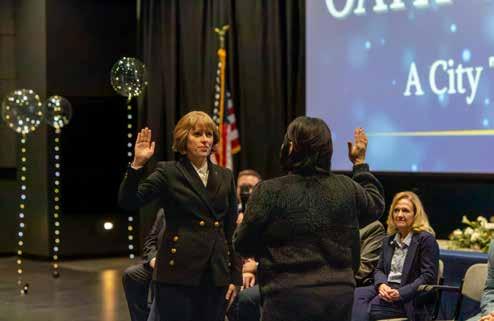
Annette Harris recites her Oath of Office with City Recorder Tangee Sloan. (Rebecca Olds/City Journals)
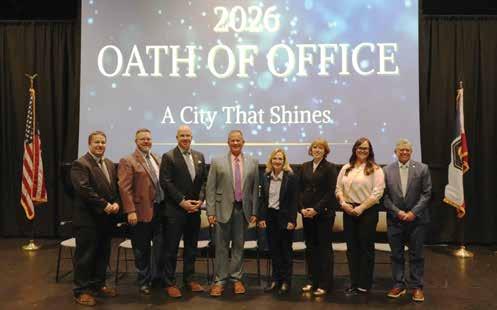
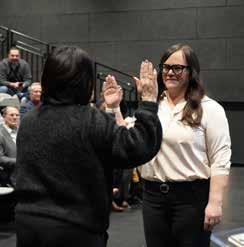
Jessica Wignall recites her Oath of Office with City Recorder Tangee Sloan. (Photo courtesy West Jordan City)
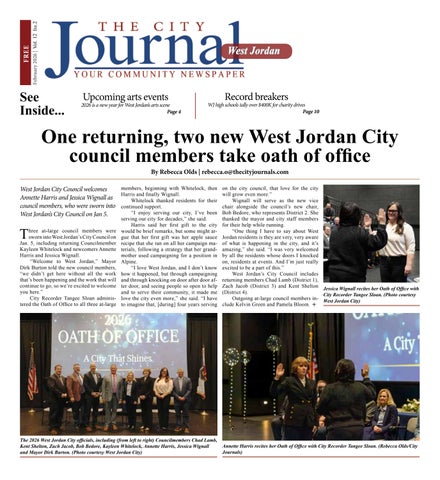
The 2026 West Jordan City officials, including (from left to right) Councilmembers Chad Lamb, Kent Shelton, Zach Jacob, Bob Bedore, Kayleen Whitelock, Annette Harris, Jessica Wignall and Mayor Dirk Burton. (Photo courtesy West Jordan City)






New community center affording arts society new opportunities
Art in the Park and “A Midsummer Night’s Dream” on the docket for 2026.
By Linda Steele
l.steele@mycityjournals.com
Anew year means new events for the arts community in West Jordan.
The Cultural Arts Society of West Jordan has been around for 30 years. The organization used to be part of the city but in 2016 they asked Vic Groves and his wife Michelle Groves to break off the arts from the city and become an independent arts 501(c)(3) organization. In 2019 it officially became the Cultural Arts Society of West Jordan.
The city is very supportive and CASWJ receives grants, non-government grants and donations. The city supports 75% of their operations besides building usage. CASWJ is the primary occupant of the new community arts center. The city does huge amounts of funding for the new Community Arts Center. Previously they used to share space in Midvale at their Midvale Performing Aats Center. They now have a home for the arts in West Jordan.
A place that recently hosted the Wasatch Improv Festival in January.
The Cultural Arts Society of West Jordan has grown a lot since 2019. The growth includes theater, youth theater, band, symphony, literary and visual arts. Leadership changed when Vic Groves stepped down three years ago.
They are doing their first Shakespeare show, “A Midsummer Night’s Dream.” They are in the process of casting, having just recently finished auditions.
Dillon Workman has been the executive director of the Cultural Arts Society for three years, and has also been playing violin with the symphony for three years.
“This organization has a way of bringing people in, and they want to stay around and make friends. That is very special about this community, the arts in general, it’s so welcoming of everybody,” Workman said.
There are a lot of opportunities to volunteer, find employment and perform. West Jordan is the third biggest city in the state and CASWJ is one of the biggest cultural arts programs in the state.
The West Jordan community band exceeded 100 players within the last year. They are one of the largest concert bands in the nation. Because they are so large they just founded West Jordan Winds. All new theater groups perform at the Canyon View Credit Union Community and Arts Center along with jazz bands and the symphony.
One of their biggest projects is Art in the Park which is done at the Veterans Memorial Park. This event is coming up on May 2, 11 a.m. to 4 p.m. There will be tents, food trucks, booths, art work is displayed, chalk art, performances on the pavilion and on the stage. There will be a new dedicated stage for performances. There is a youth group that performs with large numbers.
They have the junior show age 4-16, and the senior

youth 12-18. They have auditions for the youth shows because there are so many who want to perform. They like to include as many kids as they can, so they overcast the show.
“No matter what the organization’s arts are, like dancing, literary arts, theater or visuals, it gives performers the opportunity to meet friends and enjoy performing,” Vic Groves said, director of Sugar House Factory Playhouse.
To find out about all of the performances go to wjarts.org l
WEST JORDAN TEAM
The West Jordan Journal is a monthly publication distributed directly to residents via the USPS as well as locations throughout West Jordan. For information about distribution please email hello@thecityjournals.com or call our offices. Rack locations are also available on our website. The views and opinions expressed in display advertisements do not necessarily reflect or represent the views and opinions held by Loyal Perch Media or the City Journals. This publication may not be reproduced in whole or in part without the express written consent of the owner. © 2019 Loyal Perch Media, Inc.
Bryan Scott | bryan.s@thecityjournals.com EDITOR
Travis Barton | travis.b@thecityjournals.com
ADVERTISING EXECUTIVES
Mieka Sawatzki | mieka.s@thecityjournals.com
Lindsay Andreasen | lindsay.a@thecityjournals.com
Ryan Casper | ryan.c@thecityjournals.com
Marc Davis | marc.d@thecityjournals.com
Rack
Lydia Rice | lydia.r@thecityjournals.com 385-557-1022
Stacey LaMont Ty Gorton

PHONE: 801-254-5974
Handel’s “Messiah” with the West Jordan Symphony. A tradition of 31 years. (Photo courtesy Cultural Arts Society of West Jordan) Utah Reader’s Fest members of the book-loving community gather to celebrate the joy of reading and local authors. (Photo courtesy Cultural Arts Society of West Jordan)
“Play On,” performed by the Sugar Factory Playhouse. (Photo courtesy Travis Green)

Shattered Ankle, Silent Employer:
The following is based on real events. Names have been changed to protect identities.
On a freezing November day in 2019, Kyle’s life changed instantly. Falling from a roof while working for a small construction company, he shattered his left ankle. Instead of immediate support, Kyle faced a legal nightmare: his employer carried no workers’ compensation insurance and denied all liability. Kyle was left with no

income, a mountain of medical bills, and a bleak future.
Kyle is one of a growing number of workers injured by uninsured employers. While Utah law requires practically all businesses to carry insurance, some cut costs to increase profits, gambling with their employees’ financial well-being.
Uninsured employers are personally liable for benefits, but many simply disappear when accidents happen. Utah’s “Uninsured Employers Fund” is a safety net, yet accessing it is a legal labyrinth—often forcing injured workers to file complex lawsuits to prove the employer cannot pay.
Abandoned by his employer in pain and financial stress, Kyle called Just Work Comp Law. We took the burden off his shoulders, dragging the employer to court and winning the benefits he desperately needed. If you are injured and uninsured, the law is still on your side. Just Work Comp Law fights for you.


Walgreens opens new regional fulfillment center in West Jordan
Fulfilment center will serve pharmacies at 96 Walgreens locations in four states
By Tom Haraldsen Salt Lake Business Journal
Walgreens has opened a new micro-fulfillment center in West Jordan, the 13th regional facility of its kind in the Walgreens family. The 27,000-square-foot facility will support 96 Walgreens stores in the Intermountain region, including 48 in Utah.
Chief Technology Operations Officer John Joplin said the high-tech facility, located at 6306 Airport Road, will allow instore pharmacists to spend more quality time with patients and bring additional new jobs to the area.
“We’re first and foremost a pharmacy, so it’s clinical,” Joplin said of the new site. “We do use a lot of automation, robotics and innovative technology to fill prescriptions. We’re kind of a back-office support for the stores. We fill prescriptions, which frees up our team members in the stores to help customers with any clinical needs they may have, like immunizations or medical
therapy management. They can focus on what’s most important: the patient.”
He said the West Jordan facility is part of a growing network of Walgreens fulfillment centers used to process millions of prescriptions weekly. This center alone is expected to process 4.2 million prescriptions each year.
“Even though this site is one of our smaller ones, as the footprint and the needs grow, we can adjust things and expand,” he said. “Across the network, we fill a little over 200 million prescriptions a year. This site will also fill orders for stores in Idaho, Montana, Wyoming and part of Oregon.”
Joplin said these centers help increase both customer satisfaction and team member satisfaction, making the ability to fill prescriptions faster.
Currently there are 50 employees at the new facility, and they may add to the staff.
“Hiring in this area is super important to us,” Joplin said. “We’re happy to entertain resumes for the fulfillment center. We’re always looking for pharmacists, pharmacy techs, specialists maybe right out of college, technology professionals, maintenance and those with IT experience.” l



(TTY: 711).
Get to know us before you need us.
When you need emergency care fast, the closest emergency room is a smart thing to know. You never know the level of care you’ll need when an emergency happens and choosing the right ER can make all the difference. And a hospital ER comes with the confidence of additional services right on-site.
Congratulations to CommonSpirit Holy Cross Hospital – West Valley for receiving the Leapfrog Hospital Safety Grade-A Accreditation for the second consecutive time. Leapfrog Hospital Safety Grades are determined based on a rigorous assessment of various safety measures.
Find emergency care close to you at mountain.commonspirit.org.
Cutting the ribbon on the new Walgreens micro-fulfillment center are (from left) Darren Kennedy, Walgreens senior director of micro-fulfillment site operations; Makaila Kelso from ChamberWest; West Jordan Economic Development Manager Paul Coates; West Jordan Mayor Dirk Burton; Josch Bullard, Walgreens fulfillment center site director; ChamberWest President/CEO Barbara Riddle; ChamberWest Past Chair Mace Melon; Idaho Licenses officer Nicole Chopski; and Lorri Walmsley, Walgreens director of pharmacy affairs. (Photo courtesy Walgreens)
Entries are being accepted for the KID art contest
Residents in the KID district are invited to participate.
By Peri Kinder peri.k@thecityjournals.com
Calling all artists! The Kearns Improvement District is holding its 2026 Water Conservation Art Contest and invites residents ages 5 and up to participate by creating a conservation-themed piece of art.
The contest is open to anyone living within the service boundaries of KID, which includes Kearns, plus sections of Taylorsville, West Jordan and West Valley. Artists can choose any medium for their submission, but all work must be original.
“The water conservation art contest invites all of the KID community to share their talent and to help remind all of us of the need to conserve,” KID General Manager Greg Anderson said. “KID is a partner with the EPA’s WaterSense program, and we use the winning submittal artwork to help in the monthly WaterSense promotion to conserve. Our community has been recognized on a national basis for these efforts.”
Entries should promote awareness about the importance of water conservation, highlighting water-saving practices or portraying the beauty of water resources. Acceptable mediums include painting, drawing, sculpture, digital art, photography, mixed media and collage.
Participants can enter one of four categories: adult, high school, junior high and elementary, with cash priz-
es for the top 4 entries in each category. Winners can receive up to $250.
“The changing weather patterns have significantly impacted our water resources that we depend on for a thriving economy,” Anderson said. “Around the Thanksgiving holiday, our snowpack was only 50% to 60% of normal. If this cycle continues, it will have a significant impact on our water distribution capabilities. Conservation is the key to bridging the reliability of our water supply and these weather pattern changes.”
Artwork will be judged on creativity, originality, adherence to the theme, technical skill and overall impact. The judging panel will consist of the three-member board of Trustees of the District, who will use their knowledge of water conservation to evaluate the artwork.
“There are multitudes of ways to conserve water that will have an impact on our resources and our way of life,” Anderson said. “We invite our community to share their talent and express what they envision conservation to be and the impact that it may have on their lives. We have had some remarkable submittals in the past and hope for even more this coming year.”
Submissions must be sent to KIDContest@KIDWater4UT.gov by Friday, April 3. For a complete list of rules and guidelines, visit kidwater4ut.gov. l
The KID Water Conservation Art Contest is now accepting submissions. Artwork must be submitted by Friday, April 3.

Give Yourself a Valentine This Year: Learn to Decode Messages from Your Heart
When we talk about heart disease, the usual suspects often come to mind: crushing chest pain, shortness of breath, radiating arm discomfort. While these classic symptoms demand immediate attention, your heart often speaks in a more subtle language, a series of whispers and quiet shouts that can easily be dismissed or attributed to other, less serious issues.
During Heart Month this February, we want to empower you to become a skilled interpreter of your body’s unique signals, recognizing that early detection can be profoundly life-saving.
Many people are unaware that heart problems don’t always announce themselves with dramatic flair. “We frequently see patients who’ve ignored subtle signs for weeks or even months, often rationalizing them away,” explains Dr. Richard Gelb, a cardiologist at Holy Cross Hospital –Mountain Point. “Especially for women, symptoms can be incredibly nuanced and different from the textbook descriptions often associated with men.”
So, what are these often-overlooked indicators that your heart might be sending out an SOS?
Persistent, Unexplained Fatigue: This isn’t just being tired after a long day. If you
find yourself unusually exhausted after normal activities, or if a simple walk leaves you winded in a way it never did before, your heart might be working harder than it should to pump blood.
This can be a sign of various heart conditions, including heart failure or even blockages.
Discomfort Beyond the Chest: While chest pain is classic, heart-related discomfort can manifest in surprising places. This includes pain, pressure, or aching in your jaw, neck, back, or even your stomach.
“We’ve had cases where patients initially thought they had a bad toothache or indigestion, only to find it was their heart,” says Dr. Bruce Kenwood, a cardiologist at Holy Cross Hospital – Jordan Valley. “Pay particular attention if this discomfort appears during exertion and subsides with rest.

Swelling in Unusual Areas: Swollen feet, ankles, legs, or even your abdomen could be a sign of fluid retention, a common symptom of heart failure. If your heart isn’t pumping effectively, blood can back up in the veins, leading to fluid accumulation. Don’t dismiss persistent swelling, especially if it’s accompanied by weight gain.
Chronic Indigestion or Nausea: While often benign, persistent indigestion, heartburn, or nausea, particularly when coupled with exertion, can sometimes be a
heart attack symptom, especially in women. If antacids aren’t helping and the discomfort seems linked to physical activity, it’s worth investigating further.
Lightheadedness or Dizziness: Occasional lightheadedness can happen for many reasons, but if you frequently feel faint, dizzy, or lightheaded, it could indicate an arrhythmia (irregular heartbeat) or a problem with blood flow to your brain due to a compromised heart.
“By familiarizing yourself with these less obvious signs, you’re taking a proactive step in safeguarding your cardiovascular health. Your body is constantly communicating; the key is to learn its second language,” said Dr. Roja Mulamalla, a cardiologist at Holy Cross Hospital – Davis.
Call to Action: If any of these subtle symptoms resonate with you, or if you’re experiencing anything that just “doesn’t feel right” in your body, please don’t wait. Listen to your heart’s whispers. Schedule an appointment with your primary care physician to discuss your concerns, or if symptoms are sudden and severe, seek emergency medical care immediately. Early detection and intervention are crucial for positive heart health outcomes. Your heart speaks – are you listening?
For more information or to find a provider visit mountain.commonspirit.org


‘Don’t lose the momentum,’
West Jordan bids farewell to departing council
In West Jordan’s final council meeting of 2025, councilmembers bid adieu to Pamela Bloom and Kelvin Green.
By Travis Barton travis.b@thecityjournals.com
After almost two and half hours, the West Jordan City Council wasn’t ready to motion to adjourn. It still had some goodbyes to give.
During the final council meeting of 2025, outgoing members Pamela Bloom and Kelvin Green were given warm sendoffs by the city and fellow councilmembers as they were thanked for their service as elected officials.
“You have made the council richer for your service,” Councilmember Zach Jacob told them both, after expressing his appreciation for the chance to serve with them.
Council Director Alan Anderson recognized their time and years of service on the council, Green having served six years from 2020-2025 (he lost his reelection bid) and Bloom for her term that started in 2022.
Anderson highlighted the 222 ordinances adopted by the council during the last four years the two served (319 including the extra two years for Green). Among them Anderson listed the renaming of Copper Hills Parkway, affordable housing, amendments to home occupations and general business regulations, the Copper Rim town center, creating corridor land use along Redwood Road, helipad ordinance,
google fiber adoption, Copper Meadows development and water efficiency standards.
“Those will leave an indelible outcome on the city of West Jordan for quite a long time,” Anderson said.
He presented both with a city employee-signed picture frame of City Hall and a street sign labeled Bloom Blvd. and Green Gateway. Green also left behind a three-piece canvas of the American flag.
Bloom expressed gratitude for her journey of serving, noting what surprised her most was how the harder decisions weren’t about policy, but “about people trying to be heard while carrying fear and hope or frustration.”
Her parting words were both a recognition of a council seat’s importance and an admonition for those serving going forward.
“I was a temporary steward of something bigger than any one person,” she said in her final remarks from the dais. “My hope is that this council keeps choosing curiosity over certainty, listening before reacting and remembering that most people who come to this room truly care deeply about this city, even when they disagree.
“Serving here has shaped how I listen, how I question and how seriously I take public trust and I will carry that with me.”
For Green as he looked back on his six years on the council and four and a half on the planning commission, he felt they made “immense strides in land use and trying to get planning things right.”
“We’ve set the city on a great trajectory…don’t lose the
members
momentum,” he said.
He highlighted proud accomplishments from his time on the council including economic development, the helipad ordinance, building the arts center without any debt and refocused on patriotic emblems like Memorial Day, Veterans Day and the Gold Star Memorial. All the other councilmembers thanked them for their service. Jacob said as one voting member of seven, you can sometimes miss the handprint councilmembers leave on the city.
“You both have things you can drive around the city and you can point to and say ‘that wouldn’t have happened if I hadn’t been here,” he said. “I have appreciated serving with the both of you.” l
HUNGRY KIDS CAN’T LE ARN!



City Hall said good bye to two council members. (File photo Cit y Journals)
Inclusion takes center stage at inaugural state unified dance competition
Local high school dancers made history earning top medals
By Julie Slama j.slama@mycityjournals.com
In the first state high school unified dance competition, three area schools swept the event.
Copper Hills High School won the unified dance team competition, with Highland High and Murray High in second and third places, respectively. Several students from each of the schools placed in solo and duet categories.
Unified dance is a program that brings together students of all abilities together to promote inclusion, friendship and teamwork with an emphasis on movement and joy. The Special Olympics Utah competition was held in December at Highland High and featured a variety of dance styles and creative interpretations.
Students performed their routines on stage before receiving feedback from a panel of judges, including three who recently competed and won gold medals at the Special Olympics World Games. Much of the feedback was positive and encouraging with comments such as “keep smiling and showing you’re having fun,” “you owned that stage,” “great techniques” and “good energy and choreography.”
Many of the performances included costumes and props. Murray High dancers wore bright colors while Copper Hills performers sported matching shirts that said, “Inclusion is Cool.” Props included everything from watering cans to leis,

adding creativity and personality to the routines.
Some students choreographed and practiced dances independently or together as an afterschool club. At Copper Hills, teacher Anna Bay has instructed adaptive dance for three years.
“We have so many good kids who love to dance, so we wanted to give them more of a dance experience than what they could get in our mainstream classes,” she said. “With so many interested, we were able to open up a class just for the special ed kids. We have 20 special ed students in the class, plus 20 peer tutors. Then, we have aides who help.”
Bay said the benefits of unified dance go beyond learning choreography and dance technique.
“They’re learning social skills, how to be part of a team and about friendship. They’re listening and following directions, but we do it in a dance way, so it’s all by having fun. I teach them a lot of the same things I do in my ballroom classes from stretching to line dances. We’ve been working on learning choreography, which we were able to perform today,” she said. “They have so much fun and I love their genuine smiles.” l


















Copper Hills team performs a dance routine at the first state high school unified dance competition, earning first place honors. (Julie Slama/ City Journals)





Record-breaking year for school charity drives
By Jet Burnham j.burnham@mycityjournals.com
In the first three weeks of December, students at Jordan School District high schools collected a combined total of $1,096,873 for charity. That number is almost double last year’s $645,935 total.
West Jordan High School’s 2025 charity drive, MAD Jags, collected $184,573, six times more than the $30,849 they collected last year, breaking their record for the most money ever raised.
SBO Service Officer Camryn Ridley credits the dedication of WJHS student body officers and students who gave up most afternoons and evenings in December for MAD Jags events.

“Helping others is something that comes natural to our students, and through the student’s efforts this MAD Jag (making a difference) season, we will be able to continue to help others throughout the year,” Ridley said.
There were several successful fundraising events but donations from local business owners contributed the most to the final record-breaking total. For the first time, students developed an investor pitch to request donations from local businesses.
“The opportunity for our Student Government Officers to reflect on their classmates and use that knowledge to brainstorm a list of needs and develop a pitch deck was a critical deep dive into serving our community,”
WJHS Assistant Principal Kami Taylor said. “The outcome blew us all away. We raised more funds than ever before and the students were able to see how they directly impacted their community.”
Taylor said besides the financial aspect, the successful outcomes of the charity season included students thinking about others and discovering how they can positively impact others and getting to know people outside their usual social groups.
“[Student Government Officers] and their families were full of emotions: pride for their hard work, joy for the people served and increased self esteem from the success of hard work,” Taylor said.
The fundraising total was announced at a school assembly just before the winter break.
“The students and staff who helped raise that money were beyond excited,” Ridley said. “Tears were shed, smiles were on everyone’s faces and overall it was just a really cool experience to be a part of.”
Some of the money raised went to Indy’s Ohana. One of the families who will receive a family trip to Hawaii because of the funds raised attended the assembly.
“It was very heartwarming to see their happiness, knowing that they are going through such a difficult time in their lives, and knowing that we had played a part in helping bring that joy into their lives,” Ridley said.
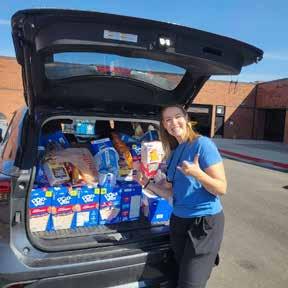
The money also went to help more than 50 families in need within the West Jordan community.
Copper Hills High School’s PAWS for a Cause charity fundraiser collected $227,796.26 this year. By comparison, last year’s total was $71,515.25. That money will be used to help community members in need.
Posted on the school website was a note of appreciation.
“We would like to thank the community for their incredible generosity in supporting our Copper Hills charity drive PAWS for a Cause. It was a record breaking year with $227,796.26 being raised to help those in our community.”
West Jordan High School student government officers celebrate the record-breaking total for their 2025 charity fundraiser. (Photo courtesy Jordan School District)
High-tech lab inspires high engagement
Students get their hands on rare tools during project-based learning field trips.
By Jet Burnham j.burnham@mycityjournals.com
TheJordan Innovation Lab housed at Juniper Elementary in Herriman is full of 3D printers, cutting machines, digital cameras, 3D pens and piles of cardboard and craft supplies. It is currently available to Jordan School District’s fourth, fifth and sixth graders for one of three project-based field trips: 3D printing, stop motion animation or engineering.
“The skills they take away from here — just like the problem solving and creativity — are invaluable,” JSD digital specialist Traci Rindlisbach said. “Any kid who comes in here is going through the design principles of engineering.”
JSD digital specialists collaborate with teachers to plan curriculum-based learning activities that allow students to show what they’ve learned in a whole new way, using equipment they don’t usually have access to.
The lab has 14 3D printers, some basic and easy to use and some that can handle more advanced multicolor prints. Students love to create a design on the computer and then watch it get printed with plastic filament to become a solid object. Students often print objects related to something they are learning. One teacher had students design and 3D print something to include in a diorama of an ecosystem. Another class designed and printed models of Native American shelters they’d been learning about.
Stop motion filming is a popular field trip. Students have used the technique to create animations showing what they know about fractions, the Pioneer Trail and planetary orbits. Students use the lab’s craft supplies to create objects to manipulate as they take 300400 still shots to create a four second video.
A row of ChompSaws and a pile of cardboard greeted a class on an engineering field trip. After a quick tutorial of how to use the equipment, students designed and built solar ovens. With creativity and trial and error, they figured out how to make hinges and interlocking pieces which were quickly and safely cut using the ChompSaws.
Lab supervisor Tori Hadley said both teachers and students are excited to use the lab.
“The kids want to learn and they want to do hands-on,” Hadley said.
Through a grant from the Jordan Education Foundation, fourth, fifth and sixth grade teachers can get a free bus for field trips to the lab. For teachers of other grades, the lab holds a weekly Teacher Tinker Time to allow all teachers to explore the lab’s equipment and brainstorm ideas for using lab resources.
“It’s just a way to get people here and trying things,” digital specialist Kelli Cannon
said. “They’ll come in because they just want to see what this is all about. They can make something and then take it back to their class, because we know if the teachers get skills, then they can share it with their classroom, even if they can’t bring their kids here.”
Foothills Elementary teacher Amy Peterson attended a Tinker Time to explore the tools. She had already scheduled a field trip for her students to 3D print fish which they could use to identify the animal’s anatomy and adaptations. But then lab specialists showed her how students could make a time lapse video of the life cycle of a fish while they waited for the 3D prints to be done.
“I didn’t even know that was an option,” Peterson said. “So it was nice to be able to talk to them about the standard and find out we could do something that I have no capability and no technology to be able to do. I have no idea how to make that work, but they do, so I’m pretty excited about that.”
Her field trip to the lab is scheduled for March.
“It’s exciting to be able to have the kids try something new and find a new way to apply their learning outside of the classroom, but also using some technology that I think is going to really get them excited about it,” she said.
When there isn’t a field trip scheduled, Juniper Elementary students have access to the one-of-a-kind lab which was made possible by community partners Utah Jazz, Utah Mammoth and America First Credit Union.
“It’s actually really fun because you get to learn how to use things that you’ve never tried before,” a student said.
Two students recently had an idea to create a maze for remote controlled Spheros and used the space and equipment in the lab to build it. The school also has a 3D printing club, in which students work together on projects such as creating centerpieces for a Jordan District banquet.
Employees cultivate a nonperfectionist atmosphere in the lab where mistakes are expected. They are quick to show students the drawer full of their failed prints.
“We fail all the time,” Rindlisbach said. “But we’re still here and it’s because we failed and we kept going and we learned from our failures. So we just show them that we mess up all the time. That is something I think kids don’t necessarily always have—the opportunity to mess up and try again.”
Cannon said students get excited about the potential of 3D-printing movie props, tablet cases or things they can sell, but others think bigger, like designing light-weight 3D-printed objects for a space station or printing prosthetic limbs. Lab employees talk with students about careers that use the skills they learn in the lab and encourage them--especially the girls, who are underrepresented in STEM fields-- to take advantage of the many CTE and STEM courses offered in middle and high school. l
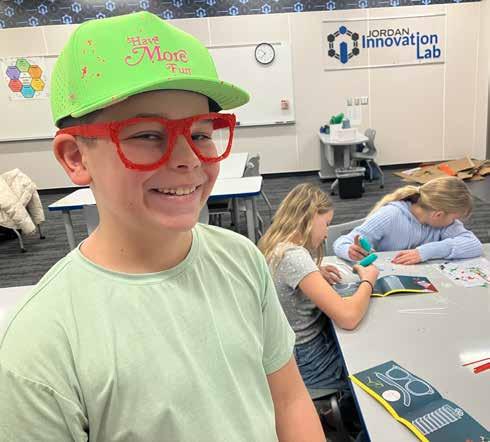



Sixth grader Jaxon Jones proudly shows off the glass frames he made using a 3D pen in the Jordan Innovation Lab at Juniper Elementary. (Jet Burnham/City Journals)
School band directors band together at Rose Parade
By Jet Burnham j.burnham@mycityjournals.com
Lisa Blodgett, band teacher at Majestic Elementary Arts Academy in West Jordan, marched with a group of 349 other school band directors in the 2026 Rose Parade held Jan. 1. She was one of seven directors from Utah among the group with representatives from all 50 states, Canada, Mexico and Costa Rica invited to perform with The Band Directors Marching Band in the famous parade.
She said it was a lot of work to get prepared, memorizing five tunes and practicing marching, which she hadn’t done for a long time.
“Marching in a parade and just walking down the streets is not so bad, but when you’re trying to play an instrument and breathe and hold your instrument at the right angle, that actually takes some coordination,” she said. “Walking and playing at the same time also isn’t the same as standing and playing.”
The theme for this year’s parade was “The Magic in Teamwork,” which was fitting because all of the band members had to prepare and rehearse on their own to be ready to come together when they all finally arrived in California a few days before the parade.
“We had our first rehearsal and it immediately came together — people were prepared, they had parts memorized, and then we just put all the pieces together,” Blodgett said.
Blodgett and others also worked together to help decorate the Michael D. Sewell Memorial Foundation float honoring band directors which accompanied them on the route. She said the floats were “ginormous” and she was amazed at how beautifully detailed they were.
“It’s a lot of work and people actually work on creating them for several months of the year, and then it takes a team of people that whole week before — like, all day into


the night — to get the floats ready, because every surface of the float was covered with flowers or grains or seeds,” she said.
Her contribution was gluing flax seeds on the hair of one of the float’s characters, and rice on the rim of a giant drum. “It definitely made me feel more connected to it also, because then I got to see the end result,” she said.
She was one of the few who did. During the night before and the morning of the parade, rain fell on the uncovered floats.
“The poor floats were pretty washed down, and all the colors that were bright and vibrant on them kind of had been all mushed and had kind of run together,” Blodgett said. “They were still awesome, but the colors just weren’t quite the same.”
The performers also got rained on for the first half of the parade but were grateful for the cooling effect of their wet uniforms during the sunny second half of the five-and-a-half mile parade route.
Blodgett said the whole experience was so much more than just marching in a pa-
rade. The Band Directors Marching Band is part of the Saluting America’s Band Directors Foundation, an organization honoring Michael Sewell, a longtime school band director who passed away. It was established by his widow Karen, and invites band directors to get involved in community service projects and performances before, during and after the parade.
While in Pasadena for the parade, band members participated in a service-through-music project, providing a donation and a performance at a Christmas Light event benefitting families who were impacted by last year’s Southern California wildfires. Some of the band members joined with other bands to honor first responders at another community event. Others, including Blodgett, were part of a video project in which 101 band teachers recorded themselves playing their part of a song and then all the individual recordings were compiled as one cohesive band performance. That project can be viewed on YouTube.
Blodgett said all of these experiences were also a good opportunity for her to remember what it is like to be in the student
seat, which helps her be a better director.
“I get to be a student again, I get to have a director that’s leading me, I get to be the one that’s learning how to put my piece together with everybody else and be part of a team that way,” she said. “With my students all the time at school, I talk about ‘we are a team, and if we don’t work together, then we don’t get the desired product. In the end, we’re not as strong as we could be.’ And so it was kind of fun to be part of that team.”
Her students were excited to see her very clearly in the center of the TV screen when she showed them the clip of the national news coverage of the parade.
“The excitement and enthusiasm they had when they saw me marching the parade was actually quite fun and hopefully inspirational for these kids,” she said.
Blodgett first learned of The Band Directors Marching Band while watching the 2022 Rose Parade hoping to catch a glimpse of some of her former students who were participating in other marching bands. When she saw the group of band directors, who were marching in the parade for the first time, she immediately knew she wanted to join them. l

Lisa Blodgett, at center, with The Band Directors Marching Band in the 137th Rose Parade. (Photo courtesy Lisa Blodgett)
Majestic Elementary band teacher Lisa Blodgett poses, with the trombone she played in the Rose Parade, by the float she helped decorate. (Photo courtesy Lisa Blodgett)
Culture, community and cake pops
Mixed-race students cultivate pride in their culture through a school club and class.
By Jet Burnham j.burnham@mycityjournals.com
Theinternational assembly held at Copper Hills High School each January features performances from several affinity clubs such as Latinos in Action, Black Student Union, People of the Pacific and Asian American Student Association. Each spring, these clubs host a multicultural carnival with dance performances, artifact exhibits and cultural presentations to showcase their heritage.
“Those times are really great opportunities to see the clubs and how we represent ourselves,” Asian American Student Association President Cassidy Orme said. “Our club is focused on creating community and educating people at our school about Asian culture.”
The AASA has 55 members on the books and a leadership council of six who plan regular socials, such as celebrating the Lunar New Year this month, when they get together for an activity or craft and to share food.
“Some of us will bring cookies from the grocery store, but a lot of us will try and bring more ethnic food,” Orme said. “I like to bring dango, which is like small mochi balls, and we have some members that like to bring egg rolls. And sometimes we have cake pops.”
Like other school clubs, the AASA participates in service projects, such as the annual charity fundraiser. Like other school teams, they occasionally perform at school sports half-time shows. Members have learned a traditional Filipino dance and a Laotian line dance to perform this year.
Students with Japanese, Laos, Filipino, Chinese, Korean and Vietnamese heritage are members of the club, but membership is open to anyone. “We don’t want to exclude anyone because that’s kind of backwards,” Orme said.
She and her Asian peers have experienced negative attention due to their ethnic-

ity. Other students sometimes treat their cultures as “exotic” or “weird,” she said, which makes them feel separated from others.
“A lot of people that I meet are kind of ashamed that they’re Asian or, like, feel like there’s a target on them because they are Asian,” Orme said. “I want them to come out of the club feeling proud of who they are and knowing that they shouldn’t feel the need to change or, like, be scared of getting hurt or something because of who they are.”
Being involved in the AASA has helped her feel supported and more hopeful that she can help improve things for teens like her.
“It makes me more courageous and proud of my identity,” Orme, who is half Japanese, said. “Because Asians kind of get a lot of criticism and microaggressions, like, still to this day, and this club kind of helps people recognize those problems and how we can start to overcome them as a society.”
Club Adviser Lindsay Reyes, who is half Filipino, said it’s important for students to have a space where they can strengthen each other.
“This was a club that I wish that I had ac-



cess to when I was in school, just knowing that there is a space where I can celebrate my culture and talk to other people and share experiences, whereas some of my other friends who are White--I may not be able to share those same experiences with them,” Reyes said.
This year, Reyes got approval to expand the club into a class. She teaches the Asian
American Student Association class to give students more opportunities to appreciate their cultures and to develop leadership skills.
“In the class, we promote cultural awareness, and share things from our own cultures, learn about other cultures, and something we’ve been trying to move towards is also serving the community,” she said.l
Members of Copper Hills High School’s Asian Association club perform a Laotian dance at a girls basketball halftime show. (Photo courtesy Lindsay Reyes)
Over the fence: Commercial vehicles can no longer park on Midvale streets
Drivers of for-profit vehicles will receive an infraction on their first offense and a class C misdemeanor on repeated offenses.
By Giovanni Radtke g.radtke@mycityjournals.com
On March 22, 2025, a 16 year old driving westbound on Fort Union Boulevard swerved to avoid hitting a car pulling up in front of him. The quick maneuver and wet streets caused the teenager to lose control, and he crashed into a semitruck parked on the side of the road. The teenager died on the scene.
The tragic death of Elijah Exodus Bustamante-Martínez sparked a desire among Midvale residents to impose restrictions on semitrucks parking on busy roads. And the city council passed an ordinance on Dec. 2 barring all commercial vehicles from parking on the street.
23rd
Golden Corral, 665 East 7200 South, Midvale
“I had a few people reach out to me on this, which I don’t necessarily get, and everyone was like ‘make it as restrictive as possible,’” Midvale Councilmember Bryant Brown said moments before the unanimous vote.


The ordinance came about after numerous council discussions over a sixmonth period, and making it apply to all for-profit vehicles, not just semitrucks, was spurred by the car-sharing app Turo.
“This whole conversation started with … there’s a safety issue with having huge semitrucks and large commercial vehicles on our roads, then it became like ‘oh yeah and there is also this Turo thing that we just discovered,’” Mayor Dustin Gettel said. “... I think encompassing it all together is great because now … it takes care of the core problems that we were experiencing and that’s safety in neighborhoods.”
Individuals using public streets as “essentially their storage space” for their Turo cars have become a growing nuisance to residents, Midvale’s Deputy City Attorney Daniel Van Beuge said at a council discussion in November.
“On one particular street, an officer, as going out to a call, has counted up to 12 of their [Turo] vehicles on a singular section of Midvale public street,” Beuge said, “which has been frustrating to the residents in the area because their parking or public parking is being occupied by all these Turo vehicles taking up space from them.”




Parking on roadways for commercial purposes is still allowed for tasks like dropping people off or loading or unloading a vehicle, as long as the driver leaves once their task is complete. But someone parking for extended periods of time will get an infraction on their first violation of the new ordinance and a class C misdemeanor on any subsequent offense.
Some councilmembers raised concerns about the new restrictions affecting residents who use their personal cars for ridesharing apps like Lyft or Uber to make some extra income. However, Gettel noted that most parking enforcement does not come from police patrolling around looking for rideshare cars, but rather from residents who spot the vehicles and call them in.
“It’s going to be rare, if ever, someone calls to our attention a single Lyft vehicle that’s parked there overnight until they go onto their next shift, but it is very easy for someone to notice … 12 cars parked on Bingham Junction Boulevard between Bingham Junction Station and 7800 South,” Gettel said.
Along with parking on Midvale streets, the ordinance added the same punishments to commercial vehicles parked in cityowned parking lots, with some exceptions. Beuge told the council in November that the code change was prompted by some businesses on Main Street using city-owned lots to store their delivery vehicles.
“I think frankly that this is fair because we tell … for example, the old fire station … ‘hey, you cannot use this as a parking lot to run your business,’” Brown said. “The city’s not here to make your balance sheet a little bit better.” l
Cars parked alongside Bingham Junction Boulevard and 7400 South. (Giovanni Radtke/City Journals)
‘Good time to be in Utah,’ Zions economist says
Outlook for state, region remains strong.
By Brice Wallace Salt Lake Business Journal
Economicoutlook season is underway, and Robert Spendlove has thrown out the first pitch.
At a recent outlook briefing in Salt Lake City, Zions Bank’s senior economist listed several challenges in the national economy: uncertainty and risk caused by tariffs and the recent government shutdown, low consumer sentiment, slowing labor market growth, and the threat that increased tariffs could reaccelerate inflation.
“But with all that, the Intermountain Region remains really strong,” he assured the crowd. “Our economic fundamentals are strong. Our population and demographics are strong. So, it is a good time. Even though we’ve got that risk and that uncertainty, it’s a good time to be in Utah.”
Businesspeople are generally “grumpy” about tariffs because of the uncertainty they create. The average effective tariff rate was 3% a year ago but now it’s at 17%. However, they have yet to cause expected inflation. Most businesspeople can adjust to tariff impacts, but only if they know at what rates they will be, he said.
“It’s been going up and down and sideways. … We just see them going up and down, almost willy-nilly, for the past year,” Spendlove said. “And if you’re a businessperson, your response might just be ‘I’m just going to pull back,’ and I’ve heard that from a lot of businesspeople.”
But Utah’s economic fundamentals remain strong:
• Utah’s population growth is nearly 2%, compared to 1% nationally.
• Utah’s employment growth is 1.7%, above the national figure of 1%.
• Utah’s unemployment rate, like the nation’s, has been trending up, but Utah’s — at about 3.5% the past year — “actually has kind of stalled out,” he said. “I mean, it’s good, right? We want the unemployment rate to stall out. We don’t want it to continue to move up.”
Spendlove expects the rate to “kind of stick around there” at about 3.5% and keep Utah in “that sweet spot.” “We’re not the lowest in the country, like in the Upper Midwest, but we’re also not the highest, like in California and Nevada and Washington, D.C.,” he said.
• Utah’s new unemployment insurance claims are about 2,000. “We would have to cross 4,000 for me to get nervous about those weekly unemployment insurance claims. … We’re about half of that now, and it’s something that we’ll be watching, but I don’t see any signs of distress right now.”
For contrast, during the COVID pandemic, the figure grew from 2,000 to over 20,000 in one week.
• After seeing a huge surge in housing prices from 2020 to 2022, the growth now is between 1% and 2% — “actually what I would argue is a really good level,” he said. “You don’t want to see a big contraction. You also don’t want to see a big escalation in those home prices again.”
• Utah’s wage growth is higher than the national average.
• Median household income in Utah is “great,” at more than $100,000, thanks to demographics and the state’s strong economy.
Meanwhile, Moody’s indicates that Utah is not among states facing a recession risk. “Utah is doing well,” Spendlove said. “We’re still expanding, Idaho is still expanding, Arizona is still expanding. But we are surrounded by weakness. We are surrounded by states that are already struggling, are already treading water or are already in recession.”
Nathan Callister, the new president and CEO of Zions Bank, said annual economic outlooks usually feature an assessment that the new year will be “the most unique year.”
“And I’m not saying this is the most unique year, but it is an incredibly unique market environment that we’re in,” he said. “I think there’s a lot of stuff above the surface that we see. I think there’s a lot below the surface as well that are creating challeng-
es and will continue to create challenges. And we are navigating, I think, the convergence of so many moving parts.”
Trouble areas include geopolitics, tariffs, the AI boom, asset prices in the stock market, the proliferation of the private markets (including private credit), consumer sentiment, the “K”-shaped economy, a convergence of wealth, affordability, deficits and the national debt, among others, he said.
“Despite all of this, our economy has been incredibly resilient, and Utah has been incredibly resilient, but I think we’re feeling, even here, some of those challenges,” Callister said.
Calling for Utahns to become more agile and more connected than ever before, Callister said geopolitics heads his overall list of worries.
Robert Spendlove, senior economist at Zions Bank, briefs an audience about his 2026 economic outlook at a recent gathering in Salt Lake City. (Brice
Better Shelves. Custom Solutions.
“I feel like we’re seeing a tectonic shift in the world order, from turf battles to trade wars, to the Monroe Doctrine that’s going on now, to all these changes going on to our supply chain,” he said. “I think we’ll continue to see some major implications to what’s going on in this changing world order that’s way different from what we’ve experienced since World War II.” l





Wallace/ Salt Lake Business Journal)
Celebrating Heart Month
heart by We know you
Heart care is more than numbers on a screen.
At Intermountain Health, heart care starts with getting to know what’s important to you and building a care plan together. From preventive screenings and lifestyle recommendations, to treating the most complex conditions with advanced technologies, our experts are with you through all of it. In other words, we’ve got your back — and your heart.

Learn more or schedule with a primary care provider
Business leaders forum discusses challenges with government regulations
Leaders gather to discuss the overregulation of their businesses during a forum sponsored by the Intermountain Business Alliance.
By Tom Haraldsen t.haraldsen@mycityjournals.com
Aside from the need for financial support and strength, there may be no larger challenge for businesses than government rules and regulations. That was the message shared by and with participants in the Utah Regulatory Reform Listen and Learn Forum held on Dec. 17 at the Salt Mine Productive Workspace in Sandy.
The forum was the third in a series of such meetings planned by the Intermountain Business Alliance, designed to bring Utah business leaders together to discuss real-world barriers and develop practical reforms to strengthen Utah’s economic competitiveness.
“The most terrifying words in the English language are ‘I’m from the government and I’m here to help you,’” said Trent Staggs, outgoing mayor of Riverton and now the U.S. Small Business Administration advocate for Region 8. “The cost of regulation in this country is staggering. The National Association of Manufacturing says it believes regulation alone is costing businesses $3 trillion a year. That’s almost 15% of our GNP.”
One example he pointed to is Form 941, the quarterly reports businesses are required to file with the IRS. Shifting that to an annual report, he said, could result in a $90 billion savings for businesses.
As mayor, and now in his role with the SBA, Staggs is advocating for less regulation and more common sense when it comes to the rules of the road in business.
A strong advocate for President Trump, he praised Trump’s Executive Order 14192, which says that for any new regulation an agency wants to implement, it has to eliminate 10 others already on the books. He stated that another executive order from Trump charges all agency heads to look at current rules and identify those they feel might be unconstitutional.
“Just this summer, the National Small Business Association asked all businesses across the country what the most painful resource of regulations was, and they stated the federal government by far,” Staggs said. “Rules that come from these federal agencies are by people not elected to their offices. Congress to a large degree, I believe, has abdicated much of its responsibility by delegating the rulemaking authority to these unelected bureaucrats. The net result of this overregulation is it keeps you from making
profits and hiring people. Deregulation will help the economy.”
Speakers at breakout sessions during the forum covered a wide range of areas where regulations have large impacts. Those include agriculture and agri-business, construction and infrastructure, tourism and hospitality, manufacturing and mining, technology, banking and finance, and health care and insurance.
Corinna Harris, president of the Intermountain Business Alliance, said its goal is to “ensure businesses stay in business, by driving meaningful regulatory reform and removing barriers to growth at every level of government.”
“We are holding two more forums in the next week, on Jan. 9 in Eagle Mountain and on Jan. 12 in Nephi,” she said. “We’re also publishing a newsletter with comments and suggestions shared at these forums.”
She wants to see a united effort by local business owners and government leaders to make meaningful changes in regulatory practices.
Staggs told attendees the list of most wanted issues concerning business owners can be found on the SBA website at advocacy.sba.gov. Harris said more information about the alliance, or suggestions for changes, can be sent to her at charris@intermountainbusinessalliance.com. l
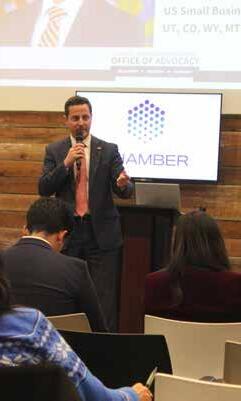
Trent Staggs, U.S. Small Business Administration advocate for Region 8, discusses the problems that government regulation is causing businesses in Utah and throughout the nation. (Tom Haraldsen/ City Journals)
Local officer helps launch peer-led support group for first responders
The Watch
By Shaun Delliskave s.delliskave@mycityjournals.com
Anewpeer-led support group aimed at first responders across Salt Lake County will begin meeting in Murray later this month, offering a confidential, non-clinical space for participants to talk with others who understand the unique pressures of the job.
The group, called The Watch, was founded by Murray City Police Officer Benjamin Gregoire, who said the idea grew out of both personal experience and conversations with colleagues across agencies.
A critical incident he experienced in the line of duty last year, Gregoire said, became a turning point and underscored for him how limited accessible, peer-based wellness resources are for first responders in Salt Lake County.
Gregoire said that beyond formal peer support teams, there are few places where first responders can speak openly with others who share similar experiences. He also observed that first responder culture often operates in silos.
“Police tend to stay with police, fire with fire, dispatch with dispatch—even though we often carry very similar stressors and trauma,” he said. “The Watch grew out of a desire to create a shared space that breaks down those barriers.”
Unlike traditional mental health programs, The Watch is intentionally peer-led and non-clinical. Gregoire emphasized that the group is not designed to replace professional care.
“There are no clinicians, no diagnoses, no notes, and no treatment plans,” he said. “It’s a space grounded in shared lived experience. While professional mental health care is critically important—and encouraged—The Watch is designed to complement those resources, not replace them.”
Sessions are structured to be low-pressure and accessible. Meetings will last one hour and are drop-in, meaning participants can attend as their schedules allow. At the start of each session, guidelines are reviewed to establish expectations and safety. From there, discussion is participant-led.
“If there’s a lull, a simple prompt— such as ‘What brought you here today?’— may be offered,” Gregoire said. “But there is never any pressure to speak. First-time attendees can expect a low-pressure environment where listening is just as welcome as sharing.”
Confidentiality is a central principle of the group. Gregoire said participants verbally agree to keep what is shared within the group confidential and that rank does not factor into the space.
“Rank does not exist within the space—everyone is equal,” he said. “If administrators attend, they are held to the same standards as everyone else.” He added that the confidentiality protections outlined in Utah’s peer support statute apply and are communicated at each meeting.
Murray City has played a supporting role by approving the group, providing meeting space, administrative assistance, and help with outreach and marketing. Gregoire stressed, however, that The Watch remains independent.
“It is not a Murray City Police Department program, nor does it report back to any department,” he said. “Murray is hosting and endorsing the effort, but the group itself remains peer-driven and separate from departmental operations.”
Gregoire hopes the group will help address lingering stigma around seeking help, particularly for those who may feel overlooked.
“Dispatch and corrections professionals, in particular, are often overlooked in wellness conversations despite facing significant cumulative stress,” he said. “The Watch aims to create a starting point— normalizing peer support and making it easier for people to show up without fear or judgment.”
The first meeting is scheduled for Jan. 14, and while no sessions have yet been held, Gregoire said early interest has been strong. “We’ve already received strong informal interest from a wide range of agen-

cies and disciplines,” he said. Looking ahead, Gregoire said success would mean broader cultural change. “Success, to me, would look like peer support becoming more normalized within first responder culture and administrations taking wellness more seriously as a core respon-
sibility—not an afterthought,” he said. He added that he hopes similar groups will eventually form in other counties, noting that “Davis County Sheriff’s Office is beginning something along those lines, which suggests this is a need being felt beyond just Murray or Salt Lake County.” l
SINGLE




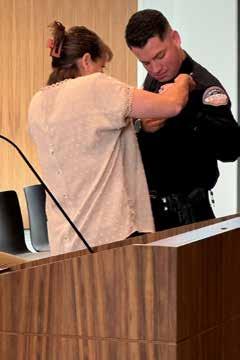
Officer Benjamin Gregorie takes the oath of a police officer. (Photo courtesy Murray Police)
Officer Benjamin Gregorie receives his badge. (Photo courtesy Murray Police)
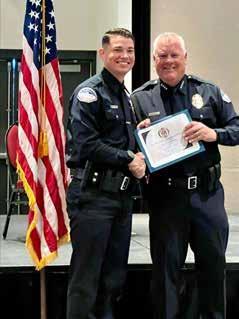
Officer Benjamin Gregorie with Police Chief Craig Burnett. (Photo courtesy Murray Police)
By Holly Curby hello@hollycurby.com
L14 ways to love others this Valentine’s Day
ove isn’t just a feeling reserved for Valentine’s Day—it’s a daily choice that shapes our relationships, our health, and even the world around us. Sometimes the best reminders of everyday love come from simple gestures—like what one local Chick-fil-A guest does faithfully every month.
At a Chick-fil-A restaurant in our community, team members have grown accustomed to more than warm greetings from one particular customer. This guest arrives carrying gift bags—one for every team member who has a birthday that month. Rain or shine, they show up with small, thoughtful gifts that send a clear message: You matter. You’re seen. You’re appreciated.
Team members say the gesture brightens the month and boosts morale. A simple birthday gift becomes a reminder that kindness doesn’t have to be complicated. Mother Teresa once said, “Not all of us can do great things. But we can do small things with great love.” These monthly gifts reflect that spirit—a small act that makes a big impression.
- Feel happier and less stressed: Showing connection boosts oxytocin by up to 12% during supportive interactions, according to University of California research. Higher oxytocin lowers cortisol, the body’s stress hormone, and increases daily life satisfaction.
- Build stronger relationships: The Gottman Institute found that regularly expressing appreciation maintains a ratio of five positive interactions for every negative one. This helps build emotional safety and trust.
- Grow personally: Encouragement from friends and loved ones makes people more motivated and resilient. Research in the Journal of Personality and Social Psychology shows those with regular emotional support are more than twice as likely to complete a difficult task.
- Spread kindness: A study in Proceedings of the National Academy of Sciences found that one considerate act often inspires additional acts, creating a ripple effect that touches people far beyond the original act.
- Boost health and longevity: People with strong relationships have lower blood pressure, stronger immune systems, and live longer, according to the 85-year Harvard Study of Adult Development. That makes love a practical daily prac-


tice. Whether at home, at work, or while running errands, we each have opportunities to make someone feel valued. Here are simple ways to bring more love into everyday life:
1. Practice active listening: Put down the phone and be fully present.
2. Offer your attention: Presence communicates, “You matter.”
3. Express gratitude: A sincere “thank you” or note of appreciation goes a long way.
4. Offer emotional support: Sometimes love looks like simply sitting with someone.
5. Show patience and grace: Understanding helps relationships grow.
6. Let go and forgive: Healing matters more than holding onto hurt.
7. Support someone’s dreams: Celebrate steps of courage.
8. Create safe spaces: People open up where they feel accepted.
9. Practice self-compassion: Loving yourself strengthens your ability to love others.
10. Lead with empathy: Try seeing the world from another’s perspective.
11. Celebrate joy: Rejoice with others in big and small victories.
12. Offer simple acts of kindness: Open a door, help someone, or serve without
MEET DR. HARARAH, M.D.
expecting anything back.
13. Pray for others: Quietly lifting someone up is an act of love.
14. Learn their love language: Words, time, service, gifts or touch—speak what matters to them.
In a world that often feels hurried or divided, love has never been more essential. It isn’t defined by grand gestures but by noticing who needs encouragement, choosing compassion over criticism, and making time for connection. The Chick-fil-A birthday tradition is a perfect example: meaningful love often looks like small, consistent, intentional kindness.
Maya Angelou captured this truth beautifully: “People will forget what you said, people will forget what you did, but people will never forget how you made them feel.”
This week, choose two ways from the list above to intentionally show love. Notice the impact—for you and the person you reach out to. You may find that one small act becomes the very encouragement someone needed.
For more inspiration or to dive deeper, tune into Holly’s Highlights podcast, Season 6, Episode 4, and consider joining the 30-Day Show Love Challenge at www.HollyCurby.com to “be the change we wish to see in the world” (Mahatma Gandhi)—one intentional act at a time. l
Dr. Hararah, a triple board-certified physician, completed his residency in Family Medicine at NYU Langone and a fellowship in Undersea and Hyperbaric Medicine/Wound Care at SUNY Upstate University Hospital. With additional training in Bariatric Medicine and certification from the American Board of Obesity Medicine, he brings expertise in primary care, dive medicine, bariatric medicine, and clinical hyperbarics.
A firm believer in the biopsychosocial approach, Dr. Hararah views patients as complex individuals whose lives and experiences shape their healthcare. Known for his compassionate care and dedication, he listens intently, prioritizes your well-being, and works to find the best diagnosis and treatment plan.
As the owner of Blackstone Medical, Dr. Hararah is committed to helping you achieve your best health.
OUR SERVICES
Primary Care:
• Annual preventative physical exams
• Cancer screening
•
•
Specializing in Wound Care:
Patients First:
“Dr. Hararah understands the daunting and sometimes demoralizing feelings health care sometimes causes, and wants patients to be truly seen and valued as human beings.”

County sheriff’s office honors America’s 250th anniversary with flag ceremony
As part of a nationwide and global observance, the Salt Lake County Sheriff’s Office proudly welcomed a special flag during its stop in Utah as part of Flag Sojourn 250.
As part of a nationwide and global observance, the Salt Lake County Sheriff’s Office welcomed a special flag Jan. 7 during its stop in Utah as part of Flag Sojourn 250—a historic journey designed to unite Americans while honoring the nation’s past, present and future.
The Flag Sojourn 250 initiative, commemorating the country’s upcoming 250th anniversary, is carrying this American flag to every U.S. state and territory, as well as all 26 overseas U.S. military cemeteries. The journey is meant to pay tribute to those who served and sacrificed for the nation while celebrating the principles of liberty, resilience and unity that define America.
“This shared journey honors our history, remembers our heroes, and looks ahead with hope,” said Salt Lake County Sheriff Rosie Rivera. “The Stars and Stripes


represent far more than a symbol—they embody the sacrifices made in defense of freedom and the ideals that bind us together as one nation.”
The ceremony featured the presentation and raising of the flag by the Salt Lake County Sheriff’s Office Honor Guard, fol-


lowed by a moment of silence and ceremonial music. Attendees also joined together in reciting the Pledge of Allegiance.
The event concluded with the Honor Guard lowering and refolding the flag, marking the end of a meaningful stop on its journey. The flag next traveled to Colorado.
Flag Sojourn 250 is a national unity initiative led by the National Flag Foundation (NFF) in partnership with America250’s America Waves program, an epic tribute campaign honoring the American flag. l






The Salt Lake County Sheriff’s Office held a special flag ceremony in January to honor the upcoming 250th anniversary of the country. (Photos courtesy Salt Lake County Sheriff’s Office)
Salt Lake County Sheriff Rosie Rivera participates in the special flag ceremony held in January.
(Photo courtesy Salt Lake County Sheriff’s Office)
New report suggests half of Utah’s young students are unable to read at proper grade level
While the study can’t pinpoint a singular cause, it does stress the importance of students meeting age-appropriate standards as a means to ensure future success and economic prosperity.
By Lizzie Walje l.walje@mycityjournals.com
Anewreport is spelling out an alarming reality for Utah’s youngest residents, as it indicates that half of them are unable to read at their corresponding grade level. This reality is not isolated to a few districts or schools within the state. Rather, the report shows glaring deficiencies at a statewide level.
The report was published by the Kem C. Gardner Policy Institute at the University of Utah, shortly after the beginning of the 2026 calendar year. It details some troubling information, revealing that a large percentage of K-3 students in Utah have failed to meet appropriate grade-level expectations. Per Utah’s state policy, a student is considered to have satisfied grade-level expectations if they meet or exceed a score of 405 on the end of year benchmark reading assessment. The study’s data showcases that just 50.3% of third graders are achieving appropriate proficiency.
Utah is seemingly not alone in this issue, and it’s not just young children who are currently affected. In September 2025, The Harvard Gazette reported that reading scores for high school seniors, released by the Nation’s Report Card, had fallen to their lowest level since 1992. It was the first year that high school seniors had taken the nationwide test since the Covid-19 pandemic, revealing a disturbing divide between the nation’s highest and lowest achieving students.
While some may argue this is a sensible conclusion given the challenges that plagued teachers and students during the height of the Covid-19 pandemic, research suggests that scores have been steadily declining, predating the pandemic.
According to Martin West, an academic dean and a professor of education at the Harvard Graduate School of Education and the deputy director of the Program on Education Policy and Governance at the Harvard Kennedy School, “American students’ literacy skills peaked in roughly the middle of the last decade and have fallen significantly since that time.”
When asked about why West believes this is happening, he could not offer a singular answer, as usually these types of issues are multifaceted and can occur due to a range of differing and intersecting factors. He did however say that “I don’t think we

have smoking gun evidence that the rise of screen-based childhood is a direct contributor to the literacy trends that we’re seeing. But I’m willing to put it very high on my list of potential suspects.”
In Utah, Andrea Thomas Brandley, the lead author of the Gardner Policy Institute’s report, explained why it’s so important that students meet the necessary benchmarks of literacy, especially when it concerns third graders in particular. “We look at third grade specifically as like a pivot point,” she said. “Prior to third grade, students are spending a lot of their time learning to read, and then after third grade, they’re doing a lot of reading to learn.”
While K-3 literacy issues have permeated schools and districts at the statewide level, there are a few interesting outliers. Notably, Salt Lake City School District is one of 17 districts that failed to reach proficiency in 50% of its students. Only one district in the state, Park City School District, was able to reach 70% proficiency, reporting 70.1% in 2025.
Other statistics further complicate the issue, with the study reporting that only 18% of third-grade students with limited English-language proficiency and 35.2% of economically disadvantaged students met grade-level expectations. Furthermore, reading proficiency varies widely, with English-language learners, students with disabilities, and Hispanic/Latino students also performing lower, on average, than their peers.
Literacy, or lack thereof, has very real
consequences that can impact a student’s life well into adulthood. Strong early literacy skills are proven to be foundational for future academic success and achievement, higher graduation rates, better employment prospects, and overall health and civic engagement. The study also emphasizes that early experiences are important. Of which, they cite language exposure, shared reading, and high-quality early learning environments as critical for a child’s readiness to read.
“Research indicates that nearly all children can learn to read with systematic, evidence-based instruction and targeted support,” a summarization of the study released by the Kem C. Gardner Policy Institute said.
In spite of the dire news expressed by the data, there were a few silver linings. Among them, some indication of advancement, with kindergarten proficiency actually improving, jumping to 53.3% in 2025 from 37.7% in 2021. The state also vows that they intend to respond aggressively to the issue with policy changes. Utah’s Early Literacy Outcomes Improvement Act (SB 127, 2022) aims to address these challenges by setting a statewide goal of 70% third-grade reading proficiency by 2027 and strengthening supports.
While policy design is important, the study’s summary affirmed, the study also highlighted the need for policy to be consistent and well implemented overtime. Policy should also be integrated to align with current curriculum and aided by teacher support. Furthermore, it is beneficial for the
issue to be recognized within the student as early as possible, with targeted interventions performed to help promote improvement.
One state in the union has shown marked improvement in elevating their literacy and reading rates is Mississippi. Ironically, Mississippi consistently ranks poorly when it comes to overall education outcomes. However, they’ve seemingly been able to target their own literacy issues successfully.
In 2013, fourth-grade students in Mississippi were ranking 49th overall in reading scores but had impressively managed to climb to ninth overall in 2024 thanks to what the Gardner report claimed was a “multi-year, coordinated approach and the state’s emphasis on implementation quality, rather than any individual reform acting alone.” The report specifically points to Mississippi as a point of reference for Utah to closely follow.
As for Brandley’s specific thoughts regarding how to improve the literacy issue, much like West, she acknowledges there is no one size fits all solution. However, she does believe in the importance of addressing these issues holistically.
“Particularly, when kids are 0-5 [years of age]. It’s the most rapid brain development we experience in our lives. While we don’t know the cause necessarily, I do think this is a critical time to make sure that students are exposed to language and books and conversations and storytelling with caregivers. That helps build a foundation for them to be ready more formally when they enter school.” l
The Kem C. Gardner Policy Institute at the University of Utah released a study that spells out literacy trouble for Utah’s youngest residents. (Adobe)
Utah lawmakers seek bell-to-bell ban on using cellular phones during school
A new bill proposed by Sen. Lincoln Fillmore (R-South Jordan) and backed by Gov. Spencer J. Cox seeks to expand on current Utah law that bans cell phones in school during active class time.
By Lizzie Walje l.walje@mycityjournals.com
UtahGov. Spencer J. Cox and Sen. Lincoln Fillmore (R-South Jordan) have teamed up alongside other state leaders to craft and propose a bill that would essentially outright ban student cell phones from public schools. The bill comes ahead of the upcoming 2026 General Session, where it will be put to the vote.
Cox first unveiled the proposal during a news conference at the Utah State Capitol, explaining that the ban would have a major positive impact on students’ ability to learn effectively and potentially improve their overall well-being.
“I am convinced more than ever that a bell-to-bell cell phone ban is the single most important thing that we can do for our students in our schools today,” Cox said.
In 2025, a cellphone ban was put in place as a result of Senate Bill 178. That bill, however, still allows students to use phones during passing times or downtimes such as when they move between class periods and when they’re at lunch. Cox and Fillmore’s new bill builds upon 178’s foundation, however, they’re seeking to take things a step further. In the bell-tobell bill, absolutely no cellphone use would be permitted at any time during school hours.
Some schools, and school districts, have their own cell phone policies and procedures already in place. Granite School District, for instance, has its own bell-to-bell ban already in effect at Granger High School.
“[Granger High School] requires [its] students to put their cell phones inside of a locking pouch at the start of every day,” said Luke Allen, associate director of communications for the District. “And then at the end of the day, as they exit, they can use a magnetic device to unlock those pouches.”
Allen reports the policy has had positive results, among them keeping students focused throughout the day and decreasing student fights on campus by 50%.
“The first year of that policy at Granger High School, if you compare the student failure rate to the four years leading up to that, they had their lowest rates of those five years,” he said. “So, they had their lowest failure rates in five years, the first year they had that policy.”
Those who oppose the bell-to-bell ban have stated that children should have access to their phones in case of emergency. The bill would leave room for each school to implement their own emergency policy as they see fit. Currently, at Granger, students are allowed to request their cell phones from teachers, should an emergency situation arise.
“Granite School District would be in
support of any policy or legislation that helps students spend less time on their cell phones and more time engaged in their academics during the school day,” Allen said. “So, any minute that a student has spent engaging with social media or distracted by their cell phone during the school day, that’s a minute that they’re not spending engaging with their learning or their academics.”
During a press conference at which the bell-to-bell legislation was presented to the public, many questions arose regarding everything from implementation of the bill to potential funding concerns. Fillmore did not mention any specific plan for funding; he did, however, assert that each school could craft their own plan based on their available financial resources.
Fillmore pointed to Granger, in particular, as an example. “Some schools, like Granger, have already invested in Yondr pouches. There are all kinds of workable solutions at various costs,” Fillmore said.
For context, Yondr pouches are lockable fabric sleeves, a popular choice amongst schools and venues that require the relinquishing of cellphones. Like previously suggested, they use a magnetic technology, that allows users to keep their device with them but not be able to access or use it. Phones can then be unlocked at a “locking base” thereby reducing distraction and encouraging focus. While the pouches do prevent usage, they don’t block signals which provides room for medical exemptions.
According to the CEO of Yondr, it is estimated that thousands of schools globally implement their pouches. In the United States alone, they estimate that around 2 million students use Yondr pouches as a part of their dayto-day schooling protocol.
Supporters of the bill argue that going phone free has already yielded positive results pertaining to improved overall attendance and creating stronger, in-person, social interactions between students. According to Cox, increasing attendance is a big incentive for passing the bill.
“It turns out when you have an environment where people enjoy being together, and they’re interacting with each other, kids want to be there. And they show up,” Cox said. “We have an opportunity to fix what we got wrong last time and do it the right way this time.”
Fillmore echoed Cox’s sentiments, further asserting that Utah school districts not only supported the original 2025 ban, but even took further measures by their own volition.
“I am not aware of a single school district, even though they have the power to do so, who have gone less than what the state law requires them to do,” Fillmore said. “But I am aware of a lot of individual schools and school districts who have stepped farther.”
As far as how the bell-to-bell ban will be implemented, Fillmore says that decision will be left to the discretion of the schools. There won’t exist a required methodology for how devices will be contained. Schools are welcome to go the route of Yondr pouches or some comparable mechanism, or, they can

simply require students to keep their phones out of sight and in their bags or backpacks for the duration of the day.
For Cox, who has campaigned, and spent much of his tenure reducing social media usage and increasing regulations on tech companies, this is “an easy call,” he said. Especially with the rise of artificial intelligence.
“If we thought it wasn’t a fair fight with
the social media companies, the fight is going to completely overwhelm us with AI chatbots and their ability to not just rewire our brains, but hijack everything that makes us human,” he said. “And we can’t allow that to happen in our schools.”
The fate of Fillmore’s bill will be decided at the 2026 General Session which was slated to begin Jan. 20. l









A new Utah bill seeks to ban cell phones during the duration of the school day, including downtimes such as passing between periods and lunch. (iStock)
Salt Lake County leads on criminal justice reform bringing a national lens to local solutions
Salt Lake County is responsible for many of the region’s core public safety functions, including jail operations and serving as the behavioral health authority. About 74% of the county’s general fund budget is dedicated to public safety. As the government agency responsible for these essential countywide services, we regularly evaluate our systems to ensure delivery of better outcomes for people, public safety and taxpayers.
That responsibility is what led Salt Lake County to partner with Judge Steve Leifman and The Leifman Group, nationally recognized leaders in behavioral health and criminal justice reform. In Miami-Dade County, Florida, Judge Leifman’s work helped establish one of the nation’s most successful diversion models, the “Miami Model.” The model redirects individuals with serious mental illness from jail into treatment and recovery. That approach led to dramatic reductions in arrests and recidivism, a significant drop in the jail population—saving millions of taxpayer dollars while improving public safety and enhancing lives throughout Miami-Dade County.
Over several months last fall, Salt
Aimee Winder Newton
Salt Lake County Councilmember District 3

Lake County convened more than 100 leaders from across the state and region— including state leaders, city officials, courts, law enforcement, service providers, advocates and philanthropy— to learn from the Miami Model and identify ways to implement the model here at home.
This engagement builds on years of work already underway. In 2023, Salt Lake County partnered with the State of Utah and Salt Lake City to advance the Coordinated Homeless Services Plan. In 2024, Salt Lake County Mayor Jenny Wilson launched the County’s first five-year Human Services, Homelessness and Criminal Justice Reform Action Plan, prioritizing early intervention, service coordination and accountability across systems. We’ve
also partnered with Salt Lake City on the planning and implementation of their Public Safety Plan. These efforts reflect a shared understanding that fragmented systems lead to repeated crises—costly for families, communities and taxpayers.
The data drives the need for action. Today, the Salt Lake County jail functions as Utah’s largest mental health provider. Roughly 34% of people leaving the jail exit directly into homelessness. Jail is among the most expensive—and least effective— way to address untreated mental illness and substance use disorders. Diverting individuals with serious mental illness from repeated, low-level incarceration into structured treatment and supervision is not about leniency; it is about accountability, public safety and using public dollars wisely.
Salt Lake County recognizes that simply replicating another community’s model is not what’s needed. Instead, the county is applying proven principles through a local lens—recognizing our specific responsibilities, what our population needs and what will work here. What has emerged clearly is the strength already present here: committed service providers, engaged public safety partners and a
shared willingness to align around practices that work. The Leifman Group’s recommendations focus on better coordination, improved crisis response and using shared data to guide decisions and track what’s actually working.
This work is also about leadership. Because Salt Lake County bears such a large share of public safety costs, we have a strong incentive to lead system improvement. Communities are safer when fewer people cycle through jail and our criminal justice system. Additionally, families are more stable, and taxpayer dollars can be reinvested into solutions that prevent crises before they escalate and that create lasting positive change.
At its core, Salt Lake County’s criminal justice reform work reflects a simple truth: when systems function better, outcomes improve for individuals and for the community as a whole. By leading with data, coordination and evidence-based solutions, Salt Lake County is working to improve public safety, support families in crisis, hold systems and individuals accountable, and ensure public dollars are used effectively for the benefit of the entire community.








Photo: Don Polo Photography
TheFirst Amendment now comes with footnotes. Instead of promising not to abridge the freedom of speech, government officials are quietly redlining your opinions like a ruthless book editor holding a grudge.
The erosion of our First Amendment rights should wake you up like a five-alarm fire.
Banned Media. Reporters have been barred from the White House, kicked out of the Pentagon and have lost access to the press secretary’s office. A Washington Post reporter had her house searched by the FBI, relabeling journalists from “democracy watchdogs” to “people of interest.”
The president threatens the media licenses of organizations that don’t paint him in a flattering light. He’s sued networks for billions, ordered shows to be canceled and got Jimmy Kimmel fired. When millions of people canceled Disney and HULU, Kimmel was put back on the air, so I guess free speech can now be bundled with your subscription.
Banned Words. This melting pot we call America has outlawed diversity, equity and inclusion. That’s like taking the heart out of the Tin Man or the soul out of Hozier.
The Head Start early childhood programs were told to remove a list of 200 words in grant applications or the Death Star would blow up their facilities. Words like “belong,” “disability,” and “mental health” will get funding denied, so now applicants have to do an interpre-
Don’t be left speechless
Peri Kinder Life and Laughter

tative dance, acting out “equality” or “diverse.” Government leaders go ballistic if we use pronouns or call a trans person by their chosen name, yet expect the entire country to salute the nonsensical renaming of the Gulf of America or the Trump-Kennedy Center. It costs nothing to respect someone’s pronouns, but rebranding the Department of War will cost taxpayers more than $1 billion.
Banned Books. Having a library card is now an act of defiance. Utah loves a good book ban because nothing prepares kids for real life more than hiding information that makes them feel uncomfortable.
Utah already ranks at the bottom of education funding, but yes, let’s make our kids dumber by discouraging them from learning critical thinking skills or empathy. Reading as exploration is forbidden. Curiosity becomes taboo.
But if kids want to read a book, they’ll find a way to read it. A ban adds extra enticement, like putting chocolate sprinkles on an ice cream

sundae. We’re all for letting 18 year olds carry a rifle into McDonald’s, but heaven forbid they read “The Hate U Give,” which talks about a teen affected by gun violence.
Banned criticism. The First Amendment gives us the right to criticize anyone, even the president. You can slap bumper stickers on your VW, write columns or even burn the flag.
However, professors are being fired for political beliefs, protestors are tear-gassed and shot, and university funding is cut unless courses fall in line with this administration’s doctrine. Freedom of speech is now an extreme sport.
Here’s what’s not free speech: incitement, threats, defamation, obscenity and perjury. The president has threatened talk show hosts, slan-
dered Democratic leaders and there’s strong evidence he’s perjured himself several times.
He is also protected under the First Amendment, but the president walks a Sharpie-thin line between free speech and hateful rhetoric. TrumpActionTracker.info documented 264 actions (as of Jan. 16) taken by the president and his administration during the last year to control information or spread propaganda. He’s all for free speech, as long as it’s only his.
History shows that free speech is as durable as steel, with the propensity to outlast those who violate it. The First Amendment doesn’t promise pleasant agreement but a safe space for necessary debate. Freedom of speech is not silent, and we shouldn’t be either.