F or the first time ever, Midvale’s leaders have a long-term vision for managing the city’s parks and trail system.
The Midvale Parks, Trails, and Open Space Master Plan was unanimously approved by the council on Dec. 2. The plan provides the city with a roadmap for maintaining and expanding the parks and trails network over the next 10 years.
The comprehensive plan is broken down into short, medium, and long-term phases. The most immediate phase focuses primarily on maintenance, safety and community outreach. The long-term vision involves expanding the trail system and constructing new park facilities, which would require ample funding over the coming decade.
“We often say that in order to get people to use trails, you need to create a journey that’s as desirable as the destinations,” Ryan Wallace, the project manager from MHTN Architects, told the council in November. “So … some of the elements that can do that [are] high comfort facilities, things that make movement intuitive [and] easy to do for families and residents of all ages and abilities.”
Midvale’s goal is to maintain the current level of park and trail services over the next decade. To meet that goal, the city would need to invest about $1.8 million to keep up with population growth, according to the Parks and Trails Impact Fee Facilities Plan prepared by Zions Public Finance.
By Giovanni Radtke | g.radtke@mycityjournals.com
City staff partnered with MHTN Architects and Zions Public Finance to develop Midvale’s long-term objectives. The consultants aided in an analysis of the city’s parks and trail system, according to a staff report written by Community Development Director Adam Olsen.
That analysis found that residents west of I-15 are well served by Midvale’s parks and trail network, but residents east of the freeway face gaps in service, Olsen told the Planning Commission in October.
“And we’re looking to close those gaps over time and how we can expand that network,” he said. “Whether it’s through acquisition of property [or] through partnerships with … the school district or the county.”
Some areas for eastern expansion suggested in the master plan include State Street, Fort Union Boulevard and the Jordan and Salt Lake City Canal.
Currently, Midvale manages 86.8 acres of parkland, amounting to 2.54 acres per thousand people. The National Park
Service recommends that cities offer 10 acres of parks per thousand people, the Master Plan notes.
Emily Singh, a planner and community engagement specialist at MHTN, helped conduct a survey of Midvale residents. The survey found that 25% of the respondents used the city’s parks and trails daily. The most common desire expressed by the 234 participants was adding more trails throughout the city.
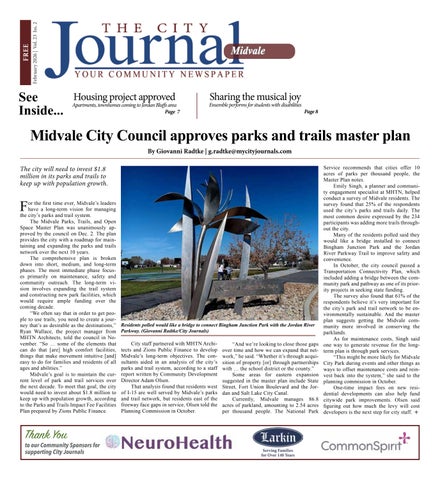
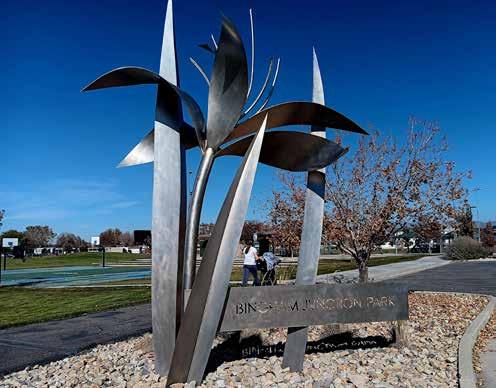
Many of the residents polled said they would like a bridge installed to connect Bingham Junction Park and the Jordan River Parkway Trail to improve safety and convenience.
In October, the city council passed a Transportation Connectivity Plan, which included adding a bridge between the community park and pathway as one of its priority projects in seeking state funding.
The survey also found that 61% of the respondents believe it’s very important for the city’s park and trail network to be environmentally sustainable. And the master plan suggests getting the Midvale community more involved in conserving the parklands.
As for maintenance costs, Singh said one way to generate revenue for the longterm plan is through park services.
“This might be more likely for Midvale City Park during events and other things as ways to offset maintenance costs and reinvest back into the system,” she said to the planning commission in October.
One-time impact fees on new residential developments can also help fund citywide park improvements. Olsen said figuring out how much the levy will cost developers is the next step for city staff. l
Residents polled would like a bridge to connect Bingham Junction Park with the Jordan River Parkway. (Giovanni Radtke/City Journals)
LIMITED TIME OFFER!
LeafFilter came out on a Wednesday, gave me a quote and installed it the next day. Very reasonable price. The installers were professional and cleaned up after themselves. Very pleased with LeafFilter.
-Je Farmer.
Have been thinking about having gutter protection installed for a number of years since every year it becomes more of a pain to climb up on the roof and get the clean-out done. Called LeafFilter on a Thursday, the salesman came on Friday and the installation was done the next day. Easy-peasy. -Anthony. 100,000+ Reviews.
Heart care is more than numbers on a
At Intermountain Health, heart care starts with getting to know what’s important to you and building a care plan together. From preventive screenings and lifestyle recommendations, to treating the most complex conditions with advanced technologies, our experts are with you through all of it. In other words, we’ve got your back — and your heart.
Commercial vehicles can no longer park on Midvale streets
Drivers of for-profit vehicles will receive an infraction on their first offense and a class C misdemeanor on repeated offenses.
By Giovanni Radtke g.radtke@mycityjournals.com
OnMarch 22, 2025, a 16 year old driving westbound on Fort Union Boulevard swerved to avoid hitting a car pulling up in front of him. The quick maneuver and wet streets caused the teenager to lose control, and he crashed into a semitruck parked on the side of the road. The teenager died on the scene.
The tragic death of Elijah Exodus Bustamante-Martínez sparked a desire among Midvale residents to impose restrictions on semitrucks parking on busy roads. And the city council passed an ordinance on Dec. 2 barring all commercial vehicles from parking on the street.
“I had a few people reach out to me on this, which I don’t necessarily get, and everyone was like ‘make it as restrictive as possible,’” Midvale Councilmember Bryant Brown said moments before the unanimous vote.
The ordinance came about after numerous council discussions over a six-month period, and making it apply to all for-profit vehicles, not just semitrucks, was spurred by the car-sharing app Turo.
“This whole conversation started with … there’s a safety issue with having huge semitrucks and large commercial vehicles on our roads, then it became like ‘oh yeah and there is also this Turo thing that we just discovered,’” Mayor Dustin Gettel said. “... I think encompassing it all together is great because now … it takes care of the core problems that we were experiencing and that’s safety in neighborhoods.”
Individuals using public streets as “es-
sentially their storage space” for their Turo cars have become a growing nuisance to residents, Midvale’s Deputy City Attorney Daniel Van Beuge said at a council discussion in November.
“On one particular street, an officer, as going out to a call, has counted up to 12 of their [Turo] vehicles on a singular section of Midvale public street,” Beuge said, “which has been frustrating to the residents in the area because their parking or public parking is being occupied by all these Turo vehicles taking up space from them.”
Parking on roadways for commercial purposes is still allowed for tasks like dropping people off or loading or unloading a vehicle, as long as the driver leaves once their task is
complete. But someone parking for extended periods of time will get an infraction on their first violation of the new ordinance and a class C misdemeanor on any subsequent offense.
Some councilmembers raised concerns about the new restrictions affecting residents who use their personal cars for ridesharing apps like Lyft or Uber to make some extra income. However, Gettel noted that most parking enforcement does not come from police patrolling around looking for rideshare cars, but rather from residents who spot the vehicles and call them in.
“It’s going to be rare, if ever, someone calls to our attention a single Lyft vehicle that’s parked there overnight until they go onto their next shift, but it is very easy for
someone to notice … 12 cars parked on Bingham Junction Boulevard between Bingham Junction Station and 7800 South,” Gettel said.
Along with parking on Midvale streets, the ordinance added the same punishments to commercial vehicles parked in city-owned parking lots, with some exceptions. Beuge told the council in November that the code change was prompted by some businesses on Main Street using city-owned lots to store their delivery vehicles.
“I think frankly that this is fair because we tell … for example, the old fire station … ‘hey, you cannot use this as a parking lot to run your business,’” Brown said. “The city’s not here to make your balance sheet a little bit better.” l
Give Yourself a Valentine This Year: Learn to Decode Messages from Your Heart
When we talk about heart disease, the usual suspects often come to mind: crushing chest pain, shortness of breath, radiating arm discomfort. While these classic symptoms demand immediate attention, your heart often speaks in a more subtle language, a series of whispers and quiet shouts that can easily be dismissed or attributed to other, less serious issues. During Heart Month this February, we want to empower you to become a skilled interpreter of your body’s unique signals, recognizing that early detection can be profoundly life-saving.
Many people are unaware that heart problems don’t always announce themselves with dramatic flair. “We frequently see patients who’ve ignored subtle signs for weeks or even months, often rationalizing them away,” explains Dr. Richard Gelb, a cardiologist at Holy Cross Hospital –Mountain Point. “Especially for women, symptoms can be incredibly nuanced and different from the textbook descriptions often associated with men.”
So, what are these often-overlooked indicators that your heart might be sending out an SOS?
Persistent, Unexplained Fatigue: This isn’t just being tired after a long day. If you
find yourself unusually exhausted after normal activities, or if a simple walk leaves you winded in a way it never did before, your heart might be working harder than it should to pump blood.
This can be a sign of various heart conditions, including heart failure or even blockages.
Discomfort Beyond the Chest: While chest pain is classic, heart-related discomfort can manifest in surprising places. This includes pain, pressure, or aching in your jaw, neck, back, or even your stomach.
“We’ve had cases where patients initially thought they had a bad toothache or indigestion, only to find it was their heart,” says Dr. Bruce Kenwood, a cardiologist at Holy Cross Hospital – Jordan Valley. “Pay particular attention if this discomfort appears during exertion and subsides with rest.
Swelling in Unusual Areas: Swollen feet, ankles, legs, or even your abdomen could be a sign of fluid retention, a common symptom of heart failure. If your heart isn’t pumping effectively, blood can back up in the veins, leading to fluid accumulation. Don’t dismiss persistent swelling, especially if it’s accompanied by weight gain.
Chronic Indigestion or Nausea: While often benign, persistent indigestion, heartburn, or nausea, particularly when coupled with exertion, can sometimes be a
heart attack symptom, especially in women. If antacids aren’t helping and the discomfort seems linked to physical activity, it’s worth investigating further.
Lightheadedness or Dizziness: Occasional lightheadedness can happen for many reasons, but if you frequently feel faint, dizzy, or lightheaded, it could indicate an arrhythmia (irregular heartbeat) or a problem with blood flow to your brain due to a compromised heart.
“By familiarizing yourself with these less obvious signs, you’re taking a proactive step in safeguarding your cardiovascular health. Your body is constantly communicating; the key is to learn its second language,” said Dr. Roja Mulamalla, a cardiologist at Holy Cross Hospital – Davis.
Call to Action: If any of these subtle symptoms resonate with you, or if you’re experiencing anything that just “doesn’t feel right” in your body, please don’t wait. Listen to your heart’s whispers. Schedule an appointment with your primary care physician to discuss your concerns, or if symptoms are sudden and severe, seek emergency medical care immediately. Early detection and intervention are crucial for positive heart health outcomes. Your heart speaks – are you listening?
For more information or to find a provider visit mountain.commonspirit.org
Learn more about the services, care providers and missiondriven work of the Holy Cross hospitals and CommonSpirit Health at www.holycrossutah.org.
At CommonSpirit Health, we make the healing presence of God known in our world by improving the health of the people we serve, especially those who are vulnerable, while we advance social justice for all.
When minutes count, count on our emergency care. Get to know us before you need us. CommonSpirit Health Mountain Region does not discriminate against any person on the basis of race, color, national origin, disability, age, sex, religion, creed, ancestry, sexual orientation, and
When you need emergency care fast, the closest emergency room is a smart thing to know. You never know the level of care you’ll need when an emergency happens and choosing the right ER can make all the difference. And a hospital ER comes with the confidence of additional services right on-site.
CommonSpirit Holy Cross Hospital – Salt Lake has been awarded Chest Pain Center Accreditation from the American College of Cardiology (ACC). Facilities that achieve accreditation meet or exceed an array of stringent criteria for evaluating, diagnosing and treating patients who may be experiencing a heart attack.
Find emergency care close to you at mountain.commonspirit.org.
Greek Streak Taverna to open in Midvale’s Arts and Culture District
The Greek-style restaurant will open its second location on the bottom floor of the Corner and 6th Apartments.
By Giovanni Radtke g.radtke@mycityjournals.com
When Mario Trejo, the owner of the Logan-based Greek Streak Taverna, traveled to Midvale last year to meet some friends, it inspired him to make a change in his life. And the Midvale Redevelopment Agency gave him some options.
“I was like, this would be a cool spot to try something different,” he said at an RDA board meeting in November. “I’ve been doing the same thing for nine years now, and I’m like, I need something to be excited for again. And I think this would be a great opportunity.”
On Dec. 2, the Midvale RDA approved loan terms to Greek Streak Taverna. The $80,000 loan will help fund tenant improvements at the restaurant’s planned location in Midvale’s historic Main Street.
“We are excited and eager to be a part of the revitalization of the Midvale Main Arts and Culture District,” Greek Streak Taverna wrote in its proposal to the RDA. “We feel
that our food and our customer base fits well within the culture of that area.”
Greek Streak Taverna’s new location will be on the bottom floor of the Corner and 6th Apartments at 7487 S. Main Street. With
its home location in Logan, the Midvale location will be Greek Streak’s first foray into Salt Lake County.
Mayor Dustin Gettel said blending Greek Streak with the apartment complex “shows other people that this is possible and you can have a ground-floor retail restaurant space and make a decent living out of it.”
Trejo told city lawmakers in November that he plans to gear the Midvale location to late-night dining, which lies in stark contrast to his restaurant in Logan.
“We’re like the lunch spot in [Logan], and we hit like the marks for the place that all the chiropractors and doctors and the
university brings everyone for lunch,” he said. “So, like I want to kind of flip-flop that and kind of have like a place that groups of friends can come to late in the evening and stay open later hours.”
Greek Streak plans to run from 11 a.m. to 10 p.m. on weekdays once it opens, either in May or June. And to help make the Greek Streak Taverna more suitable for the Midvale nightlife, the Mediterranean restaurant plans to get a liquor license, Aubrey Ruiz, Midvale’s RDA program manager, said in November.
Currently, Trejo is working with architects to develop a layout for the Midvale location, and he told the board that a lot of the loan funds will be used to assemble the blueprint.
The restaurant is “just under 2,000 square feet, but it’s a blank shell,” Trejo said. “So, it gives us a lot of opportunity to move things around and kind of utilize that space really well.”
According to the loan term sheet, the funds will also go toward buying kitchen appliances and furnishings for the lobby and outdoor patio. Midvale’s RDA granted the loan at a 2% interest rate and with a seven-year maturity.
“There’s not a lot of RDA programs that allow businesses to have opportunities like this,” Trejo said to the board in November. “I talked to a lot of my friends, and they’re like, ‘Well, how do you get money?’ I’m like it’s not easy, but things like this gives us opportunities. So I’m really grateful for it.”
After approving the loan for Greek Streak Taverna, the RDA has $670,000 left in its revolving loan budget to allocate to other businesses looking to open in Midvale. The agency has approved term sheets for SaltFire Brewing Company and Honeysuckle Coffee earlier in the fiscal year. l
Mural logo of the Midvale Main Arts and Culture District, where Greek Streak Taverna will be located. (Giovanni Radtke/City Journals)
Greek Streak Taverna will be located in the Corner and 6th Apartments complex. (Giovanni Radtke/City Journals)
Midvale City Council approves high-density View 78 Apartments
Dave Denison, the senior development manager at the Gardner Group, told the council that the developers are trying to balance their property rights with possible land uses.
By Giovanni Radtke g.radtke@mycityjournals.com
Midvale City Council gave the go-ahead to a high-density housing project despite lingering concerns surrounding a lack of affordable units and the absence of businesses and services in the Jordan Bluffs area.
The Gardner Group will develop the View 78 Apartments, comprising three-story apartment buildings totaling 232 units, along with an additional 124 townhomes.
The housing complex is boxed between Bingham Junction Boulevard and South Main Street, lying southeast of 8150 Ivy Drive. On the north side of Ivy is the Reserve at View 78 Apartments, a different set of apartment buildings already under construction by the Gardner company.
A strip of Seghini Drive will run through the heart of View 78, and the developer plans to add curb extensions on the road to protect parked cars from oncoming traffic.
“That’s actually a pretty nice feature to have on the street,” Midvale’s Planning Director Wendelin Knobloch said of the curb extensions in February. “I think from experience as a city in Midvale and other cities in the valley, we know no matter what your parking requirement is, there will be cars on the street.”
Before approving the project on Nov. 18, Councilman Bryant Brown said that he found the housing development “uninspiring and a little bit kind of insulting.”
“You have the ‘good, better, best model,’ I wouldn’t even put that in that when everyone keeps waiting for this area to provide a lot of amenities,” he said.
Planned amenities for the View 78 Apartments exceed the city’s requirements for a residential project. Still, Brown said it offers nothing to the public at large.
“We actually, a few years ago, you remember, brought some five-story [apartment buildings], a lot more dense product here, which the council wasn’t really happy about,” he said. “And in our work session, we kind of realized that, and we switched gears at great expense to ourselves.”
“So we do feel it is a better plan,” Denison continued. “It’s less dense. We really worked hard to enhance Seghini Drive … and make this a true benefit for the city.”
Brown replied that he would have preferred five-story apartment buildings if they included ground-level retail.
“Density is not my fear, it’s density without providing services for the area, even if it’s mostly servicing the four stories that live above,” he said.
Councilmember Denece Mikolash shared Brown’s sentiment, stating she would like to see a balance of apartments and townhomes, along with a mix of commercial buildings.
During the public hearing on the housing project, Midvale resident Jason Baxter said he, too, would like to see retail in the Jordan Bluffs area.
“A lot of this part of Midvale has seen commercial space and stores close over the years and get replaced by housing, which is good that the housing is there. But the nearest grocery stores to this area are miles away,” Baxter said.
Housing affordability was another concern raised during public comment.
Candace Tarkeshian, a Midvale mother of three, told the council that two of her adult children cannot afford their own apartments.
“When I see spaces like this, I think of my 25-year-old daughter who’s disabled,” Tarkeshian said. “I would love for her to be able to move into a space like this, but she A: has to be able to afford it and B: has to
be able to get where she’s going, and with transportation being difficult for her, that’s a concern for me and my family.”
Councilmember Heidi Robinson later echoed concerns about the dearth of affordable units at 78 View.
“I just hope at some point we can see some sort of affordability component to such a large project,” Robinson said. “I mean, just because there’s more houses, it doesn’t ad-
dress the affordability of them.”
Some 5.4 acres in the southern lot of the complex are left vacant in the preliminary design plan. “It remains to be seen if the south lot will be used for more townhomes or apartment buildings,” Knobloch said.
The Gardner Group plans to finish construction of 260 dwellings in the fall of 2028. The company will then begin construction on the remaining 96 townhouses right after.l
Construction on the Reserve, an apartment complex across the street from the recently approved View 78 Apartments. (Giovanni Radtke/City Journals)
Making connection and sharing joy through music
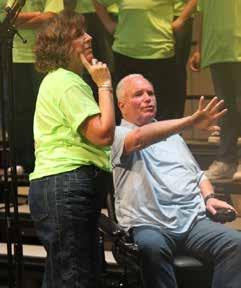
Music filled Jordan Valley School as Hillcrest High School’s Vocal Ensemble performed for students with disabilities whose joy was expressed through movement and smiles, creating a moment of connection that went far beyond the songs.
By Julie Slama j.slama@mycityjournals.com
Hillcrest High School’s Vocal Ensemble recently brought the joy of music to Jordan Valley students, performing for an audience eager to clap, dance and move to the songs.
For Jordan Valley Music Therapist Hope Ward, the performance aligned with her goals in her first year.
“One of my biggest goals this year is outreach, so I invited a couple of different schools to come,” she said. “Hillcrest has been coming for years.”
In addition to Hillcrest, Corner Canyon High students sang at Jordan Valley in early December and Brighton High was on the schedule along with a private violin studio performance.
Jordan Valley students have severe multiple disabilities including autism, cerebral palsy, traumatic brain injury, seizure disorders, communication impairments, genetic disorders and syndromes, deafblindness and students who are extremely medically fragile. The goal at Jordan Valley School is to improve the quality of life for its 70 students, age 5 to adult, and their families.
Ward said bringing performances directly removes barriers.
“Our students love this. Sometimes we don’t have the access as other students to be able to do things like this so having them come to us is easier. Our students are obsessed
with music,” she said.
Ward said students express their excitement in their own ways.
“Many of our students are nonverbal so when they are excited, they move their bodies. Music makes them happy, so these students are expressing it through movements. Maybe they’re making some vocalizations that aren’t words, but they are clearly excited from their happy sounds,” she said.
As a music therapist, Ward works closely with students’ educational plans. She works with each of the 10 classes in group therapy sessions, then supports 20 students through their individualized education program through music.
“Maybe their goals are to increase motor dexterity so grasping something like a maraca is very motivating. When they shake it, they are increasing their grasp. It’s fun and that’s why it’s effective,” Ward explained.
Jordan Valley Principal Matt Nelson said these live performances are meaningful.
“It’s important to get this quality of music brought to our students where they’re comfortable and familiar so they can enjoy it,” he said. “We’ve had students dancing, clapping, jumping up and down, rocking back and forth. Engaging with music is another method our students can communicate. It’s a powerful medium.”
Hillcrest High senior John Hansen said performing for Jordan Valley students offers something unique as does performing in venues such as Gardner Hall, the Tabernacle and the capitol.
Hillcrest junior Laelia Raleigh said their visit was rewarding.
“I love talking to them,” she said. “I talked to a girl in the corner and she smiled at me and gave me the biggest hug. It just filled my heart with so much joy.”
Hillcrest choir director RaNae Dalgleish said the tradition of performing at Jordan Valley began decades earlier under Hillcrest choir director Brian Bentley and one she has chosen to continue.
“Performing in our community strengthens students musically and personally,” she said about the synergy coming from 40 performances during the winter season. “Watching my students here, some of them have never had a chance to be with others who are disabled to the point where they can’t be in a typical classroom. They’re seeing how these kids respond to music, how they light up and they dance, they move and they vocalize. They’re learning the powerful impact of what they’re doing. When we talk as a team about our experiences and goals and what is worth our time, we come here. Bringing joy to Jordan Valley students is worth our time and investment.” l
Loving Your Pup: Simple Ways to Build a Stronger Bond This February
February is a season centered around love, and it’s also a great time to focus on the relationship we share with our dogs. Our pups are part of our families and daily routines, and loving them well goes beyond affection. It’s about consistency, care, and creating a life where they can truly thrive.
Here are some simple ways to show your pup love every day:
CREATE ROUTINE AND STRUCTURE
Dogs feel safest when they know what to expect. Regular feeding times, walks, play, and rest help build confidence and reduce anxiety.
PRIORITIZE MOVEMENT AND ENRICHMENT
Purposeful play, exercise, and mental stimulation support both physical health and emotional well-being. Even small additions—like an extra walk or a new puzzle toy—can make a big difference.
INVEST IN EARLY TRAINING AND SOCIALIZATION
Positive reinforcement training and safe social experiences help dogs build good habits and confidence that last a lifetime.
FOCUS ON PREVENTATIVE HEALTH
Dental care, nutrition, and wellness routines are often overlooked but are key to long-term health. Starting healthy habits early helps prevent bigger issues down the road.
TAKE CARE OF YOURSELF, TOO
Loving your dog also means giving yourself grace. A calm, supported pet parent is better equipped to care for their pup. Community resources and trusted professionals can make all the difference.
If you need support with socialization, structure, and creating a routine your dog can thrive in, now is a great time to get started.
Sign your pup up for a Meet & Greet today at Dogtopia to learn how daycare, enrichment, and structured play can support a happy, healthy life together.
Hillcrest High students share a moment with Jordan Valley students after their concert. (Julie Slama/City Journals)
By Julie Slama j.slama@mycityjournals.com
The scent of waffles mixed with laughter and smiles from Jordan Valley School and Life Skills Academy students, honored as special guests, filled the Belgian Waffle & Omelet Inn. For more than 40 years, the Midvale restaurant has opened its doors and its heart and turned an ordinary meal into a holiday tradition, complete with a visit from Santa Claus.
“It wouldn’t be Christmas without Jordan Valley being here,” said owner Jeff Wilhelmsen, who has continued the tradition since 1983. “We’ve been happy to be able to do it.”
Students at nearby Jordan Valley School have severe multiple disabilities, many who are extremely medically fragile. The goal at Jordan Valley is to improve the quality of life for its 70 students, age 5 to adult, and their families.
The holiday tradition began when Wilhelmsen partnered with the late Kerm Eskelson, Sr., who was the building’s landlord at the time.
“He said, ‘let’s do this to help these kids,’” Wilhelmsen said. “He covered 50% in cash, and I covered the rest. When he passed away, we continued doing it on our own. He was a real good guy.”
This year, more than 100 students and staff from Jordan Valley came as well as for the first time, about 50 students and staff from Life Skills Academy, Canyons School District’s post-high adult transition school which provides instruction and training to students with special needs who have aged out of traditional high school.
All the meals were fully paid for by the restaurant and Santa arrived with treat bags filled with juice boxes, candy canes, clementines and chocolate Christmas trees.
“They roll out the red carpet; they have so much love for our students,” said Jeff Honsvick, first-year assistant principal at both schools. “Talk about the spirit of Christmas, this is incredible.”
Honsvick said the experience goes far beyond a holiday party.
“I’ve worked 15 years at a school similar to this and I’ve seen the incredible outreach of the community before, but there’s something about a business welcoming the entire school that just gives me goosebumps,” he said. “Seeing the students be successful in the community is huge for me.”
For many students, eating at a restaurant is a rare opportunity.
“A lot of our students don’t get the chance to eat in a restaurant,” said Rachel Murphy, Jordan Valley administrative assistant who coordinated the school’s visit. “Some parents feel worried about people and crowds, so this gives them the experience to be in the community they don’t normal have.”
Life Skills Academy Principal Stacey Nofsinger said those experiences are hard to replicate at school.
“You can only teach so much in a classroom,” she said. “So, they’re learning how to
go to a restaurant, how to order, how to use their social skills.”
To help students be successful, Murphy said those who use devices to communicate, had preloaded choices and comments added so they could interact with the restaurant staff and when they met Santa.
“This helps them be more independent,” she said.
The place is familiar to some students,
who come on a regular basis to learn practical skills. For years, Belgian Waffle has served as a job site for students.
“They fill salt and pepper shakers, wipe tables, wipe menus, bus tables, vacuum; they’re helping us and getting experience,” said Cheryl McCormick, a longtime staff member who has worked the event with Jordan Valley for 17 years as her mother did before her. “I love having them here. These are my kids. When they see Santa Claus, it makes my year.”
Nofsinger, too, enjoys the interaction: “Just seeing happiness, both my staff and students as well as the Belgian Waffle staff and how they love this, is fun for me.”
The restaurant remains open to the public during the holiday meal for the schools— and touches those patrons as well.
Matthew Smith, a sports videographer from Casper, Wyoming, who happened to stop in that day, said the party was “amazing.”
“Kids with disabilities almost never get out and it’s important they’re given these social interactions in these environments,” he said. “It’s what life is all about.”
For the Belgian Waffle staff, the purpose has never changed.
“This place is always open to these students,” Wilhelmsen said.
McCormick added: “And that makes my heart happy.” l
Jordan Valley students got a visit with Santa Claus while being treated to a holiday party at the Belgian Waffle & Omelet Inn. (Julie Slama/City Journals)
Inclusion takes center stage at inaugural state unified dance competition
Local high school dancers made history earning top medals while promoting inclusion and showcasing talent.
By Julie Slama j.slama@mycityjournals.com
In the first state high school unified dance competition, three area schools swept the event.
Copper Hills High School won the unified dance team competition, with Highland High and Murray High in second and third places, respectively. Several students from each of the schools placed in solo and duet categories.
Unified dance is a program that brings together students of all abilities together to promote inclusion, friendship and teamwork with an emphasis on movement and joy. The Special Olympics Utah competition was held in December at Highland High and featured a variety of dance styles and creative interpretations.
Students performed their routines on stage before receiving feedback from a panel of judges, including three who recently competed and won gold medals at the Special Olympics World Games. Much of the feedback was positive and encouraging with comments such as “keep smiling and showing you’re having fun,” “you owned that stage,” “great techniques” and “good energy and choreography.”
Many of the performances included cos-
tumes and props. Murray High dancers wore bright colors while Copper Hills performers sported matching shirts that said, “Inclusion is Cool.” Props included everything from watering cans to leis, adding creativity and personality to the routines.
Some students choreographed and practiced dances independently or together as an afterschool club. At Copper Hills, teacher Anna Bay has instructed adaptive dance for three years.
“We have so many good kids who love to dance, so we wanted to give them more of a dance experience than what they could get in our mainstream classes,” she said. “With so many interested, we were able to open up a class just for the special ed kids. We have 20 special ed students in the class, plus 20 peer tutors. Then, we have aides who help.”
Bay said the benefits of unified dance go beyond learning choreography and dance technique.
“They’re learning social skills, how to be part of a team and about friendship. They’re listening and following directions, but we do it in a dance way, so it’s all by having fun. I teach them a lot of the same things I do in my ballroom classes from stretching to line dances. We’ve been working on learning choreography, which we were able to perform today,” she said. “They have so much fun and I love their genuine smiles.” l
Murray High student-dancer Bree Cox won first place for her solo at the state’s first high school unified dance competition. (Julie Slama/City Journals)
Murray High students perform a group dance at the first state high school unified dance competition. (Julie Slama/City Journals)
MIDVALE CITY DIRECTORY
City Hall
801-567-7200
Finance/Utilities 801-567-7200
Court 801-567-7265
City Attorney’s O ce 801-567-7250
City Recorder/Human Resources 801-567-7228
Community Development 801-567-7211
Public Works 801-567-7235
Ace Disposal/Recycling 801-363-9995
Midvale Historical Museum 801-567-7285
Midvale Senior Center ....................... 385-468-3350
SL County Animal Services .............. 385-468-7387
Fire Dispatch ......................................... 801-940-4000
Uni ed Police Department
> Midvale Precinct 385-468-9350
Public Works 801-567-7235
Rocky Mountain Power 877-508-5088
In The Middle of Everything
City Hall – 7505 South Holden Street • Midvale, UT 84047
Midvale Monthly with Mayor Gettel
CITY
Rooted in Service: A Look Back at Midvale’s 2025
Midvale is a community that makes me proud every day. With just over 36,000 residents, our city is de ned by steady progress, civic pride, and genuine care for one another. In 2025, I watched our team focus on strengthening essential services, improving infrastructure, and protecting the character that makes Midvale such a special place to live.
Looking back, from improvements beneath our streets to the new art along Main Street, the year showed consistent progress, creativity, and a deep commitment to serving our community, reminding me why I’m so proud to call Midvale home.
Building a Stronger Foundation
Much of Midvale’s most important work happens behind the scenes. In 2025, our Water and Sewer teams strengthened system reliability through new valve installations, expanded valve exercising e orts, lift station upgrades, and ongoing capital projects. Nearly 80 percent of our sewer system was camera inspected and cleaned. We also implemented a Water Conservation Response Plan and updated our water standards by removing uoride. These steps support clean water, dependable service, and the long-term health of our infrastructure.
Streets That Work—and a Team That Cares
Major projects, like Stagg Street improvements and sewer rehabilitation, complemented routine surface treatments to keep our roadways in top condition.
A Main Street That Tells Our Story
Main Street remains a vibrant center for arts, culture, and small business. The Midvale Main Art House hosted events, workshops, and community gatherings throughout the year. Construction of the Food Truck Plaza created a welcoming gateway to the Midvale Main Arts & Culture District. Seven new murals were added, bringing the total to 45. Economic activity stayed strong, with four new businesses opening (Cactus and Tropicals, The Bambino Pizza, Senor Pollo Mexican Grill, and Maivie) and four additional food establishments approved for small business loans and expected to open in 2026 (Honeysuckle Co ee, SaltFire Brewing, Greek Streak, and Blacksmith Ice Cream).
Our Streets and Stormwater crews kept Midvale moving safely and e ciently. The Center Street Underpass and Fitzer’s removal project improved both appearance and safety along key transportation routes. The team maintained an outstanding safety record, contributing to strong employee retention and consistent service. Quick responses through our City service portal continue to re ect our culture of putting residents rst.
Planning for Connection and Conservation
Several major planning e orts wrapped up in 2025, including updates to the Parks, Trails, and Open Space Master Plan, the Transportation Connectivity Plan, and the Water Use and Preservation element of the General Plan. These initiatives help ensure sustainability, accessibility, and balanced growth for the city we all share.
Engineering Innovation in Action
Midvale continues to pursue forward-thinking infrastructure solutions. Our Engineering division processed more than 200 permit reviews while maintaining high standards in our neighborhoods.
Strengthening City Services from the Inside Out
The Building Division was restructured to improve e ciency and accountability. Administrative Services achieved full water meter data transmission during billing cycles after years of improvements. The Department also earned the Government Finance O cers Association’s Certi cate of Achievement for Excellence in Financial Reporting for the FY2024 Annual Comprehensive Financial Report.
Steady Leadership and Strong Governance
The City Recorder’s O ce ensured smooth continuity during leadership transitions involving the Mayor and District 5 Council seat. The 2025 municipal election was conducted seamlessly and in full compliance with state law. The team advanced the City’s Government Data Privacy Policy and contributed to the annual privacy report, reinforcing our commitment to responsible data stewardship.
Looking Ahead
Midvale’s story in 2025 lls me with pride. It’s a story of steady improvement, innovation, and community spirit, visible in reliable services, safer streets, thoughtful planning, and a dedicated city team that truly cares. As we look ahead, I’m con dent Midvale will remain authentic, welcoming, and committed to serving every resident who calls our city home.
In The Middle of Everything
Le y Leviticus: e Neighborhoods Best Kept Secret
Is there a sinkhole? A snowstorm? Lefty is on his way. At any time of day, he is on call whatever the need may be.
You might not know that Lefty Lee Leviticus has worked for Midvale City for two years, but you’d notice if he couldn’t do his job.
Without Lefty and his crew on Street Maintenance, your roads would be full of potholes, roadsides would be stacked with trash, and no street signs would guide your drive to work.
Street Maintenance is the crew that you don’t know you love until the job isn’t done, and with this Midvale Crew, that isn’t likely to happen.
“They do it because they like being part of the city and helping. They see the di erence in the city they work in,” Roland Garcia, Streets and Storm Manager.
“Lefty has only been with the city for a few years. He’s willing to do whatever it takes to get the job done.”
“We do try our best to keep streets maintained in as many ways possible,” Lefty said. “Whatever request the residents put in, we try to do in a timely manner and do it to the best of our ability.”
Not only does Lefty serve the needs of Midvale, but he serves his family. We had to reschedule the interview for this article twice, both for excellent reasons. Once because his wife was unwell at home, and another time because he was needed at work.
“I like serving others, helping others, “ Lefty said. “I was raised that way. My parents cared for everyone. Seeing people happy makes me happy. I love this job.”
Lefty and his coworkers take care of many of the services that make our city safe. They patch asphalt, x and replace sidewalks, gutter and curbs, replace broken street signs, paint no-parking zones, plow and salt roads in the winter as well as maintain the plows themselves, clean up trash, x and keep city properties clean, maintain crosswalk signs, and put up lights and banners for holidays and events.
Call for Artists! 2026 Los Muros on Main: Midvale City Mural Festival
The Redevelopment Agency (RDA) of Midvale City invites local, national, and international mural artists and artist teams to apply for the 2026 Los Muros on Main: Midvale City Mural Festival, happening Saturday, June 13, 2026, from 4–9 p.m. in Midvale, UT. This annual event continues to draw artists to one of Utah’s most active and evolving creative districts.
Set within the Midvale Main Arts & Culture District, Los Muros on Main o ers artists the opportu-
nity to contribute to a district de ned by collaboration, large-scale public art, and creative energy. With more than 45 murals already installed, the area has become a destination for artists interested in creating impactful work in a public setting.
Los Muros on Main brings together artists, musicians, and visitors for a shared, street-level experience focused on large-scale mural work that re ects Midvale’s character, diversity, and lived experiences. Murals will be painted between June 6–13, 2026, with artists completing their work during the festival and engaging with attendees.
Selected artists will receive a stipend of up to $4,500, based on wall size, along with additional support for wall preparation, equipment, and select travel expenses.
Applications are open to experienced mural artists of all backgrounds. The deadline to apply is Thursday, February 26, 2026, at 12 a.m.
Full details and the application are available at EngageMidvale.com/Call-for-Artists.
FEBRUARY 2026 CITY NEWSLETTER
MIDVALE. UTAH. GOV
Millie Mallatt: e New Maestro of Midvale Events In-Person Book
Do you ever feel overwhelmed by keeping up with work, getting your car’s oil changed, eating three nutritious meals a day, helping kids with homework, and still planning that birthday party? Midvale City’s events have thrived thanks to the Redevelopment Team and city sta , who have managed them in addition to their already full workloads. Now it’s time to bring in an Event Planner of our own.
“Events have been so successful that we need a fulltime person to take events including Harvest Days and make them bigger and better,” Kate Andrus, Midvale’s Redevelopment Agency (RDA) Director, said.
We welcome Millie Mallatt, a seasoned event and recreation coordinator. She spent seven years planning Ragnar Relays, managing thousands of participants and volunteers,
dozens of vendors, race courses, timing, food, entertainment, and ensuring safety and accessibility across threeday events. Just before joining Midvale, she transformed a Florida recreation center that previously had no structure, rebuilding after-school and summer camp programs with organized schedules, homework help, and sta -led clubs. She also organized senior activities, including ferry trips and holiday outings, and oversaw athletics ranging from youth basketball and T-ball to senior softball.
“She loves to get her boots on the ground,” Andrus said. “She’s got the right energy, has creative solutions, is proactive and very charismatic.”
“The RDA has been managing the events,” Mallatt said. “It’s impressive what they’ve been able to accomplish.”
Mallatt will be able to host the same great events you have enjoyed and come to expect, but with more focused planning. “I have a sustainable, local mindset,” Mallatt said. “I want to do things with meaning and impact.”
She knows how to plan for the right amount of people in a space, how to recruit volunteers, and how to bring a community together.
We can’t wait to see you at our traditional events, and perhaps a few more! Keep a look out for announcements on social media and in the community!
Midvale City Events 2026
Food Truck Tuesdays, starting May 19th
June 13: Los Muros on Main: Midvale City Muros Festival
July 27-August 1: Harvest Days
October 24: Trick-or-Treat on Main Street
December 12: Light up Main Street
Other Sponsored Events 2026
April 10-11: LetterWest by Craft Lake City
October TBD: Midvale Main Car Show
Midvale City’s Main Art House, located on historic Main Street, is more than a gallery, it’s a vibrant community hub where creativity thrives. Home to the local art collective Creative Rebellion, the Art House o ers a welcoming space for everyone to explore, experiment, and express themselves through art.
The Art House functions as both gallery and working studio, providing a home for painters, sculptors, muralists, and multimedia artists who believe creativity is essential to mental health, community connection, and self-expression. Weekly art classes, hands-on workshops, and monthly exhibitions invite people of all ages and skill levels to discover the joy of making art, whether you’re a beginner or an experienced creator.
Hands-On Workshops for Everyone
Creative Rebellion’s workshops are designed to spark curiosity, encourage experimentation, and remove the pressure of perfection. Recent events include:
• Abstract Tool Painting – Break free from traditional brushes and explore unexpected textures and movement using unconventional tools. This class emphasizes play, intuition, and creative risk-taking.
• Pysanky Egg Decorating – Learn the centuries-old Ukrainian folk art of wax-resist egg decorating with artist Adrianne. Create intricate, nature-inspired designs while exploring meditative storytelling through art. Each participant leaves with their own decorated egg, perfect for gifts or keepsakes.
Buddies at SLCo Animal Services!
Looking for a way to make reading even more exciting? Come read to the adorable cats at Salt Lake County Animal Services! Our Book Buddies program is perfect for kids under 18 to enjoy some quality reading time while helping cats feel loved and socialized. It’s a win-win for everyone!
HOW IT WORKS:
1. Visit us at 511 W 3900 S, SLC between 10 AM – 6 PM, Tuesday through Saturday.
2. Kids must bring along an adult buddy.
3. Bring your favorite book (or a few!) or pick one from our cattery “library.”
4. Sign in and out on the clipboard in the cattery—it even counts as volunteer time!
This heartwarming program helps kids build con dence in their reading while o ering soothing companionship to our shelter cats. Cats nd the sound of a human voice calming, and other shelters have seen incredible bene ts from similar programs.
Have questions? We’re here to help! Email us at animalvolunteer@slco.org or visit AdoptUtahPets.org.
Come join us for a purr-fectly wonderful time!
Midvale Main Art House: A Hub for Creativity and Community
• Collage Fridays – A relaxed, come-as-you-are session for cutting, layering, and composing images with papers, magazines, textures, and found materials. Whether following a theme or experimenting intuitively, participants leave with original artwork and fresh creative ideas for the weekend. No experience necessary.
• Watercolor Workshops with JJ Riggs – A two-hour session where participants of all ages learn to build soft layers of color, prep and plot their images, and capture the personality of a person or pet in watercolor. Everyone leaves with a completed painting.
Workshops are a ordable, hands-on, and designed to prioritize exploration over perfection.
Explore the gallery, meet the talented local artists who bring it to life, and discover unique pieces you can take home, perfect for gifts or adding a splash of creativity to your space.
Whether you want to try a class, attend an exhibition, or simply wander through and soak in the art, there’s something for everyone. Pick up a brush for the rst time, get inspired by experienced artists, or connect with neighbors who share your passion for creativity.
Location: 7697 S Main Street, Midvale, UT 84047
Hours: Tuesday through Saturday, 11:00 a.m. to 9:00 p.m.
For workshop schedules, registration, and exhibition details, visit TheCreativeRebellion.org.
Longtime educator and Olympic choreographer Paul Winkelman, now living with ALS, is finding new ways to inspire students and hoping to return to the Olympic spotlight.
By Julie Slama j.slama@mycityjournals.com
Ineight years, Salt Lake will once again welcome the world as host of the XXVII Winter Olympic Games in 2034. For Paul Winkelman, a longtime educator and counselor in Canyons School District, he hopes it will give him a repeat performance as the opening and closing ceremonies choreographer, a role he cherished during the 2002 Games.
“I’d love to do that,” Winkelman said simply, reflecting on one of his greatest experiences of his life.
In 2002, Winkelman was teaching at Alta High and coaching its nationally acclaimed ballroom dance team when dozens of people walked into the school commons after school, cameras rolling. Among them was a producer for the Salt Lake Organizing Committee.
After watching the boys’ portion of the rehearsal, Winkelman recalled being asked who he was and what group was practicing.
“I explained we were the Alta High School ballroom dance team,” Winkelman said. “He said, ‘I’ve never seen guys dance like this.’”
That chance encounter ultimately led to Winkelman being hired as the full-time choreographer of the Olympic opening and closing ceremonies. His students became the backbone of the Western Frontiers section, the largest segment of the ceremonies, first learning the choreography, then helping teach it to hundreds of performers who filled Rice-Eccles Stadium.
“I said many times, the Salt Lake Olympics was heaven. It was unbelievable,” he said.
Eight years from now, however, if Winkelman returns to the Olympic stage, his approach will look different. In 2022, he was diagnosed with ALS, common-
Still dancing forward
ly known as Lou Gehrig’s disease, a progressive neurological disorder that attacks motor neurons in the brain and spinal cord, gradually robbing the body of voluntary muscle movement while leaving the mind intact.
“I teach a totally different way. It’s verbal. I’ll explain to my top couple what I want and they become my legs,” he said.
Even with the diagnosis, Winkelman hasn’t stepped away from his career, working with students.
“In 2022, I was diagnosed with ALS, but I knew there’s no way I’m quitting work because I love working with kids, and I wouldn’t know what to do with myself,” he said.
A life shaped by students and the arts
Helping students has been Winkelman’s lifelong passion. He began his career at East Midvale Elementary, where he spent seven years teaching third and fourth grade while building a drama program that quickly grew beyond expectations.
“I loved East Midvale,” he said. “We produced all-school productions where ev-
eryone from kindergarten through sixth grade could be involved. It was an after-school activity many students wanted to be a part of.”
Winkelman’s reputation led then Jordan School District to move him to an opening at Alta just one week before school started in 1992. There, he continued the school’s strong theater tradition and launched what would become one of the most successful ballroom programs in the country.
“We became national champions,” he said. “Of the 10 years I was there, eight times we were the national champions. Those kids worked so hard.”
Winkelman lived and breathed work.
“There were times I never went home. I slept on the floor of the auditorium when I was tired, but I loved what I was doing and
the productions we did there were absolutely amazing. The students and the quality of their work was stunning,” he said.
After adding his master’s degree in psychology to his undergraduate education degree and master’s in theater, Winkelman pursued the counseling field, leaving Alta in 2003. He worked at Brighton High, Hillcrest High and Utah Valley University before returning to Brighton.
At Hillcrest, Winkelman helped sustain and elevate the school’s well-known musical theater tradition for a decade, collaborating with choir director RaNae Dalgleish.
“Working with Paul at Hillcrest — I’ve never met a man with more passion and energy and talent,” she said. “He was demanding, but he also made it fun. Our musicals
Entrada counselor Paul Winkelman continues to make a big contribution to students, both in counseling and in the performing arts, while living with ALS. (Julie Slama/City Journals)
Hillcrest High performing arts students as well as Beatles tribute band Sean’s Garage and Bingham High theater director David Martin came together to perform in a BeatALS concert to help the ALS Foundation. (Photo courtesy of Janal Williams)
Hillcrest High choir director RaNae Dalgleish and guest choreographer Paul Winkelman work together on the recent BeatALS concert, which honored Winkelman. (Photo courtesy of Janal Williams)
were phenomenal because they had the Paul touch.”
A moment that redefined his world
Winkelman’s ALS diagnosis came after months of uncertainty, injuries and worsening weakness.
“When the fourth doctor told me, ‘You have ALS,’ I just sat there. I vividly remember I went right out of body like I was watching myself,” he said.
The disease takes a physical toll on Winkelman daily. He experiences tremors and painful muscle spasms, which he describes as “painful Charley horses in your whole body” and frequent falls.
“When I fall, my body freezes, and I’m like a piece of glass hitting the floor. My head has been cut open; I’ve had to have shoulder surgery because I ripped the rotator. It scares me to fall, because I know there’s no way to stop and, on my way, down, I wonder, how bad is this one going to be? It’s taught me the more invincible you think you are, the less you are. Life can be very fragile,” he said.
Even so, Winkelman’s outlook remains clear.
“My attitude from day one has been positive,” he said. “You can stay positive and contribute, or you can turn this into a negative and give up.”
Today, Winkelman is a part-time counselor at Entrada Adult High school, where the flexibility allows him to continue supporting students.
“I’m still working with them on careers and on getting them graduated,” he said. “If I get up one day and my body just says no, I can work with my disability much more easily.”
Winkelman continues to choreograph, judge competitions and mentor performers, recently coaching a group to the world championships. He also has produced Broadway stars, including Derek Hough of “Dancing with the Stars” and Ashley Bryant in “The Play That Goes Wrong,” and worked on the choreography for the movie, “High School Musical.”
“My mind can still see what the choreography needs to be,” he said.
BeatALS — music, meaning and community
His choreography was on full display recently at Hillcrest High during a BeatALS benefit concert honoring Winkelman. Supported by Dalgleish, he met Bingham High theater director David Martin and worked with Sean’s Garage, a Beatles tribute band, to raise funds for ALS research and awareness.
“We had a night of wonderful music and celebration,” Dalgleish said. “We ended up earning about $5,700 for the ALS Foundation.”
Not only did Winkelman choreograph numbers for the program, he spent time talking with 50 students about music, dance and life. He also shared his journey with the audience during a pause in the concert.
“It was so much fun and the kids were awesome,” Winkelman said. “I heard some songs I didn’t know. I’m quickly becoming a Beatles fan.”
Dalgleish said the experience also impacted the students.
“The kids learned the songs, the history of the time and we had Beatles trivia every day and they learned to be thankful for every day,” she said. “The concert was beautiful. They danced, the orchestra played, the band played, the choir sang. It was stunning. It brought me to tears.”
Gratitude for every day
Winkelman credits his faith, family and friends for sustaining him.
“I’ve lived the life of at least five people,” he said. “I had many incredible opportunities in my life. I can’t be bitter. I just have to find a different way to do things.”
Brighton High recently honored Winkelman with a scholarship in his name for students pursuing ballroom dance at BYU, another reminder of the legacy he continues to build.
“I’m lucky and whether I get the opportunity to choreograph another Olympics or championship, I get up—even on rough days—and I find the positive light, hoping I can change somebody’s life,” he said. “That has been a beautiful blessing, and I’m thankful for every day.” l
Don’t ignore signs of the winter blues
Thousands of Utahns deal with Seasonal Affective Disorder.
By Peri Kinder peri.k@thecityjournals.com
F
or many people in Utah, the “winter blues” show up as exhaustion, a lack of motivation and low energy. While the dark nights and cold days can make anyone irritable, if symptoms of weariness or sadness last more than two weeks, it could be a sign of Seasonal Affective Disorder.
While the national SAD rate is around 5%, it’s estimated that 10% of Utahns experience SAD each year. Environmental factors like the annual inversion, limited sunlight and disrupted circadian rhythms contribute to an overall emotional slump.
Dr. Jason Hunziker, Division Chief of Adult Psychiatry at the University of Utah, said SAD is a type of depression affected by low light exposure that can heavily impact the way people function. It can show up as low motivation, a higher intake of carbohydrates, excessive sleeping or just feeling off.
“People get up in the morning and it’s dark; they come home from work and it’s dark, and it affects them,” Hunziker said. “It begins to interfere. You’re getting to work late, you’re not keeping up at work and you’re not getting to school. Your relationships are starting to become fragile, and there are more arguments or isolation. You start to feel hopeless.”
While brief periods of sadness are common, SAD symptoms lasting two weeks or more should be considered serious, and it might be time to talk with a professional, especially if the depression includes thoughts of self-harm or suicidal ideation.
Hunziker said one of the best ways to combat SAD is through movement, outside if possible. Moving the body releases endorphins that provide a sense of well-being and it can take the mind off worry or stress.
“One of the biggest things people forget to do in the winter is move,” he said. “Go out for a walk, go to the gym, run on the treadmill at home, just make sure you’re trying to do something. It’s best if you’re outside because the cold air and the sunlight, all of those things we need are outside.”
Light therapy is another effective way to treat SAD symptoms. Whether you take a 20-minute dog walk or sit in front of a light therapy lamp, the benefits will pay off in the long run.
Healthy eating plays a big role in how people feel in the colder months. Winter meals and snacks often contain carbheavy comfort foods but the more fresh produce that can be incorporated into a diet, the bigger the reward. Staying connected to loved ones is another way to improve mental health.
“We isolate in the wintertime but we need to make sure we’re meeting with family and friends, and reaching out to them all the time,” Hunziker said. “There are so many ways that we can help when things start to go the wrong direction. Let’s not let it get too far down the road before we do something.”
For people prone to SAD some pre-winter planning may help. Create an autumn toolkit to help avoid the deep depression associated with the disorder. Set up a therapy appointment in early September and plan on filling anti-depressant medication in early fall, so it has time to work.
Having things to look forward to can help alleviate SAD symptoms. Schedule fun events for the winter or plan a weekend getaway.
For those who need crisis help, key resources include the 988 Suicide & Crisis Lifeline number and the SafeUT
Walking outside is a top recommendation for alleviating symptoms of Seasonal Affective Disorder. Taking a proactive approach to seasonal depression can help those who struggle with mental health in the winter. (Adobe stock)
App, an app that allows students to call a licensed counselor for free, at any time of the day or night.
“If you don’t know where to start, start with your primary care doctor and let them know what’s happening,” Hunziker said. “Make sure you’re moving, make sure you’re getting light, make sure we’re taking care of our bodies and keeping our connections. Don’t ignore that stuff.” l
Suffering from Depression, Anxiety, or OCD?
Our TMS machine can help you get your life back
• NOT medicine
• NOT shock therapy
• NOT invasive
• IS safe and effective
• IS COVERED by most insurance
and older!
TMS is like physical therapy for the brain. It uses magnetic pulses, similar in strength to MRI, to reignite dormant connections in the brain and give you control of your depression. With NeuroStar, you can live on your terms
County sheriff’s office honors America’s 250th anniversary with flag ceremony
As part of a nationwide and global observance, the Salt Lake County Sheriff’s Office proudly welcomed a special flag during its stop in Utah as part of Flag Sojourn 250.
As part of a nationwide and global observance, the Salt Lake County Sheriff’s Office welcomed a special flag Jan. 7 during its stop in Utah as part of Flag Sojourn 250—a historic journey designed to unite Americans while honoring the nation’s past, present and future.
The Flag Sojourn 250 initiative, commemorating the country’s upcoming 250th anniversary, is carrying this American flag to every U.S. state and territory, as well as all 26 overseas U.S. military cemeteries. The journey is meant to pay tribute to those who served and sacrificed for the nation while celebrating the principles of liberty, resilience and unity that define America.
“This shared journey honors our history, remembers our heroes, and looks ahead with hope,” said Salt Lake County Sheriff Rosie Rivera. “The Stars and Stripes represent far more than a symbol—they embody the sacrifices made in defense of freedom and the ideals that bind us together as one nation.”
Salt Lake County Sheriff Rosie Rivera participates in the special flag ceremony held in January. (Photo courtesy Salt Lake County Sheriff’s Office)
The ceremony featured the presentation and raising of the flag by the Salt Lake County Sheriff’s Office Honor Guard, followed by a moment of silence and ceremonial music. Attendees also joined together in
reciting the Pledge of Allegiance.
The event concluded with the Honor Guard lowering and refolding the flag, marking the end of a meaningful stop on its journey. The flag next traveled to Colorado.
Flag Sojourn 250 is a national unity initiative led by the National Flag Foundation (NFF) in partnership with America250’s America Waves program, an epic tribute campaign honoring the American flag. l
Local officer helps launch peer-led support group for first responders
By Shaun Delliskave s.delliskave@mycityjournals.com
Anewpeer-led support group aimed at first responders across Salt Lake County will begin meeting in Murray later this month, offering a confidential, non-clinical space for participants to talk with others who understand the unique pressures of the job.
The group, called The Watch, was founded by Murray City Police Officer Benjamin Gregoire, who said the idea grew out of both personal experience and conversations with colleagues across agencies.
A critical incident he experienced in the line of duty last year, Gregoire said, became a turning point and underscored for him how limited accessible, peer-based wellness resources are for first responders in Salt Lake County.
Gregoire said that beyond formal peer support teams, there are few places where first responders can speak openly with others who share similar experiences. He also observed that first responder culture often operates in silos.
though we often carry very similar stressors and trauma,” he said. “The Watch grew out of a desire to create a shared space that breaks down those barriers.”
Unlike traditional mental health programs, The Watch is intentionally peer-led and non-clinical. Gregoire emphasized that the group is not designed to replace professional care.
resources, not replace them.”
Sessions are structured to be low-pressure and accessible. Meetings will last one hour and are drop-in, meaning participants can attend as their schedules allow. At the start of each session, guidelines are reviewed to establish expectations and safety. From there, discussion is participant-led.
“If there’s a lull, a simple prompt—such as ‘What brought you here today?’—may be offered,” Gregoire said. “But there is never any pressure to speak. First-time attendees can expect a low-pressure environment where listening is just as welcome as sharing.”
Confidentiality is a central principle of the group. Gregoire said participants verbally agree to keep what is shared within the group confidential and that rank does not factor into the space.
“Rank does not exist within the space—everyone is equal,” he said. “If administrators attend, they are held to the same standards as everyone else.” He added that the confidentiality protections outlined in Utah’s peer support statute apply and are communicated at each meeting.
Murray City has played a supporting role by approving the group, providing meeting space, administrative assistance, and help with outreach and marketing. Gregoire stressed, however, that The Watch remains independent.
any department,” he said. “Murray is hosting and endorsing the effort, but the group itself remains peer-driven and separate from departmental operations.”
Gregoire hopes the group will help address lingering stigma around seeking help, particularly for those who may feel overlooked.
“Dispatch and corrections professionals, in particular, are often overlooked in wellness conversations despite facing significant cumulative stress,” he said. “The Watch aims to create a starting point—normalizing peer support and making it easier for people to show up without fear or judgment.”
The first meeting is scheduled for Jan. 14, and while no sessions have yet been held, Gregoire said early interest has been strong. “We’ve already received strong informal interest from a wide range of agencies and disciplines,” he said.
“Police tend to stay with police, fire with fire, dispatch with dispatch—even
Looking ahead, Gregoire said success would mean broader cultural change. “Success, to me, would look like peer support becoming more normalized within first responder culture and administrations taking wellness more seriously as a core responsibility—not an afterthought,” he said. He added that he hopes similar groups will eventually form in other counties, noting that “Davis County Sheriff’s Office is beginning something along those lines, which suggests this is a need being felt beyond just Murray or Salt Lake County.” l The
“There are no clinicians, no diagnoses, no notes, and no treatment plans,” he said. “It’s a space grounded in shared lived experience. While professional mental health care is critically important—and encouraged— The Watch is designed to complement those
“It is not a Murray City Police Department program, nor does it report back to
The Salt Lake County Sheriff’s Office held a special flag ceremony in January to honor the upcoming 250th anniversary of the country. (Photos courtesy Salt Lake County Sheriff’s Office)
Officer Benjamin Gregorie takes the oath of a police officer. (Photo courtesy Murray Police)
Utah lawmakers seek bell-to-bell ban on using cellular phones during school
A new bill proposed by Sen. Lincoln Fillmore (R-South Jordan) and backed by Gov. Spencer J. Cox seeks to expand on current Utah law that bans cell phones in school during active class time.
By Lizzie Walje l.walje@mycityjournals.com
Utah
Gov. Spencer J. Cox and Sen. Lincoln Fillmore (R-South Jordan) have teamed up alongside other state leaders to craft and propose a bill that would essentially outright ban student cell phones from public schools. The bill comes ahead of the upcoming 2026 General Session, where it will be put to the vote.
Cox first unveiled the proposal during a news conference at the Utah State Capitol, explaining that the ban would have a major positive impact on students’ ability to learn effectively and potentially improve their overall well-being.
“I am convinced more than ever that a bell-to-bell cell phone ban is the single most important thing that we can do for our students in our schools today,” Cox said.
In 2025, a cellphone ban was put in place as a result of Senate Bill 178. That bill, however, still allows students to use phones during passing times or downtimes such as when they
move between class periods and when they’re at lunch. Cox and Fillmore’s new bill builds upon 178’s foundation, however, they’re seeking to take things a step further. In the bell-tobell bill, absolutely no cellphone use would be permitted at any time during school hours.
Some schools, and school districts, have their own cell phone policies and procedures already in place. Granite School District, for instance, has its own bell-to-bell ban already in effect at Granger High School.
“[Granger High School] requires [its] students to put their cell phones inside of a locking pouch at the start of every day,” said Luke Allen, associate director of communications for the District. “And then at the end of the day, as they exit, they can use a magnetic device to unlock those pouches.”
Allen reports the policy has had positive results, among them keeping students focused throughout the day and decreasing student fights on campus by 50%.
“The first year of that policy at Granger High School, if you compare the student failure rate to the four years leading up to that, they had their lowest rates of those five years,” he said. “So, they had their lowest failure rates in five years, the first year they had that policy.”
Those who oppose the bell-to-bell ban have stated that children should have access to their phones in case of emergency. The bill would leave room for each school to implement their own emergency policy as they see fit. Cur-
rently, at Granger, students are allowed to request their cell phones from teachers, should an emergency situation arise.
“Granite School District would be in support of any policy or legislation that helps students spend less time on their cell phones and more time engaged in their academics during the school day,” Allen said. “So, any minute that a student has spent engaging with social media or distracted by their cell phone during the school day, that’s a minute that they’re not spending engaging with their learning or their academics.”
During a press conference at which the bell-to-bell legislation was presented to the public, many questions arose regarding everything from implementation of the bill to potential funding concerns. Fillmore did not mention any specific plan for funding; he did, however, assert that each school could craft their own plan based on their available financial resources.
Fillmore pointed to Granger, in particular, as an example. “Some schools, like Granger, have already invested in Yondr pouches. There are all kinds of workable solutions at various costs,” Fillmore said.
For context, Yondr pouches are lockable fabric sleeves, a popular choice amongst schools and venues that require the relinquishing of cellphones. Like previously suggested, they use a magnetic technology, that allows users to keep their device with them but not be able to access or use it. Phones can then be unlocked at a “locking base” thereby reducing distraction and encouraging focus. While the pouches do prevent usage, they don’t block signals which provides room for medical exemptions.
According to the CEO of Yondr, it is estimated that thousands of schools globally implement their pouches. In the United States alone, they estimate that around 2 million students use Yondr pouches as a part of their dayto-day schooling protocol.
Supporters of the bill argue that going phone free has already yielded positive results
pertaining to improved overall attendance and creating stronger, in-person, social interactions between students. According to Cox, increasing attendance is a big incentive for passing the bill.
“It turns out when you have an environment where people enjoy being together, and they’re interacting with each other, kids want to be there. And they show up,” Cox said. “We have an opportunity to fix what we got wrong last time and do it the right way this time.”
Fillmore echoed Cox’s sentiments, further asserting that Utah school districts not only supported the original 2025 ban, but even took further measures by their own volition.
“I am not aware of a single school district, even though they have the power to do so, who have gone less than what the state law requires them to do,” Fillmore said. “But I am aware of a lot of individual schools and school districts who have stepped farther.”
As far as how the bell-to-bell ban will be implemented, Fillmore says that decision will be left to the discretion of the schools. There won’t exist a required methodology for how devices will be contained. Schools are welcome to go the route of Yondr pouches or some comparable mechanism, or, they can simply require students to keep their phones out of sight and in their bags or backpacks for the duration of the day.
For Cox, who has campaigned, and spent much of his tenure reducing social media usage and increasing regulations on tech companies, this is “an easy call,” he said. Especially with the rise of artificial intelligence.
“If we thought it wasn’t a fair fight with the social media companies, the fight is going to completely overwhelm us with AI chatbots and their ability to not just rewire our brains, but hijack everything that makes us human,” he said. “And we can’t allow that to happen in our schools.”
The fate of Fillmore’s bill will be decided at the 2026 General Session which was slated to begin Jan. 20. l
A new Utah bill seeks to ban cell phones during the duration of the school day, including downtimes such as passing between periods and lunch. (iStock)
New report suggests half of Utah’s young students are unable to read at proper grade level
While the study can’t pinpoint a singular cause, it does stress the importance of students meeting age-appropriate standards as a means to ensure future success and economic prosperity.
By Lizzie Walje l.walje@mycityjournals.com
Anewreport is spelling out an alarming reality for Utah’s youngest residents, as it indicates that half of them are unable to read at their corresponding grade level. This reality is not isolated to a few districts or schools within the state. Rather, the report shows glaring deficiencies at a statewide level.
The report was published by the Kem C. Gardner Policy Institute at the University of Utah, shortly after the beginning of the 2026 calendar year. It details some troubling information, revealing that a large percentage of K-3 students in Utah have failed to meet appropriate grade-level expectations. Per Utah’s state policy, a student is considered to have satisfied grade-level expectations if they meet or exceed a score of 405 on the end of year benchmark reading assessment. The study’s data showcases that just 50.3% of third graders are achieving appropriate proficiency.
Utah is seemingly not alone in this issue, and it’s not just young children who are currently affected. In September 2025, The Harvard Gazette reported that reading scores for high school seniors, released by the Nation’s Report Card, had fallen to their lowest level since 1992. It was the first year that high school seniors had taken the nationwide test since the Covid-19 pandemic, revealing a disturbing divide between the nation’s highest and lowest achieving students.
While some may argue this is a sensible conclusion given the challenges that plagued teachers and students during the height of the Covid-19 pandemic, research suggests that scores have been steadily declining, predating the pandemic.
According to Martin West, an academic dean and a professor of education at the Harvard Graduate School of Education and the deputy director of the Program on Education Policy and Governance at the Harvard Kennedy School, “American students’ literacy skills peaked in roughly the middle of the last decade and have fallen significantly since that time.”
When asked about why West believes this is happening, he could not offer a singular answer, as usually these types of issues are multifaceted and can occur due to a range of differing and intersecting factors. He did however say that “I don’t think we
have smoking gun evidence that the rise of screen-based childhood is a direct contributor to the literacy trends that we’re seeing. But I’m willing to put it very high on my list of potential suspects.”
In Utah, Andrea Thomas Brandley, the lead author of the Gardner Policy Institute’s report, explained why it’s so important that students meet the necessary benchmarks of literacy, especially when it concerns third graders in particular. “We look at third grade specifically as like a pivot point,” she said. “Prior to third grade, students are spending a lot of their time learning to read, and then after third grade, they’re doing a lot of reading to learn.”
While K-3 literacy issues have permeated schools and districts at the statewide level, there are a few interesting outliers. Notably, Salt Lake City School District is one of 17 districts that failed to reach proficiency in 50% of its students. Only one district in the state, Park City School District, was able to reach 70% proficiency, reporting 70.1% in 2025.
Other statistics further complicate the issue, with the study reporting that only 18% of third-grade students with limited English-language proficiency and 35.2% of economically disadvantaged students met grade-level expectations. Furthermore, reading proficiency varies widely, with English-language learners, students with disabilities, and Hispanic/Latino students also performing lower, on average, than their peers.
Literacy, or lack thereof, has very real
consequences that can impact a student’s life well into adulthood. Strong early literacy skills are proven to be foundational for future academic success and achievement, higher graduation rates, better employment prospects, and overall health and civic engagement. The study also emphasizes that early experiences are important. Of which, they cite language exposure, shared reading, and high-quality early learning environments as critical for a child’s readiness to read.
“Research indicates that nearly all children can learn to read with systematic, evidence-based instruction and targeted support,” a summarization of the study released by the Kem C. Gardner Policy Institute said.
In spite of the dire news expressed by the data, there were a few silver linings. Among them, some indication of advancement, with kindergarten proficiency actually improving, jumping to 53.3% in 2025 from 37.7% in 2021. The state also vows that they intend to respond aggressively to the issue with policy changes. Utah’s Early Literacy Outcomes Improvement Act (SB 127, 2022) aims to address these challenges by setting a statewide goal of 70% third-grade reading proficiency by 2027 and strengthening supports.
While policy design is important, the study’s summary affirmed, the study also highlighted the need for policy to be consistent and well implemented overtime. Policy should also be integrated to align with current curriculum and aided by teacher support. Furthermore, it is beneficial for the
issue to be recognized within the student as early as possible, with targeted interventions performed to help promote improvement. One state in the union has shown marked improvement in elevating their literacy and reading rates is Mississippi. Ironically, Mississippi consistently ranks poorly when it comes to overall education outcomes. However, they’ve seemingly been able to target their own literacy issues successfully.
In 2013, fourth-grade students in Mississippi were ranking 49th overall in reading scores but had impressively managed to climb to ninth overall in 2024 thanks to what the Gardner report claimed was a “multi-year, coordinated approach and the state’s emphasis on implementation quality, rather than any individual reform acting alone.” The report specifically points to Mississippi as a point of reference for Utah to closely follow.
As for Brandley’s specific thoughts regarding how to improve the literacy issue, much like West, she acknowledges there is no one size fits all solution. However, she does believe in the importance of addressing these issues holistically.
“Particularly, when kids are 0-5 [years of age]. It’s the most rapid brain development we experience in our lives. While we don’t know the cause necessarily, I do think this is a critical time to make sure that students are exposed to language and books and conversations and storytelling with caregivers. That helps build a foundation for them to be ready more formally when they enter school.” l
The Kem C. Gardner Policy Institute at the University of Utah released a study that spells out literacy trouble for Utah’s youngest residents. (Adobe)
The Utah Nordic Alliance invites residents to play outside this winter
The cross-country group wants more people to enjoy the sport.
By Peri Kinder peri.k@thecityjournals.com
Cross-country skiers understand the beauty of moving through a wintry landscape. The steady rhythm and peaceful pace offer a chance to enjoy the Wasatch Mountains in an entirely new way. As winter arrives and people become homebound, cross-country skiing is an accessible, family-friendly sport that gets everyone outside and moving.
Jennifer Zurick, race director for The Utah Nordic Alliance’s Wasatch Citizens Series, said the sport turns parks and golf courses into a winter playground, where the world seems softer and quieter.
“Cross-country skiing isn’t only about speed or medals; it’s about joy,” Zurick said. “It’s movement, community and that beautiful moment when the only sound you hear is your skis sliding through snow.”
For people looking for a different (and less expensive) alternative to alpine skiing, cross-country adventures are a rewarding replacement for crowded resorts, high-cost lift tickets and hours of waiting in traffic or lift lines.
Zurick said it’s easy to glide into winter by joining the world of cross-country skiing, but she suggests beginners take the time for some basic lessons before hitting the tracks.
“Getting instruction is a great way to go, because you’ll learn the techniques to help you move efficiently and safely,” she said. “TUNA offers lessons for everybody from the age of 3 and up.”
Two locations make it easy to access cross-country skiing. Mountain Dell Golf Course provides approximately 6
miles of groomed Nordic ski tracks that range from gentle to challenging. TUNA offers a Mountain Dell season pass starting at $150, often cheaper than a one-day ski pass at local resorts. The course is open daily and kids under 18 ski free.
“You don’t have to drive hours or spend a fortune to have a world-class ski experience. It’s right here, 15 minutes from Millcreek.”
The second location is Millcreek Canyon, with its frequently groomed tracks, gorgeous scenery and the option to bring a pet along for the adventure.
The canyon’s trail system has a 1,000-foot climb and runs for more than three miles, offering skate and classic skiing. TUNA’s website at utahnordic.org provides maps, grooming reports and weather conditions for several cross-country locations throughout the state.
“Millcreek Canyon offers a completely different experience,” Zurick said. “It’s more wild, a place for quiet tours, dog walks and that sense of discovery that comes with skiing under big trees and open sky.”
For the more competitive skier, TUNA holds a Wasatch Citizens race series at places like Soldier Hollow and Mountain Dell to challenge skiers of all levels, from kids to elite athletes. As Utah’s oldest and largest Nordic race series, it includes potluck dinners, local sponsors and a friendly, competitive atmosphere.
TUNA also trains junior and comp teams, and holds masters events to build social circles and enjoy easy competition. Information about races, lessons and events can be found at the organization’s website.
“We see families who start in our youth programs, and before long, parents are skiing too,” Zurick said. “Cross-country feeds the soul in a way that I haven’t encountered in many other sports. There’s this sense of self-sufficiency in being able to move through a winter landscape.” l
Accessibility and affordability make cross-country skiing a family-friendly winter sport option. (Adobe stock)
Monthly memberships for physical and mental health care
Companies can subscribe to monthly memberships for health care for their employees instead of (or in addition to) buying into insurance costs.
By Cassie Goff c.goff@mycityjournals.com
Paying
a monthly membership is a somewhat expected norm now for services like streaming, deliveries, spas and gyms – but what about health care? Medallus Medical has been reimagining what healthcare can look like for individuals, families and companies.
“We come up with innovative solutions to help people with high deductibles and companies who have increasing health care costs and reduce those while giving quality care with friendly delivery,” said the founder of Medallus Medical Dr. Rachot Vachathrone.
Working in the health care industry since 1997, Vachathrone noticed his patients were waiting until their health was severe before seeking treatment. They would tell him about their stresses and fears of high insurance deductibles and copays. Vachathrone began imagining how he might encourage patients to be more proactive with their healthcare if it were more affordable.
“Insurance is supposed to be for major things like surgeries and, God forbid, cancer or any of those diagnoses,” said Chief Business Development Officer Arliss Fernandez. “For everyday things like a cold, strep, bronchitis, pneumonia…stitches, fractures…and x-rays we can take care of that
at urgent care clinics.”
Vachathrone’s “aha” moment came when he was reviewing his own personal finances and skimmed over the monthly gym membership charge. What if there was a membership for urgent and primary care? Now, Medallus Medical’s memberships provide patients with predictable access to care at an affordable monthly rate.
“Medicine should not be expensive,” Fernandez said. “We are trying to transition where we’re not going to be so reliant on insurance. It gives the opportunity for the provider to have more one-on-one with the patient.”
Medallus Medical offers urgent care and walk-in primary care for individuals, families, school districts, companies and cooperations based on a monthly membership structure. Medallus Medical can treat minor injuries and illnesses to ongoing primary care needs with basic labs and in-office procedures.
“If you look at the local school districts, their insurance is just skyrocketing and it’s out of control. It shouldn’t be that way. We are being an advocate…to structure insurance correctly and give insurance to employees that they’re going to use,” Fernandez said.
“We decided to make it walk-in. That way our day is not scheduled full and patients don’t have to go somewhere else and wait another day,” Vachathrone said.
This year, Medallus Medical is working to partner with third-party companies to offer a handful of new or updated programs for physical and mental health. Medallus Medical is working to offer unlimited telehealth appointments 24 hours a day. Another program available to companies will allow adult employees to have access to three therapy sessions
per year. In addition, Medallus Medical offers a prescription savings plan program where patients have zero copays for medications.
“We are growing, improving our services, and expanding our employer programs because we believe families and businesses deserve better options than what traditional health care usually provides,” Fernandez said. “Mental health and medications are what people need.”
New companies signing up for Medallus Medical’s membership and/or programs can meet with their Patient Advocate Team who will visit with their employees to teach them how to use the Medallus membership and invite them in for their first primary care visit.
“We want you to be proactive,” Fernandez said. “If you’re getting vitals checked or same-day prescription refills – just walk-in. We encourage that.”
Medallus Medical has eight locations throughout the Wasatch Front; all open at 9 a.m. and close at either 7 p.m. or 8 p.m.
Medallus Medical’s urgent care locations can be found in: Holladay (3934 S. 2300 East), Draper (1126 E. Draper Pkwy.), Sandy (7998 S. 1300 East), South Jordan (10433 S. Redwood Road), Riverton (13348 S. Market Center Drive), West Valley City (3451 S. 5600 West), American Fork (476 N. 900 West #C) and Layton (1868 N. 1200 West).
For more information, call Medallus Medical at 877633-9110 or visit their website at: www.MedallusUrgentCare.com
“It’s about making people healthy,” Fernandez said. “We are trying to make medicine simple.” l
‘Good time to be in Utah,’ Zions economist says
Outlook for state, region remains strong.
By Brice Wallace Salt Lake Business Journal
Economic outlook season is underway, and Robert Spendlove has thrown out the first pitch.
At a recent outlook briefing in Salt Lake City, Zions Bank’s senior economist listed several challenges in the national economy: uncertainty and risk caused by tariffs and the recent government shutdown, low consumer sentiment, slowing labor market growth, and the threat that increased tariffs could reaccelerate inflation.
“But with all that, the Intermountain Region remains really strong,” he assured the crowd. “Our economic fundamentals are strong. Our population and demographics are strong. So, it is a good time. Even though we’ve got that risk and that uncertainty, it’s a good time to be in Utah.”
Businesspeople are generally “grumpy” about tariffs because of the uncertainty they create. The average effective tariff rate was 3% a year ago but now it’s at 17%. However, they have yet to cause expected inflation. Most businesspeople can adjust to tariff impacts, but only if they know at what rates they will be, he said.
“It’s been going up and down and sideways. … We just see them going up and down, almost willy-nilly, for the past year,” Spendlove said. “And if you’re a businessperson, your response might just be ‘I’m just going to pull back,’ and I’ve heard that from a lot of businesspeople.”
But Utah’s economic fundamentals remain strong:
• Utah’s population growth is nearly 2%, compared to 1% nationally.
• Utah’s employment growth is 1.7%, above the national figure of 1%.
• Utah’s unemployment rate, like the nation’s, has been trending up, but Utah’s — at about 3.5% the past year — “actually has kind of stalled out,” he said. “I mean, it’s good, right? We want the unemployment rate to stall out. We don’t want it to continue to move up.”
Spendlove expects the rate to “kind of stick around there” at about 3.5% and keep Utah in “that sweet spot.” “We’re not the lowest in the country, like in the Upper Midwest, but we’re also not the highest, like in California and Nevada and Washington, D.C.,” he said.
• Utah’s new unemployment insurance claims are about 2,000. “We would have to cross 4,000 for me to get nervous about those weekly unemployment insurance claims. … We’re about half of that now, and it’s something that we’ll be watching, but I don’t see any signs of distress right now.”
For contrast, during the COVID pandemic, the figure grew from 2,000 to over 20,000 in one week.
• After seeing a huge surge in housing prices from 2020 to 2022, the growth now is between 1% and 2% — “actually what I would argue is a really good level,” he said. “You don’t want to see a big contraction. You also don’t want to see a big escalation in those home prices again.”
• Utah’s wage growth is higher than the national average.
• Median household income in Utah is “great,” at more than $100,000, thanks to demographics and the state’s strong economy.
Meanwhile, Moody’s indicates that Utah is not among states facing a recession risk. “Utah is doing well,” Spendlove said. “We’re still expanding, Idaho is still expanding, Arizona is still expanding. But we are surrounded by weakness. We are surrounded by states that are already struggling, are already treading water or are already in recession.”
Nathan Callister, the new president and CEO of Zions Bank, said annual economic outlooks usually feature an assessment that the new year will be “the most unique year.”
“And I’m not saying this is the most unique year, but it is an incredibly unique market environment that we’re in,” he said. “I think there’s a lot of stuff above the surface that we see. I think there’s a lot below the surface as well that are creating challeng-
es and will continue to create challenges. And we are navigating, I think, the convergence of so many moving parts.”
Trouble areas include geopolitics, tariffs, the AI boom, asset prices in the stock market, the proliferation of the private markets (including private credit), consumer sentiment, the “K”-shaped economy, a convergence of wealth, affordability, deficits and the national debt, among others, he said.
“Despite all of this, our economy has been incredibly resilient, and Utah has been incredibly resilient, but I think we’re feeling, even here, some of those challenges,” Callister said.
Calling for Utahns to become more agile and more connected than ever before, Callister said geopolitics
Robert Spendlove, senior economist at Zions Bank, briefs an audience about his 2026 economic outlook at a recent gathering in Salt Lake City. (Brice Wallace/Salt Lake Business Journal)
heads his overall list of worries.
“I feel like we’re seeing a tectonic shift in the world order, from turf battles to trade wars, to the Monroe Doctrine that’s going on now, to all these changes going on to our supply chain,” he said. “I think we’ll continue to see some major implications to what’s going on in this changing world order that’s way different from what we’ve experienced since World War II.” l
Salt Lake County leads on criminal justice reform bringing a national lens to local solutions
Salt Lake County is responsible for many of the region’s core public safety functions, including jail operations and serving as the behavioral health authority. About 74% of the county’s general fund budget is dedicated to public safety. As the government agency responsible for these essential countywide services, we regularly evaluate our systems to ensure delivery of better outcomes for people, public safety and taxpayers.
That responsibility is what led Salt Lake County to partner with Judge Steve Leifman and The Leifman Group, nationally recognized leaders in behavioral health and criminal justice reform. In Miami-Dade County, Florida, Judge Leifman’s work helped establish one of the nation’s most successful diversion models, the “Miami Model.” The model redirects individuals with serious mental illness from jail into treatment and recovery. That approach led to dramatic reductions in arrests and recidivism, a significant drop in the jail population—saving millions of taxpayer dollars while improving public safety and enhancing lives throughout Miami-Dade County.
Over several months last fall, Salt
Aimee Winder Newton
Salt Lake County Councilmember District 3
Lake County convened more than 100 leaders from across the state and region— including state leaders, city officials, courts, law enforcement, service providers, advocates and philanthropy— to learn from the Miami Model and identify ways to implement the model here at home.
This engagement builds on years of work already underway. In 2023, Salt Lake County partnered with the State of Utah and Salt Lake City to advance the Coordinated Homeless Services Plan. In 2024, Salt Lake County Mayor Jenny Wilson launched the County’s first five-year Human Services, Homelessness and Criminal Justice Reform Action Plan, prioritizing early intervention, service coordination and accountability across systems. We’ve
also partnered with Salt Lake City on the planning and implementation of their Public Safety Plan. These efforts reflect a shared understanding that fragmented systems lead to repeated crises—costly for families, communities and taxpayers.
The data drives the need for action. Today, the Salt Lake County jail functions as Utah’s largest mental health provider. Roughly 34% of people leaving the jail exit directly into homelessness. Jail is among the most expensive—and least effective— way to address untreated mental illness and substance use disorders. Diverting individuals with serious mental illness from repeated, low-level incarceration into structured treatment and supervision is not about leniency; it is about accountability, public safety and using public dollars wisely.
23rd
Corral, 665 East 7200 South, Midvale
Salt Lake County recognizes that simply replicating another community’s model is not what’s needed. Instead, the county is applying proven principles through a local lens—recognizing our specific responsibilities, what our population needs and what will work here. What has emerged clearly is the strength already present here: committed service providers, engaged public safety partners and a
shared willingness to align around practices that work. The Leifman Group’s recommendations focus on better coordination, improved crisis response and using shared data to guide decisions and track what’s actually working.
This work is also about leadership. Because Salt Lake County bears such a large share of public safety costs, we have a strong incentive to lead system improvement. Communities are safer when fewer people cycle through jail and our criminal justice system. Additionally, families are more stable, and taxpayer dollars can be reinvested into solutions that prevent crises before they escalate and that create lasting positive change.
At its core, Salt Lake County’s criminal justice reform work reflects a simple truth: when systems function better, outcomes improve for individuals and for the community as a whole. By leading with data, coordination and evidence-based solutions, Salt Lake County is working to improve public safety, support families in crisis, hold systems and individuals accountable, and ensure public dollars are used effectively for the benefit of the entire community.
The First Amendment now comes with footnotes. Instead of promising not to abridge the freedom of speech, government officials are quietly redlining your opinions like a ruthless book editor holding a grudge.
The erosion of our First Amendment rights should wake you up like a five-alarm fire.
Banned Media. Reporters have been barred from the White House, kicked out of the Pentagon and have lost access to the press secretary’s office. A Washington Post reporter had her house searched by the FBI, relabeling journalists from “democracy watchdogs” to “people of interest.”
The president threatens the media licenses of organizations that don’t paint him in a flattering light. He’s sued networks for billions, ordered shows to be canceled and got Jimmy Kimmel fired. When millions of people canceled Disney and HULU, Kimmel was put back on the air, so I guess free speech can now be bundled with your subscription.
Banned Words. This melting pot we call America has outlawed diversity, equity and inclusion. That’s like taking the heart out of the Tin Man or the soul out of Hozier.
The Head Start early childhood programs were told to remove a list of 200 words in grant applications or the Death Star would blow up their facilities. Words like “belong,” “disability,” and “mental health” will get funding denied, so now applicants have to do an interpre-
Don’t be left speechless
Peri Kinder Life and Laughter
tative dance, acting out “equality” or “diverse.” Government leaders go ballistic if we use pronouns or call a trans person by their chosen name, yet expect the entire country to salute the nonsensical renaming of the Gulf of America or the Trump-Kennedy Center. It costs nothing to respect someone’s pronouns, but rebranding the Department of War will cost taxpayers more than $1 billion.
Banned Books. Having a library card is now an act of defiance. Utah loves a good book ban because nothing prepares kids for real life more than hiding information that makes them feel uncomfortable.
Utah already ranks at the bottom of education funding, but yes, let’s make our kids dumber by discouraging them from learning critical thinking skills or empathy. Reading as exploration is forbidden. Curiosity becomes taboo.
But if kids want to read a book, they’ll find a way to read it. A ban adds extra enticement, like putting chocolate sprinkles on an ice cream
sundae. We’re all for letting 18 year olds carry a rifle into McDonald’s, but heaven forbid they read “The Hate U Give,” which talks about a teen affected by gun violence.
Banned criticism. The First Amendment gives us the right to criticize anyone, even the president. You can slap bumper stickers on your VW, write columns or even burn the flag.
However, professors are being fired for political beliefs, protestors are tear-gassed and shot, and university funding is cut unless courses fall in line with this administration’s doctrine. Freedom of speech is now an extreme sport.
Here’s what’s not free speech: incitement, threats, defamation, obscenity and perjury. The president has threatened talk show hosts, slan-
dered Democratic leaders and there’s strong evidence he’s perjured himself several times. He is also protected under the First Amendment, but the president walks a Sharpie-thin line between free speech and hateful rhetoric. TrumpActionTracker.info documented 264 actions (as of Jan. 16) taken by the president and his administration during the last year to control information or spread propaganda. He’s all for free speech, as long as it’s only his.
History shows that free speech is as durable as steel, with the propensity to outlast those who violate it. The First Amendment doesn’t promise pleasant agreement but a safe space for necessary debate. Freedom of speech is not silent, and we shouldn’t be either.