See

Officials take oaths
Gov. Spencer Cox was on hand to swear in the mayor Page 7
Still dancing
SoJo resident still inspiring students while living with ALS Page 12

Gov. Spencer Cox was on hand to swear in the mayor Page 7
SoJo resident still inspiring students while living with ALS Page 12
South Jordan leaders look back with pride, forward with high hopes for 2026.
By Tom Haraldsen t.haraldsen@mycityjournals.com
By all accounts, the city of South Jordan enjoyed some major achievements in 2025, and Mayor Dawn Ramsey feels that 2026 looks equally promising.
That was the message during her third annual State of the City address she presented on Jan. 13. The event was held in the Terrace Room at The Ballpark at America First Square, a complex that was among the many new openings and developments in the city last year.

By Tom Haraldsen | t.haraldsen@mycityjournals.com
“By all accounts, 2025 was an extraordinary year,” she said. “We welcomed many new businesses, many new visitors who came to South Jordan for the first time. Between the Salt Lake Bees baseball games in this park; the events held in America First Square in the amphitheater, Megaplex entertainment complex and ice skating rink; and the new businesses in our community, that kind of regional exposure matters as our community’s reputation continues to grow.”
After introducing members of the city council and saluting other city staff members, Ramsey presented a list of achievements for the city during 2025. They included the ballpark opening for the first Bees game in April, the addition of a third TRAX line station adjacent to the ballpark, the continued development of Downtown Daybreak, the city’s awards for its water purification projects, opening of a new South Jordan passport office in city hall and new pickleball courts bringing the total in the city to 18. She said more than 380 new businesses opened and over 9,000 jobs were created.
“There’s a good reason why, for the 17th straight year, Daybreak has been recognized as one of the best master planned communities in the country,” Ramsey said.
The year also included the announcement of plans for a new 17,000 square foot senior housing project, new swim lanes that will soon open at the South Jordan Fitness and Aquatics Center, and the groundbreaking later this year for a regional arts center. Development has begun on a huge pickleball complex that Wade Williams of Utah Black Diamond professional pickleball team discussed at the event, a complex that when complete will feature 48 more courts along with a large grandstand area. The complex will host regional and national events in the future once it’s completed in 2027.
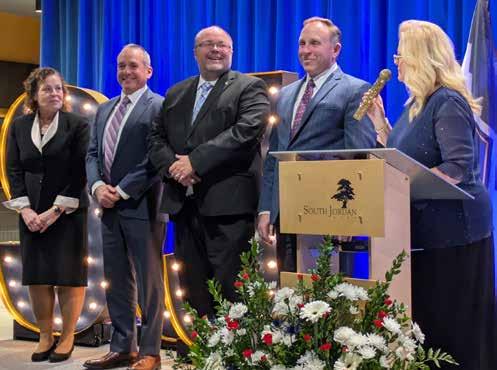
“We have so many exciting things happening in this city, and we couldn’t do it without the help and support of our partners like the Larry H. Miller Company, the Ivory Innovations Team, Okland Construction and the Boyer Company,” the mayor said. “Public private partnerships are so important and meaningful, and we’re so grateful for them.”
The evening also included comments from Porter Openshaw with Ivory Innovations, who are finalizing plans for the senior center complex to be built in The District; Utah Rep. Tracy Miller whose district in-
cludes portions of South Jordan; Williams from the Utah Black Diamonds and Jennie Taylor of the Major Brent Taylor Foundation who will bring a 9/11 exhibit to the Salt Lake Valley for the first time in memory of the 25th anniversary of the terrorist attacks. Much more info to come on that project.
Prior to the start of Ramsey’s address, the National Anthem was performed by the Herriman High School Madrigals, the Pledge of Allegiance was led by veteran Kenneth Brown and an invocation was given by Chris and Hannah Bechtel of the Sego Church. l



When we talk about heart disease, the usual suspects often come to mind: crushing chest pain, shortness of breath, radiating arm discomfort. While these classic symptoms demand immediate attention, your heart often speaks in a more subtle language, a series of whispers and quiet shouts that can easily be dismissed or attributed to other, less serious issues. During Heart Month this February, we want to empower you to become a skilled interpreter of your body’s unique signals, recognizing that early detection can be profoundly life-saving.
Many people are unaware that heart problems don’t always announce themselves with dramatic flair. “We frequently see patients who’ve ignored subtle signs for weeks or even months, often rationalizing them away,” explains Dr. Richard Gelb, a cardiologist at Holy Cross Hospital –Mountain Point. “Especially for women, symptoms can be incredibly nuanced and different from the textbook descriptions often associated with men.”
So, what are these often-overlooked indicators that your heart might be sending out an SOS?
Persistent, Unexplained Fatigue: This isn’t just being tired after a long day. If you
find yourself unusually exhausted after normal activities, or if a simple walk leaves you winded in a way it never did before, your heart might be working harder than it should to pump blood.
This can be a sign of various heart conditions, including heart failure or even blockages.
Discomfort Beyond the Chest: While chest pain is classic, heart-related discomfort can manifest in surprising places. This includes pain, pressure, or aching in your jaw, neck, back, or even your stomach.
“We’ve had cases where patients initially thought they had a bad toothache or indigestion, only to find it was their heart,” says Dr. Bruce Kenwood, a cardiologist at Holy Cross Hospital – Jordan Valley. “Pay particular attention if this discomfort appears during exertion and subsides with rest.

Swelling in Unusual Areas: Swollen feet, ankles, legs, or even your abdomen could be a sign of fluid retention, a common symptom of heart failure. If your heart isn’t pumping effectively, blood can back up in the veins, leading to fluid accumulation. Don’t dismiss persistent swelling, especially if it’s accompanied by weight gain.
Chronic Indigestion or Nausea: While often benign, persistent indigestion, heartburn, or nausea, particularly when coupled with exertion, can sometimes be a


heart attack symptom, especially in women. If antacids aren’t helping and the discomfort seems linked to physical activity, it’s worth investigating further.
Lightheadedness or Dizziness: Occasional lightheadedness can happen for many reasons, but if you frequently feel faint, dizzy, or lightheaded, it could indicate an arrhythmia (irregular heartbeat) or a problem with blood flow to your brain due to a compromised heart.
“By familiarizing yourself with these less obvious signs, you’re taking a proactive step in safeguarding your cardiovascular health. Your body is constantly communicating; the key is to learn its second language,” said Dr. Roja Mulamalla, a cardiologist at Holy Cross Hospital – Davis.
Call to Action: If any of these subtle symptoms resonate with you, or if you’re experiencing anything that just “doesn’t feel right” in your body, please don’t wait. Listen to your heart’s whispers. Schedule an appointment with your primary care physician to discuss your concerns, or if symptoms are sudden and severe, seek emergency medical care immediately. Early detection and intervention are crucial for positive heart health outcomes. Your heart speaks – are you listening?
For more information or to find a provider visit mountain.commonspirit.org


Learn more about the services, care providers and missiondriven work of the Holy Cross hospitals and CommonSpirit Health at www.holycrossutah.org.

At CommonSpirit Health, we make the healing presence of God known in our world by improving the health of the people we serve, especially those who are vulnerable, while we advance social justice for all.
to know us before you need us.
When you need emergency care fast, the closest emergency room is a smart thing to know. You never know the level of care you’ll need when an emergency happens and choosing the right ER can make all the difference. And a hospital ER comes with the confidence of additional services right on-site.
Congratulations to CommonSpirit Holy Cross Hospital – Jordan Valley for receiving the Leapfrog Hospital Safety Grade-A Accreditation for the fourth consecutive time. Leapfrog Hospital Safety Grades are determined based on a rigorous assessment of various safety measures.
Find emergency care close to you at mountain.commonspirit.org
i số 1-303-643-1000 (TTY: 711).
From parks to free libraries, small works of art are appearing around the community, each one carrying a message created by American Academy of Innovation students.
By Julie Slama j.slama@mycityjournals.com
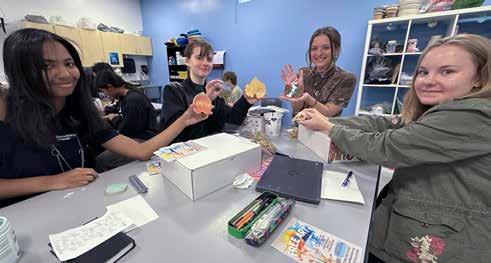
Afewworks of art have turned up in unexpected places around the community – tucked on a UTA TRAX train seat, resting near a park bridge, nestled by books in a free library and even in a dentist’s office waiting room. Each piece is carefully placed inside a gift bag with a note explaining the art is free and meant to be found and treasured.
Those discoveries are part of a project created by American Academy of Innovation

Art Foundations 1 class.
During November, students explored the theme “journey” by creating two pieces of art: one inspired by a real leaf and a second piece of their choosing. Once completed, the works were intentionally abandoned in public spaces for others to find.
Sophomore Eden Montgomery said the idea of journey shaped both her material and message.
“When I thought about the word journey, thrive came to mind so I wrote it on my leaf,” she said. “We all came up with different words and different ideas to relate to our own journeys.”
In clay, students pressed real leaves they and their teacher Camille Grimshaw brought in. Many chose glaze colors that matched the actual leaf. Grimshaw said students learned about working with art and creating texture. For some, it was their first experience with ceramics since the class is an introduction to art.
For many students, the meaningful part of the project was leaving their work abandoned.
“We’re leaving the art so someone who finds it will get a glimpse of our journey and be able to relate it to their own,” said sophomore Amy Flake, who put the word, “Why?” on her leaf. “I’m always questioning things and thought it was a good word to inspire others on their journeys.”
Junior Kat Cooper added: “And even inspire them on their own journey.”
A note inside the gift bag included Grimshaw’s email. The hope was the art finders would contact the teacher about their thoughts about the art project.
Sophomore Lina Lockridge said the project helps to build connections with people even though they may never meet.
“We’re sharing connections with people. Even though we may never know each other, we’re sharing our art which inspires the con-
versation of journey. It a nice connection,” she said.
Flake said it’s also an opportunity for them to share their talent.
“It’s cool because we may learn how they interpret our work when they send an email,” she said.
Students placed their art in everyday locations where someone might find it and be surprised.
Sophomore Owen Swensen picked his leaf because of the details in it. He hopes its finder will appreciate it.
“I hope when it’s in their house or wherever they put it, it will add some color or brightness to it and it will give them a little joy and happiness,” he said.
Freshman Kit Culbertson’s second piece was a small ceramic whale with the words, “Go Far.”
“I like whales,” Culbertson said. “It’s actually my second whale. The first one took me a day to sculpt it, but it broke. So, I re-
made it. I really like how realistic it looks.”
Eden created a star: “I think of our galaxy and it’s a journey itself.”
One student cut out the center of the leaf in a heart as the second shape and another student added a caterpillar to a leaf.
Grimshaw said the project grew out of her graduate studies as a desire to help students see art as part of the larger world.
“Classrooms are isolated, so students don’t realize there are connections,” she said. “I want them to connect art outside of school. It’s meaningful to other people. Art isn’t just something you do in high school and forget about it. We can make connections to other people through art.”
Junior Gage Tarin said the experience has changed how he feels about sharing his artwork.
“I used to be embarrassed about showing people my art,” he said. “Now I’m giving away my art so others can enjoy it and that’s cool.” l
The South Jordan Journal is a monthly publication distributed directly to residents via the USPS as well as locations throughout South Jordan.
For information about distribution please email hello@thecityjournals.com or call our offices. Rack locations are also available on our website. The views and opinions expressed in display advertisements do not necessarily reflect or represent the views and opinions held by Loyal Perch Media or the City Journals. This publication may not be reproduced in whole or in part without the express written consent of the owner. © 2019 Loyal Perch Media, Inc.
Bryan Scott | bryan.s@thecityjournals.com EDITOR
Travis Barton | travis.b@thecityjournals.com
ADVERTISING EXECUTIVES
Mieka Sawatzki | mieka.s@thecityjournals.com
Lindsay Andreasen | lindsay.a@thecityjournals.com
Ryan Casper | ryan.c@thecityjournals.com
Marc Davis | marc.d@thecityjournals.com CIRCULATION
Lydia Rice | lydia.r@thecityjournals.com 385-557-1022
Rack
Stacey LaMont Ty Gorton SOUTH
9500 South 500 West, Suite 205 Sandy, UT 84070
PHONE: 801-254-5974
community while promoting a strong local economy via relevant content presented across a synergetic network of print and digital media.
& Distributed by






For three miles of the hike all was well, until Adrian Ramirez collapsed.
By Laura S. Crapo l.crapo@mycityjournals.com
ThisNew Year is sweeter than ever because
Adrian Ramirez of South Jordan is with his family to enjoy it. This past Veterans Day, Nov. 11, 2025, he and some family and friends got together for a fun, challenging day outside. They drove to Saratoga Springs for this activity specifically meant to honor those who have served in the armed forces. A Ruck Muck is a tough walk or hike with weighted back packs (the Ruck) known for its supportive and encouraging atmosphere. For three miles all was well until Ramirez collapsed.
“I know CPR and was able to revive my dad. I have had previous rescue experiences with the military overseas,” adopted son Francisco Vazquez said, who is a U.S. Marine veteran. “All of the guys in our group are military. I do a few rucks every year and this was the first time my dad was able to come with me.”
They knew exactly what to do and jumped into action. They called 911, elevated Ramirez’s feet to calm his blood pressure and provided shade for his comfort. The police came in five minutes and in about 10 more minutes the ambulance came. Vazquez helped
the EMT move his dad to the gurney and rode in the ambulance with him to the hospital.
“We hadn’t known he had that blockage until this happened, so it was lucky,” Vazquez saide. “He was actually out of the hospital the next day. It’s important to be in the right place with the right people who know how to do things the right way.”
The Unified Fire and Lehi Fire departments responded to the scene where they began treatment. They contacted Holy Cross Hospital – Mountain Point when the EKG revealed that Ramirez was in cardiac arrest. Shortly after arriving at the Emergency Department, they found his left anterior descending artery was 95% blocked. He was then rushed into another room to have a stent placed in his heart. This was done quickly because medical professionals have nicknamed that artery “the Widowmaker” because very few with that artery blocked survive. The heart catheterization went well and Ramirez responded well to the procedure. After only one day’s recovery, he was able to go home.
An emotional Ramirez returned to Holy Cross Hospital – Mountain Point, where he was able to express his thanks to the EMS crew, the hospital team and his son, who all contributed to saving his life. They gathered in a room with 40 people who had come to celebrate his amazingly quick recovery.
“If it wasn’t for people like you, I
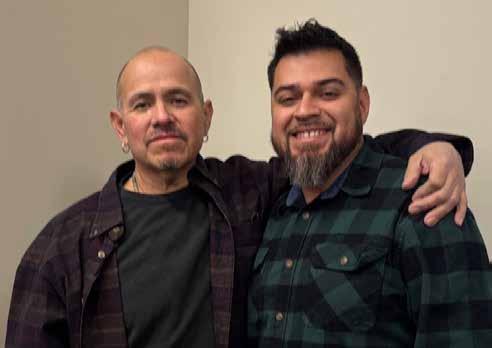
wouldn’t have had a shot. You guys are heroes, man. I literally owe you my life. Thank you. Bless you all,” he said.
The hospital’s EMS liaison, Gavin Harris, presented Vazquez and the three EMS professionals who took part in saving
Ramirez’s life with the CommonSpirit Health
“Great Save” award. CommonSpirit Health is one of the nation’s largest nonprofit Catholic healthcare organizations. Their motto is: Inspired by faith; Driven by innovation; Powered by human kindness.l

February is a season centered around love, and it’s also a great time to focus on the relationship we share with our dogs. Our pups are part of our families and daily routines, and loving them well goes beyond affection. It’s about consistency, care, and creating a life where they can truly thrive.
Here are some simple ways to show your pup love every day:
CREATE ROUTINE AND STRUCTURE
Dogs feel safest when they know what to expect. Regular feeding times, walks, play, and rest help build confidence and reduce anxiety.
PRIORITIZE MOVEMENT AND ENRICHMENT
Purposeful play, exercise, and mental stimulation support both physical health and emotional well-being. Even small additions—like an extra walk or a new puzzle toy—can make a big difference.
INVEST IN EARLY TRAINING AND SOCIALIZATION
Positive reinforcement training and safe social experiences help dogs build good habits and confidence that last a lifetime.
FOCUS ON PREVENTATIVE HEALTH
Dental care, nutrition, and wellness routines are often overlooked but are key to long-term health. Starting healthy habits early helps prevent bigger issues down the road.
TAKE CARE OF YOURSELF, TOO
Loving your dog also means giving yourself grace. A calm, supported pet parent is better equipped to care for their pup. Community resources and trusted professionals can make all the difference.
If you need support with socialization, structure, and creating a routine your dog can thrive in, now is a great time to get started. Sign your pup up for a Meet & Greet today at Dogtopia to learn how daycare, enrichment, and structured play can support a happy, healthy life together.

Utah’s governor joins civic leaders at ceremonies for South Jordan elected officials.
By Tom Haraldsen t.haraldsen@mycityjournals.com
During a very busy first week of January in cities along the Wasatch Front, South Jordan held its Oath of Office Ceremony on Jan. 6. Mayor Dawn Ramsey and city council members Don Shelton and Jason McGuire, all of whom were reelected in November, took their oaths before a standing room only crowd of family and residents in council chambers.
Several other cities held similar ceremonies the week of Jan. 5.
In South Jordan, Gov. Spencer Cox administered the Oath of Office to Ramsey, who is beginning her third term at the city’s helm. In his opening comments, Utah’s governor said the nation’s Founding Fathers “knew that if this system of self-government was going to work, they needed a citizenry that was educated, first of all, and that was moral. As I look out here tonight, I see a citizenry that is educated—that is here to learn and to contribute to those who have voted and those who’ve received the votes of the people and are going to be sworn in tonight. I see a moral people who care deeply about who we are as a nation and a state, and who are willing to sacrifice their time to come to a public meeting. I’m glad it’s standing room only this evening.”
Cox said he has felt a strong personal connection with Ramsey, pointing out that before he served as a governor or lieutenant governor, “I was mayor of a small town. I understand a little bit what it means to be a mayor. I am asked all the time if it’s hard to be a governor, and at times it is. But I always say it’s much harder to be a mayor or to serve on a city council. The reason it’s harder is because you are where it all comes together. Local government is the most important kind of government because it is closer to the people. Thomas Jefferson said the government that is closest to the people is the most responsive.”
He also drew a laugh when he said that community elections are non-partisan for a reason—because potholes aren’t partisan.
“We have to get stuff done,” he said, “and that’s what mayors and city councils do.” He listed just a few of the organizations that Ramsey is involved with in leadership and as a member, including the Utah League of Cities and Towns, the Jordan Education Association, the Wasatch Front Regional Council, the Economic Development Corporation of Utah, Point of the Mountain state land authority, Jordan Valley Water Conser-
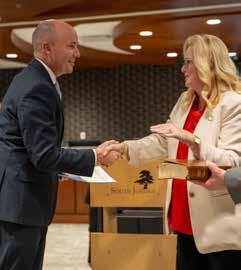
Mayor Dawn Ramsey is congratulated by Utah Gov. Spencer Cox after she is sworn in to office during ceremonies on Jan. 6. She joined returning council members Don Shelton and Jason McGuire taking oaths of office for new four-year terms. (Photo courtesy South Jordan City)
vancy District and South Valley Sewer.
“And I haven’t even got through half of them,” he said. “Now that takes a very talented person, but it also takes a very dedicated person…and a person with an incredible family around them.”
“We’re so blessed to live here, to have what we have and to be surrounded by this incredible community,” Ramsey said in her remarks. “We need to remember as we’re making plans now about the future of our children and grandchildren, and the quality of life for those who will outlive us. Strong schools where kids are safe and become educated. It is the honor of a lifetime to serve as mayor of South Jordan.”
She praised the city council, “hard working civic servants. They’re not drama, they’re not ego, they’re here to serve, which is why we’re getting so much done. Thank you to our staff. It is one of the greatest blessings of my life to be surrounded by such good, smart, hardworking people. Thank you for helping create a place where people want to live.”
Shelton and McGuire made similar comments, thanking their families for support as they serve on the council, which involves a lot of time away from home at meetings or other public events. They received their Oaths of Office from city recorder Anna Crookston.
The evening began with a color guard with bagpipes from the South Jordan Fire Department, the National Anthem performed by the Bingham High Madrigals and the Pledge of Allegiance from students at Aspen Elementary. A patriotic song was also performed by fifth grade students at South Jordan Elementary. l
Celebrating Heart Month
Heart care is more than numbers on a screen.
At Intermountain Health, heart care starts with getting to know what’s important to you and building a care plan together. From preventive screenings and lifestyle recommendations, to treating the most complex conditions with advanced technologies, our experts are with you through all of it. In other words, we’ve got your back — and your heart.

Learn more or schedule with a primary care provider





Inclusion takes center stage at inaugural state unified dance competition
Local high school dancers made history earning top medals while promoting inclusion and showcasing talent.
By Julie Slama j.slama@mycityjournals.com
In the first state high school unified dance competition, three area schools swept the event.
Copper Hills High School won the unified dance team competition, with Highland High and Murray High in second and third places, respectively. Several students from each of the schools placed in solo and duet categories.
Unified dance is a program that brings together students of all abilities together to promote inclusion, friendship and teamwork with an emphasis on movement and joy. The Special Olympics Utah competition was held in December at Highland High and featured a variety of dance styles and creative interpretations.

Students performed their routines on stage before receiving feedback from a panel of judges, including three who recently competed and won gold medals at the Special Olympics World Games. Much of the feedback was positive and encouraging with comments such as “keep smiling and showing you’re having fun,” “you owned that stage,” “great techniques” and “good energy and choreography.”
Many of the performances included costumes and props. Murray High dancers wore bright colors while Copper Hills performers sported matching shirts that said, “Inclusion is Cool.” Props included everything from watering cans to leis, adding creativity and personality to the routines.
Some students choreographed and practiced dances independently or together as an afterschool club. At Copper Hills, teacher Anna Bay has instructed adaptive dance for three years.
“We have so many good kids who love to dance, so we wanted to give them more of a dance experience than what they could get in our mainstream classes,” she said. “With so many interested, we were able to open up a class just for the special ed kids. We have 20 special ed students in the class, plus 20 peer tutors. Then, we have aides who help.”
Bay said the benefits of unified dance go beyond learning choreography and dance technique.
“They’re learning social skills, how to be part of a team and about friendship. They’re listening and following directions, but we do it in a dance way, so it’s all by having fun. I teach them a lot of the same things I do in my ballroom classes from stretching to line dances. We’ve been working on learning choreography, which we were able to perform today,” she said. “They have so much fun and I love their genuine smiles.” l

With more than 30 years of educational experience, Shawn McLeod has stepped in as school principal when former principal Rodney Shaw retired.
By Julie Slama j.slama@mycityjournals.com
In January, Bingham High welcomed a familiar face back to its halls.
Shawn McLeod was named Bingham’s new principal, replacing Rodney Shaw, who retired in December after serving 6 1/2 years as principal.
McLeod, who recently served for more than five years as principal at Hidden Valley Middle in Bluffdale, marks a return to the high school level.
He began his career as a math teacher and coach at Hillcrest High in Midvale before moving into administration. He later served as an assistant principal at Copper Hills in West Jordan and three years at Bingham earlier in his administrative career.
After those early years, McLeod transitioned to middle school administration to better balance work and family life. He spent 16 years – seven as an assistant principal and nine as principal – at South Jordan Middle before being asked to open Hidden Valley Middle.
“It’s very unique to stay at a school for so long; I love the community here in South Jordan,” McLeod said.
As his children grew older, McLeod began considering a return to high school administration. When Shaw announced his retirement, the opportunity aligned with that goal.
“I got the call asking if I would accept coming to Bing-
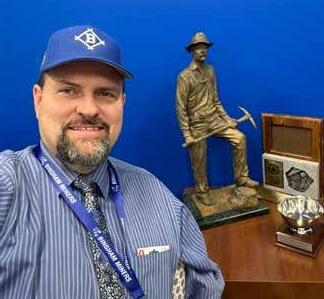
ham High,” McLeod said. “It’s kind of fun since Rodney Shaw originally was assigned to be Hidden Valley principal and it was still two years out. They hadn’t even started breaking ground yet to build the building when Bingham’s principal position opened, so he came here. So, I went to Hidden Valley and now, I’m following him here. I’m excited about ending my career back at the high school where I began my career.”
McLeod and Shaw worked closely to ensure a smooth transition leading up to 2026.
Looking ahead, McLeod is eager to reconnect with Bingham’s traditions and its 118-year history.
“I love Bingham’s traditions, its rich history of academics, activities, the history coming from Bingham Canyon; I’m looking forward to getting back to those things here,” he said. “I remember pinning students; homecoming time; the whitewashing of the ‘B’ in Copperton, where the old Bingham High used to be; the music tours; all the sporting events; the stomps; graduation and all of those extracurricular activities which always are fun. I love seeing the students having a great time together and supporting each other.”
McLeod also wants to focus on strong academic opportunities.
“My goal is to continue to support student learning and continue to provide opportunities for kids to excel and progress in all areas of their educational experiences,” he said. “When it comes to AP participation, and all of those different tech classes, I want to keep those opportunities available so we can connect to all students and then be able to recognize them.”
McLeod grew up in Montana and followed his father’s steps in a career in education. McLeod moved to Utah to earn his undergraduate degree in math at Brigham Young University and then he earned his master’s degree in educational leadership at the University of Utah.
“This is my 31st year in education and I love my career as an educator,” McLeod said. “After six years of teaching, I was ready to jump into administration, working with all the kids in the school, not just the 150 to 200 students I saw every day. I was interested in working with all the programs in the school and helping students navigate those, finding their successes – and I still love what I do.”l


















Thinking about launching a business? Two local businesswomen discuss getting off on the right foot and avoiding common mistakes.
By Elisa Eames e.eames@mycityjournals.com
In2010, Barack Obama said, “Small businesses are the backbone of our economy and the cornerstones of our communities.” Around 70% of U.S. jobs are provided by small businesses, yet the Bureau of Labor Statistics reports that between 20% and 24% of new businesses fail within their first year. After five years, about half have closed, and after 10, nearly two-thirds are history.
However, the independence, personal fulfillment, flexibility, community impact and potential financial rewards of owning a business still persuade over 5 million U.S. entrepreneurs to take the plunge each year.
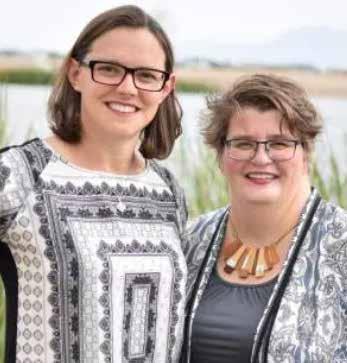
Though starting and running a company can be daunting, applying a few relatively simple fundamentals can help set you up for success. Founders and owners of Salt Lake-based Backyard Bookkeeper, Backyard Payroll and SPC Strategies, locals Julie DeLong and Alex Mic-Podar tackle tough questions affecting entrepreneurs today.
Specializing in bookkeeping system customization and clean up, DeLong has written several articles for Forbes Magazine and Intuit and was an adjunct bookkeeping professor for the University of Utah.
Mic-Podar has started a total of seven businesses and provides business coaching, executive coaching and consulting services. She is a board member with multiple nonprofits and was a 2023 recipient of the Utah 40 Over 40 award, which recognizes women over the age of 40 for professional success and business contributions.
This is the first in a four-part article series about how to start and grow your own business.
Q: What is the most important thing to know for current and prospective business owners? What are the first steps?
Mic-Podar: Number one: start by creating a limited liability company. If someone sues you, they can come for all your assets. But with an LLC, they can only take what the LLC has, not your personal belongings. So protect yourself from the beginning.
But don’t let the legal hoops get in the way of starting. It doesn’t have to be complicated. People think it takes a lot of money to start a business. It doesn’t.
If you aren’t sure of your business name, just register an LLC named after yourself or something else familiar—you can add business names later as doing business as, which will function as legal aliases for your existing entity.
DeLong: There’s research available, but sometimes it’s just hearsay. Talk to people around you. I will periodically hear about industries where service providers are a hot commodity. For example, I learned a few years ago that airplane mechanics are apparently hard to come by. There aren’t enough of them.
Ask yourself what would make things easier for people. Who is it hard to get an appointment with? What problem can I solve? Or what problem needs solving, even if it’s not you that solves it? Maybe you put some people together who know how to do what you want.
partnership, and you need more complex bookkeeping. It needs to have its own tax return, whereas a single-member LLC is just a Schedule C on your personal return. Very easy.
If you need a partnership, even if it’s with a spouse, have a lawyer draw up a partnership agreement. You can try to do it yourself, but it’s bound to create problems.
Number two: we’re bookkeepers, so we’re going to tell you to track your expenses from the very beginning. Whether you use a spreadsheet or something like QuickBooks doesn’t really matter starting out, but when you start making over $1,000 a month, seriously consider moving to adequate software.
Number three: think about the future of your finances. Educate yourself about why numbers matter. Numbers tell a story. This is the pitfall of any business within five years: when they start making money, they start spending more, but they’re not thinking about how much money they really have in the bank account.
Number four: this is the most important point—just start!
Q: What are some tips for creating a unique business idea that meets a market need?
DeLong: It has to be something you know enough about to be competent. It sits at the intersection of market need, interest and ability. It needs to be something you’re interested in and that you are physically capable of doing.
If you’re missing one of those ingredients, you’re doomed to fail because you’re either working in an arena where you don’t have enough experience, you aren’t personally invested or you’re providing a service nobody wants.
Know what you’re interested in, what you think you could be good at, and then start looking for areas in the marketplace where there might be a demand for it.
Mic-Podar: A simple way to describe it is just to look around you at the world and ask yourself, “What’s missing?” Look for opportunities where the right business idea could come and make something more efficient or fill a need that no one has filled yet.
Q: How do you determine if there’s a demand for something?
Mic-Podar: Think about what is missing and be the solution. If, for example, you think your mechanic is lacking and you know you can do better, identify how you can do better. What is the mechanic truly missing to be better? By identifying missing elements, you discover businesses you could start. Maybe you don’t even start a mechanic business. Maybe you start a consulting business that focuses on mechanics.
Q: What are some strategies for recognizing my skills and interests?
DeLong: I once took an office management position and it included some accounting. I learned on the job and discovered I really liked it. One of the most important skills you can cultivate is the ability to learn, and if you’re constantly learning and constantly looking for things to learn, then you’ll eventually find something you really like.
There’s not necessarily going to be one answer. There will ultimately be multiple things you could do that would be worthwhile and could be profitable. You could end up doing multiple things like Alex.
Q: What are some guidelines for choosing a business name?
DeLong: You want something memorable, unique, catchy and that nobody else has used.
Mic-Podar: If you want to be found on Google, it’s important that your name has to do with your URL and that your name includes something about what you do. This is a keyword and helps with search engine optimization. If you are a consulting business, make sure your name has something to do with consulting. Or if you’re an e-commerce business, your name should say something about your product.
Q: Why should I choose an LLC? What about other business entities?
DeLong: A lot of people will set up partnerships, especially husband and wife partnerships. But any structure other than a single-member LLC will require its own separate tax return that is due a month earlier than your regular tax return on March 15, not April 15. The very simplest, cheapest, and easiest choice you can make is an LLC with one owner. Even if you add a spouse to that LLC, it’s a
I know two friends who owned their business 50/50. They created a contract, signed it, and everything. But there were big omissions and inevitably, disagreements. So in the end, even though it was a great idea and a great product, the business self-destructed, and they were left with nothing.
Corporations come with special rules, extra paperwork, extra returns and extra tax forms. So if you want anything that’s more complex, consult a certified public accountant beforehand.
It doesn’t matter how great the business idea is or how thorough you think you’ve been with your own contract. You don’t know what you don’t know.
Q: How do I officially register my business with the government? How do I get an EIN from the IRS?
DeLong: You create your business entity at the state level. You can create an LLC online. It’s really easy in Utah and is less than $100. Go to corporations.utah.gov. The annual renewal is around $20. This creates a separate legal entity under the state of Utah, so it won’t be you earning the money—it will be the business.
If you have a physical location, you also need a business license. And, of course, depending on the industry, there may or may not be industry licenses you have to obtain.
An employer identification number is simply a tax ID number that identifies your business as a separate taxable entity to the IRS. All of the business’s revenue will be associated with the EIN. You can also set up the EIN online on the IRS website. It is free and easy to do.
Mic-Podar: But if you have the means, consult with a lawyer to make sure you are doing it correctly. There are many law offices that offer this service.
Q: Should I open a physical store location or stay online?
DeLong: It depends on the kind of business. Do you need a place that receives people in person? If so, you need a storefront or home office. Again, if you have a physical storefront or if customers come to your home, you need a business license. Always check with local authorities.
Even if you need a storefront, you don’t have to sign a five-year commercial lease. Especially if you’re brand new, avoid commercial leases because they lock you in. Unless you file bankruptcy, a lot of times you have to pay the entire value of all five years of monthly pay-
ments, even if you go under and aren’t using the space anymore.
Don’t make that kind of financial commitment unless you really have to or you are very sure you have the income to support it.
A lot of places do month-to-month leases. There are co-working spaces. Or find someone who does have a commercial lease and see if they’ve got an empty office. Get creative.
Plenty of businesses don’t require a storefront, and there are a lot of creative solutions out there. If you’re in the e-commerce business, for example, some people can do fulfillment for you. You don’t have to rent your own warehouse and do your own packaging.
If you’re working from home for an online business, you do not need a city license.
Q: How do I create a marketing plan and develop my brand?
Mic-Podar: A brand comes with time and will evolve, so don’t focus too much on that yet. Also, don’t focus too much on marketing because it includes so many aspects: branding, colors, your website, employee uniforms etc. These days, you can go to ChatGPT and say, ‘this is what I’m selling. Create me a logo.’ You don’t need lots of software.
When you start, focus on your product or service and who your buyer is. Make a plan around your buyers. Sometimes people feel like they need large budgets for marketing, but you don’t. In today’s world, you have social media. You can create content and showcase it
easily. There is so much free marketing.
When we started our business, we had no money for marketing, so I focused on free resources. Instead of buying ad space on a platform, I focused on who my clients were and how I could reach them. I looked for ads seeking bookkeepers and W2 employees and called them. That was my marketing strategy. I coldcalled and asked if they’d consider outsourcing. One out of 10 said they’d be interested.
You can sign up on Wix to create a website. They’ll give you a URL, and AI will create it for you. ChatGPT will write the code, and you just copy and paste it. Or you can sign up for Google Sites if you don’t know how to make a website. It’s free.
DeLong: Plenty of businesses don’t even bother with a website. They just have a Facebook page.
Mic-Podar: The main point is don’t quit your full-time job tomorrow; start a business on the side, regardless if that is e-commerce or business to business. See where it takes you.
Then when you see the potential and you have cash flow, slowly step away from your full-time job and spend more time on your business. This is very important—spend time growing your business. Invest your time in it. Your time will be the most valuable asset your business has.
I know plenty of millionaires who have a full-time job and have hundreds of businesses on the side. There is no wrong way of doing things. Just get it going.l








Longtime educator and Olympic choreographer Paul Winkelman, now living with ALS, is finding new ways to inspire students and hoping to return to the Olympic spotlight.
By Julie Slama j.slama@mycityjournals.com
Ineight years, Salt Lake will once again welcome the world as host of the XXVII Winter Olympic Games in 2034. For South Jordan resident Paul Winkelman, a longtime educator and counselor in Canyons School District, he hopes it will give him a repeat performance as the opening and closing ceremonies choreographer, a role he cherished during the 2002 Games.
“I’d love to do that,” Winkelman said simply, reflecting on one of his greatest experiences of his life.
In 2002, Winkelman was teaching at Alta High and coaching its nationally acclaimed ballroom dance team when dozens of people walked into the school commons after school, cameras rolling. Among them was a producer for the Salt Lake Organizing Committee.
After watching the boys’ portion of the rehearsal, Winkelman recalled being asked
who he was and what group was practicing.
“I explained we were the Alta High School ballroom dance team,” Winkelman said. “He said, ‘I’ve never seen guys dance like this.’”
That chance encounter ultimately led to Winkelman being hired as the full-time choreographer of the Olympic opening and closing ceremonies. His students became the backbone of the Western Frontiers section, the largest segment of the ceremonies, first learning the choreography, then helping teach it to hundreds of performers who filled Rice-Eccles Stadium.
“I said many times, the Salt Lake Olympics was heaven. It was unbelievable,” he said.
Eight years from now, however, if Winkelman returns to the Olympic stage, his approach will look different. In 2022, he was diagnosed with ALS, commonly known as Lou Gehrig’s disease, a progressive neurological disorder that attacks motor neurons in the brain and spinal cord, gradually robbing the body of voluntary muscle movement while leaving the mind intact.
“I teach a totally different way. It’s verbal. I’ll explain to my top couple what I want and they become my legs,” he said.
Even with the diagnosis, Winkelman hasn’t stepped away from his career, working with students.






“In 2022, I was diagnosed with ALS, but I knew there’s no way I’m quitting work because I love working with kids, and I wouldn’t know what to do with myself,” he said.
A life shaped by students and the arts Helping students has been Winkelman’s lifelong passion. He began his career at East
Midvale Elementary, where he spent seven years teaching third and fourth grade while building a drama program that quickly grew beyond expectations.
“I loved East Midvale,” he said. “We produced all-school productions where everyone from kindergarten through sixth grade could be involved. It was an

after-school activity many students wanted to be a part of.”
Winkelman’s reputation led then Jordan School District to move him to an opening at Alta just one week before school started in 1992. There, he continued the school’s strong theater tradition and launched what would become one of the most successful ballroom programs in the country.
“We became national champions,” he said. “Of the 10 years I was there, eight times we were the national champions. Those kids worked so hard.”
Winkelman lived and breathed work.
“There were times I never went home. I slept on the floor of the auditorium when I was tired, but I loved what I was doing and the productions we did there were absolutely amazing. The students and the quality of their work was stunning,” he said.
After adding his master’s degree in psychology to his undergraduate education degree and master’s in theater, Winkelman pursued the counseling field, leaving Alta in 2003. He worked at Brighton High, Hillcrest High and Utah Valley University before returning to Brighton.
At Hillcrest, Winkelman helped sustain and elevate the school’s well-known musical theater tradition for a decade, collaborating with choir director RaNae Dalgleish.
“Working with Paul at Hillcrest — I’ve never met a man with more passion and energy and talent,” she said. “He was demanding, but
he also made it fun. Our musicals were phenomenal because they had the Paul touch.”
A moment that redefined his world
Winkelman’s ALS diagnosis came after months of uncertainty, injuries and worsening weakness.
“When the fourth doctor told me, ‘You have ALS,’ I just sat there. I vividly remember I went right out of body like I was watching myself,” he said.
The disease takes a physical toll on Winkelman daily. He experiences tremors and painful muscle spasms, which he describes as “painful Charley horses in your whole body” and frequent falls.
“When I fall, my body freezes, and I’m like a piece of glass hitting the floor. My head has been cut open; I’ve had to have shoulder surgery because I ripped the rotator. It scares me to fall, because I know there’s no way to stop and, on my way, down, I wonder, how bad is this one going to be? It’s taught me the more invincible you think you are, the less you are. Life can be very fragile,” he said.
Even so, Winkelman’s outlook remains clear.
“My attitude from day one has been positive,” he said. “You can stay positive and contribute, or you can turn this into a negative and give up.”
Today, Winkelman is a part-time counselor at Entrada Adult High school, where

the flexibility allows him to continue supporting students.
“I’m still working with them on careers and on getting them graduated,” he said. “If I get up one day and my body just says no, I can work with my disability much more easily.”
Winkelman continues to choreograph, judge competitions and mentor performers, recently coaching a group to the world championships. He also has produced Broadway stars, including Derek Hough of “Dancing with the Stars” and Ashley Bryant in “The Play That Goes Wrong,” and worked on the choreography for the movie, “High School Musical.”
“My mind can still see what the choreography needs to be,” he said.
— music, meaning and community
His choreography was on full display recently at Hillcrest High during a BeatALS benefit concert honoring Winkelman. Supported by Dalgleish, he met Bingham High theater director David Martin and worked with Sean’s Garage, a Beatles tribute band, to raise funds for ALS research and awareness.
“We had a night of wonderful music and celebration,” Dalgleish said. “We ended up earning about $5,700 for the ALS Foundation.”
Not only did Winkelman choreograph numbers for the program, he spent time talking with 50 students about music, dance and life. He also shared his journey with the
audience during a pause in the concert.
“It was so much fun and the kids were awesome,” Winkelman said. “I heard some songs I didn’t know. I’m quickly becoming a Beatles fan.”
Dalgleish said the experience also impacted the students.
“The kids learned the songs, the history of the time and we had Beatles trivia every day and they learned to be thankful for every day,” she said. “The concert was beautiful. They danced, the orchestra played, the band played, the choir sang. It was stunning. It brought me to tears.”
Winkelman credits his faith, family and friends for sustaining him.
“I’ve lived the life of at least five people,” he said. “I had many incredible opportunities in my life. I can’t be bitter. I just have to find a different way to do things.”
Brighton High recently honored Winkelman with a scholarship in his name for students pursuing ballroom dance at BYU, another reminder of the legacy he continues to build.
“I’m lucky and whether I get the opportunity to choreograph another Olympics or championship, I get up—even on rough days—and I find the positive light, hoping I can change somebody’s life,” he said. “That has been a beautiful blessing, and I’m thankful for every day.” l





Monte Vista Elementary is putting inclusion at the heart of its school culture, earning national recognition for a program that brings students of all abilities together.
By Julie Slama j.slama@mycityjournals.com
Music filled the multi-purpose room as Monte Vista Elementary students and teachers cheered and formed a tunnel for students with disabilities and their partners, who carried homemade Olympic torches, toward the stage. It wasn’t a competition, but a celebration of a school culture where everyone belongs.
At the recent school assembly, Monte Vista Elementary was recognized as a national Unified Champion school for creating an inclusive environment for students of all abilities. After showing a highlight video of their unified program, Special Olympics Utah’s Sophia Schmidt spoke about inclusion before the banner was revealed.
“Simply put,” school psychologist Lisa Stillman said, “I told them we got the banner because of how awesome we are at being good friends with everyone.”
Monte Vista’s Unified Champions Program, now in its second year, was devel-

oped for all students, including those in the school’s STAR (support) classes.
“We started the program to provide an opportunity for students in the support class to feel like they’re part of the Monte Vista community,” she said. “It’s been rewarding seeing kids naturally connect with each other. Personally, I have two kids on the spectrum and it was hard as a mom seeing
them coming home from elementary school not feeling connected, not having friends. I want to make sure every kid has a chance to belong.”
The program is led by Stillman, school counselor Melissa Guiterrez and wellness specialist Erin Nester. Last year, students met twice per month and participated in activities ranging from music to unified sports.
“At the beginning of the program last year, kids would come back and say, ‘I don’t know how to talk to them’ or ‘I don’t know how to play with them,’” Stillman said. “By the end of the year, it was, ‘He’s my best friend’ or they’d walk in ask, ‘Can today be buddy day?’”
Ambassadors are selected in part from teacher recommendations and include students who are naturally inclusive, those stepping outside their comfort zone and some who have differing abilities themselves.
“The beautiful thing about the program is when you see some of our ambassadors who themselves have a hard time socially are with someone who is excited to see them, and they become besties. It’s good for both kids,” she said.
Ambassadors learn skills, such as adaptive play, reading body language and knowing when to seek adult help.
“They learn social problem-solving,” Stillman said. “If their approach doesn’t work out the first time, they try to find another way.”
That’s what fifth-grader Lucy Sellers learned after becoming an ambassador.
“I’ve learned how to play with people who play differently from me,” she said.
Fifth-grader Harley Bushnell likes to play with toys with the buddies.
“I like to play with them and just getting to be with them makes me happy,” Harley said.
Spending time with his buddy is a favorite part of school for sixth-grader Andy Corea.
“I like doing music rotation with my buddy and I do LEGO with him. It’s fun being with him and playing ball together,” he said.
Sixth-grade ambassador Lorenzo Mayer Pepe said inclusion motivates him.
“I like making people feel like they want to be part of something; it’s what makes school a better place,” he said.
His classmate, Graham Howell, said the experience has been meaningful.
“Everyone needs a friend,” he said. “Making others feel good makes me feel good. When I come and see my buddy smile, it’s really cool.”
Sixth-grader Ande Stowe added: “Monte Vista has become a great school; we try to include everyone.”
The program is growing. Participation increased from about 60 students and ambassadors last year to 99 ambassadors this year, giving each student two buddies.
Plans include adding Junior Ambassadors for younger students and to create Playground Ambassadors to promote inclusion and conflict-resolution during recesses.
Stillman said the national recognition affirms their work, but it goes beyond the banner.
“We’re wanting to change the whole culture of the school,” she said. “It’s about connecting kids and giving them a chance to belong. Every kid has it in them to be kind, aware and inclusive, but now they’re learning how to take action. We welcome everyone and that’s what I love.” l

The Weber State commit joins Miner senior Moli Toia for top postseason honors.
By Brian Shaw b.shaw@mycityjournals.com
Denzel
Peoples spent most of his high school football career backing up Bingham legends.
In his first year at the school, Peoples played sparingly in seven games as a thirdstring defensive back and backed up Cameron Mamalis, who led that 10-3 Miner team in tackles.
In year three as a Bingham junior, the Weber State commit played more often—but was still learning the ropes from Charger Doty, who after his 6A First-Team All-State season moved on to Utah State University, where he helped lead the Aggies to a 6-7 record and Idaho Potato Bowl berth under firstyear head coach Bronco Mendenhall.
In year four, though, Peoples finally was given the keys to the proverbial Ferrari.
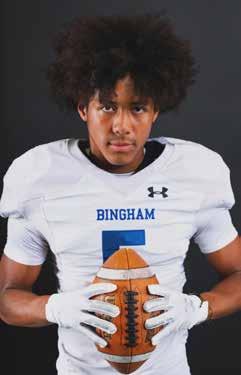
For his efforts in the one year that Peoples got to show his entire arsenal of abilities, the Bingham senior was named to the Deseret News All-State 6A First-Team for the first time in his high school football career.
It was also the first time Peoples has been named to any All-State team in high school football, which made his numbers ever more impressive.
The Bingham senior finished his final year with 41 tackles and two interceptions, including a highlight reel pick-and-return at one of the top teams in the country back in September against No. 10 Corona (California) Centennial, alma mater to one Jake Retzlaff, the BYU and Tulane quarterback who led two separate teams to major bowl and College Football Playoff games in consecutive years.
To play that type of game against a program the caliber of Centennial just proved what Bingham coaches thought all along— they knew what they had in Denzel Peoples, who also finished with a whopping 16 pass breakups as a senior. He’s currently playing on the Miners basketball team, where Peoples is averaging four points, two rebounds and two assists in his final year here.
The multi-sport athlete was not the only Miner to be named to the 6A First-Team; senior offensive tackle Moli Toia also received that honor.
Toia graded out an unconscionable 88% on his blocks, and had an unreal 88 pancakes on a Bingham team that finished with a 3-7 record, but was 3-3 in Region 2.
It was that mark in league play, coupled with a tough preseason schedule that included games against the No. 10 team in America, as well as Alta and Corner Canyon, that
earned Bingham a state playoff spot.
In addition to postseason honors for Peoples and Toia, Bingham senior linebacker Judd Bowen was named 6A Second-Team All-State. Bowen had 68 tackles, averaging about seven per game. The Bingham senior also had six quarterback hurries, one sack and a fumble recovery. Bowen also carries a 39-10 career record into his final season as a high school wrestler and is currently ranked No. 6 in Utah.
Others given honorable mention included senior offensive lineman and Utah State University commit Lucas Neidig and junior defensive end Monson Tukuafu.
All Deseret News All-State selections are voted on by their respective teams, initially. From a list of selected players, coaches are then asked to vote on the top players that are categorized by position group.l



65 years ago, Ruby Bridges taught a lesson –one that continues being learned today
Monte Vista students walked in honor of Ruby Bridges’ courage and to raise awareness about the impacts of racism and bullying.
By Julie Slama j.slama@mycityjournals.com
Sixty-five years ago, a 6-year-old walked to school.
It became national headlines and a fact many students learn about each year.
Ruby Bridges was the first African American student to attend an all-white public elementary school in New Orleans
on Nov. 14, 1960. She walked to school each day since she was denied a seat on the school bus because of the color of her skin. Now, many students not only learn about the impact she had on schools, but they take part in the Ruby Bridges Walk to School Day, a nationwide annual walk that honors her courage and resilience.
Monte Vista Elementary students joined in the Nov. 14 walk to raise awareness about the impacts of racism and bullying. To mark the occasion, school staff distributed purple flags, bags and silicone bracelets, and students were encouraged to wear purple, Bridges’ favorite color, to symbolize courage, resilience and unity.l




By Brian Shaw b.shaw@mycityjournals.com
When we last caught up with Bingham’s girls basketball team, they were riding a yellow bus to an eventual victory in Utah County.
Nothing has changed since.
Well, except for the area in which the Lady Miners are doing their most damage.
Aside from a bit of a letdown in Oregon at a holiday tournament and one loss in Region 2 play, the Lady Miners have gone rather unblemished, record-wise.
Bingham (10-3, 2-1 Region 2 at press time) is still making noise, whether that’s home or away.
Two days after an 18-point triumph at Provo Dec. 11, Bingham was at home against Skyridge in a non-region tilt.
Evy Roberts continued her hot hand, and the family legacy, by pouring in 20 points on six 3-point makes. The Bingham junior also added seven rebounds and six assists in the 64-47 win.
That hot hand would not continue, how-


ever, in the team’s holiday tournament opener in Salem, Oregon, as the Lady Miners fell to West Linn (Portland) by 16 points, 61-45. Junior Veanna Pau’u paced Bingham with 10, while sophomore Lanie Smith and junior

Brizzy Cottle each had eight.
It marked the first time that Bingham lost a game since Nov. 20, but the Lady Miners were onto something—even if it was a slow night for Roberts, who was held to 10 points in the loss.
In the next game in Oregon, the Lady Miners held on for a 39-36 victory over Beaverton, getting 10 and nine points, respectively, from Smith and Cottle.
Bingham then closed out the holiday tournament, and 2025, with a resounding 6046 win against West Albany, a game where Roberts again found her shooting stroke. The Bingham junior drilled four 3-pointers en route to a game-high 18, while Smith had eight, Cottle seven and junior Quinn Porter, six points each.
To finish the holiday tournament at 2-1 on the strength of two straight wins had to be somewhat satisfying for a Lady Miners team that had not lost since mid-November. And


yet the biggest tests of the season were still to follow for a Bingham team that advanced all the way to the semifinals at state in the last school year.
That’s where Region 2 play comes into view, the next step for this Lady Miners team.
Heading into 2026, Bingham is led by Roberts’ per-game average of 13 points. The junior is No. 1 in Utah Class 6A in 3-point makes, No. 8 in the state, and ranks in the top 500 nationally in that category.
Smith is the Lady Miners’ second-leading scorer, putting the ball in the basket at a rate of nine points per game. The sophomore point guard has big shoes to fill, having taken over for the recently graduated and record-setting phenom Addy Horsley, who now plays her basketball at Chandler-Gilbert Community College (Arizona).
Perhaps the most versatile player on Bingham’s roster, however, doesn’t lead the team in any major category.
Pau’u is the Lady Miners queen of efficiency, averaging eight points, six rebounds, one steal and one block—in just six minutes of action per game. The Cyprus High School transfer has certainly made a mark in her first season at BHS. The 6-foot-2-inch center is giving Bingham the kind of inside presence the team did not have last season.
That was important heading into a congested league slate beginning in early January—one that included newcomers such as a vastly improved Westlake and a Cedar Valley team that ruled the lower classifications. Bingham also no longer has rival Corner Canyon to worry about.
But, as coach Hector Marquez stressed to City Journals back in December, this is still a young team. With teams chock full of youth, it’s hard to tell whether or not they’ll fill the fountain and forget about the tasks at hand or recall how they fell to Copper Hills at the Huntsman Center in last year’s 6A state semifinals.
The hope is that in year two of Marquez’ rein, these Lady Miners will chip away at the doubters and get back that bad loss versus their Region 4 rivals. l



With a healthy Luke West and an emerging Parker Snedaker, Miners played nationally-ranked No. 16 Timpview and six other top squads in its first seven games.
By Brian Shaw b.shaw@mycityjournals.com
It is entirely possible that these Bingham boys have played the toughest preseason schedule in America.
With all apologies to that Miners football team coached by Eric Jones that played No. 1 Mater Dei of Los Angeles and the eventual Utah state champs Skyridge and runners-up Lone Peak within weeks of each other, there is an argument to be had that this Bingham boys basketball team just ran the gauntlet.
No other high school basketball team in Utah has played the current No. 16 team in all the land in Timpview to open the 2025-26 season—then played American Fork, Olympus—and then competed in a tournament against Rock Canyon of Colorado, followed by Lehi and Lone Peak.
That was just Bingham’s first six games. Oh, and then the Miners played Davis.
Grief
a path
And yet this Bingham team still came out of all those early season scraps with a 4-3 record.
With a healthy Luke West on the floor, some might say that was to be expected.
But, it really wasn’t. Not after the Miners limped out of the state tournament a lot earlier than most had anticipated, in the spring of 2025, months after they won the Vegas Tarkanian Classic title but lost their star player West for most of that season to injury.
Well, West is not only back—he’s got help. Parker Snedaker has emerged as the 1B to West’s 1A, another weapon with which the opposition must contend—or else.
It seems like Luke West has been at Bingham for more than four years, honestly. This writer—who is writing his final dispatch for this team—first watched the kid when he was a freshman, and was getting up extra shots in the old Pit, two hours before school started. West’s hunger and drive to be great hasn’t diminished one iota; the only thing that is different, perhaps, is that the Bingham senior has realized time is undefeated, and injury will lessen that impact if you let it.
West certainly hasn’t. Though the Miners currently sit at 8-7 overall—and split this year’s Tarkanian Classic defeating teams








from Texas and Florida before winning those first four games in Region 2 play also—West is back, averaging 23 points per game.
Snedaker isn’t far behind that production, either, scoring the basketball at 21 points per contest.
The eye-opener about this Miners team under longtime head coach Kyle Straatman, who has shouldered the unenviable task of replacing one of Bingham’s most successful coaches in the storied program’s history, is how they share the basketball.
Straatman not only achieved his 100th win at the school in early January in an impressive win at Copper Hills, he has a group
that not only can score the basketball—they can share it, too.
Nine guys average an assist or more per game, and no Miner is notching more than four.
That means the basketball rarely sticks— another reason that come state tournament time, these Miners could be hard to beat, and it’s entirely possible Straatman might finally win the one trophy that has eluded him: a state title.
This Miners squad may not have won the Tark Classic this year and may have had more trouble winning games than they’d hoped, but in many ways they’re miles ahead of the team that overachieved at the tournament they won a year ago and then underachieved at state.
This unselfishness, a trait that has won Bingham several state titles in years past and pushed guys like Yoeli Childs and Branden Carlson to unforeseen heights as college standouts and pros, is hard to replicate and even harder to quantify.
That said, you get the impression that the best is yet to come for this Bingham squad. For all 15 of them and this now-veteran coaching staff, the next two months will tell the whole story. l
Leaders gather to discuss the overregulation of their businesses during a forum sponsored by the Intermountain Business Alliance.
By Tom Haraldsen t.haraldsen@mycityjournals.com
Aside from the need for financial support and strength, there may be no larger challenge for businesses than government rules and regulations. That was the message shared by and with participants in the Utah Regulatory Reform Listen and Learn Forum held on Dec. 17 at the Salt Mine Productive Workspace in Sandy.
The forum was the third in a series of such meetings planned by the Intermountain Business Alliance, designed to bring Utah business leaders together to discuss real-world barriers and develop practical reforms to strengthen Utah’s economic competitiveness.
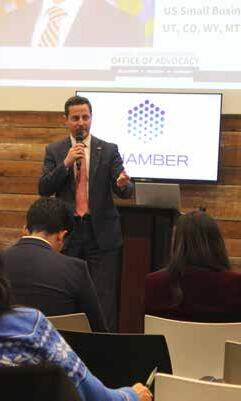
“The most terrifying words in the English language are ‘I’m from the government and I’m here to help you,’” said Trent Staggs, outgoing mayor of Riverton and now the U.S. Small Business Administration advocate for Region 8. “The cost of regulation in this country is staggering. The National As-
sociation of Manufacturing says it believes regulation alone is costing businesses $3 trillion a year. That’s almost 15% of our GNP.”
One example he pointed to is Form 941, the quarterly reports businesses are required to file with the IRS. Shifting that to an annual report, he said, could result in a $90 billion savings for businesses.
As mayor, and now in his role with the SBA, Staggs is advocating for less regulation and more common sense when it comes to the rules of the road in business. A strong advocate for President Trump, he praised Trump’s Executive Order 14192, which says that for any new regulation an agency wants to implement, it has to eliminate 10 others already on the books. He stated that another executive order from Trump charges all agency heads to look at current rules and identify those they feel might be unconstitutional.
“Just this summer, the National Small Business Association asked all businesses across the country what the most painful resource of regulations was, and they stated the federal government by far,” Staggs said. “Rules that come from these federal agencies are by people not elected to their offices. Congress to a large degree, I believe, has abdicated much of its responsibility by delegating the rulemaking authority to these unelected bureaucrats. The net result of this overregulation is it keeps you from making


profits and hiring people. Deregulation will help the economy.”
Speakers at breakout sessions during the forum covered a wide range of areas where regulations have large impacts. Those include agriculture and agri-business, construction and infrastructure, tourism and hospitality, manufacturing and mining, technology, banking and finance, and health care and insurance.
Corinna Harris, president of the Intermountain Business Alliance, said its goal is to “ensure businesses stay in business, by driving meaningful regulatory reform and removing barriers to growth at every level of government.”
“We are holding two more forums in the next week, on Jan. 9 in Eagle Mountain and on Jan. 12 in Nephi,” she said. “We’re also publishing a newsletter with comments and suggestions shared at these forums.”
She wants to see a united effort by local business owners and government leaders to make meaningful changes in regulatory practices.
Staggs told attendees the list of most wanted issues concerning business owners can be found on the SBA website at advocacy.sba.gov. Harris said more information about the alliance, or suggestions for changes, can be sent to her at charris@intermountainbusinessalliance.com. l
Dr. Hararah, a triple board-certified physician, completed his residency in Family Medicine at NYU Langone and a fellowship in Undersea and Hyperbaric Medicine/Wound Care at SUNY Upstate University Hospital. With additional training in Bariatric Medicine and certification from the American Board of Obesity Medicine, he brings expertise in primary care, dive medicine, bariatric medicine, and clinical hyperbarics.
A firm believer in the biopsychosocial approach, Dr. Hararah views patients as complex individuals whose lives and experiences shape their healthcare. Known for his compassionate care and dedication, he listens intently, prioritizes your well-being, and works to find the best diagnosis and treatment plan.
As the owner of Blackstone Medical, Dr. Hararah is committed to helping you achieve your best health.
• Annual preventative physical exams
• Cancer screening
• Sick visits
• Specialist referrals
• Medication refills
• Chronic disease management
• Chronic, non-healing wounds
• Acute, minor wounds
• Diabetic foot ulcers
• Venous ulcers
• Arterial ulcers
• Pressure injuries...and more!
“Dr. Hararah understands the daunting and sometimes demoralizing feelings health care sometimes causes, and wants patients to be truly seen and valued as human beings.”

The
By Brian Shaw b.shaw@mycityjournals.com
Whenthe Jordan School District announced back in the spring of 2025 that at the beginning of the 2025-26 school year it would be reassigning kids attending Bingham High School back to schools within those students’ natural boundaries, it signaled a sea change that would be felt in all departments at BHS—including athletics.
Never was that more apparent than when this past fall, the Bingham football team suffered lopsided losses against schools it has historically been dominant against. The Miners trudged to a 3-7 record, their worst mark in over a decade.
Bingham’s girls soccer team limped to a 6-14 mark, too. The girls volleyball team did well with the athletes they had, under a new head coach and Bingham alum. But, they weren’t the same Miner power, either, finishing with a 14-8 record and bowing out in the 6A state quarterfinals.
Such is life, one supposes, when what goes around eventually comes around. An open-enrollment policy allowed students to come from near and sometimes far to Bingham to participate in its unique school culture and welcoming atmosphere toward all—until the Jordan District slammed the door.
The loss of Bingham’s starting quarterback from last year’s team to the Jordan District’s new reallocation policy, and in his case to West Jordan High, was painful enough— but he was far from the only one that was moved. The same was true on several other Bingham programs including girls soccer and volleyball.
What’s the solution? That might be a complicated question.
The City of West Jordan, in particular


West Jordan High School, has been experiencing this dearth of kids for many years. Not since the early-to-mid 2000s has WJHS had a plentiful student body; the problem is that while some Utah cities stay young and sprite, others such as West Jordan and South Jordan are not.
According to a recent report conducted by The Inexcellence Group based on data compiled from a December 2025 Jordan District board meeting, the “more established” Northside neighborhoods of West Jordan and South Jordan are aging in place and thus, while they’re remaining in their area homes, they’re not sending kids to area schools because their children have long since graduated.
Meanwhile, the Southside in both cities is experiencing explosive growth, as new families with kids that are still very young resettle into high-density housing in the newer Herriman and Olympia neighborhoods, all the way north along the Oquirrhs to the West Jordan-Magna City boundary.
This restructuring of families has also created a sort of shift in Bingham’s student body, in which a good portion of last year’s kids from grades 9-12 have now been pushed back toward schools within their natural boundaries.
On that note, some personal news. I have been reassigned to another beat at City
Journals, and so I will no longer be covering Bingham High School sports for the South Jordan Journal.
Though the names and faces have changed in many ways since I started covering this beat back in 2015, and the West Jordan Journal in the years previous to that, the passion and spirit with which the Bingham High Community follows their athletics programs surely will not. Of that, I am certain.
I have sincerely appreciated every opportunity in getting to know you, be it in person at a game, a practice or on social media.

It is my fervent hope that in some small and meaningful way, my reporting here has contributed toward documenting the storied athletic history and proud tradition at BHS. Thank you very much. l








The Watch will offer drop-in, peerled sessions intended to support first responders from across Salt Lake County.
By Shaun Delliskave s.delliskave@mycityjournals.com
Anewpeer-led support group aimed at first responders across Salt Lake County will begin meeting in Murray later this month, offering a confidential, non-clinical space for participants to talk with others who understand the unique pressures of the job.
The group, called The Watch, was founded by Murray City Police Officer Benjamin Gregoire, who said the idea grew out of both personal experience and conversations with colleagues across agencies.
A critical incident he experienced in the line of duty last year, Gregoire said, became a turning point and underscored for him how limited accessible, peer-based wellness resources are for first responders in Salt Lake County.
Gregoire said that beyond formal peer support teams, there are few places where first responders can speak openly with others who share similar experiences. He also observed that first responder culture often operates in silos.


Officer Benjamin Gregorie takes the oath of a police officer.
(Photo courtesy Murray Police)
“Police tend to stay with police, fire with fire, dispatch with dispatch—even though we often carry very similar stressors and trauma,” he said. “The Watch grew out of a desire to create a shared space that breaks down those barriers.”
Unlike traditional mental health programs, The Watch is intentionally peer-led and non-clinical. Gregoire emphasized that the group is not designed to replace professional care.
“There are no clinicians, no diagnoses, no notes, and no treatment plans,” he said. “It’s a space grounded in shared lived experience. While professional mental health care is critically important—and encouraged— The Watch is designed to complement those resources, not replace them.”
Sessions are structured to be low-pressure and accessible. Meetings will last one hour and are drop-in, meaning participants

Funeral arrangements are a deeply personal choice. Preplanning provides you with the time needed to make practical, detailed decisions that reflect your standards, lifestyle, taste and budget. And we assure you and your family that the choices you make will be carried out as planned.
can attend as their schedules allow. At the start of each session, guidelines are reviewed to establish expectations and safety. From there, discussion is participant-led.
“If there’s a lull, a simple prompt—such as ‘What brought you here today?’—may be offered,” Gregoire said. “But there is never any pressure to speak. First-time attendees can expect a low-pressure environment where listening is just as welcome as sharing.”
Confidentiality is a central principle of the group. Gregoire said participants verbally agree to keep what is shared within the group confidential and that rank does not factor into the space.
“Rank does not exist within the space—everyone is equal,” he said. “If administrators attend, they are held to the same standards as everyone else.” He added that the confidentiality protections outlined in Utah’s peer support statute apply and are communicated at each meeting.
Murray City has played a supporting role by approving the group, providing meeting space, administrative assistance, and help with outreach and marketing. Gregoire stressed, however, that The Watch remains independent.
“It is not a Murray City Police Department program, nor does it report back to any department,” he said. “Murray is hosting and endorsing the effort, but the group
itself remains peer-driven and separate from departmental operations.”
Gregoire hopes the group will help address lingering stigma around seeking help, particularly for those who may feel overlooked.
“Dispatch and corrections professionals, in particular, are often overlooked in wellness conversations despite facing significant cumulative stress,” he said. “The Watch aims to create a starting point—normalizing peer support and making it easier for people to show up without fear or judgment.”
The first meeting is scheduled for Jan. 14, and while no sessions have yet been held, Gregoire said early interest has been strong. “We’ve already received strong informal interest from a wide range of agencies and disciplines,” he said.
Looking ahead, Gregoire said success would mean broader cultural change. “Success, to me, would look like peer support becoming more normalized within first responder culture and administrations taking wellness more seriously as a core responsibility—not an afterthought,” he said. He added that he hopes similar groups will eventually form in other counties, noting that “Davis County Sheriff’s Office is beginning something along those lines, which suggests this is a need being felt beyond just Murray or Salt Lake County.” l

In a challenging Region 2, the Herriman boys basketball team knows it is up against tough opponents each night. The Mustangs were 2-3 through their first five league games.
By Josh McFadden
The talent level in Utah high school boys
basketball is nothing to scoff at. The Herriman Mustangs know this all too well; they see it virtually every game.
Herriman competes in a stacked Region 2, which features the top-ranked team in the state, Westlake, along with difficult tests in Mountain Ridge and Bingham. Riverton is no slouch either.
A formidable test the Mustangs often see is a disparity in size on the court. Region 2 features teams that boast length and physical players. The Mustangs, meanwhile, don’t have the tallest lineup on the court, so head coach Doug Meacham preaches mental toughness and playing smart.
“The biggest challenge will be guarding bigger and longer defenders, and handling the physicality of some teams,” he said. “What can your players do to confront and overcome those? Be mentally ready to fight mentally and compete physically. Also, we need to use our IQ to combat other teams that might be bigger or stronger.”
Herriman was 6-5 in non-region play. Meacham didn’t shy away from a hard schedule. Herriman participated in two tournaments, including the pre-Christmas Tarkanian Classic in Las Vegas, Nevada, which boasted teams from all across the country. Herriman went 2-2 in the tournament, defeating an opponent from Nevada and one from California, while falling to a foe from Fort Lauderdale, Florida, and one from Nevada.
Heading into the region schedule, Meacham was pleased with the players’ attitudes and efforts.
“We have had a productive pre-season and have gotten better overall since the summer,” he said. “Our guys are showing up every day and wanting to get better.”
Region play saw the Mustangs open up with a 3-2 record through Jan. 19.
Herriman doubled up Cedar Valley in the region opener on Dec. 30, winning easily by the count of 82-41. After falling at home to Bingham on Jan. 2, 77-59, and then losing at Mountain Ridge by the score of 70-57 on Jan. 6, the Mustangs took down Riverton on the road, 58-43 on Jan. 9, and then cruised past Copper Hills at home on Jan. 13, 70-58. Meacham hopes his team can continue
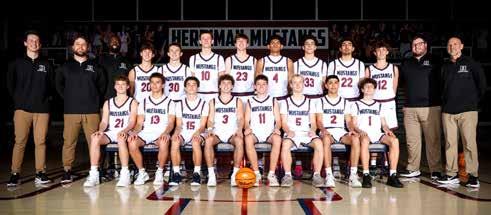
to be effective from three-point range and do a better job of defending opponents. Through 16 games, the 9-7 Mustangs had made 133 shots from behind the three-point line, good enough for 8.3 per game. Leading the way in three-pointers for Herriman at this stage was freshman Xavier Mulford with 35. Senior Carlo Mulford was right behind with 20 three-pointers. The duo of Carlo and Xavier paced the team through 16 games in scoring with 18.3 points and 11.4 points per game, respectively.
“Our team’s strength is our ability to shoot the three-pointer,” Meacham said. “We have a group of guys that can make shots. I’m hoping we can keep learning to trust each other and trust our player movement and ball movement on offense and then be committed to team defense.”
Meacham loves having the Mulford brothers lead the team. Both have been productive at both ends of the court and create difficult matchups for opponents.
“Both of these guys have put in a lot of time to earn the right to have some big games,” Meacham said. “They are our main ball handlers or point guards. Their job is to facilitate and put pressure on the opposing team’s defense, creating shots for themselves and others.”
Other key contributors this season have been Stone Tia, a junior guard-forward who is scoring just over 10 points a game, along with senior guard-forward Cy Arnell, who averages 6.6 points per game and leads Herriman with 6.1 rebounds an outing.
Many big games await Herriman, but Meacham is confident that his team can compete and finish strong. The team has improved throughout the year, and Meacham’s biggest hope is that the Mustangs are at their best once the postseason state tournament begins.
“Our goals are to be playing our best basketball in February and have a chance to compete in the state tournament,” he said.
To continue on a good trajectory to be
a factor in the playoffs, Meacham said the Mustangs need to do a better job of communicating on the court and trust one another more. Nothing will come easy for Herriman down the stretch as it seeks to finish among the top teams in Region and Class 6A. The Mustangs face every Region 2 foe twice. The regular season wraps up Feb. 13 at home with Westlake in a game that could go a long way in determining Herriman’s state tournament seeding. l


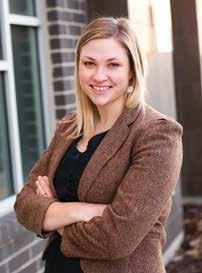
Salt Lake County is responsible for many of the region’s core public safety functions, including jail operations and serving as the behavioral health authority. About 74% of the county’s general fund budget is dedicated to public safety. As the government agency responsible for these essential countywide services, we regularly evaluate our systems to ensure delivery of better outcomes for people, public safety and taxpayers.
That responsibility is what led Salt Lake County to partner with Judge Steve Leifman and The Leifman Group, nationally recognized leaders in behavioral health and criminal justice reform. In Miami-Dade County, Florida, Judge Leifman’s work helped establish one of the nation’s most successful diversion models, the “Miami Model.” The model redirects individuals with serious mental illness from jail into treatment and recovery. That approach led to dramatic reductions in arrests and recidivism, a significant drop in the jail population—saving millions of taxpayer dollars while improving public safety and enhancing lives throughout Miami-Dade County.
Over several months last fall, Salt Lake County convened more than 100

leaders from across the state and region— including state leaders, city officials, courts, law enforcement, service providers, advocates and philanthropy— to learn from the Miami Model and identify ways to implement the model here at home.
This engagement builds on years of work already underway. In 2023, Salt Lake County partnered with the State of Utah and Salt Lake City to advance the Coordinated Homeless Services Plan. In 2024, Salt Lake County Mayor Jenny Wilson launched the County’s first five-year Human Services, Homelessness and Criminal Justice Reform Action Plan, prioritizing early intervention, service coordination and accountability across systems. We’ve also partnered with Salt Lake City on
the planning and implementation of their Public Safety Plan. These efforts reflect a shared understanding that fragmented systems lead to repeated crises—costly for families, communities and taxpayers.
The data drives the need for action.
Today, the Salt Lake County jail functions as Utah’s largest mental health provider. Roughly 34% of people leaving the jail exit directly into homelessness. Jail is among the most expensive—and least effective—way to address untreated mental illness and substance use disorders. Diverting individuals with serious mental illness from repeated, low-level incarceration into structured treatment and supervision is not about leniency; it is about accountability, public safety and using public dollars wisely.
Salt Lake County recognizes that simply replicating another community’s model is not what’s needed. Instead, the county is applying proven principles through a local lens—recognizing our specific responsibilities, what our population needs and what will work here. What has emerged clearly is the strength already present here: committed service providers, engaged public safety partners and a
shared willingness to align around practices that work. The Leifman Group’s recommendations focus on better coordination, improved crisis response and using shared data to guide decisions and track what’s actually working.
This work is also about leadership. Because Salt Lake County bears such a large share of public safety costs, we have a strong incentive to lead system improvement. Communities are safer when fewer people cycle through jail and our criminal justice system. Additionally, families are more stable, and taxpayer dollars can be reinvested into solutions that prevent crises before they escalate and that create lasting positive change.
At its core, Salt Lake County’s criminal justice reform work reflects a simple truth: when systems function better, outcomes improve for individuals and for the community as a whole. By leading with data, coordination and evidence-based solutions, Salt Lake County is working to improve public safety, support families in crisis, hold systems and individuals accountable, and ensure public dollars are used effectively for the benefit of the entire community.








TheFirst Amendment now comes with footnotes. Instead of promising not to abridge the freedom of speech, government officials are quietly redlining your opinions like a ruthless book editor holding a grudge.
The erosion of our First Amendment rights should wake you up like a five-alarm fire.
Banned Media. Reporters have been barred from the White House, kicked out of the Pentagon and have lost access to the press secretary’s office. A Washington Post reporter had her house searched by the FBI, relabeling journalists from “democracy watchdogs” to “people of interest.”
The president threatens the media licenses of organizations that don’t paint him in a flattering light. He’s sued networks for billions, ordered shows to be canceled and got Jimmy Kimmel fired. When millions of people canceled Disney and HULU, Kimmel was put back on the air, so I guess free speech can now be bundled with your subscription.
Banned Words. This melting pot we call America has outlawed diversity, equity and inclusion. That’s like taking the heart out of the Tin Man or the soul out of Hozier.
The Head Start early childhood programs were told to remove a list of 200 words in grant applications or the Death Star would blow up their facilities. Words like “belong,” “disability,” and “mental health” will get funding denied, so now applicants have to do an interpre-

tative dance, acting out “equality” or “diverse.” Government leaders go ballistic if we use pronouns or call a trans person by their chosen name, yet expect the entire country to salute the nonsensical renaming of the Gulf of America or the Trump-Kennedy Center. It costs nothing to respect someone’s pronouns, but rebranding the Department of War will cost taxpayers more than $1 billion.
Banned Books. Having a library card is now an act of defiance. Utah loves a good book ban because nothing prepares kids for real life more than hiding information that makes them feel uncomfortable.
Utah already ranks at the bottom of education funding, but yes, let’s make our kids dumber by discouraging them from learning critical thinking skills or empathy. Reading as exploration is forbidden. Curiosity becomes taboo.
But if kids want to read a book, they’ll find a way to read it. A ban adds extra enticement, like putting chocolate sprinkles on an ice cream

sundae. We’re all for letting 18 year olds carry a rifle into McDonald’s, but heaven forbid they read “The Hate U Give,” which talks about a teen affected by gun violence.
Banned criticism. The First Amendment gives us the right to criticize anyone, even the president. You can slap bumper stickers on your VW, write columns or even burn the flag.
However, professors are being fired for political beliefs, protestors are tear-gassed and shot, and university funding is cut unless courses fall in line with this administration’s doctrine. Freedom of speech is now an extreme sport.
Here’s what’s not free speech: incitement, threats, defamation, obscenity and perjury. The president has threatened talk show hosts, slan-
dered Democratic leaders and there’s strong evidence he’s perjured himself several times.
He is also protected under the First Amendment, but the president walks a Sharpie-thin line between free speech and hateful rhetoric. TrumpActionTracker.info documented 264 actions (as of Jan. 16) taken by the president and his administration during the last year to control information or spread propaganda. He’s all for free speech, as long as it’s only his.
History shows that free speech is as durable as steel, with the propensity to outlast those who violate it. The First Amendment doesn’t promise pleasant agreement but a safe space for necessary debate. Freedom of speech is not silent, and we shouldn’t be either.